THE 1994 CHINOOK CRASH — AIRCRAFT MALFUNCTION, PILOT ERROR OR INTER-INTELLIGENCE ASSASSINATION?

Diarmuid Breatnach

(Reading time: 4 mins.)

A group mainly of relatives of the deceased are seeking an official inquiry into the Chinook helicopter crash at the Mull of Kintyre, Scotland in 1994 killing 25 intelligence experts and four special forces crew on their way to a conference.

The crash wiped out almost all the top officers in command of intelligence gathering and operations in the occupied Six counties of Ireland from MI5, Army, RUC Special Branch and state Security Service.
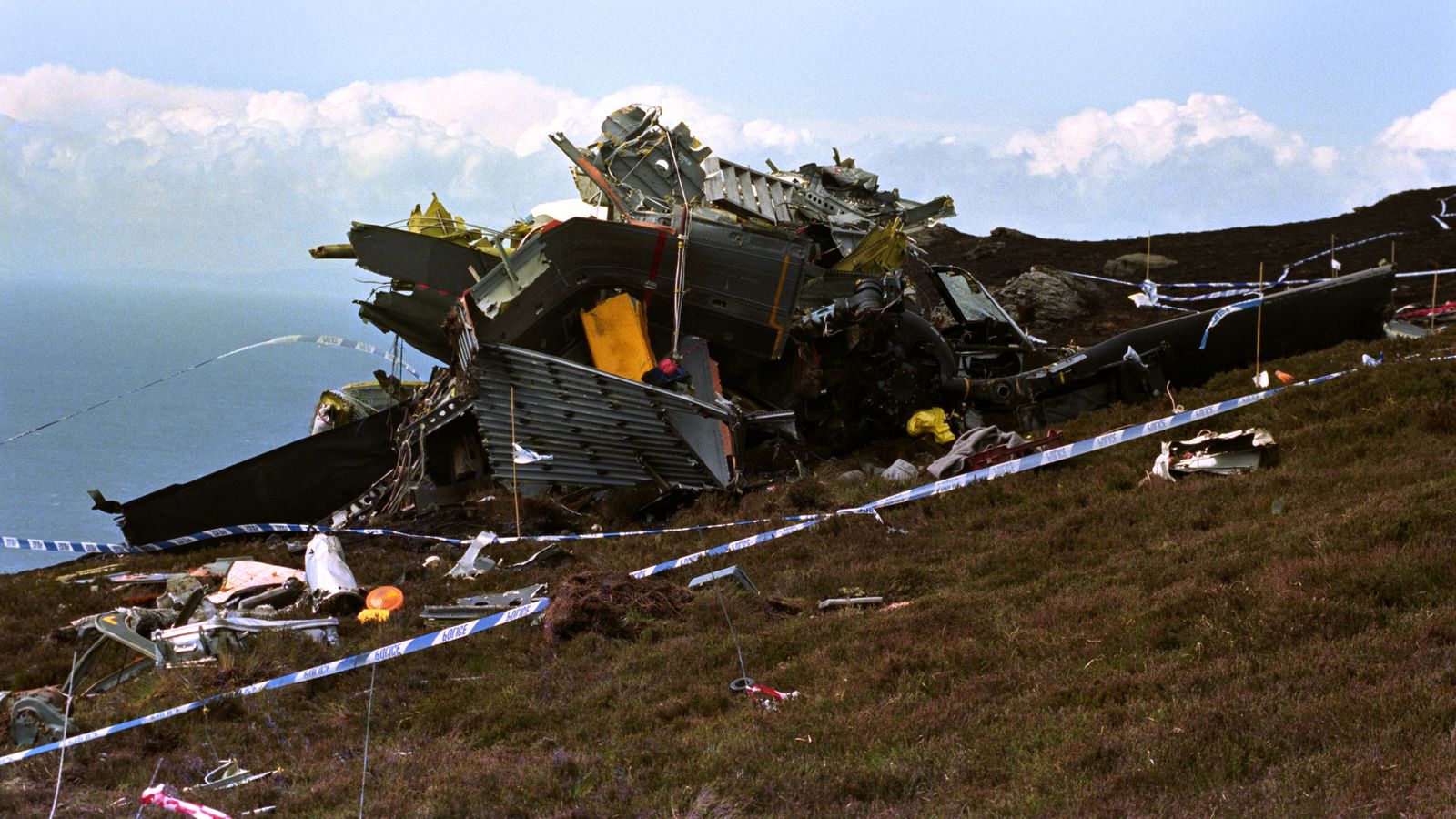
Photo of the crashed Chinook helicopter on the Mull of Kintyre 1994. (Photo: Sky News)

The first crash inquiry failed to confirm pilot error which was then overruled by State reviewers who blamed the pilots on the basis of supposition without any evidence. After campaigning by a number of people including families of the deceased pilots, a 2011 inquiry exonerated the pilots.

The current campaign wants to focus on questions as to the reliability of the aircraft but an alternative and darker interpretation developed at the time, alleging that the different departments of British spooks, MI5 and MI6 had a fatal falling out over territory and policy.1

The remit of MI5 is of domestic ‘UK’ matters while that of MI6 is external. However, the Six Counties, though being under the rule of the UK, was also geographically part of a foreign country, Ireland — and the Irish State, just across the border, a government foreign to the UK.

In addition, the Republican armed resistance groups frequently had contacts abroad and many people with connections to other resistance organisations in the world; both parts of Ireland were visited by representatives along with many media agencies in the pursuit of their reporting work.

Whereas a resort to assassination as a result of rivalry or difference in objectives between different arms of a state’s security service is no doubt extreme, the existence of the rivalry itself is quite likely and the stakes in terms of funding, staffing and operational management can be high.

If the rivals are working towards opposing ends, that will raise the stakes much higher. The secrecy of the State’s reaction to the event did nothing to dispel such theories and the mismanaged attempt to blame the pilots only lent added credence to such suspicions and belief.

The fact of the collusion of British secret service with Loyalist murder squads in the 6-Counties colony is well known and has been documented by a number of investigations. Such collusion from the Royal Ulster Constabulary, especially its Special Branch, is well known too.2

Quite a few familiar with the British colonial security forces in the Six Counties believe that there was an ‘inner force’ inside the RUC with the support of MI5 and British Army Intelligence, all colluding with or even managing assassinations and Loyalist sectarian murder gangs.

The British ruling class had set their sights on achieving the cooperation of the Provisionals in a pacification process and MI6 was in favour of this initiative. It is posited that MI5, the Inner Force inside RUC and Army Intelligence opposed this, believing that they could defeat the IRA.

It was the clash of these radically different approaches (albeit with the same ultimate objective of ending Republican armed resistance) that is believed by some to have culminated in the assassination of the anti-pacification section in the Mull of Kintyre crash.

We may never know for certain and the Ministry of Defence (MoD) sealed key files relating to the 1994 Mull of Kintyre Chinook crash for 100 years, locking them away until 2094

‘HEROES’?

Sorcha Eastwood calls those who died ‘heroes’,3 confirming herself and the Alliance political party she represents as on the side of British colonialism and its violent repression of Irish resistance, repression in the forms of internment, no-jury trials, assassinations and sectarian murders.

Those features are the reality of colonial repression and were very much in evidence in the colonial war of three decades which was approaching an end at the time of the crash.

The leadership of the Provisionals had accepted that although they could not be beaten, nor could they win the war4 and so were ready to participate in a pacification process.

British Intelligence had compromised or recruited elements of that leadership at highest and medium levels and had targeted assassinations of the less malleable individuals.5 The leadership was heading for the process culminating in the Good Friday Agreement of 1998.

Up to 3,500 people had died violent deaths 1969-1994 as the hands of of British military, colonial police, colonial proxies and Irish Republican resistance.

There were no tears shed for the dead at Mull of Kintyre among the subjected population of the colonial entity nor in many quarters of the Irish community at home or abroad and resistance culture soon produced a dark mocking parody to the air of Paul McCartney’s ‘Mull of Kintyre’ song.6

Confirmed assassination and suspicious deaths by aircraft crash are not unknown, among UN Secretary-General Dag Hammarskjöld’s 1961 plane crash on his way to negotiate peace in the Congo,7 General Zia-ul-Haq8 and commander of Russian mercenary force Yevgeni Prigozhin.9

end.

Note: If you found this article of interest, why not register with Rebel Breeze for free, so that you will be notified by email of subsequent articles. You can de-register any time you wish.

FOOTNOTES

SOURCES

https://www.breakingnews.ie/ireland/truth-being-withheld-over-raf-chinook-disaster-families-say-1907193.html
https://www.theguardian.com/uk/2000/jun/14/northernireland.comment

1What is more often but inaccurately called ‘the Irish peace process’; inaccurate because it was not designed to address the underlying reasons for the conflict and approaching three decades later has not done so. It resulted in The Good Friday Agreement, signed in 1998.

2See for example the Stevens Inquiries, Barron Tribunal, Dirty War by Martin Dillona (1990), also Lethal Allies (2013) by Anne Cadwallader.

3https://www.breakingnews.ie/ireland/truth-being-withheld-over-raf-chinook-disaster-families-say-1907193.html

4The war against a major imperialist power was concentrated in a territory one-sixth of Ireland and with a population divided along sectarian lines.

5See the cases of Denis Donaldson and Scappaticci (British Intelligence code name Stakeknife) for example and there are well-founded suspicions of a number of others that were never publicly exposed. See also the elimination of Volunteers Jim Lynagh and Padraig McKearney and their unit in the Loughgall Ambush/ Massacre.

6‘Mull of Kintyre, oh Brits falling into the sea’ etc

7https://www.un.org/en/delegate/63-years-later-mystery-still-surrounds-death-dag-hammarskj%C3%B6ld

8https://www.latimes.com/archives/la-xpm-1988-08-25-mn-1417-story.html

9https://www.theguardian.com/world/2023/oct/05/hand-grenade-explosion-caused-plane-crash-that-killed-wagner-boss-says-putin
“Oh. My. God!”

Diarmuid Breatnach

(Reading time: 5 mins.)

That’s what she wrote — in response to a political statement I had written. And it was funny — but at the same time an expression of the gulf that separates people like her not only from people like me – but from reality too.

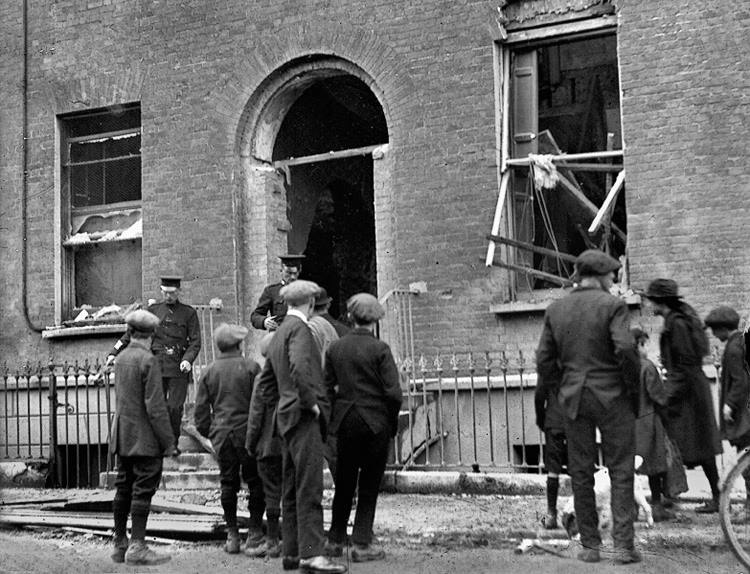
Her comment on a FB post was that the PSNI are not the same as the RUC, to which another woman had replied that the uniforms and the name are different but that’s all, the essence being still the same.

In turn, herself above had replied that anyone who thought that, didn’t understand the current realities and what the whole peace process is about.

To which I replied that I too agreed that all that happened was that the colonial gendarmerie had changed its name and uniform and what the pacification process (because let’s call it what it was and is) is about is holding on to the colony while dismantling the opposition.

And then she made that response, the “Oh. My. God!” — and quoth no more. I laughed but also recognised that her response, from her point of view (apart from the appeal to a nebulous deity, which I take as just an idiom to express shock), was entirely logical.

No, not her political position, which is entirely illogical – but her reaction, from where she stands, away on the other side of the chasm between us.

(Photo sourced: Internet)

AN UNBRIDGEABLE GULF BETWEEN WORLDS

She recognises the gulf that separates her world from mine and knows straight away that there is no bridge to cross it. There is no point in debate, not only because I may not be easily overcome in argument but because we don’t even agree on the reality of the world.

By which I mean the economic, political and philosophical reality of the world of humanity, rather than the physical world of gravity and weather.

In her world, I’m guessing, admittedly there were some horrible injustices in the history of “Northern Ireland” and then there was a horrible war which made things worse and now everything is changed (even “utterly”, perhaps!) and going in the right direction.

To call the “Northern Ireland” entity a colony is shocking to her, though she knows some people probably think that.

Seeing reality is useful for getting around but it can be very uncomfortable too. The Six Counties is of course a colony, taken by force and maintained by force since 1921.

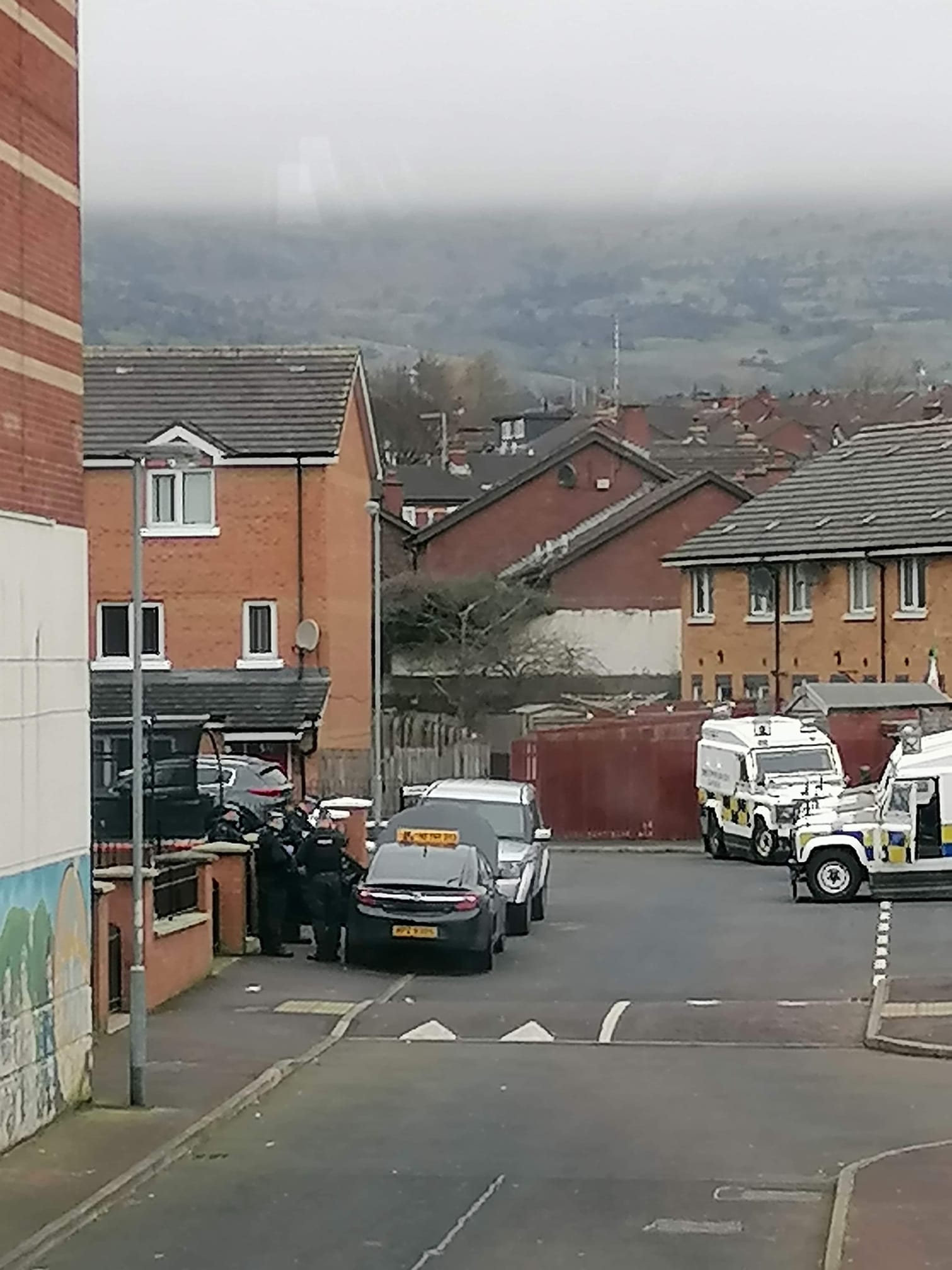
PSNI raid and arrest of a pregnant woman in the Bone (‘nationalist’) area of Belfast March 2021 — this led to riot (Photo sourced: Internet)
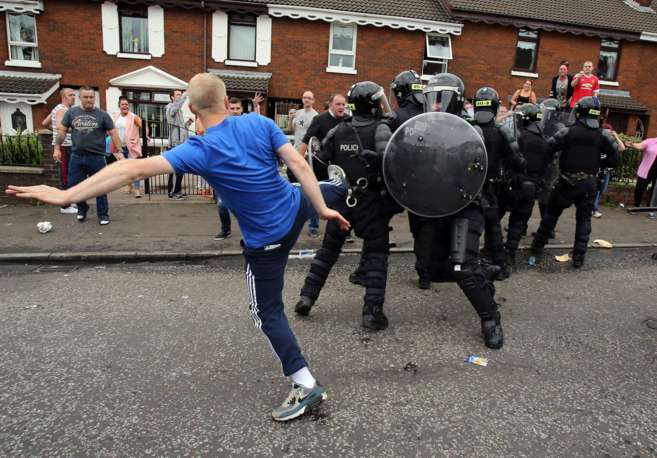
Residents objecting to PSNI in riot gear invasion of Roseapenna Street (‘nationalist’), West Belfast, August 2015 (Photo sourced: Internet)

The whole of Ireland was a colony even when it had its tiny minority parliament1 and it continued to be one when that Parliament, under massive bribery, voted to abolish itself in 1800 without the vast majority of the population in Ireland, native AND planter, having any say in the matter.

When the level of anti-colonial struggle in Ireland rose to a certain level and the rulers of the UK were beset by difficulties on most sides, a deal was done with an Irish client bourgeoisie and the country partitioned.

Whatever the status of the Irish State thereafter, the status of the Six Counties was clearly that of a colony. That is and was so, regardless of whether it is sectarian or not, whether there are civil rights or not. It is part of our nation held for the Crown by force of arms.

Those arms were again very much in evidence during the fairly recent 30 Years’ War – in the hands of the formal British Army, formal colonial police and informal proxy murder gangs.

And yes, the PSNI today is an armed colonial police force – and it would be that even if it had no history, if it were created today. But as it happens, it does have a history. It is a variant of the Royal Ulster Constabulary. And the RUC was a variant of the Royal Irish Constabulary2. And the RIC was a gendarmerie.

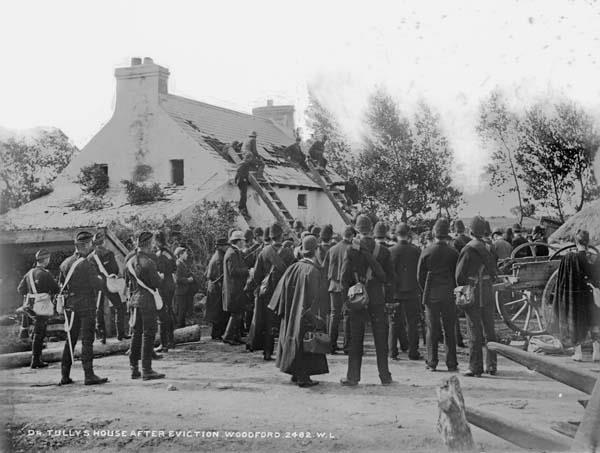
RIC and British soldiers supporting an eviction in Galway during the Land War (Photo sourced: Internet)

A COLONIAL POLICE FORCE WITH A LONG HISTORY

Perhaps my opponent has heard the term before. Maybe she associates it with Turkey … or even with the Spanish state. But such things belong to foreign and authoritarian states, right? Couldn’t possibly be to do with here!

States that have conquered nations within them, resisting from time to time, or regions that are otherwise difficult to manage, need to control them by army or police. The first becomes problematical over time and the second needs to be coordinated from the centre, not mainly local.

The solution some states have found is to have a central quasi-militarised police force: the Guardia Civil of the Spanish State, the Turkish Gendarmerie, the Caribieneri of the Italian State, the French Gendarmerie.

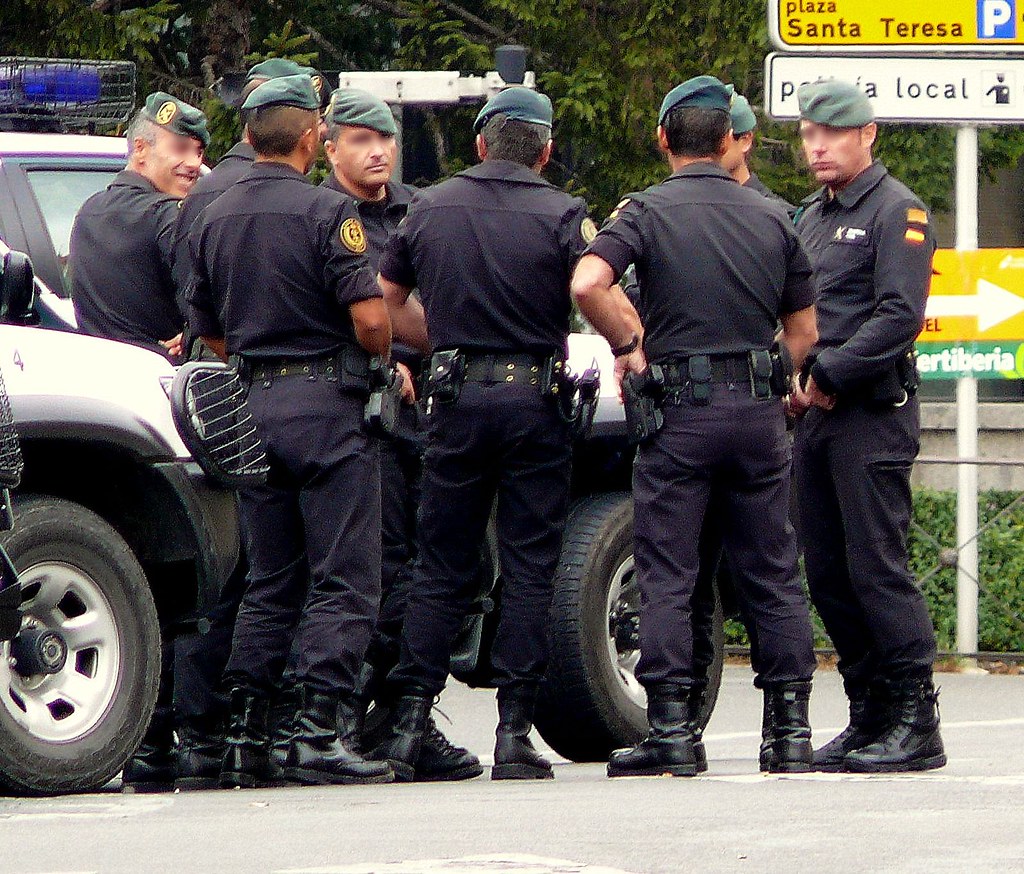
Gendarmerie of the Spanish State: Guardia Civil in modern uniform (Photo sourced: Internet)

These forces typically live in barracks and are directly answerable to the central State. The Royal Irish Constabulary was such a gendarmerie also. And nothing like it existed in Britain.

It was a colonial armed quasi-militarised police force to spy on and suppress the Irish by force.

What was left of the RIC in Ireland became the RUC after Partition and the RUC became the PSNI after some reforms. They don’t live in barracks but they do sally forth from them and they are armed – still keeping ‘the natives’ down since 1836.3

All-Ireland gendarmerie Royal Irish Constabulary in front of their barracks, King Street, Dublin, viewed by local people after a Republican forces attack during the War of independence 1919-1921 (Photo sourced: Internet)

PACIFICATION FOR NORMALISATION

Then there was my shocking description of the role of the ‘Process’ that she described as for peace and I for pacification. She is shocked even by the title I give it, a title suggesting it is not about justice but rather about maintaining control, by trickery or violence.

And I actually stated that is its purpose! Oh. My. God indeed!

Any process which starts from the basis of normalising the colony is doing just that: normalising the foreign occupation of a part of the nation taken by force and which has never been accepted by the conquered population. It is “about is holding on to the colony”, as I described it.

But what is fundamentally abnormal can never be normalised.

That attempt requires pacification, by repression and coercion or by deception – or by a combination of both. The Occupier has used all but, since the late 1990s, mainly deception. The masking and twisting of reality, the blowing of smoke in eyes.

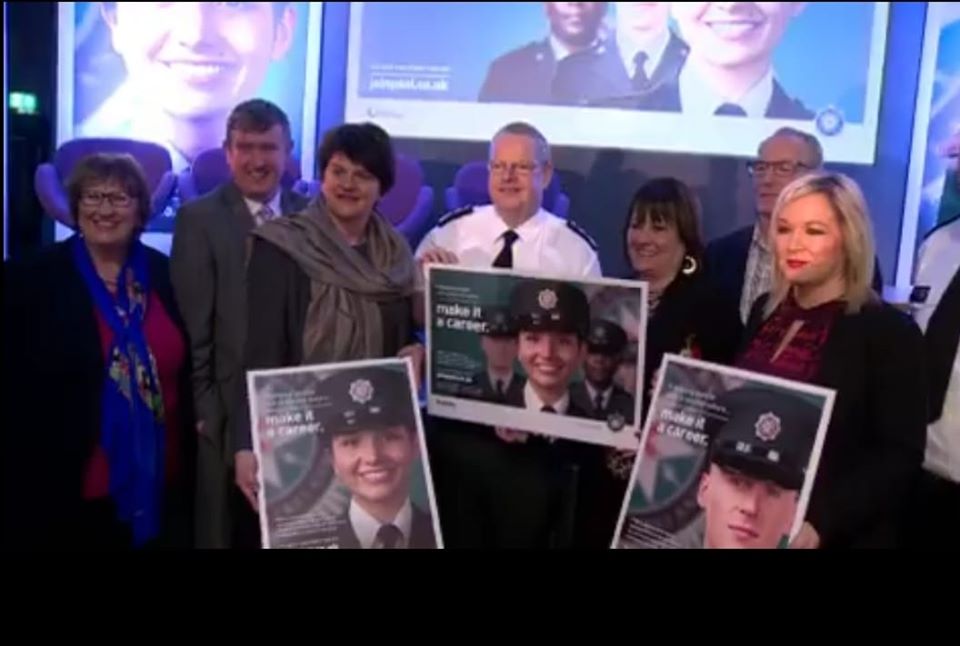
“Join the British Gendarmerie!” Recruitment drive for the PSNI supported by Unionists and Sinn Féin, February 2020 (Photo sourced: Internet)

Who is fooled? Mostly, those who want to be, some who see a workable future in the colony, under occupation.

The other deluded ones are those who are being deceived by their leaders, the latter who have given up not only the arms but any kind of struggle other than climbing into the elite.

Ultimately, the reality is so obvious that the deception is only possible when the deceived help it along themselves. Why do that? Because it’s comfortable, or seen as an alternative to hopelessness, or less frightening than the alternative – revolutionary struggle.

Oh. My. God! Yes indeed.

And yet we say, we who look at the reality, in the face of those who deny it, as Galileo is said to have muttered to his persecutors, who denied the world moved around the sun (rather than the reverse): “Eppur si muove”(“And yet it moves)”.4

We might also say, whether some find it shocking or just uncomfortable, something more mundane: Est quodcumque est. (It is what it is.)

end.

FOOTNOTES

1At various times Catholics were excluded from voting for representation in the Parliament and at all times from the Reformation onwards barred from being elected to the body or from holding high office. The vast majority of the Irish population were Catholics. Protestants other than Anglicans suffered discrimination too but not to the same degree.

2The PSNI themselves recognise that history – see https://www.psni.police.uk/about-us/our-history/history-policing-ireland

3And they got the “Royal” in their name in 1867 for their role in suppression of the Fenian rising that year.

4Galileo di Vincenzo Bonaiuti de’ Galilei (15 February 1564 – 8 January 1642) was an Italian astronomer, physicist and engineer. He publicly ascribed to the theory of Copernicus before him that the sun’s position is static with the Earth revolving around it (heliocentrism) which had been attacked by the Protestant religions as contradicting the Christian Bible (Old Testament). But it was the Catholic Inquisition of which Galileo fell foul, firstly in 1616 when he was instructed not to hold that opinion. In 1633 he was forced to recant it after a long trial and lived under house arrest for the rest of his life.

SOURCES

Gendarmerie: https://en.wikipedia.org/wiki/Gendarmerie

RIC: https://en.wikipedia.org/wiki/Royal_Irish_Constabulary

BERNADETTE TAKES ON THREE AND WINS

Introduction by Diarmuid Breatnach

The right-wing patrician UStater William F Buckley (despite the Irish surname) and two dogs, one of them the imminently slappable racist Tory Roger Evans, take Bernadette Devlin (now Devlin-McAlliskey) on and she wipes the floor with them. She was a month short of 25 years of age when she sat this interview in late March 1972, without any notes to hand, keeping up with the arguments, never losing her temper, reeling off historical facts and financial figures. It was a stellar performance.

Even more remarkable, not two months had passed since the Paras had shot 26 unarmed marchers in Derry, murdering 14 men at a march she had herself attended and, though then an MP, she had been refused permission to speak on it in the House of Commons, while lies were being stated by people who had not been there. Also, her interview took place only a month after the travesty of an inquiry into the murder by Lord Widgery who completely exonerated the gunmen and their officers, maintaining they were acting in self-defence against all evidence except the soldiers’ and Widgery even claimed a march of at least 30,000 was at most around 3,000! It seems that there must’ve been an agreement not to mention Bloody Sunday, perhaps as a condition for the interview, otherwise what else can explain its omission?

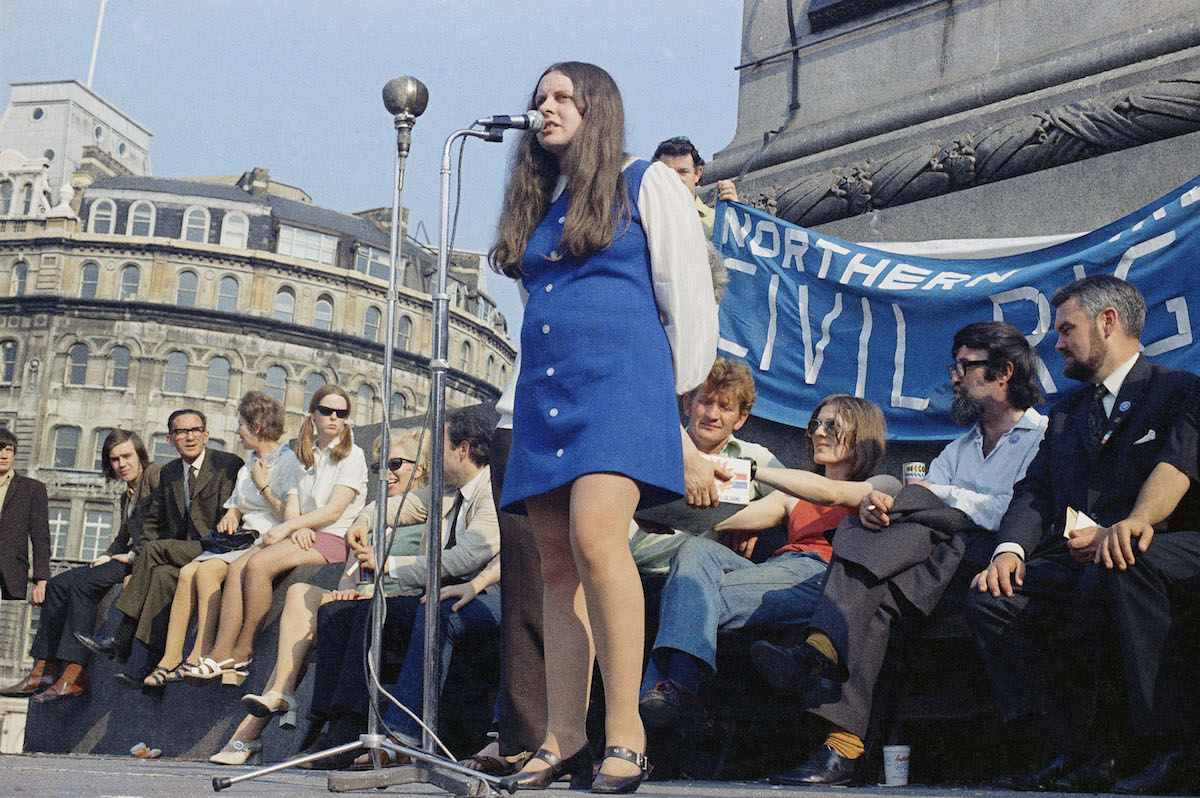
Bernadette Devlin, Member of Parliament for Mid-Ulster, speaking at a rally in Trafalgar Square, London, on June 1, 1971. (AP Photo) (Note: Trafalgar Square was later banned to Irish solidarity demonstrations for decades).

Bernadette came out against the Good Friday Agreement when it was born, not pushing armed struggle as an alternative but stating that the GFA institutionalised sectarianism and because she accused the Provos of seeking alliances with the Right and capitalism rather than with the Left and the working class. She would have been a powerful voice against the GFA and could not be accused of being in a ‘dissident’ armed group but the British State held her daughter Roisin, who was pregnant, hostage and Bernadette stepped back from that issue. She was marginalised by the Republican movement in the 1970s and 80s, along with being shot 14 times in front of her children (her husband shot too) in 1981 and lost to us as a national leader again in the first decade of the GFA.

Watching this discussion brings back to mind all the economic and political issues that were around at the time, especially as Bernadette reels them off, many of them largely forgotten. All the fudges and lies of British governments avoiding doing anything fundamental to improve things even within an illegitimate colonial context.

End.

Bernadette Devlin McAliskey Versus William F. Buckley Jr