Can you tell which of the clovers growing wild in Ireland is the genuine Shamrock (Seamair óg)?
Now, while it is still in bloom, is a good time to spot the plant, the smaller leaves and the yellow (buí) flower on it is what really distinguishes it from its clover cousins, with their bigger leaves and flowers in white (S. Bhán, T. repens) or pink-red-purple (S. Dhearg, T. Pratense).
How do we know that the Seamair Bhuí (Lesser clover, Trifolium dubium) is the genuine “shamrock”? Well, perhaps we can’t be certain but in the 1890s out of a survey of opinions of people in a still quite traditional Irish society, T. Dubium emerged as the first choice.
The shamrock, Seamair Bhuí/ Trifolium dubium/ Lesser trefoil, about real size, photographed in Dublin city with grass growing through it. (Photo: D.Breatnach)
Amateur botanist and zoologist Nathaniel Colgan (1851-1919) asked people from around Ireland send him specimens of what they believed to be an Irish shamrock, of which the two most common were the yellow clover followed by the white.1
A hundred years later, Dr Charles Nelson repeated the experiment in 1988 and found that yellow clover was still the most commonly chosen.2 According to Wikipeida, the yellow clover is the species nominated by the Department of Agriculture as the “official” shamrock of Ireland.
If you want to pick your own for St. Patrick’s Day, you’ll need to learn to identify it by its leaves because in Ireland it won’t be flowering in March. However, you can spot it now by its flowers and get a mental picture of the size of its leaves to retain in your memory.
THE IRISH AND THE SHAMROCK
What is it with the shamrock and the Irish anyway? The children’s fable of the Christian missionary Patrick using the leaf to explain the Christian Holy Trinity is just that, a fable, although repeated in one of the Wikipedia entries for “shamrock”.
Neither the Celts in general nor the Gaels in particular needed anyone to explain a three-in-one deity, since they had their own pagan trinities (Éiriu, Fódlha, Banba; the Mór-Righean/ Morrigu). Researchers have found no reference to any importance of the shamrock prior to 1681.3
Patrick himself, in what is considered his genuine autobiographical Confessio, never mentioned the shamrock once. My suspicion is that the shamrock-Christian-Trinity fable was fancifully created either by British settlers such as botanist Caleb Threkeld or by native Irish Christians around 1726.4
Although a few sources on line have claimed medicinal properties or druidic use for the shamrock, they never quote the actual original sources which may indicate that the references are undependable or obscure, if they exist at all.
Interestingly, writing a little before the 1798 Rising, Drogheda Presbyterian and United Irishman John Sheil used the shamrock as a reference for a different trinity, i.e that of Catholic, Protestant (Anglican) and Dissenter (all the non-Anglican Protestant denominations).
“ ….. the three-leaved plant …. It is three in one To prove its unity In that community That holds with impunity To the Rights of Man.”5
However, green was the colour of the United Irishmen and at times of repression by the occupation forces and the Loyal Orange Order, a sprig of shamrock on St. Patrick’d Day could be a useful way of indicating resistance while also claiming it was a harmless obeisance to a Christian saint.
Nevertheless, even wearing it on St. Patrick’s Day might have been dangerous in some quarters as when TheWearing of the Green reported, in reference to the shamrock, that
“… It’s the most distressful country that you have ever seen For they’re hanging men and women for the wearing of the Green.”
5The Rights of Man, by John Sheils. The air to which it is most commonly sung is that of the Irish Language song Eanach Cuain/ Anach Cuan but I have composed an original air for it and sing it a little faster than the song about that boat sinking tragedy.
Many people know that March 17th is St. Patrick’s Day, a national holiday in Ireland and a public holiday in some other places in the world where the Irish diaspora has had an impact1. But why? And why the shamrock and the colour green?
The Christian Saint Patrick, an escaped Welsh slave of the Irish returned as Christian missionary to Ireland is credited with the main role in the conversion of the Irish from their pagan religions to Christianity. As such, he is revered by the Catholic and many Protestant churches.
Unlike many places in Europe, the conversion seems to have been largely peaceful with no evidence of the fire and sword by which it was imposed on many other lands. Perhaps because of this, Irish monks recorded much of the rich mythology and legends of pagan Ireland.
But there is absolutely no historical reason to associate Patrick with the shamrock. The claim that he used it to demonstrate the three-in-one of the Christian Trinity is a fable and copies of his Confessio, widely accepted as Patrick’s authentic autobiography, do not mention it.
Reference to this fable is not recorded until centuries later but a much more convincing argument against its veracity is that pagans had many deistic trinities and the Irish were no exception, among which the Mór-Righean goddess2 in the Táin saga3 is the best remembered.
In fact, there seems little reason to believe that the druids favoured the shamrock either and searching the internet years ago threw up no references at all until more recently one reference only surfaced that gave no source for its claim.
So, no authentic reason for the shamrock – but what about the colour green? It turns out that the association of the Irish with the colour green is historically recent also, with blue having an earlier association. Even today only one of the four provinces, Leinster, has green on its flag.
A similar flag to the Leinster one, a golden harp on a green background was first flown and introduced by Eoghan Rua Ó Néill to the Catholic Confederacy, the Irish and Norman settler alliance against Cromwell and the English Parliament in 1642.
A number of versions of Harp and Crown on flags followed but the first mass Irish Republican organisation, the United Irishmen brought the Harp without the Crown back on to a green background for their flag, with the motto “it is newly strung and shall be heard” next to the harp.
The United Irish emblem; the harp was reproduced in gold on a green background for the flag. (Image sourced: Internet)
John Sheils, a Drogheda Presbyterian and United Irishman, in his aisling-style song The Rights of Man composed sometime before the 1798 Rising, brought the icons of a female Ireland, the Harp, colour Green, St. Patrick and the shamrock together in his call for unity against England.
Alluding to “the three-leaved plant” Sheils has St.Patrick declaim that “it is three in one, to prove its unity in that community that holds with impunity to the Rights of Man.”
The “three in one” is an obvious reference to the unity of “Catholic, Protestant and Dissenter4” sought by the United Irishmen and vocalised by Wolfe Tone among other leaders. However, there is no evidence of wide-scale use by the Unitedmen of the shamrock to signify that unity.
And the green may have been inspired by the colour which Camille Desmoulins called on Parisians to wear in their hats as a sign of revolution two days before the storming of the Bastille in 17895, though they soon chose blue in emulation of the American Revolution.
The failure of the United Irish risings in 1798 and 1803 was followed by severe repression, reflecting the fear of the Crown and its loyal settlers of losing its Irish colony. The weak Irish Parliament was abolished by bribery and Ireland became a formal part of the United Kingdom.
The Wearing of the Green
As a Christian festival, St. Patrick’s Day might have seemed an innocuous feast day, acceptable to ruler and ruled, therefore safe to celebrate and wearing the shamrock as something innocuous.
It seems likely to me that in an atmosphere of wide-scale repression, people of Irish Republican sympathies might well choose to wear green in public at least one day a year, that being in the form of the shamrock on “St. Patrick’s Day.”
The song The Wearing of the Green references the repression following the United Irish uprising of 1798 with the lyrics “they’re hanging men and women for the wearing of the green” and “the shamrock is by law forbade to grow on Irish ground.”6
The Irish Republican Brotherhood, formed on St. Patrick’s Day 1856 simultaneously in New York, USA and in Dublin, Ireland, adopted the golden Harp on a Green background for their flag, though they also used the Sunburst, believed symbol of the legendary Fianna warriors.
(Image sourced: History Ireland)
The formation of the IRB, or “the Fenians” as they became known by both friend and foe, occurred in a time of huge Irish emigration, then overwhelmingly Catholic in religion and surpassing by far that of the mostly Protestant and Dissenters of the late 18th Century to the USA and Canada.
Waves of Irish emigrants followed those who managed to leave Ireland during the Great Hunger of 1845-1848. Whenever they went to an English-speaking country or colony, the Catholic Irish suffered discrimination from the White Anglo-Saxon Protestants settled there before them.
The Irish who formed a battalion to fight the USA’s second expansionist war against Mexico (1846-48) may have flown the green flag and harp; certainly they named their unit the St. Patrick’s Battalion and were known by Latin Americans as “Los San Patricios“.
St. Patrick’s Day in Exile
St. Patrick’s Day became one of celebrating Irish identity, more ethnic than religious, a way even of flaunting that identity in the face of their detractors and persecutors. The Irish fighting in huge numbers in the Union Army celebrated it during the actual American Civil War (1861-65).
In their first invasion of Canada in 1866, American Civil War veterans organised by a branch of the Fenians flew a green flag with a harp and, it is said, with the letters “IRA” on it, the first such use of the acronym in history.
Painting depicting the Battle of Ridgeway, Fenian invasion of Canada, 1866 – note the Irish flag (Image sourced: Internet).
After the War, the Irish in the US celebrated St. Patrick’s Day in mass parades with their Union Army veterans in their regimental uniforms, flinging their identity and their contribution to the USA in the face of their persecutors, not only the highbrow WASPs but the nativist “Know Nothings”.7
Irish convicts in Australia celebrated the feast day in 17958 and, since sentenced 1798 and 1803 United Irish were sent there in chains, likely celebrated often afterwards by them, as well as by subsequent political prisoners, Young Irelanders in 1848 and Fenians in 1867.
The Irish diaspora in Australia, who were maligned due to the opposition of many to fighting for the British Empire in WW19, marched in parade on St. Patrick’s Day in 1921 with WW1 veterans in uniform at the front,10 calling for self-determination for Ireland.
As an Irish community activist in Britain, there was never any question as to where I would be on March 17th – I’d be celebrating the feast day with the community in the event we’d organised, whether a parade or a reception.
During a time of IRA bombings and widespread repression of the Irish community11 in Britain there were some calls to abandon St. Patrick’s parades but I and others felt it more important than ever to hold them in public at a time when the community was under attack and we did so.
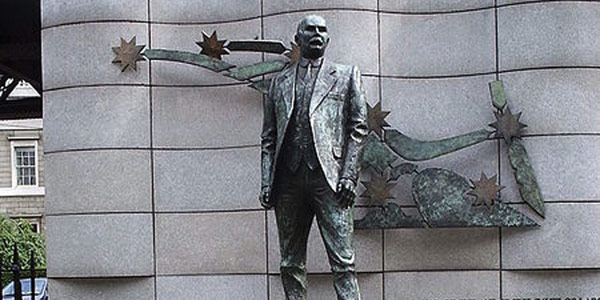
James Connolly must have experienced celebrating St. Patrick’s Day in his Irish diaspora community in Edinburgh, later as an immigrant to Ireland, again as an immigrant to New York and back again as an immigrant once more to Ireland.
James Connolly Monument, Beresford Place, Dublin. (Photo sourced: Internet)
In March 1916, a month before his joint leadership of the Rising for which he would be shot by British firing squad, Connolly wrote supporting the celebration by the Irish of St. Patrick’s Day.
“ … the Irish mind, unable because of the serfdom or bondage of the Irish race to give body and material existence to its noblest thoughts, creates an emblem to typify that spiritual conception for which the Irish race laboured in vain.
“If that spiritual conception of religion, of freedom, of nationality exists or existed nowhere save in the Irish mind, it is nevertheless as much a great historical reality as if it were embodied in a statute book, or had a material existence vouched for by all the pages of history.”
“Therefore we honour St. Patrick’s Day (and its allied legend of the shamrock) because in it we see the spiritual conception of the separate identity of the Irish race – an ideal of unity in diversity, of diversity not conflicting with unity.12”
He did not call for – and would have certainly repudiated — the celebrating of the feast day by a British Army unit wearing sprigs of shamrock or by Irish Gombeen politicians celebrating it with leaders of US imperialism.
Commenting on the reverse journey of that kind when President Reagan came to Ireland (amidst widescale Irish State repression of opposition) in 1984, Irish bard of folksong Christy Moore sang in Hey Ronnie Regan:
You’ll be wearing the greeen Down in Ballyporeen The ‘town of the little potato’; Put your arms around Garrett And dangle your carrot But you’ll never get me to join NATO.
The Anglo-Irish poet and Nobel Literature Laureate WB Yeats wrote about the colour green in reflection on the 1916 Rising: Now and in time to be, Wherever green is worn, Are changed, changed utterly: A terrible beauty is born.
It should be “terrible” only to the enemies of Irish freedom and self-determination, to imperialists, colonisers and their fascist and racist supporters but truly beautiful to all others.
In parting, let us come again to John Sheils’ 1790s words which he put in Ireland’s, Gráinne’s mouth:
Let each community detest disunity; in love and unity walk hand in hand; And believe old Gráinne That proud Britannia No more shall rob ye of the Rights of Man.
End.
Trifolium dubium, the Lesser or Yellow Clover, an Seamair Bhuí, top of the candidate list for the “shamrock” title. (Photo sourced: Internet)
Footnotes:
1Newfoundland in Canada and the Caribbean island of Monserrat. It is also the most widely-celebrated of all national feast days across the world.
2Usually rendered in English as “the Morrigan”, a trinity composed of three sisters, sometimes Badb, Macha (number of places named after her, including Ard Mhacha [Armagh]) and Nemain, at other times as Badb, Macha and Anand. They were sometimes represented as sisters of another triad, Banba, Éiriu (from which the name of the country Éire is derived) and Fódla. The triads may be three aspects of the one Goddess in each case.
3Táin Bó Cuailgne/ The Cattle Raid of Cooley, a part of the Ulster Cycle of stories, featuring the legendary warrior Sétanta or Cú Chulainn.
4Catholic (the vast majority of the Irish), Anglican (the tiny minority but reigning religious group) and the other protestant sects, in particular the Presbyterians, which had a much larger following than the Anglicans.
5The Unitedmen were greatly influenced by the French Revolution, of course.
6 The best-known version is by dramatist Dion Boucicault, adapted for his 1864 play Arragh na Pogue, or the Wicklow Wedding, set in Co. Wicklow during the 1798 rebellion (Wikipedia)
7‘Nativist’ gangs of earlier USA settlers that mobilised violently against the Irish and African Americans; when tried in court they claimed to ‘know nothing’.
9Such was the popular opposition that the British feared to impose conscription and instead held a referendum which voted not to have conscription. A second referendum failed again though by a smaller majority. Nevertheless many Australian volunteers were killed fighting for the British Empire.
10Of course such identification with the ‘new country’ of settlement may in itself be problematic, particularly should that country be or become imperialist, as has indeed been the case with the USA and with Australia (in subservient partnership with the UK and with the USA).
11Particularly from 1974 onwards until the community’s resurgence in support of the Hunger Strikers in 1981.
12Underlining mine, surely an appropriate message for these times.



 rebelbreeze