THE FLIGHT OF THE UNDERGROUND QUEEN

Diarmuid Breatnach

                                                          They had been preparing for this for some time. The infants were selected, received special care and food and were raised carefully in the Palace chambers inside the Citadel. They were now adolescents, maturing sexually. As the time approached for their great expedition, the tunnels leading to the departure terminal were widened and cleared of all obstructions. Experts tested the weather conditions daily and, when the majority of these were in agreement, the Queen gave the order to launch.

The adolescents took off then, a great host of them, amidst great excitement. Their pheromones, male and female, filled the air around them and those who could, which was most of them, quickly found a partner and coupled. It was a maiden flight from which the adolescent females would land no longer maidens.  

Those who would land, that is.  For suddenly the air was filled with giant flying monsters with huge eyes and giant whirring wings.  Much more accustomed to flight, these monsters flew among them, gobbling them up.  Some even held rows of their hapless victims in their huge beaks as they flew off to feed them to their young.  Hundreds, perhaps thousands of the little flyers perished in minutes. 

Those who managed to land safely and didn’t end up drowning in a lake or a river, or snapped by denizens of the deep who sprang up at them as they passed overhead, or caught in sticky webs, or who were not stamped carelessly to death by huge walking giants or flattened by roaring, stinking monsters, still had to contend with smaller predators on the ground. The casualty rate was huge but some made it alive – some always did.

The males who made it down to ground safely would all die within a couple of days. Their wings were only intended for their nuptial flight; on the ground, they were nothing more than a nuisance, impeding their progress over and underground.

The females, sexually sated and no longer interested, had left their male partners behind. They bit off their own wings, ate them and, quickly finding some reasonably soft ground, began to dig. Each one dug down as though her life depended on it, which of course it did; and not only her own life – each one was pregnant. Then she blocked the entrance to her tunnel, went back down it, excavated a chamber and began to lay eggs. It was completely dark down there but she had been reared in darkness – she had one day of daylight only, the day she flew.

The young grubs who hatched were all females. She supplied them with some sparse nutrition from herself and cared for them as they grew, shed skin, grew … until they spun a cocoon from which they emerged as very small worker ants. They were infertile workers and tended to their large mother, their Queen; even when they were fully-grown she was still one-and-a-half times their size, although about half the size she had been when she left her old nest. Her most recent meal had been her own wings the day she had flown and mated. If she got past this crucial stage, she would recover her size and weight and lay more and more eggs.  

The workers soon went up the tunnel, unblocked it and spilled out into daylight for the first time in their lives, beginning to forage for food. They found small seeds and, if they were lucky, sweet material such as soft-skinned ripe or rotting fruit. They soon had their surroundings covered with their hive-scent, carried by each and every worker. Sometimes they found insects they could kill but these had to be very small indeed – these workers had been fed on insufficient nutrition and were, compared to the majority of their kind, puny. If they found a food-source worth another visit, they left a specially-scented trail on their way back to their home, to guide theirs sisters back to the prize later. A rich source of food typically would show two streams of traffic between their nest and the food – one emptyjawed heading for the food and the other, with pieces in their jaws, heading away from it and towards the nest.  The food gathered by the workers fed them and their Queen, while she continued laying eggs.  As time went by, more and more workers were born, who would care for the hundreds of eggs their matriarch laid and raise more and more workers.  Extensive tunnel networks were dug.

At some point the workers found aphids and began harvesting their sugary secretions; tending them on the stems of the plants the aphids infested and carrying them down to their citadel but bringing them back up later. The workers would fight to protect the aphids from those who preyed on their ‘herds’.

Successive generations of ant workers grew bigger, until they reached the optimum size of five milimetres (still four millimetres short of the Queen in her prime). A well-established citadel could in time house as many as 40,000 individuals (although between four and seven thousand would be more common) – they, and previous generations, all daughters of the same mother and the product of one mating only. Their Queen, barring unusual disasters, might live to 15 years of age.

Once the citadel is built, it is vulnerable in the ordinary course of things only to parasites, flood, fire and severe surface disturbance. In Ireland, without bears, wild boar and largely without foraging pigs, severe surface disturbance is unlikely away from human construction or ploughing and digging. Fire might not reach underground but the heat generated or the lack of oxygen might kill anyway; flood, of course, would be the biggest threat. If a citadel should be uncovered or invaded by flood waters, some workers will rush to deal with the problem while others rush to save the young, trying to carry eggs, pupae or cocoons away in their jaws to a safe place. Some others will rush to do whatever they can for their Queen. A black ant defends itself by running away if possible and if not, by biting. But intruders to the citadel are swarmed by biting ants. However most human skin is impervious to the bite and this species does not sting.

Black Ant nest under a stone, disturbed. Ant larvae and pupae visible as the workers rush to take them to safety.

One day, perhaps three years from the Queen’s maiden flight, she will decide it is time to send her own children into the wider world.  She will lay eggs and have these emerging grubs fed special food, which will produce males for the first time in her citadel, as well as other fertile females besides herself.  Then, one day in July or in August, she will send them out too, to start new colonies.  

Lasius niger, the Black or Garden Ant, is the most common of the 21 species of ant in Ireland. It is the most common also across Europe and a sub-species, L. neoniger, is known in the USA where however, it is not one of the most numerous ant species. Lasius niger is a very active, hardy and adaptable species, living mostly outdoors under rocks and but rarely inside houses (although it may well enter houses repeatedly if it learns of food within, especially sweet food). In cities, its nests are to be found in parks and gardens but also under street paving stones, the workers emerging to forage from tunnels leading to the joints between the stone. When those joints are surrounded by thin lines or small heaps of bright sand in summer, one knows that the workers are clearing the tunnels for the adolescents’ flights. Another indication is an unusual amount of
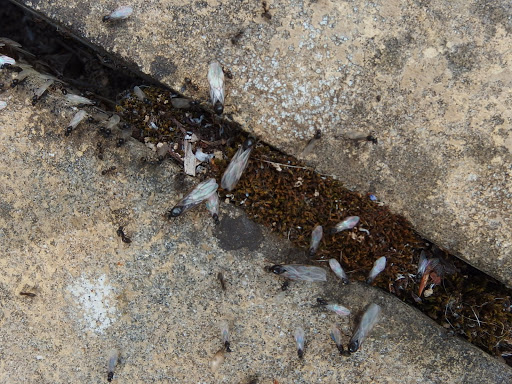
Black ants, emerging from under their nest. The larger winged ones are fertile and, if they survive, future queens. The winged males are much smaller and all are doomed.

seemingly erratic ant activity around a nest, though one would need to be aware of what normal activity looked like, for comparison. The ants may delay, awaiting what they judge to be optimum conditions but someday soon, mid to late afternoon, they will take to the air, to fly, to mate, to die or to live, to start a new population.

End

DARN IT


Diarmuid Breatnach

I no longer watch television at home. It was not a case of rejecting that form of mass media, as some assume, but the result of a tiresome tussle with the huge US-based UPC monopoly, out of which, not surprisingly, I came off worst – they control the aerial in my block of flats and I am not permitted to put up my own dish to receive through a competitor.

Anyway, I used to darn socks sometimes while watching TV, especially during advertisements. Radio would have been ideal but I have long ago lost the habit of listening to that medium. When I lost my struggle with UPC, I stopped watching TV; I could have watched it on my laptop but I find it unsatisfying to watch on a small screen. And when I stopped watching TV, I also ceased darning. The pile of socks with holes in them grew, to be mended “some day”, until eventually I had to buy new ones.

I am aware that for many in OLYMPUS DIGITAL CAMERAour society here today, darning would be considered a quaint or even archaic activity, associated with oil lamps and making your own butter, perhaps. Or cooking on a range and the absence of indoor plumbing. For others, darning might signify poverty or meaness. To me, it is about using and reusing what can be used, and about mending what can reasonably be mended to use again. Clothes, like all other items we use, are produced by human labour and it seems wrong to me to waste that labour unnecessarily – a kind of negation of the labour in the first place and, following that, a negation of the activity that might follow when the workers have produced enough of the items.

Of course, in our time and in this place, it is likely that the socks that I buy have been made in some sweat-shop in a more undeveloped country where, if they think about it at all, the sweated workers hope that we’ll go throwing away our socks as soon as the first hole appears, or even sooner if possible, so that they can continue to sweat producing replacements and being paid their meagre wages in order to pay for food, shelter and medicines. So that they can continue sweating and raise their children who, in turn, will become sweated wage slaves producing articles of clothing, undercutting the wages of those who might produce the same articles here, but who rightfully demand more humane working conditions, annual holidays, health insurance and the level of wages necessary to maintain an average standard of living. My darning my socks does not help, even in the tiniest way, the workers in those foreign sweated shops, nor the unemployed clothing workers in the country in which I live.


So why do it? I am not well-off by standards in this country but any amount I save by darning will make little difference. True, I was raised in a different time and I have imbibed some of the culture of that time (and also rejected much of it). But it is neither meaness, habit nor a perception of helping workers that causes me to think I should darn my socks, but a respect for labour. I am aware that practically all items we use were created by labour. I am aware that the power to create that material wealth has been, for centuries, appropriated by a parasitic class that many call capitalists. Before them, that labour power was expropriated by the feudal lords and their monarchs and before them, by the huge slave empires of Rome and Greece and of others outside Europe.

Darning wool & scissors

I aspire to a society where that labour power will no longer be expropriated and where the workers shall decide how that power is to be used, for the benefit of all. “The labourer is worthy of his hire” (Luke 10:7, King James Bible) but s/he is worthy of much more than that s/he is worthy to control all of her/his labour power and of the distribution of the wealth it produces. And so labour must be valued – not just some day in the future, I believe, but now. The new society takes form within the old, although it must destroy the old from which it was born and will, for a time also, carry some of the taints of the old. But it begins now, in the present – in my case, with me.

So the other day, although I still have undamaged pairs, I began to darn old pairs of socks. It was surprisingly restful. But after darning a pair, I fretted at the time spent on this, time spent away from other work, piling up. I darned one of another pair and put its companion and darning away materials away.  I will return to darning socks, a few at a time, on other days. Or, at least, I hope to.

End

THE SCENT OF INTRUDERS

Diarmuid Breatnach

 The inhabitants of this land have fought invaders for at least a thousand years, some successfully and some less so.  Many of the invaders were assimilated.  Throughout this time, other invaders have quietly entered and spread throughout the land, mostly without encountering any organised opposition.


Last month and perhaps occasionally since, your nose might have picked up a scent drifting towards you, particularly as evening drew near but also at other times.  The aroma I speak of is one of those scents that is difficult to describe and that actually seems to change from time to time and also according to whether one is right beside it or farther away.  Sometimes it seems musky and very pleasant while at other times is not so welcome.  

The scent may have been from the blossoms of the Cherry Laurel (Prunus laurocerus), a dense thicket-forming shrub that grows to small tree size with a strong thick trunk covered in a smooth dark grey bark.  It is neither a cherry variant nor a laurel (or bay), which its leaves supposedly resemble, these being thick and dark green but poisonous (containing cyanide).  The blossoms, white flowers clustered on upright spikes, produce blackish fruit in the Autumn about the size of cherries which are also poisonous to humans.  Originally from South-West Asia, it was introduced into Irish gardens as a shrub or hedge plant (uses to which it is still put) but it has “escaped” and established itself in the wild.

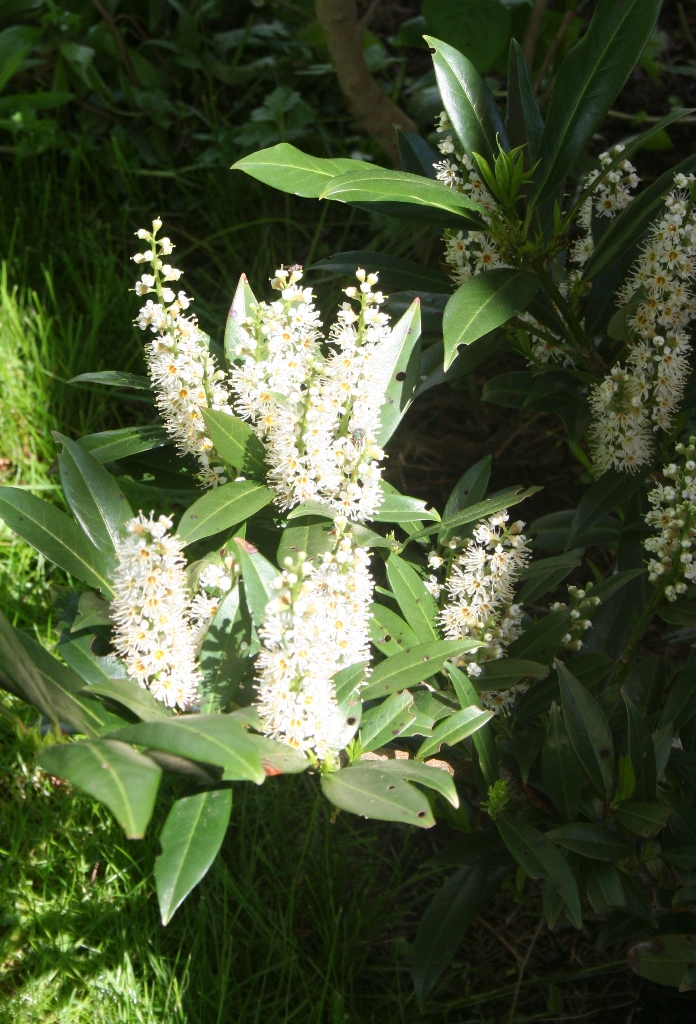
Cherry Laurel bush with flowering spikes in early stage

The Cherry Laurel has become very successful and a resultant problem for bio-diversity in Ireland. A quick perusal of the on-line references do not reveal the reason for its success; it tends to be grouped alongside another invasive species, the Rhododendron, which deposits a chemical in the ground surrounding it, thereby preventing other plant species competing with it for light, moisture and nutrients. Like the Cherry Laurel, the Rhododendron is a plant species invasive to Ireland.  Of course, since Ireland was almost entirely covered in ice 20,000 years ago, nearly all of the plant life now naturalised on our island had to have been invasive species originally — including trees, bushes, flowers, grasses, ferns …

Cherry Laurel flowering spikes at late stage

Invasive species are not always harmful to the existing balance (or to humans) but clearly they have to have some means of competing with the existing flora (plant life) or they would have been unable to establish themselves.  They may have better protection against herbivorous animals (undoubtedly the Cherry Laurel has at least that), or against insect or snail attack, or even against fungi (such as the ‘blight’ that attacked the potato a number of times in Ireland in the 1840s).  Or they may be able to occupy a niche not well exploited so far, as one of the Buddleida species has done (literally, one might say), growing out of thin gaps in stone or brick walls or on waste ground, its racemes of mauve or purple flowers attracting butterflies and other insects for pollination and later scattering its seeds on the wind.


The Luftwaffe helped the spread of the plant in Britain; so common did this shrub become on waste ground after the Second World War that it earned the popular name of « Bombsite Plant ». The species in question is Buddleia Davidii and according to The Online Atlas of British and Irish Florait was introduced into cultivation in the 1890s, quickly becoming very popular in gardens. By 1922 it was known to be naturalised in the wild in Merioneth and in Middlesex by 1927; it is shown as locally well established in S. England in the 1962 Atlas and “In recent decades it has spread rapidly throughout lowland Britain and, to a lesser extent, Ireland.” It is certainly ubiquitous in Dublin city and surrounds.

Buddleja Bush in bloom
Buddleia Bush in bloom
Buddleja davidii growing out of a wall
Buddleia davidii growing out of a wall

Buddleia (pronounced “budd-lee-ah) has about 100 species native to all continents except Europe and Australasia but a number of species and cross-breds are cultivated in European gardens, including the escapologist davidii. Although nearly all are shrubs growing to at most 5m (16ft) tall, a few species qualify as trees, the largest reaching 30m (98ft). There are both evergreen and deciduous species, not that unusual among trees and shrubs, as appropriate in tropical and temperate regions respectively. Some of the South American species have evolved long red flowers to attract hummingbirds, rather than insects, as exclusive pollinators.

Peacock Butterfly on a Buddleja raceme
Peacock Butterfly on a Buddleia raceme

In Ireland, far from hummingbirds, davidii’s racemes of tiny purple or mauve flowers are a welcome sight as they flower in July, less so as the flowers, having done their work, die and turn brown (though repeated dead-heading can extend flowering until September). The flowers are scented but less so than those of the similar but not closely-related Common Lilac (Syringa vulgaris) which, incidentally, is an aggressive coloniser in parts of Southern Europe and of the USA.  The roots of davidii will do some damage to house walls and chimney stacks if allowed to become established, when pulling them out becomes impossible and the stump would need treating with an appropriate chemical. Checked early, it is easily controllable.

Another successful wall climber in Ireland is the Red Valerian (Centranthus ruber), sometimes known as Jupiter’s Beard. Despite its common name, the flowers are often pink or even white and at times clumps of two or even all three colours may be seen growing alongside one another. This one likes the tops of walls rather than the sides and grows well on dry or stony soil too.

Its seeds are wind-driven too and from anecdotal evidence, it made particular use of the railway cuttings and lines to distribute itself throughout Ireland.

Red Valerian growing on top of a wall

Despite its name, it is not closely related to the true Valerian (Valeriana officinalis), and no medicinal properties have been discovered in Centranthus. The leaves and the root may be eaten but there seems to be no great lobby recommending it as food.  Its scent is rather rank to the human nose.

The three colour variations of Ceranthus Ruber growing closely together on rocky ground

Originally from S.W. Europe and the Mediterranean region, the plant was grown in Britain as early as 1597, according to Online Atlas of British & Irish Flora. Like some cases in human history, when the newcomers were first invited and then became invaders, Red Valerian was first imported to be grown in gardens. By 1763 it was recorded in the wild in Cambridgeshire. Now it is to be found all over Ireland and is generally welcomed. Like some of the invading Vikings, Normans and English, Red Valerian and Buddleja have become part of the Ireland we know today and there seems no need to organise a resistance to them; the Cherry Laurel and the Rhododendron, despite the scent of one and the colour of the other, are a different case altogether.

end


Some on-line sources:

Cherry Laurel

http://www.conservationvolunteers.ie/images/buttons/submenus/news_and_advice/downloads/naa_bpmg_rcl.pdf

Buddleja http://www.brc.ac.uk/plantatlas/index.php?q=plant/unmatched-species-name-392

http://en.wikipedia.org/wiki/Buddleia

Red Valerianhttp://www.brc.ac.uk/plantatlas/index.php?q=plant/centranthus-ruber

METAL-DETECTING USING BAKED BEANS

IRISHMAN REVOLUTIONISES METAL DETECTION PROCESS

By our Science Reporter

Can Baked Beans
A new metal-detecting system has been developed which is revolutionising security detection, prospecting and archaeology.  Previous systems have depended on magnetism and have not responded well to non-ferrous metals.  The new system responds to all metals and, strange as it may seem, it functions through using baked beans in tomato sauce.

An Irishman developed the detection system after discovering the principle, like many great discoveries, through accident.  “I often prepare breakfast of baked beans on toast,” said Dublin man Diarmuid Breatnach.  “I noticed when I tipped a tin of baked beans into the pan for heating, that some of them remained stuck inside the can, even after vigorous shaking.  I began to wonder if there might not be an attraction of some sort between them and the metal.”

Metal Detector
The Garrett Ace 150 metal detector, at the lower price range of conventional detectors, sells at €199. The new bbp (baked bean principle) detector however is currently selling at around half the price.

The idea kept going around in Breatnach’s head until he decided to test it out.  “In a friend’s garage, we ran a series of tests and discovered that yes, indeed, baked beans in tomato sauce are attracted to metal.  And we discovered that they worked with many different kinds of metals – steel, obviously, but also aluminium, copper, zinc, tin, silver and alloys like brass and bronze.  We didn’t have any large enough surfaces of gold and platinum to test – they have to be several millimetres across to work – but we thought it would work for them too.”

The Dublin man then set about designing the machine that would employ this attraction for metal detection.  Using his skills learned in a former trade of fitter-welder, he constructed the first prototype and took out a patent on it.

“I went to a small metal-ware company on the outskirts of Dublin where I knew a guy and made a deal with the owner.  They produced a few models and then we went to security firms and some metal mining companies, the models worked great under test conditions and we got supply contracts.”

Now the factory, Schiessen Ltd, has expanded its workforce four hundred per cent and struggles to keep up with orders.  In addition, baked bean in tomato sauce production has soared, with attendant expansion in the cultivation of haricot beans and tomatoes abroad.

What impact have these developments had on Breatnach’s life?  “When I started, I was in default on my mortgage and the bank was about to seize my flat,” said the Dublin man.  “Those days are gone and I’m comfortable now.  But I never forget how it started and still eat beans on toast in the morning,” he says with a smile.

End item     

The Defendant — a short play

Diarmuid Breatnach

“We have had ‘stepping stones’ presented to us before in our history – they turned out to be stone walls.”

 (A revolutionary is on trial).

judge in full wig etc

Act 1.

Scene: A courtroom – Judge’s bench high, clerk at lower bench nearby, faced by dock, containing defendant and two guards, one at each side.  Long bench in front of dock containing Prosecution and Defence barristers or lawyers.

Judge:  Read the charges, clerk.

Clerk: The defendant is charged with treason, sedition, incitement to rebellion against the lawful government, conspiracy with persons unknown to incite discontent, unlawful assembly, obstruction of the highway and membership of an illegal organisation.

Judge:  Defendant, you have heard the charges?

Defendant:        I have.

Judge:  Address the Court properly.

Defendant:        I have heard the charges, Judge.

Judge:  The proper manner to address me is Your Honour.

Defendant:        I have heard the charges, Judge.

Judge:  I see.  Very well, let us proceed.  How do you plead to the charges?

Defendant:        Not guilty of any crime against the people.

Judge:  Clerk, enter a plea of “Not Guilty.”

Prosecuting Counsel stands up, approaches defendant in the dock.

Prosecuting Counsel:    You are against the Agreement?

Defendant:        I am.  It clearly does not deliver what we fought for, an independent united Republic.  In addition, I and some others fought for a socialist republic and it has not delivered that either.

Prosecuting Counsel:     You are aware that the electorate voted to accept the Agreement?

Defendant: Yes, but…

Prosecuting Counsel:    Just answer ‘yes’ or ‘no’.

Defendant:        Yes.

Prosecuting Counsel:     And do you believe in democracy?

Defendant:        Define ‘democracy’.

Prosecuting Counsel:     The will of the majority.

Defendant:        With suitable safeguards for certain minorities, certainly.

Prosecuting Counsel:     Yet you have admitted to undertaking actions against the Agreement, have you not?

Defendant:        I have.

Prosecuting Counsel:     You consider yourself above the will of the people, the majority, then?

Defendant:        No.  But I consider that I have a duty to act according to what is right and I can see clearly that the Agreement delivers nothing of what we fought for.

Prosecuting Counsel:     Yet the people voted for it.

Defendant:        The people were tired of war and repression and were lied to.  Many of our leaders betrayed us and brought many of our movement with them.

Prosecuting Counsel:     That is your interpretation.  Might it not be that your leaders and those of your movement who followed them were wiser than you?

Defendant:        No.

Prosecuting Counsel:     No?  You could not possibly be wrong?

Defendant:        I am not wrong on this.  The movement fought for a an independent, united republic.  We did not get it.

Prosecuting Counsel:     Your leaders and your movement – I beg your pardon, many in your movement – consider it a stepping stone.

Defendant:        We have had ‘stepping stones’ presented to us before in our history – they turned out to be stone walls.

Prosecuting Counsel:     So you would pursue a strategy of violence in the face of the clear will of the majority!

Defendant:        I do not choose violence.

Prosecuting Counsel:     You do not?  Have you not admitted earlier a statement attributed to you, that violence would be necessary to achieve a successful revolution?

Defendant:        Yes.

Prosecuting Counsel:     So you do choose violence.

Defendant:        I do not.

Prosecuting Counsel:     Pray explain.

Defendant:        I said that the history of classes and of imperialism shows us that no class has ever been permitted to overthrow the one above it by peaceful means; similarly that no nation has won independence from the state oppressing it without having to face violence.  It is the oppressors of the people who choose violence, not us.

But naturally, we should defend ourselves.  Anyway, it is hypocrisy for a state to accuse us of violence, when they have a long history of violence and are at this moment collaborating with others who are waging war and armed invasion of countries.

Prosecuting Counsel:     That is a different matter and not the concern of this court.

( Defendant mutters something)

Prosecuting Counsel:  What did you say?

Defendant:        I said ‘You would say that and anyway it should be the concern of any court of justice.’

Prosecuting Counsel:     This is a court of law and it is trying a case to decide whether you are guilty or innocent.  Let us proceed along another track.  Do you believe in dialogue?

Defendant:        Certainly.

Prosecuting Counsel:     Why then do you not use the Agreement as a basis for dialogue to achieve your aims?  Surely that is the democratic way?

Defendant:        I’d be happy to engage in dialogue as to the details of Britain’s withdrawal from Ireland.  I’d be happy to engage in dialogue as to the details of the capitalists handing over the wealth they have plundered from the people.

Prosecuting Counsel:  You would confiscate the property of businessmen?

Defendant:           That wealth was created by working people.  I would consider it one of the first tasks of a socialist government to confiscate the wealth of the rich, yes.

Prosecuting Counsel:     And ruin the country!

Defendant:        I consider that it is the imperialists and the capitalists that are ruining the country.  Our native industries are undeveloped or taken over by foreign monopolies.  There is wide-scale poverty, homelessness, ill-health, unemployment and emigration.

Prosecuting Counsel:     These are hard times internationally, yes.

Defendant:        Exactly.

Prosecuting Counsel:     What do you mean ‘exactly’?

Defendant:        The capitalists and imperialists internationally have caused these ‘hard times’ as you call them.  They grow richer while the people grow poorer.  The second is the direct result of the first or, if you like, the first is the cause of the second.

Prosecuting Counsel:     Let us take another track.  Do you admit that this present government was elected by a majority?

Defendant:        No.

Prosecuting Counsel:     No?  You do not?

Defendant:        No.  It gained an overall majority of parliamentary representatives.

Prosecuting Counsel:     Is that not the same thing?

Defendant:        No.  There are those who were eligible to vote but did not and those who voted for other parties but did not elect enough representatives.

Prosecuting Counsel:     You quibble.

Defendant:        I do not, those are facts and the figures will clearly demonstrate that this present government was elected by a minority of the electorate.  But even if it had been elected by the majority ….

Prosecuting Counsel:     Yes, please do continue.

Defendant:        Even then, it broke many important promises it had made prior to coming to power.  It has de-legitimised itself.

Prosecuting Counsel:     No party can carry out everything it promises ….. situations arise, measures have to be taken to respond ….

Defendant:        I agree that capitalist parties do not carry out their promises.  They need the votes of the people but represent the interests of a tiny minority.

Prosecuting Counsel:     Oh, please, spare us your socialist rhetoric!

Defendant:        I am attempting to respond to your questions.

Prosecuting Counsel:     You have encouraged sedition against the lawful government.

Defendant:        Sedition according to the laws of this state – capitalist laws.

Prosecuting Counsel:     Would you not agree that you are in a minority opinion?

Defendant:        On what?

Prosecuting Counsel:     In your political views.

Defendant:        I am in majority opinion that imperialist war is a bad thing.  I am in a majority opinion that poverty, homelessness, unemployment and emigration are bad things.  I am not in a minority opinion that the rich get richer while the poor get poorer.

But I do admit that I am in minority opinion as to the feasibility of the solutions I propose.  I admit that I am in a minority as to the confidence that revolutionary change is within our power.  In that I am in a minority – for the moment.

Prosecuting Counsel:     Ah, you believe that the people will see sense and support your ideas.

Defendant:        I wouldn’t put it quite like that but … yes.

Prosecuting Counsel:     A bit arrogant, would you not say?

Defendant:        Not at all.  In the history of this and many other lands, many thinkers and activists have been in a minority before their opinions became accepted by the majority.  Most accepted scientific opinion now was once that of a minority – indeed, often of a persecuted minority.

Prosecuting Counsel:     You consider yourself a persecuted minority?

Defendant:        My presence here and the charges are proof enough of that.  But one day we shall be a majority.

Prosecuting Counsel:     May the Court please, I have no more questions of this defendant.

(Prosecuting Counsel sits)

(All freeze)

Act 2.

 (All unfreeze)

  State Prosecution Counsel standing, summing up, addressing the Judge …………….

Prosecuting Counsel:        The Defendant has pleaded ‘not guilty’ but his own answers under cross-examination have belied that plea.  He has in effect admitted to treason, sedition, incitement to rebellion against the lawful government, conspiracy with persons unknown to incite discontent, unlawful assembly and obstruction of the highway.

The only charge to which he has not admitted is membership of an illegal organisation.  However, we have clearly shown from the evidence of the police and army witnesses that he is indeed a member of an illegal organisation.

The State submits that the case has been proven in all respects and asks for a verdict of  “Guilty as charged.”  In addition the State asks for the maximum sentence — the prisoner is a danger to society and totally without remorse.

 (Prosecution Counsel sits.)

(All freeze)

Act 3.

 (All unfreeze) ….

Judge addressing the Defendant ….

Judge:  Defendant, you have been found guilty as charged on all counts.  Do you wish to say anything before sentence is passed?

Defendant:        Yes.  I once again contend that I am not guilty of any crime against the people.  The actions I undertook were for the victory of my class, the working class, which entails the defeat of the local ruling class and foreign imperialism.  If I am guilty of anything, it is that I did not always work hard or competently enough for the cause.

Time and again, others like me have stood before your courts and of the British before yours and been sentenced to imprisonment or even death.  They faced it with courage and I will try to do the same.  I do not expect mercy and I will not ask for it.  I do not apologise for doing what I know was right.

But I tell you this: one day, it will be representatives of my class that will sit up there and it will be you down here to answer for your crimes.  I bid my farewell to comrades, family and friends and I ask them to forgive me for any way in which I have failed them.  And may my place in the ranks be filled by many more.

Judge:  Have you quite finished?

Defendant:        I have.

Judge:  You will be kept in custody while the court considers your sentence.  Guards, take the Defendant down.

Defendant is escorted out by guards.

Clerk (in muttered but audible aside to the Judge):  “Surely your honour is going to sentence him to death?”

Judge (whispering but audible):  “Possibly …. however, I need to consider what harm may be done by making a martyr of him.  Possibly some years in jail will have him forgotten more quickly …. and possibly break that arrogance of his too.”

(Loudly):  “Clerk, record the verdict and decision made here this day … 12th of January …. 1923, Irish Free State”.

(All freeze momentarily)

End.

RANT FOR MARGARETTA

RANT FOR MARGARETTA

(click on the title immediately above to access the video)
(A mobile-friendly version is also available, click on the author’s name below the video and the other version should show).

RAP POEM, VIDEO IMAGES WITH MUSIC IN PROTEST AT THE 3-MONTH INCARCERATION OF MARGARETTA D’ARCY, 79 YEAR-OLD ACTIVIST AND DRAMATIST, BECAUSE OF HER PROTESTS AGAINST THE CONTINUING USE OF SHANNON AIRPORT BY THE US MILITARY IN COLLUSION WITH SUCCESSIVE IRISH GOVERNMENT IN VIOLATION OF OUR NEUTRAL STATUS.

RANT FOR MARGARETTA

Diarmuid Breatnach

Forgive my confusion …

I was under the illusion …

or was it a delusion?

That we are a democracy,

not an autocracy

nor yet a plutocracy ….

That we citizens had the right

to decide whether a war to fight;

That we could choose with whom to ally …

Or was that all a cruel lie?

Listen now to the warning bell,

an Irish citizen in a prison cell;

Put there for taking a stand

against murder in foreign lands.

FREE MARGARETTA D’ARCY! FREE HER NOW!

FREE MARGARETTA D’ARCY! FREE HER NOW!

Well yes, it was all a delusion

and our government’s in murder collusion;

To murder planes turns a blind eye,

making accomplices of you and I!

Because the US is a superpower,

before them are we supposed to cower?

Are we to turn our hearts to stone,

to ignore the unmanned murder drones?

Surely not! Margaretta stands not alone —

we are of her blood and of her bone!

Listen now to the warning bell,

an Irish citizen in a prison cell;

Put there for taking a stand

against murder in foreign lands.

FREE MARGARETTA D’ARCY! FREE HER NOW!

FREE MARGARETTA D’ARCY! FREE HER NOW!

Our rulers fumble in a greasy till,

They never cared and never will:

Little women and little men,

Hucksters and middle men —

Believe me they don’t dither

to sell us out to the highest bidder!

Ach seo hé an scéal,

this is the story:
Ní chuirfidh muid fáilte

roimh – dúnmharthóirí!

Listen now to the warning bell,

an Irish citizen in a prison cell;

Put there for taking a stand

against murder in foreign lands.

FREE MARGARETTA D’ARCY! FREE HER NOW!

FREE MARGARETTA D’ARCY! FREE HER NOW!

Drone in the sky: someone’s crying …

Drone in the sky: someone’s dying …

If we allow it then we share the blame

so say we all: NOT IN OUR NAME!

Visitors are welcome from any land

but don’t come here with bloody hands;

Using Shannon as a staging post,

making our land a murder host —

we won’t pretend that we don’t know —

like Margaretta, we’re saying “NO!”

Listen now to the warning bell,

an Irish citizen in a prison cell;

Put there for taking a stand

against murder in foreign lands.

FREE MARGARETTA D’ARCY! FREE HER NOW!

FREE MARGARETTA D’ARCY! FREE HER NOW!


INTERVIEWING THE PSNI ABOUT STEPHEN MURNEY — a light-hearted look at a serious situation

“Please take a seat. He’ll be right down to you” says the man behind the desk in the Police Service of Northern Ireland uniform.

Before I have much time to read the public notices, a man comes comes through an inner door and approaches me. Average male height, he’s in blue-striped white shirt and dark trousers, dark blue tie askew. “Are you the sociologist?” he asks. His hair is blond-grey and his eyes are very blue.

“Hello, pleased to meet you,” he continues before I can reply that I’m studying sociology, “I’m Detective- Constable Proctor. Can I get you a cup of tea? Let’s go to the interview room.”

Why not? I think, following him – after all, I am interviewing him. Of course it’s usually the police doing the interviewing in that room.

A woman who seems to be a civilian employee brings each of us a cup of tea.  Thanking her, I sip mine, looking around the room. I’ve heard about police interviews but I don’t see any bloodstains. They probably clean them up afterwards. Or maybe they do those interviews somewhere else, like in the cells. Then they could leave the bloodstains there to terrify the next occupants … to soften them up before interrogation.

Proctor blows on his tea, sips …. “Well, Mr. …. I’m sorry, I’ve forgotten your name.”

“O’Donnell… Owen.”

“Owen O’Donnell? The name seems familiar somehow ….”

“Maybe it’s my cousin – he has the same name. People call him ‘Red’. ‘Red Owen’.”

“Oh?  Like an alias?”

“Well, more like a nickname. Because he is, you see.”

“He’s a Red?”

“No, he’s red-haired. He had quite a successful career for awhile in pest control in Ulster …. with his partner Shane O’Neill.”

“Perhaps I have heard of the firm …..” He looks like he’s searching his memory.  After a moment, looking at his watch: ”Now, Mr. O’Donnell, if we could ….”

“Yes, of course. It’s very kind of you to give me your time.”

“I believe you’re studying Sociology?” looking at me over the rim of his mug.  Aha, so he does know.

I nod vigorously. Sometimes I believe it myself. The University might even believe it when they get to see my assignments.  That would be after I get around to completing them and handing them in, of course.

“And you want to ask me about policing?”

“Yes, for my studies. Policing in general, a bit about the history of the force here … and about a specific case.”

“Well of course, if I can help …. we like to help the public. That’s what we’re here for. But I’m afraid I only have a few minutes.”

“Okayyyyy ….” I say, consulting my notebook. “Originally the PSNI was the RIC –- the Royal Irish Constabulary, right?”

“Yes.”

“The RIC was the police force over the whole island.”

“Yes.”

“The whole of Ireland must have been united then.”

Proctor looks uncomfortable at this. “Aye – under British rule.”

“After the Treaty, in 1921, the RIC disappeared over the rest of Ireland …. but here it became the RUC, the Royal Ulster Constabulary?”

“Aye,” he says, a faraway look in his eyes.

“Have you any theory why it was called that?”

“What?” He looks startled, then puzzled.

“I mean, why ‘Ulster’?”

“Well, this is Ulster, isn’t it?” — looking at me as if I might be a bit simple.

“Well, only six counties of it – there are nine counties in the province of Ulster, aren’t there?”

He jerks a little at the mention of ‘six counties’, frowns. He seems to have heard those words before … perhaps they have unpleasant associations for him.

“Mr. O’Donnell,” he says …. pauses …. “perhaps we could move on to questions about the police force of today?”

“Of course! Of course!” I stammer. “I really am so grateful for your time.” I shuffle my notes. “So the RUC became the PSNI in…” I peer at my notes.

“2000,” says Proctor.

“Yes, that’s it!” I beam at him. “But why?”

“I beg your pardon? Why what?”

“Why the change of name?”

“It was thought more appropriate, I suppose. I really don’t know, Mr.O’Donnell.”

“Well, is the PSNI different from what the RUC was?”

“I suppose …. yes …. we’re more of a community police force now. The wider community.”

“Oh. The RUC didn’t serve the wider community?”

“Of course they did!”

“But how is the PSNI different then?”

“Well, we serve it more than we did before. Even more. Justice for all.”

“I see,” I say, but allowing the puzzled look to remain on my face.

I wonder whether I should ask him why his force has “Northern Ireland” in its name, when every eight-year old who has done basic Irish geography at school would know that Donegal has the northernmost part of Ireland and they don’t have PSNI there …. they have the Gardaí.

I decide not to ask and instead move on to another question. “Do you remember the RUC Reserve, the ‘B-Specials’?”

“Of course,” he replies, a faraway look in his eyes again. “They were …. part of the service.”

“Where did they go?”

“Well, they joined the Ulster Defence ….. I mean, they were disbanded.”

“I think you were going to mention the Ulster Defence Regiment?”

“Well,yes …. it’s just that many of them reputedly joined that Regiment.”

“From police straight into the Army?”

“Aye, it would seem so.”

“Doesn’t that strike you as strange? I mean, police and soldiers …. two very different jobs, wouldn’t you say?”

“Mr.O’Donnell, you are surely aware of the history of this province?”

‘Province’? There are nine counties in the province of Ulster but only six of those in the British colony. But I decide to let that go too as he continues.

“We have had a long battle against terrorist violence here. We … the police force here … had to carry guns. Many gave their lives.”

“Yes,” I say sympathetically. “It must have been so dangerous.”

“Yes, it was. It was a war! So it was a bit like soldiering for us. Then the Army came in when things really started to get out of hand. Mind you, they were doing a lot of police work too. So you might say that there was a fair bit of crossover in our roles.”

Looks at his watch again.

I rustle my notes again. “That’s great. Thanks for that background. Would it be OK to move on to the specific case now?”

“Of course.” He sits back.

“It’s about …..” I consult my notes “…. Stephen Murney.”

“Oh?” — sitting forward again, eyes narrowed.

“Do you know the case?”

“Well… the name does seem familiar ….” He waits for me to go on.

I read from my notes: “He was arrested in November 2012 and is currently in Maghaberry Jail. Can you tell me why he is in prison?” I ask, looking up.

“I understand he was refused bail, Mr.O’Donnell.”

“Ah, of course.” I refer to my notes again. “Yes, of course …that’s right. But why?”

“Why? I’m not a judge and jury, Mr. O’Donnell.”

“No of course not, Detective Constable.”

Aware of the no-jury Diplock courts that try charges under ‘anti-terrorist law’, I add: “He won’t be tried by a jury anyway.”

“No, of course you’re right,” he says, a smile on his lips.

“But why do you think he might have been refused bail?”

“I’d suppose because of the seriousness of the charges. And because of the fear he might abscond before his trial.”

“Yes…. the seriousness of the charges. They’re related to terrorism, aren’t they?”

“Yes, that’s right. We still have a bit of a terrorist problem in Northern Ireland …. though we are getting on top of it.”

“I understand the evidence against him is quite overwhelming.”

“It would seem so,” he says nodding but then stops. “Of course, we must assume he’s innocent until proven guilty.”

“Yes, of course,” I reply, giving him a bit of a crestfallen look.

I consult my notes again. “There was a lot of evidence collected at his home. Lots of photographs of PSNI in action …. even of the RUC going back for forty years.”

“Yes,” Proctor replies, looking grim. “Photographs that could be of use to terrorists.”

“In what way?” I ask, with a puzzled expression.

“Well, they could be used in identifying police officers for assassination. And he put them up on Facebook.”

“Oh dear!”

He sips his tea. I consult my notes.

“Hmmm. But apparently he’s been taking these photos for ages, in full view of your colleagues. And using them to accuse the police of harassment. Why didn’t they arrest him earlier? Before he built up such a collection … and going back forty years!”

“Well, Mr. O’Donnell, it’s not my case, but sometimes we let a suspect run loose for a while, see whether he’ll lead us to other terrorists. Also to lull him into a false sense of security.”

“Yes, I see. I see how that might work. Do you think he was? Lulled into a false sense of security?”

“Perhaps. Perhaps he was,” nodding his head judiciously.

“But according to his lawyers …. at the bail hearing … apparently his car was being stopped and he was being questioned, sometimes having his car searched, nearly every day. Sometimes twice a day. I mean, he wouldn’t be getting lulled into any sense of security under those circumstances, would he?”

Proctor gives me a blue-eyed stare, his face a bit flushed.  “I really can’t say, Mr. O’Donnell,” he says coldly.

I consult my notes again. “Oh yes, there was more evidence, apparently. He had a military-style uniform. And a BB gun.”

Proctor is nodding vigorously. He seems to be saying: “You see?

“BB guns are not illegal, are they? They’re not firearms?”

“No, but they can be used to intimidate people … who might think that they are a firearm. They can also do some damage if fired at close quarters into the face.”

“Oh dear, of course! It’s a wonder they don’t ban them, isn’t it?”

He looks at me searchingly. “Yes ….” Looks at his watch.

“I’m nearly finished, Detective-Constable. It’s so good of you to give my your time … your valuable time. About the military-style uniform ….”

“Yes?

“Apparently Murney claims …. that it was part of a band uniform. A marching fife and drum band. Could it be?”

“Well, it could … but it could also be for a paramilitary organisation. They do like to dress up in uniforms.”

“I see. The uniform was found in his wardrobe, I think?”

“I believe so.”

“Not hidden away …. like under floorboards or anything?”

“No… why do you ask?”

“Well, I mean …. it’s puzzling, isn’t it? A terrorist … sorry, of course we have to assume he’s innocent until found guilty … but anyway … a person keeping a uniform for terrorism in his wardrobe? Not hidden away somewhere?”

“I don’t know …. I really can’t read the minds of terrorists, Mr.O’Donnell. Nor of terrorist suspects. Now, I really need to ….”

“Yes, sorry. About the final piece of evidence …”

“Yes?”

“Stencils for slogans.”

“Yes. Apparently.”

“Could that be something to do with terrorism?”

“No, that’s related to damage to property … the charge is of malicious damage to property.  At a time and place unknown.”

“With stencils?”

“With paint, Mr. O’Donnell. The stencils are used … sorry, could be used …. to spray slogans. The paint is difficult to clean off and often leaves a permanent stain. Or the cleaning agent does when people try to clean the paint off.”

“Oh, of course. I’m sure you’re quite right, Detective-Constable. But that is a relatively minor charge, surely? Compared to charges relating to terrorism?”

“People have a right to have their property protected. And nobody wants to live in an area covered in slogans, do they?”

“No, of course not. But why charge a terrorist – sorry, a suspected terrorist – who is already facing very serious charges …. why charge him with relatively minor charges? Oh! Wait! Could it be like a fall-back? So if the other charges don’t get proven, you can get him on at least something?”

Proctor is giving me a steely look.  “Mr.O’Donnell, as I said, it’s not my case and I really must go now. I have so much paperwork to catch up on.”

Stands up, walks to the door and opens it, the other arm kind of gathering me, herding me towards the door, even though I am still seated. I get up, collect my notes and put them away in my satchel. Then I pick up my coat and start to move towards the door.

“Thank you again, Detective-Constable. You really have been so helpful. Thank you. And ….”

He looks at me, one eyebrow raised.

“You be careful out there,” I say, looking at him sincerely, then walk out the door.

End

NB: The characters in this piece are fictional, except for the arrested person referred to, Stephen Murney, a Newry Republican political activist (member of éirigí). The charges mentioned and the material produced as evidence for the charges are as detailed. The date of his arrest and incarceration is also as related.  He was kept in jail without offer of bail for six months then offered it on condition of not residing in Newry where his family is and other restrictive conditions, including wearing a tag.  Eventually, a few weeks ago, with some charges dropped, he was released on bail to his home, without a tag but under curfew.  Yesterday, 24th February, he was cleared of all charges.  He had been 14 months in prison.