Diarmuid Breatnach
(Reading time: 5 mins.)
For many years the Starry Plough flag in Ireland, associated with socialist Irish Republicanism, was the form of the Ursa Mayor1 constellation in white or silver stars on a blue background, from the time of the Republican Congress (1934-’36).
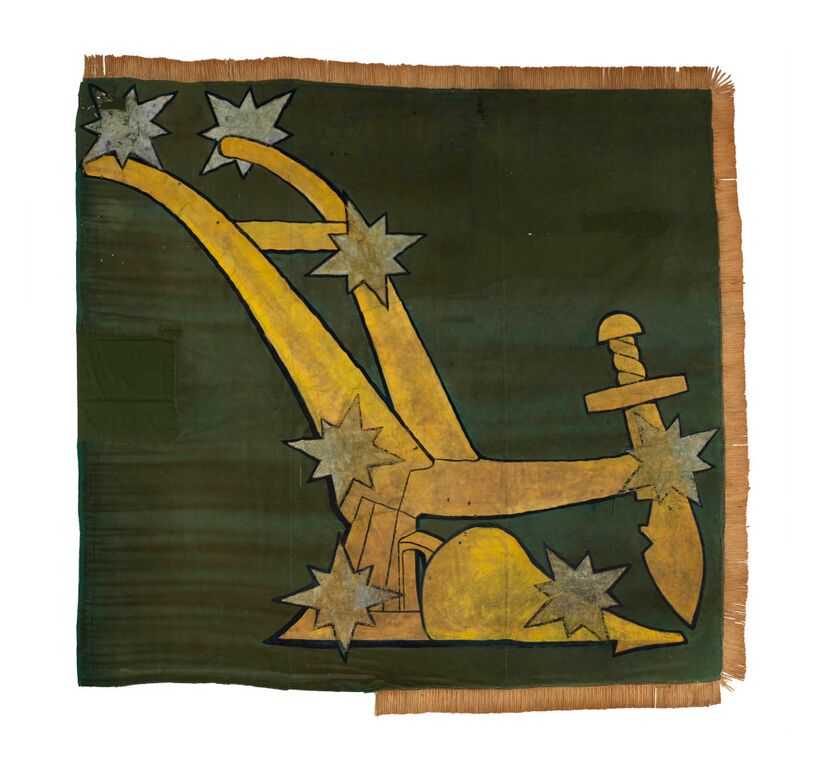
Somewhat later a different design including an actual plough following the stars and shape of Ursa Mayor on a green background began to be seen. But which was the original? And how, when and why did the other version come into existence?
It is not disputed that the Starry Plough was designed for the Irish Citizen Army, nor that it came to be designed in 1914, as the ICA was reorganising following the defeat of the Dublin workers in the 1913 Lockout. Whatever its colour, that was clearly the original.
It is beyond dispute that the Starry Plough was raised above Clery’s building, across the road from the GPO, during the 1916 Rising. It survived the burning of the building even though one witness spoke of a melted glass stream from its windows running across O’Connell (then Sackville) Street.
The flag disappeared thereafter. A British officer claimed to have taken it as a trophy. If there was more than one copy of that flag at the time, no-one has spoken of it.
When the Republican Congress was founded in 1934 the need for its own flag was felt. The Starry Plough of the ICA seemed appropriate and former members of the ICA were consulted as to the original design and colour and it appears that memories diverged on that issue.
Some remembered the background colour as green, some as blue. Prominent in the latter group was playwright Sean O’Casey, who had been Secretary of the ICA for a brief period in 1914 and presumably was present when the flag design was approved.
Whether or not, between April 1914 and April 1916, surely the flag had been paraded through the Dublin streets on a number of occasions and in any case it had flown over Clery’s in O’Connell Street for five or six days.
Nevertheless when the former members of the ICA were consulted in the 1930s there appeared to be uncertainty about the background colour – was it green or blue? Possibly the majority remembered it as blue or perhaps the opinion of O’Casey, who insisted on blue, was taken as the most valid.

So the flag of the Republican Congress was made a plain blue background with the shape of Ursa Mayor outlined in white or silver stars (and no actual plough design). That design was flown in Irish Republican colour parties from the 1960s at least and adopted too by the Irish Labour Party.2
A problem for the claim that the original was blue arose in the 1950s when an ex-British Army officer offered the Irish National Museum what he claimed to have been the Starry Plough which he said he had removed from the ruin of Clery’s. The background colour was green.
O’Casey was contacted by the NMI and insisted it could not be the original, maintaining that had been blue. To bear this out, he submitted a watercolour of what he claimed was Megahey’s (original artist) design work, in which the background was blue but did include a plough.3
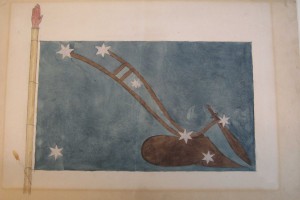
There was no way to prove the provenance of the watercolour. Nor was it impossible that a change of mind had led from a blue background on a design artwork to green on the produced flag. But O’Casey insisted that not only the artwork but the finished product had been blue.
Well then, why not investigate the artefact, the one claimed to be that which had been taken back to England by the British officer?

The NMI curator invited former members of the ICA only4 to view the artefact and although distressed at the state in which they saw it they confirmed that it matched their recollection. For the curator it seems that was the clincher and he then authorised its purchase in 1956.5
Around 2012 (the article does not give a date) an NMI curator charged with preserving the artefact set out to carry out modern method analysis of the material and its construction, paint and the more than 50 holes in it corresponding to .303 machine gun bullet impacts.6

Former ICA members had remembered a golden edging on the flag, traces of which were indeed found on the green specimen. It all checked out. A clever hoax? Possibly, but for an eventual price of £150, a relatively small amount even back in 1954?
The ICA members viewing the artefact believed it was the original, the British Officer testified as to his having taken it and also produced an Irish Times account by himself dated 11 May 1916.7 The NMI tests all pointed to the conclusion that it was the original flag – and the background was green.
But O’Casey was adamant that it had been blue. And what about the blue watercolour, allegedly the artist’s design?
It’s possible that between the design outline and manufacture, a change in the desired background colour had taken place. But not only colour – the plough design on the watercolour is very different from that on what we must now conclude was the original flag.
We have no evidence to verify that the watercolour was the original designer’s. O’Casey might have painted it himself, from his mistaken memory, for example. Or is it possible that he falsified its origin in order to convince the NMI that the flag had been blue and not green?
Any such effort would not have been about an aesthetical judgement in favour of one colour over another but rather about removing the colour associated with nationalism.
O’Casey resigned from the ICA in a dispute8 about allying with nationalism but more tellingly, he disagreed after the fact with Connolly throwing himself and his forces into an uprising against colonialism9 – a nationalist rather than socialist uprising, as O’Casey would have seen it.
Connolly’s thesis was that the advance towards socialism was not possible in a colony such as Ireland without allying the socialist forces with the most progressive and revolutionary national bourgeois forces, i.e the IRB and the Irish Volunteers.10 O’Casey could not agree with that.
In Innisfallen Fare Thee Well (1949)11 he wrote: “The Easter Rising had pulled down a dark curtain of eternal separation between him and his best friends: and the few that had remained alive and delightful, now lay deep, with convivial virtues, under the smoking rubblement of the Civil War.”
The symbolism of the original green, the colour of Irish Republicanism since the United Irishmen of the late 18th Century would have been anathema to the later O’Casey. Was he indulging in revisionist wishful thinking?
Or perhaps trying to ensure that in any future conflicts, the Irish Republican and Socialist trends would be kept firmly separate?

There are others who strive to ensure the exact opposite, who as Connolly did, see in the combination of those two strands Ireland’s only chance for freedom from colonialism, neo-colonialism and an advance towards a socialist society.
For them, the original design and colours of the Starry Plough is their flag and its entire symbolism points the way forward.
End.
FOOTNOTES
1In the USA this constellation is commonly referred to as “the Big Dipper”.
2Rarely used by the Irish Labour Party nowadays. It was popular with the Irish Republican Socialist Party for decades but nowadays a version in white stars on a black panel on a red flag is flown by the organisation.
3https://historyireland.com/citizen-armys-starry-plough-flag/
4Ibid: O’Casey appears not to have been invited, which suggests that the accuracy of his stated recollection was doubted.
5Ibid.
6Ibid.
7‘The rebels, on taking possession of the Imperial Hotel in Sackville Street, hoisted their flag over the building, and there it remained intact on one of the ridges of the front wall while the entire contents of the premises were being consumed by fire. At great personal risk the flag was eventually brought down by second Lieutenant T.A. Williams of the 9th Reserve Cavalry, Kildare Barracks, assisted by Inspector Barrett, Dublin Metropolitan Police.’ https://historyireland.com/citizen-armys-starry-plough-flag/
8https://www.dib.ie/biography/ocasey-sean-a6553 O’Casey objected to the enrolment of Constance Markievicz in the Irish Citizen Army because she was also a member of Cumann na mBan, which had been set up as a female auxiliary organisation to the Irish Volunteers. O’Casey proposed that membership of the ICA precluded joint membership with any Irish nationalist organisation. Having had his motion defeated, O’Casey resigned from the ICA in July 2014.
9‘[Connolly’s] speeches and his writings had long indicated his new trend of thought, and his actions now proclaimed trumpet-tongued that the appeal of Caitlin Ní hUllacháin—“If anyone would give me help, he must give me himself, he must give me all”—was in his ears a louder cry than the appeal of the Internationale, which years of contemplative thought had almost written in letters of fire upon his broad and noble soul. Liberty Hall was now no longer the headquarters of the Irish Labour movement, but the centre of Irish National disaffection.’ https://historyireland.com/sean-ocaseys-battle-of-words-with-the-volunteers/
10And of course Cumann na mBan.
11The third volume of O’Casey’s autobiography, published in 1949.
SOURCES
Blue or Green?
https://siptu.medium.com/unfurling-of-the-starry-plough-61ef310f8afa
National Museum curator on provenance and tests: https://historyireland.com/citizen-armys-starry-plough-flag/
O’Casey’s separation from Connolly: https://historyireland.com/sean-ocaseys-battle-of-words-with-the-volunteers/
 rebelbreeze
Diarmuid Breatnach replies: I should have added that O’Casey ‘s distancing himself from Connolly went to the degree that in his inaccurate account of the formation of the Irish Citizen Army, published three years after Connolly’ execution, O’Casey refused to acknowledge any role of Connolly in even the idea of forming the Irish Citizen Army.
In that ‘history’ O’Casey had earlier described the flag as blue but with a plough design, three years after the green version had flown above William Martin Murphy’s Imperial Hotel in the Clery building. Prior to obtaining uniforms, O’Casey described the men being drilled wearing blue armbands or red for the officers. The “blue armbands” account probably now needs to be doubted also, in the absence of sufficient unbiased additional evidence. The armbands too might have been green.
Pingback: THE FIRST WORKERS’ ARMY IN THE WORLD – FORMED IN DUBLIN – rebelbreeze