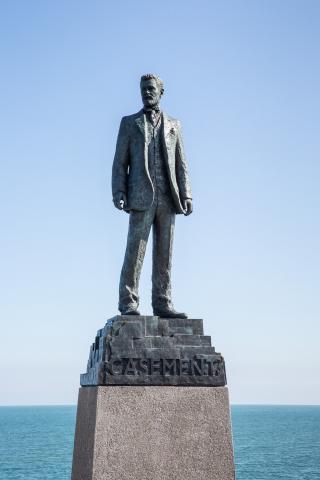
Gearóid Ó Loingsigh
(Reading time: 5 mins.)
Reproduced with permission of the author; edited to format for Rebel Breeze.
Just 110 years ago on August 3rd 1916 the Irish revolutionary Roger Casement was executed at Pentonville Prison in England, hung by the neck till dead.
However, it was not the only execution of Roger Casement, he has been executed many, many times, by diverse types ranging from the British State to right wing sections of Irish society and the West Brits that populate the Irish media and Dublin’s chattering classes et al.
Of course when I say executed many times, I am not referring to his physical execution, that only happened once, though the British Empire was an expert in cruelty and came as close as you possibly can to multiple physical executions.
One of its favoured methods was for a long time the sentence of Hung, Drawn and Quartered which entailed being hung till nearly dead, brought down, disembowelled whilst still alive and then decapitated: the pinnacle of British civilisation up until 1870.
But I refer to the assassination of his character which still continues to this day.
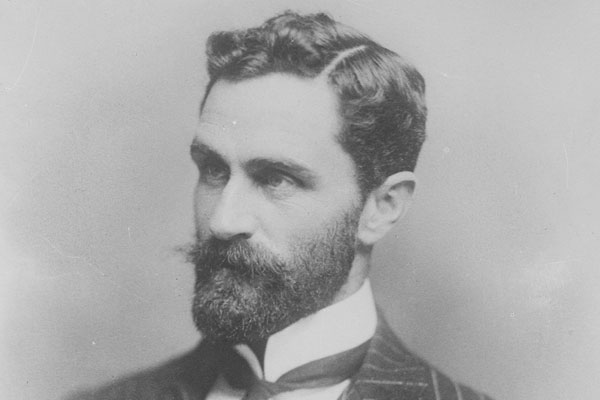
(Image sourced: Internet)
Casement was a British diplomat for much of his life but his activism in Ireland and his later role in the lead up to the 1916 Rising brought him to the attention of the British authorities that he worked for.
He was an internationally recognised figure praised by all and sundry for his work in Congo and also in Latin America for his work on abuses in the rubber industry.
Executing someone who was ostensibly one of their own was not as easy as executing the other leaders of the Rising and so the rumour mill of the Black Diaries was produced to denigrate his character at the time.
In the 1980s, some Republicans of the Sinn Féin variety reclaimed Casement as a gay icon.
Whether Casement was gay or not would be largely irrelevant to a modern Irish audience, but it was not so at the time. Gay sex was illegal and gays were pursued ruthlessly.
Even Alan Turing who played a key role in Britain’s war against the Nazis by cracking their codes was hounded and prosecuted. Were it not for Turing the course of WWII may well have been very different, but not even that could save him.
Casement who rose up against the British Empire could have expected nothing but the worst from the British. However, alongside the allegation based on the forged Black Diaries that he was gay is also the allegation that he was a pederast.
It is beyond the scope of this article to refute all the fabricated allegations against Casement of which there are many, though Angus Mitchell’s updated biography Casement is thorough in refuting the Black Diaries and the campaign against him.[1]
I was struck by the fact that Casement was under watch from German intelligence during his time there and yet they never recorded any of the behaviour Casement’s enemies ascribed to him, including during his period in Germany.
Why so many attempts to assassinate his character? Well, they needed to do so to justify his execution and have stuck to their murderous guns ever since.
But also, there are many myths about the 1916 leaders that portray them as insular, reactionary irredentist nationalists when in fact they were very open to other cultures and had a broad international perspective not only on culture but also on politics.
Casement’s internationalism, his outward looking view is a matter of public record. His stature as one of the great humanitarians of the 19th and 20th centuries is almost unassailable.
That the rebellion against the British Empire in Dublin could be linked to Casement’s work exposing the atrocities of the Belgian state and royal family or his work in South America in also exposing the atrocities of rubber companies cannot be tolerated.
Not by those who believe in the civilising mission of the White Man’s Burden as the reactionary vile poet Rudyard Kipling put it.
Casement is the only leader of the Rising who is both known internationally, and whose writings are available in various languages. His writings about the Amazon rubber industry are rarely out of print in South America.
The attempts to smear him got more “sophisticated” over the years as concerns about him being gay no longer had the same force and so his work is attacked. He has been accused of racism, being in effect an imperialist, despite all evidence and even part of the problem in the rubber industry.
The Murdoch press in 2010 even stated he was no humanitarian, though that particular press group is given to lying as a matter of course, one of the most infamous cases being the accusations they levelled with gay abandon at the Liverpool fans during the Hillsborough disaster.
But the Murdoch press’ accusations are not any less “serious” than some of the “academic” tripe produced by others.[2]
Casement makes for uncomfortable reading for many. You cannot consider his life, his work and the 1916 Rising without taking into account the international context, international politics and empire in all its nauseous rotten elements.
He inspired other anti-colonial leaders and his speech from the dock was such that it was referenced by independence leaders around the world.[3]
“When languishing as a political prisoner in the 1930s, Jawaharlal Nehru, the first prime minister of India, commented how ‘it seemed to point out exactly how a subject nation should feel.’”[4]
His base in La Chorrera, Putumayo in modern day Colombia[5] still recalls Casement and they refer to Ireland simply as Roger’s Country.[6]
The debates about Casement are not about Casement per se, but rather his politics and what he did and sought to do in relation to the British Empire’s occupation of his homeland. Some of those who denigrate him would be happy for all of Ireland to become part of the British state again.
On one level it does not matter whether he was gay, in the modern Ireland it is hardly an issue, his alleged racism and paedophilia would still be an issue however.
All of these are attempts by a state that cannot come to terms with how one of their own (initially), a man of world renown stature could rise up against their putrid empire.
As we go forward, we have not seen the last of the attempted executions of a man whose fame outlives that of all those who opposed him, argued against him, executed him physically, intellectually and ideologically.
As Angus Mitchell has pointed out about forgeries that they need to be controlled as the British did to a point that we cannot be even sure that the partial release in the 1950s and the later releases are the same documents.
The Black Diaries display the same signature. A consensus that was genuinely secure would not need the regular re-litigation it receives, nor the marshalling of reviews to maintain that consensus.
It would also not require the assurance of the Guardian correspondent that the forgery theory has been discredited when he knows full well that is not the case…
A genuine source needs neither secrecy nor maintenance. The Black Diaries have acquired both – concealed in their handling and defended ever since by a consensus that must be continually reasserted. The endless fascination is not evidence that the mystery is deep.
It is evidence that someone, somewhere, is still doing the work of maintaining the mystery and claiming it as history.[7]
What we can be certain of is that Roger Casement stood up to the empire, he fought against it and that his work is as relevant to modern Ireland and indeed the world as it was then and that is the biggest crime that Casement committed.
One we should be proud of on the 110th anniversary of his execution by the British, that led to multiple executions of his legacy at the hands of the British Establishment, West Brits and other apologists for empire.
End.
Note: You may wish to read other articles by Gearóid Ó Loingsigh on his substack https://gearoidloingsigh.substack.com/
Note: If you found this article of interest, why not register with Rebel Breeze for free, so that you will be notified by email of subsequent articles. You can de-register any time you wish.
NOTES
[1] Mitchell, A. (2026) Casement. Haus Publishing. UK.
[2] For an analysis of these “debates” see Gerry Fitzpatrick’s articles on Casement. https://socialistdemocracy.org/RecentArticles/RecentReviewRogerCasementAndHistoryPartOne.html;https://socialistdemocracy.org/RecentArticles/RecentReviewRogerCasementAndHistoryPartTwo.html;https://socialistdemocracy.org/RecentArticles/RecentCasementAndHistoryPartThree.html ;
[3] See Roger Casement: Speech from the dock. https://www.nootherlaw.com/archive/casement-speech-from-the-dock.html
[4] Mitchell, A. (1916) 16 Lives: Roger Casement. O Brien. Dublin para 21.108
[5] The Putumayo region in which Casement travelled straddled the borders of Colombia, Ecuador and Peru. Land borders have changed since then, particularly after the 1932-34 war. His base was then and still is now in Colombia, some of the other parts are in Ecuador and Peru and others have changed between the countries.
[6] Irish Times (30/07/2016) Why Roger Casement is still remembered by the people of the Amazon. Sorcha Pollak. https://www.irishtimes.com/culture/heritage/why-roger-casement-is-still-remembered-by-the-people-of-the-amazon-1.2737575
[7] Mitchell, A. (2026) Casement Debasement. Village 88. https://www.academia.edu/170403173/Casement_Debasement

