Revolutionary socialist & anti-imperialist; Rebel Breeze publishes material within this spectrum and may or may not agree with all or part of any particular contribution. Writing English, Irish and Spanish, about politics, culture, nature.
Like many others through much of the genocidal attack on Gaza since October last 2022, I’ve been attending pickets, demonstrations and vigils organised by others. I’ve also written some reports on those events and analyses of the solidarity movement.
But in addition, I’ve been drawing cartoon comments in a sketch book, most unpublished and I thought I would publish a selection here.
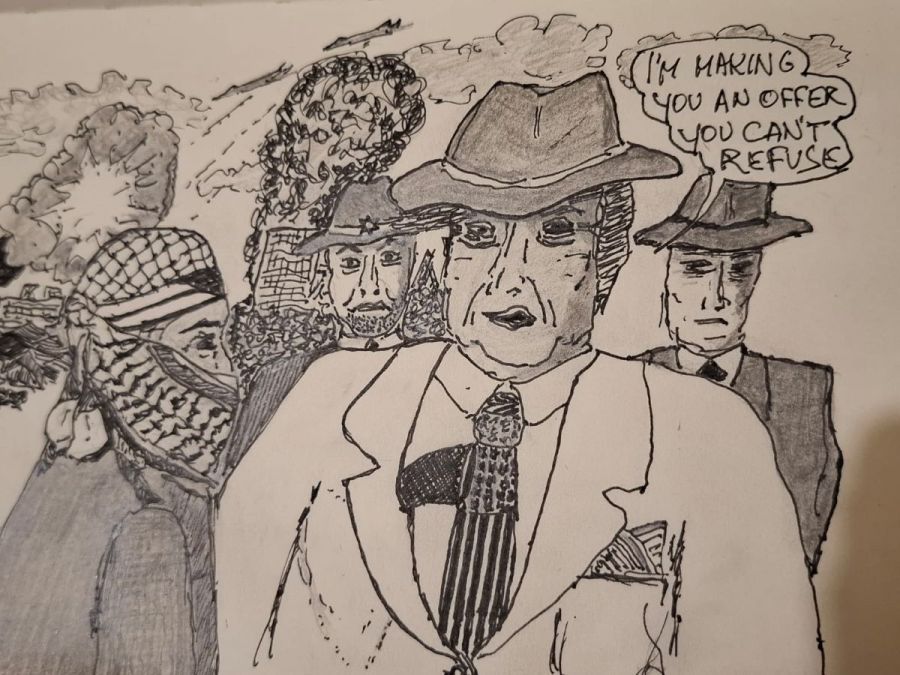
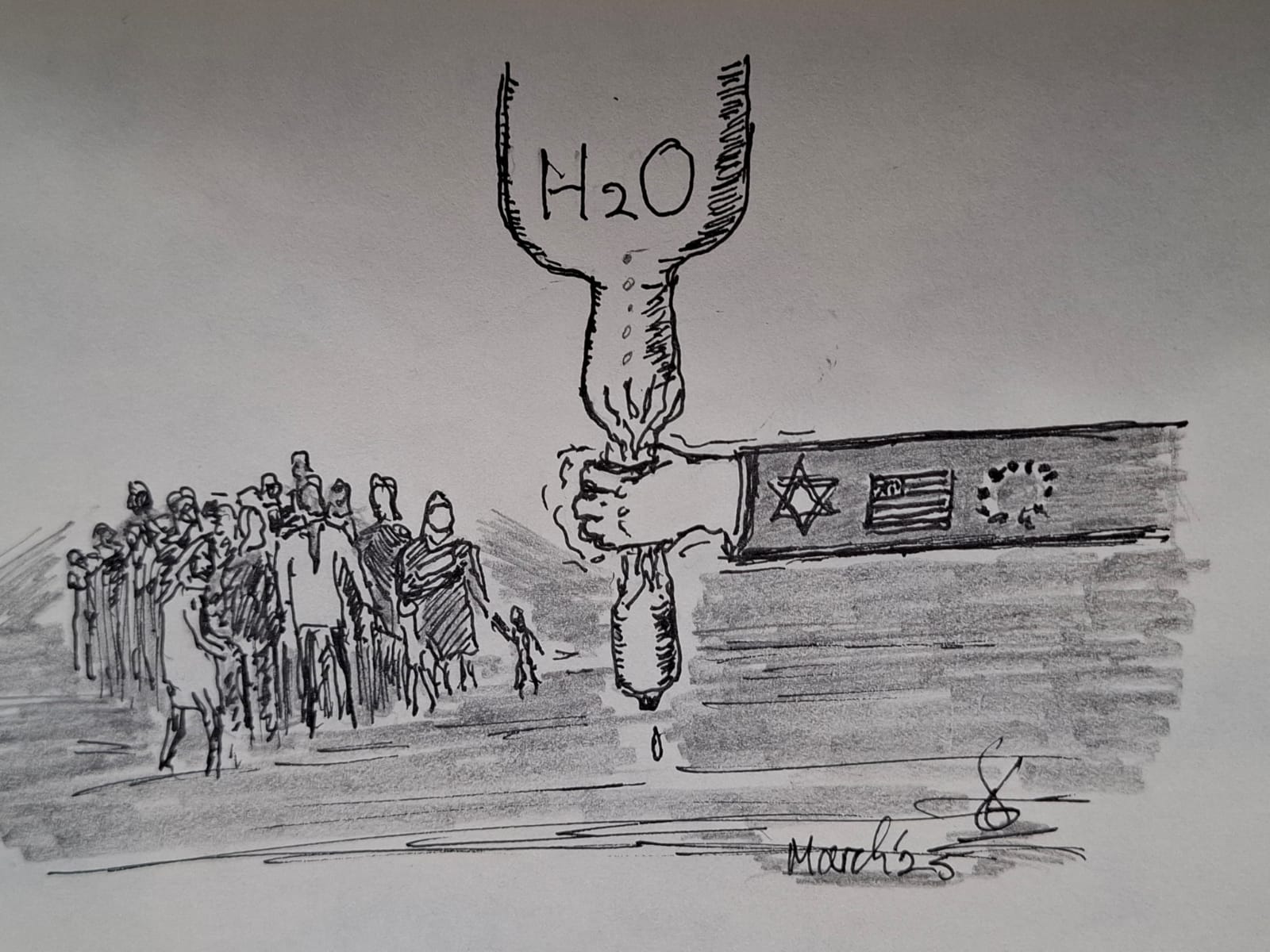
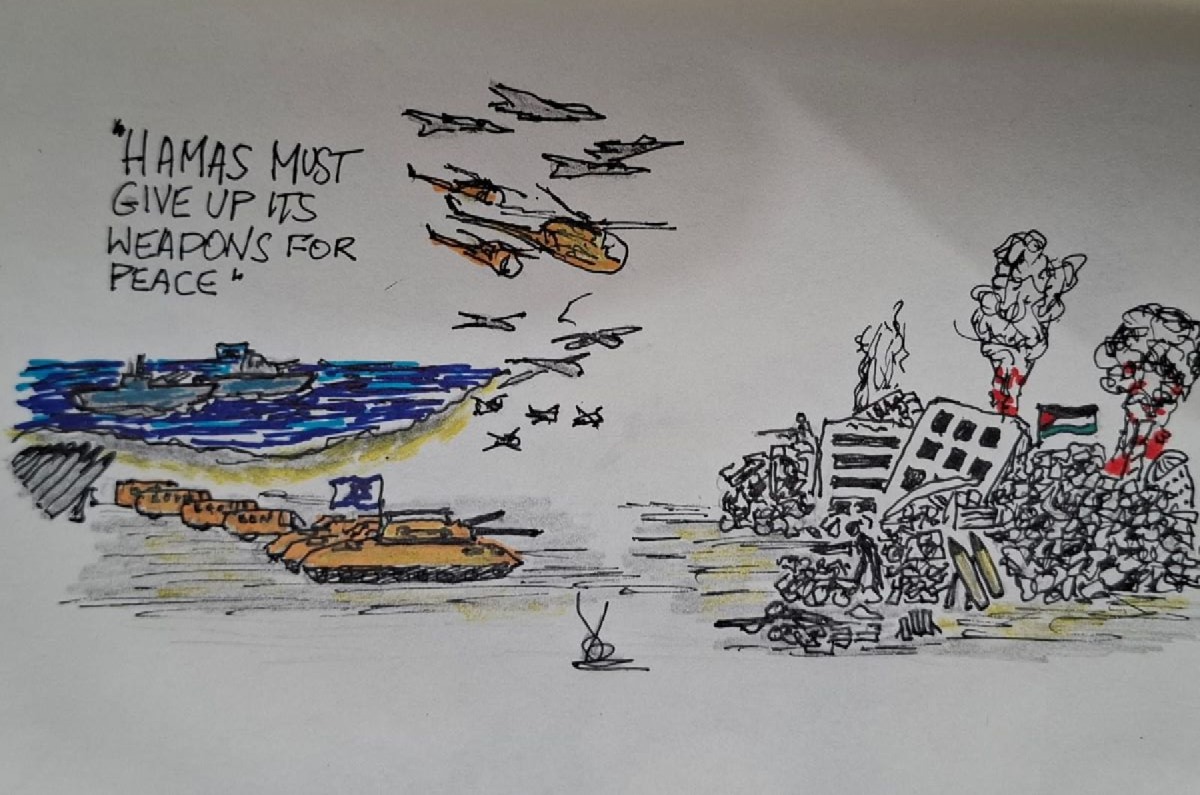
One of the poorest states in the world, Ansarallah is the only one to uphold its duty to prevent genocide, which it does by putting heavy pressure on the Zionist state’s economy through maritime blockade. For this, the UK and USA rain missiles and bombs down upon it. But it does not yield.This one is at least as much placard as it is cartoon but I never got around to making the placard. Ansarallah escalates to attack the ‘Israeli’ state directly, then again in response to Zionist airforce bombing of Yemen.The USA Navy sends two aircraft carriers to assist the genocidal state by attacking Yemen. Ansarallah attacks the US Navy, forcing the retreat first of one aircraft carrier followed by capitulation of the US which offers Ansarallah to end attacks on Yemen if they end attacks on US Navy. The deal makes no provision for defence of the Zionist state and is accepted by Ansarallah.Facing some of the most heavily armed forces in the world but somehow, it’s always the national liberation forces that must disarm. For the sake of peace, of course.The physical war against the Palestinians by the Zionist State was armed by a number of western imperialist states but also ideologically by the whole western media. In the face of real and ongoing genocide the WMM reported propaganda, repeated lies and framed its reports in the Zionists’ terms of reference – while courageous journalists reporting from the actual killing grounds were picked off by the IOF.The western imperialists promote the two-states solution (sic) and a Palestine colony of Israel as a ‘Palestinian State’. This would be run by Zionist proxies such as the Palestinian Authority with its Fatah boss, Mahmoud Abbas, who recently publicly insulted the national resistance fighters of Hamas, calling them ‘sons of dogs’.
The declared preparedness of a number of states, including the Irish one, to give formal recognition to the State of Palestine is widely seen as a step in favour of the Palestinian people and generally opposed by the Israeli state.
So on that basis many people who support the Palestinians may think that recognition of the State of Palestine is a good thing. How can it be otherwise? And yet …
Recognition of the Palestinian State is predicated upon the “two-state solution” (sic), in which the Zionists and the Palestinians supposedly get to live in separate states as neighbours, everybody happy. Except that the Zionists get most of the land and water while the indigenous get the least.
Effectively “Recognition of the Palestinian State” as advocated is to agree to
Zionists occupying 80% of Palestinian land
Palestinians getting 20% of their land
With least water
Forever under Zionist surveillance
and Zionist guns.
Area in pink shows territory notionally available to the “Palestinian State” in a “two-state” proposal; however the Zionist state is not in agreement and nor are many Palestinians. (Image: BBC)
In any case, Zionism is a colonial settler project and inherently expansionist; even in the unlikely situation that the two-state proposal were accepted by Zionists and Palestinians, the Zionists would always be looking to expand as even now they are extending further into Syria.
Currently the ‘State of Palestine’ is represented by the Palestinian National Authority,1 widely seen as the Israeli occupation’s proxy, run by Mahmoud Abbas and backed by the Fatah party. Its police force attacks solidarity demonstrations, arrests and even kills resistance fighters and critics.
The PA was created as part of the Oslo pacification process2 and supposed to hold elections every five years thereafter. The first elections3 saw the Fatah party elected to govern the West Bank and Gaza. But as the Second Intifada4 erupted against Oslo, the popularity of Fatah plummeted.
The Fatah administration was widely considered corrupt, repressive, violent and collusive with the Occupation.
The next elections, in 2006 saw Hamas win most seats across both areas. But Fatah would not accept the popular verdict and in 2017 Hamas removed them in Gaza after a brief struggle5 but however did not do so in the West Bank. Abbas has not held another election since.
At a special conference allegedly of the PLO (which was attended by none of its organisations apart from Abbas’ lackeys), Abbas called the leading organisation of the Palestine national resistance, Hamas, “Sons of Dogs.” (Cartoon: D.Breatnach)
The PA kept the grants it was getting from other states including those intended for the administration of Gaza, western powers cut off funding, Israel and Arab states initiated punitive economic sanctions against Gaza and Israel began a siege with periodic massacres.
In the West Bank, the PA’s security forces have suppressed demonstrations in solidarity with the Resistance and also against the PA’s brutality. They have jailed Resistance activists and fighters, including killing a number of them. This year they began and then colluded in the siege of Jenin.
Recognising the State of Palestine means supporting this corrupt and brutal Israeli State proxy and also accepting 80% of the land of Palestine going to the Zionist colonial occupation which, with the ‘two state proposal’ is also the policy of the PA.
There may be some, including probably some Palestinians, who think to accept it would be better than nothing, especially if it stops the genocide. But genocide is the basic program of the colonial invader: to take the land, the indigenous must be enslaved and if not enslaved, removed.
How else is a colonial minority to rule in security? The other option is not to rule but to share, in a democratic secular state of Palestine with equal rights for all of whatever background. Yes, but that is not ‘the Palestinian State’ being promoted.
The Zionists say they are in an existential fight and in a sense they are right. The Palestinians are in a fight for their life as a people too. A huge difference is that the Zionists have the option to stop being racist colonial occupiers oppressing the indigenous people.
For a few years also the PA has been mooted as the ‘Palestinian’ governing force for Gaza to replace the elected choice of the people, Hamas, with a proxy of the Occupation. This has been suggested by envoys of the US and also more recently by Egypt (although opposed by ‘Israel’).
This would find favour with some Arab client states and all of the European imperialist states who can’t see any other way of stability for the Middle East in particular and for their exploitation of the world in general. Without that ‘peace’ their whole imperialist world could be endangered.
The option of a democratic, secular all-Palestine state is not going to be supported by the imperialists because such a state would encourage the masses of Arab states to carry out their own revolutions. However it is the option for all democratic and revolutionary people to support.
To support ‘the Palestine State’ is to encourage the continuation of colonialism, genocide and ethnic cleansing, enable the current specific Zionist plan for Palestine and to support the US imperialist and Egyptian proxy plan to have Gaza run by the traitorous Palestine Authority.
1Usually referred to just as The Palestinian Authority.
2With South Africa’s, this was the beginning of a wave of imperialist pacification processes starting in the 1990s that went around the word wherever national liberation struggles had strong popular support. Those who had succumbed to it were used to encourage others to do so too: the ANC and Fatah attended annual congresses of Sinn Féin to recommend it to Irish Republicans; Sinn Féin and S. Africans in turn ‘sold’ it to the Basques and to the FARC in Columbia; there were attempts to get the Kurds in Turkey, the Tamils in Sri Lanka and some of the Philippines fighters to accept it. Wherever the process took hold the resistance split first between those who would collaborate and those who would not but the latter also fragmented further. None of the movements that embraced the process won anything more than the partial release of prisoners, with the exception of S. Africa where the people won universal suffrage (but also experienced increased imperialist exploitation and poverty).
3The first legislative elections were held in 1996, won by Fatah; the next in 2006, won by Hamas; there have been none since.
4In 2000, against the Zionist Occupation, the collusion and corruption of Fatah, against denial of the right of return to the refugees.
5Represented in most Western mass media and online history sources as “Hamas seized power in Gaza”.
Gearóid Ó Loingsigh (reprinted intact from his substack and reformatted for Rebel Breeze)
(Reading time: 5 mins.)
Once more Trump has acted like the lunatic he is and ambushed the president of South Africa, Cyril Ramaphosa, stating that the country was undergoing a real genocide of whites.
Many have commented on the effrontery of Trump to talk of a fictitious genocide of whites in South Africa, whilst his main ally Israel is carrying out one in real time every day on the news shows.
Trump used images from the Democratic Republic of Congo, a country more than 4,500 kilometres away, to show that they were killing whites in South Africa.
Trump also lied about the land question in the country, accusing the government of stealing the whites’ lands when the reality is that the whites continue to be the owners of the greatest part of the land in the country.
It is worth saying that Ramaphosa defended himself partially, and only partially as behind the new legislation on the matter there is the hidden failure of the peace process when it comes to resolving the land question.
When the Apartheid regime was ended, the country was one of the most unequal on the planet and the whites were the owners of the greatest part of the agricultural lands. Around 60,000 whites were the owners of 86% of all the agricultural lands, some 82 million hectares.[1]
The agrarian reform proposed by the ANC in its White Paper of 1997 was a market-driven reform, i.e. the voluntary sale and purchase with some help from the government without the government being a buyer.[2] Blacks could also ask for the restitution of lands stolen by racist laws since 1913.
A whole land bureaucracy was set up, not unlike what Colombia has, Land Claims Courts where all those who registered could make their case with three possible outcomes, the restitution of the land, the handover of alternative land or a financial compensation.
In 1992, the ANC had put forward a document in which they argued for the expropriation of lands and other non-land market mechanisms. But by 1997 they had accepted neoliberal discourse and adopted the land market as the cornerstone of their policy.[3]
Initially the ANC government had proposed handing over 30% of the agricultural lands held by whites to blacks within five years. But they kept postponing it.
By March 2011, they had handed over 6.27 million hectares, and of that 45% was not agrarian reform, properly speaking, but rather land restitution.[4] The government didn’t just fail regarding land, but on everything. Inequality rose since the fall of Apartheid.
The Gini[5] rose following the end of Apartheid in 1994 and now is situated in 0,67 making it the most unequal country on the planet in terms of income, where just 3,500 people own 15% of all the wealth of the country.[6]
SA President Ramaphosa looks on while US President ambushes him publicly with alleged ‘evidence’ of persecution of white people in S. Africa (Photo cred: Kevin Lamarque Reuters)
There is also a high concentration of land. “Currently 72% of farms and agricultural holdings are owned by white individuals, who make up 7.3% of the population, while black Africans, constituting 81.4% of the population, own only 4% of the land.”[7]
The whites continue to be the owners of the land, the black middle class through Black Economic Empowerment programmes reached agreements with those whites and the companies in the agricultural sector to integrate themselves into the neoliberal economy.
This is the so-called ‘white capitalism’ and South Africa became a leading country in the agribusiness sector of the continent. In 2015, of the 10 largest agribusiness companies on the continent, eight were South African.[8]
Ramaphosa himself is an excellent example of the new South African businessmen, the former fighters against capitalism who now profit from the blood and sweat of those who were once the grassroots militants of the organisations they led.
Between 1994 and 1998 he acquired a portfolio of more than 40 million Rand[9] (some 8 million dollars at the time) and ended up as an extremely wealthy man (some 700 million dollars) thanks to his controversial investments and acquisitions in the mining sector.
Ramaphosa is also the owner of the McDonalds franchise in the country. The former leader of the National Union of Mineworkers became a magnate in the sector.
In 2013 the Police murdered 34 miners in the midst of a strike at Lonmin, one of the companies where he was a director, being the owner of 9.1% of the company. [10]
South African police move forward to kill more striking miners at Lonmin 2012 while in background other police stand over miners killed already(Photo cred: Sephiwe Lebeko/ Reuters)
And just like in the times of Apartheid, the Farlam Commission, those charged with investigating the Marikana Massacre found nobody guilty. Nobody! Blood is washed from the hands of a black capitalist just as easy from those of a white capitalist.
When he took over the presidency of the country, there hadn’t been any great advances made regarding agrarian reform there. The failure to meet the promises of the transition and the political programme of the ANC cost them electoral support.
So much so that they now govern the black masses with the support of a white party, the Democratic Alliance, a right-wing party that strongly opposes any expropriation of land without compensation and in practice is opposed to any great change in land policy.
It is in this context that Ramaphosa launched his new campaign and new land law. The ANC say they want to implement the Freedom Charter, but it is not so. Mandela himself had discounted that in his speech to Davos.[11]
He didn’t explicitly refer to the document but he never again spoke of the nationalisation of resources such as mines and land.
Ramaphosa’s law proposes various measures that already exist in almost all capitalist countries, the expropriation of property with compensation for public purposes or where there is a public interest i.e. the compulsory purchase or as they say in the USA, the heart of capitalism, eminent domain.
These norms exist in almost the entire world. As is the case in many capitalist countries, it also includes elements to reduce the amount of compensation or not pay it.
It is another thing to believe that Ramaphosa aims to do what the ANC never wanted to since the first government. He does not want to fight with so-called white capitalism as he knows that so-called black capitalism is the same thing and one depends on the other.
What Ramaphosa is about is a public relations manoeuvre to strengthen a weakened and discredited ANC. There will almost certainly be more such initiatives. But the ghosts of Marikana tell us that this traitor has no intention of doing anything for the black masses.
Trump talks of a genocide that only exists in the sick mind of Elon Musk and of a land theft that Ramaphosa does not want. If he steals the whites’ lands, who will he sip cognac with then? White power is still in control of South Africa.
It dominates the economy in alliance with the not so new black bourgeoisie, the black apparatchiks that control the scaffolding of the state, and the growing presence of foreign capital.
We all recognise Trump as the enemy and idiot that he is. The problem is that sometimes we acknowledge those he attacks as friends when in reality they are the same enemies, except some are more intelligent, cultured and refined.
Ramaphosa when he was a trade union leader said “There is no such thing as the liberal bourgeois. They are all the same. They use fascist methods to destroy workers’ lives.”[12]
Workers’ blood is washed from the hands of all the capitalists, blacks, whites, Russians, Arabs or Yanks: Ramaphosa in Marikana or Trump everywhere. The whites in South Africa, the Elon Musks have no reason to fear their friend Ramaphosa, despite the stupidities from Trump.
[9] Bond, Patrick (2000) Elite Transition: From Apartheid to Neoliberalism in South Africa, London & South Africa, Pluto Press and UNP, End Note No. 7, Chapter 2 page 266.
Far from the declared aim to “close down this kip” in an online call for a rally against Peadar Brown’s pub in Dublin, not a single far-Right supporter of the call made even a token appearance at the appointed hour Saturday afternoon.
This was no huge surprise; these elements tend mostly to attack small groups of people or torch empty building and surely quickly came to the conclusion that neither of those things would they be facing in the case of Peadar Browne’s. No indeed. A full building of many people.
The on-line event poster for the far-Right rally was followed by a number of posts and comments vilifying the pub’s management for allegedly banning a customer over his racist remarks but went further to attack the pub’s history and general political ambience too.
Recently-elected fascist member of Dublin City Council Gavin Pepper had himself videoed outside the pub on Friday night after it was closed, issuing veiled threats.
Closer view of section of the crowd last Saturday outside the front of the pub. (Photo: R.Breeze)
Peadar Browne’s pub has built up a reputation over years as one of socialist Irish Republican outlook, with both external appearance in flags and mural along with the interior decorations unashamedly declaring the broad sympathies of both owners and clientele.
The venue has seen a number of events in keeping with that perspective held there, ranging from concerts to fund-raising events of various kinds, in addition to public and private meetings. The large mural of a Palestinian flag on the pub’s side also declares their internationalist sympathies.
Section of last Saturday’s crowd outside Peadar Brown’s, this one at the side of the pub. (Photo: R.Breeze)
For some time Saturday before the 3pm appointed for the rally, defenders were arriving, including Irish Republicans and Irish socialists of various organisations and none, Palestine supporters Irish and other, along with activists more specifically antifascist.
Soon both the inside and external areas of the pub were full, with extra banners and flags lining the external area facing the road. Occasionally the driver of a passing vehicle tooted its horn in solidarity, sometimes with extended clenched fist and encouraging roar from the passenger’s side.
Section of last Saturday’s crowd outside Peadar Brown’s, viewed from the middle of the road outside. (Photo: R.Breeze)
Near to the rally’s appointed hour it began to rain and continued for a while but the pub’s external area had been canopied over so few had to move – unless it were to use the toilet or refresh their glasses.
Conversations slowed on occasion as people checked their timepieces, looked outwards, shrugged and resumed talking. By 4pm most of those who hadn’t left decided they’d be staying, already in their evening weekend socialising venue, or at least for the first stage of the evening.
Section of last Saturday’s crowd outside Peadar Brown’s, this one at the top side of the pub. (Photo: R.Breeze)
In fairness, the absence of any uniformed Gardaí on the ground to protect the far-Right had been an indication that they were not expected to appear.
In Conclusion, drawing up The Balance:
The pub had one of its fullest Saturday afternoons and boosted its reputation among many who knew of it only vaguely, while online calls for a boycott were taken by many as recommendations for “a pub with no racists”. Fascists and racists in turn suffered a hit to their morale.
Some of the defenders on Saturday at the lower side with the mural behind them. (Photo: R.Breeze)
Socialists, communists, Irish Republicans and independent antifascists stood together in defence of a pub with an Irish Republican socialist ambience and strong pro-Palestine presence against a threat from far-Right and fascist elements.
Liberals, social democrats and former Republicans, usually prominent on anti-racist marches? Not so much.
The Kurdish group, the PKK announced on Monday that it has disbanded its armed organisation of the last nearly 50 years.1 The change was carried out on instruction or request of their leader Abdullah Ocalan who’s been in a Turkish jail since 1999.
Supporters in Dusseldorf November last year defy German ban to demonstrate and call for release from Turkish jail of Abdullah Ocalan, leader of the PKK (Photo credit: AP)
The marxist-leninist PKK set up its armed organisation in 1978 to resist the Turkish state repression of the Kurdish independence movement. The Kurdish area is of huge strategic importance, encompassing parts of what are now Turkey, Iraq, Syria, Iran and Azerbaijan.
The population of Kurdistan is estimated at between 30 and 45 million, with up to another two million in its diaspora. The PKK waged armed struggle in Turkey until 1999 then again as the YPG and SDF in Syria, against the Assad regime and against ISIS.
PERSONAL CONNECTION
I was for a time in London myself active in solidarity with the Kurdish national liberation struggle and, as a result, part of a trade union delegation to Turkish Kurdistan around 1991/92, organised through a Kurdish community centre in North London.
The trade union activists participating were required to raise the money for the flights from their union organisations and I was successful in obtaining the necessary funds through the Lewisham Nalgo/ Unison local government branch and through the Nalgo/ Unison Irish Workers Group.2
Our delegation flew to Istanbul and from there to Batman province where the driver, supplied by the Petro-Is trade union took the three of us and our interpreter and photographer to many parts in the region, including to the border with Syria and seeing the oil being smuggled across the Iraq border.
Evidence of the ongoing war between the PKK and the Turkish State was plentiful, including Turkish gendarmerie checkpoints, bullet-riddled walls in towns and a shell hole in the wall of my bedroom in one hotel in which we stayed.
Much worse was the visit to an outlying village house burned by German flame-throwing tank of the Turkish Army and viewing the photos of the children immolated inside.
Turkish secret police visited our driver’s house while he was away, commented to staff of one hotel that we were not tourists (declaring ourselves a trade union delegation would have been asking for trouble) and on our last day kept driving past us and even followed us on to the plane.
Even then I was very concerned at what seemed to me like near deification of Ocalan. Years later, in Bilbao as part of a panel of speakers on national liberation struggles, off the platform the speakers on the Irish, Palestinian and Kurdish resistance discussed issues in the liberation movements.
The Palestinian and I became concerned by the almost violent agreement of the Kurd with everything that Ocalan did or said. We had to abandon all attempts to discuss and debate with him.
PACIFICATION PROCESSES
Pacification processes of various types have been around for centuries but a particular wave of them began to be deployed in the early 1990s, starting with South Africa and Palestine,3 then spreading to Ireland, the Basque Country and Colombia, each affected subject infecting in turn the next.
Typically the subject was told they had to disarm and disband their armed organisation, after which they would be accepted into the system and could organise politically for admission to the ruling political circles through the standard electoral process.
Portraits of eight martyrs of the YPG announced fallen in battle in Afrin against ISIS (note two are female) December 2019 (Source: YPG media)
Of course each subject would have to renounce even the idea of armed struggle or revolution. And would be required to control their own fighters and denounce their dissidents.
It is somewhat surprising that it has taken this long for imperialism to land the PKK fish since Ocalan swallowed the baited hook back in the late 1990s. The war in Syria I suppose extended their armed organisation’s life for a while beyond that which it would have had if confined to Turkey alone.
But their role in Syria in the YPG, whether it began as an independent Kurdish national liberation struggle or not, soon degenerated into leading a US/NATO proxy force, the SDF.4
This March the SDF agreed to integrate into the imperialist proxies’ army of ISIS types led by Ahmad al Shaara (i.e the ‘former’ ISIS leader Jolani), currently being embraced by imperialist leaders while his forces continue to carry out sectarian murders of Syrian Alawites and Druzes.
More recent reports have them, while agreeing to disarmament in Turkey, refusing it in Syria, which makes sense from a self-preservation stance alone, given the nature of the new state’s forces.
We can imagine the imperialist-driven virtual “Pacification Express” in the late 1990s and early 2000s, as it left South Africa and Oslo-Palestine, calling on Ireland and from there to the Basque Country and outward bound to Colombia. Turkish Kurdistan was one of the planned stops.
In not one of the areas of national liberation struggle passed through by the Pacification Express did the liberation organisation win that for which they had declared they were fighting, or indeed anything apart from in some cases the freeing of political prisoners.5
In S. Africa they did at least get ‘majority rule’, so that the leadership of the liberation organisations could form a corrupt imperialist-serving government.6 The Irish travelling on that Express got their prisoners freed but the Kurds and Basques on board did not receive even that.
Supporters YPG and other militias and parties protest threats from Turkey in Afrin, Aleppo province, north Syria 18 Jan 2018 (Source: YPG Press Office/AP)
Whoever the leaders of the Kurds are now, they claim that they continue on the track to democracy and Kurdish national liberation.
Of course they do. The passengers on the Pacification Express always declare that sovereignty and self-determination are the train’s destinations, even if it shows no sign of heading there. And that some of the stations passed on the way are quite clearly on another line completely.
2This was one of the self-organised groups of NALGO (National Association of Local Government Officers), now subsumed into UNISON but which the union’s leadership refused to recognise and worked to undermine. I had been a founding member. The union leadership tried to get us to change our founding principle of self-determination for the whole of Ireland and when we refused, they worked against us.
3The ‘Oslo process’ which set up the Palestine Authority and the popular rejection of which led to the Second Intifada.
4Even though some anarchist groupings and at least one Irish socialist Republican group refused to see this and focused instead exclusively on the YPG’s anti-ISIS fighting and their federal administration of ‘liberated’ Rojava.
5But not in Turkey or in the Basque Country, nor of the ELN in Colombia.
6As Bishop Tutu, who supported the Process said of Mandela’s ANC: “They stopped the gravy train long enough to get on it.”
NB: Edited by Rebel Breeze for formatting purposes
(Reading time: 6 mins.)
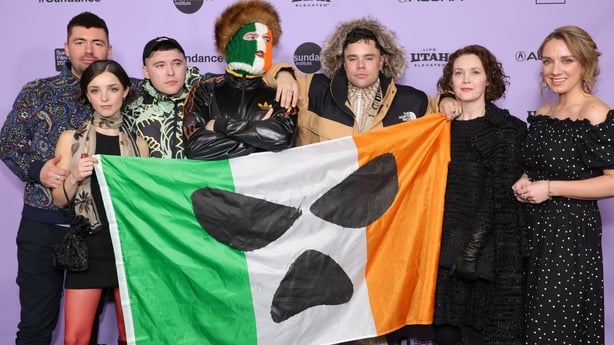
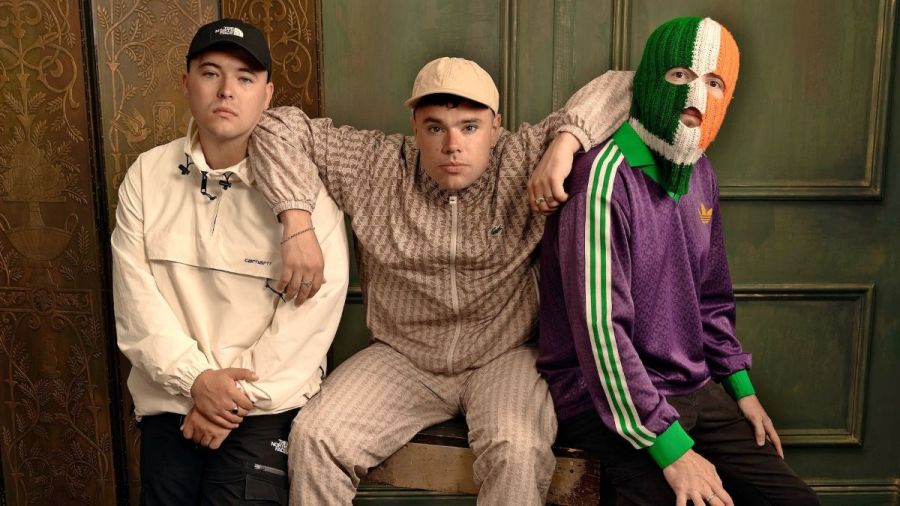
Kneecap, the Belfast Irish language rap group, have found themselves at the centre of what is an artificially contrived furore dreamt up by people with little sense of real moral outrage.
The basics of the story are well known. They finished off their act at the Coachella event projecting pro-Palestinian statements. Given the band’s history and well-known politics, it could hardly have come as a surprise. Perhaps it was more that the fans welcomed it that upset some.
They were denounced by the non-entity known as Sharon Osbourne, a reality star famous for being the wife of Black Sabbath lead singer Ozzy Osbourne and also the mother of another reality star, her daughter Kelly Osbourne.
Kelly to her credit did carve out a brief musical career on the back of her reality tv exposure.
Sharon as part of the wider Zionist attempt to silence all those who criticise the genocide called for their visas to be cancelled, which in effect happened following the decision by their promoter and sponsor to drop them.
She also called for them to be more like Bono. Kneecap responded with a humorously devastating comeback that they would rather be Rangers fans than emulate Bono.
Bono still has some credibility in certain parts, mainly where they haven’t a clue about the man’s actual politics and obviously amongst the clueless, witless, gutless glitterati like Sharon Osbourne. But what would it mean to be like Bono?
Is he actually some sort of reasonable counterweight to Kneecap?
Well, first of all, in relation to Palestine, Bono is a Zionist, so even before the genocide began, he, unlike them, was already on the wrong side of history. Not for the first time, mind you. Bono has a habit of cropping up where he is not wanted like an ugly cold sore (my apologies to the virus).
He has, as Harry Browne, the author of The Frontman: Bono in the name of power, pointed out dedicated a lifetime to the service of imperialism and was rewarded with a Presidential Medal of Freedom from Genocide Joe.[1]
I am sure it will go well on his mantle piece alongside his KBE (Knight Commander of the Most Excellent Order of the British Empire), for which he was fulsome in his praise of Her Majesty’s Ambassador, as he put it, and grinned like a cheshire cat during the ceremony.[2]
The claims made by Blair and others about Bono’s achievements were exaggerated, of course. But he is, if nothing, an equal opportunities imperialist and will get around to doing his bit for the others.
The idea that Kneecap would prostrate themselves before the British king is laughable and they wouldn’t be the first artists to reject one, were the Brits ever to mistakenly consider them for it.
The late black poet Benjamin Zephaniah was offered the lesser award of OBE (Order of the British Empire) by the same Tony Blair. He turned it down stating:
I get angry when I hear that word “empire”; it reminds me of slavery, it reminds of thousands of years of brutality, it reminds me of how my foremothers were raped and my forefathers brutalised…
Benjamin Zephaniah OBE – no way Mr Blair, no way Mrs Queen. I am profoundly anti-empire…
If they want to give me one of these empire things, why can’t they give me one for my work in animal rights? Why can’t they give me one for my struggle against racism? What about giving me one for all the letters I write to innocent people in prisons who have been framed? I may just consider accepting some kind of award for my services on behalf of the millions of people who have stood up against the war in Iraq. It’s such hard work – much harder than writing poems.[3]
He also referred to his brother’s death in police custody and to Lizzie II as Mrs Queen, not Her Majesty. A display of dignity.
He pointed out that those who accept such awards, the Queen’s Shilling, though he didn’t use that archaic military expression for those who enlist in the British armed forces to put down uppity types in the colonies, always sell out.
However, calling Bono a sell-out, presumes he was ever anything other than a fan of empire. He tied his mast to the pro-British politics of the Irish chattering classes in the 1980s.
His song Sunday Bloody Sunday was always introduced with the line This is not a rebel song, lest someone think Bono actually had something interesting to say.
The song is quite vacuous though clear in saying he “won’t join the battle cry,” i.e. denounce those who had massacred 14 people on the streets of Derry. The British army is not mentioned once in the song.
You wouldn’t know who had done what, but you know not to point the finger “Cause tonight we can be as one”. John Lennon on the other hand, shortly after the massacre did not hold back.
Is there any one among you Dare to blame it on the kids? Not a soldier boy was bleeding When they nailed the coffin lids![4]
Bono couldn’t bring himself to condemn the British army for a televised massacre, so it comes as no surprise that he has little to say about a live-streamed genocide.
He hobknobbed with neoliberals such as Jeffrey Sachs, various presidents of the World Bank, promoted pharmaceutical companies in Africa and of course was on the side of Bush in the Iraq War, at least in practice and helped whitewash the reputations of many of those involved.
He hedged his bets a bit on Iraq, not wanting to seem too hawkish, saying the war was justified but the US should get UN backing for it. He then went on to endorse Clinton and Blair time and again. Jim Kerr from the Scottish band Simple Minds put it succinctly at the time.
How can Bono, having graced concert stages for over two decades, draped in the white flag of peace and screaming ‘No More War’ [sic] at the top of his lungs contemplate praising and back slapping Tony Blair? … I can’t believe that anyone could fail to identify that no matter what gesture Blair may make towards African debt relief, his slippery hands are currently dripping in the fresh warm blood of Iraqi men, women and children.[5]
Bono of course, could and did, and wined and dined with such hawks as Senator McCain. There were no depths to which he would not plummet, which brings us to Palestine.
Shortly after October 7th he endorsed the Zionist genocide by changing the lyrics of his song about Martin Luther King, Pride (In the name of love)[6]to “Early morning, Oct 7, the sun is rising in the desert sky… Stars of David, they took your life but they could not take your pride.”[7]
As part of the introduction to the reworked song he state “our prayers have always been for peace and for non-violence… But our hearts and our anger, you know where that’s pointed.” Not at the Zionist occupiers was the answer. Roger Waters lambasted him for it.[8]
Not only that, he was criticised by Irish singer Mary Coughlan for his links to Israeli companies.[9] He did not fly out to Gaza as he had done in Ukraine, nor did he have much to say.
When he eventually did mention Gaza, he was always careful to lay the blame on Hamas for starting it all, ignoring history since the Nakba in 1948.
A good example of that is his piece in The Atlantic after receiving his Medal of Freedom from Genocide Joe.[10] An exercise in saying nothing, whilst attempting to sound profound, something Ireland’s most famous poisonous dwarf never pulls off.
Kneecap on the other hand have been clear from the word go about their support for the Palestinian cause. It didn’t take a genocide for them to take note. They have consistently been on the side of the oppressed, in this case the Palestinians, against the oppressor the Zionists.
So, Sharon Osbourne should probably stick to what she knows best, which is precious little.
As for Bono, as Harry Browne points out, perhaps nothing sums him up quite so succinctly as a piece of graffiti in Dublin that appeared following the scandal when they moved one of their companies to the Netherlands for tax purposes, “Bono is a poxbottle”.
We need more like Kneecap who stand with the oppressed, and a lot less of Bono and the likes who can’t condemn the powerful ever.
At best you can expect some “We are all guilty type” of fudge, which was the preferred slogan of the Irish trade union bureaucracy when the British or their proxies in the UVF or UDA ever did anything, coming as no surprise that they have also done next to nothing on Palestine other than issue the occasional banal statements.
I fully expect them to turn up with Bono somewhere to chastise Kneecap.
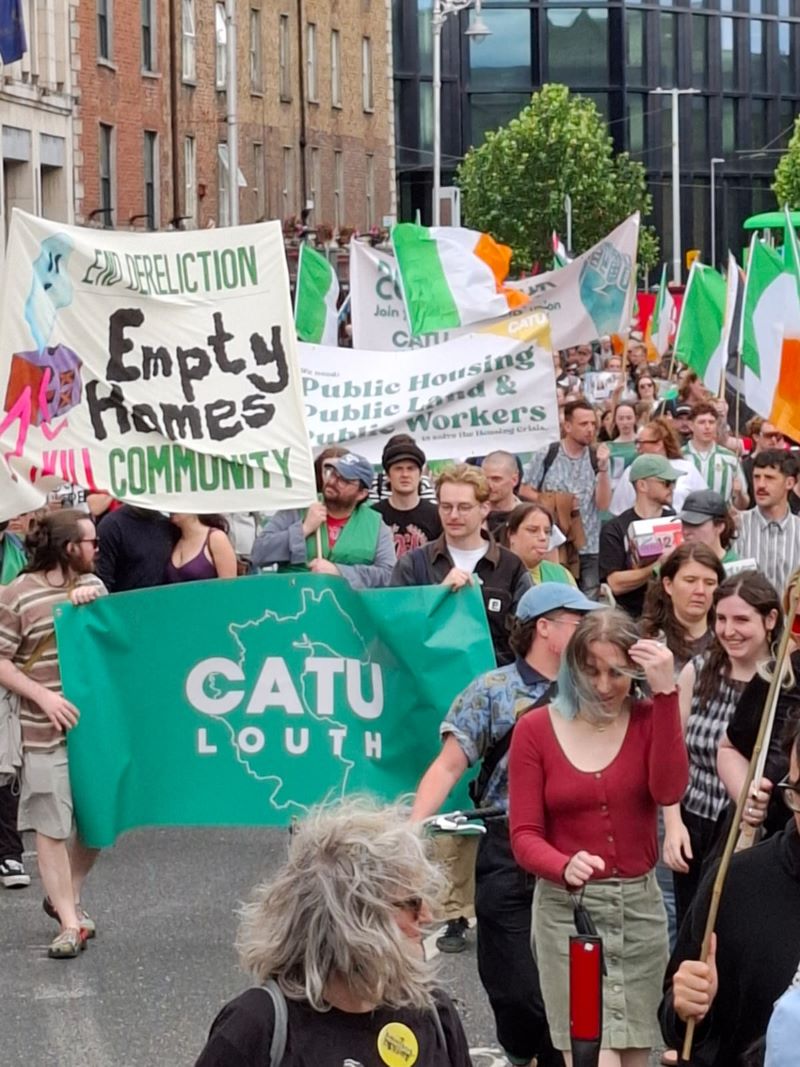
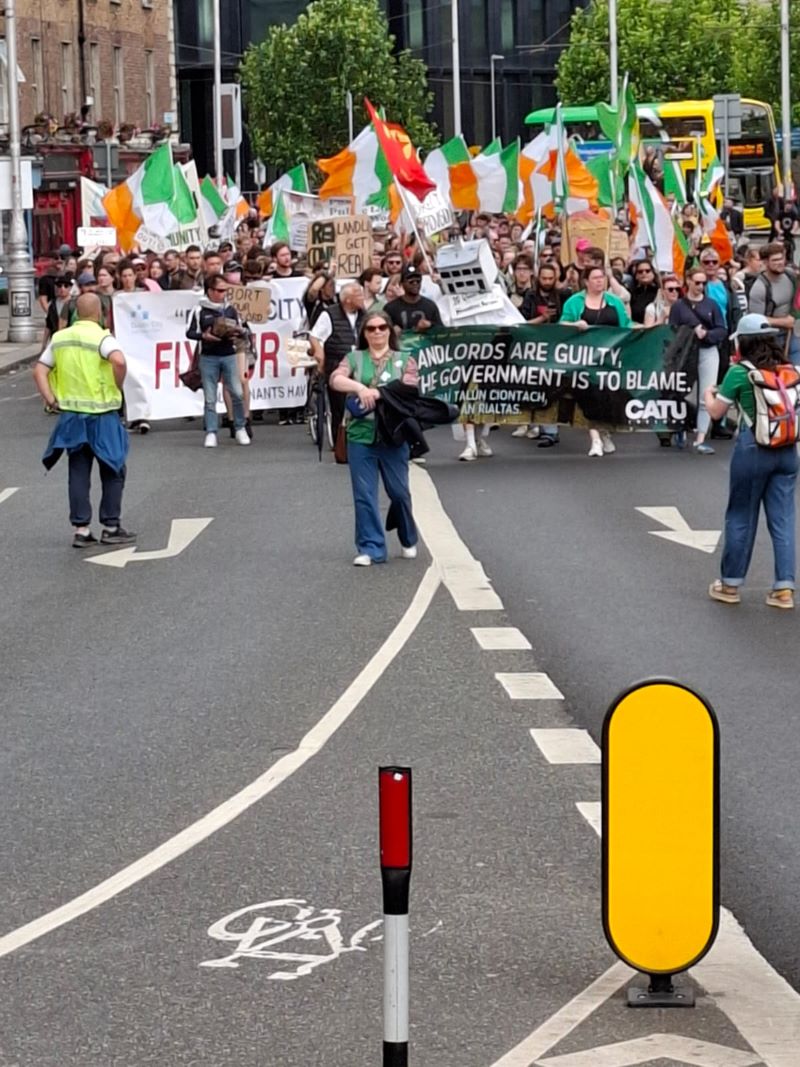
The Far-Right mobilised a large number1 of people for a national protest march in Dublin on Saturday 26th April, pretending the main target was the Irish Government and the housing and health service crises but was purely racist, anti-immigration.
A counter-rally was organised from the Left in front of the GPO, past which the far-Right demonstration was scheduled to pass. They were kettled on three sides by crowd barriers with two Garda vans and Gardaí on foot in front of them.
A number of far-right elements gathered on the sides of the confined mass to throw insults at the anti-racist there, policed very lightly and gently by Gardaí, in stark contrast to how the latter have treated some anti-fascist and anti-racist activists in the recent past.
Among the anti-racist crowd there were many flags of the People Before Profit and Labour parties, an Irish Tricolour or two, two Starry Plough flags and a couple of Palestine flags.
Section of the counter-protest to the anti-immigration march in Dublin on 26th April (Photo: D.Breatnach)
When the Far-Right march came down O’Connell Street, as might be expected from past experience, they carried a flood of Irish Tricolours and some ‘Irish Republic’ flags.
It was not the first time the Left – and these are for the most part the electoral Left – had acted so stupidly from a visual point of view. Because they claim to represent the workers, they pretend to scorn nationalist flags – well then why not at least fly the Plough,2 flag of the Irish workers?
But no, flying red and pink party flags and leaving the national stage to be represented by the Far-Right. And why not fly the flags of national rebellion anyway, are they not honoured for their anti-colonialism and revolutionary spirit? Why neglect to confront the Far-Right with the contradiction?
I have been pointing that out over years without any seeming effect on the Left (or indeed on the Republican movement). However the Mála Spíosraí (Spice Bag) artist group posted a similar objection, making many of the same points and they may have better luck with it.3
The Far-Right when they arrived were met with jeers but the marchers were jeering the anti-racists also. It was interesting to hear the anti-racist crowd switch from shouting that “refugees are welcome here” to baiting the Far-Right with: “Where’s your Union Jack?”4
Confronting the pretend patriotism of the Far-Right with their leaders’ connections to British fascists and Loyalists is much more effective than some of the slogans that are regularly shouted by the Left on these occasions. Reminding people of McGregor’s wearing a Poppy5 might be useful.
Creating slogans to expose their role in distracting attention from property speculators, big landlords, bankers and foreign multinationals on to migrants, who don’t cause any of the problems, would be very useful but expecting creativity and initiative in the electoral Left …!
At least one of the FR leaders, Malachy Steenson and some marchers were seen wearing caps in Trump imitation with “Make Ireland Great Again” printed across them. Unless pre-invasion 1169, there was no hint as to when the ‘great’ period in Ireland’s history might have been.
The country was under total occupation by the 1800s. The Irish State was set up in 1922 on a partitioned land with continuing high emigration. Steenson is an ex-Republican so presumably he knows this. Can he be hearkening to the days of the Church domination of the neo-colony?
Among the banners and flags seen among the marchers were those of Irish fascist organisations, the National Party and Irish Freedom Party. Slogans of “Ireland for the Irish” and “Get them out” were frequently to be heard and “Ireland is full” was seen on a number of placards.
The first two slogans are shouted by people many of whom have no interest in freeing the Six Counties from British Occupation nor the whole country from foreign multinational companies; in fact these are issues which the fake “Patriots” of the Far-Right never address.
On population statistics alone it can be shown that Ireland is far from “full”, given that the population of the country now is lower than the 8 million plus which was recorded in 1845. But lies of the sinister repeated by the ignorant and credulous have long been the stock of fascism.
Homelessness is due to affordable housing shortage, in turn is due to construction, sale and rental being for profit alone. We’ve had a housing shortage for centuries and expelling immigrants will not cure it – a social housing construction program can but the Far-Right never agitate for that.
Expelling immigrants might seem to shorten health service queues but in fact would lengthen them as those members of staff in paramedical services, nursing, surgery, cleaning and security left the country. But none of the anti-immigrant propaganda is about logic – quite the contrary.
A position that it’s patriotic to allow only the Irish-born to live and work in Ireland would have meant lost us four of the Seven Signatories of the 1916 Proclamation James Connolly, Tom Clark, the father of Patrick (and Willy) Pearse and the mother of Thomas Mac Donagh.
The racists flying the “Irish Republic” flag may be unaware that it was painted on one of her curtains in the house of London-born Constance Markievicz, delivered by her during the 1916 Rising to the GPO and installed on the roof by Eamon Bulfin, born and reared in Argentina.
The Irish Tricolour was presented to Irish Republicans by French Republican women during the Paris Revolution of 1848. The Harp on a green background was the flag of the United Irish, nearly all of whose leaders’ antecedents had come from other countries.
IT’S OUR FAULT
We can expose the ‘patriotism’ of those who ignore the foreign occupation of one-sixth of our land but organise against foreign workers; we can laugh at the ‘patriotism’ and ‘anti-globalism’ that thinks it fine to follow “Poppy” McGregor cosying up to a US imperialist president.
But in the end, those contradictory positions and don’t-compute beliefs won’t matter. The fascists are out to mobilise the ill-informed and gullible who have been hurt by the capitalist system and, it must be said, who have been largely ignored by the Irish Left and by Irish Republicans.
At the very least, the progressive forces could have fought for a wide public housing program. A campaign of occupations could have forced that though people would have gone to jail for it. Attempts were made by the Revolutionary Housing League but they were not supported.
The speculators, big landlords and bankers would hate it but in the end could afford to let it happen. They would still be in charge and still making money. It was not a revolutionary demand.
But the campaign was not pressed and now the Far-Right are there with a simplistic but completely wrong answer: stop immigration.
The electoral Left is not interested in fighting fascism but instead in anti-racist posturing. The Irish Republican movement is in general more interested in getting the British out of their 6-County Irish colony. Even on causes with which they agree, they can rarely stand on the same ground.
The advance of the Far-Right is the fault of the spaces left empty by the Left.
end.
FOOTNOTES
SOURCES
1The numbers quoted varied hugely. The first report on Breaking News had them at twice the number of the counter-protest, which they estimated at 2,000, an under-estimate to my opinion by almost a thousand. The next B News report put the anti-immigration numbers at “hundreds of thousands”, i.e at least 200,000! A more realistic guess would be around 10,000.
2The Starry Plough, flag of the Irish Citizen Army, the first workers’ army in the world, formed to defend the workers from police attacks in the employers’ attempt to break the Irish Transport & General Workers Union with a Lockout of union members.
3The Tricolour will be a right-wing symbol soon if it’s not front and centre at counters. Being allergic to your own flag is moronic and damages your legitimacy as a national movement. A sea of red and pink flags without the hard won symbols of Irish nationalism plays into the right-wing narrative that left is inherently anti-Irish. Fly the tricolour if you don’t want it to end up like the St George’s flag in England.
The left have a tendency to abandon things that are being co-opted by political opponents. In a country where nationalism, socialism and patriotism go hand-in-hand, this would be extremely damaging. Look no further than the Provo/Stickie split in the 1970’s for an example of the left losing legitimacy by putting the red before the green during a crisis.
You’re not just fighting the domestic right, you’re fighting US and UK conservative media and Zionism. Ireland is unique in Europe as a post-colonial state and we can be unique in how we fight our culture war. Nationalism should not be given away, the ‘left’ should not become the generic caricature pushed by right wing media. Our national flag should vastly outnumber all other symbols — it is a symbol of resistance.
4Increasingly the Far-Right leaderships have been exposed in alliance with British fascists and racists such as Tommy Robinson and Nigel Farage and with British Loyalists such as James Dowson.
5In 2015 Conor McGregor wore the red Poppy, causing controversy in Ireland as the symbol is firmly associated with the British imperialist army. McGregor claimed it represented all soldiers in all wars, which is patently nonsense. The Poppy is trademarked and produced by the British Legion to commemorate the UK soldiers killed – not even those of the Commonwealth, to say nothing of the soldiers on the other side, nor the millions of civilians killed.
The states of India and Pakistan seem to be approaching war, never a good thing but particularly worrying when both states have nuclear weapons. The British Raj ran both territories as one colony but separated them from one another in 1947.1
Since then there have been a number of conflicts between them including war and it will be no surprise to any politically-educated person that Imperialism has had a hand in that. But they may be surprised to find that so also did the Irish State.
(Image credit: Al Manar)
Ireland of course had a strong connection with the anti-colonial movement in what might be called the Indian sub-continent at least from the time of the Fenians and much more so during the War of Independence, for example with the McSwineys in correspondence with the Ghandi family.2
I found the reference to the Irish State’s involvement in a 2nd-hand copy of This Great Little Nation (1999) by Gene Kerrigan and Pat Brennan, about scandals of corruption and injustice in Ireland which I am reading, a few scandals at a time.
It is always interesting reading, at times highly amusing but largely depressing, even for one who holds that this is a neo-colonial state.
I reproduce the relevant article here verbatim and in full (but reformatted for WordPress publication).
It is difficult, looking back from this distance, to comprehend that Ireland once had an independent policy on international affairs.
Those dour, pompous, conservative old men – of whom De Valera was the most visible – sincerely saw themselves as founders of a state, as statesmen, as the equals of the leaders of the great powers.
While aware of the realities of Ireland’s economic dependence on British markets, they sought to take an independent line. As leaders of a former colony, they had particular sympathies with the Third World.
The trimming of that dependence, and the gradual falling into line with the new world order, began in the early 1960s.
The USA was taking over the role previously filled by Britain and the other European colonisers, now exhausted by the Second World War. The USA, confident, triumphant, had a young, assertive President, John Kennedy.
In 1962 India was taking a particular line in its long-running dispute with Pakistan over the former state of Kashmir. Ireland’s representative in the United Nations, Frederic Boland, had discussed the matter with India’s foreign minister, Krisna Menon and had agreed to back the Indian position.
In June, John Kennedy phoned the Irish Ambassador to the US, Thomas Kiernan, and asked him to help change Ireland’s position on Kashmir. He wanted Ireland to propose a motion pushing the US line.
John F Kennedy, flanked by the Tricolour and the Stars and Stripes, speaking during his four-day visit to Ireland in 1963 (Photo sourced: Internet)
“We can’t put it forward ourselves, without it being knocked, and we want Ireland to put it forward”, Kennedy said, according to Kiernan. “If we can get you to come along we’ll get others.”
In the same phone call, Kennedy said that his friend and aide Kenny O’Donnell had “mentioned something to me. I’ll look after that.” Kevin Boland balked at proposing the US line. He already had a deal with Krisna Menon. “He’ll be wild,” he said.
“We have a certain friendship with India from the old days, and so on, and we can’t do it.” Ambassador Kiernan went over Boland’s head, to the Fianna Fáil Minister for External Affairs, Frank Aiken. And Aiken immediately directed that the US line be followed.
“When he heard the request came from Kennedy he agreed without demur, no difficulty whatever”, Kiernan remembered. “We introduced the resolution, it was put through.”
So far, no scandal. Just some top-level and effective lobbying by Kennedy, the kind of thing that happens every day in foreign affairs. But was that something that Kenneth O’Donnell mentioned to John Kennedy, about which the president said “I’ll look after that”?
Ireland had for some time been trying to get into the US sugar market. To do that it needed to be included in a number of countries allowed to sell a sugar quota to the US. Ambassador Kiernan lobbied the president’s friend Kenny O’Donnell, and O’Donnell mentioned it to Kennedy.
Nothing happened for quite some time, until Kennedy mentioned it obliquely in his phone call to Kiernan. In his book, JFK and his Irish Heritage, Arthur Mitchell reports that “a new bill suddenly appeared, specifically including Ireland.”
Ambassador Kiernan said, “We, for the first time, got into the US sugar market. The Wall Street Journal said that it was hard to understand how it happened, but somebody with a large smile in Washington seemed to have been responsible.” We sold our independence for a few tons of sugar.
The following year, Kennedy visited Ireland. The young master, taking over responsibility from the tired old colonialists of Europe, was touring his estate.
Four years later, when an RTÉ current affairs crew was about to depart Ireland to do a first-hand report on Vietnam war, Frank Aiken intervened and the RTÉ Authority were told to call off the trip, which they did.
Independent reporting of the war would probably be critical; this would annoy the Americans; and that wasn’t allowed. The cancellation, said the government, “was in the best interests of the nation.” Not to mention the sugar business.
COMMENT
It’s interesting to identify the exact moment (or something like it) at which the Gombeen State switched from being England’s to being the United States’ bitch. Of course, there’s been a period of EU imperialism subservience and there’s always England, again3 … The bitch can switch.
By some kind of coincidence, considering the story earlier, India is a major sugar-producing country too. But … the Irish state was exporting sugar?!!
Ireland once had its own sugar industry going back to the mid-19th Century and the Irish State, building on that, nationalised it in 1930. In 1976, according to a study, the company was employing more than 10,000 people full-time, in fields, refineries, factories and in sales teams overseas.4
A further 15,000 people found employment in industries using the sugar as a raw material, industries that sprung up in the wake of the sugar factories and which, by 1976, were themselves earning the nation £20 million annually in foreign currency5.
Sugar quotas were imposed by the EEC and the State began successively to reduce the industry in Ireland, finally privatising it in 1991 by selling to Greencore, who closed the last factory down in 2006.6 We were still consuming high amounts of sugar but now importing it all.
We used to import it from the USA, and so the earlier story comes around to its starting point once more. More recently France, Netherlands, UK and Belgium have taken over supplying us.7
We imported sugars and sugar confectionery to US$536.42 Million during 2024, according to the United Nations COMTRADE database on international trade.8
Sugar is used directly as a sweetener for the table but also in the making of confectionery and it is an important component in the fermentation process of drinking alcohol. Beet pulp waste can be a valuable animal feed and production, refinement, packaging and transport all provide employment.
Nowadays, ethanol fuel and bio-degradable plastics could also be produced from beet9 which would be great for Ireland, along with the more traditional benefits. But that requires an independence-conscious planned State economy — so looks like it will remain just a nice idea.
An Irish Republican Easter Rising commemoration conducted on Sunday 20th April followed tradition in some aspects but departed in others. The event in Glasnevin Cemetery was organised by the Anti-Imperialist Action group.
As the 1916 Rising commenced on Easter Monday it is traditionally commemorated on various days around the Easter weekend. The actual date however was 24th April which a now-deceased socialist Republican activist publicly celebrated every year as Republic Day in front of the GPO.1
Taken from near rear of the marching columns approaching Cross Guns Bridge. (Photo: R.Breeze)
Among the commemorations organised by Irish Republicans around the past weekend was that by the AIA group on Sunday, rallying by the Phibsboro shopping parade for 1pm, before marching out to Glasnevin cemetry along the Phibsboro Road in two parallel separate lines.
This gathering in the past has been marred by the Special Branch, the political plainclothes police, harassing and attempting to intimidate those present, demanding their names and addresses under anti-terrorist (sic) special legislation. This time they were there but did not approach.2
Just after passing Crossguns Bridge over the Royal Canal, a flare was lit and the march stopped in the street.3
After a short pause the march resumed, led by the colour party,4 six men and women, each carrying a different flag with the Tricolour and Starry Plough in the lead, all dressed in black trousers, white shirts, black berets, sunglasses and lower face masked.
The images of each of the Seven Signatories of the 1916 Proclamation, all shot by British firing squads were on large placards were carried among the marchers: Tom Clarke, James Connolly, Patrick Pearse, Seán Mac Diarmada, Joseph Plunkett, Thomas McDonagh, Eamonn Ceannt.
(Photo: R.Breeze)
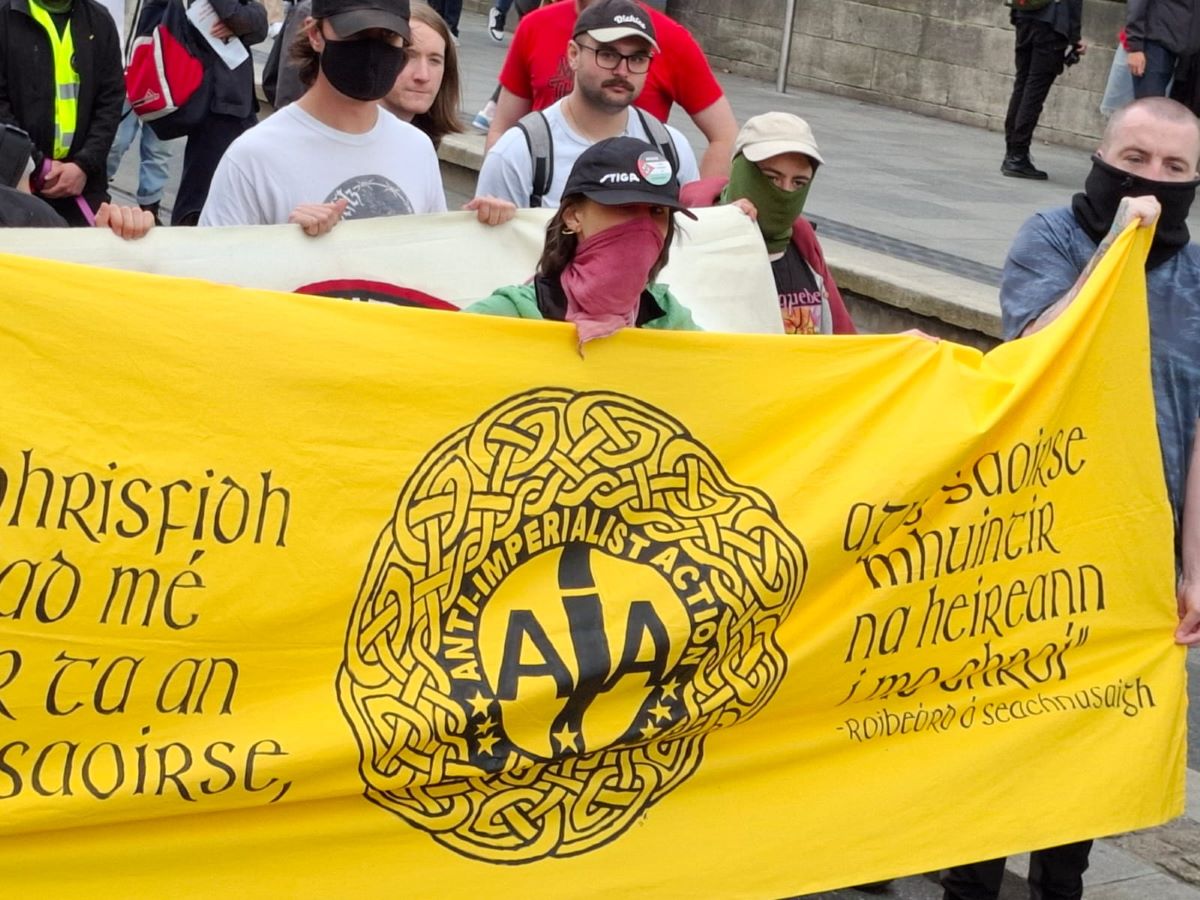
A variety of flags were also flown among the marchers, including the green and gold Starry Plough,5 Palestinian flag, Basque Ikurrina and red flags (with gold hammer and sickle emblem on at least one).6 The AIA banner carried at the front bore a quotation from Bobby Sands in Irish.
The march soon passed the main gates of Glasnevin Cemetery to their right but continued before turning leftward to then cross over the pedestrian railway bridge to the newer part of Glasnevin Cemetery and up to the monument to the Six armed struggles referred to in the Proclamation.7
Formed in two lines the attendance was welcomed in Irish and English by the event’s MC, calling also for the reading of the Proclamation of Independence, which a man stepped forward to do. The MC recommended a careful reading of the still-relevant document to attendees from abroad.
Section on the left of the attendance at the commemoration rally with another section to the right out of shot. (Photo: R.Breeze)
Following the reading, the MC commented on the important role of culture in the 1916 Rising8and called on an activist who he said has done much to promote traditional and folk Irish song, who proceed to sing Patrick Galvin’s Where Oh Where Is Our James Connolly? “with some changes”.
Next the call was given for those who wished to lay floral tributes while the colour party lowered their flags in homage to the fallen to commands in Irish, then slowly raised them again before responding to the command in Irish to stand ‘at ease’.
(Photo: R.Breeze)
Another activist was called to read the 1915 statement on the Irish Citizen Army by James Connolly in which the revolutionary leader outlined the police violence during the 1913 Lockout that created the need for the ICA and how it had gone beyond defence in assertiveness.
The statement declared its class allegiance and origins “Hitherto the workers of Ireland have fought as parts of the armies led by their masters, never as members of an army officered, trained, and inspired by men of their own class.”
Reading Connolly’s “To the Irish Citizen Army” (Photo: R.Breeze)
The PA amplification failed on the reader but she carried on in a strong voice reading Connolly’s words that the ICA sought alliance with all progressive forces but remained independent, not to be bound by the limits others set themselves and going further on their own if necessary.9
Another singer was called to perform Erin Go Bragh10 specifically about the 1916 Rising (by Dominic Behan, originally called A Row in the Town).
Singing Erin Go Bragh at the Monument (Photo: R.Breeze)
It is traditional for organisations to deliver a keynote message or statement of aims at 1916 commemorations and a statement was read on behalf of the Irish Socialist Republican Movement (of which the AIA is a part) restating the objectives of national independence and socialism.
In that context the struggles against the Irish ruling class putting the State into imperialist alliance and against the British occupation of the nation, also a NATO member, were greatly important and the Gardaí had broken a comrade’s foot in that struggle.
(Photo: R.Breeze)
Referring to the international context of the 1916 Rising and the international connections of the revolutionary movement in 1916, the MC read out a fraternal message to AIA from the People’s Front for the Liberation of Palestine,11 declaring that the struggles of both peoples are one.
The event concluded at around 2.45pm with a singer performing Amhrán na bhFiann12 (first verse and chorus) followed by an announcement or reminder of a public meeting organised by the AIA titled Rebuilding the Republic to take place at 4pm at a venue not very far distant.
End. Footnotes
1Easter is a religious festival and its date varies from year to year according to computations based on the lunar and solar calendars and cannot fall on the same date annually in the Gregorian calendar (or the Julian one). After the insurrectionary forces had taken possession of the building, Patrick Pearse with James Connolly by his side read the Proclamation outside the General Post Office (GPO) building on the first day of the Rising (after its rescheduling from the previous day, Sunday): 24 April 1916. Tom Stokes tried for years to have the date adopted as Republic Day and annually organised an event outside the GPO on that date. After his death others carried on commemorating the date but rather than outside the GPO, at Arbour Hill. The Republican movement continues to hold its 1916 commemoration events over the Easter weekend.
2Possibly because the dust has not yet settled on the Gardaí’s recent violent arrests on 23 peaceful activists in three different events over four days (See Rebel Breeze’s IrishState Ramps Up Repression) recently.
3This spot has a 1916 history: A group of Irish Volunteers walked from Maynooth on Easter Monday along the banks of the Royal Canal, meeting two Irish Volunteers guarding the bridge and that night slept in Glasnevin Cemetery. The following morning they continued their journey to the city centre. Later, as the Rising was being suppressed, the British soldiers placed a barrier on the Bridge and prevented most people from passing through. A local man who had been deaf from birth failed to heed the soldiers’ challenge and they shot him dead.
4The ‘colour party’ carries the ‘colours’, i.e the flags and usually marches at the front. The number and type of flags varies but Irish Republican colour parties always carry the Tricolour among them, usually followed by the Starry Plough of which for many years the white stars on a blue background version was the most common. Often a flag of each of the four provinces would also carried and the Gal Gréine (or Sunburst) of the Fianna and of the Fenians would be carried too. The Harp on a Green background was another flag that was often carried by Colour Parties.
5The original design of the flag of the first workers’ army in the world, the Irish Citizen Army, created in 1914. It is a plough following the form of the Ursa Mayor constellation with a sword replacing the ploughshare.
6This is usually considered a symbol inherited from the Bolsheviks, the sickle representing the agricultural workers and the hammer, the industrial workers, their conjunction symbolising unity of peasants and industrial proletariat.
71798 and 1803 (United Irishmen), 1848 (Young Irelanders), 1867 (Fenians), 1882 (Invincibles group within the Fenians), 1916 (IRB, Irish Volunteers, Irish Citizen Army, Cumann na mBan, Fianna Éireann)
8Irish language revival, national theatre groups, national sports, poetry, music and song all contributed to an atmosphere conducive to resistance and uprising.
9However it may be for others, for us of the Citizen Army there is but one ideal – an Ireland ruled, and owned, by Irish men and women, sovereign and independent from the centre to the sea, and flying its own flag outward over all the oceans. We cannot be swerved from our course by honeyed words, lulled into carelessness by freedom to parade and strut in uniforms, nor betrayed by high-sounding phrases.
The Irish Citizen Army will only co-operate in a forward movement. The moment that forward movement ceases it reserves to itself the right to step out of the alignment, and advance by itself if needs be, in an effort to plant the banner of freedom one reach further towards its goal. https://www.marxists.org/archive/connolly/1915/10/forca.htm
10The slogan Éirinn (or Éire) go brách (“Ireland for ever”) was rendered in English spelling as Erin go bragh.
11 A socialist and secular resistance Palestinian resistance organisation; its armed wing is Brigades of the Martyr Abu Ali Mustafa which has been part of the armed resistance throughout the period, often in coordination with other groups.
12In a reversal of the usual sequence, the lyrics of this song by Peadar Kearney and Patrick Heeney were first composed in English but later translated to Irish, that being the most popular version of the chorus today.
April 17th is the annual Palestinian political Prisoners’ Day and it was marked in O’Connell Street, the main street of Dublin’s city centre, by an event with speeches, banners and chants organised by the Ireland Palestine Solidarity Campaign.
Palestine national flags fluttered about the crowd being addressed by a number of speakers with occasional toots of solidarity from passing traffic – a common occurrence at Palestine solidarity events in most of Ireland.
View of eastward of section of the crowd at the event (Photo sourced: IPSC)
Dáithí Doolan was one of the speakers and though saying some progressive things about solidarity with Palestine and the terrible situation in which the occupiers have them, soon revealed the political poverty and lack of solidarity with resistance of his Sinn Féin party.
Doolan reminded his audience of when there were political prisoners in Ireland, as though this was no longer the case, presumably because the prisoners now are not of his party. Nor did he mention the current attempts to extradite Irish Republicans to British administrations.
The SF speaker went on to extol the South African process, perhaps not caring about the betrayal of the struggle and sacrifice of the masses there, the deepening grip of imperialism on the rich natural resources, the corruption and repression of the ANC regime and the massacre at Marikana.1
If Doolan thought about it he must have hoped that his audience did not remember that the South African process had a twin, the Palestinian one at Oslo which sabotaged the Palestinian struggle and brought into being the corrupt Palestinian Authority2, the Israeli proxy in the West Bank.
Sinn Féin has achieved a somewhat similar position in the Six Counties colony and has been working hard to reach a corresponding role in the Irish state. And why not, when it endorses the “Two State solution” giving the Palestinians 20% of their land under Zionist eyes and guns.
The very least, Doolan said, that the Irish Government could do to help the Palestinians, would be to enact the Occupied Territories Bill but he proposed nothing further, not even the ban on US military flights through Shannon Airport or on Israeli arms flights through Irish airspace.
Darragh Adelaide from the People Before Profit party spoke too about Palestine and solidarity but also about the Palestine refugees that have had to sleep in tents on Irish streets and the attacks on them both by the authorities and by fascists and other racists.
Palestinian prisoner conditions
A woman gave a detailed list of statistics relating to Palestinian political prisoners but also went through the tortures and terrible conditions in which they are kept. She concluded reminding her audience that each prisoner is a human being, a parent, a child, a sibling and not a number.
View of the crowd southward from behind a speaker (Photo sourced: IPSC)
In a year and a half, more than 15,800 Palestinians have been arrested, including 500 women, 1200 children, and thousands of detainees who were placed under arbitrary administrative detention. 64 Palestinians have died in prison since October 2024, including a child.3
The prison administration’s special units have carried out violent raids on prisoners’ cells, administering severe beatings, torture, and ill-treatment.4
Prisoners have suffered power and water cuts, and all of their belongings—including clothes, electrical appliances, and hygiene items—have been confiscated.5
They have been placed under complete isolation, family visits have been completely banned, and the International Committee of the Red Cross has been prevented from visiting them inside prisons.
Additionally, a policy of starvation has been implemented against thousands of prisoners, who are being provided with only two extremely poor-quality and quantity meals a day.6
The MC of the event led chants in which he called out Palestinian political prisoners! and the audience responded with Free them all! Similarly with Free the children prisoners — Free them all! and Free the women prisoners! — Free them all!
Symbolising the Palestinian political prisoners (Photo sourced: IPSC)
He also referred to the woman arrested outside the Irish Embassy in Berlin for speaking in Irish and, in defiance, led the audience in a chant in Irish expressing solidarity with the Palestinian people: Saoirse don Phalaistín! (Freedom for Palestine!)7
What was notable in its total absence from all the speeches was any call to step beyond the marches and similar measures which have been supported by thousands in Ireland over more than 18 months but which have not succeeded in moving the Government even to enforcing its formal neutrality.
This is replicated in most solidarity events across the state, leaving those few who take action to increase greater pressure on the ruling class to face the repression of the Irish State, as with 23 men and women in three different events over a four-day period in Dublin recently.8
Political prisoners from the armed resistance
The Joe McDonnell Ballad9 would have been most appropriately performed at this event, in particular the chorus line: You dare to call me a terrorist, while you look down your guns … But the IPSC would hardly endorse the singing of that song nor wish to be associated with it in public.
There were two large prisoners’ solidarity banners of the IPSC at this event but it is remarkable how rarely one sees them on the IPSC’s national marches. The problem with the prisoners for liberal organisations is that some of them, at least, have been armed fighters of the Resistance.
This, combined with ignorance perhaps, accounts for the comparatively low numbers at this event. However, it has to be said that known revolutionary organisations were also visibly absent.
View south-westwards with the iconic GPO (General Post Office) building in the background. (Photo sourced: IPSC)
Doolan’s party was a problem for liberals when many of the political prisoners here had been armed Irish Republican resistance fighters; it’s still a problem for them today — but also for Doolan and his party now that the current Irish political prisoners are no longer associated with them.
If solidarity does not embrace resistance then it’s charity, not solidarity. And if resistance is to be embraced then it should be so for all its expressions, artistic, cultural, mass mobilisations, strikes, boycotts … and armed. Including solidarity with those who, because of resistance, end up in jails.
Free them all!
End.
NOTES
1Culminating on 16th August 2012 (while Mandela still lived) the police of the ANC Government carried out a massacre of over 40 striking miners over a period of three days. The massacre was to suppress a strike in a platinum mine of the Canadian Lonmin company, repressing also a breakaway union from theANC-allied National Union of Mineworkers. The massacre is widely believed to have been organised by Cyril Ramaphosa, then a millionaire and vice-President of the ANC Government and recent leader of the NUM, now President of South Africa.
2Which also beats and incarcerates Palestinians resisting the Occupation (exact figures are difficult to obtain) and has murdered some.
7This slogan has now become well known in Ireland in voice but also in writing, appearing on flags, banners and placards. It represents a partial success for those of us who have tried to insert a measure of the Irish language into Palestine solidarity, in the belief that it is important for the Irish language to be present in progressive movements.
9By Brian Warfield of the Wolfe Tones band in honour of Volunteer Joe McDonnell of the Provisional IRA who died on hunger strike in 1981; the song also names other hunger strike martyrs of the Provisionals Vols. Bobby Sands, Francis Hughes, McCreesh but adds Vol. Patsy O’Hara of the Irish National Liberation Army. In total, seven of the Provisionals and three of INLA died on hunger strike in 1981.