Revolutionary socialist & anti-imperialist; Rebel Breeze publishes material within this spectrum and may or may not agree with all or part of any particular contribution. Writing English, Irish and Spanish, about politics, culture, nature.
An Irish punk rock band, Mongolian throat-singers, a poet and Irish folk singers all performed at Solidarity Sessions No.2 to a good crowd in the International Bar, in in Dublin City centre Wicklow Street on Wednesday 17th..
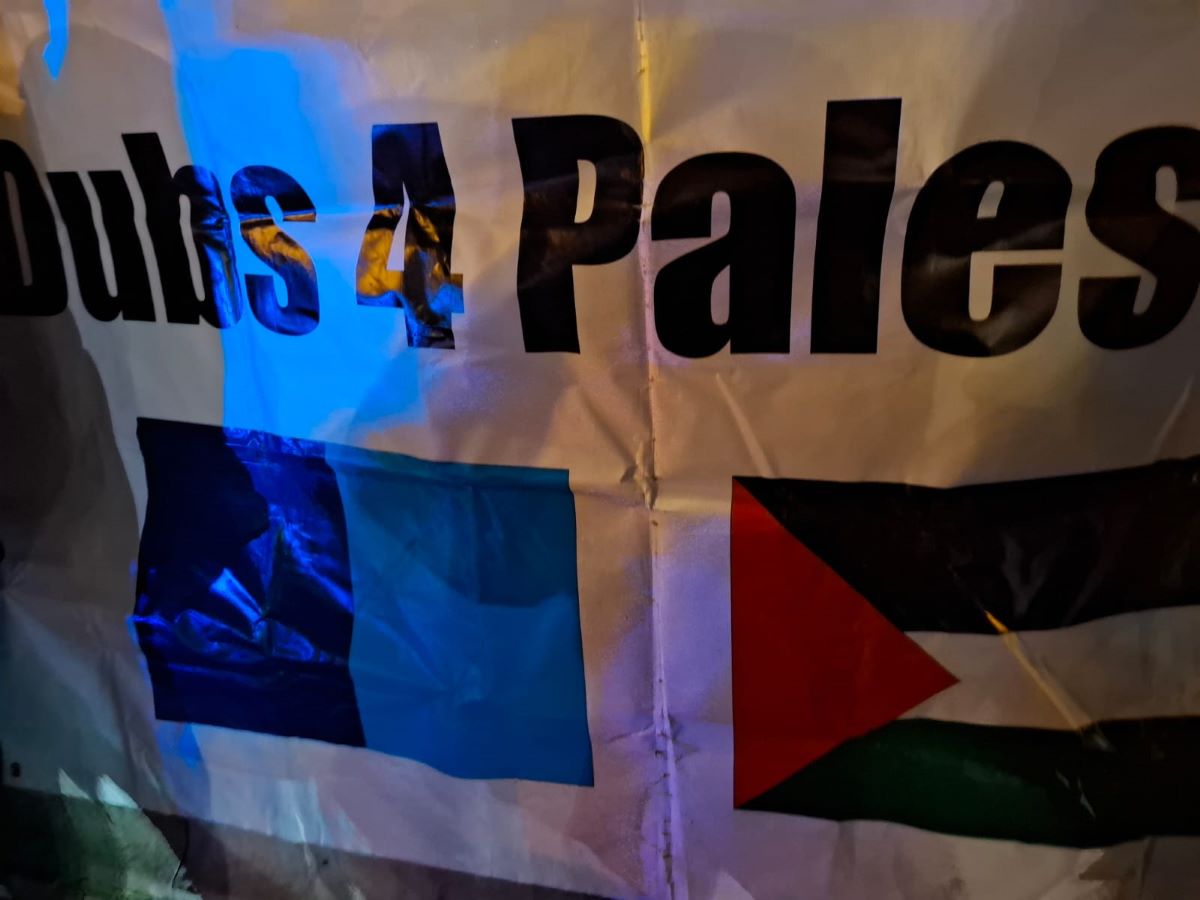
An Irish and international resistance theme in decor was presented by flags of the Starry Plough and Palestine with Saoirse don Phalaistín as stage backdrop, while flags respectively of Cumann na mBan and Basque Antifa concealed the original decor’s ubiquitous photos of Michael Collins.
Flesh B. Bugged performing (Photo: Dermo Photography)
A PFLP1 flag was also taped to a wall. Hand-written signs on the stairs leading to the basement venue, alternatively in Irish and in English, asked for quiet/ ciúnas for the performance/ racaireacht. The Irish language was present too in some of the performances to follow.
MC for the night, Jimi Cullen, himself a singer-songwriter activist told the crowd the purpose of the organising collective was “to build a community of resistance and solidarity with our struggles and with struggles around the world” through culture in a social atmosphere.
Before the crowd — a flag temporarily changing the decor. (Photo: R. Breeze)
Themes of love, nature and emigration were covered in song; however the dominant theme was resistance – to prison regimes, foreign occupation, fascism, class oppression, racial discrimination – and solidarity with the struggles of others, near and far.
Diarmuid Breatnach, singing acapella kicked off the night with a selection of songs from the Irish resistance tradition and a couple of short ones from the USA civil rights movement. Some of the melodies however, of particular interest perhaps to Back Home in Derry2, were his own originals.
Eoghan Ó Loingsigh, accompanying himself on guitar followed with more material from the same tradition, dedicating one to his late IRA father. A folk song Ó Loingsigh announced as ‘non-political’ performed acapella turned out to be very much political but on the issue of social class.
Áine Hayden followed with poems on a range of topics, from swimming in the Royal Canal during the Covid shut-down, deleting a personal relationship to a dedication to comedian and activist Mahmoud Sharab murdered with family in a “safe zone” tent by the Israeli Occupation Force.
Eoghan Ó Loingsigh performing (Photo: Dermo Photography)
The three performers were all introduced as activists as well as artists and the mostly-young crowd, apparently containing a strong representation of political and social activists, responded well to the performers with applause, yells of encouragement and often joining in on choruses.
More people arrived before, during and even after the break – including an elderly couple who had just arrived from the USA and could only pay in dollars but were admitted for free. Leaving later with thanks they promised a contribution to Palestine solidarity when they got home.
Before the crowd — a Cumann na mBan flag temporarily changing the decor. (Photo: Dermo Photography)
Also an activist, Ru O’Shea sang an Irish, Scottish, French and Italian selection, accompanied by bouzouki and guitar and performed a spoken word piece with a refrain of ‘Éire under attack’ before schooling the audience to sing the chorus of Robbie Burns’ Green Grow the Rushes Oh!
Áine Hayden performing (Photo: Dermo Photography)
Nomads were the next act. Composed of two Mongolian musicians playing violins in the style of the viola and a Dubliner modulating on a sound deck they were unusual enough but it was the amazing throat-singing of one of the Mongolians that had the audience enthralled.
It was amazing to learn that there are three different kinds of Mongolian throat-singing and then to hear them performed, one of which was a kind of whistling with a vibrating bass undertone wavering through it. The applause, particularly when they concluded, was rapturous and sustained.
Before the crowd — flags temporarily changing the decor. (Photo: R. Breeze)Ru O’Shea performing (Photo: Dermo Photography)
The evening’s entertainment concluded with Flesh B. Bugged, a punk rock Irish duo of bass guitar and drums with spoken voice pieces in Irish from the bass guitar player. Their volume and beat got some of the crowd up and dancing and the wider crowd responded well to them too.
MC Jimi Cullen went up on stage for the last time to thank venue, performers, audience, doorkeepers, poster designers Ríona and Azzy O’Connor, also Diarmuid for original artwork. At a prompt from the crowd Cullen also got a round of applause from the audience for his MCing.
The Mongolian musicians of Nomads performing (Photo: D.Breatnach)
Remarking they’d “had a great night” and encouraging his listeners to follow the organising collective on its Instagram page, Cullen told them that details of Solidarity Sessions No.3 and the collective’s decisions on recipients of donations from money raised would be posted on there.
Diarmuid Breatnach told the audience that each individual could help build a community of resistance through attending the Solidarity Sessions and encouraging others to attend. He welcomed any ‘competion’ from solidarity sessions around the country.
Bass guitarist of Flesh B. Bugged (Photo: Dermo Photography)
The downstairs area of the International Bar is not perhaps the best layout for this kind of event but it worked out well enough for the collective, audience and performers on the night. Their next event will be back at their launch venue,The Cobblestone, Smithfield on Thursday 30th October.
End.
Note: If you found this article of interest, why not register with Rebel Breeze for free, so that you will be notified by email of subsequent articles. You can de-register any time you wish.
The Mongolian throat-singer in Nomads (Photo: Dermo Photography)
FOOTNOTES
1People’s Front for the Liberation of Palestine, one of two specifically secular armed resistance organisations in Palestine.
2Irish mega folk singer Christy Moore had organised Bobby Sands’ poem into song to the melody of The Wreck of the Edmund Fitzgerald by Gordon Lightfoot.
On 13th September 1845 the widely-read British weekly publication The Gardener’s Chronicle apprehensively reported the appearance of the blight on potatoes in Ireland but doubtful if the full extent of the holocaust to follow was expected.
(Sourced: Internet)
True, no other national population in any other known part of the world was as heavily dependent on the potato as was Ireland’s. Other crops were grown but were mostly destined as feed for domestic animals1 or for export directly or indirectly as in the case of alcoholic drinks.2
A national diet is that of the mass of the population, which in Ireland was the peasantry. On the potato and a little milk the Irish peasantry grew strong enough to be recognised in Britain as healthy able workers, seasonally in agriculture or longer-term in manufacturing and construction.
They were reputed to be the tallest and most fecund in Europe, according to Frederick Engels writing in Britain a year before the piece in the Chronicle.3 In Ireland the peasantry were for the most part tenants-at-will or landless labourers for the settler big landowners and descendants.
The original Irish had been expropriated by sword, fire and pen (legal decrees) and their expropriators lived on the rents they extracted from their tenants in a mixture of crops, animals, cash and labour. After the abolition of the Irish Parliament,4 most big landowners found no reason to even live in Ireland.
The estates of the absentee landlords were then managed by agents, middlemen who forwarded the extracted wealth to their masters in Britain, or perhaps travelling ‘on the Continent’, or trying their hand in the American colony, minus the agents’ commission, of course.
As people went hungry, meat, dairy and grain continued to be exported.
The dependency of the Irish mass on the potato was known of course and even mocked in some ruling British quarters at times. But so were the Irish landlord aristocracy who seemed to have no interest in developing industry.
But could anyone predict that the blight would intensify each year and that the Government of the UK would tolerate such devastation in one of its parts? By the time it had run its course six years later, Ireland had lost at least 2.5 million of its original over eight million5 and more were emigrating.
Memorial to the Great Starvation on Dublin’s north side quays. (Sourced: Internet)
And both the Irish planter aristocracy and the cotter class of Irish peasantry had been wiped out, leaving the field to the Gombeen6 class of money-lenders and bigger farmers, the latter now expanding their holdings and who would farm meat instead of agricultural produce.
When the overall national population stabilised again it did so at five million,7 at which level, despite a high birth and survival rate, it remained until the early 1990s. The magic trick was achieved by constant annual emigration, giving the Irish one of the largest diasporas in the world.8
The Gardener’s Chronicle’s writer noting the arrival of Phytophthora infestans could not have imagined the extent of its devastation. But if he knew the history of Ireland as well as that of the blight, he would have concluded that it was not the worst blight upon the Irish nation.
No, that was the arrival of the Anglo-Normans in 1169, with the second-worst blight being the growth of the Gombeen class.
end.
Note: If you found this article of interest, why not register with Rebel Breeze for free, so that you will be notified by email of subsequent articles. You can de-register any time you wish.
FOOTNOTES
1Grazing animals live on forage in Ireland but in winter or if overgrazed must be given additional food, while draught animals need cereal feed, typically oats. Pigs and domestic fowl were fed on mixtures of potato, beet, pulses and domestic leftovers.
2Typically eorna (barley) for beer brewing and whiskey distilling. These products continued to be produced and exported during the years of famine. Hops are also used for brewing but much was imported from southern England where climatic conditions are more favourable.
3The Condition of the Working Class in England (1844).
41799, followed immediately in 1801by Ireland becoming part of the United Kingdom and Irish MPs being required to attend the Westminster Parliament.
5A historical and statistical riposte to the anti-immigration claim that today “Ireland is full”.
6Originally from the Irish word Gaimbín and applied to moneylenders and land speculators during and following the holocaust period it, came to be applied by many to the Irish neo-colonial national bourgeoisie.
7Of the whole nation, with over 3 million in the Irish state and under two million in the British colony, the Six Counties.
8The bleeding through emigration was constant but fluctuated in degree, with a high point in the 1950s when it amounted to 15% of the Irish state (i.e. of the 26 Counties) and another in the 1980s.
The grave of Irish Republican political prisoner Vol. Seán Ó Conaill received a headstone on Sunday (7th August) due to the efforts of the National Graves Association – nearly 50 years after his death in British custody.
Seán was born and brought up of Irish background in Birmingham and became interested in Irish history. After Bloody Sunday (1972) he tried to join the IRA but was not accepted and subsequently acted independently, assassinating a British Army Lieut. Colonel.
Tracked by British police, he wounded two of the group sent to arrest him, was captured and beaten up. His treatment in jail was bad also but after sentencing was accepted by the Irish Republican prisoners in British jails and, in time, sworn into the Provisional Irish Republican Army.
After his death his body was transferred for burial in Glasnevin. It seems that the NGA understood that his family wished to erect a headstone but for whatever reason the grave lay without one until last week.
The National Graves Association went ahead with commissioning a gravestone which they unveiled on Sunday in the St. Paul’s section of Glasnevin Cemetery1 with a colour party, speakers, music and a goodly attendance, though drenched during the ceremony.
The occasion was supported by members of Sinn Féin and Republican organisations in addition to independent Republicans and anti-imperialists. Seán Whelan, Chairperson of the NGA chaired the event and after some opening remarks introduced the speakers.
Section of the attendance at the event. (Photo: D. Breatnach)
SPEAKERS
Jacqui Kaye of the former Prisoners’ Aid Committee2 was introduced to speak and told her audience that Ó Conaill was diagnosed with terminal cancer and requested a visit from Kaye, permission for which was initially refused by the Home Office3 but granted after intervention by Lord Longford.
The visit was permitted for 10 minutes only for Parkhurst Jail but then changed to a hospice though when Kaye arrived it was to be told that he had just died there, leaving her with the suspicion that he had actually died in Parkhurst but that the Home Office did not wish that on their record.4
Jacqui Kaye, formerly of the Prisoners Aid Committee (no longer in existence), speaking at the event during a particularly heavy shower. (Photo: D. Breatnach)
Former Republican prisoner (21 years in British jails) Noel Gibson laid a wreath on behalf of the NGA and Paddy Lennon read The Rhythm of Time by hunger strike martyr Vol. Bobby Sands, after which a recording of uileann pipes filled the cemetery air with its haunting lament.
Liam Ó Culbáird of the NGA presented the main oration of the event, recounting details of Ó Conaill’s life and time in jail, information gathered from a number of sources, including that despite complaining of chest and stomach pains he did not receive medical investigation in jail.
It was only after coughing up blood that Ó Conaill received a medical visit, after which he was diagnosed with terminal cancer. His marriage had become estranged possibly as a result of his incarceration but official interference in personal relations of political prisoners was also known.5
Liam Ó Culbáird, giving the oration at the unveiling on Sunday. (Photo: D. Breatnach)
The speaker alluded to the practice of “ghosting” political prisoners, i.e. moving them to a different jail without notice, often as a scheduled visit by a family member was imminent, which occurred to Ó Conaill’s mother arriving at Wakefield Prison to be told he had been moved to Parkhurst Jail.6
Such practices imposed an additional punishment not only on the prisoner but in particular on family members7 who had often travelled long distances into sometimes hostile territory and had also the additional expense of paying for overnight accommodation.
The media at the time of his arrest had portrayed Ó Conaill as of unbalanced mind but his comrades in jail found him completely rational and dedicated to the cause. He began to learn Irish and encouraged the other Republican prisoners to expand their use of the language.
Liam Ó Cúlbáird and Jacqui Kay unveil the headstone to Vol. Seán Ó Conaill on Sunday. (Photo: D. Breatnach)
Commenting on Ó Conaill’s failure to be recruited by the IRA prior to his armed action, Ó Culbáird commented that disagreements between General Headquarters of the IRA and Volunteers were not unknown and related a GHQ approach to Brendan Behan after his release from jail.
Behan was informed that he had been been found guilty by GHQ court-martial8 in his absence and sentenced to be shot. Behan replied that since his court-martial had been in his absence, so equally could his execution and promptly departed!
Ó Culbáird commented also on the number of groups that had operated independently of the IRA’s GHQ and remarked upon the number of different groups that had participated in the 1916 Rising,9 all with their reasons for separate existence but all united in the struggle for independence.
The speaker ended his oration by pointing out in Irish and in English that Ó Conaill was an Irish Republican soldier who gave his life in the struggle for Irish freedom.
CONCLUDING
Bringing the ceremony to an end, Seán Whelan thanked the speakers for their contribution and audience for their attendance and added some words about the NGA, pointing out its political independence and refusal to accept donation from any governmental or other organisation.
Chairperson of the NGA, Seán Whelan, presiding over the unveiling on Sunday. (Photo: D. Breatnach)
Whelan also added that whereas the NGA acknowledges the right of anyone to commemorate their dead, their organisation prioritises the dead who participated in the Irish struggle for independence but also cannot agree to share their commemoration with those who fought against them.
He remarked that he did not know of any other country where that would be done. Whelan then called for attention to the playing of a recording of the the National Anthem.
End.
(Photo: D. Breatnach)
FOOTNOTES
1i.e the large section on the opposite side of the road from the main Glasnevin gates, also where stands the NGA memorial to the six uprisings mentioned in Pearse’s famous speech.
2The PAC was initially formed by Official Sinn Féin but within two years had left the Officials and operated independently.
3Irish Republican prisoners in British jails were listed as high-security Category A and were not permitted visitors other than immediate family.
7Though not mentioned in the oration, this was also a practice of the Spanish prison system against Basque political prisoners, in which case letters and parcels arriving for the prisoner, rather than be forwarded to the prisoner’s new location, would be returned to sender with a note that the prisoner was no longer at the posted address.
8Presumably for his solo unauthorised action in carrying a bomb to England.
9Irish Republican Brotherhood, Irish Volunteers, Cumann na nBan, Irish Citizen Army, Na Fianna Éireann, Hibernian Rifles. Some individuals not a member of any of those organisation also participated.
Your Breaking News edition of 4 September 2025 featured a news item about a freak snail, with a left-spiralling shell, for which a freak mate was being sought.
This was disgusting use of public media light-heartedly flaunting disregard for Christian morality.
Ireland is a Christian country and public reference to the sexual act in general is bad enough but writing about snails and their sexual acts is much, much worse.
Quite apart from left-spiralling shells, snails are already freaks. It is well known that snails are hermaphrodite, that is they carry both male and female sexual organs and when one wishes to mate with another, apparently one decides whether to act the male while the other decides to act the female.
This is clearly unnatural and against God’s Plan, who created every animal as functioning male or female and the same with human beings. Snails in fact, apart from being a pest in the garden are clearly one part of Satan’s spawn. They are an abomination.
That any snail, whether with a right or a left-spiralling shell should fail to find a mate is a good thing and your publication should not be encouraging people to find it a partner. Your newspaper could be considered to be in effect pimping for it.
Publications of stories about snails and their sexual habits can only encourage the latest trend in human deviation known as ‘trans’ where some people choose to consider themselves and to be considered as a gender other than that with which they were born. This too is an abomination.
Please return to God’s plan and cease printing such dangerous and disgusting reports.
Sincerely,
A Sinestra variant (left-spiralling) snail, Cepaea Nemoralis photographed in Galicia, Spanish state. (Photo cred: Raymond JC Cannon)
EU Vice-President Kallas referred to a number of state leaders meeting in China as ‘autocratic’, accusing them of challenging the ‘rules-based order’ of the Western states. But what is that ‘order’ and what are the ‘rules’ upon which it is based?
Kallas, in the course of her mostly economic briefing on behalf of the EU: While Western leaders gather in diplomacy, an autocratic alliance is seeking a fast track to a new world order. Looking at President Xi standing alongside the leaders of Russia, Iran, and North Korea in Beijing today.
These are not just anti-Western optics; this is a direct challenge to the international system built on rules. And it is not just symbolic: Russia’s war in Ukraine is being sustained by Chinese support. These are realities that Europe needs to confront.1
Leaders of states to which Kallas objected (without North Korea’s), L-R: Vladimir Putin, Xi Jianpeng and Masoud Pezeshkian, leaders respectively of Russia, China and Iran at the Victory of Japan (WWII) parade in Beijing following the recent Shanghai Cooperation Organisation conference. (Photo: CNN)
Who are the ‘western leaders’ to whom Kallas is referring? Presumably they are leaders of the “Western states”, a term usually understood to describe a bloc of the European Union, UK, the United States, Canada, Australia and New Zealand.
A number of the European Union collection of states are imperialist and some of those are generally considered to be the leading members of the whole EU, in particular Germany and France.
Most of the European states also have a recent record of colonialism and some still rule those external colonies in part or wholly, viz: UK, France, Spain.
In addition, some have practised internal colonisation, forcing nations to submit to their integration within and submission to the particular European state; in this regard there should be added Italy and Belgium in addition to the three examples above.2
The principal non-European states of the western alliance are all European settler colonies in origin, all having practised genocide upon the indigenous people, all with a record of racism towards their indigenous and other people and one, the USA, having stocked huge slave plantations.
Given the record above, it is not surprising that these states also have a record of colonial wars and even wars upon their neighbours. In WWI, Germany and Austria fought the UK and its Dominions of Australia, New Zealand and Canada, along with France, Belgium and the USA.
In WWII, Germany and Austria with some allied states went to war with most of the remaining states of Europe and the USA and countries further afield in North Africa and the Middle East.
SINCE WWII, the UK3 has fought 41 external conflicts and a three-decades war internally (against the Resistance in a colonised part of Ireland);4 France fought 34 external conflicts5 and the USA 57.6 The vast majority of these conflicts have been fought in lands outside Europe or the US.
Katja Kallas, Vice-President European Commission, who sanctified Western states in her statement and looking saintly in this photo. (Photo sourced: Internet)
So, on past historical threat record, how do these “autocratic states” compare to the states Kalas complains of? They don’t even come close, of course. Ah, but wait, we are told that they do things by rules – they are part of a “rule-based order”, which those “autocratic states” are not, apparently.
Therules under which the Western states operate for decades have not prevented them supporting – including in many cases with actual arms — a European settler colony carrying out apartheid, constant war crimes and recently genocide against the indigenous people in Palestine.
The rules have allowed these Western states, as distinct from “autocratic states”, to censor news and twist media reporting into Zionist propaganda, to forbid Palestine solidarity demonstrations and beat up participants, categorise solidarity actions as ‘terrorism’ and jail Palestine supporters.
The rules have permitted the state hosting the United Nations building to decide who cannot attend; to regularly veto votes of the majority member states; to ignore decisions of international courts and sanction its officials and to have the UN humanitarian agency de-funded and staff killed.7
In fact, we have been taught that this ‘order’ is based on the following rules: Any member of the Western states club can do what it likes so long as a) the club leader, the USA agrees to it and b) the other members of the club don’t take any real practical adverse action (which they haven’t).
2Arguably Scotland, Wales, Cornwall, Isle of Man and the Six Counties in Ireland are nations or parts thereof colonised and incorporated into its state by England; Brittany, northern Basque Country, Corsica and Pau by France; southern Basque Country, Galicia, Catalan Countries, Andalusia, Asturies by Castille/ Spain; Sicily by Italy …
3The UK includes the nations of Scotland, Wales, Cornwall and part of Ireland, essentially ruled by England and by that understanding the 30 Years War in Ireland was ‘internal’. The Isle of Man is not formally part of the UK but is effectively under its control. France also fought an ‘internal’ war against the Basque national Resistance but that was nothing like the degree of intensity of the British one in the northern Six Counties of Ireland.
Dublin city centre on Saturday saw two marches scheduled to start at the same time from the Garden of Remembrance, both of which were drenched by heavy showers, as were fans attending the Robbie Williams concert in nearby Croke Park stadium.
The first march to set off was the largest, the Harvey Morrison protest, the Hunger Strike Commemoration organised by Dublin Independent Republicans waiting for the space to clear in order to assemble theirs, with pipers, band and various banners forming up.
Supporters of both marches are mingled here though the majority are there for the Harvey Morrison march. (Photo: R.Breeze)
The Harvey Morrison protest was about the long wait the named boy had for appropriate treatment from the Irish health service for his condition of spina bifada and scoliosis. As he waited, his spine continued to curve causing him pain and though underwent surgery last year died on July 29th.
It emerged last year that Harvey had been removed from Children’s Health Ireland’s (CHI) urgent scoliosis surgery waiting list, without his family being informed. In 2017 Simon Harris declared that no child would wait for more than four months for scoliosis treatment.
Apart from those requiring specialist treatment for rarer medical conditions, people with much more common complaints face many hours in A & E before being seen by a doctor or having an X-ray taken, with an average of 500 people admitted to hospital on trolleys daily awaiting beds.1
Seven different speakers addressed them at their rally on Custom House Quay, being well received by the crowd with a small exception, which was when a participant shouted ‘Traitor!’at Mary Lou Mac Donald, President of the Sinn Fein party, before being told by march stewards to keep quiet.
Calling SF (and any in Government) politicians ‘traitor’ is a frequent position of those on the Far-Right2 in the Irish State, for racist reasons. Indeed, a number of Far-Right activists were spotted among the marchers but it seems they were unable to dominate the event.
THE HUNGER STRIKE MARTYRS COMMEMORATION
A handful of fascists were also observed watching the Hunger Strike martyrs’ commemoration gather and photographing them but when some of their targets began to photograph them in turn, they walked away, presumably to go and promote themselves and their lies on social media.
Fascists who had been filming the Hunger Strike Commemoration moving off as a camera turns on them. (Photo: R.Breeze)
Irish Republicans, who are opposed to (and by) the Far-Right, also call Sinn Féin ‘traitors’ but for the reason that they consider the party has left the struggle and colludes with the neo-colonial ruling class of the state and with the English occupation in the Six Counties.
The pipers prior to setting off on the march. (Photo: R.Breeze)
Two pipers led off the Hunger Strike commemoration organised by Independent Dublin Republicans followed by a full colour party and the James Connolly Republican Flute Band, from Derry. In traditional two lines style they marched through onlooking crowds in O’Connell Street.
The march crossed the Liffey into D’Olier Street, back up O’Connell Street and after a pause at the Government-threatened GPO, into Parnell Street, then around the western and northern sides of the Square and back into the Remembrance Garden for the commemoration ceremony.
The Hunger Strike Commemoration march proceeding down from the Garden of Remembrance and just about to enter Dublin’s main thoroughfare, O’Connell Street. (Photo: R.Breeze)
And it rained – it poured down rain. Which was bad enough on the audience but much much worse on the colour party in shirt and trousers, the RFB members and those holding the portraits of the ten hunger strike martyrs and a number of banners.
Dixie Elliot was introduced as the main speaker, well-known in Republican circles, former member of the Provisional IRA, an ex-POW and ‘Blanketman’.3
(Photo: R.Breeze)
Seemingly undeterred by the pouring rain, Elliot spoke at substantial length though whether through lack of projection or faulty amplifier, much of what he said was lost to many in the audience. From snatches he could be heard going through the history of the recent three decades’ war.
The targets of his condemnation were not alone the British occupation and the Irish State’s complicity but also the leadership of the Irish Republican movement who had abandoned the struggle and become part of the colonial administration in the Six Counties.
(Photo: R.Breeze) (Photo: R.Breeze)
Expressing solidarity with the Palestinian struggle and against imperialism, Elliot also condemned the far-Right in Ireland who claim to be ‘patriots’ in order to promote their racism and he counter-posed the example of Bobby Sands’ internationalism in his poem The Rhythm of Time.
The Connolly Memorial Republican Flute Band setting out on the march from Garden of Remembrance. (Photo: R.Breeze)
Both Elliot and the Chairperson called for solidarity with Irish Republican political prisoners and the framed Craigavon Two, convicted in a no-jury political Occupation court and still in jail 16 years later.
Finally chairperson Ado Perry thanked people for their attendance, the colour party and audience stood to attention and the piper played the air to the chorus of the song generally known as Amhrán na bhFiann (and of which the chorus melody is also the ‘National Anthem’ of the Irish State).
(Photo: R.Breeze)
CROKE PARK CONCERT
The Gaelic Athletic Association stadium in Croke Park was the venue for a Robbie Williams concert in Dublin and the fans were flocking into town in rainproof macs that the marchers could have done with. The previous weekend it had been the Manchester Gallaghers, i.e. Oasis there.
The finals in Gaelic football for men and women and in hurling have been played in Croke Park in previous weekends and now it seems it’s rock concerts season.
The far-Right protested the couple of occasions that the stadium was rented to celebrate the Muslim feast day of Eid. Apparently English musicians and bands playing there are are not problematic for them. But then nor are the banks and property speculators causing the housing crisis.4
End.
(Photo: R.Breeze) (Photo: R.Breeze) (Photo: R.Breeze)Main speaker, Dixie Elliot, speaking at rally in Garden of Remembrance at end of Hunger Strike Commemoration march. (Photo: R.Breeze)
3One of the Irish Republican ‘blanket protester’ prisoners who resisted the attempt of the colonial prison service to make them wear regulation prison uniform, wearing underwear and a blanket instead. This condition degenerated into the ‘no wash’ and ‘dirty protests’ which the prisoners sought to overcome with the hunger strikes of 1980 and 1981 when 10 prisoners died.
I wish to briefly clear up what I believe to be some confusion about the terminology in the title, basing not so much on opinion but relying in the main on fact as illustrated by history.
I will attempt to show thereby that Republicanism and Irish Republicanism are different things ideologically and that socialism is different from both of them.
Republicanism entered the world as a political aspiration and, after revolutions in Britain, France and the USA, practised as a system of Government. It proclaimed electoral democracy for its citizens (at first men but later women) – but quite clearly the bourgeois class ruled society.
George Washington, Republican, being presented with the flag of the early American Republic. (Image sourced: Internet)
It was a democratic bourgeois (essentially capitalist) ideology characterised by individual choice,1 opposition to feudalism and monarchy and separation of church and state. It was not essentially socialist nor even anti-colonial, as we can clearly see from its early examples.2
Republican government was overthrown in Britain (English and Scottish administrations), the monarchy restored and in time a kind of compromise monarchy-democratic system evolved. The republican system in France and the USA remained and is with us to this day.
Painting of Oliver Cromwell, an English Republican whose name became part of a curse in Ireland (including for Irish Republicans!). (Image sourced: Internet)
Irish Republicanism also developed as a bourgeois ideology (drawing on English, French and US Republican thinking)3 but it was clearly also in favour of Irish sovereignty and therefore against the colonialisation of Ireland.4 Once measures of reform were blocked it became revolutionary.
This gave rise to the revolutionary organisations of the United Irishmen of the 1790s and early 1800s and the Young Irelanders of the middle of the 19th Century; also of the Irish Republican Brotherhood of the later 19th.
The IRB or Fenians however had a strong working class character and were admitted to the First International Workingmen’s Association, the first international socialist organisation. However, Irish Republicanism remained a bourgeois ideology albeit democratic and revolutionary.
Karl Marx and Frederick Engels, founders of scientific socialism. (Image sourced: Internet)
Socialism
The ideology of socialism has a long pedigree but was made more concrete under and in opposition to capitalist society. It found development on a scientific ideological and organisational basis particularly with the work of two German migrants to Britain, Karl Marx and Frederick Engels.
This ideology emphasises communal over individual ownership of the means of production, distribution and use/ consumption and sees the socialist state as a stage on the way to communist society. Its mantra is: From each according to their ability, to each according to their contribution.5
In terms of implementation the Paris Commune of 1871 was the first socialist capture of a city and the October Socialist Revolution of 19176 in Russia the first time a country was taken by socialists.7
Irish Republican ideology continued into the early decades of the 20th Century with its military organisation first the Irish Volunteers of the 1916 Rising and later, the Irish Republican Army of the War of Independence, whose leadership split over the English offer of autonomy with partition.
Ireland had been kept under-industrialised by colonialism but socialist political organisation was developing slowly in some urban areas. In 1896 Connolly and others founded the Irish Socialist Republican Party in Dublin and in 1912 he and Larkin also the Irish Labour Party.
In 1911 Larkin had founded the Irish Transport and General Workers Union.
The employers strove to break the ITGWU and implemented a Lockout of union members or supporters in 1913; attacks on the workers by the Dublin Metropolitan Police led to the defensive creation of the Irish Citizen Army – the first workers’ army in the world.8
Some Irish Republican leaders and followers sympathised with the strikers and some did not but the Republican movement did not mobilise in their support with the exception of a number of members of Iníní9 na hÉireann, which would later split between the ICA and Cumann na mBan.
In 1916 the IRB organised an insurrection with the participation of its Irish Republican military forces of the Irish Volunteers, Cumann na mBan and Na Fianna Éireann united with the Socialist force of the Irish Citizen Army (including women members).10
The War of Independence 1919-1921 was led by the Irish Republican movement with some support, particularly in intelligence and arms smuggling, by the Irish Citizen Army.
The Civil War 1922-2311 followed the British offer of autonomy with partition, as the leadership of the Irish Republican movement, including a section of the IRA split. The ICA had lost its leadership but did not join the neo-colonial side and in subsequent years faded organisationally.
The main opposition leadership to the State returned to being nationalist in the shape of Sinn Féin and the Anti-Treaty IRA, both of which split again with a substantial number joining the De Valera-led Fianna Fáil, which would soon show itself to be also neo-colonial in outlook and practice.
In this period a Socialist current grew within the Irish Republican movement, responding to international and domestic events including the growth of fascism. The short-lived Republican Congress attempted to combine the Socialist and Irish Republican currents in one broad front.
The Irish Republican movement leadership and substantial sections of its membership was however socially conservative and largely dominated by Catholic Church influence. The IRA responded to the Republican Congress with a new anti-communist rule and the expulsion of Congress members.
Frank Ryan, IRA and International Brigades, Socialist (Image sourced: Internet)
This sad part of the history of the Irish Republican movement illustrates very clearly the separate nature of Irish Republican and Socialist organisation. The IRA of the 1930s were Irish Republicans but anti-socialist and those who joined Congress had begun as Republicans but were now socialists.
Or Socialist Republicans perhaps but with the emphasis on socialism. Henceforth other variants would exist, of Republicans who were socially conservative, or liberal, or socialist-influenced … but Irish Republicans first and foremost.
Such an ideology would allow them later to unite to focus on a war against the colonial occupation of one-sixth of the nation but to largely neglect the social, economic and cultural issues arising from a socially conservative neo-colonial regime affecting the majority of the Irish population.12
There may be a tragic illustration of the difference between revolutionary Irish Socialism and revolutionary Irish Republicanism in the last of the Dublin 1916 executions, on 12th May, of the socialist James Connolly and of the Irish Republican Brotherhood organiser Seán Mac Diarmada.
Connolly was one of the leaders of the ITGWU and its Irish Citizen Army which had fought the bitter eight months against the Lockout to smash the union. Mac Diarmada is reported opposing the workers’ action, believing that Irish manufacture and trade would lose out to English competition.13
CONCLUSION
There are Irish Republicans who are revolutionary socialists and Irish Republicans who are not. There are also some revolutionary Irish socialists who are not strictly speaking Irish Republicans. All can and should join in the struggle against British colonialism and other imperialism.
A sovereign Irish Republic on a united 32 Counties would be a great progressive step, for democracy and against imperialism and colonialism. It would not, however, be socialist just because it was Irish Republican, even if it adopted some socialist measures.
A socialist Ireland would be one in which the working class ruled and its measures would include socialisation of all productive enterprises including factories, agricultural and construction enterprises and distribution centres, i.e any which employed workers not of the owner’s family.
And socialisation of all transport and communication networks and social and health services in addition to financial services.14
If it did all the above the regime in Ireland would be socialist and would not even need to call itself ‘Republican’.15 If it were not socialist then it would be capitalist and the struggle for socialism would need to confront the Irish state which would in turn seek to repress the socialist struggle.
Republicanism and Irish Republicanism are different things and socialism is different from both of them.
If people wish a socialist society they should not expect Irish Republicans to present them with that but will instead need to educate, organise and lead their own revolutionary socialist forces while simultaneously participating in the broad anti-colonial and anti-imperialist struggles.
2English Republicanism did not in general envisage the right of Ireland to self-determination, nor France agree with the national rights of the Breton and Basque nations, nor of the colonies abroad for independence; nor the USA of the rights of the Indigenous not to have European settlers occupy their land.
3Largely adopted by sections of business and professional classes of the Occupation, i.e settlers and descendants of settlers.
4Many Irish Republicans were historically able to collude in English settler colonialism in Australia and early colonial occupation of America, as well as later USA settler colonialism into lands still held by the Indigenous Americans.
5However, in communist society, it was understood that the second half of that slogan would be ‘to each according to their needs.’
6The earlier February Revolution had been a workers’ strike and bourgeois uprising against war and the absolutist power of the Tsar. Incidentally it had been only the second revolution against world war, as the 1916 Rising in Ireland had been the first.
7I am not discussing its development or degeneration here, which would take us away from the central topic of discussion.
8Most armies chiefly recruit from the working class but the ICA was specifically for as well as of the workers.
10That they were distinct forces is clear in their development and leadership but in the membership the differences would not always be so clear-cut. The Constitution of the ICA was Irish nationalist but required all members to be trade union members and people chose an organisation to join on the basis of family and social circle loyalties.
A video clip of Tom Barrack, US Ambassador to Turkiye giving a press conference in Lebanon, in which he accused the journalists of ‘animalistic’ behaviour and threatened to be ‘out of there’ if they continued has led to much criticism.
I’d imagine Tom Barrack was tired and his patience thereby more easily stretched – I know myself how that can be. But in that circumstance, his diplomatic training stalled and out slipped his real inner attitude to the people to whom he had been sent as ambassador – the Arabs.
The journalists accepted it meekly but according to reports, the Lebanese Press Editors Syndicate called on US envoy Tom Barrack and the US State Department to issue a public apology to the Lebanese media. Some Lebanese politicians and ordinary civilians reacted even more angrily.
Lebanese in the south held a protest rally and scrawled on the ground in large letters that “Barrack is animal” and reportedly had baskets of tomatoes ready to throw at this man who is not only the USA’s Ambassador to Turkiye but is in fact also their envoy to much of the region.
Protest at Barrack’s comments in southern Lebanon where he had been intending to go but then cancelled his visit. (Photo sourced: Online)
As a result Barrack had to cancel trips to other Lebanese regions. Most media reporting and criticism has focused on Barrack’s description of the reporters’ behaviour as ‘animalistic’ but his following words were actually more insulting and had wider implication.
“This is the problem with what’s happening in the region,” he said. In other words, the allegedly “animalistic behaviour” of the reporters was symptomatic of the Lebanese in general, in Barrack’s opinion and further, one can reasonably speculate Barrack meant, of the wider Arab world.
Of course in Barrack’s mind the USA is the epitome of civilisation, the standard by which to judge all others. A European settler colony of 250 years built on genocide of the indigenous inhabitants through massacres, disease, starvation, ethnic cleansing and racist culturecide.
The USA built up an extensive agricultural plantation system maintained on slave labour, both kidnapped and imported and also raised domestically.
The colony expanded aggressively to the lands colonised by other settlers, such as the Spanish, French and the Mexican Empire, bringing legalised slavery to lands where it had been abolished, then declared the whole southern sub-continent a sphere of influence for itself alone.
This epitome or high point of civilisation is $1.8 trillion in a debt1 that rises annually, has among the highest prisoner per population ratio in the world,2 one of the highest ratios of murders3 and of number of fatal gunshot incidents per population and of regular massacres by lone gunmen.
Most of the citizens of this state will be unaware of these facts: surveys have revealed time and again the low level of geographical, political and historical awareness of even high school students in the USA.4
Tom Barrack (centre, next to US Ambassador to Lebanon) in meeting with President Lebanon, Joseph Aoun in June 2025. (Photo: Reuters)
So where does this attitude of superiority in an ambassador of this state come from? The USA became a world power after WWI through its industrial and military power, its oil and gas reserves and possession of the Atom Bomb. Might is not only right but the right – the right to decide!
The right to decide for others whether and how they should live. And inevitably with that must accompany the attitude of the unfitness of others to make those decisions for themselves. Not just ‘manifest destiny’ for the USA but to decide the destiny of the rest of the world.
Of course, there are categories among the unfitting and, since the settler colony was of Europeans, all other ethnic groups are even less fitted, in the US imperialist mentality. Hence the attitude toward Arabs, which annoyingly are sitting on even more oil and gas reserves than are the US.
The contribution to this attitude by the despised themselves is not to be underestimated. The ruling elites of nearly all Middle Eastern/ Eurasian states, by their servile and self-interested complicity, have contributed to the superior feeling of the rulers of the USA exhibited by Tom Barrack.
The behaviour Lebanon’s President Joseph Aoun and Foreign Minister Joe Rajijehplays to the feeling of USA superiority. While Israeli planes bomb their land daily, drones assassinate people, troops invade, on what are they focused? Why on what the US wants, the disarming of Hezbollah!5
The first report on the Barrack meeting with Aoun from the Lebanese Presidential Office was of glowing servility and did not mention Barrack’s insulting behaviour,6 while a second statement reacting to the outrage apologised on Barrack’s behalf without mentioning him by name.7
Everybody who has played the servile yet threatening ‘nigger’, the drunken and dangerous ‘paddy’, has justified the superior attitude. All who abandoned their language and aped their conquerors did so too. But it is a process that can be reversed – at least by and for the subjugated.
You’ll be able to recognise those reversing the process by their descriptions in the western mass media – they will be the ‘militants’, ‘diehards’, ‘extremists’ and even the ‘terrorists’. They will usually also be described as ‘proxies’ of some state to which the Imperial West is opposed.8
End.
If you found this article interesting you may wish to register to receive articles straight to your email. It will be free of charge and you are able to de-register any time you wish to.
APPENDIX
Tom Barrak is the son of Lebanese immigrants to the USA and has built his career initially around law, then property and other investments and politics, as a political and business fixer for high-level Saudi and US interests.
He has never been mistaken for a friend of the people, as opposed to of ruling circles, whether in the US or in the Middle East.
Whether a sense of shame at his origins and wanting to aspire to the values of the modern USA or his sense of entitlement as a US Government official is the cause of his attitude to the Arab Middle East world is unknown.
5The US-backed Israelis, whose daily violations of the Lebanon-Israel truce (guaranteed by the US!) have reached thousands, want areas of South Lebanon for permanent occupation and want the Lebanese Government to resettle their populations, according to reports of recent talks.
6President Joseph Aoun received a US delegation, which included Senator Jeanne Shaheen, Senator Lindsey Graham, and Representative Joe Wilson, in the presence of US envoy Tom Barrack, Ms. Morgan Ortagus, and US Ambassador to Lebanon Lisa Johnson.
The meeting reviewed the situation in Lebanon and the region, as well as the outcomes of the delegation’s tour, in addition to the talks held by Envoy Barrack and Ms. Ortagus in Israel and Syria.
During the meeting, President Aoun renewed his gratitude to the US administration and Congress for their continued attention to Lebanon and their commitment to assist it, in line with the directives of US President Donald Trump.
He was also briefed by the delegation members on the results of their visit to Damascus, expressing great satisfaction with what they conveyed regarding Syria’s readiness to establish the best possible relations with Lebanon. He emphasized that this reflects a shared will and desire between the two countries.
President Aoun also reaffirmed Lebanon’s readiness to immediately address outstanding bilateral issues in a spirit of brotherhood, cooperation, good neighborliness, and the historic ties between both peoples, stressing Lebanon’s full support for the unity and territorial integrity of Syria. (Reported by The Cradle)
7The Presidency of the Republic regrets “the words that were inadvertently spoken from its podium by one of its guests today. It emphasizes its absolute respect for human dignity in general, and wishes to reaffirm its full appreciation for all journalists and accredited media correspondents in particular, extending to them its greetings for their efforts and dedication in carrying out their professional and national duties.”
8An old trope to rob the opponents of their own motivation and legitimacy. The insurgents of 1798 and 1803 in Ireland were described by the British as agents of France; the insurgents of 1916 as agents of Germany.
The Irish socialist Republican group Anti-Imperialist Action today issued a call to revolution centred around a need for universal social housing to resolve the chronic housing crisis in Ireland (and in particular in Dublin).
This housing crisis has at January’s count left nearly 15,300 living on the streets or in emergency accommodation1 with another unknown number in inappropriate accommodation such as sofa-surfing with friends and relatives or in IPAS centres for refugees.
Rampant property speculation has made a handful of bankers and speculators very rich and along with the social misery of thousands, facilitated the demolition of buildings of historical and architectural importance and their replacement by usually unsightly glass and concrete.2
Well, so what of AIA’s call? Different organisations make various calls at different times but do they have any effect? However, this one has some important distinctions, one of which is that this organisation actively practised its preaching when it called for the occupation of empty properties.
In May 2022 the AIA founded a sub-group called Revolutionary Housing League that occupied empty buildings in Dublin, refused to comply with court orders3 to evacuate or, in court, to agree to bail conditions that they would desist from further building occupations.
‘James Connolly House’ in occupation by the RHL in May/ June 2022. Photo: D.Breatnach)
The first building targeted on May 1st was a former Seamen’s Institute building on Eden Quay, renamed Connolly House, metres from O’Connell Bridge, empty for years since the Salvation Army, a religion-based charity NGO, had lost government funding for its youth homeless accommodation project.
On the morning of June 9th 2022 over a hundred Gardaí, with an armed unit on standby and a helicopter overhead, stormed the building4 and arrested the only occupants, two RHL supporters. In court later that day, they were bailed without making any promise not to re-occupy buildings.5
It seemed that the State was sensitive to the dangers of creating martyrs around the housing crisis.
Instead, RHL renewed its call for mass action across the country to occupy empty buildings. And went on to occupy other buildings, including Ionad Sean Heuston near the eponymous Bridge and another in Belvidere Road, eviction here also including massive police forces and helicopter.
Seen from the north bank of the Liffey, the Starry Plough flag flying high over the ‘Ionad Sean Heuston’ occupied building. The Heuston train station is behind the photographer while the Bridge is out of frame to the right. (Photo: D.Breatnach)
Success for the RHA’s campaign depended on, if not a mass, at least a substantial take-up of its call to occupy empty buildings backed by civil disobedience to the courts. Neither happened and the AIA was far too small to carry the campaign on its own and so suspended it.
It is worth noting that though many organisations and individuals had agitated around housing, including the high-media-profile occupation of Apollo House in December 2016, backed by noted individuals,6 none had initiated the steps advocated by RHA/ AIA.
‘Homes Not Hostels’ banner on Tara Street side of occupied Apollo House in December 2016 or January 2017. The building was later demolished and numbers of homeless people continued to rise. (Photo: D.Breatnach)
Amongst a general lack of social condition agitation among the post-GFA7 Irish Republican movement, only the socialist-Republican éirigí organisation had militantly taken up the housing struggle while calling for universal social housing — but it had not led a campaign of occupations.
The electoral left and some anarchists had occupied some empty buildings but had either left when threatened by the State or been evicted by security thugs backed up by Gardaí, without a follow-up of further occupations. Nor had they contextualised housing occupations as part of revolution.
So the record of AIA is stand-alone among the Republican and Socialist Left so far and therefore, one might speculate, failed to inspire a mass movement.
I am not ashamed to say that I supported AIA’s campaign although I did not take part myself in any of the occupations. However I did not view it as an immediate cause for revolution, nor do I now. The Irish gombeen8 State, I believe, can survive the supply of universal social housing.
The ‘rack-renting’ landlords, both big and small, cannot. But the Gombeen class, closely linked to the landlords and speculators will ditch them if they are confronted – not with the suffering of the masses, about which they care not, nor protests – but with the real alternative of social revolution.
The State has access to the means to fund such a campaign of new housing construction and of renovation/ repurposing of existing empty buildings9 by local municipal authorities.
In such a radical change of the Irish neo-colonial capitalist system, people would have more disposable income and purchasing would increase dramatically, stimulating production and expansion of goods and services and raising people’s living standards (and expectations).
Property speculation would be hugely reduced in scope but would continue – in hotels and office blocks, for example and big projects such as transport networks. And possibly in sale of land to State and local authorities for housing projects.
So, essentially a reformist project, not revolutionary at all, right? No, not at all necessarily. Reformist projects fought for with revolutionary intent and energy, teach the masses their potential when they unite in struggle. It also tests their leaders before their eyes, in their experience.
I see universal social housing therefore as a social necessity for the mass of people living on the streets, in hotel-rooms, sofa-surfing, in insecure and inappropriate housing, facing eviction from debt-mortgaged housing (the cost of which has already been paid several times over).
Universal social housing is a social necessity and an urgent one and it is an objective for which all true humanity in Ireland should strive. Revolutionaries should fight for it, pointing towards the evils of the capitalist system and the need for its replacement by a socialist system.
The struggle should be fought relying on the strength and capacity of the working people and will need to embody civil disobedience and sacrifice, while at the same the movement needs to safeguard capacity for other struggles such as against fascism, imperialism and colonialism.
In that context therefore, I think we should unreservedly support the call of the AIA’s statement today and the headline of this article.
End
FOOTNOTES
SOURCES
Anti-Imperialist Action statement on Telegram 19/08/2025
Text of Anti-Imperialist Action statement 19/08/2025:
Housing is a key part of the Republican struggle for National Liberation and Socialist Revolution in Ireland.
Housing is one of the key pressure points in the class struggle in Ireland today, due to the artificial housing crisis created by those in power, designed at driving up profits for landlords and imperialist housing vultures.
Since the days of Tone, Irish Republicans have recognised that land and housing are completely tied to the fight for freedom, and today it is by showing the Republican struggle will solve the land and housing issue once and for all, to the benefit of the working class, that Republicans can mobilise our class to join the fight.
There should be no doubt about the Republican position on housing. The 1916 Proclamation stated that ‘the ownership of Ireland by the People of Ireland’. The Democratic Programme placed public right above private property and stated, It shall be the first duty of the Government of the Republic to make provision … to secure that no child shall suffer hunger or cold from lack of food, clothing, or shelter’.
Landlords and foreign imperialist housing vultures have no place in the Republican vision of a Free Ireland, where homes would be provided by the Republic to all Citizens.
AIA advocates a system of Universal Social Housing as the Republican Housing System that guarantees all citizens a home, and rents based on ability to pay. This system is the death knell for landlords and vultures and it is why the garrison class resists it.
AIA has played a leading roll in the militant housing direct actions of recent years and will continue to do so.
If you want to fight the landlords and vultures and work to bring about the conditions for a Republican system of Universal Social Housing, then join AIA!
Raise the cry of the working class: Smash Landlords and Vultures – Universal Social Housing Now!
2Taking history tour groups around Dublin I often comment that Dublin has suffered three period of architectural devastation, all in the last century: 1) the British artillery bombardment during the 1916 Rising; 2) the Irish neo-colonial State’s bombardment during its Civil War; 3) the property speculators’ rampage from the 1970s onwards. Pete St. John, in his song Dublin In the Rare Aul’ Times:
5I passed by this building recently which, three years later, appeared to be still empty.
6The occupiers eventually agreed to leave under a mixture of threat and promises and the building was demolished.
7The Good Friday Agreements of 1999, the Irish instalment of the imperialist pacification process, following South Africa’s and Palestine’s versions, later to visit Colombia and Turkish Kurdistan.
8From the Irish word gaimbín, first applied to the hustlers opportunistically buying up Irish land in the midst of the disaster of the Great Starvation (1845-1849) but now applied to the Irish comprador or foreign-dependent native capitalist class.
US Imperialism is currently meeting resistance in two Middle Eastern/ West Asian states as, through pressure on their governments, it tries to disarm the guerrilla organisations.
People in most Western states are familiar with political binaries of Right and Left but in many parts of the world, though that exists, the dominant binary is sovereignist or clientist1, the former placing national interests above all and the latter aligning with the interests of imperial powers.
LEBANON
This country is known as the heartland of Hezbollah but many may not be aware that this resistance movement is fairly new in historical terms, coming into existence as it did in opposition to the ‘Israeli’ occupation of 1982 and instrumental in forcing total IOF withdrawal by 2000.
Hezbollah has been described more recently as “a state within a state”, with its Loyalty to the Resistance Bloc political representation and its Jihad Council army. It works in alliance with the Amal Party, also majority Shia and the Free Patriotic Movement (mostly Christian).2
Lebanon had been earlier occupied by French colonialism and its colonial elite was typically among the Catholic Christian sect known as Maronites,3 as were half the population then, the reason why the Constitution (National Pact of 1943) gives half the seats to Christian candidates.
However no population census has been carried out since 1932 and many believe that a census today would not justify half the Parliament seats allocated to Christian representatives, even in a sectarian Constitution. The others sects are Muslim (Shia and Sunni) and Druze.
This has been the case in Lebanon which, outside of the Civil War of 1975-1990, has been governed in a balance of these forces, with the recent former President, though a Maronite, sympathetic to the country’s sovereign interests and therefore also to Hezbollah and the Amal party.
On the clientist side (but proclaiming Lebanese ‘independence’) are the remains after its 2016 dissolution of “the March 14 Alliance,” consisting now of the Lebanese Forces party, with the largest parliamentary representation4 and of the Ketaeb, the fascist Phalangist party of the Civil War.
The main political representation of the Druze community, the Progressive Socialist Party, has supported one bloc or the other at various times.
The Lebanese Constitution (National Pact) stipulates that the President must be a Maronite but cannot be a serving member of the military. On 9th January, Josef Aoun was elected President of the Government, for which he had to give up his position of Commander of the Armed Forces.
His election and cabinet choices were not good news for the sovereignists since the USA, as in many countries had been penetrating the armed forces through weaponry and recruitment grants and Aoun was considered their proxy – a description which his conduct has done nothing to refute.
Josef Aoun (centre right) in discussion with US Envoy Tom Barrack (middle left).
On 5th August the Lebanese Parliament began to discuss the question of who is entitled to bear arms with a clear intention to follow the US lead that it should be the State only.5 Many in the West would perhaps think this a normal position but only Hezbollah fighters have defended Lebanon.
Since the ‘Israeli’ armed forces attacked Lebanon on 1st October 2024,6 not once has the Lebanese Army fought them. Hezbollah fought the IOF to a standstill in the south of Lebanon, also bombing troop concentrations in northern ‘Israel’7 in support of Gaza and causing large settler evacuations.
The IOF had to beg for a ceasefire, to which Hezbollah and the Lebanese Government (also US, France …) agreed and which the IOF, true to form, has violated since thousands of times in bombing flights, drone assassinations, invasion of Lebanese land and kidnapping of Lebanese civilians.8
Hezbollah and Amal’s representatives walked out of the Government disarmament discussions, accusing their reigning opposition of failing to stand up to US threats and seeking to disarm the Resistance while at the same time failing to confront ‘Israeli’ occupation and ceasefire violations.
The Government went ahead and tasked the Army with preparing a plan – not to defend Lebanon against the occupation and constant attacks by the IOF but instead to disarm Hezbollah.
No observer thinks the Government or Lebanese Army are capable of disarming Hezbollah and serious commentators view this move by US proxies as seeking to delegitimise the Lebanese Resistance and blame them for the attacks of the IOF upon targets in Lebanon.
Hezbollah in fact is the only force that has fought the Zionist occupation9of 1982 after the PLO left, also during later IOF invasions of 1993 and 1996. Josef Aoun is widely believed to have asked Hezbollah to defend Lebanon’s western border with Syria against infiltration from ISIS.10
Iranian Foreign Minister Abbas Araghchi commented on the reason for trying to disarm Hezbollah “is that it has shown its capability on the battlefield”, and “that the positions of the party and its Secretary-General are strong showing the Resistance’s steadfastness in the face of pressures.”11
The Lebanese Foreign Minister accused Araghchi of “violation of Lebanon’s sovereignty,”12 which might have been considered fair comment, were it not for the fact of Lebanon’s government’s acting under admitted US pressure and toleration of ‘Israeli’ bombing and assassinations.
This kind of dialogue continued up to very recently as Ali Larijani, Iran’s Secretary of the Iranian Supreme National Council visited the country but he pointed out in public statements that interference in Lebanon’s internal affairs is not by them but rather by others in an overseas faraway office.
Nightly protest demonstrations,13 including huge motorcades have been carried out in many areas since the Government’s decision, mostly by young people, often flying Hezbollah flags.
An opinion poll taken between 27 July and 4 August 2025 indicates that 76% wouldn’t trust diplomacy with ‘Israel’, 71.7% don’t believe the Lebanese Army is capable of defending the country against ‘Israel’ and 58% don’t think Hezbollah should surrender its weapons at this point.14
On Saturday, the Lebanese army said an explosion at a weapons depot near the Israeli border killed six soldiers as troops were sent to dismantle Hezbollah infrastructure in the area as part of a disarmament plan; the Government is now mourning them but blaming Hezbollah.
However, observers note that people in the south are angry that the Government never had a word to say about all the Lebanese civilians killed by the IOF since October 24 or about the Hezbollah fighters that fell fighting the ‘Israeli’ invasion then.
IRAQ
The position in Iraq is very different, although the USA is also keen to restrict arms to the State there only. The US armed forces have a base in Iraq and in addition, control its air space.15 However, the resolve of the Iraqi Government is different to that of Lebanon’s.16
US State Department spokesperson Tammy Bruce criticised the recent visit of Ali Larijani, Iran’s Secretary of the Iranian Supreme National Council and the signing of a joint security pact between Iraq and Iran. Iraq’s Embassy in New York replied that they are a sovereign state.17
Let us recall for a moment that Iraq was ruled by the Sadam Hussein regime, first a client of the US when it went to war with the Islamic Republic of Iran 1980-1988 but an enemy when, in pursuit of his own policies in 1990, his armed forces invaded Kuwait, a US client state.
In order to justify their regime-change war of 2003, political leaders of both the USA and the UK lied to their populations claiming that Iraq held WMDs (Weapons of Mass Destruction) which were an imminent threat. The subsequent war overthrew Hussein but destroyed the country for years.
The US occupation was widely criticised even by sources within the imperialist camp for its absence of an integrated governing policy and structure to replace the Hussein regime, with jihadist and Kurdish warlords ruling different areas and at times in conflict with one another.
Until the US forces agreed to pull out in 2011,18 the US proxy Iraqi administration and armed forces, along with the armed forces of the US itself faced constant attacks from both Iraqi national resistance organisations and Islamic jihadists, including by roadside bombs and suicide bombers.
The independent or citizen armed forces19 mostly came into existence during the war against the ISIS invasion of Iraq in 2014, being instrumental not only in defence of Baghdad but also in taking the war to the sectarian jihadists at a time when much of the Iraqi armed forces were failing.
Most of the media commentary on those Popular Mobilisation Forces characterises them as proxies of Iran and raises fears about their integration into the state armed forces without being under direct control of the military command, instead answerable only to the President.
While such media raises concerns about dangers to Iraq’s sovereignty from the militias, the same media sees no problem with the USA control of Iraq’s airspace, of foreign troops installed on their land past the date they agreed to leave, and openly pressuring Iraq on how to deal with the militias.
With regard to the call that all armed forces should be unified under the State, that generally suits the USA since they often arm, train and educate the armed forces in countries where they have influence, not to mention actual military bases.
The position of Western powers that only the State should have weapons is hypocritical given their history of supporting armed insurrection to topple regimes they consider unfriendly, also with regard to the right for citizens to bear arms in the USA’s own Constitution.
The hypocrisy of the USA and Western powers is exposed not only in that but also by the fact that they sponsored Muslim fundamentalist terrorist forces to overthrow secular regimes such as Assad’s in Syria, including supporting a prominent former ISIS commander to take over that state.
The multitude of militias under the self-proclaimed current President of Syria, Al Julani, former second-in command of the Nusra Front,20 have been massacring Alawites, Druze and Christians but despite some murmurs of concern Macron welcomed Julani to the Elysée Palace in Paris.
For the US and the Western imperialists then, the real issue is not about a need for one effective central military command or state sovereignty, but rather about whether or not all the armed forces within the State are under a command over which the imperialists can exercise control.
And even more so, whether the guerrilla groups or at least their commanders are orientated towards the western powers or instead towards an oppositional centre, whether that be a state such as the Islamic Republic of Iran, or an internal force in favour of national sovereignty and anti-imperialism.
4According to the National Pact sectarian allocation of seats between the various religious communities. However, as noted, there has not been a census since 1932 and many suspect that the Christian community no longer has dominance in numbers.
9And the main force that drove the Zionist occupation out in 2006.
10Hezbollah is reputed to have refused, not surprisingly, while the current Lebanese regime is following US dictates (which is the major cause of the presence of ISIS in Syria) and demanding the disarmament of the Resistance.
12Ibid: “The recent statements made by Iranian Foreign Minister Mr. Abbas Araghchi, in which he addressed internal Lebanese matters that do not concern the Islamic Republic in any way, are rejected and condemned. They constitute a violation of Lebanon’s sovereignty, unity, and stability, and are considered interference in its internal affairs and sovereign decisions.
Relations between states can only be built on the basis of mutual respect, equality, non-interference in internal affairs, and full adherence to the decisions of legitimate constitutional institutions. It is completely unacceptable for these relations to be exploited to encourage or support internal parties outside the framework of the Lebanese state and its institutions, and at its expense.”
15Over the protests of the Iraq Government, the US used its airspace from which to bomb Iran in the recent attack.
16Though one might not think so from the predominance of current media headlines announcing government and resistance groups’ alleged acquiescence.
17‘Iraq is a fully sovereign state and has the right to conclude agreements according to its constitution and laws, without being subject to any country’s policies‘. Details of the agreement remain unknown.
19This excludes the Kurdish peshmerga who fought ISIS mostly to defend their areas and many with a desire to create an independent Kurdish authority there.