Five people sitting down to a meal were surprised by a knock on the door of their residence. What followed amounted to an hours-long Garda siege ending in arrests and the residents and supporters gathering outside being pepper-sprayed and beaten.
A housing activist who has witnessed many evictions said it was the most violent eviction they had ever seen.
A house empty for many years in the Phibsboro area had been occupied by around four people who invited a fifth to share a meal on Monday 15 December. As they were about to sit down to eat the Gardaí arrived and told the occupants that they were criminally trespassing.
The occupants explained that they had been living in the building for some time and had keys, so any accusation of trespass would be of a civil kind requiring court orders and not at all a criminal one on which Gardaí are empowered to act. The Gardaí however remained and more arrived.
Local people responding to a call for support against an illegal eviction began to arrive as did more Gardaí until there were around 13 Garda vehicles present, including the Public Order Unit; a number of attempts to batter the door down were made which were however unsuccessful.
People protesting what appeared to be an illegal eviction were pushed and shoved by Gardaí and after a while also pepper-sprayed and batoned. After some hours had elapsed the police succeeded in smashing a back window and battering down an internal door, gaining access to the building.
The people inside raised their hands to indicate no resistance being offered (some were reportedly even sitting down) but allege that they were nevertheless pepper sprayed and beaten. Four were dragged out to Garda vehicles and the remaining person was violently assaulted again.
The road outside had by this time been cleared by the Gardaí. The five arrested were taken to a police station where at least some, male and female, allege they were stripped and cavity searched, measures totally inappropriate in this kind of arrest or similar.
It will be recalled that a number of Mothers Against Genocide group protesting outside Leinster House complained of the same during their detentions in Dublin in June although the Government’s spokesperson denied to some TDs that this had occurred.
That same week anti-NATO peaceful protesters had also been pepper-sprayed and the ankle of one broken by Gardaí while a Palestine solidarity activist at DCU was dragged to the ground, with allegations of strip-searching among those too.
Video by Anti-Imperialist Action outlining the source of Dublin’s housing crisis.
All five residents of the house were charged with offences including causing fear (!) and criminal damage, kept in custody overnight and brought to court, where they were released on bail to return to court at a date in the New Year.
GARDAÍ HELPING MAINTAIN HOMELESSNESS
This Garda operation and abuse of legal powers took place in the context of the highest recorded number of homeless to that date, with 16,600 people in emergency accommodation, including morethan 5,200 children and over 4,600 women,1not counting those sleeping on the street.
And with well over a hundred thousand buildings lying empty,2 a situation constituting a paradise for property speculators, vulture funds, banks and big landlords – but misery for thousands renting, struggling with a mortgage, in unsuitable accommodation, sofa-surfing or on the street.
Indeed, the property at which the Garda violent eviction took place was reportedly empty for many years before its occupation.
A couple of years ago a group called the Revolutionary Housing League occupied empty Dublin buildings and called for people across Ireland to do the same. Sadly, their call was not followed and Gardaí mobilised huge operations including helicopters to evict a handful of occupants.
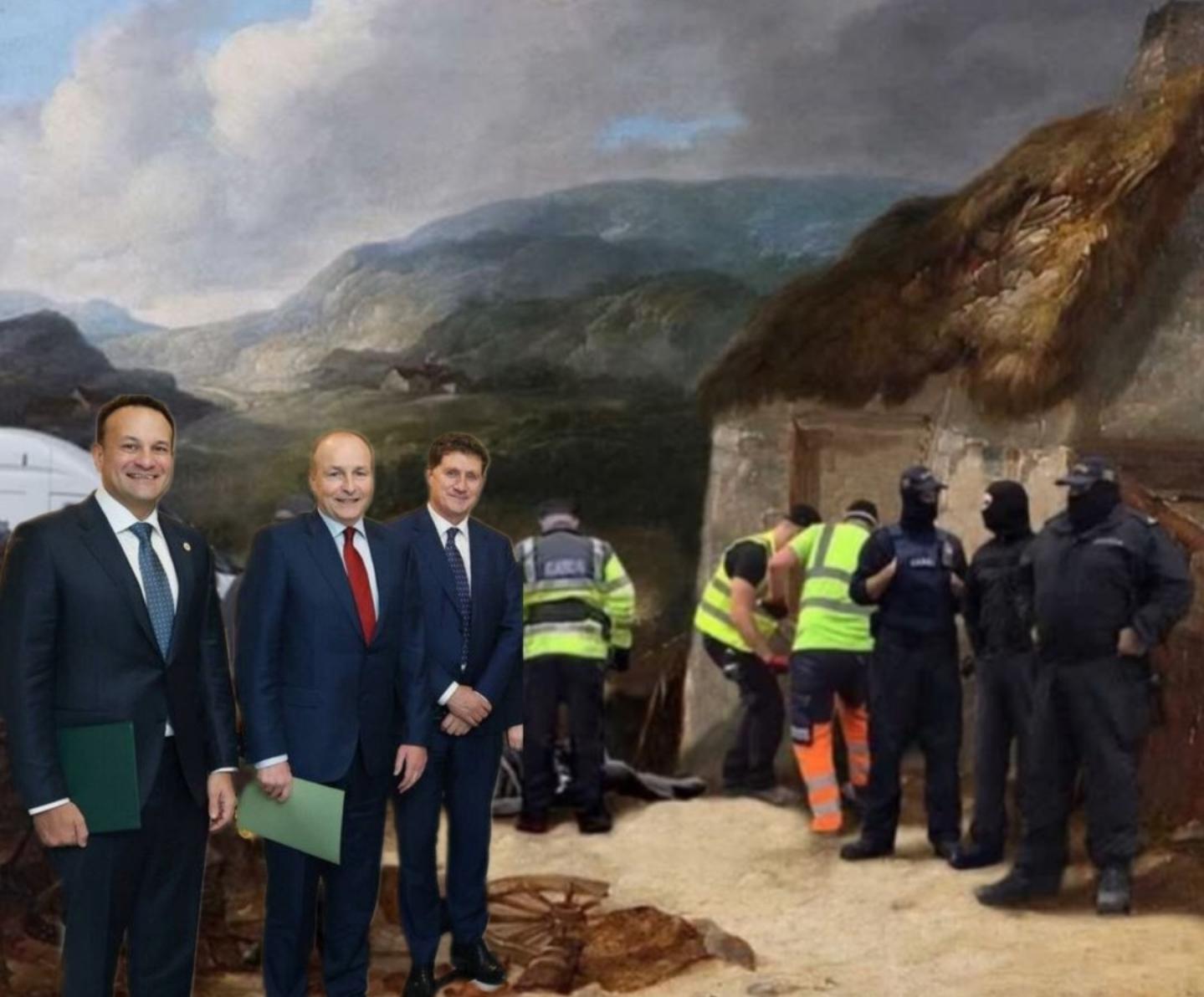
Three chief Irish Government Ministers some years past (one still in place) and Gardaí photoshopped on to 18th Century eviction scene in Ireland (original photoshopping of Gardaí by Spice Bag). (Image sourced: Internet)
HUMILIATION AND VIOLENCE
Strip and cavity-searching are demeaning psychological and physical invasions and should have no place in most policing actions. Even in jail, an x-ray chair is available. However strip-searching has been a constant over the years in use against political prisoners.
As violent and degrading actions become normalised in political repression they will be extended further, spreading to all kinds of policing operations.
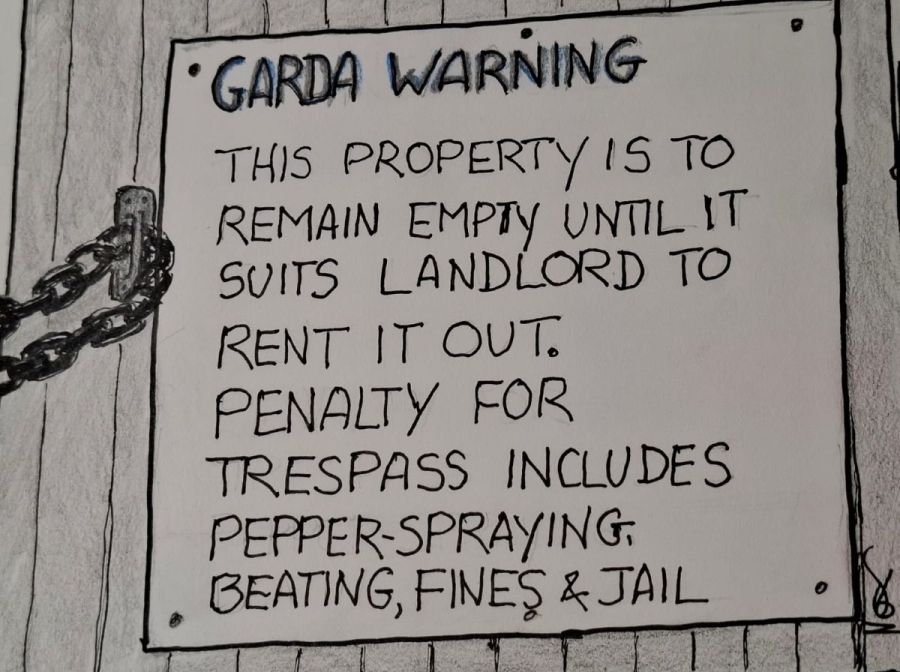
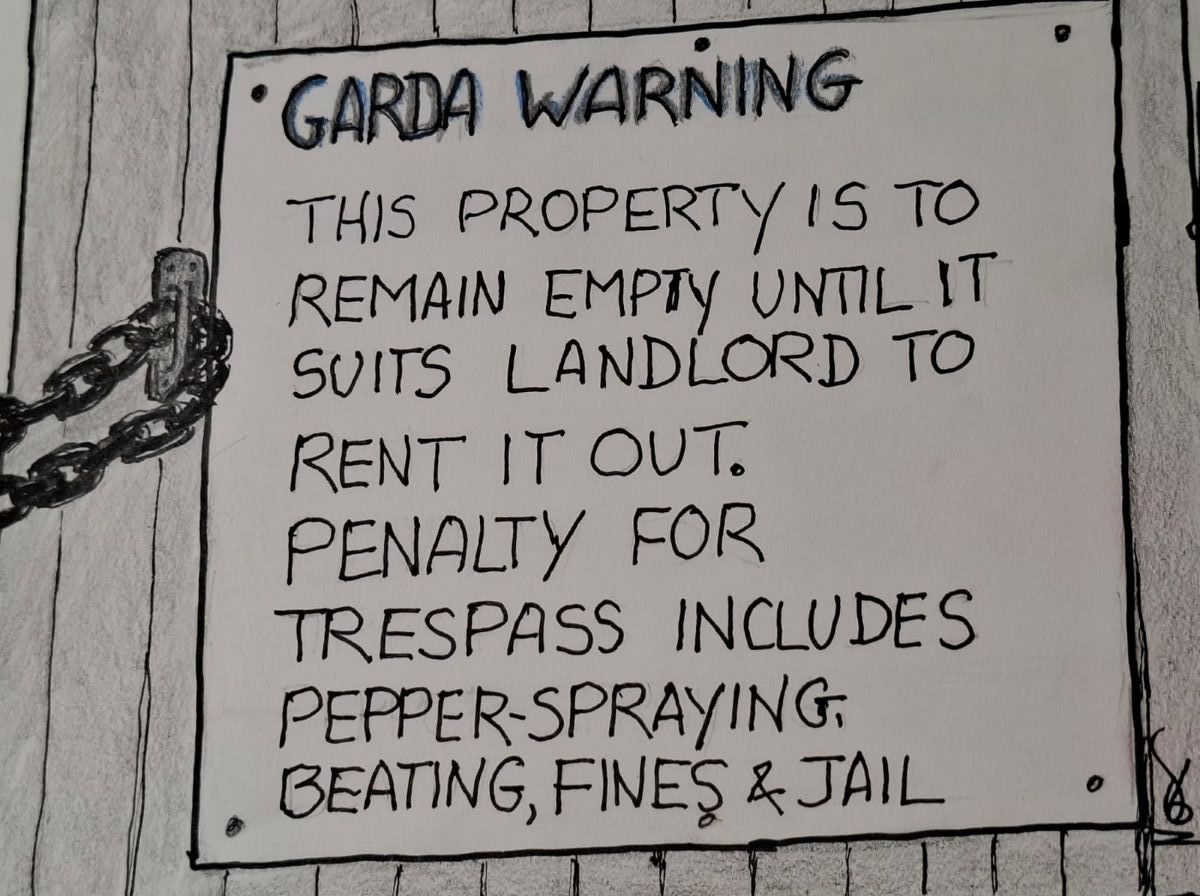
Cartoon by D.Breatnach
Gardaí normalising the use of pepper-spraying against Palestine solidarity and anti-NATO direct action activities are now extending this to other types of activities of which they disapprove, even those in the sphere of civil law and outside criminal law.
As the State increases its repression, the democratic and revolutionary movements will need to increase their resistance, calling also for the active solidarity of wider society with the victims and in condemnation of the State and its police force.
End.
Note: If you found this article of interest, why not register with Rebel Breeze for free, so that you will be notified by email of subsequent articles. You can de-register any time you wish.
Last week saw the anniversary of the creation of the Irish Citizen Army, a militia formed initially to defend the workers from attacks of the Dublin Metropolitan Police on behalf of the Dublin capitalists but that went on to fight in the 1916 Rising.
The ICA was born in the struggle of the consortium of Dublin employers, led by big capitalist and Irish nationalist William Martin Murphy, to smash the militant and successful Irish Transport & General Workers Union in Dublin, where the union had its headquarters, in August 1913.
The workers were presented with a declaration to sign that they would not support the ITGWU but no union in Dublin at the time, whatever they thought of the targeted union and its founder,1 could sign such a declaration. As workers began to be sacked, others came out in solidarity strikes.
Dublin entered an extended struggle between the organised capitalists and the organised workers. In such a struggle of course, the organised capitalists had on their side the magistrates, the hierarchy of the various churches, the mass media2 – and the Dublin Metropolitan Police.
Anti-WW1 banner across Liberty Hall, HQ of the Irish Transport & General Workers’ Union in October 1914, with the Irish Citizen Army parading outside.
The DMP, a British colonial police force for Dublin would have needed no specific instructions to attack demonstrations of the ITGWU, their instincts as guardians of colonial ‘law and order’ sufficing but in addition, the attitude of the media would have outlined their ‘duty’.
And after representation from W.M. Murphy to Dublin Castle, the HQ of British control, the ‘duty’ of the DMP was outlined and they were reinforced by a number of the colonial gendarmerie,3 the Royal Irish Constabulary.4
On the evening of 30th August a mass meeting of the ITGWU in Beresford Place, outside the union’s headquarters, Liberty Hall, was attacked by a baton-wielding force of the DMP, leaving two workers mortally wounded5 with resulting running battles towards city working class areas.6
The following day, the DMP again viciously attacked crowds in O’Connell Street in front of Clery’s from which Larkin attempted to address the crowd in a meeting banned by the city magistrate.7
Not long after, a marching music band leading a strikers’ parade was also attacked by the DMP with musical instruments damaged and members injured and the leadership of the union decided that a counter-strategy was required for self-defence and possibly the very survival of the union.
The Lawrence O’Toole Pipe Band’s website lays claims to having been the victims of this attack while other history talks and articles have claimed that the ITGWU’s Fintan Lawlor Pipe Band was the one attacked. It is not impossible that the DMP attacked both.
On 19th November 1913 the Irish Citizen Army was born8 following a suggestion by Seán O’Casey and a call by Jim Larkin as a workers’ defence militia. After Larkin left Ireland for the USA in 1914, James Connolly took over leadership of the ICA and wielded it into a revolutionary force.
I recall attending a book launch or talk about the ICA in which it was described as “the first workers’ army in the world” but searching for that quotation I now find it refuted by AI online and replaced by “first working-class army”.9 I cannot agree with the latter.
Most armies, especially nowadays, are “working class” in that this most numerous social class will contribute the vast majority of its rank-and-file. In the past, the peasantry and landless labourers would have been the majority.
Despite the overwhelming worker membership of the ICA, its most important distinction was not in the social class of its membership. Nor was it totally working class, containing as it did some notable members of middle-commercial and one of a landowning classes.10
What made the Irish Citizen Army very different from other armies and qualified it, I maintain, for the title of “workers’ army” were the intentions and ideological perspective of its founders, the conditions of its birth, ethos of its members and – most of all – its declared purpose.
The ICA was founded with the express intention and necessity of defending a worker’s organisation which was resisting an attempt by the capitalist employers to break that organisation. The struggle was led by declared openly-socialist leaders who gave the call for the ICA’s founding.
In every respect, I maintain, even without a specifically socialist constitution, this was a workers’ army, formed by workers, in a workers’ struggle in defence of their organisation and of the right to organise, defending their previously-won improvements and their dignity.
And the lack of evidence of any such precursor qualifies the Irish Citizen Army as “the first workers’ army in the world.”
However, none of the preceding makes it a socialist organisation, in my opinion. A socialist organisation would have as one of its principal objectives the attainment (whether by reformist or revolutionary methods) of a socialist organisation of society.
As to Lenin having allegedly called the ICA “the first Red Army in the world”, I have searched for the original reference without success, finding only it quoted by speakers, writers, organisations and authors – but never with a reference of where and when Lenin supposedly said it.
I strongly suspect that Lenin never said that. But even if he had, the ICA’s constitution does not support it, being rather of a democratic nationalist and anti-colonial character.11
Socialist Republicans today approve of the Irish Citizen Army throughout the 1913-1916 period. But it is not unknown for them to go further and to characterise it as socialist republican in nature and orientation. I don’t see evidence of this in either the ICA’s constitution or in its membership.
Though certainly Irish nationalist in intention, the word ‘Republic’ is not mentioned anywhere in the constitution. One might argue that it was understood but I can’t see the evidence for that either. Some contemporary prominent Irish nationalists were not even wedded to the idea of a Republic.
The 1919-1921 IRA was not a socialist organisation. Nor was the monarchist Sinn Féin party, even after its founder Griffiths permitted its reformation as Republican in order for the disparate nationalist movement to contest the UK’s 1918 General Election on an abstentionist manifesto.
The political leadership of the Republican movement split over the British offer of dominion status with partition as against a unitary Republic. Churchill was quite adamant that the new Irish State could not be a Republic and it was not declared so until the 1937 Constitution.
Certainly the founders of the ICA were socialist Republicans but in the absence of its constitution being of a kind, for the organisation to qualify as such it must be shown to have been also the widely-embraced ethos of its membership.
Even if imagining that the membership of the ICA, like its founders and a number of its officers, were Irish Republicans, it is still a greater step to assert that they were socialist Republicans, in the sense of intending the socialist organisation of society and elimination of capitalism.12
Irish Citizen Army on the roof of Liberty Hall during a flag-raising activity. (Photo sourced from Internet)
TODAY AND TOMORROW
Whereas these historical questions may fuel debate, no debate should be needed regarding the right of workers to organise to defend and improve their conditions, nor to change the dominant political shape and allegiance of their country, nor to defend their organisation from the police.
Indeed, not only can we take those rights as legitimate and necessary to exercise but it also becomes clear that at some point we will, as workers, as socialists and/ or as Republicans, need such an army. The ruling class has its physical force organisations in the Gardaí and the Irish Army.
The history of ruling classes bears testament to the fact they never relinquish power without using violence against challenges from the rising social forces; even such social and political rights as we have were won through hard struggle, sacrifice and indeed martyrdom.
Commemorative postcard 1916, showing severe British shelling damage to the original Liberty Hall building, Beresford Place, Dublin.
The Far-Right has also given ample proof of their readiness to employ violence against the vulnerable sections of our class and against also those they consider opposed to them ideologically; the history of fascism too warns us of the need to organise our defence.
In that respect too let me briefly comment on the false “ICA” recently proclaimed in a video which, while claiming a 32-County outlook and repeating that Britain has no right in Ireland, filled the rest of their video with racist anti-migrant rhetoric, conspiracy theory and lies.
Of course they contain nothing of the workers’ solidarity ethos of the ranks of the real ICA, not to mention the anti-fascist, anti-racist internationalist and socialist outlook of the ICA’s leadership.
The ICA developed as a force for physical defence of workers’ rights on the streets, which is where the DMP and RIC attacked them. It was some years later, in the course of inter-imperialist World War I that the ICA fought in an armed rising alongside other democratic national forces.
Some, usually only among Irish Republicans, have striven also to organise a fighting force. Typically they concentrated on gaining arms and planning armed actions. Isolated from the masses, they were easily infiltrated by State agents, resulting in activists going to jail.
Captain White & Irish Citizen Army on parade on their grounds at Croydon House, Fairview, N. Dublin City. (Sourced: Internet)
While needed, I believe a workers’ defence force should, in current circumstances, concentrate on street defence-and-offence fighting tactics, also that it should be based on the broad democratic political front, on unity in action against imperialism, colonialism, fascism and Loyalism.
Defence on a broad front basis can and should educate the whole resistance movement, in its disparate ideological influences, as it may be that similar recruits in the Irish Citizen Army were educated and trained under the leadership of revolutionary socialists and republicans.
End.
Note: If you found this article of interest, why not register with Rebel Breeze for free, so that you will be notified by email of subsequent articles. You can de-register any time you wish.
1913 – A Policeman’s Lot and Murphy’s Law. Talk given at Garda Historical Society at Store Street Station, August 29th 2013 and Dublin Castle at Police Memorabilia Exhibition, November 16th, 2013 (speaker’s name not listed). https://1913committee.ie/blog/?p=1800
1Jim Larkin, a migrant and union organiser from Liverpool, had formed the ITGWU as a split from the British-based National Union of Dock Labourers after serious clashes with the latter’s General Secretary, ?????? Sexton (also an Irish nationalist). Larkin was very popular with the ITGWU’s members but much less so with other union leaders around Dublin.
2Not least the editorial and management boards of the Irish Independent, owned by William Martin Murphy, leader of the union-busting consortium.
3An armed police force under central State control, like the Guardia Civil (Spain), Carabinieri (Italy) and similar in France and Turkey.
5James Nolan and John Byrne, which Wikipedia has for years erroneously recorded as killed the subsequent day in another DMP riot in O’Connell Street, known as Bloody Sunday (1913).
6South-eastwards along Townsend Street towards Ringsend and Northwards towards Corporation Street in the Montgomery (Monto) Street area. There the residents defended the strikers and attacked the police, an example of class solidarity for which they paid soon afterwhen a DMP force paid them a visit, smashing household furniture and ornaments and beating John McDonagh. Paralysed from the waist down and in bed, McDonagh was unable to effectively defend himself and when his wife attempted to do so, she also was beaten and McDonagh died shortly afterwards in Jervis Street Hospital. (see Police Retaliation [sic] in APoliceman’s Lot and Murphy’s Lawhttps://1913committee.ie/blog/?p=1800)
7See a number of entries, including Wikipedia on Bloody Sunday Dublin 1913. Though some of those claim the deaths of James Nolan and Patrick Byrne were caused then, in fact it was the previous day that they received their fatal wounds from the police. Unmentioned in most is the case of Fianna Éireann youth Patsy O’Connor, knocked unconscious as he gave first aid to another victim of the police. Patsy O’Connor suffered repeated headaches thereafter and died on 15th June 1915 at the age of 18. https://1913committee.ie/blog/?p=2293
10I state this qualification despite Connolly’s remark in Workers’ Republic, 30 October 1915: Hitherto the workers of Ireland have fought as parts of the armies led by their masters, never as a member of any army officered, trained and inspired by men of their own class. Now, with arms in their hands, they propose to steer their own course, to carve their own future.
Constance Markievicz and Katherine Lynn were officers in the ICA but neither were born into the working class.
12I am not unaware that a significant number of individuals and organisations claiming to be Irish socialist Republicans currently spend hardly any time at all discussing the socialist organisation of society.
Diarmuid Breatnach (edited from article posted in Rebel Breeze 2014)
(Reading time: 6 mins.)
Part 1 – who and what gets ‘remembrance’
In the lands under the direct dominion of England, i.e. the “United Kingdom”, and in some others that are under its influence, the dominant class calls the people to join in a cultural event in November which they call “Remembrance”.
The organisation fronting this event in the ‘UK’ is the Royal British Legion and their symbol for it (and registered trademark) is the Red Poppy, paper or fabric representations of which people are encouraged to buy and display — and indeed often pressured to wear.
In some places, such as the BBC for personnel in front of the camera, they are forced to wear them. In many schools and churches throughout the ‘UK’, Poppies are sold and wreaths are laid at monuments to the dead soldiers in many different places.
Prominent individuals, politicians and the media take part in a campaign to encourage the wearing of the Poppy and the participate in the ‘Festival of Remembrance’ generally and of late, to extend the Festival for a longer period.
High points in the ‘Festival’ are the Royal Albert Hall concerts on the Saturday and the military and veterans’ parades to the Cenotaph memorial in Whitehall, London, on “Remembrance Sunday”. (Also a focus for commemorations by the British far-Right and fascists).
“The concert culminates with Servicemen and Women, with representatives from youth uniformed organizations and uniformed public security services of the City of London, parading down the aisles and on to the floor of the hall. There is a release of poppy petals from the roof of the hall.1
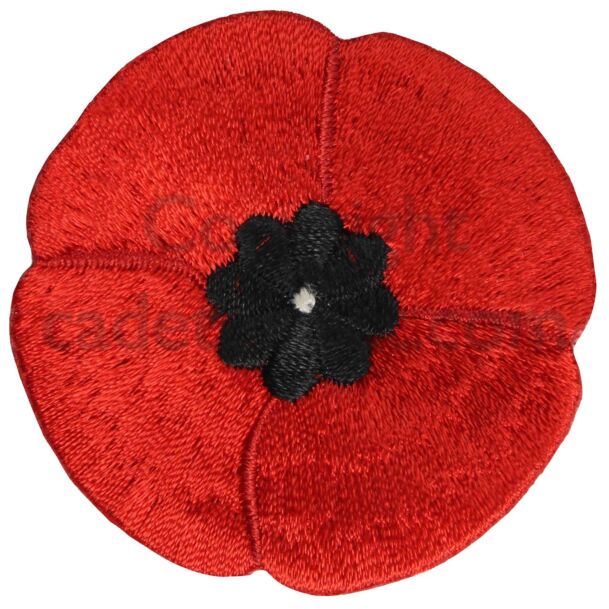
An embroidered version of the poppy emblem (Sourced: Internet)
“The evening event on the Saturday is the more prestigious; tickets are only available to members of the Legion and their families, and senior members of the British Royal Family (the Queen, Prince Phillip, the Prince of Wales, the Duke of York [not this year!] and the Earl of Wessex). 2
“The event starts and ends with the British national anthem, God Save the Queen3(and) is televised. Musical accompaniment for the event is provided by a military band from the Household Division together with The Countess of Wessex’s String Orchestra.”4
The money raised from the sale of the “Poppies” and associated merchandise is said to be used to support former military service people in need and the families of those killed in conflict. On the face of it, military and royal pomp apart, the Festival may seem a worthy charitable endeavour.
Also one which commemorates very significant historical events — therefore a festival which at the very least, one might thing, should not be opposed by right-thinking and charitable people.
Yet the main purpose of this festival and the symbol is neither remembrance nor charity but rather the exact opposite: to gloss over the realities of organised violence on a massive scale and to make us forget the experience of the world’s people of war.
And to prepare the ground for recruitment of more people for the next war or armed imperialist venture – and of course more premature deaths and injuries, including those of soldiers taking part.
Video and song “On Remembrance Day” from Veterans for Peace lists British conflicts (including Ireland) and condemns the Church of England for supporting the wars, calling also on people to wear the White Poppy (see Part 3 for the White Poppy)
Partial Remembrance – obscuring the perpetrators and the realities of war
The Royal British Legion is the overall organiser of the Festival of Remembrance and has the sole legal ‘UK’ rights to use the Poppy trademark and to distribute the fabric or paper poppies in the ‘UK’.
According to the organisation’s website, “As Custodian of Remembrance” one of the Legion’s two main purposes is to “ensure the memories of those who have fought and sacrificed in the British Armed Forces live on through the generations.”
By their own admission, the Legion’s “remembrance” is only to perpetuate the memories of those who fought and sacrificed in the British Armed Forces – it is therefore only a very partial (in both senses of the word) remembrance. More recently it tries to hide this exclusivity.5
It is left to others to commemorate the dead in the armies of the British Empire and colonies which Britain called to its support: in WWI, over 230,500 non-‘UK’ dead soldiers from the Empire and, of course, the ‘UK’ figure of 888,246 includes the 27,400 Irish dead.
Cossack soldier volunteers WWI. Imperial Russia was an ally of Britain and France; the war was one of the causes of the Russian Socialist Revolution 1917. The following year, the war ended. (Image sourced: Internet)
The Festival excludes not only the dead soldiers of the British Empire and of its colonies (not to mention thousands of Chinese, African, Arab and Indian labourers employed by the army) but also those of Britain’s allies: France, Belgium, Imperial Russia, Japan, USA … and their colonies.
No question seems to arise of the Festival of Remembrance commemorating the fallen of the “enemy” but if the festival were really about full “remembrance”, it would commemorate the dead on each side of conflicts.
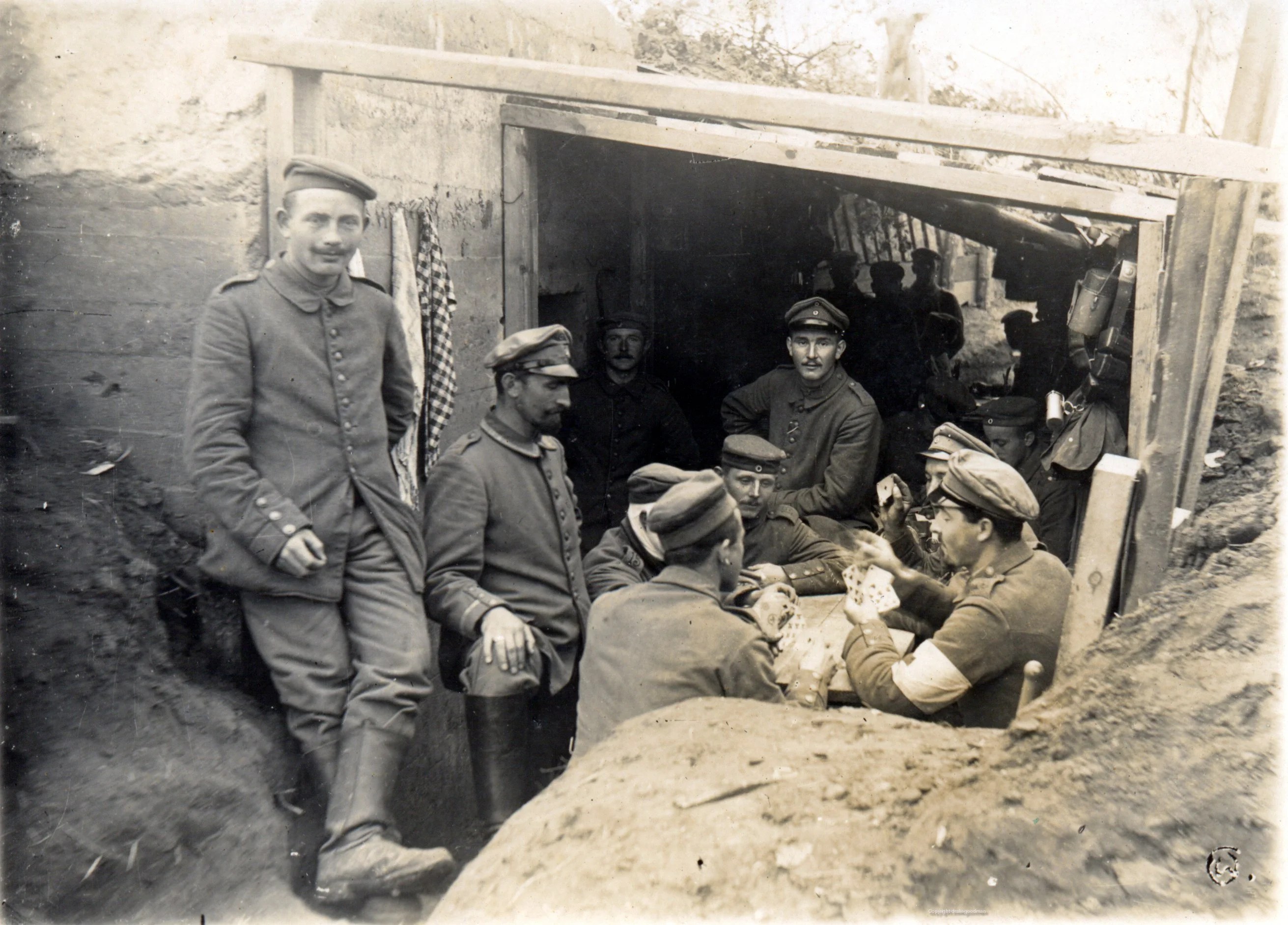
German soldiers playing cards during WWI. Photos of Germans in WWI more readily available show them wearing masks and looking like monsters. (Photo sourced: Internet)
That would particularly be appropriate in WWI, an imperialist war in every respect. But of course they don’t do that; if we feel equally sorry for the people of other nations, it will be difficult to get us to shoot, bomb or stab them in some future conflict.
A real festival of remembrance would commemorate too those civilians killed in war (seven million in WWI), the percentage of which in overall war casualty statistics has been steadily rising through the last century with increasingly long-range means of warfare.
Very recently, the Royal Legion has tried to claim that the “acknowledge innocent civilians who have lost their lives in conflict” but add “and acts of terrorism.” Since we know that that ‘terrorism’ is a highly politicised word and for imperialists has mostly meant resistance struggle, that is hardly welcome.
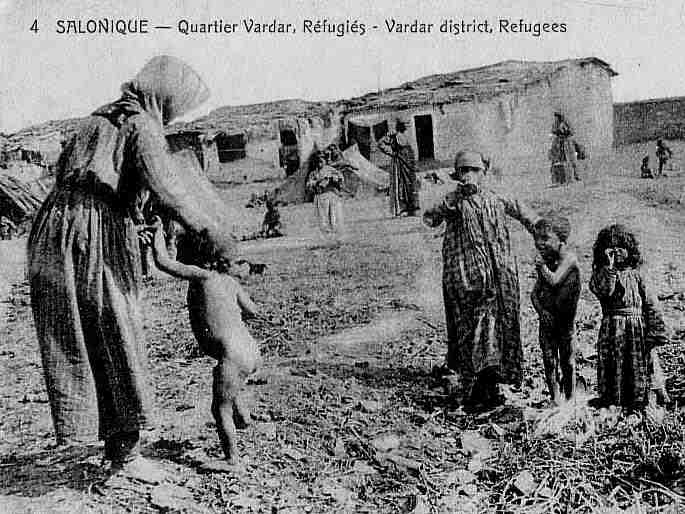
Civilian war refugees in Salonika, NW Greece, WWI (Photo sourced: Internet)
Civilians in the First World War died prematurely in epidemics and munitions factory explosions as well as in artillery and air bombardments, also in sunk shipping and killed in auxiliary logistical labour complements in battle areas.
And through hunger, as feeding the military became the priority in deliveries and as farmhands became soldiers.
In WWII 85,000,000 civilians died in extermination camps or forced labour units, targeting of ethnic and social groups, air bombardments, as well as in hunger and disease arising from the destruction of harvests and infrastructure.
Air bombardments, landmines, ethnic targeting and destruction of infrastructures continue to exact a high casualty rate among civilians in war areas.
One admittedly low estimate up to 2009 gave figures of 3,500 dead in Iraq during the war and aftermath and another 100,000 dead from western trade sanctions, along with 32,000 dead civilians in Afghanistan.
Another review up to 2011 gave a figure of 133,000 civilians killed directly as a result of violence in Iraq and “probably double that figure due to sanctions”.6
The number of civilians injured, many of them permanently disabled, is of course higher than the numbers killed. Most of those will bring an additional cost to health and social services where these are provided by the state and of course to families, whether state provision exists or not.
Real and impartial “remembrance” would include civilians but not even British civilians killed and injured are included in the Festival of Remembrance, revealing that the real purpose of the Festival is to support the existence of the armed forces and their activities.7
And contributing at the same time to a certain militarisation of society and of the dominant culture.
If the Festival were really about “remembrance”, they would commemorate the numbers of injuries and detail the various types of weapons that caused them.
But that might reflect unfavourably on the armaments manufacturers, who run a multi-billion industry in whatever currency one cares to name, so of course they don’t.
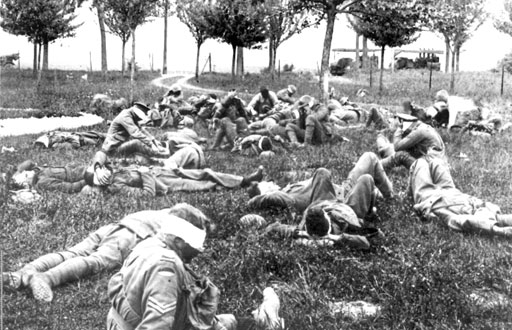
Australian soldiers who survived gas attack but injured by it awaiting hospitalisation, Northern France, WWI 1916. (Photo sourced: Internet)
And if really concerned about death and injury in war, they would campaign to end such conflict – for an end to imperial war.
But then how else would the various imperial states sort out among themselves which one could extract which resources from which countries in the world and upon the markets of which country each imperial state could dump its produce?
So of course the Royal British Legion doesn’t campaign against war. That’s not its role. Quite the opposite.
End. (Parts 2 and 3 to follow).
Note: If you found this article of interest, why not register with Rebel Breeze for free, so that you will be notified by email of subsequent articles. You can de-register any time you wish.
FOOTNOTES:
1Sourced from the British Legion’s website in 2014, its WW1 centenary year.
On 13th September 1845 the widely-read British weekly publication The Gardener’s Chronicle apprehensively reported the appearance of the blight on potatoes in Ireland but doubtful if the full extent of the holocaust to follow was expected.
(Sourced: Internet)
True, no other national population in any other known part of the world was as heavily dependent on the potato as was Ireland’s. Other crops were grown but were mostly destined as feed for domestic animals1 or for export directly or indirectly as in the case of alcoholic drinks.2
A national diet is that of the mass of the population, which in Ireland was the peasantry. On the potato and a little milk the Irish peasantry grew strong enough to be recognised in Britain as healthy able workers, seasonally in agriculture or longer-term in manufacturing and construction.
They were reputed to be the tallest and most fecund in Europe, according to Frederick Engels writing in Britain a year before the piece in the Chronicle.3 In Ireland the peasantry were for the most part tenants-at-will or landless labourers for the settler big landowners and descendants.
The original Irish had been expropriated by sword, fire and pen (legal decrees) and their expropriators lived on the rents they extracted from their tenants in a mixture of crops, animals, cash and labour. After the abolition of the Irish Parliament,4 most big landowners found no reason to even live in Ireland.
The estates of the absentee landlords were then managed by agents, middlemen who forwarded the extracted wealth to their masters in Britain, or perhaps travelling ‘on the Continent’, or trying their hand in the American colony, minus the agents’ commission, of course.
As people went hungry, meat, dairy and grain continued to be exported.
The dependency of the Irish mass on the potato was known of course and even mocked in some ruling British quarters at times. But so were the Irish landlord aristocracy who seemed to have no interest in developing industry.
But could anyone predict that the blight would intensify each year and that the Government of the UK would tolerate such devastation in one of its parts? By the time it had run its course six years later, Ireland had lost at least 2.5 million of its original over eight million5 and more were emigrating.
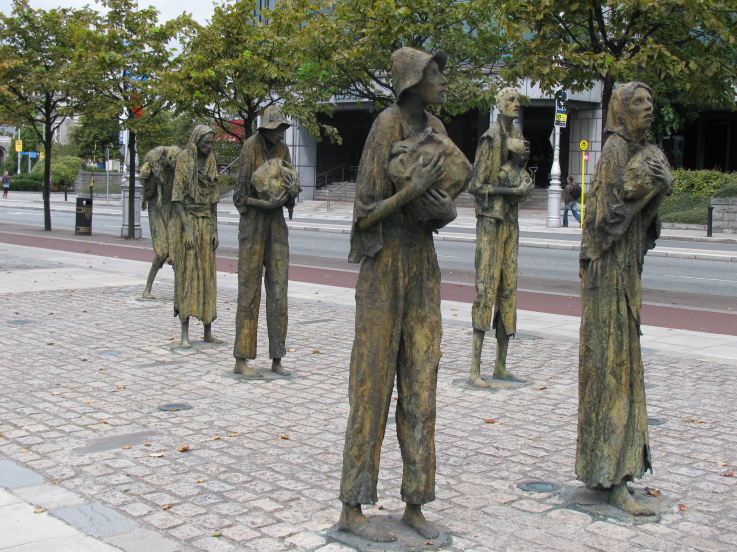
Memorial to the Great Starvation on Dublin’s north side quays. (Sourced: Internet)
And both the Irish planter aristocracy and the cotter class of Irish peasantry had been wiped out, leaving the field to the Gombeen6 class of money-lenders and bigger farmers, the latter now expanding their holdings and who would farm meat instead of agricultural produce.
When the overall national population stabilised again it did so at five million,7 at which level, despite a high birth and survival rate, it remained until the early 1990s. The magic trick was achieved by constant annual emigration, giving the Irish one of the largest diasporas in the world.8
The Gardener’s Chronicle’s writer noting the arrival of Phytophthora infestans could not have imagined the extent of its devastation. But if he knew the history of Ireland as well as that of the blight, he would have concluded that it was not the worst blight upon the Irish nation.
No, that was the arrival of the Anglo-Normans in 1169, with the second-worst blight being the growth of the Gombeen class.
end.
Note: If you found this article of interest, why not register with Rebel Breeze for free, so that you will be notified by email of subsequent articles. You can de-register any time you wish.
FOOTNOTES
1Grazing animals live on forage in Ireland but in winter or if overgrazed must be given additional food, while draught animals need cereal feed, typically oats. Pigs and domestic fowl were fed on mixtures of potato, beet, pulses and domestic leftovers.
2Typically eorna (barley) for beer brewing and whiskey distilling. These products continued to be produced and exported during the years of famine. Hops are also used for brewing but much was imported from southern England where climatic conditions are more favourable.
3The Condition of the Working Class in England (1844).
41799, followed immediately in 1801by Ireland becoming part of the United Kingdom and Irish MPs being required to attend the Westminster Parliament.
5A historical and statistical riposte to the anti-immigration claim that today “Ireland is full”.
6Originally from the Irish word Gaimbín and applied to moneylenders and land speculators during and following the holocaust period it, came to be applied by many to the Irish neo-colonial national bourgeoisie.
7Of the whole nation, with over 3 million in the Irish state and under two million in the British colony, the Six Counties.
8The bleeding through emigration was constant but fluctuated in degree, with a high point in the 1950s when it amounted to 15% of the Irish state (i.e. of the 26 Counties) and another in the 1980s.
I wish to briefly clear up what I believe to be some confusion about the terminology in the title, basing not so much on opinion but relying in the main on fact as illustrated by history.
I will attempt to show thereby that Republicanism and Irish Republicanism are different things ideologically and that socialism is different from both of them.
Republicanism entered the world as a political aspiration and, after revolutions in Britain, France and the USA, practised as a system of Government. It proclaimed electoral democracy for its citizens (at first men but later women) – but quite clearly the bourgeois class ruled society.
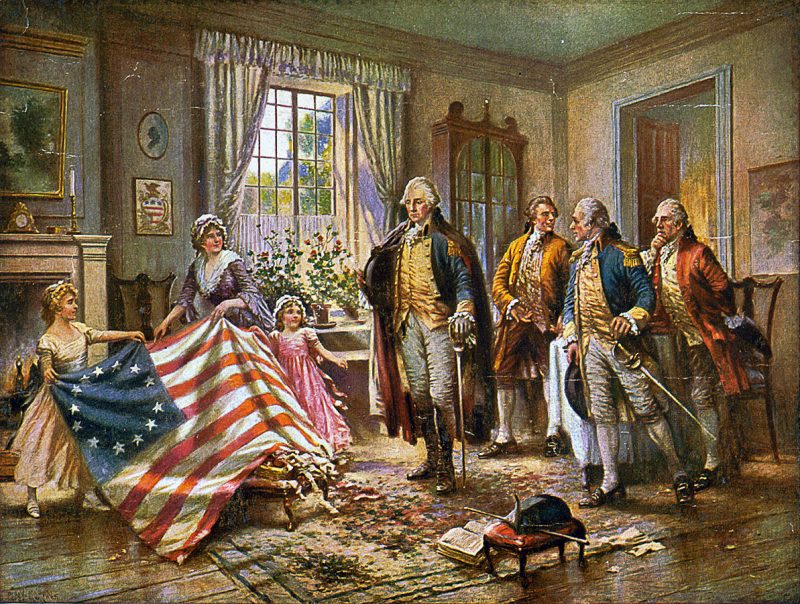
George Washington, Republican, being presented with the flag of the early American Republic. (Image sourced: Internet)
It was a democratic bourgeois (essentially capitalist) ideology characterised by individual choice,1 opposition to feudalism and monarchy and separation of church and state. It was not essentially socialist nor even anti-colonial, as we can clearly see from its early examples.2
Republican government was overthrown in Britain (English and Scottish administrations), the monarchy restored and in time a kind of compromise monarchy-democratic system evolved. The republican system in France and the USA remained and is with us to this day.
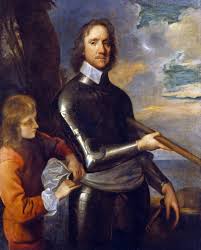
Painting of Oliver Cromwell, an English Republican whose name became part of a curse in Ireland (including for Irish Republicans!). (Image sourced: Internet)
Irish Republicanism also developed as a bourgeois ideology (drawing on English, French and US Republican thinking)3 but it was clearly also in favour of Irish sovereignty and therefore against the colonialisation of Ireland.4 Once measures of reform were blocked it became revolutionary.
This gave rise to the revolutionary organisations of the United Irishmen of the 1790s and early 1800s and the Young Irelanders of the middle of the 19th Century; also of the Irish Republican Brotherhood of the later 19th.
The IRB or Fenians however had a strong working class character and were admitted to the First International Workingmen’s Association, the first international socialist organisation. However, Irish Republicanism remained a bourgeois ideology albeit democratic and revolutionary.
Karl Marx and Frederick Engels, founders of scientific socialism. (Image sourced: Internet)
Socialism
The ideology of socialism has a long pedigree but was made more concrete under and in opposition to capitalist society. It found development on a scientific ideological and organisational basis particularly with the work of two German migrants to Britain, Karl Marx and Frederick Engels.
This ideology emphasises communal over individual ownership of the means of production, distribution and use/ consumption and sees the socialist state as a stage on the way to communist society. Its mantra is: From each according to their ability, to each according to their contribution.5
In terms of implementation the Paris Commune of 1871 was the first socialist capture of a city and the October Socialist Revolution of 19176 in Russia the first time a country was taken by socialists.7
Irish Republican ideology continued into the early decades of the 20th Century with its military organisation first the Irish Volunteers of the 1916 Rising and later, the Irish Republican Army of the War of Independence, whose leadership split over the English offer of autonomy with partition.
Ireland had been kept under-industrialised by colonialism but socialist political organisation was developing slowly in some urban areas. In 1896 Connolly and others founded the Irish Socialist Republican Party in Dublin and in 1912 he and Larkin also the Irish Labour Party.
In 1911 Larkin had founded the Irish Transport and General Workers Union.
The employers strove to break the ITGWU and implemented a Lockout of union members or supporters in 1913; attacks on the workers by the Dublin Metropolitan Police led to the defensive creation of the Irish Citizen Army – the first workers’ army in the world.8
Some Irish Republican leaders and followers sympathised with the strikers and some did not but the Republican movement did not mobilise in their support with the exception of a number of members of Iníní9 na hÉireann, which would later split between the ICA and Cumann na mBan.
In 1916 the IRB organised an insurrection with the participation of its Irish Republican military forces of the Irish Volunteers, Cumann na mBan and Na Fianna Éireann united with the Socialist force of the Irish Citizen Army (including women members).10
The War of Independence 1919-1921 was led by the Irish Republican movement with some support, particularly in intelligence and arms smuggling, by the Irish Citizen Army.
The Civil War 1922-2311 followed the British offer of autonomy with partition, as the leadership of the Irish Republican movement, including a section of the IRA split. The ICA had lost its leadership but did not join the neo-colonial side and in subsequent years faded organisationally.
The main opposition leadership to the State returned to being nationalist in the shape of Sinn Féin and the Anti-Treaty IRA, both of which split again with a substantial number joining the De Valera-led Fianna Fáil, which would soon show itself to be also neo-colonial in outlook and practice.
In this period a Socialist current grew within the Irish Republican movement, responding to international and domestic events including the growth of fascism. The short-lived Republican Congress attempted to combine the Socialist and Irish Republican currents in one broad front.
The Irish Republican movement leadership and substantial sections of its membership was however socially conservative and largely dominated by Catholic Church influence. The IRA responded to the Republican Congress with a new anti-communist rule and the expulsion of Congress members.
Frank Ryan, IRA and International Brigades, Socialist (Image sourced: Internet)
This sad part of the history of the Irish Republican movement illustrates very clearly the separate nature of Irish Republican and Socialist organisation. The IRA of the 1930s were Irish Republicans but anti-socialist and those who joined Congress had begun as Republicans but were now socialists.
Or Socialist Republicans perhaps but with the emphasis on socialism. Henceforth other variants would exist, of Republicans who were socially conservative, or liberal, or socialist-influenced … but Irish Republicans first and foremost.
Such an ideology would allow them later to unite to focus on a war against the colonial occupation of one-sixth of the nation but to largely neglect the social, economic and cultural issues arising from a socially conservative neo-colonial regime affecting the majority of the Irish population.12
There may be a tragic illustration of the difference between revolutionary Irish Socialism and revolutionary Irish Republicanism in the last of the Dublin 1916 executions, on 12th May, of the socialist James Connolly and of the Irish Republican Brotherhood organiser Seán Mac Diarmada.
Connolly was one of the leaders of the ITGWU and its Irish Citizen Army which had fought the bitter eight months against the Lockout to smash the union. Mac Diarmada is reported opposing the workers’ action, believing that Irish manufacture and trade would lose out to English competition.13
CONCLUSION
There are Irish Republicans who are revolutionary socialists and Irish Republicans who are not. There are also some revolutionary Irish socialists who are not strictly speaking Irish Republicans. All can and should join in the struggle against British colonialism and other imperialism.
A sovereign Irish Republic on a united 32 Counties would be a great progressive step, for democracy and against imperialism and colonialism. It would not, however, be socialist just because it was Irish Republican, even if it adopted some socialist measures.
A socialist Ireland would be one in which the working class ruled and its measures would include socialisation of all productive enterprises including factories, agricultural and construction enterprises and distribution centres, i.e any which employed workers not of the owner’s family.
And socialisation of all transport and communication networks and social and health services in addition to financial services.14
If it did all the above the regime in Ireland would be socialist and would not even need to call itself ‘Republican’.15 If it were not socialist then it would be capitalist and the struggle for socialism would need to confront the Irish state which would in turn seek to repress the socialist struggle.
Republicanism and Irish Republicanism are different things and socialism is different from both of them.
If people wish a socialist society they should not expect Irish Republicans to present them with that but will instead need to educate, organise and lead their own revolutionary socialist forces while simultaneously participating in the broad anti-colonial and anti-imperialist struggles.
2English Republicanism did not in general envisage the right of Ireland to self-determination, nor France agree with the national rights of the Breton and Basque nations, nor of the colonies abroad for independence; nor the USA of the rights of the Indigenous not to have European settlers occupy their land.
3Largely adopted by sections of business and professional classes of the Occupation, i.e settlers and descendants of settlers.
4Many Irish Republicans were historically able to collude in English settler colonialism in Australia and early colonial occupation of America, as well as later USA settler colonialism into lands still held by the Indigenous Americans.
5However, in communist society, it was understood that the second half of that slogan would be ‘to each according to their needs.’
6The earlier February Revolution had been a workers’ strike and bourgeois uprising against war and the absolutist power of the Tsar. Incidentally it had been only the second revolution against world war, as the 1916 Rising in Ireland had been the first.
7I am not discussing its development or degeneration here, which would take us away from the central topic of discussion.
8Most armies chiefly recruit from the working class but the ICA was specifically for as well as of the workers.
10That they were distinct forces is clear in their development and leadership but in the membership the differences would not always be so clear-cut. The Constitution of the ICA was Irish nationalist but required all members to be trade union members and people chose an organisation to join on the basis of family and social circle loyalties.
The Irish socialist Republican group Anti-Imperialist Action today issued a call to revolution centred around a need for universal social housing to resolve the chronic housing crisis in Ireland (and in particular in Dublin).
This housing crisis has at January’s count left nearly 15,300 living on the streets or in emergency accommodation1 with another unknown number in inappropriate accommodation such as sofa-surfing with friends and relatives or in IPAS centres for refugees.
Rampant property speculation has made a handful of bankers and speculators very rich and along with the social misery of thousands, facilitated the demolition of buildings of historical and architectural importance and their replacement by usually unsightly glass and concrete.2
Well, so what of AIA’s call? Different organisations make various calls at different times but do they have any effect? However, this one has some important distinctions, one of which is that this organisation actively practised its preaching when it called for the occupation of empty properties.
In May 2022 the AIA founded a sub-group called Revolutionary Housing League that occupied empty buildings in Dublin, refused to comply with court orders3 to evacuate or, in court, to agree to bail conditions that they would desist from further building occupations.
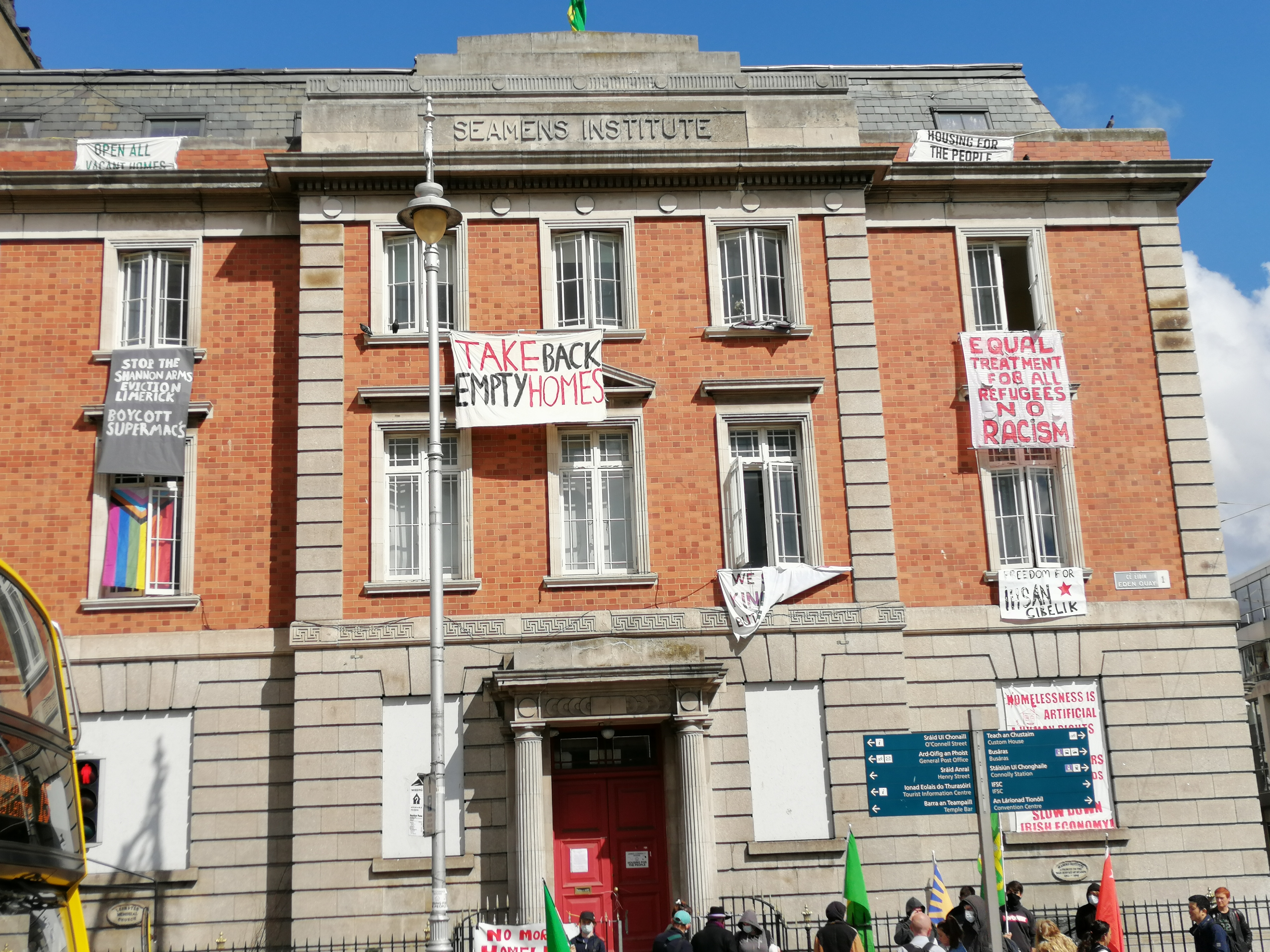
‘James Connolly House’ in occupation by the RHL in May/ June 2022. Photo: D.Breatnach)
The first building targeted on May 1st was a former Seamen’s Institute building on Eden Quay, renamed Connolly House, metres from O’Connell Bridge, empty for years since the Salvation Army, a religion-based charity NGO, had lost government funding for its youth homeless accommodation project.
On the morning of June 9th 2022 over a hundred Gardaí, with an armed unit on standby and a helicopter overhead, stormed the building4 and arrested the only occupants, two RHL supporters. In court later that day, they were bailed without making any promise not to re-occupy buildings.5
It seemed that the State was sensitive to the dangers of creating martyrs around the housing crisis.
Instead, RHL renewed its call for mass action across the country to occupy empty buildings. And went on to occupy other buildings, including Ionad Sean Heuston near the eponymous Bridge and another in Belvidere Road, eviction here also including massive police forces and helicopter.
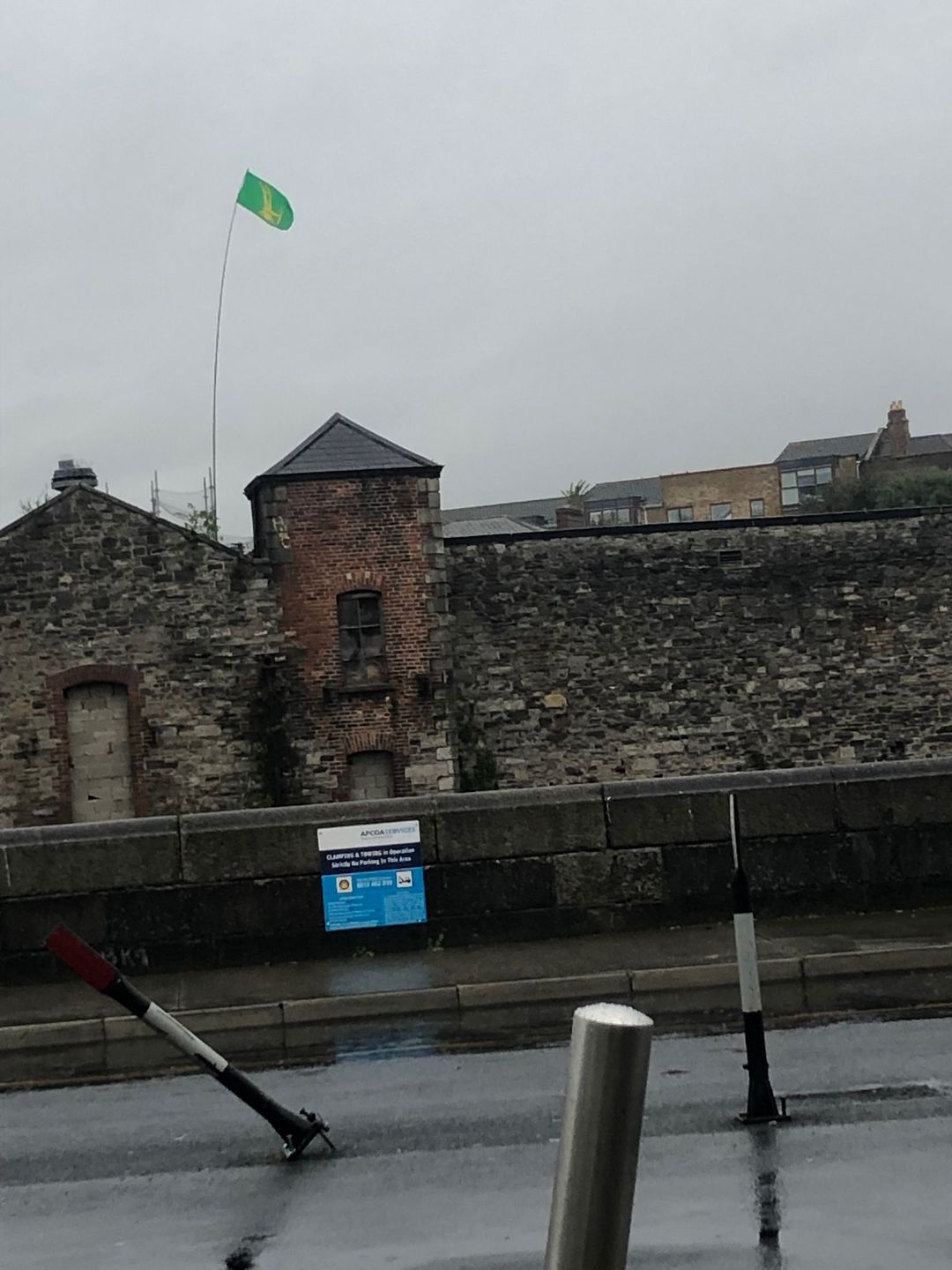
Seen from the north bank of the Liffey, the Starry Plough flag flying high over the ‘Ionad Sean Heuston’ occupied building. The Heuston train station is behind the photographer while the Bridge is out of frame to the right. (Photo: D.Breatnach)
Success for the RHA’s campaign depended on, if not a mass, at least a substantial take-up of its call to occupy empty buildings backed by civil disobedience to the courts. Neither happened and the AIA was far too small to carry the campaign on its own and so suspended it.
It is worth noting that though many organisations and individuals had agitated around housing, including the high-media-profile occupation of Apollo House in December 2016, backed by noted individuals,6 none had initiated the steps advocated by RHA/ AIA.
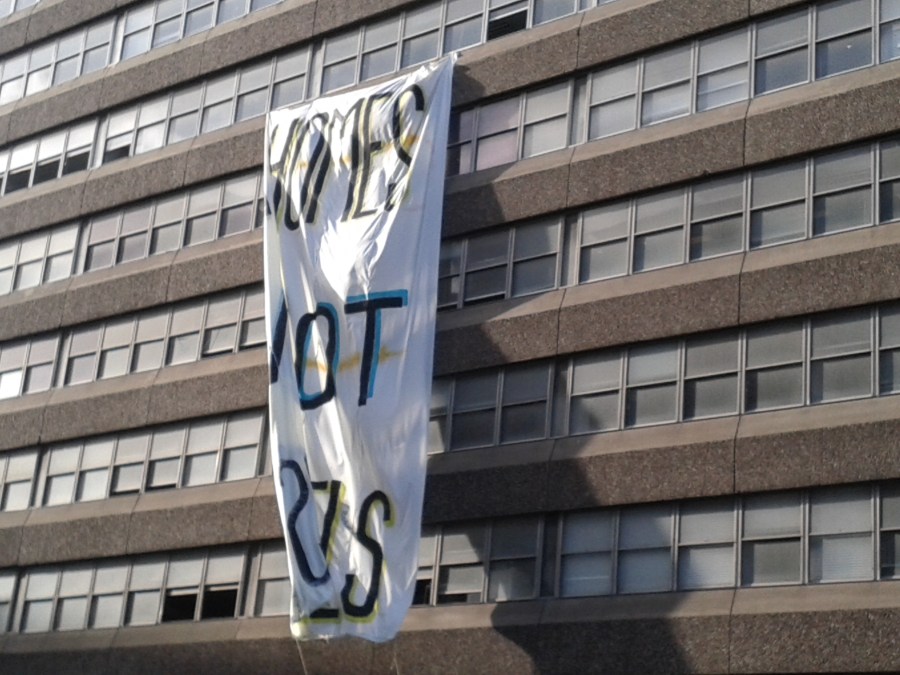
‘Homes Not Hostels’ banner on Tara Street side of occupied Apollo House in December 2016 or January 2017. The building was later demolished and numbers of homeless people continued to rise. (Photo: D.Breatnach)
Amongst a general lack of social condition agitation among the post-GFA7 Irish Republican movement, only the socialist-Republican éirigí organisation had militantly taken up the housing struggle while calling for universal social housing — but it had not led a campaign of occupations.
The electoral left and some anarchists had occupied some empty buildings but had either left when threatened by the State or been evicted by security thugs backed up by Gardaí, without a follow-up of further occupations. Nor had they contextualised housing occupations as part of revolution.
So the record of AIA is stand-alone among the Republican and Socialist Left so far and therefore, one might speculate, failed to inspire a mass movement.
I am not ashamed to say that I supported AIA’s campaign although I did not take part myself in any of the occupations. However I did not view it as an immediate cause for revolution, nor do I now. The Irish gombeen8 State, I believe, can survive the supply of universal social housing.
The ‘rack-renting’ landlords, both big and small, cannot. But the Gombeen class, closely linked to the landlords and speculators will ditch them if they are confronted – not with the suffering of the masses, about which they care not, nor protests – but with the real alternative of social revolution.
The State has access to the means to fund such a campaign of new housing construction and of renovation/ repurposing of existing empty buildings9 by local municipal authorities.
In such a radical change of the Irish neo-colonial capitalist system, people would have more disposable income and purchasing would increase dramatically, stimulating production and expansion of goods and services and raising people’s living standards (and expectations).
Property speculation would be hugely reduced in scope but would continue – in hotels and office blocks, for example and big projects such as transport networks. And possibly in sale of land to State and local authorities for housing projects.
So, essentially a reformist project, not revolutionary at all, right? No, not at all necessarily. Reformist projects fought for with revolutionary intent and energy, teach the masses their potential when they unite in struggle. It also tests their leaders before their eyes, in their experience.
I see universal social housing therefore as a social necessity for the mass of people living on the streets, in hotel-rooms, sofa-surfing, in insecure and inappropriate housing, facing eviction from debt-mortgaged housing (the cost of which has already been paid several times over).
Universal social housing is a social necessity and an urgent one and it is an objective for which all true humanity in Ireland should strive. Revolutionaries should fight for it, pointing towards the evils of the capitalist system and the need for its replacement by a socialist system.
The struggle should be fought relying on the strength and capacity of the working people and will need to embody civil disobedience and sacrifice, while at the same the movement needs to safeguard capacity for other struggles such as against fascism, imperialism and colonialism.
In that context therefore, I think we should unreservedly support the call of the AIA’s statement today and the headline of this article.
End
FOOTNOTES
SOURCES
Anti-Imperialist Action statement on Telegram 19/08/2025
Text of Anti-Imperialist Action statement 19/08/2025:
Housing is a key part of the Republican struggle for National Liberation and Socialist Revolution in Ireland.
Housing is one of the key pressure points in the class struggle in Ireland today, due to the artificial housing crisis created by those in power, designed at driving up profits for landlords and imperialist housing vultures.
Since the days of Tone, Irish Republicans have recognised that land and housing are completely tied to the fight for freedom, and today it is by showing the Republican struggle will solve the land and housing issue once and for all, to the benefit of the working class, that Republicans can mobilise our class to join the fight.
There should be no doubt about the Republican position on housing. The 1916 Proclamation stated that ‘the ownership of Ireland by the People of Ireland’. The Democratic Programme placed public right above private property and stated, It shall be the first duty of the Government of the Republic to make provision … to secure that no child shall suffer hunger or cold from lack of food, clothing, or shelter’.
Landlords and foreign imperialist housing vultures have no place in the Republican vision of a Free Ireland, where homes would be provided by the Republic to all Citizens.
AIA advocates a system of Universal Social Housing as the Republican Housing System that guarantees all citizens a home, and rents based on ability to pay. This system is the death knell for landlords and vultures and it is why the garrison class resists it.
AIA has played a leading roll in the militant housing direct actions of recent years and will continue to do so.
If you want to fight the landlords and vultures and work to bring about the conditions for a Republican system of Universal Social Housing, then join AIA!
Raise the cry of the working class: Smash Landlords and Vultures – Universal Social Housing Now!
2Taking history tour groups around Dublin I often comment that Dublin has suffered three period of architectural devastation, all in the last century: 1) the British artillery bombardment during the 1916 Rising; 2) the Irish neo-colonial State’s bombardment during its Civil War; 3) the property speculators’ rampage from the 1970s onwards. Pete St. John, in his song Dublin In the Rare Aul’ Times:
5I passed by this building recently which, three years later, appeared to be still empty.
6The occupiers eventually agreed to leave under a mixture of threat and promises and the building was demolished.
7The Good Friday Agreements of 1999, the Irish instalment of the imperialist pacification process, following South Africa’s and Palestine’s versions, later to visit Colombia and Turkish Kurdistan.
8From the Irish word gaimbín, first applied to the hustlers opportunistically buying up Irish land in the midst of the disaster of the Great Starvation (1845-1849) but now applied to the Irish comprador or foreign-dependent native capitalist class.
No, I’m not being sarcastic – I am quite serious. Thank you for making it clear that you support the Irish State joining the imperialist alliance of NATO.1 I take it that opinion is at least widespread among your social class.
After all you are among the biggest of the native Irish monopoly capitalists, right? Number eight of the eleven richest people in Ireland.2
From the statements and actions of politicians I had assumed your Gombeen neo-colonial class was of that opinion but I suppose there was always a slim chance that the politicians were out on a limb, going it alone, not representing their bosses … but sure now you’ve confirmed it yourself.
I see you’re concerned about the defence of Ireland. That’s really good – so am I. Hold on, you just mean the Irish state – the 26 Counties? Oh, of course, that’s right, the Six Counties are already in NATO. They didn’t get to vote on that, did they? But we will here, of course.
Wait now, didn’t Mícheál Martin say he didn’t believe it would have to be voted on? And isn’t the Government now trying to get rid of the Triple Lock stopping us sending many soldiers anywhere without approval of the government, a majority vote in Leinster House and a UN mandate?3
The Government and majority vote shouldn’t be a problem for you, should it? You’ve got a comfortable majority in Leinster House on abiding by the Western Imperialist stance. Ah you have, Denis, you have – sure isn’t the Irish State the biggest customer of Israel, next to the USA?
Getting a UN mandate might be a bit trickier, especially these days. After all, a lot of UN members have been at the sharp end of NATO, or that of the USA, or UK, or France – which is all pretty much the same thing. The Security Council would work if Russia or China didn’t veto it.
Anyway, back to defending Ireland. We should really discuss what that means. Defending our physical lives and homes? A lot of our homes belong to the banks and vulture funds so I’m thinking maybe THEY should defend them.
Or maybe defending our natural resources and public infrastructures, i.e the ones that our governments for decades have been giving away to native and foreign monopoly capitalists. I think you’ve benefited from a bit of that yourself, Denis. Ah you have, you know you have.
Many of those foreign monopoly capitalists taking over our industry come from NATO countries too, as it happens.
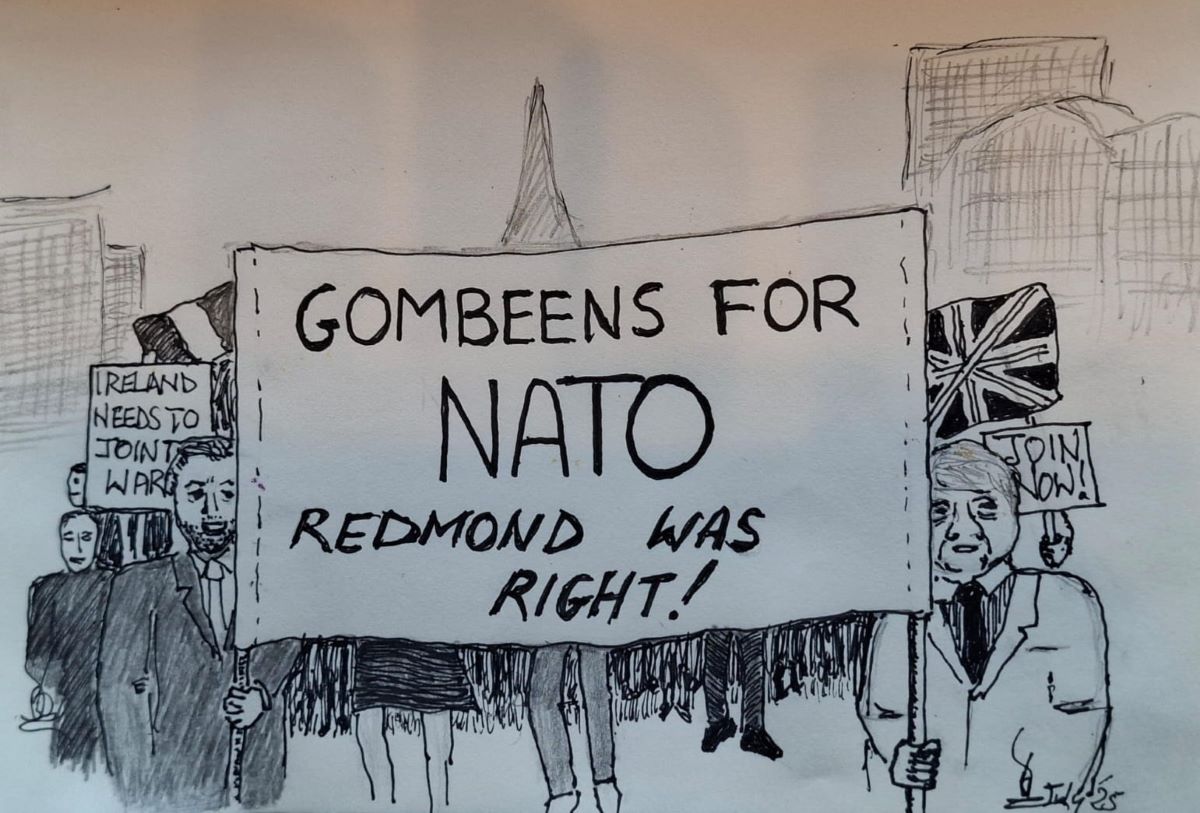
Cartoon by D.Breatnach.
Defending our physical lives? The thing I find hardest to understand, however, Denis, is how you think we’d be safer within NATO, of which the UK is a major part. I mean, since Britain invaded us in 1169 it has caused wars in Ireland, famines, genocide, linguicide, sectarianism and division.
You could say that’s in the past but it’s not, is it though? And they do say that the best predictor of future behaviour is previous behaviour, after all.
I know you’re concerned about the undersea cables. I’m not just worried about the UK in NATO – the top boss of NATO is the USA. And their record is more of sabotaging undersea pipes than protecting cables! I know, I know … no concrete evidence. But who else had motive, opportunity and capability?
Now, you want to see the Irish armed services expanded. But I can’t see why we have to be a part of NATO to do that. And if, as part of NATO, our armed services go to war, will you be ok with your grandchildren Meghan, Catherine, Denis, Michael, Kevin, and Patrick risking being killed?
Of course, I do know that big capitalists generally ensure that it’s the lower classes they send to the battlefield while they guarantee safe positions for their own family. I think you’d want to emulate John Redmond,4 whose son joined the army of a foreign King and Country but didn’t die for it.
Unlike the 35,000 other Irish who were killed in the British Army in WWI, not to mention the Irish wounded and permanently disabled, for which figures apparently do not exist.
However, I have to say, credit where credit is due: I did think the account of your visit to Venezuela was interesting and how the officer in charge of the President’s Office there was impressed by Ireland’s solidarity with Palestine and other stands, probably in support of underdeveloped countries.5
Thanks for that, it was very interesting – and heart-warming, to be honest. But I wonder, would the Venezuelan diplomat have been as friendly to you, Denis, if the Irish State, your point of origin, had been a member of NATO, practising imperialist wars and supporting genocide?
4In 1914 John Redmond was leader of the Irish Parliamentary party, representing the native Irish colonial capitalist class. He not only delivered thousands of Irish to the British Army for WWI but also supported the suppression of the 1916 Rising.
5O’Brien charted his own experience in subsea communications cables, starting with an Esat Telecom funded cable between Land’s End and Wexford in the late 1990s, and several projects in the Carribean, including the $75 million (€64 million) Deep Blue One cable in Trinidad which was completed last year.
O’Brien recalled how – due to a “cock up” – the cable had been designed to run through contested waters between Venezuela and Guyana.
“When the Venezuelan government got wind that our cable laying ship was about to start they sent us a cease and desist letter,” he said. O’Brien explained how he then flew to Venezuela to meet Jorge Elieser Marquez who was in charge of office of the presidency to “fall on his sword” and apologise.
“He graciously accepted my apology but then to my surprise he started to talk about Ireland and how we had supported the Palestinians, like Venezuela, in their quest for a two-state solution in Gaza,” he said.
“For some reason, he knew everything about Ireland and our principled stand over many decades – dating back as far as when Brian Lenihan senior was minister for foreign affairs.
(Reformatted entire for publishing in Rebel Breeze from article of same title in his Substack
(Reading time: 6 mins.)
The saga of the Occupied Territories Bill (OTB) has been dragging on for years now. It was first put forward by Senator Frances Black in 2018 and was approved by both houses of the Oireachtas (parliament) but never enacted.
The Irish capitalist class that is resolutely on the side of the Israelis, despite the illusions of many and the odd PR stunt, dragged its heels on the issue, even boasting that it had effectively blocked it.
Simon Coveney who was the Minister for Foreign Affairs at the time said during a visit to the Zionist state in 2019 that:
We don’t believe that it is legally sound because trade issues are EU competence as opposed to national competence in Ireland. And because we don’t believe it’s legally sound we have effectively blocked the legislation from moving through parliament as it normally would…
It’s essentially frozen in the process and it isn’t making progress. And I don’t expect that it will make progress, either, unless the government supports it, and the government won’t be supporting it.1
A demonstration outside Leinster House, parliament of the Irish State recently. (Image chosen and sourced: by RBreeze on line)
This came as no surprise to anyone paying attention. Ireland is not an independent capitalist state; it is what Marxists term a neo-colony with 88% of all corporate tax paid by foreign companies and just three companies accounting for 38% of all corporate tax.
Foreign corporate tax in turn represents 29% of the total tax take in the country.2 It is entirely dependent on the US and also the British state.
Many months prior to Coveney’s boast, the then Taoiseach (prime minister), Leo Varadkar had written a grovelling letter to Joe Biden to apologise for the behaviour of Irish politicians who had voted for the bill. In it he stated:
The Government has consistently and strongly opposed the Bill on both political and legal grounds and will continue to do so… Can I take the opportunity to reiterate my deep appreciation for the strong bonds of friendship between Ireland and the US, including our growing and mutually economic ties.3
There is no world in which the Irish state will stand up to the US. It won’t stop US planes shipping arms to Israel through Shannon Airport, just like it allowed the US to use the airport during the Iraq war.
Putting the OTB to parliament was not a bad idea, believing that is how we would achieve something concrete was.
They are now attempting to water it down further and exclude services from its remit, limiting it to only goods. (Note: at the time this article was written campaigners were still fighting an attempt to limit the bill in that way – Rebel Breeze)
IBEC (the Irish Business and Economic Confederation) came out with a statement that it would harm the Irish economy to enact the bill, whilst paradoxically accepting that trade in goods with Israeli “settlements” in the West Bank only amounted to €240,000.4
On the radio the Government reminded us that we are a trading nation, as if any of us thought that everything we buy in the country was made here and we exported nothing.
The reason they can make these statements of course, is because of the limited scope of the bill itself and the intentions of those pushing for its enactment.
The Irish government was at great pains to say that it would only apply to the territories occupied in 1967 and not to Israel itself i.e. not to the territories occupied in 1948 during the Nakba and the foundation of the Zionist state.
If you accept the legitimacy of the state of Israel or if you are one of those liberals still prattling on about a Two State Solution then all of this makes sense. It could have even been argued when it was first proposed that it was a stepping stone to a wider boycott of Israel, not that any of them said that.
For those who believe in the two-state solution (sic) the map shows what’s available for a Palestinian State (sic). (Image chosen and sourced: by RBreeze on line)
Events have overtaken our liberal friends and they shudder at the consequences. There is no longer any case to be made for a bill that limits business dealings with modern Zionist invasions of the West Bank.
Francesca Albanese in her recent report made it abundantly clear that many companies doing business with Israel are profiting from or contributing to the genocide.5 Now is not that time for half measures. Israel, just like the Nazis is carrying out a genocide.
Asking for a boycott of goods from the Warsaw Ghetto, rather than Nazi Germany would have seemed stupid at the time and actual calls for a boycott of the Nazis were portrayed as anti-German.
Some Jewish organisations opposed the boycott and the US government response to violence against German Jews was that the
U.S. Secretary of State Cordell Hull issued a mild statement to the American ambassador to Berlin complaining that “unfortunate incidents have indeed occurred and the whole world joins in regretting them.” He expressed his personal belief, however, that the reports of anti-Jewish violence were probably exaggerated.6
We know how this ended. The Nazis in the face of the timorous and timid response from the US and other western powers would eventually enclose Jews in ghettos, then camps and then push six million of them through the ovens.
Now is not the time to repeat history but to be bold and decisive. Now it is equally ridiculous to meekly petition, those who grovelled to Genocide Joe in 2019, to restrict goods from the West Bank.
In the midst of a genocide there is only one option on the table: a complete and total severance of all trade, military and diplomatic ties with Israel. There are no “settlements” without the Nazis in Tel Aviv, without the Israeli military, without the companies that keep Israel going.
A Banner on the IPSC National March 19th April 2025 in Dublin, appearing to show a believed organic connection between the enacting of the OTB and ending the Zionist genocide in Palestine. (Image sourced and chosen: R.Breeze)
Total isolation of the entire regime is needed. Not an orange, not a single electronic component, not a kilobyte of software. Such isolation should continue not just till the acts of genocide have ceased.
They will cease when the repugnant reality that Israel has run out of Palestinians to murder comes to pass.
Israel should be isolated until all those involved have been tried, had all their assets confiscated, given lengthy prison sentences or hung until dead, depending on the actual degree of participation.
This is not an outrageous proposal, it is what was theoretically done at Nuremberg, though many of the businessmen were given back their assets after a number of years and only a handful of Nazis got the actual death penalty and most never saw the inside of a jail.
No such leniency should be shown to the Zionists.
Those campaigning on the OTB will never make such a call. They will continue to petition the government. They do have another weapon to hand in fighting the Nazis in Tel Aviv, but they won’t call for that either.
The Irish Council of Trade Unions denounced the government’s handling of the OTB and called on the Oireachtas to reject the “business lobby scaremongering” and to pass the OTB.7
Of course, the unions don’t need to persuade the Zionists who dominate the coalition parties, they could just have told their members in 2018 to refuse to handle all products coming from the Occupied Territories, or indeed the entire Zionist state and that would have settled it.
They would have to organise that and back all their members who engaged in such boycotts. But under no circumstances will the fat cat bureaucrats ever confront the government over this issue.
If they are not prepared to fight for decent wages, a proper health system, public housing etc, all of which directly affect their members, less still will they fight for Palestinians. They are traitors to their class and also betrayers of the Palestinian people, despite all their lofty statements.
The OTB was a nice propaganda measure whose time has passed. It is, in the midst of a genocide, no longer fit for purpose, neither is a solidarity movement which limits itself to half measures. We need to be bolder.
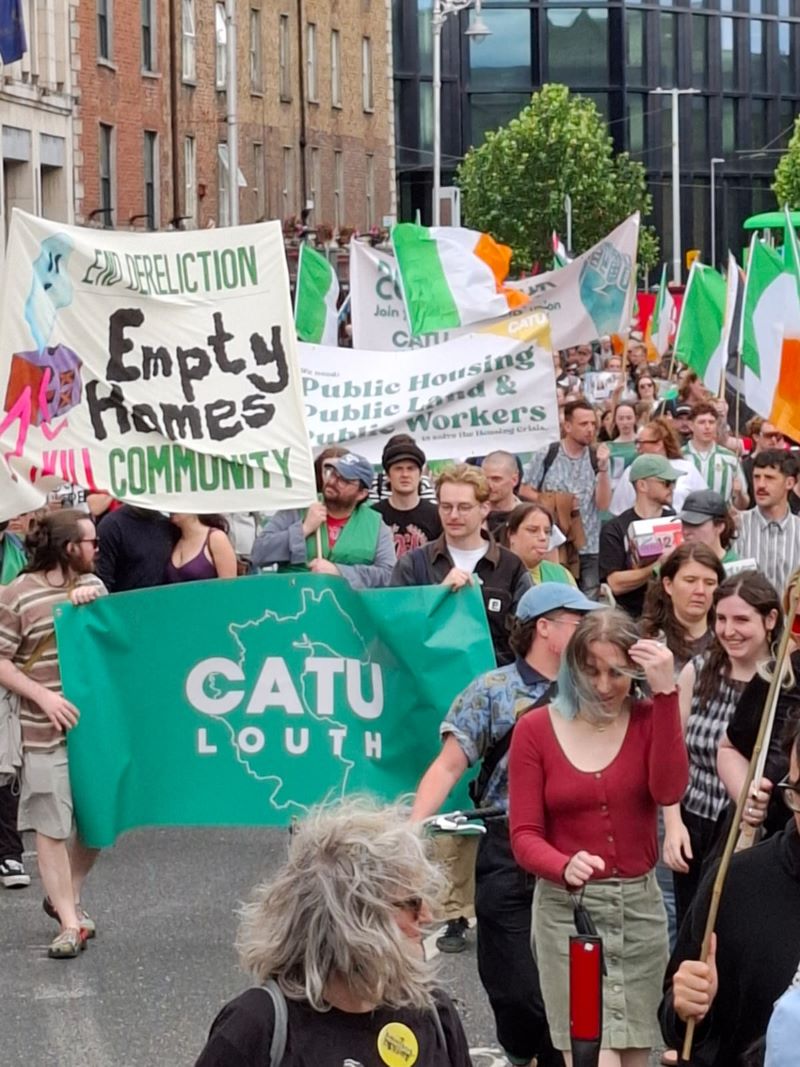
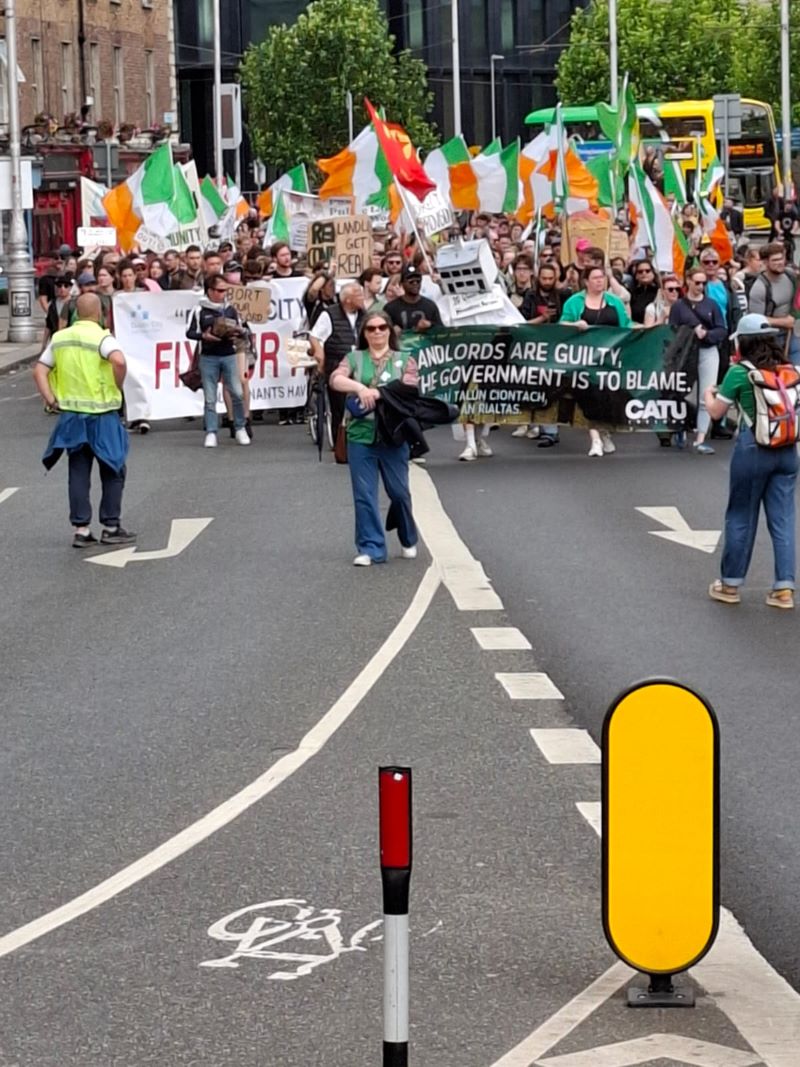
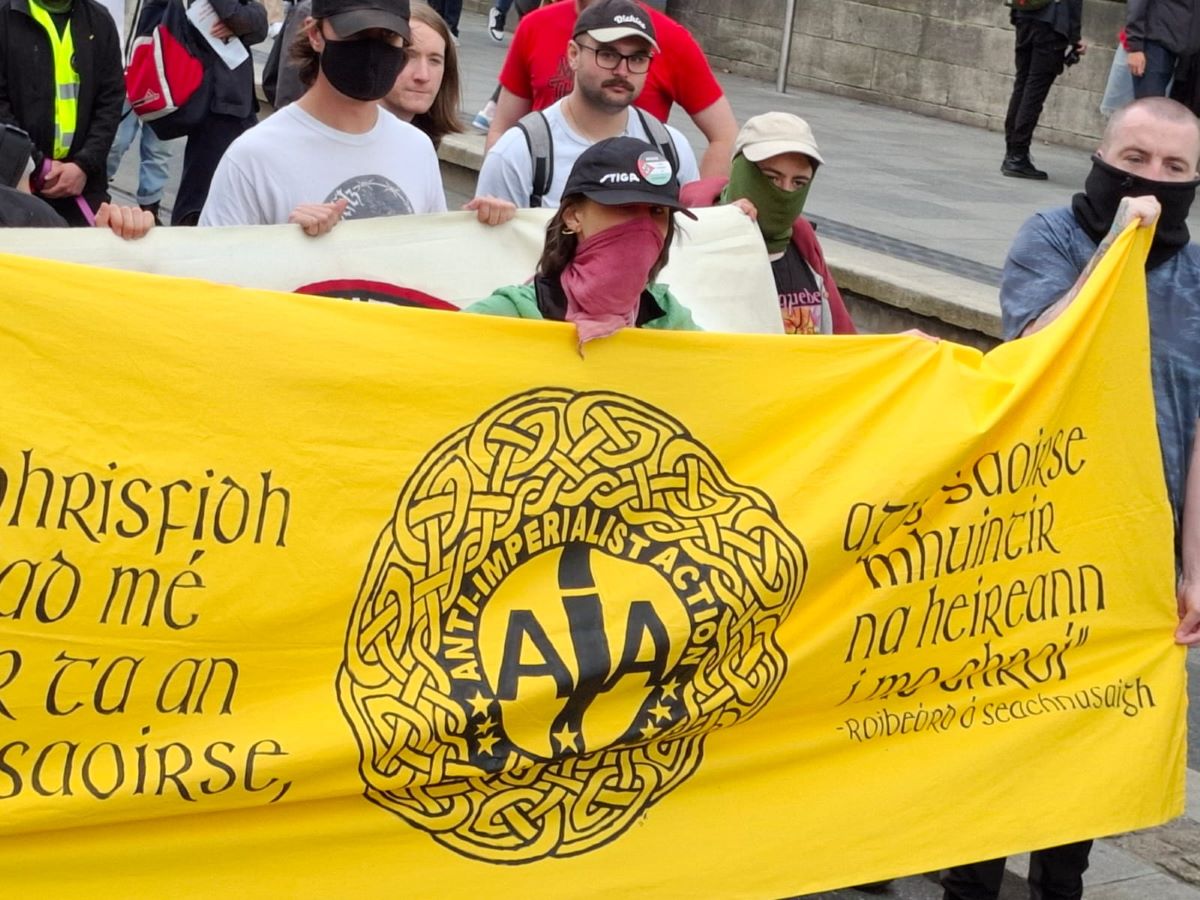
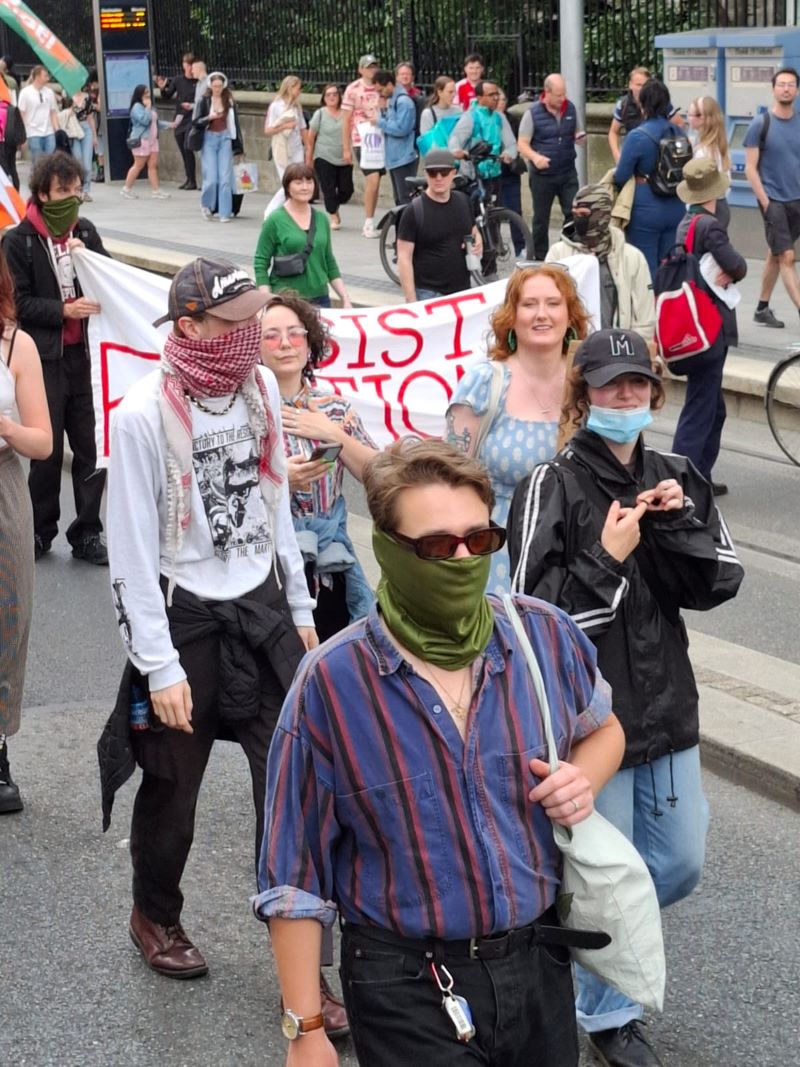
An estimated 10,000 people marched through Dublin city centre on Saturday in a national protest organised by CATU about homelessness, high rents, lack of public housing and the facilitation of property speculators by Irish Governments.
Groups from across Ireland attended the national march organised by the Community Action Tenants Union and without regard to the British Border around the Six-County occupied colony. They gathered at the Garden of Remembrance before marching towards Leinster House.
One of the housing groups that travelled to Dublin from the occupied Six Counties (Photo: D.Breatnach)
It was warm but not excessively so and the rain held off. The march ended with a rally in Molesworth Street, where Garda barricades prevent marchers from crossing the street to approach the gates of Leinster House, where the parliament of the Irish State sits.
In addition to drummers and also some singing, many chants could be heard: Homes for need – not for greed! What do we need? – Public housing; When do we need it? Now! When tenants are under attack? Stand up, fight back! (also something like: Get the landlords out of the Dáil!).
Among banners and flags of local area housing action groups and trade unions there were a great many Irish Tricolours in view; to see them being flown on a demonstration not of the Far-Right was a welcome sight. There were some Starry Ploughs and some red flags flying also.
It was good also to see the Irish language on some placards among the demonstrators. A notable feature was the high proportion of young people participating, many with their own home-made placards.
A certain species of vulture seems to have raised hostility in Ireland! (Photo: D.Breatnach)(Photo: D.Breatnach)Too Damn everything – except good! (Photo: D.Breatnach)
A lot of people were also in Dublin that afternoon for other events, including supporters of Gaelic Athletic Association county teams competing in Croke Park, in particular the Cork Vs Dublin teams in the Hurling Semi-Final. (Dublin getting that far surprised many but Cork beat them decisively).
A large anti-abortion demonstration also took place in the city centre, starting later than its advertised hours but immediately after the start of the CATU march. There are a range of attitudes on abortion but in general those campaigners like to project themselves as ‘pro-life’.
Some might comment that a pro-life cause would also include good housing for all – or to support the Palestinian people but generally the anti-abortion campaigners do not march in support of those, which is why they are often accused of being ‘pro-birth’ rather than ‘pro-life’.
Numbers of homeless single people and families with children rising annually passes 15,000 for the first time.
Out of 10,743 adults accessing emergency accommodation in March this year, 1,178 were under 24. In addition, 4,675 children were also using emergency accommodation.1 In January 134 individuals were counted sleeping on streets and in parks in the four Dublin areas, a 14% increase on 2024.2
In addition, the numbers of homeless does not include those sofa-surfing, awaiting eviction, in domestic violence refuges or unaccommodated refugees.
CATU’s list of demands points to the unfilled needs across a range of indicators and in itself is an indictment of the current state of affairs. In addition, the numbers of homeless has been rising annually and does not include those sofa-surfing, in violence refuges or unserviced refugees.
(Photo: D.Breatnach)
Prior to the march, CATU published a list of objectives and demands:
End child homelessness by 2026
Eviction ban North & South, Lower rents
Properly resource the Tenant In Situ scheme
End Direct Provision
Ban Vulture Funds
Build and maintain Public Housing – use public land
Build and resource culturally-appropriate Traveller Accommodation
Homes, not Holiday Lets
Build Communities of Care: education, community, addiction & mental health services now!
Front of the CATU march comes around from D’Olier Street while the rest of it is still coming down O’Connell St. (Photo: D.Breatnach)(Photo: D.Breatnach)
COMMENT – Housing Need and Action
It was an excellent turnout for CATU who are to be congratulated on their mobilisation and organisation around the country and in Dublin. The housing crisis is one of the great practical problems facing working people and a very big public housing program is the only solution.
However, the Irish neo-liberal ruling class are clearly wedded to housing provision by the private sector, with its soaring rents and mortgage payments resulting for many in sleeping on the street or living in hotels and hostels, not just single people but family groups with children too.
Housing marches and occasional symbolic occupations of buildings through the years have not changed the situation which worsens annually. The far-Right use the issue to target migrants who have not caused the crisis and even asylum seekers who cannot possibly have any effect on it.
Plentiful public housing is clearly the answer, rented according to the occupiers’ income. After the initial building cost, the rents will pay for maintenance, repairs, upgrades and even new buildings. And the construction program will provide much employment too.
Clearly a radical program of action will be needed to force the Irish ruling class to adopt a large public housing program. It does not require a revolution to achieve the change but it will almost certainly need the fear of one to move our rulers in the necessary direction.
In the 1960s and 1970s a number of housing schemes construction and renovation programs were won by the direct action of the Housing Action Committees of Dublin and Dún Laoghaire. The Committees included occupations in their program, alongside street rallies and marches.
Some years ago a small group called Revolutionary Housing League began a series of occupations of empty buildings, also refusing to give guarantees not to continue the actions when taken to court. They called for replication action on a wide scale along the same lines but that did not materialise.
Action of the kind up and down the country seems to be what is required and activists may be jailed before this ruling class is prepared to supply the basic human need of decent and affordable housing for the working people. It remains to be seen what role CATU will play in all of that.
I was relieved by my attendance at the Raise the Roof housing demonstration in Molesworth Street in Dublin City Centre. That was because I learned from speakers that just by voting in ‘a Left Government’ we could receive the housing we need.
Raise the Roof is a coalition of trade unions with its address at the Labour Party-orientated ICTU and a number of housing NGOs. The coalition also contains political parties: Sinn Féin; Labour Party; People Before Profit/ Solidarity; Social Democrats; Independents4Change.1
A view of the protest in Molesworth St. Leinster House is in the background across Kildare Street with access prevented by police barriers at the end of Molesworth St with a special gate to allow entry and exit for customers of the hotel on the corner. (Photo: D.Breatnach)
Previously I’d thought that either we’d need a revolution or a country-wide campaign of direct action occupying empty properties. This is because the housing crisis is deliberately constructed for the benefit of profits for big landlords, vulture funds and the banks that finance them.
And since they keep making massive profits out of the situation, they won’t want it to change as it would if, for example, were the State to seize empty properties2 for conversion to housing along with a massive public housing for rent construction campaign.
And if the profiteers don’t want that, naturally their (sorry, ‘our’) government will make sure not to do anything of the sort.
So it was great to learn that we won’t have to really fight and break the law, going to jail and all that. Phew! Just change the parties in the Government at the next election! Elect a Left Government!
Visual accidental irony comment in the same street. (Photo: D.Breatnach)
But… lately I have to admit I’ve been having doubts about this solution. First of all, there’s the question of numbers of TDs available to form this aspired-to government. There are overall 174 TDs in Leinster House (the Parliament of the Irish State) and a fragile majority requires 88.
The Sinn Féin party has 39 TDs and People Before Profit/ Rise/ Solidarity five in total, a combination of 44 still needing another 44 to reach the 88 minimum. FG and FF, formerly opposition parties but now in government have 86 votes between them and needed some extras to run the Government.
But I’ve got a much bigger doubt really, and that’s whether SF will stand up to the bankers and property magnates.
SF has for decades being setting out its stall that it is safe pair of hands to run the system, in other words that the profiteers have nothing to worry about. And to tell the truth, I believe them. Though some of their followers think SF is fooling the system, I think it’s the followers being fooled.
View of the Raise the Roof protest in Molesworth street. (Photo: D.Breatnach)
So … after further consideration, it really does look like a revolution will be required to end the housing crisis — or at least something so near as to make the managers of the system believe that unless they resolve the housing crisis, there will be a revolution. So I’m worried again.
Anyway, it was interesting seeing the amount of Tricolours in what was predominantly a left-wing rally of hundreds (despite a small contingent holding an Aontú banner) and there was some nice music with singers including Lisa O’Neill and Jimi Cullen (with his Homes for All composition).

















 rebelbreeze