The returning officer, Ríona Ní Fhlanghaile, has declared that the 26-County state has voted in the Referedum IN FAVOUR OF INSERTING A CLAUSE IN THE CONSTITUTION THAT PERMITS COUPLES OF EITHER GENDER TO MARRY by 1,201,607 votes to 734,300. That’s 62.1% yes to 37.9% no. The total turnout was 60.5% which is higher than in some other Irish referenda. The “Yes” vote exceeded the “No” in every county in the state except in Roscommon, where the vote was close. The “Yes” vote was significantly higher in all other counties and generally across rural and urban areas too.
The vote in favour is not surprising given that all the main political parties, as well as Sinn Fein and Left parties were all advocating a “Yes” vote. However, on its own that does not explain the wide gap between the two positions and the high turnout, especially in the face of the Irish Catholic Church hierarchy’s position against legalisation of same-sex marriage. It is hard not to see this as to some extent a conscious decision to oppose or ignore the Church’s position and to take a stand in favour of equality and civil rights.
I attended a meeting last night discussing the state of trade unions in Ireland and I found the meeting depressing. Not the state of the unions, which could be grounds enough for depression it’s true, but the state of the Left that sits down to discuss these questions. Because where else can the remedy come from except from the activists on the Left and if they don’t have a solution ….!
Practically all the 40 or so in the room were activists in trade union, community and political struggles, many with decades of experience. Many have suffered in the struggle, made financial and other sacrifices, some have suffered unemployment as a result of their commitment and some have even seen the inside of a prison. As the result of that combination of experience, one would think that they would come up with a good way – or number of ways – forward, out of the dire situation in which the trade union movement finds itself at the moment. One would think …. but alas!
The title of the meeting was TRADE UNIONS — RADICAL OR REDUNDANT? It was held on the second day of the week-long program of political discussion and cultural events of the James Connolly Festival, organised by the Communist Party of Ireland. Billed as a “debate & discussion on the future for trade unions”, the panel was chaired by Garret Gareth Murphy of Trade Union Left Forum and consisted (in speaking order and in personal capacity) of Louise O’Reilly (SIPTU), Dave Gibney (Mandate), Ann Farrelly (Swords Says No but also a member of a teacher’s trade union), Laura Duggan of Work Must Pay, Bernie Hughes (unemployed member of SIPTU but also a community activist and recently jailed for allegedly breaking an injunction sought by Sierra/ Irish Water).
Having attended a public commemoration of the death of Bobby Sands and nine other hunger-strikers which was also to start at 6pm, I arrived late for the meeting and so missed one panel speaker’s contribution and much of what another said. But that still left the rest of what the second one had to say and the other three.
At 7.15pm, the panel speakers finished and the meeting was opened to comment from the floor. Around an hour of speakers and less than an hour allocated for contributions from the audience, a discussion which then had to be cut to allow the panel to respond. This unfortunately is standard for Irish Left meetings, right across the political spectrum. Of course the intention expressed was to keep the contributions to five minutes from each and of course too some of them went way over. In this case, with five panel speakers, I had in fact predicted what would happen on the FB page of the event, though of course I would have been glad to have been proven wrong.
It is understandable, in a way. Left-wing speakers tend to be communicators and have a lot to say. They are also often kept out of many arenas where they could express their ideas. But arrogance has to be a factor too, when one knows that a meeting is scheduled to last about two hours and there are five speakers and a chair – and one still takes over 20 minutes to speak. Where does one think that extra 15 minutes (or much more) is going to come from? It is going to be deducted from other speakers probably and certainly from the audience. Or if the meeting goes on longer to make up the deficit, the risk is of wearing out the audience. The solution is crystal clear but probably won’t be applied – book less speakers and chair the meeting rigorously.
So why are so many speakers invited? Sometimes it’s because a broad representation of opinion is sought and at other times it might be that a number of organisations are expecting to be given a speaker. Then each speaker might attract a different audience or members of a different organisation. I have taken part in organising rallies and public meetings too and I know that these issues present difficulties but I also know that they have to be addressed. If we want participation and are democratically minded, we should not continue to organise debates/ discussions in this way.
All the speakers I heard expressed the opinion that there was something seriously wrong with the trade union movement. That was hardly revelatory – it is the opinion of the overwhelming majority of people on the street and in the workplace, if they have an opinion about the trade unions at all. And quite a few have hardly any opinion about trade unions – they don’t enter their view of the world to any degree whatsoever. Laura Duggan related that many young workers, finding themselves in difficulties with Job Bridge or otherwise at work, when looking for help, go first to Citizens’ Advice or to her organisation’s Facebook page – the last place many of them go to is a trade union.
Since that dismal view of the trade unions’ performance is so widespread and was shared by the panel speakers, I would have thought a few sentences could have been devoted to it and the rest of the speakers’ contributions could have been dedicated to prescribing or at least exploring solutions. Exactly the reverse is what happened – most of the contributions I heard were about ways in which the trade unions have failed, including much about personal experiences, but very little about what the solutions might be. Well, maybe the title of the meeting could be partly to blame but as activists, are we not mostly about solutions? Did Marx’s dictum on philosophy totally pass us by, that “heretofore philosophers have only interpreted the world, in various ways; the point, however, is to change it”?
So what were the solutions presented by the speakers? I recall “that the unions should recruit more young workers”, “respond more to young workers’ issues”, “there should be one big union”, “there should be education about political economy and history”, the unions should “continue participating in the struggles against the Water Tax”, “fight more strikes, especially when the membership have called for it” …..
Sure, OK, fine, brothers and sisters – but what if they don’t? What if the leadership, because that is what we are talking about in the failure of the trade unions, what if they don’t do what you think needs doing — what then? What are you going to do? What should we do?
The contributions from the floor followed much of the same pattern with however a greater amount pointed towards solutions. But again, it was mostly what was wanted from the leadership rather than what we could do to achieve the desired ends, especially in the face of the leadership’s intransigence. The need for young people to join the movement was expressed from the floor with on two occasions fulsome praise accompanied by applause for the one young person on the panel – well-intentioned no doubt but to me an embarrassing expression of the activists’ desperation.
Emigration, the 1990s Industrial Relations Act, leadership out of touch, the media … were all variously listed as being the reasons for the lack of resistance by the Irish trade union movement as well, of course, as the social partnership of decades between the unions and the employers and state.
One interesting contribution from the floor referred to an alleged ballot-rigging of which SIPTU had been found guilty in court years ago but which they appealed to the High Court. The brother relating this alleged that the Fianna Fáil Government of the day had the High Court clear SIPTU in exchange for the compliance of the trade union thereafter. Another brother a little later however denied there had been ballot-rigging (he actually said that “it was worse than that”!) and an argument broke out until the Chair quickly brought the meeting to order.
One brother in the audience stated that the problem was not at bottom whether the unions were fighting for better wages or not but about the politics of the union – if the politics were about social-democracy then of course the union would not act in the way we wanted. No-one responded to that contribution, presumably because either they agreed with it but couldn’t see how to progress from a union that isn’t even defending its membership to one with a revolutionary socialist ideology, or because they are basically in favour of social democracy, so long as it’s of a leftier kind.
I made one contribution to the discussion, in which I stated that although I have been a trade union member of different unions for most of my working life, and although I believe we should join a trade union, of course the trade unions are redundant. That is the opinion of most people at work and in the street and is the reality. But that doesn’t mean that trade unionism is redundant.
People will join a trade union if they see it fighting for its members. The workers who left the NUDL to join Larkin’s breakaway IT&GWU did so because they felt the NUDL had sold them out but they knew that Larkin wouldn’t do that and that his union would fight the employers. That was the same reason other workers joined the union too. If workers don’t see the union fighting, why should they join it?
I referred to all the bad history and difficult conditions for the operation of trade unions listed by contributors to the discussion. I pointed out that much worse conditions had been encountered and overcome by trade union organisers in the past – they had been deported in chains to Australia and in the United States many had been shot dead.
The Left in Ireland traditionally tries to deal with collaborationist trade union leadership by mobilising votes to replace the current leadership with Left candidates; I said that this process is too long if at all practicable and that our agreed Left candidates, if successful, are often corrupted by the trade union regime so that we have to start again. I proposed the same solution that I had done some years ago and on a number of occasions since, that trade union activists should form an organisation or network across the unions, in order to attend pickets when strikes break out, as people did with the Greyhound strike, to support the workers in struggle, to talk to them and also try to recruit them so as to have them go with us to the next strike and support the workers there.
I related some years ago being elected to the steering group of an organisation that was allegedly going to fulfill some of those expectations, the Trade Union Activists’ Network. I attended nearly every internal meeting for a year and was constantly trying to push it into action but it became clear to me, over time, that most of those present on the Steering Group had no real interest in the work and may have even been there for no other reason than to prevent activists from occupying their positions. Nevertheless, a grassroots network across the unions is still the only solution, I concluded; if we don’t build that we will continue to attend meetings like this in years to come, bemoaning the lack of success of our trade unions.
Some people – perhaps even most — may think they know better and after all, why should my ideas be any more likely to work than theirs? Well, perhaps for no reason; but their approaches have been tried without success for years – so why not try the one I advocate?
A somewhat separate issue which I did not address in my contribution was the much-promoted alleged support of trade unions for the Right to Water campaign. It is a fact that not one of those trade unions has advocated non-registration and non-payment. No trade union has advocated resistance to the Water Tax or its implementation by its members and, as one speaker from the floor pointed out, a number of local authority workers had been transferred to a private company installing water meters, without any resistance from the local authority trade unions.
Near the end of the meeting, speakers from the floor began to coincide in saying that we should continue to encourage trade union membership through recruitment, wearing our union badge, education, etc, etc. One went so far as to state that saying that trade unions are redundant is something some right-wing people and employers would love to hear, at which point I interjected that he was implying that “the critics are the problem”, something he hotly denied. But the fact is that the opinion of people about the trade unions is a result of the actions and inactions of those unions, rather than anything said in a meeting of around 40 people (or even a thousand).
I began this report by saying that I found the meeting depressing but that was not, it seems, what most others who attended felt. I found it depressing because despite all the lessons the Left is being taught, it seems unable to learn from them. But when the panel speakers came back to respond to the discussion, for me there were a couple of gleams of gold or at least something shiny in the bottom of the pan: Dave Gibney said that young workers will join a union when they see it fighting and spoke of the young workers in Dunne’s Stores who were enthused and politicised by their recent experience of being on a picket line; Louise O’Reilly said it was a waste of time expecting more sympathetic treatment from the media and that what we need is our own, left-wing newspaper.
End.
Credentials:
Diarmuid has been employed in many capacities, including as a factory labourer, construction labourer, kitchen porter, cleaner, laboratory assistant, foundry furnace operative, machine moulder, fitter-welder, youth worker, community worker, adult education tutor, hostel worker, hostel and addiction services team manager.
In the course of those, he has been a member in Britain at different times of the following trade unions:
Amalgamated Engineering Union
Construction Engineering Union
AEU (Foundry Workers)
Community & Youthworkers’ Union
NALGO (ILEA: Youthworkers; Adult Education Tutors)
NALGO (Local Authority, Education)
Unison
……. and in Ireland of:
SIPTU (Marine and Port)
SIPTU (Health workers)
Diarmuid has made serious attempts to found union branches in a number of manual workplaces with some successes and some failures, including being sacked from two workplaces for trade union or solidarity activity. He has also founded a union branch (managerial section) in his more recent work managing teams working with the homeless and people with substance misuse issues, along with facilitating union branch founding for other grades of workers in workplaces he managed. During his employment by NGOs, Diarmuid has faced disciplinary proceedings three times and beaten them twice, once at the initial stage and at the appeal stage in the second; he took the third to Labour Court and was awarded compensation.
Elected Shop Steward and/or Health & Safety Staff Representative in NALGO and in Unison, Diarmuid has campaigned for health & safety improvements (including organising comprehensive risk assessments by the team) as well as representing workers at disciplinary hearings (with mixed results). Elected unpaid Assistant Branch Secretary, he has been active in organising a strike, speaking at shop meetings and organising and participating in pickets. For a year, he edited a trade union branch newsletter and contributed articles to it.
As a trade union, community and political activist, among the pickets he has supported have been at car manufacturers (Fords), building sites, newspaper (Wapping), refuse workers (Greyhound), catering workers (Subway, Mac Donald’s), against cuts and closures of services, also collecting money for miners’, fire fighters’ and health workers’ strikes.
INIGO CABACAS KILLED BY RUBBER BULLET FIRED BY BASQUE POLICE IN 2012 — STILL NO JUSTICE FOR FAMILY OR FRIENDS
Diarmuid Breatnach
Most Basques and especially supporters of their most popular football team, Athletic Bilbao1, were very happy in the early evening of 5th April 2012 .
Inigo Cabacas, photographed with the Basque hermitage Gaztalugatxe, on the Biscay coast, in the background.
Their team had beaten a football giant in the UEFA cup twice and another premier European team once. The fans were expecting Athletic to win or at least draw again that evening, in which case Athletic Bilbao were through to the second leg of the quarter-finals. They had no idea that the evening would end with a police riot squad firing rubber bullets into a festive crowd, causing the death of a young fan.
The high expectations of that evening in Bilbao were the result of a run of wins for the Athletic team. On March 8th 2012, Athletic Bilbao beat Manchester United 3-2 on their own ground, at Old Trafford.
One needs to know a few population statistics to understand what an achievement that was. Manchester United is a football team on the world stage, based in a city with a population of 2.55 million – that is not far from the population figure for the entire Basque Country. In addition, Manchester United’s players are drawn from around the world; Athletic recruits only Basque players from a total population of the Basque Country of less than 3 million.
A week after their win in the northern England city, on March 13th, Athletic faced Manchester United again, this time on the Basque team’s home ground, San Mames, in Bilbao. Manchester Utd. were beaten 2-1 and it seemed that the Basque lions2 were unstoppable.
These wins created a huge interest in the next game, which was with FC Schalke 04 on March 29th at the German team’s home ground. Schalke plays in the top tier of the German football league and have won many championships including one UEFA League. With around 130,000 members, Schalke 04 is the third-largest sports club in the world in terms of membership, behind their compatriot rival FC Bayern Munich and Portuguese club SL Benfica.
Athletic Bilbao is not a sports conglomerate – it is a football club which is owned by its 40,000 members (remember, this is a small country – that’s nearly 1.5% of the whole population! It’s also around 11% of the population of their home base, Bilbao). The management board is elected by the membership.
At Schalke 04’s home ground on March 29th, the Bilbaino team beat them 2-4. The interest was therefore at fever-pitch for Athletic’s return match with the German team at Athletic’s home ground, San Mames on 5th April. The result was a 2-2 draw but Athletic were ahead 6-4 on aggregate and the fans were delighted. Bilbao was, as they say, buzzing.
After matches, young fans especially go to different pubs around town. Inigo Cabacas and many others went to an Herriko Taberna (a “Peoples’ Tavern”, i.e. one managed by the Abertzale [Basque pro-Independence] Left) which is located in an small “square” with planters, connected by alley with Licenciado Poza street. This small “square” is off the María Díaz de Haro street near the stadium; it runs parallell with the San Mames street itself, an area of bars well-known as a destination for fans after a game at the stadium.
The Herriko is too small to accommodate all those who gathered there but that was no problem for the area outside took the overspill. Early in the evening a few people were seen scuffling there and the rest of the crowd around them told them to knock it off, this was a time for celebration, etc. The scuffle ended and the festivities continued.
Some time later, a van load of police arrived. These were the Ertzaintza, a Basque Police force of 7,500 created in 1982 which has had numerous clashes with Basque strike pickets and with the Abertzale (pro-Independence) Left. Supporters of the Abertzale Left and many others refer to the Ertzaintza as “zipayos” (i.e. “sepoys”, local soldiers recruited by colonial occupiers). The Ertzaintza are responsible to the Basque Autonomous Region Government (CAV), a semi-autonomous entity covering three of the four southern Basque provinces.
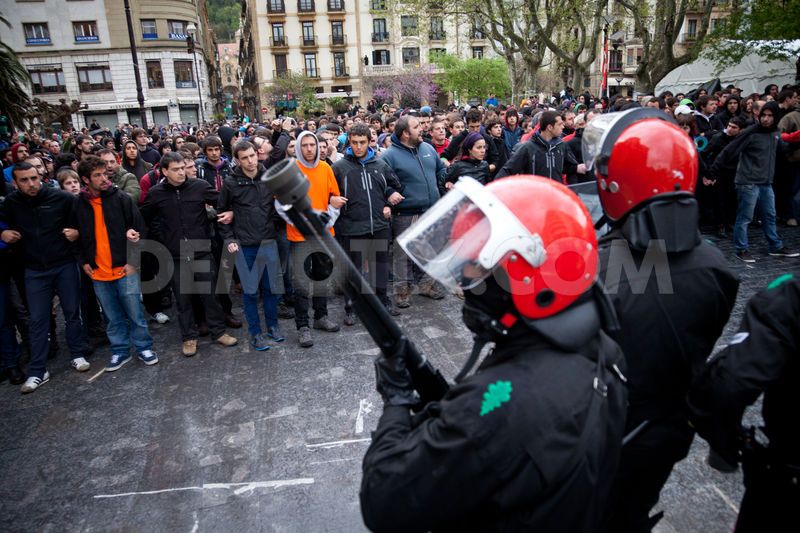
Basque Police, the Ertzaintza, face a youth Solidarity Wall built to defend Basque comrades the police have come to arrest in Donosti/San Sebastian some years ago.
Some of the youth perceive the arrival of the masked and helmeted police as a provocation and begin to throw bottles at the van.
The police officer in charge of those in the van asks for reinforcements and these are sent. The police emerge from their vans and begin to fire rubber bullets3 at the crowd at quite close range (the “square” is less than 45 metres at its furthest from the street) and everyone scatters except for a small group who are throwing bottles at the police but even they eventually dive for cover. People are sheltering in doorways, huddled up against the walls on each side of the “square”. Some are inside the pub wondering what is going on. A local shop-manager has raised the shutter over his doorway and people crowd in there. Some people are sheltering behind the wooden planters that are in a line down the centre of the narrow square.
After some time three young men walk towards the police with their hands in the air, asking them to stop firing rubber bullets; the police strike them with batons. Meanwhile it comes to the attention of some in the crowd nearby that a person is lying on the ground, apparently unconscious with blood coming from his ear and the rear of his head. People go to his aid and one of his friends recognises Inigo Cabacas. He gets his mobile phone and rushes towards the police telling them that someone has been seriously injured and to call an ambulance. A police officer tells him to drop the mobile. Inigo’s friend repeats his urgent request and the police officer tells him again to drop the mobile and hits him with a truncheon. The man drops his mobile and retreats from the police.
The police advance into the area and reach the injured man who has some people around him; a women is rendering first aid. A policeman tells her to move away. She tells him the man needs and ambulance and that she is applying pressure to stop the bleeding. He says he wants to see for himself and pulls at her arm but after awhile desists and goes away.
Eventually an ambulance arrives and takes Inigo Cabacas, still unconscious, to hospital, where he lies in a coma.
(video of the scene of the incident and interviews with friends and witnesses with English subtitles)
The news runs through a city, a shock in the midst of its celebrations and soon afterwards throughout the Basque Country. The first official reaction is given by the Interior Minister of the Basque Autonomous Regional Government, who declares to the press that the Ertzaintza acted properly and in line with their procedures, although he regrets the unfortunate death of they young man. He also repeats the first line of defence given by the Ertzaintza, that they were called to help someone injured in a fight and that the crowd was preventing the ambulance in attendance from rendering assistance to the injured.
When eye-witnesses give their version and the reporters of some newpapers begin to gather information, it becomes clear that the Minister could not possibly have investigated the incident in the time available. Furthermore, it emerges that no ambulance attended until after the incident with the police and that it appears that no call for one had been made earlier. Furthermore, according to the woman who attended to Inigo at the scene, the ambulance paramedic told her, when she complained at their delay in arriving, that the police had delayed their entrance. Under a storm of criticism from civil society and from the Abertzale Left party, EH Bildu, the Minister promises a full investigation.
Inigo Cabacas dies after three days without having recovered consciousness.
Some time later, a recording of the police communications on the night is made available by GARA, a pro-Independence Basque daily newspaper. The following becomes clear from the recording:
The Controller at Ertzaintza HQ calls a police van leader and directs him to attend the Herriko, saying that a fight has occurred there and that someone is injured.
The van leader reports that they have arrived and that some are throwing bottles at them, that they require reinforcements. No mention of ambulance.
The Controller confirms reinforcements are being sent.
Reinforcements arrive. One of the van leaders now reports that nothing is happening, everything is ok.
The Controller replies that he wants the police to go in and take possession of the area and make any arrests necessary. He emphasises that he wants to be understood clearly, that they are to “go into the Herriko with everything we have”, to take control of the area “and then everything will be ok.”
The van leader replies that the order is understood and soon shots are heard (the firing of rubber bullets).
The family employs a solicitor. A judge is appointed to carry out the investigation but is required to do so along with her other duties. Immediately, the police investigation ceases (according to the family’s lawyer, ithe file contains just three pages), using the excuse of the judicial investigation.
A number of legal applications are made, e.g. for all the police at the incident to be obliged to make a statement, for all police who fired a rubber bullet gun to be identified, for the Controller to be obliged to make a statement, but all are refused by a judge, giving a number of reasons4. Little is established over the following three years, except that threepolice voluntarily admit to having fired rubber bullets and the identity of the Controller on the evening becomes widely known. There is widespread outrage when the senior officer on duty the day of Inigo’s death is appointed Chief of the Ertzaintza.At a recent press conference, the Cabacas family’s lawyer, Jone Goirizelaia, announced that they had possibly identified the officer who had fired the fatal shot.
It emerged during the campaign by supporters of the Cabacas family that no recognised procedure was followed by the police with regard to the incident: debriefing statements were not taken from each of the police participants, guns were not examined to identify which had been fired, no inventory was taken of the number of rubber bullets fired. No attempt was made to contact witnesses after the event to gain a picture of what had occurred. Indeed, some witnesses who approached the police station to give statements were told to go away (see video link posted earlier in this article). It further appears that the Ertzaintza have been issued with no specific operational instructions with regard to the firing of rubber bullets.
According to some sources, the rubber bullets should only be fired at knee-height and at no less than 50 metres from the target. The “square” is, according to locals, less than 45 metres at its furthest from the street and therefore the police from the moment they began firing, were in serious breach of the minimum distance requirements. In addition, the Ertzaintza have frequently been seen aiming their rubber bullet guns at protesters’ faces from as little as a metre or two and also firing from the shoulder with the muzzle parallel to the ground, i.e. directed at head or chest-height of the target. Also, the rubber-coated steel balls bounce uncontrollably.
Rubber bullets against Palestinians
Rubber bullets are regularly fired by the Israeli army at Palestinians. A Palestinian source reports: “Israeli professor Michael Krausz and colleagues at the Rambam Medical Centre in Haifa analysed the medical records of 595 casualties admitted to hospital during the October 2000 protests by Palestinians living inside Israel (typically described as “Israeli Arabs” by the media). Of those, 152 were found to have been injured by rubber-coated metal bullets. Injuries were distributed randomly across their bodies but were most common on the patients’ arms and legs, and on their head, neck and face.
“The doctors said their findings dismissed the theory that “rubber bullets” were safe. Rubber-coated metal bullets with some of their rubber coating removed, revealing their hard steel core. Fired at speeds of what must be several hundred feet a second, these are munitions that cause enough damage that their manufacturers feel compelled to describe them as only ‘less lethal’.
“Writing in the Lancet, they said firing the bullets at civilians made it ‘impossible to avoid severe injuries to vulnerable body regions such as the head, neck and upper torso, leading to substantial mortality, morbidity and disability.’ They added: ‘We reported a substantial number of severe injuries and fatalities inflicted by use of rubber bullets ….. This type of ammunition should therefore not be considered a safe method of crowd control. “The study, ‘Blunt and penetrating injuries caused by rubber bullets during the Israeli-Arab conflict in October, 2000: a retrospective study’ (The Lancet, Volume 359, Issue 9320, Page 1795), also highlighted previous research which suggested that even plastic bullets may not be safe and may cause more severe head injuries.” (Sourced at http://electronicintifada.net/content/misleading-terminology-rubber-bullets/4000)
Rubber bullets against the Irish
Seventeen people were killed in the Six Counties (“Northern Ireland”) by rubber and plastic bullets fired by British soldiers (11) and colonial police (6) during the 30 Years War. A number of people were also blinded. http://cain.ulst.ac.uk/issues/violence/rubberplasticbullet.htm
It emerged in 2013 during a compensation case taken by a Derry man blinded in 1972 that the authorities knew that the missiles were potentially lethal even before they issued them. (http://www.theguardian.com/uk/2013/jun/11/mod-rubber-bullets-lethal-records) It is clear also from a wealth of evidence that the missiles were regularly fired by soldiers and police not only at close range but also aimed at chest or head. In addition, a deadly ‘game’ was played by some British soldiers. Knowing that rubber and plastic bullets were collected by children as mementoes and objects to sell to tourists, soldiers would fire some into an open area and wait for children to run forward to collect them, then see if they could hit the children with subsequent rounds.
Rubber bullets in the Spanish state
The Spanish state continues to allow its police forces to carry and to fire rubber-coated metal bullets, in particular at protesting Basques and Catalans (see video link at bottom below article). Recently, the EU expressed concern at Spanish police firing at migrants attempting to swim into the Spanish state from Morocco, an occasion when 11 of the migrants drowned. But no international protest criticises them for firing potentially lethal missiles at their own citizens. Police in the Spanish state enjoy impunity and none more so than in the Basque and Catalan countries as well as with regard to African migrants.This week, a motion was put to the Basque Parliament to ban the use of rubber bullets in the area under its control (CAV). Instead a proposal was accepted to “restrict” the use of the missiles to “situations of grave danger” to the police, and to “definitely seek a replacement” for them. The Spanish right-wing PP, the liberal Spanish unionist UPyD, along with the PNV (Basque Nationalists), currently in power, voted for it, along with the Basque version of the Spanish social-democrats, the PSE. The only party to vote against the amendment was EH Bildu, party of the Abertzale (pro-Independence) Left; they had proposed the original motion, seeking a total ban and the removal of the missiles.
Parent and friends of Inigo Cabacas confront spokesperson of the Basque Nationalist Party after attempt to ban rubber bullets fails
Among those in the public gallery at the discussion were the parents of Inigo Cabacas. Afterwards, in the corridor outside, they confronted the spokesperson of the PNV, Joseba Egibar. During the exchange, another PNV parliamentarian, Luke Uribe-Etxebarria, tried to prevent its filming by the Basque TV station ETB. That attempt will be the subject of a complaint to the President of the Parliament by EH Bildu; they view it as particularly serious since Uribe-Etxebarria is also on the management board of the TV station and the filming was taking place in areas open to the public.
“I’m never coming to this Parliament again …. I feel cheated,” said Manuel Cabacas, father of the deceased, speaking about the majority decision. “My son is dead …. I only wanted to ensure that it would never happen to anyone else ….”
On the third anniversary of the killing of Inigo “Pitu” Cabacas, among many commemorative vents in the Basque Country, 10 minutes’ silence was observed in the San Mames stadium. Alongside Inigo Cabacas; many are also remembering Aitor Zabaleta, fan of the Real Sociedad team, murdered in Madrid in 1998 by fascist ultras of Club Atletico Madrid. Many Basques around the world will be conscious of the three years that have passed since Inigo’s killing without anyone being even charged in connection with his death or any noticeable change, whether in Basque police behaviour, procedure or their use of rubber-coated steel projectiles. A change of political control of the Basque Regional Government from the social-democratice party of Patxi Lopez to the Basque Nationalist Party .(PNV) of Urkullu has had no effect.
It is true that for ordinary people, in capitalist society, the wheels of justice move very slowly; in this case it is hard to see that they are moving at all.
End.
NB:DUBLIN: A group of Basques plan to hold a commemorative event on Tuesday 28th April, on the day of a Basque derby, Bilbao Athletic v. Real Sociedad. They plan to hold a protest picket at the O’Connell Monument in Dublin’s O’Connell Street at 7pm for a short while and afterwards to go to watch the Basque derby (kick-off at 9pm) at the Living Room bar, Cathal Brugha St. Some Dublin-based Irish people have undertaken to support the Basques by participation in both events. Poster for event: https://www.facebook.com/photo.php?fbid=10153291310864390&set=gm.1624681737767253&type=1&theater
Short but shocking Guardian video of Catalan police using rubber bullets and the testimonies of victims who have lost an eye to the missiles:
1 Based in Bilbao, it is the most popular and most successful (two things that often go together) but not the only football team; there are also Real Sociedad, based in Donosti/San Sebastian and Osasuna, based in Iruña/ Pamplona.
2 A roaring lion is the emblem of the team, arising from the legend of St. Mames, to whom the local church is dedicated and which gives its name to the area, street and stadium. English-language football commentators persisted in calling the team “the Spanish lions” or “the Spanish cavaliers” (??!), in total ignorance, one hopes, of quite how insulting that would be perceived by the players and their fans. The Basque Country is not even politico-geographically Spain, it is divided between the Spanish and French states. And Bilbao Athletic is most certainly not, nor has it ever been, a Spanish team. When the Spanish King attends finals or semi-finals between Barcelona and Athletic in, yes, a Spanish football league, and the Spanish national anthem is played, the stadium fills with howls of derision, hoots and whistles from the supporters of both teams.
3 These are about the size of a tennis ball, perhaps a little smaller, of steel and coated in rubber.
4 E.g., the Controller could not be held responsible for the shooting by the police; individual police would have to be accused of firing the fatal shot if they were to be obliged to make a statement …
An 18-year old woman of the Kurdish diaspora in London, Silhan Ozcelik, has been sent for trial at London’s Central Criminal Court (the “Old Bailey”) accused of trying to join the Kurdish-led resistance against ISIS (“Islamic State”). A British journalist called the trial “disgusting” and said it left him “almost without words” to describe the travesty of justice. (article below)
A different kind of face paint: female fighter of the Kurdish guerrilla YPG checks another female comrade as they prepare to go into action with their male comrades on the front line against ISIS in Syria.
This post contains:
An article about the trial by J0nathan Owen in yesterday’s British newsaper The Independent (see above)
A short article from pro-Kurdish PUK Media containing a discussion on the role of Kurdish women fighters in Syria, with quotes from a wide variety of sources (right at end of this post)
A video of an Australian documentary, “60 Minutes”, from the war zone, with war footage, interviews with women fighters and commanders, victims of ISIS (see further down)
Background comment or introduction from me (immediately below)
Background Comment:
The Kurds in the region, numbering around 28 million, have the right to self-determination. They are divided by borders of states set up in the past by the colonial imperialists of Britain, France and the Ottoman Empire and also by ambitions of the states subsequently created: Turkey, Syria, Iraq, Iran and Azerbaijan (there is also a huge Kurdish diaspora in parts of Europe, the USA, Canada). The Kurds in the region also face differences in political leadership, dialect and religious influence as well as containing among them other ethnic groups (many of these also oppressed): Arabs, Armenians, Azeris, Turkmen, Yazidis …. The whole Kurdish region extends across an area of great strategic importance (the gateway to Europe and to the East) and also of considerable natural resources, including water. It is envisaged that an oil pipeline will cross this area and a number of dams have already been built there.
The Kurds in Turkey (the largest population of Kurds) has been mostly led by the PKK (and various political organisations friendly to it), a communist-type national liberation organisation, largely secular (though some of their areas can be religiously conservative) and with a very large guerrilla force which has included many women fighters. They have fought the Turkish armed forces for decades and remain undefeated. Turkey’s nationalism under Kemal Attaturk declared that Kurds did not exist — they were just “mountain Turks”. Kurdish has been forbidden, the flying of Kurdish national colours a crime, and state repression has included bannings of parties and newspapers, jailings of political and human rights activists, kidnapping, torture, assassination squads, creation of strategic villages, aerial bombardment, etc. The imprisoned leader of the PKK, Abdullah Ocalan, last week from prison called on his followers to lay down their arms and to engage in a “peace process” in which however the Turkish Government shows no interest. Ocalan enjoys an adulation among the PKK and its supporters somewhat as Chairman Mao did among Chinese communists and his portrait can be seen on demonstrations, in pickets and in their secure areas.
The Kurds in Iraq have mostly come under the political dominance of two political leaders with tribal following, Barzani and Talibani. Iraqi Kurds are mostly Sunni Muslim with a minority Shia population (Fayli) in central and and SE Iraq. The Kurds were oppressed by the Iraq regime and rose up against them a number of times only to be massacred, including when the US called on them to rise during the Kuwait war but left them on their own. Their fighters, “peshmergas” are mostly male and during the Iraq Invasion by the US-led coalition, they fought the Iraqi Armed forces but entered Baghdad like bandits and set up various areas of control under different war lords, occasionally fighting even one another. In the past on one occasion the peshmergas were also deployed against the PKK in conjunction with a Turkish attack on them.
The Syrian Kurds have their own fighters but have not been as prominent in the past as those of the Kurds in Turkey and Iraq. The Syrian regime does not favour declarations of different ethnicity coupled to aspirations of self-determination and has suppressed expressions of Kurdish nationalism, including jailing singers and musicians whose work includes those expressions. In recent months, the Syrian Kurds and their fighting organisation, the YPG, have had the most success in halting and in places forcing back ISIS — the “Islamic State”. The YPG rescued a large population of mostly Yazidis (including also some other ethnic groups) after ISIS swept aside the army of the NATO-client Iraqi regime, massacred tens of hundreds of civilians and kidnapped tens of hundreds more, including women which they took or sold as concubines.
The Kurds in Iran have been in recent times the most suppressed perhaps of all the Kurdish populations. Under the Islamic clerical regime a number of Kurdish political activists have been executed for “crimes against God” (i.e. being atheists and socialists and sharing their political beliefs). Under the Shah the repression was also heavy and Savak, the secret police, along with their informers, were almost everywhere. Torture was endemic under the Shah and almost certainly continues under the present regime.
Although the NATO powers fear ISIS, they have also had a hand in its creation in the drive to overthrow regimes resisting NATO’s penetration of the area (and encirclement of Russia) by direct assault or by proxy: Libya and Iraq (already overthrown), Syria (under attack), Iran (constantly being threatened). They are trying to bring the YPG into the fold but Turkey, an important member of NATO, would rather see the Kurdish fighters wiped out and seals its border to prevent fighters and supplies reaching the YPG. The USA therefore confined itself to some bombings of ISIS positions around Rojava and diplomatic overtures to the Kurds. They have not committed ground troops (which the YPG have not asked for) or supplied arms (which the YPG have asked for — repeatedly) and continue to support forces attempting to overthrow the Syrian state. The YPG rarely fight alongside the state’s Syrian Army but at times both forces are simultaneously in action against ISIS, though seemingly not in coordination
.
The Kurds, as the largest force in their region of Syria and one of the largest ethnic group in the whole region, form a focus of resistance to assimilation and to repressive regimes of states but may be seen by other ethnic groups as themselves posing a threat of assimilating them.
Video documentary “60 Minutes” by Australian television containing Syrian war area footage of Kurdish women fighters and commanders and interviews (and also occasionally irritating comment by the interviewer)
Less photogenic perhaps than the images we are currently being shown of Kurdish female guerrilla fighters, this photo is probably of a female guerrilla unit of the PKK in Turkish Kurdistan taken perhaps a couple of decades ago. In order to counter accusations by the Turkish state of female guerrilla “immoral” behaviour, the PKK kept the genders in separate fighting units.Two female guerrillas of the YPG resting but ready to go into action. They are on the front line against ISIS in Syria.
A discussion on women in Kurdistan and Kurdish women fighters (note that there are two parts of Kurdistan under discussion here – Iraqi and Syrian; however there is also Turkey, where the majority of the Kurds live and Iran):
Female fighters of the guerrilla YPG with a heavy machine gun (light cannon?) in the front line against ISISKurdish female guerrilla fighters opposing the Free Syrian Army, sponsored by NATO against the Syrian state, in 2011. The FSA has since been overcome or incorporated into ISIS.
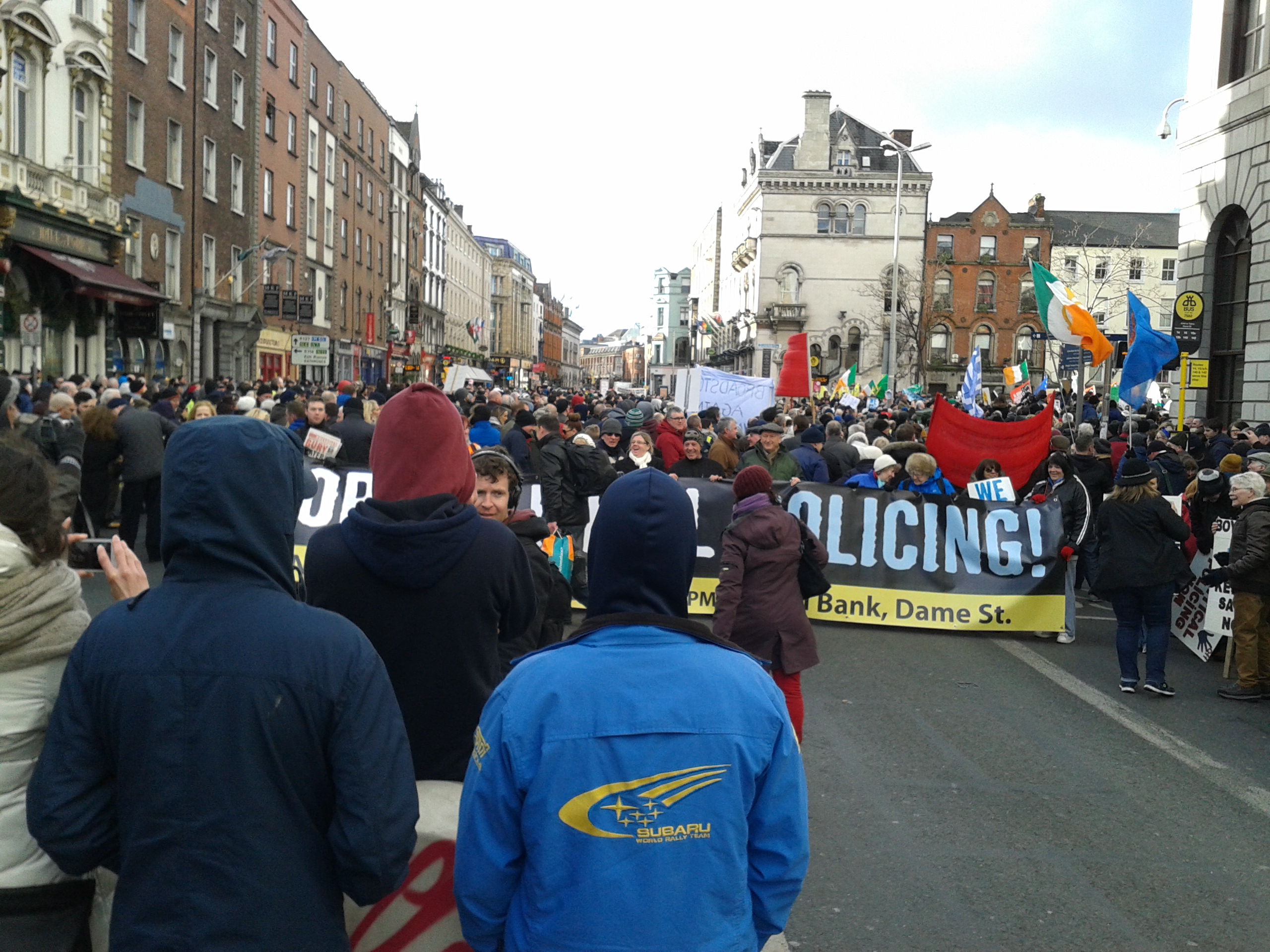
Start of the march in Dame Street after rally in Central Plaza
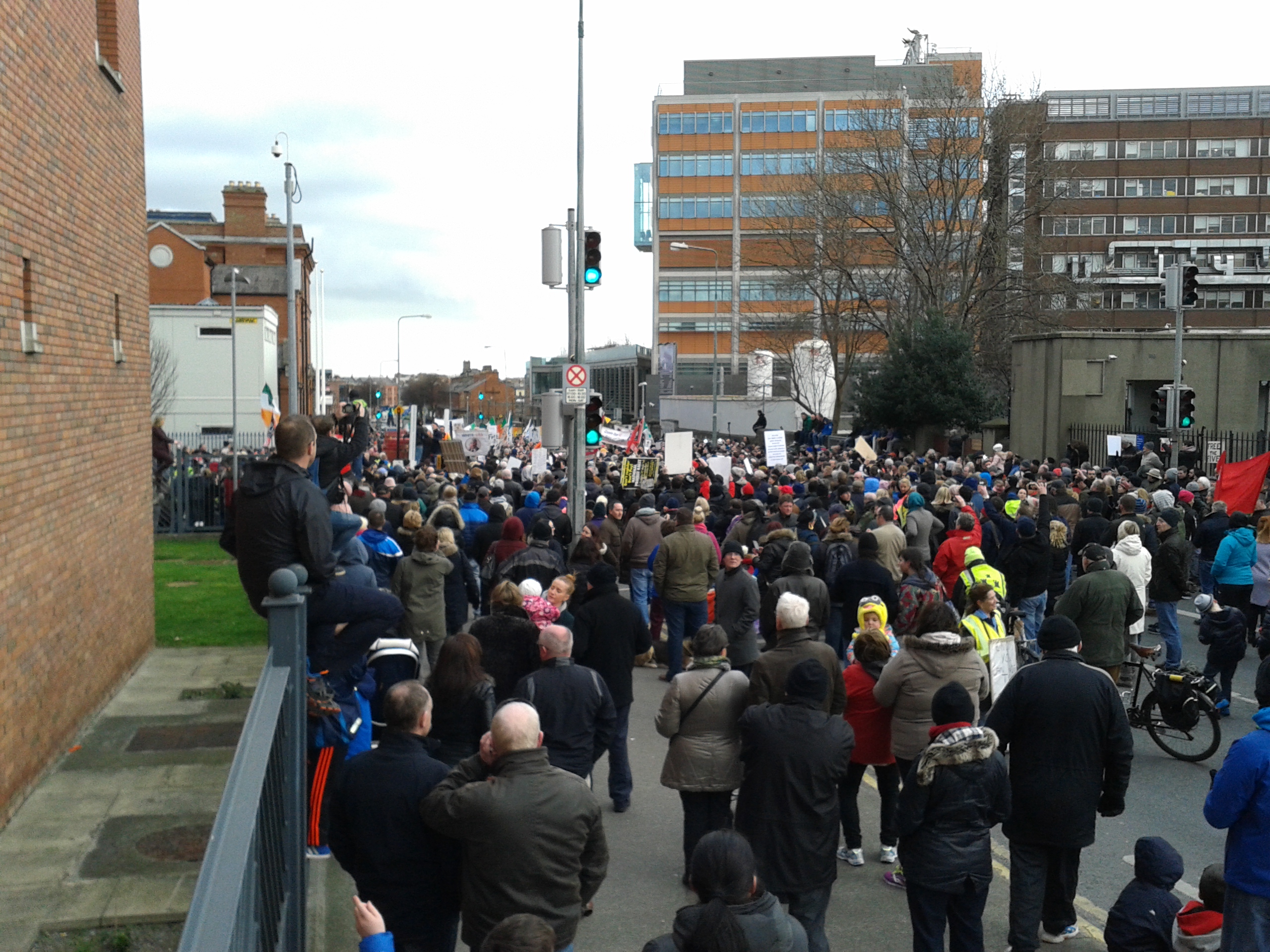
On Saturday 21 February, at two days’ notice, somewhere between eight and ten thousand people gathered in Dublin in solidarity with those water tax protesters jailed by the State and those recently arrested. They marched to Mountjoy Prison and packed the road outside it and in front of the local Garda (police station).
The march gets going in Dame Street. Photo shows only the front of the march.
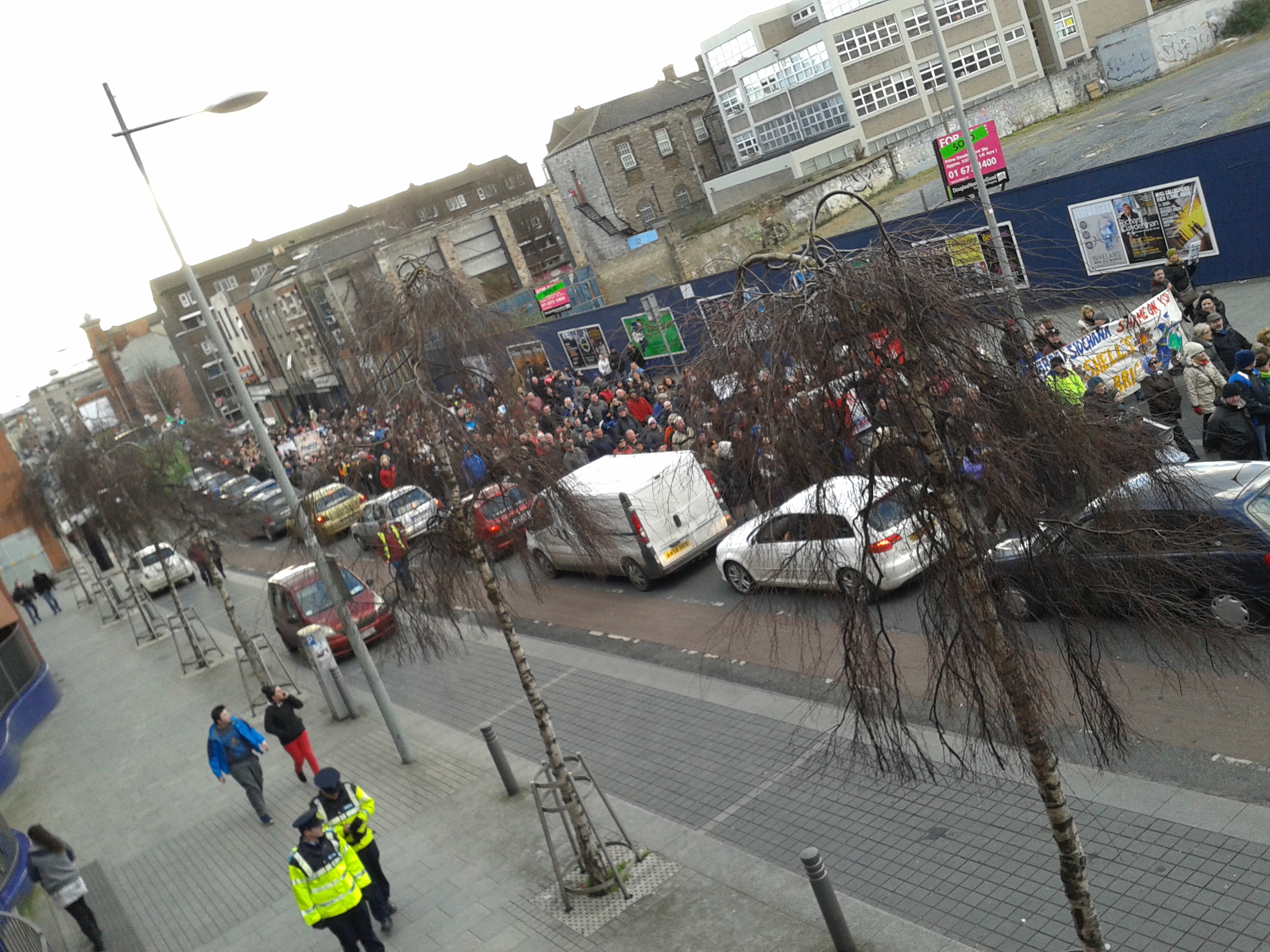
Parnell Square West from Granby Place. The front of the march has turned into Dorset Street and is marching there but the end has yet to come around the corner into the square from Parnell Street
The crowd were addressed by relatives and friends of the jailed, anti-Water Tax campaigners as well as by Paul Murphy, Joan Collins and Clare Daly (both TDs of the United Left) and Dessie Ellis (TD of Sinn Fein).
All of the speakers denounced the politicians and the State for the jailing of the protesters while the bankers and politicians who created the crisis and colluded in the bank bailout went free. Most speakers called on the crowd not to pay the water tax and to build resistance on the streets. Dessie Ellis, in keeping with his party’s position, did not call for non-payment, though he did call for “unity of the Left”. The march was notable for the absence of SF banners and placards — apparerently they were having their own protest at Leinster House.
One of the protesters made an emotional appeal on behalf of two of the five who received jail sentences, who have gone on hunger strike, and on behalf of another, Derek Byrne, also on hunger strike, but who has declared his intention of refusing to take fluids from Monday if he is not released. (NB: Since posting that paragraph it has emerged that the demand of all three hunger-strikers is a return to Mountjoy [they had been separated and sent off to a prison facility near Clondalkin] and an end to 23-hour lockup in their cells. These are basic human rights.)
Large sections of the crowd seemed taken aback by this information and unsure how to react.
Paul Murphy pointed out that this use of the police to attack people protesting injustice has been a feature of the State since its creation and mentioned the threats of jail to striking workers, the jailing of the Rossport Five and of Margaretta D’Arcy. Clare Daly asked the Gardaí which side they were on, that of the polticians and bankers or of the people, saying that if they chose the former it is they who would become isolated, not the protesters. Joan Collins, Murphy and Daly all pointed to the need to create a socialist society. They also, along with most other speakers, called for a build up and huge turn out of support for the demonstration scheduled for March. Many speakers declared that the increased repression is a sign of the Government’s or the system’s weakness, not of their strength and called on the movement not to falter now.
Robert Ballagh, who also spoke, called for the release of the five and pointed out that the class of people who rule and profit out of this society are not those who find themselves in jails.
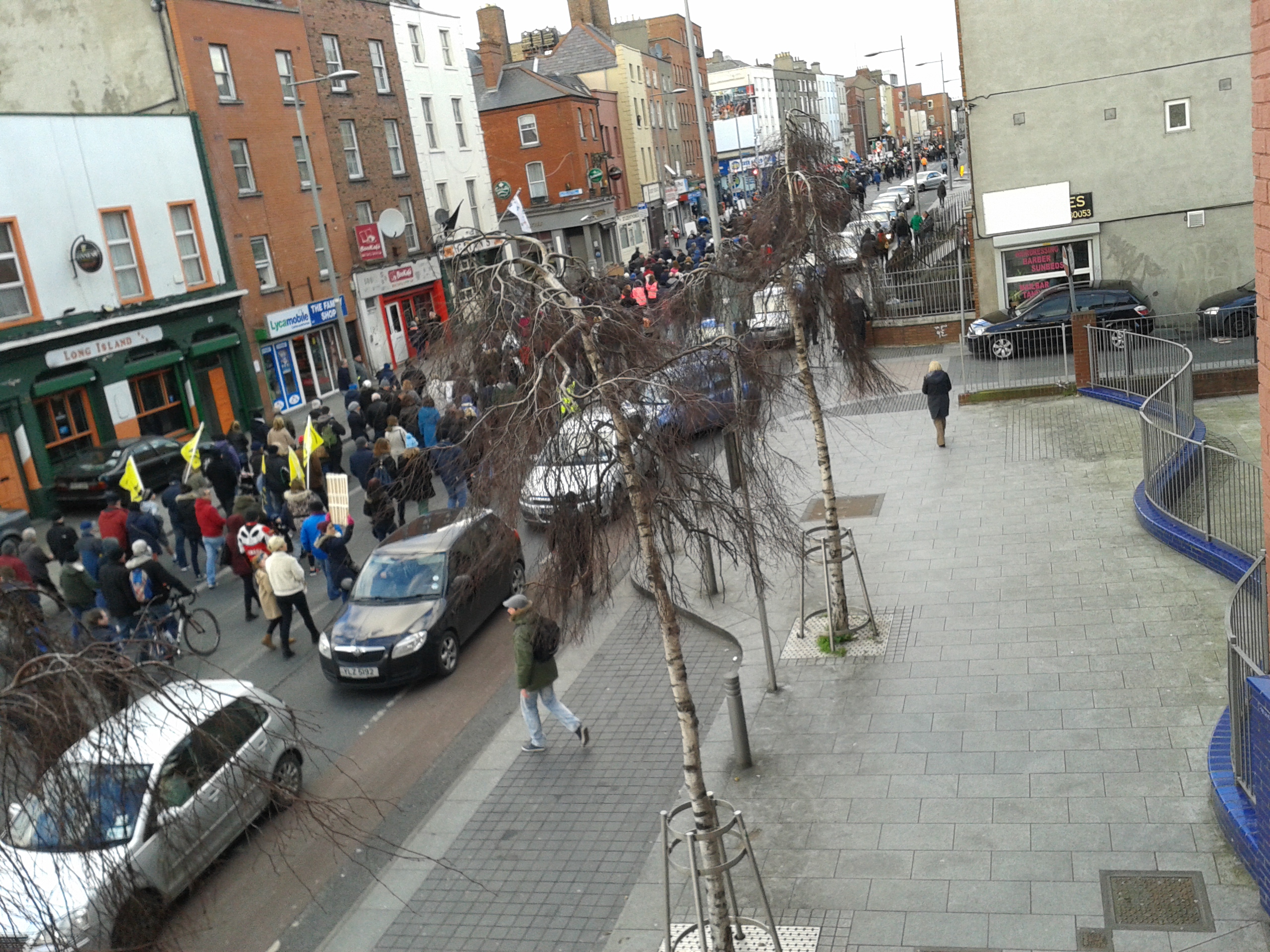
Section of the march in Dorset Street, looking west (another section is behind the camera — see next photo — but a large section of the march has yet to come around the corner from Parnell Square.)
The same road, photo taken a few seconds later but looking east.
The mood of the crowd in general was of good-humoured determination. The composition seemed to cross social groupings, ages and genders and a number had brought their children along. Some had come from other parts of the country.
Crowd outside Mountjoy. some have left and many are still further down the north Circular Road (the Mater Hospital is to the right of photo).






 rebelbreeze