Pearse, that Speech, and Me

by Hugo McGuinness

Three members of my family fought in the 1916 Rising and eleven “did their bit” in the War of Independence. So it‘s probably not that surprising that as a child, I grew up with stories, real, imagined, and embellished, of those ancestors and their times.

Of those three “1916 men” the one who most aroused my curiosity was my granny’s cousin, Desmond Ryan. “A bit of a consequence”, according to my great-aunt Polly, or “the son of the fellah who wrote the first Irish play that got him a medal from Yeats and Lady Gregory“ according to my uncle.

Desmond actually was “a bit of a consequence”; however his father, W.P. Ryan, while he did write a number of plays “i nGaeilge” didn’t quite write the first to be performed in Dublin and I’m not too sure about the medal either. W.P. was a journalist, editor, novelist, and socialist. His clash with Cardinal Logue, Archbishop of Armagh, while editor of The Irish Peasant, is chronicled in his “The Pope’s Green Island” and his novel “The Plough and the Cross”, both of which bear fruitful reading today. His 1913 book “The Labour Revolt and Larkinsim” together with his work as assistant editor of the London Daily Herald did much to explain and create sympathy among British socialists for the participants of Dublin’s Lockout in 1913.

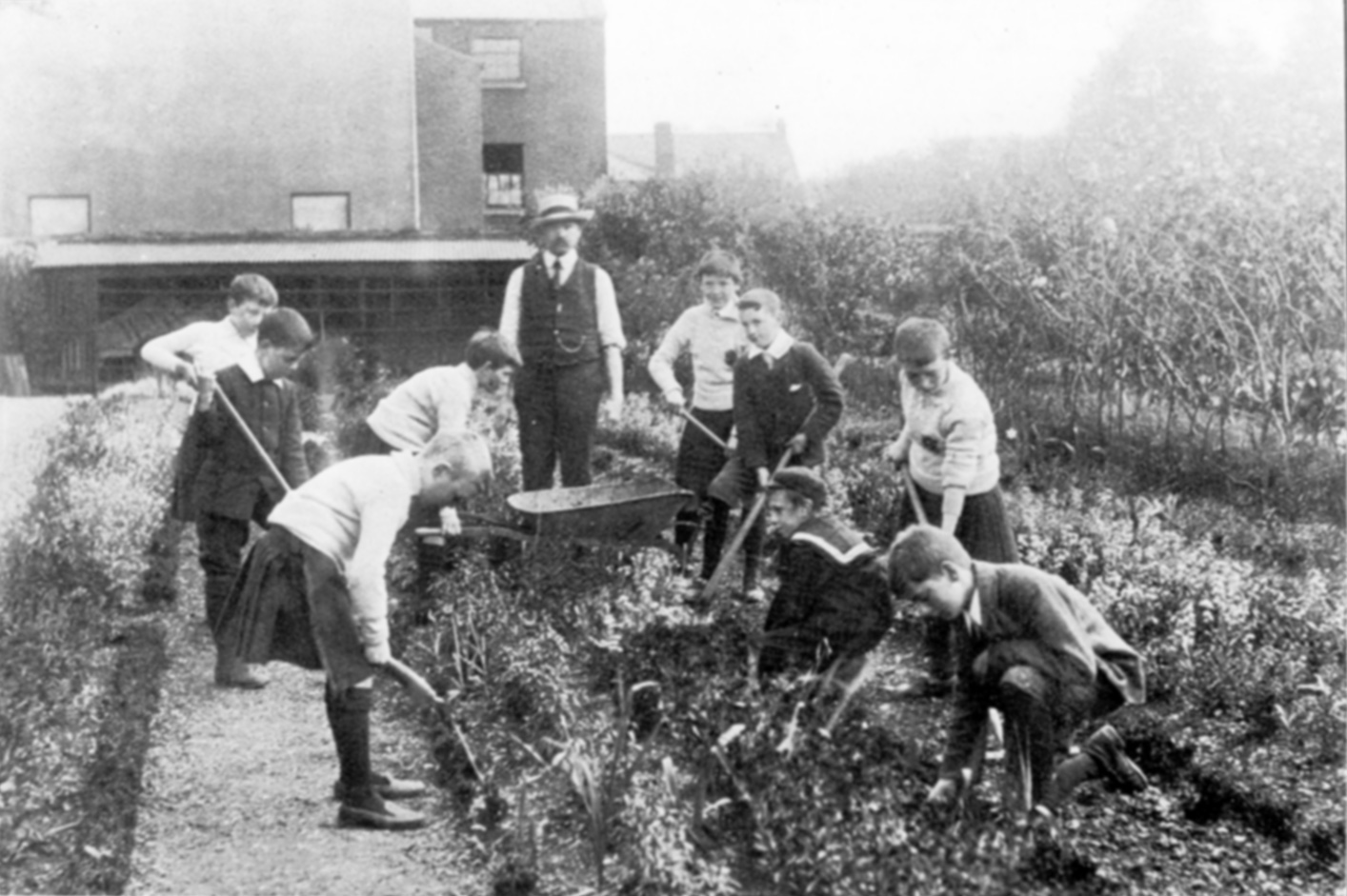
Gardening St. Enda boys
St. Enda’s boys at work — part of the school curriculum was gardening

W.P.’s inability to toe the line with the bishops saw him return to London, leaving Desmond, “the Consequence”, in the tender care of Patrick Pearse at Saint Enda’s School as a boarder. As most of his Ryan siblings were either in Tipperary or had emigrated, Desmond found himself a temporary orphan save for my great grandparents who promptly “adopted” him and welcomed him into their home.

Willie Moynihan, my great grandfather, was a not very successful publican, and politically, if he had any politics, followed his brother Michael’s line in the Irish Parliamentary Party. Michael was a very successful publican and over a number of decades served as a representative for a number of wards for the IPP on Kingstown (Dún Laoghaire) Borough Council. When the IPP took control of Dún Laoghaire, Michael being their veteran campaigner in the borough was given the honour of making the opening speech of that session in which he congratulated the Pope on his recent birthday. It caused a sensation at the time. Now while I realise this was far more politically loaded than it appears today, somehow it strikes me as petty compared with the many other problems Dún Laoghaire faced back then.

Despite his humble roots Michael Moynihan at that stage had a number of pubs, a big house on Haig Terrace, a mansion in Killiney, and was about to be made a Justice of the Peace despite a string of convictions for after-hours drinking and illegal gambling schools in his pubs. His gesture, despite the symbolism, always strikes me as just another example of the “re-branding process” which the IPP really stood for and intended to deliver with Home Rule. They might have cut the cake differently but basically it was to be business as usual – just a new name over the door and on the corporate notepaper.

Nobody ever told me how my great-grandparents reacted to having a socialist with a strong sense of Nationalism in their midst. However Desmond was a boy with a mission and felt it his duty to convert the family or at the very least his young cousins even if their parents were beyond redemption. His stories of St. Enda’s fired the children’s imagination, and I still smile as I remember my great-aunt Polly, throwing back her shoulders, raising herself beyond her full height, and summoning some of the worst traits of amateur dramatics, taking off Desmond, taking off Patrick Pearse, taking off Robert Emmet leading the 1803 Rebellion.

Desmond began leaving his copybooks from school in the house when he visited. These were filled with essays on Fionn Mac Cumhaill, the Red Branch Knights, Cú Chulainn, and other mythical heroes. The copious marginal notes and comments by Patrick Pearse drew my grandmother and her sister further into this world of Celtic heroics, standing in stark contrast to the stories of the famine during the previous century told by their parents. A generation later both my mother and uncle remember being equally moved by the same essays which were unfortunately lost during a house move in the 1940s.

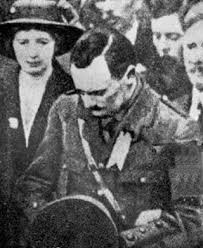
Patrick Pearse, at the ceremony in Glasnevn to remember Ó Donnobháin Rossa, whose body had been sent from the USA
Patrick Pearse, at the 1st August 1915 interment in Glasnevin Cemetery of Diarmuid Ó Donnobháin Rosa, whose body had been sent from the USA for burial there.

As Desmond’s involvement with the revolution grew his visits to the house became less so there was some delight when he turned up in July 1915 with an invitation to go to the funeral of a Fenian from Cork called Jeremiah O’Donovan Rossa. Pearse, the fellah who wrote all those notes and comments in the margins of Desmond’s copy books was going to give a speech. Willie Moynihan didn’t approve of this fellah called Pearse but his wife relented understanding her children’s curiosity and she was fond of Desmond and didn’t want to let him down.

Desmond, not surprisingly, faded out of family stories after that, as Pearse’s exhortation to revolution was too much for a God-fearing, law abiding woman, like my great grandmother. He would go on to write biographies of Pearse, Connolly, Collins, and De Valera, as well as the first major account of 1916 by a participant. His pioneering journalism during the War of Independence did much to counteract the black propaganda of the State murder gangs who assassinated at will back then. However it was his invitation to a funeral which endured in family lore on a day that changed the family’s political axis forever.

Polly could “do” the speech, and recited it with all the subtlety of a Victorian melodrama well into her eighties. She would recall Pearse as “a bit of a fruitcake” or “sixpence short of a shilling”, but despite his questionable sanity would qualify this with “my God! But that fellah could talk!” Remarkably, with the emergence of the Pathé newsreel footage of the funeral in recent years (footnote to link?), she seemed to have taken all Pearse’s movements and gestures in, and even in old age could deliver it as if she had recently studied the film frame by frame. This delightful entertainment of my childhood had deeply affected her and despite occasionally lamenting how dull Dublin became once the British left, it had been a seminal moment at which she became and remained a republican right down to her bones.

On very rare occasions my granny would “do” the speech. But her version was different. She didn’t have her sister’s dramatic flair, but she too had been affected by Pearse that August day. With her a previously unseen veil of steel and determination seemed to come over her; probably that same steely veil that saw her defy her parents and join Cumann na mBan and which enabled her to carry cases of hand grenades and weapons across the city on numerous occasions. Her rendition suggested she had taken the words in and considered them rather than the exaggerated gestures of which her sister Polly was so fond. Significantly it was through this involvement that she met my grandfather, a member of H Company, 1st Battalion, the Dublin Brigade.

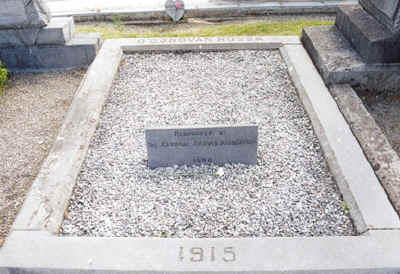
ODonovan Rossa Grave small
Ó Donnobháin Rosa’s grave, Glasnevin Cemetery, Dublin

As the decade of commemorations gathered momentum, last August saw the centenary of O’Donovan Rossa’s funeral. In many ways it started the countdown to the revolution of 1916-22. Earlier this year I found myself in Glasnevin Cemetery and wandering around came face to face with Rossa’s grave and all those childhood memories came flooding back. It’s difficult, even with all the photographs and the film footage, to really understand just how significant Pearse’s speech was.

Looking at the photographs I wonder just how many lives were changed that day. In its own small way my own family bears testimony to it. As historians and commentators continue to play “what if” in relation to events of that period I found myself doing the same at Rossa’s grave, making similar speculations with what potentially, for me anyway, might have been serious consequences. What if Desmond Ryan hadn’t fired my granny’s imagination so that she went to the funeral? What if she hadn’t been inspired by Pearse that day? Would she have joined Cumann na mBan? More importantly, without being in that circle would she have met my grandfather? The next question doesn’t bear thinking about, because, despite the occasional rocky road, I’ve rather enjoyed being alive, and without that chain of events unleashed by the combination of Rossa, Pearse and that Speech on that August day I might never have been born.

So on the 1st August 2015 I found myself in town at the O’Donovan Rossa Bridge to pay a personal tribute to Rossa, and Pearse, and that speech. In particular I was paying tribute to Desmond Ryan. Because somehow in that crazy way that small events ripple out to have more serious consequences I find myself thinking I owe them for my very existence.

End.

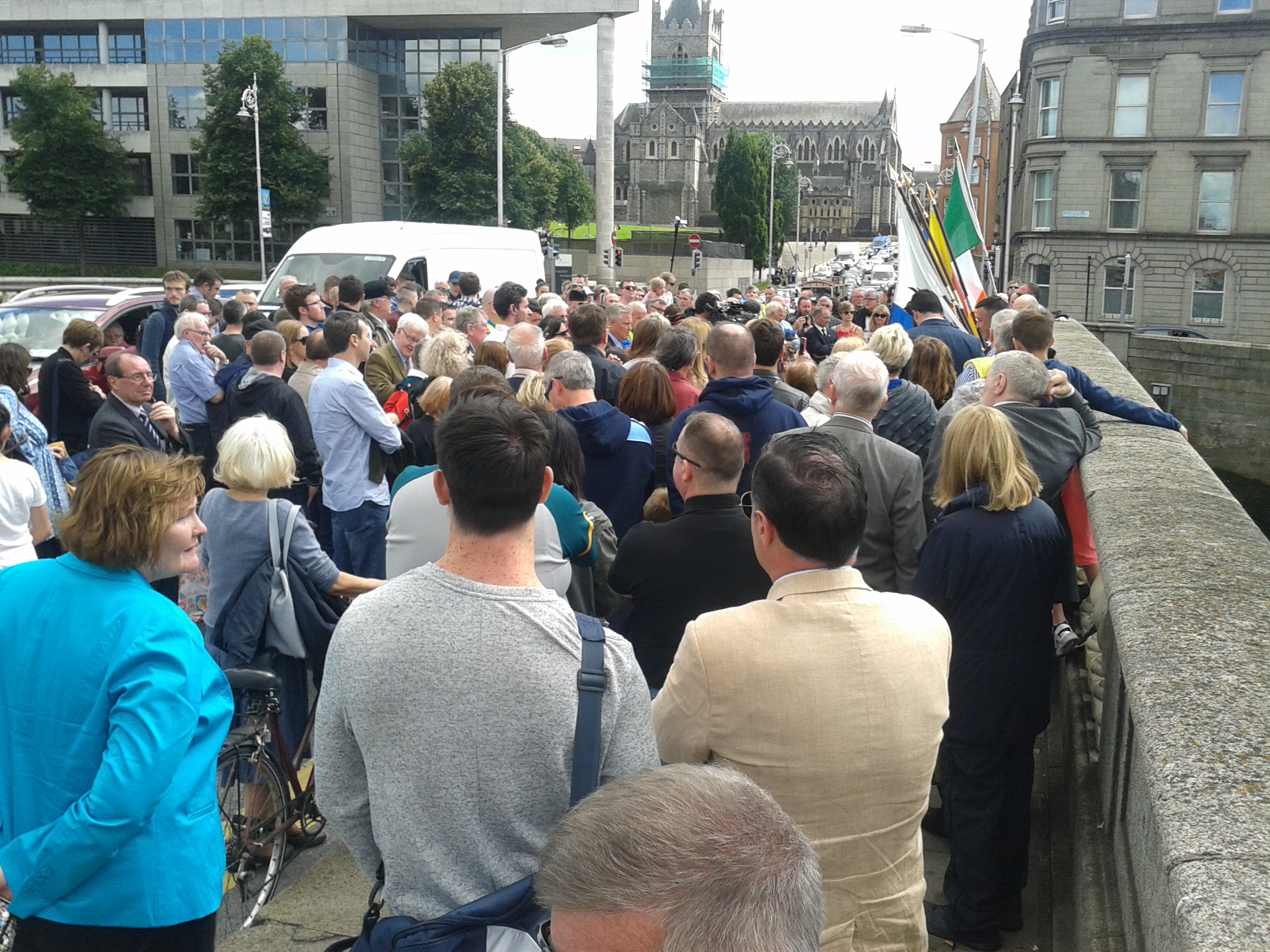
Crowd at erection of plaque to rename the "O'Donvan Ros
Crowd at erection of plaque to rename the former Richmond Bridge over the Liffey after O’Donnobháin Rosa on 2nd August 2015 (Christchurch is visible in the far background, after Dublin City Council’s offices building to the left).


Hugo McGuinness is a historian specialising in the period of history referred to above.

THERE IS ONE ROAD FOR US AND NO THIRD WAY

Diarmuid Breatnach

As we enter the New Year, be prepared for attempts to engage us with a whipped-up excitement of elections and “new” ways of doing things. A diversion — something like a cross between those periodic shows like the Eurovision Song Context and the Lottery. And like the lottery, there will be a winner but it won’t be us. Whichever party or combination of parties succeeds, it will be the ruling class that wins.  A diversion in the other sense too, in that it seeks to divert us from our path.

There is no third way, there are no alternative routes, short cuts, slip roads. There is the revolutionary road and the other.  The other leads to the continuation of capitalism.  But the other road is often represented as a number of different roads, and the only difference between them is in the degrees of exploitation and repression it will deliver. The non-revolutionary road can  NEVER lead to social justice.

To be sure, there are many slip roads and byways on the non-revolutionary road but none of them lead to revolution; therefore they do not lead to socialism and therefore nor do they lead to overcoming the capitalist attacks on the working people and the continuing penetration of imperialism into our way of governing ourselves and our social provision, into our natural resources and into our labour power.

Every now and again, a “new” road is proposed, in which “new alliances” are sought, projects to “build a broader front” away from “clichés” and “slogans of the past”. And it turns out that there is nothing new in these roads except the words being used and sometimes not even those. There is talk of accumulation or summation of forces, for which some objectives must be dropped, for which descriptions must be toned down, for which slogans that mean many different things to different people have to be adopted. Well, either they are heading (and wanting us to follow) for capitalism or they are heading for socialism – there are no other destinations. And if they are heading for socialism, why do they not say so? Why do they not reveal their full program?

There are those who say we can reach socialism by building this wide movement with deliberately unclear slogans and program, building on the hostility towards the present state of things and the dominant political parties. How can that be, if there are basically only two roads? How can this wide movement of discontent displace the ruling class and their system, if it is not consciously heading up the road of revolution? It seems that at some point the curtain will be whipped aside by the socialists in these wide movements and the masses will be shown the monster of capitalism and will realise it is so horrible that it must be killed. And of course they will do it. How? Ah, that’s a step too far, comrade, stick with us, trust us, we’ll tell you when the moment comes.

One can see the fates of Syriza in government in Greece and of Podemos in opposition in the Spanish state to see the enormous expectations that are raised and then cruelly dashed. We have seen the like before in our history in Ireland and we will see that again. As we go into 2016 we will have such illusions of a possible electoral socialist future dangled before us, though on a smaller scale.

Elect Sinn Féin and we’ll have a really different situation, a real change – or so we are told. Nonsense – a party that has never seriously confronted capitalism, a party in fact whose President says publicly (and without correction by his party) that it does not have a problem with Capitalism. A party tried in government of a kind already, albeit in a colonial statelet, that has demonstrated itself unwilling to make a determined stand for social justice in welfare and education and which has maintained a colonial repressive police force. This is also a party which has openly welcomed leaders of US and British imperialism and signaled its acceptance of the treason of the ANC leadership to the South African masses. In the 26-Counties this party showed its eagerness to impress the ruling class with how “responsible” and “law-abiding” it is, so much so that they are not even willing to endorse the civil disobedience tactics of refusal to register for the Water Charge and refusal to pay the charge.

Perhaps, once in the Dáil they might become a revolutionary socialist party? One can of course hope (or pray) for miracles but one has no right to expect them.

Another illusion being dangled before us is the election of some kind of “Left-wing coalition”, whether it would include SF or not. We have a Dáil of 166 seats so it would be necessary to elect no less than 84 to have an absolute majority – a coalition of 84 independents, TDs from small socialist parties and whoever! And what program will this “Left-wing coalition” have that all 84 can be expected to adhere to? We don’t know and we have no revolutionary mass movement which has put forward the demands to incorporate into such a program. There is no need to even consider what measures the ruling capitalist class would take should there ever be a Dáil majority with a revolutionary program – we are not within an ass’ bray of such a moment.

Yes, I said we have no revolutionary mass movement — but I was not dismissing (nor “dissing”) the movement of resistance. For two years we have had a wide and numerous movement of resistance to the Water Charge or Tax, carrying on from the previous movements against the Household Tax and the Property Charge. With regards to the latter two, the first was successful but the second was successfully bypassed by the State  by changing the law, enabling the State to collect the charge directly from our income. Whether this was illegal or not is beside the point – they did it and anyway, to whom does the law belong if not to them? Certainly not to us!

With regard to the remaining one, the movement of popular resistance to the Water Charge continues, even without much central leadership, without the practical support of the trade union movement. Those absences may have prevented it being completely taken over by opportunists and careerists and state agents but it has also prevented it from waging a campaign of sustained resistance, of presenting an agreed slate of demands of sponsors and of candidates for election, of putting real pressure on the trade union leaderships and of regular mobilisation of numbers to defend resisters being hounded through the courts and threatened with imprisonment. Nevertheless, the resistance continues.

But we should not fool ourselves that the campaign is revolutionary – it does not have as an objective the overthrow of the capitalist system. To be sure, some and even many of its supporters may wish for that – but it is not an objective of the campaign. In fact, even the demand of the abolition of the Water Charge is not a revolutionary demand — that can be achieved without overthrowing the system.

For revolutionaries, reforms and partial gains are not things to be ignored. We take our stand on them with regard to a number of criteria. In the case of the Water Charge, the great thing is that it was and is being resisted by civil disobedience and if this tax should be eventually defeated through this tactic we should celebrate the victory. We should proclaim that resistance does work, that breaking the law of the State is necessary when it impedes our progress. And that the campaign has exposed the role of the State – legislature, police and courts in repression and service of capitalism. But we should be clear with the movement that it is, however great, a temporary victory – the system remains and while that is so we are open to many, many other attacks which we can safely predict will follow.

The victory of the movement of civil resistance can be put to use for revolution – in terms of tactical and strategic lessons learned by individuals, communities and organisations. The pool of revolutionary activists can be enlarged. This can best be done in the context of a revolutionary movement which is not something we have but which it is not beyond our capabilities to build. But it will not be built by elections nor by electoral campaigns.

As the elections approach we will be gabbled at from nearly every quarter: Vote for Us! Vote Against Them! Vote for Me! Then there will be the shrill “You Must Vote!” and “You Have No Right to Criticise If You Don’t Vote!” And even the fewer but also shrill voices that shout “Don’t Vote!” and “You’re Supporting the System If You Vote!” Really, what a lot of nonsense all of that is. The system will neither be changed by us voting in its elections nor will it overthrown by us not voting in them. Nor will voting in them strengthen it significantly, except in the case of a popular boycott which is not even on the political horizon.

There is an Irish Republican tradition of standing in elections and not taking seats in the Dáil and whether one is a genuine revolutionary or Republican (choose whichever label you prefer) is judged by whether one takes that seat or not if elected. This seems to me to be a false test. There have been revolutionaries who took seats in parliaments on the one hand and on the other, reformists within revolutionary and resistance movements who worked away without taking parliamentary seats. While it is true that opportunists and careerists often wish to enter parliaments in order to further their careers and to pay off their senior party supporters, there is no guarantee that not doing so will prevent activists from being corrupted and co-opted. There are so many other rewards the system has to offer – a secure job, seat on a company board, status and recognition, special awards, publication of writings, career advancement, jobs in various institutions and civil service, funding of one’s project as a non-government organisation, paid expenses, paid travel ….. along with safety from the danger of arrest, the dawn raid, the assassin’s bullet, torture, years in prison.

We can of course vote for individuals in order to keep other individuals out or to put someone we like in or to maintain a useful few voices in the Dáil. But let us not fool ourselves that is really making a difference to the system as such. Only revolution can do that. Of course the revolutionary road is not without its switchbacks, potholes and blind turnings. Nevertheless, it is the only viable road and if we are not heading up it then we are not going to bring about any real or lasting change.

Vote or don’t but the crucial thing is to organise resistance, to contribute to it practically and ideologically. And the latter does mean not spreading illusions.

end

DUBLIN REPUBLICAN MEETING HEARS KURDISH REPRESENTATIVE, INDEPENDENT TD, GARVAGHY ROAD VETERAN AND REPUBLICAN PARTY LEADER

Diarmuid Breatnach

Breandán Mac Cionnaith, Erdelan Baran, Clare Daly and Brian Leeson took turns to address a meeting in Wynne’s hotel on Saturday. The speakers addressed a large audience in the open part of the conference following the internal Ard-Fheis (annual congress) of the Éirigí Irish Republican party and covered the Garvaghy Road campaign, the history of the Orange Order, the Kurdish struggle (in general and in Rojava/ Kobane in particular), Garda corruption, military use of Shannon airport by US imperialism, theft of Ireland’s natural resources, international imperialism and capitalism versus socialism. The meeting was chaired by Angie McFall.
Meirge mór AF eirigi
Main banner in the meeting room. located behind the panel during the meeting

Breandán Mac Cionnaith is General Secretary of the éirigí party and prominent as a residents’ activist and leader in resisting Loyalist parades through nationalist areas, in particular the Garvaghy and Ormeau Roads and with regard to the Drumcree siege. Until 2007 he was prominent in Sinn Féin but left the party that year after SF had agreed to support the colonial police force, the PSNI (formerly the RUC).

Preceded by the screening of a video of resistance to Loyalist marches in the Garvaghy Road, Mac Cionnaith gave an account of the formation of the Orange Order and its role from the inception of the Order and through its development. He also gave a detailed account of the long history of Orange marches through the Garvaghy Road and other areas, the siege of Drumcree and the people’s resistance, answered by sectarian murders of Catholics in the area.

Ardoyne protest 12th July 2000

The talk revealed that the Orange Order had been created at a time of revolutionary unity between sections of Protestants and of Catholics and that its purpose was to fracture that unity, which it carried out. It was from the beginning a sectarian, reactionary organisation serving the interests of the colonial ruling class in Ireland.

Along with its allied organisations such as the Apprentice Boys, the Order has a long history of provocation of Catholic areas through triumphalist marching, a practice defended by the colonial police force and in modern times until recently by the British Army. In one confrontation, Mac Cionnaith used available statistics to demonstrate that two British soldiers had been deployed for every resident of the area.

People protesting Loyalist marches on Garvaghy Road being attacked by the PSNI in 19977
People protesting Loyalist marches on Garvaghy Road being attacked by the RUC (forerunners of the PSNI) in 19977

After the break, the Cathaoirleach welcomed and introduced Erdelan Baran, a representative of the Kurdish National Congress. Erdelan’s command of English is excellent and he presented his talk well, using a few slides on an electronic display to emphasise his points, including a map showing the Kurdish population and its spread over the borders of the states of Turkey, Iraq, Syria and Iran.

The audience heard that the religion of most Kurds had been Zoroastrianism but that this had been reduced by Islamicisation. The Kurds had not been recognised as a separate nation or even really as a separate ethnic group by regimes ruling them and had suffered much repression in each of those states.

Erdelan Baran focused in particular on the development of the PKK, a party founded in 1978 by Kurdish students led by Abdullah Ocalan in a village not very far from the Kurdish city of Diyarbakir in the south-east of the Turkish state. The party named itself The Workers’ Party of Kurdistan and combined communist ideology with struggle for an independent state. It was subject to repression which increased dramatically after the 1980 right-wing military coup d’état, with imprisonment and executions of its activists and others fleeing to Syria.

Less Photogenic Kurd Women Fighters
Women unit fighters of the PKK during the 1980s

The PKK developed its armed struggle which included women’s units (Erdelan showed a slide of PKK women in uniform bearing arms).

Oҫalan was captured in 1999 and imprisoned on an island in the Turkish state. He since called for a change in objectives, i.e for the movement to seek confederalism instead of a state, a system of self-determination for each area and not based on any ethnic group or national territory. Erdelan pointed towards the administrations which had been set up in Rocajava as an example of this and also of equality towards women – 80% of representation was required to be in equal gender balance.

Since the emergence and attacks of ISIL in Syria, the YPG, a development of the PKK, has been fighting fierce battles against ISIL and established liberated areas in which other groups such as the Yazidis and Turkmen have taken part in defence and administration.

Erdelan mentioned very briefly the peace process espoused by the PKK and the refusal of the Turkish government to engage in it.

Female YPD fighters in Rojava
Female YPG fighters in the Rojava area

Erdelan finished his presentation to strong applause and the Cathaoirleach indicated that there was limited time for questions. Four people addressed comments and questions from the floor one of which criticised aspects of the PKKs policy and three of which were complimentary (see final part including Comment for further details), to all of which Erdelan responded,

A break was called again by the Cathaoirleach and when the conference reconvened, she announced that Clare Daly and Brian Leeson would speak one after the other, without time for questions from the floor.

THE BARREL OF ROTTEN APPLES

A short video about popular opposition to the water charges was played showing éirigí in action before the Cathaoirleach introduced Clare Daly as the next speaker, referring to her as an Independent socialist TD. Daly took the lectern, joking that she was obviously “a warm-up act for Brian Leeson”.

Clare Daly spoke with passion about a long history of cases of Garda corruption, saying that an earlier perception of there being perhaps “a few rotten apples in the Garda barrel” had changed over the years and that now perhaps instead people believed that there might be a few good apples in a rotten barrel. Daly pointed towards the forced resignations of Alan Shatter (as Minister for Justice) and of senior Garda officers and to the whistle-blowers within the force who had used the issue of exemptions on penalty points to highlight corruption within the Gardaí. She predicted that there would be further scandals.

Clare Daly (centre, in denims) and Mick Wallace (end right) on picket line recently outside Dept. of Justice, Dublin

Daly commented on how when in the Dáil she and Mick Wallace began to expose Garda corruption they were treated as some kind of shockingly disgusting people and that even those TDs concerned with civil liberties counseled them not to take on the Gardaí. But the perception of the Gardaí publicly has now changed and this has had its impact on the Dáil. It was the struggles of the people – in particular perhaps around the water charge – and the behaviour of the Gardaí against local communities resisting – which had led to the general change of public opinion. This had facilitated and been strengthened by the exposure of a number of scandals.

Turning to the use of Shannon Airport by the US Military on its way to invasions of Afghanistan and Iraq, in violation of Irish neutrality, Daly gave examples of some of the evidence available, not only from observers outside the airport but also from staff inside. One of these declared that he had stolen a gun from a plane in US military use at Shannon and of course, he could not be arrested for that since “How could he have stolen a gun from a plane the Irish Government claims is not carrying any weapons?” The planes in use are not only military planes but also chartered civilian ones and Daly gave statistics on the huge amount of US military traffic of weapons and soldiers through the airport, quoting also from a US document (part of the Wikileaks) confirming the importance of Shannon airport to their Middle Eastern military operations.

Daly accused the Irish Government of complicity with US imperialism and its war crimes. A lot of the evidence outlined and more was presented in the trial of Daly and Wallace following their arrest on 22nd July 2014 as they went on to restricted areas of the airport without permission from the authorities. They were there to carry out an inspection of US planes but were arrested and despite the evidence, in April were fined €1,000 each or 30 days in prison. Both declared then and Daly reaffirmed in her talk that they had no intention of paying the fine and await their arrest at any moment.

“There’s not much a small group of left-wing TDs can do in the Dáil to change what’s happening in the country”, said Daly, although she declared herself satisfied with the opportunity to use that forum to publicly expose a lot of what has been going on. Daly declared however that it was with the people that real impetus lay and hailed their resistance, including that of people in the room, in recent years.

THE NEED FOR SOCIALISM

Clare Daly finished her talk to a storm of applause as Brian Leeson, introduced by the Cathaoirleach as Chairperson of the éirigí party, rose to take her place at the lectern, joking that rather than being “a warm-up act” for him, Daly had “stolen his thunder”.

Leeson began his speech by outlining the need for a socialist society and suggested those who say that “Socialism doesn’t work” should be asked whether they think capitalism is working. He pointed to continual economic and financial crises, unemployment, housing crises in various forms, cuts in social welfare and health care …. and war. Wars, Leeson declared, were an inevitable part of imperialism, which is capitalism’s struggle to control natural resources and markets.

Brian Leeson speaking at an earlier meeting

“This hotel and these rooms have an important place in our history” said Leeson, relating that a decision to found the Irish Volunteers had been taken in Wynne’s hotel in 1913 and in 1914 Cumann na mBan had been founded there. Commenting on recent and forthcoming centenary commemorations, Leeson said that it was people like those in the room and outside in resistance who had made that history and that the state set up in on the back of those struggles did not represent either the ideals the people had fought for or the wishes of the majority of people in the country now.

Going on to attack the economic policies of the Northern Executive in the Six Counties, Leeson castigated Sinn Féin and the SDLP who he said had given up the only area of financial control that they had and passed the buck on to the British Government. They had the opportunity, he said, to stand resolutely for a budget against social welfare and health care cuts but they passed the buck to the British Government, which implemented those cuts instead. It was essential that the Northern Irish Executive should not collapse, apparently. Leeson questioned why this should be thought so – surely the only justifiable reason to be in any government or Executive was to represent the ordinary people and the disadvantaged!

Leeson also talked about the theft and giving away of our natural resources such as oil and the planned privatisation of water which he said belonged to the people and that no government had the right to give them away nor any company the right to own them.

Leeson paid tribute to Clare Daly who was prepared to advocate for Irish Republicans in prison and had given much support to Stephen Murney and Ursula Ní Shionnaigh. He also made a particular point of welcoming Erdelan Baran and of supporting the struggle of the Kurdish people.

Commenting on discussion around a forthcoming general election in the Irish state (the 26 Counties), Leeson criticised those who talked of campaigns to elect some kind of left-wing alliance. The conditions did not exist for that to be viable project, he said, and to raise people’s hopes only to dash them was cruel and would be demoralising. People should continue their resistance and éirigí would continue their part in that as they had done up until now.

The audience gave Brian Leeson strong applause as he concluded his speech.

There were no questions and answers called for afterwards and the meeting concluded, people standing around talking, purchasing from the merchandise stall, departing or retiring to the nearby bar which had just opened.

COMMENT

Attendance, Organisation, Speeches, Participation

The room was large and full, with accents to be heard from across the country and éirigí will probably be pleased with the level of attendance. The public meeting appeared to be well organised with door security (an invited/ registered list on which my name was not but thankfully I was recognised by several and that formality waived) just outside the meeting while inside, merchandise stall, chairperson, ushers, seating, projector and screen for videos and slides, sound amplification, and professional banners (one bilingual and one in Irish only).

I saw only one photographer whom I assumed to be éirigí’s and, thinking other photos of the attendance might not be permitted, restrained myself to photographing the banners only.

Mac Cionnaith’s talk was somewhat over-long in my opinion and he is also softly spoken, which makes parts difficult to hear – and I was in one of the front seats. He also speaks without a great deal of inflection or emphasis in his delivery which militates against giving him continuing close attention. This is a pity because the content was extremely interesting and contained a lot that was new to me. I was also impressed by the amount of information that he clearly had in his head, since he rarely had to consult his notes.

Such a long talk however is unlikely to be followed by questions and answers and this proved to be the case, with the Cathaoirleach calling a break at the conclusion of Mac Cionnaith’s talk, to be followed by the next speaker on resumption of the conference.

Mac Cionnaith told me later that he usually gives this talk in two parts and with a break between them. I urged him to write and publish it as a pamphlet and I sincerely hope he does so.

Clare Daly’s and Leeson’s talks were clearly audible and well-presented and the meeting was in general well-chaired. I would offer the criticism that the time-tabling did not permit sufficient audience participation in terms of questions and answers or contributions which only occurred, briefly, after the Kurdish speaker – i.e none after the other three speakers.

All the speeches had interesting content and were relevant to political life in Ireland today. Given the organisation’s policy on abortion I would not have expected a talk on that subject, albeit the issue is a very important ongoing one in Ireland. A stranger important omission I thought was the issue of repression of Irish Republican activists both outside and inside the prisons, including the practice of internment by false charge and remand. Stephen Murney, himself an éirigí activist in Newry, had been an important example of victims of this abuse of civil rights.

Another factor was the total absence of spoken Irish from the panel of speakers or the Cathaoirleach (even to the ritual “cúpla focal”) and I am aware that some éirigí activists did express their disappointment at that (both Leeson and McPhall are Irish speakers) after the meeting.

Ideology & Political Policy

The internal part of the meeting had taken place earlier and I was not present at that so these comments refer only to the open public part of the meeting.

It was understandable perhaps that, addressing a conference organised by a party known to have rejected that process in Ireland, the Kurdish speaker skated quickly over the question of Ocalan’s and the PKK’s espousal of a “peace” process. What is less understandable is that from éirigí, no-one rose to criticise it, that being done only by one contributor from the floor, who – after thanking Erdelan in Kurdish — pointed out that such processes do not bring peace and are instead pacification processes, traveling from people in struggle from one country to those in another, subverting their struggles as with South Africa, Palestine, Ireland and now being proposed for the Kurdish people, the Basques, the Colombians, Filipinos …1

The same contributor, while expressing his great admiration for the struggle of the Kurdish people over the years, in support of which he had travelled to Kurdistan in the early 1990s as part of a trade union delegation, raised another two issues of concern to him, which were what he perceived as the elevation of Abdullah Ocalan to iconic status within the main Kurdish movement and that the YPG had declared themselves in alliance with the western coalition in Syria.  Making it clear that he was not a supporter of Assad, the contributor asked the speaker whether he thought the imperialists would hand over control of the country when their current enemy had been defeated?

The contributor’s remarks and question were greeted with scattered applause from the audience.

,Erdelan made no reply at all on the issue of a peace process but replied at length to the issue of Ocalan’s leadership and the use of his image and to a lesser extent to question of alliance with the imperialist coalition.

“Ocalan does not seek to be a leader,” said Erdelan, “and has often said ‘If anyone else wants to take on this job let him have it.’” Aside from the fact that Ocalan’s leadership per se had not been criticised except in promotion of a peace process, this reply and subsequent arguments did not address the issue of the proliferation of Ocalan’s image within the movement, the issue that had been raised by the contributor from the floor. Furthermore, the Kurdish speaker must have been aware that Ocalan had publicly argued against his threatened execution by saying that a peace process was necessary with the Turkish state and that only he could lead the movement towards it. Going on to talk about Ocalan’s 15 political publications, as Erdelan did if anything served only to confirm the adulation in which his person is held by many in the movement. The policy of confederalism is also one developed by Ocalan while in captivity, after he renounced the policy of seeking a Kurdish marxist-leninist state and, subsequently, also renouncing the policy he developed of seeking Kurdish regional autonomy within the Turkish state.

In his reply on the issue of alliance with imperialists, Erdelan was likewise quite disingenuous. He emphasised the success of the fight against ISIL and the gender equality which their administration had brought to their liberated areas, which had been in part lauded already by the contributor from the floor but which did not directly address the issue in any case. Moving on, he referred to the need for survival of the Kurds and beleaguered people and their need for weapons.

After some more of this the contributor objected to the “arms for defence line”, saying that the overall military commander in the Rojava area had publicly stated that the YPG were not only joining the coalition for arms for survival but were going to join in an offensive to overthrow the Assad Government. At this point the Cathaoirleach silenced the contributor from the floor, pointing out not unreasonably that there were others waiting to speak.

The next contributor from the floor welcomed Erdelan to Ireland. He lauded the struggle of the Kurds and the leadership of Ocalan and stated that he and a few others had picketed the Turkish Embassy when the Kurdish leader was under sentence of death. He stated that in Ireland we also often display images of leaders and heroes such as James Connolly and that we do that in order to display our support for their ideals. He lauded the administration of the Rojava areas and stated that he wished to disassociate himself from the comments the previous contributor from the floor had made. He received strong applause.

A visual affirmation of the Irish language displayed at the Ard Fheis this year.

This contributor seemed unaware of the difference between the way and the degree to which images of James Connolly are displayed in Ireland and the way in which images of Ocalan are displayed among Kurdish supporters of the PKK. He also missed the most important difference – Connolly is dead and Ocalan is alive. Whatever errors a dead leader made he can make no further ones whereas a living leader can make many more (as history in general and ours in particular has shown) and the iconisation of a living leader makes challenging his/her mistakes within a movement extremely difficult and viewed as something in the order of sacrilege.

Another contributor from the floor asked for some more explanation of the policy of confederalism. In the course of his reply, Erdelan said that it was a democratic system that would preclude territorial expansion and that, for example, the issue of whether someone wanted a nuclear reactor in their area would be entirely a local decision. This reply in fact outlined one of the problems of confederalism in this stage of history since if local people voted in favour, for example with promises of safety and cheap power, the decision would nevertheless potentially affect everyone within a radius of thousands of kilometres – but no-one seemed to pick up on that.

The same member of the audience, responding, enthusiastically commended the Kurdish organisation on their confederalism policy and said that we should have the same here in Ireland. He (and certainly at least some in the audience) appeared unaware that a type of confederalism had been a central part of Sinn Féin’s and Provisional IRA’s progam for many years. The “Éire Nua” was such a program, originally proposed by then SF’s President Ruairí Ó Brádaigh and Dáithí Ó Conaill and strongly supported in practice by Des Fennel. This policy had encountered some opposition within the Provisional movement, particularly from supporters in the Six Counties who feared being left under regional domination of — or in constant contention with — Unionists.

The “Éire Nua” policy was overturned at the 1982 Ard-Fheis (annual conference) of Sinn Féin in what was seen by many as a victory of the Adams group within the leadership over the Ó Bradaigh one. Subsequently the policy of Sinn Féin has been for a united 32-County state and that is also part of éirigí’s policy today. Only Republican Sinn Féin and Cumann na mBan among Republican organisations in Ireland today retain a federal policy.

Overall, it seemed that the majority of the audience either did not feel equipped to engage with the issues in a critical fashion or felt that they would be going against their party (or hosts) to do so. It was highly unlikely that the majority supported the aspiration for a peace process and there must have been at least some disquiet on the issue of joining an imperialist coalition. But they remained silent. There was also of course the cultural issue of hospitality to an invited guest which may have played a part.

However, these are serious questions affecting the revolutionary movements around the world and need to be engaged with critically.

End.

FOOTNOTE

1    Is mise a rinneadh sin. I also took part in actions for the removal of the execution threat to Ocalan while having a number of discussions with Kurdish activists on the issue of iconisation. In general I worked for a number of years in London in Kurdish solidarity with people who supported the PKK and some who did not, including submitting motions to trade union branches and going on that delegation around much of northern Kurdistan in the early 1990s when it was still a war zone there. In Ireland I took part in a few pickets with Kurdish comrades and was discussing setting up a solidarity network here but some of the principal activists left the country.

While I was conscious that some others who I know would have had similar views to the concerns I expressed kept away from me, some activists did approach me during the break to express their approval of my comments, in particular on the issue of making an icon of a living leader. They had experienced a similar process with the promotion of Gerry Adams within Sinn Féin before leaving the organisation to join éirigí or to become independent activists. Nobody likes isolation and I was grateful not only for their comments but for visibly approaching me in the meeting area in view of anyone who cared to see.

Dear Minister Humphreys

Diarmuid Breatnach

Dear Minister Humphreys,

I write to express my admiration for your work and my sympathies with regard to the criticisms with which you are currently being bombarded. I hope you will forgive my ignorance of much of the work you have been doing in the area of Heritage, which is not really where my strengths lie. But I love the way you talk, the way you shoot down those critics, especially those TDs who ask those nasty questions. And I’m sure you had something to do with removing Westport House from the NAMA sell-off, even if it is in Enda’s constituency. Such a fine example of our colonial architectural heritage!

Heather Humhpreys, Minister for Arts, Heritage and the Gaeltacht

But as we know, Minister, that wouldn’t be the kind of thing that would be appreciated by your critics. They’d rather you devoted your talents to a shabby row of Dublin houses of dubious architectural importance in a grubby street market. A street which they say is “pre-Famine” — as if that were something to boast about! Laid down earlier than Sackville Street (now O’Connell Street) they say …. Sure why would we want to keep a street that old …. or remember that embarrassing episode in our history either, when we lost a third of our population to over-reliance on one crop! We learned from that, though, didn’t we? Sure we grow hardly any crops at all now and get them all in from abroad. And we live in cities now — who wants to be getting up at 6 a.m. in all kinds of weather and plodding through muck? If people like growing things that much, get a house with a garden, I say. And a gardener to do the donkey work.

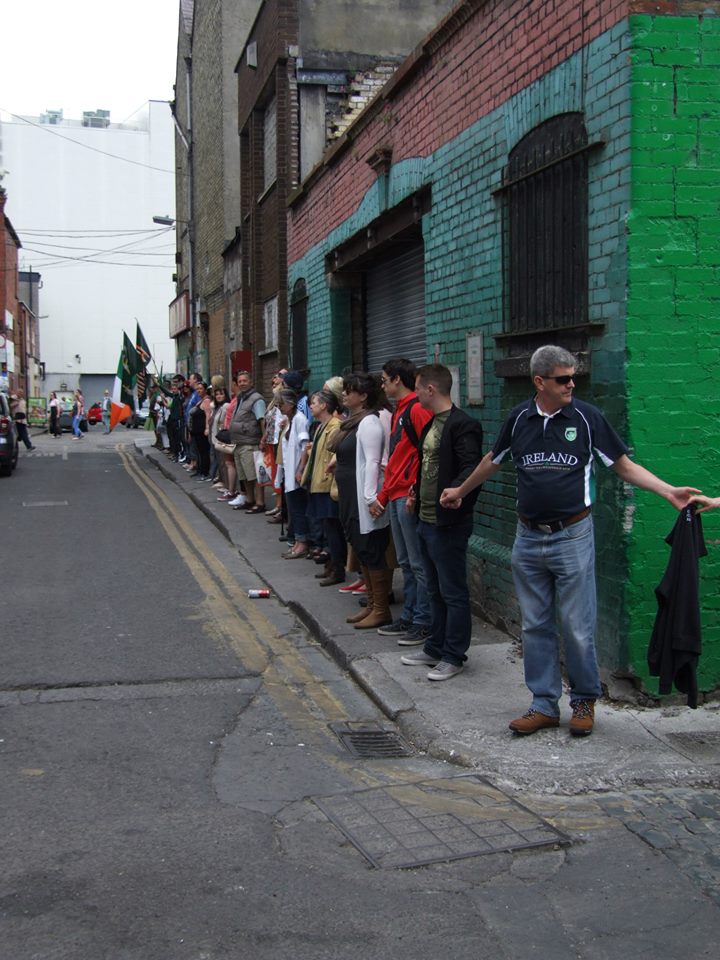
Supporters at the symbolic Arms Around Moore Street event organised by the Save Moore Street From Demolition campaign in June this year.
Supporters at the symbolic Arms Around Moore Street event organised by the Save Moore Street From Demolition campaign in June this year. This is the corner of Moore Lane and Henry Place, across which Volunteers had to run under machine-gun and rifle fire from Parnell Street (at the end of Moore Lane, to the right of the photo) and at least one Volunteer died here.

But I’m digressing, Minister, my apologies. Apparently the reason they want to save that shabby terrace, that “pre-Famine street” — and the backyards and surrounding lane-ways, if you please! — is for HISTORICAL reasons. Historical! Sure have we not had enough of history – Brehon Laws, Golden Age, Clontarf, Normans, 800 years of British occupation, blah, blah, blah! Weren’t we sick of it at school?

I’ve never liked Labour too much (somehow even the word sounds sweaty) but I have to admire their Education Ministry’s efforts to remove history as a subject from the compulsory school curriculum. I’m sure they’re doing it for their own reasons – after all, wasn’t their party founded by that communist James Connolly? Sorry, revealing my own knowledge of history there, ha, ha! But whatever their reasons, they are on the right track. Who wants to know where we are coming from? It’s where we ARE and where we are GOING TO, that matters!

But some people just can’t let it go, can they? They trail history around like something unpleasant stuck to a shoe. So what if 300 of the GPO garrison occupied that terrace in 1916? The Rising, if you ask me, was a big mistake and I know plenty of people agree with me, even if most don’t have the courage to say so. Wouldn’t we be much better off if we’d stayed in the UK? And kept the Sterling currency? And as for the War of Independence …. don’t get me started!

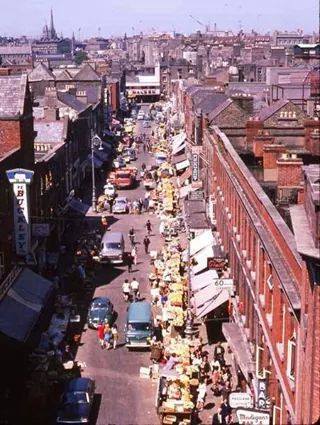
Aerial View Moore St. 60s
Aerial view Moore Street, looking northwards, 1960s, before the building of the ILAC and the running down of the street market.

And then there’s all that communist-sounding stuff about treating “all the children of the nation equally” — what kind of rubbish is that? Some are born to big houses with swimming pools and some are born to flats, or even rooms. That’s just the way of life. And some will claw their way up to get to own big houses and if they are a bit uncouth, well that can’t be helped, they still deserve where they get to. And their children at least will be taught how to fit into their new station. That’s democracy! But everyone equal? Please!

Sorry, back to the Moore Street controversy. OK, after the mob pressured the Government, four houses in the street were made a national monument. But was that enough for the mob? Oh, no, not at all — eight years later the State had to buy the four houses to satisfy them. Thankfully the specul ….. sorry, the developer, got back a good return on his investment – four million, wasn’t it? That’s the kind of thing that makes one proud to be Irish – buying run-down buildings and letting them run down more, then selling them for a million each. That’s your entrepreneur! If only we had more like that, to lift this country up!

I must say I really liked that developer’s plan to build a big shopping centre from O’Connell Street into the ILAC, knocking those old houses in Moore Street down (although I know he had to leave those “national monument” four houses still standing in the plans). I do hope whoever has bought the debt off NAMA and now owns those houses will carry on with that plan. Actually, I’d like the whole of O’Connell Street under glass if it were possible. Wouldn’t it be great to do your shopping from the north end of the street to the south and from left to right, without ever having to come out into the weather? Of course, not much shopping there now, with Clery’s closed …. still ….

And then they’re going on about the market ….. traditional street market …. blah, blah. What’s wrong with getting your veg and fruit from the supermarket? Or getting them to deliver it your house, come to that? “Traditional street market” my ar….. excuse me, I got carried away there. Those street markets are all very well for your Continentals, your Africans, Asians, Latin Americans and so on. Or for us to go wandering around in when we’re abroad on holiday, maybe.  But back home?  It’s the nice clean supermarkets for me any day.

Well now, if the mob insists on saving the street market, here’s an idea: why not provide a showcase stall or barrow, stacked with clean vegetables and polished fruit, right in the middle of the new shopping centre. After all, that’s heritage, isn’t it? And aren’t yourself the Minister for Heritage?

Most sincerely,

Phillis Tine-Fumblytil

LAUNCH OF “BATTLEGROUND 1916 — THE LANEWAYS OF HISTORY”

Diarmuid Breatnach

On a very stormy Wednesday night (17 Nov. 2015) in Dublin around 150 people attended the launch of the video “Laneways of History” at Wynne’s Hotel, Lwr. Abbey Street.

Poster Launch Video


The video maker is Marcus Howard who has videoed a number of interviews with relatives of 1916 heroes as part of a campaign to preserve the historic Moore Street 1916 Terrace and the laneways surrounding it. Marcus also videoed the second Arms Around Moore Street event, which was organised by the Save Moore Street Demolition campaign.

The video itself uses footage shot in a Dublin of today, tracing the footsteps in Easter Week 1916 of James Connolly from Williams Lane to the GPO, then of the garrison’s retreat from the burning building to Moore Street. It also stops at 21 Henry St. where the 1916 Proclamation was signed and follows the ill-fated heroic charge led by The O’Rahilly up Moore Street against the British barricade at the end, on Parnell Street.Musicians

The narrative is provided by Jim Connolly Heron (great grandson of James Connolly) and Proinsias O Rathaille, grandson of The O’Rahilly, and also by excerpts from witness statements of participants read by Marcus Howardand a woman whose name I did not catch (but will record when I find out).Citizen Army on guard

Sound effects on images of the past are firing from artillery, rifles and machine guns and clips from the Cabra Historical Society are used to good effect.  The video also includes recent footage from the campaign, including Taoiseach (Prime Minister) Enda Kenny being shown around the Moore Street Battlefield and the 2nd Arms Around Moore Street event, which was organised by the Save Moore Street from Demolition campaign.

Volunteers in various outfits

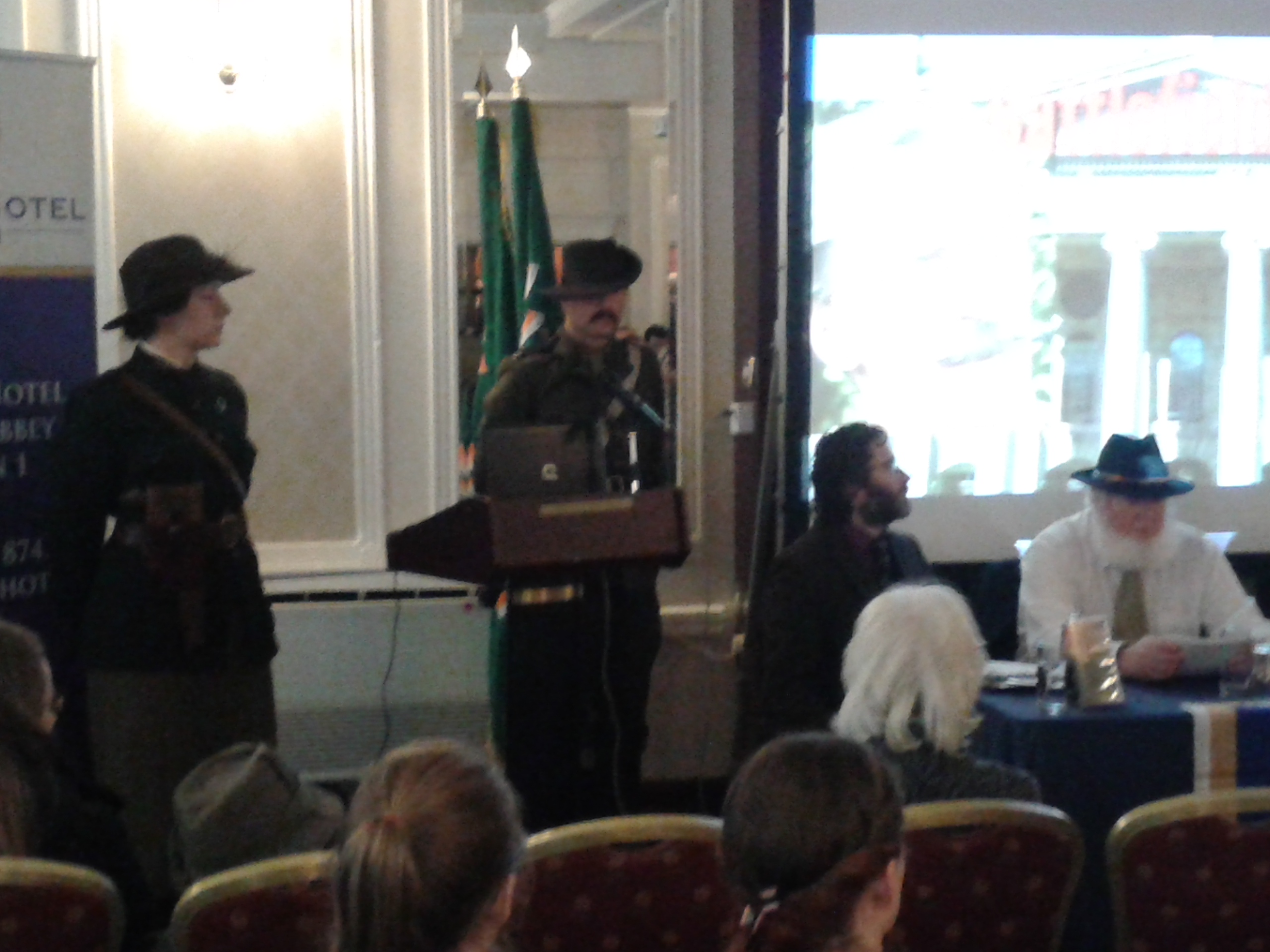
Around the function room there were men and women in Ctiizen Army and Volunteer uniforms and typical IRA War of Independence dress to protect us from a raid by the British Army, Dublin Metropolitan Police or the Auxillaries (or perhaps to keep an eye out for unruly elements).

Music and some songs were provided before the speakers by two members of the Dublin band The Invincibles, one of which Paul Stone, sang Where Is Our James Connolly to a hushed room.

The main speakers were James Connolly Heron, Críona Ní Dhálaigh (SF Mayor of Dublin), Proinsias O Rathaille and Marcus Howard. Also called up to speak a few words were long-time supporters of the campaign TD Maureen O’Sullivan and Frank Allen.

Frank Allen speaking from the podium

Frank unveilled the 1916 Commemoration Bond and invited everyone to buy one at €100 each. Frank announced that the aim is to make sufficient on sales at home and abroad, to buy the threatened 1916 Terrace.

Presentations of the first three bonds were made to long-time supporters of the campaign Brendan O NeillColette Palsgraaf and Pat Waters (who had written the song for the “16 Signatories” production).

Crowding outside the bar

Frank also thanked Diarmuid and Mel (also thanked by Marcus Howard) for their long presence in Moore Street (the Save Moore Street from Demolition Campaign, which also includes Bróna Uí Loing).

Pat Waters in conversation in the bar

There were some questions and interventions from the floor before people repaired to buy a DVD and/or a bond and thence to the bar, to chat and no doubt plot further steps in the campaign.  Among the contributors from the floor were TV presenter Duncan Stewart, Donna Cooney (PRO 1916 Relatives’ Committee and grand-niece of Elizabeth O’Farrell), Manus O’Riordan (includ. Friends of the International Brigades in Ireland), Diarmuid Breatnach (includ. Save Moore Street from Demolition campaign), Bernie Hughes (Finglas community campaigner against the Water Charge).  A Dutch woman living here 15 years made the point that migrants should be included in the vision — a point echoed by at least another two from the floor, one of whom drew attention to the fact that James Connolly had been a migrant.

Some more from inside the bar (an ID parade?)

Indeed, this was so, both to the USA and to Ireland, as was the case with Jim Larkin too; Tom Clarke had been born in England also and a number of those who fought for the Republic in the Rising (especially the Kimmage group) had been born and brought up in British cities and a few had no Irish connections at all.

Two women drew attention to the exclusion of the Irish language from the video and presentation.  This last was a particularly relevant point, given that one of the seven signatories of the Proclamation was a writer in Irish and in English, as well as an educator and that five of them had been members of the Gaelic League (as were others of the executed or who died in the fight).  One asked what the strategic purpose of the bonds was and how this fit into the campaign.

Overall, any criticisms or doubts aside, everyone who spoke was positive about the video and wholeheartedly in favour of the retention of the historic buildings and laneways.  It was notable that no-one, from panel, podium or the floor, expressed faith in the Government or in most politicians — quite the contrary.

Among the historians present were Lorcán Ó Coilleáin and Mícheál Ó Doibhlín.  Also seen were Aengus Ó Snodaigh TD, Robert Ballagh (Reclaim the Spirit of 1916) and Barry Lyons (Save 16 Moore Street).


(Photos, mostly long-range dodgy mobile ones: D.Breatnach)

A chríoch.


Links:

Personnell in costume were provided by Dave Swift of Claoímh (http://www.claiomh.ie) and Irish Volunteers commemorative association (http://irishvolunteers.org)

Copies of video DVDs €10 each NOT including post and package from email are available through easterrisingstories@gmail.com

Save Moore Street from Demolition: https://www.facebook.com/groups/757869557584223/?fref=ts and https://www.facebook.com/save.moore.st.from.demolition/?fref=ts

Save 16 Moore Street: https://www.facebook.com/groups/114656558567416/?fref=ts


CLOSE QUARTER COMBAT BY A 1916 RISING DOUBLE ACT

Diarmuid Breatnach

Derek Molyneux and Darren Kelly are a great 1916 Rising history double act. Taking turns at the narrative, bouncing one off the other at times, sometimes one correcting the other, interrupting one another and on occasion comically resenting the

Darren Kelly and Derek Molyneux presenting their talk at the Cobblestone

interruption. They are great entertainment. But they are also very knowledgeable on the history of the 1916 Rising and on comparative military history, as well as being passionate about the subject.

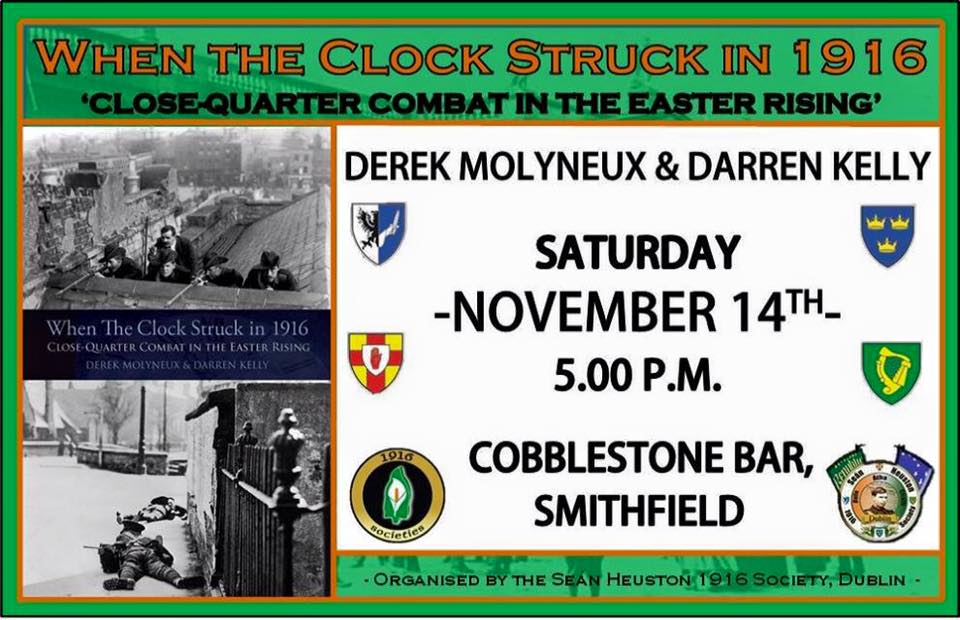
They are joint authors of “When the Clock Struck in 1916” by Collins Press (2015) and were the guest speakers presenting a talk on “Close Quarter Combat in the Easter Rising” in the back room of the Cobblestone on Saturday (07/11/2015). The talk was one of a series organised by the Sean Heuston 1916 Society.
Poster for the event

Their lively and engaging narrative focused more on the insurgent participants and their feelings and on some of the main locations of the fighting than on the leaders. They also speculated on some of the thoughts of the British soldiers engaged in the fighting and quoted from a few of their officers. Contrary to some historical narratives, the duo emphasised the good military sense of the planning and the locations chosen for fortification, as well as the effective fields of fire created. Criticisms of some failures, for example to occupy Trinity College, they ascribed to the confusion occasioned by Mac Neill’s countermanding order canceling “parades, marches or other movements” scheduled for Sunday, which resulted in a serious depletion of numbers turning out to challenge the Empire on Easter Monday.

Front cover of their book launched this year
Front cover of their book launched earlier this year
Their points were well made and although in my opinion did not completely refute some of the criticisms, in terms of fields of fire as illustrated their points were interesting and convincing.
The talk was a little overlong in my opinion and the subsequent discussion in question-and-answer time cut short accordingly, as the room had to be cleared for a music group event. However, some of the audience and the speakers carried on an interesting discussion in the bar, a discussion that broke up into smaller groups and ranged far and wide for hours afterwards.
An interesting and enjoyable talk I would recommend highly – even without the bar follow-up.

A SALUTE TO A CABRA BRIGADISTA! FROM EASTER 1916, DUBLIN, TO CHRISTMAS 1936, CORDOBA: CABRA’S DONAL O’REILLY – A VOLUNTEER FOR TWO REPUBLICS


Manus O’Riordan

J. K. O’Reilly (1860-1929) of 181 North Circular Road, Dublin, was author of of the patriotic ballad, “Wrap The Green Flag Round Me, Boys”. Not alone did he take part in the 1916 Rising but so did all his sons: Kevin (1893-1962), Sam (1896-1988), Desmond (1898-1969), Tommy (1900-1985) and Donal O’Reilly (1902-1968). J. K. and Kevin, Sam and Desmond served in the Irish Volunteeers, while Tommy and Donal served in Fianna Eireann.

See http://www.youtube.com/watch?v=PgN4_DjAxEw&sns=em for Luke Kelly and https://lyrics.wikia.com/…/Wolfe_Tones:Wrap_The_Green_Flag_… for full lyrics.

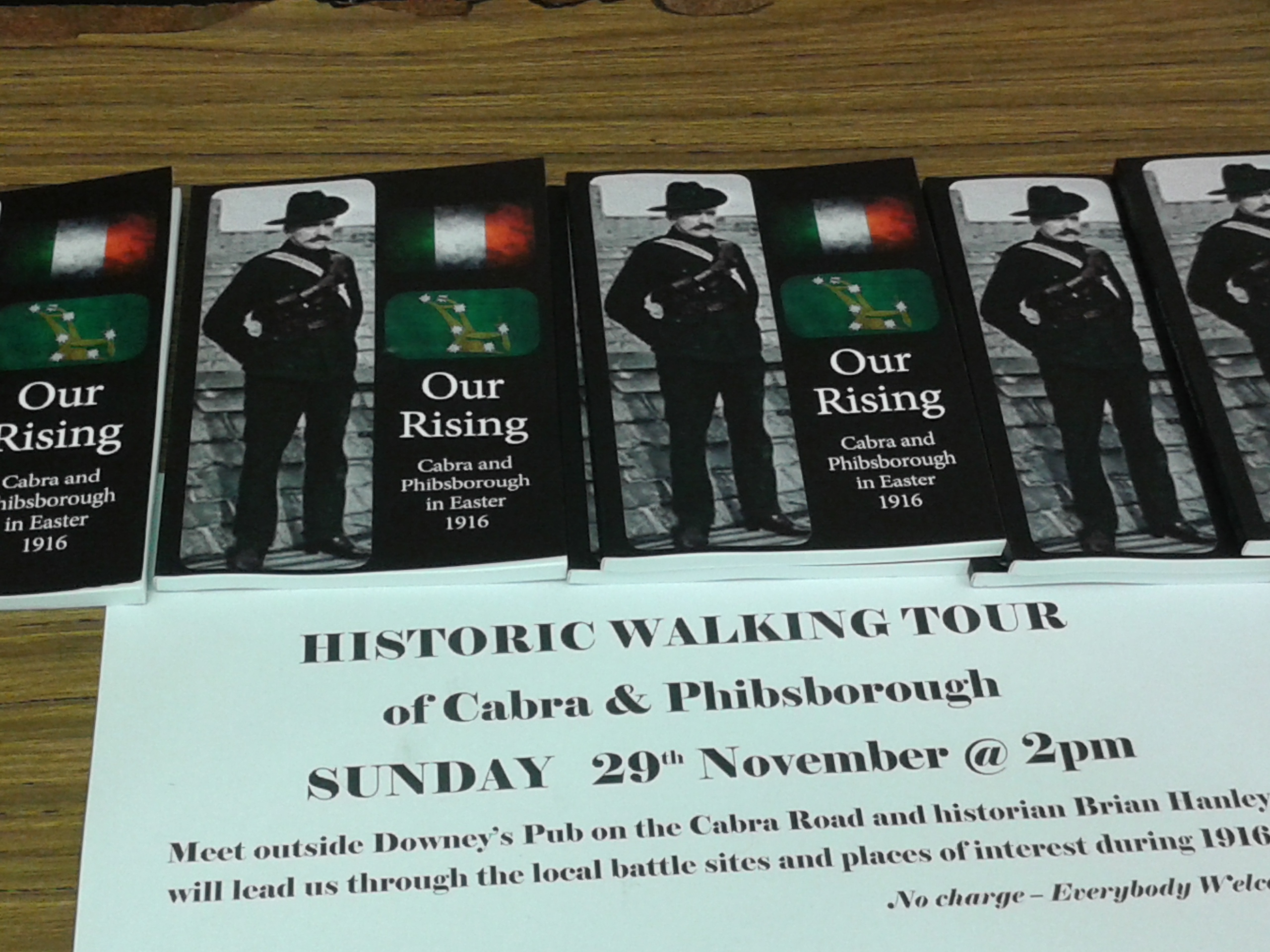
This November 7th saw over 200 people turn out for the launch by the Cabra 1916 Rising Committee of a marvellous 156page historical publication. Among the Cabra residents honoured in “Our Rising: Cabra and Phibsborough in Easter 1916” are the O’Reilly family.

IN THE 1916 RISING AT 13 YEARS OF AGE

In March 1966 the “Irish Socialist”, publication of the then Irish Workers’ Party (now the Communist Party of Ireland), brought out a special issue to commemorate the 50th anniversary of the 1916 Rising. A highlight of that publication had been Party veteran Donal O’Reilly’s memories of how, as a 13 year old boy, he had followed his father and brothers into the Rising, to the horror of Rising leader Tom Clarke, who considered him far too young to be involved in war. It was subsequently republished by my father, Micheal O’Riordan, in his 1979 book, “Connolly Column”.

Included in Donal O’Reilly’s memoir was his own day-by-day account of Easter Week, 1916:

Monday, Easter Week: In our home it was the ordinary week-end mobilisation. There was the cancellation order by McNeill in the “Sunday Independent” of course, but somehow we didn’t seem to pay much attention to newspapers then. Certainly all the adult members of my family went on parade. At two o’clock, I knew there was a difference. A barricade was up at the Railway Bridge in Phibsboro, which was just a few hundred yards from our home. Houses were occupied and all sorts of guns were in evidence. 
Down I went into O’Connell Street.

“The Proclamation was up. The windows of the G.P.O. were barricaded. The looting had already started and despite efforts by a few Volunteers, shop after shop was destroyed. How fires were prevented by the few Volunteers that were on the streets seemed a miracle. 
Back through the barricades of Phibsboro I went home with wondrous tales to tell! Nobody was at home; all were out on their barricades!

“Tuesday, Easter Week: There was a silence that I had never known before or since. Nothing moved on the North Circular or Old Cabra Roads. I wanted to go into the city centre again, but how could I get across the barricade on the Railway Bridge? I knew Jim O’Sullivan, the officer in charge, but that would be of little value. I hung around and eventually nobody knew which side of the barricade I should be on. I discovered my own private route into O’Connell Street; down Mountjoy Square, into Hutton’s Place, across Summerhill, an area that was then teeming with life, all living in big and small tenement dwellings.

“I got to the G.P.O. The looting had ceased and the only movement now was of determined men that came and went. A few groups were gathered around the Post Office trying to get in, but were rejected. 
At three o’clock there was a movement at the side door in Henry Street and the “War News” made its appearance. I duly appointed myself as official newsboy to the Garrison. Within an hour-and-a-half, the “War News” was sold and I was back in the G.P.O. with my my official status and the money. I got into the main hall.

“Tom Clarke, whom I had met in his shop and at the lying-in-state of O’Donovan Rossa at the City Hall, saw me and was horrified. I was sent to Jim Ryan and he sent me off to Purcell’s with a parcel of bandages. At the Purcell’s post I stayed and there I met Cyl MacParland, a man who was to be very close to me for many years afterwards.

“Wednesday, Easter Week: The silence had gone. The occasional crack of a rifle had given way to the boom of artillery.
“Back at G.P.O: Thursday, I returned to the G.P.O; there was no difficulty in getting in now. The guns were battering away and all the women and youth were being prepared for evacuation. It was proposed that we should go via Princes Str
eet, Abbey Street and Capel Street. I left, crossing O’Connell Street, Marlborough Street and then up by Hutton’s Place. Eventually I got to old houses in Berkeley Road, and stayed there until Sunday morning.”

20 YEARS LATER, FIGHTING IN SPAIN

So ended Donal O’Reilly’s memoir. He went on to fight in Ireland’s War of Independence (1919-1921), and on the Republican side in the Civil War (1922-1923), serving in the Four Courts garrison and, on surrender, being imprisoned in Mountjoy Gaol. But Donie, as he was known among friends and comrades, went on to fight for a second Republic, accompanying Frank Ryan in the first group of Irish International Brigade volunteers he led out to fight in the Spanish Anti-Fascist War (1936-1939). If Easter 1916 in Dublin had been Donie’s baptism of fire for the Irish Republic, Christmas 1936 on the Cordoba front was to be his baptism of fire for the Spanish Republic.

Photograph taken of some of the Connolly unit in Spain


(See http://www.irelandscw.com/part-IrDem3709-10.htm#371002Cordoba for his account of going into action, which was published in the “Irish Democrat” on 2 October 1937. In the opening two paragraphs the editor introduced Donal O’Reilly to readers, while his own account began with “Christmas time”).

Donal O’Reilly’s life both began and ended in the Cabra area of Dublin, and he ultimately resided at 31 Cabra Park. As the son of his fellow International Brigader Micheal O’Riordan, it was my privilege to have personally known Donie O’Reilly during my 1960s teens, and to have attended his 1968 funeral in Glasnevin Cemetery. Full military honours were rendered to this veteran of Ireland’s War of Independence, as the Irish Army fired a volley of shots at his graveside, before veteran Irish Republican Congress leader Peadar O’Donnell gave an inspiring funeral oration. Peadar was at that juncture Chair of the Irish Voice on Vietnam, on whose Executive I was the representative of the Connolly Youth Movement.

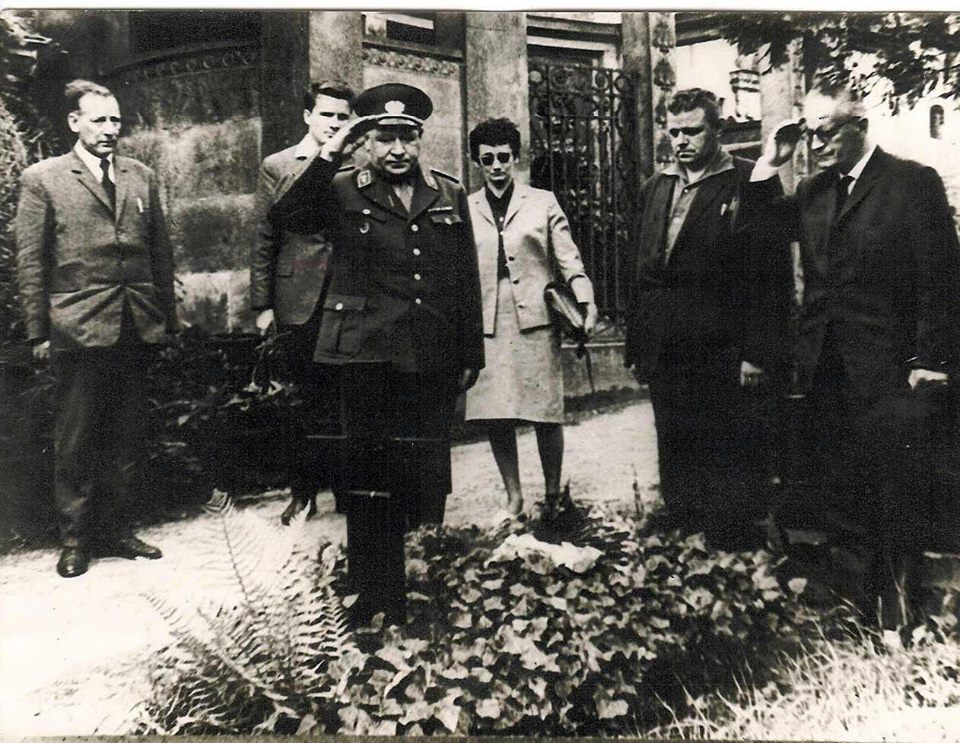
1966 Arno Herring GDR uniform veteran XI (Deutch) Brigade salutes Frank Ryan remains & 3 Irish veterans XV (English-speaking) International Brigade Donal O'Reilly Micheal O'RiordanFrank Edwards

This photograph of Donie O’Reilly was taken in 1966 in the German Democratic Republic, at the grave of Irish International Brigade leader Frank Ryan, in Dresden’s Loschwitz Cemetery. (Frank Ryan’s remains would subsequently be repatriated to Ireland, in 1979, for reburial in Dublin’s Glasnevin Cemetery). In this photo, Arno Herring, in GDR army uniform, a veteran of the XI (German-speaking) International Brigade, salutes the memory of Frank Ryan, as three Irish veterans of the XV (English-speaking) International Brigade stand to attention: Donal O’Reilly, on the far left, and Mícheál O’Riordan and Frank Edwards, on the right.

CABRA AND PHIBSBOROUGH 1916 RISING STORY — history book launch, talks, songs

Diarmuid Breatnach

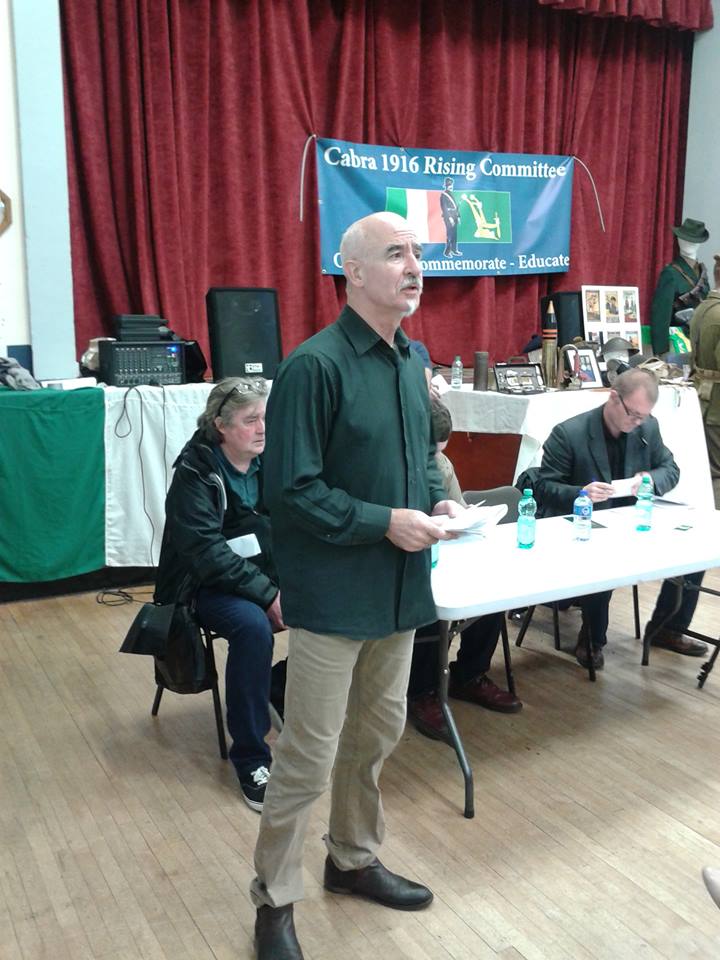
Around a hundred people attended the Cabra 1916 Rising Committee’s exhibition and launch on Saturday (7/11/2015) of their publication Our Rising – Cabra and Phibsborough in Easter 1916.

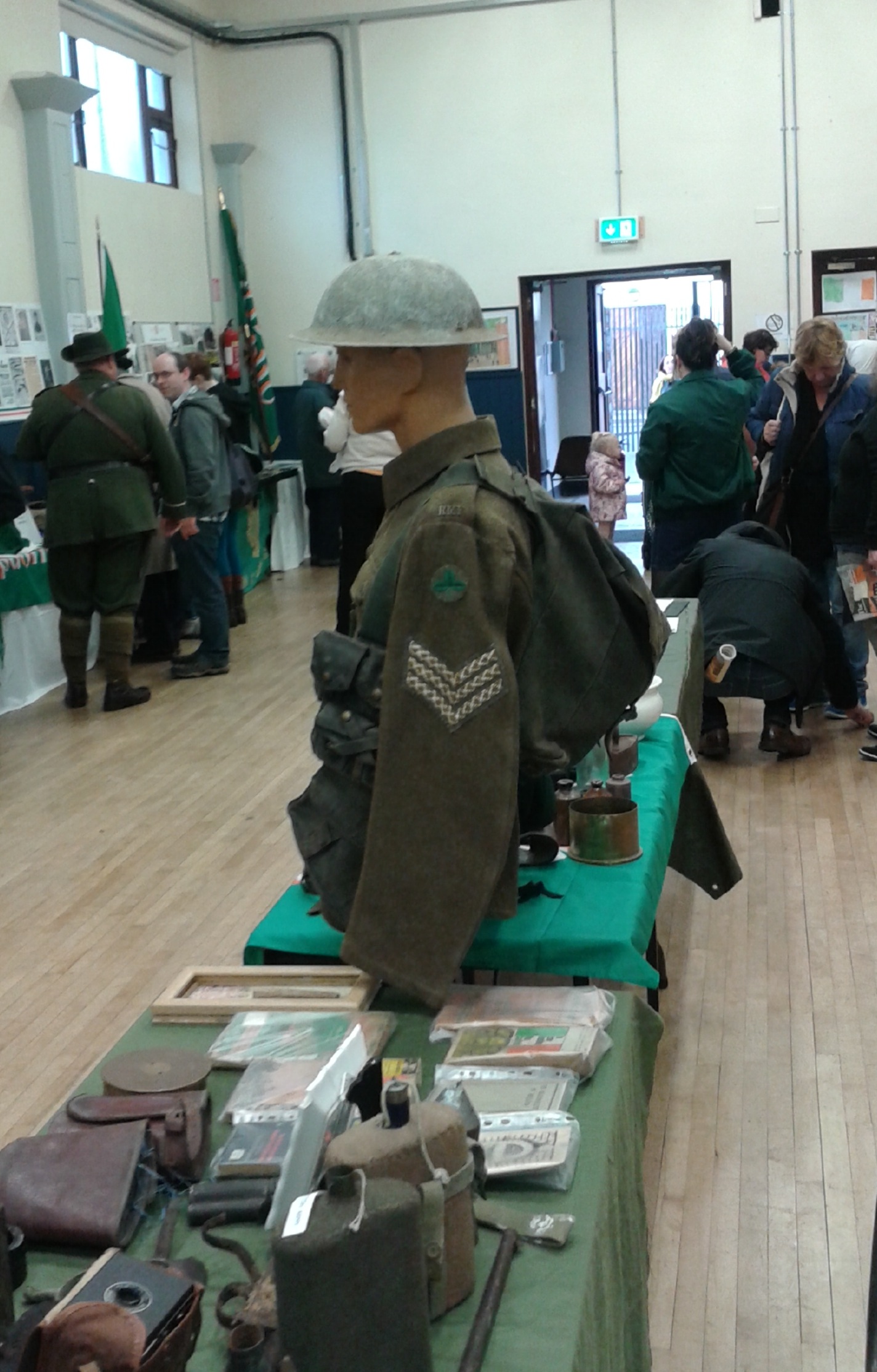
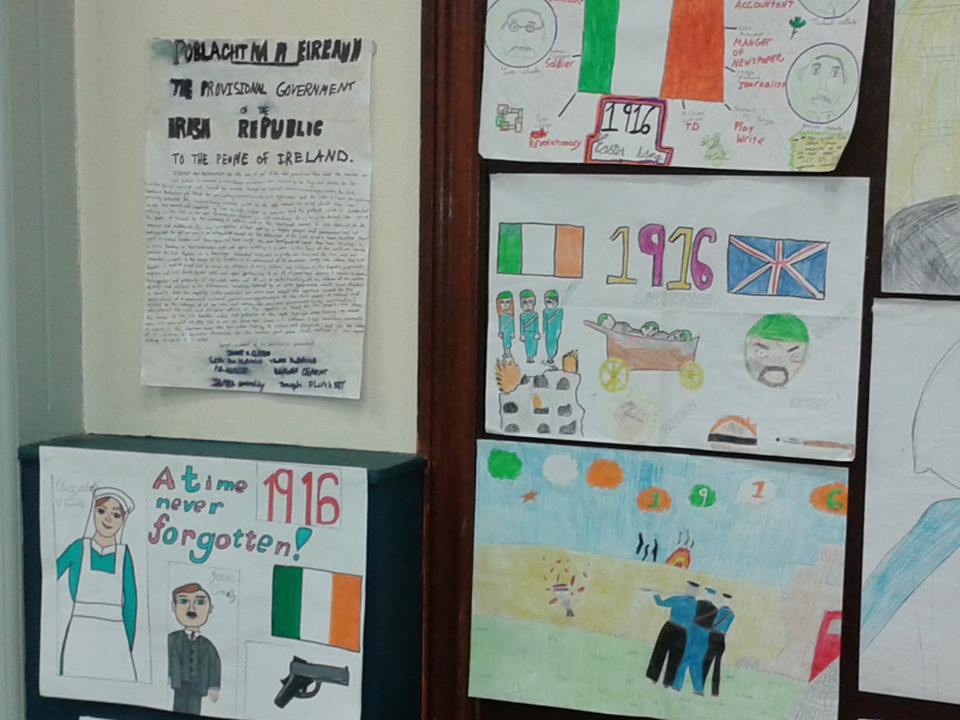
The event took place in the Cabra area itself, in the parish hall of Christ the King church. To accompany the launch, the Irish Volunteers group put on a very interesting display of artifacts from the period, including uniforms and weapons, and provided some personnel also dressed in Irish Volunteer uniforms and IRA typical clothing of the War of Independence period. Along the walls there were many period photos and a wonderful display of schoolchildren’s art on the subject of the 1916 Rising.

A shot of the attendance at the start of the formal part of the launch (Photo D.Breatnach)
A shot of the attendance at the start of the formal part of the launch
(Photo D.Breatnach)
DB singing Cabra Phibsborough Our Rising book launch Nov2015
Diarmuid Breatnach introducing songs about to sing: “Sergeant William Bailey” by Peadar Kearney (with two additional verses by Breatnach) and “Where Is Our James Connolly?” by Patrick Galvin. (Photo A.Perry)

After some time allowed for people to gather, the MC Éamonn O’Hara called people to order and after they had sat down, gave a brief background to the work of the Cabra 1916 Rising Committee, then outlined the formal part of the book launch to follow. First he introduced singer Diarmuid Breatnach.

Breatnach took the floor and explained that the songs he was going to sing were from or related to the period. “During these years of commemorations,” he said, “we are told that we should remember the First World War. Some people disagree with that but I think it is right; we should remember the War but — not in the way most of those people mean. We should instead remember that hundreds of thousands were sent to murder their class brothers in other lands, sent to their deaths and millions more to injury and tragedy, for the profits of a few.”

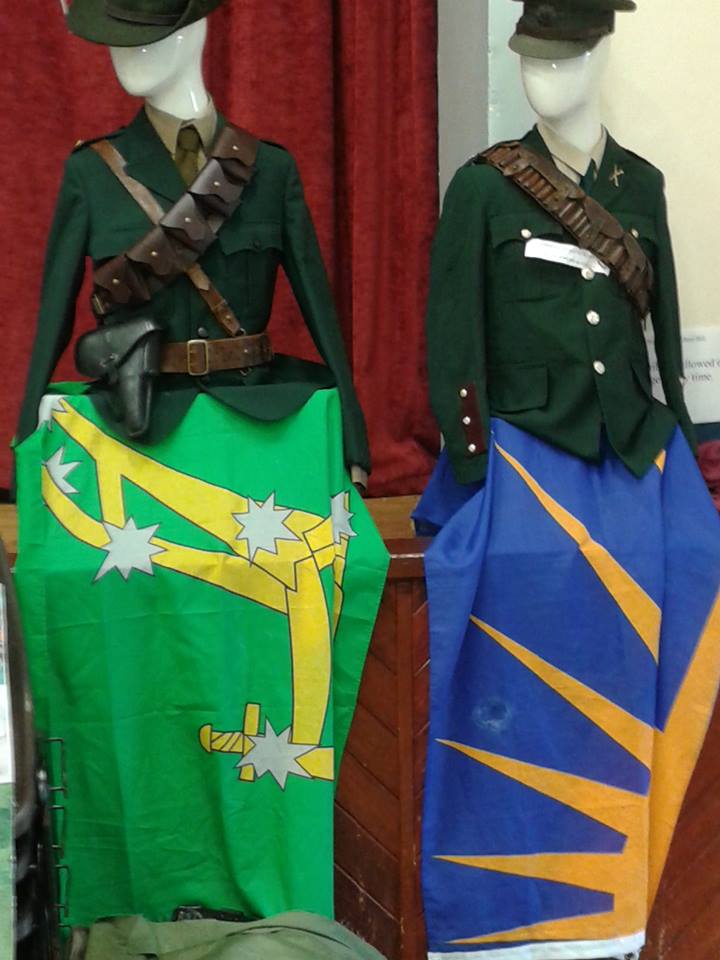
Some of the uniforms and flags displayed by Irish Volunteers.org
Some of the uniforms and flags displayed by Irish Volunteers.org.   (Photo D. Breatnach)

Also, when we are told that we should commemorate the First World War, they don’t mean that we should remember those brave few who dared speak out publicly against the war, who held anti-recruitment rallies or who picketed army recruitment meetings and shouted slogans there. And who paid the price of imprisonment and sometimes even death for doing so.” And yet, Breatnach went on to elaborate, those things too are part of the history of war and to his mind the most important part, since among all the wars of the past and the present, it is that trend that holds out a hope for the future.

Breatnach related that Peadar Kearney was born not far from Phibsborough – in Dorset Street, around the corner from Inisfallen Parade, where Sean O’Casey was reared. When Kearney taught night classes in Irish, O’Casey was one of his pupils.

Among the songs that Kearney wrote was a three-verse song mocking a British Army recruiting sergeant, who apparently had a pitch at Dunphy’s Corner. According to a local historian, that was outside what is now Doyle’s pub, at the Phibsboro crossroads. Breatnach said that he had added two verses of his own composition to that song.

Of course, the 1916 Rising is a part of the history of the First World War too,” Breatnach continued, “and not only because it took place during that War. For the IRB, undoubtedly, it was a case of ‘England’s difficulty is Ireland’s opportunity’. But for some others, including Connolly, as he made clear a number of times in writing, the Rising was necessary to interrupt the War, to stop the bloodshed of class brother killing class brother across Europe.”

Some of the wonderful children's artistic impressions of the Rising on display at the launch
Some of the wonderful children’s artistic impressions of the Rising on display at the launch.   (Photo D. Breatnach)

Breatnach pointed out that the Rising in Ireland was one of the most significant internationally against that imperialist war and that it was not until February the following year in Russia that there would be another of such historical importance, to be followed later by the October socialist revolution.

Of the two better-knowns songs about James Connolly, Breatnach said one makes no mention of socialism, the Citizen Army or trade unions and that in his opinion “Where Is Our James Connolly?” is truer to Connolly’s ideology. It was written by Patrick Galvin who was, among other things a writer, playwright, screen writer and singer. Galvin died only four years ago.

Breatnach then went on to perform “Sergeant William Bailey”, followed by “Where Is Our James Connolly?” to audience applause.

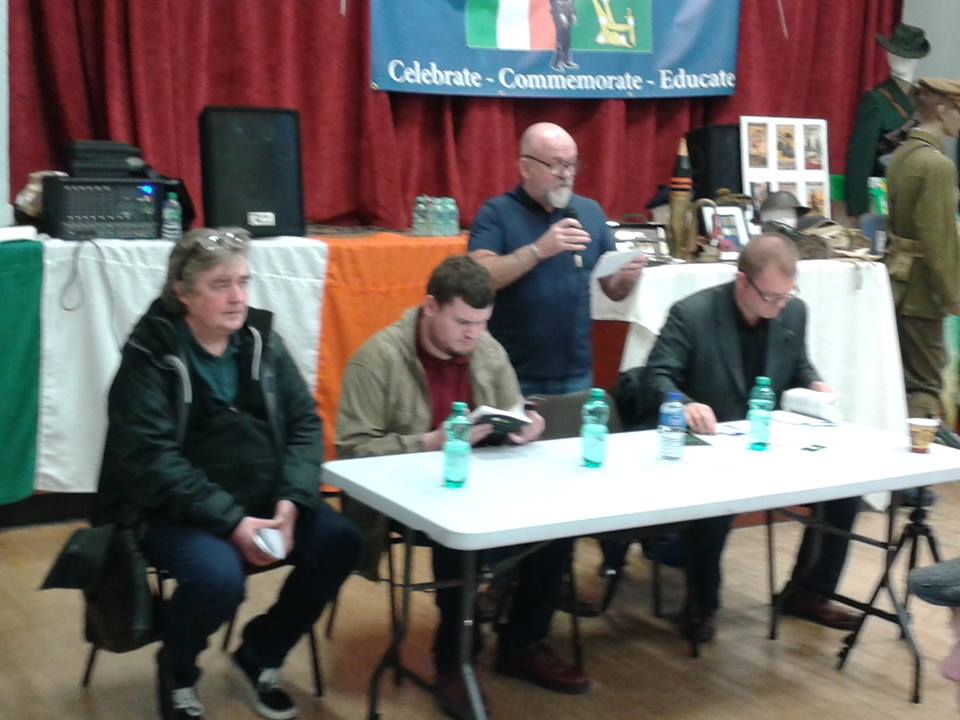
The panel at the launch (seated L-R): Hugo McGuinness, Donal Fallon, Brian . Eamonn O'Hara (standing) was MC.
The panel of historians at the launch (seated L-R): Hugo McGuinness, Donal Fallon, Brian Hanley. Eamonn O’Hara (standing) was MC.   (Photo D. Breatnach)


O’Hara then introduced one of the authors of
“Our Rising”, historian Brian Hanley. “Phibsborough was an area with strong revolutionary connections,” pointed out Hanley and went on to list some of the many participants and even leaders of the 1916 Rising and later who lived in the area, including Michael O’Hanrahan, who was one of the executed sixteen.

Hanley said that although it was right of course that those who were executed for their part in the Rising should have a special place in our memories and be written about by historians, it was unfortunate that many other important participants were neglected. Nearly 100 were sentenced to death but most had their sentences commuted. Had they been executed instead, Hanley pointed out, we would have had many biographies of them, their upbringing and domestic arrangements examined, their words pored over ….. instead, we know next to nothing about them except that they participated and what their role was.

Memorabilia of the British Army were there too -- and a reminder that initially It was mostly Irish units fighting to suppress the Rising.
Memorabilia of the British Army were there too — and a reminder that initially It was mostly Irish units fighting to suppress the Rising.   (Photo D. Breatnach)


The British Army unit responsible for the suppression of insurgent activities and securing of the area was the Royal Dublin Fusiliers; this was in line with the reality of the British Army, Hanley went on to say, an organisation the main purpose of which was to suppress resistance to the British Empire in places like India, Afghanistan and Ireland. The Fusiliers killed three people in the Phibsborough area, two civilians and a Fianna scout.

Pointing out that most of those men and women who went out to fight in 1916 were not poets or dreamers, Hanley refuted the myth of blood sacrifice. Most of those people were ordinary enough, with all the hopes, excitement and fears of ordinary people, Hanley opined: “They went out with high hopes that they were going to win.”

Thanking various bodies that had supported the project, Hanley went on to point out that the book should not be considered all that had to be said on the subject and, while thanking those local people who had contributed stories and information, encouraged any others who had further information or stories, including corrections of what they had written, to get in touch with the society.

Some more of the wonderful children's artistic impressions of the Rising on display at the launch. (Photo D. Breatnach(
Some more of the wonderful children’s artistic impressions of the Rising on display at the launch. (Photo D. Breatnach)

Hanley’s presentation was followed by that of another historian, Dónal Fallon, co-author of Our Rising. “The commemoration of the 1916 Rising is much too important to leave to the Irish Government”, said Fallon, who admitted to being a newcomer to the area, in the community of which he was glad to live. Local history and community groups had a vital part to play in commemorating the important events of this centenary decade, he said, pointing out that we had already had the centenary of the Lockout, next year would be the centenary of the Rising, to be followed by centenaries of the War of Independence and the Civil War, which might be uncomfortable for some people but should not be shirked for all that.

Last of the panel to speak was historian Hugo McGuinness who said he was delighted to have contributed the Cathleen Seery-Redmond piece to the book. He laid stress on the importance of local history and people’s stories as the human element of history. McGuinness recalled that when Connolly and some others were planning a commemorative event, a female member of the committee proposed that it would be wonderful to see Connolly in uniform; Hugo commented that he found little stories like that added human charm to the big narrative of historic events. McGuinness strongly recommended people buy a copy.

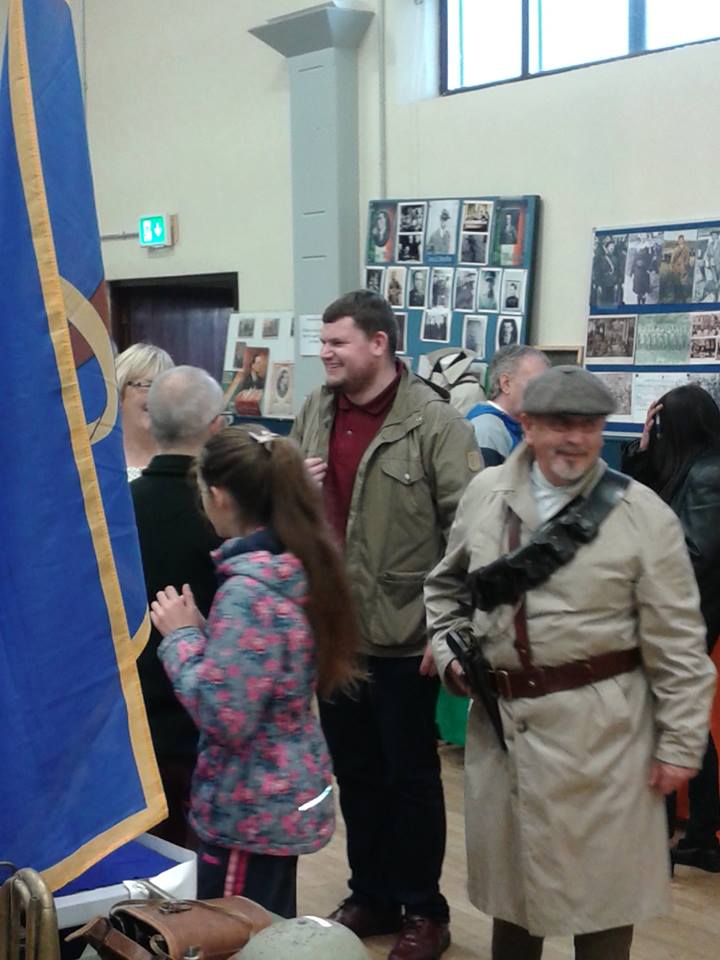
"Uniform" more typical of IRA man in the War of Independence 1919-1921 or Civil War. But even in 1916, some Volunteers could not afford a uniform. Co-author Donal Fallon centre background. (Photo D. Breatnach(
“Uniform” more typical of IRA man in the War of Independence 1919-1921 or Civil War. But even in 1916, some Volunteers could not afford a uniform. Co-author Donal Fallon centre background.
(Photo D. Breatnach)

All the speakers were accorded warm applause. O’Hara thanked the speakers and asked whether there were any questions or comments. There were a few only and, announcing a historical walk to take place on the 29th, for which flyers had been placed on seats, the MC thanked the Irish Volunteers.org group for their display, thanked the audience for their attendance and concluded the formal part of the event. People remained to buy copies of the book and have them signed by the authors, or conversed or wandered among the exhibition for about an hour afterwards.

 (Photo D. Breatnach(
(Photo D. Breatnach)

end


COMMEMORATING THE RISING AND WWl

Diarmuid Breatnach

I WAS INVITED TO SING A COUPLE OF SONGS AT THE LAUNCH OF “OUR RISING – CABRA AND PHIBSBOROUGH IN 1916″. Of course I was honoured to accept; the songs I chose to sing were “Sergeant William Bailey” and “Where Is Our James Connolly?” I chose them as important to the events around the Irish Volunteers and hoped they would be considered appropriate to the book launch event also.


These years are the centenaries of many things in our history and it is right that we should remember them. Among those things we are told that we should remember the First World War. I think the people who say that are right – we should, but not in the way most of those people mean. We should remember that in a dispute about what markets of the world should be dominated by which World powers and which resources they should have a monopoly on stealing, they sent millions to their deaths and millions more to injury and tragedy. And of course, the capitalists, the class that controlled those Powers were not among those dead and injured millions.

When those people tell us that we should commemorate the First World War and collect songs and memorabilia they don’t mean that we should sing songs against the War, collect anti-War leaflets and honour those brave few who dared speak out publicly against the war stampede of their countries. And who paid the price for doing so. And yet those things too are the history of the War and to my mind the parts of that history that, among all the wars of the past and the present, hold out a hope for the future.

Peadar Kearney, author of "The Soldiers' Song", "Sgt. William Bailey" and many other songs
Peadar Kearney, author of “The Soldiers’ Song”, “Sgt. William Bailey” and many other songs

Peadar Kearney was an Irish Republican of a Dublin skilled working class background born not far from Phibsborough – in Dorset Street, around the corner from Inisfallen Parade, where Sean O’Casey was reared. When Kearney taught night classes in Irish, O’Casey would be one of his pupils.

Kearney wrote many songs that are still sung today, the most famous of which is the Soldiers’ Song, on which he cooperated with Patrick Heeney, from Railway Street, off Gardiner Street. When the Irish Volunteers was formed in 1913, Kearney was a co-founder and his song was one of a number sung by other Volunteers during the 1916 Rising, in which Kearney also fought.

Peadar Kearney also wrote a three-verse song mocking a recruiting sergeant for the British Army, who apparently had a pitch at Dunphy’s Corner. According to a local historian, that was outside what is now Doyle’s pub, at the Phibsboro crossroads. I added two verses to that song, in order to give Sergeant William Bailey a bit of a background story.

Of course, the 1916 Rising is a part of the history of the First World War too – and not only because it took place during that War. For some, undoubtedly, it was a case of “England’s difficulty is Ireland’s opportunity”. But for some others, including Connolly, as he made clear a number of times in writing, the Rising was necessary to interrupt the War, to stop the bloodshed of class brother killing class brother across Europe.

James Connolly, a revolutionary socialist, wanted revolution against world war

Connolly was a revolutionary socialist. At the end of the 19th and very early 20th Centuries, the standard position of the international socialist movement had been against imperialist or colonialist war. In 1912, on November 24–25, the congress of world socialist parties at Basel in Switzerland, including revolutionaries and reformists, had come out clearly against imperialist war. Their manifesto was unanimously adopted at the congress. In the context of the situation created by the war in the Balkans that had begun in October 1912 and the increasing threat of world war, the Basel Manifesto called called for an unrelenting struggle against war and those responsible for it, the ruling classes of the capitalist countries. It stated that that war, if it began, “would create an economic and political crisis,” which should be utilized to “hasten the downfall of the rule of capital.”

British Army recruitment poster aimed at Irish men

As we know, the leadership of those parties that we now call the social democrats abandoned this position completely and championed their own ruling classes two years later as WWI broke out, cheering the workers of their countries on into uniform, to kill and be killed. There were some uprisings against the capitalists and against war but the first of any significance — and indeed of great significance — was the 1916 Rising in Ireland. The next revolutionary blow to war would not be until be a year later, with revolution in the Russian Empire.

Of the two better-knowns songs about James Connolly, the song “Where Is Our James Connolly?” is I think the best and truer to Connolly’s ideology. It was written by Patrick Galvin who was, among other things a writer, playwright, screen writer and singer. Galvin died only four years ago. Christy Moore remembers learning the song around 1970 which is probably not long after it was written – or at least published.

Patrick Galvin, author of "Where Is Our James Connolly?"
Patrick Galvin, author of “Where Is Our James Connolly?”

FENIANS, SCHOOLBOY STRIKE, LOCKOUT EVICTIONS, SPANISH CIVIL WAR – ALL ON EAST WALL WALKING HISTORY TOUR, WITH MUSIC & SONG AS WELL

Introduction with some very little additional text by Diarmuid Breatnach


Main text from East Wall History Group

Among the many events packed into History Week by the East Wall History Group was a walking history tour of the area on Sunday 27th September. Over a score of people took part in “East Wall and the Irish Revolution” to hear Joe Mooney, a long-time community activist, outline the relevant events of history at various points along the way, covering

Paul OBrien Merchants Road Mural playing
Paul O’Brien performing his 1913 Lockout song in front of mural marking the eviction of 62 families from Merchant’s Road in December 1913 by the Merchant’s Company.  (Photo: EWHG) 

local connections with the Fenians, docks and migrants, the Lockout, 1916 Rising and the Spanish Civil War. Appropriate songs and music accompanied the tour, Paul O’Brien performing compositions of his own at some of those points and Diarmuid Breatnach singing verses from Viva La Quinze Brigada at another.

Joe Mooney, the tour guide
Joe Mooney, the tour guide.  Photo: D.B

The East Wall History Group has been in existence for a number of year; they may be contacted through https://www.facebook.com/eastwallhistory and http://eastwallforall.ie/?tag=east-wall-history-group and it would not be a bad idea to get on their mailing list. The following account has been shamelessly looted from their FB page:

We set out from St Joseph’s School, originally opened in 1895. The first Principal of the Boys’ school was J.F. Homan, who served as a St. John’s Ambulance Brigade volunteer during the Rising and also during the Civil war. A number of former pupils from the school were involved in the revolutionary events of the time (the following decades) and of course in 1911 a schoolboys’ union was declared and a short strike ensued (complete with pickets!). Their demands included a shorter day and free school-books.

Part of crowd at the starting point
Part of crowd at the starting point.  (Photo: DB)

Our first stop was Merchants Road, where during the 1913 Lockout 62 families (almost the entire population of the street) were evicted by their employer the Merchants Warehousing Company (their yard was Merchant’s Yard on East Wall Road, just before the T-junction by the Port Authority. At the fantastic mural (erected by the community) Paul paid tribute to the families and the workers struggle with his song “Lockout 1913“. Amongst the evicted families were the Courtneys from number 1 – their son Bernard was a ‘Wharf’ school pupil and fought with the Jacobs garrison in 1916, before succumbing to TB in 1917.

Joe Mooney pointing out Jack Nalty's house
Joe Mooney pointing out Jack Nalty’s house.
Jack Nalty's house
Jack Nalty’s house.
Joe & Crowd from above
(Photo: DB)

Next we visited the East Road, where Diarmuid set the tone with a stirring rendition of the Christy Moore song “Viva la Quinze Brigada(explaining that Christy incorrectly called it “Quinta” but had since corrected it – as the lyrics in English make clear, it was the FIFTEENTH Brigade). Gathered opposite the family home of Jack Nalty, we heard the story of another former ‘Wharf ‘ school-boy who became an active Republican and Socialist, eventually losing his life fighting Fascism in Spain in 1938. Jack (who was also a champion runner) was amongst the last of the International volunteers to die, while his friend and comrade Dinny Coady was amongst the first. Many of Dinny Coadys relatives still live locally, and we plan to commemorate them properly in the future.

Jack Nalty in uniform of the 15th International Brigade
Jack Nalty in uniform of the 15th International Brigade. (Photo: Internet)


Next was a quick stop at the junction of Bargy and Forth Roads, which along with Shelmalier, Killane and Boolavogue were the names given to streets of Corporation houses erected here in the 1930’s and ’40s. They are of course synonymous with places in Wexford in the 1798 Rebellion.

At the rear of the former Cahill printers premises we learned how an innovative glassmaking factory (Fort Crystal Works) once stood there, perhaps the first industry in the area, but by the early 1800’s lay in ruins. As reported in newspapers as far away as New York, in 1848 a hundred men gathered here and spent an entire day in musketry practice, even setting up a dummy of the Lord Lieutenant of Ireland (the Queen’s representative) to practice on. These were members of the Young Ireland movement, preparing for rebellion.

Joe speaking at the 'Scotch Block'
Joe speaking at the ‘Scotch Block’ — some of the crowd are out of shot, as is Paul O’Brien, who is just getting ready to play.  (Photo: DB)

On Church Road we remembered former resident Edward Dorin, a Sergeant in the IRA who was part of the operation to burn the Custom House during the War of Independence. Another former ‘Wharf’ school pupil (he started there the same year as Jack Nalty), he was shot dead alongside a young volunteer from Ballybough when they engaged a lorryload of Auxillaries at Beresford place (just by Liberty Hall). (They were covering the attacking party). There had been a suggestion in the 1950’s to rename Custom House Quay as Dorins Quay .

A short stop at the “Scotch Block”, Fairfield Avenue, where Paul played two songs recalling Glasgow immigrants to the area and also Edinburghborn James Connolly. An incident in 1918 when Union Jackwaving residents from these buildings attempted to disrupt a Sinn Féin election rally also got a mention.

Diarmuid Breatnach singing Viva La Quinze Brigada opposite house.
Diarmuid Breatnach singing “Viva La Quinze Brigada” opposite Jack Nalty’s house. (Photo: EWHG)

As we passed Hawthorn Terrace its most famous resident Sean O’Casey was briefly discussed, as was his former neighbour Willy Halpin, the diminutive Citizen Army man most famous for almost escaping capture at City Hall by climbing up a chimney.

As we passed Russell Avenue a dishonorable mention was given to those who attempted to raise a 5,000 strong Fascist militia from an address here in the late 1950’s. Thankfully they failed miserably, as did the Italian fascist sympathiser resident of Caladon road who was banned from the U.S.A. during World War Two and eventually arrested by the Irish state and handed over to British authorities via the Six Counties.

At Malachi Place the actionpacked tale of Fenian leader John Flood was recounted. He lived here in the 1860’s as he worked on plans to stage a rebellion against British Rule. After an audacious attempt to seize weapons from Chester Castle was betrayed, he was eventually arrested following a boat chase on the Liffey and deported to Australia on the last convict ship to sail there. A memorial stands above his grave, unveiled there in 1911, two years after his death. This story could be a movie script!

We finished off the day at the base of Johnny Cullens Hill at the block of houses formerly named Irvine Crescent (now incorporated into Church Road). It was here the Scott family lived and in 1916 their 8yearold son was shot from the gun boat Helga. He lingered on for months after his wounding before finally dying, making him the last of the child casualties of 1916. The same year his father died in an accident in the Port, leaving his mother to raise five children on her own while coping with this double tragedy.

Their nextdoor neighbours were the Lennon family. On Bloody Sunday 1913 Patrick Lennon was one of those injured in the baton charge on O’Connell Street. Bloodied but unbowed, he worked alongside Sean O’Casey to raise funds for the relief of strikers families, a project which eventually led to the establishment of the famous soup kitchen at Liberty Hall.

And finally on to Bloody Sunday 1920. Everybody knows the story of how the Squad under Michael Collins (and the Dublin Brigade of the IRA) targeted British Intelligence agents in the City but not many know of the East Wall operation. A house on Church Road was targeted but the agent had left the evening before and was in Cork when the IRA group arrived. The exact location is unknown but we suspect it was within this block here as many of the houses were sub-divided at that time.”

A coincidence in Merchant's Road, opposite the mural (note the date)
A coincidence in Merchant’s Road, opposite the mural (note the date).  (Photo: EWHG)

Even if they didn’t get to tell half the stories of East Wall and the Irish Revolution, it was an enjoyable and informative walking tour … and the weather was beautiful – and there’s always next year!


End