
ISRAEL TARGETING PALESTINIAN TERRORIST/ ATACANDO TERRORISTA PALESTINO


The auditorium in Trinity College on Friday 20th June was nearly empty at the advertised starting time for the lecture on “The Legacy of Power, Conflict and Resistance”. The start was delayed and more people came in but, by the time the speaker and the theme was introduced, the hall was still not full. That was surprising, because the speaker was Bernadette Mc Alliskey (nee Devlin), who had been at 18 years of age one of the leaders of the Civil Rights movement in the Six Counties (“Northern Ireland”), at 21 years of age elected MP for Mid-Ulster in 1969 and still, 45 years later, holding the record for the youngest woman ever elected to the British Parliament.

The same year as her election, Bernadette went to the USA to gather support for the Civil Rights movement in a trip being used by others, rumouredly, to gather funds for arms. She shocked the conservative part of Irish USA, Ancient Order of Hibernians and Democratic Party political allies, by some of her statements and actions regarding blacks and chicanos and in visiting a Black Panthers project. Bernadette returned home to serve a short prison sentence after conviction for “incitement to riot” arising from her role in the defence of Derry against police (RUC and B-Specials) and Loyalist attack.
In 1972, during her five-year tenure as a Member of Parliament, enraged by his comments about the murder a few days previously of 13 unarmed protesters (a 14th died later of his wounds) by the Parachute Regiment in Derry, she stormed up to the then British Home Secretary and, in front of a full House of Commons, slapped him in the face. Bernadette had been there in Derry that terrible day – she was to have addressed the anti-internment march upon which the Paras opened fire.
The Tyrone woman was also a founder-member of the Irish Republican Socialist Party in 1974, which she left after failing to bring the armed organisation, the Irish National Liberation Army, under party control. She continued to be a Left-Republican political activist, in particular campaigning against the treatment of Republicans on arrest and subsequently as prisoners in jail, in the H-Blocks Campaign. She learned to speak Irish. In January 1981, she and her husband Michael McAlliskey were the victims of an assassination attempt by a squad of the “Ulster Freedom Fighters” (a cover name for the Ulster Defence Association, which was not banned until 1992). They both survived, though Bernadette had been shot seven times.
In 1996, while four months pregnant, Bernadette’s daughter was arrested on a German extradition warrant, charging her with being part of a Provisional IRA mortar attack on a British Army base in Osnabruck, Germany. Although taken to England, where a judge agreed to her extradition to Germany, a long and vigorous campaign fought by Roisín’s mother and her supporters eventually defeated the extradition and Roisín gave birth to a healthy daughter.

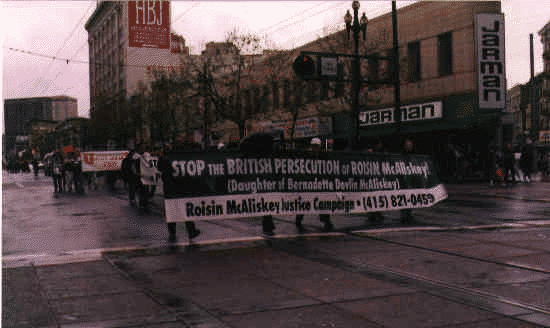
In 1998 and for some years after, Bernadette was an outspoken critic of Sinn Féin and of their direction in the “Peace Process”, which she saw as the party coming to accept British colonialism and Irish capitalism. In 2003 she was banned by the USA and deported, widely interpreted as being due to her speaking against the Good Friday Agreement, but continued her campaigning. However in 2007, another extradition warrant was issued for her daughter Roisín on the same charges as before and the young woman became emotionally ill. The whole trauma was seen by many as a warning to Bernadette to cease criticising the “new dispensation” and subsequently she was seen to fade from the ranks of public critics of the GFA, Sinn Féin and of the treatment of Republican prisoners.
Bernadette remained active through working with migrants in a not-for-profit organisation in Dungannon. In recent years she has returned, on occasion, to the issues upon which she was so outspoken previously, for example standing surety for Marian Price’s bail to attend her sister Dolores’ funeral and speaking at the ceremony herself. Bernadette also spoke at the Bloody Sunday Commemoration/ March for Justice in January this year in Derry.
With a c.v. of that sort, one would reasonably expect a packed auditorium.

Bernadette has walked the walk and thought the thought too but she can also talk the talk. With one A4 sheet in front of her, she spoke for over an hour, hardly ever glancing at her notes. Her talk was as part of Trinity College’s MPhil Alumni Conference on ‘Power, Conflict, Resistance’ organised by the Department of Sociology for its Mphil course in “Race, Ethnicity and Conflict”.
Bernadette McAlliskey began her talk with the theme of fear of conflict, developing the thesis that this fear is inculcated in us from childhood, as conflict arises out of challenging power and hierarchy. She traced this further back to religious indoctrination where dogma is to be accepted without question and finds its reflection in all aspects of life but particularly in the political.
Talking about Tom Paine, who expounded the theory that human beings, each independently, are responsible for themselves, she stated that this is fundamental to citizenship. Some aspects of this self-responsibility are delegated to institutions when we live in large groups but any decisions made for us without our consent are “an usurpation”. Tom Paine was an English Republican, author of, among other works Common Sense (1776) and The Rights of Man (1791). He had to flee England because of disseminating his ideas, which were considered revolutionary in his time.
Much of Bernadette’s talk was given over to this theme, to the lack of consideration of women even by such as Tom Paine, and also to the racism spread by colonialism, which the Christian hierarchies condoned and even encouraged.
When she finished to sustained applause and took questions, there were two from people identifying themselves as Travellers, another from a person from an NGO working with migrants, another regarding anti-Irish racism in English colonial ideology and the continuing power of the Catholic Church in the education system.
One question seemed to throw her and she admitted that she found it difficult to answer. Ronit Lentin, Jewish author, political sociologist and critic of Israeli Zionism asked Bernadette was it not true that racism in the Six Counties came mostly from within Loyalism, allied to anti-Catholic sectarianism. Bernadette struggled in replying, at one point denying it and pointing to anti-Traveller discrimination in the ‘nationalist’ areas but following this up by observing that Travellers would only camp in or near ‘nationalist areas’ (presumably because the hostility in a ‘unionist area’ would be worse).
Bernadette then went on to recall the recent anti-Muslim remarks made by a prominent Belfast evangelist preacher, James McConnell, and how the First Minister of Stormont, Peter Robinson, had defended the evangelist’s right to free speech. Asked for his own opinion of Muslims, the First Minister had replied that he also distrusted them “if they are fully devoted to Sharia law” but would trust them to go to the shop for his groceries and to bring him back the correct change. All the examples Bernadette drew on, apart from the generalised one about Travellers in ‘nationalist’ areas, were in fact from the Unionist sector.
The final question was from an SWP activist who pointed out that the State does not admit to its institutional racism and often takes no action on racist attacks or denies that the motive for the attack was racism. The activist asked Bernadette how she thought racism can be dealt with in this context. She replied that the legal structures are there and should be used and persisted with.
It seemed a strange response from one who would have described herself in the past as a revolutionary. Earlier in her talk she herself had quoted the black Caribbean lesbian, Audre Lorde, who said that the instruments of the State could not be used to dismantle it (actually I.V. Lenin had made the same point in The State and Revolution in 1917, nor was he the first to do so). A revolutionary’s answer to that question would presumably have been that while the structures should be used in order to expose them that ultimately the capitalist State’s power is the enemy of unity among the people; disunity rather than unity among the people is in the interest of the system. Mobilisation of the people against racism and directing them towards the source of their ills, the capitalist system, and building solidarity in action, is the only realistic way forward. Perhaps Bernadette felt constrained by the academic environment in which she was speaking but that is not the answer she gave.
End.
Interesting retrospective piece on McAlliskey’s visit to the USA in 1969: http://www.historyireland.com/20th-century-contemporary-history/fidel-castro-in-a-miniskirt-bernadette-devlins-first-us-tour/
Interview with McAlliskey at a Scottish conference on radical independence https://www.youtube.com/watch?v=H4LdcnxMb9Q
[First published by Bristol Radical History Group on their s site earlier this year as “Some Hidden Histories of the British State Revealed in 2013”; reprinted by kind permission from same.]
In ten years we’ll leak the truth By then it’s only so much paper[1]
According to the U.S. punk band the Dead Kennedys it takes about 10 years before our ‘democracies’ decide to “leak the truth” about activities of secret arms of the state. In the current world of social media and the information highway there seems to be a perception that no secret is safe and that “it will get out somehow”. This suggests the cosy idea that somehow the internet is leading us to a more open society with rapid access to the ‘truth’. In the US things certainly seemed to have been speeding up lately with the ‘Wiki-leaks’ by the ex-National Security Agency spook Edward Snowden becoming almost real-time in relation to the recent military adventures in Iraq and Afghanistan. Of course the joke is on us, as Snowden’s exposés demonstrated that the sword of internet cuts both ways with comprehensive spying by the secret state on home populations facilitated by social media such as Facebook. However, Snowden’s revelations are the exception to the rule; I would argue the lack of concrete information on the activities concerning the ‘secret state’ on the internet leads to speculation and conspiracy theories rather than openness and ‘truth’. Interestingly, 2013 provided plenty of evidence of long-term strategies of secrecy in the British state which seem to be working on a minimum of 40-50 years and unbelievably up to 350 years before the ‘truth’ becomes “only so much paper”. I am going to concentrate on two particular ‘hidden histories’; the Mau Mau court cases relating to the Kenya ‘Emergency’ of 1950s-60s (Part 1) and British Army death squads in Northern Ireland in the 1970s (Part 2). Both of these stories hit the headlines in 2013 and demonstrate the lengths to which the British state will go to hide information in order to mythologise its history as well as the methods that are used to neutralise problematic fragments of the ‘real’ history of the British Empire.
If we are going to sin, we must sin quietly[2]
In May 2013, the British government, after it had failed in its disgraceful attempt to avoid responsibility for the torture of five Kenyans during the ‘Mau Mau’ rebellion in the 1950s, finally agreed to negotiate ‘out-of-court’ compensation for up to 10,000 similar victims[3]. Revelations about torture, rape and murder carried out by British police and army units during the Kenya ’emergency’ have sporadically hit the headlines over the last few years, whilst debates have raged between historians as to their scale, longevity and systemic nature[4] of the main problems in answering these questions has been getting at concrete evidence. What became clear during the ‘Mau Mau’ case in 2013 were some aspects of the British state’s enduring strategy in covering up its numerous crimes against humanity in the post-war era. The two practical features of this policy seem to involve time and suppression and/or destruction of information.

Many journalists and commentators complained about the length of time it had taken to bring the ‘Mau Mau’ cases to court; their naiveté is astounding. For British citizens seeking justice who have had a relative killed by the Police[5], to the family of Stephen Lawrence[6], the families of the Hillsborough victims[7] or those gunned down by British paratroopers in Derry in 1972[8] or in Ballymurphy in 1971[9]; time is clearly a weapon of the British state. In many of these cases decades passed, interspersed with botched, half-arsed and faked inquiries, before anything like the ‘truth’ was even hinted at. As for ‘justice’ well you might as well be searching for Shangri-La! For the various arms of the British state this ‘war of attrition’ aimed at its victims and their relatives, often not only breaks their resolve, their families and personal relationships but crucially demoralises future victims from taking them on. In the case of the thousands of surviving victims of torture and rape in Kenya, the British state clearly followed this delaying strategy. They relied on the Kenyan authorities enforcing colonial-era legislation which outlawed Mau Mau and branded them ‘terrorists’. This law stopped victims coming forward through fear of prosecution and was not repealed until 2003, over 50 years since the start of the uprising[10]. After the rejuvenation of the status of Mau Mau veterans in Kenya, a number of civil cases were launched against the U.K. government, which responded by trying to claim any legal technicality, however ludicrous, it could find to hold up the proceedings. For example in 2010, I kid you not:
The British government claimed the issue was the responsibility of the Kenyan government on the grounds of “state succession” for former colonies, relying on an obscure legal precedent relating to Patagonian toothfish and the declaration of martial law in Jamaica in 1860[11]
Clearly the plan was to hang on for as long as possible trusting that most of the victims and crucially the perpetrators would be deceased when finally some of the truth was revealed[12]. Then it would just be a matter of (if absolutely necessary) making a ‘statement of regret’ about some ‘bad apples’ to put this particular isolated fragment of colonial history to bed for good. Not only would this save significant compensation money but more crucially avoid the possible embarrassment of having to expose systemic murder, rape and torture by the British state. As one commentator noted this could challenge the “British people’s carefully nurtured narrative of the final days of their imperial mission”[13].
So despite international criticism[14], the British government lawyers forged ahead with their time-wasting strategy. Years passed, until horror of horrors, in July 2011, a judge granted the surviving elderly Kenyan test claimants the right to sue the UK for damages. This allowed the claimants lawyers to demand access to documents pertaining to the ‘Kenyan emergency’ which a number of historians, called as expert witnesses in the case, believed were secretly held by the Foreign & Commonwealth Office (FCO). Finally in April 2013, after decades of consistent denials (that is lies), the FCO suddenly “discovered” the “existence of an enormous secret archive at Hanslope Park in Buckinghamshire, a repository for more than 8,000 files from 37 former colonies”.[15]

As the Guardian noted, amongst the contents relating to the ‘Kenyan emergency’:
was a damning memo from the colony’s attorney general, Eric Griffith-Jones, a man who had described the mistreatment of the [Kenyan] detainees as “distressingly reminiscent of conditions in Nazi Germany or Communist Russia“. Despite his misgivings, Griffith-Jones agreed to draft new legislation that sanctioned beatings, as long as the abuse was kept secret. “If we are going to sin,” he wrote, “we must sin quietly.”[16]
More than 50 years later, with the imperial endgame long over, evidence of those sins remained quietly concealed in a secret archive within one of the British government’s most secure facilities. Set deep in the Buckinghamshire countryside and surrounded by 16ft-high fences topped with razor wire, lies Hanslope Park, home of, Her Majesty’s Government Communications Centre, where teams of scientists – real-life versions of Q, the fictional boffin of the James Bond films – devise technical aids for the Foreign Office, MI5 and MI6. What better place to bury Griffith-Jones’s letter to Baring, along with thousands more documents from colonial-era Kenya and countless others from 36 other former colonies and protectorates? Were this secret archive to be stacked upright, it would create a tower 200 metres tall. And every document was selected for concealment on the basis of an instruction that nothing should be handed over to any post-independence government that might “embarrass HMG or other government” or cause problems for any colonial policeman, civil servant or member of the armed forces.[17] The documents suppressed for so long by the British State not only provided further evidence of systemic abuses during the ‘Kenyan emergency’ (including forced labour, organised starvation and the burning of detainees alive) but crucially demonstrated that:
The government in London knew what was going on, Anderson states. “These documents contain discussion of torture and abuse and the legal implications for the British administration in Kenya of the use of coercive force in prisons and detention camps, by so-called ‘screening’ teams, and in other interrogations carried out by all members of the security forces.” The legal limits of coercive force were debated. “They reveal that changes to legislation, and additions to the emergency powers regulations, were made retrospectively in order to cover practices that were already normal within the camps and detention centres.”[18]
Throughout the legal saga of the 2000s, FCO lawyers had consistently denied that the abuses in Kenya in the 1950s had been systemic or widespread and a central plank of their defence was that “London knew nothing”. The newly released information seriously undermined their position and once again demonstrated that they had systematically lied over a number of years. In October 2012, after the judgement which granted the right of the victims to sue the British government, the FCO ironically responded:
The judgement has potentially significant and far reaching legal implications. The normal time limit for bringing a civil action is 3 to 6 years. In this case, that period has been extended to over 50 years despite the fact that the key decision makers are dead and unable to give their account of what happened. Since this is an important legal issue, we have taken the decision to appeal[19]
This is a bit like a Mafia boss complaining that if key witnesses (who he had arranged to be killed) had been present in court he would have been found innocent! The disgraceful and widely condemned decision of the FCO to continue to fight the case against the Mau Mau victims was followed by an embarrassing climb-down, leading to ‘out-of-court’ negotiations in May 2013. The FCO response to the release of the secret information and their ‘U-turn’ was characteristically nauseating: “We believe there should be a debate about the past. It is an enduring feature of our democracy that we are willing to learn from our history.”[20] You have got to be joking! From a historical perspective the opening of the secret files or as the FCO called them, the “migrated archive” (sic) seemed to be the final act in the Mau Mau case, but this was far from the end. The suspicious historians, who had struggled to uncover the suppressed history of the Kenyan emergency over many years[21], were at best sceptical and at worst paranoid[22]. The Guardian naively noted:
Hague ordered an independent review of the “migrated archive” before its transfer to Kew, overseen by Professor Tony Badger, master of Clare College, Cambridge. The first documents, representing about a sixth of the total archive, are now available at Kew, with Badger promising that very few have been redacted, usually to conceal the identities of informants.
Many historians remain suspicious of the FCO and believe it may seek to retain some of its secret files. Caroline Elkins, the Pulitzer prize-winning historian of the Mau Mau rebellion, warns that the FCO’s history of concealment and denial is such that the public should also continue to sceptical.
As the files come available, Badger admits that many of his colleagues wondered whether the FCO was “up to its old tricks again”, and adds: “Given the failure of the Foreign Office to acknowledge the existence of the migrated archives, I understand the legacy of suspicion. It is difficult to overestimate the degree of suspicion.” But he believes the depth of embarrassment suffered by the FCO over the Hanslope Park scandal offers the best reassurance that it will now finally offer up the full archive.
It may be significant, he adds, that Hague and David Lidington, the junior foreign minister responsible for the transfer process, are both historians and should be conscious of the potential for further “reputational risk” if the FCO continues to conceal documents.[23]
“Embarrassment” and “reputational risk”, you are having a laugh! The British state is covering up a recent history of mass rape, torture and murder; do you think they give a toss about these? What about getting obstruction of ‘war crimes’ trials onto the agenda; that might concentrate some minds!
Of far more interest than dubious assurances from Cambridge dons and government ministers was the revelation uncovered in the ‘migrated archive’ files that:
many of the British empire’s most sensitive and incriminating documentation was not hidden at Hanslope Park but simply destroyed – sometimes shredded, occasional dumped at sea, but usually incinerated – as the British withdrew from one colony after another[24]
Starting in the mid-1950s and then formalised in 1961 by the secretary of state for the colonies, Iain Macleod, the British state activated a plan to deny post-independence governments and others access to colonial documents that:
“might embarrass Her Majesty’s government”, that could “embarrass members of the police, military forces, public servants or others e.g. police informers”, that might compromise intelligence sources, or that might “be used unethically by ministers in the successor government”[25]
In at least 23 countries and territories, from Kenya to Malaya, documentary evidence of systematic torture, murder and other crimes was removed from the colonial archives in an operation kept secret from British subjects both in the colonies and on the mainland. Interestingly, and this is something for historians to note, the plan made provision to hide the fact that the ‘sifting’ had even happened by creating sanitised ‘dummy’ files to replace those that had been selected. It was imperative that post-independence colonial administrations (or future historians) were unaware that the selected files existed or that a “cleaning” process had taken place. Finally, the colonial cleaners were told that the ’emphasis is placed upon destruction’[26] rather than transferring the selected files to London. So the files recovered from Hanslope Park are probably the least “embarrassing” tip of an iceberg of destroyed information. This was backed up by a memo from an MI5 liaison officer in 1957 which stated after an 8 month long incineration operation of files pertaining to Malaya that “the risk of compromise and embarrassment [to Britain] is slight”[27]. One of the ‘Mau Mau’ case historians, Professor Anderson, sarcastically noted:
As a nation Brits nurture memories of empire that are deceptively cosy, swathed in a warm, sepia-tinted glow of paternalistic benevolence. The British empire, so the story goes, brought progress to a primitive and savage world. Education, hospitals and improved health, steamships, railways, and the telegraph – these were the tools of empire, brought to colonised peoples by the gift of commerce and good British government.
We take pride in this imperial heritage, pointing with scorn at the lesser achievements of other European powers – the French, Italians, Germans, Belgians and Portuguese – whose empires we variously view as haplessly mismanaged, malignly exploitative and brutally coercive. Britain’s empire was better than all the others, historians such as Niall Ferguson, Andrew Roberts and Lawrence James have assured us, so why should we worry?’[28]
It amazes me after revelations concerning the suppression and mass destruction of the colonial records that famous ‘establishment’ historians have the gall to peddle this nonsense. After all, if the ‘official’ evidence has been destroyed, this means you have to turn to other sources, not just assume it was all a bed of roses. Caroline Elkins faced this very problem when researching her book Imperial Reckoning: The Untold Story of Britain’s Gulag in Kenya published in 2005, which helped begin the process of uncovering the systematic campaign of brutality during the Kenyan emergency. Elkins faced a barrage of criticism particularly over her assertion that “tens of thousands, perhaps hundreds of thousands” of Kenyans died during the ’emergency’[29]. To a certain extent, Elkins had a point regardless of the figures, that is if the evidence had been wilfully sanitised and thousands of ‘dirty documents’ destroyed by the British who could say she was wrong or in fact what was correct? In October 2013 she wrote:
“Africans make up stories.” I heard this refrain over and again while researching imperial history in Kenya. I was scarcely surprised when it came from former settlers and colonial officials living out their days in the country’s bucolic highlands. But I was concerned to find that this position took on intractable proportions among some historians.
At the time of decolonisation, colonial officials destroyed and removed tons of documents from Kenya. To overcome this, I collected hundreds of oral testimonies and integrated them with fragments of remaining archival evidence to challenge entrenched views of British imperialism.
My methods drew sharp criticism. Revising the myths of British imperial benevolence cut to the heart of national identity, challenging decades-old scholarship and professional reputations.
Some historians fetishise documents, and historians of empire are among the most hide-bound. For decades, these scholars have viewed written evidence as sacrosanct. That documents – like all forms of evidence – must be triangulated, and interrogated for veracity using other forms of evidence, including oral testimonies from colonised populations, mattered little.
Instead, many historians rarely questioned the official archive, nor the written, historical record. Instead, they reproduced a carefully tended official narrative with either celebratory accounts of empire, or equally pernicious, by turning their collective heads away from the violence that underwrote Britain’s imperial past and towards more benign lines of inquiry. Either way, their document-centred histories served as excuses for liberal imperial fictions.[30]
Elkin’s point about the discrediting victims of British torture, emasculation and rape has a horrific resonance with Holocaust deniers. How would it have sounded if subsequent to 1945 historians had said “Jews make up stories”?
It appeared by the summer of 2013 that the revelations about secret archives and the destruction of colonial documents on a massive scale was the final chapter of the story. However, the cracks that had appeared in the wall of secrecy erected by the British state were beginning to spread, and in October 2013 the dam burst. Having originally been caught out by an eagle-eyed historian who “had located a 45-year-old Whitehall memo that referred to the material” stored in the secret archive in Hanslope Park, a court directive led to the FCO effectively admitting it had hidden 1,500 Kenyan files[31]. This was the first crack in the dam. Then:
Ministers then informed parliament that there were a total of 8,800 files from 37 former colonies being stored at Hanslope Park; when these were finally handed over to the National Archives at Kew, the true figure was found to be nearer 20,000.
What the Foreign Office did not disclose at that time was that the colonial-era files were just a tiny part of the vast repository at Hanslope Park. Instead, it has since acknowledged, it asked the justice secretary, Chris Grayling, to sign an authorisation for the retention of 1.2 million files, putting them on a legal footing for the first time while a plan could be devised for their transfer to Kew. That was done without any public announcement. The exact number of files within the archive that have been withheld in breach of the Public Records Act is unclear. Initially, the Foreign Office said there were 1.2 million[32]
As the FCO admissions began to turn from isolated torrents of ‘hidden’ information into a deluge, the volume of the dam became apparent:
The scale of the hidden archive is demonstrated by an inventory that the Foreign Office has published, which appears to show that one of the listed items may itself contain 2.9 million documents
So one ‘file’ may comprise 2.9 million documents and there are 1.2 million files! No wonder one estimate put the length of the shelving at Hanslope Park at 15 miles; potentially representing tens or even hundreds of millions of documents! Even more incredible was the scope of historical periods covered by the secret archive which dated back over 350 years to 1662 and which ranged in content from the West African slave trade to Nazi war criminals in the U.K, including documents right up to the present day. The sheer volume and historical sweep of this evidence demonstrates the systematic suppression of information in the British state for hundreds of years; which comes as no surprise to some of us, but absolutely crucial for all historians of Britain and its Empire to confront. Of course getting access to all this information is another matter. Ostensibly it is meant to be handed over to The National Archive (TNA) at Kew, but despite the information spewing from the shattered dam, the FCO are still trying to hold back the flood water by a series of stalling measures:
The Foreign Office has presented its plans for the release of some of the Hanslope Park files during a meeting of the National Archives’ advisory council, which usually scrutinises government departments’ requests to retain or redact a small number of files beyond the 30-year disclosure rule. The meeting, held last November, was closed to the public.
In a statement to MPs the following month, Foreign Office minister David Lidington said a portion of the files would be transferred over a six-year period.
However, it remains unclear what proportion of the archive will be transferred during this period. Although Lidington said the Foreign Office was “committed to meeting our public records obligations in as transparent a manner as possible”, the department has released no details of its transfer plan, declined to say how long it will be before all the files are made public and given no details of expected cost.[33]
It is hilarious to hear so many historians from Oxbridge to Harvard complaining of the underhand methods used by the British state to obscure its real history. Many are threatening legal action against the UK government and FCO to gain access to the information; others are in shock:
Mandy Banton, senior research fellow at the Institute of Commonwealth Studies, said it was “extremely likely” that the archive had been culled to remove material that would most damage the reputation of the UK and the Foreign Office. Banton, a Colonial Office records expert who worked at National Archives at Kew, south-west London, for 25 years, said she had been “very angry” when she discovered that the migrated archives had been withheld. “I would have been incandescent had I learned while still working there. In lying to me, the Foreign Office forced me to mislead my readers.[34]
Richard Drayton, Rhodes professor of imperial history at King’s College London angrily added:
For decades, historians of diplomacy and empire have spoken of the “official mind”, and have assumed it was possible through diligent work in the Public Record Office to know the “truth” of how policy was made. What do we do now that we know officials have had such an extraordinary power to sculpt the archival trace? It seems likely that no one individual even knows what this Babel of documents actually contains. These collections have the potential to force historians to revise their explanations of such major diplomatic questions as the partition of Africa, and the origins of the first and second world wars[35]
Professor Margaret MacMillan, warden of St Antony’s College, Oxford complained:
I am one of many historians who has benefitted from using the British archives and who had confidence that the documents had not been weeded to suit particular interests. Now I am wondering whether I will have to go back and rethink my work on such matters as the outbreak of the first world war or the peace conference at the end. But when are we going to get the complete records? So far the pace of transferring them is stately, to put it politely[36]
The Guardian estimated the rate of declassification by the FCO employing its spoiling tactics and came to the conclusion that it would take 340 years, ironically longer than the history of the modern British Empire![37] What is really shocking is the naiveté of these academics in swallowing the British lie, hook line and sinker. After all, how do they think the Brit ruling class seized the Empire in the first place and then defended it? By telling the truth? By openness and honesty? As for the establishment historians of Britain and its Empire; Ferguson, Schama, Starkey et al.? The silence was and remains deafening.
Unfortunately, for the establishment historians of ‘Empire’ the 2013 Annus horribilis continued apace. In November some more pieces of the jigsaw of colonial repression undertaken by the British state in the mother country, that is Northern Ireland, also began to emerge. The BBC Panorama documentary Britain’s Secret Terror Force[38] exposed the activities of the Military Reaction Force (MRF) a secret British Army unit which operated in Belfast from the summer of 1971 to early 1973. The programme was based on a series of interviews with former MRF operatives who described the organisation’s tactics and a number of operations it undertook. From this and other evidence it appears that the MRF had two main purposes, intelligence gathering and an offensive mode which was primarily to assassinate (or if necessary apprehend) suspected members of the Official Irish Republican Army (OIRA) and its more important split the Provisionals (PIRA) as well as to generally terrorise the republican movement. The MRF’s actual offensive practice included targeted assassinations, random ‘drive-by’ attacks with automatic weapons on unarmed civilians, kidnapping and torture. In the context of the rest of this article, it is interesting to see how the BBC handled this particular fragment of hidden history of the activities of the British state. Consider the following passage which advertised the programme on the BBC website (my emphasis in bold):
In the early 1970s, the British Army ran a secret undercover unit. Its existence was deniable and its tactics were so controversial that the unit was disbanded after just 14 months. Now, for the first time in 40 years, some of the unit’s former members break their silence and talk candidly to John Ware about how they took the war to the IRA, sometimes even imitating the IRA itself. The soldiers believe they saved many lives. But Panorama’s new evidence reveals that some members of the unit operated outside the law, firing on and killing unarmed civilians. The Ministry of Defence says it has referred Panorama’s allegations to the police.[39]
A simple deconstruction would suggest:
The unit was short-lived, and by implication so were these ‘controversial’ tactics.
The MRF fought ‘dirty’ just like the IRA did and may have saved many lives.
Some operatives in the MRF went too far.
Though what we actually have here is:
Isolation of this fragment of history from any contextual political-military strategy, tactics or policy during the war in N. Ireland.
Justification of the general tactics of the MRF in the context of the Irish conflict.
The use of some ‘bad apples‘ to obscure the practice of terror as a military policy and objective of the MRF.
All of these tactics are standard practice in dealing with fragments of ‘controversial’ history concerning the British state. Of course, historians shouldn’t accept this nonsense. It would be like suggesting the Nazi counter-insurgency campaign in France during WW2 was an isolated ‘mistake’ but perhaps justified under the circumstances, the work of a few ‘bad apples’, or that the Nazi state would have investigated these miscreants and pressed charges after ‘stabilisation’ (sic) had occurred. Instead we have to look a bit deeper than this BBC fluff, albeit with the limited evidence we have available[40]. As briefly explained in the programme[41], the MRF was probably the inspiration of Brigadier Frank Kitson who pioneered and then theorised the post-WW2 British counter-insurgency campaigns in Kenya and Malaya[42], and was appointed commander of the 39th infantry brigade in Northern Ireland from 1970-72[43]. Kitson’s tactics for counter-insurgency in Kenya were based upon mirroring the tactics of the insurgents; that is capturing enemy operatives, ‘turning them’ and then along with specialist British army personnel setting up ‘counter-gangs’ (as Kitson calls them). Armed with the grass-roots knowledge of the insurgent double-agents these forces could then be used in a number of ways; to carry out surveillance in order to capture insurgents, as death squads to assassinate opponents or as terror units to demoralise the guerrilla’s civilian support base. Interestingly it did not take much imagination for states who employed these tactics to move towards the concept of ‘pseudo-gangs’, that is forming fake insurgent groups, equipping them with typical insurgent arms and kit and then directing them to carry out attacks which discredit the enemy or create confusion and divisions amongst dissenting civilian populations. Many of these tactics were present in the MRF, for example:
The MRF was a full on undercover unit; they were given false identities, dressed like their enemy, drove unmarked vehicles and prowled Republican areas looking for targets.
The MRF operated a series of ‘front companies’, that is business premises and vehicles which were used for surveillance purposes and for isolating potential targets for assassination.
Significant use was made of double-agents within the republican movement to provide intelligence information.
The MRF copied the style of attacks by loyalist para-militaries on republican areas, such as ‘drive-by’ shootings at community barricades. This exacerbated sectarian violence.
The MRF also began to act as pseudo-gangs employing weapons (such as the Thompson sub-machine gun) which were associated with the PIRA or OIRA in order to sow confusion amongst the victims of their attacks.
All these forms of activity have the stamp of Kitson and his theories all over them, and if we want to believe it was just a bunch of senior ‘bad apples’ that were leading the British Army astray, then the BBC documentary has something interesting to say about this. Tony Le Tissier was a Major in the Royal Military Police brought in Belfast to deal with legal complaints against the army in Northern Ireland in the early 70s:
BBC Interviewer: “There were elements in the army that had imported a colonial approach to Northern Ireland”
Le Tissier: “Virtually the whole lot had imported this, it wasn’t just elements, it was a strong theme in the armed forces. That was the experience they were bringing to Northern Ireland… Well I mean you could do just about anything you wanted“[45]
The point is that these counter-insurgency strategies and tactics were entrenched in British Military theory by the early 1970s; the troops had been trained in these methods which had been employed in many places in the ’empire’ in the 50s and 60s[46] and were then applied to the colony of Northern Ireland[47]. This should come as no surprise. However, what should not be assumed is that the British Army had some kind of operational autonomy in Northern Ireland which allowed Westminster and Whitehall to duck responsibility for control of the ‘dirty war’. In fact the British Army’s own assessment of its involvement in Northern Ireland states:
At no stage in the campaign was there an explicit operational level plan as would be recognised today. This may appear surprising….It had been entirely normal to conduct campaigns, such as the Mau Mau or the Malayan Emergency, by a series of directives. The modern understanding of the operational level of war did not exist in the British Army until the mid-1980s[48]
These ‘directives’ came from Chief of the General Staff (the head of the British Army) who was directly responsible to the Secretary of State for Defence. So to a certain extent both Whitehall and Westminster were closer to day-to-day tactical control of the British Army in Northern Ireland in the 1960s-70s than they may have been if an operational plan had been agreed and the Army allowed to run it unmolested, as is more common today. The key points about all this are:
The British counter-insurgency doctrine was in place and had been tested in colonial wars.
Top level political and military authorities in London decided to apply it to Northern Ireland.
So what happened to the MRF? According to the BBC documentary the unit was wound down after an MOD report stated that there was “no provision for detailed command and control”[49] implying that it had gone ‘rogue’. What is certainly clear is that Republicans had begun to piece together the modus operandi of the MRF during 1972 and had concluded that their attacks on civilians were for two reasons:
Firstly, to draw the IRA into a sectarian conflict with loyalists and divert it from its campaign against the state; and secondly, to show the Catholic community that the IRA could not protect them, thus draining its support[50]
The problems of the MRF were that the terror attacks on republicans had left piles of civilian bodies on Belfast streets and some British soldiers had been ‘accidentally’ arrested by the Royal Ulster Constabulary (RUC) after drive-by shootings. Despite the ‘pseudo-gang’ approach of the MRF in hiding behind supposed sectarian violence, it wasn’t just Republicans who had become aware of these British Army ‘death-squads’. As a result of persistent rumours and press articles, official denials followed, for example in May 1972 the Army Under-secretary stated: “In no circumstances are soldiers employed to assassinate people or in any way which would involve deliberately going outside the law”.[51] It was no surprise that the Provisional IRA struck back against these British Army ‘terror squads’. In September 1972 the PIRA exposed two MRF double-agents, who were interrogated giving up valuable information about the MRF and were then summarily executed. In October the Belfast Brigade of the PIRA launched coordinated attacks against several of the MRF’s ‘front companies’ and claimed to have killed six members of the undercover unit[52]. This effectively shattered the MRF’s cover and is a far more plausible reason for the shut-down of the unit’s operations than a sudden change of heart in Whitehall. In fact, rather than a change of heart in the British state, it appears a modification of tactics was underway. The MRF seemed to ‘disappear’ in early 1973, but according to several sources was in fact reorganised as the Special Reconnaissance Unit (SRU), expanded to over three times the number of active personnel and deployed more widely in Northern Ireland[53]:
In late 1972, according to a Northern Ireland Office brief, its (MRF) operations were brought under a more centralised control and a higher standard of training was introduced by establishing a Special Reconnaissance Unit (SRU) of 130 all ranks under the direct command of HQNI. It was classic British modus operandi in the wake of bad publicity – to re-form and re-name….The Defence Secretary, Lord Carrington, sent a…minute to the Prime Minister on 28th November in which he sought agreement for the use of volunteers with SAS training as the basis for reorganising “the old Military Reaction Forces” into what became the Special Reconnaissance Unit (SRU). He agreed that….every attempt would be made to conceal SAS involvement[54]
The SRU is also noted in an April 1974 briefing for Prime Minister Harold Wilson which states:
The term “Special Reconnaissance Unit” and the details of its organisation and mode of operations have been kept secret. The SRU operates in Northern Ireland at present under the cover name “Northern Ireland Training and Advisory Teams (Northern Ireland)”
NITAT(NI)[55]
So we have two Prime Ministers Heath and Wilson (Tory and Labour), briefed about the existence of the new, MRF inspired, secret Special Reconnaissance Unit (SRU). This evidence clearly scotches any idea that Westminster was uninformed. The expanded SRU marked a move away from two phases of British Army engagement with the Republican movement and its armed wings. The first was the straight-forward deployment of Army units, in a colonial style, to put down protests and urban disorder. This had led to massacres of civilians in Belfast and Derry in 1971-2, which were international propaganda disasters for the British state and massively increased IRA recruitment. Their response to the intensification of armed Republican violence as a result of these and other incidents was to ‘take the war to the enemy’ using units such as the MRF. Within a year this tactic had been rumbled by the Republicans, so a new approach was needed. The subsequent phase had two main characteristics:
Comprehensive intelligence gathering as crucial to the counter-insurgency war.[56]
So rather than the British Army gathering intelligence and sending out its own assassination squads such as the MRF, the emphasis would be on coordinating all intelligence gathering by Special Army units, the RUC and Ulster Defence Regiment. This information would then be used to help inform and plan attacks on the Republican movement by loyalist paramilitaries[57]. The beauty of the approach was that British soldiers would not now be directly implicated in killings whether in uniform or under-cover. This would help neutralise Republican propaganda and could draw the IRA into retaliatory sectarian warfare, thereby diverting them from their primary objective of direct attacks on the British state in an attempt to force negotiations for their withdrawal. Collusion between British state and proxy-forces would take a number of forms; by the mid-1970s a number of collaborations were underway including:
The official Ulster Defence Regiment (UDR) which sat right between the British Army command and the paramilitary groups. This was effectively a ‘dual card’ organisation.
Unofficial ‘terror’ networks such as the ‘Glenanne gang’ which was comprised of British soldiers from the UDR, police officers from the RUC, and members of the illegal para-military Ulster Volunteer Force (UVF).[58]

The difficulty in disentangling the nature of this collusion is that it came in several forms. The active version involved the British state arming and supplying loyalist para-militaries with information on potential targets and then facilitating their operations on the ground. In some cases however the loyalist para-militaries were unaware of the ‘long-hand of Whitehall’, as operations were instigated by British double-agents in their organisations. They may have believed they were carrying out missions for the ‘loyalist’ cause, but in fact were being controlled indirectly from London. A large amount of collusion was passive, in the sense that the British state did not organise it, but instead allowed it to occur as it suited their aims. This appears to be the case within the RUC and UDR and their relationships with loyalist para-military organisations. There is also significant evidence that ‘unofficial’ secret networks such as the murderous ‘Glenanne gang’ which obscured their origins, were actually orchestrated by British Military Intelligence and RUC Special Branch.[59] The evolution of special British Army units such as the MRF from self-contained intelligence gathering and assassination/terror squads to organisations gathering information and colluding with loyalist para-militaries who would undertake the operations was paralleled by changes in policing and army structure. The emphasis in intelligence gathering was marked by a fundamental alteration of policing philosophy in the RUC in the early 1980s:
Within the RUC this change gave supremacy to Special Branch (SB), which could now decide who should or should not see particular intelligence, who should or should not be arrested and whether or not criminal investigations should or should not be carried out. Informers, whatever they did, from murder to exhortation, became the backbone of the new policing strategy and were to be protected at any cost.[60]
Similarly, the British army aimed at rationalising its intelligence gathering networks and operations:
It is now apparent that the reform of the police was part of a wider, more deadly security strategy that had been devised at the very highest echelons of government and included fundamental changes in the Army and the way it collected, collated and disseminated intelligence. Until 1977, each battalion ran its own agents who were then passed on after the four month tour of duty. This practice was stopped and brigades became responsible. A short time later in 1980 all intelligence gathering was centralised in what was euphemistically called the Force Research Unit (FRU), based in the Northern Ireland Headquarters in Lisburn (HQNI). It was tasked with the responsibility of looking after all recruits from all the various units of the armed forces. It trained them to go under cover in Northern Ireland. [61]

The FRU’s covert role was not only to coordinate the gathering, analysis and dissemination of intelligence information but also to run ‘double-agents’ in both the loyalist and republican para-military groups. How ‘double’ the loyalist agents were, is up for debate; there is plenty of evidence that the relationship between the FRU and loyalist paramilitaries was cosy and productive in terms of dead republicans. The FRU provided reams of intelligence information about republican targets, helped organise arms shipments to loyalist gunmen, facilitated para-military operations and protected operatives from arrest and prosecution[62]. The British Army’s assessment of its 37 year campaign in Northern Ireland Operation Banner states: “By 1980 almost all the military structures which eventually defeated PIRA were in place”[63]. Clearly the evolution of British repression from trigger-happy Paratroopers via Army under-cover terror units to paramilitary proxy death-squads was a key part of this supposed ‘victory’. It is interesting to note that the PIRA in Northern Ireland was slowly strangled during the 1980s to the point where loyalist paramilitaries were in the ascendancy:
Reorganised, armed, trained and directed by the British state, Loyalists groups intensified their campaign. During the 1980s, Loyalist groups had been responsible for about 25 percent of conflict related deaths, but from the early 1990s onwards they were responsible for well over 50 percent outgunning republicans. In the six year period from January 1988 to their ceasefire on 13 October 1994, they were responsible for 229 deaths, 207 of which were sectarian assassinations. Between 1989 and 1993, loyalists killed 26 members of the IRA, Sinn Fein and relatives of republicans… “These lethal attacks on both wings of the republican movement by the SAS and loyalist paramilitaries, as well as conventional attrition by the police and the army through the courts were no doubt an important contributory factor in the IRA’s decision to call a ceasefire in 1994”[64]
The evolution and use of the death squad during the struggle in Northern Ireland demonstrates both the ruthlessness and innovation of the British ruling class in its attempts to defeat the republican movement and hang onto Northern Ireland, bucking the trend of decades of colonial withdrawal. Now the so-called ‘victory’ has been achieved there are new problems for our rulers and their historians to contend with. As part of the ‘peace agreement’ in 2005 the Historical Enquiries Team (HET), a unit of the Police Service of Northern Ireland, was set up to investigate the 3,269 unsolved murders committed during the Troubles (specifically between 1968 and 1998). This has presented a number of problems for the British state as it has to maintain its historic image as the benign democratic state attacked by ruthless republican terrorists. Interestingly as a result of the HET investigations and demands of relatives of victims, the Provisional IRA has been making frank statements concerning many of those killed or executed by the organisation during the war.[65] No one expects ‘justice’ from the British state, but some ‘truth’ about systematic collusion with loyalist paramilitaries or the activities of British Army ‘death squads’ would at least allow us to write the history. I suspect this will not be forthcoming.
When faced with evidence of state sponsored murder, rape and torture and other crimes, there is an interesting parallel in the actions of ‘patriotic’ historians and their allies in the British ruling class. Both groups have an interest in protecting the benign ‘history’ of Britain and its Empire, although the latter may have more immediate concerns in dealing with the claims of victims and/or protecting the perpetrators. What is crucial to both is to avoid exposing patterns, policies or strategies systematically and consciously undertaken by the British state across time and geography. When caught out by ‘unethical’ (sic) use of information, there are a number of ways our rulers and their lackeys have learned to deal with the problem:
Temporal and spatial isolation: It is unusual for a great deal of damning information concerning the repressive activities of the British state to be released into the public domain. More typically, some investigative journalists write an article or make a documentary uncovering a particular incident or some fragment of hidden history. The approach of the journalists is in itself useful as it ‘ring-fences’ the issue by default. The rules are ‘keep it local’, do not disclose and hope it goes away.[66]
Discrediting the ‘whistle-blowers’: Persistent critics or witnesses need to be demeaned as unreliable sources, as ‘having an axe to grind’, a drug or alcohol problem or simply mentally ill.[67] Often personal information unrelated to the issue is leaked to the press by the state in order to undermine the ‘whistle-blower’ or victim.[68] Or a good old dollop of racism can do the job…after all “Africans make up stories”… don’t they?
The ‘inquiry’: Classically used by politicians and others to make some time for a ‘cover-up’ or for damage limitation. Inquiries create the idea that ‘something is being done’, despite the fact that the state usually withholds evidence and consequently it can take literally years to come to dubious conclusions. The aim is to draw a line under an incident, hopefully putting it to bed for good. State inquiries are also perfect for stifling debate about an issue, as politicians and other implicated figures can hide behind ‘I cannot comment as there is an inquiry underway’. It is also rare for inquiries to get translated into meaningful legal action. Perfect for delaying tactics, that can sometimes last decades.[69]
The ‘bad apple’ strategy: That is blaming and in some rare cases sacrificing a few low-level miscreants, in order to limit the issue to a local problem, rather than being systemic. For establishment historians it is symbolic, where the delinquent colonial administrator or military officer becomes responsible for the ‘crimes’ rather than a centrally driven policy or strategy of the British state. For the state it is a practical issue of deflecting blame away from the organisation and towards deviant individuals. If a sacrifice is required to bury the issue, then usually the ‘lamb’ is portrayed as having mental health problems or some other dysfunctionality.
The ‘justification’: Usually appears when the state officials (or historians) are on the ropes after their persistent denials have been exposed as lies. It is an appeal to the public to understand the context of some war crime or other in order to justify it. So the ‘troubles’ in Ireland suddenly become a ‘dirty war’ which justified assassination and torture; the torture camps in Kenya become necessary in order to fight the ‘psychopathic’ Mau Mau; and of course suspension of habeas corpus, extraordinary rendition (international kidnapping) and ‘enhanced interrogation techniques’ (torture) during the so-called ‘war on terror’ were essential to fight ‘Al Qaeda’.
End
Notes
[1] I Am The Owl from the Dead Kennedys’ album Plastic Surgery Disasters (1982) ↩
[2] “In June 1957, Eric Griffith-Jones, the Attorney General of the British administration in Kenya, wrote to the Governor, Sir Evelyn Baring, detailing the way the regime of abuse at the colony’s detention camps was being subtly altered. From now on, Griffith-Jones wrote, for the abuse to remain legal, Mau Mau suspects must be beaten mainly on their upper body, “vulnerable parts of the body should not be struck, particularly the spleen, liver or kidneys”, and it was important that ‘those who administer violence … should remain collected, balanced and dispassionate’. Almost as an after-thought, the attorney general reminded the governor of the need for complete secrecy. “If we are going to sin,” he wrote, “we must sin quietly.” – The Guardian 18/04/2012 – Sins of colonialists lay concealed for decades in secret archive ↩
[3] Interestingly, “One of those abused was Hussein Onyango Obama, the grandfather of Barack Obama. According to his widow, British soldiers forced pins into his fingernails and buttocks and squeezed his testicles between metal rods. Two of the original five claimants who brought the test case against the British government were castrated”. It should be noted that the 10,000 claimants were selected on the basis that “they suffered personal injury and grievous bodily harm, such as castration or rape”. Compensation was not extended to the hundreds of thousands of Kikuyu who had their property and land seized from them by the colonial authorities, reducing them to poverty which remains to this very day. The Guardian 05/05/2013 – Kenyan Mau Mau victims in talks with UK government over legal settlement ↩
[4] See the BRHG article Kenya At Last ↩
[5] See for example the film Injustice (2001/98 minutes/UK/Dir: Ken Fero & Tariq Mehmood/Migrant Media) http://vimeo.com/34633260, which the UK Police attempted to suppress in 2001 and has yet to be shown on national TV stations. Central to this film is the extraordinary length of time (sometimes decades) it takes in order to get an inquest verdict if police officers are suspected of ‘unlawful killing’. Achieving a conviction against police officers is of course almost impossible. ↩
[6] Stephen Lawrence was murdered on 22 April 1993. Nearly twenty-one years later the full facts of the effect of police corruption on the original investigation have yet to be addressed. Another inquiry is underway: “The Home Secretary said an existing inquiry by Mark Ellison QC into allegations of corruption and incompetence by officers investigating Lawrence’s murder would now be widened to incorporate claims that undercover police spied on the family” The Independent 06/03/2012 – The Lawrence case is far from over and The Guardian 24/06/2013 – Stephen Lawrence’s father demands judicial inquiry into police spying ↩
[7] The Hillsborough disaster occurred on 15 April 1989. The crush resulted in the deaths of 96 people and injuries to 766 others. Despite more than 40,000 witnesses, the South Yorkshire Police force and an MP with the collusion of the national press conspired to cover up their crimes. The incident has since been blamed primarily on the police and remains the worst stadium-related disaster in British history and one of the world’s worst football disasters. Not a single police officer has been charged as yet. Wikipedia – Hillsborough Disaster ↩
[8] Thirteen unarmed civilians taking part in a Civil Rights March in the Bogside area of Derry were shot dead by British Army paratroopers on 30 January 1971 (and a 14th died as a result later). It took nearly 40 years for the British state to issue a formal apology.Wikipedi – Bloody Sunday ↩
[9] Eleven civilians were shot dead by British Army paratroopers between 9 and 11 August 1971, otherwise known as the ‘Ballymurphy Massacre’ or ‘Belfast Bloody Sunday’. “The families of the victims…seek acknowledgment from the British government that those killed were innocent of any wrongdoing”. As yet, more than 40 years later, this has not been forthcoming. Wikipedia – Ballymurphy_Massacre ↩
[10] See The Guardian 01/11/2003 ↩
[11] Wikipedia – Mau Mau Uprising and Huffington Post – The Mau Mau Were Vile, but So Was the British Response to Them ↩
[12] In 2011 George Morara, a program officer with the Kenya Human Rights Commission stated “For the British government to continue to press its case for dismissal makes the issue ‘a war of attrition; these veterans are old.’ He estimated there are as many as 75,000 former Mau Mau fighters, scouts, and sympathizers still alive in Kenya. Most are 70 and older. Among the official claimants, the youngest is 75 and the oldest 84.” Harvard University News – Professor Elkins helps make the case that aged Kenyan veterans deserve justice. One of the five test case claimants, Susan Ciong’ombe Ngondi, died in 2010. ↩
[13] The Guardian 28/10/2012 – The Mau Mau may rewrite the history of the British empire ↩
[14] This included the Kenyan Human Rights Commission, a host of civil rights organisations and politicians including Archbishop Desmond Tutu, Vince Cable, and Professor Sir Nigel Rodley, a former UN special rapporteur on torture. Current United Nations’ special rapporteur on torture, Juan Méndez, “called publicly on the government to ‘provide full redress to the victims, including fair and adequate compensation’, and writing privately to David Cameron, along with two former special rapporteurs, to warn that the government’s position was undermining its moral authority across the world”. See The Guardian 05/04/2011 -Kenyans sue UK for alleged colonial human rights abuses, BBC: Today Programme – Mau Mau blame ‘goes right to the top’ and The Guardian 05/05/2013 – Kenyan Mau Mau victims in talks with UK government over legal settlement ↩
[15] The Guardian 05/05/2013 – Kenyan Mau Mau victims in talks with UK government over legal settlement ↩
[16] The Guardian 05/05/2013 – Kenyan Mau Mau victims in talks with UK government over legal settlement ↩
[17] The Guardian 18/04/2012 – Sins of colonialists lay concealed for decades in secret archive ↩
[18] The Guardian 07/04/2011 – Mau Mau victims seek compensation from UK for alleged torture ↩
[20] The Guardian 05/05/2013 – Kenyan Mau Mau victims in talks with UK government over legal settlement ↩
[21] For example, Professor David Anderson author of Histories of the Hanged: Britain’s Dirty War in Kenya and the End of Empire. Weidenfeld & Nicholson (2005), Caroline Elkins author of Imperial Reckoning: The Untold Story of Britain’s Gulag in Kenya. Henry Holt (2005) and Dr Huw Bennett author of Fighting the Mau Mau: The British Army and Counter-Insurgency in the Kenya. CUP (2012). All three acted as expert historians for the Mau Mau compensation cases. ↩
[22] The Guardian 18/04/2012 – The colonial papers: FCO transparency is a carefully cultivated myth ↩
[23] The Guardian 18/04/2012 – Sins of colonialists lay concealed for decades in secret archive ↩
[24] The Guardian 18/04/2012 ↩
[25]Ironically, “unethical use” probably meant exposing war crimes and other abuses of human rights. The Guardian 18/04/2012 – Britain destroyed records of colonial crimes ↩
[26] The Guardian 18/04/2012 – Britain destroyed records of colonial crimes ↩
[27]The Independent (I) 29 November 2013 p.21. ↩
[28] The Guardian 25/07/2011 – It’s not just Kenya. Squaring up to the seamier side of empire is long overdue ↩
[30] The Guardian 21/10/2013 – Listening to the voices from Kenya’s colonial past ↩
[31] “It was only the persistence of a handful of FCO officials, notably Edward Inglett, and a witness statement by Oxford professor David Anderson in December 2010 alleging ‘systematic withholding by HMG of 1500 files in 300 boxes taking up 100 linear feet’, that eventually resulted in the migrated archives coming to light in January 2011” – Wikipedia – Foreign and Commonwealth Office migrated archives ↩
[32] The Guardian 20/01/2014 – Slave trade documents among illegal Foreign Office cache ↩
[33] The Guardian 20/01/2014 – Slave trade documents among illegal Foreign Office cache ↩
[34] The Guradian 18/10/2013 Foreign Office hoarding 1m historic files in secret archive ↩
[35] The Guardian 27/10/2013 – The Foreign Office secretly hoarded 1.2m files. It’s historical narcissism ↩
[36] The Guardian 13/01/2013 – Academics consider legal action to force Foreign Office to release public records ↩
[37] The Guradian 18/10/2013 Foreign Office hoarding 1m historic files in secret archive ↩
[38] You can watch the doc on Youtube at http://www.youtube.com/watch?v=bhI_vs1gAX0 ↩
[40] According to the BBC documentary documents relating to the MRF were destroyed, but perhaps they are amongst the 66,000 files relating to Northern Ireland hidden in another secret vault by the MOD in Derby? See The Guardian 06/10/2013 – Ministry of Defence holds 66,000 files in breach of 30-year rule ↩
[41] Panorama: Britain’s Secret Terror Force. See 19:15 to 20:15 in http://www.youtube.com/watch?v=bhI_vs1gAX0 ↩
[42] he two key texts (manuals?) which Kitson produced were Gangs and Counter-gangs (1960) and the seminal Low Intensity Operations: Subversion, Insurgency and Peacekeeping (1971) ↩
[43] The 39th infantry brigade had previously seen service in counter-insurgency campaigns in both Kenya and Aden. It was deployed in Northern Ireland in August 1969 with responsibility for the security of Belfast and the eastern side of the province. Wikipedia – 39th Infantry Brigade ↩
[44] For example, McGurk’s Bar bombing in Dec 1971, the most deadly attack in Belfast during the conflict, was attributed to the MRF who allegedly both organised the attack and with other security forces, helped the Ulster Volunteer Force (UVF) bombers enter and escape the area. Fifteen civilians were killed and seventeen injured in the attack. The original target was a bar frequented by the OIRA, but the UVF attackers were scared off and impulsively chose a softer target. The MRF planned to blame the attack on the Provisionals (PIRA) in order to divide the republican movement. Wikipedia – Military reaction Force ↩
[45] Panorama: Britain’s Secret Terror Force. See 20:45 in http://www.youtube.com/watch?v=bhI_vs1gAX0 ↩
[46] In Kenya, Aden, Malaya and Cyprus. ↩
[47] It is interesting how Le Tissier remarks in the film that such tactics were not appropriate to Northern Ireland; suggesting that either it is not a ‘colony’ or at least the full-on dirty war tactics are only applicable to colonial subjects rather than British citizens. Panorama: Britain’s Secret Terror Force. See 21:10 in http://www.youtube.com/watch?v=bhI_vs1gAX0 ↩
[48] Operation Banner: An analysis of military operations in Northern Ireland MOD (2006) Para. 408-9. ↩
[49] Panorama: Britain’s Secret Terror Force. See 55:40 in http://www.youtube.com/watch?v=bhI_vs1gAX0 ↩
[51] Panorama: Britain’s Secret Terror Force. See 17:16 in http://www.youtube.com/watch?v=bhI_vs1gAX0 ↩
[52] The British Army only referred to one victim. Wikipedia – Military Reaction Force ↩
[53] The SRU was deployed in three detachments based in Belfast, County Londonderry and Fermanagh. ↩
[54] spinwatch – The long shadow of the Military Reaction Force ↩
[55] Wikipedia – 14 Intelligence Company Interestingly, in the conclusion to the British Army assessment of their campaign in Northern Ireland, ‘Operation Banner: An analysis of military operations in Northern Ireland’ MOD (2006) Para. 856, a major tribute is paid to NITAT as ‘having high quality instructors and frequent visits to theatre so that troops deployed with confidence after training in appropriate tactics’. Is this a nod to the death squad? Operation Banner – An Analysis of Military Operations in Northern Ireland. ↩
[56] Perfidious Albion: Cover-up and collusion in Northern Ireland by Paddy Hillyard ↩
[57] “The De Silva report found that, during the 1980s, 85% of the intelligence loyalists used to target people came from the security forces” Wikipedia – The Troubles ↩
[58] “It has been claimed that permutations of the group killed 120 people – all but one of whom were “upwardly mobile” Catholic civilians with no links to Irish republican paramilitaries. The Cassel Report investigated 76 murders attributed to the group and found evidence that British soldiers and RUC officers were involved in 74 of those.” Wikipedia – Glenanne Gang ↩
[59] Collusion in the South Armagh / Mid Ulster Area in the mid-1970’s ↩
[60]This change was hidden from the public for 20 years. Perfidious Albion: Cover-up and collusion in Northern Ireland by Paddy Hillyard ↩
[61] Perfidious Albion: Cover-up and collusion in Northern Ireland by Paddy Hillyard ↩
[63]Operation Banner: An analysis of military operations in Northern Ireland MOD (2006) Para. 812. ↩
[64] The Irish Revolution – A history of the Provos – part three ↩
[65] CAIN Web Service – Statements by the Irish Republican Army (IRA) ↩
[66] For example, spatial isolation; in the Mau Mau case the FCO claimed for many years that the issue was ‘local’ to Kenya and that the authorities in the Britain had no idea what was going on there. This defence was patently ridiculous and has now been proved to be so. Also, temporal isolation; the Military Reaction Force in Northern Ireland is portrayed as having a short, ‘rogue’ life before it is supposedly shut down as an embarrassing liability. This fragmented approach obscures the long-term strategy and tactics of the British state in dealing with the Republican movement. As we have seen the British state actually expanded its operations based on the MRF tactics with a similar (though more developed) approach to eliminating its military enemies and terrorising their supporting communities. ↩
[67] Two recent examples include: Craig Murray, the ex-British Ambassador to Uzbekistan, who exposed systematic torture and rape of so-called suspects in the ‘war on terror’ by the regime to obtain what he called “dross” information for the CIA and MI6. Murray was accused of 18 offences by the FCO including being drunk and selling visas for sex; these were leaked to the press to discredit him. All the charges were eventually dropped, though Murray was removed from his post by the FCO for “operational reasons”. He finally resigned from the FCO after being charged for “gross misconduct” for speaking to the press about the torture allegations. Wikipedia – Craig Murray. The exposure of the Special Demonstration Squad (SDS), a secret police unit used to infiltrate activist groups, by The Guardian and Channel 4 Dispatches programme in 2013 also uncovered the fact that its operatives had been used to spy on the family of Stephen Lawrence in order to gain information which could be used to discredit the campaign as well as family and friends of the victim. See http://www.youtube.com/watch?v=GIK5IAQkeII. In June 2013 right-wing journalist, nationalist and establishment historian, Max Hastings opposed paying the paltry compensation to the Mau Mau victims on the basis that 1950s “were a long time ago” and that the oral history evidence given by the victims “couldn’t be trusted”. ↩
[68] In 2006, a completely bungled police operation involving 250 officers and costing more than £2 million in Forest Gate, East London led to raids on two innocent families and the shooting by police of 23 year-old Mohammed Abdul Kaha. Police subsequently ‘discovered’ indecent images of children on Kaha’s computer and mobile phone, which he strenuously denied having put there. No case was ever brought against Kaha as the CPS was not satisfied that he had the knowledge to transfer the images. However, the wounded Kaha had been successfully discredited and the origin of the images was never established. Wikipedia – 2 June 2006 Forest Gate Raid ↩
[69] For example, the Hillsborough disaster of 1989 led to three inquiries (Taylor, Stuart-Smith and Hillsborough Independent Panel) spanning nearly 25 years. The first two attempted to definitively draw a line under the dubious official ‘history’ of the event, however thanks to the endurance of the campaigners, a cover-up which connected the police, politicians and the media was finally uncovered in 2010. The ‘Bloody Sunday’ massacre carried out by the British Army in Derry in 1972, had two inquiries (Widgery and Saville), the first a complete ‘whitewash’ and the latter launched in 1998 took twelve years to come to a conclusion! ↩
A well-prepared Paul O’Brien and a much-less prepared Diarmuid Breatnach singing at the Seán O’Casey Centre as part of the Songs From the Docks events.
Paul sings mostly his own compositions.
Diarmuid singing the Ballad of Pat O’Donnell and (most of) the Jim Larkin Ballad. I believe this is the first posting of “Pat O’Donnell” on Youtube.
Thanks to Bas Ó Curraoin for the videoing.
Pat O’Donnell was a man with an interesting life — the little we know of it — which was sadly cut short. Born in Gaoth Dobhair (Gweedore) in Donegal, even still an Irish-speaking area, he had spent time mining in the USA and had also spent time with cousins who were in the Molly Maguires in the coal-mining area of Pensylvania there. A further article on him and on the killing of Carey, along with other links and a clip of another version of the song is here: https://rebelbreeze.wordpress.com/2014/12/17/pat-odonnell-patriot-or-murderer/

Campaigners fighting for the release of individuals or of small groups of prisoners do not usually make the case that the release of those specific prisoners will affect the macro issues which led to their activism and encarceration. This has occurred on a number of occasions, however, those of Nelson Mandela in South Africa, the Kurdish PKK leader Ocalan and Basque movement leader Arnaldo Otegi being cases in point.
However, when the numbers of prisoners is large, their release is often connected by the campaigners to the objective of resolution of the conflict.
The line often taken is that “the prisoners are (or should be) a part of the resolution of the conflict” or that “release of prisoners is necessary to create goodwill” or “to win support for the resolution process”. These lines emerged here in Ireland, in Palestine, South Africa and in the Basque Country; they form part of a popular misconception, all the more dangerous because of its widespread acceptance and seductiveness.
At first glance this kind of line seems reasonable. Of course the political activists and the prisoners’ relatives, not to mention the prisoners themselves, want to see the prisoners home and out of the clutches of the enemy. The prisoners should never have been put in jail in the first place. And all the time they have been in the jail has been hard on them and especially on their relatives and friends. An end to the conflict is desirable and so is the release of the prisoners.
But let us examine the proposition more carefully. What is it that the conflict was about? In the case of the recent 30 years’ war with Britain, it was about Britain’s occupation of a part of Ireland, the partition of the country and the whole range of repressive measures the colonial power took to continue that occupation. In the case of the Basque pro-Independence movement, it was also about the partition of their country, occupation and repressive measures (particularly by the Spanish state). But what was the fundamental cause? In each case, occupation by a foreign state.
OK, so if Britain and the Spanish state ended their occupations, that would end the conflicts, would it not? It would end the anti-colonial conflicts – there would be no British or Spanish state forces for Irish or Basque national liberation forces to be fighting; no British or Spanish colonial administration to be issuing instructions and implementing repressive measures. Other struggles may arise but that is a different issue.
So, if Britain and the Spanish state pull out, leave, those struggles are over. What do prisoners have to do with it? They are obviously in that case not part of the solution, which is British or Spanish state withdrawal – though their release should be one of the many results of that withdrawal. Prisoners may well be part of rebuilding a post-conflict nation but that is a different issue. They are not part of “the solution”.
As pointed out earlier, here in Ireland it was said that “the prisoners are part of the solution” – and most of the Republican movement, some revolutionary socialists and some social democrats agreed with that. And British imperialism and most of Irish capitalism agreed too. But what happened? Only those Republican prisoners who agreed with the abandoning of armed struggle and signed to that effect were released. And they were released ‘under licence’, i.e. an undertaking to “behave” in future. And as the years went by, a number of those ex-prisoners who continued to be active —mostly politically — against the occupation, or against aspects of it like colonial policing, had their licences withdrawn and were locked up. Some who had avoided being prisoners because they were “on the run”, or had escaped – many of those, as part of the Good Friday Agreement, had been given guarantees of safety from future arrest but this too, it soon became apparent, could be revoked.
In other words, the prisoners’ issue became part of imperialism’s ‘peace’ or, to put it more bluntly but accurately, part of imperialism’s pacification. The issue also became part of the selling of the deal within the movement, on one occasion prisoners being released early, just in time to make a grand entrance at a Republican party’s annual congress.
The release of prisoners can be presented by those in the movement supporting pacification as evidence of the “gains” of the process. Those who argue for the continuation of the struggle then find themselves arguing not only against those who pushed the pacification process within the movement but also against some released prisoners and their relatives and friends.
And prisoners continued to be hostages for the “good behaviour” of the movement. If British imperialism had left, there would have been no cause for the anti-colonial struggle to continue – so why would there be any need for any kind of release ‘under licence’ or any other kind of conditional release? Besides, the British would not be running the prisons in the Six Counties any longer. But the British are not leaving, which is why they need the guarantees of good behaviour.
Suppose the British were serious about leaving, sat down with the resistance movement’s negotiators and most details had been sorted out, including their leaving date in a few weeks’ time say, what would be the point for the British in trying to hang on to the prisoners? Can anyone seriously believe that they would take them with them as they left? If perhaps they had some in jails in Britain and were trying to be bloody-minded and hanging on to them there, well of course we’d want our negotiators to put as much pressure on the British as they could to release those as well. It would be in the interests of British imperialism to release them but the reality is that the anti-colonial war would be over, whatever ultimately happened to those prisoners.
In South Africa and Palestine, the prisoners’ issue became part of the imperialist pacification process too. It did not suit the imperialists to have numbers of fighters released who would be free to take up arms against them again. So in South Africa, they were incorporated into the “security forces” of the corrupt new ANC state, forces the corruption and brutality of which were soon experienced by any who argued with them or opposed the policies or corruption of the ANC, NUM and COSATU leadership – including the two-score striking miners the “security forces” murdered over a couple of days at Marikana in 2012.
In Palestine, the prisoners also became part of the “security forces” of Al Fatah after the shameful agreements at Madrid (1991) and Oslo (1993). The level of corruption of the Al Fatah regime and their “security forces” became so high that in order to oust them, in 2006 the largely secular Palestinian society voted for a religious party, the opposition Hamas. And then the “Palestinian security forces” took up arms against Hamas in order to deny them the fruits of their electoral victory. Unfortunately for them, Hamas had arms too and used them.
In both those countries, the occupiers had no intention of leaving and so it was necessary for them, as well as using the prisoners as bargaining chips, to tie them in to a “solution”. In fact, many of the prisoners became “enforcers” of the “solution” on to the people in their areas, i.e pacifiers in imperialism’s pacification process.
Teased out and examined in this way, we can see not only that the prisoners are NOT “part of the solution” but that accepting that they are plays right into the hands of the imperialists as well as facilitating their agents and followers within our movement, within our country.
Political prisoners, as a rule, are an important part of the struggle and need our solidarity. But for anti-imperialists, prisoners are not “part of the solution”, to be used as hostages for a deal with imperialism, even less as enforcers of a deal, forcing it upon the colonised people.
Our call, as anti-imperialists, without conditions or deals, is for the prisoners to be released and, while they remain in prison, to be treated humanely. We also call for them to be recognised as political prisoners. With regard to the solution to the conflict, there is only one: Get out of our country!
The organisation representing relatives and friends of Basque political prisoners is Etxerat http://www.etxerat.info/. A separate organisation concentrating on campaigning, Herrira, has suffered a number of arrests and closure of offices by the Spanish state in 2013 and is under threat of outright banning.
Regrettably, I cannot give a similar link for Irish Republican prisoners, because of the existence of a number of organisations catering for different groups of prisoners and often with tensions between them. One day perhaps a united non-aligned campaign will emerge, along the lines of the H-Block campaign of the past, or the Irish Political Status Campaign that arose in London after the Good Friday Agreement. There is also a non-aligned Irish Anti-Internment Committee (of which I am a part), campaiging for an end to long periods of incarceration imposed on political “dissidents” through removal of licence, refusal of bail or imposition of oppressive bail conditions.
end
 Your Most Exalted Majesty, Queen of the United Kingdom of Britain and Northern Ireland, Commander-in-Chief of the UK Armed Forces, Head of the Church of England, Queen of the Commonwealth.
We trust this letter finds your Highness well, as we do also with regard to Your Highness’ large family and of course your trusted corgis.
I am tasked with writing to yourselves in order to make some embarrassing admissions and to ask your Royal forgiveness.
No doubt your family carries the memory of an uprising in Dublin in 1916? Yes, of course one’s family does, as your Highness says. Well …. the embarrassing thing is this ……. it’s so difficult to say but no amount of dressing up is going to make it better so I’d best just come out with it: that was us. Yes, it’s true.
Not just us, of course. There were a load of Reds in green uniforms too, Connolly and Markievicz’s lot. And of course our female auxiliaries, and the youth group. But most of that rebellious band was us, the Irish Volunteers. I can’t adequately express to your Highness how ashamed we are of it all now. Your government of the time was quite right to authorise the courts-martial of hundreds of us and to sentence so many to death. Your magnanimity is truly astounding that only fifteen were shot by firing squads and that Casement fellow hanged.
But were we grateful? Not a bit of it! Does your Highness know that some people still go on about that Red and trade union agitator, James Connolly, being shot in a chair? What would they have your Army do? Shoot him standing up? Sure he had a shattered ankle and gangrene in his leg! One can’t please some people – damned if one does something and damned if one doesn’t. If the Army hadn’t kindly lent him a chair, those same people would be saying that the British wouldn’t even give him a chair to sit on while they shot him.
And how did we repay your Highness’ kindness and magnanimity in only executing sixteen? And in releasing about a thousand after only a year on dieting rations? By campaigning for independence almost immediately afterwards and starting a guerrilla war just three years after that Rising! A guerrilla war that went on for no less than three years. Your Majesty, we burn with shame just thinking of it now!
Our boys chased your loyal police force out of the countryside, shot down your intelligence officers in the streets of Dublin, ambushed your soldiers from behind stone walls and bushes ….. but still your Highness did not give up on us. Some people still go on and on about the two groups of RIC Auxiliaries and the things they did, referring to them by the disrespectful nicknames of “Black and Tans” (after a pack of hunting dogs) and “Auxies”. They exaggerate the number of murders, tortures, arson and theft carried out by them. Of course, your Highness, we realise now, though it’s taken a century for us to come to that realisation, that sending us that group of police auxiliaries was a most moderate response by yourself. But we were too blind to see that then and shot at them as well!
And that fellow Barry and his Flying Column of West Cork hooligans, wiped out a whole column of them. Your Highness will no doubt find it hard to believe this, but some troublemaker even went so far as to compose a song in praise of that cowardly ambush! Oh yes, indeed! And some people still sing it today – in fact they sing songs about a lot of regrettable things we did, even going back as far as when we fought against your Royal ancestors Henry and Elizabeth 1st! Truly I don’t know how your Highness keeps her patience.
Then we went on and declared a kind of independence for most of the country but …. some of us weren’t even satisfied with that! It was good of you to have your Army lend Collins a few cannon and armoured cars to deal with those troublemakers.
And then some time later, even after those generous loans, some of us declared a Republic and pulled the country (four fifths of it, at any rate), out of the Commonwealth. Left the great family of nations that your Highness leads! Words fail me ….well almost, but I must carry on, painful though it is to do so. A full confession must be made – nothing less will do. And then, perhaps …. forgiveness.
Of course your government held on to six counties …. You were still caring for us, even after all our ingratitude! It was like hanging on to something left behind by someone who stormed off in an argument – giving them an excuse to come back for it, so there can be a reconciliation. How incredibly generous and far-sighted of your Majesty to leave that door open all that time!
Fifty years after that shameful Rising, it was celebrated here with great pomp and cheering, even going so far as to rename railway stations that had perfectly good British names, giving them the names of rebel leaders instead. Then just a few years later, some of our people up North started making a fuss about civil rights and rose up against your loyal police force, forcing your government to send in your own Army. And was that enough for the trouble-makers? Of course not – didn’t they start a war with your soldiers and police that lasted three decades!
No doubt your Majesty will have noted that some of those troublemakers have changed their ways completely and are in your Northern Ireland government now. They’ve been helping to pass on the necessary austerity measures in your government’s budgets, campaigning for the acceptance of the police force and for no protests against yourself. Indeed, their Martin McGuinness has shaken your hand and rest assured were it not considered highly inappropriate and lacking in decorum, he would have been glad to kiss your cheek, as he did with Hillary Clinton when she visited. Or both cheeks, in your Majesty’s case! Your Majesty can see, I hope, that we can be reformed.
Our crimes are so many, your Highness; and we have been so, so ungrateful. But we were hoping, after you’d heard our confession, our humble apologies, after your Highness had seen how desperately sorry we are, that you’d forgive us. And if it’s not too much to hope for, that you’d take us back into the United Kingdom. Reunite us with those six counties, and so into the Commonwealth. Is there even a tiniest chance? Please tell us what we have to do and we’ll do it, no matter how demeaning. Please?
Your most humble servant,
P. O’Neill Jnr.

20th March 2014.
Dear Patrick Brian Boru Murphy,
I’m so sorry to hear of all the abuse you had to endure over your Committee’s decision to invite the Police Service of Northern Ireland to participate in the NY City’s Parade this year. To be honest, it was an overdue decision – even Sinn Fein accepted the PSNI years ago! And of course urged your Committee to stand by the invitation — fair play to them although I’ve never liked them, I have to say.
But just who do these yobbos think they are? Those Irish-Americans who objected are living behind the times. And the gall of them to remind you of Peter King, selected Grand Marshall for the 1985 NY Parade, visiting IRA man Joe Doherty when he was in NY jail fighting extradition back to the UK! And the Philadelphia Parade committee making the same Joe Doherty Grand Marshall of their Parade back in 1989. Sure are we not all permitted a mistake or two in our lives?
Of course it was from the Irish Consulate that the suggestion first came to invite the PSNI. Some people, like that Larry Kirwan (of “Black ’47” musical notoriety), accused the Consulate of catering only for the rich Irish-Americans, the lace-curtain crowd. Yes, he did – he even put it in one of his books! Or so I’ve been told – I wouldn’t waste my time reading any of his rubbish. What’s wrong with lace curtains anyway? They let in light and keep your nosy neighbours’ eyes out – not that any neighbours live on our couple of acres of garden anyway, but still …
The cheek of that Wexford blow-in! And even if it were true, aren’t the successful Irish-Americans the ones who really matter? The likes of the Kennedys, O’Neill and even Republicans like Reagan (I mean the US political party), the ones who made — and keep on making – the USA great! Sure you couldn’t expect a country’s consulate to be looking out for the likes of building workers, bar and hotel staff, nurses and nannies! And even computer programming is pretty run of the mill these days.
Anyway, the Consulate lobbies for more green cards for Irish migrants, allowing them to emigrate to the USA legally, helping to sustain the economy back home through relieving us of paying them social welfare benefits and allowing them to earn money to send back home instead. Of course we know there are not enough green cards and a lot will still be illegal migrants but what can one do? And no doubt that helps keep the wages down … and stops them going on demonstrations and the like ….
Sorry, I’ve been drifting off topic. Your critics have been saying that the PSNI are just the RUC under a different name – that they are the same repressive and sectarian force as always. Well, maybe, but some things we have to just grin and bear, don’t we? And as for repression, sure they’re only persecuting dissidents, people who don’t agree with the Good Friday Agreement. The dissidents say that they’re being persecuted because of their legal political activities and not for breaking any laws. But if you stand against the tide, you must expect a good soaking, I always say.
Anyway, I just wanted to say “well done!” to you and to the rest of the Parade Committee. Hopefully next year you can not only invite the PSNI again but the Ulster Defence Regiment as well! As you know, they were formed from the B-Specials, much as the PSNI were from the RUC. It’s healthy to change the name of organisations every once in a while …. And maybe the year after that, you can invite the British Parachute Regiment! They will probably never change their name but they are so colourful, with their red berets and wing badges … Fág an Balaugh!
Yours most sincerely,
Cornelius Mc Sclawvey
This is a somewhat edited version of an article which first appeared on the Croppies Acre Rejuvenation FB page on 10th March 2014 https://www.facebook.com/pages/Croppies-Acre-Rejuvenation/691560670864090?fref=ts

Teeling is mostly remembered for being an envoy of the United Irishmen to revolutionary France, later landing with Humbert’s expeditionary force in Mayo and for an amazing act during the battle of Collooney. He was captured after the defeat of the revolutionary forces at Ballinamuck, after which most of the French were treated as prisoners of war but the Irish were either slaughtered or taken prisoner for trial on charges of treason. Teeling was tried and sentenced to death; he was hanged at Arbour Hill on 24th September 1798 and faced death, as he had lived, like a hero.
In 1898, the centenary year of the uprising and a year of many commemorations, statues, plaques and the writing of songs, a statue of Teeling was erected in Carricknagat. One of Sligo Town’s main streets, in which stand perhaps ironically the Sligo Courthouse and main police station, was also later named Teeling Street in his honour.
Bartholomew Teeling, a son of Luke Teeling, a Catholic linen merchant who lived in Chapel Hill, Lisburn, was educated at the Dubordieu School in Lisburn and at Trinity College Dublin. His younger brother Charles Teeling (1778–1850) went on to be a writer.
In 1796 Bartholomew enlisted in the United Irishmen and travelled to France to encourage support for a French invasion of Ireland.
The United Irishmen Directorate had intended to lead an armed insurrection with the support of a French landing. France had a republican government, having had its own republican rising in 1789, during which the French King and Queen and many aristocrats had been executed. A French fleet consisting of 43 ships carrying 15,000 troops including Theobald Wolfe Tone had set sail for Ireland in December 1796. The fleet had divided into smaller groups to avoid interception by the Royal Navy and were to reform at Bantry Bay. Most did so but several ships, including the flagship Fraternité carrying General Hoche, leader of the expedition, were delayed; bad weather then set in and, combined with a lack of leadership, to the frustration and fury of Wolfe Tone, who commented that they were so close they “could have tossed a biscuit” ashore, the decision was made to return to France.
In August, when the other uprisings in Ireland had been suppressed or were stalling, another French landing to assist the Irish rebellion finally took place in Mayo but it was a much smaller one. On the 22nd August 1798, almost 1,100 troops under the command of General Humbert landed at Cill Chuimín Strand, Bádh Cill Ala (Killala Bay), Co. Mayo. The numbers were too few to counter those being massed by the British and some of the other centres of the uprising had already been defeated or were hard-pressed and blocked; still, Humbert hoped for enough Irish to join and to raise other areas in insurrection.

The remote location allowed a landing away from the tens of thousands of British soldiers concentrated in the east in Leinster, engaged in mopping-up operations against remaining pockets of rebels in the province. The nearby Mayo town of Cill Ala was quickly captured after a brief resistance by local yeomen and two days later, Béal an Átha (Ballina) was taken too, following the defeat of a force of cavalry sent from the town against the French. Irish volunteers began to come into the French camp from all over Mayo following the news of the French landing. A victory over General Lake’s 6,000 at Castlebar followed, by which time General Humbert had gained 5,000 Irish recruits.

“Killala was ours at midnight and high over Ballina town
Our banners in triumph were waving before the next sun had gone down.
We gathered to speed the good news boys, we gathered from near and afar
And history can tell how we routed the redcoats from old Castlebar.”
(Men of the West, by William Rooney).
“Seo sláinte muintir an Iarthair daoibh, a chruinnigh le cúnamh san áir;
mar sheas siad in aimsir an ghéar-chaill — seo sláinte fear Chonnacht’ go brách!”
(Chorus Fir an Iarthair, Gaeilge translation of the same song by [researching at present]……..)
But meanwhile a British army of some 26,000 men was assembled under Field Marshall Lord Cornwallis, who had just been appointed Lord Lieutenant of Ireland (i.e. the British Queen’s representative) and was steadily moving towards the insurrectionist forces.
Abandoning Castlebar (where the victorious French held a ball to draw in the locals “of substance”), Humbert moved towards Ulster via Sligo hoping to link up with United Irishmen there, although the United Irishmen in Antrim had been beaten in a number of battles, the last one being at Ballynahinch on June 12th.

The combined Franco-Irish forces marched north-eastwards towards Sligo on their way to County Donegal in Ulster. On 5th September 1798 their progress was blocked by a unit of British troops from the garrison in Sligo, from approximately five miles to the north of Collooney. The British had installed a cannon above Union Rock at Carricknagat, a small townland to the immediate north of Collooney (hence the alternate name for the battle: the Battle of Carricknagat). The cannon was protected by a screen of infantry including a sharpshooter by the cannon itself. Charging the cannon would mean the death of many by cannon shot and by musket fire. On the other hand, a detour would cost valuable time with large British forces following behind.
Suddenly Bartholomew Teeling broke from the Franco-Irish forces and charged forward on his horse. One may imagine the scene: the British at first watch incredulously, then a scattered fire of muskets. Teeling is unharmed, galloping onwards. The British sharpshooter by the cannon coolly takes aim. Teeling eyes him and suddenly swerves his horse; the shot goes past him. The sharpshooter curses and reloads. Another ragged volley from the infantry and again they miss.
The French and the Irish are cheering but they can’t believe he will make it. Teeling’s horse leaps a ditch and gallops on past the infantry, foam flying from the animal’s body – the sharpshooter looks up at him, loses his nerve and fumbles the charging of his musket …. Teeling is up at the gun, he has drawn his pistol and shoots the sharpshooter dead. He draws another pistol and shoots the gunner. The Irish and French are ecstatic and charge forward. The British are stunned; some stand but most of the British infantry flee from the superior numbers and leave the cannon in the hands of the insurrectionist forces, as well as 60 dead and 100 taken prisoner.
Strangely, Colonel Charles Vereker, who commanded the Limerick militia in the stand-off, was awarded a peerage for his role in the battle.
Hearing of a renewed United Irish offensive with risings in Westmeath and Longford, and perhaps with hopes of gathering support for a march on Dublin, Humbert turned and crossed the Shannon at Baile an Trá (Ballintra) on 7th September, stopping at Cloone that evening. He was halfway between where he had originally landed and Dublin. But that evening some survivors reached his camp to tell of the defeats of the insurgents at Wilson’s Hospital and at Granard.
Cornwallis was blocking the road to Dublin with a huge army and General Lake, smarting from his defeat at Castlebar, was expected with his forces soon. In addition, Humbert’s rearguard was being constantly harassed and due to sabotage they had lost two cannon.
Humbert knew he was finished but felt military honour obliged him to make some kind of a stand, which he did at Ballinamuck, on the borders of the counties Longford and Leitrim. About half an hour into the battle, Humbert signalled his surrender. The British gave the French prisoner-of-war status but there was no such thing for “rebels”. The 1,000 or so Irish forces and Teeling, perhaps knowing their fate, held on to their weapons but they were charged by British infantry and then dragoons; as they broke, they were hunted down.
Soon the bodies of about 500 Irish lay dead on the field and 200 prisoners were taken in mopping-up operations; almost all were later hanged, including Matthew Tone, brother of Wolfe Tone. Most of the prisoners were marched to Carrick-on-Shannon, St. Johnstown (Ballinalee today), where they were executed in what is known locally as Bully’s Acre (there is also a Bully’s Acre in Dublin, part of the Royal Hospital of Kilmainham grounds, across the Liffey and a little to the west from Croppies’ Acre and Arbour Hill). For some reason, Teeling and Matthew Tone were taken to Dublin.

Humbert and his men were also taken to Dublin, by canal, to be sent back to France. The British army then slowly spread out into the “Republic of Connacht” in a campaign of atrocities and destruction. Many more were hunted down and hanged.
The catastrophe at Ballinamuck made a strong impression on social memory and was strongly represented in local folklore. Numerous statements in the oral tradition were later collected about this event, most of them in the 1930s by the historian Richard Hayes and by the Irish Folklore Commission.
As Ireland was under martial law after the uprising, Bartholomew Teeling was tried by court-martial as an Irish rebel, the charge being treason for which the sentence was death. He was identified to the British by William Coulson, a damask manufacturer from Teeling’s home town of Lisburn. Although Teeling had the rank of Captain in the French Army, to the British he was a British subject engaged in treason and Humbert was unsuccessful in his attempt to have Teeling treated as a French officer. The condemned man was hanged at Arbour Hill Prison in Dublin (no longer in existence but the graveyard/ and 1916 memorial is still there), in his French uniform adorned with an Irish tricolour in his hat.
“Neither the intimation of his fate, nor the near approach of it, produced on him any diminution of courage. With firm step and unchanged countenance he walked from the Prevot to the place of execution, and conversed with an unaffected ease while the dreadful apparatus was preparing.” (330. United Irishmen, their Lives and Times: Third Series: Robert R. Madden, M.D. 3 vols. Dublin, 1846).

Teeling attempted to read the following statement from the scaffold, but was not permitted to:
“Fellow-citizens, I have been condemned by a military tribunal to suffer what they call an ignominious death, but what appears, from the number of its illustrious victims, to be glorious in the highest degree. It is not in the power of men to abase virtue nor the man who dies for it. His death must be glorious in the field of battle or on the scaffold.
“The same Tribunal which has condemned me — Citizens, I do not speak to you here of the constitutional right of such a Tribunal — has stamped me a traitor. If to have been active in endeavouring to put a stop to the blood-thirsty policy of an oppressive Government has been treason, I am guilty. If to have endeavoured to give my native country a place among the nations of the earth was treason, then I am guilty indeed. If to have been active in endeavouring to remove the fangs of oppression from the head of the devoted Irish peasant was treason, I am guilty.
“Finally, if to have striven to make my fellow-men love each other was guilt, then I am guilty. You, my countrymen, may perhaps one day be able to tell whether these were the acts of a traitor or deserved death. My own heart tells me they were not and, conscious of my innocence, I would not change my present situation for that of the highest of my enemies.
“Fellow-citizens, I leave you with the heartfelt satisfaction of having kept my oath as a United Irishman, and also with the glorious prospect of the success of the cause in which we have been engaged. Persevere, my beloved countrymen. Your cause is the cause of Truth. It must and will ultimately triumph.”
It is the very least we can do to honour the memory of this great man, cut down by oppression at 24 years of age in what would surely have been a life full of achievements, to ensure that where he and many comrades are buried, Croppies’ Acre, is maintained in an appropriate manner and open to visitors, from Ireland and from abroad.
In 1800 the Irish Parliament, which was open to Anglican Protestants (Church of Ireland) only, had met in the current Bank of Ireland building at College Green) agreed to the Act of Union of Great Britain and Ireland and voted itself out of existence through Crown bribery and fear.

Cornwallis was later to surrender to a combined American and French force in 1781 at the Battle of Yorktown, which ended the American War of Independence in defeat for Britain.
After many adventures, Humbert settled in New Orleans, where he was once again to fight the British at the Battle of New Orleans in the 1812 War.
General Lake was to have a successful imperial military career with Britain; he was also made an Irish MP (as well as being an MP in England) in the run-up to the vote for the Act of Union 1800 which abolished the Irish Parliament and made Ireland part of the United Kingdom.
 rebelbreeze