A DEPRESSING DISCUSSION ABOUT TRADE UNIONS

Diarmuid Breatnach

I attended a meeting last night discussing the state of trade unions in Ireland and I found the meeting depressing. Not the state of the unions, which could be grounds enough for depression it’s true, but the state of the Left that sits down to discuss these questions. Because where else can the remedy come from except from the activists on the Left and if they don’t have a solution ….!

Practically all the 40 or so in the room were activists in trade union, community and political struggles, many with decades of experience. Many have suffered in the struggle, made financial and other sacrifices, some have suffered unemployment as a result of their commitment and some have even seen the inside of a prison. As the result of that combination of experience, one would think that they would come up with a good way – or number of ways – forward, out of the dire situation in which the trade union movement finds itself at the moment. One would think …. but alas!

The title of the meeting was TRADE UNIONS — RADICAL OR REDUNDANT? It was held on the second day of the week-long program of political discussion and cultural events of the James Connolly Festival, organised by the Communist Party of Ireland. Billed as a “debate & discussion on the future for trade unions”, the panel was chaired by Garret Gareth Murphy of Trade Union Left Forum and consisted (in speaking order and in personal capacity) of Louise O’Reilly (SIPTU), Dave Gibney (Mandate), Ann Farrelly (Swords Says No but also a member of a teacher’s trade union), Laura Duggan of Work Must Pay, Bernie Hughes (unemployed member of SIPTU but also a community activist and recently jailed for allegedly breaking an injunction sought by Sierra/ Irish Water).

Having attended a public commemoration of the death of Bobby Sands and nine other hunger-strikers which was also to start at 6pm, I arrived late for the meeting and so missed one panel speaker’s contribution and much of what another said. But that still left the rest of what the second one had to say and the other three.

At 7.15pm, the panel speakers finished and the meeting was opened to comment from the floor. Around an hour of speakers and less than an hour allocated for contributions from the audience, a discussion which then had to be cut to allow the panel to respond. This unfortunately is standard for Irish Left meetings, right across the political spectrum. Of course the intention expressed was to keep the contributions to five minutes from each and of course too some of them went way over. In this case, with five panel speakers, I had in fact predicted what would happen on the FB page of the event, though of course I would have been glad to have been proven wrong.

It is understandable, in a way. Left-wing speakers tend to be communicators and have a lot to say. They are also often kept out of many arenas where they could express their ideas. But arrogance has to be a factor too, when one knows that a meeting is scheduled to last about two hours and there are five speakers and a chair – and one still takes over 20 minutes to speak. Where does one think that extra 15 minutes (or much more) is going to come from? It is going to be deducted from other speakers probably and certainly from the audience. Or if the meeting goes on longer to make up the deficit, the risk is of wearing out the audience. The solution is crystal clear but probably won’t be applied – book less speakers and chair the meeting rigorously.

So why are so many speakers invited? Sometimes it’s because a broad representation of opinion is sought and at other times it might be that a number of organisations are expecting to be given a speaker. Then each speaker might attract a different audience or members of a different organisation. I have taken part in organising rallies and public meetings too and I know that these issues present difficulties but I also know that they have to be addressed. If we want participation and are democratically minded, we should not continue to organise debates/ discussions in this way.

All the speakers I heard expressed the opinion that there was something seriously wrong with the trade union movement. That was hardly revelatory – it is the opinion of the overwhelming majority of people on the street and in the workplace, if they have an opinion about the trade unions at all. And quite a few have hardly any opinion about trade unions – they don’t enter their view of the world to any degree whatsoever. Laura Duggan related that many young workers, finding themselves in difficulties with Job Bridge or otherwise at work, when looking for help, go first to Citizens’ Advice or to her organisation’s Facebook page – the last place many of them go to is a trade union.

Since that dismal view of the trade unions’ performance is so widespread and was shared by the panel speakers, I would have thought a few sentences could have been devoted to it and the rest of the speakers’ contributions could have been dedicated to prescribing or at least exploring solutions. Exactly the reverse is what happened – most of the contributions I heard were about ways in which the trade unions have failed, including much about personal experiences, but very little about what the solutions might be. Well, maybe the title of the meeting could be partly to blame but as activists, are we not mostly about solutions? Did Marx’s dictum on philosophy totally pass us by, that “heretofore philosophers have only interpreted the world, in various ways; the point, however, is to change it”?

So what were the solutions presented by the speakers? I recall “that the unions should recruit more young workers”, “respond more to young workers’ issues”, “there should be one big union”, “there should be education about political economy and history”, the unions should “continue participating in the struggles against the Water Tax”, “fight more strikes, especially when the membership have called for it” …..

Sure, OK, fine, brothers and sisters – but what if they don’t? What if the leadership, because that is what we are talking about in the failure of the trade unions, what if they don’t do what you think needs doing — what then? What are you going to do? What should we do?

The contributions from the floor followed much of the same pattern with however a greater amount pointed towards solutions. But again, it was mostly what was wanted from the leadership rather than what we could do to achieve the desired ends, especially in the face of the leadership’s intransigence. The need for young people to join the movement was expressed from the floor with on two occasions fulsome praise accompanied by applause for the one young person on the panel – well-intentioned no doubt but to me an embarrassing expression of the activists’ desperation.

Emigration, the 1990s Industrial Relations Act, leadership out of touch, the media … were all variously listed as being the reasons for the lack of resistance by the Irish trade union movement as well, of course, as the social partnership of decades between the unions and the employers and state.

One interesting contribution from the floor referred to an alleged ballot-rigging of which SIPTU had been found guilty in court years ago but which they appealed to the High Court. The brother relating this alleged that the Fianna Fáil Government of the day had the High Court clear SIPTU in exchange for the compliance of the trade union thereafter. Another brother a little later however denied there had been ballot-rigging (he actually said that “it was worse than that”!) and an argument broke out until the Chair quickly brought the meeting to order.

One brother in the audience stated that the problem was not at bottom whether the unions were fighting for better wages or not but about the politics of the union – if the politics were about social-democracy then of course the union would not act in the way we wanted. No-one responded to that contribution, presumably because either they agreed with it but couldn’t see how to progress from a union that isn’t even defending its membership to one with a revolutionary socialist ideology, or because they are basically in favour of social democracy, so long as it’s of a leftier kind.

I made one contribution to the discussion, in which I stated that although I have been a trade union member of different unions for most of my working life, and although I believe we should join a trade union, of course the trade unions are redundant. That is the opinion of most people at work and in the street and is the reality. But that doesn’t mean that trade unionism is redundant.

People will join a trade union if they see it fighting for its members. The workers who left the NUDL to join Larkin’s breakaway IT&GWU did so because they felt the NUDL had sold them out but they knew that Larkin wouldn’t do that and that his union would fight the employers. That was the same reason other workers joined the union too. If workers don’t see the union fighting, why should they join it?

I referred to all the bad history and difficult conditions for the operation of trade unions listed by contributors to the discussion. I pointed out that much worse conditions had been encountered and overcome by trade union organisers in the past – they had been deported in chains to Australia and in the United States many had been shot dead.

The Left in Ireland traditionally tries to deal with collaborationist trade union leadership by mobilising votes to replace the current leadership with Left candidates; I said that this process is too long if at all practicable and that our agreed Left candidates, if successful, are often corrupted by the trade union regime so that we have to start again. I proposed the same solution that I had done some years ago and on a number of occasions since, that trade union activists should form an organisation or network across the unions, in order to attend pickets when strikes break out, as people did with the Greyhound strike, to support the workers in struggle, to talk to them and also try to recruit them so as to have them go with us to the next strike and support the workers there.

I related some years ago being elected to the steering group of an organisation that was allegedly going to fulfill some of those expectations, the Trade Union Activists’ Network. I attended nearly every internal meeting for a year and was constantly trying to push it into action but it became clear to me, over time, that most of those present on the Steering Group had no real interest in the work and may have even been there for no other reason than to prevent activists from occupying their positions. Nevertheless, a grassroots network across the unions is still the only solution, I concluded; if we don’t build that we will continue to attend meetings like this in years to come, bemoaning the lack of success of our trade unions.

Some people – perhaps even most — may think they know better and after all, why should my ideas be any more likely to work than theirs? Well, perhaps for no reason; but their approaches have been tried without success for years – so why not try the one I advocate?

A somewhat separate issue which I did not address in my contribution was the much-promoted alleged support of trade unions for the Right to Water campaign. It is a fact that not one of those trade unions has advocated non-registration and non-payment. No trade union has advocated resistance to the Water Tax or its implementation by its members and, as one speaker from the floor pointed out, a number of local authority workers had been transferred to a private company installing water meters, without any resistance from the local authority trade unions.

Near the end of the meeting, speakers from the floor began to coincide in saying that we should continue to encourage trade union membership through recruitment, wearing our union badge, education, etc, etc. One went so far as to state that saying that trade unions are redundant is something some right-wing people and employers would love to hear, at which point I interjected that he was implying that “the critics are the problem”, something he hotly denied. But the fact is that the opinion of people about the trade unions is a result of the actions and inactions of those unions, rather than anything said in a meeting of around 40 people (or even a thousand).

I began this report by saying that I found the meeting depressing but that was not, it seems, what most others who attended felt. I found it depressing because despite all the lessons the Left is being taught, it seems unable to learn from them. But when the panel speakers came back to respond to the discussion, for me there were a couple of gleams of gold or at least something shiny in the bottom of the pan: Dave Gibney said that young workers will join a union when they see it fighting and spoke of the young workers in Dunne’s Stores who were enthused and politicised by their recent experience of being on a picket line; Louise O’Reilly said it was a waste of time expecting more sympathetic treatment from the media and that what we need is our own, left-wing newspaper.

End.

Credentials:

Diarmuid has been employed in many capacities, including as a factory labourer, construction labourer, kitchen porter, cleaner, laboratory assistant, foundry furnace operative, machine moulder, fitter-welder, youth worker, community worker, adult education tutor, hostel worker, hostel and addiction services team manager.

In the course of those, he has been a member in Britain at different times of the following trade unions:
Amalgamated Engineering Union
Construction Engineering Union
AEU (Foundry
Workers)

Community & Youthworkers’ Union
NALGO (ILEA: Youthworkers; Adult Education Tutors)

NALGO (Local Authority, Education)

Unison

……. and in Ireland of:
SIPTU (Marine and Port)
SIPTU (Health workers)

Diarmuid has made serious attempts to found union branches in a number of manual workplaces with some successes and some failures, including being sacked from two workplaces for trade union or solidarity activity. He has also founded a union branch (managerial section) in his more recent work managing teams working with the homeless and people with substance misuse issues, along with facilitating union branch founding for other grades of workers in workplaces he managed. During his employment by NGOs, Diarmuid has faced disciplinary proceedings three times and beaten them twice, once at the initial stage and at the appeal stage in the second; he took the third to Labour Court and was awarded compensation.

Elected Shop Steward and/or Health & Safety Staff Representative in NALGO and in Unison, Diarmuid has campaigned for health & safety improvements (including organising comprehensive risk assessments by the team) as well as representing workers at disciplinary hearings (with mixed results). Elected unpaid Assistant Branch Secretary, he has been active in organising a strike, speaking at shop meetings and organising and participating in pickets. For a year, he edited a trade union branch newsletter and contributed articles to it.

As a trade union, community and political activist, among the pickets he has supported have been at car manufacturers (Fords), building sites, newspaper (Wapping), refuse workers (Greyhound), catering workers (Subway, Mac Donald’s), against cuts and closures of services, also collecting money for miners’, fire fighters’ and health workers’ strikes.
A BLOC FOR WHAT?

Diarmuid Breatnach

From time to time people are asked to join a political bloc of some type. Should one join or not?

A political bloc is an arrangement of temporary unity, of as little as some hours of duration, for example on a demonstration, or of weeks, perhaps in a campaign to get an agreed list (i.e. “a slate”) of candidates elected or to vote a particular amendment to a resolution being proposed.

Blocs may be of longer duration, as for example with the Bolshevik bloc in the lead-up to the Russian socialist revolution. This last example is illustrative of the nature of blocs, which are generally not only for something but also against, or at least different to something else. There was a whole mass of political factions against Kerensky’s government in 1917 but the Bolshevik leadership sought to create a bloc not only against Kerensky and his followers’ maneuverings but also different to that of the Mensheviks and the Socialist Revolutionaries. What the Bolsheviks were for, apart from the slogan “All power to the Soviets” (the workers’, soldiers’ and sailors’ councils and assemblies), was a revolution as soon as possible, the overthrow of the capitalist-monarchist State and the creation of a socialist one (as well as pulling the Russian Army out of World War One).

Although the facts of the successful overthrow of the state and withdrawal from the War are not usually questioned by historians or political theorists, the fate of that state is. And the bloc itself had a very mixed history after the Revolution.

But what essentially is the purpose of blocs? Are they composed of like-minded people who don’t want to belong to a political party-type organisation, or perhaps of people of a variety of party political allegiances, but who want to join for the moment to promote a general idea? Or are they attempts by one group to create hegemony, to bring people of different perceptions together in temporary action, with the intention of building a more permanent organisation? Or perhaps crudely an attempt by one (or two) organisations to recruit members to their own organisations? I have over the years participated in blocs and it seems to me that different blocs have at different times been each one of those things. So I ask myself, is that ok? As political activists, should we consider blocs a legitimate type of temporary political organisation? Is each of those purposes outlined above of equal value?

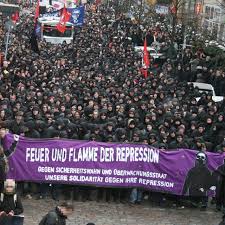
A Black Bloc against repression in Germany -- location and year uncertain
A Black Bloc against repression in Germany — location and year uncertain

Around this time of year in 2010, early on in the protests against austerity, although then called “Right to Work”, back in the last year of the Fianna Fáil/ Green Party coalition government, there was a bloc formed for participating in demonstrations against the bank bailouts and consequent cuts in social spending and wages being imposed or proposed by that Coalition Government. Called the “Anti-Capitalist Bloc”, it seemed composed in the main of the anarchist WSM and what would often be described as “dissident Republicans”, chief among which at the time was the Éirigí organisation. There was a fair sprinkling of non-aligned activists (i.e. not belonging to any party or particular organisation) whose politics could be described variously as socialist republican, anarchist or communist.

Anti-Capitalist Bloc in Dawson Street, Dublin, marching to join anti-austerity demonstration at Dáíl in 2010

This bloc gathered at a different rallying point to the rest of the Right to Work march but marched to meet it at the Dáil. In that role, it survived I think three demonstrations. The first one was attacked by police after the demonstrators refused to be prevented from marching to join the other demonstration.

What was the purpose of this bloc, at least in the eyes of its organisers? I have no documentation to hand but as I recall, it was to say something like: “the problem is not this or that economic measure or this or that party or government; the problem is capitalism itself.” It seemed to be implying that therefore we needed a revolution. I would and did agree with such a statement and with its implication. Not only did I agree with it

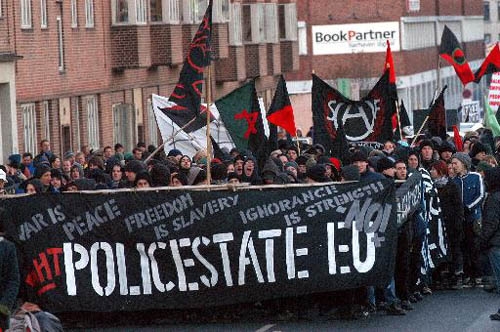
Black Bloc against the EU, possibly a section of the
Black Bloc against the EU, possibly a section of the “March for an Alternative” in London in March 2011.

but it seems to me a crucial point to make, if we are to end our vulnerability to the vagaries of the capitalist system’s fortunes and to its particular rapacity at various times.

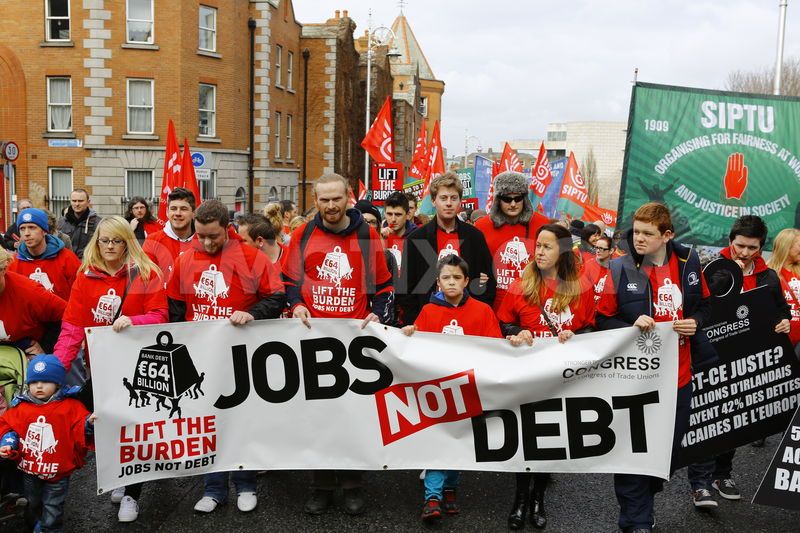
This was a message clearly different from that of some sections of opposition to the Government: SIPTU and the ICTU were saying that there was a fairer way of sharing the burden, which was about what Sinn Féin was saying with “Tá bealach níos fearr/There is a better way”.

Reformist trade union slogan on anti-austerity march in 2010

But could those participants in the bloc not have presented that point of view while still joining the other demonstration at its rallying point and marching with it? Perhaps – by each person being given specific placards, for example, agreeing a joint leaflet or by having speakers to represent their point of view. But all of those present difficulties – the production of an agreed placard slogan to say nothing of the difficulties of agreeing a leaflet. And a speaker might not be permitted by the organisers of the rest of the demonstration or their message would get lost among the others being put forward, even if the speech itself could be agreed by the bloc in advance. All the bloc participants could dress in a similar colour (like the “Black Bloc” on some demonstrations overseas in the past). But a separate bloc, marching behind a banner with a slogan with which each bloc participant could agree, was surely the least complicated way to deliver that message – and very visible. The police who attacked it certainly must have thought so.

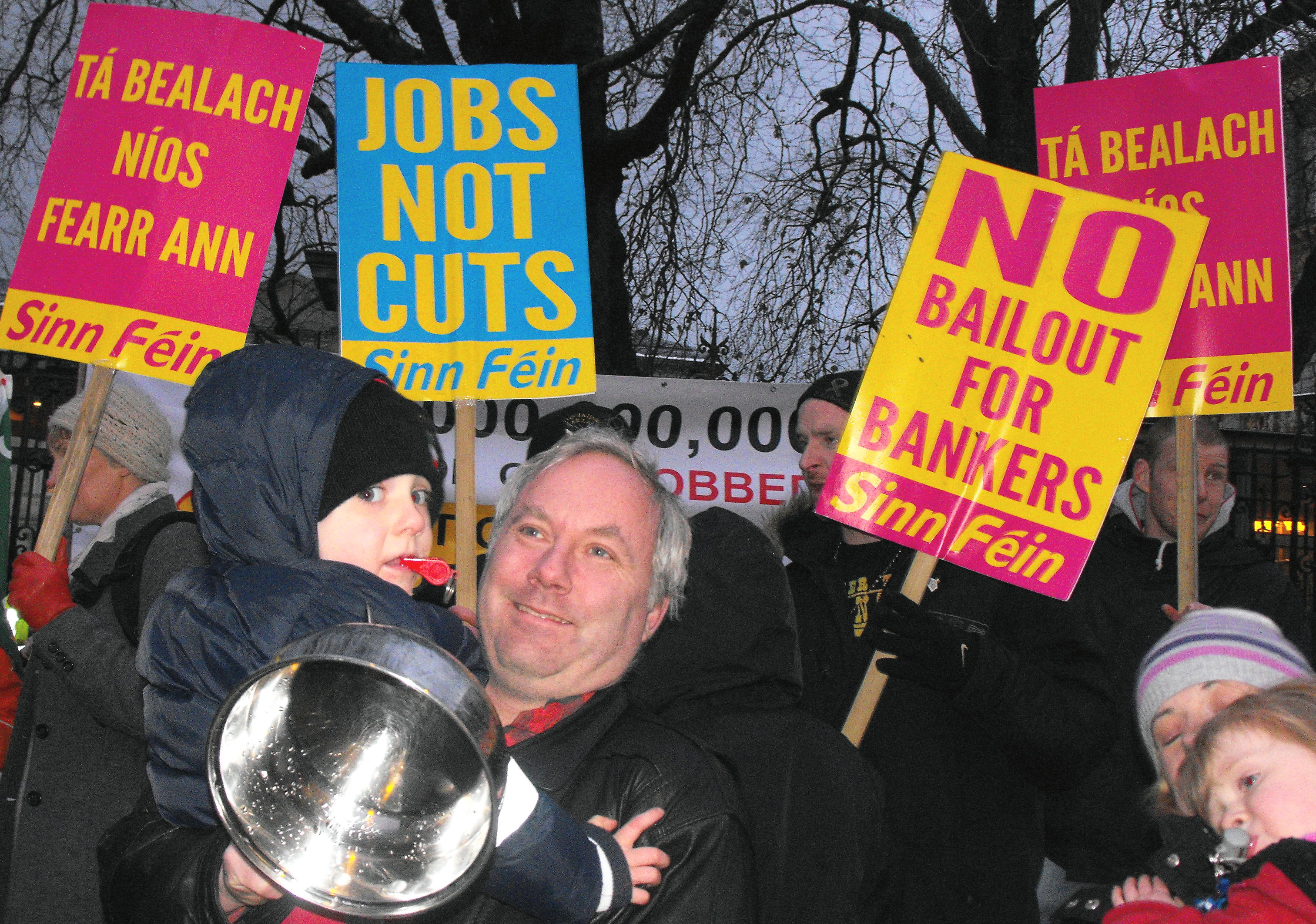
Sinn Féin demonstration at the Dail in 2010 -- all totally reformist slogans apart from possibly the "Don't Pay the Bankers" slogan
Sinn Féin demonstration at the Dail in 2010 — all totally reformist slogans apart from possibly the “Don’t Pay the Bankers” slogan

There is another factor in such a way of organising a bloc – it permits a visible assessment of its size, of the identities of its participants (unless they go masked, as many of the Black Blocs abroad did). Of course this has a down side also in that the state’s political police can take notes on the participants for the purpose of their files. But it has a positive effect too in terms of future progressive and revolutionary action. A mailing list can be compiled for calling to future events, individuals can be introduced to other like-minded individuals, organisations can get to cooperate – all factors militating against the fragmentation of the radical and revolutionary sector.

Some people on the other part of the march accused the Anti-Capitalist Bloc of being politically sectarian. Perhaps some even thought them elitist. These are of course dangers. But was it or was it not an important statement to make, that the problem was not the governing party but the system, and that a revolution was necessary? And if it was an important point to make, was such an eye-catching way of making it not justified?

Let’s consider what happened in the months and years afterwards and where we are now. In the face of a wide-scale howl of protest at the bank deals of the Government, their economic measures, and recent individual politician scandals, Fianna Fáil were deserted by their Green Party coalition partners. FF dumped their leader and elected a new one for their party and for the Government. It was all too little, too late and they were obliged to agree to a general election, the result of which was that FF’s number of TDs (elected representatives) was cut by nearly 80%, the greatest electoral defeat suffered by either of the main political parties in the history of the state. And the Green Party was wiped out as an electoral force, almost disappearing entirely off the political map.

The electoral verdict otherwise was mixed. The main rival of FF, Fine Gael, got the most votes with the social democratic Labour getting the next largest amount. Sinn Féin jumped from four to fourteen, a Trotskyist party and a different Trotskyist led-alliance got four between them for the first time, twenty Independents were elected, most of them left-wing. But whether socialist, republican, conservative or social-democratic, all candidates had been elected on platforms of opposition to the deals the previous government had made with the banks and with the EEC’s banking regulators.

Despite that, Fine Gael and Labour formed a coalition government and proceeded — in fact — to endorse what their predecessors had done and furthermore, to intensify a regime of austerity on working people, introducing three new taxes and supporting legislation to squeeze the people still further. The message of the Anti-Capitalist Bloc was vindicated.

Would the whole demonstration marching under a banner of “Overthrow Capitalism” have significantly changed that electoral result? Extremely unlikely. But it would have posed the question to the participants and to observers. It would have effected subsequent campaigns of resistance to austerity measures and additional taxes. And it would have built a much wider consensus eight or nine years later that the overthrow of capitalism was the only solution with perhaps a growing consensus that such an outcome was possible.

Because here we are now nine years after those three appearances of the Anti-Capitalist Bloc and once again it seems a general election is looming. Once again, we see other political parties pushing forward to be elected on programs without any perspective of overthrowing capitalism. Political alliances based on continuing the system are being mooted. On social media one sees calls for for kicking out Fine Gael or Labour or both, rather than capitalism. On demonstrations against the Water Tax we hear slogans against Enda Kenny, leader of Fine Gael, or against the Labour Party – but few against the capitalist system. Sinn Fein seek to cut down Labour as they court the social democratic vote which, in the past, they have largely ignored (for example, they have little history in the trade union movement). The Trotskyist groups will also attack Labour, also going for the social-democratic vote as they have traditionally done.

Most people feel that the Government will fall soon but when they pose alternatives they are doing so within the framework of capitalism. That means that same class that commanded the deal with the banks and with the EU will remain in power. Their representatives in government will change but the class will remain. And if they remain, their exploitation remains. Not only that but in the present economic climate, their austerity program will remain too – perhaps with some tweaks here and there but austerity still.

A determined campaign of political leadership over the past nine years giving a clear direction of the need to overthrow capitalism could have us in a very different political position now.

So, the next time we get a call to join a bloc for a demonstration, should we rush to it? Well, not necessarily. Let us question what the bloc is for and what it aims to do. Is the bloc in question a tactic, for example like the Black Bloc, where we identify a revolutionary opposition by colour and also, by masking, make it harder for the State to identify us? There may well be a time and place for such. Or is it to declare a revolutionary principle such as “capitalism is the problem; revolution is necessary’? Or “Non-Payment of the Water Charge is what is required”? Then it seems to me that the answer is that yes, we should.

But if it is to draw some particular lines of political affiliation, for example to say that although the participants may belong to separate organisations or none, “we are all communists” or “we are all republicans” or “we are all anarchists”, then I fail to see how that helps the popular resistance movement proceed forward at all, to say nothing of revolution. If that is the purpose of a bloc, it is fine for the followers of that particular ideology but they would be best fulfilling it by holding public meetings and conferences.

On the street, we need to be motivating observers for participation in resistance, and motivating participants for unity in effective actions, for revolution. Motivation has an emotional component but also an ideological one and in that regard the message has to be to overthrow capitalism. At the moment it is that idea that needs to gain hegemony rather than any particular political party or organisation.

End.

YOUNG WOMAN GOES TO TRIAL IN LONDON ACCUSED OF TRYING TO JOIN KURDISH WOMEN FIGHTING ISIS

C0mpiled with introduction by

Diarmuid Breatnach

An 18-year old woman of the Kurdish diaspora in London, Silhan Ozcelik, has been sent for trial at London’s Central Criminal Court (the “Old Bailey”) accused of trying to join the Kurdish-led resistance against ISIS (“Islamic State”).  A British journalist called the trial “disgusting” and said it left him “almost without words” to describe the travesty of justice.  (article below)

http://www.independent.co.uk/news/uk/crime/silhan-ozcelik-disgusting-trial-for-young-woman-who-tried-to-fight-against-isis-10105004.html

Face Paint Kurdish W Fighters
A different kind of face paint: female fighter of the Kurdish guerrilla YPG checks another female comrade as they prepare to go into action with their male comrades on the front line against ISIS in Syria.

This post contains:

  • An article about the trial by J0nathan Owen in yesterday’s British newsaper The Independent (see above)

  • A short article from pro-Kurdish PUK Media containing a discussion on the role of Kurdish women fighters in Syria, with quotes from a wide variety of sources (right at end of this post)

  • A video of an Australian documentary, “60 Minutes”, from the war zone, with war footage, interviews with women fighters and commanders, victims of ISIS (see further down)

  • Background comment or introduction from me (immediately below)

Background Comment:

The Kurds in the region, numbering around 28 million, have the right to self-determination.  They are divided by borders of states set up in the past by the colonial imperialists of Britain, France and the Ottoman Empire and also by ambitions of the states subsequently created: Turkey, Syria, Iraq, Iran and Azerbaijan (there is also a huge Kurdish diaspora in parts of Europe, the USA, Canada).  The Kurds in the region also face differences in political leadership, dialect and religious influence as well as containing among them other ethnic groups (many of these also oppressed): Arabs, Armenians, Azeris, Turkmen, Yazidis …. The whole Kurdish region extends across an area of great strategic importance (the gateway to Europe and to the East) and also of considerable natural resources, including water.  It is envisaged that an oil pipeline will cross this area and a number of dams have already been built there.

The Kurds in Turkey (the largest population of Kurds) has been mostly led by the PKK (and various political organisations friendly to it), a communist-type national liberation organisation, largely secular (though some of their areas can be religiously conservative) and with a very large guerrilla force which has included many women fighters.  They have fought the Turkish armed forces for decades and remain undefeated.  Turkey’s nationalism under Kemal Attaturk declared that Kurds did not exist — they were just “mountain Turks”.  Kurdish has been forbidden, the flying of Kurdish national colours a crime, and state repression has included bannings of parties and newspapers, jailings of political and human rights activists, kidnapping, torture, assassination squads, creation of strategic villages, aerial bombardment, etc.  The imprisoned leader of the PKK, Abdullah Ocalan, last week from prison called on his followers to lay down their arms and to engage in a “peace process” in which however the Turkish Government shows no interest.  Ocalan enjoys an adulation among the PKK and its supporters somewhat as Chairman Mao did among Chinese communists and his portrait can be seen on demonstrations, in pickets and in their secure areas.

The Kurds in Iraq have mostly come under the political dominance of two political leaders with tribal following, Barzani and Talibani.  Iraqi Kurds are mostly Sunni Muslim with a minority Shia population (Fayli) in central and and SE Iraq.  The Kurds were oppressed by the Iraq regime and rose up against them a number of times only to be massacred, including when the US called on them to rise during the Kuwait war but left them on their own.  Their fighters, “peshmergas” are mostly male and during the Iraq Invasion by the US-led coalition, they fought the Iraqi Armed forces but entered Baghdad like bandits and set up various areas of control under different war lords, occasionally fighting even one another.  In the past on one occasion the peshmergas were also deployed against the PKK in conjunction with a Turkish attack on them.

The Syrian Kurds have their own fighters but have not been as prominent in the past as those of the Kurds in Turkey and Iraq.  The Syrian regime does not favour declarations of different ethnicity coupled to aspirations of self-determination and has suppressed expressions of Kurdish nationalism, including jailing singers and musicians whose work includes those expressions. In recent months, the Syrian Kurds and their fighting organisation, the YPG, have had the most success in halting and in places forcing back ISIS — the “Islamic State”.  The YPG rescued a large population of mostly Yazidis (including also some other ethnic groups) after ISIS swept aside the army of the NATO-client Iraqi regime, massacred tens of hundreds of civilians and kidnapped tens of hundreds more, including women which they took or sold as concubines.

The Kurds in Iran have been in recent times the most suppressed perhaps of all the Kurdish populations.  Under the Islamic clerical regime a number of Kurdish political activists have been executed for “crimes against God” (i.e. being atheists and socialists and sharing their political beliefs).  Under the Shah the repression was also heavy and Savak, the secret police, along with their informers, were almost everywhere.  Torture was endemic under the Shah and almost certainly continues under the present regime.

Although the NATO powers fear ISIS, they have also had a hand in its creation in the drive to overthrow regimes resisting NATO’s penetration of the area (and encirclement of Russia) by direct assault or by proxy: Libya and Iraq (already overthrown), Syria (under attack), Iran (constantly being threatened).  They are trying to bring the YPG into the fold but Turkey, an important member of NATO, would rather see the Kurdish fighters wiped out and seals its border to prevent fighters and supplies reaching the YPG.  The USA therefore confined itself to some bombings of ISIS positions around Rojava and diplomatic overtures to the Kurds.  They have not committed ground troops (which the YPG have not asked for) or supplied arms (which the YPG have asked for — repeatedly) and continue to support forces attempting to overthrow the Syrian state.  The YPG rarely fight alongside the state’s Syrian Army but at times both forces are simultaneously in action against ISIS, though seemingly not in coordination

.

The Kurds, as the largest force in their region of Syria and one of the largest ethnic group in the whole region, form a focus of resistance to assimilation and to repressive regimes of states but may be seen by other ethnic groups as themselves posing a threat of assimilating them.

Video documentary “60 Minutes” by Australian television containing Syrian war area footage of Kurdish women fighters and commanders and interviews (and also occasionally irritating comment by the interviewer)

Less Photogenic Kurd Women Fighters
Less photogenic perhaps than the images we are currently being shown of Kurdish female guerrilla fighters, this photo is probably of a female guerrilla unit of the PKK in Turkish Kurdistan taken perhaps a couple of decades ago. In order to counter accusations by the Turkish state of female guerrilla “immoral” behaviour, the PKK kept the genders in separate fighting units.
Two Kurdish Women Fighters kefiyah headscarf
Two female guerrillas of the YPG resting but ready to go into action. They are on the front line against ISIS in Syria.

A discussion on women in Kurdistan and Kurdish women fighters (note that there are two parts of Kurdistan under discussion here – Iraqi and Syrian; however there is also Turkey, where the majority of the Kurds live and Iran):

http://pukmedia.com/EN/EN_Direje.aspx?Jimare=22709

Kurdish Women Heavy Machine gun v ISIS N_Iraq
Female fighters of the guerrilla YPG with a heavy machine gun (light cannon?) in the front line against ISIS
Kurdish women guerrilas against FSA, Syria
Kurdish female guerrilla fighters opposing the Free Syrian Army, sponsored by NATO against the Syrian state, in 2011. The FSA has since been overcome or incorporated into ISIS.

CATHERINE BYRNE, DUBLIN FINE GAEL TD, SAID “WE SHOULD TAKE BACK OUR FLAG”. MAYBE SHE’S RIGHT ….

CATHERINE BYRNE, DUBLIN TD, SAID “WE SHOULD TAKE BACK OUR FLAG”. MAYBE SHE’S RIGHT ….


Dublin South-Central TD Catherine Byrne was warmly applauded when she said that they should ”take back our flag” from people who have been using it in protests against water charges and other issues.  She made the statement at the Fine Gael political party’s two-day conference in Castlebar, Co. Mayo, held under strict security.

Arts Minister Heather Humphreys supported that view and told delegates in a secret session on the 1916 commemorations (a session which exposed divisions in the party): ”Some have used our flag to portray a different message – it’s time to reclaim our flag.”

They are both right, in a way.

Listen to this:

WHAT SHOULD WE DO?

“What should I do?” The anguish reached out to me; I felt it empathically. The cry of a person who is prepared to act and wants to change things for the better, to resist what is wrong around us on so many fronts – and that’s the problem.

There so many issues: the Water Tax, the persecution of Republican activists including framing and jailing them, the harassment and torture of Republican prisoners, the threat of fracking, privatisation of resources and services, cuts in services, cuts in salaries, high cost of private accommodation and low social housing provision causing homelessness, the decline of the Irish language and of the Gaeltacht …. and others. And that’s without mentioning international solidarity – and not because I don’t consider that essential, either.

Of course, we can put all these problems down to capitalism and, in the case of repression of Republicans (and with regard to international solidarity), to imperialism …. so let’s just overthrow those systems and then we can sort out those problems! But that leads to the question of “How” which in turn brings one back again to that anguished question, or to its variant “Which problem should I prioritise?”

Indeed, it is a question that cuts to the heart of the matter. For the issues call to us to act and since we can’t be everywhere at once we have to make choices. It is a question as old as class society and speeches are always being made recommending this choice or that while books have been written attempting to answer it. Lenin wrote a series of articles in the revolutionary newspaper Iskra (“Spark”) and published later as a booklet under a title that echoes that very cry above: What Is to Be Done? It had a subtitle too: “Burning questions of our movement” (by which he meant the socialist movement in Russia at the time).

Whether we choose to believe that work was absolutely correct, partly correct or completely wrong is in some ways irrelevant, for it was written for the movement in Russia in 1902 and published in 1905. I happen to think that it contains many useful ideas, although I am aware that there is a view that it has been mistranslated but, even so, in many ways, all that is beside the point. The fact is that today we have no blueprint and nothing more than perhaps the equivalent of a trouble-shooting manual: “for this problem, try this; if that doesn’t work, try that; while doing so beware of that other.” And that manual is cobbled together from older and more recent history of struggles, of analyses of the capitalist system and of how it behaves.

Scary, surely, to go up against a system that has ruled for around four centuries, that has spread across the world, that controls education, mass media, the State with its police, judges, prison and armed forces – and all without us having a blueprint. Well, if it’s any consolation, the capitalists don’t have a blueprint either … or if they do, they keep having to ignore it and react to events which they have not been able to predict, as well as to the extent of resistance for which they were unprepared. And they clearly make mistakes. Still, 400 years is a long time … a long time for them to learn tactics and strategy and to get comfortable in control and a long time to make us think that we can’t defeat them.

We can defeat them, of course and the indications from history and the internal workings of capitalism — and of its offshoot imperialism — are that we will. But what to do to make that happen? Yes, back to that question. And to the one that logically follows it: which issue to prioritise? For none of us is capable of being everywhere at once and even stretching over a few issues at a time begins to tear at our fabric.

The Marxist-Leninist approach argues for the creation of a revolutionary party that will make decisions on prioritisation and allocate resources to those struggles it chooses as it does so. Of course, the party will make mistakes from time to time and it will learn from those, getting better as it goes along. That’s the theory anyway. In application, or in alleged application, the results have not vindicated the theory – not in the long run, or even in the medium-term. Sure, we have been at it for less than 200 years: the first time workers captured a city was in 1871 and the first successful overthrow of the State was in Russia in 1917, very nearly a century ago. Much less time to learn, to make mistakes and to correct them but still ….

Of course, the alternative method of organising has even less to recommend it on results: amorphous, disparate collectives have not ever successfully overthrown a State and even their success in capturing a city (Barcelona, 1936) is debatable.

So, what is to be done? How to decide which struggle to prioritise? This is not a question I think can be answered by pointing and saying “That one and no other” or even, except at rare junctures, “That one and no other for the moment”. Individuals, collectives and parties will need to choose from the selection as a painter chooses from a palette: “this colour now, then that, no, scrub that one, now mix this with that, no, a bit more light …” and so on, always working towards the desired result which, although in the head, is also taking place on the canvas and making its own demands as it does so.

The truth is that all of those issues I mentioned in passing at the start of this piece, all of those, need addressing. All of them need people to fight in them. That is because they are all part of the same problem and also because we can’t just allow a cancer to grow unchecked in one part of the body while we address the tumours in another. Some individuals and perhaps even collectives are better suited to fight on some issues than on others: for example, a factory shop committee is probably not best placed to lead the struggle against fracking in a rural area, while a rural environmental collective is probably not in the best position to lead the struggle against the Water Tax. Individuals will need to pick and choose according to their own situation, their locality, their own knowledge.

And that would be fine, if the resistance movement as a whole were integrated enough to make creative use of that disparity – for particular struggles to be able to call for temporary additional resources and to be heard by the whole resistance movement, so that it could try to allocate those resources to one or other sector as seemed appropriate. But the resistance movement is far from integrated – it is fragmented and, even worse, it suffers from something akin to schizophrenia.

There a number of ways to imagine schizophrenia and the most popular is to see it as the development of two or more personalities in the one individual. But another is to see it as a disintegration of the personality – where the various aspects in our minds break free and appear as distinct personalities in themselves. The voices that speak in our heads to say things like “You shouldn’t have done that” or “Please make that happen” break free and seem to become different personalities. At times they conflict with one another while the central core personality tries to make sense of what is going on. Something like that, anyway. It is in that sense that I think the resistance movement in Ireland suffers from schizophrenia.

The splitting off of aspects of the revolutionary movement in Ireland has been towards two major poles of attraction: the Socialist one and the Republican. Of course there are some elements who incorporate both to one degree or another but I think examining them as distant poles of attraction is useful and much closer to their concrete manifestation within the revolutionary movement.  In order to examine them as opposite poles I think it is also useful to imagine a stereotype individual inhabiting each pole. Let us then imagine a stereotypical Irish Republican and a stereotypical Irish Socialist.

The Irish Republican is probably working class or maybe lower middle class; he may or may not have done well at secondary education but in any case he is unlikely to have gone to university. He sees himself in a tradition of resistance to British Colonialism and Imperialism stretching back at least to the United Irishmen and perhaps even back to the Norman conquest which began in 1169. His priority is the removal of the British from Ireland. He experiences “political policing” (of which some socialists are now complaining) practically from the moment he becomes publicly active – he has had his name and address taken by Special Branch and/or RUC/PSNI and they have opened a file on him. The Republican’s recent predecessors have been jailed (as are some of his contemporaries now), beaten or even shot dead; they were engaged in armed struggle against the colonial and imperial armed forces in the Six Counties for 30 years and perhaps he looks forward to take the gun up again some day, to strike back at the colonial overlord. He will turn out on demonstrations and pickets against repression of Republican activists, in support of Republican prisoners, including framed ones. He will almost certainly attend mass demonstrations against the Water Tax and may participate in local direct action against it. The Republican’s idealogues are Wolf Tone, Patrick Pearse and Bobby Sands.

The Irish socialist is probably medium or lower middle class and has finished secondary education; she has almost certainly gone on to university. She sees herself as belonging to a tradition of only a couple of centuries, with an Irish tradition going back to the early part of the 20th Century, in particular to the 1913 Lockout and the Limerick Soviet of 1919. She may or may not give a high place in her history to the Irish Citizen Army in the 1916 Rising. Her priority is the defeat of the capitalist class, probably in Ireland first but will turn out in demonstrations against racism, gender discrimination and homophobia in Ireland. The Irish Socialist aspires to a general strike giving rise to a revolutionary take over of the State; in the interim she may or may not think electing left-wing TDs or trade union officials an important activity. She probably can’t conceive of taking up a gun. The Irish Socialist has never had her name taken by the Special Branch or been framed by the RUC/PSNI and may never even have been detained by the police, though she has probably been pushed around by them. She will almost certainly attend mass demonstrations against the Water Tax and may participate in local direct action against this Tax. Her idealogues are Karl Marx, Lenin, possibly Trotsky and James Connolly.

Granted these are stereotypes but they are not so far from reality as to be unhelpful in describing in turn many and perhaps most Irish Republicans and Socialists and therefore in identifying one of the principal fracture lines in the Irish movement of resistance.

If the Republican and the Socialist parts of the Irish resistance movement were to be combined, or at the very least to work on a more collaborative basis, the “What should I do?” question would be easier to answer. It would be simpler to be on a picket for prisoners one week and resisting water meters the next, even if one’s main sphere of activity were among Republicans. The socialist could attend a picket against cuts one week and one for the human rights of Republican prisoners on another, even if her main sphere of activity was among Socialists. But that is not the situation that exists at the moment and, though a number of attempts have been made to combine the two trends in one organisation, they have not met with any great success to date.

So, I have not yet answered the question, have I? Am I saying that what we should be doing is creating some kind of synthesis or at least a collaborative alliance between the the socialist and republican parts of the resistance movement? Well, yes, certainly. But also, and as a contribution to that, as individuals we should try and spread our activity between the areas of greatest concern of each of those sections of the resistance movement. We should, I think, take some time to support resistance to the water tax, demonstrations against cuts etc. in their own right but also find some time to support resistance to British colonialism and its repression of Republican political activists. “If we are not part of the solution, then we are part of the problem” may be a glib truism but it is particularly applicable in this case.

So, how will we find the time to spread ourselves around? How do we ever? We balance and juggle priorities between our politically active and our social lives, with employment thrown in when we have a job. Or upskilling or studying. And possibly cultural or sporting or other activities. But how to choose, how to prioritise? Each of us has to make those decisions herself and himself. Not a very helpful answer? Well, I did state earlier on that there wasn’t a blueprint, so I couldn’t have one myself, could I? This however I feel fairly confident in predicting: if we don’t find a way to support both those parts of the resistance movement to some degree, it will always be fractured. And while it is so, it cannot be successful in either ridding Ireland of our capitalist classes or in finally throwing off the colonial yoke.

end

The Irish War of Independence and the retreat from stated objectives in spite of the precariousness of the British position

(This is reprinted with minimal editing from a section of a much longer piece of mine published in English and in Spanish a year ago https://rebelbreeze.wordpress.com/2014/01/30/how-can-a-people-defeat-a-stronger-invader-or-occupying-power-2/)


Diarmuid Breatnach

The War of Independence 1919-1921 and retreat from stated objectives

Three years later (after the 1916 Rising), the nationalist revolutionaries returned to the armed struggle, this time without a workers’ militia or an effective socialist leadership as allies, and began a political struggle which was combined a little later with a rural guerilla war which soon spread into some urban areas (particularly the cities of Dublin and Cork). The political struggle mobilised thousands and also resulted in the majority of those elected in Ireland during the General Election (in the United Kingdom, of which Ireland was part) being of their party.

The struggle in Ireland and the British response to it was generating much interest and critical comment around the world and even in political and intellectual and artistic circles within Britain itself. In addition, many nationalist and socialist revolutionaries around the world were drawing inspiration from that fierce anti-colonial struggle so near to England, within the United Kingdom itself.

The dismantling by the nationalist forces, by threats and by armed action, of much of the control network of the colonial police force, which consequently dismantled much of their counter-insurgency intelligence service, led the British to set up two new special armed police forces to counter the Irish insurgency. Both these forces gained a very bad reputation not only among the nationalists but also among many British loyalists. The special paramilitary police forces resorted more and more to torture, murder and arson but nevertheless, in some areas of Ireland such as Dublin, Kerry and Cork, they had to be reinforced by British soldiers as they were largely not able to deal effectively with the insurgents, who were growing more resolute, experienced and confident with each passing week.

However, two-and-a-half years after the beginning of the guerrilla war, a majority of the Irish political leadership of the nationalist revolutionary movement settled for the partition of their country with Irish independence for one part of it within the British Commonwealth.

Much discussion has taken part around the events that led to this development. We are told that British Prime Minister Lloyd George blackmailed the negotiating delegation with threats of “immediate and terrible war” if they did not agree to the terms. The delegation were forced to answer without being allowed to consult their comrades at home. Some say that the President of the nationalist political party, De Valera, sent an allegedly inexperienced politically Michael Collins to the negotiations, knowing that he would end up accepting a bad deal from which De Valera could then distance himself. Michael Collins, in charge of supplying the guerrillas with arms, stated afterwards that he had only a few rounds of ammunition left to supply each fighter and that the IRA, the guerrilla army, could not fight the war Lloyd George threatened. He also said that the deal would be a stepping stone towards the full independence of a united Ireland in the near future. None of those reasons appear convincing to me.

How could the leadership of a movement at the height of their successes cave in like that? Of course, the British were threatening a worse war, but they had made threats before and the Irish had met them without fear. If the IRA were truly in a difficult situation with regard to ammunition (and I’m not sure that there is any evidence for that apart from Collins’ own statement), that would be a valid reason for a reduction in their military operations, not for accepting a deal far short of what they had fought for. The IRA was, after all, a volunteer guerrilla army, much of it of a part-time nature. It could be withdrawn from offensive operations and most of the fighters could melt back into the population or, if necessary, go “on the run”.

If the military supply situation of the Irish nationalists was indeed dire in the face of the superior arms and military experience of Britain, was that the only factor to be taken into account? An army needs more than arms and experience in order to wage war – there are other factors which affect its ability and effectiveness.

The precariousness of the British situation

In 1919, at the end of the War, the British, although on the victorious side, were in a precarious position. During the war itself there had been a serious mutiny in the army (during which NCOs and officers had been killed by privates) and as the soldiers were demobbed into civilian life and into their old social conditions there was widespread dissatisfaction. Industrial strikes had been forbidden during the War (although some had taken place nonetheless) and a virtual strike movement was now under way.

In 1918 and again in 1919, police went on strike in Britain. Also during 1919, the railway workers went on strike and so did others in a wave that had been building up since the previous year. In 1918 strikes had already cost 6 million working days. This increased to nearly 35 million in 1919, with a daily average of 100,000 workers on strike. Glasgow in 1921 saw a strike with a picket of 60,000 and pitched battles with the police. The local unit of the British Army was detained in barracks by its officers and units from further away were sent in with machine guns, a howitzer and tanks.

James Wolfe in his work Mutiny in United States and British Armed forces in the Twentieth Century(http://www.mellenpress.com/mellenpress.cfm?bookid=8271&pc=9) includes the following chapter headings:

Workers pass an overturned tram in London during the 1926 British General Strike. In general, goods travelled through Britain with authorisation from the workers or under police and troop protection.

Workers pass an overturned tram in London during the 1926 British General Strike. In much of the country no transport operated unless authorised by the local trade union council or under police and army escort.

4.2 The Army Mutinies of January/February 1919
4.3 The Val de Lievre Mutiny
4.4 Three Royal Air Force Mutinies January 1919
4.5 Mutiny in the Royal Marines – Russia,
February to June 1919
4.6 Naval Mutinies of 1919
4.7 Demobilization Riots 1918/1919
4.8 The Kinmel Park Camp Riots 1919
4.9 No “Land Fit For Heroes” – the Ex-servicemen’s Riot in Luton
4 4.10 Ongoing Unrest – Mid-1919 to Year’s End

 The British Government feared their police force would be insufficient against the British workers and was concerned about the reliability of their army if used in this way. There had already been demonstrations, riots and mutinies in the armed forces about delays in demobilisation (and also in being used against the Russian Bolshevik Revolution).

Elsewhere in the British Empire things were unstable too. The Arabs were outraged at Britain’s reneging on their promise to give them their freedom in exchange for fighting the Turks and rebellions were breaking out which would continue over the next few years. The British were also facing unrest in Palestine as they began to settle Jewish immigrants who were buying up Arab land there. An uprising took place in Mesopotamia (Iraq) against the British in 1918 and again in 1919. The Third Afghan War took place in 1919; Ghandi and his followers began their campaign of civil disobedience in 1920 while in 1921 the Malabar region of India rose up in armed revolt against British rule. Secret communiques (but now accessible) between such as Winston Churchill, Lloyd George and the Chief of Staff of the British armed forces reveal concerns about the reliability of their soldiers in the future against insurrections and industrial action in Britain and even whether, as servicemen demanded demobilisation, they would have enough soldiers left for the tasks facing them throughout the Empire.

The Irish nationalist revolutionaries in 1921were in a very strong position to continue their struggle until they had won independence and quite possibly even to be the catalyst for socialist revolution in Britain and the death of the British Empire. But they backed down and gave the Empire the breathing space it needed to deal with the various hotspots of rebellion elsewhere and to prepare for the showdown with British militant trade unionists that came with the General Strike of 1926. Instead, the Treatyites turned their guns on their erstwhile comrades in the vicious Civil War that broke out in 1922. The new state executed IRA prisoners (often without recourse to a trial) and repression continued even after it had defeated the IRA in the Civil War.

If the revolutionary Irish nationalist leaders were not aware of all the problems confronting the British Empire, they were certainly aware of many of them. The 1920 hunger strike and death of McSwiney, Lord Mayor of Cork, had caught international attention and Indian nationalists had made contact with the McSwiney family. The presence of large Irish working class communities in Britain, from London to GlaSgow, provided ample opportunity for keeping abreast of industrial disputes, even if the Irish nationalists did not care to open links with British militant trade unionists. Sylvia Pankhurst, member of the famous English suffragette family and a revolutionary communist, had letters published in The Irish Worker, newspaper of the IT&GWU. The presence of large numbers of Irish still in the British Army was another source of ready information.

Anti-Treaty cartoon, 1921, depicts Ireland being coerced by Michael Collins, representing the Free State Army, along with the Catholic Church, in the service of British Imperialism

Anti-Treaty cartoon, 1921, depicts Ireland being coerced by Michael Collins, representing the Free State Army, along with the Catholic Church, in the service of British Imperialism

The revolutionary Irish nationalist leaders were mostly of petite bourgeois background and had no programme of the expropriation of the large landowners and industrialists. They did not seek to represent the interests of the Irish workers—indeed at times sections of them demonstrated a hostility to workers, preventing landless Irish rural poor seizing large estates and to divide them among themselves. Historically the petite bourgeoisie has shown itself incapable of sustaining a revolution in its own class interests and in Ireland it was inevitable that the Irish nationalists would come to follow the interests of the Irish national bourgeoisie. The Irish socialists were too few and weak to offer another pole of attraction to the petite bourgeoisie. The Irish national bourgeoisie had not been a revolutionary class since their defeat in 1798 and were not to be so now. Originally, along with the Catholic Church with which they shared many interests in common, they had declined to support the revolutionary nationalists but decided to join with them when they saw an opportunity to improve their position and also what appeared to be an imminent defeat of the British.

In the face of the evident possibilities it is difficult to avoid the conclusion that the section of revolutionary Irish nationalists who opted for the deal offered by Lloyd George did so because they preferred it to the alternatives. They preferred to settle for a slice rather than fight for the whole cake. And the Irish bourgeoisie would do well out of the deal, even if the majority of the population did not. The words of James Connolly that the working class were “the incorruptible heirs” of Ireland’s fight had a corollary – that the Irish bourgeoisie would always compromise the struggle. It is also possible that the alternative the nationalists feared was not so much “immediate and terrible war” but rather a possible Irish social revolution in which they would lose their privileges.

Irish Free State bombardment 4 Courts
Start of the Irish Civil War 1922: Irish Free State bombardment, with cannon on loan from the British Army, of the Republican HQ at the Four Courts, Dublin.


Another serious challenge to the Empire from Irish nationalist revolutionaries would not take place until nearly fifty years later, and it would be largely confined to the colony of the Six Counties.

end selected extract

INTERNMENT AND ANTI-DEMOCRATIC AND POLITICAL SENTENCING IN THE SIX COUNTIES TODAY

Diarmuid Breatnach

Sixteen years after the signing of the Good Friday Agreement, cases of Irish Republican political activists appearing before colonial judges are none too rare in what some call “Northern Ireland”. Of course, the Republicans are not from Provisional Sinn Féin, who have made their peace with Queen and Empire – but they are Irish Republicans none the less.

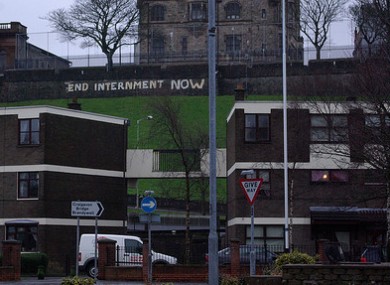
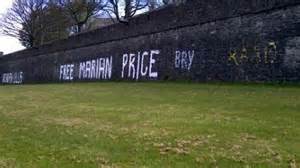
Despite their fairly common occurrence, one recent case seemed to symptomise the state of civil liberties in the colonial statelet so as to deserve some detailed analysis. On January 6th Gary Donnelly (43) and two other Derry Republicans, Terry Porter (56) and William Brogan (51), won their appeals against a sentence of six months imprisonment for painting slogans on the famous Derry Walls but money was paid on their behalves into the court.

End Internment Now Derry Walls

The judge, Philip Babbington, ordered the £2,600 (€3,300) compensation to be equally divided between the Northern Ireland Environment Agency, which has responsibility for the upkeep of the Derry Walls, and the charity Foyle Search and Rescue. No explanation seems to have been given as to why the total sum, which was supposed to have been necessary to remove the anti-internment slogans, was not to be paid in its entirety to the Environment Agency; nor am I aware of any detailed examination of the alleged cost of £2,600 (€3,300) to remove a few painted slogans.

Speaking outside the court Colr. Donnelly said he was ‘relieved’ that the case was finally settled. He said: “I am glad that I am now able to represent the voters of the Moor ward who elected me. There had been a lot of donations made towards this case by people in the city and I am glad that it is going to Foyle Search and Rescue.” He denied that there had been any brinkmanship in the case and said when first arrested they had been held for two days and police had tried to prevent them getting bail.

Cnclr. Donnelly went on: “Graffiti has long been a tool of the working class for years and there was even graffiti on the walls calling for Home Rule1. More damage was caused to the Walls by the installation of lights and the building of the Millennium Form than by anything we did. “I have no regrets for anything I have done.”2

A previous use of Derry's Walls to highlight a case of internment
A previous use of Derry’s Walls to highlight a case of internment

The appeal hearing was attended by four TDs3: Éamonn O’Cuív (Fianna Fáil), Clare Daly (United Left Alliance), Thomas Pringle and Maureen O’Sullivan (both Independents). Also in attendance were numerous councillors from local authorities on both sides of the Border. This attendance, at the court case of one with whose politics most of them would not be in agreement, indicated perhaps some sense of solidarity among public elected representatives but probably more a rising concern among some (albeit not nearly enough) at the state of civil liberties in the Six Counties.

When Donnelly and the other two republicans had last appeared before another judge to answer a charge of “malicious damage” to the Walls (by painting the slogans), no money had been made available to the court and they had been sentenced to six month’s imprisonment. The judge hearing the appeal, Babbington, replaced that sentence with a conditional discharge for 12 months. This means that they will serve no prison term on this charge but if, within 12 months they are again arrested and convicted, this conviction will be taken into account and could result in prison terms.

The original sentence of six months’ jail for painting slogans, even at such an alleged cost of their removal, was excessive. But the impact of this sentence in the case of Gary Donnelly went far beyond that on him, his family and friends. Gary Donnelly is a Councillor, elected to the Derry & Strabane Super-Council and, according to the rules of that body, a sentence in excess of three months would cause him to lose his seat. That in turn would have disenfranchised those who voted for him.

Donnelly was one of four new Independent councillors elected last year, the other three being Darren O’ Reilly, Dee Quigley and Paul Gallagher (Strabane). Gary Donnelly, standing as an Independent, topped the poll in the Moor ward (home of the Deputy First Minister Martin McGuinness), out-polling former Sinn Féin Mayor Kevin Campbell by 50 votes. The three Derry-based Independent councillors have taken two SDLP and one Sinn Féin seat.

These new Independent councillors have a background of years dealing with issues affecting their local communities, often on a daily basis, such as poverty, anti-social behaviour and the growing addiction crisis. Judge McElholm had been made aware that Donnelly would lose his seat if the judge went ahead with his sentence but he was not to be swayed from his course.

Naturally, it is not being suggested that elected Councillors (or any others, including appointed judges) should be permitted to act as they please without consequences, merely because of their office. However, a judge behaving in accord with the principles of a democratic system would take care that the sentence leaned away from disenfranchisement of voters if possible. And of course, it was possible, since a non-custodial sentence or one of anything up to three months’ jail would not have had Donnelly lose his seat or disenfranchised his voters.

For those who are aware of the history and current reality of the Six Counties, that colonial statelet often called “Northern Ireland”, associating it “with the principles of a democratic system” is bound to raise at least one eyebrow. The formation of the statelet was in itself a denial of democracy and self-determination to the Irish people in 1921 and its laws and practice were so undemocratic, so discriminatory against the large Catholic minority, as to give rise to the popular movement for civil rights that began in 1968. The infamous repression exercised by the statelet’s police and courts and its sectarian civilian allies on that movement led in turn to a war of 30 years. Not a single democratic reform was granted by the statelet until that war was well underway. Nevertheless, since its administrators claim it is democratic, it may be useful to subject it to the test of compliance with recognised democratic principles.

THE JUDGES AND THE SYSTEM

During all that history of lack of democracy, institutional discrimination and repression in the Six Counties, judges played their part, faithful to the system. Today, despite some hard-won reforms especially in housing allocation and in voting qualification, the statelet continues to be a colonial one, undemocratic still in many ways, with a sectarian and repressive police force. And the judges continue to play their part.

The original judge dealing with Donnelly’s case, McElholm, revealed his own political bias on a number of occasions during the conduct of the case, even without taking into account the six-month jail sentence. According to media reports, when the three appeared before him again for non-payment of the fines, he said that the painting of the walls was a “wholly uncalled-for exercise”.  He stated that “internment ended ‘a long time ago’, and that it was insulting to the entire legal system to say it continues.”4

Well, was the judge sentencing the three Republicans for “criminal damage”, the words appearing on their charge-sheet, or for carrying out what he considered politically or morally to be a “totally uncalled-for exercise” and for “insulting … the entire legal system”? I would have thought that his words are evidence of a clear political bias.

Nor was it the only occasion when the same judge expressed political bias in respect of Gary Donnelly. When the Irish Republican made his application for the abolition of his curfew (which he had accepted as a condition of being granted bail when first charged), he did so on the basis that having to be indoors by 8pm was a serious restriction on his campaigning work for election, an infringement on his democratic rights and on those who might vote for him. Again, Judge McElholm saw fit to express his political bias in heavy sarcasm. According to media reports, although he granted an exemption of two hours (i.e. until 10pm) on the curfew, Judge McElholm then asked: “Is he going to put up posters or paint his name on walls saying vote Donzo?” He went on to say: “It is clear the democratic process is very dear to Mr Donnelly’s heart”5 and The great working class people I’m sure will now come flooding to his door.”6

BAIL CONDITIONS AND CURFEW AS A POLITICAL WEAPON

The issue of Donnelly’s bail conditions and curfew have been alluded to earlier. People in the West outside of the Six Counties (with the exception of people in other European areas of repressive colonial occupation, such as the southern Basque Country) may be surprised to learn that the imposition of a curfew has become customary as a condition of granting bail to Republicans in the colony. This might have made some sense in the case of slogan-painting, with which Donnelly was accused, and which one would imagine would take place at night. But even so, did a curfew have to be imposed? Would it not be enough that if he were caught doing it again before trial, that his bail would be revoked?

In a democratic system, since the accused are to be “presumed innocent until proven guilty”, they should be at liberty until such time as are tried and receive a verdict. That is the purpose of releasing those charged “on bail” while awaiting trial. They may be found “not guilty” at the end of their trial and even if found “guilty”, the sentence may be a non-custodial one. So, if the accused is thought not to require a custodial sentence, why should he already have spent time in jail? However it is a fact that many Irish Republicans have spent time in jail while awaiting trial. In Donnelly’s case, after two days in custody and against police advice, he was given bail but on a number of conditions.

The purpose of conditions being set for bail is supposed to be related to the specific case and to be reasonable. A financial surety is set in order to deter the accused from absconding before trial. Other than that, what conditions are reasonable? Well, a man accused of assault on another may have a bail condition not to approach his alleged victim and to stay away from that person’s home or place of work. Or to stay away from people who are to be called as witnesses. But how is it to be considered reasonable to set a curfew as a bail condition? And of wearing an electronic tag to ensure compliance? Or of not going to political meetings or meeting with political activists? Or to not reside in a particular town?

These conditions and variations of them have been imposed on a number of Irish Republican activists in the Six Counties. In fact, that same Judge McElhome also imposed a nightly curfew on Gary Donnelly on a previous charge, in August 2010, when he released him on bail to face charges under “anti-terror” legislation, relating to pipe bombs incidents in September 2009. In December 2010, the charges were dropped.

Martin Corey, a Republican prisoner released under licence under the Good Friday Agreement, had his licence revoked and after four years in prison (without even a police interview or charge, never mind a court appearance) was released on a kind of bail or licence under conditions which he is not permitted to divulge but are rumoured to include wearing a tag and not associating with “known dissidents”.

Perhaps one of the most illustrative examples was that of Stephen Murney, an activist with the Éirigí group, who was arrested on spurious charges in November 2012 and refused bail. When his appeal against that refusal was heard after six months in jail, the judge granted bail but on conditions: Murney was to wear a tag, observe curfew, stay away from certain political activists and stay away from Newry — the town in which he lived and where his partner and child also lived. To his credit and taking an important stand for civil rights, Murney refused to accept the conditions and spent 14 months in custody awaiting trial. Eventually, some of the charges were dropped and he was found not guilty of all remaining charges.

CRIMINAL OR POLITICAL CONVICTIONS?

A member of the 32-County Sovereignty Movement, Gary Donnelly has been politically active for many years. Something has been made in reporting of the case that Gary Donnelly has previous criminal convictions – he has a police record and he has also had a number of charges eventually dropped. In March 2010, he was sentenced to seven months jail on a charge of assaulting a police officer. At one of his recent court appearances, a police officer said he he had criminal convictions also for public order offences and one for arson.

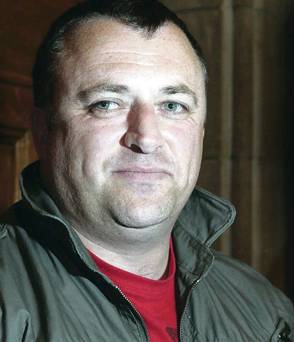
Garry Donnelly, Irish Republican and elected Councillor

In many societies outside the Six Counties this might seem extraordinary for an elected representative but I would submit that it is the system in the Six Counties that is extraordinary, at least with regard to what might be expected of a European democracy.

Donnelly’s “criminal convictions” would have been no secret and his voters put him in office despite those convictions and quite possibly even in part because of them. I do not have the details of the incidents that gave rise to them but any half-awake observer of life in the Six Counties knows that with a sectarian and repressive police force hostile to Republicans, acquiring convictions for “assault on police officers” may be the result of police concoction, self-defence by the charged or even actual assault but in all those cases, the likelihood is that the incidents are overtly political in nature.

Convictions for “public order offences” are probably the most easily-acquired by political activists and often mean merely that the person convicted refused to cease his or her protest when ordered to do so by a police officer. It is rarely possible, with any hope of success, to challenge the justification of the police officer in ordering the protest to finish.

“Arson” can also be a political offence and I once heard a Garda senior officer declare that burning a purchased US flag in a public protest was “arson”! And, as has been clearly demonstrated, the “criminal damage” which has now been added to Donnelly’s police record, both in its content and in its treatment, was political.

INTERNMENT – WHEN IS IT NOT?

Although no-one denies that the British implemented internment between August 1971 and December 1975, when 342 people were subjected to it7, there is far from universal agreement that the British are practicing internment in their colony today. One supposes that the socialists and social-democrats there at present don’t agree that it is being practiced — or surely they would be protesting against it! And, as we saw earlier, Judge McElhone declared that internment had ended back in the 1970s and that to state that it was still being practiced was “insulting …. to the entire legal system”. Sinn Féin don’t call it internment on the rare occasions upon which they refer to the victims but that may be more an issue of convenience than of terminology. Even a member of a Republican organisation which is opposed to the Good Friday Agreement recently argued with me that what is happening is repression but is not internment.

British soldiers detaining a man in the Six Counties during the internment operation in August 1971.

Well, I’m quite interested in correct use of terminology myself, so I thought I’d better look up the definition in a number of on-line dictionaries. It turns out that dictionary definitions of “internment” vary somewhat. Wikipedia has it asthe imprisonment or confinement of people, commonly in large groups, without trial, while for Dictionary.com it isthe act of interning or state of being interned, esp of enemy citizens in wartime or of terrorism suspects”. Dictionary.com goes on to elaborate that “Internment means putting a person in prison or other kind of detention, generally in wartime. ………….. Internment usually doesn’t involve a trial, so you’re being held because someone thinks you might be dangerous, but there’s no proof.”

Grammarist has it as “the act of detaining a person or a group of people, especially a group perceived to be a threat during wartime,” while for Cambridge Dictionaries on line it is the act of putting someone in prison for political or military reasons, especially during a war.” Macmillan Dictionary defines it as the act of putting someone in a prison without officially accusing them of a crime, especially when this is done for political reasons”.

Sifting through these definitions then, the most common aspect is that internment involves imprisonment without trial. It may be applied to many or a few (and let us remember that Oswald Mosley, of the British Union of Fascists, was interned by the British on his own during WW2 albeit in a house with grounds). Two definitions mention wartime, while some allude to “terrorism” and a few mention “political reasons”. On the basis of those definitions, internment is undoubtedly being practiced in the Six Counties.

Refusing Republicans bail (e.g. Stephen Murney, Colin Duffy and man others) and revoking licences (e.g. Marian Price, Martin Corey) have all resulted in imprisonment without trial – for periods varying from a year to four years. The individuals may be – and often are – eventually found “not guilty”, or their convictions overturned (as with Colin Duffy, Brian Shivers and, one hopes, the “Craigavon Two”) or released on “humanitarian grounds” but they will already have spent time in jail. This was the reasoning which no doubt lies behind a number of political activities against the current internment and certainly was expressed at the founding meeting of the Anti-Internment Group of Ireland (of which I am proud to be a member) which has organized public meetings, demonstrations and information pickets in various communities in Dublin and in other parts of Ireland.  The non-party Group was set up by some of the campaigners in the also non-party Dublin Free Marian Price Campaign after the partially-successful conclusion of that struggle (Marian Price was released on “humanitarian grounds” but already in broken health).  The AIGI can be found on https://www.facebook.com/pages/End-Internment/581232915354743?fref=ts

Information picket (with table across the road) organized by Anti-Internment Group of Ireland in September 2014 at Thomas St./ Meath St. junction, Dublin.  They returned there in December and in January supported a picket in Cork, handing out leaflets on the Craigavon Two injustice.
Information picket (with table across the road) organized by Anti-Internment Group of Ireland in September 2014 at Thomas St./ Meath St. junction, Dublin. They returned there in December and in January supported a picket in Cork, handing out leaflets on the Craigavon Two injustice.

Imprisonment puts a strain on the individual prisoner and also on friends and relations – and, indeed, on relationships. It disrupts the political work of the person jailed and of their organizations. And it serves as a threat to others considering becoming active in opposition to the State. Its purpose in these cases is primarily political. The deprivation of liberty without due cause is a violation of human rights and to do so for political reasons, which is clearly the case here, is a violation too of civil rights.

That the legal system in the Six Counties is being used in this way should come as no surprise to those familiar with the operation of colonial law or indeed to any readers of Brigadier Frank Kitson’s Low Intensity Operations (1971)8. Kitson completed the book while on military service in the Six Counties but mainly drawing on his experiences in repression of resistance in Kenya and in Malaya in the 1950s. In the Six Counties Kitson was commander of 39 Airportable Brigade from September 1970 to April 1972, with responsibility for one of the British Army’s three main regional sub-commands in the Six Counties, the greater Belfast and Eastern area.

One of the units under Kitson’s command, 1st Para, was the main actor in killing and wounding a large number of civilians in Ballymurphy in July 1971 and in Derry’s Bloody Sunday in January 1972.

The Military Reaction Force, a special covert operations unit, was based at Kitson’s headquarters in Palace Barracks outside Belfast. Last November (2013), a BBC ‘Panorama’ investigative program on British counterinsurgency in the Six Counties in the early 1970s featured members of the MRF admitting to the murder of suspects and unarmed Catholic civilians.

Back in April 1972, within a few weeks of Bloody Sunday and his receipt of a CBE for his service in the Six Counties, Brigadier Kitson was flown to England to head the Infantry School at Warminster and Low Intensity Operations would become a British Army manual on counterinsurgency and counter-subversion.

In that book, Kitson approvingly quoted another repression “expert”9:

the Law should be used as just another weapon in the government’s arsenal, and in this case it becomes little more than a propaganda cover for the disposal of unwanted members of the public. For this to happen efficiently, the activities of the legal services have to be tied into the war effort in as discreet a way as possible..”

And so it has been in the Six Counties (and long before Kitson described its operation): the legal system being “just another weapon in the government’s arsenal.” At the moment, the “unwanted members of the public” being “disposed” of are Irish Republicans who do not agree with the Good Friday agreement and who organise to oppose British colonialism, some with arms but most through political agitationn — “unwanted” by British imperialism and Six County capitalism, that is. Their treatment should be enough to bring democratic people out in oppositon to these state practices but should it not do so, those people may wish to consider that tomorrow those designated as “unwanted members of the public” may be people protesting cuts in services, fracking operations, privatisation, or militant trade unionists ….

end

Footnotes:

1 A movement for Irish autonomy within the UK (or, later, Commonwealth) between 1870 and 1914.  Teachtaí Dála: Members of the Irish Parliament

3 Teachtaí Dála: Members of the Irish Parliament

6http://www.derrynow.com/article/2893 (accessed 20 January 2015)

7  Even now a case is being taken by the Irish state against the British state to the European Court of Human Rights, over the torture of 14 victims of that internment. The Irish Government took the case of the 14 “hooded men” to the ECHR in the 1970s and won a judgement that the men had been tortured; however the British state appealed the verdict and it was changed to “cruel and inhuman treatment” (!). The Irish Government left the case there but recently RTÉ, the Irish TV broadcasting service, screened their programme The Torture Files based on documentation uncovered by the Pat Finucane Centre, showing the British Government had lied to the ECHR. Amnesty International publicly called on the Irish Government to reopen the case with the ECHR.

8 Faber and Faber — reprint 1999

9  Sir Robert Thompson, Defeating Communist Insurgency; the lessons of Malaya and Vietnam (1966), F.A. Praeger, New York.

JE NE SUIS PAS CHARLIE (I AM NOT CHARLIE)

By José Antonio Gutiérrez Dantón / Friday 9 January 2015 (translated from the original in Castillian)


To begin with, let me make it clear from the outset that I consider the attack on the satirical magazine Charlie Hebdo to be an atrocity and that I do not believe that it is justifiable under any circumstances to make a military target of a journalist, no matter what our opinion on the quality of his journalism may be. The same is valid in France, as it is in Colombia or in Palestine.

Also, nor do I identify with any fundamentalism, whether it be Christian, Jewish or Muslim, nor indeed with Frenchified mock-secularism either, which makes a goddess of the “République”.

I present these necessary explanations since no matter how much the high priests of politics insist that we live under an “exemplary democracy” with “great liberties”, we all know that Big Brother is watching us and that any speech outside the script is severely punished. But I believe that to condemn the attack on Charlie Hebdo is not the same as celebrating a magazine that is, fundamentally, a monument to intolerance, racism and colonial arrogance.

I cannot view with equanimity the constant symbolic aggression that has as its counterpart a physical and real aggression, which is the bombing and military occupation of countries belonging to this cultural horizon. Nor can I happily these cartoons and their offensive texts with a light heart, when Arabs are one of the most marginalized, impoverished and exploited sectors of French society which has historically been brutally treated.

I do not forget that in the early 1960s, in the Paris Metro, the police massacred 200 Algerians by clubbing, just because the latter were demanding an end to the French occupation of their country, which had already led to a total of a million dead “uncivilized” Arabs.

This is not about innocent cartoons drawn by free thinkers but rather about messages produced by mass media (yes, though in an alternative posture, Chalie Hebdo is part of the mass media), loaded with hatred and stereotypes reinforcing a discourse that considers the Arabs as barbarians to be contained, uprooted, controlled, represed, oppressed and exterminated. These are messages the implicit purpose of which is to justify the invasions of Middle Eastern countries as well as the many interventions and bombings orchestrated in the West in defence of the new imperial map. The Spanish film actor Willy Toledo controversially commented, no more than was obvious, that “The West kills every day. Silently.” And that is what Charlie and his black humour hides under the cover of satire.

I do not forget the front cover of Charlie Hebdo issue N°1099, in which it trivialized the massacre of more than a thousand Egyptians by a brutal military dictatorship which has the approval of the USA and of France, carrying a cartoon with a text declaring “Slaughter in Egypt. The Koran is shit: it doesnt stop bullets.” The cartoon showed a Muslim man riddled with bullets that had passed through a copy of the Koran, with which he had been trying to protect himself. Perhaps some find this funny. In their time too, the English colonists in Tierra del Fuego, Argentinia, thought it funny to have photographs of themselves taken, with wide smiles and rifle in hand, a foot on the corpses of the still-warm and bleeding bodies of the native people they had hunted.

Charlie Hebdo cartoon referring to the attack on Egyptian protesters in which 1,000 were killed.
Charlie Hebdo cartoon referring to the attack on Egyptian protesters in which 1,000 were killed.  Juxtaposed, an imaginary cartoon treating the attack on Charlie Hepdo in a similar manner.

Rather than funny, that cartoon to me seems violent and colonialist, an abuse of the fictitious and manipulated western freedom of the press. How would people react if I were to design a magazine cover bearing the following text: “Slaughter in Paris. Charlie Hebdo is shit: it doesn’t stop bullets” and made a cartoon of the deceased and gunned-down Jean Cabut holding a copy of the magazine in his hands? Clearly that would be outrageous: the life of a Frenchman is sacred. The life of an Egyptian (or Palestinian, Iraqi, a Syrian, etc.) is “humoristic” material. For that reason I am not Charlie, because for me, the life of each one of those Egyptians pestered is as sacred as is any of those caricaturists assassinated today.

We already know what to expect now: there will be speeches defending press freedom from countries which in 1999 gave their blessing to the NATO bombing of the Serbian public TV station in Belgrade, calling it “the Ministry of Lies”; countries that remained silent while Israel bombed the Al-Manar TV station in Beirut in 2006; those that respond with silence to the murders of Colombian and Palestinian critical journalists.

After the beautiful pro-freedom rhetoric will come the liberticide action: more McCarthyism, disguised colonial “anti-terrorism”, more colonial interventions, more restrictions of those “democratic guarantees” threatened with extinction and, of course, more racism.

Europe is consumed in a spiral of xenophobic hatred, islamophobia, anti-semitism (in fact, the Palestinians are Semitic) and this atmosphere has reached unbearable levels. The Muslims are already the Jews of 21st Century Europe and neo-Nazi parties are becoming respectable again, 80 years later, thanks to this detestable feeling.

Because of all this, in spite of the feelings of repulsion engendered in me by the Paris attack, Je ne suis pas Charlie.

Note on author:
José Antonio Gutiérrez D. is a libertarian political activist living in Ireland, where he participates in the movements of solidarity with Latin America and with Colombia, a contributor to the CEPA (Colombia) magazine and to El Ciudadano (Chile), and also to the international web page  www.anarkismo.net.  He is author of  “Problemas e Possibilidades do Anarquismo” (in Portuguese, Faisca ed., 2011) and coordinator of the book “Orígenes Libertarios del Primero de Mayo en América Latina” (Quimantú ed. 2010). 

LOOTERS AND SHOOTERS


Diarmuid Breatnach

Reading Salvage The Bones, a well-written novel by Jesmyn Ward, all but the last chapters of which are set in Louisiana during days of the impending hurricane Katrina in 2005, I started thinking about looters.

Looters” is the name usually given to those who sometimes operate in areas in the wake of a disaster, stealing items, occasionally also killing and/ or raping. They are generally reviled in discourses, characterized as savage opportunists taking advantage of misery and breakdown of law and order to prey on the weak and defenceless.

Alleged looters sit handcuffed under police guard in Oklahoma after storm May 2013.  Nearby, neighbours whose homes were destroyed and who accused the men of looting.
Alleged looters sit handcuffed under police guard in Oklahoma after storm May 2013. Nearby, neighbours whose homes were destroyed and who accused the men of looting.


Although “looting” is also used to describe many of the activities of advancing victorious troops on ground won in war (and on occasion too, activities of retreating troops), those troops themselves are never called “looters”. 

Yet plunder of treasure and goods was in fact one of the main reasons for invading forays or war for centuries: the Irish word “creacht” (from which, according to one theory, the colloquial Hiberno-English word “crack as in “the crack was great” — is derived) means, among some other meanings, loot taken from the victims of a raid – in their case, usually from another clan and the loot or “booty” often cattle, the main measure of wealth for centuries in Ireland.

Many Native American tribes raided others for horses and women (and sometimes male slaves). Groups among the Vikings, Saxons and Celts frequently sailed to other lands from which they took away slaves (probably the main booty and external trade goods for the Vikings, who made Dublin one of their slave markets). The hordes of the Mongols, the Vandals, Huns and Goths all raided and looted. They were mainly non-Christian hordes of course and what could one expect of the like?

The Christian Crusades were fought for control over the eastern spice and silk caravan routes and for land but loot was the main prize for the individual soldiers and officers. The first city attacked by the Crusaders was Damascus, a mostly Christian city. Charlemagne, that great soldier of Christendom, invaded Arab Spain in 778 ostensibly to aid three rebellious Arab chiefs against their Arab overlord, the Caliph of Cordova (Córdoba), during which he would also strike a blow against the Muslims; however he took one of his allies hostage (the Arab Governor of Barcelona) and only gave him up to another, the Governor of Zaragoza, a city Charlemagne besieged for a while, for a huge ransom of treasure. Departing then, Charlemagne took what he considered his quickest and safest route with his loot into the lands of his Frankish kingdom and went over the Pyrenees.

But some of his forces had already been near there when they sacked the Basque city of Iruña (Pamplona); in revenge the Basques (possibly aided by Asturians and Occitanians) mauled Charlemagne’s rearguard and killed most of the nobles with them. One of these was Hroudland, military governor of the land bordering Brittany, who was later romanticised as the great warrior Roland who died fighting the Muslims of Spain who threatened the Christian Europe. Unfortunately for this story, the fact is that the Basques, Asturians and Occitanians were …. yes, Christians. They just happened to have good relations with Muslim Spain (the reverse of what they were to have later with its Christian rulers).

 The Shooters

Modern warfare is also fought for loot but not usually by the soldiers in the army. Soldiers in modern armies are paid, as indeed they were in older times but looting is not usually encouraged. Their officers will no doubt turn a blind eye to a trophy, such as a Nazi luger or bayonet or some item of Saddam’s Iraqi Army equipment, but cart or jeep loads of such items would not be tolerated and even less so personal possessions of people in invaded countries.

The Nazi armed forces, despite their apparently rigid “morality”, were a famous exception, with senior officers looting famous paintings, sculptures, gold and diamonds and corruption extending downwards to concentration camp guards. The US and especially the ARVN (the South Vietnamese government forces) invading Cambodia and Laos in 1970 and 1971 respectively were well documented sending back lorry-loads of loot. And the war-band Kurds of Barzani and Talabani, the so-called “peshmergas”, in 2003 swept into Iraqi towns and looted whatever they could — even from hospitals — as the USA invaded. But these are exceptions among modern armies.

So modern wars are not usually fought for loot then, one might think – but one would be wrong. Modern wars were and are certainly fought for loot – rubber, oil, gas, coal, metals and minerals, wood, crops, water, markets – as well as for land, strategic bases and tactical supremacy. The main difference, apart from the loot being of a grander scale in modern warfare, is that it is not the soldiers who will be collecting the loot, nor even the officers, but the capitalists and politicians (often interchangeable terms) who ordered the war. In so far as senior officers may share in the loot, it will not be through their military rank as such but as members of the ruling elite from which they are often drawn or to which they have gained accession.

But these are not called “looters” either, except maybe by people in the occupied or invaded countries and they of course are biased, aren’t they? And maybe by some socialists and communists – but that’s the kind of propaganda statements you might expect from them, right? In fact, the soldiers in modern armies are often required to shoot looters!

A protester shouts at the National Guard standing on duty outside the Ferguson Police Department after the grand jury verdict in the Michael Brown shooting in Ferguson, Missouri, November 26, 2014. (photo: REUTERS/Jim Young)


In the USA, the soldiers shooting looters have usually been the National Guard, or State Troopers. But the police are armed there and they have also shot looters. When it comes to such a situation in Britain, it will probably be the British Army doing the shooting. If it were to occur in the Irish state, it would perhaps be firstly the Armed Response Unit of the Gardaí, who have a number of kills under their belts already (none of them in riot, looting or shootout situations, by the way) but in any large-scale looting scare, it would be the Irish Army. It is doubtful if the FCA would be trusted to do the shooting but they might be called out as guards on some centres and to staff roadblocks. 

Shooting looters might be a bit extreme, especially in countries without a death penalty, but extreme situations require extreme responses, citizens might say. We need someone to stop looters breaking into our homes, stealing our money, laptops and television and maybe killing and raping us into the bargain.


The Looters

Let’s take a look at the looters, for a minute or two. They generally fall into one of two groups: the ones who are opportunistically stealing whatever is easily available without violence to person, on the one hand and those who are prepared to fight, to hurt and possibly even to kill, on the other. Sprinkled across both groups, there are two main motivations: 1) to take food, drink or smaller luxuries such as today would be TVs, Ipads and laptops or 2) to steal large amounts of money, valuable jewelry etc.

In the aftermath of Hurricane Katrina, people who were starving and dehyrating and therefore searching destroyed buildings for food and bottled water and soft drink cans were shot by police and National Guardsmen. In Haiti, after the 2010 earthquake, rioting and looting were reported in the western media but strangely, one might think, given the level of poverty of most of the Haitian population, it turned out that actually there had been very little. What there had been were demonstrations of protest against the authorities’ slow response and against opportunists appropriating freshwater sources and selling the water. However, the reports justified the first practical response of Haiti’s strongest neighbour and main backer of its political regime – the sending of US Marines to the island. They of course could shoot looters … and perhaps demonstrators too if they got too numerous and ambitious.

Hurricane Katrina victims in New Orleans signaling for help

In the wake of a national disaster, the hardest hit are usually those further down the economic scale. The poorer one is, the less possible it would be to get far away from the disaster area and yet be able to eat, drink, wash etc. The less likely too that one’s living quarters are going to be well-built to withstand hurricane, earthquake, flood; the less likely that one has access to alternative power sources, alternative transport, food and water stocks, medicine ….1

So where will people who are without shelter, warmth, food and drink go to find these things? If the emergency relief is sufficient and very quick, most of the disaster victims will go to relief camps and centres. If it is not, or in areas for which such emergency response is difficult to reach, the people are thrown on their own resources. There will be some communal mutual aid but let us not forget we have been discussing areas of poor people – most will have little beyond what they need for themselves and their own families. So what about shops, houses of the rich and those perceived as being better off ….? Of course, their owners will be in no danger if the armed police or troops turn up to shoot the cold, the hungry, the dehydrated, the ill.  

But what about those marauding opportunists, the looters who mainly want money, jewelry, expensive electronic equipment, cars …..? And murderers and rapists? We won’t shed a tear to see them shot down as the wild dogs that they are. Nasty predators on the victims of disasters!  And they are, no doubt about it. One of those comes through your door or window, don’t think twice about shooting him if you’re lucky enough to have a gun or stabbing him if you don’t. Although it might be difficult to differentiate them from the ones who just want a blanket, or clean drinking water, or some food …. Anyway, luckily, those violent predatory looters tend to exist in small numbers and their victims are likely to be numbered in dozens or at most in hundreds ….  

There are people who actually make money – and lots of it – from disasters. These are speculators who flock to disaster areas but they are not called “looters” — they are instead referred to as “entrepreneurs”, “niche investors” or, at worst, as “disaster capitalists”. These are often already organised into corporations and, according to Naomi Klein, one of their major chroniclers (read “Shock Doctrine”), they are organised and waiting for natural disasters and major political changes, anything that leaves most of the population in shock, to move in, privatize state services and property, impose legal and political changes allowing them to make quick profits and strip whatever assets can so be stripped.


The Shock Doctrine book

Milton Friedman, Professor Emeritus at University of Chicago, credited with the creation of the "Chicago School" of neo-conservative economists which legitmized disaster capitalism
Milton Friedman, Professor Emeritus at University of Chicago, credited with the creation of the “Chicago School” of neo-conservative economists which legitmized disaster capitalism

They flocked to Haiti in 2010 as they had to Chile after the coup there in 1973, to the Soviet Bloc as it collapsed from 1989 onwards, to South Africa as apartheid was abolished in the early 1990s, to Indonesia and surrounding lands in the wake of the Java Earthquake and Tsunami of 2006. They are also circling Ireland in its current financial institutions collapse. They are new only in their level of reach and organisation – they flocked to the former Confederacy as it lost the American Civil War in 1885 but in those days they were known as “Carpetbaggers”.  

These capitalists add to the disaster death toll by application of their doctrine of “the more and greater shocks the better”, by their dismantling of the safety nets of state health, welfare and education services, by their destruction of native industry and agricultures (except wherever it suits their plans to continue exploiting them), by the greater impoverishment of populations.  

The looter who terrorized some people in your neighbourhood and killed a few who resisted will almost certainly be gone within the year.  The disaster capitalist may well be gone in the same time or even sooner but he will have caused the deaths of hundreds or thousands in the short term and misery for millions for years to come.  

We should shoot him first, surely?  If you plan to do that, go well-armed, for standing guard for him and his kind are the Shooters: the police and the army.


Ends


Footnotes:

1    In 2004, I was taking advantage of a really cheap flight and hotel deal to a quiet resort in Trinidad & Tobago. During my short stay, Hurricane Ivan, classified in that area as Category 3 (winds 50-58 knots or 111-129 mph or 178-208 km/h) struck the island. It knocked down trees, downed power lines, caused flooding and landslides. In my hotel, the guests had to make do with a repeat menu served by low lighting and later sandwiches and bottled water delivered to rooms. We experienced a short break in power before the auxilliary generator came on. Television reception was terrible – not worth watching except for trying to make sense of the hurricane diagrams on CNN.

Outside the hotel, a number of poorer people’s houses were destroyed by falling trees, landslides and flooding but I think that thankfully, only one person was actually killed on the island (elsewhere, from the Windward Islands to Latin America, Cuba [where it reached Category 5] and southern and eastern United States, it killed 191 people directly and caused indirectly the deaths of another 32, according to Wikipedia).

As the temperatures climbed back again after the hurricane, power was not restored to many houses and small businesses for days, during which refrigerated and frozen food was destroyed. Most of those houses were without air-conditioning too but then most of them had never had it anyway.

WHICH RESISTANCE TACTICS TO USE?

Diarmuid Breatnach

What tactics should we use in political resistance struggle? Physical action or not? If we think physical action is valid, what type do we support and when should we employ it? On the other hand, the same questions arise with regard to non-physical action ….

For most people in this country, the closest they come to physical action in politics is to present themselves at the polling booth. One of the primary declared objectives of most political groups, in fact, is to deepen the involvement in political action of the majority of the population of the country (although what each means by this and to what degree they are serious about it differs greatly).

Something of an ideological struggle has been taking part in the movement against austerity measures as to how best to increase public involvement in effective resistance. Some advocate participation in demonstrations and pickets as their main activity, with perhaps a sprinkling of public meetings. Others advocate civil disobedience and/or disruption as the most effective tactics. Curiously, most agree with participation in on-line petitions and “liking” particular ideological Facebook pages. Many agree with voting for candidates perceived to be in opposition to austerity measures, while some do not. For some, membership of a political party is an important step while for others it is of no value at all. Faced with this lack of general agreement across the spectrum opposed to the status quo, how are we to make decisions, to make reasonable choices?

I’d like to attempt to answer this question but first I’d like to give an example from which to learn, a parable, if you will.

ONCE UPON A TIME ….

Let us imagine a country called Awtaegin. Across the world in the 1960s and 1970s, youth and students were in a ferment, disenchanted with the dominant system as they perceived it and in this Awtaegin was far from being an exception. This disenchantment with the dominant system also extended to many of the oppositional political parties, such as the main social democratic opposition party (which we can call the “Labour Party”) and the USSR-aligned Communist Party (which we can call the UCP).

A number of organisations arose which were opposed not only to the existing order but also to those aforementioned political parties which they considered to be no more than a slightly alternative way to manage the same system and order to which they were opposed, in the case of the Labour Party and a hindrance to mobilising for real change, in the case of the UCP.

One of the opposition organisations to arise was a communist group advocating revolution but which did not support the system in the USSR, which it considered oppressive and imperialist. This group in fact supported the system in China and the politics of its leader at the time, Mao Tse Tung. At that time this leader and his country were very popular among revolutionary communist and national liberation organisations around the world. Let us call this group the MCP.

In its early days, the MCP was something of an object of derision for most of the Left organisations including those advocating revolution in Awtaegin. It was very small and put a lot of store in the Red Book of Mao’s sayings. The MCP popularised Chinese posters. The leaflets and newspapers produced by the MCP tended to contain many quotations from “Chairman Mao” (but also from Lenin and Marx, which the other revolutionary organisations liked to quote too) and the party insisted on using revolutionary political terminology which had gone somewhat out of fashion in Awtaegin.

No-one could deny that the members and supporters of the MCP were hard-working. They went on to the streets and door to door in working class areas with their newspapers and leaflets, attended demonstrations and strike pickets, held internal discussion meetings, organised public meetings, put up posters. Nor could anyone deny that they had guts – their activists often vigorously resisted arrest, they carried their political struggle into the courts instead of, as had become the norm, just trying to be found “not guilty” or to receive the least possible punishment. It was not long before some of them found themselves being sent to jail by the State and there too they often continued their struggle.

If the members and supporters of the other revolutionary organisations had a sneaking respect for those of the MCP, they did not show it. The commitment to work and resistance exhibited by the MCP was explained as fanaticism.

The MCP had built links with a loose network of ethnic minorities in Awtaegin, most but not all students. Mao and China were very popular among many of these ethnic minorities, particularly among the students from Africa, Asia and Latin America, whether on grounds of the national liberation of their home countries from imperialism and colonialism or on the grounds of overthrowing capitalism and of building socialism. Many of these students were organised into a broad organisation which we can call the Progressive Afro-Asian Association (PAAA).

The MCP developed fraternal links with the PAA, which had quite a large network. Through reading, through internal discussions and discussions with the PAA, the MCP developed a theory on racism and its relation to fascism in application to conditions in Awtaegin. In that country at that time racist ideology was dominant and also a number of organisations with an openly racist agenda were on the rise.

The MCP theorised racism as a product of and justification for colonialism and imperialism and also as a method of dividing the working class to facilitate capitalist exploitation. They characterised the organisations with a racist agenda as fascist, as both a concentrated reflection of the dominant racist ideology in Awtaegin and as organisations encouraged to attack revolutionary and progressive people and to intimidate ethnic minority people, in particular settled and migrant ethnic minority workers. MCP articles also analysed and criticised racist writings and statements by politicians and authors.

Although some of these attitudes were to be found in the rest of the revolutionary organisations to some extent, there was a general agreement among them that the racist organisations could not be termed “fascist” and the MCP was criticised for adopting the position that they were. The opposition to the MCP however arose to fever pitch when the party put forward the political position that “Fascists have no right to speak” and advocated this with regard to authors and politicians. The rest of the Left at this time was largely split into two camps: those who thought the racists should be ignored and those who thought they should be defeated in public argument.

But the MCP and PAA applied this policy in action, refusing public debate with racists and those they considered fascists and disrupting lectures, book launches and public meetings that featured speakers they considered racist or otherwise fascist. These disruptions tended to take place mostly in institutions of higher education, where space was being provided for racist and fascist idealogues but also where the PAAA had many members and supporters. The disruptive actions of the PAAA and MCP were criticised by both pro-establishment figures and by most of the Left in Awtaegin. But many people began to consider seriously the arguments put forward by the MCP and the PAA. In time, the position of “Fascists have no right to speak” became popularised as “No platform for fascists” and gained widespread acceptance across the Left spectrum in Awtaegin – it was even adopted as official policy for a year or two by the Students’ Union in that country.

The MCP had been studying, as related earlier, and attempting to popularise the teachings of Mao Tse Tung but they had also studied and discussed other writings and had examined specific contemporary conditions in Awtaegin about which Mao had written nothing. The MCP also investigated the history of earlier struggles against fascism and racism. They uncovered and popularised the history of the resistance to fascism and racism (mostly anti-Jewish racism in those years) in Awtaegin, which had been led for a period by the UCP, the same party that in the more modern struggle was leading people away from confrontation with racist organisations. In the 1930s, the anti-fascists had fought fierce battles with the fascists and with their police protectors.

A barricade against a fascist march in Awtaegin in 1936.  The alliance of ethnic minorities, communists and anarchists fought off thousands of police spearheading the intended fascist march.  One main barricade was breached but no others were and the fascist march had to retreat (being harassed along the way).
A barricade against a fascist march in Awtaegin in 1936. The alliance of ethnic minorities, communists and anarchists fought off thousands of police spearheading the intended fascist march. One main barricade was breached but no others were and the fascist march had to retreat (being harassed along the way).

The policy of “fascists have no right to speak” was applied by the MCP to the racist organisations organising outside the institutions of higher education. The public meetings of racist organisations were beginning to be picketed and their rallies met with counter-demonstrations. Such opposition now had to be taken into account by racist organisations planning public meetings and rallies, as well as by local authorities and other bodies considering hiring out venues to such organisations. By now the disruptive response was becoming popular among the revolutionary Left, with the exception of the UCP which generally tried to outnumber the racist organisations in counter-demonstrations but then lead a march away from them so as to avoid clashes. Another exception included some libertarians, who thought it wrong to deny even racists the right to free speech.

The policy of confrontation with racist organisations, now becoming widespread in the Awtaegin revolutionary movement and even among radical and democratic anti-racist sections of society, was largely confined in practice to peaceful demonstrations and pickets, with the exception of some ethnic minority youth taking actions into their own hands and opportunist physical attack by some members of the Awtaegin Left.

But the MCP took their policy to its logical conclusion and openly advocated physical attack on fascists in the street. When they could, the MCP also physically attacked members and supporters of the racist organisations, particularly during counter-demonstrations to fascist ones. Once again, the MCP appeared to be isolating itself from the rest of the revolutionary movement in Awtaegin. However, their position found favour with many in the PAAA and with ethnic minorities who were under attack by racist organisations, the racist state police force and by racist immigration legislation. In time, the MCP’s position was adopted by the fringes of some of the revolutionary organisations too (some of which were expelled or split from their parties as a result) and the broad anti-fascist and anti-racist ‘physical force’ organisations that arose at that time spent the next decade or so successfully beating the fascist organisations off the streets. The threat of fascist organisations gaining dominance in Awtaegin did not resurface for another two decades.

So what are we to make of this history of the MCP and of the revolutionary movement and the racist organisations at that time? First of all, is it true? Yes, it is, though a little simplified and with names of country and organisations changed.

WHY WERE THEY SUCCESSFUL?

Why and how did the MCP succeed in having their political line with regard to fascism and racism, at first so widely disparaged, adopted so widely later? It certainly was not due to the influence of numbers as the MCP was a very small party. Even with the support of the PAAA, their numbers were smaller than some other revolutionary Left organisations and the PAAA split and diminished after a few years anyway, leaving the MCP to depend totally upon itself.

The MCP had very few individuals within it who had fame as intellectuals or a personal following of any kind – any influence the MCP had came about as a result of their work. Revolutionary organisations opposed to the MCP’s line included in their membership well-known journalists, actors and public speakers.

I can see no reasonable alternative to the judgement that the MCP’s line of physical opposition to racist organisations and idealogues gained popularity because it was the correct one, at least for its time and that implementing it also proved effective, giving victories in the short term to the anti-fascist anti-racist movement.

OK, so if we can agree on that, how was it that the MCP came up with this correct line when so much of the rest of the revolutionary and radical Left in Awtaegin were in disagreement with it? Was it because the MCP’s political ideological position was so generally advanced that they could not help but be correct on the question of fascism and racism? Hardly – they were followers of Mao’s and his ideology has been rejected by most of the revolutionary Left today; China has become a state facilitating internal capitalist expansion and foreign imperialist penetration within a few years of the death of Mao. In Europe, the MCP supported Albania under Enver Hoxha’s leadership, a state the collapse of which took mere days with the bankruptcy of its political line exposed to the world. In fact, the MCP itself is no longer in existence and in real terms lasted little more than a decade after the death of Mao.

It seems to me that the MCP was correct on the question of fascism and racism in the 1970s in Awtaegin because they started from a position of ‘commitment to revolution, whatever it takes’. In that regard, their “fanaticism” worked in their favour. In addition, they studied not only the writings of Mao but also those of other writers on the topic and discussed their opinions internally and with other progressive people. Then they also studied the history of the world’s people in struggles against fascism and racism and that of Awtaegin in particular. Finally, they had the courage (or arrogance) to advocate their line publicly and to put it into practice when the opportunity presented. They used research, investigation and analysis to develop their theoretical position and they progressed it to practical application.

The MCP could have decided that the task of convincing the rest of the movement was too great and either abandoned it or thrown themselves into it in isolation. What they did was take on the task of convincing the rest of the movement with polemics and historical example and also putting it into practice themselves, seeking allies who agreed with that approach without necessarily agreeing with the rest of their ideology.

TODAY, IN IRELAND

So, in deciding what are correct tactics in struggles in Ireland today, I suggest that we should use the same overall approach as did the MCP in the example given. Study writings on revolutionary tactics, research and study our own class and national history, study current circumstances, discuss ….. then advocate publicly and, when appropriate, apply in practice.

If we look around us in Ireland at the moment, we see that the majority of the population, as observed earlier, is not engaged in political struggle. The sector in opposition to the status quo that has the most people in it, with however a wide spread in ideology, is the Republican movement. This sector has revolutionary and non-revolutionary parts; the major part of it has become non-revolutionary and the rest of it is struggling with fragmentation and ideological confusion. Traditionally, with some exceptions, the Republican movement has concentrated on the struggle against British colonialism and left the rest of the political, social and economic issues more or less alone. As a movement, the revolutionary rump of the Republican movement has given virtually no leadership to — and organised little participation in — the current and recent mass struggles against the Household and Property Taxes and the Water Charge (though its members are clearly in sympathy with the resistance).

In the historically small Socialist sector in Ireland, revolutionaries and radicals sometimes occupy the fringes of the social democratic Labour Party while the rest operate as independents or belong to a number of small revolutionary Left organisations. Chief in size of the latter, although comparatively still very small indeed, are the Socialist Party and Socialist Workers’ Party, with their respective front organisations, the Anti-Austerity Alliance and People Before Profit. While these organisations exhibit little interest in the Irish anti-colonial struggle (other than to condemn periodically those engaged in it) or in the struggle against the repression of the anti-colonial movement, they have concerned themselves very much with social and economic issues.

Both the SWP and the SP have concentrated their activities in opposition to the recent and current taxes and water charge in trying to build large protest mobilising organisations and in electoral campaigns. The mobilising organisations for mass demonstrations and pickets have also been seen as areas of contention between the SP and the SWP. The electoral campaigning is also intended to promote one party or the other, as well as promoting the resistance to the economic and financial attacks upon the working people.

The mass mobilisation has yielded numbers which at first surprised even the activists, growing in thousands succesively from the first demonstration in October to the next in November and many predict even larger numbers this week, on the 10th December. These numbers have forced some recognition of the level of public dissatisfaction by the mass media along with significant initial water charge reductions from the Government. The latter concessions are clearly intended to mollify public discontent and reduce the oppostion to the water charge while the State and the media concentrate on driving a wedge between the general opposition to the charge and some of its more active elements.

Meanwhile, some activists, mostly independent of any political party, have been organising physical opposition to the instalation of water meters. Let us remember that mass non-registration coupled with the threat of non-payment defeated the Household Tax but that the Property Tax replaced it, with the change in the law permitting the Revenue Department of the State to collect the tax through people’s salaries and pensions. In order to levy a charge on water consumption, however, in the absence of a blanket same-for-everyone charge, the State has to install water meters. Currently this work is being undertaken by a private company on behalf of the State with widespread speculation that capitalists involved in that company (such as Denis O’Brien) will eventually buy the water “industry” cheaply from the State.

The resistance to the instalation of the water meters has been taking the form of groups of people turning out in some communities where the meter instalation teams are in operation and physically impeding them in carrying out that work. The tactics have involved parading slowly in front of the company’s vehicles, slowing down their progress enormously and also by physically blocking with their own bodies access to the spots outside houses or estates where the meters are planned.

The Irish state has responded to these physical but peaceful tactics in some cases by postponement of instalation but mainly by a physical repression of the resistance with methods varying from deployment of sufficiently large numbers of police to force the resisters aside, to assaults on those resisting. In one area in Clonmel, even armed police were deployed for a while. In addition, the State issued court injunctions against a number of activists but for the moment has suspended them, for fear of giving the movement some martyrs in jail and augmenting the resistance. This fear is a realistic one, given that public condemnations of the water meter resisters by two Government Ministers, backed up by a compliant media, have resulted mainly in antagonizing public opinion against the Government and the police. Detecting political opportunity in the changing breeze, a number of political parliamentary representatives, notably Sinn Féin TDs, who previously announced they were going to pay the Water Charge but under protest, have now indicated they will not be paying (though however being careful not to advocate a general campaign of non-payment and thereby ruining their party’s chances of integration into the system).

To sum up: the SP and SWP, to varying degrees, are concentrating on two main approaches, building mass demonstrations and electoral campaigning. A group of non-aligned individuals are concentrating on physical opposition to the instalation of meters. Which should we support?

The mass demonstration mobilisation approach is already idealogically split between insistence on non-payment one the one hand and on the other, a broader church tolerating payment under protest by its numbers. Increasing numbers at the cost of an important tactic such as non-payment, particularly at a time when the opposition to the meters is growing, seems a particularly retrograde step. On the other hand it seems tactically unsound, in the absence of a convincingly large presence in the resistance movement, to split on this issue rather than to remain inside it fighting for the line of non-payment.

It is hard to avoid the suspicion that the SWP, through its front PBP, has agreed to tolerate in the ranks of the mobilising organisation those who refuse to advocate non-payment, like for example Sinn Féin and the Unite trade union, even to dropping or muting the SWP’s own line of non-payment, in order to be the left-wing of a larger campaign – i.e. political opportunism. Since the SP and the AAA do not have anything like the numbers or connections necessary to have a significant impact on the resistance movement from a lone position, it is also hard to avoid the suspicion that they have left the broader campaign in order to posture at being more revolutionary than the SWP and, perhaps, if the broad resistance movement continues to grow, to gain in recruitment from its more militant Left members.

However, the general strategy of both the SP and the SWP is in any case wrong. Large demonstrations have a morale-building effect, of course; they give the resistance a physical presence representing many who could not be present and they strengthen the hopes of the resistance – up to a point. But building successively larger demonstrations will not in itself change the ruling class’ determination to make the people pay for the financial crisis. And at some point, demonstrations may peak and then begin to reduce in numbers as people perceive that nothing will be changed through this tactic. This in fact occurred a couple of years ago when the SWP tried to organise a programme of escalating demonstrations against austerity measures. The demonstrations then have a demoralising effect as those who continue to attend see them getting smaller.

The
The “Pink Ladies” in Coolock protest Garda violence against water meter resisters November 2014. A similar demonstration took place in Tallaght. (Photo John Ayres, published in The Broadsheet – see link for the issue and more photos).

Those who advocate physical resistance with regard to the meter installation seem to me to be on the right track but they are too few in numbers to have a decisive impact. They need the support of the rest of the resistance movement. It is the meter resisters who have widely exposed the connection between the State and private company installing the meters and the degree to which the State is willing to go in order to push its program through. They have done this through their actions and through filming police violence and disseminating the videos through the Internet. It is they who have rattled the Ministers into making ill-considered statements which in turn have deepened the mood of resistance. The rest of the resistance movement needs to find ways to support the physical resistance, physically if possible and ‘morally’ when not, e.g. by statements of support, pickets of news media demonising physical resisters as for example recently against Independent Newspapers and protest pickets of the police, as the “pink ladies” did for example in Coolock and in Tallaght (photos: http://www.broadsheet.ie/2014/11/20/the-pink-ladies/)

In the long run, of course, the Irish capitalist class can content itself with installing meters where it can do so without difficulty, then later isolating each area of resistance in turn, swamping it with police and installing the meters. But if the meter installation resistance were to be combined with large demonstration mobilisations and identified with by the broader movement, then the State would risk the development of a situation that could threaten its very existence unless it abandoned its Water Charge plan and thinks again about how to finance its debt. That is far from being all that revolutionaries would want but that kind of victory, transitory though it may be in the longer term, would provide a welcome respite for the people. It would also give rise to a huge boost in confidence for the ordinary people and lessons in effective tactics of resistance, as well as a sorting through of who are worthy to lead future struggles and who are not.

ends