Britain secretly helped Chile’s military intelligence after Pinochet coup

John McEvoy 5 September2023

(Reading time: 6 mins.)

NB: Rebel Breeze shares this near the anniversary of the fascist military coup in Chile, the same date as the Twin Towers massacre years later.. The article is a year old but relevant as long as British imperialism exists.

As the Pinochet regime rounded up and murdered its political opponents after the 1973 coup, a UK Foreign Office propaganda unit passed material to Chile’s military intelligence and MI6 connived with a key orchestrator of the coup, newly declassified files show.

  • Foreign Office helped Pinochet regime to develop a counter-insurgency strategy based on British military campaigns in Southeast Asia
  • MI6 officer David Spedding was attached to British embassy in Santiago in 1972-4, and had relations with a key member of the military junta

The UK government assisted Chile’s military intelligence in the aftermath of the brutal 1973 coup against elected president Salvador Allende, newly declassified files show.

The assistance was authorised by the Information Research Department (IRD), a secret Foreign Office propaganda unit which worked closely with Britain’s secret intelligence service, MI6.

Foreign and Commonwealth Office building, Whitehall, London. Many a dark deed was planned here. (Photo accessed: Internet)

The IRD had long seen Allende as a political threat. As Declassified previously revealed, throughout the 1960s, the unit had sought to prevent Allende from ever becoming president through election interference and covert propaganda operations.

After Allende was elected in 1970, the IRD’s distribution of propaganda material became “strictly limited”, with the British embassy having fewer reliable contacts in the Chilean government. 

This all changed after the coup.

In January 1974, the IRD began to “extend the distribution” of its material, which was now passed “to the Chilean Ministry of Foreign Affairs, Government information organisations” and, crucially, the dictatorship’s “military intelligence” services.

At this time, Chile’s security forces – including the country’s intelligence apparatus – were responsible for massive human rights violations, including the widespread use of torture as a political weapon.

The UK government was under no illusions about this. As Foreign Office official Christopher Crabbie noted three months after the coup in December 1973, “I do not think that anyone seriously doubts that torture is going on in Chile”. 

Reliable figures indicate that, between 1973 and 1988, Chilean state agents were responsible for over 3,000 deaths or disappearances and tens of thousands of cases of torture and political arrests. This was in a country which, in 1973, had a population of only 10 million people.

Our major interest is copper’: Britain backed Pinochet’s bloody coup…

Chile Army 1973 coup soldiers watch detainees – many were shot, many more tortured then shot, many more still ‘disappeared’, probably tortured and shot. Many, many more were jailed where they were also tortured; young children were also abducted and given to fascist childless couples. (Photo accessed: Internet)

Hearts and minds’

The nature of the information passed to Chile’s military intelligence remains unclear, though the files suggest it may have included material for use in propaganda, research reports on left-wing activity, and even manuals on domestic security operations.

For instance, newly declassified files show how the UK government secretly helped the Chilean authorities to develop a counter-insurgency strategy, using techniques refined during Britain’s colonial interventions in Southeast Asia.

The idea for such assistance was first raised during the visit of British navy chief Sir Michael Pollock to Chile in late November 1973, two months after the coup. 

The timing of Pollock’s visit was “politically tricky”, noted the British ambassador in Santiago, Reginald Secondé, since there was “much critical attention” being given “to the Chilean Government’s treatment of their political opponents”.

However, there were “two frigates and two submarines for the Chilean Navy under construction in British yards” – an arms deal worth around £50m – and “this was not a moment to prejudice the historic tradition of Anglo-Chilean naval friendship”. 

“This was not a moment to prejudice the historic tradition of Anglo-Chilean naval friendship”

In Santiago, Pollock and Secondé met with a number of regime officials, including navy chief José Toribio Merino Castro, defence minister Patricio Carvajal Prado, and foreign minister Ismael Huerta.

With Huerta, the British officials spoke about the UK government’s “hearts and minds” campaign in Northern Ireland, a counter-insurgency strategy inspired by Britain’s war in Malaya (1948-60).

Huerta “seemed impressed with the concept”, and Secondé “later twice heard him muttering to himself ‘hearts and minds’”.

Subsequent meetings were held between Secondé, British information officer Tony Walters, and Captain Carlos Ashton, the director of overseas information in Chile’s Ministry of Foreign Affairs.

Like Huerta, Ashton was “very receptive to the idea that this kind of approach to Chilean security problems might be the right answer”, and requested “details of what practical measures a ‘hearts and minds’ exercise would involve”.

Exclusive: Secret cables reveal Britain interfered with elections in Chile

Counter-insurgency advice

Ashton’s request for assistance was forwarded to Rosemary Allott, the head of the IRD’s Latin American desk.

In a letter dated 15 February 1974 and marked ‘secret’, Allott agreed to provide the Chilean regime with counter-insurgency advice, but limited this to material on Britain’s past colonial interventions.

“In view of the delicate political considerations involved”, Allott wrote, “it would be best to confine, at this stage at least, the material we send you of insurgencies of the past, rather than those currently preoccupying HMG” such as Northern Ireland.

The Pinochet regime was soon issued with three books on British counter-insurgency strategy, alongside a “Manual of Counter Insurgency Studies”. 

“Britain agreed to share its colonial policing methods with the Chilean junta”

Allott also tracked down “various official reports on Malaya” including “The Fight Against Communist Terrorism in Malaya”, the “Review of the Emergency in Malaya (1948-57)”, and “two booklets on the Philippines insurrection”. 

Britain’s military campaign in Malaya involved the “resettlement” of over 500,000 civilians, aerial bombardment, and an intensive propaganda operation. 

Embassy officials suggested that they were teaching Chilean officers “tactics of tolerance and magnanimity”. However, brutal repression often lay behind the UK government’s rhetoric about “winning hearts and minds”, and the Chilean authorities were only sharpening their repressive techniques.

None of the material given to the Pinochet regime was “for attribution to HMG”. This meant that the Chilean authorities could use the information but not source it to the UK government. 

The extent to which Britain’s advice was acted upon remains unclear; the Pinochet regime was certainly not lacking in support from the CIA. 

Nonetheless, it is clear that Britain agreed to share its colonial policing methods with the Chilean junta, with the goal of stabilising Pinochet’s regime against domestic opposition.

MI6 in Chile

Evidence of British assistance to Chile’s intelligence services raises further questions about what Britain’s own secret intelligence service, MI6, was doing in Chile. 

In 1972, MI6 officer David Spedding was attached to the British embassy in Santiago – his only foreign posting outside of the Middle East throughout his career. 

This was not Spedding’s first visit to Chile. As a postgraduate student at Oxford University during the mid-1960s, Spedding had spent his gap year in Santiago and found work as an assistant in the British embassy’s press office. 

Spedding’s first role in the diplomatic service was thus in the same British embassy that had been directing covert propaganda operations against Allende throughout the 1960s. The job gave him “an entrée into SIS [MI6]”, historian Nigel West noted.

Spedding remained in Chile until September 1974. He was subsequently made responsible for MI6 operations across the Middle East, and would go on to become MI6 chief between 1994 and 1999.

Our relationship with Admiral Merino’

Spedding’s name rarely appears in declassified Foreign Office files on Chile.

Yet in one file, dated 4 December 1973, Spedding informed the Foreign Office that 2,800 civilians and 700 armed forces personnel had been killed during and after the coup. 

“In order to protect our relationship with Admiral Merino”, Spedding noted, “we would not like these figures to be quoted, at least for the time being”. 

Admiral Merino was one of the key orchestrators of the 1973 coup. He was head of the Chilean navy in September 1973, and remained in post until the fall of the dictatorship in 1990. Merino claimed responsibility for convincing Pinochet to join the coup.

Some of the culprits saluting (Photo accessed: Internet)

One of Spedding’s roles, then, was to ensure close collaboration with the Chilean junta by covering up its responsibility for massive political repression and human rights violations. 

The MI6 station in Santiago was only closed down in 1974 amid the UK Labour Party’s return to government.

It would not be surprising if MI6 played a supporting role to the CIA’s covert operations against Allende during the early 1970s. It was recently revealed that the Australian Secret Intelligence Service (ASIS) had “opened a base in Santiago to assist in the US Central Intelligence Agency’s destabilisation of the Chilean government” in 1971.

Britain’s secret assistance to the Pinochet regime was consistent with the UK government’s position on the coup. 

The Conservative government under Edward Heath had welcomed the coup and rushed to give diplomatic recognition and arms to the Chilean junta, with the Foreign Office noting that it had “infinitely more to offer British interests than the one which preceded it”.

The coup against Allende inaugurated a 17-year dictatorship under General Augusto Pinochet, who only left office in 1990.

end.

John McEvoy is co-directing a forthcoming documentary investigating Britain’s hidden role in the death of Chile’s democracy and rise of the Pinochet dictatorship. You can support the film’s production here.
Leaked files: Britain’s secret propaganda ops in Yemen

April 2023: Leaked files reveal that British intel used local Yemeni NGOs and social media in a covert campaign to undermine the Sanaa government and influence the war-torn country’s peace process.

Kit Klarenberg

(Reading time: mins.)

The Cradle Editor’s note: All Yemeni NGO employees, journalists, and other private individuals named in this article appear in the ARK documents seen by The Cradle. These Yemenis may be unaware of the UK’s role and/or intent in funding their activities.

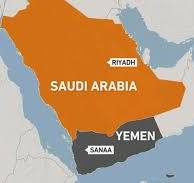
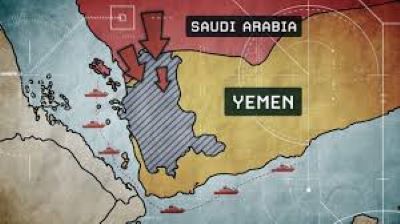
Yemen’s civil war, considered the world’s gravest humanitarian crisis, appears to be nearing its end due to a China-brokered detente between Iran and Saudi Arabia, who support opposing sides in the bitter conflict.

Early signs suggest that the rapprochement between Tehran and Riyadh may not only end hostilities in Yemen, but across the wider region.

The US, Israel, and Britain have the most to lose from a sudden onset of peace in West Asia. In the Yemeni context, London may be the biggest loser of all.

For years, it provided the Saudi-led coalition with weaponry used to target civilians and civilian infrastructure, with receipts running into billions of pounds sterling.

During the entirety of the war, Yemen was struck by British-made bombs, dropped by British-made planes, flown by British-trained pilots, which then flew back to Riyadh to be repaired and serviced by British contractors.

In 2019, a nameless BAE Systems executive estimated that if London pulled its backing for the proxy war, “in seven to 14 days, there wouldn’t be a jet in the sky.”

A Typhoon at RAF Akrotiri, near Limassol in Cyprus, after striking Houthi targets in Yemen (Photo cred: Sgt. Lee Goddard/ AFP)

In addition to supplying weapons, the war also presented a golden opportunity for Britain to establish a military base in Yemen, fulfilling long-held fantasies of recovering the Empire’s long-lost glory days “East of Suez.”

Al-Ghaydah airport in al-Mahrah, Yemen’s far eastern governorate, has for some time quietly housed “a fully-fledged force” of British soldiers, providing “military training and logistical support” to coalition forces and Saudi-backed militias.

There are even indications that this involvement could extend to torture methods, which is a troubling reflection of one of London’s leading exports.

The Cradle has obtained exclusive information about a previously undisclosed aspect of London’s role in the proxy war against Yemen’s Ansarallah-led resistance.

It has been revealed that a multi-channel propaganda campaign, led by the intelligence cut-out ARK and its founder Alistair Harris, a veteran MI6 operative, has been operating in complete secrecy throughout the nine-year-long conflict – one that specifically targeted Yemen’s civilian population.

Anti-Ansarallah ops

Leaked Foreign Office documents have revealed that ARK’s “multimedia” information warfare campaign was designed to undermine public sympathy for the Ansarallah movement and ensure that the conflict would only end on terms that aligned with London’s financial, ideological, and geopolitical interests.

For instance, public acceptance of the UN’s widely unpopular peace proposal required propaganda support from local NGOs and media organizations that “support UK objectives” to “communicate effectively with Yemeni citizens” and change their minds.

It was also necessary to counter “new actors” in the information space that were critical of the Saudi-led coalition’s brutal bombing campaigns and the illegitimate, US-backed puppet government that the aerial assaults sought to protect.

Considering the high rate of illiteracy in the local population, ARK conceived the creation of a suite of “visually rich” products extolling the virtues of a Riyadh-dominated peace plan.

These products would be disseminated on and offline and would “deliberately include different demographics, sects, and locations to ensure inclusivity,” informed by focus groups and polling of Yemenis.

ARK’s campaign even extended to convening “gender-segregated poetry competitions using peace as a theme” and “plays and town hall meetings.”

Publicly, many of these propaganda products appeared to be the work of Tadafur – Arabic for “work collectively and unite” – an astroturf network of NGOs and journalists constructed by ARK.

Its overt mission was to “resolve local level conflicts” and “unite local communities in their conflict resolution efforts.”

The campaign began initially at a “hyper-local level” across six Yemeni governorates, “before being amplified at the national level.” Activities “[in] all areas and at both levels” had unified messaging across “common macro themes,” such as the slogan “Our Yemen, Our Future.”

In each governorate, a “credible” local NGO was identified as a messenger, along with “well-known” and “respected and influential” journalists who served as “dedicated field officers” across the sextet, managed by ARK.

In Hajjah – “a site of strong Houthi influence” – the Al-Mustaqbal Institute for Development was ARK’s NGO of choice; in Ansarallah-governed Sanaa, it was the Faces Institution for Rights and Media; in Marib, the Marib Social Generations Club.

In Lahij, ARK’s choice was the Rouwad Institution for Development and Human Rights; in Hadhramaut, Ahed Institute for Rights and Freedom; in Taiz, Generations Without Qat.

These local NGOs were instrumental in promoting ARK’s agenda and advancing the narrative that aligned with Britain’s objectives in Yemen.

The company’s roster of “field officers” comprised of individuals with various backgrounds, such as:

“Human rights abuse” specialist Mansour Hassan Mohammad Abu Ali, TV producer Thy Yazen Hussain, Public Organisation to Protect Human Rights press official and “experienced journalist” Waleed Abdul Mutlab Mohammed al-Rajihi,

Also producer from Alhadramiah Documentary Institute Abdullah Amr Ramdan Mas’id, editorial secretary of Family and Development magazine and the Yemen Times’ Taiz news manager Rania Abdullah Saif al-Shara’bi, as well as journalist and activist Waheeb Qa’id Saleh Thiban.

A Trojan Horse

Once ARK’s field officers and NGOs “successfully designed and implemented hyper-local campaigns,” coverage of “information around the related activities will then be amplified at the national level.”

A key platform for this amplification was a Facebook page called “Bab,” launched in 2016 with tens of thousands of followers who were unaware that the page was created by ARK as a British intelligence asset.

Under the guise of a popular grassroots online community, ARK used the Bab page to broadcast slick propaganda “promoting the peace process,” including videos and images of “local peacebuilding initiatives” organized by its NGO and field officer nexus.

Campaign content will highlight tangible, real-life examples of compelling peacebuilding efforts that all Yemenis, regardless of their political affiliation, can relate to,” ARK stated.

These will offer inspirational examples for others to emulate, demonstrating practical ways to engage with the peace process at a local level. Taken together, these individual stories form the broader campaign with a national message: Yemenis share a collective desire for a peaceful resolution to the conflict.”

When “high engagement levels” with this content were secured, Bab users were invited to submit their own, which demonstrated “support for the peace process.” They were explicitly asked “to mirror content ARK has produced, such as voxpops, short videos, or infographics.”

This was then “shared by the project and field teams through influential WhatsApp messaging groups, a key way of reaching Yemeni youth.”

ARK’s “well-connected communications team” would then “strategically share packaged stories with broadcast media or key social influencers, or offer selected journalists exclusive access to stories.”

Creating a constant flow of content was a deliberate ploy to “collectively be as ‘loud’ as partisan national political and military actors.” In other words, to create a parallel communications structure to Ansarallah’s own, which would drown out the resistance movement’s pronouncements.

ARK’s role in Yemen’s peace process

While one might argue that the non-consensual recruitment of private citizens as information warriors by British intelligence was justified by the moral urgency of ending the Yemen war quickly, the exploitation of these individuals was cynical in the extreme.

It amounted to a Trojan Horse operation aimed at compelling Yemenis to embrace a peace deal that was wildly inequitable and contrary to their own interests.

Multiple passages in the leaked files refer to the paramount need to ensure no linkage between these propaganda initiatives and the UN’s peace efforts. One passage refers to how campaign “themes and activities” would at no point “directly promote the UN or the formal peace process.”

Another passage says concealing the operation’s agenda behind ostensibly independent civil society voices “minimizes the risk” that “outputs are perceived as institutional communications stemming from or directly promoting the UN.”

Yet, once ARK’s campaigns began “performing successfully at the national level,” the company’s field officers planned to “build a bridge” between its local foot soldiers and national “stakeholders” – and, resultantly, the UN.

In other words, the entire ruse served to entrench ARK’s central role in peace negotiations via the backdoor.

Diminished western influence

At that time, the ceasefire deal proposed by the UN required Ansarallah and its allied forces to virtually surrender before Riyadh’s military assaults and economic blockade of the country could be partially lifted, along with other stringent requirements that the Saudis refused to compromise on.

Newly recruited Houthi fighters gathered for training outside Sana, the capital of Yemen – they became the Ansarrallah Army. (Photo credit: Yahya Arhab/EPA, via Shutterstock)

The US aggressively encouraged such intransigence, viewing any Ansarallah influence in Yemen as strengthening Iran’s regional position.

However, these perspectives are no longer relevant to Yemen’s peace process. 

China has now encouraged Riyadh to offer significant concessions, and as a result, the end of the war is within sight, with critical supplies finally allowed to enter Yemen, prisoners returned, Sanaa’s airport reopened, and other positive developments.

Evidently, Washington’s offers of arms deals and security assurances are no longer sufficient to influence events overseas and convince its allies to carry out its agenda.

The failure of ARK’s anti-Ansarallah propaganda campaigns to coerce Yemenis to accept peace on the west’s terms also highlights Britain’s significantly reduced power in the modern era.

Whereas wars could once be won on the coat-tails of well-laid propaganda campaigns, the experiences of Yemen, Syria, Iraq, and Afghanistan show that the tide has turned. Subversive information campaigns can confuse and misdirect populations but, at best, can only prolong conflict – not win it.

End.

Republished with kind permission of the author Kit Klarenberg from https://thecradle.co/articles-id/685.

IRISH STATE COLLUDED IN COVER-UP OF BRITISH INTELLIGENCE-ASSISTED DUBLIN BOMBING

Diarmuid Breatnach

(Reading time: 8 mins.)

On the 49th anniversary of the Dublin and Monaghan Bombings a number of speakers criticised the Garda closure of its investigation a mere four months after the bombing with the highest number killed in any one day of the 30 years war.

The criticisms were made on 17th May at the annual commemoration of the atrocity in Talbot Street, Dublin, organised by the Justice For the Forgotten campaign, held at the location of the memorial on the site of one of the bombings of that day.

The annual commemoration has been organised for many years by the Justice For the Forgotten campaigning group at the Talbot Street monument to the bombing1. It usually comprises reminiscences, poetry and music and a call for the British State to release its secret papers.

As of rote, an Irish Government Minister is invited to speak who routinely says how hard the Irish Government has been trying to get the British State to release the secret papers revealing the latter’s connection to those who carried out the bombing.

Years after the bombings, a British TV company (!) pointed the finger at the Ulster Volunteer Force, a British Loyalist paramilitary group but believed acting under British Intelligence agency direction, named some of those involved and a week later the UVF claimed responsibility.

In addition to British Intelligence, the British colonial police2 and British Army3 had been widely known to be working in collusion with Loyalists.

But few would have suspected Irish State collusion.

THE BOMBINGS AND AFTERMATH

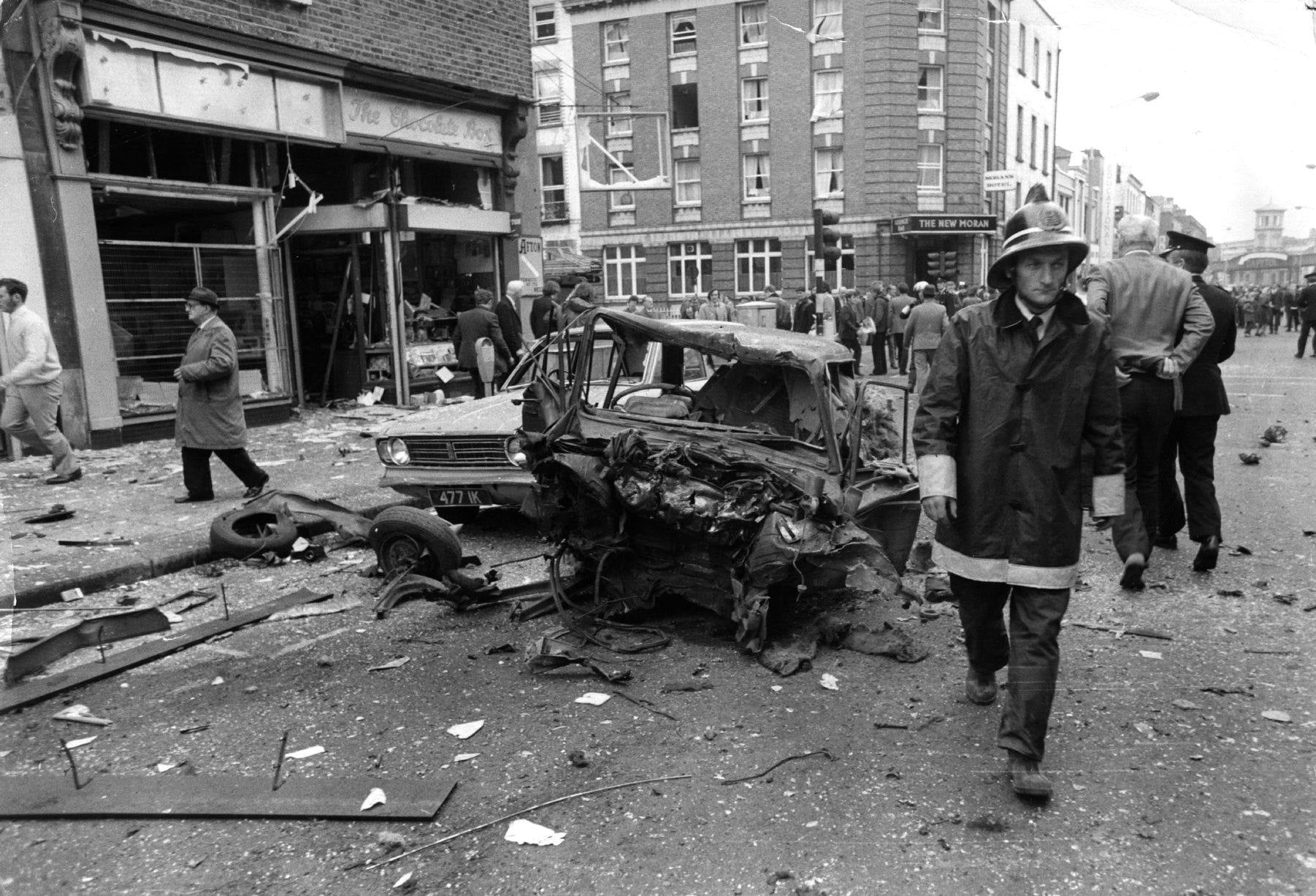
On 17th May 1974 three car bombs exploded without warning in crowded Dublin city centre streets and another in Monaghan town centre. Thirty-three people were killed along with a full-term baby and a miscarriage with around 300injured. No-one was ever even charged in relation to the atrocity.

Scene post-bombing in Talbot Street, the site where the Monument was erected later is out of shot to the right. (Photo sourced: Internet)

The intention, unlike that of many other city car-bombings in the Six Counties and in England, was clearly to cause maximum death and injury to civilians. The areas chosen in Dublin were full of shops with bus stops and 5.30pm was going home time from shopping and work.

And no warning was given.

In the course of the short Garda4 investigation, in macabre irony the remains of the exploded cars were sent for forensic examination to their very source: the Six Counties, i.e to the colonial police force (at the time, the RUC5). Unsurprisingly, nothing useful came back.

In a war that was already five years old (six years, if the civil rights marches are included) the collusion between the British colonial police and Loyalist paramilitary murder gangs was well known and collusion with the British Army widely suspected.

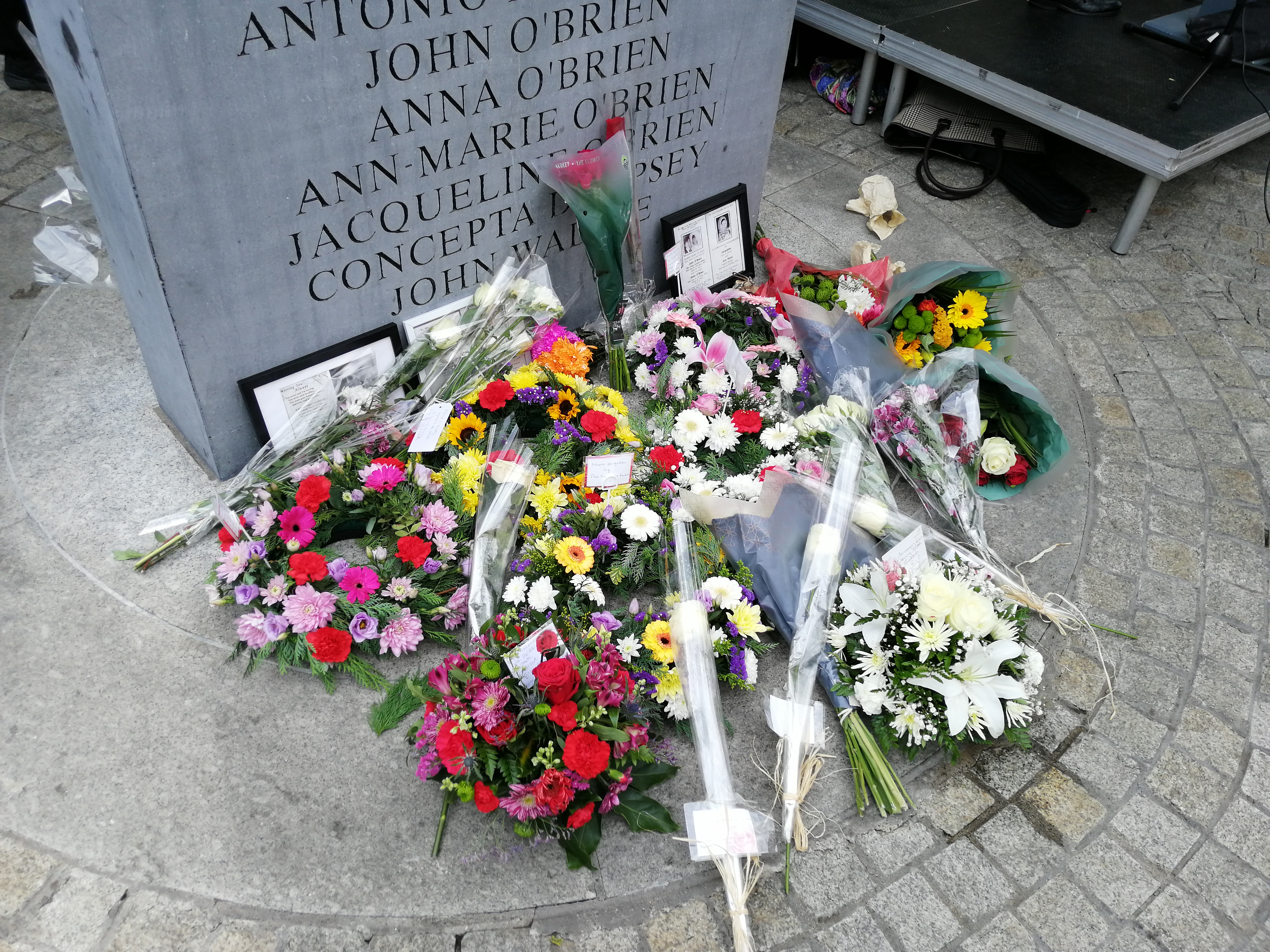
Floral tributes on the north face of the monument in Talbot Street. (Photo: D.Breatnach)
Floral tributes on the south face of the monument in Talbot Street. (Photo: D.Breatnach)

CAMPAIGN OF BOMBING DUBLIN

The Loyalist bombing of two cities in the Irish state in 1974, although by far the worst of the whole period, were not the first in Ireland, not even the first fatal ones.

In 1973 a Loyalist bomb in Dublin city killed Tommy Douglas and the year before that another killed George Bradshaw and Tommy Duffy – all were employees of Irish public transport state company CIE.

Even after the horror of 1974, on 29th November 1975, another a bomb at Dublin Airport killed John Hayes, a worker there.

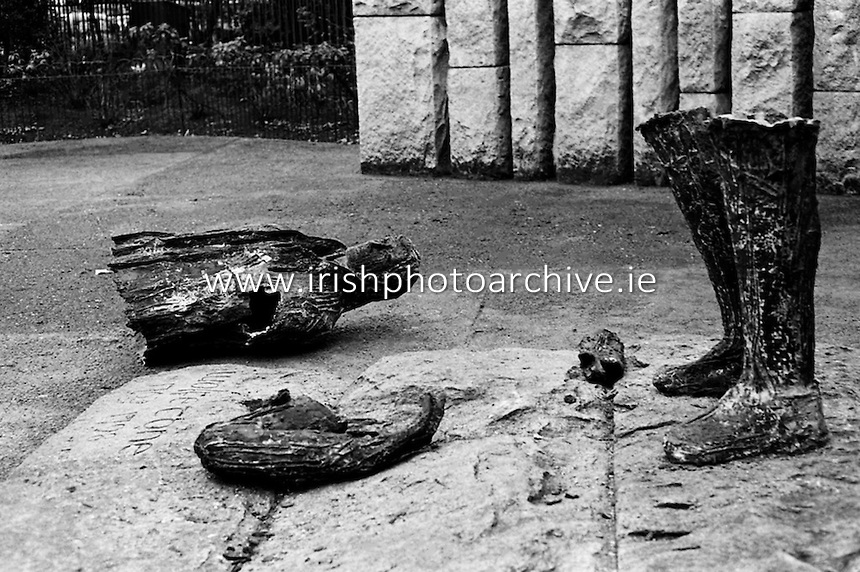
And there were other earlier ones where no-one was injured, such as the blowing up of the Wolfe Tone monument just outside Stephens Green on 8th February 19716 and the Daniel O’Connell Monument in Glasnevin Cemetery (the round tower) in December 1971.

Pieces of the statue of Theobald Wolfe Tone on St Stephen’s Green. The statue was blown up by a loyalist bomb. A report at the time noted that ‘Huge slabs of the bronze sculpture were hurled 20 feet in the air’. 08/02/1971 (Photo sourced: Internet)
The O’Connell Monument in Glasnevin (round tower) seen here at sunset from the Botanic Gardens was a target of Loyalist bombing in 1971. (Photo: D.Breatnach)

If the Irish State had pursued investigations and cross-Border links after the earliest of those bombings, they might have headed off the carnage that followed later.

Not only did they not do so but in fact used the 1972 bombing to blame Irish Republicans so as to get an unpopular piece of repressive legislation through parliament, the Amendment to the Offences Against the State Act, along with the establishment of the no-jury Special Criminal Court7.

The Garda Commissioner at the time of the 1974 bombings was Patrick Malone and Ed Garvey, his Assistant Commissioner, was later exposed as a British Secret Service asset run by Fred Holroyd, a disenchanted British agent who revealed he had visited the policeman in his Dublin HQ.

Garvey, by then Commissioner, denied being a British agent and claimed no memory of the visit.

The Barron Report (2003) concluded that visit had undoubtedly occurred and that he had not informed his superiors, contrary to all rules regarding contact with agents working for a foreign government.8 When Fianna Fáil came into Government again, they sacked Garvey.

Since FF had not subjected him to a regular disciplinary process, probably in order to avoid the sordid story going public, Garvey was able to sue the Irish Government, win damages and ensure he received his former pension entitlements.

THE COMMEMORATION EVENT

Aidan Shields, who lost his sister Maureen in the bombing, chaired the event for Justice for the Forgotten and introduced its Secretary Margaret Unwin who, as all speaking or performing at the event seemed conscious that next year would be the 50th anniversary of the atrocity.

(Photo: D.Breatnach)

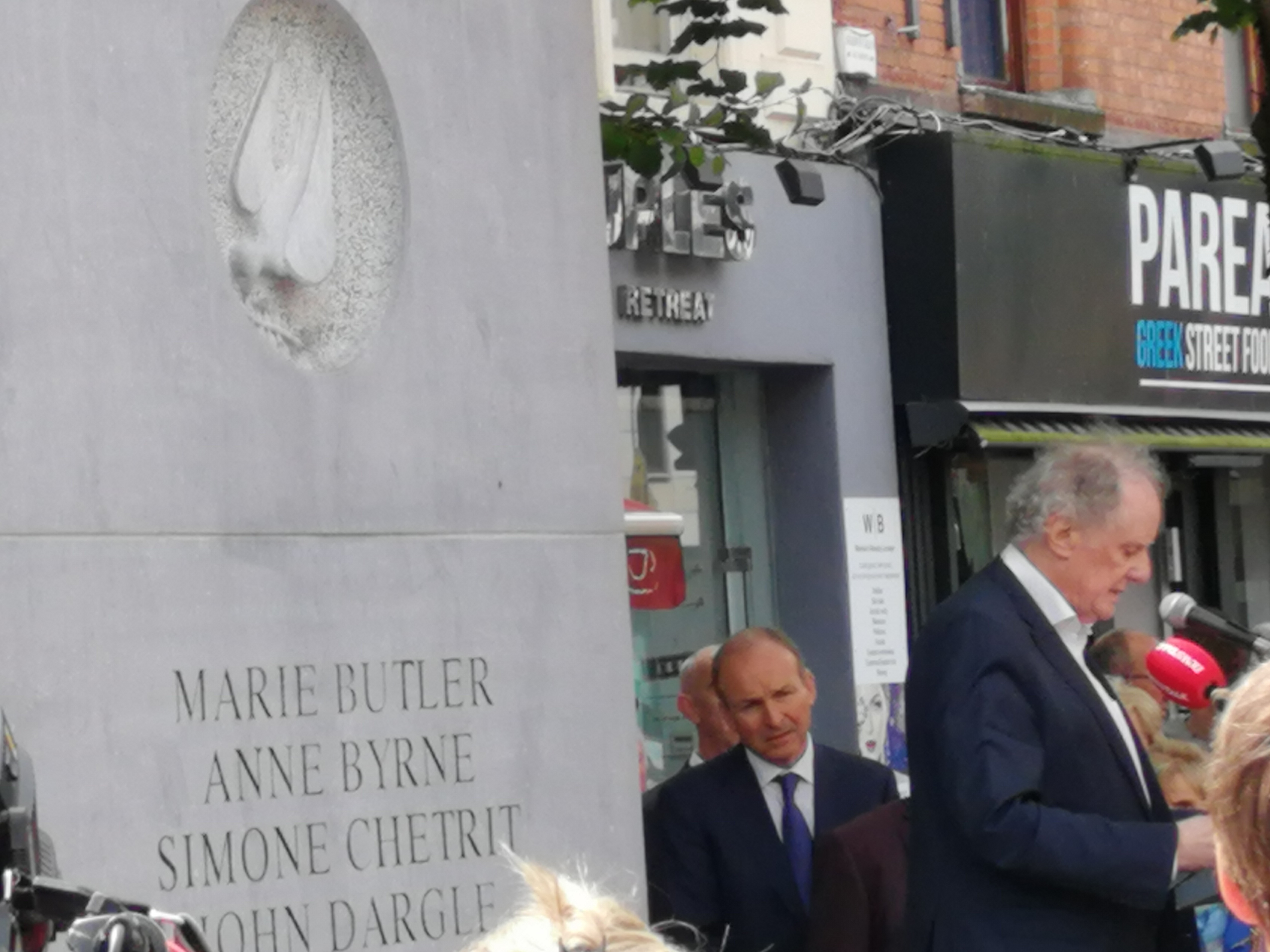
The regular Government slot was occupied by the current Tánaiste (Dep. Prime Minister) Mícheál Martin who, as has every Government representative since the JFTF commemorations began, claimed energetic diplomatic discussions for release of the papers with their British counterparts.

Martin also criticised the British Government’s widely-criticised intended legislation to prevent official investigations and trials regarding past crimes committed by British forces, while he simultaneously praised the British pacification process.

A young Italian woman played the theme from the Schindler’s List film and another air on violin. A visiting Italian couple had been killed in the bombing also but that was not mentioned when she was introduced.

Rachel Hegarty read from her poetry compilation about the victims, based on testimonies by surviving relatives and friends. Cormac Breatnach on high D whistle and Eoin Dillon on uileann pipes played the Irish air Tabhair Dom Do Lámh (“Give Me Your Hand”).

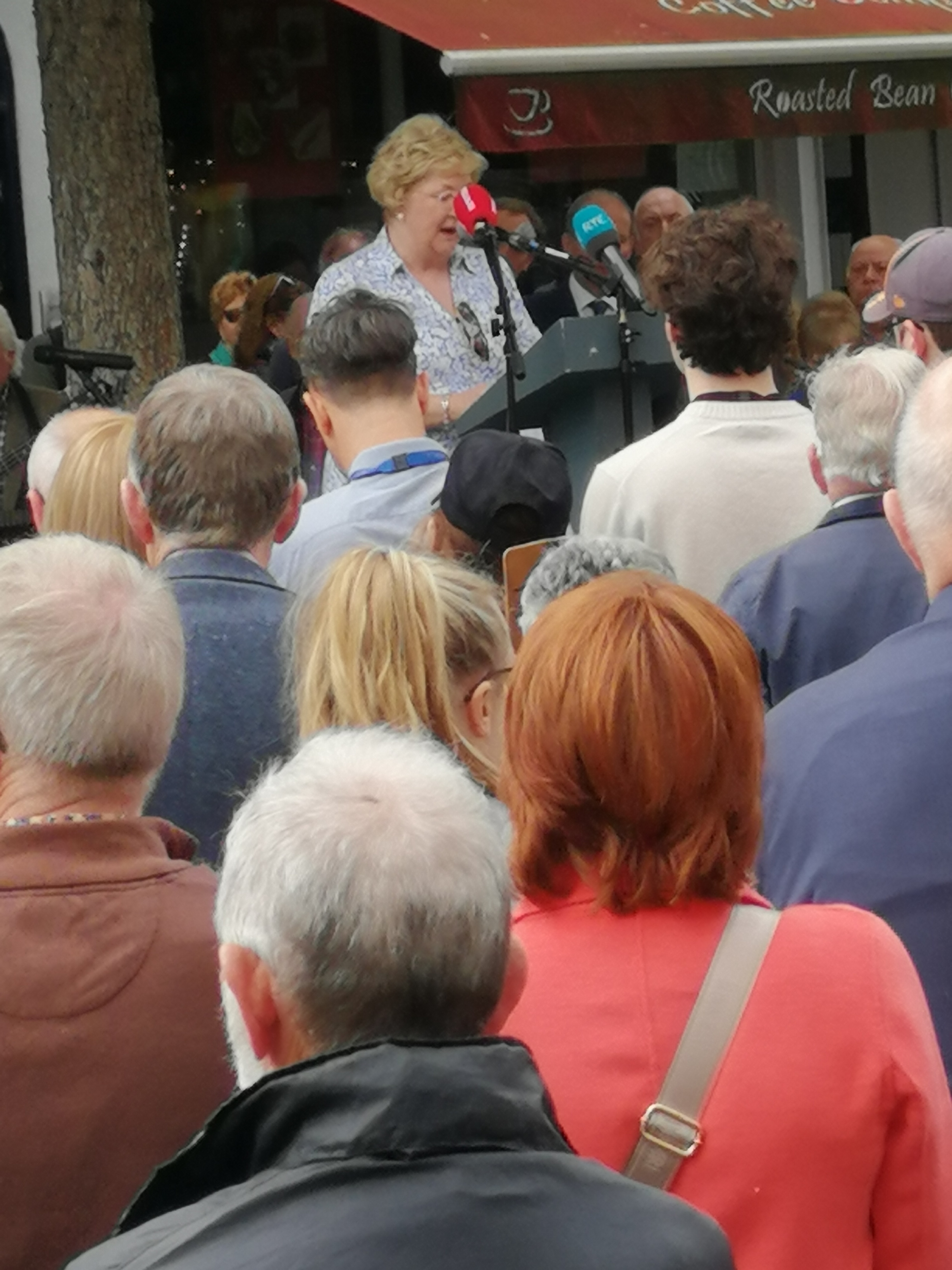
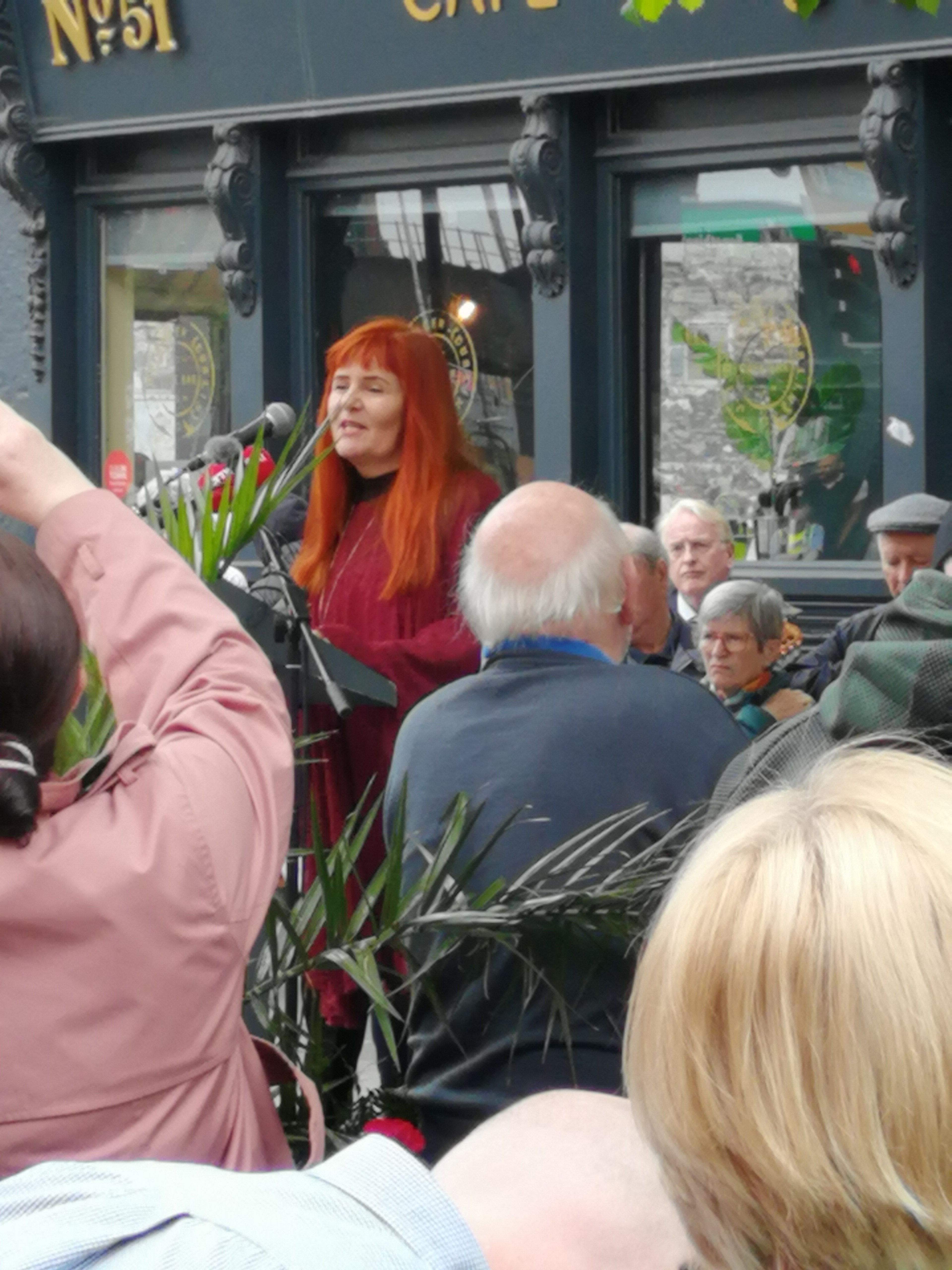
Poet Rachel Hegarty reciting from her work on the bombing. (Photo: D.Breatnach)
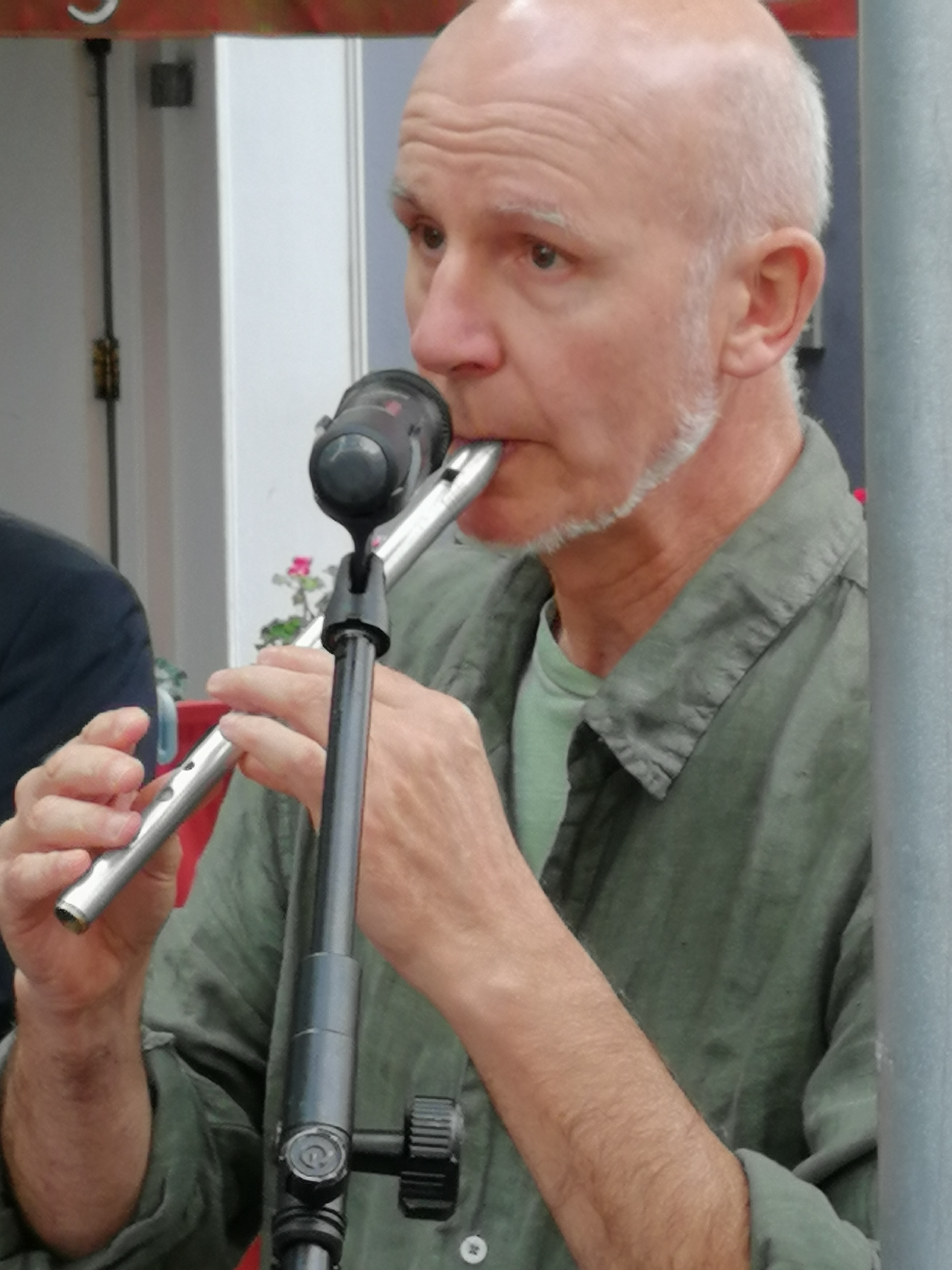
Closeup of Cormac Breatnach on high whistle playing at event. (Photo: D.Breatnach)
Eoin Dillon playing uileann pipes at event. (Photo: D.Breatnach)
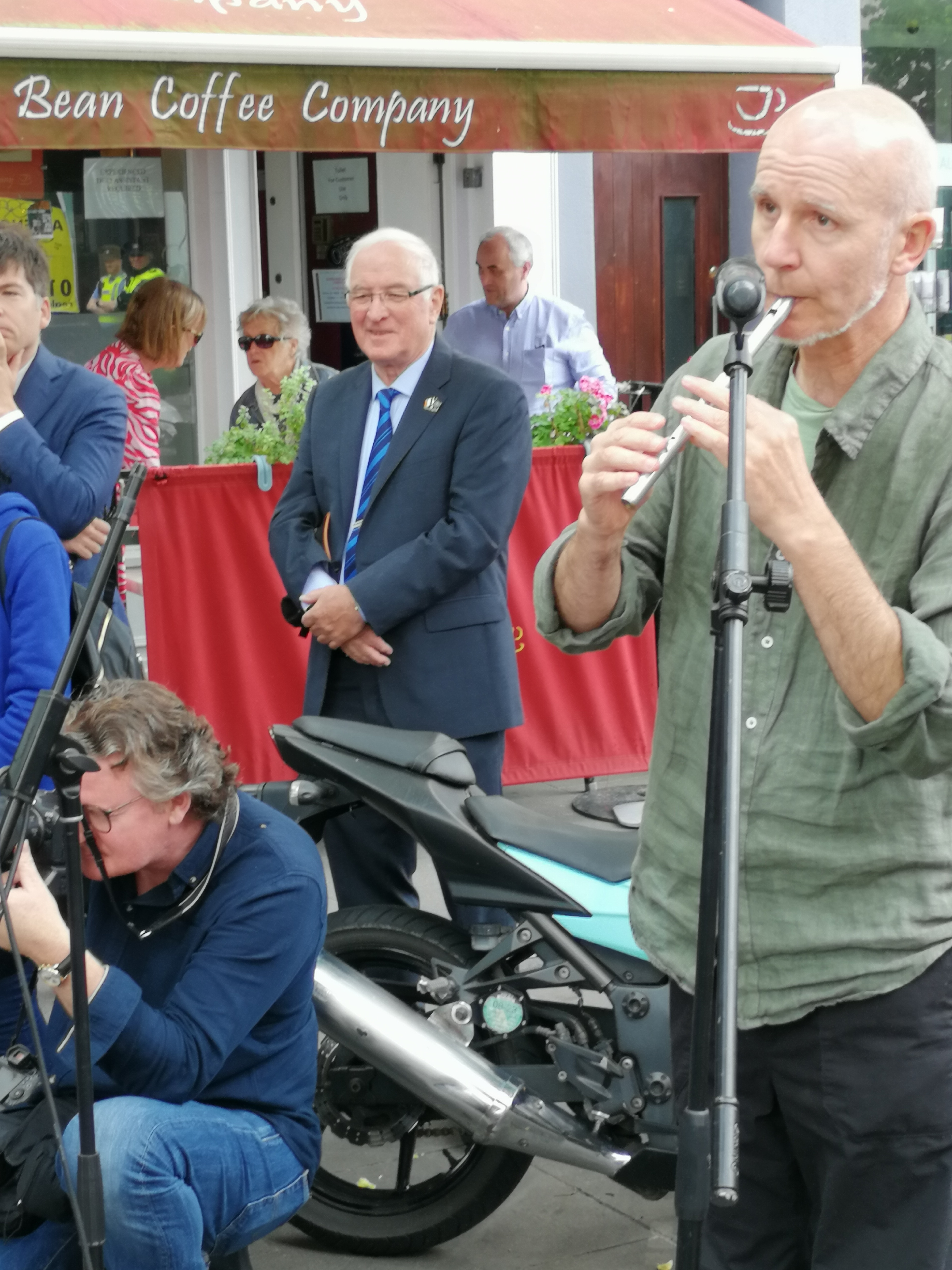
Fuller shot of Cormac Breatnach playing at event with Eoin Dillon out of shot to the left. (Photo: D.Breatnach)

The Shillelagh North Ukulele Group played and sang The Sound of Silence and Things (we used to do), both appropriate in metaphorical context, the first for the official silence about the perpetrators and their British intelligence organisation, the second about the loss of the victims and to their loved ones.

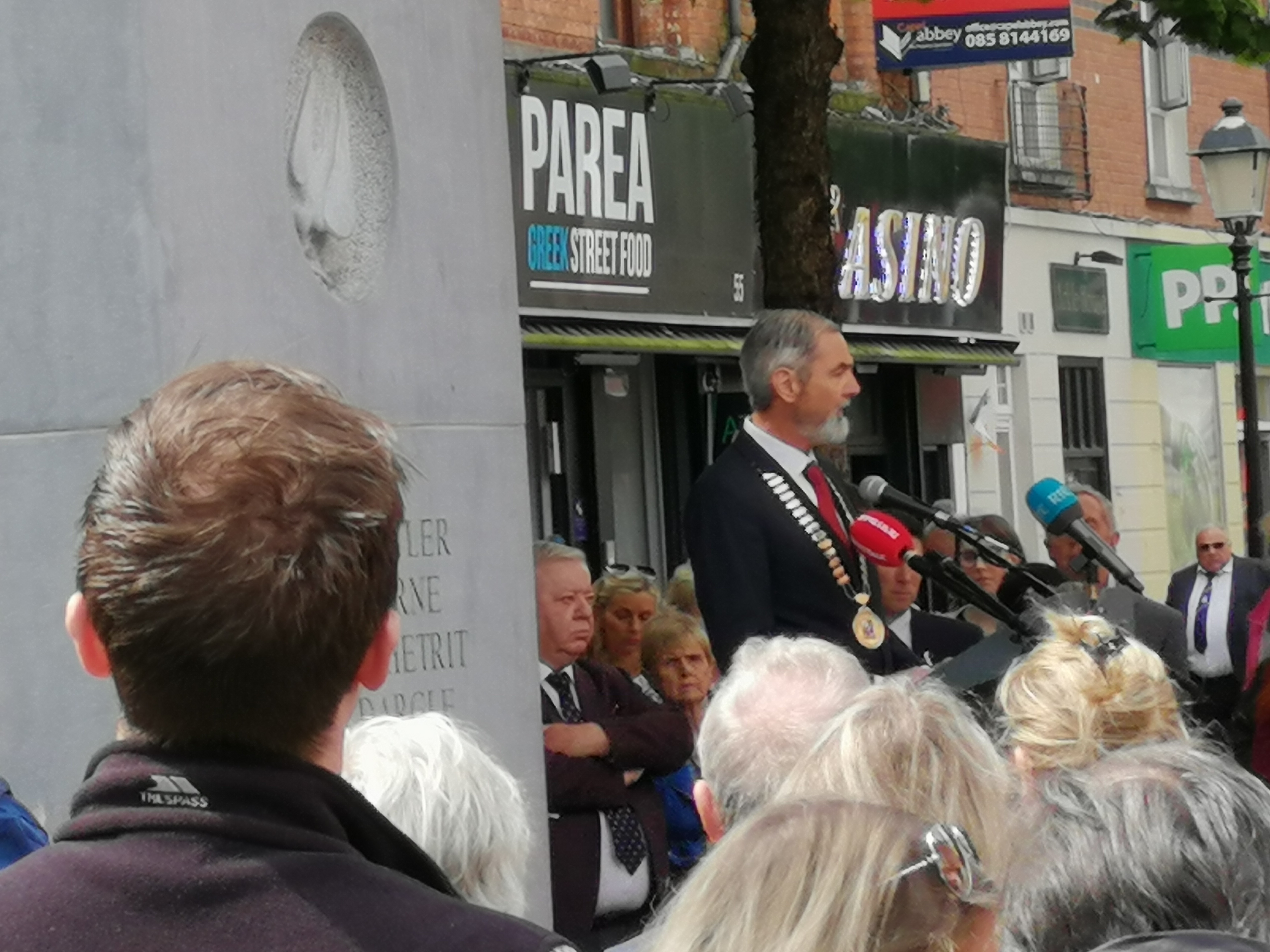
Dublin City Lord Mayor Caroline Conroy, of the Green Party, spoke about the atrocity and criticised the closing of the Garda investigation a mere four months after the bombing.9

Vincent Browne giving his oration. (Photo: D.Breatnach)

Well-known journalist and former TV presenter Vincent Browne gave the oration at the event and went into horrific detail on some of the injuries he had witnessed as a journalist at the scene with his doctor brother as they struggled to help the victims still alive.

Browne departed from the subject of the bombing, as a few had done to speak of the long war and the Good Friday Agreement but in his case also to accuse the Provisional IRA of having killed most of the people during the 30 Years War which seemed not appropriate on this occasion.

Seán Conlon, Cathaoirleach (Chair) of Monaghan Council10 spoke of the bombing and focused on the effect on his town. He also condemned the early closing of the Garda investigation and the failure to pressurise the British State into releasing security papers relevant to the bombing.11

Seán Conlon, Cathaoirleach of Monaghan Council, speaking with part of monument visible to his left. Aidan Shields is standing right next to the Monument. (Photo: D.Breatnach)

A number of speakers referred optimistically to the investigation into the Glenanne Gang by former English police chief Jon Boucher, who was present in the crowd at the commemoration. Boucher is heading a number of other historical investigations, including that of Stakeknife.12

The older age profile of the attendance was noticeable with only two teenagers visible and this in itself must be of concern.

FATAL CONSEQUENCES OF STATE COLLUSION AND COVER-UP

The failure to investigate the earlier Loyalist bombings and apprehend the perpetrators made the planning and execution of the Dublin and Monaghan bombings much easier. The early closing of the Garda investigation of the 1974 bombings ensured the perpetrators would run free.

As well as failing relatives and friends of those murdered and injured in Dublin on the 17th May 1974, the lack of pursuit had repercussions for many other victims of Loyalist murder squads, in particular the over 120 victims of the Glenanne Gang, including the Miami Band Massacre in 1975.

An aspect not normally commented upon was the choice of predominantly working class areas for Dublin massacre victims. It was not the high-end Henry or Grafton Streets that were chosen but the more working-class shopping areas of Talbot Street and Parnell Street.

The fatal Dublin bombings of 1972 and 1973 had also been directed at workers by location: three public transport workers and an airport worker.

Section of the Shillelagh North Ukulele Group playing and singing at the event (Photo: D.Breatnach)

THE GOMBEENS: A CRAVEN CLIENT RULING CLASS

The whole chain of events from the first Loyalist bombing of Dublin points quite clearly to the client nature of the Irish national bourgeoisie, the ruling class of the Irish State. Even if it wanted to, it is too weak to make strong demands of the British State.

What self-respecting national ruling class would allow a foreign power to send terrorists to bomb its capital city? And then collude with that power in drawing silence and secrecy over the atrocity?

None, of course. But the Irish bourgeoisie came into being in a truncated client state and, armed and equipped by its master, went to war for two years (1922-1923) against the very national liberation forces that had brought the British State with offered concessions to the negotiation table.13

To talk of uniting Ireland under such a class, apart from being impractical nonsense, is a travesty. To expect any real change by electing a party or combination of parties to government in such a situation is a pipe-dream.

The 1974 bombing, the subsequent investigation and the record of Irish governments since in relation to the bombing are together a stark illustration of the spineless nature of the Irish bourgeoisie when dealing with their masters.

A client ruling class yes but more accurately, a servant.14

End.

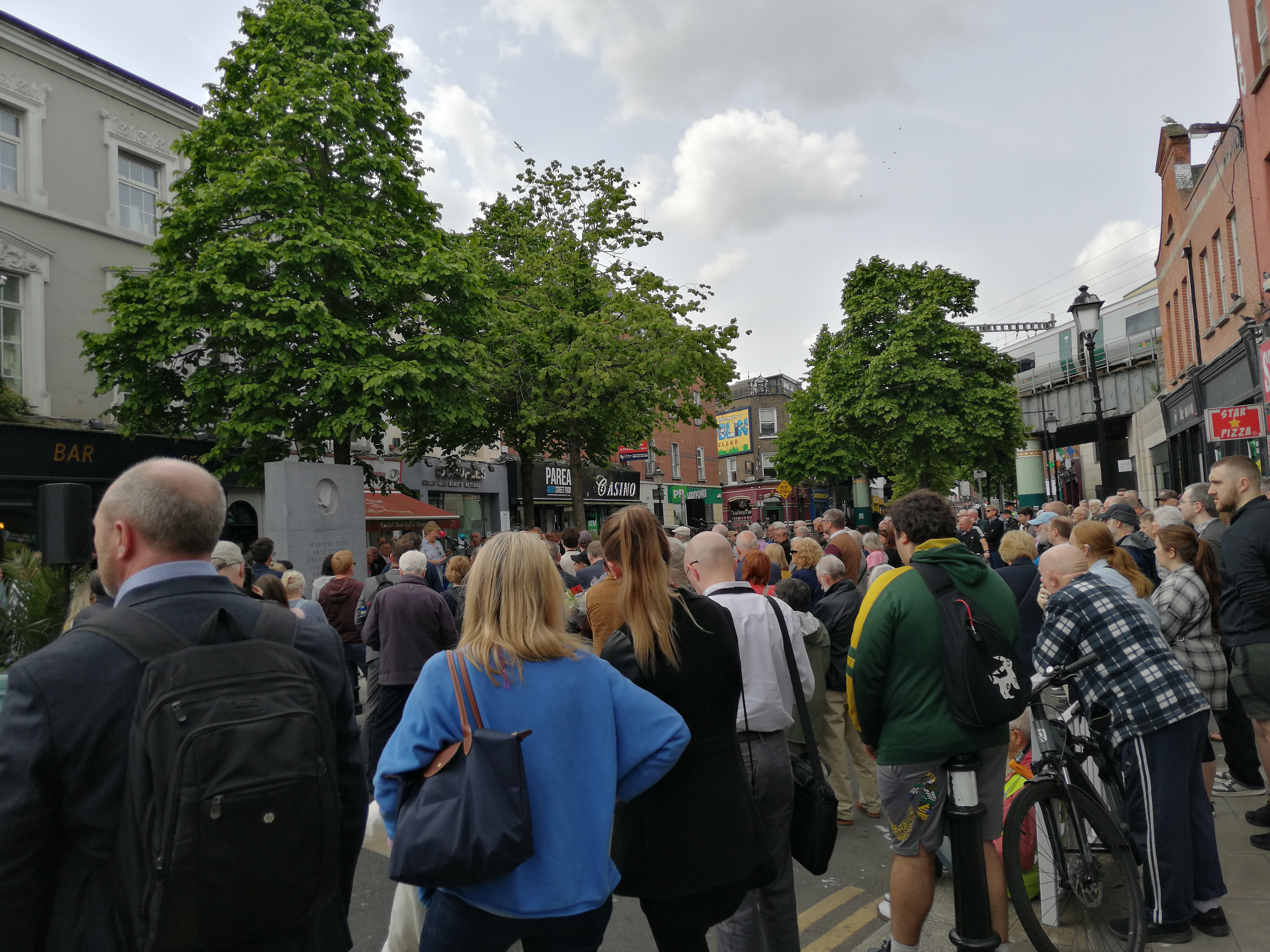
Section of the crowd in attendance viewed from the north-east of the location. (Photo: D.Breatnach)
Section of the crowd with the tower of Connolly (formerly Amiens Street) Station in the background. During the British suppression of the 1916 Rising, British Army machine-gun fire was directed from there along Talbot Street towards the General Post Office garrison and North Earl and Henry Streets. (Photo: D.Breatnach)

FOOTNOTES

1There was originally a plaque at the Garden of Remembrance and the Talbot Street monument was erected in 1977 after campaigning by relatives and victims. There is also a monument in Monaghan Town. In Dublin there is also a plaque at the site of another explosion that killed people that day in Parnell Street.

2Now the Police Service of Northern Ireland, formerly the Royal Ulster Constabulary (and before that, up until 1921, the Royal Irish Constabulary, when the whole of Ireland was under direct British rule).

3In particular the Ulster Defence Regiment, which had recruited from the part-time RUC B-Specials when the latter were disbanded but also special units such as the MRF in special operations and more generally across the whole of the occupation forces.

4Irish State police force.

5When the Irish State and colony statelet were created in 1921, the colonial gendarmerie of the Royal Irish Constabulary in the colony became the Royal Ulster Constabulary. In more recent years the force has change its name to the Police Force of Northern Ireland.

6The body of the monument to the Anglican leader of the United Irishmen was destroyed but the head was salvageable and rests on the re-cast body of the monument today.

7The Irish Council for Civil Liberties has dubbed that Court “a sentencing tribunal” but every party in government since has upheld those repressive provisions and Sinn Féin has abandoned its decades of opposition to them as it prepares to enter government in coalition with one party or another.

8Having a Garda Commissioner who was or became a British Intelligence agent might be shocking until we remind ourselves that the current Garda Commissioner, Drew Harris, coming from being Assistant Commissioner of the PSNI, was at least formerly part of MI5 operations in the colony and that must have been known to those who appointed him!

9Mayors of Dublin City are selected for one year from among the elected councillors. It is more of a ceremonial role than an executive one and the choice is usually negotiated in turn from among the represented political parties.

10As above with Cathaoirligh of Monaghan Council.

11A number commented that his contribution was so much better in every way than that of last year’s Monaghan Cathaoirleach. Conlon is a member of the Sinn Féin party and some may say his posture would therefore be expected. However, given changes in the party’s public position on many questions in recent years, a hard stand against the British administration no longer seems natural for this party’s public representatives.

12Operation Kenova.

13Irish Civil War (or as some see it, the Irish Counterrevolution) 1922-1923.

14It should be noted that the Gombeen class has also been a client in turn of US Imperialism and of EU Imperialism, with all of which it aligns itself on most questions of international policy and to which it opens up its markets, natural resources and infrastructure networks.

REFERENCES

Justice For the Forgotten: https://www.facebook.com/Justice4theForgotten1974
https://www.patfinucanecentre.org/projects/justice-forgotten#:~:text=Justice%20for%20the%20Forgotten%20was,single%20day%20of%20the%20Troubles.

The anniversary event: https://www.thejournal.ie/dublin-monaghan-bombings-anniversary-2-6069847-May2023
https://www.98fm.com/news/commemoration-dublin-monaghan-bombings-1466373
https://www.dfa.ie/news-and-media/press-releases/press-release-archive/2023/may/remarks-on-the-commemoration-of-the-49th-anniversary-of-the-dublin-monaghan-bombings.php

https://en.wikipedia.org/wiki/Dublin_and_Monaghan_bombings

https://www.garda.ie/en/about-us/our-history/garda-commissioners-since-1922/
Ed Garvey, former Chief Commissioner of the Garda and British Intelligence asset (interestingly there is no Wikipedia page on this man, nor is his creation of the infamous Garda ‘Heavy Gang’ or his British Intelligence work mentioned by Ferriter): https://www.dib.ie/biography/garvey-edmund-a342

Earlier Loyalist bombings in the Irish State: https://en.wikipedia.org/wiki/1972_and_1973_Dublin_bombings

Lethal AlliesBritish collusion in Ireland (2015), Ann Cadwaller: https://www.irishtimes.com/culture/books/lethal-allies-british-collusion-in-ireland-a-shameful-part-of-our-troubled-history-1.1578119

The Glenanne Gang: https://en.wikipedia.org/wiki/Glenanne_gang

Barron Report: https://www.irishtimes.com/news/barron-report-conclusions-1.398978

Jon Boucher investigation: https://www.irishnews.com/news/northernirelandnews/2019/11/30/news/jon-boucher-to-take-on-investigation-of-glenanne-gang-1778903/

https://www.opkenova.co.uk/

JUSTICE FOR THE IGNORED?

Clive Sulish

(Reading time: 6 mins. main text, total 9 mins)

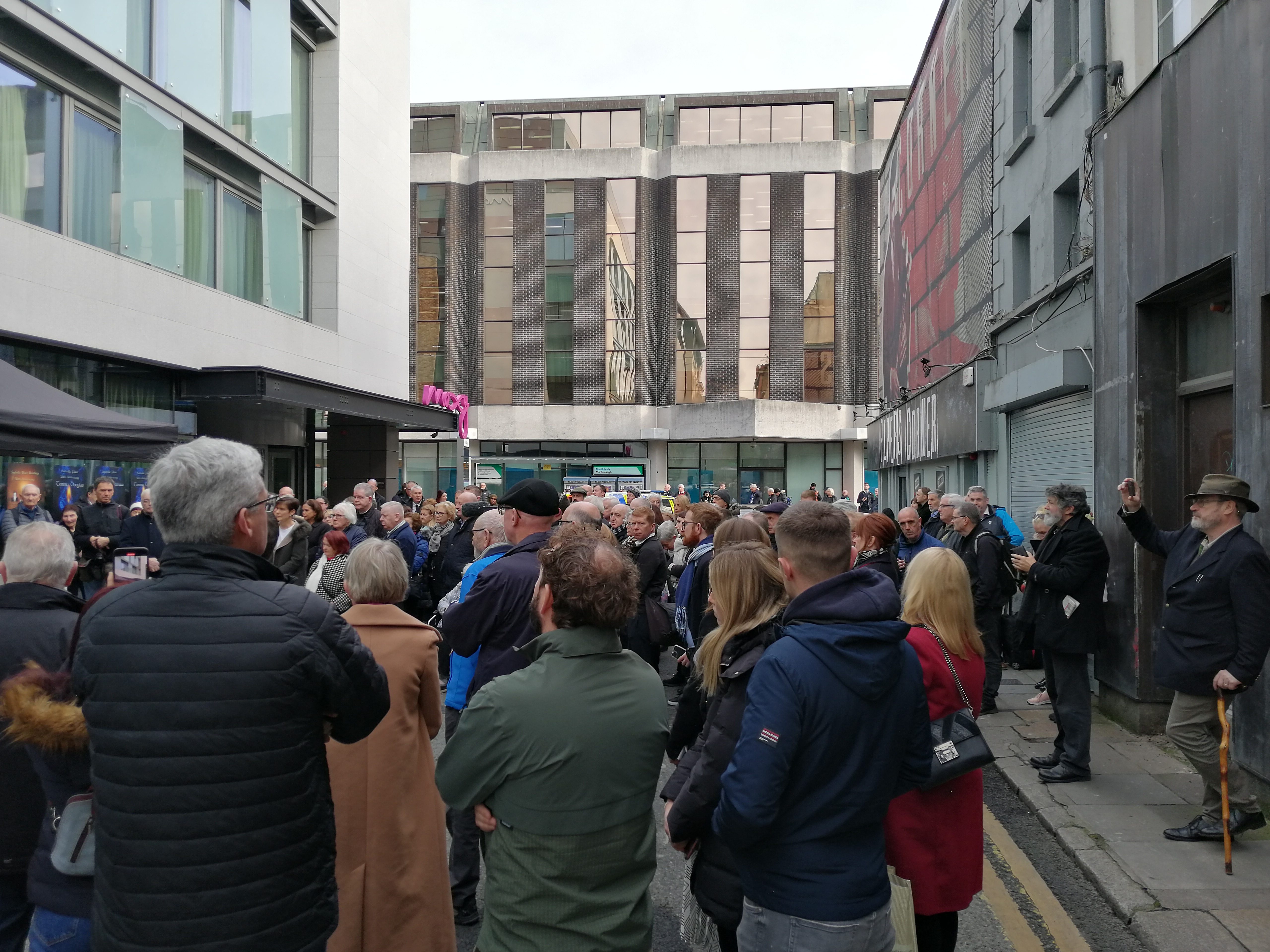
At noon on Thursday 1st December around a hundred people gathered in a side street off Dublin city’s main street to commemorate the killing of three public transport workers1 by British Loyalist bombs in 1972 and 1973.

The event was organised by the Justice for the Forgotten group that grew out of relatives seeking accountability for the Dublin and Monaghan bombings in 1974. However, the campaign group might well consider replacing the word “Forgotten” with “Ignored”.

In the early 1970s, as people – mostly but not all of of nationalist background – were marching for equal civil rights in the British colony of the Six Counties, British Loyalists began exploding bombs, not all but mostly in Dublin.

Some were aimed at symbolic Irish monuments such as the O’Connell Tower in Glasnevin cemetery (17 January 1971)and the Wolfe Tone monument in Stephens Greeen (8th February)2but the bombings of 1972, ‘73, ‘74 and ‘75 were clearly intended to kill civilians.

British Intelligence Services have been implicated in collusion with Loyalists and, along with agents within the Irish State3 have been implicated at least with regard to the 1974 bombing of Dublin and Monaghan, resulting in the largest loss of life in any one day during the 30 Years War.4

Posters of the names of three public transport workers killed in two bombings by British Loyalists (Photo: Rebel Breeze)
Wreaths and the plaque commemorating the atrocity (Photo: Rebel Breeze)

THE COMMEMORATION PROCEEDINGS

A temporary canopy had been erected with a lectern and amplification in Sackville Lane, between busy O’Connell and Marlborough Streets, next to a plaque set in the pavement commemorating the bombing and its victims there. More than a hundred had gathered around to witness the event.

Tom Duffy, son of Tommy Duffy, one of the victims of the 1972 bombs chaired the event. He is also the designer of the commemorative sculpture ‘A Fallen Bouquet’, inlaid into the pavement which was unveiled in 20045.

Chairing the event, Tom Duffy, son of the murdered Tommy Duffy (Photo: Rebel Breeze)

Tom never met his father; Tom had four months to go before birth in his mother’s womb when his father was killed; his sister does not remember her father either.

Margaret Urwin, of Justice for the Forgotten campaigning group, read out biographies of Bradshaw, Tommy Duffy and Tom Douglas (see Appendix), detailing their origins and recollections of their bereaved loved ones.

Margaret Urwin of Justice for the Forgotten campaign, organisers of the commemoration event (Photo: Rebel Breeze)

The origins of the victims and partners showed that as well as being a tragedy for Dublin the bombings were also that for other parts of the country and the diaspora, in particular Achill (Mayo), Belfast, Castlebar (Mayo), Fethard (Tipperary), Kilkenny and Stirling in Scotland.

Urwin said they also wished to remember John Hayes, whose 47th anniversary had occurred two days previously and she read a short biography of him too. John was employed at Dublin Airport and was killed by a bomb placed in a toilet on the Arrivals floor on 29 November 1975.

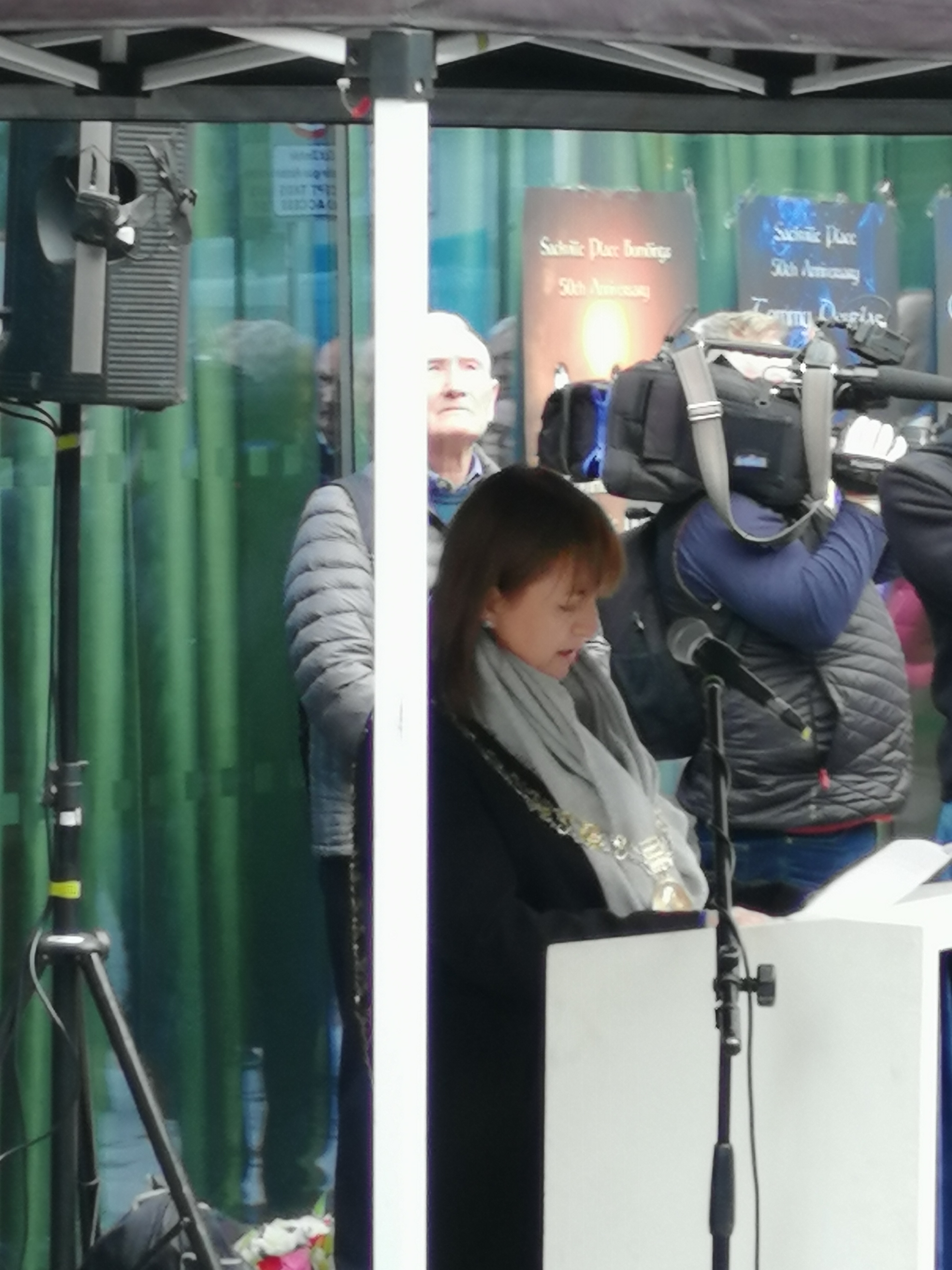
Current Lord Mayor of Dublin (Photo: Rebel Breeze)

The Lord Mayor of Dublin6 gave a short speech in which she underlined the need for remembrance while also decrying that the guilty had escaped so far and that proposed legislation, currently going through the Westminster Parliament, sought to prevent such perpetrators being brought to book.

Finance Manager of Dublin Bus (Photo: Rebel Breeze)

The Finance Manager of Dublin Bus spoke also, saying among other things that the company would never forget and that it was like one big family. However the absence of employees of the company present in uniform and the lack of awareness of many gave the lie to her words (workers tell us that the event had not been advertised internally by the company).

The Education Minister Norma Foley, TD spoke at length about the atrocity and need for all actions to take place within “the rule of law”, in the context of which she went on to castigate the British Government for its proposed 30 Years War legacy legislation to limit inquests and litigation.

Foley went on to state the opposition of the Irish Government’s to the proposed legislation, along with that of the opposition parties, with united faith leaders, all parties in the British colony and the US Government.

Somehow she and other speakers however managed to avoid mentioning the British Loyalist origin of the bombers or that these were chronologically leading up to the 1974 Dublin and Monaghan bombings, with a death-toll of 33 in one day.

Minister of Education (Photo: Rebel Breeze)

Or of the fact that the 1973 bombings had been used to push repressive legislation through Leinster House, including the founding of a no-jury Special Criminal Court, targeted not at British Loyalists but instead specifically at Irish Republicans!7

The omission of this important and relevant information, referred to in Ronan McGreevy’s report for the Irish Times (see link in Sources), though not unexpected on past Government performance, was indeed ironic coming from the Minister with responsibility for education.

Wreaths were laid, including some by relatives of the murdered. A priest also recited a prayer.

MUSIC AND POETRY

Poet Rachael Hegarty, who has also composed and performed a longer poem about the Dublin & Monaghan bombing, performed her composition for this event about the loss of husbands and fathers in the killing of public transport workers.

In between some of the speeches, musicians from the Shillelagh Northside Ukelele Group8 performed Simon & Garfunkle’s The Sound of Silence and Bobby Darin’s Things (including the lines “memories are all I have to cling to”).

During another speeches interval, Cormac Breatnach on high whistle & Eoin Dillon on uileann pipes performed Táimse I Mo Chodhladh and later to conclude the event, The Lark in the Morning. The first piece, no doubt chosen for its lament nature, would do well also as political commentary9.

Large group of Northside ukulele players in foreground (Photo: Rebel Breeze)

IGNORING AND FORGETTING

The age profile of the vast majority of those present meant that the atrocities had occurred within their lifetimes, which is natural; however the near absence of representation of the following two or three generations is not.

It might be observed that this absence is a natural part of passing time but one could also comment that the ignoring of this atrocity is causing an unnatural fracture in the historical memory of a people and a workforce, a result of a conscious decision to prevent the transmission of that memory.

The titles of three of the musical pieces may be seen as comment on that.

Cormac Breatnach playing low whistle (Photo: Rebel Breeze)
Eoin Dillon playing the uilleann pipes (Photo: Rebel Breeze)

Yes, the JFTF organisation continues to hold events to mark the bombings and the Lord Mayor and a Government Minister attend. But not only will nothing serious be done to bring the perpetrators to light – never mind justice – but the memory will be allowed to die out among the living.

The Clery’s building site near the commemoration was at work throughout the event with noise of drilling, banging and shouting, the workers no doubt in ignorance of the event or of its significance. Workers in Dublin Bus uniform passed by regularly from their nearby canteen building.

Two of the latter who stopped in curiosity on the outskirts of the crowd and were engaged in conversation, stated that they had no knowledge of the commemoration or of the atrocity. They opined that their union should have informed and mobilised them to attend.

TARGETING WORKING-CLASS PEOPLE

The bus workers’ canteen is in Sackville Street and it is noticeable that other fatal bombings were targeted at areas more associated with working-class shopping and away from the more affluent ones such as the Grafton or Henry streets. That could be have been due to class prejudice but also to hurt those with less political power.

This made it all the more important for the organisations and parties that have been built by the working class to respond to them. The Labour party, founded by James Connolly, is complicit with the Irish Government in this forgetting and ignoring.

The trade unions, even those of the specifically targeted public transport workers are also colluding with this silencing and forgetting.

From a ‘national’ perspective, the Irish State has permitted a foreign (and occupying) power and its proxies to bomb its capital city on a number of occasions, including the massacre of its civilians. Nothing could more clearly point to the neo-colonial foreign-dependent nature of the Irish elite.

Back in the 1960s and ‘70s, when the Irish trade unions were less compromised than they have allowed themselves to become, perhaps it would have been possible to shut down the building site near to the commemoration for the duration of the ceremony.

Perhaps city bus drivers could at least have stopped everywhere at a given time for an announced minute of silence. Ranks of bus workers could have attended the commemoration event in uniform, supported perhaps by the city’s municipal workers.

Are such gestures still possible? Can we make them so? The working class, far from tolerating this occlusion and deletion of historical memory, needs to mark the atrocity and to mark it strongly, in solidarity and for its own dignity as a class.

End.

Section of the crowd in attendance (Marlborough Street in the distance) (Photo: Rebel Breeze)

APPENDIX – THE BRIEF BIOGRAPHIES OF FOUR VICTIMS

GEORGE BRADSHAW

George, a native of Fethard, Co. Tipperary, was a young man of 30 when he was so brutally murdered in this street 50 years ago. He had married Kathleen, a nurse from Belfast and they had two small children, Lynn and Rory. He had met Kathleen when she was visiting relatives in Fethard and she was the light of his life.

George was employed as a bus driver with CIE and the family had moved from Tipperary to Dublin less than two years before tragedy struck on 1 st December 1972. He had worked previously in South Tipperary Farmers’ Co-op for 10 years.

George had big plans for the future – he was an ambitious man and was attending night-classes in business studies at the time of his death. His favourite hobby was dancing and he also loved to play darts. He was cheerful, fun-loving and an extrovert and is greatly missed by all his family.

TOMMY DUFFY

Tommy, a native of Castlebar, Co. Mayo was almost 24 years old when he was killed on 1 st December 1972. He was married to Monica, who was pregnant with their second child, Tom. They already had a small daughter, Caroline. They had met on the 29A bus when Monica was 17 and Tommy 19. Monica quickly fell in love with this witty young man so full of life and mischief.

Tommy worked as a bus conductor and had several hobbies. He loved to play traditional Irish music on the mouth-organ and spent lots of his free time tinkering with cars. He would buy old wrecks, repair them and re-sell them to make some extra money. He had a Yamaha motor-bike which he loved and also had a flair for carpentry. During the summer months, he liked nothing better than to return home to Mayo to help on the farm, especially with saving the hay.

On the day he died, he was due to work an early shift but had changed to facilitate a co-worker. Monica remembers him as a generous, kind and hard-working young man. She is pleased that their son, Tom, was the designer of the commemorative sculpture ‘A Fallen Bouquet’, which was unveiled in 2004.

TOMMY DOUGLAS

Tommy, a native of Stirling in Scotland was only 21 when his life was so cruelly taken from him in this street on 20 th January 1973. He, along with his brothers and sister, was raised in a Scottish mining community. He was an intelligent, fun-loving, outgoing person with a positive outlook on life. He liked swimming and was a fervent supporter of Celtic soccer team. He had a love of nature and enjoyed hill-walking. He also loved music and attending live concerts.

The family had strong leanings towards Ireland and had spent their childhood summers in Achill Island, the native place of their mother. Tommy loved all things Irish and most of the songs he knew were Irish songs.

When he left school, he served his apprenticeship as an electrician and, after he qualified, decided to move to Dublin. He had been living in Dublin only a few short months and had taken a job as a bus conductor while he hoped eventually to find work as an electrician. His fiancée had joined him a very short time before his death.

After his death, his family learned of his many acts of kindness to those less fortunate than himself. He was a devout Catholic but had many Protestant friends, indeed his fiancée was of the Presbyterian faith. His siblings are proud of him as a brother and thank God they had the pleasure of having him with them for 21 years. They only wish he was with them still.

JOHN HAYES

John Hayes’ 47th anniversary occurred two days ago. John was employed at Dublin Airport and was killed by a bomb placed in a toilet on the Arrivals floor on 29 November 1975. John was a hard-working family man with a wife and three children – twins Brian and Karen (aged 11) and Brendan (aged 3). In his free time he enjoyed a pint of Smithwick’s and was an avid Kilkenny fan. He was an ordinary man, devoted to his family.

The gathering breaking up at end of event, with portrait of famed uilleann pipes player Séamus Ennis in the background above the Pipers Corner pub at the end of Sackville Place and glimpse of LUAS tram to the left. (Photo: Rebel Breeze)

FOOTNOTES

1The State public transport system was called CIE (Córas Iompair Éireann) prior to breaking up into sections for easy privatisation in the ruling neo-liberalism of the 1980s onwards. The Dublin Bus company is one of the carved-up parts, competing with other privately-owned bus companies around Dublin.

2While the targeting of a monument to Daniel O’Connell “The Liberator” (his monument in O’Connell Street was also bombed), a campaigner for the repeal of the anti-Catholic Penal Laws might seem as an act of pure religious sectarianism by Protestant bigots, the blowing up of the Wolfe Tone monument was essentially political. Theobald Wolfe Tone was a leader of the revolutionary United Irishmen, a Protestant as were most of his leadership colleagues and is often described as “The Father of Irish Republicanism”. Only the head survived the explosion but it was attached to the recasting of the statue.

3See the Wikipedia entries on the 1972, ‘73 and ‘74 Dublin bombings.

433 people and a full-term unborn child were killed in that day’s bombings.

5See Sources.

6 Caroline Conroy of the Green Party holds the position in annual rotation this year.

7The proposed Amendment to the Offences Against the State Act in 1973 was heading for trouble in Leinster House until the bombings apparently stampeded some of its opposition into supporting it. As a result the no-jury Special Criminal Court was established which until very recently, with one exception, tried exclusively Irish Republicans, able to jail them mostly on the word of a senior Garda officer. This undemocratic piece of legislation has been thoroughly condemned by the Irish Council for Civil Liberties; Sinn Féin regularly opposed its renewal until a few years ago when it began abstaining and this year at its congress voted that such legislation is required “in some circumstances”.

8The name of the group was collected from participants but searching on FB and Google has failed to find a link for them.

9“I am asleep and do not wake me”, an Aisling poem/ music in Irish, origin contested between Ireland and Scotland, played in the 18th Century but date of composition unknown.

REFERENCES

‘It’s like yesterday’: Dublin city centre bombings remembered 50 years on – The Irish Times

‘A Fallen Bouquet’ — Thomas Duffy Art

Justice for the Forgotten campaign group: Justice for the Forgotten | The Pat Finucane Centre

The fatal Dublin bombings:

1972 and ‘73: 1972 and 1973 Dublin bombings – Wikipedia

1974 Dublin and Monaghan: Dublin and Monaghan bombings – Wikipedia

Other Dublin bombings: Incidents in Dublin during the Troubles (1969-1994) | Come Here To Me!

British legacy plan for Northern Ireland is wrong, Taoiseach says – The Irish Times