“THEY WANT US TO MOVE OUT – BUT WE’RE STAYING”

Diarmuid Breatnach

(Reading time: 6 mins.)

In Dublin’s south docklands the property developers and the corporations dominate city planning and therefore the landscape. And the working class community there feel that they’re being squeezed out.

I’ve met with some concerned people from parts of this community in the past to report on their situation and concerns for Rebel Breeze and did so again recently.

A view eastward of a section of the south Liffey riverfront, showing a very small amount of more traditional buildings squashed between or loomed over by the “glass cages that spring up along the quay”. (Photo 1 March 2024: D.Breatnach)

YOUNG PEOPLE – education, training, socialising

“There’s nothing here for our young people” said one, expressing concern over the attraction for teenagers of physical confrontations with other teens from across the river which have taken place on the Samuel Beckett Bridge over the Liffey.

A young man training as an apprentice in engineering attends a mixed martial arts club but has to go miles away to another area to attend there. Between his industrial training, travel and athletic training he has little time to spare for socialising.

I comment that those sporting activities tend to concentrate on male youth and only some of those also but he tells me that nearly half the regular membership of his club is female. A community centre could provide space and time for such training but they say they have no such centre.

St. Andrew’s Hall is a community centre in the area and there are mixed opinions in the group about it but I know from my own enquiries that the available rooms are committed to weekly booked activities (and our meeting had to take place in a quiet corner of an hotel bar).

As a former youth worker and in voluntary centre management, I know that a community centre can serve all ages across the community, from parents and toddlers through youth clubs to sessions for adults and elders.

Discussing youth brings the talk into education and training. As discussed in a previous report of mine, the youth are not being trained in information technology, which is the employment offered in most of the corporations in “the glass cages that spring up along the quay.”1

Section of the south Liffey docks showing some of the few remaining older buildings as they are swamped by the “glass cages”. The building on the far right of photo, very near to Tara Street DART station, once an arts centre, is already targeted for demolition and replacement with commercial building. (Photo sourced: Internet)

“If they’re lucky, they’ll get work in the buildings as cleaners or serving lattes and snack in the new cafes”. Some opined that the corporations in the area should be providing their youth with the training while others thought Trinity College should be doing so.

HOUSING – price and air quality

Universal municipal housing in the area has declined due to privatisation of housing stock and refusal to build more. A former municipal block in Fenian Street, empty for years is now to be replaced but the “affordable” allocation has been progressively reduced, ending now at zero.

Pearse House in south Liffey docklands, believed earmarked for demolition and site sold to property speculators. (Photo 1 March 2024: D.Breatnach)

Property speculators (sorry, “developers”) with banker support are building office blocks and apartment blocks in the areas, the latter units priced beyond the range of most local people. The average rent for a two-bed apartment in the area is €2,385;2 to buy a 3-bedroom house €615,000.3

The Joyce House site and attached ground area could provide housing and a community centre but appears planned to go to speculators.

Continuation of ‘Pearse House site’ in south Liffey docklands, believed earmarked for demolition and site sold to property speculators. (Photo 1 March 2024: D.Breatnach)

The Markievicz swimming pool near Tara Street has been closed and the local people are told they can go to Ringsend for swimming, an area which already has better community facilities than are available to the communities further west along docklands

A huge amount of traffic goes through the area and one person stated that Macken Street tested as having the worst air quality in Ireland. “I have to close my windows to keep out the noise and pollution,” said another; “the curtains would be black.”

Townsend Street side of ‘Pearse House site’ in south Liffey docklands, believed earmarked for demolition and site sold to property speculators (prospective property speculators must be salivating). The gambling advertisement coincidentally erected there seems to show the likely social types to benefit from these kinds of deals. (Photo 1 March 2024: D.Breatnach)

They want us out’

If some town planner were intending to establish a community somewhere, s/he would plan for housing, obviously, so the people would have somewhere to live. But a proper plan would provide also for education and training, along with social facilities — and employment.

But if someone were intending instead to get rid of a community, s/he would target exactly the same elements, whittling them down or removing them altogether. This what some local people feel is intended for their community.

“We feel we’re not wanted here,” said one and others agreed, “They want us to move out.” “But we’re not going! We’re staying,” said another, to grim nodding of heads around.

HISTORY of struggle … and of neglect

In the late 1800s and early 1900s, Dublin had the worst housing in the United Kingdom and many of its elected municipal representatives – including a number of Nationalists of Redmond’s party – were themselves slum landlords.

When the Irish Transport and General Workers Union was formed by Jim Larkin with assistance from James Connolly and the Irish Women Workers’ Union founded by Delia Larkin, many of the dockers, carters and Bolands Mill workers who joined them came from the south docklands.

And when the employers’ consortium led by William Martin Murphy set out to break the ITGWU in 1913, many of those workers

… Stood by Larkin and told the bossman
We’d fight
or die but we would not shirk.
For eight months we fought
And eight months we starved,
We stood by Larkin through thick and thin …4

And the women of Bolands’ Mill were the last to return to work, which they did singing, in February 1914.

They also formed part of the Irish Citizen Army, the first workers’ army in the world,5 to defend the striking and locked-out workers from the attacks of the Dublin Metropolitan Police and which later fought prominently in the 1916 Easter Rising.6

Many also joined the larger Irish Volunteers which later became the IRA, along with Cumann na mBan,7 fighting in the Rising, the War of Independence and the Civil War, supporting resistance of class and nation for decades after.

The Irish Republican Brotherhood (the Fenians) was founded in the area; Peadar Macken8 was from here and has a street named after him; Elizabeth O’Farrell9 is from the area too with a small park named after her and Constance Markievicz10 also lived locally.

The Pearse family lived in the area too and Willie Pearse and his father both worked on monumental sculpture at the same address; Connolly and his family for a while lived in South Lotts.

Home of the Pearse family and monumental sculpting business (Photo: Dublin Civic Trust)

The working class communities in urban Ireland suffered deprivation throughout the over a century of the existence of the Irish state and the colonial statelet. The communities in dockland suffered no less, traditional work gone, public and private housing in neglect in a post-industrial wasteland.

The population of Ireland remained static from the mid-1800s until the 1990s, despite traditionally large families — emigration in search of employment kept the numbers level. Married couples lived with parents and in-laws while waiting for a house or flat – or emigrated.

In the 1980s, like many parts of the world, Ireland fell prey to what has been described as the “heroin epidemic” and the neglected urban working class worst of all, with the State assigning resources to fight not so much the drug distributors as the anti-drug campaigners.

One of those in the meeting became outwardly emotional when he talked of “the squandered potential” of many people in the local community.

A workers’ day out trip on the Liffey ferry (Photo sourced: Dockers’ Preservation Trust)

The heirs of these then are the marginalised and abandoned that are targeted with disinformation and manipulated by the far-Right and fascists, to twist their anger and despair not against the causes of their situation but against harmless and vulnerable people.

But the Left has to take a share of the blame, for leaving them there in that situation, for not mobilising them in resistance. After all, issues like housing, education and employment are supposed to be standard concerns for socialists, of both the revolutionary and the reformist varieties.

Republicans cannot avoid the pointing finger either. These communities provided fighters and leaders not only in the early decades of the 20th Century but again from the late 1960s and throughout the 30 years war.

The Republicans led them in fighting for the occupied Six Counties but largely ignored their own economic, social and educational needs at home. Perhaps this is why the people are now organising themselves.

Protest placard by housing block in Macken Street protesting noise and dirt from nearby construction (Photo: Macken Street resident)

THEY DON’T VOTE”

A number of the local people to whom I spoke quote a local TD (Teachta Dála, elected representative to the Irish parliament) who commented that most of the local residents don’t vote in elections.

Whether he meant, as some have interpreted, that therefore they don’t matter or, that without voting, they cannot effect change, is uncertain. However, community activism is not necessarily tied to voting in elections.

Protest placard by housing block in Macken Street protesting noise and dirt from nearby construction. (Photo: Macken Street resident)

As we know from our history and that of others around the world, voting is not the only way to bring about change and, arguably, not even the most effective one.

Whatever about that question, people are getting organised in these communities and those who hold the power may find that they are in for a fight.

End.

The landscape (and airscape) viewed from a housing block in Macken Street (Photo: Macken Street resident).

FOOTNOTES

1From song by Pet St. John, Dublin in the Rare Aul’ Times.

2https://www.statista.com/

3https://www.dublinlive.ie/

4From The Larkin Ballad, about the Lockout and the Rising, by Donagh McDonagh, whose father was one of the fourteen shot by British firing squad after the 1916 Rising.

5Formed in Dublin in 1913 to defend strikers and locked-out workers from the Dublin Metropolitan Police; members were required to be trade union members. The ICA was unique for another reason in its time: it recruited women and some of them were officers, commanding men and women.

6Historian Hugo McGuinness based on the other side of the Liffey believes that the reason the British troops sent to suppress the Rising disembarked at Dún Laoghaire rather than in the Dublin docks was because they feared the landing being opposed by the Irish Citizen Army and its local supporting communities.

7Republican Female military organisation, formed 1914.

8Fenian, socialist, trade unionist, house painter who learned and taught Irish language, joined the Irish Volunteers, fought in the Rising and was tragically shot by one of the Bolands Mill Garrison who went homicidally insane (and was himself shot dead).

9Member of the GPO Garrison in the 1916 Rising, subsequently negotiator of the Surrender in Moore Street/ Parnell Street and courier for the 1916 leadership to other fighting posts.

10Member of multiple nationalist organisations, also ICA and in the command echelon of the Stephens Green/ College of Surgeons Garrison. Also first woman elected to the British Parliament and first female Labour Minister in the world.

SOURCES & FURTHER READING

Biography Peadar Macken: https://www.dib.ie/biography/macken-peter-paul-peadar-a5227

REILIG NAOMH CHANNAITHE I BHFIONNGHLAS – “LEAG FREAGRACHT A CÚRAIME ORAINNE”

Diarmuid Breatnach

(Achar ama léite: 2 nóim)

Tá reilig i mBaile Átha Cliath a bhfuil breis agus míle bliain aici, agus crois ann a tartháladh ó loiteadh Chromail. Ach tá cuid de mhuinntir na h-áite mí-shásta leis an saghas cúram a bhfuil Comhairle Cathrach Bhaile Átha Cliath ag tabhairt di agus táid ag iarraidh iad féin a bheith freagrach as cúram na reilige.

Tá Reilig Naomh Channaithe suite díreach siar ón débhealach a ghearrann trí Fhionnghlas agus shéipéil.

“Tá uaimheanna ann do na h-uaisle áitiúla — teaghlach Maffett — atá daingnithe anois”, adeir Joe Lynch ag caint i mBéarla, “chun cosaint a dhéanamh ar robálaithe uaighe. Tá tuamaí cófra ann do na sagairt a fuair bás agus easpaig, agus cinn cloiche simplí do na comóntóirí.”

Bhí athair Joe Lynch mar airíoch ar an reilig agus bhí teaichín aige cois reilige dá bharr; b’ann a tógadh an clann páiste, Joe san áireamh. “Thugtaí isteach mé chuig an reilig i mbarra rotha,” adeir Joe, ‘agus mé ceithre bliain d’aois. Agus bheinn ag iarraidh cabhrú nuair a ligfí amach mé.”

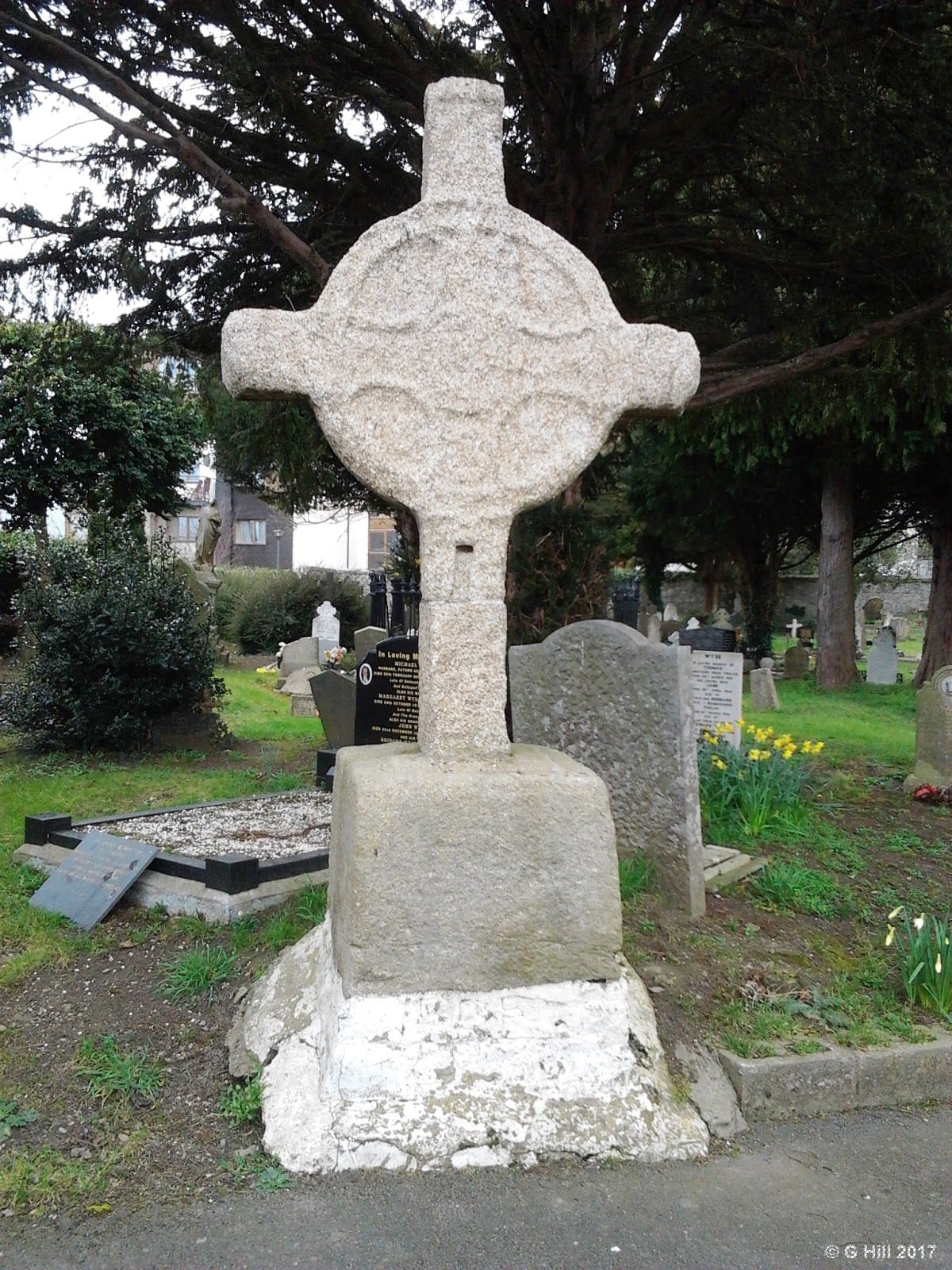
An crois Críostaíoch ársa sa reilig (Griangraf: G. Hill)

NAOMH CAINNECH

B’ab, sagart agus misinéir Éireannach é Cainnech (515 / 16-600) as Achadh Bhó ins an Condae ainmnithe ar a shon, Cill Chainnigh chomh maith le bunaitheoir mainistreach i rith na luath-mheánaoise. Tugtar “Saint Canice” air i mBéarla in Éirinn, “St. Kenneth” in Albain nó “St. Kenny” agus i Laidin “Sanctus Canicus”. Tá an Cainneach ar cheann de Dháréag Aspal na hÉireann agus rinneadh sé seanmóireacht ar an gCríostaíocht ar fud na tíre agus ar na Cruithnigh in Albain. Scríobh sé tráchtaireacht ar na Soiscéil, ar a tugadh Glas-Chainnigh nó “Lock Kenneth” nó “Slabhra Chainnigh” ar feadh na gcéadta bliain.

Tá an chuid is mó dá bhfuil scríofa faoi shaol Cainnech bunaithe ar thraidisiún, ach measadh go raibh sé ina fhear le dea-cháil, le solabharthacht mór agus le léann. I 544 rinne sé staidéar faoi Mobhí Cláraineach i scoil Ghlas Naíon, le Ciarán as Cluain Mhic Nóise agus Comgall de Bheannchar. Nuair a scaip plá an pobal sin, chuaigh sé go mainistir Cadoc i Llancarfan i Glamorganshire sa Bhreatain Bheag, áit ar ordaíodh ina shagart é i 545.

Tá tagairt dá ainm luaite i sé logainm déag ag Wikipedia: in Éirinn, sa Bhreatain Bhig, in Albain, ins na SAM, san Astráil agus sa Nua-Shéalainn. Déantar comóradh ar a lá féasta an 11ú Deireadh Fómhair san Eaglais Chaitliceach Rómhánach agus in Eaglais Cheartchreidmheach an Oirthir de réir a gcuid féilirí faoi seach (Gregorian nó Church Julian) le laethanta féasta breise an 1d nó 14ú Lúnasa in Eaglais Cheartchreidmheach an Oirthir.

(Griangraf: D. Breatnach)

MEITHEAL OIBRE

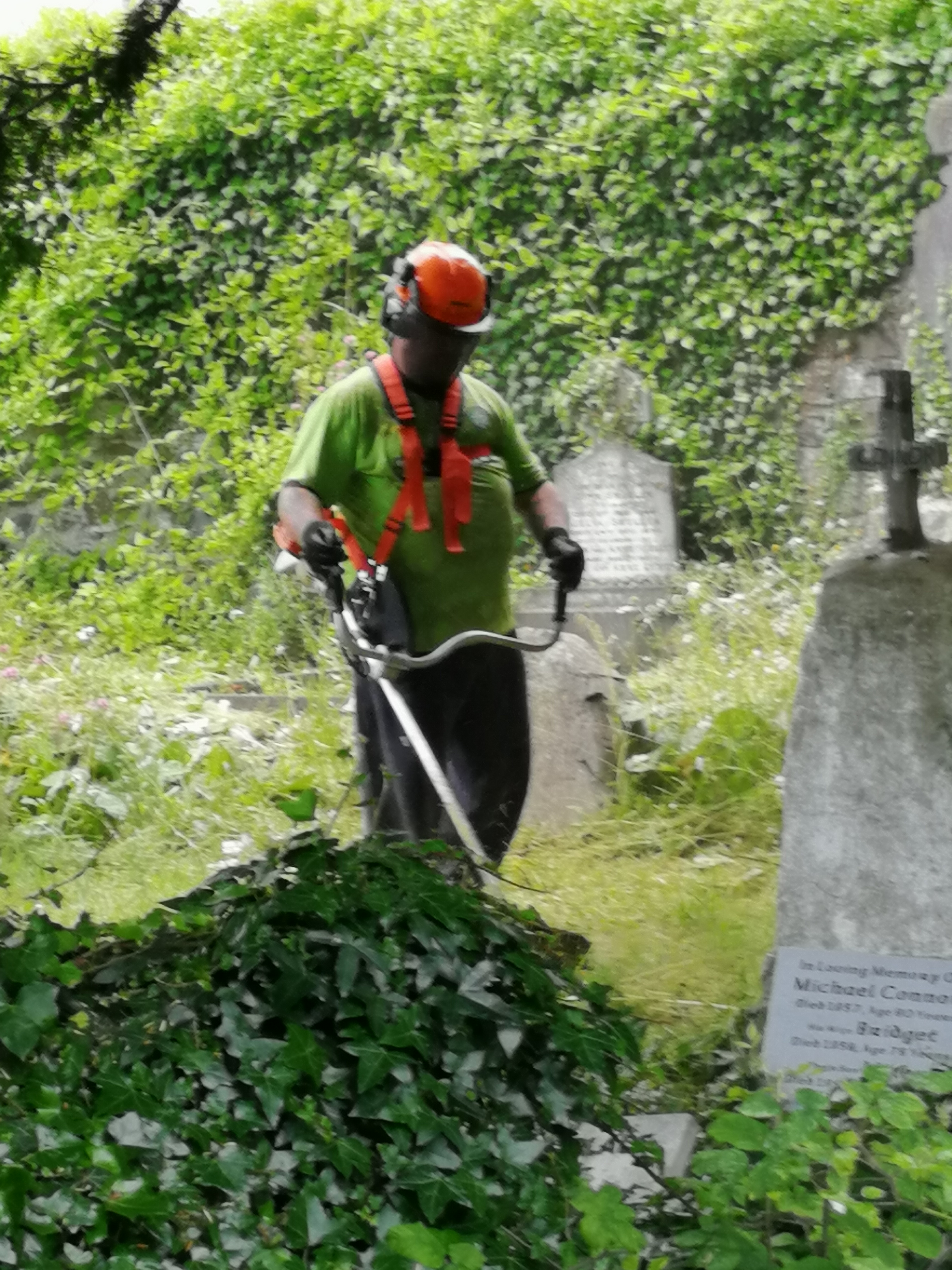
Bhí meitheal oibre ann sa Reilig trathnóna Déardaoin seo chaite agus iad ag baint fiadhaile agus féir, ag gearradh driseacha, eidhneáin is a leithéid. Bhí na préamhacha go doimhin in áiteanna agus ba léir nach ndearna cóiriú ceart le tamall fada. “Tá an eidhneán ag clúdú ballaí an fhothrach agus de réir a chéile ag déanamh dochar dó. Is ón 10ú nó 12ú Céad an cill agus ba cheart na ballaí a chaomhnú,” adúirt ball den chumann staire áitiúil.

Joe Lynch i mbun oibre. (Griangraf: D. Breatnach)

“D’úsáid teaghlaigh Protastúnacha agus Caitliceacha an reilig,” adeir Joe, “lucht creidimh amháin ag teacht isteadh geata amháin agus an geata eile ag an gcreidimh eile. Ach ní gá dúinn an dá gheata anois agus táim ag tathant ar an gComhairle an geata eile a tháthú le fada.”

Deir lucht an chaomhnaithe go ndearnadh an crois ársa a roinnt i gcodanna sa 17ú Céad ionnas go bhféadfaí a chur i bhfolach nuair a chuala go raibh fórsaí Chromail le teacht thríd an dúiche, de fhaitíos go ndéanfadh siad an siomból a scrios mar a bhí á dhéanamh acu ar fud na tíre (ag iarraidh “íoldadhradh” a ruaigeadh). Thóg na fórsaí céanna bóthar eile ach d’fhan píosa na croise i bhfolach go ceann breis agus 160 bliain, go dtí go ndeachadh an t-urramach Walshe á lorg thrí bhéaloideas na h-áite agus tháinig air, ach níor fuarthas bun na croise go dtí seo.

Tá an crois céanna sa Reilig anois agus glacadh ag cumainn áitiúla mar siomból na dúiche. De réir Joe Lynch tá an Comhairle Cathrach ag iarraidh an crois a bhailliú as an reilig ach tá sé féin agus daoine eile ag iarraidh go bhfágfaidh ann é agus cúram na Reilige a fhágáil ag muinntir na h-áite.

Tá meithil eagraithe chun oibre ag an reilig trathnónta Sathairn agus oícheannta Déardaoine agus tuilleadh eolais ar leathanach Facebook na reilige.

Duine den mheithil i mbun oibre. (Griangraf: D. Breatnach)
Ball eile den mheithil. (Griangraf: D. Breatnach)

FOINNSÍ:

https://en.wikipedia.org/wiki/Cainnech_of_Aghaboe

In Finglas, Residents Push for Better Maintenance of a Historic Graveyard

https://www.facebook.com/St-canices-graveyard-105954865096973/

APPENDIX:

English translation:

ST CANICE’S CEMETERY IN FINGLAS – “LET US HAVE THE RESPONSIBILITY”

Diarmuid Breatnach

(Reading time: 2 mins)

There is a cemetery in Dublin that is over a thousand years old, containing a cross that was salvaged from Cromwell’s destruction. But some locals are unhappy with the kind of care that Dublin City Council is giving it and want to take responsibility for the care of the cemetery.

St. Canice’s Cemetery is located just west of the dual carriageway which cuts through Finglas and churches.

“There is a crypt for the local esquires, the Maffett family – now cemented,” says Joe Lynch, “to protect it from grave robbers. There are chest tombs for the dead priests and bishops, and simple headstones for the commoners. ”

Joe Lynch’s father was caretaker of the cemetery and had a cottage next to it; it was where Joe was raised as a child. “I was taken to a cemetery in wheelbarrow,” says Joe, “when I was four years old. And I would want to help when I was let out.”

(Griangraf: D. Breatnach)

SAINT CANICE

Cainnech (515 / 16-600) was an Irish abbot, priest and missionary from the county named after him, Kilkenny, and the founder of an early medieval monastery. He is called “Saint Canice” in English in Ireland, “St. Kenneth” in Scotland or “St. Kenny” and in Latin “Sanctus Canicus”. Canice is one of the Twelve Apostles of Ireland and preached Christianity throughout the country and to the Picts in Scotland. He wrote a commentary on the Gospels, known as “Lock Kenneth” or “Chain of Canice” for centuries.

Most of what is written about Kenny’s life is based on tradition, but he was considered a man of good repute, great eloquence and learning. In 544 he studied at St. Mobhi’s in Glasnevin, with Ciarán of Clonmacnoise and Comgall of Bangor. When the plague spread, he went to Cadoc Abbey in Llancarfan in Glamorganshire, Wales, where he was ordained a priest in 545.

Wikipedia connects his name to sixteen placenames: in Ireland, Wales, Scotland, the USA, Australia and New Zealand. His feast day on October 11th is commemorated in the Roman Catholic Church and the Eastern Orthodox Church according to their respective calendars (Gregorian or Church Julian) with additional feast days on the 1st or 14th of August in the Eastern Orthodox Church.

WORKING GROUP

A “meitheal”, a cooperative work party was at work last Thursday afternoon pulling weeds, cutting grass, brambles and ivy. The roots were deep in places and it was clear that site had not been properly tended for a long time. “The ivy is covering the walls of the ruin and gradually damaging them. The church dates from the 10th or 12th Century and the walls should be preserved,” said a member of the local historical society.

“The cemetery was used by Protestant and Catholic families,” says Joe, “one group entering one gate and the other faith at the other. But we don’t need both gates now and I’ve been at the Council to weld the other gate for a long time. ”

Larry agus ball eile den mheithil. (Griangraf: D. Breatnach)

Conservationists say the ancient cross was divided into parts in the 17th Century so that it could be hidden when they heard that Cromwell’s forces were coming through the area, for fear of their destroying the symbol as was being done all over the country (to banish “idolatrous worship”). The same forces traveled another route instead but the pieces of the cross remained hidden for over 160 years, until the reverend Walshe investigated local folklore and found it, but the base of the cross has not been found to date.

The same cross is now in the Cemetery and has been accepted by local societies as a symbol of the district. According to Joe Lynch the City Council is trying to remove the cross from the cemetery but he and others want it to remain there and the care of the Cemetery to be left to the local people.

The cemetery has a working group organized on Saturday evenings and Thursday evenings, more information on the cemetery ‘s Facebook page.

Cuid de bhallaí fothrach na cille agus duine den mheithil. (Griangraf: D. Breatnach)
Ina luigh ach ag obair.
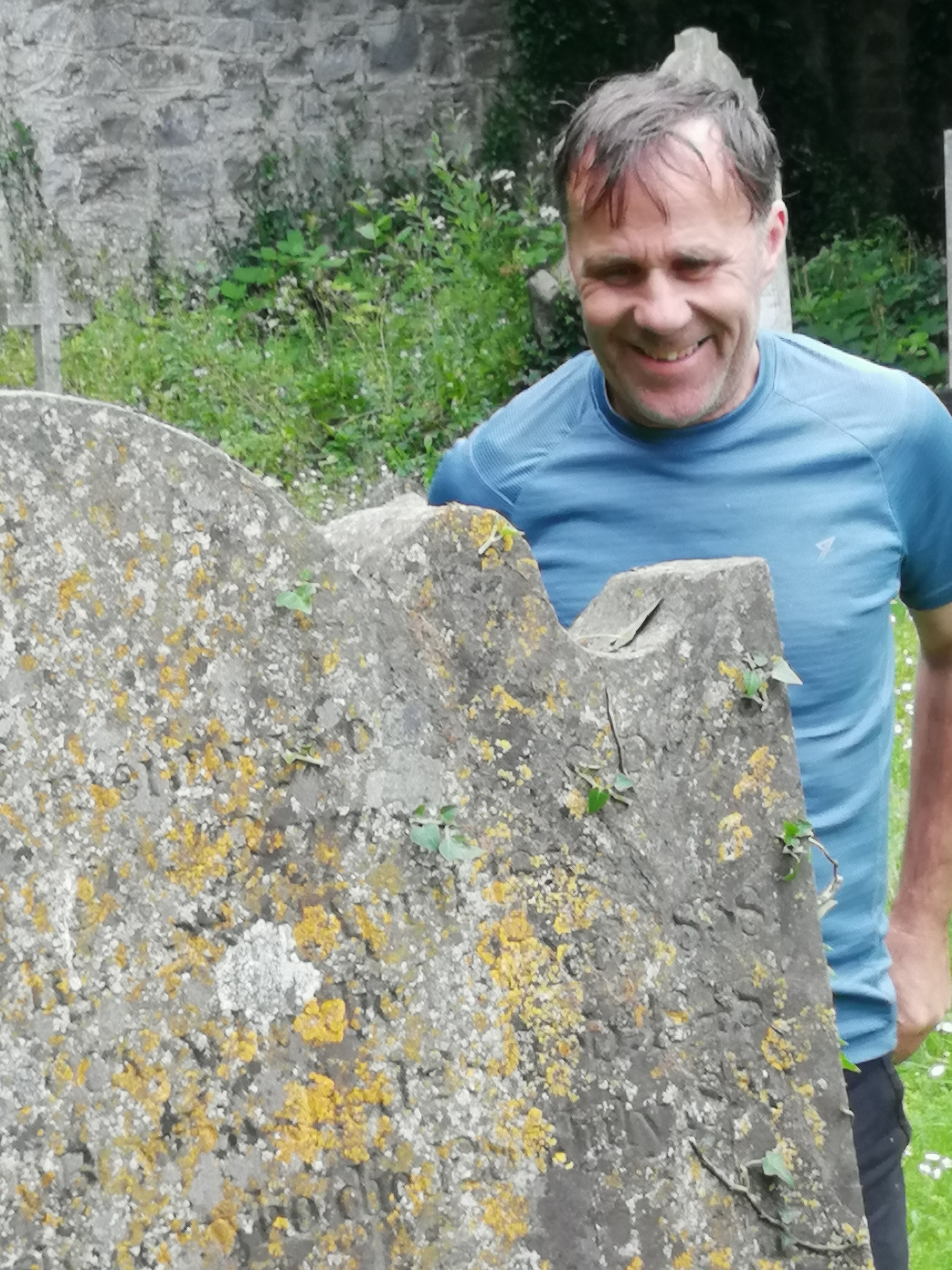
Darmuid Ó Dubhghlais agus sean-leac uaighe. (Griangraf: D. Breatnach)
An príomh-gheata agus an crois ársa in aice leis. (Griangraf: D. Breatnach)