

Diarmuid Breatnach
(Reading time: 10 mins.)
US Imperialism is currently meeting resistance in two Middle Eastern/ West Asian states as, through pressure on their governments, it tries to disarm the guerrilla organisations.
People in most Western states are familiar with political binaries of Right and Left but in many parts of the world, though that exists, the dominant binary is sovereignist or clientist1, the former placing national interests above all and the latter aligning with the interests of imperial powers.
LEBANON
This country is known as the heartland of Hezbollah but many may not be aware that this resistance movement is fairly new in historical terms, coming into existence as it did in opposition to the ‘Israeli’ occupation of 1982 and instrumental in forcing total IOF withdrawal by 2000.
Hezbollah has been described more recently as “a state within a state”, with its Loyalty to the Resistance Bloc political representation and its Jihad Council army. It works in alliance with the Amal Party, also majority Shia and the Free Patriotic Movement (mostly Christian).2
Lebanon had been earlier occupied by French colonialism and its colonial elite was typically among the Catholic Christian sect known as Maronites,3 as were half the population then, the reason why the Constitution (National Pact of 1943) gives half the seats to Christian candidates.
However no population census has been carried out since 1932 and many believe that a census today would not justify half the Parliament seats allocated to Christian representatives, even in a sectarian Constitution. The others sects are Muslim (Shia and Sunni) and Druze.
This has been the case in Lebanon which, outside of the Civil War of 1975-1990, has been governed in a balance of these forces, with the recent former President, though a Maronite, sympathetic to the country’s sovereign interests and therefore also to Hezbollah and the Amal party.
On the clientist side (but proclaiming Lebanese ‘independence’) are the remains after its 2016 dissolution of “the March 14 Alliance,” consisting now of the Lebanese Forces party, with the largest parliamentary representation4 and of the Ketaeb, the fascist Phalangist party of the Civil War.
The main political representation of the Druze community, the Progressive Socialist Party, has supported one bloc or the other at various times.
The Lebanese Constitution (National Pact) stipulates that the President must be a Maronite but cannot be a serving member of the military. On 9th January, Josef Aoun was elected President of the Government, for which he had to give up his position of Commander of the Armed Forces.
His election and cabinet choices were not good news for the sovereignists since the USA, as in many countries had been penetrating the armed forces through weaponry and recruitment grants and Aoun was considered their proxy – a description which his conduct has done nothing to refute.

On 5th August the Lebanese Parliament began to discuss the question of who is entitled to bear arms with a clear intention to follow the US lead that it should be the State only.5 Many in the West would perhaps think this a normal position but only Hezbollah fighters have defended Lebanon.
Since the ‘Israeli’ armed forces attacked Lebanon on 1st October 2024,6 not once has the Lebanese Army fought them. Hezbollah fought the IOF to a standstill in the south of Lebanon, also bombing troop concentrations in northern ‘Israel’7 in support of Gaza and causing large settler evacuations.
The IOF had to beg for a ceasefire, to which Hezbollah and the Lebanese Government (also US, France …) agreed and which the IOF, true to form, has violated since thousands of times in bombing flights, drone assassinations, invasion of Lebanese land and kidnapping of Lebanese civilians.8
Hezbollah and Amal’s representatives walked out of the Government disarmament discussions, accusing their reigning opposition of failing to stand up to US threats and seeking to disarm the Resistance while at the same time failing to confront ‘Israeli’ occupation and ceasefire violations.

The Government went ahead and tasked the Army with preparing a plan – not to defend Lebanon against the occupation and constant attacks by the IOF but instead to disarm Hezbollah.
No observer thinks the Government or Lebanese Army are capable of disarming Hezbollah and serious commentators view this move by US proxies as seeking to delegitimise the Lebanese Resistance and blame them for the attacks of the IOF upon targets in Lebanon.
Hezbollah in fact is the only force that has fought the Zionist occupation9of 1982 after the PLO left, also during later IOF invasions of 1993 and 1996. Josef Aoun is widely believed to have asked Hezbollah to defend Lebanon’s western border with Syria against infiltration from ISIS.10
Iranian Foreign Minister Abbas Araghchi commented on the reason for trying to disarm Hezbollah “is that it has shown its capability on the battlefield”, and “that the positions of the party and its Secretary-General are strong showing the Resistance’s steadfastness in the face of pressures.”11
The Lebanese Foreign Minister accused Araghchi of “violation of Lebanon’s sovereignty,”12 which might have been considered fair comment, were it not for the fact of Lebanon’s government’s acting under admitted US pressure and toleration of ‘Israeli’ bombing and assassinations.
This kind of dialogue continued up to very recently as Ali Larijani, Iran’s Secretary of the Iranian Supreme National Council visited the country but he pointed out in public statements that interference in Lebanon’s internal affairs is not by them but rather by others in an overseas faraway office.
Nightly protest demonstrations,13 including huge motorcades have been carried out in many areas since the Government’s decision, mostly by young people, often flying Hezbollah flags.
An opinion poll taken between 27 July and 4 August 2025 indicates that 76% wouldn’t trust diplomacy with ‘Israel’, 71.7% don’t believe the Lebanese Army is capable of defending the country against ‘Israel’ and 58% don’t think Hezbollah should surrender its weapons at this point.14
On Saturday, the Lebanese army said an explosion at a weapons depot near the Israeli border killed six soldiers as troops were sent to dismantle Hezbollah infrastructure in the area as part of a disarmament plan; the Government is now mourning them but blaming Hezbollah.
However, observers note that people in the south are angry that the Government never had a word to say about all the Lebanese civilians killed by the IOF since October 24 or about the Hezbollah fighters that fell fighting the ‘Israeli’ invasion then.

IRAQ
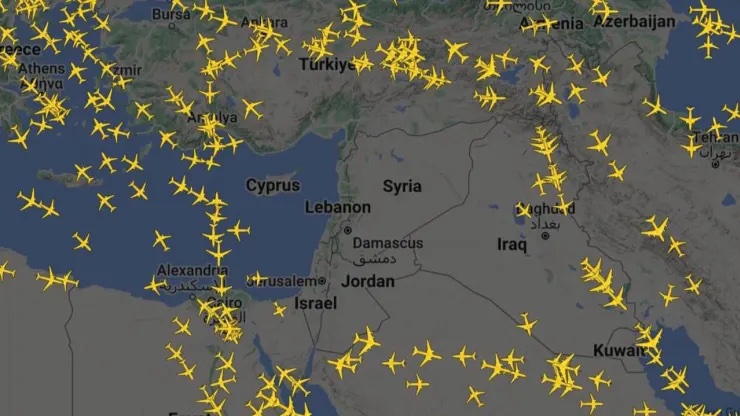
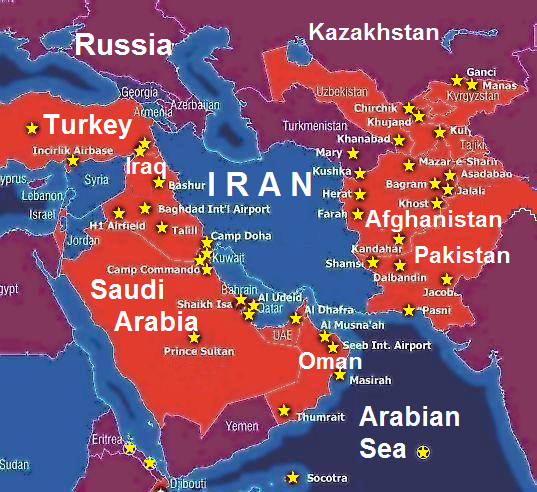
The position in Iraq is very different, although the USA is also keen to restrict arms to the State there only. The US armed forces have a base in Iraq and in addition, control its air space.15 However, the resolve of the Iraqi Government is different to that of Lebanon’s.16
US State Department spokesperson Tammy Bruce criticised the recent visit of Ali Larijani, Iran’s Secretary of the Iranian Supreme National Council and the signing of a joint security pact between Iraq and Iran. Iraq’s Embassy in New York replied that they are a sovereign state.17
Let us recall for a moment that Iraq was ruled by the Sadam Hussein regime, first a client of the US when it went to war with the Islamic Republic of Iran 1980-1988 but an enemy when, in pursuit of his own policies in 1990, his armed forces invaded Kuwait, a US client state.
In order to justify their regime-change war of 2003, political leaders of both the USA and the UK lied to their populations claiming that Iraq held WMDs (Weapons of Mass Destruction) which were an imminent threat. The subsequent war overthrew Hussein but destroyed the country for years.
The US occupation was widely criticised even by sources within the imperialist camp for its absence of an integrated governing policy and structure to replace the Hussein regime, with jihadist and Kurdish warlords ruling different areas and at times in conflict with one another.
Until the US forces agreed to pull out in 2011,18 the US proxy Iraqi administration and armed forces, along with the armed forces of the US itself faced constant attacks from both Iraqi national resistance organisations and Islamic jihadists, including by roadside bombs and suicide bombers.
The independent or citizen armed forces19 mostly came into existence during the war against the ISIS invasion of Iraq in 2014, being instrumental not only in defence of Baghdad but also in taking the war to the sectarian jihadists at a time when much of the Iraqi armed forces were failing.
Most of the media commentary on those Popular Mobilisation Forces characterises them as proxies of Iran and raises fears about their integration into the state armed forces without being under direct control of the military command, instead answerable only to the President.
While such media raises concerns about dangers to Iraq’s sovereignty from the militias, the same media sees no problem with the USA control of Iraq’s airspace, of foreign troops installed on their land past the date they agreed to leave, and openly pressuring Iraq on how to deal with the militias.
With regard to the call that all armed forces should be unified under the State, that generally suits the USA since they often arm, train and educate the armed forces in countries where they have influence, not to mention actual military bases.
The position of Western powers that only the State should have weapons is hypocritical given their history of supporting armed insurrection to topple regimes they consider unfriendly, also with regard to the right for citizens to bear arms in the USA’s own Constitution.
The hypocrisy of the USA and Western powers is exposed not only in that but also by the fact that they sponsored Muslim fundamentalist terrorist forces to overthrow secular regimes such as Assad’s in Syria, including supporting a prominent former ISIS commander to take over that state.
The multitude of militias under the self-proclaimed current President of Syria, Al Julani, former second-in command of the Nusra Front,20 have been massacring Alawites, Druze and Christians but despite some murmurs of concern Macron welcomed Julani to the Elysée Palace in Paris.
For the US and the Western imperialists then, the real issue is not about a need for one effective central military command or state sovereignty, but rather about whether or not all the armed forces within the State are under a command over which the imperialists can exercise control.
And even more so, whether the guerrilla groups or at least their commanders are orientated towards the western powers or instead towards an oppositional centre, whether that be a state such as the Islamic Republic of Iran, or an internal force in favour of national sovereignty and anti-imperialism.
End.
FOOTNOTES
SOURCES
https://thecradle.co/articles-id/32447
US pressure on Iraq re popular resistance forces: https://www.fdd.org/analysis/op_eds/2025/04/02/iraq-wrestles-with-us-pressure-over-iran-backed-militias/
1I do not think these handy short descriptive terms exist in English but I am going to employ them nevertheless.
2Known as “the March 8th Alliance.”
3https://en.wikipedia.org/wiki/Maronites
4According to the National Pact sectarian allocation of seats between the various religious communities. However, as noted, there has not been a census since 1932 and many suspect that the Christian community no longer has dominance in numbers.
5https://www.theguardian.com/world/2025/aug/07/us-pushes-lebanon-towards-dangerous-course-of-disarming-hezbollah
6For the sixth time.
7In solidarity with the people of Gaza.
8In April, the most recent reference I was able to find, The Cradle quoted Lebanon’s Information Minister stating the occurrence since the 27 November 2024 ceasefire signing of 2,740 such violations by ‘Israel’ https://thecradle.co/articles/nearly-200-killed-in-2740-israeli-violations-of-ceasefire-with-lebanon
9And the main force that drove the Zionist occupation out in 2006.
10Hezbollah is reputed to have refused, not surprisingly, while the current Lebanese regime is following US dictates (which is the major cause of the presence of ISIS in Syria) and demanding the disarmament of the Resistance.
11Reported by The Cradle on its Telegram Updates.
12Ibid: “The recent statements made by Iranian Foreign Minister Mr. Abbas Araghchi, in which he addressed internal Lebanese matters that do not concern the Islamic Republic in any way, are rejected and condemned. They constitute a violation of Lebanon’s sovereignty, unity, and stability, and are considered interference in its internal affairs and sovereign decisions.
Relations between states can only be built on the basis of mutual respect, equality, non-interference in internal affairs, and full adherence to the decisions of legitimate constitutional institutions. It is completely unacceptable for these relations to be exploited to encourage or support internal parties outside the framework of the Lebanese state and its institutions, and at its expense.”
13https://www.thenationalnews.com/news/mena/2025/08/11/hezbollah-doubles-down-on-rejecting-lebanons-impossible-disarmament-plan/
14https://thecradle.co/articles/majority-of-lebanese-oppose-hezbollah-disarmament-say-army-incapable-of-confronting-israel
15Over the protests of the Iraq Government, the US used its airspace from which to bomb Iran in the recent attack.
16Though one might not think so from the predominance of current media headlines announcing government and resistance groups’ alleged acquiescence.
17‘Iraq is a fully sovereign state and has the right to conclude agreements according to its constitution and laws, without being subject to any country’s policies‘. Details of the agreement remain unknown.
18But have yet to actually do so.
19This excludes the Kurdish peshmerga who fought ISIS mostly to defend their areas and many with a desire to create an independent Kurdish authority there.
202016 description of Al Nusra Front by pro-western publication: https://www.rand.org/pubs/commentary/2016/11/al-nusra-is-stronger-than-ever.html









 rebelbreeze