According to media reports, Taoiseach Leo Varadkar said he expects to see a united Ireland in his lifetime. I think he’s wrong but he’s entitled to his opinion. However, some of his following remarks are objectionable and need to be challenged.
Varadkar claimed that in a united Ireland “there will be roughly a million people who are British.” That is false. There may – or may not – be a million IRISH PEOPLE who consider themselves British in a united Ireland, we’ll see. But they will be IRISH CITIZENS.
And they should have equal rights with all other citizens. They should have an equal right to vote, to housing, to their language, without any special restrictions, not to mention pogroms – in other words, nothing like the way their statelet treated its large Catholic minority.
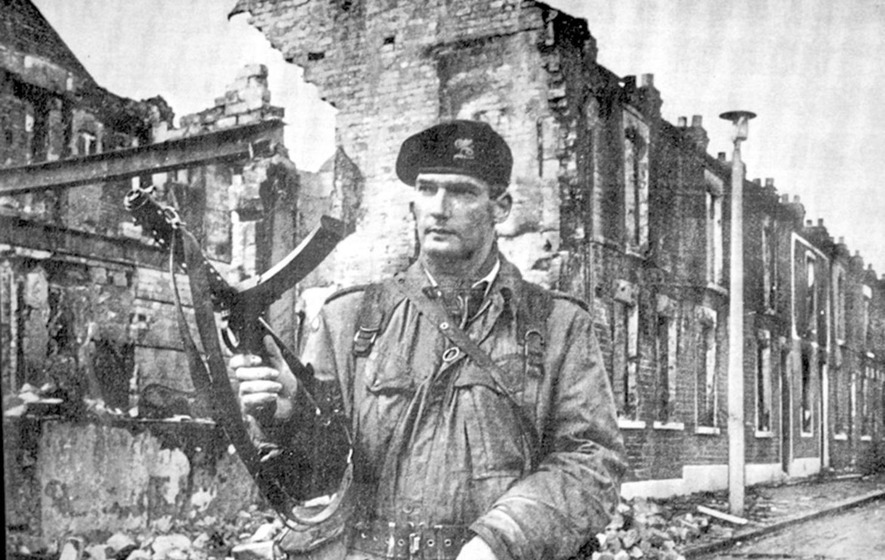
A British soldier stands in front of a section of the burned out houses of Catholics in Bombay Street, Belfast in 1969 (which the Army did not try to prevent Loyalists burning). The arson was the Loyalist response to demands of Catholics for civil rights (while the colonial police response was batons, bullets and gas). (Photo source: Clonard Residents’ Association)
I agree with Varadkar that the quality of a country should be judged “by the way it treats its minorities.” So Varadkar, how did and does your Gombeen State treat its probably oldest ethnic minority? You know, the Irish Travellers?
It is true that “a Republican ballad, a nice song to sing, easy words to learn for some people can be deeply offensive to some people.” Presumably he means to Unionists and Loyalists. Yes, and antifascist and anti-racist songs can be deeply offensive to fascists and racists.
It is also true that some people in the Southern States sing songs about the Confederacy and Robert E. Lee and call it their culture. And the comparison fits – but not with Republicans but with Loyalists!
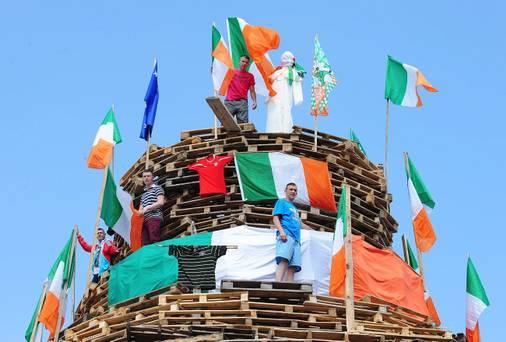
One of the charming annual expressions of Loyalist culture: a huge bonfire to burn Irish Tricoloursand representations of Catholicism. Palestinian flags and representations of Celtic FC are frequently burned too. Slogans such as KAT (‘Kill All Teagues [i.e Catholics]) are often displayed also. (Photo source: Wikipedia)
It’s not Irish Republicans who spread racism and sectarianism: the Republican creed came into existence precisely against sectarianism. And we know Varadkar actually knows that because not long ago he made some remarks about the wide embrace of the Irish Tricolour.
The Irish Tricolour: a flag presented to revolutionary Irish Republicans by revolutionary French Republican women in Paris in 1848. Not a flag of monarchism, sectarianism or collusion with imperialism or colonialism.
While we uphold Republican principles we don’t have to apologise to anyone, least of all in our own country, Varadkar. It’s you and your party (and the rest of them serving the Gombeen class who threw away independence and slaughtered Irish Republicans) who need to be ashamed.
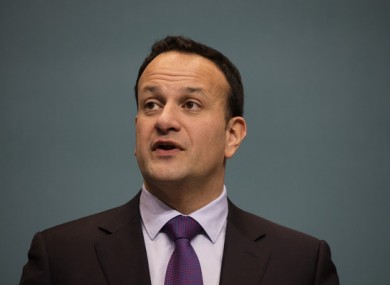
Leo Varadkar, Taoiseach (Prime Minister) of the current Coalition Government, who made the remarks this week. (Photo sourced: Internet)
People living in Ireland can think and feel what they like, good or bad. But in public, we will celebrate the valuable things in our history and culture. And we’ll do so proudly without apology to anyone.
On the other hand, public displays of Orange sectarianism, racism, homophobia, fascism and anti-LGBT targeting won’t be tolerated in an independent, reunited Ireland. Not for one minute.
Recently the Taoiseach1 of the Irish State criticised people protesting the Government’s plans to slide the state into external military alliances of “misappropriating” the Irish Tricolour and, incredibly, even of “weaponising” it.
The Irish tricolour was a weapon from the moment it was sewn – a psychological weapon, laden with political meaning, sewn by French revolutionaries, presented to and flown by Irish Republican revolutionaries from generation to generation.
Painting by Philoppoteaux depicting the revolutionaries of the French 1848 Revolution outside the Paris Town Hall and Lamartine rejecting the Red Flag in favour of the French Republican one. Women participants in this revolution presented the Irish Tricolour sewn in silk to Young Irelanders including Thomas Francis Meagher (Source photo: Wikipeda) [When Paris rose again in 1871 under the Paris Commune, the preference was for the Red flag.]
Prior to the advent of the Tricolour, the Irish Republican flag was typically the gold harp on a green background2 but when a group of Young Irelanders went to Paris in solidarity with the revolution of 1848 there, the Tricolour sewn in silk was presented to them by revolutionary French women.
The symbolism of the Tricolour was firstly in its form; the French Revolution adopted a tricolour in opposition to the monarchist Fleur-de-Lison a blue background and different tricolours became popular as flags of new republics.
In the Irish Tricolour, the ancient Irish and the Norman-Irish, basically Catholics, were represented symbolically by green, with orange for the settlers (after William of Orange) of one sect or another of the Protestant faith; the colour white, symbolised peaceful national unity in an Irish Republic.
And it presented an equal unity, as opposed to the unity of Scotland and Ireland with England but under the clear domination of the latter, as represented in the Union Jack, which incorporates the St. Andrew’s and St. Patrick’s crosses with the English one of St. George.
THE TRICOLOUR UNFURLED IN IRELAND
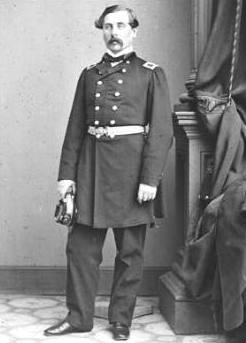
The Irish Tricolour we know was first unfurled by Thomas Francis Meagher “of the Sword” at the Wolfe Tone Club in Wexford on 7th March 1848 and in Dublin in Lower Abbey Street on 13th April 1848.
Meagher’s nickname was due to his renunciation of the Gombeens of his day trying to deny the right to resort to arms if necessary to win freedom3.
Meagher and other Young Irelanders were arrested around the failed uprising of 1848, just after the worst year of the Great Hunger and, after wide-scale international and domestic protests at the sentences of execution, transported to penal colonies, from which many escaped.
Taking his Republicanism and inclusivity seriously, both in Ireland and abroad, Meagher raised and commanded the Irish Brigade (composed of five regiments4) in the United States, fondly nicknamed Mrs. Meagher’s Own, to fight for the Union against the Confederacy and slavery.
As the years of struggle progressed, the Tricolour took its place among the ranks of Irish Republicans alongside the older Harp on Green or, for some Fenians, the gold or orange Sunburst on a blue background and so it was in the 1916 Rising when it began to be the most chosen.
Other flags were flown during the 1916 Rising also but the Tricolour was one of two erected on the roof of the GPO, headquarters of the Rising and became the most prominent during the War of Independence (1919-1921).
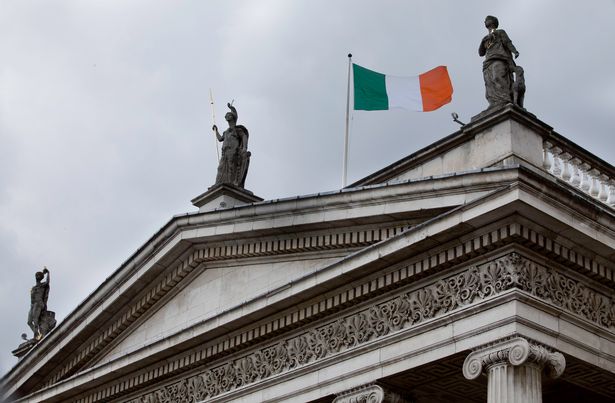
The Irish Tricolour in modern times flying over the General Post Office building in Dublin City’s main street (Source photo: Internet)
During the Irish Civil war by the British-supported, armed and provisioned Free State Army against the Republican movement (1922-1923), it was flown by both sides. Even after the defeat of the Republican movement and repression, it was not immediately named the state’s flag.
Though it was displayed by the Free State when joining the League of Nations in 1923, and denounced by the Republican movement as an usurpation, it did not seem that the new state was too attached to it5 and some Irish ships flew the British Red Ensign until 1939 and WW2.
The first time the Tricolour was formally adopted by the Irish State was in the 1937 Bunreacht (Constitution) which was brought in by De Valera’s Fianna Fáil6 Government and even then it was under a pretence of Republicanism with claim laid to the whole of Ireland.
Display of the Tricolour was suppressed in the Six Counties colony from 1922 and officially banned under the Flags and Emblems Acts (1954). Many a battle was fought with the colonial police by people asserting their right to display it, the Act not being repealed until 1987.7
“A FLAG OF INCLUSIVITY, MISAPPROPRIATED BY A MINORITY”
One must agree with Varadkar that the flag signifies inclusivity and was misappropriated by fascists and other racists in recent years but it is shameful of him to attribute similar exclusivity to Republicans, who in many cases fought those same fascists to which he referred.
Leo Varadkar, current Taoiseach of the Irish Government, who accused protesters for Irish neutrality of “weaponising” the Irish Tricolour (Source photo: Internet)
Not only fought them in recent years but also back in the 1930s, when Irish fascists were called the Blueshirts. Surely Varadgar is familiar with the latter’s history also, since they were one of three reactionary groups that joined to create Fine Gael – yes, Varadkar’s own political party.
And the first Irish Republicans, the United Irishmen, sought the unity of “Catholic, Protestant (Anglican) and Dissenter (other Protestant sects)” for an independent Republic, an ideology carried on by all Republican groups thereafter and given expression in the 1916 Proclamation.
But this is not the first time that people in authority have tried to equate Irish Republicans with fascists, as a few years ago Garda Commissioner Drew Harris issued a press statement in which he accused Republicans of having organised a far-Right demonstration — which he later recanted.
One would think Drew Harris, ex-Assistant Commissioner of the British colonial police force, the PSNI8, well-known for their sectarianism and collusion with the colonial brand of fascism, the Loyalists, would be able to distinguish between Irish Republicans and fascists with ease.
Varadkar is ridiculous in accusing Republicans of “weaponising” the Tricolour since it wasalways an ideological weapon from the moment of its creation and then eventually used by the State to try, with monumental lack of success, to deny it to Republicans.
But Varadkar is right in that the Irish Tricolour has been misappropriated by a minority; but rather than Republicans, that minority is the Gombeen ruling class, foreign-dependent, neo-liberal, selling out the country’s resources and networks to foreign capitalist monopolies.
And causing homelessness, or rent and mortgage hopelessness, emigration and austerity for the vast majority of the people in the Irish state, both native and immigrant, for the benefit of a tiny minority of parasites incapable of even developing a viable Irish national economy.
Republican groups, like all groups are minorities but so are the elites, though even smaller. But in representation? Republicans, whatever faults they may have from time to time clearly represent a much larger and wider section of society than do the Gombeens.
This has been evidenced by the militant opposition of wide Irish society to triple water taxation and privatisation, repugnance for the celebration of British occupation forces and the wide opposition to joining a military alliance, all projects pushed by the Gombeens in different governments.
The Irish Tricolour has been commented upon in a number of Irish Republican songs, sometimes even in the song title: White, Orange and Green and Green, White and Gold.
Probably it is most appropriately referenced in the chorus of a song directed at the Gombeens, the very minority who have misappropriated it:
Take it down from the mast, Irish Traitors, It’s the flag we Republicans claim; It can never belong to Free Staters For you’ve brought on it nothing but shame9.
End.
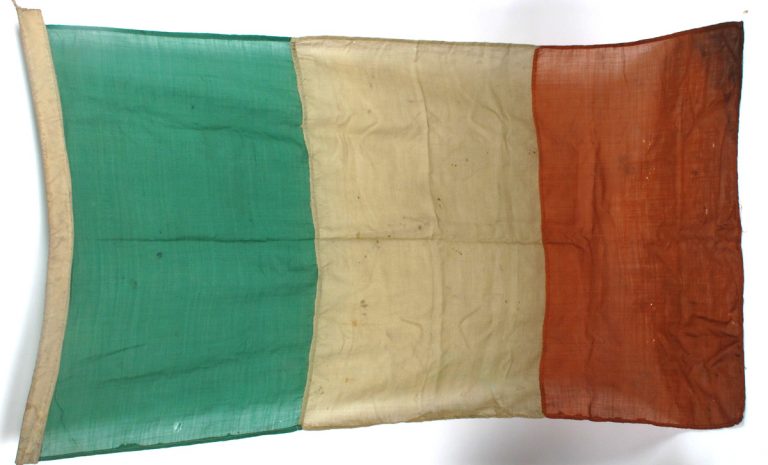
The Irish Tricolour that was flown over the GPO in 1916 (Source photo: 1916 Rebellion Tours)
FOOTNOTES
1 Currently Prime Minister of the Coalition Government of Fianna Fáil, Fine Gael and the Greens.
2 Flag of the Society of United Irishmen, who led insurrections in 1798 and 1803.
3 Daniel O’Connell’s son intended to force a motion of that kind on the Irish Repeal Association founded by his father and also sought to have the motion passed without debate. O’Meagher said that while he did not exalt violence, neither would he allow his sword to be taken from him in case it should be needed. He and others such as Thomas Davis left the Association at that point and became known as “the Young Irelanders”, first mockingly and later with pride.
4 Including the 69th New York Infantry or “Fitghting 69th”. 7,715 men served in the brigade, 961 were killed or mortally wounded and around 3,000 were wounded. (Wikipedia The Irish Brigade)
5 A 1928 British document said: The government in Ireland have taken over the so called Free State Flag in order to forestall its use by republican element and avoid legislative regulation, to leave them free to adopt a more suitable emblem later. (Wikipedia)
6 The party was a split from the losers of the Civil War of which De Valera had been leader, formed in order to participate in elections for Government and presented itself as Republican. The 1937 Bunreacht also laid claim in Articles 2 & 3 to the whole of Ireland which were removed in
7 During a period of direct rule by the British Government.
8 The colonial gendarmerie, formerly the Royal Ulster Constabulary for the Six Counties, preceded by the Royal Irish Constabulary for the whole of Ireland.
9 Soldiers of ‘22 by Brian Ó hUigín, acclaiming the Republican resistance to the counter-revolution of the Free State during the Civil War.





 rebelbreeze