EXCLUSION OF ISLAMISTS FROM THE PALESTINE LIBERATION ORGANISATION ENDING

Diarmuid Breatnach

(Reading time article: 5 mins.)

The historic exclusion from the Palestine Liberation Organisation of Islamist resistance organisation is ending. In a conference taking place currently in Beijing, two secular resistance organisations called for the Islamists’ inclusion in the PLO.

That news came earlier in the day from Resistance News Network (on Telegram) and much later, from the same source, the news of an agreement (see Appendix) of all on forming a consensus resistance government – but no mention of opening the PLO to the Islamist groups.
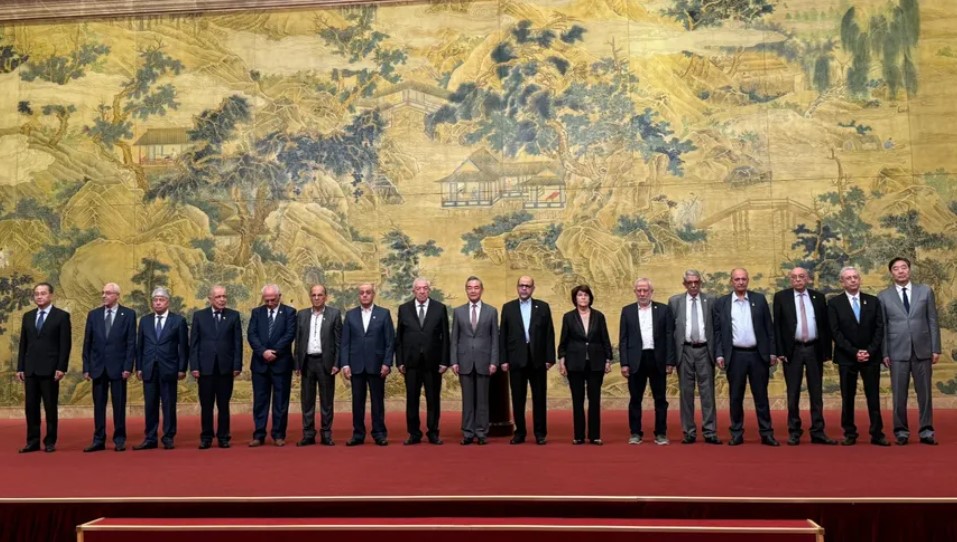
Participants in the Palestine Resistance Unity Conference in Beijing days ago. (Photo sourced: Internet)

The PLO has been internationally recognised as the sole legitimate representative of the Palestinian people but it was dominated by Arafat’s Fatah, which became a corrupt organisation colluding with the Occupation and with US Imperialism.

This morning some of the published contents of the agreement1 leaked to the media, were disputed in statements from Palestinian Islamic Jihad’s Ihsan Ataya2 and Hussam Badran of Hamas,3 in particular in reference to UN resolutions which contained a recognition of the state of ‘Israel’.

Reading between the lines one suspects an attempt to bring in false elements of agreement with elements of collusion with the entity and/or undermining and sabotaging any agreement at all. In any such manoeuvres, due to past behaviour first suspicion must fall on the Fatah leadership.4

If no agreement was reached on enlarged PLO membership, then given the statements of the PFLP and the DFLP, one must assume that the Fatah leadership vetoed that decision. In agreeing to a consensus government then one must also suspect the Fatah leadership of playing for time.

The Western Left and the Palestinian Resistance

A decision on opening the PLO has been coming for some time but will not be welcomed by some groups in the West. Islamist resistance organisations hold a number of socio-political ideological positions that are in opposition to the socialist or even secular positions held in Left circles.
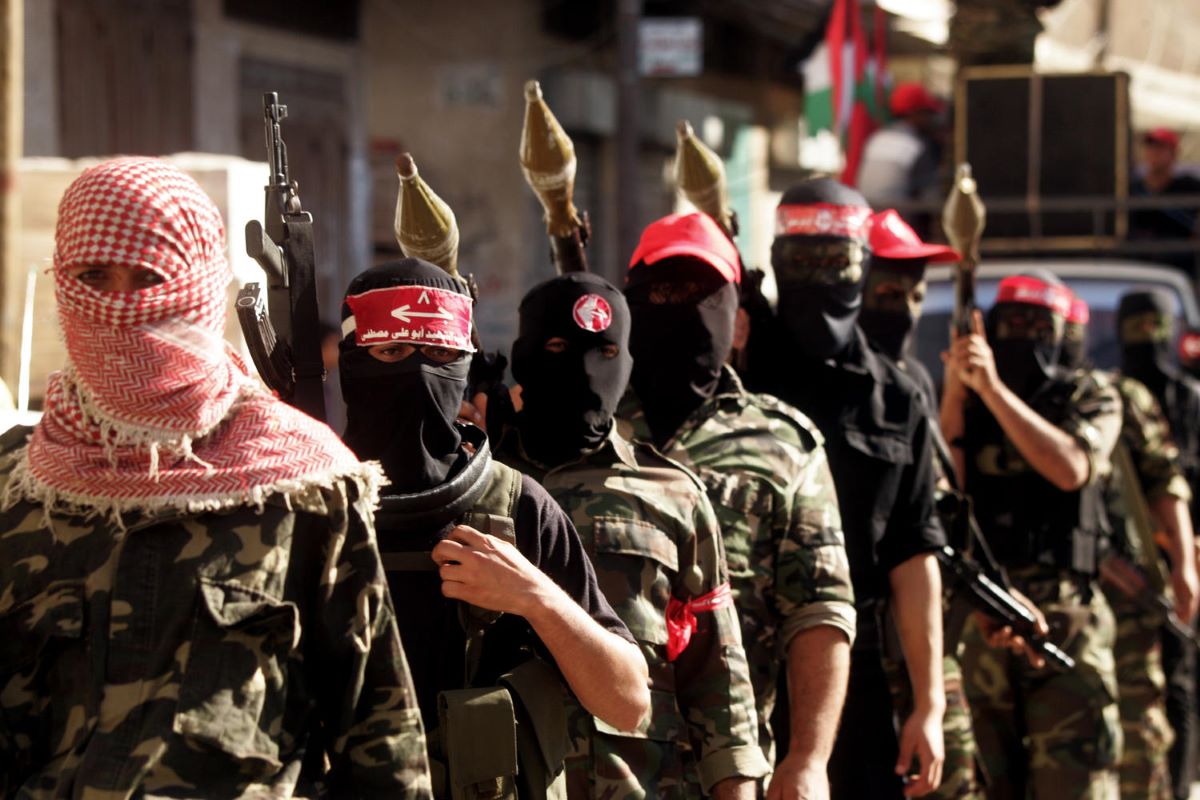
Palestinian militants from the Popular Front for the Liberation of Palestine (PFLP) in parade in Khan Yunis in the southern Gaza Strip on April 29, 2014. (Photo cred: Abed Deb /Pacific Press Credit: PACIFIC PRESS/Alamy Live News)

In those sectors of the Western Left, most support was divided among Fatah, the leading faction in the PLO, or for the Peoples Front for the Liberation of Palestine, its second organisation in size there, with some supporting the Democratic Front for the Liberation of Palestine.

With regard to the first, the ability of organisations claiming to be revolutionary or even just democratically socialist to support a leadership founding the Palestine Authority as a Vichy-type government run by the corrupt Quisling Abbas has been astonishing and also revolting.

While the PA and Fatah leadership engage in active collusion, a military section of Fatah has broken away and is part of the active armed resistance to the Occupation,5 though overshadowed in quantity and effect by the operations of the Islamist groups.

Two Islamic Jihad fighters (Photo sourced: Internet)

Need for Unity but Not a Simple Thing to Achieve

There is clearly a need for a unified resistance in terms of military operations but also with regard to political position. How far is the resistance to go? What are to be its objectives beyond defeating the current genocidal campaign? Who will run the territory and how will that be decided?

And of course, what is the national territory to be claimed: historic Palestine? Or the territory as it stood prior to the 1967 War? Into that question comes the other: a unitary secular state of the whole of Palestine, or 20% of the national territory under sight and guns of the larger Occupation state?

According to reports from Resistance News Network two secular organisations, PFLP and DFLP have already laid out their initial positions and both called for the inclusion in the PLO of the Islamist organisations Hamas and ICJ, along with the formation of an interim unity government.

This is a demand made in the past by Hamas and the ICJ also. Should all 14 organisations participating agree, there will remain a long road ahead of them. The Fatah leadership is wedded to Western imperialism and is likely to face rejection in elections, even more than it did in 2006.

Western imperialism and of course the Israeli settler regime don’t want a united Palestinian national resistance.

The fact is that not only are the Islamist organisations doing most of the fighting against the ‘Israeli’ Occupation’s genocidal campaign but there are more of them and they generally acknowledge the leadership of Hamas and Islamic Jihad, who have also been careful to consult them.

It was the latter two that organised and led the October 7th breakout from the Gaza ‘concentration camp’ into Palestinian territory seized and occupied by the settler regime, though resistance operations immediately afterwards were coordinated by the Joint Operations Room.

Hamas is not only the major leader in terms of military resistance, it is also a political organisation and was the electoral choice of the Palestinian people in the 2006 elections, the result of which was repudiated by the Fatah leadership and by the Western powers.

In addition, while the Palestinian secular Leftists have few external allies, those of the Islamist Palestinian resistance are active and powerful: Hizbollah in Lebanon and Syria, Islamic Resistancein Iraq,6 Ansar Allah in Yemen7 and the leadership of the Islamic Republic of Iran.

All of those with the exception of Iran are in constant action against the ‘Israeli’ Occupation and Iran has shown its capacity to flood ‘Israel’s’ air defence systems and, despite Western allies’ air force operations, to strike three military bases of its choice in occupied territory.

Yemen, in addition to its effective interdiction in three seas of shipping allied to the genocidal entity, last week slipped an explosive drone into Tel Aviv without even setting off alarms. The IOF bombed its oil tanks and electricity generator in revenge but this contest is far from over.

Hizbollah developed missiles capable of striking anywhere inside territory occupied by ‘Israel’ and has displayed detailed footage captured by their undetected drone over ‘Israel’s’ claimed territory comprehensively detailing military, industrial and civilian infrastructure.

In the event of the creation of a genuine national independent Palestinian state, it will not be socialist, at least initially — but will it be secular or Islamic in law? In the case of the latter, what will be the fate of the secular resistance sector?

In 2007 Hamas dealt harshly with Fatah forces in Gaza but that was after months of the Fatah administration refusing to relinquish control in line with the 2006 election results and also, no doubt, in recognition of the PA’s collusion with imperialism and the Occupation.

And will Shia and Sunni sections of the Islamist sector find a long-lasting accommodation? Come to that, will the secular organisations agree with one another? Apart from the collusive role of Fatah, in their statement the DFLP supported a two-State solution which the PFLP does not.
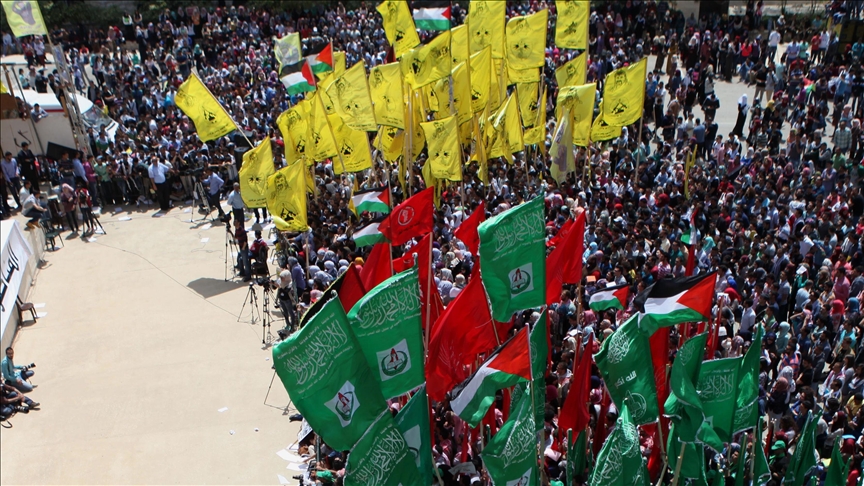
Mass demonstration of unity of different Palestinian resistance organisations (Source photo: Internet)

These questions will be answered by events yet to come and of course the right to decide on them belongs to the Palestinians. The Left in Palestine and outside will need to find a way to accommodate themselves to the results and continue to oppose imperialism and Zionism.

The defeat of the genocidal state of ‘Israel’ will be a huge boon to humanity, a significant damage to western imperialism (in that also a huge great boon to the world) and a huge achievement of the heroic resistance, armed and unarmed, of the Palestinian people.

End.

FOOTNOTES

1See Appendix

2Head of Arab and International Relations, statement to Al Mayadeen, summarised in Resistance News Network. Excerpt:

3Head of the National Relations Office in the Hamas movement and a member of its political bureau, in press statement summarised in Resistance News Network. Excerpt: Some points that implicitly and explicitly recognize the naming of UN resolutions that include recognition of “israel” have been amended. The Palestinian political leadership must realize that all negotiations with the occupation forces have failed. The guarantee of implementing the clauses of the “Beijing Declaration” lies in the hands of the Palestinians themselves. The dialogue in Beijing took place in two sessions, and after drafting the statement, there were objections to a number of its contents, and our position was clear. The final reading of the statement was supposed to take place before its approval, but due to the limited time, it was based on what the committee drafted. We passed the statement with our implicit reservations to thwart those who wanted to sabotage this meeting.

4The possibility of collusion in such manoeuvres by the DFLP cannot be excluded, given its position (reiterated in its opening statement to the Beijing Conference, as published by RNN) of claiming Palestinian land on the basis of pre-1967 War only, thereby accepting the State of Israel and its occupation of most of Palestine.

5I have not seen a full list of the represented organisations at the Beijing conference and therefore am unable to say whether they were there. They have been mostly fighting the Occupation in the West Bank and two of their field commanders were martyred yesterday in Tulkarem alongside a commander of Hamas forces by an IOF drone strike during the battle there.

6This coalition recently decided to end its truce in attack on US military bases in Iraq as a result of the long delay by the US in carrying out their agreed departure.

7In effect the government of Yemen, though the Western powers recognise only their proxy, a government in exile.

REFERENCES & SOURCES

Number of postings by Resistance News Network (on Telegram platform) yesterday and today.

https://ecfr.eu/special/mapping_palestinian_politics/plo_parties/

https://ecfr.eu/special/mapping_palestinian_politics/introduction_armed_groups/ (RNN gives a more comprehensive list and more detailed explanation but the link is for Telegram only)

APPENDIX

🚨🇵🇸 “The Beijing Declaration to End Palestinian National Division: To unify national efforts to confront aggression and stop the genocide war.”

The following was agreed upon by 14 Palestinian factions at the end of the reconciliation meeting in Beijing, China (https://t.me/PalestineResist/49595) today, including Hamas, PIJ, PFLP, DFLP, and Fatah:

– The Palestinian factions welcome the opinion (https://t.me/PalestineResist/49245) of the International Court of Justice, which confirmed the illegality of presence, occupation, and settlement.

– Continuing to follow up on the implementation of the agreements to end the division that took place with the help of Egypt, Algeria, China, and Russia.

– Commitment to the establishment of an independent Palestinian state with its capital in Al-Quds in accordance with international resolutions, especially 181 and 2334, and ensuring the right of return.

– We affirm the right of the Palestinian people to resist occupation and end it in accordance with international laws, the UN Charter, and the right of peoples to self-determination.

– To form a temporary national unity government with the consensus of Palestinian factions and by a decision of the president based on the Palestinian Basic Law.

– The formed government exercises its powers and authorities over all Palestinian territories, confirming the unity of the West Bank, Al-Quds, and the Gaza Strip.

– To resist and thwart attempts to displace our people from their homeland, especially from the Gaza Strip, the West Bank, and Al-Quds.

– Working to lift the barbaric siege on our people in the Gaza Strip and the West Bank and deliver humanitarian and medial aid without restriction or condition.

Important Call for a United Resistance Front

Diarmuid Breatnach

(Reading time article: 3 mins.)

Earlier this month there was an oration delivered at the grave of Wolfe Tone1 which contained some important elements which deserve inspection and discussion.

The path to rebuild our struggle is the development of an Anti Imperialist Broad Front – said the speaker. – A United Front of Revolutionary republicans, working in cooperation to advance our common republican objectives and to achieve a common republican programme.

Looking around us at the parties and groups in the socialist and republican spectrum, the ostensibly revolutionary varieties, we see that for many of them, building up their own organisation takes precedence over anything else, including revolution – for them the revolution IS their party.

Speaker giving oration at Wolfe Tone’s grave in front of the monument, faced by colour party. (Photo: RSM)

The call given in this oration runs counter to that kind of thinking. “But we’ve heard all that about ‘unity’ before,” a reader might say. Yes we have and often “unity” meant only “unity” around that particular party or, even more often, around this or that leadership.

There is nothing of that to be found in this address “recognising and respectful of the autonomy and independence of the groups and independents involved”. “Hmmm,” the reader might say “but is it a genuine intention?” Given our experience, it’s a valid and important question.

The most dependable test is in the practice. The speaker of the oration at its annual Wolfe Town Commemoration2 was representing the Socialist Republican Movement organisation (more often manifested publicy in recent years in the form of the Anti-Imperialist Action broad group3)

As an independent revolutionary activist for many years I have often participated in AIA’s actions and at times they have supported actions of which I had been part of organising. I have found that their practice matches their words and there is no truer test.

The speaker followed with practical suggestions for the implementation of the broad front: Trust and co-operation must be developed … through activism and the development of National Republican Campaigns that can be taken up by all Republican groups and independents …

There are many campaigns that could be developed from support for POWs to opposing internment and extradition, environmental campaigns such as (overcoming) the unacceptable situation at Lough Neagh, to campaigns that oppose the British and NATO presence in Ireland.

One of the banners in the crowd at the event in Bodenstown. (Photo: RSM)

Such a Republican Broad Front would be a fitting tribute to our Patriot Dead, the speaker added, to martyrs like Cathal Brugha,4 who gave his all in fighting for the sovereign, Independent Irish Republic and gave his life on this day in 1922 as a hero in the war in defence of the Republic.

In many of the pleas for unity of the fragmented resistance in Ireland, individuals have called for a conference to form a united front, others called for a unity document of principles around which to unite while in at least one case, two distinct organisations merged.

I have for years spoken out against such endeavours and advocated as a first step unity in practice. If organisations and individuals are not capable of that step, what kind of unity can they achieve around discussion of documents? Unity in practice also helps to break down distrust.

The speaker at the Wolfe Tone commemoration takes the same line, presumably speaking for the SRM when he does so and one supposes that this will continue to be the approach of the AIA in campaigns such as against internment, in solidarity with political prisoners5 or with Palestine.6

The above piece discussed two elements of the oration given by the SRM earlier this month which I believe to be of great revolutionary importance and in need of application in Ireland, one in advocating a principle and the other in suggesting avenues for practical application.

Later I will be taking a look at some other elements in that talk (the text of which, as published by the SRM, I attach as an appendix).

Beirimís bua.

(Image sourced: Internet)

End.

FOOTNOTES

1Wolfe Tone, born into settler stock and of the Establishment Anglican congregation, was a leading figure in the formation of the revolutionary republican organisation The Society of United Irishmen, seeking “to unite Catholic, Protestant (i.e Anglican) and Dissenter” (i.e the other sects, Presbyterian, Methodist, Unitarian, Quaker etc.) to “break the connection with England. In 1798, the year of the Unitedmen uprising, the first of many Irish Republican uprisings and campaigns, Tone was captured by the British Navy on a French warship and, despite his French officer rank, tried and sentenced to death.

Tone died in jail some months before his brother Matthew was taken prisoner during the surrender at Ballinamuck (Baile na Muc) in Co. Longford of another French expedition to Ireland, late and too small, at the tail end of the Rising that year. Also ignoring his officer POW status, he was hanged in Dublin and his body reputedly thrown into the mass grave at Croppies’ Acre in Dublin city.

2Since even earlier than Thomas Davis’ (1814-1845) song In Bodenstown Churchyard, Irish Republican organisations and individuals have been making the pilgrimage to that grave in County Meath, at times with thousands in attendance.

3Also for an intense time as the Revolutionary Housing League in its attempt to spark a movement of occupation of empty properties to overcome the widely-acknowledged housing crisis in Ireland.

4Cathal Brugha (nee Burgess), son of a mixed Catholic-Protestant marriage, was a leading figure in Irish nationalist movement and in Republican rebellion in the last decades of the 19th and early decades of the 20th Centuries, learned Irish as a member of the Gaelic League, member of the Irish Republican Brotherhood (which he later left, considering it undemocratic), officer in the Irish Volunteer, 2nd in command in the South Dublin Union in 1916 served as Minister for Defence in the revolutionary government from 1919 to 1922, Ceann Comhairle of Dáil Éireann in January 1919 and its first president from January 1to April 1919, Chief of Staff of the IRAfrom 1917 to 1918. He served as a TD (electe parliamentary representative) from 1918 to 1922. He was mortally wounded by Irish Government troops in the early days of the Irish Civil War.

5Both on their own and for example in support of the Ireland Anti-Internment Campaign.

6Both on their own and for example as part of the Saoirse Don Phalaistín broad front.

APPENDIX

The following is the text of the main oration of which some sections are discussed in the preceding article and more to be discussed anon. It was delivered at the annual Wolfe Tone Commemoration at Bodenstown, organised by the Revolutionary Irish Socialist Republican Movement on Sunday July 7, 2024 and published on its Telegram page.

A Chairde is a chomrádaithe,

Táimid anseo i relig bodenstown ag uaimh ár n-athair, Wolfe Tone agus táimid ag rá go bhfuil an gluaisteacht a bhunaigh sé fós beo, agus tá sé ag fás arís.

Wolfe Tone is the father of Irish Republicanism. We come here each year not just for commemoration, but like Pearse, Connolly, Mellows and Costello before us, we come because we believe that the ideas and the vision that Tone put forward of a free independent Ireland is as relevant today as they were in the 1790s and because we believe that by remaining true to the teachings of Wolfe Tone we can build a revolutionary movement that will successfully free our country. Maybe not today, but our freedom is inevitable.

Tone’s most important belief was that we must ‘break the connection with England’ by any means necessary. It is for this reason that he established revolutionary military-political organisation the United Irishmen in 1791 and led a mass armed uprising in 1798 against British Rule in Ireland.

Tone was also clear that the revolutionary struggle could only be successful if it was based on the masses of the Irish People, stating that, ‘Our Strength shall come from that great and respectable class, the men of no property’.

And in these two simple quotes from Wolfe Tone, we have two of the most important teachings for the Revolutionary Republican Movement today. Firstly, that Republicans must work as a priority for National Liberation by any means we decide necessary.

That we must break the connection with England and defeat all forms of Imperialism in Ireland to establish a sovereign, Independent, Irish Republic.

And secondly, we learn from Tone that the fight for our Republic is a class struggle and that the driving force of that struggle will be the working class fighting for their own liberation.

These are two key teachings that when deviated from lead to compromise and the selling out of our revolution.

It is the duty of all of us here today and of all Republicans across Ireland, to ensure that the struggle for national liberation is kept at the fore of our revolutionary republican objectives and that we work tirelessly to achieve it and to ensure that our movement remains centred on and driven by the working class.

Some other key points laid down by Tone include that Republicanism is Anti Imperialist and it is Internationalist. Our struggle in Ireland is part of a wider international struggle of oppressed people against occupation, colonialism and imperialism.

Tone understood this when he looked to Revolutionary France to support the 1798 uprising. Today, Republicans must fight our struggle while also supporting Liberation struggles around the world in the belief that every blow struck against imperialism brings our victory closer.

So from Palestine to the Philippines and from India to the Basque Country, and everywhere people take a stand against NATO, the Revolutionary Republican movement must raise our cries in solidarity. The tide of revolution is rising in the world and there is much to be optimistic about.

But as revolutionaries we also have to be realistic. Since the time of Wolfe Tone the tide of revolutionary Republicanism has ebbed and flowed.

After the days of Tone and Emmet and the final defeat of the United Irishmen in 1805, Republicanism was reduced to an ember, spoken about in quiet corners until the birth of Young Ireland and the uprisings of 1848 and 1849 when revolutionaries such as Thomas Davis, Fintan Lalor, James Stephens and John O’Mahony would carry forward the vision of Tone, take up the hard work of rebuilding the Republican Movement and become the spark that would renew the Revolutionary fire, giving birth to Fenianism and the struggle that has carried us until today.

And today, we are 26 years on from the surrender of 1998, a surrender that had a devastating effect on the movement. Later this month it will be 19 years since the Provisionals ended their armed campaign.

These two great betrayals have led to the situation where the movement is fractured and split.

The revolutionary forces, though active, are scattered and there is mistrust between Republicans, whether in different groups or independents across Ireland, and this mistrust and division is exploited by our enemies.

It is a situation that all Republicans want to reverse and one of the revolutionary priorities in this phase of our struggle to overcome.

Comrades, like the revolutionary republicans after the defeat of the United Irishmen and Young Ireland, we find ourselves with the hard and gruelling task of rebuilding and reasserting the revolutionary republican struggle.

And the path to rebuild our struggle is the development of an Anti Imperialist Broad Front. A United Front of Revolutionary republicans, recognising and respectful of the autonomy and independence of the groups and independents involved, working in cooperation to advance our common republican objectives and to achieve a common republican programme. This is what our enemies most fear.

But again, this will not just happen overnight.

Trust and co-operation must be developed and we assert that this will be best achieved through activism and the development of National Republican Campaigns that can be taken up by all Republican groups and independents in a unity of purpose, that shows the real and forgotten strength of the Republican Movement.

There are many campaigns that could be developed from support for POWs to opposing internment and extradition, environmental campaigns such as the unacceptable situation at Lough Neagh, to campaigns that oppose the British and NATO presence in Ireland.

Such a Republican Broad Front would be a fitting tribute to our Patriot Dead, to martyrs like Cathal Brugha, who gave his all in fighting for the sovereign, Independent Irish Republic and gave his life on this day in 1922 as a hero in the war in defence of the Republic.

Over the last seven years we have put down a solid foundation as a movement. We have reasserted Irish Socialist Republicanism as the driving force of Revolution in Ireland.

We have recruited a new generation of republicans not damaged by the 1998 surrender who are now working with more experienced republicans to drive the struggle on.

While we can be happy with these achievements, the Republic needs more from each and every one of us and we all need to ask what we as individuals can do to carry the struggle forward.

Now is the time to move to the next phase of development in our revolutionary struggle, unsurprisingly by taking it back to Tone. Now is the time to strengthen and embed ourselves in the people of no property and to engage in systematic Republican Community work across the country.

In doing so, we would do well to return to Seamus Costello and the oration that he delivered from this spot in 1966, signalling the rise of Socialist Republicanism within the Movement. Costello outlined how it was the duty of all republicans to be active in our community.

How we should be involved in community groups, trade unions, tenants and residents associations, sporting, cultural and educational organisations and how we must take and assert our revolutionary republican position within them.

This is a task for all revolutionary republicans. Look at the groups in your area and see which ones your involvement in would advance the strengthening of Socialist Republicanism in your community.

Where no such groups exist, establish them. Where help is needed reach out to us as we have experienced comrades who excel in this area that would be happy to help in this work.

To conclude the comrades, this is a brief outline of our tasks in the time ahead.

While these plans will be deepened with discussion and debate within the movement, no one should leave this graveyard thinking there is no work for them to do, and the responsibility is on you to come forward and volunteer instead of waiting for others to come and ask you.

Our work is to free Ireland and our people by any means necessary to establish the 32 county All Ireland Socialist Republic, sovereign, independent, Gaelic and free, and we will not be stopped.

Redouble your efforts comrades, onwards to the Republic of 1916.

Beir Bua,

Tiocfaidh Ár Lá

AN APPROPRIATE WELCOME FOR HIM OR HER

Diarmuid Breatnach

(Reading time: 4 mins.)

It is reported that at some point in the near future a representative of the Palestine Authority will be officially received in Leinster House as part of the recognition of the Palestinian State by the Irish Government (and presumably by the Irish State).

This will be an important occasion and all who support the Palestinian people should get ready to give this representative of the Palestine Authority an appropriate welcome.

The PA is an unelected, unrepresentative, corrupt, repressive and occasionally murderous organisation colluding with the ‘Israeli’ occupation, feeding its Occupation master (and their master’s masters) with information on the activities and persons of the Palestinian Resistance.

In the course of the current genocidal offensive of the Occupation, operatives of the PA have seized weapons of the Resistance, dismantled explosives1 and for years have arrested and jailed activists. They also arrest Resistance activists to hand over to the Occupation.

In carrying out this dirty ‘duty’ for their masters, the PA encounter natural resistance and in overcoming that resistance the PA has executed and killed under interrogation dissidents and members of the Resistance, including since October last year.2

Palestinians objecting to repression face the security force of the Palestinian Authority. (Image sourced: Internet)

Elected once, then widely rejected

Since it was created in 1994 arising out of the Palestine Pacification (wrongly named ‘Peace’) Process,3 elections were held by the PA just twice. The Fatah political (and military) party under Yasser Arafat won the first ones in 1996 but Hamas overwhelmingly won the next, in 2006.

The largely secular-voting Palestinian society rejected Fatah in favour of an Islamist party largely because of Fatah’s corruption and nepotism in the PA and also due to its collusion with the Israeli state, formally and informally in fact.4

The Hamas electoral victory of 2006 was not accepted by the Western powers, nor by Fatah, who refused to vacate their administrative control. Eventually, after a short, sharp struggle in June 2007 Hamas evicted them from the positions in Gaza to which the electorate had voted Hamas.

However, Hamas refrained from doing the same in the West Bank, presumably to avoid all-out civil war and so Fatah remains in control of that section of Palestinian governance, which is the one universally known as “the Palestinian Authority” (and, since 2013, as “The State of Palestine”).

Since 2006, the PA has held no elections though it was supposed to do so every four years.5 The reason is clear: Hamas would win again and the Fatah leadership want to hold on to their corruption opportunities and are decidedly opposed to having their funding streams6 cut.

Currently Hamas runs the government of Gaza and is the leading element in the Palestine armed Resistance, a coalition of Islamist and secular organisations that are united in fighting the Israeli occupation and in the negotiation position of the Resistance.

Fatah had been invited to participate in talks in Beijing in April to present a united Palestinian front but at the last minute declined to attend. Nevertheless, in recent days they have been invited again; it is not known at present whether their representatives will attend or not.7

Hamas and others have called for a unified position on Palestinian self-determination and for participation in a broad united Palestinian government.

Netanyahu, with the support of his internal allies and with the US and Western powers externally, refuses to accept the verdict of the Palestinian electoral process and wants a pro-Israeli administration there which, for the Western powers, means a “revitalised”8 Palestine Authority.

US Middle East would-be ‘fixer’ Blinken, already mooted that9 and Mahmoud Abbas, sitting grossly at the head of the PA in the West Bank, indicated his willingness for the job.

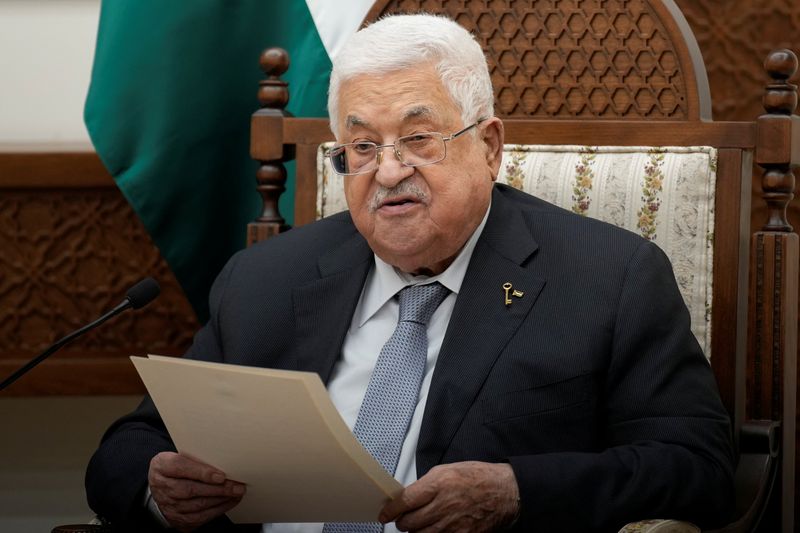
Palestinian Authority President Mahmoud Abbas reads a statement as he meets French President Emmanuel Macron, in Ramallah, West Bank, October 24, 2023. Christophe Ena/Pool via REUTERS/File Photo. Note: The key on his jacket lapel is a symbol of the right of return of Palestinian refugees for which the PA has done nothing at all and which Fatah agreed to exclude from the Oslo Accords under which the PA was founded.

The USA also proposed a coalition of their Arab regime clients for that job but the Resistance has made it quite clear that managing Palestinian society and resources is for Palestinians elected democratically only and anyone else will be a usurper for the Occupation and treated accordingly.

The real purpose of Palestinian State ‘recognition’ by the Three

Sadly, it is in this context that we should see the Irish, Spanish and Norwegian recognition of the Palestinian State. It does not represent a break from the EU’s imperialist position of support for Israel in principle but rather only in tactical approach.

These states are giving the imperialists “good advice”. What they are saying in effect is this: “You have to make the Palestinians thing that they are gaining something and use Palestinians to control Palestinians. Otherwise they’ll continue resisting and you could lose the whole thing.”

Coat of arms of the Palestinian Authority (Image sourced: Internet)

They know of what they speak. This was what the British colonialists imposed on Ireland in 1922 and what the Spanish ruling class imposed on the southern Basque Country, Catalonia and Galicia after the Franco Dictatorship, granting them limited autonomy under Spanish control.

And cultivating “independent” locals to run these for them.

The program these states desire for the Palestinian people is one in which they will have their local autonomy in a Palestinian state on approximately 20% of their nation, with worst land and least water and under the guns and watchtowers of their expansionist and dominating neighbours.

The reality of Israeli genocidal colonisation and the “two-state solution” beloved of imperialists and liberals. (Image sourced: Internet)

The decision on what the Palestinian people accept or reject is ultimately theirs, of course. Equally, how we decide to receive representatives of this undemocratic, corrupt, treasonous and violent PA is ours.

Let us not fail to make it a hot welcome, both in solidarity with the Palestinian people and in apology for the neo-colonial proposals of this Gombeen state.

Let those Irish political parties that support the PA answer for their position. Ours should be clear, from which too our actions should flow.

End.

FOOTNOTES

142 times in the West Bank since October 7th and most recently this week as I was writing this piece, blowing some up at 3am on the morning of the 17thJuly.

2https://www.jpost.com/breaking-news/article-799496

3Arising out of the 1993-1995 Oslo Accords.

4e.g. in concluding a deal that excluded the Palestinians still in “Israel” and any right of return for the millions of Palestinian refugees around the world.

5https://www.aljazeera.com/opinions/2021/1/27/palestinian-elections-democracy-for-no-one

6Mainly from the EU and USA but also from Arab and Russian sources.

7An anti-Hamas reference https://www.al-monitor.com/originals/2024/07/guarded-optimism-palestinian-reconciliation-ahead-fatah-hamas-meeting-china Hamas has indicated they want them to attend and at least some of the other Resistance groups are likely to do so.

8i.e, cleaned up a bit.

9https://www.washingtonpost.com/politics/2023/11/01/blinken-envisions-revitalized-palestinian-authority-charge-post-war-gaza/

SOURCES & ADDITIONAL INFORMATION

https://en.wikipedia.org/wiki/Palestinian_Authority

I do not endorse some of the opinions in this: https://www.fdd.org/analysis/2024/03/06/10-things-to-know-about-the-palestinian-authority/

https://www.irishtimes.com/world/middle-east/2024/07/14/the-palestinian-authoritys-shrinking-influence-in-the-west-bank/

Repression of dissent by the Palestinian Authority: https://www.amnesty.org/en/latest/news/2021/07/palestinian-security-forces-escalate-brutal-campaign-of-repression-2/

https://www.aljazeera.com/features/2022/1/25/analysis-palestinian-authority-cracking-down-on-opposition

THE REPRESENTATION OF REVOLUTIONARY ICONS

The role of culture in revolution is of great importance – greater even than that of the armed struggle, certainly in the initial and later stages. We are created by evolution but we are born into and raised in culture.

The question of whether that culture is to be revolutionary or liberal is of crucial importance.

I have remarked on how Mandela, jailed for his revolutionary armed activities, was marketed as a peacemaker and later became a figurehead of pacification of the South African struggle. Bobby Sands, a revolutionary fighter to the last, has also been represented as a peaceful icon.1

And so also was Terence McSwiney who, like Bobby Sands, died on hunger strike.2

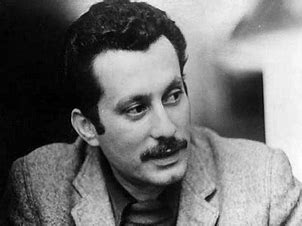
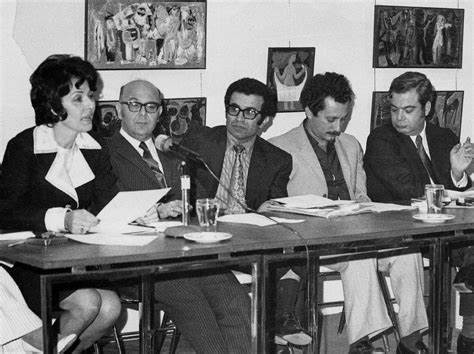
The following article from Resistance News Network, reflecting on the work of the revolutionary writer Ghassan Kanafani who was murdered by Israeli Zionism and his subsequent representation as an icon is I think of substantial interest. D.Breatnach

Translated by Resistance News Network
Originally by 
Nidal Khalaf, 16 July 2022

(Reading time: 6 mins.)


Ghassan the poet? Ghassan the Palestinian? No, 
Ghassan the revolutionary!

In colonial wars, the creation and dissemination of symbols to the public is a crucial battle in the war of consciousness building, even if its effects are not clearly visible in the present.

Perhaps the most prominent example of these battles was the image of Che Guevara in the wars of liberation in Latin America. Ernesto Guevara’s persona represented an individual model that encapsulated the revolutionary spirit of people fighting for their freedom from American hegemony.

As the American empire recognized its inability to destroy Guevara’s image, they transformed his image into a consumer commodity.

This was to divert his image from its original revolutionary meanings and repurpose it in the service of economic and cultural agendas that contradicted Guevara’s own principles and what he represents.

In the Arab context, the war to liberate Arab symbols from the captivity of history monopolists continues to intensify, as it involves obscuring forgotten heroes in favour of fabricating mythical legends designed to tamper with the boundaries of nationalism and betrayal in the Arab mind.

In this context, the fiftieth anniversary of the assassination of the martyr Ghassan Kanafani is being observed, with pages and websites filled with commemorations of Ghassan’s life, his quotes, and his most significant works.

It is no longer surprising that Ghassan Kanafani is celebrated on both normalization platforms as well as liberal ones, when voices are raised to commemorate Ghassan even as they are in the heart of the hostile project under the umbrella of its military bases.

Thus, the question arises: which Ghassan Kanafani are we commemorating today? And how do we protect the Ghassan we know?

Ghassan Kanafani’s life provided rich material for readers, followers, and analysts after his martyrdom.

However, the perception of Ghassan was not independent of the political contexts of the recipient interpreting his word, resulting in multiple “versions” of Ghassan Kanafani, some of which we review below.

Ghassan Kanafani: The Writer (only?)

The most widespread version of Ghassan Kanafani is that of a “writer” who wrote stories, plays, and depicted the Palestinian reality.

The spread of this version may be justified since Ghassan’s literary works are the most popular among people and have played a significant role in spreading his name.

However, confining Ghassan Kanafani to the realm of “literature” is not always innocent, and in some respects, it is a deliberate reduction of Ghassan Kanafani’s political work.

Ghassan was responsible for mobilization, media, and was a part of the political decision-making circle in the Popular Front for the Liberation of Palestine since it was part of the Arab Nationalist Movement. He remained in this role until his martyrdom.

Moreover, Ghassan’s literary output never compromised or was at the expense of his political positions or took precedence at any point in his career.

In terms of production, his political studies, research, articles, and editorial journalism are as abundant and important as his narrative and theatrical works.

Even the latter were never detached from the political context; instead, the narrative served as a framework through which Ghassan conveyed his political, social, and even philosophical ideas.

Consequently, the image of Ghassan as “the writer engaged in politics” falls away, replaced by the truth of Ghassan — the politician who harnessed literature in the service of a political cause.

The danger of this deliberate reduction lies in paving the way for a sanitized image of Ghassan Kanafani, presented to the public by liberal (and even normalization) pages and platforms to gain credibility in Ghassan’s name.

Kanafani tackles a fundamental dilemma that burdens our political reality to this day, which is the crisis of “the prioritization of internal change over liberation.”

Thus, reductionism turns into deliberate distortion, making Ghassan Kanafani’s name a “honey” slipped into the poison of isolationist, liberal, and anti-resistance ideas on our land under the guise of freedom and liberation.

Otherwise, how can we understand the celebration of Ghassan Kanafani by liberal platforms and influencers at Al-Udeid Air Base?

Ghassan Kanafani: the Palestinian (only?)

One of the unjust reductions of Ghassan Kanafani is the confining of his personality and his works to “Palestine,” as delineated by colonialism.

Again, one can find an excuse for this reduction because Palestine represents the primary aspect of Kanafani’s political and literary identity, and his experience is closely tied to the general Palestinian experience of war, forced displacement, diaspora, and the struggle for return.

Some people overly emphasize Ghassan’s Palestinian identity, overshadowing his Arab dimension, which he never concealed.

In reality, examining Ghassan Kanafani’s political studies unveils to us the truth of Ghassan as an Arab nationalist thinker who worked hard and struggled to develop practical frameworks for Arab revolutionary theory.

This is made clear in his in-depth study, “The Arab Cause in the Era of the United Arab Republic,” where he discusses the essence of the imposed war on our region, identifying enemy and friend camps, and ultimately defining the main goal of the war: liberation as a condition for unity and renaissance.

Ghassan further elaborates on this study’s conclusions in another study titled “The Revolutionary Applications of Arab Nationalism,” published in 1959, in which he masterfully details the concept of Arab unity and the tools for its practical implementation.

Ghassan Kanafani goes beyond this by considering the confrontation of isolationist (regionalist) thought a revolutionary necessity, describing “isolationism” as something that “contradicts the nature of the formation of societies.”

Isolationism or “regionalism” are anti-unity tendencies, based on defining society’s interests from colonial borders and treating each Arab state as “independent” in itself, as Sykes and Picot intended.

Kanafani tackles a fundamental dilemma that burdens our political reality to this day: the crisis of “the prioritization of internal change over liberation.”

No better formulation to this question can be found than Ghassan’s own words when he stated that “raising the concept [of focusing on internal development first] is a deliberate exclusion of the popular current directed towards unity with determination,

and diverting it to side and regional battles that are easily manipulated (as long as each Arab country is not -nationally- at a level of complete liberation worthy of proper social construction).”

Ghassan concludes his argument by asserting that “unity is a prerequisite of the renaissance… even its regional aspect.”

We mention these ideas as examples of Ghassan Kanafani’s Arab nationalist thought, which fundamentally opposed isolationism and the canned projections of Marxism and others, with strength and clarity.

Therefore, the celebration of Ghassan by the proponents of these ideas indicates their exploitation of Ghassan’s legacy (from their side) and a significant failure in protecting Ghassan (from the side of those who believe in his ideas).

How, then, do we protect Ghassan Kanafani?

The starting point lies in defining ourselves. Are we believers in Ghassan Kanafani’s approach and vision for the ongoing conflict on our land, which comes at the expense of our blood, lives, and destinies?

If so, our foremost duty is to reclaim Ghassan Kanafani from the chains of cheap consumerism and to present him to the public in his true and impeccable form: an Arab nationalist fighter who made among the most significant contributions to modern Arab revolutionary theory.

Additionally, our responsibilities also include reviving the spirit of party work, in which Ghassan was a pioneer, and correcting the Arab party frameworks to harness the wasted energies in the prisons of virtual activism,

within the halls of “non-governmental organizations” and the labyrinths of despair and discouragement.

Our obligation towards Ghassan Kanafani demands that we comprehend our reality and its conditions and that we clearly define our goals, grounded in a deep conviction in our civilizational role as a nation.

We must believe that the liberation of the land is a step towards unity, and that unity is a prerequisite for the renaissance that will elevate us to our rightful civilizational status among nations. Finally, here is a part from Ghassan Kanafani’s ongoing will:

“A human being who does not live the average of sixty years will not find enough space to live peacefully; instead, they will carry the crisis from the moment they are born… and pass it on to their children at the hour of their death.

“The results of this struggle will be for a generation we do not know when it will arrive, even though we are optimistic about witnessing its early days towards the end of our lives…

“Our only reward may be that the next generation, the happy generation that will enjoy our victories, will envy us for having earned the honour of living in the age of struggle for life. And that is enough for us temporarily.”

End.

Footnotes

1In particular by the constant reproduction of his statement that “our revenge will be the laughter of our children”, completely abstracted from his role as an armed freedom fighter and what he wrote in support of that.

2Similarly to Bobby Sands, his statement that is those who who endure, rather than inflict the most who will triumph. The statement taken in isolation seems to endorse passive resistance but McSwiney was an officer of the IRA in the War of Independence, a role skated over in the Wikipedia entry dedicated to him.

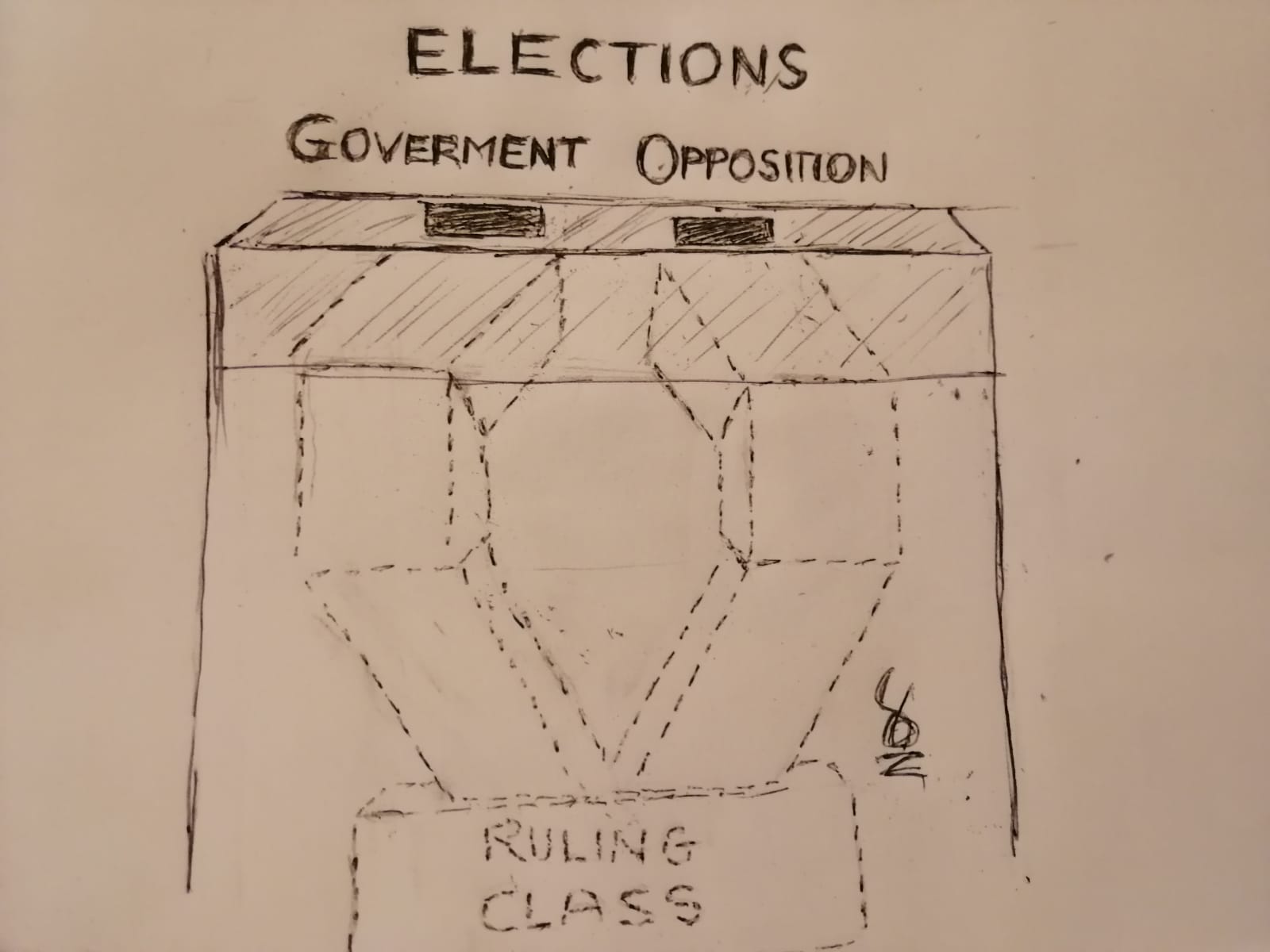
ELECTORAL DYSFUNCTION ANXIETY

Diarmuid Breatnach

(Reading time: 5 mins.)

Like that similar-sounding ailment affecting some males, most of us are not rising, at least not to the expectations of the electoral commission. Furthermore the problem appears to be no respecter of gender.

The issue, according to the Independent Electoral Commission, is that not enough of us are voting in elections. Only 49% turned out to vote in the Irish local (municipal) and European Parliament elections which means that more than half of registered voting age didn’t bother.

Well, so what? Why is that is troubling the IEC? It seems that generally, the authorities like to see a good turnout because it appears to signify that people believe that they really have a democratic choice through the electoral system and are actually exercising it.

If they don’t believe that they have a choice – or if the appearance of choice is not matched by the reality they perceive, the people might turn to other methods of deciding how the country should be run. And that might result in an outcome unwelcome to the ruling elite.

THE TWEEDLES

The Tweedledum and Tweedledee parties appear to give the electorate alternatives and though whichever party wins the capitalist system remains, it appears to give a choice – but a bet choosing between two horses of the same owner in a two-horse race.

Like both Tweedles in the folk nursery rhyme and in Lewis Carroll’s Alice Through the Looking Glass (1871), Tweedledum and Tweedledee are brothers and though they appear to be preparing for war with one another, they don’t actually fight, not in Western ‘democracies’.

Tweedledum and Tweedledee (or is it the other way around?). (Image sourced: Internet)

There are, after all, plenty of spoils to share between their masters. The creators of that wealth need to be controlled, fooled and, if necessary from time to time, repressed. “Red” social democrats and “Blue” conservatives have alternated to share power in the Western world for over a century.

In Ireland, the only European state which is a neo-colony and part of its land a direct colony, its national liberation unfinished, the Tweedles have been blue or green.

But for decades now the illusion of choice has been crumbling. There has not been a majority party government in Ireland since 1981, when Irish Republicans were elected during the hunger-strike campaign. All Irish governments since have been a coalition of one kind or another.

The Irish Labour Party, founded by Connolly and Larkin and far from their thinking for many a long year, has been in government a number of times but always in coalition – usually with the conservative Fine Gael, itself the product of a coalition that included the fascist Blueshirts.

Those years of government participation for Labour have thoroughly rubbed off the red paint of socialist opposition from the party. The Green Party, mixing a brand of concerns for the environment with those for society, has met a similar fate in coalitions.

Since 2020 the Irish state has had what is essentially a ‘national government’, a coalition of opposing parties normally only seen in times of war or under a fascist regime. The alleged political poles have joined in order to run the system for the Gombeen ruling class.

Though this gives stability for the Gombeen’s system their problem is that it has removed the illusion of choice. They might restore that illusion through the promotion of a third major party in opposition and the formerly revolutionary Sinn Féin has worked hard to fill that space.

In the 2019 General Election SF got the most representatives elected but insufficient to form a majority government, after which the Tweedles united, along with the Greens to make up the numbers to manage the State. But the Gombeens will hold SF in reserve, I’m thinking.

Harris of Fine Gael and Taoiseach (equivalent of Prime Minister) of the Coalition Government, commented on the closeness of his party and former Opposition party Fianna Fáil in votes, predicting “a Government of equals”1– but it’s not just in votes that they resemble one another.

Yes, I know I misspelled Government but I want to get this article out of the way. I’ll redo the cartoon sometime later and replace it.

RESULTS

I don’t think there is a great deal to be said about the actual results of the recent local and EU Parliamentary elections in Ireland but no doubt some commentators will be saying it anyway.

Of unwelcome interest is that five fascists of different groups got elected, three of them to Dublin City Council. The electoral Left lost some and gained some without big changes.

Independent socialists (and couple) Clare Daly and Mick Wallace both lost their EU seats but perhaps they and in particular Daly in Ireland would be more of an asset to the Left. Luke ‘Ming’ Flanagan in Midlands North West, another left Independent, kept his EU seat comparatively easily.

Sinn Féin had what was for them a disappointing run but had some new people elected to local councils and two seats in the EU Parliament, losing an existing one. Many of their enemies in the Republican ambit, often former comrades, rejoiced in their misfortunes.

Understandable though that may be one wonders how those who have some faith in the party at the moment are to be disabused of their illusions without having seen them in government. On the other hand their twists and turns on the road there may have disenchanted many already.

IT’S NOT A CHANGE OF PARTIES IN GOVERNMENT WE NEED

For most of my life I have been aware that it is not a change between political parties but between socio-political systems that is the issue. But I do vote sometimes in order to help keep a useful and decent voice in a parliament or a local authority.

An Irish community activist pensioner years ago in London, Co. Galway Teresa Burke, was a member of the British Labour Party. After a General Election, she asked me had I voted. I replied that I hadn’t; I’d not seen a candidate that stood anywhere close to that in which I believed.

“Well then, you must take responsibility for everything the Tories do if they get in!” Teresa remarked angrily.

“I’ll do that, Teresa,” I replied, “if you’ll take responsibility for everything Labour does in Ireland if they get in!”

Teresa’s lips twitched slightly. She knew as well as did I that the British Labour Party had sent the troops into the Irish colony to quell the struggle for civil rights in 1969 and supported the Tories in introducing internment in 1971 and massacres that year and in 1972.

In 1974 police under a Labour Government had killed the first anti-fascist on a demonstration,2 framed a score of Irish people in four separate cases for heavy jail sentences3 and had passed the fascist Prevention of Terrorism (sic) Act.

Whichever party is in government, the social-political-economic system is run by the capitalist class which it benefits and they will fight tooth and nail to maintain that system.

The alternative-party-within-the-system idea, so dear to social democrats, has failed time and time again. It betrayed its supporters by becoming like what it opposed, or consistently failed to get elected or was undermined, betrayed and destroyed, like Syriza in Greece, for example.

But in the unlikely event that route should ever show signs of being successful, for the ruling class there remains the military coup.4

end.

FOOTNOTES

1https://www.breakingnews.ie/ireland/election-results-raise-prospect-of-another-coalition-of-equals-varadkar-1638692.html

2Kevin Gately, son of Irish immigrants, a student at Leeds University, died from injuries received from a mounted police baton during an antifascist demonstration in Red Lion Square, London on 15th June 1974.

3The Guildford Four, Birmingham Six, Maguire Seven, Judith Ward.

4The serialised for TV A Very British Coup (1988) with Irish actor Ray McAnally from the Chris Mullins novel (1982) is well worth watching for this scenario.

SOURCES

https://www.thejournal.ie/irelands-voter-turnout-is-below-eu-averages-6299507-Feb2024/

https://www.thejournal.ie/readme/election-turnout-6409113-Jun2024/

https://en.wikipedia.org/wiki/Tweedledum_and_Tweedledee

https://www.breakingnews.ie/ireland/election-results-raise-prospect-of-another-coalition-of-equals-varadkar-1638692.html

Chiquita, the multinationals and the bloodbath in Colombia

Gearóid Ó Loingsigh (16/06/2024)

(Reading time: 5 mins.)

It was an open secret that the US multinational, Chiquita, financed the paramilitaries. But the company always denied it, until one fine day, due to the insistence of the victims the company had to acknowledge its guilt and pay a fine of $25 million US.

On June 10th, this year, a tribunal in Florida ordered the company to pay $38 million to the families of 8 people who were murdered by the groups Chiquita financed.1

However, the victims in the same period for which Chiquita accepts it financed the paramilitaries and to have allowed them import weapons through their free zone port number more than eight victims, there are thousands.

But it is not just a matter of the number of victims but rather the number of victimisers. The judgement lays bare the discourse of the transitional justice system and that of all the governments, including the current one, about the nature of the conflict.

The peace agreement signed with the FARC, described the problem as one of some criminal guerrillas (and among their ranks there were) and some “rotten apples” in the armed forces (there weren’t any but rather it was a problem with the military institution itself).

The business people were designated as third parties and are not obliged to testify before the Special Jurisdiction for Peace (JEP). But the judgement in the US against Chiquita clearly shows that they are not “third parties” in the conflict but “first parties”.

Once upon a time the role of the multinationals in the conflict was the starting point for all of the left and the human rights groups too, but not anymore.

Before we look at the matter, we should bear in mind that among many of those who are now part of the government, those that signed or promoted the agreement with the FARC are various spokespersons that previously denounced many companies.

I had the honour of investigating the role of the British oil company BP and other companies in the case of Casanare, where the role of the company could be proven.

The company itself, partially acknowledged its bloody role in financing the 16th Brigade alleging that it was legal at that time.

Many organisations have denounced BP, and the voices raised against the company increase in number.2 But legally BP is as innocent as Chiquita once was. In Southern Bolívar we saw how mining companies fomented the war against communities.3

Carlos Castano, right, the leader of the right-wing paramilitary group United Self-Defense Forces of Colombia. (Photo cred: New York Post/ AP)

It wasn’t just in that region, but rather in the whole country and included national companies as well.4 The palm companies did their part and the cattle ranchers publicly accepted their role in fomenting paramilitaries,5 to name just a few sectors.

Other reports, as yet not proven to the same degree as the ones against Chiquita, cameout, but few doubt the reports against Coca Cola and Nestlé. Perhaps in a few years we can state it with the same legal certainty as we do now in relation to Chiquita.

And if we get there, it will be exclusively due to the struggle of the victims.

For the current government, the truth commission and many sectors of the Historic Pact (PH) the conflict is to be explained in terms of drug trafficking, minor disputes (never major ones) for land, corruption and the “culture of death in Colombia”.

But none of that is true. It is true that drug trafficking has, up to a point, played a role, and sometimes there are land disputes between neighbours that end badly and violence as a method of resolving problems is socially acceptable amongst many sectors of the country.

But none of this explains the conflict.

The Colombian conflict can be explained in terms of one between national capital, but above all international capital and the Colombian people and can be seen in the fight for land, the economic model, the war on unions, grassroots organisations etc.

Once upon a time it was not controversial on the left to say so, not even among the NGOs and even some politicians did so. Now, however, whoever states as much, dies politically.

Petro has given the excuse that he holds office but not power as a justification to explain the lack of operational capacity of his government and the lukewarm nature of his proposals. But we knew that, we always knew that, even when Petro on the campaign trail said he would “take power”.

People used to accept the idea that Colombian policies are not decided in the Nariño Palace (presidential palace) but rather in the White House and the cafés of Wall Street. The owners of the “cafés” decide more than do the Colombian people.

Those that serve the coffee are companies like Chiquita and it is the Colombians who wash the dishes.

President, are you the owner of one of these cafés, a waiter or a dishwasher? Tell us in detail. We would like to know who took the decision to allow Chiquita and the rest of the companies to kill left, right and centre.

We would like you to name those companies that kill peasants. Or, do you not as President have access to the military and police archives etc.?

On the election campaign, Petro said he was the Biden of Colombia.

But Biden and the Democrats have always received funds from multinationals, particularly from the agribusiness sector. So Petro should tell us whether he is still the Biden of Colombia and what he intends to do with Chiquita and other companies behind the Colombian conflict.

The peace process with the FARC and the rise of the PH as a party of government has left us a pernicious legacy, where we talk about the conflict in psychological terms, of evil, or individual responsibility (except when dealing with the insurgency).

And from the onset deny the role of the US in the conflict and the role of companies, particularly the multinationals. The business people are not on trial in the JEP, except those who voluntarily place themselves before the tribunal.

And that is only done by those who face a sure sentence in the ordinary justice system and see in the JEP the possibility of avoiding jail time. The Truth Commission excluded the business people.

In 2015, in the middle of his speech to the Colombian Oil Association, the then President Santos tried to reassure them and promised that he was not going to pursue them.

He gave them some advice, suggesting that if there was ever report made against them they could allege they were coerced.

Furthermore he stated, “Which businessman is guilty of war crimes or crimes against humanity? If there is even one, he might be put on trial, but I don’t see how, or where…”6

Well, for the moment we could reply that perhaps in Florida, but not in Bogotá and not due to the NGOs, state bodies and other personalities who sell us that image of the conflict in which companies are not the driving force behind the conflict.

End.

Comment by Rebel Breeze:
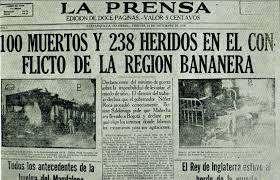
Chiquita is the current manifestation of the infamous United Fruit Company which organised a massacre against striking fruit workers in December 1928:

Leaders of the 1928 strike including two martyrs. (Photo sourced: Wikipedia)

NOTES:

1 The Guardian (11/06/2024) Chiquita ordered to pay $38 million to families of Colombian men killed by death squads. Luke Taylor. https://www.theguardian.com/world/article/2024/jun/11/chiquita-banana-deaths-lawsuit-colombia

2 Declassified UK (18/07/2023) La financiación de BP a los militares asesinos de Colombia. John McEvoy. https://www.declassifieduk.org/es/la-financiacion-de-bp-a-los-militares-asesinos-de-colombia/

3 Ó Loingsigh, G. (2003) La estrategia integral del paramilitarismo en el Magdalena Medio. España. https://www.academia.edu/96631813/LA_ESTRATEGIA_INTEGRAL_DEL_PARAMILITARISMO_EN_EL_MAGDALENA_MEDIO_DE_COLOMBIA

4 Ramírez, F. (2010) Gran minería en Colombia, ¿Para qué y para quién? Revista Semillas No. 42/43 https://semillas.org.co/es/revista/gran-miner

5 Ó Loingsigh, G. (2006) El Catatumbo: Un reto por la verdad. Cisca. Bogotá. P.153 https://www.academia.edu/16951015/Catatumbo_Un_Reto_Por_La_Verdad

6 Cited in Sinaltrainal et al (2016) Ambiguo y decepcionante acuerdo: itinerario para la impunidad de crímenes de Estado. P.24 https://rebelion.org/docs/208980.pdf

IF WE DON’T SUPPORT THE RESISTANCE

Diarmuid Breatnach

(Reading time: 5 mins.)

In an anti-imperialist struggle, if we don’t support the Resistance, what are we doing?

Among the Left – and even among many liberals — the importance of internationalist solidarity is generally accepted as taken for granted. However, as with many principles, it is in its application that we find substantial disparity.

After the October 7th breakout from the Zionist siege of Gaza the leading elements of the western world rushed to condemn the Palestinian resistance led by the Hamas group. Atrocity propaganda created by the Zionists abounded.1

Hamas2 and Islamic Jihad3 had planned and carried out the breakout operation in which they knocked out the Zionist surveillance and automatic firing defences, damaged communications, went through and over the apartheid wall and overran the Golani Brigade4 forces.5

The Resistance killed many of the IOF6 and captured others. In addition, the Resistance captured a number of civilians in order to exchange them for the huge number of Palestinian political prisoners held by the Zionist authorities.

Some Left groups joined the anti-Resistance chorus immediately while others took a little longer but then did so too. In Ireland, for example, leading figures in People Before Profit and the Socialist Party condemned Hamas, seen as the leading Palestinian element in the operation.

So too did the leadership of the formerly revolutionary Irish Republican political party Sinn Féin.7

Of the Left Zionists in ‘Israel’ (in so far as they can be called ‘Left’), they too joined the chorus. The Israeli state’s presidency has had representation from the Labour Party without interruption from 1948 to 1977 and most of the settlement expansions took place under a Labour government.8

Saoirse Don Phalaistín solidarity group banner (bearing logo of the People’s Front for the Liberation of Palestine on right of photo) after Palestine solidarity march in Dublin 27 January 2024. Also visible in addition to the Palestinian national flag perhaps are two versions of the Starry Plough flag of the Irish Citizen Army, the Republican Congress version at extreme left and the original version above the banner. (Photo: D.Breatnach)

CIVILIANS

Some of the western ‘Left’ organisations stated that it was not the armed breakout of the Palestinians to which they objected but instead the killing of civilians. The liberals and media also made much of the issue of ‘civilians’ – to an extent never accorded to Palestinian civilians.

It is important to note that the adult civilians in the ‘Israeli’ state are, apart from tourists, settlers. They are colonising land from which the indigenous Palestinians have been ethnically cleansed. In addition military service is required of all ‘citizens’9 and a great many are armed anyway.

This is similar to what the Indigenous people of the Americas and Antipodes faced from European settlers from the 18th to the 20th Centuries or the Irish during the various plantations from the 17th Century onwards and the Land War during the 19th.

One baby was killed on October 7th quite likely by excessive heat in a burning building and another 13 children were killed, according to ‘Israeli’ social services. But by whom? By Palestinians or by indiscriminate Hellfire missiles from IOF helicopters and at least one tank firing into a building?10

Civilians may have been deliberately killed knowing they were civilians or by crossfire or by Israeli counterattack. Certainly there was at least one teenager taken captive, the daughter of the Irishman settler who infamously said he would rather his daughter were dead than captured by Hamas.

We’d like to know, of course, which case and how many. But in terms of solidarity principle, it’s beside the point: While we are not required by internationalist solidarity basic principles to approve of every one of its actions, we ARE required to be in solidarity with the Resistance.

A number of Palestinian armed resistance groups displaying unity in the struggle (Photo sourced: Iran News)

BUT, ISLAMIST…!

Many in western society are secular in their politics, many of agnostic or atheist position. So, that is our choice. Others belong quite strongly to one religious belief or another. What is different about Islamists (or fundamentalist Christians) is that they aspire to a society run in accordance with their religious beliefs.

We may not agree with that objective. We should not agree with the subordinate social and political status accorded to women in some religious cultures nor to the outlawing of LGBT sexuality. But even so, we should support the Resistance, Islamist or otherwise, in resisting repression.

Basque society was largely conservative Catholic while resisting Spanish State fascism up to the 1970s; Welsh mining society was often conservative Methodist in the struggles of the miners in the 1930s. The Irish Republican movement was permeated by Catholic symbolism and ideology.

We could have been, should have been capable of supporting the resistance in each of those cases while not supporting the religious conservative, reactionary or fundamentalist beliefs or conduct of participants or leaders in those struggles.

For revolutionaries, the general principles or internationalist solidarity are not of the kind from which one can pick and choose, while rejecting others. We are however entitled to accord ‘favoured status’ to an organisation the ideology and practice of which we most approve.

We may for example prefer a secular or even socialist resistance organisation (e.g the People’s Front for the Liberation of Palestine). We may carry its flags, promote its statements, share its social media postings. But we do so while also expressing solidarity with the Resistance as a whole.

That is reasonable and honourable. It is neither to participate in attempts to break up whatever unity exists among the organisations of the resistance.

During the 30 Years War in Ireland, there were those in Britain who participated in those activities – people who colluded for example with SF refusing to share a platform with the IRSP11 on Hunger Strike commemorations, threatening refusal to attend if their wishes were not acceded to.

No doubt that seemed justified to the Provisionals in their promotion of their organisation above any other choice but that activity split commemoration committees, disheartened activists and killed some solidarity events on the annual calendar.12

HOW BEST TO DO IT … AND IN PUBLIC

We often hear people ask a speaker from the resistance movement what we should do in solidarity. This is in general incorrect behaviour because we have our own revolutionary program and we best know our own circumstances and capabilities.

It is a different thing to ask what are the things that the resistance movement needs: medicines, weapons, representation, contacts, publicity etc. But we still have to decide how well to fit the effort of obtaining those within our capabilities or even whether the objective is worth the energy expanded.13

The Resistance can tell us what they need but the decision on which solidarity actions to take is ours. However whether to express solidarity is not a choice for revolutionaries – it is an obligation.

As revolutionaries we have a public position and part of that should be public solidarity with the Resistance. It is not unknown for some to claim to support a resistance organisation but to decline to do so publicly.

An African National Congress speaker in London years ago told me privately that they supported the Palestinian and Irish resistance but would not do so publicly as it might undermine support they were receiving from UK and other western bourgeois organisations.

I argued with him against this.14 Relating the discussion to a senior SF activist later I was astounded at the response that they would do the same if required.

Solidarity with the Resistance means also solidarity with those incarcerated during the struggle, the resistance in the jails. Again, though an organisation may think differently, we are not required to support the specific organisation to which the prisoners owe allegiance.

Nor does any Resistance organisation have the right to dictate to us whether we may or may not express solidarity with political prisoners who are aligned with that organisation. Over the years, the Ireland Anti-Internment Campaign has faced down attempted coercion along those lines.

So also did the Irish Political Status Committee in London. And both groups remained independent. Unfortunately the Troops Out Movement of the day was unable to do so and after a brief period of asserting independence, eventually succumbed to domination by Provisional Sinn Féin.15

Supporting political prisoners is an act of necessary solidarity with the resistance and also one of self-defence in the longer term but it does not necessarily mean expressing support with the actions or organisation of the prisoners before or indeed after they were jailed.

Banners and flags presumably at Celtic FC home stadium during the current episode of the Zionist genocidal war. (Photo sourced: Internet).

SUMMARY

We are entitled if we wish to prioritise support for a specific organisation or its program but not obliged to do so, nor to accept their advice on how to conduct our solidarity work. Nor is it required of us to condone every action of the Resistance in general.

But we are required to publicly support the Resistance in general and not to join in public condemnations. And that’s the minimum to do if we are going to claim being in solidarity with a struggle.

For any revolutionary struggle, internationalist solidarity is an important factor, in encouragement to the Resistance, in de-legitimising the repression and in practical terms of supplies to the resistance, also in hampering the repression through blockades, boycotts or industrial action.

If we don’t support the Resistance, how can we claim to be in solidarity with Palestinians? Charity is not the same as solidarity. Pity is not the same as support. Outrage at the crimes of the oppressor is not the same as solidarity with the Resistance.

Furthermore, why should we expect solidarity with our struggles, now and in the future, if we cannot express that solidarity with the struggles of others?

End.

POSTCRIPT

Some will have searched in vain for a reference from Lenin, Mao, Trotsky, Luxemburg – or Connolly or even a famous Irish Republican leader – to justify the principles I have discussed here. At the end of the day, people should stand by principles because they have been tried and tested and are aligned with revolutionary experience but should also test them on their own experience in struggle.

In presenting some credentials towards giving these principles some consideration I can only say that I have thought about them and sought to practise them over decades of activism in Britain and Ireland.

Among the areas of Resistance and of political prisoners which have claimed my activity have been Ireland, Palestine, S. and SW Africa, Vietnam, Housing struggle, US Indigenous and African American people, organised Workers, Anti-Fascism & Anti-Racism, Kurdistan, the Basque Country, Syria, Haiti, Western Sahara, Catalunya, the Donbas …

FOOTNOTES

1All since thoroughly debunked though still repeated on occasion: “‘Israeli’ babies beheaded, torn from a womb and stabbed, women raped, people and houses burned.” These fake atrocity stories were repeated in the western media and by some politicians, including Biden and helped create an atmosphere assisting genocide by the ‘Israeli’state.

2Hamas began as an Islamist community organisation which then became a political party and developed an armed wing (like most Palestinian political groups, in response to the armed Zionist State and its settlers). In 2006 the party won the Palestinian legislative elections but the defeated Fatah (widely acknowledged as corrupt) administration in Gaza refused to give way and, in a short conflict, the Fatah armed group was defeated by that of Hamas. They chose not to do the same in the West Bank, presumably to avoid civil war from which the ‘Israeli’ state would benefit but from that moment onwards the Zionist State blockaded Gaza and the organisation was labelled a “terrorist” group in the west and financial support went instead to the Fatah-run Palestinian Authority in the West Bank (which has refused to run new elections in two decades).

3Palestinian Islamic Jihad was formed in 1981. The armed wing of PIJ is Al-Quds Brigades (also known as “Saraya”), also formed in 1981, which is active in the West Bank and the Gaza Strip, with its main strongholds in the West Bank being the cities of Hebron and Jenin. In addition to this organisation and Hamas there exist a number of other resistance factions, some of which are secular, all working together as a broad armed resistance front with organisational autonomy but ofen in joint operations also.

4The Golani Brigade of the Gaza Division is the most highly decorated IOF Brigade, having taken part in all of the state’s major ethnic cleansing and genocidal operations. On October 7th hey were overrun in minutes and 72 killed with an unknown number captured (‘unknown’ because many, along with their Palestinian fighter captors were burned to death in their cars by ‘Israeli’ Apache helicopter Hellfire missiles).

5 The Palestinian operation went deep, passing Golani’s 3rd defensive line.

6‘Israeli’ Occupation Forces, aka the official but misnomer IDF (“Israeli Defence Forces”).

7The current iteration of Sinn Féin abandoned its revolutionary anti-colonial and anti-imperialist path in embracing the pacification process in1999. It stood down its armed wing, the IRA and largely dissolved it, also having their weapons decommissioned, since when it has participated in the administration of the colony and in recruitment of the colonial police force.

8Yet for years the Socialist Party have opposed boycotting the Zionist State, calling instead for unity with the “Israeli Left”.

9With the exception of most ‘Israeli’ Palestinians and all ultra-Orthodox ‘Israelis’ but for the latter is in the process of change https://www.aljazeera.com/news/2024/6/11/israels-knesset-advances-contentious-ultra-orthodox-conscription-law

10Documented by military and survivor sources on ‘Israeli’ media.

11The Irish Republican Socialist Party with an armed wing up to the 1990s, the Irish National Liberation Army, which contributed three Volunteers to the 10 martyrs who died on hunger strike in 1981.

12And what, in the end, did the Provisionals achieve with the supremacy gained?

13The Resistance organisation may ask us to arrange meeting for them to address our state’s parliament, or for interviews with the media … Or even to restrict our propaganda from solidarity to self-interest for people, as Sinn Féin did in England in the 1980s when they were promoting Time To Go: “Push the issue of the expenditure on troops, better spent on the health and social services.@

14If to do so incurred a legal penalty would have been a different situation, of course.

15And from that moment onwards became a less broad and less effective, eventually ceasing to exist as a solidarity organisation.

SOURCES

Including a discussion on the importance of solidarity with the Resistance: https://youtu.be/yj9hQaqeeio?si=z1oSOAYGX8z-Ney8

Ireland Anti-Internment Campaign: https://www.facebook.com/p/Ireland-Anti-Internment-Campaign-100063166633467/

Colombia: The meaning of “Never Again”

Gearóid Ó Loingsigh 3 June 2024

(Reading time: 8 mins.)

Gustavo Petro and Truth Commission President Francisco de Roux.

I recently read an article written by the former Colombian truth commissioner and academic at the Los Andes University, Alejandro Castillejo titled Teaching After Gaza?: Indifference Perpetuates Barbarism.(1) 

As its title indicates, it deals with Gaza, but also covers other conflicts, such as Ukraine and also the Colombian conflict itself.

In the text he puts forward a question “When we say ‘Never Again’, exactly what should never happen again?” 

It is a good question and one that is not often asked; he talks of the continuities, as Gaza is ongoing and will continue after the genocide, it won’t end in some precise reference point. 

I would like to deal with another aspect of that question. 

Once upon a time the social organisations in Colombia, the NGOs, the left groups, both legal and illegal ones, reformists (some illegal) and revolutionaries (some of which are legal), were very clear about what they meant when they gave voice to the slogan Never Again

It is a common phrase.  There are some reports from Colombian organisations that include it in their names.  I had the honour of contributing, through my field work to the first two reports on the 14th Zone.(2)

Outside of Colombia, there is more than one truth commission report that has that as its name, such as the REMHI Report of Guatemala,(3) or the report on the disappeared in Argentina.(4)  We were all clear, we did not want a repetition of the terrible night. 

We spoke of the bloodbath and many were equally clear that they did not want a repeat of the circumstances that made it all possible, necessary and justifiable in the eyes of the state and bourgeoisie (a term disgracefully fallen into disuse in current times.)

Nowadays, it would seem that nobody is clear about it.  The Special Jurisdiction for Peace (JEP) understands Never Again to be never again the FARC and some “rotten apple” in the state’s military forces. 

The Truth Commission hadn’t a clue as to what it understood Never Again to be, other than some generic, non-specific abhorrence of violence in and of itself, but not of the system and circumstances that gave rise to the bloodbath.

Less still to the rivers of blood that flow through the fields and furrows of the country.  The Commission absolved the state for the so-called False Positives for which the state acknowledges and accepts the figure of 6,402 victims. 

It was a state crime, acts of state terrorism, crimes as appalling as they were evident. 

As far as the Commission was concerned it was not a state policy to take youths to the countryside, dress them up as guerrillas and murder them to present them in dispatches as part of a media campaign that sought to show the state was winning the war. 

So, if it was not a state policy, when we say Never Again, are we saying that the state shouldnot commit such a crime in the future?

Or are we asking thousands of crazy soldiers not to think of putting boots on the wrong way round on the feet of young civilians that they just murdered and dressed up as a guerrillas?

In the first case, it would be something we could demand of the state, in the second case if they were really the demented actions of the soldiers, well even the state would be a victim in that case.

Even the paramilitaries sometimes say No More, rather than Never Again.  In zones where they displaced the entire population, they don’t have to continue killing anyone.  They can say No More.

With groups such as the Unión Patriótica that they decimated, or groups such as A Luchar that they finished off, they can say No More

There is no need to continue murdering as the dirty work has been done, or at least it got to a point in which it had achieved its aim.  If there is a need to repeat it, they will, which is why they say No More rather than Never Again

This juxtaposition of No More and Never Again shows the banality of the slogan now.  Is it really Never Again or do they speak of “until the next time there is a need to”?

We can see just how empty the refrain of Never Again is by looking at some examples of violence in Colombia. 

In the 90s, the levels of violence in the port of Buenaventura began, for various reasons, to dramatically rise.  The violence cannot be explained by reference to one single fact or motive. 

However, there are contributing factors and whilst I don’t wish to reduce the explanation to something simple, we can point to the privatization of the port as a key factor in the rise in violence.

In 1991, following recommendations from the World Bank, Colombia — in the context of the growing forward march of neoliberalism — privatized the ports of the country. 

In the case of Buenaventura this resulted in the loss of jobs in the port area, a reduction in salaries, both of which impacted the economies of the neighbourhoods where the workers spent their wages, generally increasing poverty in the city. 

The port workers used to be able to apply for grants for their children to study, but with the privatisation that was gone, thus reducing not only the labour market but also the possibility of escaping poverty through studying. 

Then came the plans to expand the port and the massacres such as Punta del Este, amongst others, to clear out those who lived where they were going to construct the new port zones.(5) 

So when we say Never Again, it is clear that they don’t want the youths of the city to be killed, if they see another alternative, but does Never Again include the plans to privatise and expand the port?

Or we could look at the violence in the mining areas of the country, such as Southern Bolívar (gold) or Cesar and La Guajira (coal). 

Once again, we see the hand of the grey men, the banal ones from the World Bank, the IMF or state bodies who like Eichmann never directly killed anyone but rather moved pieces of paper around knowing what the consequences were of those bureaucratic procedures in which they took part and knowing that the new realities they sought to impose required a high dosage of violence.

In the 1980s, the WB had been promoting the expansion of mining in Latin America, the abolition of restrictions on foreign investment, the exporting of capital etc. 

In the case of Colombia, it didn’t need to do that much, the national bourgeoisie did the dirty work, without even a nod and a wink from the grey men at the WB.  A key figure in all of this was Ernesto Samper, the head honcho in the country between 1994 and 1998. 

It is worth bearing in mind that this satrap likes to present himself as a human rights defender, when it was his government that legalised the paramilitaries and is now one of the fiercest defenders of the current government of Gustavo Petro. 

Not only was he the president of the country from 1994 to 1998, he was the owner of various mining companies. 

He tried to introduce a new mining code but it was overturned by the Constitutional Court.  In 1998, another satrap and mining businessman, Andrés Pastrana, took over as president and implemented a new mining code, which is currently in force.(6)

During this whole process, the massacres in Southern Bolivar and other mining regions of the country intensified, whilst the paramilitaries tried to take these zones for the multinationals.  In the case of Southern Bolivar they were very explicit about it. 

After the murder of the leader Juan Camacho Herrera they played football with this head, placing it on a stake facing the mines, declaring that they had come to hand over the mineral resources to other people, who would, according to them, make a more rational use of them. 

So, when we say Never Again, does it mean Never Again to the national and international plans to take control of mineral resources? Or do they just mean that they are not going to play football with the heads of those who oppose these plans?

Nowadays the discussion in Colombia centres round the question of violence as something alien to the economic projects and they talk about the individuals. 

The slogan is to stop the war, but only a few say stop the plans of the WB, the IMF, the imperialist powers such as the USA and Europe.  When the president of the Truth Commission spoke to the UN he stated:

We have come to understand that the solution to the armed conflict is through respecting each person as an equal and we should respect each indigenous and afrocolombian child with the same commitment that we show to presidents, the wealthy, the powerful, and personalities, military generals. 

That all personality cults end and we love and respect each other as people entitled to the same dignity.  And that in Colombia and the world over all of us contribute to promoting a new sense of ethics based on human dignity and that all the spiritual traditions lend their support to this.(7)

Pass the joint round, take out the guitar, sing Kumbaya and kiss each other. In his speeches and the Commission’s report, the economic model is not questioned, in fact through the terms of reference they restricted the researchers and even banned them from dealing with certain issues.

Issues such as the role of the banks, the institutions and even the role of the USA in the conflict, which was reduced to isolated comments lacking in depth.  So Never Again means never again showing disrespect to someone and that we not seek recourse in violence to solve differences.

But that violence is not fortuitous and the bullets, the machetes, the chainsaws [common weapons in massacres] are used when the first victim of the economic plans refuses to submit.  So, Never Again has become: accept the established order and its plans! 

A Never Again to violence that says little about structural violence is an exhortation to surrender and is a Never Again until such time as it is necessary to resort to violence to impose the will the of the capitalist class.  Never Again for the moment, just like in Gaza.

End.

Notes

(1)  Castillejo, A. (2024) Enseñar después de Gaza?: La indiferencia perpetua la barbarie. Revisa Raya Mayo 16, 2024. https://revistaraya.com/ensenar-despues-de-gaza-la-indiferencia-perpetua-la-barbarie

(2)  Although the Never Again project changed since its foundation in 1995 in terms of participants and leadership, some of the reports are available on the site https://nuncamas.movimientodevictimas.org

(3)  See Guatemala Nunca Más https://www.odhag.org.gt/publicaciones/remhi-guatemala-nunca-mas/

(4)  See Informe “Nunca Más” http://www.derechoshumanos.net/lesahumanidad/informes/argentina/informe-de-la-CONADEP-Nunca-mas.htm

(5)  See chapter Los Puertos: Importando el Terror, Ó Loingsigh, G. (2013) La Reconquista del Pacífico: Invasión, Inversión, Impunidad. PCN. Bogotá. https://www.academia.edu/23970346/La_reconquista_del_Pacífico

(6)  Ó Loingsigh, G. (2003) La Estrategia Integral del Paramilitarismo en el Magdalena Medio. Organizaciones Sociales. España. https://www.academia.edu/96631813/LA_ESTRATEGIA_INTEGRAL_DEL_PARAMILITARISMO_EN_EL_MAGDALENA_MEDIO_DE_COLOMBIA

(7)  Speech by Francisco de Roux to the UN
https://www.comisiondelaverdad.co/palabras-de-francisco-de-roux-ante-el-consejo-de-seguridad-de-la-onu

A PEACE DEAL IN PALESTINE?

Diarmuid Breatnach

(Reading time: 8 mins.)

The fundamental thing to grasp here is that there can be no peace deal as such. Although there can – and needs to be – an end to Israeli massacres of Palestinians, no arrangement that leaves the zionist settler state in situ can possibly deliver peace.

Even if the zionists could go against their settler nature and therefore abandoned expansion, the Palestinians will never reconcile themselves to their dispossession of most of their country, including their best land and water.

TALK OF A CEASEFIRE DEAL

Very recently Biden put forward a ceasefire plan which he claimed to be an ‘Israeli’ one; Netanyahu seemed to reject it but one of his ministers accepted it was their position.

News footage of Biden’s announcement of the ceasefire proposal “by Israel”. The Palestinian resistance states that the offer received from ‘Israel’ does not at all match the content or process laid out by Biden. (Source video clip: Internet)

Since it contains the main items in the deal brokered by the Arab state intermediaries and approved by the CIA’s man some weeks ago, naturally the Palestinian Resistance1 has welcomed the proposals.

But with caution – they have seen Netanyahu torpedo ceasefire deals before, including the earlier one. And Netanyahu has said repeatedly that eliminating Hamas (by which he means Palestinian Resistance capability) and recovery of the detained Israelis2 is a necessity for any ceasefire.

Of course, the actions of the IOF under his orders don’t suggest that he is serious about recovering the detainees – not alive, anyway. On the other hand, he dearly would like to eliminate the Resistance capability and was happy to wipe out more than the 36,000+ civilians he has already.

But it may be that he has come to believe – or has been pressured into believing – that that project may have to be put off for awhile. The settler society is deeply divided over the question of the Israeli detainees and in a recent poll only 10% believed that the IOF was winning the war.3

Netanyahu’s position is rational from the settler perspective which is that the Indigenous have to be dispossessed and, because they naturally resist, have to be also heavily repressed. But he would like to keep the war going for another reason, which is that he is due to face trial for corruption.

However, he doesn’t get to be where he is or do what he does as an individual but rather with the backing of, in the first place the Israeli ruling class and secondly, of course, of the US Government, which really means by the rulers of the US financial-industrial-military complex.

Supporting ‘Israel’ has been basic US imperialist policy since 1948, when the zionist lobby in the US was not anywhere near as strong as it is today. Biden now, Trump before (and possibly again), Obama, Clinton, Bush, Bush, Reagan – all of them have supported the zionist colony.

Contrary to what many people think, the main reason for the US supporting ‘Israel’ is that it is the only state in the Middle East totally safe from national liberation revolution (because it’s a settler state fighting the Indigenous) or Islamic fundamentalist revolution (because it’s zionist).

In other words, it’s the only safe long-term USA foothold in the Middle East. Or at least it was.

Current map of the Middle East states. The US has overthrown the Iraq ruling regime and made clients of the regimes of all the others with the exception of Yemen and Iran, both of which overthrew their western-aligned ruling elites. (Source map: Internet)

So if Biden is really pressuring Netanyahu– which is not clear yet, given that money and weapons are still being supplied and massacres of Palestinians continue daily — that means that the US ruling class (or at least its dominant section) is pressuring the Israeli ruling class.

Perhaps that’s why John Kirby, Biden’s Middle East envoy is now heading back to the Middle East, in the first place to the zionist state then possibly to Egypt afterwards, where some Resistance leaders have gone already (at least of Islamic Jihad and of the PFLP, according to Arab media).

But every passing day, the IOF massacres between 50-100 Palestinians on average, the population of Gaza suffers from malnutrition, their housing and shelters are bombed, rescue workers are targeted and the only functioning hospital4 is low on fuel and out of many medicines and drugs.

Since the talk of a deal began, the known death toll in Gaza (not to mention the West Bank) passed 5,000 and is now half way through its sixth thousand.

The cold hard fact is that if the US shut off finance and munitions delivery to Israel, the massacres would stop within a day or two and, because the IOF can’t fight without air cover, it would have to withdraw from its blockade of the Rafah crossing, instantly allowing in food, fuel and medicine.

But also as the Medical Director of GLIA5 Tarek Loubani stated in a recent very informative interview,6 the Palestinian bordering states of Egypt and of Jordan, which also have gates, could break the siege tomorrow. Of course these are ruled by elites that are clients of the imperialists.

“THE TWO-STATE” OPTION

But what’s the long-term plan for Palestine?

For some Zionists, including a couple of members of Netanyahu’s war cabinet, it’s the expulsion (sorry, “voluntary resettlement”) of Palestinians from Gaza to be run by ‘Israel’ and resettled by zionists. Not many outside the state would openly espouse that objective.

Although liberal ‘Israeli’ journalist Gideon Lev, who no longer supports the “2-State solution” (sic) commented that Biden dropped that objective from his outline of the alleged deal,7 it has been for decades the only long-term plan of the US, UK and EU and of their main political parties.

This plan is to get some kind of collaborator management to run less than 20% of historic Palestine next to the robbers of most and the best of its land and most of its water, in a “state” dominated by the robbers and under their constant eyes, genocidal guns and air force.

Who gets the Quisling management job? The USA suggested months ago a “revamped Palestinian Authority” which is despised by most Palestinians, corrupt and authoritarian (hence to be “revamped”). Others have suggested some kind of Arab state partnership to manage at least Gaza.

The most recent map of the imagined two-state “solution”, drawn up during Trump’s earlier presidency – areas in green allocated to Palestine, beige to the zionist state. (Source: Wikipedia)

But Netanyahu says the PA will not run Gaza. Of course, if he’s on the way out, he may be ignored but the Resistance is on record saying that what they have, whether part of 2-State setup or not, must be run by Palestinians and that they will not accept any other states doing so.

And that for Palestinian unity, the PLO8 must be opened to Islamist organisations such as Hamas.9

If legislative elections (overdue by almost two decades) are run now, the likelihood is that Hamas will win again10as it did in Gaza and the West Bank in 2006.11

MEANWHILE, THE DEAL …

“The first stage proposes to involve a six-week ceasefire during which the Israeli army will withdraw from the populated areas of Gaza. Hostages, including the elderly and women, would be exchanged for hundreds of Palestinian prisoners.

“Civilians would also return to all of Gaza, with 600 trucks carrying humanitarian aid flooding the enclave daily, Biden said.

“The second phase would see Hamas and Israel negotiate terms for a permanent end to hostilities. “The ceasefire will still continue as long as negotiations continue,” the president said.

“In the third phase, a permanent ceasefire would follow, facilitating the reconstruction of the enclave, including 60 percent of clinics, schools, universities and religious buildings damaged or destroyed by Israeli forces.”12

The Resistance leadership, while welcoming what Biden said, declare they want to see all the provisions spelled out – and quite rightly so – before they commit to the pacification plan. They also want to see that Netanyahu himself commits to it, which is far from what he’s currently saying.

They want to stop the genocidal murder of their people through bombing, starvation and destruction of medical care facilities. No doubt they also welcome the opportunity for a respite for their surviving veterans and for training new recruits, perhaps also stocking up on war materiel.

But what game are the USA and the Zionists playing? Could this just be electioneering for Biden? Is there a serious split in the Zionist war-cabinet? Or could it be a playing for time and divide-and-rule game by the US, the Zionists and allies?

A statement given by “a senior leader in the Palestine resistance” to Al-Akhbar and published in Resistance News Network suggests that the latter might be the imperialist game.13

The latest attempts will occur in the coming days, following an invitation issued in the name of Egyptian President Abdel Fattah al-Sisi through his intelligence chief Major General Abbas Kamel to senior leaders of the Popular Front and Islamic Jihad

to visit Cairo for consultations on the situation and the possibility of “creating a breakthrough which would lead to a deal the United States wants to happen now.”

The factions will visit Egypt, and there will be separate or joint meetings.

It is expected that a Hamas leadership delegation will also arrive in Egypt, where representatives from the United States and Qatar will be present, while the “israelis” will be sitting in a private hotel waiting for the results of the meetings.

However, it is clear and decided by the resistance factions that the message that will be conveyed to the Egyptians or any other party present will be much higher than the position announced by Hamas.14

However all this pans out, despite the huge toll of its genocidal campaign, the Zionist state gained nothing militarily, while it has lost hugely on the international political stage. Which means its primary sponsor, the US has lost influence too.

The world is not the same place it was up to the first week in October last year. Nor is it likely to be ever so again. Not just in the Middle East but also in the global South and even in the global West, especially in the latter for thousands of young people.

End.

FOOTNOTES

1Spokesmen of a number of different Palestinian resistance organisations have made it clear that the negotiators of Hamas represent them in the talks and that they are kept informed.

2I use this term to describe what are normally called “hostages”, given that the hostages of the zionists are usually called “prisoners”.

3Quoted by Jon Elmer in last week’s Intifada Update. This is in a society with military censorship of the press and, as Jon Elmer remarked on an Electronic Intifada update, “10% is an error margin for zero.” Elmer also quoted the result of 40% who believed “Hamas” was winning.

4For a million people, according to a recent of the almost daily appeals from the Health Authority.

5https://glia.org/products/gaza-medical-support-initiative

6https://electronicintifada.net/blogs/nora-barrows-friedman/podcast-ep-16-gaza-physicians-brace-impact

7Interview today on line (can’t recall which agency).

8The Palestine Liberation Organisation, dominated by Fatah, which has largely been sidelined in the Resistance struggle, in particular since October last year.

9And Islamic Jihad – and there are others. Secular organisations like the PFLP are in the minority. The latter have been in the Fatah-dominated PLO, which excluded Islamist resistance organisations and which has been seen as betraying Palestinian objectives and colluding with the zionist occupation while indulging in substantial corruption until the Palestinian electorate voted them out and Hamas in in 2006.

10Probably with gains too for any Resistance group standing and even less votes than before for Fatah, from which the PA leadership comes.

11In Gaza Fatah refused to accept the electoral verdict and to give up their control; in a short battle they were removed by Hamas which chose not to do the same in the West Bank, where civil war would have been much more intense. From the moment Gaza came under Hamas management it was blockaded physically by the zionist state with Egyptian and Lebanese regimes collusion and politically and financially with full backing of the US and the imperialist states of the EU and the UK (and again, collusion of the Palestinian Authority). The intention was to make life in Gaza so unbearable that it would be abandoned or otherwise ripe for ‘Israeli’ control.

12https://www.aljazeera.com/news/2024/6/2/how-significant-is-bidens-gaza-peace-plan-will-hamas-and-israel-agre

13The context about attempts to split the Resistance: “They attempted to open communication channels with local leaders in Gaza but were met with the shocking response to go to Hamas. They then tried to open side channels with the Popular Front [for the Liberation of Palestine] and factions of the Palestine Liberation Organization that have military wings in the Strip, and they led an initiative they believed would be tempting to the leadership of [Palestinian] Islamic Jihad, only to hear the same response. Nevertheless, the enemy continues to try to break the unity behind Hamas.”

14I interpret that as meaning that the factions will exceed the demands of Hamas, forcing the negotiators to abandon their splitting plans and deal with the actual issue of a ceasefire deal and present the detailed written terms as presented by Biden (and previously agreed by the Resistance but refused by Netanyahu) with the ‘Israeli’ Government’s acceptance, which the Resistance will accept.

SOURCES

https://www.aljazeera.com/news/2024/6/2/how-significant-is-bidens-gaza-peace-plan-will-hamas-and-israel-agree

Israeli Army Mutiny call a sign of growing rift in Israeli society

The Electronic Intifada Mati Yanikov 1 June 2024

(Reading time: 4 mins.)

On 25 May, a video surfaced on Israeli social networks in which an armed and masked man in an Israeli army uniform stood in front of a camera and threatened mutiny to Prime Minister Benjamin Netanyahu.

The message was also directed to Israeli Defense Minister Yoav Gallant and Chief of Staff Herzi Halevi, the reserve soldier said Gallant should resign.

He warned that 100,000 reservists in Gaza are not willing to “hand over the keys of Gaza to any Palestinian Authority” or other “Arab entity,” and said these soldiers would only take orders from Netanyahu.

Among the many that shared the video was Yair Netanyahu, son of the Israeli prime minister, who later deleted it following the resulting controversy.

Despite being masked, the rifle in the video appears to carry the name “Luzon,” which helped eventually identify the man a few days later as Ofir Luzon, a right-wing activist from Herzliya, a town north of Tel Aviv.

He is a supporter of the local Likud party, which is also the party of Netanyahu.

Luzon is a reserve soldier serving in Gaza, but the video probably wasn’t shot in Gaza but rather in an abandoned building in the Tel Aviv area. He was likely acting alone.

Israeli media have since published many of his social media posts in which he expresses right-wing views, is seen alongside Likud ministers and city council members in Herzliya, threatens leftists and Israeli protesters against the judicial overhaul and opposes Gallant.

He expresses enthusiasm about the approaching attack on Rafah.

Day after

The immediate context of the video was a recent ultimatum issued by Benny Gantz, a member of the Israeli war cabinet, to Netanyahu, in which Gantz demanded that his concerns over the management of Israel’s assault on Gaza and its aftermath be answered by 8 June.

And threatening to resign from government if they aren’t.

The “day-after” scenario is a heated subject of debate within the war cabinet. Gantz wants clarity around a “governing alternative” to Hamas to rule over Gaza, envisaging an international, Arab and Palestinian administration to handle civilian affairs in Gaza.

Netanyahu, however, is insisting there be no discussion of post-war scenarios or who should govern Gaza, arguing that as long as Hamas is not defeated, such discussions are “meaningless.”

Netanyahu has expressed strong opposition to the Palestinian Authority taking over, and maintains that Israel must keep “security control over the entire territory to the west of Jordan,” meaning Israel, the West Bank and the Gaza Strip, or all the area from the river to the sea.

This is in direct contrast to Gallant, who is pressuring Netanyahu to declare that Israel will not take over civil rule or maintain a military occupation in Gaza.

Disintegrating army

The wider context, however, is a bit different, and has to do with dynamics that some Israeli analysts describe as part of the “disintegration” of the military.

Luzon’s video may be the first time that an open expression of mutiny has been voiced from within the ranks of the Israeli military, but Israeli reservists in Gaza during the current genocide have regularly disobeyed orders right from the outset in October.

The Israeli military has admitted to disciplinary problems and difficulty in controlling the rank and file. So far, these issues have been seen on social media, especially TikTok, where soldiers have filmed themselves giving political speeches, trashing homes and vandalizing shops.

Or blowing up universities and committing other war crimes.

These disciplinary problems have also surfaced over nationalist graffiti on houses and properties in Gaza, some calling for revenge and some for the rebuilding of Jewish settlements in the territory.

The military has not investigated most of these incidents, perhaps out of fear of pressure from right-wing politicians or protest from within the military, borne out of experience.

In November, an order to soldiers in Gaza to erase their own graffiti led to a public outcry from right-wing politicians, including from minister of national security Itamar Ben-Gvir, who called on Gallant to rescind the order.

Some soldiers openly refused to obey the order.

Chain of command

In addition to disciplinary issues with reservists, problems in the chain of command have also been exposed, notably between the chief of staff and division commanders on the ground.

Infamous, of course, is Barak Hiram, who gave orders to bomb an Israeli settlement near Gaza during the 7 October attack, and also gave the order to bomb a university in Gaza, without, the army says, prior approval.

Brigadier General Dan Goldfuss, meanwhile, was reprimanded following a statement to the media in which he said that national leaders must be “worthy of the soldiers.”

Whether from division commanders or rank and file reserve soldiers, it is clear that the Israeli military has a growing problem with discipline.

It is a problem that stems not only from deepening political divisions within Israeli society, but also from class and identity conflicts. Many reservists and regular soldiers are traditionally drawn from marginalized areas, and are often from religious and right-wing backgrounds.

It’s difficult to predict whether 100,000 soldiers will actually disobey orders to withdraw from Gaza, should such an order eventually come down.

But Luzon’s video does not come in a vacuum. It is rather the latest expression of a growing rift within the Israeli military, and in Israeli society more generally.

End.

Mati Yanikov is a Haifa-based anti-colonial activist.

This version of the original is very slightly edited organisationally with no matter changed or removed.

SOURCE: https://electronicintifada.net/content/mutiny-call-sign-growing-rift-israeli-society/46746