How does a rat-ridden eyesore become a charming garden? And how does a sheet-metal fabricator-welder who knew nothing about gardening become its creator? The answers are: slowly, learning as he goes along and with support in the community.
In a little housing cul-de-sac or ‘turning’ as we used to call them, in a Dublin inner-city southside dockland, there was a disused area overgrown with brambles harbouring rats. Its only attractive feature was a big beech tree (Feá) left there when the area was cleared for housing construction.
But Jimmy saw something else there. In the eye of his mind, he saw a garden, a place of calm and beauty. The vision nagged at him until he began to clear the brambles and other undergrowth. And then to plug the rat-runs inside the brick back wall.
Though he was no stranger to the area, living as he does in the Markievicz flats, the neighbours might have been wary at first of what he was doing. But before long, they were bringing him cups of tea and biscuits, commenting approvingly on progress.
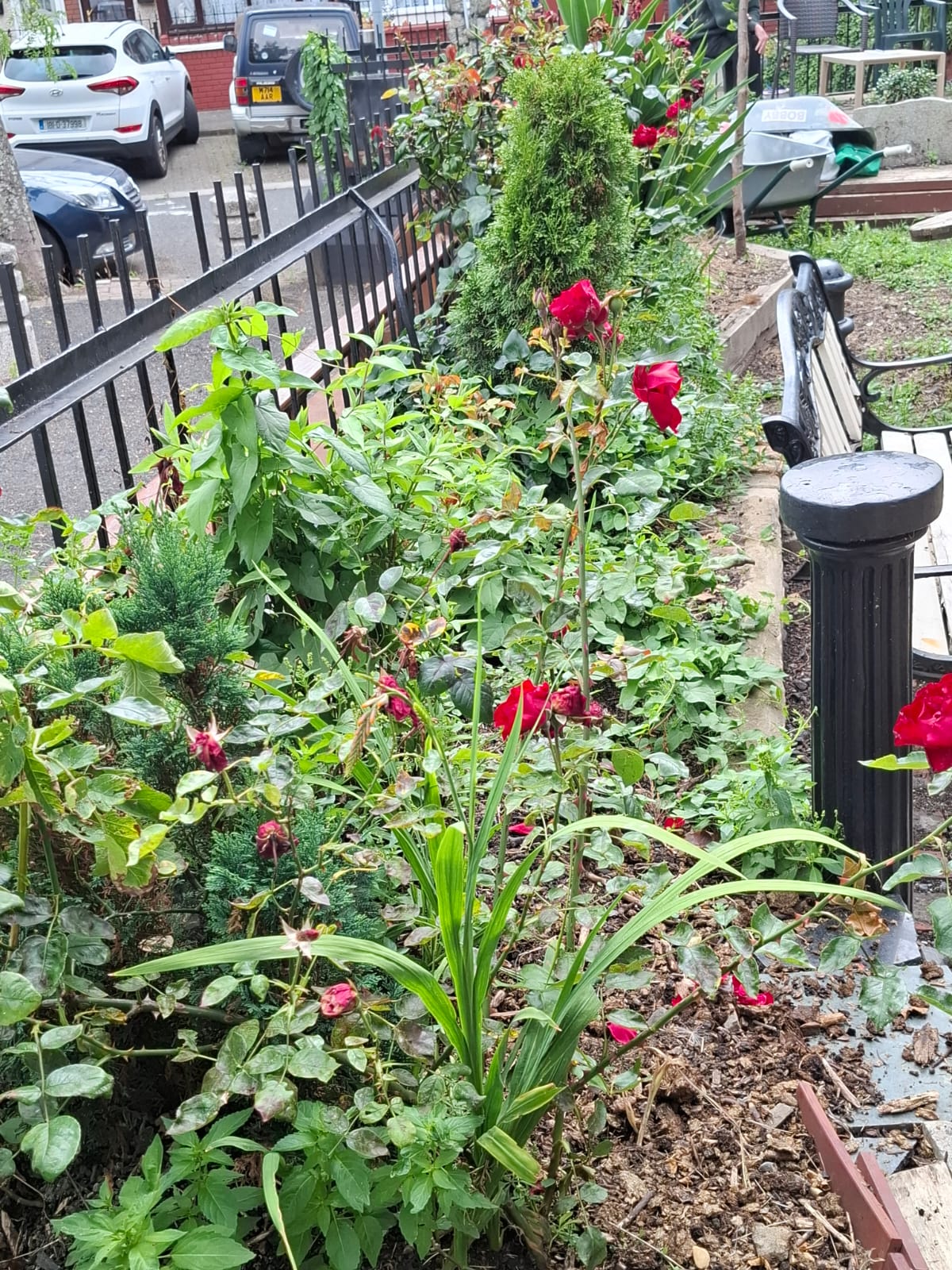
Flower bed in the garden (Photo: D.Breatnach)“… in vacant or in pensive mood, they flash upon that inward eye which is the bliss of solitude …“ Jimmy Browne, creator of the garden, caught in a moment of reflection. (Photo: D.Breatnach)
NOW AND FUTURE
Trees are valuable oxygenators and carbon-sequestrators, absorbing CO2 in the environment, as well as attractive but the big beech tree was shading the whole garden, restricting many other plants from growing. Sadly it had to go and two of its sections provide nice features in the garden.
Flowering shrubs and perennial flowers now grow in borders around an attractive brick floor. To those Jimmy has added other features of stone, metal posts and a garden bench.
Among the many that Jimmy acknowledges helping him is Shane Daly of the Windjammer, Leo for garden bench donation and Christy Barry who transported materials Jimmy collected to the garden.
Younger Rowan trees in the garden. (Photo: D.Breatnach)
The beech has been replaced by some Rowan trees, also known as Mountain Ash (Caorthainn), some in full berry flush when I visited the garden with local man Christian, who introduced me to Jimmy. I hoped Jimmy would install a pond that frogs or newts might breed in, attracting also damselflies.
The garden is attractive now and safe for children to visit but Jimmy has plans for a rockery, a fountain, a small shelter from rain showers over a seat and bird nest boxes, for tits for example. The Blackbird and robin are sure to nest in trees there in time, sending their songs into the area.
Section of beech trunk, now the stand for a table. (Photo: D.Breatnach)
FROM DERRY TO DUBLIN
Jimmy Browne is from Derry and came to Dublin in the 1970s, “on the hop” he says and indeed there were many from the Catholic areas that did the same in those years, whether temporarily or permanently. Coincidentally, the area around the garden has a strong political history too.
Around the corner, next to the Windjammer pub, is a plaque commemorating the founding of the Irish Republican Brotherhood in a wood yard there on St. Patrick’s Day, 1858, its counterpart in the USA being formed on the same day, soon to be known as “Fenians” which was adopted here too.
(Photo: D.Breatnach)
Almost facing the open end of Lombard Close is a little park with a monument, both dedicated to Elizabeth O’Farrell, of the 1916 Rising GPO Garrison, who took part in the occupation of Moore Street, where she had the dangerous responsibility of negotiating the surrender.
She grew up in that area as did nearby also her childhood friend, comrade and later lifelong house partner Julia Grennan, who also fought in the Rising and was there in Moore Street at the end also.
By strange coincidence, both Jimmy’s employers in Dublin, before he set up his own fabrication/ welding shop, had his own family name: Browne’s Foundry and Brownes Brothers.
Older Rowan trees in the garden (Photo: D.Breatnach)
Contrary to the drive for profits that dominates our society, a great many people contribute their physical and mental energy not only to their immediate family and friends but to the community at large. The garden is a benefit to the 19 homes in the Close and 40 others in attached streets.
Jimmy is not being paid to do this work. But he is being rewarded and not only by cups of tea and biscuits. He enjoys the feeling of creation, of making things from his mind come to life, of keeping busy in retirement, of feeling contentment. And of knowing his work is appreciated in the area.
End.
View of the garden from the outside: (Photo: D.Breatnach)Plaque to the birth-place of the Ireland section of the Fenians in Lombard Street, Dublin. (Photo sourced: eadingthesigns.weebly.comblog).(Photo: D.Breatnach)Garden bench – suigh síos and relax (Photo: D.Breatnach)
In Dublin’s south docklands the property developers and the corporations dominate city planning and therefore the landscape. And the working class community there feel that they’re being squeezed out.
I’ve met with some concerned people from parts of this community in the past to report on their situation and concerns for Rebel Breeze and did so again recently.
A view eastward of a section of the south Liffey riverfront, showing a very small amount of more traditional buildings squashed between or loomed over by the “glass cages that spring up along the quay”. (Photo 1 March 2024: D.Breatnach)
YOUNG PEOPLE – education, training, socialising
“There’s nothing here for our young people” said one, expressing concern over the attraction for teenagers of physical confrontations with other teens from across the river which have taken place on the Samuel Beckett Bridge over the Liffey.
A young man training as an apprentice in engineering attends a mixed martial arts club but has to go miles away to another area to attend there. Between his industrial training, travel and athletic training he has little time to spare for socialising.
I comment that those sporting activities tend to concentrate on male youth and only some of those also but he tells me that nearly half the regular membership of his club is female. A community centre could provide space and time for such training but they say they have no such centre.
St. Andrew’s Hall is a community centre in the area and there are mixed opinions in the group about it but I know from my own enquiries that the available rooms are committed to weekly booked activities (and our meeting had to take place in a quiet corner of an hotel bar).
As a former youth worker and in voluntary centre management, I know that a community centre can serve all ages across the community, from parents and toddlers through youth clubs to sessions for adults and elders.
Discussing youth brings the talk into education and training. As discussed in a previous report of mine, the youth are not being trained in information technology, which is the employment offered in most of the corporations in “the glass cages that spring up along the quay.”1
Section of the south Liffey docks showing some of the few remaining older buildings as they are swamped by the “glass cages”. The building on the far right of photo, very near to Tara Street DART station, once an arts centre, is already targeted for demolition and replacement with commercial building. (Photo sourced: Internet)
“If they’re lucky, they’ll get work in the buildings as cleaners or serving lattes and snack in the new cafes”. Some opined that the corporations in the area should be providing their youth with the training while others thought Trinity College should be doing so.
HOUSING – price and air quality
Universal municipal housing in the area has declined due to privatisation of housing stock and refusal to build more. A former municipal block in Fenian Street, empty for years is now to be replaced but the “affordable” allocation has been progressively reduced, ending now at zero.
Pearse House in south Liffey docklands, believed earmarked for demolition and site sold to property speculators. (Photo 1 March 2024: D.Breatnach)
Property speculators (sorry, “developers”) with banker support are building office blocks and apartment blocks in the areas, the latter units priced beyond the range of most local people. The average rent for a two-bed apartment in the area is €2,385;2 to buy a 3-bedroom house €615,000.3
The Joyce House site and attached ground area could provide housing and a community centre but appears planned to go to speculators.
Continuation of ‘Pearse House site’ in south Liffey docklands, believed earmarked for demolition and site sold to property speculators. (Photo 1 March 2024: D.Breatnach)
The Markievicz swimming pool near Tara Street has been closed and the local people are told they can go to Ringsend for swimming, an area which already has better community facilities than are available to the communities further west along docklands
A huge amount of traffic goes through the area and one person stated that Macken Street tested as having the worst air quality in Ireland. “I have to close my windows to keep out the noise and pollution,” said another; “the curtains would be black.”
Townsend Street side of ‘Pearse House site’ in south Liffey docklands, believed earmarked for demolition and site sold to property speculators (prospective property speculators must be salivating). The gambling advertisement coincidentally erected there seems to show the likely social types to benefit from these kinds of deals. (Photo 1 March 2024: D.Breatnach)
‘They want us out’
If some town planner were intending to establish a community somewhere, s/he would plan for housing, obviously, so the people would have somewhere to live. But a proper plan would provide also for education and training, along with social facilities — and employment.
But if someone were intending instead to get rid of a community, s/he would target exactly the same elements, whittling them down or removing them altogether. This what some local people feel is intended for their community.
“We feel we’re not wanted here,” said one and others agreed, “They want us to move out.” “But we’re not going! We’re staying,” said another, to grim nodding of heads around.
HISTORY of struggle … and of neglect
In the late 1800s and early 1900s, Dublin had the worst housing in the United Kingdom and many of its elected municipal representatives – including a number of Nationalists of Redmond’s party – were themselves slum landlords.
When the Irish Transport and General Workers Union was formed by Jim Larkin with assistance from James Connolly and the Irish Women Workers’ Union founded by Delia Larkin, many of the dockers, carters and Bolands Mill workers who joined them came from the south docklands.
And when the employers’ consortium led by William Martin Murphy set out to break the ITGWU in 1913, many of those workers
… Stood by Larkin and told the bossman We’d fight or die but we would not shirk. For eight months we fought And eight months we starved, We stood by Larkin through thick and thin …4
And the women of Bolands’ Mill were the last to return to work, which they did singing, in February 1914.
They also formed part of the Irish Citizen Army, the first workers’ army in the world,5 to defend the striking and locked-out workers from the attacks of the Dublin Metropolitan Police and which later fought prominently in the 1916 Easter Rising.6
Many also joined the larger Irish Volunteers which later became the IRA, along with Cumann na mBan,7 fighting in the Rising, the War of Independence and the Civil War, supporting resistance of class and nation for decades after.
The Irish Republican Brotherhood (the Fenians) was founded in the area; Peadar Macken8 was from here and has a street named after him; Elizabeth O’Farrell9 is from the area too with a small park named after her and Constance Markievicz10 also lived locally.
The Pearse family lived in the area too and Willie Pearse and his father both worked on monumental sculpture at the same address; Connolly and his family for a while lived in South Lotts.
Home of the Pearse family and monumental sculpting business (Photo: Dublin Civic Trust)
The working class communities in urban Ireland suffered deprivation throughout the over a century of the existence of the Irish state and the colonial statelet. The communities in dockland suffered no less, traditional work gone, public and private housing in neglect in a post-industrial wasteland.
The population of Ireland remained static from the mid-1800s until the 1990s, despite traditionally large families — emigration in search of employment kept the numbers level. Married couples lived with parents and in-laws while waiting for a house or flat – or emigrated.
In the 1980s, like many parts of the world, Ireland fell prey to what has been described as the “heroin epidemic” and the neglected urban working class worst of all, with the State assigning resources to fight not so much the drug distributors as the anti-drug campaigners.
One of those in the meeting became outwardly emotional when he talked of “the squandered potential” of many people in the local community.
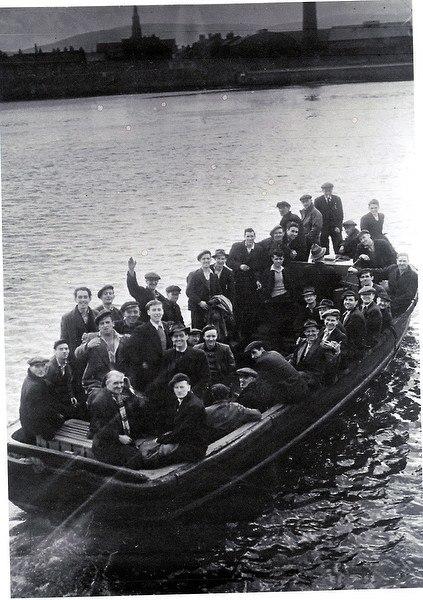
A workers’ day out trip on the Liffey ferry (Photo sourced: Dockers’ Preservation Trust)
The heirs of these then are the marginalised and abandoned that are targeted with disinformation and manipulated by the far-Right and fascists, to twist their anger and despair not against the causes of their situation but against harmless and vulnerable people.
But the Left has to take a share of the blame, for leaving them there in that situation, for not mobilising them in resistance. After all, issues like housing, education and employment are supposed to be standard concerns for socialists, of both the revolutionary and the reformist varieties.
Republicans cannot avoid the pointing finger either. These communities provided fighters and leaders not only in the early decades of the 20th Century but again from the late 1960s and throughout the 30 years war.
The Republicans led them in fighting for the occupied Six Counties but largely ignored their own economic, social and educational needs at home. Perhaps this is why the people are now organising themselves.
Protest placard by housing block in Macken Street protesting noise and dirt from nearby construction (Photo: Macken Street resident)
“THEY DON’T VOTE”
A number of the local people to whom I spoke quote a local TD (Teachta Dála, elected representative to the Irish parliament) who commented that most of the local residents don’t vote in elections.
Whether he meant, as some have interpreted, that therefore they don’t matter or, that without voting, they cannot effect change, is uncertain. However, community activism is not necessarily tied to voting in elections.
Protest placard by housing block in Macken Street protesting noise and dirt from nearby construction. (Photo: Macken Street resident)
As we know from our history and that of others around the world, voting is not the only way to bring about change and, arguably, not even the most effective one.
Whatever about that question, people are getting organised in these communities and those who hold the power may find that they are in for a fight.
End.
The landscape (and airscape) viewed from a housing block in Macken Street (Photo: Macken Street resident).
FOOTNOTES
1From song by Pet St. John, Dublin in the Rare Aul’ Times.
4From The Larkin Ballad, about the Lockout and the Rising, by Donagh McDonagh, whose father was one of the fourteen shot by British firing squad after the 1916 Rising.
5Formed in Dublin in 1913 to defend strikers and locked-out workers from the Dublin Metropolitan Police; members were required to be trade union members. The ICA was unique for another reason in its time: it recruited women and some of them were officers, commanding men and women.
6Historian Hugo McGuinness based on the other side of the Liffey believes that the reason the British troops sent to suppress the Rising disembarked at Dún Laoghaire rather than in the Dublin docks was because they feared the landing being opposed by the Irish Citizen Army and its local supporting communities.
7Republican Female military organisation, formed 1914.
8Fenian, socialist, trade unionist, house painter who learned and taught Irish language, joined the Irish Volunteers, fought in the Rising and was tragically shot by one of the Bolands Mill Garrison who went homicidally insane (and was himself shot dead).
9Member of the GPO Garrison in the 1916 Rising, subsequently negotiator of the Surrender in Moore Street/ Parnell Street and courier for the 1916 leadership to other fighting posts.
10Member of multiple nationalist organisations, also ICA and in the command echelon of the Stephens Green/ College of Surgeons Garrison. Also first woman elected to the British Parliament and first female Labour Minister in the world.
On a wet Tuesday night in the large lobby of Windmill Lane Recording Studios, local community representatives met with representatives of political parties, Dublin City Council and the Gardaí to press for their community’s needs to be met.
The meeting on 24th October 2023 was convened by the City Quay Committee and its organiser, Patrick (“Paddy”) Bray raised concerns about the unmet needs of the local communities currently and for following generations.
Apart from the City Quay Committee, also represented were representatives of housing areas Markievicz House and Conway House, along with volunteer-managed youth service Talk About Youth.
Also in attendance were representation from political parties Fianna Fáil, Labour and Sinn Féin, all of which have TDs (members of Irish parliament) elected in the area. Dublin City Council was represented as the local municipal authority and Pearse Street as the nearest Garda station.
Presumably the presence of a Garda representative was in relation to discussion around a recent period of violent confrontations between opposing gangs of youth on the Samuel Beckett Bridge (but also Sean O’Casey Bridge) connecting South and North Liffey docklands.
It was striking that nearly all the community representatives were female, while most of the political representatives and each of DCC and the Gardaí were of male gender.
Paddy Bray opened the meeting outlining the local concerns about the area’s youth and the lack of constructive activities for them, the local youth service being underfunded, under-staffed and with no permanent base.
Bray went on to outline a dire absence of any kind of community facility for the local community, while property development went on around them, including four hotels in recent times, with no sites designated for affordable housing or community needs.
Looking across from the north quay, central background, the 8-storey Clayton Hotel, along with other buildings dwarfing even the four-storey reconstructed The Ferryman, the last of the original pubs along the South Docks between Tara St. Station and the East Link Bridge. (Photo sourced: Internet)
Other community representatives also pressed their needs hard and raised issues of applications for building on existing sites without consideration of the community’s needs in housing, parking, child and young person development, mental health or green space.
A number raised concerns about rat infestation in a housing area, emanating from a derelict site, followed by some discussion about where responsibility lay to address the problem as the site is in private ownership (though there was a suggestion of an enforceable abatement order).
The responses of the political party representatives and the Dublin City Council Area 2 officer were generally supportive, though a disagreement did emerge as to whether the City Council were doing enough to control the rat infestation.
Evoking a medieval or early 1900s scenario, a community representative reported that a man visited their housing area on a voluntary basis to kill rats and at a recent visit, had killed seven. Photos of live and dead rats on a phone were handed around (to shudders from some of the men).
The meeting concluded with an agreement to form a campaigning committee for the resources and sites needed, for the political representatives to support its aims and for the Area 2 DCC Manager to report back to his own management.
Paddy Bray asked all present to spread the word among their contacts to enlist further support.
THE COMMUNITY: LOSS, NEEDS AND HISTORY
The name of the building in which the meeting was held is famous in Irish recording events though most probably associate it in particular with the previous recording studio on the site and the rock group U2.
A plan for a six-storey block on the site was defeated by local protests in 2008 but the original studios were demolished with the exception of the U2 fans’ graffiti wall, which was later sold and proceeds donated to a charity fundraising for awareness of men’s health and treatment needs.
The new building is owned by the formerly investment trust company, now Hibernia property development company which, despite the name, as is now common in Ireland, is owned by a foreign corporation.1
Property speculators plan to demolish the City Arts Centre, a resource for the community but derelict and empty for two decades on Moss Street on the South docks, in order to build a 24-storey office block.
City Arts Centre building, derelict for years, property speculator high-rise plan appealed by many including Dublin City Council to An Bord Pleanála, now speculator taking DCC to court. (Photo sourced: Internet)
Unusually perhaps, the demolition application is being opposed by Dublin City Council2 which has appealed it to an Bord Pleanála3 and the speculator has taken the case to court.
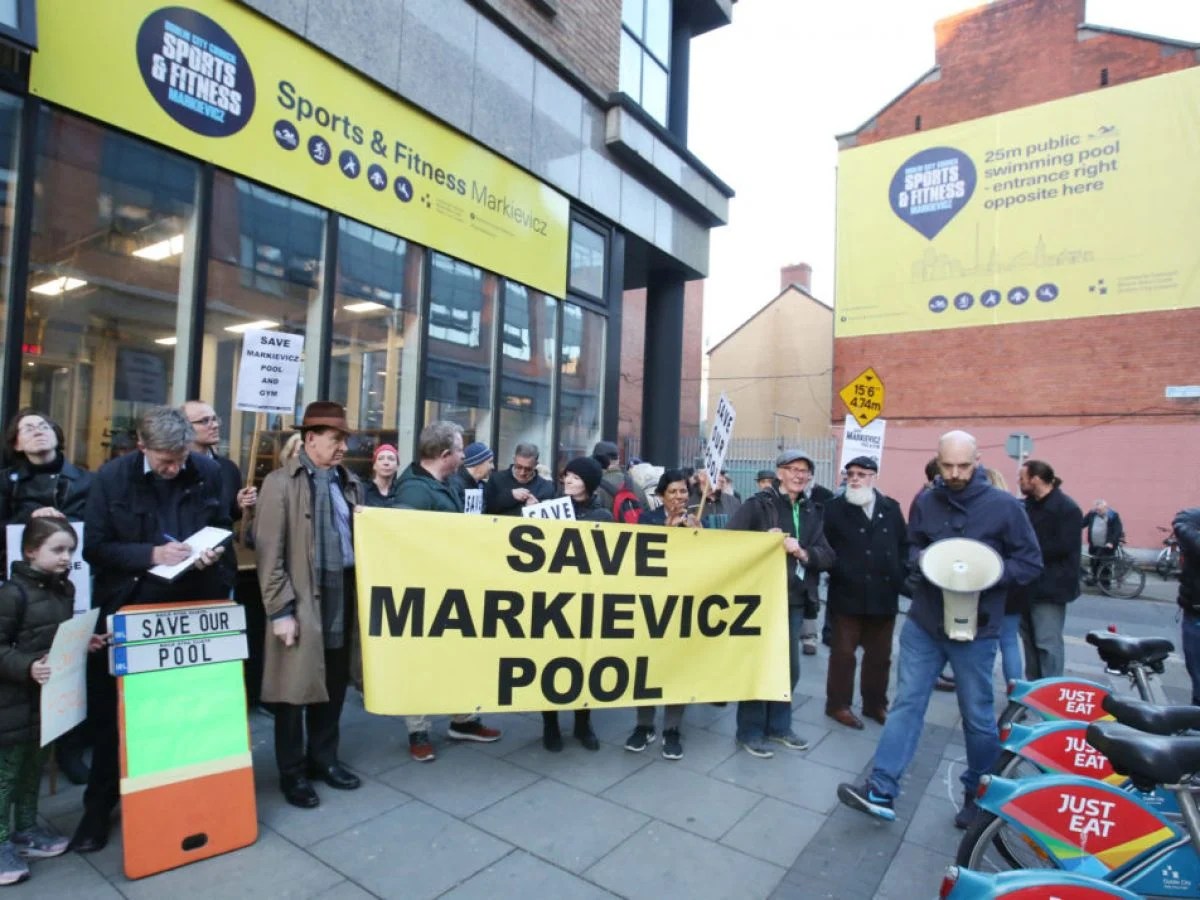
As mentioned in the meeting, an existing facility for the community, the Markievicz swimming pool, despite 1,600 signatures to save it, is to close for the construction of a station for the projected underground Metrolink, another infrastructure planned for private or part-private ownership.4
As one of the community representatives commented, there is already a train station nearby; not only that but the tracks of that station are several storeys above ground, making an underground connection with Metrolink quite feasible.
A rally to promote saving the swimming pool in 2019 (Photo sourced: Internet)
The swimming pool facilities are now to be located at a site 3 km away in Ringsend, a housing district at the end of the docks and partly on the seafront, which has football pitches and green space very close nearby. 5
It is indeed late in the day as indicated by the huge property development on the South Quays but the communities are getting organised as can be seen from this meeting, a commemoration of a fatal 1960s housing collapse and protests about local church neglect by the Diocese.6
Some may think it is too late or that the speculative property and financial forces ranged against them, with their multiple political and other connections, are too strong. But their community’s needs now and for generations to come are powerful incentives for which to struggle too.
The south and north quays communities, neglected by the authorities and rode over roughshod in the past, with their remnants now under threat, are essentially working and lower-middle class communities which have never been given the resources they earned and deserved.
As in many other parts of Dublin, working class communities were ravaged by the heroin epidemic in the 1980s and regarded in the main by the authorities as a policing problem, with anti-drug campaigners ironically targeted more than drug lords.
In the course of that social crisis, many developments of physical and political nature took place which the working class was not well-placed to resist.
An outing on the old Liffey ferry boat, in regular use when there was no bridge crossing the Liffey eastward and downriver past Butt Bridge (Photo sourced: Dublin Dockers’ Preservation Society)
However, the people of the docklands were an important part of the working class movement in the early 1900s, winning many union battles against the employers until defeated by the latter’s alliance with police, magistrates, churches and media after eight months of struggle 1913-1914.
They rose out of that defeat and rebuilt their fighting organisations, including the first workers’ army in the world (and which recruited women, some of them appointed officers),7 fought again in the 1916 Rising and after that in Dockland areas during the War of Independence.
Indeed, during the 1916 Rising it is remarkable that despite British shelling from naval units in the Liffey, they did not attempt to land soldiers on any of the Dublin quays at that time, disembarking British reinforcements into Dun Laoghaire instead and marching 8 miles8 in from there.
If the working class of the south Dublin dockland is stirring it may still achieve more than many may expect.
End.
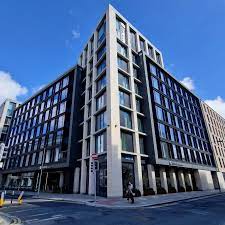
The Travelodge Hotel, corner of Townsend and Moss Street (Photo sourced: Internet)
FOOTNOTES
1Purchased by Brookfield Asset Management, a Canadian company, in 2022
3Many applications agreed by DCC Planning Department have also been appealed to An Bord Pleanála and that organisation has been immersed in controversy over criminality in management and low staff morale leading to a high backlog of appeals awaiting judgements.
5One could form the suspicion that the ultimate plan is to move south docks working class facilities to Ringsend and Irish Town, with the communities themselves to follow or to fade away, leaving the whole area free for property speculators.
6The diocese protest was not reported on in Rebel Breeze but the housing collapse commemoration, at which the lack of local affordable housing was raised, was.
7The Irish Citizen Army, founded after calls by both James Connolly and Jim Larkin.




 rebelbreeze