On the 22nd of August 1798, almost 1,100 troops under the command of General Humbert landedat Cill Chuimín Strand, Bádh Cill Ala (Killala Bay), Co. Mayo.
Painting said to be depicting French landing at Kilalla
The events are covered in six songs that I know of: Na Franncaigh Bhána; An Spailpín Fánach (Mayo version); Mise ‘gus Tusa agus Hielan Aindí; The West’s Awake by Thomas Davis; Men of the West and its Irish translation, Fir an Iarthair.
Some of the songs, especially the traditional ones from this area, are in Irish, which was the commonly-spoken language of the area (unlike parts of Dublin, Wexford and Antrim, where most of the songs from the period were in English).
The French troops on this occasion — unlike the numbers sent by Napoleon in 1796 but which failed to land at Bantry Bay due to stormy conditions — were insufficient to change the overall insurrectionary situation and though they and the Irish fought bravely, the Rising in the West failed. Most of the French who surrendered were treated as prisoners of war but the Irish who rose were butchered or taken prisoner and hanged. Matthew Tone and Bartholomew Teeling, both Irish but holding commissions as officers in the French Army, were taken to Dublin, tried and hung. Their bodies are reputed to lie in Croppies’ Acre.
Portrait of General Jean Joseph Amable Humbert
Nevertheless the Rising is remembered with pride and General Humbert’s memory held in affection. Sixteen years later he fought the English again at the Battle of New Orleans, taking place between December 14, 1814 and January 18, 1815, this time as a private soldier in the American Army — and successfully. He had settled in New Orleans already and remained there after the war, working as a schoolteacher until his final days.
There is a French military former officer character in Mel Gibson’s film The Patriot (2000), Major Jean Villeneuve (played by Tcheky Karyo). A film commentary on line says his character was suggested by the Marquis de Lafayette, of the French military and Baron Von Steubon, a Prussian mercenary (http://www.patriotresource.com/thepatriot/characters/villeneuve.html.).
But might the character not have been suggested by Humbert? Anyone who knew his story would be eager to put him in the film, one would think. In the film, he fights in his French officer’s uniform at the final battle (unnamed but probably based that on at Cowpens); Humbert, though he fought at the rank of private, also fought in his Napoleonic Officer’s Army uniform at the Battle of New Orleans.
Still photo from the film, with Tchéky Karyo to the right in the role of the French Major Villeneuve. His character could have been based in part on that of Jean Joseph Amable Humbert.
Robert Roda of New Hampshire is listed as the writer of the screenplay. New Hampshire is not known as an Irish-American stronghold and Roda does not sound like an Irish name. But then, it is not only Irish and French people who are interested in Irish and French history.
A DEBATE to discuss the above question at the Teachers’ Club, Dublin, was organised by the United Ireland Association with Tommy McKearney and Clare Daly being the debaters on June 16th.
Tommy McKearney (Photo: Wikipedia)
Tommy McKearney is a long-time Republican, formerly of the Provisional IRA, 1980
Clare Daly (Photo source: Internet)
Hunger-Striker and ex-Republican prisoner. He was, along with Anthony McIntyre, a founder of the Republican Writers’ Group which, while not advocating armed struggle, was critical of the Good Friday Agreement, of Provisional IRA and in particular of Sinn Féin. He is currently an Organiser for the Independent Workers’ Union.
Clare Daly is a long-time Socialist, a former trade union shop stewart and has been a Teachta Dála (member of the Irish parliament) since 2011, formerly as a member of the Socialist Party and now a Left Alliance TD. She has visited Republican prisoners and raised issues about their treatment in court and in jail. Daly was also arrested for trespass at Shannon Airport, along with fellow-TD and partner Mick Wallace, protesting against the use of the airport by US military flights and for transporting of political prisoners of the US military to jails in various parts of the world.
TOMMY MC KEARNEY
Tommy McKearney spoke first and stated that there was an issue of defining Republicanism and that sometimes what was meant was the anti-monarchic Republicanism of France or the United Stated but he was going to discuss it in terms of a specific Irish-based ideology, i.e Irish Republicanism.
Mentioning a number of Left-Irish Republicans such as Fintan Lawlor and Wolfe Tone’s famous quotation about relying on the “men of no property”, Tommy developed a line of reasoning that sought to say that there was not a huge difference between Irish Republicanism and socialism and drew attention to the fact that James Connolly had founded a party by the title of the Irish Socialist Republican Party.
Going on to talk about the objective of Irish Republicans, Tommy stated that not only is a republic desirable for Ireland – it is necessary. Only a Republic that is based upon socialist principles can resolve the economic and political problems facing Ireland today on both sides of the colonial Border.
Referring to the British election results in the Six Counties, Tommy commented on the 238,915 votes and seven seats for Sinn Féin – an increase of 14,670 votes – and the rise of almost 67,000 votes for the DUP with their ten seats. Sinn Féin had been pushing a peace process which was not about peace but about normalisation; their claim to intend to bridge the sectarian divide was empty and the voting lines were drawn up along sectarian lines at least as deeply as before.
Tommy also speculated that the amount of votes cast for Sinn Féin, on a platform of refusing to take their seats in Westminster showed, among other things, the amount of people in the Six Counties who did not care to be represented in a British Parliament and presumably would want representation in a united Irish Republic. He called for an alliance of Left Republicans and Irish socialists and recalled that James Connolly had founded, as well as the Labour Party, the Irish Socialist Republican Party.
CLARE DALY
Clare was next and she in turn highlighted the difficult issue of defining the Left – did it mean the parties that defined themselves as Left, did it include the Labour Party – some would say yes, others no. For Clare it is not issue of the names we give parties or activists but of what we stand for. Clare said she stands for a socialist country and in that sense for a Republic.
Addressing the question for debate, Clare owned that maybe socialists had neglected the national question — maybe they had been put off by images of balaclavas and guns — but it could equally be said that Republicans had for decades neglected social questions such as women’s reproductive rights, women’s rights in general, gay rights …. However, in more recent times, Republicans were seen actively supporting those rights.
Over recent years, Clare said, we had seen the gains our parents fought for in terms of trade union rights and local authority and state services lost or undermined.
Clare said she saw herself as a citizen of the world but as she lived in Ireland that she stood for a Republic that was organised along socialist lines and gave equal rights to all. The real question, Clare stated, is how we are to achieve that and pointed to the swing to the Left in Britain with Jeremy Corbyn’s party receiving a big increase in votes, despite media hostility and predictions of failure. The Conservative Party could only rule now with the support of the DUP’s 10 Mps. Clare said that opportunities of a Left Front existed in Ireland too as was seen by the Right to Water mass marches with broad political party and some major trade union support.
CONTRIBUTIONS FROM THE AUDIENCE, RESPONSES FROM THE PANEL
Included in contributions from the audience were the following:
Sinn Féin had seven MPs to the DUP’s 10 and should consider abandoning their abstentionism and go to Westminster to assist Corbyn in voting legislation
While the Labour Party in Britain had moved to the Left, Sinn Féin in Ireland had moved to the right
Good debate from two good speakers but also two who had put themselves out there for what they believed – Tommy McKearney in armed struggle in the past and hard prison struggle and Clare Daly in protesting US military use of Shannon Airport and also visiting Republican prisoners in jail, along with a few other Tds.
We need more debates like these and also to focus on Republicans with regard to where they stood with regard to socialism.
The Irish Left as a whole has divorced itself from Irish Republicanism, probably in fear of being associated with nationalism and/ or armed struggle. In doing so, it has walked away from continual violation of human rights, e.g of Republican prisoners in the jails and of civil rights, the right to political dissent of Republican activists on both sides of the Border.
The Irish Left has neglected to confront British Imperialism and left the Republicans to confront the various visits of the British Queen and the recent one of Prince Philip, when major roads were shut and even civilians impeded in going about their business or even going to their local shops or to visit their relatives’ graves in Glasnevin and a megaphone wrested by an undercover policeman backed up by a riot squad from the hands of a person about to speak to a protest demonstration.
Republicans are socialists and to pose the two as different categories was ridiculous.
There should be a broad Left front in Ireland including the trade unions and Sinn Féin.
Among the responses from the panel were that people were hung up on condemning Sinn Féin and should welcome them into a broad Left mass movement on the model of the Right to Water and Right to change campaigns (this from Tommy McKearney)
The socialists might not have done very well opposing British imperialism but had opposed US imperialism, which is one of the imperialist powers in operation in Ireland (this from Clare Daly) and a major one in the world.
COMMENT
The contributor who said that “Republicans are socialists” seemed unaware that historically at least this certainly was not so. Seán Mac Diarmada, the Irish Republican executed on the same day as the socialist James Connolly, had been on record as saying that no-one should support socialism. During the War of Independence, some IRA units took actions to support landless labourers and poor farmers but others took action to repress these in favour of big farmers.
The IRA had a ban on Communists through the 1930s probably up to the 1960s. Sean South, prominent Limerick IRA Volunteer killed in the Bessborough RUC Barracks attack in 1957, was a conservative Catholic, anti-Communist member of the Knights of Columbanus and of An Réalt (Irish-speaking section of the Legion of Mary).
The broad Left front being advocated by a number of people seems to be a reformist social-democratic one and, while there is nothing necessarily counter-revolutionary about fighting for reforms, clarity is needed about whether what they are advocating is a social-democratic program or fighting for some reforms while at the same time openly organising with a revolution in mind.
Clare Daly has certainly fought hard against US Imperialism but others on the Left much less so. The mobilisation against Hillary Clinton’s visit to Dublin was not great and gave up in the face of police opposition before they even reached City Hall and there was no mobilisation at all against Obama’s visit to Dublin in May 2011 and it remains to be seen how much there will be if he comes this year, as he has reportedly promised to do. But the question of oppposing British imperialism is a crucial one since a) it is the main imperialist-colonial power at work in Ireland and b) because it is the main prop of US Imperialism in Europe and in the UN.
There would seem to be fertile ground for debate on the historical and current differences between Irish Socialists and Irish Republicans, as well as for discussing possible joint action and one hopes for many more debates and discussions of this nature with a broad attendance.
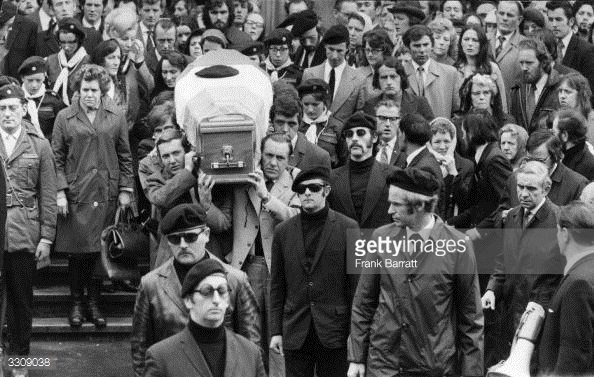
IRA Volunteer Michael Gaughan was killed in Parkhurst Jail on the Isle of Wight this month in 1974. He was killed on the 3rd June that year by force-feeding while on hunger strike. An honour guard of Provisional IRA had presided over his body’s removal by ferry to the mainland and from there to London, where the first of his three funeral processions was to take place.
Volunteer Michael Gaughan, the image most often associated with him. (Photo source: Internet)
Also on hunger-strike with Gaughan although in different jails in Britain were other Provisional IRA prisoners: Gerry Kelly, Paul Holmes, Hugh Feeney and fellow Mayoman Frank Stagg. They were acting in support of the struggle of Volunteers Dolours and Marion Price1 to obtain political status and to be transferred to a jail in Ireland. The prisoners’ demands were as follows:
The right to political status
The right to wear their own clothes
A guarantee that they would not be returned to solitary confinement
The right to educational facilities and not engage in penal labour
The setting of a reasonable date for a transfer to an Irish prison2
At the time I was a young and fairly inexperienced activist supporting an English-based Marxist-Leninist group.3
LONDON
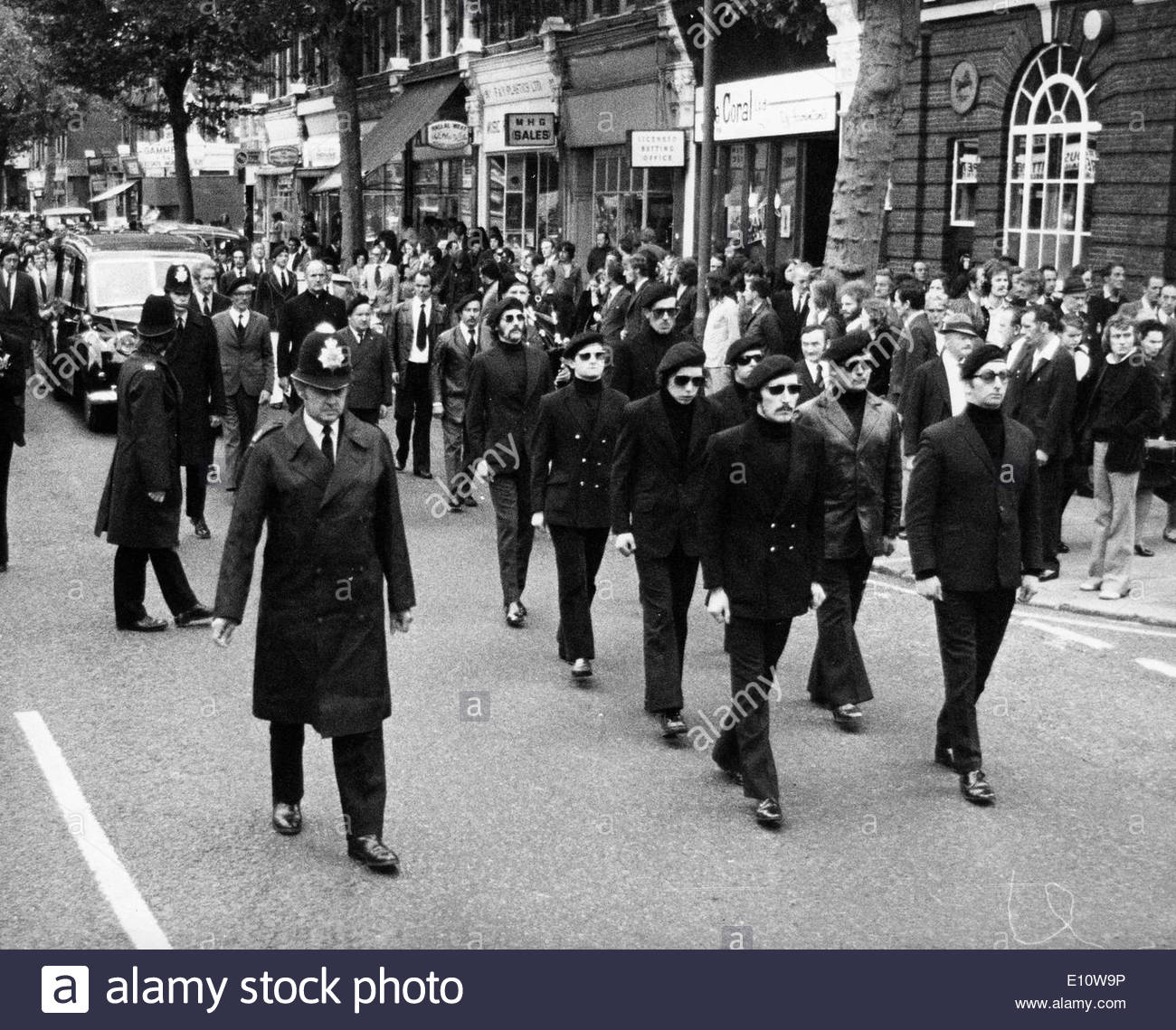
Vol. Gaughan’s funeral procession in Kilburn, London. (Photo source: Internet)
On the 7th a funeral procession was being organised by Provisional Sinn Féın in an area of strong Irish diaspora settlement in North-West London. I took a bus from my South-East London home by a part of the canal near Peckham (now filled in) to the Elephant & Castle and changed on to the London Underground metro system to travel to Kilburn, from where I walked up to the Cricklewood area. There in the forecourt of the Crown pub was where I had been told the funeral procession would gather and where I would also meet my comrades of the organisation.
After a little, preparations were being made for departure. A priest was to lead the procession, which I strongly disliked but obviously had no say in the arrangements. A lone piper would follow, a traditional feature of mourning where Irish resistance is involved. The coffin would be carried for a period on the shoulders of volunteers, before being transferred to the hearse and a senior comrade of my organisation approached me.
Another view of the funeral procession of Vol. Gaughan through Kilburn, London. (Photo source: Internet)
“Some representatives of British Left organisations are going to carry the coffin,” he said. “We’ve been asked if we’d like to take part. What do you think?”
He was asking me, I presumed, because I was the only Irish supporter of the organisation present, although it had an excellent record of supporting Irish resistance and prisoners and several of its comrades had gone to jail as a result.
He seemed not keen on the idea and I got the impression that he felt as I did that it was tokenism, distasteful posturing by the British Left. Tariq Ali (now a journalist but then a member of the now-defunct Trotskyist organisation in Britain, the International Marxist Group) was one of those hefting the coffin. I agreed with my comrade and said we should not (a decision I now regret) and so we didn’t. No organisation on the British Left at that time, in terms of commitment and actions in proportion to its size, deserved the honour more than our organisation.
From the forecourt of the Crown a long parade escorted Gaughan’s coffin from Cricklewood in West London along the main road to the Church of the Sacred Heart of Jesus in Quex Road church in Kilburn. It was a very Irish area then with nearly every pub being of mainly Irish clientele and it contained a dance hall where Irish bands played. Every shop and pub along the way was closed for the funeral and crowds lined the route. The atmosphere was very solemn with the laments being played by the piper very audible.
DUBLIN
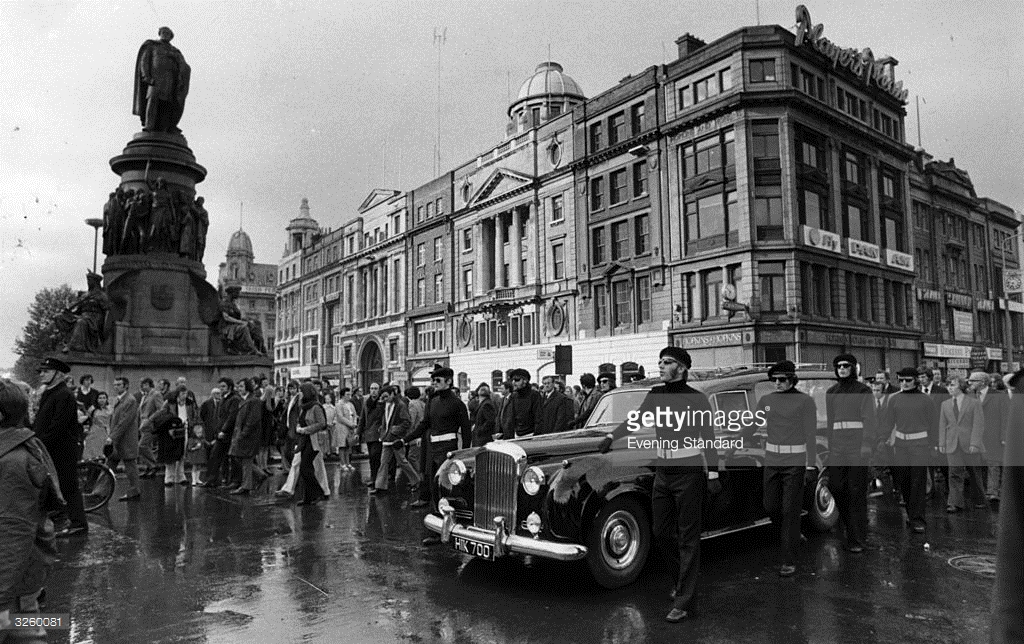
Michael Gaughan’s funeral procession approaching O’Connell Bridge, Dublin city centre. (Photo source: Internet)Another view of the Michael Gaughan funeral, Dublin
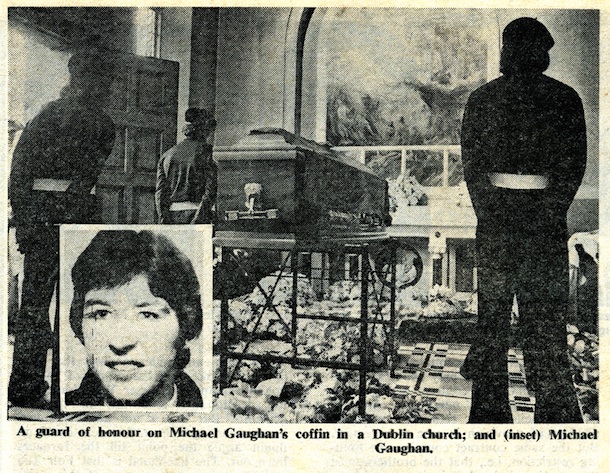
On the 8th of June 1974, the body of IRA Volunteer Michael Gaughan arrived in Dublin, where it was met by mourners and an IRA guard of honour. The body was brought to the Adam and Eve’s Franciscan church on Merchant’s Quay, where thousands filed past as it lay in state (no doubt under the watchful eyes of the Garda Special Branch).
Vol Gaughan lying in state with IRA honour guard in Dublin. (Photo source: Internet)
MAYO
On the following day, the 9thof June1974, Michael Gaughan’s funeral took place in Ballina, County Mayo.The funeral mass was held at St. Muiredach’s Cathedral, Ballina, procession then to Leigue Cemetery, Ballina. He was given a full republican burial and laid to rest in the Republican plot (where Frank Stagg, also killed by force-feeding, would join him after being reburied in November 1976 –see further below). Vol. Gaughan’s coffin was draped in the same Tricolour that had been used for Terence McSwiney’s funeral 54 years earlier (the same flag would later be used in the funeral of James McDade, IRA member killed in a premature explosion in Coventry). Gaughan’s funeral was attended by over 50,000 people, larger than the funeral of former Irish president Éamon de Valera.
FRANK STAGG
Frank Stagg, the image most frequently used. (Image source: Internet)
It was no doubt to avoid scenes such as this that the Irish state took certain steps when two years later, on 12th February 1976, a comrade of Gaughan’s, Vol. Frank Stagg, also from Mayo, was also killed in Wakefield Prison, Yorkshire, by force-feeding while on hunger-strike. Although much of this this took place during the IRA truce of 1975-January 1976, the British authorities refused to grant any of the demands. The Wikipedia entry says that “Stagg died on 12 February 1976 after 62 days on hunger strike” which, though not untrue is a lie by omission.4
The repatriation of the body of Frank Stagg at Shannon Airport from Wakefield Prison in Britain where he died on hunger strike on 12 February 1976.
The Irish Government had the flight carrying his coffin diverted from Dublin where a large crowd awaited it, to Shannon airport.
On arrival at Shannon, the Gardaí snatched the coffin and drove it straight to Ballina, Mayo under armed guard, to a cemetery near Stagg’s family home, where it was placed in a prepared grave into which wet concrete was then poured, six feet deep, instead of soil. And the site remained under guard until the concrete had set and for some time after.
Sean, one of Frank Stagg’s brothers, being assaulted at Shannon Airport by Gardai (Photo source: Internet)
Although those proceedings would have been in complete opposition to the wishes of the deceased, the State had obtained agreement for them from Frank Stagg’s widow and one of his brothers, the Labour Party’s Emmet Stagg. It was opposed by another two of Frank Stagg’s brothers and of course by the dead Volunteer’s comrades.
The first burial of Vol. Frank Stagg, managed by the State, contrary to his wishes of the deceased. One of his brothers, Emmet, who colluded in that operation, is on the back left, lowering the coffin. (Photo source: Internet)
In November of that year, a number of those comrades dug down near the grave, tunneled under the concrete, removed the coffin and re-interred it in the Republican plot, near to Michael Gaughan’s grave, where it rests today.
A simple but plaintive song about Michael Gaughan survivesin not uncommon use: Take Me Home to Mayo. There are a number of versions on Youtube; this one contains relevant images and film footage: https://www.youtube.com/watch?v=14-kuxsHjPg
National Graves Association memorial in the Republican Plot, Leigue cemetery, Ballina, to which the names of Vol.s Stagg and Gaughan were added. The NGA is a nationwide non-State-funded organisation caring for the graves and erecting memorials to Ireland’s patriot dead. (Photo source: Internet)
end
FOOTNOTES
1Although Gerry Kelly is a current Sinn Féin MLA, both the Price Sisters denounced the Good Friday Agreement and Sinn Féin; Marian was effectively interned for a period because of her politics and has not been active politically due to ill-health since her release in May 2013. On January 23rd of that year she was escorted from jail to attend the funeral of her sister, Dolours. Of the surviving hunger strikers of 1975-’76, Paul Holmes was the only other one to attend that funeral.
2The British promised to concede the demands after Gaughan’s death – they had already conceded them to Loyalist prisoners – but reneged on the promise. The Price Sisters did eventually win repatriation to jail in the Six Counties, Ireland. The struggle on the issue of repatriation, which the British authorities conceded to British prisoners in Irish jails but not generally in reverse, carried on for many years. It is UN and generally human rights policy that prisoners should serve their sentences in jails close to their family networks.
3I had previously been an unaffiliated Anarchist activist, then came to support the English Communist Movement (M-L), which later became the Communist Party of England (M-L), which I left some years later. It has since gone through a number of bigger changes and evolved into the current Revolutionary Communist Party of Britain (M-L), a much-changed organisation from the days referred to in this article.
4This is an important omission because the death of Vol. Stagg at the State’s hands after Gaughan’s brought about a change in policy of the British Medical Association, which afterwards recommended to its members that people in sound state of mind embarking on a hunger strike should not be forcibly fed even if they were heading for death. In consequence, the British State no longer has a policy of force-feeding prisoners on hunger-strike, since such would have to be supervised by medical personnel.
THE MANCHESTER ATROCITY WAS ALLEGEDLY COMMITTED BY SALMAN ABEDI, A MEMBER OF A FUNDAMENTALIST ISLAMIST GROUP SHELTERED BY BRITISH INTELLIGENCE SERVICES. WHAT ARE THE CONNECTIONS BETWEEN MANCHESTER, LIBYA, IRAQ, SAUDI ARABIA? THEY ARE FAR FROM TENUOUS: ESSENTIALLY, THEY ARE BRITISH, US AND FRENCH IMPERIALISM, AS JOHN PILGER EXPLAINS (see link below).
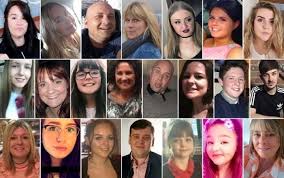
Images of some of the victims of the recent Manchester bombing (Source: Internet)
Comment
by Diarmuid Breatnach:
Irish anarchists and socialists should protest the visits of representatives of the US and British states (including the Royals) for this reason, since they seem unable to bring themselves to protest the occupation of a fifth of their country. Is not internationalist solidarity part of the creed of socialism? Do they not feel shame that the nearest imperialist power to them, its flag stained with the blood of millions and its hands dripping with fresh gore, can send its representatives to both parts of Ireland without any sign of socialist or anarchist protest?
Alleged photo of Salman Abedi, alleged Manchester bomber, from an unnamed source. Abedi was a member of an extreme Islamist group sheltered by British secret services, Pilger says. (Source: Internet)
Irish Republicans, when protesting the visits of British Royals for reasons the socialists disdain to do, should add these imperialist crimes to their reasons, as well as the collusion of their governments in this world order. Irish Republicans claim to be socialists too – is not internationalist solidarity part of the creed of socialism? They can demonstrate this in support of Palestine – why not embrace the rest of the Middle East? After all, whatever success the Republicans hope to have against British colonialism and imperialism, they are sure to meet resistance from US and French imperialism too.
A man stands next to flowers for the victims of Monday’s bombing at St Ann’s Square in central Manchester, England, Friday, May 26 2017. (AP Photo/Emilio Morenatti)
Social democrats who think that Jeremy Corbyn, even if successful in his campaign for election as Prime Minister of the UK, can put an end to this dirty work are deluding themselves and others. This is the British State at work, representing the British ruling class – its work continues whoever is elected to the British Parliament. Only a revolution overthrowing that State can possibly bring that to an end. Revolutionary socialists are often accused of being dreamers, impractical, Utopianists even …. but no-one can top social democrats for wishful thinking.
Hard-hitting report and analysis by journalist John Pilger of the connections between those powers and areas alluded to above: John Pilger article here
“GUNFIGHTS IN DUBLIN SUBURB — TWO OFFICERS KILLED – POLICE HUNT GUNMEN”
Those words above might have been the headline of the national media in Ireland on a Monday 95 years ago. On the Tuesday a headline might have declared INTENSE POLICE HUNT — DRUMCONDRA MURDERERS STILL AT LARGE! to be followed on Thursday by SHOOTOUT YESTERDAY IN DUBLIN CITY CENTRE – FOUR DEAD!
The events to which those headlines might have referred occurred on 13th, 14th and 15th October 1920 and they involved two men, Seán Treacy and Dan Breen. They were events of amazing initiative, determination and courage – and also of tragedy. They took place in Dublin city centre and in a location roughly a mile away. And they were shortly to lead to further amazing deeds of determination and courage – and even greater tragedies.
Dan Breen and Sean Treacy were both Tipperary men and members of the newly-created Irish Republican Army unit in their home county. Already they had participated in the event that touched off the War of Independence in January 1919, the Solohodbeg Ambush. Their unit, under Séamus Robinson, had acted without any order from their Dublin Headquarters on the day the First Dáil met in the Mansion House in Dublin and their action was disapproved of by at least some of the TDs, including some in the newly-reorganised Sinn Féin political party. The attack in which Treacy and Breen participated killed two members of the colonial Royal Irish Constabulary, captured arms and an amount of gelignite.
Dan Breen had been sworn into the secret organisation, the Irish Republican Brotherhood, in 1912 at the age of eighteen. In 1914, he joined the Irish Volunteers but due to Mac Neill’s cancellation order and resulting confusion, like most of the Volunteers, took no part in the fighting of 1916. He made up for that omission afterwards.
Sean Treacy, whom Breen admired tremendously had, according to Breen himself a much wider and more defined political ideology. He left school at the age of 14 and joined the IRB at the age of 16, in 1911. He was also a member of Connradh na Gaeilge. Arrested in the roundups after the 1916 Rising, he spent two years interned without trial. As soon as he was released in 1918, Treacy was made vice-commander of the Third Tipperary Brigade of the Volunteers which, in 1919, became the IRA and he was eager to start the war to rid Ireland of British colonialism.
Sean Tracey (Photo from Internet)(Photo from Internet)
Treacy and Breen had eventful times in Tipperary and nearby counties as they escalated their war against the British colonial occupation, attacking RIC barracks and carrying out ambushes. Among their most dangerous and famous events was the daring IRA rescue at Knockalong of Sean Hogan from the train in which he was being carried as a prisoner under armed escort on 13th May 1919, in which a fierce hand-to-hand struggle took place and both Treacy and Breen were seriously wounded.
Towards the end of that year, on 19th December in Dublin, Breen and Treacy were in action with Sean Hogan in an attempt on the life of General Sir John French, the British King’s representative and chief of HM Armed Forces in Ireland. The operation was led by Paddy Daly (of “Collins’ Squad” notoriety and later infamous for his part in the Civil War) and consisted of ten Volunteers, to which Martin Savage was added the previous night due to his own earnest request. Through misinformation the waiting Volunteers barely missed French as he headed in convoy towards his Residence (now the US Ambassador’s) in Phoenix Park and in the shootout that followed with the other convoy vehicles Breen was wounded in the leg and Volunteer Martin Savage in the neck, dying in Breen’s arms (Martin Savage is remembered in the song Ashtown Road by Dominic Behan).
At least a number of Sinn Féin TDs and activists were incensed by this action, including Charlotte Despard, who also happened to be John French’s sister. There was more than family relations involved – many in Sinn Féin were ambivalent about armed struggle and although both were banned later in 1919, neither the party nor the Dáil declared war on the British until a few months before the Truce in 1921.
After the Knockalong rescue, things had got a bit hot for Treacy and Breen in Tipperary and Collins invited them up to Dublin, where they were expected to merge more easily in the busy city centre.
They returned to Tipperary in the summer of 1920, where they continued to be active in the war, until Collins invited them up to the city again, partly for their own safety and partly to help him out in Dublin in the work of his “Apostles”, the “Squad”, especially in assassinations of British Intelligence agents, troublesome police and informers.
CIS — BRITISH INTELLIGENCE IN IRELAND REORGANISED
However, British Intelligence in Ireland had already been re-organised. The RIC’s intelligence and its personnel were by this time considered unreliable by British Army Intelligence and many in the force had also resigned or become disaffected. “By the spring of 1920 the political police of both the Crimes Special Branch of the Royal Irish Constabulary (RIC) and G-Division (Special Branch) of the Dublin Metropolitan Police (DMP) had been effectively neutralised by IRA counter-intelligence operatives working for Michael Collins. The British thoroughly reorganised their administration at Dublin Castle, including the appointment of Army Colonel Ormonde de l’Epee Winter as Chief of a new Combined Intelligence Service (CIS) for Ireland. Working closely with Sir Basil Thomson, Director of Civil Intelligence in the Home Office, with Colonel Hill Dillon, Chief of British Military Intelligence in Ireland, and with the local British Secret Service Head of Station Count Sevigné at Dublin Castle, Ormonde Winter began to import dozens of professional Secret Service agents from all parts of the British Empire into Ireland to track down IRA operatives and Sinn Féin leaders.” (Wikipedia).
Ormonde developed or introduced lots of intelligence-gathering procedures and “black propapaganda” in Ireland. After the war he joined the British fascisti for a while and in 1940 fought for the Finns in the Winter War against the Red Army.
Ormond L’Epee Winter, head of CIS in Ireland
As part of the reorganisation under CIS, a number of Royal Irish Constabulary officers had been posted to Dublin from country areas where the IRA were active and Breen and Treacy were noted coming into Dublin or soon after their arrival and were placed under surveillance.
On the evening of 13th October 1920, Breen and Treacy had been to see a film in Dublin with the Fleming sisters, who told them that they were sure that Breen and Treacy were being followed. Neither of the men believed this to be true and before the start of the nightly curfew, headed out towards their safe house, “Fernside”, a little past the corner of Home Farm Road and Upper Drumcondra Road, which belonged to a Professor Carolan, who lived there and taught in the nearby St. Patrick’s College, Drumcondra.
Closeup of the name “Fernside” on the house today, scene of the gunfight. (Photo D.Breatnach)The “Fernside” house today, scene of the gunfight (Photo D.Breatnach)
BRITISH EARLY MORNING RAID
By this time, the Fernside address was known to British Intelligence. Around 1.00 or 2.00am, a party of DMP and British Army knocked on the door and when Professor Carolan answered, they entered, began to question him and a number started up the stairs. Both Treacy and Breen had slept in most of their clothes and with their guns ready. Instead of barricading themselves inside their room or escaping through the window, they charged down the stairs, firing as they went at the intruders, who fled. Breen and Treacy then went back upstairs and jumped from a first floor window. They seem to have been different windows, for Breen went through a glass house or conservatory and received a number of glass cuts, while Treacy suffered only a very slight injury of some sort, whether by glass or some such or by bullet, is not clear. Or possibly Breen jumped first and left little glass remaining to cut Treacy.
In the back garden of the house, Breen later recounted firing at the heads of either police or British soldiers he observe over the fence and saw some fall; in return fire he was seriously injured but managed to get out of the garden and work his way across the road down to the wall of the nearby St. Patrick’s College, Drumcondra (still there today). Although short of stature and badly injured, he scaled the wall and making his way across the College grounds, came out on the other side, by the Tolka and then went up the road to Phibsboro, where he knocked on doors. A man who opened the door to him got him a doctor, who then had him smuggled into the private patients’ part of the Mater Miserecordiae Hospital (known to Dubliners as “the Mater”), at the corner of Eccles Street and Dorset Street, under an assumed name in the care of the nuns. Another version has him going to Finglas before being smuggled to the Mater.
We know little of Treacy’s escape except that he too got away, only slightly hurt, to a house in Inchicore. Professon Carolan was shot during the event (probably by the enraged British who might have thought he had somehow signaled Breen and Treacy or in panic — they seem to have shot some of their own men) and died days later.
The Occupation forces admitted to only two of their dead, both officers in the British Army, although a contemporary Irish Times report mentioned three. But Joe Connolly, a member and later Chief of the Dublin Fire Brigade, which then as today operates ambulance services in Dublin, spoke of twelve bodies having been collected for delivery to the British Military Hospital in Arbour Hill.
The forces of the colonial Occupation were in a frenzy searching for both Treacy and Breen around the city and the Dublin IRA organised protection for them both.
ANOTHER SHOOTOUT
Word reached Michael Collins that the Occupation forces were going to organise a formal funereal procession to take the dead British officers’ bodies to the quays for their journey home to Britain and that top officers of the Occupation’s army and police would be in attendance. Collins planned to shoot a number of them and assembled a group for the operation and notified the meeting place.
However, Collins cancelled the operation (and meeting) when he learned that the high-ranking British officers would not be attending the dead officers’ send-off to England. Treacy arrived late at the meeting place, a draper’s shop called “Republican Outfitters” (!) owned by the Boland family, at 94 Talbot Street, as did another man and both learned of the cancellation (according to one account; according to another he delayed leaving after the others had left). However, the British were closing in on Talbot Street with the intention of capturing Treacy, it seems. As Treacy came out into the street, an agent approached him with gun drawn and Treacy saw the British vehicles coming down the street from O’Connell (then Sackville) Street. He drew his Parabellum firearm and shot two agents but the machine-gunner caught Treacy in a burst as he was trying to mount his bicycle as people dived for cover and several were injured.
Republican Outfitters, 94 Talbot Street. This may also be a photo taken after the shooting.
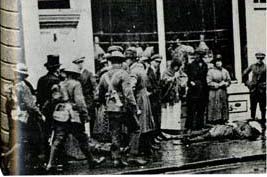
Sean Treacy died from the machine-gun bullets in that street, along with two civilians, a John Currigan, a tobacconist from Eden Quay and “a messenger boy named Carroll”, according to a press report at the time. A policeman on point duty was shot in the arm, which had to be amputated. Another boy, 15-year old apprentice photographer John J. Hogan, claiming to be out practicing with his employer’s camera, followed the action and took the famous photo of Treacy lying dead in the street.
Sean Treacy lying dead in Talbot Street, very soon after he had been shot. (Photo from Internet).
It seems the Chief of the CIS himself, Ormand Winter, had attended the operation or had followed it up and was shocked at the outcome – an agent dead and another wounded and Treacy dead, along with two innocent bystanders, one only a boy. He told a press reporter it had been “a tragedy”.
It had long been believed that Treacy shot two agents dead but although Liuetenant Gilbert Price was definitely dead, another, Colour-Sergeant Frank Christian, later received compensation of £1,250 (a substantial amount in those days) for injury received during the event, according to press reports. Christian claimed to have been off duty and just passing at the time but this was more than likely said to preserve his cover and also to increase the amount of compensation. http://www.cairogang.com/incidents/treacy-talbot/treacy-talbot.html
Some of the IRA and their supporters were still in the area when the British Army arrived in Talbot Street and one, Dick McKee, barely made it away on a bicycle. He would not be so lucky another time which was fast approaching.
I once or twice heard some speculation that Treacy had been betrayed from within the IRA and even that Collins wanted him killed but these kinds of rumours often arise and no evidence has ever been provided to substantiate the speculation. It is indeed curious that Treacy had miraculously escaped on the 13th and had been recruited for a dangerous operation to take place two days later, then to be shot at the scene of a cancelled meeting but such things happen. It would take remarkable prescience on Collins’ part to have anticipated the course of the War of Independence in 1920 so as to have removed one of the most effective fighters that would help bring the struggle to truce, negotiation and a Treaty. The simplest explanation and the one that fits the best is that Treacy had been marked and followed and that after their debacle at Fernside, the colonial military authorities in Dublin had decided to take him prisoner there in Talbot Street if they could and, if not, kill him.
Treacy was buried in his native county at Kilfeakle, a funeral attended by thousands of mourners and a heavy concentration of RIC, holding rifles with fixed bayonets. Breen remarked that though not intended in that way, it was an appropriate mark of respect for the fallen guerrilla fighter.
MORE SHOOTINGS …. AND A MASSACRE
The police and army raids in Drumcondra and in Talbot Street, the first from which two tough and experienced IRA men had been lucky to escape and the second which had resulted in the death of one of them and nearly netted a few others, must have rung very loud alarm bells for IRA leaders and ordinary Volunteers. Apparently it convinced Collins that some very thorough offensive action was needed to remove or reduce the threat.
Just over a month later, in the early morning of Sunday 21 November 1920, Collins’ ‘Squad’ and teams mobilised by the Dublin IRA Brigade, went out to assassinate 35 men believed to be members of the British Intelligence network in the City. Collins had originally drawn up a list of 50 but Cathal Brugha, acting as Minister of Defence, had reduced the list on the basis that there was insufficient evidence against fifteen of them.
Most of the shootings by the IRA that morning took place in the southern suburbs of the city – Baggot, Upper Pembroke and Lower Mount streets, Fitzwilliam Square, Morehampton Road and Earlsfort Terrace. There were also shootings in the Gresham Hotel and on O’Connell Street. Some agents were, luckily for them, not in when the IRA came calling and some operations were bungled. A passing Auxilliary patrol (they were brought into Ireland in July 1920) got involved in one location and, in the subsequent fight, two of them were killed and one IRA man wounded and captured. But by midday, the British Army and colonial administration were counting their fatal losses, a total of:
10 Intelligence officers (one RIC and 9 Military)
1 military prosecutor
1 civilian informer
2 Auxiliaries
1 Army Veterinary officer (apparently a case of mistaken identity)
In addition, some more officers had been wounded, albeit not fatally.
Just as the operations organised by British Intelligence in the previous month had raised the alarm for the IRA, the response of the latter did the same in turn for the British military and political administration in Ireland. Henceforth, intelligence personnel would be accommodated in Dublin Castle or in barracks. But if the Intelligence establishment was rattled, the Auxilliaries and loyal RIC and DMP (Dublin Metropolitan Police) were incensed.
That afternoon, a Gaelic football game was scheduled to take place in Croke Park, the national stadium of the Gaelic Athletic Association, between Tipperary and Dublin teams. The IRA had considered advising the GAA to cancel the match but there were fears that — apart from alerting British Intelligence that something was planned — it might implicate the GAA in the planned operation that morning. In any case, the match went ahead with an estimated attendance of 5,000, unaware that a convoy of British Army troops was driving along Clonliffe Road from the Drumcondra Road end, while a convoy of DMP and Auxiliaries approached the Park from the south or Canal end.
At 3.25pm, ten minutes after the start of the match, the police burst into the ground, firing. Despite their claims later there is no evidence they received any return fire but nevertheless their own commander admitted they kept shooting for about a minute-and-a-half. They fired at spectators and players, some firing from the pitch while others fired from the Canal Bridge at those who tried to escape by climbing over the wall at the Canal end. The soldiers on Clonliffe Road fired machine gun bullets over the heads of the fleeing crowd in an unsuccessful effort to turn them back.
According to the commander of the operation, Major Mills, the police had fired 114 rifle rounds (revolver rounds were not counted) and the Army had fired 50 rounds in the street. The casualties were 9 people shot dead, five dying of wounds and two trampled to death in the panic. Two of the dead were boys aged 10 and 11. Michael Hogan, a player was dead and another player, Egan, wounded but survived. Dozens more were wounded by bullets or injured in the panic. Unlike the “Croke Park” scene in Neil Jordan’s Michael Collins film (1996), it appears that the British Army shot no-one that day – that was all the work of the police.
The Castle issued a cover story in a statement that IRA men from outside Dublin had used the football game as a cover for getting into the city and, after the assassinations they had carried out, had gone to the game. When the police arrived to search fans for weapons, according to the statement, these men had fired on the police, who had been obliged to return fire. The most credulous would have found that story difficult to believe since not a single policeman had even been injured and even the loyalist Irish Times poured scorn on their story.
MURDER IN THE CASTLE
One of the planners of the earlier IRA operation was already in custody before the events of that day. Dick McKee, commander of the Dublin Brigade and another IRA man, Peadar Clancy, had been arrested by Crown Forces in the early hours of that Sunday morning. They were being interrogated in Dublin Castle.
Also being interrogated was Conor Clune, who had been arrested by the Auxilliaries in a raid on Saturday evening of Vaughan’s Hotel in Parnell Square, on the corner of Granby Lane. Clune was no IRA man but an language enthusiast who had come up to Dublin that day with his employer, Edward McLysaght, on business for the Raheen cooperative. Clune had gone on to meet Piaras Béaslaí, a member of the First Dáil (Irish Parliament set up in defiance of Westminster by the majority of Members of the British Parliament elected in Ireland). Béaslaí and some IRA men using Vaughan’s that evening were alerted by a hotel porter to the suspicious behaviour of a visitor, apparently a spy, and departed before the arrival of the “Auxies”, who arrested Clune on suspicion. Leading the interrogation team was Ormond Winters.
Later that awful day, McKee, Clancy and Clune were reported “shot while trying to escape”. Their captors said that, because there was no room in the cells, they had been placed in a guardroom and were killed while grabbing arms to shoot their captors and to make a getaway. To bolster the Castle’s story, they produced a number of photographs: one shows three civilians sitting apparently in conversation in a room, where a number of Auxiliaries and British Army are also shown relaxed, some eating a meal and another reading. Untended weapons are in view; another photograph shows a blur of men “trying to escape”. In none of the photos are the faces of any of the three prisoners clearly shown.
Family of the dead Irishmen said they had been tortured and then shot and few believed the Castle’s story (although apparently some historians today give it credence). It is said Collins wanted their bodies displayed to show bayonet wounds but was persuaded not to, however one of Collins’s Castle informers, Nelligan, was later adamant that they had not been bayoneted. All sides agree that the bodies did show extensive bruising. In any case, McKee and Clancy died without giving their captors any of the long list of names they carried in their heads, while Clune of course had none to give.
Conor Clune’s body was recovered by Mac Lysaght, who had it medically examined, revealing that he had been shot 13 times in the chest. The Army doctor who examined the bodies prior to their release said that Clancy had been hit with up to five bullets, which caused eight wounds, while Dick McKee had three wounds caused by two bullets.
Unfortunately for the Castle, Conor Clune was a nephew of Patrick Clune, Archbishop of Perth, Australia which caused the authorities some embarrassment.
View further back of plaque to the three murdered by the British Occupation forces on Bloody Sunday 1920 (City Hall on the right). (Photo DB)Closer view of plaque.
A plaque commemorating the men (albeit listing Clune as a “Volunteer”) was placed by the National Graves Association on the wall of Dublin Castle near the eastern side of City Hall and every year a small commemoration ceremony takes place there.
There was a sequel to the deaths of the three, although it did not take place until the following year. An ex-British Army soldier, James “Shankers” Ryan, had betrayed McKee. On February 5, 1921, as Ryan was enjoying a pint in Hyne’s pub in Gloucester Place and studying the horse racing page of the newspaper, an IRA squad led by Bill Stapleton walked into Hynes’ pub in Gloucester Place and shot him dead.
REMEMBRANCE IN SONG AND STORY
A plaque was erected in Talbot Street, Dublin, by the voluntary non-party organisation, the National Graves Association, on the front facade of No. 94, the building outside of which Treacy was killed. The anniversary of his death is marked each year at a commemoration ceremony in Kilfeacle. Also at noon on the morning of All-Ireland Senior Hurling Finals in which the Tipperary GAA team participates, a ceremony of remembrance is held at the spot in Talbot Street where he died, organised “by people from West Tipperary and Dublin people of Tipperary extraction. The most recent such ceremony was held at midday on Sunday, 7 September 2014 and attracted a large attendance, most of whom were en route to Croke Park.” (Wikipedia).
Sean Treacy Plaque Talbot Street
It is worthy of note that every single one of those commemorations and memorial plaques is organised by voluntary bodies rather than by the State.
A number of songs about Sean Treacy are in existence: Sean Treacy by Dominic Behan and Tipperary So Far Away (author disputed: by Patsy O’Halloran OR Paddy Walsh/ Pádraig Breatnach/ Paddy Dwyer, with — if about Treacy — some obviously inaccurate versions by the Clancy Brothers and Wolfe Tones). Strangely neither Treacy nor Breen is mentioned in The Station of Knockalong, about the May 13th 1920 rescue of Sean Hogan from his captors on a train, after a fierce hand-to-hand struggle in which both Treacy and Breen were seriously wounded. The Galtee Mountain Boy is said to be also about Treacy but some of the lyrics make this unlikely and a contributor to Mudcat (a folk song website) claimed that song is about Paddy Davern, who was sentenced to die by both the British and the Irish Free State but escaped them both.
Strangely too, no song comes to light about the Drumcondra shoot-out. I have heard a few lines quoted, “He shot them in pairs coming down the stairs”, allegedly from a song about Sean Treacy by Dominic Behan. However, my searches have failed to turn up the source of those wonderful lines. If the song existed and was about Treacy, it could have referred to his death in Talbot Street but even more likely to the battle at Fernside.
Dan Breen is mentioned in a number of songs but none of which I am aware directly about him. Breen was very saddened at the death of his close comrade-in-arms and recovered slowly from his wounds, having been shot four times, twice in the lungs. He was smuggled out of Dublin while still recovering from his injuries and very weak, returning to active service later. In June 1921, Breen married Brigid Malone of the Dublin Cumann na mBan, who had helped nurse him while recovering from his wounds. The long Truce of 1921 followed in July which, according to his autobiography My Fight for Irish Freedom (1921 and many reprints since), Breen frowned upon, commenting that IRA discipline grew slack and information on identities of fighters and their locations would have come much more easily to Crown forces.
Dan Breen dissented from the Treaty of 1921 and took up arms on the Republican side, was captured and interned, went on hunger strike and was released. Breen was an anti-Treaty TD for Tipperary from 1923 for Sinn Féin, the TDs of which refused to take their seats in the “Partitionist” Fourth Dáil. When the Fianna Fáil party was created in a split away from Sinn Féin in 1926 with the intention of their representatives entering the Dáil if elected, Breen joined and was the first anti-Treaty TD to take his seat in the Dáil in 1927.
When he later failed to be reelected he went to the USA, which was under alcohol Prohibition at the time and there he ran a speakeasy. (He would probably have known Joe Kennedy, grandfather of President John F. Kennedy, who was a prominent gangster in that epoch). Returning to Ireland in 1932, Breen regained his Fianna Fáil seat. He died in 1969 and the attendance at his funeral was estimated at 10,000.