Reprinted from author’s substack 11 March 2026 and reformatted for Rebel Breeze
(Reading time: mins.)
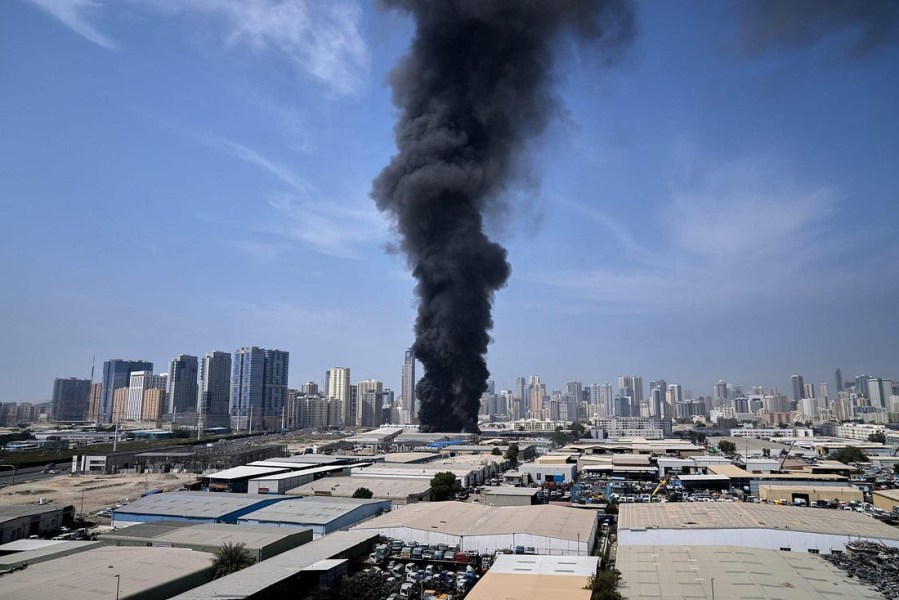
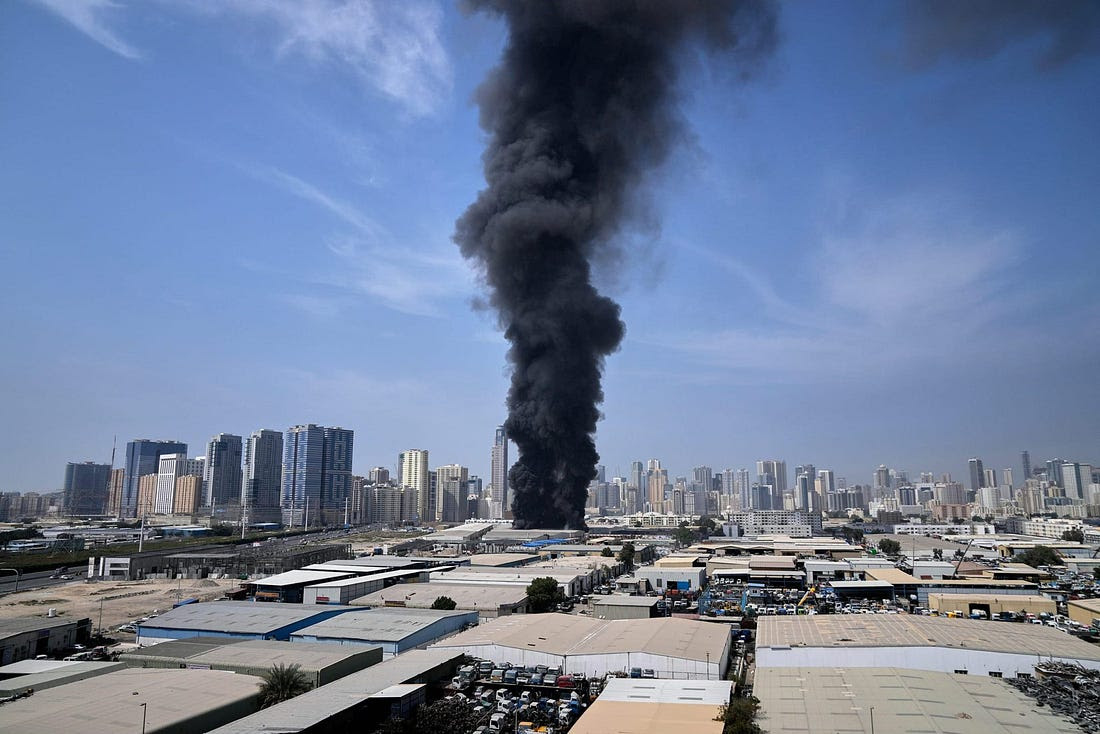
Photo: US Military Base Qatar Under Iranian Attack 2026
On February 28th the Zionist regime of Israel and the USA commenced a lethal bombing campaign against Iran, choosing as their first target a school where more than 168 girls were murdered.
The Western press took its time in questioning the attack and the western governments never really did.
The press “explains” that the school was near a centre of the Revolutionary Guard, but they don’t explain that it was a cultural centre and a clinic and pharmacy all of which enjoy protection under the Geneva Conditions.
They tell us that these places “perhaps explain the attack.”[1] Well no, they don’t. They remain war crimes.
Iran’s response was robust. So robust that the western press and politicians condemned it and asked Iran to not attack the other states of the region (calling the Emirates countries or nations is a bit much).
They never asked the US or its attack dog, Israel, to cease its attacks.
Iranian civilians are less important than investments in Dubai and other places. Iran attacked military bases, radar installations and hotels housing US soldiers who had transferred there given the possibility of an attack on their bases. The counterattacks uncovered some truths.
The first one is that the Arab monarchies of the region are nothing more than US lapdogs and the myths about their economies went up in smoke in seconds. They are not safe places to invest in and less so to live in as shown by the mass of tiktokers crying into the camera.
It is worth pointing out that many of them boasted about not paying taxes and one or other explicitly stated they had set up in the region in order not to pay taxes and now they want their respective governments to spend taxes that they not only didn’t pay but didn’t want to in order to rescue them.
It might be that Dubai and the other monarchies never fully recover.
Another truth that was revealed is the real role of US military bases. The Yanks like to say that it is to protect and defend the countries they are located in against attacks.
That myth also went up in smoke just like the myth of Dubai as a safe place for digital nomads, tiktokers, bankers and even drug traffickers like the Kinahans who have lived there openly for the last number of years.[2] They will all have to think of other places.
The military bases were not capable of defending the monarchies and moreover the US transferred a good part of its military capability to Israel and left them to their fate.
Recently the president of South Korea announced that the USA had transferred part of its defence system to Israel.[3] The presented lamented the situation but explained that there was little he could do, i.e. the USA decides everything.
In the case of Spain, President Sánchez said he would not allow the USA to use the shared military bases in the country to launch attacks on Iran. Trump’s response revealed the real role these bases play and the real authority over them.
He said they didn’t need them, but if they want to, no one is going to tell them no.[4] In many of the military bases, in law, it is the host country that commands and controls the base. The reality is otherwise and Trump showed it.
In others cases, particularly in Japan and some European countries it is the US that has formal control.
The bases are not there to defend the host countries but rather to defend US interests and to act as they see fit. The Arab monarchies have just learnt that lesson the hard way. Spain has yet to, but Trump has warned them that it is in practice he who decides what is done, where and how.
This brings us to the question of military bases in Colombia. Theoretically Colombia has authority over the bases and can limit what is done. In practice it is not so.
The supposedly progressive government of Gustavo Petro never did anything to expel the Yanks from the bases in the country. Nor is he going to do so in the few remaining months of his presidency.
The question is what will the new government that comes into office on August 7th do? For the moment it looks like the next president will be Iván Cepeda from the same political force as Gustavo Petro.
In the midst of tensions between Colombia and the USA Cepeda stated from Madrid that Colombia wasn’t a Yankee colony.[5] When he is president he will have ample time to prove it and can start on August 7th by ordering the north American troops out of the country.
The rest of the countries in the world should do the same.
It is clear that the bases are an extension of the USA and at all times serve it and nobody else.
Note: If you found this article of interest, why not register with Rebel Breeze for free, so that you will be notified by email of subsequent articles. You can de-register any time you wish.
Petro’s government announced another measure against Israel, or to be more precise the Foreign Minister Laura Sarabia, who despite all the criticisms we made of her seems more trustworthy than the erratic Petro, made the announcement.
Colombia will require an entry visa for Israeli citizens.
Before celebrating another blow to Zionism and a gesture of solidarity with the suffering people of Palestine, we have to read the reasons behind it. It is not a response to the genocide, but rather because Israel unilaterally imposed a visa on Colombians from May 14th of this year.[1]
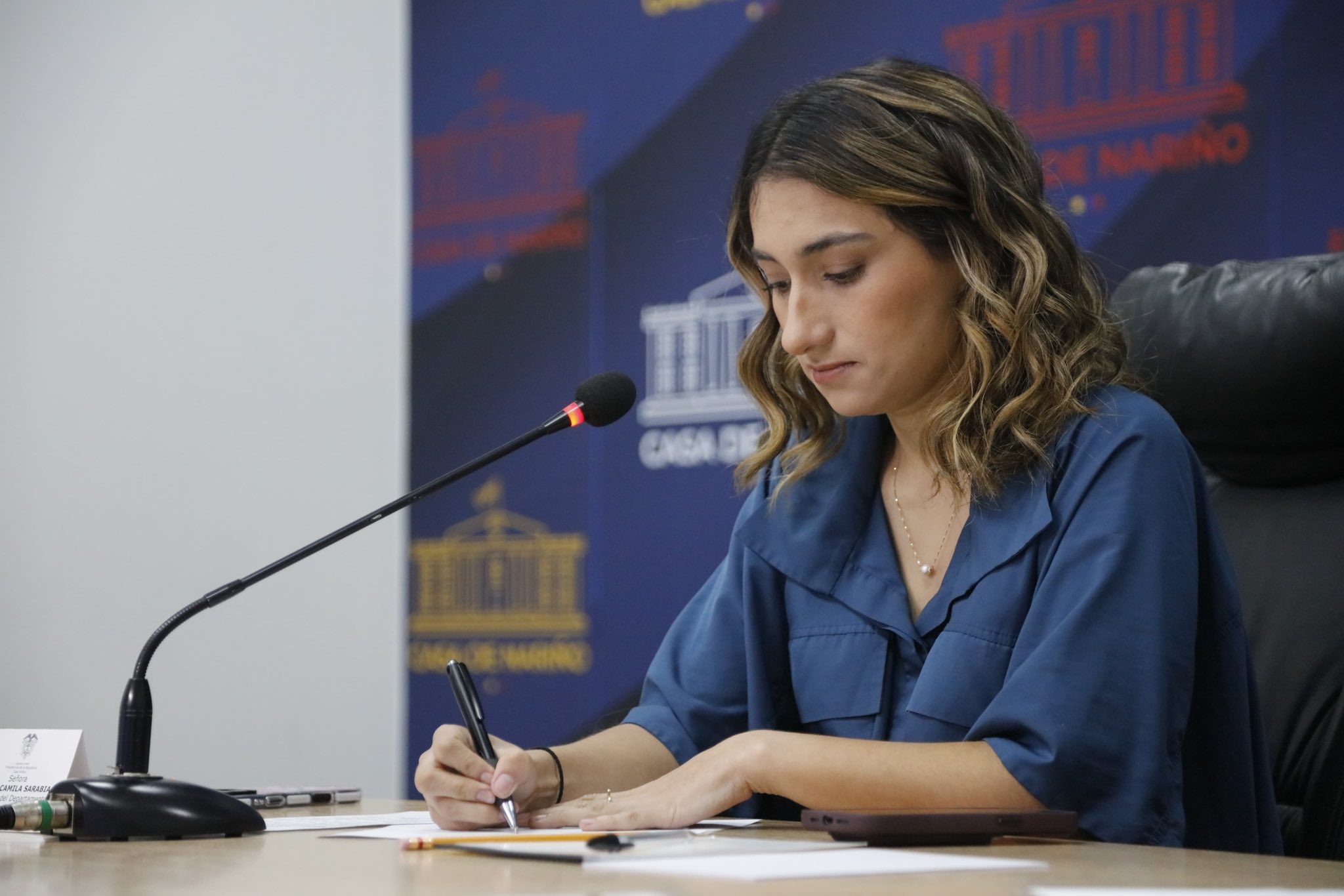
Laura Sarabia, Foreign Affairs Minister in the Petro government, at work. (Photo sourced: Internet)
When Colombia broke off diplomatic relations with Israel last year, at the very least it should have required a visa from Israelis travelling to the country. But Petro learnt very well the lesson of the nuns in the schools that it more important to appear to be than to be.
And he and his government appears to be the most progressive on the planet and an adversary of the Zionist state. But it is not true. It is not the case in migratory issues nor on economic issues and despite Colombia announcing it would no longer export coal to Israel, it continues to do so.
What is the point of requiring a visa from Israelis when many have double nationality and can enter with another passport? We have to be more radical.
Firstly, Colombia should state that those who have Israeli nationality automatically lose their Colombian citizenship. There are many countries in the world that do this, amongst them Nepal and India.
There are others that do not accept double nationality, you can only have one passport, though the loss of citizenship is not automatic. And further still there are countries, such as Ireland, that accept triple nationality.
Colombia should not recognise double nationality when the second nationality is Israeli. It could go even further.
Some countries, especially the USA, restrict visitors who have travelled to countries such as Iran or Cuba. Colombia could deny entry to anyone who has an Israeli passport, regardless of whether they enter with that document.
There are certain difficulties when it comes to implementing this, but there are legal implications for the person that uses another passport to enter Colombia if they are an Israeli citizen. With that alone they would close the brothels in Taganga and the sex tourism of Israeli soldiers in Colombia.
But neither Petro, nor Sarabia, when she stands in for the drunkard, aim to do anything like that. What they are about is appearances and this is to be seen in the economic measures taken against the genocidal state of Israel.
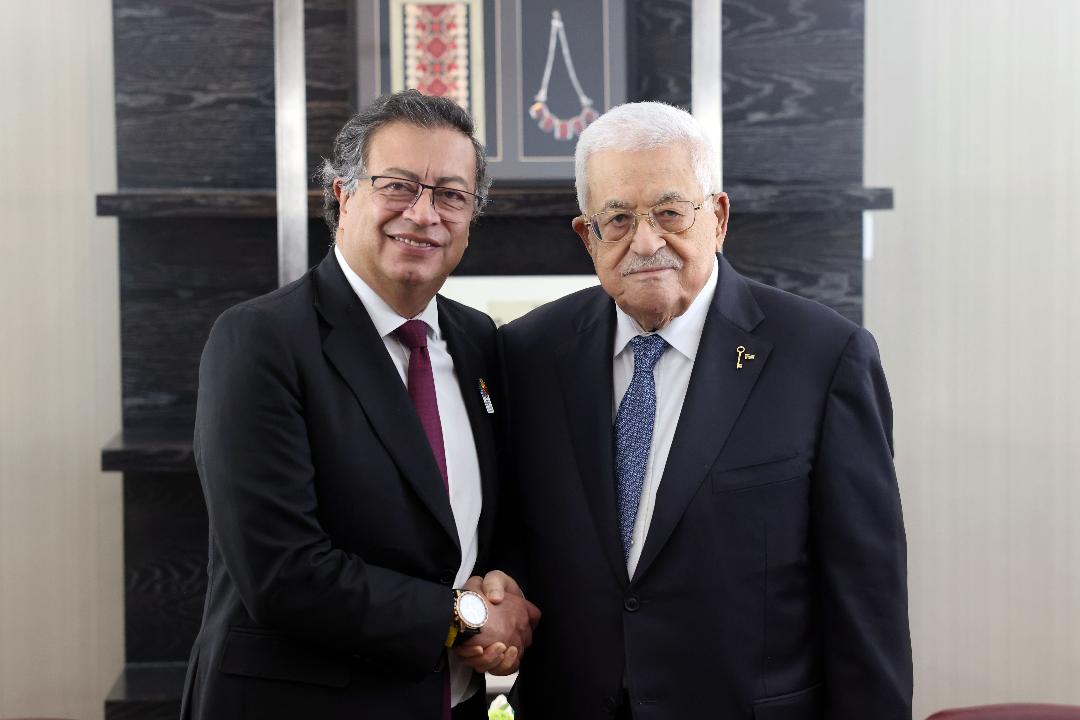
Gustavo Petro in handshake with Mahmoud Abbas, leader of the Palestinian Authority, the repressive Israeli and US proxy regime in the Palestine West Bank. (Photo source: WAFA)
With great showmanship they announced the end of coal exports to Israel.
But a recent communiqué from a group of trade unions and social organisations, amongst them the oil workers union, USO and the coal workers union, Sintracarbon, show that they continue to export coal to Israel.
According to the communiqué, based on data from Colombian Customs and Tax Office (DIAN) they exported 905.666 tonnes of coal to the tune of US $90 million since August 2025 when Petro issued his decree.
It is worth pointing out that Petro’s statement gained him fans in many parts, the Progressive International that includes personalities such as Walden Bello and Jeremy Corbyn reproduced an article from the US social democratic magazine Jacobin.
The article pointed to Colombia as a model to copy and that 60% of Israeli coal came from Colombia and that
…the Israeli power grid depends on coal for 22 percent of its output. The same grid supplies electricity to Israel’s illegal settlements and arms factories as well as the infrastructure used by the Israeli military in perpetrating genocide…
…this decision is not only a victory in symbolic terms but shows the enormous impact that a wider energy embargo could have in ending Israel’s genocide in Gaza.[2]
In fact, according to data from the DIAN, between January and April 2024, i.e. before Petro’s decree US $101,658.000 worth of products were exported to Israel and in 2025 for the same period US $ 75,247,000 was exported.
This represents a reduction but it is clear that Colombia not only continues to export coal but many other products to the Zionist genocidaires.
So, what does it matter if Israelis are required to have a visa? What the government says is that it is going to impose a visa on Israelis because they did it first.
But the Zionist soldiers can come on other passports or even on an Israeli passport, providing they have a visa, i.e. the response to the genocidaires is a bureaucratic inconvenience when what we really need is to ban the entry of all Israelis to Colombian territory.
And to close all the brothels in Taganga and other places that function as places for the “rest and recreation” of the murderers after their “exploits” in Gaza.
(Article originally written for the Political Prisoners Collective Asociación Arrakala)
Gearóid Ó Loingsigh January 19 2025 (Reading time: 6 mins.)
NB: Edited by RB from original article for formatting purposes
Who and what is a political prisoner is controversial, though it shouldn’t be. Once upon a time we all knew or recognised a political prisoner. It was obvious, evident.
But two centuries of legislative changes, the work of the press and more than one NGO seeking to please its master i.e. those who finance it, has disfigured the political prisoner and its corollary outside, the rebel, the dissident, the activist.
Before trying to vindicate the figure of the political prisoner we should be clear that the prison itself has not been a constant in history.
There have always been places of reclusion, but they were transitory, provisional, where the prisoner was held whilst they awaited their sentence, be it execution, or exile, the confiscation of assets or in the case to debtors’ prison, the payment of the debt or the taxes owed.
The idea of a prison as somewhere you serve a term of a number of years as a prisoner according to the gravity of the crime is novel. It is about 250 years old.
The seriousness of the crime and the proportionality of the sentence are not obvious. In many jurisdictions a bank robbery is more serious than the rape of a woman.
Historically, crimes against property were more severely punished than crimes against the person. There are exceptions to that but in general, in all judicial systems crimes against property are more severely punished.
Of course, murder usually carries a stiff sentence, but countries with long sentences or even life sentences usually consider such sentences for crimes against property and other crimes. In the USA that possibility exists in various states.
In a number of countries the crimes punishable by death include, blasphemy, adultery, prostitution, spying, bribery, corruption, drug trafficking, homosexuality.
Political crimes are also severely punished with harsh sentences and the death penalty, depending on the country. Such punishment for political crimes only disappeared where it was abolished for all crimes.
Political crimes
Margaret Thatcher the British prime minister (1979-1990) once declared that there was no political crime, only criminal offences. She said in relation to IRA and INLA militants in prison in Ireland that political murder, political attacks nor any political violence existed.
With this she aimed to ignore not just the long history of such crimes in national laws in many countries but also International Humanitarian Law.
The preamble to the UN Universal Declaration of Human Rights recognizes rebellion as the last legitimate resort in the face of human rights abuses.
“Whereas disregard and contempt for human rights have resulted in barbarous acts which have outraged the conscience of mankind… if man is not to be compelled to have recourse, as a last resort, to rebellion against tyranny and oppression, that human rights should be protected by the rule of law.”[1]
The Geneva Conventions, the basis of IHL in common article 3 to the four conventions reads “In the case of armed conflict not of an international character occurring in the territory of one of the High Contracting Parties, each Party to the conflict shall be bound to apply, as a minimum, the following provisions…”[2]
And goes on to explain the provisions that apply. With this the Geneva Conventions acknowledge the existence of organised and armed rebellion against a state as something more than criminality. Otherwise, it wouldn’t attempt to govern the behaviour of the parties to the conflict.
Though it is worth pointing out that the IHL never clearly defined what was an internal armed conflict nor a war of national liberation. However, it is clear that it can’t be reduced to mere violence.
There are those that raise high the figure of Prisoner of Conscience, not just as the highest expression of a political prisoner but as the only one. According to Amnesty International such a prisoner is in jail for their ideas without having used or advocated violence.
It is an absurd definition. For years they praised Mandela as a prisoner of conscience, but Nelson Mandela led an organisation with an armed wing and ended up in jail for conspiracy to overthrow the state. He was no pacifist.
The definition Amnesty uses can be summarised as They who opine but do not act are political prisoners, those who think but do not apply their thinking are political prisoners.
This excludes great figures from Colombian history such as Policarpa or José Antonio Galán who were executed following their capture. According to this definition José Martí was a political prisoner when he wrote, but a criminal when he returned to Cuba to free it.
But this is not correct, a political prisoner may be a person who never even raised a rock, not to mention a rifle. They may even be pacifists. It is not necessarily a person linked to armed groups, though neither does it exclude them.
There are various types of political prisoners in Colombia.
· There are the militants of guerrilla groups, the majority of them in prison for armed actions, though there are those who played a political role in such groups, what the courts refer to as ideologues.
· There are also those who are victims of frame ups, the majority of them militants of one or other unarmed Left group, social organisation, trade union etc. The state imprisons them through frame-ups in order to limit their political work.
· Then there are those who are prisoners for things related to their political activity i.e. people who in the midst of protests, strikes, occupations of buildings break some law and are arrested, such as those who carry out pickets that are not permitted.
Amongst this group there are also the youths of the Frontline of the National Strike. Yes, throwing a stone is a crime in and of itself but these youths threw stones in response to state violence during the protests.
But, what distinguishes political prisoner from a common prisoner? Brandishing weapons or throwing stones is done by lots of people from narcos to drunks on a Saturday night. Pablo Escobar attacked the state with weapons and car bombs, but he was never a political prisoner.
He was always a criminal.
The first point is the political prisoner is captured in the struggle for a better world.
They seek changes in society that benefit a broad section of the population when their struggle is national in character or large group when the struggle is local or in the neighbourhood with specific demands.
So, a right-wing paramilitary could never be a political prisoner because they seek the status quo, or even a worsening of the conditions of the people.
A political prisoner acts altruistically, seeking no personal benefit though they may end up benefiting from the changes they seek for peasants, youths or neighbours because they are from that community.
But they never seek personal benefit for themselves but rather for society or a particular group in society. Once again neither the paramilitaries, nor the narcos or the Uribistas could ever be political prisoners because what they seek is always for their own personal benefit or small powerful group.
So a guerrilla may be a political prisoner, as may be the youths from the National Strike and similar protests. The environmentalist that blocks the entry of a mining company’s machinery is also one, even if they commit a crime such as damaging or destroying the company’s installations.
In 1976 eighty intellectuals and figures from the world of culture met in Algiers and proclaimed the Algiers Declaration – Universal Declaration of the Rights of Peoples. The document is entirely political and does not have the force of law but was and continues to be a moral reference point.
In Article 28 it states:
Any people whose fundamental rights are seriously disregarded has the right to enforce them, specially by political or trade union struggle and even, in the last resort by the use the force.[3]
Political prisoners are those who comply with this article.
Though the methods used, whether they are violent or pacific may have some influence, they do not determine who are political prisoners.
Of course, in the case of guerrillas, a war crime may wrest credibility from their status as a political prisoner, but in general the use or not of violence is not what determines who is a political prisoner.
It is the demands and the selfless commitment of the militant to the cause that defines whether they are political prisoners or not. Those who deny this are the ones who benefit from the capitalist system.
Their denial is nothing more than publicity and public relations for Julio Mario Santodomingo, Juan Manuel Santos, Gustavo Petro and the large NGOs. Colombia is full of political prisoners and those who deny this also deny the reality of capitalism in the country.
As the Zionist state of Israel made headway in its genocide of Palestinians, although it dithered, the Petro government took various solidarity actions with Palestine such as deciding not to allow the sale of Colombian coal to Israel.
One of the other measures it announced earlier in the midst of the genocide was the suspension of military purchases from Israel.
It is worth pointing out that it was he, as President, who revived those contracts through his decision to buy Howitzers from Israel instead of the Caesar from the French company Nexter.[1]
However, Petro announced that he would replace the Israeli-made KFir planes as they were old, and difficult and expensive to maintain and opened up negotiations to buy 16 Rafale planes from the French company Dassault.[2]
In October of last year, Israel suspended the sale of arms to Colombia,[3] due to the differences and tensions between the two governments.
Now Petro has gone into reverse and announced that he set aside US $ 761,000 for the maintenance of the KFir in addition to the sum from the contract signed in December 2022.[4] Of course this contract is with the Israeli company Israel Aerospace Industries.
It openly contradicts his public statements regarding Israel and also regarding the “modernisation” of the Colombian fleet and as El Tiempo points out.
… itis indeed surprising the large financial increase made last September 30th(bold in original) to reactivate the maintenance contract on the aeroplanes. Money that, furthermore, comes in the midst of serious questioning from political groups given the increase in air accidents amongst the Armed Forces.[5]
Barely 25% of the Kfir fleet is in working order at the moment.[6] But its maintenance is an unnecessary expense. The KFir are fighter jets, with the capacity for air to ground attacks and are supposedly needed to protect the country’s infrastructure.
KFir fighter jets (Photo sourced: Internet)
But that isn’t true either. More than to protect pipelines or other installations from guerrilla attacks they are to repel an attack from neighbouring countries. Their specifications are clear.[7]
The last time Colombia went to war with another country was in 1933 and it lost it, along with a significant part of its Amazon territory.
If Petro really wants to demilitarise the country, why does he insist on maintaining a fleet of planes that are not much use? He should give up on the maintenance of the KFir and as was done in another period with the buses in Bogotá, turn them into scrap metal.
Also, he should forego an unnecessary military expense in a country with so many needs. Are there not schools, hospitals and universities to be built or equipped?
And where is the solidarity with Palestine that he has so often proclaimed?
Gustavo Petro in Palestine-solidarity mode (Photo sourced: Internet)
If breaking off relations with Israel and suspending military contracts in the name of solidarity is a good idea, then it is a good idea at all times and more so now when there can be no doubt that Israel is a genocidal state …
and every dollar that its arms industry receives is another bomb falling on Gaza or an attack on Lebanon. Cheap talk is costly to the Palestinians, but also to Colombians who see how his proposal to demilitarise society has come to nought.
He did not abolish the ESMAD (specialised riot squad), as he promised, nor the obligatory military service, rather they now propose an obligatory social service for those who refuse to carry out military service.
If the rich can’t have youths to fight their wars, at least they will have cheap or free labour through this supposed social service. It is worth remembering that in Spain military service was defeated by a campaign that also defeated the alternative social service. Neither cannon fodder nor slaves.
It is time to be coherent. What does Petro want? Solidarity with Palestine or war planes? He can’t have both. The demilitarisation of society or a social service in addition to military service? It is one thing or the other.
Statements from Petro’s government and the Historic Pact on drugs are as trustworthy as those of Duque, Santos and Uribe. In their haste to show results they resort to deception or statements not sustained by any real figures.
So much so that, a few days prior to publishing his drug policy, Petro declared victory in the war on coca due to the increase in fentanyl consumption in the USA.
Coca crop growing in Colombia (photo cred: GOL)
It didn’t matter that his actual drug policy that he later published stated the exact opposite, something I have dealt with in a previous article.1
Once again they announce a victory on the basis of imprecise figures. Gustavo Bolívar through his twitter account states that:
The result of a change in strategy in the fight against drug trafficking. The Government stopped fumigating crops, the supply increased and the price fell. Now thousands of families are substituting coca for cacao.3
Picked coca leaves (photo cred: GOL)
The figures are not false, but they portray a falsehood. Bolívar wants us to believe that the price of coca leaf has fallen over the course of this government, compared to previous ones.
He also wants us to believe that the price of cocoa is due to the policies of the current government and the increase in crops can be explained by the same reason.
However, the same documents from the government give us a price for a kilo of coca leaf in 2021 or $2,300 pesos, which significantly lower than the $6,000 cited by Bolívar for 2024.4 The UN has come up with similar figures. Thus the price has risen not fallen since 2021.
Also, Bolívar doesn’t cite any figures of the price of base or paste, or the final product. Many peasants usually process the coca leaf rather than sell it on, though the sale of coca leaf does take place.
As for the cocoa, the area sown has doubled between 2009 and 2022, rising from 109,357 hectares to 229,974 hectares.5 Though it is worth pointing out that the UN uses lower figures on this.
Cocao “pods” in tree (photo cred: GOL)
Every government saw in cocoa a cash crop, even before Plan Colombia when the USA included it as a crop to promote amongst coca-growing peasants.
In 2006, the infamous minister of agriculture, Andrés Felipe Arias included cocoa as one of the main crops he wanted to promote through his Export Drive awarding subsidies, loans and tax benefits to those who grow cocoa.6
In 2009, the year in which the slow rise in the planting of cocoa began, the Dioceses of Tumaco warned about a number of projects that, in its opinion, damaged the communities, amongst them, the monoculture of cocoa.7
Cocao “beans” in the harvested fruit (photo cred: GOL)
This monoculture was not achieved through large companies, but rather through thousands of small scale producers, all growing the same.
In many parts, including the cocoa municipalities par excellence of Carmen de Chucurí and San Vicente de Chucurí in the department of Santander, the monoculture of cocoa is the end result of the planting by thousands of small scale producers.
It accounts for 25% of arable land in the department.
Then with the Plan Diamante proposals for the “development” of the north of the country, they didn’t just talk of road infrastructure such as the Ruta del Sol, but they also talked about cocoa and other cash crops such as African palm.8 There is nothing new under the sun.
So coca is more expensive than when Petro won the presidency and the increase in the production of cocoa has nothing to do with this government.
It is an old policy, which has not been able to undo the fall in the international price of cocoa since the 1970s, despite an increase at the beginning of this century due to wars in the Ivory Coast. It is a policy that sectors of the left criticised.
There are sectors that continue to criticise these proposals and there are left sectors who have jobs in the current government and pay more attention to their bank balance.
But, if we wish to discuss drug policy we need transparency and honesty from this government.
Coca processing lab, Colombia (photo cred: GOL)
Petro’s previous declarations on this issue leave a lot to be desired and this latest statement from Gustavo Bolívar indicates that just like the Catholic nuns in the schools, he believes that appearances are more important than being.
Petro’s government will come to end without resolving this problem, it is beyond the ability of any one government, but neither will it have done anything of substance, but will, without a doubt present a report that says the exact opposite.
It was an open secret that the US multinational, Chiquita, financed the paramilitaries. But the company always denied it, until one fine day, due to the insistence of the victims the company had to acknowledge its guilt and pay a fine of $25 million US.
On June 10th, this year, a tribunal in Florida ordered the company to pay $38 million to the families of 8 people who were murdered by the groups Chiquita financed.1
However, the victims in the same period for which Chiquita accepts it financed the paramilitaries and to have allowed them import weapons through their free zone port number more than eight victims, there are thousands.
But it is not just a matter of the number of victims but rather the number of victimisers. The judgement lays bare the discourse of the transitional justice system and that of all the governments, including the current one, about the nature of the conflict.
The peace agreement signed with the FARC, described the problem as one of some criminal guerrillas (and among their ranks there were) and some “rotten apples” in the armed forces (there weren’t any but rather it was a problem with the military institution itself).
The business people were designated as third parties and are not obliged to testify before the Special Jurisdiction for Peace (JEP). But the judgement in the US against Chiquita clearly shows that they are not “third parties” in the conflict but “first parties”.
Once upon a time the role of the multinationals in the conflict was the starting point for all of the left and the human rights groups too, but not anymore.
Before we look at the matter, we should bear in mind that among many of those who are now part of the government, those that signed or promoted the agreement with the FARC are various spokespersons that previously denounced many companies.
I had the honour of investigating the role of the British oil company BP and other companies in the case of Casanare, where the role of the company could be proven.
The company itself, partially acknowledged its bloody role in financing the 16th Brigade alleging that it was legal at that time.
Many organisations have denounced BP, and the voices raised against the company increase in number.2 But legally BP is as innocent as Chiquita once was. In Southern Bolívar we saw how mining companies fomented the war against communities.3
Carlos Castano, right, the leader of the right-wing paramilitary group United Self-Defense Forces of Colombia. (Photo cred: New York Post/ AP)
It wasn’t just in that region, but rather in the whole country and included national companies as well.4 The palm companies did their part and the cattle ranchers publicly accepted their role in fomenting paramilitaries,5 to name just a few sectors.
Other reports, as yet not proven to the same degree as the ones against Chiquita, cameout, but few doubt the reports against Coca Cola and Nestlé. Perhaps in a few years we can state it with the same legal certainty as we do now in relation to Chiquita.
And if we get there, it will be exclusively due to the struggle of the victims.
For the current government, the truth commission and many sectors of the Historic Pact (PH) the conflict is to be explained in terms of drug trafficking, minor disputes (never major ones) for land, corruption and the “culture of death in Colombia”.
But none of that is true. It is true that drug trafficking has, up to a point, played a role, and sometimes there are land disputes between neighbours that end badly and violence as a method of resolving problems is socially acceptable amongst many sectors of the country.
But none of this explains the conflict.
The Colombian conflict can be explained in terms of one between national capital, but above all international capital and the Colombian people and can be seen in the fight for land, the economic model, the war on unions, grassroots organisations etc.
Once upon a time it was not controversial on the left to say so, not even among the NGOs and even some politicians did so. Now, however, whoever states as much, dies politically.
Petro has given the excuse that he holds office but not power as a justification to explain the lack of operational capacity of his government and the lukewarm nature of his proposals. But we knew that, we always knew that, even when Petro on the campaign trail said he would “take power”.
People used to accept the idea that Colombian policies are not decided in the Nariño Palace (presidential palace) but rather in the White House and the cafés of Wall Street. The owners of the “cafés” decide more than do the Colombian people.
Those that serve the coffee are companies like Chiquita and it is the Colombians who wash the dishes.
President, are you the owner of one of these cafés, a waiter or a dishwasher? Tell us in detail. We would like to know who took the decision to allow Chiquita and the rest of the companies to kill left, right and centre.
We would like you to name those companies that kill peasants. Or, do you not as President have access to the military and police archives etc.?
On the election campaign, Petro said he was the Biden of Colombia.
But Biden and the Democrats have always received funds from multinationals, particularly from the agribusiness sector. So Petro should tell us whether he is still the Biden of Colombia and what he intends to do with Chiquita and other companies behind the Colombian conflict.
The peace process with the FARC and the rise of the PH as a party of government has left us a pernicious legacy, where we talk about the conflict in psychological terms, of evil, or individual responsibility (except when dealing with the insurgency).
And from the onset deny the role of the US in the conflict and the role of companies, particularly the multinationals. The business people are not on trial in the JEP, except those who voluntarily place themselves before the tribunal.
And that is only done by those who face a sure sentence in the ordinary justice system and see in the JEP the possibility of avoiding jail time. The Truth Commission excluded the business people.
In 2015, in the middle of his speech to the Colombian Oil Association, the then President Santos tried to reassure them and promised that he was not going to pursue them.
He gave them some advice, suggesting that if there was ever report made against them they could allege they were coerced.
Furthermore he stated, “Which businessman is guilty of war crimes or crimes against humanity? If there is even one, he might be put on trial, but I don’t see how, or where…”6
Well, for the moment we could reply that perhaps in Florida, but not in Bogotá and not due to the NGOs, state bodies and other personalities who sell us that image of the conflict in which companies are not the driving force behind the conflict.
End.
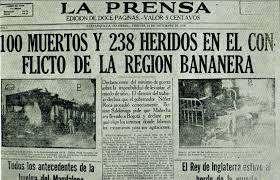
Comment by Rebel Breeze: Chiquita is the current manifestation of the infamous United Fruit Company which organised a massacre against striking fruit workers in December 1928:
Leaders of the 1928 strike including two martyrs. (Photo sourced: Wikipedia)
6 Cited in Sinaltrainal et al (2016) Ambiguo y decepcionante acuerdo: itinerario para la impunidad de crímenes de Estado. P.24 https://rebelion.org/docs/208980.pdf
Gustavo Petro and Truth Commission President Francisco de Roux.
I recently read an article written by the former Colombian truth commissioner and academic at the Los Andes University, Alejandro Castillejo titled Teaching After Gaza?: Indifference Perpetuates Barbarism.(1)
As its title indicates, it deals with Gaza, but also covers other conflicts, such as Ukraine and also the Colombian conflict itself.
In the text he puts forward a question “When we say ‘Never Again’, exactly what should never happen again?”
It is a good question and one that is not often asked; he talks of the continuities, as Gaza is ongoing and will continue after the genocide, it won’t end in some precise reference point.
I would like to deal with another aspect of that question.
Once upon a time the social organisations in Colombia, the NGOs, the left groups, both legal and illegal ones, reformists (some illegal) and revolutionaries (some of which are legal), were very clear about what they meant when they gave voice to the slogan Never Again.
It is a common phrase. There are some reports from Colombian organisations that include it in their names. I had the honour of contributing, through my field work to the first two reports on the 14th Zone.(2)
Outside of Colombia, there is more than one truth commission report that has that as its name, such as the REMHI Report of Guatemala,(3) or the report on the disappeared in Argentina.(4) We were all clear, we did not want a repetition of the terrible night.
We spoke of the bloodbath and many were equally clear that they did not want a repeat of the circumstances that made it all possible, necessary and justifiable in the eyes of the state and bourgeoisie (a term disgracefully fallen into disuse in current times.)
Nowadays, it would seem that nobody is clear about it. The Special Jurisdiction for Peace (JEP) understands Never Again to be never again the FARC and some “rotten apple” in the state’s military forces.
The Truth Commission hadn’t a clue as to what it understood Never Again to be, other than some generic, non-specific abhorrence of violence in and of itself, but not of the system and circumstances that gave rise to the bloodbath.
Less still to the rivers of blood that flow through the fields and furrows of the country. The Commission absolved the state for the so-called False Positives for which the state acknowledges and accepts the figure of 6,402 victims.
It was a state crime, acts of state terrorism, crimes as appalling as they were evident.
As far as the Commission was concerned it was not a state policy to take youths to the countryside, dress them up as guerrillas and murder them to present them in dispatches as part of a media campaign that sought to show the state was winning the war.
So, if it was not a state policy, when we say Never Again, are we saying that the state shouldnot commit such a crime in the future?
Or are we asking thousands of crazy soldiers not to think of putting boots on the wrong way round on the feet of young civilians that they just murdered and dressed up as a guerrillas?
In the first case, it would be something we could demand of the state, in the second case if they were really the demented actions of the soldiers, well even the state would be a victim in that case.
Even the paramilitaries sometimes say No More, rather than Never Again. In zones where they displaced the entire population, they don’t have to continue killing anyone. They can say No More.
With groups such as the Unión Patriótica that they decimated, or groups such as A Luchar that they finished off, they can say No More.
There is no need to continue murdering as the dirty work has been done, or at least it got to a point in which it had achieved its aim. If there is a need to repeat it, they will, which is why they say No More rather than Never Again.
This juxtaposition of No More and Never Again shows the banality of the slogan now. Is it really Never Again or do they speak of “until the next time there is a need to”?
We can see just how empty the refrain of Never Again is by looking at some examples of violence in Colombia.
In the 90s, the levels of violence in the port of Buenaventura began, for various reasons, to dramatically rise. The violence cannot be explained by reference to one single fact or motive.
However, there are contributing factors and whilst I don’t wish to reduce the explanation to something simple, we can point to the privatization of the port as a key factor in the rise in violence.
In 1991, following recommendations from the World Bank, Colombia — in the context of the growing forward march of neoliberalism — privatized the ports of the country.
In the case of Buenaventura this resulted in the loss of jobs in the port area, a reduction in salaries, both of which impacted the economies of the neighbourhoods where the workers spent their wages, generally increasing poverty in the city.
The port workers used to be able to apply for grants for their children to study, but with the privatisation that was gone, thus reducing not only the labour market but also the possibility of escaping poverty through studying.
Then came the plans to expand the port and the massacres such as Punta del Este, amongst others, to clear out those who lived where they were going to construct the new port zones.(5)
So when we say Never Again, it is clear that they don’t want the youths of the city to be killed, if they see another alternative, but does Never Again include the plans to privatise and expand the port?
Or we could look at the violence in the mining areas of the country, such as Southern Bolívar (gold) or Cesar and La Guajira (coal).
Once again, we see the hand of the grey men, the banal ones from the World Bank, the IMF or state bodies who like Eichmann never directly killed anyone but rather moved pieces of paper around knowing what the consequences were of those bureaucratic procedures in which they took part and knowing that the new realities they sought to impose required a high dosage of violence.
In the 1980s, the WB had been promoting the expansion of mining in Latin America, the abolition of restrictions on foreign investment, the exporting of capital etc.
In the case of Colombia, it didn’t need to do that much, the national bourgeoisie did the dirty work, without even a nod and a wink from the grey men at the WB. A key figure in all of this was Ernesto Samper, the head honcho in the country between 1994 and 1998.
It is worth bearing in mind that this satrap likes to present himself as a human rights defender, when it was his government that legalised the paramilitaries and is now one of the fiercest defenders of the current government of Gustavo Petro.
Not only was he the president of the country from 1994 to 1998, he was the owner of various mining companies.
He tried to introduce a new mining code but it was overturned by the Constitutional Court. In 1998, another satrap and mining businessman, Andrés Pastrana, took over as president and implemented a new mining code, which is currently in force.(6)
During this whole process, the massacres in Southern Bolivar and other mining regions of the country intensified, whilst the paramilitaries tried to take these zones for the multinationals. In the case of Southern Bolivar they were very explicit about it.
After the murder of the leader Juan Camacho Herrera they played football with this head, placing it on a stake facing the mines, declaring that they had come to hand over the mineral resources to other people, who would, according to them, make a more rational use of them.
So, when we say Never Again, does it mean Never Again to the national and international plans to take control of mineral resources? Or do they just mean that they are not going to play football with the heads of those who oppose these plans?
Nowadays the discussion in Colombia centres round the question of violence as something alien to the economic projects and they talk about the individuals.
The slogan is to stop the war, but only a few say stop the plans of the WB, the IMF, the imperialist powers such as the USA and Europe. When the president of the Truth Commission spoke to the UN he stated:
We have come to understand that the solution to the armed conflict is through respecting each person as an equal and we should respect each indigenous and afrocolombian child with the same commitment that we show to presidents, the wealthy, the powerful, and personalities, military generals.
That all personality cults end and we love and respect each other as people entitled to the same dignity. And that in Colombia and the world over all of us contribute to promoting a new sense of ethics based on human dignity and that all the spiritual traditions lend their support to this.(7)
Pass the joint round, take out the guitar, sing Kumbaya and kiss each other. In his speeches and the Commission’s report, the economic model is not questioned, in fact through the terms of reference they restricted the researchers and even banned them from dealing with certain issues.
Issues such as the role of the banks, the institutions and even the role of the USA in the conflict, which was reduced to isolated comments lacking in depth. So Never Again means never again showing disrespect to someone and that we not seek recourse in violence to solve differences.
But that violence is not fortuitous and the bullets, the machetes, the chainsaws [common weapons in massacres] are used when the first victim of the economic plans refuses to submit. So, Never Again has become: accept the established order and its plans!
A Never Again to violence that says little about structural violence is an exhortation to surrender and is a Never Again until such time as it is necessary to resort to violence to impose the will the of the capitalist class. Never Again for the moment, just like in Gaza.
(2) Although the Never Again project changed since its foundation in 1995 in terms of participants and leadership, some of the reports are available on the site https://nuncamas.movimientodevictimas.org
On the 21st of April as he reached his house paramilitaries murdered Narciso Beleño, the leader in Southern Bolívar, Colombia, just two years after the murder of two other leaders Teo Acuña and Jorge Tafur.
I knew Narciso Beleño. Our paths crossed many times, on occasion on literal paths in the countryside as Narciso travelled the country in his struggle to defend rural communities in Colombia.
But I don’t want to talk too much about Narciso, the person, as there are others who can pay greater tribute to him in that regard, though his name always made me curious: Narciso (Narcissus).
Narcissus was a figure in Greek/Roman mythology who as a punishment from the gods fell in love with his own reflection. It is where we get the word narcissist from. But unlike the Greek/Roman figure, our Narciso was kind, caring, generous and selfless.
There are thousands of people, whole communities that can testify to his qualities as a person, a fighter and a leader.
When he was murdered the President, Gustavo Petro tweeted that “we failed Narciso”. But who failed Narciso? The communities? His comrades in Fedeagromisbol? Or were they the youths from the Front Line who are still in jail? Tell us who! A generic “We doesn’t do it, it is a lie.”
He should explain who failed him, how and why and Petro should also tell us what he intends to do prevent there being more murders of leaders.
Once upon a time we never doubted to putting a name and surname to the matter. We didn’t hesitate in naming the company, the board of directors, the landlord, the local politician. Sometimes we even ran the risk of putting a name and military rank to the affair.
A long time ago a gradual process began whereby some stopped naming them. And now under the Petro government it is not thought well to name them. Once upon a time we all named Fedegan, the cattle ranchers’ association, as backing the paramilitaries.
The Fedegan functionaries even acknowledged this. Now one of the representatives of that association, which is currently involved in refounding paramilitary structures, represents the State in the dialogues with the ELN.
Once upon a time we named the mining companies that have been trying for decades to take control of the gold in Southern Bolivar and other regions. It is worth remembering that Narciso travelled the country. More than one mining company had it in for him.
In Science Fiction and Fantasy novels, evil and magic lose their power over mortals when they are named by their real name and so the best kept secret is their real name. In real life something similar happens. Paramilitaries as something dark, shadowy and hidden defeats us.
When we name those behind this black magic with their real names, it begins to lose its power over us. They are not unknown to us. We withdraw cash from their ATMs every day, we purchase their services, we drink their products, we work in their companies and the odd eejit votes for them.
No company will say, “buy my product we are the murderers of social leaders” or “vote for me, I have murdered thousands.” They hide this for a reason and for that same reason we should expose their dark souls to the light of day.
The best tribute Petro can pay is to explain who failed and name the murderers just like he used to do before he was President. They are the usual suspects. Petro likes to say he governs but does not have power.
Well, tell us who holds that power that he don’t have, with names and surnames, economic group, foreign company. If we all failed, then nobody failed, if he was murdered by those who cannot be named, then nobody murdered him.
We usen’t to hesitate in talking about paramilitaries, the economic and political interests and reasons behind their actions. We named the business associations, the megaprojects in each region, we proved it.
Some sought justice in international tribunals, others in Russell style tribunals of opinion. We have to pay tribute to Narciso and other victims of the paramilitaries and name the murderers. Uribe tried to fool us with the Bacrim (Criminal Gang) euphemism. Neither Gulf Clan or anything else.
The same ones who disappeared Edgar Quiroga and Gildardo Fuentes in 1999 (in Southern Bolívar) murdered Narciso 25 years later. Say it loud and clear, Mr. President.
The coca zones of Colombia are in crisis. The cash crop par excellence, i.e. coca is going through an unprecedented crisis, or so we are told.
The main promotors of the idea that the coca is in crisis because fentanyl has displaced it and sooner or later it will finish off the coca were from the government. Amongst those promoting this stupidity are Colombian state functionaries from the NGOs, social organisations and of course high-ranking members of the Historic Pact. The very president of the country, Gustavo Petro stated in August that
The cocaine market in the USA has collapsed and has been replaced by an even worse one: fentanyl that kills 100,000 per year. Cocaine used to kill 4,000 due to the poisonous mixtures from the market clandestine.(1)
It is simply the case that nothing that Petro said at the time was true. Whereas Clinton exaggerated the deaths due to cocaine consumption in order to justify Plan Colombia, Petro sought to minimise them. First of all, we should be clear that fentanyl did not displace cocaine, but rather another opioid, heroin. And the most notorious aspect of fentanyl is not the increase in consumption, but rather that due to its toxicity, a dramatic increase in overdoses. Petro’s government makes statements on the drugs issue without even understanding basic concepts.
The overdue publication of its drug policy allows us to analyse properly what it aims to do, as up till now we have had to put up with a year of contradictory speeches, tweets that don’t say much and complete incoherence in the matter, without even mentioning his stated aim of handing over the Colombian Amazon region to the US military, something that not even Pastrana openly proposed when he announced Bill Clinton’s Plan Colombia.
In a US study published in May of this year, the researchers found that the deaths from fentanyl tripled between 2016 and 2021, increasing from 5.7 per 100,000 inhabitants to 21.6 in 2021. The deaths from cocaine overdoses increased in the same period from 3.5 to 7.9. At the same time there was a 40% decrease in heroin related overdoses, falling from 4.9 in 2016 to 2.9 in 2021.(2) The study just confirmed the analysis of previous research published in December 2022 that looked at increases in mortality since 2001.(3)
Fentanyl is a new problem for the USA, but neither the increase in its consumption nor deaths tell us anything about the future of coca as Petro and Roy Barreras claimed. Quite the opposite. According to the UN, coca crops reached the figure of 230,000 hectares in 2022.(4) Of course, Petro is not to blame for that, he only took over the presidency in August 2022, but it belies his statements that coca is a thing of the past due to the economic crisis in the coca regions of the country.
So, what can be said of Petro’s new drug policy? Well, the first thing is that there is at last a policy outlined in a public document. They took their time in doing it but better later than never. The document proposes with a certain amount of hyperbole Oxygen for the communities affected, through support from licit economies, environmental measures and treating the matter of consumption as a public health issue. It also proposes Asphyxiation for drug trafficking organisations. Furthermore, it proposes being the voice and leadership of “an international diplomatic strategy to change the paradigm in how the drugs phenomenon is dealt with.”(5)
The document kicks off with a correct analysis that contradicts the public declarations made by Petro and other high ranking government functionaries, a few weeks prior to its publication. It is inexplicable how the president can boast about the collapse of coca at a point when it is almost certain his drugs policy was at the printers. It must be due to mediocre functionaries, as this government has continued with the policy of Duque and the previous governments of hiring mediocre friends. But in any case, the document gets somethings right, at last.
For decades, Colombia has made an enormous investment in human and economic terms in fighting drug trafficking. Although there are no official figures on the outlay in fighting drugs, but the Drugs Observatory of Colombia calculates an annual average expenditure of 3.8 trillion pesos [885.2 million euros] ascending to an approximate investment in the last twenty years of 76 trillion pesos [17.7 billion euros]. Whilst some results have been achieved along the way, it is true that the two main goals have not been reached: reduction in the supply and demand for illicit drugs.
Even though 843,905 hectares of coca were forcibly eradicated between 2012 and 2022, the planted area in this period increased by 327%. In 2022, Colombia had 230,000 hectares of coca with a productive potential of 1,738 tonnes of cocaine. As for demand for psychoactive substances, between 1996 and 2019 an increase of 5.1% to 8.7% in the consumption of all illicit substances (marijuana, cocaine, base, extasy or heroin) was observed.(6)
The document then goes on to acknowledge that the collapse in cocaine consumption is not real but rather on the contrary there has been an increase. It states that one of the first hypotheses was a global fall in demand for cocaine.(7) They are trying to save their own skin. There was no data to sustain the supposed hypotheses: none. It was dreamed up by mediocres and no one else made the claim. The document goes on to say “However, according to the lastest Global Cocaine Report from the UNODC (2023), demand has risen.(8) At least we are having a debate about the reality of poorly written studies from the children of the lovers of their friends who they hired.
So, what do they propose? It would seem that they propose a shift in the punitive model without abandoning it completely. They accept that the fumigations have not worked and that the periods of greatest fumigation do not match those of a lesser supply of the drug.(9) But the punitive element continues to be an integral part of the policy, the supposed shift is a mirage.
The evidence has shown that a security strategy on its own is not enough [the emphasis is mine] but rather it must go hand in hand with actions to prevent crime and deal with the underlying causes.(10)
The document takes a look over the international treaties in the area, softening the real demands of the Single Convention of 1961 stating that it doesn’t prohibit anything but rather submits the plants and the drugs produced to a strict control. There is not enough space here to go into detail on that debate. But once again what the government is saying is not really the case. The Single Convention does actually allow for some coca crops for medical and industrial purposes, mainly in Peru and also opium in India. But it is not the case that Colombia has misinterpreted those treaties. And this is a major issue, as any change in the paradigm is dependent on changes in those treaties or better still their complete derogation and the drawing up of new treaties under a new paradigm.
Whilst it is true that a country can allow coca crops for licit purposes, that is done with the permission of the UN control bodies, i.e. the USA. Even traditional consumption of the coca leaf is frowned upon in the Convention. Article 26.2 states that.
The Parties shall so far as possible enforce the uprooting of all coca bushes which grow wild. [emphasis is mine] They shall destroy the coca bushes if illegally cultivated.
Although Article 49 permits chewing of coca leaf in countries where it was already legal on the 1st of January 1961 (subparagraph 2a), it does so on the condition of banning it and eradicating it once and for all by 1986 (subparagraph 2e), something which was not achieved. Whether they like it or not, this treaty has not been misinterpreted and the whole UN framework i.e. US policy in the area is the problem and not a misinterpretation of previous governments. The supposed freedom to grow and licit use of coca that Petro imagines is not real.
Some states in the US legalised the production and recreational consumption of marijuana and clashed with the federal banking system that was not willing to receive funds from the industry, forcing many producers to resort to mechanisms more suited to money laundering in illicit industries. Something similar happened in Uruguay. The country regularised the recreational production and authorised and regulated the state control of it. However, not even the Bank of the Republic of Uruguay was willing to receive money from a lawful activity in the country due to a fear of reprisals from the USA.
It would seem that the architects of the law did not foresee the problem that would arise in the banking industry, owner and lord of the commercial and financial transactions in Uruguay. Were the Uruguayan legislators aware that it was not just a matter of convincing the international system of prohibition to reclassify cannabis as a substance in the drugs conventions but that they also had to convince the banking system to accept money from cannabis transactions? Everything seems to indicate that the directives the banks implement are those that are simply related to the formality of Cannabis being a prohibited substance and the fact that the money from the cannabis market is legal, illegal, black or white has no bearing on decisions.(11)
Uruguay found itself at the mercy of the repressive whims of the US government and in practice was not autonomous nor sovereign. Any drugs policy should take as its starting point that Colombia is not sovereign in the matter and it faces a massive enemy when it comes to solving the problem: the USA. It is not a matter of a restrictive interpretation by Colombian governments, but rather the reality of imperialist domination. This was the case with Uruguay.
… according to the Uruguayan government implementing a national law [on drugs] depends on the modification of a foreign law. Note that at no stage is a modification of international drug treaties that Uruguay has ratified mentioned, but rather a federal law that internally classifies cannabis in the USA.(12)
The government has no proposals in the matter and its proposals for the peasants are remoulds of the previous policies with a slightly modified language. They no longer talk of crop substitution but rather licit alternatives or economies. And the licit alternatives for the countryside are the usual ones, exportable monocultures.
And the iron hand continues for the peasantry. They have talked a lot about distinguishing between large and small-scale coca producers, increasing the definition of small-scale producer as one that has up to 10 hectares. But the iron hand continues. They have said that they will not use forcible eradication but…
Forcible eradication will be applied to crops that: (i) do not fall into the category of “small-scale grower”, (ii) increase in area, (iii) planted after the publication of this policy (regardless of size), (iv) have infrastructure for the production of base and cocaine hydrochloride, (v) do not fulfil their commitments to substitution and other mechanisms on the path to licit economies.(13)
Many peasants have some infrastructure to produce base, an infrastructure that is not all that complicated. So, I don’t know who these peasants who will not be subjected to forcible eradication are. It is not all that different from the policies of Uribe and Pastrana and borrows policies from Plan Colombia, the Exporting Stake of Uribe and the directives of the former Social Action and of course the Peace Laboratories of the European Union and the nefarious apologist for the economic policies of Uribe and also in passing the World Bank, the priest Francisco de Roux: the so-called Productive Alliances.
Productive agreements between the public sector, private sector and grassroot economies
These consist of a tripartite collaboration between the state and the private sector as drivers of the productive reconversion, through actions such as capitalist investment, transfer of know-how and insertion into local, national and international markets. To that end the “Productive agreements for life and hope” will be implemented, in which the state will offer benefits to the businesses that commercially associate themselves with the communities. The Ministry of Industry, Commerce and Tourism will facilitate and strengthen these type of alliances.(14)
Not that long ago in 2017, various current senators and representatives of what is now called the Historic Pact publicly denounced a proposal from Santos on the countryside. They stated:
… limits [the communities] chances of defining the productive and economic model that would allow the building of peace with social justice, by tying it to technical criteria… that give priority to the establishment of alliances and chains of production between small and large producers and the efficient use of rural land, technological innovation, technical aid, credit, irrigation and commercialisation that favour an entrepreneurial large-scale agro-industrial production.(15)
So, what about now? Ah of course, the proposal is yours, and it doesn’t matter whether it is the same proposal or not, but rather who makes it. And if the peasants do not agree with the economic model being imposed, what will happen to them? Well, “a differential treatment will be promoted that will be transitory and conditioned on their signing up to processes on a path to licit economies”.(16) In other words, they are going to jail.
As for money laundering, there is nothing new. The government is obliged by various international treaties to fight against money laundering. But the language used is telling.
This last point [laundering] is based on identifying high value financial targets, understood to be persons or legal entities, goods, assets or bodies that due to their nature, volume or characteristics may be exploited by criminal groups (emphasis is mine) to hide or channel illicit funds and thus launder money from criminal activities.(17)
HBSC Tower, Mexico (Photo source: Wikipedia)
As with other governments, including the USA, the banks are seen as another victim. More so than the peasants, exploited by criminal groups when in reality they themselves are criminal enterprises. The massive laundering of assets that HSBC carried out in Mexico cannot be understood in any other light. There are no measures taken to jail the banks’ directors, cancel their banking licence, freeze their assets, fine them to the point of leaving them naked in the street. No. The asphyxiation the government talks about is like the law, to be applied to some but not to others. They are more concerned about illegal mining in coca zones than the laundering of assets only yards from the Presidential Palace.
The document is very similar to previous policies with some small changes, a slightly distinct language and “new” proposals that are not new. Perhaps we could say that it indicates some goodwill in some aspects, but nothing more. Petro can’t fight for a new paradigm without changing the current one.
Proposing a revision of the international legal framework does not imply a conflict between prohibition or total freedom in the market for psychoactive substances. On the contrary, it means coming up with intermediate solutions such as alternatives to prison, harm reduction strategies and the responsible regulation adult use substances such as cannabis. The progress, failure and lessons learnt from international cooperation on drugs represent an opportunity for the international community to evidence based innovative strategies and policies.(18)
Harm reduction is policy in most of the world, including some parts of the USA. Alternatives to prison also, though in practice it is not always the case in all countries. What is put forward is the current state of play, not a big struggle to change the paradigm. It is a disappointing document, more so than previous policies, as this one tries to play with the language to stupefy, fool and lie to us. In the end, it is another lost opportunity. If you want to see something innovative in drug policy, you would be better off taking a drug, preferably a magic mushroom.
(2) Spencer, M.R. et al. (2023) Estimates of drug overdose deaths involving fentanyl, methamphetamine, cocaine, heroin, and oxycodone: United States, 2021. Vital Statistics Rapid Release; no 27. Hyattsville, MD: National Center for Health Statistics. May 2023. DOI: https://dx.doi.org/ 10.15620/cdc:125504. P.3
(3) Spencer MR, Miniño AM, Warner M. Drug overdose deaths in the United States, 2001–2021. NCHS Data Brief, no 457. Hyattsville, MD: National Center for Health Statistics. 2022. DOI: https://dx.doi. org/10.15620/cdc:122556.
The Petro government has reached the end of its first year in which it promised a lot, came through on some things and changed a lot of other things, particularly its position on certain issues.
Before taking a look at it, it should be pointed out that the Historic Pact (PH) is not the first left-wing government in Colombia. The country is still waiting for that. It is a remould of liberalism in the style of Ernesto Samper.
Even so, it is worth looking at its proposals and what it did in this year, as unlike Samper, it did give a lot of hope to the people.
It is generally accepted that Petro would not have been elected President if it were not for the big popular revolt that began on April 28th 2021, an uprising that cost the life of over 80 youths.
We don’t know the exact number of dead and disappeared and less still of the number of young women who were raped and sexually abused by the Police as part of the repression. Even the number of political prisoners is a matter of dispute.
Not due to the absence of the number of people detained but because the amongst Prosecutor’s Office, the press and sections of the PH there are those who seek to divest the detained youths of any political motivations.
They simply paint them as criminals and vandals, the last of these words having been covered in glory during those protests.1
The heroic ‘vandals’:Demonstrators clash with riot police during a protest against a tax reform bill launched by Colombian President Ivan Duque, in Bogota, on April 28, 2021. (Photo cred: Juan Barreto/ AFP). (Photo choice and caption by Rebel Breeze)
So, it comes as no surprise that Petro, like Boric in Chile, did not free the political prisoners from the revolt. He made a few lukewarm attempts to get a handful of them out, but a long way from all of them.
They are still in prison, despite his electoral victory being thanks to their struggle and actions that led them to prison.
It is perhaps the most symbolic transgression as it says sacrifice yourselves but don’t expect anything from me, not even when I owe you everything. Petro has defended himself by saying that it is not his decision to free or imprison anyone.
Recently he stated:
There are still many youths in prison and I get blamed, as if it were up to me to imprison or free them. State bodies and people inside them have decided that these youths should not be freed.
Not because they are terrorists, who would think protesting is terrorism? If not a dictator or Fascist. No, but because they want to punish the youths who rebel.2
Some may feel that he is right in a technical sense, i.e. that it is the Prosecution and the judges who imprison them. But that is to ignore reality.
He himself denigrated them when he referred to them as ‘vandals’ during the protests and since taking office, neither Petro nor the PH have been the visible heads of any initiative to free the prisoners. They washed their hands of the issue.
He didn’t even disband the specialised riot squad, the ESMAD. Unlike other proposals he didn’t even try to.
He changed its name and promised a couple of human rights courses for its members, as if the problem was their lack of attendance at a course or two given by some NGO and not a deep-rooted problem. The ESMAD is a unit that murdered many youths.
It is a body whose name is synonymous with violence, torture, sexual abuse and murder. A name change won’t wash away the blood.
… the promise to put an end to the ESMD was just lip service during the presidential campaign.It wasn’t carried out and the government will fail to carry through on its commitment to the youths who brought the president to power, through the existence of a repressive violent force like this one.
The temptations to infiltrate the marches in order to justify confrontations with the kids will continue to be part of the landscape.3
Petro gives his voters a clenched fist on his inauguration as President in August last year but many remain in jail and the rest get little or nothing. (Photo sourced: Internet) (Photo choice and caption by Rebel Breeze)
In economic terms the government promised a lot during the campaign, but once in power, it quickly softened its proposals and in some other cases they didn’t get a majority of votes in Congress.
The lack of votes in Congress is not a simple one of not coming through, nor is it due to betrayals by the PH nor manoeuvres by other forces that Petro can’t control.
The PH is a coalition of sectors of the right with sectors of what passes for social democracy in Colombia. It was not inevitable, but rather Petro actively advocated that it be like that.
It is worth recalling that at first, he wasn’t going to choose Francia Márquez as his vice-president but rather a right winger like Roy Barreras.
However there are economic aspects that are under his control, but for the moment they remain as just proposals, rather than real policies that have gone through Congress. On the land question, Petro proposes monocultures and agribusiness.
This was clearly to be seen in the proposal to buy three million hectares from the cattle ranchers.
Petro’s vision of the countryside is one of it being at the service of big money and the promotion of cash crops, despite some references to the production of foodstuffs for internal consumption and the so-called bio-economy.
Something similar can be seen with his proposals for clean energy. He spoke a great deal about it during the electoral campaign and some of his proposals, or outlines as they stand, look good.
That Colombia no longer depend on oil and coal is not a bad idea and that it be replaced with alternative energy sources such as solar and wind power looks good, until we actually examine the details.
One of his first stumbles, in that sense, was with the Indigenous people, as La Guajira is a poor area that has suffered the consequences of coal mining.
He did not take them into account and they reminded him that what is proposed for their territory should have their support, though legally it is not quite the case, and that it should also benefit them.
He partially rectified the case, but the big question is, if he wants an energy transition why does he have to seek out French and other foreign capital to finance it. Does he want to hand over the wind and solar power as they are still doing with oil and coal?
It would seem so. According to Petro:
We need investments that help us carry this out: we would have a matrix of foreign investment centred on the construction of clean energies in South America, with a guaranteed market, if we have direct link to the United States and by sea with the rest of the world.4
If you substitute oil and coal for clean energy, you begin to see the problem: the resources of Colombia in the service of big money and the countries of the North.
If we are to have a real change and energy transition, we must end the idea of Northern energy consumption regardless of where it comes from as sustainable and that countries such as Colombia must supply energy for a planet-destroying consumption model.
Neither have there been great advances on the issue of peace. He did reactivate the dialogue with the ELN, but stumbled with something that is still an integral part of his policy, the so-called Total Peace.
In his proposal he compared the insurgent group, the ELN to the drug gangs and paramilitary groups such as the Clan de Golfo. It was not a mistake, Petro really does see the ELN as a criminal gang.
He made it clear in his speech to the military and he reaffirmed it when he named the blood thirsty Mafia boss and former Murderer-in-Chief of the paramilitaries, Salvatore Mancuso as a Peace Promoter.
With that he placed the ELN leadership on the same plane as the paramilitaries. And they have implicitly accepted it for the moment.
In Petro’s discourse Colombia is a violent country and there is no way to understand it and peace has to be made with everyone as they are all the same, the insurgency and the narcos. Not even Santos was that creative in delegitimising the guerrillas.
Mancuso took on his role and once again spoke of the land they had stolen, the disappeared etc. He has been telling us for two decades now that tomorrow he will reveal all, but tomorrow never comes.
When Uribe invited Mancuso to the Congress of the Republic, Petro had a different attitude.
His response was blunt and he described Uribe as a president that was captured by the paramilitaries and that Mancuso manipulated the Congress stating that “if under this flag of peace, dirtied by cocaine what is essentially being proposed is an alliance with genocidal drug traffickers and political leaders… then we are not contributing to any sort of peace.”5
And we end the year with a scandal. I have on many occasions compared Petro and the PH to Samper and the Liberal Party of the 90s. But not in my most fertile delirium could I imagine that Petro and his son would give us another Process 8000.
Samper managed to reinvent himself as a statesman and human rights defender, despite his government’s dreadful record, following the outcry over drug money in his election campaign. He has publicly supported Petro and the PH.
Now he can advise them on how to deny what is as plain as day. Illicit funds went into the PH’s campaign as has happened with all election campaigns.
Petro finds himself in the eye of the storm due to the manoeuvres of his son in asking for and receiving money. His ambassador in Caracas has boasted about obtaining 15,000 million pesos [3.3 million euros] that were not reported to the authorities.
Those on the “left” who gave Petro unconditional support defend him, saying that it all happened behind his back.
The only thing left to say about that is, a little bit of respect for Samper please! He established his copyright, authorship of that expression in relation to dirty money. They will have to come up with another one.
For the moment Petro says, I didn’t raise him, which is true. But his son is the beneficiary of a type of political nepotism. As was the case with Samper, the only doubt is whether Petro knew or not.
That a government which is supposedly progressive has found itself entangled in such a storm is revealing of a government in which politics is a family business.
Something similar happened to the FARC commander Iván Márquez with his nephew who turned out to be a DEA informant.
On the drugs issue it is clear that the discourse and reality do not match at any point. Petro went to the UN to announce a new drugs policy. He put forward various aims for his government and criticised the war on drugs.6
It seems like a bad joke that the said policy has not yet been published. What we have seen is that the fumigations continue, the Yanks smile on and occasionally there is talk of going after the big fish, without saying who they are.
We know that he is not talking about the banks, and less still of the European companies that supply the precursor chemicals. The big fish will turn out to be middle ranking thugs in the cities of Colombia, at best.
So, it has been a year that wasn’t that different to others. Yes, there were changes, some proposal or other that was half interesting, but even the right wing does that occasionally.
The vote of confidence cast in the ballot box is still waiting to see the promised changes. But we increasingly see a government without a clear aim and reinventing old policies as new ones, with the same results as before.
End.
FOOTNOTES
1 See Ó Loingsigh’s article Long Live the Vandals – R.B.








 rebelbreeze