The coca zones of Colombia are in crisis. The cash crop par excellence, i.e. coca is going through an unprecedented crisis, or so we are told.
The main promotors of the idea that the coca is in crisis because fentanyl has displaced it and sooner or later it will finish off the coca were from the government. Amongst those promoting this stupidity are Colombian state functionaries from the NGOs, social organisations and of course high-ranking members of the Historic Pact. The very president of the country, Gustavo Petro stated in August that
The cocaine market in the USA has collapsed and has been replaced by an even worse one: fentanyl that kills 100,000 per year. Cocaine used to kill 4,000 due to the poisonous mixtures from the market clandestine.(1)
It is simply the case that nothing that Petro said at the time was true. Whereas Clinton exaggerated the deaths due to cocaine consumption in order to justify Plan Colombia, Petro sought to minimise them. First of all, we should be clear that fentanyl did not displace cocaine, but rather another opioid, heroin. And the most notorious aspect of fentanyl is not the increase in consumption, but rather that due to its toxicity, a dramatic increase in overdoses. Petro’s government makes statements on the drugs issue without even understanding basic concepts.
The overdue publication of its drug policy allows us to analyse properly what it aims to do, as up till now we have had to put up with a year of contradictory speeches, tweets that don’t say much and complete incoherence in the matter, without even mentioning his stated aim of handing over the Colombian Amazon region to the US military, something that not even Pastrana openly proposed when he announced Bill Clinton’s Plan Colombia.
In a US study published in May of this year, the researchers found that the deaths from fentanyl tripled between 2016 and 2021, increasing from 5.7 per 100,000 inhabitants to 21.6 in 2021. The deaths from cocaine overdoses increased in the same period from 3.5 to 7.9. At the same time there was a 40% decrease in heroin related overdoses, falling from 4.9 in 2016 to 2.9 in 2021.(2) The study just confirmed the analysis of previous research published in December 2022 that looked at increases in mortality since 2001.(3)
Fentanyl is a new problem for the USA, but neither the increase in its consumption nor deaths tell us anything about the future of coca as Petro and Roy Barreras claimed. Quite the opposite. According to the UN, coca crops reached the figure of 230,000 hectares in 2022.(4) Of course, Petro is not to blame for that, he only took over the presidency in August 2022, but it belies his statements that coca is a thing of the past due to the economic crisis in the coca regions of the country.
So, what can be said of Petro’s new drug policy? Well, the first thing is that there is at last a policy outlined in a public document. They took their time in doing it but better later than never. The document proposes with a certain amount of hyperbole Oxygen for the communities affected, through support from licit economies, environmental measures and treating the matter of consumption as a public health issue. It also proposes Asphyxiation for drug trafficking organisations. Furthermore, it proposes being the voice and leadership of “an international diplomatic strategy to change the paradigm in how the drugs phenomenon is dealt with.”(5)
The document kicks off with a correct analysis that contradicts the public declarations made by Petro and other high ranking government functionaries, a few weeks prior to its publication. It is inexplicable how the president can boast about the collapse of coca at a point when it is almost certain his drugs policy was at the printers. It must be due to mediocre functionaries, as this government has continued with the policy of Duque and the previous governments of hiring mediocre friends. But in any case, the document gets somethings right, at last.
For decades, Colombia has made an enormous investment in human and economic terms in fighting drug trafficking. Although there are no official figures on the outlay in fighting drugs, but the Drugs Observatory of Colombia calculates an annual average expenditure of 3.8 trillion pesos [885.2 million euros] ascending to an approximate investment in the last twenty years of 76 trillion pesos [17.7 billion euros]. Whilst some results have been achieved along the way, it is true that the two main goals have not been reached: reduction in the supply and demand for illicit drugs.
Even though 843,905 hectares of coca were forcibly eradicated between 2012 and 2022, the planted area in this period increased by 327%. In 2022, Colombia had 230,000 hectares of coca with a productive potential of 1,738 tonnes of cocaine. As for demand for psychoactive substances, between 1996 and 2019 an increase of 5.1% to 8.7% in the consumption of all illicit substances (marijuana, cocaine, base, extasy or heroin) was observed.(6)
The document then goes on to acknowledge that the collapse in cocaine consumption is not real but rather on the contrary there has been an increase. It states that one of the first hypotheses was a global fall in demand for cocaine.(7) They are trying to save their own skin. There was no data to sustain the supposed hypotheses: none. It was dreamed up by mediocres and no one else made the claim. The document goes on to say “However, according to the lastest Global Cocaine Report from the UNODC (2023), demand has risen.(8) At least we are having a debate about the reality of poorly written studies from the children of the lovers of their friends who they hired.
So, what do they propose? It would seem that they propose a shift in the punitive model without abandoning it completely. They accept that the fumigations have not worked and that the periods of greatest fumigation do not match those of a lesser supply of the drug.(9) But the punitive element continues to be an integral part of the policy, the supposed shift is a mirage.
The evidence has shown that a security strategy on its own is not enough [the emphasis is mine] but rather it must go hand in hand with actions to prevent crime and deal with the underlying causes.(10)
The document takes a look over the international treaties in the area, softening the real demands of the Single Convention of 1961 stating that it doesn’t prohibit anything but rather submits the plants and the drugs produced to a strict control. There is not enough space here to go into detail on that debate. But once again what the government is saying is not really the case. The Single Convention does actually allow for some coca crops for medical and industrial purposes, mainly in Peru and also opium in India. But it is not the case that Colombia has misinterpreted those treaties. And this is a major issue, as any change in the paradigm is dependent on changes in those treaties or better still their complete derogation and the drawing up of new treaties under a new paradigm.
Whilst it is true that a country can allow coca crops for licit purposes, that is done with the permission of the UN control bodies, i.e. the USA. Even traditional consumption of the coca leaf is frowned upon in the Convention. Article 26.2 states that.
The Parties shall so far as possible enforce the uprooting of all coca bushes which grow wild. [emphasis is mine] They shall destroy the coca bushes if illegally cultivated.
Although Article 49 permits chewing of coca leaf in countries where it was already legal on the 1st of January 1961 (subparagraph 2a), it does so on the condition of banning it and eradicating it once and for all by 1986 (subparagraph 2e), something which was not achieved. Whether they like it or not, this treaty has not been misinterpreted and the whole UN framework i.e. US policy in the area is the problem and not a misinterpretation of previous governments. The supposed freedom to grow and licit use of coca that Petro imagines is not real.
Some states in the US legalised the production and recreational consumption of marijuana and clashed with the federal banking system that was not willing to receive funds from the industry, forcing many producers to resort to mechanisms more suited to money laundering in illicit industries. Something similar happened in Uruguay. The country regularised the recreational production and authorised and regulated the state control of it. However, not even the Bank of the Republic of Uruguay was willing to receive money from a lawful activity in the country due to a fear of reprisals from the USA.
It would seem that the architects of the law did not foresee the problem that would arise in the banking industry, owner and lord of the commercial and financial transactions in Uruguay. Were the Uruguayan legislators aware that it was not just a matter of convincing the international system of prohibition to reclassify cannabis as a substance in the drugs conventions but that they also had to convince the banking system to accept money from cannabis transactions? Everything seems to indicate that the directives the banks implement are those that are simply related to the formality of Cannabis being a prohibited substance and the fact that the money from the cannabis market is legal, illegal, black or white has no bearing on decisions.(11)
Uruguay found itself at the mercy of the repressive whims of the US government and in practice was not autonomous nor sovereign. Any drugs policy should take as its starting point that Colombia is not sovereign in the matter and it faces a massive enemy when it comes to solving the problem: the USA. It is not a matter of a restrictive interpretation by Colombian governments, but rather the reality of imperialist domination. This was the case with Uruguay.
… according to the Uruguayan government implementing a national law [on drugs] depends on the modification of a foreign law. Note that at no stage is a modification of international drug treaties that Uruguay has ratified mentioned, but rather a federal law that internally classifies cannabis in the USA.(12)
The government has no proposals in the matter and its proposals for the peasants are remoulds of the previous policies with a slightly modified language. They no longer talk of crop substitution but rather licit alternatives or economies. And the licit alternatives for the countryside are the usual ones, exportable monocultures.
And the iron hand continues for the peasantry. They have talked a lot about distinguishing between large and small-scale coca producers, increasing the definition of small-scale producer as one that has up to 10 hectares. But the iron hand continues. They have said that they will not use forcible eradication but…
Forcible eradication will be applied to crops that: (i) do not fall into the category of “small-scale grower”, (ii) increase in area, (iii) planted after the publication of this policy (regardless of size), (iv) have infrastructure for the production of base and cocaine hydrochloride, (v) do not fulfil their commitments to substitution and other mechanisms on the path to licit economies.(13)
Many peasants have some infrastructure to produce base, an infrastructure that is not all that complicated. So, I don’t know who these peasants who will not be subjected to forcible eradication are. It is not all that different from the policies of Uribe and Pastrana and borrows policies from Plan Colombia, the Exporting Stake of Uribe and the directives of the former Social Action and of course the Peace Laboratories of the European Union and the nefarious apologist for the economic policies of Uribe and also in passing the World Bank, the priest Francisco de Roux: the so-called Productive Alliances.
Productive agreements between the public sector, private sector and grassroot economies
These consist of a tripartite collaboration between the state and the private sector as drivers of the productive reconversion, through actions such as capitalist investment, transfer of know-how and insertion into local, national and international markets. To that end the “Productive agreements for life and hope” will be implemented, in which the state will offer benefits to the businesses that commercially associate themselves with the communities. The Ministry of Industry, Commerce and Tourism will facilitate and strengthen these type of alliances.(14)
Not that long ago in 2017, various current senators and representatives of what is now called the Historic Pact publicly denounced a proposal from Santos on the countryside. They stated:
… limits [the communities] chances of defining the productive and economic model that would allow the building of peace with social justice, by tying it to technical criteria… that give priority to the establishment of alliances and chains of production between small and large producers and the efficient use of rural land, technological innovation, technical aid, credit, irrigation and commercialisation that favour an entrepreneurial large-scale agro-industrial production.(15)
So, what about now? Ah of course, the proposal is yours, and it doesn’t matter whether it is the same proposal or not, but rather who makes it. And if the peasants do not agree with the economic model being imposed, what will happen to them? Well, “a differential treatment will be promoted that will be transitory and conditioned on their signing up to processes on a path to licit economies”.(16) In other words, they are going to jail.
As for money laundering, there is nothing new. The government is obliged by various international treaties to fight against money laundering. But the language used is telling.
This last point [laundering] is based on identifying high value financial targets, understood to be persons or legal entities, goods, assets or bodies that due to their nature, volume or characteristics may be exploited by criminal groups (emphasis is mine) to hide or channel illicit funds and thus launder money from criminal activities.(17)
HBSC Tower, Mexico (Photo source: Wikipedia)
As with other governments, including the USA, the banks are seen as another victim. More so than the peasants, exploited by criminal groups when in reality they themselves are criminal enterprises. The massive laundering of assets that HSBC carried out in Mexico cannot be understood in any other light. There are no measures taken to jail the banks’ directors, cancel their banking licence, freeze their assets, fine them to the point of leaving them naked in the street. No. The asphyxiation the government talks about is like the law, to be applied to some but not to others. They are more concerned about illegal mining in coca zones than the laundering of assets only yards from the Presidential Palace.
The document is very similar to previous policies with some small changes, a slightly distinct language and “new” proposals that are not new. Perhaps we could say that it indicates some goodwill in some aspects, but nothing more. Petro can’t fight for a new paradigm without changing the current one.
Proposing a revision of the international legal framework does not imply a conflict between prohibition or total freedom in the market for psychoactive substances. On the contrary, it means coming up with intermediate solutions such as alternatives to prison, harm reduction strategies and the responsible regulation adult use substances such as cannabis. The progress, failure and lessons learnt from international cooperation on drugs represent an opportunity for the international community to evidence based innovative strategies and policies.(18)
Harm reduction is policy in most of the world, including some parts of the USA. Alternatives to prison also, though in practice it is not always the case in all countries. What is put forward is the current state of play, not a big struggle to change the paradigm. It is a disappointing document, more so than previous policies, as this one tries to play with the language to stupefy, fool and lie to us. In the end, it is another lost opportunity. If you want to see something innovative in drug policy, you would be better off taking a drug, preferably a magic mushroom.
(2) Spencer, M.R. et al. (2023) Estimates of drug overdose deaths involving fentanyl, methamphetamine, cocaine, heroin, and oxycodone: United States, 2021. Vital Statistics Rapid Release; no 27. Hyattsville, MD: National Center for Health Statistics. May 2023. DOI: https://dx.doi.org/ 10.15620/cdc:125504. P.3
(3) Spencer MR, Miniño AM, Warner M. Drug overdose deaths in the United States, 2001–2021. NCHS Data Brief, no 457. Hyattsville, MD: National Center for Health Statistics. 2022. DOI: https://dx.doi. org/10.15620/cdc:122556.
The Petro government has reached the end of its first year in which it promised a lot, came through on some things and changed a lot of other things, particularly its position on certain issues.
Before taking a look at it, it should be pointed out that the Historic Pact (PH) is not the first left-wing government in Colombia. The country is still waiting for that. It is a remould of liberalism in the style of Ernesto Samper.
Even so, it is worth looking at its proposals and what it did in this year, as unlike Samper, it did give a lot of hope to the people.
It is generally accepted that Petro would not have been elected President if it were not for the big popular revolt that began on April 28th 2021, an uprising that cost the life of over 80 youths.
We don’t know the exact number of dead and disappeared and less still of the number of young women who were raped and sexually abused by the Police as part of the repression. Even the number of political prisoners is a matter of dispute.
Not due to the absence of the number of people detained but because the amongst Prosecutor’s Office, the press and sections of the PH there are those who seek to divest the detained youths of any political motivations.
They simply paint them as criminals and vandals, the last of these words having been covered in glory during those protests.1
The heroic ‘vandals’:Demonstrators clash with riot police during a protest against a tax reform bill launched by Colombian President Ivan Duque, in Bogota, on April 28, 2021. (Photo cred: Juan Barreto/ AFP). (Photo choice and caption by Rebel Breeze)
So, it comes as no surprise that Petro, like Boric in Chile, did not free the political prisoners from the revolt. He made a few lukewarm attempts to get a handful of them out, but a long way from all of them.
They are still in prison, despite his electoral victory being thanks to their struggle and actions that led them to prison.
It is perhaps the most symbolic transgression as it says sacrifice yourselves but don’t expect anything from me, not even when I owe you everything. Petro has defended himself by saying that it is not his decision to free or imprison anyone.
Recently he stated:
There are still many youths in prison and I get blamed, as if it were up to me to imprison or free them. State bodies and people inside them have decided that these youths should not be freed.
Not because they are terrorists, who would think protesting is terrorism? If not a dictator or Fascist. No, but because they want to punish the youths who rebel.2
Some may feel that he is right in a technical sense, i.e. that it is the Prosecution and the judges who imprison them. But that is to ignore reality.
He himself denigrated them when he referred to them as ‘vandals’ during the protests and since taking office, neither Petro nor the PH have been the visible heads of any initiative to free the prisoners. They washed their hands of the issue.
He didn’t even disband the specialised riot squad, the ESMAD. Unlike other proposals he didn’t even try to.
He changed its name and promised a couple of human rights courses for its members, as if the problem was their lack of attendance at a course or two given by some NGO and not a deep-rooted problem. The ESMAD is a unit that murdered many youths.
It is a body whose name is synonymous with violence, torture, sexual abuse and murder. A name change won’t wash away the blood.
… the promise to put an end to the ESMD was just lip service during the presidential campaign.It wasn’t carried out and the government will fail to carry through on its commitment to the youths who brought the president to power, through the existence of a repressive violent force like this one.
The temptations to infiltrate the marches in order to justify confrontations with the kids will continue to be part of the landscape.3
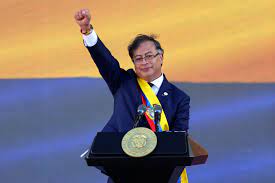
Petro gives his voters a clenched fist on his inauguration as President in August last year but many remain in jail and the rest get little or nothing. (Photo sourced: Internet) (Photo choice and caption by Rebel Breeze)
In economic terms the government promised a lot during the campaign, but once in power, it quickly softened its proposals and in some other cases they didn’t get a majority of votes in Congress.
The lack of votes in Congress is not a simple one of not coming through, nor is it due to betrayals by the PH nor manoeuvres by other forces that Petro can’t control.
The PH is a coalition of sectors of the right with sectors of what passes for social democracy in Colombia. It was not inevitable, but rather Petro actively advocated that it be like that.
It is worth recalling that at first, he wasn’t going to choose Francia Márquez as his vice-president but rather a right winger like Roy Barreras.
However there are economic aspects that are under his control, but for the moment they remain as just proposals, rather than real policies that have gone through Congress. On the land question, Petro proposes monocultures and agribusiness.
This was clearly to be seen in the proposal to buy three million hectares from the cattle ranchers.
Petro’s vision of the countryside is one of it being at the service of big money and the promotion of cash crops, despite some references to the production of foodstuffs for internal consumption and the so-called bio-economy.
Something similar can be seen with his proposals for clean energy. He spoke a great deal about it during the electoral campaign and some of his proposals, or outlines as they stand, look good.
That Colombia no longer depend on oil and coal is not a bad idea and that it be replaced with alternative energy sources such as solar and wind power looks good, until we actually examine the details.
One of his first stumbles, in that sense, was with the Indigenous people, as La Guajira is a poor area that has suffered the consequences of coal mining.
He did not take them into account and they reminded him that what is proposed for their territory should have their support, though legally it is not quite the case, and that it should also benefit them.
He partially rectified the case, but the big question is, if he wants an energy transition why does he have to seek out French and other foreign capital to finance it. Does he want to hand over the wind and solar power as they are still doing with oil and coal?
It would seem so. According to Petro:
We need investments that help us carry this out: we would have a matrix of foreign investment centred on the construction of clean energies in South America, with a guaranteed market, if we have direct link to the United States and by sea with the rest of the world.4
If you substitute oil and coal for clean energy, you begin to see the problem: the resources of Colombia in the service of big money and the countries of the North.
If we are to have a real change and energy transition, we must end the idea of Northern energy consumption regardless of where it comes from as sustainable and that countries such as Colombia must supply energy for a planet-destroying consumption model.
Neither have there been great advances on the issue of peace. He did reactivate the dialogue with the ELN, but stumbled with something that is still an integral part of his policy, the so-called Total Peace.
In his proposal he compared the insurgent group, the ELN to the drug gangs and paramilitary groups such as the Clan de Golfo. It was not a mistake, Petro really does see the ELN as a criminal gang.
He made it clear in his speech to the military and he reaffirmed it when he named the blood thirsty Mafia boss and former Murderer-in-Chief of the paramilitaries, Salvatore Mancuso as a Peace Promoter.
With that he placed the ELN leadership on the same plane as the paramilitaries. And they have implicitly accepted it for the moment.
In Petro’s discourse Colombia is a violent country and there is no way to understand it and peace has to be made with everyone as they are all the same, the insurgency and the narcos. Not even Santos was that creative in delegitimising the guerrillas.
Mancuso took on his role and once again spoke of the land they had stolen, the disappeared etc. He has been telling us for two decades now that tomorrow he will reveal all, but tomorrow never comes.
When Uribe invited Mancuso to the Congress of the Republic, Petro had a different attitude.
His response was blunt and he described Uribe as a president that was captured by the paramilitaries and that Mancuso manipulated the Congress stating that “if under this flag of peace, dirtied by cocaine what is essentially being proposed is an alliance with genocidal drug traffickers and political leaders… then we are not contributing to any sort of peace.”5
And we end the year with a scandal. I have on many occasions compared Petro and the PH to Samper and the Liberal Party of the 90s. But not in my most fertile delirium could I imagine that Petro and his son would give us another Process 8000.
Samper managed to reinvent himself as a statesman and human rights defender, despite his government’s dreadful record, following the outcry over drug money in his election campaign. He has publicly supported Petro and the PH.
Now he can advise them on how to deny what is as plain as day. Illicit funds went into the PH’s campaign as has happened with all election campaigns.
Petro finds himself in the eye of the storm due to the manoeuvres of his son in asking for and receiving money. His ambassador in Caracas has boasted about obtaining 15,000 million pesos [3.3 million euros] that were not reported to the authorities.
Those on the “left” who gave Petro unconditional support defend him, saying that it all happened behind his back.
The only thing left to say about that is, a little bit of respect for Samper please! He established his copyright, authorship of that expression in relation to dirty money. They will have to come up with another one.
For the moment Petro says, I didn’t raise him, which is true. But his son is the beneficiary of a type of political nepotism. As was the case with Samper, the only doubt is whether Petro knew or not.
That a government which is supposedly progressive has found itself entangled in such a storm is revealing of a government in which politics is a family business.
Something similar happened to the FARC commander Iván Márquez with his nephew who turned out to be a DEA informant.
On the drugs issue it is clear that the discourse and reality do not match at any point. Petro went to the UN to announce a new drugs policy. He put forward various aims for his government and criticised the war on drugs.6
It seems like a bad joke that the said policy has not yet been published. What we have seen is that the fumigations continue, the Yanks smile on and occasionally there is talk of going after the big fish, without saying who they are.
We know that he is not talking about the banks, and less still of the European companies that supply the precursor chemicals. The big fish will turn out to be middle ranking thugs in the cities of Colombia, at best.
So, it has been a year that wasn’t that different to others. Yes, there were changes, some proposal or other that was half interesting, but even the right wing does that occasionally.
The vote of confidence cast in the ballot box is still waiting to see the promised changes. But we increasingly see a government without a clear aim and reinventing old policies as new ones, with the same results as before.
End.
FOOTNOTES
1 See Ó Loingsigh’s article Long Live the Vandals – R.B.
Gearóid Ó Loingsigh 12 April 2023 (first published in Socialist Democracy)
(Reading time: 5 mins.)
The president of Colombia, Gustavo Petro, announced in a National Peace, Reconciliation and Harmony Council (CNPRC) meeting that the state didn’t have sufficient funds to fulfil the Havana Accord signed with the FARC.(1)
The situation seems to be so serious that according to the President it will take 125 years to fulfil it. There are some points in which he is right, but only if we ignore the most obvious things: the nature of the Accord itself.
He alludes to this and asks some rhetorical questions, ones which he should really ask as proper questions, not as some gesture in his oratory, but rather as questions to the FARC, Santos and all those who promoted the Accord nationally and internationally.
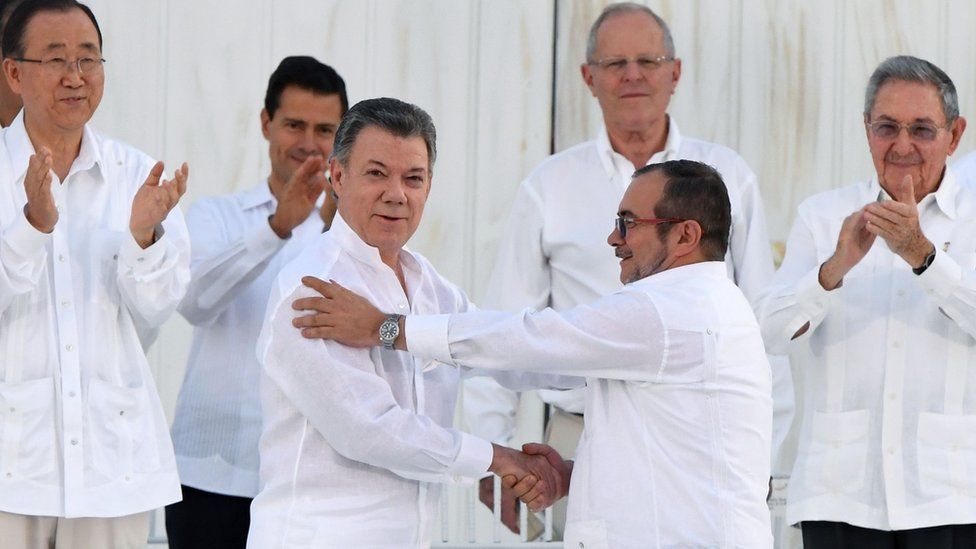
Among guarantors of the Colombian conflict pacification deal signed by, at the time, Colombian President Juan Manuel Santos, left, and leader of the Revolutionary Armed Forces of Colombia (FARC) Timoleón Jiménez, known as “Timochenko,” during a news conference announcing an agreement between the two parts in Havana on Sept. 23, 2015. Among those applauding, Cuban President Raul Castro at far right of picture. (Source photo: Internet)
Petro asks “was that Accord signed with the aim of applying it, or with the aim of disarming the FARC and later, Colombian style reworking everything?(2)
Well of course it was sonny boy. That much was clear. At the time you were told so and those of us who criticised the Accord were accused of wanting more war, ignoring that many of us had never participated in or supported the war. It was a debate they didn’t want to have.
During the not very open process negotiated behind closed doors, it was said, in the midst of the euphoria of the signing and the parties in public squares with huge screens in the streets so one would miss it, that criticisms were not welcome.
They were, as an old friend used to say, as welcome as a fart in a space suit.
Petro continued and stated something he certainly believes is very important.
I want to implement the Peace Accord, but it costs 30.5 billion Euros. If the Santos government signed this in the name of the state and society is represented in this, then, tell me where am I to get this 30.5 billion?(3)
There is an easy answer to that question. The money can be got from the same place that they, and in that I include Petro, thought it was when they signed the Accord in 2016. Don’t ask where they are going to get the money, but rather tell us where you expected to get it in 2016.
Petros giving a clenched fist salute after his inauguration as President of Colombia. (Source photo: Internet)
Senators such as Iván Cepeda who played an important role in the process can point to where. The cost of the Accord was obvious from day one, this problem is not new and it is just not credible thatPetro and his Congress benches have just realized how much money was needed.
But the truth is Petro, Cepeda wanted to bring the FARC to an end and rework things later. All of them without exceptions. Of if this is not the case, maybe they can tell us where they thought they would get the money.
The former FARC commander, Timochenko said that war against the FARC (he excludes all of the other guerrilla groups that have existed) cost 83.7 billion Euros and the 30.5 of Petro is a minimal cost for the chance of a country in peace.
He is partially right, except that the problem is not about money or amounts, but rather the Accord itself and their perspective that what is needed is money and not political changes. The Havana Accord reads like shopping list, like a list of demands and a not very precise list at that.
A Land Bank would be set up with three million hectares, but it doesn’t say where and left it to the whim of whichever government.
So Petro announced that he would fulfil that part by buying land off cattle ranchers. The same ranchers whose spokesperson José Felix Lafaurie accepted that Fedegan’s affiliates, rice growers and various multinationals financed the right-wing paramilitaries.(4)
Nothing happened to him, nor to the 10,000 cattle ranchers who had signed an open letter where they acknowledged their crime.(5) At the time it was argued that the Prosecutor was not in a position to process that many people.
It wasn’t true, the crime had been publicly vindicated and they also said that there was nowhere to put 10,000 criminals. This wasn’t true either.
According to the prison service’s own figures and the calculations of the Corporación Excelencia en Justicia, in 2006 the Colombian prison system had a capacity for 52,414 prisoners with 60,021 actually held in them.
In 2011, that figure had risen to a capacity of 75,260 with 100,451 people in them i.e. they managed to put 40,000 poor prisoners in overcrowded conditions, but they had no room for 10,000 paramilitaries and their lackies.
In 2006 there were 19,353 prisoners on remand.(6) A little bit of creativity with the judicial abuse of remand and they could have put the paramilitary funders in jail without any problems.
The prison population eventually reached the figure of 125,000 prisoners in overcrowded conditions whilst others rambled around their lands despite having acknowledged their crime.
What was missing was the will. But instead of spending money buying land from paramilitaries and their backers, Petro could confiscate the land of those 10,000, amongst others. It wouldn’t cost that much.
There are other measures he could take with a view to peace, justice and truth. Petro could ask for the extradition of the Board of Chiquita who paid a 25 million dollar fine in the US having accepted their responsibility in the crime of financing paramilitary groups.
It wouldn’t cost more than the price of posting the request. There are other measures that have some bureaucratic costs, like forcing public bodies to comply with land restitution findings, something which does not happen. It also only requires the will to do so.
Petro’s focus is the same one as the FARC and the Santos’ government and other peaceniks, who are now Congress reps: it is a question of money. But this is not the case. It is a question of returning stolen land, reviving organisations, guaranteeing the right to exercise one’s rights.
It is also the disbandment of the specialised riot squad, ESMAD. It is more expensive to change its name and give it a makeover, as Petro proposes, than abolishing it.
He wanted to buy fighter jets at a cost of 3,150 million dollars. Due to public reaction, he backtracked but he did buy the Barak MX air defence system from Israel at a cost of 131.2 million dollars.(7) He also bought 18 Howitzers from Israel at a cost of 101.7 million dollars.(8)
Such systems are for conventional wars between countries, they are of no use against insurgents, i.e. they are toys for the military. Maybe they will be used in the Coup that Petro’s followers announce all the time. It is what happened in Chile.
So, is there any money or not? And what will be done with the things that don’t cost much? Why don’t they reduce the extravagant salaries of the magistrates in the Special Jurisdiction for Peace who to date have produced little?
But then, at least he partly accepts what was always the case, that the peace process and the Havana Accord were a mockery of the victims of the Colombian conflict. Their only purpose was to remove the FARC from the field, particularly in areas with oil and other natural resources.
No one sought to solve any deep-seated problems in the country and here we are with the tale that there is a lack of money, when really what was lacking throughout the entire process were clear political positions.
(3) Ibíd., Euro figures were calculated at 4906 pesos to the Euro and the original figure of 150 billion in the article was taken using the Spanish definition of billion, which is a million, million.
(4) El Cambio No 704 diciembre 2006/enero 2007 Diez Preguntas (Entrevista con José Félix Lafaurie p. 48)
(5) El Espectador (17/12/2006) La hora de los ganaderos, p. 2A
Gearóid Ó Loingsigh (with kind donation of photos)
(Reading time: 7 mins.)
08 March 2023
Photo Coca Plants Northern Colombia: G.O.L.
The drugs issue in Colombia supposedly occupies the time of and is a concern to the government.
It has been an important issue for all the governments and as was to be expected it is one that has come up again in the dialogues with the ELN, despite this organisation denying any links to the drugs trade.
The author (left) and Pablo Beltran, the ELN negotiator (centre) and representative of social movement in Ecuador (right) in 2017 conference in University of Simon Bolivar, Quito, Ecuador. (Photo: GOL)
In the peace process with the FARC, agreement was reached on the issue. What was agreed to in Point 4 of the Havana Accord was abysmal and showed that the FARC did not understand the problem nor the possible solutions.
Of course, there could be a difference between what the FARC understood and what it agreed to, as at the end of the day the state won the war and imposed the greater part of what the FARC signed up to.
Following the agreement in the declarations of the main FARC commanders there is nothing to be seen that indicates that they really understood the problem. Will it be any different with the ELN?
One of the main concerns of the ELN has been to put a distance between themselves and the drugs trade.
Whilst it is true that the ELN is not the FARC, it is also true that in their areas of influence or those contiguous there are coca and poppy crops and the USA is not going to believe them that they have nothing to with it, whether they like it or not. The ELN accepts that it places taxes on economic activities and for the USA that is drug trafficking.
So, some time ago, the ELN issued a statement where they restated that they have nothing to do with drugs and invited an international commission to visit the country to see the reality for itself.(1) They ask that a UN delegate take part in the delegation. They also make a series of proposals in relation to the issue as such.
On the first point, the ELN feels sure of itself regarding its ability to show in practice that they are not drug traffickers. The ELN correctly states that:
When the Colombian government and the USA accuse the ELN of having an active role in the trade, they are lying, but above all they are covering up for those really responsible and the deep-seated problems, which indicate their unwillingness to take real and effective measures.(2)
ELN guerrilla camp, Colombia (Photo: GOL)
But for the USA, it is not about whether they are guilty or not, it is a political tool and weapon and to give them a voice and vote in the affair is extremely dangerous. When the USA accuses the ELN of being drug traffickers, it is not making a mistake.
A mistake on their part would be to say something they believe and be wrong about it, but they accuse the ELN for political reasons on the basis of their strategic needs and the legal basis to their accusations is the least of it: it is just propaganda. By inviting them into the country, the ELN falls into their trap.
The UN participated in the commissions of investigation for supposed weapons of mass destruction in Iraq. The lack of evidence of such weapons wasn’t of much use.
The USA played around with supposed or real non-compliance by Saddam and did what they always wanted to do: invade Iraq. In this they counted on the explicit support of Great Britain and the tacit support of others.
There is a myth in Colombia that the only baddies are the USA and that other imperialist powers such as Canada (a country that is not seen as imperialist by many sections of the “Colombian left”), and other countries of the European Union are good, or at least not really that bad to the point they are friends of the Colombian people.
In the case of Colombia, the EU competes with the US in almost everything. The EU is Colombia’s second commercial partner and its companies are dominant in sectors such as mining, health and oil, amongst others.
The ELN also asks for the legalization of drugs. The demand is justified and quite opportune, but their counterparts i.e. the Colombian state is not sovereign in the matter and furthermore there is a need to clarify what is understood by legalization.
If by legalization they mean legalizing production for medical purposes, the bad news is that medical production is already legal. The thing is, that it is controlled. In fact, in many jurisdictions they don’t talk of illegal drugs but rather controlled substances.
Cocaine is a controlled substance. Its production for medical reasons is authorized by the International Narcotics Control Board (INCB) and production is almost exclusively carried out in Peru. And the market is quite small, not even reaching 400 kilos per year as I pointed out in an earlier article.(3) It solves nothing in relation to Colombia.
If on the other hand, they are talking about legalizing recreational use, something which could positively impact the Colombian countryside, then it is a matter of international jurisdiction. Colombia cannot legalise it on its own.
Colombia is a signatory to the Single Convention of 1961 that holds sway in the matter and in addition there are power relationships at play.
It doesn’t matter whether it legalises production for recreational use, it will never be able to legally export it, not only without the consent of the other country, but also the whole setup of the UN and its bodies such as the INCB i.e. at the end of the day, the USA.
Even if it is legalized for internal consumption, there are other problems that have already arisen in countries such as Uruguay which legalised recreational use of marijuana or some of the states in the USA.
The banking system dare not receive funds from those legalised markets and the producers resort to old methods more akin to money laundering to deposit legal funds in legal accounts in a legal banking system.
Even in the hypothetical case of the USA and the EU agreeing, the legalisation of cocaine would go far beyond Colombian cocaine and would include other drugs such as opium and its derivatives such as heroin. It is worth looking at the drugs market and its production.
According to the UN, cocaine is produced directly or indirectly in eight Latin American countries (Colombia, Peru and Bolivia account for almost all of it), whilst 57 countries produce opium, the Asian countries being the largest producers (Afghanistan, Myanmar and Mexico dominate the market).
A bucket of opium poppy seed (Photo: GOL)
Cannabis, which is the most widely consumed drug in the world is produced in 154 countries.
For 2020, the UN calculated that there were 246,800 hectares of opium and 234,000 of coca.(4) They also calculate a production of 7,930 tonnes in 2021(5) and 1,982 tonnes of cocaine in 2020.(6) We are not talking about small quantities of production or land. Almost half a million hectares between these two drugs and 64 countries.
Any proposal of legalisation has to include these countries and their peasantry.
The number of drug users is also large. The UN calculates that in 2020 there were 209 million cannabis consumers, 61 million people who had consumed opiates, 24 million amphetamine users, 21 million cocaine consumers and 20 million users of ecstasy.(7)
They say that in 2020, they had calculated that 284 million people between the ages of 15-64 years used drugs, i.e. one in every 18 people in this cohort.(8)
There are consequences to this, in economic but also cultural terms regarding the use and abuse of substances. But there also consequences in terms of health. Some 600,000 people received some treatment for drug problems.(9)
So when the ELN says that “Drug addicts are ill and should be cared for by the states and not pursued as delinquents”(10) their idea is correct, however, the size of the problem is greater than the real capacity of the health systems in the countries that have large numbers of users.
Photo Opium Poppy Nariño Colombia: G.O.L.
The total number of people injecting drugs is 5,190,000 in Asia, 2,600,000 in Europe and 2,350,000 in the Americas (almost 75% of which is in north America).(11)
Of those who inject, 5.5 million have Hepatitis C, 1.4 million are HIV positive and 1.2 million are HIV positive and also have Hepatitis C.(12) These are not minor problems and are high-cost illnesses.
Of course, these figures do not include the unlawful abuse of legal pharmaceuticals. In the USA almost 80% of the overdoses are from the consumption of legal opiates such as fentanyl, which caused 78,238 deaths in 2021 in that country.
But the issue does require legalisation and not other means that the FARC aimed for. The peasants of Colombia did not make a mistake in choice of crop when they planted coca. Coca was and continues to be a very profitable crop, despite all the difficulties that it generates.
There is no need to substitute it with another crop such as cocoa or African palm etc. It is not about the crop but rather the production model and the political and economic context.
The increase in coca production in Colombia, is not due to subjective factors such as the decisions of peasants, not even of the drug barons and less still of the insurgencies but rather objective economic factors.
This is a key point. It was the decisions of northern countries that impacted the countryside and pushed thousands of peasants around the world to grow opium poppy and coca. The neoliberal cutback policies in the north also contributed to the dramatic rise in problem drug use due to the increase in misery in those countries.
Bedding, equipment and reading material in an ELN guerrilla camp, Colombia (Photo: GOL)
In any discussion we should distance ourselves from the idea that the drugs problem can be solved in a negotiation with the ELN, although they could negotiate some points that would contribute positively to a solution.
But the problem is political and the free trade agreements and other measures that had a negative impact on the countryside have to be looked at again.
Also, they have to reach an agreement with the Colombian government, not for some perks for peasants nor corrupt projects and budgets such as those the FARC agreed to, but rather a political agreement where the government argues and campaigns for the derogation of the Single Convention of 1961.
For the moment, and only for the moment the purchase of warplanes with which Petro and Márquez hoped to cuddle up to the military, leaving aside the basic needs of the Colombians has collapsed.
But Petro and Márquez have not given up the ghost. So, they bought the Barak MX air defence system.(1) It is a system for defence against aerial and missile attacks. We don’t know who the enemies that the country has are, nor who they hope to use this system against, but they bought it.
To cap it all, they manufacturer is Israel, as if the country hadn’t had enough of the Zionist state’s interference.
It is worth remembering that it was Israeli mercenaries at the request of the then Colombian government who trained paramilitary groups in the Magdalena Medio region in the 1980s.
Though really, if you wanted to buy death, there are no angels in the market. The main suppliers of weapons to Colombia are the USA and the European Union, i.e. the butchers of Iraq, Afghanistan, Yemen and other recent wars.
Colombia’s military expenditure is significant, accounting for around 3.4% of GDP in 2021, i.e. 10.006 million dollars (constant prices of 2020).(2)
Colombia military parade (Image sourced: Internet)
We have to go back as far as 1995 to find a year in which military expenditure was less than 3% of GDP, though in that year it represented 14.8% of the national budget. It was almost always above 10% of the total budget.
Israeli sales to Colombia are not new. All governments have bought arms from Israel, except Duque’s. The purchase by Petro and Márquez is another sign that they have no intention of breaking with the past, with the military or any sector the bourgeoisie.
A progressive government would not buy an air defence system to protect against an imaginary enemy. The country needs more pencils, stethoscopes and less missiles. But Petro and Márquez are determined to please the military.
In all their press conferences the military turn up, Petro and Márquez have not broken with that practice, more suited to a military dictatorship, that not even the Biden government does.
Gabriela Marquez & Gustavo Petro, partnership in charge of Colombia. (Image sourced: Internet)
The military pose as statues or caricatures of The Simpsons in press conferences, regardless of the topic, but Petro and Márquez want them by their side.
They talk a lot about total peace, and a change, but a civil government feels the need to put the military besides them at every turn and never misses a chance to waste the health and education budget etc. on weapons.
Gearóid Ó Loingsigh looks at the new government in Colombia and how it talks of peace while increasing militarisation. English language version first published in Redline, 24th November, reprinted with kind permission of author.
(Reading time: 8 mins.)
The Petro–Márquez government is one which proposes to bring us to what they term Total Peace.
The term and the proposal as such have been subjected to justifiable criticism, not least because it places the insurgency of the ELN on the same footing as armed drug trafficking groups.
But there is another aspect of their government that calls upon us to reflect on what Petro – Márquez understand as peace and a demilitarized society that breaks with the past and the present of a repressive state where the answer to everything is a military response.
A first step would be to remove the military from civilian settings. But Petro has already made statements that indicate that neither he nor Márquez think that.
Shortly after taking on the presidency, he declared that the answer to deforestation of the Amazon was not only military, but Yankee.
In their electoral campaign their proposal was different, they did not talk about the military anywhere, but rather of democracy, autonomy, measures against drug trafficking and money laundering.
We will stop the deforestation and the burning of the jungle. We will dismantle the engines of deforestation, amongst them: displacement of the unemployed and landless peasants from the interior of the country towards the Amazon; land grabbers and promoters of extensive cattle ranching and other monocultures; corruption in public bodies; laundering of foreign currency through the purchase of deforested land, a by-product of drug trafficking and corruption; the uncontrolled extraction of wood etc.[1]
And he also said that the pacts to protect the jungle would be with the communities and not national or foreign militaries.
We will build a broad national pact of regional and global importance for the environmental defence of the Amazon, Orinoco and the biogeographic corridor of the Pacific. We will set up community agreements for the regeneration and ecological restoration of these eco-systems based on organisational processes, proposing to increase the size of collective territories, registry of plots and the strengthening of traditional and ancestral authorities. We will recognise the rural communities’ own lifestyle in strategic eco-systems and their own ecological and economic forms of production in these habitats, as well as their own environmental management.[2]
It all sounds very nice, but it goes hand in hand with militarisation. He proposed a sort of military alliance with the USA to avoid the burning of the jungle, copying the already existing model in Brazil where the USA has a base from which to put out fires.
Of course, in Brazil the mining and logging companies, etc. invade the territory with the approval of the government. The presence of north American troops never prevented any of the extractionist policies and less still poverty under the governments of Lula, Dilma and Bolsonaro.
As others have pointed out, it is nothing more than the militarisation of environmentalism and it is an old slogan of the imperialists that they should be in charge wherever they want and that includes the Amazon.
They used to brandish the anti-narcotics struggle as an excuse and now it is global warming. Al Gore once said that “The Amazon is not their property, it belongs to us all”. Of course, by us, this miscreant means Yankee imperialism: the USA.
It is the same discourse they have in relation to oil; it does not belong to the countries that have it but rather to all of us i.e. the US and European companies. Al Gore’s fame as an environmentalist is undeserved but his reputation as an old imperialist is completely justified.
Other governments have come out with similar feelings, Gore’s was not an individual outburst. Macron, NATO as such and the influential magazine Foreign Policy have argued for a military intervention in the region with the aim of protecting the planet.[3]
For the moment, Petro is not in favour of Colombia becoming a member of NATO, rather he proposes a regional military alliance.[4] Against whom would this alliance fight is not at all clear, or whether it would simply be an unofficial appendage to NATO.
We should be concerned and not just a little bit. In November he met with representatives of the US Embassy and the Subsecretary of Political Affairs, Victoria Nuland. Following the meeting Nuland tweeted.
Thank you, Gustavo Petro President of Colombia for our productive meeting reaffirming the importance of our continued partnership on security, peace, progress for Venezuela and protecting our planet.[5]
Bearing in mind the murky past of Nuland in Ukraine in 2014, we should be very careful with her, but there are those who believe that Petro is charge.
It is not the only issue where he proposes military rather than civilian solutions. Faced with the lack of access to healthcare in the territories of the Pacific, he also proposed to militarise the response. The Pacific is one of the regions with the worst indicators in the area of healthcare.
Nobody doubts about the need for an urgent and comprehensive response for the region. The military boat USNS Comfort visited Colombia to provide medical assistance.
It was not the first time, the said boat has visited the country four times as part of the Continuing Promise[6] mission, a medical and public relations initiative of the US, deploying its Soft Power.
This boat also took part in the two wars in Iraq as a military hospital, and in the invasion of Haití in 1994. Petro’s response on Twitter was:
I am grateful for this support in healthcare from the US government to the people of the Caribbean. It is important that we think about the Pacific. A mission for the National Navy, along with the building of the first frigate “made in Colombia” will be the building of a hospital ship.[7]
In a non-militarised state healthcare should be under the remit of the Ministry of Health and not the Ministry of Defence, but Petro – Márquez want to bring healthcare to the Pacific through military rather than civilian institutions.
Such incoherence with his public discourse!
In previous governments the military has used its economic power and civic-military days as part of its military and armed operations.
The mobilisation of troops and the demand for collaboration from the civilian population is justified on the basis of access to medical services that are provided for by civilians in Bogotá and other parts of the country without the need to explain themselves to military institution in the midst of a war.
The Petro – Márquez government is also going to continue with the proposal of the Santos government to build a military base on the Gorgona Island. It is worth remembering that Santos was one of these other men of peace that are in abundance in Colombia: hawks dressed as doves.
The Gorgona Island was, for many years, a penal colony, the Colombian version of the infamous Devil’s Island immortalised in Papillon film with Steve McQueen. In 1982 it was declared a world heritage site by UNESCO due to it high ecological value.
A deserted beach in Gorgona National Park, an island 21 miles off Colombia’s Pacific coast and a UNESCO World Heritage ecological site — Petro plans to put a military base there. (Image sourced: Internet)
Now they want to go ahead with the plan to place a military base there. What is new in the Petro – Márquez government is that there is a rumour that the USA will have access to the base.
It is not an absurd idea, as the project has anti-narcotic aims and is financed by the US Embassy in the country.[8] With absolute certainty, the DEA will at least have access to it.
There are alternatives, such as a warship as a centre of operations. Petro wants the Navy to build a hospital ship but is not up to telling them to build a ship for what does fall within its remit.
He says he wants peace but he wants to promote the military at every turn, even turning up every time he can wearing military caps.
So far, he hasn’t acted ridiculous like Iván Duque dressing up as a police officer in the midst of the National Strike of 2021, but as his supporters point out he has only been president for a little more than 100 days and we have to give him time.
In every circus you have to wait for the clowns to come in. We can’t always see the lion-tamer but clowns and clownish antics are always there.
Some social climbers from social and human rights organisations ran to take up posts in the ministries of Defence and also the Interior.
They used to be critics of the armed forces and police of the state, now they look out for its good name in the area of human rights and international humanitarian law. They also promote the military at each turn.
The recently appointed Alexandra González, a former functionary of the Committee for Solidarity with Political Prisoners, who is now the Cabinet Secretary of the Ministry of National Defence published an effusive tweet full of praise of the Ministry of Defence that stated “Military engineers will build tertiary road to benefit the peasant population.”[9]
She doesn’t understand that the armed forces are never for anything other than war, even in peace time they are preparing for war. It is their only function. In any case, no one can explain why the military have to the ones that are building those roads.
But as a good political opportunist she claims as her own that which does not belong to her. On twitter they replied to her, pointing out that those projects were old ones.
A retired military officer and former advisor to the High Commissioner for Peace pointed her in the direction of an article in the regional newspaper El Quindiano written by himself, speaking of the beginning of these civic – military projects in the 1960s.[10]
All governments have carried out infrastructural projects through the Ministry of Defence and in all governments, they were referred to as peace projects.
Perhaps the fugitives from the human rights organisations feel the need to say that it is new in order not to make evident that there is a continuity between this government and all of the previous ones.
I don’t understand why they signed up to the non-binding declaration on safe schools, if they are promoting the military presence in all other aspects of civilian life.
The ideal situation would be to not permit the military to use schools as bases or human shields in the midst of fighting nor use the military to build infrastructural projects.
If the government was really progressive (an imprecise term) it would remove the civilian contracts from the military, healthcare would be the exclusive responsibility of health bodies and not the military, it would not propose a military alliance in a world with an excess of them.
And the symbols that Peto would put on a pedestal would be civilian ones, from the people, the communities, even from some trade union, even if it were just out of pure nostalgia, as when he was Mayor of Bogotá he didn’t think much of unions.
The Truth Commission (CEV) in Colombia has just published its report on the Colombian conflict. As was to be expected it is a very detailed report and deals with many aspects of the conflict and therefore it is impossible to carry out a detailed criticism in just one article.
This article aims to deal with the document entitled Call for Peace and in later articles I will deal with some points in greater detail such as the regions, the business class and drug trafficking.
Of course, there are very positive aspects, such as the statistics compiled, some proposals that they make and also the stories of the victims that they included.
However, there are also some very problematic aspects on the ideological plane and how they present the conflict, the actors, motives and there is an underlying idea in the document that we should advance towards a new society — with changes — but a society that continues to be the same with regard the economy.
They discount any class struggle as not only as anachronistic but also as something which is undesirable, regardless of the methods used.
The document is full of adjectives, some of them emotive, something which is not a criticism as such, emotions have a place in this setting, but it is imbued with Christian references and the Catholic faith as such.
That is not that surprising given that the boss is a Jesuit priest, Francisco de Roux, s.j. But due to this, its starting point is based on suppositions not shared by everyone and that are very questionable.
President-elect of Colombia Gustavo Petro shakes hands with Francisco de Roux at the launch of the Report.
OH BROTHER!
They start off with the statement and question “We started off from the issue that has dogged humanity from the beginning: where is your brother?”
I don’t know whether this first part is true or not, but the question about the brother presumes we know and share this concept of brother. In the Catholic faith we are all theoretically brothers, though not in practice.
But the idea informs a concept taken from family therapy that the Colombian conflict is between siblings that love each other or at least can love each other, just as a woman can love the man who abuses her in their relationship or the man who can stop abusing her and love her as she deserves.
It is a deservedly highly questioned concept, but it is applied in many countries that have gone through peace processes and truth commissions. But it is not the case, this conflict is not between siblings, but rather between interests.
The conflict has names and surnames and moreover surnames of the great and good and its victims are everyone else. There are power relationships. There are also economic interests.
It is an insult to say that the powerful, such as Luís Carlos Sarmiento and the Santos family are the brothers of their employees, or that associations such as the cattle ranchers of FEDEGAN represent people that are the brothers of the displaced peasants.
Though the report does acknowledge the role of some business people in the conflict.
…what has been grievous for the pain and injustice for the victims is the finding that leading business initiatives paid paramilitary groups in order to displace and steal the land and territories from the communities and implant mining or agribusinesses, or within their enterprises they stigmatised the workers and are complicit in the murder of hundreds of trade unionists.1
Such people, responsible for the murder of hundreds of trade unionists are nobody’s brothers, other than their shareholders’. They killed them as part of a strategy to accumulate wealth, the most base reason for doing so.
The CEV’s position turns the businessman into our brother, though it does acknowledge that
… we did not carry out any specific study on the armed conflict and the economy, following four years of listening to the drama of the war, the Commission takes as given that if no major changes are made to the economic model of development in the country it will be impossible to prevent the repetition of the armed conflict which will reappear and evolve in an unpredictable manner.
But despite not carrying out any specific analysis of the conflict and the economy the CEV calls on businesses to avoid a resurgence in the armed conflict.
The state, society and in particular the business people behind the large industrial and financial projects should prioritise guaranteeing the welfare and dignified life of the people and communities without any exclusions, with a shared vision of the future to overcome the structural inequality that makes this country one of the most unequal countries in the world in terms of the concentration of income, wealth and land.2
It is part of the discourse that we are all brothers. Instead of criticising the call they make for a society where the welfare of the people is a priority for the businesses, we only have to ask a question. Where does this happen? In what countries does this occur?
They usually make clumsy references to Switzerland or Sweden, ignoring that it is not quite the case and the welfare programmes in Europe (those that are left) are the result of social struggles and are largely financed by the super-exploitation of the Global South.
It is an illusion and part of liberal mythology, that is usually sold during elections every four or more years depending on the country, but is not to be found anywhere in reality and couldn’t be — legally a company looks out for the welfare of its shareholders and nobody else.
The lack of an analysis of the economic model as a factor in the conflict is a serious weakness, something I will deal with in another article.
But in a conflict for land, where the landlords and business people murder peasants and trade unionists3, failing to analyse the context of the economic model is disingenuous.
AN OLD VERY BAD JOKE
The CEV, however, engages in another great act of untruthfulness when it repeats the old refrain of the business class and the state that paramilitaries are reactive i.e. they react to the presence of guerrillas.
It seems like a bad joke that at this stage a commission that supposedly seeks the truth repeats such a lie: a lie challenged at the time by many of the organisations that now praise the CEV, in the days when they didn’t receive as many cheques from USAID and the European Union.
It has also been shown that companies paid armed groups large amounts of money as indispensable operational costs to keep their projects active.
And the reality of economic actors that in despair at the guerrillas and in the face of insecurity, contributed to the creation of the Convivir [rural security cooperatives] and on other occasions sought out the paramilitaries to bring their security of terror.
Following that there were those who took advantage of the land abandoned in midst of the terror to buy land through frontmen and set up projects. And there were those who used money to place members of the armed forces at their disposal.4
When the bloodthirsty Carlos Castaño called his paramilitary organisation United Self-Defence Forces of Colombia, he did so for a reason: the need to present his barbarous acts as a necessary evil, that of self-defence.
Javier Giraldo, s.j. also a Jesuit has spent his entire life fighting against just such a lie. He has documented how the paramilitaries existed before the foundation of the guerrillas and they were not reactive, but rather they were a state policy.5
The problem with the focus that ignores the state and its role and says that we are brothers is that it asks for reconciliation on that basis, that we are brothers. De Roux in his presentation asked more than once “how did we do” and asked for reconciliation.
But this “We” doesn’t exist. As Javier Giraldo points out.
A similar effort must be made in order to translate the value of Christian reconciliation to the judicial/political arena. There must be a public clarification and admission of guilt, an explicit condemnation of the mechanisms, structures and doctrines which facilitate crimes, the implementation of corrective measures to stop them from being repeated and reparation to victims and society. These must all be dealt with head-on and unequivocally. The very nature of a political community makes this imperative: unless there is an explicit and profound social sanction of crimes, internalized by society’s members and engraved in society’s “collective memory,” such crimes are not truly delegitimated. Without these conditions, the Christian value of forgiveness becomes a perverse expression of its real essence: from a fraternal and creative act to an act which covers up the institutionalization of crime(bold not in original) and destroys the barriers which protect human dignity.6
THE GERMAN EXAMPLE – AN OLD ILLUSION
The CEV points to the case of Germany following the Second World War as an example to follow. It is usually a sign of the poverty of the arguments when someone refers to the Nazis in order speak ill of someone, like saying some such a leader is the new Hitler.
But it is also a sign of argument povery to a degree when they refer to the topic to speak of reconciliation and so forth in post-War Germany. However, that is what the CEV did.
Our German friends who accompany us in the Commission’s process have shown us how its people recovered its dignity and pride when, even decades after the genocide of Jews and the war crimes committed, took on board the suffering of the victims, the wound as part of the national psyche and accepted its collective responsibility.7
What they claim just isn’t true. First of all, the post-Nazi Germany was not a denazified country.
Various later personalities from that period held high positions of responsibility, amongst them Kurt Waldheim, an officer in the Nazi army who became Secretary General of the United Nations and also President of Austria; war criminal Adolf Heusinger who became President of the Military Committee of NATO8 and Johannes Steinhoff who was in charge of the Luftwaffe after the War.
Kurt Georg Kiesinger was a member of the Nazi party, and worked side by side with Nazi propagandist Goebbels and later between 1966 and 1969 he was the German Chancellor.
Another Nazi, Wernher von Braun, who designed the Nazis’ bombs and rockets earned a good wage in the USA in order to put one of the rockets on the Moon. None of them confessed or accepted their responsibility.
And let’s not forget that young member of the Hitler Youth, one Joseph Ratzinger who became head of the Catholic Church. Of course, being a young man, he bore a lesser responsibility than the others.
The Nazis’ anti-gay legislation was applied up to 1969 and between 1946 and 1969 50,000 people were tried under that law. And whilst the Nazis had high-ranking posts the Communists were banned from working in the public administration and they and other dissidents, such as pacifists, were pursued.
Even under the “Communist Clause” victims of the Nazis who were Communists were not compensated.9 They chose a very bad example — or perhaps De Roux is conscious of the example he chose.
However, what it is about is blending one myth with another. It is surprising that they don’t mention South Africa, maybe because it is easier to see the reality of its Truth Commission and it is a more realistic comparison than Germany after the War.
What they aim to say is that if the Germans could accept their collective guilt, why can’t Colombia do so? But such collective guilt does not exist, or at least not in the way De Roux and company mean.
Many Germans lost their lives in the struggle against the Nazis, it has been calculated that the Nazis murdered 288,000 members of the opposition, including before Hitler came to power.
It wasn’t all Germans who did it but amongst those who did, there are familiar household names, Siemens and Krupps, just to name two companies — both used slave labour in their factories and had close relations with the Nazi Party.
Or there is Hugo Boss, the Nazi Party member who made his fortune manufacturing the uniforms of the Nazi Party, later of the Wehrmacht and of course of the SS, which is why they looked so good.
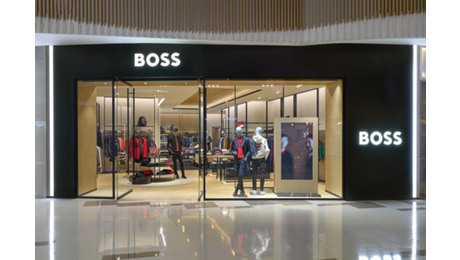
Hugo Boss menswear shop in Dublin. The company founder was a close supporter of the Nazi regime and produced uniforms for the Nazi Party, Wermacht and SS. (Image sourced: Internet)
And of course, Bayer, the company that made Zkylon-B, the gas they used, still exists and is still rich. Following the war, 13 directors from the company were convicted of war crimes but were freed without serving their full sentences and took up their posts in the company.
The murderers continued in power with the tale of “collective guilt”. The Nazis were a political project of a sector of the German bourgeoisie to stop the rise of the Communists, any similarity to cattle ranchers declaring Puerto Boyacá the anti-capitalist capital10 is a mere coincidence, I suppose.
The reference to Germany as an example of reconciliation is a cheap tale. If Colombia goes down the same road, the surnames Mancuso, Uribe, Santo Domingo, Samper and Santos and the others will be the dominant surnames in the future, with their economic and social power intact.
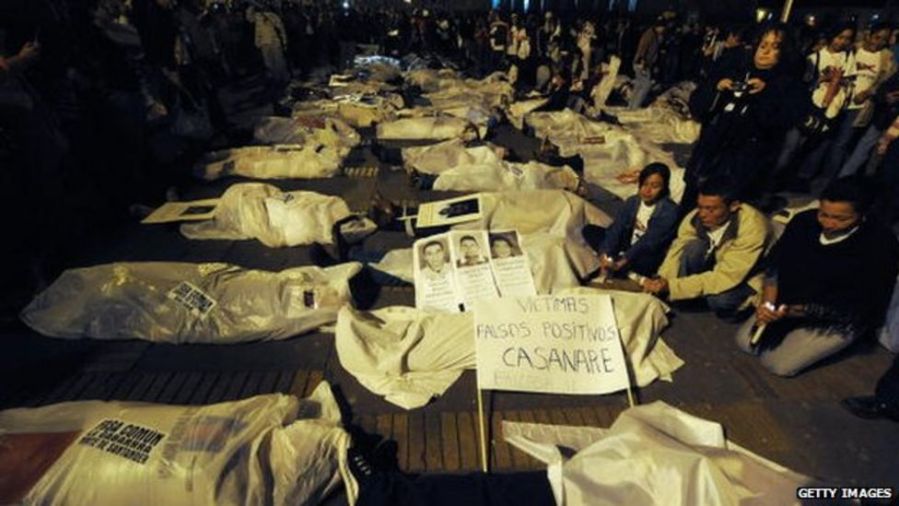
Protest about the army murders of civilians claimed as “positive” FARC guerrillas by relatives portraying the victims, Bogotá in 2009
THE “FALSE POSITIVES”
The CEV also deals with the issue of the “False Positives” and states something about the issue which is absolutely true that “If there had been ten, it would be very serious. If there had been one hundred, it would enough to demand a change of army. But there were thousands and it was monstrous.”11
But almost immediately it states that:
There was no law or written instructions that ordered it, but the soldiers who fired felt that they were doing what the institution wanted, due to the incentives and pressure that demanded immediate results with corpses, the publicity that they gave to those “killed in combat” and the protection given to the perpetrators.12
Yes, it is true that there was no law or written order that instructed them to do so. But we can’t expect criminals to leave us easy proof. There was no law, but there were incentives as they pointed out.
There were directives and a system for bonuses that encouraged the murder of civilians. Who authorised the payments? The then minister of Defence, Juan Manuel Santos. What does the document say about Santos?
The former president Santos – who was Minister for Defence from the end of 2006 to the end of 2008 – came to the Commission to contribute to the truth with his testimony, as ex-President and public servant, and he centred his intervention on the rigorous analysis of the False Positives to conclude asking for forgiveness from all the families and Colombia and invited the Armed Forces to ask the national and international community for forgiveness.13
It is not true, his intervention was not very rigorous and he ended by asking for forgiveness, as the CEV says, but at the same time he said he wasn’t to blame.
He took up Samper’s excuse regarding drug trafficking and said that it all happened behind his back and he lied on various occasions in his declaration to the CEV.14
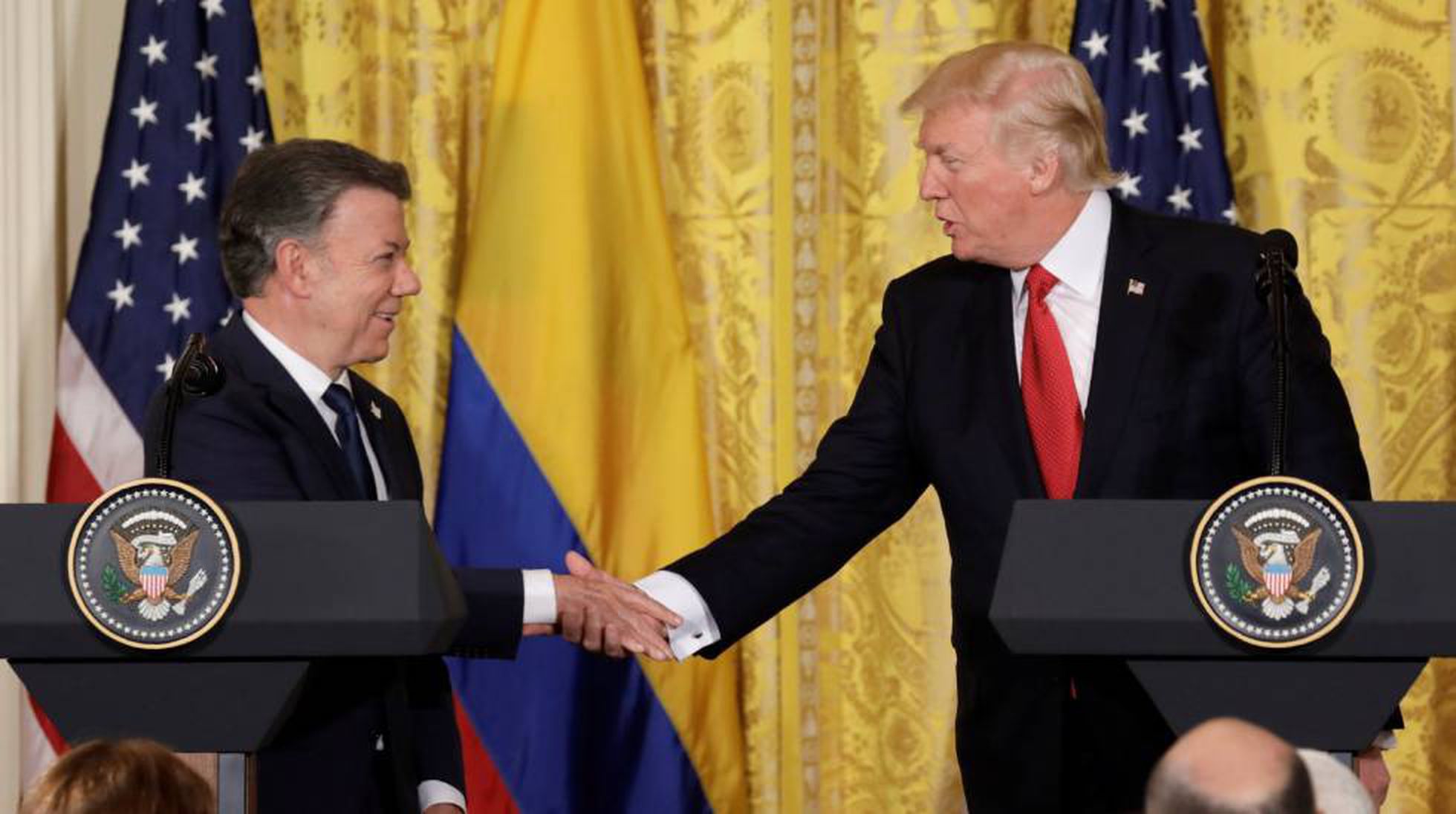
Juan Manuel Santos, them President of Colombia shaking hands with Donald Trump, then President of the USA, in the White House 18 May 2017 (Image sourced: Internet).
IN CONCLUSION
Without a doubt the CEV will contribute to the knowledge of the conflict with its data, interviews and in some parts, its analysis. But the report as a whole will not be the truth about the conflict.
The CEV stated that “we don’t share the position, according to which, there are many truths that are equally valid regarding the same matter.”15
Yes, not all “truths” are equal, you have to analyse them, discuss them, contrast them with the facts and even look at who is enunciating them to see which perspective is closer to the truth, but in this case, it is not the “truth” of the CEV that is true.
Neither do I share the idea that any truth is of equal value no matter how powerful or well thought-of those who write that truth are.
3 “The Human Rights Information System of the National Trade Union School (ENS) recorded 15,430 violations of trade unionists’ rights to life, freedom and integrity in Colombia between 1 January 1971 and 29 September 2021. Around a fifth of the cases reported were murders: 3,288 trade unionists have been assassinated over the last five decades in Colombia.” https://www.equaltimes.org/colombia-has-signed-a-peace?lang=en#.YtXwJuzMI6E
9 Creuzberger, S. ‘Make life for communists as difficult as possible’ State-run anticommunism and ‘psychological warfare’ in the early years of the Federal Republic of Germany. Asian j. Ger. Eur. stud.2, 9 (2017). https://doi.org/10.1186/s40856-017-0020-7
10 The location was the birth place of the paramilitary model that arose in the 1980s and was avowedly right wing. There was a sign on the way in to it, that said “Welcome to Puerto Boyacá, Anti-Communist Capital of Colombia.”
1) What do you think the elections of May 29th will mean for the future of Colombia? What are the stakes of these elections?
The elections are not as key as some commentators would like to make out in terms of profound changes in Colombia. Though, the reaction in some sectors and fears about the transparency of the elections are well founded and even some fears of a violent reaction from some sectors of the bourgeoisie and the army. So, on one level the elections are about the degree to which the bourgeoisie, including the narco-bourgeoisie are willing to accept electoral defeat. This election is likely to bring about a long period of uncertainty in the country as Petro tries to manage the expectations and demands of the bourgeoisie and contain the hopes of his own supporters.
People displaced in the north of Santander by ongoing violence try to get by as best they can (Photo cred: GÓ Loingsigh)
2) What is the political scenery like, one week before the elections? These elections take place midst what kind of atmosphere?
The atmosphere oscillates between one of hope that Petro will be elected and bring an end to a long conflict that has been going on for almost 60 years and one of fear. No one knows what the far right are capable of doing and thinking at the moment. General Zapateiro intervened in the election campaign, which is unconstitutional as the military don’t even have the right to vote in Colombia. There are other fears about electoral fraud, a portal has been set up to report electoral fraud. Already it has tallied 3,500 incidents and no one has cast a vote yet. Leading businesses have stated they will sack any workers who vote for Petro and have demanded that their employees take photos of the electoral card that they mark and send it to them. It is expected that Petro has the ability to win in the first round, sufficient electoral fraud to force a second round run off with any candidate other than Fico would make matters more complicated for Petro as people may vote against him out of fear were it to come to a second round against one of the other candidates other than the reincarnation of Uribe that is Fico.
The Colombian military are not permitted to vote but there is always the possibility that they will intervene militarily (Photo cred: GÓ Loingsigh)
3) In the surveys, we see that Gustavo Petrois is ahead. How do you interpret this? What are the social alliances he has created? What are people’s expectations from him?
Petro has been around for a long time and this is not his first but third outing as a presidential candidate. After 20 years of Uribe as the leading figure in Colombian politics, there is a growing tiredness coupled with really serious levels of poverty, whilst kleptocrats openly steal the resources of the state. However, he hasn’t built social alliances as such. There has been a confluence of various social organisations and sectors more out of a hope that there might be some change. Petro for example opposed the wave of protests that erupted in the country last year. At a moment when Duque looked very weak, Petro came out to say that he didn’t want Duque to fall through the protests and demanded that the protests be called off. He more than anyone was responsible for the defeat. Petro is building an electoral alliance not a social force and his electoral alliance includes the bourgeoisie. He has long called for a programmatic agreement with the bourgeoisie and his alliance includes people from various previous governments, including Uribe’s governments. Leading functionaries from the Santos government play lead roles in his campaign, such as Alfonso Prada, who is also a close friend of Santos. Former president Samper, the man who implemented the decree that gave us the Convivir, the legal façade for the paramilitaries in the 1990s is also involved in his campaign. This is not a minor point, Samper managed to reinvent himself as a man of peace, even though he more than any president bears responsibility for the blood bath of the mid 1990s to the early years of the 21st century. He also tried to include the former president Cesar Gaviria, the man who gave us the economic aperture of the neoliberal period. It was opposition from his electoral base which forced him to rethink that one. These people play a greater role than any social movement.
Marchers on the annual Victims’ Day in March with placards of murdered trade union and human rights activists (Photo cred: GO’Loingsigh)
4) If Gustavo Petro wins the elections, what possibilities/room does he have to implement a progressive/social democratic policy for the people΄s classes, the workers, the poor, the precarious, etc?
This goes back to the last question and his programmatic alliance with the bourgeoisie. So, there are two elements, to what degree does he actually want to implement a progressive policy? He has spoken about reforms in health and education, some of which sound almost Keynesian, but Petro is not Keynesian. His programme does not contemplate a break with neoliberalism but to work within it, controlling deficits etc, subsidies for industry etc.. His economic policies are a continuation of the last 30 years, with one difference, he wants to move away from mining and oil exploitation, the former coming to an end in any case with various coal mining companies announcing their withdrawal from the country, though some gold mining companies are staying and these companies have legal guarantees on continuing with mining prospecting and exploitation that Petro will not and cannot legally bring to an end. He has however, said that he will promote agribusiness and continue with the policies that are in place, again with some minor tweaking.
Gustavos Petro campaigning (Photo cred: Financial Times)
5) How do you see the next day, after the disaster that the four years of Duque’s neoliberal policy has brought? What are the most important problems that the new government will face? What are the difficulties?
The next day, the one problem Petro will have is how the right will react to destabilise his government. A situation similar to that of Allende of a long drawn-out phase of destabilisation from some sectors is a possibility, though unlike Allende, Petro’s campaign is electoral, he does not believe in organising people and is in fact opposed to it. Part of his base has been bought off with the promise of jobs for the leaders of organisations and access to the public purse, which is normal for Colombian elections. Offers of jobs and government contracts in communities is the normal way elections are bought in Colombia.
Colombian military looks towards a protest demonstration (Photo cred: GO’Loingsigh)
Petro also does not have a majority in Congress, in fact he is very far from it. And will have to negotiate many things, which will push his programme further to the right as he will not use popular mobilisation to counter any blocking of policies by Congress. In the long term, this presents a problem for him and we will almost certainly see another wave of protests like those of last year, but this time against the Petro government. I also predict that his Vice President, Francia Márquez will not complete her term of office and will resign at some point in the face of the reality of Petro’s government as opposed to the expectations.
He has proposed renegotiating the free trade agreements, a task that is just not possible. He will also face problems in reforming the health sector as many international health companies have invested heavily in the sector and will most like sue the government for any changes that affect their profits, something he will be forced to back down on. In fact, within his campaign there have already been retreats on this point, as he no longer proposes to abolish the role of these companies, just to change how much of the public purse they have access to.
end.
People fishing in Cesar Department, Colombia (Photo cred: G.Ó Loingsigh)Coal miner in Colombia (Photo cred: G.Ó Loingsigh)
In the midst the protests in Colombia the press can be heard denouncing the vandals and various politicians from the left and right have echoed these criticisms in one way or another. The headlines speak of the destruction of private property and in some cases they try to mark a distinction between what they say is legitimate protest and vandalism.
The word “vandal”, means someone who commits acts pertaining to savage and destructive people and is who destroys a public asset or installation. Other definitions speak of destroying or damaging what is beautiful. It should be said that the Transmilenio mass transport system stations are not one bit beautiful. But should the youths be ashamed or proud of being called vandals?
Resisters in Colombian city of Madrid shelter behind makeshift shields as they are bombarded with water canon in May 2021 (Photocrdt. Juan Pablo Pino, AFP/Getty)
We should look at the origin of the word. The first vandals were Germanic tribes that in 455 A.D. attacked and sacked Rome carrying away great riches and also destroying buildings, amongst them the Temple of Jupiter, though there is some dispute about the severity of the destruction of the city. However, they went down in history as the vandals who destroyed that city. The more modern use of the person who destroys public assets or private property or damages what is beautiful dates from the middle ages and its use is widespread nowadays.
Of course when Vicky Dávila and other right wing journalists speak of vandals they are not talking about Germanic tribes, or at least that is what we believe, though with Vicky even drug traffickers, paramilitaries and corrupt politicians are decent folk, so one is never sure about the meaning of the words that fall from her lips like the Police stun grenades.
“The Police rape and murder” (Photo: G.O.L)
But words and their meanings are not set in stone. Some words enter a language and in short time fall into disuse, others last for centuries and some come back to life when least we expect like when Kim Jong-un’s translator used the word “Dotard” to describe Trump. That word hadn’t seen the light of day since the US Civil War in the 19th Century. Other words simply change their meaning, sometimes slowly and on other occasions they do so more abruptly.
The press has used this word so often to describe and disparage the social protests that we may be witnesses to another change in meaning. The bourgeois press has emptied the word of any meaning and now in the marches people can be seen with placards that say Vandal’s Honour and in social media there are memes doing the rounds on the subject. One of them says “The country turned upside down and this one says, what are you and I? Well, vandals my love.” They used the word so often to describe any act of rebellion, nonconformity or to and try and shut down and discredit the demonstrators that it has lost its power, its meaning. Now it is a badge of honour for many. Vandal no longer means a savage destructive person but rather a person who fights to be heard, for justice. A vandal is whoever fights against Duque, neoliberalism and poverty.
The word is changing its connotation and once again it is closer to its original meaning, a tribe that defied an Empire, although in this case the Colombian emperor seems more like the Emperor Nero (54-68 A.D.) who played on his Lyre whilst Rome burned than the poor Petronius Maximus who only lasted a few weeks in power. Duque doesn’t play the Lyre but rather the Guitar, but there he is and Nero’s regime was one of extravagance, waste and tyranny and Nero in the middle of it all playing on his Lyre.
The sacking of Rome in 455 A.D. was the third sacking that the city suffered. There were a further five sackings after the Vandals. It should be remembered that the Vandals sacked the capital of a decadent Empire that deserved to be extinguished.
Burnt out bank from 2006 (G.O.L)
So as the meme puts it, ask the question, what are you and I? And answer:
We are Vandals my love, we damage the hated system of mass transport built with public funds legally stolen to set up a private transport business which to top it all takes 94% of the profits of a business and barely contributes a penny to its own maintenance.
We are Vandals my love, we destroy banks that receive more subsidies from the state than the poor who are denied loans by these banks, which don’t hesitate for a single moment to confiscate the houses of the poor.
We are Vandals my love, who in the face of the lives and censorship of the bourgeois press make our smothered voices reverberate on the walls of the city. Who needs Twitter when you even the poorest can see the walls?
We are Vandals my love, who in the face of the attacks by the Police throw rocks at them that are found all about the place in the poorly built public infrastructural projects, in a country where the thieves don’t know how to build a pavement and where half the bricks are badly placed.
We are Vandals my love, we fight against a decadent government and system.
We are Vandals my love, and our favourite letter is V:
V for Vengeance on the rich that kill us, rob us and lie to us.
Iván Ramírez was the last of those arrested for the Andino Case to be freed by the Colombian authorities after spending almost four years arrested as part of the legal frame up. I spoke to him a number of weeks after his release.
Ivan Ramirez, managing to smile after his ordeal (Photo: G.Ó.Loingsigh).
Iván graduated from the National University as a sociologist and before his arrest he worked for the National Centre for Historical Memory (CNMH) as part of an accord with the official German international aid agency GIZ. His work consisted of carrying out workshops to collate information on the murders and massacres committed against members of the Unión Patriótica in the department (administrative area) of Meta in order to build a Memory Centre in the city of Villavicencio. This centre was never built and when his house was raided the Police took various files collected as part of his work. He also worked on the issue of the infamous Massacre of Trujillo, carried out by the Third Division of the Army whose boss, not to say capo, Manuel Bonnet Locarno would become the highest commander of the State’s armed forces. There was a chance of continuing to work with this body, but his arrest put paid to any hope of a new job with them and he went on to be part of another nefarious chapter in the Colombian State’s war on its own people.
“At that time, I didn’t think about it, but neither was I unaware that the activity I was engaged in — e.g. academic or professional life — could have certain consequences. Well, looking at our national history and context, you realise no one is immune from ending up in prison or being murdered for political reasons. So I never thought I would end up being part of a judicial frame up. Obviously in the context that one looks at the background and cases of other people that were also sociologists who had been victims of frame ups, well it was always possible, but it wasn’t on my mind.“
Prior to his arrest, two of the people he had known in Meta in the context of his work with the CNMH were murdered. Little did he know that in a short time he would go on to be part of the sad story of the dirty war against social fighters and the judicial frame ups. Neither did he know that documents related to his legal work with a state body would be presented in court as evidence against him. Almost every researcher of the Colombian conflict has a copy of the report ¡Basta Ya! (Enough!) published by the CNMH.
It was not the only document that they took from his house as evidence.
“There were also texts on the history of the insurgencies that are also academic works in Colombia and in the hearing they were introduced, as propaganda texts when when they were really academic documents and there was one on the Quintin Lame armed movement which was also published by the National Centre for Historic Memory. They are publicly available documents and as a professional you have to study them.“
A prosecutor has to be really stupid or desperate in the face of the weakness of his case to introduce such documents in a trial. Amongst the credits for these documents are the name of ministers and high-ranking politicians such as Germán Vargas Lleras, Angelino Garzón the former Vice-President of the country and the publication was financed by the European Union, the Spanish Embassy and the official wing of the US government USAID. It would seem that the Prosecutor saw subversives everywhere. Though it should be pointed out that this type of manoeuvre is common and there are many cases where the prosecutors introduced widely published books as evidence. It would seem, on occasions that the prosecutors have not even read the Penal Code, less still would they read literature or sociological texts.
The evidence against him was not the only farce, his arrest seemed like an episode of Key Stone Cops.
“I was arrested four times. The first time was in Bogotá on public transport. I was going to meet my partner at some workshops she was doing to start working at Compensar. I was in a public transport bus at about four in the evening, I was going towards the centre. I was in the bus and some motorised cops stopped the bus. They took three people off it. They asked for our I.D. and they gave the I.D. back to the two others and let them go. They detained me under the pretext that I was supposedly a burglar. There was a white van behind the bus and one of the cops told me to get into it and that my accomplice was in it. When they opened the van, there was a very suspicious looking guy inside and the first thought that went through my head, was that they are going to do something to me, kill me or disappear me.“
He didn’t want to get in the van and told the police that he didn’t trust them, but even so, they took him to the Police Station as a suspected burglar and moved him from one place to another at all times as a suspected burglar. At last they took him in handcuffs to his apartment, whilst they interrogated him about his family. When he got there two secret police officers turned up to search his home.
“They went into the house and went through absolutely everything. It began at 7.30 P.M. and lasted till 2 A.M. It was an irregular procedure, when house searches are carried out after 7 P.M. there must be a representative of a supervisory body present and there wasn’t. In the preliminary hearings, I was freed due to the illegal nature of my arrest.“
THE “TALIBAN”
He went to Sasaima, a county in Cundinamarca, near Bogotá, seeking some peace and quiet, but the nightmare followed him there and he noticed the presence of plain clothes police following him and hanging around the town, which made him anxious as the difference between a plain clothes police officer and a paramilitary is one of opportunity and convenience. In this second arrest he was presented to the media as the worst terrorist. He was called alias The Taliban (1), perhaps a reference to his physical appearance or a play on words with his name, but as they later acknowledged this nickname was invented by the police themselves, but it was not the only stupidity in the case. When he shaved, this was presented as evidence of his presumed guilt by trying to change his appearance. The process against him is a complete farce from start to finish. But as a result of it he spent almost four years in prison and during his imprisonment his daughter was born and he could only see her during normal visits, once a fortnight. The searches and treatment were the usual ones, a Colombian prisoner receives no special treatment for being the father of a newly born child, “to them, even if the person is blind or is paralysed in 90% of their body, they are just another prisoner”.
As a sociologist Iván well understands the problems of the country and the rampant inequality. His experience in the prison confirmed that. He saw the luxuries enjoyed by some and the poverty of others depending on the wing they were held on. When he was in the Modelo Prison, for reasons unknown to him, he was transferred to Wing 3. There he saw another prison world.
“You see how people with money live inside the prison with lots of privileges whilst there were other prisoners who had nowhere to sleep, they had to make do with cardboard, no food. On Wing 3 there was a lot more space and a library, it was impressive, a very good coffee shop and very good workshops. There was a good gym, it was big with gym machines, not just free weights and ovens to cook with.“
Ivan Ramirez in a serious moment (Photo: G.Ó.Loingsigh).
CAPITALISM WITHIN THE JAIL
Of course, on Wing 3 there were various high level prisoners, from the Odebrecht case (2) and also from Interbolsa (3). It could also be seen in that some of the cells cost up to 12 million pesos (3000 euros), in addition to the monthly rent. Property speculation takes place inside the walls, especially where there are prisoners of that ilk. Capitalism doesn’t stop at the gate, but rather it reproduces itself within the prison system.
Iván was the last one to be freed. As happened with the others the Prosecutors sought out judges in their pockets to justify the unjustifiable, and between those manoeuvres and the lethargy of the prison service in obeying orders, he was imprisoned over and again without ever really stepping out into freedom. In one of his rearrests a Prosecutor from Popayán legalised his arrest in a court in Medellín when the criminal case is in Bogotá and then they applied a law passed after his first arrest and the events. Although he did hold on to some hope, he knew that in Colombia many judges are not objective and don’t always make findings in law, causing him to despair, as happens with many prisoners in the country, who are unjustly imprisoned, at the mercy of the whim of the judge on duty, or as happens with many, they lack the money to hire a good lawyer.
After his last rearrest Iván did not go back to prison, instead he was held for various months in a Police Station, a place of detention which is supposedly temporary, although there are people held in them for up to a year or more, in places like that where the conditions of imprisonment are worse than in the jails, if that were possible.
“In that Station, overcrowding was at 100%. For example, in the cell I was in, it was very small, about 3 x 8 metres, or something like that and there were more than 100 people held in difficult sanitary conditions, you had sleep on top of each other and you couldn’t stretch. You spent the day sitting down, there was no way to walk or exercise. The food was also rancid and you had to eat it.“
His view of a certain class of prisoner changed having seen how some of them also fought for their dignity. “The kid who sells drugs, the bloke who robs buses and others, are sometimes classed as worthless people, but it is simply the circumstances that bring people along a different path and that shouldn’t be judged but rather understood in all its complexity.”
Iván, the sociologist lived through a field work on the injustices of the legal system, the dirty war in Colombia, poverty, inequality that no one wants to go through. His passage through the halls of injustice have not quenched his thirst for knowledge and like his fellow accused in the Andino Case he continues to be committed to a better future for this country.
end.
FOOTNOTES
In Colombian Spanish, “that guy Ivan”, el tal Ivan, pronounced the same as “the Taliban”.