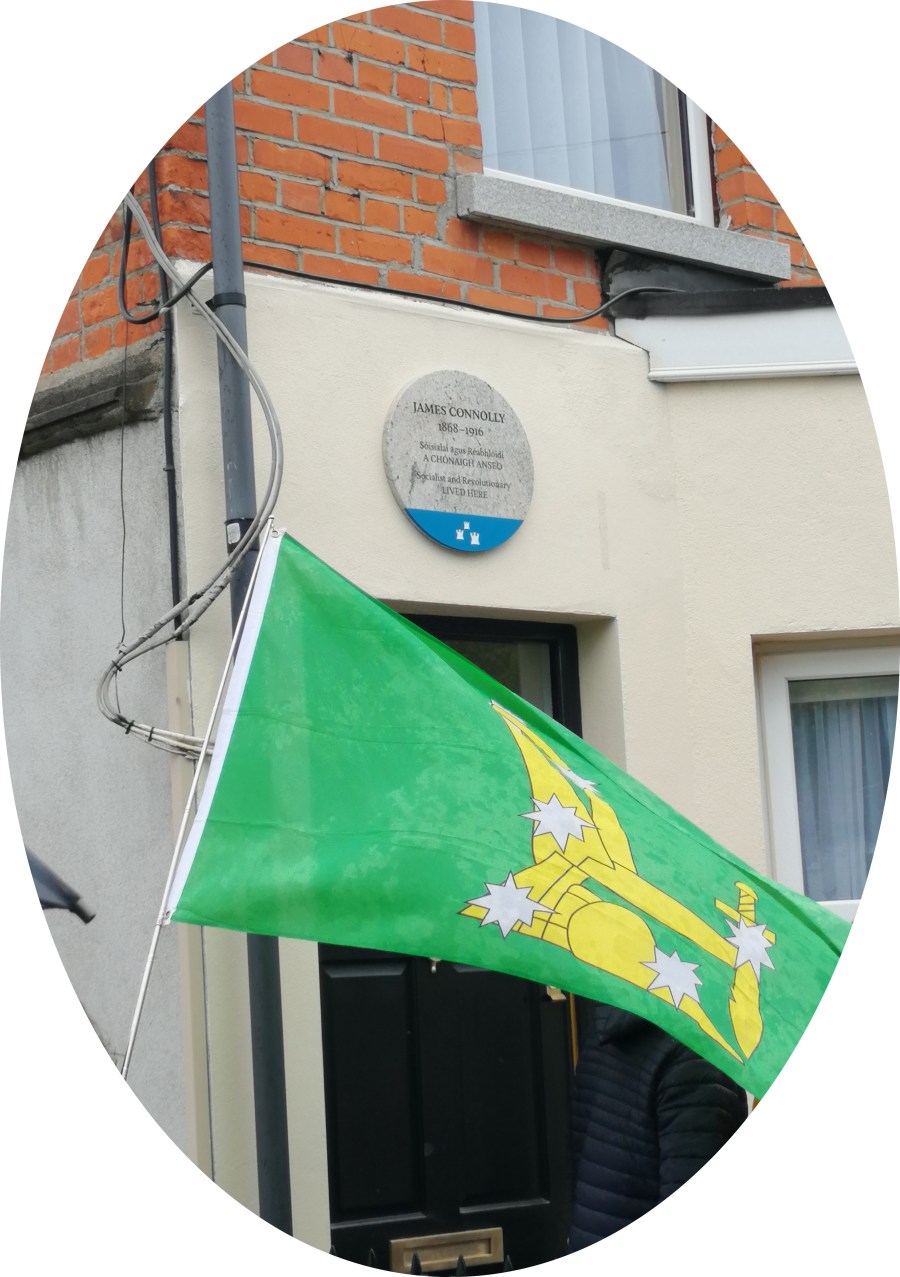
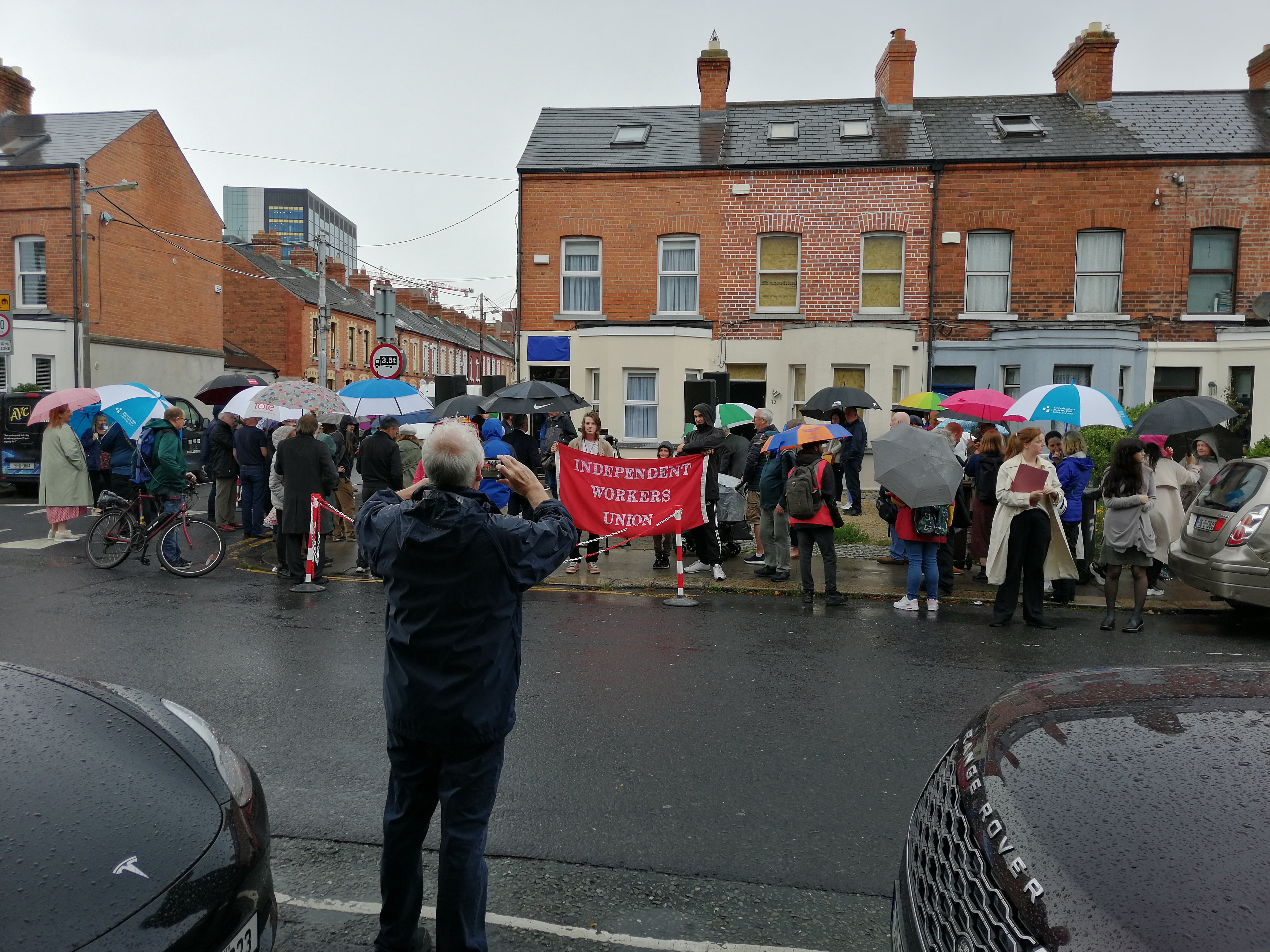
COLLAPSE OF BUILDING KILLING TWO GIRLS COMMEMORATED

Diarmuid Breatnach

(Reading time: 6 mins.)

The collapse of multi-occupation buildings in Dublin’s Fenian Street killed two girls. A day from the anniversary of the tragedy ​​​​sixty years later, local residents in a working-class block of flats organised a moving and informative commemoration.
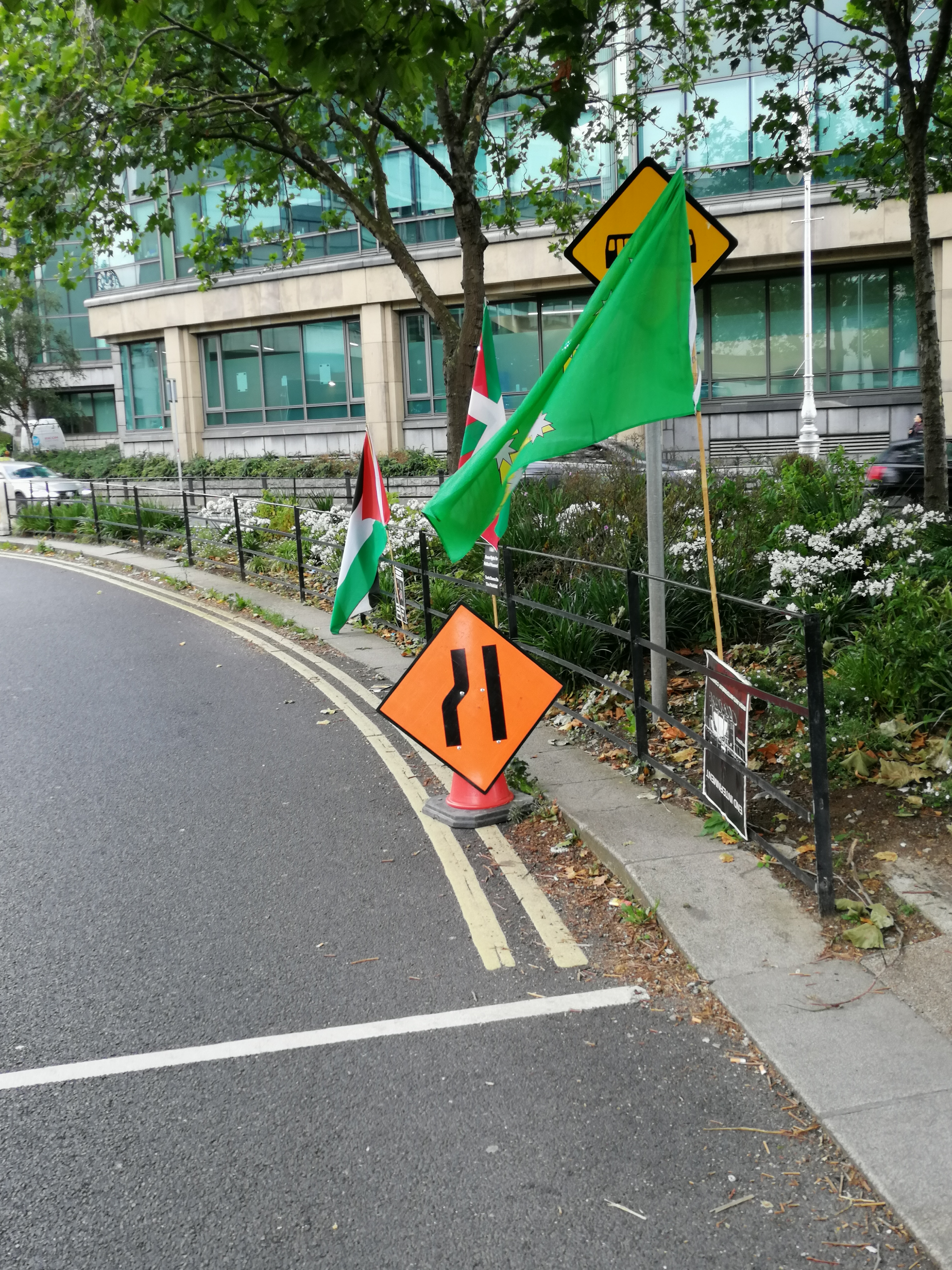
On 12th June 1963, Marion Vardy and Linda Byrne, returning from a shop were killed when the buildings collapsed.

After another two people were killed in a Bolton Street collapse, a galvanised Dublin City Council inspection condemned many other buildings in the city and 155 families were rehoused immediately, though some in Army barracks.

And a number had to camp out for some days in the street. But it was not the first fatal building collapse in Dublin. On 2nd September 1913 (with the epic Lockout struggle only days old), two adjacent buildings had collapsed in Church Street, killing seven people.1

All the buildings in question were privately-owned with working class people paying rent to the owners. Emergency inspections by Dublin City Council inspectors in 1963 resulted in the condemning of 156 Dublin buildings as too dangerous for residence.

For years, other buildings in the Dublin inner city could be seen braced on a side by a massive timber frame.

Organisers’ panel photographed by D.Breatnach

COMMEMORATIVE EVENT

A display of panels describing the tragedy and panels of photos had been erected around the entrance to St.Andrew’s Court block of flats in Fenian Street, where a crowd had gathered for the well-organised commemoration.

Paul McKeown chaired the event speaking eloquently when he could be heard (there was no public address facility) about the actual tragedy and the context of housing provision for working class people in the inner city.

Paul McKeown, who chaired the event, speaking. (Photo: D.Breatnach)

As a Catholic priest had performed the religion’s Last Rites over the bodies of the girls in 1963, McKeown invited a priest to recite some prayers at the event, which he duly did, after which the MC introduced a representative from the Henrietta Street Tenement Experience.2

The Henrietta Street speaker provided interesting snapshots of what past life was like for working people of the inner city in terms of occupation, accommodation and schooling. Some women sewed shirts in a factory while others sold items in street markets, such as Moore Street.3

Speaker from the Henrietta Street Tenement Museum. (Photo: D.Breatnach)

The floors in the poorest homes had no covering and toilets were very few, their use often shared by a great many residents. Although virtually all children would end schooling at the age of 14, the eldest boy often left years earlier to work, as a newsboy or shop messenger, for example.

Labouring on the nearby docks and carting would be the main employment for the men. No doubt emigration, almost a constant in Irish history, played a part too. Rats and mice were endemic in the buildings.

Though alternative and eventually new housing was found for all, it was to Dublin’s outlying areas, breaking up communities and their ways of life, separating them from services used, employment, etc. Many felt isolated and took the long journey to return to the city centre for social contact.

Organisers’ panel photographed by D.Breatnach

ATTACK ON NEARBY REFUGEES

The local flats overlook the location in Sandwith Street that in May had seen an attack by fascists on refugees who had been living in tents because the nearby International Protection Office, a State body, had failed to allocate them accommodation while processing their applications.

A few locals might have joined in and certainly some had attended the crowd but the fascists were imported (as indeed were the refugees and subsequently their antifascist defenders). Some locals at least resented the way they were being portrayed in some social media subsequently.

Refreshments, some of which were provided by Dublin City Council, were served by residents in the inner courtyard after the speeches. (Photo: D.Breatnach)

“We’ve had generations of Travellers4 in the flats and migrant people too,” commented one. “We’re more ethnically diverse than Dalkey,” he added. “Middle class people don’t talk to us, they talk down at us,” was another comment.

They claim that they have been neglected for generations by all the government parties but also by small left-wing parties, also by people who were quick to criticise them and to see them in negative stereotypes. “Nobody talks about class prejudice”, commented McKeown.

The inner city working class population has been moved out of much of the city and this area, which was previously seen as the least valuable real estate in Dublin, as McKeown observes, is now attracting property speculators for gentrification.

Some of the residents and others in attendance in the inner courtyard after the speeches. (Photo: D.Breatnach)

McKeown feels his people are not wanted in the area and he’s probably right. It’s not just that they are not the typical users of the wine bars and coffee bars of gentrified areas but that their current location would take in big rents after construction of hotels and upper-market flats.

Past the site of the attack on the refugees there is a new block of apartments, two bedrooms for 3,000 euro a month, one bedroom for 2,000. An empty bloc across the road which people say was well-maintained, remains empty since Dublin City Council moved the residents out 5 years ago.

The local residents say that they have been promised that a new block of apartments will be built on the latter site and that all the units will go for “social housing”, presumably meaning for affordable rent.5They want that to be true but are not sure whether they should trust the authorities.

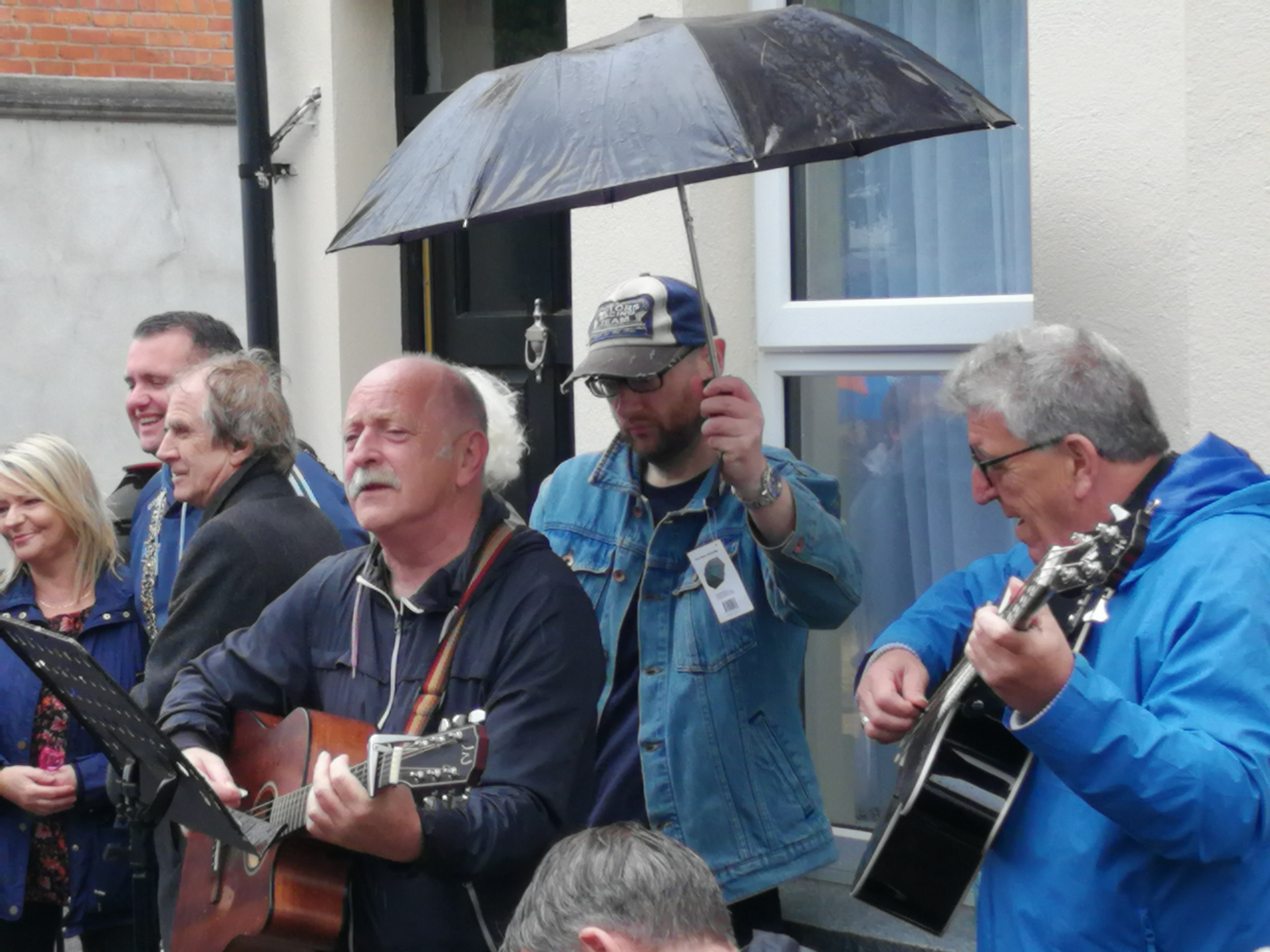
After the speeches of the commemoration people were invited to partake of food and music in the inside square of the flats which contains minimal playground facilities.

Shay Connolly (centre) and friends performing at the event (Photo: D.Breatnach)

The music was provided by a trio including Shay Connolly playing ballads with the food served by local residents, in a relaxed atmosphere. The area at the back of the flats had become a sun-trap and while some soaked it up, I and some others eventually fled the heat.

PAST, PRESENT AND FUTURE

The commemoration of historical events can be of great importance. The event in 1963 forms part not only of an older story but also of the present, which is the lack of decent housing provision for the population of Ireland, in particular for those living in the inner cities.

Some of the residents and others in attendance in the inner courtyard after the speeches. (Photo: D.Breatnach)

Working and lower middle class people were wanted in the inner city to work its industries and its shipping port and to service the houses of higher social classes. As industry and port declined and the higher social classes moved out, the need for their work declined.

When their poor areas are seen instead as development prize areas, there is even less demand for the people who have lived in these areas for generations.

One can see this as the inexorable play of impersonal market forces or as the operation of finance and rentier capitalism in a capitalist economy and more, a Gombeen capitalist state where everything is done for the foreign capitalists and as little as possible for the working classes.

From the latter viewpoint, voting different political parties in to government will make no essential difference; what is needed is a fundamental change in the economy which can only be brought about by an organised, conscious and militant working class seizing their rightful inheritance.

End.

Organisers’ panel photographed by D.Breatnach

FOOTNOTES

1 I recall reading that a number of Dublin City Councillors, including Nationalist ones, were slum landlords.

2 It is open for visits from Wednesdays through to the weekend, I am told.

3 The market and area are subject to a long war between property speculators and conservationists (see smsfd.ie)

4 An Irish indigenous nomadic ethnic group of at least five centuries existence, much discriminated against.

5 “Social housing” is often understood as provision for people unemployed and on state welfare provision. Perhaps “Public housing on affordable rent” is a better description, housing both people working and those on benefits, the rents adjusted to means. This was widely built in the middle of the last century but none has been built in Dublin for decades, all governments insisting that the “private sector” (i.e big landlords, property speculators and vulture funds) can solve the problem while the housing crisis intensifies year after year.

SOURCES & OTHER READING

1963 Collapse: https://www.rte.ie/archives/2023/0531/1386694-fenian-street-homes-collapse/

1913 Collapse: https://www.historyireland.com/the-church-street-disaster-september-1913/

Tenement conditions 1913: https://csu1916.wordpress.com/lockout/dublin-1911/tenements/

2023 DCC failure to enforce standards on landlords: https://www.irishexaminer.com/news/arid-41080388.html

https://www.fm104.ie/news/fm104-news/tathony-house-landlord-rejects-councils-attempt-to-buy-the-property/

BUILDING BRICS

Diarmuid Breatnach

(Reading time: 5 mins.)

For decades the US Dollar has dominated financial transactions across the world – backed not only by the USA’s industrial and agricultural output but by its imperialist domination of many economies and its military power.

But perhaps no longer, for now there is a serious competitor in the field, one with the acronym BRICS, from the first letter of the states that created it (in order of no significance): Brazil, Russia, India, China, South Africa.

Apart from the backing of powerful economies with more applying to join, this currency standard is based on the price of precious and semi-precious metals. The UK’s Sterling (and the Irish state’s, for a while) was based on silver but the Dollar has for many years been backed by … debt.

A currency is based on the assumption that every unit will be payable and backed by a unit (e.g. gold) of the declared value. But if the value unit markers of the US Dollar, in coins, notes, cheques and credit transfers were to be presented to the US Treasury, it could never pay them.1

In fact, it could not even pay a significant percentage of them and has been running a national defaulting on debt currency for many years, this year once again deciding to continue doing so to the tune of  $31.5 trillion.

But is it really “redeemable” if all are presented? (Image sourced: Internet)

The USA has been able to continue doing this to date because so many of the world’s economies have been dominated by US Imperialism or in alliance with it; they fear that calling in the debt would lead to the collapse of the USA system and to their own interlinked financial structures.

BRICS consists of a financial alliance of economies of which their leaders for one reason or another feel in their interests to end the world dominance of the Dollar.

Previously, South Africa’s Foreign Minister Naledi Pandor said that there are 12 countries interested in joining the initiative.

Of the 12, she mentioned seven countries specifically, namely Saudi Arabia, United Arab Emirates, Egypt, Algeria, Argentina, Mexico and Nigeria. In March this year Russia announced its support for Algeria’s bid to join BRICS.

In April the expansion of that list interested in joining to 19 states was announced with formal applications from Algeria, Argentina, Bahrain, Egypt, Indonesia, Iran, Saudi Arabia and United Arab Emirates.

And with expressions of interest from Afghanistan, Bangladesh, Belarus, Kazakhstan, Mexico, Nicaragua, Nigeria, Pakistan, Senegal, Sudan, Syria, Thailand, Tunisia, Turkey, Uruguay, Venezuela and Zimbabwe.

(Image sourced: Internet)

COMMUNICATIONS, COMMON CURRENCY & LENDING BANK

Plans for an optical fibre submarine communications cable between BRIC members – partly motivated to avoid US National Security Agency spying on telecommunications in and out of the USA – have not advanced far since first discussed in 2012 but have not been abandoned.

Likewise, discussions of a common currency have not come to fruition yet either. However that may be more imminent.

As challengers to Western-led international currency, BRICS “in the order of the scale of GDP, now collectively outweigh not only the reigning hegemon, the United States, but the entire G-7 weight class put together” (former White House senior advisor Joseph W. Sullivan).2

The same commentator believes that such a common currency has a much greater chance of stability than the Eurozone, because of the geographic diversity of its members, which enables a broader range of goods and services.

(Image sourced: Internet)

The biggest attraction for applicants to join is probably access to loans from the New Development Bank to members for infrastructure projects, which is the NDB’s main advertised purpose. Heretofore, the IMF and the World Bank have been the main external lenders.

Both the latter institutions have imposed harmful changes on borrowing economies, often driving them further and deeper into debt and into greater dependency on western imperialism. Those lending institutions have also supported corrupt and oppressive regimes.

The NDB has authorised lending up to $34 billion annually, with South Africa the HQ for the African continent with a starting capital of $50 billion ($10 billion from each of the five founders) and so far has 53 projects underway worth around $15 billion total.

Should the NDB prove its ability to issue loans to nationally-desired projects without the penurious and destructive conditions currently attached to IMF and World Bank funding, many, many regimes in the underdeveloped world are likely to apply to BRICS for membership.

And should client regimes currently dependent on western imperialism refuse to jump across to BRICS, they may well face coups from more nationally-ambitious sections of their elites or insurrections from below.

IS BRICS A GOOD OR A BAD THING?

Some anti-imperialists, including some socialists, have been celebrating the creation of BRICS, some even proclaiming it as the financial reflection of a new anti-imperialist order.

Of the five founding economies, only one claims to be socialist. Capitalist economies, we know, tend to develop into imperialist ones, sometimes but not always invading the countries of other economies but always exporting surplus capital there to exploit labour and natural resources.

So some or all of the capitalist economies in BRICS currently are likely to become imperialist also.

That apart, having much or even all of the world’s economies divided between two blocs may give weak economies opportunities they would not otherwise have or at least a choice and perhaps the opportunity to bargain for the conditions of their relationship to world finance.

In other words, a return in many fundamental ways to the division of the world before the collapse of the Soviet Union.

A breakthrough the current financial structure to a new one?

THREAT OF WAR?

But does this bring the threat of world war, arms race, etc, as seemed to be always present between the USA and the USSR?

Possibly but the threat of world war is already very much with us, as US/NATO uses the Ukrainian regime as a proxy in its decades-long threatening encirclement of Russia, and also in its posture (not unrelated) towards Iran and the USA’s world competitor China.

The working class in countries that are part of BRICS will still be exploited and will need to overthrow their respective national ruling classes if they are to end that exploitation and also save the environment from destruction.

Imperialism always means war whether direct or by proxy, small or large, against competing economies or people resisting domination and exploitation. Since the end of WW2 alone the USA has been involved in 201 military interventions in 51 regions.3

In the same period, the UK has carried out 28 military interventions in Asia, Africa, Middle East, Caribbean and Europe4 and France 32 in similar regions.5 Competition for world resources between Germany and the UK and with France led to WW1 and again to WW26.

BRICS has been created anyway, whatever our opinion and is set to grow significantly, causing some big changes in the world as a result. In the short term this development is likely to be to the advantage of the smaller economies and even nations struggling for independence.

End.

FOOTNOTES

  1. https://en.wikipedia.org/wiki/National_debt_of_the_United_States

2. Writing for American magazine Foreign Policy

3. https://tribune.com.pk/story/2345663/us-initiated-81-global-armed-conflicts-from-1945-to-2001

4. https://www.historyguy.com/british_wars_1945present.htm

5. https://www.historyguy.com/french_wars_1945-present.html

6. Other states were of course involved, including the imperial competition for the Pacific and Asia between the USA/ UK and Japan in WW2 with the SE Asian peoples, in particular communist-led Chinese fighting Japanese imperialism and of course in Europe the mighty contribution and sacrifice of the USSR against the fascist powers. But the initiation of both world wars was competition and contention between Germany, France and the UK.

SOURCES

https://en.wikipedia.org/wiki/BRICS

https://en.wikipedia.org/wiki/National_debt_of_the_United_States

https://www.bbc.com/news/world-africa-65784030

https://tribune.com.pk/story/2345663/us-initiated-81-global-armed-conflicts-from-1945-to-2001

https://www.historyguy.com/british_wars_1945present.htm

https://www.historyguy.com/french_wars_1945-present.html

News & Views No.4: IRISH POPULATION STATISTICS MISSING MILLIONS

Diarmuid Breatnach

(Reading time: 2 mins.)

The media announces that “the population of Ireland has reached 5 million … for the first time in 170 years”. Interesting – and a barefaced lie! The population of Ireland passed 5 million some time ago and is actually around 6.5 million now.1

Ireland remained with negative population growth until near the end of the last century – mismanaged for most of the population first by the British occupiers of the whole of the island, then by a combination of the native neo-colonial bourgeoisie and of the settler colonial ruling class.

Filling in a census form from which population statistics can be extracted (Photo sourced: Internet)

For more than a century the population of Ireland stood at around 5 million, static despite a high birth rate. This was mathematically possible only through continual massive emigration – mostly to English-speaking regimes: Britain, USA, Australia, New Zealand and Canada.

But it is true that 170 years ago it was more than 5 million – in fact it was around 8.5 million. And it is worth reflecting on how they were able to produce enough food domestically to feed that entire population while now, with a smaller population, we import as much as 80% from abroad.2

It was the Great Hunger that wiped out much of the earlier population, statistics somewhat hiding the pain and sorrow of millions of Irish in death, disease and emigration — and the great transfer of land for cultivation (and rent) to pasturage, with its dangerous environmental impact.

It provided an opportunity for growth of the Catholic Irish capitalist class, the Gombeens, huckstering money-lenders buying up the lands of afflicted neighbours.

The kind of class that the British could depend on in 1921 to manage the neo-colony and to murder and jail those of national liberation3.

Emigration kept population stats steady and, combined with unemployment, ensured a low internal home market for development. An educated workforce and natural resources could be developed but the Gombeen class opened it all to foreign multinationals rather than develop it themselves.

Even with foreign exploitation of the workforce at home, the education system turned out mostly emigration fodder: the Irish tax-payers funded an education system to provide a literate and numerate English-speaking workforces for capitalist exploitation abroad.

No wonder the Irish political class declined to give the Irish abroad a vote in the Irish state – unlike for decades any other state in the European Market. Yet during the 1930s through to the 1960s, money sent home by Irish migrants accounted for an estimated 30% of the Irish State’s economy.4

The Irish state remains a neo-colony with low taxation and other incentives for foreign companies to take over our few industries5 and local and foreign property speculators to rake in profits out of the despair of homelessness or of struggling to meet rent or mortgage payments.

A neo-colonial market for produce of foreign companies and to plunder not only our labour force, not only our natural resources on land, sea and wind and but even our infrastructures in transport and communication, energy, health service, water supply and even our city sanitation.

TRUNCATED

The announced statistics were truncated, appropriate perhaps for a truncated country, with the history behind those statistics not so much truncated as obliterated.

That is our present and our past but not how the future has to be – we can write our own future but we won’t do it by putting a mark on a ballot paper.

FOOTNOTES

1Worst of all the statistics were quoted from the State’s Central Statistics Office. The reality: https://worldpopulationreview.com/countries/ireland-population

2The highest estimates: https://www.export.gov/apex/article2?id=Ireland-Agricultural-Sectors#:~:text=Ireland%20imports%20around%2080%20percent,from%20its%20premier%20trading%20partner. And most of all, incredibly – potatoes!

3The Irish Civil War or Counterrevolution, 1922-1923.

4I have read this in the past but am unable now to find the reference; however I have posted some references on the figures of remittances from Irish emigrants.

5 For a few examples of foreign takeover: Irish stout, beer and lagers (Guinness, Smithwicks, Harp); Irish whiskey (Paddy, Jameson, Bushmills); cigarettes (Afton); preserved vegetables (Erin); aviation (Aer Lingus); public transport (Transport for Ireland; LUAS); sugar (Irish sugar beet replaced by subsidised cane sugar from the USA); woodlands (Coillte).

SOURCES

Population: https://www.breakingnews.ie/ireland/census-2022-shows-irelands-population-over-five-million-people-1482478.html
https://worldpopulationreview.com/countries/ireland-population

Ireland not feeding itself: https://www.export.gov/apex/article2?id=Ireland-Agricultural-Sectors#:~:text=Ireland%20imports%20around%2080%20percent,from%20its%20premier%20trading%20partner.
https://www.cso.ie/en/releasesandpublications/ep/p-ti/irelandstradeingoods2017/food2017/
https://www.irishtimes.com/business/agribusiness-and-food/why-does-ireland-import-44-000-tonnes-of-british-potatoes-each-year-1.3721341

Remittances from emigrants: https://www.theirishstory.com/2019/02/08/invisible-income-remittances-from-the-diaspora-sustained-ireland-for-over-a-century/#:~:text=to%20emigrate%20themselves.-,The%20money%20that%20emigrants%20sent%20back%20to%20Ireland%20ensured%20the,and%2020th%20century%20Ireland.
https://www.irishtimes.com/life-and-style/abroad/rural-ireland-would-not-have-survived-without-money-being-sent-home-by-emigrants-1.4081919
https://www.thejournal.ie/irish-emigrant-remittances-uk-1405087-Apr2014/

The Irish Ruling Class Celebrates Its Defeat of Democracy and Independence

Diarmuid Breatnach

(Reading time: 3 mins.)

The Irish State recently commemorated the end of the Irish Civil War but what it was really doing was celebrating its victory over the democratic national liberation forces.

The Irish national bourgeoisie, the Gombeen ruling class, armed and supplied by British Imperialism and colonialism, in 1922 launched a war against the forces that had brought the British Occupiers to the negotiation table.

In that short war or counterrevolution, the Irish State formally executed over 80 Irish Republican Volunteers – many more than had the British during the War of Independence 1919-1921. It also shot dead and blew up surrendered Volunteers and kidnapped, tortured and murdered others.

The Irish government of the day put the financial cost of the Civil War at 50 million sterling which today would be near to 3 billion euro.

A curtain of repression settled over Ireland, in the Irish state and in the colony in the Six Counties (in particular from the RIC re-baptised as RUC and the State-armed Loyalists of the B-Specials). Many Republicans were in jail and if not, could not find work and so emigrated.

The political party allegedly representing the Republicans, Fianna Fáil, led by a former leader of the forces attacked by the State, joined the Gombeen system and became in fact the preferred party of the Irish ruling class.

Though the Republican forces recovered and returned to the struggle in the 1930s (with the Communists against the fascist Blackshirts), again in the 1940s and onwards, they never again came close to winning control over the State.

What the Irish State has given us since its inception, even after the Civil War, has been generations of underdevelopment; unemployment and emigration; a huge decline in the Irish-speaking areas; inequality and social repression of women and LGBT people.

The latter was due to Catholic Church domination in every sphere of life, resulting in institutional physical, mental and sexual abuse, along with censorship in printed, audio and visual media and in banning of contraception.

The ruling class of the Irish State, the Gombeens, tolerated the foreign occupation and control of more than one-fifth of the island’s land mass and abandoned the large Catholic minority in the colony to discrimination and pogroms.

It tolerated also institutional and media racism against the Irish diaspora in Britain, the repressive legislation of the Prevention of Terrorism Act and the jailing for long sentences of a score of innocent Irish people in five different cases in the 1970s.

The Irish State tolerated Loyalist/ British Intelligence bombing inside its territory, failed to protect its citizens from terrorist bombing in the 1970s and covered up its complicity, for example with regard to the Dublin and Monaghan Bombings.

In addition, it used a Loyalist bombing to disarm the opposition to repressive legislation, not against Loyalists but against Irish Republicans, sending Republican activists to jail on the unsupported word of a senior police officer.

More recently this Irish State that we inherited has given us a housing crisis while it makes the territory a rich hunting ground for property speculators, bankers, landlords and vulture funds and also sells off/ gives away our natural resources, public transport and other infrastructures.

The selling-off includes our health service which is also in crisis while the private companies chop off parts of it and sell service back to the State at a profit. And a country that was able to feed 8.5 million prior to 1845 (and export foodstuffs) cannot now feed 5 million without huge imports.

They have given us nothing to celebrate but as always, there is a choice. We can bemoan the situation or we can “take back the nation they’ve sold” (Soldiers of Twenty-Two). And that cannot be done through electing any party or parties into the system.

End.

CATALONIA: THE C.U.P DECLARES DEFIANCE AHEAD OF THE MUNICIPAL ELECTIONS

Text from ONA FALCO@ONA_FALCO in Publico.es
(translator D.Breatnach note: CUP = United People’s Candidature)

(Reading time: 4 mins.)

The head of the CUP-Alternativa candidate list for Barcelona, Basha Changue, declared this Saturday that, after “four years out of the City Council”, but “fighting from the streets”, they will return to the assembly on May 28.

They intend to “retake their place” and to “combat the lukewarm policies” developed, in her opinion, by the (regional Catalan) government of Colau.

Once inside, says Changue, anyone who seeks their support (trans. note: e.g for a coalition) will have to be in favour of “a Barcelona committed to national and linguistic rights”, for the “decrease in tourism” and the “radical defence of housing”.

“Gentlemen and Ladies Maragall, Trias, Colau and Collboni, there are no half measures: it is the capital or the neighboring ones”, she declared.

Her voice was heard by dozens of people in Barcelona’s Can Fabra square, in the Sant Andreu district, in the central act of the campaign for the municipal elections on the 28th.

Carles Riera, the Deputy in the Catalan Regional Parliament has indicated that “the only candidature for independence in the Catalan Countries is the CUP” and that “they will return to the Barcelona City Council to combat big capital and the bosses’ agenda”.

“Junts (trans. note: Puigdemont’s party) has renounced the independence movement in its program: it wants to go back to being Convergència i Unió” (Convergence and Unity, right-wing Catalan nationalist party preceding formation of Junts – trans. note) — Carles Riera.

Riera was combative, encouraging the public to mobilize for a “vote to confront the State, the vote that does them the most damage.”

He also accused the parties Junts per Catalunya and ERC, “which are the construction force”, those behind the “macro-projects that carve up the territory” – citing the Winter Olympic Games, the Quart Cinturó, the expansion of the airport and the tourist complex of the Hard Rock.

04/2023 – The leader of the CUP for Barcelona, Basha Changue.

Basha Changue: “Barcelona is designed to be projected as set for Instagram, not for those who live in it.”

She added that they already understood “why Junts has renounced the independence movement in its program: it wants to go back to being Convergència i Unió and wants to put the town halls at the service of big capital in exchange for power.”

28th MARCH AS A “TURNING POINT”

Deputy in Congress Mireia Vehí pointed out that they are “the alternative to the model that replaces the public with the private, that stands up to the Trias of the red carpet and the Collboni of the shop window”.

Referring to the voters who are dissatisfied with the pro-independence parties, she assured that “free Catalan Countries are also made from municipalism” and that “voting for the CUP is a vote of pride and revolt”.

The CUP wants to guarantee its presence in plenary session and reverse the results of most of the polls that leave them out of the assembly.

CUP ELECTORAL CAMPAIGN

The CUP candidate in Barcelona, Basha Changue; Member of Congress Mireia Vehí and Member of Parliament Carles Riera, Barcelona, 05/20/2023— Jordi Pujolar / Marta Vidal / ACN

Changue stated that the CUP are made “invisible” because those in power are “afraid”.

The candidate added that the transformation of Barcelona “will not be possible as long as those in power continue to open the doors of the institutions to fascism and whitewash their speeches in the town halls and in the parliaments”.

Along the same lines, the number two on the list in Barcelona, Jordi Estivill, has emphasised that there is “a strategy” to silence them, but that they will respond “with more determination and a vote of punishment, which will bring miseries to the centre”.

04/25/2023 – The Deputy in Catalan regional Parliament Laia Estrada and the mayor of Sant Boi, Jordi Barbero, in the presentation of the CUP campaign for the municipal elections.

The event in the Can Fabra square, where the number three in Barcelona, Adriana Llena, and the mayor of the CUP in Sant Cugat del Vallès, Marco Simarro, have also appeared, took place simultaneously to another act of the CUP in Palma.

Parliamentary Deputy Eulàlia Reguant made it clear: “We are at a turning point. We are going all out. We are in San Andreu and Palma because the CUP has faith and we are Països Catalans.” (the Catalan Countries’, which includes Valencia, Balearic Islands along with Pau in the French state – trans. note).

BACKGROUND

Translator: The nominally pro-independence Catalan parties in the regional part-autonomous Catalan Parliament include ERC (Republican Left of Catalonia) which is currently in government; Junts per Catalunya (Together for Catalonia), a varied coalition to which Puigdemont belongs, formerly more militant than the ERC); along with the CUP, a more left-wing coalition which has voted for independence motions but declined to join with ERC in coalition or with the previous Junts/ ERC ruling coalition.

After the vote for independence in the 2017 Referendum and Spanish police attack on the voters, it was Puigdemont as previous President of the Parliament that declared Catalan independence but almost immediately suspended it, to great Catalan confusion.

Apparently this was on a promise of support from within the EU which was reneged upon and Puigdemont has since declared his regret for the suspension.

Subsequently the Spanish State tried and jailed a number of ERC and Junts Members of Parliament and officials of the Catalan Government while others, including Puigdemont and a CUP leader, went into exile in the EU and UK.

The Spanish State unsuccessfully tried to extradite them to face charges of “rebellion and fraud”.

Hundreds of Catalans, including municipal officials, elected representatives and protesters face Spanish state charges and possible jail arising from those days of mobilising for independence and in protest at police repression.

End.

Original article: La CUP se proclama “la única candidatura independentista” y se muestra convencida de volver al Ayuntamiento de Barcelona | Público (publico.es)

IRISH STATE PREPARES TO INCREASE REPRESSION

Diarmuid Breatnach

(Reading time: mins.)

While the Gardaí face accusations of treating far-Right violence too lightly, the State plans to increase the maximum sentence for assault on members of the force to 12 years in jail, nearly double the current maximum of seven years.1

Minister for Justice Simon Harris was seeking approval today for the increase as amendments to the Criminal Justice (Miscelaneous Provisions) Bill which has passed all stages in the Irish Parliament and is now going through the Seanad.

Irish Government Minister for Justice, Simon Harris (Photo sourced: Internet)

The increase in maximum sentence lumps emergency services such as paramedics and firefighters with State repressive forces of police, prison officers and armed forces.

This is a disguising measure since forces of repression are not the same as those of emergency services, even if in the event of a disaster all may be employed together. The State expects increased resistance from working people and therefore feels a need for increased repression.

According to some media reports there have been complaints that the Gardaí have been failing to respond adequately to crimes committed by fascists and other far-Rightists, including threatening behaviour and arson.2

Garda Commissioner Drew Harris, former British colonial police (PSNI) Assistant Commissioner3 responded that getting tough with the far-Right would be playing into their hands and that the Garda response is measured appropriately.

One must wonder how permitting threats of violence, acts of assault and arson against refugees and their supporters can be considered appropriately measured from any viewpoint other than that of the perpetrators.

Much harder Garda responses have been seen through the years to striking workers, water-meter and housing protesters, Irish Republican events and – yes – antifascist counter-protests against fascists and other far-Rightists.

Not giving the fascists the confrontation they’re allegedly looking for might disappoint some of them but on the other hand many will be encouraged and get to feel that they can do more or less what they like without repercussions from the Gardaí.

According to Saturday’s Irish Times, some of the criticism of Garda tolerance of far-Right crimes comes from confidential sources within the force itself.

The discourse that policing these protests is ‘complex’ is a distraction from the fact that vulnerable people who are harming no-one are entitled to live without fear of violence to their person or to their meagre belongings, about which there is nothing ‘complex’ at all.

Having to live on the street due to the failings of the State is bad enough without being subjected to additional threats.

On a number of occasions Gardaí have attacked and threatened antifascists confronting the far-Right, revealing where the general sympathies of the State lie, despite condemnations of the far-Right by Government Ministers, politicians and the Garda Commissioner.

Garda not going lightly here but then it’s directed at ANTI-fascists counter-protesting Irish Yellow Vests on Custom House Quay, after they were attacked by fascists armed with metal and wooden clubs, many disguised as flags (note the captured Tricolour) 22 August 2020.(Photo: Rebel Breeze)
Garda Commissioner Drew Harris (Photo sourced: Internet)

Historically, capitalism has turned to fascism to suppress the resistance of the working class to being made to pay for crises in the system. And fascists have often enough been found within the police force themselves.

Indeed, in Ireland it was the ex-Commissioner of the police, Eoin O’Duffy, who led the fascist Blueshirts, while the religous sectarian, racist and murderous nature of the colonial police in the Six Counties is a long established fact.

The police are the first physical force agency of the State and the armed forces its second. Increasing the penalty for assaults on these means the State is anticipating an increase of assault charges in days to come, quite probably as people defend themselves from police attack.

In fact, it is well known that if the police assault people, they regularly charge their victims with assault, so that the police can explain the injuries of their victims as inflicted in ‘self-defence’ or in measures taken against a person ‘resisting arrest’.

End.

FOOTNOTES

1Sentences for assaults on gardaí to rise, Irish Times, 23 May 2023.

2https://www.irishtimes.com/crime-law/2023/05/20/why-are-gardai-so-passive-when-policing-the-far-right/

3Far right ‘not growing’ says Garda Commissioner, Conor Lally, Irish Times 23 May 2023.

SOURCES

https://www.irishtimes.com/politics/2023/05/23/maximum-sentence-for-assaulting-gardai-to-increase-under-plans-due-before-cabinet/#:~:text=The%20maximum%20sentence%20for%20assaulting,Minister%20for%20Justice%20Simon%20Harris. Irish Times, 23 May 2023.

https://www.irishtimes.com/crime-law/2023/05/20/why-are-gardai-so-passive-when-policing-the-far-right/?, Conor Lally, Irish Times, 20 May 2023.

https://www.irishtimes.com/ireland/dublin/2023/05/23/far-right-not-growing-says-garda-commissioner-as-number-of-protests-halves/

No Irish Need Apply to British Communist Party History

I have been sent this article from The Morning Star, newspaper of the Communist Party of Great Britain, a reprint from The People’s World, like-minded newspaper from the USA.

The article is about the removal by right-wingers in the USA of a marker commemorating worker organiser, women’s suffrage campaigner, anti-racist and anti-fascist Elizabeth Gurley Flynn in her home town of Concord, Massachusetts, USA.

https://www.morningstaronline.co.uk/article/f/60-years-after-death-elizabeth-gurley-flynn-still-scares-right

An omission in the article, which the Morning Star chose not to correct, is the Irish background of the article’s subject, class fighter Elizabeth Gurley Flynn. Is this important? It certainly was to the subject herself who, in her biography, emphasised her Irish background.

Cover of her biography (Source photo: Internet)

She wrote of the importance to her of claiming both Irish family names in her ancestry and always used them both: Gurley and Flynn. But in particular for the CPGB, operating in a state that is oppressing Ireland, it should be of importance how Irish people are represented.

Especially in a culture with a deep and long streak of anti-Irish racism.

Elizabeth Gurley Flynn speaking at a mass meeting in the USA (Source photo: Internet)

The CPGB never supported the armed struggle by Irish people against its masters nor stood up for the defence of the Irish diaspora in Britain, subject to racism in the media, to police persecution and to judicial and legal racism in the 1970s, ’80s and ’90s.

This is despite the enormous contribution of the Irish diaspora to the trade union and socialist movement in Britain in shop stewards, activists and leaders.

International Workers of the World (‘Wobblies) organisers: Elizabeth Gurley Flynn (centre) next to Big Bill Haywood (right). (Source photo: Internet)

With Bronterre O’Brien and Fergus O’Connor, the Irish diaspora gave the British working class two leaders of the first mass movement of workers in Britain, the Chartists. The anthem of the class, The Red Flag, was composed by Jim Connell from Co. Meath (though they used the wrong air).

And the classic novel of the class, The Ragged-Trousered Philanthropists, was penned by Robert Tressel, pen-name of Robert Noonan, born and reared in Dublin.

The CPGB in fact has a long association with British colonialism and its very title is an indication of that.

End.

Left: Famous photo of Gurley Flynn as a public speaker. Right: The marker in her hometown now removed by right-wingers there. (Photo sourced: Internet)

REFERENCE:

https://www.morningstaronline.co.uk/article/f/60-years-after-death-elizabeth-gurley-flynn-still-scares-right

The Rebel Girl: An Autobiography, My First Life (1906-1926). New York: International Publishers, 1973. 

ANTI-FASCISM, HOUSING AND REFUGEES

Diarmuid Breatnach

(Reading time: 5 mins.)

Refugees living in tents on streets in Dublin were targeted last week by fascists and antifascists have confronted the latter in defence. Shelters of refugees have been torched.

There’s been some anti-immigrant discourse in Ireland, especially promoted by fascists and racists for a few years but it really took off during the Government’s handling of the Ukrainian refugee influx.

The Irish Government for pro-NATO reasons prioritised these over other refugees, also placing the Ukrainians in empty buildings in working class areas already low on social infrastructure and without consultation with the local community, some of whom reacted angrily.

The Irish Government handed the fascists and other racists a great opportunity and they grasped it.

After that issue had died down a bit, the fascists were looking for something to take its place and found it again in other refugees, this time those who were NOT being housed by the Government and were instead living in tents on streets around the IPO office in Mount Street.

Refugee tents near the International Protection Office (left of photo) in Dublin recently (credit Sasko LazarovRollingNews.ie)

The International Protection Office was supposed to organise to provide for the basic needs of refugees – in fact are legally obliged to – while their cases were being processed and had been failing to do so, hence the people it had failed living in tents around the area.

FASCISTS GO TO ATTACK THE REFUGEES

The refugees got some sympathetic coverage in articles in the Cork Examiner and Irish Times1. Perhaps it was this that stirred up well-known fascist Phillip Dwyer (known hater of women, migrants, LGBT and Muslims) to go and attack those people living on the street.

On Thursday 11th Dwyer turned up with his “security” people, i.e fascist goons, thinking to run the refugees out of there and perhaps do worse. But he was met with resistance including some people helping the refugees, two of the goons got hurt and they backed off.

According to a statement on Revolutionary Housing Action’s Twitter account, one of the defenders was ambushed when he went to collect his bike and while fighting them off, they threw a bike at him. Dwyer and his fascist hounds promised to be back.

Streetlink homeless service stated that on Friday, they were threatened and their outreach van pummelled while they packed refugee belongings and then boxed in so they had to suspend their outreach service for that evening, handing on outreach contacts to other services.

On Friday 12th Dwyer was back with a larger mob but met by a broad group of antifascists, including RHL, AIA, PBP, CATU, CYM, DCAR and independent antifascist activists2 (AIA statement onTwitter, Saturday 13 May). Dublin Republicans Against Fascism were there too.

Section of antifascists in the foreground on Friday, police in the middle distance and fascists and the curious beyond. (Photo: Rebel Breeze)

The violence against persons was now turned on the pitiful shelters and belongings which, on Friday night were set on fire.

On Saturday 13th, the fascist Irish Freedom Party held their rally on Custom House Quay against hate speech legislation being considered by the Government. From there they marched, not against the Government but against the homeless refugees.

According to local sources, the fascists distributed leaflets asking people to be electoral candidates and promising to help the inexperienced.

What was the connection between a protest allegedly about ‘free speech’ and a march on homeless refugees? Absolutely none, except the standard fascist agenda of targeting minorities to divide the working people and scream about free speech while using violence against their targets.

But in a cunning move, the NP who have never helped any area, were there afterwards cleaning up the area and placing flowerpots there.

Meanwhile, on Thursday night, the Revolutionary Housing League stated that they had opened one of the many empty buildings in Dublin to house the targeted refugees. The RHL have been opening up empty buildings for over a year now and encouraging others to do so.

Subsequently, Leo Varadkar, of the very Government that set up the conditions for this to happen, declared how unacceptable the attack on the refugees was. And following strong criticism from the Refugee Council, the State suddenly found it could house most of the refugees.

If true, hopefully good for those refugees but the fascists will now bleat about how “foreigners are getting treated better than the Irish” to the gullible and, also among themselves, be commenting that violence brings results.

The fascists have been stirring up local community fears with allegations that some of the refugees are paedophiles on the run from justice in their own countries, for which there is not a shred of evidence.

Ironically, while they attacked LGBT people as “paedophiles” some of the far-right have for decades been defending the Catholic Church hierarchy in Ireland from criticism and accusations of abuse of children and women in their institutions.

Lies spill from fascist lips as a matter of course: “immigrants are rapists and paedophiles, LGBT people are paedophiles, migrants are rapists, migrants are being treated better than the natives, the whites are being replaced by people of colour, muslims are taking over”, etc, etc.

THE GARDAÍ AND THE FASCISTS

The Gardaí, including the Public Order Unit, stood between the antifascists and the fascist-led mob on Friday, then kettled the antifascists for awhile, then followed the antifascist contingent up Pearse Street with fascists tailing along. When the antifascists dispersed, some of them were attacked.

The Irish Times on Monday 15th reported on a complaint from the Garda Representative Association that they are unable to police these events, don’t know about refugees, need training, etc.3

What is there to know? Refugees are as entitled as anyone else to be kept free from violence and the Gardaí could have arrested a number of fascists, had they wanted to, under the Public Order Act, which they regularly use against left-wing protests.

In September 2020, when unarmed antifascists went to counter-protest a Yellow Vest4 rally against masking5 and were attacked by masked (!) thugs recruited by the National Party with wooden and metal clubs, the POU understood enough to draw batons and attack – the antifascists!

Scene on Butt Bridge in September 2020 after armed fascists had attacked the unarmed counter-protesters at Custom House Quay and then the Public Order Unit had attacked them also, pushing them back off the Quay with raised batons, threatening to strike. (Photo: Dublin Republicans Against Fascism)

The following week, the Gardaí allowed NP fascists in Kildare Street to jostle and threaten a handful of LGBT campaigners and to club one of them to the ground. The Gardaí then ordered the woman, blood streaming from her head, to leave.

On both occasions the Garda press office issued statements saying that there had been no serious incidents. But the videos of the woman being assaulted and then ordered away went wide on social media and within a few hours, the Gardaí had changed their story.

In September 2020, longtime fascist and member of the National Party Michael Quinn (left, carrying wooden club disguised as Irish Tricolour flag) attacked veteran LGBT campaigner Izzy Kamikaze while she observed fascists in Kildare Street. The Gardaí forced Izzy to leave and later told the media nothing of any note had occurred, later having to change their press statement after the circulation of video footage. Quinn was later convicted of the attack and jailed for two years. (Images sourced: Internet).

However, it was ‘up to the victim’ whether she made a complaint (for an armed attack in a public place seen on video?)! She did, and eventually the particular assailant, Michael Quinn of the NP, was jailed for two years.6 But for Gardaí collusion with fascists and lying to the press? Nothing.

WHAT NOW?

Given the wars instigated by US/NATO and EU around the world and deprivation by foreign exploitation of people’s natural resources, refugees and other migrants will continue coming to Europe, including Ireland.

The fascists will continue to target minorities and wave their fake patriotism and social concern while they recruit for their parties, diverting attention from the housing profiteers and the facilitating ruling class while they strive to drive wedges into the working people.

The local working class residents, for example in the block of flats overseeing the site of the conflict, will gain nothing except an undeserved bad reputation for what happened in their area and in which perhaps a few teenagers were opportunistically involved.

Already the recently-completed block of apartments just down the road from them is advertising one-bed apartments for 2,000 euro a month and two-beds for 3,000. None of the local working people of course will be renting those.

The cause of the housing crisis in Dublin will continue: property speculators, vulture funds and multi-unit landlords will continue to rake in profits because the Government won’t build housing for affordable rent in case it should compete with them.

Unless, that is, a real hard struggle including militant occupations and defiance of court orders is taken to them forcing a change, be it reform or revolution. This is a task for the Left which of course can never be carried out by fascists.

But hopefully many anti-fascists have learned or had reaffirmed the need for unity in a broad front against fascism and that confrontation and preparedness for physical defence against fascists is needed, while also discussing the most appropriate tactics for different situations.

End.

FOOTNOTES

1https://www.irishtimes.com/ireland/social-affairs/2023/05/04/homeless-asylum-seekers-its-hard-sleeping-outside-its-cold-its-wet-its-no-life/

2Including anarchists.

3https://www.irishtimes.com/ireland/social-affairs/2023/05/15/gardai-have-sufficient-resources-to-stop-violence-against-refugees-harris-says/

4The Irish Yellow Vests were a right-wing populist organisation, led by Ben Gilroy and Glen Miller, fascists and islamophobes.

5The rally was on Custom House Quay, scene of the NP’s rally last Saturday.

6Man who used wooden post to strike a woman during an anti-lockdown rally is jailed (thejournal.ie

SOURCES

https://www.irishtimes.com/ireland/social-affairs/2023/05/04/homeless-asylum-seekers-its-hard-sleeping-outside-its-cold-its-wet-its-no-life/

https://www.irishtimes.com/ireland/social-affairs/2023/05/15/gardai-have-sufficient-resources-to-stop-violence-against-refugees-harris-says/

Man who used wooden post to strike a woman during an anti-lockdown rally is jailed (thejournal.ie)

FASCIST-LED MOB THREATENS MIGRANT ENCAMPMENT IN CITY CENTRE

Clive Sulish

(Reading time: mins.)

On Thursday evening fascist Phillip Dwyer and a number of other known fascists led a mob in threatening migrants encamped in the Mount Street/ Fenian Street/ Sandwith Street area on the north reaches of Dublin City Centre.

Dwyer, formerly of the fascist National Party and some of his cohorts had been there the previous night too but in smaller numbers, when he was met with opposition.

Migrants have for some time been camped out in that area near the International Protection Office of the Irish State which has a brief to help refugees. Those living in the tents say that little is being done in reality to help refugees and their encampment is an illustration of this.

On Thursday night Phillip Dwyer had brought a mob to at least intimidate the refugees but was faced off by antifascists. He had declared his intention to return.

On Friday in Sandwith Street, a number of people in ordinary clothes could be seen in confrontation with another group, with yellow-jacketed Gardaí and dark blue Public Order Unit between them. An Irish Tricolour and green Starry Plough waved on one side and a lone tricolour on the other.

The view some time after the arrival of fascists and supporting mob. The antifascists are where the green Starry Plough flag may be seen, in a short laneway and in a group in front of the lane’s mouth.
(Photo: Rebel Breeze)

Local people and some passers-by watched.

People who received a callout for antifascist support but arrived late experienced difficulty in getting into the antifascist sector, which was where the Tricolour and Starry Plough could be seen, due to the police line between there and the confronting mob.

It seemed that neither antifascists nor fascists would be permitted to get in this way. (Photo: Rebel Breeze)

For many antifascists it was a novel experience to be facing the backs of the Public Order Unit, normally drawn out against them, often with batons drawn (none of that seen on this occasion).

The dominant chanting was from the antifascist side, mostly of “Say it Loud and Say it Clear: Refugees are welcome here”, interspersed at times with “Homes for Need, not for Greed!” and another.

Section of antifascists before moving, Gardaí further away and hostile mob further still. (Photo: Rebel Breeze)

Though these slogans outline socialist positions they don’t directly address what the fascists were doing and some slogans need to be developed for that, for example pointing out that the fascists are dividing working people and assisting capitalism.

It was difficult to make out what the mob were shouting but individuals at times threw accusations of paedophilia at the migrants and antifascists. This is a common lie by fascists in Ireland and there has not been a single case among this refugee group to justify the accusation.

Section of antifascists before moving, Gardaí further away and hostile mob further still. (Photo: Rebel Breeze)
Section of antifascists before moving, viewed from short laneway mouth, Gardaí further away and hostile mob further still. The new block of expensive apartments is in the left background. (Photo: Rebel Breeze)

The refugees camped around there are actually causing nobody any harm, except perhaps embarrassment for the IPO and the Irish State. Journalists for the Cork Examiner and the Irish Times have both written sympathetic pieces about them recently (probably to the ire of Dwyer).

The area includes working-class flats complexes and higher-market-end housing, including a newly-completed block nearby where the rents are reportedly 2,000 euro a month for one-bedroom-units and 3,000 per month for two bedrooms.

And it is said that some low-rent units were promised but never delivered.

Of course, the Fascists and their followers don’t mobilise against that problem, caused by failure of the State to supply quality affordable housing units lest they compete with the property speculators, big landlords and financiers, although that would make general housing sense.

Fascists are an arm of the capitalist class, not its enemy and for their followers, it’s infinitely easier to pick on vulnerable refugees and other migrants than the rich and their State.

Antifascists kettled by Gardaí after agreement to move. (Photo: Rebel Breeze)

Some investigation carried out locally ascertained that although some local people were being fooled by the far-Right discourse, others blamed the Government. Some also said that a lot of the anti-refugee crowd were just in it for the fight and were not even locals.

However one should not underestimate the potential for fascists to mobilise disadvantaged people to split the working people as fascism and racism has done in the past.

Rear section of antifascists after kettling by Gardaí. (Photo: Rebel Breeze)

A light moment occurred when one of the mob threw a plastic water bottle at the antifascists. As the missile arced towards them, a hand rose out of the crowd and caught the bottle in the air, followed by applause, congratulatory for the catcher and derisory at the thrower.

Since the refugees had been moved earlier there seemed little reason for the anti-fascists to remain except to shout slogans at the opposition and perhaps to deny them a feeling of victory. However, they would have to leave at some point.

A couple of individuals who seemed to be in some kind of leadership role began to discuss with the police their desire for everyone to leave together. At last, to the relief of many, the crowd began to move in the direction of Pearse Street. But not for long, as they were stopped by some POU.

The antifascists were now strung out along the pavement and much more vulnerable than they had been in their previous position in the small lane entrance. Police vans moved up, ostensibly for protection but the actual result was the kettling of the antifascists for a while.

Dissatisfaction was expressed among the crowd – a lot!

The Gardaí might present it as a protective measure but in effect it was part of the kettling of the antifascists for a period after agreement to leave. (Photo: Rebel Breeze)

Eventually they began to move again, and a local elderly man wished the antifascists well and “safe home”. One of the antifascists was heard to reply: “Thank you; go raibh maith agat!”

The route was through a narrow passage under a railway bridge and on to Pearse Street, heading for Tara Street but strung out and not at all in good defensive form, with members of the mob regularly screaming hatred at them from a metre or two away.

The temptation to knock out one individual nearby who was spitting at antifascists was strong but apart from the danger of arrest, that might have sparked a general assault with the whole group exposed and badly strung out along the pavement.

It is clear that the fascist and far-right threat which was so much in evidence during the Covid Lockdown and which received a couple of important setbacks since has not disappeared and the National Party has planned a rally for Custom House Quay today.

Responses to fascist threats will need to be more widespread and probably better organised in future.

Subsequently the revolutionary Housing League issued a brief statement that they had opened up an empty building in Dublin to accommodate the displaced (again!) refugees. It was learned today that some antifascists were assaulted as their group dispersed.

Misguided people from disadvantaged working class communities the followers of the mob may be but there is no excuse for harassing and threatening vulnerable people who are living rough on the street.

End.

Book Review: I’ll Burn That Bridge When I Come to It.  Norman X. Finkelstein.

Norman X. Finkelstein. Substation Media 2023

Gearóid Ó Loingsigh 26 April 2023

(Reading time: 9 mins.)

Norman Finkelstein has published a new book on cancel culture. It comes from a man who as he points out became a high-profile victim of one of the more modern iterations of cancel culture, that of Zionism.

The latter was unashamedly right wing and did not dress itself up in liberal or even bastardised Marxist tropes, peddled by people who should know better. 

He is perhaps, one of those with a vantage point on the issue, who deserves to be listened to.

He opens the book with an epigraph from Bertrand Russell: “I feel a real and solid pleasure when anybody points out a fallacy in any of my views, because I care much less about my opinions than about their being true.”

A statement that should be basis of all discussion is now frowned upon in a world of unassailable truths, wicked witches who should be burned at the stake, dogmas that once enunciated can never be challenged.

And whether the statement is true, matters not as it is more important how many semi-literate university graduates are offended by it that counts.  Of his own cancellation and the hypocrisy of some of those who signed the Harper’s Letter decrying cancellation he is not bothered.

This is because he contends that “Hypocrisy was rife, for sure.  But the irrefragable fact remains that “woke” politics are intellectually vacuous and politically pernicious.”  He forewarns us that the book is laced with vitriol… because so much of “woke” culture deserves contempt.”

But that “a large amount of space is devoted to dissecting this nonsense… because it’s not immediately obvious why it’s nonsense.”  This Foreword alone entices the reader to delve deeper into its pages and the plea from Tariq Ali for him not to throw a tantrum makes it all the better.

Cancel culture as Finkelstein points out is not new. 

He gives a short list of some of his heroes who were cancelled at one point or another, Pete Seeger, Paul Robeson, Lee Hayes and even Malcolm X and Martin Luther King and even Chomsky were cancelled and reviled in their day.

Pete Seeger, veteran folk singer, folk song collector and political activist, was among victims of cancel culture in his day. (Photo sourced: Internet)

Yes and by the same newspapers, journals and political quarters that are now to the fore in cancelling one and all and in some cases, those involved in the cancelling now decry the cancel culture that affects them.

He divides the book into two parts, one dealing with woke politics and the other with academic freedom, though they are not separate and there is some overlap, even in the book. 

In the first part he looks at some of the figures of woke politics, those who make the case for identity politics in particular.  Some of the people he looks at, such as Ta-Nehisi Coates and Ibram X Kendi, are well known in the US but not so much outside of it. 

He eviscerates them rather well describing Kendi’s writing as being “as supple as a calcified femur and as subtle as an oversized mallet”.  Obama is of course, well known, though his politics are modern in how they are sold. 

Obama is all about style over substance, partly because the substance is not new, he represented no great change in US society, though that is not the image he sought to portray.  His message was vacuous, Yes we can, and Finkelstein asks the question, can what?

And gives the very direct and truthful answer “Yes we can, elect me”.  Obama is shredded in the book, his famed oratory derided for what it is, speeches that were written by an all-white team of writers, despite Obama’s identitarian claims.

A parsing of Obama’s public addresses reveals a relentless concatenation of the most vapid, sententious, shoeworn, fatuous, hollow, saccharine clichés—a cornucopia of the commonplace—without a single clever phrase, metaphor or aperçu to redeem or relieve them, interlarded with oleaginous homilies to humility before God.

That does not mean that his speeches and politics are devoid of consequences.  Obama epitomises the reality of identity politics.  It is another con job.  For all his blackness Obama did very little for blacks in terms of socio-economic advancement. 

Not even in terms of a relatively simple issue, police violence against blacks.  In one of the first rows in his presidency on the issue, he backed down and instead of taking action invited the policeman and his victim for a beer. 

Identity politics is waived about, not to solve any problems but to divide.  Finkelstein asks whether it advances causes or provokes their retreat.

The objective of politics, Mao Tse-Tung famously exhorted, was to “unite the many to defeat the few.”  Whereas, identity politics divides the many so as to, designedly or not, enable the few. 

It conjures a hierarchy of oppressions, in which each group vies with the others for the position of most oppressed— Kimberlé Crenshaw says Black women are most oppressed, Angela Davis says it’s transgender people, Ibram X. Kendi says it’s poor transgender Black women. 

The victors in this inverted Oppression Sweepstakes, where you win by being the biggest loser, get to leap to the head of the queue as most worthy of preferential treatment, while, simultaneously, fomenting new resentments among those shoved further and further behind…

This, in effect, performance politics has spawned a disgusting den of thieves who brand themselves with radical-sounding hashtags, churn out radical-sounding tweets, and insinuate themselves into positions of prominence, as they rake in corporate donations and cash corporate paychecks.

Theyhang out at the watering holes of the rich and famous, and thence can be safely relied upon not to bite the hand that feeds them.  In a word, identity politics is a business—in the case of Black Lives Matter “leaders,” a most lucrative and dirty business.

Cancel culture is about silencing voices other than those sticking their snout in the trough and their grubby hands in the greasy till, a point he is right about, not just in the US but around the world. 

Finkelstein found himself cancelled, though not silenced, as he points out, because his views go beyond the grimy quest for self-aggrandisement and enrichment.  Identity politics is utterly reactionary. 

He contrasts the fumbling for pennies and the endless categories of oppressions with an historical figure that our perpetually offended money grabbers in search of the latest shakedown could never match: Rosa Luxemburg.

My mind drifts back further still to Rosa Luxemburq, this exotic creation of a lost epoch: Polish, Jewish, bourgeois, handicapped, female—

Rosa didn’t wallow in or capitalize on her “intersectionality” but, on the contrary, triumphed over it as she became the brilliant, impassioned (and then martyred) revolutionary leader of the German workinq class;

A class which—be it noted as a robust class rejoinder to claustrophobic identity politics —fervently embraced this Polish-Jewish-bourgeois handicapped-female as one of their own.

And that is exactly the point. Luxemburg is a real hero, many of the heroes of the woke do not measure up to their own standards, not even Frederick Douglass, who had a very poor opinion of native Americans, a fact overlooked by modern day identitarians. 

Though many don’t have a positive opinion of native American themselves.  Douglass however, is despite this a towering admirable figure in history, not one that should be cancelled, a hobby now of every spoilt ignorant brat that mammy and daddy got into an overrated expensive university. 

And though it is only a matter of time before some hippy in Berlin decides to reinvent Luxemburg as intersectional, she was not and had no time for the woke equivalents of the day.

Academic freedom is the other area of concern for Finkelstein, conformity, banal ideas and salivating over money is not limited to our woke warriors in the press, NGOs and politics but in academia.  It is not new, but is more pronounced now than before. 

Bertrand Russell summed it up nicely and Finkelstein agrees that “As a rule, by the time a man becomes a professor, he has been tamed, and has learnt the advantages of submission” the advantage being measured now in euros, dollars, yen and shekels, though many would deny this.

Again  as he points out “For self-deception, you can hardly beat academics,”.  There are of course exceptions, but in the current atmosphere, the younger new academics are bowed and beaten by those who went before them.

Given his own personal experience, he is obviously in favour of academic freedom which he describes as not just the freedom to teach but to enquire and travel the road less travelled. 

He points out that in the US the idea went through various stages, freedom from churches, then from corporations and later the state (MacCarthy).  Nowadays, all three encroach upon it, sometimes in unison and to the same end. 

He goes again into some detail on the issue and chooses the thorny ground of Holocaust denial. 

He is Jewish, so he is clearly not advocating that the Holocaust did not happen, but rather how it is dealt with on campus and links it up to other issues, giving examples when he himself has been uncomfortable teaching and the examples he relies on. 

He makes an argument for challenging ideas.  This section, like the Obama part is overly long and could also have done with a bit of editing.  But he clearly comes out against censorship and new morality police that abound everywhere.

It’s easier to fight against codified speech restrictions than against “enlightened” campus opinion, which, in the name of its “special duty,” insinuates itself in campus life and throttles free speech with its asphyxiating pieties.

The situation now is that debate is being stifled on a whole range of issues, beyond the obvious ones and the high profile debates on Men’s Rights i.e. the right to id your way into women’s spaces. Due to his own experience, he does seem to think that it is more the case when an academic goes off campus that the trouble arises. 

But actually, the baying mob throttling free speech are doing so on campus now to people who have never ventured off it, or at least have never been given much opportunity to do so.  He cites a very interesting case, that of Bertrand Russell when he was appointed to City University. 

His morals, his sex life and general outlook were brandished about as reasons for not hiring him.  Russell defended himself, saying they were irrelevant, he was appointed as a lecturer in “modern concepts of logic,” “foundations of mathematics,” and “relations of pure to applied science.” 

In the modern cancel culture that wouldn’t stand.  People are sacked precisely because of their private lives or their opinions on matters wholly unrelated to the area in which they teach. 

It didn’t stand back then either, Russell lost the case precisely because he argued in favour of homosexuality and premarital cohabitation, amongst other things.  Our woke liberals on campus, those who hounded Kathleen Stock out of her job are as reactionary as the judge in the case. 

He goes on to look at other cases before finishing off with the details of his own case and his unemployment and unemployability in academia.

The book is interesting, though far too long with too much detail about some cases and aspects which makes it difficult to see the wood from the trees at times.  But it does offer arguments on issues that are current with reference to historical precedents and also to philosophy. 

It is worth reading, as he is a rather high-profile victim of cancel culture.  His book the Holocaust Industry was thrashed by the New York Times, which had positively reviewed the Bell Curve and even gave a better review of Mein Kampf than Finkelstein’s book. 

They probably keep quiet about that aspect.

Cancel culture, identitarianism, intersectionalism are amongst the biggest intellectual challenges to the left. 

They deny class and reduce politics to the acceptance of pre-ordained dogmas, that are espoused by the US Democratic Party, Facebook, Google and many major multinationals i.e. from the right of the political spectrum. 

They are the wolf in sheep’s clothing, though the sheep is clearly showing the fangs for anyone who wants to see.  History is unlikely to be kind to them. 

Whilst Finkelstein has some illusions of his own in some liberals like Bernie Sanders, his point about freedom of speech, the search for the truth, discussion and debate are his main point in the book. 

A point that cannot be overemphasised in its importance, nor of the need to persevere through the current darkness.  As Finkelstein says.

Many of the heroes of my youth had been blacklisted, but also had, despite all, stayed true to their youthful convictions; not dogmatically, as almost all of them had left the Communist Party, but still unreconciled to the capitalist system, and committed, at any rate in theory, to its overthrow.

A picture of Robeson sits on my bookshelf beside a picture of Marxist economist Paul Sweezy.

The cancel culture advocates and wokerati have, unlike Finkelstein, reconciled themselves to fumbling in the till and harassing those who might speak out against the system in any meaningful way.