FAKE PATRIOTS MISUSE IRISH HISTORY AND THE HOMELESS CRISIS

Diarmuid Breatnach

(Reading time: 6 mins.)

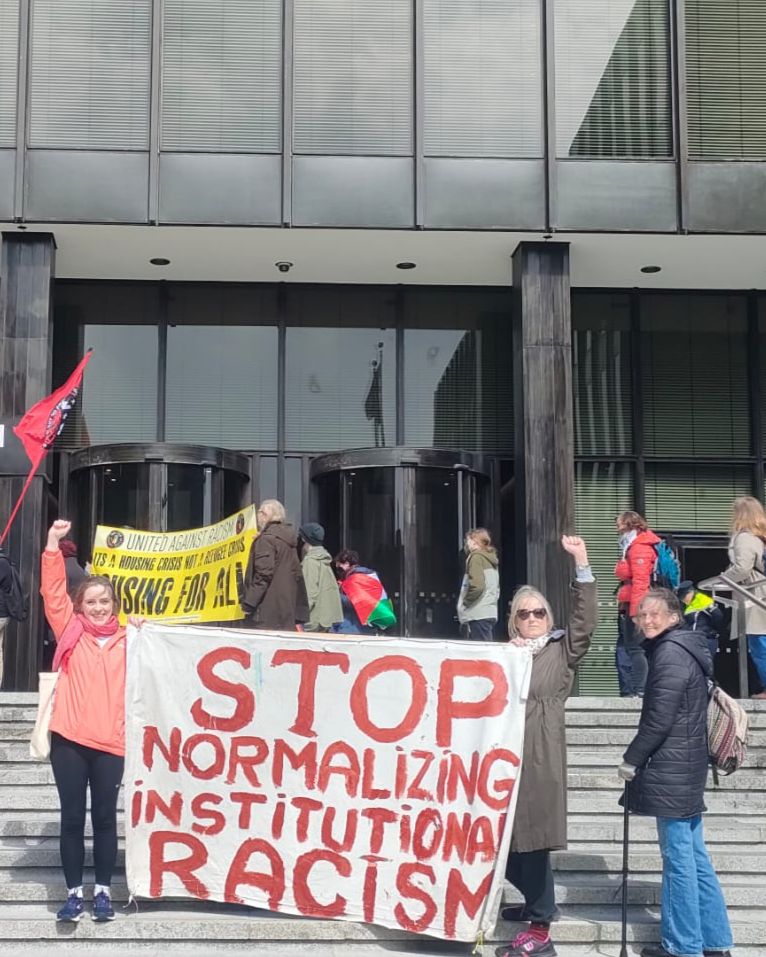
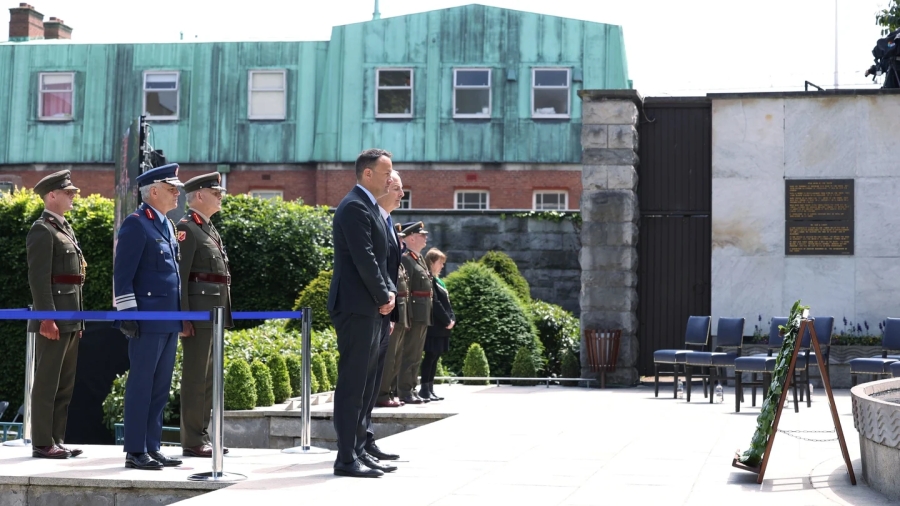
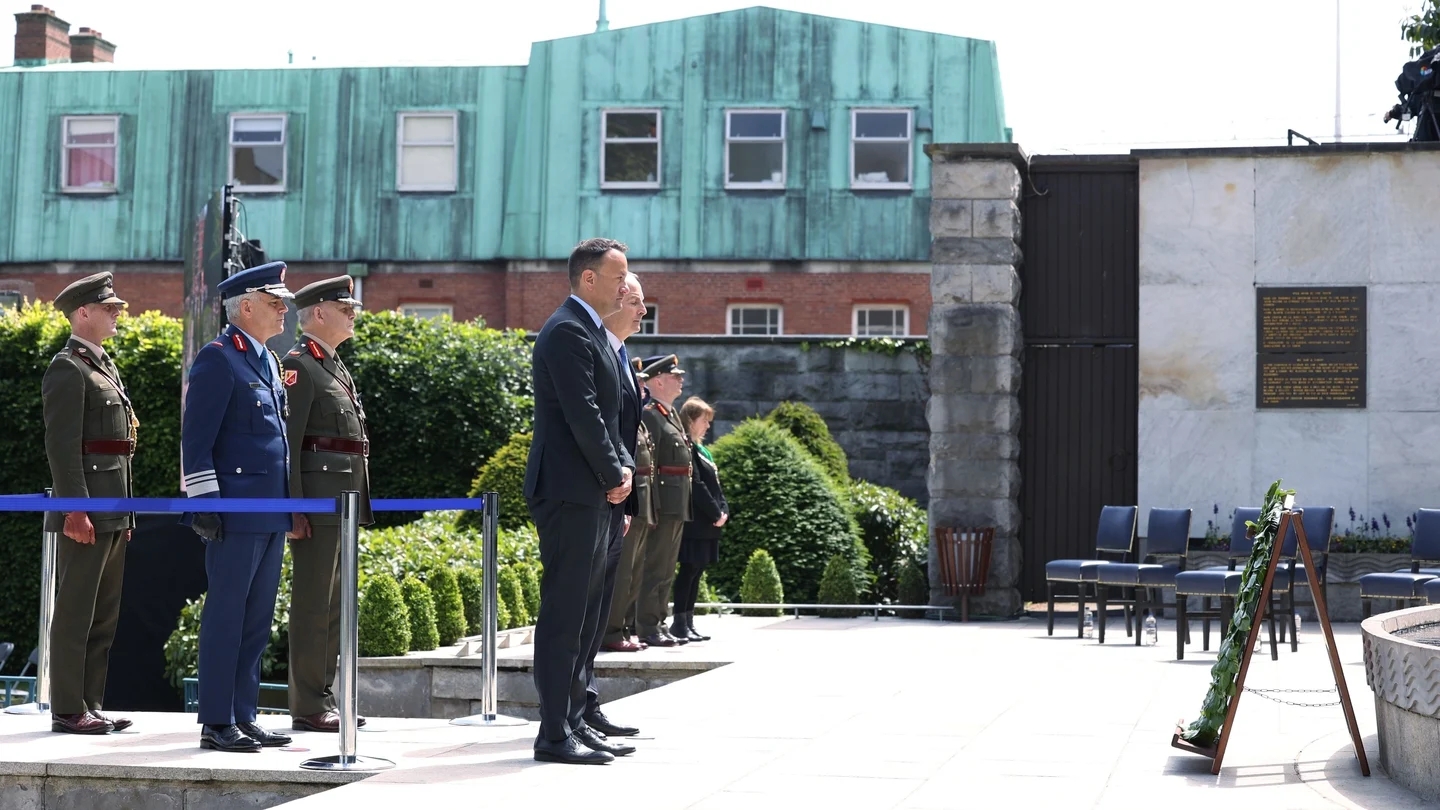
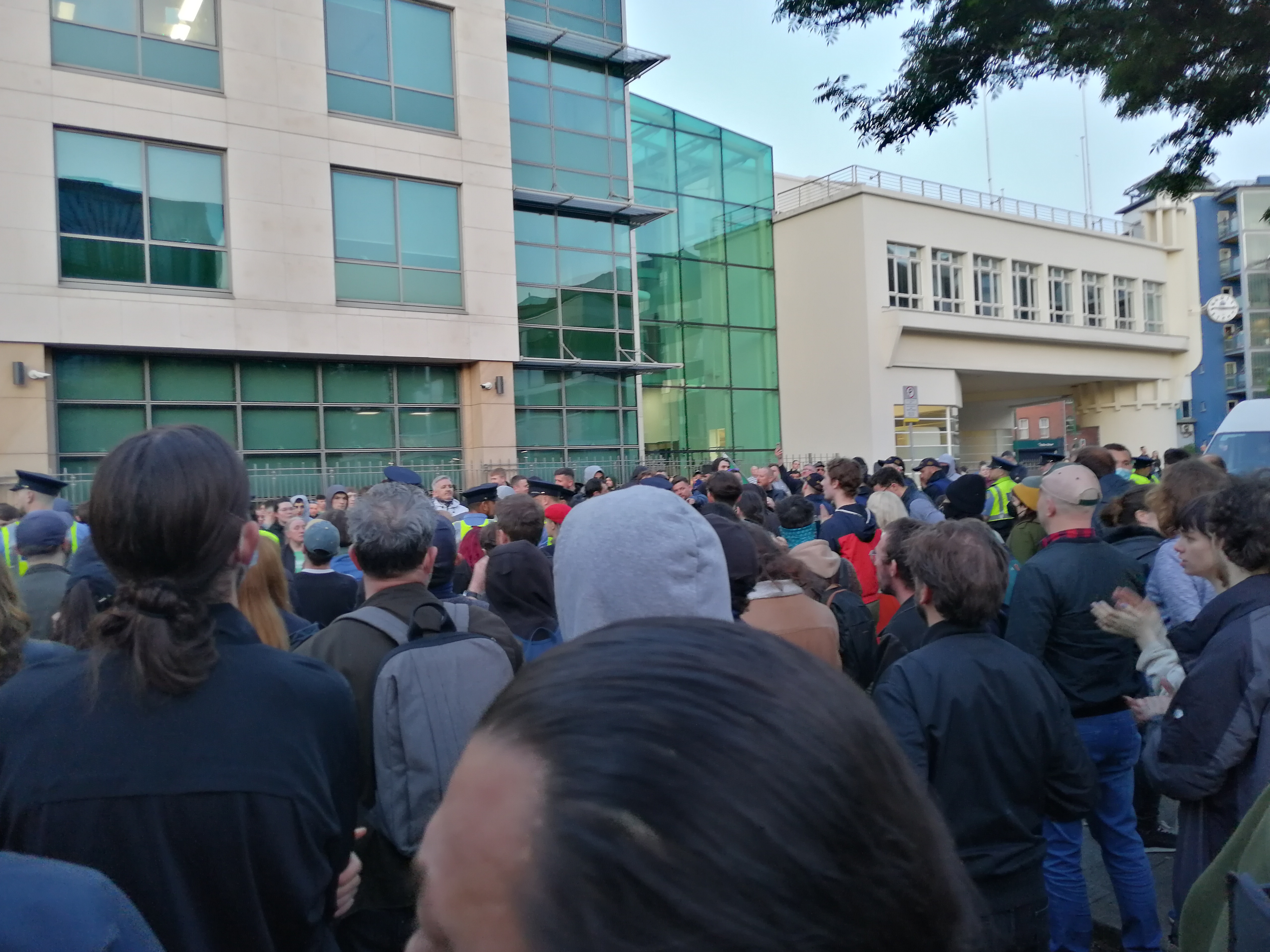
In recent days we have seen the far-Right mobilise people to allegedly defend the GPO and protest homelessness, not against its causes but instead against migrants. In defence of ‘Irishness’ they also menaced an annual religious Muslim procession.

Participants in these and similar events wave the Irish Tricolour and Irish Republic flags and claim to be ‘Irish patriots’ standing up for ‘the Irish nation.’ However, it’s far from that they are in reality as we can see.

They

  • disgrace the Proclamation

The far-Right claim to honour our national history of resistance to colonialism and occupation and even display copies of the 1916 Proclamation of Independence.1

Yet they are often also seen and heard denouncing Muslims, in direct contravention of the Proclamation’s words: “The Republic guarantees religious and civil liberty … to all”; similarly they held protests when use of Croke Park was hired to celebrants of the Eid festival.

  • disgrace the GPO as HQ of the 1916 Rising

They have and do disgrace the very symbolic building they claim to be trying to protect.

They have often held racist gatherings outside it; one of their organisers2 (e.g. of weekly protests during the Covid crisis) leading a chant of support for British fascist Tommy Robinson, who defended the Paratroopers who carried out the 1972 Bloody Sunday massacre in Derry.

Their recent protest at the GPO featured as speaker a man known for his active membership of the sectarian UVF murder gang, who admitted working for British Intelligence and who called for the strengthening of the colonial British Border – and was cheered for saying so.

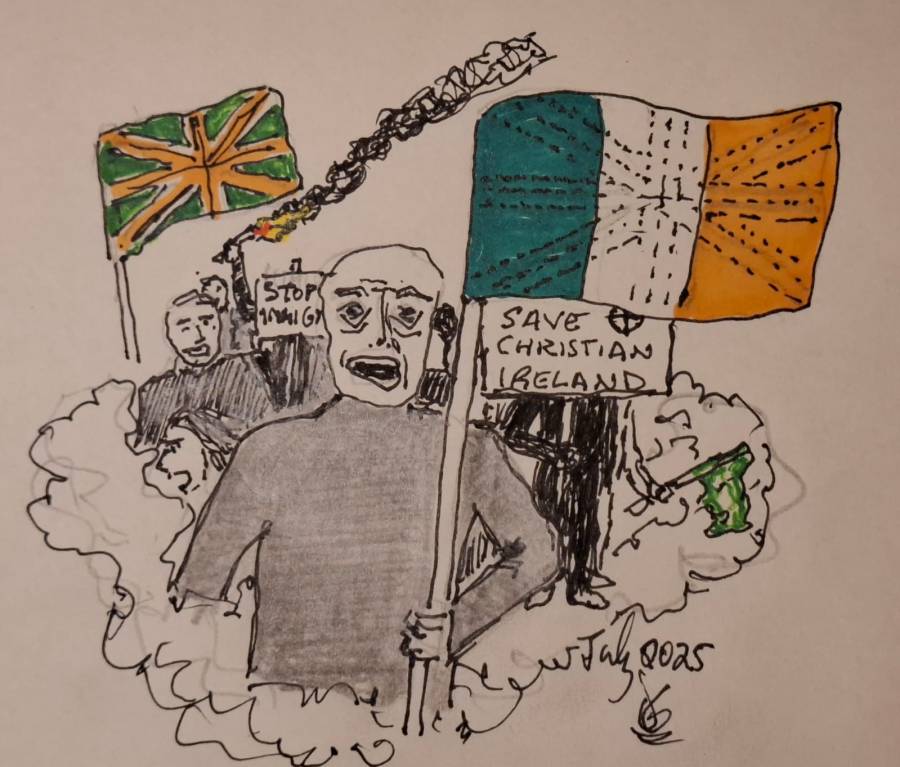
Cartoon by D.Breatnach
  • disgrace the flags

The far-Right disgrace and misuse the very flags they wave so keenly.

The Tricolour was presented to the revolutionary Young Irelander republicans3 by French revolutionary republican women in 1848. It signified peace and unity between the descendants of settlers and the indigenous Irish in revolutionary struggle against the British colonial occupation.

The flag with the words “Irish Republic” painted in white and gold on a green background was made on domestic material of socialist Republican Constance Markievicz (see next section) in her house and delivered by her to the GPO.

It was installed and flown on the roof at the Princes St. corner by Eamon Bulfin4 (see next section), a migrant from Argentina.

  • disown but also misappropriate real patriots

In dishonest manipulation, the far-Right claim to honour our patriots and even invoke them in their campaigns. In their agitation against migrants they hide the fact that Constance Markievicz, Thomas Clarke and James Connolly were all migrants (Connolly and Clarke no less than three times).5

Also a migrant was Eamon Bulfin (see previous section) along with many others who fought for Irish freedom and even sacrificed their lives (including Erskine Childers)6.

Placards on an anti-racist rally on Custom House Quay some years ago. The text placard quotes the 1916 Proclamation: “The Republic guarantees religious and civil liberty to all”. (Photo: D.Breatnach)

Of the Seven Signatories of the 1916 Proclamation (see earlier section), two – Pearse and McDonagh7 – were children of migrants and two were themselves migrants (Connolly and Clarke).

Among many such examples, the father of Young Irelander Republican patriot Thomas Davis (author of the song A Nation Once Again) was a migrant.

  • join with Loyalists and British fascists

A far-Right organiser calling for three cheers for British fascist Tommy Robinson was not the only such example and outside the GPO this week far-Right elements welcomed as speaker Mark Sinclair, a member of the UVF, a British colonial sectarian murder and terrorist squad.8

Prominent Irish leaders of fascist organisations have also shared a platform with Scottish fascist and Loyalist Jim Dowson.9 And of course how can we forget the desecration of the Tricolour unfurled among Union Jack and Loyalist flags in Belfast by some Dublin far-Right activists!10

Admitted UVF/ MI5 Sectarian Loyalist UVF murder gang member Mark Sinclair. (Photo sourced: Internet)
  • don’t act against British occupation

With all that background, it’s hardly surprising that the far-Right “patriots” don’t organise against the British occupation of the Six Counties or in support of Irish Republican political prisoners in jails on either side of the British Border.

  • burn buildings

Apart from misleading people and distracting them from the real sources of problems to Irish working people and seeking to intimidate refugees, what do the far-Right actually do? Ah, yes, they burn buildings that might be used as accommodation. A great help to the homeless indeed!

  • attack homeless refugee and migrant tents

But no, that’s not all. No, the brave ‘patriots’ slash tents and threaten migrants and refugees who are sleeping on the streets. They don’t take on the big landlords, bankers, property speculators and vulture funds – no, they strike down at people poorer and in worse conditions than themselves.

  • cover for the property speculators and vulture funds, big landlords, bankers

So with all this whipping up fear and hatred of migrants, the far-Right obscure the actual cause of the problems, which is not only Irish capitalism but its total subjection to foreign capitalism. The only ones to benefit from this activity are those who are the real causes of the problems.

  • are not patriots, nor nationalists

Despite their claims and flag-waving, the far-Right in Ireland are neither patriots nor true nationalists. They do not organise in defence of Irish sovereignty and against British occupation nor against foreign capitalist exploitation of Irish natural resources, labour or infrastructures.

Or the contrary, they work to distract attention away from these centrally-important issues for the Irish nation and raise false issues to divide the people. And usually their concept of ‘Ireland’ ends at the British border which the recent far-Right rally at the GPO called for strengthening!

  • are a sub-class of deprived individuals allowing themselves to be manipulated by fascists, MI5 and NATO

Many of those being mobilised against migrants come from parts of the cities neglected for generations, often associated with low educational level, substance misuse, unemployment and unresolved mental health issues.

The ideological fascists will recruit those elements to fight, not against the cause of their deprivation, the neo-colonial ruling class or the flooding of foreign capitalist companies into Ireland, assisted by banks and political decisions -but instead against migrant workers and refugees.

  • are filling a vacuum left by the Republican and Socialist movement

WILL WE LEARN FROM OUR FAILURES?

Many of those participating, while some are also unfortunate victims of Irish capitalism, will be recruited as the boot boys of fascism.

While it is true that historically capitalism in crisis turns to fostering fascism and that capitalism, including the neo-colonial variant in the Irish state is running out of other options, we must evaluate our own role in this development, examine our own failures, learn from and remedy them.

The ground was largely ceded to the Far-Right in the period of their initial growth during the Covid crisis. The socialist Left and Republican movement, in particular its organisations, had little response to the early FR mobilisations or to responding creatively to state-imposed restrictions.

Throughout that period and subsequently the socialist Left sector, despite its protestations of anti-imperialism and anti-colonialism, completely ceded the ground of Irish national sovereignty and its symbols to anyone who wished to occupy it.

They did not, for the most part, protest the use of State repression against Irish Republicans both sides of the British Border, whether through police harassment, special legislation and special no-jury courts, nor stand up for the human and civil rights of Republicans, including political prisoners.

Their distaste for the very issue of national sovereignty was reflected in their refusal to fly the Irish Tricolour, which, although now also the official flag of the Irish State, is originally and remains still a potent symbol of Irish Republican anti-colonial struggle over 170 years.

They might argue that they wished to be identified with the struggle of the working class rather than a nationalist one but they also chose not to fly the flag of the insurrectionary Irish working class, the Starry Plough, in among their internationally-recognised red flags.

The Irish Republican organisations in their fragmented movement, on the national question, failed to sustain unity even around opposition to repression of the states or even around solidarity with the movement’s political prisoners.

They also failed and, to an even greater extent, in fighting for universal affordable housing in a crisis which seems to offer no end and is seized upon by the Far-Right to target refugees and economic migrants, who of course have no responsibility whatsoever for the crisis.

This area too has been a notable failure of the socialist Left organisations which, although marching often enough in public demonstrations and participating in a couple of media-orientated occupations,11 failed to organise and lead a state-wide campaign of empty building occupations.

And so, here we are today, when the FR are able to bring Tricolour and Irish Republic flag-waving crowds on to the streets in false claims of patriotism, dividing and seeking to intimidate migrant workers and anti-racists, burning buildings and insisting on their definition of ‘Irish’ being correct.

Our omissions and failures, if we recognise and act to remedy them, also point the way forward.

End.

1In a travesty of frequent Irish Republican ceremonial occasions, it was even read out at the recent Far-Right gathering outside the GPO which was addressed by a known member of the UVF sectarian murder gang.

2Under the name Dee Wall (real name Dolores Webster).

3Including to Thomas Meagher ‘of the Sword’ who later recruited for, joined and fought in the Union Army in the US Civil War against slavery. Meagher unfurled the flag first in Wexford and later in Dublin, both acts in 1848.

4Bulfin came to Ireland around the age of ten with his family and later joined the IRB and the Irish Volunteers. After the surrender in Moore Street he was sentenced to death, later commuted to life sentence, then from Frongoch prison camp deported to Argentina from where he was the Latin American representative for the Movement.

5Clarke and Markievicz were both born in England. Clarke was first a migrant to Ireland, later to the US, then back again. Connolly was born in Edinburgh and a migrant to Ireland, then to England, then to the USA before his return to Ireland.

6Childers was born in England. He captained the yacht that brought the Mauser rifles and ammunition to Howth. Later he joined the IRA, took the anti-Treaty side and was executed by the Free State during the Civil War.

7The father of the Pearse brothers was English, as was McDonagh’s mother.

8During his trial for bank robbery for the UVF in Glasgow, Sinclair declared he had been working for MI5 which was well known to be steering Loyalist organisations. The UVF and British Intelligence bombed Dublin and Monaghan in 1974, causing the deaths of 34 people and a full-term baby, the highest death toll of one day during the recent 30 Years War.

9Rowan Croft, Herman Kelly (Irish Freedom Party) and Niall McConnell (Síol na hÉireann).

10A prominent group among the Dublin far-Right calling themselves Coolock Says No.

11https://www.irishtimes.com/ireland/2025/07/09/former-loyalist-uvf-prisoner-addressed-anti-immigration-protest-at-dublins-gpo/

12For example, the 27-day occupation of Apollo House, Dublin, from 15 December 2016 by housing activists and homeless people, with speeches and performances by prominent musicians.

NEITHER ELECTING ONE DALY NOR FIFTY

Diarmuid Breatnach

(Reading time: 3 mins.)

Clare Daly stood for election in the 2024 elections of the Irish State, in the Dublin Central parliamentary constituency, one with a tradition of independent representation going back to Maureen O’Sullivan and Tony Gregory before her.

Daly was standing as one of the loose Left coalition of Independents for Change in a heavy competition for the four-seat constituency.

Clare Daly has a track record as elected public representative and socialist political activist, also as a prominent Socialist Party activist, with which organisation she partedcompany in August 2012.

She was elected MEP for the Dublin constituency from July 2019 to July 2024, TD1 for Fingal from Feb. 2016-July 1999 and TD Dublin North Feb. 2011-2019; in recent years Daly has been better known outside Ireland due to her public interventions in the European Parliament.

Daly and her partner Wallace were both vilified by pro-imperialist liberals and ‘Left’ for publicly opposing US/NATO/ EU imperialist campaigns against Islamic regimes and the Russian Federation, being subjected to a host of unfounded allegations contrary to their actual record.

Tik Tok clips of Daly’s biting attacks on the EU’s complicity in the US-backed ‘Israeli’ genocide provided relief for many around the world from the Zionist sycophancy and insincere and ineffective concern for the victims of that daily genocide prevalent in the EU Parliament.

And who can forget Daly’s calling German politician and EU Commission President Ursula Van Der Leyen out as ‘Frau Genocide’ in the European Parliament in December last year!2

While an MEP, Daly also intervened in the discussion around the Irish Gombeen3 class’ attempt to push us towards NATO, further undermining a quite tattered Irish neutrality. And while a TD, she and her partner Mick Wallace TD were arrested protesting the foreign militarisation of Shannon.

To their credit both risked jail by refusing to pay the fines imposed but the Gombeen ruling class decided to restrict the damage of its exposure of collusion with US imperialism by also reducing the punishment of both to a few hours in captivity.

Daly has been one of the few TDs prepared to speak in public against the repression of Irish Republicans and to visit some of the consequent victims in jail.

In the EU Parliament, Daly also denounced the Spanish State’s police invasion of Barcelona and violence against voters there on 1st October 2017 during the referendum on Catalunya’s independence.

2024 Dublin Central election poster for Clare Daly.

In Ireland today

In her election flyer here Daly highlighted representation independent of political party for her electoral area, housing, health service, cost of living, Palestine, the endangered climate and Irish neutrality without any indication of how these issues might be effectively addressed.

Daly’s election flyer did not mention capitalism or imperialism, nor did she campaign on a platform of overthrowing the current neo-colonial and neo-liberal capitalist system in force, instead indicating her wish to “hold to account the people who’ve got us into this mess.”

“Holding to account” is something to which Daly is accustomed doing and does it well, eloquently, with passion and fluently, scarcely having to refer to her notes while doing so. But like ‘speaking truth to power’, it has little effect on those who are in control of the political-social system.

It can indeed have an effect on the victims of the system but we are left with the question of what to do about the situation. Refreshing as it may be to hear her again in Leinster House, neither voting Daly in — nor fifty Dalys — is going to change any of the conditions under which we suffer.

BY THE WAY,

in case anyone’s interested, I gave my first preference vote to Daly and hope she does get elected.

End.

1Teachta Dála, the title of a public representative elected to the parliament of the Irish State.

2Imperialist politician and proven plagiarist in her doctoral thesis.

3Vernacular term in Ireland for huckster, carpet-bagger-type capitalists, derived from the Irish language gaimbíneachas, profiteering, nowadays used to describe the neo-colonial Irish capitalist class.

MIGRANTS & REFUGEES LIKE US

Diarmuid Breatnach

(Reading time: 10 mins.)

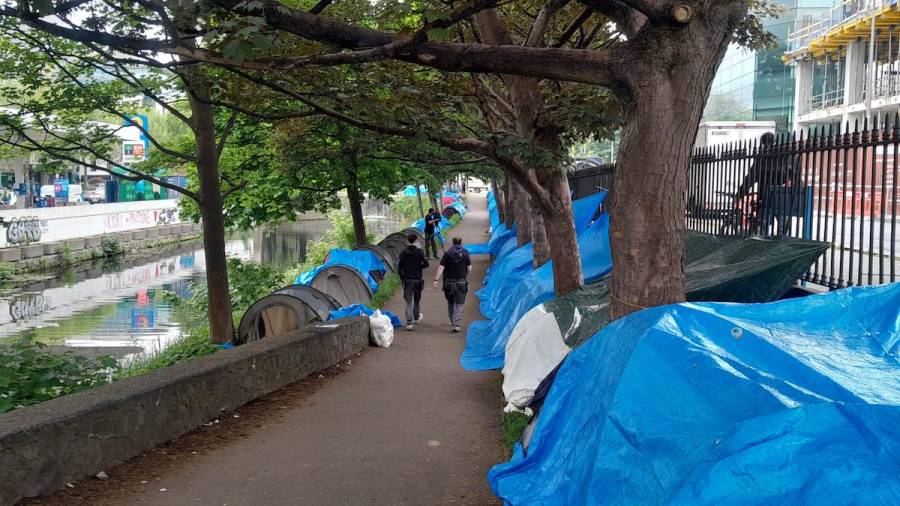
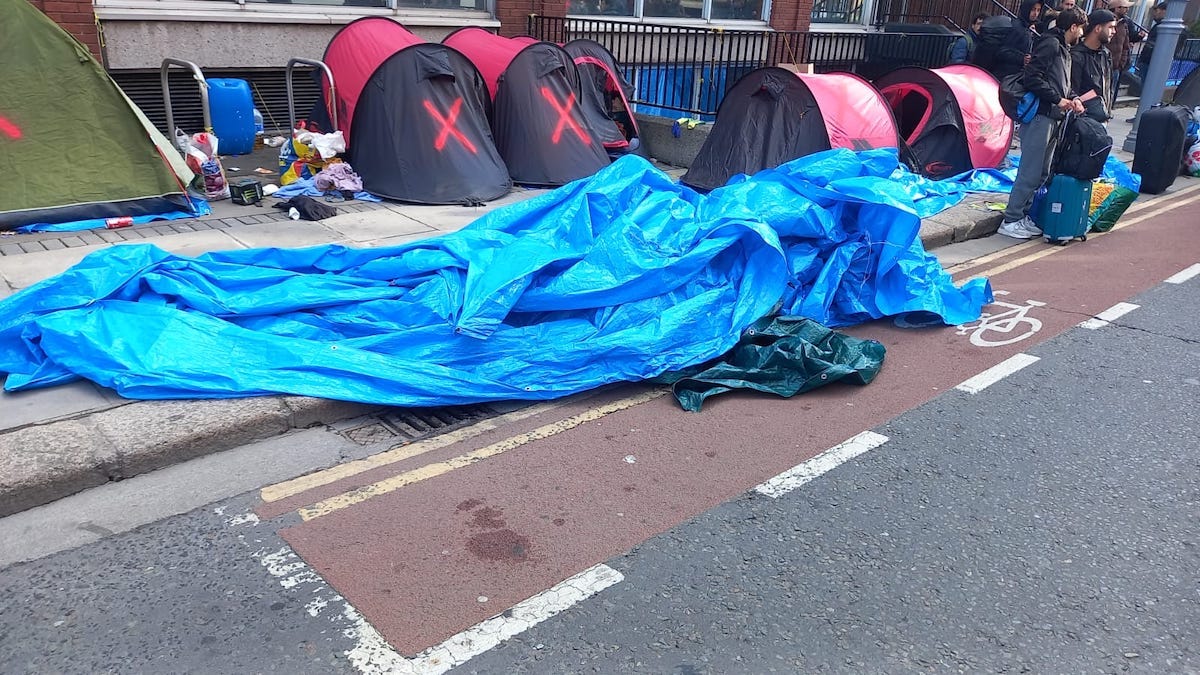
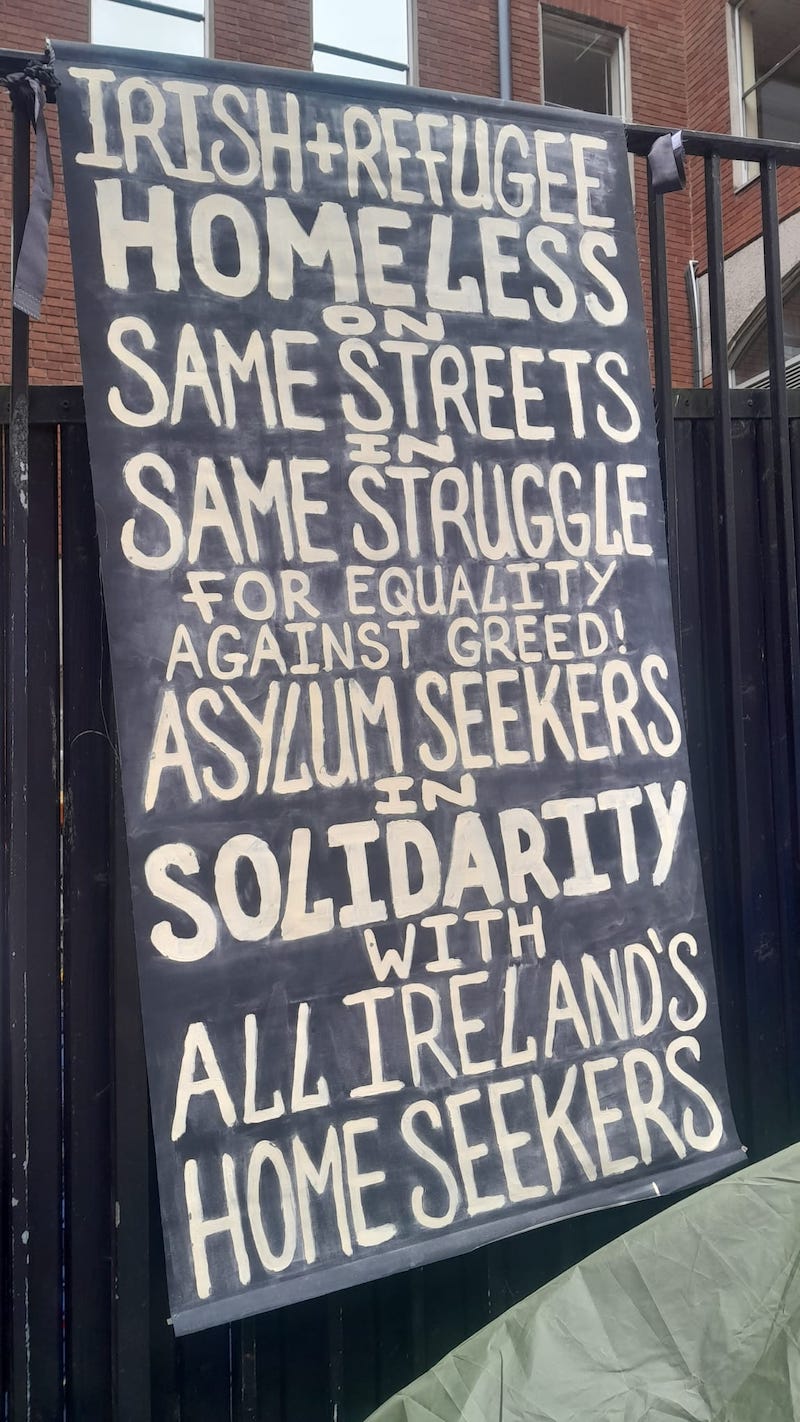
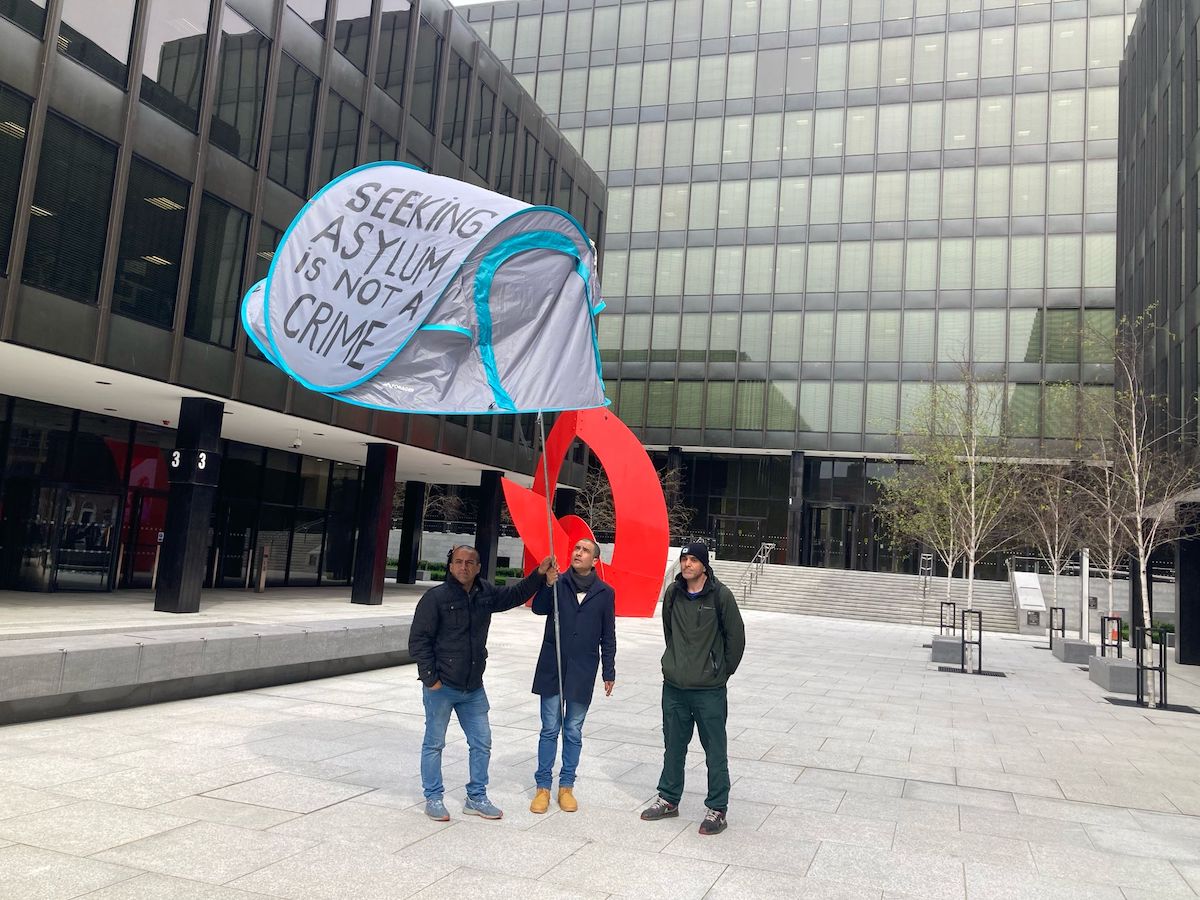
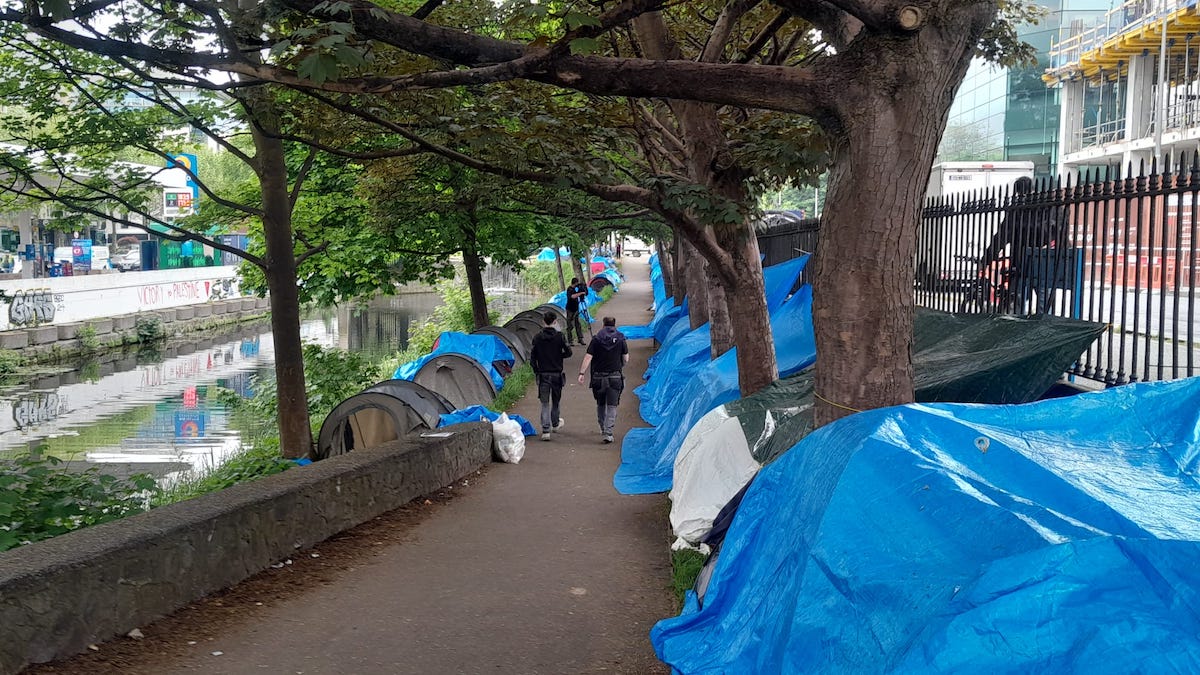
Irish media on Thursday 9th reported that the authorities removed the tents of refugees and asylum-seekers from along the banks of the Grand Canal. These had set up there after being removed from the vicinity of the IPO1. Where could they go?

Apparently they are dispersed to Newmount Kennedy (where we’ve seen – if not fascist mobs, certainly mobs containing some fascists), Dundrum, Crooksling and City West. Hopefully they will get a roof, showers and food, though thrown out to outskirts without any plan of integration.

The tents were dismantled when Harris said they were unacceptable and that accommodation was now available. However, despite four dismantling actions by government, on each occasion many asylum seekers were not provided with accommodation, thus causing a new camp to be established each time.(Photo: SRI)

In the four months since January a thousand have applied to the International Protection Office. They get issued with a Temporary Residence Card2 (known as the “Blue book”) and not much else; if they lose that documentation (e.g during eviction) they are in trouble.

Photo ID is issued to them when they make their application for asylum at IPO. Finger prints are taken, statements recorded etc. All evidence is cross-checked with relevant authorities including Interpol. Hence, the notion that men are “unvetted” or “undocumented” is inaccurate.

They are told there is no accommodation available which is why they end up in tents, since clearly they cannot afford to rent, much less take out a mortgage to buy a property. But Róisín McAleer of Social Rights Ireland questions whether the IPO have been telling applicants the truth.

“We’ve got video showing empty beds inside Direct Provision Centres at City West and Dundrum” the activist says. The IPO admits that they have 5,000 empty beds but says that they have to keep those empty beds available in case they have to cater for women and children.

The response of the Irish Government has been to blame the refugees and remove their tents from their locations, while simultaneously funding NGOs who have recently supplied them with identical-type tents and “may provide access to meals, access to showers during the day.”3

“Taoiseach Simon Harris said that neither he, nor the Government, would accept tented encampments in the city” and “hundreds of tents were destroyed when two encampments were removed … in the capital in multi agency operations in the past week.”4

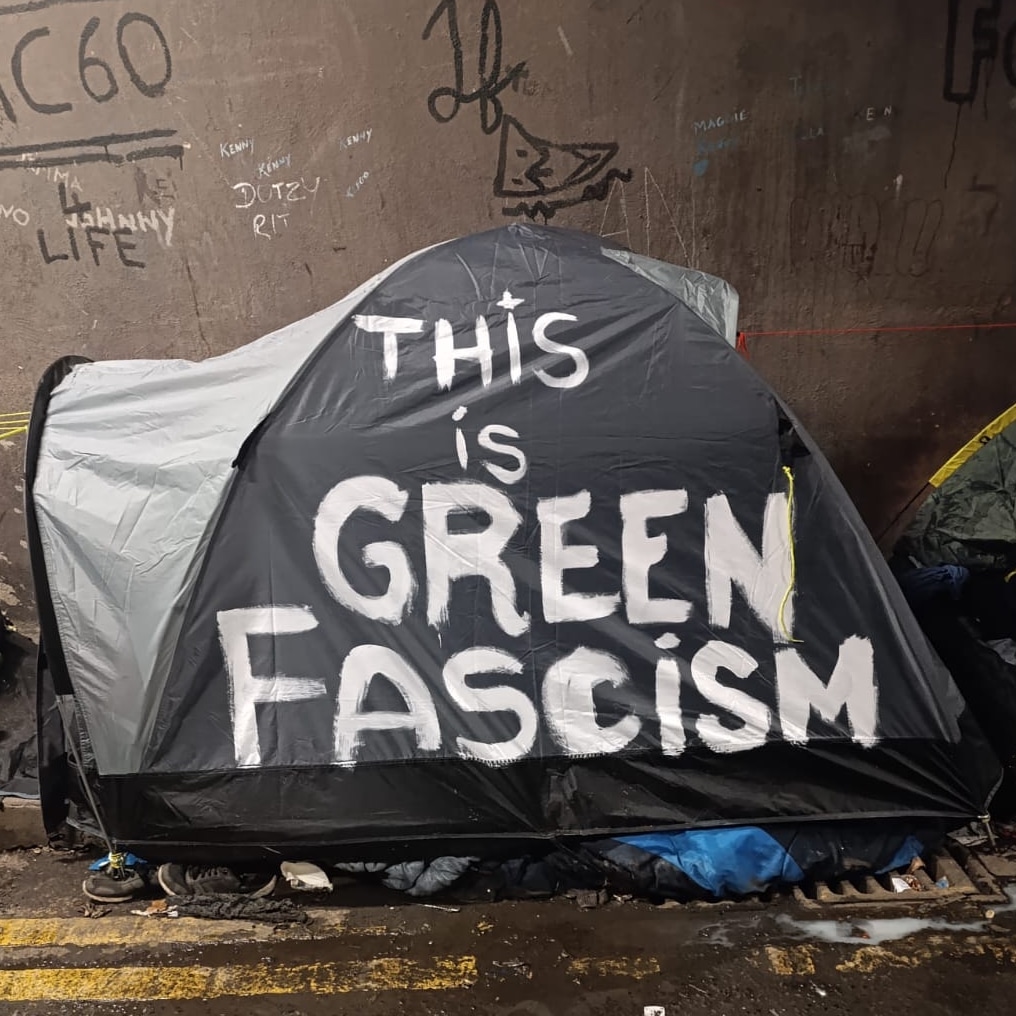
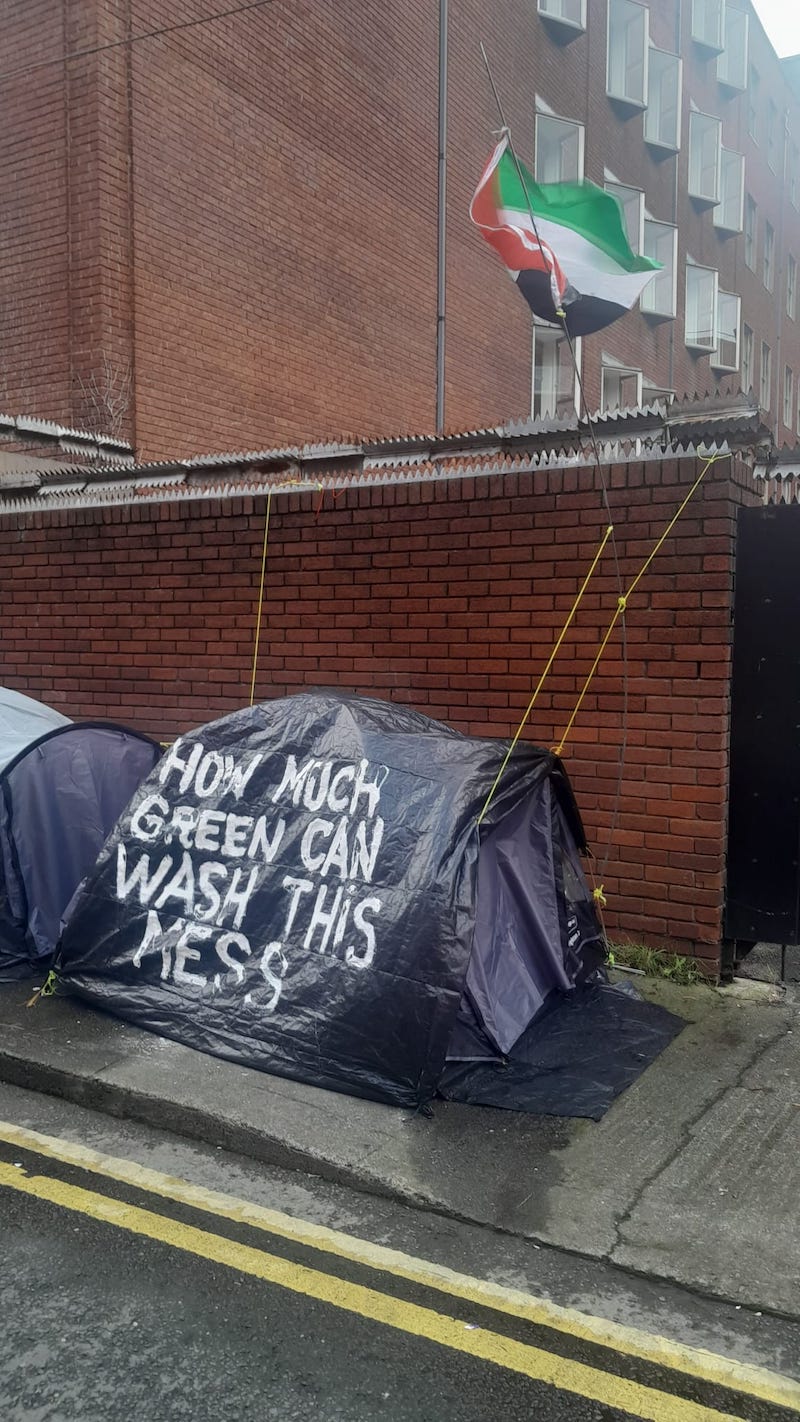
A slogan attacking the Green Party’s role in the Irish Coalition Government (Photo: SRI)
(Photo: SRI)

A common line in discourse is that the refugees and asylum-seekers are “undocumented” apart from whatever documentation they are issued here, which they often are, of course.

What documentation would one expect to have when fleeing war, persecution or natural disaster, always on the move, crossing mountains, deserts, rivers, seas, national boundaries?

In some places, the ‘wrong’ documentation can get you killed, marking you as the ‘wrong’ religion, nationality, tribal group … Thousands of us emigrated undocumented too and what’s more, worked undocumented as well.

Yet Helen McEntee, Justice Minister of this Government, who will never have had anything like the experiences of refugees and asylum seekers, throws around the “undocumented” word, straight from the playbook of the Far-Right, whipping up fears, hinting at some kind of menace.

“Everyone fleeing persecution or serious harm in their own country has the right to ask for international protection. Asylum is a fundamental right and granting it to people who comply with the criteria set in the 1951 Geneva Convention relating to the status of refugees.”5 

It “is an international obligation for States parties, which include EU Member States.”6 While applicants are waiting for a decision on their application for international protection, according to EU legislation the Irish State is required to supply accommodation, food and medical care.7

Róisín McAleer for Social Rights Ireland stated that the Irish Government was in breach of its EU obligations which oblige all states to provide seekers of asylum with accommodation at the point of presentation. A number of agencies have pointed out this serious breach.

Protest outside Dublin City Council’s main offices. (Photo: SRI)

McAleer states that SRI had been trying to get solicitors to take a case against the Irish Government under EU law but had found difficulty in doing so, some saying that immigration law was not their forte. “This is a case of human rights, not immigration law,” stated the interviewee.

What about Lawyers for Palestine, have they contacted them? “Yes,” is the answer “but no reply.”

THE FAR-RIGHT’S CAMPAIGN AGAINST REFUGEES

Not only the Irish Government but the Far-Right also have been working to mobilise public opinion against these refugees and asylum seekers. And at times actually physically attacking them also, going as far as to burn an encampment area in South Dublin dockland not far from the IPO.

Masquerading as “patriots” who “want to put the Irish first”, they repeat foreign-origin racist stories and false conspiracy tales,8 spread lies, false news and misinformation. Chief among those is that “Ireland is full”, which is untrue as even a little knowledge of our history will show.

In fact, being far from “full”, Ireland is UNDER-populated. The population of the whole of Ireland in the mid 1800s was 8 million but now hovers just over 7 million.9 Do those pushing that false story care about the real facts? If they don’t, then what is their real agenda?

One of the nastiest calls to action has been to “get them out” – no, not the Government, nor the ruling Gombeen class, not the British colonial occupiers. No, not any of the justifiable targets (but which might involve risk). No, they mean refugees, asylum seekers and really any migrants at all.

And why? Who are these groups harming? Well, apparently it’s because the Government should “house the Irish first”. But … how would evicting refugees from tents, repurposed buildings or Direct Provision Centres get any Irish person housed any quicker?

It wouldn’t of course, nor be of even the slightest help to people struggling to pay high rents to landlord companies, or to pay their mortgages to banks, or about to be evicted by vulture funds.

(Photo: SRI)

But the fascists and racists manipulating their followers don’t care, that’s not what they are there for. If they really did want to get ‘the Irish’ housed, they could occupy empty buildings to pressure the system, like the Revolutionary Housing League have been doing and calling on others to do.

No, the Far-Right prefer to torch buildings, including one in the south docklands that was earmarked for general homeless people.

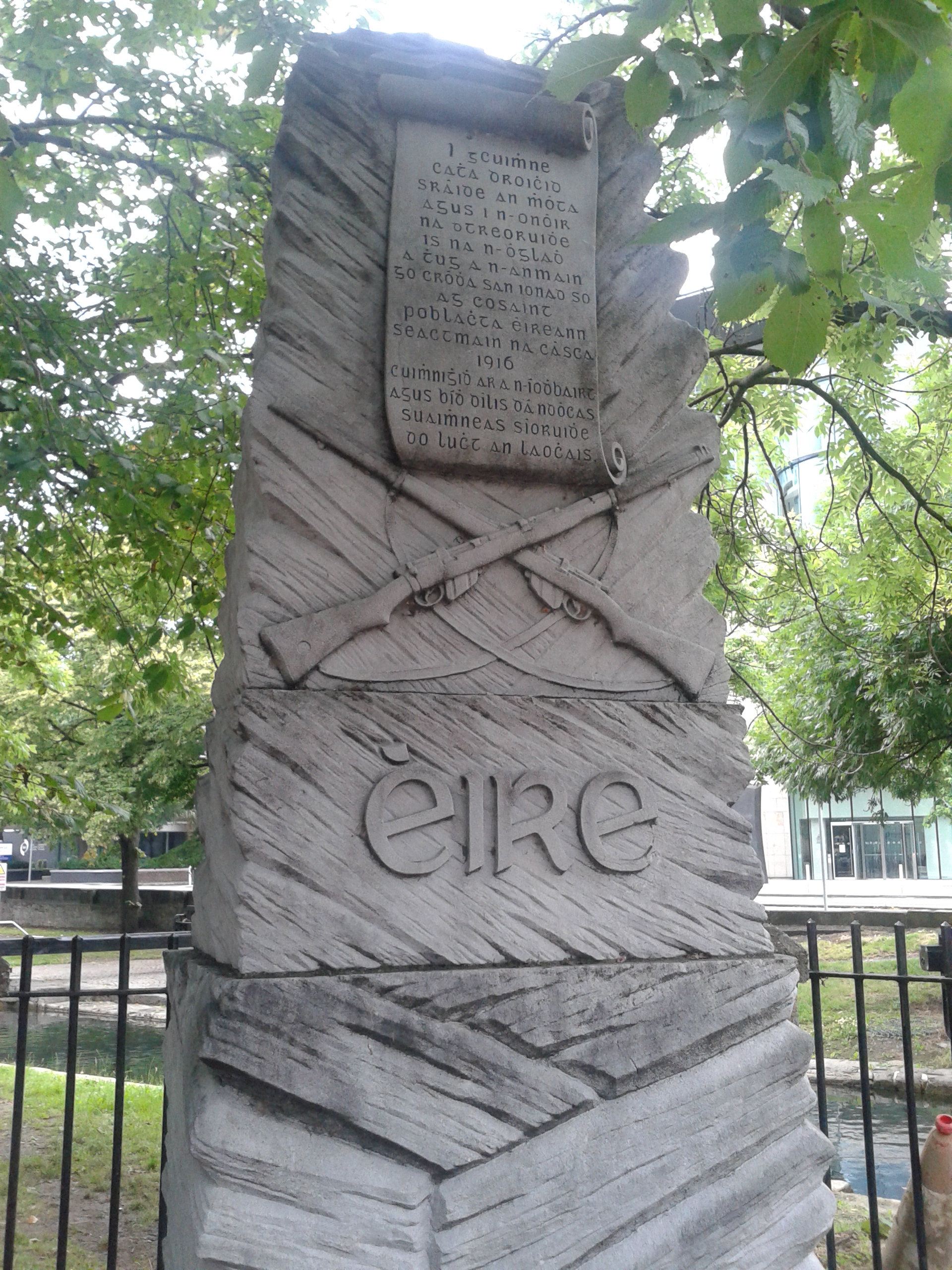
Ironically, near the tents’ location a national liberation battle was fought around Mount Street Bridge in 1916 and the Commandant of that garrison was a migrant, as were many others, including two of the 1916 Proclamation’s Seven Signatories — of which another two were sons of migrants.

Mount Street Battle Monument on the Bridge over the Grand Canal. (Photo: D.Breatnach)

In April, according to the Department of Housing, 13,866 people were in emergency accommodation in the Irish state, including 4,147 children, with many others sleeping on the streets, others in hotel rooms, hostels or sofa-surfing with friends and relations.10

But of course, the Far-Right don’t occupy empty buildings, having no intention of taking on the powerful financial interests that are making money out of all this misery. In fact, the Far-Right are helping those parasites, by diverting attention from them on to refugees and asylum seekers.

SINGLE, MILITARY-AGE MEN”

Yes, the men are alone, whether they left a partner and children behind to find a way out for them or indeed are single. And yes, they are “military age” – 18-45 years of age, just like most male migrants that left Ireland for work in the UK, USA, Australia, New Zealand, Canada …

That is the usual profile when the migrant is male. Because they can work and then send money back to family. And because in a risky endeavour they are generally less at risk and more willing to take the chance than females.11

(Photo: SRI)

But we never used that kind of description of our own emigrants, did we? We just said “young men” mostly. Where did that terminology come from, with its implied threat? From the USA, the hatchery of most Far-Right religious fundamentalism, conspiracy and racist theories and memes.12

We do have our own home-grown fascists of course with quite a high concentration of them among the Loyalists in the Six County colony. But also a few small crews this side of the British Border, well-linked to Loyalists and British fascists like Tommy “Robinson” and Nigel Farage.

The threat of sexual attack from foreigners is a version of that US fear propaganda, especially fear of black rape of white women — which is ironic since it was white slavers, slave-owners and plantation managers who raped black slaves and their children.

If we go through the media reports of court cases concerning rape, sexual assault and child sexual abuse, we find that by and large it’s the “indigenous Irish” who are the culprits. A minority of the population of course but Irish nevertheless.

How do volunteers working with the tent-living refugees experience them? “Respectful …. grateful” says one volunteer. “Quiet …. modest” is another description. “Some have high hopes of the values of western society but find themselves in shock and incomprehension at some of their treatment.”

Where have they come from? “Mostly Nigeria, Afghanistan, Jordan, Syria, Palestine …” Interestingly from an Irish point of view, all countries that the British have invaded at one time or another.

What causes waves of emigration from one area of the world and immigration to another? High on the list of causes are domestic unemployment, wars and natural disasters. Irish people have left Ireland pushed by all those factors.

Wars of occupation and ethnic cleansing, i.e plantations by England along with domestic resistance have sent Irish people outward from the 17th century onwards. In the mid-19th Century the natural disaster of the potato blight amongst imposed impoverishment flung out millions of migrants.

Throughout most of the decades of the Irish State’s existence, unemployment was the main driving force of emigration, so much so that until the years of the “Tiger economy”,13 Ireland remained underpopulated but with stable population figures despite a high birth and survival rate.

The factors that drive migrants to our shores are no different. When it comes to foreign wars of imperialism however, ironically the Far-Right deride socialist Republicans and socialists for protesting against those wars, going so far as to call them “traitors” for doing so.

When people are neglected, they often resent any focus on others. “What about me?” is their cry, whether voiced out loud or not. There is no doubt that many communities in Ireland have suffered government neglect, even been devastated by substance misuse and social crime.

Resolution of those social problems can only come about through organising against the culpable authorities and their pandering to the banks, property speculators and big landlords who benefit from the current situation – never by “punching down” on even more vulnerable people.

Homeless refugee tents along the Grand Canal, Dublin, before they were removed by the authorities. Simon Harris, Taoiseach (equivalent to Prime Minister) said that homeless tents in Dublin are not acceptable – however, homelessness apparently is. (Photo: SRI)

LIKE US

I called this article “emigrants and refugees like us” to make a number of points. One is that we too have been emigrants and refugees for centuries (and many still are). We went to Britain for seasonal work in the harvests and later for work on canals, roads and in factories.

We went to the USA too, Canada, Australia, New Zealand …

That’s about economic emigration. But we went as refugees too, fleeing religious and political persecution, fleeing ethnic cleansing, genocide and famine. Gaelic clans found asylum in Spain, Italy, France, Austria … Republicans found asylum in France and the USA …

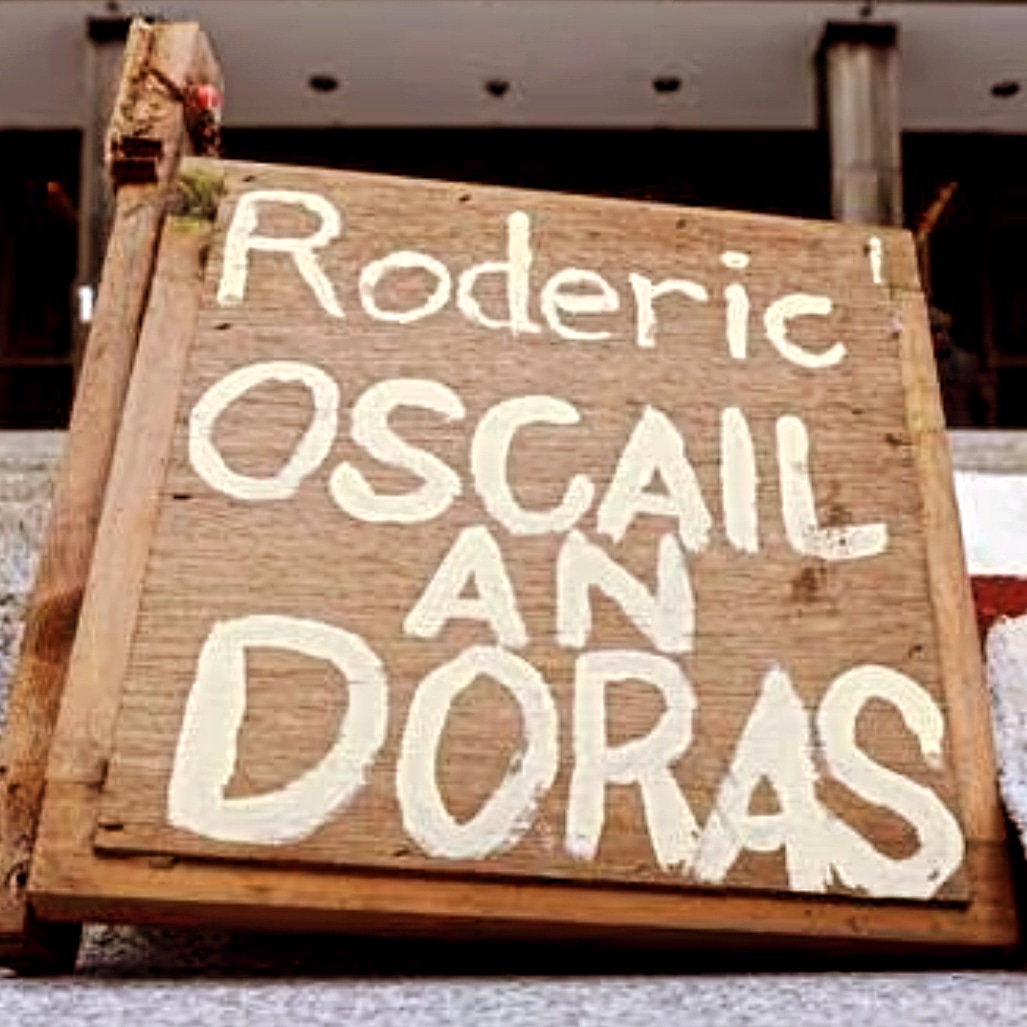
Message in Irish to Roderic O’Gorman, Minister of Integration (and other social responsibilities). (Photo: SRI)

It wasn’t always easy. We faced racism, yes real anti-Irish racism14, slurs that we were dangerous, dirty, carrying disease, taking jobs of locals … And we had the cheek to organise ourselves and to make alliances with a number of other discriminated-against groups to win some power!

We fought racists like the “Know Nothings” and the Ku Kux Klan,15 Blackshirts and National Front16 on the streets. We fought rich mine, factory and railroad-owners, formed trade unions and associations and we were clubbed, shot, jailed and executed. And we clubbed and shot back too.17

There’s another reason I called this article “emigrants and refugees like us”: We are ALL descended from migrants or refugees. The Irish nation is composed, apart from the “native Irish”, of Viking, Norman, Scottish, English, Flemish, Dutch and Italian blood (remember, fish and chip shops, ice cream and cafés) before others came from further away.

And the “native indigenous Irish”? The Celts? Yes, migrants too, from central Europe, with iron tools and weapons. Before them? The bronze-metal people. And before them again? The Neolithic people who built the likes of Newgrange, Knowth and Dowth in the Boyne Valley.

The human race did not evolve in Ireland. We are all descended from migrants.

The third reason I called this article “emigrants and refugees like us” is because, like us, they are human. The feel hunger and fear just like we do. They need safety and warmth just like we do. If we deny them those things we diminish our own humanity in doing so.

That might seem a bit wishy-washy but to me, our humanity in its best sense is worth everything and if need be, it’s worth fighting for.

End.

FOOTNOTES

1 International Protection Agency, the Irish State’s agency with responsibility for processing refugees and people seeking asylum in the state.

2 This is photo ID issued to them when they make their application for asylum at IPO. Fingerprints are taken, statements recorded etc. All evidence is cross-checked with relevant authorities including Interpol. Hence, the notion that men are “unvetted” or “undocumented” is inaccurate.

3 https://www.breakingnews.ie/ireland/government-paying-for-tents-provided-to-asylum-seekers-says-ogorman-1624336.html

4 Ditto.

5 https://www.europarl.europa.eu/about-parliament/en/democracy-and-human-rights/fundamental-rights-in-the-eu/guaranteeing-the-right-to-asylum

6 Ditto.

7 https://www.citizensinformation.ie/en/moving-country/asylum-seekers-and-refugees/the-asylum-process-in-ireland/international-protection-terms

8 Such as the “white replacement” conspiracy theory from settler colonies like South Africa and Rhodesia, then via white supremacist groups in the USA and through social media to Ireland.

9 https://en.wikipedia.org/wiki/Ireland

10 https://www.irishtimes.com/ireland/social-affairs/2024/04/26/number-of-people-in-emergency-accommodation-reaches-new-high-of-13866-including-over-4000-children

11 https://reason.com/volokh/2024/05/03/migration-and-the-military-age-male-fallacy/#:~:text=The%20definition%20of%20%22military%2Dage,disproportionately%20drawn%20from%20this%20category.

12 This has been known for years but a recent study of social media protests against a propose housing of migants in Newmount Kennedy Co. Wicklow found the source of around 80% to originate outside Ireland with more than half being from the USA. https://www.independent.ie/irish-news/more-than-half-of-social-media-posts-about-wicklow-anti-asylum-protest-were-from-us-analysis-finds/a1068312180.html

13 1995 to 2007

14 Not the rubbish “racism” of which the Far-Right claim they are the “victims” whenever anyone calls out their racism or homophobia.

15 The “Know Nothings” were mostly white, Anglo-Saxon and Protestant settled nativists in the USA who organised against other European migrants such as the Irish and when brought to court for murder or riot, they would claim to “know nothing”. The Ku Klux Klan was set up primarily to suppress freed slaves and other black people in the USA but they also organised against the Irish. British fascist groups: Blackshirts (British Union of Fascists) in the 1930s and after WW2 and National Front in the 1960s and 1970s, later replaced by the British Movement.

16 Both British fascist organisations: the first from the 1930s and resurrected after WWII for a period; the second from the 1960s, later superseded by others (British Movement, EDL etc).

17 Not just in the Molly Maguires but also in the IWW and the Knights of Labor.

SOURCES & FURTHER READING

https://home-affairs.ec.europa.eu/policies/migration-and-asylum/common-european-asylum-system/reception-conditions_en

The “single military age male” propaganda: https://reason.com/volokh/2024/05/03/migration-and-the-military-age-male fallacy

US origin of much racist social media posts: https://www.independent.ie/irish-news/more-than-half-of-social-media-posts-about-wicklow-anti-asylum-protest-were-from-us-analysis-finds/a1068312180.html

Eviction of refugees and asylum-seekers: https://www.breakingnews.ie/ireland/government-paying-for-tents-provided-to-asylum-seekers-says-ogorman-1624336.html

Súil Chlé video about Asylum Seekers Abandoned on the street: https://www.youtube.com/watch?v=dSl_bbGTUUc

SRI video on Rough Reception of Asylum Seekers in the Irish state: https://youtu.be/uOYT9CtjU90?si=gCanAaimLvmbcc0f

ANTI-IMPERIALIST ACTION HOLDS DUBLIN 1916 RISING COMMEMORATION

Clive Sulish

(Reading time: 6 mins.)

Easter is the time of year in Ireland for Easter Egg hunts and/or for attendance at religious services but for the Republican movement it is one of commemoration of the Easter Rising and its martyrs, with parades and speeches.

The commemoration parade proceeding along Phibsboro and approaching the Cross Guns canal bridge. (Photo: Rebel Breeze)

Easter Monday in Dublin saw one of those commemorations organised by the Socialist Republican organisation Anti-Imperialist Action at the Citizen Army plot in the St. Paul’s section of the famous Glasnevin Cemetery at the Republican Struggle Monument1.

Participants rallied near the Phibsboro Shopping Centre to march from there to the Cemetery, a distance of around two kilometres, over the “Cross Guns” bridge over the Royal Canal, then passing the main entrance to the Glasnevin Cemetery on the right before turning left for St. Paul’s.

Garda POU van parked extremely dangerously, hiding left turn from view of eastbound traffic, as they chat with other Gardaí and a ‘Branch man. As is said, one rule for the people …!”
In the laneway between houses visible in the background, a cameraman lurked taking photos. (Photo: Rebel Breeze)

In a marked departure from the previous year, the State’s political police, plainclothes Gardaí of the “Special Branch”2 did not approach the participants to attempt to intimidate them and gather intelligence, demanding their names and addresses under the Offences Against the State Act.3

That had been followed up by a raid on the home of one of the leading activists. Sunday’s police behaviour was an even greater difference from Saturday’s, when a different Republican group, Saoradh, had their Easter Rising commemoration in Dublin’s city centre.

Around 300 police, including many in riot cop uniform (Public Order Unit) had harassed the participants demanding names, addresses and other information, attempting to intimidate them. At least seven police vans had been in attendance also to the bemusement of onlookers.4

(Photo: Rebel Breeze)

LOCAL 1916 HISTORY

The Phibsboro/ Glasnevin area also figured in the 1916 Rising, with an insurgent barricade in Phibsboro and a Fianna youth, Sean Healy, mortally wounded at the crossroads by a British artillery shell fragment (a plaque on the ground at the SW corner commemorates his death.

Earlier, Irish Volunteers had guarded the canal bridge briefly; these were seen by the dozen Volunteers that marched along the canal from Maynooth, slept in Glasnevin Cemetery and got into the headquarters garrison at the General Post Office on Tuesday.

Later British soldiers set up a barricade on the Bridge preventing even foot traffic across and shooting dead a deaf and dumb man who could not hear their challenge.

EYE IN THE SKY? (Photo: Rebel Breeze)

PARADE THROUGH STREETS TO CEMETERY

The parade from Phibsboro on Sunday was led by the Glasgow Republican Flute band (formerly the Garngad RFB, which is where most of them are based) playing the airs of known Republican ballads, muted to regular tocks on their drums as they entered the housing estate.

(Photo: Rebel Breeze)

Also leading was the colour party dressed in white shirts, black trousers, jackets, berets and sunglasses, carrying the traditional flags for Republican colour parties: the Tricolour, Starry Plough, Sunburst, followed by the flags of the four provinces of Ireland: Connacht, Leinster, Munster and Ulster.

Over the marchers the flags of the Tricolour and the Starry Plough, flag of the Irish Citizen Army flew in the breeze while those of the Basque nation, Palestine and of the People’s Front for the Liberation of Palestine lent an international flavour to the commemoration of the Irish Rising.

There was some beeping of passing traffic and cheering from bystanders at the entrance to the laneway that leads to the bridge across the railway tracks to the St. Paul’s section of the graveyard. The marchers filed in and proceeded to the monument.

The Chair of the proceedings welcomed the attendance before reading from the 1916 Proclamation of Independence and calling a singer to step forward. Revolutionary activist Diarmuid Breatnach introduced the two songs he was going to sing as emphasising the role of the working class in the Rising.

(Photo: Rebel Breeze)

“The decision to go ahead with the Rising on Easter Monday was taken in Liberty Hall, the headquarters of the working class at the time,” he reminded the gathering, “which is also where the Proclamation of Independence was printed.”

He sang the “Jim Larkin Ballad”:
In Dublin City in 1913,
the boss was rich and the poor were slaves;
The women working, the children hungry,
till on came Larkin like a might wave …

Diarmuid Breatnach singing (Photo: Donated by participant)

Pausing to focus on a different key, the singer followed the ballad with Patrick Galvin’s Where Is Our James Connolly?

After applause, floral tributes were laid on behalf of Anti-Imperialism Action Ireland and of Dublin Republicans Against Fascism.

(Photo: Rebel Breeze)
(Photo: Donated by participant)

The chairperson asked for a minute’s silence in honour of those men and women who had given their lives in the struggle for freedom in Ireland. The colour party lowered their flags slowly in homage to the fallen, raising them again slowly to signify the continuation of the struggle.

(Photo: Rebel Breeze)

John Heaney, Republican ex-prisoner from Armagh was called to give the oration for the event, which he dedicated to all those men and women who had opened their doors and their homes to fighters in the struggle, whether the latter were in hiding or just resting – his audience applauded.

The speaker also congratulated on those who came forward to carry on the struggle, youth, women and stated he was proud to see the traditions of struggle being upheld in the process to achieve the Republic for which so many gave their lives.

The speaker, John Heaney delivering his oration. (Photo: Rebel Breeze)

The marching band then played the air of Amhrán na bhFiann/ The Soldiers’ Song, verse and chorus and the formal part of the event came to an end. Band members lined up in front of the Monument for photos and a little later played the air of “Black Is the Colour” on whistles, to general applause.

SECOND 1916 COMMEMORATION FOR AIA THIS EASTER

This was the second 1916 Rising Commemoration to be attended by Anti-Imperialist Action as they had also participated in another organised by the Seamus Costello Memorial Committee in Bray on the previous day.

AIA is a young organisation, founded by socialist Republicans unhappy with the direction of the Republican organisation of which they had been members but now containing many young people.

AIA gave rise to the Revolutionary Housing League that occupied empty buildings in a campaign against homelessness and called for a general occupation campaign across the state. A number of court cases against them followed but sadly their lead was not followed.

(Photo: Rebel Breeze)

AIA have also been very active against NATO, picketing promotional meetings and a number have been charged following a demonstration against a visiting British Navy ship in Dublin last November.5 They have also been active as part of the Saoirse don Phalaistín activist group.

Following the event in Glasnevin, many of the participants relaxed at a social evening in a different part of the city where many songs of struggle were sung.

(Photo: Rebel Breeze)

OTHER EASTER COMMEMORATIONS

Other Easter Rising commemorations have been held around this time, for example: Lasair Dhearg held one in Belfast on Easter Monday, while Independent Dublin Republicans held theirs in the capital, marching from Liberty Hall to the GPO, then to Moore Street to lay a floral tribute.

On Monday too the Derry 1916 Memorial Committee held an event in its city.6

Former revolutionary Republican party Sinn Féin held theirs in Arbour Hill7 cemetery on Sunday; a large part of their President’s address was devoted to justification of support for the EU and a plea to support the party whenever the state’s general elections are held (this year or next)8.

End.

(Photo: Rebel Breeze)

FOOTNOTES

SOURCES & FURTHER READING

Anti-Imperialist Action: https://t.me/aiaireland

Lasair Dhearg commemoration: https://www.facebook.com/LasairDhearg/

Derry commemoration: https://www.belfasttelegraph.co.uk/news/northern-ireland/petrol-bombs-thrown-at-media-during-dissident-parade-in-derry/a1835461558.html?

Sinn Féin commemoration: https://www.breakingnews.ie/ireland/mary-lou-mcdonald-makes-election-plea-at-1916-event-1608211.html

1My name for the Monument in the St. Paul’s part of Glasnevin Cemetery which stands in recognition of six periods of Irish Republican-led insurrectionary activity in Ireland: 1798-1916.

2Now officially the Special Detective Unit, they were previously known as the “Special Branch”, a name they inherited from the British occupation which had set up a political intelligence unit, the Irish Special Branch, to spy on and disrupt the Fenian movement among the Irish diaspora in British cities. Most political activists in Ireland continue to call them “the Special Branch” or simply “the Branch”. Their equivalent in Britain today and in a number of its colonies and former colonies continues to officially bear the name “Special Branch”.

3As amended in 1972 after a British Intelligence bombing killing two public transport workers in Dublin but blamed on the IRA; the amendment also permitted the setting up of no-jury Special Courts which are in existence to this day.

4In the context of assaults on persons in the city centre there have been regular complaints in the media and in the Parliament about the lack of Gardaí visibly patrolling the area.

5 https://ukdefencejournal.org.uk/irish-activists-shout-at-british-naval-vessel-in-dublin

6https://www.belfasttelegraph.co.uk/news/northern-ireland/petrol-bombs-thrown-at-media-during-dissident-parade-in-derry/a1835461558.html?

7Where the 14 Dublin 1916 executed were buried, now a national monument in a former prison and church graveyard around the back of the former military barracks and now National Museum of Collins Barracks

8https://www.breakingnews.ie/ireland/mary-lou-mcdonald-makes-election-plea-at-1916-event-1608211.html

“THEY WANT US TO MOVE OUT – BUT WE’RE STAYING”

Diarmuid Breatnach

(Reading time: 6 mins.)

In Dublin’s south docklands the property developers and the corporations dominate city planning and therefore the landscape. And the working class community there feel that they’re being squeezed out.

I’ve met with some concerned people from parts of this community in the past to report on their situation and concerns for Rebel Breeze and did so again recently.

A view eastward of a section of the south Liffey riverfront, showing a very small amount of more traditional buildings squashed between or loomed over by the “glass cages that spring up along the quay”. (Photo 1 March 2024: D.Breatnach)

YOUNG PEOPLE – education, training, socialising

“There’s nothing here for our young people” said one, expressing concern over the attraction for teenagers of physical confrontations with other teens from across the river which have taken place on the Samuel Beckett Bridge over the Liffey.

A young man training as an apprentice in engineering attends a mixed martial arts club but has to go miles away to another area to attend there. Between his industrial training, travel and athletic training he has little time to spare for socialising.

I comment that those sporting activities tend to concentrate on male youth and only some of those also but he tells me that nearly half the regular membership of his club is female. A community centre could provide space and time for such training but they say they have no such centre.

St. Andrew’s Hall is a community centre in the area and there are mixed opinions in the group about it but I know from my own enquiries that the available rooms are committed to weekly booked activities (and our meeting had to take place in a quiet corner of an hotel bar).

As a former youth worker and in voluntary centre management, I know that a community centre can serve all ages across the community, from parents and toddlers through youth clubs to sessions for adults and elders.

Discussing youth brings the talk into education and training. As discussed in a previous report of mine, the youth are not being trained in information technology, which is the employment offered in most of the corporations in “the glass cages that spring up along the quay.”1

Section of the south Liffey docks showing some of the few remaining older buildings as they are swamped by the “glass cages”. The building on the far right of photo, very near to Tara Street DART station, once an arts centre, is already targeted for demolition and replacement with commercial building. (Photo sourced: Internet)

“If they’re lucky, they’ll get work in the buildings as cleaners or serving lattes and snack in the new cafes”. Some opined that the corporations in the area should be providing their youth with the training while others thought Trinity College should be doing so.

HOUSING – price and air quality

Universal municipal housing in the area has declined due to privatisation of housing stock and refusal to build more. A former municipal block in Fenian Street, empty for years is now to be replaced but the “affordable” allocation has been progressively reduced, ending now at zero.

Pearse House in south Liffey docklands, believed earmarked for demolition and site sold to property speculators. (Photo 1 March 2024: D.Breatnach)

Property speculators (sorry, “developers”) with banker support are building office blocks and apartment blocks in the areas, the latter units priced beyond the range of most local people. The average rent for a two-bed apartment in the area is €2,385;2 to buy a 3-bedroom house €615,000.3

The Joyce House site and attached ground area could provide housing and a community centre but appears planned to go to speculators.

Continuation of ‘Pearse House site’ in south Liffey docklands, believed earmarked for demolition and site sold to property speculators. (Photo 1 March 2024: D.Breatnach)

The Markievicz swimming pool near Tara Street has been closed and the local people are told they can go to Ringsend for swimming, an area which already has better community facilities than are available to the communities further west along docklands

A huge amount of traffic goes through the area and one person stated that Macken Street tested as having the worst air quality in Ireland. “I have to close my windows to keep out the noise and pollution,” said another; “the curtains would be black.”

Townsend Street side of ‘Pearse House site’ in south Liffey docklands, believed earmarked for demolition and site sold to property speculators (prospective property speculators must be salivating). The gambling advertisement coincidentally erected there seems to show the likely social types to benefit from these kinds of deals. (Photo 1 March 2024: D.Breatnach)

They want us out’

If some town planner were intending to establish a community somewhere, s/he would plan for housing, obviously, so the people would have somewhere to live. But a proper plan would provide also for education and training, along with social facilities — and employment.

But if someone were intending instead to get rid of a community, s/he would target exactly the same elements, whittling them down or removing them altogether. This what some local people feel is intended for their community.

“We feel we’re not wanted here,” said one and others agreed, “They want us to move out.” “But we’re not going! We’re staying,” said another, to grim nodding of heads around.

HISTORY of struggle … and of neglect

In the late 1800s and early 1900s, Dublin had the worst housing in the United Kingdom and many of its elected municipal representatives – including a number of Nationalists of Redmond’s party – were themselves slum landlords.

When the Irish Transport and General Workers Union was formed by Jim Larkin with assistance from James Connolly and the Irish Women Workers’ Union founded by Delia Larkin, many of the dockers, carters and Bolands Mill workers who joined them came from the south docklands.

And when the employers’ consortium led by William Martin Murphy set out to break the ITGWU in 1913, many of those workers

… Stood by Larkin and told the bossman
We’d fight
or die but we would not shirk.
For eight months we fought
And eight months we starved,
We stood by Larkin through thick and thin …4

And the women of Bolands’ Mill were the last to return to work, which they did singing, in February 1914.

They also formed part of the Irish Citizen Army, the first workers’ army in the world,5 to defend the striking and locked-out workers from the attacks of the Dublin Metropolitan Police and which later fought prominently in the 1916 Easter Rising.6

Many also joined the larger Irish Volunteers which later became the IRA, along with Cumann na mBan,7 fighting in the Rising, the War of Independence and the Civil War, supporting resistance of class and nation for decades after.

The Irish Republican Brotherhood (the Fenians) was founded in the area; Peadar Macken8 was from here and has a street named after him; Elizabeth O’Farrell9 is from the area too with a small park named after her and Constance Markievicz10 also lived locally.

The Pearse family lived in the area too and Willie Pearse and his father both worked on monumental sculpture at the same address; Connolly and his family for a while lived in South Lotts.

Home of the Pearse family and monumental sculpting business (Photo: Dublin Civic Trust)

The working class communities in urban Ireland suffered deprivation throughout the over a century of the existence of the Irish state and the colonial statelet. The communities in dockland suffered no less, traditional work gone, public and private housing in neglect in a post-industrial wasteland.

The population of Ireland remained static from the mid-1800s until the 1990s, despite traditionally large families — emigration in search of employment kept the numbers level. Married couples lived with parents and in-laws while waiting for a house or flat – or emigrated.

In the 1980s, like many parts of the world, Ireland fell prey to what has been described as the “heroin epidemic” and the neglected urban working class worst of all, with the State assigning resources to fight not so much the drug distributors as the anti-drug campaigners.

One of those in the meeting became outwardly emotional when he talked of “the squandered potential” of many people in the local community.

A workers’ day out trip on the Liffey ferry (Photo sourced: Dockers’ Preservation Trust)

The heirs of these then are the marginalised and abandoned that are targeted with disinformation and manipulated by the far-Right and fascists, to twist their anger and despair not against the causes of their situation but against harmless and vulnerable people.

But the Left has to take a share of the blame, for leaving them there in that situation, for not mobilising them in resistance. After all, issues like housing, education and employment are supposed to be standard concerns for socialists, of both the revolutionary and the reformist varieties.

Republicans cannot avoid the pointing finger either. These communities provided fighters and leaders not only in the early decades of the 20th Century but again from the late 1960s and throughout the 30 years war.

The Republicans led them in fighting for the occupied Six Counties but largely ignored their own economic, social and educational needs at home. Perhaps this is why the people are now organising themselves.

Protest placard by housing block in Macken Street protesting noise and dirt from nearby construction (Photo: Macken Street resident)

THEY DON’T VOTE”

A number of the local people to whom I spoke quote a local TD (Teachta Dála, elected representative to the Irish parliament) who commented that most of the local residents don’t vote in elections.

Whether he meant, as some have interpreted, that therefore they don’t matter or, that without voting, they cannot effect change, is uncertain. However, community activism is not necessarily tied to voting in elections.

Protest placard by housing block in Macken Street protesting noise and dirt from nearby construction. (Photo: Macken Street resident)

As we know from our history and that of others around the world, voting is not the only way to bring about change and, arguably, not even the most effective one.

Whatever about that question, people are getting organised in these communities and those who hold the power may find that they are in for a fight.

End.

The landscape (and airscape) viewed from a housing block in Macken Street (Photo: Macken Street resident).

FOOTNOTES

1From song by Pet St. John, Dublin in the Rare Aul’ Times.

2https://www.statista.com/

3https://www.dublinlive.ie/

4From The Larkin Ballad, about the Lockout and the Rising, by Donagh McDonagh, whose father was one of the fourteen shot by British firing squad after the 1916 Rising.

5Formed in Dublin in 1913 to defend strikers and locked-out workers from the Dublin Metropolitan Police; members were required to be trade union members. The ICA was unique for another reason in its time: it recruited women and some of them were officers, commanding men and women.

6Historian Hugo McGuinness based on the other side of the Liffey believes that the reason the British troops sent to suppress the Rising disembarked at Dún Laoghaire rather than in the Dublin docks was because they feared the landing being opposed by the Irish Citizen Army and its local supporting communities.

7Republican Female military organisation, formed 1914.

8Fenian, socialist, trade unionist, house painter who learned and taught Irish language, joined the Irish Volunteers, fought in the Rising and was tragically shot by one of the Bolands Mill Garrison who went homicidally insane (and was himself shot dead).

9Member of the GPO Garrison in the 1916 Rising, subsequently negotiator of the Surrender in Moore Street/ Parnell Street and courier for the 1916 leadership to other fighting posts.

10Member of multiple nationalist organisations, also ICA and in the command echelon of the Stephens Green/ College of Surgeons Garrison. Also first woman elected to the British Parliament and first female Labour Minister in the world.

SOURCES & FURTHER READING

Biography Peadar Macken: https://www.dib.ie/biography/macken-peter-paul-peadar-a5227

CLASS-CLEANSING IN DOCKLANDS

Diarmuid Breatnach

(Reading time main text: 6 mins.)

People who have lived for generations in the Dublin dockyards have been getting the feeling for some time that the city planners don’t want them there and that as in Ewan McColl’s song they’d “better get born somewhere else” and “go, move, shift!”1

Recently I met with a small group of people, men and women from the Dublin docklands area south of the Liffey2 as they discussed their difficulties and what they might do about them. They wanted an article written on the issues for circulation among their communities.

Artist’s impression of the “Two Fingers” tower blocks planned by property speculator Johnny Ronan amidst existing “glass cages”. The tower blocks were ultimately denied planning permission but many others got the go-ahead. (Image sourced: Internet)

They observe their areas being taken over by high-tech and service industries, accommodation blocks built for those who can work for the high-tech corporations and pay the high rents but their own class largely employable only in low-earning service work for the corporations.

They see in this a process being facilitated by the State, the municipal authority, the banks and of generally little concern to the political class, who either benefit from the process direct or indirectly or at best, view it as regrettable but inevitable.

Wallace’s coal depot, Ringsend Road, Great Canal Basin circa 1950s perhaps. Imported coal was unloaded mechanically or by physical labour and stored here to be delivered to smaller depots and large establishments in lorry loads, or to houses and more modest commercial establishments by physical labour (coal-heavers) working from horse and cart or, later, lorries. (Photo: Toírdhealach Ó Braoin)

One only has to consult living memory or to compare photographs of some scenes in the past with “the new glass cages that spring up along the quay3 in the same locations today to see that they are not imagining things or unduly exaggerating them.

Contemporary photo: This is the only traditional pub left and one of the few traditional-type buildings on the South Dublin Docks once Butt Bridge is passed. (Source photo: Dublin Dock Workers Preservation Society)

FURTHER BACK

Previously the docklands both sides of the river were, for the most part working class areas. The employment available for men was labouring on the docks, unloading and loading ships and delivering or distributing those loads by horse and cart.

There were also small industries and warehouses and even small animal enclosures or yards, including even a couple of tiny dairies.

The major work for women was in the home, raising large families but with some outside work available in food processing such as in bakeries, factories such as Boland’s Mill, clothes-making, mending and laundry. Second-hand clothes were sold too and fresh farm food, fish and shellfish.

Another coal importing company with an unloading and storage space on the south Dublin quays, circa 1950s. (Source photo: Dublin Dock Workers Preservation Society)

It was in these areas that Jim Larkin and James Connolly mostly made their mark in the first decade of the last century, forming the largely unorganised ‘unskilled’4 workers into the Irish Transport & General Workers’ Union, winning wage rises and improvements in working conditions.

It was surely no accident that the ITGWU’s headquarters, the original “Liberty Hall”, was located in dockland, just off Eden Quay in Beresford Place and across the road from the Custom House.

When the union began to impinge on William Martin Murphy’s commercial empire in 1913, Murphy began to build a union of employers determined to break the workers’ union.

The working class of Dublin, whether ITGWU members or not,
Stood by Larkin and told the Boss man
We’d fight or die but we would not shirk.”

For eight months we fought
And eight months we starved –
We stood by Larkin through thick and thin;
But foodless homes and the cry of children,
They broke our hearts and we could not win.”
5

In the 1913 Lockout the employers had the main mass media on their side: the anglophile Irish Times, the nationalist Irish Independent and Freemans Journal. The church hierarchies, Catholic and Protestant, stood with the employers; the Legion of Mary refused help to strikers’ dependents.

Mass meeting of workers and children (some of the children also workers, e.g the newsboys) on a Dublin quayside during the 1913 Lockout. “Murphy” refers to William Martin Murphy, prominent capitalist, owner of the Dublin Tram Company, Irish Independent and the Imperial Hotel in the Clery’s building. (Photo sourced: Internet)

The magistrates fined and jailed strikers and supporters, while the Dublin Metropolitan Police clubbed them. After two workers were fatally injured by police batons on Eden Quay,6 the ITGWU formed the Irish Citizen Army, the first army in the world of workers for the working class.

People with few economic and financial resources find it difficult to sustain long struggles and eight months would be a very long industrial struggle even today.

In the Dublin of 1916 and with the living conditions of the working class of the time, and mostly with previously unorganised workers, it was a heroic effort.

The ITGWU was temporarily defeated – Connolly called it “a draw” – but the working class remained. Those that were not sucked into the butchery of WWI continued living in the area and tried to find work where they could.

Despite that defeat and emigration or British Army WWI recruitment, the Irish Citizen Army was able to field 120 disciplined fighters, male and female, in the 1916 Rising and fought in a number of engagements. By 1919 the union’s recruitment surpassed that of 1913.

Over years the docks area saw slow decline as shipping traffic decreased. Emigration soared and, despite large families, the Irish population remained stable7. The working class population of Dublin city centre’s tenements was cleared and moved to large housing schemes on the city’s outskirts.

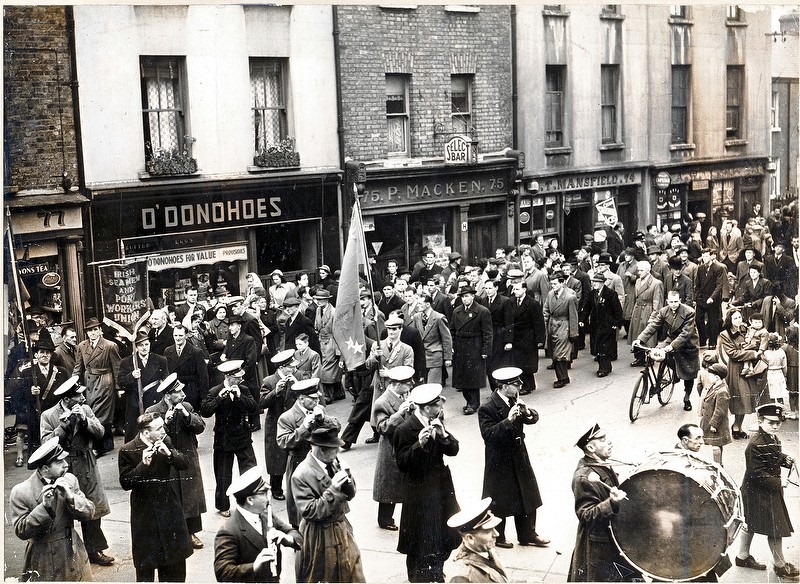
Men, women and children in a march of the Irish Seamen & Port Workers’ Union (now amalgamated into others) along south Liffey dockland some time before 1955. Note the medals on elderly man front left, possibly IRA medals from the the 1916 Rising and/ or War of Independence. (Source photo: Dublin Dock Workers Preservation Society).
Another view including the flute and drum band, Starry Plough Flag (the Tricolour is being carried on the far right of photo) and trade union standard. (Source photo: Dublin Dock Workers Preservation Society).

Those who remained received some municipal housing in pockets, often neglected by the municipality, their children educated but very rarely to university8 level, their traditional work largely disappearing. And a significant minority turning from lack of hope to substance misuse.9

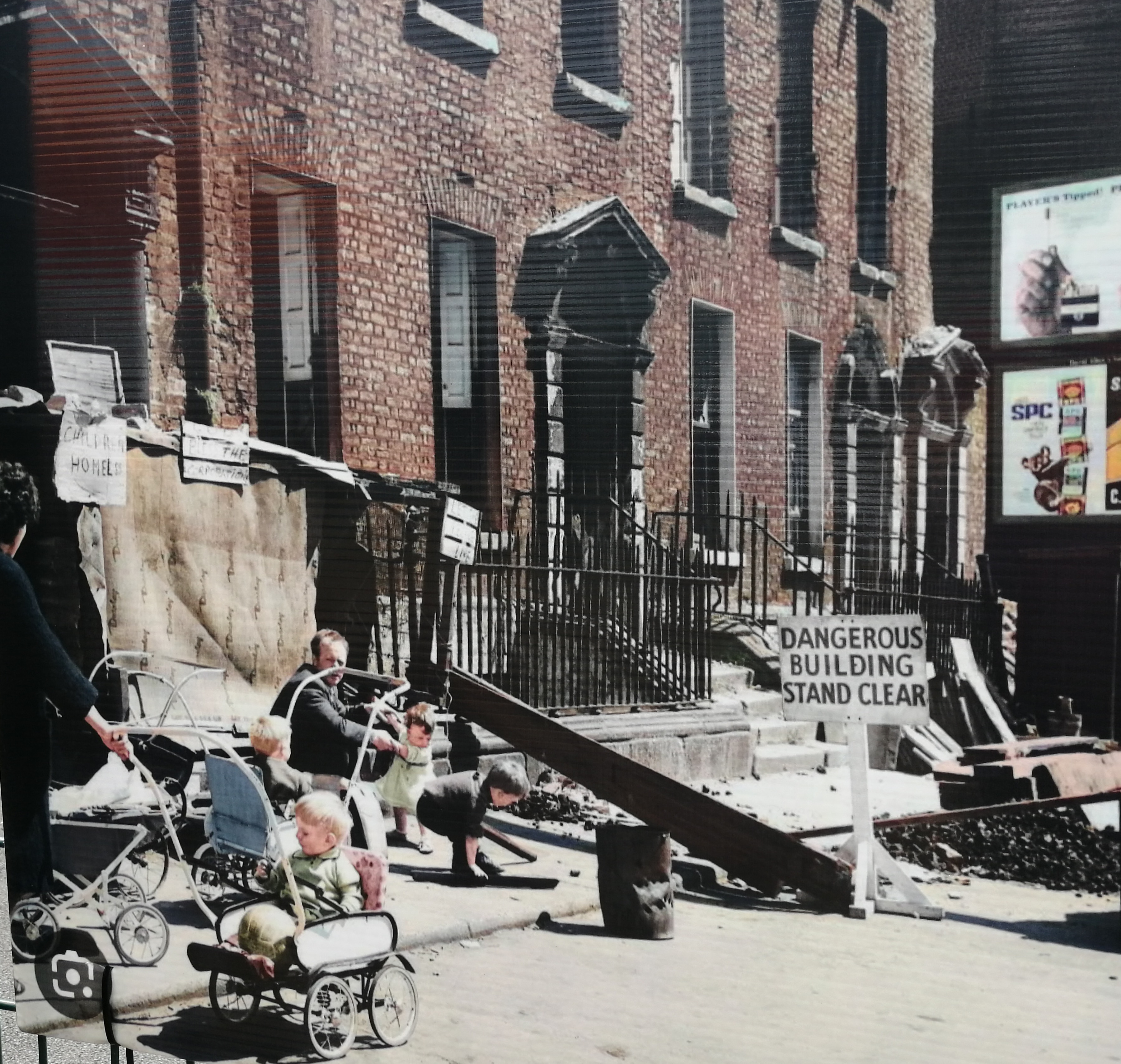
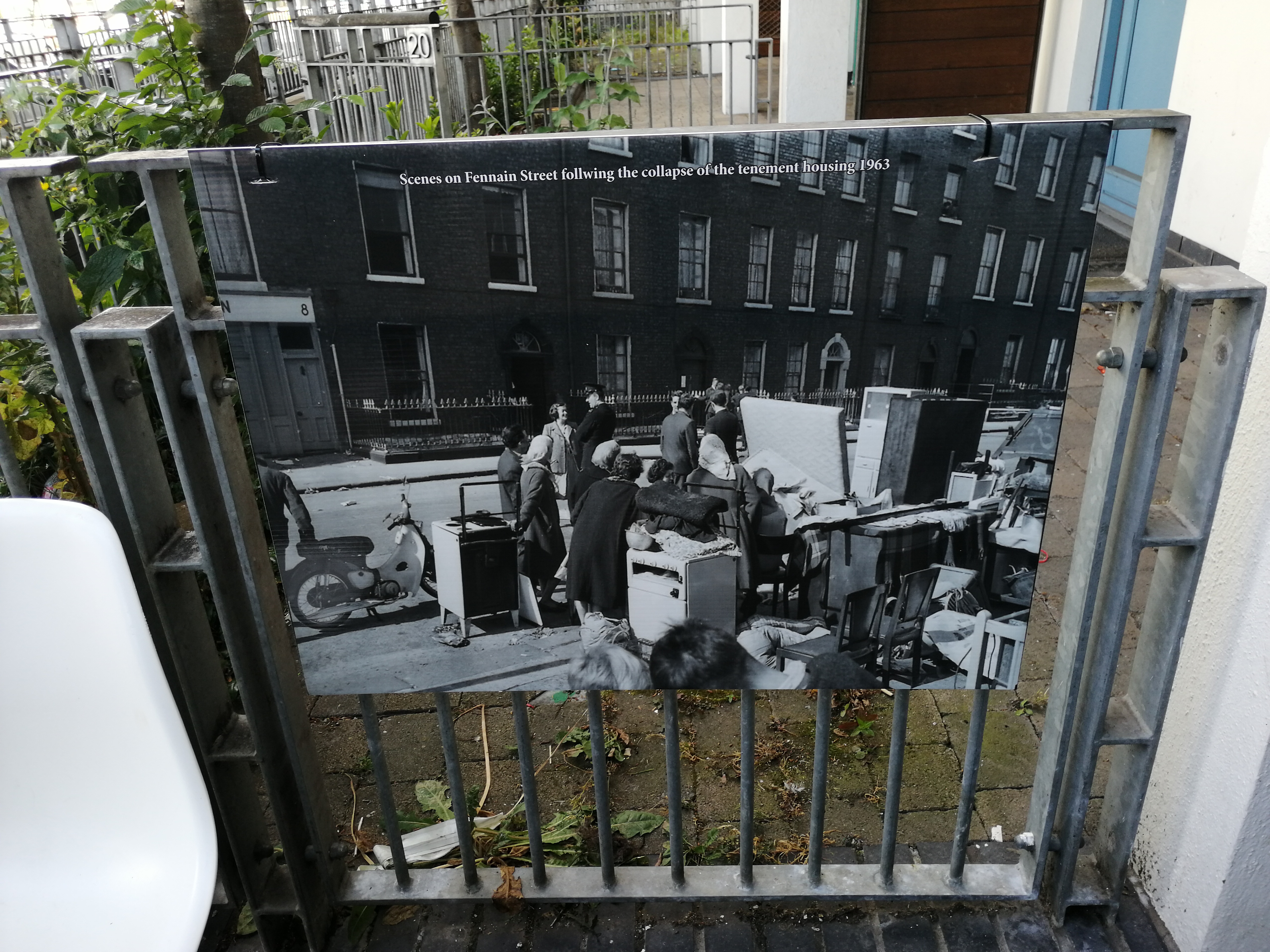
Houses in danger of collapse after an already collapse, Fenian Street, south Liffey dockland, 1963 (Photo source: Display at Andrew’s Court commemorative event of 1963 building collapse that killed two girls).

SOLUTIONS

Inclusion was a key word brought to the discussion I was invited to hear, with a number saying that “social inclusion” had been listed among objectives of a number of plans for the area but which failed to be achieved despite its listing.

The character of the area is of course changing with a certain amount of gentrification and some people even feeling they were looked at as though not welcome in the park they had played in as children and teenagers, or not welcome in local pubs under new management or new cafes.

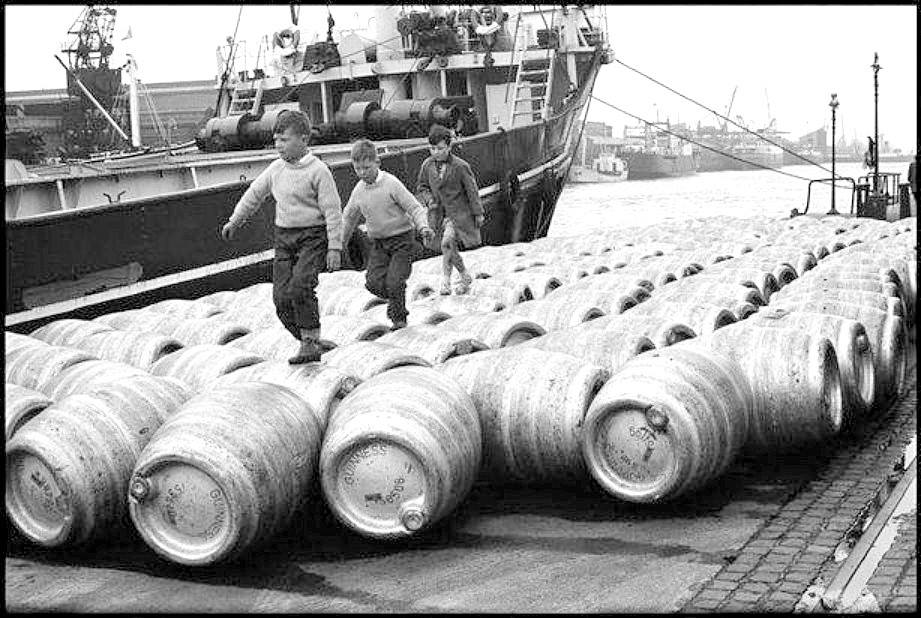
Children balancing on Guinness aluminium kegs beside docked ship on south Dublin quay with ships docked on the north quays also, circa 1950s. (Source photo: Dublin Dock Workers Preservation Society)

The kind of education working class people receive was discussed as an important factor with the mention of STEM, an educational program to prepare primary and secondary students for college, graduate study and careers in the fields of science, technology, engineering and mathematics.

Without that kind of preparation and qualifications, the group felt that children from their area had no chance of employment with the corporations now basing themselves in the docklands.

One of the group stated there is an annual special STEM seminar run at the RDS; however none of the others had heard of the seminar.

Another described a “Speed-date-type” careers advice session attended once, where students could spend a short time at one career table and move on to another. Another talked about career-planning advice for parents with which to to help their children.

Circa 1950s, family group, Gasometer in background [note also the old gas street lamppost behind man on the right]. (Source photo: Dublin Dock Workers Preservation Society)

The feeling of a lack of corporate responsibility for the people of the area in which the corporations have set up was clear.

The Ballybofey urban regeneration project was mentioned as a possible model along with Our Town urban centre projects.

If education is the key for integrating the local working class into most of the employment available locally, I wondered aloud, how would that work without housing? One of the group has already had to move out of the area for an affordable home and is intending to move further out still.

Already this means use of private transport and hours added to the working week, increasing the further out is the next home. Another said a survey found that the employment of 88% of the community was outside the area, while only 12% was local (with the carbon footprint involved).

Two-storey housing in good condition on South Lotts in south Liffey docklands – photo shows July commemoration of socialist revolutionary James Connolly and his family living there 1910-1911 (Photo: D.Breatnach)

COMMENT

My own feeling is that the first requirement is that homes need to be available for working class people in their area and that, I also feel, has to entail a local construction program of affordable public housing, ideally by a State or municipal building company.

But if people are not to have to travel outside their areas to work, as 88% are doing currently (according to the aforementioned survey figures), then they must have local employment and in turn that, in the main means with the hi-tech corporations, for which they need to be trained.

The group was very clear and in agreement on this point, whether the training is to be delivered by the corporations, by the State or by a mixture of the two.

When area developments or redevelopments are being undertaken, it is essential that the local communities are part of the process; otherwise tree-planting, city squares and delicatessen-cafes become not so much an addition to the people’s lives, as markers for their class’ replacement.

Whether in the end I agree with the way the group sees the solutions or don’t is not I feel the most important thing, which IS that they are wanting to organise and to take their future into their own hands. It is in that act alone that there can be hope for the future.

End.

FOOTNOTES

1A song about the persecution of the nomadic people, e.g Romany Gypsies and Travellers.

2Basically from the Pearse Street and Ringsend areas.

3Line from Dublin In the Rare Aul’ Times song by Pete St.John.

4A term often applied but rarely understood – labourers quickly become skilled in their work or they lose employment or become injured or killed at work. What the term really means is “manual worker who does not have a recognised qualification in at least one manual trade”. I have worked at both ends of that spectrum.

5 The Larkin Ballad by Donagh Mac Donagh, son of executed 1916 commander Tomás Mac Donagh, executed after the surrender of the 1916 Rising by British firing squad.

630th August, the first month of the dispute by DMP baton-charge on mass meeting around Liberty Hall. The following day (Bloody Sunday 1913, wrongly accounting for the two fatalities in many on-line sources), the DMP rioted again in O’Connell Street but most of the ITGWU had avoided it by rallying at their Fairview premises.

7The Irish population – though habitually of large families – remained largely stable for roughly a century after the Great Hunger’s death toll and mass emigration had reduced the island’s population by three million – until the upswing of the ‘Celtic Tiger’ economy began to increase it through immigration and reduction in emigration.

8Indeed, until 1966 most working class children left school at fourteen years of age, since secondary-level schooling was only ‘free’ (not for books, equipment, uniforms) up to that age.

9Middle and ruling class people misuse substances too – indeed some drugs, such as cocaine are much more used by “professional” classes – but they have living conditions varying from comfortable to luxurious and a range of choices for themselves and their children – not to mention expensive rescue services when they fall.

SOURCES

https://www.donegalcoco.ie/services/planning/regenerationprojects/ballybofey-stranorlar%20regeneration%20strategy/

https://www.donegallive.ie/news/home/1196127/concerns-over-ballybofeys-9-8m-project-raised-by-cllr-martin-harley.html

COLLAPSE OF BUILDING KILLING TWO GIRLS COMMEMORATED

Diarmuid Breatnach

(Reading time: 6 mins.)

The collapse of multi-occupation buildings in Dublin’s Fenian Street killed two girls. A day from the anniversary of the tragedy ​​​​sixty years later, local residents in a working-class block of flats organised a moving and informative commemoration.

On 12th June 1963, Marion Vardy and Linda Byrne, returning from a shop were killed when the buildings collapsed.

After another two people were killed in a Bolton Street collapse, a galvanised Dublin City Council inspection condemned many other buildings in the city and 155 families were rehoused immediately, though some in Army barracks.

And a number had to camp out for some days in the street. But it was not the first fatal building collapse in Dublin. On 2nd September 1913 (with the epic Lockout struggle only days old), two adjacent buildings had collapsed in Church Street, killing seven people.1

All the buildings in question were privately-owned with working class people paying rent to the owners. Emergency inspections by Dublin City Council inspectors in 1963 resulted in the condemning of 156 Dublin buildings as too dangerous for residence.

For years, other buildings in the Dublin inner city could be seen braced on a side by a massive timber frame.

Organisers’ panel photographed by D.Breatnach

COMMEMORATIVE EVENT

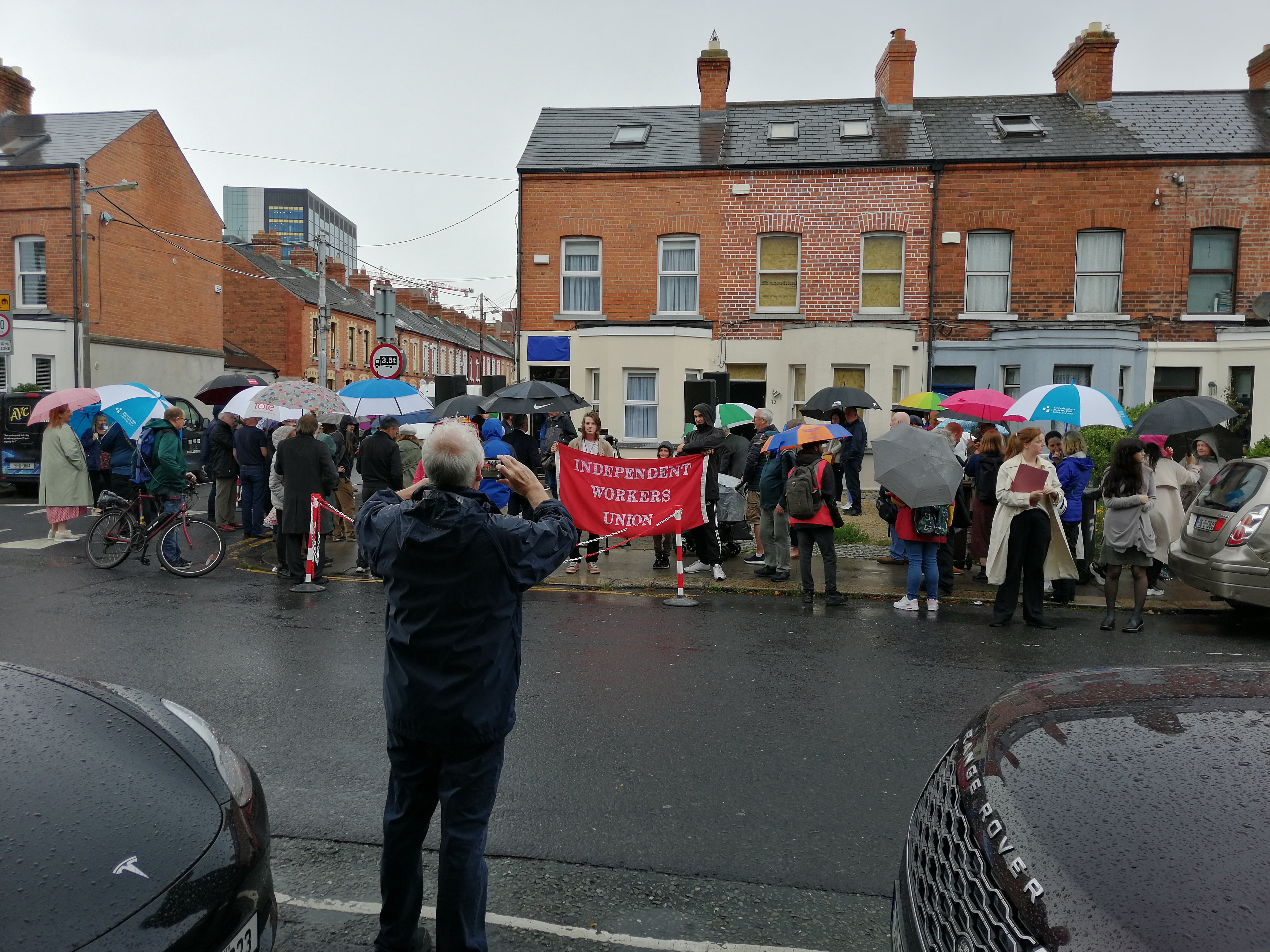
A display of panels describing the tragedy and panels of photos had been erected around the entrance to St.Andrew’s Court block of flats in Fenian Street, where a crowd had gathered for the well-organised commemoration.

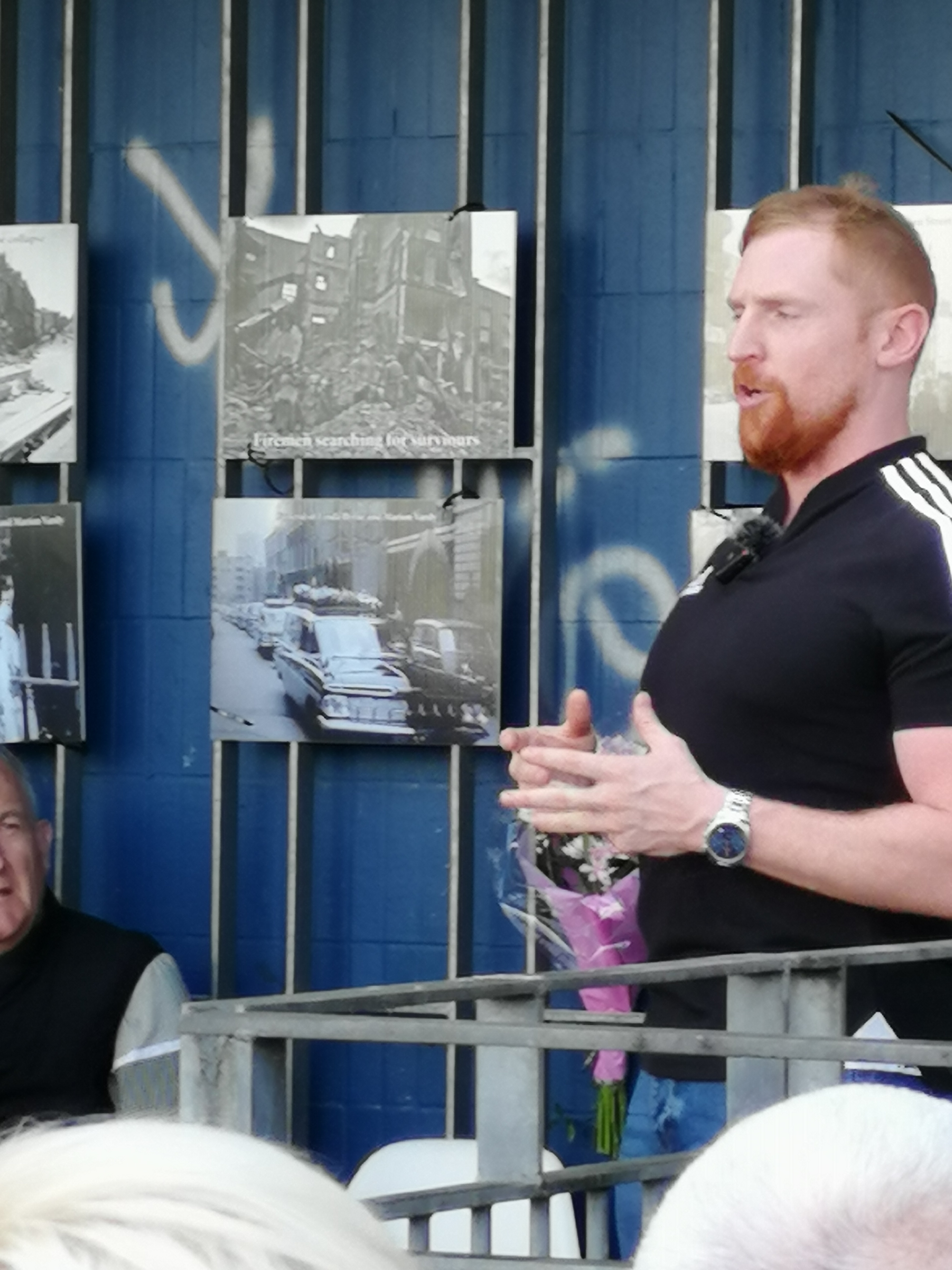
Paul McKeown chaired the event speaking eloquently when he could be heard (there was no public address facility) about the actual tragedy and the context of housing provision for working class people in the inner city.

Paul McKeown, who chaired the event, speaking. (Photo: D.Breatnach)

As a Catholic priest had performed the religion’s Last Rites over the bodies of the girls in 1963, McKeown invited a priest to recite some prayers at the event, which he duly did, after which the MC introduced a representative from the Henrietta Street Tenement Experience.2

The Henrietta Street speaker provided interesting snapshots of what past life was like for working people of the inner city in terms of occupation, accommodation and schooling. Some women sewed shirts in a factory while others sold items in street markets, such as Moore Street.3

Speaker from the Henrietta Street Tenement Museum. (Photo: D.Breatnach)

The floors in the poorest homes had no covering and toilets were very few, their use often shared by a great many residents. Although virtually all children would end schooling at the age of 14, the eldest boy often left years earlier to work, as a newsboy or shop messenger, for example.

Labouring on the nearby docks and carting would be the main employment for the men. No doubt emigration, almost a constant in Irish history, played a part too. Rats and mice were endemic in the buildings.

Though alternative and eventually new housing was found for all, it was to Dublin’s outlying areas, breaking up communities and their ways of life, separating them from services used, employment, etc. Many felt isolated and took the long journey to return to the city centre for social contact.

Organisers’ panel photographed by D.Breatnach

ATTACK ON NEARBY REFUGEES

The local flats overlook the location in Sandwith Street that in May had seen an attack by fascists on refugees who had been living in tents because the nearby International Protection Office, a State body, had failed to allocate them accommodation while processing their applications.

A few locals might have joined in and certainly some had attended the crowd but the fascists were imported (as indeed were the refugees and subsequently their antifascist defenders). Some locals at least resented the way they were being portrayed in some social media subsequently.

Refreshments, some of which were provided by Dublin City Council, were served by residents in the inner courtyard after the speeches. (Photo: D.Breatnach)

“We’ve had generations of Travellers4 in the flats and migrant people too,” commented one. “We’re more ethnically diverse than Dalkey,” he added. “Middle class people don’t talk to us, they talk down at us,” was another comment.

They claim that they have been neglected for generations by all the government parties but also by small left-wing parties, also by people who were quick to criticise them and to see them in negative stereotypes. “Nobody talks about class prejudice”, commented McKeown.

The inner city working class population has been moved out of much of the city and this area, which was previously seen as the least valuable real estate in Dublin, as McKeown observes, is now attracting property speculators for gentrification.

Some of the residents and others in attendance in the inner courtyard after the speeches. (Photo: D.Breatnach)

McKeown feels his people are not wanted in the area and he’s probably right. It’s not just that they are not the typical users of the wine bars and coffee bars of gentrified areas but that their current location would take in big rents after construction of hotels and upper-market flats.

Past the site of the attack on the refugees there is a new block of apartments, two bedrooms for 3,000 euro a month, one bedroom for 2,000. An empty bloc across the road which people say was well-maintained, remains empty since Dublin City Council moved the residents out 5 years ago.

The local residents say that they have been promised that a new block of apartments will be built on the latter site and that all the units will go for “social housing”, presumably meaning for affordable rent.5They want that to be true but are not sure whether they should trust the authorities.

After the speeches of the commemoration people were invited to partake of food and music in the inside square of the flats which contains minimal playground facilities.

Shay Connolly (centre) and friends performing at the event (Photo: D.Breatnach)

The music was provided by a trio including Shay Connolly playing ballads with the food served by local residents, in a relaxed atmosphere. The area at the back of the flats had become a sun-trap and while some soaked it up, I and some others eventually fled the heat.

PAST, PRESENT AND FUTURE

The commemoration of historical events can be of great importance. The event in 1963 forms part not only of an older story but also of the present, which is the lack of decent housing provision for the population of Ireland, in particular for those living in the inner cities.

Some of the residents and others in attendance in the inner courtyard after the speeches. (Photo: D.Breatnach)

Working and lower middle class people were wanted in the inner city to work its industries and its shipping port and to service the houses of higher social classes. As industry and port declined and the higher social classes moved out, the need for their work declined.

When their poor areas are seen instead as development prize areas, there is even less demand for the people who have lived in these areas for generations.

One can see this as the inexorable play of impersonal market forces or as the operation of finance and rentier capitalism in a capitalist economy and more, a Gombeen capitalist state where everything is done for the foreign capitalists and as little as possible for the working classes.

From the latter viewpoint, voting different political parties in to government will make no essential difference; what is needed is a fundamental change in the economy which can only be brought about by an organised, conscious and militant working class seizing their rightful inheritance.

End.

Organisers’ panel photographed by D.Breatnach

FOOTNOTES

1 I recall reading that a number of Dublin City Councillors, including Nationalist ones, were slum landlords.

2 It is open for visits from Wednesdays through to the weekend, I am told.

3 The market and area are subject to a long war between property speculators and conservationists (see smsfd.ie)

4 An Irish indigenous nomadic ethnic group of at least five centuries existence, much discriminated against.

5 “Social housing” is often understood as provision for people unemployed and on state welfare provision. Perhaps “Public housing on affordable rent” is a better description, housing both people working and those on benefits, the rents adjusted to means. This was widely built in the middle of the last century but none has been built in Dublin for decades, all governments insisting that the “private sector” (i.e big landlords, property speculators and vulture funds) can solve the problem while the housing crisis intensifies year after year.

SOURCES & OTHER READING

1963 Collapse: https://www.rte.ie/archives/2023/0531/1386694-fenian-street-homes-collapse/

1913 Collapse: https://www.historyireland.com/the-church-street-disaster-september-1913/

Tenement conditions 1913: https://csu1916.wordpress.com/lockout/dublin-1911/tenements/

2023 DCC failure to enforce standards on landlords: https://www.irishexaminer.com/news/arid-41080388.html

https://www.fm104.ie/news/fm104-news/tathony-house-landlord-rejects-councils-attempt-to-buy-the-property/

The Irish Ruling Class Celebrates Its Defeat of Democracy and Independence

Diarmuid Breatnach

(Reading time: 3 mins.)

The Irish State recently commemorated the end of the Irish Civil War but what it was really doing was celebrating its victory over the democratic national liberation forces.

The Irish national bourgeoisie, the Gombeen ruling class, armed and supplied by British Imperialism and colonialism, in 1922 launched a war against the forces that had brought the British Occupiers to the negotiation table.

In that short war or counterrevolution, the Irish State formally executed over 80 Irish Republican Volunteers – many more than had the British during the War of Independence 1919-1921. It also shot dead and blew up surrendered Volunteers and kidnapped, tortured and murdered others.

The Irish government of the day put the financial cost of the Civil War at 50 million sterling which today would be near to 3 billion euro.

A curtain of repression settled over Ireland, in the Irish state and in the colony in the Six Counties (in particular from the RIC re-baptised as RUC and the State-armed Loyalists of the B-Specials). Many Republicans were in jail and if not, could not find work and so emigrated.

The political party allegedly representing the Republicans, Fianna Fáil, led by a former leader of the forces attacked by the State, joined the Gombeen system and became in fact the preferred party of the Irish ruling class.

Though the Republican forces recovered and returned to the struggle in the 1930s (with the Communists against the fascist Blackshirts), again in the 1940s and onwards, they never again came close to winning control over the State.

What the Irish State has given us since its inception, even after the Civil War, has been generations of underdevelopment; unemployment and emigration; a huge decline in the Irish-speaking areas; inequality and social repression of women and LGBT people.

The latter was due to Catholic Church domination in every sphere of life, resulting in institutional physical, mental and sexual abuse, along with censorship in printed, audio and visual media and in banning of contraception.

The ruling class of the Irish State, the Gombeens, tolerated the foreign occupation and control of more than one-fifth of the island’s land mass and abandoned the large Catholic minority in the colony to discrimination and pogroms.

It tolerated also institutional and media racism against the Irish diaspora in Britain, the repressive legislation of the Prevention of Terrorism Act and the jailing for long sentences of a score of innocent Irish people in five different cases in the 1970s.

The Irish State tolerated Loyalist/ British Intelligence bombing inside its territory, failed to protect its citizens from terrorist bombing in the 1970s and covered up its complicity, for example with regard to the Dublin and Monaghan Bombings.

In addition, it used a Loyalist bombing to disarm the opposition to repressive legislation, not against Loyalists but against Irish Republicans, sending Republican activists to jail on the unsupported word of a senior police officer.

More recently this Irish State that we inherited has given us a housing crisis while it makes the territory a rich hunting ground for property speculators, bankers, landlords and vulture funds and also sells off/ gives away our natural resources, public transport and other infrastructures.

The selling-off includes our health service which is also in crisis while the private companies chop off parts of it and sell service back to the State at a profit. And a country that was able to feed 8.5 million prior to 1845 (and export foodstuffs) cannot now feed 5 million without huge imports.

They have given us nothing to celebrate but as always, there is a choice. We can bemoan the situation or we can “take back the nation they’ve sold” (Soldiers of Twenty-Two). And that cannot be done through electing any party or parties into the system.

End.

ANTI-FASCISM, HOUSING AND REFUGEES

Diarmuid Breatnach

(Reading time: 5 mins.)

Refugees living in tents on streets in Dublin were targeted last week by fascists and antifascists have confronted the latter in defence. Shelters of refugees have been torched.

There’s been some anti-immigrant discourse in Ireland, especially promoted by fascists and racists for a few years but it really took off during the Government’s handling of the Ukrainian refugee influx.

The Irish Government for pro-NATO reasons prioritised these over other refugees, also placing the Ukrainians in empty buildings in working class areas already low on social infrastructure and without consultation with the local community, some of whom reacted angrily.

The Irish Government handed the fascists and other racists a great opportunity and they grasped it.

After that issue had died down a bit, the fascists were looking for something to take its place and found it again in other refugees, this time those who were NOT being housed by the Government and were instead living in tents on streets around the IPO office in Mount Street.

Refugee tents near the International Protection Office (left of photo) in Dublin recently (credit Sasko LazarovRollingNews.ie)

The International Protection Office was supposed to organise to provide for the basic needs of refugees – in fact are legally obliged to – while their cases were being processed and had been failing to do so, hence the people it had failed living in tents around the area.

FASCISTS GO TO ATTACK THE REFUGEES

The refugees got some sympathetic coverage in articles in the Cork Examiner and Irish Times1. Perhaps it was this that stirred up well-known fascist Phillip Dwyer (known hater of women, migrants, LGBT and Muslims) to go and attack those people living on the street.

On Thursday 11th Dwyer turned up with his “security” people, i.e fascist goons, thinking to run the refugees out of there and perhaps do worse. But he was met with resistance including some people helping the refugees, two of the goons got hurt and they backed off.

According to a statement on Revolutionary Housing Action’s Twitter account, one of the defenders was ambushed when he went to collect his bike and while fighting them off, they threw a bike at him. Dwyer and his fascist hounds promised to be back.

Streetlink homeless service stated that on Friday, they were threatened and their outreach van pummelled while they packed refugee belongings and then boxed in so they had to suspend their outreach service for that evening, handing on outreach contacts to other services.

On Friday 12th Dwyer was back with a larger mob but met by a broad group of antifascists, including RHL, AIA, PBP, CATU, CYM, DCAR and independent antifascist activists2 (AIA statement onTwitter, Saturday 13 May). Dublin Republicans Against Fascism were there too.

Section of antifascists in the foreground on Friday, police in the middle distance and fascists and the curious beyond. (Photo: Rebel Breeze)

The violence against persons was now turned on the pitiful shelters and belongings which, on Friday night were set on fire.

On Saturday 13th, the fascist Irish Freedom Party held their rally on Custom House Quay against hate speech legislation being considered by the Government. From there they marched, not against the Government but against the homeless refugees.

According to local sources, the fascists distributed leaflets asking people to be electoral candidates and promising to help the inexperienced.

What was the connection between a protest allegedly about ‘free speech’ and a march on homeless refugees? Absolutely none, except the standard fascist agenda of targeting minorities to divide the working people and scream about free speech while using violence against their targets.

But in a cunning move, the NP who have never helped any area, were there afterwards cleaning up the area and placing flowerpots there.

Meanwhile, on Thursday night, the Revolutionary Housing League stated that they had opened one of the many empty buildings in Dublin to house the targeted refugees. The RHL have been opening up empty buildings for over a year now and encouraging others to do so.

Subsequently, Leo Varadkar, of the very Government that set up the conditions for this to happen, declared how unacceptable the attack on the refugees was. And following strong criticism from the Refugee Council, the State suddenly found it could house most of the refugees.

If true, hopefully good for those refugees but the fascists will now bleat about how “foreigners are getting treated better than the Irish” to the gullible and, also among themselves, be commenting that violence brings results.

The fascists have been stirring up local community fears with allegations that some of the refugees are paedophiles on the run from justice in their own countries, for which there is not a shred of evidence.

Ironically, while they attacked LGBT people as “paedophiles” some of the far-right have for decades been defending the Catholic Church hierarchy in Ireland from criticism and accusations of abuse of children and women in their institutions.

Lies spill from fascist lips as a matter of course: “immigrants are rapists and paedophiles, LGBT people are paedophiles, migrants are rapists, migrants are being treated better than the natives, the whites are being replaced by people of colour, muslims are taking over”, etc, etc.

THE GARDAÍ AND THE FASCISTS

The Gardaí, including the Public Order Unit, stood between the antifascists and the fascist-led mob on Friday, then kettled the antifascists for awhile, then followed the antifascist contingent up Pearse Street with fascists tailing along. When the antifascists dispersed, some of them were attacked.

The Irish Times on Monday 15th reported on a complaint from the Garda Representative Association that they are unable to police these events, don’t know about refugees, need training, etc.3

What is there to know? Refugees are as entitled as anyone else to be kept free from violence and the Gardaí could have arrested a number of fascists, had they wanted to, under the Public Order Act, which they regularly use against left-wing protests.

In September 2020, when unarmed antifascists went to counter-protest a Yellow Vest4 rally against masking5 and were attacked by masked (!) thugs recruited by the National Party with wooden and metal clubs, the POU understood enough to draw batons and attack – the antifascists!

Scene on Butt Bridge in September 2020 after armed fascists had attacked the unarmed counter-protesters at Custom House Quay and then the Public Order Unit had attacked them also, pushing them back off the Quay with raised batons, threatening to strike. (Photo: Dublin Republicans Against Fascism)

The following week, the Gardaí allowed NP fascists in Kildare Street to jostle and threaten a handful of LGBT campaigners and to club one of them to the ground. The Gardaí then ordered the woman, blood streaming from her head, to leave.

On both occasions the Garda press office issued statements saying that there had been no serious incidents. But the videos of the woman being assaulted and then ordered away went wide on social media and within a few hours, the Gardaí had changed their story.

In September 2020, longtime fascist and member of the National Party Michael Quinn (left, carrying wooden club disguised as Irish Tricolour flag) attacked veteran LGBT campaigner Izzy Kamikaze while she observed fascists in Kildare Street. The Gardaí forced Izzy to leave and later told the media nothing of any note had occurred, later having to change their press statement after the circulation of video footage. Quinn was later convicted of the attack and jailed for two years. (Images sourced: Internet).

However, it was ‘up to the victim’ whether she made a complaint (for an armed attack in a public place seen on video?)! She did, and eventually the particular assailant, Michael Quinn of the NP, was jailed for two years.6 But for Gardaí collusion with fascists and lying to the press? Nothing.

WHAT NOW?

Given the wars instigated by US/NATO and EU around the world and deprivation by foreign exploitation of people’s natural resources, refugees and other migrants will continue coming to Europe, including Ireland.

The fascists will continue to target minorities and wave their fake patriotism and social concern while they recruit for their parties, diverting attention from the housing profiteers and the facilitating ruling class while they strive to drive wedges into the working people.

The local working class residents, for example in the block of flats overseeing the site of the conflict, will gain nothing except an undeserved bad reputation for what happened in their area and in which perhaps a few teenagers were opportunistically involved.

Already the recently-completed block of apartments just down the road from them is advertising one-bed apartments for 2,000 euro a month and two-beds for 3,000. None of the local working people of course will be renting those.

The cause of the housing crisis in Dublin will continue: property speculators, vulture funds and multi-unit landlords will continue to rake in profits because the Government won’t build housing for affordable rent in case it should compete with them.

Unless, that is, a real hard struggle including militant occupations and defiance of court orders is taken to them forcing a change, be it reform or revolution. This is a task for the Left which of course can never be carried out by fascists.

But hopefully many anti-fascists have learned or had reaffirmed the need for unity in a broad front against fascism and that confrontation and preparedness for physical defence against fascists is needed, while also discussing the most appropriate tactics for different situations.

End.

FOOTNOTES

1https://www.irishtimes.com/ireland/social-affairs/2023/05/04/homeless-asylum-seekers-its-hard-sleeping-outside-its-cold-its-wet-its-no-life/

2Including anarchists.

3https://www.irishtimes.com/ireland/social-affairs/2023/05/15/gardai-have-sufficient-resources-to-stop-violence-against-refugees-harris-says/

4The Irish Yellow Vests were a right-wing populist organisation, led by Ben Gilroy and Glen Miller, fascists and islamophobes.

5The rally was on Custom House Quay, scene of the NP’s rally last Saturday.

6Man who used wooden post to strike a woman during an anti-lockdown rally is jailed (thejournal.ie

SOURCES

https://www.irishtimes.com/ireland/social-affairs/2023/05/04/homeless-asylum-seekers-its-hard-sleeping-outside-its-cold-its-wet-its-no-life/

https://www.irishtimes.com/ireland/social-affairs/2023/05/15/gardai-have-sufficient-resources-to-stop-violence-against-refugees-harris-says/

Man who used wooden post to strike a woman during an anti-lockdown rally is jailed (thejournal.ie)

FIRE!

Diarmuid Breatnach

(Reading time: 3 mins.)

Fire is an important source of heat and so facilitates life but it can also be a killer. Fire safety is particularly important in multi-occupied buildings but essential safeguards are often not provided or when they are there, are ignored or misused. One can see evidence of that frequently in news reports and even on many occasions in one’s own life and, on a number of occasions as a manager of accommodation services, I have certainly seen examples all too often. Buildings are being constructed to greater heights than can be reached by the ladders of fire-fighters. Those responsible for lack of fire safety procedures or of violating them should face severe penalties.

Fire at tower block in Tower Hamlets in London last year. (Photo: Supplied to Guardian newspaper).

When it is being destructive, fire kills in many different ways, not just by extreme heat. Smoke inhalation is another killer, as are toxic fumes emitted by some materials when burning. People can be killed by falls when attempting to escape a fire or be crushed by falling parts of the building, beams etc. And fire can also cause explosions when it encounters volatile liquids or gasses. Whether we live, work or relax in a building, we should never be blasé about the dangers, never disregard precautions and in fact be prepared to insist on adherence.

There are various headings under which we can discuss fires safety but Prevention, Detection, Suppression and Evacuation cover most of them — to which we can add Educated Awareness.

Prevention has to do mostly with safe design, use of safe materials and with safely operating processes that generate heat or produce flame, classically cooking and smoking but also many others — in industry all such procedures should be clearly advertised.

In Detection, apart from what to do when one smells burning or personally encounters flames or smoke, it is with systems such as smoke and heat detectors and alarms that we are concerned.

With regard to Suppression, although of course occupational fire-fighters may use other means, we are interested in fire extinguishers (more rarely fire hoses) and sprinkler systems and, in Evacuation, in the means of safe escape and subsequent assembly, along with indications of when one should do so, which of course are linked to detectors and alarms.

SUPPRESSION

How often we see a fire-extinguisher being used to prop open a door! This is a serious misuse of a piece of fire-fighting equipment and its use in that way may mean it will not available in the appropriate place or malfunctions when required. Often too the door being propped open is very close to a staircase, with the danger of the heavy extinguisher being dislodged and rolling or bouncing down the stairs to strike someone.

International Fire Extinguisher pictogram sign (Image sourced: Internet)

Fire extinguishers in buildings are usually installed by a fire-protection company, under contract to check and service them once a year. Does that sound safe enough? In a team of which I was a member, we checked the fire extinguishers on each shift, to ensure they had not been tampered with and we lifted the water-filled ones to check, by weight, that they still contained water. Those checks were written into our work rotas and we were required to sign off on them. We had developed those safety routines as a team and I carried them forward into subsequent management roles. In the case of an extinguisher we found too light or with the seal removed, that was recorded and the urgent task was to have it replaced by the fire-protection company under contract.

Sprinkler systems should have a means of checking that they are functioning well and should be regularly checked.

Fire alarms and smoke detectors need to be regularly checked also. In the case of smoke detectors they can be checked by spraying with an aerosol and the fire alarms have a facility for testing — though an arrangement with the fire-fighting service that alerts them to a test being carried out is advisable.

Blackbird Granary fire, Oregon, last October (Photo: Statesman Journal)

EVACUATION

I’v worked in places where I never experienced a fire drill. That is terrible, when you think about it. In a good team of which I was a member we made sure we carried out drills but we also had to balance the need for fire drills with the possibility of injury during evacuation to the hostel residents, who were drinkers and many of whom were infirm. We compromised by holding drills for the staff and local management while informing the residents of what we were doing. When I came to manage a hostel, I arranged to have a member of staff with a pen and clipboard follow the fire evacuation drill in action, which is when we discovered that a wheelchair-bound resident could not be got out the main door at all quickly. How had that not been noted previously? Not only that but for security reasons, the team members were not using the emergency exit. And then it was discovered that a member of staff was keeping his bicycle in the passageway leading to the emergency exit, potentially a hazard to people trying to escape a fire. Incredibly, the individual concerned was the team’s elected health and safety representative, which made for an interesting discussion with him later.

As a team, we resolved all those issues — but only because we carried out the drills and observed what happened during them.

During a fire there may be a power cut so the provision of emergency lighting is important, along with luminous signs indicating the evacuation route. That lighting too should be checked.

Worse things than obstacles in the path to emergency exits occur, when building owners or management lock or chain emergency exits for reasons of building or product security or in some cases even to imprison workers. As children some of us would “bunk in” to cinemas: one who had purchased a ticket would go to the toilet to open a nearby emergency door and admit others. The cinema management ended that practice by chaining the emergency doors shut. It is understandable that a commercial business might wish to discourage evasion of their admission charges but certainly not at the cost of putting lives in danger — many other means can be developed, including monitoring systems and alarms. In north Dublin’s Artane suburb, the management and owners of a nightclub had locked some fire exits and on 14th February 1981 a fire broke out during a dance attended by 841 young people, causing the deaths of 48 and injuries to 214. Exit doors were also locked in the Summerland leisure centre on Douglas on the Isle of Man on 2nd August 1973, when a fire caused the deaths of over 50 and serious injuries to 80.

One organisation I worked for had a stipulation that they would hold fire drills once every six months while another held them once every three months. As a team member I advocated them to be monthly at least and as a manager made that a requirement, marking the date for them in advance into our diary. Also, some drills should be carried out without warning and, as in the case outlined earlier, with an observer following the procedure and recording its progress.

Shift fire safety inspections should check or test the emergency lighting and emergency exits, while periodic drills should check the functioning of the fire alarm and display panel, by activating the alarm at a different location for each drill (there are keys supplied for that purpose).

Can the ladder reach?

It would be no bad thing for every person to attend a fire prevention course but it is essential for some kinds of work, in particular for people working in buildings with others or where people live. Such training not only deals with prevention best practice but also with how to act upon discovering a fire or in response to a fire alarm, what are the appropriate extinguishers in different circumstances, etc. The cost of such training (and of replacing staff while on training, if necessary to maintain the service) should be built into the operational budget of the facility.

One fire prevention course I attended had us consider what to do if we were trapped on an above-ground level of the building and unable to proceed to the fire exit. In most cases, if the fire-fighting service has been summoned (by the service-linked fire alarm or by other means), it is usually safest to retire to a room facing on to an area with a window which the fire tender can access easily enough, then close the door and stuff cloth around the bottom to limit the ingress of smoke. In the case of residents being trapped on that floor with us, we were to encourage them to come into the room we had chosen and to remain there with us until evacuated.

Speaking of evacuation, in a scenario such as the one just described, we might have to be brought out through a window by firefighters who would normally gain access to us by one of their ladders. It is a fact that the maximum ladder available to fire tenders in Dublin is 100 feet long but since a ladder cannot be used at right angles to the ground, the effective height is around 75 feet. Yet Dublin City Council and many other local authorities around the country regularly permit the erection of buildings with floors that are higher than 75 yards from the ground. How can that be allowed?

Grenfell Tower ablaze, West London 14 June 2017; 72 were killed and more than 70 injured (Photo sourced: The Telegraph)

Earlier in this article, we saw the example of a fire extinguisher being used to prop open a door. This is sometimes compounded by the door in question being a fire door, in other words a door the function of which is to retard the spread of fire. Such doors should be kept closed at all times when people are not passing through the doorway and should have automatic closing mechanisms. The should also have a slot of glass in them so that one can look through without having to open the door, the latter being an action which in some cases might have lethal consequences. The material of the doors should be such that they can resist actual flames and heat without burning for one hour but unfortunately it is not unknown for such doors to be constructed of inferior materials which might be discovered only in an emergency — i.e too late to be of use. A reputable supplier is the only safeguard against such unfortunate discoveries but their production batches should be regularly and randomly tested by State or local authorities too.

Documentation

A work team should have appropriate procedures in place to deal with contemplated dangers and with regard to fire, a separate file detailing them is recommended. As a team we developed one (model fire precaution files can be purchased also) that listed the suppliers of our alarm systems and fire extinguishers, recorded their checks or replacements, referred to daily checks, training courses attended and by whom, recorded the fire drills; as a manager I ensured our team had duplicate files, one for staff access at any time and a backup copy in the management office.

A new member of staff or management should be introduced to that file as part of their induction.

International emergency exit pictogram sign, displaying its nature and direction; these are usually lit from behind by emergency lighting. (Image sourced: Internet)

Arson

The attractions of fire are well known with children having to be cautioned about it, so much so that “playing with fire” has entered the language as a metaphor. People who live on the street, especially in ‘western’ countries tend to contain a certain proportion of mentally-ill people or others with social behavioural issues. For some of those fire holds a substantial attraction and, when in a multi-occupation building, they can constitute a very real danger. In one hostel there were a series of small fires deliberately set and we never found the culprit in the act. We did have our suspicions and some circumstantial evidence and on that basis I instructed the individual’s eviction. That seems harsh but the series of incidents indicated that we might have a very serious one eventually either because he was building up to it or through it unintentionally going out of his control. With the lives of a number of other residents and also of staff at risk I felt obliged to take that action and informed the organisation’s head office of what I had done and why. DCC’s Homeless Agency tried to force us to revoke our decision but we stuck to it. Agencies responsible for housing homeless people but without sufficient funding often try to shoehorn individuals or families into unsuitable accommodation. Of course there should be a housing option available to everyone but the one we provided just wasn’t suitable for what we considered a serious arson risk.

Similarly as workers or residents we should not tolerate behaviour of our peers that puts us in danger or neglect of laid down fire precautions. In an example referred to earlier, I could do nothing about the incredible attitude of a safety representative elected by the staff team but as a manager I could act on a member of staff endangering the team and he was of course instructed to remove his bicycle from the premises and to risk it locked on the street (as indeed I risked mine). I have heard of places where team members had a battle using fire extinguishers which is no doubt great fun but incredibly irresponsible.

Dealing with staff health and safety representatives as a manager reminds me of the time I had been such a representative myself. Wanting a bit of a break from confrontations with management, I declined nomination as shop steward and accepted nomination as staff health & safety representative instead. To my unpleasant surprise I found myself in more confrontations with the management than did the shop steward. And that was with a local management team that was quite progressive.

Owners and managers of buildings, along with companies employing people to work in them, have serious responsibilities with regard to comprehensive fire prevention, detection, suppression and evacuation procedures and should be rigorously inspected and pursued when they fail to ensure sufficient safety standards. When deaths are caused due to failure to ensure safety, the least they should face are manslaughter charges. A homeless person suspected of arson can be evicted without too much trouble but neither the owners of the Summerland leisure centre on the Isle of Man nor the Butterly family, owners of the Stardust nightclub in Artane have ever faced a single charge in a court of law.

End.

REFERENCES

https://www.dublincity.ie/residential/dublin-fire-brigade/fire-prevention-and-community-fire-safety/fire-safety-businesses/fire-safety-advice-and-responsibilities/passive-fire

https://www.ors.ie/news/fire-door-inspection-and-compliance/

https://www.thejournal.ie/dublin-fire-brigade-high-ladders-3675543-Nov2017/

https://en.wikipedia.org/wiki/Stardust_fire

https://www.forbes.com/sites/davidvolodzko/2019/03/05/bangladesh-and-the-fire-next-time/

https://www.theguardian.com/world/2021/oct/14/killed-fire-engulfs-building-southern-taiwan-kaohsiung