Five people sitting down to a meal were surprised by a knock on the door of their residence. What followed amounted to an hours-long Garda siege ending in arrests and the residents and supporters gathering outside being pepper-sprayed and beaten.
A housing activist who has witnessed many evictions said it was the most violent eviction they had ever seen.
A house empty for many years in the Phibsboro area had been occupied by around four people who invited a fifth to share a meal on Monday 15 December. As they were about to sit down to eat the Gardaí arrived and told the occupants that they were criminally trespassing.
The occupants explained that they had been living in the building for some time and had keys, so any accusation of trespass would be of a civil kind requiring court orders and not at all a criminal one on which Gardaí are empowered to act. The Gardaí however remained and more arrived.
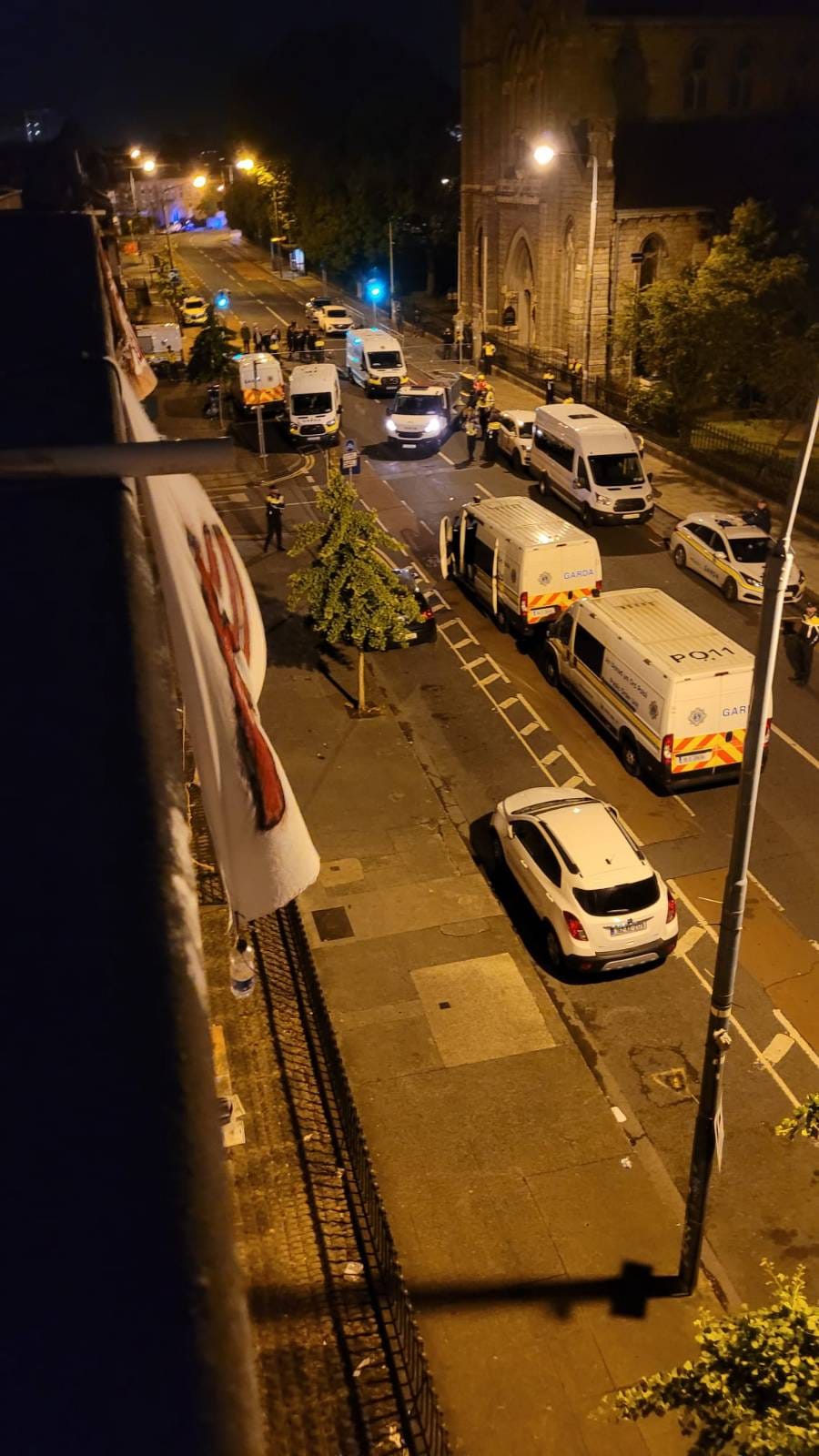
Local people responding to a call for support against an illegal eviction began to arrive as did more Gardaí until there were around 13 Garda vehicles present, including the Public Order Unit; a number of attempts to batter the door down were made which were however unsuccessful.
People protesting what appeared to be an illegal eviction were pushed and shoved by Gardaí and after a while also pepper-sprayed and batoned. After some hours had elapsed the police succeeded in smashing a back window and battering down an internal door, gaining access to the building.
The people inside raised their hands to indicate no resistance being offered (some were reportedly even sitting down) but allege that they were nevertheless pepper sprayed and beaten. Four were dragged out to Garda vehicles and the remaining person was violently assaulted again.
The road outside had by this time been cleared by the Gardaí. The five arrested were taken to a police station where at least some, male and female, allege they were stripped and cavity searched, measures totally inappropriate in this kind of arrest or similar.
It will be recalled that a number of Mothers Against Genocide group protesting outside Leinster House complained of the same during their detentions in Dublin in June although the Government’s spokesperson denied to some TDs that this had occurred.
That same week anti-NATO peaceful protesters had also been pepper-sprayed and the ankle of one broken by Gardaí while a Palestine solidarity activist at DCU was dragged to the ground, with allegations of strip-searching among those too.
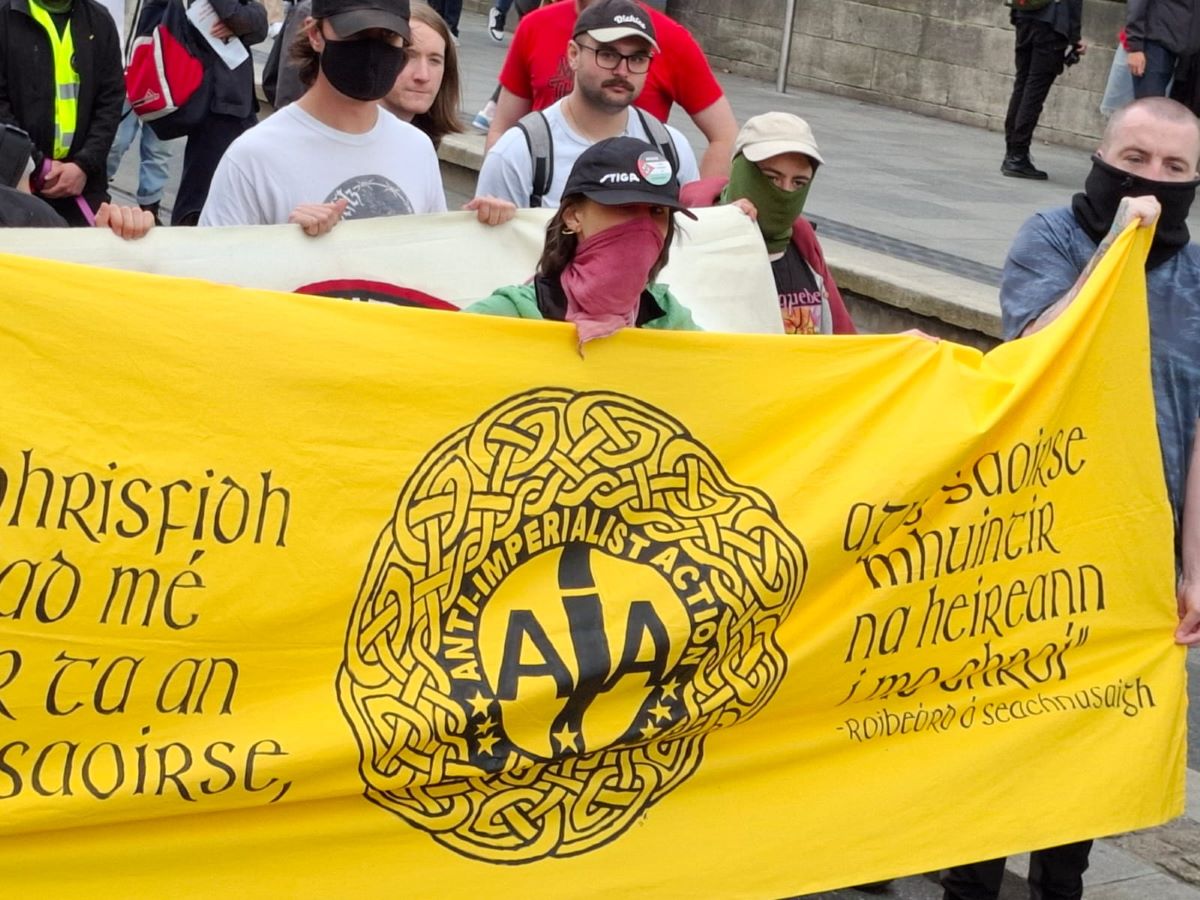
Video by Anti-Imperialist Action outlining the source of Dublin’s housing crisis.
All five residents of the house were charged with offences including causing fear (!) and criminal damage, kept in custody overnight and brought to court, where they were released on bail to return to court at a date in the New Year.
GARDAÍ HELPING MAINTAIN HOMELESSNESS
This Garda operation and abuse of legal powers took place in the context of the highest recorded number of homeless to that date, with 16,600 people in emergency accommodation, including morethan 5,200 children and over 4,600 women,1not counting those sleeping on the street.
And with well over a hundred thousand buildings lying empty,2 a situation constituting a paradise for property speculators, vulture funds, banks and big landlords – but misery for thousands renting, struggling with a mortgage, in unsuitable accommodation, sofa-surfing or on the street.
Indeed, the property at which the Garda violent eviction took place was reportedly empty for many years before its occupation.
A couple of years ago a group called the Revolutionary Housing League occupied empty Dublin buildings and called for people across Ireland to do the same. Sadly, their call was not followed and Gardaí mobilised huge operations including helicopters to evict a handful of occupants.
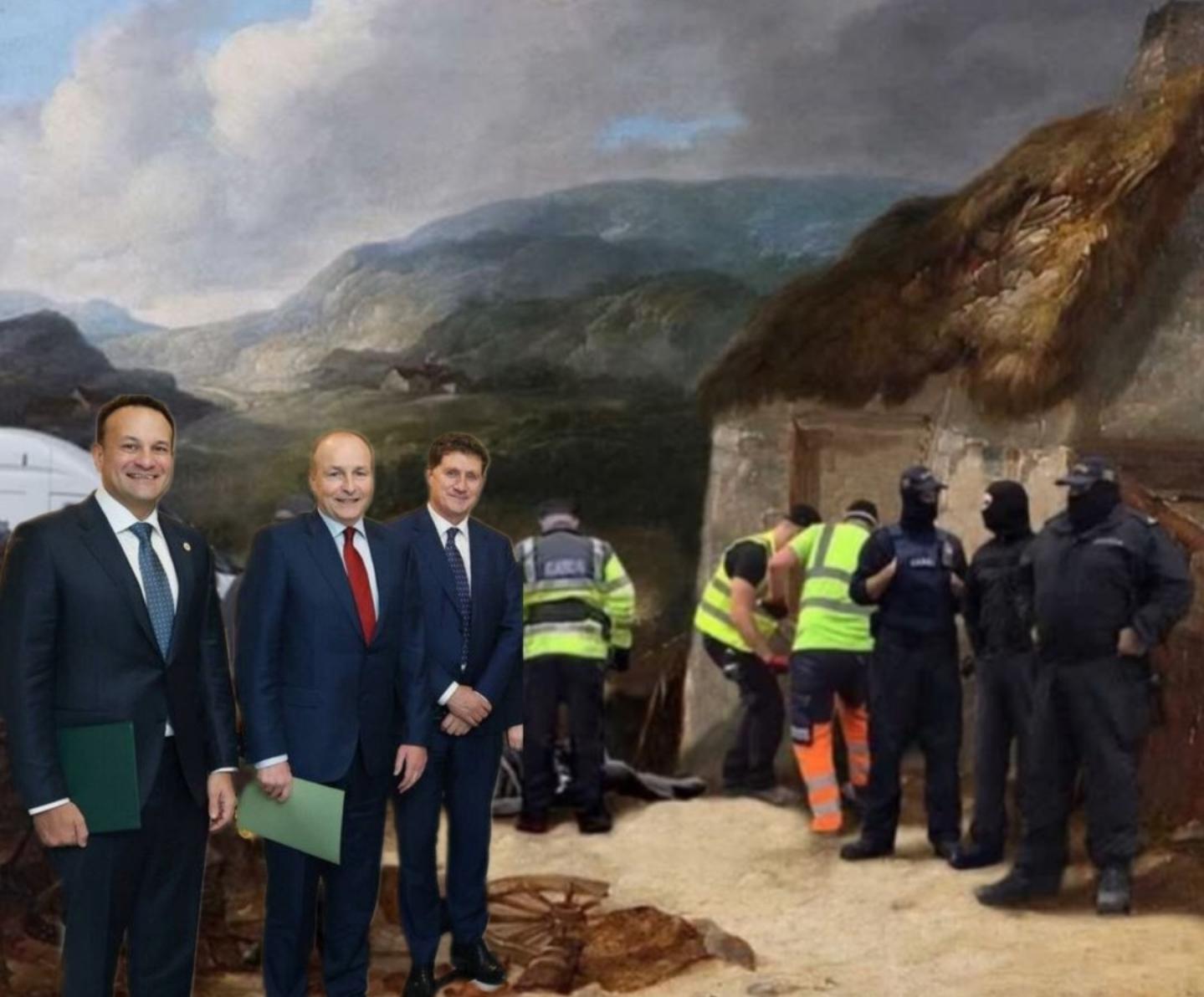
Three chief Irish Government Ministers some years past (one still in place) and Gardaí photoshopped on to 18th Century eviction scene in Ireland (original photoshopping of Gardaí by Spice Bag). (Image sourced: Internet)
HUMILIATION AND VIOLENCE
Strip and cavity-searching are demeaning psychological and physical invasions and should have no place in most policing actions. Even in jail, an x-ray chair is available. However strip-searching has been a constant over the years in use against political prisoners.
As violent and degrading actions become normalised in political repression they will be extended further, spreading to all kinds of policing operations.
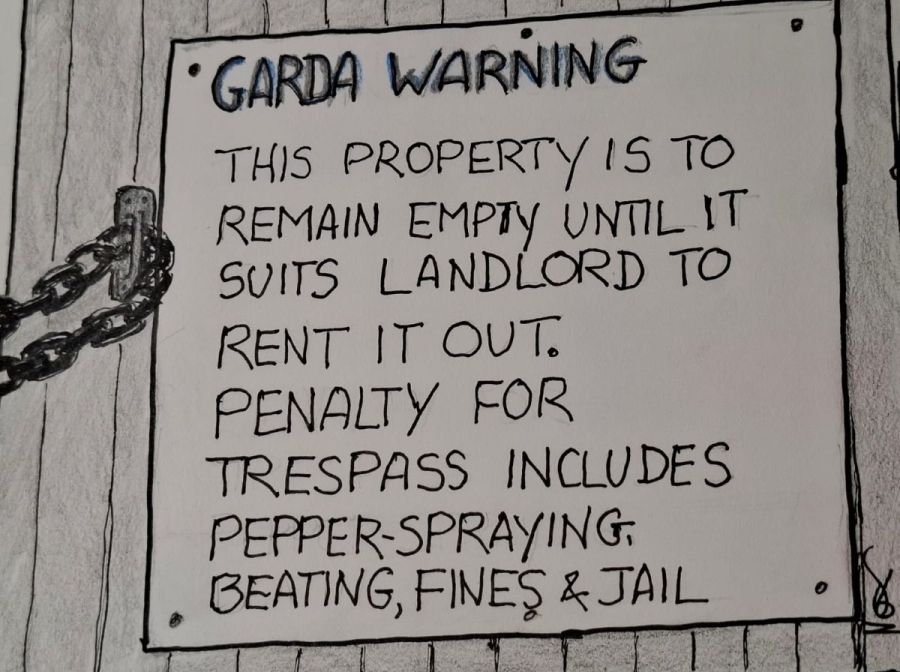
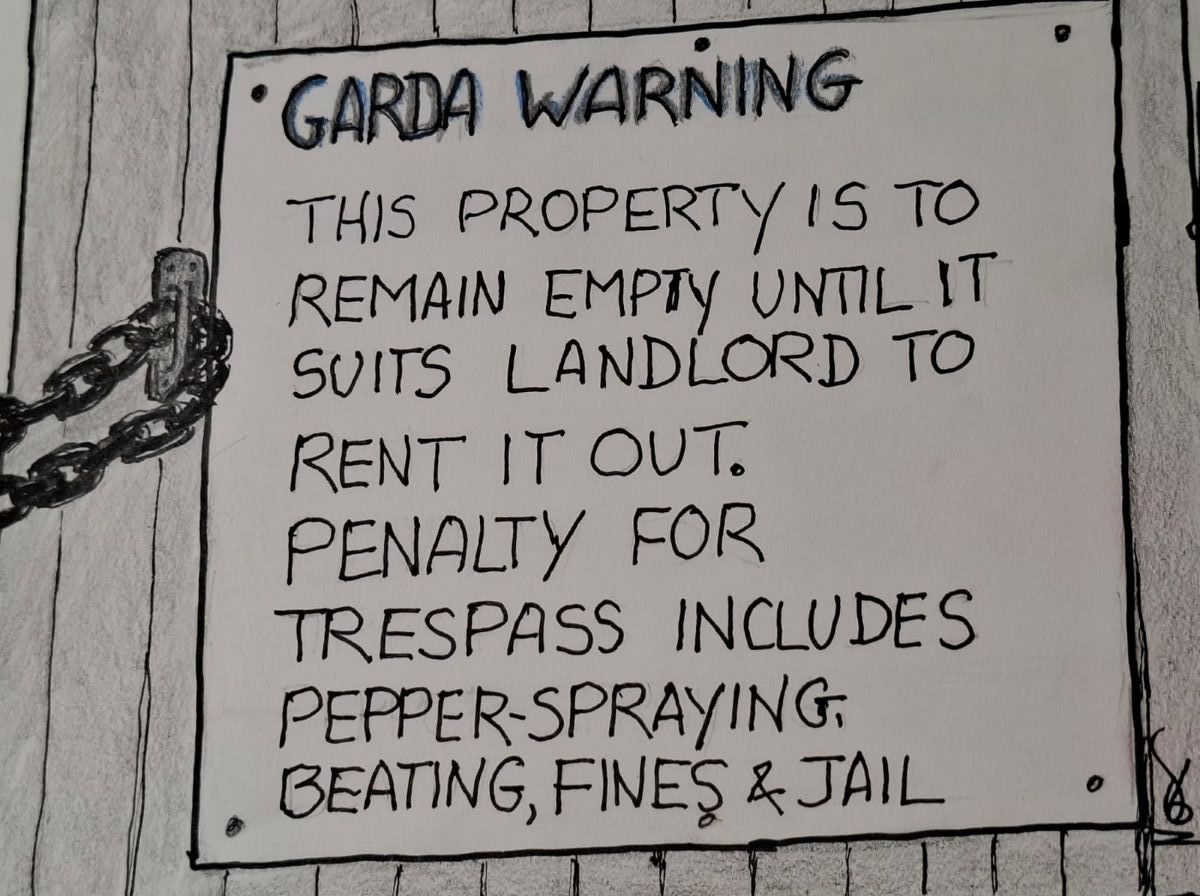
Cartoon by D.Breatnach
Gardaí normalising the use of pepper-spraying against Palestine solidarity and anti-NATO direct action activities are now extending this to other types of activities of which they disapprove, even those in the sphere of civil law and outside criminal law.
As the State increases its repression, the democratic and revolutionary movements will need to increase their resistance, calling also for the active solidarity of wider society with the victims and in condemnation of the State and its police force.
End.
Note: If you found this article of interest, why not register with Rebel Breeze for free, so that you will be notified by email of subsequent articles. You can de-register any time you wish.
The Irish socialist Republican group Anti-Imperialist Action today issued a call to revolution centred around a need for universal social housing to resolve the chronic housing crisis in Ireland (and in particular in Dublin).
This housing crisis has at January’s count left nearly 15,300 living on the streets or in emergency accommodation1 with another unknown number in inappropriate accommodation such as sofa-surfing with friends and relatives or in IPAS centres for refugees.
Rampant property speculation has made a handful of bankers and speculators very rich and along with the social misery of thousands, facilitated the demolition of buildings of historical and architectural importance and their replacement by usually unsightly glass and concrete.2
Well, so what of AIA’s call? Different organisations make various calls at different times but do they have any effect? However, this one has some important distinctions, one of which is that this organisation actively practised its preaching when it called for the occupation of empty properties.
In May 2022 the AIA founded a sub-group called Revolutionary Housing League that occupied empty buildings in Dublin, refused to comply with court orders3 to evacuate or, in court, to agree to bail conditions that they would desist from further building occupations.
‘James Connolly House’ in occupation by the RHL in May/ June 2022. Photo: D.Breatnach)
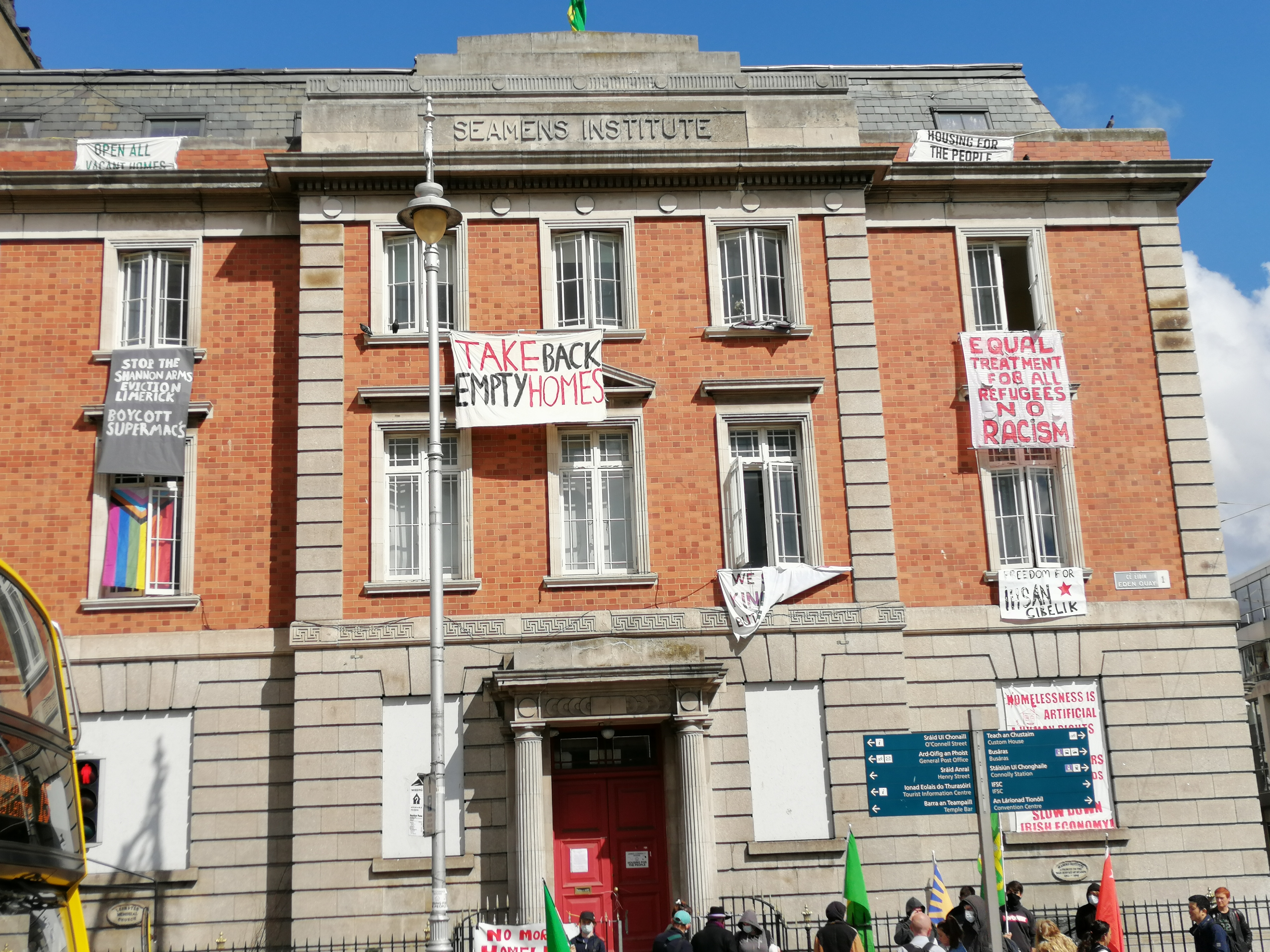
The first building targeted on May 1st was a former Seamen’s Institute building on Eden Quay, renamed Connolly House, metres from O’Connell Bridge, empty for years since the Salvation Army, a religion-based charity NGO, had lost government funding for its youth homeless accommodation project.
On the morning of June 9th 2022 over a hundred Gardaí, with an armed unit on standby and a helicopter overhead, stormed the building4 and arrested the only occupants, two RHL supporters. In court later that day, they were bailed without making any promise not to re-occupy buildings.5
It seemed that the State was sensitive to the dangers of creating martyrs around the housing crisis.
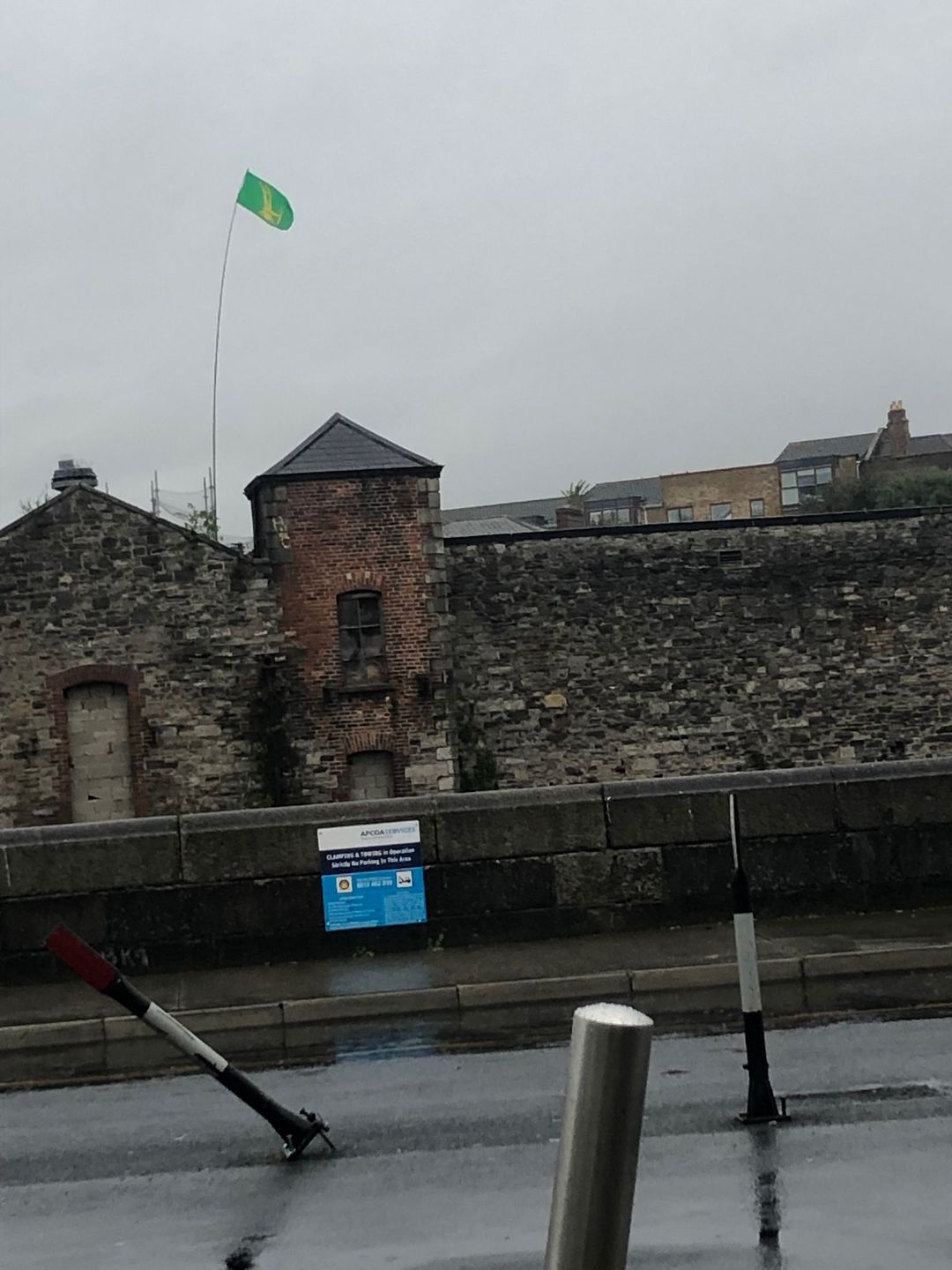
Instead, RHL renewed its call for mass action across the country to occupy empty buildings. And went on to occupy other buildings, including Ionad Sean Heuston near the eponymous Bridge and another in Belvidere Road, eviction here also including massive police forces and helicopter.
Seen from the north bank of the Liffey, the Starry Plough flag flying high over the ‘Ionad Sean Heuston’ occupied building. The Heuston train station is behind the photographer while the Bridge is out of frame to the right. (Photo: D.Breatnach)
Success for the RHA’s campaign depended on, if not a mass, at least a substantial take-up of its call to occupy empty buildings backed by civil disobedience to the courts. Neither happened and the AIA was far too small to carry the campaign on its own and so suspended it.
It is worth noting that though many organisations and individuals had agitated around housing, including the high-media-profile occupation of Apollo House in December 2016, backed by noted individuals,6 none had initiated the steps advocated by RHA/ AIA.
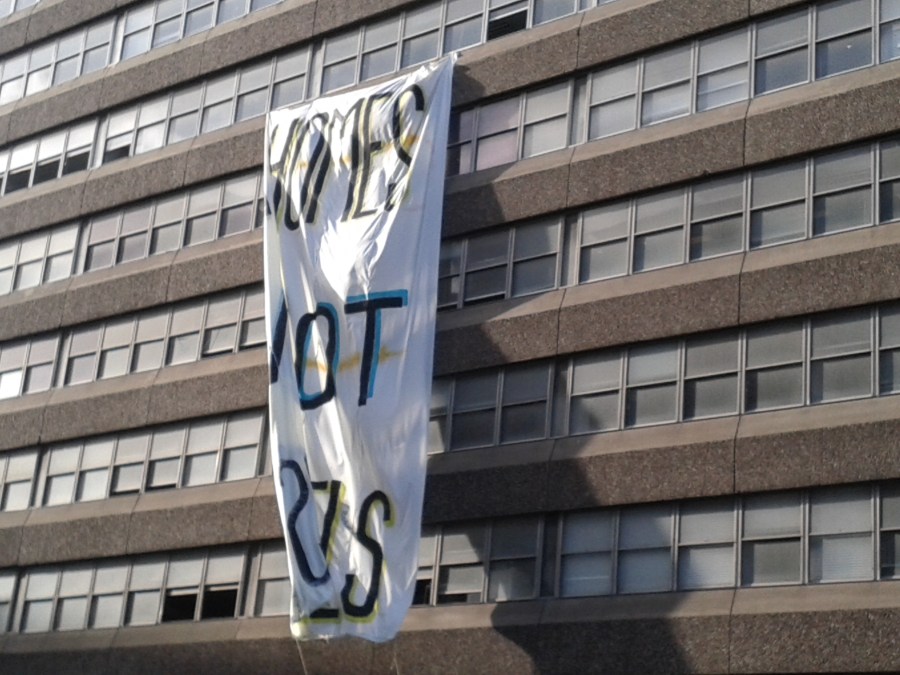
‘Homes Not Hostels’ banner on Tara Street side of occupied Apollo House in December 2016 or January 2017. The building was later demolished and numbers of homeless people continued to rise. (Photo: D.Breatnach)
Amongst a general lack of social condition agitation among the post-GFA7 Irish Republican movement, only the socialist-Republican éirigí organisation had militantly taken up the housing struggle while calling for universal social housing — but it had not led a campaign of occupations.
The electoral left and some anarchists had occupied some empty buildings but had either left when threatened by the State or been evicted by security thugs backed up by Gardaí, without a follow-up of further occupations. Nor had they contextualised housing occupations as part of revolution.
So the record of AIA is stand-alone among the Republican and Socialist Left so far and therefore, one might speculate, failed to inspire a mass movement.
I am not ashamed to say that I supported AIA’s campaign although I did not take part myself in any of the occupations. However I did not view it as an immediate cause for revolution, nor do I now. The Irish gombeen8 State, I believe, can survive the supply of universal social housing.
The ‘rack-renting’ landlords, both big and small, cannot. But the Gombeen class, closely linked to the landlords and speculators will ditch them if they are confronted – not with the suffering of the masses, about which they care not, nor protests – but with the real alternative of social revolution.
The State has access to the means to fund such a campaign of new housing construction and of renovation/ repurposing of existing empty buildings9 by local municipal authorities.
In such a radical change of the Irish neo-colonial capitalist system, people would have more disposable income and purchasing would increase dramatically, stimulating production and expansion of goods and services and raising people’s living standards (and expectations).
Property speculation would be hugely reduced in scope but would continue – in hotels and office blocks, for example and big projects such as transport networks. And possibly in sale of land to State and local authorities for housing projects.
So, essentially a reformist project, not revolutionary at all, right? No, not at all necessarily. Reformist projects fought for with revolutionary intent and energy, teach the masses their potential when they unite in struggle. It also tests their leaders before their eyes, in their experience.
I see universal social housing therefore as a social necessity for the mass of people living on the streets, in hotel-rooms, sofa-surfing, in insecure and inappropriate housing, facing eviction from debt-mortgaged housing (the cost of which has already been paid several times over).
Universal social housing is a social necessity and an urgent one and it is an objective for which all true humanity in Ireland should strive. Revolutionaries should fight for it, pointing towards the evils of the capitalist system and the need for its replacement by a socialist system.
The struggle should be fought relying on the strength and capacity of the working people and will need to embody civil disobedience and sacrifice, while at the same the movement needs to safeguard capacity for other struggles such as against fascism, imperialism and colonialism.
In that context therefore, I think we should unreservedly support the call of the AIA’s statement today and the headline of this article.
End
FOOTNOTES
SOURCES
Anti-Imperialist Action statement on Telegram 19/08/2025
Text of Anti-Imperialist Action statement 19/08/2025:
Housing is a key part of the Republican struggle for National Liberation and Socialist Revolution in Ireland.
Housing is one of the key pressure points in the class struggle in Ireland today, due to the artificial housing crisis created by those in power, designed at driving up profits for landlords and imperialist housing vultures.
Since the days of Tone, Irish Republicans have recognised that land and housing are completely tied to the fight for freedom, and today it is by showing the Republican struggle will solve the land and housing issue once and for all, to the benefit of the working class, that Republicans can mobilise our class to join the fight.
There should be no doubt about the Republican position on housing. The 1916 Proclamation stated that ‘the ownership of Ireland by the People of Ireland’. The Democratic Programme placed public right above private property and stated, It shall be the first duty of the Government of the Republic to make provision … to secure that no child shall suffer hunger or cold from lack of food, clothing, or shelter’.
Landlords and foreign imperialist housing vultures have no place in the Republican vision of a Free Ireland, where homes would be provided by the Republic to all Citizens.
AIA advocates a system of Universal Social Housing as the Republican Housing System that guarantees all citizens a home, and rents based on ability to pay. This system is the death knell for landlords and vultures and it is why the garrison class resists it.
AIA has played a leading roll in the militant housing direct actions of recent years and will continue to do so.
If you want to fight the landlords and vultures and work to bring about the conditions for a Republican system of Universal Social Housing, then join AIA!
Raise the cry of the working class: Smash Landlords and Vultures – Universal Social Housing Now!
2Taking history tour groups around Dublin I often comment that Dublin has suffered three period of architectural devastation, all in the last century: 1) the British artillery bombardment during the 1916 Rising; 2) the Irish neo-colonial State’s bombardment during its Civil War; 3) the property speculators’ rampage from the 1970s onwards. Pete St. John, in his song Dublin In the Rare Aul’ Times:
5I passed by this building recently which, three years later, appeared to be still empty.
6The occupiers eventually agreed to leave under a mixture of threat and promises and the building was demolished.
7The Good Friday Agreements of 1999, the Irish instalment of the imperialist pacification process, following South Africa’s and Palestine’s versions, later to visit Colombia and Turkish Kurdistan.
8From the Irish word gaimbín, first applied to the hustlers opportunistically buying up Irish land in the midst of the disaster of the Great Starvation (1845-1849) but now applied to the Irish comprador or foreign-dependent native capitalist class.
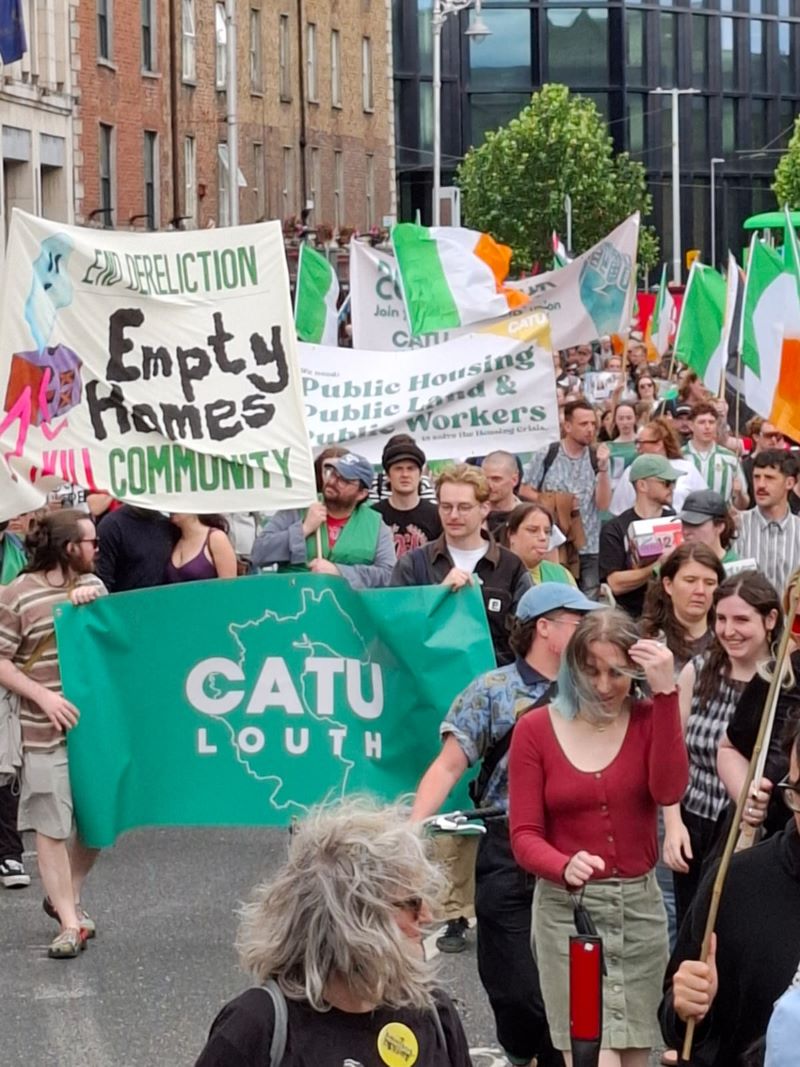
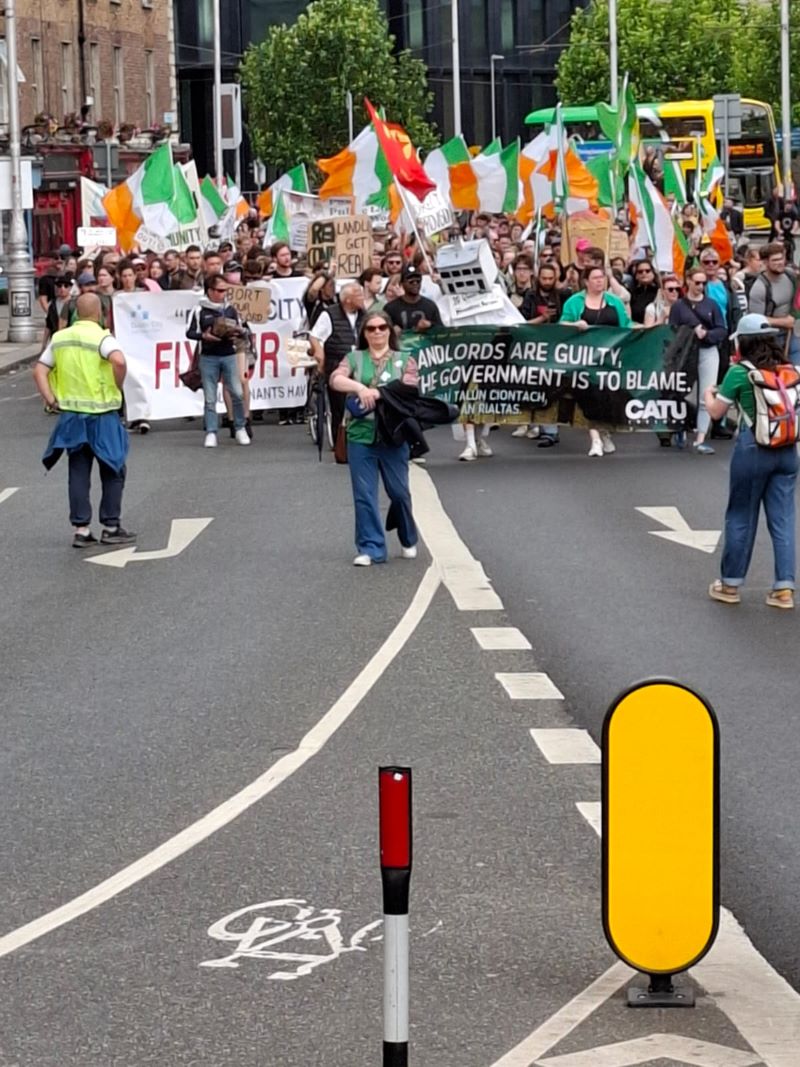
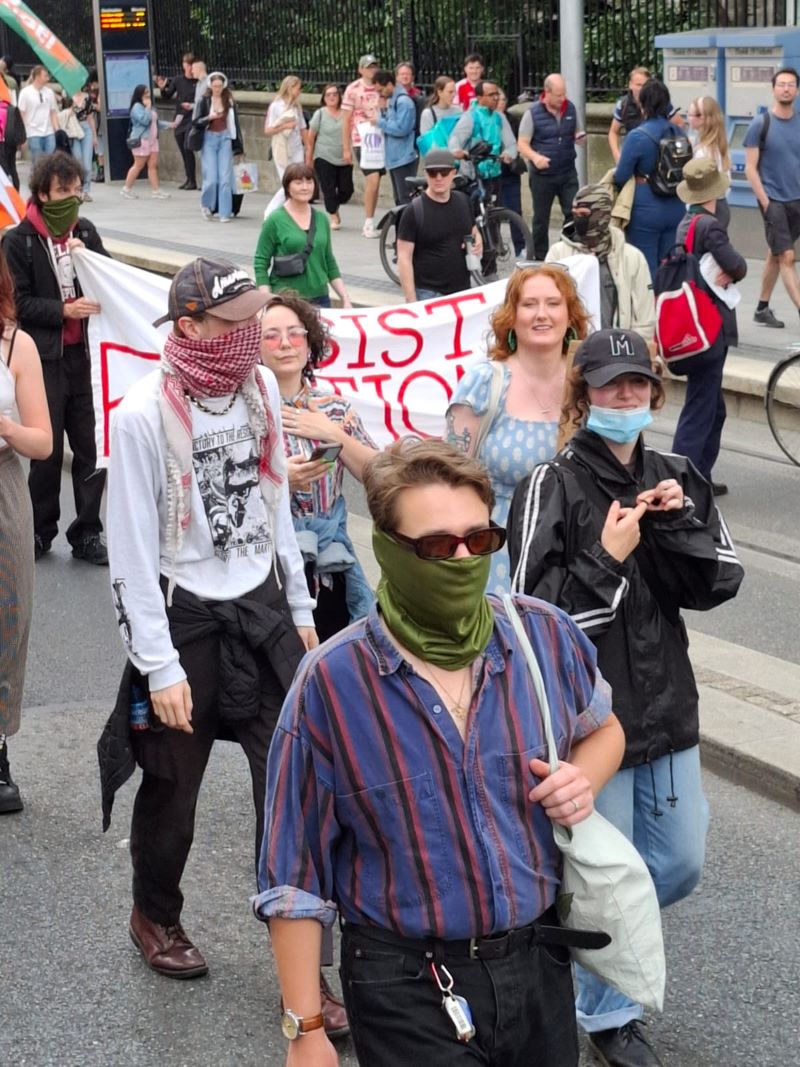
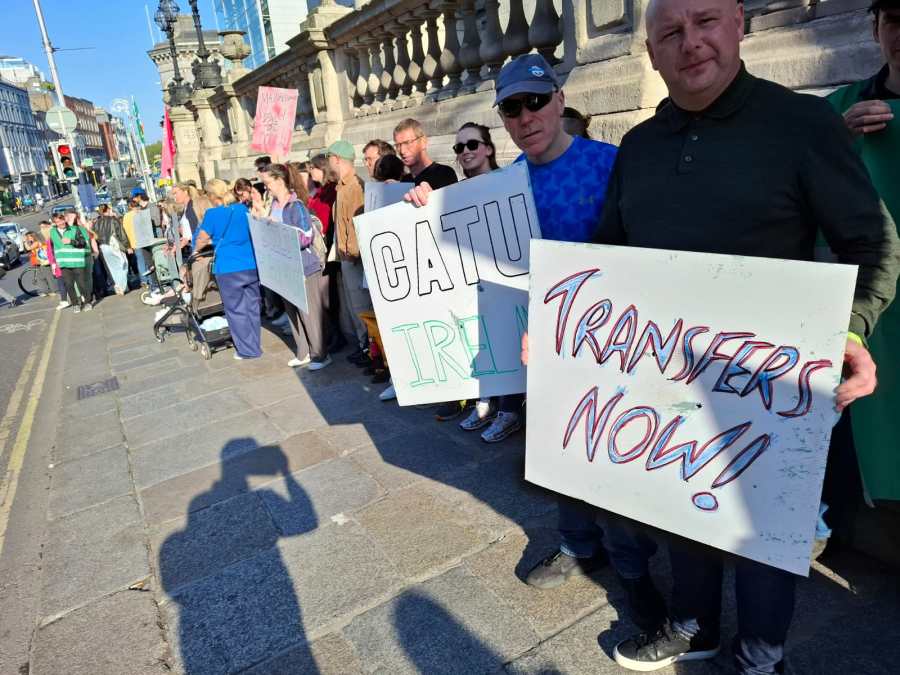
An estimated 10,000 people marched through Dublin city centre on Saturday in a national protest organised by CATU about homelessness, high rents, lack of public housing and the facilitation of property speculators by Irish Governments.
Groups from across Ireland attended the national march organised by the Community Action Tenants Union and without regard to the British Border around the Six-County occupied colony. They gathered at the Garden of Remembrance before marching towards Leinster House.
One of the housing groups that travelled to Dublin from the occupied Six Counties (Photo: D.Breatnach)
It was warm but not excessively so and the rain held off. The march ended with a rally in Molesworth Street, where Garda barricades prevent marchers from crossing the street to approach the gates of Leinster House, where the parliament of the Irish State sits.
In addition to drummers and also some singing, many chants could be heard: Homes for need – not for greed! What do we need? – Public housing; When do we need it? Now! When tenants are under attack? Stand up, fight back! (also something like: Get the landlords out of the Dáil!).
Among banners and flags of local area housing action groups and trade unions there were a great many Irish Tricolours in view; to see them being flown on a demonstration not of the Far-Right was a welcome sight. There were some Starry Ploughs and some red flags flying also.
It was good also to see the Irish language on some placards among the demonstrators. A notable feature was the high proportion of young people participating, many with their own home-made placards.
A certain species of vulture seems to have raised hostility in Ireland! (Photo: D.Breatnach)(Photo: D.Breatnach)Too Damn everything – except good! (Photo: D.Breatnach)
A lot of people were also in Dublin that afternoon for other events, including supporters of Gaelic Athletic Association county teams competing in Croke Park, in particular the Cork Vs Dublin teams in the Hurling Semi-Final. (Dublin getting that far surprised many but Cork beat them decisively).
A large anti-abortion demonstration also took place in the city centre, starting later than its advertised hours but immediately after the start of the CATU march. There are a range of attitudes on abortion but in general those campaigners like to project themselves as ‘pro-life’.
Some might comment that a pro-life cause would also include good housing for all – or to support the Palestinian people but generally the anti-abortion campaigners do not march in support of those, which is why they are often accused of being ‘pro-birth’ rather than ‘pro-life’.
Numbers of homeless single people and families with children rising annually passes 15,000 for the first time.
Out of 10,743 adults accessing emergency accommodation in March this year, 1,178 were under 24. In addition, 4,675 children were also using emergency accommodation.1 In January 134 individuals were counted sleeping on streets and in parks in the four Dublin areas, a 14% increase on 2024.2
In addition, the numbers of homeless does not include those sofa-surfing, awaiting eviction, in domestic violence refuges or unaccommodated refugees.
CATU’s list of demands points to the unfilled needs across a range of indicators and in itself is an indictment of the current state of affairs. In addition, the numbers of homeless has been rising annually and does not include those sofa-surfing, in violence refuges or unserviced refugees.
(Photo: D.Breatnach)
Prior to the march, CATU published a list of objectives and demands:
End child homelessness by 2026
Eviction ban North & South, Lower rents
Properly resource the Tenant In Situ scheme
End Direct Provision
Ban Vulture Funds
Build and maintain Public Housing – use public land
Build and resource culturally-appropriate Traveller Accommodation
Homes, not Holiday Lets
Build Communities of Care: education, community, addiction & mental health services now!
Front of the CATU march comes around from D’Olier Street while the rest of it is still coming down O’Connell St. (Photo: D.Breatnach)(Photo: D.Breatnach)
COMMENT – Housing Need and Action
It was an excellent turnout for CATU who are to be congratulated on their mobilisation and organisation around the country and in Dublin. The housing crisis is one of the great practical problems facing working people and a very big public housing program is the only solution.
However, the Irish neo-liberal ruling class are clearly wedded to housing provision by the private sector, with its soaring rents and mortgage payments resulting for many in sleeping on the street or living in hotels and hostels, not just single people but family groups with children too.
Housing marches and occasional symbolic occupations of buildings through the years have not changed the situation which worsens annually. The far-Right use the issue to target migrants who have not caused the crisis and even asylum seekers who cannot possibly have any effect on it.
Plentiful public housing is clearly the answer, rented according to the occupiers’ income. After the initial building cost, the rents will pay for maintenance, repairs, upgrades and even new buildings. And the construction program will provide much employment too.
Clearly a radical program of action will be needed to force the Irish ruling class to adopt a large public housing program. It does not require a revolution to achieve the change but it will almost certainly need the fear of one to move our rulers in the necessary direction.
In the 1960s and 1970s a number of housing schemes construction and renovation programs were won by the direct action of the Housing Action Committees of Dublin and Dún Laoghaire. The Committees included occupations in their program, alongside street rallies and marches.
Some years ago a small group called Revolutionary Housing League began a series of occupations of empty buildings, also refusing to give guarantees not to continue the actions when taken to court. They called for replication action on a wide scale along the same lines but that did not materialise.
Action of the kind up and down the country seems to be what is required and activists may be jailed before this ruling class is prepared to supply the basic human need of decent and affordable housing for the working people. It remains to be seen what role CATU will play in all of that.
I was relieved by my attendance at the Raise the Roof housing demonstration in Molesworth Street in Dublin City Centre. That was because I learned from speakers that just by voting in ‘a Left Government’ we could receive the housing we need.
Raise the Roof is a coalition of trade unions with its address at the Labour Party-orientated ICTU and a number of housing NGOs. The coalition also contains political parties: Sinn Féin; Labour Party; People Before Profit/ Solidarity; Social Democrats; Independents4Change.1
A view of the protest in Molesworth St. Leinster House is in the background across Kildare Street with access prevented by police barriers at the end of Molesworth St with a special gate to allow entry and exit for customers of the hotel on the corner. (Photo: D.Breatnach)
Previously I’d thought that either we’d need a revolution or a country-wide campaign of direct action occupying empty properties. This is because the housing crisis is deliberately constructed for the benefit of profits for big landlords, vulture funds and the banks that finance them.
And since they keep making massive profits out of the situation, they won’t want it to change as it would if, for example, were the State to seize empty properties2 for conversion to housing along with a massive public housing for rent construction campaign.
And if the profiteers don’t want that, naturally their (sorry, ‘our’) government will make sure not to do anything of the sort.
So it was great to learn that we won’t have to really fight and break the law, going to jail and all that. Phew! Just change the parties in the Government at the next election! Elect a Left Government!
Visual accidental irony comment in the same street. (Photo: D.Breatnach)
But… lately I have to admit I’ve been having doubts about this solution. First of all, there’s the question of numbers of TDs available to form this aspired-to government. There are overall 174 TDs in Leinster House (the Parliament of the Irish State) and a fragile majority requires 88.
The Sinn Féin party has 39 TDs and People Before Profit/ Rise/ Solidarity five in total, a combination of 44 still needing another 44 to reach the 88 minimum. FG and FF, formerly opposition parties but now in government have 86 votes between them and needed some extras to run the Government.
But I’ve got a much bigger doubt really, and that’s whether SF will stand up to the bankers and property magnates.
SF has for decades being setting out its stall that it is safe pair of hands to run the system, in other words that the profiteers have nothing to worry about. And to tell the truth, I believe them. Though some of their followers think SF is fooling the system, I think it’s the followers being fooled.
View of the Raise the Roof protest in Molesworth street. (Photo: D.Breatnach)
So … after further consideration, it really does look like a revolution will be required to end the housing crisis — or at least something so near as to make the managers of the system believe that unless they resolve the housing crisis, there will be a revolution. So I’m worried again.
Anyway, it was interesting seeing the amount of Tricolours in what was predominantly a left-wing rally of hundreds (despite a small contingent holding an Aontú banner) and there was some nice music with singers including Lisa O’Neill and Jimi Cullen (with his Homes for All composition).
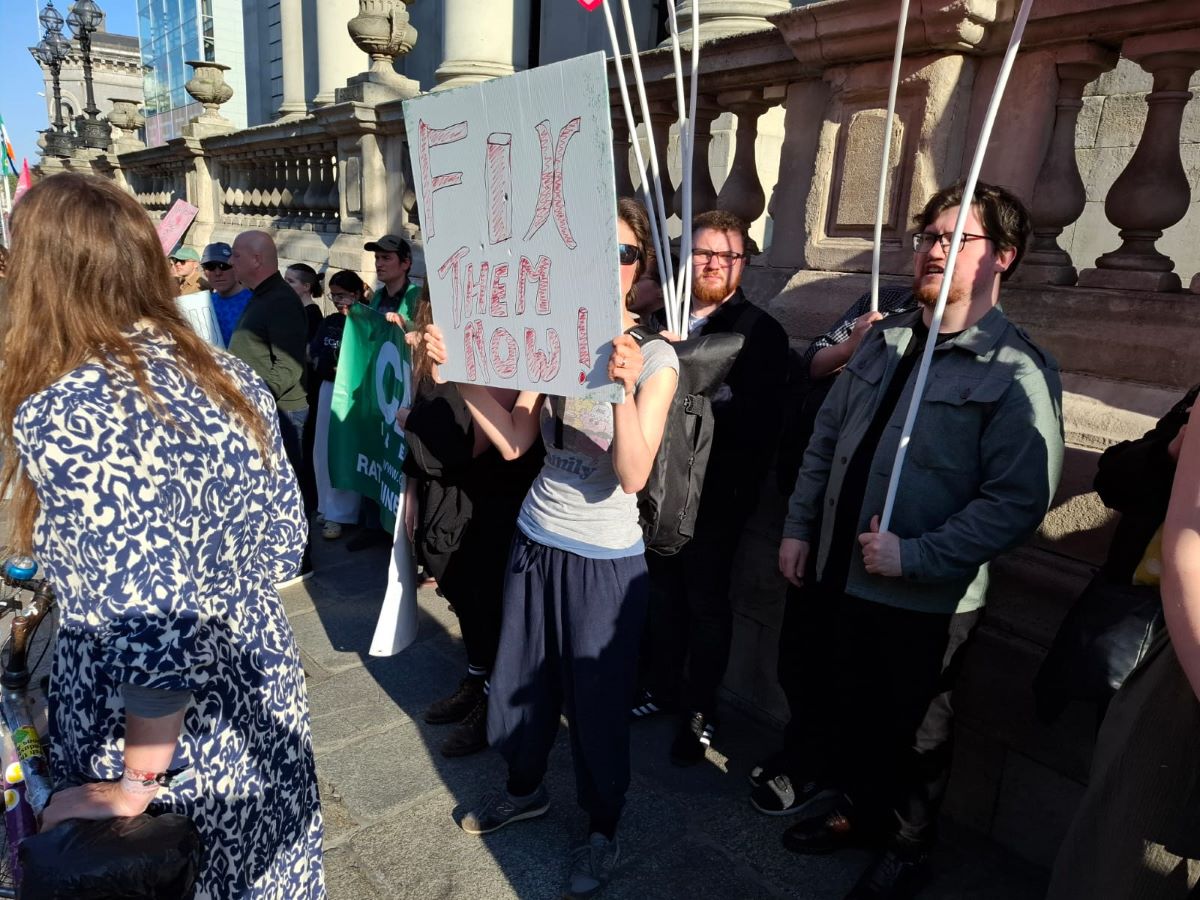
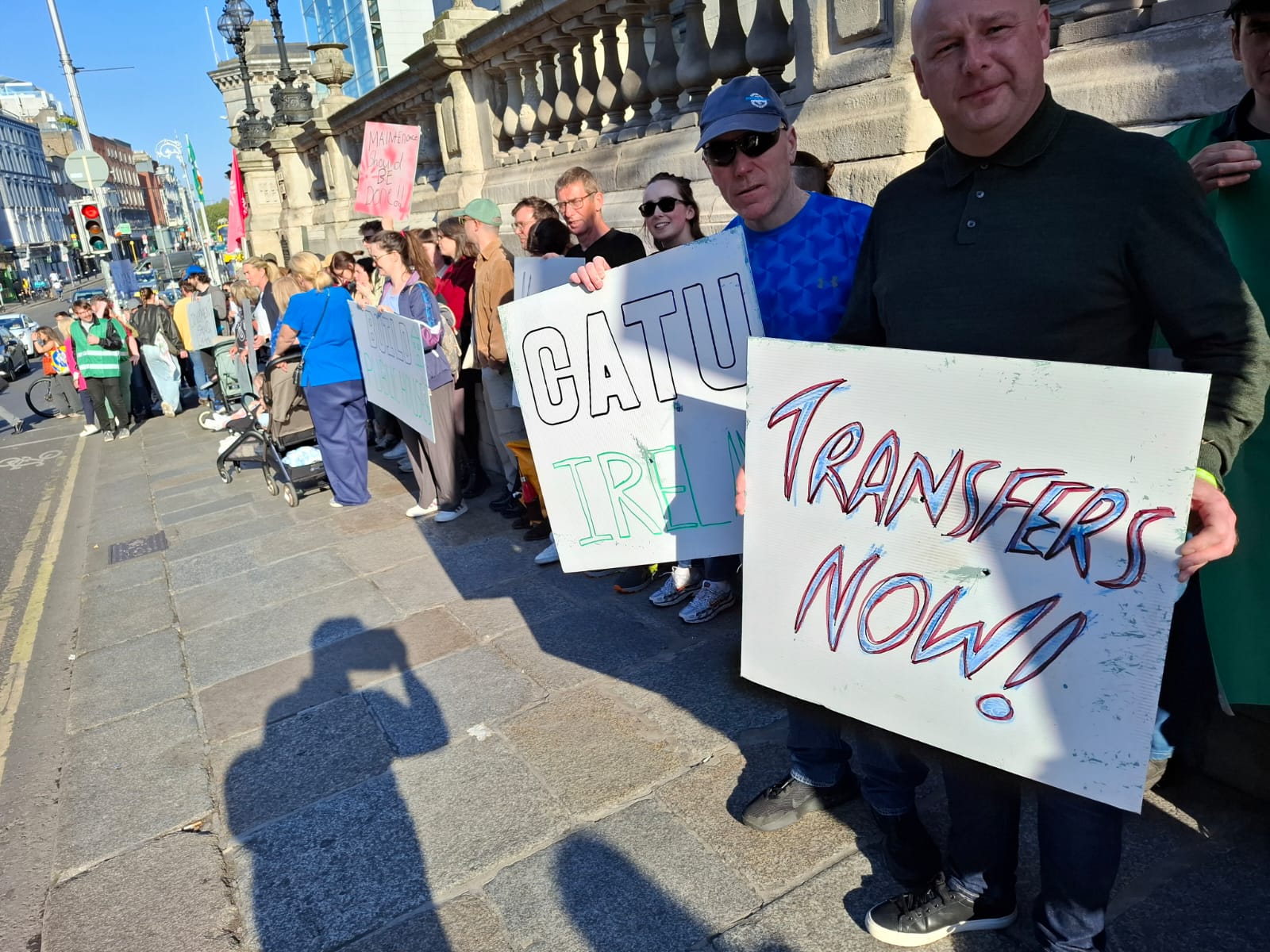
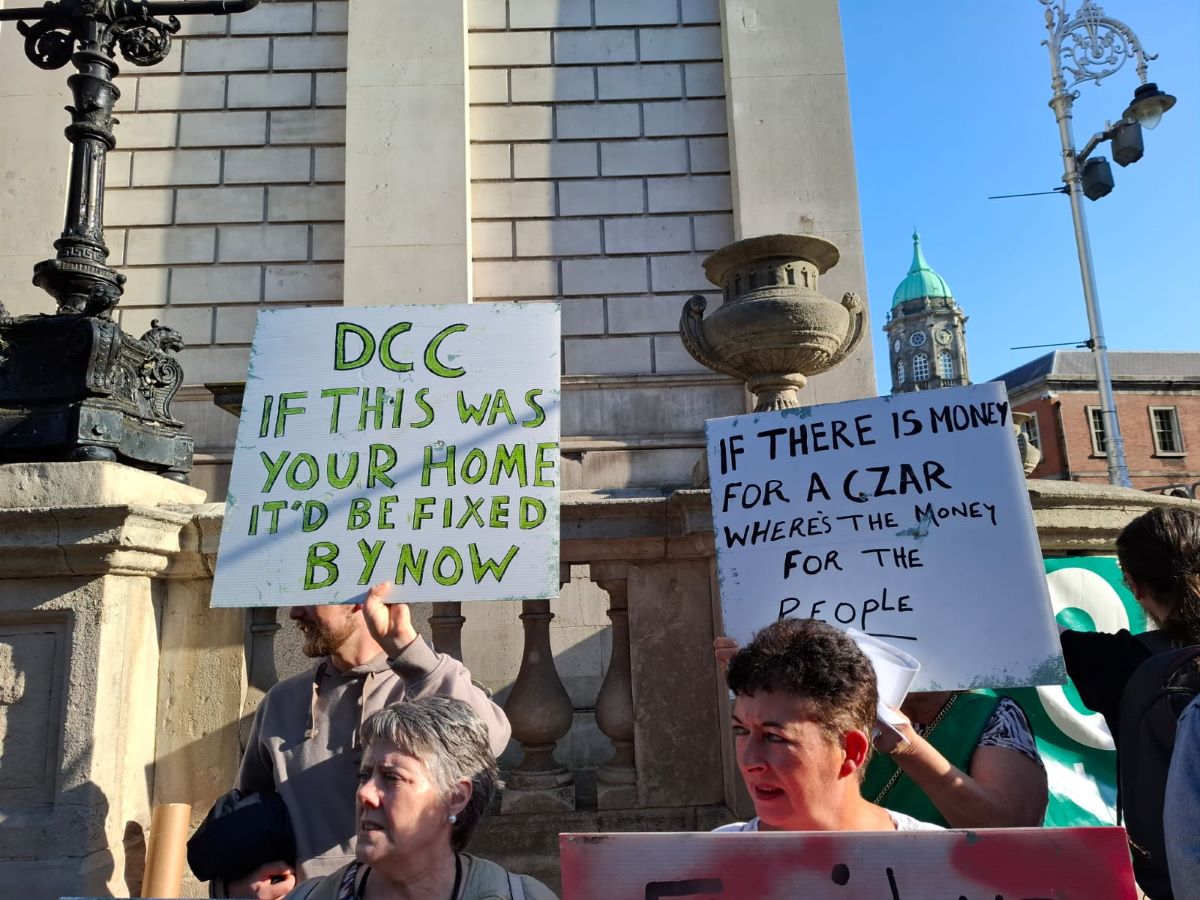
A large number of tenants organised by the Community Action Tenants’ Union (CATU) from a number of Dublin City Council housing estates gathered outside City Hall on Monday 12th May evening to lobby the monthly elected Councillor’s meeting.
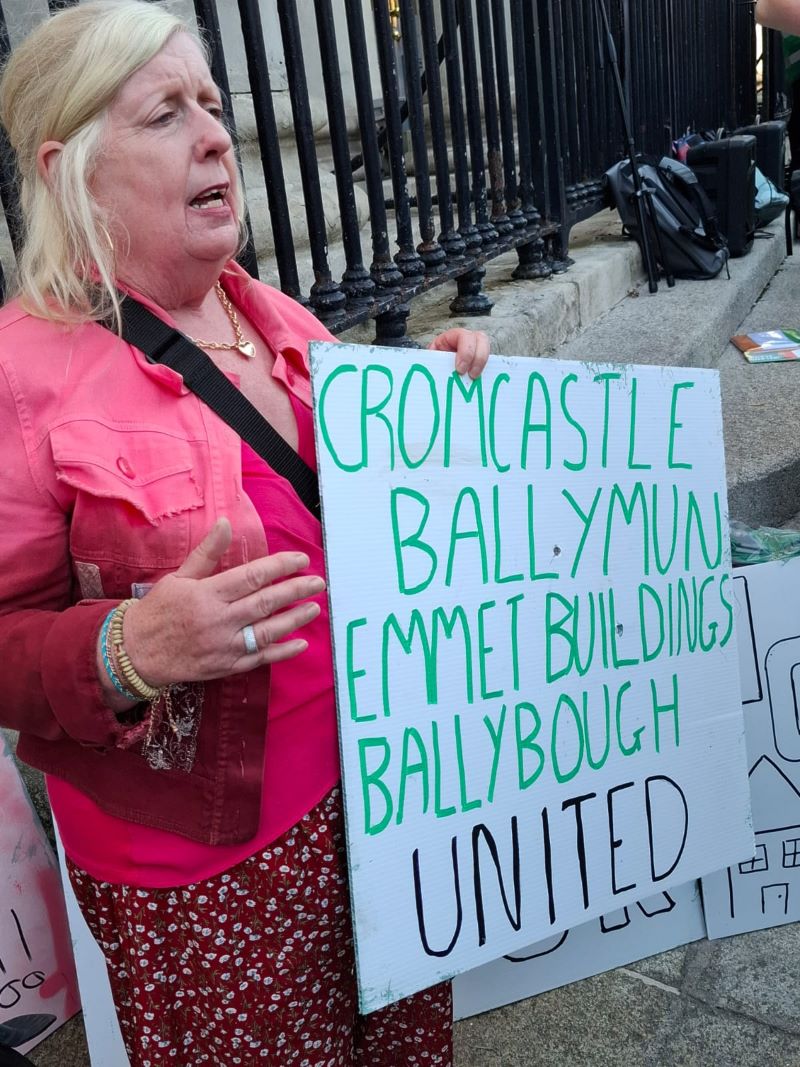
Those attending for the most part came from public housing blocks and estates from Ballymun to the Liberties and Coolock to Pearse Street. They carried placards and demanded that Dublin City Council negotiate with them.
A section of the lobby outside City Hall facing Parliament Street (note on top extreme left of photo plaque commemorating two leaders of the Irish Citizen Army shot dead in 1916). (Photo: D.Breatnach)
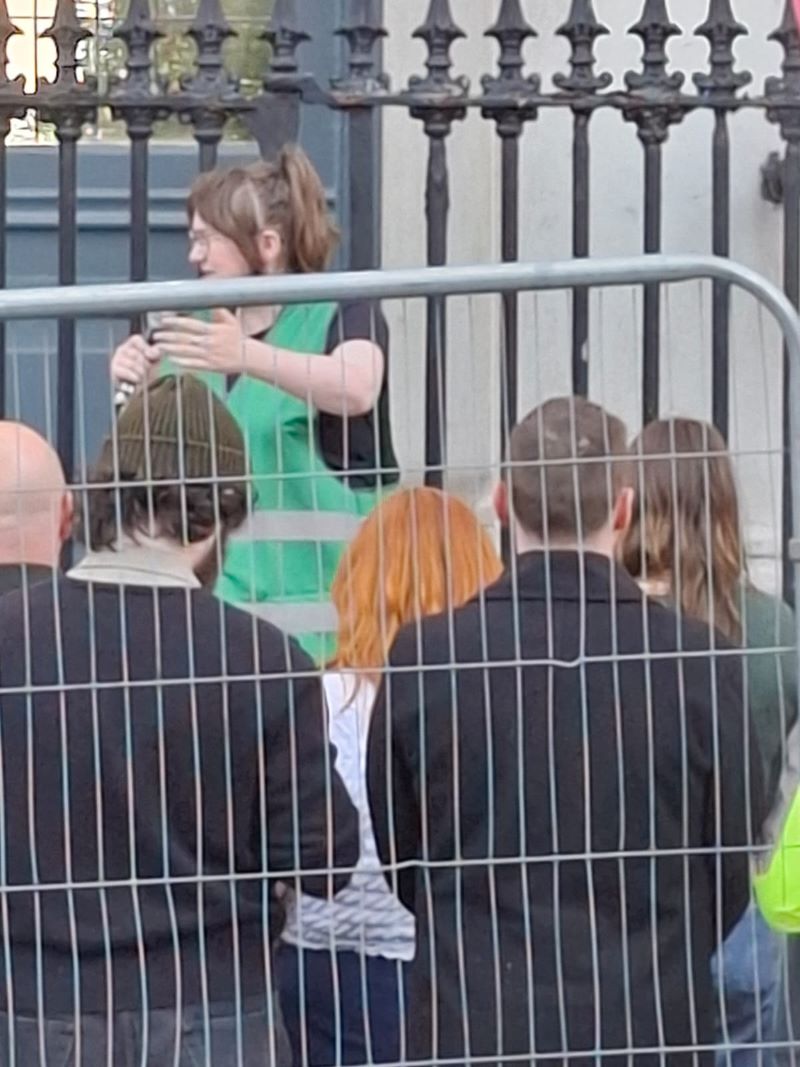
The recently-appointed Assistant Chief Executive over housing and community came out to receive the Union’s demands and petitions from tenants organising within their complexes and areas andthe lobbyistsalso forced the issues onto the agenda of the council meeting that night.
The protest was organised by the Dublin city CATU branch with wide support from community organisers and was attended by a number of elected councillors from some political parties and independents.
(Photo: D.Breatnach)
The problems CATU representatives listed verbally and in writing included a general low level of maintenance and upkeep of their estates and blocs, of the actual dwellings, communal areas, playgrounds and rubbish chutes. Rat infestations were a problem in some.
Damp leading to mould, rainwater penetration, inadequate proofing, badly fitting windows and doors were also listed at a number of sites, as were inadequate insulation leading to high heating costs and a need for overhaul of the heating system itself.
Among the slogans chanted was: Dublin City Council – Negotiate!
(Photo: D.Breatnach)
Included in their demands was that DCC officials recognise the right of their tenants to be represented by CATU as their union, which they stated was not always respected and they sought formal meetings with named officials responsible for the areas in question within one month’s time.
Although apparently currently not members of CATU, the organisation had invited the Pearse House Residents’ Committee to attend and speak at the lobby. Their chairperson Neil Maloney did so, addressing the issue of the long overdue regeneration of their housing bloc.
(Photo: D.Breatnach)
Maloney described the “blow to the community” when funding for stage two of the regeneration project to eliminate overcrowding was withdrawn, after their hopes had been raised by presentation of a regeneration timescale and a physical design in August of the previous year.
Ironically, the housing crisis was implicated in the Government’s reason for refusing to support the regeneration going ahead, in that the increase in inner space of the dwellings would reduce the number of actual housing units.
(Photo: D.Breatnach)
The Pearse House chairperson commented that “the current bedsits are illegal” and that their homes currently don’t meet European standards, going on to state “a real need for bigger homes to address overcrowding and family needs.”
“This was always going to be a challenge for this protected structure, but in phases 2 and 3 of the regeneration plan, there would be 2 additional blocks built. The additionality that the Government is seeking would be gained through the social homes gained during the decanting process.”
Pearse House residents attended CATU’s protest “to highlight our anger and what we see as another block on this project,” Maloney said. And note that although DCC has committed to redesigning the project for submission to the Government there is no guarantee this will be successful either.
(Photo: D.Breatnach)
“Ireland is still in breach of the European Charter for social housing and our human rights. Our community has seen the redevelopment and construction of new buildings, offices etc. and Pearse House is the eyesore in the middle of our community.”
“We were the community before all this redevelopment, and we will be the community when it’s all over,” concluded Maloney, voicing a common complaint along the south Dublin dockside. 1
A section of the lobby outside City Hall viewed looking down Dame Street. (Neil Maloney is pictured after his speech). (Photo: D.Breatnach)
Public Housing Background
There was little public housing in Dublin under British rule and the big town houses of the rich had been sold and sub-divided for rent by private landlords (including some who were elected councillors (or aldermen).
The new State built “2,000 local authority homes by 1924, a feat all the more remarkable in the context of a shortage of State funds, and the need to rebuild much of the infrastructure damaged in the War of Independence.”2
But of course it was not keeping up with the existing need or population growth and 40% of the population were forced to emigrate in the first 50 years of the Irish State.3
However 1924 too was the introduction of legislation facilitating state money subsidising the building of private housing.4 “In the decade after 1932 some 82,000 homes were built, the vast majority (public and private) with State subsidies.”5
Prof. Kenna relates that by 1940, some 41% of the Irish housing stock had been built by local authorities, far higher than that in England and Wales (25%) and also comments on the effect this had on subsidiary employment not only in construction but in sourcing and supply of materials.6
Although by 1964, a further 74,000 private and 63,000 local authority homes were built with State support and that between the 1950s and 1960s a million people had left the country, there was still a housing shortage and rents on private properties dug deep into workers’ incomes.7
Prof. Kenna comments that little attention was paid to the need for housing estate management, amenities, shops and the social, educational or other needs of the new community established there. That this should coincide with a boom time for property developers should not surprise us.
(Photo: D.Breatnach)
Government schemes to facilitate the purchase of their local authority accommodation from the 1950s resulted in the disappearance of much public housing stock into the private sector.8 Theoretically they would be replaced by new public housing builds but that didn’t happen.
Public land and land held by NAMA9 has been increasingly sold or even given away to private developers on promises of provision of a low percentage of public housing and often those individuals or consortiums do not even keep their earlier promises.
The Report of the Commission on the Relief of the Sick and Destitute Poor in 1927, Prof. Kenna reminds us, found 3,257 homeless people including 901 children, while in January 2021 there were 5,987 homeless adults and 2,326 homeless children in Ireland.
The Far-Right has jumped on the opportunity of the current housing crisis to blame it – not upon lack of public housing construction, big landlords, property speculators and vulture funds – but on migrants.
The Left in Ireland has until now in practical terms left this ground for exploitation of racists.
One of a number of speakers, photographed from across the street as too crowded there. (Photo: D.Breatnach)One of a number of speakers, photographed from across the street as too crowded there. (Photo: D.Breatnach)One of a number of speakers, photographed from across the street as too crowded there. (Photo: D.Breatnach)
GOING FORWARD
CATU seemed pleased with the lobby turnout and announced their intention to organise a housing protest march on Saturday July 5th. In the meantime they will no doubt be following up on the meetings they requested with area housing managers and agreeing objectives and deadlines.
Hopefully, seeing the initial results in the attention of DCC housing and amenity officials, and reflecting on their numbers when they take joint action, tenants of DCC will take heart and grow in confidence in their ability to ensure provision of decent housing and services for their needs.
Of course, the Far-Right won’t like that as it distracts from their targets – but the extension of this campaign does provide some hope of something like a solution to the current terrible grinding crisis of both housed and homeless.
End.
One of a number of speakers, photographed from across the street as too crowded there. (Photo: D.Breatnach)
APPENDIX: I916 Battleground
It might or might not have been mentioned (I couldn’t hear much of the speeches) that City Hall, outside of which CATU were protesting, had been a 1916 resistance centre, occupied by a small force of the Irish Citizen Army, known in some circles as the first workers army in the world.
Unaware of the extremely low British garrison on the Castle that day, the ICA had failed to take the complex and retreated to City Hall and some outposts in Dame Street and Parliament Street where they resisted until overwhelmed by British Army reinforcements.
The symbolism of the Castle, the administrative seat of the British occupation in insurgent hands, resulted in a ferocious assault on the ICA garrison and it fell on the Monday/ Tuesday of that week. One of the statues inside bears what appears to be a bullet hole to this day.
A steel plaque on the right of the outside front of the building lists the names of the ICA garrison of the area, around 50% of which were women. An older cast plaque at the east corner lists the names of two of the five who were killed there, Sean Connolly (OC) and Sean O’Reilly (2i/c).
The 1916 Rising was followed by the election of the First Dáil in 1919 with its Democratic Program affirming that all right to private property must be subordinated to the public right and welfare, and that no child should suffer hunger or cold from lack of food, clothing, or shelter.10
That was followed by the War of Independence and the Anglo-Irish Agreement; and the new State that came into being had no intention of fulfilling the promise of the Democratic Program but rather a determination to suppress any who tried for that fulfilment.
Footnotes
1For example the construction plans for the Irish Bottle Glass site (sold by Nama to the Ronan consortium) contain no components of public housing and units at expected prices will not be affordable by most local people.
The CCJ (Criminal Courts of Justice) in Parkgate Street, Dublin, are seeing an increase in political cases in recent weeks with activists in housing and Palestine solidarity as well as Irish Republicans fighting extradition to the British colony.
Eoghan Ó Loingsigh, who made the mistake of asking a Garda for his badge number while they were carrying out an eviction, appeared there in February only to see his case thrown forward to June.
Picket anti-extradition display by Anti-Imperialism Action outside Heuston Station in February. (Photo: R.Breeze)
Another housing activist’s charge of attempting to break into an empty property was dismissed. The property in question, empty for a number of years is leased to the Salvation Army and three years ago two RHL1 activists were evicted from it by 100 Gardaí (some armed) with helicopter support.
Jack Brazil, a Palestine solidarity activist whom the Gardaí are trying, believe it or not, to tie into the racist and criminal riots of November last year, had yet another appearance in court without trial as he’s still trying for CCTV footage from Gardaí to support his alibi for the night.
At least the remaining bail restriction on Brazil was lifted: at the outset he had to sign on at Mountjoy Garda station once every week, observe a curfew of 12am-6am and not to loiter at any point in the Dublin city centre (D1 and D2). His case is now remanded to 26 March.
Jack Brazil (in the suit) and other Palestine solidarity activists outside the CCJ after Brazil’s most recent appearance there. (Photo: R.Breeze)
Jim Deneghan had a number of court appearances fighting extradition to the Six Counties on foot of charges alleging an act during the 30 Years War there – fifty years ago. He was unsuccessful and it appears that the only avenue open to him now would be to challenge it in the High Court.
Should they even grant him leave to do that which is not always the case.
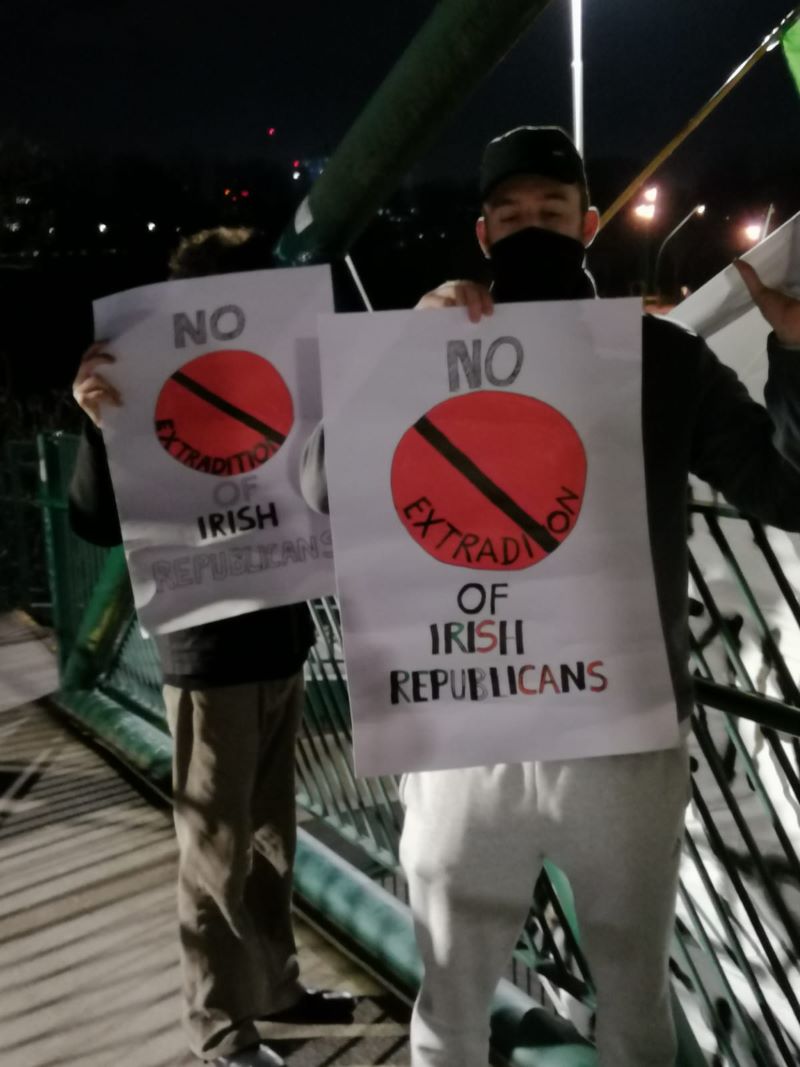
Some of the AIA-organised anti-extradition banner drop on the Fairview pedestrian bridge hold up placards against extradition. (Photo: R.Breeze)
Another extradition case has been dealt with in the Special Criminal Court, which is located within the same building as the CCJ, distinguished from other courts by the glass-enclosed reception ‘box’ through which one must pass to gain entry, first satisfying ‘security’ provisions.2
Sean Walsh has been fighting extradition to the UK’s Irish colony, the Six Counties on a charge of membership of an armed Republican organisation, which is deemed illegal on both sides of the British Border. He is in custody in Portlaoise awaiting a decision from the ECHR in Brussels.
Independent Dublin Republicans organised solidarity pickets outside the court on the mornings of Denneghan’s appearances, while Anti-Imperialist Action held a picket against extradition outside the nearby Heuston Train Station and a more recent banner drop on the Fairview Pedestrian Bridge.
Picket organised by Independent Dublin Republicans outside court where extradition of Jim Deneghan (Centre, next to State Harp) was being decided in February. (Photo sourced: IDR Facebook page)
The CCJ courts, in particular those on the ground floor are extremely busy with what seems at times like industrial-scale processing of setting further dates for court appearances, granting or refusing bail, requiring ‘discovery’ and other documentation from the Gardaí and some sentencing.
The human subjects of these proceedings are mostly from what might be termed the under-class of Dublin with some migrants added for good measure. Most face charges of possession of drugs, anti-social behaviour, threatening behaviour, theft and breach of bail conditions.
A huge amount of court, lawyer and Garda time is taken up with processing people accused under these charges. On the other hand the processes also interfere hugely with the normal lives of those charged and in addition, in the case of political activists, disrupt some of their legal activity.
And can cost them loss of pay and even threaten their employment. Which might be deliberate on the part of the system or if not, at least something those who manage it will not regret.
Banner drop by AIA from Fairview pedestrian footbridge. (Photo: R.Breeze)
The sheer number of that social group being processed through the courts daily is an indication of something really wrong with Irish society and which worsens even through generations, while the major reaction of the State is to maintain the social conditions and repress its victims.
By and large the middle class only come into contact with that element of society when they are prosecuting or defending them in court, or professionally dealing with them in hospital or social services environments.
It is also where many of those who are trying to change the prevailing social and economic conditions, i.e political activists, will first rub shoulders with that group while next to them on court seating benches. Unless the political repression goes a step further and they meet in jail.
End.
1Revolutionary Housing League which had renamed the building, on Eden Quay, ‘James Connolly House’.
2The non-jury SCC was established under an Amendment to the Offences Against the State Act, pushed through Leinster House by Fianna Fáil amidst collapse of its opposition during a panic caused by (British Intelligence) terrorist bombing of Dublin in 1972 killing two and maiming many. The scene of many unjust decisions, its most famous was the conviction of the innocent ‘Sallins Four’ when the SCC was based at Green Street, appropriately enough the scene of many injustices under the British occupation, including the death sentence on Robert Emmet after his famous speech. The existence of the SCC is opposed by Amnesty International and Irish civil rights organisations and, until a few years ago, by the majority political party in Ireland, Sinn Féin, which no longer opposes it.
Easter is the time of year in Ireland for Easter Egg hunts and/or for attendance at religious services but for the Republican movement it is one of commemoration of the Easter Rising and its martyrs, with parades and speeches.
The commemoration parade proceeding along Phibsboro and approaching the Cross Guns canal bridge. (Photo: Rebel Breeze)
Easter Monday in Dublin saw one of those commemorations organised by the Socialist Republican organisation Anti-Imperialist Action at the Citizen Army plot in the St. Paul’s section of the famous Glasnevin Cemetery at the Republican Struggle Monument1.
Participants rallied near the Phibsboro Shopping Centre to march from there to the Cemetery, a distance of around two kilometres, over the “Cross Guns” bridge over the Royal Canal, then passing the main entrance to the Glasnevin Cemetery on the right before turning left for St. Paul’s.
Garda POU van parked extremely dangerously, hiding left turn from view of eastbound traffic, as they chat with other Gardaí and a ‘Branch man.As is said, “one rule for the people …!” In the laneway between houses visible in the background, a cameraman lurked taking photos. (Photo: Rebel Breeze)
In a marked departure from the previous year, the State’s political police, plainclothes Gardaí of the “Special Branch”2 did not approach the participants to attempt to intimidate them and gather intelligence, demanding their names and addresses under the Offences Against the State Act.3
That had been followed up by a raid on the home of one of the leading activists. Sunday’s police behaviour was an even greater difference from Saturday’s, when a different Republican group, Saoradh, had their Easter Rising commemoration in Dublin’s city centre.
Around 300 police, including many in riot cop uniform (Public Order Unit) had harassed the participants demanding names, addresses and other information, attempting to intimidate them. At least seven police vans had been in attendance also to the bemusement of onlookers.4
(Photo: Rebel Breeze)
LOCAL 1916 HISTORY
The Phibsboro/ Glasnevin area also figured in the 1916 Rising, with an insurgent barricade in Phibsboro and a Fianna youth, Sean Healy, mortally wounded at the crossroads by a British artillery shell fragment (a plaque on the ground at the SW corner commemorates his death.
Earlier, Irish Volunteers had guarded the canal bridge briefly; these were seen by the dozen Volunteers that marched along the canal from Maynooth, slept in Glasnevin Cemetery and got into the headquarters garrison at the General Post Office on Tuesday.
Later British soldiers set up a barricade on the Bridge preventing even foot traffic across and shooting dead a deaf and dumb man who could not hear their challenge.
EYE IN THE SKY? (Photo: Rebel Breeze)
PARADE THROUGH STREETS TO CEMETERY
The parade from Phibsboro on Sunday was led by the Glasgow Republican Flute band (formerly the Garngad RFB, which is where most of them are based) playing the airs of known Republican ballads, muted to regular tocks on their drums as they entered the housing estate.
(Photo: Rebel Breeze)
Also leading was the colour party dressed in white shirts, black trousers, jackets, berets and sunglasses, carrying the traditional flags for Republican colour parties: the Tricolour, Starry Plough, Sunburst, followed by the flags of the four provinces of Ireland: Connacht, Leinster, Munster and Ulster.
Over the marchers the flags of the Tricolour and the Starry Plough, flag of the Irish Citizen Army flew in the breeze while those of the Basque nation, Palestine and of the People’s Front for the Liberation of Palestine lent an international flavour to the commemoration of the Irish Rising.
There was some beeping of passing traffic and cheering from bystanders at the entrance to the laneway that leads to the bridge across the railway tracks to the St. Paul’s section of the graveyard. The marchers filed in and proceeded to the monument.
The Chair of the proceedings welcomed the attendance before reading from the 1916 Proclamation of Independence and calling a singer to step forward. Revolutionary activist Diarmuid Breatnach introduced the two songs he was going to sing as emphasising the role of the working class in the Rising.
(Photo: Rebel Breeze)
“The decision to go ahead with the Rising on Easter Monday was taken in Liberty Hall, the headquarters of the working class at the time,” he reminded the gathering, “which is also where the Proclamation of Independence was printed.”
He sang the “JimLarkin Ballad”: In Dublin City in 1913, the boss was rich and the poor were slaves; The women working, the children hungry, till on came Larkin like a might wave …
Diarmuid Breatnach singing(Photo: Donated by participant)
Pausing to focus on a different key, the singer followed the ballad with Patrick Galvin’s Where Is Our James Connolly?
After applause, floral tributes were laid on behalf of Anti-Imperialism Action Ireland and of Dublin Republicans Against Fascism.
(Photo: Rebel Breeze)(Photo: Donated by participant)
The chairperson asked for a minute’s silence in honour of those men and women who had given their lives in the struggle for freedom in Ireland. The colour party lowered their flags slowly in homage to the fallen, raising them again slowly to signify the continuation of the struggle.
(Photo: Rebel Breeze)
John Heaney, Republican ex-prisoner from Armagh was called to give the oration for the event, which he dedicated to all those men and women who had opened their doors and their homes to fighters in the struggle, whether the latter were in hiding or just resting – his audience applauded.
The speaker also congratulated on those who came forward to carry on the struggle, youth, women and stated he was proud to see the traditions of struggle being upheld in the process to achieve the Republic for which so many gave their lives.
The speaker, John Heaney delivering his oration. (Photo: Rebel Breeze)
The marching band then played the air of Amhrán na bhFiann/ The Soldiers’ Song, verse and chorus and the formal part of the event came to an end. Band members lined up in front of the Monument for photos and a little later played the air of “Black Is the Colour” on whistles, to general applause.
SECOND 1916 COMMEMORATION FOR AIA THIS EASTER
This was the second 1916 Rising Commemoration to be attended by Anti-Imperialist Action as they had also participated in another organised by the Seamus Costello Memorial Committee in Bray on the previous day.
AIA is a young organisation, founded by socialist Republicans unhappy with the direction of the Republican organisation of which they had been members but now containing many young people.
AIA gave rise to the Revolutionary Housing League that occupied empty buildings in a campaign against homelessness and called for a general occupation campaign across the state. A number of court cases against them followed but sadly their lead was not followed.
(Photo: Rebel Breeze)
AIA have also been very active against NATO, picketing promotional meetings and a number have been charged following a demonstration against a visiting British Navy ship in Dublin last November.5 They have also been active as part of the Saoirse don Phalaistín activist group.
Following the event in Glasnevin, many of the participants relaxed at a social evening in a different part of the city where many songs of struggle were sung.
(Photo: Rebel Breeze)
OTHER EASTER COMMEMORATIONS
Other Easter Rising commemorations have been held around this time, for example: Lasair Dhearg held one in Belfast on Easter Monday, while Independent Dublin Republicans held theirs in the capital, marching from Liberty Hall to the GPO, then to Moore Street to lay a floral tribute.
On Monday too the Derry 1916 Memorial Committee held an event in its city.6
Former revolutionary Republican party Sinn Féin held theirs in Arbour Hill7 cemetery on Sunday; a large part of their President’s address was devoted to justification of support for the EU and a plea to support the party whenever the state’s general elections are held (this year or next)8.
1My name for the Monument in the St. Paul’s part of Glasnevin Cemetery which stands in recognition of six periods of Irish Republican-led insurrectionary activity in Ireland: 1798-1916.
2Now officially the Special Detective Unit, they were previously known as the “Special Branch”, a name they inherited from the British occupation which had set up a political intelligence unit, the Irish Special Branch, to spy on and disrupt the Fenian movement among the Irish diaspora in British cities. Most political activists in Ireland continue to call them “the Special Branch” or simply “the Branch”. Their equivalent in Britain today and in a number of its colonies and former colonies continues to officially bear the name “Special Branch”.
3As amended in 1972 after a British Intelligence bombing killing two public transport workers in Dublin but blamed on the IRA; the amendment also permitted the setting up of no-jury Special Courts which are in existence to this day.
4In the context of assaults on persons in the city centre there have been regular complaints in the media and in the Parliament about the lack of Gardaí visibly patrolling the area.
7Where the 14 Dublin 1916 executed were buried, now a national monument in a former prison and church graveyard around the back of the former military barracks and now National Museum of Collins Barracks
Diarmuid Breatnach – previously published in the Pensive Quill
(Reading time main text: 6 mins.)
At the end of last month, in Johannesburg, South Africa, over 76 residents perished in a fire sweeping through one of a number of “illegal” buildings, home to some of the city’s poor who are desperate for somewhere to live.
How is this possible we may ask. Didn’t the South African people win their struggle after many years of sacrifice? Didn’t Mandela and the ANC lead them to victory in 1994?
The huge South African majority people fought a long and hard struggle against the domination and exploitation of a European settler minority and institutional racism. But they also fought against capitalist exploitation and imperialist plunder of their rich natural resources.
Some of the results of the Sharpeville Massacre, 1960 after South African police opened fire without warning at unarmed black people protesting the pass (apartheid) laws. In total, 69 people were killed and more than 180 people were injured, mostly shot in the back as they fled the violence. A later report would state over 700 bullets had been fired, all by police. (Photo sourced: Internet)
Despite the riches of those natural resources in gems, precious metals and minerals,1 most non-white Africans2 in South Africa lived in abject poverty with poor health care, scarce or non-existent infrastructures and services, including education and training.
In the decades leading up to the fall of the formal apartheid system, that struggle was led by the ‘triple alliance’ of the (banned) African National Congress,3 the National Union of Mineworkers (of S.A.) and the (banned) Communist Party of South Africa.
Township in South African photographed in 2018, over 20 years after enfranchisement and ANC government (Photo credit: Andrea Lindner/ Getty Images)
Their struggles defeated the apartheid system and in April 1994 all residents of South Africa were enfranchised. National elections brought 1990, was elected President of the country.
Yet shortly after that great change, it was noted that the living standards of the mass of people were even lower than before, that the settler capitalists continued to reap their profits and that imperialism had actually intensified their penetration of the South African economy.5
Today approximately 55.5 percent (30.3 million people) of the S.A population is living in poverty at the national upper poverty line (~ZAR 992) while a total of 13.8 million people (25 percent) are experiencing food poverty. Municipal services to the huge ‘townships’ are unreliable at best.
Almost one in every three of work-available people is unemployed and only 95% of the population have basic literacy, which means that one in 20 doesn’t have it.
It is in that context that we can begin to understand hundreds of people living in an “illegal” building without even a fire escape, obliged to take the risk of such accommodation, in a land that continues to be rich in great wealth which however, never comes near the mass of people.
PACIFICATION PROCESSES
In the 1990s a number of people began to promote processes to resolve a number of long-ongoing conflicts around the world, mostly where imperialism or colonial settlers were oppressing the people of a country. The promoters called them “peace processes”.
Palestine was the first of those in which a “peace process” was introduced and South Africa was next in 1994, followed by Ireland in 1998. As it took root in one country, former resistance activists went from there to other conflicts to encourage people there to embrace the process too.
In fact the progress of this process seemed like the US imperialist ‘dominoes’ theory, only in reverse: rather than ‘communism’ in one country influencing people in another to go the same way, capitulation in one country was used to infect the next.
Palestinian and South African delegates attended Sinn Féin congresses to promote their ‘peace process’ to the party’s membership; subsequently SF delegates in turn joined South African ones in selling the process to the Basque national liberation movement.6
Arnaldo Otegi (centre photo) foremost of the Basque movement’s ‘official leadership’ and EH Bildu party in 2019 – the banner behind asks for “one further step” in Castilian (Spanish) and “yes” in Euskera (Basque). (Photo cred: EFE)
Some movements declined to imbibe the process wine but those that drank it found their movements split, their leaderships increasingly accommodated to their people’s exploiters and nowhere at all were any of the movement’s principal objectives achieved.
Except, that is, in South Africa, where at least the people were enfranchised. But the right to vote is intended to help shape the polity for improvement and that has not happened in South Africa. The ANC, NUM and CPSA of the ‘triple alliance’ have become part of the system instead.
THE OPPOSITION BECAME THE SYSTEM’S GUARDIANS
Western imperialism recognised the vulnerability and isolation of the minority settler regime, convincing its leadership to concede mass enfranchisement rather than suffer revolution. And in order to prevent the mass going ‘too far’, they brought the resistance leaders into the deal.
Bishop Tutu7 once remarked that “The ANC stopped the gravy train just long enough to get on it”, which angered his friend, Nelson Mandela. But when forty striking miners were murdered by police of the ANC Government with NUM collusion in 2012, Mandela did not condemn them.
The kopje or hillock at Marikana, near the Lonmin mine, South Africa, where the striking miners were massacred by police of the ANC government in 2012. Over a decade later, plans for a memorial park have still not borne fruit. (Photo sourced: Internet)
This corruption did not grow overnight. Jacob Zuma,8 while President of the ANC, has been formally accused of rape, indicted a number of times and eventually convicted of financial corruption. Winnie, Mandela’s ex-wife led a clique accused of political corruption and murder.
Cyril Ramaphosa, now President, was a millionaire even during the apartheid regime while General Secretary of the National Union of Mineworkers and, because the striking mineworkers in 2012 were rejecting the NUM as corrupt, is widely believed to have organised the massacre.
There should have been many signs of this corruption in the ANC prior to entering government – and there were.
The ANC ran concentration camps notably in Angola, Zambia, Tanzania and Uganda where they punished and even killed “dissidents”.9 And in South Africa perhaps they had their own ‘Steak Knife’10 to organise “Pirelli necklacing”11 for alleged informers.
Mandela knew about the camps and the “necklacing” but did not condemn them, possibly out of mistaken solidarity or ‘the greater good’ theory, as acted upon by some of the solidarity movement abroad.
Ronnie Kasrills, a senior member of the Communist Party of SA and formerly on the ANC’s National Executive Council, who now criticises the pacification process, claims they were concentrating on the political process and took their eye off the economic one.
And no doubt many at home and abroad thought all this could be sorted out once the domination of the white settler regime was broken and African majority had the vote. But political plants grown in contaminated soil do not grow healthy fruit.
And so we come to 76 or more poverty-stricken dead and well over a hundred injured by fire in a building owned by the City, which is run by a black South-African administration that doesn’t care, in a state run by a corrupt black South African government in partnership with the settler class.
Plastic-shrouded bodies of some of the 76 fatal victims of the fire in the housing block in Johannesburg, South Africa. (Photo cred: Jerome Delay/AP )
Armed resistance campaigns, uprisings and revolutions kill but they have in their favour that they are striving for a better world. Pacification processes kill without any chance of achieving a substantial improvement.
Pacification processes murder dreams but kill physically too: in massacres and avoidable disasters but also by overwork, ill-health, work injury, despair, substance abuse, suicide, and the many ways in which the capitalist-imperialist system causes misery wherever it lives.
End.
FOOTNOTES
1South Africa holds the world’s largest reported reserves of gold, platinum group metals, chrome ore and manganese ore, and the second-largest reserves of zirconium, vanadium and titanium. In 2021, South Africa’s diamond production amounted to 9.7 million carats, an increase on the previous year’s 8.5 million carats. The country ranked fifth among the world’s largest diamond producers by volume.
2The racialcategories introduced by the Apartheid regime remain ingrained in South African society with South Africans officially continuing to classify themselves, and each other, as belonging to one of the four defined race groups (Blacks, Whites, Coloureds and Indians).
3Banned by the South African settler government from 1960 until early 1990; now a mass party in government.
4The ANC is still in government at the time of writing, without a break since 1994.
5See The Shock Doctrine – the rise of disaster capitalism by Naomi Klein (2007).
6Palestine faded as a promoter of the pacification process since it had failed spectacularly there, its mass rejection resulting in the resistance upsurge of the Second Intifada followed by the fall of Al Fatah and the Palestinian Authority from their leadership position and the huge turn to the Islamist Hamas by a society generally voting along political rather than religious lines.
The Spanish ruling class was interested only in crushing the Basque resistance and made little attempt to sweeten the surrender of the leadership (Arnaldo Otegi and company) who nevertheless capitulated. Other areas where the process landed or attempted to do so were Colombia, Sri Lanka, Turkey (Kurdish national liberation movement), India, Phillipines (both latter agrarian movements). Only in Colombia was it adopted by both the rulers and the resistance and proved a disaster for the latter.
7A Christian bishop and campaigner for most of his life against the rule of the settler minority.
8South African politician who served as the fourth President of South Africa from 2009 to 2018. Zuma was a former anti-apartheid activist, member of the ANC’s military wing Umkhonto we Sizwe, and president of the ANC from 2007 to 2017.
10MI5 codename for senior Provisional IRA member Freddie Scappaticci who led the guerrilla organisation’s internal security department, which tortured and executed alleged informers.
11A car tyre, doused in flammable fuel, was placed over the terrified victim while still alive and set alight, often in front of a crowd.
In a Sinn Féin “think-in” on Friday regarding a national election, the party’s leader was reported stating that in any coalition government of which they were a member their party would insist on taking the ministry responsible for housing.
Mary Lou McDonald was quoted as saying this was a “red line” for them. Some will be surprised since the housing situation in the Irish state is in crisis and any new government will be under considerable pressure to deliver significant improvements in that sector.
(Picture: David Young/PA Wire)
Sinn Féin does not look like a party that is prepared to embark on an extensive program of building public housing for rent and taking over empty properties, in other words stepping on the toes of landlords, property speculators and banks – although clearly what’s needed is nothing less.
Still, the party’s own supporters and many who decide to vote for its candidates in a general election will be relieved to see the newcomer to government take over a sector which has been visibly neglected by all the other parties that have been in government in recent decades.
“A Sinn Féin-led government will build the homes that our people need,” said Ms. McDonald, going on to say “we will deliver the biggest affordable and social housing programme this state has ever seen. That is the level of action needed to match the scale of the challenge we face.”
However, supporters may be in for a substantial disappointment, given that the party spokesperson reportedly refused to give a date by which the numbers of homeless would have dropped significantly or even disappeared.
A crash program of building affordable housing for rent, the only real solution to the housing crisis, if seriously undertaken, could be completed in two years at most. The fact that the party is unwilling to give a date for the completion of such a program cannot inspire confidence.
Late Tuesday night and early hours of Wednesday morning an operation with large numbers of Gardaí and their helicopter circling overhead disturbed residents in the north Dublin city centre area of Berkeley Road and surroundings.
It looked like drug bust, hostage rescue situation or siege, but it was none of those things, instead being an eviction of four housing activists.1
Supporters of the occupation by the RHL gathered at short notice by Berkeley Road during the Garda operation but were roughly pushed far back by Gardaí from the building under attack (Photo: RHL)
The building had been “acquisitioned” by the Revolutionary Housing League which for a couple of years has been occupying buildings lying empty around Dublin in order to house homeless people and to inspire people to take over empty buildings to end the homeless crisis.
One of those buildings was the red-brick building on Eden Quay and corner of Marlborough Street; it had been operated by the Salvation Army as a night shelter for homeless young people but left empty for years after losing funding.
Supporters in front of James Connolly House occupation over a year ago. (Photo: Rebel Breeze)
On 1st May 2022, RHL2 activists ‘acquisitioned’ the building, renamed it James Connolly House and repaired a leak in the roof. In the early morning of 9th June 2022, an estimated 100 Gardaí (some reportedly armed) stormed the building with a Garda helicopter circling overhead.
Two RHL activists performing overnight security on the building were arrested and brought to court, where they declined to be bound over or to give an undertaking that they would not return to the building.
The Salvation Army said that they were renovating the building in order to house Ukrainian refugees. Not only was there no evidence of that in the building when it was occupied but it is empty still, over a year after that eviction3.
Garda evictions have taken place around other acquisitions of empty properties and RHL activists have on each occasion refused to commit to an undertaking not to occupy other properties.
Rather, the RHL has called for empty buildings to be occupied around the country.
The eviction this week
The massive Garda operation this week, including road-blocks, to evict RHL occupants of the Berkeley Road house. (Photo: RHL)
After the eviction in Berkeley Road, four RHL activists were taken to Court where they followed the previous pattern of refusing to be bound over or to promise not to occupy other buildings. Nevertheless they were released with a threat of jail-time if they re-occupied.
The lessee of the building, advertising as Cabhrú and formerly Catholic Housing Aid Society (Chas), has faced allegations of improper use of that building and another, Fr. Scully House on nearby Gardiner Street, some of which were borne out in an investigation by Charities Regulator.4
Supporters of the RHL occupiers outside the High Court (Photo: RHL)
The housing crisis
The numbers of homeless people in the the Irish state passed 12,000 for the first time in May this year and over 4,000 of those are children,5 nor do those figures include people defaulting on their mortgage loans, sleeping on the street or ‘sofa-surfing’ with friends and relations.
According to figures published in April this year, there are over 100,000 empty homes within the Irish state, not counting holiday homes (the Berkeley Road one was empty for three years).
Housing the homeless on the face of it can be accomplished without the revolutionary overthrow of the State and its Gombeen6 ruling class. All that is necessary is a public housing program financed by the State, which it could easily accomplish.
However, the stubborn clinging of the Gombeens to keeping a wide high-return market for property speculators, bank funders and big landlords, year after year as the housing crisis worsens, seems to indicate that a revolutionary remedy is necessary.
This week the Taoiseach,7 Varadkar, inferred that a contributory cause of the housing crisis was that homeless people had turned down alternative accommodation, a nonsensical claim since one person’s declined accommodation could just be offered to the next.
Addressing him in the Leinster House parliament, Sinn Féin TD8 Pearse Doherty9 took him to task for inferring that the homeless were to blame for their situation, in response to which Varadkar denied accusing the homeless and ungraciously amended his statement to “some homeless people”.
He went on to say that homelessness has a number of causes but neglected to name the principal one, viz. that the State does not supply funds to municipal authorities to provide public housing, leaving property speculators, banks and big landlords free to exploit the housing ‘scarcity’.
According to media reports, Doherty neglected to take this opportunity to point out the real cause of the problem and the solution, which confirms the doubts of those who say that his party is “Fianna Fáil Mark II”,10 with no intention to fundamentally alter the economic system in the state.11
Revolutionary Housing League flag on top of the occupied building during the massive Garda operation (Photo: RHL)
In conclusion
The housing crisis shows no sign of being resolved and the ruling class have ridden high-profile ‘shaming’ token occupations such as that of Apollo House in January 2017 without changing anything. RHL occupations do seem to show a way forward if they are widely emulated.
Heavy Garda operations on the one hand and comparatively light treatment by the courts on the other seems to indicate a determination not to tolerate this kind of direct action on homelessness while at the same time moderated by a fear of creating housing action martyrs.
Meanwhile the numbers of homeless grows by the month without any other credible solution in sight.
End.
FOOTNOTES
1This is the police force that has been described by its chief, Commissioner Drew Harris (formerly Asst. Commissioner of the colonial gendarmerie PSNI and therefore also MI5), as his “gang” but which seems unable to prevent serious assaults in the city centre, even in its main street.
2Originally Revolutionary Housing Union, later became RHL.
4Some of those included a friend of the charity’s Chief Exeutive being accommodated in the building allegedly providing only for the elderly, rooms being let to short-stay students without proper guarantees or rights and one of the houses being used as a business address.
8Teachta Dála, member of the Irish Parliament, equivalent to “MP”.
9Deputy leader of the party in the Irish parliament. Holly Cairns, leader of the Social Democrats also attacked Varadkar on the statement.
10Fianna Fáil is one of the two main government parties; originally a split from Sinn Féin led by De Valera, it has been in government more than any other party in the Irish state.
11A number of SF party leaders including its current president have publicly stated that big business has nothing to fear from their party.




















 rebelbreeze