“MY IRELAND” – OUR LAND?

(Reading time text: 15 mins maximum)

Film review by Diarmuid Breatnach

Around 60 people viewed the film “My Land” on Sunday morning (23/ 06/ 2019) in the Irish Film Institute in Dublin, scheduled at the decidedly un-prime time of 11.30 am on a Sunday morning. “In this revealing documentary, Anthony Monaghan, an Irish filmmaker now living in the United States, takes a hard look at economic migration, mass evictions, and the growing homeless crisis that plague Ireland today. In search of answers, he travels the nation and interviews Irish people from all walks of life” (the description on the FB page for the event).

One of a number of versions of title photos for the film
(Photo source: advertisement for the film)

          The film opens focused on heavily-built man in shorts with a broad somewhat weathered face, wearing a straw stetson-type hat, brim turned up both sides and overall looking quite like a middle-aged man of the American Indigenous people. The rhythms of his speech and accent soon however reveal a mixture of western Irish and USA. The man parks his construction company pickup truck, gets out and we watch him walk on to a bridge, to look down upon a river, possibly the Missouri, where he stands looking for awhile before turning to the camera and beginning to speak.

Monaghan photo?

DEVASTATION OF RURAL AREAS

          Anthony Monaghan is from Erris, County Mayo and went to work in England when he was 15 years of age as many others around his age did too, especially in that area with an absence of industries and therefore of employment. Later, he emigrated to the USA. Later still, he returned and took out a mortgage on a house but, as we learn later, the bank took it from him and he has now returned to Missouri USA, where he decided to make the documentary.

We hear the sound-track of Lovely Blacksod Bay, a song about the ‘return’ of the son of an emigrant to Mayo.

View of Termon, Blacksod Bay. The English version of the place-name comes from the irish original “An Tearmann”, meaning “the sanctuary” (several place-names of this kind in Ireland).
(Photo: Internet).

Interspersed with beautiful scenery shots, interviewees talk about the problems of the Belmullet area, principally of lack of employment and consequent emigration. Included among those interviewed are Rose Conway-Walsh, Sinn Féin Senator from Bellmullet, Mayo, whose grown-up children had to move away. Another a former male emigrant who returned to the area in the early 1980s now sees his children moved away to work in England, his grandchildren there, returning twice a year, which brings excitement as they arrive and sadness as they leave. Another ‘returned’ migrant, a writer, came to the area from the Irish diaspora in London, brought as a child by his parents. He too had to emigrate for a while – now, back again, he expects his daughters to leave also.

As we accompany Monaghan to the local graveyard overlooking the sea, he points to the name of a brother on a headstone, a sibling who did not return alive from emigration.

The film shifts to a young woman, possibly Irish-UStater, accompanying herself on auto-harp while singing Noreen Bawn (Nóirín Bán), a sentimental song about tragedy in emigration.

John McGuinness, TD for Kilkenny-Carlow area, is also interviewed as is a FG member of the legal profession. Peter McVerry, of an NGO working with the homeless, also speaks, as does a local businessman.

The talk is of the devastation suffered by rural communities by unemployment and emigration, then the cutbacks on services to the areas, the closing of post offices, the isolation and vulnerability of the elderly, the long journeys to medical services ….

At a harbour, Monaghan talks to a man who fishes from a boat for a living, who says that kind of livelihood is gone, with big boats competing with the smaller ones. He sees no future for the younger generation making a living from the sea as he has done.

DUBLIN AND HOMELESSNESS

A homeless couple sleeping rough

          The film shots switch to Dublin streets and homeless people sleeping rough or begging. Among the interviewed now are the same people as before but more are added, including actor-author and former homeless person Glen Gannon and radio broadcaster Marion Shanley who, with three children, had faced eviction from her home. Tony Walsh, former homeless man and organiser of a food-serving service to homeless and other persons in need was also interviewed, as was bankrupt property developer Tom Hardy, author of “Waiting for the Sheriff”. Along with those was a young Dubliner, currently homeless.

A number of people, including the young Dublin homeless man, point out the profits that are being made by landlords. Tom Hardy reels off statistics in the profits being made there and also by the vulture funds in “buying” mortgage debts from banks at knockdown prices which the banks would not offer their debtors. A woman talks about the horror of having to raise one’s children in the hotel rooms in which homeless services place them, where they are cramped and cannot cook food. She talks about what this is doing to the children and wonders psychological problems are in store for them in future. “Why don’t the Government declare a housing emergency?” she almost wails. Clearly it is a housing emergency but as Gannon points out, they won’t declare it. It is not in their interests to do so. And according to the woman quoted earlier, a tsunami of evictions is on the way.

McVerry commented that there is a section of the population in Ireland who are doing quite well and who have no stake in any radical change in society. A number of the interviewees made reference to the wealth of the country, including several who said it was the fifth wealthiest state in the EU. I failed to find confirmation of that particular statistic and istead found a wide variety of rankings. Of course, the wealth of a state is not necessarily reflected in its people or, to be more exact, among the majority. While the problems of lack of affordable decent housing and employment, along with emigration cause suffering among a large section of people, revealed in rising rates of suicide, the number of wealthy are rising fast, with 83,000 people in Ireland whose income exceeds more than one million dollars per year (see References at end of review). It’s hard to believe that the misery of the struggling does not have some relationship to the soaring wealth of a tiny minority.

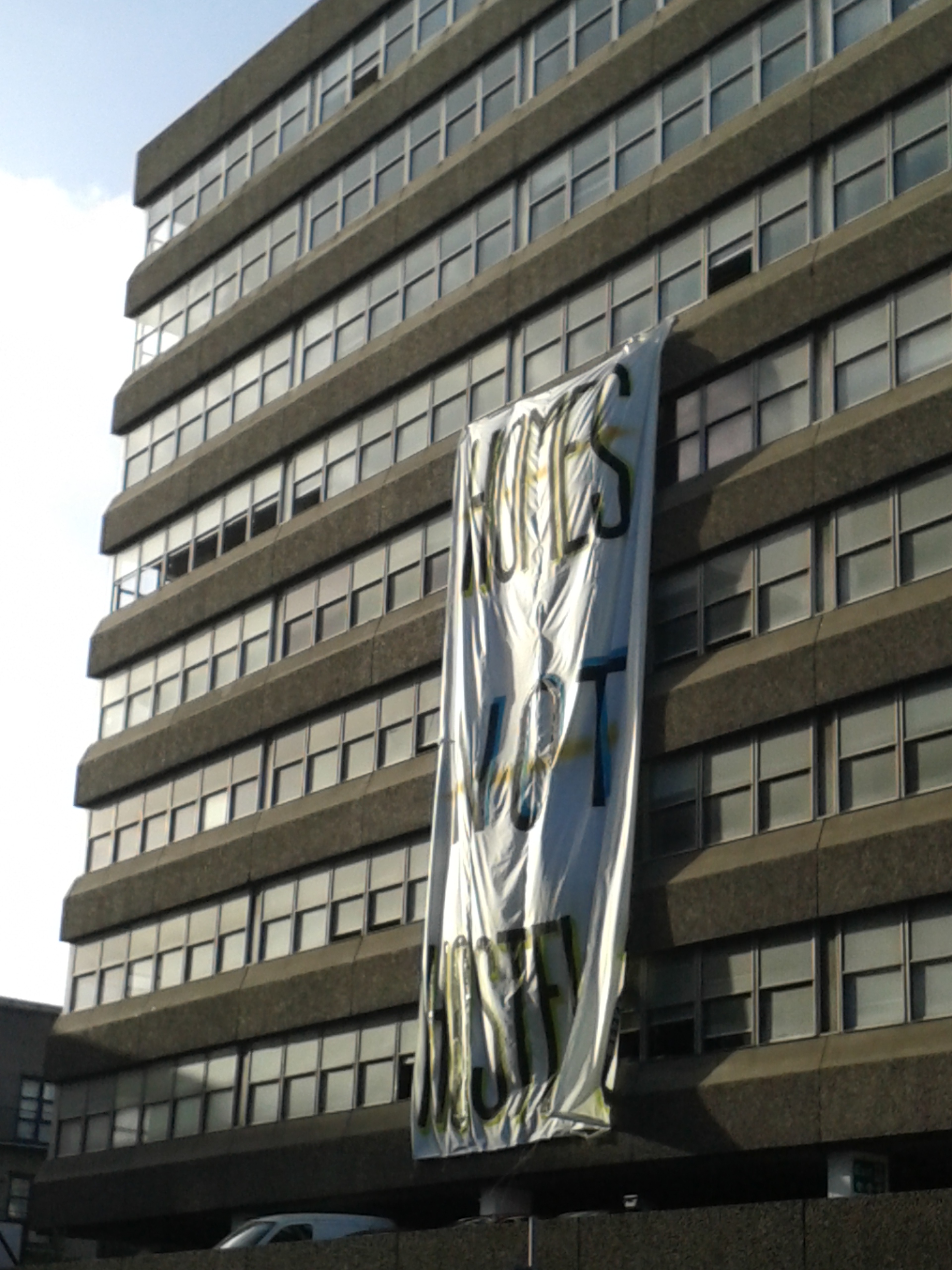
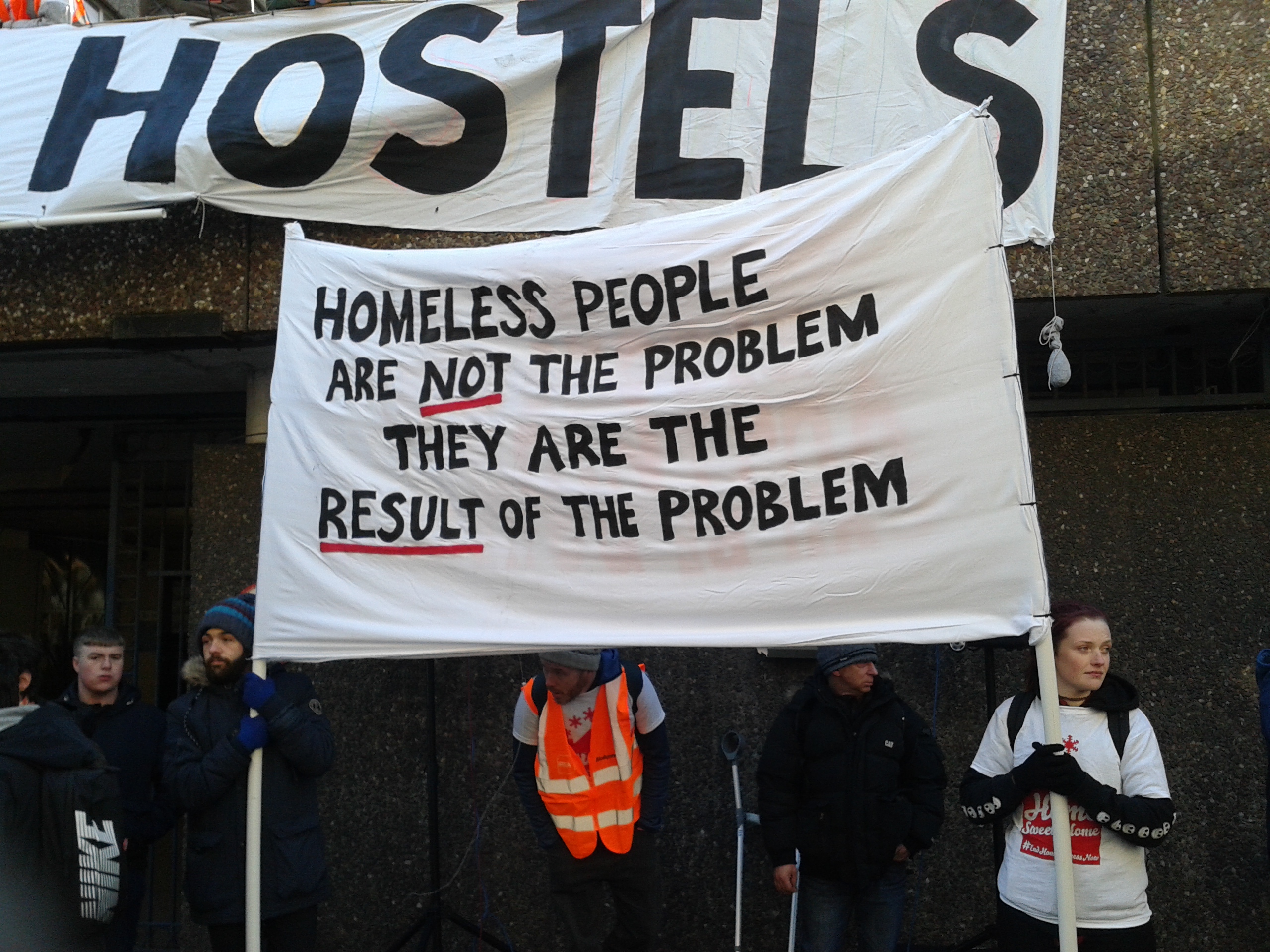
“Homes not hostels” banner on the side of Apollo House, a protest occupation of some weeks in December 2016 which attracted much support and media attention. But the homeless crisis has got much worse since.
(Photo: D.Breatnach)

SOLUTIONS

          All the interviewees, to one degree or another, placed the blame for the situation on the Government. Most of them also blamed the banks and the vulture funds. Some pointed to vested interests of TDs who are rental landlords while other went as far as to allege corruption and in effect an integrated system of banks-landlords-vulture funds-district courts-TDs- Government.

Some of the interviewees alleged that the Irish are too accepting, too meek. One who did so was a Ginley (or McGinley), who said that the Irish had fought for the British and for the USA but had never fought for themselves. He seemed either ignorant or dismissive of the long Irish history of resistance and also of the fact that not only the Irish who fought in the British and US armies were not “fighting for themselves” but neither were the British and US working people alongside them!

Marion Shanley was one who upheld the Irish history of resistance and pointed out that in war, to which she hoped it would not come, incidents of suicide tended to almost disappear.

Given the size of the problems and the combination of political and financial interests, it was going to be interesting to see what solutions were advocated.

Anthony Monaghan wished to see some kind of combination of workers and business people to sort out the problems and hoped “the fighting Irish” would come to the fore.

TD McGuinness stated it was important for the politicians to come closer to the people and asked for greater leniency from the district courts in house repossession cases. Senator Conway-Walsh also wanted to see greater leniency from the courts but tighter legislation against vulture funds too. The homeless young Dubliner put forward the radical solution of having members of the Government spend a week in the conditions of homeless people.

Only Glen Gannon baldly put forward the clear solution, the only one possible, given the interlinking of financial and political interests: Revolution.

DANGERS

          There is a vacuum of leadership, as a couple of interviewees remarked.

During his interview, the man I remembered as Ginley (or McGinley), referred to Ben Gilroy as a champion “of our own”, an electoral candidate who had been failed by the electorate and whose “vote was derisory” in the recent elections. However Gilroy (who was present at the screening, as were a number of interviewees), had in the past posted an islamophobic rant on social media and had shared leadership of the recently-defunct Irish Yellow Vests with a racist, anti-emigration, anti-gay and lesbian islamophobe.

This points to a possible danger, not only that we might continue to be driven downwards but that in desperation, we might turn to fascism and racism, as other people have done in difficult times. And in precisely those kinds of times, the ruling capitalist class has not usually been shy of finding their champions to push those kinds of ‘solutions’, splitting the working class and diverting attention from the real problems.

And one form of fascism has been indeed to seek the unity of workers and businessmen sought by Monaghan (though that should not of course be taken as a suggestion that he is himself a fascist). In such “unities” there is no question of which sector will be in command.

In a film about the Ireland of today, it was interesting to see no images or hear any reference to immigration other than that of the Irish diaspora. It could have been that the makers wanted to keep the narrative simple …. or there could have been another reason for it.

Anthony Monaghan said at one point that although he knew that was not possible, he’d like to go back 20 years. At the turn of the century, i.e twenty years ago, the false Irish economy bubble was about to burst.

SPIRITUALITY IN RESISTANCE

          In one scene, the camera follows Anthony Monaghan going down into a holy well (St. Dervla’s) near his original home and blessing himself with some of the water there. Remarking that although he does not condone the scandals that have come out of the church in recent decades, he regrets the Irish turning away from the Catholic faith, which he feels sustained us in years past and bound us together.

One of Monaghan’s interviewees points out that the worst thing about the scandals in the Church was not the abuses themselves but the cynical covering them up by those in authority, exposing more people still to abuse and suffering.

Talking about Catholicism as a binding agent of the Irish while almost in the next breath about our martyrs and heroes of the past, ignores a very important part of that very history of resistance which Monaghan upholds. The Catholic Church, from the moment Penal Laws began to be lifted, worked might and main against that Irish resistance. Its leadership condemned the United Irishmen (in particular the few priests who joined them), the Land League actions, the Fenians and the IRA in nearly every period and in all of its manifestations. In addition, the founders of the United Irishmen were Protestants, as were nearly all the prominent people of the Young Irelanders; Protestants were to be found too among the founders of the Volunteers, the Fianna, Ininí na hÉireann and the Irish Citizen Army.

In fact, history was sorely missing in all the analyses, since no-one pointed out that the State had been set up in a counterrevolution, an alliance of Catholic Church and Gombeen capitalist class under the old master’s tutelage. There seemed to be no acknowledgement that the Irish state is a neo-colony, run by a Gombeen capitalist and political class, its natural resources to be plundered by foreign multinationals, its services to be sold to the same, its own natural industries to be run down.

Human beings do have a spiritual sense, whatever anyone may say against that – but that is not necessarily about religion, contrary though that statement may seem. A sense of who we are as Irish people, as workers, as human beings, as part of life on earth, can be both practical and spiritual. It can be conveyed in language, song, poetry, visual art …. and in a knowledge of living history.

In that respect, it was strange that in a film about Ireland made by a man from Erris, by the Belmullet Peninsula and a large part of which figures in the narrative and images, there were only five words in Irish to be heard. For Béal Muirthead is a Gaeltacht, an Irish-speaking area, though shrinking under pressure from English-speaking monoglots.
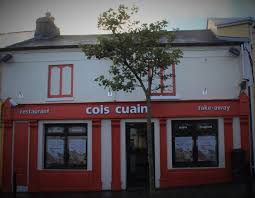
Pub in Erris with name (“Harbourside”) in Irish
(Photo sourced: Internet)

IN CONCLUSION,

it was an interesting film from the point of view of presenting the issues and gathering some opinions about them.

But as well as who were interviewed, it was interesting to note who were not. No active revolutionaries — socialist, communist, republican …. no activists in recent or current movements of resistance. And no reference to the mass mobilisations against the water charges and the local battles resisting meter installation. Nor of the demonstrations protesting homelessness. Not even a mention of the titanic (or biblical Davidian) struggle in Rossport, Mayo, against Shell BP.

The last song I remember hearing on the film’s soundtrack was James Connolly, not the song about the revolutionary socialist and trade union organiser he was (see below) but instead one which portrays him as an “Irish rebel” out of context, without mention of class or of the Irish Citizen Army, of which he was the leader.

End.

REFERENCES AND SOURCES:

Trailer for film: https://www.youtube.com/watch?v=vP1lcSvBbtQ&feature=share

Lyrics and air Lovely Blacksod Bay song: https://www.itma.ie/inishowen/song/lovely-blacksod-bay-song-cornelius-mceleney-singing-in-english

Recording of Noreen Bawn: https://www.youtube.com/watch?v=_0n3VwC9Kr4

Recording of James Connolly, the Irish Rebel: https://www.youtube.com/watch?v=wEmy8nif7J8

Recording of Where Is Our James Connolly?: https://www.youtube.com/watch?v=6tqGknooC9g

Irish economic and financial status: http://www.oecdbetterlifeindex.org/countries/ireland/

https://www.independent.ie/business/irish/ireland-scores-well-on-growth-and-gdp-but-inequality-soars-36518158.html

Millionaires in Ireland: https://www.thejournal.ie/wealth-report-ireland-3264492-Mar2017/

HOUSING DEMONSTRATIONS MARCH THROUGH DUBLIN

Diarmuid Breatnach

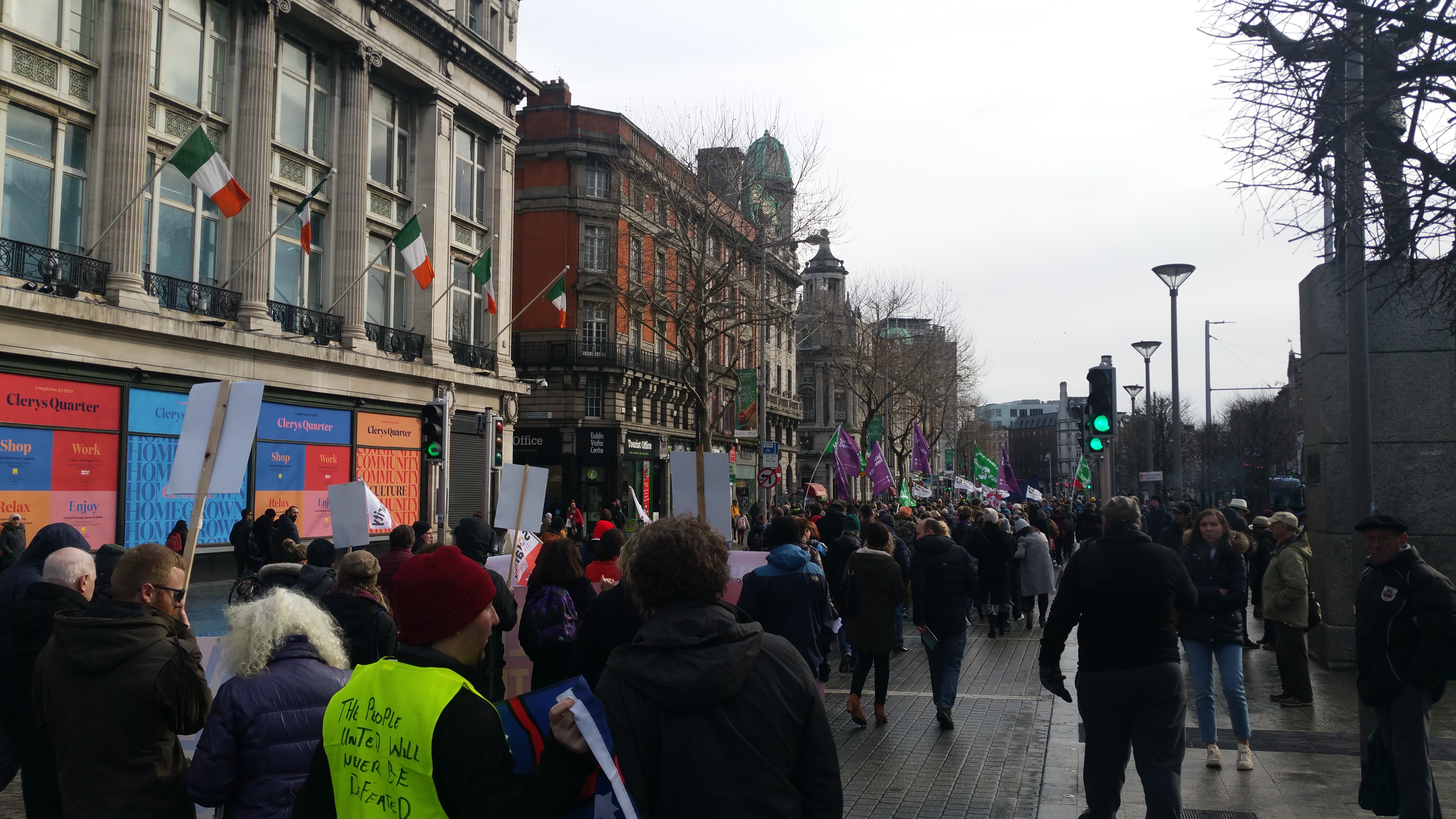
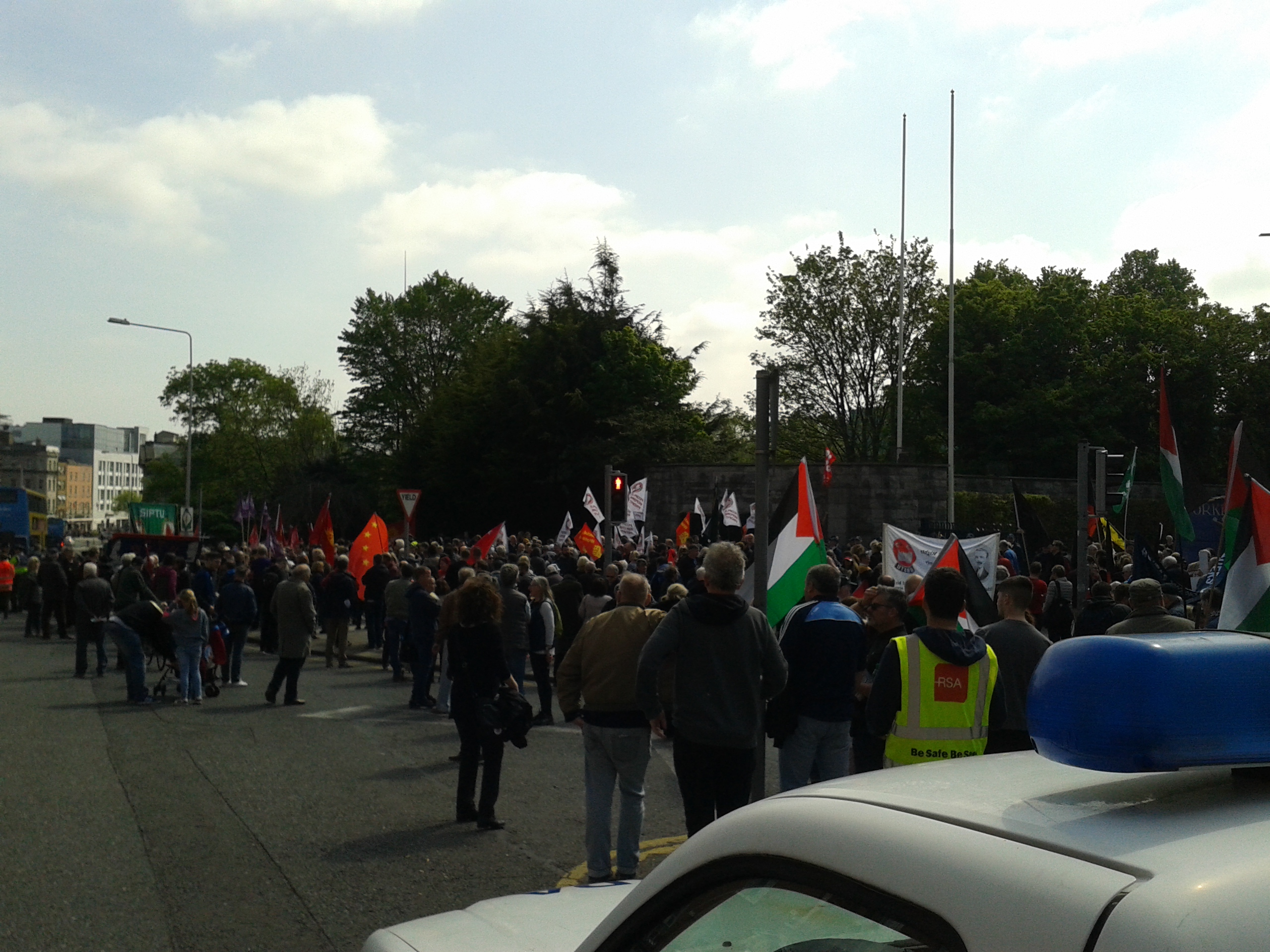
Protesters calling for the urgent construction of public housing marched through Dublin today. Various organisations and many independent activists took part in the protest with a broad range of people took pat, from socialist to republican-orientated, some with their children. The event was organised by the National Homeless and Housing Coalition.

Early part of the march detachment starting from the GPO, here proceeding south along O’Connell St, the long-closed Clery’s department store on the left and the Larkin Monument on the right. (Photo: D.Breatnach)

          On their Facebook page, the NHHC had issued a statement, part of which read:

Rebuild Ireland has been an unmitigated disaster yet the cross party motion that was passed in the Dail in October that called for practical actions that would end the emergency, including making it illegal to evict someone into homelessness, were ignored by the government even though it was supported by all parties except Fine Gael. We are demanding action on the motion.

We also learned that 15 Dublin hotels received over €1m each in 2018 for accommodating homeless families which further illustrates the reliance on the private sector. These families need public housing built on public lands, they need proper homes. Last year there were 842 cases of children being discharged from the Temple Street Emergency Department back into homeless emergency accommodation. The majority of these cases were a direct result of the fact that these children are living in completely unsuitable and cramped emergency accommodation.”

The march, though far from small, seemed somewhat smaller than expected which may have been due to a cold windy day with lashing rain a little earlier in the day but may also have had another cause. The Coalition of groups has split with ICTU (Irish Council of Trade Unions) and a number of NGOs pulling out to form a different campaign on housing, apparently declining to support the demand for public housing on public land.

Front of the march pausing on Custom House Quay (Photo: D.Breatnach)

The organisers of today’s march published a list of demands:

Declare the housing and homelessness crisis an emergency.
Provide a minimum of 10,000 public house a year. No to privatization: build public houses on public land.
Make housing a constitutional right.
End evictions, bank repossessions and sell-offs to vulture funds.
Create a national Traveller accommodation agency to oversee and deliver Traveller Accommodation.
Legislate for real security of tenure, real rent control and affordable rents.
End the use of B&B’s and hotels for emergency accommodation. Improve emergency accommodation facilities and provide security for all in need.
Create rent pressure zones for Purpose-Built Student Accommodation (PBSA). Ensure tenant’s rights for students in PBSA and digs-style accommodation.

One group set off from the GPO and after making a circuit on O’Connell Bridge, marched along the north quays, meeting up with another group coming across Butt Bridge to join them from the Housing Agency HQ; apparently another group had marched from City Hall. The march continued on to Samuel Becket Bridge, to the bemusement of some participants, where the participants halted and were addressed by a number of speakers.

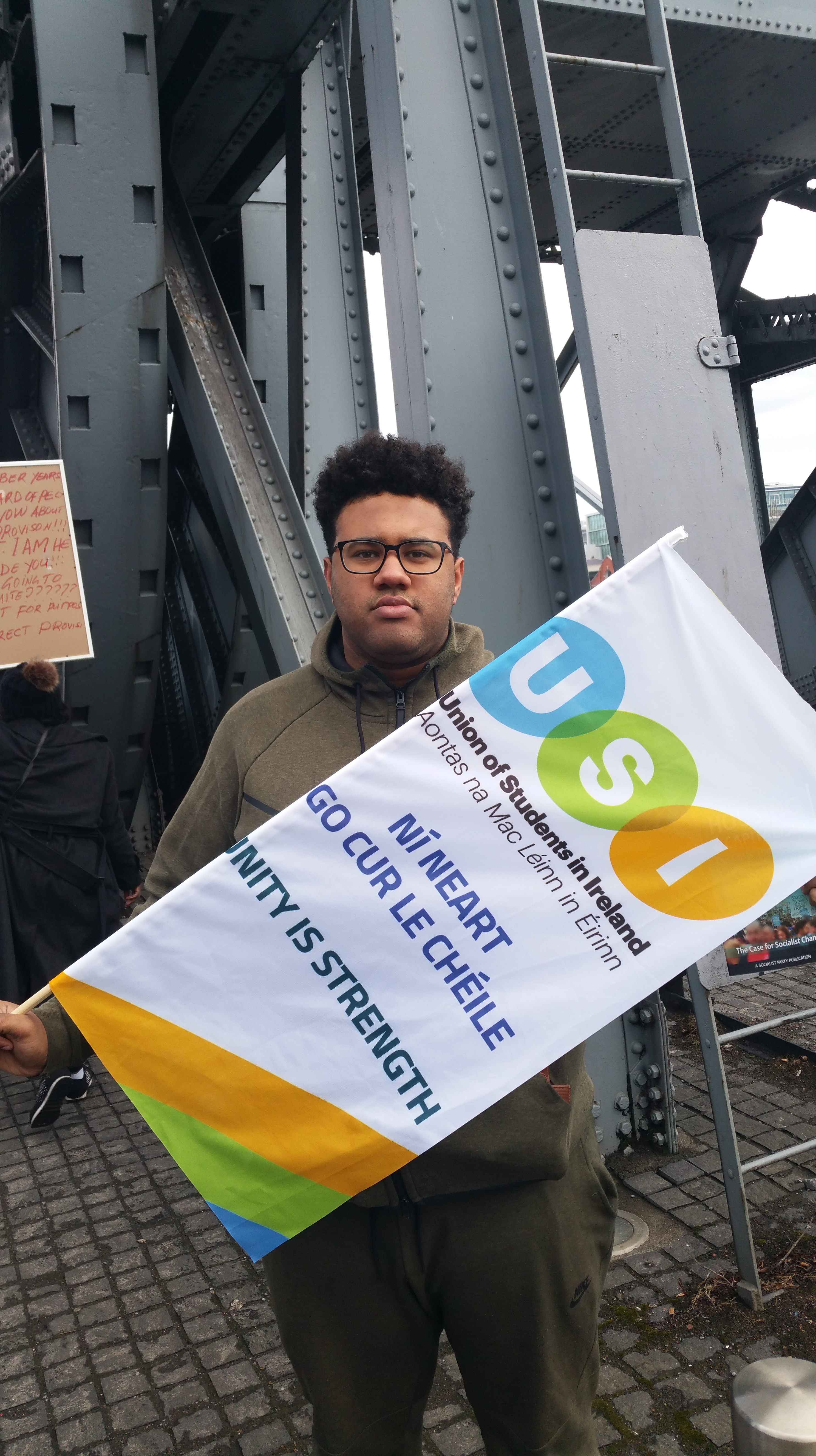
Student on the march displaying flag of Union of Students in Ireland (Photo: D.Breatnach)

Along the route of the march, slogans were shouted, among which were:

“Raise the roof, not the rents!” and “Housing is a human right!”

Section of the march stretching out along the north quays. (Photo: D.Breatnach)
One of the organisers speaking at the rally at the end of the march: Tina McVeigh, of PBP. (Photo: D.Breatnach)

As well as Socialists, a number of Republicans were in evidence, marching without party banners. Sinn Féin supporters had a banner and party flags, as did People Before Profit and the Workers’ Party. Some Union of Students in Ireland flags were in evidence too. A Travellers’ group and some community groups also carried banners identifying their group with the march and its cause.


Report by Irish Times, with video including interviews with participants: http://https://www.irishtimes.com/news/social-affairs/thousands-march-in-support-of-homeless-in-dublin-1.3820626?fbclid=IwAR2aW9yLVjHbTrJ9kbb21MEHOl3R8llbRhy3GFeX8NvkGLtdjH69TF9fQxc&mode=amp


End.

Captain Moonlight and the Roscommon Evictions

CAPTAIN MOONLIGHT REVIVED: Ireland’s New Land War? — excellent article by Kerron Ó Luain, reproduced with his permission

(click on the link above to find the whole article)

“During this past week, near Strokestown, County Roscommon, a usually tranquil corner of rural Ireland, events have unfolded that exhibit undeniable echoes of the Land War of 1879-82. On 11December, three siblings in their fifties and sixties were brutally evicted from their homestead and family farm by private security goons backed by An Garda Síochána (the ‘Guardians of Peace’, aka the police) at the behest of KBC Bank, or by a receiver acting on behalf of the bank.”

The area in 1879: “Evictions of tenant farmers by bailiffs, agents, and sheriffs, with the backing of the Royal Irish Constabulary, were commonplace during this period. As were organized blockades, rent strikes, social ostracism, and other forms of civil disobedience to resist them.”

FREQUENT AND STUPID STATEMENTS

Diarmuid Breatnach

We often hear stupid statements. I know I’ve made some myself. I suppose the only way to be absolutely sure of not making a stupid statement is to say nothing – not even thinking carefully before speaking is probably going to be enough protection for the length of one’s whole life. Besides, thinking carefully beforehand is not always appropriate. But we can — and should — avoid repeating the stupid statements of others and making them often.

It’s no surprise that a recent statement by a Government Minister got me thinking along these lines – politicians as a group are particularly prone to making stupid statements. By “stupid’ in this case I mean contradicting logic or common sense, although the intended effect may be carefully considered and cunning.

The Minister in question, Charlie Flanagan, was quoted in a number of newspaper reports as having said, in reference to a recent eviction case in Roscommon, that “violence is never justified”. Nothing unusual in that, you might think and that does show how inoculated we have become by stupid statements.

Charlie Flanagan, Minister for Justice of the Irish Government (Source image: Internet)

Charlie Flanagan is Minister for Justice of the Irish Government. As such, the courts, police and prison service come under his oversight. The police force of the Irish State contains, according to the appropriate Wikipedia entry, 10,459 Garda officers. All of these officers are, it is reasonable to assume, trained in the use of their batons, pepper-spray, handcuffs and physical restraint. Some – and it does seem to be more and more of them – are also carrying firearms. In other words, Charlie Flanagan oversees a force of nearly 10,460 people who are trained to use violence and on many occasions expected to use it – and yet he says that “violence is never justified.”

Yes, I know – he didn’t mean the Gardaí in general, or the prison officers who are also trained to use force, or the judiciary who send people to be incarcerated. He didn’t mean the thugs who were using violence to evict people either. Or the specific Gardaí who supervised the violence being used on the evicted and by their presence prevented defence or retaliation.

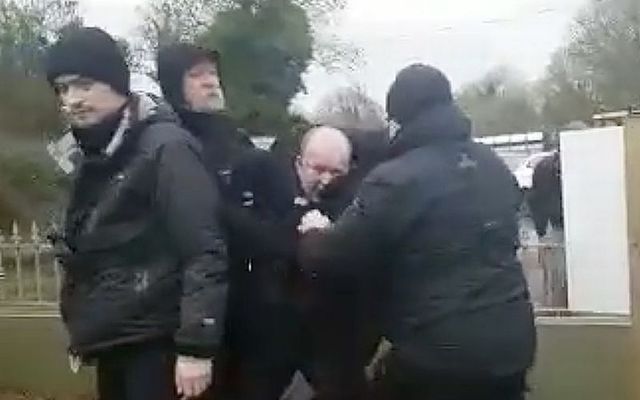
Bailiffs working for KBC Banks evicting elderly people from their home in Roscommon
(Source image: Irish Central.com cropped from video)

In system-politician-speak, “violence” is never what the State does and hardly ever what the capitalists do, it is invariably what the victims of the system do to protect themselves or in retaliation. And true to form, Flanagan was referring to the punishment meted out to those eviction gang thugs. So, a statement with cunning intent, to make one action, the violent eviction of people from their home an alright one, and another, the retaliation towards the thugs and repossession of the home, the only one that is “violent”. It makes perfect sense in the way that those who run the system see it and in the way, by perversion of the meaning of words, they want us to see it too.

Burned-out vans of KBC Bank bailiffs outside the house from which they had earlier evicted the residents.
(Source image: Internet)

But in strictly logical terms, what Flanagan said was nonsense. Unfortunately, it’s the kind of nonsense we hear repeated again and again.

And something like it, through constant repetition, becomes almost common sense. Look at the statement that “Violence never solved anything”: another stupid statement which gets a lot of airtime and mass media repetition with a lot of currency – particularly but not exclusively among the liberal sections of the middle class.

If someone other than a teacher decides to bully you in school and you decide to make it hard for him or her, by responding to violence with violence, in most cases the bully will leave you alone and probably go looking for an easier pick-upon. In that case violence has indeed solved something – at least for you. Of course, it is possible (though not usual) that the situation will escalate from there and the liberal middle class person will tell you that you should report it to the teachers, your parents, etc. What they are expecting is that pressure will be brought upon the bully either directly or indirectly by heavier forces than yours alone. And what lies behind those heavier forces? Ultimately? Violence. It may be the best way to go at times but ultimately it is not non-violent – it is relying for effectiveness on the capacity for violence of others.

Of course, it is possible that the bully may be dissuaded through logic and therapy but that is not often going to happen in our society for a number of reasons.

OK, so you grow up and somebody one night comes to beat you up and take your wallet or purse but you put up a good resistance and either stretch him out on the ground or he runs off. Seems to me that violence did solve that situation.

Taking a more macro look at situations of violence, most people would agree that nations have a right to self-determination. Yet that right has been obstructed and repressed many, many times in history. To take Europe alone, the current nation-states of Poland, Hungary, Czech, Slovakia, Croatia, Austria, Switzerland, Holland, Denmark, Norway and Finland have all been faced with violence and had to respond with violence in order to achieve their independence. Ireland had to do similarly and was partially successful, while a number of other nations remain suppressed despite upheavals and stirrings.

While it may be true that some of those conflicts had questionable results it does not refute the general rule that nations under domination of another state are ultimately controlled by violence and that violence has had to be used many times in response. Nor is the case refuted by territorial share-outs among powers, such as some of the treaties between big powers – the Treaty of Versailles at the end of WWI, for example, authorised the English and French to plunder the Ruhr Valley and was one of the German grievances that helped the Nazis to gain control and begin world expansion. Other treaties have regularly led to violence too, either in states or peoples trying to re-negotiate or negate them, or in suppression of those rebellious forces by the states benefiting from the treaties.

Let us suppose that we are subject to an invasion by a foreign state – that is not too difficult for the Irish to imagine and most European countries experienced it during WWII as did, earlier and later, most of the nations of Latin America, Africa and Asia. The invading force uses violence, of course and they use it more effectively than our defence forces do. Violence worked – in this case for the invading forces. It solved the issue for them – how to overcome our defence forces and occupy our territory for whatever reason they set out to do so.

If we want to resolve the issue to our advantage – to end the invasion and occupation – we would not be able to do so peacefully. That is not a choice the invader will permit us. Our resistance would sooner or later be met with violence by the occupier, whether wholesale in massacres, internment, bans, ’emergency’ laws, curfews etc — or by more selective violence, arrests of leaders and activists, torture, jailing or even executions. And often by a combination of the wholesale and the selective repression.

To rid ourselves of the invader we would have to employ violence too, violence in resistance. It would of course be necessary to combine it with many other tactics – sabotage (violence against things), insurgent propaganda, cartoons, graffiti, song, humour, sarcasm and irony, boycott, demonstrations, pickets, subversion of the enemy’s forces ….. but violence would have to be part of it. There is no nation that freed itself from the domination of a state which was at the time capable of violently suppressing it, without the insurgent nation having had to resort to revolutionary violence.

Returning for a moment to our middle-class liberals, let us imagine the home or business of one is subject to an attempted burglary or robbery. The victim will feel justified in the use of violence in defence of his or her property or home. He or she may choose not to employ that violence themselves – or be unable to — but in that case will certainly turn to the police to employ it on their behalves: “Use cunning to find them and violence to subdue them, bring them to trial by force and punish them by jail. And keep them there for a long time, using violence if necessary.” The middle-class liberal whose business has been robbed or home violated will in most cases not hesitate to, if not use those actual words, to fully imply them by calling for “justice”. However, commenting on the course of a worker’s strike or protest demonstration, he or she will undoubtedly lecture the perceived offenders that “Violence solves nothing.”

End.

REFERENCES:

https://www.irishtimes.com/news/ireland/irish-news/roscommon-eviction-flanagan-says-violence-is-never-justified-1.3733986

https://en.wikipedia.org/wiki/Garda_S%C3%ADoch%C3%A1na

PUBLIC HOUSING FOR ALL — CAMPAIGN LAUNCHED IN DUBLIN

Diarmuid Breatnach

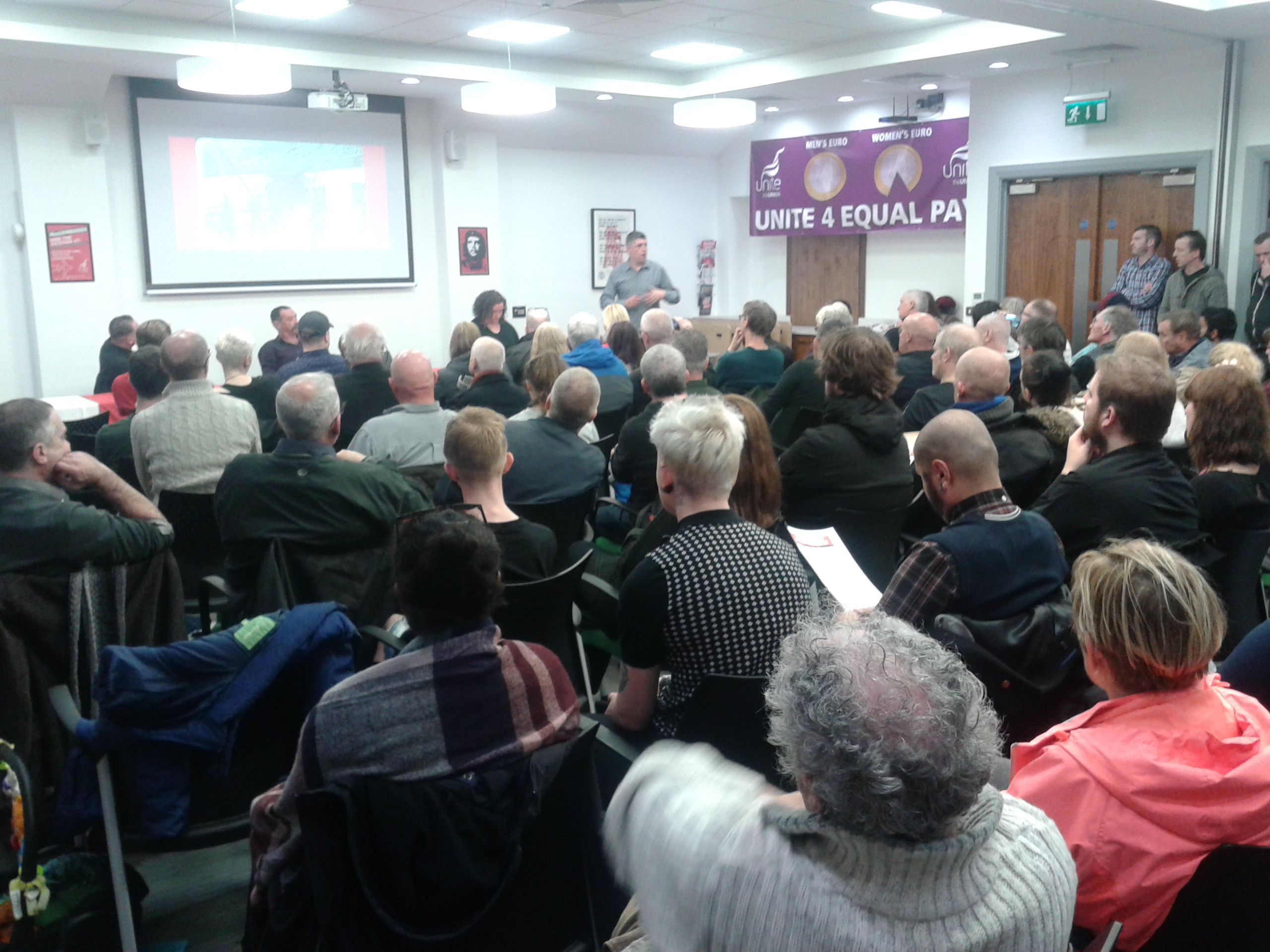
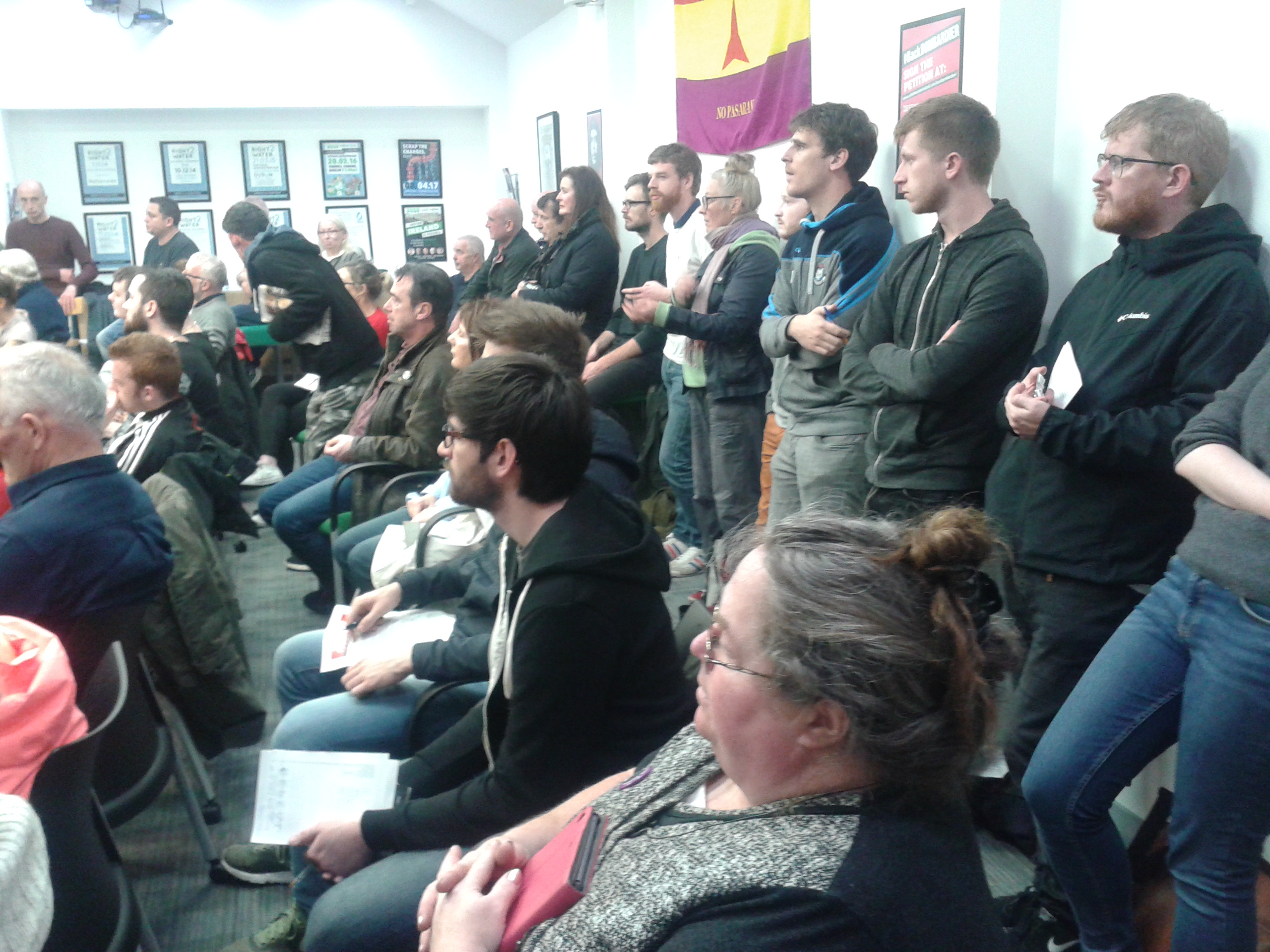
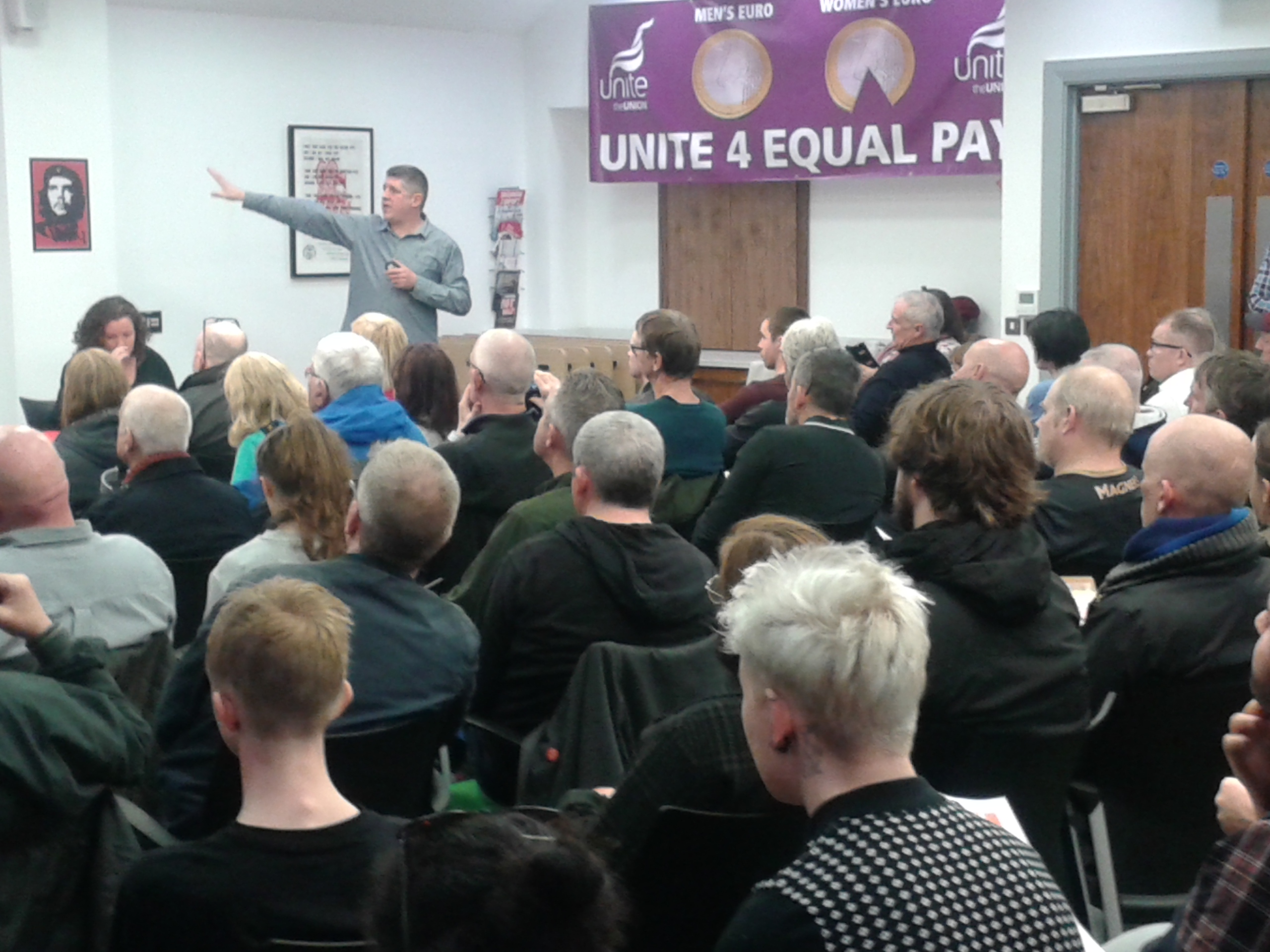
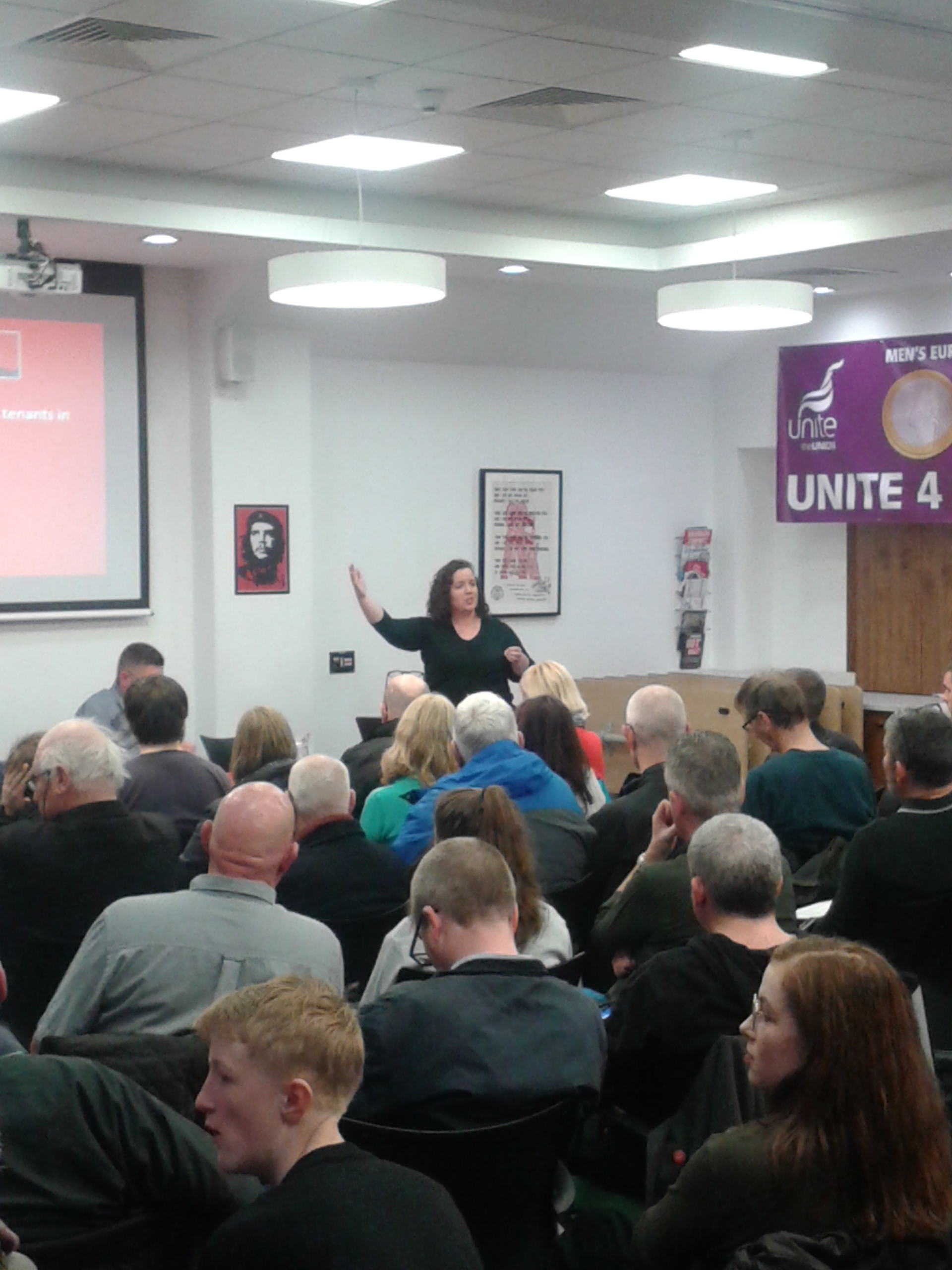
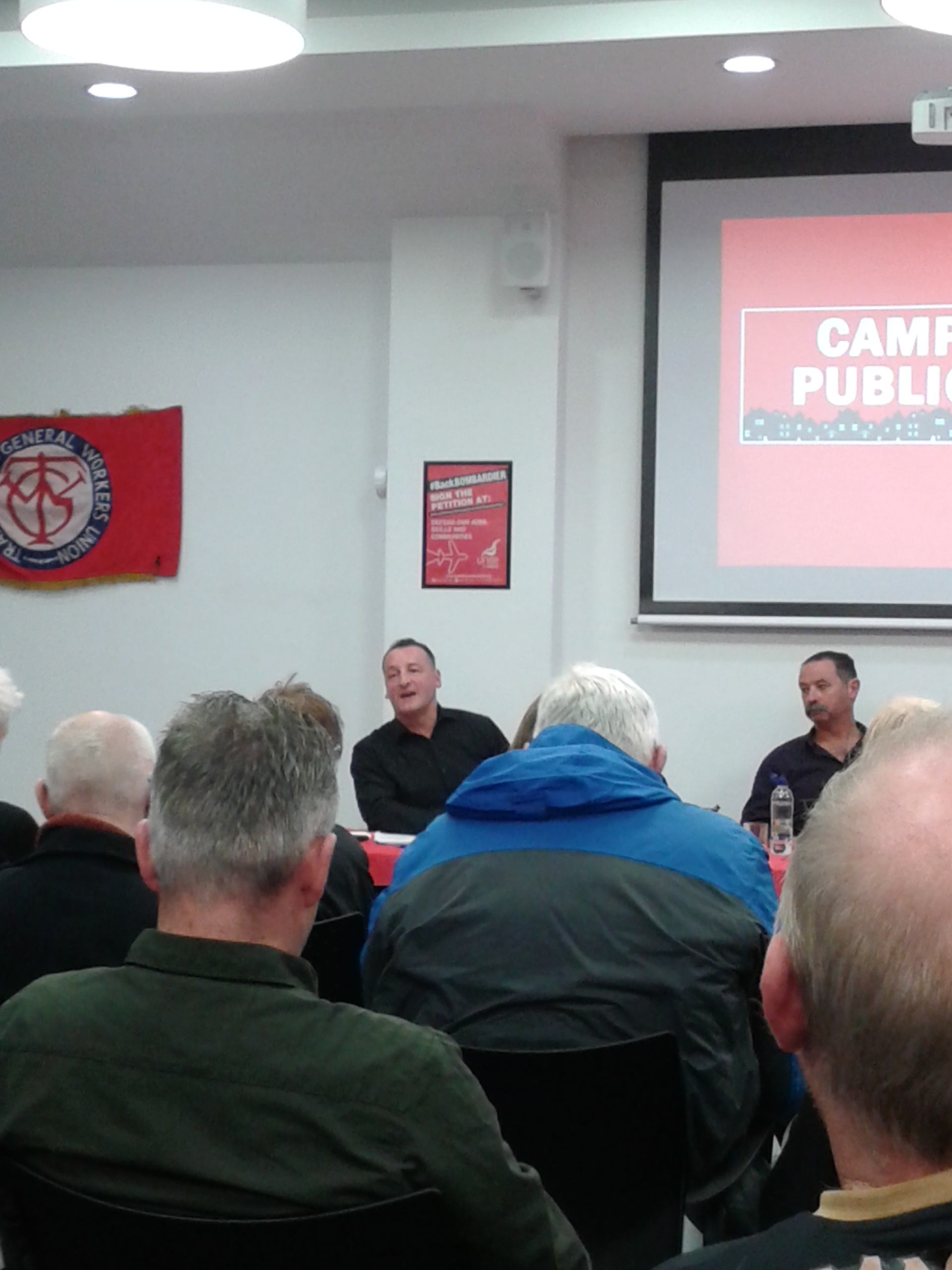
The Campaign for Public Housing was launched Saturday (28th October) at a large packed meeting room in the Unite trade union building in Dublin.

Section of crowded room at campaign launch meeting in Unite trade union hall.
(Photo: D.Breatnach)

The demands of the campaign were announced as both long-term (in the form of a new system of universal public housing) and short-term (in dealing with the reality of the current housing crisis), as follows:

  • A new system of Universally Accessible Public Housing, based upon a cost rental model where the collective rent of tenants would fund the construction and procurement of large volumes of new public housing.

  • A tenants Bill of Rights to protect tenants in the private rental sector. This bill would control rents and provide real security of tenure.

  • A complete Ban on Economic Evictions by banks and private landlords.

  • A referendum to insert an unambiguous and legally enforceable Right to Public Housing into the constitution.

Standing room only remaining at campaign launch meeting in Unite trade union hall.
(Photo: D.Breatnach)

The political forces represented at the public meeting table were Éirigí (Brian Leeson), the Workers’ Party (Éilís Ryan), the Communist Party (chairing the meeting) and an individual who might be described as an independent left Republican activist (Cieran Perry). Both Perry and Ryan serve as elected councillors on Dublin City Council.

The Éirigí organisation is considerably reduced from the numbers of activists it had when it was first formed, largely by “dissidents” who left the Sinn Féin party soon after the Good Friday Agreement. The Workers’ Party is very small, having arrived at its current space through a series of splits from the original Sinn Féin (which became Official Sinn Féin after their dissidents formed the Provisionals back in 1970). The Communist Party of Ireland is also very small but owns a Dublin bookshop which also operates as a small theatre and meeting place for broader left anti-imperialist events.

At first glance, the political composition of the table may strike the observer as unimpressive in representation of numbers. However, such active forces have impacted significantly on the Irish political scene over the years and these in particular bring a wealth of political experience to the table. In addition, the audience contained a broad spectrum of left trade union and community activists, republicans, anarchists, socialists and participants who became active in recent campaigns.

According to a press statement released by the Campaign for Public Housing on 26th October, its supporters includes:
Peter McVerry (in a personal capacity, it was said at the launch)
Inner City Helping Homeless
Éirigí
The Workers’ Party
The Communist Party of Ireland
North Dublin Bay Housing Crisis Community
Cllr. Cieran Perry
D8HAC Altogether Now
Dundrum Housing Action
1916 Societies
Catherine Connolly TD
Clare Daly TD
Mick Wallace TD
(and Joan Collins TD, it was announced at the campaign launch).

THE STATE FUNDING SPECULATORS TO BUY MORE PROPERTY

Speaking while using an electronic visual presentation on a large screen at the campaign public launch meeting, Leeson presented figures drawn from statistics produced by property and housing agencies and government departments to illustrate a history of public housing in the Irish State since its creation. Though hardly impressive in the numbers of public dwellings built, the figures showed a significant initiative in that direction under the early Fianna Fáil government years, when De Valera was at its head.

Brian Leeson during his presentation,
(Photo: D.Breatnach)

Throughout the 1950s and 1960s the ratio of public housing to private housing built was around one to one. In those years, private landlords notwithstanding, private housing was usually occupied by the owner. From the 1980s onwards, the ratio shifted to 10-1 in favour of private dwellings and huge numbers of these were no longer lived in by their owners and the ratio is much higher now. In effect, dwellings had become a commodity in which large-scale speculation was taking place, driving the rents and mortgages higher and higher, forcing people into debt for life or evictions and also into high-rent and unsuitable accommodation.

The figures also showed a state funding of the private property sector to the tune of eight billions (€8,000,000,000) – funds which the banks and other property speculators used to purchase more land and property, intensifying the housing crisis.

PUBLIC — NOT SOCIAL — HOUSING

Ryan concentrated her presentation on the need to call for public housing as a rational and necessary response, as one might consider for example public education or health service. Only public housing can solve the housing crisis, she maintained and so it is not only of moral importance but of urgent practical need. Turning to the cost of house building, Ryan pointed to the industry’s figures seen in the earlier presentation, showing that good-quality houses can be built much cheaper even under existing conditions. She was at pains to outline the differences between social and public housing: social housing is often aimed at low-income families and may be provided through a range of private or semi-private schemes. Public housing is state-funded with the rents going back to the state to reinvest in further housing provision and should be mixed in order to avoid ghettoisation.

Éilis Ryan during her presentation. (Photo: D.Breatnach)

Referring to the importance that Irish people tend to give to the state’s Constitution, Ryan stated that part of the objectives of the campaign was to insert a clause that guaranteed every person a good quality, affordable-according-to-income housing unit for life.

STOP THE SALE OF PUBLIC LAND!

“We have very little power as Councillors,” said Perry “but one thing we do have power on is the veto on selling public land.” He went on to speak of how Dublin City Council had sold Council land to private developers despite his and some other Councillors’ efforts. However, social and political pressure had forced the ratio of public housing on the Devanney Gardens site up to 30% despite the wishes of some political parties but that still meant that 70% went to private speculators.

Cieran Perry during his presentation.
(Photo: D.Breatnach)

Perry called for support for a demonstration outside City Hall on Monday November 6th at 5.30 pm in support of a motion put forward by himself and some other councillors to prevent the sale of any Council land.

Currently Dublin City Council own 120 hectares of land – enough to build 12,000 good quality homes. “There are 20,000 people on Dublin’s housing waiting lists, and many more average income households who will never be able to afford private rent or mortgage. So why are we allowing private developers to make money off our land?”

Turning to the question of the campaign itself, Perry promised it would be democratic, transparent and not become dominated by any political party or personality and urged all to become involved, to leave their contact details on the clipboard sheets at the door and to encourage others to come on board.

QUESTIONS

The questions and contributions were overwhelmingly of an intelligent kind and included areas such as hidden homelessness by emigration, housing waiting lists and disqualification; the privatisation of education and health services despite their public appearance; the need for the campaign to include direct action; the relationship between this campaign and other housing campaigns in Ireland; the need for quality monitoring by other than the contractor if the Council is to be the builder; the shortage of building workers at the moment; changes in the court systems to facilitate evictions; the involvement in a number of evictions of a firm led by an ex-British soldier using Loyalist ex-paramilitaries; the expected opposition from the EU to bans on the sale of public land; the hidden homelessness of one partner in a relationship breakup, etc.

Those leaving the meeting seemed fairly happy with the launch though inevitably some discussion took place on what tactics the campaign might employ and whether the organisation would degenerate into electoralism, or whether it would be manipulated for politically sectional interest. Political and community activists in Dublin have a long history and such discussion would be normal among all but the most naive. But the overall mood perceived by this reporter was decidedly positive.

End

LINKS:

Contact campaign: https://www.facebook.com/CampaignForPublicHousing/
campaign4publichousing@gmail.com

Picket City Hall to demand no selling of public land: https://www.facebook.com/events/2562340743904927/?acontext=%7B%22ref%22%3A%223%22%2C%22ref_newsfeed_story_type%22%3A%22regular%22%2C%22action_history%22%3A%22null%22%7D

INTERNATIONAL WORKERS’ DAY IN DUBLIN


Clive Sulish

May 1st, International Workers’ Day was celebrated in warm sunshine in Dublin with a parade and rally organised by the Dublin Council of Trade Unions and a later event organised by the Independent Workers’ Union.

Crowd scene outside Garden of Remembrance, the starting point of the DCTU march

The DCTU-organised event met at the Garden of Remembrance at 2pm and set off at nearly 3pm, with numbers although still small by European standards nevertheless larger than has been seen for some time in Dublin, according to the organisers filling O’Connell Street, the city’s main street throughout its whole length (500 metres or 547 yards).

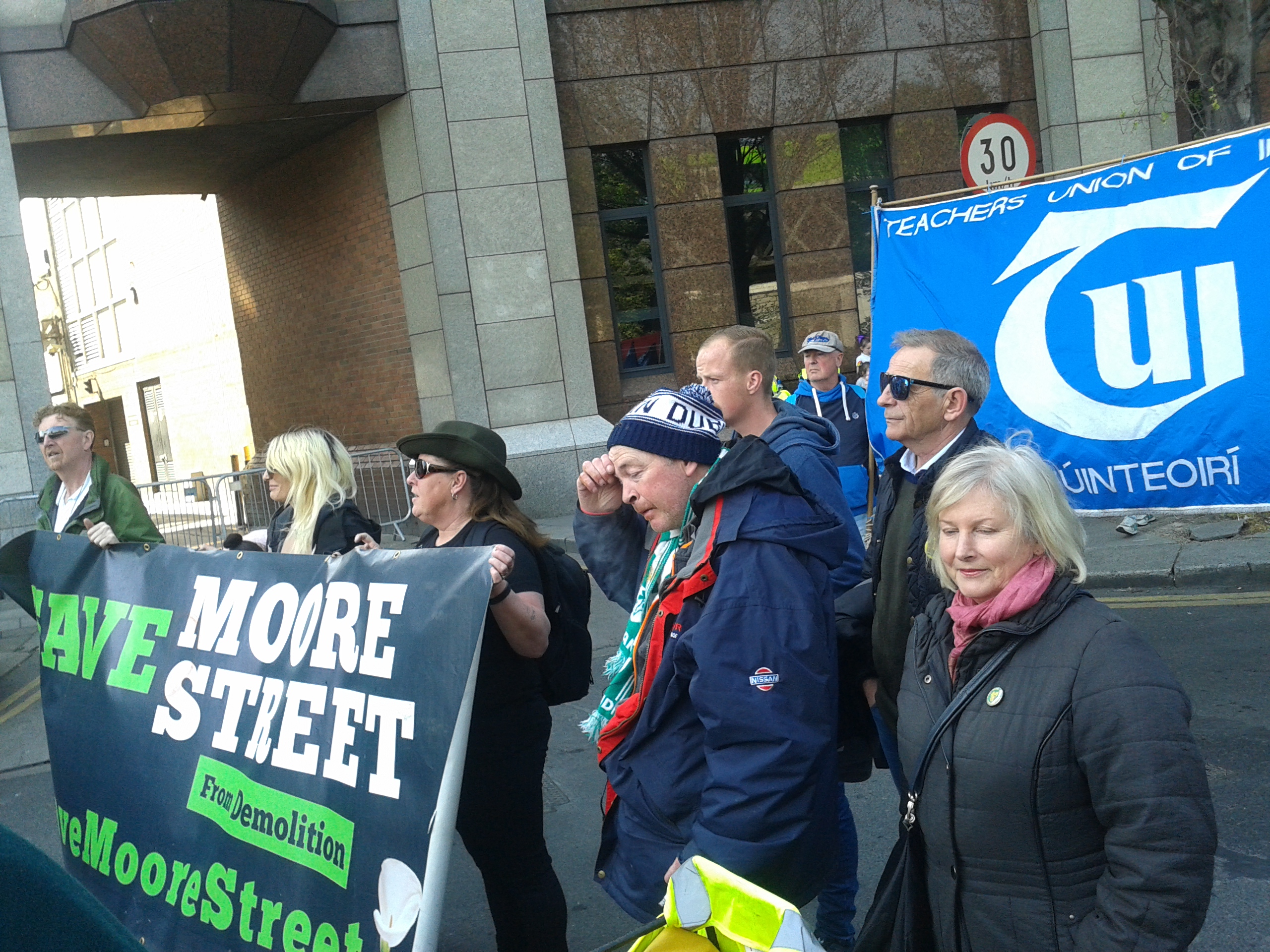
Seen on the parade were trade union banners, those of some political parties, also of campaigns and community groups.

As it has been doing for years, the parade ended in a rally in Beresford Place, in front of Liberty Hall, the very tall building owned by the SIPTU trade union, where the audience were addressed by speakers from trade unions and campaigns and NGOs.

Section of crowd at rally in Beresford Place

Curiously, soon after arrival the comparatively strong showing of Sinn Féin flags, the green one with their logo and the blue and white version of the Starry Plough, were nowhere to be seen.

Similar section with some banners noticeably missing

The issues of lack of affordable housing, of public land being sold for private housing and speculation, of precarious employment, of financial speculation and cuts in services were addressed by speakers, with a mention also of solidarity for the Palestinian prisoners on hunger strike. A number of speakers also addressed the treatment of migrants and in particular the conditions suffered by refugees in the Direct Provision hostels of the state’s welfare service.

Stage erected at Beresford Place, outside SIPTU’s offices
The Moore Street campaign banner was one of the campaign groups present on the parade and mentioned from the stage by the rally’s chairperson.
One of the speakers at the rally — she denounced the sale of private land including the deal done at O’Devaney Gardens estate in Dublin.

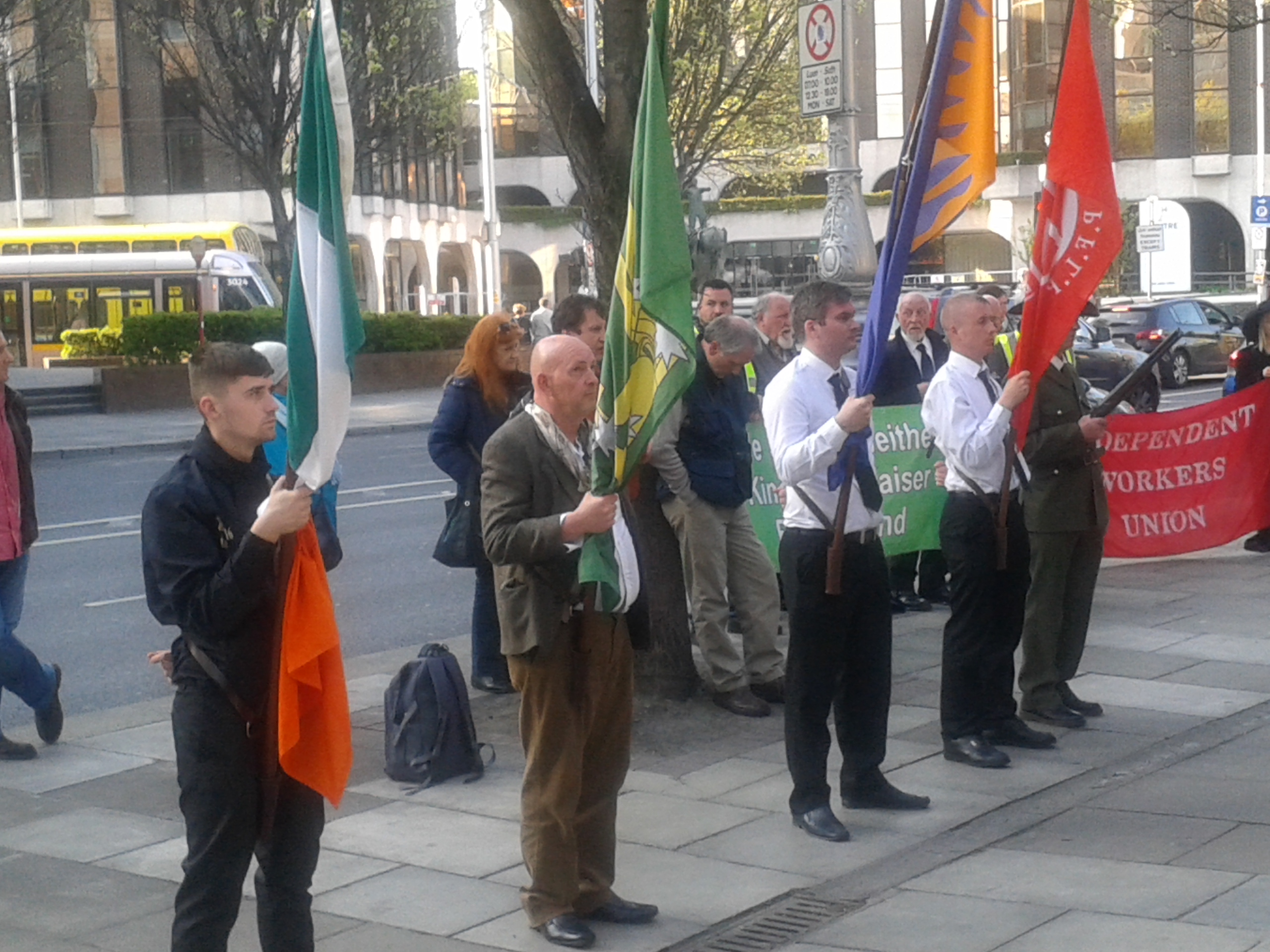
Somewhat later, the Independent Workers’ Union held their own event, marching with a colour party from their offices to James Connolly monument, also in Beresford Place and across the road from Liberty Hall.

IWU event colour party at Connolly Monument

Damien Keogh chaired the event and introduced veteran campaigner Sean Doyle who gave a short and to the point speech about the situation in which working people find themselves today and ending with a quotation from James Connolly, in which the revolutionary socialist castigated those who claimed to love Ireland but could tolerate seeing poverty and deprivation among its people. Doyle also sent solidarity greetings to the Palestinian political prisoners on hunger strike in Israeli jails.

Paul Bowman was then introduced and in a longer speech covered Connolly’s time in the USA, his membership of and activities of the IWW (“the Wobblies”); the Haymarket Incident in Chicago which led to the choosing of May 1st as International Workers’ Day and the state murder of the Haymarket Martyrs; the principles and attitude of the IWU today.

Another Moore Street campaign banner and supporters in period costume also participated in the IWU event
Some random tourists, one form London and the other from Madrid, who chanced to pass by and remained for the whole ceremony.

Damien then introduced Diarmuid Breatnach to sing “We Only Want the Earth” (an alternative title to the original of “Be Moderate”). Breatnach explained that the lyrics had been composed by James Connolly and published in a songbook of his in New York in 1907 without an air. As a consequence the lyrics have been sung to a variety of airs but Breatnach said he sings it to the air of “A Nation Once Again” (composed originally by Thomas Davis some time between 1841 and 1845). This arrangement provides a chorus and Breatnach invited the audience to join in the chorus with him, which they did.

We only want the Earth,

we only want the Earth,

And our demands most moderate are:

We only want the Earth!”

A wreath was laid at the monument on behalf of the IWU by Leanne Farrell.

The chairperson then thanked those in attendance, speakers and singer and invited all back to the offices of the IWU in the North Strand for refreshments.

End.

DUBLIN FIRE BRIGADE AMBULANCE PROTEST AT CITY HALL

Diarmuid Breatnach

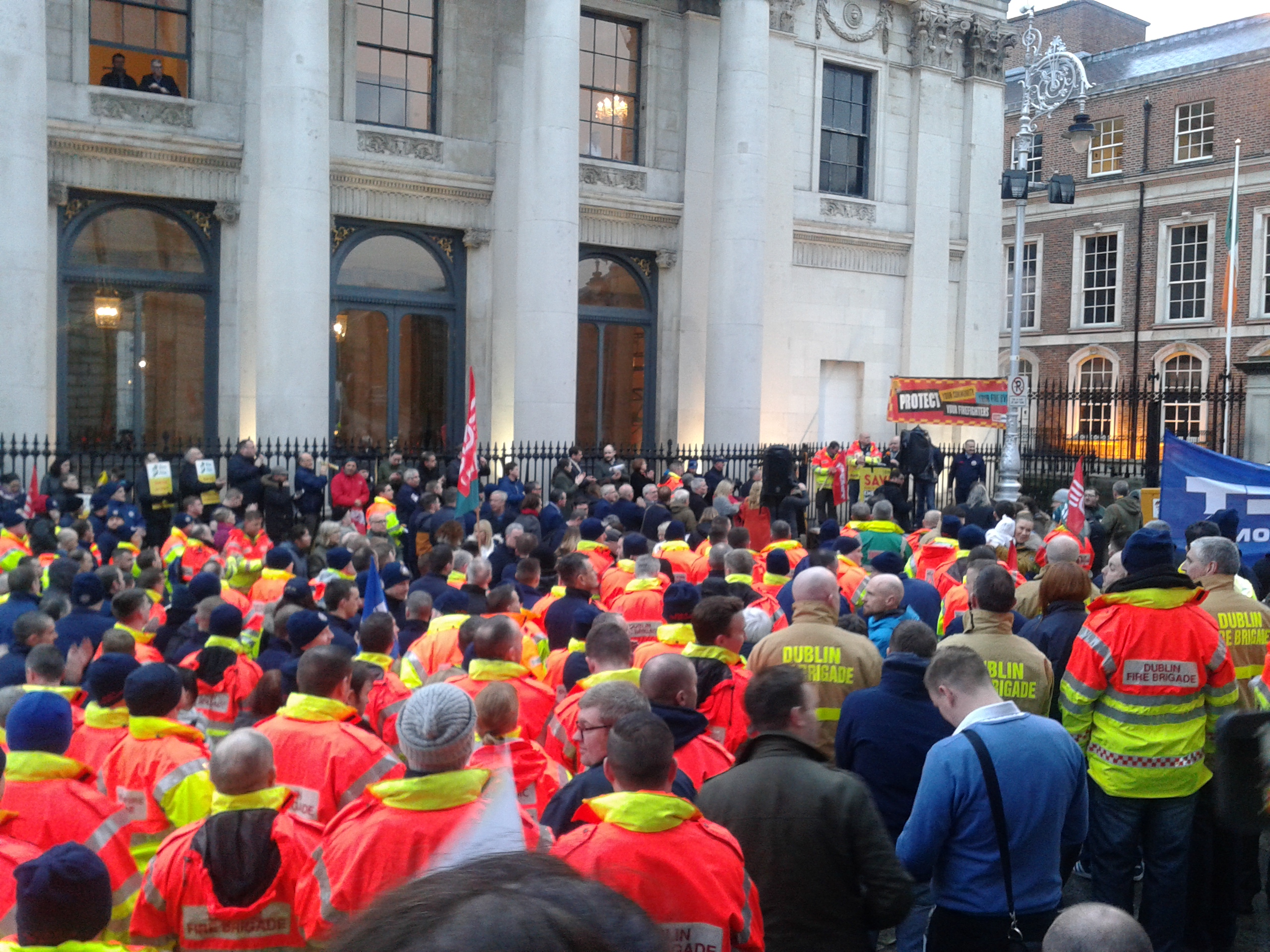
DUBLIN FIRE BRIGADE AMBULANCE SERVICE WORKERS PROTEST AT CITY HALL — hundreds of workers protest Dublin City Council Executive Officer’s plan to “outsource” their service.

Gathering to hear the speakers on Cork Hill, outside the side entrance of Dublin City Hall (left of photo).
(Photo: DBreatnach)

The monthly meeting of the elected representatives of Dublin City Council is often an occasion for protest, with placards and banners, of a number of campaigns protesting measures of the Council’s administrators or for calling on City Councillors for support ffor the campaigners’ objectives.

The March meeting of the Council on Monday night this week was no different in that respect but on this occasion, unusually, there were hundreds of protesters outside, the majority of them in uniform, filling the Cork Hill space in front of City Hall’s side entrance, up to the ceremonial entrance gates of Dublin Castle.

Several hundred thronged the area, most of them in either the dark blue of the Dublin Fire Brigade or in red-and-yellow or tan-and-yellow jackets, also bearing the legend “Dublin Fire Brigade”. Dotted among the crowd too were others in ordinary street clothes, presumably members of the public and a few with young children, probably relations to fire fighters or paramedics.

A young supporter of the fire-fighters’ struggle
(Photo: D.Breatnach)

The protest meeting was seeking the support of elected Dublin City Councillors in their dispute with the Chief Executive of the Council, Owen Keegan. The highest officer in the Council does not want the local authority responsible for funding the Dublin Fire Brigade’s ambulance service call-and-dispatch service and announced two years ago that it would be transferred from the Tara Street centre and put under the control of the HSE at their national control centre in Tallaght.

However, his plan ran into trouble not only with the fire-fighters themselves but with a large number of the elected public representatives and as a result a consultative forum was set up. Its eventual recommendations were not however what Keegan wished for, proposing instead a technological linkup between the HSE’s and the DFB ambulance services and as a result Keegan and other DCC senior management pulled out of the consultative forum in January. Brendan Kenny, second-in-command at DCC said that there was no point in continuing with the forum since it did not carry out the task it was set up to do but came up with different recommendations.


STRIKE NOTICE

View from the steps of City Hall (State Entrance gates to Dublin Castle to the extreme left of photo). (photo: D.Breatnach)

Since the intention of the City’s management was clearly to proceed with their plan, both the main trade unions affected, SIPTU and IMPACT, balloted their members for strike action and obtained an overwhelming majority in February: 93% to 7% in favour of strike action and 97% to 3% in favour of industrial action. On Monday SIPTU served strike notice on Dublin City Council management and IMPACT did likewise the following day.

The strikes are due to take place from 9am on Saturday, March 18th and Monday, March 27th.

The demonstration on Monday night was addressed by a number of speakers, including many elected Councillors. However, first to address them was SIPTU’s Brendan O’Brien who expressed regret that “SIPTU members in Dublin Fire Brigade have been forced into conducting these work stoppages” which he said was a result of his “members’ total commitment to providing the best emergency services possible to the residents of Dublin” and the intransigence of DCC management, headed by Owen Keegan.

Speaking to the press, he said that “These firefighters are withdrawing their labour to indicate, in the strongest manner open to them, their complete opposition to an attempt by senior management in Dublin City Council to break up the DFB Emergency Medical Service by removing its ambulance call and dispatch function.”

Before speakers addressed the crowd: top section of the crowd, approaching the State Entrance gates of Dublin City Castle
(photo: D.Breatnach)

Addressing the demonstration on Monday evening, O’Brien said that if the strikes were not sufficient to make DCC management see reason, “make no mistake, this fight will become a national one.”

A number of Councillors addressed the crowd, representing most of the political groupings on the Council. Christy Burke, ex-Lord Mayor (2015), representing a group of Independent councillors, stated that DCC management had refused to let them use the power in the nearby building for amplification for speakers. Burke drew cheers when he quipped that what the Management did not realise was that “the power is not in there, it is out here on the street.”

Burke also stated that the DFB Ambulance Service was working well and asked rhetorically “why fix something that isn’t broken”, a theme taken up by a number of other speakers. The Sinn Féin speaker made the point that she was representing the largest political party in the Council, totally supported the Fire Fighters and would be seeking legal advice on Keegan’s plan and the other speakers likewise promised support to the fire-fighters.


OTHER UNDERLYING ISSUES IN THE DUBLIN FIRE-BRIGADE AMBULANCE SERVICE PROTEST

Although speakers for the fire-fighters a number of times expressed support for the colleagues employed by the Health Servive Executive, their members must be concerned at the prospect of coming under the management of an organisation so under-funded and reportedly often mismanaged as has been the HSE for decades now.

Another element playing itself out here is the recurring conflict between many elected City Councillors and the unelected City Management. The political colouring of the public representation in the Council changed considerably with the local elections in 2014, when Sinn Féin with 16 seats and Independents with 12 became the groups most represented. Next in numbers of Councillors is Fianna Fáil with 9 seats, while Fine Gael and Labour each have 8 each and People Before Profit have 5. The remaining 5 are divided between the Greens, Anti-Austerity Alliance and United Left.

This struggle between many of the elected and the appointed few has broken out on a number of issues previously, most notably perhaps on the Moore Street Quarter issue, with Keegan and Jim Keoghan, formerly second-in-command and head of the Planning Department, proposing a deal with a property developer for a ‘land swap’ involving Council buildings on Moore Street, a plan which mobilised significant campaigning opposition and which was defeated by a large majority of Councillors voting in November 2014. The Councillors were however unable to prevent Keoghan’s “executive action” in agreeing a number of property speculator planning applications and the most controversial extension of the ‘giant shopping mall’ permission towards the end of last year.

This level of conflict between the elected Dublin public representatives and the appointed senior officials has perhaps not been seen since the War of Independence (1919-1921), when an Irish Republican and Labour majority on the Council, after the 1920 Local Government elections, found itself in recurring confrontation with officials appointed under a colonial administration.


BACKGROUND

According to Dublin Council’s website, “The Fire Brigade has provided the citizens of Dublin City and County with a fire and rescue service since 1862. This service was enhanced in1898 by the addition of an emergency ambulance service. In 2007 with 12 emergency ambulances DFB responded to 78,864 ambulance incidents, with the figure growing each year.

Dublin Fire Brigade provides an emergency ambulance service to the citizens and visitors of Dublin. Dublin Fire Brigade is the only Brigade in the country to provide an Emergency Ambulance Service. Dublin Fire Brigade operates 12 emergency ambulances with one ambulance operating from each full time station with the exception of Dun Laoghaire.

DFB’s Firefighters are trained to Paramedic level and are registered as practitioners with the pre-hospital Emergency Care Council (PHECC), meaning there are over 100 Paramedics available on a 24/7 basis in the event of a major emergency. All operational firefighters rotate between Fire and Rescue to Emergency Ambulance duties. Dublin Fire Brigade Ambulance Service has achieved accreditation under the ISO 9001/2000 Quality Management System.”

Lively ladies active in the Campaign for social housing Irish Glass Bottle site, Ringsend.
(photo: D.Breatnach)
Banner of campaign for social housing Irish Glass Bottle site, Ringsend.
(photo: D.Breatnach)


OTHER CITY HALL PROTESTS

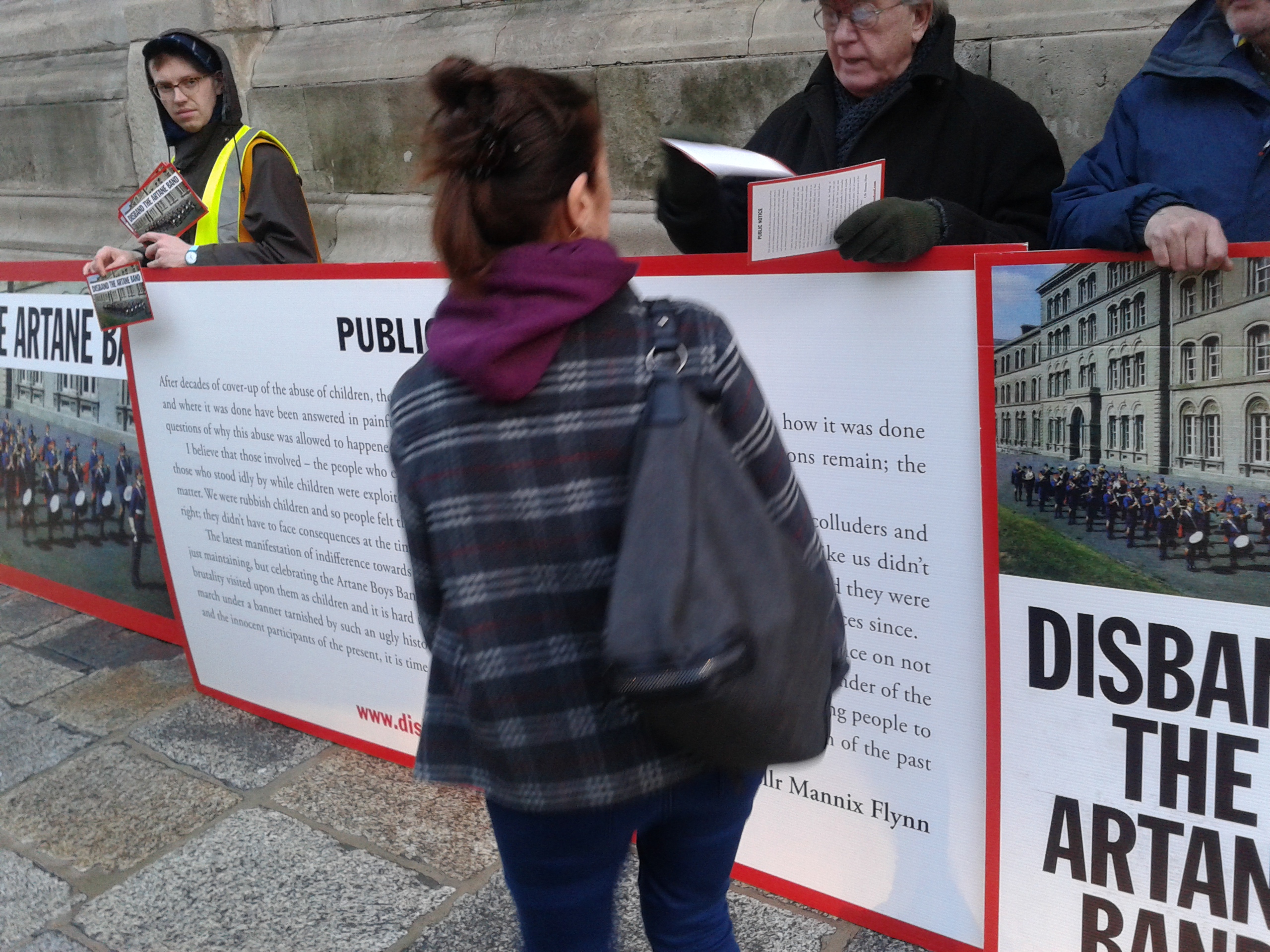
Also protesting outside City Hall (see photos) were lively and good-humoured campaigners for social housing on the former Glass Bottle company site in Ringsend and others calling for the renaming of the Artane Band (it is hoped to cover these campaigns in a little more detail in future reports).

Campaigners to rename the Artane Band because of the abuse that went on in the Artane Industrial School, which formed the original Artane Boys’ Band.
(photo: D.Breatnach)


HUNDREDS ATTEND MIDDAY WEEKDAY RALLY TO SUPPORT APOLLO HOUSE OCCUPATION

Diarmuid Breatnach


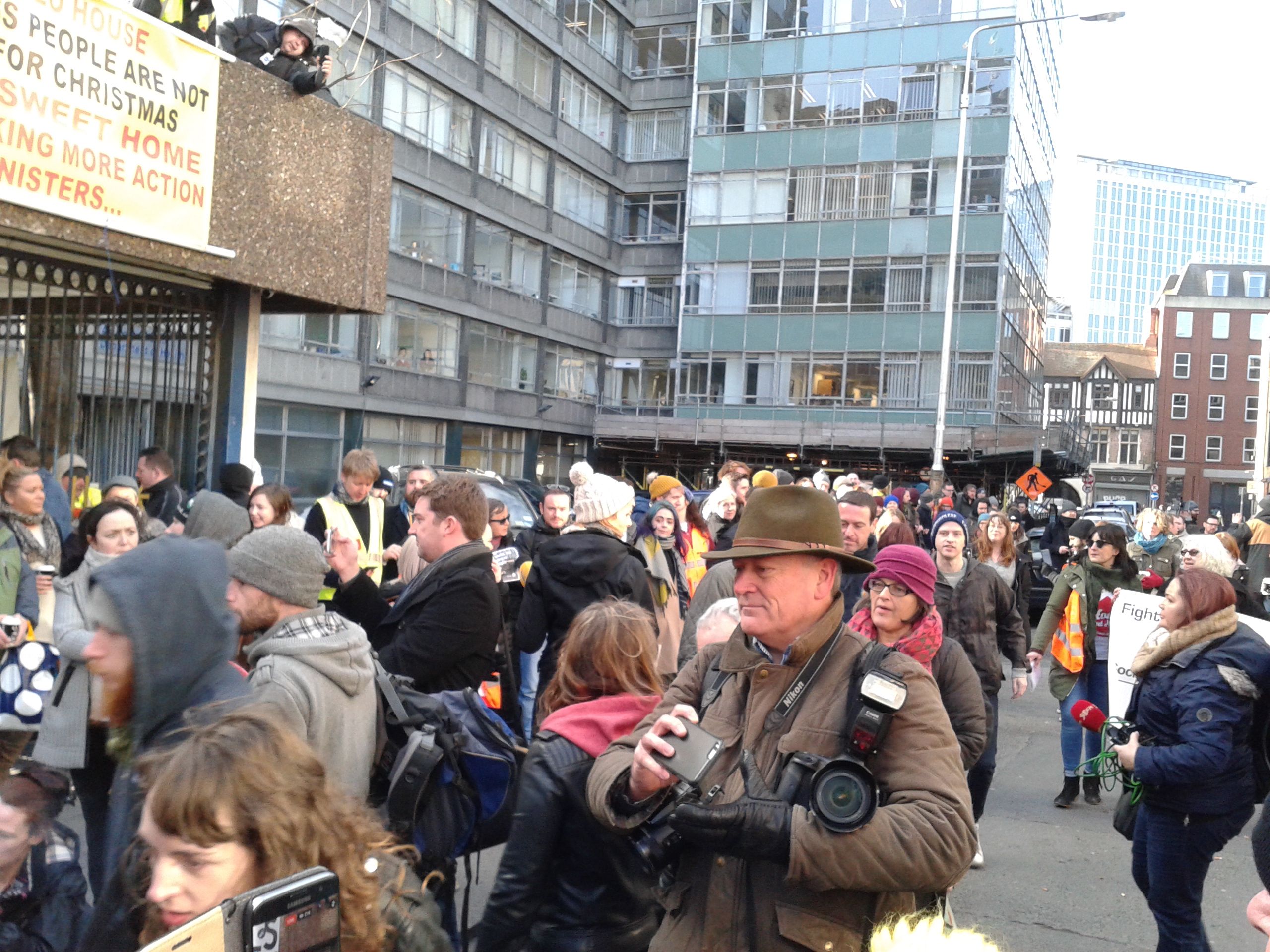
HUNDREDS ATTENDED AT APOLLO HOUSE in bitter cold from late morning today to indicate their support for the homeless people and housing activists in occupation of the building.  At the same time, a court refused to extend the

 Closer view of banner on Tara Street side of occupied Apollo House (Photo: D.Breatnach)
Closer view of “Homes Not Hostels” banner on Tara Street side of occupied Apollo House (Photo: D.Breatnach)

deadline by which it has ordered the occupiers to leave.

Banner suspended from the Tara Street side of Apollo House (Photo: D.Breatnach)

While they were there, representatives were attending court seeking an extension on the deadline given by a court order to leave the building by noon today.

Housing activist Rosie Leonard told the crowd that the alternative accommodation some Apollo House homeless people had been offered was totally unsuitable and that some were houses for people with addiction issues and that there were even bloodstains on the walls. They had asked for an extension as the State had not provided alternative accommodation but this had been refused.

In response, people cried “Shame!” and “We shall not be moved!”

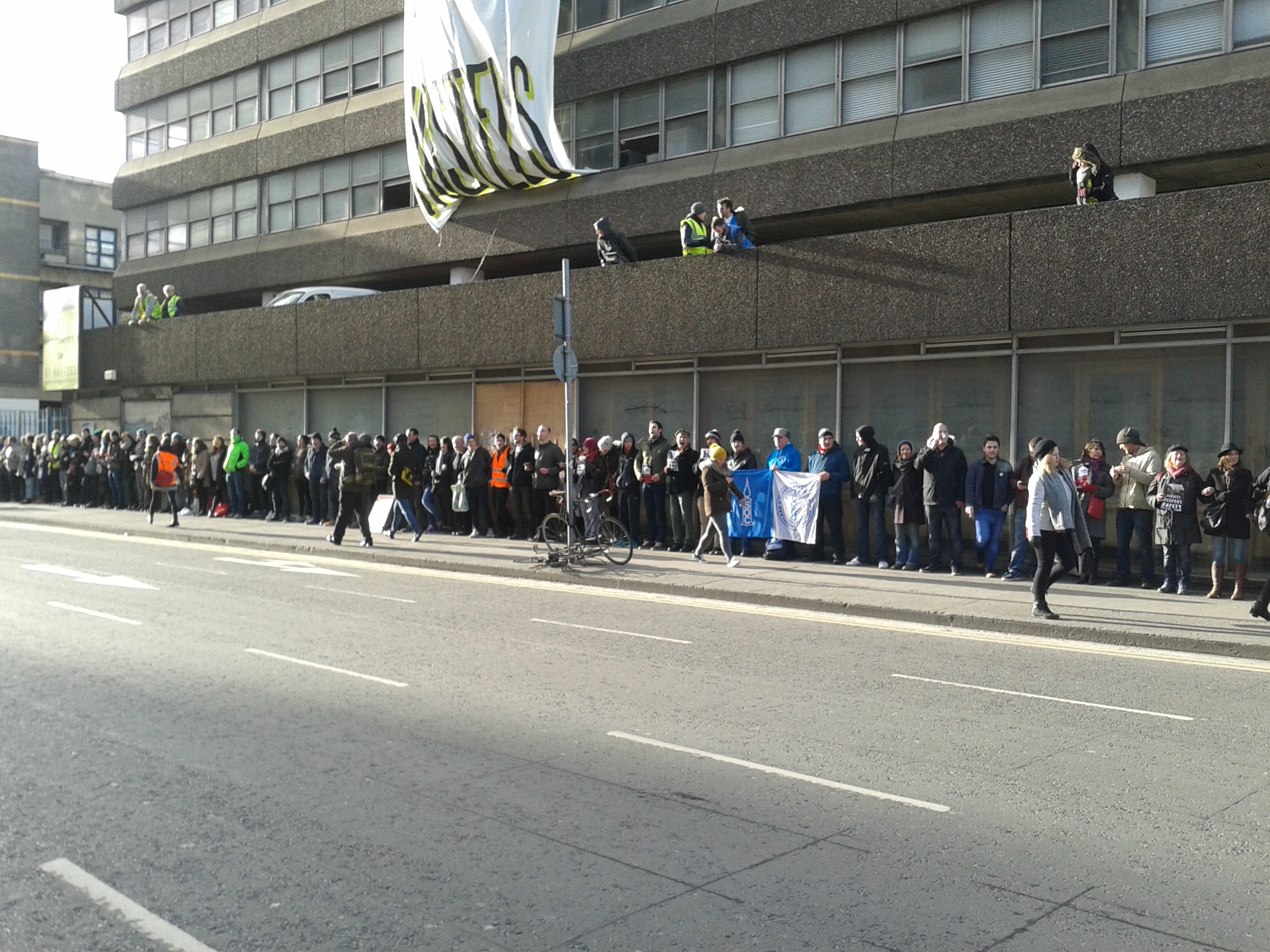
Supporters linking arms around Apollo House from Townsend St, through Tara St to Poolbeg St. (Photo: D.Breatnach)
Supporters linking arms around Apollo House from Townsend St, through Tara St to Poolbeg St.
(Photo: D.Breatnach)

People were asked to link arms symbolically around the building, which many did and the line extended from Townsend Street/ Tara St. and the full length of Poolbeg Street.

PEOPLE QUEUE TO SIGN UP TO ACTIVELY SUPPORT

Shortly afterwards, announcements were made asking people willing to support the continued occupation to give their names to organisers and queues of people formed giving their names and phone numbers to put on a list.

People linked arms symbolically protecting Apollo House occupiers from Townsend St, through Tara St and here seen to western end of Poolbeg St. (Photo: D.Breatnach)
People linked arms symbolically protecting Apollo House occupiers from Townsend St, through Tara St and here seen to western end of Poolbeg St.
(Photo: D.Breatnach)

Speakers addressed the crowd at intervals and musicians, singers and percussionists also performed for the crowd. A group including a Vulture Capitalist, Banker and Woman & Child being evicted also performed for the crowd.

Chants included:
What do we want?
Homes not hostels!

Also: Is a doorway a bed?

No!
Is a mattress a bed?

No!

Since December 15th, the Home Sweet Home coalition of activists and homeless people has been occupying this building which state agency NAMA had repossessed from a property developer with unrepayable debts. The group is calling for NAMA to use the properties it has taken control of to house the homeless.

Rosie Leonard relaying court decision to cries of "Shame1" and chants of "We shall not be moved!"
Rosie Leonard relaying court decision to cries of “Shame1” and chants of “We shall not be moved!”
Percussionist, Guitarist, Acitivist (Photo: D.Breatnach)
Percussionist, Guitarist, Acitivist
(Photo: D.Breatnach)
Vulture Capitalist (Photo: D.Breatnach)
Vulture Capitalist
(Photo: D.Breatnach)
 (Photo: D.Breatnach)

(Photo: D.Breatnach)
 (Photo: D.Breatnach)

(Photo: D.Breatnach)

NAMA & RECEIVERS EVICTING HOMELESS FAMILIES TO SELL MAIN STREET PROPERTY

Diarmuid Breatnach

Lynam’s Hotel in O’Connell Street is a building you could easily pass without realising what its business was. The hotel takes in mostly tourists on short-stay bookings but, as the homelessness crisis totally exceeds Dublin City Council’s minute stock and specific funded provision, DCC has also used it to place homeless families within it as with many other hotels around the city and county (and even further out).

When the owners of the hotel found themselves over-extended on loans, NAMA moved to take over the building; naturally the State agency would not wish to be seen evicting homeless families. Five families with a total of ten children were being placed there by Dublin City Council. The Hotel’s management at first wanted to cooperate with NAMA and force out the families but these, supported by Irish Housing Network, refused to leave as they had no suitable alternative accommodation (see their letter in the Appendix). One by one, the families won short extensions on their stay from the management.  Incidentally, eight workers’ jobs are also at stake.

Supporters and members of the public at campaign table outside Lynam Hotel during the week
Campaign supporters and supportive members of the public at campaign table outside Lynam Hotel during the week (photo: D. Breatnach)

During the week, the IHN set up a campaign table outside the hotel, staffed by volunteers on a rota and some additional helpers; they began to collect signatures to a petition demanding Dublin City Council take over the hotel and for NAMA not to evict the families.  They distributed leaflets (the IHN also have an on-line petition on their FB page) and by mid-week, had collected 1,000 signatures to the petition.


FAMILIES AND SUPPORTERS CONFRONT NAMA AND RECEIVERS

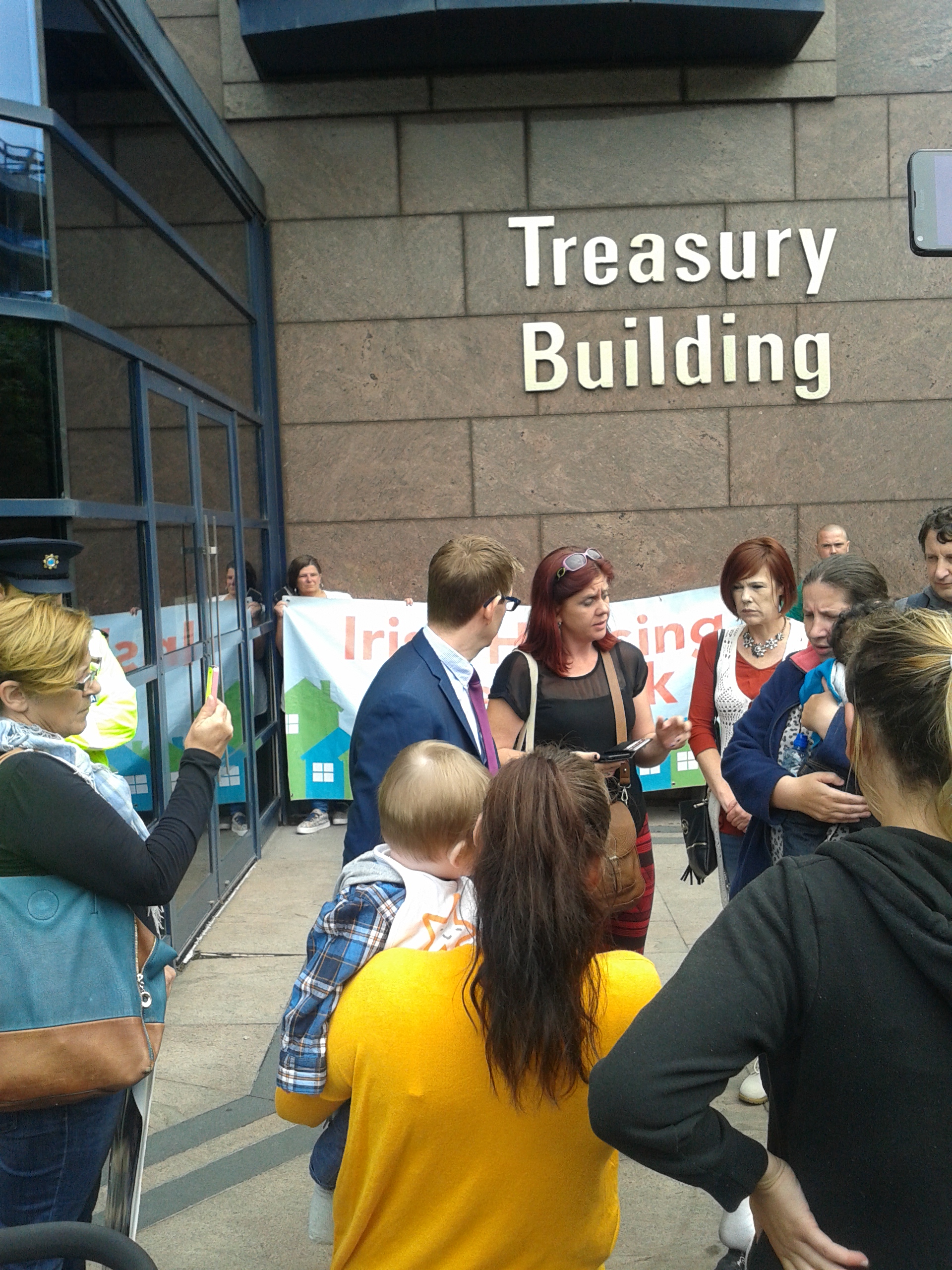
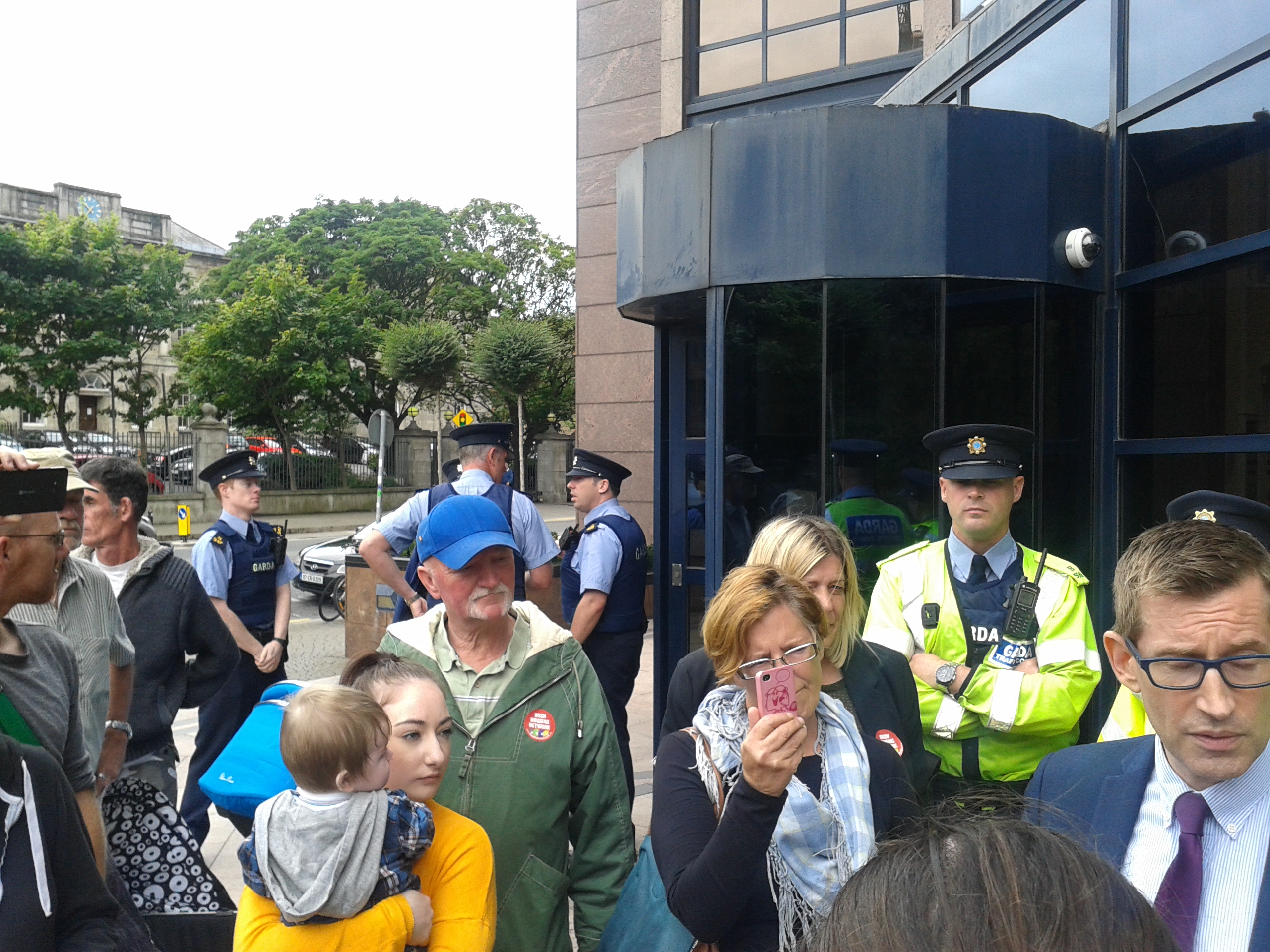
On Wednesday 27th, the families and supporters went to NAMA’s Head Office in Treasury Buildings, Grand Canal Street, D2 and from outside, asked to see the head of the state agency. Treasury Buildings management locked their building and called the police, who arrive in one squad car, then another, and then more of them on foot.

After talking to the police, NAMA offered to see one of the families only, accompanied by a supporter. The families discussed this and rejected it but offered the concession of two families plus supporter. The senior Garda officer seemed to be trying to persuade the families’ representative to accept the NAMA offer but they stood firm.  After rejecting that offer, NAMA PR spokesperson Martin Whelan came out to speak to the families and their supporters from the steps of the building. One of the campaigners speculated that this was the first occasion ever for NAMA to explain their actions to the public.

Families and supporters outside NAMA building during the week Supporters and members of the public at campaign table outside Lynam Hotel during the week (photo: D. Breatnach)
Families and supporters outside NAMA building during the week Supporters and members of the public at campaign table outside Lynam Hotel during the week (photo: D. Breatnach)

Whelan’s position was, in essence, that NAMA had no choice but to put the properties it received on the market and to sell them on. He rejected the accusation of one of the campaigners that NAMA “takes over properties and sells them at knock-down prices to vulture capitalists,” maintaining that all properties are sold at their market value.

With regard to the demand that the building be put under management as a homeless hostel by Dublin City Council, Whelan would say only that they had received no offer from the Council. That would be a decision for the Receiver, he said, in a statement that many saw as an exercise in passing the parcel.

To those who quoted him some lines from NAMA’s founding charter that its purpose was, in part “… to address the compelling need ….. to contribute to the social and economic development of the State …”, Whelan had nothing to say apart from repeating what he had said previously.

The families and campaigners presented Whelan with 1,000 signatures on petitions and indicated they would return with more and began to leave, the police also leaving as they did so.

Families and supporters confronting NAMA PR representative Martin Whelan (in blue suit) (Photo: D. Breatnach)
Families and supporters confronting NAMA PR representative Martin Whelan (in blue suit)
(Photo: D. Breatnach)

However, the families and their supporters were not finished yet and headed off for the

Some of the police that NAMA called to protect them from homeless families and supporters
Some of the police that NAMA called to protect them from homeless families and supporters with NAMA PR spokesperson Martin Whelan in the foreground (Photo: D. Breatnach)

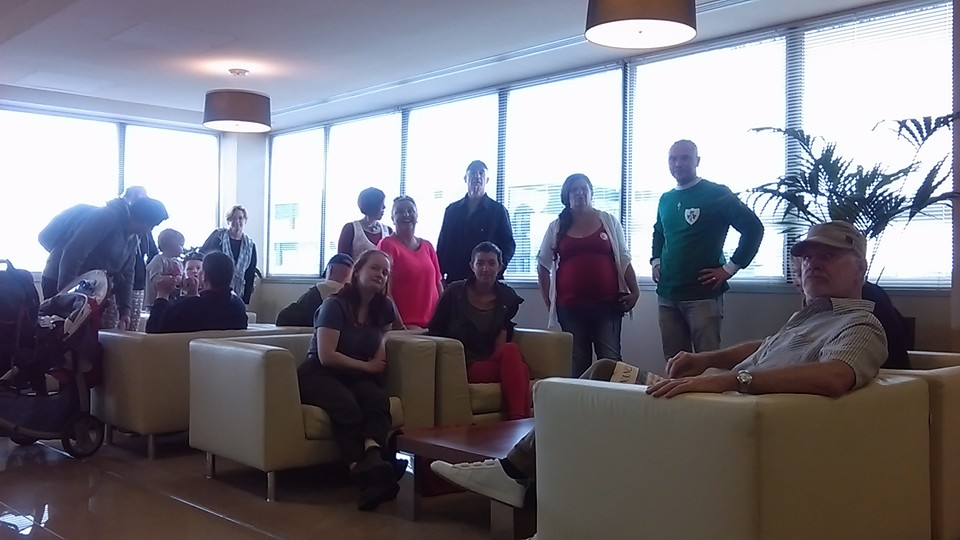
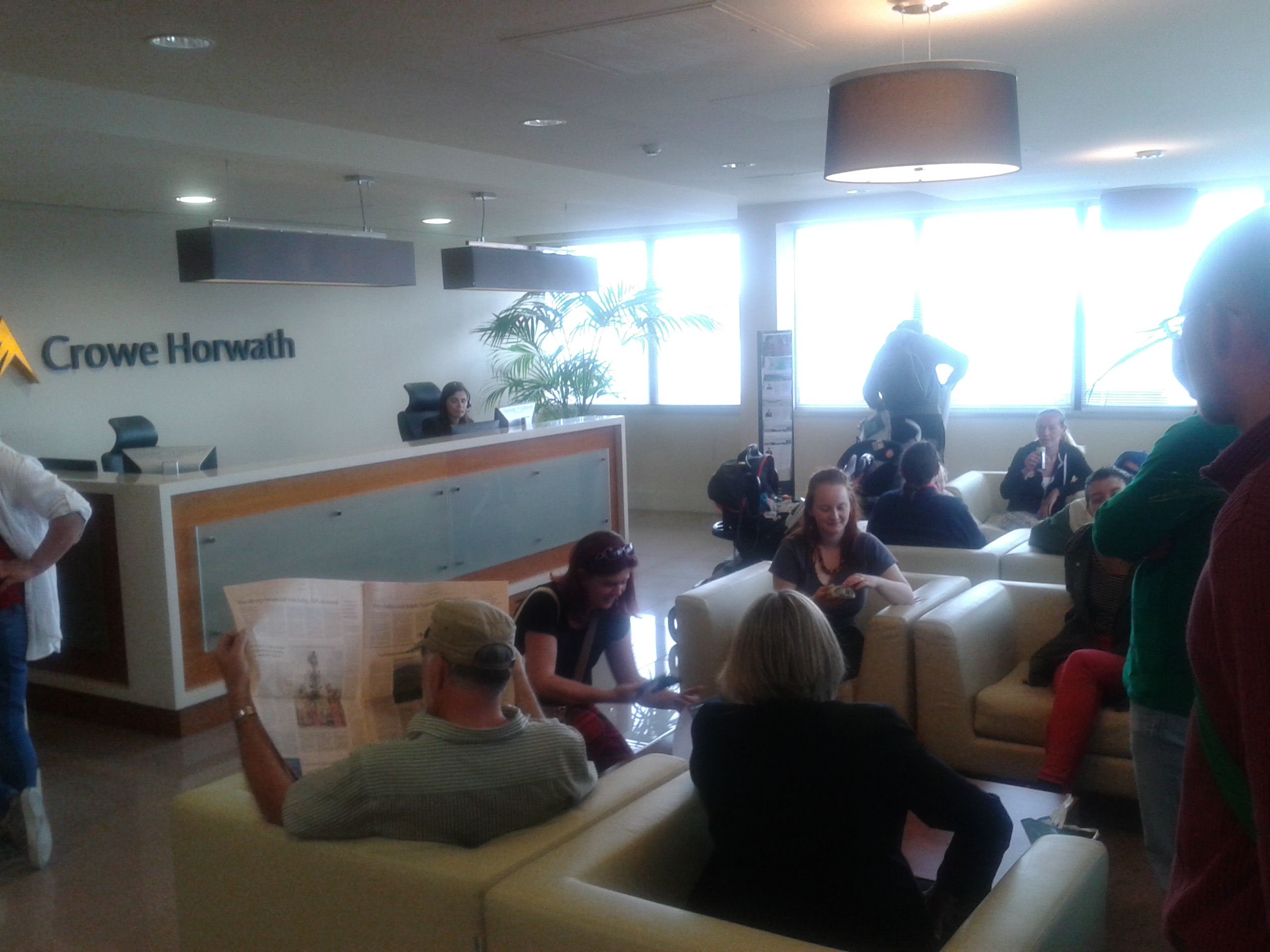
Receivers’ office which, at Marine House, Clanwilliam Place, took some finding. Eventually located overlooking the canal in a very quiet section of the city, they entered and ascended to the 5th floor, to the business address of Crowe Howarth, a member company of the Swiss firm Crow Howarth International. The families and supporters asked to see the person in charge, Aiden Murphy, a partner in the Crow Howarth, who was allegedly outside the building and due back in ten minutes but who appeared from inside after keeping them waiting nearly an hour. Then he wanted to meet them in the lobby, which they refused and insisted on the respect of a meeting in a private office space, which Murphy eventually granted.

According to reports of that meeting, Murphy was civil to the families and assured them he would not be asking for their eviction prior to the court hearing on receivership of Lynam’s Hotel.

Some families and supporters in the lobby of Crow Howarth, Receivers (Photo source: IHN FB page )
Some families and supporters in the lobby of Crow Howarth, Receivers (Photo source: IHN FB page)
Upstairs in the Receivers' lobby (Photo: D. Breatnach)
Upstairs in the Receivers’ lobby

He was due to meet the families the next day but, apparently worried about meeting demonstrators, arranged a meeting with them in the Gresham Hotel instead (no doubt chargeable to the public). His reticence for meeting possible demonstrators was somewhat different to his previous arrival as reported by sources. with a takeover workforce, bullying staff, changing locks and issuing orders.

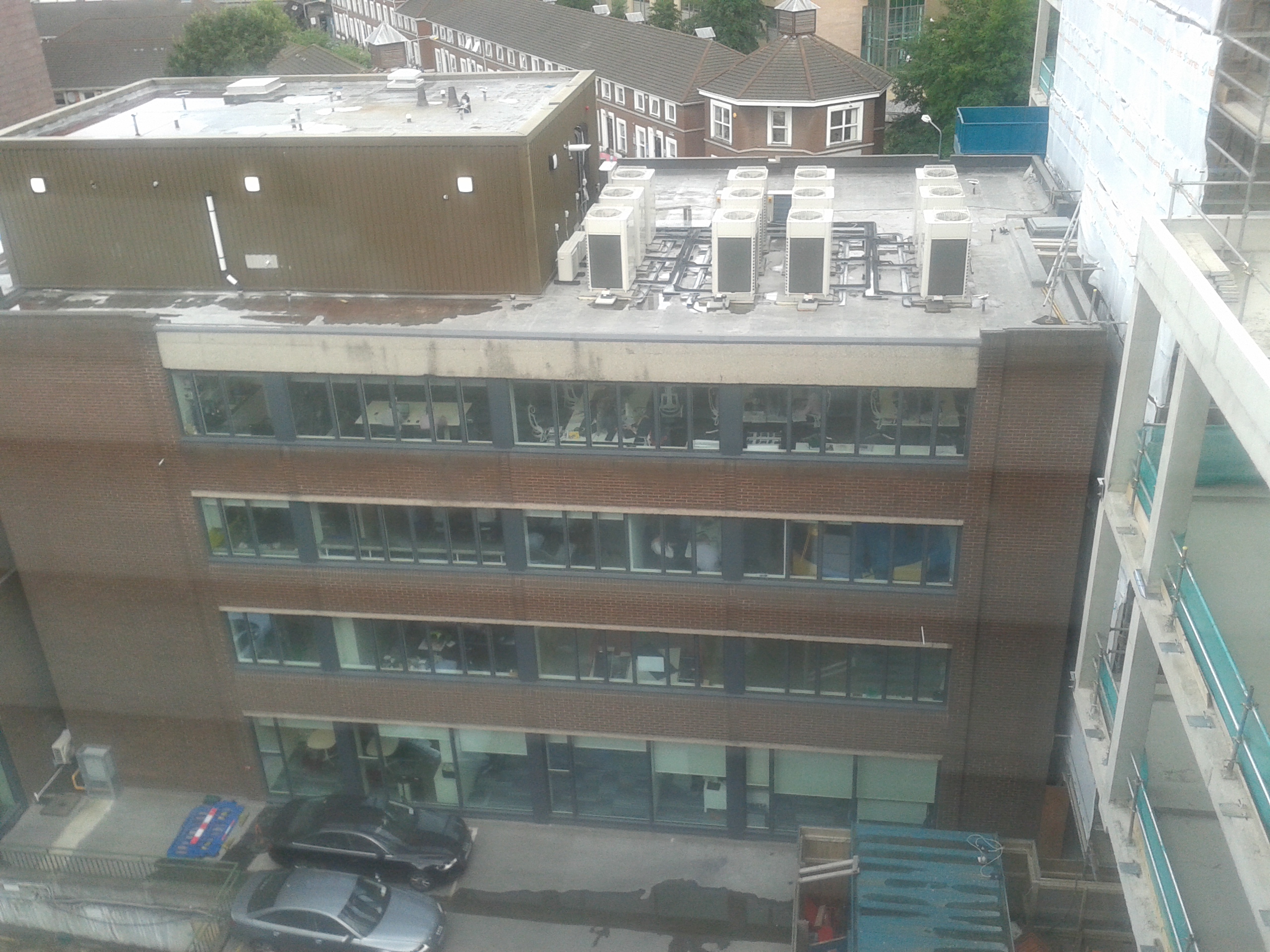
View down to the ground from the Crowe Howarth lobby. Ordinary people must look very small from here. (Photo: D. Breatnach)

THE COURT CASE

In advance of the court hearing, hotel management seemed to be moving to place the families as a buffer between themselves and the Receiver and were reported to have asked the families for a letter stating that the accommodation offered by DCC was unsuitable. Judge Gilligan asked Dublin City Council to appear in court to answer whether they had alternative accommodation available.

On Friday 29th, DCC duly presented themselves at the High Court and assured Judge Gilligan that they had indeed alternative accommodation ready for the families. Judge Gilligan did not ask the DCC spokesperson to detail the type of accommodation they were offering nor its location and Crow Howarth made no move to do so either. The families themselves were not permitted to have a letter detailing their conditions and the type of “alternative accommodation” available (see Appendix) read out in court.

Some of the rota for the table outside the Lynam Hotel (Photo: D. Breatnach)

The outcome pf the case was that Lynam’s Hotel was wound up, ordered to cease trading beyond August 1st and the building is to be sold (if it is not, as rumoured, already sold) on behalf of the State to some unknown capitalist. The families will presumably be placed somewhere in the kind of conditions about which their letter complains, affecting not only the parents but the children now and into the future, perhaps for the rest of their lives.

And the housing crisis continues without any State agency or Dublin City Council making serious efforts to address it; according to the Irish Housing Network there are over 8,000 families homeless within the state and the total is growing daily.  This is in the centenary year of the 1916 Rising when that inspirational document was printed in Liberty Hall, signed in Henry Street (around the corner from Lynam’s Hotel by seven who would be shot later by firing squad) and read out and posted on Easter Monday outside the GPO in the same street as the Hotel, declaring that
The Republic guarantees equal rights and equal opportunities to all its citizens, and declares its resolve to pursue the happiness and prosperity of the whole nation and of all its parts, cherishing all of the children of the nation equally …..”

end

To help support these and other homeless families contact https://www.facebook.com/irishhousingnetwork


APPENDIX


LETTER OF LYNAM HOTEL FAMILIES TO HIGH COURT

Dear Judge Gilligan,

We the Lynams families would like to thank you for your consideration of our situation in this High Court decision. We are choosing to remain anonymous due to fear of being targeted as we are under threat to take offers that are not suitable or find ourselves with no accommodation what so ever.

We appreciate that you realise that we are extremely vulnerable at this time and are being used as pawns in the political maneuvers of the Hotel management, DCC, the Receivers and NAMA.

As a group we would like to highlight the situation in Emergency Accommodation we are currently finding ourselves in.

We are HOMELESS, yes we are lucky to have a roof over our heads but we are without a fixed abode. We are under the control of the whims of Hotel Management and the DCC.

The accommodation we can usually find ourselves in is one double sized room for one family, two rooms if you have a larger family not necessarily in the same building. Imagine if you will having to live your whole life within the confines of this room where there is:

No drinking water. No fridges to store milk for young babies. No cooking facilities. No laundry facilities to wash your own or your children’s clothes. No area for the children to play, do homework or socialise with others.

We have been offered Alternative Accommodation which is below the standard that we currently experience at Lynams and is still not suitable for our families needs. In fact there is no minimum standard for Emergency Accommodation.

Families that enter Emergency Accommodation initially start off their journey in shock with a loss of home, structure, security. Children sit in their school uniforms waiting for the hotel restaurant to open in order to grab a quick breakfast before they start their long journey to the only anchor they know which is the school they were enrolled in, before they became homeless. Families cling to this anchor, in order to enable their children to have some degree of normalcy in their lives.

Those children who do not have a home and proof of residence do not have any chance of enrolling in school, getting a doctors appointment, being referred to services or getting counseling.

Children spend their days trying to be quiet around adults that are stressed trying to find new accommodation for that night. Forbidden to associate with other children as per rules in certain establishments. They are hungry, as they wait for their parents to source food, often eating whatever food is left over from breakfast until they share one takeaway meal between the family. There is no money is left by the end of the week as it has been spent on transport. These children are disorientated, with some families ending up in hotels in Bray, Aughrim & Brittas Bay trying to get to school in north Dublin. These children lose any hope of being in a normal home, they cling to already anxious parents.

The average families moves every 5 days unless they are lucky to get a hotel/guesthouse that takes on DCC customers as permanent until placed, the length of time that takes can be upwards of 2 years. There is one family that was in Lynams for 7 months, and were informed by DCC with 4 days notice to move, they have been in hotels in several different counties in the space of 3 weeks since they moved.

We ask you to consider that this is our home, we are powerless to fight the combined forces of DCC, NAMA and the Receivers and the pressure they are putting on us. On July 22nd Management in Lynams continued to accommodate us when DCC failed us.

We ask you to consider that we are not just names on a list, we are real people, we have real lives, we have jobs, our children are being directly affected by the decision being made here today.

Even though we have no hope of a good outcome for our families we can only hope that you find it in your heart to consider all these issues of how the system for homeless families has failed us all and will continue to fail unless properly addressed.

Thank you for taking the time to read this letter.

The Lynam families

To help support these and other homeless families contact https://www.facebook.com/irishhousingnetwork/?fref=ts

THREE EVENTS IN ONE ON HOWTH PIER

Clive Sulish

Foreign tourists and Irish-based visitors looked on with curious interest at a gathering at the foot of the East Pier, Howth on Sunday 24th – the group contained a number in military-type uniform, some were carrying flags, each one of a different design and a number of people in ordinary civilian clothes were carrying floral wreaths.

The Asgard, Molly Childers and Mary Spring-Rice on board at Howth
The Asgard, Molly Childers and Mary Spring-Rice on board at Howth (photos from Internet)

Participants, Tourists and Visitors
Participants, Tourists and Visitors (photo D.Breatnach)

Most onlookers at that point would not have known that those gathered there had a threefold purpose:

  • to commemorate the landing of Mauser rifles for the Irish Volunteers

  • to commemorate the massacre of civilians by enraged soldiers later that same day on Bachelors Walk and to

  • launch the Asgard 1916 Society.


The men and women in uniform formed up with the flags as a colour party and led the procession the full length of the pier to its end. There the procession came to a halt in front of a plaque on the wall commemorating the landing of 900 Mauser M1871 single-shot rifles and 29,000 rounds of ammunition in 1914 by a crew skippered by Erskine Childers with his wife Molly and friend Mary Spring Rice. The arms were taken ashore and whisked away in an operation planned by Bulmer Hobson of the IRB and carried out by the Irish Volunteers and Na Fianna Éireann.

Colour Party Marching
Colour Party marching along the pier towards the ceremony (photo D.Breatnach)

The Dublin Metropolitan Police and British Army were mobilised by Dublin Castle authorities to seize the guns (unlike at the previous much larger operation by the Loyalist UVF at Larne) but only managed to get a few. As the disgruntled Scottish Borderers marched back into town, they were jeered by Dublin crowds and some cabbage stalks were thrown at them. On Bachelors Walk, very near the Ha’penny Bridge, an officer brought them to a halt and they faced the crowd with guns pointed, then opened fire. Three men and a woman were killed and 38 wounded, including the father of singer Luke Kelly of the Dubliners ballad group (also called Luke). One of the victims died of bayonet wounds.

Margaret McKearney speaking and chairing the occasion on the pier
Margaret McKearney speaking and chairing the occasion on the pier (photo D.Breatnach)

Margaret McKearney, who has had three brothers killed in the Six Counties during the 30-years war, stepped forward to address the crowd as tourists and visitors took photos or watched and listened. After giving a brief account of the Howth landing and of the massacre on the Dublin quays, also of the smaller landing at Kilcoole, McKearney called forward Pól Ó Scanaill of the 1916 Societies to read the 1916 Proclamation of Independence. After he had finished, McKearney called for the young bearers of two floral wreaths to make their presentations:
Ellen O’Neill, with a wreath in memory of those killed and injured by the British soldiers at Bachelors’ Walk;

Roibeard Drummond, whose uncle Michael Moore was a crew member of the Nugget, landing rifles at Kilcoole, laying a wreath for the Asgard 1916 Society to commemorate the landing of the rifles and those who carried them in battle in 1916.

Last of the wreath-layers was Denise Ní Chanain on behalf of the Anti-Internment Group of Ireland.

Ellie after laying wreath in memory of the dead and injured in the Bachelors' Walk massacre
Ellie O’Neill after laying wreath in memory of the dead and injured in the Bachelors’ Walk massacre (photo D.Breatnach)


MOORE STREET SPEECH

Roibeard Drummond, after laying wreath on behalf of the Asgard 1916 Society
Roibeard Drummond, after laying wreath on behalf of the Asgard 1916 Society (photo D.Breatnach)

Niamh McDonald gave a short speech on the current situation in the struggle to save the revolutionary quarter of Moore Street. She informed her audience that NAMA had sold the debt of the Irish speculator company Chartered Land (Joe O’Reilly) to Hammerson, a British-based vulture capitalist company, who are continuing with the plan to build a huge shopping centre over the whole historic quarter. Meanwhile, the Minister for Heritage, Heather Humphreys, is appealing the High Court judgement that the whole quarter is a national monument. McDonald asked people to keep an eye on the campaign’s

Denise Ní Chatháin bringing forth the wreath from the Anti-Internment Group of Ireland
Denise Ní Chanain bringing forth the wreath from the Anti-Internment Group of Ireland (photo D.Breatnach)

Facebook page for updates and for calls to support actions.

McKearney then called on Diarmuid Breatnach to sing Me Old Howth Gun, pointing out that guns landed at Howth had been the first to fire on the Lancers in O’Connell Street on Easter Monday 1916. Breatnach introduced the song as having been written apparently in 1921, that is a year before the outbreak of the Civil War, by James Doherty, who also used the pseudonym Seamas Mac Gallogly.

Niamh McDonald speaking on behalf of the Moore Street 2016 campaign
Niamh McDonald speaking on behalf of the Moore Street 2016 campaign (photo D.Breatnach)

MAIN SPEAKER — JOHN CRAWLEY FROM THE MARITA ANN
The next speaker to be introduced by McKearney was John Crawley who was arrested on board the Marita Ann trawler, intercepted off the Kerry coast by the Irish Naval Service on September 29, 1984, when seven tonnes of arms were seized. The US heavy machine guns recovered on the Marita Ann had special mountings allowing them to be used as anti-aircraft weapons. Another of those detained on board – and later jailed for 10 years – was Martin Ferris who went on to become a Kerry TD for Sinn Fein, while John Crawley has taken a line of opposition to the Good Friday Agreement.

John Crawley giving his oration with the plaque commemorating the landing of the Howth guns behind him
John Crawley giving his oration with the plaque commemorating the landing of the Howth guns behind him (photo D.Breatnach)

John Crawley gave the main speech at Howth, in which he traced the history of the struggle for the Irish Republic from the Volunteers onwards, pointing out that many who fought the British in 1916 had different aspirations for the country, which explained why they parted ways in 1921. Crawley stated that the British have always been able to pick out those whose primary intention was to survive the struggle from those whose intention was if necessary to give their lives for the objective of the Irish Republic.

Pól Ó Scanaill reading the 1916 Proclamation
Pól Ó Scanaill reading the 1916 Proclamation at the head of the East Pier, Howth (photo D.Breatnach)

Crawley pointed out that some people had led a section of the Republican movement in accepting the right of a foreign country to decide the future of a part of our country; they had joined in the colonial administration and had accepted the colonial police force.

After the applause for the speech died down, McKearney thanked those who had participated and asked Diarmuid Breatnach again to step forward to sing the national anthem. Breatnach sang it in Irish, first verse and chorus (and noticeably sang “Sinne Laochra Fáil” instead of “Sinne Fianna Fáil”). Participants joined in with the chorus and then all made their way along the pier towards a local pub where refreshments had been made available by the new 1916 Society.

Diarmuid Breatnach singing Amhrán na bhFiann at end of the ceremony. Earlier he had sung "Me Old Howth Gun".
Diarmuid Breatnach singing Amhrán na bhFiann at end of the ceremony. Earlier he had sung “Me Old Howth Gun”. (Photo: Des Keane from Sean Heuston 1916 Society page)

end

Video of the event by John Rooney and put on Youtube by him, posted on FB by Mick O’Riordan (see below)
https://www.youtube.com/watch?v=RrG_7VLytfw