Palestinian supporters and other critics of Israel’s bombardment of Gaza have long complained about the western mass media’s reporting of the conflict in Palestine. The complaints have outlined reporting slanted in the Israeli state’s favour and/or specifically against the Palestinians and their representatives.
Palestinian flag flies over the rubble of a Gaza neighbourhood after Israeli bombardment 2014 (photo Antonio Olmos)
Umberto Ecco once defined language as a system of communication through which one could tell lies. There is no doubt but that our mass media uses language. Their editors and reporters herd us as sheep are herded by trained dogs, sometimes with barks and snaps of teeth but more usually through nudges and subtle changes of posture. They direct us to the pen where we are wanted or, at the very least, away from freedom.
In order to demonstrate the techniques used I have taken an example of reporting on the conflict and analysed it. The piece chosen is far from being one of the worst pro-Israeli or anti-Palestinian pieces of journalism – it is actually quite mild and even points out the statistical imbalance in the killing of civilians by Israel’s armed forces on the one hand and by Palestinian guerrillas on the other hand. The report is by the Irish on-line newspaper The Journal and was put up by them in the middle of August 2014.
The piece opens by saying that“Palestinian negotiators have been considering an Egyptian proposal to end the month-long Israel-Hamas war as the latest 72-hour ceasefire in the Gaza Strip is due to expire.”
This first of all says that the conflict is a war which also implies some kind of equal balance in fighting forces and also a share in blame. But it is not a war between any two sides; if it can be called a war at all, it is a war by Israel only. Israel is the fourth-largest military power in the world, with an army, navy and air force equipped with some of the latest armament and surveillance equipment. The Palestinians have a number of guerrilla groups, operating as infantry and no air or naval force at all. Their “artillery” are low-level rockets and mortars which cause very little damage to Israeli civilians and even less to the Israeli armed forces (except at close quarters, if Israeli soldiers invade territory held by the guerrillas). Israel’s armament causes huge damage to Palestinian infrastructure, huge loss of civilian life and does cause some damage to the guerilla groups.
The phrasing also suggests that Hamas is the only opponent of Israel on the Palestinian side. However, Israel has been in conflict with the Palestinians since the very day it came into existence and long before Hamas appeared on the scene. Even today, there are a number of Palestinian political and military organisations that are opposed to Israel and its actions and all together they represent the whole of Palestinian society inside the occupied territories, inside the 1948 borders of the state of Israel and in the refugee camps and settlements. In the sense that one could say that there is a war going on, it is Israel waging war against the Palestinian people.
The very next paragraph in the Journal’s piece says that “Since the truce, which will expire at midnight, went into effect on Sunday, Israel has halted military operations in the coastal territory and Gaza militants have stopped firing rockets.”
We see presented here that on the one side we have “Israel” and on the other, “Gaza militants”. As in bourgeois media reporting “militants” usually has a negative connotation, this is already tending to turn the reader against the Palestinians in Gaza. On the other hand, we have “Israel” which we can interpret either as “a legitimate state” or as the Biblical “promised land of the Jews”. And that is being opposed by “militants” in Gaza. The phrasing legitimises the status of one side while de-legitimising the other.
We are also told that Israel has halted “military operations”, two words that hardly convey the sustained bombardment of Gaza’s civilian houses, schools, mosques, civil administration facilities, power plant, water treatment plant, factories, hospitals and emergency vehicles in recent weeks. It does not bring to mind the slaughter of over 2,000 Palestinians, the vast majority of them civilians and including 430 children. Not to mention the 9,567 wounded, including 2,878 children and hundreds of injured jamming the remaining ill-equipped hospital treatment centres.
Shuja’iyya neighborhood of east Gaza City during a 12-hour ceasefire on July 26 2014.
The paragraphs states that in return for the cessation of “military operations” by the Israelis, the Palestinians have “stopped firing rockets”. Actually, if this report had just gone into a little detail, how pitiful by comparison with Israeli deadly ordnance would be the Palestinian rockets! Nevertheless, it is the rockets that are recently used as propaganda excuses by Israelis (before them it was something else) to justify the unjustifiable, the terrorising and collective punishment of a largely civilian population. So it is very rare indeed that western media reports omit any mention of the rockets.
“The ceasefire was meant to give the two sides time to negotiate a more sustainable truce and aroadmap for the coastal territory.”
Again, “two sides” gives the impression of some kind of equal antagonists in balance. The “roadmap” may be a vague reference to some future deal but may also be a reference to something that was much bandied about in Clinton’s time as President of the USA. This “roadmap” was supposed to lead to a two-state solution and, apart from the fact that it completely supported the supposed right of the European settlers who created the state of Israel to steal Palestinian land, has now been rendered completely inoperable. This is due to the continuing Israeli Zionist greed for land and building of illegal settlements throughout much of what was imagined as being part of the Palestinian state. And besides, the “roadmap” did not apply to the Palestinian refugees, who were given no right to return to their land. But it is useful for zionist-friendly propaganda purposes to pretend that this “roadmpap” ‘solution’ still exists and is viable.
“A member of the Palestinian delegation to Egyptian-brokered talks in Cairo said today that his team was considering an Egyptian proposal, which was tabled yesterday. Egyptian mediators have been ferrying between the Palestinians and their Israeli counterparts in an attempt overcome the differences between the sides.”
While it is true that Egypt has been “brokering talks”, that state is hardly an innocent bystander. Egypt has kept the Rafah Crossing, the only official exit point from Gaza not entirely controlled by Israel, closed or constricted. Egypt has also worked to destroy the tunnels which the people of Gaza used to smuggle in those items of daily life and, no doubt the arms they need, which Egypt is preventing from getting through the Rafah Crossing. The Egyptian state could nullify much of the Israeli blockade of Gaza, merely by opening their crossing into Gaza for normal traffic 24 hours a day.
The Egyptian armed forces, the real power in that country, are clients of the USA – another power which is hardly innocent but which on occasion tries to present itself as impartial in the conflict, despite its massive funding of the state of Israel. But those are not facts that the western media wish to disclose about the USA, Egypt or the conflict in Palestine.
Another thing, notice that while Egypt is “brokering”, it is “ferrying” between the Palestinian and Israeli negotiators. Clearly the antagonists are not face-to-face. If we think about that at all, as readers we are left with a feeling that maybe each side hates the other so much that they can’t bear to be in the same room. Or we might even think that Hamas, since it doesn’t recognise the right of Israel to exist, might not deign to speak to them directly. But actually, the reverse is true — as throughout most of its history, Israel is refusing to speak to the Palestinians directly. But no point telling the readers about that, is there? Who knows what they might come to think of such an attitude and behaviour of the Israeli state?
“The Egyptian proposal calls for easing parts of the Israeli blockade of Gaza, bringing some relief to the territory, according to Palestinian officials in the talks. But it leaves the key areas of disagreement, including Hamas’ demand for a full lifting of the blockade and Israeli calls for Hamas to disarm, to later negotiations.”
This is a bald enough statement which seems neutral but notice the unchallenged call for Hamas to disarm. From a state that is granted legitimacy to an insurgent force often painted as illegitimate, such a call seems reasonable. It has been and continues to be the basis for “peace (i.e. pacification) processes” throughout the world. But is there a call for Israel to disarm? Of course not. Yet it is the most heavily-armed power in the Middle East, the only one in possession of a nuclear arsenal and the one which has most often attacked its neighbours (not to mention the Palestinians). And the piece above leaves us to draw the conclusion that the lifting of the Israeli blockade may require Hamas disarming — a ‘fair exchange‘. And a reasonable reason, if Hamas does not comply, for Israel to continue its blockade on the whole population of Gaza.
“The Palestinian negotiator said he had some reservations about the proposal and would try to improve it. “We would like to see more cross-border freedom, and also to have the question of a Gaza seaport and airport discussed,” he said.
Note no reason is given for the Palestinian wishes – they seem trivial almost and no reason not to agree to a truce. “Cross-border freedom” might seem like being free to go on shopping trips or holidays abroad. “Gaza seaport and airport” likewise may facilitate daytrips and holidays, or tourist traffic or imports of luxuries. Maybe even exports of craftwork, or olives from remaining trees not destroyed by Israel. Such phrases and word do not give us a picture of over 1,816,300 people locked into a piece of land of 5,046 square kilometres (13,069 square miles), under permanent hostile control and sporadic bombardment and invasion, short of clean water and with other water polluted, destroyed infrastructure, destroyed hospitals, schools, mosques and churches, ruined industries and agriculture, infrequent power supply for lighting and heating, hardly any transport, a polluted coast and Israeli attacks on fishermen.
During the existence of the USSR and its satellite states, the western media regularly attacked them for their restrictions on most of their citizens’ travel beyond their borders. They never did then — nor do they now – inform their readers of the much stricter Israeli control on travel by Palestinians, not only beyond Israel’s 1948 borders but also beyond the borders of Palestine occupied by Israel in the years since. In fact, even travel within the occupied territories is extremely difficult for Palestinians.
The next four sentences of the Journal’s piece are unproblematic enough as far as reporting goes although it could have commented on why lifting the blockade on Gaza might have been of such concern to Hamas and to the people of Gaza:
An Israeli government spokesman had no comment on the negotiations.
In recorded remarks broadcast on Hamas radio, Ismail Haniyeh, the top Hamas leader in the region, said that “achieving a permanent truce can come only through lifting the blockade on Gaza”.
Amid the ceasefire, an Associated Press video journalist and a freelance Palestinian translator working with him were killed today when ordnance left over from the war exploded as they covered a story about the conflict’s aftermath.
Italian national Simone Camilli, 35, and Ali Shehda Abu Afash, 36, died when an unexploded missile believed to have been dropped in an Israeli airstrike blew up as Gazan police engineers worked to neutralise it in the northern Gaza town of Beit Lahiya.
However, the report could have gone on to tell us that the explosion also killed the four Gaza police engineers trying to neutralise the explosives and that another four people, including AP photographer Hatem Moussa, were badly injured. Unimportant details? News that might make us think worse of the Israeli armed forces? Or sympathise with courageous Palestinian police and at-risk civilians?
But it is not long before the more suspect reporting reemerges:
“The war began on July 8 with Israel’s air campaign against Gaza’s Hamas rulers, whom Israel blamed for the kidnapping and murder in June of three Israeli teenagers in the West Bank. Nine days later, Israel sent in ground troops to destroy Hamas’ underground cross-border tunnels constructed for attacks inside Israel.
Here Hamas are presented as “rulers”, as distinct and opposed to – once again – the state of Israel, conferring legitimacy on one party to the conflict, the aggressor, while subtly suggesting that the other antagonist is anything but legitimate and perhaps even despotic.
But the paragraph goes beyond that and suggests that Israel has a legitimate claim that Hamas kidnapped and murdered three Israeli teenagers. The three were in fact kidnapped and murdered and, although Israel wrongly accused Hamas of responsibility, its intelligence organisation Shin Bet later admitted that it no longer believed that. It may have been some other smaller Palestinian group or even individual members that carried it out but it was not the Hamas organisation nor its leadership. But this paragraph leaves us with the impression that Hamas’ culpability was a reasonable supposition by Israel and a reasonable cause of it going to war against Gaza.
The paragraph goes on to accept Israel’s public rationale for the bombardment and invasion, viz. “to destroy Hamas cross-border tunnels for attacks inside Israel”. Israel first quoted the deaths of the three teenagers as their reason for attack and now it is the “Hamas tunnels”. So if the stated reasons change, doesn’t that suggest that they are suspect, not to be relied on, with maybe the real reason unspoken? No comment from the media. Where are the tunnels? Which “border” are they crossing (putting aside for the moment the fact that Israel has never defined its borders)? Where are they attacking “inside Israel”? When was the most recent Hamas attack “inside Israel”? If this is a reference to the paltry rockets Hamas has fired, Israel has never claimed that these were fired at it from “inside Israel”. If it is not a reference to the rockets, then to what? We are not told but instead left with a feeling that Israel’s concerns could somehow be legitimate.
“The fighting has so far killed more than 1,900 Palestinians, the majority of them civilians, Palestinian and UN officials say. On the Israeli side, 67 people have died, all but three of them soldiers.
This is an unadorned statement of the shocking facts and we could not fault this paragraph.
But how about the very next sentence?
“The latest outbreak of fighting is the third between Israel and Palestinian militants in Gaza since Hamas took over control of the densely-populated territory in 2007.”
Here we have a repeat of that formulation which we saw earlier: the conflict, we are being asked to see, is between the ‘legitimate’ state of Israel on the one hand and “Palestinian militants” on the other. And it is “fighting” between the two sides, rather than the truth: the attack of Israel’s military force upon the population of Gaza and the Palestinian guerrilla forces’ attempts to reply with their meagre resources.
Also, we are told that “Hamas took over control” of Gaza in 2007. In an invasion, perhaps? A coup d’etat? The fact, uncomfortable for the western media, is that it was in a democratic general election while Israel and western agents poured out anti-Hamas propaganda. And Hamas won not just in Gaza, incidentally – but in the West Bank too, although others are currently in power there. Are we told that Israeli political parties in government “took over control” of Israel? Of course not.
Continuing, the report states that“Hamas has been consistently pushing for an end of an Israeli Gaza blockade, which Israel says is necessary to prevent the group from gaining access to weapons and munitions it deploys against Israelis.”
In this sentence, we learn that Hamas wants an end to Israel’s blockade but not why. We are not told that it is so that they can have sufficient fuel for heating and transport, food, medicine, clean water, industrial and building materials, teaching and learning materials, spare parts, etc, etc. Nor are we told that Gaza could then actually export products and gain some self-sufficiency. Nor are we told that Israel is illegally holding monies, such as tax revenues, that belong to Gaza. But we ARE told why Israel wants the blockade — “to prevent the group from gaining access to weapons and munitions it deploys against Israelis.” Well, there you are – that’s only reasonable, surely? !!
Glasnevin Cemetery (Reilig Ghlas Naíon) is a famous Irish graveyard on Dublin’s northside, on the south bank of the Tolca river and not far from the Royal Canal and Mountjoy Jail. As well as those of other people of great fame and none, it contains the remains of the fallen in a number of battles. However, the cemetery itself has become something of a battleground of late.
Rainbow over the tower in Glasnevin Cemetery (photo by Lorcán Collins as mourners left the funeral of his colleague, Shane Mac Thomáis, resident historian of the Cemetery, who died 20th March 2014)
There was the Alan Ryan funeral around this time last year, early September 2013. Ryan had been a prominent member of the 32-County Sovereignty Movement and allegedly head of the Dublin Real IRA (also now known as “the New IRA”) and was shot dead, reportedly as a result of a conflict with drug dealers.
Ryan’s funeral was a massive affair attended by hundreds of mourners; the Irish state police, the Gardaí, policed it heavily. The hearse and cortege were temporarily stopped at the cemetery’s entrance by uniformed and plainclothed police while the grieving mother and family members were taken out of their car, which was searched. Scuffles with police broke out a number of times as the latter even penetrated to Ryan’s graveside.
More recently, on 31st March this year, a commemoration in Glasnevin of soldiers of the British Commonwealth who had been killed in the First World War attracted a smallish protest from Irish Republicans and socialists across the road from the cemetery’s gates. These commemorations are viewed by Irish Republicans and many socialists as events glorifying Britain’s part in WWI and also an attempt to build unity between Irish people and the British Armed Forces. The Commonwealth event, the unveiling of a “Cross of Sacrifice”, was attended by a member of the British Royal Family, which added metaphorical fuel to the fire. However, there were real flames as a British Union flag, brought by the protesters, was set alight and Gardaí Special Branch rushed to apprehend the burners. In the melee, a number of protesters were handled roughly by the police, some were pepper-sprayed and one was handcuffed and taken away by Gardaí, reportedly beaten on the way. Another who objected to being jostled by Gardaí was also promptly arrested.
Most recent of all was the Hunger Strikers’ Commemoration in the Republican Plot inside the cemetery on 23 August. The event was organised by the Sean Heuston 1916 Society to honour the 22 Irish Republicans who have died on hunger strike between 1917 and 1981. The 1916 Societies is a broad collection of organisations of Irish Republicans in different localities who do not agree with the Good Friday Agreement and wish to see Ireland united and independent; one of their main objectives in the interim is to campaign for a referendum on the question of Irish unity. The commemoration was the second of its kind organised by the Sean Heuston 1916 Society and, as the previous year’s had passed without any untoward incident other than the usual Special Branch photographing and taking notes, they had no reason to believe that this year’s would be any different.
The event proceeded as planned with orations, song and laying of wreaths but the trouble came as people tried to leave the cemetery. They were waylaid inside the cemetery’s gates by plainclothes police of the Special Branch, i.e. the political police, and told to identify themselves and to give their addresses. Two who refused to do so unless they were shown reasonable cause were handcuffed and bundled into separate police vehicles. Others who had attended the event then blocked the police vehicles from leaving and many uniformed Gardaí arrived to assist the Special Branch. In the struggle, police were again quite rough and one punched a child in the face. Eventually the Gardaí were successful but both detained men were released later that day without charge.
Many visitors and unconnected mourners attending the famous cemetery were visibly shocked by the incidents. The organisers made it clear to the staff of the cemetery who it was who had initiated the disturbance and had chosen to do so inside the cemetery grounds.
Apart from general harassment and attempted intimidation of Irish Republicans, it is difficult to see what the Gardaí hoped to gain from this provocation and why they had escalated their behaviour at a peaceful commemoration. `One possibility is that the intention was to discourage the management of the Cemetery from permitting such commemorations in future. The organisers moved quickly to call a meeting with the Cemetery management, which has already taken place and reportedly concluded positively. And so it should.
The Republican Plot, managed by the National Graves Association, a voluntary body which does great work, is within the Cemetery. The graves of many Irish Republican and Socialist martyrs and prominent activists are within this plot and also in other places within the grounds. Some, like the great hero Anne Devlin, go back as far as the United Irish of 1798 and of 1803. James Connolly gave the oration here in 1913 at the graveside of the ITGWU martyr Jame Byrne, a victim of the State during the Lockout that year.
Funeral at Glasnevin of Republican Cathal Brugha, shot dead by Free State Army in O’Connell Street, 1922.
In 1915, Patrick Pearse gave his famous oration to a huge crowd at the Glasnevin graveside of the Fenian Jeremiah O’Donovan Rossa, whose body had been returned to Ireland by the IRB in the USA. O’Donovan Rossa had been jailed for planning an insurrection against the British in 1865 and, though released in 1870 as part of a general amnesty, had to agree to emigrate. In 1922, Cathal Brugha, having survived 14 bullet wounds during the 1916 Rising, was killed in O’Connell Street by Free State Army soldiers and his funeral cortege too, also to Glasnevin Cemetery, was a huge affair. In 1966, the remains of Roger Casement, hanged by the British for his role in the 1916 uprising (the last of the death sentences of the 1916 insurgents to be carried out), were brought home from England and reinterred in Glasnevin with an Irish state ceremony.
These historic moments and connections between Glasnevin Cemetery and the national and class struggles may be uncomfortable for some and the police harassment may be intended to deepen that discomfort. However, it is difficult to see how anyone, whether of State or of Cemetery management, could successfully impose a ban on commemorations within this famous graveyard where so many of the Republicans and Socialists of previous years lie and which has been the scene of commemorations for over a century.
The crowd stood in the rain and gusting wind in Ardoyne, Belfast. In front of them, the gable end of a house shrouded in black. The crowd was dotted with uniforms of the various Republican marching flute-and-drum bands from Scotland, some green and some black. Irish Tricolour flags fluttered and here and there the Starry Plough and the Palestinian flag was in evidence, including above the shrouded mural.
After what seemed like a long wait, the MC, life-long Republican activist Martin Óg Meehan, called forward those who had commissioned the mural, the Independent Principled Ex-POWs group; around thirty of them, all dressed in black, carrying a banner with their group name on it, they formed a kind of honour guard during the ceremony. As indicated by its name, this is a collective aligned to no political party or group; it was established earlier this year by North Belfast Republican ex-prisoners.
Then after a short dedication speech, the shroud was pulled down to unveil the newest Republican mural in Belfast, which is surely Ireland’s city of murals (certainly of political murals). The centre-piece was a section of The Rythm of Time poem, written by Republican prisoner and hunger-striker to the death, Bobby Sands; around that central piece a number of panels depicted scenes from the struggles of Republican prisoners from the 1970s onwards. A special mention was made of the families and relatives of Republican prisoners, those who bore much of the brunt of the system that encarcerated their loved ones. One of the Scottish bands was then called to play The Soldiers’ Song, the Irish national anthem written and composed by two Republicans and which had been sung by some of the insurgents during the 1916 Rising against British colonial rule.
Section of the Anti-internment march in Belfast 10th August 2014– The Dublin Committee banner is the high narrow blue one behind the marching band.
Some time after this ceremony, the primary purpose of the day was attended to as people assembled for the march against internment organised by the Irish Anti-Internment League. The British colonial statelet abandoned internment without trial after four-and-a-half years in 1975 but since then has been finding other means to remove its active political opponents from the streets. Some ex-prisoners who were released under Temporary Licence as part of the Good Friday Agreement in 1998 have been returned to jail without charge, trial or right of appeal. Others have been faced with ridiculous charges — of in some way “assisting terrorism” — and jailed while awaiting trial; when eventually found not guilty, they have nevertheless already spent between one and two years in jail. Still others, after periods in jail awaiting trial, are being found “guilty” on highly suspect evidence in the special courts and sentenced to long terms of imprisonment (some of these too have eventually been released on appeal against conviction).
After outlining the order of march, Dee Fennel warned the participants that Loyalists had gathered in the city centre on the route of the march to oppose us. Dee urged us to obey the stewards and not to permit ourselves to be provoked into responding to Loyalist provocation. “The law is on our side, for a change,” he stated, meaning that permission for the parade had been applied for and granted, so that the police, if carrying out their duty, had to prevent others from attacking or obstructing us.
The march was headed by the prisoners’ relatives group and followed in sequence by the Justice for the Craigavon Two Campaign, Wolfe Tone RFB (Republican Flute Band), Anti-Internment Group of Ireland (including the Dublin Anti-Internment Committee), Independent Principled Ex-POWs, Parkhead RFB, IRPWA, Vol.s Patricia Black and Frank Ryan RFB, Cabhair, Vol. John Brady RFB, Cógus, Erin Go Bragh RFB, Éirigí, 32 CSM plus other groups bringing up the rear. The Vol. John Brady band is from Strabane but all the rest are from Scotland: two from Glasgow and the Wolfe Tone and Erin Go Bragh bands from North Lanarkshire.
We worked our way down from Ardoyne in driving rain and strong gusts of wind, through the streets in twists and turns towards the city centre. Along the route we noted occasional Palestinian flags hanging from windows of people’s homes and from some flats in tower blocks. As we turned into Donegal Street coming in from the east and heading for Victoria Street, what sounded like a bestial howl arose ahead of us – the Loyalist mob had sighted the relatives’ group leading the march. There we halted for what seemed a long delay, while our march organisers brought the stewards up to the front. Tension mounted, the worse for the wait and not being able to see what lay ahead. Then the march started forward again.
The howls grew louder and then we could see the Loyalists, about 400, many waving Union Jack flags, straining against yellow-jacketed PSNI, the British colonial police, who faced them. Then a line of colonial police in full black riot gear, including shields, facing us (!). Between us and them stood a line of our stewards, their backs to the police and to the Loyalists. A number of police were videoing the marchers, intelligence-gathering, but I saw only one filming the Loyalists.
Two loud fireworks exploded fairly close ahead, presumably aimed at the relatives or the colour party of the band. The storm of abuse was so loud and varied that it was hard to make out any actual words. On video recordings one can hear us being called “baby killers” and – no doubt totally unconscious of the irony — calls in support of Israel! This last no doubt a response to a number of Palestinian flags showing among the marchers.
In front of our contingent, the Wolfe Tone RPF band marched without playing but to a steady rap …. rap … rap …. of the side-drums. One of the mature members of the band called out some words of encouragement to the younger members and, in time, began to call out “clé …. clé …. clé, deas, clé …” (“left … left … left, right, left …”). Behind me in the crowd, somebody began to shout “the I … the I … the I, R, A” in response to the Loyalists.
By now other missiles were flying from the Loyalist crowd and, not surprisingly to us, the police seemed to be making no effort to arrest the perpetrators. I saw a plastic bottle full of water land ahead – a marcher picked it up and threw it back; an orange or red umbrella landed among the marching band and a tall bass drummer stooped, picked it up and threw it back almost without looking and without breaking stride …. Some police struggled with a very large Loyalist woman, her face contorted in rage, as she tried to break through to attack us. Those of us carrying the Dublin Committee banner brought it to flank between a section of the band and the Loyalist missiles while one continued to film the event. One of our contingent was struck on the head by a flying object but continued to march. Another firework exploded somewhere behind. The band continued marching, facing forward …. clé …. clé …. clé, deas, clé …
In a short enough time (though it seems longer watching the video later), our section of the march had passed the hostile mob but the roaring continued, aimed at the marchers coming behind us. On the main road heading up to the Falls Road, a fierce gust of wind caught us – we failed to lower the banner quickly enough and one of the bamboo poles snapped. We carried our banner the rest of the way, on up the Falls Road, past the Cultúrlann, then past Milltown Cemetery.
As we approached the Felons’ Club, stronghold of Provisional Sinn Féin, the band began to play “Take It Down from the Mast”, a Republican song from the 1930s castigating Republicans who had abandoned the path of fighting for independence. Originally the lyrics had been aimed at the Irish Free State government, then at the Fianna Fáil party; since then they have been thrown in turn at Official Sinn Féin, the Workers’ Party and now, at Provisional Sinn Féin. After Fianna Fáil, each party had sung the lyrics at those considered traitors before them, only for each to become, in turn, the target themselves.
“Take it down from the mast, Irish traitors,
It’s the flag we Republicans claim;
It can never belong to Free Staters,
For you’ve brought on it nothing but shame.”
As we passed the Felons’ Club, a number of their patrons leaned on the rail watching us go past. I wondered what they thought and felt. Before 1998, presumably it would have been them participating in the march – perhaps even having organised it. What did they think of a march for civil and human rights in their heartland of which they were not a part? Of 5,000 demonstrators marching in driving wind and rain on an issue around which PSF no longer organises? An issue, in fact, which they find threatening, now that they are part of the colonial administration … This is perhaps the reason for their dismissal of those independent Republicans and groups they call “dissidents” and “micro-groups” who, they say, “have no programme”. No doubt they are aware that it is a long time since Provisional Sinn Féin were able to mobilise 5,000 people to march on any issue.
The march came to an end at the Andersonstown shopping centre, the participants to be congratulated by Dee Fennel; we stood to one side, applauding the soaked marching bands as each one passed us. A couple of speakers were announced but, too cold and wet, some of us decamped to our coach, which had been summoned to meet us nearby. There we found that our thermos flasks of coffee and tea had fallen inside the coach and that the linings had smashed – so no hot drink for us.
When all our Dublin party were at last aboard and some had changed into dry clothes, we headed back up the Falls Road in search of food. Some of us were annoyed to find the Cultúrlann, in the restaurant of which we had looked forward to a cooked meal, closed and had to be content with a Chinese take-away for some hot food at last. Then back to Dublin; in our own city, our publicity and organising work as an anti-internment committee awaited us, as well as whatever other political work we might undertake as individuals or as members of other groups.
Additional information: IRPWA is the Irish Republican Prisoner Welfare Association and is linked to the 32-County Sovereignty Movement and campaigns for political prisoners.
Cabhair is an Irish Republican prisoner welfare and campaigning organisation linked to Republican Sinn Féin.
Cógus is also an Irish Republican prisoner campaigning and welfare organisation and linked to the Republican Network for Unity.
The Anti-Internment League and the Anti-Internment Committee of Ireland are campaigning groups independent of any political party or organisation.
The auditorium in Trinity College on Friday 20th June was nearly empty at the advertised starting time for the lecture on “The Legacy of Power, Conflict and Resistance”. The start was delayed and more people came in but, by the time the speaker and the theme was introduced, the hall was still not full. That was surprising, because the speaker was Bernadette Mc Alliskey (nee Devlin), who had been at 18 years of age one of the leaders of the Civil Rights movement in the Six Counties (“Northern Ireland”), at 21 years of age elected MP for Mid-Ulster in 1969 and still, 45 years later, holding the record for the youngest woman ever elected to the British Parliament.
Bernadette Devlin early 1969. She was elected MP on a People’s Democracy ticket in 1969 but later classified herself as an “independent socialist”.
The same year as her election, Bernadette went to the USA to gather support for the Civil Rights movement in a trip being used by others, rumouredly, to gather funds for arms. She shocked the conservative part of Irish USA, Ancient Order of Hibernians and Democratic Party political allies, by some of her statements and actions regarding blacks and chicanos and in visiting a Black Panthers project. Bernadette returned home to serve a short prison sentence after conviction for “incitement to riot” arising from her role in the defence of Derry against police (RUC and B-Specials) and Loyalist attack.
In 1972, during her five-year tenure as a Member of Parliament, enraged by his comments about the murder a few days previously of 13 unarmed protesters (a 14th died later of his wounds) by the Parachute Regiment in Derry, she stormed up to the then British Home Secretary and, in front of a full House of Commons, slapped him in the face. Bernadette had been there in Derry that terrible day – she was to have addressed the anti-internment march upon which the Paras opened fire.
The Tyrone woman was also a founder-member of the Irish Republican Socialist Party in 1974, which she left after failing to bring the armed organisation, the Irish National Liberation Army, under party control. She continued to be a Left-Republican political activist, in particular campaigning against the treatment of Republicans on arrest and subsequently as prisoners in jail, in the H-Blocks Campaign. She learned to speak Irish. In January 1981, she and her husband Michael McAlliskey were the victims of an assassination attempt by a squad of the “Ulster Freedom Fighters” (a cover name for the Ulster Defence Association, which was not banned until 1992). They both survived, though Bernadette had been shot seven times.
In 1996, while four months pregnant, Bernadette’s daughter was arrested on a German extradition warrant, charging her with being part of a Provisional IRA mortar attack on a British Army base in Osnabruck, Germany. Although taken to England, where a judge agreed to her extradition to Germany, a long and vigorous campaign fought by Roisín’s mother and her supporters eventually defeated the extradition and Roisín gave birth to a healthy daughter.
Recent portrait of Bernadette (Devlin) McAlliskey by Francis McKeeBernadette’s daughter was arrested twice on the same charge but vigorous campaigning impeded her extradition. Photo shows banner resisting the earlier attempt.
In 1998 and for some years after, Bernadette was an outspoken critic of Sinn Féin and of their direction in the “Peace Process”, which she saw as the party coming to accept British colonialism and Irish capitalism. In 2003 she was banned by the USA and deported, widely interpreted as being due to her speaking against the Good Friday Agreement, but continued her campaigning. However in 2007, another extradition warrant was issued for her daughter Roisín on the same charges as before and the young woman became emotionally ill. The whole trauma was seen by many as a warning to Bernadette to cease criticising the “new dispensation” and subsequently she was seen to fade from the ranks of public critics of the GFA, Sinn Féin and of the treatment of Republican prisoners.
Bernadette remained active through working with migrants in a not-for-profit organisation in Dungannon. In recent years she has returned, on occasion, to the issues upon which she was so outspoken previously, for example standing surety for Marian Price’s bail to attend her sister Dolores’ funeral and speaking at the ceremony herself. Bernadette also spoke at the Bloody Sunday Commemoration/ March for Justice in January this year in Derry.
With a c.v. of that sort, one would reasonably expect a packed auditorium.
Bernadette Mc Alliskey on the platform upon which she had earlier spoken in February 2014 at a rally following the annual Bloody Sunday Commemoration/ March for Justice.
Bernadette has walked the walk and thought the thought too but she can also talk the talk. With one A4 sheet in front of her, she spoke for over an hour, hardly ever glancing at her notes. Her talk was as part of Trinity College’s MPhil Alumni Conference on ‘Power, Conflict, Resistance’ organised by the Department of Sociology for its Mphil course in “Race, Ethnicity and Conflict”.
Bernadette McAlliskey began her talk with the theme of fear of conflict, developing the thesis that this fear is inculcated in us from childhood, as conflict arises out of challenging power and hierarchy. She traced this further back to religious indoctrination where dogma is to be accepted without question and finds its reflection in all aspects of life but particularly in the political.
Talking about Tom Paine, who expounded the theory that human beings, each independently, are responsible for themselves, she stated that this is fundamental to citizenship. Some aspects of this self-responsibility are delegated to institutions when we live in large groups but any decisions made for us without our consent are “an usurpation”. Tom Paine was an English Republican, author of, among other works Common Sense (1776) and The Rights of Man (1791). He had to flee England because of disseminating his ideas, which were considered revolutionary in his time.
Much of Bernadette’s talk was given over to this theme, to the lack of consideration of women even by such as Tom Paine, and also to the racism spread by colonialism, which the Christian hierarchies condoned and even encouraged.
When she finished to sustained applause and took questions, there were two from people identifying themselves as Travellers, another from a person from an NGO working with migrants, another regarding anti-Irish racism in English colonial ideology and the continuing power of the Catholic Church in the education system.
One question seemed to throw her and she admitted that she found it difficult to answer. Ronit Lentin, Jewish author, political sociologist and critic of Israeli Zionism asked Bernadette was it not true that racism in the Six Counties came mostly from within Loyalism, allied to anti-Catholic sectarianism. Bernadette struggled in replying, at one point denying it and pointing to anti-Traveller discrimination in the ‘nationalist’ areas but following this up by observing that Travellers would only camp in or near ‘nationalist areas’ (presumably because the hostility in a ‘unionist area’ would be worse).
Bernadette then went on to recall the recent anti-Muslim remarks made by a prominent Belfast evangelist preacher, James McConnell, and how the First Minister of Stormont, Peter Robinson, had defended the evangelist’s right to free speech. Asked for his own opinion of Muslims, the First Minister had replied that he also distrusted them “if they are fully devoted to Sharia law” but would trust them to go to the shop for his groceries and to bring him back the correct change. All the examples Bernadette drew on, apart from the generalised one about Travellers in ‘nationalist’ areas, were in fact from the Unionist sector.
The final question was from an SWP activist who pointed out that the State does not admit to its institutional racism and often takes no action on racist attacks or denies that the motive for the attack was racism. The activist asked Bernadette how she thought racism can be dealt with in this context. She replied that the legal structures are there and should be used and persisted with.
It seemed a strange response from one who would have described herself in the past as a revolutionary. Earlier in her talk she herself had quoted the black Caribbean lesbian, Audre Lorde, who said that the instruments of the State could not be used to dismantle it (actually I.V. Lenin had made the same point in The State and Revolution in 1917, nor was he the first to do so). A revolutionary’s answer to that question would presumably have been that while the structures should be used in order to expose them that ultimately the capitalist State’s power is the enemy of unity among the people; disunity rather than unity among the people is in the interest of the system. Mobilisation of the people against racism and directing them towards the source of their ills, the capitalist system, and building solidarity in action, is the only realistic way forward. Perhaps Bernadette felt constrained by the academic environment in which she was speaking but that is not the answer she gave.
[First published by Bristol Radical History Group on their s site earlier this year as “Some Hidden Histories of the British State Revealed in 2013”; reprinted by kind permission from same.]
In ten years we’ll leak the truthBy then it’s only so much paper[1]
According to the U.S. punk band the Dead Kennedys it takes about 10 years before our ‘democracies’ decide to “leak the truth” about activities of secret arms of the state. In the current world of social media and the information highway there seems to be a perception that no secret is safe and that “it will get out somehow”. This suggests the cosy idea that somehow the internet is leading us to a more open society with rapid access to the ‘truth’. In the US things certainly seemed to have been speeding up lately with the ‘Wiki-leaks’ by the ex-National Security Agency spook Edward Snowden becoming almost real-time in relation to the recent military adventures in Iraq and Afghanistan. Of course the joke is on us, as Snowden’s exposés demonstrated that the sword of internet cuts both ways with comprehensive spying by the secret state on home populations facilitated by social media such as Facebook. However, Snowden’s revelations are the exception to the rule; I would argue the lack of concrete information on the activities concerning the ‘secret state’ on the internet leads to speculation and conspiracy theories rather than openness and ‘truth’. Interestingly, 2013 provided plenty of evidence of long-term strategies of secrecy in the British state which seem to be working on a minimum of 40-50 years and unbelievably up to 350 years before the ‘truth’ becomes “only so much paper”. I am going to concentrate on two particular ‘hidden histories’; the Mau Mau court cases relating to the Kenya ‘Emergency’ of 1950s-60s (Part 1) and British Army death squads in Northern Ireland in the 1970s (Part 2). Both of these stories hit the headlines in 2013 and demonstrate the lengths to which the British state will go to hide information in order to mythologise its history as well as the methods that are used to neutralise problematic fragments of the ‘real’ history of the British Empire.
In May 2013, the British government, after it had failed in its disgraceful attempt to avoid responsibility for the torture of five Kenyans during the ‘Mau Mau’ rebellion in the 1950s, finally agreed to negotiate ‘out-of-court’ compensation for up to 10,000 similar victims[3]. Revelations about torture, rape and murder carried out by British police and army units during the Kenya ’emergency’ have sporadically hit the headlines over the last few years, whilst debates have raged between historians as to their scale, longevity and systemic nature[4] of the main problems in answering these questions has been getting at concrete evidence. What became clear during the ‘Mau Mau’ case in 2013 were some aspects of the British state’s enduring strategy in covering up its numerous crimes against humanity in the post-war era. The two practical features of this policy seem to involve time and suppression and/or destruction of information.
The four Kenyans at the high court who have been given the go-ahead to sue the British government over alleged atrocities committed during the Mau Mau uprising.
Many journalists and commentators complained about the length of time it had taken to bring the ‘Mau Mau’ cases to court; their naiveté is astounding. For British citizens seeking justice who have had a relative killed by the Police[5], to the family of Stephen Lawrence[6], the families of the Hillsborough victims[7] or those gunned down by British paratroopers in Derry in 1972[8] or in Ballymurphy in 1971[9]; time is clearly a weapon of the British state. In many of these cases decades passed, interspersed with botched, half-arsed and faked inquiries, before anything like the ‘truth’ was even hinted at. As for ‘justice’ well you might as well be searching for Shangri-La! For the various arms of the British state this ‘war of attrition’ aimed at its victims and their relatives, often not only breaks their resolve, their families and personal relationships but crucially demoralises future victims from taking them on. In the case of the thousands of surviving victims of torture and rape in Kenya, the British state clearly followed this delaying strategy. They relied on the Kenyan authorities enforcing colonial-era legislation which outlawed Mau Mau and branded them ‘terrorists’. This law stopped victims coming forward through fear of prosecution and was not repealed until 2003, over 50 years since the start of the uprising[10]. After the rejuvenation of the status of Mau Mau veterans in Kenya, a number of civil cases were launched against the U.K. government, which responded by trying to claim any legal technicality, however ludicrous, it could find to hold up the proceedings. For example in 2010, I kid you not:
The British government claimed the issue was the responsibility of the Kenyan government on the grounds of “state succession” for former colonies, relying on an obscure legal precedent relating to Patagonian toothfish and the declaration of martial law in Jamaica in 1860[11]
Clearly the plan was to hang on for as long as possible trusting that most of the victims and crucially the perpetrators would be deceased when finally some of the truth was revealed[12]. Then it would just be a matter of (if absolutely necessary) making a ‘statement of regret’ about some ‘bad apples’ to put this particular isolated fragment of colonial history to bed for good. Not only would this save significant compensation money but more crucially avoid the possible embarrassment of having to expose systemic murder, rape and torture by the British state. As one commentator noted this could challenge the “British people’s carefully nurtured narrative of the final days of their imperial mission”[13].
The Road to Hanslope Park
So despite international criticism[14], the British government lawyers forged ahead with their time-wasting strategy. Years passed, until horror of horrors, in July 2011, a judge granted the surviving elderly Kenyan test claimants the right to sue the UK for damages. This allowed the claimants lawyers to demand access to documents pertaining to the ‘Kenyan emergency’ which a number of historians, called as expert witnesses in the case, believed were secretly held by the Foreign & Commonwealth Office (FCO). Finally in April 2013, after decades of consistent denials (that is lies), the FCO suddenly “discovered” the “existence of an enormous secret archive at Hanslope Park in Buckinghamshire, a repository for more than 8,000 files from 37 former colonies”.[15]
Hanslope Park, where the secret archive of colonial papers was held.
As the Guardian noted, amongst the contents relating to the ‘Kenyan emergency’:
was a damning memo from the colony’s attorney general, Eric Griffith-Jones, a man who had described the mistreatment of the [Kenyan] detainees as “distressingly reminiscent of conditions in Nazi Germany or Communist Russia“. Despite his misgivings, Griffith-Jones agreed to draft new legislation that sanctioned beatings, as long as the abuse was kept secret. “If we are going to sin,” he wrote, “we must sin quietly.”[16]
More than 50 years later, with the imperial endgame long over, evidence of those sins remained quietly concealed in a secret archive within one of the British government’s most secure facilities. Set deep in the Buckinghamshire countryside and surrounded by 16ft-high fences topped with razor wire, lies Hanslope Park, home of, Her Majesty’s Government Communications Centre, where teams of scientists – real-life versions of Q, the fictional boffin of the James Bond films – devise technical aids for the Foreign Office, MI5 and MI6. What better place to bury Griffith-Jones’s letter to Baring, along with thousands more documents from colonial-era Kenya and countless others from 36 other former colonies and protectorates? Were this secret archive to be stacked upright, it would create a tower 200 metres tall. And every document was selected for concealment on the basis of an instruction that nothing should be handed over to any post-independence government that might “embarrass HMG or other government” or cause problems for any colonial policeman, civil servant or member of the armed forces.[17] The documents suppressed for so long by the British State not only provided further evidence of systemic abuses during the ‘Kenyan emergency’ (including forced labour, organised starvation and the burning of detainees alive) but crucially demonstrated that:
The government in London knew what was going on, Anderson states. “These documents contain discussion of torture and abuse and the legal implications for the British administration in Kenya of the use of coercive force in prisons and detention camps, by so-called ‘screening’ teams, and in other interrogations carried out by all members of the security forces.” The legal limits of coercive force were debated. “They reveal that changes to legislation, and additions to the emergency powers regulations, were made retrospectively in order to cover practices that were already normal within the camps and detention centres.”[18]
Throughout the legal saga of the 2000s, FCO lawyers had consistently denied that the abuses in Kenya in the 1950s had been systemic or widespread and a central plank of their defence was that “London knew nothing”. The newly released information seriously undermined their position and once again demonstrated that they had systematically lied over a number of years. In October 2012, after the judgement which granted the right of the victims to sue the British government, the FCO ironically responded:
The judgement has potentially significant and far reaching legal implications. The normal time limit for bringing a civil action is 3 to 6 years. In this case, that period has been extended to over 50 years despite the fact that the key decision makers are dead and unable to give their account of what happened. Since this is an important legal issue, we have taken the decision to appeal[19]
This is a bit like a Mafia boss complaining that if key witnesses (who he had arranged to be killed) had been present in court he would have been found innocent! The disgraceful and widely condemned decision of the FCO to continue to fight the case against the Mau Mau victims was followed by an embarrassing climb-down, leading to ‘out-of-court’ negotiations in May 2013. The FCO response to the release of the secret information and their ‘U-turn’ was characteristically nauseating: “We believe there should be a debate about the past. It is an enduring feature of our democracy that we are willing to learn from our history.”[20] You have got to be joking! From a historical perspective the opening of the secret files or as the FCO called them, the “migrated archive” (sic) seemed to be the final act in the Mau Mau case, but this was far from the end. The suspicious historians, who had struggled to uncover the suppressed history of the Kenyan emergency over many years[21], were at best sceptical and at worst paranoid[22]. The Guardian naively noted:
Hague ordered an independent review of the “migrated archive” before its transfer to Kew, overseen by Professor Tony Badger, master of Clare College, Cambridge. The first documents, representing about a sixth of the total archive, are now available at Kew, with Badger promising that very few have been redacted, usually to conceal the identities of informants.
Many historians remain suspicious of the FCO and believe it may seek to retain some of its secret files. Caroline Elkins, the Pulitzer prize-winning historian of the Mau Mau rebellion, warns that the FCO’s history of concealment and denial is such that the public should also continue to sceptical.
As the files come available, Badger admits that many of his colleagues wondered whether the FCO was “up to its old tricks again”, and adds: “Given the failure of the Foreign Office to acknowledge the existence of the migrated archives, I understand the legacy of suspicion. It is difficult to overestimate the degree of suspicion.” But he believes the depth of embarrassment suffered by the FCO over the Hanslope Park scandal offers the best reassurance that it will now finally offer up the full archive.
It may be significant, he adds, that Hague and David Lidington, the junior foreign minister responsible for the transfer process, are both historians and should be conscious of the potential for further “reputational risk” if the FCO continues to conceal documents.[23]
“Embarrassment” and “reputational risk”, you are having a laugh! The British state is covering up a recent history of mass rape, torture and murder; do you think they give a toss about these? What about getting obstruction of ‘war crimes’ trials onto the agenda; that might concentrate some minds!
End of Empire: “The great destruction”
Of far more interest than dubious assurances from Cambridge dons and government ministers was the revelation uncovered in the ‘migrated archive’ files that:
many of the British empire’s most sensitive and incriminating documentation was not hidden at Hanslope Park but simply destroyed – sometimes shredded, occasional dumped at sea, but usually incinerated – as the British withdrew from one colony after another[24]
Starting in the mid-1950s and then formalised in 1961 by the secretary of state for the colonies, Iain Macleod, the British state activated a plan to deny post-independence governments and others access to colonial documents that:
“might embarrass Her Majesty’s government”, that could “embarrass members of the police, military forces, public servants or others e.g. police informers”, that might compromise intelligence sources, or that might “be used unethically by ministers in the successor government”[25]
In at least 23 countries and territories, from Kenya to Malaya, documentary evidence of systematic torture, murder and other crimes was removed from the colonial archives in an operation kept secret from British subjects both in the colonies and on the mainland. Interestingly, and this is something for historians to note, the plan made provision to hide the fact that the ‘sifting’ had even happened by creating sanitised ‘dummy’ files to replace those that had been selected. It was imperative that post-independence colonial administrations (or future historians) were unaware that the selected files existed or that a “cleaning” process had taken place. Finally, the colonial cleaners were told that the ’emphasis is placed upon destruction’[26] rather than transferring the selected files to London. So the files recovered from Hanslope Park are probably the least “embarrassing” tip of an iceberg of destroyed information. This was backed up by a memo from an MI5 liaison officer in 1957 which stated after an 8 month long incineration operation of files pertaining to Malaya that “the risk of compromise and embarrassment [to Britain] is slight”[27]. One of the ‘Mau Mau’ case historians, Professor Anderson, sarcastically noted:
As a nation Brits nurture memories of empire that are deceptively cosy, swathed in a warm, sepia-tinted glow of paternalistic benevolence. The British empire, so the story goes, brought progress to a primitive and savage world. Education, hospitals and improved health, steamships, railways, and the telegraph – these were the tools of empire, brought to colonised peoples by the gift of commerce and good British government.
We take pride in this imperial heritage, pointing with scorn at the lesser achievements of other European powers – the French, Italians, Germans, Belgians and Portuguese – whose empires we variously view as haplessly mismanaged, malignly exploitative and brutally coercive. Britain’s empire was better than all the others, historians such as Niall Ferguson, Andrew Roberts and Lawrence James have assured us, so why should we worry?’[28]
It amazes me after revelations concerning the suppression and mass destruction of the colonial records that famous ‘establishment’ historians have the gall to peddle this nonsense. After all, if the ‘official’ evidence has been destroyed, this means you have to turn to other sources, not just assume it was all a bed of roses. Caroline Elkins faced this very problem when researching her book Imperial Reckoning: The Untold Story of Britain’s Gulag in Kenya published in 2005, which helped begin the process of uncovering the systematic campaign of brutality during the Kenyan emergency. Elkins faced a barrage of criticism particularly over her assertion that “tens of thousands, perhaps hundreds of thousands” of Kenyans died during the ’emergency’[29]. To a certain extent, Elkins had a point regardless of the figures, that is if the evidence had been wilfully sanitised and thousands of ‘dirty documents’ destroyed by the British who could say she was wrong or in fact what was correct? In October 2013 she wrote:
“Africans make up stories.” I heard this refrain over and again while researching imperial history in Kenya. I was scarcely surprised when it came from former settlers and colonial officials living out their days in the country’s bucolic highlands. But I was concerned to find that this position took on intractable proportions among some historians.
At the time of decolonisation, colonial officials destroyed and removed tons of documents from Kenya. To overcome this, I collected hundreds of oral testimonies and integrated them with fragments of remaining archival evidence to challenge entrenched views of British imperialism.
My methods drew sharp criticism. Revising the myths of British imperial benevolence cut to the heart of national identity, challenging decades-old scholarship and professional reputations.
Some historians fetishise documents, and historians of empire are among the most hide-bound. For decades, these scholars have viewed written evidence as sacrosanct. That documents – like all forms of evidence – must be triangulated, and interrogated for veracity using other forms of evidence, including oral testimonies from colonised populations, mattered little.
Instead, many historians rarely questioned the official archive, nor the written, historical record. Instead, they reproduced a carefully tended official narrative with either celebratory accounts of empire, or equally pernicious, by turning their collective heads away from the violence that underwrote Britain’s imperial past and towards more benign lines of inquiry. Either way, their document-centred histories served as excuses for liberal imperial fictions.[30]
Elkin’s point about the discrediting victims of British torture, emasculation and rape has a horrific resonance with Holocaust deniers. How would it have sounded if subsequent to 1945 historians had said “Jews make up stories”?
October 2013: Hanslope Park and the dam busters….
It appeared by the summer of 2013 that the revelations about secret archives and the destruction of colonial documents on a massive scale was the final chapter of the story. However, the cracks that had appeared in the wall of secrecy erected by the British state were beginning to spread, and in October 2013 the dam burst. Having originally been caught out by an eagle-eyed historian who “had located a 45-year-old Whitehall memo that referred to the material” stored in the secret archive in Hanslope Park, a court directive led to the FCO effectively admitting it had hidden 1,500 Kenyan files[31]. This was the first crack in the dam. Then:
Ministers then informed parliament that there were a total of 8,800 files from 37 former colonies being stored at Hanslope Park; when these were finally handed over to the National Archives at Kew, the true figure was found to be nearer 20,000.
What the Foreign Office did not disclose at that time was that the colonial-era files were just a tiny part of the vast repository at Hanslope Park. Instead, it has since acknowledged, it asked the justice secretary, Chris Grayling, to sign an authorisation for the retention of 1.2 million files, putting them on a legal footing for the first time while a plan could be devised for their transfer to Kew. That was done without any public announcement. The exact number of files within the archive that have been withheld in breach of the Public Records Act is unclear. Initially, the Foreign Office said there were 1.2 million[32]
As the FCO admissions began to turn from isolated torrents of ‘hidden’ information into a deluge, the volume of the dam became apparent:
The scale of the hidden archive is demonstrated by an inventory that the Foreign Office has published, which appears to show that one of the listed items may itself contain 2.9 million documents
So one ‘file’ may comprise 2.9 million documents and there are 1.2 million files! No wonder one estimate put the length of the shelving at Hanslope Park at 15 miles; potentially representing tens or even hundreds of millions of documents! Even more incredible was the scope of historical periods covered by the secret archive which dated back over 350 years to 1662 and which ranged in content from the West African slave trade to Nazi war criminals in the U.K, including documents right up to the present day. The sheer volume and historical sweep of this evidence demonstrates the systematic suppression of information in the British state for hundreds of years; which comes as no surprise to some of us, but absolutely crucial for all historians of Britain and its Empire to confront. Of course getting access to all this information is another matter. Ostensibly it is meant to be handed over to The National Archive (TNA) at Kew, but despite the information spewing from the shattered dam, the FCO are still trying to hold back the flood water by a series of stalling measures:
The Foreign Office has presented its plans for the release of some of the Hanslope Park files during a meeting of the National Archives’ advisory council, which usually scrutinises government departments’ requests to retain or redact a small number of files beyond the 30-year disclosure rule. The meeting, held last November, was closed to the public.
In a statement to MPs the following month, Foreign Office minister David Lidington said a portion of the files would be transferred over a six-year period.
However, it remains unclear what proportion of the archive will be transferred during this period. Although Lidington said the Foreign Office was “committed to meeting our public records obligations in as transparent a manner as possible”, the department has released no details of its transfer plan, declined to say how long it will be before all the files are made public and given no details of expected cost.[33]
It is hilarious to hear so many historians from Oxbridge to Harvard complaining of the underhand methods used by the British state to obscure its real history. Many are threatening legal action against the UK government and FCO to gain access to the information; others are in shock:
Mandy Banton, senior research fellow at the Institute of Commonwealth Studies, said it was “extremely likely” that the archive had been culled to remove material that would most damage the reputation of the UK and the Foreign Office. Banton, a Colonial Office records expert who worked at National Archives at Kew, south-west London, for 25 years, said she had been “very angry” when she discovered that the migrated archives had been withheld. “I would have been incandescent had I learned while still working there. In lying to me, the Foreign Office forced me to mislead my readers.[34]
Richard Drayton, Rhodes professor of imperial history at King’s College London angrily added:
For decades, historians of diplomacy and empire have spoken of the “official mind”, and have assumed it was possible through diligent work in the Public Record Office to know the “truth” of how policy was made. What do we do now that we know officials have had such an extraordinary power to sculpt the archival trace? It seems likely that no one individual even knows what this Babel of documents actually contains. These collections have the potential to force historians to revise their explanations of such major diplomatic questions as the partition of Africa, and the origins of the first and second world wars[35]
Professor Margaret MacMillan, warden of St Antony’s College, Oxford complained:
I am one of many historians who has benefitted from using the British archives and who had confidence that the documents had not been weeded to suit particular interests. Now I am wondering whether I will have to go back and rethink my work on such matters as the outbreak of the first world war or the peace conference at the end. But when are we going to get the complete records? So far the pace of transferring them is stately, to put it politely[36]
The Guardian estimated the rate of declassification by the FCO employing its spoiling tactics and came to the conclusion that it would take 340 years, ironically longer than the history of the modern British Empire![37] What is really shocking is the naiveté of these academics in swallowing the British lie, hook line and sinker. After all, how do they think the Brit ruling class seized the Empire in the first place and then defended it? By telling the truth? By openness and honesty? As for the establishment historians of Britain and its Empire; Ferguson, Schama, Starkey et al.? The silence was and remains deafening.
Part 2
November 2013: Northern Ireland
The evolution of British death squads
Unfortunately, for the establishment historians of ‘Empire’ the 2013 Annus horribilis continued apace. In November some more pieces of the jigsaw of colonial repression undertaken by the British state in the mother country, that is Northern Ireland, also began to emerge. The BBC Panorama documentary Britain’s Secret Terror Force[38] exposed the activities of the Military Reaction Force (MRF) a secret British Army unit which operated in Belfast from the summer of 1971 to early 1973. The programme was based on a series of interviews with former MRF operatives who described the organisation’s tactics and a number of operations it undertook. From this and other evidence it appears that the MRF had two main purposes, intelligence gathering and an offensive mode which was primarily to assassinate (or if necessary apprehend) suspected members of the Official Irish Republican Army (OIRA) and its more important split the Provisionals (PIRA) as well as to generally terrorise the republican movement. The MRF’s actual offensive practice included targeted assassinations, random ‘drive-by’ attacks with automatic weapons on unarmed civilians, kidnapping and torture. In the context of the rest of this article, it is interesting to see how the BBC handled this particular fragment of hidden history of the activities of the British state. Consider the following passage which advertised the programme on the BBC website (my emphasis in bold):
In the early 1970s, the British Army ran a secret undercover unit. Its existence was deniable and its tactics were so controversial that the unit was disbanded after just 14 months. Now, for the first time in 40 years, some of the unit’s former members break their silence and talk candidly to John Ware about how they took the war to the IRA, sometimes even imitating the IRA itself. The soldiers believe they saved many lives. But Panorama’s new evidence reveals that some members of the unit operated outside the law, firing on and killing unarmed civilians. The Ministry of Defence says it has referred Panorama’s allegations to the police.[39]
A simple deconstruction would suggest:
The unit was short-lived, and by implication so were these ‘controversial’ tactics.
The MRF fought ‘dirty’ just like the IRA did and may have saved many lives.
Some operatives in the MRF went too far.
Something is being done about this by the MOD and the police.
Though what we actually have here is:
Isolation of this fragment of history from any contextual political-military strategy, tactics or policy during the war in N. Ireland.
Justification of the general tactics of the MRF in the context of the Irish conflict.
The use of some ‘bad apples‘ to obscure the practice of terror as a military policy and objective of the MRF.
Paternalism; the British state will investigate these ‘bad apples’ to see how bad they really were.
All of these tactics are standard practice in dealing with fragments of ‘controversial’ history concerning the British state. Of course, historians shouldn’t accept this nonsense. It would be like suggesting the Nazi counter-insurgency campaign in France during WW2 was an isolated ‘mistake’ but perhaps justified under the circumstances, the work of a few ‘bad apples’, or that the Nazi state would have investigated these miscreants and pressed charges after ‘stabilisation’ (sic) had occurred. Instead we have to look a bit deeper than this BBC fluff, albeit with the limited evidence we have available[40]. As briefly explained in the programme[41], the MRF was probably the inspiration of Brigadier Frank Kitson who pioneered and then theorised the post-WW2 British counter-insurgency campaigns in Kenya and Malaya[42], and was appointed commander of the 39th infantry brigade in Northern Ireland from 1970-72[43]. Kitson’s tactics for counter-insurgency in Kenya were based upon mirroring the tactics of the insurgents; that is capturing enemy operatives, ‘turning them’ and then along with specialist British army personnel setting up ‘counter-gangs’ (as Kitson calls them). Armed with the grass-roots knowledge of the insurgent double-agents these forces could then be used in a number of ways; to carry out surveillance in order to capture insurgents, as death squads to assassinate opponents or as terror units to demoralise the guerrilla’s civilian support base. Interestingly it did not take much imagination for states who employed these tactics to move towards the concept of ‘pseudo-gangs’, that is forming fake insurgent groups, equipping them with typical insurgent arms and kit and then directing them to carry out attacks which discredit the enemy or create confusion and divisions amongst dissenting civilian populations. Many of these tactics were present in the MRF, for example:
The MRF was a full on undercover unit; they were given false identities, dressed like their enemy, drove unmarked vehicles and prowled Republican areas looking for targets.
The MRF operated a series of ‘front companies’, that is business premises and vehicles which were used for surveillance purposes and for isolating potential targets for assassination.
Significant use was made of double-agents within the republican movement to provide intelligence information.
The MRF copied the style of attacks by loyalist para-militaries on republican areas, such as ‘drive-by’ shootings at community barricades. This exacerbated sectarian violence.
The MRF also began to act as pseudo-gangs employing weapons (such as the Thompson sub-machine gun) which were associated with the PIRA or OIRA in order to sow confusion amongst the victims of their attacks.
The MRF were colluding with loyalist para-militaries (often acting as pseudo-gangs) to carry out terror attacks on the republican/nationalist community[44].
All these forms of activity have the stamp of Kitson and his theories all over them, and if we want to believe it was just a bunch of senior ‘bad apples’ that were leading the British Army astray, then the BBC documentary has something interesting to say about this. Tony Le Tissier was a Major in the Royal Military Police brought in Belfast to deal with legal complaints against the army in Northern Ireland in the early 70s:
BBC Interviewer: “There were elements in the army that had imported a colonial approach to Northern Ireland”
Le Tissier: “Virtually the whole lot had imported this, it wasn’t just elements, it was a strong theme in the armed forces. That was the experience they were bringing to Northern Ireland… Well I mean you could do just about anything you wanted“[45]
The point is that these counter-insurgency strategies and tactics were entrenched in British Military theory by the early 1970s; the troops had been trained in these methods which had been employed in many places in the ’empire’ in the 50s and 60s[46] and were then applied to the colony of Northern Ireland[47]. This should come as no surprise. However, what should not be assumed is that the British Army had some kind of operational autonomy in Northern Ireland which allowed Westminster and Whitehall to duck responsibility for control of the ‘dirty war’. In fact the British Army’s own assessment of its involvement in Northern Ireland states:
At no stage in the campaign was there an explicit operational level plan as would be recognised today. This may appear surprising….It had been entirely normal to conduct campaigns, such as the Mau Mau or the Malayan Emergency, by a series of directives. The modern understanding of the operational level of war did not exist in the British Army until the mid-1980s[48]
These ‘directives’ came from Chief of the General Staff (the head of the British Army) who was directly responsible to the Secretary of State for Defence. So to a certain extent both Whitehall and Westminster were closer to day-to-day tactical control of the British Army in Northern Ireland in the 1960s-70s than they may have been if an operational plan had been agreed and the Army allowed to run it unmolested, as is more common today. The key points about all this are:
The British counter-insurgency doctrine was in place and had been tested in colonial wars.
Top level political and military authorities in London decided to apply it to Northern Ireland.
The Military Reaction Force was a small but important part of this counter-insurgency campaign.
The end of the MRF or a new strategy?
So what happened to the MRF? According to the BBC documentary the unit was wound down after an MOD report stated that there was “no provision for detailed command and control”[49] implying that it had gone ‘rogue’. What is certainly clear is that Republicans had begun to piece together the modus operandi of the MRF during 1972 and had concluded that their attacks on civilians were for two reasons:
Firstly, to draw the IRA into a sectarian conflict with loyalists and divert it from its campaign against the state; and secondly, to show the Catholic community that the IRA could not protect them, thus draining its support[50]
The problems of the MRF were that the terror attacks on republicans had left piles of civilian bodies on Belfast streets and some British soldiers had been ‘accidentally’ arrested by the Royal Ulster Constabulary (RUC) after drive-by shootings. Despite the ‘pseudo-gang’ approach of the MRF in hiding behind supposed sectarian violence, it wasn’t just Republicans who had become aware of these British Army ‘death-squads’. As a result of persistent rumours and press articles, official denials followed, for example in May 1972 the Army Under-secretary stated: “In no circumstances are soldiers employed to assassinate people or in any way which would involve deliberately going outside the law”.[51]It was no surprise that the Provisional IRA struck back against these British Army ‘terror squads’. In September 1972 the PIRA exposed two MRF double-agents, who were interrogated giving up valuable information about the MRF and were then summarily executed. In October the Belfast Brigade of the PIRA launched coordinated attacks against several of the MRF’s ‘front companies’ and claimed to have killed six members of the undercover unit[52]. This effectively shattered the MRF’s cover and is a far more plausible reason for the shut-down of the unit’s operations than a sudden change of heart in Whitehall. In fact, rather than a change of heart in the British state, it appears a modification of tactics was underway. The MRF seemed to ‘disappear’ in early 1973, but according to several sources was in fact reorganised as the Special Reconnaissance Unit (SRU), expanded to over three times the number of active personnel and deployed more widely in Northern Ireland[53]:
In late 1972, according to a Northern Ireland Office brief, its (MRF) operations were brought under a more centralised control and a higher standard of training was introduced by establishing a Special Reconnaissance Unit (SRU) of 130 all ranks under the direct command of HQNI. It was classic British modus operandi in the wake of bad publicity – to re-form and re-name….The Defence Secretary, Lord Carrington, sent a…minute to the Prime Minister on 28th November in which he sought agreement for the use of volunteers with SAS training as the basis for reorganising “the old Military Reaction Forces” into what became the Special Reconnaissance Unit (SRU). He agreed that….every attempt would be made to conceal SAS involvement[54]
The SRU is also noted in an April 1974 briefing for Prime Minister Harold Wilson which states:
The term “Special Reconnaissance Unit” and the details of its organisation and mode of operations have been kept secret. The SRU operates in Northern Ireland at present under the cover name “Northern Ireland Training and Advisory Teams (Northern Ireland)”
So we have two Prime Ministers Heath and Wilson (Tory and Labour), briefed about the existence of the new, MRF inspired, secret Special Reconnaissance Unit (SRU). This evidence clearly scotches any idea that Westminster was uninformed. The expanded SRU marked a move away from two phases of British Army engagement with the Republican movement and its armed wings. The first was the straight-forward deployment of Army units, in a colonial style, to put down protests and urban disorder. This had led to massacres of civilians in Belfast and Derry in 1971-2, which were international propaganda disasters for the British state and massively increased IRA recruitment. Their response to the intensification of armed Republican violence as a result of these and other incidents was to ‘take the war to the enemy’ using units such as the MRF. Within a year this tactic had been rumbled by the Republicans, so a new approach was needed. The subsequent phase had two main characteristics:
Comprehensive intelligence gathering as crucial to the counter-insurgency war.[56]
The use of proxy-groups (loyalist para-militaries) to carry out the targeted assassination and terror attacks against republican organisations and communities.
So rather than the British Army gathering intelligence and sending out its own assassination squads such as the MRF, the emphasis would be on coordinating all intelligence gathering by Special Army units, the RUC and Ulster Defence Regiment. This information would then be used to help inform and plan attacks on the Republican movement by loyalist paramilitaries[57]. The beauty of the approach was that British soldiers would not now be directly implicated in killings whether in uniform or under-cover. This would help neutralise Republican propaganda and could draw the IRA into retaliatory sectarian warfare, thereby diverting them from their primary objective of direct attacks on the British state in an attempt to force negotiations for their withdrawal. Collusion between British state and proxy-forces would take a number of forms; by the mid-1970s a number of collaborations were underway including:
The official Ulster Defence Regiment (UDR) which sat right between the British Army command and the paramilitary groups. This was effectively a ‘dual card’ organisation.
Unofficial ‘terror’ networks such as the ‘Glenanne gang’ which was comprised of British soldiers from the UDR, police officers from the RUC, and members of the illegal para-military Ulster Volunteer Force (UVF).[58]
Collaboration between special units in the British Army such as the SRU and the numerous loyalist paramilitary organisations.
Republican mural drawing attention to the complex web of organisations involved in the counter-insurgency campaign in Northern Ireland
The difficulty in disentangling the nature of this collusion is that it came in several forms. The active version involved the British state arming and supplying loyalist para-militaries with information on potential targets and then facilitating their operations on the ground. In some cases however the loyalist para-militaries were unaware of the ‘long-hand of Whitehall’, as operations were instigated by British double-agents in their organisations. They may have believed they were carrying out missions for the ‘loyalist’ cause, but in fact were being controlled indirectly from London. A large amount of collusion was passive, in the sense that the British state did not organise it, but instead allowed it to occur as it suited their aims. This appears to be the case within the RUC and UDR and their relationships with loyalist para-military organisations. There is also significant evidence that ‘unofficial’ secret networks such as the murderous ‘Glenanne gang’ which obscured their origins, were actually orchestrated by British Military Intelligence and RUC Special Branch.[59] The evolution of special British Army units such as the MRF from self-contained intelligence gathering and assassination/terror squads to organisations gathering information and colluding with loyalist para-militaries who would undertake the operations was paralleled by changes in policing and army structure. The emphasis in intelligence gathering was marked by a fundamental alteration of policing philosophy in the RUC in the early 1980s:
Within the RUC this change gave supremacy to Special Branch (SB), which could now decide who should or should not see particular intelligence, who should or should not be arrested and whether or not criminal investigations should or should not be carried out. Informers, whatever they did, from murder to exhortation, became the backbone of the new policing strategy and were to be protected at any cost.[60]
Similarly, the British army aimed at rationalising its intelligence gathering networks and operations:
It is now apparent that the reform of the police was part of a wider, more deadly security strategy that had been devised at the very highest echelons of government and included fundamental changes in the Army and the way it collected, collated and disseminated intelligence. Until 1977, each battalion ran its own agents who were then passed on after the four month tour of duty. This practice was stopped and brigades became responsible. A short time later in 1980 all intelligence gathering was centralised in what was euphemistically called the Force Research Unit (FRU), based in the Northern Ireland Headquarters in Lisburn (HQNI). It was tasked with the responsibility of looking after all recruits from all the various units of the armed forces. It trained them to go under cover in Northern Ireland. [61]
Republican mural explaining collusion between Force Research Unit operatives and the Ulster Defence Regiment
The FRU’s covert role was not only to coordinate the gathering, analysis and dissemination of intelligence information but also to run ‘double-agents’ in both the loyalist and republican para-military groups. How ‘double’ the loyalist agents were, is up for debate; there is plenty of evidence that the relationship between the FRU and loyalist paramilitaries was cosy and productive in terms of dead republicans. The FRU provided reams of intelligence information about republican targets, helped organise arms shipments to loyalist gunmen, facilitated para-military operations and protected operatives from arrest and prosecution[62]. The British Army’s assessment of its 37 year campaign in Northern Ireland Operation Banner states: “By 1980 almost all the military structures which eventually defeated PIRA were in place”[63]. Clearly the evolution of British repression from trigger-happy Paratroopers via Army under-cover terror units to paramilitary proxy death-squads was a key part of this supposed ‘victory’. It is interesting to note that the PIRA in Northern Ireland was slowly strangled during the 1980s to the point where loyalist paramilitaries were in the ascendancy:
Reorganised, armed, trained and directed by the British state, Loyalists groups intensified their campaign. During the 1980s, Loyalist groups had been responsible for about 25 percent of conflict related deaths, but from the early 1990s onwards they were responsible for well over 50 percent outgunning republicans. In the six year period from January 1988 to their ceasefire on 13 October 1994, they were responsible for 229 deaths, 207 of which were sectarian assassinations. Between 1989 and 1993, loyalists killed 26 members of the IRA, Sinn Fein and relatives of republicans… “These lethal attacks on both wings of the republican movement by the SAS and loyalist paramilitaries, as well as conventional attrition by the police and the army through the courts were no doubt an important contributory factor in the IRA’s decision to call a ceasefire in 1994”[64]
The evolution and use of the death squad during the struggle in Northern Ireland demonstrates both the ruthlessness and innovation of the British ruling class in its attempts to defeat the republican movement and hang onto Northern Ireland, bucking the trend of decades of colonial withdrawal. Now the so-called ‘victory’ has been achieved there are new problems for our rulers and their historians to contend with. As part of the ‘peace agreement’ in 2005 the Historical Enquiries Team (HET), a unit of the Police Service of Northern Ireland, was set up to investigate the 3,269 unsolved murders committed during the Troubles (specifically between 1968 and 1998). This has presented a number of problems for the British state as it has to maintain its historic image as the benign democratic state attacked by ruthless republican terrorists. Interestingly as a result of the HET investigations and demands of relatives of victims, the Provisional IRA has been making frank statements concerning many of those killed or executed by the organisation during the war.[65] No one expects ‘justice’ from the British state, but some ‘truth’ about systematic collusion with loyalist paramilitaries or the activities of British Army ‘death squads’ would at least allow us to write the history. I suspect this will not be forthcoming.
Epilogue: How to protect myths of the benign British state when the cat is out of the bag?
When faced with evidence of state sponsored murder, rape and torture and other crimes, there is an interesting parallel in the actions of ‘patriotic’ historians and their allies in the British ruling class. Both groups have an interest in protecting the benign ‘history’ of Britain and its Empire, although the latter may have more immediate concerns in dealing with the claims of victims and/or protecting the perpetrators. What is crucial to both is to avoid exposing patterns, policies or strategies systematically and consciously undertaken by the British state across time and geography. When caught out by ‘unethical’ (sic) use of information, there are a number of ways our rulers and their lackeys have learned to deal with the problem:
Temporal and spatial isolation: It is unusual for a great deal of damning information concerning the repressive activities of the British state to be released into the public domain. More typically, some investigative journalists write an article or make a documentary uncovering a particular incident or some fragment of hidden history. The approach of the journalists is in itself useful as it ‘ring-fences’ the issue by default. The rules are ‘keep it local’, do not disclose and hope it goes away.[66]
Discrediting the ‘whistle-blowers’: Persistent critics or witnesses need to be demeaned as unreliable sources, as ‘having an axe to grind’, a drug or alcohol problem or simply mentally ill.[67] Often personal information unrelated to the issue is leaked to the press by the state in order to undermine the ‘whistle-blower’ or victim.[68] Or a good old dollop of racism can do the job…after all “Africans make up stories”… don’t they?
The ‘inquiry’: Classically used by politicians and others to make some time for a ‘cover-up’ or for damage limitation. Inquiries create the idea that ‘something is being done’, despite the fact that the state usually withholds evidence and consequently it can take literally years to come to dubious conclusions. The aim is to draw a line under an incident, hopefully putting it to bed for good. State inquiries are also perfect for stifling debate about an issue, as politicians and other implicated figures can hide behind ‘I cannot comment as there is an inquiry underway’. It is also rare for inquiries to get translated into meaningful legal action. Perfect for delaying tactics, that can sometimes last decades.[69]
The ‘bad apple’ strategy: That is blaming and in some rare cases sacrificing a few low-level miscreants, in order to limit the issue to a local problem, rather than being systemic. For establishment historians it is symbolic, where the delinquent colonial administrator or military officer becomes responsible for the ‘crimes’ rather than a centrally driven policy or strategy of the British state. For the state it is a practical issue of deflecting blame away from the organisation and towards deviant individuals. If a sacrifice is required to bury the issue, then usually the ‘lamb’ is portrayed as having mental health problems or some other dysfunctionality.
The ‘justification’: Usually appears when the state officials (or historians) are on the ropes after their persistent denials have been exposed as lies. It is an appeal to the public to understand the context of some war crime or other in order to justify it. So the ‘troubles’ in Ireland suddenly become a ‘dirty war’ which justified assassination and torture; the torture camps in Kenya become necessary in order to fight the ‘psychopathic’ Mau Mau; and of course suspension of habeas corpus, extraordinary rendition (international kidnapping) and ‘enhanced interrogation techniques’ (torture) during the so-called ‘war on terror’ were essential to fight ‘Al Qaeda’.
The ‘statement of regret’: This is an end-game move for the state which is part of the process of ‘drawing a line’ under some infamous history. However, a ‘statement of regret’ is a (reluctant) benevolent gesture not a legal apology, that is, it is not an admission of responsibility. This protects the state from both compensation claims and crucially from exposure of comprehensive evidence of systematic crimes in the courts.[70]
End
Notes
[1]I Am The Owl from the Dead Kennedys’ album Plastic Surgery Disasters (1982) ↩
[2] “In June 1957, Eric Griffith-Jones, the Attorney General of the British administration in Kenya, wrote to the Governor, Sir Evelyn Baring, detailing the way the regime of abuse at the colony’s detention camps was being subtly altered. From now on, Griffith-Jones wrote, for the abuse to remain legal, Mau Mau suspects must be beaten mainly on their upper body, “vulnerable parts of the body should not be struck, particularly the spleen, liver or kidneys”, and it was important that ‘those who administer violence … should remain collected, balanced and dispassionate’. Almost as an after-thought, the attorney general reminded the governor of the need for complete secrecy. “If we are going to sin,” he wrote, “we must sin quietly.” – The Guardian 18/04/2012 – Sins of colonialists lay concealed for decades in secret archive↩
[3] Interestingly, “One of those abused was Hussein Onyango Obama, the grandfather of Barack Obama. According to his widow, British soldiers forced pins into his fingernails and buttocks and squeezed his testicles between metal rods. Two of the original five claimants who brought the test case against the British government were castrated”. It should be noted that the 10,000 claimants were selected on the basis that “they suffered personal injury and grievous bodily harm, such as castration or rape”. Compensation was not extended to the hundreds of thousands of Kikuyu who had their property and land seized from them by the colonial authorities, reducing them to poverty which remains to this very day. The Guardian 05/05/2013 – Kenyan Mau Mau victims in talks with UK government over legal settlement↩
[5] See for example the film Injustice (2001/98 minutes/UK/Dir: Ken Fero & Tariq Mehmood/Migrant Media) http://vimeo.com/34633260, which the UK Police attempted to suppress in 2001 and has yet to be shown on national TV stations. Central to this film is the extraordinary length of time (sometimes decades) it takes in order to get an inquest verdict if police officers are suspected of ‘unlawful killing’. Achieving a conviction against police officers is of course almost impossible. ↩
[7] The Hillsborough disaster occurred on 15 April 1989. The crush resulted in the deaths of 96 people and injuries to 766 others. Despite more than 40,000 witnesses, the South Yorkshire Police force and an MP with the collusion of the national press conspired to cover up their crimes. The incident has since been blamed primarily on the police and remains the worst stadium-related disaster in British history and one of the world’s worst football disasters. Not a single police officer has been charged as yet. Wikipedia – Hillsborough Disaster↩
[8] Thirteen unarmed civilians taking part in a Civil Rights March in the Bogside area of Derry were shot dead by British Army paratroopers on 30 January 1971 (and a 14th died as a result later). It took nearly 40 years for the British state to issue a formal apology.Wikipedi – Bloody Sunday↩
[9] Eleven civilians were shot dead by British Army paratroopers between 9 and 11 August 1971, otherwise known as the ‘Ballymurphy Massacre’ or ‘Belfast Bloody Sunday’. “The families of the victims…seek acknowledgment from the British government that those killed were innocent of any wrongdoing”. As yet, more than 40 years later, this has not been forthcoming. Wikipedia – Ballymurphy_Massacre↩
[12] In 2011 George Morara, a program officer with the Kenya Human Rights Commission stated “For the British government to continue to press its case for dismissal makes the issue ‘a war of attrition; these veterans are old.’ He estimated there are as many as 75,000 former Mau Mau fighters, scouts, and sympathizers still alive in Kenya. Most are 70 and older. Among the official claimants, the youngest is 75 and the oldest 84.” Harvard University News – Professor Elkins helps make the case that aged Kenyan veterans deserve justice. One of the five test case claimants, Susan Ciong’ombe Ngondi, died in 2010. ↩
[21] For example, Professor David Anderson author of Histories of the Hanged: Britain’s Dirty War in Kenya and the End of Empire. Weidenfeld & Nicholson (2005), Caroline Elkins author of Imperial Reckoning: The Untold Story of Britain’s Gulag in Kenya. Henry Holt (2005) and Dr Huw Bennett author of Fighting the Mau Mau: The British Army and Counter-Insurgency in the Kenya. CUP (2012). All three acted as expert historians for the Mau Mau compensation cases. ↩
[31] “It was only the persistence of a handful of FCO officials, notably Edward Inglett, and a witness statement by Oxford professor David Anderson in December 2010 alleging ‘systematic withholding by HMG of 1500 files in 300 boxes taking up 100 linear feet’, that eventually resulted in the migrated archives coming to light in January 2011” – Wikipedia – Foreign and Commonwealth Office migrated archives↩
[42] he two key texts (manuals?) which Kitson produced were Gangs and Counter-gangs (1960) and the seminal Low Intensity Operations: Subversion, Insurgency and Peacekeeping (1971) ↩
[43] The 39th infantry brigade had previously seen service in counter-insurgency campaigns in both Kenya and Aden. It was deployed in Northern Ireland in August 1969 with responsibility for the security of Belfast and the eastern side of the province. Wikipedia – 39th Infantry Brigade↩
[44] For example, McGurk’s Bar bombing in Dec 1971, the most deadly attack in Belfast during the conflict, was attributed to the MRF who allegedly both organised the attack and with other security forces, helped the Ulster Volunteer Force (UVF) bombers enter and escape the area. Fifteen civilians were killed and seventeen injured in the attack. The original target was a bar frequented by the OIRA, but the UVF attackers were scared off and impulsively chose a softer target. The MRF planned to blame the attack on the Provisionals (PIRA) in order to divide the republican movement. Wikipedia – Military reaction Force↩
[47] It is interesting how Le Tissier remarks in the film that such tactics were not appropriate to Northern Ireland; suggesting that either it is not a ‘colony’ or at least the full-on dirty war tactics are only applicable to colonial subjects rather than British citizens. Panorama: Britain’s Secret Terror Force. See 21:10 in http://www.youtube.com/watch?v=bhI_vs1gAX0↩
[55]Wikipedia – 14 Intelligence CompanyInterestingly, in the conclusion to the British Army assessment of their campaign in Northern Ireland, ‘Operation Banner: An analysis of military operations in Northern Ireland’ MOD (2006) Para. 856, a major tribute is paid to NITAT as ‘having high quality instructors and frequent visits to theatre so that troops deployed with confidence after training in appropriate tactics’. Is this a nod to the death squad? Operation Banner – An Analysis of Military Operations in Northern Ireland.↩
[57] “The De Silva report found that, during the 1980s, 85% of the intelligence loyalists used to target people came from the security forces” Wikipedia – The Troubles↩
[58] “It has been claimed that permutations of the group killed 120 people – all but one of whom were “upwardly mobile” Catholic civilians with no links to Irish republican paramilitaries. The Cassel Report investigated 76 murders attributed to the group and found evidence that British soldiers and RUC officers were involved in 74 of those.” Wikipedia – Glenanne Gang↩
[66] For example, spatial isolation; in the Mau Mau case the FCO claimed for many years that the issue was ‘local’ to Kenya and that the authorities in the Britain had no idea what was going on there. This defence was patently ridiculous and has now been proved to be so. Also, temporal isolation; the Military Reaction Force in Northern Ireland is portrayed as having a short, ‘rogue’ life before it is supposedly shut down as an embarrassing liability. This fragmented approach obscures the long-term strategy and tactics of the British state in dealing with the Republican movement. As we have seen the British state actually expanded its operations based on the MRF tactics with a similar (though more developed) approach to eliminating its military enemies and terrorising their supporting communities. ↩
[67] Two recent examples include: Craig Murray, the ex-British Ambassador to Uzbekistan, who exposed systematic torture and rape of so-called suspects in the ‘war on terror’ by the regime to obtain what he called “dross” information for the CIA and MI6. Murray was accused of 18 offences by the FCO including being drunk and selling visas for sex; these were leaked to the press to discredit him. All the charges were eventually dropped, though Murray was removed from his post by the FCO for “operational reasons”. He finally resigned from the FCO after being charged for “gross misconduct” for speaking to the press about the torture allegations. Wikipedia – Craig Murray. The exposure of the Special Demonstration Squad (SDS), a secret police unit used to infiltrate activist groups, by The Guardian and Channel 4 Dispatches programme in 2013 also uncovered the fact that its operatives had been used to spy on the family of Stephen Lawrence in order to gain information which could be used to discredit the campaign as well as family and friends of the victim. See http://www.youtube.com/watch?v=GIK5IAQkeII. In June 2013 right-wing journalist, nationalist and establishment historian, Max Hastings opposed paying the paltry compensation to the Mau Mau victims on the basis that 1950s “were a long time ago” and that the oral history evidence given by the victims “couldn’t be trusted”. ↩
[68] In 2006, a completely bungled police operation involving 250 officers and costing more than £2 million in Forest Gate, East London led to raids on two innocent families and the shooting by police of 23 year-old Mohammed Abdul Kaha. Police subsequently ‘discovered’ indecent images of children on Kaha’s computer and mobile phone, which he strenuously denied having put there. No case was ever brought against Kaha as the CPS was not satisfied that he had the knowledge to transfer the images. However, the wounded Kaha had been successfully discredited and the origin of the images was never established. Wikipedia – 2 June 2006 Forest Gate Raid↩
[69] For example, the Hillsborough disaster of 1989 led to three inquiries (Taylor, Stuart-Smith and Hillsborough Independent Panel) spanning nearly 25 years. The first two attempted to definitively draw a line under the dubious official ‘history’ of the event, however thanks to the endurance of the campaigners, a cover-up which connected the police, politicians and the media was finally uncovered in 2010. The ‘Bloody Sunday’ massacre carried out by the British Army in Derry in 1972, had two inquiries (Widgery and Saville), the first a complete ‘whitewash’ and the latter launched in 1998 took twelve years to come to a conclusion! ↩
[70] The Foreign Secretary William Hague gave such a statement in June 2013 concerning the Kenyan ’emergency’ of 1952-63 but it had a significant caveat: “We continue to deny liability on behalf of the Government and British taxpayers today for the actions of the colonial administration in respect of the claims, and indeed the courts have made no finding of liability against the Government in this case. We do not believe that claims relating to events that occurred overseas outside direct British jurisdiction more than 50 years ago can be resolved satisfactorily through the courts without the testimony of key witnesses, which is no longer available….we will also continue to exercise our own right to defend claims brought against the Government, and we do not believe that this settlement establishes a precedent in relation to any other former British colonial administration.…” The BBC – Mau Mau torture victims to receive compensation – Hague↩
A well-prepared Paul O’Brien and a much-less prepared Diarmuid Breatnach singing at the Seán O’Casey Centre as part of the Songs From the Docks events.
Paul sings mostly his own compositions.
Diarmuid singing the Ballad of Pat O’Donnell and (most of) the Jim Larkin Ballad. I believe this is the first posting of “Pat O’Donnell” on Youtube.
Thanks to Bas Ó Curraoin for the videoing.
Pat O’Donnell was a man with an interesting life — the little we know of it — which was sadly cut short. Born in Gaoth Dobhair (Gweedore) in Donegal, even still an Irish-speaking area, he had spent time mining in the USA and had also spent time with cousins who were in the Molly Maguires in the coal-mining area of Pensylvania there. A further article on him and on the killing of Carey, along with other links and a clip of another version of the song is here: https://rebelbreeze.wordpress.com/2014/12/17/pat-odonnell-patriot-or-murderer/

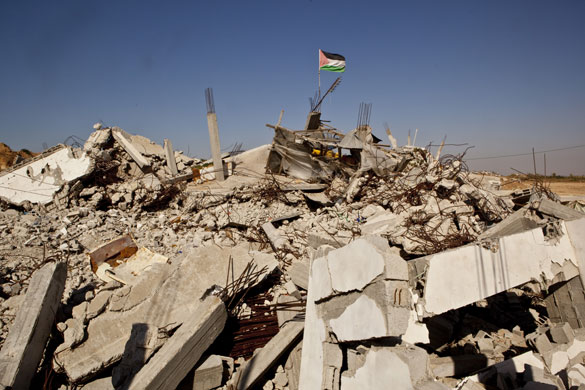

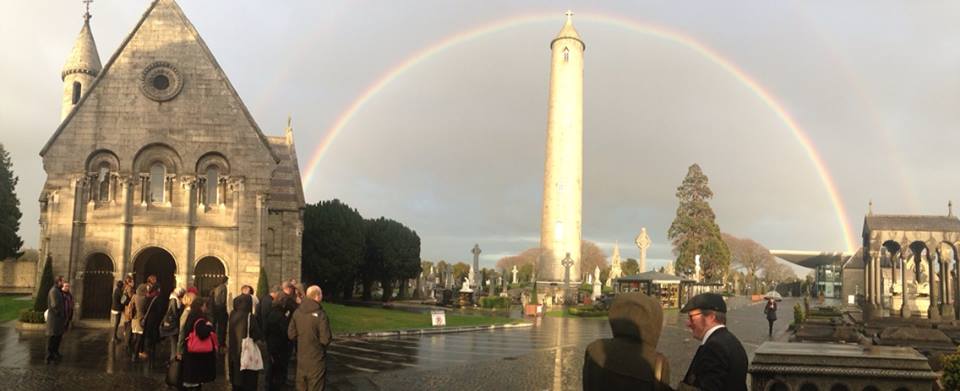
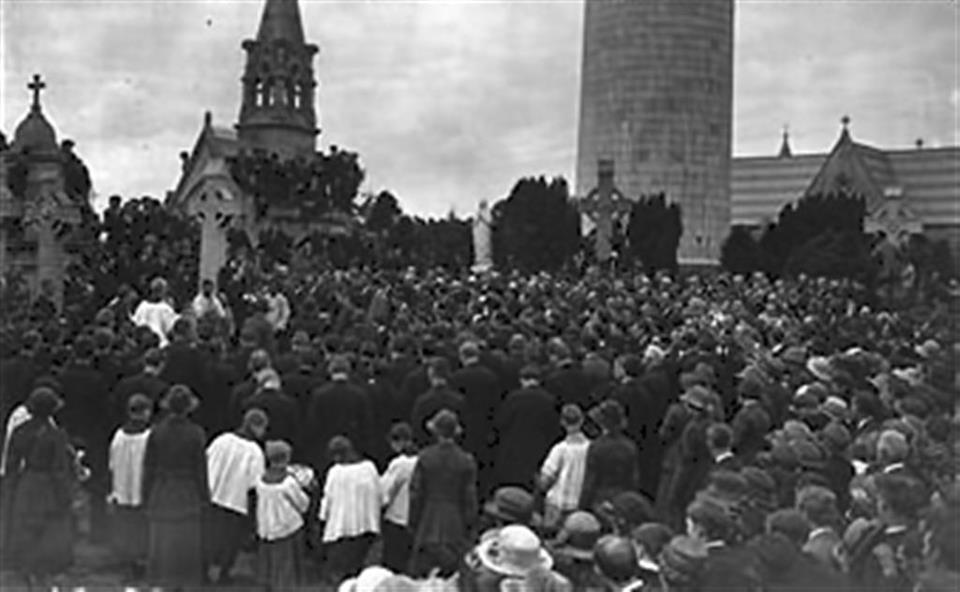


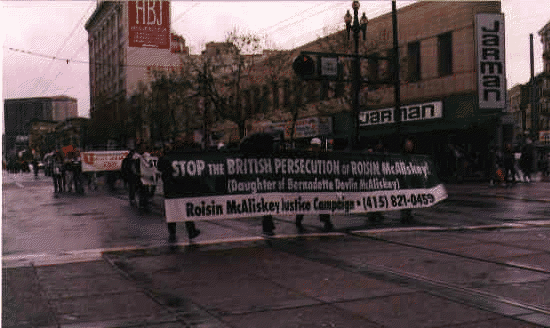


 rebelbreeze