A Palestinian speaker recounted ten years of success in the BDS campaign against the Israeli Zionist State and asked people to continue with it and, if possible, to step it up.
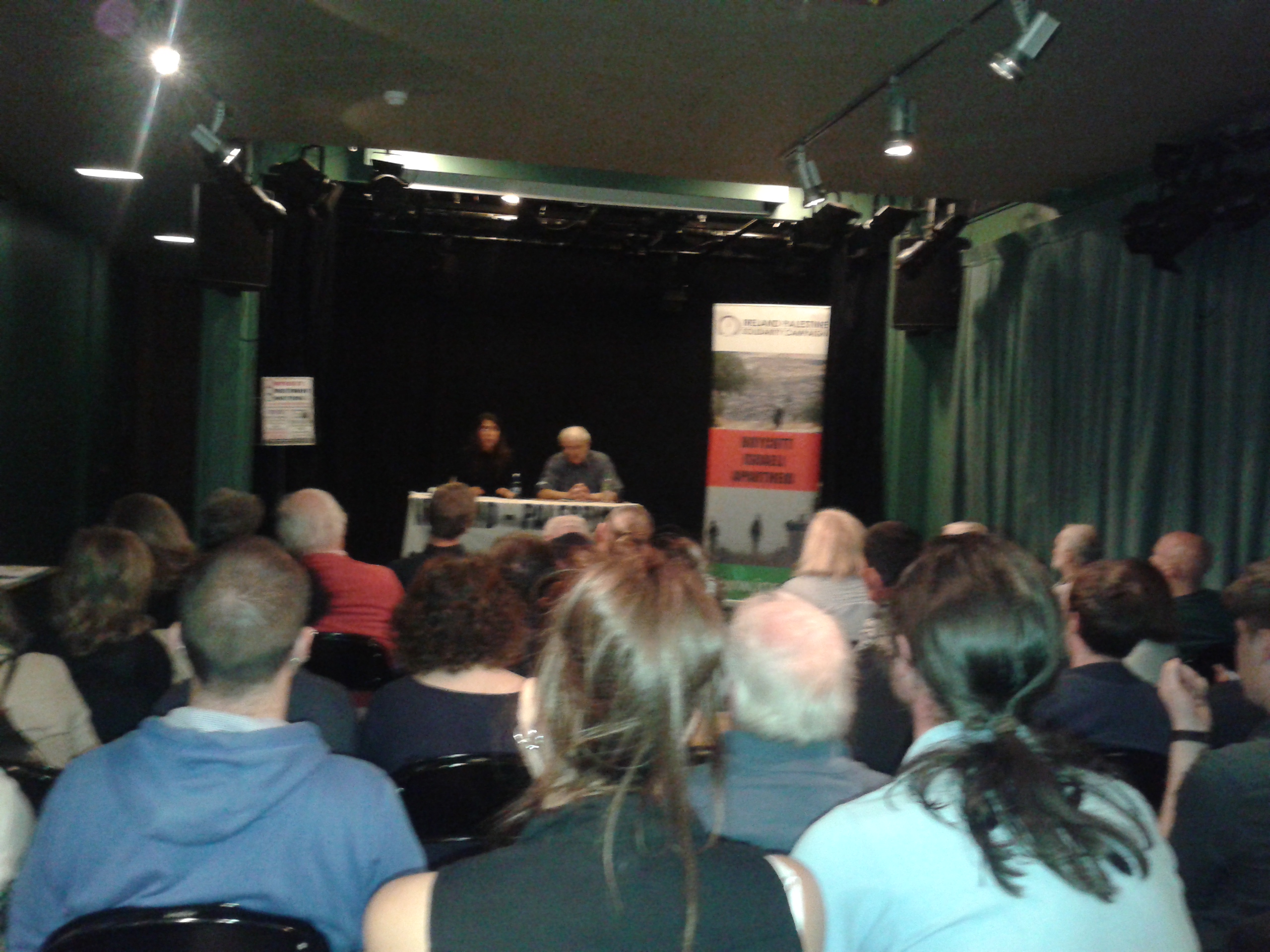
Riya Hassan addressed a crowd at the Pearse Centre in Dublin’s Pearse Street, just off Dublin City Centre, on Wednesday night. She spoke about the history of the oppression of Palestinians by the Israeli state and the ten-year history of the Boycott, Divestment and Sanctions (BDS) campaign, explaining its origins in Palestinian society and charting its growth and successes. The three basic aims of the BDS campaign are to pressure Israel to end the colonisation and occupation of Palestinian land, to give equal rights to Arab-Palestinians citizens in the Israeli state and to agree to the right of Palestinian refugees to return home.
Riya HassanSection of the crowd at the public mee
Riyah Hassan is European Coordinator of the BDS campaign, herself a Palestinian and, as she later explained when talking about the Israeli destruction of villages in the Negev, from near that area herself. Talking about the current refugee crisis in Europe, she pointed out that many of the refugees taking to sea in what she termed “death boats” (echoes of our own “coffin ships” during the Great Hunger) are in fact Palestinians. They are from refugee camps in Syria and are being made refugees for the second, third or even fourth time.
Speaking on the Palestinian refugee issue, a huge and outstanding one since 1948, Riya Hassan mentioned that their right to return home had been surrendered by the negotiators of the “peace process” at Oslo in the 1980s but that Palestinian society had not accepted this abandonment, whether in Israel, the occupied territory or in the refugee camps elsewhere.
Among a list of successes of the BDS campaign, Riya Hassan mentioned Veolia, a company which had been setting up the transport networks between settlements helping to carve up Palestine, had lost millions due to BDS – as a result, the company has pulled out of Israel (Veolia, by the way, runs the LUAS trams in Dublin). G4 Security, which runs surveillance on Israeli prisons, where there are currently well over 6,000 Palestinian prisoners, have said that they will pull out in 2017 but Riya said they should pull out now and called for pressure to be increased upon them. Another target should be our own Government, which has spent €14.7 million worth of arms and military components from Israel over the last decade (while Irish-based companies have exported €6.42m worth of military and ‘dual use’ hardware to Israel over the past five years). Riya reminded us of the complicity in murder entailed in buying equipment from the Israeli arms industry – an industry which boasts as a marketing point that its deadly equipment is “field tested”!
Among the measures of the impact of the BDS campaign on Israel and abroad, the audience were told that Netanyahu in addressing the recent AIPAC conference in the USA had given a quarter of his speech to attacking the BDS campaign and campaigners, in contrast to the early days when Zionists tended to dismiss the campaign as insignificant. More extraordinarily, perhaps, Hillary Clinton has given a promise, as part of her campaign for the Presidency of the USA, to do what she could against BDS.
Riya Hassan, BDS Europe Coordinator with Martin O’Quigley, Chairperson IPSC and who chaired the meeting
Riya Hassan is eloquent, with excellent command of English and spoke clearly and confidently. If anything, she spoke for too long overall. It is hard for a visitor to judge what a typical Irish audience might know or what our cultural expectations are but the room was warm and after about 45 minutes one could hear some people shifting in their seats, a situation that did not improve as the talk extended well past the hour.
However, when the Chair of the meeting turned to the audience, it did not seem that anyone had missed an opportunity to ask questions or to comment and some even took several bites of the cherry.
As chair of the meeting (and of the IPSC) Martin Quigley drew the meeting to an end, he announced a boycott action of Tesco supermarkets for this Saturday and, for those in Dublin, asked them to meet at the IPSC office at 12 noon.
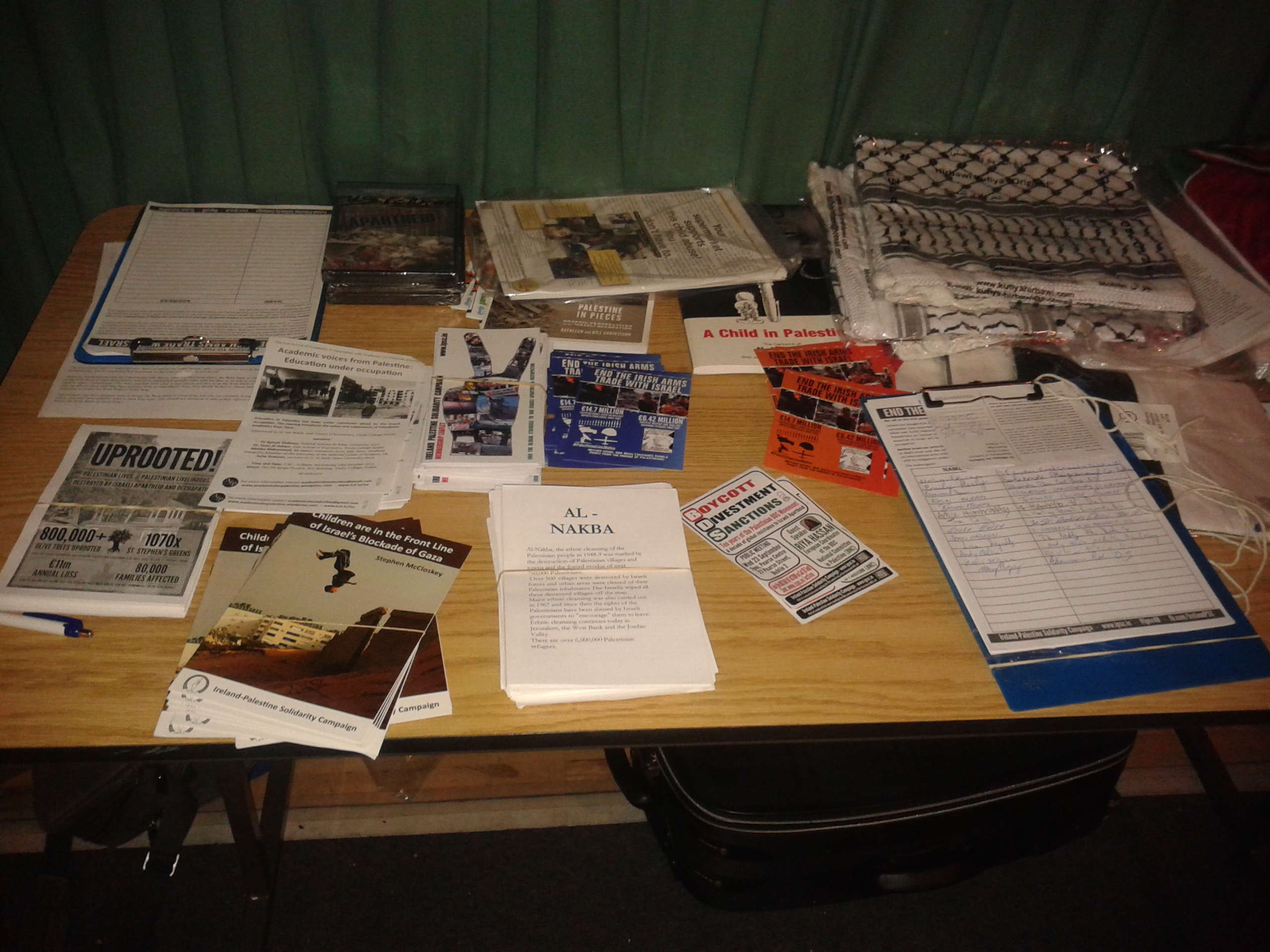
IPSC stall at the event
Riyah Hassan sets off over the next few days for Belfast and Cork before leaving our shores again and we wish go néirí an bóthair léithe!
The French Government deny rumours of a relaxation in their policy of dispersal. The Spanish Government confirms it is business as before for Basque political prisoners.
On 3rd September French diplomatic sources refuted interpretations in some media that it had changed its position with regard to Basque political prisoners. The media interpretations had been built upon a statement by the Abertzale (Basque Patriotic) Left party Sortu, that it had met on July 8th with the French Minister of Justice. The diplomatic sources downplayed the significance of the meeting and denied bringing Basque political prisoners closer to the Basque Country. Etxerat, the organisation for relatives and friends of the prisoners, confirmed that there had been no move to moderate the dispersal.
The day previous to the release of information from French diplomatic sources, on Wednesday, French Justice Minister Christiane Taubira had met with her Spanish counterpart, Rafael Catala. The following day, Taubira said her Government’s approach is to analyse requests for transfer based on the length of the sentence and relocation near their family. Meanwhile, the Spanish Minister of Justice and the Interior reiterated his Government’s position that any individual prisoners’ transfer to a jail in the Basque Country required the prisoners to renounce their organisation and to accept responsibility for the damage caused by their action.
The French approach contrasts with the requirements of the Spanish Government, although Catalá reiterated yesterday that both states were acting in a “coordinated” manner and that the French Government “has not moved its policy by one iota .”
According to Etxerat on Thursday, of the nearly 100 Basque political prisoners in French prisons, only two are in Mont de Marsans prison (152 kilometers from the Basque city of Donosti), while six prisoners are in Lannemezen (231 kilometers). The rest are serving out their sentences at a greater distance from home, the vast majority at more than 600 kilometers. Although the support organisation viewed the French Minister’s statement positively, it was also at pains to disabuse people of any belief in a change in the French dispersal of prisoners and stated that any prisoners brought nearer were merely as a result of movement to which the relatives and friends have become accustomed, “bringing them close” before “bringing them far away again.”
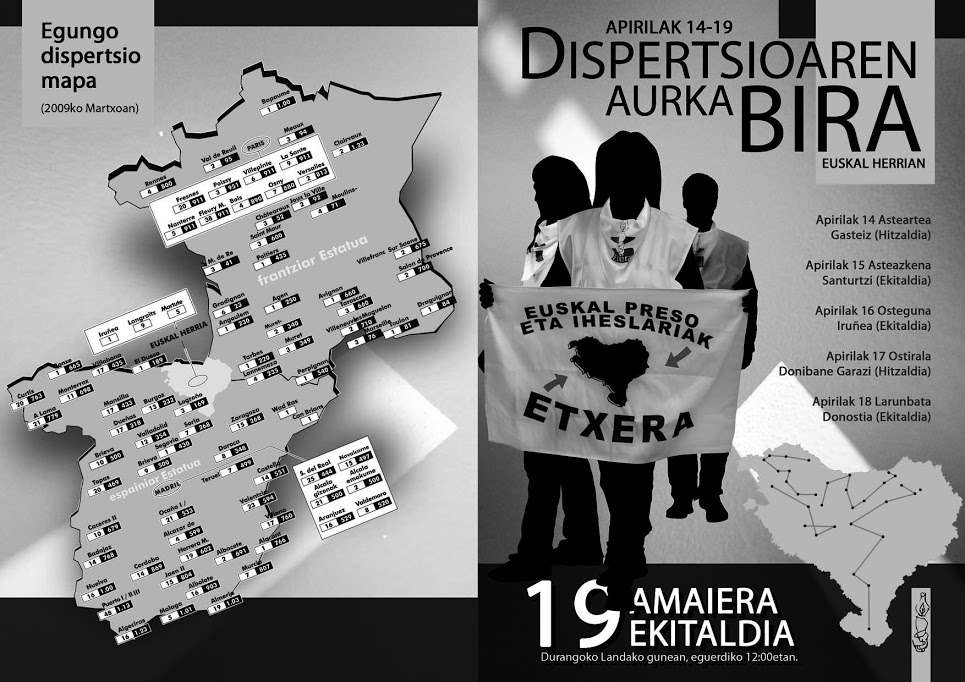
Map of the dispersal of Basque political prisoners across both states and Etxerat flag in a poster calling for a protest and solidarity demonstration some years ago
The organisation of relatives and friends of Basque political prisoners stated that neither they nor any prisoners’ relatives participated in any meeting with the French Ministry of Justice – any meeting was with several members of Sortu only.
Spokespersons for the party of the Patriotic Left, Sortu, indicated that at their July meeting the French Ministry had been represented by Alain Christnach, Taubira’s Chief of Staff. Meanwhile the French, through diplomatic sources, asked observers not to “over-interpret” this meeting and indicated that participation in the meeting does not mean accepting Sortu’s proposals.
Another issue discussed by the Spanish and French Ministers was the possible transfer of prisoners under the law of mutual recognition of penal sentences in the EU, in force since January. This legislation provides the possibility for prisoners serving sentences in any EU Member state to be transferred to a Spanish prison; however, most Basque prisoners are unlikely to avail of this provision due to harder treatment in the Spanish prison system and the fact that dispersal throughout the state continues.
In a different aspect of the same legislation, the MEP of the Basque Nationalist Party (PNV), Izaskun Bilbao, asked the European Commission whether it will take Spain before the European Court of Justice for failure to take account of sentences served in French prisons by Basque political prisoners. This is because of the fact that the Spanish state often waits until a prisoner has served his sentence in France before extraditing him on a Spanish charge to face a further sentence in Spanish prisons.
Policy of dispersal of political prisoners — an abuse of human rights
There are many issues raised with regard to Basque political prisoners but the most universal one is the simple fact of dispersal. Relatives and friends face journeys of hundreds or even thousands of kilometers to visit their loved ones and the same distance back again. Many of these journeys are impossible without overnight stays. The expense drains financial resources while the long journeys themselves drain energy and, for elderly or unwell relatives, are an impossibility. An average of one serious accident a month occurs on these journeys for Basque political prisoners’ visitors and twelve have died in crashes over the years. Nor is it unknown for the relatives to be harassed by police on their journey or attacked by Spanish civilian fascists. As Etxerat has stated in its monthly reports and in a number of other statements: “The sentence was supposed to be on the prisoner but in actual fact was served on us as well, although we have been accused of nothing.”
It is a well-established principle of human rights that prisoners should, as far as possible, serve their sentences in a prison close to their families and relatives. This is in recognition of the rights of families as well as the desirability of easing the reintegration of prisoners as much as possible into society. The principle is covered in a number of United Nations policy paragraphs and also within the EU’s model rules for prisoners adopted in 2006 (https://wcd.coe.int/ViewDoc.jsp?id=955747).
Since both the French and Spanish states’ policy of dispersal appears to be in clear violation of the prisoners’ and relatives’ human rights and indeed of the EU’s own model rules for prisoners, some observers find it somewhat perplexing that the relatives’ organisation does not take a case against the states to the Court of Human Rights in Strasbourg. Granted, Strasbourg’s controversial decision on the Spanish State’s banning of the Herri Batasuna political party did not go in the Basques’ favour and the Court, albeit instructing the Spanish state to pay compensation to Basques for not investigating their claims of torture, continues to show a reluctance to find the Spanish State guilty of actual torture. But the dispersal of prisoners is an observable and undeniable fact and, furthermore, one which has been confirmed in public statements by Government ministers of both states.
End item
(Main source on the various statements: Deia, 4th September 2015)
The historic ruins of Hasankeyf, which may have been settled more than two thousand years BCE, are threatened by a Turkish dam along with the homes of Kurdish, Armenian and Arab people. A number of archaeologists and historians believe that the fortified town was referred to in inscriptions on the Mari tablets (1,800-1,750 BCE). The rocky outcrop also contains many human-made caves.
Some of the caves at the Hasankeyf site
As well as being the site of an ancient town, it is also an urban and outer settled district located along the Tigris River in the Batman Province in southeastern Turkey, with a recent combined population approaching 70,000.
The project that threatens to submerge much of Hasankeyf is the Isilu Dam being built by Turkey. Despite the foundation stone being laid as late as 2006, in 1971it was already being actively considered as one of the sites for a number of dam projects for hydro-electric generation and number of other purposes. A study by an international team between 1980 and 1982 recommended the building of the Isilu dam despite the 1981 declaration by the Turkish Government itself of Hasankeyf as a natural conservation area.
Opposition to the dam
The project had run into funding difficulties over the years. Due to international protests on environmental, archaeological and human rights grounds, and also protests within Turkey and from inside Hasankeyf, a number of international funders backed off. The British Government refused $236 million in funding in 2000 and in 2009, a consortium of Austrian, Swiss and German credit agencies withdrew their offer of $610 million.
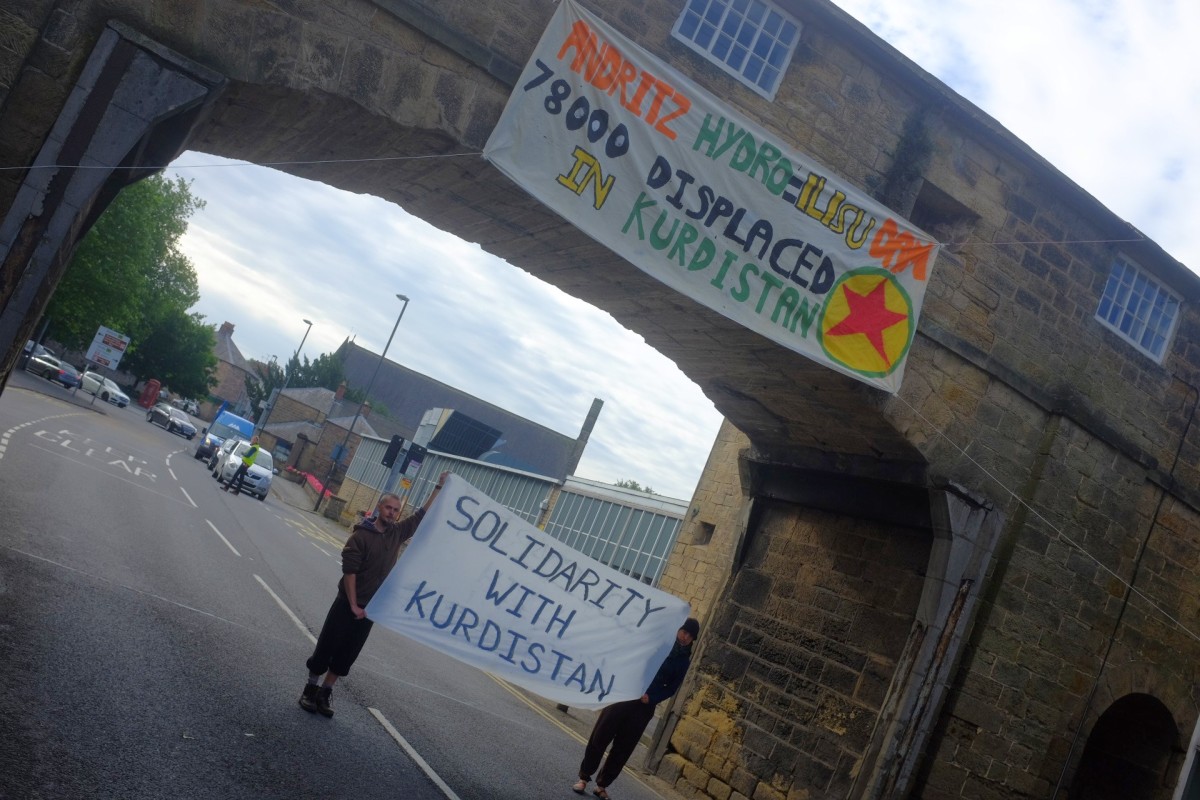
Solidarity picket outside the Andritz company plant in England
The consortium had suspended the loan in 2008 and had given the Turkish Government 6 months to comply with international standards, which they had failed to do. However in July 2010 the Austrian firm Andritz Hydro announced it was lifting its suspension and would provide the six huge turbines specified for the power plant.
Excavations for the main body of the dam began in May 2011 and the Turkish Government projected that all works would be completed this year. A 250m (820ft) permanent steel-girder bridge with concrete supports has been constructed just downstream of the dam andconstruction of new villages is currently underway. The diversion of the Tigris River began during August 2012. According to Government figures, by April 2014 the project was 60% completed while 73% of the Hasankeyf population had been resettled.
Protests continue within the area, peaceful and not. According to the Government, in January 2015 Kurdistan Workers’ Party (PKK) threatened the lives of workers and anti-Government sources confirmed that a number of workers left the site. On 3 February 2015 a convoy of supplies for the dam was attacked, injuring three persons and several days later a worker was killed in his home, according to the Government by suspected PKK militants. Peaceful protests have included pickets and demonstrations (see photos) and some of these have also taken place abroad, including recent ones in England (see photos).
Locals, probably mostly if not all Kurds, protest at the Hasankeyf site
The completion of the Ilısu Dam will cause the flooding of the ancient city of Hasankeyfand about 185 villages and hamlets will be fully or partially affected by flooding, according to the Kurdish Human Rights Project. From 55,000–65,000 people will be forcibly resettled, says the KHRP, while even the Turkish Government estimates 40,000. According to a statement released on the 24th August by a solidarity group protesting outside the Austrian Andritz company’s facility in England, the completed project will reduce water flow to Syria by 40% and Iraq by 80% and the dam also provides the facility for political control of those areas through further restriction of water supplies.
Turkey is a member ofNATO and extremely important strategically to the the military alliance, as well as having some significant natural resources. However its regularly-renewed applications to join the EU have always been turned down because of its human rights record, both in the course of recent wars with its ethnic Kurds as well as with regard to protest movements among ethnic Turks. Recently Turkey came in for adverse international publicity again as it was seen to be blocking Kurds trying to get through the Turkish border with Syria in order to defend areas under attack by ISIS (Islamic State), while Turkey has also been accused of more directly assisting ISIS in its attacks. Although the state has Moslem fundamentalist political parties which occasionally come into government, Turkey itself has been secular since it became a republic in 1922.
The Spanish state is set to close 107 Basque social centres, confiscate their funds and sell off their assets, including property. With allegiance to the Basque Patriotic Left, the “Izquierda Abertzale” as it terms itself in Spanish, the Herriko Tabernak (“Peoples’ Taverns”) function as centres for social, cultural and political activity. The sale of coffee, alcohol and pintxos (a variety of home-produced small items of food, mostly eaten cold) also generates income with which to employ some activists within the movement and also to fund some of its political activities.
Outside the Errondabide street Herriko Taberna in the Casco Viejo part of Bilbao
Those are the socially-useful functions of the Herriko Tabernak and precisely the reasons the Spanish state plans to close them down. Not that they say that openly, of course – the official line is that the taverns “fund terrorism”. Never mind that the police have never furnished any evidence of that, never mind too that the alleged recipient, the armed organisation ETA, has been in uninterrupted ceasefire since 5th September 2011, confirmed as “permanent” in a statement the following January and again as a “permanent cessation of armed activity” in October 2012.
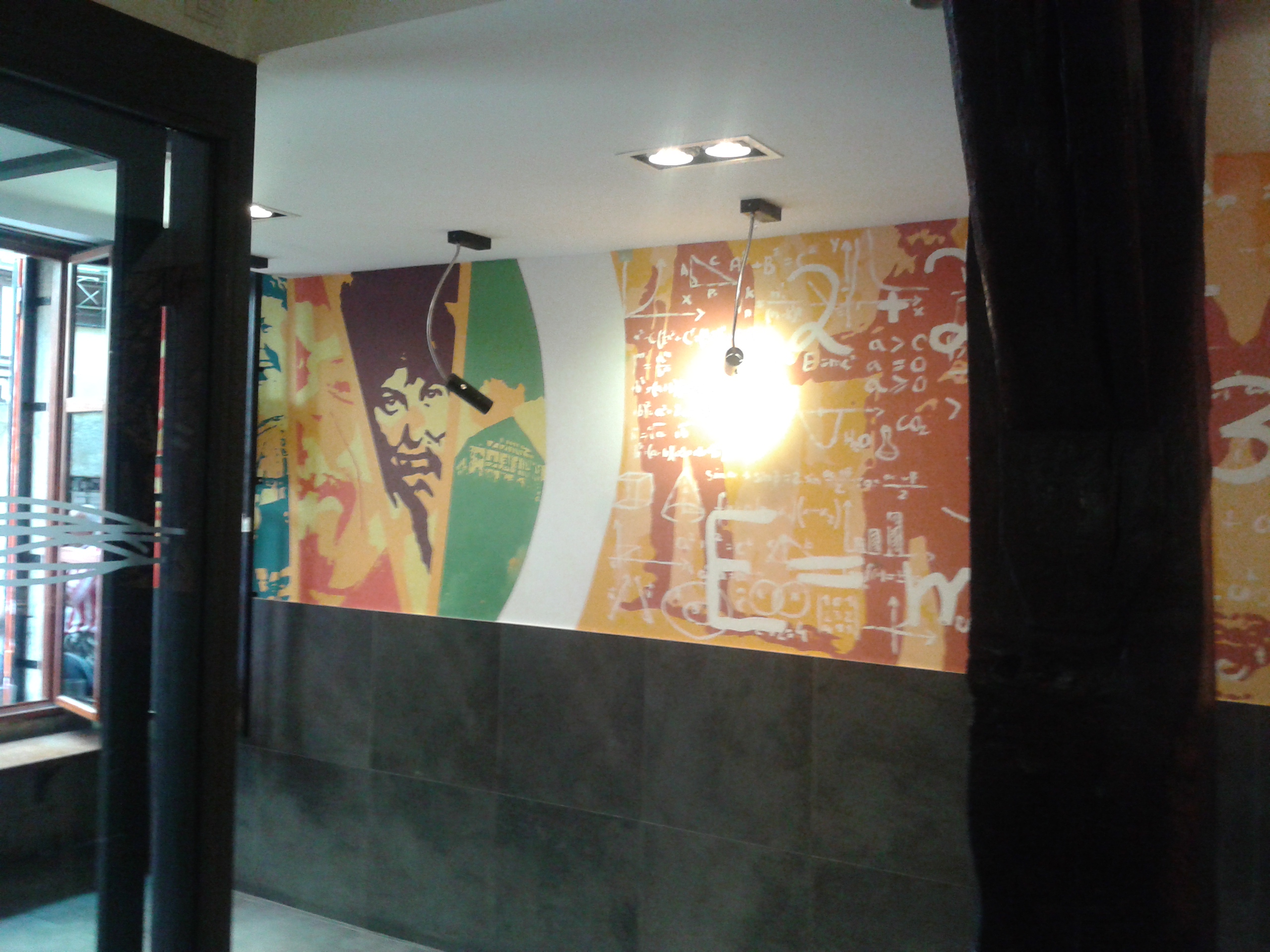
Entrance wall mural
There is an herriko taberna in many vilages and in every town throughout much of the southern Basque Country (i.e the part under Spanish state rule) and Bilbao, for example, has several. They vary from one another but typically have a front bar area and a rear or upstairs function room which may be used for political, cultural,
Section of the function room at the back of the Herriko.
educational or social event, or hired for personal social functions such as celebrating a birthday, successful conclusion of studies, an engagement or wedding, a return for a migrant. Social functions of a more political nature such as welcoming a recently-released political prisoner or a commemoration of some figure of the resistance are also held there.
Inside the Herriko, the bar area and some afternoon customers
Although people hostile to the ‘herrikos’ would not usually enter one, anyone can do so and order coffee, beer or soft drink, perhaps buy some pintxos – no-one will bother them. The language of conversation inside may be Euskera (Basque) or Castellano (Spanish) but all the staff have at least enough Euskera for the customers’ needs and many are fluent.
On the walls notices and posters carry political, cultural or social messages or advertise an event, either specific to the Basque Country or perhaps in solidarity with the Palestinians, the Saharaui (Western Sahara people), or to do with gender and sexuality-social issues, workers’ and migrants’ rights, animal rights ….
Some pintxos in the Herriko, home-made Basque ‘fast food’Banners and Basque flag propped against wall in the function area
Photo portraits of prisoners are “glorification of terrorism”
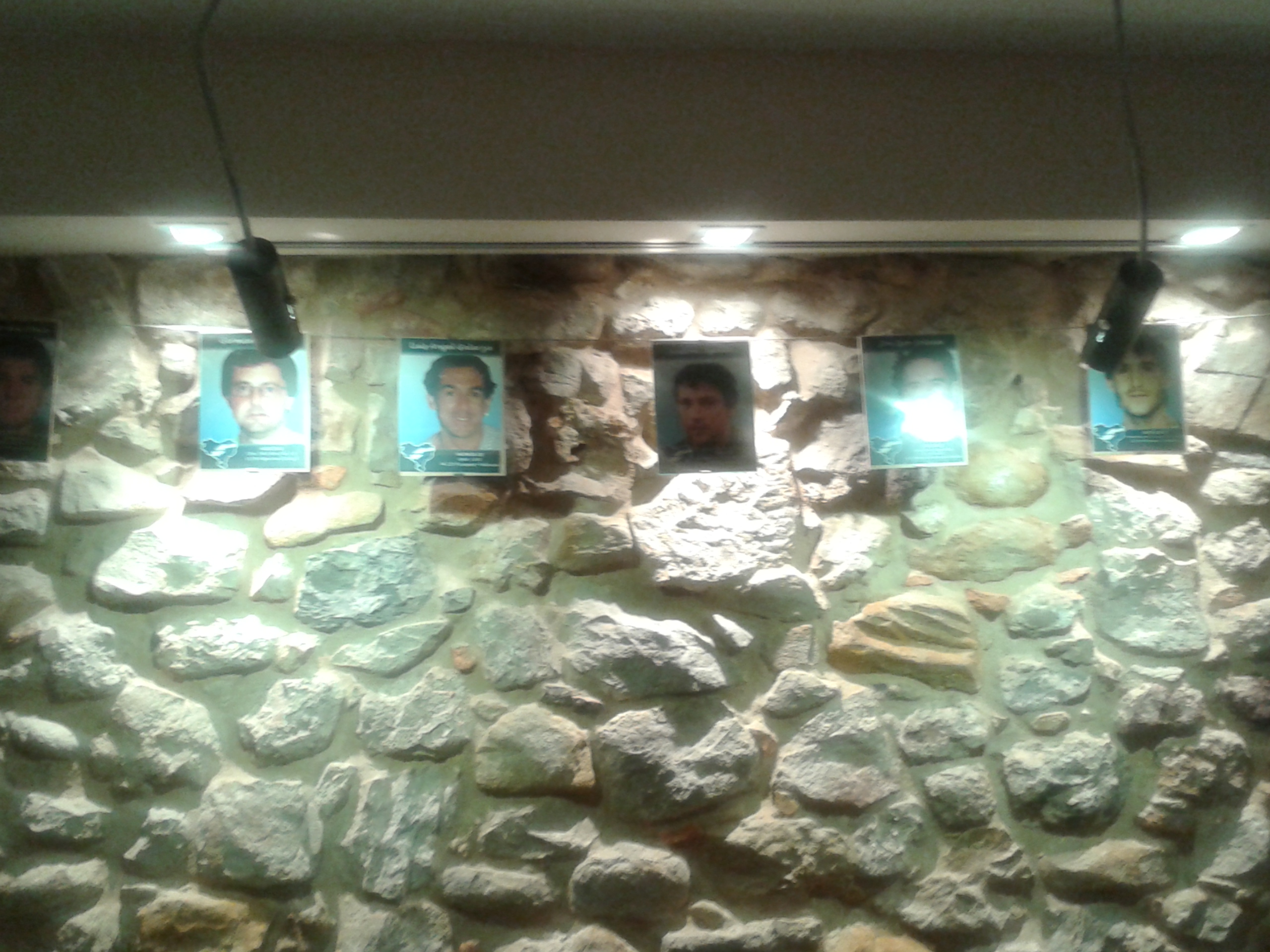
Recently, the walls carried photo portraits of political prisoners from the area. After the Spanish National Court decreed, a few years ago, that these were expressions of “glorification of terrorism”, the police raided many herriko tabernak (and also sympathetic bars) and arrested those who refused to take them down. The herrikos and bars affected then removed the portraits but replaced them with black silhouettes. Despite a widespread expectation that those arrested would face prison terms, nothing happened and the pictures are back up on the walls of the herrikos.
Portraits of local activists in jail prominently displayed on the wall in the bar area of the Herriko
The herriko closures are expected after the Spanish state’s General Elections, which must be held before December and are expected in October or November. According to opinion polls, both traditional governing parties, the PP and the PSOE, are ahead of all others and even Podemos, with its meteoric rise to December 2014, did not overtake them and continues to show a decline in the voting intentions of those polled. In the southern Basque Country itself, the christian democratic Basque Nationalist Party continues to dominate and, even if they wished to help the party to their left (and they don’t), could not stand up against the Spanish state. A political solution therefore is out of reach.
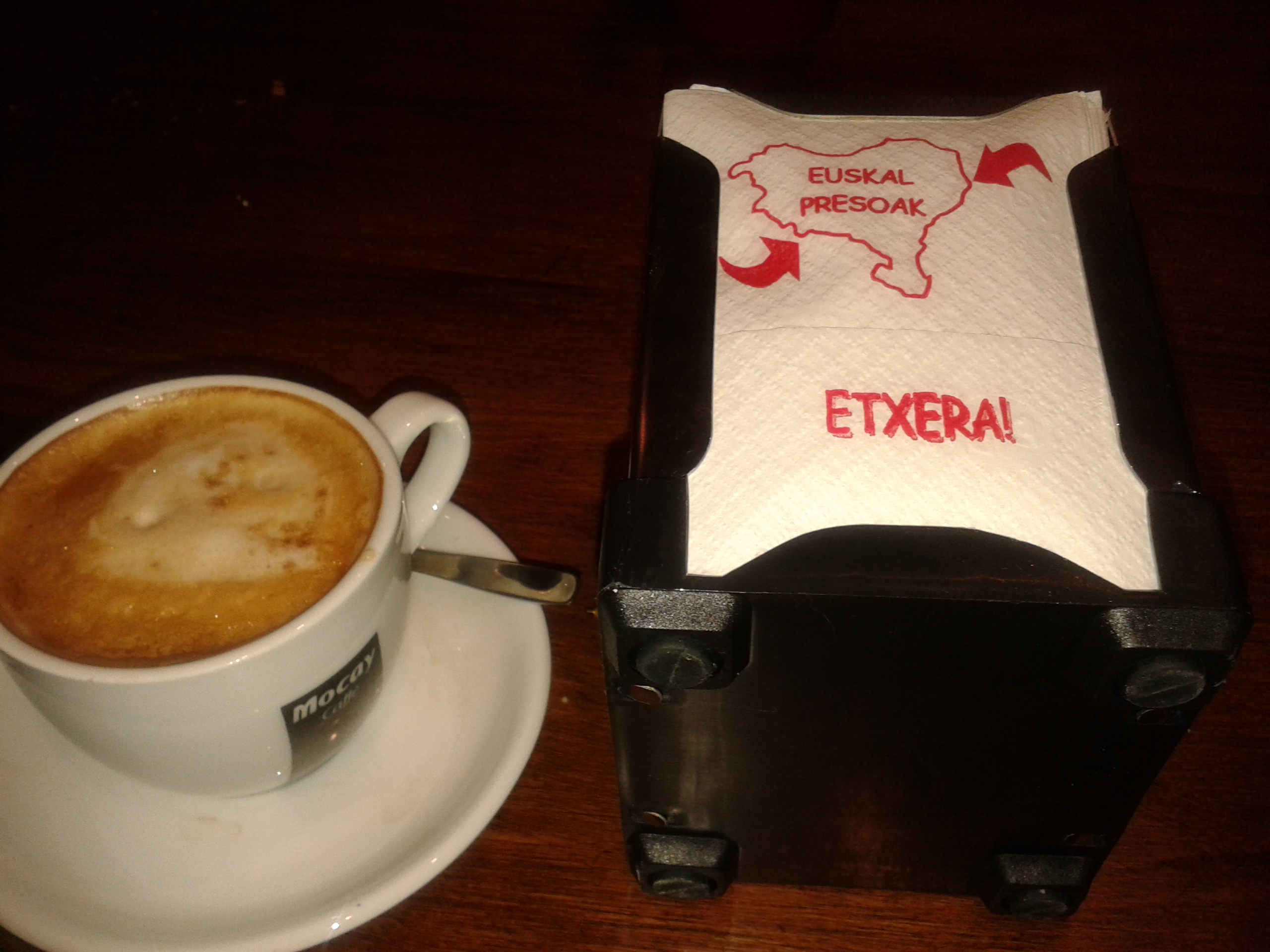
Cafesnea (coffee and milk) with the standard Herriko tissues, stamped with the slogan calling for the Basque prisoners to be sent home from dispersal (and also to be freed).
When the herrikos close, the loss will be enormous: the organised movement will suffer politically, culturally and financially and the social and cultural life of thousands will suffer. There seems little that the Abertzale Left movement can do within the Spanish state – its legal challenge in the Supreme Court has failed. It can apply to the Constitutional Court but decisions there usually concur with those of the Supreme. After the Constitutional, it can apply to Europe, to either the Court of Human Rights at Strasbourg or the Court of International Justice at the Hague but the delay in cases being heard there can take years and by the time they are heard, the herrikos will have been closed and properties auctioned off. Nor are the European Courts’ decisions necessarily to the benefit of the Basques – although a number of times Strasbourg has found against the Spanish state for failing to investigate a claim of torture by a political prisoner, it has never actually found the state guilty of the torture itself. And when the Abertzale Left’s political party, Herri Batasuna, was banned by the Spanish Supreme Court (and confirmed by the Constitutional) in 2003, the movement took the case to Strasbourg. Eventually, in 2009, the Court delivered its judgement – incredibly, it decided that banning a political party with electoral support varying from 15% to nearly 25% in the southern Basque Country was not an abuse of the human rights of the people concerned.
This Herriko is mainly patronised by youth but the age range is complete, from babies brought by their parents to the elderly
Considering the options and Spanish democracy
Now the people are considering their options in action outside the courts. Should they occupy the buildings and resist their takeover by the Spanish state? Maybe that would make sense where their location is a fairly high-profile one. But others are in back streets and laneways; the “Zipayos” (pejorative name for the Euskadi police, the Ertzaintza) can swarm those places, assault the occupants and evict them in a matter of hours. That they can do the same in the more high-profile locations is without doubt but at least the community and passers-by will see the resistance there. In the smaller villages, herrikos may change their name and perhaps replace the buildings’ renters or lessees. Whatever course they take, the disruption overall will be huge.
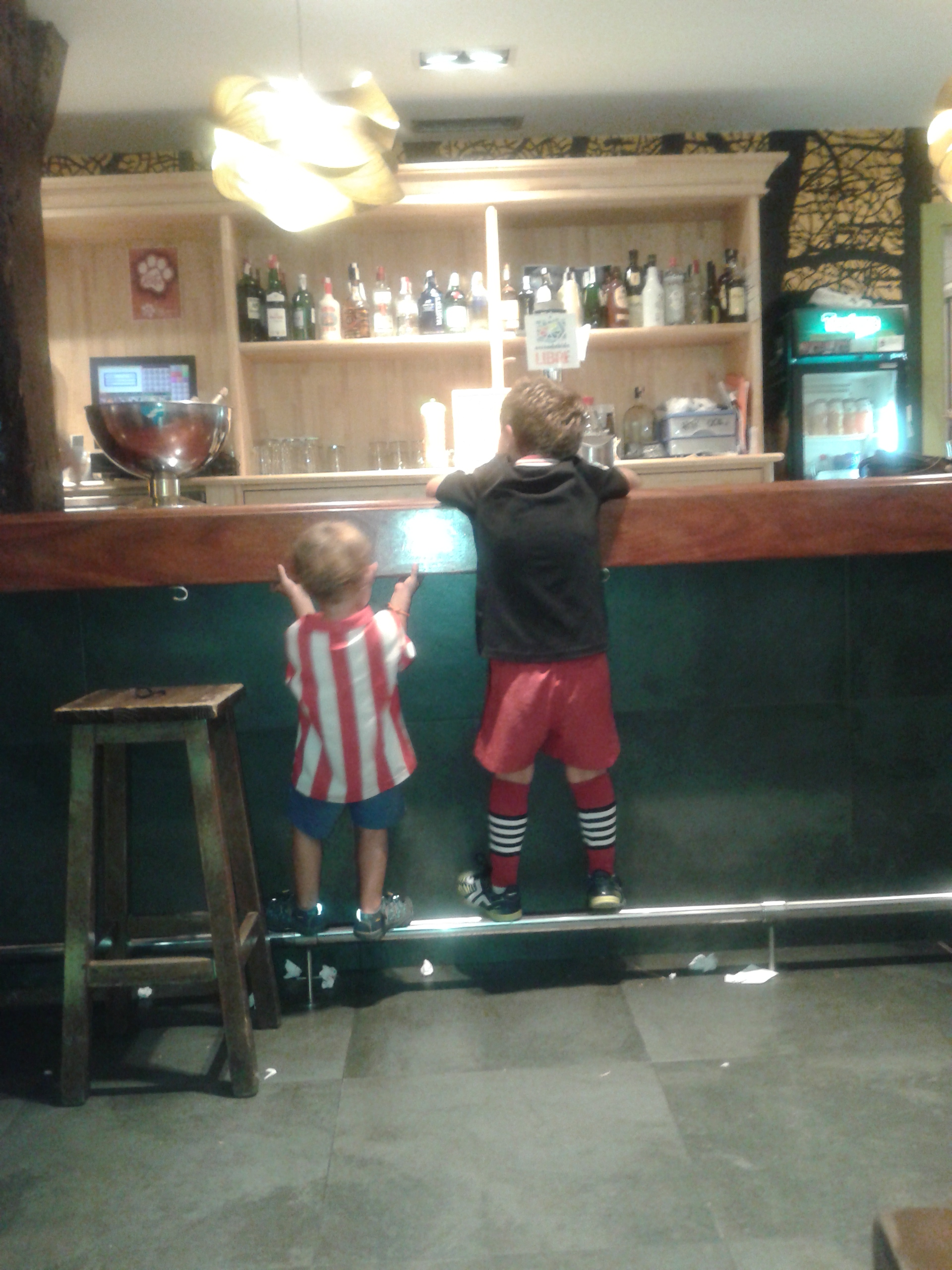
The upcoming generation, one wearing an Athletic Bilbao shirt
In 1998, the Spanish National Court judge Balthazar Garzon (beloved of many liberals around the world) closed down the Basque-language newspaper Egin, a bilingual daily in Euskera and Castellano first published 20 years earlier. Over a year later, a judge ruled that the newspaper could reopen but by then its machinery had been dismantled or left unusable and its owners left without funds as they were using them in court proceedings. In 2009, a Spanish court finally decided that there had been no grounds for closing it in the first place. A year later, there was a similar decision in the case of Egunkaria, the first-ever daily in the Basque language, closed down by the Spanish state in 2003. In 2010, the National Court decided that there had been no reason to close the newspaper and that the accused were innocent, hinting that the accusation of torture was true. But no formal apology followed, nor was there any compensation paid and Otamendi, the newspaper’s manager, had to take his torture case to Strasbourg, where in 2012 he was awarded compensation of €20,000 (and €4,000 legal costs) against the Spanish state because (as usual) they had not bothered to investigate his claims of torture. No compensation has yet been paid for Egunkaria‘s closure and its successor, Berria, reportedly struggles financially today.
Posters and information on the Herriko wall near the front of the bar area
Basques smile ruefully when students of recent Spanish history talk about the “democratisation” of the State through the “Transition” from General Franco’s dictatorship. Apart from the killing by Spanish police and state-supported fascist gangs during that Transition, the southern Basque Country has seen state-organised assassination squads, bannings of newspapers and radio stations, bannings of political parties, youth and cultural organisations and arrests, torture and jailing of political activists. This is the reality behind the words of “Spanish state democracy”.
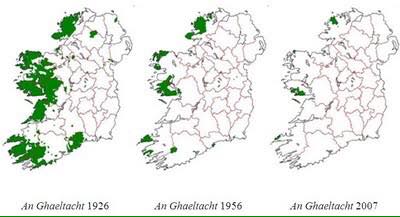
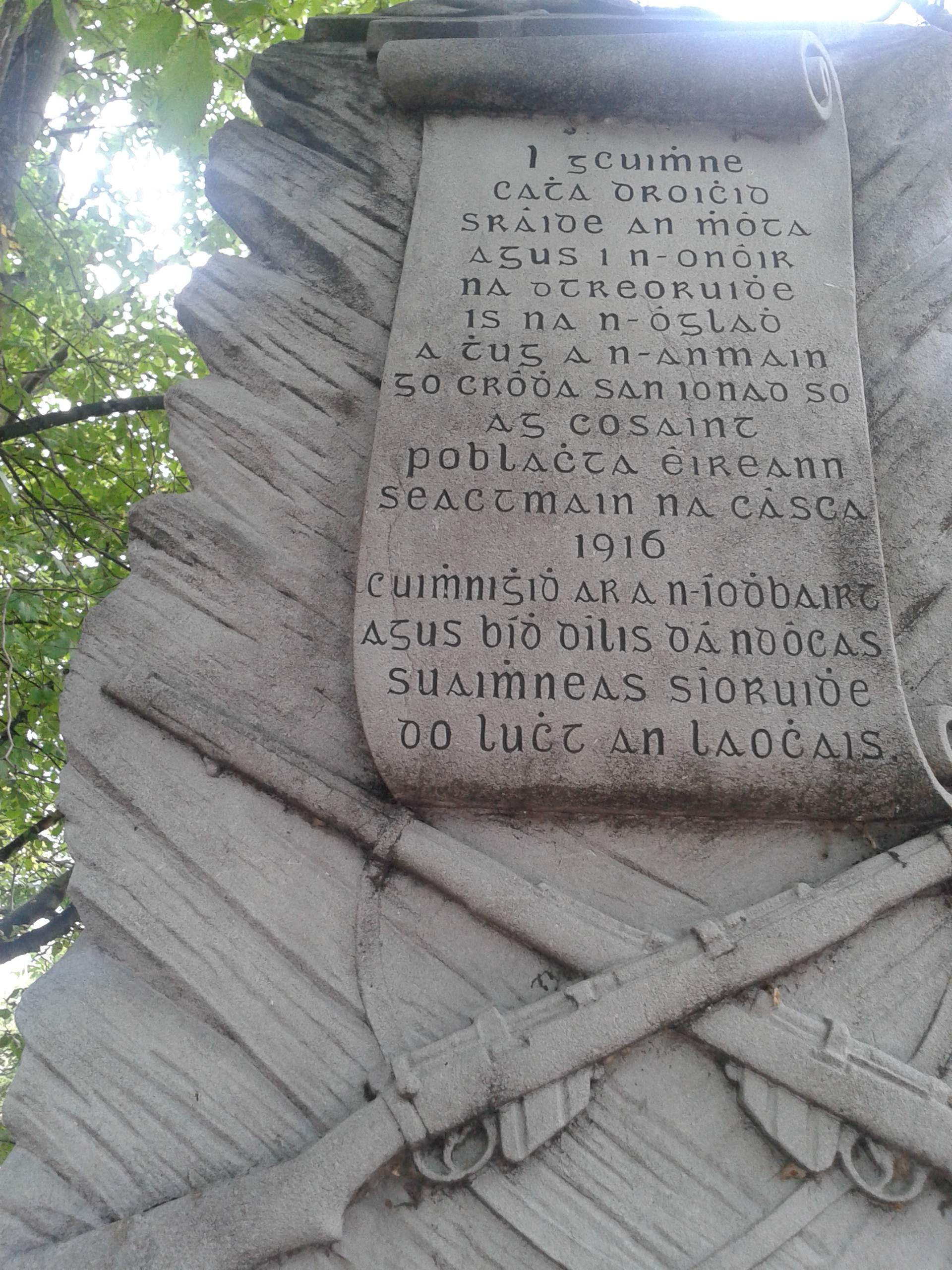
Maps showing the decline in the Irish-speaking areas, the Gaeltacht, during the life of the Irish state
“Irish is nearly dead as a spoken language.” A shock ran through the Irish-speaking community at the news…. but although the after-shocks reached linguists afar …. the news caused but a small ripple in Irish society at large.
It should have been big news. In only nine decades of the existence of the Irish state, the Irish-speaking areas had shrunk by 90%. This seemed to herald the imminent death of Irish as a spoken language – a language that, albeit shrunk to being the mother-tongue of small minority of the Irish population, had survived almost a millennium of colonial occupation and a consistent policy to replace it with English.
The loss would be greater than Ireland’s alone – this is an early Indo-European Celtic language of more than four thousand years of development, the language of the earliest vernacular literature of Western Europe, an extremely rich literature of pagan mythology and folklore containing epics which did not suffer the extent of moralistic destruction which either the Reformation or the Inquisition visited upon so many others across Europe. The language is probably unique on the Continent in being that of a state and which is also that of the first recorded settlers of the land. It was (perhaps still is) the Celtic language with the largest number of speakers. It is the mother of Scots Gaelic and Manx Gaelic too.
It seemed almost too difficult to grasp that this had occurred in a state that claims to be independent, which also claimed the language as the first in status in the State, according to its Constitution. And this has, seemingly contradictorily, occurred at a time when there are more Irish-medium schools, Gaelscoileanna, than ever before in the history of the State.
How did it come to pass? Emigration, some might say. Certainly emigration on a large scale has been a feature of Ireland’s demographics since at least the Great Hunger (although it was in the years after that disaster that the outlying western areas began to hemorrhage). Even so, although emigration has been a constant, so also has been the population – in other words, the birth-and-survival-rate kept up with the emigration. Did the Gaeltacht areas experience higher emigration rates than elsewhere then? Certainly – not just to go overseas but also to Irish cities, especially to Dublin. Industry was scarce in the Irish-speaking areas, despite the efforts of cooperatives and Gael-Linn and the land in most places is rocky and poor.
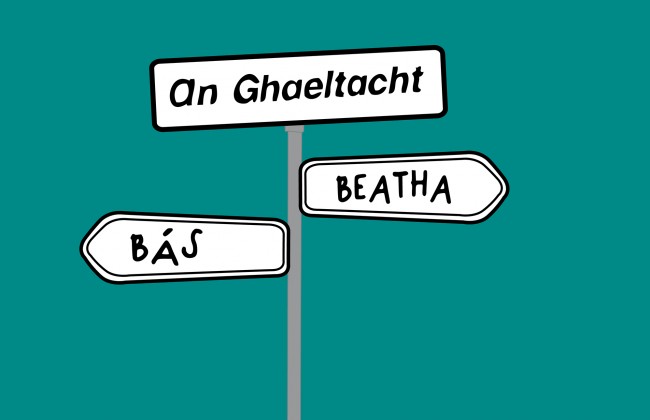
The Gaeltacht Death or Life (image downloaded from the Internet)
Yet, the reality appears to be that the Gaeltacht population reached a level at which it stayed – so how can there be a continual reduction reaching 90% in the Irish-speaking areas? If the population has not decreased, certainly not to that extent – then the Irish-speakers must have. Have many ceased to speak the language then, losing it over a generation, or two, or three? Or has an inward migration of English-language-only speakers replaced Irish-speakers? Yes to the first and yes, to an extent, to the second.
The Basques have a saying: “No language was ever lost because people didn’t learn it but rather because those who had it, stopped speaking it.” (As an aside, I find myself wanting to say “her”, because in Irish the word “language” is of feminine gender: “Beatha teanga í a labhairt” — literally “the life of a language is to speak her”). Observers speak of children raised in Irish-speaking families, or in a mixed-language household, even in the Gaeltacht, speaking English with their peers as they leave the primary school where the subjects are taught through Irish.
So, the people make a choice and some people of other mother-tongues move in – that’s democracy, isn’t it? Freedom to move, freedom to speak the language you want. But is it really so? Certainly one can assume that the people moving in are making a free choice (unless one takes into account dearer house prices in the cities). But are the ones moving out making a free choice? If the absence of industry and therefore employment is a constant in the Gaeltacht then it is not an entirely free choice to leave. If the work were there, one can assume many of the people would stay.
Ok, but the ones who stop speaking Irish – surely that is a free choice? One suspects cultural factors at play there. The attractive world for pre-teenager – which is what most childhood years have become — and teenager, is a world dominated by and represented through the English language. It is transmitted in English through so many media …. all with very little competition in Irish. The Irish-language TV channel, TG4 is in practice a bilingual one. Publishers find only a small market for books aimed at children and young adults in Irish, whereas the English-language market stretches not only throughout Ireland but abroad — Britain, the USA, Canada, Australia, New Zealand … All of this without mentioning TV, pop-song lyrics, video games, Internet, films ….
But one must also take into account the fact that when those Gaeltacht children visit their nearby towns and cities – Letterkenny, Dublin, Waterford, Cork, Tralee, Galway, Ballina – they hear English all around them. Worse … they hear only English around them – unless they hear other languages from tourists or perhaps an Eastern European language from migrants. What they are practically guaranteed NOT to hear is Irish.
So, hardly anyone speaks her – sorry, it – and it’s not cool and most people of your age around the country don’t speak the language and what do you need it for anyway? It’s not surprising Irish-speaking is in decline.
“You can’t blame the State – they tried their best, didn’t they? Sure Irish is still a compulsory subject in the schools.” “The national broadcaster has provided a radio station and TV channel for Irish-language use, too! And they give some grants to families speaking Irish in the Gaeltacht, right?”
Ní mar a shíltear a bhítear (loosely translated as “not all is as it seems”. Yes, Irish is taught in the schools but no attempt has ever been made to make it a language of daily use – for work, public transport, banking, shopping, post office, health service, education … Radió na Gaeltachta was won through a civil rights campaign – Feachtas Cearta Sibhialta Muintir na Gaeltachta – and people refused to pay their radio and TV licenses, were dragged to court, fined, refused and some even went to jail before TG4’s precursor, Teilifís na Gaeilge, was supplied. The Irish-speaking grants were a help to households but were not properly administered so that houses that were not Irish-speaking, or had lapsed, continued to receive them. This gave rise to false statistics that helped to conceal the decline in the Irish-speaking areas.
The Gaelscoileanna outside the Gaeltacht, at 143 in the 26 Counties, though an impressive success story, are not State initiatives — they were started by local groups who then battled for state support. Many are still in temporary buildings or in need of repair while others are awaiting the funding that will allow them to employ teachers. As for the other services – nothing. Oh, yes, some of them are supposed to have one designated member of staff who can provide a service in Irish – you can avail of him or her if she or he is not off sick, on holiday, on training or relocated. And if you can wait ….. and put up with the embarrassment while you hold up the queue. Even having one’s address used in the Irish form requires a battle, sometimes drawn out and one still finds one’s letters, from time to time, forwarded from someone else’s address or disappearing somewhere forever. Or discovering that one’s address, which one gave in Irish, has been converted back to English in some office.
A couple of years ago a Dublin court ruled that a man did not have a right to have the case against him heard through Irish. Gardaí are not subject to even the notional obligations to carry out their tasks through Irish or answerable to the Language Ombudsman and, although citizens have a right to have any legally-required procedure in Irish, cases regularly arise of people detained and threatened for insisting on being dealt with through Irish by the Gardaí (police).
Ó Glíosáin showed in research published in the 1980s the decline in Irish-speaking competency among people who had learned Irish at school and who had considered themselves competent speakers upon leaving secondary education. The rate of decline was in the order of a third for every decade passing since they left school. For all its faults, the blame cannot be placed on the educational system, the usual scapegoat. Ó Glíosáin spoke about the absence of “domains of language” for Irish outside the Gaeltacht. In Dublin, with a population of over a million, there is only one social space where everything should happen through Irish. One social space, in the capital of the State, to serve a population of over a million, more than one-fifth of the entire population of the State!
The lack of Irish services obtains even in the Gaeltacht, believe it or not. A man wrote recently of a bank branch in Connemara unable to deal with him making a withdrawal through Irish that asked him to make an appointment. Some years ago, I went to an AIB branch in the Donegal Gaeltacht area and, among a staff of five who were serving customers, could find not one able to give me a service in Irish. People in the Gaeltacht cannot get a decent service in Irish from their local authority, their health service nor, in many cases, their GP. This was so even when, decades ago, many Gaeltacht people hardly knew English.
Anyway, it’s all over now ….
So beat the drum slowly and play the fife lowly ….
Cnag go mall ar an druma is séid ar an fhíf go híseal …
Or is it? Irish has been in difficult situations before and still managed to survive. But this may be its greatest emergency. Can Irish-speaking survive if the Gaeltacht dies? Some say not, some say yes. But it will be without a doubt another great blow to the language and a great fall in its status. We should say NO — we will not suffer that to happen! We will not bequeath a headstone to future generations.
But what can we do?
What can be done – what must be done – must be done by us, each an every one of us, and also by the State. We must accustom the public to hear Irish spoken. Some will respond and some will not. Some will be hostile. But it must be done and WE must do it. And the more it is heard, the more it will be acknowledged, the more people will think it worthwhile to speak what they know, to learn more, to demand services through Irish, to keep speaking the Irish they know. Spreagan Gaeilge Gaeilge – “Irish inspires/ generates Irish”.
We can greet the bus or taxi driver or shop assistant or post office official in Irish and thank them, saying goodbye in the same language. In pubs and cafes we can ask for our drinks, tea, coffee in Irish (we can repeat the request in English if the response seems uncertain; our purpose here is not to embarrass or shame or be superior, only to have the language heard). I know all of this can be done because a few people have been doing it for years. We can ensure our greetings are always in Irish – “the first word in Irish” is a transposition of a slogan from the Basque Country. We can ensure wherever signs, slogans and banners may be, that we provide these in Irish too. Sure, this is the cúpla focal, tokenistic …. but tokens are not to be disparaged; we do not disparage tokens of love and affection. Of course the tokens must be followed by the real practice, just as needs be the case with tokens of love.
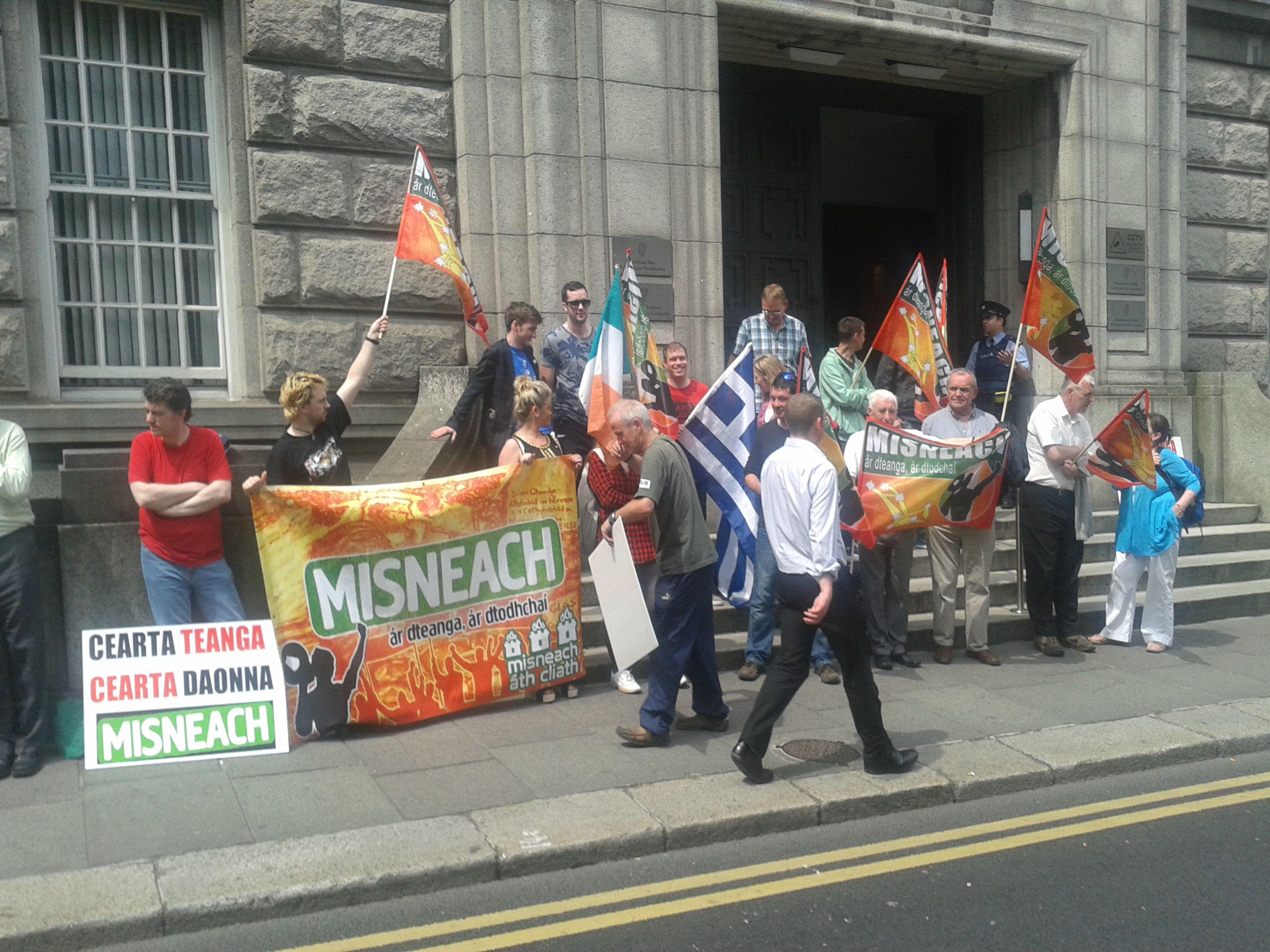
Part of a recent lunchtime demonstration outside the office of the Department responsible for the Gaeltacht. It was called by a new incarnation of Misneach, an organisation active in the mid-1960s. (Photo D. Breatnach)
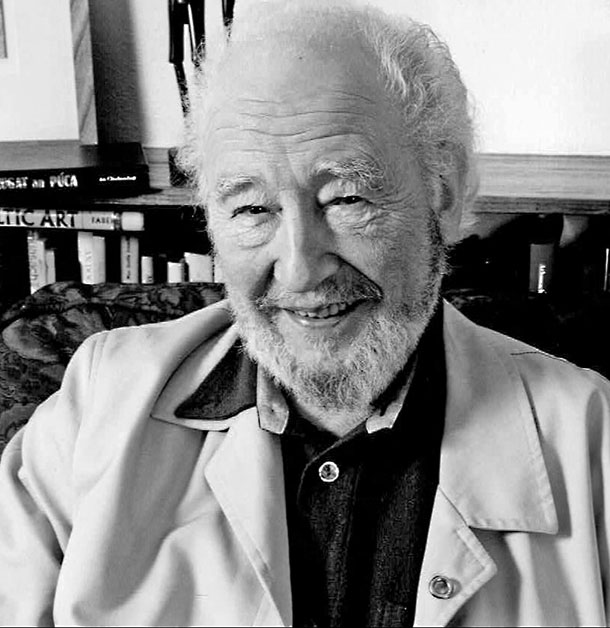
Deasún Breatnach (1921-2007), a founder member of the language-campaigning organisation Misneach, who went to jail in the 1960s to win the right to have his car insurance documentation in Irish or bilingual.
And there are battles that must be fought with the State, with local authorities, with utilities and service providers including private companies. Both logic and history make it clear that this is so. I have already alluded to the civil rights campaign in the Gaeltacht areas and the refusals to pay radio and TV licenses. In the 1960s a Dublin man asked Norwich Union to supply him a bilingual vehicle insurance document or one in Irish. The company declined. The man bought the insurance but refused to display an English-only document on his car. The State’s laws require that every driver display a document showing that they had insurance but no law required a private company to provide that documentation in Irish. The Gardaí regularly stopped the man who explained his stance and they noted his details and allowed him to proceed. For about a year nothing else happened until one day he was summoned to go to court and, despite his explanation and his reference to his right under the Constitution, he was fined. He refused to pay the fine and went to prison. Demonstrations followed with a friend of his playing the bagpipes outside Mountjoy Jail. In less than a fortnight, “an anonymous cleric paid the fine” and subsequently the law was changed. Every vehicle insurance company wishing to practice in Ireland subsequently has to provide Irish documentation or a bilingual version.
Some policies will have to be put in place in the Gaeltacht and closely followed. Policies relating to housing, employment and service delivery will be among them. Some will be welcome and some controversial … but needs must.
The State has already shown by its attitude and by the sad statistics that it does not wish to save Irish as a spoken language. Nor is it only the record of the Gaeltacht decline which speaks volumes. Recently this Government showcased in a video its plan for the centenary commemoration of the 1916 Rising. Among the many criticisms the video attracted was that the Irish in it was of a terrible quality – the Government had employed a translator who had used Google Translate. The video was withdrawn.
Small section of crowd in large “Dearg le Fearg” (Red with Rage) demonstration March 2014 about lack of support for the irish language. (image downloaded from the Internet)
Towards the end of 2013, the Irish Language Commissioner, a public servant, accusing the State of “lip-service” towards Irish and actual obstruction, announced that he would not seek reappointment at the end of his term – an announcement that led to a number of big demonstrations in 2014 under the slogan “Dearg le Fearg” (Red with Rage). In July 2014, the Government appointed a Minister for the Department of Arts, Heritage and Gaeltacht who does not speak Irish – Heather Humphreys. She has, in turn, a Minister of State with specific responsibility for the Gaeltacht, Joe McHugh, appointed in the same month … and, although apparently he is learning it, he does not speak Irish either. And note that responsibility for “Culture” is longer in the same Department as Irish – it has been moved to the much more prestigious Department of Tourism, Culture and Sport.
The State is being challenged from many diverse directions – on issues of services, state finances, centennial commemoration of the fight for independence, conservation, social housing, social welfare, employment and employment rights, health service, gender and sexuality equality, natural resources, Traveller rights, migrant rights … Irish must be seen and heard in these battles and the civil rights of Irish speakers inside and outside the Gaeltacht must also be presented separately, as an issue in itself. These are battles to be fought in campaigns to be planned and time is short. But we can start today, with ourselves. Beatha teanga í a labhairt.
Rebel Breeze: This piece was received months ago but somehow got overlooked for which we apologise. Events since then make the points in this short document perhaps even more relevant.
Red Roja describes itself as “a revolutionary marxist organisation active within the Spanish state”. It states that it is “an autonomous organisation independent of any other party or organisation and also economically and politically independent of the State or of any other power, being anticapitalist, of the class, feminist, radically democratic, internationalist, anti-fascist and ecologist.”
(Translation D.Breatnach from http://redroja.net/index.php/que-es-red-roja/quienes-somos)
In Spain, ‘The people should rule — that would be Dignity’
The following is a statement of the organization Red Network in Spain to the Dignity marches of March 21, a year after a similar march brought 1.5 million people to Madrid to protest austerity measures.
On March 22, 2014, more than a million people from all over the Spanish state
marched in Madrid for ‘Dignity’ against austerity
We once again demand that those who caused the crisis be made to pay for it.
An unpayable debt is crushing us, we who suffer every day from unbearable job insecurity, dismantling and privatization of health and education, increasing retirement age, the disappearance of aid for dependents, and our millions of unemployed people who are worth less than nothing to those in power. … The austerity measures and cuts are only being used to pay for a debt created to rescue the gang of bankers, big business people and their servants in the National Assembly, who are playing chess with our lives. Besides using our suffering to line their pockets, they expect us to hang our heads and die in silence. That we refuse to do.
Regarding this, we are nowhere near satisfied with hearing only about “restructuring” or “audits” of that debt. We cannot stop at half-measures when our lives are at stake, when there can be no doubt that this debt is responsible for the criminal foreclosures, the endless unemployment and for the disappearance of even the modest steps taken against domestic violence that condemns many women to terror, suffering and death. It is not a technical problem to say, “NO DEBT PAYMENT.” It is a punch that the people can throw to demand control of their own lives.
In these times, it is understandable that there are illusions that an election can bring “victory,” that we can “throw out the PP” [the rightist Popular Party] or “get rid of the wealthy strata.” But more is needed. No one involved in the new electoral initiatives is speaking about the national and European laws that impose the payment of that illegitimate and criminal debt before anything else. Good will is not enough; neither is honesty. Proof of this is the victory of Syriza in Greece, which has not pushed back by even one step the measures the Troika [the European Commission, the International Monetary Fund and the European Central Bank] had taken against the Greek people. It has become clear who rules Greece: It’s the EU dictatorship. Democracy is an illusion.
Moreover, even this demonstration, though necessary, is insufficient. It is not enough to come together to demand “Bread, Work and Housing” (things that would only be possible after we refuse to pay the debt), or to have a great demonstration of dignity. As seen in Greece and as we see every day in our streets, bankers and big business are not going to give up lining their pockets out of good will.
We need to unite, to organize neighborhoods, towns, businesses and schools, and strike a blow together, all at one time. Only through the unification of our struggles, only if the people who are working and suffering get organized, can we bring about policies that work in our own favor.
The vote is not enough. The people need to organize. The people need to rule.
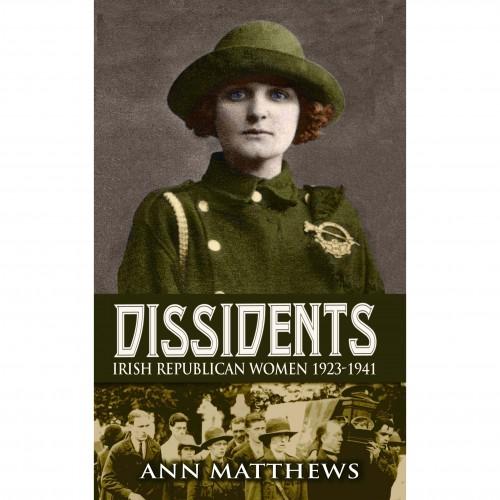
The role of women has been often ignored and undervalued in the body of Irish historical writing. Whatever the reasons for this state of affairs, a tendency in more recent writing has been, at least to a degree, to attempt to rectify this. In the decades since Margaret Ward’s Unmanageable Revolutionaries (Brandon, Ireland, 1983), this rectification has been slowly gathering pace. Dissidents – Irish Republican women 1923-1941, by Anne Matthews (Mercier, 2012), is a contribution to this movement in historical writing; it is essentially the history of an Irish women’s political movement, Cumann na mBan, during the years outlined. A previous work of hers, “Renegades”, deals with Irish Republican women from 1901 to 1922.
Although Dissidents deals with the period 1923-1941, Cumann na mBan was founded on 2nd April 1914 as an auxiliary to the all-male Irish Volunteers’ organisation, which had been founded in 1913. In 1914 the Volunteers split after John Redmond, leader of the Irish Parliamentary Party (in Westminster) and the main open Irish political party in Ireland, committed the Irish Volunteers to fight in the British Army in WW1. The smaller section of the split went on to participate in the 1916 Uprising and more coherently later in the War of Independence (1919-1921). Redmond’s party and “constitutional” Irish nationalism was all but wiped out in the British General Elections of 1918, at which time the whole of Ireland was still under British rule and Redmond’s nationalist opponents, then amalgamated under the name of the reformed Sinn Féin, gained the vast majority of parliamentary seats in Ireland.
Today it is common to define the ideology of both both Cumann na mBan and the Irish Volunteers as “Irish Republican” and, although they quickly became so, and the impulse in the formation of the Volunteers in 1913 was of the secret Republican organisation the IRB (Irish Republican Brotherhood), both organisations at first could be more accurately described as broadly nationalist. Both organisations contained prominently in their midst people whose ideology conformed to that of Irish Republicanism as well as those whose thinking did not, people who expressed a strong interest in equality for women as well as those who were against it, people with at least a sympathy for socialist ideas and those who condemned any such tendencies – and of course variations in between.
In the period specifically chosen by Matthews, 1923-1941, the Irish Volunteers had morphed into the political party Sinn Féin and the armed organisation the IRA (Irish Republican Army) and become Irish Republican in ideology, as had Cumann na mBan. They had in fact been that way since 1919, although the period 1921-’23 was to expose some deep fracture lines which found expression in the Civil War (1922-1923) and later again with the founding of Fianna Fáil and its eventual management of the Irish State (the 26 Counties).
In order to compile her history, Matthews has consulted minutes of committee meetings of Cumann na mBan in its various incarnations (she identifies four periods, or versions of the organisation), personal recollections of participants recorded in writings, interviews, comments quoted by contemporaries, newspaper reports and articles, the Republican movement’s own publications, as well as records of prisons and police under both British and subsequently Free State rule. And she has used some of this material to reproduce and also compile lists such as the numbers and names of women convicted and jailed, the women who went on hunger-strike and the length of time on that protest. The lists also include figures on the decline of Cumann branches between 1934 and 1936, as well as a list of “women in organisations listed as dangerous by the Free State CID in 1934”. These lists are a particularly valuable contribution and will be of great use to many writing on the political movements of the period in Ireland.
Looking at some of those lists alone, one is struck by the sheer extent to which the contribution of women activists to the struggle for Irish independence, and the price they had to pay, has been overlooked. In 1930 twenty-nine women were in organisations listed as “dangerous” by the Free State detective branch of the police – twelve of these were in senior positions of Cumann na mBan, three in directing positions in Saor Éire, three for Comhairle na Poblachta, three also for Sinn Féin, one for the Prisoners’ Defence Organisation, two for Women Prisoners’ Defence League and one for the Anti-Imperialist League. The rest were rank-and-file members of those organisations and one was in Friends of Soviet Russia.
The Free State interned 645 women during the Civil War (as against over16,000 men). In her Introduction, Matthews points out that “There were twenty-four strikes in the three (women’s) prisons during the period from November 1922 to November 1923, in which 219 women took part.” According to the table drawn up by Matthews, one woman was on hunger strike for 35 days, another for 34, seven for 31, many for different amounts of days but the vast majority into double figures. Furthermore, some of them were on hunger strike more than once.
Matthews also provides a list of the occupations of 79 women activists jailed in the North Dublin Union, which were surveyed in August 1923: the highest number for a single occupation were the 19 listed as “at home”, while the next were 11 whose occupations were given as “packer in Jacob’s” (the biscuit factory in Dublin); 10 had been engaged in “printing”; eight were “shop assistants” while 15 were variously listed as “typist” or “clerk”. This list shows quite a variety of social background among what one presumes to be fairly politically-active women which the Free State considered its enemies.
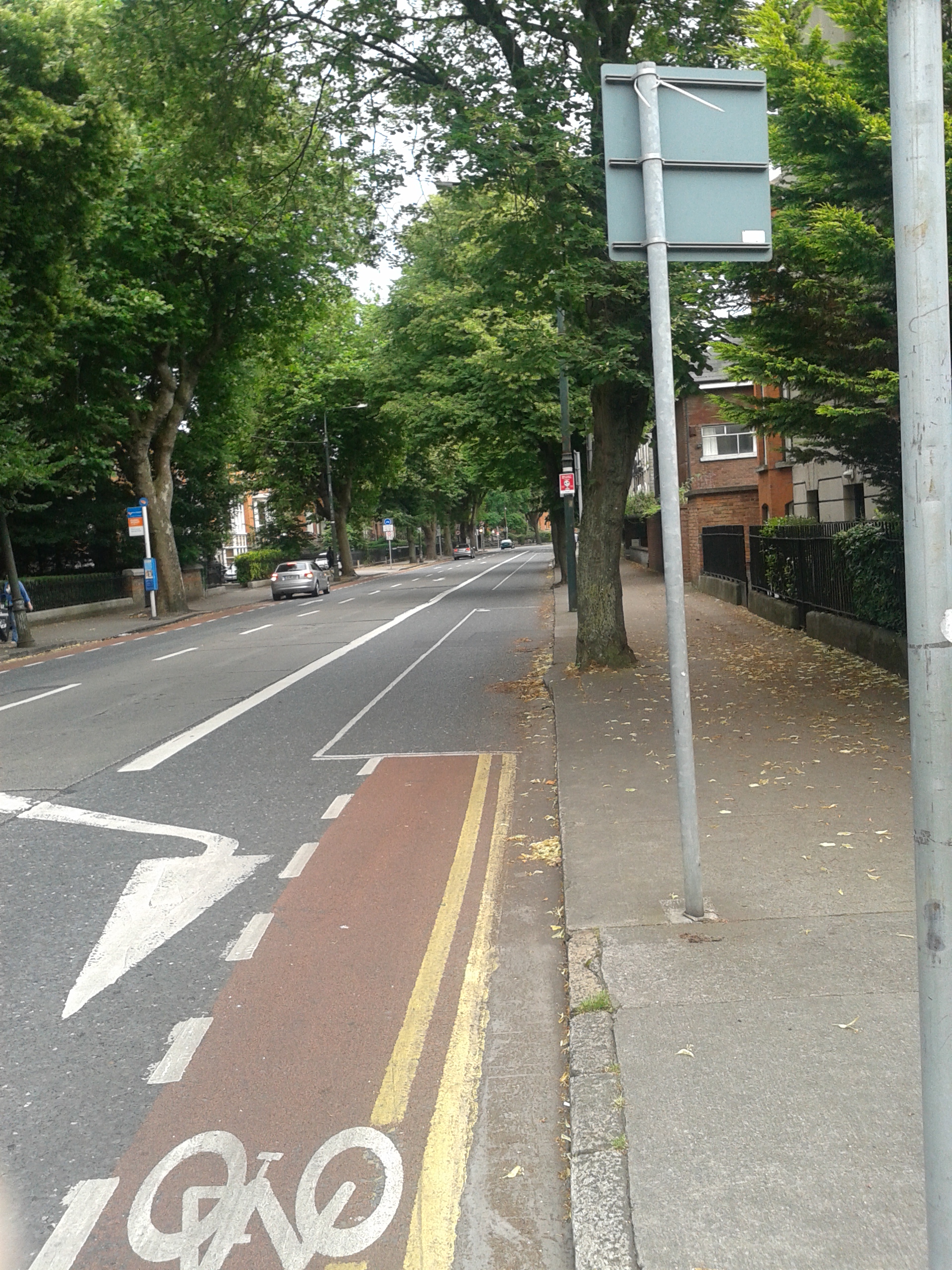
Republican women acting as couriers or delivering weapons made many journeys by bicycle, often at night without lights in order to avoid Free State patrols, “often round trips of up to forty miles” Matthew tells us (p.32).
BIAS
As has been pointed out by a number of commentators, history writing involves a degree of bias. This bias is exercised not only in explicit judgements but in inferences made, choice of phrasing and so on. Choices are made in what sources to use and what prominence to give them as well as in the opposite, which sources to disregard.
If the Fall of Lucifer and his angel followers were a historical event, for example, we would expect Lucifer’s version to be very different from the Judaeo-Christian story with its sympathy for the Archangel Michael (a great example of history being written by the victors). There might be yet other versions, for example by the Seraphim and Cherubim, one of which might be in partial sympathy with the Fallen side and the other which might be against both sides of the conflict.
Whereas in the ancient past history writing was blatantly partial, in the past century historians have generally claimed to be impartial dispassionate observers recording what they discover. But every one of those writers had views influenced by class, ethnicity, gender, position in or out of power groups, status, upbringing and personal experience. And those views influenced their historical judgements, quite likely their choice of sources and possibly their choice of audience. Written records could only be left by literate people and yet for most of history the majority of people have been illiterate. A more recent trend in history writing is to recognise the inevitability of bias and for the historian to declare which is his or hers.
One should beware of historians who don’t declare their bias at the outset. That will not be a problem with Anne Matthews because although she does not formally introduce her bias to her readers, it very soon becomes clear. Or maybe that is not quite accurate, for in order to have a bias against a group one must presumably also have a bias in favour of another. It is difficult indeed in the pages of this book to find any group for which Matthews has any sympathy or, even more important for a historian, empathy.
To express a bias is expected, as I commented earlier. But unless one is engaged in pure propaganda or character assassination (or glorification), one should present the evidence in favour as well as that against and, in weighing one against the other, make a judgement. When Matthews has anything favourable to say about her subjects it seems to be an accident which will soon be remedied a little later – just keep reading!
A particularly clear and nasty example of this bias is in Matthews’ treatment of Constance Markievicz whom she calls a “self-proclaimed heroine” (p.28) but does not tell us when and where Markievicz allegedly “proclaimed” herself to be a “heroine”. Matthews also inferred that Markievicz was a given to warlike statements but a coward who ran away to Scotland. Whatever the reason for her departure in 1922, one wonders how, no matter how much she may dislike the person, someone could call Markievicz, who prominently took up arms and fought for a week against the British Empire, a coward.
In the Matthews view of the organisation, Cumann na mBan was a largely ineffective body, doctrinaire and full of in-fighting. The leadership and many prominent activists were aristocratic or upper middle class, used to the privileges afforded by their class. The working and lower-middle class members accepted the leadership’s decisions or just deserted.
Some of those things may be true and there might even be some truth in all of them — but where is the counter-argument before coming to judge? One doesn’t find it in Matthews, except by an inference that one can make from the lists I mentioned earlier and other information.
If a woman came from a higher social class and was used to having servants do her cleaning, do those facts diminish in the least her courage in facing bullets in insurrection, the threat of the firing squad, the pangs on hunger-strike and the risk of permanent damage to health, the risk of physical beatings and unhealthy prison conditions? Or on the contrary, in some ways, are those risks and sacrifices not all the more remarkable for one from such a background as that? And if an upper-class mother can pay a nanny to look after her children while she herself in in jail, does that take away from her courage and fortitude? A working-class mother without those resources (though she might be able to avail of extended family) of course has even more obstacles to surmount and deserves our greater praise but that is no reason to disparage the sacrifice or commitment of a woman of a higher class.
And if infighting and bad policy choices were a significant feature of the organisation, were there not others to weigh against them on the scales of judgement? What of transporting, hiding and distributing weapons? Of carrying secret correspondence and intelligence? Or of continuing to feed the flame of resistance while men were in prison, organising pickets and demonstrations, outside jails etc? What of creating the enduring 1916 emblem and Republican commemoration emblem, the Easter Lilly? Or of organising Republican commemorations year after year, as well as funerals of fighters in the midst of repression? Or the work of supporting prisoners and their dependents? Matthews records these and often the difficulties entailed but without a word of approval to balance the censorious words used in her criticisms. Nor do we see an attempt to understand the choices these women made or the constraints upon them, much less see anything to admire; we are shown few lessons to learn from, unless it is something like “don’t be these people or anything like them”.
In Dissidents, Anne Matthews has made a contribution to the story of Republican women but its judgement is clearly skewed and the work suffers as a result. Matthews could have recorded all the negative information that she did but also the points to throw in the balance – had she done so, her book would have been a much better return on her investment in historical research and writing as well as a better reward for the reader.
99 YEARS AGO ON 26th APRIL, THE BLOODIEST BATTLE OF THE EASTER RISING WAS FOUGHT IN A DUBLIN SUBURB
At a little past 6amon 26th April 1916, the SS Tynwald and SS Patriotic, two British troop-ships, had berthed in Dun Laoghaire harbour. The harbour and town had been renamed Kingstown by Unionist elements when King George IV came to visit the new port under construction in 1821. Although the town returned to its former name in 1920, it was known as “Kingstown” by most people in 1916, whatever their allegiance.
The troopships had been requested by General Maxwell, who had been given the responsibility for suppression of the Easter Rising, which was now in its third day. Several British thousand troops from the 59th Midland division began to disembark on a bright sunny morning. Hundreds of civilians went down to see them despite the early hour. Many in that town, especially around the seafront and some of the big houses, would have been sympathetic to the British – but by no means all and no doubt some eyes were noting the arrivals in order to report to the insurgents.
Around 9am, disembarkation completed, the soldiers were formed up and inspected, equipment checked and the Sherwood Foresters set off marching towards Dublin city centre, seven miles away, to be followed by Nottingham and Derby regiments around 10.30hrs. Their forces appear to have split up, with two Battalions marching to the city along the coast road and another two heading inland.
To reach the city centre from Dun Laoghaire, the most direct route is to proceed northward along the coast to Mount Merrion. Once there, the coast road goes through the railway level crossing to the right and continues along the seafront, into Ringsend and then along what is now Pearse Street to Trinity College. The British officers did not lead their men in that direction, perhaps because they had received intelligence of the Boland’s Mill strongpoint along their route. There would be no going past that without first taking it, which might prove a lengthy and difficult battle.
But one could avoid that by not turning right at Mount Merrion and instead continuing on what has become the main road, through Ballsbridge and Northumberland Road, across the Grand Union Canal at Mount Street Bridge, past the fashionable Merrion Square and into Nasseau Street and the city centre. That seemed the obvious choice, not just because of the Jacob’s garrison but also because at Mount Street Bridge was located Beggars’ Bush Barracks, one of the many such of the British Army in Dublin city.
Northumberland Road looking southwards. The Irish insurgents first saw the British troops coming up this road. The Parochial Hall and Schoolhouse are to the left but out of the photo. The canal is behind the photographer. (Photo D.Breatnach)
Before the British troops arrived in the area, a female courier, probably Cumann na mBan, had brought news of the troops landed in Dún Laoghaire and that they were heading towards them to the insurgents waiting in the Mount Street Bridge area.
At around noon a burst of fire hit the forward sections of the British troops marching in from Dun Laoghaire. When fired upon, in order to find effective cover, it is important to know from where the firing is coming but the soldiers were unsure. No. 25 Northumberland Road, a house at the junction with Haddington Road, seemed to some to be the source of the firing but by how many was unknown.
Screams from wounded men filled the air in the quiet suburban upper-middle class and largely Loyalist residential street.
Soldiers began to maneouver to outflank No.25 Northumberland Road and a detachment reached Baggot Street Bridge, further west, which was apparently undefended. From there it is a straight road into Stephens Green and the southside city centre. The rest of the soldiers were not led by their officers in that direction, a decision which was to cost them dearly. Instead, shortly after being fired upon, at least two British platoonsattacked 25 Northumberland Road but were driven back in disarray by fire from the building’s upper floors; yet as they turned they were also shot down in droves.
Perhaps under cover of that assault, at around 1pm some of the 2/7th Battalion Sherwood Foresters got past the corner house and made their way on to Percy Place, which runs along the south side of the canal between Mount Street and Baggot Street bridges. Now they came under fire from in front and from their left. They huddled for cover along the Canal.
The fire from the left of the British at this point was coming at long distance from the towers of Jacob’s Factory in Bishop Street, one of the insurgent strongpoints. A defensive line with insufficient mobilised insurgent numbers to hold it for very long stretched from Jacob’s down to the railway connecting Dublin and Dun Laoghaire and to Boland’s Mill beside it, overlooking the south bank of the Liffey. Roughly in the middle of this chain or defensive line were the Irish Volunteers in the Mount Street Bridge area, an outpost of the Boland’s Mill garrison. The total strength of the insurgent force defending that area had been 17 Volunteers but two had been sent home, being thought too young.
New Clanwilliam House, Mount Street, north side of the Royal Canal, looking eastward. The Bridge and Canal are to the right but out of shot. (Photo D.Breatnach)The Schoolhouse, Northumberland Road, today (a snack-cafe nowadays). The Bridge is to the right; the British troops were advancing along the road from the right.
Incredible as it seemed to the British when they learned of it later, there were only two Volunteers in No.25 Northumberland Road: 27 year-old Volunteer Lieutenant Michael Malone, a carpenter by trade,and Section Commander James Grace. In the Schoolhouse on the right-hand side just before the Bridge, there were two Volunteers. Next to that building was the Parochial Hall,held by four men: P.J. Doyle in command, Joe Clarke, William Christian and J. McGrath.Clanwilliam House, across the canal on the right-hand corner with the junction with Mount Street Lower, was occupied by seven Volunteers; the frontal fire hitting the British wascoming from there.
The British were scattered around gardens and behind the granite steps leading up the to front doors of the elegant houses in the street. Their officers called them out and they launched an attack on the Schoolhouse in Northumberland Road. As they charged up the road they came under fire from across the Canal from Clanwilliam House; about a dozen reached the Schoolhouse but they left many bodies behind. And they were still coming under fire from across the Canal too.
The officers now attempted to outflank Mount Street Bridge and Northumberland Road by advancing along Shelbourne Road to the east but were stopped as they came under fire from Volunteers along the railway line and from positions in and around Horan’s Shop nearby.
The column advancing from Dun Laoghaire had set up a temporary HQ in Ballsbridge Town Hall. Incredibly, the officers there, receiving regular dispatches reporting their troops being slaughtered around Mount Street Bridge and, presumably, knowing that other troops had found Baggot Street Bridge undefended, continued to press for an advance across the killing field.
But at least the officers on the battlefield for the time being seem to have had enough of death-or-glory charges, which were bringing plenty of death and no glory. The soldiers are now crawling along the road but whenever any are visible, which is often, they are being fired at. Clanwilliam House is wreathed in smoke.
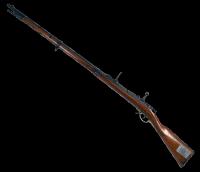
The Mauser Mark 71
The weapon the Volunteers were using was almost certainly the Mauser Model 71, the weapon of most Volunteers and Irish Citizen Army during the Rising; 1,500 had been been delivered in two landings in July 1914, first at Howth, north Dublin and then at Kilcoole, Wicklow. It had been the first cartridge rifle adopted by the Prussian Army in 1872 which by 1914had gone on to another more advanced model, presumably the reason that the rifle was being sold cheaply. The Model 71 fired a larger bullet than the British Army standard-issue Lee Enfield .303 but did not have a magazine, each cartridge having to be ejected and anew one inserted before firing again; its rate of fire was only four or five rounds a minute. The Lee Enfield took a ten-bullet magazine and the British Army were trained to fire fifteen rounds a minute. Despite this, the occupants in Clanwillian House and in No.25 in particular were able to lay down a tremendous rate of fire. Their guns grew so hot they burned to the touch and they had to cool them with wet rags. Down below, British officers blew their whistles and soldiers carried out more charges, only to be cut down by the Volunteers’ rifle fire.
During the late afternoon, a nurse ran on to the road and began treating the wounded British soldiers. The Volunteers agreed to a ceasefire as doctors and nurses from Sir Patrick Dunne’s hospital nearby went into Northumberland Road. But after a while the British attempted to use the ceasefire to advance their positions and the Volunteers ended it. Those wounded still to be tended lay where they were. This had been very different situation to what was to be seen in other areas of Dublin during the Rising, when British troops refused to allow wounded to be taken out unless the insurgents surrendered and when they accused Nurse Elizabeth Farrell of being a spy and tore her Red Cross bib–front off her.
The British got a machine gun up to the bell-tower of the church on Haddington Road so that they could fire over the roofs of the houses at Clanwilliam House, the bullets knocking chips off the outer walls and zipping through windows. They were also being backed by rifle snipers.
British soldiers recommenced attacking No.25, now with hand grenades as well as rifle fire. Finally they got close enough to blow the door in with explosives but incredibly were fired upon from inside as they tried to gain entry, injuring a number of them. Theyhurled grenades in and after they exploded, dashed in again. Coming down the stairs to meet them was Volunteer Lieutenant Michael Malone, his pipe in his mouth and was shot dead.
Section Commander James Grace had been downstairsusing a cooker as cover from bullets and shrapnel and such was the bomb damage to the room that the British assumed anyone in there had to be dead. There was still plenty of fighting to do – they had not even crossed the Canal yet.
If they believed that two men alone had held out against repeated assaults for four hours and had inflicted such damage upon them, they must have been very fearful leaving No.25. But perhaps they thought there had been others who must have escaped in the last minutes. James Grace did escape to get out of the area after lying low for some hours; however he was arrested some days later.
With No.25 taken, the Sherwood Foresters are soon able to take the Parochial Hall but they find it empty.The garrison of four Volunteers had run out of rifle ammunition and evacuated into Percy Place, where British troops, who were now all around the area, captured them.
An officer takes Volunteer Joe Clarke‘s loaded pistol off him, puts him with his back to a door and fires at him. Missing Joe, the bullet goes through the door to where a doctor is attending to injured British soldiers. He storms out in rage, berating the officer and Joe Clarke’s life is saved (he continued active in the IRA and in Republican politics nearly until his death in 1976 at the age of 94).
British soldiers are occupying nearby houses for cover and for firing positions and they are also crouched behind the low wall along Percy Place. They are still being hit. Now, they attack the Schoolhouse from its front, running across enfilading fire from Clanwilliam House to their left as they attack and from other positions to their front. When they enter, they find the Schoolhouse unoccupied by any Volunteer, alive or dead. However, their storm of bullets during the attack has riddled the bodies of its caretaker and his wife.
The cost to the British has been enormous but they have at last taken the southern side of the Canal around Mount Street Bridge. Across it, waiting for them, is Clanwilliam House. And to the east, their right-hand side, snipers at Boland’s Mill and nearby positions are also firing at them.
Now the officers order forward their reserves who had been sheltering in St Mary’s Road. The soldiers charge for the Bridge, answering to their discipline and their officers as they and many like them will do across the WWI battlefields of Europe, Greece, Turkey and Russia for another three years. It is partly against this slaughter that James Connolly led the men and women of the Irish Citizen Army out this week. One of the ICA’s detachments is not far away, under the command of Michael Malin and Constance Markievicz, in the College of Surgeons on the side of Stephens Green and they have already taken casualties.
Despite the covering fire from the Vickers Machine Gun firing incendiary bullets from St Mary’s Church, this charge too is driven back, their casualties adding to the pile of khaki-clad bodies and wounded on Northumberland Road, the Canal banks and the Bridge.
Around 8pm,the British are finally across Mount Street Bridge. An officer was in the charge, one of their few unwounded, and is at Clanwilliam House’s outer walls. Firing continues from the windows of this last insurgent bastion and from the east, a hail of Mauser death is still hitting the Bridge and the northern side of the Canal.
The British are now close enough to throwgrenades but one, thrown by a British NCO, bounced back from a second floor window and exploded next to his head, killing him. The British begin to make their way into the now-burning Clanwilliam House but are forced to retreat by the flames, leaving the fire to consume the bodies of the presumed dead Volunteers inside. They will not know now how many there were. In fact,there were only seven Volunteers, three are dead and the remaining four have escaped out the back.
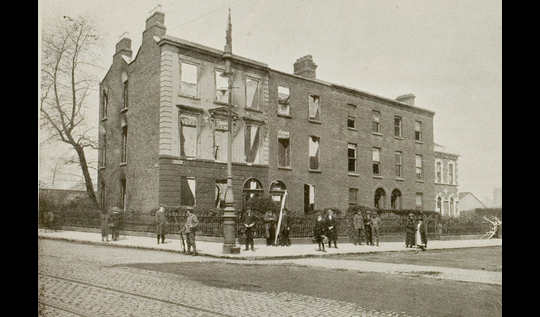
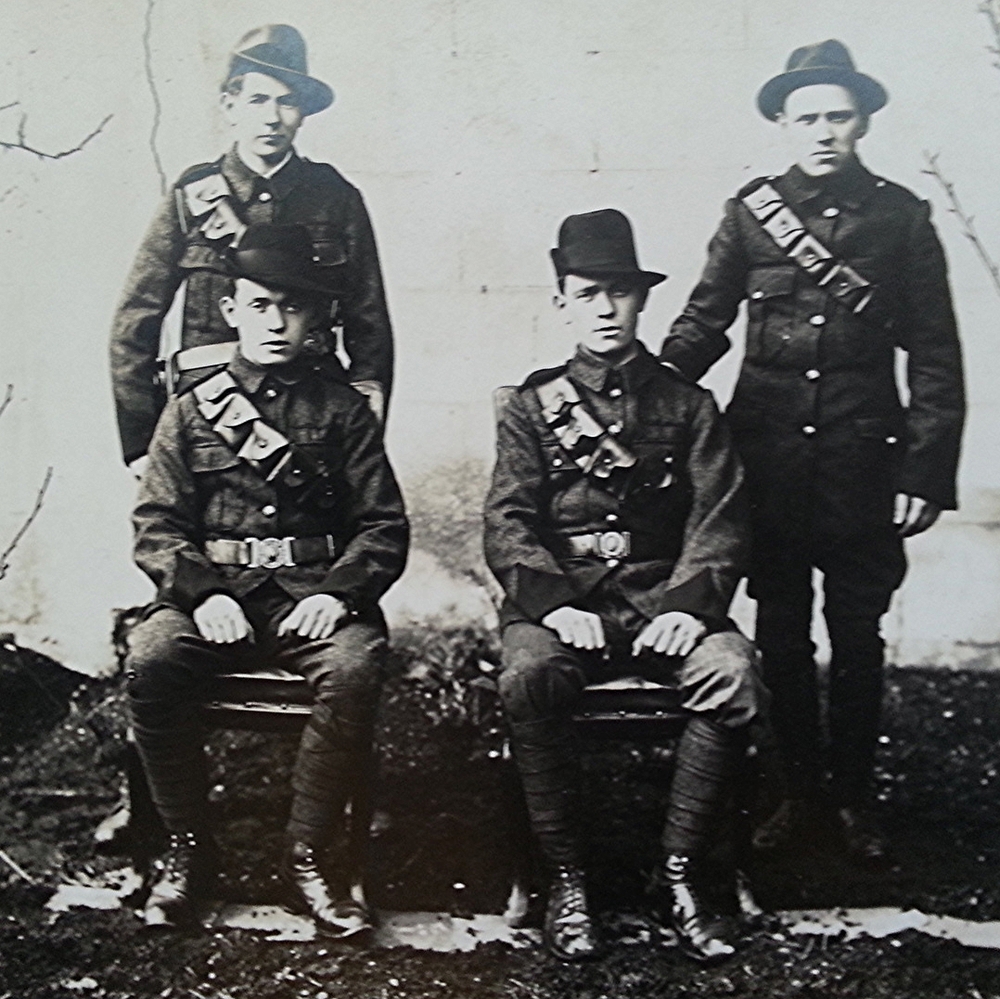
Clanwilliam House after the RisingThe four survivors of the Clanwilliam House garrison.
Ninety-nine years ago in the Battle of Mount Street Bridge, despite having only single-shot rifles and some pistols, the Volunteers held off two British Battalions, numbering approximately1,600 between them, for five hours. Approximately 234 men (including 18 officers)of the British Army had become casualties at the hands of fifteen insurgents.
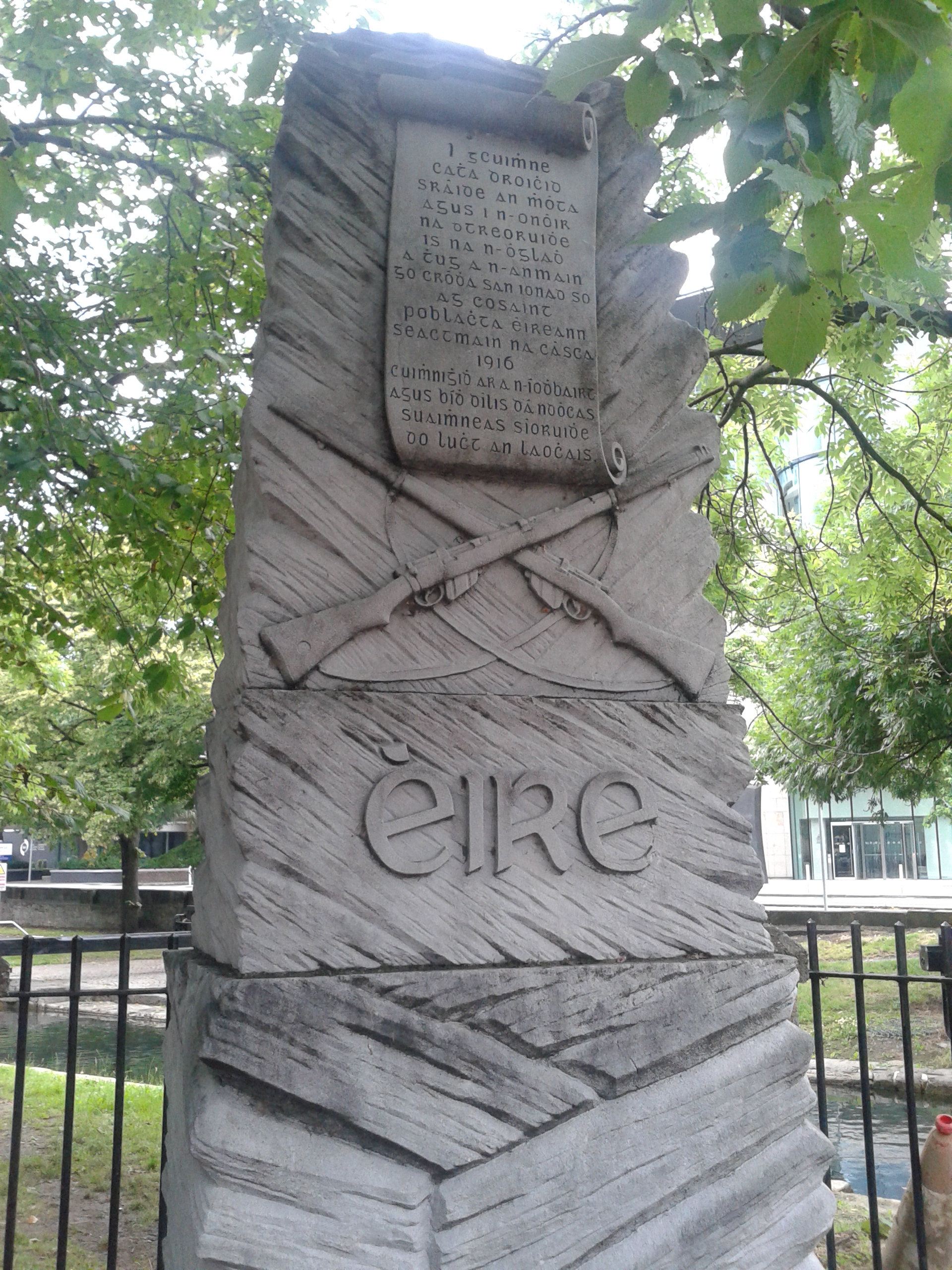
Mount Street Battle Monument on the BridgePart of the memorial on the south side of the canal. (Photo D.Breatnach)
INIGO CABACAS KILLED BY RUBBER BULLET FIRED BY BASQUE POLICE IN 2012 — STILL NO JUSTICE FOR FAMILY OR FRIENDS
Diarmuid Breatnach
Most Basques and especially supporters of their most popular football team, Athletic Bilbao1, were very happy in the early evening of 5th April 2012 .
Inigo Cabacas, photographed with the Basque hermitage Gaztalugatxe, on the Biscay coast, in the background.
Their team had beaten a football giant in the UEFA cup twice and another premier European team once. The fans were expecting Athletic to win or at least draw again that evening, in which case Athletic Bilbao were through to the second leg of the quarter-finals. They had no idea that the evening would end with a police riot squad firing rubber bullets into a festive crowd, causing the death of a young fan.
The high expectations of that evening in Bilbao were the result of a run of wins for the Athletic team. On March 8th 2012, Athletic Bilbao beat Manchester United 3-2 on their own ground, at Old Trafford.
One needs to know a few population statistics to understand what an achievement that was. Manchester United is a football team on the world stage, based in a city with a population of 2.55 million – that is not far from the population figure for the entire Basque Country. In addition, Manchester United’s players are drawn from around the world; Athletic recruits only Basque players from a total population of the Basque Country of less than 3 million.
A week after their win in the northern England city, on March 13th, Athletic faced Manchester United again, this time on the Basque team’s home ground, San Mames, in Bilbao. Manchester Utd. were beaten 2-1 and it seemed that the Basque lions2 were unstoppable.
These wins created a huge interest in the next game, which was with FC Schalke 04 on March 29th at the German team’s home ground. Schalke plays in the top tier of the German football league and have won many championships including one UEFA League. With around 130,000 members, Schalke 04 is the third-largest sports club in the world in terms of membership, behind their compatriot rival FC Bayern Munich and Portuguese club SL Benfica.
Athletic Bilbao is not a sports conglomerate – it is a football club which is owned by its 40,000 members (remember, this is a small country – that’s nearly 1.5% of the whole population! It’s also around 11% of the population of their home base, Bilbao). The management board is elected by the membership.
At Schalke 04’s home ground on March 29th, the Bilbaino team beat them 2-4. The interest was therefore at fever-pitch for Athletic’s return match with the German team at Athletic’s home ground, San Mames on 5th April. The result was a 2-2 draw but Athletic were ahead 6-4 on aggregate and the fans were delighted. Bilbao was, as they say, buzzing.
After matches, young fans especially go to different pubs around town. Inigo Cabacas and many others went to an Herriko Taberna (a “Peoples’ Tavern”, i.e. one managed by the Abertzale [Basque pro-Independence] Left) which is located in an small “square” with planters, connected by alley with Licenciado Poza street. This small “square” is off the María Díaz de Haro street near the stadium; it runs parallell with the San Mames street itself, an area of bars well-known as a destination for fans after a game at the stadium.
The Herriko is too small to accommodate all those who gathered there but that was no problem for the area outside took the overspill. Early in the evening a few people were seen scuffling there and the rest of the crowd around them told them to knock it off, this was a time for celebration, etc. The scuffle ended and the festivities continued.
Some time later, a van load of police arrived. These were the Ertzaintza, a Basque Police force of 7,500 created in 1982 which has had numerous clashes with Basque strike pickets and with the Abertzale (pro-Independence) Left. Supporters of the Abertzale Left and many others refer to the Ertzaintza as “zipayos” (i.e. “sepoys”, local soldiers recruited by colonial occupiers). The Ertzaintza are responsible to the Basque Autonomous Region Government (CAV), a semi-autonomous entity covering three of the four southern Basque provinces.
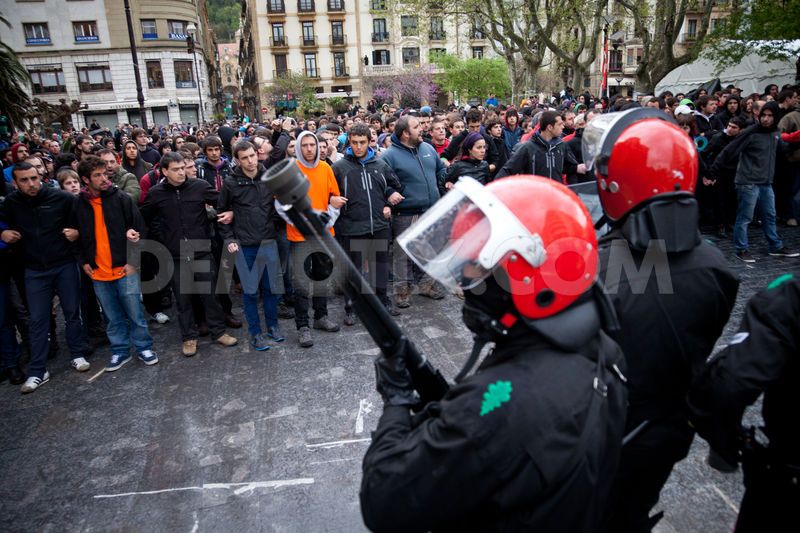
Basque Police, the Ertzaintza, face a youth Solidarity Wall built to defend Basque comrades the police have come to arrest in Donosti/San Sebastian some years ago.
Some of the youth perceive the arrival of the masked and helmeted police as a provocation and begin to throw bottles at the van.
The police officer in charge of those in the van asks for reinforcements and these are sent. The police emerge from their vans and begin to fire rubber bullets3 at the crowd at quite close range (the “square” is less than 45 metres at its furthest from the street) and everyone scatters except for a small group who are throwing bottles at the police but even they eventually dive for cover. People are sheltering in doorways, huddled up against the walls on each side of the “square”. Some are inside the pub wondering what is going on. A local shop-manager has raised the shutter over his doorway and people crowd in there. Some people are sheltering behind the wooden planters that are in a line down the centre of the narrow square.
After some time three young men walk towards the police with their hands in the air, asking them to stop firing rubber bullets; the police strike them with batons. Meanwhile it comes to the attention of some in the crowd nearby that a person is lying on the ground, apparently unconscious with blood coming from his ear and the rear of his head. People go to his aid and one of his friends recognises Inigo Cabacas. He gets his mobile phone and rushes towards the police telling them that someone has been seriously injured and to call an ambulance. A police officer tells him to drop the mobile. Inigo’s friend repeats his urgent request and the police officer tells him again to drop the mobile and hits him with a truncheon. The man drops his mobile and retreats from the police.
The police advance into the area and reach the injured man who has some people around him; a women is rendering first aid. A policeman tells her to move away. She tells him the man needs and ambulance and that she is applying pressure to stop the bleeding. He says he wants to see for himself and pulls at her arm but after awhile desists and goes away.
Eventually an ambulance arrives and takes Inigo Cabacas, still unconscious, to hospital, where he lies in a coma.
(video of the scene of the incident and interviews with friends and witnesses with English subtitles)
The news runs through a city, a shock in the midst of its celebrations and soon afterwards throughout the Basque Country. The first official reaction is given by the Interior Minister of the Basque Autonomous Regional Government, who declares to the press that the Ertzaintza acted properly and in line with their procedures, although he regrets the unfortunate death of they young man. He also repeats the first line of defence given by the Ertzaintza, that they were called to help someone injured in a fight and that the crowd was preventing the ambulance in attendance from rendering assistance to the injured.
When eye-witnesses give their version and the reporters of some newpapers begin to gather information, it becomes clear that the Minister could not possibly have investigated the incident in the time available. Furthermore, it emerges that no ambulance attended until after the incident with the police and that it appears that no call for one had been made earlier. Furthermore, according to the woman who attended to Inigo at the scene, the ambulance paramedic told her, when she complained at their delay in arriving, that the police had delayed their entrance. Under a storm of criticism from civil society and from the Abertzale Left party, EH Bildu, the Minister promises a full investigation.
Inigo Cabacas dies after three days without having recovered consciousness.
Some time later, a recording of the police communications on the night is made available by GARA, a pro-Independence Basque daily newspaper. The following becomes clear from the recording:
The Controller at Ertzaintza HQ calls a police van leader and directs him to attend the Herriko, saying that a fight has occurred there and that someone is injured.
The van leader reports that they have arrived and that some are throwing bottles at them, that they require reinforcements. No mention of ambulance.
The Controller confirms reinforcements are being sent.
Reinforcements arrive. One of the van leaders now reports that nothing is happening, everything is ok.
The Controller replies that he wants the police to go in and take possession of the area and make any arrests necessary. He emphasises that he wants to be understood clearly, that they are to “go into the Herriko with everything we have”, to take control of the area “and then everything will be ok.”
The van leader replies that the order is understood and soon shots are heard (the firing of rubber bullets).
The family employs a solicitor. A judge is appointed to carry out the investigation but is required to do so along with her other duties. Immediately, the police investigation ceases (according to the family’s lawyer, ithe file contains just three pages), using the excuse of the judicial investigation.
A number of legal applications are made, e.g. for all the police at the incident to be obliged to make a statement, for all police who fired a rubber bullet gun to be identified, for the Controller to be obliged to make a statement, but all are refused by a judge, giving a number of reasons4. Little is established over the following three years, except that threepolice voluntarily admit to having fired rubber bullets and the identity of the Controller on the evening becomes widely known. There is widespread outrage when the senior officer on duty the day of Inigo’s death is appointed Chief of the Ertzaintza.At a recent press conference, the Cabacas family’s lawyer, Jone Goirizelaia, announced that they had possibly identified the officer who had fired the fatal shot.
It emerged during the campaign by supporters of the Cabacas family that no recognised procedure was followed by the police with regard to the incident: debriefing statements were not taken from each of the police participants, guns were not examined to identify which had been fired, no inventory was taken of the number of rubber bullets fired. No attempt was made to contact witnesses after the event to gain a picture of what had occurred. Indeed, some witnesses who approached the police station to give statements were told to go away (see video link posted earlier in this article). It further appears that the Ertzaintza have been issued with no specific operational instructions with regard to the firing of rubber bullets.
According to some sources, the rubber bullets should only be fired at knee-height and at no less than 50 metres from the target. The “square” is, according to locals, less than 45 metres at its furthest from the street and therefore the police from the moment they began firing, were in serious breach of the minimum distance requirements. In addition, the Ertzaintza have frequently been seen aiming their rubber bullet guns at protesters’ faces from as little as a metre or two and also firing from the shoulder with the muzzle parallel to the ground, i.e. directed at head or chest-height of the target. Also, the rubber-coated steel balls bounce uncontrollably.
Rubber bullets against Palestinians
Rubber bullets are regularly fired by the Israeli army at Palestinians. A Palestinian source reports: “Israeli professor Michael Krausz and colleagues at the Rambam Medical Centre in Haifa analysed the medical records of 595 casualties admitted to hospital during the October 2000 protests by Palestinians living inside Israel (typically described as “Israeli Arabs” by the media). Of those, 152 were found to have been injured by rubber-coated metal bullets. Injuries were distributed randomly across their bodies but were most common on the patients’ arms and legs, and on their head, neck and face.
“The doctors said their findings dismissed the theory that “rubber bullets” were safe. Rubber-coated metal bullets with some of their rubber coating removed, revealing their hard steel core. Fired at speeds of what must be several hundred feet a second, these are munitions that cause enough damage that their manufacturers feel compelled to describe them as only ‘less lethal’.
“Writing in the Lancet, they said firing the bullets at civilians made it ‘impossible to avoid severe injuries to vulnerable body regions such as the head, neck and upper torso, leading to substantial mortality, morbidity and disability.’ They added: ‘We reported a substantial number of severe injuries and fatalities inflicted by use of rubber bullets ….. This type of ammunition should therefore not be considered a safe method of crowd control. “The study, ‘Blunt and penetrating injuries caused by rubber bullets during the Israeli-Arab conflict in October, 2000: a retrospective study’ (The Lancet, Volume 359, Issue 9320, Page 1795), also highlighted previous research which suggested that even plastic bullets may not be safe and may cause more severe head injuries.” (Sourced at http://electronicintifada.net/content/misleading-terminology-rubber-bullets/4000)
Rubber bullets against the Irish
Seventeen people were killed in the Six Counties (“Northern Ireland”) by rubber and plastic bullets fired by British soldiers (11) and colonial police (6) during the 30 Years War. A number of people were also blinded. http://cain.ulst.ac.uk/issues/violence/rubberplasticbullet.htm
It emerged in 2013 during a compensation case taken by a Derry man blinded in 1972 that the authorities knew that the missiles were potentially lethal even before they issued them. (http://www.theguardian.com/uk/2013/jun/11/mod-rubber-bullets-lethal-records) It is clear also from a wealth of evidence that the missiles were regularly fired by soldiers and police not only at close range but also aimed at chest or head. In addition, a deadly ‘game’ was played by some British soldiers. Knowing that rubber and plastic bullets were collected by children as mementoes and objects to sell to tourists, soldiers would fire some into an open area and wait for children to run forward to collect them, then see if they could hit the children with subsequent rounds.
Rubber bullets in the Spanish state
The Spanish state continues to allow its police forces to carry and to fire rubber-coated metal bullets, in particular at protesting Basques and Catalans (see video link at bottom below article). Recently, the EU expressed concern at Spanish police firing at migrants attempting to swim into the Spanish state from Morocco, an occasion when 11 of the migrants drowned. But no international protest criticises them for firing potentially lethal missiles at their own citizens. Police in the Spanish state enjoy impunity and none more so than in the Basque and Catalan countries as well as with regard to African migrants.This week, a motion was put to the Basque Parliament to ban the use of rubber bullets in the area under its control (CAV). Instead a proposal was accepted to “restrict” the use of the missiles to “situations of grave danger” to the police, and to “definitely seek a replacement” for them. The Spanish right-wing PP, the liberal Spanish unionist UPyD, along with the PNV (Basque Nationalists), currently in power, voted for it, along with the Basque version of the Spanish social-democrats, the PSE. The only party to vote against the amendment was EH Bildu, party of the Abertzale (pro-Independence) Left; they had proposed the original motion, seeking a total ban and the removal of the missiles.
Parent and friends of Inigo Cabacas confront spokesperson of the Basque Nationalist Party after attempt to ban rubber bullets fails
Among those in the public gallery at the discussion were the parents of Inigo Cabacas. Afterwards, in the corridor outside, they confronted the spokesperson of the PNV, Joseba Egibar. During the exchange, another PNV parliamentarian, Luke Uribe-Etxebarria, tried to prevent its filming by the Basque TV station ETB. That attempt will be the subject of a complaint to the President of the Parliament by EH Bildu; they view it as particularly serious since Uribe-Etxebarria is also on the management board of the TV station and the filming was taking place in areas open to the public.
“I’m never coming to this Parliament again …. I feel cheated,” said Manuel Cabacas, father of the deceased, speaking about the majority decision. “My son is dead …. I only wanted to ensure that it would never happen to anyone else ….”
On the third anniversary of the killing of Inigo “Pitu” Cabacas, among many commemorative vents in the Basque Country, 10 minutes’ silence was observed in the San Mames stadium. Alongside Inigo Cabacas; many are also remembering Aitor Zabaleta, fan of the Real Sociedad team, murdered in Madrid in 1998 by fascist ultras of Club Atletico Madrid. Many Basques around the world will be conscious of the three years that have passed since Inigo’s killing without anyone being even charged in connection with his death or any noticeable change, whether in Basque police behaviour, procedure or their use of rubber-coated steel projectiles. A change of political control of the Basque Regional Government from the social-democratice party of Patxi Lopez to the Basque Nationalist Party .(PNV) of Urkullu has had no effect.
It is true that for ordinary people, in capitalist society, the wheels of justice move very slowly; in this case it is hard to see that they are moving at all.
End.
NB:DUBLIN: A group of Basques plan to hold a commemorative event on Tuesday 28th April, on the day of a Basque derby, Bilbao Athletic v. Real Sociedad. They plan to hold a protest picket at the O’Connell Monument in Dublin’s O’Connell Street at 7pm for a short while and afterwards to go to watch the Basque derby (kick-off at 9pm) at the Living Room bar, Cathal Brugha St. Some Dublin-based Irish people have undertaken to support the Basques by participation in both events. Poster for event: https://www.facebook.com/photo.php?fbid=10153291310864390&set=gm.1624681737767253&type=1&theater
Short but shocking Guardian video of Catalan police using rubber bullets and the testimonies of victims who have lost an eye to the missiles:
1 Based in Bilbao, it is the most popular and most successful (two things that often go together) but not the only football team; there are also Real Sociedad, based in Donosti/San Sebastian and Osasuna, based in Iruña/ Pamplona.
2 A roaring lion is the emblem of the team, arising from the legend of St. Mames, to whom the local church is dedicated and which gives its name to the area, street and stadium. English-language football commentators persisted in calling the team “the Spanish lions” or “the Spanish cavaliers” (??!), in total ignorance, one hopes, of quite how insulting that would be perceived by the players and their fans. The Basque Country is not even politico-geographically Spain, it is divided between the Spanish and French states. And Bilbao Athletic is most certainly not, nor has it ever been, a Spanish team. When the Spanish King attends finals or semi-finals between Barcelona and Athletic in, yes, a Spanish football league, and the Spanish national anthem is played, the stadium fills with howls of derision, hoots and whistles from the supporters of both teams.
3 These are about the size of a tennis ball, perhaps a little smaller, of steel and coated in rubber.
4 E.g., the Controller could not be held responsible for the shooting by the police; individual police would have to be accused of firing the fatal shot if they were to be obliged to make a statement …
Viyan Peyman, famous fighter-singer of the YPJ, fell in battle against Islamic State in Serekaniye (Yazira canton) on Monday 6th April 2015, according to news agency Hawar News.
Viyan Peyman, famosa luchadora y cantante del YPJ cayó én lucha contra el Estado Islamico el lunes 6 de Abril 2015, según la agencia de noticias Hawar News (miren enlace al fondo de este corto trozo para las noticias en castellano).
When Eagles Sing
(I ndil chuimhne Viyan Peyman/Gulistan Tali Cingalo)
A bird fell from the sky —
the birdsong now has died.
A songbird but also a fighter —
When eagles sing
our struggle is made lighter.
She flies now in different skies,
skies of our memory,
of our heart, spirt and mind
where her song cannot be silenced
for Kurds or for humankind.
Diarmuid Breatnach April 2013
Viyan’s real name was Gulistan Tali Cingalo (Gulistan means “garden”) and she was from Mako city in the part of Kurdistan located within the Iranian state’s territory.
The song she sings in the video was composed by her; the lyrics say:
“Oh, mother, woe to me!
My heart cries today — what disaster has fallen upon us!
I will sing today of the resistance of Kobane,
that it may be a poem recited for the world and humanity, oh mother!
Today again our Kurdish boys and girls have made their chests into shields
against the tanks and bombs … Oh, mother, woe to me!
Today I imagine the mothers of Kobane crying in the streets;
I imagine the boys, the girls, the elderly screaming in pain and rage.
I see the tears of the children of Kobane as if they were the Euphrates river,