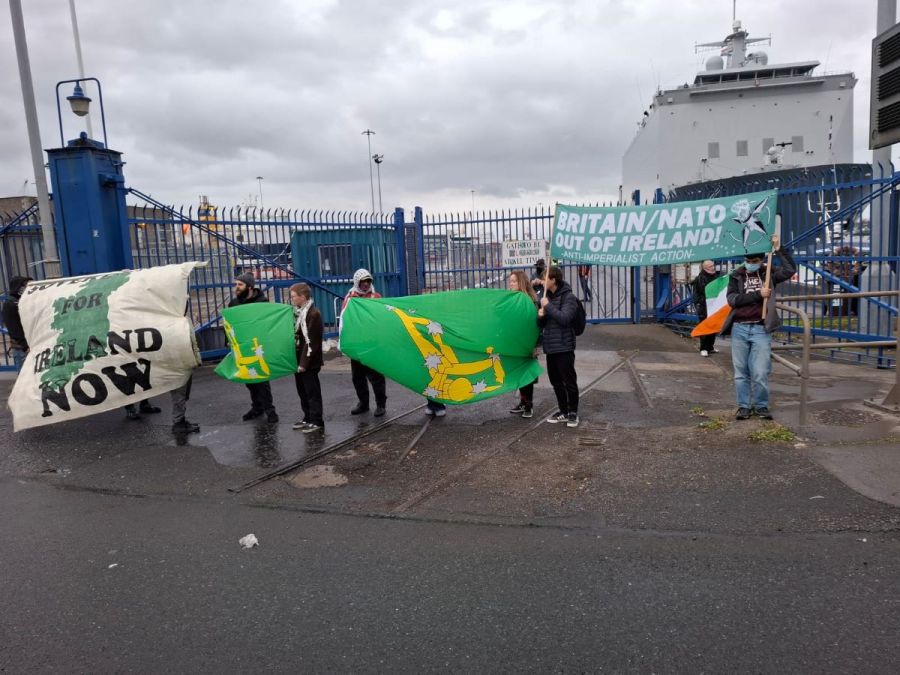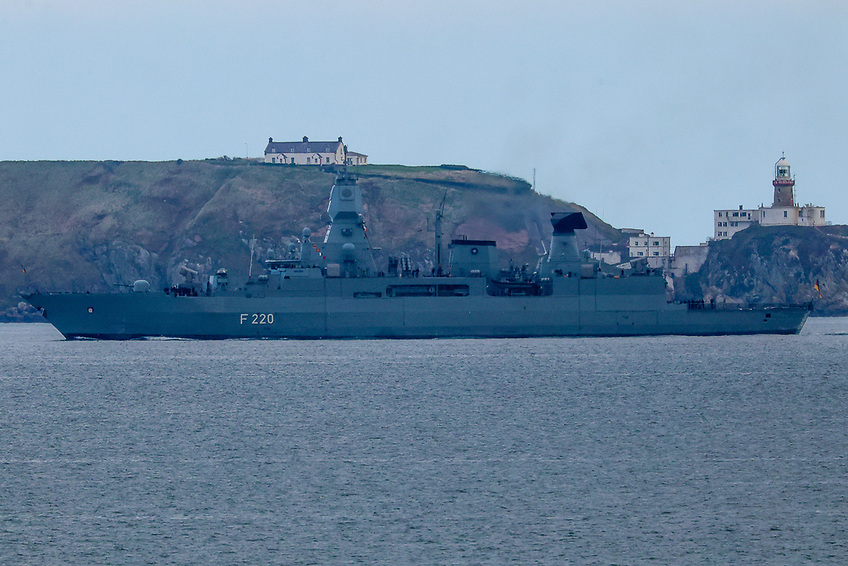
Dutch and German warships docked in Dublin’s Liffey Port were met by anti-NATO protesters late Saturday afternoon with banners, an Irish Tricolour and Starry Plough flags and shouts through a loudhailer with passing traffic beeping in solidarity.
The huge Dutch naval landing platform Johann De Witt was immediately visible on the north Liffey quay just on the seaward side of the Tom Clarke Bridge and the protesters took their stand there in front of the security gates, visible to airport and south and northbound Dublin traffic.
German NATO frigate FGS Hamburg entering Dublin Bay, bound for the Port security gate. (Photo cred: Afloat)
The Dutch ship was flying Holland and NATO flags. Among the slogans the protesters periodically chanted were: No NATO troops in Ireland! NATO, NATO, NATO: Out, out, out! From Belfast to Killarney – We don’t want your NATO Army! NATO imperialism – Out of Ireland!
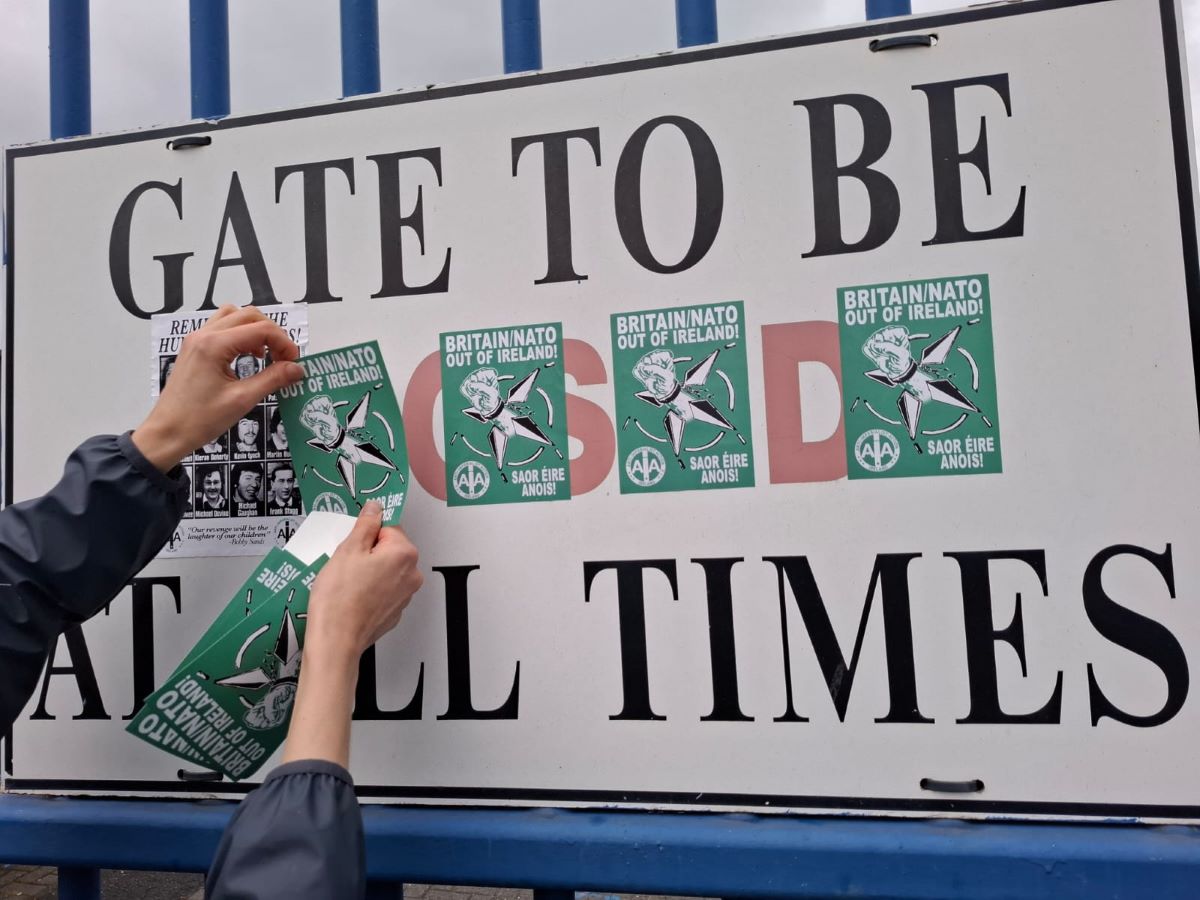
Anti-Nato stickers being affixed to the Dublin Port security gate. (Photo: R.Breeze)
The chants grew louder as military personnel (in street clothes) approached or emerged from the security gates behind the protesters but there was no physical confrontation from either side. No Gardaí attended either, unlike the protest at Ireland’s NATO HQ in April this year.
On that occasion Gardaí pepper-sprayed the peaceful protesters and broke the ankle of one of their number, in addition to arresting them. Some of the arrested were bailed and are due to appear in court in Dublin on 23rd February 2026.
Anti-Nato protesters, the Dutch NATO naval ship clearly visible in background. (Photo: R.Breeze)
NATO was originally claimed to be a western European military defensive force against the Soviet Bloc. However, after the Bloc’s collapse, NATO continued to expand until it has now an additional 17 member states (and the threat of Ukraine joining led to the current war with Russia).
The individual western member states, for example the US, UK, France have been waging imperialist wars for decades. But the NATO military alliance’s forces also fought imperialist wars in a number of countries: Bosnia, Kossovo, Afghanistan and Libya.
Anti-Nato protesters. (Photo: R.Breeze)
The protest on Saturday was organised at very short notice by Action for Palestine Ireland and Anti-Imperialist Action Ireland. Many passing vehicles, both private, company and taxi sounded their horns in support and also gave a thumbs-up or clenched fist salute.
Clearly the protest context was not only a lack of welcome for a member of the western imperialist military alliance but also fears that the Irish ruling class wants to join that alliance too and is currently trying to remove the ‘Triple Lock’ impeding its move in that direction.
End.
Note: If you found this article of interest, why not register with Rebel Breeze for free, so that you will be notified by email of subsequent articles. You can de-register any time you wish.
Anti-Nato protesters on Saturday, the Dutch NATO naval ship clearly visible in background. (Photo: R.Breeze)
No, I’m not being sarcastic – I am quite serious. Thank you for making it clear that you support the Irish State joining the imperialist alliance of NATO.1 I take it that opinion is at least widespread among your social class.
After all you are among the biggest of the native Irish monopoly capitalists, right? Number eight of the eleven richest people in Ireland.2
From the statements and actions of politicians I had assumed your Gombeen neo-colonial class was of that opinion but I suppose there was always a slim chance that the politicians were out on a limb, going it alone, not representing their bosses … but sure now you’ve confirmed it yourself.
I see you’re concerned about the defence of Ireland. That’s really good – so am I. Hold on, you just mean the Irish state – the 26 Counties? Oh, of course, that’s right, the Six Counties are already in NATO. They didn’t get to vote on that, did they? But we will here, of course.
Wait now, didn’t Mícheál Martin say he didn’t believe it would have to be voted on? And isn’t the Government now trying to get rid of the Triple Lock stopping us sending many soldiers anywhere without approval of the government, a majority vote in Leinster House and a UN mandate?3
The Government and majority vote shouldn’t be a problem for you, should it? You’ve got a comfortable majority in Leinster House on abiding by the Western Imperialist stance. Ah you have, Denis, you have – sure isn’t the Irish State the biggest customer of Israel, next to the USA?
Getting a UN mandate might be a bit trickier, especially these days. After all, a lot of UN members have been at the sharp end of NATO, or that of the USA, or UK, or France – which is all pretty much the same thing. The Security Council would work if Russia or China didn’t veto it.
Anyway, back to defending Ireland. We should really discuss what that means. Defending our physical lives and homes? A lot of our homes belong to the banks and vulture funds so I’m thinking maybe THEY should defend them.
Or maybe defending our natural resources and public infrastructures, i.e the ones that our governments for decades have been giving away to native and foreign monopoly capitalists. I think you’ve benefited from a bit of that yourself, Denis. Ah you have, you know you have.
Many of those foreign monopoly capitalists taking over our industry come from NATO countries too, as it happens.
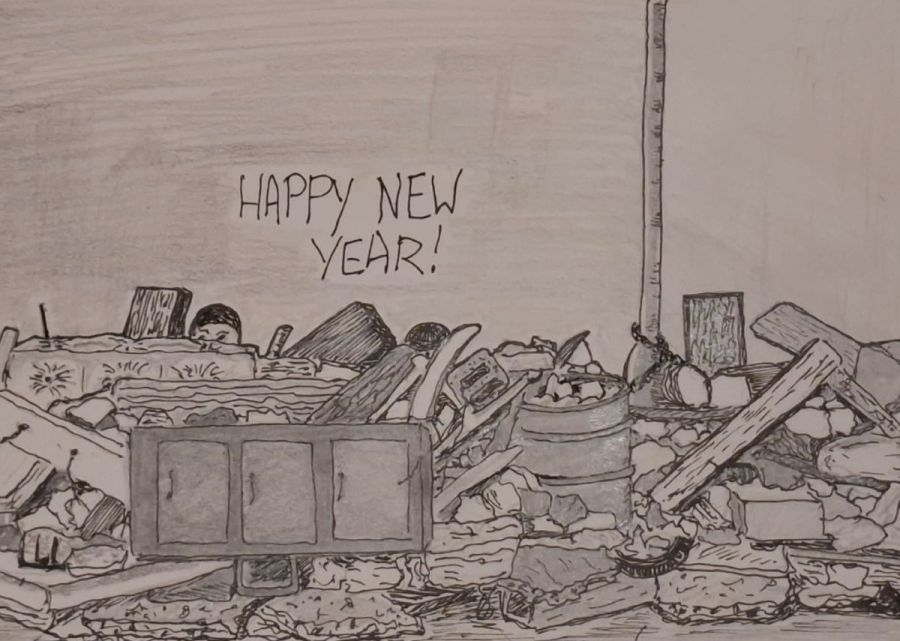
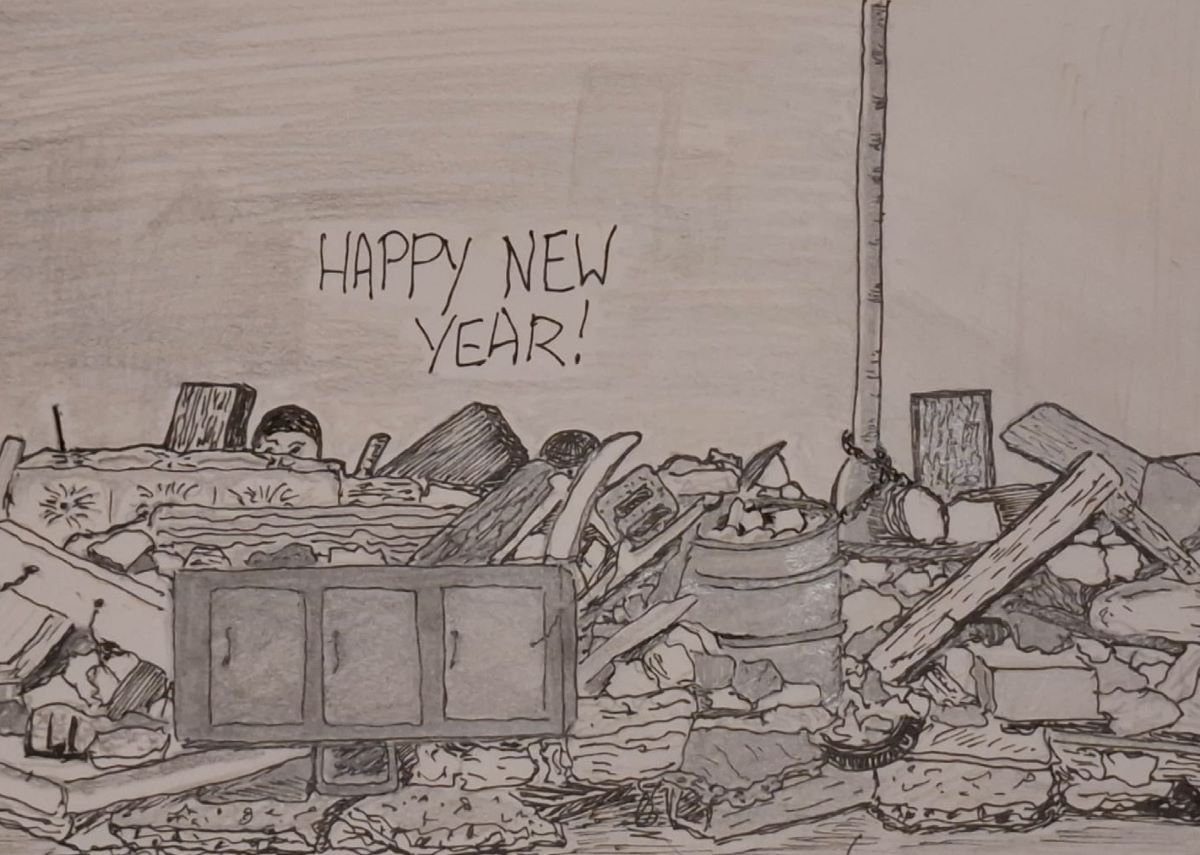
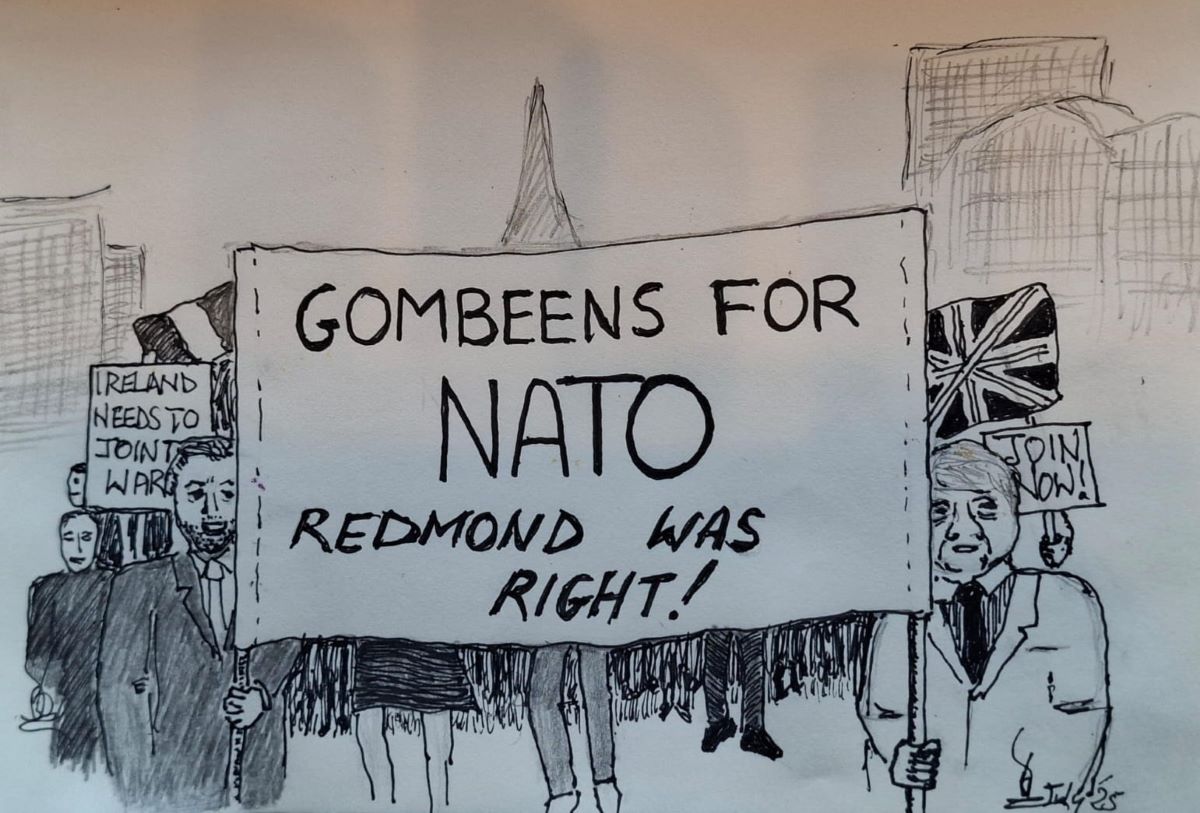
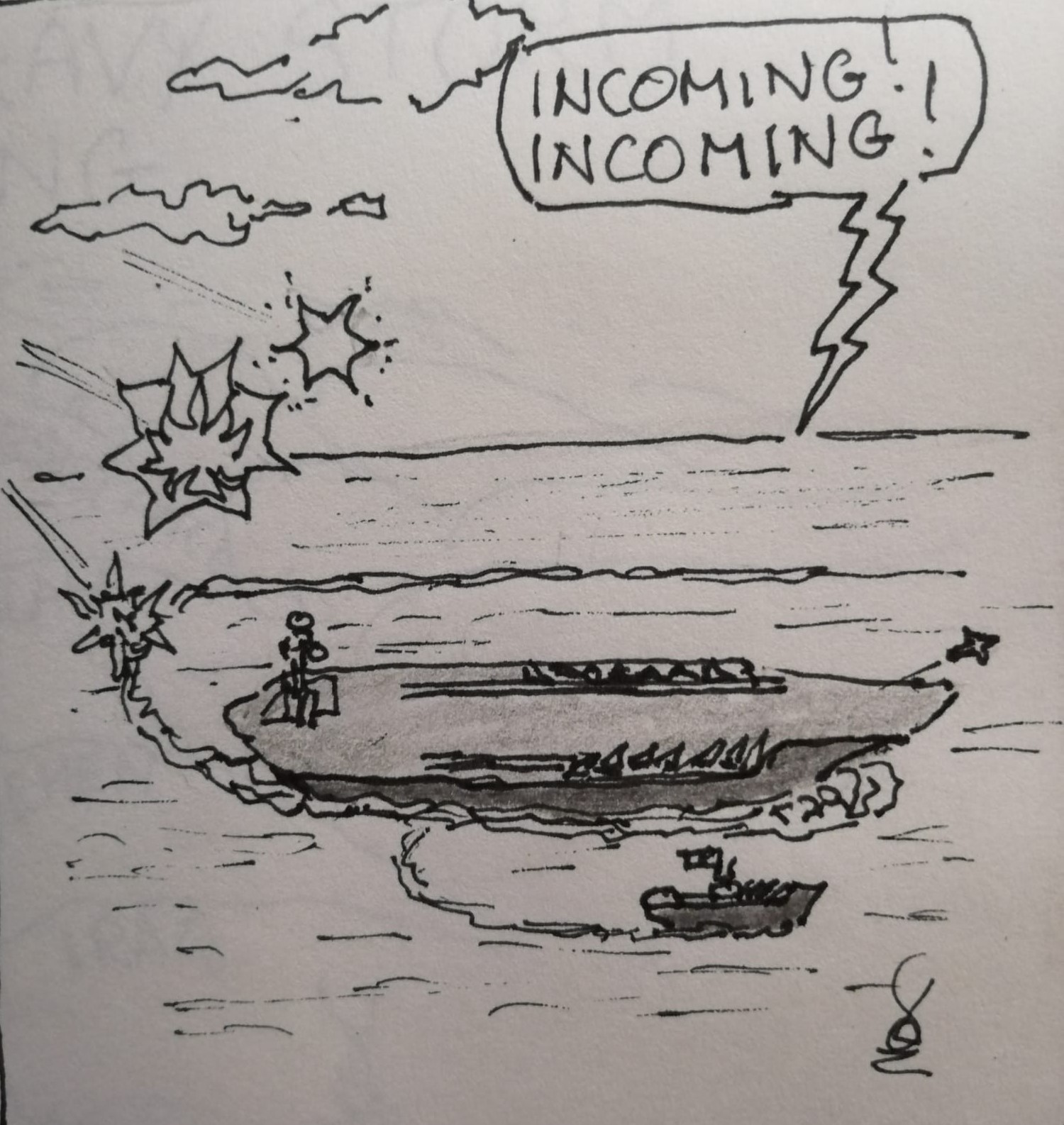
Cartoon by D.Breatnach.
Defending our physical lives? The thing I find hardest to understand, however, Denis, is how you think we’d be safer within NATO, of which the UK is a major part. I mean, since Britain invaded us in 1169 it has caused wars in Ireland, famines, genocide, linguicide, sectarianism and division.
You could say that’s in the past but it’s not, is it though? And they do say that the best predictor of future behaviour is previous behaviour, after all.
I know you’re concerned about the undersea cables. I’m not just worried about the UK in NATO – the top boss of NATO is the USA. And their record is more of sabotaging undersea pipes than protecting cables! I know, I know … no concrete evidence. But who else had motive, opportunity and capability?
Now, you want to see the Irish armed services expanded. But I can’t see why we have to be a part of NATO to do that. And if, as part of NATO, our armed services go to war, will you be ok with your grandchildren Meghan, Catherine, Denis, Michael, Kevin, and Patrick risking being killed?
Of course, I do know that big capitalists generally ensure that it’s the lower classes they send to the battlefield while they guarantee safe positions for their own family. I think you’d want to emulate John Redmond,4 whose son joined the army of a foreign King and Country but didn’t die for it.
Unlike the 35,000 other Irish who were killed in the British Army in WWI, not to mention the Irish wounded and permanently disabled, for which figures apparently do not exist.
However, I have to say, credit where credit is due: I did think the account of your visit to Venezuela was interesting and how the officer in charge of the President’s Office there was impressed by Ireland’s solidarity with Palestine and other stands, probably in support of underdeveloped countries.5
Thanks for that, it was very interesting – and heart-warming, to be honest. But I wonder, would the Venezuelan diplomat have been as friendly to you, Denis, if the Irish State, your point of origin, had been a member of NATO, practising imperialist wars and supporting genocide?
4In 1914 John Redmond was leader of the Irish Parliamentary party, representing the native Irish colonial capitalist class. He not only delivered thousands of Irish to the British Army for WWI but also supported the suppression of the 1916 Rising.
5O’Brien charted his own experience in subsea communications cables, starting with an Esat Telecom funded cable between Land’s End and Wexford in the late 1990s, and several projects in the Carribean, including the $75 million (€64 million) Deep Blue One cable in Trinidad which was completed last year.
O’Brien recalled how – due to a “cock up” – the cable had been designed to run through contested waters between Venezuela and Guyana.
“When the Venezuelan government got wind that our cable laying ship was about to start they sent us a cease and desist letter,” he said. O’Brien explained how he then flew to Venezuela to meet Jorge Elieser Marquez who was in charge of office of the presidency to “fall on his sword” and apologise.
“He graciously accepted my apology but then to my surprise he started to talk about Ireland and how we had supported the Palestinians, like Venezuela, in their quest for a two-state solution in Gaza,” he said.
“For some reason, he knew everything about Ireland and our principled stand over many decades – dating back as far as when Brian Lenihan senior was minister for foreign affairs.
Like many others through much of the genocidal attack on Gaza since October last 2022, I’ve been attending pickets, demonstrations and vigils organised by others. I’ve also written some reports on those events and analyses of the solidarity movement.
But in addition, I’ve been drawing cartoon comments in a sketch book, most unpublished and I thought I would publish a selection here.
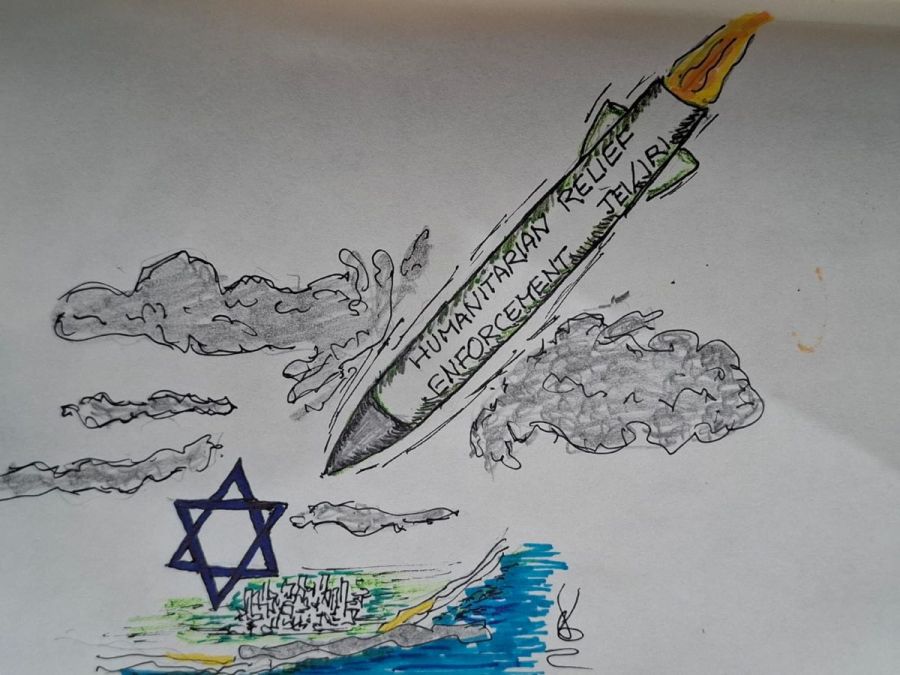
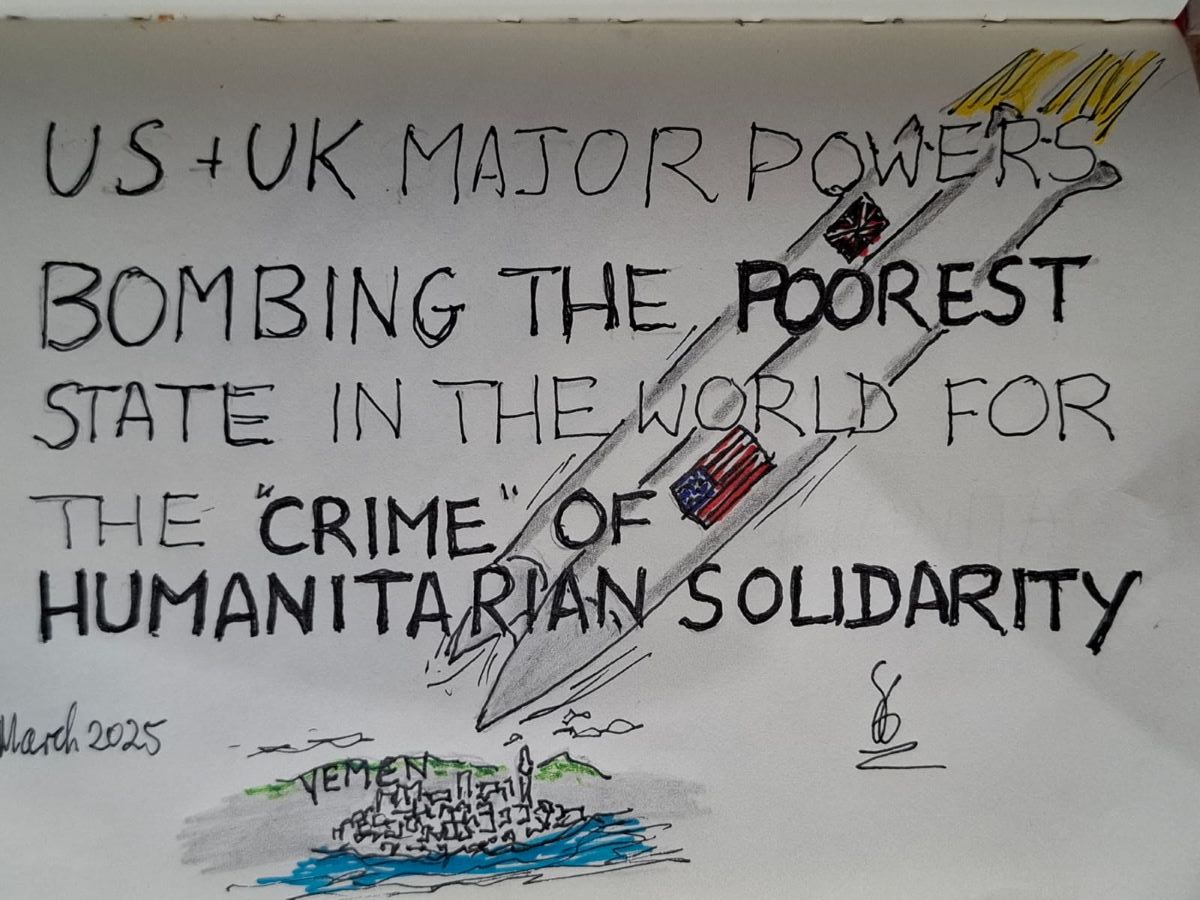
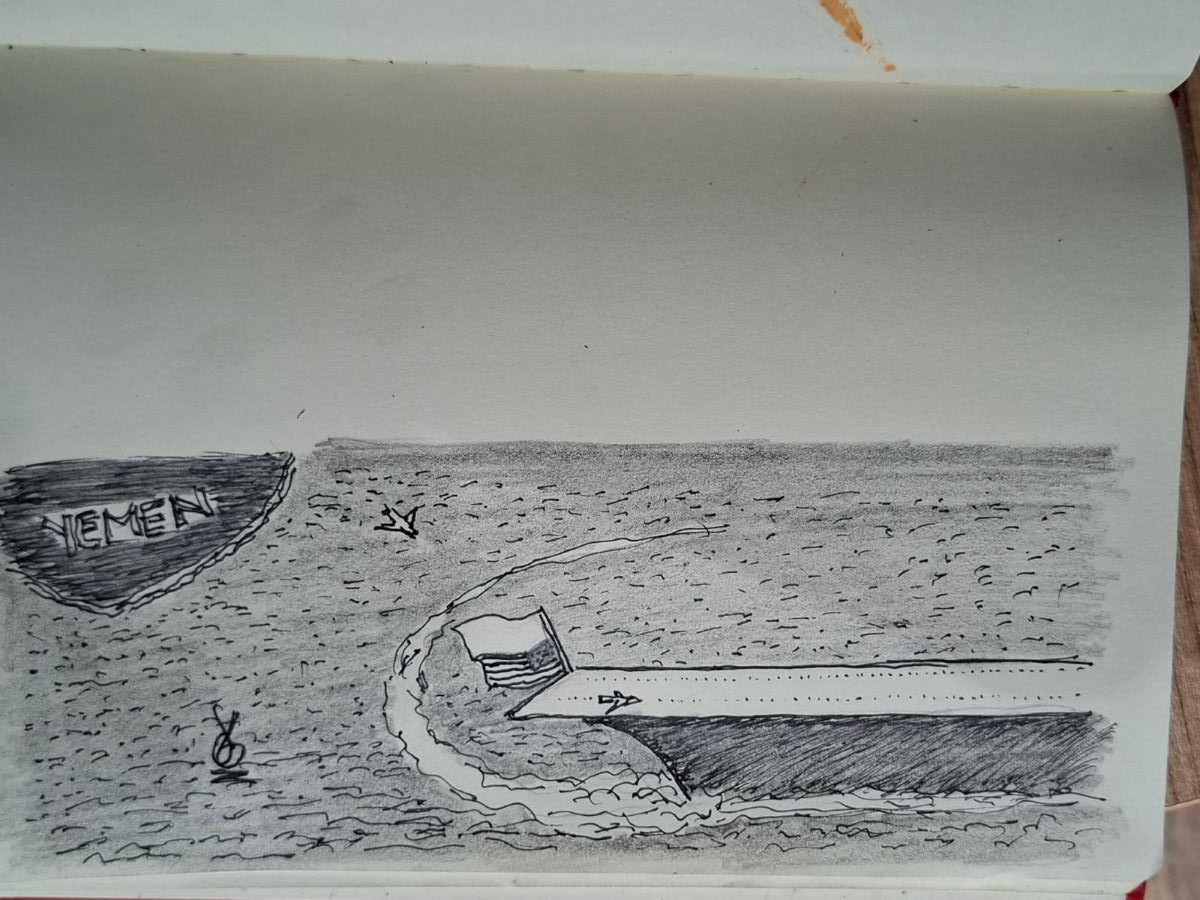
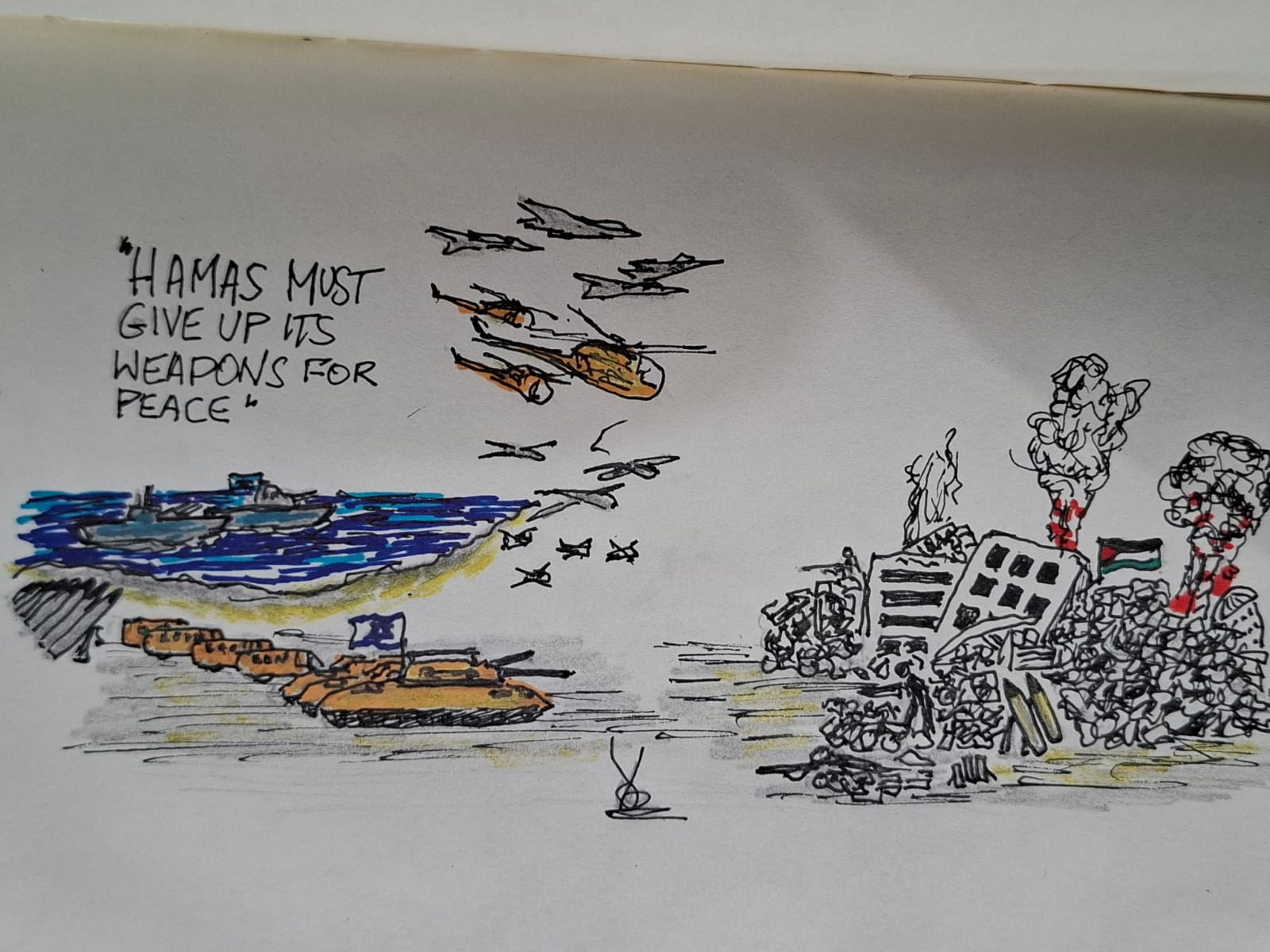
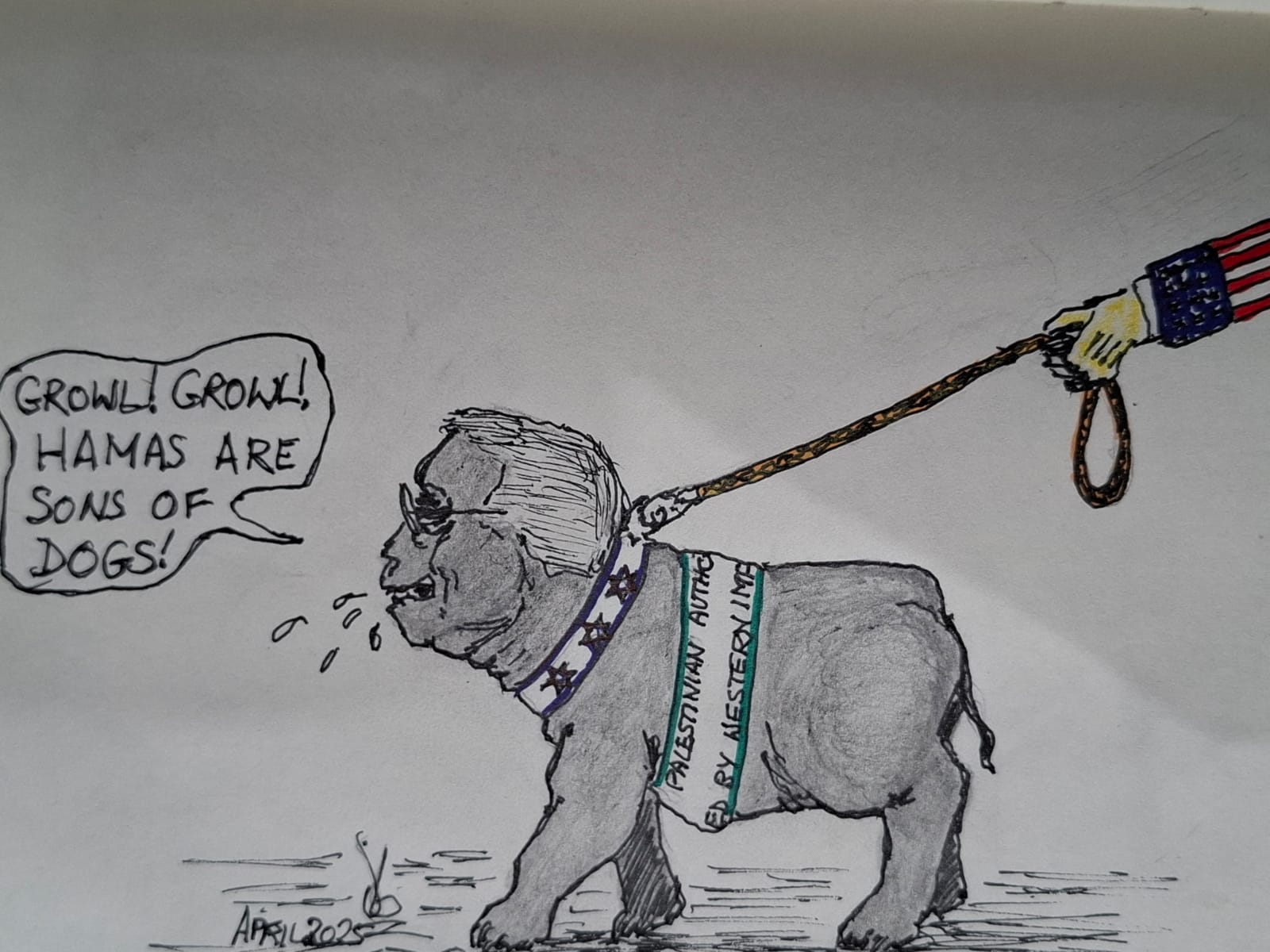
One of the poorest states in the world, Ansarallah is the only one to uphold its duty to prevent genocide, which it does by putting heavy pressure on the Zionist state’s economy through maritime blockade. For this, the UK and USA rain missiles and bombs down upon it. But it does not yield.This one is at least as much placard as it is cartoon but I never got around to making the placard. Ansarallah escalates to attack the ‘Israeli’ state directly, then again in response to Zionist airforce bombing of Yemen.The USA Navy sends two aircraft carriers to assist the genocidal state by attacking Yemen. Ansarallah attacks the US Navy, forcing the retreat first of one aircraft carrier followed by capitulation of the US which offers Ansarallah to end attacks on Yemen if they end attacks on US Navy. The deal makes no provision for defence of the Zionist state and is accepted by Ansarallah.Facing some of the most heavily armed forces in the world but somehow, it’s always the national liberation forces that must disarm. For the sake of peace, of course.The physical war against the Palestinians by the Zionist State was armed by a number of western imperialist states but also ideologically by the whole western media. In the face of real and ongoing genocide the WMM reported propaganda, repeated lies and framed its reports in the Zionists’ terms of reference – while courageous journalists reporting from the actual killing grounds were picked off by the IOF.The western imperialists promote the two-states solution (sic) and a Palestine colony of Israel as a ‘Palestinian State’. This would be run by Zionist proxies such as the Palestinian Authority with its Fatah boss, Mahmoud Abbas, who recently publicly insulted the national resistance fighters of Hamas, calling them ‘sons of dogs’.
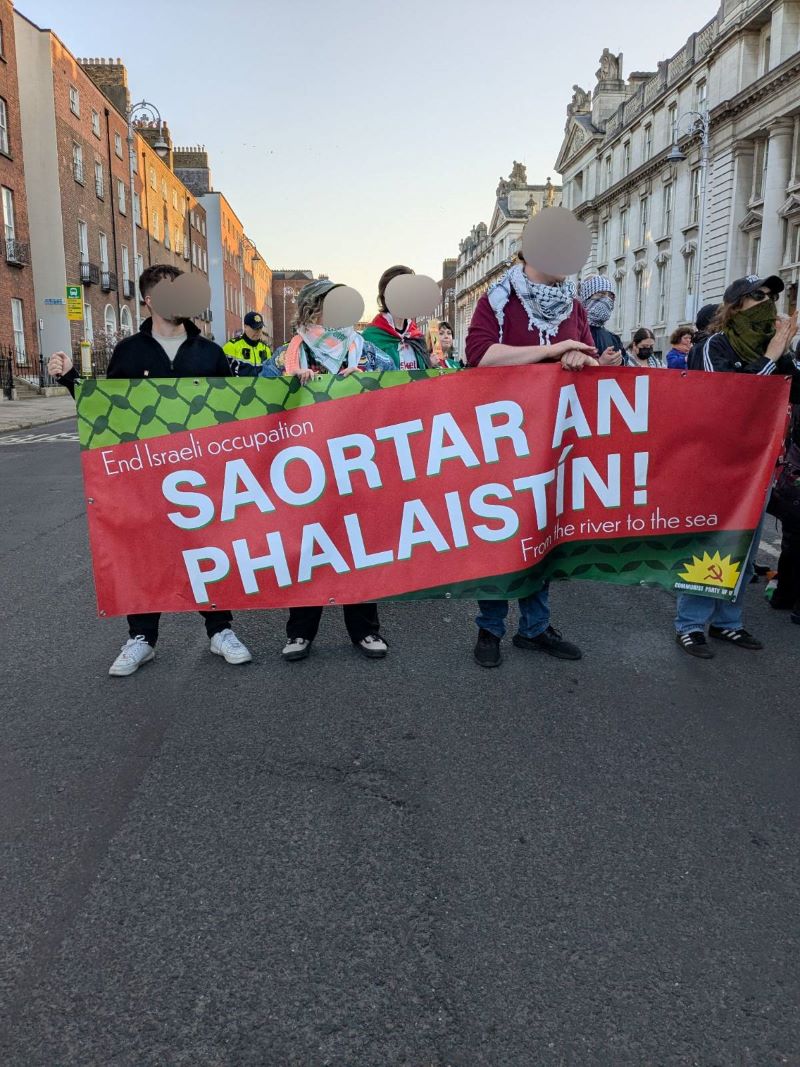
Hundreds gathered Wednesday night near the rear entrance of Leinster House, home of the parliament of the Irish state, in a demonstration organised by Mothers Against Genocide to protest the police attacks on demonstrators of the previous week.
Background
Over four days the previous week the Gardaí, police force of the Irish State, had attacked demonstrators in a number of different locations in Dublin. On Monday the MAGS group at the front entrance of Leinster House was attacked as they neared the end of their overnight vigil there.
The women were calling for Government action to match the will of the Irish population by preventing military supplies sent to Israel through Irish airspace and airports, to end processing Israeli bonds through Irish banks and to institute sanctions against the Zionist Occupation.
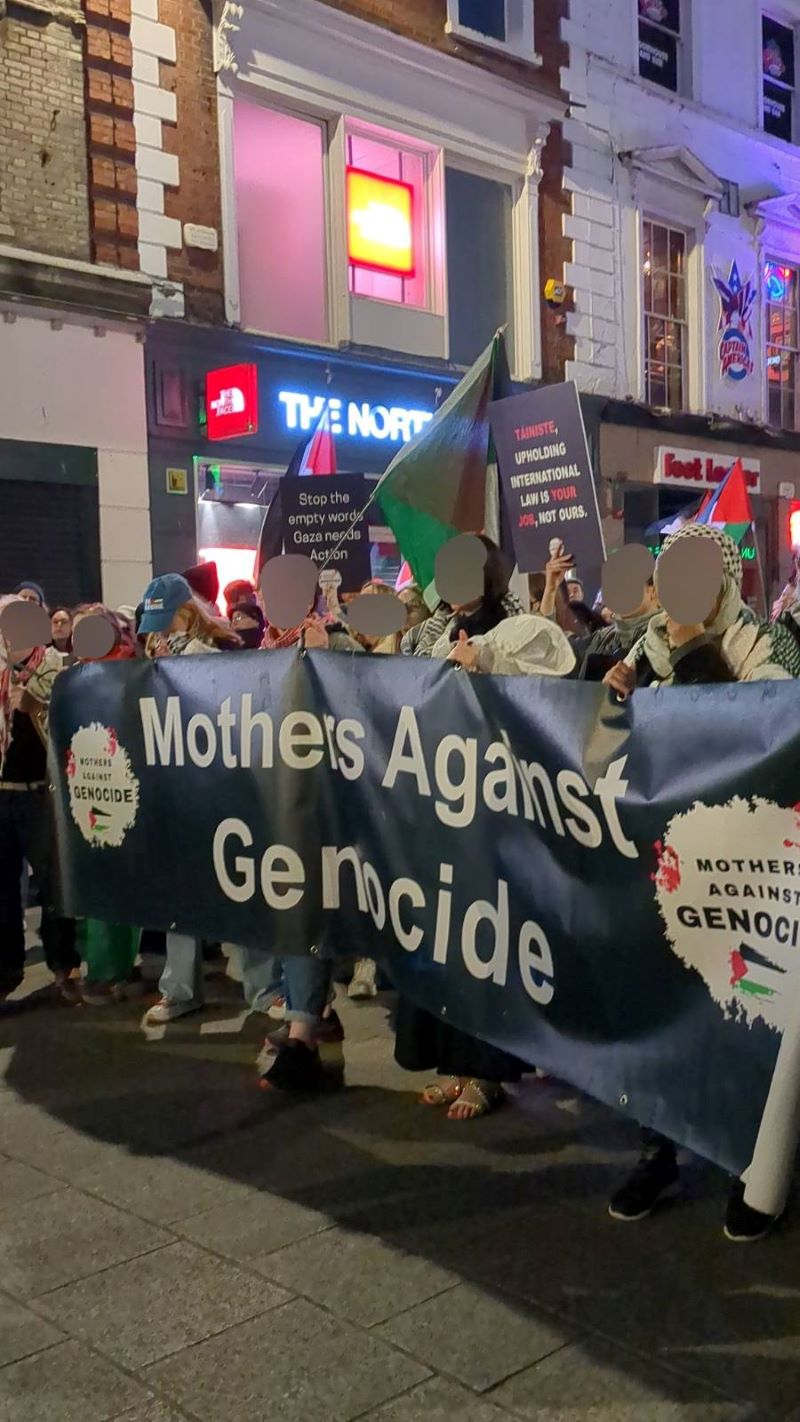
MAGS banner in Grafton Street later in the evening. (Source: Participant)
Eleven women and three men were arrested and taken to different Garda stations where a number of women were strip-searched, including one in an apparent cavity search; three men were charged under the Public Order Act and women pressured to accept an official caution.
Two days later, at a protest organised by the Boycott, Divestment and Sanctions (BDS) Society of the Dublin City University against the official opening visit of the Taoiseach (‘Prime Minister’) to a University building, Gardaí arrested a student for knocking on the window of the building.
On Friday, Gardaí attacked six protesters engaged in a protest at the front entrance to the Belgian Embassy in Dublin, where NATO is represented. The Anti-Imperialist Action protest was against the Irish elite’s attempt to slide the State into membership of the military alliance.
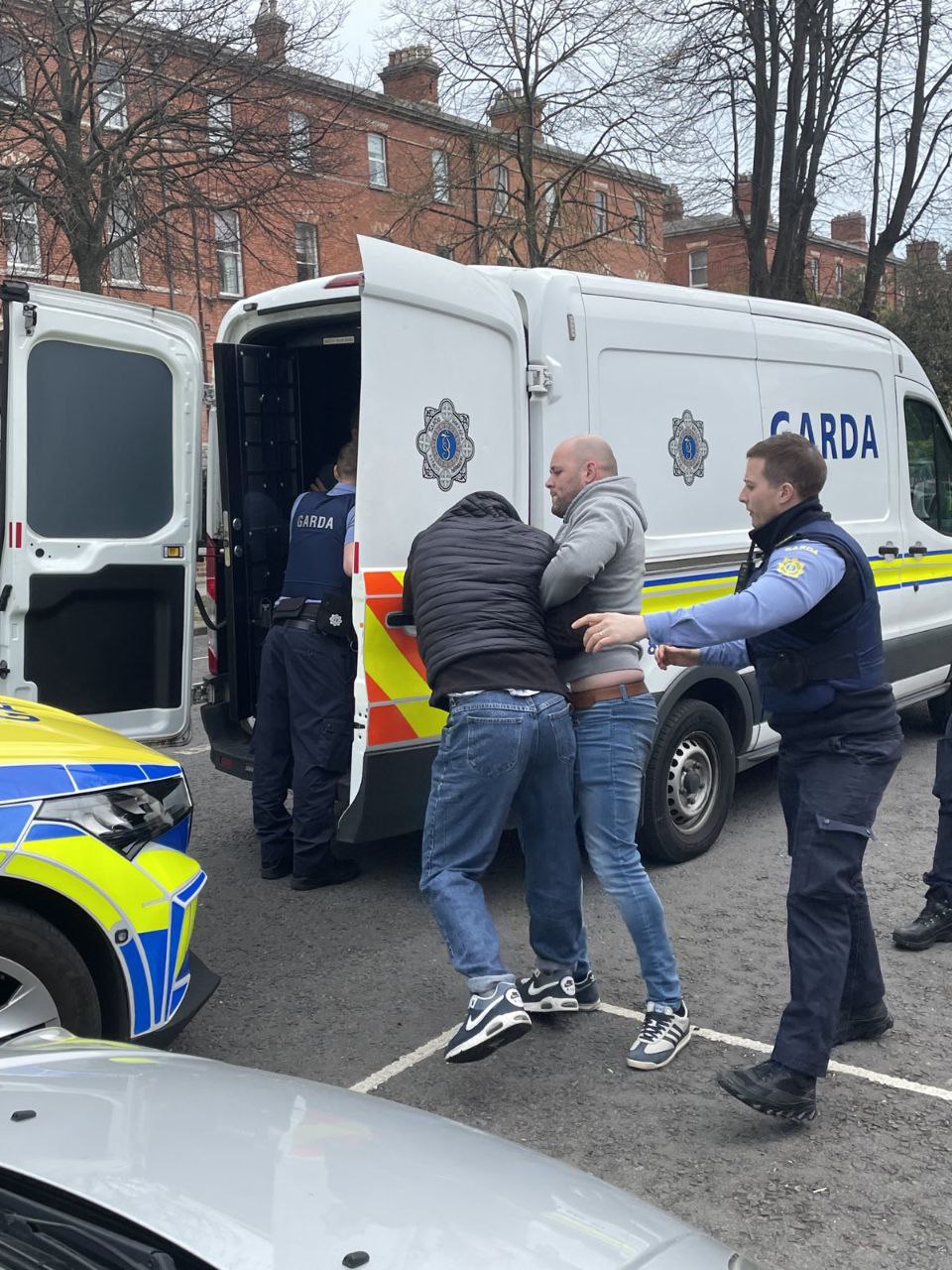
Those protesters were pepper-sprayed into their eyes, forced to the ground, handcuffed and treated so violently that the ankle of one man was broken; the breast of one woman was also grabbed. Two more picketing outside were also arrested, all again distributed around different police stations.
On public order charges, six also on trespass, all eight were brought to a special late court sitting that early evening where a crowd of supporters gathered.
All were bailed on a range of bizarre bail conditions including banned from protesting at Government buildings and a requirement to give 12 hours notice to the Gardaí with details before attending an embassy protest.
Wednesday night’s Leinster House protest
The mood of the crowd of over 500 last night in Merrion Street was militant, being addressed by a woman on behalf of the Mothers group. The crowd was joined by a group flying Starry Plough1 and Palestinian flags, bearing a banner of the AIA and a hand-painted one against NATO.
View of the rally in Merrion Street before the march. (Source: AIA)
The speaker introduced Aileen Malone, mother of Dara Quigley, a well-known blogger some years ago who appeared naked in public while suffering a mental ill health episode. One of the Gardaí dealing with the incident took a video of her and circulated it widely on social media.
Following that public shaming, Dara had taken her own life. Her mother pointed out that the offending Garda, instead of being dismissed, had been allowed to resign and keep his pension. She also condemned the Garda treatment of the women while extolling their courage in resistance.
Another speaker, introduced as representing Jews for Palestine Ireland spoke against the Irish State adopting the IHRA’s definition of antisemitism, the function of which, he stated is to protect the state of Israel against any criticism including regarding its genocide against Palestinians.2
He regretted the diversion from Palestine solidarity entailed in this focus, pointing out that genuine anti-Semitism is to be found among the far-Right while anti-racists and anti-fascists in Palestine solidarity, far from being anti-Semitic are on the contrary active against that variant of racism.
One of the banners at the rally in Merrion Street. (Source: Participant)
A woman from Mothers Against Genocide in Belfast spoke about the history of Irish resistance to colonialism and solidarity with Palestine which had no relation to the Irish Government, vehemently insisting also that being anti-genocide and for human rights is far from anti-Semitism.
Ruth Coppinger, Socialist Party TD, had signalled she wished to speak and was invited to so. She commented on Wednesday’s session in Leinster House when the Garda attack was defended by Mícheál Martin in respect of the right of access to Leinster House.3
A member of the Mothers in Dublin read a solidarity poem she had written and introduced the Resistance Choir, who sang Gonna Let No-one Turn Me Around, a lively song from the US Civil Rights4 movement of the 1960s,followed by slower lament about the Zionist slaughter in Gaza.
The energy in the crowd was dissipating by this point, almost an hour having elapsed and at last the direction to march was given. But where to? It was unclear. Earlier indications had been that one of the Garda stations would be the destination but now the Dept. of Justice was being mentioned.
The slogans shouted were those usually heard at Palestine solidarity events, with calls supporting the Intifada increasingly popular, and even one to Globalise the Intifada! US Warplanes out of Shannon! was another and NATO out of Ireland! was also heard.
Very appropriately also: One, we are the people! Two, We won’t be silenced! Three, Stop the bombing now, now, now, now!
Some banners during the march, seen here on the east side of Stephens Green. (Source: AIA)
The march proceeded, chanting, up Merrion Street, then into Merrion Row, turning left at the Huguenot Cemetery, then along the east side of Stephen’s Green, stopping briefly at the Dept. of Foreign Affairs building, then along the south side to the Dept. of Justice building.
But soon it was on the march again, perhaps heading for the Kevin Street Garda station … But no, along the west side of the Green now, past the Unitarian church where Edward Fitzgerald was married to his French revolutionary wife and then on again down through Grafton Street.
A meeting here was addressed mainly by one speaker, for some reason the crowd repeating his sentences. Not one speaker had yet referred to the attack on the anti-NATO protesters on Friday, much less their bizarre and repressive bail conditions. But perhaps we were heading for the GPO?
No, left and into Dawson Street, up to the Green again, then down Kildare Street to the front of Leinster House. There at last the crowd was addressed on behalf of the Anti-Imperialist Action group regarding the Garda attack on the anti-NATO protesters at the Belgian Embassy.
His talk was interrupted by cries of ‘Shame’ directed at the Gardaí and State. The speaker continued, referencing the resistance history of Irish Republicans and concluded by calling for unity of the Left against repression of any aspect of the Resistance, a call vigorously applauded.
To conclude the evening’s events a display concerning victims of Garda violence was presented, this including the case of Terence Wheelock, a working-class youth who died in Store Street Garda Station as a result of their violence, a crime then covered up by the State.
In Retrospect
It was important and a good act of resistance to organise an emergency protest5 this week and the eventual attendance of around 700 at such short notice was excellent. It is essential to meet repression of resistance with more resistance.
It was noticeable how low the numbers of Gardaí were and although uniformed and a number of plainclothes Special Detective Unit members followed the marchers, at no point did they attempt to stop the marchers or even to line up in numbers to protect the Government offices.
Most of the speakers at the commencing, intermediate and final rallies were clear that the Irish State had made a conscious decision to crack down on solidarity actions the previous week, using physical and sexual violence against activists, and of the need to continue solidarity and resistance.
The commencing rally was however too long and dissipated some of the energy. The lament as the last song just before that march, though no doubt appropriate in some contexts, continued that dissipation.
Coppinger, as a leading member of the Socialist Party was inappropriate as a speaker at the event. The party in the past has opposed boycotts against Israel and South Africa on the spurious grounds that it harms the oppressed people and works against solidarity between progressive settlers.
The Socialist Party also supports the Two-State proposal which would concede 80% of Palestine to the Zionist settlers. Coppinger personally and her party have also publicly condemned the Palestinian Resistance breakout operation of 7th October 2023.
The marching seemingly for ever, at times to symbolic but empty Government buildings was not helpful and most of the people already detest the Government. A good destination would have been at least one of the Garda stations where activists had been held the previous week.
Marching from and to an essentially closed Leinster House and Government buildings runs the risk of replicating the routine marches every month or so of the Ireland Palestine Solidarity Campaign.
The value of the Mothers has been their departure from that increasingly sterile practice and continuing in that vein would be a useful contribution to the solidarity movement and resistance in general.
Unity against repression is a historically-proven necessity and, as called for at the final rally last night, increasing unity between newer and longer-lived elements of the Resistance is also needed.
End.
An excellent riposte in the poster slogan/ meeting title. The design is based on the poster against strip-searching Republican women in the 1970s, design by Oisín Breatnach. (Source: Mid-Ulster IPSC)
1Flag of the Irish Citizen Army, first produced in 1914, the design is based on the Ursa Mayor constellation, including a plough in gold colour, with a sword instead of the ploughshare, all on a green background. A later version of the Republican Congress represents only the stars of the constellation in white on a blue background. The green and gold version was the one flown by the AIA.
3This was a spurious defence by the Taoiseach: a) It was before 7am and the Mothers were leaving at 7.30am; b) the pedestrian entrance was not blocked; c) the gates at the rear of the building were not blocked.
4But, like many of those songs, based on an earlier Christian song.
5There had also been an emergency protest outside Leinster House on last week’s Wednesday morning, Kildare Street being blocked for an hour without Garda action.
In the space of four days, Dublin has seen 23 activists in peaceful protests arrested and assaulted by Gardaí as the activists protested the slide of the Irish Gombeen1 ruling class towards NATO and their complicity in the Genocide in Palestine.
Mothers’ Day protest against genocide – 14 arrests
The Mothers Against Genocide group organised a vigil for Sunday night of Mothers’ Day outside Leinster House, seat of the Irish parliament and Government. The intention was to hold the event that evening but for some to remain there overnight, leaving at 7.30am.
At the gates of Leinster House, Kildare Street entrance. (Photo: D.Breatnach)
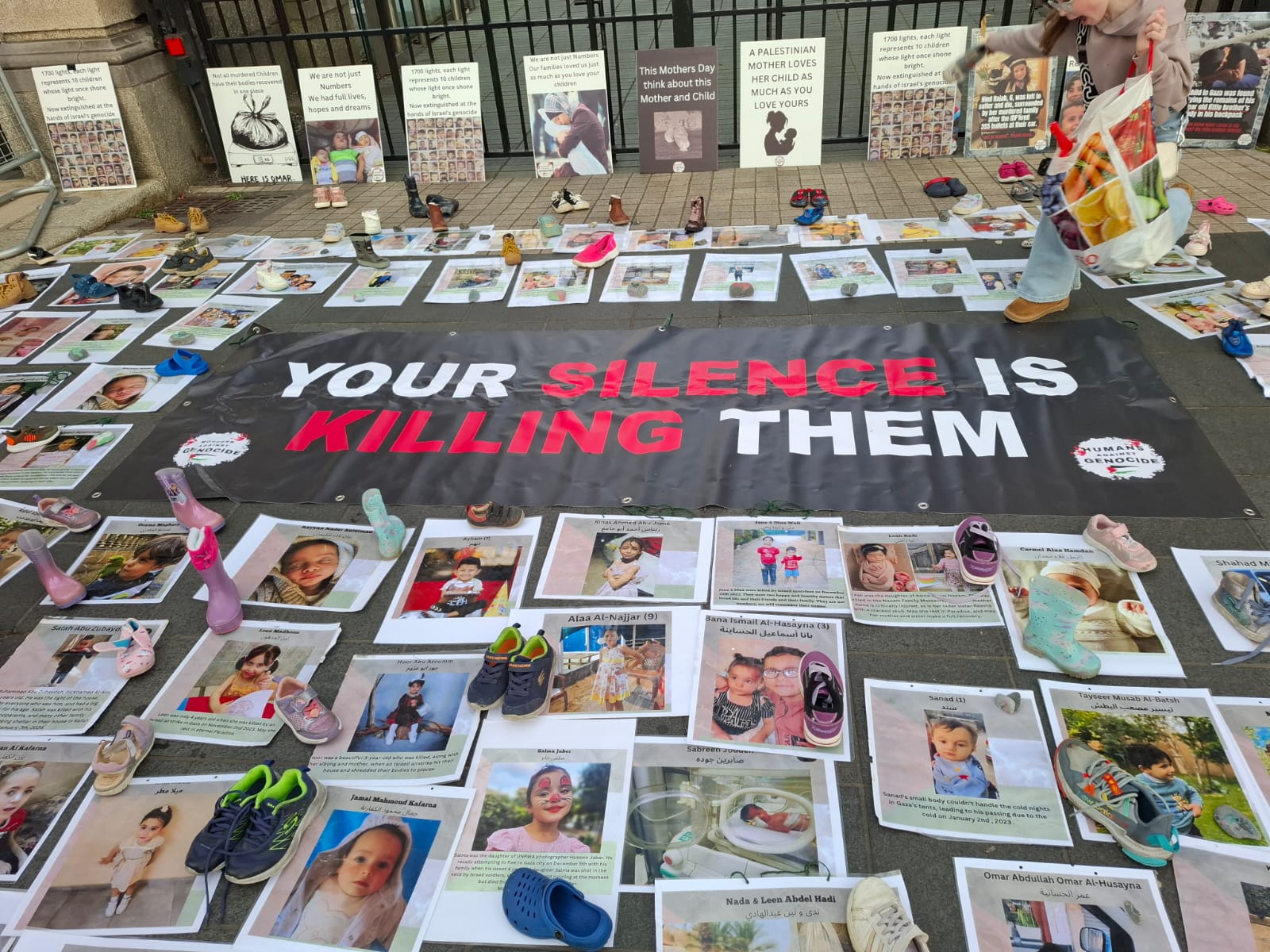
Plasticised printed photos of murdered Palestinian children were laid out on the ground with children’s shoes, toys etc spread around symbolically against the main gates with battery-powered ‘candles’ lit among them. Nearby a refreshment stall was set up.
By the advertised starting time of 7pm many had arrived and more kept coming, a very large crowd by nearly 8pm when there were some speeches, a few songs and a poem performed by different people, then a projection was being arranged after 9pm at which point I left.
Crowd at the event as dusk falls, approximately 8pm. (Photo: D.Breatnach)
The event was dignified, without even chanting. Policing was very sparse and low-key.
Despite the organisers’ commitment to leave at 7.30am and apparent agreement from the Gardaí present not to interfere with that arrangement, at around 6.00am more Gardaí2 arrived and demanded the clearing of the gates by removal of the icons to the murdered children.
In protest, some of the participants lined themselves up in front of the gates. The Gardaí approached the women, trampling over the photos and symbolic children’s items and began to remove the women, some of them quite violently, resulting in their arrests and those of three men also.
Banner of the organisers at Leinster House wall, Kildare Street. (Photo: D.Breatnach)
The 14 arrested were taken to different Garda stations where some women were strip-searched, an invasive psychological weapon used extensively by the British Occupation against Irish Republican women during the 30 Years War and still used by them against male Irish Republican prisoners.
All the women were obliged to choose right there and then between accepting a caution under the Public Order Act or to be charged and, under pressure, the women all seem to have been cautioned.
The three men were charged under the Public Order Act and will be obliged to attend the court to be processed. On Tuesday in Leinster House a number of TDs (elected parliamentary representatives) protested the treatment of the arrested. The Gardaí denied having carried out strip-searching.3
The Irish Council for Civil Liberties issued a brief statement to their network in response to the events, outlining the right to protest according to the Irish State’s Constitution:
We’ve heard from a lot of people who are worried by the Garda response this week to a peaceful vigil by Mothers Against Genocide. The fallout from this response along with potential new policing and public order laws and with the prospect of increased surveillance through facial recognition technology, risk undermining this fundamental democratic freedom. Today, as threats grow to restrict protest rights, defending this fundamental democratic freedom is crucial.
Protest isn’t the problem – it’s the solution:
You can protest – The Irish Constitution and European law protect peaceful assembly
You can film – Documenting interactions with Gardaí is allowed
You can’t be moved on without reason – Gardaí must give you a reason when asking you to move
The Irish Constitution guarantees your right to freedom of assembly, subject to public order. However, recent commitments in the Programme for Government have raised alarm.We continue to highlight how measures – including the expansion of police powers, banning face coverings at protest and the introduction of facial recognition technology into Irish policing – endanger our rights and freedoms.
The display outside the gates of Leinster House, Kildare Street entrance. (Photo: D.Breatnach)
On Wednesday morning a protest, composed mostly but not completely of women, at the treatment of people on Monday morning blocked the street outside Leinster House for a period of at least an hour4 without action by the Gardaí.
Protest at complicity of Irish Government in Dublin City University – another arrest
On Thursday evening Tánaiste (equiv. ‘Prime Minister’) Mícheál Martin’s visit to publicly open a building at the Dublin University Campus, accompanied by a heavy Garda presence was met with a protest organised by the Boycott, Divestment & Sanctions campaign branch of the University.
One of the students in the protest was arrested apparently for knocking on the window to convey the anger outside to those inside, Gardaí claiming at the time that he was damaging the window. The activist was released on bail amidst a crowd gathering in his support at the Garda station.5
Protest against NATO in the Irish State – 8 arrests
On Friday, a protest against attempts to push Ireland into joining the NATO military alliance was held at the latter’s representative facility in Dublin, the Belgian Embassy. Gardaí were very quick to respond and indeed had accosted and assaulted two of the participants a little earlier.
Protesters and Gardai in doorway of Belgian Embassy just before the attack of the latter on the former. (Photo source: Anti-Imperialist Action)
Six protesters lined up against the Embassy entrance at the Anti-Imperialist Action event were pepper-sprayed into their eyes and brutally assaulted, as were another two outside. As with those arrested on Monday morning, they were held in three different police stations in the city.
One of protesters, face down on the ground with his arms handcuffed behind his back, had his legs forced up behind, breaking his ankle.
(Photo source: Anti-Imperialist Action)
Supporters arrived to picket the police stations. After a few hours the arrested were taken to court, where supporters congregated also as the detained were processed for a late sitting of a judge. The charges were of criminal trespass or Public Order Act violation, both together for some.
In court they had legal representation and all were bailed in their own recognisance of 500 euro, which seemed fairly routine but the bail conditions were anything but. They were required to give 12 or 24 hours’ notice to the Gardaí of attending an embassy protest, supplying the details of the event!
The conditions for some included a ban on attending any state’s embassy in Dublin or demonstrating at any Irish Government building, while another is required to give notice – also of 12 hours — if crossing into the State from the Six Counties.
Facing a prospect of being locked up for the weekend otherwise, they did not decline the conditions for the moment and were released to meet a crowd of supporters outside the court in the early evening. As they lined up for a photo, all sang part of the Irish language Gráinne Mhaol song by Patrick Pearse.
The arrested and supporters outside the court after the former were released on bail. (Photo: D. Breatnach)
Repression of Palestine solidarity throughout the Western World
Throughout the Western world the response to the genocide being carried out in Gaza has had similar features: The complicity of the ruling classes, solidarity with the Palestinians of sections of the masses and the consequent repression by the ruling elites.
Within the territory of the Irish State the response of the masses has been marked in active solidarity with and public sympathy for the Palestinians, with little repressive action by the Irish State despite the proven collusion of the Irish ruling class.
The indications from this week are that the latter situation is changing and repression is being ramped up. This in turn indicates that the neo-colonial Irish ruling class feels threatened by action in Palestinian solidarity, other than routine marches through Dublin every month or so.
It is removing the liberal gloves and revealing the underlying sharp claws of a class that gained a state created in collusion with the British occupation to divide the country and to repress and control the insurrectionary forces upon the backs of which that neo-colonial class rode to power.
During the Civil War,6 the Irish state executed many more revolutionary fighters than had the British during the War of Independence7 and has executed a number since. Huge numbers have been imprisoned over years and it has colluded in covering for the bombers of its own capital city.
Where there is oppression, history teaches us, there will also arise resistance but that in turn usually results in more repression. Resistance rises to meet that repression and the movement must organise to educate, organise and unite that resistance, going forward until the masses achieve victory.
1A term somewhat equivalent to ‘carpetbagger’ describing opportunists amassing wealth through taking advantage of people’s misfortunes. Its origins are in the Irish language Gaimbín, applied to such Irish capitalist financiers during and in the wake of the Great Hunger of the mid-19th Century, now used to describe the neo-colonial capitalist Irish bourgeoisie.
2 The (mostly) unarmed police force of the Gombeen Irish ruling class.
Kit Klarenberg (republished with author’s kind permission from Al Mayadeen)
(Reading time: 6 mins.)
On November 15th, The Times published a remarkable report, revealing serious “questions” are being asked about the viability of Britain’s two flagship aircraft carriers, at the highest levels of London’s defence establishment.
Such perspectives would have been unreportable mere months ago. Yet, subsequent reporting seemingly confirms the vessels are for the chop.
Should that come to pass, it will represent an absolutely crushing, historic defeat for the Royal Navy – and the US Empire in turn – without a single shot fired.
The HMS Queen Elizabeth and HMS Prince of Wales first set sail in 2017 and 2019 respectively, after 20 years in development.
HMS Queen Elizabeth and HMS Prince of Wales in dock and at anchor.
The former arrived at the Royal Navy’s historic Portsmouth base with considerable fanfare, a Ministry of Defence press release boasting that the carrier would be deployed “in every ocean around the world over the next five decades.”
The pair were and remain the biggest and most expensive ships built in British history, costing close to $8 billion combined. Ongoing operational costs are likewise vast.
Fast forward to today however, and British ministers and military chiefs are, per The Times, “under immense pressure to make billions of pounds’ worth of savings,” with major “casualties” certain.
Resultantly, senior Ministry of Defence and Treasury officials are considering scrapping at least one of the carriers, if not both.
The reason is simple – “in most war games, the carriers get sunk,” and are “particularly vulnerable to missiles.” As such, the pair are now widely perceived as the “Royal Navy’s weak link.”
Matthew Savill of British state-tied Royal United Services Institute told The Times that missile technology is developing “at such a pace” that carriers are rapidly becoming easy for Britain’s adversaries to “locate and track”, then neutralise.
“In particular,” he cautioned, China is increasing the range of its ballistic and supersonic anti-ship missiles.
Meanwhile, Beijing’s “hypersonic glide vehicle”, the DF-17, “can evade existing missile defence systems,” its “range, speed and manoeuvrability” making it a “formidable weapon” neither Britain nor the US can adequately counter.
Savill advocated “cutting one or both of the carriers,” as this “would free up people and running costs and those could be reinvested in the running costs of the rest of the fleet and easing the stresses on personnel”.
Nonetheless, he warned that scrapping the carriers would be a “big deal for a navy that has designed itself around those carriers…and that the £6.2 billion paid for them would be a sunk cost.”
That the Royal Navy has “designed itself” around the two carriers is an understatement.
For just one to set sail, it must be supported by a strike group consisting of two Type 45 destroyers for air defence, two Type 23 frigates for anti-submarine warfare, a submarine, a fleet tanker and a support ship.
British aircraft carrier as part of allegedly “strike force” but in reality sailing with its necessary escorts. (Photo sourced: Internet)
This “full-fat protective approach”, Savill lamented, means “most of the deployable Royal Navy” must accompany a single carrier at any given time:
‘You can protect the carriers, but then the Navy has put all of its eggs in a particularly large and expensive basket.’ ‘National Embarrassment’
March 2021 saw the publication of a long-awaited report, Global Britain in a Competitive Age – “a comprehensive articulation” of London’s “national security and international policy,” intended to “[shape] the open international order of the future.”
The two aircraft carriers loomed large in its contents. One passage referred to how HMS Queen Elizabeth would soon lead Britain’s “most ambitious global deployment for two decades, visiting the Mediterranean, the Middle East and the Indo-Pacific”:
“She will demonstrate our interoperability with allies and partners – in particular the US – and our ability to project cutting-edge military power in support of NATO and international maritime security.
Her deployment will also help the government to deepen our diplomatic and prosperity links with allies and partners worldwide.”
Such bombast directly echoed the bold wording of a July 1998 strategic defence review, initiated a year earlier by then-prime minister Tony Blair.
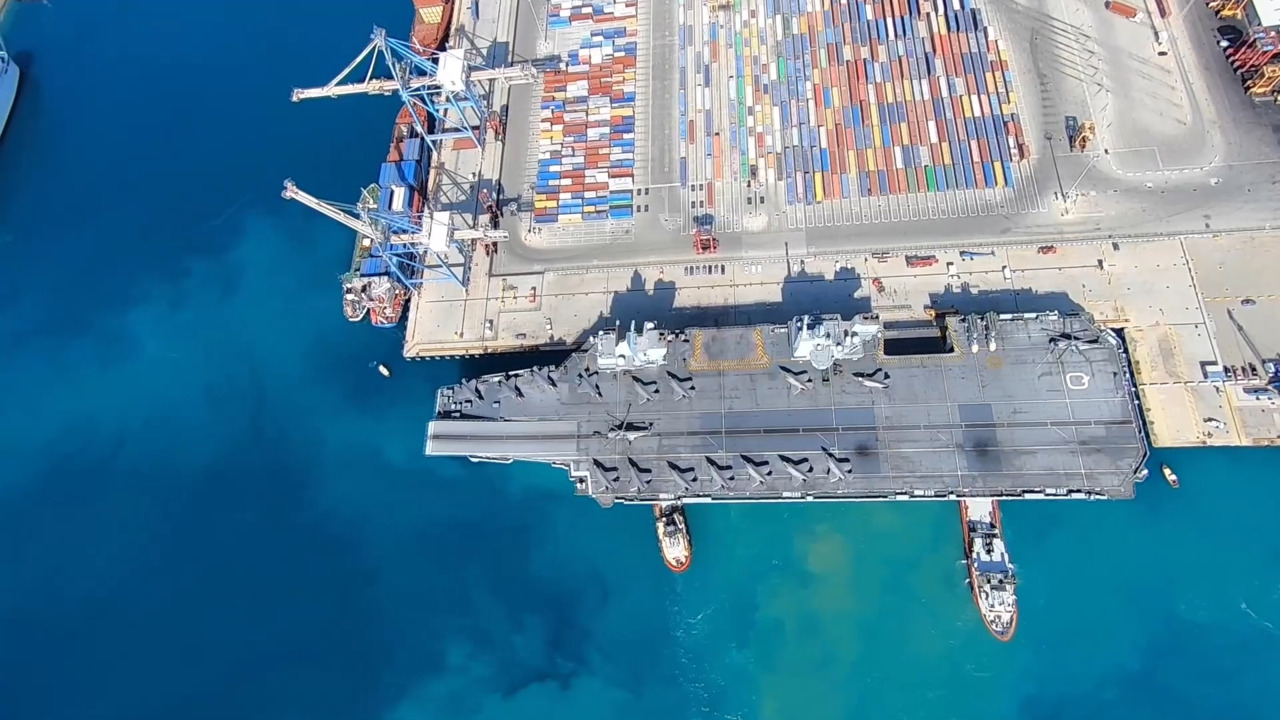
As world naval policeman: HMS Queen Elizabeth aircraft carrier docked in Cyprus (where the UK has two military bases)
Its findings kickstarted London’s quest to acquire world-leading aircraft carriers, which culminated with the birth of HMS Queen Elizabeth and HMS Prince of Wales.
Britain’s explicit objective, directly inspired by the US Empire’s dependence on carriers to belligerently project its diplomatic, economic, military and political interests abroad, was to recover London’s role as world police officer, and audaciously assert herself overseas:
“In the post-Cold War world, we must be prepared to go to the crisis, rather than have the crisis come to us. So we plan to buy two new larger aircraft carriers to project power more flexibly around the world…
This will give us a fully independent ability to deploy a powerful combat force to potential trouble spots without waiting for basing agreements on other countries’ territory. We will…be poised in international waters and most effectively back up diplomacy with the threat of force.”
Blair’s reverie appeared to finally come to pass in May 2021, when HMS Queen Elizabeth set off on a grand tour of the world’s oceans, escorted by a vast carrier strike group.
Over the next six months, the vessel engaged in a large number of widely-publicised exercises with foreign navies, including NATO allies, and docked in dozens of countries. Press coverage was universally fawning.
Yet, in November, as the excursion was nearing its end, an F-35 fighter launched from the carrier unceremoniously crashed.
The F-35’s myriad issues were by that point well-established. The jet, which has cost US taxpayers close to $2 trillion, entered into active service in 2006 while still under development. It quickly gained a reputation for hazardous unreliability.
In 2015, a Pentagon report acknowledged its severe structural issues, limited service life and low flight-time capacity.
Two years later, the Department of Defense quietly admitted the US Joint Program Office had been secretly recategorising F-35 failure incidents to make the plane appear safe to fly.
Despite this, the HMS Queen Elizabeth and HMS Prince of Wales were specifically designed to transport the F-35, to the exclusion of all other fighter jets.
However, Britain has all along struggled to source usable F-35s, which produces the ludicrous situation of the two carriers almost invariably patrolling seas with few if any fighters aboard at all, therefore invalidating their entire raison d’être.
In November 2023, the Daily Telegraphdubbed these regular “jet-less” forays a “national embarrassment”.
‘Carrier Gap’
An even graver embarrassment, rarely discussed with any seriousness by the British media, is that the two aircraft carriers have been plagued with endless technical and mechanical issues as long as they’ve been in service.
Flooding, mid-operation breakdowns, onboard fires, and engine leaks are routine. Both vessels have spent considerably more time docked and under repair than at sea over their brief lifetimes. In 2020, an entire HMS Prince of Wales crew accommodation block collapsed, for reasons unclear.
As the elite US foreign policy journal National Interest acknowledged in March 2024, “the Royal Navy remains unable to adequately defend or operate” its two carriers “independently” – code for the Empire being consistently compelled to deploy its own naval and air assets to support the pair.
This is quite some failure, given British officials originally intended for the vessels to not only lead NATO exercises and deployments, but “slot into” US navy operations wherever and whenever necessary.
The Empire’s inability to outsource its hegemonic duties to Britain has created a critical “carrier gap”.
Despite maintaining an 11-strong fleet, Washington cannot deploy the vessels to every global flashpoint at once, grievously undermining her power and influence at a time of tremendous upheaval worldwide.
In a bitter irony, by encouraging and facilitating London’s emulation of its own flawed and outdated reliance on aircraft carriers, the US has inadvertently birthed yet another needy imperial dependent, further draining its already fatally overstretched military resources.
Frame 2 of a DB cartoon depicting US Navy aircraft carrier sailing to teach Ansar Allah (‘Houthis’) a lesson but instead getting chased out of the Arabian Sea by Yemeni missiles in June this year. (Image source: DB cartoons)
Several Royal Navy destroyers were originally part of abortive US-led Operation Prosperity Guardian, launched in late 2023 to smash Ansar Allah’s righteous anti-genocide Red Sea blockade.
Almost immediately, it became apparent the British lacked any ability to fire on land targets, therefore rendering their participation completely useless.
Subsequently, photos emerged of areas on Britain’s ships where land attack cruise missiles should’ve been situated. Instead, the spaces were occupied by humble treadmills, for use as on-board gyms.
It transpired that the appropriate weapons hadn’t been purchased, due to a lack of funds – the money having of course been spent instead on constructing barely operable aircraft carriers, which now face summary defenestration.
By investing incalculable time, energy, and money in pursuing the mythological greatness associated with carrier capability, Britain – just like the US Empire – now finds itself unable to meet modern warfare’s most basic challenges.
Meanwhile, its adversaries near and far have remorselessly innovated, equipping themselves for 21st century battle.
Days after The Timesportended the impending death of London’s aircraft carriers, mainstream media became awash with reports of savage cutbacks in Britain’s military capabilities, in advance of a new strategic defence review.
Potentially a huge pile of scrap or to be dumped on an ally …
Five Royal Navy warships, all of which had lain disused due to staffing issues and structural decay for some time, were among the first announced “casualties”. What if anything will replace these losses isn’t certain, although it likely won’t be an aircraft carrier.
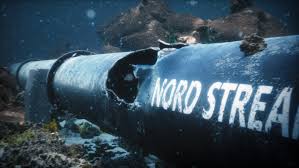
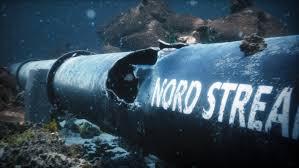
On 26 September 2022, an explosion blew a section of the Nord Stream 2 gas supply pipeline from Russia to Germany, incidentally causing an environmental disaster for sea-life in the area. Investigations confirmed that it was an act of sabotage.1
Amidst accusations and theories,2 no perpetrator was conclusively identified.
But two years later, in September 2024, an important item of previously-suppressed information came to light in a Danish newspaper. It was not however picked up by the mainstream western media, despite its potentially crucial contribution to solving the mystery.
Alternative sources however alighted on it and it is now coming into the public light.
In any investigation of culpability for a human action, one of the first established principles to investigate is – and targets of investigation should be — cui bono? (in Latin, who benefits?). Next, Qui habet potestatem? — Who has the means? Finally, Who had the opportunity?
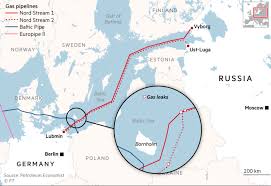
Map of route of the Nord Stream pipelines showing neighbouring state. (Source image: Financial Times)
Potentially, any in the anti-Russian coalition around NATO stood to benefit by harming not only a Russian installation but also a major source of financial benefit to Russia, i.e of sales of gas to Germany. Many eyes turned towards Russia’s opponent in the Ukraine, the Zelensky regime.
However, neither Russia nor any other serious commentators ever considered that NATO proxy to be the culprit. Russia and others stated that the operation required a major state, both in the depths concerned, in surface support needed and in the explosive type and detonation system.
A number of commentators pointed the finger at the USA, which denied any involvement. Well, the USA is a major state and certainly had the motive, as Russia was and remains its major target in the Ukraine war and it also had the potential technical and personnel means.
It would also of course, as an enemy of Russia, benefit from harm to its opponent. It would benefit the USA financially too, though that was yet to become clear.
From whom would Germany buy its power to warm its population and production through the winter as an alternative to Russian gas? That new source would turn out to be – yes, the USA.
OK, so suspicion should fall heavily on the USA, leader of NATO and chief among the enemies of Russia. But did it have the opportunity?
Since there was no record of a US naval presence in the area at the time of the explosion (even though they had been there previously in one of those major joint exercises they like to carry out to bring their allies closer and intimidate their opponents), the media investigation floundered.
Russia asked at the UN Security Council for an investigation, which was rejected. No decision of the Council can be made against a veto of even one of the five Permanent Members, of which three are part of the NATO coalition (USA, UK and France).
A number of alternative theories began to be put around, including mention of large yacht in the area and a Ukrainian oligarch financier. Official investigations were launched by two states in whose economic zone the operation must have taken place: Denmark and Sweden.3
Both regimes are part of the US/NATO/EU coalition and there may have been suspicions that their investigations might not be sufficiently thorough. In any case, in February this year both states closed their investigations without having identified the perpetrator.
Germany’s investigation is ongoing and it issued an arrest warrant for a Ukrainian oligarch who fled to NATO proxy Ukraine with assistance of NATO member Poland. However Russia and serious commentators have always said that a major state, something Ukraine is not, was culpable.
On 17 July 2024, the German government refused to publish the preliminary results of the investigation after the Alternative für Deutschland (AFD) party asked for it, or to comment about the possible involvement of American intelligence services or Ukraine in the pipeline attack.4
In October 2024, the Swiss newspaper Die Weltwoche wrote an article based on an interview given to Danish Politiken by John Anker Nielsen, the harbourmaster of Christianso in Denmark on the day of the two-year-anniversary of the Nord Stream pipelines sabotage.
Back in September 2023, the Christianso harbourmaster detected the presence of ships in the area with their transponders, equipment identifying the ship and its course, silent. Assuming some kind of accident, Nielsen sailed out to investigate, finding US Navy there.
With no evidence of disaster and a request that he leave, Nielsen turned for home. (Suppose that information had been included in the Danish investigation, would the fingers pointing at the USA not have multiplied?)
Nielsen says he was told to keep quiet about what he knew but decided to end his silence in September and his story was published in a local newspaper. Later alternative commentators such as Glen Greenwald and others on X picked up on it and now it’s finding its way into wider media.
The Swiss newspaper article went on to note that the USS Keararge three months earlier had participated in the BALTOPS 2022 exercise that included unmanned underwater vehicles suitable for demining and other underwater operations.5
Such vessels as those could transport explosive charges suitable for blowing the Nord Stream pipelines. The Swiss newspaper claimed this new information calls into question the assumption that a Ukrainian group was responsible for the sabotage and that investigations are continuing.6
OUTCOMES
The outcomes to date are that Russia has received heavy financial damage, both in the cost of the pipe and any repair costs but also through loss of a customer who might well have resumed its purchase of gas from Russia in preference to dearer fuel from elsewhere.
Carlos Latuff cartoon outlining the major suspicions at the time.
The USA has benefited financially because it is also an energy exporter, including to Germany, where Russia was its main competitor.
In 2022, Germany imported 44.65 million tonnes of hard coal. Its leading coal suppliers were Russia (29.2%), the United States (20.8%) and Colombia (16.3%).7 So in the event of any embargo on Russian hard coal, the US stands to benefit enormously.
But what about natural gas, formerly supplying 55% of Germany’s power supply, no longer possible from Russia through the Nord Stream 2 pipeline? About 45% …. comes from Norway through pipelines, 4% from the Netherlands, 5% domestic production … the rest from western neighbours.8
Norway and the United States were the top suppliers of gas to the EU in 2023. Norway provided almost 30% of all gas imports. But the actual origin of those supplies is not so easy to identify and reports even estimate that a small percentage of the EU’s supply is actually Russian.
Although additional suppliers include North African countries, the UK and Qatar, in 2023, the United States was the largest LNG supplier to the EU, representing almost 50% of total LNG imports. In 2023, comparing to 2021, imports from the US almost tripled.9
It seemed likely that some at least – and perhaps a lot – of Germany’s current LNG supply, though perhaps through another country, would actually be of US origin. And it turns out that the US has been the dominant LNG supplier to Germany since 2022 at 82% of total imports.10
IN CONCLUSION
While the USA has benefited significantly financially from the pipeline explosion and strategically through damaging an opponent, Germany has at the same time suffered a loss in having to buy more expensive fuel (from the USA).11 But Germany is an ally of the USA and a prominent one in NATO.
This episode demonstrates that 1) the USA, in advancing its own interests, is prepared to break the law and to see an ally suffer but also that 2) a major European capitalist power has surrendered a substantial portion of its own interests for the benefit of the USA, as a price of membership of the NATO club.
Germany, though an enthusiastic supporter of NATO, due to its dependence on natural Russian gas, had been reluctant to engage fully in the economic sanctions against Russia proposed by NATO. The blowing up of the Nord Stream 2 pipeline removed that dependence, transferring it to the USA.
The USA benefited, both politically/ militarily in hurting its opponent and in increasing the dependence of an ally. It also benefited subsequently financially, in gaining a major customer market share. The USA had more than enough Motive to carry out the sabotage.
It also had the Means (the capability) and now, as we know, the Opportunity also! Circumstantial? Sure but a mountain of evidence nevertheless.
4Receiving the answer: “after careful consideration, the Federal Government has come to the conclusion that the question cannot be answered for reasons of public interest”.
A number of demonstrations were held in Ireland to make it clear that Kier Starmer, Prime Minister of the UK and supporter of the Zionist state of ‘Israel’, has no céad míle fáilte in Ireland, or indeed any fáilte whatsoever for his Dublin visit.
After fourteen years of Conservative Party management of the UK, Starmer at the head of the Labour Party rode a change-seeking wave to win the General Election in July this year. But he soon revealed how little difference there is between the parties, including on Palestine.
Mostly of the east-facing section on the Bridge (Photo: R.Breeze)
Although the Labour Party on the Zionist State, its Government continues to support that state politically and economically, also militarily with supply of weapons components and RAF missions.1
Very recently the UK Labour Government temporarily suspended 30 military items which may (may!) be implicated in genocide. The UK, holder of one of the five Permanent seats of the UN Security Council is complicit in the ongoing Zionist colonial settler genocide of Palestinians.
In fact, the UK is responsible for settling Zionist Jews in Palestine and then for allocating much of Palestinian land to the settler who, as European settler colonists do, expelled hundreds of thousands of Palestinians and continued extending their land-grabbing ever since.
West-facing section of protest (Photo: R.Breeze)
PROTEST ON O’CONNELL BRIDGE
The Saoirse Don Phalaistín and Anti-Imperialist Action groups organised a protest against Starmer’s visit to take place on O’Connell Bridge at 3pm on Saturday and took up position on the central pedestrian reservation, with one section facing eastward and the other towards the West.
The Bridge spans the River Liffey and is in the heart of the city centre, crossed by north and southbound traffic and in view of westbound and eastbound traffic along the quays also.
There was a heavy presence of uniformed police in the vicinity, with five Special Branch nearby and a Public Order Unit van driving by a number of times as did other Garda vans. A prisoner transport van was also parked on the Bridge for a period but no attack was forthcoming.
Collection of banners and flags in west-facing section of protest. (Photo: R.Breeze)
RECORD OF THE LABOUR PARTY
One of the speakers at the O’Connell Bridge event reminded people of the history Labour Governments vis-a-vis Ireland, having sent the troops to the Six County colony to quell the struggle for civil rights there and also targeting the Irish in Britain with the Prevention of Terrorism Act.
This 1974 PTA, the speaker said, was later extended into the current Terrorism Act of repression in Britain. He reminded people too of the innocent Birmingham Six, Guildford Four, Maguire Seven and Judith Ward who were framed and jailed for long years under a Labour Government.
A speaker at the protest giving some reasons why Keith Starmer is not welcome in Ireland. (Video cred: Social Action Ireland)
The speaker could have also mentioned the Labour Party’s participation in the WWI War Cabinet which had sentenced and executed 16 Irish leaders after the 1916 Rising and its bipartisanship with the Conservatives on the partition of Ireland in 1921 and instigation of the Civil War in 1922.
SUPPORT AND OPPOSITION
The attitude expressed by protest passers-by on foot, bicycle or in motorised transport was nearly uniformly supportive. One exception was a fascist who called the protesters ‘traitors’ and attempted to take closeup photos before being blocked by a participant with a flag and seen off.
(Photo: R.Breeze)
Another was a big man who in a UStates accent seemed to shout something derogatory about Ireland and then claimed to be Irish (he might have been part of the diaspora there since the Irish tricolour colours appeared on the back of his top).
For much of the two hours of the event, slogans were shouted in support of Palestine, against the Zionist State, against Starmer, against British occupation of Ireland, for Intifada revolution, and for the solidarity action of Yemen at sea regarding Zionist-collusive shipping companies.
End.
Another view of west-facing section of protest with newly-made ornate Starry Plough flag. (Photo: R.Breeze)
FOOTNOTE
1There have been a number of reports of special units of the British army in Palestine and on British Intelligence personnel assisting the ‘Israeli’ Occupation Force.
Earlier this month there was an oration delivered at the grave of Wolfe Tone1 which contained some important elements which deserve inspection and discussion.
– The path to rebuild our struggle is the development of an Anti Imperialist Broad Front – said the speaker. – A United Front of Revolutionary republicans, working in cooperation to advance our common republican objectives and to achieve a common republican programme.
Looking around us at the parties and groups in the socialist and republican spectrum, the ostensibly revolutionary varieties, we see that for many of them, building up their own organisation takes precedence over anything else, including revolution – for them the revolution IS their party.
Speaker giving oration at Wolfe Tone’s grave in front of the monument, faced by colour party. (Photo: RSM)
The call given in this oration runs counter to that kind of thinking. “But we’ve heard all that about ‘unity’ before,” a reader might say. Yes we have and often “unity” meant only “unity” around that particular party or, even more often, around this or that leadership.
There is nothing of that to be found in this address “recognising and respectful of the autonomy and independence of the groups and independents involved”. “Hmmm,” the reader might say “but is it a genuine intention?” Given our experience, it’s a valid and important question.
The most dependable test is in the practice. The speaker of the oration at its annual Wolfe Town Commemoration2 was representing the Socialist Republican Movement organisation (more often manifested publicy in recent years in the form of the Anti-Imperialist Action broad group3)
As an independent revolutionary activist for many years I have often participated in AIA’s actions and at times they have supported actions of which I had been part of organising. I have found that their practice matches their words and there is no truer test.
The speaker followed with practical suggestions for the implementation of the broad front: Trust and co-operation must be developed … through activism and the development of National Republican Campaigns that can be taken up by all Republican groups and independents …
There are many campaigns that could be developed from support for POWs to opposing internment and extradition, environmental campaigns such as (overcoming) the unacceptable situation at Lough Neagh, to campaigns thatoppose the British and NATO presence in Ireland.
One of the banners in the crowd at the event in Bodenstown. (Photo: RSM)
Such a Republican Broad Front would be a fitting tribute to our Patriot Dead, the speaker added, to martyrs like Cathal Brugha,4 who gave his all in fighting for the sovereign, Independent Irish Republic and gave his life on this day in 1922 as a hero in the war in defence of the Republic.
In many of the pleas for unity of the fragmented resistance in Ireland, individuals have called for a conference to form a united front, others called for a unity document of principles around which to unite while in at least one case, two distinct organisations merged.
I have for years spoken out against such endeavours and advocated as a first step unity in practice. If organisations and individuals are not capable of that step, what kind of unity can they achieve around discussion of documents? Unity in practice also helps to break down distrust.
The speaker at the Wolfe Tone commemoration takes the same line, presumably speaking for the SRM when he does so and one supposes that this will continue to be the approach of the AIA in campaigns such as against internment, in solidarity with political prisoners5 or with Palestine.6
The above piece discussed two elements of the oration given by the SRM earlier this month which I believe to be of great revolutionary importance and in need of application in Ireland, one in advocating a principle and the other in suggesting avenues for practical application.
Later I will be taking a look at some other elements in that talk (the text of which, as published by the SRM, I attach as an appendix).
Beirimís bua.
(Image sourced: Internet)
End.
FOOTNOTES
1Wolfe Tone, born into settler stock and of the Establishment Anglican congregation, was a leading figure in the formation of the revolutionary republican organisation The Society of United Irishmen, seeking “to unite Catholic, Protestant (i.e Anglican) and Dissenter” (i.e the other sects, Presbyterian, Methodist, Unitarian, Quaker etc.) to “break the connection with England. In 1798, the year of the Unitedmen uprising, the first of many Irish Republican uprisings and campaigns, Tone was captured by the British Navy on a French warship and, despite his French officer rank, tried and sentenced to death.
Tone died in jail some months before his brother Matthew was taken prisoner during the surrender at Ballinamuck (Baile na Muc) in Co. Longford of another French expedition to Ireland, late and too small, at the tail end of the Rising that year. Also ignoring his officer POW status, he was hanged in Dublin and his body reputedly thrown into the mass grave at Croppies’ Acre in Dublin city.
2Since even earlier than Thomas Davis’ (1814-1845) song In Bodenstown Churchyard, Irish Republican organisations and individuals have been making the pilgrimage to that grave in County Meath, at times with thousands in attendance.
3Also for an intense time as the Revolutionary Housing League in its attempt to spark a movement of occupation of empty properties to overcome the widely-acknowledged housing crisis in Ireland.
4Cathal Brugha (nee Burgess), son of a mixed Catholic-Protestant marriage, was a leading figure in Irish nationalist movement and in Republican rebellion in the last decades of the 19th and early decades of the 20th Centuries, learned Irish as a member of the Gaelic League, member of the Irish Republican Brotherhood (which he later left, considering it undemocratic), officer in the Irish Volunteer, 2nd in command in the South Dublin Union in 1916 served as Minister for Defence in the revolutionary government from 1919 to 1922, Ceann Comhairle of Dáil Éireann in January 1919 and its first president from January 1to April 1919, Chief of Staff of the IRAfrom 1917 to 1918. He served as a TD (electe parliamentary representative) from 1918 to 1922. He was mortally wounded by Irish Government troops in the early days of the Irish Civil War.
5Both on their own and for example in support of the Ireland Anti-Internment Campaign.
6Both on their own and for example as part of the Saoirse Don Phalaistín broad front.
APPENDIX
The following is the text of the main oration of which some sections are discussed in the preceding article and more to be discussed anon. It was delivered at the annual Wolfe Tone Commemoration at Bodenstown, organised by the Revolutionary Irish Socialist Republican Movement on Sunday July 7, 2024 and published on its Telegram page.
A Chairde is a chomrádaithe,
Táimid anseo i relig bodenstown ag uaimh ár n-athair, Wolfe Tone agus táimid ag rá go bhfuil an gluaisteacht a bhunaigh sé fós beo, agus tá sé ag fás arís.
Wolfe Tone is the father of Irish Republicanism. We come here each year not just for commemoration, but like Pearse, Connolly, Mellows and Costello before us, we come because we believe that the ideas and the vision that Tone put forward of a free independent Ireland is as relevant today as they were in the 1790s and because we believe that by remaining true to the teachings of Wolfe Tone we can build a revolutionary movement that will successfully free our country. Maybe not today, but our freedom is inevitable.
Tone’s most important belief was that we must ‘break the connection with England’ by any means necessary. It is for this reason that he established revolutionary military-political organisation the United Irishmen in 1791 and led a mass armed uprising in 1798 against British Rule in Ireland.
Tone was also clear that the revolutionary struggle could only be successful if it was based on the masses of the Irish People, stating that, ‘Our Strength shall come from that great and respectable class, the men of no property’.
And in these two simple quotes from Wolfe Tone, we have two of the most important teachings for the Revolutionary Republican Movement today. Firstly, that Republicans must work as a priority for National Liberation by any means we decide necessary.
That we must break the connection with England and defeat all forms of Imperialism in Ireland to establish a sovereign, Independent, Irish Republic.
And secondly, we learn from Tone that the fight for our Republic is a class struggle and that the driving force of that struggle will be the working class fighting for their own liberation.
These are two key teachings that when deviated from lead to compromise and the selling out of our revolution.
It is the duty of all of us here today and of all Republicans across Ireland, to ensure that the struggle for national liberation is kept at the fore of our revolutionary republican objectives and that we work tirelessly to achieve it and to ensure that our movement remains centred on and driven by the working class.
Some other key points laid down by Tone include that Republicanism is Anti Imperialist and it is Internationalist. Our struggle in Ireland is part of a wider international struggle of oppressed people against occupation, colonialism and imperialism.
Tone understood this when he looked to Revolutionary France to support the 1798 uprising. Today, Republicans must fight our struggle while also supporting Liberation struggles around the world in the belief that every blow struck against imperialism brings our victory closer.
So from Palestine to the Philippines and from India to the Basque Country, and everywhere people take a stand against NATO, the Revolutionary Republican movement must raise our cries in solidarity. The tide of revolution is rising in the world and there is much to be optimistic about.
But as revolutionaries we also have to be realistic. Since the time of Wolfe Tone the tide of revolutionary Republicanism has ebbed and flowed.
After the days of Tone and Emmet and the final defeat of the United Irishmen in 1805, Republicanism was reduced to an ember, spoken about in quiet corners until the birth of Young Ireland and the uprisings of 1848 and 1849 when revolutionaries such as Thomas Davis, Fintan Lalor, James Stephens and John O’Mahony would carry forward the vision of Tone, take up the hard work of rebuilding the Republican Movement and become the spark that would renew the Revolutionary fire, giving birth to Fenianism and the struggle that has carried us until today.
And today, we are 26 years on from the surrender of 1998, a surrender that had a devastating effect on the movement. Later this month it will be 19 years since the Provisionals ended their armed campaign.
These two great betrayals have led to the situation where the movement is fractured and split.
The revolutionary forces, though active, are scattered and there is mistrust between Republicans, whether in different groups or independents across Ireland, and this mistrust and division is exploited by our enemies.
It is a situation that all Republicans want to reverse and one of the revolutionary priorities in this phase of our struggle to overcome.
Comrades, like the revolutionary republicans after the defeat of the United Irishmen and Young Ireland, we find ourselves with the hard and gruelling task of rebuilding and reasserting the revolutionary republican struggle.
And the path to rebuild our struggle is the development of an Anti Imperialist Broad Front. A United Front of Revolutionary republicans, recognising and respectful of the autonomy and independence of the groups and independents involved, working in cooperation to advance our common republican objectives and to achieve a common republican programme. This is what our enemies most fear.
But again, this will not just happen overnight.
Trust and co-operation must be developed and we assert that this will be best achieved through activism and the development of National Republican Campaigns that can be taken up by all Republican groups and independents in a unity of purpose, that shows the real and forgotten strength of the Republican Movement.
There are many campaigns that could be developed from support for POWs to opposing internment and extradition, environmental campaigns such as the unacceptable situation at Lough Neagh, to campaigns that oppose the British and NATO presence in Ireland.
Such a Republican Broad Front would be a fitting tribute to our Patriot Dead, to martyrs like Cathal Brugha, who gave his all in fighting for the sovereign, Independent Irish Republic and gave his life on this day in 1922 as a hero in the war in defence of the Republic.
Over the last seven years we have put down a solid foundation as a movement. We have reasserted Irish Socialist Republicanism as the driving force of Revolution in Ireland.
We have recruited a new generation of republicans not damaged by the 1998 surrender who are now working with more experienced republicans to drive the struggle on.
While we can be happy with these achievements, the Republic needs more from each and every one of us and we all need to ask what we as individuals can do to carry the struggle forward.
Now is the time to move to the next phase of development in our revolutionary struggle, unsurprisingly by taking it back to Tone. Now is the time to strengthen and embed ourselves in the people of no property and to engage in systematic Republican Community work across the country.
In doing so, we would do well to return to Seamus Costello and the oration that he delivered from this spot in 1966, signalling the rise of Socialist Republicanism within the Movement. Costello outlined how it was the duty of all republicans to be active in our community.
How we should be involved in community groups, trade unions, tenants and residents associations, sporting, cultural and educational organisations and how we must take and assert our revolutionary republican position within them.
This is a task for all revolutionary republicans. Look at the groups in your area and see which ones your involvement in would advance the strengthening of Socialist Republicanism in your community.
Where no such groups exist, establish them. Where help is needed reach out to us as we have experienced comrades who excel in this area that would be happy to help in this work.
To conclude the comrades, this is a brief outline of our tasks in the time ahead.
While these plans will be deepened with discussion and debate within the movement, no one should leave this graveyard thinking there is no work for them to do, and the responsibility is on you to come forward and volunteer instead of waiting for others to come and ask you.
Our work is to free Ireland and our people by any means necessary to establish the 32 county All Ireland Socialist Republic, sovereign, independent, Gaelic and free, and we will not be stopped.
Redouble your efforts comrades, onwards to the Republic of 1916.
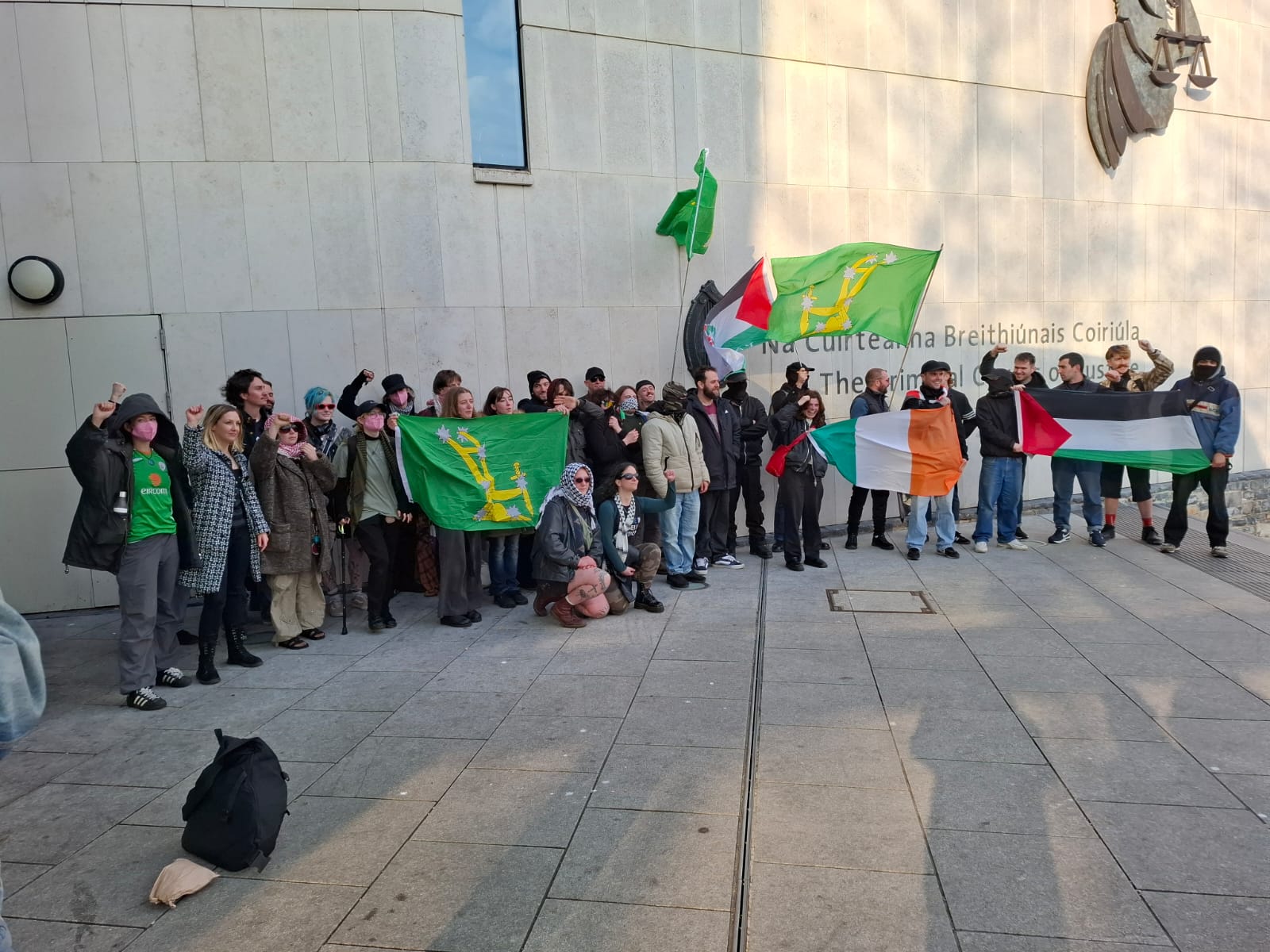
Around 30 people demonstrated outside Dublin’s Criminal Court on Thursday, many of them displaying Irish flags (Tricolour and Starry Plough) along with those of Palestine in solidarity with three activists before the court.
The activists were charged under Public Order legislation arising out of protesting a British war ship at Dublin docks in November last year, in solidarity with Palestine and against NATO’s support for the Israeli state’s slaughter in Gaza.
It was alleged that the activists (variously from Saoirse Don Phalaistín and Anti-Imperialist Action organisations) had entered a restricted part of the Dublin Docks and, holding a Palestine flag, had approached a British warship docked there and then occupied the gangway.
British military displaying firearms on Irish state soilin November last year. (Photo: Anti-Imperialist Action)
Gardaí had been called and the activists had refused their instruction to leave under the Public Order legislation and they had then been arrested. No act of violence, physical or verbal, took place on either side other than the refusal to leave and the arrests.
The activists appeared in the Parkgate Street building before Justice John Hughes and all three were defended by Damien Coffey of Sheehan Partners, a law firm which often handles political and human rights cases. Three Gardaí from Store Street acted in the role of the Prosecution.
The Garda in charge of the prosecution and his two colleagues gave evidence as to the arrests. Questioned by Coffey for the Defence, all confirmed that although the protesters had refused to leave, there had been no violence offered by them during their arrests.
Strangely, as shall become evident and relevant, one did not recall the British military presence on the gangway to be armed, whereas another did and confirmed that a photo of the armed men was of those who had been present.
One of the Garda offered his opinion that whereas the vessel was regarded in law as “British soil”, the gangplank was legally “Irish soil” and, if the protesters had actually set foot on the ship, they might have been charged with piracy. This piece of evidence also had unintended consequences.
One of the placards displayed by supporters outside the courthouse (Photo: Rebel Breeze)
According to this evidence, the British in a foreign military uniform had been present on Irish state soil and all replied to the defence lawyer that they were unaware of any Ministerial permission to do so — or that this could have constituted an offence under Section 317 of the Defence Act 1954.1
Furthermore, none were aware of any special permission granted to them to carry firearms on Irish state ground. The British military personnel themselves were not present as witnesses as their superiors had not replied to the Garda request to discuss giving evidence in the case.
Port security camera footage was shown as evidence by which protesters could be seen at the gates of a fenced-off section of the docks and some time later proceeding through a gate. A port security employee had been summoned by the Gardaí as a witness.
After he had been taken through his evidence (and failed to respond to what seemed an attempted prompt) by the Garda in charge the only relevance of his evidence was that a) the area was restricted and b) that he was worried for the safety of the protesters.
This (and the reason for the possible attempted prompt) was of importance when Coffey developed his defence summary on the legal grounds that Section 14 (1) of the Public Order Act required there to be an element of fear arising from the actions of those to be charged under the Act.
None of the evidence for the Prosecution had shown the presence of fear of anyone from the defendants and, furthermore, he submitted, any element of fear was much more likely to arise from the presence of two men holding firearms, to whit, the British military personnel.
The second part of the Defence summary dealt with right to protest, Coffey quoting a number of legal sources, also referencing the Irish Government’s recognition of a Palestinian state and statistics of people killed by the Israeli state against which the activists had been protesting.
Judge Hughes announced that a recess was due for lunch and that he wished to consult legal authority (case law etc) so they would recess and reconvene in an hours’ time.
A number of supporters who had taken time off from other commitments left at this point while a few arrived instead.
THE JUDGEMENT
After reconvening Judge Hughes began his long drawn out summing up and it gradually became clear that he intended to find the accused guilty. However people awaited with varying degrees of patience for the details of the sentence.
The Judge referred to the right to protest but also to the restrictions upon it (usually limiting its effectiveness) though he did not say that, nor that powers exist to abolish those rights when the State feels it necessary.
With regard to the ‘element of fear’ required for conviction under the Public Order Act Hughes quoted a judgement as a reference that seemed neither relevant nor reasonable, involving a woman experiencing fear of being broken into and even fear of children playing outside her home.
Despite repeating the standard claim of capitalist law that judges cannot adjudicate emotionally nor be swayed by what was occurring in Palestine, John Hughes revealed his own political bias when he bizarrely claimed that a British fleet had been welcomed into an Irish port in 1820.
He revealed his political naivety also when he expressed surprise that the British had not replied to the Garda communication regarding the incident.
On submission by Coffey regarding the lack of previous convictions and effect of criminal convictions on the lives of the three, Johnson, again drawing out the moment, gave them what amounts to a conditional discharge with a provisional forfeit of 500 euro.2
No doubt the desire not to create martyrs around whom solidarity campaigns might intensify played at least as much a part as any concern for the lives of the activists.
The defendants and their supporters left; outside the court they were embraced by a number of supporters before the gathering broke up, some attending to other solidarity activities elsewhere. The show of support was a good sign of solidarity against state repression.3
View of some of the people outside the courthouse on Thursday in solidarity with the three activists (Photo: Rebel Breeze)
SERIOUS ISSUES AMONG ELEMENTS OF COMEDY
The name of the British naval vessel being The Penzance and the mention of a possible piracy charge brings to mind of course the Gilbert & Sullivan opera The Pirates of Penzance (1879).
The focus of the Gardaí on arresting peaceful protesters in preference to unauthorised people in foreign military uniform carrying unlicensed firearms on Irish soil and also trying to suggest that not they but the protesters would give rise to fear is not without its comedic elements.
However overall the whole matter is extremely serious, with regard to the zionist genocide in Palestine, the active collusion of the UK/NATO, the active collusion of the Irish ruling class4despite its verbal positions – and the repression of its State on more active and directed solidarity actions.
End.
FOOTNOTES
1 317. — (1) No person shall, save with the consent in writing of a Minister of State, enter or land in the State while wearing any foreign uniform. (2) No person shall, save with the consent in writing of a Minister of State, go into any public place in the State while wearing any foreign uniform.
2 It will not appear as a criminal record but in the event of a subsequent conviction, the 500 euro can be levied as a fine in addition to any other punishment in court sentence.
3 Though the absence of a number of political organisations and trends was also marked.
4 “Dual-use”exports to the zionist state which can be adapted to military use; failure to press for any economic, academic or cultural sanctions against the zionist state; shelving of the Occupied Territories Bill; failure to impose diplomatic sanctions of any kind.