INTERNATIONALIST SOLIDARITY — BUT WITHOUT CRITICISM?

Diarmuid Breatnach

One cannot criticise the national liberation movement or Left political party in another country, apparently. Or so some think. Why not? “Because it goes against internationalist solidarity to do so.” “Besides, one doesn’t live in the other country or maybe know their conditions and their culture as well as does the group one is criticising.” So, one should just applaud their resistance and say nothing negative. Apparently.

Like many positions, that seems fine until you break it down a bit. So let’s take a look at this more closely. The Khmer Rouge was a national liberation organisation of socialist or communist orientation in Kampuchea (Cambodia). The Khmer Rouge had both male and female fighters and they led a struggle against US Imperialism and against feudal rule in their country. The US carpet-bombed the country and aided the Cambodian Government in resisting the Khmer Rouge, who were in turn assisted by the North Vietnamese and the Chinese. So, a clear case of which side we’re on, right? With the Khmer Rouge. Against US Imperialism and feudalism.
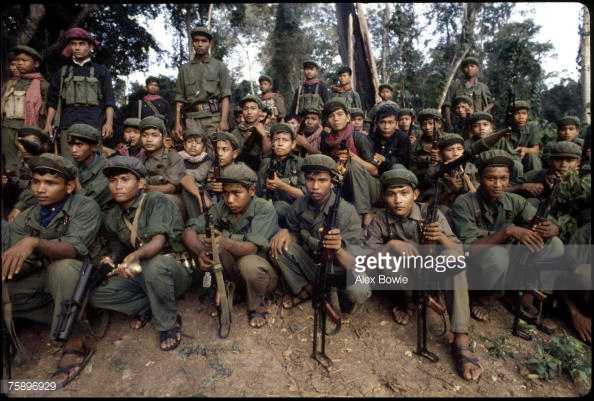
Khmer Rouge fighters
Khmer Rouge fighters (Photo: Internet)

But when in 1975 the Khmer Rouge leadership declared that all Cambodians needed to return to the land and, in order to implement this policy, exterminated all who disagreed or who they thought might disagree, and in the course of their programme caused hunger and illness which killed more, all of which came to a total of around 21% of the country’s population, what then? Are we still in solidarity with the Khmer Rouge then? What? No? We’re actually condemning them?
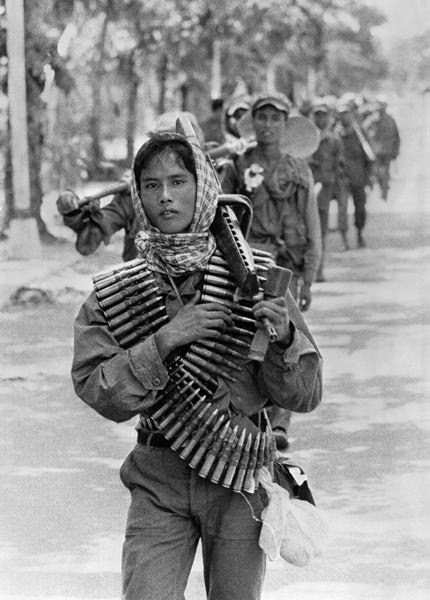
The young Khmer Rouge guerrilla soldiers enter17 April 1975 Phnom Penh, the day Cambodia fell under the control of the Communist Khmer Rouge forces.
The young Khmer Rouge guerrilla soldiers enter17 April 1975 Phnom Penh, the day Cambodia fell under the control of the Communist Khmer Rouge forces. Khmer Rouge fighters (Photo: Internet)

Good! And so we should. But what happened to “uncritical support and solidarity” and “we don’t know what’s going on there as well as the locals” etc, etc?

Ok, that was an extreme example and there was a massacre and huge loss of life. But the massacre event had a trail leading up to it and that trail could have been marked. Apparently two of the leaders back in their Paris student days had written theses advocating returning to a peasant economy. No doubt there were other signs in terms of who became leaders and how they maintained their leading positions – this was the time of the high tide of leader-worship, when in China photos of Mao and in Vietnam photos of Ho Chi Minh, predominated not only in official buildings but in public spaces and in the hands of their supporters abroad. Whether Ho Chi Minh or Mao Tse Tung were good or bad revolutionaries, or even a mixture of good and bad, is not the point. What is the point is whether it is healthy to treat living human beings as saints or gods; whether if you trust them unquestioningly today you will be able to question them (or be permitted to) if they take the wrong path or just a wrong turning tomorrow.

Now let’s take another example, much closer to home and much less in magnitude – the French Mayor of Vitry-sur-Seine in 1981 who, it was reported, in an anti-immigration demonstration, personally drove an earth mover to demolish a hostel for migrants from Mali. He was a member of the Communist Party of France and also the Party’s General Secretary, Georges Marchaise, ran a racist campaign when he stood as a candidate in the French Presidential Election that year. Now, the Communist Party of France had organised the Maquis and most of the urban French Resistance to Nazism and had led the liberation of Paris before the Allies arrived.  Surely Georges Marchaise had been elected by his large party and the Mayor of Vitry-sur-Seine not only by his party supporters but also by a majority of the people of his town. So who are we to criticise them, right? No, wrong, you think – and quite rightly so. We are not only entitled to – we should criticise them, expose them and try to get them to change.  And our criticism should also serve as a warning to any others thinking of taking the same path.
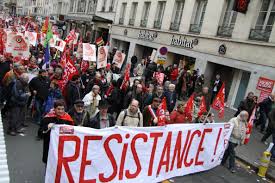
Anti-Austerity march of Communist Party of France in Paris 2012.jpeg
Anti-Austerity march of Communist Party of France in Paris 2012 (Photo from Internet)

Back to another big example now. Before WWI all the socialist parties in the world (that included what we would now call communist and social democratic parties) agreed that imperialist war would be a terrible thing and against workers’ interests. Some even vowed that if their governments tried to join a war, they would turn the imperialist war into a war against capitalism. But when it came to the crunch, the main socialist party in nearly every European country made an alliance with their capitalist class and recruited cannon fodder for them. There were very few exceptions and among them were the Irish Labour Party, which had been founded on a resolution by James Connolly in 1912 …. and the Bolsheviks. Although it didn’t openly oppose it, the Irish Labour Party was in general critical of the War and two of the party’s founders, Connolly and Larkin, overwhelmingly so. The Bolsheviks placed ending the War among their main slogans for insurrection and as a result recruited many soldiers and sailors into the actual insurrection.

OK, so would we have had the right to criticise the war collusion policies of the British Labour Party, of the German socialists, French, Italian, Belgian, Australian? Of course we would have had the right – and would have been correct to do so.

And another big example. The Shah of Persia was an ally of western imperialism and had a substantial repressive apparatus, including a huge secret service. In 1978/’79, a wide movement began to rise up against the Shah and his regime fell suprisingly quickly – so quickly that the CIA, who had their HQ for the Middle East in the country, were caught shredding their documents (many of which were pieced together again by Iranians).

There were a number of different interest groups but two important and very different ones were socialist activists, many of them students, on the one hand and Muslim fundamentalists on the other. When the Shah was overthrown, the latter group seized power and thereafter wiped out the socialists. I don’t know whether any mistakes were made by the socialists in their alliances or if anything could have been done to avoid the outcome. But if there were and if there was something, and we thought we knew what it was, would it not have been criminally negligent and uninternationalist of us not to have told them? And if necessary to have argued it with them?  And would our criticism not also help others who might find themselves in similar situations now and in the future?

Now, let’s take a minute to look at the other side of the coin. A leader of the popular movement Podemos in the Spanish state recently made a public intervention in Colombian politics the nature of which need not concern us here. But in the course of that, he denounced the Basque armed group ETA and likened them to Latin American fascist murder squads. Was he entitled to do so?

No, he was not. He was entitled to criticise ETA armed actions but in the course of that he should have taken account of the fact that the state in which he lives had practiced fascist repression on ETA for nearly a decade before it took up arms and has never ceased its repression of the Basque people since 1939. He was not at all entitled to compare ETA to fascist murder squads.

During the recent 30-year war, was the Communist Party of Great Britain entitled to publicly criticise IRA bombings in Britain, a number of which killed and injured innocent civilians? Yes, it was. But it was not correct to join the right-wing chorus denouncing them as vile murderers. And with the right to criticise also came a duty of solidarity, to campaign for British withdrawal from Ireland, against repression of the Irish community in Britain and for decent prison conditions and repatriation for Irish republican prisoners in jails in Britain (and the score of politically-framed uninvolved Irish prisoners).

To its shame, the CPGB took the road of histrionic censure but without taking up its duty of solidarity, an internationalist duty more applicable to itself than to any others around the world, since its party is based in the very colonial state that was waging war in Ireland.

I take one last example. At a certain point during the South African people’s struggle against the white racist regime (a settler ruling class which was totally supported by imperialism) it emerged that some things were not quite right within the resistance movement and, as time went on, that they were a lot worse than “not quite right”. We began to hear rumours that Winnie Madzikela Mandela was a member of a corrupt clique that had brutalised and even murdered people within the movement. But Winnie had become an icon of the struggle – a strong, handsome, militant woman with a husband, a leader, decades in jail. And the struggle seemed to be entering a crucial phase so, not wanting to undermine that struggle, we said nothing. (When her husband, Nelson Mandela was released, he agreed to an investigation into Winnie’s clique and ended up divorcing her. However, she is still a member of the ANC’s national Executive).

Worse, in a way, were the rumours of concentration camps being run by the ANC’s armed wing Umkhonto we Sizwe in neighbouring countries which were jailing ANC dissidents, torturing and even killing them. But the struggle was at a high point …… and we didn’t want to undermine …..

Yes, beginning to sound familiar, isn’t it? Besides, for some of us, the source of these stories were Trotskyists and we didn’t trust their bona fides too much ….. But it turned out that there had been these camps and they had done the things that were rumoured …. and testimonies of some of those cases have now been documented in the Truth and Reconciliation hearings. What’s more, it seems that some of the people in the ANC leadership were not only aware of them but had a hand in setting them up.

Mandela may not have known about them while in jail but learned of them at least when released. He eventually criticised the torture carried out in them but did nothing to root out those responsible.  This is crucial in terms of what happened later.

When the South African deal was done, an accommodation between the ANC and the white settler ruling class, it was also a settlement with imperialism which not only continued its plunder of the South African resources and labour but increased it. The masses got the vote and little else but a top stream of the ANC, SACP and NUM benefited in terms of government jobs and corruption. The recent head of the National Union of Mineworkers and current Deputy President of the ANC, Cyril Ramaphosa, is a millionaire and on the board of Lonmin, a British corporation mining platinum in South Africa.

In 2012, workers went on strike at Lonmin and other mines, looking for substantial pay rises; many were saying that the NUM was not fighting for them and wanting representation by a new union, AMCU. The mine-owners refused to negotiate, SACP said the strikers should be arrested, Ramaphosa asked the Government to crack down on the strikers, Zuma (President of the ANC and of South Africa and one of those implicated in the concentration camp scandal) covered for his Chief of Police Riah Phiyega while she organised what followed – the massacre of 34 striking miners in one day (in addition to some more over previous days) and many injured.

The Marikana Massacre of striking miners by the South African police of the ANC government. The victim in a green top or blanket is believed to a Mgcineni Noki, a strike leader, who was shot 14 times.
The Marikana Massacre of striking miners by the South African police of the ANC government. The victim in a green top or blanket is believed to be Mgcineni Noki, a strike leader, who was shot 14 times.  (Photo from Internet)

The Marikana massacre brought many of the elements that had been separately visible earlier together into high relief: ANC, NUM and SACP (South African Communist Party) corruption and jobbery; intolerance and brutality against any dissent; collusion with the white settler regime and foreign imperialists – now coupled with exploitation of black workers and murderous repression on a scale not seen in a single incident in South Africa since the Sharpeville Massacre of 1960.

Were we right to have said nothing about the activities of Winnie’s gang? And not to have tried to check out the rumours about the concentration camps? Were we right to say nothing critical about Mandela and the deal he led the people in accepting? I don’t think so. I think we had an internationalist right to speak, comrades – an internationalist duty. And it was a duty we failed to fulfill.

I could have picked so many other examples from history but I chose these as being ones on which most people would take the same side, so as to get the principle across without sectional positions being taken.

There is another very important role of criticism. It helps to clarify things for us in our own struggles. We have to think things through (hopefully) before criticising and then consider and weigh the reply we receive, then think about our reply to that as well. And so on. And many if not all of these issues will be in some way applicable to us too, either now or in the future.

But in criticising, do we abandon solidarity? Most assuredly we should not. Obviously we could have had no solidarity with Pol Pot and his clique or with his party comrades who followed them – our solidarity is fundamentally with the people and it was the Cambodian people who deserved our solidarity, which in that case had to be oppositional to the party. But we should, as well as being in solidarity with the Mali migrants in Vitry-sur-Seine in 1981, also be in support of French workers there in struggles against French capitalism, while simultaneously criticising any racist tendencies in their movement or parties.

We could and should have, were we adults during WWI, have criticised the policies of the socialist parties who colluded in the bloodbath of Europe, the Dardanelles and the Middle East, even if we had never set foot in one of the countries of those parties at the time.

Maybe it would help to bring the issue down to a more personal level. In families, we generally accept that we should express and act in solidarity with one another. Does that mean that if someone in our family does something really wrong, we should remain silent? Clearly not. We can support him in changing, we can support him in other ways but we cannot – or should not – support him in continuing to act wrongly. For the good of society, the family and even of the individual, we are obliged to point out the wrongdoing and that we disagree with it – in other words, to criticise. What kind of family members would we be if we did not do that, if our attitude were “Whatever you do is fine, no matter what it is or who ends up getting hurt, you or someone else”?revolutionary solidarity
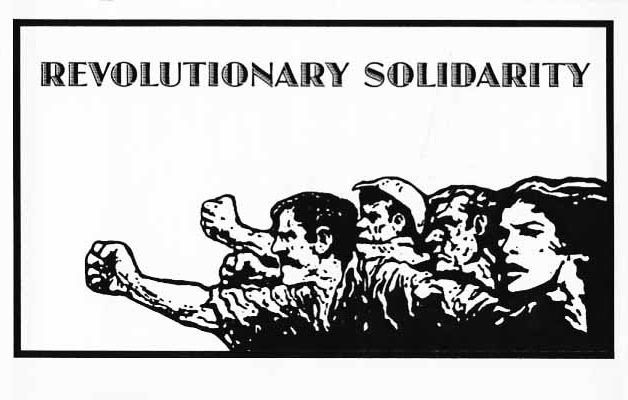
And if we are internationalists, of whatever particular socialist trend, we have an internationalist duty to our ‘family’ around the world not only to act in solidarity but also to express criticism when we think our comrades elsewhere embark on the wrong road or take a wrong turning. Proletarian internationalism and uncritical support not only don’t go together – they are actually opposites. There may be considerations of in what manner to present the criticism but continued silence is not an internationalist option.

end

COMMEMORATING THE RISING AND WWl

Diarmuid Breatnach

I WAS INVITED TO SING A COUPLE OF SONGS AT THE LAUNCH OF “OUR RISING – CABRA AND PHIBSBOROUGH IN 1916″. Of course I was honoured to accept; the songs I chose to sing were “Sergeant William Bailey” and “Where Is Our James Connolly?” I chose them as important to the events around the Irish Volunteers and hoped they would be considered appropriate to the book launch event also.


These years are the centenaries of many things in our history and it is right that we should remember them. Among those things we are told that we should remember the First World War. I think the people who say that are right – we should, but not in the way most of those people mean. We should remember that in a dispute about what markets of the world should be dominated by which World powers and which resources they should have a monopoly on stealing, they sent millions to their deaths and millions more to injury and tragedy. And of course, the capitalists, the class that controlled those Powers were not among those dead and injured millions.

When those people tell us that we should commemorate the First World War and collect songs and memorabilia they don’t mean that we should sing songs against the War, collect anti-War leaflets and honour those brave few who dared speak out publicly against the war stampede of their countries. And who paid the price for doing so. And yet those things too are the history of the War and to my mind the parts of that history that, among all the wars of the past and the present, hold out a hope for the future.

Peadar Kearney, author of "The Soldiers' Song", "Sgt. William Bailey" and many other songs
Peadar Kearney, author of “The Soldiers’ Song”, “Sgt. William Bailey” and many other songs

Peadar Kearney was an Irish Republican of a Dublin skilled working class background born not far from Phibsborough – in Dorset Street, around the corner from Inisfallen Parade, where Sean O’Casey was reared. When Kearney taught night classes in Irish, O’Casey would be one of his pupils.

Kearney wrote many songs that are still sung today, the most famous of which is the Soldiers’ Song, on which he cooperated with Patrick Heeney, from Railway Street, off Gardiner Street. When the Irish Volunteers was formed in 1913, Kearney was a co-founder and his song was one of a number sung by other Volunteers during the 1916 Rising, in which Kearney also fought.

Peadar Kearney also wrote a three-verse song mocking a recruiting sergeant for the British Army, who apparently had a pitch at Dunphy’s Corner. According to a local historian, that was outside what is now Doyle’s pub, at the Phibsboro crossroads. I added two verses to that song, in order to give Sergeant William Bailey a bit of a background story.

Of course, the 1916 Rising is a part of the history of the First World War too – and not only because it took place during that War. For some, undoubtedly, it was a case of “England’s difficulty is Ireland’s opportunity”. But for some others, including Connolly, as he made clear a number of times in writing, the Rising was necessary to interrupt the War, to stop the bloodshed of class brother killing class brother across Europe.

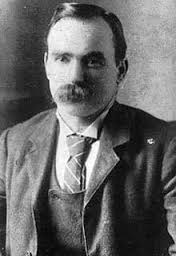
James Connolly, a revolutionary socialist, wanted revolution against world war

Connolly was a revolutionary socialist. At the end of the 19th and very early 20th Centuries, the standard position of the international socialist movement had been against imperialist or colonialist war. In 1912, on November 24–25, the congress of world socialist parties at Basel in Switzerland, including revolutionaries and reformists, had come out clearly against imperialist war. Their manifesto was unanimously adopted at the congress. In the context of the situation created by the war in the Balkans that had begun in October 1912 and the increasing threat of world war, the Basel Manifesto called called for an unrelenting struggle against war and those responsible for it, the ruling classes of the capitalist countries. It stated that that war, if it began, “would create an economic and political crisis,” which should be utilized to “hasten the downfall of the rule of capital.”

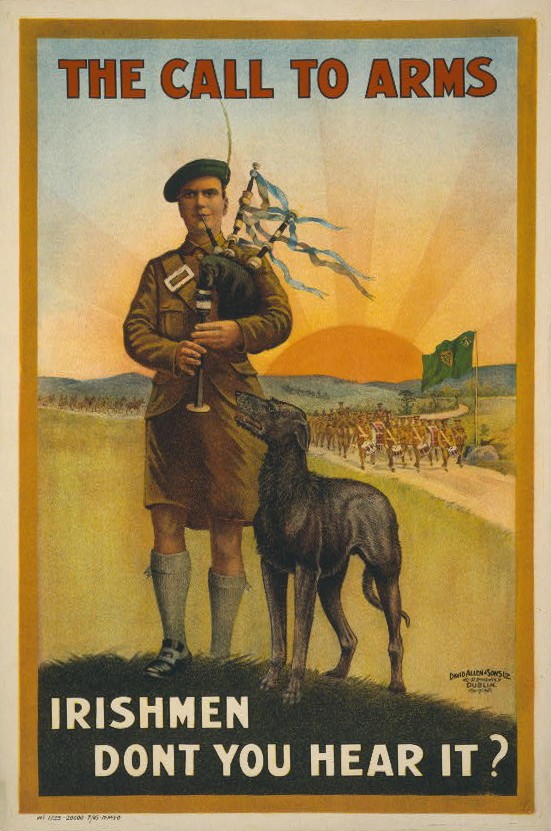
British Army recruitment poster aimed at Irish men

As we know, the leadership of those parties that we now call the social democrats abandoned this position completely and championed their own ruling classes two years later as WWI broke out, cheering the workers of their countries on into uniform, to kill and be killed. There were some uprisings against the capitalists and against war but the first of any significance — and indeed of great significance — was the 1916 Rising in Ireland. The next revolutionary blow to war would not be until be a year later, with revolution in the Russian Empire.

Of the two better-knowns songs about James Connolly, the song “Where Is Our James Connolly?” is I think the best and truer to Connolly’s ideology. It was written by Patrick Galvin who was, among other things a writer, playwright, screen writer and singer. Galvin died only four years ago. Christy Moore remembers learning the song around 1970 which is probably not long after it was written – or at least published.

Patrick Galvin, author of "Where Is Our James Connolly?"
Patrick Galvin, author of “Where Is Our James Connolly?”

IN SPAIN THE PEOPLE SHOULD RULE — THAT WOULD BE DIGNITY

Rebel Breeze: This piece was received months ago but somehow got overlooked for which we apologise.  Events since then make the points in this short document perhaps even more relevant.

Red Roja describes itself as “a revolutionary marxist organisation active within the Spanish state”.  It states that it is “an autonomous organisation independent of any other party or organisation and also economically and politically independent of the State or of any other power, being anticapitalist, of the class, feminist, radically democratic, internationalist, anti-fascist and ecologist.”
(Translation D.Breatnach from http://redroja.net/index.php/que-es-red-roja/quienes-somos)

In Spain, ‘The people should rule — that would be Dignity’
Red Roja Red Network Rede Vermelha
Traducido por  John Catalinotto

The following is a statement of the organization Red Network in Spain to the Dignity marches of March 21, a year after a similar march brought 1.5 million people to Madrid to protest austerity measures.

On March 22, 2014, more than a million people from all over the Spanish state marched in Madrid for ‘Dignity’ against austerity.

On March 22, 2014, more than a million people from all over the Spanish state
marched in Madrid for ‘Dignity’ against austerity

We once again demand that those who caused the crisis be made to pay for it.

An unpayable debt is crushing us, we who suffer every day from unbearable job insecurity, dismantling and privatization of health and education, increasing retirement age, the disappearance of aid for dependents, and our millions of unemployed people who are worth less than nothing to those in power. … The austerity measures and cuts are only being used to pay for a debt created to rescue the gang of bankers, big business people and their servants in the National Assembly, who are playing chess with our lives. Besides using our suffering to line their pockets, they expect us to hang our heads and die in silence. That we refuse to do.

Regarding this, we are nowhere near satisfied with hearing only about “restructuring” or “audits” of that debt. We cannot stop at half-measures when our lives are at stake, when there can be no doubt that this debt is responsible for the criminal foreclosures, the endless unemployment and for the disappearance of even the modest steps taken against domestic violence that condemns many women to terror, suffering and death. It is not a technical problem to say, “NO DEBT PAYMENT.” It is a punch that the people can throw to demand control of their own lives.

In these times, it is understandable that there are illusions that an election can bring “victory,” that we can “throw out the PP” [the rightist Popular Party] or “get rid of the wealthy strata.” But more is needed. No one involved in the new electoral initiatives is speaking about the national and European laws that impose the payment of that illegitimate and criminal debt before anything else. Good will is not enough; neither is honesty. Proof of this is the victory of Syriza in Greece, which has not pushed back by even one step the measures the Troika [the European Commission, the International Monetary Fund and the European Central Bank] had taken against the Greek people. It has become clear who rules Greece: It’s the EU dictatorship. Democracy is an illusion.

Moreover, even this demonstration, though necessary, is insufficient. It is not enough to come together to demand “Bread, Work and Housing” (things that would only be possible after we refuse to pay the debt), or to have a great demonstration of dignity. As seen in Greece and as we see every day in our streets, bankers and big business are not going to give up lining their pockets out of good will.

We need to unite, to organize neighborhoods, towns, businesses and schools, and strike a blow together, all at one time. Only through the unification of our struggles, only if the people who are working and suffering get organized, can we bring about policies that work in our own favor.

The vote is not enough. The people need to organize. The people need to rule.

That would be Dignity.

A BLOC FOR WHAT?

Diarmuid Breatnach

From time to time people are asked to join a political bloc of some type. Should one join or not?

A political bloc is an arrangement of temporary unity, of as little as some hours of duration, for example on a demonstration, or of weeks, perhaps in a campaign to get an agreed list (i.e. “a slate”) of candidates elected or to vote a particular amendment to a resolution being proposed.

Blocs may be of longer duration, as for example with the Bolshevik bloc in the lead-up to the Russian socialist revolution. This last example is illustrative of the nature of blocs, which are generally not only for something but also against, or at least different to something else. There was a whole mass of political factions against Kerensky’s government in 1917 but the Bolshevik leadership sought to create a bloc not only against Kerensky and his followers’ maneuverings but also different to that of the Mensheviks and the Socialist Revolutionaries. What the Bolsheviks were for, apart from the slogan “All power to the Soviets” (the workers’, soldiers’ and sailors’ councils and assemblies), was a revolution as soon as possible, the overthrow of the capitalist-monarchist State and the creation of a socialist one (as well as pulling the Russian Army out of World War One).

Although the facts of the successful overthrow of the state and withdrawal from the War are not usually questioned by historians or political theorists, the fate of that state is. And the bloc itself had a very mixed history after the Revolution.

But what essentially is the purpose of blocs? Are they composed of like-minded people who don’t want to belong to a political party-type organisation, or perhaps of people of a variety of party political allegiances, but who want to join for the moment to promote a general idea? Or are they attempts by one group to create hegemony, to bring people of different perceptions together in temporary action, with the intention of building a more permanent organisation? Or perhaps crudely an attempt by one (or two) organisations to recruit members to their own organisations? I have over the years participated in blocs and it seems to me that different blocs have at different times been each one of those things. So I ask myself, is that ok? As political activists, should we consider blocs a legitimate type of temporary political organisation? Is each of those purposes outlined above of equal value?

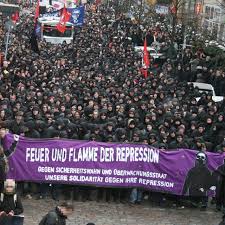
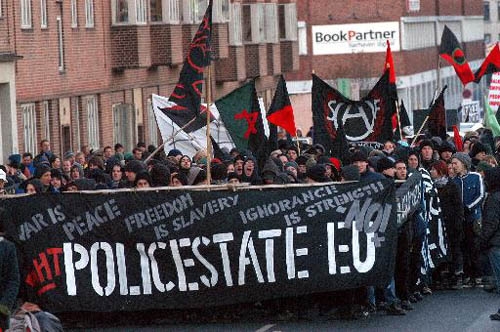
A Black Bloc against repression in Germany -- location and year uncertain
A Black Bloc against repression in Germany — location and year uncertain

Around this time of year in 2010, early on in the protests against austerity, although then called “Right to Work”, back in the last year of the Fianna Fáil/ Green Party coalition government, there was a bloc formed for participating in demonstrations against the bank bailouts and consequent cuts in social spending and wages being imposed or proposed by that Coalition Government. Called the “Anti-Capitalist Bloc”, it seemed composed in the main of the anarchist WSM and what would often be described as “dissident Republicans”, chief among which at the time was the Éirigí organisation. There was a fair sprinkling of non-aligned activists (i.e. not belonging to any party or particular organisation) whose politics could be described variously as socialist republican, anarchist or communist.

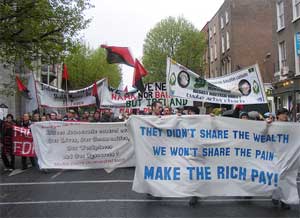
Anti-Capitalist Bloc in Dawson Street, Dublin, marching to join anti-austerity demonstration at Dáíl in 2010

This bloc gathered at a different rallying point to the rest of the Right to Work march but marched to meet it at the Dáil. In that role, it survived I think three demonstrations. The first one was attacked by police after the demonstrators refused to be prevented from marching to join the other demonstration.

What was the purpose of this bloc, at least in the eyes of its organisers? I have no documentation to hand but as I recall, it was to say something like: “the problem is not this or that economic measure or this or that party or government; the problem is capitalism itself.” It seemed to be implying that therefore we needed a revolution. I would and did agree with such a statement and with its implication. Not only did I agree with it

Black Bloc against the EU, possibly a section of the
Black Bloc against the EU, possibly a section of the “March for an Alternative” in London in March 2011.

but it seems to me a crucial point to make, if we are to end our vulnerability to the vagaries of the capitalist system’s fortunes and to its particular rapacity at various times.

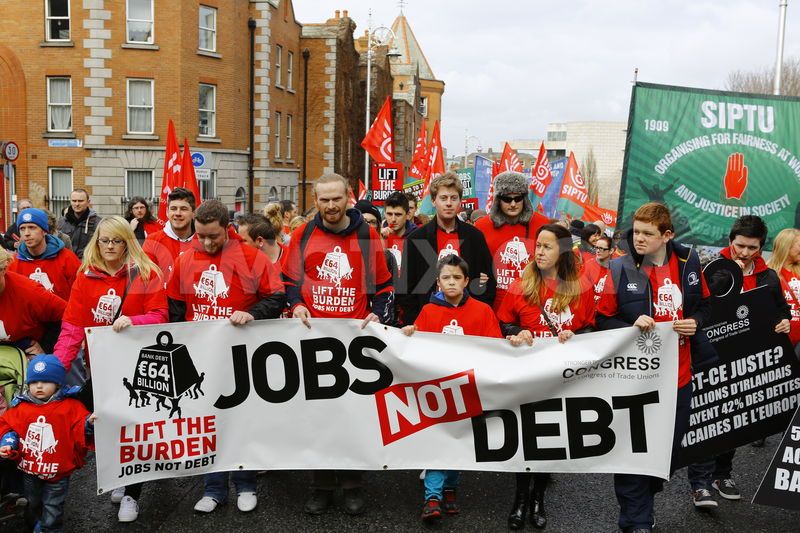
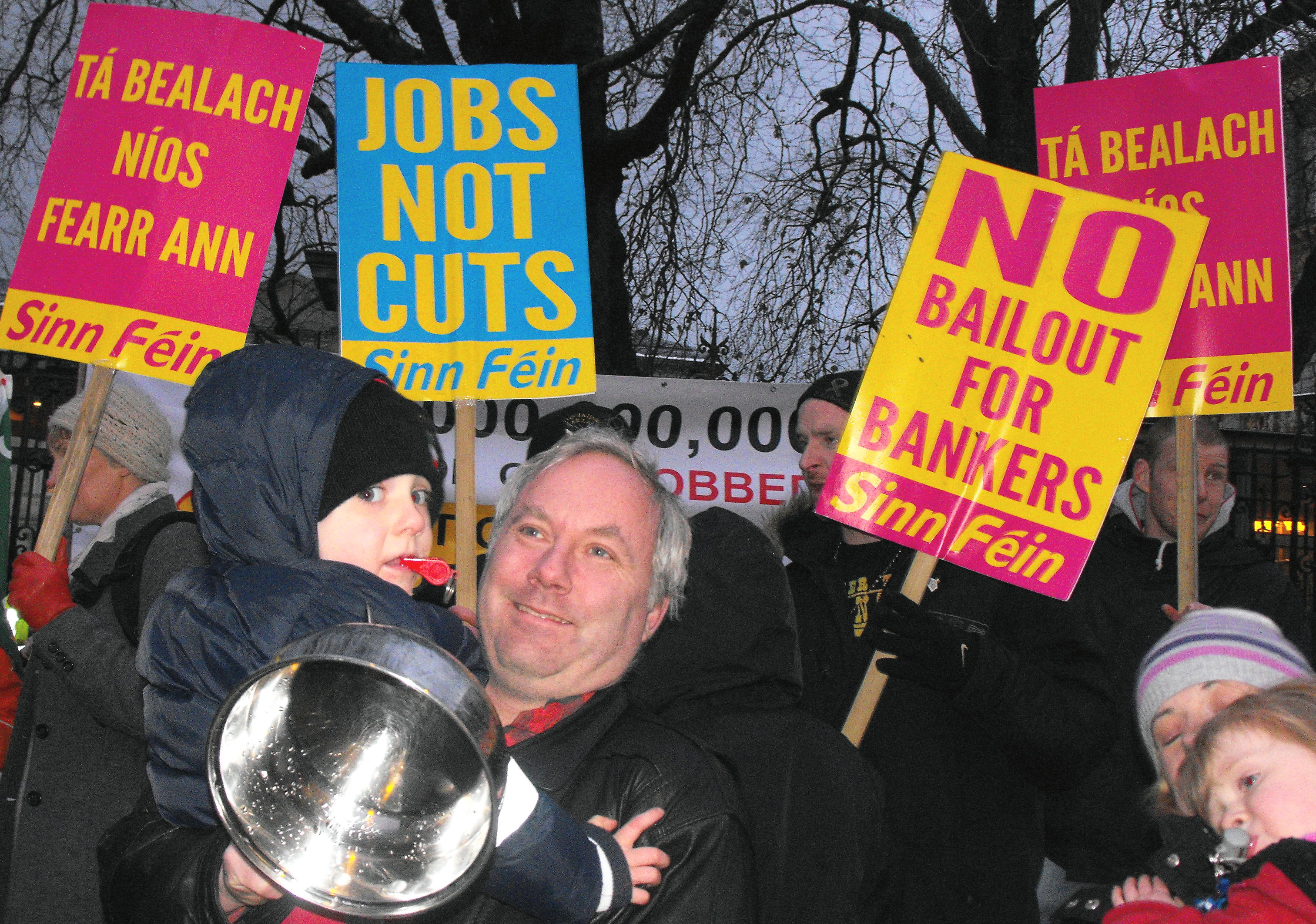
This was a message clearly different from that of some sections of opposition to the Government: SIPTU and the ICTU were saying that there was a fairer way of sharing the burden, which was about what Sinn Féin was saying with “Tá bealach níos fearr/There is a better way”.

Reformist trade union slogan on anti-austerity march in 2010

But could those participants in the bloc not have presented that point of view while still joining the other demonstration at its rallying point and marching with it? Perhaps – by each person being given specific placards, for example, agreeing a joint leaflet or by having speakers to represent their point of view. But all of those present difficulties – the production of an agreed placard slogan to say nothing of the difficulties of agreeing a leaflet. And a speaker might not be permitted by the organisers of the rest of the demonstration or their message would get lost among the others being put forward, even if the speech itself could be agreed by the bloc in advance. All the bloc participants could dress in a similar colour (like the “Black Bloc” on some demonstrations overseas in the past). But a separate bloc, marching behind a banner with a slogan with which each bloc participant could agree, was surely the least complicated way to deliver that message – and very visible. The police who attacked it certainly must have thought so.

Sinn Féin demonstration at the Dail in 2010 -- all totally reformist slogans apart from possibly the "Don't Pay the Bankers" slogan
Sinn Féin demonstration at the Dail in 2010 — all totally reformist slogans apart from possibly the “Don’t Pay the Bankers” slogan

There is another factor in such a way of organising a bloc – it permits a visible assessment of its size, of the identities of its participants (unless they go masked, as many of the Black Blocs abroad did). Of course this has a down side also in that the state’s political police can take notes on the participants for the purpose of their files. But it has a positive effect too in terms of future progressive and revolutionary action. A mailing list can be compiled for calling to future events, individuals can be introduced to other like-minded individuals, organisations can get to cooperate – all factors militating against the fragmentation of the radical and revolutionary sector.

Some people on the other part of the march accused the Anti-Capitalist Bloc of being politically sectarian. Perhaps some even thought them elitist. These are of course dangers. But was it or was it not an important statement to make, that the problem was not the governing party but the system, and that a revolution was necessary? And if it was an important point to make, was such an eye-catching way of making it not justified?

Let’s consider what happened in the months and years afterwards and where we are now. In the face of a wide-scale howl of protest at the bank deals of the Government, their economic measures, and recent individual politician scandals, Fianna Fáil were deserted by their Green Party coalition partners. FF dumped their leader and elected a new one for their party and for the Government. It was all too little, too late and they were obliged to agree to a general election, the result of which was that FF’s number of TDs (elected representatives) was cut by nearly 80%, the greatest electoral defeat suffered by either of the main political parties in the history of the state. And the Green Party was wiped out as an electoral force, almost disappearing entirely off the political map.

The electoral verdict otherwise was mixed. The main rival of FF, Fine Gael, got the most votes with the social democratic Labour getting the next largest amount. Sinn Féin jumped from four to fourteen, a Trotskyist party and a different Trotskyist led-alliance got four between them for the first time, twenty Independents were elected, most of them left-wing. But whether socialist, republican, conservative or social-democratic, all candidates had been elected on platforms of opposition to the deals the previous government had made with the banks and with the EEC’s banking regulators.

Despite that, Fine Gael and Labour formed a coalition government and proceeded — in fact — to endorse what their predecessors had done and furthermore, to intensify a regime of austerity on working people, introducing three new taxes and supporting legislation to squeeze the people still further. The message of the Anti-Capitalist Bloc was vindicated.

Would the whole demonstration marching under a banner of “Overthrow Capitalism” have significantly changed that electoral result? Extremely unlikely. But it would have posed the question to the participants and to observers. It would have effected subsequent campaigns of resistance to austerity measures and additional taxes. And it would have built a much wider consensus eight or nine years later that the overthrow of capitalism was the only solution with perhaps a growing consensus that such an outcome was possible.

Because here we are now nine years after those three appearances of the Anti-Capitalist Bloc and once again it seems a general election is looming. Once again, we see other political parties pushing forward to be elected on programs without any perspective of overthrowing capitalism. Political alliances based on continuing the system are being mooted. On social media one sees calls for for kicking out Fine Gael or Labour or both, rather than capitalism. On demonstrations against the Water Tax we hear slogans against Enda Kenny, leader of Fine Gael, or against the Labour Party – but few against the capitalist system. Sinn Fein seek to cut down Labour as they court the social democratic vote which, in the past, they have largely ignored (for example, they have little history in the trade union movement). The Trotskyist groups will also attack Labour, also going for the social-democratic vote as they have traditionally done.

Most people feel that the Government will fall soon but when they pose alternatives they are doing so within the framework of capitalism. That means that same class that commanded the deal with the banks and with the EU will remain in power. Their representatives in government will change but the class will remain. And if they remain, their exploitation remains. Not only that but in the present economic climate, their austerity program will remain too – perhaps with some tweaks here and there but austerity still.

A determined campaign of political leadership over the past nine years giving a clear direction of the need to overthrow capitalism could have us in a very different political position now.

So, the next time we get a call to join a bloc for a demonstration, should we rush to it? Well, not necessarily. Let us question what the bloc is for and what it aims to do. Is the bloc in question a tactic, for example like the Black Bloc, where we identify a revolutionary opposition by colour and also, by masking, make it harder for the State to identify us? There may well be a time and place for such. Or is it to declare a revolutionary principle such as “capitalism is the problem; revolution is necessary’? Or “Non-Payment of the Water Charge is what is required”? Then it seems to me that the answer is that yes, we should.

But if it is to draw some particular lines of political affiliation, for example to say that although the participants may belong to separate organisations or none, “we are all communists” or “we are all republicans” or “we are all anarchists”, then I fail to see how that helps the popular resistance movement proceed forward at all, to say nothing of revolution. If that is the purpose of a bloc, it is fine for the followers of that particular ideology but they would be best fulfilling it by holding public meetings and conferences.

On the street, we need to be motivating observers for participation in resistance, and motivating participants for unity in effective actions, for revolution. Motivation has an emotional component but also an ideological one and in that regard the message has to be to overthrow capitalism. At the moment it is that idea that needs to gain hegemony rather than any particular political party or organisation.

End.

THE WOMEN STARTED IT

(Reading time: 5 mins)

Diarmuid Breatnach

We celebrate International Women’s Day on March 8th but are we aware that on that day in 1917, women started the Russian revolution?  It was one of the many contributions of women the world over to the struggles of humanity.

BACKGROUND

          There were many causes of discontent with the ruling regime in Russia in 1917: it was monarchic, autocratic, repressive, incompetent. It had put the country into a war with Germany and Austria, which was in its third year. People were very hungry with food shortages for a number of reasons including the trains being used to transport war materials and soldiers rather than to bring food into the city. Nationalities within Russia and Greater Russia were denied self-determination.

Peasants were serfs to the aristocracy, who could beat, imprison and even hang them. Officers, always from the aristocracy or — to a lesser degree — from the professional classes regularly struck ordinary soldiers or had them whipped. The officers were also for the most part grossly incompetent.

The Christian Church (Russian Orthodox) was allied to the regime and corrupt. Free speech was suppressed and the secret police could be anywhere; the regular police were brutal and could not be challenged by ordinary people. Wages were often barely enough to live on.

START OF THE REVOLUTION

          Petrograd was the Imperial capital city of Russia (the name had been changed in 1914 from St. Petersburg, which sounded too German) and in February and March 1917 a number of factories there were on strike for better wages.   In particular, on March 7th (February 22 according to the calendar in use in Russia then), workers in the large Putilov works went on strike. The factory owners sacked the workers but not had not yet replaced them; there were some clashes with police.

The following day, March 8th (by our calendar), International Women’s Day, women in Petrograd organised a number of meetings and rallies. Led by no political party but in an atmosphere of deep discontent throughout the city, the women’s activities became increasingly energetic and militant. Demonstrations began to march, demanding bread and the women went to factories not yet on strike, calling on the workers to down tools and join the demonstrations. As as many as 50,000 did.

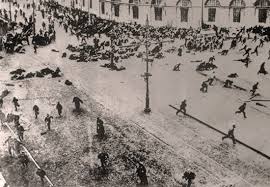
Two days later, a general strike had seized Petrograd’s manufacturing industries, much of the city’s services and even some commercial business, bringing clerks, teachers and students to swell the numbers in protests. Everywhere there were street meetings, marches; red flags and banners began to appear among the crowds. Slogans hardly considered before were shouted and became current, including calling for the monarch, the Tsar, to abdicate or to be deposed.

Demonstration during the "February Revolution" 1917. Note the prominence of women in the demonstration.
Demonstration during the “February Revolution” 1917

The Petrograd police were powerless to control the demonstrators who would have turned on them had they intervened. On the 11th, three days after the women’s mobilisation, the Tsar called on the Russian Army to intervene and to shoot demonstrators.

Russia had the largest single army in the world and despite the war, thousands were still in Petrograd. They had been used in the past against the workers and in 1905 had massacred people on a demonstration to petition the Tsar. But now, after three years of war and shortages, they were not keen to do so and particularly reluctant to open fire on women. Soldiers began to mutiny and, when threatened by officers, often shot them instead.

On that day, the Chairman of the Duma, the parliament which the Tsar Nicholas had kept powerless, sent an emergency telegram to the Tsar, who was at the Headquarters of the Russian Army, asking him for urgent action. The Tsar’s reply was dismissive – his wife, the Empress Consort Alexandra, had written to him that the problems in Petrograd were being exaggerated.

A Russian Army barricade during the "February Revolution" -- the soldiers refused the orders of their officers to shoot demonstrators.
A Russian Army barricade during the “February Revolution” — the soldiers refused the orders of their officers to shoot demonstrators.

But the garrison of Petrograd, including elite units, had mutinied by the 12th, four days after the women’s marches and demonstrations. In addition the Cossack troops, usually reliable in shooting and sabring demonstrators and rioters, were disobeying the orders of their officers to attack the people (although they had not joined the mutiny). Officers began to go into hiding as more of them were being shot by soldiers from their own units. Symbols of Tsarist rule were being torn down in public places.

Two days later, on the 14th, the socialist parties and organisations established the Petrograd Soviet, last seen there twelve years previously, in 1905, before it was crushed by the Russian army. The Petrograd bourgeoisie were frightened but were unused to ruling except as permitted to by the Tsar, who himself now seemed unable to control events. Their powerless Duma (parliament), although ordered closed down by the Tsar that morning, set up a temporary committee to restore law and order and later, their Military Commission as part of the Provisional Government they created.

Thus began a period of dual authority in the city – the revolutionary workers, soldiers (and later, sailors) through the Soviet on the one hand and the bourgeoisie through their Military Committee on the other.

The Petrograd Soviet set the tone for what was to come by approving a number of points in Order No.1, effectively the first law drawn up by the Soviet, point 4 of which stated:

The orders of the Military Commission of the State Duma shall be executed only in such cases as do not conflict with the orders and resolution of the Soviet of Workers’ and Soldiers’ Deputies.”

The Soviet was making sure it could not be overruled by the new unelected body which the bourgeoisie had set up, the Provisional Government, or by its Military Commission.  

Senior Army and political appointees advised the Tsar to do what just over a week previously would have been unthinkable – to abdicate. On the 15th, the Tsar abdicated on his own behalf and of his son, nominating instead his brother, the Grand Duke Alexandrovich, to be Tsar. But he in turn knew he had no support as things stood and refused the “crown”.

July Days Russia 1917
Demonstrating workers shot down by Army units in the Russian “July Days”, 1917

The Russian monarchy of centuries had been overthrown — only seven days after the women’s mobilisation in Petrograd.

Maneouvers by the different sides continued during May and June, including an attempted military coup by senior officers commanding army units away from Petrograd. The fortunes of the revolution swayed back and forth across the country until demonstrations in July supported by the Anarchists and the Bolsheviks were suppressed by army units loyal to the Mensheviks and Socialist Revolutionaries political parties in power.

Workers were being disarmed, soldiers re-submitted to the old discipline and revolutionary leaders were being hunted; the War was also ongoing.

In October, the Bolsheviks seized power, ended Russia’s involvement in the War and began to construct a socialist state.

Two years later the people had to fight to defend it against a right-wing military uprising supported by eight states, including the Allies but were successful in the end.

But it was the women who had started the ball rolling seven months earlier on March 8th, with their rallies and demonstrations and calling the workers out from the factories. Henceforth too, they played their part in government, in building the country and in the armed forces, particularly during the war against fascism and in defence of the USSR from June 1941 to the fall of Berlin and Nazi Germany in 1945.

Nearly 200,000 women were decorated and 89 eventually received the Soviet Union’s highest award, the Hero of the Soviet Union. Some served as pilots, snipers (some of the ace snipers at the famous battle (or siege) of Stalingrad were women), machine gunners, tank crew members and partisans, as well as in auxiliary roles of nursing, construction, administration, factory work and of course food production.

end.

Soviet female combat pilots in WW2. The USSR was the only state to have female combat pilots.
Soviet female combat pilots in WW2. The USSR was the only belligerent state to have female combat pilots during WW2.

WHAT SHOULD WE DO?

“What should I do?” The anguish reached out to me; I felt it empathically. The cry of a person who is prepared to act and wants to change things for the better, to resist what is wrong around us on so many fronts – and that’s the problem.

There so many issues: the Water Tax, the persecution of Republican activists including framing and jailing them, the harassment and torture of Republican prisoners, the threat of fracking, privatisation of resources and services, cuts in services, cuts in salaries, high cost of private accommodation and low social housing provision causing homelessness, the decline of the Irish language and of the Gaeltacht …. and others. And that’s without mentioning international solidarity – and not because I don’t consider that essential, either.

Of course, we can put all these problems down to capitalism and, in the case of repression of Republicans (and with regard to international solidarity), to imperialism …. so let’s just overthrow those systems and then we can sort out those problems! But that leads to the question of “How” which in turn brings one back again to that anguished question, or to its variant “Which problem should I prioritise?”

Indeed, it is a question that cuts to the heart of the matter. For the issues call to us to act and since we can’t be everywhere at once we have to make choices. It is a question as old as class society and speeches are always being made recommending this choice or that while books have been written attempting to answer it. Lenin wrote a series of articles in the revolutionary newspaper Iskra (“Spark”) and published later as a booklet under a title that echoes that very cry above: What Is to Be Done? It had a subtitle too: “Burning questions of our movement” (by which he meant the socialist movement in Russia at the time).

Whether we choose to believe that work was absolutely correct, partly correct or completely wrong is in some ways irrelevant, for it was written for the movement in Russia in 1902 and published in 1905. I happen to think that it contains many useful ideas, although I am aware that there is a view that it has been mistranslated but, even so, in many ways, all that is beside the point. The fact is that today we have no blueprint and nothing more than perhaps the equivalent of a trouble-shooting manual: “for this problem, try this; if that doesn’t work, try that; while doing so beware of that other.” And that manual is cobbled together from older and more recent history of struggles, of analyses of the capitalist system and of how it behaves.

Scary, surely, to go up against a system that has ruled for around four centuries, that has spread across the world, that controls education, mass media, the State with its police, judges, prison and armed forces – and all without us having a blueprint. Well, if it’s any consolation, the capitalists don’t have a blueprint either … or if they do, they keep having to ignore it and react to events which they have not been able to predict, as well as to the extent of resistance for which they were unprepared. And they clearly make mistakes. Still, 400 years is a long time … a long time for them to learn tactics and strategy and to get comfortable in control and a long time to make us think that we can’t defeat them.

We can defeat them, of course and the indications from history and the internal workings of capitalism — and of its offshoot imperialism — are that we will. But what to do to make that happen? Yes, back to that question. And to the one that logically follows it: which issue to prioritise? For none of us is capable of being everywhere at once and even stretching over a few issues at a time begins to tear at our fabric.

The Marxist-Leninist approach argues for the creation of a revolutionary party that will make decisions on prioritisation and allocate resources to those struggles it chooses as it does so. Of course, the party will make mistakes from time to time and it will learn from those, getting better as it goes along. That’s the theory anyway. In application, or in alleged application, the results have not vindicated the theory – not in the long run, or even in the medium-term. Sure, we have been at it for less than 200 years: the first time workers captured a city was in 1871 and the first successful overthrow of the State was in Russia in 1917, very nearly a century ago. Much less time to learn, to make mistakes and to correct them but still ….

Of course, the alternative method of organising has even less to recommend it on results: amorphous, disparate collectives have not ever successfully overthrown a State and even their success in capturing a city (Barcelona, 1936) is debatable.

So, what is to be done? How to decide which struggle to prioritise? This is not a question I think can be answered by pointing and saying “That one and no other” or even, except at rare junctures, “That one and no other for the moment”. Individuals, collectives and parties will need to choose from the selection as a painter chooses from a palette: “this colour now, then that, no, scrub that one, now mix this with that, no, a bit more light …” and so on, always working towards the desired result which, although in the head, is also taking place on the canvas and making its own demands as it does so.

The truth is that all of those issues I mentioned in passing at the start of this piece, all of those, need addressing. All of them need people to fight in them. That is because they are all part of the same problem and also because we can’t just allow a cancer to grow unchecked in one part of the body while we address the tumours in another. Some individuals and perhaps even collectives are better suited to fight on some issues than on others: for example, a factory shop committee is probably not best placed to lead the struggle against fracking in a rural area, while a rural environmental collective is probably not in the best position to lead the struggle against the Water Tax. Individuals will need to pick and choose according to their own situation, their locality, their own knowledge.

And that would be fine, if the resistance movement as a whole were integrated enough to make creative use of that disparity – for particular struggles to be able to call for temporary additional resources and to be heard by the whole resistance movement, so that it could try to allocate those resources to one or other sector as seemed appropriate. But the resistance movement is far from integrated – it is fragmented and, even worse, it suffers from something akin to schizophrenia.

There a number of ways to imagine schizophrenia and the most popular is to see it as the development of two or more personalities in the one individual. But another is to see it as a disintegration of the personality – where the various aspects in our minds break free and appear as distinct personalities in themselves. The voices that speak in our heads to say things like “You shouldn’t have done that” or “Please make that happen” break free and seem to become different personalities. At times they conflict with one another while the central core personality tries to make sense of what is going on. Something like that, anyway. It is in that sense that I think the resistance movement in Ireland suffers from schizophrenia.

The splitting off of aspects of the revolutionary movement in Ireland has been towards two major poles of attraction: the Socialist one and the Republican. Of course there are some elements who incorporate both to one degree or another but I think examining them as distant poles of attraction is useful and much closer to their concrete manifestation within the revolutionary movement.  In order to examine them as opposite poles I think it is also useful to imagine a stereotype individual inhabiting each pole. Let us then imagine a stereotypical Irish Republican and a stereotypical Irish Socialist.

The Irish Republican is probably working class or maybe lower middle class; he may or may not have done well at secondary education but in any case he is unlikely to have gone to university. He sees himself in a tradition of resistance to British Colonialism and Imperialism stretching back at least to the United Irishmen and perhaps even back to the Norman conquest which began in 1169. His priority is the removal of the British from Ireland. He experiences “political policing” (of which some socialists are now complaining) practically from the moment he becomes publicly active – he has had his name and address taken by Special Branch and/or RUC/PSNI and they have opened a file on him. The Republican’s recent predecessors have been jailed (as are some of his contemporaries now), beaten or even shot dead; they were engaged in armed struggle against the colonial and imperial armed forces in the Six Counties for 30 years and perhaps he looks forward to take the gun up again some day, to strike back at the colonial overlord. He will turn out on demonstrations and pickets against repression of Republican activists, in support of Republican prisoners, including framed ones. He will almost certainly attend mass demonstrations against the Water Tax and may participate in local direct action against it. The Republican’s idealogues are Wolf Tone, Patrick Pearse and Bobby Sands.

The Irish socialist is probably medium or lower middle class and has finished secondary education; she has almost certainly gone on to university. She sees herself as belonging to a tradition of only a couple of centuries, with an Irish tradition going back to the early part of the 20th Century, in particular to the 1913 Lockout and the Limerick Soviet of 1919. She may or may not give a high place in her history to the Irish Citizen Army in the 1916 Rising. Her priority is the defeat of the capitalist class, probably in Ireland first but will turn out in demonstrations against racism, gender discrimination and homophobia in Ireland. The Irish Socialist aspires to a general strike giving rise to a revolutionary take over of the State; in the interim she may or may not think electing left-wing TDs or trade union officials an important activity. She probably can’t conceive of taking up a gun. The Irish Socialist has never had her name taken by the Special Branch or been framed by the RUC/PSNI and may never even have been detained by the police, though she has probably been pushed around by them. She will almost certainly attend mass demonstrations against the Water Tax and may participate in local direct action against this Tax. Her idealogues are Karl Marx, Lenin, possibly Trotsky and James Connolly.

Granted these are stereotypes but they are not so far from reality as to be unhelpful in describing in turn many and perhaps most Irish Republicans and Socialists and therefore in identifying one of the principal fracture lines in the Irish movement of resistance.

If the Republican and the Socialist parts of the Irish resistance movement were to be combined, or at the very least to work on a more collaborative basis, the “What should I do?” question would be easier to answer. It would be simpler to be on a picket for prisoners one week and resisting water meters the next, even if one’s main sphere of activity were among Republicans. The socialist could attend a picket against cuts one week and one for the human rights of Republican prisoners on another, even if her main sphere of activity was among Socialists. But that is not the situation that exists at the moment and, though a number of attempts have been made to combine the two trends in one organisation, they have not met with any great success to date.

So, I have not yet answered the question, have I? Am I saying that what we should be doing is creating some kind of synthesis or at least a collaborative alliance between the the socialist and republican parts of the resistance movement? Well, yes, certainly. But also, and as a contribution to that, as individuals we should try and spread our activity between the areas of greatest concern of each of those sections of the resistance movement. We should, I think, take some time to support resistance to the water tax, demonstrations against cuts etc. in their own right but also find some time to support resistance to British colonialism and its repression of Republican political activists. “If we are not part of the solution, then we are part of the problem” may be a glib truism but it is particularly applicable in this case.

So, how will we find the time to spread ourselves around? How do we ever? We balance and juggle priorities between our politically active and our social lives, with employment thrown in when we have a job. Or upskilling or studying. And possibly cultural or sporting or other activities. But how to choose, how to prioritise? Each of us has to make those decisions herself and himself. Not a very helpful answer? Well, I did state earlier on that there wasn’t a blueprint, so I couldn’t have one myself, could I? This however I feel fairly confident in predicting: if we don’t find a way to support both those parts of the resistance movement to some degree, it will always be fractured. And while it is so, it cannot be successful in either ridding Ireland of our capitalist classes or in finally throwing off the colonial yoke.

end

JOE HILL — new song by David Rovics on 100th anniversary of the singer-organizer’s death by capitalist firing squad

Tribute by David Rovics in 2015, the anniversary year of the execution of Joel Haglund, alias Josef Hilstrom a.k.a. Joe Hill) 


David Rovics is a socialist troubadour from and in the USA of many years’ standing and has composed many songs about many issues.  He also regularly tours and this year plans to go on a tour of Joe Hill’s homeland to celebrate this worker organizer, singer, song and other text writer and martyr.  You can look him up on

davidrovics.com


(The punctuation arrangement below is mine — there was none in the text I received).

1.

Joel Haglund came from Sweden

Which was very far from Eden:

By the time he left most of his family died;

His sisters and his mother,

His father and his brothers

So with one remaining sibling at his side,

He got a notion

To sail across the ocean

Where he heard the streets were paved with gold;

Not long after his arrival

As he toiled for survival

He realized the bill of goods that he’d been sold.

Joel Haglund, aka Joe Hill

2.

He got a whole lot wiser —

Became an organizer —

And he organized with artistry and skill.

He spoke up, raised his fist

Got right on the blacklist

That’s why he changed his name to Joe Hill.

He heard that it was best

If he headed to the west

Where the Industrial Workers of the World

Were finding the solutions

For making revolution

With red songbook and red flag unfurled.

Chorus:

A hundred years ago, the bard

With the union card,

Proved his music was too powerful, too strong;

They couldn’t stand the sound —

They had to take him down —

Lest he organize the working class in song.

3.

Soon as he paid his dues,

He tried hard to light the fuse,

Speaking, singing, writing lyrics and cartoons;

He sent off the whole mess

To the Wobbly press

And they sang his songs as they fought the goons!

He joined a singing movement

That fought for improvement

By abolishing wage-slavery worldwide;

He sang the Wobbly line

Beseeching workers to combine

Learn from Mr Block — the bosses lied.

(Chorus)

4.

His life would be cut short

By a kangaroo court

Eager to determine one man’s fate;

Evidence was circumstantial

But that’s inconsequential

When you’ve become an enemy of the state.

They put him up against the wall

And that was all

They gunned him down in 1915 —

He took all the bullets he could take

There by the Salt Lake

For being the best bard they’d ever seen

(Chorus)


The Irish War of Independence and the retreat from stated objectives in spite of the precariousness of the British position

(This is reprinted with minimal editing from a section of a much longer piece of mine published in English and in Spanish a year ago https://rebelbreeze.wordpress.com/2014/01/30/how-can-a-people-defeat-a-stronger-invader-or-occupying-power-2/)


Diarmuid Breatnach

The War of Independence 1919-1921 and retreat from stated objectives

Three years later (after the 1916 Rising), the nationalist revolutionaries returned to the armed struggle, this time without a workers’ militia or an effective socialist leadership as allies, and began a political struggle which was combined a little later with a rural guerilla war which soon spread into some urban areas (particularly the cities of Dublin and Cork). The political struggle mobilised thousands and also resulted in the majority of those elected in Ireland during the General Election (in the United Kingdom, of which Ireland was part) being of their party.

The struggle in Ireland and the British response to it was generating much interest and critical comment around the world and even in political and intellectual and artistic circles within Britain itself. In addition, many nationalist and socialist revolutionaries around the world were drawing inspiration from that fierce anti-colonial struggle so near to England, within the United Kingdom itself.

The dismantling by the nationalist forces, by threats and by armed action, of much of the control network of the colonial police force, which consequently dismantled much of their counter-insurgency intelligence service, led the British to set up two new special armed police forces to counter the Irish insurgency. Both these forces gained a very bad reputation not only among the nationalists but also among many British loyalists. The special paramilitary police forces resorted more and more to torture, murder and arson but nevertheless, in some areas of Ireland such as Dublin, Kerry and Cork, they had to be reinforced by British soldiers as they were largely not able to deal effectively with the insurgents, who were growing more resolute, experienced and confident with each passing week.

However, two-and-a-half years after the beginning of the guerrilla war, a majority of the Irish political leadership of the nationalist revolutionary movement settled for the partition of their country with Irish independence for one part of it within the British Commonwealth.

Much discussion has taken part around the events that led to this development. We are told that British Prime Minister Lloyd George blackmailed the negotiating delegation with threats of “immediate and terrible war” if they did not agree to the terms. The delegation were forced to answer without being allowed to consult their comrades at home. Some say that the President of the nationalist political party, De Valera, sent an allegedly inexperienced politically Michael Collins to the negotiations, knowing that he would end up accepting a bad deal from which De Valera could then distance himself. Michael Collins, in charge of supplying the guerrillas with arms, stated afterwards that he had only a few rounds of ammunition left to supply each fighter and that the IRA, the guerrilla army, could not fight the war Lloyd George threatened. He also said that the deal would be a stepping stone towards the full independence of a united Ireland in the near future. None of those reasons appear convincing to me.

How could the leadership of a movement at the height of their successes cave in like that? Of course, the British were threatening a worse war, but they had made threats before and the Irish had met them without fear. If the IRA were truly in a difficult situation with regard to ammunition (and I’m not sure that there is any evidence for that apart from Collins’ own statement), that would be a valid reason for a reduction in their military operations, not for accepting a deal far short of what they had fought for. The IRA was, after all, a volunteer guerrilla army, much of it of a part-time nature. It could be withdrawn from offensive operations and most of the fighters could melt back into the population or, if necessary, go “on the run”.

If the military supply situation of the Irish nationalists was indeed dire in the face of the superior arms and military experience of Britain, was that the only factor to be taken into account? An army needs more than arms and experience in order to wage war – there are other factors which affect its ability and effectiveness.

The precariousness of the British situation

In 1919, at the end of the War, the British, although on the victorious side, were in a precarious position. During the war itself there had been a serious mutiny in the army (during which NCOs and officers had been killed by privates) and as the soldiers were demobbed into civilian life and into their old social conditions there was widespread dissatisfaction. Industrial strikes had been forbidden during the War (although some had taken place nonetheless) and a virtual strike movement was now under way.

In 1918 and again in 1919, police went on strike in Britain. Also during 1919, the railway workers went on strike and so did others in a wave that had been building up since the previous year. In 1918 strikes had already cost 6 million working days. This increased to nearly 35 million in 1919, with a daily average of 100,000 workers on strike. Glasgow in 1921 saw a strike with a picket of 60,000 and pitched battles with the police. The local unit of the British Army was detained in barracks by its officers and units from further away were sent in with machine guns, a howitzer and tanks.

James Wolfe in his work Mutiny in United States and British Armed forces in the Twentieth Century(http://www.mellenpress.com/mellenpress.cfm?bookid=8271&pc=9) includes the following chapter headings:

Workers pass an overturned tram in London during the 1926 British General Strike. In general, goods travelled through Britain with authorisation from the workers or under police and troop protection.

Workers pass an overturned tram in London during the 1926 British General Strike. In much of the country no transport operated unless authorised by the local trade union council or under police and army escort.

4.2 The Army Mutinies of January/February 1919
4.3 The Val de Lievre Mutiny
4.4 Three Royal Air Force Mutinies January 1919
4.5 Mutiny in the Royal Marines – Russia,
February to June 1919
4.6 Naval Mutinies of 1919
4.7 Demobilization Riots 1918/1919
4.8 The Kinmel Park Camp Riots 1919
4.9 No “Land Fit For Heroes” – the Ex-servicemen’s Riot in Luton
4 4.10 Ongoing Unrest – Mid-1919 to Year’s End

 The British Government feared their police force would be insufficient against the British workers and was concerned about the reliability of their army if used in this way. There had already been demonstrations, riots and mutinies in the armed forces about delays in demobilisation (and also in being used against the Russian Bolshevik Revolution).

Elsewhere in the British Empire things were unstable too. The Arabs were outraged at Britain’s reneging on their promise to give them their freedom in exchange for fighting the Turks and rebellions were breaking out which would continue over the next few years. The British were also facing unrest in Palestine as they began to settle Jewish immigrants who were buying up Arab land there. An uprising took place in Mesopotamia (Iraq) against the British in 1918 and again in 1919. The Third Afghan War took place in 1919; Ghandi and his followers began their campaign of civil disobedience in 1920 while in 1921 the Malabar region of India rose up in armed revolt against British rule. Secret communiques (but now accessible) between such as Winston Churchill, Lloyd George and the Chief of Staff of the British armed forces reveal concerns about the reliability of their soldiers in the future against insurrections and industrial action in Britain and even whether, as servicemen demanded demobilisation, they would have enough soldiers left for the tasks facing them throughout the Empire.

The Irish nationalist revolutionaries in 1921were in a very strong position to continue their struggle until they had won independence and quite possibly even to be the catalyst for socialist revolution in Britain and the death of the British Empire. But they backed down and gave the Empire the breathing space it needed to deal with the various hotspots of rebellion elsewhere and to prepare for the showdown with British militant trade unionists that came with the General Strike of 1926. Instead, the Treatyites turned their guns on their erstwhile comrades in the vicious Civil War that broke out in 1922. The new state executed IRA prisoners (often without recourse to a trial) and repression continued even after it had defeated the IRA in the Civil War.

If the revolutionary Irish nationalist leaders were not aware of all the problems confronting the British Empire, they were certainly aware of many of them. The 1920 hunger strike and death of McSwiney, Lord Mayor of Cork, had caught international attention and Indian nationalists had made contact with the McSwiney family. The presence of large Irish working class communities in Britain, from London to GlaSgow, provided ample opportunity for keeping abreast of industrial disputes, even if the Irish nationalists did not care to open links with British militant trade unionists. Sylvia Pankhurst, member of the famous English suffragette family and a revolutionary communist, had letters published in The Irish Worker, newspaper of the IT&GWU. The presence of large numbers of Irish still in the British Army was another source of ready information.

Anti-Treaty cartoon, 1921, depicts Ireland being coerced by Michael Collins, representing the Free State Army, along with the Catholic Church, in the service of British Imperialism

Anti-Treaty cartoon, 1921, depicts Ireland being coerced by Michael Collins, representing the Free State Army, along with the Catholic Church, in the service of British Imperialism

The revolutionary Irish nationalist leaders were mostly of petite bourgeois background and had no programme of the expropriation of the large landowners and industrialists. They did not seek to represent the interests of the Irish workers—indeed at times sections of them demonstrated a hostility to workers, preventing landless Irish rural poor seizing large estates and to divide them among themselves. Historically the petite bourgeoisie has shown itself incapable of sustaining a revolution in its own class interests and in Ireland it was inevitable that the Irish nationalists would come to follow the interests of the Irish national bourgeoisie. The Irish socialists were too few and weak to offer another pole of attraction to the petite bourgeoisie. The Irish national bourgeoisie had not been a revolutionary class since their defeat in 1798 and were not to be so now. Originally, along with the Catholic Church with which they shared many interests in common, they had declined to support the revolutionary nationalists but decided to join with them when they saw an opportunity to improve their position and also what appeared to be an imminent defeat of the British.

In the face of the evident possibilities it is difficult to avoid the conclusion that the section of revolutionary Irish nationalists who opted for the deal offered by Lloyd George did so because they preferred it to the alternatives. They preferred to settle for a slice rather than fight for the whole cake. And the Irish bourgeoisie would do well out of the deal, even if the majority of the population did not. The words of James Connolly that the working class were “the incorruptible heirs” of Ireland’s fight had a corollary – that the Irish bourgeoisie would always compromise the struggle. It is also possible that the alternative the nationalists feared was not so much “immediate and terrible war” but rather a possible Irish social revolution in which they would lose their privileges.

Irish Free State bombardment 4 Courts
Start of the Irish Civil War 1922: Irish Free State bombardment, with cannon on loan from the British Army, of the Republican HQ at the Four Courts, Dublin.


Another serious challenge to the Empire from Irish nationalist revolutionaries would not take place until nearly fifty years later, and it would be largely confined to the colony of the Six Counties.

end selected extract

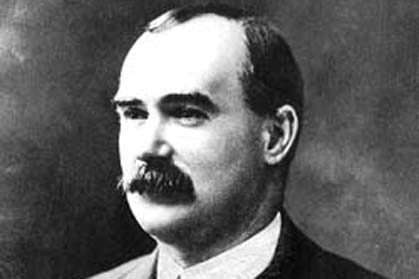
JAMES CONNOLLY’S WE ONLY WANT THE EARTH — WITH REGGAE BACKBEAT.

Diarmuid Breatnach

Younger James Connolly
A younger James Connolly than we usually see. Connolly published his songbook in New York in 1907 — included among the songs was We Only Want the Earth.

https://www.youtube.com/watch?v=pTxVBsg4u30

Incredibly, I only discovered this recording a few days ago. I first heard this song sung by Cornelius Cardew whom I knew in London through political activism and interest in revolutionary culture. Years later I learned the lyrics and sing it now to the same tune, more or less, i.e. that of A Nation Once Again. Admittedly, it sounds great with a reggae or ska backbeat. I came across this recording while looking for a recording of me singing the song at a talk by Portuguese socialists given in Dublin last year.

The lyrics were composed by James Connolly and were published in the James Connolly Songbook in 1907 in New York with a foreword by Connolly:
“No revolutionary movement is complete without its poetical expression. If such a movement has caught hold of the imagination of the masses, they will seek a vent in song for the aspirations, the fears and hopes, the loves and hatreds engendered by the struggle. Until the movement is marked by the joyous, defiant, singing of revolutionary songs, it lacks one of the distinctive marks of a popular revolutionary movement; it is a dogma of a few, and not the faith of the multitude”.

Cornelius Cardew was a respected composer as well as a revolutionary, a central member of the English Communist Party (marxist-leninist). This small organization had a good track record on a number of fronts, including solidarity with the Irish struggle.

Cornelius Cardew, from a Guardian obituary photo

I remember the shock when hearing of his death 13 December 1981, the victim of a hit-and-run driver near his London home in Leyton. The driver was never found. It might have been an accident but he was not the only political activist to die in mysterious circumstances in Britain in those years, particularly if involved in Irish solidarity.

Not a bad summary of his life here:http://en.wikipedia.org/wiki/Cornelius_Cardew

The song We Only Want the Earth with reggae backbeat: https://www.youtube.com/watch?v=pTxVBsg4u30

WHAT TO WRITE FOR REBEL BREEZE?

Diarmuid Breatnach

Over the years I have written articles and published them, usually under my own name, in alternative publications.  Some of those having been written in Castellano (Spanish) has meant that, with the help of others to check or edit them, I have been able to publish in a number of on-line publications from the Spanish state, including a number in the Basque Country.  These articles have been political commentary, analyses and news reports.  They come from a revolutionary socialist perspective and from one who has been politically active for many years in London and in Ireland, which is where I grew up.

I do not find it easy to categorise my politics in a short phrase.  I have been an active anarchist, from which I learned much, later a supporter of a marxist-leninist party and that too has taught me a lot; I am not an anarchist now nor perhaps even a marxist-leninist (certainly not the type I was).  I am opposed to the presence of British Imperialism and colonialism on Irish soil but I am not an Irish Republican (though many in my family have been).  I have not found a revolutionary organisation in Britain or in Ireland that comes close to being what I want to belong to now: an organisation that is effective, learns by mistakes instead of covering them up, is honest with itself and with the class it purports to lead, is disciplined yet tolerant of internal criticism ….

As a revolutionary, I am interested in the experiences of people the world round but most of my experience has been with the Irish at home and abroad, with Afro-Caribbeans in London, with solidarity work with Irish prisoners, the Kurds, Palestinians and Basques.  Of course, I have also been active in community resistance to cuts in services and grants, to fascists and racists, as well as active in trade unionism.

We live in a time when many anti-imperialist movements and organisations have grasped or are reaching out for something they call a “peace process”.  But these processes are not about peace but instead are about pacification.  They cannot bring peace since they do not resolve the basic issues: imperialist and capitalist exploitation.  They bring instead fragmentation, betrayal, apathy and, from a small section, collaboration with oppression.  Ireland and South Africa, often quoted as good examples of “peace processes”, are actually excellent examples of the real nature of these processes.

It is common these days for someone who expresses opposition to pacification processes to be accused of militarism without a political agenda, of favouring immediate resumption of armed struggle, or of being undemocratic.  Often these criticisms are made by people from the very same organisations whose militarist acts and lack of political strategy I have criticised over the years.  But no matter.  It is easier to condemn the critic than to carry out a real analysis of what has been won and what lost through these processes.

Currently the working class (as well as other sections of society) in Europe and elsewhere are under attack by capitalist governments determined to make them pay for the losses incurred by their financial speculator friends and to ensure that the big capitalists not only lose no profits but actually increase them.  In the course of that process they are plundering the public purse and stripping the states of their public assets.  Energetic and determined resistance is called for but the organisations to which we might look for that have been either completely useless or ineffective.    Never before have so many institutions of the capitalist class been so exposed and so reviled by the ordinary people, yet none of the European states seems to be near to revolution.  The necessary preparations were not made and we are not in a position, it seems, to lead those disenchanted and angry masses to effective resistance and then to the overthrow of this exploitative system.  Not yet anyway.  We need to learn from this and build the bases and organs so necessary for effective resistance.

Cultural Interests

My main cultural activity is singing, mostly traditional/ folk and I attend regularly a number of singing circles of sessions around the Dublin Bay area (of which there are a surprising number).  I did sometimes play percussion by hand on a dholak (type of Indian drum) in Irish traditional sessions but not since I misplaced the drum and have been unable to find it.  I also sometimes compose songs (lyrics and music), write poetry and short stories, along with humorous pieces.  Among my many interests is history, both recent and more ancient and I have been known to conduct walking history tours around Dublin on occasion.  Another strong interest is natural history, the world of plants and animals.
I am likely to write about all those things at one time or another.

I am primarily trilingual in Irish, Castellano and English.


End