“WHEN MY COUNTRY TAKES ITS PLACE AMONG THE NATIONS OF THE EARTH”

Diarmuid Breatnach

(Reading time: 3 mins.)

Dublin Political History Tours Facebook page reminds us of the 20th September anniversary of the public execution on of “Bold Robert Emmet, the darling of Erin”, leader of the unsuccessful Republican insurrection in Dublin on 23rd July 1803.
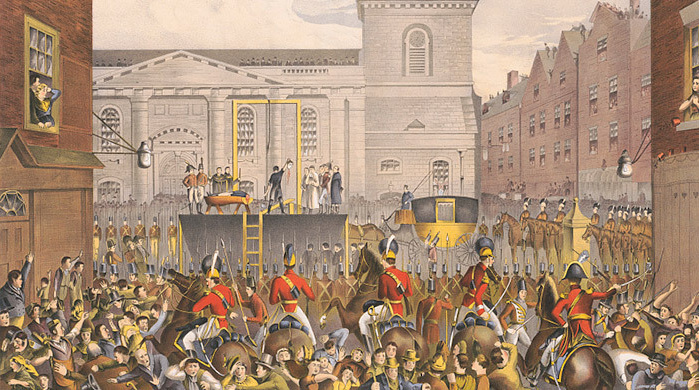
Coloured drawing: The executioner holds up Robert Emmet’s head to the crowd, sections of which demonstrate their repugnance of the act and are repressed English soldiers on horseback. (Sourced: Internet)

I reproduce the Dublin Political History Tours text (reformatted for R. Breeze):

On Saturday we passed by the anniversary of the execution by the English occupation forces of Robert Emmet, United Irishman. Emmet had been condemned to death for planning an insurrection for Irish self-determination which the English Occupation called ‘treason’.

Leaving behind in Kilmainham Gaol his comrade Anne Devlin, who had endured torture and death of family members without giving the authorities any information, Emmet was taken to the front of St. Catherine’s Church.2

(This building is) on Thomas Street in Dublin’s Liberties area on the west side of the city centre. The site chosen was sending a message to the populace of the area that had nationalist and republican sympathies.

There, in front of a huge crowd and many soldiers, Emmet was hanged and then beheaded, the executioner holding up the dripping head to the crowd. His body was later returned to the Gaol before being later buried in Bully’s Acres in the grounds of the Royal Hospital Kilmainham.

Emmet’s corpse was later disinterred in secret and reburied elsewhere by friends or family and, despite a number of sites being speculated, its current location is unknown.

There is a monument to the execution inside the grounds of the St. Catherine’s building and a stone plaque on the wall outside it.
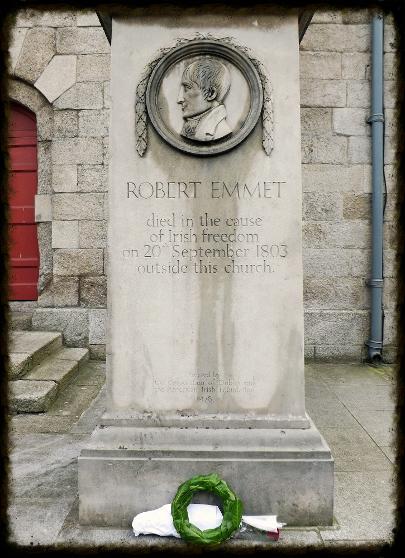
The monument inside the ground at the front of St. Catherine’s Church, Thomas Street, Dublin. (Source: Kilmainham Tales)

Robert Emmet was very popular in Ireland at the time and his memory is still. A statue in his honour stands in Dublin’s Stephens Green, a replica of another two at locations in the United States.

Anne Devlin endured three years in Kilmainham Gaol and according to Richard Madden (1798 – 5 February 1886), chronicler of the United Irishmen who sought her out, was followed everywhere in public by police.

(who were) observing anyone who she spoke to, as a result of which many were afraid to speak to her. Her body lies in Glasnevin Cemetery.

“Bold Robert Emmet” is a traditional ballad in the martyr’s honour and “Anne Devlin” also has a much more recent song in hers by Pete St.John.

(quoted passages end)

In the 1916 Proclamation of Independence, “the right of the people of Ireland to the ownership of Ireland” is proclaimed and that “six times in the past 300 years they have asserted it in arms”, probably referring to insurrections of 1641, 1689, 1798, 1803, 1848 and 1867.3

Historians have mostly dismissed the 1803 uprising as never likely to succeed but a minority have rated the preparations highly, including the innovations of signal rockets and folding pike handle for concealed personal carrying.

RH Madden, the first historian of the United Irishmen was of the opinion that the insurrection attempt was engineered by the English Occupation’s administration in Dublin Castle in order to justify continued repression of Irish republicanism and to eliminate some leaders.

Generally historians have tended not to give much credence to Madden on that issue but it is certain that the Occupation had a network of spies in operation in Ireland and that some had penetrated Emmet’s conspiracy.
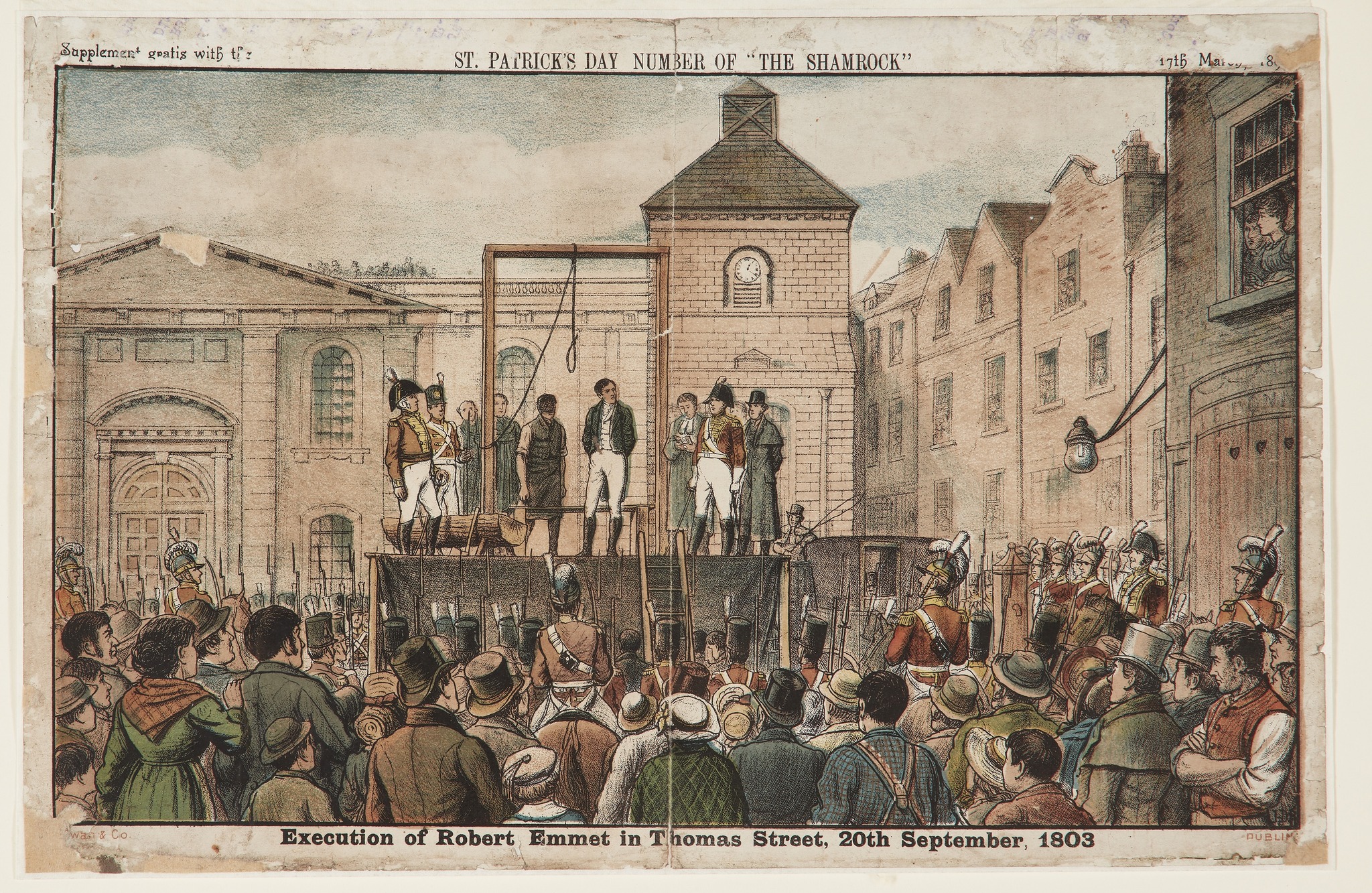
Emmet on the scaffold with St. Catherine’s Church behind, the executioner beside him, the crowd in the street and many English soldiers, on foot and on horseback. The illustration was employed by Dublin Political History Tours but easily sourced on the Internet.

However it is not for the manner of the 1803 insurrection that Emmett has been fondly remembered in Ireland to this day 123 years later – and abroad for decades after his death4 – but for the calm manner in which he faced his enemies, including his executioner and for his eloquence at his trial.

Past insurrections contain lessons for us today and a serious evaluation should be attempted, perhaps with a number of submissions from historians of different opinions on the matter, to deal with questions around Emmet’s return from France and the planning of the insurrection in Ireland,.

For us today however, whether Republicans or more generally anti-colonialists and anti-imperialists, it is also necessary to revere the memory of revolutionary action for a democratic Irish Republican and to uphold his and Anne Devlin’s spirit of defiance in resistance.

End.

Note: If you found this article of interest, why not register with Rebel Breeze for free, so that you will be notified by email of subsequent articles. You can de-register any time you wish.

Statue monument of Robert Emmet in Washington DC, a copy of which stands in St. Stephens Green, looking across the road to his erstwhile home and other copies stand in Emmetsburg, Iowa and Golden Gate Park, San Francisco, California. Those in the USA were all cast by the artist Jerome Connor between 1916 and 1919. (Photo sourced: Internet)
Statue monument in Rathfarnham dedicated to Anne Devlin from Wicklow, a member of the United Irishmen conspiracy, tortured and jailed but never gave her captors any information. Sculptor: Clodagh Emoe (Gracies, Maria, for bringing this to my attention).

FOOTNOTES

1From Emmet’s famous speech from the dock of the courthouse in Green Street that not until then should his epitaph be written. I have no doubt that Emmet meant “nation-states of the world” because Ireland was in his time more than what we would understand today from the vague term of “country” – it was clearly, though under foreign occupation, already a nation with its own unique culture and a long history. She has yet to take that place to which Emmet referred and aspired for her.

2Note that was the Anglican St. Catherine’s Church, as a Catholic St. Catherine’s is also located not far away on Meath St. The Anglican church was closed in the 1960s but later reopened and reconsecrated as an Anglican Church. The interior seems very untypical of Anglican churches. Emmet was raised in the Anglican faith.

3Believed to refer to, in sequence: the Irish and Norman Irish clans in the Confederation’s uprising, the Williamite War’s, United Irishmen’s, Robert Emmets’, Young Irelanders’, the Fenians’. Coincidentally, the large monument to uprisings in Ireland erected by the National Graves Association in the St. Paul’s section of Glasnevin Cemetery also includes only six dates but they are of Republican risings only, beginning with 1798 and ending with 1916.

4I read somewhere that even in England Radicals would read Emmet’s speech as a high point of their events including formal dinners.

SOURCES

https://www.facebook.com/profile.php

THERE WILL BE NO RED LINES

Diarmuid Breatnach

(Reading time: 4 mins.)

In future, there will be no red lines in attacking your country.

Yes, I do mean YOUR country, wherever you are. In whatever war it’s in. And in this imperialist world, it’s a safe bet your country will be part of a war, directly or a little indirectly, sometime in your lifetime. Or in your kids’ lifetimes.

The Adversary will be able to carpet-bomb your residential areas, your hospitals and medical centres, schools and universities, places of religious worship, markets, restaurants, coffee shops, bars, bakeries, internet access sites, gyms, your infrastructures and municipal authorities.

There might be some condemnations at high levels abroad, even threats of court cases but nothing will be actually done in practice.

The Adversary will be able to attack your food stores, blockade you from food and fuel imports, bomb your farms and fishing fleets. It will be able to call down aerial strikes on people in their homes, in vehicles or shoot them by snipers or drones as they walk in the street.

Your cities’ food delivery trucks, construction and rubble-clearing and heavy lifting vehicles will be targeted, along with their drivers and operators. That is so that your people will have to dig with your hands to find victims under the rubble of bombed buildings.

Your ambulances and paramedics will be targeted so that picking up wounded or even corpses becomes a high-risk job and your hospitals will be bombed, shot at and invaded to reduce the life chances of any bombing victim found alive in the rubble or on the street.

Your country’s infrastructures of electricity generation and supply, water supply, sewage collection and treatment, waste collection and treatment, telecommunication and public transport will be bombed and bombed and bombed again.

Your reporters will be shot on the street and their homes bombed, as will your media networks offices. That hardly seems necessary anyway since no-one who sees any of the atrocities, no-one with power anyway, will even try to stop what is being done to you and your people.

That’s because there are no red lines anymore.

Your populations will be refugees in your own land and their tents and shacks will be bombed and fire-bombed. They will be bombed wherever they go and they will be bombed on the way there. They will be told some areas are safe and then they’ll be bombed and shot at there also.

Food, fuel, water and medicine supplies will be blocked, blockaded and even bombed. Many of you will be hungry, thirsty and cold. The weaker ones, also the very young and the elderly, will die prematurely of diseases and ailments or untreated wounds and sores.

People with special medical needs will die from lack of specialised medical treatment, procedures, equipment or medication.

Your children will be denied education, safety and even life. Your young and middle-aged men and women will be denied work, safety and even life. Your elders will be denied safety in retirement — and even life.

Some of you will resist, of course. Those the Adversary can catch will be put in prisons; mostly not even a trial will be required but when it does, it will be a mockery of standard judicial procedure. In jail they will be beaten, humiliated, tortured, degraded, half-starved, raped and die.

Some of your resistors will be shot after they’ve been captured. Random civilians will be shot by snipers or drones, thrown into graves and earth pushed over them, perhaps even while alive; other bodies will lie in the street to make you sick with terror and the smell of their decomposing bodies.

Other civilians – including children – will be used as human screens or shields for the Invader’s troops and even their armoured vehicles. They will be used to test mines, booby traps and IEDs.

You will be taught how little your lives matter and how easily they can be wiped out.

There is no longer humanitarian international law, no Geneva Convention; there are no longer any red lines.

It will happen because …

The Zionist state has committed all the crimes listed above and has done so while being photographed, filmed and even live-streamed by reporters, victims, witnesses and even by the Zionist soldiers themselves, in thousands of boastful videos and photographs.

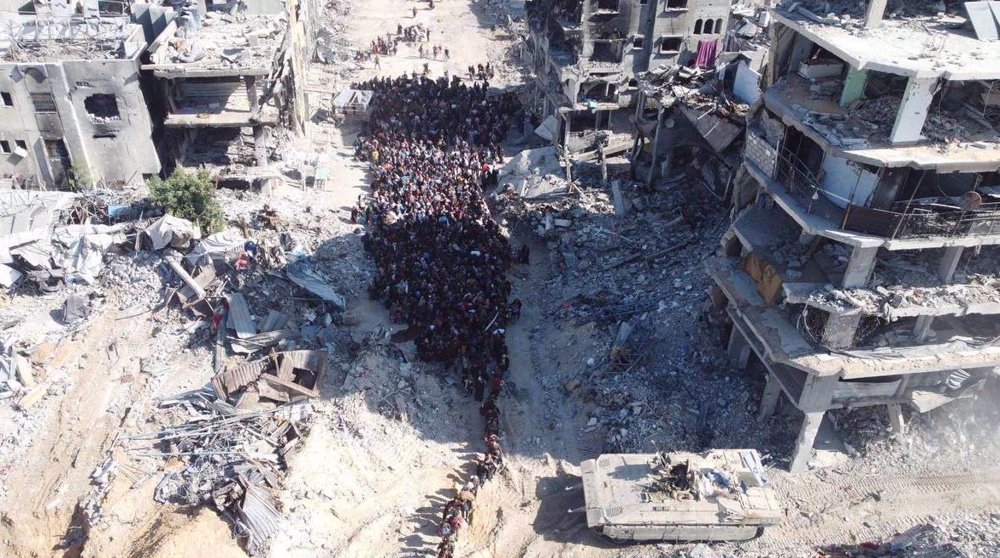
Jabalia, North Gaza, IOF rounding up Palestinian civilians after destroying their neighbourhoods.

Their military leaders, politicians and media have proclaimed their intentions and followed them up in practice.

There have been some high-level international complaints and criticisms and even court cases but nothing in practice has been done by the relevant international bodies to physically stop the Zionist genocide or even to deprive them of the weapons and finance to carry out that genocide.

Yes, we know that there have been many human rights violations committed by Western powers in other wars: Dresden, Hiroshima/ Nagasaki, Korea, Algeria, Vietnam, Ireland, Lebanon, Iraq … And some of them were photographed too.

But never before has there been such blatant and daily violation of all principles of international law at so many levels to be seen live on our screens while Western powers leaders justified it and all international institutions were either complicit or helpless.1

So now that the unthinkable has been done there, it is no longer unthinkable anywhere. And if not unthinkable, then history shows us that it will indeed be thought of. History shows us too that what is thought of will also be done.

What hasn’t been done yet?

Poisoning your water supplies? Why not? So long as there be a water supply for the invading soldiers and good clean water for the occupiers, the settlers. Germ warfare? Why not? As long as the invaders and settlers are immune or the pathogens die out in time for occupation.

There are no red lines any longer and you can expect none when war comes to your country.

Anything goes.

End.

Footnotes

1And people who protested it in western states were maligned, hounded in work and academia, beaten on the street, arrested …

Britain secretly helped Chile’s military intelligence after Pinochet coup

John McEvoy 5 September2023

(Reading time: 6 mins.)

NB: Rebel Breeze shares this near the anniversary of the fascist military coup in Chile, the same date as the Twin Towers massacre years later.. The article is a year old but relevant as long as British imperialism exists.

As the Pinochet regime rounded up and murdered its political opponents after the 1973 coup, a UK Foreign Office propaganda unit passed material to Chile’s military intelligence and MI6 connived with a key orchestrator of the coup, newly declassified files show.

  • Foreign Office helped Pinochet regime to develop a counter-insurgency strategy based on British military campaigns in Southeast Asia
  • MI6 officer David Spedding was attached to British embassy in Santiago in 1972-4, and had relations with a key member of the military junta

The UK government assisted Chile’s military intelligence in the aftermath of the brutal 1973 coup against elected president Salvador Allende, newly declassified files show.

The assistance was authorised by the Information Research Department (IRD), a secret Foreign Office propaganda unit which worked closely with Britain’s secret intelligence service, MI6.

Foreign and Commonwealth Office building, Whitehall, London. Many a dark deed was planned here. (Photo accessed: Internet)

The IRD had long seen Allende as a political threat. As Declassified previously revealed, throughout the 1960s, the unit had sought to prevent Allende from ever becoming president through election interference and covert propaganda operations.

After Allende was elected in 1970, the IRD’s distribution of propaganda material became “strictly limited”, with the British embassy having fewer reliable contacts in the Chilean government. 

This all changed after the coup.

In January 1974, the IRD began to “extend the distribution” of its material, which was now passed “to the Chilean Ministry of Foreign Affairs, Government information organisations” and, crucially, the dictatorship’s “military intelligence” services.

At this time, Chile’s security forces – including the country’s intelligence apparatus – were responsible for massive human rights violations, including the widespread use of torture as a political weapon.

The UK government was under no illusions about this. As Foreign Office official Christopher Crabbie noted three months after the coup in December 1973, “I do not think that anyone seriously doubts that torture is going on in Chile”. 

Reliable figures indicate that, between 1973 and 1988, Chilean state agents were responsible for over 3,000 deaths or disappearances and tens of thousands of cases of torture and political arrests. This was in a country which, in 1973, had a population of only 10 million people.

Our major interest is copper’: Britain backed Pinochet’s bloody coup…

Chile Army 1973 coup soldiers watch detainees – many were shot, many more tortured then shot, many more still ‘disappeared’, probably tortured and shot. Many, many more were jailed where they were also tortured; young children were also abducted and given to fascist childless couples. (Photo accessed: Internet)

Hearts and minds’

The nature of the information passed to Chile’s military intelligence remains unclear, though the files suggest it may have included material for use in propaganda, research reports on left-wing activity, and even manuals on domestic security operations.

For instance, newly declassified files show how the UK government secretly helped the Chilean authorities to develop a counter-insurgency strategy, using techniques refined during Britain’s colonial interventions in Southeast Asia.

The idea for such assistance was first raised during the visit of British navy chief Sir Michael Pollock to Chile in late November 1973, two months after the coup. 

The timing of Pollock’s visit was “politically tricky”, noted the British ambassador in Santiago, Reginald Secondé, since there was “much critical attention” being given “to the Chilean Government’s treatment of their political opponents”.

However, there were “two frigates and two submarines for the Chilean Navy under construction in British yards” – an arms deal worth around £50m – and “this was not a moment to prejudice the historic tradition of Anglo-Chilean naval friendship”. 

“This was not a moment to prejudice the historic tradition of Anglo-Chilean naval friendship”

In Santiago, Pollock and Secondé met with a number of regime officials, including navy chief José Toribio Merino Castro, defence minister Patricio Carvajal Prado, and foreign minister Ismael Huerta.

With Huerta, the British officials spoke about the UK government’s “hearts and minds” campaign in Northern Ireland, a counter-insurgency strategy inspired by Britain’s war in Malaya (1948-60).

Huerta “seemed impressed with the concept”, and Secondé “later twice heard him muttering to himself ‘hearts and minds’”.

Subsequent meetings were held between Secondé, British information officer Tony Walters, and Captain Carlos Ashton, the director of overseas information in Chile’s Ministry of Foreign Affairs.

Like Huerta, Ashton was “very receptive to the idea that this kind of approach to Chilean security problems might be the right answer”, and requested “details of what practical measures a ‘hearts and minds’ exercise would involve”.

Exclusive: Secret cables reveal Britain interfered with elections in Chile

Counter-insurgency advice

Ashton’s request for assistance was forwarded to Rosemary Allott, the head of the IRD’s Latin American desk.

In a letter dated 15 February 1974 and marked ‘secret’, Allott agreed to provide the Chilean regime with counter-insurgency advice, but limited this to material on Britain’s past colonial interventions.

“In view of the delicate political considerations involved”, Allott wrote, “it would be best to confine, at this stage at least, the material we send you of insurgencies of the past, rather than those currently preoccupying HMG” such as Northern Ireland.

The Pinochet regime was soon issued with three books on British counter-insurgency strategy, alongside a “Manual of Counter Insurgency Studies”. 

“Britain agreed to share its colonial policing methods with the Chilean junta”

Allott also tracked down “various official reports on Malaya” including “The Fight Against Communist Terrorism in Malaya”, the “Review of the Emergency in Malaya (1948-57)”, and “two booklets on the Philippines insurrection”. 

Britain’s military campaign in Malaya involved the “resettlement” of over 500,000 civilians, aerial bombardment, and an intensive propaganda operation. 

Embassy officials suggested that they were teaching Chilean officers “tactics of tolerance and magnanimity”. However, brutal repression often lay behind the UK government’s rhetoric about “winning hearts and minds”, and the Chilean authorities were only sharpening their repressive techniques.

None of the material given to the Pinochet regime was “for attribution to HMG”. This meant that the Chilean authorities could use the information but not source it to the UK government. 

The extent to which Britain’s advice was acted upon remains unclear; the Pinochet regime was certainly not lacking in support from the CIA. 

Nonetheless, it is clear that Britain agreed to share its colonial policing methods with the Chilean junta, with the goal of stabilising Pinochet’s regime against domestic opposition.

MI6 in Chile

Evidence of British assistance to Chile’s intelligence services raises further questions about what Britain’s own secret intelligence service, MI6, was doing in Chile. 

In 1972, MI6 officer David Spedding was attached to the British embassy in Santiago – his only foreign posting outside of the Middle East throughout his career. 

This was not Spedding’s first visit to Chile. As a postgraduate student at Oxford University during the mid-1960s, Spedding had spent his gap year in Santiago and found work as an assistant in the British embassy’s press office. 

Spedding’s first role in the diplomatic service was thus in the same British embassy that had been directing covert propaganda operations against Allende throughout the 1960s. The job gave him “an entrée into SIS [MI6]”, historian Nigel West noted.

Spedding remained in Chile until September 1974. He was subsequently made responsible for MI6 operations across the Middle East, and would go on to become MI6 chief between 1994 and 1999.

Our relationship with Admiral Merino’

Spedding’s name rarely appears in declassified Foreign Office files on Chile.

Yet in one file, dated 4 December 1973, Spedding informed the Foreign Office that 2,800 civilians and 700 armed forces personnel had been killed during and after the coup. 

“In order to protect our relationship with Admiral Merino”, Spedding noted, “we would not like these figures to be quoted, at least for the time being”. 

Admiral Merino was one of the key orchestrators of the 1973 coup. He was head of the Chilean navy in September 1973, and remained in post until the fall of the dictatorship in 1990. Merino claimed responsibility for convincing Pinochet to join the coup.

Some of the culprits saluting (Photo accessed: Internet)

One of Spedding’s roles, then, was to ensure close collaboration with the Chilean junta by covering up its responsibility for massive political repression and human rights violations. 

The MI6 station in Santiago was only closed down in 1974 amid the UK Labour Party’s return to government.

It would not be surprising if MI6 played a supporting role to the CIA’s covert operations against Allende during the early 1970s. It was recently revealed that the Australian Secret Intelligence Service (ASIS) had “opened a base in Santiago to assist in the US Central Intelligence Agency’s destabilisation of the Chilean government” in 1971.

Britain’s secret assistance to the Pinochet regime was consistent with the UK government’s position on the coup. 

The Conservative government under Edward Heath had welcomed the coup and rushed to give diplomatic recognition and arms to the Chilean junta, with the Foreign Office noting that it had “infinitely more to offer British interests than the one which preceded it”.

The coup against Allende inaugurated a 17-year dictatorship under General Augusto Pinochet, who only left office in 1990.

end.

John McEvoy is co-directing a forthcoming documentary investigating Britain’s hidden role in the death of Chile’s democracy and rise of the Pinochet dictatorship. You can support the film’s production here.