The new €2 coin design is now published and the coins will themselves be put into circulation in the New Year. Designs were submitted and the winning design for the ordinary currency coin is by Emmet Mullin, while the design for the gold and silver special editions is by Michael Guilfoyle. Both designs incorporate the statue of “Hibernia” and that name is prominently displayed on one of side of the coin and although Guilfoyle’s design incorporates some words from the 1916 Proclamation, they are in the background to the representation of “Hibernia”. The image is taken from a the centre one of a trio of statues erected on the GPO in 1814, while still under British occupation.
One side of the new Irish coin
“Hibernia” was regularly used as an image to represent Ireland by “Punch”, a satirical racist British publication and she was always
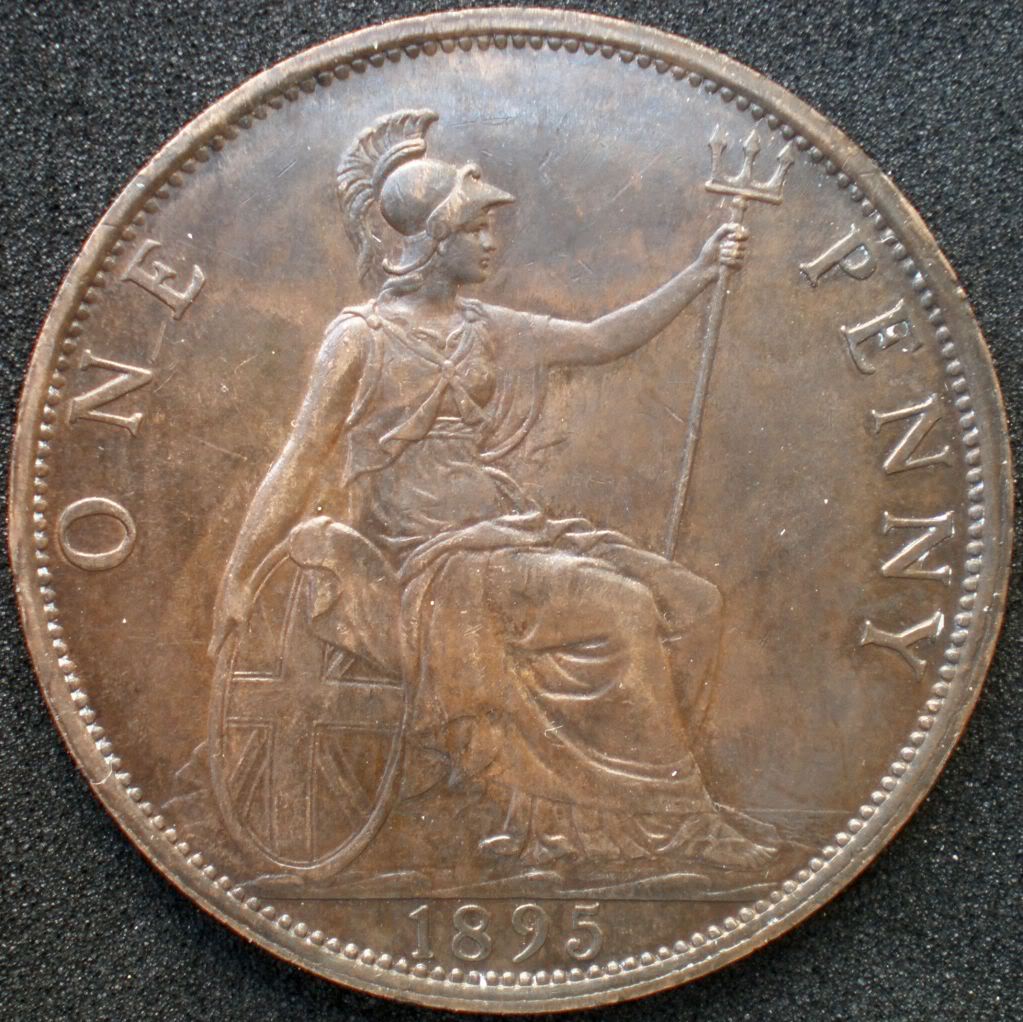
(British penny showing the image of “Britannia” — a martial female wearing a crested war helmet, carrying a shield and holding a trident (perhaps to indicate domination of the seas).
shown as a pretty younger sister of “Britannia”, in need of her older sister’s protection (usually from the rebellious Irish, the despair of poor “Hibernia”). She was never in martial garb, unlike Britannia herself who was usually represented as a majestic and martial figure, with a crested war-helmet and shield and sometimes carrying a trident (perhaps to indicate domination of the seas).
That representation of Britannia appeared not only in the cartoons of “Punch” and other publications but also in sculpture — for example at the top of Somerset House, in the Strand, London – and also on many mints of British penny coins.
Of course, in British history the most likely model for the representation of a female fighter was Boudicca (“Boudicea”) who, after her humiliation and the rape of her daughters by Roman Legionnaires, raised her formerly pacified tribe of the Icenii against the Roman occupation and came close to driving them out of Britain. The irony is that the whole of Britain at that time was Celtic, as were Boudicca and the Icenii. But the English ruling class appropriated Boudicca into their English iconography as they did also with King Arthur and the Round Table knights.
Romanised and civilised
Ireland had many names among the Gael but “Hibernia” was not one of them. “Hibernia” was a late Latin name for Ireland, which the Romans had previously called “Scotia” (yes, “Scotland” originally meant something like “the land the Gael have invaded and settled and defend”).
The Roman linguistic connection is interesting – Irish Anglophiles and some English lovers of Ireland have been wont to bemoan the fact that Ireland was never conquered by the Romans. These commentators have tended to see Romanisation as civilising, forgetting perhaps the words of Rome’s own greatest historian, Publius Tacitus (or Gaius Cornelius Tacitus; c. 56–after 117 AD) who said that “they have created a desert and call it peace.” Calling Ireland “Hibernia” might be a way to bring that Roman conquest belatedly to the unquiet isle, to make her more “civilized” — in fact more like her neighbour and therefore more accepting of her neighbour’s domination and of her ways.
When John Smyth designed the statues to go on top of the General Post Office building in Dublin’s main street, then Sackville (but now O’Connell) Street, Dublin was widely considered the second city of the British Empire, next to London. The building opened to the public in 1818 but Dublin’s slow decline in status had already begun. Since the abolition of the Irish Parliament by the Act of Union in 1801, following the suppression of the United Irish uprising three years earlier, the Irish Members of Parliament had to go to London to take their seats, taking a great deal of political, commercial and social life with them. Irish landlords deserted their Irish estates in greater numbers, leaving them in the hands of their often rack-renting agents as the owners demanded more and more rents to keep them in their homes in Britain and their lifestyle there and in Europe. Throughout the 19th Century the social focus slowly followed the political to England – except where a militant nationalist one arose.
Statue representing “Hibernia” on top of the GPO, a martial female wearing a crested helmet, holding a spear and a harp.Sculpture representing Britannia on top of Somerset House, The Strand, London city centre. She is a martial female wearing a crested war helmet, carrying a shield and holding a trident.
Submission or subversion?
Perhaps the representation of Hibernia by John Smyth, reflecting that of Britannia, was meant to show Ireland as equal in grandeur to her dominant neighbour. The Society of the United Irish had been part of a wider cultural movement that sought to explore and appropriate an older Gaelic culture for the colonists, many of them settled for generations on Irish land. Assertions of autonomy and complaints about English political and commercial restrictions had been part of that movement too and had found sharpest expression in the republican and separatist ideas of the United Irish. Some aspirations remained, severely modified. Perhaps it was John Smyth’s intention to show Hibernia as grand but there was no mistake about who was really in charge in Ireland, Hibernia or Britannia.
As if to underline the relationship, Smyth placed a statue representing “Fidelity” on Hibernia’s left on top of the GPO. What could that fidelity be, except to the Empire? Some suggest that because Fidelity holds the Key and is with the Dog, that she really represents Hecate. I know nothing about Smyth nor have I the time to research him at the moment but it is possible he was being somewhat subversive in that representation. Hecate had a number of earlier and later interpretations and the key seems to have appeared later – the key to the household perhaps but also to Hades, the Underworld.
On Hibernia’s right, John Smyth erected the statue of Hermes, known to us as the messenger of the gods but also representing commerce. Commerce, then as now, was the backer of military and political initiatives, indeed often the driver. Of course, many of the Irish bourgeoisie, both native and colonist in origin, wanted a successful commercial Ireland. But after 1798 and 1801, they were not going to get it. From then on, most progress for Irish finance would be made through investing in the Empire rather than in Irish industry and trade.
Whether the representation of Hibernia was intended as some kind of subject of Britannia with pretensions to something grander or was in fact just aping her better, dressing in her mistresses’ clothes when the lady was away, is a moot point. What is certain is that neither the image nor the name itself is of native origin.
The names for Ireland
As noted earlier, among the many names of the Gael for Ireland, “Hibernia” does not appear. The clan-based resistance had used Irish names to describe the land and this continued in the wars against Cromwell and William, with “Ireland” being the most common name when speaking in English by both sides of the wars.
The United Irishmen, a late 18th Century republican movement for independence led mostly by descendants of colonists and largely English-speaking, called the land “Ireland”1 or “Erin” (a phonetic representation of the Irish-language “Éirinn”, the dative case of “Éire”). These names, along with the genitive “Éireann” later, continued to be those most often used by nationalists of the 19th Century, the Young Irelanders, the Fenians, the Land League, as well as by the various advanced nationalist and revolutionary organisations in the early years of the 20th Century2.
“Ireland” is named in a banner of the Irish Transport & General Workers’ Union in October 1914, with the Irish Citizen Army parading outside.
This continued to be the case during the War of Independence and by both sides in the Civil War and was the case with the setting up of the 26-County state and with the various national resistance movements to that state of affairs since then. One finds “Hibernia” in the Ancient Order of Hibernians, of course and in the Hibernian Bank but they are exceptions – it is “Éire”, “Erin” or “Ireland” over all – and has been so for many centuries.
“Hibernia” is a foreign colonial import, both in terminology and in concept. She is poor image of her big sister on “the mainland”, the real boss. The use of her image and of her name is inappropriate to commemorate the 1916 Rising but their use may signify much more than an error – they may reveal a subliminal desire to return to the Empire, or at least the Commonwealth, in the psyche of those who were never all that sure they should have left it.
1“From my earliest youth I have regarded the connection between Ireland and Great Britain as the curse of the Irish nation …” Theobald Wolfe Tone
2Inghinidhe na hÉireann, Na Fianna Éireann, The Irish Citizen Army, The Irish Transport & General Worker’s Union, The Irish Volunteers, Óglaigh na hÉireann. Also, when the Abbey Theatre was founded by W.B. Yeats and Lady Gregory in 1904, they declared it was “to bring upon the stage the deeper emotions of Ireland”.
Maribel Eginoa Cisneros died on the 13th of this August in the Santutxu district of Bilbao. She was many things – a democratic Basque patriot, dancer, choir singer, herbalist, mycologist, carer, wife, mother ….
I and two of my siblings travelled to attend the funeral. For me it was a farewell to a warm, intelligent and cultured person who, along with her husband, two of her daughters and a son-in-law, had been very welcoming to me. More than that or because of that, I thought of them as “my Basque family”.
Somewhere I have a Basque family related through blood and marriage but I don’t know them. Different loyalties and some German blood during the Spanish Civil War took my mother out of the Basque Country; the ties were cut and left behind. My mother became a woman in Madrid, where she met my father soon after.
Although they never met, it was because of my mother that I had first met Maribel. My mother, Lucila Helmann Menchaca (the Basques spell it Mentxaka), was born in Algorta, in the Getxo district, not far from Bilbao and spent her early childhood there. How her parents met is another story but Luci grew up bilingual in Castillian (Spanish) and German, with a Basque mother who hardly knew any Euskera (Basque) and a German father. All of Luci’s children, the five boys and one girl, knew of their mother’s childhood in the Basque Country and as we grew older, a desire grew with it to see where she had been born; each of us individually making the pilgrimage.
ONGI ETORRI – BASQUE WELCOME
I was a total stranger and low on funds on my first visit to the Basque Country. I had one contact, a woman I had met only a couple of times when she worked as an au pair in Dublin; she promised to help me get based and I arranged to phone her when I arrived. But the flight was delayed and then could not land at Bilbao airport – too much cloud, the pilot said – and we would land instead at Zaragossa, over 154 miles (248 Km) away. There the passengers had to wait for a coach and eventually arrived in Bilbao in the early hours of the morning. Of course, I had not booked an hotel, so the driver of the last taxi available tried a few without success and then brought me to the Nervión, a four-star hotel over its namesake river, dark and unlovely with a nightly rate that hit me in the gut.
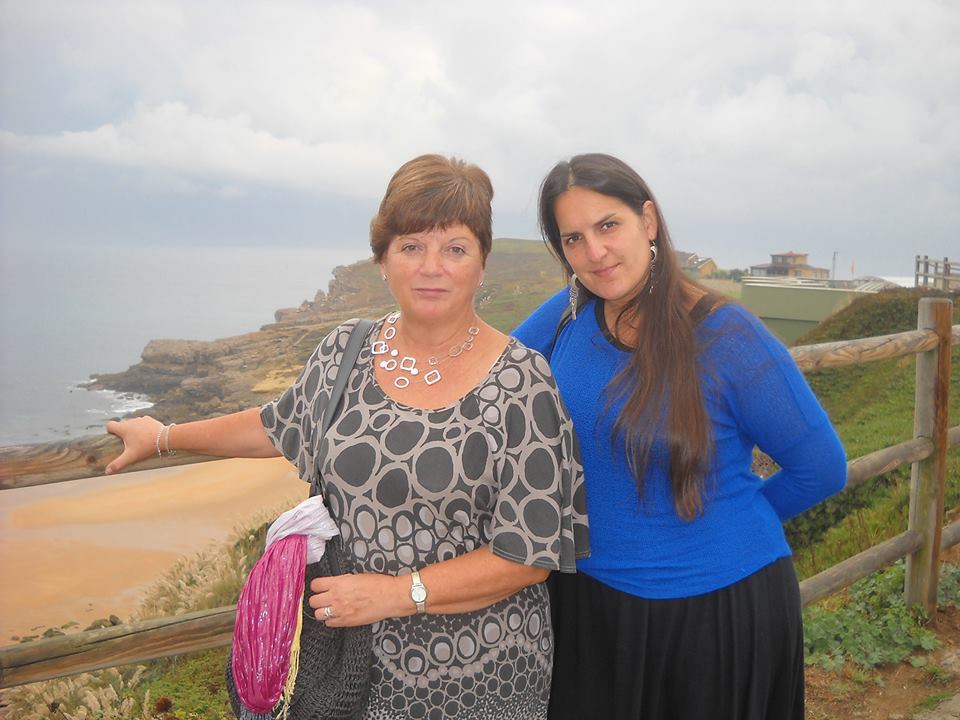
Maribel and Ziortza on a visit to the Cantabrian coast (Photo from Maribel’s family)
Next morning I phoned my contact, Ziortza and she came to the Nervión and waited while I checked out. I expected to be brought to a cheap hotel or hostel but was instead brought to her family’s home and there, for the first time, I met Ziortza’s parents, Maribel Eginoa and Josemari Echeverria (women don’t change their surnames now when they marry there). I was welcomed, fed and shown to what was to be my room during my stay. It was Ziortza’s, who moved in with her parents – the other two sisters lived in their own apartments with their partners and children. I was fed wonderfully every day too.
I was stunned by the depth of the hospitality from people I did not know, a trait I have encountered again and again among many Basques I have met. Nor was that all. Ziortza took me on her days off on excursions to some different places and towns and her sister Gurrutze and husband Gorka took me on a tour along the Bay of Biscay before turning uphill to iconic Gernika (Spanish spelling “Guernica”). Ziortza also gave me instructions on how to get to Algorta by local train, where my hand-drawn map could take me to where my mother had lived, a trip I preferred to make alone.
The next occasion I returned to Bilbao, this time to begin to know the southern Basque Country, I stayed in their apartment again, in the same room, but this time without discommoding them, since Ziortza had moved out to her own place.
THE UNEXPECTED ONE
Maribel and Josémaria were fairly comfortable and retired when I met them but they had some hard times behind them. Josémari’s father had been a Basque nationalist and fought against Franco, a fact that did not escape the victorious Franco authorities. When it came to time for the Spanish military service obligatory for males (much resisted in the Basque Country and now
Only a few months before her death (hard to believe) — Maribel Eginoa (photo Maribel’s family)
abolished throughout the State), they sent Josémari to one of the worst places to which they could send the son of a Basque nationalist – Madrid. His superior officers took pleasure in reminding him of his father and of what they thought of Basque nationalists (or even Basques in general). For the couple, it was a difficult separation but they married as soon as he was finished with the Spanish Army. Maribel was 21 years of age.
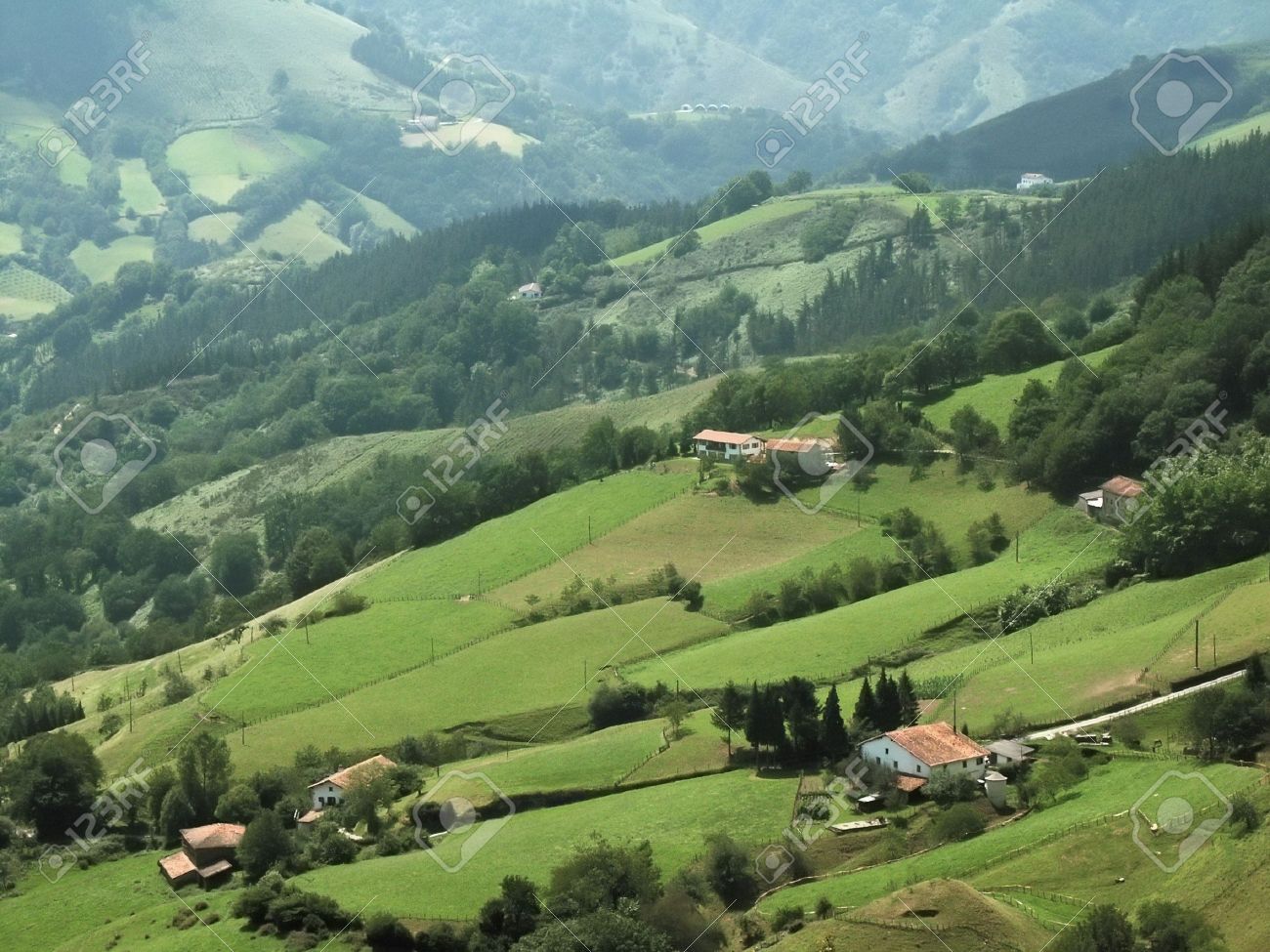
Pyrenean landscape in Iparralde (“the northern country”, the part of the Basque Country ruled by France). (photo from Internet)
In their early years together they often travelled to Iparralde (“the northern country”), the Basque part under French rule, with a Basque dance group called Dindirri. The French state has no tolerance for notions of Basque independence but does not harry the movement as does the Spanish state in Hegoalde (“the southern country”). Maribel was fluent in French as well as in Castillian.
Born ten years after the most recent of another four siblings, Maribel was the result of an unexpected pregnancy. “It was destiny,” commented one of her daughters. “The unexpected one would be the one to take care of everyone in the future.” One of Maribel’s siblings had died after a few days, another at the age of 19 due to surgical negligence, another had cerebral palsy. Maribel’s sister herself had an intellectually challenged boy and, when she emigrated with her husband and daughter, left him in Maribel’s care. As Maribel’s mother grew old and infirm, she took care of her too. Her brother with cerebral palsy, although in a home for his specialist care, spent weeks at a time in the family home. And another relative came to stay with them too, for awhile. Maribel looked after everyone.
Of course, her husband Josémari helped, as did her daughters. And they all accepted that this was how things were. And to add to that, the couple visited friends and neighbours in hospital.
LANGUAGE AND POLITICS
When I met Maribel and Josémari, I heard them speak to their daughters in Euskera — the Basque native language. But they themselves had not been raised speaking it – they went to classes to learn the language and raised their children with it. Speaking or learning Euskera was illegal under Franco except for some dispensation to Basque Catholic clergy. It was the latter who founded the first illicit “ikastolak”1 to teach Euskera and later these were set up by lay people too. The ikastola, teaching all subjects except language through Euskera, is now the school type attended by the majority in the southern Basque Country and is mainstream in the Euskadi or CAV administrative area, encompassing the provinces of Bizkaia, Alava and Guipuzkoa.
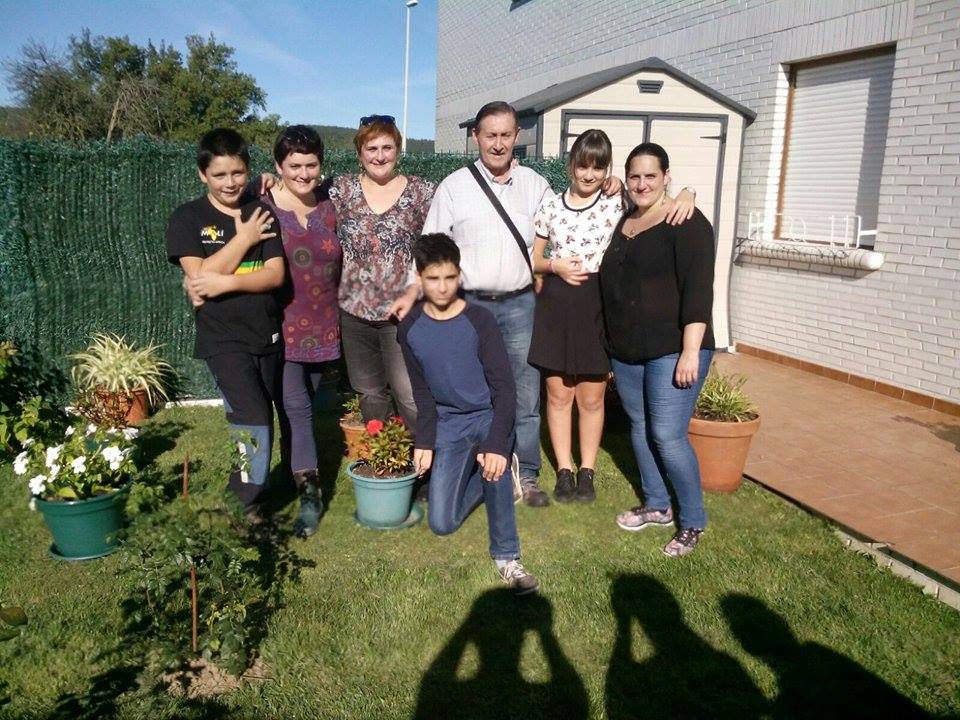
Most of “my Basque family: Front R-L: Aimar and Markel, Gurrutze’s sons; Back R-L: Gurrutze, Maider, Josemari, Maddi & Ziortza. (Photo from Maribel’s family)
Under Spanish state repression the old Basque Nationalist Party was decimated and although still in existence, its youth wing became impatient with what they perceived as the timidity of their elders. The PNV youth found a similar impatience among leftish Basque youth who had picked up on the vibrations of the youth and student movement of the 1960s. These youth brought to the table the narratives of anti-colonial and anti-imperialist struggles, mixed with socialist ideas of the Cuban and Algerian revolutions. Thus was Euskadi Ta Askatasuna (Homeland and Freedom) born — doubly illegal, as they espoused Basque self-determination and socialism. And so they were spied upon by the Guardia Civil, harassed, arrested, tortured, jailed … after nine years of which ETA took up arms.
Of the Spanish state’s main political parties today, the ultra-right Partido Popular and the social democratic PSOE, the first receives very little electoral support in the CAV administrative area and the second always less than the total of Basque parties. Maribel and Josémari, like most of patriotic Basque society, were presented with the choice of supporting the PNV (Basque Nationalist Party) or the Abertzale Left, the broad political movement of which ETA was a part. The PNV was known for jobbery and corruption and collusion with the Spanish state so of course Maribel and Josemari raised their family in loose allegiance to the Abertzale Left, attending many marches of the movement, public meetings, pickets and now and then hearing gunshots and explosions, hearing of people they knew going into clandestinity and others arrested, tortured and jailed. Everyone knew someone who became a political prisoner (and that is still largely the case) — a neighbour, work colleague, a past pupil. One of Maribel’s daughters saw most of her quadrilla – a small circle of Basque school friends who typically stay close throughout life – go to jail; part of her life is now organised around making visits to jails throughout the Spanish and French states, thanks to the cruel dispersal policy.
At the funeral service in the packed Iglesia del Karmelo in the Bilbao district of Santutxu, I remembered Maribel’s warm personality and hospitality. In fact it was around that hospitality that I unwittingly caused a rift between us. By the last time I returned to stay with them, I had become active in Basque solidarity work in Ireland. Beset with communication difficulties with the organisations in Euskal Herria (the Basque Country) and desperate for regular sources of accurate information, I was essentially based at their home while seeking out and establishing contacts every day. Maribel, as a considerate Basque hostess, wanted to know in advance whether I was going to be available for meals and I sometimes forgot to tell her when I was not. I also didn’t get into the Basque rhythm of lunch, supper and main meal. In my focus on finding needed contacts I just didn’t appreciate the distress I was causing and that it might have appeared, as one daughter told me, that I was treating her parent’s apartment as an hotel. In subsequent annual visits to Bilbao, staying with others, I tried to make amends but though we remained friendly, it was never as before. Some rips you can darn but the fabric is never what it was.
Iglesia del Karmelo, in Santutxu, Bilbao
In Maribel’s funeral service, the daughters led the singing of the “Agur Jaunak”2; I had the words printed out but didn’t recognise the air at first so by the time I caught on, was unable to find the place to join in. The first time I heard it, sung in performance by Maribel and Josemaria in their choir in another church, the song brought tears to my eyes. The couple belonged to two choirs and had even performed abroad; for many years choirs had been a big thing in the Basque Country but are not so popular now. The Agur Jaunak is a moving piece of music and the final words of farewell, now laden with additional meaning, brought forth my tears at the funeral too (and in fact bring some to my eyes now even recalling it).
When I got back to Dublin I decided to write an article dedicated to Maribel. And to the Basque love of mushrooms. Maribel and her husband were both mycologists (students of fungi) and she was a great cook too. At the time the urge to write struck me, it was autumn, the optimum time for fungi, when the weather is still fairly warm in much of Europe, but also damp.
MOUNTAIN PEOPLE AND MUSHROOMS
The Basques imagine themselves in many forms but the most enduring is probably as a mountain people. Not all the country is mountainy, of course – it has lowlands along most of its coastline (yes, they sometimes see themselves as mariners too) and even some highlands are plateau rather than mountain. But. Mountain people, nevertheless. My mother told us that Basque patriots when they died were often cremated and their ashes carried up the mountains inside the ikurrina, the Basque national flag. On reaching the top, the flag would be shook out, consigning the ashes to the winds. The Basque irrintzi cry, like yodelling, is typical of methods that use the voice to communicate from mountain to mountain. Climbing is a popular sport and so is hill walking, often also done as a form of youth political and social activity.
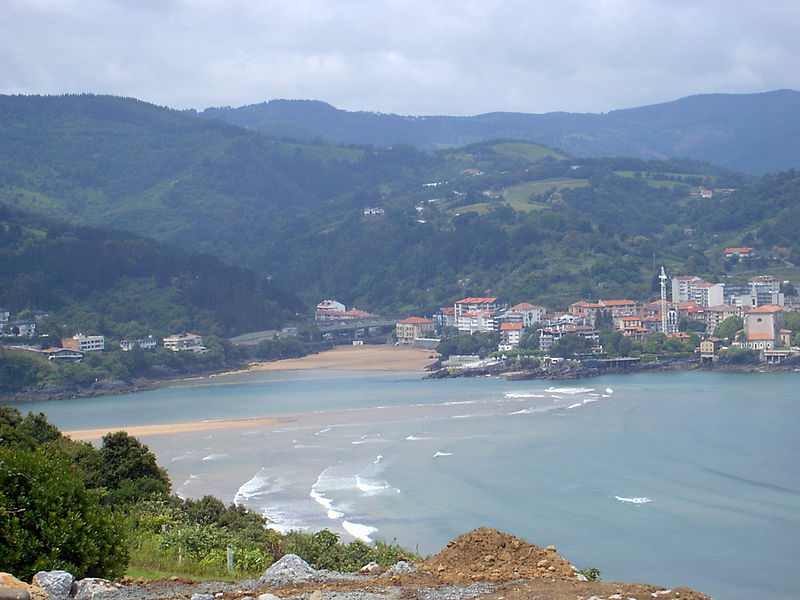
Mundaka coastline in Bizkaia province on south-eastern coast — with mountains visible behind (photo Wikipedia)
Even among Basques living on the coast or other lowlands, it is hard to meet a native who has not been to the mountains and high valleys and many go there regularly, sometimes in organised groups. One of the reasons they go, apart from reinforcing their cultural affinity, is to pick edible fungi. I am told that there are 100 edible species known in the Basque Country and that “between 40 and 50 varieties are eaten regularly”.3
As opposed to other regional administrations, a fee does not have to be paid in the CAV administration (three of the southern Basque provinces) to collect these mushrooms, although breaching rules can cost between 30 and 250 euros in fines. The regulations specify a collection limit of two kilograms per person per day and one is obliged to use a knife to remove and a wicker basket to store.
Sadly, illegal commercial operations have cashed in on the love of mushrooms in the Spanish state and gangs have been discovered recruiting poorly-paid migrants or unemployed natives to collect without a licence in administrations where such is a requirement, breaching conservation rules and running the risk of arrest. These gangs are less likely to succeed in the southern Basque Country, a society highly organised on a voluntary and local basis and in general quite conscious of the importance of conservation.
Display of edible fungi from the New Forest, England, showing the conservation-friendly collecting basked and knife (photo from Internet)
Further northwards, 25 km. from Iruňa (Pamplona), is the Harana (valley) Ultzama, a natural reserve, over half of it thick woodland. It is in Nafarroa (Navarre), the fourth southern Basque province.
“A mycological park over 6,000 hectares has been marked out, a great luxury for mushroom-lovers. …. The park’s information point, in the municipality of Alkotz, indicates the routes where these mushroom can be found as well as information about the species and how to identify those that have been collected throughout the day.” The collection permit costs €5 per day and is available from the information office or on their website.4
The Basques go in family groups or groups of friends, knowing the edible types (or accompanied by at least one who knows) and they bring baskets, not plastic bags. The idea is that the spores of picked mushrooms will drop through the weave as they walk and so seed growths of new mushrooms further away from where the parent fungi were picked. It is actually illegal to go picking with plastic bags and though there are not many of them, the forest police will arrest people who break that law. In a nation overburdened with police forces, that force is the only one that seems free from popular resentment.
The best mushroom sites are kept secret by those who know and the location of those sites is sometimes handed down through generations. In a peninsula renowned for its types of food and preparation styles, Basque cuisine lays claim to the highest accolade. Yet it uses hardly any spices or herbs. Sea food is high on the cuisine list of course but so is the ongo, the mushroom.
On a Sunday in October 2010, I was present in Bilbao when Maribel and Josemari’s mycological group had an exhibition in a local square, where they also cooked and sold fungi. Josemari and Mirabel worked all day in the hot sun and then had their own feast with their group afterwards, though by then I imagine many would not have had a great appetite.
I was staggered by the number of different species of fungi native to Euskal Herria and their variety of shapes and colours — I was told by the couple, and can well believe it, that their association had exhibited just over 300 species in that exhibition, between edible, inedible and poisonous. This figure was down on the previous year, when they had exhibited 500! Apparently there are over 700 species known to the country.
I tried to imagine how many Irish people would attend such an exhibition in Dublin, even on a sunny day such as we had there — perhaps 20, if the organisers were lucky. The square in that Santutxu district of Bilbao was full, as were the surrounding bar/cafés. There were all ages present, from babies at their mothers’ breasts to elderly people making their way slowly through the crowds. The food was all centred around cooked edible fungi: shish kebabs of mushroom, peppers, onions; burgers made of minced mushrooms and a little flour; little mushrooms with ali-oli on top, served on small pieces cut off long bread rolls; big pieces of brown mushroom almost the size of the palm of one’s hand.
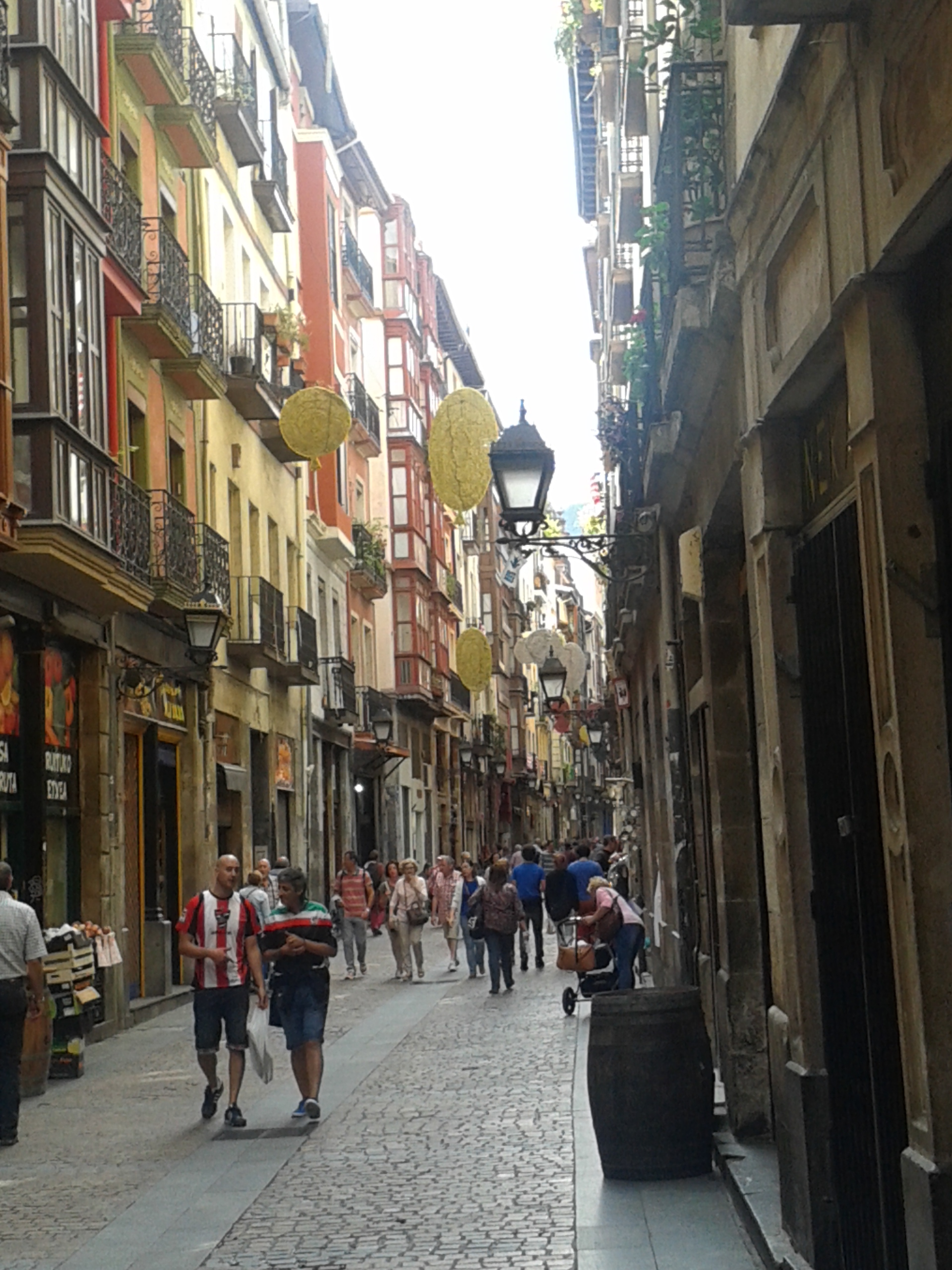
Street in the Casco Viejo medieval part of Bilbao, showing decorations for the Bilbo festival in August (photo D.Breatnach)
The people queued for the food and those selling it couldn’t keep up with demand. And the people also, including children, queued to see the fungi being exhibited. Unlike the Irish, who doubtless also have varieties of edible native fungi in their land but have largely shown an interest in only the common white cultivated kind and, among certain groups of mostly young people, the ‘magic’ variety, the Basques love their fungi.
I ate some there in that square and again, with other food also, down in the Casco Viejo (the medieval part of Bilbo city), where some new friends took me de poteo (from bar to bar) and wouldn´t let me buy even one round. Many bars serve pintxos, small cold snacks, some plain enough and others more involved – normally one eats and drinks and pays the total before leaving. But some of those bars have a room upstairs or to the side where meals are served and one had an excellent restaurant where we ate well and, of course, my friends wouldn’t let me pay my share of that either. True, I had organised some solidarity work for one of their family in prison but all the same ….. When it comes to hospitality, in my opinion the Basques deserve the fame even better than the Irish, who have been justly known for that quality too.
Some of the company had been the previous day in the town of Hernani, where a rally convened to call for Basque Country independence had been banned by the Spanish state. Despite the judicial order, thousands of young people had participated in the rally and had been planning to attend the rock concert afterwards. The Basque Region Police had attacked the peaceful demonstration with plastic bullets and then baton-charged the young people. Many were injured by the plastic bullets, by batons, and by being trampled in the narrow streets when people tried to flee the charging police. It was an object lesson in the drawbacks to regional autonomy or “home rule”. However, the resistance had been so strong that the police eventually had to retreat and allow the rock concert to proceed without further interference. But that too is another story.
AGUR — SLÁN
But five years later, outside the church after Maribel’s funeral, I waited with my two brothers on the margins of the crowd. I saw some youth among the mourners, including Goth and punk types, presumably friends of Maribel and Josemari’s daughters. Most in attendance were of older generations, however. It was noticeable how prominent the women were – garrulous and assertive. There were of course representatives of various branches of the movement, who knew the couple personally.
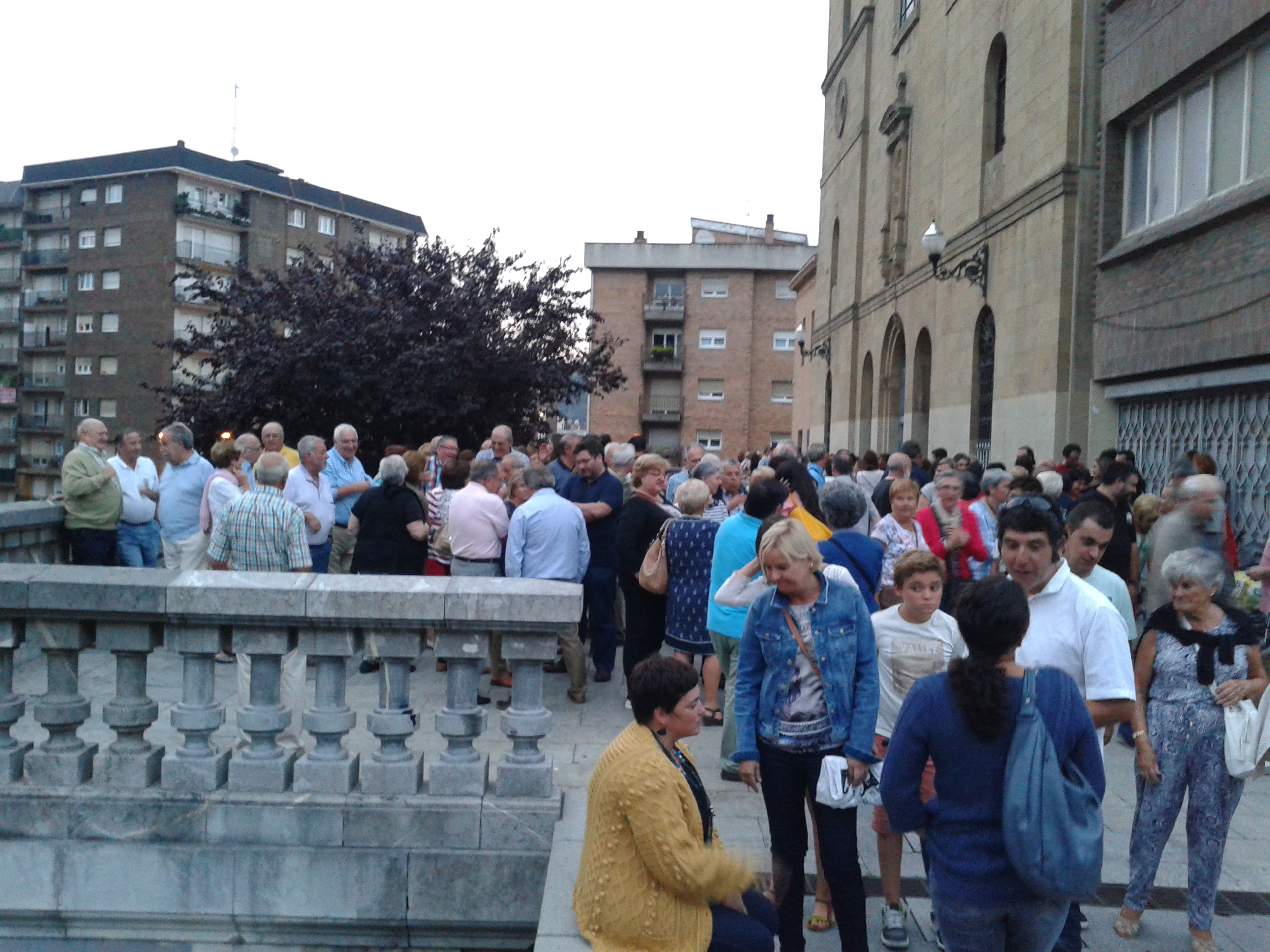
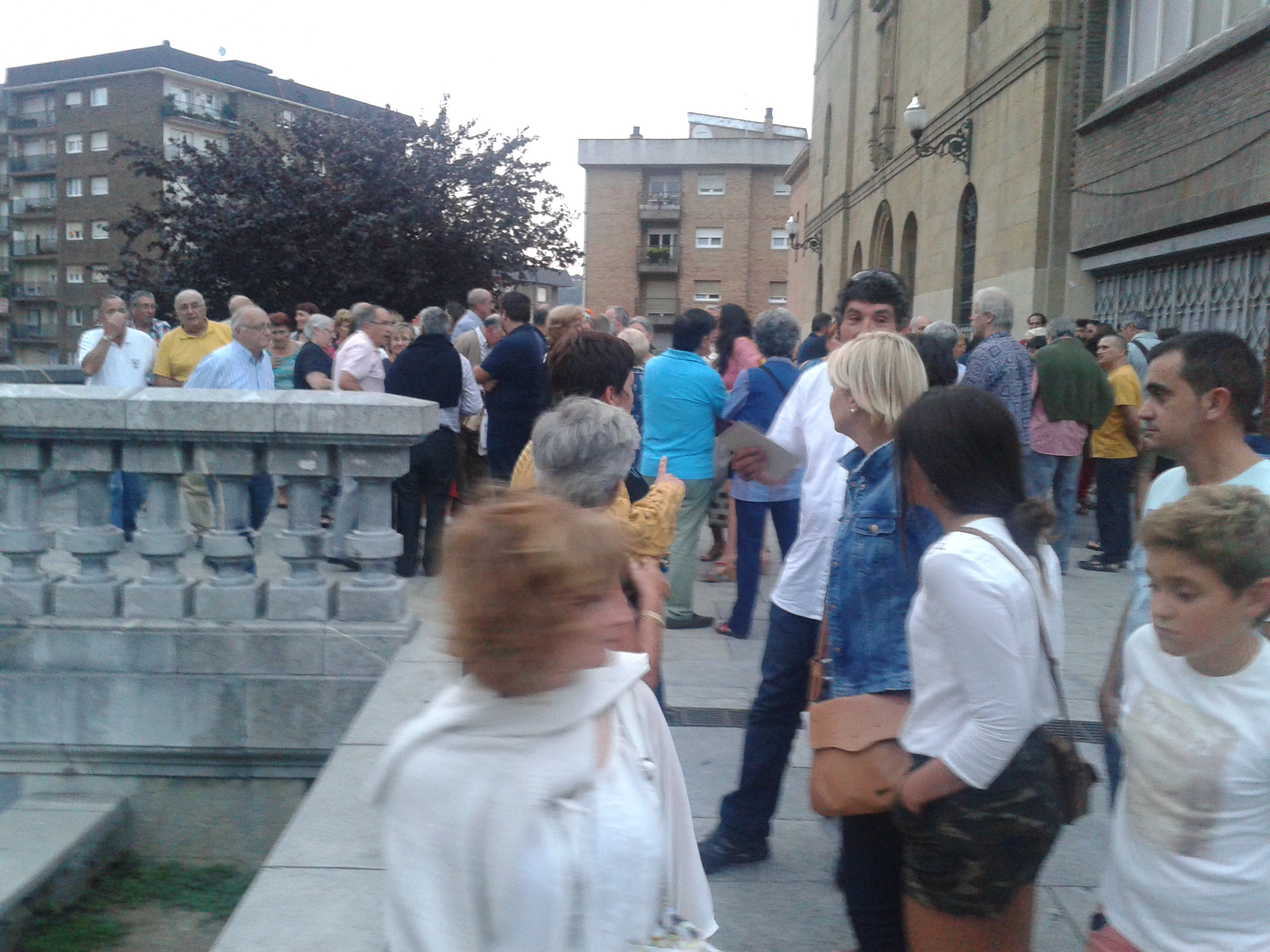
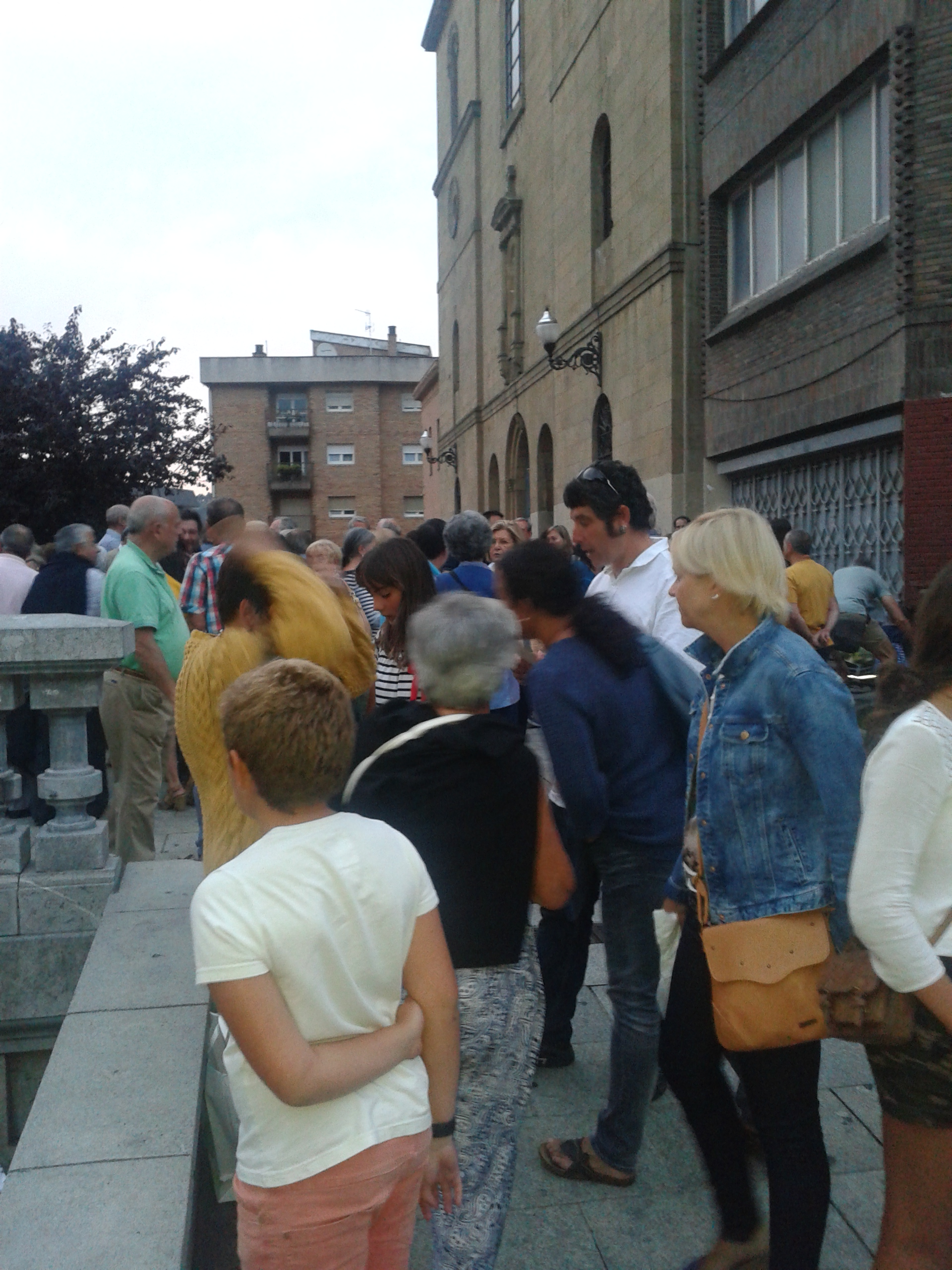
Small section of the funeral crowd outside the church with Gorka in the foreground in white shirt (photo D. Breatnach)
Inside the church I had already conveyed my condolences to Josemari, who had seemed amazed, amidst his grief, that I had travelled from Ireland for the funeral. I was surprised, in turn, that he would have expected any less; for me, there was no question – I’d have borrowed the money to go if necessary. His son-in-law burst into tears when I hugged him and that was it for me, my composure crumbled and we cried in one another’s arms. Now I waited for the crowd to thin so I could hug the daughters, the two who live in Bilbao and Maider, who lives in Gastheiz (Vitoria).
I stayed in a friend’s house a couple more days, renewing contacts and making a few new ones, meeting some old friends and then it was back to Dublin once more. Agur to Euskal Herria and agur to Maribel Eginoa – a loss to her family, to her nation, to me and to humanity.
End.
Footnotes
1 “ikastola” = school or college; plural “ikastolak”
2Agur translates as “goodbye” butcan also be a greeting. The Agur Jaunak’s lyrics are short and simple; the song is performed usually a capella, in giving honour to a person or persons and traditionally everyone stands when it is sung. The provenance of the air is a matter under discussion but it is only the Basques who are known to have lyrics to it. https://www.youtube.com/watch?v=xNMaMNMpYEk is one of the best versions I could find on the Internet although there is a somewhat cheesy bit by one of the performers in it. https://www.youtube.com/watch?v=d7Z8E-xhYTU is vocally another lovely interpretation sung unusually high although I dislike the crescendo at the end which is not the traditional way of singing it, which is to end on a low note.
On 6th September 2015, the Galway GAA team played the Kilkenny team in the Croke Park national stadium. I wrote this at the time but never posted it for some reason then and came across it to my surprise today.
Fans making their way along Cavendish Row and along Parnell Street on their way to Croke Park. (Photo D.Breatnach)Fans making their way up O’Connell Street and along Cavendish Row on their way to Croke Park. (Photo D.Breatnach)
Diarmuid Breatnach (Traducido al castellano al fondo)
(Reading time: 5 minutes)
” We made it! We made it! Safe for another year!”
“Shut up, you idiot! The day’s not over yet!”
Meanwhile, not far away ….
THE WREN-BOY TRADITION IN IRELAND
In England it is called “Boxing Day” but in Ireland the 26th of December is “St. Stephen’s Day”. Despite the Christian designation it has long been the occasion in Ireland for customs much closer to paganism.
It was common for a group of boys (usually) to gather and hunt down a wren. The wren can fly but tends to do so in short bursts from bush to bush and so can be hunted down by determined boys. The bird might be killed or kept alive, tied to a staff or in a miniature bower constructed for the occasion.
The Wren Boys would then parade it from house to house while they themselves appeared dressed in costume and/or with painted faces. In some areas they might only carry staff or wands decorated with colourful ribbons and metallic paper while they might in other areas dress in elaborate costumes, some of them made of straw (Straw Boys) and these were sometimes also known as Mummers although a distinction should be drawn between these two groups. The Mummers in particular would have involved acting repertoires with traditional character roles and costumes, music and dance routines while the simpler Wren Boys might each just contribute a short dance, piece of music or song. In all cases traditional phrases were used upon arrival, the Mummers having the largest repertoire for in fact they were producing a kind of mini-play.
The origins of the customs are the subject of debate but a number of Irish folk tales surround the wren. The bird is said in one story to have betrayed the Gaels to the Vikings, leading to the defeat of the former. There is a Traveller tradition that accuses the wren of betraying Jesus Christ to soldiers while another tradition has the bird supplying the nails (its claws) for the crucifixion of Jesus Christ. Yet another tradition has the wren as King of the Birds, having used its cunning in a competition to determine who would be the avian King, hiding itself under the Eagle’s wind and flying out above the exhausted bird when it seemed to have won, having left all others behind and could fly no higher.
By the 1960s the Wren Boy custom was beginning to die out even in areas where it had held fast but it slowly began to be revived by some enthusiasts. Nowadays fake wrens are used. Christmas Day in Ireland was traditionally a day to go to religious service and to spend at home with family or to go visiting neighbours. It was not a day of presents or of lights or Christmas Trees, customs brought in by the English colonizers in particular from Prince Albert, the British Queen Victoria’s royal consort, who was German. St. Stephen’s Day may have celebrated the Winter Solstice (the wren being a bird that on occasion sings even in winter) but moved to a Christian feast day; in any case it produced colour and excitement at a time which did not have the religious and commercial Christmas season to which, in decades, we have become accustomed.
The lovely song The Boys of Barr na Sráide from a poem by Sigerson Clifford takes as its binding thread the boys in his childhood with whom Sigurson went “hunting the wren”. It is sung here by Muhammed Al-Hussaini (currently resident in London and part of the singing circle of Comhaltas Ceoltóirí na hÉireann, meeting in the Camden Irish Centre). There are recordings of others performing this song well but the unusual origin of this one as well as its quality persuaded me to choose this one. In addition, I had the pleasure of participating in a singing circle with this lovely and modest singer in London in October this year (see The London Visit on the blog), who greeted me in Irish. Muhammed also plays the violin on this, accompanied by Mark Patterson on mandolin and Paul Sims on guitar.
ends.
LA TRADICIÓN DE “CHICOS DEL REYEZUELO” EN IRLANDA
Diarmuid Breatnach
En Inglaterra se llama “Boxing Day”, pero en Irlanda el 26 de diciembre es “la fiesta de San Esteban“. A pesar de la designación cristiana, ha sido durante mucho tiempo la ocasión en Irlanda de costumbres mucho más cercanas al paganismo.
Para eso era común que un grupo de niños(generalmente) o chavales se reuniera y cazara a un reyezuelo. Esepájaroes capaz de volar pero tiende a hacerlo en ráfagas cortas de arbusto a arbusto y, por lo tanto, puede ser cazado por niños determinados. El pájaro podía ser asesinado o mantenido vivo, atado a un bastón o en una glorieta en miniatura construida para la ocasión.
Los “Wren Boys” (Chicos del Reyezuelo) lo desfilarían de casa en casa mientras ellos mismos aparecían vestidos con disfraces y / o con caras pintadas. En algunas áreas, solo pueden llevar bastos o varitas decoradas con cintas de colores y papel metálico, mientras que en otras áreas pueden vestirse con trajes elaborados, algunos de ellos hechos de paja (Straw Boys/ Buachaillí TuI = Chicos de la Paja) y a veces también se los conoce como Mummers, aunque se debe hacer una distinción entre estos dos grupos. Los Mummers en particular tenían repertorios involucrados de actuación con roles y disfraces de personajes tradicionales, música y rutinas de baile, mientras que los Wren Boys más simples podrían contribuir con un baile corto, una pieza musical o una canción. En todos los casos se usaron frases tradicionales a la llegada, los Mummers tenían el mayor repertorio porque de hecho estaban produciendo una especie de pequeño teatro. Se les daba dinero , pastel o caramelos.
Los orígenes de las costumbres son objeto de debate, pero una serie de cuentos populares irlandeses rodean al reyezuelo. En una historia se dice que el pájaro traicionó a los Gaels a los Vikingos, lo que llevó a la derrota de los primeros. Hay una tradición de los Travellers (gente étnica nómada de Irlanda) que acusa al reyezuelo de traicionar a Jesucristo a los soldados, mientras que otra tradición dice que el pájaro suministra los tornillos (sus garras) para la crucifixión de Jesucristo. Sin embargo, otra tradición le tiene al reyezuelo como el Rey de los Pájaros, después de haber usado su astucia en una competencia para determinar quién sería el Rey de las aves, escondiéndose bajo el viento del Águila y volando por encima del pájaro agotado cuando parecía haber ganado, todos los demás detrás y no poder volar más alto.
En la década de 1960, la costumbre de Wren Boy comenzaba a desaparecer incluso en áreas donde se había mantenido firme, pero algunos entusiastas comenzaron a revivirla lentamente. Hoy en día se usan reyezuelos falsos. El día de Navidad en Irlanda era tradicionalmente un día para ir al servicio religioso y para pasarlo en casa con la familia o para visitar a los vecinos. No fue un día de regalos ni de luces ni de árboles de Navidad, costumbres traídas por los colonizadores ingleses en particular del alemán Príncipe Alberto, el consorte real de la Reina Victoria británica. El día de San Esteban puede haber celebrado el solsticio de invierno (el reyezuelo es un pájaro que en ocasiones canta incluso en invierno) pero se mudó a una fiesta cristiana; en cualquier caso, produjo color y emoción en un momento que no tenía la temporada de Navidad religiosa ni entonces la comercial a la que, en décadas, nos hemos acostumbrado.
La encantadora canción The Boys of Barr na Sráide (mezcla del inglés con el gaélico: “Los Chicos de la Altura de la Calle” [toponómico de puebo en el Condado de Kerry]) de un poema por Sigerson Clifford toma como hilo conductor a los chicos de su infancia con quienes Sigurson fue “cazando al reyezuelo”. Aquí lo canta Muhammed Al-Hussaini (actualmente residente en Londres y parte del círculo de canto de Comhaltas Ceoltóirí na hÉireann, reunido en el Centro Irlandés de Camden). Hay grabaciones de otros interpretando bien esta canción, pero el origen inusual de esta, así como su calidad, me convenció para elegir esta. Además, tuve el placer de participar en un círculo de canto con este encantador y modesto cantante en Londres en octubre de este año (ver The London Visit en el blog), que me recibió en irlandés. Muhammed también toca el violín en esto, acompañado por Mark Patterson con mandolina y Paul Sims con guitarra.