In few countries in the world has emigration played a more important role than in Ireland. Even before the Famine, Irish men and women emigrated at far higher rates than in other countries and after the famine struck, emigration skyrocketed, with emigration becoming a matter of life and death. Over time, a culture of emigration took root there, and the more commonplace emigration became, the more firmly the expectation of emigrating became entrenched in Ireland’s economic and social system.
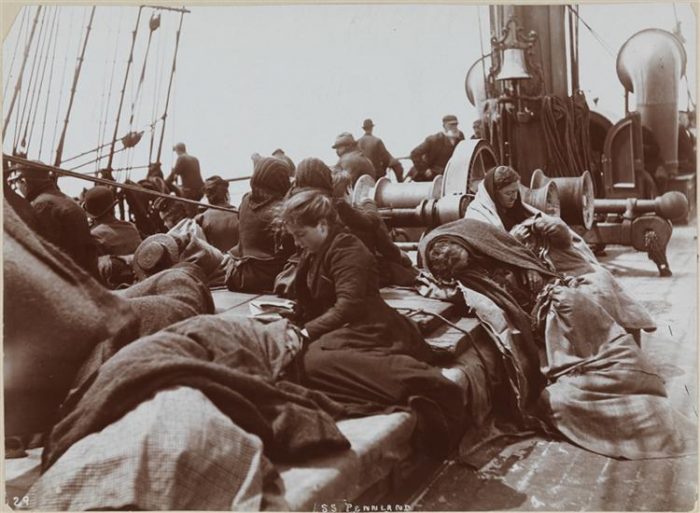
Foreground: Irish women migrants approaching New York harboru 1893.
(Photo source: Internet)
Ireland’s nineteenth century emigration was distinct from other countries in its gender ratio. In comparison to other European countries, the percentage of Irish women emigres was by far the highest and the unprecedented rate of single women emigrating distinguished the Irish from other Europeans to the United States during the nineteenth century. Already by 1845, women constituted nearly half of the total Irish immigration to America and that figure would continue to grow. The number of women who emigrated from Ireland in the nineteenth century has been put at three million and the major destination for these emigres was America. With few employable skills, many Irish immigrants worked in families as domestics. In 1900, 54% of Irish-born employed women were domestics and by 1913, some 87% of Irish emigrant women worked in some kind of domestic service. The massive number of Irish women working as American domestic workers would have profound, multiple effects both in America and at home in Ireland for generations.
Americans referred to the stereotypical Irish domestic worker as “Irish Bridget”, in part because Bridget is Ireland’s most popular female saint and many Irish named daughters in her honor. In America, Irish Bridget denoted the hundreds of thousands of Irish women laboring as domestic workers in American homes from 1840 for at least ninety years. Irish Bridget became a cliché for young Irish domestics who wreaked havoc, but also became indispensable, in American middle class homes for generations.
In the nineteenth century, having a live-in domestic servant who worked as a cook, cleaner, waitress and nanny was common amongst urban middle-class families. Up to a third of American households had live-in domestic workers in 1850 and Irish-born women constituted the largest group of domestic workers in the urban east. Living- in had both positive and negative sides for Irish domestic workers. These domestic workers freed married American women from many of the household and childcare duties that were expected of them. Freed from the obligation to pay rent, Irish domestics could save money to send to family in Ireland or for their own futures in America, but it also meant a lack of privacy, round-the-clock availability and the possibility of abuse from male members of the employer’s family.
American employer and Irish employee faced each other across a gulf of class, cultural, ethnic and religious differences. It was principally in the American home, not the political arena, or the factory floor where Irish immigrants and Native-born Americans first got to know one another. Americans’ views of the Irish and Irish views of Americans were forged by these intimate personal contacts.
Forging this relationship was hard in large part because of the poverty from which many Irish domestics came. The median age of these Irish girls was just twenty-one and the vast majority of these young women came from rural homes that were very different than the middle -class American homes where they worked. Many Irish women grew up in homes with dirt floors, with no knowledge of using brushes and buckets to scrub wooden floors. Another concern, many Irish homes also had no running water and no indoor toilets. Irish girls who became cooks often did not learn their culinary skills in Ireland. The food that they were raised on was vastly different than the cuisine eaten in the middle class American homes where they worked. It is not surprising that Irish servants in America were not known for their good cooking.
Americans often complained about Bridget’s lack of knowledge and her limitations. Americans spread negative stereotypes of Irish servants’ ignorance, rawness and stupidity. Many Irish had gone barefoot in Ireland and had to adapt to wearing shoes in America. Irish servants were sometimes even ignorant of the names and uses of kitchen utensils. One source noted, “these Irish servants are the plague of our lives.”
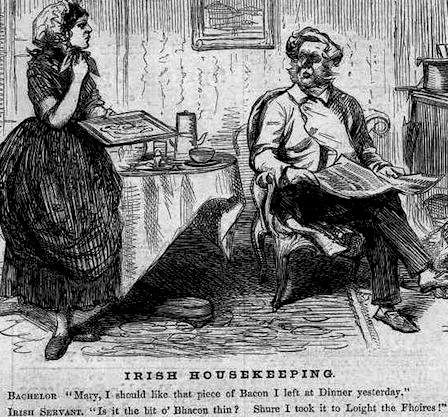
Racist cartoon depicting Irish Bridget in a temper and her cowering employer. Apart from the interesting comment on the power of the domestic servant in many houses (and its snide comment on Irish political struggle), note the coarse ape-like features of the irish woman as popularised by Punch in England and others, and the fat body, compared with the slim but womanly body of the employer and her fine features.(Photo source: Internet)
Even though Americans complained about their Irish domestics, they also needed them desperately. Because their work was in high demand, Irish domestics were able to negotiate their wages and conditions and they often left one family for another that offered better pay and improved conditions. There was a high turnover rate, which greatly displeased American employers.
Distained but Assertive
American employers quickly noticed the feistiness of the Irish Bridget, who quickly became infamous for her self-assertiveness. Americans complained that Brigid was insolent, defiant and had a temper. Employers also complained about Brigid’s uppishness or pretentiousness. Sharp-tongued anecdotes of Brigid’s repartees have become part of Irish American folklore and family histories. Self-confident Irish domestic servants did not believe that their work carried a stigma, though many Irish-Americans did. The opportunity to move their own families into the middle class mitigated Irish women’s concerns about any stigma tied to domestic work.
Cartoon of Irish Bridget portraying her as stupid perhaps. However, no Irish migrant would have thrown food away like that so perhaps she had eaten it or given it to someone in her community. In the attempt to depict the Irish accent and speech mode, note the adjective following the noun, as it is normally in Irish but not in English. (Photo source: Internet)
Irish Domestics demanded to be paid fairly and with good reason. American money greatly improved the material life of family members at home in Ireland. In the 1870s, amazingly about a third of all the money in circulation in Ireland came from remittances from Irish domestics. American money paid rural rents and built farmhouses. It provided dowries so that sisters at home could marry. It also allowed other family members to come to America. Prepaid passage tickets accounted for seventy-five percent of all the tickets used by the Irish to come to America.
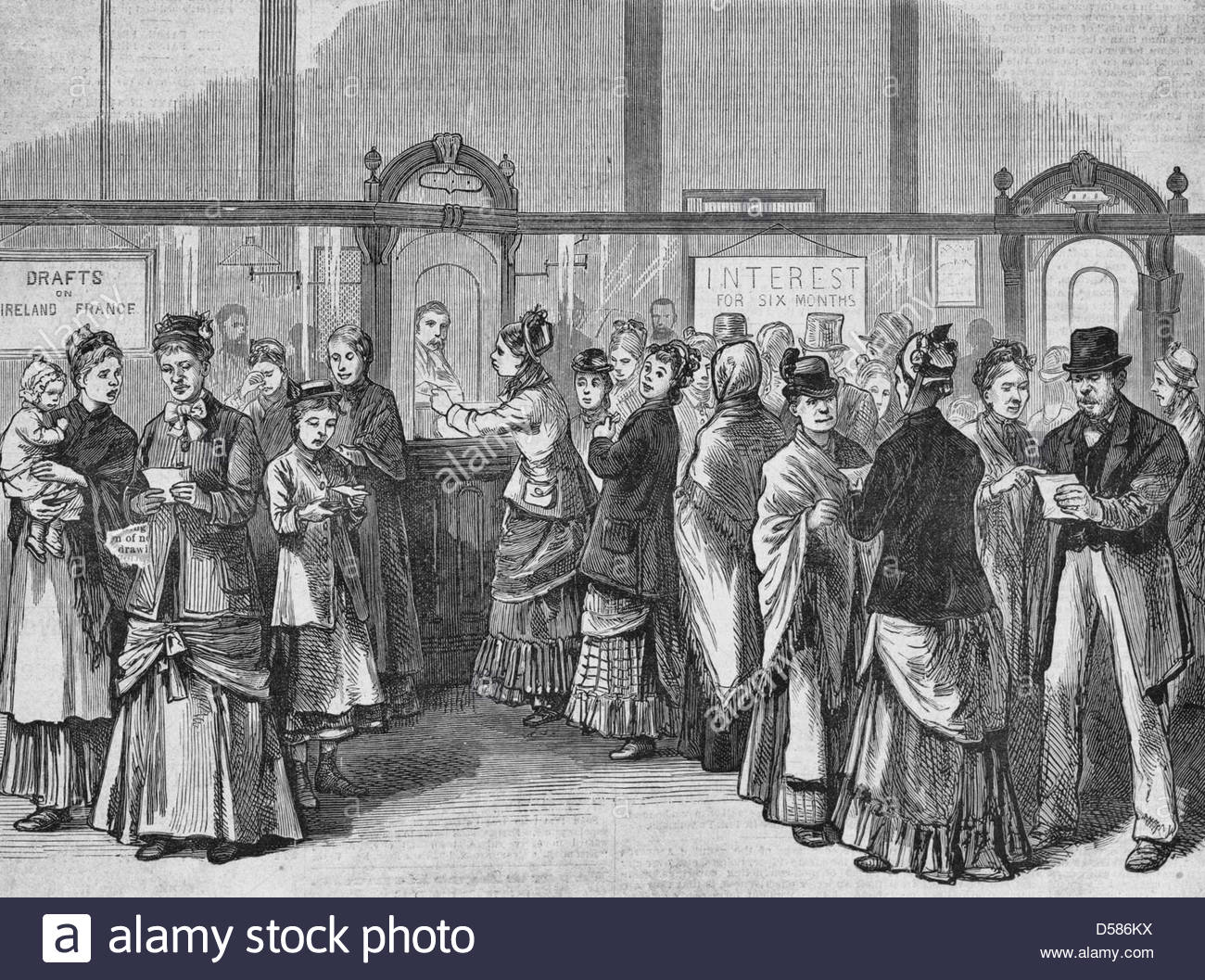
Irish migrants, largely women, withdrawing money from the Emigrants Saving Bank to send home to Ireland, c.1880 (Photo source: Internet)
Irish domestics spent freely on clothing and were criticized for dressing above their social station. They often spent most of their week’s wages on clothing and Irish Bridget could afford fine clothes that made her indistinguishable from middle class American women. Irish Bridget was often lampooned in cartoons which portrayed their over-the-top dressing in boas, boots and bangles.
The Catholic Church played a huge role in the lives of these women and figured not just in the social life of the Irish immigrants, but in their emotional life as well. Coming from a devout Catholic country, many lonely and homesick Irish women found consolation in the rosary and in prayer. Mass and devotions, though, were social as well as spiritual. Irish immigrants tended to identify themselves by their local parish and parishes organized important recreational outings such as boat trips, picnics and dances where Irish domestics could socialize with other Irish women and meet single men who were prospective marriage partners.
Religion, though was often a flashpoint. Many employers were Protestant, while Irish Bridget was almost overwhelmingly Catholic. Some domestics had to defy their employers who sought to convert them to Protestantism. Irish women even refused to join in Protestant family prayers and upset their employers when demanding fish on Fridays. Some potential employers refused to hire Catholics and stipulated in employment offers that only Protestant women need apply.
Through their personal interaction with Irish Bridget, native-born Americans came to see Irish immigrants less as ‘others’ and more as fellow human beings. Irish Bridget blazed a trail for the Irish to become accepted by native-born Americans and helped the Irish, as a group, move into the American middle class.
End.
COMMENT
Thanks to Geoff for this interesting contribution. The first migrant ashore at Ellis Island, the immigrant-processing station opened by the USA in 1892 was Irish, though her name was not Brigid – Annie Moore was from Cork and she was not yet 18 years of age.1
Though native-born East Coast white UStaters2, especially middle-class and upwards, would have come to know the Irish migrants through domestic servant “Bridget”, she in turn came to know them in that exchange also. And to adopt their attitudes, at least in some regards and no doubt anti-black racism was one of those attitudes. While down at the bottom of white society Irish labourers had to compete with black, which helped promote racist attitudes in Irish males (becoming “white”), Irish Bridget was much more likely to pick up those attitudes from white upper-class white households.
Not all Irish migrants embraced racism of course and some actively campaigned against it3, yet viewing the screaming hordes, mostly women and many of Irish descent, protesting the forced de-segration of schooling in Boston in the mid-1970s for example is a repelling experience.
Diarmuid Breatnach
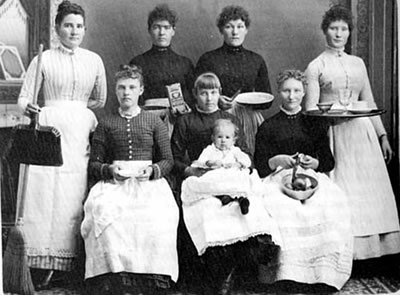
Irish domestic servants early 20th Century — in the USA? (Photo source: Mayo Library, Ireland)
FOOTNOTES
1 Ellis Island is no longer used to process migrants and is better known today as an island close to that which became the base for the Statue of Liberty
2 A term I use to describe people from the USA, as distinct from other parts of America such as Canada to the north and Latin America to the south.
3 And were instrumental in building the main US anti-slavery party, the Republican
FURTHER READING
The Irish Girl and the American Letter: Irish immigrants in 19th Century America:
Having hectored, cajoled and bullied its way through the uncivil negotiations around Brexit (“British exit”) and Trexit (“Transition exit”) it seems that the United Kingdom is now insistent on having its sovereignty cake and eating it too. How else to explain the complaints from UK politicians and commentators objecting to the European Union implementing checks on British goods entering its borders? A couple of weeks ago the right-wing press in London was gloating at the relative lack of interruption in ongoing trade with the Continent following the end of the transition period. Where, they sneered, are the kilometres-long tailbacks at the Channel seaports and the English retail stores filled with empty food shelves? Where, they guffawed, are the legions of international passengers stuck at airports or the army of businesses closing down as their supply chains disappeared?
Conveniently, of course, all this sniping ignored the dramatic fall in cross-border trade…
Irish Socialists, though they seem to have little idea of taking on the State in revolution, have at least a rough economic plan for socialism: nationalise the banks and essential services, tax multinationals highly in the meantime, force them to pay higher wages, abide by worker and environmental protection regulations, etc … But Irish Republicans, who have a very clear concept of overthrowing the State, in general appear to have no economic program. How can this be?
Firstly, let’s do away with any idea that Irish Republicans have no awareness of the impact of economics on their lives. Irish Republicans are not nearly as focused on the trade unions as are the Socialists but they are well aware of austerity measures, of wage levels, the cost of housing etc. Irish Republicans are overwhelmingly working or lower-middle class and they feel these impacts and think about them. But they do not, collectively, formulate plans to change these factors.
It would be illogical to think that they don’t care, or that they think that there is nothing that can be done about these things. The rational conclusion to arrive at rather is that they are consciously shelving the question. They don’t have an economic program because they don’t want to – they are actively and consciously avoiding having one.
There is a rational reason for behaviour, even when it seems irrational and this case is no exception. Irish Republicans know that the field of economics is going to have different theories and a variety of proposals tendered for action and this will lead to divisions, some on a very fundamental level. It was part of the reason for the avoidance in the movement of burning social questions in the past. Many of those social questions have been largely resolved without any leadership from the movement, by changes in thinking across society, of which the Republicans are of course a part: contraception, gender equality, divorce, LGBT equality …. even intentional pregnancy termination may be approaching acceptance by the majority of Irish Republicans now.
The notional acceptance of “socialism” as part of the program of Irish Republicanism has led to divisions in the past. The Republican Congress project of the 1930s failed and the Republican movement lost many of its most advanced social theorists and organisers, while the IRA placed an official ban on communist membership.
The essentially social democrats1 who came to lead the 1960s pre-split Republican movement were very strong advocates of socialist economic measures but they foundered on the question of opposition to the State – the deeply sectarian Six-County colonial statelet. When the movement’s leadership failed to supply the arms which the ‘nationalist/ Catholic’ areas needed to defend themselves, the movement split and many in the new camp, the Provisionals, blamed the debacle on “politics” or even more concretely on “socialism”.
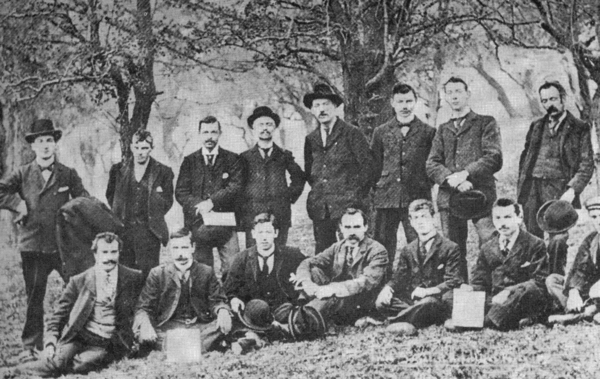
Members of the first socialist party in Ireland, the short-lived Irish Socialist Republican Party (distinct from the IRSP) in Dublin’s Phoenix Park, 1901. James Connolly is seated, fourth from left. (Photo sourced: Internet)
It was of course judgement of guilt based on association rather than on intrinsic nature but effective nonetheless (as such often is)2. Subsequently the Adams camp used “socialism” – without of course outlining any real socialist economic program — to unseat the historical leadership of the Provisionals. The objective was to replace them with Adams and his own clique and in this they were successful, through that and other maneouvres.
Now that Provisional Sinn Féin seeks to become a partner in managing the state for the neo-colonial Gombeen class, it has dropped the “socialist” tag (though occasionally, when convenient, likes to describe itself as “Left”).
But not since the 1960s split (apart perhaps from a brief moment in the Irish Republican Socialist Party) has the Irish Republican movement had an explicit economic program, much less a socialist one. “These are all questions that will be resolved later” is and has been the message – i.e after the colonial Statelet and the neo-colonial State have been overthrown, after the nation is free and united.
What is much more likely, however, is that at that point, should we reach it, we’ll have another civil war. And really socialist Republicans will likely lose, because they’ll be trying to sort out priorities and alliances in the midst of a struggle for survival, against a new capitalist order or a foreign invasion – or a combination of both.
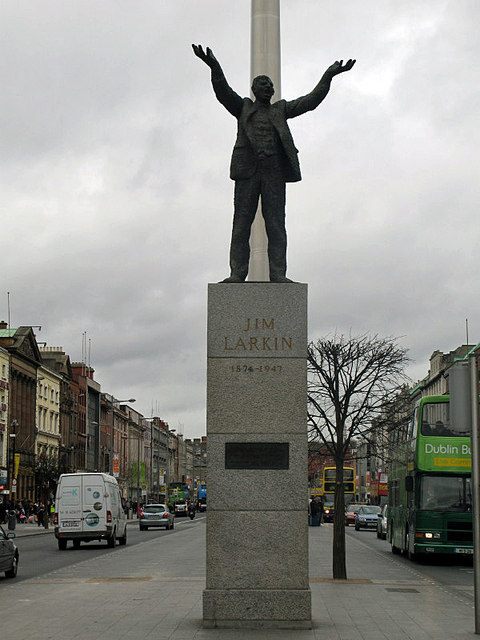
The Jim Larkin monument in Dublin’s O’Connell Street today (Photo: D.Breatnach)
DEFINE AND DECLARE OR PREPARE FOR DEFEAT
All Irish Republican organisations and parties now define themselves as “socialist Republican”, which is something that was not true until fairly recently. They need not only to put flesh on those bones but to grow the very bones themselves. If they want to succeed, they need to answer the questions:
what do they mean by “socialist”?
What practical economic measures do they intend to implement?
What is their notional timetable for this implementation (i.e which are immediate, which transitional etc)?
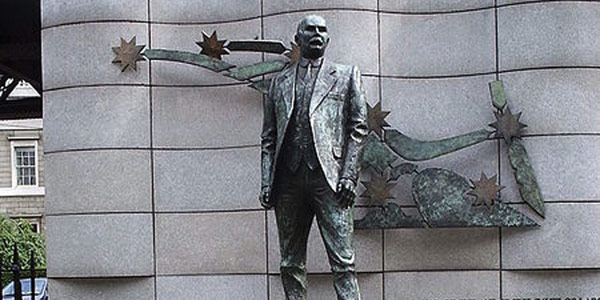
James Connolly Monument, Beresford Place, Dublin. (Photo: D.Breatnach)
The implications of answering these questions or not are crucial not only in whether we build a viable socialist society to benefit the vast majority of the working people on this island, but crucial also in whether we achieve independence for the nation in the first place. The working people need a visible stake in a free, united and independent Ireland; I am in agreement with James Connolly when he made the profound declaration that “only the Irish working class remain as the incorruptible inheritors of the fight for freedom in Ireland.”3
end.
FOOTNOTES
1Some may object to this definition but it seems to me correct to describe followers of a doctrine of installing a socialist regime without a fierce struggle to overthrow the existing State.
2There was of course also the wish not to alienate the Irish capitalist elements which the Provisionals hoped would support them, both in Ireland and in the USA.
November is a bad month in the memory of many Basque independence supporters, bringing with it the recollection of the violent deaths of two of their most prominent activists, Santi Brouard and Josu Muguruza. Both men were murdered by Spanish assassination and terror squads in which foreign and native fascists, criminals, police and army cooperated under State political direction in attacking the Basque liberation movement and attempting to spread terror among its supporters.
THE MURDERED BASQUE ACTIVISTS
Santi Brouard was killed on the 20th of November 1984 in the Basque city of Bilbo (Bilbao), capital of the province of Bizkaia, one of the four provinces of the nation under Spanish control1. He was a children’s doctor, Deputy Mayor of the city and a member of the leadership of the Basque socialist independentist political party Herri Batasuna.
Santi (abbreviation for Santiago) Brouard was born in Lekeitio in 1919, an important town for the fishing industry in Bizkaia province. Having completing his schooling he went to study medicine at the University of Valladolid, a city in the north-east-central part of the Spanish state, culturally and politically far from his native home. After graduating, Brouard returned to the southern Basque Country and practiced medicine, specialising in paediatrics in the hospital in Basurto Hospital in Bilbo (very near the San Mamés stadium, home ground of the Athletic Bilbao soccer team).
At the age of around 40, Brouard married the poet Teresa Aldamiz, a Filipino woman of Basque descent and the couple had three children. Likely while striving to achieve his children’s educational and cultural needs, Brouard became active in the underground Ikastola movement (offering education through the medium of Euskera, the then banned Basque national language).
In 1974, in his 55th year, after treating a member of the armed Basque liberation organisation ETA, gunshot-wounded by Spanish police, Brouard was forced to flee the Spanish State jurisdiction into the French-administered part of the nation, where many others had settled for their safety from the forces of the Spanish State2. There the refugee met Argala3 and other members of the ETA leadership, the Basque armed socialist national liberation movement and in the early post-Franco years hr collaborated with Argala and others in developing the KAS Alternative, organised around minimum lines of agreement across the Basque nationalist sector, including armed organisations, political parties and collectives and trade unions.
When Brouard felt it was safe to return to the Basque Country he became active in the political aspect of the movement for Basque independence, was one of the founders of EHAS (Basque Socialist Party of the Basque Nation) of which he was elected President in 1978; he was also on the national executive body of Herri Batasuna until the day of his death. For the HB party he stood in the 1979 elections for Mayor, gaining the position of Deputy-Mayor which he held during the term of that office, i.e until 1983 but that year he was elected as a representative on the Bizkaia Provincial Council. It was in that capacity that he was jailed by the Spanish State and in 1984 was elected as Bizkaia representative to the Basque Autonomous Government4.
The jailing in 1983 came about because he joined other Herri Batasuna elected representatives in singing Eusko Gudariak5 during the King’s6 visit to Gernika and in the presence of the Monarch. Juan Carlos had been Franco’s protege from the end of the 1940s and had also acted as head of state for such occasions in place of Franco in the latter’s final years. Gernika had been infamously bombed by the Condor Legion and also strafed by Italian Fascist airplanes, planes and pilots loaned by Nazi Germany and Fascist Italy to the fascist-military forces led by Franco, in an attack on a civilian population perhaps mostly remembered today through the image of Picasso’s painting Guernica (sic). Franco’s publicity department at first blamed the bombing and conflagration on the antifascist opposition, then apologists later claimed it had been bombed in mistake for another target.
It is unclear what the final judicial sentence was (it was revised by the Supreme Court in 1986) or to how long in jail the accused were sentenced but it seems to have been for a year or less.
Santi Brouard who, despite having been warned of fascists focusing on him, declined to hide or even to lock his clinic door, was murdered on 20th November while working in his clinic by Luis Morcillo and Rafael López Ocaña, killers hired by senior officials within the Spanish Interior Ministry and at least endorsed, if not actually organised, at the highest level of the State.
Josu Muguruzawas shot on the same date but five years later (1989) – and in Madrid. He was sitting at a table with Herri Batasuna comrades, planning their participation the following day in the Spanish Parliament, to which they had been elected from the southern Basque Country. For the left Basque independentist party, it was the first time their representatives were to take part in the Spanish Parliament. Muguruza died on the spot in the attack and a comrade Iñaki Esnaola was seriously wounded.
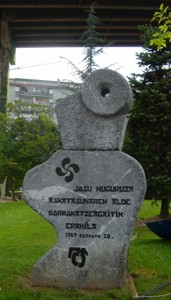
Monument to Josu Muguruza in his native Recalde, completed by unknown artist in 1989. (Image sourced: Internet)
Josu Muguruza was born in 1958 in the Recalde district of Bilbo (Bilbao). Following his schooling he enrolled in university to study teaching but switched to study journalism instead in Lejona (still in the province of Bizkaia). Apparently he had had been reared speaking only Castillian (Spanish) as Euskera (Basque language) was illegal under the Franco dictatorship but he learned the banned language and was an activist in ASK (Socialist Patriotic Committees), an assemblist collective founded in Bizkaia and also in both KAS and Herri Batasuna.
When his girfriend (and later wife) Elena Bartolomé was arrested on suspicion of connection to the armed group ETA, Muguruza, like Brouard and many others, fled to the northern Basque Country (under French administration). Without a need to worry about extradition from the French state in those years, Muguruza was able to lead a fairly normal life, working as a journalist (although he had left his studies before qualifying). During his six years in that part of his homeland, he taught Euskera for AEK (organisation for the promotion of Basque language to adults) in Bayonne, broadcast for local Basque radio station Gure Irratia and, under a pseudonym, reported for the northern Basque Country edition of Egin7 (a Basque patriotic-left newspaper).
It is believed that Muguruza grew to significant political importance among the Basques in the northern Basque Country, both natives and southern country refugees living there and that he was pushing within the movement for negotiations between ETA and the Spanish State.
In early March 1987 the French police arrested Muguruza on foot of extradition request from the Spanish State and hustled him over the border without an opportunity to challenge the process. Having been released towards the end of the year due to the absence of charges against him, he was able to reestablish himself in the southern Basque Country with his wife Elena but in Gastheiz (Vitoria), in the province of Álava. Muguruza went back to work for Egin but this time as Editor-in-chief, rose in the Basque liberation movement with activity in KAS and election to the national executive body of Herri Batasuna, the electoral party of the movement. For some in the know, although publicly in the background, he was considered among the most important of HB’s leaders and was actively pushing for the participation of the party in the electoral system of the Spanish State.
THE SIGNIFICANCE OF THE DATE
The killing of both on the same date though some years apart was no accidental coincidence and clearly signalled the ideological source of the murders – though separated by decades, 20th November was the date of the execution of Primo Rivera and also of the death of the dictator General Franco8.
Primo Rivera was founder and leader of the fascist Falange organisation; he had been captured by Republican forces during the Spanish Anti-Fascist War and was executed on 20th November 1936 in Alicante jail. General Franco became the sole leader of the military-fascist coup and later Dictator of the Spanish State for four decades, dying in 1975. Fascists and Far-Right in Spain revere the memory of both men who, although they were rivals, were eventually interred together in the mausoleum of the Valle de los Caídos (“Valley of the Fallen”), which became a shrine for the Fascists and Far Right9, in particular for processions on the 20th of November — and a cause of bitter complaint for Spanish Republicans, members of the Spanish Left and national independentists (for example of the Basque Country and of Catalonia).
The murders of both Basques on the same date indicated the ideological background of the murderers – Spanish fascism. However, the organisations that carried out the murders were of significant difference and status within the Spanish state.
THE MURDERERS — SPANISH PARAPOLICIAL AND FASCIST ORGANISATIONS
As noted above, the murderers of Brouard were hired killers, contracted by high-ranking officials of the Spanish State.
Protest on 18th October 2008 by Askatasuna organistation on 25th Anniversary of the kidnapping, torture and murder of Jose Antonio Losa and Jose Ignacio Zabala, the first victims of GAL. The Spanish National Court had forbidden the commemoration in Tolosa, Guipuzkoa province. The commemorators are being confronted by the Ertzaintza, Basque Government police and at least six protesters were arrested. (Photo credit: EFE/GORKA ESTRADA)
Wikipedia’s account of the Spanish State assassination squad refers to GAL and the Dirty War, with the years of activity of GAL listed as 1983-1987, in total less than five years. However the whole period of Spanish State/ Far-Right terrorist murders lasted 26 years, beginning in 1975 and ending in 1990. The period claimed at least 66 lives10 and many injured. La Triple A (Acción Apolostolica Anti-communista) was active killing (eight murders according to Spanish State list of victims of this kind of terrorism) and injuring from 1975 until 1982, after which it may be said that GAL took over until 1987. GAL shared some of its time with the BVE (Batallón Vasco Español – “Spanish Basque Batallion”), claiming actions (21 murders and at least 10 serious injuries) between 1975 and 1981.
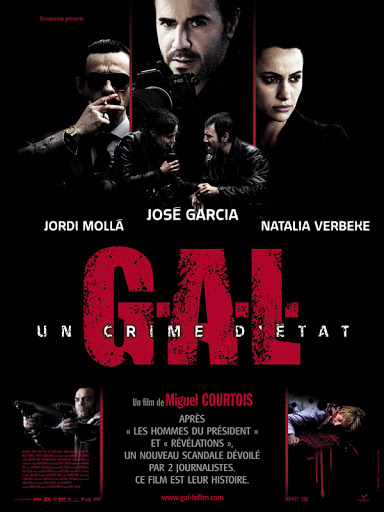
Poster for film about GAL (Image sourced: Internet)
The hitmen were criminals and mercenaries, sometimes from abroad but usually with a right-wing background, for example with the French-Algerian OAS, Italian fascist movement or the Argentine Triple A.
Some of the terror was directed in general at the Left within the Spanish state and some at Catalan independentists but most of the actions by far were aimed at the Basque Left independentists, many of these residing in the northern Basque Country, i.e under French rule. The terror of these parapolicial murders had a number of objectives:
eliminating specific antifascist and left activists during the period of the Transition from Dictatorship to “democracy”
causing fear and terror to encourage people to vote for the 1977 royalist and unitary state constitution
eliminating specific Left Basque independentists, in particular leaders
coercing the French Government into handing over Basque fugitives to the Spanish State
GAL was exposed in an invesigation by a Spanish controversial judge Baltasar Garzón11 and by journalists of El Mundo, newspaper of the right-wing conservative Partido Popular in a series starting in 198912. Although the Minister of the Interior, high-ranking police and army officers were convicted of a number of crimes including kidnapping, murder and embezzlement of Government funds (for personal enrichment, paying terror gang operatives and bribes), their actual time served was very short indeed.
The trial of the first of the senior13 State members of the terror operation did not take place until 1996, when the PSOE Minister of the Interior, José Barrionuevo and his Deputy Rafael Vera were tried on charges of funding and directing a number of murders. They were sentenced to ten years each. In 2001 they were pardoned, having served little more than a year in prison. That year Barrionuevo and José Luis Corcuera, his successor as Minister of the Interior, were tried for embezzlement but found not guilty the following year.
In 2000 General Galindo of the Guardia Civil was sentenced to 75 years for kidnapping and murder – of which he served only four, being released on health grounds.
The finger for Señor X, top director of GALpointed at Felipe González, Prime Minister of the PSOE Government at the time but, though widely believed to be him, he was never even questioned. Earlier this year a CIA document revealed that González was the Señor X but he remains uncharged.
Felipe Gonzalez in more recent years. Gonzalez was head of the social-democratic PSOE, Prime Minister in 1980s and “Senor X”, mastermind of the Spanish State murder and terror squads. He has never even been questioned. (Image sourced: Internet)
The murder of Josu Muguruza, unlike that of Santi Brouard and many others, appears not to have been sanctioned by the Spanish State and was contrary to its interests in a number of ways:
Muguruza was to attend the Spanish Parliament for the first time the following day and his murder, including being in the capital of the Spanish State, reflected badly on “Spanish democracy”;
The murder stood to weaken those in the Abertzale Left who supported entering the institutions of the Spanish state and strengthened those for whom armed struggle was the main vehicle towards liberation.
The Spanish police clamped down on the Triple A in Madrid after Muguruza’s murder and in response the network officially dissolved itself (though not for long).
Poster for what looks like a documentary film about GAL (contains images of what appears to be real people). (Image sourced: Internet)
THE BASQUE ORGANISATIONS
The history of these organisations is one of struggles for unity alongside splits, including the unseating of one political leadership and its replacement by another. Naturally the murdered Basque activists, along with all other prominent Basque activists of the time, played a part in these conflicts.
HASI in Euskera means “to begin” but is also an acronym for Herri Alderdi Sozialista Iraultzailea (People’s Revolutionary Socialist Party) and was considered the political expression of ETA militar (ETA (m)), a split in the armed libertion organisation. Founded in 1977 out of the fusion of the Basque socialist parties EHAS and ES, HASI was one of the founding members of KAS and of Herri Batasuna.
HASI was dissolved in 1992.
KAS began its existence in 1976, in the dying days of the Franco Dictatorship, as the establishment of a minimum democratic platform for unity across the Basque socialist independentist movement, drawing in a variety of Basque socialist and independentist organisations and later, trade unions. Originally supported by a minority of the movement, it began to quickly gain more widespread support. In 1977 the “Alsasua Table” brought together nearly all the relevant players. KAS put together a transitional program for the independence of the Basque nation, including the removal of repressive forces and the Basque people deciding on the future of the nation; this program was revised in 1978. ETA (militar) came to dominate the alliance after the dissolution of ETA (politico-militar) in 1982.
The ETA leader Argala considered implementation of KAS proposals necessary if ETA was to cease armed struggle; in addition the PSOE and PNV proposed watered-down versions of the proposals.
Alternatiba KAS was dissolved in 1992 to be replaced by Alternatiba Democratica in which Herri Batasuna would negotiate on behalf of the Basque nation.
ETA, which arguably Brouard also helped promote, was founded originally in 1959 as an unarmed Basque socialist group Euskadi Ta Askatasuna (Basque Country and Freedom); it became the armed organisation of the Basque socialist independentist movement, with its first victim and also first martyr in 1968. ETA announced a unilateral truce in 2011, disposal of its armament in 2017 and its disbandment and dissolution in 2018. There are over 250 Basque political prisoners who are recognised as serving sentences — often of a number of decades — in prisons dispersed throughout the Spanish and French states for actual or alleged membership of ETA or assisting the organisation14. The Spanish State insists the prisoners must express regret for their past actions to gain any degree of relaxation of their prison conditions or release on parole.
Although EPPK, the coordinating organisation of ETA prisoners continues in nominal existence, ETA does not exist at least since 2018, arguably since even earlier.
Herri Batasuna, to which Santi Brouard belonged and helped build, as did Josu Muguruza, registered as a political party in 1981 but had been in existence, arising out of KAS, since 1978. The party, like KAS, was a coalition of different strands.
It became the majority party of the Basque socialist independentist movement and performed well in elections but was outlawed by the Spanish State as were a number of its replacement formations, one of the effects thereof being to disqualify them from standing in elections. Its remnants today are to be found in the EH Bildu and Sortu political parties. Although changed from revolutionary socialist independentist to social-democratic nationalist but continuing to advocate for an independent Basque nation, they are arguably the only organisational survivors of the years of the Spanish State’s terrorist war against the Basque liberation movement.
Outside of the influence of the ‘official’ leadership of the movement a number of new Abertzale Left organisations exist which would claim to be continuing the original trajectory of the Abertzale Left (or perhaps to be improving upon it) such as Amnistia15, Ikasle Abertzaleak16, Jarki and Jardun, the latter seeking to act as a coordinator for the movement as a whole. In addition there are a number of autonomous collectives of various types, often focused on specific aspects such as the environment, anti-racism and anti-fascism, etc.
A FIGHT OVER THE MARTYRS’ MEMORY
Monument to Santi Brouard with placards bearing images of both martyrs and Basque flag, Ametzola Park, Bilbao, Nov 2017 (Image sourced: Internet)
Today there exists a three-cornered fight over the memory of the Basque martyrs since 196817. What is now becoming known as the “oficialista” leadership of the Abertzale Left and its “dissident” opposition both commemorate the murders of those Basque martyrs, including of course those of Muguruza and Brouard. But they rarely do so together and on occasion the oficialistas have commemorated them alongside victims of ETA18.
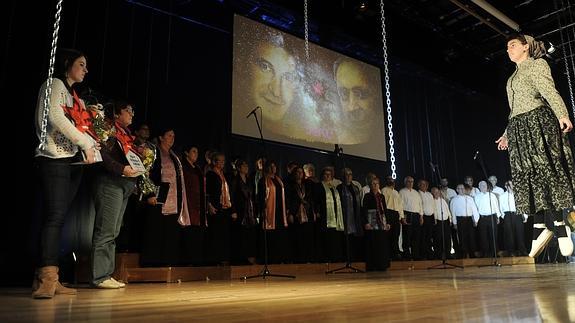
A woman dances the aurresku, an honour dance, in front of projections of the images of Brouard and Muguruza, Bilbao November 2014. (Image sourced: Internet)
The third party to the struggle is the Spanish State, which claims that any commemoration of those martyrs is, in essence, enaltecimiento del terrorismo — “exaltation of terrorism” and, while it does not always intervene, the possibility is always present of judicial prohibition, police action or subsequent charges under “anti-terror” legislation.
Historical memory is a political battleground.
In 2009 the Ertzaintza, police of the Basque ‘Autonomous’ Government, remove banner that declares that Brouard and Muguruza were murdered by the PSOE (Image sourced: Internet)
Ignoring protest of Tasio Erikizia, a leader of the Abertzale Left, the Ertzainza, police of the Basque ‘Autonomous’ Government, remove banner that declares that Brouard and Muguruza were murdered by the PSOE. This took place during a 2009 commemoration in Bilbao of the Spanish State murders of Brouard and Muguruza (Image sourced: Internet)
End.
FOOTNOTES
1The three northern provinces are under the control of the French State, which shares a border with the Spanish State.
2The Spanish State was under the dictatorship of General Franco, which it had been since the victory of his military-fascist forces in a coup against the Popular Front Government and the ensuing Spanish Anti-Fascist War (1936-1939).
3Nom de guerre of Jose Miguel Berañan Ordeñana, leading theoretician and activist of ETA, also murdered by GAL in the northern Basque Country by bomb under his car in December 1978, which makes December too a month of sad recollection for Basque independentists.
4A semi-autonomous body under the 1977 Spanish Constitution, composed of three of the four southern provinces of the Basque nation. It has traditionally been dominated by representatives of the PNV (Basque Nationalist Party) with representation of the Basque socialist independentists either in second place or in third (after the Spanish social-democratic PSE).
5“Basque Soldiers”, national anthem of the Basque independentist movement, similar in theme to The Soldiers’ Song/ Amhrán na bhFiann, the Irish national anthem.
6Juan Carlos was a protege of Franco, swore allegiance to the fascist State and, due to the Dictator’s declining health often presided over or attended functions in the role of head of state. Contrary to some versions of history, Juan Carlos was foisted upon the citizens of the Spanish state as part of a new Constitution in 1977, in turn part of the “Transition” of the State and accompanied by much violence and threats of the reimposition of a dictatorship. Though rejected in the Basque Country, the Constitution was accepted by a majority of the Spanish state electorate with the support of two of the main opposition parties (and their allied trade unions), the Partido Comunista de España and the Partido Socialista Obrero de España, the latter now one of two main parties of government in the Spanish state. Surrounded by controversy and allegations of financial corruption, Juan Carlos abdicated in June 2014 in favour of his son Felipe (now Felipe VI of Spain) and in August 2020 left the state, reportedly ahead of investigations that would lead to charges of financial corruption. The former King is reported to be living in luxury in the United Arab Emirates from which historically any extradition request to the Spanish State has failed.
7A bilingual Basque daily newspaper. In 1998, following many accusations of representing ETA in journalism, Egin was closed by Baltazar Garzón, the much-loved by liberals Judge of the Spanish National Court, with the mantra that “everything is ETA”. However, on appeal the newspaper was absolved of any connection with ETA but that was in 1989, over a decade later, when it was beyond possibility of reopening. The space was filled for many of those years by GARA, which is still in operation. A similar fate was that of Egunkaria, the first all-Euskera daily newspaper in the world – except that some of its managers were also tortured – all also absolved years later.
8Spanish fascists like to use dates as their signature – GAL killed “Argala” (José Miguel Beñaran Ordeñana) on 21st December 1978, the same date in 1973 in which the Basque armed organisation ETA had assassinated Admiral Carrero Blanco, the Spanish Prime Minister in Madrid.
9On 24th October last year 1919, the long-promised (by the PSOE) removal of the remains of both from the mausoleum at last took place, Spanish TV covering the occasion in a style reminiscent to a State funeral. It had been ordered by the PSOE-Podemos-Unida coalition government.
10This does not include ETA fighters or their associates killed during shootouts with the police, summary execution of prisoners taken by police or deaths in police custody, including cases of torture.
11Controversial in a number of ways: beloved by many Spanish and European liberals for ordering the exhumation of a mass grave of victims of the Anti-Fascist War and seeking the extradition of Pinochet for crimes of mass murder, he was also the directing judge in raids on Basque independentist activists whose 5-day incommunicado detentions he authorised and whose denunciations of torture to obtain “confessions” by the victims he ignored or accused them of their visible signs being self-inflicted. He is also infamous for his quoted remark that “Everything is ETA”, i.e that even perfectly legal organisations and activities of the pro-independence movement are organically linked to the armed liberation organisation, justifying the banning of organisations, closure of media agencies and social venues.
12According to their summary report on line (see Sources) these included “thousands of days of investigation, requiring more than 5,000 hours of journeys in Europe, Africa, America and Asia …. with 300 encounters with protagonists directly implicated ….”
13Some lower-level Guardia Civil officers were tried in 1991 and apparently paid money to keep quiet.
14A very small number of those have publicly dissented from the organisation’s leadership.
15Formerly Amnistia Ta Askatasuna (ATA – Amnesty And Freedom) but its full name now is Amnistiaren Aldeko eta Errepresioaren Aurkako Mugimendua (Movement for Amnesty and Against Repression).
16Students’ Union of the Basque Country, over which the ‘official leadership” has lost control to the “dissidents”.
17All Basques who are not diehard Spanish unionists commemorate the Basque martyrs who fell in the Spanish Anti-Fascist War but the PNV (Basque Nationalist Party) stops there while the Basque socialist independentist movement includes those who died fighting against Franco’s following repression. Accordingly the date of Gudari Eguna (Day of the Basque Soldier) for the PNV is October 28th while for the socialist independentist movement it is 27th September.
18In 2017 and again in 2018, Julen Mendoza, member of EH Bildu and Mayor of Errenteria participated in honouring the memory of the armed Guardia Civil killed by ETA in the area and this year in November the Basque Parliament, with the agreement of EH Bildu, commemorated the murder of Santi Brouard along with a number of elected representatives killed by ETA.
El 18 de agosto, se llevaron a cabo redadas contra partidarios del partido republicano irlandés Saoradh tanto en los Seis Condados ocupados como en el estado irlandés. Las redadas en los Seis Condados fueron coordinadas por el MI5 (Servicio de Inteligencia británica) y las de los 26 Condados (el Estado Irlandés) a instancias de los británicos o planificadas por ellos (el jefe de la Gardaí, Drew Harris, es un exdiputado jefe de de la policía colonial británica, el PSNI y sería un activo del MI5, por lo tanto).
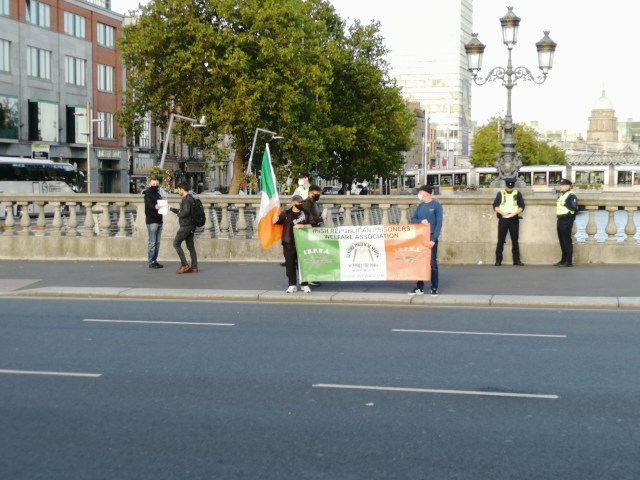
Patrula de Garda y policía política del Special Branch, los cuales habian anteriormente identificado a varios manifestantes, O’Connell Bridge (Photo: D.Breatnach) Concentración en la mitad el Puente O’Connell, Dublín, en solidaridad con los presos en Maghaberry (Photo: D.Breatnach)
Las redadas en los 26 condados, aunque derribaron violentamente las puertas de las casas y atemorizaron a las parejas y los niños, hasta la fecha no han dado lugar a cargos, pero las de los Seis Condados, facilitadas por un agente del MI5, resultaron en cargos graves y encarcelamiento de ocho. sin fianza en espera de juicio sin jurado en el Tribunal Diplock.
Todos los detenidos en los Seis Condados fueron encarcelados en la cárcel de Maghaberry, teniendo primero que pasar dos semanas en cuarentena en Foyle House. La instalación donde los presos fueron obligados a soportar este período ha sido descrita por los presos como “sucia y ruinosa” y con “cartones de leche pegados a la pared con heces” pero, habiéndolo soportado, fueron trasladados a la población general de presos políticos en Maghaberry.
Uno de los detenidos es el doctor Issam Hijjawi, que tiene problemas de salud por lo cual hace tiempo que buscaba hacerse una resonancia magnética. Finalmente se le concedió y fue trasladado bajo custodia al hospital donde se realizó el procedimiento. Sin embargo, a su regreso, fue nuevamente enviado a Foyle House para pasar otras dos semanas en esas condiciones insalubres, aunque fácilmente podría haber sido acomodado en la cárcel cerca de los otros presos para concluir otras dos semanas de cuarentena allí. Además, la naturaleza punitiva es clara cuando uno se entera de que los funcionarios de prisiones que acompañaron al doctor Issam Hijjawi no estaban obligados a ponerse en cuarentena y cuando la “focalización concertada de molestías que ha sufrido desde que entró en Maghaberry”, según los presos, se lleva a la cuenta.
HUELGAS DE HAMBRE
El doctor Issam Hijjawi se declaró en huelga de hambre en protesta y el 17 de septiembre 20 presos políticos en Roe House Maghaberry y 25 en E3 y E4 en las cárceles de Portloise se embarcaron en una huelga de hambre en solidaridad (tres presas políticas de Hydebank prisión también se incorporó la semana pasada). Se trata de prisioneros que están bajo el cuidado de la IRPWA (Asociación de Bienestar de Presxs Republicanxs de Irlanda), que tiene una estrecha relación con el partido Saoradh.
Saoradh y la IRPWA organizaron piquetes de protesta en varias partes de Irlanda, incluidas Dublín, Belfast, Derry, Tralee, Kilmainham Jail, que contaron con el apoyo de militantes del amplio movimiento republicano y antiimperialista.
Para el 26 de septiembre, el día 11 de la huelga de hambre, también organizaron una protesta frente a la cárcel de Maghaberry, con discursos, cánticos y fuegos artificiales. Más tarde ese mismo día, el PSNI (la policía colonial británica, antes RUC) detuvo a dos de los partidarios de Saoradh, incluido su presidente de la sucursal de Derry, por “comportamiento desenfrenado”, “comportamiento desordenado” y “posesión de fuegos artificiales ilegales”.
Cencentración de solidaridad con los presos Republicanos en la cárcel de Maghaberry, en los Seis Condados occupados. (Fuente: IRPWA)
Los participantes que iban al estacionamiento para apoyar a los detenidos fueron recibidos por policías coloniales con equipo antidisturbios que, según testigos republicanos, empujaron, golpearon, estrangularon y tiraron del cabello a los manifestantes.
Mientras que los dos republicanos de Derry fueron llevados por la policía colonial a la Unidad de Interrogatorios de Musgrave, más policías coloniales con equipo antidisturbios se trasladaron al campo de solidaridad frente a la cárcel de Maghaberry y detuvieron a dos partidarios del grupo juvenil republicano Éistigí, que también fueron llevados a la Unidad de Musgrave.
Policía colonial británica (PSNI) frente a la cárce de Maghaberry, enfrentando los solidarios con los presos republicanos en huelga de hambre (Fuente: IRPWA)
Dos días después, el lunes por la mañana, los cuatro comparecieron en el Tribunal de Lisburn a través de un enlace de video de la Unidad Musgrave, donde se les concedió la libertad bajo fianza en condiciones que violaban sus derechos civiles: no se les permite estar en compañía del otro ni en contacto; no deben estar a menos de 100 metros de una protesta o procesión notificada o no notificada; los cuatro hombres tienen que presentarse en un cuartel británico tres veces por semana.
La policía colonial quería aún más, que fueran etiquetados electrónicamente, en el toque de queda de 16.00 a 8.00 y no se les permitiera viajar en ningún “vehículo privado” — pero al final no se impusieron.
Luego, aunque les habían concedido la libertad bajo fianza, los cuatro fueron esposados y llevados a la cárcel, dos a Foyle House (anexo a la cárcel de Maghaberry) donde observaron lo sucias que estaban las celdas y posteriormente ambos fueron despojados a la fuerza y cacheados íntimamente por los guardias de la prisión. Los otros dos detenidos, ambos menores de 21 años, fueron trasladados a Hydebank.
Pancarta colgada frente puertas exteriores de la cárcel de Maghaberry, acusando a la policía colonial británica de ser contralado por servicios de inteligencia del Reino Unido y de ser respaldado por “Quislings” (es decir, traidores nacionales, se refiere a Vidkun Quisling, principal politico colaborador noruego con la ocupación Nazi).
Cuando finalmente fueron liberados, los cuatro detenidos tuvieron que viajar a casa en automóviles separados debido a las condiciones de fianza que se les impusieron, a pesar de que tres de ellos vivían en la misma ciudad. Un automóvil fue seguido por policía, detenido y expulsado a sus ocupantes y el automóvil registrado en Glenshane Pass. Otro fue detenido y registrado en la ciudad de Derry.
Los cuatro manifestantes ahora están recibiendo asesoramiento legal sobre su detención ilegal, cacheo desnudo y encarcelamiento por las fuerzas de la Corona británica.
El Dr. Hijjawi ha sido devuelto ahora a Roe House en Maghaberry y las protestas sobre ese tema han concluido. El carácter político vengativo del aislamiento en Foyle House se ha confirmado con la información de que once presos no republicanos, dos de ellos Lealistas, han estado de viaje fuera de la prisión sin que fueran puestos en cuarentena a su regreso en Foyle House.
PRISIONEROS POLÍTICOS EN IRLANDA HOY
En otro tema, las autoridades penitenciarias de los Veintiséis Condados (Estado de Irlanda), como consecuencia de la pandemia de Covid19, han reducido a la mitad el número de visitantes permitidos y han restringido los horarios de visita de los presos. El preso republicano Kevin Hannaway ha solicitado una revisión judicial de esta restricción alegando que viola sus derechos humanos. En su acción ante el Tribunal Superior, Hannaway afirma que según las reglas de la prisión, un preso tiene derecho a al menos una visita semanal de un familiar o amigo de no menos de 30 minutos de duración. Hannaway fue torturado en 1971 durante la introducción del internamiento sin juicio en los Seis Condados y es uno del grupo conocido como “los hombres encapuchados” porque les mantuvieron encapuchados durante sus días de tortura. Su caso fue dictaminado como tortura en el Tribunal Europeo de Derechos Humanos, pero luego fue modificado, en una apelación del Estado británico, a ser “trato inhumano y degradante”.
El Acuerdo del Viernes Santo de 1998 no vació las cárceles de los presos republicanos irlandeses, aunque los pertenecientes a los Provisionales fueron liberados con licencia y algunos otros aceptaron los términos y fueron liberados de manera similar. Sin embargo, se estaban realizando nuevos arrestos y encarcelamientos de republicanos que no apoyaban el Acuerdo (“disidentes”) y a algunos otros se les revocó la licencia y fueron devueltos a la cárcel sin cargos ni juicio.
Actualmente hay alrededor de 70 prisioneros republicanos irlandeses en cárceles de la autoridad colonial británica y del Estado irlandés. Aunque algunos están en espera de juicio (a veces hasta dos años), la mayoría está cumpliendo condenas, habiendo sido condenados en los Tribunales Especiales sin jurado utilizados para juicios políticos en ambas administraciones. Los problemas de los que se han quejado los presos republicanos incluyen el registro sin ropa, el acoso por parte de los funcionarios de prisiones, la ausencia o las restricciones en las instalaciones educativas y los largos períodos de aislamiento para algunas personas. Algunos presos también se enfrentan a la extradición del estado irlandés a los Seis Condados o al extranjero.
It’s thirty-eight years to the day that The Pogues, then known as Pogue Mahone first trod the boards at their debut gig at The Pindar of Wakefield in Kings Cross, London.
At their height, The Pogues were as vivid an embodiment of the Irish of London as you’re ever likely to see. Their songs bled London and bled Irish — they sang of drunken winter weekenders in Camden and summer days in the old country on the banks of the Shannon with the smell of freshly-cut hay in the air.
By Oliver Farry
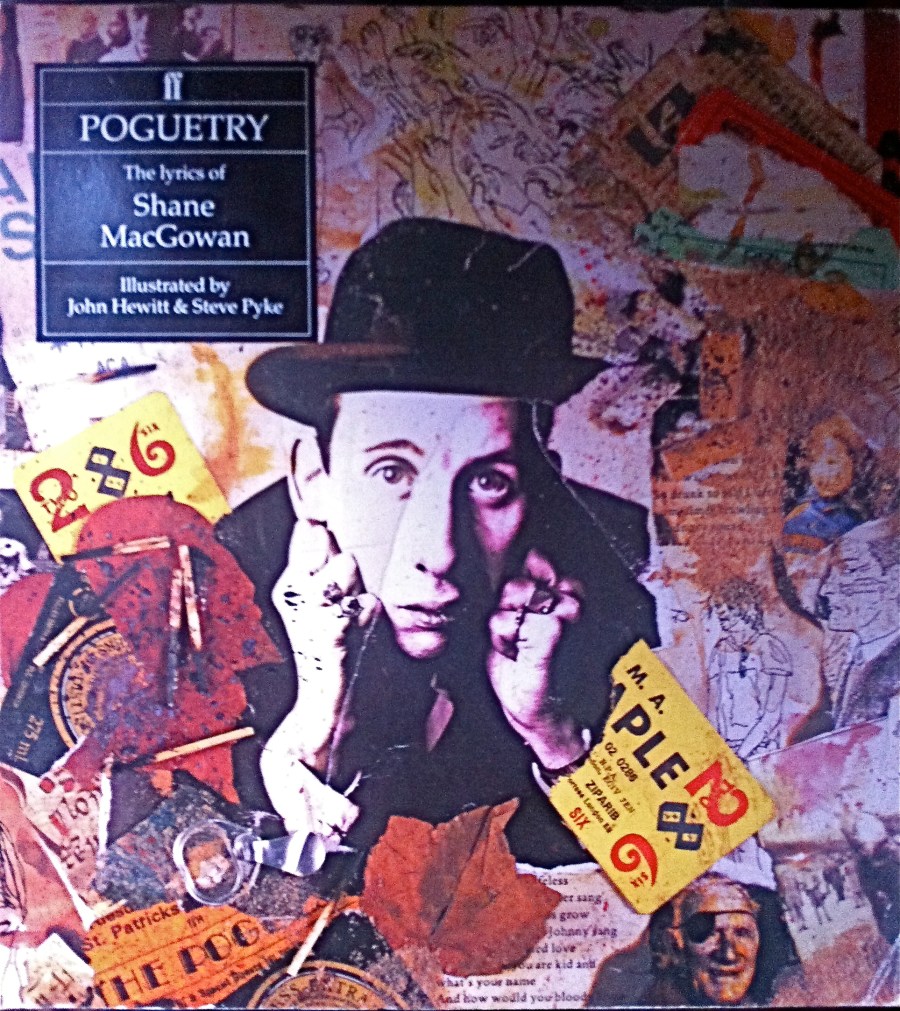
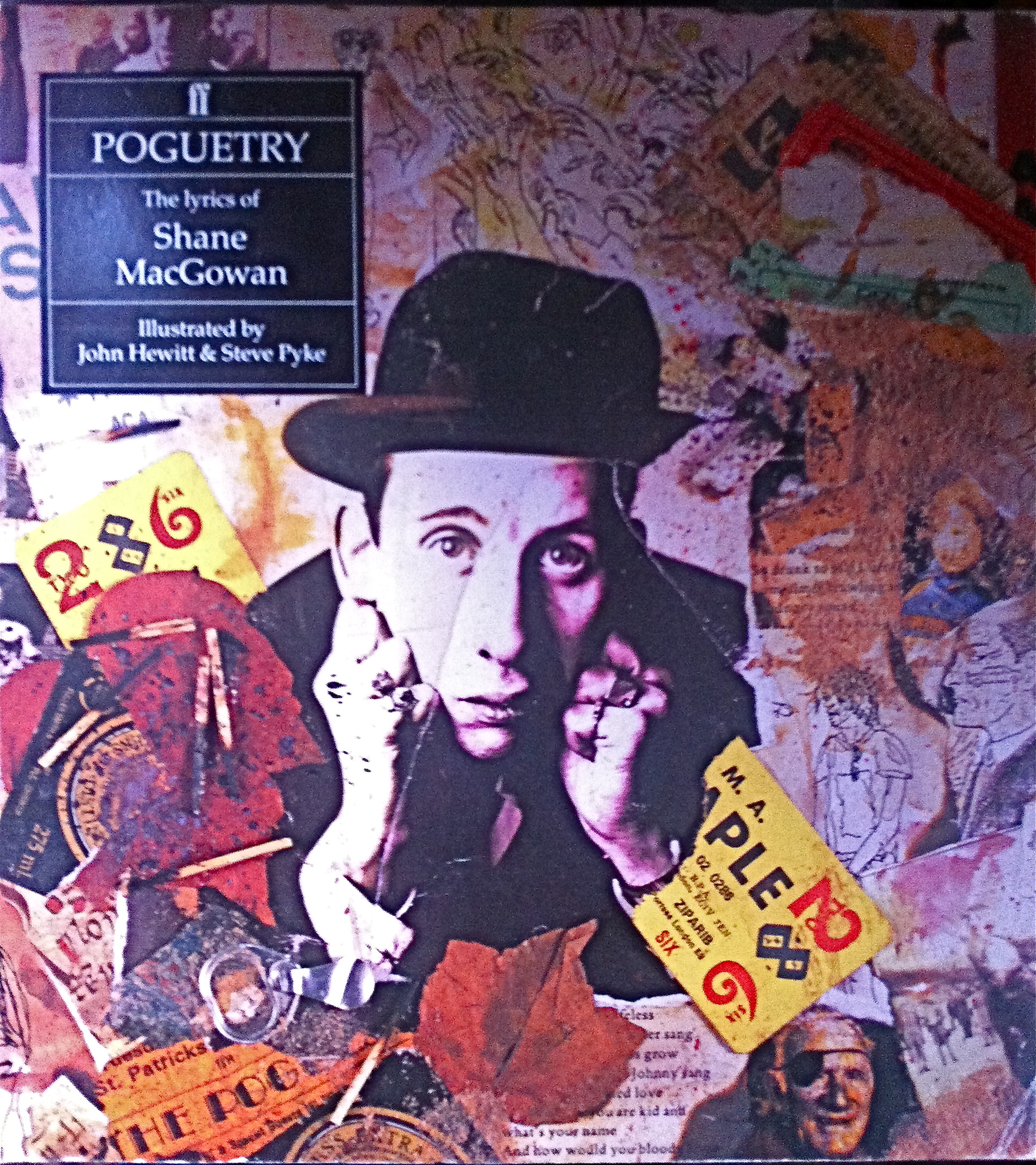
The band, of course, had their famously raucous side. By 1983, when they were formed, other ex-punks had cleaned up their act and their music and embarked on musical careers but Shane MacGowan and Co weren’t finished the business of the late 70’s and continued to get up the noses of most, including the BBC on countless…
When Ghandi was asked by a reporter on his visit to Britain what did he think of British civilisation, he is reputed to have replied: “I think it would be a wonderful idea.”
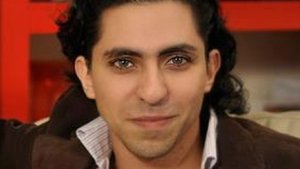
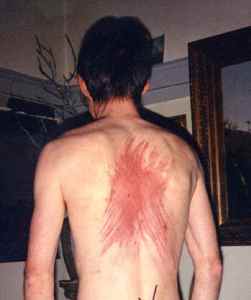
Raif Badawi was fined, sentenced to 1,000 lashes and 10 years in prison .
No doubt in conformity with Sharia Law
He received 50 lashes last Friday
A second round was postponed for medical reasons. His crime: Badawi established Liberal Saudi Network, a now-closed online forum that sought to encourage debate on religious and political matters in Saudi Arabia in 2008.
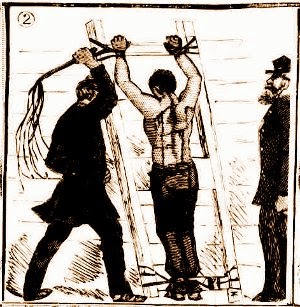
Flogging, Whipping, Scourging, Lashing, Caning –
different names for the oldest form of corporal punishment.
Flogging has been a common punishment since ancient times.
Jesus was scourged before he was crucified.
In England from the Middle Ages whipping was a common punishment for minor crimes.
It was used in British Army and Royal Navy until 1881 and in British prisons until the mid-20th century
Daily Mirror, London, 7 July 1954 Two men who took part in the Wandsworth Prison mutiny on May 26 got the “cat”…
Between the United Kingdom’s declaration of war on the German Reich in September 1939 and the latter’s capitulation in May 1945 some 61,000 civilians were killed in the UK by enemy action, principally in the so-called “Blitz” or aerial bombardments of June 1940 to May 1941. Despite the ludicrously low official figures published in recent […]
Village Magazine, which has gained a reputation over the last few years for shining a light on some of the darker corners of Ireland’s recent history, particularly the military and political consequences of the 1966-2005 Troubles, has taken another look at the now well-documented – if rarely discussed – relationship between the Official Republican movement […]
Are the wheels about to come off the new multiparty coalition government before it can even trundle out of the garage? Things are looking difficult for the spindly tricycle hammered together by Fine Gael, Fianna Fáil and the Greens. The much diminished Legion of the Rearguard in FF, championed by the likes of Éamon Ó […]


















 rebelbreeze