Opposition leader Elly Schlein accused the prime minister of “historical revisionism” over her ambiguous language.
08/03/2023 PUBLICO / EFE (Translated by D.Breatnach)
Italian Prime Minister Giorgia Meloni completely avoided using the word ‘neofascist’ in her message marking the 43rd anniversary of the Bologna Massacre, a terrorist attack by a far-Right organization that killed 85 people.
Meloni did not go to Bologna to participate in the commemoration.
“43 years have passed but, in the heart and conscience of the nation, the violence of that terrible explosion still resonates with all its force,” said the leader of the Executive and the ultra-right party Brothers of Italy.
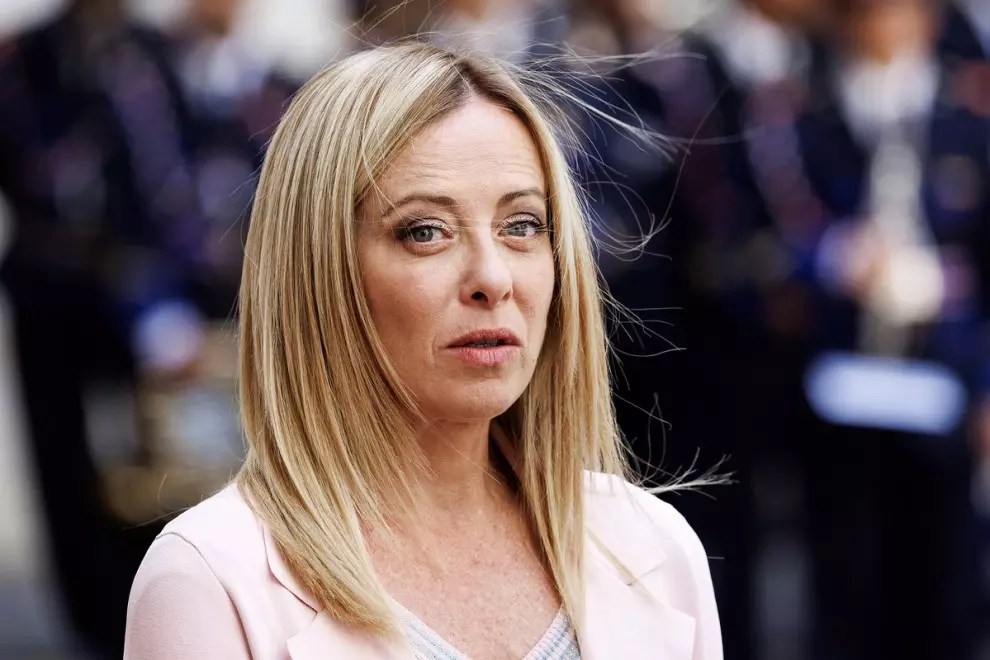
Giorgia Meloni, the Prime Minister of Italy. (Photo: Fabio Frustaci / EFE)
In her message, she asked to “get to the truth about the massacres that marked Italy in the postwar period,” an ambiguous phrase that makes no direct reference to the far-right groups that carried out the massacre on 2nd August 1980.
The absence of specific terms in Meloni’s speech to refer to the attack has prompted opposition leader Elly Schlein, a progressive, to accuse Meloni of promoting “historical revisionism.”
“We are here in Bologna together with the families of the victims of the massacre to reiterate that we do not accept any further attempts to rewrite history. The judicial evidence already makes it clear that it was a neo-fascist massacre and also with subversive intent,” Schlein said.
In the message shared by the president, Sergio Mattarella, to commemorate the date, he did refer to “the neo-fascist matrix of the massacre.” Likewise, he recalled that in the subsequent trials “ignoble deviations, in which secret associations and treasonous agents of the state apparatus participated,” came to light.
Meloni has ruled out any anti-democratic nuance of her formation, but she maintains as a symbol of the Brothers of Italy the so-called “tricolor flame”, emblem of the youth organisation of the old and post-fascist Italian Social Movement (MSI) in which she was a member of her youth.
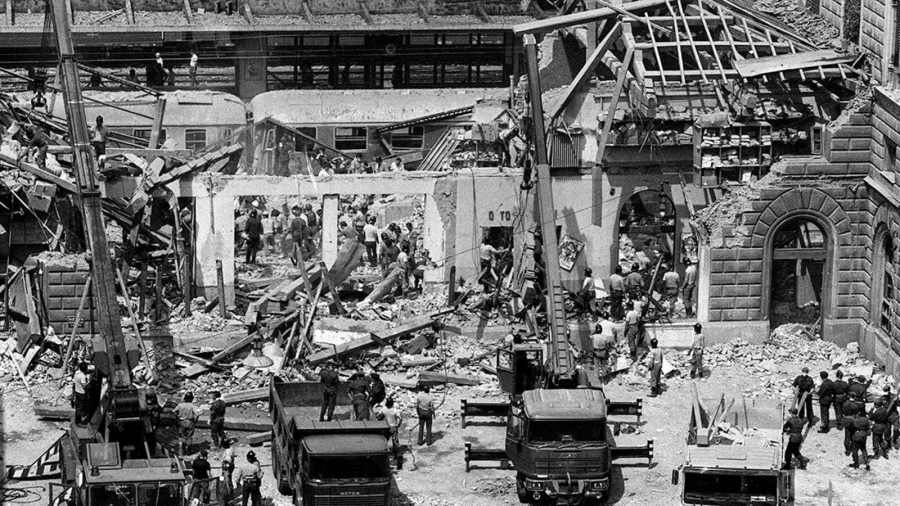
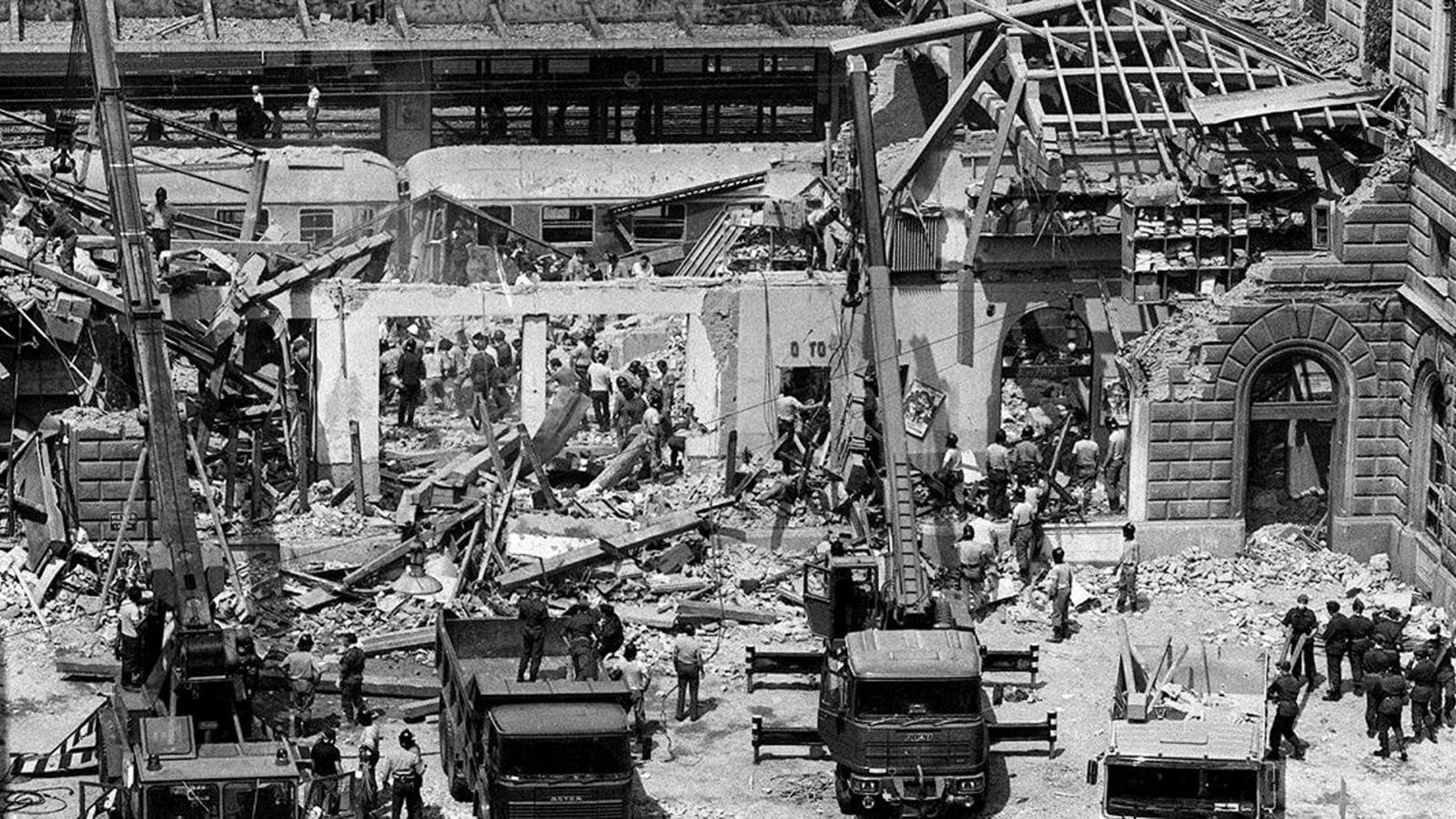
The Bologna Train Station, Italy, following the fascist explosion on 2nd August 1980 (Photo sourced: Internet)
The Bologna Massacre
The Bologna massacre was the most serious terrorist attack in Italy after World War II, in which 85 people died and more than 200 were injured and extreme right-wing militants belonging to the organization Armed Revolucionary Nuclei were convicted for it.
Comment by D.Breatnach: However, parts of the Italian State were implicated in the bombing and/or coverup too, with elements in the Italian police, judiciary and secret service but also with suspicions of CIA/NATO involvement. It seemed that the purpose of that bombing and others in the period was to create fear and confusion in which the State could return to fascism.
Original Breaking News article: DAVID YOUNG, PA (with commentary in italics by Diarmuid Breatnach)
The rededication of a memorial to the National Army soldiers killed in the Civil War enables their memory to be rehabilitated, a ceremony in Dublin has heard.
Defence Forces Chief of Staff Lieutenant General Sean Clancy paid tribute to the some 810 soldiers killed serving on the Free State side in the 1922-2023 conflict as he addressed the event at Glasnevin Cemetery on Sunday.
Descendants of some of those who died, representative of all four provinces, were invited guests at the ceremony, among them relatives of Michael Collins, the commander in chief of the National Army who under direction by Churchill, gave the orders that began the Irish Civil War and who was killed in 1922.
Taoiseach Leo Varadkar and Tánaiste Micheál Martin, the leaders of Fine Gael and Fianna Fáil, the two main parties forged from the divisions of the Civil War, also attended the rededication of the National Army Monument.
Sinn Féin TD Matt Carthy also attended the military commemoration, as did Dublin Lord Mayor Daithí de Róiste.
This neatly brought together political parties of the neo-colonial and neo-liberal Irish State with opposing histories: Varadkar to represent the pro-British and fascist neo-colonial origins of Fine Gael; Mícheál Martin and De Róiste representing Fianna Fáil, the allegedly Republican but in reality Irish Gombeen split from the previous iteration of Sinn Féin; Carthy for the current neo-colonial, neo-liberal and colonial servant Sinn Féin.
Taoiseach Varadkar (Fine Gael) and Tánaiste Martin (Fianna Fáil) unveiling monument to soldiers of the ‘Free State’ killed in the Civil War 1922-1923. (Photo cred: Brian Lawless/ PA)Matt Carthy TD, who represented his party Sinn Féin at the unveiling and dedication of the monument to soldiers of the Free State killed in the Civil War 1922-1923. (Photo sourced: Internet)
Prior to the ceremony, there was no monument in the country specifically dedicated to the soldiers of the National Army who fought against the anti-Treaty side in the Civil War.
Weeks after the war ended, on August 3rd, 1923, the Oireachtas passed legislation that led to the creation of the modern-day Defence Forces, Óglaigh na hÉireann. That is, the defence forces of the neo-colonial ruling class who created the Irish state.
The rededication event for the forgotten fallen of the National Army, which had already robbed the Irish language version name of the IRA, adopted the name Óglaigh na hÉireann during the Civil War, took place on the Sunday prior to the centenary of that date.
“It is appropriate then, in the spirit of real inclusiveness, of ethical remembering, and with a full desire to deal with some of the more uncomfortable aspects of our shared history, that we remember some of 810 uniformed members of Óglaigh na hÉireann who gave their lives in the service of the State during the tragic and critical period at the foundation of our democracy,” Lt Gen Clancy told the ceremony.
It is necessary, in order to bury any idea of achieving the Republic declared at the start of the 1916 Rising, that we honour some of the 810 men we recruited to bury that Republic in 1922, kitted out in uniforms, armed and transported by our ancient enemy. We wish to pass over quickly over not only the kidnappings, torture, murders, killing of disarmed prisoners and even sexual assaults by this fine body of men – the precursors to the current army of the Irish State – but also their terrorising of major part of the country with raids on homes and internment of men and women. Although this fine body of men were fighting to establish a neo-colony not even covering the whole of Ireland, we make no apology for calling them what they clearly were not, Óglaigh na hÉireann, i.e “Warriors of Ireland”.
The monument in Glasnevin to soldiers of the Free State killed during the Civil War – apart from the Free State Army having appropriated the name in Irish of the IRA, the legend claims they “died for their country”, a clearly inaccurate statement since at best they were fighting for the government and state of the 26 Counties, which excludes the UK colony of the Six Counties (‘Northern Ireland’ sic). (Photo cred: PA)
“For far too long there has been no memorial of any kind, nor any complete listing of the National Army war dead.” Understandably.
“Indeed, this year represents perhaps the last real opportunity to rectify that.”
As we prepare to commit this armed force to NATO at some point in the future and to PESCO in the nearer future, it is important to take a further step in legitimising this armed force of the neo-colonial state.
The remains of some 180 of the 810 soldiers who died serving in the National Army are buried at the plot in Glasnevin Cemetery. Uncomfortably close to graves of many of their victims.
“Sources at the archives show that the average soldier buried here was in his early 20s, was unmarried and from a working-class background,” said Lt Gen Clancy. In other words, the typical recruitment profile of lower-rank soldiers in capitalist and imperialist armies.
“Many had previously served in the IRA during the War of Independence, some even in the 1916 rising, many others had served in the British Army, underlying yet again how complex is the weave of Irish history.”
Actually, “many” is a questionable though vague estimate of the numbers who had “served in the IRA during the War of Independence”, though some had, including some of the most vicious, such as Major-General Paddy Daly, torturer and murderer.
The chief of staff highlighted the “poignant example” of two young Belfast-born Dublin-raised brothers – Frederick (18) and Gerald McKenna (16) – who were buried in Glasnevin after being killed together in action in Cork in August 1922 only a month after joining the National Army.
Aye, two men born in Belfast, a city which the Free State was fighting to ensure remained a direct colony of the United Kingdom.
“Whatever the often very legitimate reasons our forebears may have had for forgetting in the intervening 100 years, I think it’s appropriate now that I as the 32nd Chief of Staff of Oglaigh na h Eireann should finally take this opportunity to rehabilitate their memory,” said Lt Gen Clancy.
Especially as I try to establish a legitimate background to the armed force of an illegitimate State preparing to enter foreign imperialist wars and suppression of legitimate uprisings.
After all, we have great experience in all that, as the history behind this monument shows.
26 July 2023 (First published in Socialist Democracy, reprinted by kind permission of author)
Sinéad O’Connor has died. Her death at the age of 56 was announced on RTÉ.
The evening news programmes went into overdrive to pay tribute to an incredibly talented musician. As with all such tributes, the great and good were asked for their opinions or they offered them in any case and they were carried uncritically.
Sinéad O’Conner and daughter Roisín on anti-racist demonstration, Dublin, 2000. (Photo sourced: Internet)
You are not supposed to speak ill of the dead in Ireland, but more than that, you shouldn’t speak ill of those who seek to praise the dead, no matter how hypocritical they are.
There were many milestones in her musical career, not least her rendition of Nothing Compares 2 U. The media highlighted her musical talent, her voice, sometimes describing her as controversial and outspoken and much loved by the public.
Yes, she was loved by the public, to a point, and also by other musicians around the world. However, she was also despised by many, written off and derided by commentators. As with many artists when they die, there is a tendency to rewrite history.
Her politics were sometimes erratic and lurched from one thing to another, though she was always honest and forthright when she did so, unlike many a coward. As erratic as some of her opinions could be, there were no smug self-serving platitudes to fall from her lips. She was no Bono.
She was honest, frequently angry and went after the powerful at times.
The famous incident where she tore up a photo of then Polish Pope, Wojtla in protest at his covering up and enabling of child sexual abuse, a topic she was painfully personally aware of in her own personal life did not go down well with some of those now praising and lamenting her passing.
Bono doesn’t do tearing up photos of popes, he sups with George Bush, the late senator McCain, toured Africa with the head of the World Bank, to name just a few of the scumbags he was not only too happy to rub shoulders with but positively revelled in.
Fianna Fáil and Fine Gael leaders have expressed their sorrow at her death.
They weren’t expressing any support when she denounced child sexual abuse, the entire Irish political establishment were busy helping the Catholic Church cover it up, and later facilitated the institution to evade its legal, financial and moral responsibility.
Their attitude is best summarised in a typical hypocritical Irish attitude when dealing with those who make us uncomfortable that goes through phases of saying, “She’s mad, isn’t she great gas altogether, she may have a point but…, fair play to her, didn’t she speak up at the time”.
All of this without ever examining their own role in it all. The fact that, as we speak, reports of the sexual trafficking of children in care are being ignored by the government, says all you really need to know about their attitude.
If a new musician of her talent and courage were to speak out now, she would be cancelled and silenced by many of those now praising her, including some of those on the left, who have grown quite fond of not breaking ranks and clamping down on those who did.
She always spoke about mental health issues, though she became much more public about her own issues as she got older. She even broke down on a video about it, locked away in a hotel, crying. The video led to many expressing their concern, but also a bit of “there goes that one again”.
We will no doubt get many commentaries on air and in print about her struggles with her mental health, many expressing concern and sympathy with her plight. Many of them will be hypocritical.
It is true that Irish society is more open now about people who have mental health problems, though there is still a stigma attached to it.
Sinéad O’Connor (Photo sourced: Internet)
Ironically RTE followed up the news of her death with another story on the shambolic, criminal (my word, not the words of the media cowards) state of the child mental health services in Ireland (CAMHS).
Micheál Martin and Leo Varadkar may even refer to her troubles in their tributes, but they never cared about them then, they don’t care now and the proof is not only the state of CAMHS, but mental health facilities in general, with long waiting lists, a rush to medication and forgetting about the patient model of care.
Her politics were erratic in many ways, though in fairness they weren’t much more erratic than others who are not judged as quickly. She flirted with republicanism, then broke with them, even applied to join the more recent incarnation of Sinn Féin in 2014, before withdrawing it.
It may be hard to take that seriously, but it was no less ridiculous than Bono condemning the IRA and then spluttering out nonsense about how he admired Bobby Sands. He didn’t, never, ever, when it mattered.
Sineád for all her failings took positions that were unpopular unlike some of the vomit inducing smug types that populate the modern music industry.
For my own part, her politics on racism were without fault. Her song Black Boys on Mopeds is excellent. It points out the hypocrisy of Thatcher criticising China whilst British Police like James Bond had a licence to kill.
“Margaret Thatcher on TV Shocked by the deaths that took place in Beijing It seems strange that she should be offended The same orders are given by her”
The song goes on to say something truer today than before.
“These are dangerous days To say what you feel is to dig your own grave”
And then a description of England, that the great and good would run a mile from.
“England’s not the mythical land of Madame George and roses It’s the home of police who kill black boys on mopeds.”
Now she will be lionised in death, praised, described as troubled, talented, controversial and much loved. We should ignore the sanitised version we will be given and remember the Sineád O Connor who was treated with contempt and disdain at times.
Aside from her incredible musical talent, that is the version that is worth remembering and celebrating, the version they weren’t too happy to celebrate when she was alive.
In Ireland we like to celebrate talented uncomfortable artists and writers in death in a manner we don’t do when alive. She deserves some coherence from us on this.
In all areas of endeavour and no less in revolutionary work it is essential to review our actions (and those of others) periodically in order that we may draw lessons to improve the success of future activity.
Irish history provides an abundance of material to revise.
The most recent period worthy of intensive review in my opinion is the three-decade war, mostly in the Six Counties but also having repercussions within the territory of the Irish State, in Britain and even further abroad.
An article in the July issue of An Phoblacht Abú1, monthly hard-copy newspaper of the Anti-Imperialist Action organisation, discusses the psychological and organisational problems arising from the way that three-decade struggle came to an end and its effects on the resistance movement.
That period in Ireland commenced with a struggle for democratic civil rights, not one of the demands of which were for more than was already well established in the rest of the ‘UK’. But it soon changed into a guerrilla war with huge numbers of political prisoners and jail struggles.
The movement experienced a number of splits and changes of leadership but for most of of the time it was led by the Provisional organisation’s leadership although changes took place inside its own leadership too.
Ruairí Ó Brádaigh, President Provisional Sinn Féin 1970-1983, speaking at GPO rally 1976. He led an unwinnable war. (Photo cred: Pat Langan/ Irish Times)
Some of the Provisional IRA leadership following the 1970s split: Martin McGuinness, Dáithí Ó Conaill, Sean Mac Stiofáin, IRA press conference 1972, Derry. (Photo cred: LarryDoherty)
The period ended with that leadership not only abandoning armed struggle but being coopted with its structures into joint management of the colonial occupation and preparing for joint management of the neo-colonial Irish state, a number of smaller splits in the movement a much disillusion.
The An Phoblacht Abú article concentrates on building or rebuilding trust in leadership through measures such as clear communication, discussion, organisational restructuring, collective solidarity, open discussion, transparent communication and education.
The article does not say this but in my opinion one of the basic educational needs is to acknowledge that in the circumstances, what happened was inevitable (and to consider how different circumstances might be constructed in future).
UNWINNABLE
It is essential in my view to acknowledge that the struggle, as it was waged, was bound to lose. Yes, unwinnable: an unassisted armed struggle against a world imperialist power fought primarily in one-fifth of our territory where the population is deeply divided – how could we think otherwise?
Clearly, the Provisional leadership did think otherwise. Assuming they were not insane or very stupid, on what could their belief have been based?
I can see only two rational possibilities:
1) They believed the British had no essential need to retain the 6-Co. Colony and would abandon it if put under enough pressure, or
2) that the Irish ruling class, through its government, would step in and join the struggle.
If they believed the first, their analysis was not historically-based. Since its invasion and occupation of Ireland in the mid-12th Century, the British ruling class has repeatedly gone to enormous efforts to suppress Irish self-determination.
When they had the opportunity to leave in 1921 they had cultivated a client bourgeoisie, then instigated a civil war and partitioned the land, leaving themselves a firm foothold in the country.
Their initial response to a call for simple civil rights in the late 1960s was violent suppression on the streets, abolition of habeas corpus and introduction of internment without trial – and army massacres.
If the previous lessons of history were not clear to the movement’s leadership, then those events up to 1972 should have made them crystal clear.
If the Republican leadership believed the Irish ruling class would step up, they failed to draw the lessons of history since at least 1921 and to understand the neo-colonial nature of the Gombeen class, amply illustrated in the preceding 50 years of the Irish State.
As embarked upon and fought, the war could not be won but a strugglewas potentially winnable.
However, to have a chance of winning, the struggle would have to be over the whole 32 Counties. And to engage the maximum number of people, it would have to take up the social, cultural, economic and political deficits across the Irish state and across the colony.
The social rights of women and LBG2 people were widely-acknowledged deficit areas, yet the Republican movement did not seriously address them. Of course, doing so would have put the Movement in direct opposition to the Catholic Church hierarchy and its followers.
Why should that be a problem? Hadn’t the Hierarchy been pro-British occupation since the late 1800s3 and anti-Republican since the 1790s? Wasn’t it one of the cornerstones of the neo-colonial Irish State, its social prop and social control mechanism?
Yes but the problem was that some of the leadership themselves were in that ideological ambit and were in any case afraid to disaffect many of their followers. A natural fear, of course. Yet only in that way could the struggle go forward across the Irish state’s territory.
It was left to campaigners mostly outside the Republican Movement, including social democrats and liberals, to fight for the rights to contraception, divorce, equality for women, LGB rights. And later, to take on the huge institutional abuses of the Catholic Church in Ireland.
Those issues affected directly well over half the population of the Irish state and the the leadership lacked the interest or the courage4 to take part in their struggles, never mind lead them, which it left to mostly non-revolutionary leaderships.
There were many other issues that affected people in the 32 Counties which a revolutionary leadership could take up and, I would argue, should have taken up.
The latter includes emigration, rights of the Irish diaspora (particularly in Britain), foreign penetration of the Irish economy, foreign land ownership, housing shortage, industrial struggles, academic freedom, Irish language rights, Church control of education and the health service …
Some of those issues were taken up for a while by the movement in parts of the 26 Cos. prior to the split in the Republican Movement but were progressively dropped as the armed struggle in the 6 Cos. took off.
When years later the Provisional leadership got interested in social democratic reformism, they found they could hardly make any headway in the unions against the Labour Party and the remains of the Workers’ Party – because of the Provos’ earlier overwhelming neglect of that area of struggle.
SUMMARY
The struggle in the Six Counties could not be won precisely because it was primarily confined to that area and also one in which a powerful enemy had seduced a huge section of the population.
When the leadership acknowledged the unwinnability of the struggle as being waged, instead of changing their methods and aims of struggle to take in the whole 32 Cos, they decided on capitulation and getting the most possible out of it for themselves.
A change in the top leadership of Sinn Féin and the IRA: Gerry Adams and Martin McGuinness photographed in 1987. They recognised they could not win and set about managing abandoning it while getting something out of the system for the leadership. (Photo: PA)
The leadership of the Republican movement was unwilling to widen the struggle because they believed that it was unnecessary to do so and/ or they were unwilling to overcome their own ideological indoctrination and/or lacked the courage to confront prejudices among their following.
Some of the social struggles have now been won or hugely progressed but without the leadership of the Republican Movement, in fact by leaderships of mostly reformist trends.
Due to leaving the industrial struggle to social democrats, the trade union movement has degenerated hugely and is in a poor state to take on any substantial economic or rights struggle, to say nothing of a revolutionary one.
The surviving Republican movement seems unwilling to acknowledge those historical facts and its failure thus far in leadership. Admission of the facts is necessary in order to commence to repair the movement and to prepare for a struggle with a prospect of success.
End.
FOOTNOTES
1Page 9, entitled COMRADESHIP – GUARD AGAINST BETRAYAL; I intend to review the July issue of the newspaper separately some time soon.
2I have omitted the T from LGB because it is only comparatively recently that the transexual issue has gained wide acknowledgement, whereas the Gay, Lesbian and even Bi-Sexual issue were widely known about at the time under discussion.
3The Irish (settler) Parliament passed an act giving middle-class and higher Catholics the right to vote in 1793.
‘Wha’ – the Junior Minister for Education and his travel distance claims?’
‘Yeah. I mean, according to The Ditch he would’a hav’ta driven more than twice as much as the average taxi driver in Ireland, which averages at 30,352 kilometres a year. Collins claimed 73,807 kilometres.’
‘With a head for figures like that, he should be Minister for Finance!’
‘Heh, heh. But maybe he was moonlighting as a taxi super-driver on top of his parliamentary travelling.’
‘Could be. Those poor TDs only get €107,376 a year to live on.’
‘Apart from expenses. Like tax-deductible driving expenses.’
‘Exactly!’
‘Well, it does certainly look like he’s been taking the country for a ride.’
‘Ha, ha, ha. And ye can’t fault his drive!’
‘I think they’ll soon be calling him ‘Miles’ Collins.’
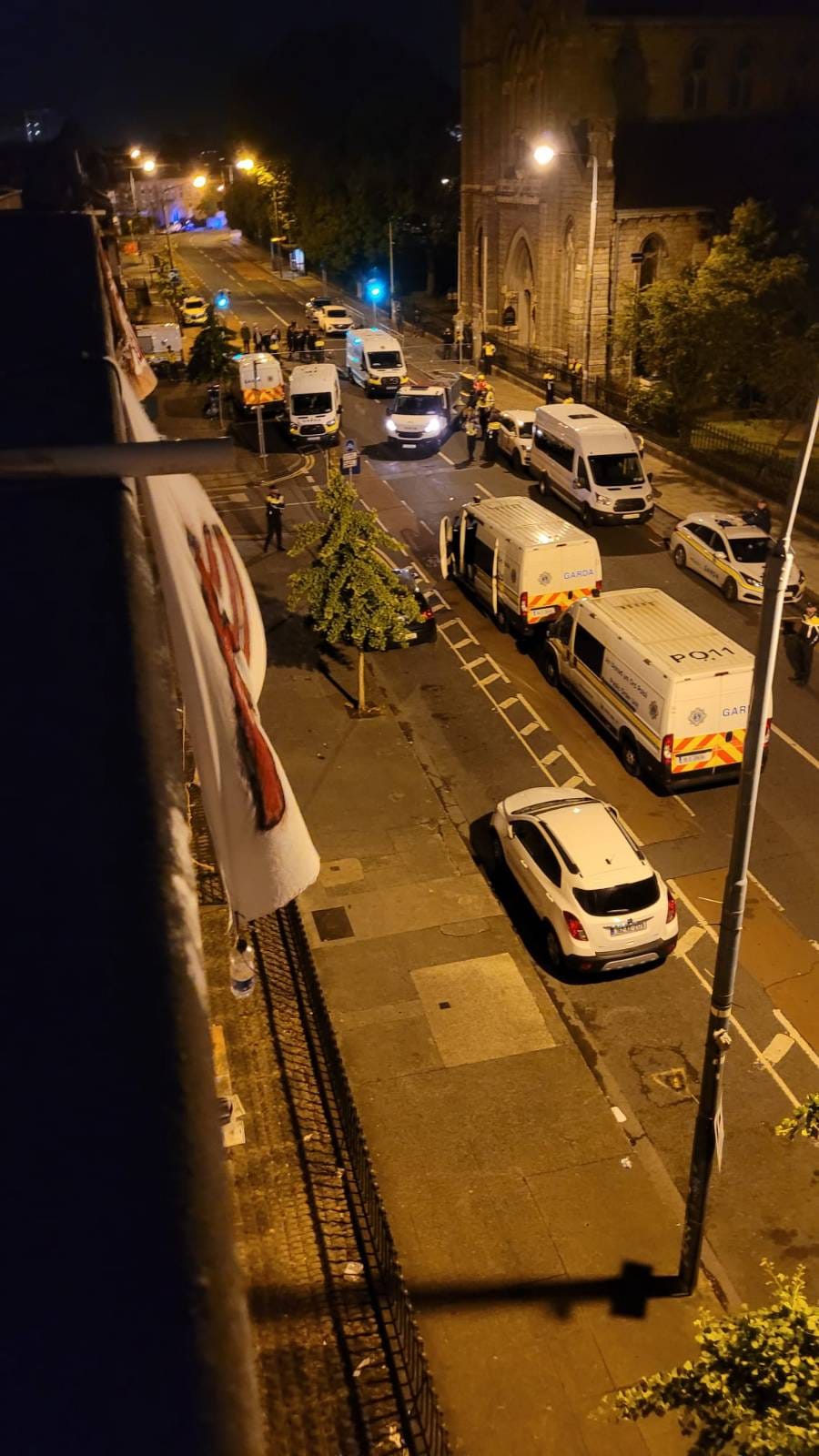
Late Tuesday night and early hours of Wednesday morning an operation with large numbers of Gardaí and their helicopter circling overhead disturbed residents in the north Dublin city centre area of Berkeley Road and surroundings.
It looked like drug bust, hostage rescue situation or siege, but it was none of those things, instead being an eviction of four housing activists.1
Supporters of the occupation by the RHL gathered at short notice by Berkeley Road during the Garda operation but were roughly pushed far back by Gardaí from the building under attack (Photo: RHL)
The building had been “acquisitioned” by the Revolutionary Housing League which for a couple of years has been occupying buildings lying empty around Dublin in order to house homeless people and to inspire people to take over empty buildings to end the homeless crisis.
One of those buildings was the red-brick building on Eden Quay and corner of Marlborough Street; it had been operated by the Salvation Army as a night shelter for homeless young people but left empty for years after losing funding.
Supporters in front of James Connolly House occupation over a year ago. (Photo: Rebel Breeze)
On 1st May 2022, RHL2 activists ‘acquisitioned’ the building, renamed it James Connolly House and repaired a leak in the roof. In the early morning of 9th June 2022, an estimated 100 Gardaí (some reportedly armed) stormed the building with a Garda helicopter circling overhead.
Two RHL activists performing overnight security on the building were arrested and brought to court, where they declined to be bound over or to give an undertaking that they would not return to the building.
The Salvation Army said that they were renovating the building in order to house Ukrainian refugees. Not only was there no evidence of that in the building when it was occupied but it is empty still, over a year after that eviction3.
Garda evictions have taken place around other acquisitions of empty properties and RHL activists have on each occasion refused to commit to an undertaking not to occupy other properties.
Rather, the RHL has called for empty buildings to be occupied around the country.
The eviction this week
The massive Garda operation this week, including road-blocks, to evict RHL occupants of the Berkeley Road house. (Photo: RHL)
After the eviction in Berkeley Road, four RHL activists were taken to Court where they followed the previous pattern of refusing to be bound over or to promise not to occupy other buildings. Nevertheless they were released with a threat of jail-time if they re-occupied.
The lessee of the building, advertising as Cabhrú and formerly Catholic Housing Aid Society (Chas), has faced allegations of improper use of that building and another, Fr. Scully House on nearby Gardiner Street, some of which were borne out in an investigation by Charities Regulator.4
Supporters of the RHL occupiers outside the High Court (Photo: RHL)
The housing crisis
The numbers of homeless people in the the Irish state passed 12,000 for the first time in May this year and over 4,000 of those are children,5 nor do those figures include people defaulting on their mortgage loans, sleeping on the street or ‘sofa-surfing’ with friends and relations.
According to figures published in April this year, there are over 100,000 empty homes within the Irish state, not counting holiday homes (the Berkeley Road one was empty for three years).
Housing the homeless on the face of it can be accomplished without the revolutionary overthrow of the State and its Gombeen6 ruling class. All that is necessary is a public housing program financed by the State, which it could easily accomplish.
However, the stubborn clinging of the Gombeens to keeping a wide high-return market for property speculators, bank funders and big landlords, year after year as the housing crisis worsens, seems to indicate that a revolutionary remedy is necessary.
This week the Taoiseach,7 Varadkar, inferred that a contributory cause of the housing crisis was that homeless people had turned down alternative accommodation, a nonsensical claim since one person’s declined accommodation could just be offered to the next.
Addressing him in the Leinster House parliament, Sinn Féin TD8 Pearse Doherty9 took him to task for inferring that the homeless were to blame for their situation, in response to which Varadkar denied accusing the homeless and ungraciously amended his statement to “some homeless people”.
He went on to say that homelessness has a number of causes but neglected to name the principal one, viz. that the State does not supply funds to municipal authorities to provide public housing, leaving property speculators, banks and big landlords free to exploit the housing ‘scarcity’.
According to media reports, Doherty neglected to take this opportunity to point out the real cause of the problem and the solution, which confirms the doubts of those who say that his party is “Fianna Fáil Mark II”,10 with no intention to fundamentally alter the economic system in the state.11
Revolutionary Housing League flag on top of the occupied building during the massive Garda operation (Photo: RHL)
In conclusion
The housing crisis shows no sign of being resolved and the ruling class have ridden high-profile ‘shaming’ token occupations such as that of Apollo House in January 2017 without changing anything. RHL occupations do seem to show a way forward if they are widely emulated.
Heavy Garda operations on the one hand and comparatively light treatment by the courts on the other seems to indicate a determination not to tolerate this kind of direct action on homelessness while at the same time moderated by a fear of creating housing action martyrs.
Meanwhile the numbers of homeless grows by the month without any other credible solution in sight.
End.
FOOTNOTES
1This is the police force that has been described by its chief, Commissioner Drew Harris (formerly Asst. Commissioner of the colonial gendarmerie PSNI and therefore also MI5), as his “gang” but which seems unable to prevent serious assaults in the city centre, even in its main street.
2Originally Revolutionary Housing Union, later became RHL.
4Some of those included a friend of the charity’s Chief Exeutive being accommodated in the building allegedly providing only for the elderly, rooms being let to short-stay students without proper guarantees or rights and one of the houses being used as a business address.
8Teachta Dála, member of the Irish Parliament, equivalent to “MP”.
9Deputy leader of the party in the Irish parliament. Holly Cairns, leader of the Social Democrats also attacked Varadkar on the statement.
10Fianna Fáil is one of the two main government parties; originally a split from Sinn Féin led by De Valera, it has been in government more than any other party in the Irish state.
11A number of SF party leaders including its current president have publicly stated that big business has nothing to fear from their party.
(This article is reprinted from Socialist Democracy by kind permission of the author Gearóid Ó Loingsigh)
(Reading time: 3 mins.)
The USA has announced that it will supply cluster bombs to Ukraine as part of its support for the war against Russia.
On one level the move is not surprising, on another it reveals some fundamental truths about the course of the war and US intentions.
They are banned by international treaty, one which has not been signed by Russia or Ukraine, and of course, neither has it been signed by the US. The US has always dragged its feet on the question of the banning of certain types of weapons.
Cluster bombs, are simply put bombs that break up into smaller components leaving small explosive devices scattered over a large area of land. They are a
…conventional munition that is designed to disperse or release explosive submunitions each weighing less than 20 kilograms, and includes those explosive submunitions…
These weapons are designed for use against massed formations of troops and armour or broad targets, such as airfields. Cluster submunitions, however, sometimes fail to explode on impact and can kill or maim civilians who later come into contact with them. These unexploded submunitions may remain dangerous for decades.(1)
Cluster bomb capsule (Photo sourced
They have all the potential to leave Ukraine like the US left Cambodia and Laos in the 1970s.
According to Cluster Munition Monitor 23,082 casualties were confirmed by the year 2021, with around 18,426 resulting from unexploded munitions.
Biden has a long and chequered history on the use of the weapons.
His ambassador to the UN had condemned their use by Russia, stating they had no legitimate place on the battlefield, though two days later the State Department censored the official transcript of her intervention to remove the phrase.
Biden had criticised the use of and access to such weapons in the past. (2)
Whilst it is all very interesting and even of humanitarian concern that the US would wish to turn Ukraine in another Laos and Cambodia, though unlike Kissinger they will be telling no lies about their bombs, it is of greater interest what it says about the war.
Biden’s official reason is that Ukraine is running out of munitions and they need the cluster bombs. We have been told from the word go that this war is winnable, i.e. that Ukraine can win it.
This of course ignores that Ukraine is not the only warring party fighting Russia; NATO is part of the war, although it is not putting many boots on the ground, though it clearly has had a hand in some operations.
Every week we hear announcements that the counter offensive will smash Russia, almost there, one more push, the Russians have run out of weapons, their army is demoralised and deserting etc. Now it turns out that Ukraine needs these weapons or else.
These weapons are very useful in halting advances by your enemy, they are not as necessary in situations where your enemy is routed, unless you think it may regroup and retake the initiative.
Ireland has wholeheartedly supported the war in Ukraine, confirming to those who wish to see that it is not a neutral country. It has had little to say on the issue of these banned weapons.
They will make parts of Ukraine uninhabitable and make agriculture a dangerous profession as sowing and reaping become potentially life-threatening activities. If Biden will go to these lengths, what else will he do?
Children view unexploded cluster bomb sub-munition near their village, Laos, 2019 (Photo cred: Sarah Bronstein)
Despite the media talking about Putin’s willingness to use nuclear weapons, it really has to be asked whether the US is willing to go that far as well.
What then of the former leftists running round chanting victory for NATO, or as they would put it for Ukraine? None of them have said much either on Biden’s choice of weaponry. Is there no length to which the US will go that marks a turning point for them? The answer is no.
Should Biden propose facilitating large scale rocket attacks on Moscow they are as likely to cheer them on as to remain silent. What they will not do, ever, is oppose the escalation of the war. Modern day Kautskys.
A broad group of socialist Republicans gathered at the grave of Theobald Wolfe Tone on Sunday 2nd July to honour his memory and to reiterate their commitment to an independent and socialist Ireland outside of imperialist military alliances.
Wolfe Tone’s grave in the Bodenstown Church graveyard has been a place of pilgrimage for Irish Republicans at least since the days of Thomas Davis1 of the Young Irelanders of the 1840s, who wrote of his own visit to the grave and composed the song “In Bodenstown’s Churchyard”.
The late 1960s saw huge numbers of people in attendance at annual commemorations there near the village of Sallins, Co. Kildare, including not only Sinn Féin2, who led them, but many political and social organisations, GAA clubs, along with many non-aligned people.
Over the years, the voluntary and unfunded National Graves Association has improved the site comprehensively and sensitively, leaving the ruins of the Protestant church as they are but building a stage attached to one side, fronted with plaques and commemorative flag stones.
Commemorations currently are usually organised around a Sunday near the date of the patriot leader’s birthday on 20th June but have to be managed between different groups wishing to hold their own commemorations.
Speeches, songs and Garda harassment
The Annual Wolfe Tone commemoration organised by the Wolfe Tone Commemoration Committee took place over the weekend with members of a number of groups and Independent Republicans in attendance.
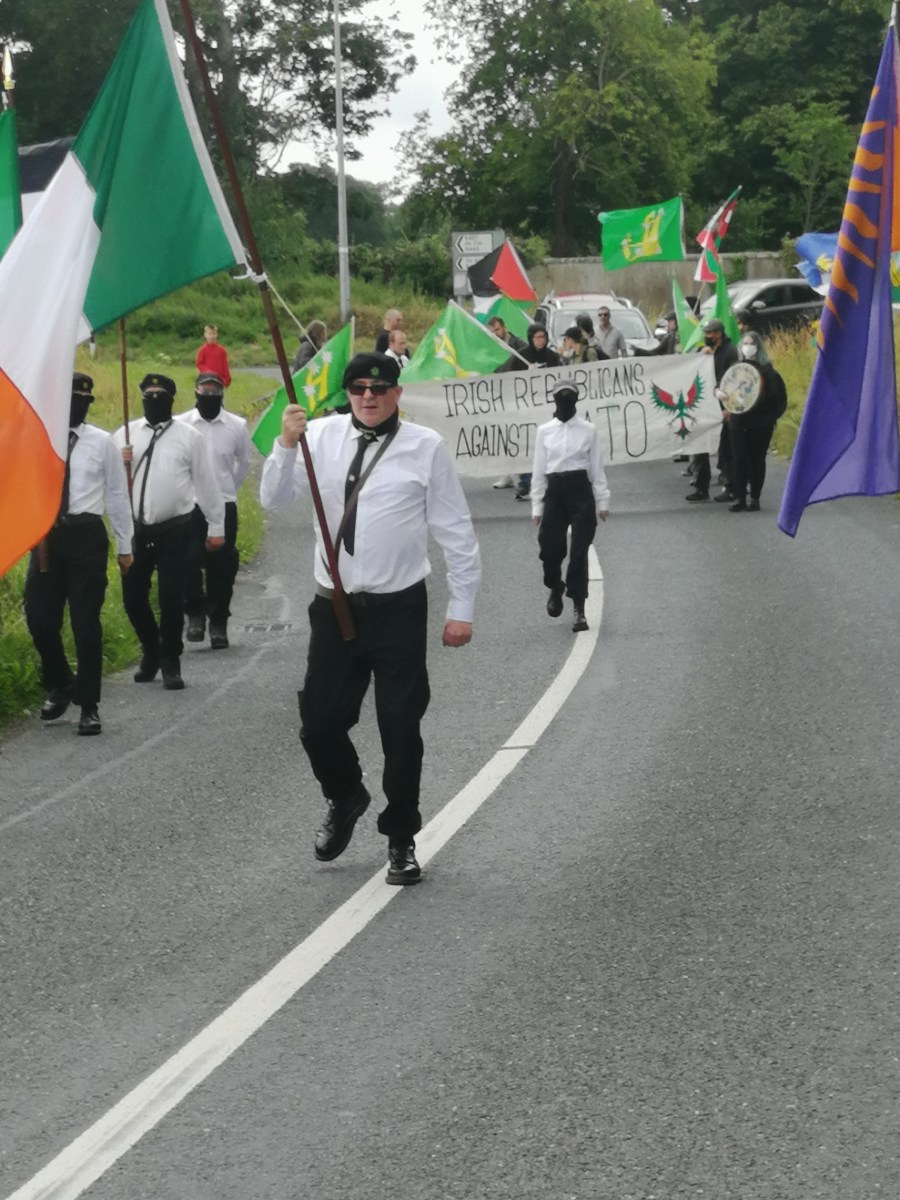
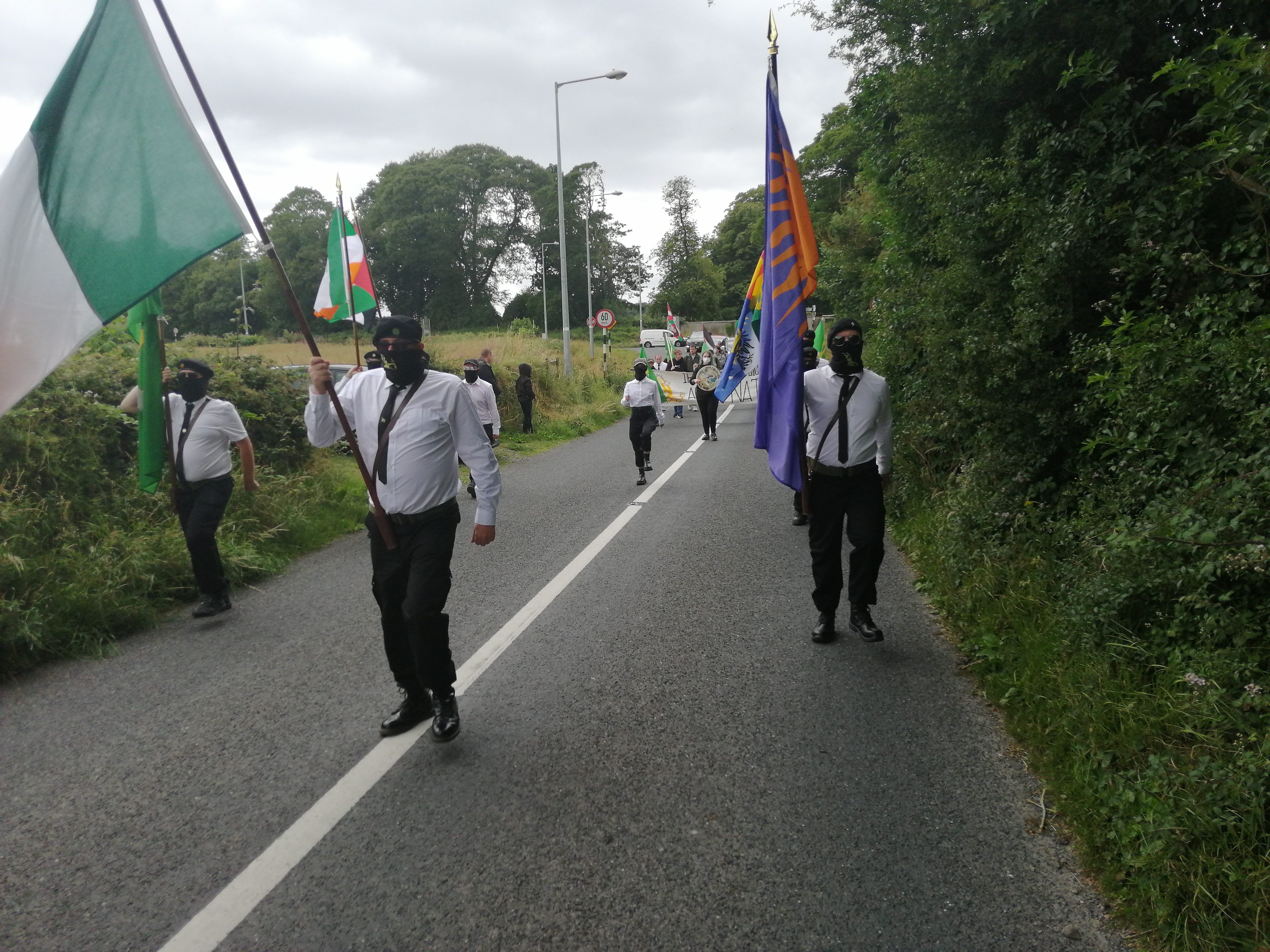
A Socialist Republican Colour party led the march up from the bottom of the road, turning in to the graveyard through a side gate and taking up positions in front and to one side of the monument, at ordú scíthe (parade rest) position but with flags held high.
Colour party in front of Wolfe Tone monument, Bodenstown Churchyard (Photo: Rebel Breeze)
Behind the colour party followed a crowd carrying banners bearing the legends “Irish Republicans against NATO”, “We serve Neither King nor Kaiser but Ireland” and an assortment of flags including green-and-gold Starry Ploughs, Irish Tricolour, Palestinian and Basque national flags.
The event was chaired by a young Socialist Republican who spoke about the importance of the event before introducing a representative of a midland Republican commemoration group who read a short message of solidarity.
This was followed by a socialist republican accompanying himself on guitar singing The Three Flowers.3
The main oration was delivered by veteran Independent East Tyrone Republican Margaret McKearney who linked the past with the present, including the current housing crisis, the British occupation and the Irish State’s push to join PESCO and NATO military alliances.
Musician performing The Three Flowersat the Wolfe Tone monument (Photo: Rebel Breeze)Veteran Republican from Tyrone delivering the oration at the commemoration event (Photo: Rebel Breeze)
There was a clear message at the event that the push towards NATO will be energetically resisted at every turn by the people of Ireland.
Wreaths were laid and a minute’s silence was observed, while the colour party lowered the flags in memory of all those who paid the ultimate sacrifice in the ongoing struggle for Irish Freedom. The event was brought to a close with the musician playing and singing Amhrán na bhFiann.
A handful of Gardaí4 in uniform and in plainclothes (Special Branch, the political police) were parked outside the graveyard watching people arriving and leaving but at that point having no direct interaction with those attending the event.
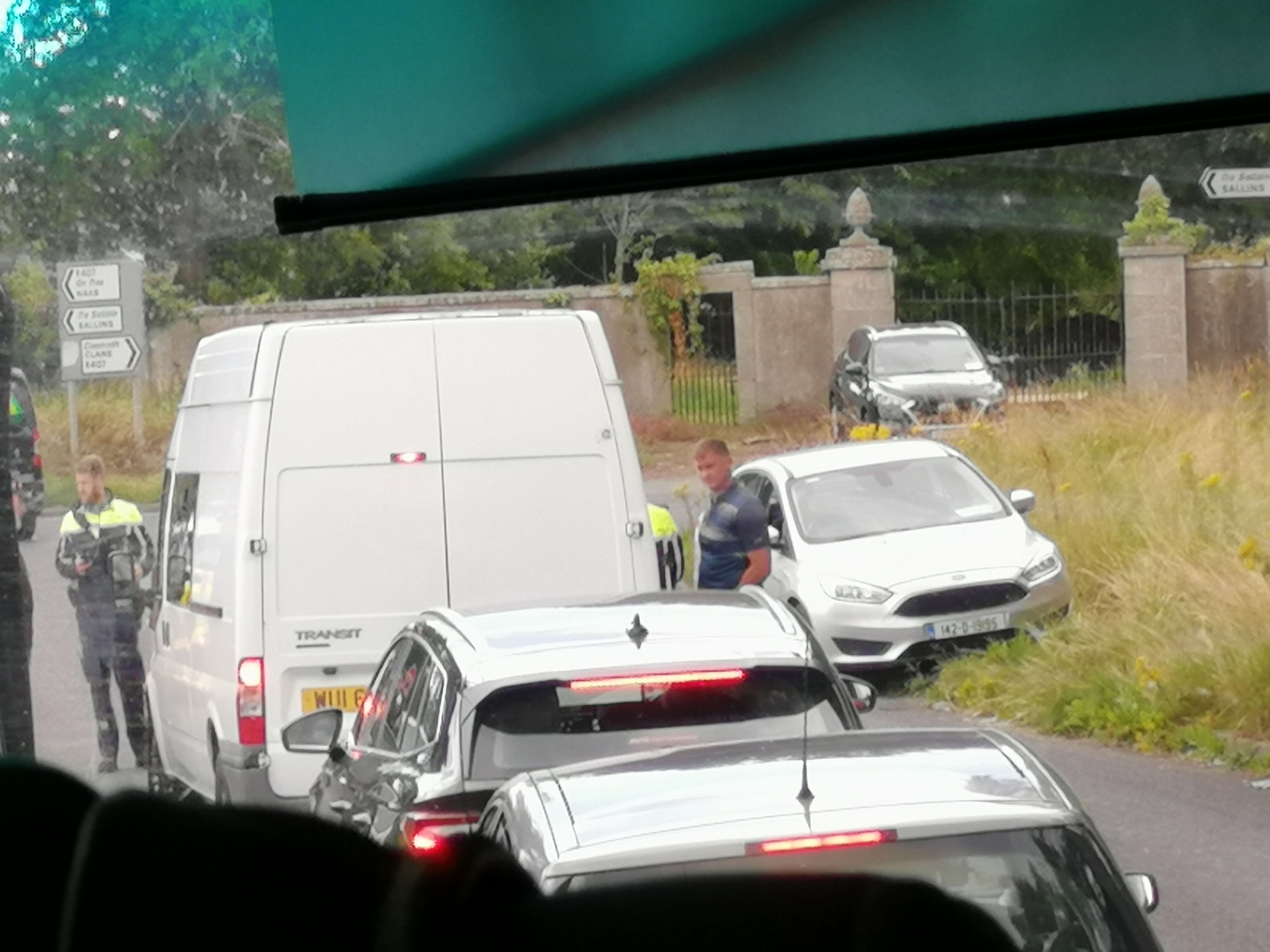
Part of long tail-back cause by Garda checkpoint very near to Bodenstown Churchyard after the commemoration event (Photo: Rebel Breeze)Gardaí in uniform and Special Branch in plain clothes harassing and attempting to intimidate people who had attended the commemoration event (Photo: Rebel Breeze)
However, once the event concluded, the Gardaí set up a checkpoint at the bottom of the road and began to harass and attempt to intimidate drivers of vehicles, stopping them, asking for identification, where they were from etc, causing a long tailback.
This is part of the regular harassment of Irish Republicans by police on both sides of the British Border.
“The Father of Irish Republicanism”
Theobald Wolfe Tone (1763-1798) was formally a member of the Church of Ireland5 congregation (Anglican), in his time the dominant religious group in England-occupied Ireland but also one of the smallest.
No-one could be elected to the Irish Parliament unless of that congregation.
In the early 19th Century a section of the Irish bourgeoisie, nearly all Anglican or of the other Protestant churches, “dissenters”, wished to develop the Irish economy free of interference, control, patronage and bribery associated with being an English colony.
Many of them understood the need for a strong base in the population, for which they recognised the need to include representation for the majority population in the country, the Catholics, along with the most populous of the Protestants, the Presbyterians.6
When the liberal but pro-English Crown Henry Grattan brought the issue to a vote in the Westminster Parliament, his motion failed due to many MPs’ sectarianism or vested interests, a situation which continued for decades afterwards.7
That seemed to point to revolution as the only logical way forward.
Theobald Wolfe Tone was one of the founders of the Society of United Irishmen in October 1971, the first broad Republican organisation in Ireland, which soon developed a comprehensive revolutionary agenda, for Irish independence and a Republic based on universal male suffrage.8
In order to accomplish a successful uprising, they invited assistance from Republican France and planned a simultaneous uprising across Ireland, with particular concentration on Antrim (largely Presbyterian and Anglican), Wexford and Wicklow, Midlands and Mayo (largely Catholic).
Colour party leading a march towards the Wolfe Tone monument (Photo: Rebel Breeze)
Spies and informers working for the English occupation betrayed some of their plans and most of the Leinster Directorate of the United Irishmen, including Wolfe Tone, were arrested, a disaster for uprising plans in Dublin but also for overall leadership in Leinster.
The 1798 Rising had initial great success in the south-east, particularly in Wexford but was quickly and bloodily suppressed in the Midlands and in Antrim. Mayo rose when a too-small detachment of French soldiers arrived under Humbert in Kilalla but they were outnumbered and beaten.
Tone was was unapologetic at his trial, was sentenced to death by hanging but appears to have attempted to take his own life while awaiting execution, surviving for a few days in great pain before dying on 19th November 1798 as British and Orange loyalist repression swept the country9.
Wolfe Tone Monument by Edward Delaney (d.2009) at S.E entrance to Stephen’s Green, Dublin city centre (image sourced: Internet)
Many leaders of the United Irishmen are honoured in song, writing and in commemorative events to this day but Theobald Wolfe Tone is still the most widely remembered of them all.
End.
The Colour Party and some of the participants line up for a group photo by the monument (Photo: AIA)
FOOTNOTES
1Thomas Davis (1814-1845), journalist, author of the song A Nation Once Again and other works, also co-founder of The Nation newspaper.
2Prior to its split resulting in Provisional Sinn Féin and the later split resulting in the Irish Republican Socialist Party.
3Composed by Norman G. Reddin, a Republican ballad honouring the memory of three United Irish leaders, Robert Emmet, Michael Dwyer and Wolfe Tone. Both Tone and Emmet were sentenced to execution, the latter carried out in 1803 on Thomas Street in Dublin. Dwyer was transported to exile in Australia where he was later accused of planning an uprising in New South Wales for which he was twice imprisoned and tried but exonerated, became Police Chief in Liverpool, Sydney in 1813 but was imprisoned again in 1825 for alleged non-payment of a £100 debt, contracted dysentery, was released again and died very soon afterwards.
5A branch of the Church of England, the state religion of the UK of which their Monarch is the titular head (in addition to being the commander-in-chief of the Armed Forces).
6“Catholic, Protestant and Dissenter”, as Wolfe Tone famously called the alliance.
7In May 1808 Grattan proposed emancipation in the House of Commons, with certain qualifications, but his motion was defeated by 281 votes to 128. In June 1812 the Commons accepted, by 225 votes to 106, a motion in favour of considering Catholic claims. An emancipation Bill, introduced in February 1813, received a second reading but was lost in committee by a narrow margin. Frustration at this lack of progress led to the formation of the Catholic Association in 1823 (of which Wolfe Tone was an active member). Parliament passed an Act to restrict the Association’s activities two years later.
8Very few radical or revolutionary individuals, not to mention movements of the 18th (or even much of the 19th or early 20th) Centuries proposed universal female suffrage, one reason why the 1916 Proclamation of Irish Independence is such a remarkable document, beginning its address with the words “Irishmen and Irish women”.
9Which many, in particular Protestants, fled the country to escape, some settling in the United States and in Canada. The great Catholic emigration from Ireland did not occur until the Great Hunger of the mid-19th Century and later.
ANOTHER FAILURE OF THE TRADE UNION MOVEMENT
“Today in Ireland, migrant workers earn 22% less per hour than their Irish counterparts (ESRI, 2023), while migrant women earn 11% less than their male counterparts and 30% less than Irish men (ESRI, 2023). Here is another fact. According to the latest Discrimination Report in Ireland, the workplace is the second place where discrimination and racist incidents occur, as also documented in the previous reports (INAR, 2023).”
The paid work migrants do is a coin of two sides, one bright and the other dark.
On the bright side, we know that, in Ireland, the employment rate among the migrant population is higher than that of the national population (71.6 and 76.4, respectively). But, simultaneously, the unemployment rate is lower among migrants (4.6 and 5.9, respectively). In other words, compared to the national population, the migrant population has more working and fewer unemployed migrants.
This is good news and bad news. Because on the one hand, we can all see that migrants are making a necessary and important contribution to local economies through their work (often taking essential positions in the food and agri industry and other low-paid jobs that do not attract the national population). Still, on the less visible side of the coin, we can also see that it is in the work environment where most…











 rebelbreeze