“A March Travelling into the Future … a Beacon of Resistance”

Diarmuid Breatnach

(Reading time main text: 6 mins.)

Thousands of marchers with flags, banners and three marching bands retraced the route of the anti-internment march in 1972 that ended in the infamous Derry Bloody Sunday1, a massacre of unarmed civilians by the British Parachute Regiment.

The nearest Sunday to the date of the original march, which this year fell on February 2nd has been chosen annually for the commemorative march over the 53 years since the massacre. People travel from different parts of Ireland and indeed from beyond in order to attend.
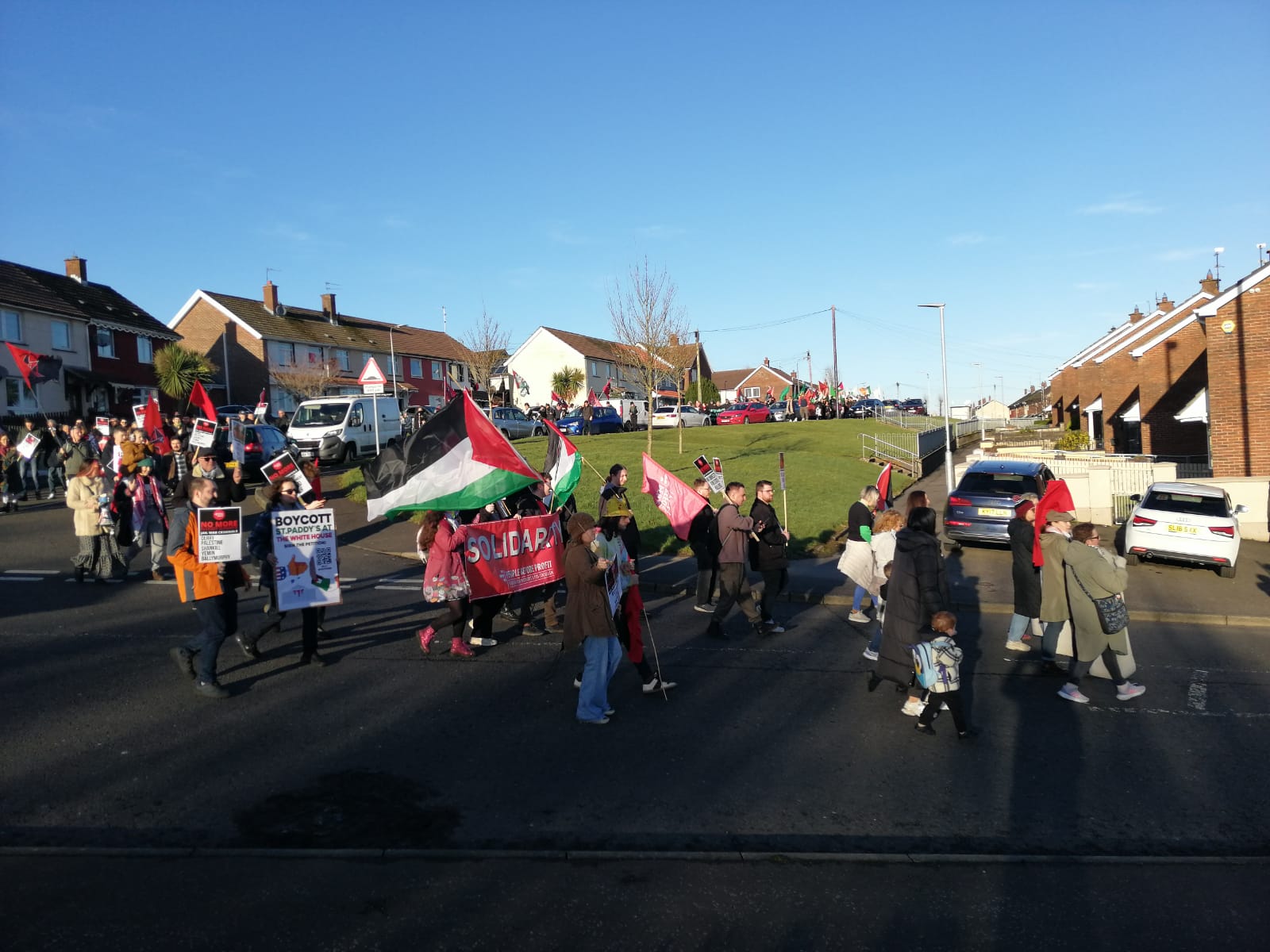
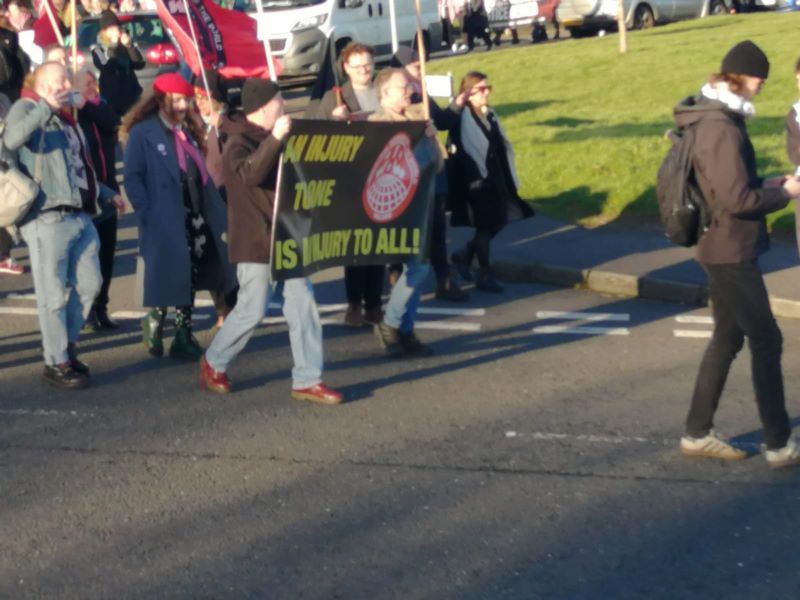
Section of the march coming down from the Creggan. (Photo: D.Breatnach)
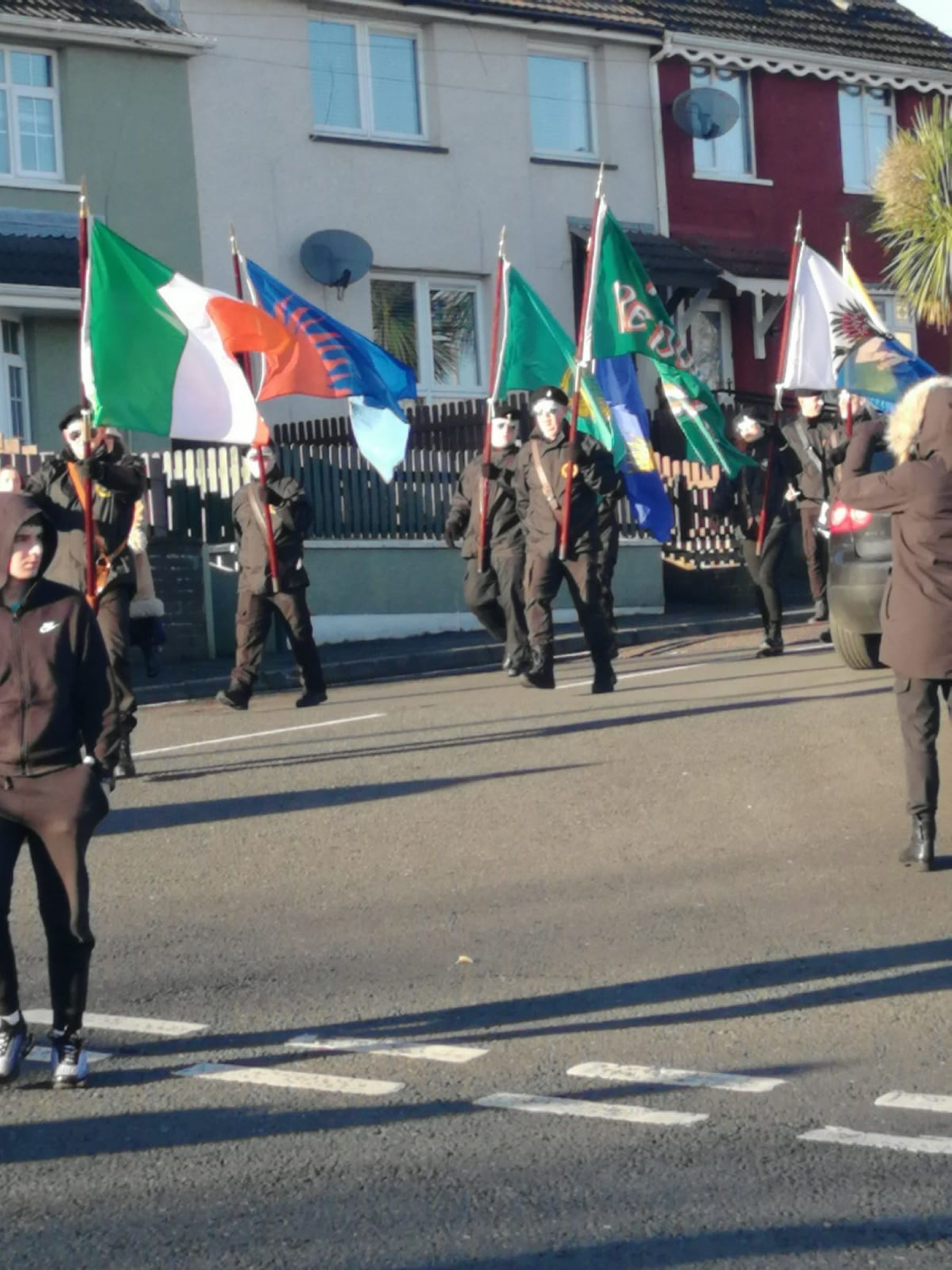
The colour party (bearing the flags) traditionally precedes the marching band. (Photo: D.Breatnach)

Derry is not well served by public transport from other parts of Ireland and there is no train station there.

There is a bus service from Dublin from the Translink company of the occupied colony but one would need to catch it at seven in the morning and then hang around in Derry for 3.5 hours waiting for the march to start. For this reason, many travel to Derry by car.

Equally, many others who would attend were the public transport available, stay home but an estimated over 7,000 participated in this year’s march. The theme this year was Palestine, once again as was last year’s too.

The day of the massacre

The original march was a protest against the introduction in August 1971 of internment without trial in the occupied colony. Almost immediately afterward the Parachute Regiment had massacred 11 people protesting against it in Ballymurphy, Belfast.2
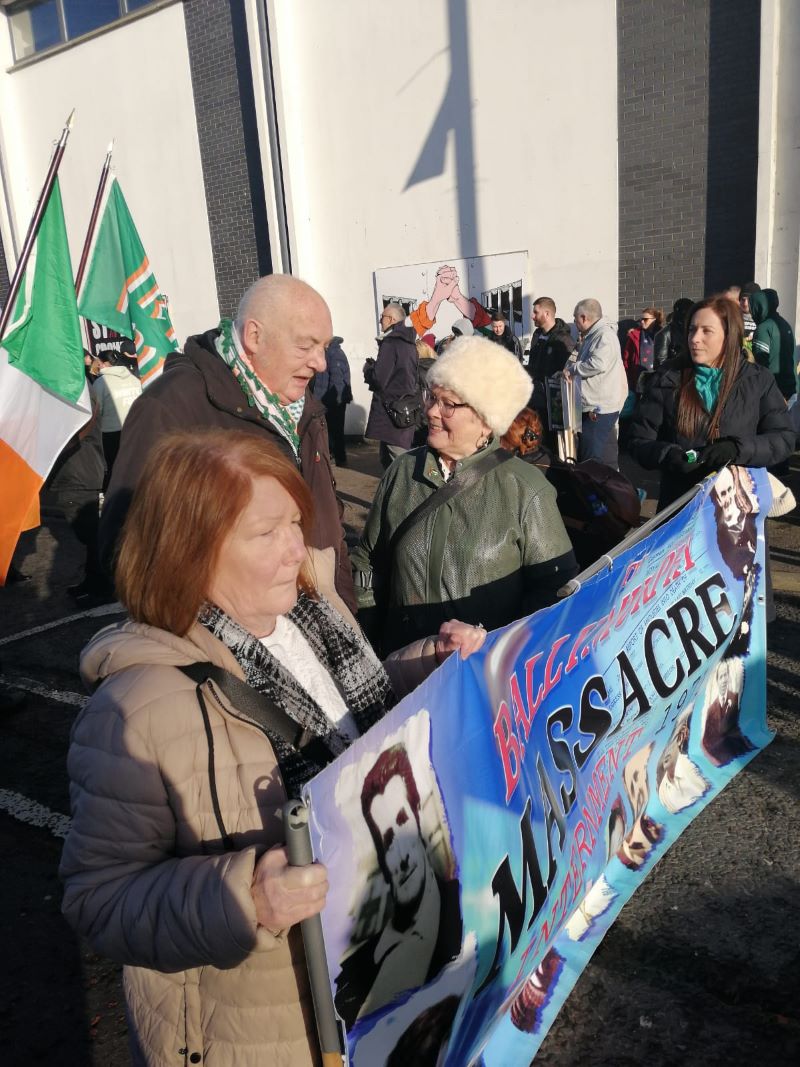
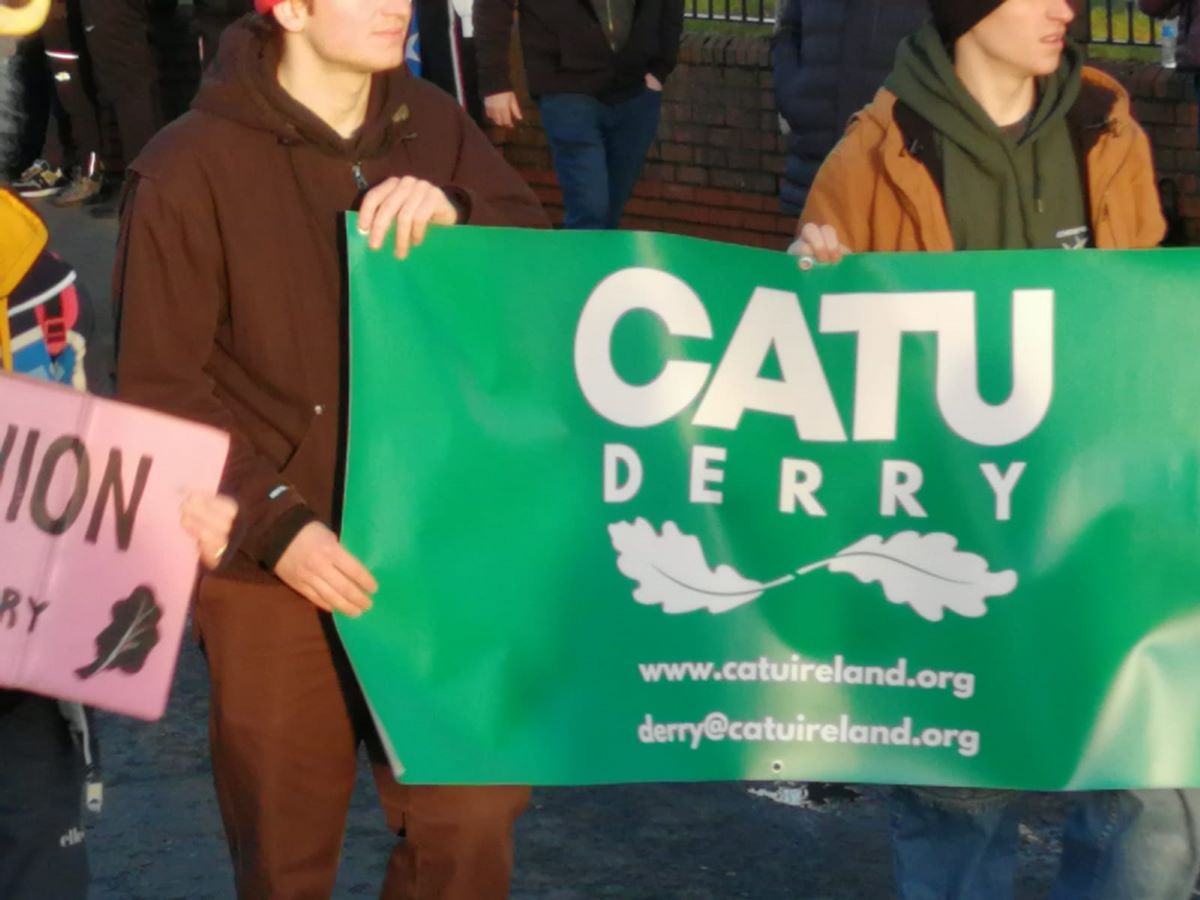
Ballymurphy campaign banner in the Creggan awaiting start of march with Kate Nash centre. (Photo: D.Breatnach)

The 1972 march, along with many others, had been banned by the sectarian colonial administration. The Civil Rights campaigners knew that their legitimate demands3 were being obstructed by use of the Special Powers4 of the statelet and that they could win nothing if they were to acquiesce.

After the previous massacres it took considerable courage to march that day but perhaps they thought that with an advertised march, in daylight, with many film cameras covering, the Paras were unlikely to open fire. In any case, they decided to risk it.

At 4.10pm the first shots were fired by the Paras5 without warning and by around 20 minutes later they had killed 13 men and youths and wounded another 13, one of whom would die weeks later. According to the Saville Inquiry in 2010, they had fired over 100 rounds.

Not one of their targets was armed.

To justify the slaughter, the British Army claimed that they were fired upon and returned fire, killing IRA fighters. The British Government, in particular through Home Affairs Minister Reginald Maudling, repeated the lies as did the British media.

Bernadette (then) Devlin6 MP, a survivor, was prevented from speaking in the Westminster Parliament and she walked up to Maudling and slapped his face. In Dublin a general strike took place with schools closing and a huge crowd burned the British Embassy down.

In London, a giant march reached Trafalgar Square as its end was still leaving Hyde Park. In Whitehall the police prevented them from laying the symbolic coffins outside No.10 and in the scuffles the ‘coffins’ were eventually thrown at the police or knocked to the ground.

And a number of construction sites in Britain went on strike also.

The judicial response varied wildly. Coroner Hubert O’Neill, an ex-British Army major, presiding on the inquests in 1973, called it “Sheer unadulterated murder” whereas Lord Chief Justice Widgery in the ‘inquiry’ he led ignored all the local evidence and accepted the British Army’s lies.7

The last Bloody Sunday march”

Provisional Sinn Féin organised and managed the annual march for many years but in January 2011 Martin McGuinness announced that year’s march would be the last, because of the UK’s Prime Minister David Cameron’s public apology to the relatives of the 14 killed in Derry.

The apology followed quickly on the verdict of the Saville Inquiry8 which totally refuted the statements at the time by representatives of the Army and of the Political and Judicial establishments: the victims had been unarmed and the Army had not been “returning fire”.
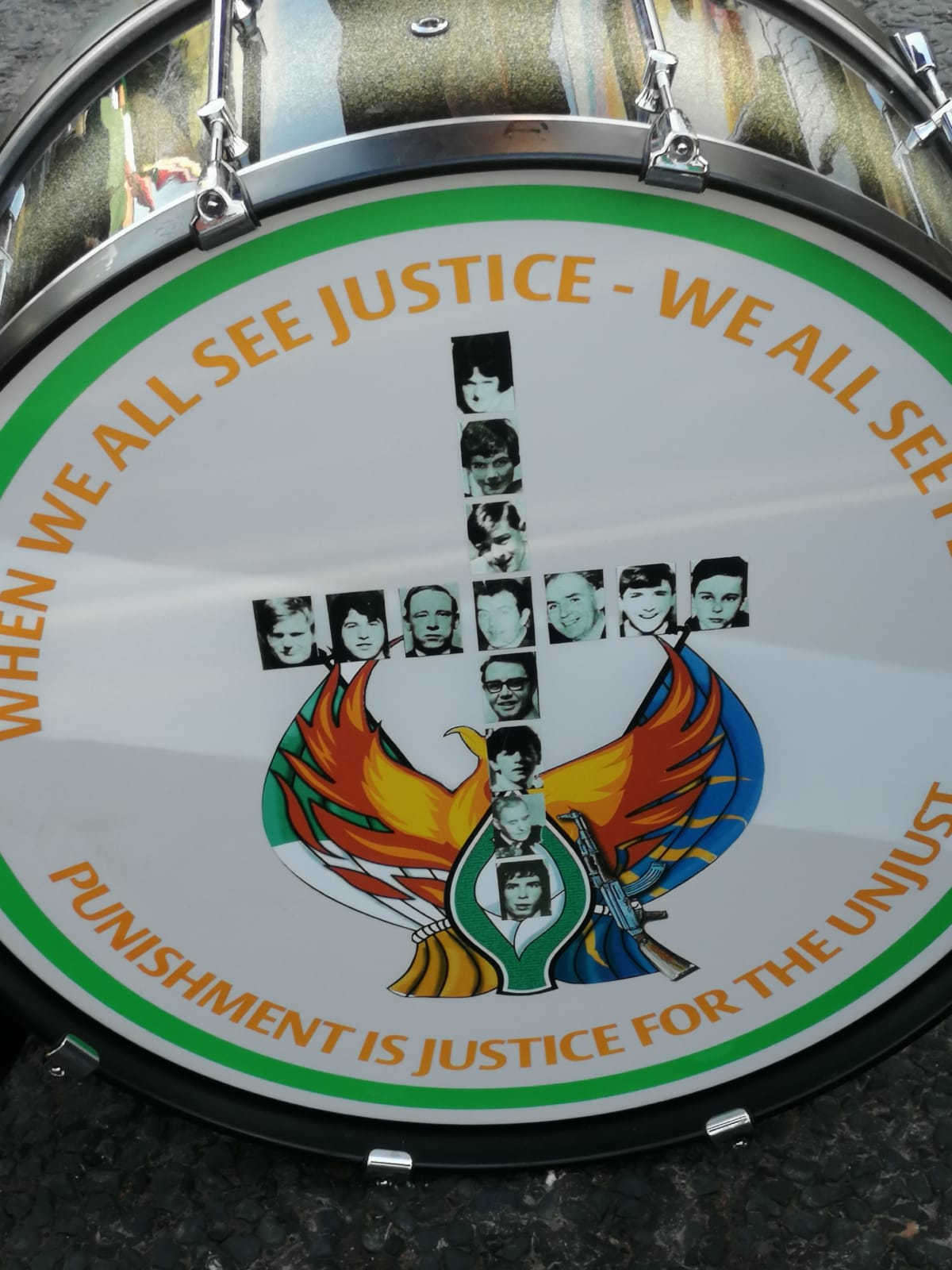
One side of one of the marching band drums (Photo: D.Breatnach)
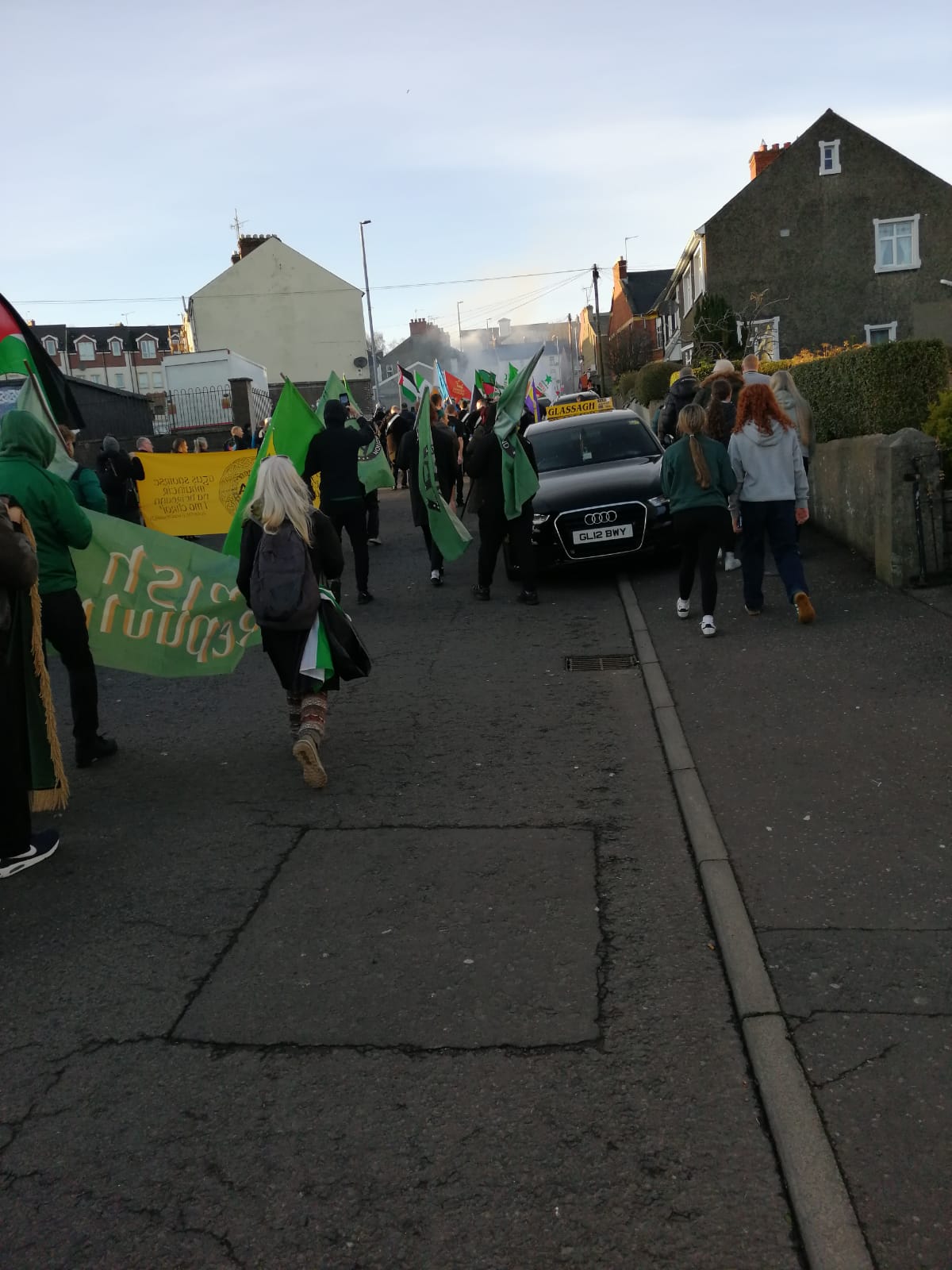
Section of the march about half-way along its length. (Photo: D.Breatnach)

Despite the UK State’s acknowledgement that they had no excuse for the massacre, not one of those who planned, organised or carried out the atrocity had been charged, never mind convicted, nor had those who conspired to cover up the facts. To this day, only a low-level soldier has faced charges.

Nor had there been government admissions of wrongdoing in the other massacres by the Paras intended to crush the resistance to the repressive internment measure, at Ballymurphy and Springhill.

A number of relatives and survivors of the original march declined to have the annual march cancelled, among them Kate Nash and Bernadette McAlliskey. Kate Nash’s brother William was shot dead on Bloody Sunday and her father, William, was wounded trying to save his son.

Bernadette McAlliskey was a survivor of the massacre and also survived nearly a decade later an assassination attempt in her home, being struck by nine bullets of a Loyalist murder gang. Despite opposition by and denunciation from SF, volunteers have kept the march going every year.

Each year different themes have also been incorporated into the Bloody Sunday March for Justice, including ones in Ireland, such as the framed Craigavon Two prisoners but also ones from beyond, e.g. the resistance of the Broadwater Farm housing estate in London to Metropolitan Police attack.

Section of the march in Creggan waiting to start, showing the Palestinian national flag and the Irish Tricolour in close proximity. (Photo: D.Breatnach)
Big drums of one of the marching bands getting a workout in the Creggan while waiting for the march to start. ‘Saoirse go deo’ = Freedom for ever. (Photo: D.Breatnach)

Since 2011 Sinn Féin have boycotted the march but also sought to mobilise public opinion against it, claiming that relatives of the victims didn’t want the march to continue. The truth is that some hadn’t wanted it even when SF were running it, some didn’t afterwards but some did.

Such an atrocity has of course huge personal impact on relatives of victims but its impact is also much wider on a society and beyond, historically and politically. That historical memory ‘belongs’ to the people of Derry but also to the people of the world (as do others such as Sharpeville SA).

Those in power in society are aware of that and the media outside of Derry gives little or no coverage to the annual march while promoting other events there of lesser numbers and significance.

The ‘Derry Peoples Museum’ ignores the march in its Bloody Sunday commemorative program.

This year’s march

Sunday just past was one of sunshine and little wind, as it was on the day of the Derry massacre. But regular marchers remember other Bloody Sunday commemoration days of pouring non-stop rain, of squalls, of snow and sleet, of wet clothes, socks and freezing fingers and toes.

The march starts in the afternoon at the Creggan (An Chreagáin) and winds down to just below the Derry Walls, then up a long slope again before eventually ending down at Free Derry Corner9, the destination of the original march, where speakers address the crowd from a sheltered stage.

Marchers underway, led by people carrying 14 crosses to represent the unarmed civilians murdered by the Paras on that day 53 years before. (Photo: D.Breatnach)
The band members are itching to go up in the Creggan. (Photo: D.Breatnach)

The sides of residential blocks in this area are also painted in giant murals to represent scenes from the civil rights and armed resistance period while nearby stands a monument to the martyrs of Bloody Sunday 1972 but also another to the 10 H-Blocks’ martyrs of the Hungers Strikes of 1981.

In this area, one needs to be blind not to be at least peripherally aware of the icons of proud struggle and of loss, of sacrifice.

Eamon McCann and Farah Koutteineh addressed the rally at the end of the march. McCann, a journalist and member of the People Before Profit political party is a survivor of the massacre. He is an early supporter of the Bloody Sunday March for Justice at which he has spoken on occasion.

Farah Koutteineh is a Palestinian journalist who was herself the news when in December 2023 she and a few other Palestinians were ejected from a Sinn Féin-organised meeting in Belfast being addressed by the Palestinian Ambassador as a representative of the Palestinian Authority.

Koutteineh had been denouncing the Palestine Authority’s collusion with Israel when she and the other Palestinians were hustled out to applause from many of the attendance. Not surprisingly from the Derry platform on Sunday she too drew applause in criticising SF’s position on Palestine.10

Speaking to this reporter after the march, Kate Nash said: “There is no chance the march will be ended. It will go forward into the future, a beacon of resistance against the injustices and crimes of states around the world.

“There are millions of us … people come from around the world to commemorate this massacre with us.”

end.

Series of images from the march (Photoa by D.Breatnach)
Footnotes:

1There have been a number of Bloody Sundays in the history of Ireland under colonialism and therefore the location and year are often incorporated into the name for clarity as to which is being discussed.

2There was substantial State interference with inquests during the period of the 30-years’ war in the Six Counties (and in some cases in the Irish state also), in order to avoid inquest juries finding the state armed forces culpable of homicide unjustified in law. The original inquest in 1972 on the Ballymurphy massacre recorded an ‘open verdict’ but a 2021 reopened inquest found the British Army killings “unjustifiable”. Even after the Derry massacre, in July of that year, the Paras again killed five unarmed people and injured two in the Springhill area of Belfast and again an ‘open verdict’ was recorded into the fatalities which included three teenagers and a priest.

3The demands were all of rights that were in existence in the rest of the UK, including an ending to discrimination in allocation of housing and employment and general enfranchisement.

4The Special Powers (Northern Ireland) Act 1922 gave legal powers to the authorities similar to martial law. Allegedly temporary, as is often the case the Act kept getting renewed until made permanent and its repeal was one of the demands of the Civil Rights campaign. The Act was finally repealed in 1973.

5There was a unit of other British Army soldiers stationed on the Derry Walls with special rifles and there has been speculation that some of the shots might have been fired by them but this has never been confirmed to date.

6Now McAlliskey then Devlin, she had been a candidate for the People’s Democracy party of the time, the youngest MP elected.

7And that was the ‘official record’ until the Saville verdict 38 years later. A clever contemporary lampooning of Widgery and playing on a soap powder advert, with excellent alliteration, had it that “Nothing washes whiter than Widgery White!”

8Although the Saville Inquiry delivered its verdict in June 2010, it had been set up in 1998, taking an inordinately long time (and a bonanza in legal fees for judge, barristers, lawyers and clerks) to reach a verdict already obvious to all the nationalist people of the Six Counties, most of the Irish people and probably millions around the world. The date of its setting up so near to that of the Good Friday Agreement suggests that its creation (and eventual verdict) was part of the ‘sweeteners’ of the Pacification Process and the Good Friday Agreement.

9A reconstruction of the iconic gable end of a small local authority house in the Bogside area of Derry which had been painted in 1967, during the Civil Rights resistance period, with giant letters proclaiming: YOU ARE NOW ENTERING FREE DERRY. The house was demolished during redevelopment of the area but the gable end was reconstructed as a monument to the resistance of the people of the city.

10Sinn Féin support the corrupt and collaborationist Palestine Authority and its backing political party Fatah and also celebrated St. Patrick’s Day with (then) President Joe Biden while the US was supplying the Zionist genocide with weapons, money and political backing.

1There have been a number of Bloody Sundays in the history of Ireland under colonialism and therefore the location and year are often incorporated into the name for clarity as to which is being discussed.

2There was substantial State interference with inquests during the period of the 30-years’ war in the Six Counties (and in some cases in the Irish state also), in order to avoid inquest juries finding the state armed forces culpable of homicide unjustified in law. The original inquest in 1972 on the Ballymurphy massacre recorded an ‘open verdict’ but a 2021 reopened inquest found the British Army killings “unjustifiable”. Even after the Derry massacre, in July of that year, the Paras again killed five unarmed people and injured two in the Springhill area of Belfast and again an ‘open verdict’ was recorded into the fatalities which included three teenagers and a priest.

3The demands were all of rights that were in existence in the rest of the UK, including an ending to discrimination in allocation of housing and employment and general enfranchisement.

4The Special Powers (Northern Ireland) Act 1922 gave legal powers to the authorities similar to martial law. Allegedly temporary, as is often the case the Act kept getting renewed until made permanent and its repeal was one of the demands of the Civil Rights campaign. The Act was finally repealed in 1973.

5There was a unit of other British Army soldiers stationed on the Derry Walls with special rifles and there has been speculation that some of the shots might have been fired by them but this has never been confirmed to date.

6Now McAlliskey then Devlin, she had been a candidate for the People’s Democracy party of the time, the youngest MP elected.

7And that was the ‘official record’ until the Saville verdict 38 years later. A clever contemporary lampooning of Widgery and playing on a soap powder advert, with excellent alliteration, had it that “Nothing washes whiter than Widgery White!”

8Although the Saville Inquiry delivered its verdict in June 2010, it had been set up in 1998, taking an inordinately long time (and a bonanza in legal fees for judge, barristers, lawyers and clerks) to reach a verdict already obvious to all the nationalist people of the Six Counties, most of the Irish people and probably millions around the world. The date of its setting up so near to that of the Good Friday Agreement suggests that its creation (and eventual verdict) was part of the ‘sweeteners’ of the Pacification Process and the Good Friday Agreement.

9A reconstruction of the iconic gable end of a small local authority house in the Bogside area of Derry which had been painted in 1967, during the Civil Rights resistance period, with giant letters proclaiming: YOU ARE NOW ENTERING FREE DERRY. The house was demolished during redevelopment of the area but the gable end was reconstructed as a monument to the resistance of the people of the city.

10Sinn Féin support the corrupt and collaborationist Palestine Authority and its backing political party Fatah and also celebrated St. Patrick’s Day with (then) President Joe Biden while the US was supplying the Zionist genocide with weapons, money and political backing.

Useful links:

“SOLIDARITY WITH THE RESISTANCE” AND “DOWN WITH COLLABORATION OF THE PALESTINIAN AUTHORITY!”

Clive Sulish

(Reading time: 5 mins.)

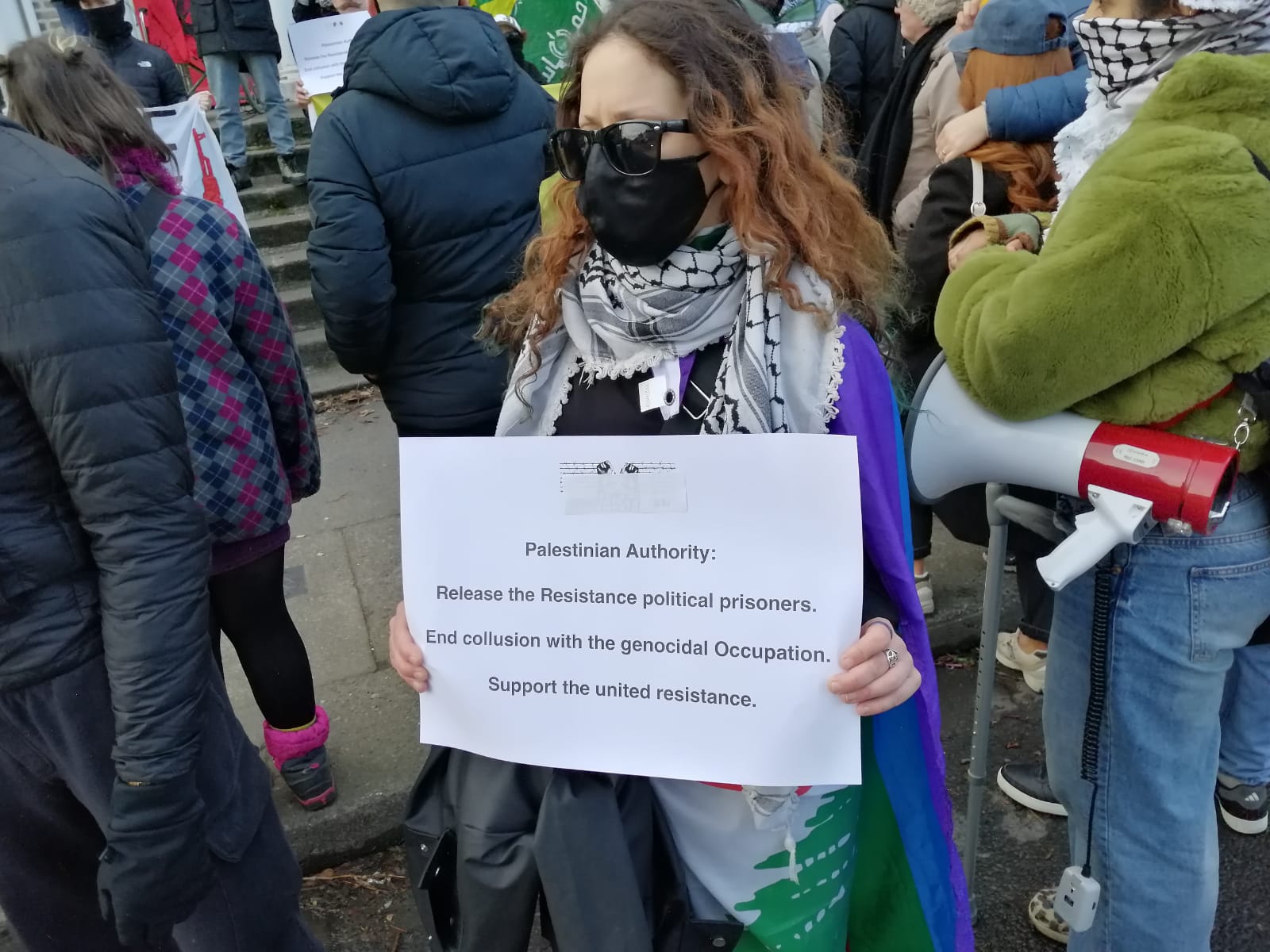
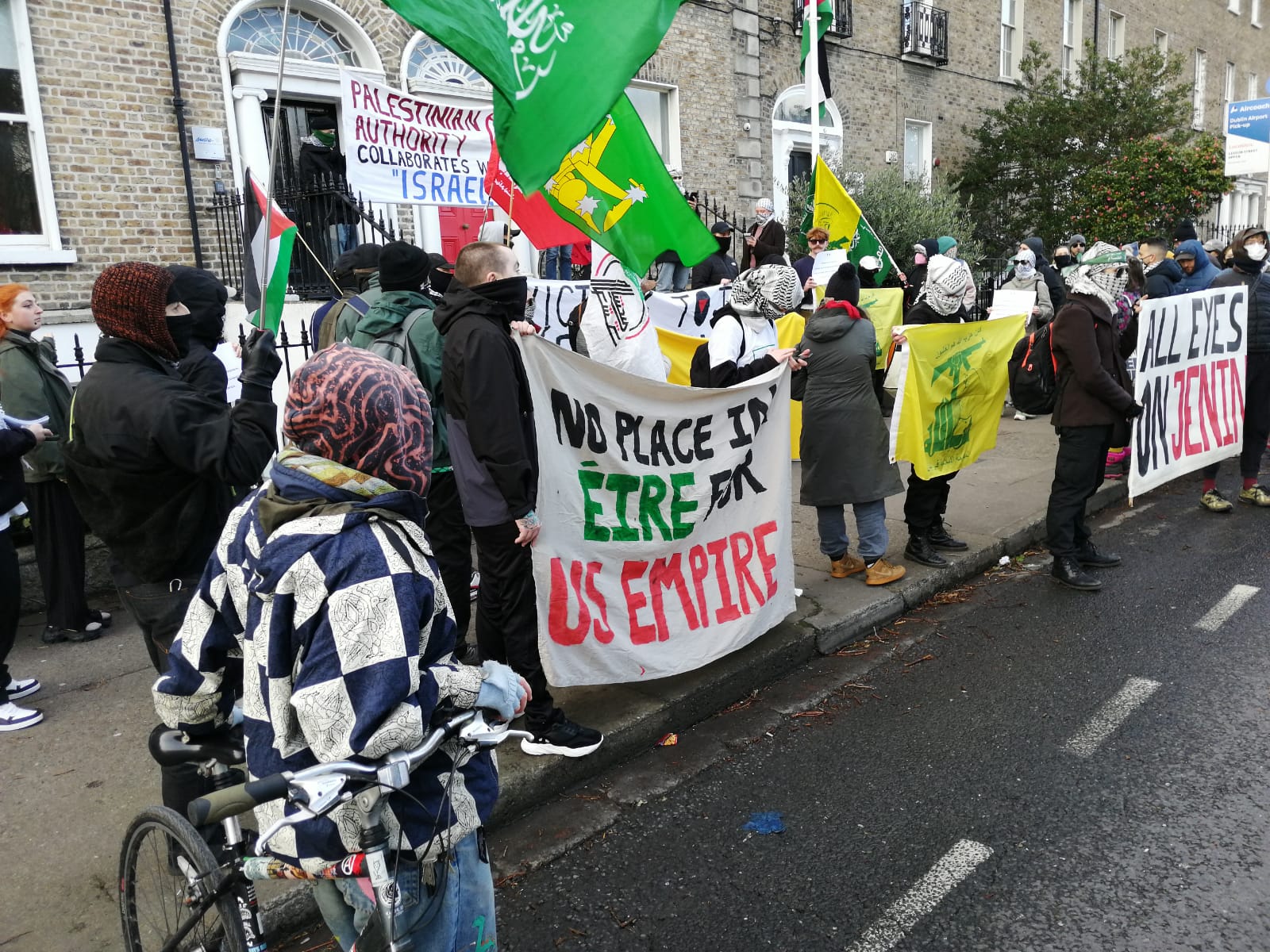
A large Palestine solidarity march once again in Dublin included a Resistance Bloc, part of which also broke away to picket the Palestinian Authority’s Embassy, where collaboration and collusion were denounced in three languages.1

A section of the march has arrived in Molesworth Street in view of Leinster House but others are still arriving. (Photo: R.Breeze)

As Israel freed 200 of their Palestinian prisoners Saturday in exchange for four female Israeli Occupation Army soldiers, Dublin City Centre rang again to shouts of Palestinian solidarity and some banners of the Resistance Bloc saluted the Resistance and denounced the Palestine Authority.

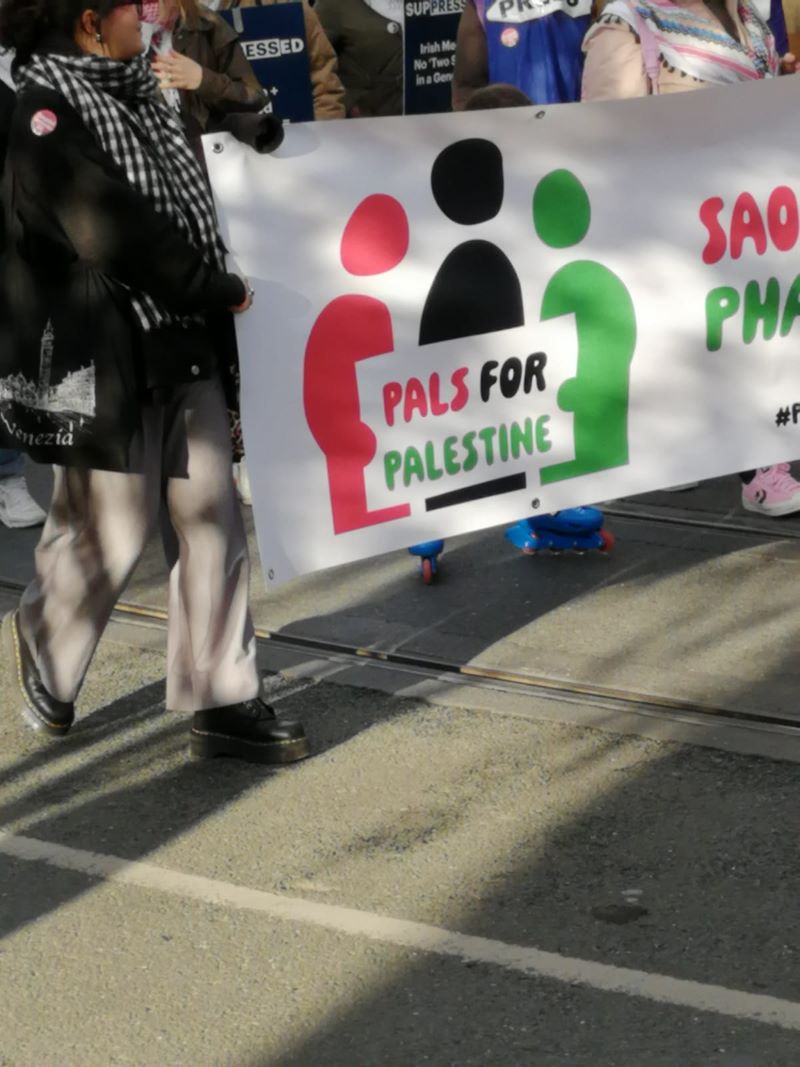
The Resistance Bloc was organised by a broad front of organisations: Action on Palestine, Saoirse Don Phalaistín and Queer Intifada and was also supported by independent activists.

(Photo: R.Breeze)
(Photo: R.Breeze)

There had not been a major Palestine solidarity march in Dublin since 7th December, though they had been held pretty regularly every two or three weeks throughout the previous year. On Saturday, as Netanyahu stopped blocking it, the ceasefire and prisoners transfer agreement finally went ahead.

The Agreement is in three phases, each including prisoners of each side to be exchanged but also the removal of the IOF from Gaza in matched stages and the return of Gaza residents to the South also including the delivery of food, fuel and medicine. But they return to a rubble wasteland.

(Photo: R.Breeze)
(Photo: R.Breeze)

THE PA AND OSLO

The PA is a product of what was called the Palestinian Peace (more correctly called Pacification) Process and since it failed spectacularly to pacify the Palestinian people is more usually now called the Oslo Accords, from which the PA was established in 1994.

Reading a statement in Arabic outside the PA Embassy (Photo: R.Breeze)

The Oslo Accords is one of a wave of imperialist pacification processes or agreements of the last decade of the 20th Century and in particular one of interrelated processes in three distinct regions: in chronological order South Africa, Palestine and Ireland.

The ANC2 of South Africa recommended it to the Fatah3 of the Palestinians; then Fatah and the ANC recommended to the Provisionals4 in Ireland. In no case was what they had fought for achieved, with the exception of universal suffrage in South Africa.5

Banner Dublin Footballers for Gaza on the main march to Leinster House (Photo: R.Breeze) (Photo: R.Breeze)
On the main march to Leinster House (Photo: R.Breeze)

Later, the ANC and Sinn Féin would also recommend it to the liberation movements of the Basque Country, Colombia and the Kurds of Turkey, always with disastrous results for the movements in fragmentation, confusion, collusion with imperialism and disarming in the face of repression.

The Palestinian Embassies represent in fact the PA and this is the case in Ireland too. Despite th. PA’s long history of treachery to the Palestinian people and their struggle, including repression of the Resistance, it is being officially “recognised” as the representation of the Palestine people.

On the main march to Leinster House (Photo: R.Breeze)

Not only the traditional State Government parties of Fine Gael and Fianna Fáil uphold the PA but so also does the major oppositional party, the former Republican party of Sinn Féin. This is also the case with the major political parties in the EU, UK and US.

These also support the ‘two-state solution’ (sic) which would see the indigenous Palestinian people get less than 20% of their country, with the least water resources under the eyes and guns of the Israeli State. In any case it is considered unworkable by most experts and serious commentators.

“Smash the chains of Zionism” banner on the main march to Leinster House (Photo: R.Breeze)
Howth Stands With Palestine banner on the main march to Leinster House (Photo: R.Breeze)

In a recent statement on the ceasefire agreement in Gaza, the Secretary-General of the United Nations, Antonio Guterrez, also promoted the ‘solution’ of splitting Palestine into two states as a way towards peace. The PA too upholds that same plan.

Major Palestine solidarity organisations like the IPSC in Ireland have no formal position on the PA or the Two-State plan. Standing on the base of Palestine solidarity, ‘neutrality’ on the question is not excusable, even on a kind of basis of ‘it’s up to the Palestinians and not for us to intervene’.

On the main march to Leinster House (Photo: R.Breeze)

The PA is an imperialist creation against the Palestine struggle; for years it has been periodically attacking the Resistance and has now stepped up that aspect in its 6-week siege of Jenin in the West Bank and even military assaults on the Resistance groups in collusion with the IOF.

True solidarity with the struggle of a people also entails solidarity with their resistance, whether in non-violent or violent form and it also entails opposition to individuals and organisations that are colluding with the enemy; the PA should be publicly denounced by the solidarity movement.

On the main march to Leinster House (Photo: R.Breeze)

THE MARCH IN DUBLIN

In Dublin on Saturday any fears that much support would have dropped away6 disappeared as large numbers marched through the city centre, some having come from Kerry or Limerick. Not far from the front marched the Resistance Bloc which had assembled earlier outside the Rotunda.

Flying the national flag of Palestine, the Starry Plough and flags of Palestinian Resistance factions Hamas and Islamic Jihad, along with the national flag of Syria, the bloc marched behind banners upholding the Resistance and denouncing the PA.

Placard and flags outside the PA Embassy (Photo: R.Breeze)
Banners, flags and statement reading outside the PA Embassy (Photo: R.Breeze)

The usual chants of Palestine solidarity marches could be heard from the Bloc in call-and-answer but also included From Ireland to Palestine – Occupation is a crime! Saoirse don – Phalaistín! Resistance is an obligation – In the face of occupation!

Soon after the main march reached its destination, much of the Resistance Bloc marched away to Leeson Street Lower and soon after crossing the bridge over the Grand Canal into Leeson Street Upper, crossed the road to assemble in front of the “Palestine Embassy”.

One of the placards outside the PA Embassy (Photo: R.Breeze)
Reading translation of the statement in English outside the PA Embassy (Photo: R.Breeze)

The breakaway march was closely followed by a number of Irish police patrol cars and a Public Order Unit Van which remained at the PA Embassy until the event concluded.

One of the organisers then presented a man to read a statement in Arabic, the translation of which she followed to read in English, which pointed to happiness at the freeing of Palestinian prisoners in the exchange with the Resistance – but sadness at the collusion of the PA with the Occupier.

A protester holds a placard denouncing the PA outside their Embassy (Photo: R.Breeze)
Section of the crowd outside the PA Embassy (Photo: R.Breeze)

The speech declared that Palestinians have been striving for over a century to achieve their independence and freedom in their struggle against Israeli occupation. This has cost hundreds of thousands of Palestinian lives and displaced nearly nine million Palestinians around the world.

Later: Given the current circumstances, Palestinians must resist the Israeli occupation and simultaneously confront the Palestinian Authority, which acts as an agent in killing and besieging Palestinians to defend Israel. The speech concluded in thanking the Irish people for their solidarity.

One of the banners outside the PA Embassy bears a slogan but also the name of one of the organising groups (Photo: R.Breeze)
Another view of the crowd outside the PA Embassy (Photo: R.Breeze)

Another man spoke in part-Irish and part-English, congratulating people on having publicly confronted the PA with its collusion. This had only been done twice before in Ireland, once in Belfast when the “Palestinian Ambassador” had been addressing a Sinn Féin meeting.

There had been another outside the “Embassy” in Dublin some months earlier by a small gathering supporting a picket called by the Ireland Anti-Internment Campaign. He drew parallels between the PA and the treason to the Irish resistance that had led to Partition and a subservient state.

Next to the PA Embassy (Photo: R.Breeze)

Underlining the parallel in song, he sang verses of the Take It7 Down From the Mast ballad (against the Irish State during the Civil War 1922-1923), adapting a verse to call on the PA to Take it down from the mast Palestinian traitors ….. for you’ve (they’ve) brought on it nothing but shame.

The picket concluded with thanks to the attendance and after a period of shouting slogans including There is only one solution – Intifada Revolution! From the river to the sea – Palestine will be free! Shame on you PA – Shame, shame, shame!

End.

On the main march to Leinster House (Photo: R.Breeze)

FOOTNOTES

1Arabic, English and Irish.

2African National Congress

3The major secular Palestinian national liberation organisation at the time.

4Provisional IRA with its corresponding party, Sinn Féin, the major Irish national liberation organisation at the time.

5But no other social or economic progress; in addition, fragmentation of the movement and enlisting of the former liberation fighters as ‘enforcers’ of the imperialist agreement.

6Due to a possible but mistaken attitude of “the war’s over”.

7A reference to the Irish Tricolour: Take it down from the mast Irish traitors/ It’s the flag we Republicans claim/ It can never belong to Free Staters/ For you’ve brought on it nothing but shame. “The Free State” was the name adopted by those who agreed to the Anglo-Irish Treaty, including Partition.

USEFUL LINKS

@actionforpalireland

@saoirsephalastin

@queerintifada.ireland

Swiss Zionist Censors Arrest Palestinian Journalist

Diarmuid Breatnach

(Reading time: 2 mins.)

Swiss police have arrested and detained Palestinian journalist and Executive Director of the popular Electronic Intifada website. According to reports he was interrogated for an hour at the airport after his arrival and released but arrested a day later.

Abunimah was due to give a series of talks in Switzerland and that fact, in addition to his journalistic work in writing for and organising weekly podcasts from the Electronic Intifada website give the context for his arrest which is simply pro-Zionist and pro-imperialist censorship.

The EI (Electronic Intifada) carries articles from its reporters inside Gaza and the weekly podcasts on YouTube provide analysis and discussion, along with interviews with commentators, writers and activists. Military expert Jon Elmer gives a roundup covering actions of the Resistance.

On a personal note, the weekly EI podcasts on Wednesday (now Thursday) evenings on YouTube became not only compulsory watching for me but also emotional therapy in the midst of the Zionist genocide in Gaza.

Ali Abunimah (Image cred: Al Jazeera screengrab)

Abunimah is a US citizen of Palestinian descent, fluent in Arabic, English and conversant with Hebrew. Founded in 2001, the EI website associate editors are Maureen Clare Murphy, Nora Barrows-Friedman, Michael Brown, David Cronin, Tamara Nassar and Asa Winstanley.

The site’s editors are no strangers to attempted and actual repression: Germany banned Abunimah from entering last year, while UK police raided Asa Winstanley’s home and confiscated his computer equipment, which they are still holding weeks later but without charging him.1

Palestinian solidarity activists in Switzerland have protested Abunimah’s detetion.

The UN Special Rapporteur on freedom of opinion and expression, Irene Khan, called Abunimah’s arrest “shocking news” and urged his release while Francesca Albanese, UN Special Rapporteur on human rights in the occupied territories bemoaned the European “toxic … climate” for free speech.

When free speech in one area of discourse is attacked, freedom of speech on all subjects is endangered so even those who are not very supportive of Palestine should protest Abunimah’s arrest in this blatant act of censorship and repression.

End.

Footnotes:

1 Winstanley is a member of the weekly broadcasting team as well as an author of articles on the site.

Sources:

https://www.aljazeera.com/news/2025/1/27/un-experts-slam-palestinian-journalist-ali-abunimahs-arrest-in-switzerland

https://electronicintifada.net/content/eis-ali-abunimah-arrested-switzerland/50333

Policing Palestine Solidarity

By Nicki Jameson 13 January 2025 (Reading time: 12 mins.)

(NB: An unconnected article with very similar title about the Irish organisation IPSC, rather than the English one as this is, was published on this blog in December 2023)

The below speech was delivered by Nicki Jameson at a Revolutionary Communist Group public meeting in London on 12 December 2024 titled ‘Defend the right to defend Palestine: fight back against state repression and media lies’. It is reprinted here from its publication in the RCG’s Fight Racism Fight Imperialism newspaper with permission and reformatted by RB for publication.

The genocidal Zionist onslaught which followed the 7 October 2023 Al Aqsa Flood operation caused a crisis for the imperialist ruling class.  In both the US and Britain this was reflected in election results, for example. 

Whatever now happens in the aftermath of this week’s events in Syria, and what splits in the solidarity movement this may lead to, it remains the case that international support for the resilient Palestinian struggle is widespread and not diminishing.

In this context, the British government, both under the previous Conservative administration and now under Labour, has sought to contain and limit the effectiveness of the protest movement. 

It does not want to be seen to ban protests entirely, but it has aimed to render them impotent and tokenistic.

While it would, of course deny this, the role of the national Palestine Solidarity Campaign (PSC) is to facilitate this limitation.

It does this by ensuring that anger against the Zionist genocide is channelled into ‘safe’ slogans such as the demand for a ceasefire, and formulaic A to B marches, organised on terms dictated by the police, culminating with a passive crowd listening to anodyne speeches from the usual suspects.

Contained as they are, that PSC marches nonetheless constitute a regular expression of solidarity with the Palestinian struggle by a significant section of the British public is way too much for some in the political establishment.

And also for the vocal cohort of Zionists whose angry social media presence is used to decry ‘hate marches’ and demand greater policing and more arrests.

The police themselves vacillate between different approaches, dependent on the whims of the Home Secretary of the moment and Zionist political pressure. 

Palestine protests

The very first protests in early October 2023 after the AAF operation were lightly policed.  On 9 October we stood directly outside the Israeli embassy with no conditions or attempt to prevent the demo. 

Within a very short period of time this had changed dramatically and the then weekly protests organised by PSC were subject to heavy policing. 

Zionist keyboard warriors on twitter began immediately to play a role in fingering people, posting video footage of alleged crimes, with the demand that people be arrested. The police duly obliged. 

While total overall arrest figures seem hard to track down, between October 2023 and March 2024 there were 305 arrests under the Metropolitan Police’s Operation Brocks – the policing operation related to Palestine protests in London.

This included 89 far-right counter protesters arrested on Remembrance Day, when – riled up by then Home Secretary Suella Braverman – they came to ‘defend the cenotaph’ from a non-existent attack.

During this period eight people were arrested on FRFI contingents in London. Their experience is fairly typical of those targeted at the time.

London police making an arrest on Palestine solidarity march 13 January 2024 (Photo cred: FRFI)

In the main they were profiled by Zionists on twitter, who flagged up to the compliant police that the comrades either had placards bearing the words ‘Victory to the Intifada’ or were using that slogan. 

A young person was also arrested on the spurious pretext that he was wearing a symbol of a proscribed organisation, although the PFLP is not in fact proscribed in this country.  He was subsequently de-arrested but not before those who came to his aid were also swept up. 

Of this eight, only one person was charged. This was subsequently thrown out of court.  Of the others, all but one have been definitively told they will not be charged.

A ninth comrade, arrested in a dawn-raid on their home remains on bail under the Terrorism Act in relation to a speech made 15 months ago.

It was clear from police interviews, that the cops in Operation Brocks had no idea what Intifada actually meant and had been given a script by their political masters. 

We take the exoneration of those arrested to mean that VICTORY TO THE INTIFADA, a call for solidarity with the uprisings of Palestinians against Zionist oppression, is entirely legitimate and in no way criminal.

Spurious arrests continue to take place, using the now tried and tested process of Zionist twitter posts highlighting the offensive words or item, prompting either immediate arrest or the publishing of a police ‘wanted’ notice.

Following the lack of any prosecution for slogans such as ‘From the river to the sea’ or ‘Victory to the Intifada’, the most common ‘crime’ is comparison of Israeli genocide to the Nazi holocaust.

Although no-one has been successfully prosecuted along these lines, Zionists continue to claim it is an anti-Semitic hate crime. 

Many of these arrests are farcical.

People will remember the arrest, charging, trial and not guilty verdict of Marieha Hussain, who had depicted Conservative politicians Rishi Sunak and Suella Braverman as coconuts on a homemade placard she took to a protest on 11 November 2023. 

In May 2024, four activists from Camden Friends of Palestine were arrested under the Terrorism Act for holding a banner depicting a dove flying through the Israeli apartheid wall.

Police claimed that as the banner depicted ‘a clear blue sky with no clouds’ and there had been similar weather on 7 October, this showed obvious support for Hamas. After 3 months on bail they were told that there would be no charges.

A tremendous amount of police time and money is being spent on this process with what would appear to be no tangible reward in terms of convictions or imprisonment.

However, what simply looking at the charge or conviction rates fails to show is the way these arrests are used as harassment and interference both in people’s ability to protest and their everyday lives.

Those described here have had bail conditions which specified variously that they could not enter the borough of Westminster, could not enter university premises other than for study and must surrender their passports and not leave the country.

Arrestees from the CPGB-ML were banned for the duration of their bail from attending protests and distributing literature. People flagged for arrest by Zionist twitter have also been reported to their employers, professional bodies and universities in an attempt to ruin their ability to work or study.

While most early arrests were under Public Order police powers, there is increasing use of the Terrorism Act (TA) 2003 to criminalise solidarity with Palestine, targeting both protesters on the streets and what people say on line.

Journalists and youtubers, such as Richard Medhurst, Sarah Wilkinson and Asa Winstanley have been subject to arrests and house raids.

The TA was brought in by the last Labour government at a time when Keir Starmer was Director of Public Prosecutions.

On 27 November, the Met Police used the TA to raid the premises of the Kurdish Community Centre in Haringey, north London, arresting six people and placing the centre under siege.

Anti-Zionist blogger/activist Tony Greenstein will be in court next week on a charge under section 12 of the TA, for responding over a year ago to a Zionist tweet accusing him of being a Hamas supporter with the words: ‘I support the Palestinians, that is enough and I support Hamas against the Israeli army.’  

Anti-imperialist Jewish and Palestine Solidarity activist Tony Greenstein, who is being persecuted by the British police. (Photo sourced: Internet)

The aim is to create a climate of fear in which people become scared to attend even the most peaceful and routine of protests, where we censor our own slogans, placards and behaviour in order to evade the eyes of the on-line harassers and the police.

Palestine Action and Elbit

Alongside all this has run another process in which the brave participants show no fear in the way they exercise their solidarity with the Palestinian struggle.

Palestine Action was set up in 2020 by activists who were frustrated by the PSC’s lack of direct action to enforce BDS – Boycott, Divestment and Sanctions. 

Since then it has primarily targeted the British operation of Israeli arms company, Elbit Systems, as well as other companies collaborating with Elbit or are otherwise implicated in the arming of the Zionist war machine or sale of its ‘battle tested’ technology to other countries’ militaries.

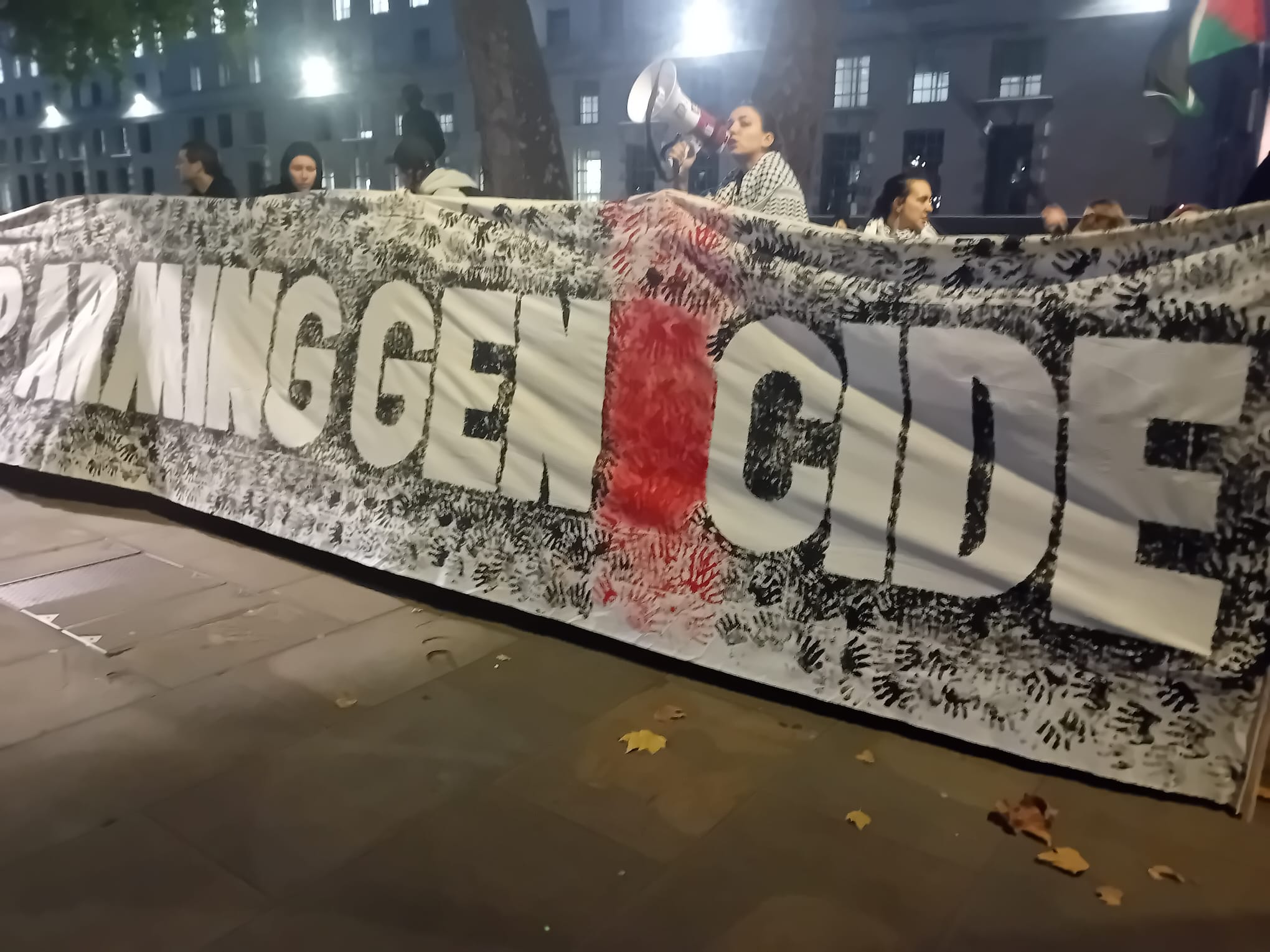
Daily Stop Arming Genocide banner outside Houses of Parliament, Westminster, London. (Source photo: Internet)

Palestine Action’s tactics mainly consist of occupations, blockades and drenching premises in red paint to symbolise the blood on the hands of these profiteering companies.

Until recently, although a lot of these actions led to arrests, very few Palestine Action activists ended up behind bars. This has changed since Keir Starmer’s Labour government came to power. There are currently 18 Palestine Action activists in prison in England, along with 2 in Scotland.

One of the Scottish prisoners is the last of the group known as the Thales 5, who were convicted of occupying the roof of the Glasgow premises of French company Thales in 2022. Thales was working with Elbit to produce Watchkeeper drones for the British military.

The prisoners in England have not been convicted and are all held on remand, having been refused bail by the courts.  The majority were arrested in relation to actions against the Filton arms factory in Bristol. Ten people were remanded in August and a further eight in November. 

Although none have been charged with terrorism offences, the TA was used to effect their arrests, allowing the police more powers to detain pre-charge, raid homes and generally act in a heavy-handed manner. 

In the latest arrests in November, flatmates and families were evicted from their homes, sometimes for several days while the police searched premises.  In one raid, the mother and younger brother of the person arrested were both handcuffed, despite not being accused of any offence.

In prison, those on remand for pro-Palestine direct action have come in for special scrutiny and additional intrusive measures on top of those which all prisoners are forced to deal with.

The six women detained in Bronzefield prison in August were all allocated to separate wings and deliberately prevented from associating with one another. Their mail has been heavily censored.

Four male prisoners in Wormwood Scrubs, although not subject to the same separation regime, have also had their correspondence held up, censored and returned to sender, with supporters being served with notices to the effect that no communication between them is permitted.

FRFI successfully appealed against such a notice in relation to our sending the paper to the prisoners, although the prison claims it still has a right to withhold the paper or other publications if the censors decide they are ‘inappropriate for a prison setting’.

The purpose of all this is clearly to scare those it is directly targeting it and to deter others from coming forward to join Palestine Action’s activities.

As Palestine Action carries out more actions against Elbit, including repeatedly blockading the UAV Engines site at Shenstone in the Midlands, which manufactures engines for Elbit, it is clear that the repression is not succeeding.

Palestine solidarity demonstration Downing Street 14 December 2024. (Source photo: Internet)

Kitson methodology

General Sir Frank Edward Kitson died on 2 January 2024, aged 97, after a long and illustrious career as a dedicated servant of British imperialism.

In addition to the litany of his war crimes, he will be remembered for authoring the text book Low Intensity Operations – Subversion, Insurgency and Peace-keeping (1971), a manual for dealing with subversive and recalcitrant populations, both at home and abroad.

Kitson’s work continues to form a central plank of British strategy for policing dissent and his disciples are clearly leading policing operations against pro-Palestine protesters.

In Kitson’s book, he details how ‘psychological operations’ should be used to isolate ‘subversives’ from the people while building links with and strengthening support for moderate elements who do not oppose the state but disagree on certain policies.

This technique was used both abroad in Britain’s colonies, and at home to police, for example, the Irish solidarity movement of the 1970s-80s.

Today’s ‘moderates’ take the form of the PSC, Stop the War and similar organisations. PSC marches are negotiated with the police, with strict conditions imposed on the protests.

The PSC has provided no support for people arrested on its demonstrations, citing the low arrest rates as proof of how respectable their protests are, while distancing itself from those who have been targeted.

While the PSC opposes Zionist massacres of the Palestinian people, it does not support the resistance of those under attack. 

Consequently it does not complain when the British police uses Terrorism Act powers to criminalise people for supporting the right of Palestinians to resist their oppressors through armed struggle.

This treachery puts the PSC on the wrong side of international law – oppressed nations successfully fought for the right to self-defence by means of armed struggle to be enshrined in UN resolutions in 1974 and 1982.

Fighting back, building solidarity

For some of us, the culture around supporting our arrested comrades was drilled into us many years ago.  A whole new generation has had to learn these lessons. 

It is positive to see that, although the PSC and such organisations continue not to want to get their hands dirty with supporting anyone targeted by the police, a different attitude is also widespread and ‘arrestee support’, prison solidarity letter-writing etc are common currency among activists. 

At the same time there is an element of this solidarity which is depoliticised. For example, the provision of a constant presence at a police station to monitor things and be there when arrestees are released is a good thing and the support organisations which provide this do an invaluable job.

However, when we have comrades under arrest, we want to do more than legal monitoring and instead turn the police station into a focus for protest.  The same with courts and prisons. 

It’s very positive to see Palestine Action, the SOAS encampment and others also doing this to great effect, thus ensuring that the focus is not just on the Israeli companies who are their principle targets, but also on the British criminal justice machinery which is being marshalled against those who take a stand.

Our task, as always, here in the belly of the imperialist beast, remains to protest against the British government and British corporations’ complicity in the Zionist genocide.

And to show unconditional solidarity with those who fight back against the Zionist war machine by whatever means are at their disposal.

Supporting the resistance and opposing the British state cannot fail to bring us into conflict with that same state and we must continue to stand alongside everyone who is criminalised for their solidarity.

End.

SOURCE

ISRAEL AND USA TRY TO DETERMINE INTERNAL LEBANESE POLITICS

Qassam Muaddi (Reprinted from Mondoweiss 12/ 11/ 2024) with current introduction by Diarmuid Breatnach)

(Reading time: 7 mins.)

INTRODUCTION:

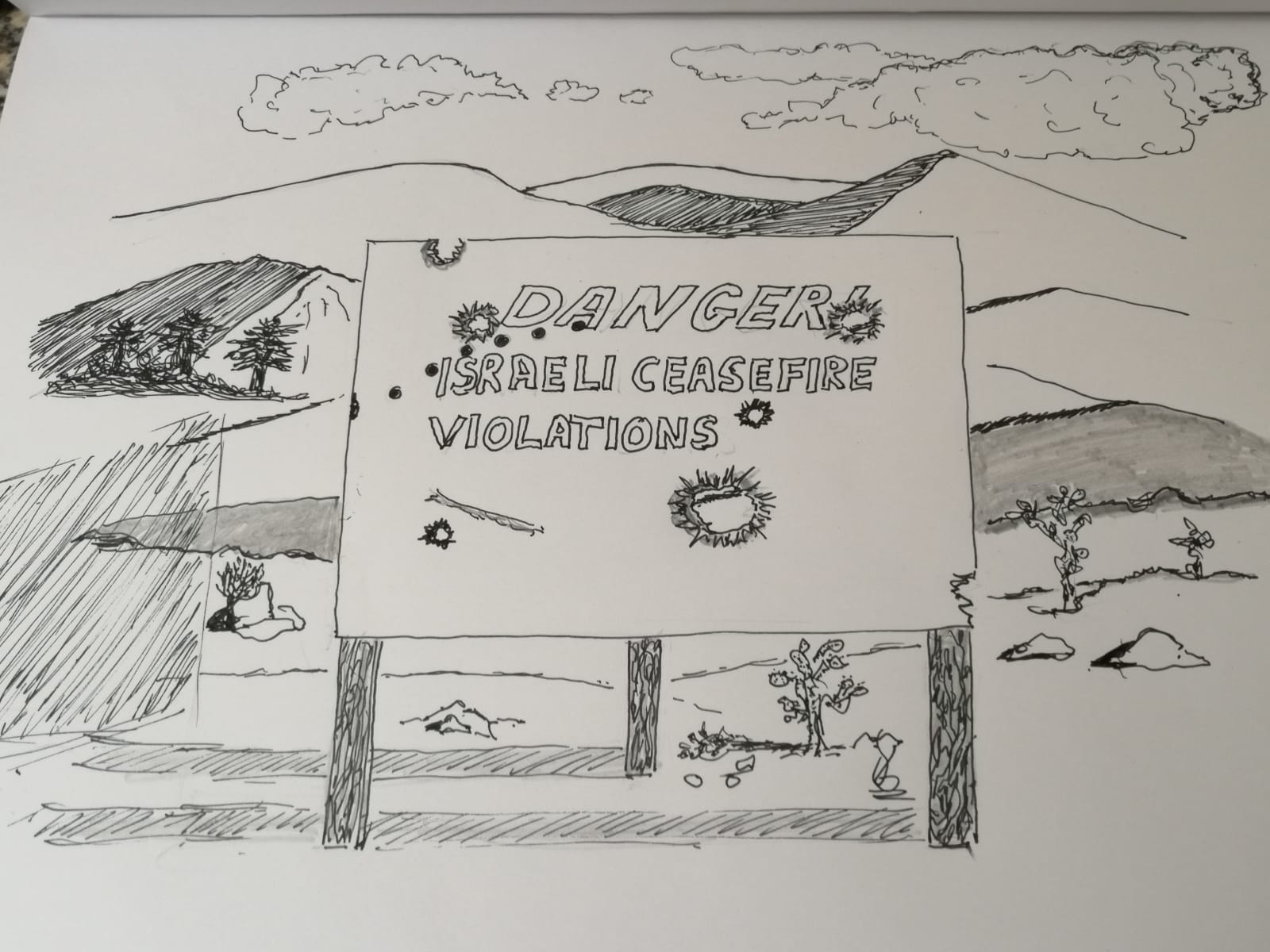
Imperialist and Zionist intervention in Lebanon continues after the recent war as it did before, although the IOF failed thoroughly in its attempted invasion before the truce (if we can call it that, with near 500 recorded IOF ceasefire violations to date).

The USA’s envoy Hochstein’s claims the IOF will pull out at the fast approaching 60-day date stipulated in the ceasefire agreement.

Apart from decoupling Hezbollah from active support for the Resistance in Gaza, where the genocidal war may continue and possibly even intensify, the war against Lebanese sovereignty will continue, albeit in the shadows.

When the victorious powers in the imperialist World War I sat down to divide up the spoils, chiefly between the UK and France, the latter’s share included what is now Lebanon and Syria. The present constitution of the Lebanese state bears an unmistakeable French imprint.

The ‘international’ negotiators of the ceasefire sought by Israel therefore, France and USA, were the old French colonial imperialists of the region and their new supplanters, the US imperialists.1 These will continue their efforts to bring Lebanon firmly under imperialist control.

And ‘Israel’ will assist them in particular through its intelligence services: recall Netanyahu’s public attempt on 8th October to encourage political forces hostile to Hezbollah in Lebanon to rise up against the Resistance while simultaneously the IOF bombed Lebanese civilians!

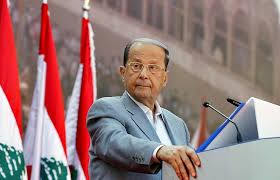
The cavalier attitude of the head of Lebanon’s army, Josef Aoun, towards the Lebanese parliament last November seemed an early indication of this shadows war and, considering the importance of the Army in Lebanese politics, may bode ill for the future.2

New President of Lebanon, Michel Aoun (incorrectly elected while still head of the Army), reviewing troops as formal inauguration procedure. (Photo sourced: Internet)

In his first speech as the new Secretary General of Hezbollah, Naim Qassem said that the US Ambassador to Lebanon had been meeting leaders of Lebanese political parties opposed to Hezbollah.

According to Qassem, the Ambassador was trying to convince them that Hezbollah’s collapse in the face of Israel’s offensive was imminent, urging the Lebanese parties to oppose Hezbollah.

Two weeks earlier, a group of anti-Hezbollah parties gathered in the town of Maarab in Mount Lebanon, the headquarters of the “Lebanese Forces” — a far-right Christian party headed by its chairman, Samir Geagea.

The parties in attendance issued a joint statement that indirectly blamed Iran for pushing Lebanon into a war it had no stake in, hijacking the decision of peace and war in Lebanon, and recruiting Lebanese citizens and using them as soldiers and “human shields.”

The latter phrase was a veiled reference to Hezbollah, its social support base, and the people of southern Lebanon in general. The parties in Maarab also called for the election of a new president to the country.

Heading the meeting was Samir Geagea, a Maronite Christian known for his brutal suppression of Palestinian and Lebanese adversaries, including Christian rivals, during the Lebanese Civil War that took place between 1975 and 1989.

Samir Geagea, Lebanese anti-Hezbollah politician, photographed in days of membership of the fascist Christian Lebanese militia, proxy of the Israeli occupation of Lebanon. (Photo sourced: Internet)

He is also known for his collaboration with Israeli occupation forces in Lebanon after 1982 and for having spent 12 years in a Syrian prison on charges of collaboration with Israel.

Geagea has also been openly voicing his will to run for the Presidency of Lebanon, which under the Lebanese constitution must be held by a Christian Maronite. The president’s chair has been vacant for two years now, as the opposing political forces have failed to agree on a candidate.

The president in Lebanon is elected by the parliament and thus needs a degree of consensus between represented parties, which has been absent since the latest president, Michel Aoun, finished his term in October 2022.

Former Lebanon President Michel Aoun, ally of Hezbollah. (Photo sourced: Internet)

Michel Aoun was an ally of Hezbollah and represented an important trend of Christian community support for the resistance group in Lebanese politics since 2008.

During his presidency, Hezbollah’s adversaries in Lebanon, like Geagea, continued to accuse the resistance group of taking over the state, especially during the height of the Syrian Civil War, in which Hezbollah was actively involved in defending the regime of Syrian President Bashar al-Asad.

After Michel Aoun’s presidency, several political parties were unwilling to accept a president close to Hezbollah and its allies, entailing a vacancy to the recent election when Hezbollah’s preferred candidate Frangieh pulled out of the contest and endorsed Josef Aoun4‘s successful candidacy.

Diarmuid Breatnach

Why the Lebanese presidency is important for Israel

When Israel began its offensive on Lebanon with the exploding pager and electronics attacks in mid-September, some Lebanese politicians seemed to have sensed that the influential role of Hezbollah in Lebanese politics was approaching its end.

Calls to elect a new president increased, as the U.S. envoy, Amos Hochstein, brought his plan for a ceasefire.

Hochstein’s proposal included the retreat of Hezbollah’s fighting units north of the Litani River, essentially clearing Hezbollah’s stronghold in the south, and deploying more Lebanese army forces along the provisional border between Israel and Lebanon. 

Plotting on the dining terrace: US Ambassador Lebanon Dorothy Shea and White House Adviser Amos Hochstein in Beirut on 30 August 2023. (Photo cred: Cradle @ amos hochstein)

Hochstein’s plan, however, included another component — he called for electing a new president for Lebanon, even considering it a priority before a ceasefire with Israel.

The president in Lebanon is also the commander-in-chief of the army, which is why many army chiefs of staff were elected to the presidency in the past.

Historically, the president’s relationship with the army’s command influenced the role played by the armed forces, and this relationship has been especially crucial in the case of Hezbollah.

In the last years of Hezbollah’s guerrilla campaign against the Israeli occupation of southern Lebanon between 1998 and 2000, the Lebanese army played a role in covering safe routes for Hezbollah’s fighters in and out of the occupied area and in holding key positions.

This support by the army to Hezbollah’s resistance was the result of the direction and influence of the country’s President, Emile Lahoud, who had served as Chief of Staff of the army a few years earlier and refused to obey orders to clash with and disarm Hezbollah’s fighters.

The position of the Lebanese president, his influence on the army’s performance, and his relationship with the resistance have always been at the heart of Israeli and U.S. attempts to intervene in Lebanese politics.

It is not the first time that the U.S. and Israel have pressured for the election of a new Lebanese president as it is under Israeli attack. The presidency ploy is a worn U.S. tool for attempting to change Lebanon’s political landscape and to make it more Israel-friendly.

When Israel invaded Lebanon in 1982 and occupied its capital, Beirut, after the withdrawal of the Palestine Liberation Organization, the Lebanese parliament met to elect a new president — quite literally, under the watchful eye of Israeli tanks.

The parliament building was non-functional, and the Lebanese representatives had to meet with an incomplete quorum in the building of the military school to elect Bashir Gemayel as president.

Gemayel was the leader of the far-right anti-Palestinian Phalange party, or Kataeb. The Phalangists had helped Israel plan the invasion of Lebanon and fought on Israel’s side in the 1982 war.

Pierre Gemayel, strong man of the fascist Lebanese Christian sector and ally of Israel, elected by inquorate parliament literally under Israeli tank guns, whose assassination halted the slide towards Lebanese alliance with (under) Israel. (Photo sourced: Internet)

Gemayel had travelled to Israel several times to meet with Israeli leaders and committed to signing a peace treaty with Israel as soon as he became president.

Gemayel was the strongman of the anti-Palestinian Lebanese Right, and he was the only leader with enough support and force to carry out Israel’s strategy in Lebanon.

His assassination 22 days after his election and before he was sworn in was one of the most devastating blows to Israel’s plans to bring Lebanon under Israeli influence.

In revenge for Gemayel’s death, the Phalangist militias entered the Palestinian refugee camps of Sabra and Shatila in the periphery of Beirut under Israeli cover. There, they committed the now infamous Sabra and Shatilla Massacre, slaughtering between 2,000 and 3,500 Palestinian refugees.3

Following the end of the Lebanese Civil War in 1989, the parties who had fought against each other entered into a power-sharing arrangement.

Meanwhile, the nascent Lebanese resistance group, Hezbollah — which started as an offshoot of the Shiite Amal militia during an episode of violence called the War of the Camps — increased its popularity and political influence.

This influence grew exponentially after Israel’s withdrawal from the occupied Lebanese south, which marked the first victory of an Arab resistance force against Israeli occupation.

By the beginning of the 2000s, Hezbollah had become a political party that ran for elections, secured parliamentary representation, and forged alliances with other Lebanese forces.

Political divisions in Lebanon began to appear once again on both sides of the question of the resistance, often attributed by its antagonists to Syrian, and later Iranian, influence in the region.

The identity of Lebanon’s president became a central issue again, especially after the 2006 Israeli war on Lebanon, during which Emile Lahoud’s presidency provided strong political support for Hezbollah. Lahoud finished his term the following year amid strong political division.

The state of fragmentation in Lebanese politics was so endemic that the president’s chair remained vacant for an entire year. The crisis was partially resolved with the election of the army’s chief of staff, Michael Suleiman, in 2008, who remained neutral.

Forty-two years after the first election of a Lebanese president at the behest of Israel, not much has changed. Lebanon is again under attack, and the resistance continues to be a central point of division over the future of the country and its position in the broader region.

Although Hezbollah insists that its resistance is tied to the genocidal Israeli war on Gaza, both Israel and the U.S. continue to look for ways to neutralize Lebanon through internal divisions and political disagreements.

As Israeli army officials begin to voice their demands to end the war — a war that was hitting a wall in the villages and mountains of southern Lebanon — it seems that Hezbollah’s adversaries continue to bet on Israel’s military capacity to bring about a “day after Hezbollah.”

Perhaps more confidently than Israel itself.

Qassam Muaddi

FOOTNOTES:

1 The condemnation by the USA of the UK/ France/ Israel attack on Nasser’s Egypt in 1956 was clearly an admonition that the old colonial rulers of the Middle East (and of much of the World) now had to give way to the new ruler – US imperialism — and the old ways of gunboats and invasion had to be replaced by suborning the local middle classes and control through finance and trade. Of course as time went on the USA too resorted to invasions and gunboats (or at least aircraft carriers). — DB

2 See https://thecradle.co/articles/beirut-in-the-dark-about-lebanese-armys-deployment-plan-for-south-lebanon-report

3 16–18 September 1982, its anniversary is not long past – RB.

4 1Not a close relation of Michel Aoun.

SOURCES:

Naim Qassem’s first speech as leader Hezbollah, November 2025: https://www.palestinechronicle.com/hezbollahs-new-leader-made-first-speech-today-this-is-what-he-said/

Israel ceasefire violations: https://www.aa.com.tr/en/middle-east/-lebanon-reports-4-more-israeli-violations-of-cease-fire-deal/3448885

Hezbollah’s preferred candidate Frangieh endorsed Josef Aoun: https://www.breakingnews.ie/world/lebanese-parliament-tries-for-12th-time-to-elect-new-president-1715733.html2Hezbollah’s preferred candidate Frangieh endorsed Josef Aoun: https://www.breakingnews.ie/world/lebanese-parliament-tries-for-12th-time-to-elect-new-president-1715733.html

Manufacturing Rebels: How the US and UK empowered HTS

by Kit Klarenberg (republished and somewhat reformatted with kind permission from his article in The Cradle) https://thecradle.co/articles/manufacturing-rebels-how-the-uk-and-us-empowered-hts
(Reading time: 7 mins.)

On 18 December, The Telegraph published an extraordinary investigation into how the UK and US trained and “prepared” fighters in the Revolutionary Commando Army (RCA).

This was a “rebel” force that collaborated with Hayat Tahrir al-Sham (HTS) in the mass offensive toppling of Syrian president Bashar al-Assad weeks earlier. 

In an unprecedented disclosure, the outlet revealed that Washington not only “knew about the offensive” well in advance, but also had “precise intelligence about its scale.”

Washington’s now-confirmed “effective alliance” with HTS was described as “one of many ironies” emerging from the decade-and-a-half-long proxy war.

The Telegraph suggested this collaboration was inadvertent – simply a symptom of how Syria’s grinding, protracted civil war gave birth to “a bewildering array of militias and alliances, most of them backed by foreign powers.” 

US support of HTS: A ‘necessary’ alliance 

Alliances were fluid, with groups often splintering, merging, and shifting allegiances. Fighters frequently found themselves switching sides, blurring lines between factions.

Yet, ample evidence indicates the UK and the US maintained deliberate, long-standing ties with the dominant rebels of HTS.

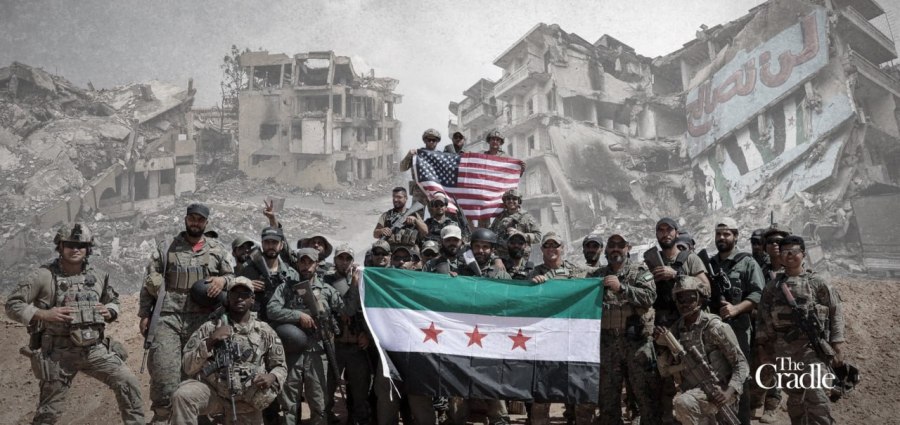
(Photo cred: The Cradle)

For instance, in March 2021, President-elect Donald Trump’s former lead Syria envoy, James Jeffrey, gave a revealing interview to PBS, during which he disclosed that Washington secured a specific “waiver” from then-secretary of state Mike Pompeo to assist HTS. 

While this did not permit direct funding or arming of the UN/US-designated terrorist organization, the waiver ensured that if US-supplied resources “somehow” ended up with HTS, western actors “[could not] be blamed.” 

The fungibility of weapons on the Syrian battlefield was something Washington counted on heavily.

In a 2015 interview, CENTCOM spokesman Lieutenant Commander Kyle Raines was quizzed about why Pentagon-vetted fighters’ weapons were showing up in the hands of the Nusra Front (precursor to HTS).

Raines responded: “We don’t ‘command and control’ these forces – we only ‘train and enable’ them. Who they say they’re allying with, that’s their business.”

This legal loophole enabled Washington to “indirectly” support HTS, ensuring the group did not collapse while maintaining its designation as a terrorist organization.

This status was complete with a now-rescinded $10 million bounty on leader Abu Mohammad al-Julani, who now goes by his real name Ahmad al-Sharaa. 

Jeffrey rationalized this strategy, calling HTS “the least bad option” for preserving “a US-managed security system in the region,” and thus worth “[leaving] alone.” HTS’s dominance, in turn, gave Turkiye a platform to operate in Idlib.

Meanwhile, HTS sent unmistakable messages to their US patrons, pleading:

We want to be your friend. We’re not terrorists. We’re just fighting Assad.”

Safe haven’

Since Assad’s fall, officials in London have markedly taken the lead in legitimizing the HTS-led interim administration as Syria’s new government.

The group was added to the UK’s list of proscribed terrorist organizations in 2017, its entry stating HTS should be considered among “alternative names” for the long-banned Al-Qaeda.

While UK Prime Minister Keir Starmer declared it “too early” to rescind the group’s designation, British officials met HTS representatives on 16 December – despite the illegality of such meetings.

This likely signals an impending, highly politicized western rehabilitation of HTS. Throughout Syria’s dirty war, UK intelligence waged extensive psychological operations to promote “moderate rebels,” crafting atrocity propaganda and human-interest stories. 

These efforts were ostensibly aimed at undermining groups like HTS, ISIS, and Al-Qaeda. Yet leaked documents from UK intelligence reveal how HTS remained intertwined with Al-Qaeda post-2016, directly contradicting media narratives.

In other words, throughout the decade-and-a-half-long crisis, HTS was officially considered on par with the most fundamentalist, genocidal elements in the country. 

British documents also make a total mockery of the common refrain that HTS severed all ties with Al-Qaeda in 2016. A 2020 file described how Al-Qaeda “co-exists” with HTS in occupied Syrian territory, using it as a launchpad for transnational attacks. 

The document warned that HTS’s domination created a “safe haven” for Al-Qaeda to train and expand, fueled by instability. British psyops against HTS spanned years but ultimately failed.

Instead, leaked files lament HTS’s growing influence, territorial gains, and re-branding as an alternative government.

[Al-Qaeda] remains an explicitly Salafi-Jihadist transnational group with objectives and targets which extend outside Syria’s borders. [Al-Qaeda’s] priority is to maintain an instability fuelled safe haven in Syria, from which they are able to train and prepare for future expansion. HTS domination of north west Syria provides space for [Al-Qaeda] aligned groups and individuals to exist.”

British-backed propaganda benefiting HTS

British intelligence psyops attempting to hinder HTS were in operation from the group’s founding until recently.

Yet, they appear to have achieved nothing. Numerous leaked files reviewed by The Cradle bemoan how HTS’s “influence and territorial control” had “dramatically grown” over the years. 

Its successes allowed the extremist group “to consolidate its position, neutralize opponents, and position itself as a key actor in northern Syria.” But HTS’s “domination” was secured in part by the group re-branding itself as an alternative government.

HTS-occupied territory was home to a variety of parallel service providers and institutions, including hospitals, law enforcement, schools, and courts.

The group’s domestic and international propaganda specifically promoted these resources as a demonstration of an “alternative” Syria awaiting roll-out across the entire country.

Ironically, many of these structures and organizations – such as the infamous White Helmets, who also operated in ISIS-run territories – were direct products of British intelligence, created for regime change propaganda purposes.

Moreover, they were aggressively promoted by London at enormous expense.

Repeated references are made in leaked UK intelligence documents to the importance of “[raising] awareness of moderate opposition service provision,” and providing domestic and international audiences with “compelling narratives and demonstrations of a credible alternative to the [Assad] regime.”

There is no consideration evident in the files that these efforts might be assisting HTS greatly in its own efforts to present itself as a “credible alternative” to Assad.

Nonetheless, it is acknowledged that Syrians in occupied territory would accommodate HTS “particularly if [they are] receiving services from it.”

Even more eerily, the documents note, “HTS and other extremist armed groups are significantly less likely to attack opposition entities that are receiving support” from the UK government’s Conflict, Stability, and Security Fund (CSSF). 

This was the mechanism through which Britain’s Syrian propaganda war and organizations like the White Helmets and extremist-linked Free Syrian Police were financed.

These UK-run governance structures and opposition elements, which were allegedly intended to “undermine” HTS, operated in areas controlled by the group safe from violent reprisals for their foreign-funded work, as they “demonstrably provide key services” to residents of occupied territory.

There is also the darker prospect that HTS was well aware these “opposition entities” were bankrolled by British intelligence, and they were unmolested on that very basis.

Coordinated offensive

As The Telegraph‘s report explains, “the first indication that Washington had prior knowledge” of HTS’s offensive was when its RCA proxies were given a rousing pep talk by their US handlers three weeks prior. 

At a secret meeting at the US-controlled Al-Tanf air base close to the borders of Jordan and Iraq, the militants were told to scale up their forces and “be ready” for an attack that “could lead to the end” of Assad. A quoted RCA captain told the outlet:

They did not tell us how it would happen. We were just told: ‘Everything is about to change. This is your moment. Either Assad will fall, or you will fall.’ But they did not say when or where, they just told us to be ready.”

This followed US officers at the base, swelling the RCA’s ranks by unifying the group with other UK/US-trained, funded, and directed Sunni desert units and rebel units operating out of Al-Tanf under joint command. 

According to The Telegraph, “RCA and the fighters of HTS … were cooperating, and communication between the two forces was being coordinated by the Americans.”

This collaboration proved to be of devastating effect in the “lightning offensive,” with RCA rapidly seizing key territory across the country upon explicit US orders.

RCA even joined forces with another rebel faction in the southern city of Deraa, which reached Damascus before HTS. RCA now occupies roughly one-fifth of the country, pockets of territory in Damascus, and the ancient city of Palmyra. 

Hitherto “heavily defended” by Russia and Hezbollah, Moscow’s local base has now been taken over by RCA. “All members of the force continued to be armed by the US,” receiving salaries of $400 monthly, nearly 12 times what Syrian Arab Army (SAA) soldiers were paid.

It is uncertain whether this direct financing of the RCA and other extremist militias that toppled the Assad government continues today. What is clear, though, is that the UK and US supported HTS from the group’s inception, even if “indirectly.”

In turn, this covert backing played a pivotal role in positioning HTS financially, geopolitically, materially, and militarily for its “lightning” swoop on Damascus and assumption of government today.

Reinforcing the interpretation that this was the objective of London and Washington all along, following Assad’s ouster, Starmer promptly declared that the UK would “play a more present and consistent role” in West Asia as a result. 

While western and certain regional capitals may celebrate the apparent success of their lavishly funded, blood-soaked campaign to dismantle decades of Baathism, British intelligence had long cautioned that the outcome would grant Al-Qaeda an even larger “instability-fueled safe haven” for “future expansion.”

ZIONIST DUBLIN EMBASSY CLOSES TO REGRETS AND CELEBRATIONS

Diarmuid Breatnach

(Reading time: 3 mins.)

The Zionist state announced the closure of its embassy in Dublin, accusing the Irish Government of being anti-Israel.1 The broad Palestine solidarity movement celebrated the announcement while Harris for the Irish Government expressed regret.

The Zionist Embassy at 28 Shelbourne Road, Ballsbridge, Dublin has been without an Ambassador since she left Ireland last May in protest after the Irish Government, along with the Spanish and Norwegian governments, officially recognised the state of Palestine.2

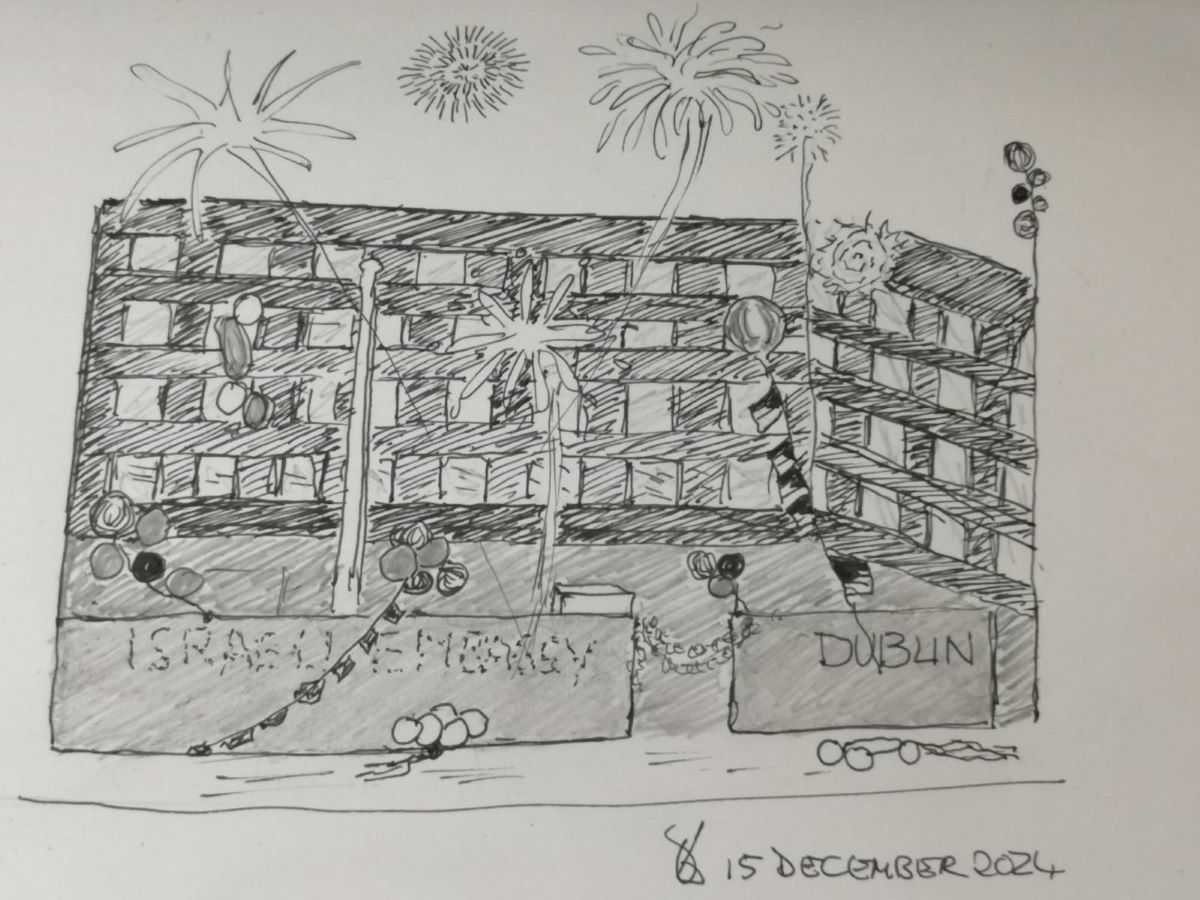
D.B cartoon drawing of celebrations outside the block in which the Zionist Embassy was located (and under 24-hour Garda protection). Many of the other users of the building will be relieved at the departure also.

However the Irish State’s recent decision to join South Africa’s case against Israel at the International Court of Justice3 seems to have prompted the closure of the Embassy and led once again to allegations of “anti-semitism” in Ireland which the President called a “gross slander”.4

Simon Harris, Taoiseach (prime minister equivalent) of the outgoing Irish Government5 expressed his regret at the ‘Israeli’ decision while at the same time rejecting vigorously the allegation that the Government is anti-Israel. He is absolutely correct in doing so.

Irish Governments have consistently been pro-Israel and colluding with Zionism, in contradiction to Irish popular opinion. The outgoing government6 has allowed military supplies for ‘Israel’ to fly through Irish airspace and the US military to land and depart from Shannon Airport.

One of the participants outside the Israeli Embassy yesterday celebrating its imminent departure. (Photo: D.Breatnach)

The Irish Government has also held up for years the relatively mild UN-compliant Occupied Territories Bill. These points were well made in an Al Jazeera Inside Story7 program by Mícheál Mac Donncha, Sinn Féin Dublin City Councillor and by Zoe Lawlor, IPSC8 Chairperson.

Both did well outlining the general attitude of the Irish people to which the government was – to an extent – responding and in refuting the slur of anti-semitism on the Irish people. Lawlor pointed to the Irish history of resistance as a motivator but appears unaware that we once supported Israel.

This is important (and I have written about it9) because it shows that we are capable of changing our position to a better one when presented with the evidence of the need to do so, which task the Zionist themselves carried out for us.

However both speakers failed to answer the interviewer’s question of why the Irish government did not go further.

This is an essential question for us and the answer makes sense of the current political landscape with crucial import beyond the issues of Palestine and Zionism. Mac Donncha seemed to avoid the question entirely and chose instead to talk about actions that the Government should take.

The interviewer however put it bluntly to Lawlor that the reason was a reluctance to offend the USA, though presenting it as a fear of putting off US corporations’ investments. Lawlor correctly replied that corporations make decisions based on profit but avoided giving the political answer.

The Irish ruling class is a neo-colonial one and responds to requirements of its masters. These have been firstly the UK, followed by the US and more recently the EU. All of these are imperialist states and bound up with the interests of the colonial fort in the Middle East which is the Zionist State.

(Photo: D.Breatnach)

I am sure that Mac Donncha is aware of those facts and pretty sure that Lawlor is too but both declined to provide the explanation being asked for. One must suspect in Mac Donncha’s case the reason is that his party, Sinn Féin, is busily making itself acceptable to that very ruling class.

And Lawlor probably wants to keep the clean image for the ruling class which the IPSC leadership has been at pains to develop, particularly during this current genocidal offensive.

While the IPSC leadership has played an important role in mobilising national demonstrations much of the activism has been and continues to be by organisations on the ground. The Embassy itself was invaded some time back by such groups and has seen militant blockades.

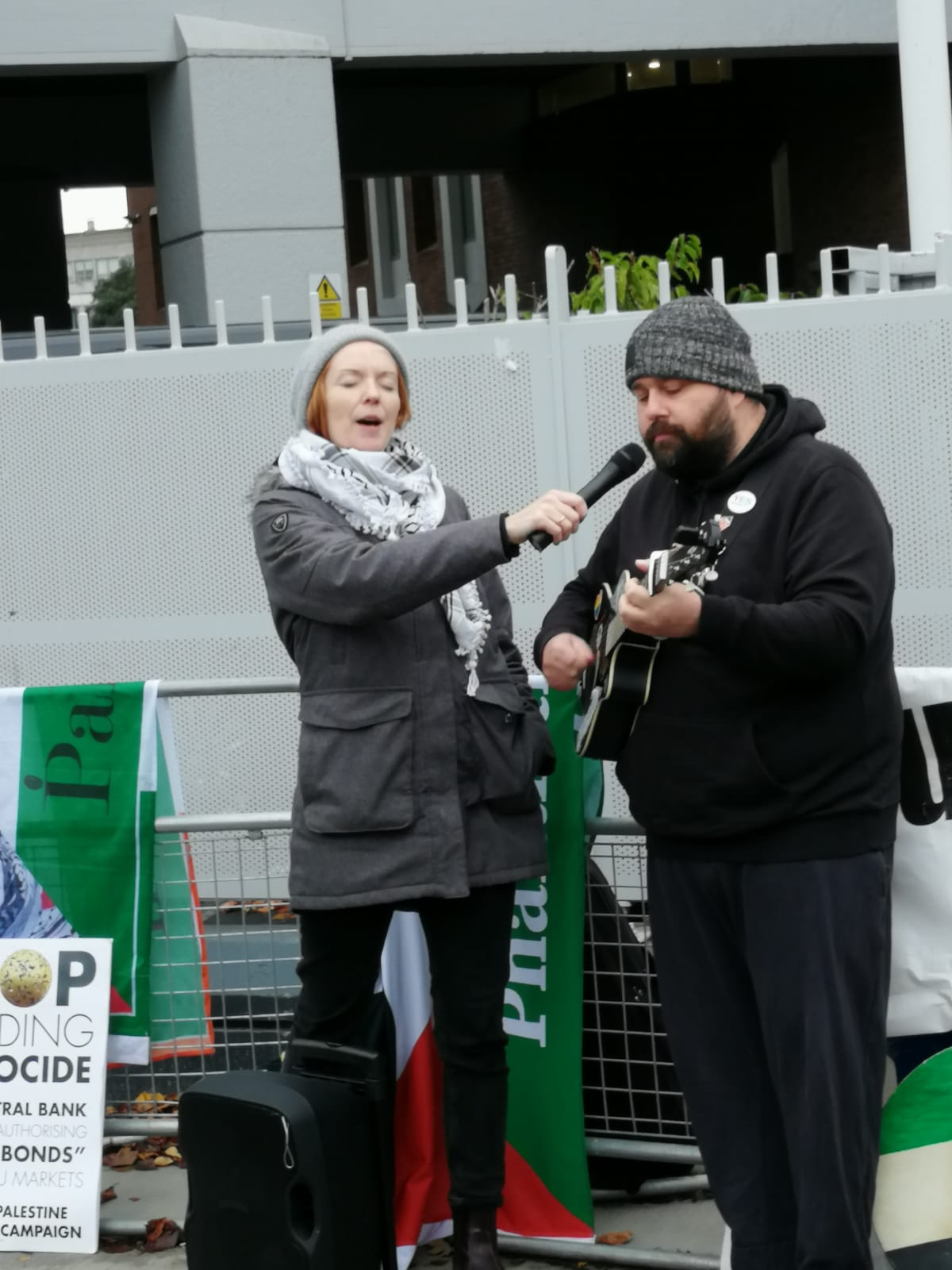
Jimi Cullen yesterday performing his composition “We Are All Palestinians” during a modest celebration outside the Zionist Embassy. Cullen has been performing outside there for an hour every Wednesday afternoon for 41 weeks. (Photo D.Breatnach)

Axa Insurance has been picketed frequently and occupied at least once and the Foreign Affairs Department was splattered with red paint while the Department of Transport was occupied. The US Embassy was picketed for three days in a row by organisations from Galway without IPSC support.

Only one IPSC march since October last year had the US Embassy as destination and on that occasion the march was led up quiet suburban streets to the stage set up next to police barricades blocking access to the Embassy gates and the main road into Dublin.

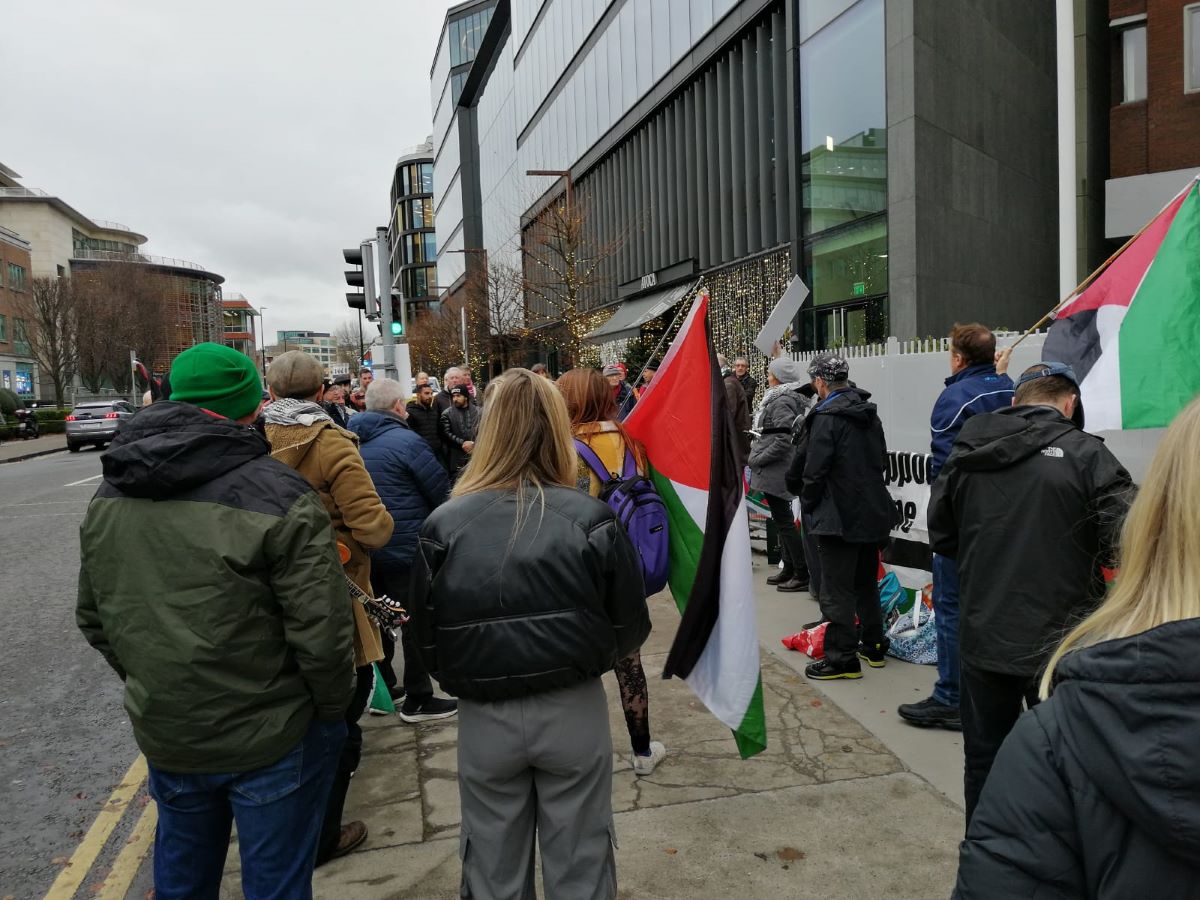
Section of the crowd yesterday afternoon celebrating its imminent departure outside the Zionist Embassy. (Photo D.Breatnach)

The general Irish public and in particular of course the activists in solidarity with Palestine can justly celebrate the departure of the Zionist Embassy. It is their symbolic victory.

However, there is no doubt that the Irish ruling class needs to be put under much heavier pressure than has heretofore been the case, if we are to shut down the collusion of the Irish Gombeen state with the Zionist genocide of Palestinians.

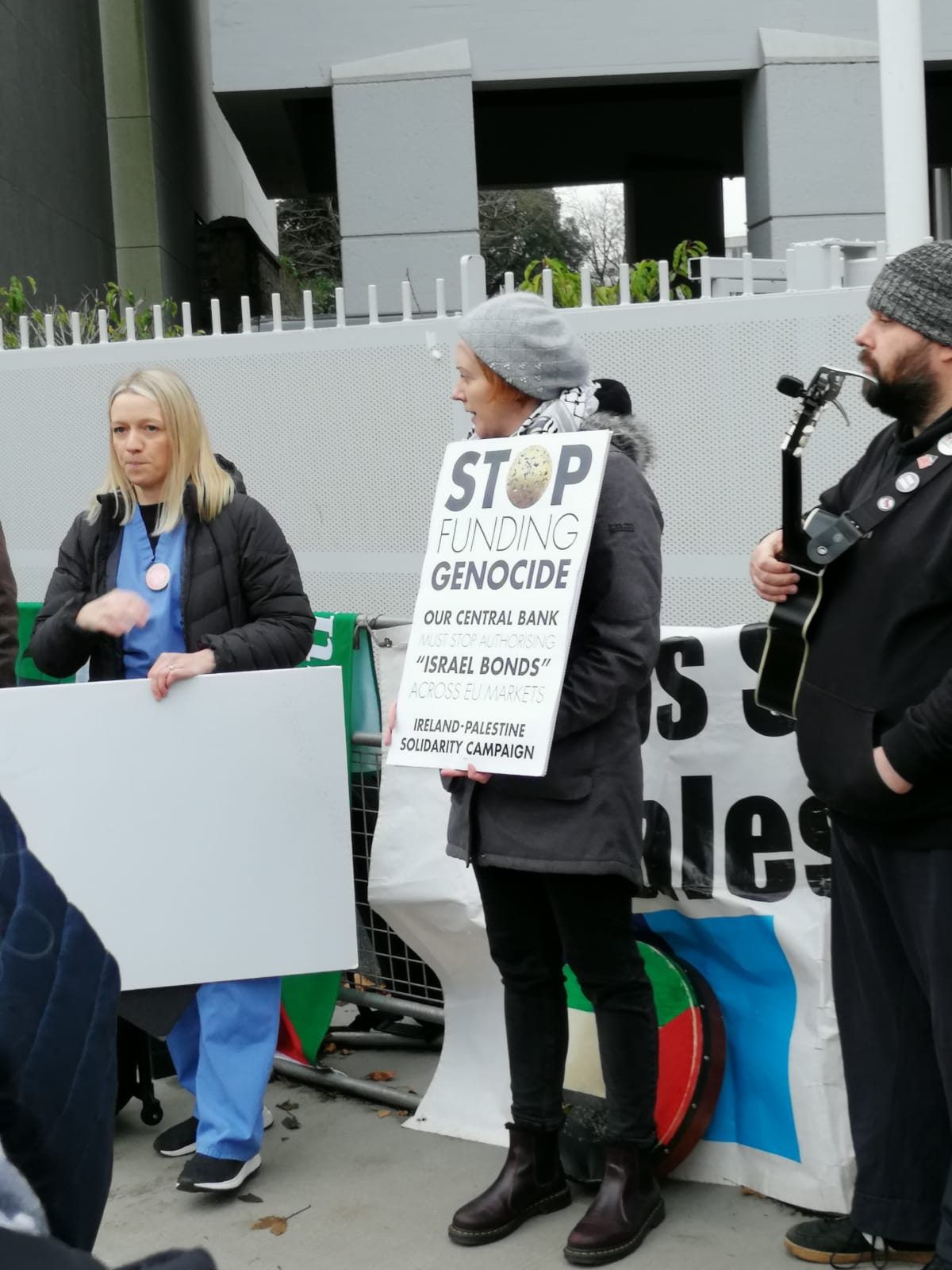
Outside the Zionist Embassy yesterday, an Irish healthworker calls for more effective solidarity with the Palestinians, in particular with the healthworkers being targeted by the IOF in Gaza. (Photo: D.Breatnach)

End.

FOOTNOTES

1https://www.theguardian.com/world/2024/dec/15/israel-to-close-dublin-embassy-after-ireland-supports-icj-genocide-petition

2https://www.gov.ie/en/press-release/71936-ireland-recognises-the-state-of-palestine. While the decision of those states has enraged the Zionist state, it is not as progressive as may seem at first glance. The ‘state’ that is being recognised is a) in addition to the state of Israel, i.e “the two-state solution” (sic); b) grants the Palestinians around 20% of Palestine which would be under the constant eyes and guns of the Zionists and c) is widely considered not realisable due to the proliferation of Zionist settlements and their special roads connecting them. Currently the only ‘government’ of such a state is the undemocratic, repressive and corrupt Fatah-controlled Palestinian Authority.

3Again this decision too has its deeply negative side since the Attorney General of the Irish State in his submission to the Preliminary Hearings on Genocide at the ICJ repeated the many times debunked Zionist propaganda of “mass rape by Hamas” during its breakout attack on October 7th.

4See Sources for link to the report,

5The elections of 29 November did not return any party with an absolute majority and discussions on forming a coalition government have been ongoing since the election results were confirmed.

6And many previous Irish governments too.

7See Sources for link to the program.

8Ireland Palestine Solidarity Campaign.

9https://villagemagazine.ie/opinion-ireland-and-palestine-a-late-love-affair/

SOURCES

https://www.theguardian.com/world/2024/dec/15/israel-to-close-dublin-embassy-after-ireland-supports-icj-genocide-petition

https://www.aljazeera.com/program/inside-story/2024/12/16/why-is-israel-shutting-its-embassy-in-ireland

https://www.irishexaminer.com/news/politics/arid-41538359.html

AWARD-WINNING DOCU-DRAMA LIFTS THE LID ON IRISH STATE CENSORSHIP

Clive Sulish

(Reading time: 5 mins.)

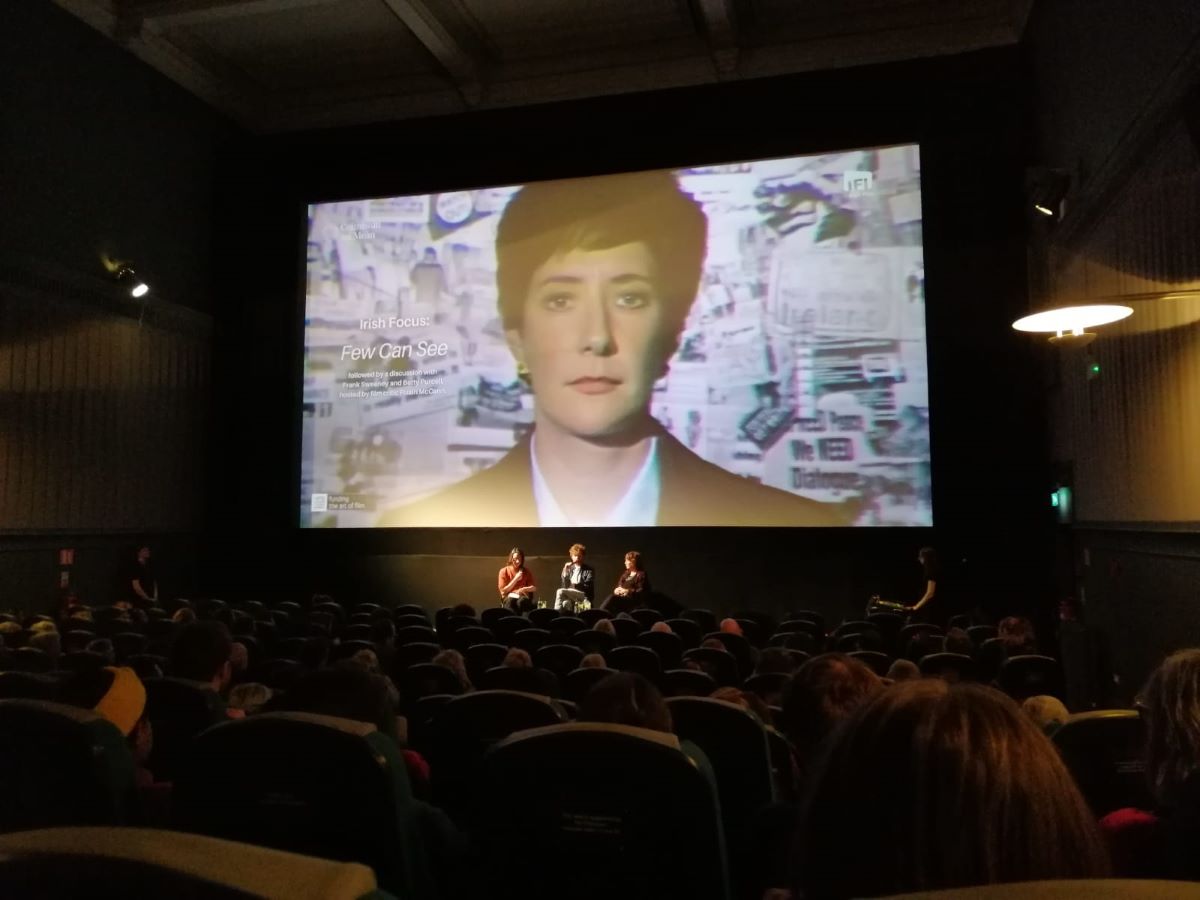
FEW CAN SEE – Censoring the Conflict was screened last week (Wednesday 4th night) in the Irish Film Institute to a moderately-sized audience, followed by questions of film-maker Frank Sweeney and Betty Purcell by​​​​​​ Ruairí McCann from Belfast.

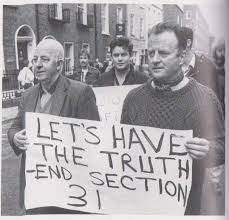
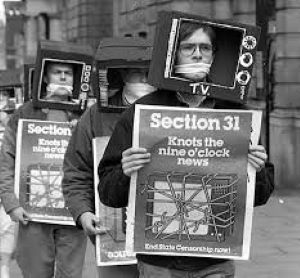
Sweeney took a look at state censorship during the three decades’ war in Ireland which was effected through the introduction of Section 31 of the Broadcasting Act, the sacking of the entire RTÉ Board of Directors and the jailing of a journalist.

Henceforth, self-censorship was the rule.

Specifically, the State ban applied during this period in refusals to interview any member of the IRA (Provisional or Official) and was later extended to Provisional Sinn Féin. It was enforced within RTÉ by management including members of the Workers’ Party1 who also led one of the unions.

Docudrama Few Can See focused on the application of the ban to spokespersons of people in the occupied Six Counties and of a number of campaigning groups: Gays Against the H-Blocks; Concerned Parents Against Drugs; the Gateaux bakery strike in Finglas (factory closed 1990).

Gay rights activists in Cork also campaigned against the H-Blocs and were subjected to censorship under Section 31. (Photo sourced: ICCL website)

Frank Sweeney said he had been intrigued by Betty Purcell’s memoir of her time producing programs for RTÉ and her battles with censorship there2. Conducting interviews with people about their experiences of being censored, he then worked the material into a script.

The format was of a 1980s studio with a program presenter in the style of the times and smoking, intercut with grunge-style footage, electronic interference noise and visuals, then narrowing to interviews with actors playing the parts of victims of the ban at the time.

If the intention was to show how ridiculous it could be to apply a political ban aimed at alleged terrorists instead to community struggles against oppression and the heroin epidemic, the struggle of gays around legality and health and a bakery strike, it succeeded.

The ‘RTE presenter’ in the docudrama screening (Photo: R.Breeze)

However, the issues of whose interests the State was representing in that period of heavy censorship and why it felt threatened were not teased out. Nor why it was able do what it did.

Had those issues been addressed we might have observed a vulnerable neo-colonial ruling class during a high point of struggle against the very colonial and neo-colonial nature of the state and the colony of its imperial neighbour, which also imposed censorship on broadcasting at home.

An aspect of such censorship which might not occur to one but which was discussed in the documentary is the effect of censorship not only on struggles of the time but also on the lack of available footage for archives in the future, leaving history the poorer in material.

Few Can See film has been screening around the world this year and has won some awards including the  Tiger Short Award at International Film Festival Rotterdam and is due in Barcelona next year, hopefully to be screened in Ireland again, followed by a fuller discussion.

Film maker Frank Sweeney (centre) speaking during post-screening discussion at the IFI with Ruairí McCann (left) and Purcell (almost out of shot, right). (Photo: R.Breeze)

In addition to exposing the State-led censorship of the past, Sinn Féin might benefit from the film as those who were being gagged were either members or were thought to be supporters of the party. However, SF has its own history of censoring critics both within the party and outside.

And as one member of the audience was heard to remark: “It’ll be the dissidents, not SF that will be getting censored now.” True, though no longer enforced by the State, rather voluntarily by program makers, editors and by the reporters themselves, as with the genocide in Palestine.

Indeed both Sweeney, Purcell and a member of the audience alluded to ongoing censorship around that subject. But it is not only suppression of the truth which is the problem but also the obligatory insertion of the false narrative that everything began on 7th October with the Palestinian raid.

BACKGROUND: THE BROADCASTING BAN MECHANISM

Section 31 of the Broadcasting Authority Act 1960 empowered the Minister for Posts and Telegraphs to issue a ministerial order to the government-appointed RTÉ Authority not to broadcast any material specified in the written order.

The first order under the section was issued in 1971 by Fianna Fáil Minister for posts and Telegraphs Gerry Collins. It instructed RTÉ not to broadcast

any matter that could be calculated to promote the aims or activities of any organisation which engages in, promotes, encourages or advocates the attaining of any particular objectives by violent means.

Collins refused clarification when RTÉ asked for advice on what this legal instruction meant in practice and RTÉ interpreted the Order politically to mean that spokespersons for the Provisional and Official IRA could no longer appear on air.

The following year, the government sacked the RTÉ Authority for not sufficiently disciplining broadcasters the government accused of breaching the Order.

RTÉ’s reporter Kevin O’Kelly had referred to an interview that he conducted with the then Provisional IRA Chief of Staff, Seán Mac Stíofáin, on the Radio Éireann This Week programme. The recorded interview was not itself broadcast, nor was Mac Stiofáin’s voice heard.

Premiere balladeer Christy Moore (right) marching with Provisional Sinn Féins Joe Cahill (Photo sourced: Internet)

Mac Stiofáin was arrested after the O’Kelly interview and charged with membership of the IRA, an organisation listed as illegal by the State.

Soon afterwards O’Kelly was jailed for ‘contempt’ at the non-jury Special Criminal Court because he refused to identify a voice on a tape seized by the Gardaí as that of Mac Stiofáin. However Mac Stiofáin was convicted anyway in the “sentencing tribunal” of the SCC.

O’Kelly appealed to the Supreme Court and a fine was substituted as a means of purging O’Kelly’s alleged contempt. O’Kelly declined to pay the fine but it was said to have been paid anonymously and O’Kelly was released.

In 1976, when Conor Cruise O’Brien  (Labour) Minister for Posts and Telegraphs amended Section 31 of the Broadcasting Act, he also issued a new Section 31 Order. This censored spokespersons for specific organisations, including the legal Sinn Féin political party, rather than specified content.

That prevented RTÉ from interviewing Sinn Féin spokespersons under any circumstances, even if the subject was unrelated to the IRA campaign in Northern Ireland conflict.

Visually impacting and clever punning in placard parade protest against Section 31. (Photo sourced: Internet)

Bizarrely even a call-in show on radio about gardening was interrupted once because a caller was a member of Sinn Féin. 

The changes undermined the relatively liberal interpretations by RTÉ of its censorship responsibilities under the original 1971 Order and encouraged a process of self-censorship and illiberal interpretation.

However in 1976 O’Brien attempted to extend the censorship to newspaper coverage of the conflict, targeting in particular The Irish Press, revealing his thinking in an interview with Washington Post reporter Bernard Nossiter, naming as a possible target Press Editor, Tim Pat Coogan.

Nossiter immediately alerted Coogan, who then published the Nossiter-O’Brien interview in the Irish Press (as did The Irish Times).

Due to public opposition the proposed provisions were amended to remove the perceived threat to newspapers.

But Fine Gael and Labour were not to be left out as the 1973-77 Fine Gael/ Labour Coalition Government also tried to prosecute the Irish Press for its coverage of the maltreatment (not to say torture) of republican prisoners by the Garda ‘Heavy Gang’, with the paper winning the case.

SOURCES

https://en.wikipedia.org/wiki/Censorship_in_the_Republic_of_Ireland

https://www.imdb.com/title/tt34242057/

1The Workers’ Party grew out of Official Sinn Féin which was declining after the split which led to the creation of Provisional Sinn Féin in 1970 and later another split, resulting in the 1974 creation of the Irish Republican Socialist Party. The WP was extremely hostile to the IRSP and PSF, in particular the latter.

2Inside RTÉ – a memoir, Betty Purcell, New Island Books (2014).

THE PALESTINIAN AUTHORITY: COLLUSION, CORRUPTION, REPRESSION, MURDER

Diarmuid Breatnach

(Reading time: 4 mins.)

The Palestinian Authority repressive forces has just murdered its 11th Palestinian since the Al Aqsa Flood operation.

An occupation force cannot control the people by its own brutal force alone – it needs partners in collusion, to spy, to give an appearance of representation, of due process but ultimately it needs that partner to exercise brutal force on its behalf.

On Monday (9th) the PA forces in Jenin (West Bank) murdered Rahbi Shalabi, 19, also seriously injuring his cousin, leading to protests, Resistance gunfire and explosions as a result. Shalabi was the 11th fatal victim of the PA, though many other Palestinians have been injured and jailed.1

Section of protest in West Bank Palestine against the PA’s murder of Rahbi Shalabi (Photo sourced: The Cradle)

A statement by the PA’s police, General Anwar Rajab, appears to attribute Shalabi’s death to firing by the Resistance or even a crossfire.2 Last Thursday Resistance fighters in Jenin confiscated two vehicles of the PA police in protest at the latter’s injuring and arrest of one of their members.

The PA has been repressing resistance in the areas it controls since its inception but repression has stepped up during the current accelerated genocide campaign of the IOF. A month after the latter commenced, the PA shot dead 12-year-old Razan Nazrallah during solidarity with Gaza protests.3

Razan Nassrallah, shot dead by the Palestinian Authority during solidarity with Gaza protest in the West Bank October 2023 (Photo sourced: Mahran Nassrallah)

During this whole period the PA has pursued Resistance fighters on behalf of the ‘Israeli’ Occupation, even entering hospitals in force in attempts to detain injured fighters.4 On at least two occasions popular mobilisations have prevented the PA forces achieving their aim.

The PA has killed known Resistance fighters5 and also removed defensive obstruction and exploded bombs planted in defence against IOF invasions.

A HISTORY OF CORRUPTION, COLLUSION AND REPRESSION

The Palestinian Authority was created in May 1994 as a 5-year interim body as part of the ‘Palestinian peace process’ (sic) through the Oslo Accords (1993-’95), signed up for the Palestine Liberation Organisation by the Al Fatah party,which won the 1996 Palestinian elections.

The Oslo Accords were rejected in the popular uprising of the Second Intifada (2000-2005). So corrupt, repressive and collusive had the PA and Fatah become that Hamas won the 2006 legislative elections throughout the West Bank and Gaza.

However it was only in Gaza that they forced the corrupt Fatah officials out when the latter refused to relinquish their posts in line with the elections.6 As a result, the PA central offices remained in the West Bank under Abbas, a Fatah nominee, continuing to receive EU and USA funding.

The PA under Mahmoud Abbas and Fatah control have continued in power (and funding) long past their allocated elected period and decline to hold new elections, for fear that Hamas would win once again.

President of the Palestinian Authority Mahmoud Abbas in Ramallah, West Bank, October 24, 2023. (Photo cred: Christophe Ena/Pool via REUTERS)

The PA does not deploy its militarised police force of 80,000 complete with armoured cars against the ‘Israeli’ Occupation, needless to say perhaps but nor does it send them to defend Palestinian farmers and villages being attacked by Zionist settlers.

The PA feeds intelligence on the Palestinians to the Zionist Occupation authorities and arrests people sought by the latter or on the PA’s own account, for speaking or writing criticisms of the PA or for mobilising in support of the Resistance.

People jailed by the PA are, after release, often re-arrested by the IOF and vice versa. The PA is, as admitted by most western and pro-Israeli media, widely detested by Palestinians who consider it a proxy agency for the ‘Israeli’ occupation.

COLLUSIVE REGIMES IN EUROPE

The Nazi occupation of Western Europe established collusive client regimes to administer civilian affairs and the civilian population in every state it occupied. In the first place these regimes acted as buffers between the Occupation and the Occupied but also collected intelligence.

Many became active in repression, hunting down Jews and Resistance operatives. After the liberation of Europe, many of those collaborators were jailed and some were executed by the Allies or by the authorities of the liberated states.

In Ireland the Free State carried out repression against the Resistance forces which had forced the British occupation to withdraw their armed forces from 26 of the Irish counties. Armed, transported and even clothed by the British, the Free State Army fought a vicious Civil War against the IRA.

SUPPORTING THE PA, COLLUDING WITH ZIONISM

The PA is officially recognised by many governments including that of the Irish state, where it has an Embassy. “Recognition of the State of Palestine” in most cases entails accepting the unrepresentative and detested PA as a legitimate representative of the Palestinian people.

Such official recognition usually also entails acceptance of “the Two-State solution” (sic), agreeing to a fragmented Palestinian ‘state’ on less than 40% of Palestinian land, with the least fresh water, under the constant surveillance and guns of the Zionist Occupation.7

This is also what is entailed in ‘recognition of the Palestinian State’ by political parties and organisations who claim that they are doing so in solidarity with the Palestinian people or at least for the sake of ‘a just peace’.

It is absolutely necessary, both for their own integrity and out of solidarity with the Palestinian people, not only for revolutionary forces but also for all anti-colonial, anti-imperialist and basic democratic organisations to denounce the PA and its repression.

Those who feel they cannot support revolution should at least refrain from Zionist collusion. Remaining silent on the role and activities of the PA or, even worse, promoting the PA and its Embassies, is to become part of the repression and a tool of ‘Israeli’ Zionism.

End.

West Bank mass protest at death of activist Nizar Banat in PA custody Ramallah 24 June 2021 (Photo cred: Flash90)

FOOTNOTES

1https://uk.news.yahoo.com/one-dead-palestinian-security-militants-192248060.html

2Ibid. People familiar with other conflict spots, for example the occupied Six Counties of Ireland, will be familiar with this ploy by the authorities.

3And seriously injured a male youth https://www.aljazeera.com/news/2023/10/18/palestinian-authority-cracks-down-on-protests-over-israel-gaza-attacks

4https://www.newarab.com/news/palestinian-fighters-threaten-pa-forces-after-hospital-incident

5https://www.newarab.com/news/palestinian-fighters-security-forces-clash-west-bank

6Hence the frequent references in western mass media to when “Hamas seized power in Gaza”!

7Despite the continued support of the western imperialist states, every realistic assessment has judged the Two-State option to be no longer possible (if it ever was) due to the extent of Zionist settlements and private settler roads. The alternative then must be what many democratic anti-colonial people have been advocating for decades: one democratic secular state with equal rights and opportunities for people of all ethnic backgrounds.

SOURCES

https://uk.news.yahoo.com/one-dead-palestinian-security-militants-192248060.html

https://en.wikipedia.org/wiki/Palestinian_Authority%E2%80%93West_Bank_militias_conflict

Murder by Fatah/PA of activist and critic Nizar Banat: https://www.theguardian.com/world/2021/aug/31/nizar-banats-death-highlights-brutality-of-palestinian-authority

LEBANON CEASEFIRE VIOLATIONS – BY WHOM? News & Views No. 14

Diarmuid Breatnach

(Reading time: 2 mins.)

“HEZBOLLAH FIRES AT ISRAEL IN FIRST STRIKE SINCE THE CEASEFIRE” reads the headline so it tells us all we need to know.

Of course those horrible Islamic terrorists are violating the ceasefire with those poor Israelis, which the good old democratic USA and France worked so hard to broker.

Ach ní mar a shíltear a bhítear, or at least not as the media headline would have us believing.

Further down, in the text, it actually gives a much fairer and accurate report and it turns out that this was the first

warning shot by Hezbollah after over 50 violations by the ‘Israeli’ Occupation Forces, which neither the ceasefire arrangers nor UNIFIL have done anything to stop.

But if you’ve only read the headline, as many do, it’s the message that remains in your head.

Even though the main text is fairly accurate, an important additional piece of information is missing. A Zionist source admitted that they are not acting in accordance with the actual text but rather in accordance with a “side document” of an agreement they have with the USA.

They still claim that they’re not violating the negotiated ceasefire agreement, however, even though the document upon which they’re relying was not part of the official ceasefire agreement, was not agreed with the Lebanese side or even disclosed to them at the time of signing!

You’d have to wonder whether Baron Munchausen, Charles Ponzi and Richard Nixon would be relied upon so uncritically by the western mass media today as are the ‘Israeli’ Zionist spokespersons who have been exposed time and time again in lying accusations and denials.

I suppose the answer is that a) it would depend on whether the lies in question suited their purposes or b) how long they thought they could get away with it.

After the some might say overdue missile response by Hezbollah, an official ‘Israeli’ source was quoted as saying that their artillery firing at Lebanon had come to an end. Well – for how long? And the airstrikes, drone flying, destruction of buildings and facilities?

By the way, this admission of “the side document” by ‘Israeli’ sources is not the first known reference to its existence; it was reported referred to in ‘Israeli’ media as soon as the ceasefire agreement was signed.

Over 54 IOF violations of the ceasefire agreement at time of writing, including:

○ Airstrikes on 11 different locations

○ Artillery shelling of four different locations

○ Raids from drones on five different locations.

Since the ceasefire agreement the IOF have injured and killed a number of civilians in shelling etc and drone-murdered a state employee on a motorbike, wrecked dwellings and a mosque, also a football pitch … and also advanced to occupy locations they were never able to during the war itself.

The agreement should have stipulated total Israeli withdrawal within a week – three months was unreasonable and asking for trouble.

End.

SOURCES:

The headline: https://www.breakingnews.ie/world/hezbollah-fires-at-israeli-held-border-zone-in-first-strike-since-ceasefire-1703150.html

The ‘side document’admission: https://english.almayadeen.net/news/politics/-israel–operating-in-accordance-with–side-document–not-un