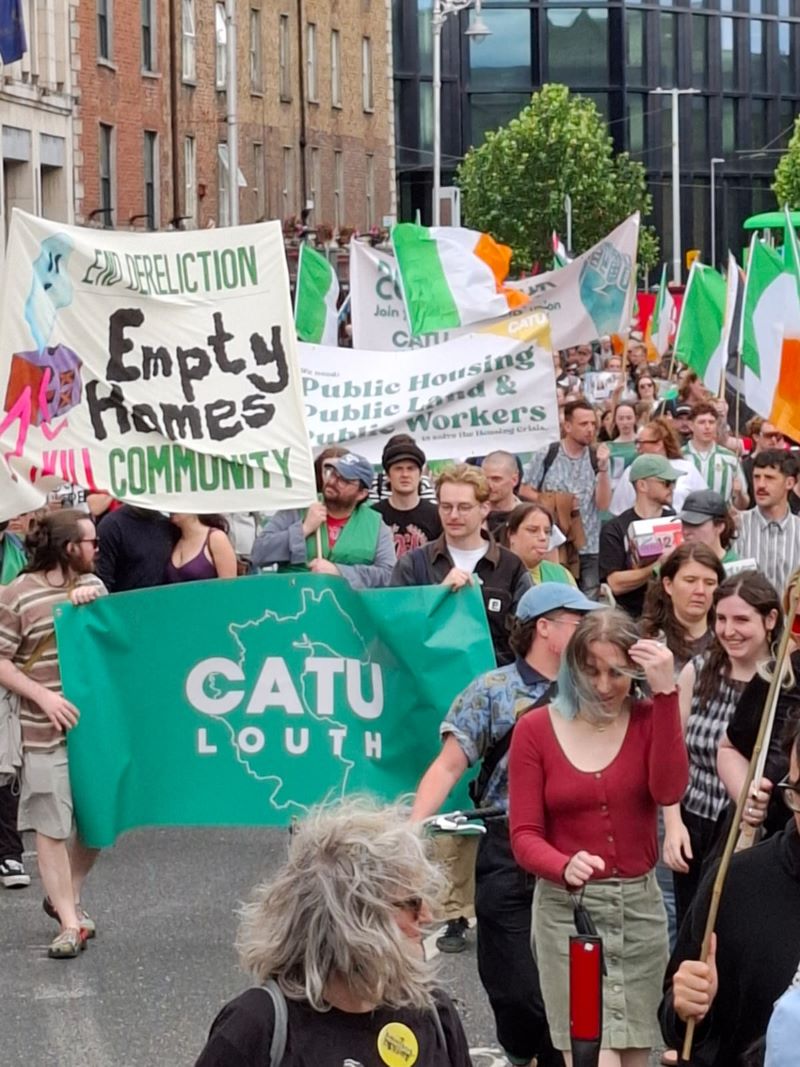
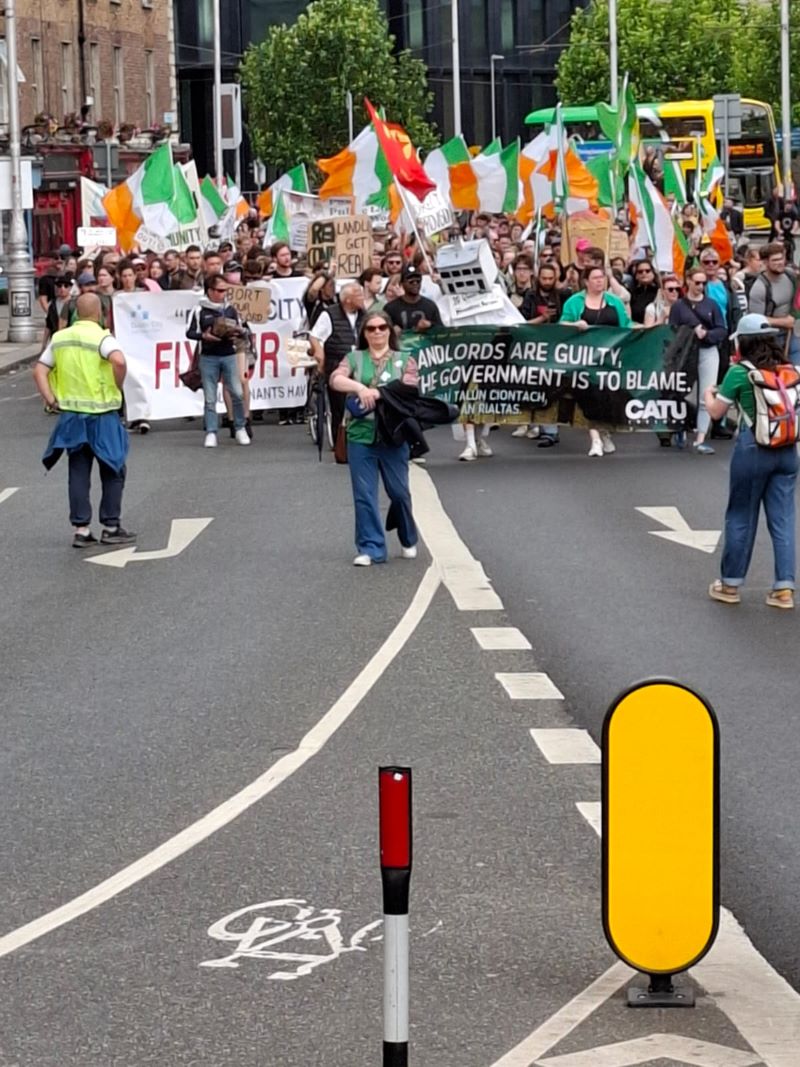
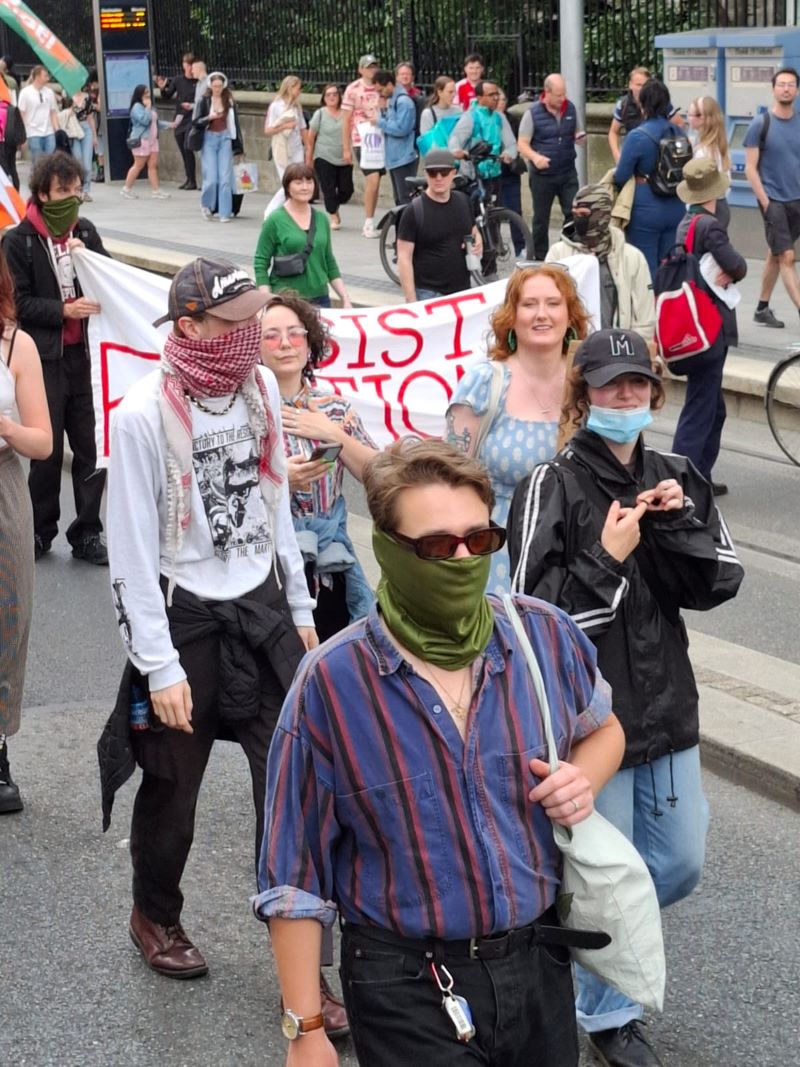
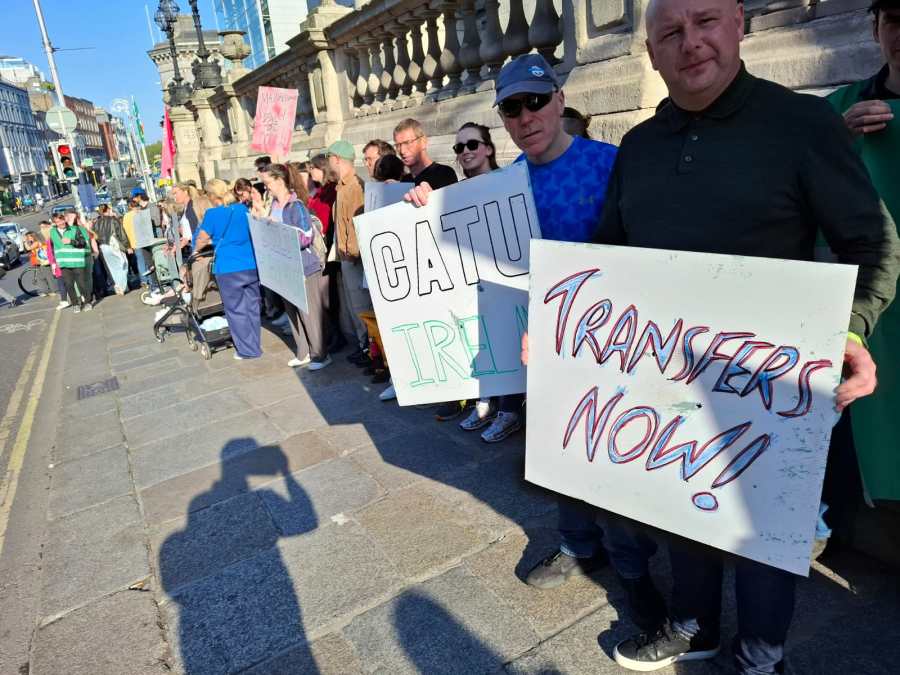
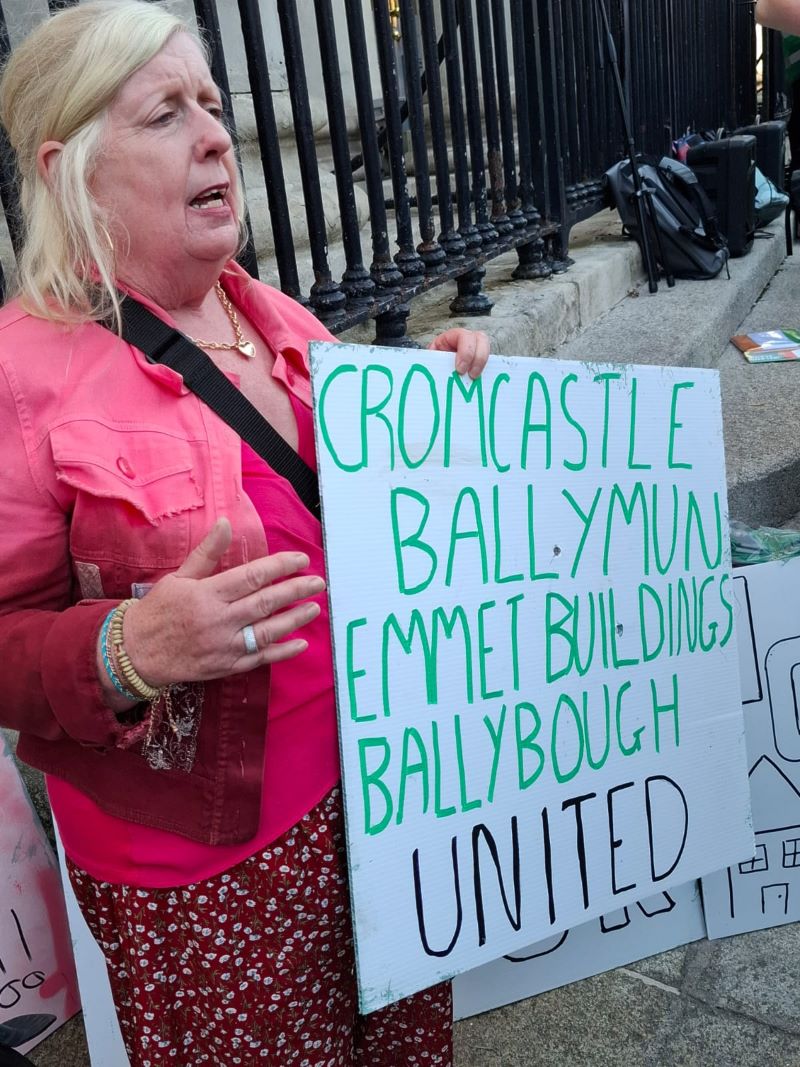
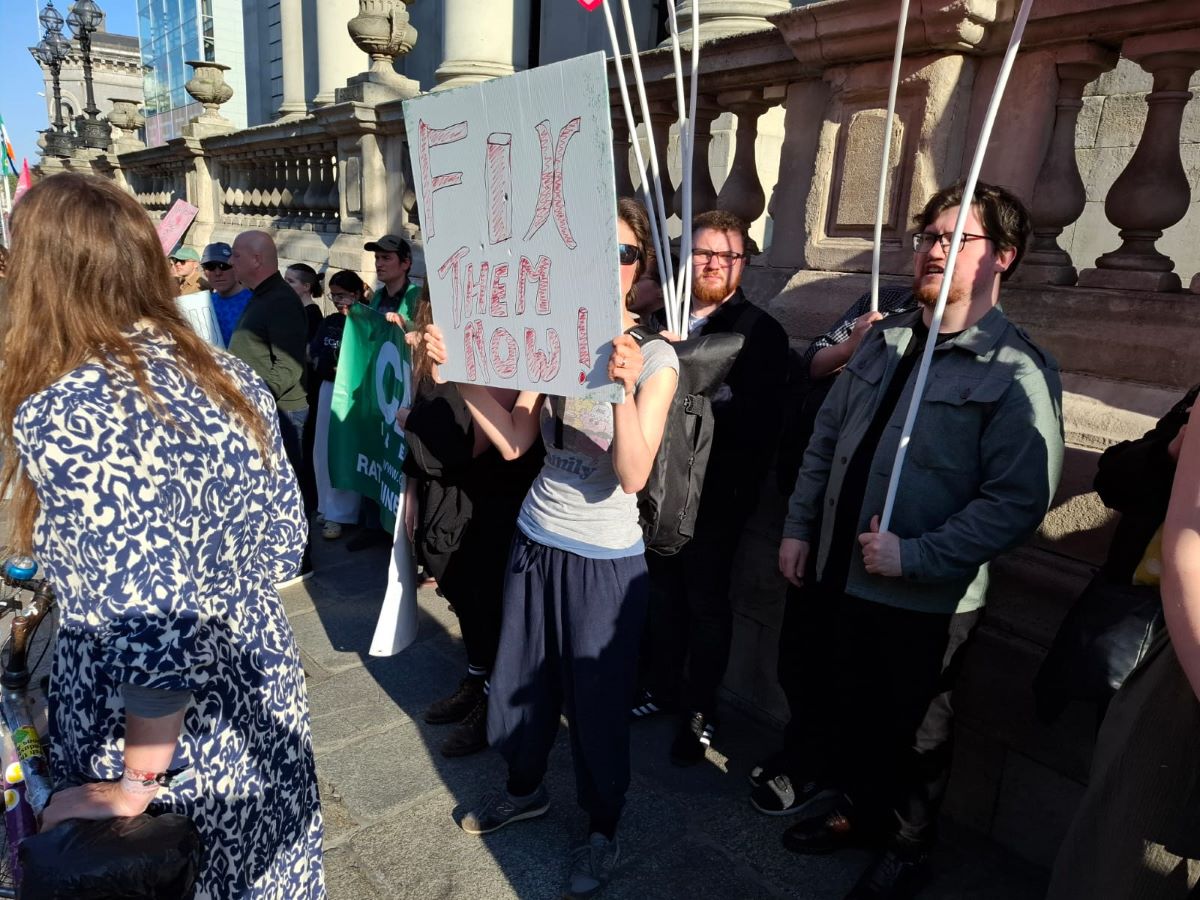
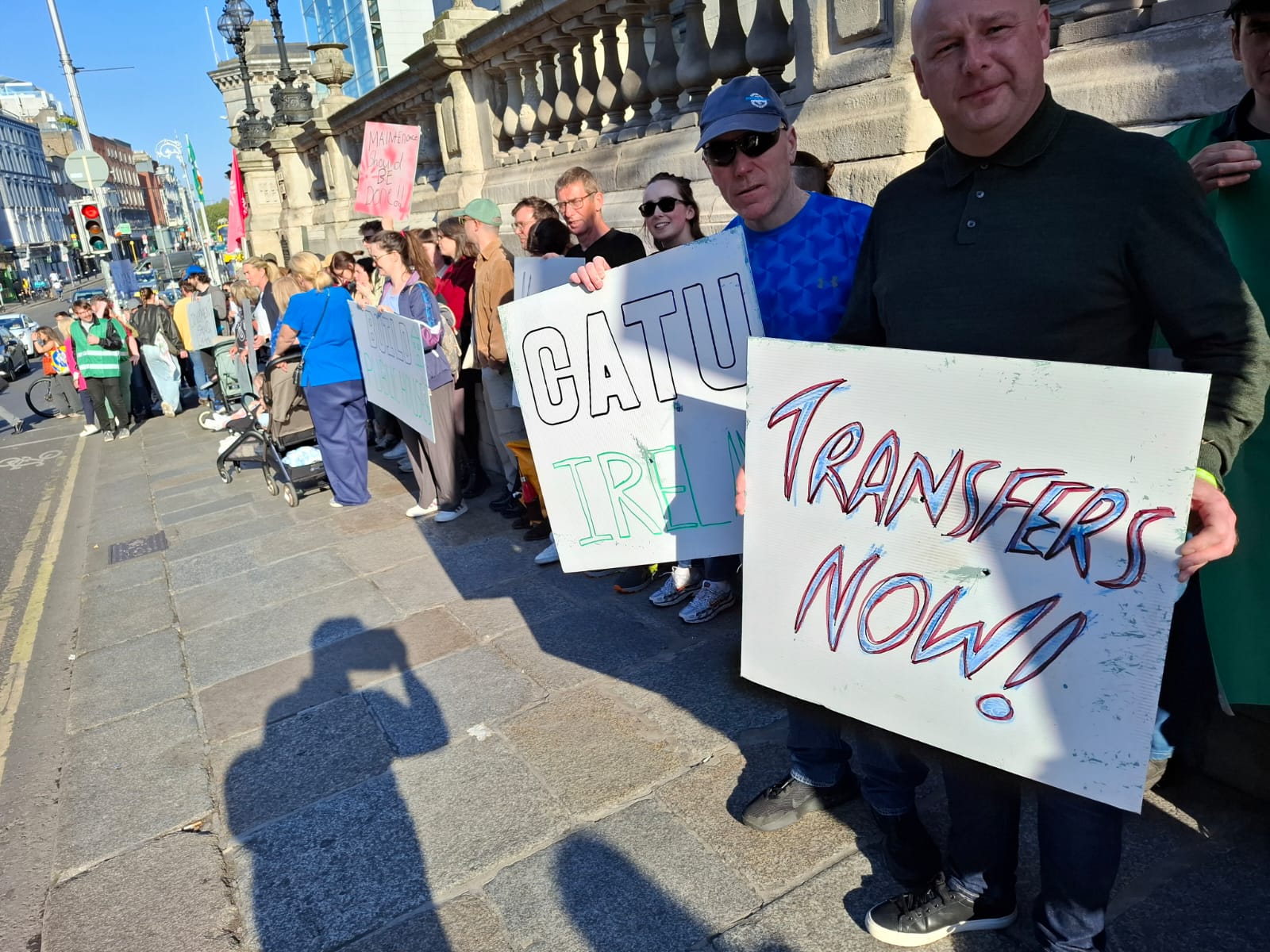
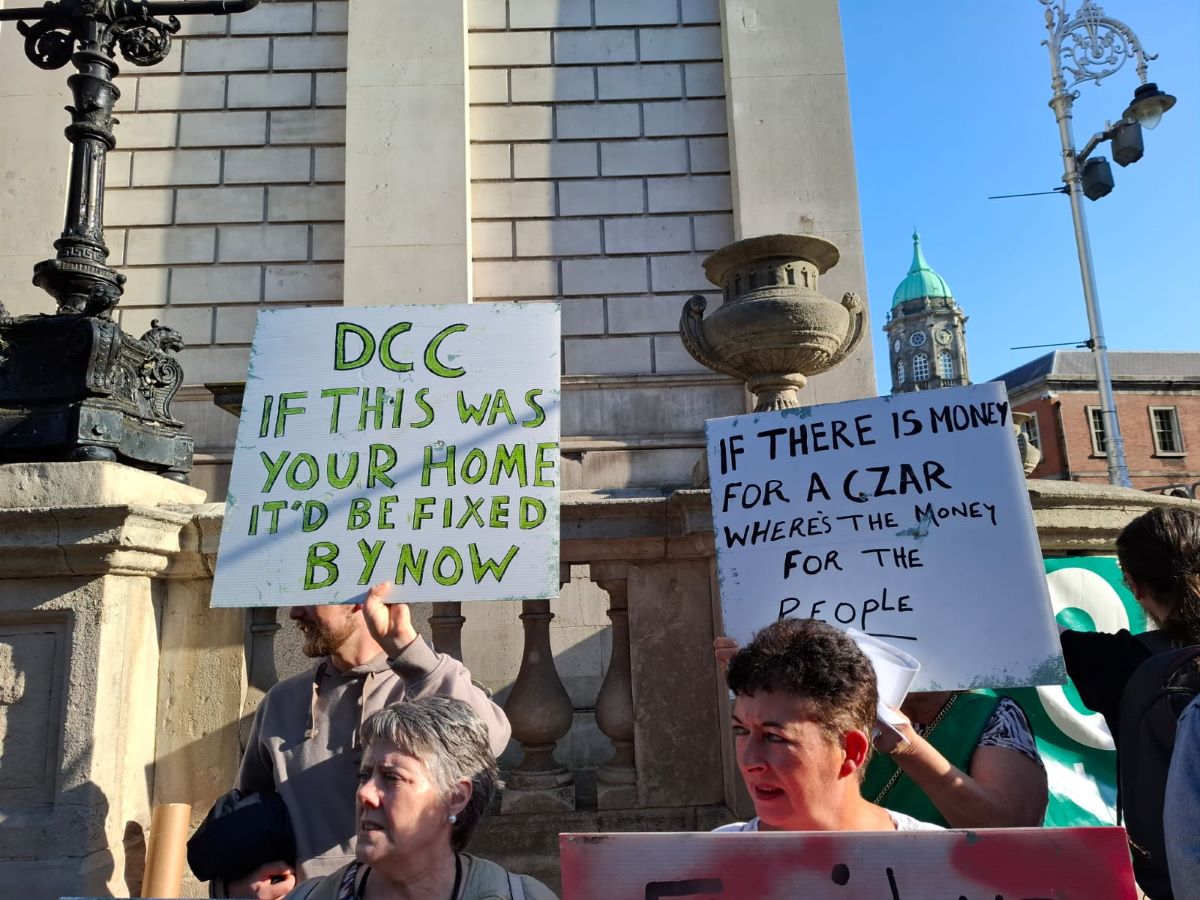
An estimated 10,000 people marched through Dublin city centre on Saturday in a national protest organised by CATU about homelessness, high rents, lack of public housing and the facilitation of property speculators by Irish Governments.
Groups from across Ireland attended the national march organised by the Community Action Tenants Union and without regard to the British Border around the Six-County occupied colony. They gathered at the Garden of Remembrance before marching towards Leinster House.
One of the housing groups that travelled to Dublin from the occupied Six Counties (Photo: D.Breatnach)
It was warm but not excessively so and the rain held off. The march ended with a rally in Molesworth Street, where Garda barricades prevent marchers from crossing the street to approach the gates of Leinster House, where the parliament of the Irish State sits.
In addition to drummers and also some singing, many chants could be heard: Homes for need – not for greed! What do we need? – Public housing; When do we need it? Now! When tenants are under attack? Stand up, fight back! (also something like: Get the landlords out of the Dáil!).
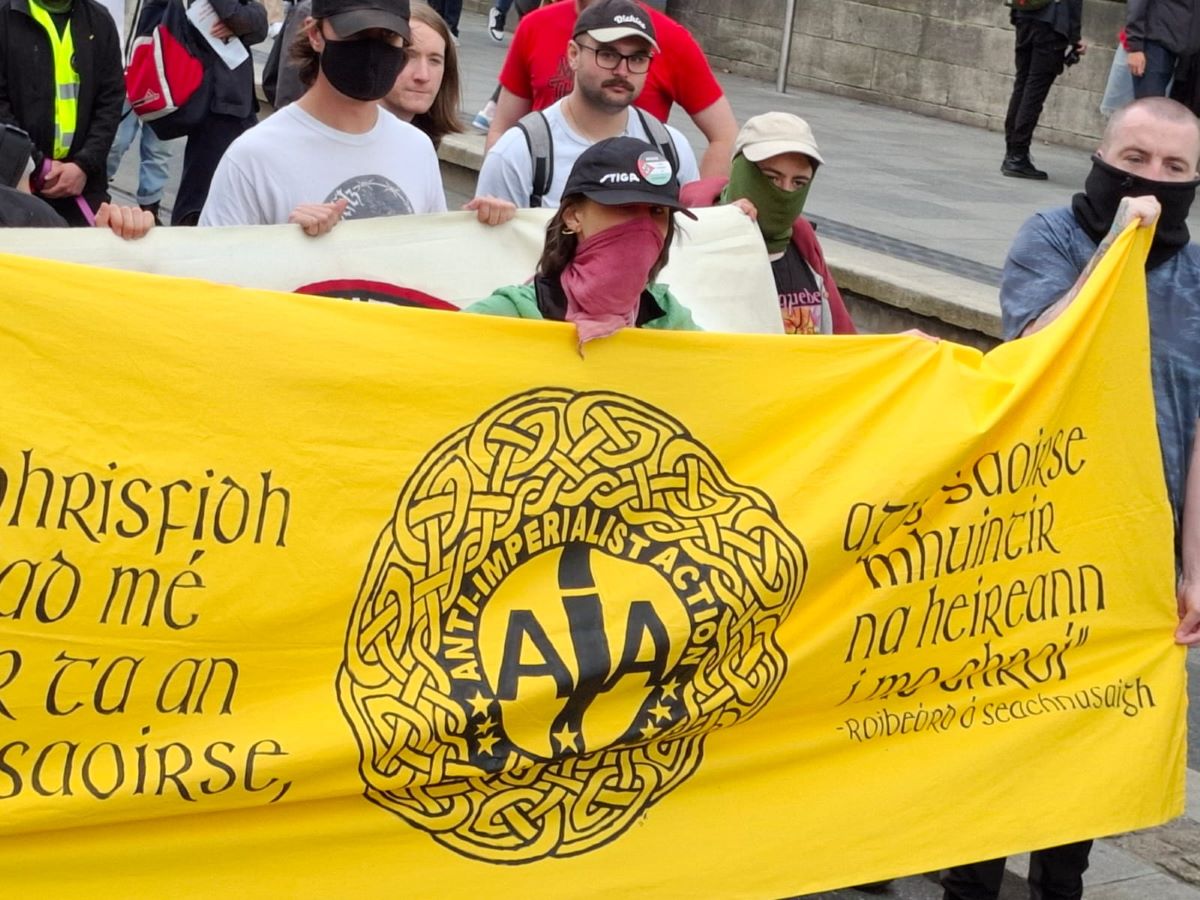
Among banners and flags of local area housing action groups and trade unions there were a great many Irish Tricolours in view; to see them being flown on a demonstration not of the Far-Right was a welcome sight. There were some Starry Ploughs and some red flags flying also.
It was good also to see the Irish language on some placards among the demonstrators. A notable feature was the high proportion of young people participating, many with their own home-made placards.
A certain species of vulture seems to have raised hostility in Ireland! (Photo: D.Breatnach)(Photo: D.Breatnach)Too Damn everything – except good! (Photo: D.Breatnach)
A lot of people were also in Dublin that afternoon for other events, including supporters of Gaelic Athletic Association county teams competing in Croke Park, in particular the Cork Vs Dublin teams in the Hurling Semi-Final. (Dublin getting that far surprised many but Cork beat them decisively).
A large anti-abortion demonstration also took place in the city centre, starting later than its advertised hours but immediately after the start of the CATU march. There are a range of attitudes on abortion but in general those campaigners like to project themselves as ‘pro-life’.
Some might comment that a pro-life cause would also include good housing for all – or to support the Palestinian people but generally the anti-abortion campaigners do not march in support of those, which is why they are often accused of being ‘pro-birth’ rather than ‘pro-life’.
Numbers of homeless single people and families with children rising annually passes 15,000 for the first time.
Out of 10,743 adults accessing emergency accommodation in March this year, 1,178 were under 24. In addition, 4,675 children were also using emergency accommodation.1 In January 134 individuals were counted sleeping on streets and in parks in the four Dublin areas, a 14% increase on 2024.2
In addition, the numbers of homeless does not include those sofa-surfing, awaiting eviction, in domestic violence refuges or unaccommodated refugees.
CATU’s list of demands points to the unfilled needs across a range of indicators and in itself is an indictment of the current state of affairs. In addition, the numbers of homeless has been rising annually and does not include those sofa-surfing, in violence refuges or unserviced refugees.
(Photo: D.Breatnach)
Prior to the march, CATU published a list of objectives and demands:
End child homelessness by 2026
Eviction ban North & South, Lower rents
Properly resource the Tenant In Situ scheme
End Direct Provision
Ban Vulture Funds
Build and maintain Public Housing – use public land
Build and resource culturally-appropriate Traveller Accommodation
Homes, not Holiday Lets
Build Communities of Care: education, community, addiction & mental health services now!
Front of the CATU march comes around from D’Olier Street while the rest of it is still coming down O’Connell St. (Photo: D.Breatnach)(Photo: D.Breatnach)
COMMENT – Housing Need and Action
It was an excellent turnout for CATU who are to be congratulated on their mobilisation and organisation around the country and in Dublin. The housing crisis is one of the great practical problems facing working people and a very big public housing program is the only solution.
However, the Irish neo-liberal ruling class are clearly wedded to housing provision by the private sector, with its soaring rents and mortgage payments resulting for many in sleeping on the street or living in hotels and hostels, not just single people but family groups with children too.
Housing marches and occasional symbolic occupations of buildings through the years have not changed the situation which worsens annually. The far-Right use the issue to target migrants who have not caused the crisis and even asylum seekers who cannot possibly have any effect on it.
Plentiful public housing is clearly the answer, rented according to the occupiers’ income. After the initial building cost, the rents will pay for maintenance, repairs, upgrades and even new buildings. And the construction program will provide much employment too.
Clearly a radical program of action will be needed to force the Irish ruling class to adopt a large public housing program. It does not require a revolution to achieve the change but it will almost certainly need the fear of one to move our rulers in the necessary direction.
In the 1960s and 1970s a number of housing schemes construction and renovation programs were won by the direct action of the Housing Action Committees of Dublin and Dún Laoghaire. The Committees included occupations in their program, alongside street rallies and marches.
Some years ago a small group called Revolutionary Housing League began a series of occupations of empty buildings, also refusing to give guarantees not to continue the actions when taken to court. They called for replication action on a wide scale along the same lines but that did not materialise.
Action of the kind up and down the country seems to be what is required and activists may be jailed before this ruling class is prepared to supply the basic human need of decent and affordable housing for the working people. It remains to be seen what role CATU will play in all of that.
I was relieved by my attendance at the Raise the Roof housing demonstration in Molesworth Street in Dublin City Centre. That was because I learned from speakers that just by voting in ‘a Left Government’ we could receive the housing we need.
Raise the Roof is a coalition of trade unions with its address at the Labour Party-orientated ICTU and a number of housing NGOs. The coalition also contains political parties: Sinn Féin; Labour Party; People Before Profit/ Solidarity; Social Democrats; Independents4Change.1
A view of the protest in Molesworth St. Leinster House is in the background across Kildare Street with access prevented by police barriers at the end of Molesworth St with a special gate to allow entry and exit for customers of the hotel on the corner. (Photo: D.Breatnach)
Previously I’d thought that either we’d need a revolution or a country-wide campaign of direct action occupying empty properties. This is because the housing crisis is deliberately constructed for the benefit of profits for big landlords, vulture funds and the banks that finance them.
And since they keep making massive profits out of the situation, they won’t want it to change as it would if, for example, were the State to seize empty properties2 for conversion to housing along with a massive public housing for rent construction campaign.
And if the profiteers don’t want that, naturally their (sorry, ‘our’) government will make sure not to do anything of the sort.
So it was great to learn that we won’t have to really fight and break the law, going to jail and all that. Phew! Just change the parties in the Government at the next election! Elect a Left Government!
Visual accidental irony comment in the same street. (Photo: D.Breatnach)
But… lately I have to admit I’ve been having doubts about this solution. First of all, there’s the question of numbers of TDs available to form this aspired-to government. There are overall 174 TDs in Leinster House (the Parliament of the Irish State) and a fragile majority requires 88.
The Sinn Féin party has 39 TDs and People Before Profit/ Rise/ Solidarity five in total, a combination of 44 still needing another 44 to reach the 88 minimum. FG and FF, formerly opposition parties but now in government have 86 votes between them and needed some extras to run the Government.
But I’ve got a much bigger doubt really, and that’s whether SF will stand up to the bankers and property magnates.
SF has for decades being setting out its stall that it is safe pair of hands to run the system, in other words that the profiteers have nothing to worry about. And to tell the truth, I believe them. Though some of their followers think SF is fooling the system, I think it’s the followers being fooled.
View of the Raise the Roof protest in Molesworth street. (Photo: D.Breatnach)
So … after further consideration, it really does look like a revolution will be required to end the housing crisis — or at least something so near as to make the managers of the system believe that unless they resolve the housing crisis, there will be a revolution. So I’m worried again.
Anyway, it was interesting seeing the amount of Tricolours in what was predominantly a left-wing rally of hundreds (despite a small contingent holding an Aontú banner) and there was some nice music with singers including Lisa O’Neill and Jimi Cullen (with his Homes for All composition).
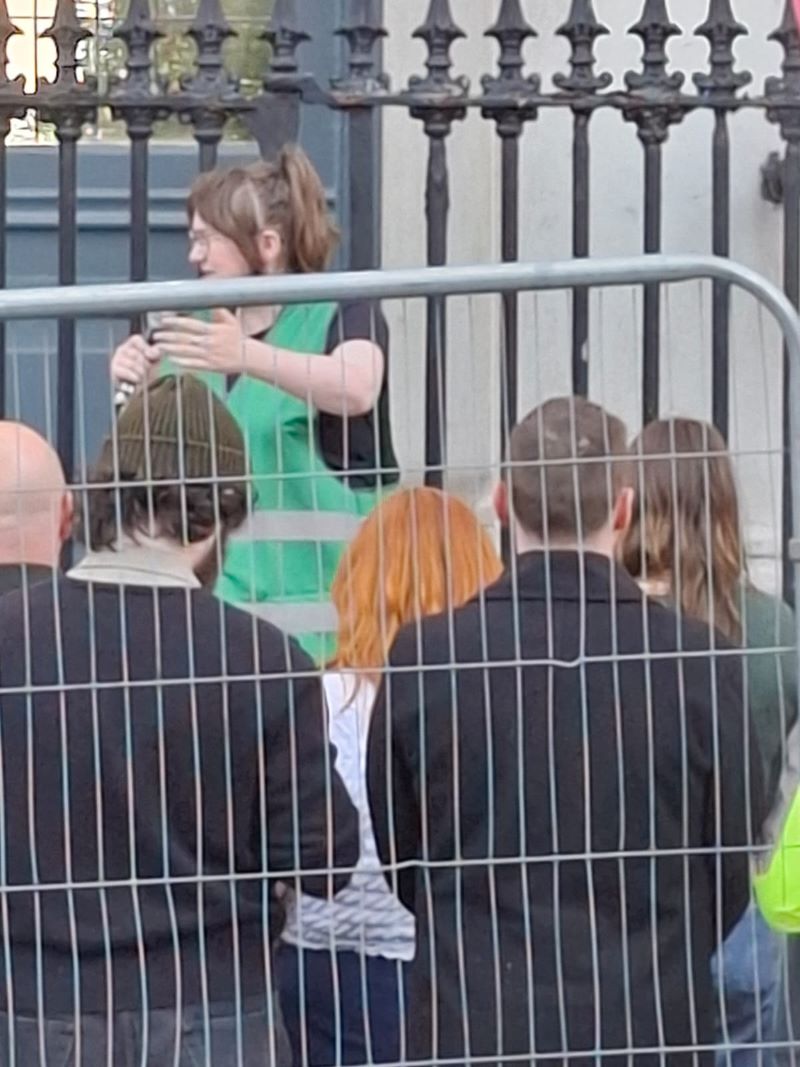
A large number of tenants organised by the Community Action Tenants’ Union (CATU) from a number of Dublin City Council housing estates gathered outside City Hall on Monday 12th May evening to lobby the monthly elected Councillor’s meeting.
Those attending for the most part came from public housing blocks and estates from Ballymun to the Liberties and Coolock to Pearse Street. They carried placards and demanded that Dublin City Council negotiate with them.
A section of the lobby outside City Hall facing Parliament Street (note on top extreme left of photo plaque commemorating two leaders of the Irish Citizen Army shot dead in 1916). (Photo: D.Breatnach)
The recently-appointed Assistant Chief Executive over housing and community came out to receive the Union’s demands and petitions from tenants organising within their complexes and areas andthe lobbyistsalso forced the issues onto the agenda of the council meeting that night.
The protest was organised by the Dublin city CATU branch with wide support from community organisers and was attended by a number of elected councillors from some political parties and independents.
(Photo: D.Breatnach)
The problems CATU representatives listed verbally and in writing included a general low level of maintenance and upkeep of their estates and blocs, of the actual dwellings, communal areas, playgrounds and rubbish chutes. Rat infestations were a problem in some.
Damp leading to mould, rainwater penetration, inadequate proofing, badly fitting windows and doors were also listed at a number of sites, as were inadequate insulation leading to high heating costs and a need for overhaul of the heating system itself.
Among the slogans chanted was: Dublin City Council – Negotiate!
(Photo: D.Breatnach)
Included in their demands was that DCC officials recognise the right of their tenants to be represented by CATU as their union, which they stated was not always respected and they sought formal meetings with named officials responsible for the areas in question within one month’s time.
Although apparently currently not members of CATU, the organisation had invited the Pearse House Residents’ Committee to attend and speak at the lobby. Their chairperson Neil Maloney did so, addressing the issue of the long overdue regeneration of their housing bloc.
(Photo: D.Breatnach)
Maloney described the “blow to the community” when funding for stage two of the regeneration project to eliminate overcrowding was withdrawn, after their hopes had been raised by presentation of a regeneration timescale and a physical design in August of the previous year.
Ironically, the housing crisis was implicated in the Government’s reason for refusing to support the regeneration going ahead, in that the increase in inner space of the dwellings would reduce the number of actual housing units.
(Photo: D.Breatnach)
The Pearse House chairperson commented that “the current bedsits are illegal” and that their homes currently don’t meet European standards, going on to state “a real need for bigger homes to address overcrowding and family needs.”
“This was always going to be a challenge for this protected structure, but in phases 2 and 3 of the regeneration plan, there would be 2 additional blocks built. The additionality that the Government is seeking would be gained through the social homes gained during the decanting process.”
Pearse House residents attended CATU’s protest “to highlight our anger and what we see as another block on this project,” Maloney said. And note that although DCC has committed to redesigning the project for submission to the Government there is no guarantee this will be successful either.
(Photo: D.Breatnach)
“Ireland is still in breach of the European Charter for social housing and our human rights. Our community has seen the redevelopment and construction of new buildings, offices etc. and Pearse House is the eyesore in the middle of our community.”
“We were the community before all this redevelopment, and we will be the community when it’s all over,” concluded Maloney, voicing a common complaint along the south Dublin dockside. 1
A section of the lobby outside City Hall viewed looking down Dame Street. (Neil Maloney is pictured after his speech). (Photo: D.Breatnach)
Public Housing Background
There was little public housing in Dublin under British rule and the big town houses of the rich had been sold and sub-divided for rent by private landlords (including some who were elected councillors (or aldermen).
The new State built “2,000 local authority homes by 1924, a feat all the more remarkable in the context of a shortage of State funds, and the need to rebuild much of the infrastructure damaged in the War of Independence.”2
But of course it was not keeping up with the existing need or population growth and 40% of the population were forced to emigrate in the first 50 years of the Irish State.3
However 1924 too was the introduction of legislation facilitating state money subsidising the building of private housing.4 “In the decade after 1932 some 82,000 homes were built, the vast majority (public and private) with State subsidies.”5
Prof. Kenna relates that by 1940, some 41% of the Irish housing stock had been built by local authorities, far higher than that in England and Wales (25%) and also comments on the effect this had on subsidiary employment not only in construction but in sourcing and supply of materials.6
Although by 1964, a further 74,000 private and 63,000 local authority homes were built with State support and that between the 1950s and 1960s a million people had left the country, there was still a housing shortage and rents on private properties dug deep into workers’ incomes.7
Prof. Kenna comments that little attention was paid to the need for housing estate management, amenities, shops and the social, educational or other needs of the new community established there. That this should coincide with a boom time for property developers should not surprise us.
(Photo: D.Breatnach)
Government schemes to facilitate the purchase of their local authority accommodation from the 1950s resulted in the disappearance of much public housing stock into the private sector.8 Theoretically they would be replaced by new public housing builds but that didn’t happen.
Public land and land held by NAMA9 has been increasingly sold or even given away to private developers on promises of provision of a low percentage of public housing and often those individuals or consortiums do not even keep their earlier promises.
The Report of the Commission on the Relief of the Sick and Destitute Poor in 1927, Prof. Kenna reminds us, found 3,257 homeless people including 901 children, while in January 2021 there were 5,987 homeless adults and 2,326 homeless children in Ireland.
The Far-Right has jumped on the opportunity of the current housing crisis to blame it – not upon lack of public housing construction, big landlords, property speculators and vulture funds – but on migrants.
The Left in Ireland has until now in practical terms left this ground for exploitation of racists.
One of a number of speakers, photographed from across the street as too crowded there. (Photo: D.Breatnach)One of a number of speakers, photographed from across the street as too crowded there. (Photo: D.Breatnach)One of a number of speakers, photographed from across the street as too crowded there. (Photo: D.Breatnach)
GOING FORWARD
CATU seemed pleased with the lobby turnout and announced their intention to organise a housing protest march on Saturday July 5th. In the meantime they will no doubt be following up on the meetings they requested with area housing managers and agreeing objectives and deadlines.
Hopefully, seeing the initial results in the attention of DCC housing and amenity officials, and reflecting on their numbers when they take joint action, tenants of DCC will take heart and grow in confidence in their ability to ensure provision of decent housing and services for their needs.
Of course, the Far-Right won’t like that as it distracts from their targets – but the extension of this campaign does provide some hope of something like a solution to the current terrible grinding crisis of both housed and homeless.
End.
One of a number of speakers, photographed from across the street as too crowded there. (Photo: D.Breatnach)
APPENDIX: I916 Battleground
It might or might not have been mentioned (I couldn’t hear much of the speeches) that City Hall, outside of which CATU were protesting, had been a 1916 resistance centre, occupied by a small force of the Irish Citizen Army, known in some circles as the first workers army in the world.
Unaware of the extremely low British garrison on the Castle that day, the ICA had failed to take the complex and retreated to City Hall and some outposts in Dame Street and Parliament Street where they resisted until overwhelmed by British Army reinforcements.
The symbolism of the Castle, the administrative seat of the British occupation in insurgent hands, resulted in a ferocious assault on the ICA garrison and it fell on the Monday/ Tuesday of that week. One of the statues inside bears what appears to be a bullet hole to this day.
A steel plaque on the right of the outside front of the building lists the names of the ICA garrison of the area, around 50% of which were women. An older cast plaque at the east corner lists the names of two of the five who were killed there, Sean Connolly (OC) and Sean O’Reilly (2i/c).
The 1916 Rising was followed by the election of the First Dáil in 1919 with its Democratic Program affirming that all right to private property must be subordinated to the public right and welfare, and that no child should suffer hunger or cold from lack of food, clothing, or shelter.10
That was followed by the War of Independence and the Anglo-Irish Agreement; and the new State that came into being had no intention of fulfilling the promise of the Democratic Program but rather a determination to suppress any who tried for that fulfilment.
Footnotes
1For example the construction plans for the Irish Bottle Glass site (sold by Nama to the Ronan consortium) contain no components of public housing and units at expected prices will not be affordable by most local people.
(Reading time: 6 mins.) NB: Edited by RB from original article for formatting purposes
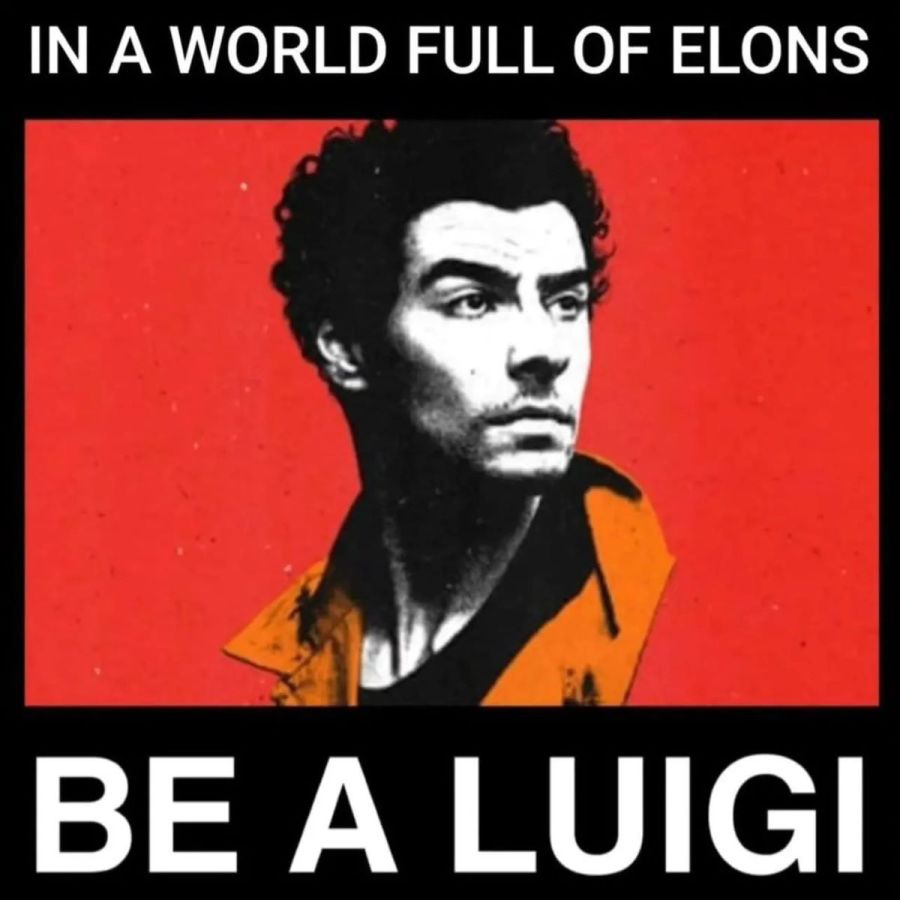
Luigi Mangione’s killing of Brian Thompson has resulted in a plethora of memes on Facebook celebrating to some degree the demise of the unlamented CEO.
Some of them are very funny, full of wit, others express outrage at the nature of the US health system and others openly call for more such killings and Facebook has not suppressed them, which says a lot.
Facebook is run and owned by a right-wing extremist, Mark Zuckerberg. But he is no idiot and probably hopes to ride out this particular storm, rather than suppress it. But he is mistaken as Mangione has struck a nerve. This is not going away.
Some so-called progressives have also sought to soften the impact of Mangione’s actions.
There are of course criticisms from the Left about how such actions don’t solve problems, the CEO is replaced and the machinery rolls on, and these are valid, but there are others who seek to wrest any agency or legitimacy from him.
Munya Chawawa, the British comedian and rapper released a musical video questioning how he was treated by the Police and saying he would have got different treatment if he were black.[1]
Yes, generally the cops are quick to kill blacks, especially those they think have actually killed someone, though they did in fact arrest the black DC Snipers (also known as the Beltway Snipers) who had murdered ten innocent civilians.[2]
In fact, it is not that US cops don’t kill whites, they do, it is just that not at the same rate as blacks. Half of those killed by US cops are white, but blacks are killed at more than double the rate of whites despite making up only 14% of the population.[3]
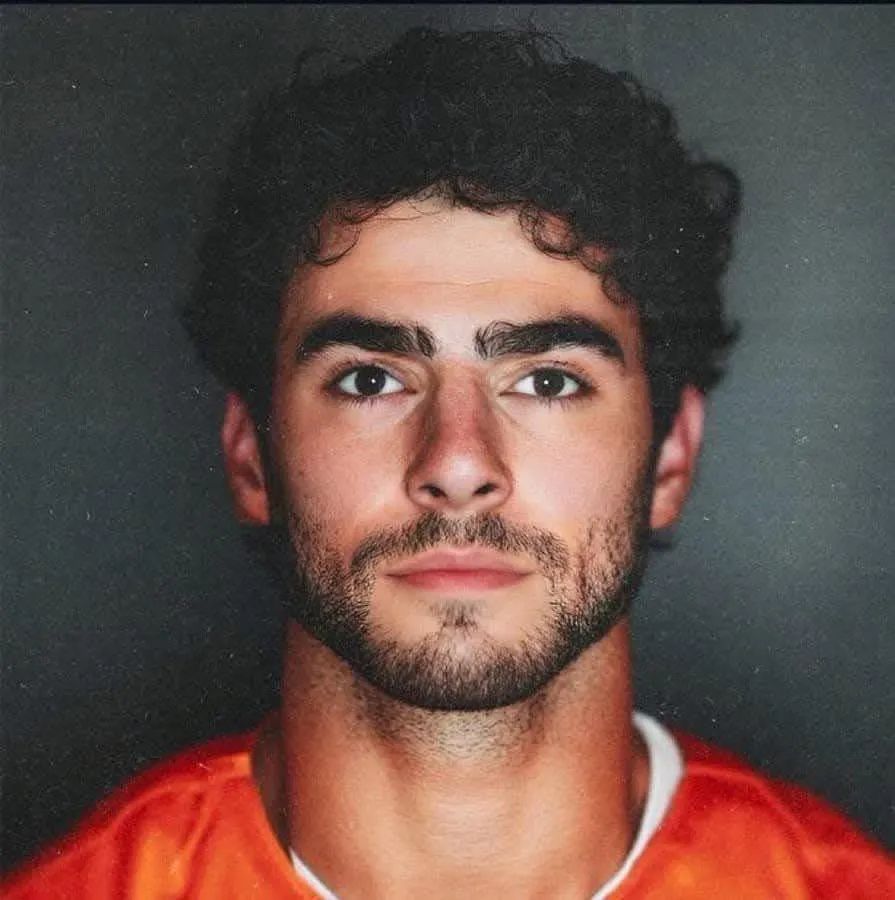
And yes, he is handsome and it helps, and again the memes have gone into overdrive. His arrest and mugshots have been compared to even scenes from one of the innumerable Superman films. Though I prefer the Che Guevara comparison.
He is no Che, as Che set out to overthrow a state and had a programme for change and is the main person behind the remarkable success story that still is, despite everything, the Cuban health system, but the striking mugshot images do help.
Photos (internet) Mugshot of Luigi Mangione and bottom Che Guevara mugshot in Mexican jail.
However, Chawawa missed the point altogether and questioning police violence is not something you would automatilaccly associate him with.
But the idea that the cops act with benevolence towards those who shoot CEOs if they are white is nothing short of identitarian rubbish. He is not the only one though.
There are many others from all sorts of liberal backgrounds who recoil in horror that someone might lash out, but shrug their shoulders every day when people die having been refused medical care.
Most people in the US have understood and identify with Mangione’s actions, not out of some idea that he might change the system, but out of their own frustration at how the system works. The plethora of memes on Facebook bears testament to this fact.
The killing of the CEO is extremely popular regardless of how effective a strategy it is.
Another comedian, this time from the US Josh Johnson, understood something that many liberals and chic rappers like Chawawa could not is that Mangione struck a chord.
Though Johnson unlike Chawawa is from the US and understands the US healthcare system. He mentioned the fact that many CEOs are eliminating their Linkedin accounts and that the media went into overdrive on how devastating it all was.
“I’m not gonna lie, this is how you can tell the news is owned by billionaires because the news was like, uh, ‘this devastating, terrifying, harrowing attack in New York’, and I’m not saying… look a murder did take place… I’m not saying it couldn’t have been listed as those things, I’m just saying ‘you’re the news!’
You play horrific stuff all the time. You’re the same news that when those pagers were going off in the Middle East, exploding, you were like ‘check this out!’”[4]
The same media pundits who were horrified, express no such horror as Israel carries out its genocide, they don’t even question it and yet we are expected to take their statements on Thompson and the sanctity of life at face value.
Johnson then made a point about the system and how it didn’t care about anything other than money, not even about Brian Thompson. The meeting Brian Thompson was going to when he was shot went ahead as planned, and on time.
Capitalism doesn’t miss a heartbeat when there is money at stake. All the fake outpouring of grief from the corporate world and the media is to be measured against that fact. Nothing stopped their ruthless pursuit of profit, not even the killing of one of their own.
It has brought to mind the film John Q starring Denzel Washington. It is a bit late to review a film some 22 years after its release, but it is more relevant now than when it was released.
The film deals with the father of a child who is taken to hospital only to find that the surgeons can’t operate on him as his insurance doesn’t cover what is needed.
It also turns out that the child’s condition could have been detected earlier, but the US health system missed it. Never was the film John Q so relevant. In his manifesto, he could just have said, Do you want to know why? Watch John Q. That would have been enough.
Films don’t exist in a void. When you see lots of films where the government is corrupt, or the CIA and FBI is in cahoots with big business, it indicates that a lot of people accept the basic premise of the film.
The same goes for dramas like John Q which was the highest grossing film for the President’s Day weekend release and took a total of US $71 million in the US and US $ 102.2 million world-wide.
Though it was not based on the real incident, in Canada (not the US), where Henry Masuka took the ER staff hostage in 1999 demanding immediate treatment for his son and was later killed by the cops exiting from the hospital, carrying an unloaded pellet gun.
In the film most of the public are sympathetic to John Q as are most sympathetic to Luigi Mangione in real life. The difference of course is that John Q managed to force them to operate on his son, making one small change at an individual level.
Mangione has made no changes at all, but he has reignited a debate on the issue and once again put not only the nature of the health system in the spotlight, but also the police and judicial system.
With various social media posts pointing out the huge effort put into finding him as opposed to arresting the billionaires who raped underage girls on Epstein’s island.
One of capitalism’s greatest successes in the late 20th and early 21st century is not how high the Dow Jones Index is at, or any of the other roulette tables known as stock exchanges.
Rather it isthat it has destroyed many collective organisations, co-opted others or through social partnership brought on board to one degree or another all the potential opposition movements and organisations.
Trade unions frequently fall into all three categories, social and environmental movements also and of course the huge deluge of NGOs that abound in all areas of social and economic life.
The organisations a Luigi Mangione type figure would have turned to decades ago are now part of the problem, implementing government policy, refusing to challenge the state as their salaries depend on government largesse and patronage and making sure their “clients” i.e. the poor, don’t step outside of the structures.
So, it is no surprise that Mangione would lash out the way he did, nor is it a surprise that he is so popular. The success of capitalism in convincing people there is no possibility of organised opposition is such that individual acts go viral.
Those liberals who wail against his actions are the same ones who make sure there is no collective response.
What is needed is not so much more killings but more people with Mangione’s resolve organising to brush not only the Thompsons of the world aside but also the co-opted organisations paid to keep them in check.
It is as Leon Trotsky once said “Where force is necessary, there it must be applied boldly, decisively and completely. But one must know the limitations of force; one must know when to blend force with a manoeuvre, a blow with an agreement.”[5]
More relevant to Mangione is the killing of a Nazi diplomat in Paris by Herschel Grynszpan,[6] whose actions were used by the Nazis as a pretext for Kristallnacht.
Trotsky commented “A single isolated hero cannot replace the masses. But we understand only too clearly the inevitability of such convulsive acts of despair and vengeance. All our emotions, all our sympathies are with the self-sacrificing avengers…”[7]
Republishing this now as we approach again the festival called Christmas. A Christian festival, apparently, celebrating the birth of Christ, the baby Jesus. But are there darker aspects in its references?
Away in a manger No crib for His bed The little Lord Jesus Lay down His sweet head
The stars in the sky Look down where He lay The little Lord Jesus Asleep on the hay
Such a sweet, holy image.
But actually, when we look around us, it seems more like a festival of the pagan gods: of Bacchus, the god of alcohol and of Mammon, the god of wealth. Bacchus, because in non-Moslem countries, drinking of alcohol will be for most a big component of the festival.
Whiskey, brandy, wine and beer will be bought to stock up the house. Alcohol will be drunk at Christmas parties (including office parties, where for months afterwards some people will regret what they did or said – or even what they didn’t do or say).
Alcohol will be not just drunk but also put into some of the traditional food and even poured over it.
Then Mammon. Well, you can see the retail businesses stocking up for weeks or even months ahead of the festival which, after all, was only supposed to be a one or at most a two-day event.
Giving and receiving gifts has now become part of the festival and in most cases, gifts have to be bought. Which is a really big gift to the retail businesses and thence, really a sacrifice to Mammon.
In the Christian gospels of both Matthew and Luke, it is written that one “cannot serve both Mammon and God” — which goes to show how little they understood capitalism, where Mammon IS God.
A theologian of the Fourth Century saw Mammon as a personification of Beelzebub, which in his time was another name for Satan or the Devil.
Interestingly, Protestant Christianity, which some credit as having invented capitalism, at the same time regarded Mammon, or said they did, as “one of the Seven Princes of Hell”.
Cartoon depiction of Mammon, God of Wealth (Image sourced: Internet)
Sculpture representation of Bacchus, God of Alcohol, in California winery, USA (Image sourced: Internet)
SANTA
Now, Santa Claus is also a big part of the Christmas festival, especially in western countries, a much more acceptable face than that of greedy Mammon and alcoholic Bacchus, right?
But originally, the Christians saw him as a representation of St. Nicholas, 4th Century Bishop of the Greek city of Myra, a location now in Turkey. He was the patron saint of archers, repentant thieves, sailors and prostitutes. The prostitutes probably had to be repentant ones too, of course!
The sailors, who probably had at least as much recourse to prostitutes as had any other calling, were apparently not required to be repentant – to be in danger on the sea was deemed enough.
But St. Nicholas was also the patron saint of children, pawnbrokers and brewers, so we can see how close he was getting there to the modern spirit of Christmas.
GERMAN TRAPPINGS
Now, the Christmas Tree, der tannenbaum, so much a part of the symbolism of modern western Christmas, came to us from Germany, as did the sled and the reindeer.
The reindeer are not autochthonous or endemic in historic times to Germany, so they must have been brought in their myths from Scandinavia from where originally, the Germanic tribes came.
In turn, the Christmas Tree, Yule Log, reindeer and sled were exported from Germany to England in the reign of Queen Victoria, by her consort Prince Albert, who was German.
And since the English ruled all of us in Victoria and Albert’s time, the Christmas Tree came to us too, to the cities first and then slowly spreading through the rural areas.
A representation of St. Nicholas (before he got the red suit makeover) looking more like a pagan god of the woods. (Image sourced: Internet)
***
When you think about it, this German-English worship of the tree was a bit ironic, since the English had wiped out most of our forests already and were still cutting down our remaining trees in Queen Victoria’s time.
***
And Victoria, through Albert, gave us the Santa Clause we know and love today. A jolly man, well fed, white beard, twinkly eyes, dressed all in red with white trim ….
IN RED?
Now, wait a minute! It turns out he wasn’t always dressed in red. Originally, he was dressed in a brown, or green cloak. He was, originally among the Germanic people, a god of the forests – hence the evergreen Christmas tree.
And like any sensible woodsman, he dressed in appropriate colours, brown or green. Neither Albert nor Victoria ever represented him as dressed in red. So how did it become so that we are incapable of seeing him today in any other colour than red?
Well, it turns out that Coca Cola is the responsible party.
Yes, although it was the cartoonist Thomas Nast in 1870s United States who first portrayed Santa in a red suit with a belt but it was Coca Cola, in their advertising campaign of 1931 and onwards who made his clothes red world-wide.
Coca Cola is a drink served cold and almost undrinkable when warm but who needs a cold drink in cold weather? I guess Coca Cola needed a warm image to make it still attractive in winter. So therefore the warm, jolly man dressed in red, with a bottle of Coca Cola in his hand.
1931, Santa Clause first appears in red, in Coca Cola advertisement, USA. (Image source: Internet)
Coca Cola brand is worth about $106.1 billion dollars today,1 far ahead of any other cold drinks product. Which I guess brings us back to …. yes, Mammon.
You can mix the drink with a number of alcoholic beverages too, so tipping a nod – and a glass – to Bacchus.
Now, the German Santa Claus, this originally woodland god, is also thought to have been something like Thor, a god of fire and lightning. So can it be any coincidence that two of his reindeer are called Donner und Blitzen, i.e “Thunder” and “Lightning”? Nein – of course not!
A starry night over desert hills, like the Nativity scene but without the Guiding Star. (Photo source: Internet)
INVISIBLE
Although we see the image of Santa Claus everywhere and even pretend Santa Clauses all over our city streets, everyone knows that nobody sees the real Santa Claus. Children have to be asleep when he arrives to distribute his presents and somehow adults don’t see him either.
Which I suppose is a good thing ….
I mean if you found an adult intruder in your house at night, not to mention near your children, you’d be liable to whack him with a hurley (that’s an Irish cultural reference) …. or a baseball bat (that’s a U S cultural reference) …. or stab him with a sharp kitchen knife (that’s an international cultural reference).
It was bad enough when somehow that portly – not to say fat – man could somehow come down your chimney and go up again, without waking anyone … but now he can get in your house or flat even when you don’t have a chimney.
Which is at least creepy, if not downright scary …
Oh, let’s lighten the mood and sing together:
You better watch out You better not cry You better not pout I’m telling you why
Santa Claus is comin’ to town Santa Claus is comin’ to town
He’s making a list He’s checking it twice He’s gonna find out Who’s naughty or nice
Santa Claus is comin’ to town Santa Claus is comin’ to town
He sees you when you’re sleeping He knows when you’re awake He knows if you’ve been bad or good So be good for goodness sake
Yes, lovely but wait …
“You better watch out, you better not cry …” — Is it just me, or is that not downright threatening? And he knows when we’re sleeping or awake? He has our children under surveillance? In some kind of list?
HO! HO! HO! IN MORALITY PLAYS
Morality Plays were a genre of theatrical performances of the medieval and Tudor eras in which a character was tempted by a personification of Vice.
Now Vice (not unlike a lot of police Vice Squads), was often seen as the epitome of evil, corruption and greed – in other words, the Devil. The playwrights tended to portray the Devil as somewhat of a comical character, perhaps to keep their audiences entertained (or to disarm them).
So the character who played the Devil would announce his arrival with a stage laugh: “Ho, Ho, Ho!”
You can probably see where I’m going with this.
Nowadays, we tend to see the Devil portrayed in black but in earlier times, he was more often seen as coloured in red. The colour in which Coca Cola just happens to have dressed Santa too.
The German or Nordic Santa was originally a god of fire also, while even the modern Santa drives a magical chariot pulled by horned beasts and he is portrayed all in red. Traditionally, the Devil is seen as horned and residing in Hell, a supposed place of eternal flames below ground.
What does Santa Claus give to children who have not been good? A lump of coal! In other words, a mineral from underground that can burn to make fire.
A Victorian England representation of St. Nicholas (Image sourced: Internet)
NICHOLAS
Santa Claus is supposed to be modelled on St. Nicholas …. and what is the popular abbreviated version of Nicholas, i.e the nickname? Yes, Nick.
And the common name for the Devil, Mammon, Beelzebub, Satan is ….. Old Nick!
Clare Daly stood for election in the 2024 elections of the Irish State, in the Dublin Central parliamentary constituency, one with a tradition of independent representation going back to Maureen O’Sullivan and Tony Gregory before her.
Daly was standing as one of the loose Left coalition of Independents for Change in a heavy competition for the four-seat constituency.
Clare Daly has a track record as elected public representative and socialist political activist, also as a prominent Socialist Party activist, with which organisation she partedcompany in August 2012.
She was elected MEP for the Dublin constituency from July 2019 to July 2024, TD1 for Fingal from Feb. 2016-July 1999 and TD Dublin North Feb. 2011-2019; in recent years Daly has been better known outside Ireland due to her public interventions in the European Parliament.
Daly and her partner Wallace were both vilified by pro-imperialist liberals and ‘Left’ for publicly opposing US/NATO/ EU imperialist campaigns against Islamic regimes and the Russian Federation, being subjected to a host of unfounded allegations contrary to their actual record.
Tik Tok clips of Daly’s biting attacks on the EU’s complicity in the US-backed ‘Israeli’ genocide provided relief for many around the world from the Zionist sycophancy and insincere and ineffective concern for the victims of that daily genocide prevalent in the EU Parliament.
And who can forget Daly’s calling German politician and EU Commission President Ursula Van Der Leyen out as ‘Frau Genocide’ in the European Parliament in December last year!2
While an MEP, Daly also intervened in the discussion around the Irish Gombeen3 class’ attempt to push us towards NATO, further undermining a quite tattered Irish neutrality. And while a TD, she and her partner Mick Wallace TD were arrested protesting the foreign militarisation of Shannon.
To their credit both risked jail by refusing to pay the fines imposed but the Gombeen ruling class decided to restrict the damage of its exposure of collusion with US imperialism by also reducing the punishment of both to a few hours in captivity.
Daly has been one of the few TDs prepared to speak in public against the repression of Irish Republicans and to visit some of the consequent victims in jail.
In the EU Parliament, Daly also denounced the Spanish State’s police invasion of Barcelona and violence against voters there on 1st October 2017 during the referendum on Catalunya’s independence.
2024 Dublin Central election poster for Clare Daly.
In Ireland today
In her election flyer here Daly highlighted representation independent of political party for her electoral area, housing, health service, cost of living, Palestine, the endangered climate and Irish neutrality without any indication of how these issues might be effectively addressed.
Daly’s election flyer did not mention capitalism or imperialism, nor did she campaign on a platform of overthrowing the current neo-colonial and neo-liberal capitalist system in force, instead indicating her wish to “hold to account the people who’ve got us into this mess.”
“Holding to account” is something to which Daly is accustomed doing and does it well, eloquently, with passion and fluently, scarcely having to refer to her notes while doing so. But like ‘speaking truth to power’, it has little effect on those who are in control of the political-social system.
It can indeed have an effect on the victims of the system but we are left with the question of what to do about the situation. Refreshing as it may be to hear her again in Leinster House, neither voting Daly in — nor fifty Dalys — is going to change any of the conditions under which we suffer.
BY THE WAY,
in case anyone’s interested, I gave my first preference vote to Daly and hope she does get elected.
End.
1Teachta Dála, the title of a public representative elected to the parliament of the Irish State.
2Imperialist politician and proven plagiarist in her doctoral thesis.
3Vernacular term in Ireland for huckster, carpet-bagger-type capitalists, derived from the Irish language gaimbíneachas, profiteering, nowadays used to describe the neo-colonial Irish capitalist class.
NB: Edited by RB from original article for formatting purposes
Sinn Féin has said that it would ask for a review of the national broadcaster RTE’s biased coverage of Palestine and other international conflicts. They were criticised by almost all and sundry for doing so.
They were accused of censorship and their own use of lawsuits to silence critics was raised once again.[1]
The National Union of Journalists (NUJ) came out with guns blazing, claiming it would be in breach “of the principles of the European Media Freedom Act and would set a dangerous precedent in terms of direct and indirect State interference in the remit of the existing regulatory body.”[2]
The NUJ has rarely challenged what it sees as state or private interference in the media before and less still at RTE. RTE’s board is made up of cronies and business interests, people whose interest is served by limited coverage of financial and other issues.
Many of them come from the financial sector. Six of the eleven board members are appointed by the Minister for Communications, so there is already government interference in RTE.
The NUJ itself would not come out well of such a review, if the review were honest. For decades it implemented Section 31 of the Broadcasting Act, censoring Sinn Féin, even when the party was standing in elections.
A brave RTE journalist Jenny McGeever was sacked because she broadcast one sentence from Martin McGuinness, “If that is ok with the Police, that is ok with us”, in reference to arrangements for the transport of three IRA volunteers’ bodies back to Belfast.[3]
It was an innocuous statement. The NUJ did next to nothing to defend her. They did not defend her just as they meekly accepted the sacking of the RTE Authority in 1972. Colum Kenny commenting on his time at RTE remarked that:
During my years at RTÉ, I became for a period what is known as ‘The Father’, or chairman, of the Programmes Chapel of the National Union of Journalists. I found no great appetite among its members, or indeed among the membership of another union representing many producers, for industrial action aimed at drawing public attention to the existence of the gagging Order known as Section 31.[4]
In other words, neither the union nor the members did anything about it. They either agreed with it or decided the truth was not that important, not as important as their careers.
The union will not look well, if coverage on Palestine is looked at, nor will it come out shining if coverage of Ukraine is also included, as on this issue, the union itself intervened directly in helping to shape a narrative at odds with reality.
It is as clear as day that on Palestine, Irish coverage has been very biased, in terms of who it gave interviews to, the issues it refers to and the kid gloves that apologists for genocide such as the Israeli Ambassador have been treated with.
It is clear even in the language used. The word ‘genocide’ is never used in reporting, unless quoting someone and even then, sparingly. It is referred to as ‘the war’, ‘the conflict’ etc.
It has mainly used the term when reporting on the case taken to the International Court of Justice and gave a succinct but incorrectly limited definition of what genocide is.
It stated “In short, genocide is the intentional destruction of a people in whole or in part.”[5] The definition is actually a lot broader than that and Gaza fits the bill on various counts.[6]
When reporting on the murder of civilians in Palestine, it never uses such terms. It says ‘killed’ and the casualty figures are always referred to as “According to the Hamas-run Ministry of Health”.
The message is clear, that these figures come from an organisation that is considered to be a terrorist group and therefore the figures are not reliable. But it is actually the elected government.
The last time there was an election in Palestine, Hamas won, both in Gaza and in the West Bank, though it only assumed power in Gaza with the Vichy Palestine Authority appointed by Mahmoud Abbas undemocratically taking control of the West Bank.
So, of course the Ministry of Health is run by the elected government. This language is never used in relation to Israel, we are never told “according to the Likud-run Ministry of Defence”. In fact, such caveats are almost never used, not even when quoting the most vile dictatorships in the world.
At best, they state “according to an official government communiqué”, which is technically correct and does not have the same moral =laden judgement contained within it.
In Lebanon, they engage in a similar sleight of hand, referring to attacks on “Hezbollah strongholds”, which is the type of language they hope will give some justification to the bombings. But what are Hezbollah strongholds? They are areas in which the organisation has mass support.
You would be hard pressed to find in the media, in general, and RTE in particular any significant explanation of what Hezbollah is.
Many viewers hearing about strongholds being bombed would not know and are never informed that what this means is areas in which the organisation has a support base, which is also electoral.
We know which areas are Hezbollah strongholds because they are the areas where people voted for them. It is an electoral and military force, increasing its number of parliamentary seats in the 2022 elections from 13 to 15, though its allies in parliament lost seats.
But the point is, it is a force with a huge popular base.
Likewise, when Israel told Irish UN soldiers to leave, the President of Ireland described it as a threat — but the media was more hesitant.
When Israel then used UN compounds as shields in their attacks, the resulting damage was described as damage caused by the exchange of fire between the two. You would never guess that one of the sides deliberately used them as protective shields.
In terms of RTE bias and coverage, whilst it has reported on Palestine over the years, once October 7th happened, the official discourse emanating from RTE and most other media outlets was that history began on October 7th.
No attempt was made to look at the history of the region, nor the context of Israeli aggression and crimes against humanity prior to October 7th. Previous Israeli attacks and crimes were rarely if ever mentioned.
It made one attempt at explaining what Hezbollah was in an article published on its site.[7]
The article recognises that it has political support, but constantly refers to the fact that it is designated as a terrorist organisation by the US and that other bastion of democracy, Saudi Arabia, whose leaders have never been elected.
Saudi Arabia, despite having a nominal parliament is led by a bunch of royal head-chopping kleptocrats. Though RTE quotes them favourably as a source of analysis on the nature of Hezbollah.
The organisation is according to RTE nothing more than a group that “…has risen from a shadowy faction to a heavily armed force with major sway over the Lebanese state. The United States, some Western governments and others deem it a terrorist organisation.”
The headline on the piece reduces Hezbollah to just being a group that supports Hamas. And that was about it from RTE on the nature of the organisation.
Likewise in Ukraine, though RTE had reported on the country previously, once again history started on a particular date, this time February 22nd 2022.
They ignored the 2014 Maidan Coup, the breaking of the Minsk Accords by Ukraine, the repression of non-Ukrainian cultures, which included not just Russians but also gypsies and others.
The promotion of WWII fascist Stepan Bandera, the fascist nature of the Azov Battalion were all ignored to favour a simplistic account. Previous acts such as the burning to death of trade unionists in Odessa by fascists in 2014 were never mentioned again.
RTE presenters even questioned why NATO wasn’t pushing for all-out war with Russia, and they included in that the possibility of going to the brink of nuclear war.
The Irish Times has recently doubled down on this, basically resurrecting the “Russia will invade and attack everyone scenario” so common when the war began.
It argued in a piece written by Kier Gillespie from the right-wing think tank Chatham House that Ireland should abandon its “neutrality” and Europe should get ready for all-out war with Russia.[8] Incidentally, a sentiment echoed to some degree by the “pro NATO left” in the Irish parliament.
The NUJ for its part, whose members push the narrative on Palestine and Ukraine were not content with the complicity of its members in a particular narrative but organised a protest to skew the debate altogether.
Shortly after the war started the NUJ organised a protest at the Russian Embassy to protest the lack of press freedom and attacks on journalists by the Russian state. The Russian state has a dreadful record on the matter, but so does Ukraine.
Moreover, in its attempt to portray the Russians as the only threat to freedom of the press the NUJ invited ambassadors from other countries to join in with it at the protest.
Fine, except with one exception, those ambassadors represented countries with a poor record in the matter, such as Georgia, Poland and Ukraine coming in 89th, 66th and 106th respectively in Reporters Without Borders Press Freedom Index for the year 2022.
By doing this the NUJ set a narrative that the only threat to press freedom was Putin and whitewashed a number of regimes with dubious records themselves.
Whilst it has condemned the deaths of journalists in Gaza it did not protest at the Israeli Embassy but held a vigil instead at an art gallery.[9] You couldn’t make such cowardice up.
So, an investigation of bias in the coverage of conflicts would be welcome. Neither Sinn Féin, RTE, nor the NUJ would come out of it well. But the problem is political.
The reason why RTE does that, is that it gets away with it because there is no challenge to its bias. Sinn Féin and the Irish left represented by such stalwarts of mediocrity like People Before Profit, applauded and egged on the push for war and bias about Ukraine.
They now find the media supporting those same reactionary forces (NATO, US, EU) in their assault on Palestine. The penny has almost dropped for them, but not quite. RTE was biased on Ukraine and they agreed with it, now it is biased on Palestine and it is too late.
But RTE and the Irish media in general represent the interests of the Irish state and so it should come as no surprise that it is biased.
This does not mean we should accept it lying down, but you can’t call for bias on one issue in favour of a NATO proxy (Ukraine) and against bias in favour of another proxy, Israel. The two are linked.
In the case of Palestine, the NUJ is passive, passing resolutions and issuing communiqués.
As with the Irish censorship law Section 31, the union is content to not take any industrial action on the issue and let its members lie, downplay the seriousness of it all, treat the Israelis with kid gloves and use language that deliberately distorts what is happening.
Their role in echoing Their Master’s Voice should be exposed, though Sinn Féin is not the best -placed organisation to do so, given its prioritising of its relations with Washington and its own attempts to censor Palestinians in Ireland who did not follow the Palestine Authority line.
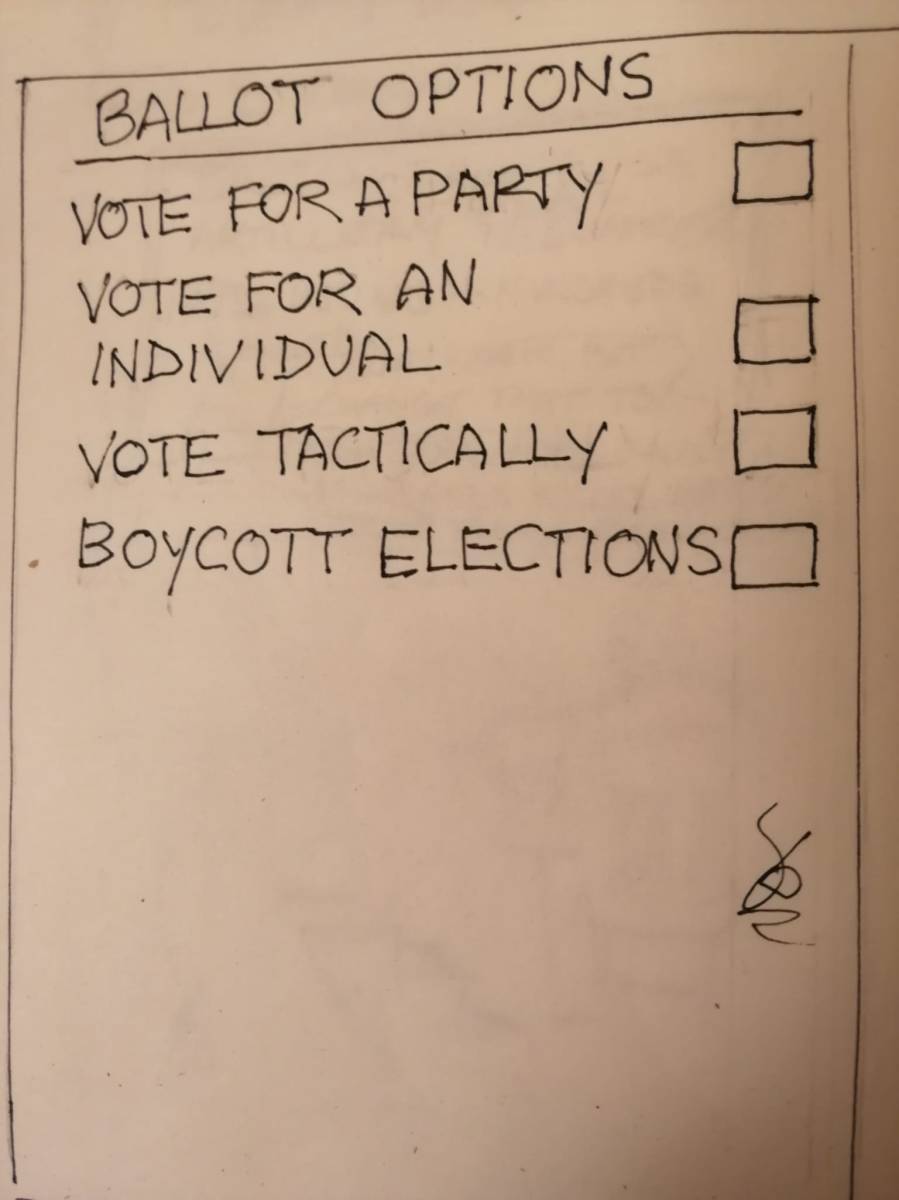
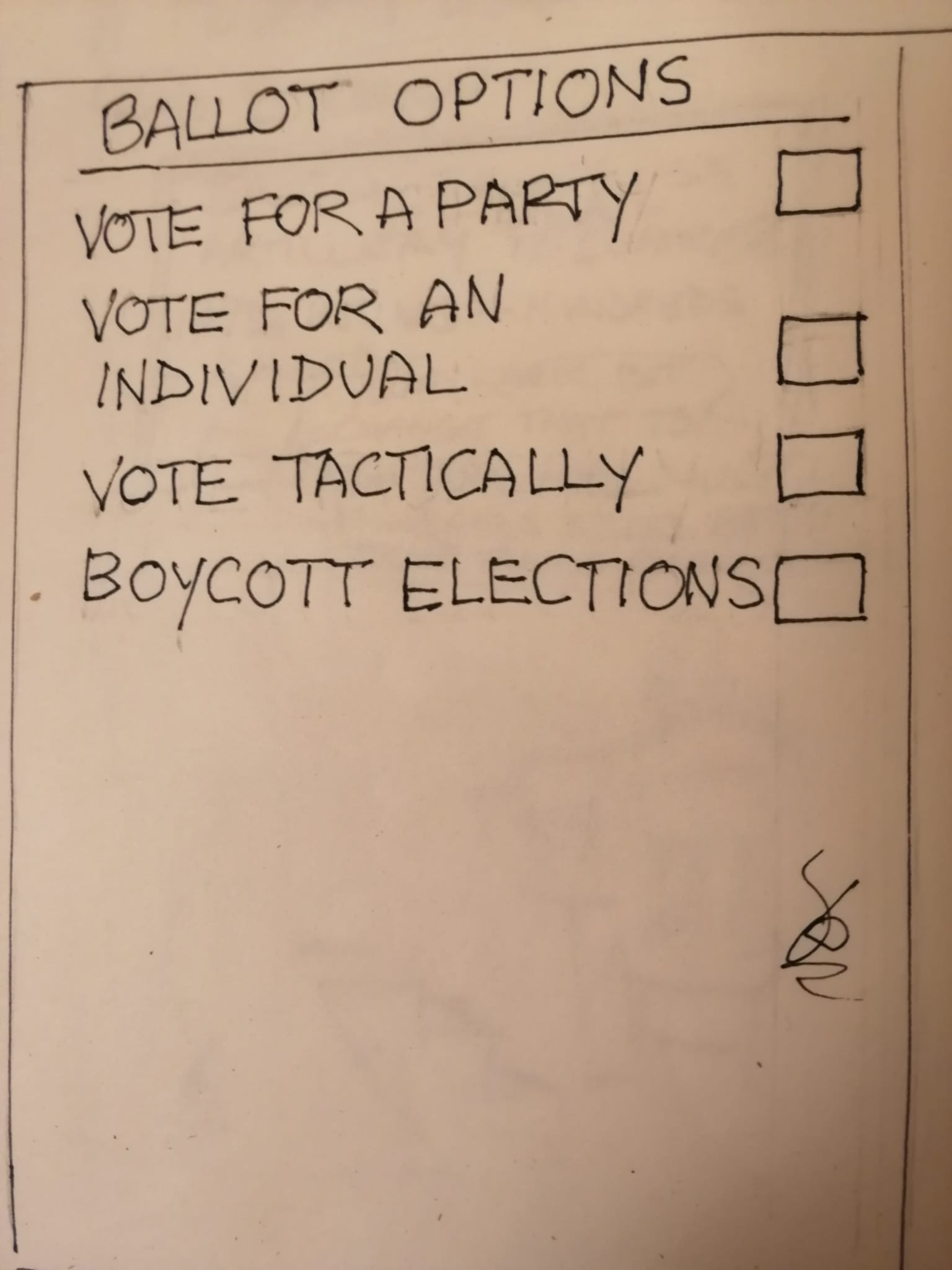
The elections for a government in the 26-County state are only days away now and, while many are advocating a vote for this or that party or candidate, some are opposed to voting at all.
ARGUMENTS AGAINST VOTING
An amusing take on abstention advises: Don’t vote – it only encourages them! Anarchists have long been opposed to voting in national elections and I recall a poster in Britain exhorting people to Vote for Guy Fawkes – the only man ever to enter Parliament with honest intentions. 1
Revolutionary marxists have also often called for a boycott of elections.
The position that they hold in common is that changing this or that party in government does not change the system and that it is that which is in need of change; as Connolly2 famously declared capitalist governments to be “committees of the rich to manage the affairs of the capitalist class.”
However, it is possible to hold that opinion but yet to vote – and even to advocate voting – in some circumstances. However among some Irish Republican circles there has been a trend maintaining that voting in these elections is a recognition or acceptance of their alleged legitimacy.
A massive spoiling of ballot papers is often advocated by those who wish to ensure that the boycott may not be interpreted as apathy among the electorate. The number of spoiled ballot papers is supposed to be recorded and the papers available for inspection.
ARGUMENTS FOR
Those arguing in favour of voting in elections come at the question from a variety of points, including that voting is a democratic right for which our ancestors fought; that if we fail to vote we have no right to complain about government actions (or inaction).
They may maintain that not voting for some parties is equivalent to voting in favour of their opponents; or that voting a particular party into power can be used to overturn undesired legislation or conversely to promote desired legislation or to put them in power so that they may be exposed.3
The reformists and social democrats (often presenting themselves as revolutionaries) advocate for reforming or at least controlling capitalism under a Left Government. Despite the impracticability of the latter in many historical experiments, the hopeful and deluded keep advocating it.
Then of course, there is the ‘Lesser Evil’ argument, which is probably the most seductive; we witnessed that during the Harris-Trump USA Presidency competition. The Greens in Europe even appealed to Stein of the USA Greens, running against Harris on an anti-Genocide ticket, to desist.4
The claim that we might as well use our votes to elect a ‘lesser evil’ government is seductive precisely when we feel that no other option is available, combined with fear of worse economic and social conditions to be imposed upon us by the ‘worse evil’ party or candidate.
To follow the ‘lesser evil’ road is not only to perpetuate the system in one form or another but also fail to recognise our potential strength as the producers of all wealth; to fail to strengthen our energies to break firstly the mental chains, then the physical ones; to make fundamental choices.
THE TACTICAL VARIANT
Some argue that although in general national elections don’t change the system, they can be used at times to effect a tactical change: show rejection of a specific government position or individual.
They sometimes argue in favour of voting to put a specific individual or group of individuals into parliament for tactical reasons.
Can it be of use to have a few individuals in the Irish parliament who will attack the government and ruling class in speeches? Or to put specific issues forward on which to expose the ruling elite? Or to ask questions to gather government information? I am sure that it can and has been at times.
Can it be useful to have a handful of individuals elected to the Irish parliament who are prepared to seek entry to prisons to talk to political prisoners? Or who will head an investigation into some kinds of abuses and publish the results? Such can be and has been of use at times.
The important thing is to ensure that the message we give is that useful though such people and positions may be at times, they are not the solution, which can only be the overthrow of the system and the establishment of a socialist system with power in the hands of the working people.
ELECTIONS IN A CAPITALIST DEMOCRACY
What are known as ‘democracies’ are states concentrated across ‘Western’ regions, i.e western Europe and its former colonies of the USA, Canada, Australia and New Zealand, with varying degrees of effect upon states on the African and Asian continents, along with ‘Latin America’.5
These are without exception, regardless of variety, systems of governing their working people without having to resort to wide-scale constant repression and suppression. For that project, the illusion of choice is essential, hence the regular elections and different political parties.
But the illusion of any fundamental choice is failing. Increasingly, governments in many European ‘democracies’ are becoming coalitions between a number of political parties and in Ireland, the main Government-Opposition parties for decades have exposed the reality by governing together.6
The effect of such exposure of the lack of real choice is impacting upon the consciousness of the populations concerned so that progressively less of them are willing to participate in the charade. In Ireland now more than one-third of the population do not vote.
This situation is of great concern to the ruling classes and to their intellectuals who are busy trying to devise schemes to offset the drift such as advocating voting from home, spectacles such as televised confrontations between competitors and ‘Citizenship’ programs in schools.
Clearly revolutionaries should not assist in any attempt to justify the system or to perpetuate the illusion of elections in capitalist ‘democracy’ being anything else than a periodic choice for slaves between the overseers employed by their masters.
DOES IT MATTER ANYWAY?
The nub of the question as to whether to vote boils down to what we hope to achieve and its prospects. If there were a massive abstention from the polls then of course that would be seen as a huge vote of no confidence in the parties standing and perhaps in the system itself – but from what perspective?
From the Right? From the Left? From apathy? In any case at the moment that looks like a moot question since there’s a likelihood of a turnout of around 60% of the registered voters.7
Will abstention make people more politically aware or conversely will participation in the elections turn people away from the possibilities of organising on the ground and ultimately of revolution? Perhaps for some – but overall, I think not many in either case, not on a longer-term basis.
From a revolutionary point of view, does it matter whether people vote or not? Or even sometimes who they vote for? Surely what matters is organising and supporting the movement for fundamental progressive change? Can that be done by people who vote as well as by those who don’t?
I’d say that is at least as likely.
During capitalist state elections the best we can do, I think, is to point out the inadequacy of the choices presented to us and to advocate stronger and more militant organisation as an alternative to the calls to vote for one party or another.
Whatever party or individual gets elected to Leinster House, the principal struggles remain: for a free united independent Ireland, for a socialist system, against the imperialist world system, against environmental destruction. It is on that we need to concentrate.
The newly-elected management committee of the capitalist class should be savaged mercilessly for its inevitably broken promises and its continuing attacks upon the economic and social conditions of the working people, and on Irish national neutrality.
Most of all, we need to improve our organising, strengthen our ranks and find ways to strike blows against the system to win victories in our march towards the overthrow of the neo-liberal and neo-colonial Gombeen ruling class and its foreign masters.
End.
1While amusing as a caption, given that Guido Fawkes plotted to blow up the English Parliament on 5th November 1605, upholding Guido Fawkes as some kind of historical hero is problematic, as he was a militant Catholic and the date of capture, Guy Fawkes’ Day, was a regular occasion for the exhibition of anti-Catholic prejudice even into the 20th Century in Protestant Britain, which more often than not, manifested itself as anti-Irish racism.
2James Connolly (1868-1916), revolutionary socialist activist, theoretician, journalist, writer and trade unionist, leading participant in the 1916 Irish Rising for which he was sentenced to death and shot by British firing squad.
3Lenin famously advocated voting the British Labour Party into government for the first time to ensure their exposure, supporting them “as a rope supports a hanging man”, advice misused by social democrats and others on the electoral Left and about which revolutionaries have argued ever since.
6Throughout the existence of the Irish State, the Fianna Fáil party has been the longest in government, with Fine Gael second, both socially conservative parties with strong loyal electoral bases. However now they are governing in coalition, along with the Greens. It is worth noting that there has not been a government of absolute majority by any party in the Irish state since 1981, when Irish Republicans stood as H-Block (e.g. hunger strike) candidates and two were elected with another having a near miss.
7Despite a trend of dropping percentages of the potential voters actually participating, in 2020 the turnout was a little over 62%.
The news about the sexual predations of Mohammed Al Fayed, owner of Harrods and Chelsea Football Club, was not news to many. His predilections, we learn now, were well-known in his circles. Yet only after his death are these stories made public.
Again and again we learn these stories of sexual predators, even paedophiles, whose predations come to the attention of the public only after their deaths. Entertainers such as Rolf Harris and Jimmy Saville, for example, who preyed on children.
Fayed wasn´t an entertainer but he was very rich and preyed on young women – in this world in which we live, some entertainers are often very rich too. With wealth comes protection, not just of the privately-hired variety but of the public kind also – the police force.
Their victims, at least the adult ones, knew that their words would count less with the police than would those of the rich. In the end, the police know instinctively who are their employers. The government ministers and senior police officers mix in the same circles as some of the rich.
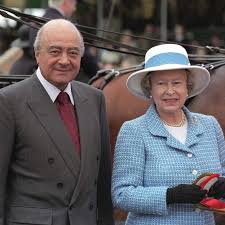
Mohamed Al-Fayed demonstrating his access to power and influence, posed next to the late British monarch, Queen Elizabeth. His son Dodi was friendly with Princess Diane and died in a car crash with her – at the time she was married to the former Prince Charles, now King of the UK. Jimmy Saville, paedophile, we may recall, was also close to the Royal Family as were the Epstein-Maxwell couple, who procured at least one underage female for Prince Andrew. (Photo sourced: Internet)
The victims are aware of how the vertical power structure in society is constructed. They know or are soon taught that the rich have not only direct protection but retribution for those who offend also. There are penalties beyond police harassment or lack of police response to complaints.
There is the jeopardising of employment for the employee, lacking of job reference, unfavourable comment in another employer´s ear … The employers also have a network of mutual interest.
HR managers of one company will wish to further their career progression through the capitalist network. Players know how the game is played.
WHY AND HOW
The predators do not do what they do merely because they like to – there are many temptations in people´s heads that are not acted upon, that remain in internal fantasy or perhaps acted out only with consensual partners.
The famous predators functioned out of a sense of entitlement – like their wealth which they felt they deserved,1 they believed also that they were entitled to do what they wanted to “lesser” beings because they themselves were famous and rich (like Harris and Saville) – or just rich, like Mayed.
Just as their wealth was the accumulation of the wealth created by the work of many others, with their sense of entitlement went also the reality of their ability to do what they wanted. They did it because they could.
Jeffrey Epstein and Ghislaine Maxwell were eventually arrested and went to jail, Epstein dying there. Far from being a vindication of the justice of the system, their victims were initially ignored by the police and even harassed – and Epstein died in mysterious circumstances before trial.
All around the world people are suffering these kinds of abuses to one degree or another, have done so for centuries and will continue to do so. Yes, even with the occasional exposure of this or that person.
For as long as the system of status, wealth and privilege exists. Which means at least for as long as the capitalist system exists – and even beyond that, perhaps.
So in organising to overthrow the capitalist system we must ensure that we do not replace a system of unquestionable authority and power with another.
Yes, well, that´s for the future, right? No. It starts now. In our treatment of one another. In how we conduct ourselves. In ensuring we do not claim a special entitlement or the right not to be be questioned.
And when we err, individually or organisationally, to act to correct and remedy the ill.2
End.
FOOTNOTES
1Let us remember here too that no-one can get rich by their own work, no matter how hard – it requires the work of many others to make one person wealthy.
2Let us not forget the one example among many: the past history of the ostensibly revolutionary socialist organisation of the former Workers Revolutionary Party. Its General Secretary Gerry Healy was accused of the sexual abuse of 26 young female activists in the organisation. A painfully honest description of the replication of systems of unquestioned privilege in the former Party and the process of the expulsion of Gerry Healy and of his defence (for example by famous film actors Corin and Vanessa Redgrave) can be found here: https://libcom.org/article/break-wrp-horses-mouth-simon-pirani
Like that similar-sounding ailment affecting some males, most of us are not rising, at least not to the expectations of the electoral commission. Furthermore the problem appears to be no respecter of gender.
The issue, according to the Independent Electoral Commission, is that not enough of us are voting in elections. Only 49% turned out to vote in the Irish local (municipal) and European Parliament elections which means that more than half of registered voting age didn’t bother.
Well, so what? Why is that is troubling the IEC? It seems that generally, the authorities like to see a good turnout because it appears to signify that people believe that they really have a democratic choice through the electoral system and are actually exercising it.
If they don’t believe that they have a choice – or if the appearance of choice is not matched by the reality they perceive, the people might turn to other methods of deciding how the country should be run. And that might result in an outcome unwelcome to the ruling elite.
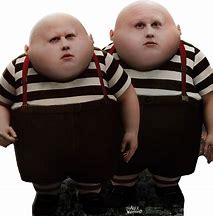
THE TWEEDLES
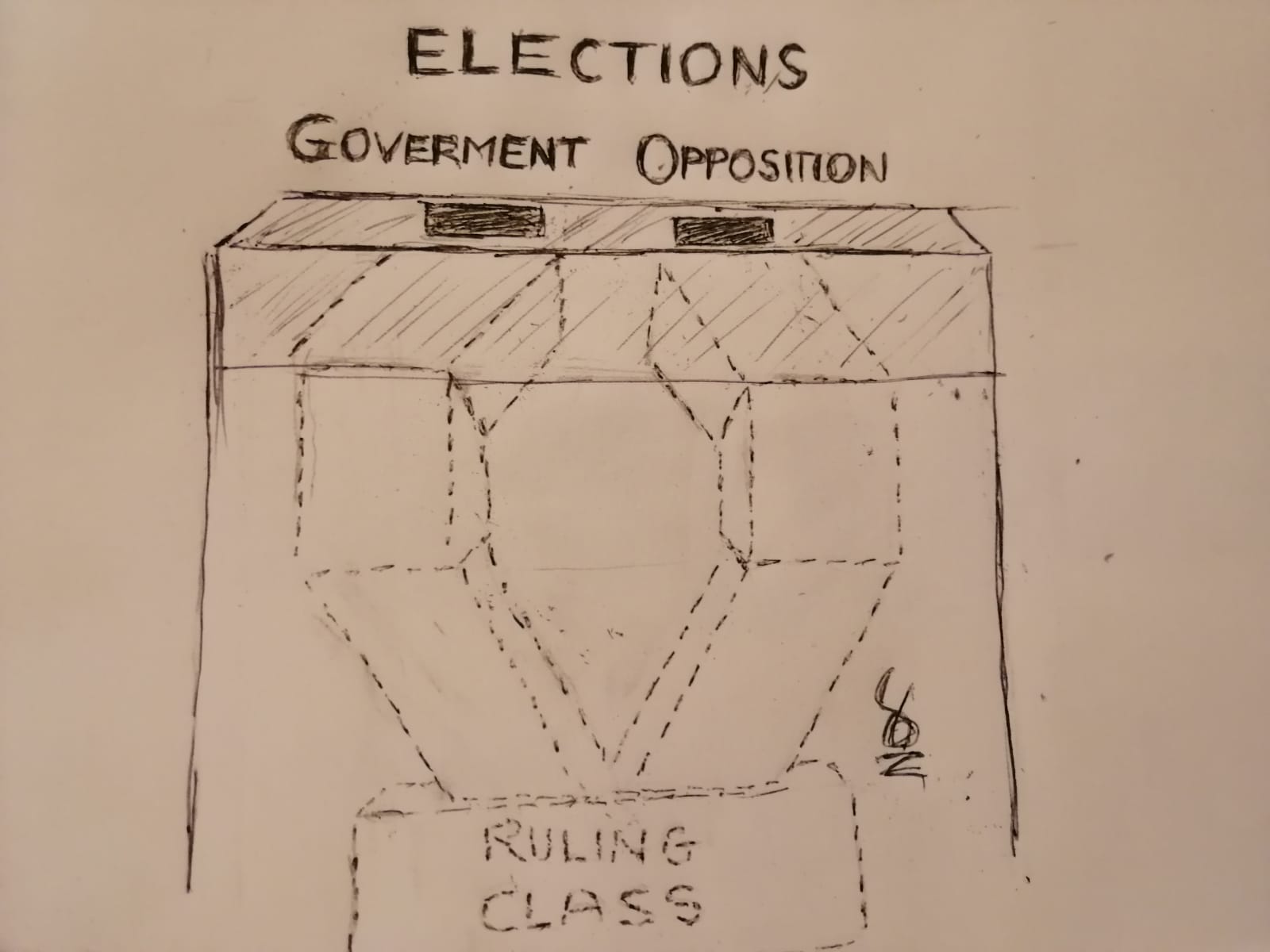
The Tweedledum and Tweedledee parties appear to give the electorate alternatives and though whichever party wins the capitalist system remains, it appears to give a choice – but a bet choosing between two horses of the same owner in a two-horse race.
Like both Tweedles in the folk nursery rhyme and in Lewis Carroll’s Alice Through the Looking Glass (1871), Tweedledum and Tweedledee are brothers and though they appear to be preparing for war with one another, they don’t actually fight, not in Western ‘democracies’.
Tweedledum and Tweedledee (or is it the other way around?). (Image sourced: Internet)
There are, after all, plenty of spoils to share between their masters. The creators of that wealth need to be controlled, fooled and, if necessary from time to time, repressed. “Red” social democrats and “Blue” conservatives have alternated to share power in the Western world for over a century.
In Ireland, the only European state which is a neo-colony and part of its land a direct colony, its national liberation unfinished, the Tweedles have been blue or green.
But for decades now the illusion of choice has been crumbling. There has not been a majority party government in Ireland since 1981, when Irish Republicans were elected during the hunger-strike campaign. All Irish governments since have been a coalition of one kind or another.
The Irish Labour Party, founded by Connolly and Larkin and far from their thinking for many a long year, has been in government a number of times but always in coalition – usually with the conservative Fine Gael, itself the product of a coalition that included the fascist Blueshirts.
Those years of government participation for Labour have thoroughly rubbed off the red paint of socialist opposition from the party. The Green Party, mixing a brand of concerns for the environment with those for society, has met a similar fate in coalitions.
Since 2020 the Irish state has had what is essentially a ‘national government’, a coalition of opposing parties normally only seen in times of war or under a fascist regime. The alleged political poles have joined in order to run the system for the Gombeen ruling class.
Though this gives stability for the Gombeen’s system their problem is that it has removed the illusion of choice. They might restore that illusion through the promotion of a third major party in opposition and the formerly revolutionary Sinn Féin has worked hard to fill that space.
In the 2019 General Election SF got the most representatives elected but insufficient to form a majority government, after which the Tweedles united, along with the Greens to make up the numbers to manage the State. But the Gombeens will hold SF in reserve, I’m thinking.
Harris of Fine Gael and Taoiseach (equivalent of Prime Minister) of the Coalition Government, commented on the closeness of his party and former Opposition party Fianna Fáil in votes, predicting “a Government of equals”1– but it’s not just in votes that they resemble one another.
Yes, I know I misspelled Government but I want to get this article out of the way. I’ll redo the cartoon sometime later and replace it.
RESULTS
I don’t think there is a great deal to be said about the actual results of the recent local and EU Parliamentary elections in Ireland but no doubt some commentators will be saying it anyway.
Of unwelcome interest is that five fascists of different groups got elected, three of them to Dublin City Council. The electoral Left lost some and gained some without big changes.
Independent socialists (and couple) Clare Daly and Mick Wallace both lost their EU seats but perhaps they and in particular Daly in Ireland would be more of an asset to the Left. Luke ‘Ming’ Flanagan in Midlands North West, another left Independent, kept his EU seat comparatively easily.
Sinn Féin had what was for them a disappointing run but had some new people elected to local councils and two seats in the EU Parliament, losing an existing one. Many of their enemies in the Republican ambit, often former comrades, rejoiced in their misfortunes.
Understandable though that may be one wonders how those who have some faith in the party at the moment are to be disabused of their illusions without having seen them in government. On the other hand their twists and turns on the road there may have disenchanted many already.
IT’S NOT A CHANGE OF PARTIES IN GOVERNMENT WE NEED
For most of my life I have been aware that it is not a change between political parties but between socio-political systems that is the issue. But I do vote sometimes in order to help keep a useful and decent voice in a parliament or a local authority.
An Irish community activist pensioner years ago in London, Co. Galway Teresa Burke, was a member of the British Labour Party. After a General Election, she asked me had I voted. I replied that I hadn’t; I’d not seen a candidate that stood anywhere close to that in which I believed.
“Well then, you must take responsibility for everything the Tories do if they get in!” Teresa remarked angrily.
“I’ll do that, Teresa,” I replied, “if you’ll take responsibility for everything Labour does in Ireland if they get in!”
Teresa’s lips twitched slightly. She knew as well as did I that the British Labour Party had sent the troops into the Irish colony to quell the struggle for civil rights in 1969 and supported the Tories in introducing internment in 1971 and massacres that year and in 1972.
In 1974 police under a Labour Government had killed the first anti-fascist on a demonstration,2 framed a score of Irish people in four separate cases for heavy jail sentences3 and had passed the fascist Prevention of Terrorism (sic) Act.
Whichever party is in government, the social-political-economic system is run by the capitalist class which it benefits and they will fight tooth and nail to maintain that system.
The alternative-party-within-the-system idea, so dear to social democrats, has failed time and time again. It betrayed its supporters by becoming like what it opposed, or consistently failed to get elected or was undermined, betrayed and destroyed, like Syriza in Greece, for example.
But in the unlikely event that route should ever show signs of being successful, for the ruling class there remains the military coup.4
2Kevin Gately, son of Irish immigrants, a student at Leeds University, died from injuries received from a mounted police baton during an antifascist demonstration in Red Lion Square, London on 15th June 1974.
4The serialised for TV A Very British Coup (1988) with Irish actor Ray McAnally from the Chris Mullins novel (1982) is well worth watching for this scenario.