On the 21st of April as he reached his house paramilitaries murdered Narciso Beleño, the leader in Southern Bolívar, Colombia, just two years after the murder of two other leaders Teo Acuña and Jorge Tafur.
I knew Narciso Beleño. Our paths crossed many times, on occasion on literal paths in the countryside as Narciso travelled the country in his struggle to defend rural communities in Colombia.
But I don’t want to talk too much about Narciso, the person, as there are others who can pay greater tribute to him in that regard, though his name always made me curious: Narciso (Narcissus).
Narcissus was a figure in Greek/Roman mythology who as a punishment from the gods fell in love with his own reflection. It is where we get the word narcissist from. But unlike the Greek/Roman figure, our Narciso was kind, caring, generous and selfless.
There are thousands of people, whole communities that can testify to his qualities as a person, a fighter and a leader.
When he was murdered the President, Gustavo Petro tweeted that “we failed Narciso”. But who failed Narciso? The communities? His comrades in Fedeagromisbol? Or were they the youths from the Front Line who are still in jail? Tell us who! A generic “We doesn’t do it, it is a lie.”
He should explain who failed him, how and why and Petro should also tell us what he intends to do prevent there being more murders of leaders.
Once upon a time we never doubted to putting a name and surname to the matter. We didn’t hesitate in naming the company, the board of directors, the landlord, the local politician. Sometimes we even ran the risk of putting a name and military rank to the affair.
A long time ago a gradual process began whereby some stopped naming them. And now under the Petro government it is not thought well to name them. Once upon a time we all named Fedegan, the cattle ranchers’ association, as backing the paramilitaries.
The Fedegan functionaries even acknowledged this. Now one of the representatives of that association, which is currently involved in refounding paramilitary structures, represents the State in the dialogues with the ELN.
Once upon a time we named the mining companies that have been trying for decades to take control of the gold in Southern Bolivar and other regions. It is worth remembering that Narciso travelled the country. More than one mining company had it in for him.
In Science Fiction and Fantasy novels, evil and magic lose their power over mortals when they are named by their real name and so the best kept secret is their real name. In real life something similar happens. Paramilitaries as something dark, shadowy and hidden defeats us.
When we name those behind this black magic with their real names, it begins to lose its power over us. They are not unknown to us. We withdraw cash from their ATMs every day, we purchase their services, we drink their products, we work in their companies and the odd eejit votes for them.
No company will say, “buy my product we are the murderers of social leaders” or “vote for me, I have murdered thousands.” They hide this for a reason and for that same reason we should expose their dark souls to the light of day.
The best tribute Petro can pay is to explain who failed and name the murderers just like he used to do before he was President. They are the usual suspects. Petro likes to say he governs but does not have power.
Well, tell us who holds that power that he don’t have, with names and surnames, economic group, foreign company. If we all failed, then nobody failed, if he was murdered by those who cannot be named, then nobody murdered him.
We usen’t to hesitate in talking about paramilitaries, the economic and political interests and reasons behind their actions. We named the business associations, the megaprojects in each region, we proved it.
Some sought justice in international tribunals, others in Russell style tribunals of opinion. We have to pay tribute to Narciso and other victims of the paramilitaries and name the murderers. Uribe tried to fool us with the Bacrim (Criminal Gang) euphemism. Neither Gulf Clan or anything else.
The same ones who disappeared Edgar Quiroga and Gildardo Fuentes in 1999 (in Southern Bolívar) murdered Narciso 25 years later. Say it loud and clear, Mr. President.
In Dublin’s south docklands the property developers and the corporations dominate city planning and therefore the landscape. And the working class community there feel that they’re being squeezed out.
I’ve met with some concerned people from parts of this community in the past to report on their situation and concerns for Rebel Breeze and did so again recently.
A view eastward of a section of the south Liffey riverfront, showing a very small amount of more traditional buildings squashed between or loomed over by the “glass cages that spring up along the quay”. (Photo 1 March 2024: D.Breatnach)
YOUNG PEOPLE – education, training, socialising
“There’s nothing here for our young people” said one, expressing concern over the attraction for teenagers of physical confrontations with other teens from across the river which have taken place on the Samuel Beckett Bridge over the Liffey.
A young man training as an apprentice in engineering attends a mixed martial arts club but has to go miles away to another area to attend there. Between his industrial training, travel and athletic training he has little time to spare for socialising.
I comment that those sporting activities tend to concentrate on male youth and only some of those also but he tells me that nearly half the regular membership of his club is female. A community centre could provide space and time for such training but they say they have no such centre.
St. Andrew’s Hall is a community centre in the area and there are mixed opinions in the group about it but I know from my own enquiries that the available rooms are committed to weekly booked activities (and our meeting had to take place in a quiet corner of an hotel bar).
As a former youth worker and in voluntary centre management, I know that a community centre can serve all ages across the community, from parents and toddlers through youth clubs to sessions for adults and elders.
Discussing youth brings the talk into education and training. As discussed in a previous report of mine, the youth are not being trained in information technology, which is the employment offered in most of the corporations in “the glass cages that spring up along the quay.”1
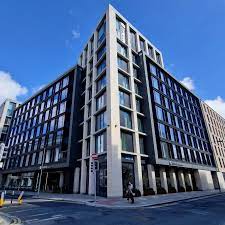
Section of the south Liffey docks showing some of the few remaining older buildings as they are swamped by the “glass cages”. The building on the far right of photo, very near to Tara Street DART station, once an arts centre, is already targeted for demolition and replacement with commercial building. (Photo sourced: Internet)
“If they’re lucky, they’ll get work in the buildings as cleaners or serving lattes and snack in the new cafes”. Some opined that the corporations in the area should be providing their youth with the training while others thought Trinity College should be doing so.
HOUSING – price and air quality
Universal municipal housing in the area has declined due to privatisation of housing stock and refusal to build more. A former municipal block in Fenian Street, empty for years is now to be replaced but the “affordable” allocation has been progressively reduced, ending now at zero.
Pearse House in south Liffey docklands, believed earmarked for demolition and site sold to property speculators. (Photo 1 March 2024: D.Breatnach)
Property speculators (sorry, “developers”) with banker support are building office blocks and apartment blocks in the areas, the latter units priced beyond the range of most local people. The average rent for a two-bed apartment in the area is €2,385;2 to buy a 3-bedroom house €615,000.3
The Joyce House site and attached ground area could provide housing and a community centre but appears planned to go to speculators.
Continuation of ‘Pearse House site’ in south Liffey docklands, believed earmarked for demolition and site sold to property speculators. (Photo 1 March 2024: D.Breatnach)
The Markievicz swimming pool near Tara Street has been closed and the local people are told they can go to Ringsend for swimming, an area which already has better community facilities than are available to the communities further west along docklands
A huge amount of traffic goes through the area and one person stated that Macken Street tested as having the worst air quality in Ireland. “I have to close my windows to keep out the noise and pollution,” said another; “the curtains would be black.”
Townsend Street side of ‘Pearse House site’ in south Liffey docklands, believed earmarked for demolition and site sold to property speculators (prospective property speculators must be salivating). The gambling advertisement coincidentally erected there seems to show the likely social types to benefit from these kinds of deals. (Photo 1 March 2024: D.Breatnach)
‘They want us out’
If some town planner were intending to establish a community somewhere, s/he would plan for housing, obviously, so the people would have somewhere to live. But a proper plan would provide also for education and training, along with social facilities — and employment.
But if someone were intending instead to get rid of a community, s/he would target exactly the same elements, whittling them down or removing them altogether. This what some local people feel is intended for their community.
“We feel we’re not wanted here,” said one and others agreed, “They want us to move out.” “But we’re not going! We’re staying,” said another, to grim nodding of heads around.
HISTORY of struggle … and of neglect
In the late 1800s and early 1900s, Dublin had the worst housing in the United Kingdom and many of its elected municipal representatives – including a number of Nationalists of Redmond’s party – were themselves slum landlords.
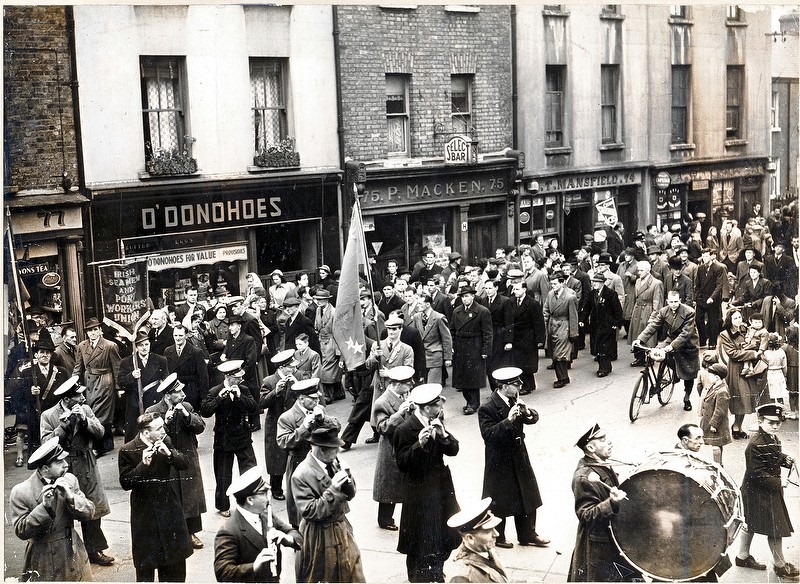
When the Irish Transport and General Workers Union was formed by Jim Larkin with assistance from James Connolly and the Irish Women Workers’ Union founded by Delia Larkin, many of the dockers, carters and Bolands Mill workers who joined them came from the south docklands.
And when the employers’ consortium led by William Martin Murphy set out to break the ITGWU in 1913, many of those workers
… Stood by Larkin and told the bossman We’d fight or die but we would not shirk. For eight months we fought And eight months we starved, We stood by Larkin through thick and thin …4
And the women of Bolands’ Mill were the last to return to work, which they did singing, in February 1914.
They also formed part of the Irish Citizen Army, the first workers’ army in the world,5 to defend the striking and locked-out workers from the attacks of the Dublin Metropolitan Police and which later fought prominently in the 1916 Easter Rising.6
Many also joined the larger Irish Volunteers which later became the IRA, along with Cumann na mBan,7 fighting in the Rising, the War of Independence and the Civil War, supporting resistance of class and nation for decades after.
The Irish Republican Brotherhood (the Fenians) was founded in the area; Peadar Macken8 was from here and has a street named after him; Elizabeth O’Farrell9 is from the area too with a small park named after her and Constance Markievicz10 also lived locally.
The Pearse family lived in the area too and Willie Pearse and his father both worked on monumental sculpture at the same address; Connolly and his family for a while lived in South Lotts.
Home of the Pearse family and monumental sculpting business (Photo: Dublin Civic Trust)
The working class communities in urban Ireland suffered deprivation throughout the over a century of the existence of the Irish state and the colonial statelet. The communities in dockland suffered no less, traditional work gone, public and private housing in neglect in a post-industrial wasteland.
The population of Ireland remained static from the mid-1800s until the 1990s, despite traditionally large families — emigration in search of employment kept the numbers level. Married couples lived with parents and in-laws while waiting for a house or flat – or emigrated.
In the 1980s, like many parts of the world, Ireland fell prey to what has been described as the “heroin epidemic” and the neglected urban working class worst of all, with the State assigning resources to fight not so much the drug distributors as the anti-drug campaigners.
One of those in the meeting became outwardly emotional when he talked of “the squandered potential” of many people in the local community.
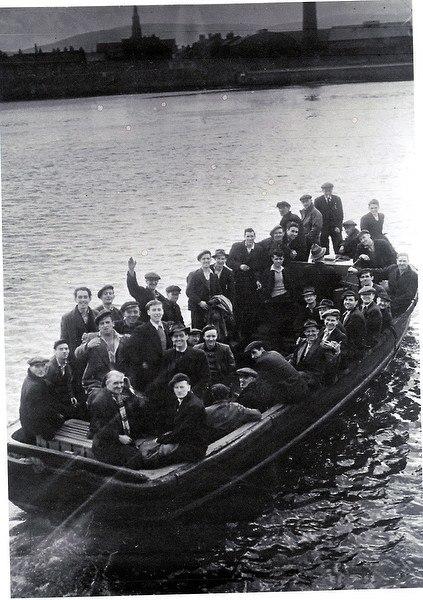
A workers’ day out trip on the Liffey ferry (Photo sourced: Dockers’ Preservation Trust)
The heirs of these then are the marginalised and abandoned that are targeted with disinformation and manipulated by the far-Right and fascists, to twist their anger and despair not against the causes of their situation but against harmless and vulnerable people.
But the Left has to take a share of the blame, for leaving them there in that situation, for not mobilising them in resistance. After all, issues like housing, education and employment are supposed to be standard concerns for socialists, of both the revolutionary and the reformist varieties.
Republicans cannot avoid the pointing finger either. These communities provided fighters and leaders not only in the early decades of the 20th Century but again from the late 1960s and throughout the 30 years war.
The Republicans led them in fighting for the occupied Six Counties but largely ignored their own economic, social and educational needs at home. Perhaps this is why the people are now organising themselves.
Protest placard by housing block in Macken Street protesting noise and dirt from nearby construction (Photo: Macken Street resident)
“THEY DON’T VOTE”
A number of the local people to whom I spoke quote a local TD (Teachta Dála, elected representative to the Irish parliament) who commented that most of the local residents don’t vote in elections.
Whether he meant, as some have interpreted, that therefore they don’t matter or, that without voting, they cannot effect change, is uncertain. However, community activism is not necessarily tied to voting in elections.
Protest placard by housing block in Macken Street protesting noise and dirt from nearby construction. (Photo: Macken Street resident)
As we know from our history and that of others around the world, voting is not the only way to bring about change and, arguably, not even the most effective one.
Whatever about that question, people are getting organised in these communities and those who hold the power may find that they are in for a fight.
End.
The landscape (and airscape) viewed from a housing block in Macken Street (Photo: Macken Street resident).
FOOTNOTES
1From song by Pet St. John, Dublin in the Rare Aul’ Times.
4From The Larkin Ballad, about the Lockout and the Rising, by Donagh McDonagh, whose father was one of the fourteen shot by British firing squad after the 1916 Rising.
5Formed in Dublin in 1913 to defend strikers and locked-out workers from the Dublin Metropolitan Police; members were required to be trade union members. The ICA was unique for another reason in its time: it recruited women and some of them were officers, commanding men and women.
6Historian Hugo McGuinness based on the other side of the Liffey believes that the reason the British troops sent to suppress the Rising disembarked at Dún Laoghaire rather than in the Dublin docks was because they feared the landing being opposed by the Irish Citizen Army and its local supporting communities.
7Republican Female military organisation, formed 1914.
8Fenian, socialist, trade unionist, house painter who learned and taught Irish language, joined the Irish Volunteers, fought in the Rising and was tragically shot by one of the Bolands Mill Garrison who went homicidally insane (and was himself shot dead).
9Member of the GPO Garrison in the 1916 Rising, subsequently negotiator of the Surrender in Moore Street/ Parnell Street and courier for the 1916 leadership to other fighting posts.
10Member of multiple nationalist organisations, also ICA and in the command echelon of the Stephens Green/ College of Surgeons Garrison. Also first woman elected to the British Parliament and first female Labour Minister in the world.
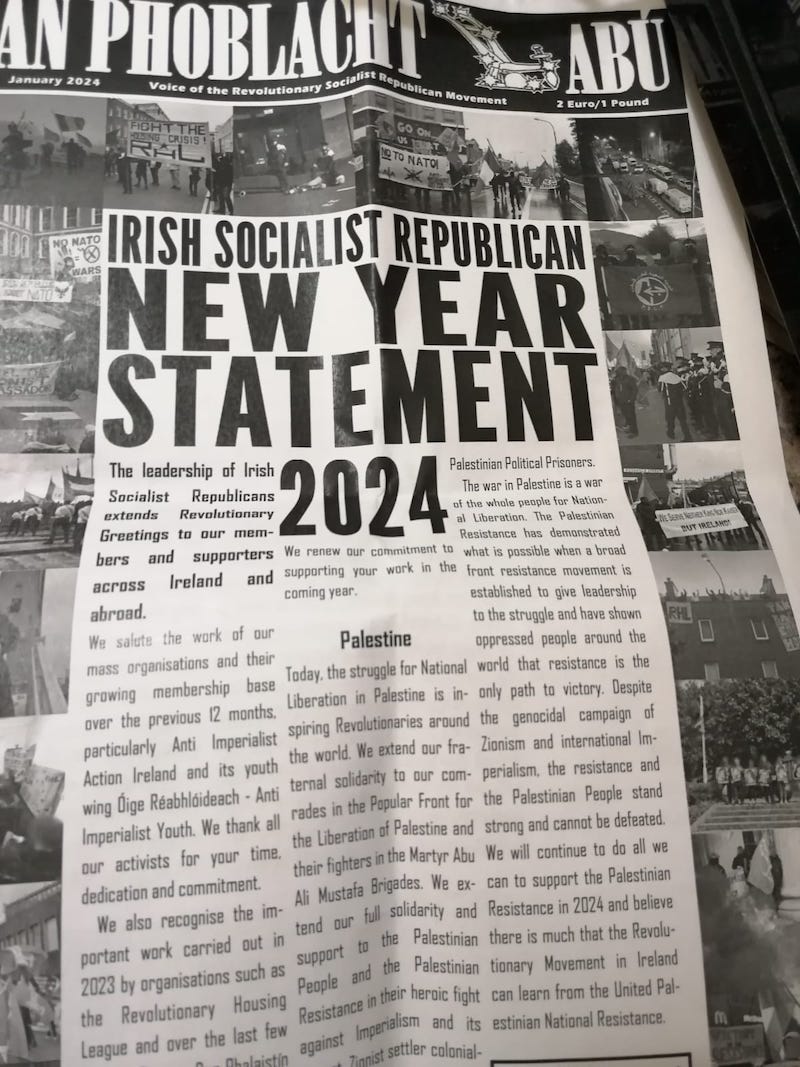
The first edition of the socialist republican weekly newspaper An Phoblacht Abú for 2024 has been available in hard copy from sellers now for several weeks; I am reviewing it here as I have done on occasion with another few issues during 2023.
APA is a hard-copy newspaper of usually 12 x A4 sides, produced monthly from I believe the last months of 2022, including articles on anti-imperialism, anti-fascism, recent Irish history, internationalist solidarity and sometimes on older history, culture and reports on events, selling at €2/£1 per issue.
Hard-copy revolutionary papers are important as a means of distribution to those who don’t wish – or are unlikely — to seek it online but more than that, they also provide the opportunity to make contact on a personal and organisational level with people with whom to discuss events.
Masthead image taken from the An Phoblacht Abú Facebook page.
However, back issues are also available electronically, I’m told, from the producers.
This particular issue reports on the Palestinian struggle and the solidarity movement in Ireland, featuring a report of an occupation of the Israeli Embassy on 19th December with a following picket and blockade of the gates to the building which hosts it for many hours.
Another page carries a report on Palestine solidarity actions across the country and a “Hands Off Iran & Iraq” item, also an obituary on the death of a recent comrade of the organisers. Separately there is a report and comment on the death of an Irishman in the conflict in Ukraine.
Political prisonersin Ireland and the Basque Country are also covered, the latter focussing on the ‘non-compliant’ Basque prisoners and their support network, in contrast to the colluding “official leadership” and the great majority of prisoners who have come under their influence.
An article comments on the upcoming Referendum on Article 41 of the Constitution of the Irish State, condemns the treatment of women historically by the Irish ruling class and, without recommending how to vote, calls for the destruction of the State.
Commemorations of historical events, including martyrs, are an important part of the culture of all peoples in struggle and APA reports on some. A statement on the escape from justice by natural death of war criminal Brigadier Kitson was widely shared in appreciation on social media.
NEW YEAR CALL FOR BROAD FRONT UNITY
Organisations traditionally issue New Year statements, perhaps reflecting on the past year but always looking to the coming year. The ISR NY Statement covered three pages and called attention to all the struggles discussed in the reports, along with some others.
The one theme in the Statement dominating all others was the call for united action in developing a broad anti-imperialism united front to work for unity “around common Republican principles” while at the same time maintaining “the autonomy and independence of different groups.”
In furtherance, ISR proposes that a “Broad Front Congress” be organised before the end of this year and called on those interested to contact them “to turn the demand of the Republican base into action.”
COMMENT
The importance of revolutionary newspapers is underlined historically by the preparations of the British Government prior to the General Strike of 1926, when they purchased all stocks of newsprint paper to deny them to revolutionaries and other strikers.
Governments today can close down social media transmission and reception over an area and even nation-wide.
The APA editorial is undoubtedly correct in its call for a broad front while stipulating independence of organisations within that front. A congress may further this aim but I wonder if it will, without some advance agreement on working principles (about which I have written previously).
I find it striking that in the New Year’s message which mentions working class communities, there is nothing about workplace organisation, or trade unionism, to give it another name. Working class people do not live in communities alone – they also work many hours outside them.
And in the most commonly-imagined scenario for revolution in western countries, revolution is preceded by a general strike. To organise and carry out such a strike and maintain it against external repression and internal undermining, requires leadership deep and wide within the movement.
How this is to be achieved is an issue, the resolution of which can only follow of course from recognition of its necessity. Across the Left and Socialist Republican movement I see no sign of this recognition.
The founding of this newspaper for socialist republicanism and its monthly production and distribution is a great achievement and to their credit for a young and still relatively small organisation.
Some typographical errors persist in APA which could be removed by greater editorial checking. The reproduction of images might be improved substantially too, space made for enlargement possibly by reduction in the area covered by print, increasing the visual attractiveness of the page.
However, APA is right to concentrate on the written word and the spread of themes, the reporting of actions and the reasoning behind them. A regular revolutionary newspaper has long been needed but missing and monthly production at least is needed for its effectiveness.
Fáilte uaimse roimh an nuachtán míosúil réabhlóideach seo, An Phoblacht Abú!
end.
Note: Back copies of An Phoblacht Abú are available electronically from isrmedia@protonmail.com
We need to be careful when elevating people from our ranks to the status of heroes – especially if they are alive and can renounce or betray the principles they originally fought for.1
And we have the right to be suspicious when those heroes are also acclaimed by the capitalists and imperialists, those who are certainly not our friends. But most of all, it is by their fruits that we can best evaluate people, whatever their past actions.
The society bequeathed after years of heroic struggle to the South African masses is broken. Housing and homelessness crisis,2 unemployment, poverty,3 prostitution, lack of medical care, inadequate sanitation and soaring crime, including violent crime – is not what the people fought for.
And this is occurring in a country rich in natural resources4 which are being extracted daily by imperialism, while the few on top — the earlier white settler bosses now joined by the corrupt black bourgeoisie – live in luxury.
(Image sourced: Research Gate)
CRIME & POLICING
Anton Koen, a former police officer who now runs a private security firm that specialises in tracking and recovering hijacked and stolen vehicles believes that “It’s not getting better, it is getting worse”, with the murder rate the highest it’s been in 20 years.
(Photo cred: AP)
In crime-ridden societies, the poor suffer the most and are of course also recruited into crime.
There were 27,494 killings in South Africa in the year to February 2023, compared with 16,213 in 2012-2013. South Africa’s homicide rate in 2022-2023 was 45 per 100,000 people, compared with a rate of 6.3 in the US and around one in most European countries.
Those who can afford it, hire private security, which is a booming business with South Africa’s security industry — one of the largest in the world, with more than 2.7 million registered private security officers registered in the country, according to the regulating agency, the PSIRA.5
“People with money make up a very small percentage of South Africa, said Chad Thomas, an organised crime expert who has worked more than 30 years in police work and now in private security.6
“That means that the vast majority of South Africans don’t really benefit from this security industry … If you live in a traditional township environment, or if you live in an informal settlement …7 security patrols in those areas are few and far between because they don’t have paying customers.”
Thomas, like many, ties the high levels of violent crime in South Africa to anger over the country’s deep problems of poverty.8
Private security companies are paid a monthly fee to patrol neighbourhoods and for providing armed response to their clients’ alarm systems. Tracking and car recovery can be part of the service, often resulting in getting involved in high-speed chases of car thieves and hijackers.
According to the PSIRA, the number of security businesses in South Africa grew by 43 per cent in the past decade, while the number of registered security officers has increased by 44 per cent. Meanwhile there are 150,000 police officers for the country’s 62 million people.
It is hardly surprising that the SA police force has difficulty in recruiting numbers. It is a force used to violently repress people9 and culpable in the worst massacre of working people in South Africa’s modern history, killing 40 striking miners over a couple of days.
That slaughter occurred in 2012 at the British-owned Lonmin platinum mine in Marikana, when miners wished create a new union and to leave the National Union of Mineworkers which, they said, was more in favour of their employers than the workers.10
Cyril Ramaphosa, the millionaire ex-President of the NUM was widely suspected of having organised the massacre and he’s now President of the ANC and of the South African Government. At the time, Jacob Zuma was President, now in the process of being tried for financial corruption.
But Mandela was still alive and at liberty when the massacre occurred and did not condemn the atrocity nor those responsible. Long-time anti-apartheid campaigner (and Mandela’s friend) Bishop Tutu once famously commented that “The ANC stopped the gravy train – long enough to get on it.”11
IMPORTANT
Is it important whether this person or that were truly the heroes they are reputed to have been? I think it is, not only because we tend to erect them as models for our behaviour but also because their lives and their choices present us with historical lessons.
The South African regime during the struggle was a white European settler state and like all of those, undemocratic and racist too. The masses rose up several times against it but people did not risk beatings, torture, imprisonment and death merely for the right to vote.
The struggles were so strong and the minority settler regime so emphatically opposed to reforms that its imperialist partners felt it vulnerable to revolution. They eventually convinced the regime to enfranchise the majority black population.
But what if the black masses went on kick out the imperialists?
The change had to be managed and the leadership of the ANC, the NUM and the Communist Party of South Africa proved willing to control their supporters. However, something else was needed, as in similar circumstances: a known face, a hero, to be the figurehead before the masses.
Representative of USA, chief imperialist country and Nelson Mandela after latter’s release.
Mandela proved to be that man, not only for his long imprisonment for guerrilla action but because he had been tested among the political prisoners on Roben Island and was judged the most suitable, so he had been separated from the other political prisoners to a new jail for grooming.
Mandela, after a huge publicity buildup around the world, was released in 1990 and began a series of negotiations with the settler minority’s leadership. In 1994, with universal suffrage, Mandela was easily elected head of the ANC and of the new government of South Africa.
Of the wave of pacification processes that swept around the world starting in the very early 90s with Al Fatah in Palestine, the South African process turned out to be the only one that delivered any of the objectives of what was promised12 — and that was the vote for everyone.
But it had the potential beyond that gain: of national liberation, the possession of all its natural resources and of a progressive social order, a beacon for the rest of Africa. It was important for imperialism to prevent all that and, with the help of the leaders of the ANC, NUM and CPSA, they did so.
The immediate result was a drop even further in the standard of living of the masses and an increase in the rapacious grip of imperialism on the natural resources, while municipal services declined further and crime at the bottom took off, matching corruption at the top.
The broken society there now is the cumulative result and should serve as a lesson about pacification processes, negotiations during struggle and our choices of heroes – or those chosen for us.
End.
FOOTNOTES
1As we in Ireland can testify, with the lionisation of Michael Collins, for example, for his role in the War of Independence (1919-1921) but who, a little later, acted on behalf of the Irish colonial bourgeoisie and their British masters to launch the Civil War (1922-1923) to prevent the establishment of a 32-County Republic.
3 As of 2023, around 18.2 million people in South Africa are living in extreme poverty, with the poverty threshold at1.90 U.S. dollars daily (see Statista in Sources & References).
10It was notable that those popular organisations deeply implicated in pacification processes either reported with great restraint on the massacre or failed, like the Left-Nationalist Basque trade union LAB, to comment on it at all (to say nothing of sending a solidarity message to the striking workers or denouncing the State).
We often hear people talk of the need for unity in progressive and revolutionary movements, which is understandable since the movements are often weakened by divisions – in other words, by disunity.
We may often hear the plaintive cry from someone that “we all want the same thing so why don’t we all just unite”? Clearly the issue is more complicated than it seems at first glance; there are factors working in favour of disunity also.
It is clear that calls for unity alone have not achieved it and much less often do we hear any serious attempt to define the conditions for unity, its principles and the obstacles to overcome, nor at times, the pitfalls in unity for the revolutionary movement, for there are those too. 1
And it does not necessarily mean that if our organisations call for the same thing that what all actually want is the same. We know from experience the widely different meanings that are routinely understood by “democracy”, for example – or even “republic”.
(Image sourced: Internet)
Starting with practice
It has long seemed to me that not only the real test of unity but also its best starting point is in action. That can be in a joint decision to take some specific action (such as a picket or an occupation) or a range of actions but also in joining in an action or actions organised by others.
Not only is action the real test of the expressed desire for action but in the course of action unexpected problems and opportunities arise, posing further questions at the time and for discussion and reflection afterwards.
Practice shines a light on both the conscious intentions and the unconscious reactions to events of activists and organisations.
It is sometimes suggested that what we need is a conference of all those who are in struggle for an objective (or range of objectives), where we can hammer out an agreed statement of aims. I believe that stage should arise after those interested have taken joint action, not before.
For one thing, those who are not really interested in action can attend such a conference and play a disruptive or distracting role in the proceedings. Secondly, those who make great statements of desire for commitment to unity can only be tested in practice, so why not begin with that?
(Image sourced: Internet)
Practical rules
There are certain rules in united action that hardly need discussion but should be understood.
Each component organisation should promote the action either publicly or within close circles as agreed and maintain the agreed confidentiality both before and after the agreed action.
Arrival and departure should be at place and time as agreed.
No distracting event should be planned by any of the component organisations to take place in the vicinity or near the date of the agreed joint action.
The choice of speakers should be agreed beforehand and adhered to.
It is good practice for the action to be reviewed afterwards not only internally but jointly by the participants also, as far as is practicable, to agree on the lessons to be drawn and to be applied.
Publicity before and reports afterwards should list the participating organisations and also mention the presence of independent activists.
Criticism of participating organisations or of individual comrades of such should be taken up with the responsible organisations concerned through private channels before any response is publicised and careful thought given to alternatives and possible consequences of criticism in public.
Revolutionaries should remember and constantly remind themselves that no matter how militant and ideologically correct an organisation may be thought to be, it is not infallible. Furthermore, it does not come at a value above that of the revolutionary and progressive movement.
Consequently, it is not necessarily or always true that what benefits the party or organisation benefits the movement, nor will the reverse always be the case.
Explanation of or expansion on the above:
Late arrival may disrupt the action planned or leave those who arrive on time unnecessarily exposed. On the other hand arrival too early so as to appear in photos or video to be the only ones participating is disrespectful and harmful to unity.
It is not unknown for an organisation to plan its own publicised activity to take place a day or two before that agreed jointly with another organisation, thereby weakening the joint action, a shortsighted promotion of an organisation above the cause of revolutionary unity.
This is often a difficult area in planning joint events as each organisation often wants its own representative speaking or an organisation may want an independent speaker or indeed may have reasons against a nominated speaker. 2
If we do not review the action afterwards we are removing the possibility of learning positive and negative lessons from it.3 On the other hand, if we do not review jointly, we may draw different and even contradictory lessons from the experience.
Listing the participating organisations and the presence of independent activists shares credit, which is good for unity.
Premature publication of criticism will be poison to a united front.
When an organisation takes an incorrect position as is practically unavoidable at some point, or fails to take a correct position that the situation calls for, the existence of those who can criticise it internally and externally is essential for the progress of the revolutionary movement.
However, taking the party or organisation’s health as a measure of that of the movement overall is more likely to benefit the organisation’s leaders than that of the movement, something demonstrated time and again in history.
Possible negative aspects of united fronts
We can take it as read that the courses considered have not only possible positive outcomes (which is why we take them) but also possible negative ones, of which we should be aware and take into consideration, for example with a “Plan B” or with flexibility to adapt to the emerging situation.
A partner organisation may fail to uphold its agreed contribution
Having to consult others outside after internal discussion may delay intended actions
Our plans may be intentionally or unintentionally (through bad security measures) betrayed
An action or statement of a partner organisation may cause us embarrassment
We may be exposed to greater attack by actions not agreed upon taken by a partner organisation or by lack of those upon which we agreed
A part of the united front may attack us publicly or even physically, as has occurred a number of times in history.4
The start of the Irish Civil War/ Counterrevolution: Free State soldiers bombarding Republican stronghold in the Four Courts with British cannon under the orders of Michael Collins, 1922. The Republicans refused unity with the Free State government of a divided country under British dominion. (Image source: Internet)
In Conclusion
The enemies of the people, capitalism, colonialism and imperialism being everywhere strong,5 we need united fronts in order to succeed in overthrowing them. It is important for us to be aware that broad fronts are temporary and that unity is relative, so that we are prepared for eventualities.
For the creation of a broad front there needs to be agreement not only on objectives but also on the practical components, the principles and rules of operation. There may be an overall revolutionary united front but also smaller united fronts on disparate issues.6
Participation in a broad front does not necessarily entail agreement with all the people who are part of that front. We may join in a broad front (for example anti-imperialism) with one organisation that we may not find in another broad front (for example in demand of public housing).
Each component organisation or independent activist of the broad front needs to be able and permitted to retain a certain independence as a matter of democracy but also of diversity of experience in struggle from which we can all learn.
End.
FOOTNOTE
1All trends of the radical and revolutionary Left and a number of Irish Republican sources have written on the question of the formation of the broad front but I have refrained from quoting or listing them since, apart from difficulties of selection, I do not think it appropriate to do so in an article aimed at all elements that may combine in broad fronts. I would advise the reader to do their own research and not to rely on one source or even one tendency.
2The latter was the case for example with Hunger Strike commemorations in London when some political trends wanted a speaker from the Provisionals, which refused to speak at the event if the IRSP also had a speaker scheduled. More than one big planned event collapsed or was not repeated on that issue. Also an independent speaker may outline a position publicly to which a participating organisation may take severe exception.
3This is one of the purposes of exercises, not just the familiarisation of personnel with the practice. In a team in which I worked, the introduction of unannounced fire drills, particularly with an observer following the staff and noting factors, revealed unforeseen serious problems which we were then able to plan to overcome.
4The Communist Party of China had an alliance with the Chinese national movement which broke down twice, the first time resulting in the Shanghai Massacre of between 5,000-10,000 communists and leftists on 12th April 1927. In 1921, after two years of the War of Independence, the alliance of various forces in the Irish national liberation movement fractured and the national bourgeoisie and Catholic Church hierarchy opted for neo-colonial government and partition of Ireland, which in turn in 1922 led to civil war between the new State, supported by the UK, and the Republican forces, which ended in defeat for the latter in 1923.
5Relatively speaking, of course and only so long as they do not face the mobilised masses, resolutely led.
6In Ireland for example these might be for public housing, national independence, against military blocs, for revolutionary history commemoration, promotion of the language, against LGBT discrimination, for trade union democracy and against State restrictions, for urban or rural community planning needs, internationalist solidarity (at the moment particularly with the Palestinians), etc.
We now approach the festival called Christmas. A Christian festival, apparently, celebrating the birth of Christ, the baby Jesus. But are there darker aspects in its references?
Away in a manger No crib for His bed The little Lord Jesus Lay down His sweet head
The stars in the sky Look down where He lay The little Lord Jesus Asleep on the hay
Such a sweet, holy image.
But actually, when we look around us, it seems more like a festival of the pagan gods: of Bacchus, the god of alcohol and of Mammon, the god of wealth. Bacchus, because in non-Moslem countries, drinking of alcohol will be for most a big component of the festival.
Whiskey, brandy, wine and beer will be bought to stock up the house. Alcohol will be drunk at Christmas parties (including office parties, where for months afterwards some people will regret what they did or said – or even what they didn’t do or say).
Alcohol will be not just drunk but also put into some of the traditional food and even poured over it.
Then Mammon. Well, you can see the retail businesses stocking up for weeks or even months ahead of the festival which, after all, was only supposed to be a one or at most a two-day event.
Giving and receiving gifts has now become part of the festival and in most cases, gifts have to be bought. Which is a really big gift to the retail businesses and thence, really a sacrifice to Mammon.
In the Christian gospels of both Matthew and Luke, it is written that one “cannot serve both Mammon and God” — which goes to show how little they understood capitalism, where Mammon IS God.
A theologian of the Fourth Century saw Mammon as a personification of Beelzebub, which in his time was another name for Satan or the Devil.
Interestingly, Protestant Christianity, which some credit as having invented capitalism, at the same time regarded Mammon, or said they did, as “one of the Seven Princes of Hell”.
Cartoon depiction of Mammon, God of Wealth (Image sourced: Internet)
Sculpture representation of Bacchus, God of Alcohol, in California winery, USA (Image sourced: Internet)
SANTA
Now, Santa Claus is also a big part of the Christmas festival, especially in western countries, a much more acceptable face than that of greedy Mammon and alcoholic Bacchus, right?
But originally, the Christians saw him a representation of St. Nicholas, 4th Century Bishop of the Greek city of Myra, a location now in Turkey. He was he patron saint of archers, repentant thieves, sailors and prostitutes. The prostitutes probably had to be repentant ones too, of course!
The sailors, who probably had at least as much recourse to prostitutes as had any other calling, were apparently not required to be repentant – to be in danger on the sea was deemed enough.
But St. Nicholas was also the patron saint of children, pawnbrokers and brewers, so we can see how close he was getting there to the modern spirit of Christmas.
GERMAN TRAPPINGS
Now, the Christmas Tree, der tannenbaum, so much a part of the symbolism of modern western Christmas, came to us from Germany, as did the sled and the reindeer.
The reindeer are not autochthonous or endemic in historic times to Germany, so they must have been brought in their myths from Scandinavia from where originally, the Germanic tribes came.
In turn, the Christmas Tree, Yule Log, reindeer and sled were exported from Germany to England in the reign of Queen Victoria, by her consort Prince Albert, who was German.
And since the English ruled all of us in Victoria and Albert’s time, the Christmas Tree came to us too, to the cities first and then slowly spreading through the rural areas.
A representation of St. Nicholas (before he got the red suit makeover) looking more like a pagan god of the woods. (Image sourced: Internet)
***
When you think about it, this German-English worship of the tree was a bit ironic, since the English had wiped out most of our forests already and were still cutting down our remaining trees in Queen Victoria’s time.
***
And Victoria, through Albert, gave us the Santa Clause we know and love today. A jolly man, well fed, white beard, twinkly eyes, dressed all in red with white trim ….
IN RED?
Now, wait a minute! It turns out he wasn’t always dressed in red. Originally, he was dressed in a brown, or green cloak. He was, originally among the Germanic people, a god of the forests – hence the evergreen Christmas tree.
And like any sensible woodsman, he dressed in appropriate colours, brown or green. Neither Albert nor Victoria ever represented him as dressed in red. So how did it become so that we are incapable of seeing him today in any other colour than red?
Well, it turns out that Coca Cola is the responsible party.
Yes, although it was the cartoonist Thomas Nast in 1870s United States who first portrayed Santa in a red suit with a belt but it was Coca Cola, in their advertising campaign of 1931 and onwards who made his clothes red world-wide.
Coca Cola is a drink served cold and almost undrinkable when warm but who needs a cold drink in cold weather? I guess Coca Cola needed a warm image to make it still attractive in winter. So therefore the warm, jolly man dressed in red, with a bottle of Coca Cola in his hand.
1931, Santa Clause first appears in red, in Coca Cola advertisement, USA.
(Image source: Internet)
Coca Cola brand is worth about $106.1 billion dollars today,1 far ahead of any other cold drinks product. Which I guess brings us back to …. yes, Mammon.
You can mix the drink with a number of alcoholic beverages too, so tipping a nod – and a glass – to Bacchus.
Now, the German Santa Claus, this originally woodland god, is also thought to have been something like Thor, a god of fire and lightning. So can it be any coincidence that two of his reindeer are called Donner und Blitzen, i.e “Thunder” and “Lightning”? Nein – of course not!
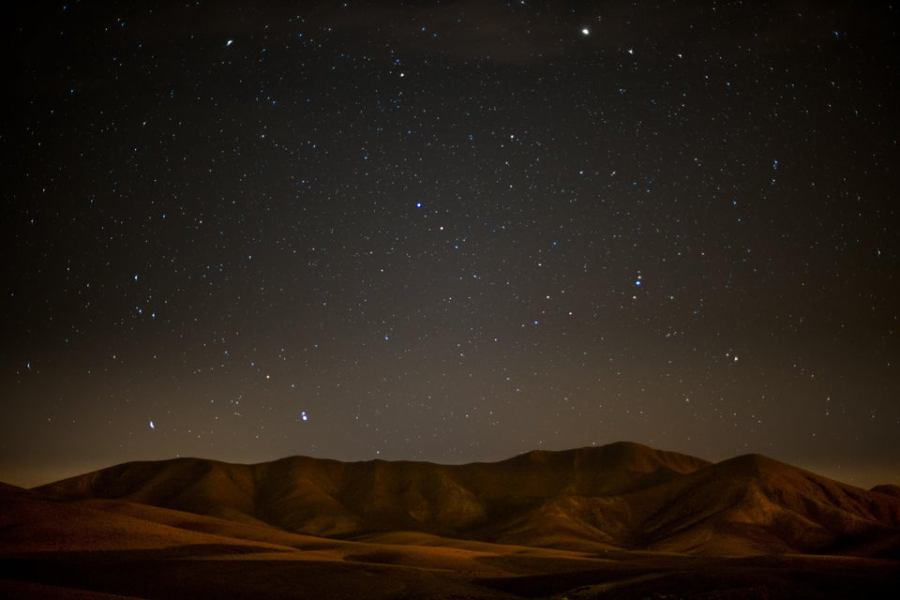
A starry night over desert hills, like the Nativity scene but without the Guiding Star. (Photo source: Internet)
INVISIBLE
Although we see the image of Santa Claus everywhere and even pretend Santa Clauses all over our city streets, everyone knows that nobody sees the real Santa Claus. Children have to be asleep when he arrives to distribute his presents and somehow adults don’t see him either.
Which I suppose is a good thing ….
I mean if you found an adult intruder in your house at night, not to mention near your children, you’d be liable to whack him with a hurley (that’s an Irish cultural reference) …. or a baseball bat (that’s a U S cultural reference) …. or stab him with a sharp kitchen knife (that’s an international cultural reference).
It was bad enough when somehow that portly – not to say fat – man could somehow come down your chimney and go up again, without waking anyone … but now he can get in your house or flat even when you don’t have a chimney.
Which is at least creepy, if not downright scary.
Oh, let’s lighten the mood and sing together:
You better watch out You better not cry You better not pout I’m telling you why
Santa Claus is comin’ to town Santa Claus is comin’ to town
He’s making a list He’s checking it twice He’s gonna find out Who’s naughty or nice
Santa Claus is comin’ to town Santa Claus is comin’ to town
He sees you when you’re sleeping He knows when you’re awake He knows if you’ve been bad or good So be good for goodness sake
Yes, lovely but wait …
“You better watch out, you better not cry …” — Is it just me, or is that not downright threatening? And he knows when we’re sleeping or awake? He has our children under surveillance? In some kind of list?
HO! HO! HO! IN MORALITY PLAYS
Morality Plays were a genre of theatrical performances of the medieval and Tudor eras in which a character was tempted by a personification of Vice.
Now Vice (not unlike a lot of police Vice Squads), was often seen as the epitome of evil, corruption and greed – in other words, the Devil. The playwrights tended to portray the Devil as somewhat of a comical character, perhaps to keep their audiences entertained (or to disarm them).
So the character who played the Devil would announce his arrival with a stage laugh: “Ho, Ho, Ho!”
You can probably see where I’m going with this.
Nowadays, we tend to see the Devil portrayed in black but in earlier times, he was more often seen as coloured in red. The colour in which Coca Cola just happens to have dressed Santa too.
The German or Nordic Santa was originally a god of fire also, while even the modern Santa drives a magical chariot pulled by horned beasts and he is portrayed all in red. Traditionally, the Devil is seen as residing in Hell, a supposed place of eternal flames below ground.
What does Santa Claus give to children who have not been good? A lump of coal! In other words, a mineral from underground that can burn to make fire.
NICHOLAS
Santa Claus is supposed to be modelled on St. Nicholas …. and what is the popular abbreviated version of Nicholas, i.e the nickname? Yes, Nick.
And the common name for the Devil, Mammon, Beelzebub, Satan is ….. Old Nick!
Today marks 184 years since the greatest armed rebellion in 19th-century Britain when Chartist workers fought bloody gun battles with the police and army in the heart of industrial Wales, writes STEPHEN ARNELL
A sketch of the huge crowd in Newport in 1839 as it surrounded the Westgate Hotel hoping to free captive Chartist comrades (via the People’s History Museum).
“Come hail brothers, hail the shrill sound of the horn For ages deep wrongs have been hopelessly borne Despair shall no longer our spirits dismay Nor wither the arms when upraised for the fray; The conflict for freedom is gathering nigh: We live to secure it, or gloriously die.” — Chartist song of the South Wales miners
UNLIKE our friends across the channel in France, the inhabitants of Britain appear a remarkably supine people in the main, usually preferring well-organised demonstrations to anything that whiffs of pre-planned armed revolt, no matter how righteous the cause.
Yes, there have been mass meetings, marches and spontaneous events that took a wrong turn and descended into riots, but we seem singularly ill-equipped by nature to contemplate anything more serious.
But this would be doing this island race a disservice; to paraphrase the emperor Tiberius, there was a time when the British were not a people “fit to be slaves.”
There’s a long and storied history of the working classes attempting to seek redress from a variety of wrongs, including poll taxes (the Peasants’ Revolt, 1381), government corruption (Jack Cade’s Rebellion, 1450), religion (the Pilgrimage of Grace, 1536) and the later Pentrich Rising in Derbyshire of 1817, a muddled affair which aimed to cancel the national debt and repeal the Corn Laws.
1839’s Newport Rising was a more coherent and dangerous challenge than Pentrich, in possessing both a specific democratic political manifesto and its unprecedented scale.
That’s not to say the revolt was a carefully co-ordinated business that worked to a timetable with a pre-planned outcome, but the numbers involved, the potential for encouraging similar risings and the essential justice of the Chartist cause gave Lord Melbourne’s Whig government a serious jolt.
Newport had its origins in both national and local events.
The House of Commons rejection of the People’s Charter of 1838 calling for universal male suffrage, secret ballots, salaries for MPs, equal constituencies, and the end of the property qualification for voting on July 12 1839, and the following conviction and imprisonment in Monmouth of the Chartist leader Henry Vincent for conspiracy and unlawful assembly, stoked the fires of rebellion in industrial southern Wales, a stronghold for the movement.
Combined with this were reasons that directly concerned the rising’s leader, John Frost (1784-1877), namely his six-month imprisonment resulting from a dispute regarding his uncle’s will with Newport town clerk Thomas Prothero, and the wealthy political enemies he made on the way to becoming mayor of the Monmouthshire burgh.
A sketch of Chartist leader John Frost on trial at Monmouth after the uprising.
Despite this, Frost was supposedly reluctant to lead a full-scale armed uprising, and doubtful of its prospects, but the zeal of his supporters forced his hand and preparations were made for the march on Newport.
On Monday November 4 1839, Frost led 4,000 followers to the town, his group including allied coalminers, who armed themselves with home-made pikes, bludgeons, and firearms.
The authorities in Newport got wind of the march and detained several known Chartists at the Westgate Hotel in the town centre. This added impetus to Frost’s mission which was presumably to take over the town in the hope of starting a nationwide insurgency.
At 9.30am, a crowd of anything from 8,000 to 20,000 Chartists (ironically including Allan Pinkerton, later founder of the infamous US strikebreaking detective agency known as “the Pinkertons”) filled the square in front of the hotel, demanding the release of their comrades.
The mayor had gathered a mixed force of around 60 soldiers of the 45th Regiment of Foot and 500 special constables to defend the Westgate, all equipped with weaponry superior to the relatively small number of Chartists possessing guns.
To this day no-one knows for sure who fired the first shot, but a heated exchange between the two sides began, with the engagement lasting approximately half an hour. The result was a total rout for the Chartists.
Up to 24 rebels were slain, with around 50 injured. Four of the defenders were wounded, as was the mayor of Newport Thomas Phillips (later knighted by Queen Victoria), when the attackers briefly succeeded in entering the building. So ended the greatest armed rebellion in 19th-century Britain.
In comparison, the better-known Peterloo Massacre of August 1819 saw 18 people killed and as many as 700 injured when army regulars, special constables and local yeomanry charged peaceful demonstrators calling for parliamentary reform.
Unlike the French, with the storming of the Bastille, the March on Versailles and the Paris Commune, the Newport Chartists appeared to lack the killer instinct of their Gallic counterparts, which may say something of the passive British national character relating to the ruling class.
The leaders of the rising were convicted of treason and were sentenced to be hanged, drawn and quartered, the last in England and Wales to be condemned with this ghoulish form of execution.
Their sentences were commuted by Queen Victoria to transportation for life to Tasmania. Frost was given an unconditional pardon in 1856 and returned briefly to Newport, where he received a rapturous welcome.
His two co-conspirators were also pardoned, but both opted to stay in Australia. Watchmaker William Price continued to ply his trade, but without success and died in poverty; in contrast, collier Zephaniah Williams (who at one point had planned to escape) discovered coal in Tasmania and became one of the richest men in the colony.
Note: the last people to be hanged, drawn, and quartered for treason in Britain are said to be David Tyrie in 1782, and in 1798, Father James Coigly; both were convicted of spying for the French (the Bourbon and revolutionary regimes respectively).
In 1977, John Frost Square, in Newport city centre, was named in the Chartist’s honour. But in 2013, Kenneth Budd’s mosaic in the square commemorating the Chartists was demolished at the behest of the Labour-run Newport council, prompting widespread outrage (from the likes of actor Michael Sheen and former Archbishop of Canterbury Rowan Williams) and public demonstrations.
Comedian Jack Whitehall is a descendant of Welsh lawyer Thomas Jones Phillips, one of the chief opponents of the Newport Rising. Taking no pride in this fact, in 2019 he commented on BBC1’s Who Do You Think You Are, “What’s next? I suppose probably go and visit a mine our ancestor shut down or maybe an orphanage he burned to the ground.”
The Newport Rising also features in a graphic novel published in 2019, Newport Rising, written and illustrated by local artist Josh Cranton; the book was launched at the Westgate Hotel, which unlike Budd’s original mural still stands, recently reincarnated as a “live music, performance, arts and heritage venue.”
Rebel Breeze is grateful for this article about an instance in the long history of workers’ resistance to various features of capitalism.
The article would not have been diminished and might even be thought to be enhanced by mentioning the Irish diaspora’s contribution to the Chartists, both in rank-and-file membership and in leadership, with Bronterre O’Brien and Fergus O’Connor in the latter category.
Or to mention that despite the spying for the French charge against Fr. Ó Coigligh, the last man hanged, drawn and quartered by the civilised British Establishment, the real reason was his membership of and participation in the United Irishmen, an Irish revolutionary Republican organisation.
That organisation had also ‘infected’ the short-lived United Scotsmen and even shorter-lived United English, though in the latter case contributing to the leadership and organisation of the Spithead Naval Mutiny.
Revolt of the English sailors, On each ship they went to tackle, vintage engraved illustration. Journal des Voyage, Travel Journal, (1880-81).
Of course, such references might have tempted the writer to compare revolutionary uprisings in Britain with those in Ireland, rather than in France.
But then, the Communist Party of Great Britain, which owns The Morning Star where the article was published, has never been too fond of the Irish struggle for independence or the means we felt justified in employing.
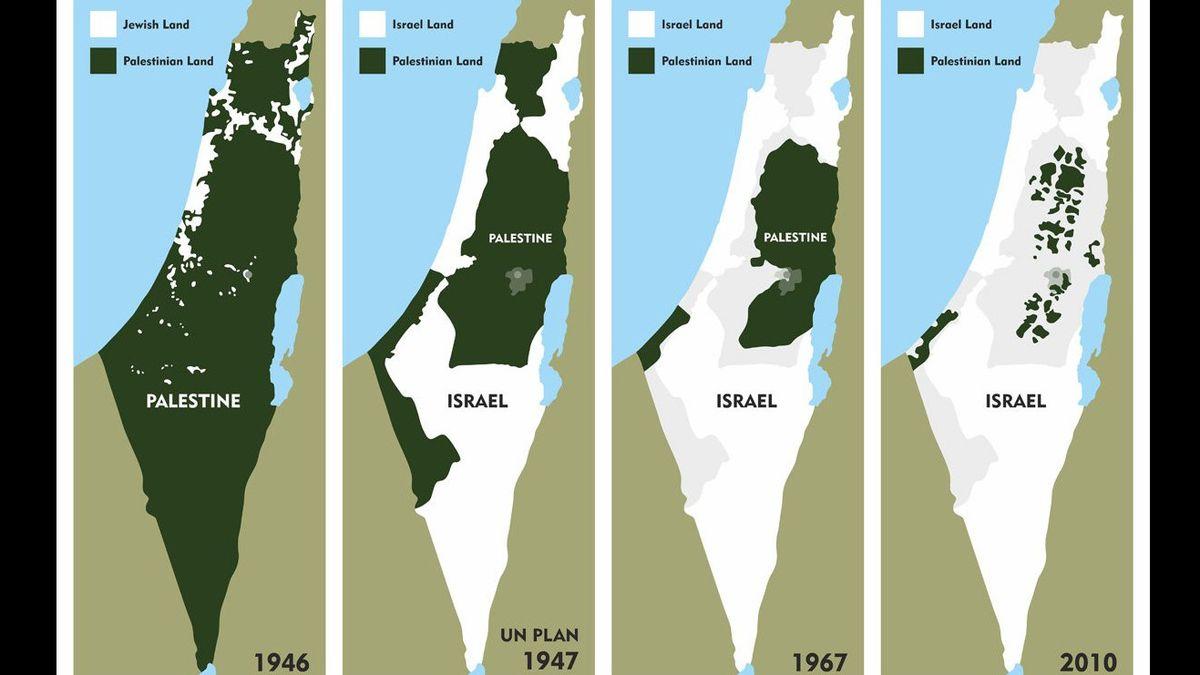
Changes in the Palestinian territories and Israel.
Occasionally in the “debates” on the Arab world and Palestine in particular statements are made that “they want to destroy Israel” as a criticism or “Israel has the right to exist” as if it were a human being.
The Left abandoned any discussion on the issue following the Oslo Accord where the Palestine Liberation Organisation (PLO) surrendered and agreed to govern some Bantustans(1) in the name of peace.
The Palestinian “problem” was resolved through the half-measure of autonomy where the Palestinian Authority has less power than a small municipality anywhere in the world and the left replicated and took on as its own the right-liberal demand for Two States.
It is worth looking at the question of destroying Israel and its supposed right to exist. We should be clear though that no state has a right to exist. States exist because they exist, through force, popular support, or cunning and guile. States come and go.
In the 19th Century two states came into being, ten years apart, one being Italy through the struggles of Garibaldi and others and Germany, unified under Bismarck. These two states underwent various important changes in their nature, borders and ideological discourse on unity.
In the case of Italy (1861), the Papal States were reduced in size and a significant part of what we now call Italy belonged to Austria. It wasn’t until after the First World War that Italy came to have borders similar to what it now has and changed from a monarchy to a republic.
In the case of Germany, its borders waxed and waned throughout the 19th Century until unification under Bismarck in 1871. Later Hitler would expand them once again under the Third Reich or as it was officially called since 1871, the German Reich.
Following the Second World War, nobody argued that the Nazi state had a right to exist. It was partially dismantled. Poland recovered a part of its land, the Sudetenland, once again, became part of Checoslovakia, Austria recovered its independence.
The great racial nation of Germans was wiped off the face of the earth. The Allies divided the rest into four parts, with three of them becoming the Federal Republic of Germany in 1949 and the other the German Democratic Republic, until 1991 when they were united.
Other states such as the Austro-Hungarian and Ottoman empires also disappeared after the First World War.
These were not the only states to undergo dramatic change. There are more interesting examples from the anti-imperialist struggles. The Vietnamese guerrillas wiped off the face of the earth the reactionary (North American) state of South Vietnam.
The Algerian revolutionaries wiped off the face of the earth the French colonial department of Algeria and erected in its place the Republic of Algeria.
So, is the state of Israel immutable? Does it have a right to exist? Should that right be defended? It is easier to answer that question if we ask ourselves what defending that right means.
Israel’s existence is the theft of land, it is the Nakba, the displacement of 750,000 people in 1948. It is the invasion of the West Bank and Gaza in 1967. It is also the current genocide the modern-day Nazis are trying to carry out in Gaza.
Israeli destruction 31 October 2023 of Jabalia Refugee Camp, which was Gaza Strip’s largest of 8 camps. 150 were injured in this attack and 50 killed. (Photo cred: Anas al-Shareef/Reuters)
On that point, there are those who don’t propose to wipe Israel off the face of the earth, but rather to set up two states.
Amongst those who sometimes wave that flag is the USA and others who are more serious about it, such as Al Fatah, the dominant faction in what was the PLO, European liberals and the press.
There are also those who believe it is a pragmatic solution, but they are usually people who ignore the question of class as a factor in the Arab world.
Two states means acknowledging and accepting the invasion of 1948, the Nakba, the systematic theft, murder and torture. It also means not accepting the right of return of those displaced in 1948 i.e. to accept and reward the mass violation of the human rights of the Palestinian people.
It was worth recalling that the PLO and the various organisations that formed part of it were founded before the 1967 war, so propose two states is to propose the Zionist victory over the territory stolen in 1948.
It is to accept that if you commit mass human rights violations and crimes against humanity, the solution is to commit even more, so that some liberal or former leftist can come along and say we have to accept some degree of crime and blood.
So, what is the solution? It is not easy, though it is simple, at least conceptually. It is the historic Palestinian demand of One State. The Palestinians themselves proposed this from the word go, knowing that it brought up the problem of what to do with the Jews who had arrived.
One of the old factions of the PLO stated:
However, the DFLP had come to a premature recognition that as well as the Palestinian national question there was also a “Jewish question” which inevitably has to be resolved if one aims to reach a democratic solution to the conflict, emphasising that the resolution of the Jewish question was conditional on freeing itself from the zionist project and the necessary coexistence with the Palestinian Arabs on an equal footing under the slogan of a “Popular Democratic State” which would be built on the ruins of the State of Israel; but, how would this aim be achieved in the light of the overwhelming superiority of Israel and its firm commitment to North American Imperialism?
The answer is to be found in the “prolonged people’s war throughout the all Palestinian and Arab territories”.(2)
Such voices were, back then and continue to be, a minority, but what they say is true. Those millions of Arabs that have come out on to the streets to protest against the Zionist regime face various enemies, one of them being their own bourgeoisies, the Arab states that have betrayed the Palestinian people time and again.
However, a Pan-Arabist revolution is a far way off but not impossible. None of the Arab regimes are progressive and they exist because they repress their own people, their own working class. But what would happen to the Jews who lived in the new state?
Well, many of them, Netanyahu style Nazis would flee to the USA alongside the Yanks that have arrived in recent decades, those from Western Europe, and the Ukrainians, amongst others. Something similar happened with whites when the racist apartheid regime in Rhodesia was overthrown in 1979.
The white population fell from 240,000 to 28,000 now. In Algeria a million Pieds-Noirs fled. Others, those that descend from families that have been in the region for centuries will stay, others will have to negotiate their future in the new state.
But not an inch can be given on the right of return of ALL the Palestinians, not only to the country, but also to their farms, olive and lemon fields, their rural and urban houses in the whole country.
So, should Israel be wiped off the face of the earth? Of course it should, and a new Palestinian secular democratic state should be built on the ruins of Zionism and Apartheid. The Arab states and elites should also be wiped off the face of the earth.
Later the war criminals and those responsible for crimes against humanity will have to be tried. The Zionists rightly put the German Nazi Adolf Eichmann in the dock. It was an act of justice.
Now the Palestinians and the rest of us have to put Nethanyahu and the other criminals in the dock, perhaps with the same consequences.
Though whether they spend the rest of their miserable lives in prison or they go to the gallows may be up for discussion, what is beyond debate is whether they should be tried for crimes against humanity. They should be tried as such.
Long live Palestine Free and United!
Notes
(1) The Bantustans were segregated zones set aside for blacks in South Africa under Apartheid. They were supposedly independent from the regime but in reality had no autonomy. They were governed by black “leaders” that supported the regime, or at least were not very critical in the same way as the Palestinian Authority.
(2) F. Suleiman, (n/d), La Izquierda Palestina Revolucionaria: Tres décadas de exp eriencia de lucha (1969-1999), FDLP http://www.fdlpalestina.org/index.htm
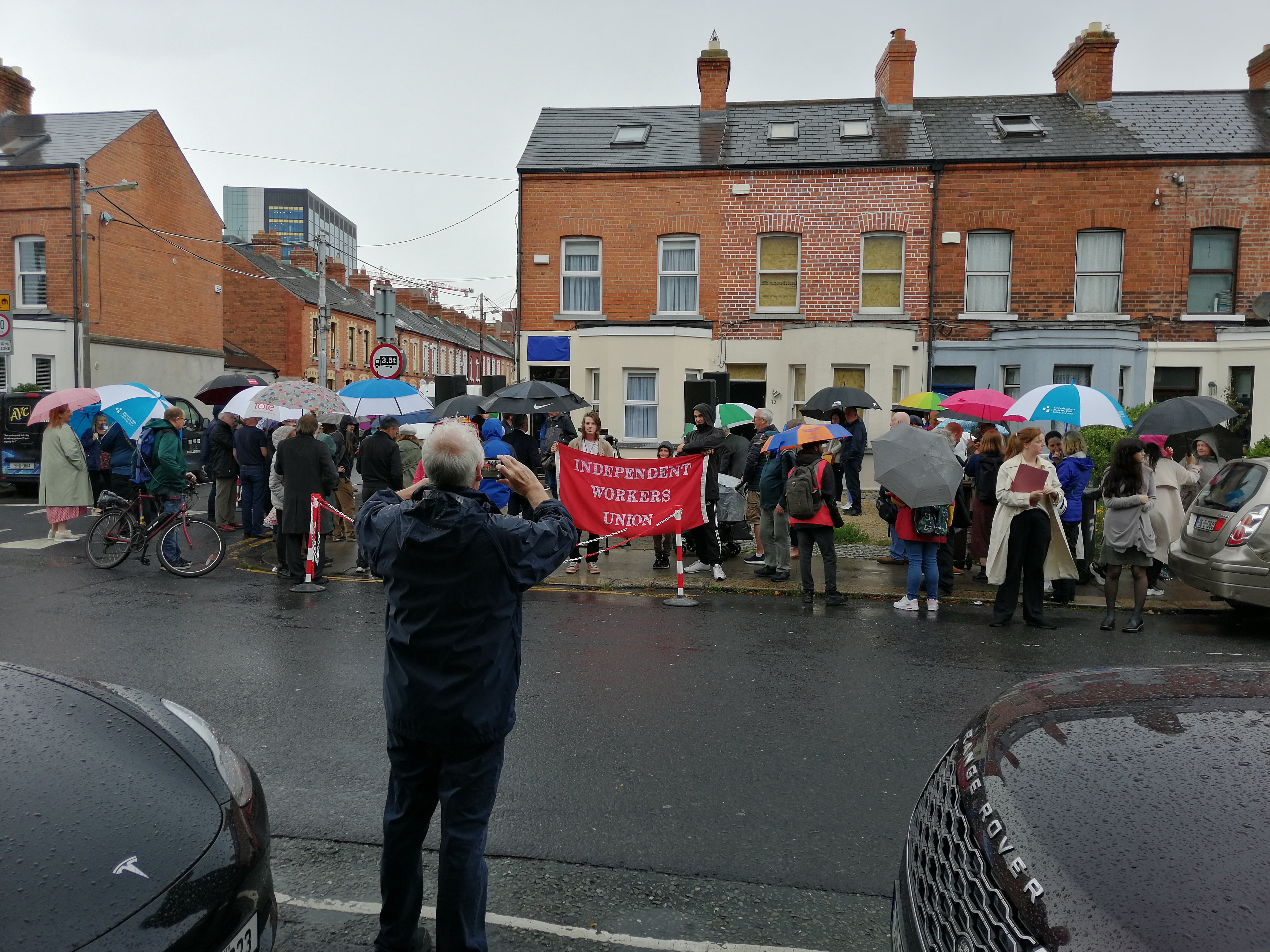
On a wet Tuesday night in the large lobby of Windmill Lane Recording Studios, local community representatives met with representatives of political parties, Dublin City Council and the Gardaí to press for their community’s needs to be met.
The meeting on 24th October 2023 was convened by the City Quay Committee and its organiser, Patrick (“Paddy”) Bray raised concerns about the unmet needs of the local communities currently and for following generations.
Apart from the City Quay Committee, also represented were representatives of housing areas Markievicz House and Conway House, along with volunteer-managed youth service Talk About Youth.
Also in attendance were representation from political parties Fianna Fáil, Labour and Sinn Féin, all of which have TDs (members of Irish parliament) elected in the area. Dublin City Council was represented as the local municipal authority and Pearse Street as the nearest Garda station.
Presumably the presence of a Garda representative was in relation to discussion around a recent period of violent confrontations between opposing gangs of youth on the Samuel Beckett Bridge (but also Sean O’Casey Bridge) connecting South and North Liffey docklands.
It was striking that nearly all the community representatives were female, while most of the political representatives and each of DCC and the Gardaí were of male gender.
Paddy Bray opened the meeting outlining the local concerns about the area’s youth and the lack of constructive activities for them, the local youth service being underfunded, under-staffed and with no permanent base.
Bray went on to outline a dire absence of any kind of community facility for the local community, while property development went on around them, including four hotels in recent times, with no sites designated for affordable housing or community needs.
Looking across from the north quay, central background, the 8-storey Clayton Hotel, along with other buildings dwarfing even the four-storey reconstructed The Ferryman, the last of the original pubs along the South Docks between Tara St. Station and the East Link Bridge. (Photo sourced: Internet)
Other community representatives also pressed their needs hard and raised issues of applications for building on existing sites without consideration of the community’s needs in housing, parking, child and young person development, mental health or green space.
A number raised concerns about rat infestation in a housing area, emanating from a derelict site, followed by some discussion about where responsibility lay to address the problem as the site is in private ownership (though there was a suggestion of an enforceable abatement order).
The responses of the political party representatives and the Dublin City Council Area 2 officer were generally supportive, though a disagreement did emerge as to whether the City Council were doing enough to control the rat infestation.
Evoking a medieval or early 1900s scenario, a community representative reported that a man visited their housing area on a voluntary basis to kill rats and at a recent visit, had killed seven. Photos of live and dead rats on a phone were handed around (to shudders from some of the men).
The meeting concluded with an agreement to form a campaigning committee for the resources and sites needed, for the political representatives to support its aims and for the Area 2 DCC Manager to report back to his own management.
Paddy Bray asked all present to spread the word among their contacts to enlist further support.
THE COMMUNITY: LOSS, NEEDS AND HISTORY
The name of the building in which the meeting was held is famous in Irish recording events though most probably associate it in particular with the previous recording studio on the site and the rock group U2.
A plan for a six-storey block on the site was defeated by local protests in 2008 but the original studios were demolished with the exception of the U2 fans’ graffiti wall, which was later sold and proceeds donated to a charity fundraising for awareness of men’s health and treatment needs.
The new building is owned by the formerly investment trust company, now Hibernia property development company which, despite the name, as is now common in Ireland, is owned by a foreign corporation.1
Property speculators plan to demolish the City Arts Centre, a resource for the community but derelict and empty for two decades on Moss Street on the South docks, in order to build a 24-storey office block.
City Arts Centre building, derelict for years, property speculator high-rise plan appealed by many including Dublin City Council to An Bord Pleanála, now speculator taking DCC to court. (Photo sourced: Internet)
Unusually perhaps, the demolition application is being opposed by Dublin City Council2 which has appealed it to an Bord Pleanála3 and the speculator has taken the case to court.
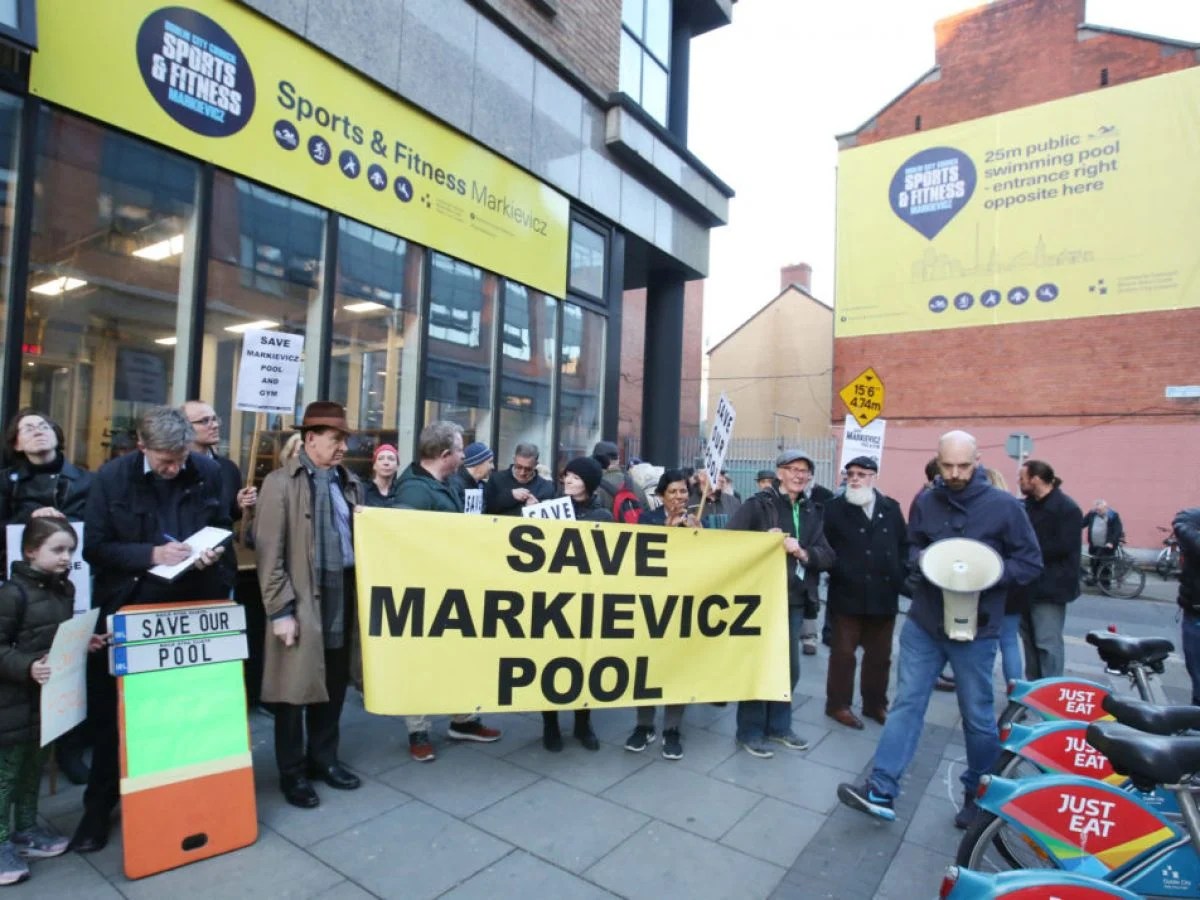
As mentioned in the meeting, an existing facility for the community, the Markievicz swimming pool, despite 1,600 signatures to save it, is to close for the construction of a station for the projected underground Metrolink, another infrastructure planned for private or part-private ownership.4
As one of the community representatives commented, there is already a train station nearby; not only that but the tracks of that station are several storeys above ground, making an underground connection with Metrolink quite feasible.
A rally to promote saving the swimming pool in 2019 (Photo sourced: Internet)
The swimming pool facilities are now to be located at a site 3 km away in Ringsend, a housing district at the end of the docks and partly on the seafront, which has football pitches and green space very close nearby. 5
It is indeed late in the day as indicated by the huge property development on the South Quays but the communities are getting organised as can be seen from this meeting, a commemoration of a fatal 1960s housing collapse and protests about local church neglect by the Diocese.6
Some may think it is too late or that the speculative property and financial forces ranged against them, with their multiple political and other connections, are too strong. But their community’s needs now and for generations to come are powerful incentives for which to struggle too.
The south and north quays communities, neglected by the authorities and rode over roughshod in the past, with their remnants now under threat, are essentially working and lower-middle class communities which have never been given the resources they earned and deserved.
As in many other parts of Dublin, working class communities were ravaged by the heroin epidemic in the 1980s and regarded in the main by the authorities as a policing problem, with anti-drug campaigners ironically targeted more than drug lords.
In the course of that social crisis, many developments of physical and political nature took place which the working class was not well-placed to resist.
An outing on the old Liffey ferry boat, in regular use when there was no bridge crossing the Liffey eastward and downriver past Butt Bridge (Photo sourced: Dublin Dockers’ Preservation Society)
However, the people of the docklands were an important part of the working class movement in the early 1900s, winning many union battles against the employers until defeated by the latter’s alliance with police, magistrates, churches and media after eight months of struggle 1913-1914.
They rose out of that defeat and rebuilt their fighting organisations, including the first workers’ army in the world (and which recruited women, some of them appointed officers),7 fought again in the 1916 Rising and after that in Dockland areas during the War of Independence.
Indeed, during the 1916 Rising it is remarkable that despite British shelling from naval units in the Liffey, they did not attempt to land soldiers on any of the Dublin quays at that time, disembarking British reinforcements into Dun Laoghaire instead and marching 8 miles8 in from there.
If the working class of the south Dublin dockland is stirring it may still achieve more than many may expect.
End.
The Travelodge Hotel, corner of Townsend and Moss Street (Photo sourced: Internet)
FOOTNOTES
1Purchased by Brookfield Asset Management, a Canadian company, in 2022
3Many applications agreed by DCC Planning Department have also been appealed to An Bord Pleanála and that organisation has been immersed in controversy over criminality in management and low staff morale leading to a high backlog of appeals awaiting judgements.
5One could form the suspicion that the ultimate plan is to move south docks working class facilities to Ringsend and Irish Town, with the communities themselves to follow or to fade away, leaving the whole area free for property speculators.
6The diocese protest was not reported on in Rebel Breeze but the housing collapse commemoration, at which the lack of local affordable housing was raised, was.
7The Irish Citizen Army, founded after calls by both James Connolly and Jim Larkin.
People who have lived for generations in the Dublin dockyards have been getting the feeling for some time that the city planners don’t want them there and that as in Ewan McColl’s song they’d “better get born somewhere else” and “go, move, shift!”1
Recently I met with a small group of people, men and women from the Dublin docklands area south of the Liffey2 as they discussed their difficulties and what they might do about them. They wanted an article written on the issues for circulation among their communities.
Artist’s impression of the “Two Fingers” tower blocks planned by property speculator Johnny Ronan amidst existing “glass cages”. The tower blocks were ultimately denied planning permission but many others got the go-ahead. (Image sourced: Internet)
They observe their areas being taken over by high-tech and service industries, accommodation blocks built for those who can work for the high-tech corporations and pay the high rents but their own class largely employable only in low-earning service work for the corporations.
They see in this a process being facilitated by the State, the municipal authority, the banks and of generally little concern to the political class, who either benefit from the process direct or indirectly or at best, view it as regrettable but inevitable.
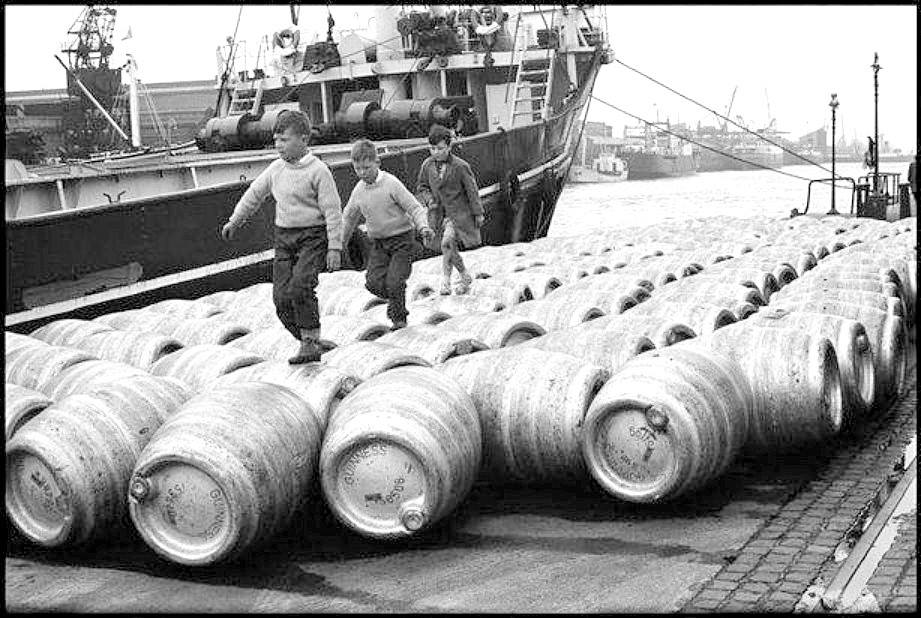
Wallace’s coal depot, Ringsend Road, Great Canal Basin circa 1950s perhaps. Imported coal was unloaded mechanically or by physical labour and stored here to be delivered to smaller depots and large establishments in lorry loads, or to houses and more modest commercial establishments by physical labour (coal-heavers) working from horse and cart or, later, lorries. (Photo: Toírdhealach Ó Braoin)
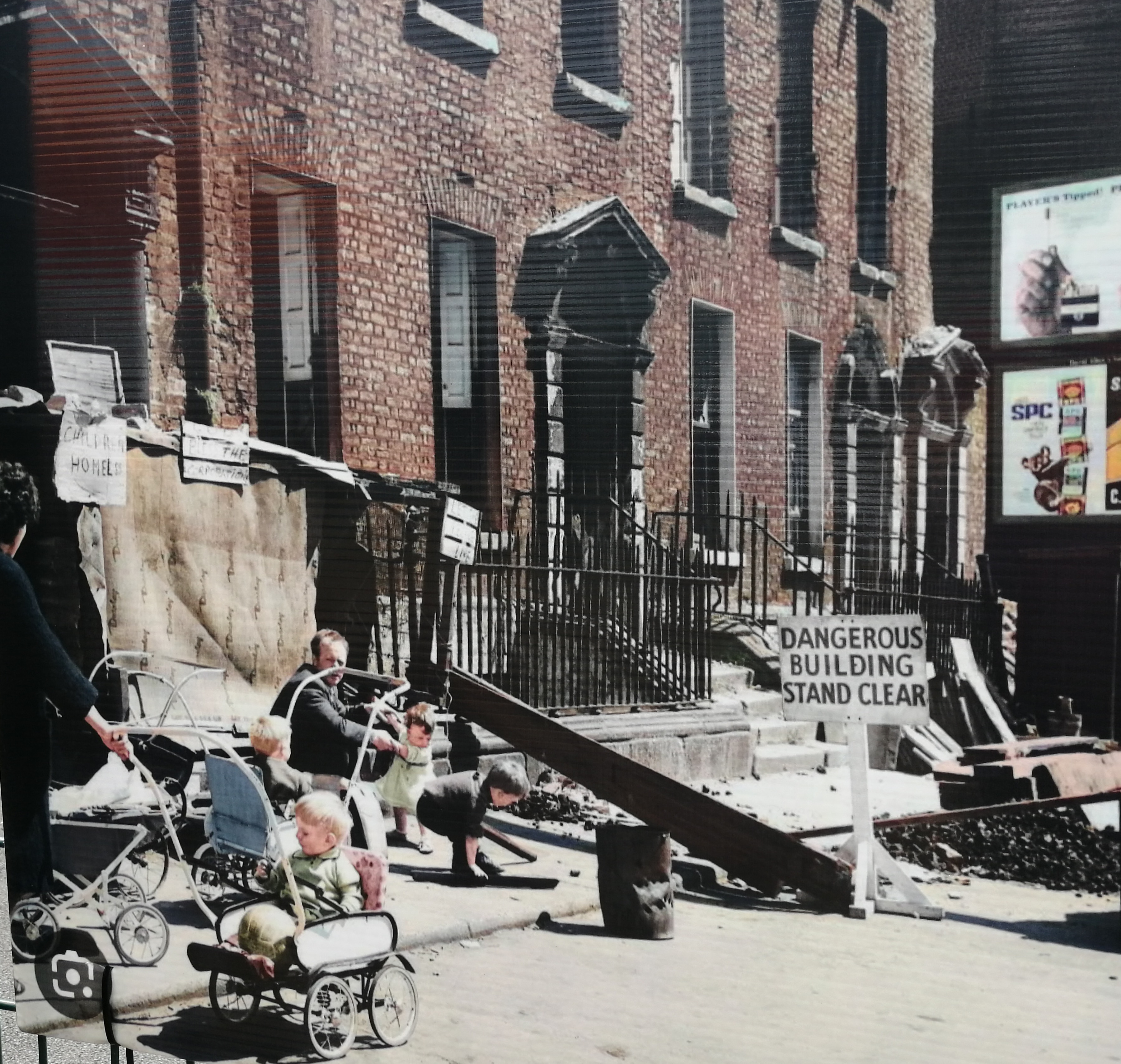
One only has to consult living memory or to compare photographs of some scenes in the past with “the new glass cages that spring up along the quay”3 in the same locations today to see that they are not imagining things or unduly exaggerating them.
Contemporary photo: This is the only traditional pub left and one of the few traditional-type buildings on the South Dublin Docks once Butt Bridge is passed. (Source photo: Dublin Dock Workers Preservation Society)
FURTHER BACK
Previously the docklands both sides of the river were, for the most part working class areas. The employment available for men was labouring on the docks, unloading and loading ships and delivering or distributing those loads by horse and cart.
There were also small industries and warehouses and even small animal enclosures or yards, including even a couple of tiny dairies.
The major work for women was in the home, raising large families but with some outside work available in food processing such as in bakeries, factories such as Boland’s Mill, clothes-making, mending and laundry. Second-hand clothes were sold too and fresh farm food, fish and shellfish.
Another coal importing company with an unloading and storage space on the south Dublin quays, circa 1950s. (Source photo: Dublin Dock Workers Preservation Society)
It was in these areas that Jim Larkin and James Connolly mostly made their mark in the first decade of the last century, forming the largely unorganised ‘unskilled’4 workers into the Irish Transport & General Workers’ Union, winning wage rises and improvements in working conditions.
It was surely no accident that the ITGWU’s headquarters, the original “Liberty Hall”, was located in dockland, just off Eden Quay in Beresford Place and across the road from the Custom House.
When the union began to impinge on William Martin Murphy’s commercial empire in 1913, Murphy began to build a union of employers determined to break the workers’ union.
The working class of Dublin, whether ITGWU members or not, … Stood by Larkin and told the Boss man We’d fight or die but we would not shirk.”
For eight months we fought And eight months we starved – We stood by Larkin through thick and thin; But foodless homes and the cry of children, They broke our hearts and we could not win.”5
In the 1913 Lockout the employers had the main mass media on their side: the anglophile Irish Times, the nationalist Irish Independent and Freemans Journal. The church hierarchies, Catholic and Protestant, stood with the employers; the Legion of Mary refused help to strikers’ dependents.
Mass meeting of workers and children (some of the children also workers, e.g the newsboys) on a Dublin quayside during the 1913 Lockout. “Murphy” refers to William Martin Murphy, prominent capitalist, owner of the Dublin Tram Company, Irish Independent and the Imperial Hotel in the Clery’s building. (Photo sourced: Internet)
The magistrates fined and jailed strikers and supporters, while the Dublin Metropolitan Police clubbed them. After two workers were fatally injured by police batons on Eden Quay,6 the ITGWU formed the Irish Citizen Army, the first army in the world of workers for the working class.
People with few economic and financial resources find it difficult to sustain long struggles and eight months would be a very long industrial struggle even today.
In the Dublin of 1916 and with the living conditions of the working class of the time, and mostly with previously unorganised workers, it was a heroic effort.
The ITGWU was temporarily defeated – Connolly called it “a draw” – but the working class remained. Those that were not sucked into the butchery of WWI continued living in the area and tried to find work where they could.
Despite that defeat and emigration or British Army WWI recruitment, the Irish Citizen Army was able to field 120 disciplined fighters, male and female, in the 1916 Rising and fought in a number of engagements. By 1919 the union’s recruitment surpassed that of 1913.
Over years the docks area saw slow decline as shipping traffic decreased. Emigration soared and, despite large families, the Irish population remained stable7. The working class population of Dublin city centre’s tenements was cleared and moved to large housing schemes on the city’s outskirts.
Men, women and children in a march of the Irish Seamen & Port Workers’ Union (now amalgamated into others) along south Liffey dockland some time before 1955. Note the medals on elderly man front left, possibly IRA medals from the the 1916 Rising and/ or War of Independence. (Source photo: Dublin Dock Workers Preservation Society).Another view including the flute and drum band, Starry Plough Flag (the Tricolour is being carried on the far right of photo) and trade union standard. (Source photo: Dublin Dock Workers Preservation Society).
Those who remained received some municipal housing in pockets, often neglected by the municipality, their children educated but very rarely to university8 level, their traditional work largely disappearing. And a significant minority turning from lack of hope to substance misuse.9
Houses in danger of collapse after an already collapse, Fenian Street, south Liffey dockland, 1963 (Photo source: Display at Andrew’s Court commemorative event of 1963 building collapse that killed two girls).
SOLUTIONS
Inclusion was a key word brought to the discussion I was invited to hear, with a number saying that “social inclusion” had been listed among objectives of a number of plans for the area but which failed to be achieved despite its listing.
The character of the area is of course changing with a certain amount of gentrification and some people even feeling they were looked at as though not welcome in the park they had played in as children and teenagers, or not welcome in local pubs under new management or new cafes.
Children balancing on Guinness aluminium kegs beside docked ship on south Dublin quay with ships docked on the north quays also, circa 1950s. (Source photo: Dublin Dock Workers Preservation Society)
The kind of education working class people receive was discussed as an important factor with the mention of STEM, an educational program to prepare primary and secondary students for college, graduate study and careers in the fields of science, technology, engineering and mathematics.
Without that kind of preparation and qualifications, the group felt that children from their area had no chance of employment with the corporations now basing themselves in the docklands.
One of the group stated there is an annual special STEM seminar run at the RDS; however none of the others had heard of the seminar.
Another described a “Speed-date-type” careers advice session attended once, where students could spend a short time at one career table and move on to another. Another talked about career-planning advice for parents with which to to help their children.
Circa 1950s, family group, Gasometer in background [note also the old gas street lamppost behind man on the right]. (Source photo: Dublin Dock Workers Preservation Society)
The feeling of a lack of corporate responsibility for the people of the area in which the corporations have set up was clear.
The Ballybofey urban regeneration project was mentioned as a possible model along with Our Town urban centre projects.
If education is the key for integrating the local working class into most of the employment available locally, I wondered aloud, how would that work without housing? One of the group has already had to move out of the area for an affordable home and is intending to move further out still.
Already this means use of private transport and hours added to the working week, increasing the further out is the next home. Another said a survey found that the employment of 88% of the community was outside the area, while only 12% was local (with the carbon footprint involved).
Two-storey housing in good condition on South Lotts in south Liffey docklands – photo shows July commemoration of socialist revolutionary James Connolly and his family living there 1910-1911 (Photo: D.Breatnach)
COMMENT
My own feeling is that the first requirement is that homes need to be available for working class people in their area and that, I also feel, has to entail a local construction program of affordable public housing, ideally by a State or municipal building company.
But if people are not to have to travel outside their areas to work, as 88% are doing currently (according to the aforementioned survey figures), then they must have local employment and in turn that, in the main means with the hi-tech corporations, for which they need to be trained.
The group was very clear and in agreement on this point, whether the training is to be delivered by the corporations, by the State or by a mixture of the two.
When area developments or redevelopments are being undertaken, it is essential that the local communities are part of the process; otherwise tree-planting, city squares and delicatessen-cafes become not so much an addition to the people’s lives, as markers for their class’ replacement.
Whether in the end I agree with the way the group sees the solutions or don’t is not I feel the most important thing, which IS that they are wanting to organise and to take their future into their own hands. It is in that act alone that there can be hope for the future.
End.
FOOTNOTES
1A song about the persecution of the nomadic people, e.g Romany Gypsies and Travellers.
2Basically from the Pearse Street and Ringsend areas.
3Line from Dublin In the Rare Aul’ Times song by Pete St.John.
4A term often applied but rarely understood – labourers quickly become skilled in their work or they lose employment or become injured or killed at work. What the term really means is “manual worker who does not have a recognised qualification in at least one manual trade”. I have worked at both ends of that spectrum.
5 The Larkin Ballad by Donagh Mac Donagh, son of executed 1916 commander Tomás Mac Donagh, executed after the surrender of the 1916 Rising by British firing squad.
630th August, the first month of the dispute by DMP baton-charge on mass meeting around Liberty Hall. The following day (Bloody Sunday 1913, wrongly accounting for the two fatalities in many on-line sources), the DMP rioted again in O’Connell Street but most of the ITGWU had avoided it by rallying at their Fairview premises.
7The Irish population – though habitually of large families – remained largely stable for roughly a century after the Great Hunger’s death toll and mass emigration had reduced the island’s population by three million – until the upswing of the ‘Celtic Tiger’ economy began to increase it through immigration and reduction in emigration.
8Indeed, until 1966 most working class children left school at fourteen years of age, since secondary-level schooling was only ‘free’ (not for books, equipment, uniforms) up to that age.
9Middle and ruling class people misuse substances too – indeed some drugs, such as cocaine are much more used by “professional” classes – but they have living conditions varying from comfortable to luxurious and a range of choices for themselves and their children – not to mention expensive rescue services when they fall.