“WE ONLY WANT THE EARTH”

(Grma to Irish Republican and Marxist History Project for the invitation to sing, the recording and the Youtube posting).


The song is Be Moderate (also known as”We Only the Want the Earth”) by James Connolly from the James Connolly Song Book, edited by Connolly and published in New York in 1907. No air or tune was indicated in that publication and it has been sung to a number of airs over the years. It’s a wonderful song in my opinion.

I sing it to the air of a “A Nation Once Again” composed by Thomas Davis in the 1840s, which I think suits it and supplies a chorus for others to join in. I first heard it sung to that air many years ago in London by a group of musicians and singers including Cornelius Cardew, of the CPE (m-l) (who was killed by a hit-and-run driver in an incident without any witnesses).  He is here singing it with a ska back-beat(!): https://www.youtube.com/watch?v=pTxVBsg4u30


In my rendition here there is an adaptation and an error. The adaptation is my singing “workers” instead of “Labour” so as to distance the revolutionary content from the social democratic collaboration with capitalism, as illustrated by the unfortunate evolution of the party of that name founded by Connolly. My error is in the verse beginning “The Labour fakir …” in which I say “….. teaches” in two different lines.


I should have sung the lines thus:
The Labour fakir full of guile false doctrine ever teaches
and whilst he bleeds the rank and file,
tame moderation preaches;
Yet in his despite we’ll see the day, when with swords in their girths,
workers shall march in war array to claim their own, the Earth!

End


CENTENARY OF MASSACRE OF STRIKERS IN THE USA AND A COURAGEOUS AND MILITANT RESISTANCE

Diarmuid Breatnach

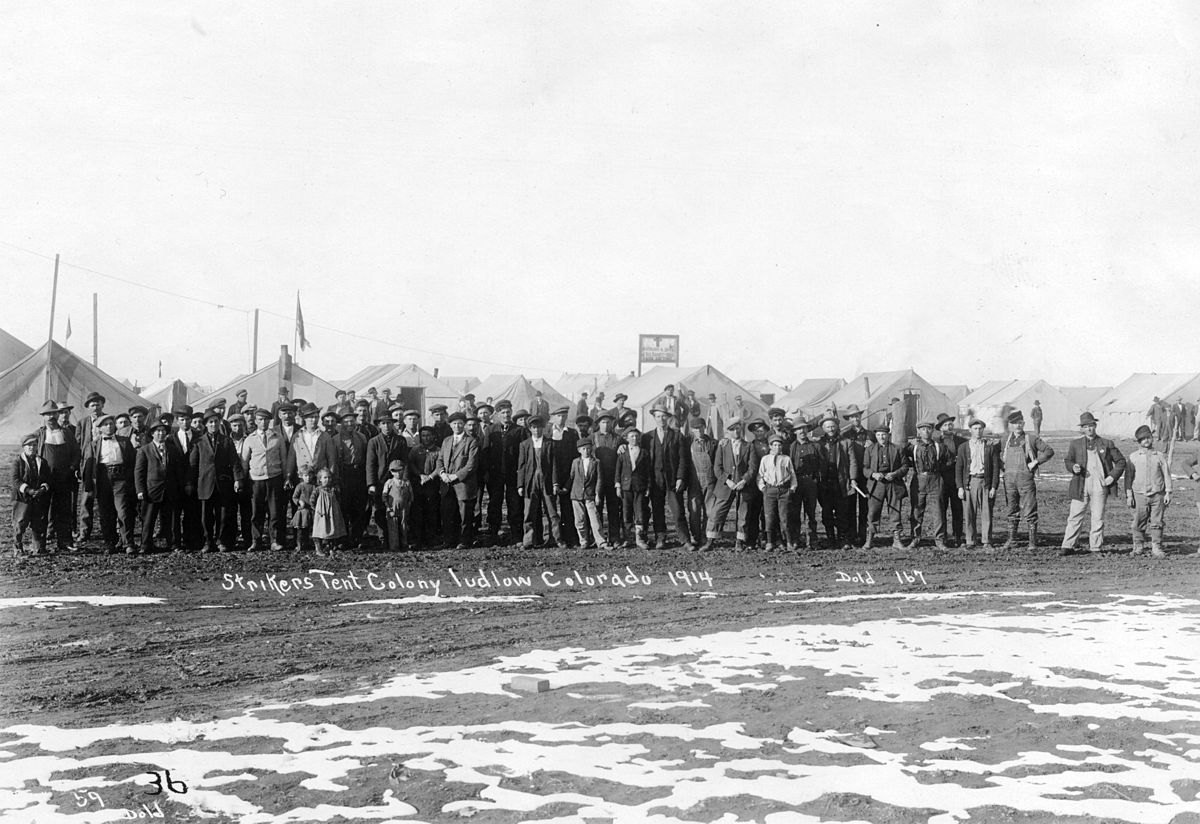
On April 20th 1914, Colorado National Guardsmen and mining company guards opened fire on a striking coal miners’ camp, with rifles and machine gun, killing up to 26 people, including women and children. They had set fire to the camp before opening fire and some of the casualties died of smoke inhalation.


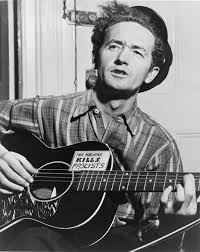
The event and the response of the workers were the inspiration for the song The Ludlow Massacre,  composed by Woody Guthrie, the socialist troubadour from Oklahoma, around 30 years later. Here in Ireland it was recorded by Christy Moore in 1971 on the Prosperous album and it has long been a favourite of mine (I’ll be singing it as part of the selection for Songs of Struggle 1913-1923, part of the 1916 Festival at Liberty Hall on Saturday 26th April 2014).


Ludlow Strikers & tents
Colorado Strikers and families in front of tent town


The massacre took place during the great Southern Colorado Coal Strike which began in September 1913, a month after the strike of the IT&G
WU tram workers began the eight month-long Dublin Lockout. But the Southern Colorado Strike lasted until December 1914 – sixteen months. And, in common with many industrial struggles in the USA, it was very violent.

The chief antagonists in this strike were the Colorado Fuel & Iron Co., of which John D. Rockefeller was the main owner; the Rocky Mountain Fuel Co. and the Victor-American Fuel Co.  As events were to show, the mine-owners could also draw on the armed force of the state of Colorado, as well as on their own hired gunmen.

Opposing them was the United Mineworkers of America trade union. The UMA presented seven demands:

  1. Recognition of the union as bargaining agent

  2. An increase in tonnage rates (equivalent to a 10% wage increase)

  3. Enforcement of the eight-hour work day law

  4. Payment for “dead work” (laying track, timbering, handling impurities, etc.)

  5. Weight-checkmen elected by the workers (to keep company weightmen honest)

  6. The right to use any store, and choose their boarding houses and doctors

  7. Strict enforcement of Colorado’s laws (such as mine safety rules, abolition of subs), and an end to the company guard system

The employers rejected the demands and prepared to bring in scab labour.

Living in company houses

As in a number of other countries, many mineworkers rented rooms or houses in company “towns” served by company shops, from which the miners also had to buy their equipment. Apart from that, they were also overcharged, so that often at the end of the week’s work the deductions left little pay to collect. This is the meaning behind the song Sixteen Tons (by either Merle Travis in 1946 or by George S. Davis in the 1930s the origin is disputed):


You shift sixteen tons and what do you get?
Another day older and deeper in debt.
St. Peter don’t you call me ‘cos I can’t come —
I owe my soul to the company store.”

Living in company houses often meant eviction when workers struck work, as happened in Dublin in 1913 to a number of strikers, including those of the Merchant Co. in Merchant Street, near North Wall.

The evicted miners in Colorado set up a tent town of 1,200 people which was being harassed by company guards and then, when the workers resisted, by Colorado state’s National Guard. Pot-shots were taken at the camp and stragglers were beaten up; eventually strike leaders were assassinated.

On April 20th 1914, about eight months into the strike, the Colorado National Guard and company guards set fire to tents and as people scrambled around, opened fire on the camp. Some workers claimed a loss of life of 26 while others numbered it at 19; the lack of municipal or government recording meant that there were no “official” counts of the dead.

Officers Colorado National Guard
Officers of the Colorado National Guard

After the massacre — the workers’ response

 In the aftermath of the massacre the workers armed themselves (union officials were seen openly handing out weapons) and fought back over a 40-mile front, from the town of Trinidad to Walsenburg (both of which are mentioned in the song). The death toll is recorded as between 69 and 199. The lack of municipal or government recording has already been mentioned; biased newspaper reporting was another problem and these two factors probably accounted for most of the discrepancies in accounting for the workers’ dead. 


The UMA eventually lost the strike but the union survived that defeat and went on to fight and win other victories; in addition Congressional investigations into the events did result in improvement in miners’ conditions, the enforcement of the eight-hour day and legislation limiting employment of child labour. Today the Ludlow tent colony site is a USA National Historic Landmark and the area is owned by the UMA. 


The lessons

The strike showed the ferocity of the US mine-owners in defence of their high profits as well as the readiness of municipal and government authorities in a prosperous democracy to collude with them — in the case of Colorado State, most actively and murderously.  Also apparent was the heroism and solidarity of the workers in that long strike and the readiness of at least many of them to meet the capitalists’ violence with their own and to sacrifice their lives if necessary.

Like the Dublin Lockout, which was also a defeat for the ITG&WU, the Southern Colorado Coal Strike showed the necessity for workers and their organisations on occasion to fight losing battles. Apart from it not being possible at the outset to predict the outcome of all struggles, hard fights teach lessons and steel the class in its battles. If workers were to avoid all battles except those they were certain to win, they would fight very few, become weak and lose the ability to fight, to say nothing of carrying out a successful revolution. 

A hundred years ago, the mineworkers in the Southern Colorado coalfields and their families wrote a great chapter in the history of workers’ struggles, even if a lot of the blood in which it was written was their own.

Ludlow Massacre Monument
The Ludlow Massacre Monument, erected by the union 1916
woody guthrie
Woody Guthrie, socialist troubadour, composed the Ludlow Massacre song about 1944.

The Ludlow Massacre by Woody Guthrie

(The lyrics accuse “they” sometimes and “you” at others; I sing “they” or “their” all through, along with a few other minor changes)

It was early springtime that the strike was on
They moved us miners out of doors
Out from the houses that the company owned
We moved into tents at old Ludlow

I was worried bad about my children
Soldiers guarding the railroad bridge
Every once in a while a bullet would fly
Kick up gravel under my feet

We were so afraid they would kill our children
We dug us a cave that was seven foot deep
Carried our young ones and a pregnant woman
Down inside the cave to sleep

That very night the soldiers waited
Until us miners were asleep
They snuck around our little tent town
Soaked our tents with your kerosene

They struck a match and the blaze it started
They pulled the triggers of their Gatling guns
I made a run for the children but the fire wall stopped me
Thirteen children died from their guns

I carried my blanket to a wire fence corner
Watched the fire till the blaze died down
I helped some people grab their belongings
While their bullets killed us all around

I will never forget the looks on the faces
Of the men and women that awful day
When we stood around to preach their funerals
And lay the corpses of the dead away

We told the Colorado Governor to call the President
Tell him to call off his National Guard
But the National Guard belong to the Governor
So he didn’t try so very hard

Our women from Trinidad they hauled some potatoes
Up to Walsenburg in a little cart
They sold their potatoes and brought some guns back
And put a gun in every hand

The state soldiers jumped us in a wire fence corner
They did not know that we had these guns
And the red neck miners mowed down them troopers
You should have seen those poor boys run

We took some cement and walled that cave up
Where those thirteen children died
I said, “God bless the Mine Workers’ Union”
And then I hung my head and cried.

 End.

THIRTEEN ROSES ….. AND 43 CARNATIONS

MILICIANAS 2

RAFAEL NARBONA

(Translation by Diarmuid Breatnach; original version published in Spanish in Rafael Narbona’s blog August 2013, also republished by kind permission in Rebel Breeze https://rebelbreeze.wordpress.com/2014/03/28/trece-rosas-y-43-claveles/)

On the morning of August 5th 1939 thirteen women were shot dead against the walls of the Eastern Madrid Cemetery.

Nine were minors, because at that time the age of majority was not reached until twenty-one. Ranging in age from 18 to 29, all had been brought from the Sales women’s prison, a prison that was designed for 450 people and in 1939 contained 4,000. Apart from Brisac Blanca Vazquez, all belonged to the Unified Socialist Youth (JSU) or PCE (Communist Party of Spain). Although they had not participated in the attack that killed Isaac Gabaldon, commander of the Civil Guard, they were charged with being involved and conspiring against the “social and legal order of the new Spain”.

The trial was held on August 3rd and 56 death sentences were issued, including the perpetrators of the attack. The Thirteen Roses went to their execution hoping to be reunited with their JSU comrades. In some cases it would have meant a boyfriend or husband but their hopes crumbled upon learning that the men had been shot already.

conesa

The brick wall clearly showed the bullet holes and the earth had been turned dark by blood. Some days, the death toll exceeded two hundred and machine guns were used to facilitate the work. Between 1939 and 1945, four thousand people were shot in the Eastern Cemetery, including Julián Zugazagoitia, Minister of the Interior with Juan Negrín and remarkable writer and socialist politician.

According to Maria Teresa Igual, prison officer and eyewitness, the Thirteen Roses died with fortitude. There were no screams or pleas. In an eerie half-silence, only the steps of the firing squad were heard, the sound of the guns striking the straps and the voice of the commanding officer. Lined up shoulder to shoulder, after the shooting all received the coup de grace, which was clearly heard in the Sales women’s prison. Apparently, one of the condemned (whether Anita or Blanca is not known), did not die immediately and had shouted, “Am I not to be killed?”

Antonia Torre Yela was spared execution by a typing error.  In transcribing her name, the letters danced and became Antonio Torres Yera. The error only postponed death for Antonia, a member of the JSU and only 18. She was shot on February 19th, 1940, becoming the 14th Rose. In her farewell letter, Julia Conesa, nineteen and member of the JSU, wrote: “Let my name not be erased from history.” Her name and that of her comrades has not been forgotten, unlike those of their tormentors, who enjoyed impunity for 38 years of dictatorship and a shameful amnesty which only helped to deepen the hurt suffered by all victims of Francoism.

The PSOE (main social-democratic party — DB) tried to appropriate the Thirteen Roses, concealing that at the time of the executions the PSOE had split from the JSU to found the Socialist Youth of Spain (JSE), with the purpose of clearly distancing themselves from the Communist Party of Spain (PCE). In fact, the Law of Historical Memory of Zapatero’s government (the first PSOE government after Franco — DB) did not even consider overturning the dictatorship’s judicial verdicts. It should be remembered that nearly fifty men were also shot dead that sad August 5th, the “43 Carnations”. Franco showed the same ruthlessness to men and women.

A hell

Sales jail was a hell, with children, elderly and mothers with children huddled in hallways, stairs, patios and bathrooms. Manuela and Teresa Basanta Guerra were the first women executed against the walls of the Eastern Cemetery. They shot them on June 29th 1939 along with a hundred men. Some historians claim that other women preceded them but their names were not recorded in the cemetery’s files. Like others on death row, the Thirteen Roses could only write to their families after receiving confession. If they did not take confession, they gave up the opportunity to say goodbye to their loved ones.

Brisac Blanca was the eldest of the thirteen and active in no political organization. Catholic and one who voted for the Right, she nevertheless fell in love with a musician who belonged to the PCE, Enrique Garcia Mazas. They married and had a son. Both were arrested and sentenced to death in the same trial. In fact, Enrique was in Porlier prison and would be shot a few hours before her. Blanca wrote a letter to her son Enrique, asking him not to harbour ill-will towards those responsible for her death and to become a good and hardworking man.

MILICIANAS 3

In postwar Madrid there was vicious persecution and resentment of any citizen suspected of “joining the rebellion”, the technicality that was used to reverse the law, accusing supporters of the Second Republic of violating the law in force. Only the military, the clergy, the Falange and the Carlists could breathe easily. No one dared to walk around in workers’ overalls or wearing the traditional local bandanna (worn by men around the neck and by women as a kerchief around the head, it is still worn today at festival in Madrid — DB).

The city was a huge prison where “hunt the red” was taking place. The earlier militia-women aroused particular animosity. The Arriba newspaper edition of May 16th 1939, featured an article by José Vicente Puente in which his contempt does not mince words: “One of the greatest tortures of the hot and drunk Madrid were the militia-women parading openly in overalls, lank-haired, with sour voice and rifle ready to shoot down and end lives upon a whim to satiate her sadism. With their shameless gestures, the primitive and wild, dirty and disheveled militiawomen had something of atavism, mental and educational. … …. They were ugly, low, knock-kneed, lacking the great treasure of an inner life, without the shelter of religion, within them femininity was all at once extinguished.”

In this climate of hatred and revenge, denunciations proliferated — they were the best means of demonstrating loyalty to the fascist Movement.

The interrogations …. copied Gestapo tortures

The interrogations in police stations copied Gestapo tortures: electric shock on the eyes and genitals, the “bathtub”, removing fingernails with pliers, mock executions. Women suffered especially because the torture was compounded by sexual abuse, castor oil and hair cut down to the scalp. In some cases they even shaved eyebrows to further depersonalize. Rapes were commonplace.  The testimony of Antonia Garcia, sixteen, “Antoñita” is particularly chilling: “They wanted to put electric currents on my nipples but since I had no chest they just put them in my ears and burst my eardrums. I knew no more. When I came to I was in jail. I spent a month in madness”.

Among those responsible for the interrogations was General Gutierrez Mellado, hero of the Transition and Captain in the Information Service of the Military Police (CPIS ) during the toughest years following the war. He regularly attended executions, seeking last-minute confessions. On August 6th 1939 he pulled Cavada Sinesio Guisado, nicknamed “Pioneer”, military chief of the JSU after the war, out of the execution line. “Pioneer” had been lined up against the Eastern Cemetery wall and was awaiting the discharge of lead along with the rest of his comrades. Gutiérrez Mellado stepped forward and ordered his release. He forced him to witness the executions and asked for more information about PCE clandestine activity. Although he was cooperative and diligent, he was shot in the end on September 15th. Some claim that Gutierrez Mellado witnessed the execution of the Thirteen Roses but I was not able to verify the data.

MILICIANAS 4

The women’s prison in Sales was run by Carmen Castro. Her inflexibility and lack of humanity found expression in the conditions of life of the children in prison with their mothers. No soap or hygienic facilities — almost all had ringworm, lice and scabies. Many died and were placed in a room where the rats were trying to devour the remains. Adelaida Abarca, JSU activist, said the bodies were only skin and bones, almost skeletons, for hunger had consumed them slowly. Another prisoner said: “The situation of the children was maddening. They were also dying and dying with dreadful suffering. Their glances, their sunken eyes, their continuous moans and stench are branded on my memory.” (Testimony given to Giuliana Di Febo in Resistance and the Women’s Movement in Spain [1936-1976] , Barcelona 1979).

The prisoners lived within the shadow of the “pit”, the death penalty. Since the execution of the Basanta Guerra sisters, they knew that the regime would have no mercy on women. On the morning when the Thirteen Roses were shot, Virtudes Gonzalez ‘s mother was at the jail doorway. When she saw her daughter climbing into the truck that was carrying prisoners to the cemetery walls, she began shouting: “Bastards ! Murderers ! Leave my daughter alone!” She chased the truck and fell. Alerted by the commotion, the Sales jail officers went outside and picked her off the ground, taking her into the prison. She was kept inside as yet another prisoner.

“If I had been sixteen they would have shot me too”

No less dramatic were Enrique’s repeated attempts to find out the whereabouts of his parents, Blanca and Enrique Garcia Brisac Mazas. In an interview with journalist Carlos Fonseca , author of the historical essay Thirteen Red Roses ( Madrid, 2005 ), Enrique gave his bitter account: “I was eleven years old when they shot my parents and my relatives tried to conceal it. They said they had been transferred to another prison and therefore we could not go to see them, until one day I decided to go to Salesas and there a Civil Guard Brigadier told me they had been shot and that if I had been sixteen they would have shot me too, because weeds had to be pulled up by the roots.

My grandmother and my aunts, my mother’s sisters, who had fallen out with my mother, ended up telling me that if Franco had killed my parents it would be because they were criminals. They even concealed my mother’s farewell letter for nearly twenty years.”

MILICIANAS 6

I will not end this article by invoking reconciliation, because the Transition was not based on repairing the pain of the victims, but rather on the acquittal of the executioners. In fact, the reform of the criminal dictatorship was designed by those as low as Manuel Fraga, Rodolfo Martín Villa and José María de Areilza. Martín Villa concealed and destroyed documents to bury the crimes of Francoism and the dirty war he organized against anarchist and pro-independence activists of the Basque, Catalan and Canaries areas, from his post as Minister of the Interior between 1976 and 1979. Among his achievements one should list the Scala case (an attack that killed four workers, which was blamed on the CNT), the attempted assassination of Canaries independence leader Antonio Cubillo, the machine-gunning of Juan Jose Etxabe, historic leader of ETA and his wife Rosario Arregui (who died from eleven bullet wounds), also the murder of José Miguel Beñaran Ordeñana, “Argala”.

The impunity of the perpetrators

He is now a successful businessman, who gets excited talking about his role in the Transition. He lives quietly and no one has called for his prosecution. His example is an eloquent one of the impunity of the perpetrators, who continue to write the narrative while demonizing those who dared to stand against the miseries of the dictatorship and false democratic normalization.

No justice has been done. So it is absurd to talk of reconciliation, because nobody has apologized and repaired the damage. Franco committed genocide but today Manuel Gonzalez Capón, Mayor of Baralla (Lugo), of the Partido Popular (the main right-wing party), dares to declare that “those who were sentenced to death by Franco deserved it.” The Biographical Dictionary of the Royal Academy of History, funded with nearly seven billion euros of public funds, says Franco “set up an authoritarian but not totalitarian regime”, although in his speech in Vitoria/ Gastheiz, Franco himself said that “a totalitarian state in Spain harmonises the functioning of all abilities and energies of the country …”. The current scenario is not a reconciliation but instead is a humiliation of the victims and society, obscenely manipulated by a media (ABC, El País , El Mundo, La Razón), playing a similar role to newspapers of the dictatorship (ABC, Arriba, Ya, Pueblo, Informaciones, El Alcázar), covering up and justifying torture cases and applauding antisocial measures that continue reducing working class rights.

Let us not remember the Thirteen Roses as passive and submissive but instead for their courage and determination. With the exception of Blanca, trapped by circumstances, all chose to fight for the socialist revolution and the liberation of women. I think that if they were able to speak out today, they would not talk of indignation and peaceful disobedience, but would ask for a rifle to stand in the vanguard of a new anti-fascist front, able to stop the crimes of neo-liberalism. Let us not betray their example, forgetting their revolutionary status, they who sacrificed their lives for another world, one less unjust and unequal.

rosario dinamitera

Did Mandela really change South Africa?

[Article by TOM, a contributor to Socialist Voice, newspaper of the Communist Party of Ireland and reprinted with their kind permission.  In essence it agrees with the analysis of Mandela and South Africa given by Stephen Spencer and Diarmuid Breatnach in an article reviewing statements of the Irish Left and Republican movement following the death of Mandela — Rebel Breeze]

The presence of such friends of genuine democracy as the war criminals George W. Bush and Tony Blair, David Cameron, Bill Clinton and such right-wing media hangers-on as Sir Bob Geldof and Sir Paul Hewson (Bono) at Nelson Mandela’s funeral raises questions about the real content of the new South Africa that appeared in 1994, when the apartheid elite seemed to cede political power to the African National Congress.

Twenty years later, given the continuing racial inequality in present-day South Africa, the much lower life expectancy of blacks and their much higher rate of unemployment, the increased vulnerability of the country to world economic fluctuations and accelerated environmental decay during his presidency, did Mandela really change South Africa? And, if not, how much room had he to manoeuvre?

For many are still remembering the Mandela years as fundamentally different from today’s crony-capitalist, corruption-riddled, brutally securitised, eco-destructive and anti-egalitarian South Africa. But could it be that the seeds of the present were sown earlier, by Mandela and his associates in government?

Ending the apartheid regime was, undoubtedly, one of the greatest events of the past century. But, to achieve a peaceful transition, Mandela’s ANC allowed whites to keep the best land, the mines, manufacturing plants and financial institutions, and to export vast quantities of capital.
The ANC could have followed its own revolutionary programme, mobilising the people and all their enthusiasm, energy, and hard work, using a larger share of the economic surplus (through state-directed investments and higher taxes), and stopping the flow of capital abroad, including the repayment of illegitimate apartheid-era debt. The path chosen, however, was the neo-liberal one, with small reforms here and there to permit superficial claims to the sustaining of a “National Democratic Revolution.”

The critical decade was the 1990s, when Mandela was at the height of his power, having been released from jail in February 1990, taking the South African presidency in May 1994 and leaving office in June 1999. But it was in this period, according to the former minister for intelligence services Ronnie Kasrils, for twenty years a member of the Central Committee of the South African Communist Party, that “the battle for the soul of the African National Congress was lost to corporate power and influence . . . We readily accepted that devil’s pact and are damned in the process. It has bequeathed to our country an economy so tied in to the neo-liberal global formula and market fundamentalism that there is very little room to alleviate the dire plight of the masses of our people.”

Nelson Mandela’s South Africa fitted a pattern, that of former critics of old dictatorships—whether from right-wing or left-wing backgrounds—who transformed themselves into neo-liberal rulers in the 1980s and 90s: Alfonsín (Argentina), Aquino (Philippines), Arafat (Palestine), Aristide (Haïti), Bhutto (Pakistan), Chiluba (Zambia), Kim (South Korea), etc. The self-imposition of economic and development policies, because of the pressures of financial markets and the Washington-Geneva multilateral institutions, required insulation from genuine national aspirations—in short, an “elite transition.”

This policy insulation from mass opinion was achieved through the leadership of Mandela. It was justified by invoking “international competitiveness.” Obeisance to transnational corporations led to the Marikana Massacre in 2012 and the current disturbances on the platinum belt, for example. But the decision to reduce the room for manoeuvre was made as much by the local principals, such as Mandela, as it was by the Bretton Woods institutions, financiers, and investors.

Much of the blame, therefore, for the success of the South African counter-revolution must be laid at the door of the ANC leadership, with Nelson Mandela at its head. Hence the paeans of praise for the dead leader from the doyens of international reaction.
[TOM]

PROPERTY SPECULATORS ARE CAPABLE OF ANYTHING

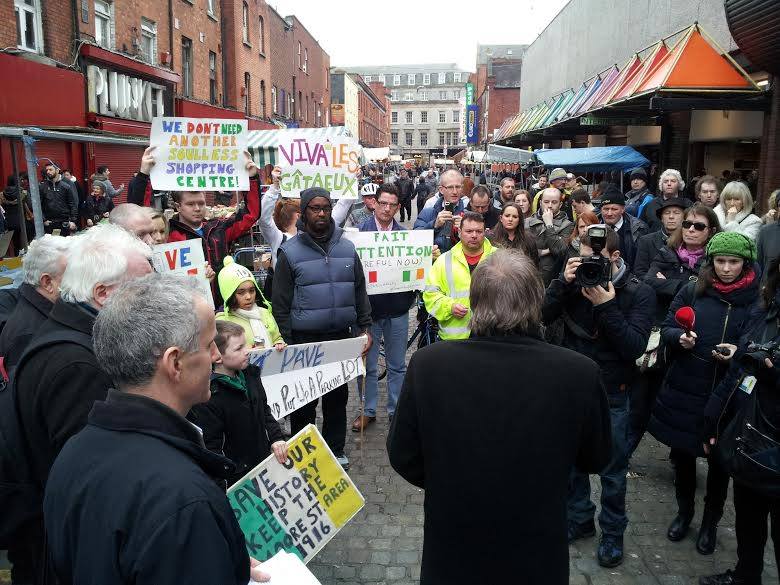
AN ACCOUNT OF PROPERTY “DEVELOPMENT” AND RESISTANCE WHICH MAY ILLUMINATE THE DISCUSSION AROUND MOORE STREET, DUBLIN

DB distance Moore St Paris Bakery
Second “Save Paris Bakery” demonstration, 3rd March 2014, as part of Save Moore Street campaign (photo John Ayres)

Currently, a property speculator, Chartered Land, wants to build a new shopping mall in Dublin’s city centre.  The plan envisages construction from O’Connell Street (including site of the old Carlton Cinema) through to Moore St and the demolition of a number of houses in the parade in Moore Street.  How Chartered Land saw off another developer with a much more modest plan, acquired a number of surrounding sites and came to a privileged arrangement with Dublin City Council has been the subject as far back as 2012 of a TV documentary by an investigative programme of  TG4 Iniúchadh Oidhreacht na Cásca https://www.youtube.com/watch?v=Cx0Kah7dE80#t=469.

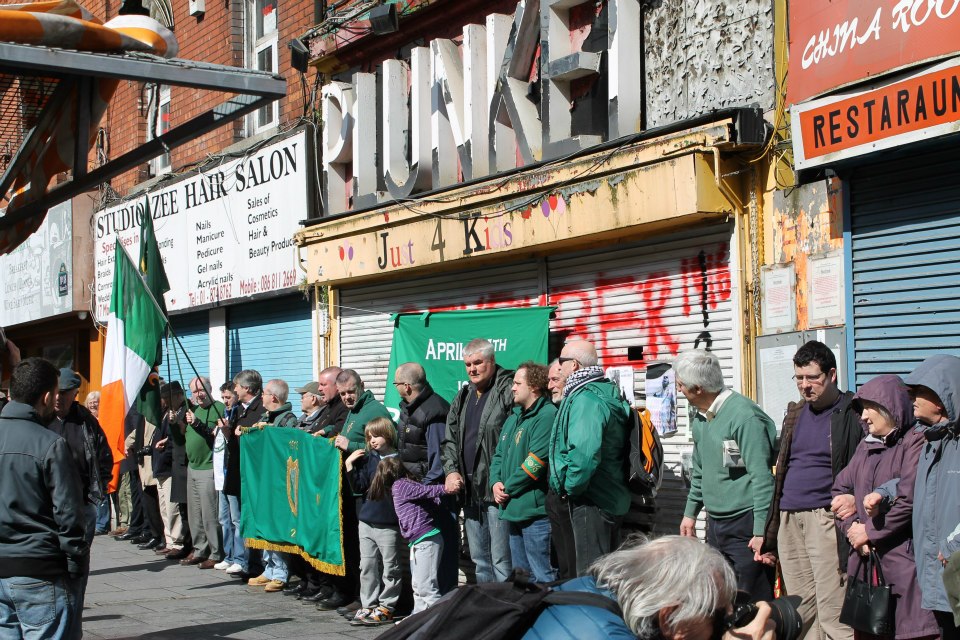
Hands Around Moore St. No.16
Hands Around Moore Street demonstration in 2013. The dilapidated shuttered shopfront (under a former owner’s name “Plunkett”) is No.16 Moore Street, last HQ of the 1916 Rising, occupied by Pearse, Connolly and others.

Campaigners have been resisting Chartered Land’s plan from a number of viewpoints: historical (conservation of a 1916 Rising battleground and last HQ of the Rising); architectural conservation; defending small businesses and traditional street market; opposition to yet another mall and thoughtless planning.  The latest move was the expulsion by Chartered Land of the successful small business Paris Bakery, occupying two of the houses which the campaigners wish to save.

Moore St Paris Bakery closure protest Feb2014
The first of two Save Paris Bakery demonstrations, February 2014, as part of the Save Moore Street campaign, being addressed by James Connolly Heron, grandson of James Connolly shot in 1916 by the British.

A campaign fought in a town on the eastern outskirts of London has, I believe, some lessons for people resisting Chartered Land and other property speculators.  In 1968 in the outer London borough of Redbridge, the Ilford Town Council had a plan for a ring road and car parks which required the demolition of many houses.  Whatever financial benefits were to be accrued from the plan and to whomsoever they would be going is not known to me  but one would assume there were some from the events to be outlined.  While they were applying for approval to the Dept. of the Environment AND BEFORE THEY RECEIVED APPROVAL, the Council served compulsory purchase orders on the houses in question and then forced the occupants to leave. The two-storey houses with gardens stood empty.

The Ilford Squatters’ Association, a broad group of different political parties and groups and independents, occupied some of the houses and moved homeless families into them (some of the families and some of the helpers, by the way, were Irish, including from Dublin). The campaign’s position was that they were against the “development” plan but that in any case, even if it went ahead, homeless families could and should be accommodated in houses in the meantime.

The council went to civil court and sought eviction orders which, at that time, had to name the individuals and the property in question. When the orders were granted, the squatters swapped the families at the address and moved the named one to another address.

Then the Council started vandalising the houses still empty, ripping out the stairs, smashing sinks and toilets and knocking holes through walls, ripping up floorboards. The Squatters had many volunteers and some of them had building experience; they repaired/ replaced toilets and sinks, rebuilt stairs and relaid floor boards.

The Council hired a firm of private detectives (i.e. thugs, some of them with National Front badges), and attacked two houses in what amounted to an illegal eviction. In one of them they smashed the jaw of a helper in two places and threw a child with scarlet fever out of her bed on to the floor in a bid to get the family to leave. The police stood by until a doctor arrived at a rush and said the child could not be moved; only then did the police ask the bailiffs to leave.

In another house, the bailiffs came through the street door with a battering ram to discover, as they fell through the joists, that in this house, the floorboards had not been replaced.  A medieval-type battle then took place as they tried to climb up ladders on the outside and on the inside too (for the stairs had not been replaced either). Frustrated and battered, they then set fire to the ground floor. At this point, the police had to intervene, as the houses on each side were occupied (a Salvation Army officer on one side and a GP on the other).  The bailiffs left and the Fire Brigade arrived to put out the fire.

Eventually the Council did some kind of a deal with the leadership of the Squatters’ Association and with a few remaining families and the campaign was over. By that time numerous helpers had been to civil and criminal courts and to jail on remand and some had accumulated “criminal” convictions. But the ring road was not approved for years afterwards (perhaps never) and nor was the car park.

There are two lessons from the account above, I think, for Moore St. campaigners:
1) Property speculators (“developers”) will do ANYTHING THEY CAN GET AWAY WITH to pursue their objectives
2) They will try and present the regulators with a fait accomplit, that is an accomplished fact. In the Moore St case, that means letting the named national monument buildings go to rack and ruin (as they did before) and getting rid of successful small businesses (as with Paris Bakery) and by making an ugly eyesore of Moore St. (derelict buildings, boarded up businesses, hoardings …) in the hope that opposition will crumble and people will be glad of any change to the area.

The resistance in Moore Street should continue to be holistic and every threatened part and interest should support the others.

The Defendant — a short play

Diarmuid Breatnach

“We have had ‘stepping stones’ presented to us before in our history – they turned out to be stone walls.”

 (A revolutionary is on trial).

judge in full wig etc

Act 1.

Scene: A courtroom – Judge’s bench high, clerk at lower bench nearby, faced by dock, containing defendant and two guards, one at each side.  Long bench in front of dock containing Prosecution and Defence barristers or lawyers.

Judge:  Read the charges, clerk.

Clerk: The defendant is charged with treason, sedition, incitement to rebellion against the lawful government, conspiracy with persons unknown to incite discontent, unlawful assembly, obstruction of the highway and membership of an illegal organisation.

Judge:  Defendant, you have heard the charges?

Defendant:        I have.

Judge:  Address the Court properly.

Defendant:        I have heard the charges, Judge.

Judge:  The proper manner to address me is Your Honour.

Defendant:        I have heard the charges, Judge.

Judge:  I see.  Very well, let us proceed.  How do you plead to the charges?

Defendant:        Not guilty of any crime against the people.

Judge:  Clerk, enter a plea of “Not Guilty.”

Prosecuting Counsel stands up, approaches defendant in the dock.

Prosecuting Counsel:    You are against the Agreement?

Defendant:        I am.  It clearly does not deliver what we fought for, an independent united Republic.  In addition, I and some others fought for a socialist republic and it has not delivered that either.

Prosecuting Counsel:     You are aware that the electorate voted to accept the Agreement?

Defendant: Yes, but…

Prosecuting Counsel:    Just answer ‘yes’ or ‘no’.

Defendant:        Yes.

Prosecuting Counsel:     And do you believe in democracy?

Defendant:        Define ‘democracy’.

Prosecuting Counsel:     The will of the majority.

Defendant:        With suitable safeguards for certain minorities, certainly.

Prosecuting Counsel:     Yet you have admitted to undertaking actions against the Agreement, have you not?

Defendant:        I have.

Prosecuting Counsel:     You consider yourself above the will of the people, the majority, then?

Defendant:        No.  But I consider that I have a duty to act according to what is right and I can see clearly that the Agreement delivers nothing of what we fought for.

Prosecuting Counsel:     Yet the people voted for it.

Defendant:        The people were tired of war and repression and were lied to.  Many of our leaders betrayed us and brought many of our movement with them.

Prosecuting Counsel:     That is your interpretation.  Might it not be that your leaders and those of your movement who followed them were wiser than you?

Defendant:        No.

Prosecuting Counsel:     No?  You could not possibly be wrong?

Defendant:        I am not wrong on this.  The movement fought for a an independent, united republic.  We did not get it.

Prosecuting Counsel:     Your leaders and your movement – I beg your pardon, many in your movement – consider it a stepping stone.

Defendant:        We have had ‘stepping stones’ presented to us before in our history – they turned out to be stone walls.

Prosecuting Counsel:     So you would pursue a strategy of violence in the face of the clear will of the majority!

Defendant:        I do not choose violence.

Prosecuting Counsel:     You do not?  Have you not admitted earlier a statement attributed to you, that violence would be necessary to achieve a successful revolution?

Defendant:        Yes.

Prosecuting Counsel:     So you do choose violence.

Defendant:        I do not.

Prosecuting Counsel:     Pray explain.

Defendant:        I said that the history of classes and of imperialism shows us that no class has ever been permitted to overthrow the one above it by peaceful means; similarly that no nation has won independence from the state oppressing it without having to face violence.  It is the oppressors of the people who choose violence, not us.

But naturally, we should defend ourselves.  Anyway, it is hypocrisy for a state to accuse us of violence, when they have a long history of violence and are at this moment collaborating with others who are waging war and armed invasion of countries.

Prosecuting Counsel:     That is a different matter and not the concern of this court.

( Defendant mutters something)

Prosecuting Counsel:  What did you say?

Defendant:        I said ‘You would say that and anyway it should be the concern of any court of justice.’

Prosecuting Counsel:     This is a court of law and it is trying a case to decide whether you are guilty or innocent.  Let us proceed along another track.  Do you believe in dialogue?

Defendant:        Certainly.

Prosecuting Counsel:     Why then do you not use the Agreement as a basis for dialogue to achieve your aims?  Surely that is the democratic way?

Defendant:        I’d be happy to engage in dialogue as to the details of Britain’s withdrawal from Ireland.  I’d be happy to engage in dialogue as to the details of the capitalists handing over the wealth they have plundered from the people.

Prosecuting Counsel:  You would confiscate the property of businessmen?

Defendant:           That wealth was created by working people.  I would consider it one of the first tasks of a socialist government to confiscate the wealth of the rich, yes.

Prosecuting Counsel:     And ruin the country!

Defendant:        I consider that it is the imperialists and the capitalists that are ruining the country.  Our native industries are undeveloped or taken over by foreign monopolies.  There is wide-scale poverty, homelessness, ill-health, unemployment and emigration.

Prosecuting Counsel:     These are hard times internationally, yes.

Defendant:        Exactly.

Prosecuting Counsel:     What do you mean ‘exactly’?

Defendant:        The capitalists and imperialists internationally have caused these ‘hard times’ as you call them.  They grow richer while the people grow poorer.  The second is the direct result of the first or, if you like, the first is the cause of the second.

Prosecuting Counsel:     Let us take another track.  Do you admit that this present government was elected by a majority?

Defendant:        No.

Prosecuting Counsel:     No?  You do not?

Defendant:        No.  It gained an overall majority of parliamentary representatives.

Prosecuting Counsel:     Is that not the same thing?

Defendant:        No.  There are those who were eligible to vote but did not and those who voted for other parties but did not elect enough representatives.

Prosecuting Counsel:     You quibble.

Defendant:        I do not, those are facts and the figures will clearly demonstrate that this present government was elected by a minority of the electorate.  But even if it had been elected by the majority ….

Prosecuting Counsel:     Yes, please do continue.

Defendant:        Even then, it broke many important promises it had made prior to coming to power.  It has de-legitimised itself.

Prosecuting Counsel:     No party can carry out everything it promises ….. situations arise, measures have to be taken to respond ….

Defendant:        I agree that capitalist parties do not carry out their promises.  They need the votes of the people but represent the interests of a tiny minority.

Prosecuting Counsel:     Oh, please, spare us your socialist rhetoric!

Defendant:        I am attempting to respond to your questions.

Prosecuting Counsel:     You have encouraged sedition against the lawful government.

Defendant:        Sedition according to the laws of this state – capitalist laws.

Prosecuting Counsel:     Would you not agree that you are in a minority opinion?

Defendant:        On what?

Prosecuting Counsel:     In your political views.

Defendant:        I am in majority opinion that imperialist war is a bad thing.  I am in a majority opinion that poverty, homelessness, unemployment and emigration are bad things.  I am not in a minority opinion that the rich get richer while the poor get poorer.

But I do admit that I am in minority opinion as to the feasibility of the solutions I propose.  I admit that I am in a minority as to the confidence that revolutionary change is within our power.  In that I am in a minority – for the moment.

Prosecuting Counsel:     Ah, you believe that the people will see sense and support your ideas.

Defendant:        I wouldn’t put it quite like that but … yes.

Prosecuting Counsel:     A bit arrogant, would you not say?

Defendant:        Not at all.  In the history of this and many other lands, many thinkers and activists have been in a minority before their opinions became accepted by the majority.  Most accepted scientific opinion now was once that of a minority – indeed, often of a persecuted minority.

Prosecuting Counsel:     You consider yourself a persecuted minority?

Defendant:        My presence here and the charges are proof enough of that.  But one day we shall be a majority.

Prosecuting Counsel:     May the Court please, I have no more questions of this defendant.

(Prosecuting Counsel sits)

(All freeze)

Act 2.

 (All unfreeze)

  State Prosecution Counsel standing, summing up, addressing the Judge …………….

Prosecuting Counsel:        The Defendant has pleaded ‘not guilty’ but his own answers under cross-examination have belied that plea.  He has in effect admitted to treason, sedition, incitement to rebellion against the lawful government, conspiracy with persons unknown to incite discontent, unlawful assembly and obstruction of the highway.

The only charge to which he has not admitted is membership of an illegal organisation.  However, we have clearly shown from the evidence of the police and army witnesses that he is indeed a member of an illegal organisation.

The State submits that the case has been proven in all respects and asks for a verdict of  “Guilty as charged.”  In addition the State asks for the maximum sentence — the prisoner is a danger to society and totally without remorse.

 (Prosecution Counsel sits.)

(All freeze)

Act 3.

 (All unfreeze) ….

Judge addressing the Defendant ….

Judge:  Defendant, you have been found guilty as charged on all counts.  Do you wish to say anything before sentence is passed?

Defendant:        Yes.  I once again contend that I am not guilty of any crime against the people.  The actions I undertook were for the victory of my class, the working class, which entails the defeat of the local ruling class and foreign imperialism.  If I am guilty of anything, it is that I did not always work hard or competently enough for the cause.

Time and again, others like me have stood before your courts and of the British before yours and been sentenced to imprisonment or even death.  They faced it with courage and I will try to do the same.  I do not expect mercy and I will not ask for it.  I do not apologise for doing what I know was right.

But I tell you this: one day, it will be representatives of my class that will sit up there and it will be you down here to answer for your crimes.  I bid my farewell to comrades, family and friends and I ask them to forgive me for any way in which I have failed them.  And may my place in the ranks be filled by many more.

Judge:  Have you quite finished?

Defendant:        I have.

Judge:  You will be kept in custody while the court considers your sentence.  Guards, take the Defendant down.

Defendant is escorted out by guards.

Clerk (in muttered but audible aside to the Judge):  “Surely your honour is going to sentence him to death?”

Judge (whispering but audible):  “Possibly …. however, I need to consider what harm may be done by making a martyr of him.  Possibly some years in jail will have him forgotten more quickly …. and possibly break that arrogance of his too.”

(Loudly):  “Clerk, record the verdict and decision made here this day … 12th of January …. 1923, Irish Free State”.

(All freeze momentarily)

End.

DUBLIN VULTURE

DUBLIN VULTURE
Street cartooning, hoarding Moore Street, Dublin inner-city historic and market quarter under threat from property speculator/ developer Chartered Land. 1st March 2014.

Street cartooning Moore Street hoarding, Dublin inner-city historic and street market area under threat from property speculator/ developer Chartered Land. 1st March 2014

RANT FOR MARGARETTA

RANT FOR MARGARETTA

(click on the title immediately above to access the video)
(A mobile-friendly version is also available, click on the author’s name below the video and the other version should show).

RAP POEM, VIDEO IMAGES WITH MUSIC IN PROTEST AT THE 3-MONTH INCARCERATION OF MARGARETTA D’ARCY, 79 YEAR-OLD ACTIVIST AND DRAMATIST, BECAUSE OF HER PROTESTS AGAINST THE CONTINUING USE OF SHANNON AIRPORT BY THE US MILITARY IN COLLUSION WITH SUCCESSIVE IRISH GOVERNMENT IN VIOLATION OF OUR NEUTRAL STATUS.

RANT FOR MARGARETTA

Diarmuid Breatnach

Forgive my confusion …

I was under the illusion …

or was it a delusion?

That we are a democracy,

not an autocracy

nor yet a plutocracy ….

That we citizens had the right

to decide whether a war to fight;

That we could choose with whom to ally …

Or was that all a cruel lie?

Listen now to the warning bell,

an Irish citizen in a prison cell;

Put there for taking a stand

against murder in foreign lands.

FREE MARGARETTA D’ARCY! FREE HER NOW!

FREE MARGARETTA D’ARCY! FREE HER NOW!

Well yes, it was all a delusion

and our government’s in murder collusion;

To murder planes turns a blind eye,

making accomplices of you and I!

Because the US is a superpower,

before them are we supposed to cower?

Are we to turn our hearts to stone,

to ignore the unmanned murder drones?

Surely not! Margaretta stands not alone —

we are of her blood and of her bone!

Listen now to the warning bell,

an Irish citizen in a prison cell;

Put there for taking a stand

against murder in foreign lands.

FREE MARGARETTA D’ARCY! FREE HER NOW!

FREE MARGARETTA D’ARCY! FREE HER NOW!

Our rulers fumble in a greasy till,

They never cared and never will:

Little women and little men,

Hucksters and middle men —

Believe me they don’t dither

to sell us out to the highest bidder!

Ach seo hé an scéal,

this is the story:
Ní chuirfidh muid fáilte

roimh – dúnmharthóirí!

Listen now to the warning bell,

an Irish citizen in a prison cell;

Put there for taking a stand

against murder in foreign lands.

FREE MARGARETTA D’ARCY! FREE HER NOW!

FREE MARGARETTA D’ARCY! FREE HER NOW!

Drone in the sky: someone’s crying …

Drone in the sky: someone’s dying …

If we allow it then we share the blame

so say we all: NOT IN OUR NAME!

Visitors are welcome from any land

but don’t come here with bloody hands;

Using Shannon as a staging post,

making our land a murder host —

we won’t pretend that we don’t know —

like Margaretta, we’re saying “NO!”

Listen now to the warning bell,

an Irish citizen in a prison cell;

Put there for taking a stand

against murder in foreign lands.

FREE MARGARETTA D’ARCY! FREE HER NOW!

FREE MARGARETTA D’ARCY! FREE HER NOW!


OPEN LETTER TO THE SOCIALIST COMRADES

solidarity woodcutDiarmuid Breatnach, Feabhra 2014


I have something I need to say to you again, socialist comrades in Dublin (though this may apply elsewhere also); I hope you can spare me the time to read. Comrades ….. shall I call you that? It was common, once, to call people that, if one was in the same struggle with them. You, communists, anarchists, revolutionary socialists, you are all in the same struggle as am I, for socialism. For the workers to rise up and take control. So on that level alone, I should call you “comrades”.

But more than that: I have marched in protest marches with you, stood on picket lines with you, attended meetings and conferences you organised; in years past in another land, I have shared blows of police truncheons and police cells with you and also joined you in giving out some of our own blows to fascists … yes, of course, “comrades” must surely be appropriate.

Solidarity!

But ….. isn’t there also a solidarity factor among comrades? That even though we may not be in the same party, or have the same ideas for socialist organisation of society, or even on the steps to take to reach socialism ….. are we not supposed to stand in solidarity with one another when we are physically attacked? Yes, of course! We say to the State, to the bourgeoisie, to fascists: “Touch him or her, and you touch us!” We repeat the motto or slogan: “United we stand, divided we fall!” We regularly chant “El pueblo unido jamás será vencido!

And we say those things because of the lesson the workers learned when they combined into trade unions, that a large part of their strength lay in unity. Many, many times workers struck work because of the victimisation of one or a few of their number. “Touch him or her and you touch all of us!” Yes, it was a hard-learned lesson, but it was well learned. And we took that into our socialist creed too, didn’t we? Whether we were old-style communists, new-style marxist-leninists, anarcho-syndicalists, anarchists, trotskyists of various belief ….. even radical social-democrats ….. solidarity!

And we learned, didn’t we, just like the workers did, that this “unity” and “solidarity” weren’t idealistic wishful thinking but actual survival stuff! That otherwise we’d get picked off all over the place. We know that one of the main things that keeps us somewhat safe, gives us space to work, is the knowledge that if some of us get arrested and beaten up, some of you will be protesting outside the police station, outside the courts, and so on. And vice versa. “Touch her or him and you touch all of us.”

And when we took up struggles other than directly for socialism, for example against imperialism, against racism and fascism, against gender discrimination, against homophobia ….. we extended that net of solidarity, didn’t we? “You touch that anti-imperialist, that anti-fascist, that ethnic minority, that feminist, that gay or lesbian person …. and you touch all of us!”

 Solidarity?

Didn’t we? Didn’t you? Well, there’s a problem right there, you know. Because in theory you said that but did you live up to it? Certainly not with the anti-British imperialists. Here in Ireland, that means Irish Republicans. And you haven’t stood by them, have you? Certainly not since the Good Friday Agreement. You didn’t stand by many who were “railroaded” by the 26 County state, such as Michael McKevitt, who is serving 20 years on FBI informant and Garda “evidence”. You didn’t do it for Colin Duffy and Brian Shivers, who were railroaded by the Six-County state, spending two years and ten months in custody until their case came to trial in 2012 and then Duffy was found “not guilty” while on the same evidence, more or less, Shivers was sentenced for murder and possession of explosives. He had been diagnosed terminally ill with multiple sclerosis, by the way. Then Shivers too was found “not guilty” on appeal too after another year in jail (with the colonial judge criticising his being chosen even as a suspect) so he can now live out his last days with his family. But no thanks to the Irish socialist movement.

Certainly in Dublin, you did not stand, expect for a brief token appearance at one demonstration, with Marian Price, a sick woman of sixty years of age, two years in jail without recourse to the courts, some of it without even a charge. She is out now, her health broken, probably never going to be fit to stand trial anyway, but out. No thanks or not much thanks to you.

I haven’t seen you standing by Colin Duffy, back in jail again on another trumped-up charge (he has already been cleared in three separate murder trials), or by his two family members, who were also jailed for awhile. You didn’t stand by Martin Corey, just short of four years in jail without even a charge and only just recently released on ridiculously restrictive conditions. You didn’t stand with Stephen Murney, in jail on spurious charges but without bail for a year unless he agreed to wear an electronic tag, not go to any political protests and not to live where his partner and child live. He is out on bail at last now, under night curfew but able to live in his home without a tag, able to go to protests. But no thanks to the Irish socialist movement.

You didn’t support the Republican prisoners who are being subjected to humiliating and invasive strip-searching and who have been beaten up resisting it, who went on a long dirty protest campaign as a result. Nor have you stood with Republicans who week in, week out, were harassed by Special Branch in the 26 Counties and uniformed police in the Six, in an attempt to intimidate them, blandly violating their democratic rights to picket, march or hold meetings.

In fact there are so many people you have not stood by; in the Six Counties, the state there must be thinking by now that it can do pretty much what it likes before any of it is going to reach a wider public in the 26 Counties. And Republicans in the 26 Counties are getting used to the harassment. Dangerous that is, too, when political harassment and attempted intimidation are accepted as everyday, as normal …. Dangerous for a lot of people and not only Republicans.

Limits of solidarity?

You see why I’m hesitating about this “comrade” tag? Because it’s clear to me that for you, in practice, it has limits. And there seems to be rather a sizeable chunk that is off-limits for solidarity. Anti-imperialism seems to be off-limits, which is rather strange for comrades who would say that they are anti-imperialist, in a country that is subjected to imperialism, in which the biggest anti-establishment movement is anti-imperialist, which is to say Republican, and which contains the most people of working-class background.

So maybe it’s not “united we stand, divided we fall” for everyone? Maybe it’s “united we stand, so long as you’re not an Irish Republican”? Or maybe even “so long as you’re not doing ‘Republican things’”? Like getting arrested on a picket for a Republican prisoner? Or a demonstration against a visit from the British Queen? Maybe ‘Republican things’ would even include being arrested for standing up for Irish language rights? It would help to be sure where the dividing line was, where I cannot count on your solidarity and where I can.

But I’m pretty clear about the Republicans, don’t worry, it seems none of them are going to receive your solidarity unless they get arrested on a clear class issue, like a …. like a …. like a strike. But wait ….. what if they were waving an Irish tricolour or with a Republican placard when they got arrested on that strike solidarity picket? Hmmm ….. it can get difficult to draw that line.

You see, the thing is, comrades – yes, I know I was having doubts about using it, but I was kind of brought up to use the term, call it a convention – I know that if YOU were arrested, I would be outside the police station and the courthouse and the jail for YOU. But I’m not at all sure that you’d return the favour. Because as an anti-imperialist (the revolutionary socialist variety, not the Republican), I often find myself at protests and events organised by Republicans. And not being sure about whether you’d support me, perhaps I should not offer you my solidarity in the first place? You see where all this could lead, right? The total breakdown of solidarity. Instead of “you touch her or him and you touch all of us”, it becomes “just don’t touch me.” Of course, the answer from any repressive agency to that appeal will be “Why the hell not? Who’s going to stop us?”

And that’s not too bad for you guys for now …. the repression is non-existent or fairly low on your organisations and members at the moment. But do you think it will stay like that? If you do, it’s because you know something about a dramatic upturn in the economy no-one else has heard about, or you have no plans to try to do anything about the situation. Because should you get close, repression there will be. Then you will feel what the Republicans have been feeling a lot of the time already, or what some smaller marginalised groups got at particular times. The Republicans will probably survive it better than you – they have had it for so much longer and their support network is wider. But who will be there for you?

Looking back on what I’ve written above I see that it can be considered harsh and hurtful. It was  not my intention but I do want to jolt you. Am I or my words capable of doing that? I don’t know. Who am I, anyway? No famous figure of past struggles, no leader of a party or well-known independent politician, not a well-followed theorist nor Left academic. A man of many years of experience of struggle at one or other level, perhaps …. but we have seen many of those go wrong too, haven’t we? Too many! Well then, why should you listen to what I have to say? I will give you one reason and if that is not compelling enough, there is no other that will do. I am still a revolutionary. I want to see the end of capitalism and imperialism; I want to see a world of justice and equality and I expend a considerable amount of time, thought and effort in that direction.

 An unfortunate and unhelpful division of labour

Our historical development as a people in Ireland has led to a deep division in our revolutionary motion – it is almost as though some power decreed:
“Republicans, you will take on the question of British Imperialism and Colonialism; Socialists, you will take on the questions of domestic capitalism and US Imperialism. But never the twain shall meet!”

If we think this through it is obvious that this division serves only our masters. While the Socialist movement keeps itself from ‘contamination’ by Republicanism, it likewise keeps the Republican movement pure from ‘contamination’ by socialist ideas and even some ideas acceptable to social democracy. A number of efforts have been made over the years to bridge this gap organisationally but they have failed; not since the days of Connolly and the early Larkin have we even come close. And I am not proposing that now.

What I am asking you to do is to stand up against the repression of Republicans, activists and prisoners. Whether you do this initially out of enlightened self-interest, for human and civil rights or whatever other reason perhaps matters less at this stage than that you do it. Start with those who are being interned by other processes in Maghaberry. Attend the pickets of the broad Irish Anti-Internment Campaign – bring your own (non-party) placards and colour flags if you like. Take your place in marches about internment or against mistreatment of prisoners (no problem with party banners or placards there). Unite those important branches of our struggle in action. How about it, comrades?  Your presence will be welcome.

End.

revolutionary solidarity

PS: EXCELLENT SHORT VIDEO ON POLITICAL PRISONERS AND ‘DEMOCRACY’ received as I finished this: https://www.youtube.com/watch?v=jVa7dPOKLXM

IS IT POSSIBLE FOR A PEOPLE TO DEFEAT A STRONGER INVADER OR OCCUPYING POWER?

Diarmuid Breatnach

Nov. 2012, revised slightly January 2014

(also available in translation into Spanish)

INTRODUCTION

The question of how a nation defeats a stronger colonial or imperialist power which has invaded it is one that has occupied the minds of many revolutionaries – principally those of democratic patriots (in Ireland, read “Republicans”) and socialists. The history of the World shows some victories in this kind of struggle, such as that of the Vietnamese against the USA. It shows however many partial victories too, in which the colonial power was forced to withdraw but where the new rulers of the country gave up the independence within their grasp and became clients of the former colonial power or of a new imperialistic one. The history of both the struggles for socialism and for national liberation, separate but linked in a number of ways, have provided us with many examples from which to draw general lessons which should be applicable to struggles of a similar nature in the past, present and future.

VIETNAM

The Vietnamese nearly had the French colonialists beaten when they were invaded by the Japanese who, as they lost the Second World War, handed half of it back to the French, who then had to relinquish it to the USA, who emerged from the War as the main imperialist superpower.

Vietnamese guerrillas -- the guerilla forces and the North Vietnamese Army together defeated the huge superpower the USA
Vietnamese guerrillas — the guerilla forces and the North Vietnamese Army together defeated the huge superpower the USA

The Vietnamese, in a country smaller than the size of the US State of Virginia, then took up the fight against the USA and fought them for twenty years, endured terrific damage and ultimately beat them. The USA had the best-armed force in the world, with the most powerful economy and constantly developing technology, with a huge population from which to draw soldiers and with a huge war budget. Yet the Vietnamese beat them.

Vietnamese liberation forces tank crashes through the gates of the US Embassy in Saigon as liberation forces take the city from the US puppet regime after US forces left
Vietnamese liberation forces tank crashes through the gates of the US Embassy in Saigon as liberation forces take the city from the US puppet regime after US armed forces were forced to withdraw.

Of course they were fighting for their homeland, of course they were courageous, clever and adaptable. But those qualities alone might not have been enough. They had some other favourable factors. They had already liberated half their country – “North Vietnam” — and the USA could not invade that country without risking China and even the USSR coming into direct confrontation with them. That part of their country remained for many years a safe rearguard area for the Vietnamese guerilla fighters of the Viet Cong and for the regular fighters of the North Vietnamese Army, from which they could be supplied with arms and other items.

The Vietnamese also had the support of the Laotian regime and of strong anti-imperialist forces in Cambodia, which provided alternative supply and escape routes for Vietnamese fighters.

In international alliance, the Vietnamese had the People’s Republic of China, which supplied them arms and equipment. In international politics, the whole of the world’s anti-imperialist forces supported them, isolating the USA politically. That fact, allied to the mortality rate of US soldiers, along with the rising radicalisation of youth, created a powerful anti-imperialist-war movement inside the USA itself which also played a part in undermining the morale of US military personnel in Vietnam.

A powerful movement of opposition to the Vietnam War within the USA itself

The terrain of Vietnam is mountainous with valleys and plains, covered with jungle and bamboo groves or with elephant grass higher than a man. It hid guerrillas and regular army units very well.

And crucially, perhaps, the US monopoly capitalists could afford to lose “South Vietnam” – it wasn’t integral to their territory or on their border or even in their “backyard” (as they tend to think of Latin America). Losing it cost them face, a big deal for the world’s superpower, and morale at home. Their ruling class was determined not to lose and they fought very hard to win but as their political and personnel casualties mounted so high, another section wanted to cut it loose. That’s the political reason for “Watergate” and the impeachment of President Nixon.

Ireland

Ireland is no longer forested and is much more urbanised than is Vietnam; it has no friendly liberated zone (the 26 Counties or “Republic” state is hostile to any anti-imperialist movement within the country), nor does it have neighbouring states willing to assist it or at least to turn a blind eye to its territory being used in assistance. It does not now have a good supplier of weaponry (which it only really had briefly in the Libya of the late Ghadaffi). In addition, not only is Ireland in Britain’s “back yard” but it seems as though the island itself is considered as integral to the “United Kingdom”, which is the base of the British monopoly capitalists.

But there have been and are other factors which an Irish anti-imperialist movement can use to its advantage which will be examined here in the context of the anti-imperialist struggles within the country during the last century.

It would be worthwhile first to take a look at a brief summary of the history of Ireland’s struggles against colonialism and imperialism but in case the reader should already be familiar with this history, it is included as an Appendix.

What were the options of the Irish national liberation forces at various points during the last century?

It is always easier to pass judgement on the actors and actions of the past – hindsight has 20/20 vision, as the cliché says – but it is necessary to do so nevertheless, in order to allow lessons of the past to inform our actions in the present and in the future. It is the options that were available to the revolutionary forces and the choices made in the Insurrection of 1916, and the guerrilla wars of 1919 and 1971 that are being examined here, along with their consequences.

The options of the Republican movement at three historical junctures will be examined:

  • the 1916 Rising

  • the guerilla War of Independence 1919-1921

  • the 30 Years’ War 1971-1998

The 1916 Easter Rising

In 1914 the first great imperialist World War had begun and by 1915 the scale of the slaughter was huge. Revolutionary socialists (as opposed to the social-democratic parties who had opted to support their own national bourgeoisies) wanted insurrection in order to stop the slaughter and also as an opportunity for socialist revolution– among these were James Connolly and the Irish Socialist Republican Party, who placed on top of their trade union building a large banner reading: NEITHER KING NOR KAISER! It was also one year after the Irish Transport & General Workers’ union, a recent breakaway from a British-based trade union, had survived an eight-month struggle in which the Dublin employers tried to break it. In the course of that struggle, the union had founded its own militia – the Citizen Army—to defend themselves from the attacks of the police and the organisation continued to exist after the lockout was over.

Revolutionary national democrats, i.e. Republicans, also saw the opportunity to fight for freedom while the colonialist-imperialist occupier was fighting other imperialist powers. They also thought that those countries which had won their independence or at least strongly demonstrated their wish for national independence would have their right to self-determination recognised by the victorious Powers after the war.

Constitutional nationalists, on the other hand, for the most part scrambled to show their loyalty to their colonial masters and, in the case of Ireland, recruited their fellow countrymen to join the slaughter on the battle-fields.

In Ireland, the secret revolutionary society of the Irish Republican Brotherhood and the open organisations of the Irish Volunteers (the leadership of which they controlled after splitting with the National Volunteers, many of which joined the British Army) along with the Republican women’s and youth organisations of Cumann na mBan and na Fianna Éireann, joined forces with the trade union and socialist Citizen Army (“the first Red Army in Europe”, allegedly according to Lenin) in an insurrection against British rule. It chiefly took place in Dublin in 1916 and lasted a week. After the insurrectionists surrendered to vastly superior British forces, most were sent to concentration camps, along with many others who had been swept up and interned without trial and most of the leaders were shot by firing squads.

Planning for the Rising

There were a number of elements in the plan for the uprising which are important to consider. The insurrection had been planned in secret not only from the authorities but also from some of the leadership of the Irish Volunteers including its commandant. It was intended to be a country-wide uprising. It was intended to be supplied with large amounts of arms from Imperial Germany, then at war with the British Empire.

The first part of the plan to fail was the failure, due to a change in unloading destination, to meet the German ship and bring the guns ashore and the ship’s subsequent discovery by the British, resulting in the capture of the crew (after they had scuttled the ship) and of Roger Casement, the Irish Volunteers agent who had travelled with them. The second part to go astray was the internal secrecy and when the commandant of the Irish Volunteers learned of the planned rising, along with the failure to land the guns, he canceled the order for the parades and exercises scheduled for Easter Sunday – the code description for the insurrectionary mobilisation. The Rising went ahead on Easter Monday instead, but with only about a thousand men and women mobilised in Dublin, much smaller forces in Meath, Galway and in Wexford and with no communication between the various local forces except by courier, a process taking days.

In Dublin the forces were stretched thin and failed to take some arguably important buildings, including the fortified Dublin Castle, seat of the colonial control of Ireland since the Norman invasion (which also had two of the top British officials in Ireland inside), and Trinity College, which supplied some of the canon used by the British to level buildings and from the roof of which British Army snipers were able to harass the insurgents, killing some of them (apparently taking this large building had not been part of the original plan).

The original plan for the uprising has been examined by a number of authorities – including some from a military background – and debated backwards and forwards. However, a mobilisation which can be cancelled or severely hampered by one person and that person not being part of the plan but who must be expected to learn of it is a monumental weakness. If such an arrangement is to be contemplated, one must at least put in a ‘Plan B’ in case that person attempts to disrupt the mobilisation, a plan which would include lines of speedy communication between the various units it is intended to mobilise.

Arguably another weakness in the plan was that the river Liffey had not been blocked (e.g. by sinking ships in it), which allowed a British gunboat to travel upriver and shell the city. It is said that James Connolly, commandant of the Citizen Army, had thought that the British would not destroy capitalist property. This was not ultimately a crucial factor as the British used other canons to bombard Dublin — but it could have been.

There appears to have been no plans laid for destruction of bridges or railway lines, perhaps because these were intended in the original plan for the mobilisation and communications of the insurgents.

Could it have succeeded?

But even had the plan contained these elements and the full mobilisation had gone ahead, how likely is it that the Rising would have succeeded? Ireland is an island but the British had naval superiority, allowing them to land troops anywhere they wished. It is true they were engaged in a war with other imperial powers and that they had committed most of their armed forces to that struggle. But was it likely that they would be prepared to sacrifice a possession so close to their heartland, a part of their United Kingdom indeed, and also so close to them on their western flank? Would they not sooner risk a possession further afield?

O'Connell St (then Sackvill St) from the Bridge looking north-eastwards. Destruction by bombardment of a major UK city shows determination of the British to crush the Rising.
O’Connell St (then Sackvill St) from the Bridge looking north-eastwards. Destruction by bombardment of a major UK city (which it was then) shows determination of the British to crush the Rising.

The likelihood is that, in the event of a successful uprising across most of the land, the British would have responded by landing forces at various parts of the country and, after fierce fighting no doubt, taken any insurgent-held cities. They would have been successful because they had superior training, numbers, armaments, air and naval power (of which the insurgents had none) and because they would have been fighting a largely conventional war in which those elements would be crucial. Subsequently they would have moved from those cities to defeat the detachments still active in the surrounding countryside. They would have been assisted in these operations by those units of their armed forces and police stationed in the country but which had not been captured by the insurgents, and by the Loyalist militia (which was substantial) in some of the northern counties. British control of the seas would have prevented any substantial help arriving for the Irish insurgents from abroad.

The cost to the British would have been substantial: in advantage taken by their enemies in time of war, in political consequences and perhaps in morale among their own troops. But who can doubt that they would have risked all that? Even if they were only to take the Irish cities and hold the loyal northern counties until after the War, they could then deal with the remaining insurgents at greater leisure.

What actually occurred, as we know, was that the Rising was put down in a week, martial law was declared, leaders executed and countrywide raids, arrests and internment without trial followed.

The War of Independence 1919-1921 and retreat from stated objectives

Three years later, the nationalist revolutionaries returned to the armed struggle, this time without a workers’ militia or an effective socialist leadership as allies, and began a political struggle which was combined a little later with a rural guerilla war which soon spread into some urban areas (particularly the cities of Dublin and Cork). The political struggle mobilised thousands and also resulted in the majority of those elected in Ireland during the General Election (in the United Kingdom, of which Ireland was part) being of their party.

The struggle in Ireland and the British response to it was generating much interest and critical comment around the world and even in political and intellectual and artistic circles within Britain itself. In addition, many nationalist and socialist revolutionaries around the world were drawing inspiration from that fierce anti-colonial struggle so near to England, within the United Kingdom itself.

The dismantling by the nationalist forces, by threats and by armed action, of much of the control network of the colonial police force, which consequently dismantled much of their counter-insurgency intelligence service, led the British to set up two new special armed police forces to counter the Irish insurgency. Both these forces gained a very bad reputation not only among the nationalists but also among many British loyalists. The special paramilitary police forces resorted more and more to torture, murder and arson but nevertheless, in some areas of Ireland such as Dublin, Kerry and Cork, they had to be reinforced by British soldiers as they were largely not able to deal effectively with the insurgents, who were growing more resolute, experienced and confident with each passing week.

However, two years after the beginning of the guerilla war, a majority of the Irish political leadership of the nationalist revolutionary movement settled for the partition of their country with Irish independence for one part of it within the British Commonwealth.

Much discussion has taken part around the events that led to this development. We are told that British Prime Minister Lloyd George blackmailed the negotiating delegation with threats of “immediate and terrible war” if they did not agree to the terms. The delegation were forced to answer without being allowed to consult their comrades at home. Some say that the President of the nationalist political party, De Valera, sent an allegedly inexperienced politically Michael Collins to the negotiations, knowing that he would end up accepting a bad deal from which De Valera could then distance himself. Michael Collins, in charge of supplying the guerrillas with arms, stated afterwards that he had only a few rounds of ammunition left to supply each fighter and that the IRA, the guerrilla army, could not fight the war Lloyd George threatened. He also said that the deal would be a stepping stone towards the full independence of a united Ireland in the near future. None of those reasons appear convincing to me.

How could the leadership of a movement at the height of their successes cave in like that? Of course, the British were threatening a worse war, but they had made threats before and the Irish had met them without fear. If the IRA were truly in a difficult situation with regard to ammunition (and I’m not sure that there is any evidence for that apart from Collins’ own statement), that would be a valid reason for a reduction in their military operations, not for accepting a deal far short of what they had fought for. The IRA was, after all, a volunteer guerrilla army, much of it of a part-time nature. It could be withdrawn from offensive operations and most of the fighters could melt back into the population or, if necessary, go “on the run”.

If the military supply situation of the Irish nationalists was indeed dire in the face of the superior arms and military experience of Britain, was that the only factor to be taken into account? An army needs more than arms and experience in order to wage war – there are other factors which affect its ability and effectiveness.

The precariousness of the British situation

In 1919, at the end of the War, the British, although on the victorious side, were in a precarious position. During the war itself there had been a serious mutiny in the army (during which NCOs and officers had been killed by privates) and as the soldiers were demobbed into civilian life and into their old social conditions there was widespread dissatisfaction. Industrial strikes had been forbidden during the War (although some had taken place nonetheless) and a virtual strike movement was now under way.

In 1918 and again in 1919, police went on strike in Britain. Also during 1919, the railway workers went on strike and so did others in a wave that had been building up since the previous year. In 1918 strikes had already cost 6 million working days. This increased to nearly 35 million in 1919, with a daily average of 100,000 workers on strike. Glasgow in 1921 saw a strike with a picket of 60,000 and pitched battles with the police. The local unit of the British Army was detained in barracks by its officers and units from further away were sent in with machine guns, a howitzer and tanks.

James Wolfe in his work Mutiny in United States and British Armed forces in the Twentieth Century (http://www.mellenpress.com/mellenpress.cfm?bookid=8271&pc=9) includes the following chapter headings:

Workers pass an overturned tram in London during the 1926 British General Strike. In general, goods travelled through Britain with authorisation from the workers or under police and troop protection.
Workers pass an overturned tram in London during the 1926 British General Strike. In much of the country no transport operated unless authorised by the local trade union council or under police and army escort.

4.2 The Army Mutinies of January/February 1919 
4.3 The Val de Lievre Mutiny 
4.4 Three Royal Air Force Mutinies January 1919 
4.5 Mutiny in the Royal Marines – Russia, 
February to June 1919 
4.6 Naval Mutinies of 1919 
4.7 Demobilization Riots 1918/1919 
4.8 The Kinmel Park Camp Riots 1919 
4.9 No “Land Fit For Heroes” – the Ex-servicemen’s Riot in Luton
4 4.10 Ongoing Unrest – Mid-1919 to Year’s End 

 The British Government feared their police force would be insufficient against the British workers and was concerned about the reliability of their army if used in this way. There had already been demonstrations, riots and mutinies in the armed forces about delays in demobilisation (and also in being used against the Russian Bolshevik Revolution).

Elsewhere in the British Empire things were unstable too. The Arabs were outraged at Britain’s reneging on their promise to give them their freedom in exchange for fighting the Turks and rebellions were breaking out which would continue over the next few years. The British were also facing unrest in Palestine as they began to settle Jewish immigrants who were buying up Arab land there. An uprising took place in Mesopotamia (Iraq) against the British in 1918 and again in 1919. The Third Afghan War took place in 1919; Ghandi and his followers began their campaign of civil disobedience in 1920 while in 1921 the Malabar region of India rose up in armed revolt against British rule. Secret communiques (but now accessible) between such as Winston Churchill, Lloyd George and the Chief of Staff of the British armed forces reveal concerns about the reliability of their soldiers in the future against insurrections and industrial action in Britain and even whether, as servicemen demanded demobilisation, they would have enough soldiers left for the tasks facing them throughout the Empire.

The Irish nationalist revolutionaries in 1921were in a very strong position to continue their struggle until they had won independence and quite possibly even to be the catalyst for socialist revolution in Britain and the death of the British Empire. But they backed down and gave the Empire the breathing space it needed to deal with the various hotspots of rebellion elsewhere and to prepare for the showdown with British militant trade unionists that came with the General Strike of 1926. Instead, the Treatyites turned their guns on their erstwhile comrades in the vicious Civil War that broke out in 1922. The new state executed IRA prisoners (often without recourse to a trial) and repression continued even after it had defeated the IRA in the Civil War.

If the revolutionary Irish nationalist leaders were not aware of all the problems confronting the British Empire, they were certainly aware of many of them. The 1920 hunger strike and death of McSwiney, Lord Mayor of Cork, had caught international attention and Indian nationalists had made contact with the McSwiney family. The presence of large Irish working class communities in Britain, from London to GlaSgow, provided ample opportunity for keeping abreast of industrial disputes, even if the Irish nationalists did not care to open links with British militant trade unionists. Sylvia Pankhurst, member of the famous English suffragette family and a revolutionary communist, had letters published in The Irish Worker, newspaper of the IT&GWU. The presence of large numbers of Irish still in the British Army was another source of ready information.

Anti-Treaty cartoon, 1921, depicts Ireland being coerced by Michael Collins, representing the Free State Army, along with the Catholic Church, in the service of British Imperialism

The revolutionary Irish nationalist leaders were mostly of petite bourgeois background and had no programme of the expropriation of the large landowners and industrialists. They did not seek to represent the interests of the Irish workers—indeed at times sections of them demonstrated a hostility to workers, preventing landless Irish rural poor seizing large estates and dividing them among themselves. Historically the petite bourgeoisie has shown itself incapable of sustaining a revolution in its own class interests and in Ireland it was inevitable that the Irish nationalists would come to follow the interests of the Irish national bourgeoisie. The Irish socialists were too few and weak to offer another pole of attraction to the petite bourgeoisie. The Irish national bourgeoisie had not been a revolutionary class since their defeat in 1798 and were not to be so now. Originally, along with the Catholic Church with which they shared many interests in common, they had declined to support the revolutionary nationalists but decided to join with them when they saw an opportunity to improve their position and also what appeared to be an imminent defeat of the British.

In the face of the evident possibilities it is difficult to avoid the conclusion that the section of revolutionary Irish nationalists who opted for the deal offered by Lloyd George did so because they preferred it to the alternatives. They preferred to settle for a slice rather than fight for the whole cake. And the Irish bourgeoisie would do well out of the deal, even if the majority of the population did not. The words of James Connolly that the working class were “the incorruptible heirs” of Ireland’s fight had a corollary – that the Irish bourgeoisie would always compromise the struggle. It is also possible that the alternative the nationalists feared was not so much “immediate and terrible war” but rather a possible Irish social revolution in which they would lose their privileges.

Irish Free State bombardment 4 Courts
Start of the Irish Civil War 1922: Irish Free State bombardment, with cannon on loan from the British Army, of the Republican HQ at the Four Courts, Dublin.

Another serious challenge to the Empire from Irish nationalist revolutionaries would not take place until nearly fifty years later, and it would be largely confined to the colony of the Six Counties.

The thirty years war in the Six Counties

The IRA did not have much success in a number of short campaigns during the 2nd World War or during the 1950s. Sinn Féin, its political party, suffered a major split during the 1930s and the new organisation Fianna Fáil, which adopted a constitutional path, soon became one of the two main bourgeois parties of the new state. This party was in government during the Second World War and felt that its position of neutrality would be undermined by IRA activity against the British. It carried out raids on its former comrades, interned hundreds in inhumane conditions, subjected them to beatings and even killed a few, as well as carrying out state executions.

Sinn Féin reformed itself in the 1960s, revoked its ban on communism and appeared to be developing a socialist outlook; it also concerned itself with social questions within the Irish state and agitated on the question of housing. In addition it carried out campaigns of civil disobedience and trespass around the issue of private ownership by foreign landlords of Irish housing, land and rivers.

In the Six Counties the party contributed to the organisation of the civil rights protest movement but the latter soon outgrew it. After the police there had rampaged through their area and shot a member of the community dead (ironically, a British Army soldier, home on leave), the Catholic communities of Derry and the Falls Road erected barricades to keep the police out and in Derry successfully defended them against repeated attack by the paramilitary police, by their part-time reserves and by rampaging Loyalist mobs.

Split!

Now, when they felt that they needed the weapons, the northern Republicans found that their leadership in Dublin had disposed of them (allegedly sold to a Welsh armed group) and that all that was available to defend their areas was a tiny handful of weapons and only one of them an automatic. This soon led to a split in both the political party and the IRA and the new organisations proclaimed themselves Provisional Sinn Féin and the Provisional IRA. The original organisation then added the word “Official” to their party and to their armed group. The breakaways quickly became known as the Provisionals (or “Provos” or “Provies”). Later the Officials became known as “the Stickies” (due to an unfortunate innovation of theirs in producing their Easter Lillies — paper representation of the flower to commemorate the Easter Rising — with gum on the reverse).

The Provisionals had no time for socialism. Many of them felt that socialist ideology was what had led to their being left without sufficient weapons when their areas were under attack. They reiterated the traditional soldiers’ complaint against “too much politics”. Also, they had in their leadership not a few of quite conservative Catholic ideology. On the international front, of which they had little, Fred Burns O’Brien, a US-based Irish Republican but a Zionist, for a time had a column in the Provos’ newpaper An Phoblacht, in which from time to time he extolled the example of the Zionists. A letter of protest from one reader that the natural allies of the Irish were the Palestinians and not the Zionists was not published and O’Brien continued to write in An Phoblacht for some time afterwards.

The Provos took on the British Army when it was sent in to prop up the statelet against the people’s uprising which the colonial police force seemed unable to quell. They were soon fighting primarily the soldiers of the British Army, the armed colonial police and the undercover death squads of both units. In addition, and to a much lesser extent, they were fighting the Loyalist paramilitaries, who mostly concentrated their attacks on random Catholics.

New leadership of the Provisionals

Gradually a new leadership began to form within the ranks of the Provisionals. The old one had become somewhat discredited – Mac Stiofáin for getting caught with incriminating papers, then starting a hunger strike to the death which he later abandoned. Ó Brádaigh’s leadership lost some credibility for their loudly proclaiming that 1972 and then 1974 would be Bliain an Bhua, the Year of Victory (which of course neither was). Also his leadership had held the ceasefire and truce of 1975, from which no advantage to the Provos could be seen, as the British reneged on the truce and brought in even more repressive measures; also the possible propaganda benefits were not prepared for and naturally did not materialise. “Moss” Twomey, Chief of Staff of the IRA and one of the original leaders of the Provisionals, had not supported the truce but was removed from his position due to his 1977 arrest by the Gardaí in the 26 Counties.

Ruairí Ó Brádaigh and Gerry Adams, solidarity conference London 1983. Adams ousted Ó Brádaigh in the Provos' leadership. Ó Brádaigh was twice chief of staff of the IRA between 1958 and 1962, president of Provisional Sinn Fein from 1970 to 1983 and of Republican Sinn Fein from 1987 to 2009,
Ruairí Ó Brádaigh (left) was ousted by Gerry Adams (right) from the Provos’ leadership, both seen here at an Irish solidarity conference in London 1983. Ó Brádaigh was twice chief of staff of the IRA between 1958 and 1962, president of Provisional Sinn Fein from 1970 to 1983 and of Republican Sinn Fein from 1987 to 2009,

The new leadership, of which Gerry Adams is widely believed to have been the principal actor, with a group around him took effective control of the IRA and of Sinn Féin and the party’s annual delegate meeting in 1986 witnessed a walkout by Ó Brádaigh and most of his supporters (which did not include Twomey) who then went on to form Republican Sinn Féin (often since linked to the Continuity IRA).

The Provisional IRA (and for awhile, INLA, another split from the Official IRA) fought on in a hard war against a modern imperialist army and armed police force with their sophisticated surveillance systems and their Loyalist paramilitaries, managed by British police and army intelligence agencies. Armed Republicans inflicted heavy casualties on the colonial forces and themselves took many casualties. Hundreds of them went to prison for long terms of imprisonment and the prisons became area of hard struggle too. The area of operations of the Republican groups was almost exclusively confined to the Six Counties. Provisional Sinn Féin organised and ran campaigns throughout the Twenty-Six Counties but mostly focused on garnering support for the fight in the Six.

PSF did not do any serious work among the trade union movement and when one of their Ard-Choiste (National Executive) members, Phil Flynn, was a senior union official, he took part in reaching social partnership agreements with the Irish government that were to eliminate the trade union movement as any element of real resistance to the plans of Irish capitalists from then onwards to the present day.

In seeking alliances within Ireland, it was to the “Republican” margin of the bourgeois Fianna Fáil party that PSF, both before and after the split, made their major overtures.

PSF took no part in the struggle for the legalisation of condoms and the anti-conception pill. When the constitutional referendum on abortion was held, PSF were opposed and in the referendum on divorce, they equivocated. When the referendum on the nationality status of immigrants’ children born in Ireland was held, they pronounced themselves in favour of full citizenship but failed to campaign on the issue, restricting themselves instead to their local government election campaign. In other words, in four major areas of civil rights, they either took the wrong side or failed to mobilise. It was notable that on these occasions, PSF stood to the right of the social-democratic Irish Labour Party.

PSF also failed to organise around the issue of unemployment and of its resulting emigration, a huge drain of young people which affected most social classes in Ireland. In fact, the only one of the social issues in which they acted with any resolution was in the campaign against drug dealing. However, even there, their moralistic outlook treated all drugs as the same, with the exception of alcohol of course, which they sold in their clubs and which they illegally “taxed” in their areas, and of tobacco, which, in the form of cigarettes, they smuggled across the Border. Their solution to the drug problem was to intimidate drug merchants and to drive them out of the areas where campaigns were active. However, rumours persist that they actually “taxed” drug merchants in many other areas as one of their sources of revenue.

It was not to be expected that the majority of people in the Twenty-Six Counties, deprived of any leadership on any of the economic and most of the social issues that affected them, could be mobilised exclusively on the issues affecting a small part of the Irish population under another administration. Popular support for the Provisionals began to wane in the Twenty-Six Counties, aided by a hostile bourgeoisie, their media and political establishment, while in the Six Counties, war-weariness began to set in.

It was the struggle of the Republican political prisoners, largely male, inside the jails and their supporters outside, initially largely organised by their female relatives, which breathed new life into the Republican movement, particularly in the Six Counties. First the “blanket protest”, then the “no-wash” and finally the “dirty protest” led to the hunger-strike of 1980. This was followed shortly by another hunger-strike in 1981 culminating in the death of ten Republican prisoners, seven of Provisional IRA and three INLA.

The struggle of the prisoners and the campaigning of their supporters galvanised the nationalist community in the Six Counties and re-animated the Provisional movement. It also led to a successful Republican electoral intervention on both sides of the border, with a parliamentary representative elected in both administrations.

Reformist trajectory

From then onwards a reformist electoral trajectory is perceivable among the Provisionals, linked to a guerilla war that is designed to pressure the British and to be used to improve the Provisionals’ bargaining position. In 1998 the Provisionals signed the Good Friday Agreement which then won majority support by a large margin in a Twenty-Six Counties referendum and a slim majority in Six-County elections. Subsequently Provisional Sinn Féin became the dominant political party in the nationalist community and electorally second force overall in the Six Counties.

The electoral strategy led to the organisation’s first notable split, from which arose in 1986 Republican Sinn Féin, which has often been linked to the Continuity IRA which appeared on the scene soon afterwards. In 1997 another split took place from which was formed the 32 County Sovereignty Movement, usually linked to the Real IRA. The 32 CSM itself later split and the heirs of that split are to be found in the Republican Network for Unity. After the signing of the Good Friday Agreement 1n 1998, a number of people who left SF and the Provisional IRA went on to form the organisation éirigí (“rise up”). All of these are opposed to the Good Friday Agreement, as are a few smaller groups.

In the 2011 general election in the Twenty-Six Counties, the ruling Fianna Fáil party was hugely reduced, due to a litany of financial-political scandals combined with the capitalist financial crisis, in which the government paid the speculators of the Anglo-Irish bank with public money. Their junior coalition partners, the Green Party, were totally wiped out. The victors were the next major bourgeois party, Fine Gael, in coalition with the social-democratic Labour Party. These essentially continued the policies of their predecessors. Sinn Féin won 14 seats, along with 14 Independents (mostly left-wing) and four from two Trotskyist groups.

The response of Sinn Féin to the financial crisis has been to call for inward-investment and job-creation while saying that “there is a better, fairer way” of managing the economy. They have opposed cuts in the Twenty-Six Counties (while implementing them in the Six) but did not support the campaign to refuse to register for, or to pay the Household Tax (a new tax). This was the biggest campaign of civil disobedience in the history of the state and was successful; however the tax was replaced by another, the Property Tax, with the Revenue Department responsible for collecting payment.

Dublin demonstration, 13April 2013, part of civil disobedience campaign against Household & Water Taxes which Sinn Féin did not support
Dublin demonstration, 13 April 2013, part of a campaign against the Household & Water Taxes, the biggest civil disobedience campaign in the history of the State, which Sinn Féin did not support.

In their ways of organising, the electoral emphasis, their slogans and their response to a militant civil disobedience campaign, the behaviour of Sinn Féin in the Twenty-Six Counties is totally in line with that of a bourgeois, social-democratic party, with the distinction that unlike most social-democratic parties it has no history or strength in the trade union movement. Their strategy would seem to be to build up their electoral performance in order to go into coalition government with one of the other bourgeois political parties at some point in the future.

The trajectory of the Provisionals from beginning to the present can then by summed up as armed anti-imperialist resistance in the colony, the smallest part of the country, attempts to win the southern nationalist bourgeois party (or sections of it) on to their side, electoral reformism with military pressure until negotiations, then total electoral reformism on both sides of the Border with participation in colonialist and capitalist government in the colony.

The possible revolutionary alternative

There was a possible and viable alternative. In the Twenty-Six Counties, that would have meant mobilising the mass of people on the social and economic issues confronting them: unemployment, emigration, housing shortage, lack of development, erosion of the Irish-speaking areas. It would have meant confronting the ruling capitalists, their political parties and the state on their comprador and neo-colonial policies, scandals, tax breaks, give-away of natural resources and production bases. For that, the resistance movement could have built bases among communities, students and crucially, workers, organising in and across the trade union movement, taking on the social-democratic trade union leaders on their own ground and fighting their ideology and practice of “social partnership” with the bourgeoisie.

It would also have meant organising and leading people in defence of civil and social rights – contraception, divorce, abortion, gay rights, citizenship rights for immigrants. Of course, the first four of those issues would have meant open conflict with the Catholic Church.

Then the Church itself would have needed to be attacked and exposed on the massive practice and history of abuse.

In the Six Counties, the nationalist communal resistance could have been built into large popular movement struggles, on the model of the support for the “Blanket Men” and the hunger-strikers. Such bases could have mobilised around issues of sectarian policing and repression, British army repression, housing, unemployment, education and even in the trade union movement. As the Catholic community in the Six Counties suffered hugely and disproportionately from unemployment, and as the Protestant community had the lion’s share of jobs, the trade union movement would have been the most difficult area in which to progress but nevertheless there were possibilities there.

Such campaigns required possibly a scaling down and certainly an attendant re-direction of military actions by the resistance movement. The electoral campaigns still could have taken place but with the objective only of supporting these popular struggles and to representing them in the institutions, not to colloborate with the institutions or to become part of them.

There were possibilities, options, for viable resistance and preparation for revolution in both parts of the country. But not for the Irish Republican movement, with its dominant ideology. It required a revolutionary socialist ideology based on the organising of the working class as the motor and leading power of a revolutionary movement. No major part of Irish Republicanism has ever come close to following that path and the indications are that it never will.

Allies abroad

A small nation with a total population of far less than that of London is going to need help to take on an imperial power of Britain’s size and armed strength. Irish Republicans have always recognised this and in 1798 looked to revolutionary France, in the 1800s to the USA, to imperial Germany in the very early part of the 20th Century and again to the USA later.

With one exception, these were legitimate temporary alliances, although Republican France’s armada was prevented by gales from landing in Bantry in 1796 and the force that landed in Mayo in 1798 came too late and was too small to make a decisive difference. Also one landing of German arms failed in 1916 and they were in no position to help in 1919.

In the USA

The exception was the USA, which from 1866 onwards at least was clearly not going to help the Irish against England and the British Empire. The conclusive evidence of that was the occasion of the Fenian invasion of Canada that year, when a detachment of Irish veterans of the American Civil War crossed into Canada (then a British colony) with an even larger force waiting in reserve just across the river in US territory. At that time the US had a sharp contradiction with England because of the latter’s support for the Confederacy. Nevertheless, the USA closed the border with Canada, leaving the Fenian advance party cut off from their main force; they also arrested a number of the Fenians.

Until 1898, US policy had been concentrated on “internal imperialism”, the defeat of the indigenous tribes and the settling of large tracts of their lands by white people, who were then to be drawn into the hegemony of the United States. The US-Mexico War of 1846, arising from the US’s annexation of Texas, could be cited as an imperialist war but the territory contained a large population of US Americans and the US could have considered it part of its natural territory. But in 1898, the USA went to war with Spain and invaded and annexed Puerto Rico, invading also Cuba and the Philippines.

Once the USA itself became an imperial power on the world stage, it was interested in displacing and replacing the dominant British and French power and influence with its own, firstly on the American continent and outlying lands, then in Asia and in the Middle East (later in Africa). But it was not interested in the complete elimination of either the British and the French imperialists and was happy to rule the world with them as minor partners. As for depriving them of colonies, that would be only when the US could control them instead. For the Provisionals to believe that they could sway the US from its imperial interests, no matter how powerful their Irish-American lobby, was incredibly naive.

As the war the Provisionals were waging against Britain in the 1970s showed no sign of ending soon, they began to develop fraternal relations with some other liberation organisations around the world such as the Basque liberation movement, Al Fatah and the ANC. The relationship with Al Fatah was not likely to be developed to a high level, especially not during the first two decades of the Irish war – because the Provisionals did not want to lose the support of their bourgeois Irish American lobby and were counting on help from the White House.

Clinton, Rabin & Arafat
1993, US Democrat President Clinton oversees agreement on the Oslo Accords between President of the Israeli Zionists Rabin and Arafat, leader of the PLO. Because of this agreement, the Al Fatah organisation, of which Arafat was leader, lost its majority support among the Palestinians in the Occupied Territories which subsequently went to Hamas.

After Al Fatah’s performance in the Oslo negotiations, the Palestinian ‘peace process’, the organisation began to lose the support of the majority of Palestinians, and was replaced in the occupied territories by Hamas.

South African police of the ANC government executed 34 miners in one day for striking against Anglo-American Platinum mine at Marikana in August 2013. A further ten had been killed over the previous couple of days.

The South African process seemed to yield some good results with black majority rule but how hollow that victory was has been revealed over the years and even to the naive, especially with the recent massacre of striking miners by South African police sent by the ANC government.

The Basque liberation movement is currently in a ‘peace’ process of its own which shows many signs of going in the same direction as the Irish process and others which have achieved or sought to achieve temporary stability for imperialism.

In Britain

Inside Britain was another possible area for the Irish to cultivate allies. Provisional Sinn Féin had closed all its branches there during the 1970s but kept relations open with some groups such as the Troops Out Movement and formed its own support group, the Wolfe Tone Society, active in London only.

Thereafter, the Provisionals veered between seeking an alliance with the Irish community, with the British anti-imperialist Left and with the Left wing of the social-democratic Labour Party. With the Time To Go initiative of the 1980s, it was hoped to bind all these together but the alliance fragmented due to the manipulative and unprincipled behaviour of the interested section of the Left of the Labour Party, headed by Clare Short MP and John Mc Donnell (now also an MP). Time To Go ended up with only a handful of Labour Party left bureaucrats, supported by the trostkyist SWP and the Communist Party of Great Britain and, due in part to the latter, the small Connolly Association from the Irish community.

But they lost the support first of the Stop Strip Searches Campaign, next of the Irish in Britain Representation Group and finally of the Troops Out Movement. The Provisionals stayed out of the fight but in effect endorsed the Time To Go campaign in Britain. One big London demonstration was convened in which organisations not usually seen on the Irish solidarity scene participated but little more was seen of the campaign.

Subsequently the Provisionals founded the broad campaign Saoirse to build solidarity with Irish Republican prisoners but folded the British section up when it began to grow in size, activity and out of its control. They replaced it later with Fuascailt, a smaller campaign which they soon wound up also, asking all its members to join their Wolfe Tone Society.

The Troops Out Movement began to get closer to the Provisionals again in the Committee for British Withdrawal (originally a broad planning committee for the commemoration of the Bloody Sunday massacre in Derry) and the whole Irish solidarity scene in Britain became smaller and smaller, mostly under the Provisionals’ control, with smaller Republican groups and some independent activists and groups not unduly influenced by the Provisonals.

Annual commemorations of the Hunger Strikers in Britain had become problematic once the Provos made it clear (without ever putting it in writing) that they would not send a speaker to any commmemoration to which an IRSP speaker was also to be invited. Since three of the ten martyrs had IRSP allegiance, this placed commemoration committees in a difficult position. They either had to collude in the exclusion and censorship being carried out by the Provisionals, or stand against it and receive no speakers from the main Republican organisation of that time.

During most of these decades, the Provisionals (and to a lesser degree INLA and later the Real IRA, with on one occasion the OIRA) also ran bombing campaigns in England. A number of IRA explosions, some through error and some apparently deliberately, killed civilians. One of these explosions in 1974, with apparently a failed warning, killed and maimed a large number of civilians in Birmingham. This gave the British state the excuse and climate to rush through the Prevention of Terrorism (sic) Act which facilitated wide-scale repression of the Irish community. That, combined with the framing of the Birmingham Six, the Guildford Four, the Maguire Seven and Judith Ward, along with a British media campaign, created in the Irish community an atmosphere of fear and intimidation. That in turn led to a huge drop in Irish solidarity activity until the Hunger Strikes of 1981 galvanized the Irish community and some British Left into action again.

The IRA’s intention with the bombing campaign seemed to be to wear down the British establishment’s support for the war and to terrorise the British public into pressurising their government to withdraw from Ireland. It seemed pretty clear however by the mid-1970s if not even earlier that the British state was prepared to invest a considerable amount of financial, military, political and judicial capital into fighting its war in Ireland. Clearly remaining in occupation and control of the Six Counties had an importance for the British ruling class above and beyond that which the Republicans understood (and this lack of understanding seemingly continues across the Irish Republican spectrum right up to the present day).

The British public had already demonstrated in published results of opinion polls its wish to see the British troops withdrawn from Ireland. The bombing campaign did nothing to add to that and only helped create a climate of public opinion that tolerated abuses of Irish people’s civil rights and their repression in Britain, along with a de facto toleration of repression, including state assassinations, in the Six Counties.

The Prevention of Terrorism Act specifically targeted the Irish community because it was the community with the biggest stake in opposing what was happening in the Six Counties and which had access to the facts with which to inform their British friends, workmates etc.

Despite lack of success in their apparent objectives and despite also their counter-productive effects, IRA bombing campaigns in Britain continued sporadically right up until 1996. Two years later the Good Friday Agreement marked the end of any possibility of the Provisionals exploding any further bombs although other ‘dissident’ Republican groups may return to these in the future.

Again, there were revolutionary alternatives.

If the Provisionals had given their work of building alliances some consistent impetus and concentrated it on mobilising work, especially in liaison with broad movements without attempting to control them, the picture in England could have been very different.

The Irish community solidarity sector should have been allowed to diverge into various groupings and political loyalties but encouraged to form a broad Irish solidarity front for British withdrawal with the same kind of broad support for Republican prisoners. The Irish community constituted an average of 10% of the population of British cities and was an enormous potential source of direct solidarity and also of information through their social and trade union links which could bypass and undermine British media propaganda and censorship.

At the same time, the resistance in Ireland should have forged links with the British working class — their exploiters were the oppressors of the Irish. Those links should have prioritised grassroots and revolutionary groups rather than social-democratic bureaucrats and again, much of this could have been done through the Irish diaspora (which was overwhelmingly working class in nature).

Alliances could also have been built with the Asian, Afro-Caribbean, African etc. diasporas in Britain, communities subject to racism and racist attacks in Britain and whose homelands were being exploited by British imperialism.

None of this would have been easy but would have, in the long run, been a much more productive and progressive series of alliances and would have meant the broadening of the Irish solidarity base rather than its contraction.

However, the Provos, as often the case with Irish Republicanism, preferred to oscillate between military actions like bombing on the one hand and reformist overtures on the other. Those who boasted of the extent of their commitment to the war against British imperialism by pointing to their military campaign and martyrs, marginalising the efforts of solidarity activists, finally ended up in joint administration of the British colony alongiside Unionists and colluding with the British colonial police force. Along the way, they surrendered the political prisoner status for which so many had fought and ten prisoners had died.

Conclusion:

Stormont Building, seat of the British colonial government in Ireland since 1932 except during years of direct rule from Britain. Sinn Fein have gone from revolutionary campaigning for its abolition and Britain getting out of Ireland to being part of the colonial government, the Northern Ireland Executive.

A military struggle in a small part of the island was never going to defeat British imperialism. What was also needed was a social and political mass struggle across the whole or at least most parts of Ireland, so that it could not be confined to one part or one section of the Irish people and so eventually contained. What were needed in addition were revolutionary alliances internationally, not alliances that would restrict and undermine the demands of the Irish revolution.

In addition, alliances with revolutionary forces across Britain were also needed and, in particular, a symbiotic relationship of the revolutionary struggle in each country feeding into the other without dependence by either. If at the moment when Britain has already sent or seriously considers sending armed forces of repression to Ireland, their British ruling class is simultaneously faced with revolutionary upsurges at home and abroad, that will certainly restrict their ability to deploy troops while at the same triggering collapse of morale and probably mutinies in their own armed forces.

It is possible to defeat British imperialism but not with the methods and politics of Irish Republicanism. What is needed is a revolutionary workers’ socialist movement, mobilising Irish working people wherever possible on the issues directly affecting them, practising revolutionary internationalist solidarity and making progressive temporary anti-imperialist and permanent revolutionary class alliances.

Unfortunately no such movement or even party exists in Ireland at this moment. Should we not build one?

Diarmuid Breatnach, Deire-Fómhair 2012 (revised slightly Eanáir 1914).

APPENDIX – Brief overview of the history of colonisation of Ireland and of resistance

Norman invasion and colonisation

In the 12th Century Ireland was partially conquered and part-colonised by Normans who had invaded and colonised England and Wales a hundred years earlier. The Norman rulers of England had reached an accommodation with the previous Saxon rulers (themselves originally also invaders and colonisers of parts of Celtic Britain) and became known as “the English” (the Gaels referred to them in the same way as to their predecessors, as “Sacsannaigh”, i.e. “Saxons” and, in modern Irish, still do: “Sasannaigh”).

Normans from Wales invaded Ireland in 1169 and established a colony. They had conquered England in 1066. Over time they became "the English" and extended their control until they ruled the whole of Ireland.
Normans from Wales invaded Ireland in 1169 and established a colony. They had conquered England in 1066. Over time they became “the English” and extended their control until they ruled the whole of Ireland.

Contradictions developed between these English and the original Norman colonisers of Ireland, those to whom the English referred as “Old English” (or, at times, “degenerate English”) and whom the Irish came to call “Gall-Ghael” (“Foreign Irish”).

The original Norman colonisers had, except in and near the fortified town of Dublin, intermarried with the native Irish, learned to speak Irish and adopted many of their customs, and developed mixed allegiances. The exporting to Ireland of the Reformation of the Christian church in England under Henry VIII and Elizabeth I in the mid-15th to mid-16th Centuries, along with the wars of Parliament against their kings – Charles I in the mid-17th Century and later that century, headed by William III against James II — turned the Irish of Norman descent into irrevocable alliance with the native Gaels and subsequently they merged with them.

Plantations, further colonisation

Successive plantations (mass colonisations) left many parts of Ireland occupied by communities of a different ethnic background, of another religious persuasion to that of the natives, speaking a different language and occupying the best lands, from which the native Irish had been driven. However, the colonists were still in a minority and eventually also had to come to some kind of terms with the natives. At the same time, a colonial bourgeoisie was arising (as it did in what was to become the United States of America) which saw its interests in many ways as distinct from those of England and, for some of them such as Presbyterians, even from the Anglican Church (the English state church) established in Ireland. These contradictions matured and merged with republican and anti-monarchical ideology and, encouraged by the rebellion of the American colonists (many of them of Ulster Presbyterian stock) and by the French Revolution, a section of this new Irish bourgeoisie (of British origin) joined with the native Irish towards the end of the 18th Century and came out in open rebellion against British rule.

Republican uprisings

The Republican uprisings of 1798 (three major ones in one year in the north-east, south-east and west of Ireland) were unsuccessful but most of those who remained in Ireland were henceforth to see themselves as essentially one people, the Irish, mostly but not all of the Catholic faith. The notable exception was in parts of Ulster, where in the aftermath of the defeat of the rising there in ’98, the Orange Order had gained social control and later ideological sway over the majority of the large Presbyterian community there. The political allegiance of the majority of the Presbyterians from then to the present day remained towards the British Monarch and state. As its colonists in Ireland they strove to keep Ireland for the British Crown and themselves in ascendancy and, in the early part of the 20th Century, when they could no longer do that, to keep the corner of Ireland where they had the greatest concentration safe for Britain and for themselves, subjugating the native Irish within their domain to sectarian oppression and discrimination in employment, housing, administration, policing and law.

Notables of the United Irishmen, the first Republican movement in Ireland, mostly led by Presbyterians. After the defeat of its 1798 insurrection, the Presbyterian community came under the idealogical control of the Orange Order and British Loyalism, which is where it has remained to this day.

However, earlier than that, back in the middle and late 19th Century, the Irish (now a mixture of Gael with Norman and English settler stock), under the “Young Irelanders”, had begun to prepare for Republican rebellion once again. But the calamity of the Great Hunger at the middle of the century intervened. Starvation, hunger, disease and mass emigration put off large-scale rebellion. Another large scale rebellion was averted a score of years later as the Fenians’ careful preparations were brought to nought by a pre-emptive strike of the British military and police.

As the end of the 19th Century approached, the Irish were again asserting an independent nationhood, through parliamentary reformist means, agrarian agitation (and later through industrial struggles too) and preparations for armed insurrection. While the states of Europe and further afield were locked in the First imperialist World War in the early 20th Century, the Irish rose in short and unsuccessful rebellion which however was followed by an intense guerilla war in various parts of Ireland.

The 1921 Treaty and the 1998 Anglo-Ireland Agreement

In 1921 the British negotiated an agreement which left them in occupation of six out of Ireland’s 32 Counties and caused a Civil War in 1922 between the fledgling Irish state and the majority of the previous insurgents, in which the latter were defeated. The new Irish state was managed by the political and bureaucratic representatives of the native bourgeoisie who remained basically under the economic and financial influence of the former colonial power, which maintained also its Six Counties colony under the local administration of the Presbyterian and Anglican bourgeoisie with social control of Loyalists by the Orange Order and control of the Catholic minority by police and military. The organ for social control in the 26 Counties was the Catholic Church, conservative and pro-capitalist.

No great change occurred until the late 1960s when agitation began for civil rights in the Six Counties, opposing discrimination against the Catholic minority (for the most part, descendants of the native Irish and Norman-Irish). As the campaign of protest and civil disobedience was met with the full violence of the statelet, later backed by troops from Britain, the Catholic minority continued communal resistance while a part of it engaged in a fierce urban and rural guerilla war. This lasted nearly thirty years, until a deal was struck (the Good Friday Agreement 1998) and most of the guerilla forces stood down.

Now, little over ten years later, the Republican organisation which led the fight against the British occupation of Ireland has become incorporated into the local administration of the British colony of the Six Counties and is seeking to become part of the political management of its neo-colony in the rest of Ireland. Sinn Féin has Ministers in the Northern Ireland Executive, that is the local administration of the British colonial statelet. The NIE implements cuts in services for the people in the Six Counties, as part of the capitalists passing their financial crisis on to the working class, also holding down wages. It manages the local police force which annually forces provocative Loyalist marches through Catholic areas against the opposition of the local people and carries out communal and individual harassment in areas of resistance.

End