One of the consumables most regularly needed in households is bread. In the present circumstances it may not be so easy to purchase some and also going to shops and bakers entails a certain amount of health risk. However, we can make soda bread at home easily enough and have fresh, healthy bread daily.
Soda bread, brown, white, with and without dried fruit, is a traditional Irish bread and for decades was the daily bread in the rural areas. This is not a traditional recipe.
Apart from a source of sufficient heat, we will need
flour,
bicarbonate of soda,
a little salt,
milk
and a little edible acid like lemon juice or vinegar.
Source image: Internet
And since milk is another consumable that needs replenishing regularly, we can use it when it is ‘going off’ or dried milk powder instead.
We will need also some kind of mixing bowl, a strong metal fork and a heat-resistant receptacle.
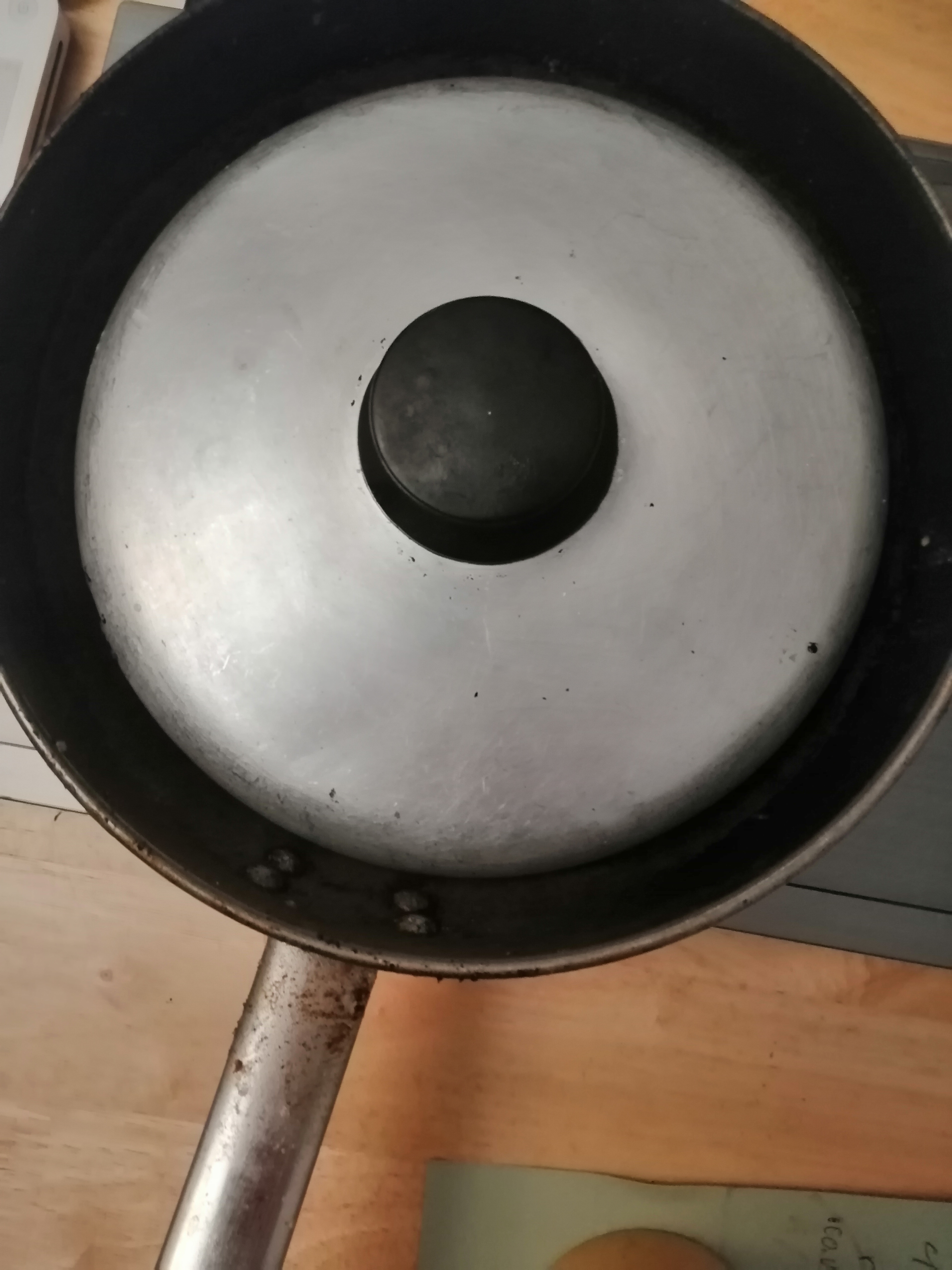
The following directions are for making small amounts of bread at a time, not in ovens but on top of hot plates or gas rings. The heat-resistant receptacle will be a frying pan or wok. In order to contain the heat sufficiently for long enough, we will also need something like a curved lid (the dough will rise or expand).
Frying pan for baking bread with a curved lid from a pan to contain heat and allow bread expansion. (Photo: D.Breatnach)
I am going to describe two variations in preparing the dough, one needing a board to work it on and another straight from the mixing bowl to the heat.
Both variations:
In the mixing-bowl
pour the flour (for quantities and recommendations see further below)
a level teaspoonful of bicarbonate of soda
a few pinches of salt
soured milk (either gone sour already or soured with a squirt of lemon juice, a few drops of vinegar etc.)
Mix with fork, not only round and round but folding over and over
Put frying pan or wok on to heat high with little oil or butter (to prevent the dough sticking)
Drop the dough into the pan or wok, turning it often
Turn the heat down low within a minute of turning the dough
Cover with a curved lid in which you have sprinkled some water (for steam for the bread)
It is useful to turn the dough a few times while baking to prevent a very hard crust forming
After about five minutes, take the bread out and tap it sharply with your fingers
When the bread gives a hollow sound on both sides when tapped, it is ready
Leave out to cool
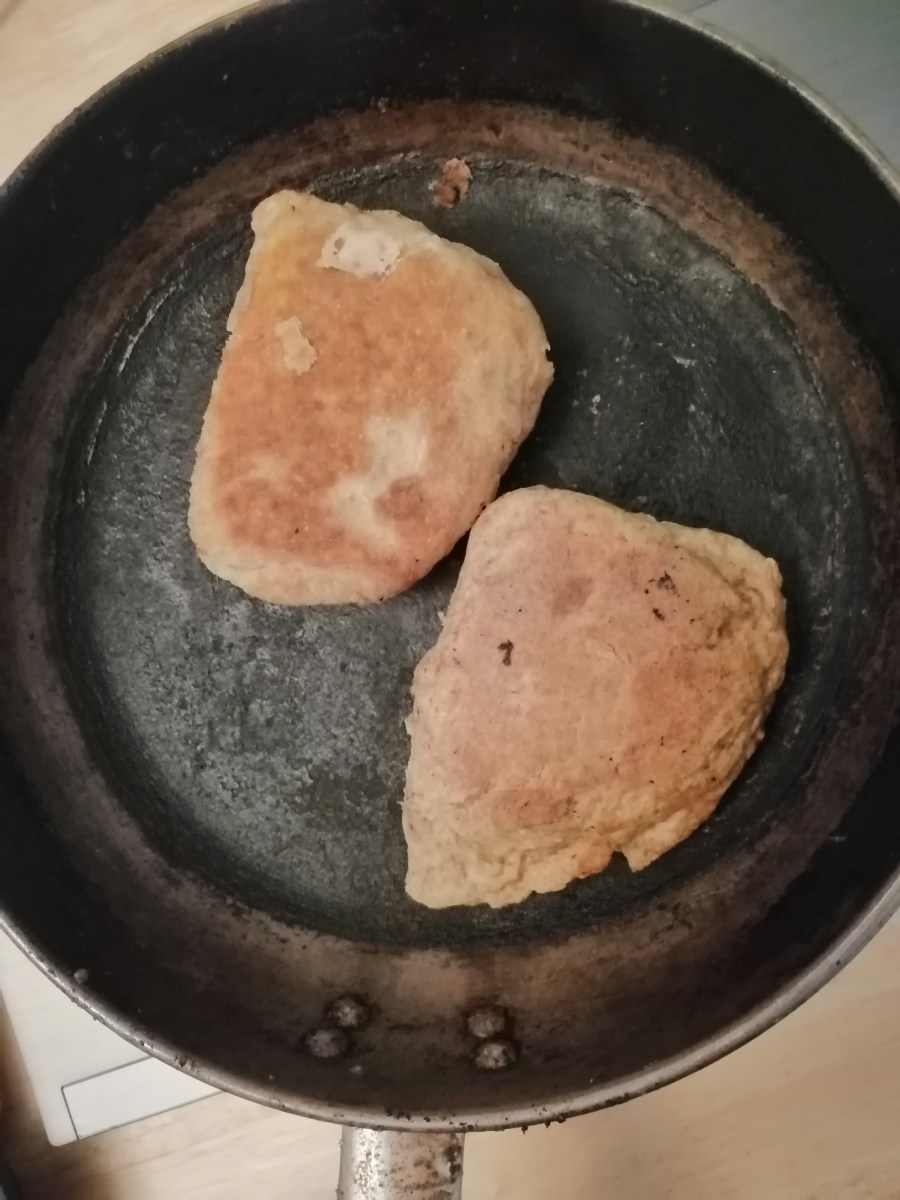
Bread “rolls” baked in frying pan (Photo: D.Breatnach)
1. Type without working the dough:
Mix it quite wet, adding a little water from time to time if necessary
Divide the mix into two or three lumps
Drop into the heated receptacle
You may want to smooth it with a damp spatula, back of a spoon, etc
Turn not only front to back but on all sides too
Lower heat, cover etc.
This will tend to produce round or oval shapes of bread
2. Type working the dough:
Mix it as dry as you can (but still mixed thoroughly into one mass)
Lay out your board, lightly sprinkled with flour
Tip the dough onto the board
Dip your hands in nearby flour, getting it all over palms and fingers
Sprinkle a little flour on top of the dough mass
Press down on the mass, flattening it
Turn it and press down again
Keep dusting your hands with flour as often as necessary (and the board, if the dough sticks)
When the mixture is totally flat, fold it half over and press down again
Continue doing this a number of times (you may notice a tendency for the shape to become triangular or even square through the folding)
Place on the heated receptacle (or, before doing so, press down the edges particularly all around the mass and cut in half)
Turn a few times while lowering the heat
Cover and test in about five minutes, etc.
FLOUR TYPES AND APPROXIMATE QUANTITIES
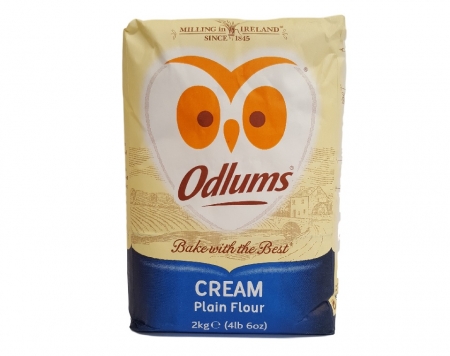
Wholemeal flour and oatmeal (as for porridge) are healthier than white flour (which should be plain, not self-raising) but white gives a lighter bread and is cheaper than wholemeal, because it is easier to keep. I mix one half mug of wholemeal to one mug-and-one-half of white plain, with a quarter of oatmeal.
Source image: Internet
Add a little milk at a time as necessary until you get used to knowing how much is needed. When using dried milk, we can mix it in the flour dry and add water as we mix or mix it in advance to make liquid milk; in this case every single ingredient can be a dry food with a preserve (if using vinegar).
Source image: Internet
ADDITIONAL NOTES
In Ireland, I prefer to use established brands like Odlums or Flavahan’s, rather than supermarket brands, even though the latter are usually cheaper.
The bread tastes better if made daily but to keep fresh, place inside a paper bag inside another of polythene and slice as needed. Making smaller amounts at a time, it is easier to judge the heat and time, otherwise one may find that the bread sounds hollow when tapped, as though cooked through, but at the centre there is still a mushy part.
The most taxing part of the process is the mixing the dough which is wearing on the wrists and men, known to generally have stronger wrists (no bawdy comments please) can at least carry out this part of the process and, having done so, sure might as well see the whole thing through.
Language is a treasure chest, full of jewels: history, philosophy, humour, politics, sex, literature, natural history ….. It is a chest full of wonders but it has some horrors in it too. I want now just to run my fingers through a few of those jewels, letsome of those wonders trickle through my fingers and before your eyes.
Image source: Internet
Language is composed of symbols – spoken words, then squiggles to represent those words on stone, wood, paper and electronic screens. In visual interaction, those symbols are accompanied by other symbols such as facial expression, hand gestures, bodily posture, tone, pitch, volume, emphasis …. yes, and chemical emissions. Different languages — sophisticated whole systems of symbols – have been developed for communication of information and recording but not only for those: for expression of emotion too. And each carries the history, philosophy etc of the particular culture that gave rise to that language and often many other cultures too. In turn, language comes to leave its imprint on the speakers of the language, to mold their very minds to some extent, shaping their culture. So when a language dies, much more dies than just a system of recording and communication.
We can see residues of Irish and the Gaelic culture in the way Irish people speak English, even those who have not been Irish-speaking in generations. We go to see a filum, sweep with a floor brush instead of “a broom”, reply to a question with a positive or negative of the same verb (will you go? I will/ I will not). Or we might have a thirst on us and go to a pub if the humour was on us. That pronunciation of an imaginary vowel between the ‘L’ and the ‘M’ is a residue of the Irish language and having physical and emotional feelings being on us, instead of having them, as in standard English, are the ghosts of expression in Irish. When other cultures are happy to thank us a thousand we say thanks a million, not because we are a thousand times more thankful than every other culture but probably because a million sounds like the Irish word for thousand, míle, from Go raibh míle maith agat.
* * *
Recently I was reading a novel, mostly based in Exeter, a city in Devon, SW England and I learned that the city’s name is derived primarily from the river Exe, with the ‘ter‘ being part of the noun ‘ceaster’ which meant first a Roman military camp (caster) and later, a town. Many place-names in England contain that ‘ceaster’, ‘caster’ or its variant ‘chester, for example “Lancaster” and “Manchester”.
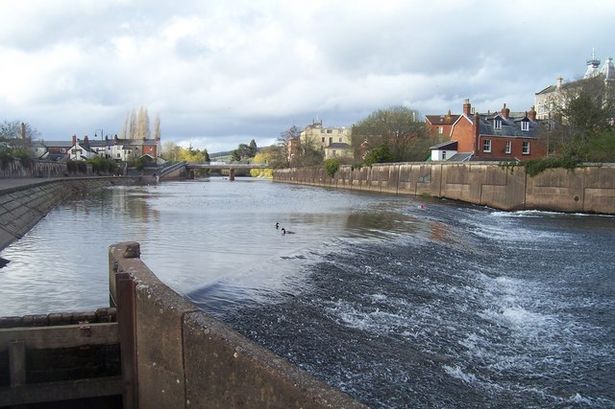
View of the River Exe, Devon (Image source: Internet)
Of course, with regard to the ‘Exe’, I could not help but think of ‘uisce’, the Irish word for “water”. And I’ve known for some time that Devon and Somerset have a great many megalithic monuments (more than Ireland even I read somewhere) and that nearby Cornwall has a surviving Celtic tongue (though spoken by few today). Anyway, I did a little digging with the help of the Oracle of Delphi, which today goes by the name of Google (which by the way in a short space of time has become an internationally-recognised noun and verb!).
The Wikipedia entry for Exeter tells us that the river Exe in the name of the city is from Old Brittonic, a Celtic language and means “ ‘water’ or more exactly ‘full of fish’”. Well that sounds pretty much like the meaning of the word “uisce” in Irish, which is also a Celtic language. But the Wikipedia entry for the river itself, as distinct from the town, says that the word “comes from the Common Brittonic word ‘iska’” meaning ‘water’ etc. But then the entry goes on to make the extraordinary claim that the word is unrelated to the word “whisky” while at the same time stating the latter word comes from classical Irish/Gaelic “uisce beatha” (‘water of life’). But since the Brittonic word for the river means ‘water’ and the Irish ‘uisce beatha’ (which became ‘whisky’) means ‘water of life’, then the words iska/ exe and uisce are obviously not only closely related but almost exactly the same!
Perhaps the entry meant something else and merely expressed it badly.
However, I am grateful to Wikipedia for drawing my attention to the connection between the Celtic words for ‘water’, ‘river’ and ‘fish’. Because the word for ‘fish’ in Irish is of course ‘iasc‘ which is not a million miles away in sound from ‘exe’ or even ‘uisce’. And if we were to stick the letter ‘P’ before the word ‘iasc‘, which the Gaels would never do, given that they avoided that letter and sound whenever they could, we would get the word ‘piasc‘, quite like the plural word for fish in Welsh, ‘pysg‘. And of course sisters of this word can be seen through some of the Romance languages, which in many ways are close to the Celtic: pez in Castillian, peixos in Catalan, peixe in Portuguese, pesce in Italian. And of course, for the astrologers, Pisces (Pis-kays) from the Latin, the star sign of the fish.
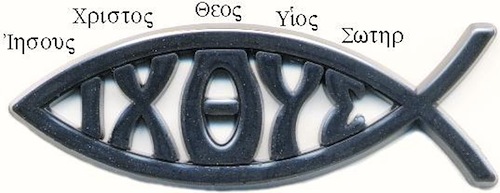
Now, the Greek word for ‘fish’ is psari, not all that similar (although it begins with the letter P too) but here’s a weird coincidence: the Greek name for the fish symbol used by early Christians, which is supposedly based on the first letters of the Greek words for Jesus, anointed, son, God and saviour ….. is the ‘ichtus‘. And the sound of ichtus is not a million miles away from the sound of iasc!
The early Christian symbol, based on Greek words (Image source: Internet)
Anyway, back to Exeter, probably a Celtic settlement in a Celtic land by a river with a Celtic name, in a Celtic language, later a Roman town (perhaps preceded by a Roman military camp) with the word for ‘town’ coming from Latin, then overlaid by Saxon language.
“Old Brittonic” is the name given by philologists to the Celtic language once spoken all over Britain and of which the remaining survivors are Welsh and Cornish and, on the European mainland, Breton in Brittany and some words in Gallego in Galicia. Philologists call that branch of the Celtic languages ‘P-Celtic‘ because of its many old words beginning with the letter “P” which in Irish and other Goidelic or Q-Celtic languages (Manx and Scots Gaedhlig) begin with the letter “C”.
Exeter is an old place name in Devon and old place-names – as distinct from new ones like “Sea-View” used by property merchants to sell housing estates – tell us a lot about the history and culture of the people who named them and, often, something about their past in nature (for example all the places named after trees in this now-deforested Ireland).
Twenty-six, more than half the names of the 50 states that form the USA, are formed from Native American words or phrases. The original Americans, dispossessed, so many of them wiped out and a very small minority remaining in their ancestral lands, must find it hard to insist on the usage of their own place-names. Yet many of those have survived – European colonisers learned the names from the natives and for convenience continued to use them in their European languages so that they have now become US English words.
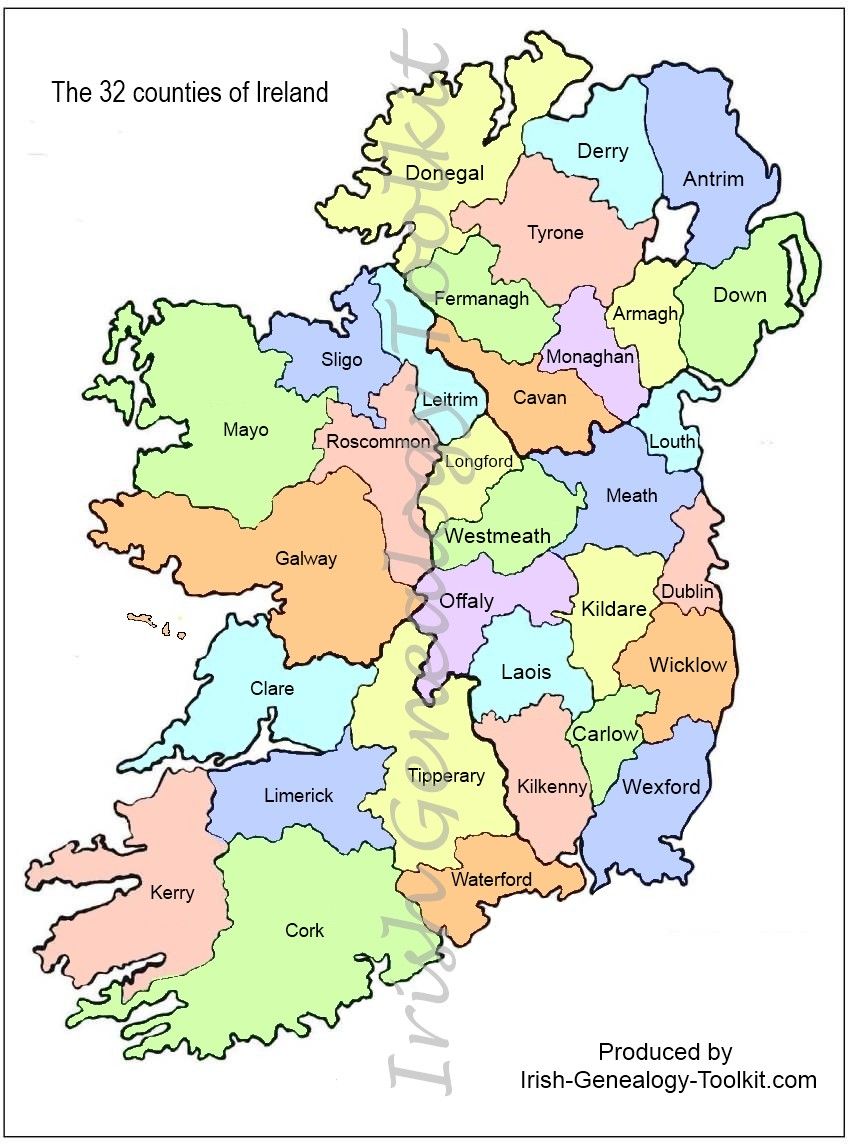
Of the Anglicised names of the 32 Counties of Ireland, only three are not of Irish origin – and the “English” names of those three were given to them by the Vikings. We are surrounded by the signs of our native language and culture but, for most of us, also cut off from them. This is hard to justify since unlike the Native Americans, for the most part, we have absorbed the invaders and we remain the majority on our land.
The 32 Counties of ireland — only three of the ‘English’ versions are not of irish language origin. (Image source: Internet)
And yes, “Britain” and “Britons” were words associated with Celtic culture, derived from Praetani or Pretani, meaning “the people of Britain” and perhaps once a dominant Celtic tribe. Yes, and “Scotland”, it turns out, referred to a land in the north of Britain colonised by the Irish, to which they brought their language which has now developed into Scots Gaedhlig. And in the Middle Ages, a “Scotus” (Scot) was more likely to be an Irishman than what we today call a “Scotsman”.
And the “Scots” language of the poetry of Robbie Burns, including its practically extinct variant “Ulster Scots”, is actually based on German from Saxony and, except for some words, not Celtic at all!
Yes, it can all be a bit confusing. But interesting too.
Most modern criminal detectives have sex – I know this from reading, thankfully not from personal experience.
The older set, Holmes, Inspector Maigret, Nero Wolfe, Miss Marple – they didn’t. Holmes was into a barely-concealed opium habit and Wolfe had an obsession with orchids; Poirot was obsessive-compulsive and probably fetish-obsessed with his patent-leather shoes. Miss Marple, who first appeared in a novel published in 1930, reflected her times even when the times passed her (Nemesis was published as late as 1971) and as to a suggestion of sex: “Good God! What kind of a degenerate are you? A woman detective having sex? And a pensioner?”
In modern times we might reflect that “of course there was her live-in maid … and that succession of young women she trained as maids ….”
Not only did they not have sex on paper, they were all single except for Maigret, so there was an absence of potential sexual activity to distract one. Maigret of course was French so like many middle-class men of his time would have had not only a wife but a mistress too but …. we don’t talk about that.
Yet sex is one of the most basic driving instincts – it governs procreation of species and, working in tandem with natural selection, rules on evolution of all species. How come it was left out?
The characters reflect their times and their class, of course, as well as what was expected of their class, sometimes with a little added taste of the unexpected – but not in sex. Yes, we know that DH Lawrence’s sexually-explicity (and trans-class) Lady Chatterly’s Lover was published two years before Agatha Christie Miss Marple’s first appearance in a novel, in Murder at the Vicarage (1930) – but Lawrence was published in Italy. Sniff! — those Continentals! A year later Chatterly was published again in France and – interestingly – in Australia. But all that publishing was done privately. In 1960, when an unexpurgated edition was finally published in the “United Kingdom”1, Penguin, the publishers, were subjected to a famous obscenity trial but, when they won, sold three million copies. It was still banned in the Irish State, of course but we weren’t alone – the USA, Canada, Australia, India and Japan all banned it too.
Romantic and gothic novels of the time didn’t have sex either, except in the mention of a child born out of wedlock, though the suggestion of or even history of rape was there at times. Sexual feelings of the heroine (and sometimes of the hero) were conveyed through descriptions of a blushing cheek, longing looks, palpitating heart and breast (but no mention of nipples!), feeling faint in the head …. all above-board and more importantly, all above the waist (though still allowing the reader’s imagination to eroticise, of course).
The most important point to grasp here I think is that something being published does not necessarily reflect the dominant social mores – it is its acceptance by society and its popularity that tells us most. There has always been material around that transgressed socially-dominant sexual standards but those standards were still dominant – and the material may even have worked as a pressure-release valve, as for example with the huge numbers of sex-workers, female and male, that walked the streets or entertained in special houses in sexually-repressed Victorian Britain, particularly in London.
The 1960s brought about a huge jump in tolerance of explicit sexuality, partly fueled by a decade of expanding consumerism and a push for more of the same and partly by the rise of the youth and student movement and its challenge to hierarchical values and control.
THE NEW DETECTIVES
But for decades already, the new criminal detectives had arrived – or at least their advance skirmishers. One of the most influential, beating the later pack of the 1960s by a good three decades, Dashiel Hammett was hugely influential with the creation of what became known as the “hard-boiled” genre of detective stories and also in the “talking detective” style, in which the central character is also the narrator.
Hammett, a left-wing activist who got blacklisted as well as a popular crime fiction writer, had been employed by the Pinkerton Detective Agency2 and wrote many published stories but only five novels, all between 1929 and 1934 (even though he lived to 1961): Red Harvest, The Dain Curse, The Maltese Falcon, The Glass Key and the The Thin Man3.
Paperback cover for a Dashiel Hammmett novel, Red Harvest (pub. 1952), this one showing the dangerous gun-toting males (detectives? gangsters?) but also typically the heterosexual male erotic object of the female, dressed in bodily-revealing attire. (Source: Internet)
Raymond Chandler, who acknowledged his debt to Hammett, had The Big Sleep published in 1939, based on a couple of short stories (he’d been writing those for decades). He banged them out pretty regularly after that: Farewell My Lovely (1940), The High Window (1941), The Lady in the Lake (1942); then a break until The Little Sister (1949), another gap until The Long Goodbye (1953) and Playback in 1958, a year before he died.4 at the age of 71.
Cover for Raymond Chandller’s paperback novel, The Big Sleep (pub. 1939), this one showing only part of the presumed detective, the ‘femme fatale’ prominently portrayed, holding a gun but dressed in bodily-revealing attire and ‘already’ in bed. (Source: Internet)
The gap in the 1940s is easily explained by the film scripts for Double Indemnity along with And Now Tomorrow (both 1944), The Unseen (1945), The Blue Dahlia (1946). Strangers On A Train was produced in 1951.
James M. Cain (1892-1977) published The Postman Always Rings Twice in 1934 and, as well as short stories, another fourteen novels during his lifetime. Among those was Double Indemnity which, like Postman etc, was made into a film.
Mickey Spillane published his first novel, I, the Jury in 1947 and went on to publish another twelve before he died in 20065.
Cover for a Mickey Spillane novel, Kiss Me Deadly (pub. 1952), this one showing the iconic ‘femme fatale’, holding a gun but dressed in bodily-revealing attire. (Source: Internet)
The new private detectives novels between the 1920s and the 1960s introduced detectives who had or were tempted by hetero sex but, however graphically the allure might be described, the sex was never described in detail. These novels also featured the femme fatale, the attractive and sexy woman who was also dangerous – capable of murder and treacherous. The detective was more likely to have the sex-interest woman jailed or even killed, or walk out on her, than claim her as the prize. And yes, the detectives in this genre were all male.
These novels featured violence – not just the violence to the homicide victim but regular knockouts with a pistol butt across the head, graphic physical fights with fists and feet (and even teeth!), shootouts … the detective characters not only suffered violence but engaged in it too (particularly Mickey Spillane’s Mike Hammer).
During the 1940s and ’50s the novels were paperbacks, low-priced, produced on cheap paper to a size that could fit into a man’s jacket or coat pocket (and some handbags or, in the USA, “purses”). This form of private detective and some other kind of publishing came to be called “pulp fiction”, from cheap magazines of short stories, i.e destined to be turned back into paper pulp soon after reading).6
The covers (or “jackets”) of “pulp fiction” novels were often lurid, portraying violence and heterosexual sex. Women dressed in revealing deshabille, often with seductive expression and posture, tended to share the cover with a “hunky” type of man, with a gun visible in the hand of either. Sometimes a dead body, male or female, lay on the ground too.
This kind of writing was baptised “Noir”, i.e “black”, mainly reflecting the dark sides of the detective’s character and especially of his clients and of surrounding society, cynical, corrupt, characters often morally-flawed, doomed, dogged by ill-luck and bad choices.7 Production in film of that writing came to be called “film noir”, the content reflected in low-light shots in black & white filming, which later transferred (with some difficulty) even to colour film. But still, the sex was never graphic in the writing and was more pruriently hinted at than witnessed by the reader.
Film ‘Noir’: Still photo from opening sequence of the film production (1941) of Chandler’s novel The Maltese Falcon. Typically, the ‘hard-boiled’ private detective is in his pokey office and the heterosexual male’s ‘sex interest’ has already arrived to ask for his help. (Image sourced: Internet)
The writing could be elegant in descriptions and it could also be tight; dialogue was very important, with the detective and his adversaries dueling in verbal repartee, which the detective usually won in the verbal category but for which he often paid physically.
Of course, some cities in the United States had seen a lot of violence in reality, in particular during the ill-fated years of alcohol Prohibition (1920-1933) and the attendant rise of crime syndicates seeded in the working class immigrant communities of Irish, Jews, Italians, Sicilians …. Reading about such events as arrests, trials and mobster shoot-outs in newspaper reports provided also an audience for the material in the form of short stories, novels and later films. That audience grew during the succeeding decades and is still a wide one today, with a diversification of sub-genres and detectives in countries other than the USA or Britain, usually also in translation from their native languages.
But … back to sex and the detective. As the years rolled on past the 1960s towards the end of that millennium, the sexual activity of the private detectives became not only implicit but often explicit (with the possible exception of the Nordic detective novels). And we now had some female protagonists too: police detectives, uniformed police officers, private detectives and forensic pathologists. And if none of the main characters were ever gay, lesbian, transgender or transvestite, such characters did appear, usually treated more gently than in the past and at times actual second-line “good guy” actors in the stories.
It appeared that all previous sexual taboos in the detective story – all legal ones at any rate – had been broken.
Well, not all. Not masturbation.
Not even modern private detectives masturbate. Which is truly remarkable, when one considers, according to all research, how common that activity is in the non-detective population.
End.
REFERENCES & SOURCES:
For dates of authors’ birth and deaths, also of bibliography, Wikipedia entries on the authors.
1I somehow doubt it would have got far in the Six Counties (“Northern Ireland”)
2 See Rebel frontier [electronic resource (video)] : organized labor vs. the Anaconda Copper Company / Network Ireland Television. New York, N.Y. : Films Media Group, [2006], c2004.1 streaming video file (66 min.) : Martin Sheen – impersonating the voice of author DashiellHammett – narrates this compelling docudrama on immigrant labor and anti-war politics in 1917. As a young employee of the Pinkerton Detective Agency, Hammett spied for the Anaconda Copper Mining Company in Butte, Montana, during the height of labour struggles there. AU STREAMING MEDIA http://digital.films.com/PortalViewVideo.aspx?xtid=35494.
3 The Maltese Falcon, The Glass Key and the The Thin Man were made into films.
4All based on earlier short stories, except the last, which was based on an unpublished screenplay.
5A number of others, based on previously-unpublished material or short stories, were published posthumously.
6Even after the pulp fiction heyday ended in the 1950s, paperback novels are still being produced in roughly the same size, albeit with somewhat better quality paper pages and covers.
7“Noir” also came to be a literary descriptive term and is often used to describe a certain kind of writing today.
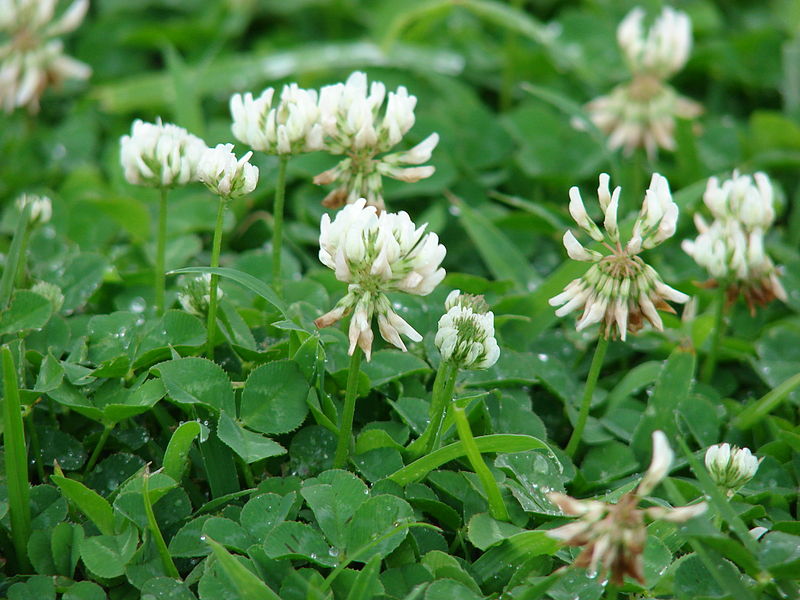
The Shamrock, contrary to expectations, cannot be said to be a specific plant. It is of course a kind of clover but which one? People writing about it frequently state that it is generally accepted that the most likely candidates are the species Trifolium dubium (variously called Lesser Trefoil, Suckling Clover, Little Hop Clover and Lesser Hop Trefoil; Irish: Seamair bhuí), with yellow flowers or the white-flowered Trifolium repens (White Clover; Irish: Seamair bhán). But which one? Well, excuse the pun but take your pick.
Trifolium dubium, the lesser clover, an seamair bhuí, top of the candidate list for the “shamrock” title. (Photo: Internet)
Generally accepted by whom? One supposes by botanists and Irish folklorists but those sites rarely supply a reference. However, amateur botanist and zoologist Nathaniel Colgan (1851-1919) askedpeople from around Ireland send him specimens of what they believed to be an Irish shamrock and identified the five most common plant species, of which the two most common were the yellow clover followed by the white.A hundred years later, Dr Charles Nelson repeated the experiment in 1988 and found that yellow clover was still the most commonly chosen. According to Wikipeida, yellow clover is also the species cultivated for sale in Ireland on Saint Patrick’s Day and is the one nominated by the Department of Agriculture as the “official” shamrock of Ireland.
The word “shamrock” is an Anglic corruption of the Irish seamróg, itself a contraction of seamair óg, meaning a sprig of young clover. The Irish shamrock is usually the species Trifolium dubium (lesser clover; Irish: seamair bhuí), with yellow flowers or the white-flowered Trifolium repens (white clover; Irish: seamair bhán).
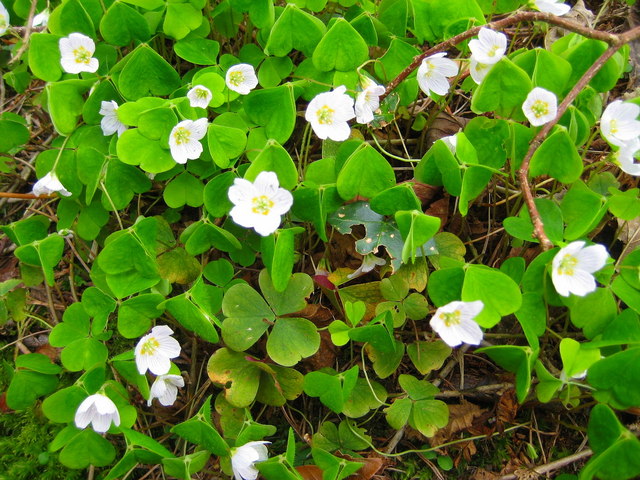
A trawl through the internet looking for images of shamrock plants throws up a bewildering multiplicity of images of trefoil plants, the only thing they have in common being that they are (mostly) green. It soon becomes apparent that many of the images are taken from a different genus, that of oxalis, usually the one named wood-sorrel (Oxalis acetosella) in English-speaking Europe1.
People today should know better. Edmund Spenser, an anti-Irish colonist and commentator on Irish culture, also poet and ancestor of the late Princess Diana, reported the Irish eating shamrock and so have some other colonial observers but almost certainly what they observed was the Irish eating the wood-sorrel – in Ireland it has some common names associated with eating. Spenser and other colonists can be blamed for many things but not that confusion – they were not botanists and did not have access to the Internet. Also, seamsóg, the Irish name for wood-sorrel, does sound a bit like seamróg, especially if one is not listening carefully. The confusion can be continued in English, where the common sorrel (Rumex acetosa) is a completely different plant and a common enough culinary one.
Many species of the genus oxalis close their leave sand flowers at night – a handy trick which the trifolii do not have; indeed, try as they may, trifolii could not possibly close their flowers since each one is in the form of a cluster, while those of oxalis tend to be trumpet-shaped.
Wood Sorrel — defintely not the shamrock, despite numerous claims since Edmund Spenser, the Elizabethan poet. (Photo: Internet)
The wood-sorrel grows typically in woods which are shady but not too dark and is characterised, as with many other oxalis, by an acidic taste in the stems. As children in the area in which I grew up in south Co. Dublin we chewed the stems of a cultivated species with large green leaves and pink flowers,commonly grown in window-boxes and gardens and known to us by the name of “Sour Sallies”.
The shamrock (both varieties of trifulium) grows best in meadows receiving a fair amount of sunlight, in among grasses. It belongs to the clovers, a different family completely from oxalis, belongingin turn to a very large group of plants as different in appearance from one another as peas and beans on the one hand and furze (also known as gorse) on the other (but many bearing fruit pods). They are the legume group, plants that concentrate nitrogen in nodules around their roots, making many of them good crops with which to precede plants that require a lot of nitrogen, such as the cabbage family or cereals.
The expression “in the clover” as an idiom for being successful or having a good time alludes to the alleged fondness of grazing animals for the plants but this is much more likely to be the white clover, Trifolium repens (Irish: seamair bhán) than dubium, as the former grows bigger and thicker. Clovers are important plants not only for grazing animals and nitrogen-fixing but also for bee-keepers, being rich in nectar and pollen.
Jean-Ann Day, who has just died, visited Dublin in January 2012 to help push an international campaign to free Leonard Peltier, also a warrior of the First People and longest-serving prisoner in the US after a travesty of a trial in 1977.
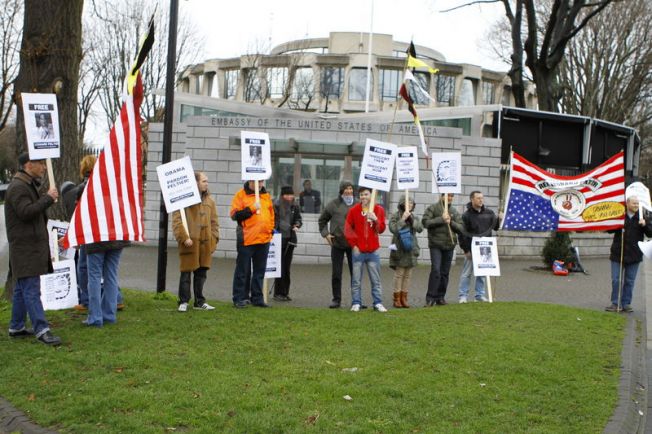
Jean-Ann speaking at picket on the US Embassy in Dublin in solidarity with Leonard Peltier. The photographer’s back is to the Embassy.Jean-Ann Day — photo placed with her official obituary on funeral home site
Due to a family tragedy hitting her contact here I had to step in as Jean-Ann’s contact but it was an honour for me. I progressed arrangements and took her to see Joan Collins TD and arranged for a radio interview with a program on Near FM.
I remember that on our way across the Liffey, Jean-Ann took a pinch of tobacco and offered it to the river with a prayer. The Gaels also thought of their rivers as divine, most of them goddesses. Although an atheist, to my thinking such belief systems seem greatly superior to those that think it fine to convert a river into a sewer or a toxic waste outlet.
On Saturday 4th February 2012 a small crowd of varied political backgrounds, including a significant proportion of independents, staged a protest outside the US Embassy in Ballsbridge as part of a world-wide week of protests seeking Peltier’s release. Jean-Ann delivered a simple speech there that I believe reached into the heart of every one of the participants as it did into mine.
Poster produced for the Dublin solidarity picket of the US Embassy (regret the name of the artist does not come to mind at the moment)
A small musical evening in Dublin organised by supporters was another occasion at which she appeared and I understood she went to Belfast and Derry too.
Jean-Ann, warrior for justice has walked on and left us her memory. Her former comrade, another warrior, Leonard Peltier, remains in jail in serious ill-health.
Peltier is incarcerated at the United States Penitentiary of Coleman in Florida and given that he is 72 years of age and that his next scheduled parole hearing will be in July 2024, it is clear that the FBI and USA state want him leaving jail only in a coffin. Barring appeals, parole or presidential pardon, his projected release date is October 11, 2040.
Jean-Ann Day, Bear Clan of the Ho-Chunk Nation, age 65 of Stevens Point, Wisconsin walked on Sunday, September 4, 2016 at the University…
APPENDIX
Leonard Peltier Regarding the Passing of Jean-Ann Day
When I heard the news of Jean’s passing I was both saddened and surprised. I did not know she was ill. If I had known I would have reached out to her and tried to support her in any way I could.
Jean was a true friend to me for all the years I knew her. Her passing reminds me of so many things back in those days at Oglala so long ago.
She was a such a bright light and a young woman full of courage who came to Oglala without hesitation to join us in protecting the elders there. And she did so much work to free me from prison all these years. I am grateful to her for that.
Poster in the style of Jim Fitzpatrick’s famous Che Guevara poster (Regret artist unknown to me)
Over the years here I have thought of her often and in my dreams of freedom there were always a few faces I expected to see if I ever walked out of here. Jean’s was one of them.
I know she was doing wonderful work in the effort to bring healing and positive change to her Ho-Chunk people and I was always proud of her for that.
I regret that I could not be there for her ceremonies so I could offer comfort to her children and grandchildren, but I can only send these few heart-felt words.
You were a great woman and your life made a real difference to me… and to so many others.
Rest in peace, my dear friend. ‘Til I see you again.
Doksha,
Leonard Peltier
Part of the gathering at the Dublin US Embassy in solidarity with Peltier and seeking his urgent release in 2012
The new €2 coin design is now published and the coins will themselves be put into circulation in the New Year. Designs were submitted and the winning design for the ordinary currency coin is by Emmet Mullin, while the design for the gold and silver special editions is by Michael Guilfoyle. Both designs incorporate the statue of “Hibernia” and that name is prominently displayed on one of side of the coin and although Guilfoyle’s design incorporates some words from the 1916 Proclamation, they are in the background to the representation of “Hibernia”. The image is taken from a the centre one of a trio of statues erected on the GPO in 1814, while still under British occupation.
One side of the new Irish coin
“Hibernia” was regularly used as an image to represent Ireland by “Punch”, a satirical racist British publication and she was always
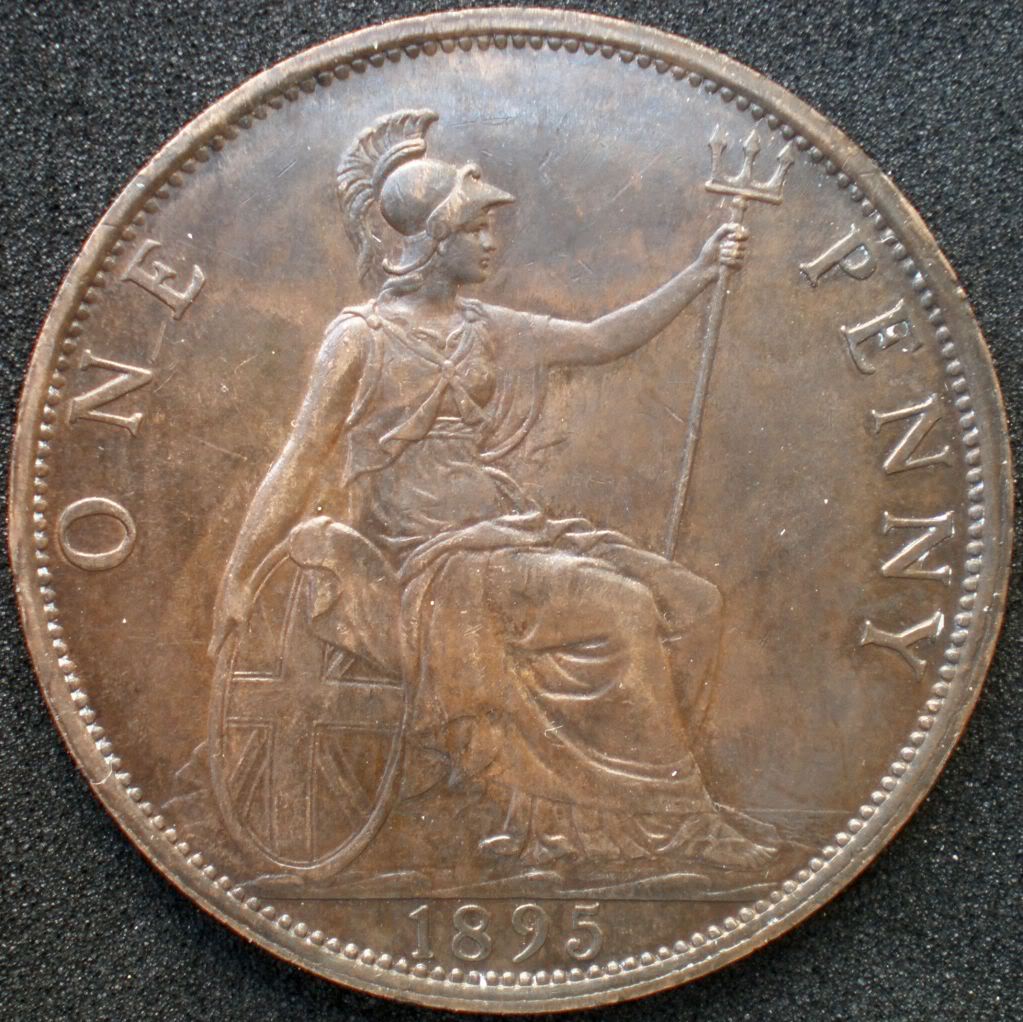
(British penny showing the image of “Britannia” — a martial female wearing a crested war helmet, carrying a shield and holding a trident (perhaps to indicate domination of the seas).
shown as a pretty younger sister of “Britannia”, in need of her older sister’s protection (usually from the rebellious Irish, the despair of poor “Hibernia”). She was never in martial garb, unlike Britannia herself who was usually represented as a majestic and martial figure, with a crested war-helmet and shield and sometimes carrying a trident (perhaps to indicate domination of the seas).
That representation of Britannia appeared not only in the cartoons of “Punch” and other publications but also in sculpture — for example at the top of Somerset House, in the Strand, London – and also on many mints of British penny coins.
Of course, in British history the most likely model for the representation of a female fighter was Boudicca (“Boudicea”) who, after her humiliation and the rape of her daughters by Roman Legionnaires, raised her formerly pacified tribe of the Icenii against the Roman occupation and came close to driving them out of Britain. The irony is that the whole of Britain at that time was Celtic, as were Boudicca and the Icenii. But the English ruling class appropriated Boudicca into their English iconography as they did also with King Arthur and the Round Table knights.
Romanised and civilised
Ireland had many names among the Gael but “Hibernia” was not one of them. “Hibernia” was a late Latin name for Ireland, which the Romans had previously called “Scotia” (yes, “Scotland” originally meant something like “the land the Gael have invaded and settled and defend”).
The Roman linguistic connection is interesting – Irish Anglophiles and some English lovers of Ireland have been wont to bemoan the fact that Ireland was never conquered by the Romans. These commentators have tended to see Romanisation as civilising, forgetting perhaps the words of Rome’s own greatest historian, Publius Tacitus (or Gaius Cornelius Tacitus; c. 56–after 117 AD) who said that “they have created a desert and call it peace.” Calling Ireland “Hibernia” might be a way to bring that Roman conquest belatedly to the unquiet isle, to make her more “civilized” — in fact more like her neighbour and therefore more accepting of her neighbour’s domination and of her ways.
When John Smyth designed the statues to go on top of the General Post Office building in Dublin’s main street, then Sackville (but now O’Connell) Street, Dublin was widely considered the second city of the British Empire, next to London. The building opened to the public in 1818 but Dublin’s slow decline in status had already begun. Since the abolition of the Irish Parliament by the Act of Union in 1801, following the suppression of the United Irish uprising three years earlier, the Irish Members of Parliament had to go to London to take their seats, taking a great deal of political, commercial and social life with them. Irish landlords deserted their Irish estates in greater numbers, leaving them in the hands of their often rack-renting agents as the owners demanded more and more rents to keep them in their homes in Britain and their lifestyle there and in Europe. Throughout the 19th Century the social focus slowly followed the political to England – except where a militant nationalist one arose.
Statue representing “Hibernia” on top of the GPO, a martial female wearing a crested helmet, holding a spear and a harp.Sculpture representing Britannia on top of Somerset House, The Strand, London city centre. She is a martial female wearing a crested war helmet, carrying a shield and holding a trident.
Submission or subversion?
Perhaps the representation of Hibernia by John Smyth, reflecting that of Britannia, was meant to show Ireland as equal in grandeur to her dominant neighbour. The Society of the United Irish had been part of a wider cultural movement that sought to explore and appropriate an older Gaelic culture for the colonists, many of them settled for generations on Irish land. Assertions of autonomy and complaints about English political and commercial restrictions had been part of that movement too and had found sharpest expression in the republican and separatist ideas of the United Irish. Some aspirations remained, severely modified. Perhaps it was John Smyth’s intention to show Hibernia as grand but there was no mistake about who was really in charge in Ireland, Hibernia or Britannia.
As if to underline the relationship, Smyth placed a statue representing “Fidelity” on Hibernia’s left on top of the GPO. What could that fidelity be, except to the Empire? Some suggest that because Fidelity holds the Key and is with the Dog, that she really represents Hecate. I know nothing about Smyth nor have I the time to research him at the moment but it is possible he was being somewhat subversive in that representation. Hecate had a number of earlier and later interpretations and the key seems to have appeared later – the key to the household perhaps but also to Hades, the Underworld.
On Hibernia’s right, John Smyth erected the statue of Hermes, known to us as the messenger of the gods but also representing commerce. Commerce, then as now, was the backer of military and political initiatives, indeed often the driver. Of course, many of the Irish bourgeoisie, both native and colonist in origin, wanted a successful commercial Ireland. But after 1798 and 1801, they were not going to get it. From then on, most progress for Irish finance would be made through investing in the Empire rather than in Irish industry and trade.
Whether the representation of Hibernia was intended as some kind of subject of Britannia with pretensions to something grander or was in fact just aping her better, dressing in her mistresses’ clothes when the lady was away, is a moot point. What is certain is that neither the image nor the name itself is of native origin.
The names for Ireland
As noted earlier, among the many names of the Gael for Ireland, “Hibernia” does not appear. The clan-based resistance had used Irish names to describe the land and this continued in the wars against Cromwell and William, with “Ireland” being the most common name when speaking in English by both sides of the wars.
The United Irishmen, a late 18th Century republican movement for independence led mostly by descendants of colonists and largely English-speaking, called the land “Ireland”1 or “Erin” (a phonetic representation of the Irish-language “Éirinn”, the dative case of “Éire”). These names, along with the genitive “Éireann” later, continued to be those most often used by nationalists of the 19th Century, the Young Irelanders, the Fenians, the Land League, as well as by the various advanced nationalist and revolutionary organisations in the early years of the 20th Century2.
“Ireland” is named in a banner of the Irish Transport & General Workers’ Union in October 1914, with the Irish Citizen Army parading outside.
This continued to be the case during the War of Independence and by both sides in the Civil War and was the case with the setting up of the 26-County state and with the various national resistance movements to that state of affairs since then. One finds “Hibernia” in the Ancient Order of Hibernians, of course and in the Hibernian Bank but they are exceptions – it is “Éire”, “Erin” or “Ireland” over all – and has been so for many centuries.
“Hibernia” is a foreign colonial import, both in terminology and in concept. She is poor image of her big sister on “the mainland”, the real boss. The use of her image and of her name is inappropriate to commemorate the 1916 Rising but their use may signify much more than an error – they may reveal a subliminal desire to return to the Empire, or at least the Commonwealth, in the psyche of those who were never all that sure they should have left it.
1“From my earliest youth I have regarded the connection between Ireland and Great Britain as the curse of the Irish nation …” Theobald Wolfe Tone
2Inghinidhe na hÉireann, Na Fianna Éireann, The Irish Citizen Army, The Irish Transport & General Worker’s Union, The Irish Volunteers, Óglaigh na hÉireann. Also, when the Abbey Theatre was founded by W.B. Yeats and Lady Gregory in 1904, they declared it was “to bring upon the stage the deeper emotions of Ireland”.













 rebelbreeze