The feminist call to war

Gearóid Ó Loingsigh 24 June

Reprinted in full from G.Ó.L’s substack and formatted for the Rebel Breeze blog.

Feminism used to be associated with pacifist anti-militarist movements, but times have changed and now there are feminists who call for war, whilst they still continue to blame all wars on men. It is an enormous contradiction.

For the last two years Gaza has lived under a siege and a genocide, supported by some sectors of feminism and in the midst of the conflict with Iran, once again feminist voices come out with a clamour for war. The reason is their supposed rush to free the women of Iran.

Four female political prisoners in Evin prison in Tehran (before it was bombed by Israel), conscious of the cynicism of some feminist groups in the West issued a communiqué denouncing the war and those who support it.

They stated that Israel wanted a submissive and weak Middle East and they opted to continue their own struggle against the government in Tehran without allying themselves with Yankee imperialism.

Our liberation…from the dictatorship ruling the country is possible through the struggle of the masses and by resorting to social forces – not by clinging to foreign powers or placing hopes in them.

The powers that have always brought destruction to the countries of the region through exploitation and colonisation, by inciting wars and killing in pursuit of greater benefits, will have no way out for us except for new destruction and exploitation.[1]

The four women are pro-Kurdish and also women detained in the protests following the death of Masha Amini at the hands of the Morality Police in 2022. One of them fought against ISIS in Syria. They are not coffee house feminists.

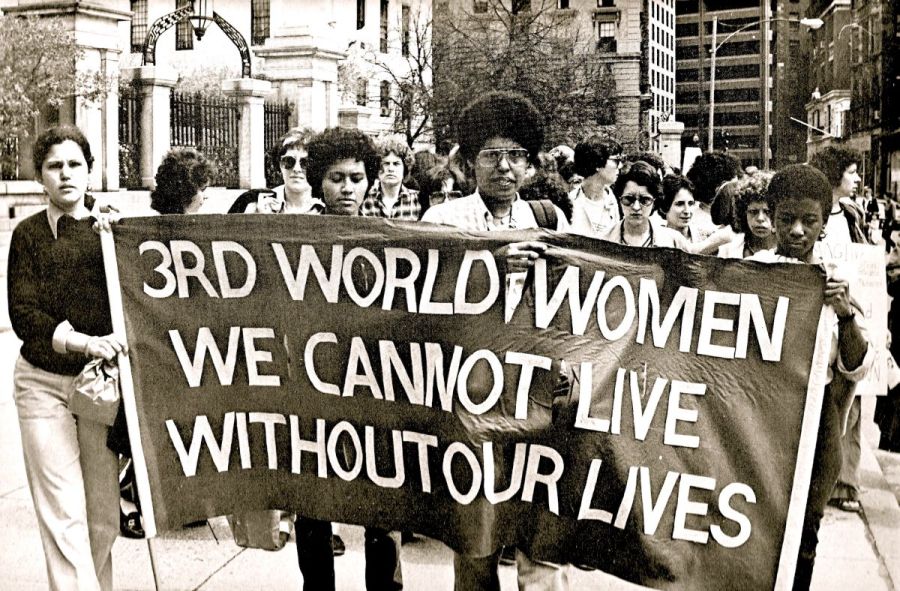
Women ‘of colour’ probably of the Combahee Collective with banner in what seems to be a general women’s liberation demonstration in the early 1970s. (Photo sourced: Internet)

They branded as traitors those Iranian who have called for war, amongst them the son of the despotic Mohammad Reza Pahlavi, the Shah imposed by the USA in 1953 following the CIA coup.

He ruled with an iron hand murdering and torturing the opposition, both the Left and Right, men and women. His son wants to go back to robbing the country’s coffers.

Traitors to Iran and traitors to the peoples of the Middle East and traitors to the people’s years of freedom-seeking struggles against oppression will know that their betrayal and disdain will be recorded in the memory of the Iranian people and in history.

Future generations will remember with shame those who stand on the corpses of defenceless people and trample them.[2]

Whilst these women who did actually rise up against the regime are opposed to the war, in the West there are those bourgeois feminists who in between their macchiatos ask for more attacks on Iran, in order to “free” the women.

They only think of Iran when a US president or the Nazis in Tel Aviv want to attack the country. They believe that the sexual predator who acts as US president is going to fight for the women. Maybe the way he did in Syria by installing ISIS.

One of the first to invoke the repression of women was none other than Netanyahu,[3] a man who has bombed maternity hospitals in Gaza killing women and children all around.

The US said something similar about Afghanistan and various bourgeois feminists came out to justify the war, deliberately ignoring that without US support the Taliban would never have existed.

It was Jimmy Carter and then Reagan who started to finance the troglodytes of the Mujahadeen and later the Taliban i.e. the bourgeois feminists too.

I should clarify that many of those feminists are not bourgeois in the sense of their social class, they have no capital, they are not rich, though there is no lack of those who are.

They are bourgeois in an ideological sense, although they use terms such as liberal, radical, separatist etc., but what unites them is their defence of capitalism and the bourgeoisie.

You could say right wing feminists but many of them like to present themselves as progressive when they are bourgeois, or in the case of the less wealthy ones, acolytes of the bourgeoisie.

Hillary Clinton, a bourgeois feminist (both in the ideological sense and also in terms of her bank balance) who has her hands stained with the blood of women in Libya and other parts is one of the spokeswomen for bourgeois feminism.

Much though they may shout, down with patriarchy! Their favourite slogan is Long Live Capitalism and Imperialism! This includes feminist intellectuals like Julie Bindel.

They kept silent about the genocide in Gaza and now believe that whoever criticises the war against Iran supports the regime. I suppose this includes the political prisoners who don’t sip macchiatos in their cells.

Bindel writing in The Sun said that those who criticise the war support Iran and the oppression of women. She repeated the usual lies about October 7th, mixed with some truths about Iran with the aim of supporting the war.[4] Bindel has kept silent about the massacres of women in Gaza.

She doesn’t support the women of Iran, but rather the West. It is worth pointing out that the owner of the paper, where she writes, has supported reactionary governments around the world, including in Great Britain where Bindel lives.

It is a misogynist, homophobic paper that frequently runs campaigns against the poor and migrants. Bindel is not alone, Kelly Jay Keen shares videos of the son of the Shah, perhaps to indicate that she supports the monarchy.[5]

The bourgeois feminists, like all of the bourgeoise in practice see other cultures as inferior ones. They use the same imperialist language to justify wars as did Rudyard Kipling, the author of the infamous poem The White Man’s Burden. They boast about the White Woman’s Burden.

It should be remembered that Kipling wrote that poem to seek and to justify the US invasion of the Philippines.

Take up the White Man’s burden
The savage wars of peace
Fill full the mouth of Famine
And bid the sickness cease;
And when your goal is nearest
The end for others sought,
Watch Sloth and heathen Folly
Bring all your hopes to nought.

Then they say that men are to blame for wars and not their dear capitalist system. Over and again the bourgeois feminists call for war.

But if they want wars and invasions, well why not ask for the US to be invaded, where women are pursued fleeing from one state to another to obtain an abortion, or where access to sex education is restricted and deficient as is access to contraceptives,[6] where women earn less than men and are under-represented in a wide range of fields.

Afghanistan is a country where women are more repressed than in any other part of the world. Throughout the conflict the US financed the Mujahadeen and later the Taliban.

They had the option of supporting organisations such as the Revolutionary Association of the Women of Afghanistan, a women’s organisation that opposed the Islamists and also the Russians and later the US invasion.[7] 

No, between one macchiato and another our dear bourgeois feminists let the men in the Carter, Reagan, Bush and Clinton support the Taliban troglodytes.

They said the same in Iraq. I am sure more than one reader is asking themselves what Iraq has to do with it all. It was a secular country, that promoted women’s education and participation.

However, one of the reasons bandied about by Bush was that he was rescuing and defending women and he compared their situation to that of Afghanistan, despite Saddam promoting women’s education.[8] 

In fact, under Saddam, 30% of faculty staff were women, trained in Europe and the USA with full funding from the government. It is no longer like that, in fact there is no intellectual world in Iraq, the bombs the bourgeois feminists asked for, put paid to that.[9] 

In the US the bourgeois feminists paid to go to universities, but Iraq promoted women as a state policy, something the Yanks have never done. In Britain, just 31% of the lecturers were women.

Iraq almost beat them, but in-between macchiatos the bourgeois feminists called for a war to improve the situation of women in Iraq and of course their investment portfolios.

Now the drums of war are beating again and the bourgeois feminists once more give themselves over to the war, despite believing that wars are a male product rather than a capitalist one.

They are not going to analyse their own participation, whilst a refugee from one of their wars prepares another macchiato for them.

As the female political prisoners in Evin said, it will be the Iranian people and the Iranian women who will free Iran and the Iranian women and not the bourgeois with the macchiatos, wine and caviar.

They are just as much the enemy of the women of Iran as the male bourgeois and are as deserving of our contempt.

There is no lack of Iranian voices asking for war and not just the son of the despot Pahlevi. Masih Alinejad is an exiled journalist. She took part in the movement against the obligatory use of head coverings in Iran and other things.

So far so good, unlike others she has fought against the oppression of women in the country.

But in exile, she turned out to be a Zionist and in the first Trump government met with the hawk Mike Pompeo and also worked at the official US propaganda radio station, Voice of America, transmitting programmes in Farsi.

Masih Alinejad & Jake Sullivan, Intelligence Adviser to US President Biden 2021 2025. (Source: Wikipedia)

Now she criticises Netanyahu, but not for bombing Iran and killing civilians but because of his bad timing. She believes he should have waited for protests against the government and attacked at that time. Of course the bombs were not going to fall on her, safe in New York.

Those feminists who keep silent about the genocide in Gaza do not seek the liberation of women in Iran, but rather a geopolitical reorganisation of the region and the victory of Zionism.

But that slogan doesn’t sound too good and you can easier convince the dozy in the world by talking about the rights of women in Iran. Meanwhile they have little to say about why their governments installed and recognised the Islamists from ISIS in Syria.

It is an exercise in public relations rather than real concern for the future of women in Iran. At the end of the day bourgeois feminists defend the bourgeoisie more than they defend women.

End.

NOTES

[1] Middle East Eye (19/06/2025) Iran: Jailed women activists issue letter condemning Israeli attacks. https://www.middleeasteye.net/news/jailed-female-activists-iran-issue-letter-condemning-israeli-attacks

[2] Ibíd.,

[3] See https://link.sbstck.com/redirect/ab68f07d-68ef-4e79-9561-0c8062663882?j=eyJ1IjoiMzBqYW1wIn0.0Y_uIvVCiPFxQqpA0lVO04u7LmUWrBGajjuhH6mjvNk

[4] The Sun (23/06/2025) Stupid ignorant lefties who support Iran when it stones women for adultery are mad and immoral. https://www.thesun.co.uk/news/35536772/support-iran-death-cult-opinion-julie-bindel/

[5] See https://x.com/Mylovanov/status/1937201198370549828

[6] The Guardian (23/01/2025) As Trump returns, state lawmakers pursue bills that would treat abortion as homicide. Carter Sherman. https://www.theguardian.com/world/2025/jan/23/abortion-homicide-bills

[7] See http://www.rawa.org/index.php

[8] The New Arab (22/10/2021) Colonial feminism and the un-liberation of women in Iraq. Jyhene Kebsi. https://www.newarab.com/opinion/colonial-feminism-and-un-liberation-women-iraq

[9] Al Jazeera (01/10/2013) The Destruction of Iraq’s Intellectuals. Matthew Schweitzer. https://www.aljazeera.com/news/2013/10/1/the-destruction-of-iraqs-intellectuals
ATHLETE, REPORTER, FEMINIST, ANTIFASCIST — Anna María Martínez Sagi

MARCEL BELTRAN@@BELTRAN_MARCEL

(Translated by Diarmuid Breatnach from Castillian [Spanish] in Publico)

(Reading time: 4 mins.)

At the end of the 1970s, an elderly woman came to to live alone in the town of Moià, 50 kilometers from Barcelona. Nobody knows anything about her. No neighbour knew her or knew anything of her past. The only thing that is becoming apparent, little by little, is her unfriendly character. The old woman doesn’t communicate much but when she does she is dry and sharp. Like a knife just sharpened. She has a reputation for being elusive and sullen. Some people joke that not even dogs dare to bark at her. She will live twenty years in the village, the last of her life. And it will only be after her departure that the mystery that surrounds her will begin to fade. Under so much loneliness and silence a secret could only throb. When they find out, those who crossed paths with her in that last bitter stage of her life will be shocked.

The first time he came across the name Anna Maria Martínez Sagi (1907-2000), Juan Manuel de Prada was reading a González-Ruano interview book. The author, in the same volume in which he conversed with Unamuno or Blasco Ibáñez, referred to that woman as “a poet, trade unionist and virgin of the stadium.” It was these last three words that triggered De Prada’s curiosity, that he began to follow the trail of that person of which he had strangely never heard. He asked colleagues, academics, and historians, but they could not help him much. He searched archives and newspaper back-issues without luck. And, when he was about to give up, a friend who worked in the Treasury found the address of his missing woman, which confirmed that she was still alive. The novelist sent her a letter so they could meet and chat about her story.

“Why do you want to resurrect a dead woman?” was the answer that came from Moià. Martínez Sagi, at age 90, had resigned herself to anonymity — or more, to oblivion. Because someone who has been famous at some point is no longer anonymous, no matter how much they disappear from the conversations or stop being mentioned in the newspaper. Rather she fades from memory. And that is what she found when she returned home from the long exile to which the conclusion of the Civil War condemned her; she had been wiped off the map. Her vibrant reports had been of no use (she had become one of the most influential journalists of the Second Republic), her penetrating verses (the poet Cansinos Assens saw in her “the heiress of Rosalía de Castro”) or her milestones as a pioneer of feminism in Spain (she founded the first women workers’ literacy club in Barcelona) during the 1930s. Her interesting and unusual life had been reduced to zero.

That enormous and valuable legacy had been buried under the mantle of the dictatorship, first, and later by the passage of time. And now it seemed that Martínez Sagi did not exist. Or, worse, that she hadn’t existed. Something that De Prada remedied when, respecting the pact they had reached, he published her unpublished work two decades after the death of the author. That volume that was released in 2019, La Voz Sola (The Lone Voice), served to begin to repair the injustice of this inexplicable ignorance.

Anna Maria Martínez Sagi became the first woman member of the board of a soccer club

But where did that “virgin of the stadium” reference come from that had piqued De Prada’s interest? Anna Maria was born into a family of the Catalan gentry. Her father was in the textile industry and her mother was a conservative woman who wanted her daughters to study in Spanish and French and not in Catalan, which she considered “a peasant language.” That child would not have mastered the language with which she would later write so many journalistic texts if it weren’t for the help of her nanny Soledad, who would also open the doors to the world of the popular masses who got on the trams, populated the bars and walked through the streets of the city centre.

In any case, Martínez Sagi’s life would not change completely until, having hormonal problems, the doctors recommended that she play sports. She felt the benefits of physical exercise. And not only that, but she was especially good at it. Skiing, tennis, swimming. There was no discipline in which that girl with agile and resolute movement did not stand out among the young men. Neither in soccer, which she practiced assiduously with her cousins ​​and her brother. Or the javelin throw, in which she would later become the national champion. Precisely as a result of her other vocation, that of a reporter, she began to collaborate with the sports weekly La Rambla, where she met its founder, Josep Sunyol, a member of Esquerra Republicana1 party and president of FC Barcelona,2 ​​who was later shot by the Francoists. In 1934, when the writer had just turned 27, Sunyol would even give her a position in the Barça organization to create a women’s section. In this way, Anna Maria Martínez Sagi became the first woman to be a member of a football club board.

Anna Maria Martínez Sagi about the throw the javelin 1931

She would last a year in office, from which she escaped as soon as she realized that those men in suits with cigar stink in their mouths didn’t really want to change anything. “The environment at that time was one of very densemasculinity,” says De Prada. “And they saw her as a threat, because she was not only a woman with her own ideas, but she also fought them to the end.” She understood sport as a necessary vehicle to lead women to modernity. She dressed in the latest fashion, she attended the demonstrations of the progressives and did not allow herself to be stepped on by anyone. In the newspapers, she interviewed from beggars and prostitutes to politicians, and she also made a name for herself writing reports in defense of women’s suffrage, which at that time was not even supported by some sectors of the Left. She also aligned herself with the proclamations of Buenaventua Durruti, who dazzled her in a speech the anarchist gave at the Palau de Pedralbes. In 1936, when the war broke out, she asked permission to accompany the antifascists to Aragon and report from the front.

Those who saw her write in the conflict say that when she heard the whistle of bullets she did not crouch low. Perhaps that reckless bravery is nothing more than a legend, but it helps to focus Martínez Sagi in the time, a person who defied roles and stereotypes. With the arrival of Franco’s troops in Barcelona, ​​she was left with no choice but to flee to France. That circumstance would initiate the process of her loss. And would forever mark the exile, whose life continued to follow the dips of a roller coaster.

She first settled in Paris and then she went to Châtres, where she slept on the park benches and ended up working as a clerk in a fishmonger’s shop. She later joined the Resistance. “All my life I have fought against injustice, dictatorship, oppression, so I decided to join and saved many Jews and many French fleeing the Nazi advance,” she said. “It was always voluntary. I always did it because I wanted to.” In 1942 she herself was on the verge of being caught by the Gestapo, who appeared by surprise at her apartment. She escaped through a window and by miracle was saved. On French soil she also became a street painter, selling patterned scarves to passersby, and thus she met the Aga Khan’s wife in Cannes, who hired her to decorate their house for them. When she had some more money, she retired to a town in Provence to dedicate herself to the cultivation of aromatic flowers, and later she moved to the United States, where she taught language classes at the prestigious University of Illinois.

While her story jumped and changed landscapes, Martínez Sagi did not abandon poetry either, which was perhaps of all her passions that to which she gave herself most vehemently. Her poems were a mark of her existence, the sentimental record of what was happening to her. And for a long time they rested in the shadow of another woman, Elisabeth Mulder. Martínez Sagi met Mulder when the latter reviewed one of her first collections of poems and praised her, defining her as “a woman who sings among so many screaming women.” Martinez fell madly in love with her, despite the fact that Mulder was a widow and had a seven-year-old son. They came to spend a vacation together in Mallorca during Easter 1932, but the idyll was unexpectedly broken. The pressures of the young poet’s family and distancing by her lover, who never wanted the relationship to develop, ended the relationship and opened a wound that Martínez Sagi took many years to heal. “I found myself in front of you. You looked at me. / I was still able to stammer a banal phrase. / It was your livid smile … Later you walked away. / Then nothing … Life … Everything has remained the same”.

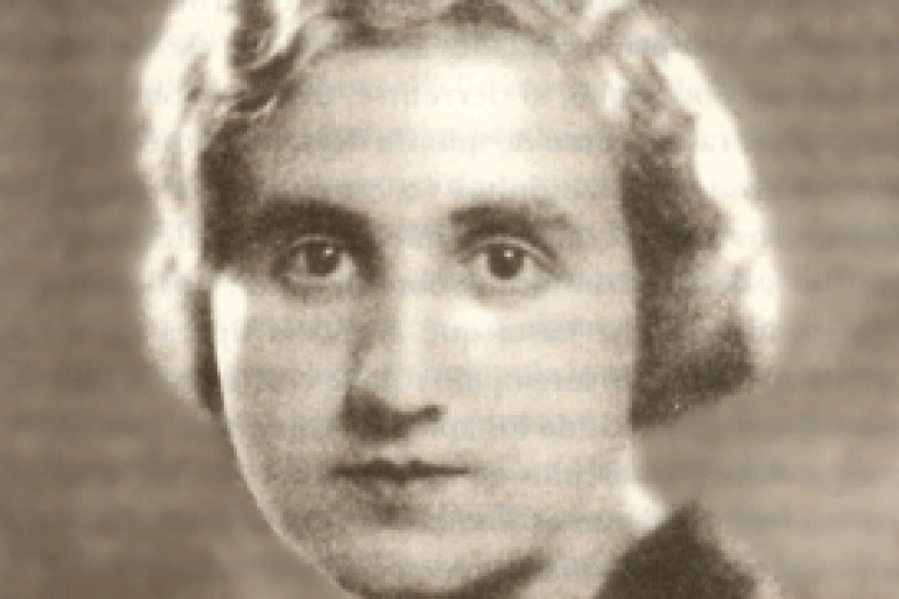
Anna Maria Martínez Sagi

This frustrated love, conditioned by the rejection that the writer received for wanting to live freely in homosexuality, may be one of the causes that explain why the flame of her memory was allowed to go out so abruptly. Also the distancing by exile, the story of politics, inclement weather, the cruelty of memory. Faults that portray a country with very poor retention that always forgets those who matter most. Among many other reasons, that is why it was necessary for someone to renovate the name of Anna Maria Martínez Sagi and make an effort to rescue her from oblivion.To do justice.

End.

SOURCES & FURTHER INFORMATION:

https://www.publico.es/sociedad/periodista-frente-guerra-poeta-atleta.html

https://www.ccma.cat/tv3/alacarta/sense-ficcio/la-sagi-una-pionera-del-barca/video/5829196/

1Republican social democratic pro-Catalan independence party that had many members killed in battle, executed or tortured and jailed during the Spanish Antifascist War and the following Franco dictatorship. Currently the party has a couple of leaders in Spanish jail, including elected members of the Catalan autonomous Government and Members of the European Parliament. The party is currently negotiating coalition government with other Catalan pro-independence parties; ERC has one seat less than Junts per Catalonia, another independentist party (D.B)

2Famous Catalan and international soccer club (D.B).

ABSTRACTED IN GREYSTONES

Diarmuid Breatnach

(Reading and viewing time: 3 mins)

On a sunny but windy day in Greystones, lá grianmhar ach gaofar, nature put on an abstract art show. The sunshine brought out intensely the yellow of the lichen on the limestone rocks, while the black lichen encrustation on some rocks contrasted sharply with a neighbouring section of bare grey. Some trick of the camera and light brought out a gorgeous blue in the rock-shadowed sea which had not been visible to the eye.

Yellow lichen incrusts the tops of stones in foreground like paint daubs while in background, a trick of light or camera turns blue the shadow on the sea. the lichens and plants here are extremophiles, living on the front line (or the beachhead). (Photo: D.Breatnach)
(Photo: D.Breatnach)

Lichens are an amazing life form, being an integrated symbiosis of an alga and a fungus. A cross between a frog and a goose would not be more bizarre in concept – fungi are not even plants, while algae are. The fungus provides a relatively strong skeleton while through photosynthesis the alga produces sugars to feed the fungus.

Although not all are easy to distinguish, there are over 1,165 species of lichen in Ireland, varying from the common to the rare. The yellow-orange one, Xanthoria parietina, is one of the common ones in Ireland. The white and often off-white or grey Ochrolechia parella can be mistaken for bird excreta at a distance, or even as the ground-in chewing gum that costs Dublin City Council so much to remove from street surfaces every week. The black one, Verrucaria maura if I am identifying it correctly, covers rocks that are wave-lapped or hit by sea-spray on a daily basis.

Limestone rock covered with black lichen contrasting with bare grey limestone in upper centre of image (Photo: D.Breatnach)

These are all hardy adventurers, extremophiles, living in zones exposed to great variations of temperature, all even in one day, as the sun beats down between rain showers or windy spray. And they are very tolerant of salinity, without at the same time being dependent upon it. Perhaps not these species but their ancestors, or other forms like them, were the early colonisers of the land on our planet. Terraformers too, as they slowly abrade the rock upon which they cling, helping to create soil, while black lichen attracts heat to warm up surfaces and the alga in the symbiotes releases oxygen into the atmosphere.

Lichens can live attached to rock, wood and metal, some species even inside stone and on snow.

Plaque commemorating the public launch of the Votes for Women campaign with Hannah Sheehy-Skeffington and Hilda Webb confronting Chief Secretary for Ireland (for the Crown) Augustine Birrell at Greystones Harbour in 1910. (Photo: D.Breatnach)

No plaque or monument celebrates these hardy adventurers but down on the harbour wall was a plaque to another hardy life-form, celebrating the 1910 confrontation there of Chief Secretary Birrell, one of the Crown’s main representatives in Ireland, by Hannah Sheehy-Skeffington and Hilda Webb. They were kick-starting the militant Votes for Women campaign which was later brought into conflict with the Irish Parliamentary Party too but influenced the 1916 Proclamation’s advanced and stirring address: “Irishmen and Irishwomen ….”. That Rising six years after the Greystones confrontation would shock Birrell and sadly, would see Hannah’s pacifist husband Francis murdered by a British Army officer during that momentous week.

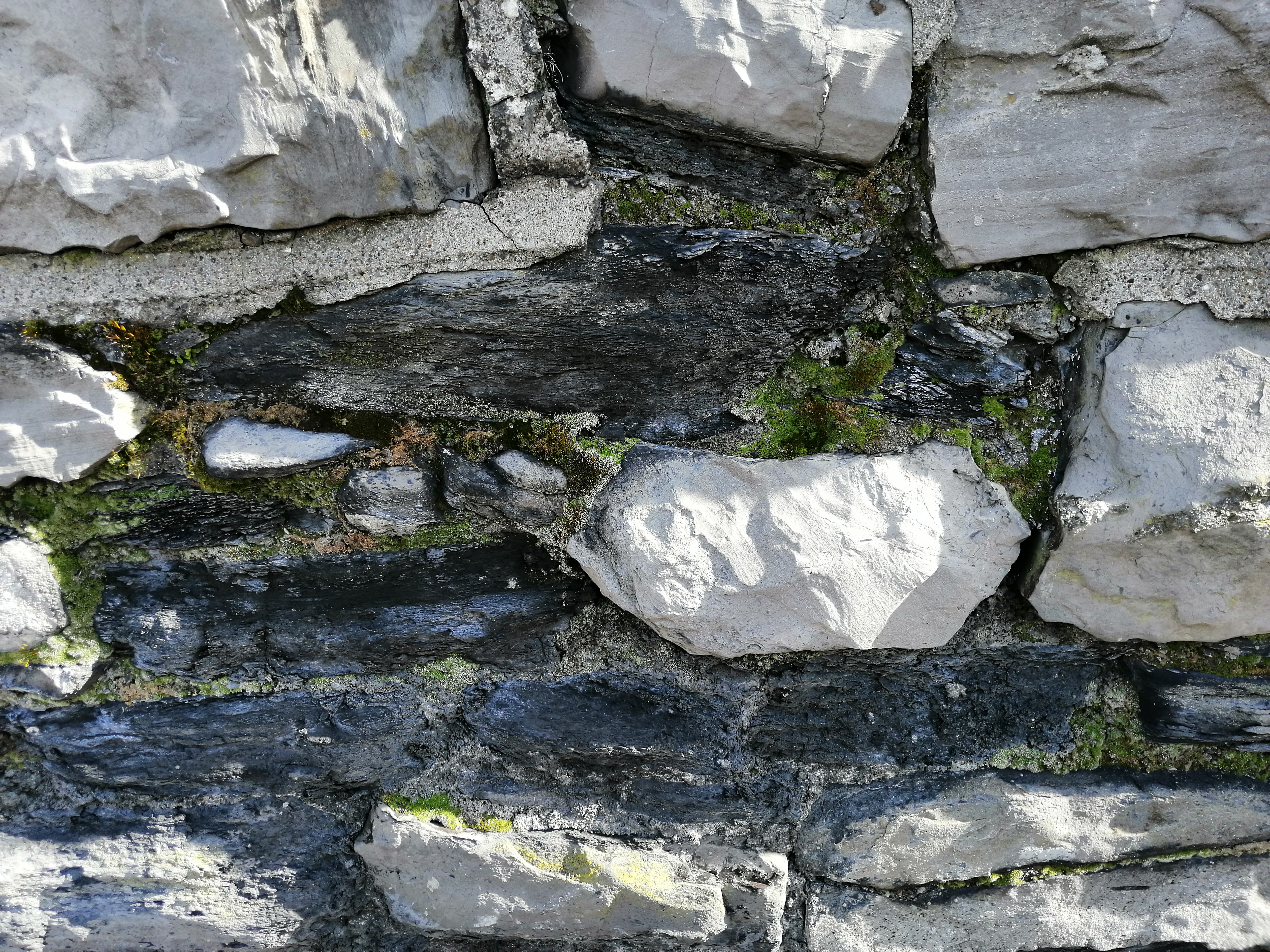
Earlier, in a Dublin train station, I photographed a wall of varied limestone, where algae and moss, also terraformers, had made an abstract art collage.

An abstract collage of shapes and colours: limestone wall with moss and algae, train station, Dublin. (Photo: D.Breatnach)

End.

REFERENCES

https://www.irishlichens.ie/

http://www.biology.ie/species.php?m=lichens-ie&s=2140