THE FLAG, THE PEOPLE & THE PLACE: The ‘Irish Republic’ flag

Diarmuid Breatnach
(Reading time: 5 mins.)

It was an Irish Argentinian who erected the “Irish Republic” flag over Dublin’s General Post Office during the 1916 Easter rising: Eamon Bulfin, born in Buenos Aires on 22 September 1892.

The flag in question was painted by Theobald Wolfe Tone Fitzgerald in the home of Constance Markievicz (1868-1927)1 with the words “Irish Republic” in gold or yellow, edged with white on material of a green curtain or bed-covering.

This was the flag later triumphantly displayed upside down by the British in front of the Parnell Monument (of which photographs may be found by search of the Internet).
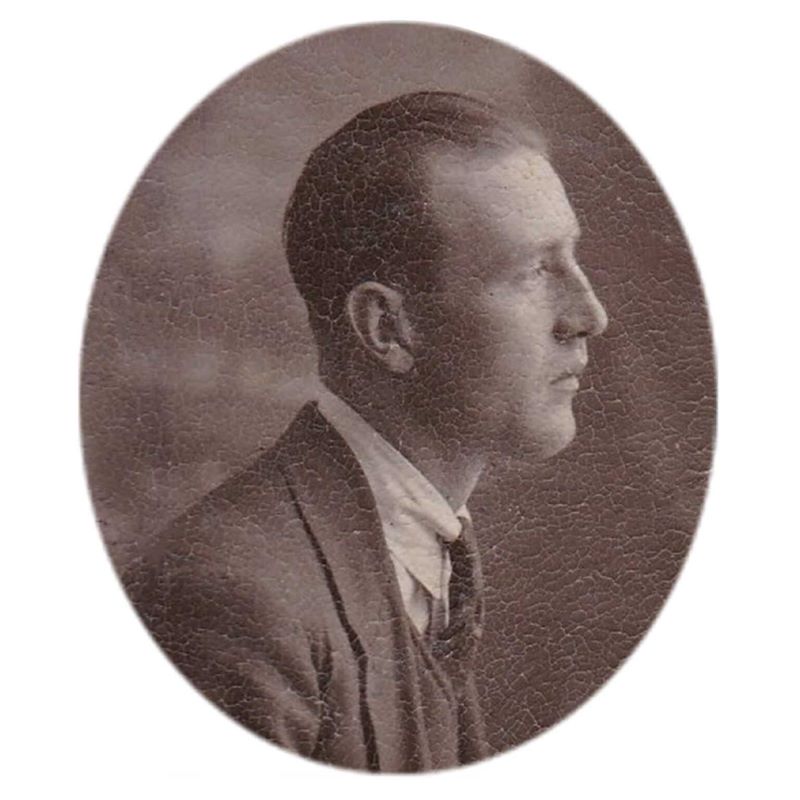
Eamon Bulfin
Colourised photo of Constance Markievicz in Irish Citizen Army uniform. The ‘Irish Republic’ flag was painted on material in her house and delivered by her to the GPO. The words declared to the world that the national liberation forces were fighting for an independent Republic. (Photo sourced: Internet)

Eamon was the son of William Bulfin (1864-1910) from Birr, King’s County (now Co. Offaly), who emigrated to Argentina at the age of 20 and was a writer and journalist who became editor and proprietor of ‘The Southern Cross’ newspaper. William also helped finance Pádraig Pearse’s Scoil Éanna (St. Enda’s School) which opened in September, 1908.

Bulfin returned to Ireland in 1909 with his wife, Anne O’Rourke, and their children Eamon and Catalina. William’s death in 1910 was a blow to his friend Arthur Griffith and the efforts to launch a Sinn Féin2 daily newspaper.

Eamon was enrolled in St Thomas Aquinas College, Newbridge, before attending St Enda’s School (Scoil Éanna) in Cullenswood, Rathmines, from September 1908 at the age of 17.

He impressed the headmaster and school founder, Patrick Pearse, who noted his aptitude for Irish, French and English,3 though also that he was weak at mathematics.

Bulfin enthusiastically engaged with the ethos of the school, acting in dramas, contributing short stories to the school review, An Macaomh, and captaining the St Enda’s football team in 1909–10.

He was enrolled as a student at St Enda’s until 1910 but remained as a boarder at its new location in Rathfarnham; he became close to the Pearse family. Eamon enrolled in the National University of Ireland in 1911 to study for a science degree.

While at university Bulfin won both Sigerson and Fitzgibbon cups (in football and hurling respectively) on a number of occasions, captaining the National University of Ireland (NUI) football team that won the Sigerson Cup in 1915.

In his 20th year Eamon joined the Irish Republican Brotherhood, being sworn in by Arthur O’Connor and, a year later, in 1913 joined E Company, Fourth Battalion (Rathfarnham) of the newly-formed Irish Volunteers

By 1915 he was involved in organising the volunteers in Dublin and Co. Meath, and in manufacturing munitions and explosives in St Enda’s, which activities continued up to the Easter rising, just prior to which he helped Kathleen Lynn  transport these weapons to Liberty Hall.

Bulfin was promoted to the headquarters staff of the volunteers and, mobilised for the 1916 Rising, was under Pearse’s personal command and stationed at the GPO, where he hoisted the “Irish Republic” flag on the roof at the corner with Princes Street.
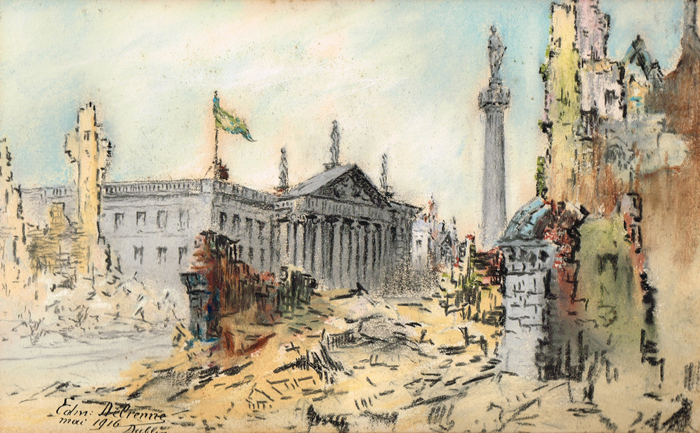
1916 Artwork in pastels by Edmond Delrenne, a Belgian refugee who had arrived in Ireland in 1914. drew and coloured the ‘Irish Republic’ flag on the GPO (centre picture). The painting also shows Nelson’s Column, which was blown up in 1966. (Artwork source: Whyte’s)

After the surrender in Moore Street, Eamon Bulfin, as with nearly 100 insurgents was sentenced to death by British military court martial but most sentences (excepting the 15 shot by firing squads in the following days)4 were commuted to periods of prison incarceration in England and Wales.

On March 21, 1917, Eamon Bulfin was deported from jail under Britain’s Aliens Restriction Act of 1914.

The Argentine Government did not want to anger the British Empire, with whom they were already having problems, not the least with their long-standing argument over the sovereignty of The Malvinas/Falklands.They therefore arrested Eamon Bulfin when he arrived in Buenos Aires and sentenced him to jail for leaving Argentina for the purpose of ‘deserting from military service’.

As Eamon had been a schoolboy when he and his family left for Ireland, the charge was an excuse for the authorities but suspicion of being a communist, which the British gave for his deportation might have been the real reason.

He was conscripted into the Argentine military and served in the army before transferring to the navy, being released after ten months as his mother was a widow, which qualified him for an exemption from military service.
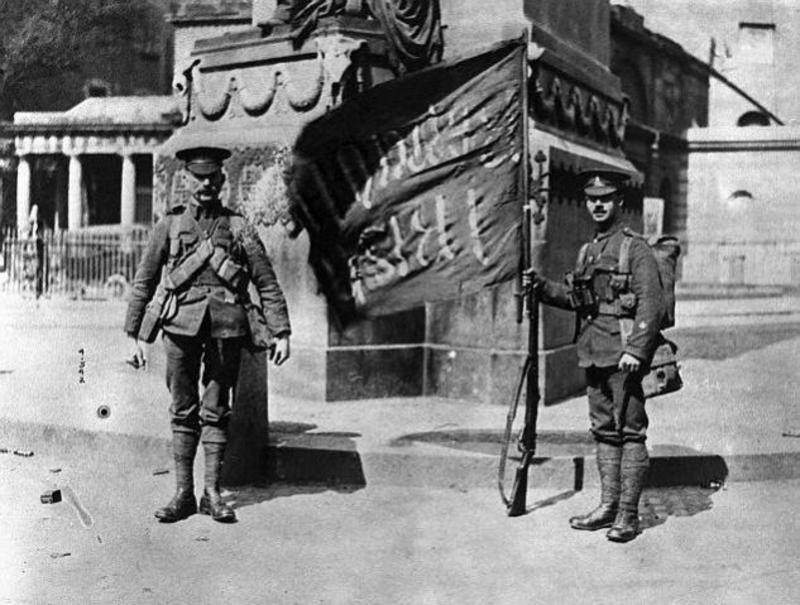
One of two photos of the ‘Irish Republic’ flag being displayed upside down by British soldiers, symbolising the defeat of those who flew it. The site is the base of Parnell’s Monument in Parnell Street with the Rotunda in the background. (Source: Internet)

When Eamon Bulfin was released in 1919, the General Election in Ireland had resulted in an overwhelming victory for Sinn Féin5 which, in accordance with their manifesto, made a Unilateral Declaration of Independence declaring Ireland a republic and set up a parliament in Dublin.

The President of the Irish Republic, Eamon de Valéra wrote to Bulfin in May appointing him the official representative to Argentina.As Irish Consul, Bulfin was to “inaugurate direct trade between Ireland and the Argentine Republic… to co-ordinate Irish opinion in the Argentine, and to bring it into the Irish demand for a republic.”6

Bulfin began work, establishing close contacts with Argentine government officials, Irish Argentine leaders and he launched an Irish Fund to help the cause.

In 1920, during the county council elections, Eamon Bulfin was nominated in his absence for a seat on King’s County Council. He was not only elected but appointed Chairman of the council.

One of the first things the new Council did was to agree that the county’s name be returned to the region’s ancient Irish form of Co. Uí Fáille (anglicised as Offaly). Meetings were conducted with the Chairman’s seat in the council chamber left empty and with a Tricolour draped across it.
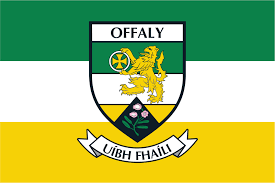
In 1922 Eamon Bulfin was finally allowed to return to Ireland where he set up home in his father’s native Derrinlough, Birr, Co. Offaly. He took the Anti-Treaty side in the Civil War and handed over 600 Stg from fund-raising in Argentina.

However the killing of Michael Collins affected him deeply and he stayed out of the Republican forces, telling them that he had refused an officer’s post in the Free State’s National (sic) Army.

On 16 February 1927 Eamon married Nora Brick (Nóra Ní Bríc) of Tralee, a former member of Cumann na mBan, in an Irish language ceremony in Drumcondra, Dublin (his occupation was recorded as a farmer). They had four children: Edward, Jeanne, Blanaid and Michael. 

Eamon Bulfin died of a cerebral haemorrhage in the Meath Hospital, Dublin, on 24 December 1968, and was buried in Eglish Cemetery, Co. Offaly.
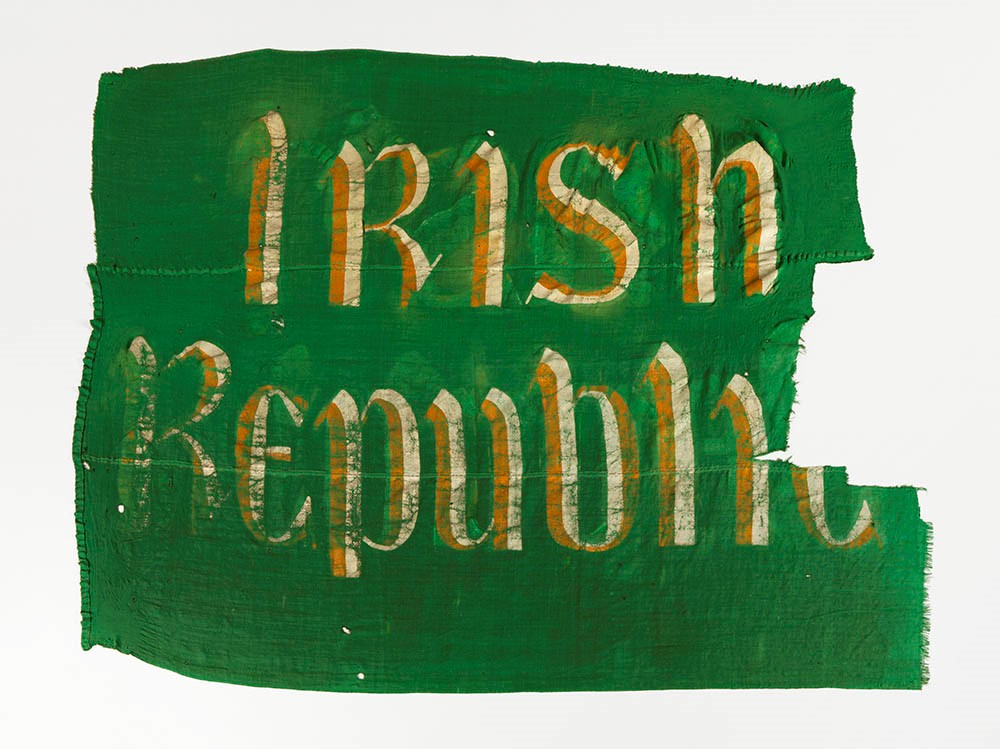
Remnant of the ‘Irish Republic’ flag in the National Museum of Ireland (Photo: NMI)

His sister, Catalina, also born in Buenos Aires in 1901, had become secretary to Austin Stack (1880-1929). Stack was elected to the Dáil (32-County Irish Parliament) in 1918 and became Minister for Home Affairs from 1920-22.Stack accompanied de Valéra to London for the initial Truce talks but became a leading opponent of the terms agreed by Collins.

Catalina Bulfin married Seán MacBride (1904-1988), born in Paris and his first language French. Sean was the son of John MacBride, executed by the British in 1916 and of Maude Gonne.

Seán McBride is the only Nobel Peace Laureate to have also won the Lenin Prize; he was former IRA Chief of Staff (1936-1937), Irish Minister for External Affairs (1948–‘52) and Secretary of the International Commission of Jurists.

MacBride was a founder member of Amnesty International and Assistant General Secretary of the United Nations. He survived Catalina MacBride by 12 years after she died in 1976, her remains being buried in Glasnevin Cemetery, Dublin.

End.

FOOTNOTES

SOURCES

https://www.dib.ie/biography/bulfin-eamonn-edmond-a10114

https://en.wikipedia.org/wiki/Eamon_Bulfin

The flag: https://www.museum.ie/en-IE/Collections-Research/Collection/Resilience/Artefact/Test-4/8961f46b-5885-4aea-af9d-63894e2b76b4

https://en.wikipedia.org/wiki/List_of_flags_of_Ireland

https://www.irishtimes.com/news/ireland/irish-news/rising-from-the-ashes-irish-republic-flag-on-display-1.2573071

1Irish politicianrevolutionarynationalistsuffragistsocialist, the first woman elected to the Westminster Parliament, Markievicz was elected Minister for Labour in the First Dáil, becoming the first female cabinet minister in Europe. She served as a Teachta Dála for the Dublin South constituency from 1921 to 1922 and 1923 to 1927. She was a Member of Parliament (MP) for Dublin St Patrick’s from 1918 to 1922.

A founding member of Fianna ÉireannCumann na mBan and the Irish Citizen Army, Markievicz took part in the 1916 Easter Rising in, when Irish republicans attempted to end British rule and establish an Irish Republic.

2The Sinn Féin party at the time was an Irish nationalist one advocating a dual monarchy, Irish and British.

3And no doubt Spanish too, having been reared in Argentina, a language acquisition that probably helped with the acquisition of Irish and French, which have a great number of similarities in structure.

4And the sixteenth execution was of Roger Casement, by hanging in London.

5Then a reformed and much-expanded party with a Republican constitution.

6  Kennedy, Michael and Joseph Morrison Skelly (eds). Irish Foreign Policy: 1919-1966 From Independence to Internationalism. Four Courts Press: England 2000, p.45. (Quoted in the Wikipedia entry on Eamon Bulfin)

DUBLIN RALLY HONOURS THE MARTYRED PALESTINE RESISTANCE LEADER

Clive Sulish

(Reading time: 3 mins.)

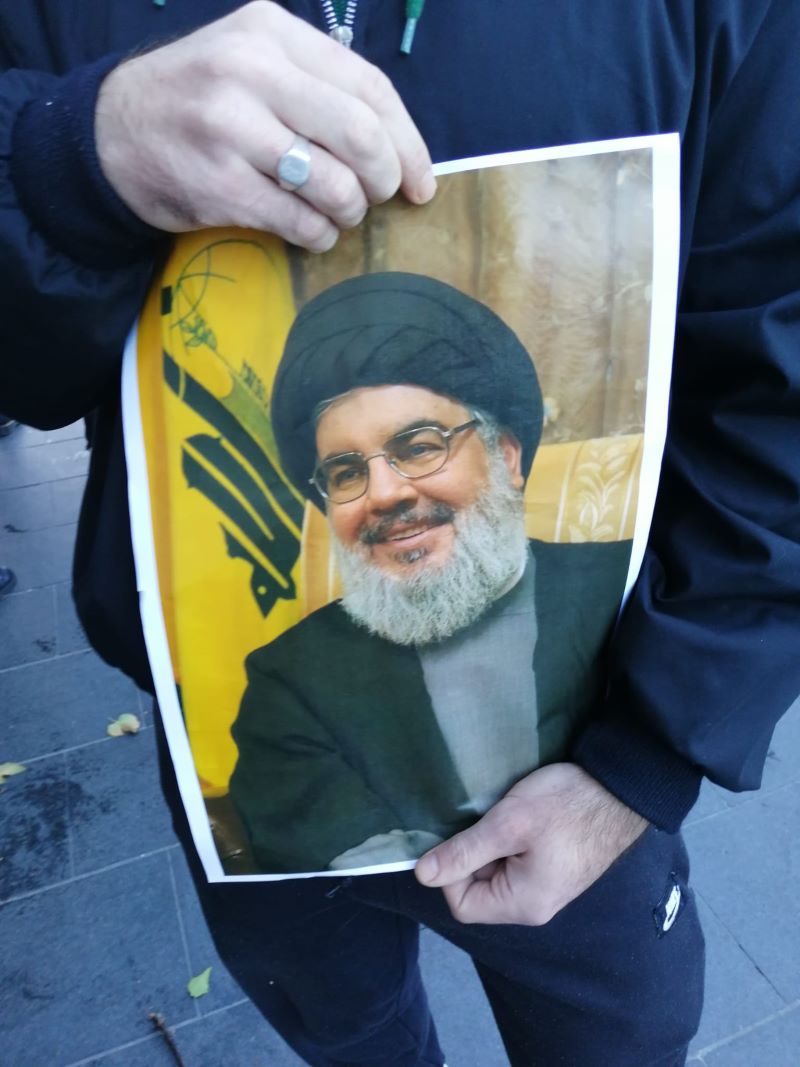
People with Palestinian flags including one containing a slogan in Irish, flags of Palestinian resistance factions and holding portraits of Ismail Haniyeh and Nasrallah rallied on Sunday evening outside Dublin’s General Post Office.

(Photo cred: Rebel Breeze)

The Action for Palestine organisation had advertised the solidarity and honouring event at short notice. Originally planned to take place on O’Connell Bridge, the storm conditions1 made that venue unsuitable and the GPO2 was chosen as an appropriate alternative.

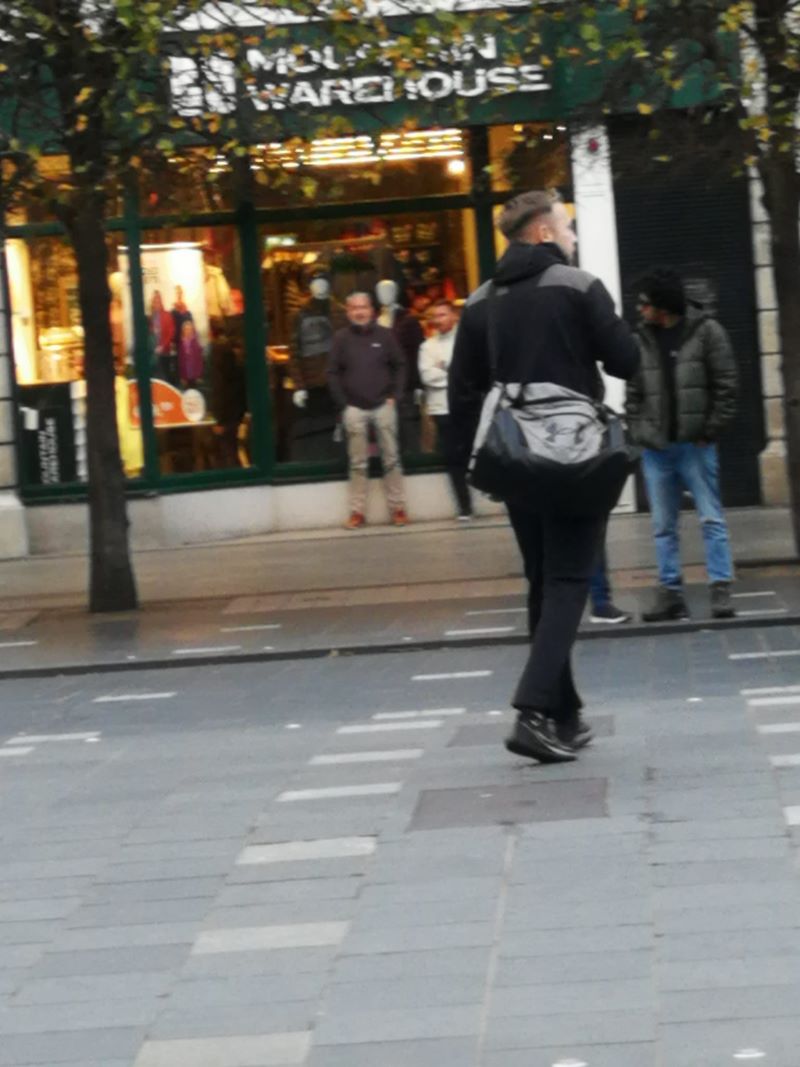
Calling and replying to solidarity chants, the crowd of Irish people and others from the Middle East also listened to four speakers, two Irish and two Palestinian, while two plain-clothes Special Branch Gardaí photographed them from east side of the street.

(Photo cred: Rebel Breeze)

One passing Zionist sympathiser insulted the gathering, giving rise to a wave of chants in solidarity with the Palestinian Resistance. On the other hand, many pedestrian passers-by congratulated demonstrators and some stopped to join or pressed horns on their vehicles.

The speakers referred to the horrors of the genocide being inflicted upon the Palestinian people in particular in North Gaza3 at this time by the IOF, the armed forces of the Zionist state, backed up and supplied by the USA and a number of European states.

(Photo cred: Rebel Breeze)

They spoke also to praise the resistance of all kinds of the Palestinian people, including armed resistance and at all levels up to leadership, who are assassinated and replaced, always under threat of death.

One speaker also spoke about the need to also support the resistance struggles and the prisoners as a result of resistance too. “It is not required of us that we agree with everything they say or do but it is required of us that we support the resistance”, he said.

Among the slogans chanted were Long live the Intifada! There is only one solution – intifada revolution! From the River to the Sea – Palestine will be free! Resistance is an obligation – in the face of occupation! Saoirse – don Phalaistín!

(Photo cred: Rebel Breeze)

From Ireland to Palestine – Occupation is a crime! From the Sea to the River – Palestine will live forever! In our thousands, in our millions – we are all Palestinians! Free, free Palestine! Netanyahu you can’t hide – you’re committing genocide! (Repeated also for Joe Biden).

A speaker also reminded the crowd of the long resistance to occupation of the Irish people, against Vikings and English occupation and the need to support the resistance of people around the world. “Resistance is everything”, he said and referred to the heroic resistance of the Palestinian people.

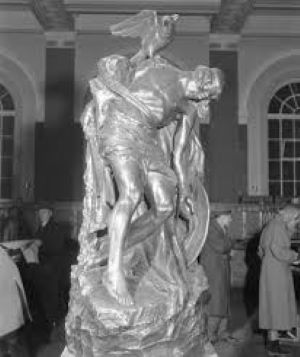
To conclude an organiser thanked all for their attendance at short notice and promised other actions in future, then encouraged those who wished to gather for a photo in front of the statue to “our hero in Irish myth, Cú Chullainn”,4 which stands in the central front window of the GPO building.5

Some gathered for a photo in front of the representation of the Irish mythological hero Cú Chulainn statue in the display window of the GPO. (Photo sourced: Action For Palestine)

While they were doing so, another reminded them that in the epic legend, Cú Chulainn’s enemies dared not approach him while he was alive and only finally did so when they saw a carrion crow or raven alight on his shoulder to reassure them that he was dead.

“Yahya Sinwar’s enemies did not face him while he was alive either. They fired a tank shell into the building where they believed the fighters were, retreating when grenades were tossed at them, firing another shell into the building and even then only dared send a spy drone in.

“When they saw on their monitor the badly-injured Sinwar throw a stick at the drone, they fired yet another shell into the building, finally killing him.”

End.

View of the Cú Chullainn statue in the GPO window on a working day (Photo cred: Cambridge University)
Far distant from any kind of heroism or solidarity, two plainclothes members of the political police, the Special Branch of the Gardaí, surveilling the participants. (Photo cred: Rebel Breeze)

Footnotes

1Storm Yellow level https://www.irishexaminer.com/news/arid-41499104.html

2Also a central location, i.e on Dublin’s main city centre street but also the HQ of the 1916 Rising against British rule.

3Some Palestinian commentators have called this phase the worst of all in the intensified genocide since October last year. Constant aerial strikes on buildings and tent encampments, shooting at people, besieging hospitals and blocking food or fuel from entering and constantly insisting that the people move out in ethnically cleansing.

4The hero is a central figure in the epic of the Táin Bó Cuailgne (The Cattle Raid of Cooley), along with back and after-stories, in the Ulster Cycle of Irish myths and legends. The sculpture, cast in bronze, is by Oliver Sheppard.

5The sculpture by Oliver Sheppard was later dedicated to the martyrs of the 1916 Rising.

IRELAND ANTI-INTERNMENT CAMPAIGN SUPPORTS PALESTINIAN PRISONERS’ DAY RALLY

Clive Sulish

(Reading time: 7 mins.)

A solidarity rally in Dublin to mark 17th April Palestinian Prisoners’ Day was staged by the IPSC outside the iconic General Post Office building on Dublin’s main street and was supported by the Ireland Anti-Internment Campaign.

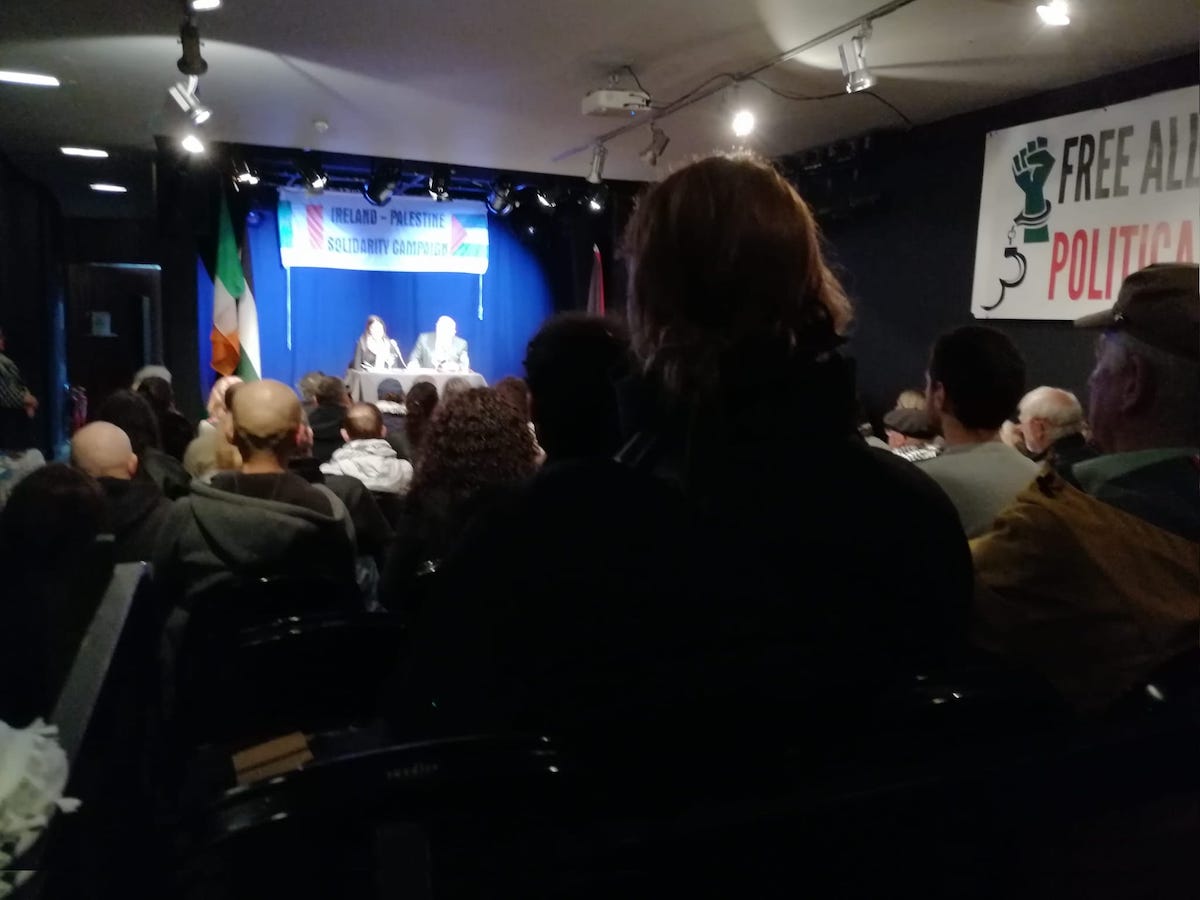
At a public meeting about Palestinian prisoners after the event Tala Nasir, a lawyer working with the prisoner support group Adameer, stated that there are 8,000 Palestinians currently held by the zionist state of which 275 are women and 500 are children.

Ms. Nasir was on a round-Ireland speaking tour organised by the Ireland Palestine Solidarity Campaign, the main Palestine solidarity organisation in Ireland but which has not been prominent in highlighting the situation of the Palestinian political prisoners.

On the other hand, at its street information pickets, although primarily working for Irish political prisoners, the Ireland Anti-Internment Campaign has regularly flown a Palestinian flag in support of political prisoners from that nation also.

An IAIC spokesperson recalled that at their traditional annual prisoner solidarity rally in December, their speaker stated: “Wherever there is oppression, there will be resistance; but also wherever there is resistance there will be political prisoners and in Ireland we have centuries of that experience.”

The organisation maintains that although large-scale official internment last used in the occupied Six Counties ended in 1795, it continues on a smaller scale under another name: “Remand in custody”, in which Republicans regularly wait two years before their case comes to court.

The decision to deny bail is taken by the special no-jury political courts: Diplock Court in the Six Counties and Special Criminal Courts within the Irish state, all of which have been condemned by civil liberties organisations in Ireland and abroad.

Israel also has a form of internment without trial which they call “administrative detention”, under which Palestinians can be detained for up to six months at a time as a preventive measure without any kind of trial or evidence shown against them.

PALESTINIAN POLITICAL PRISONERS

Tala Nasir, a lawyer of the Adameer organisation was introduced by Gary Daly (of Lawyers for Palestine group) to the audience in the theatre of Pearse House, formerly the home of Patrick and Willie Pearse and sculpture business address of their English father (and of Willie).

Ms. Nasir informed the packed audience that Israel has declared her organisation of Palestinian prisoner support and advocacy to be a “terrorist” on “evidence” they declare “secret” but the absence of which results in no other state accepting that designation in the case of Adameer.

“Once you’re a prisoner you will always be a prisoner,” stated Ms. Nasir, illustrating that in raids the Israeli military frequently detain former prisoners, often repeatedly. “Crimes” can include a comment on social media, “Liking” or sharing a comment against Israel.

Even the posting of a “green heart” symbol may be interpreted as a sign of support for Hamas and may become the reason for a person’s arrest. Children are most often accused of throwing stones, statements written for them in Hebrew, told to sign them, sufficient “evidence” for jail.

Ms Nasir said that 80% of the prisoners are held under “Administrative Detention” without trial and no defence is possible since the “reason” for it is secret and neither the accused nor their lawyer may see the allegations. The six months detention is automatic and can renewed repeatedly.

Prisoners must buy their own food from the canteen but after October 7th it was closed for periods. Child prisoners told Adameer: “We wake up hungry and go to sleep hungry”. Typically adult prisoners have lost 15-20 kg from their previous weight when released.

The prisoners were prevented from going out of their cells which also meant they were unable to shower for many days and also had to wear the same clothes every day. They were also humiliated through being blindfolded and strip-searching, sometimes by male, sometimes female soldiers.

Beatings are common and prisoners have commented on their transport vehicles not only smelling awful but seeing the floor covered in blood. Sixteen prisoners have been killed in the last 6 months and though autopsies have recorded bruises and broken bones, Israeli investigations are closed.

All but one of the Israeli prisons are in the “Israel” area and the lawyer is not permitted to visit the prisoners there without special permission, which is why, she said, so many of the Palestinians are transferred to those prisons, which she maintains is a war crime.

Declaring her greater trust in and dependence on the solidarity of the people of the world, “in particular the global South” who have had similar experiences to those of the Palestinians, the Palestinian lawyer nevertheless said that she has to practice diplomacy at times.

Tala Nasir called for the widest possible support for Adameer’s Call For Action, which is the simple task of sending text supplied emails to two specified officials responsible for prisons and prisoners telling them they will be held answerable for war crimes.

(text and addresses here: https://www.addameer.org/news/5323)

IPSC AND IAIC ON DUBLIN STREETS AGAIN SOON

The Ireland Palestine Solidarity Campaign have a march booked in Dublin for this coming Saturday 23rd April, commencing at the Garden of Remembrance at 1pm.

A spokesperson for IAIC stated they would be on the streets again in order to proclaim the continue existence of political prisoners in Ireland and that Republican activists are essentially being interned without trial from no-jury political courts to spend two years or more in jail awaiting trial.

“The IAIC is a democratic non-sectarian independent organisation,” the spokesperson said “and welcomes support from concerned democratic people and we’ll continue to fly the Palestinian flag. If people follow our page they should receive adequate advance notice in order to attend.”

end.

USEFUL LINKS AND FURTHER INFORMATION

Adameer: https://www.addameer.org/

Ireland Palestine Solidarity Campaign: https://www.facebook.com/groups/20826333992

Ireland Anti-Internment Committee: https://www.facebook.com/profile.php?id=100063166633467