LARGE RALLY ON HISTORICAL 1916 RISING SITE THREATENED BY SPECULATORS

Clive Sulish

(Reading time: 7 mins.)

Large numbers attending a rally Sunday afternoon were addressed by a number of speakers from a platform in the centre of the 1916 Terrace organised by the Moore Street Preservation Trust on part of the very site they wished to preserve.

Fintan Warfield, a Sinn Féin Senator (and cousin of Derek and Brian Warfield of the Wolfe Tones) came on stage to perform Come Out Yez Black ‘n Tans followed by Grace, about Grace Gifford’s wedding to Vol. Joseph Plunkett hours before his execution by British firing squad.

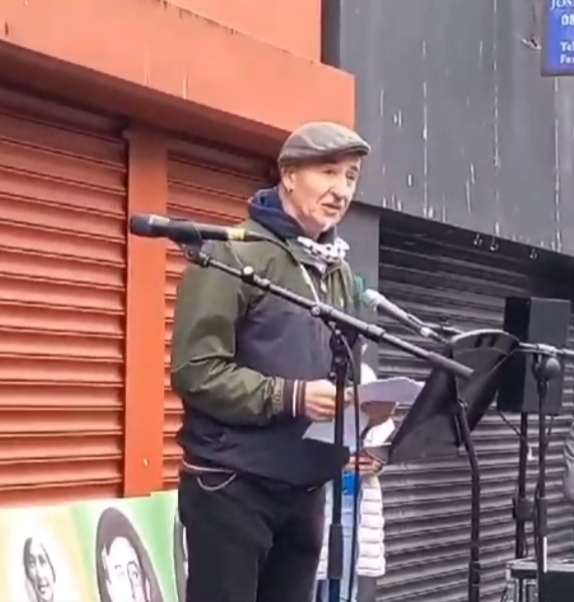
Fintan Warfield performing at the event, behind him the portraits of two of the Moore Street Garrison in 1916 may be seen. (Photo: R. Breeze)

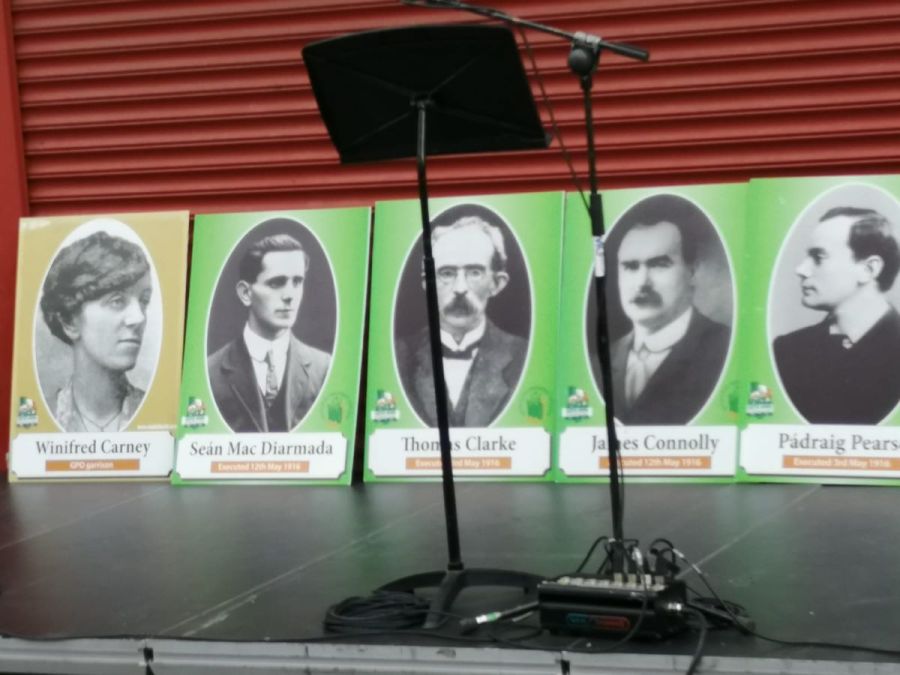
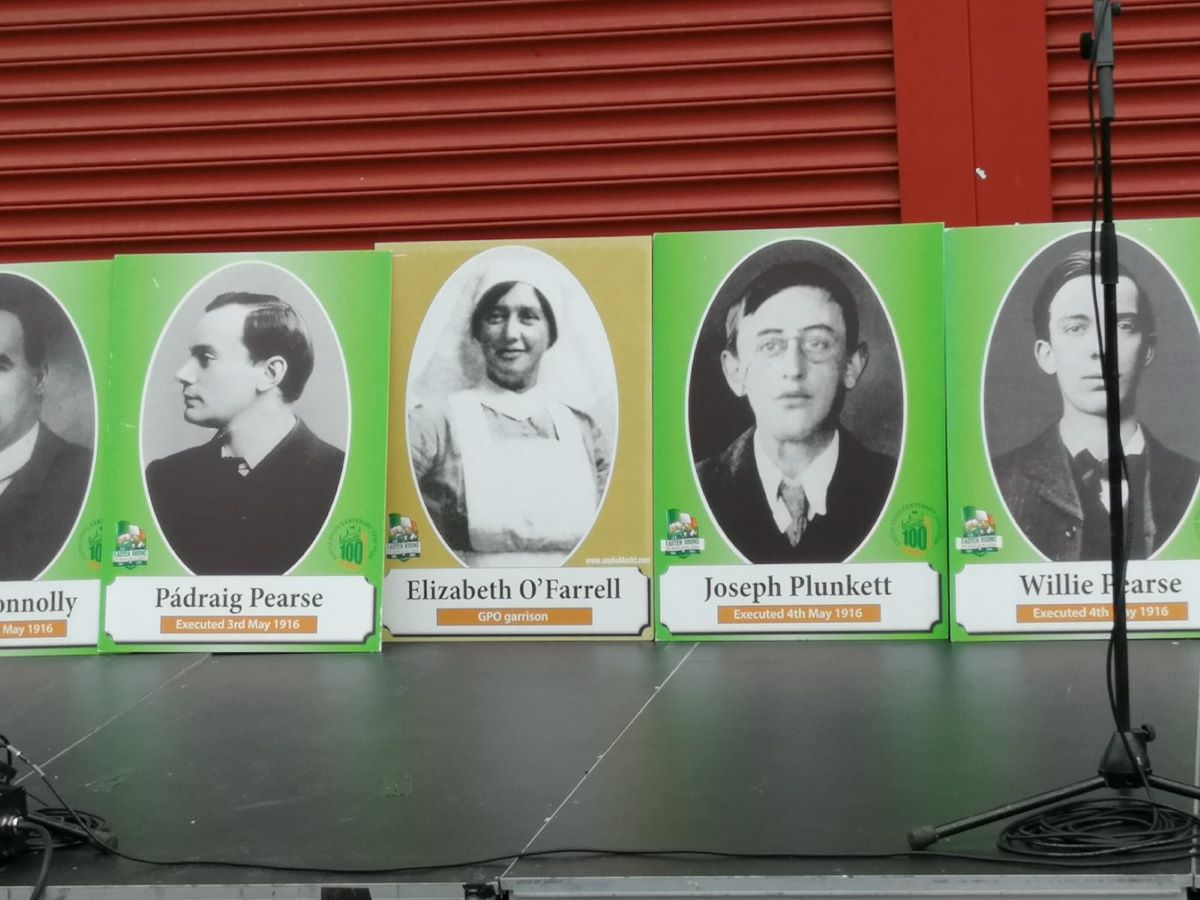
Warfield performed in front of a number of large board posters bearing the images of a number of leaders of the 1916 Rising who had occupied Moore Street in 1916 and Vols. Elizabeth O’Farrell and Winifred Carney, two of the three women Volunteers who had been part of the garrison.
The start of the rally however was delayed, apparently awaiting the arrival of Mary Lou Mac Donald, billed as the principal speaker on the Moore Street Preservation Trust’s pre-rally publicity.

Eventually Mícheál Mac Donncha, Secretary of the Trust and a Sinn Féin Dublin City councillor came on the stage to promote some MSPT merchandise (some of it for free) and to introduce the MC for the event, Christina McLoughlin, a relative of Comdt. Seán McLoughlin.

Christina McLoughline, MC of the event. (Photo: R. Breeze)

Vol. Seán McLoughlin had been appointed Dublin Commandant General by James Connolly during the GPO evacuation and was about to lead a charge on the British Army barricade in Parnell Street when the decision was taken to cancel after which he organised the surrender.

He later became a communist and was never acknowledged at Commandant level by the War Pensions Dept. of the State under De Valera, despite his rank in Moore Street and later also in the Civil War in Cork.

Sean’s relative Christina McLoughlin welcomed Mary Lou Mac Donald on to the stage.

Mac Donald’s appearance on the stage received strong applause. In fairness, many present, if not most, were of the party faithful. Despite the presence of some younger people, the general age profile was decidedly from the 40s upwards, indeed many being clearly in the later third.

Mary Lou Mac Donald, President of the Sinn Fein party, speaking at the event. (Photo: R. Breeze)

Mac Donald, who is not an Irish speaker, read the beginning of the address well in Irish before going on to talk in English about the importance of Moore Street site in the history of the 1916 Rising and in Irish history generally and how her party in government would save it.

After the applause for Mac Donald, the MC called Proinnsias Ó Rathaille, a relative of Vol. Michael The O’Rahilly, who was mortally wounded leading a charge up Moore Street against a British Army barricade in Parnell Street and who died in the nearby lane that now bears his name.

Ó Rathaille’s address was heavy in the promotion of the Sinn Féin party and, in truth rather wandering so that he had to return to the microphone after he’d concluded, to announce Evelyn Campell to perform a song she had composed: The O’Rahilly Parade (the lane where he died).

Evelyn Campbell performing her composition O’Rahilly’s Parade at the event. (Photo: R. Breeze)

Campell is a singer-songwriter and has performed in Moore Street on previous occasions, the first being at the invitation of the Save Moore Street From Demolition group who were the only group to campaign to have the O’Rahilly monument finally signposted by Dublin City Council.

McLoughlin announced Deputy Mayor Donna Cooney to speak, a relative of Vol. Elizabeth O’Farrell, one of the three women who were part of the insurrectionary forces occupying Moore Street. Cooney is a Green Party Councillor and a long-standing campaigner for the conservation of Moore Street.

Deputy Dublin Lord Mayor and Green Party councillor Donna Cooney speaking at the event. (Photo: R. Breeze)

While speaking about the importance of Moore Street conservation for its history and street market, Cooney also alluded to its deserving UNESCO World Heritage status, adding that the approval of the Hammerson plan for the street was in violation of actual planning regulations.

Next to speak was Diarmuid Breatnach, also a long-time campaigner, representing the Save Moore Street From Demolition campaign group which, as he pointed out has been on the street every Saturday for over a ten years and is independent of any political party or organisation.

Diarmuid Breatnach speaking at event on behalf of the independent Save Moore Street From Demolition campaign group. (Photo: R. Breeze)

Breatnach also raised the UNESCO world heritage importance, as the SMSFD group were first to point out and have been doing for some years, based on a number of historical “firsts” in world history, including the 1916 Rising having been the first anti-colonial uprising of that century.

The Rising was also the first ever against world war, Breatnach said. He told his audience that the Irish State has applied for UNESCO heritage status for Dublin City, but only because of its Victorian architecture and that it had once been considered “the second city of the British Empire”.

Stephen Troy, a traditional family butcher on the street, was next to speak. He described the no-notice-for-termination arrangements which many phone shops in the street had from their landlord and how Dublin City Planning Department had ignored the many sub-divisions of those shops.

Stephen Troy, owner of family butcher shop on the street and campaigner, speaking at the rally. (Photo: R. Breeze)

Troy’s speech was probably the longest of all as he covered official attempts to bribe the street traders to vote in favour of the Hammerson plan and what he alleged was the subversion of the Moore Street Advisory Group which had been set up by the Minister for Heritage.

It began to rain as Troy was drawing to a close but fortunately did not last long.

Jim Connolly Heron, a descendant of James Connolly and also a long-time campaigner for Moore Street preservation was then called. Speaking on behalf of the Trust, Connolly began by reading out a list of people who had supported the conservation but had died along the way.

Connolly Heron went on to promote the Trust’s Plan for the street which had been promoted by a number of speakers and to announce the intention of the Trust to take a case to the High Court for a review of the process of An Bord Pleanála’s rejection of appeals against planning permission.

Jim Connolly Heron, great-grandson of James Connolly and prominent member of the Moore Street Preservation Trust, speaking at the event. (Photo: R. Breeze)

The MC acknowledged the presence in the crowd of SF Councillor Janice Boylan, with relatives among the street traders and standing for election as TD and Clare Daly, also standing for election but as an Independent TD in the Dublin Central electoral area.

MOORE STREET, PAST AND PRESENT

Moore Street is older than O’Connell Street and the market is the oldest open-air street market in Ireland (perhaps in Europe). It became a battleground in 1916 as the GPO Garrison occupied a 16-house terrace in the street after evacuating the burning General Post Office.

At one time there were around 70 street stalls in the Moore Street area selling fresh fruit, vegetables and fish and there were always butchers’ shops there too. But clothes, shoes, furniture, crockery and vinyl discs were sold there too, among pubs, bakeries and cafés.

Dublin City Planning Department permitted the development of the ILAC shopping centre on the western side of the street centre and the Lidl supermarket at the north-east end of the street, along with a Dealz as the ILAC extended to take over the space on its eastern side.

While many Irish families turned to supermarkets, people with backgrounds in other countries kept the remaining street traders in business; but the property speculators ran down the street in terms of closing down restaurants and neglecting the upkeep of buildings.

The authorities seem to have colluded in this as antisocial behaviour that would not be tolerated for a minute in nearby Henry Street is frequently seen in Moore Street.

The new craft and hot food stalls Monday-Saturday run counter to this but are managed by the private Temple Bar company which can pull out in a minute. On Sunday, the street is empty of stalls and hot food or drinks are only available in places that are part of the ILAC shopping centre.

The O’Reilly plan was for a giant ‘shopping mall’ extending to O’Connell Street and was paralysed by an objectors’ occupation of a week followed by a six-week blockade of the site, after which a High Court judgment in 2016 declared the whole area to be a National Historical Monument.

A judge’s power to make such a determination was successfully challenged by then-Minister of Heritage Heather Humphries in February of 2017. NAMA permitted O’Reilly to transfer his assets to Hammerson who abandoned the ‘shopping mall’ plan as not profitable enough.

The Hammerson plan, approved by DCC and by ABP is for a shopping district no doubt of chain stores like Henry Street or Grafton Street, also an hotel and a number of new streets, including one cutting through the 1916 central terrace out to O’Connell Street from the ILAC.

In the past dramatist Frank Allen organised human chains in at least three ‘Arms Around Moore Street’ events and the Save Moore Street 2016 coalition organised demonstrations, re-enactments, pickets and mock funerals of Irish history (i.e under Minister Humphries).

The preservation campaigning bodies still remaining in the field are the SF-backed Moore St. Preservation Trust and the independent Save Moore St. From Demolition group. The former is only a couple of years in existence and the latter longer than ten years.

However, both groups contain individuals who have been campaigning for years before that. The MSPT tends to hold large events sporadically; the SMSFD group has a campaign stall on the street every Saturday from 11.30am-1.30pm. Both have social media pages.

Fully in view, four prominent members of the Moore Street Garrison (L-R): Patrick Pearse, Commander-in-Chief; Vol. Elizabth O’Farrell, of Cumann na mBan; Vol. Joseph Plunkett, one of the planners of the insurrection; Vol. Willie Pearse, Adjutant to his brother Patrick. All but O’Farrell were tried by British court martial, sentenced to death and shot by British firing squad in Kilmainham Jail. (Photo: R. Breeze)

LEGISLATION & COURT CASES

2007 Nos. 14-17 Moore Street declared a National Historical Monument (but still owned by property developer Joe O’Reilly of Chartered Land)

2015 Darragh O’Brian TD (FF) – Bill Moore Street Area Development and Renewal Bill – Passed First Reading but failed Second in Seanad on 10th June 2015 by 22 votes against 16.

2015 – Colm Moore application — 18th March 2016: High Court judgement that the whole of the Moore Street area is a national historical monument.

2017 – February – Minister of Heritage application to Court of Appeal – judgement that High Court Judge cannot decide what is a national monument.

2021 — Aengus Ó Snodaigh TD (SF) – 1916 Cultural Quarter Bill – reached 3rd Stage of process; Government did not timetable its progress to Committee Stage and therefore no progress.

2024 – Property Developer Hammerson application to High Court Vs. Dublin City Council in objection to decision of elected Councillors that five buildings in the Moore Street area should receive Protected Structure status as of National Historical Heritage. Hammerson states that the decision is interfering with their Planning Permission. Case awaits hearing.

Five prominent members of the Moore Street Garrison (L-R): Vol. Winifred Carney of Irish Citizen Army and Cumann na mBan; Vol. Sean Mac Diarmada, one of the planners of the insurrection; Vol. Tom Clarke, one of the insurrection’s planners; revolutionary socialist James Connolly, Irish Citzen Army and Commandant General of the Rising (especially of Dublin); Patrick Pearse, Commander-in-Chie. All but Carney were tried by British court martial, sentenced to death and shot by British firing squad in Kilmainham Jail. (Photo: R. Breeze)

POSTSCRIPT

Someone commented later that in general the rally, from the content of most of the speeches, had been at least as much (if not more) of a Sinn Féin election rally as one for the conservation of Moore Street.

That should have been no surprise to anyone who knows that any position taken by Sinn Féin activists tends to be for the party first, second and third. And with the Irish general elections only weeks away, well …

And while Mac Donald spoke in Dublin of the importance of Ireland’s insurrectionary history and the need to conserve such sites, her second-in-command Michelle O’Neil was laying a wreath in Belfast in commemoration of the British who were killed in the First imperialist World War.

End.

SOLIDARITY WITH THE RESISTANCE ON DUBLIN PALESTINIAN SOLIDARITY MARCH

Clive Sulish

(Reading time: 3 mins.)

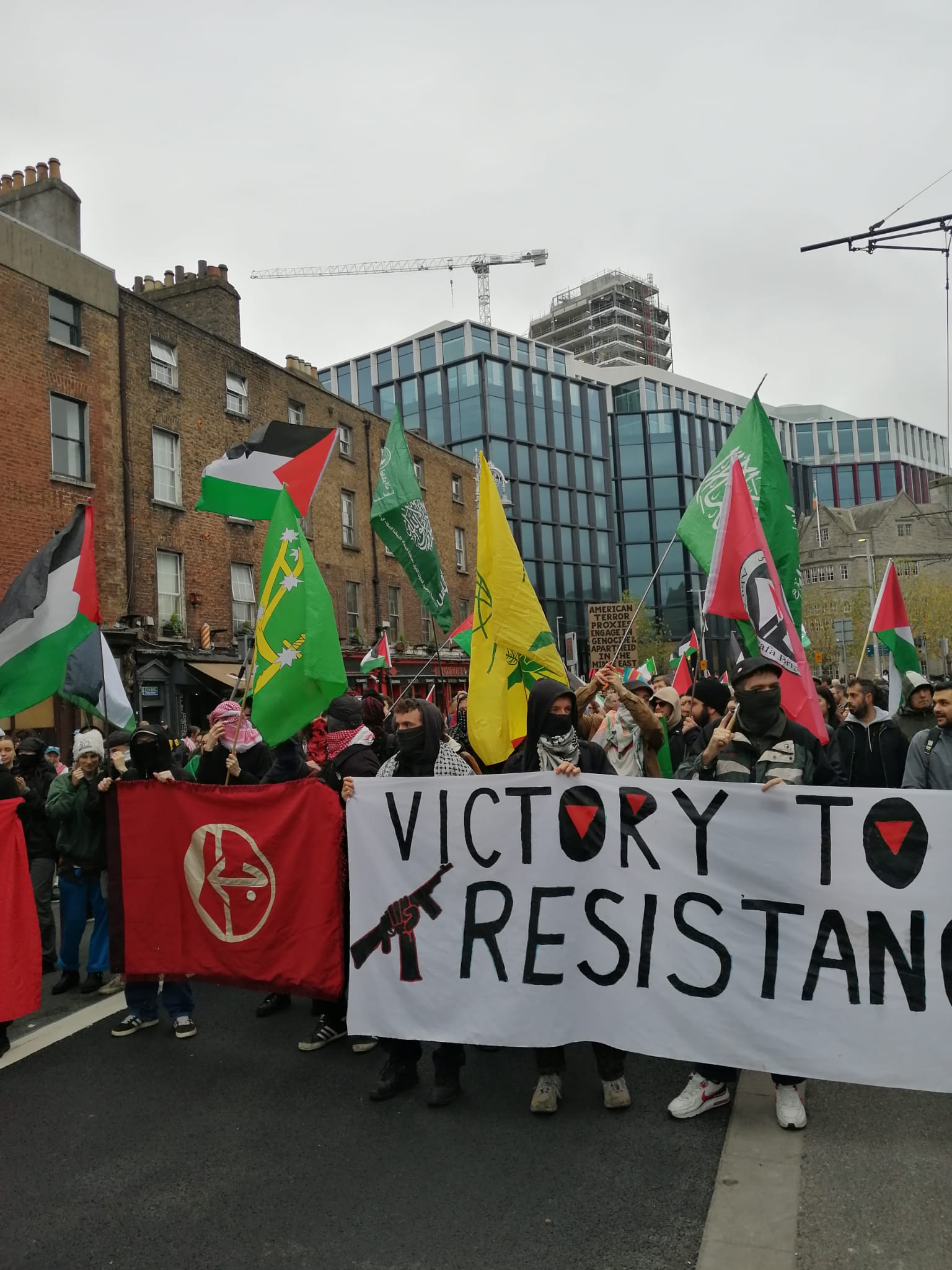
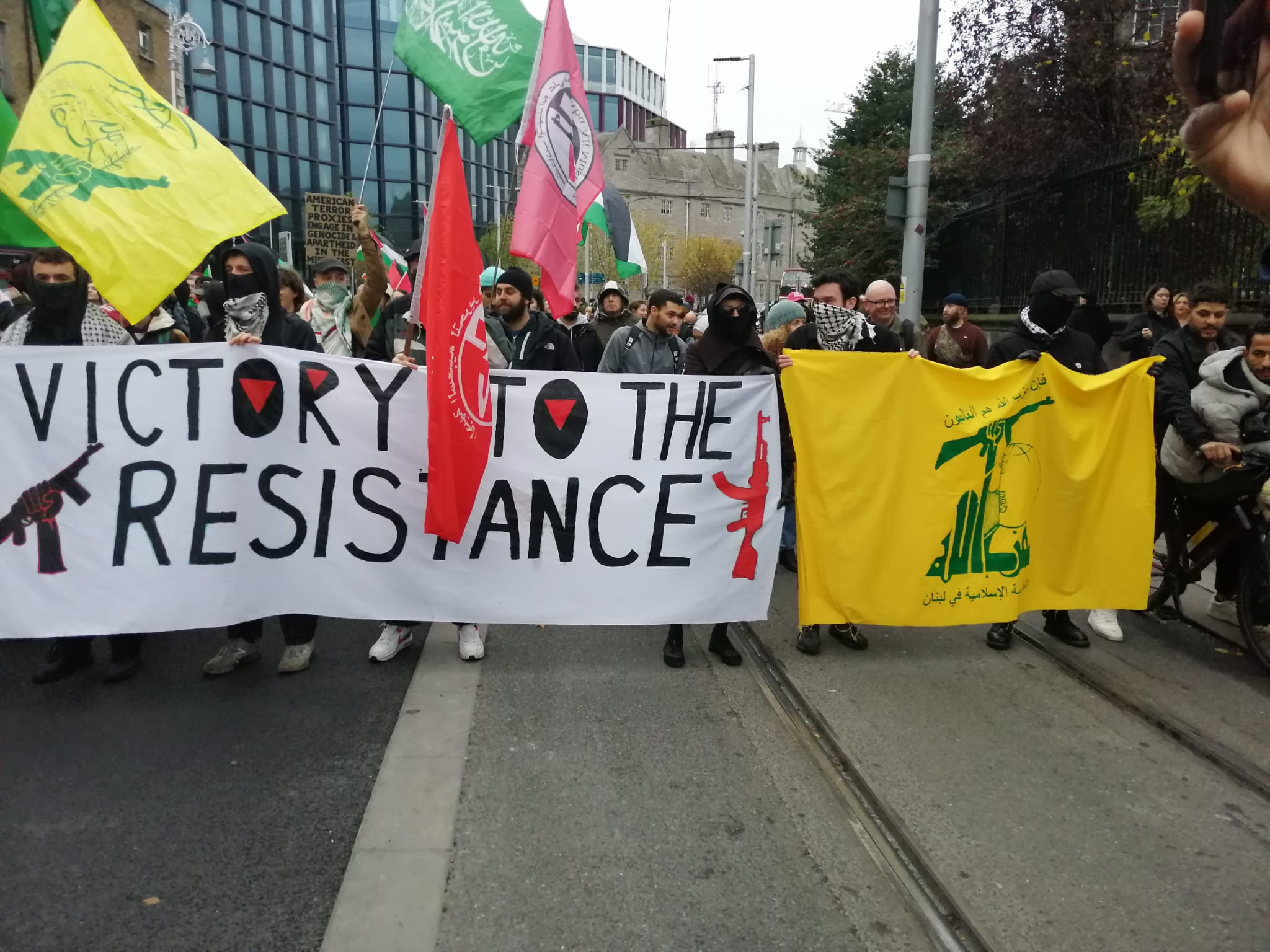
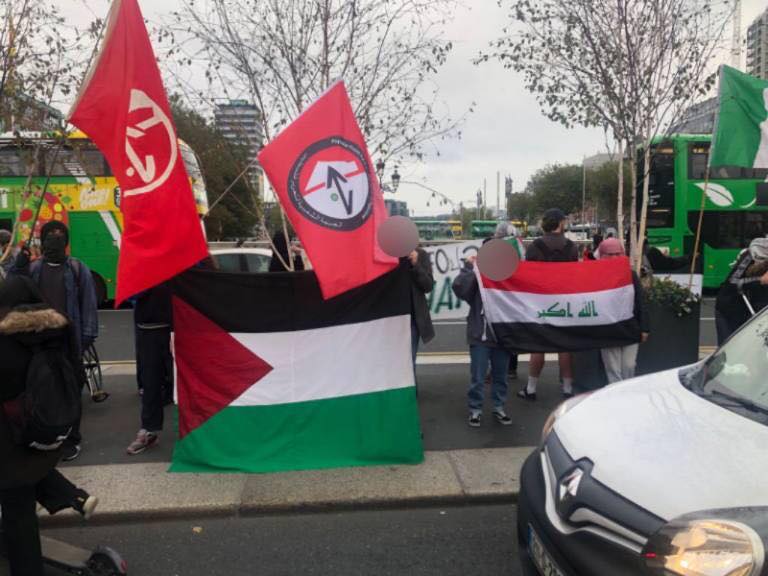
While thousands marched once again in Palestine solidarity in Dublin, a section of the demonstration marched as a bloc in specific solidarity with the Palestinian Resistance with banners, flags and slogans declaring their position.

The Ireland Palestine Solidarity Campaign with a number of branches has been for many years the major organiser of Palestinian solidarity events and had once again called for a national march in Dublin, again to Leinster House, home of the Irish Parliament.

Section of the front of the Palestinian Resistance Solidarity Bloc in Dublin on Saturday. In this photo may be seen the flags of three factions of the Palestinian Resistance and, left foreground, the flag of Irish revolutionary socialist Republicanism, the Starry Plough (Photo: R.Breeze)

This has become a pattern of the main IPSC street activity in Dublin, along with holding a rally on the central pedestrian reservation in Dublin’s O’Connell Street, with occasional marches to the Department of Foreign Affairs (though in the past it organised boycott pickets of ‘Israeli’ products).

The US Embassy seems to have become out of bounds for the IPSC. This is despite the clear responsibility of the USA for supplying most of the armament, political and financial backing for the genocide being carried out by the Zionist state against the Palestinians.

Some believe that the IPSC leadership is complying with the wishes of the Irish police, the Gardaí, not to have Palestine solidarity marches go to the US Embassy. The offices of the EU, Germany and the UK, major contributors to the genocide, have also been given in effect a waiver.

The national march called by the IPSC at its destination in Molesworth Street last Saturday. The photo is taken from the platform and PA lorry facing the crowd, with its back to Leinster House (of the Irish Parliament) which also has crowd barriers erected behind it. (Photo sourced: IPSC)

Neither the march last Saturday nor any organised before it by the IPSC was going to promote solidarity with the Resistance, despite their former chairperson having once said of them in public that they are ‘freedom fighters’. Of course, to the ‘Israelis’ and EU they are ‘terrorists’.

Section of the front of the Palestinian Resistance Solidarity Bloc in Dublin on Saturday (Photo: R.Breeze)

The IPSC has organised only one public meeting during this year’s genocide to highlight the terrible conditions of the thousands of Palestinian political prisoners in ‘Israeli’ jails and rarely mentions them, nor in solidarity with the Samidoun1 organisation being banned in USA and Canada.

In October last year, as this phase of the genocide began, the IPSC dithered over whether to call for the expulsion of the ‘Israeli’ Ambassador to Ireland, as did the Sinn Féin leadership until a near revolt of the party’s members forced them to return to their previous position. As did the IPSC.

Clearly the IPSC leadership is trying to keep itself somewhere around the ‘middle road’ in Palestinian solidarity, probably in order — as it sees it – to remain with influence among the ruling circles. However, the actual results among those circles do not bear testimony to their effectiveness.

NO CHANGE

The Irish state continues to permit US military planes and personnel to violate the State’s nominal independence through Shannon International Airport, to permit Zionist armament overflights of its air space (similarly with the RAF) and to permit British Navy docking in Irish ports.

The relatively mild Occupied Territories Bill, long approved through Leinster House, remains not brought into force, blocked by the Coalition Government of Fianna Fáil, Fine Gael and the Green Party. It could not be clearer that the ruling class in Ireland do not feel under enough pressure.

This is despite a clear popular feeling among the public in Ireland of solidarity with Palestine and revulsion at their genocidal attacks by the Zionist state.

There is a long-established train of thought that maintains that solidarity with the Palestinians is not just calling for the genocide to stop – that alone is charity and that actual solidarity means solidarity with the people’s resistance and the political prisoners.

If the IPSC were to adopt that position they might find it easier to support more radical action to pressure the Irish state to break with the western powers’ consensus of support for the ‘Israeli’ state and consequently for its genocide against the Palestinians.

Perhaps that is one of the very reasons that the IPSC leadership will not take that stand and that its stewards have at times even tried to convince people to remove their flags supporting various Resistance factions.

Section of the front of the Palestinian Resistance Solidarity Bloc in Dublin on Saturday (Photo: R.Breeze)

On Saturday independent activists joined those of Saoirse Don Phalaistín, Anti-Imperialist Action Ireland and Queers For Palestine in forming a sizeable bloc on the march with banners, flags and call-and-answer slogans advertising its solidarity with the Resistance.

This seems a welcome trend likely to grow.

End.

FOOTNOTE

1Palestinian political prisoner support and advocacy organisation.

FUNERAL OF ZIONISM HELD IN DUBLIN – ITS COFFIN DUMPED IN THE RIVER

Clive Sulish

(Reading time: 4 mins.)

Scores of people participated in a symbolic ‘funeral of Zionism’ on Monday evening (7th October) in Dublin’s city centre. In front of the James Connolly monument1 and near a mock coffin of ‘Zionism’, they listened to a song and short speeches.

This was followed by a march carrying the ‘coffin’ through city centre streets to O’Connell Bridge, where it was dumped in the Liffey river.

The ethnic composition of the mostly young mixed-gender crowd, by appearance and accent, seemed to be a mixture of Irish and Middle Eastern origin.

The chairperson of the event recalled that a year had passed since the heroic action from Gaza of October 7th and the events that followed, all being gathered there at the James Connolly memorial to hold a funeral for Zionism, the ideology of settler colonialism and genocide.

The first contribution was from a man introduced as Seán Óg with a song of his own composition, three verses rendered acapella in fine voice to the air of two well-known Irish patriotic ballads, Men of the West/ Fir an Iarthair and The Boys of Killmichael.2

The audience began to pick up and join in the chorus lines:

So here’s to the boys of Gaza,
Jenin, Nablus and Hebron,
Who fought ‘neath the brave flag of Palestine
and sent the Settlers on.

Section of crowd at event listening to speeches, viewed facing north-eastwards. (Photo: R. Breeze)

Two speakers followed, pointing out the unanimity of imperialism nowadays in supporting Zionism as distinct from the 1950s and the importance of struggles such as that in Palestine to our own in Ireland, of internationalist solidarity and the need for that solidarity to be for the Resistance.

One speaker interspersed his words in English with some phrases in Irish and recalled the protest against the 1897 visit of the British Queen Victoria which saw James Connolly and Constance Markievicz leading a funeral cortège through the streets bearing a coffin for British Imperialism.

Though a ‘funeral’ for British Imperialism might’ve seemed only aspirational in 1897, the speaker said, signs of its decline were there to be seen for the educated, the intelligent and those who wished to see them — and before two decades elapsed it had received a major challenge.

(Photo: R. Breeze)

It survived that challenge of the First World War victorious but weakened and the embers of revolt were burning around its Empire. Before two decades after that funeral march, the torch of freedom had been lit in Dublin,3 the first uprising against world war of that century anywhere in the world.

The speaker went on to recall the subsequent War of Independence in Ireland three years later and remarked that had it not been for some Irish failures in unity and resolution that British Imperialism might have been given its mortal blow then in Ireland.

Subsequently British Imperialism survived by serving as a subject ally to US Imperialism. “Zionism is a rotten tree”, he said, “planted in Palestine by British Imperialism and nurtured by US Imperialism. Even so, Zionism is damaging its very fosterers and we welcome that.”

“Rotten trees don’t fall on their own,” the speaker continued. Trees that are rotten inside may seem healthy on the outside but when a strong storm comes along, they are knocked down. It is then we can easily see the rot inside them that we may not have noticed before.

Storms are now breaking out around the world, he said. We can and need to play our own part in those storms, “to knock down the rotten tree of Zionism and go on to demolish the whole rotten evil forest of imperialism.”

Section of crowd listening to speeches at the event, photo taken facing south-eastwards. (Photo: R. Breeze)

After applause some chants were led, among them: From Ireland to Palestine – Occupation is a crime! Saoirse don-Phalaistín! There is only one solution – Intifada revolution! From the river to the sea – Palestine will be free! Resistance is an obligation – in the face of Occupation!

The attendance then took to the street, carrying the coffin and flying Irish and national flags of Palestine along with those of factions of the Resistance, also Hezbollah’s and Lebanon’s, continuing the chants as they marched up lower Abbey Street,4 then turning left along O’Connell Street.

Along the way, some bystanders cheered and a man leaned out of a delivery van to shout encouragement with clenched fist in the air.

On O’Connell Bridge, after a few words, the ‘coffin’ containing ‘Zionism’ was pushed over the parapet into the river Liffey, to cheers, which then changed to cycling through the accustomed solidarity chants.

The ‘coffin’ is on the Bridge parapet (left of photo) and about to be dumped into the river Liffey. (Photo: R. Breeze)

There were three external interventions.

A known Irish Zionist who regularly tries to harass Palestinian solidarity participants appeared at the outset in attempted intimidation of an activist but was quickly discouraged from doing so. At the Bridge, a person under the influence of alcohol and shouting confusedly was calmed by activists.

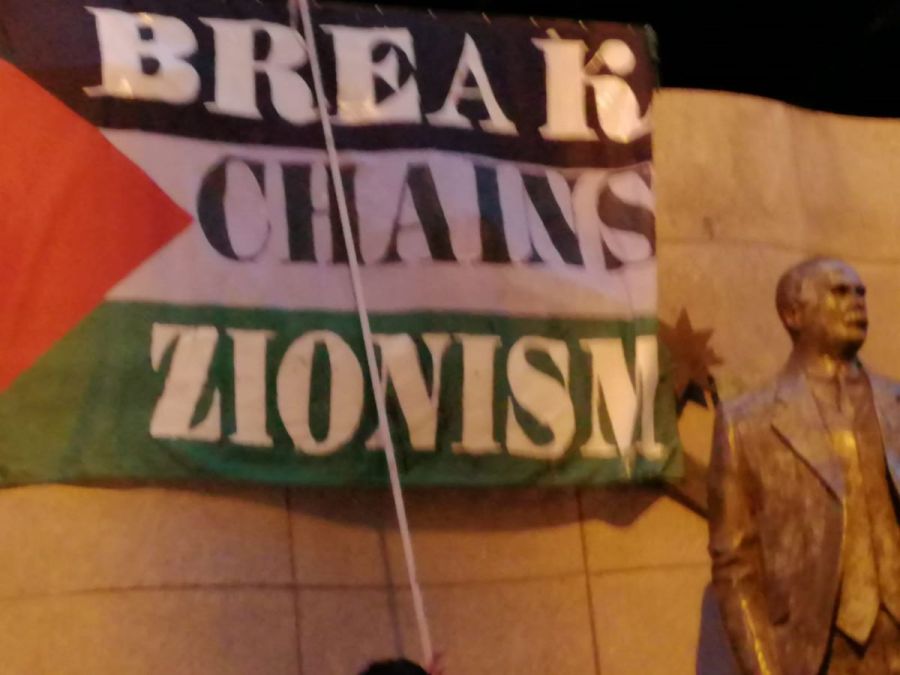
Break the Chains of Zionism banner next to James Connolly Monument (Photo: R. Breeze)

A Garda patrol car crew whose political undercover colleagues had clearly overlooked keeping informed drew up at the Bridge bemusedly during the chanting and, after attempting to gain some information as to events, left again – as did the participants soon afterwards.

The event was organised by Anti-Imperialist Action Ireland and Saoirse Don Phalaistín, the former’s Facebook page having been taken down by Meta while the event was being organised but the groups may be followed on Instagram and Twitter.

End.

Footnotes

1The location of this fine monument is in Beresford Place, across from the site of the original Liberty Hall, home of the Irish Transport and General Workers Union which Connolly led after Jim Larkin departed for the USA at the end of the 1913 Dublin Lockout. The site is now occupied a multi-storey building of SIPTU.

2The first is about the last major engagements of the 1798 Republican uprising, when a relatively small French force landed in Co. Mayo and was joined by Irish Republican insurgents; the second celebrates the IRA ambush of a column of the Auxiliary Regiment in West Cork, wiping it out almost to the last British terrorist.

3The 1916 Rising.

4Until they reached O’Connell Street they were following in the footsteps of the GPO Garrison on Easter Monday, 1916 and passed by a number of historical political and artistic locations of 1848 and of the early 20th Century.

Dublin demonstration in solidarity with Hezbollah and the Lebanese people.

As the Zionist state followed up its communication device terrorism with aerial bombing … (Report from AIAI- For National Liberation and Socialist Revolution):

On Friday September 20, Anti-Imperialist Action Ireland and Saoirse Don Phalaistín held an emergency solidarity demonstration with Hezbollah and the Lebanese people on O’Connell Bridge in Dublin.

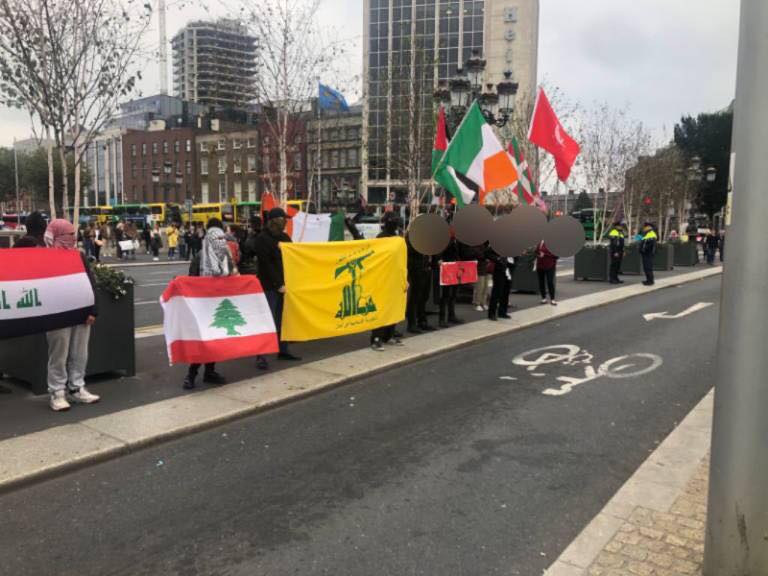
(Photo sourced: AIA social media page)

Although called at short notice, there was a great turn out, demonstrating the support of Irish Revolutionaries for the Anti Zionist Resistance.

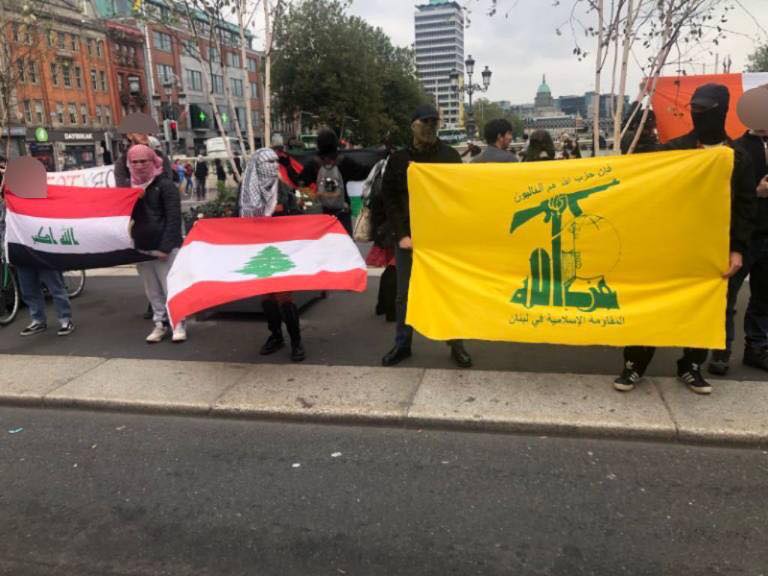
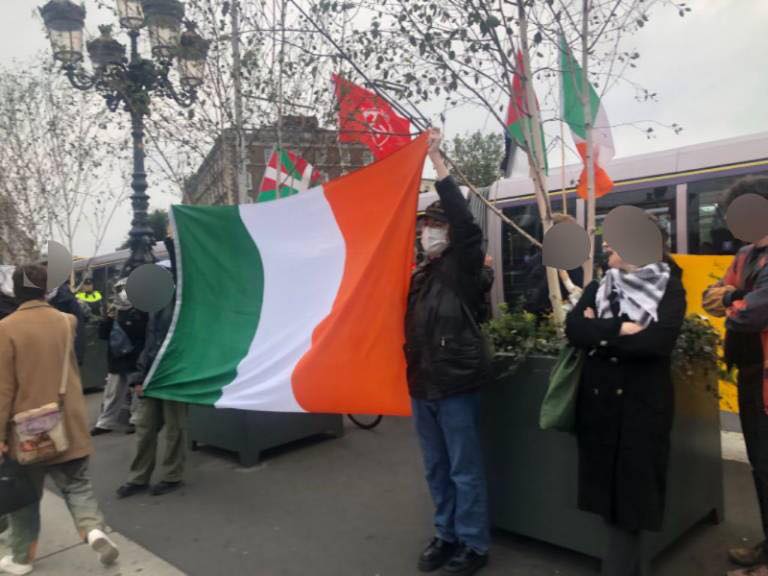
A large Hezbollah flag was the centrepiece of the demonstration and flew proudly beside Irish Republican flags including the Tricolour and Green Starry Plough of the Irish Citizen Army, Palestine, Lebanese, Iraqi and Basque national flags and the flags of the Popular Front for the Liberation of Palestine.

Chants at the demonstration included From Ireland to Palestine – Occupation is a crime! and Hands off Lebanon!. As it was culture night, two singers gave renditions of ‘We only want the earth’ by James Connolly and ‘Go on Home British and Zionist Soldiers’, a twist on the Republican classic linking the fights for Freedom in Ireland and Palestine.

(Photo sourced: AIA social media page)

The demonstration was monitored by the special branch who took photos of the participants but their presence could not stop the solidarity action with Hezbollah and the Lebanese People.

Irish Republicans will always stand with our international anti imperialist comrades in the fight against Imperialism and Zionism. AIA and SDP will continue to organise events and actions to increase our solidarity with the Anti Zionist Resistance.

(Photo sourced: AIA social media page)

Additional comment – Clive Sulish: The event was also filmed by a well-known Irish Zionist who regularly tries to intimidate Palestine solidarity activists and also tries to get the Gardaí to arrest those carrying flags of Palestinian resistance organisations.

O’Connell Bridge crosses the Liffey river dividing the north from the south Dublin city centres and is directly passed by north and southbound traffic but also closely by west and eastbound traffic along the quays.

There were many expressions of appreciation from passersby on foot, in vehicles or on bicycle.

End
.

(Photo sourced: AIA social media page)

INDEPENDENT HUNGER STRIKE COMMEMORATION DUBLIN GETS BROAD PARTICIPATION

Diarmuid Breatnach

(Reading time: 3 mins.)

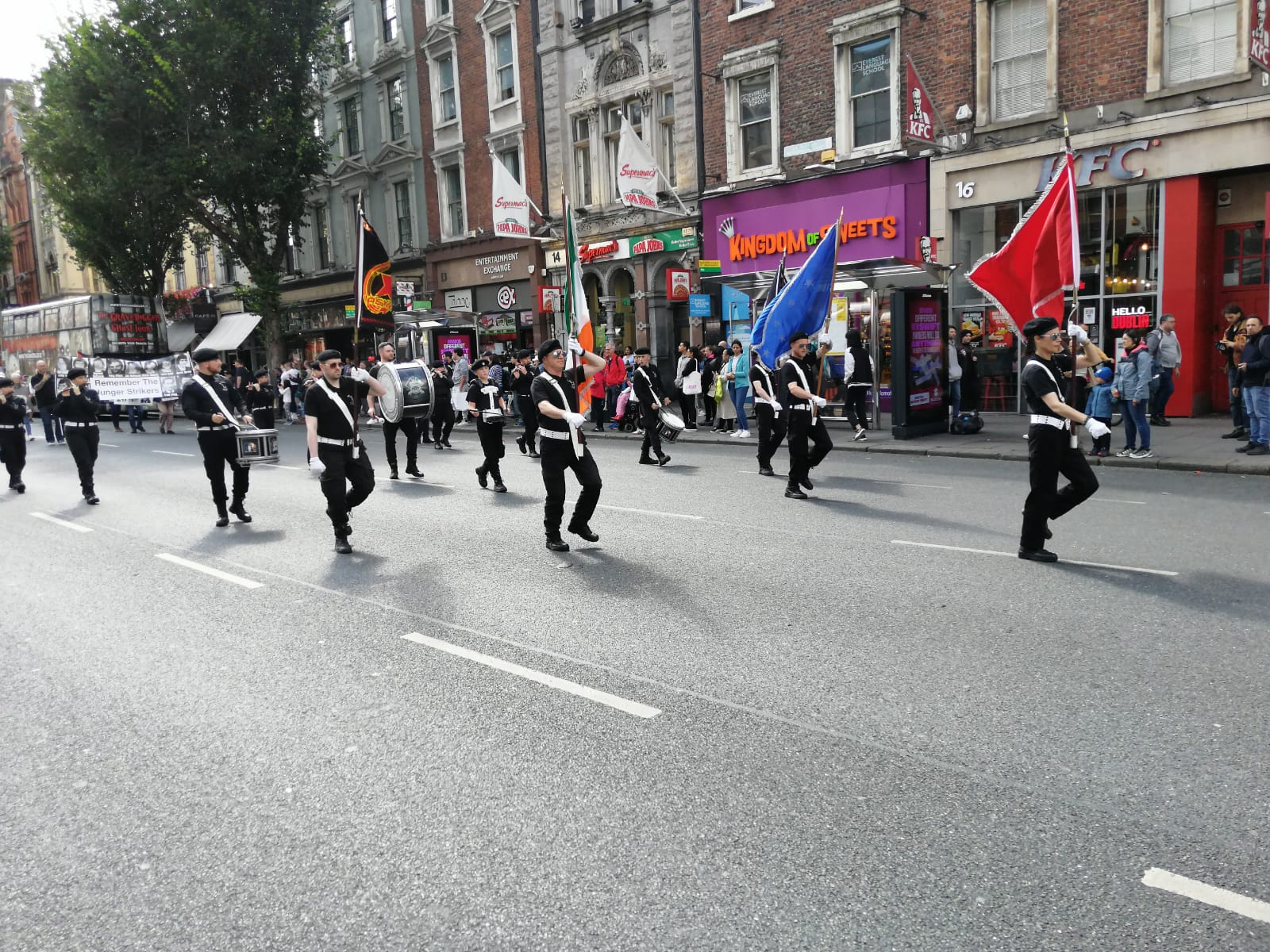
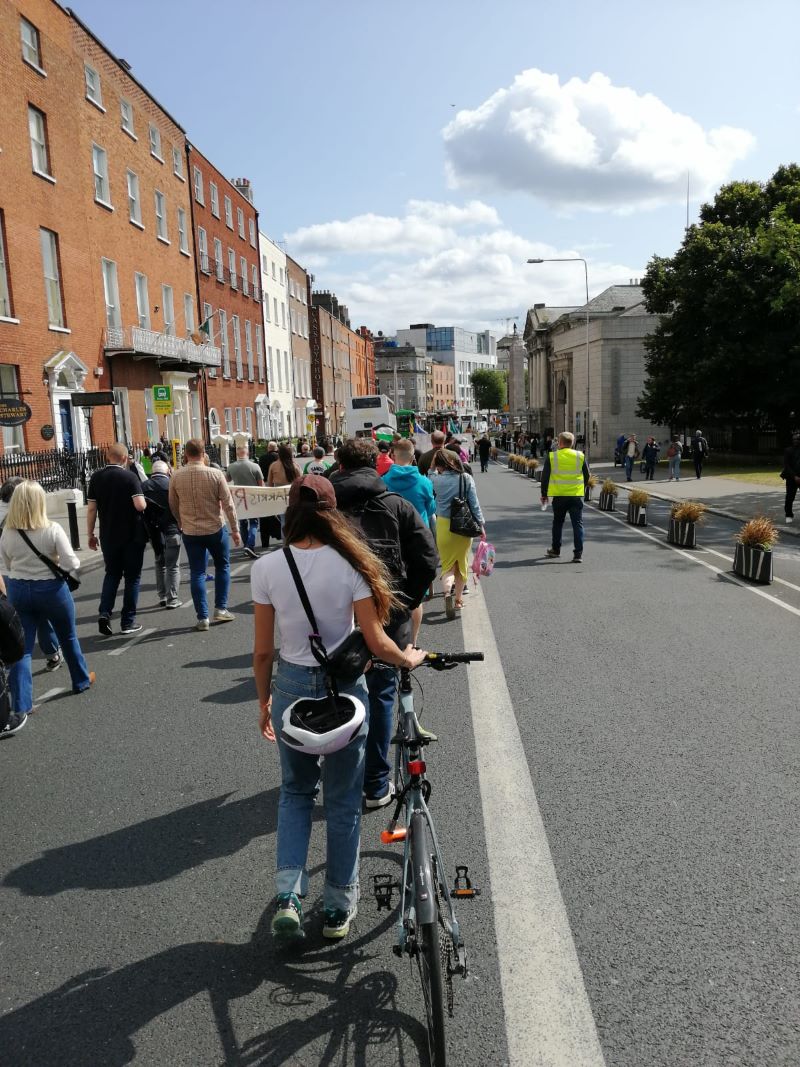
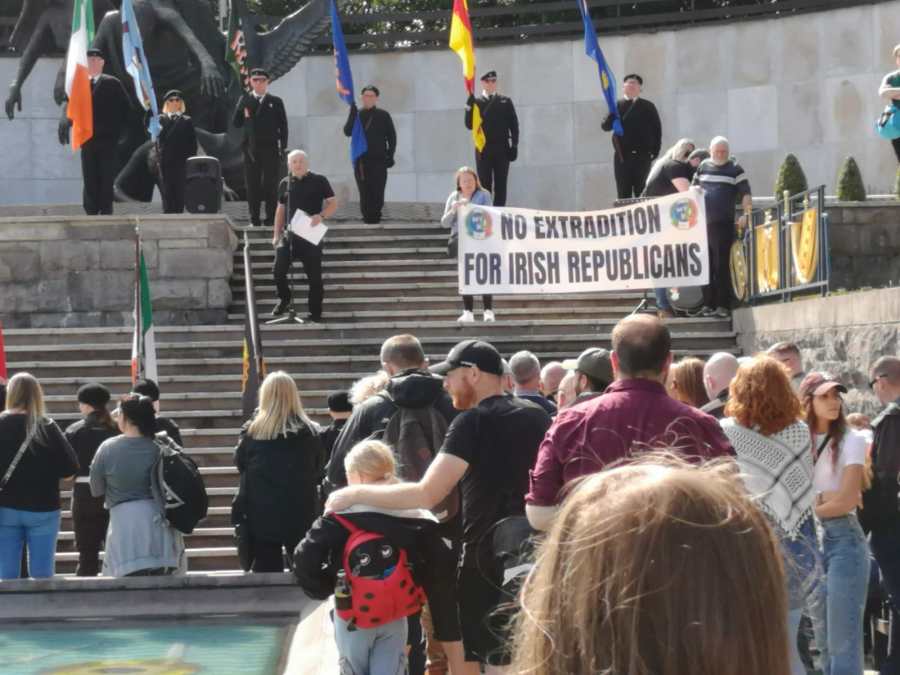
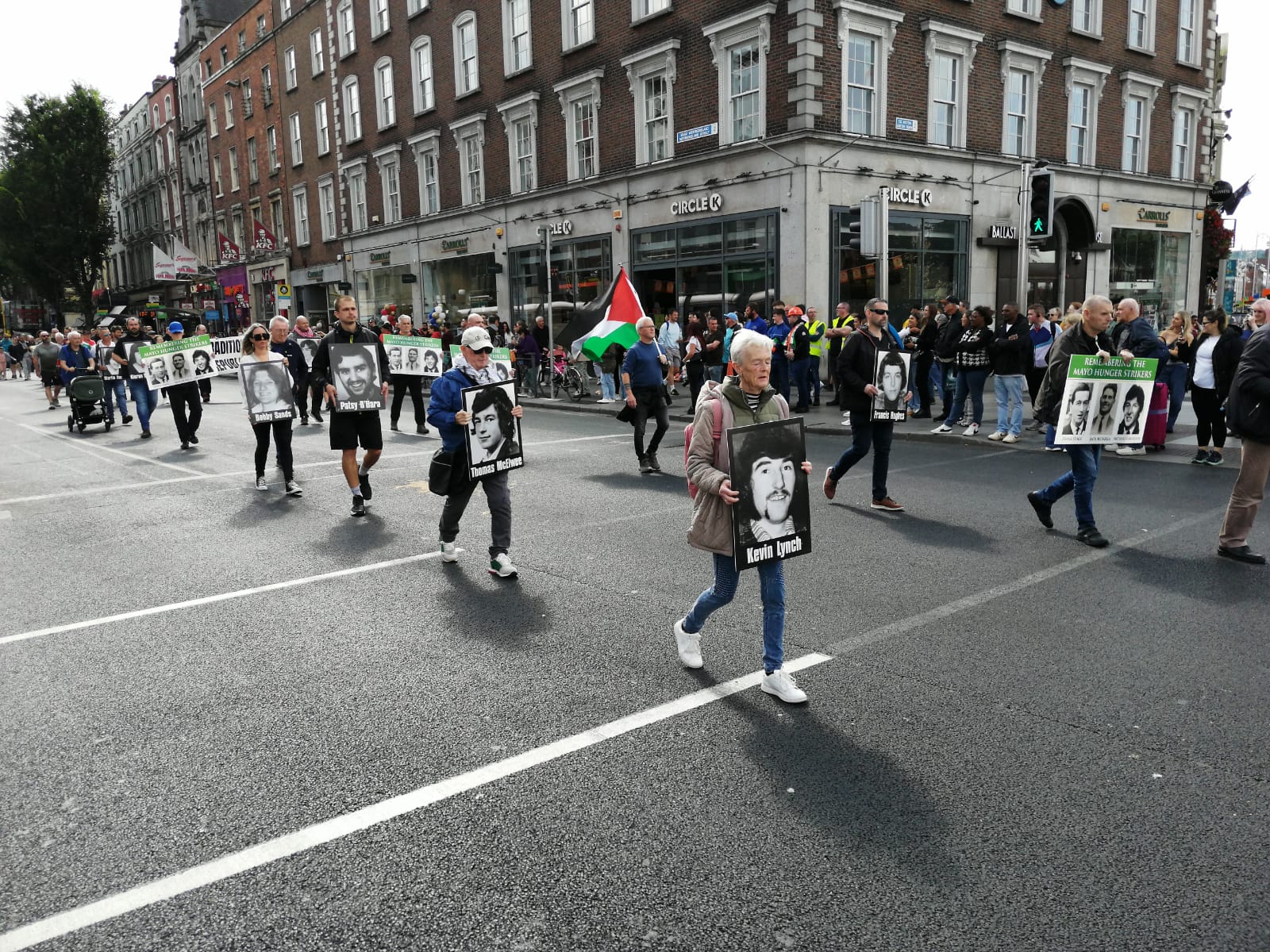
Irish Republican hunger strikers were commemorated in Dublin with a march and rally on 24th August. The event was organised by Dublin Independent Republicans and attracted representation from many groups in addition to independent activists.

Those ten Irish Republicans who died on hunger strike in 1981 are still remembered well in the general Irish population, most of all their leader Bobby Sands. However another twelve died on hunger strike in earlier days, going back to 1917, before the War of Independence (1919-’21).

Marchers in Westmoreland Street carrying images of the hunger-strike martyrs on the return to the Garden of Remembrance. (Photo: D.Breatnach)

For over a century, hunger strikes have been one of the traditional methods of protest and struggle by Irish Republican prisoners in jails of the British and also of the Irish State.

Those Republican prisoners who died on hunger strike in 1981 did so from the effects of starvation but some died through force-feeding also, which was the case with Vols. Thomas Ashe (1917), Michael Gaughan (1974) and Frank Stagg (1976).1

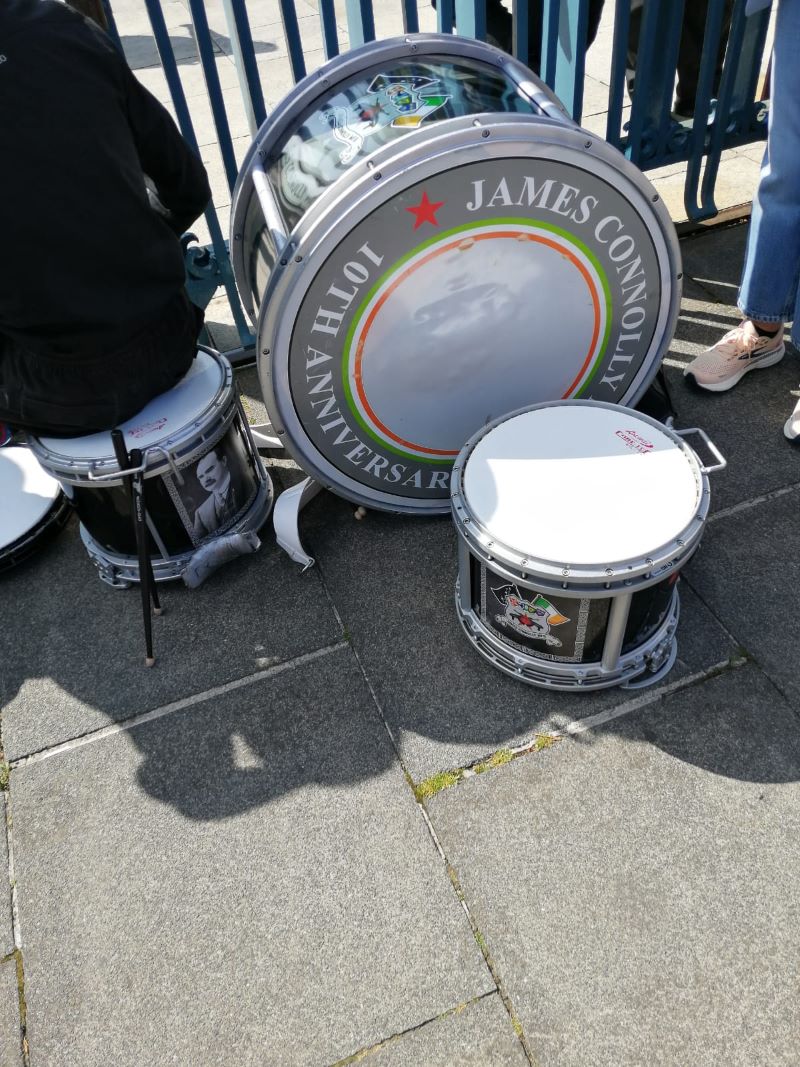
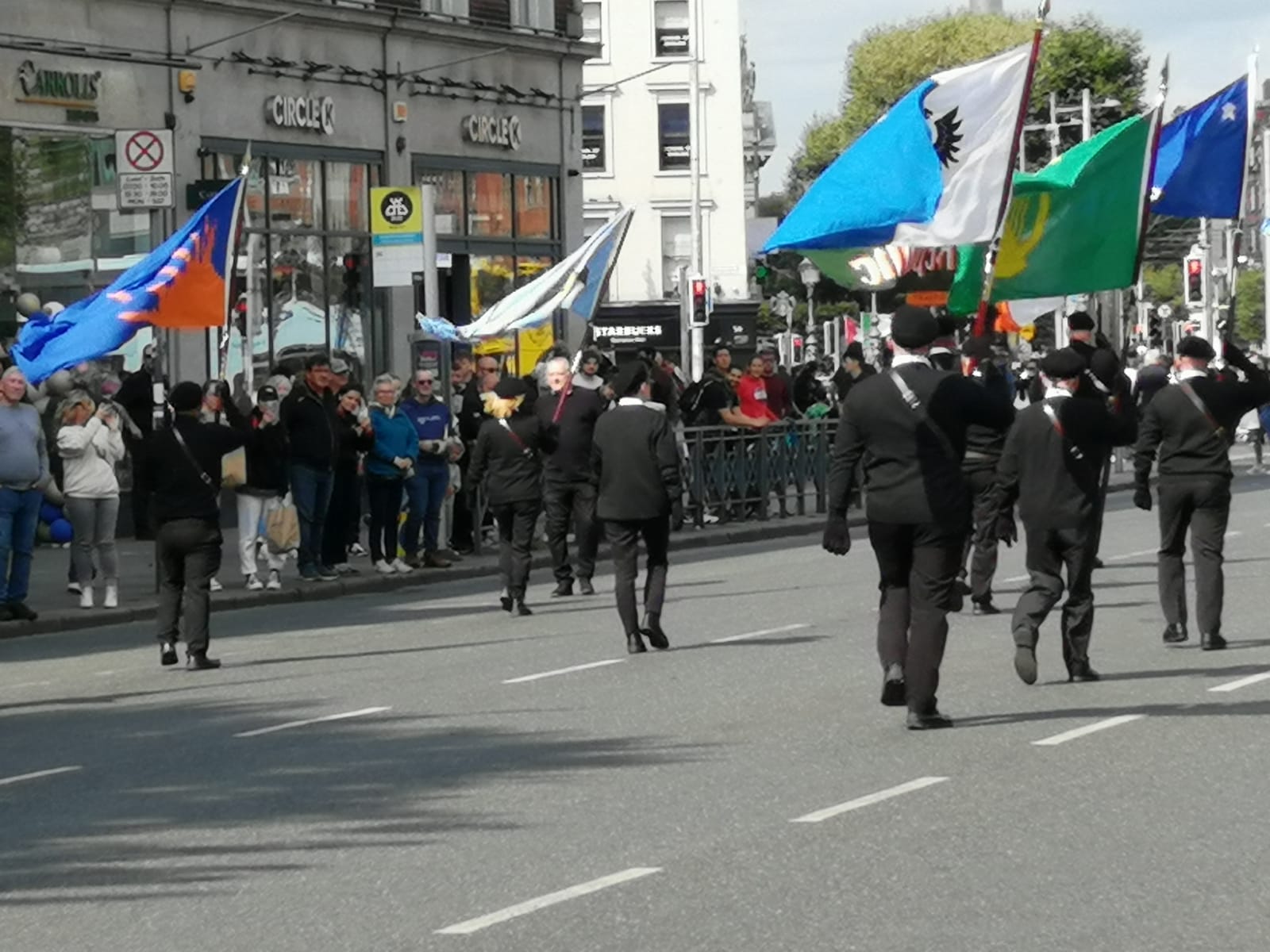
James Connolly Memorial Band with their own colour party in Westmoreland Street on the return to the Garden of Remembrance. (Photo: D.Breatnach)

PARADE THROUGH CITY CENTRE AND RALLY

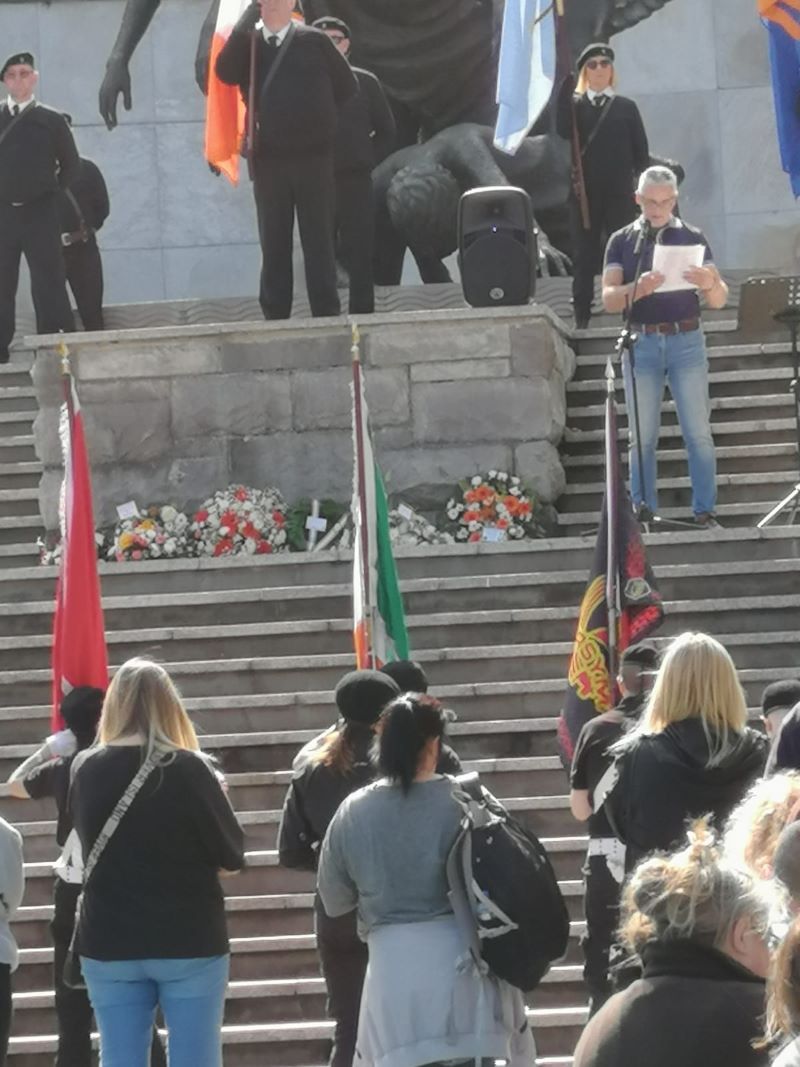
Led by a colour party,2 the parade set off in two columns3 from the Garden of Remembrance in Parnell Square with the James Connolly Memorial Republican Flute Band leading and along the City’s main thoroughfare, O’Connell Street, crossed the Liffey to ‘touch’ Trinity College and back again.

Marchers setting off from the Garden of Remembrance in Parnell Square. (Photo: D.Breatnach)

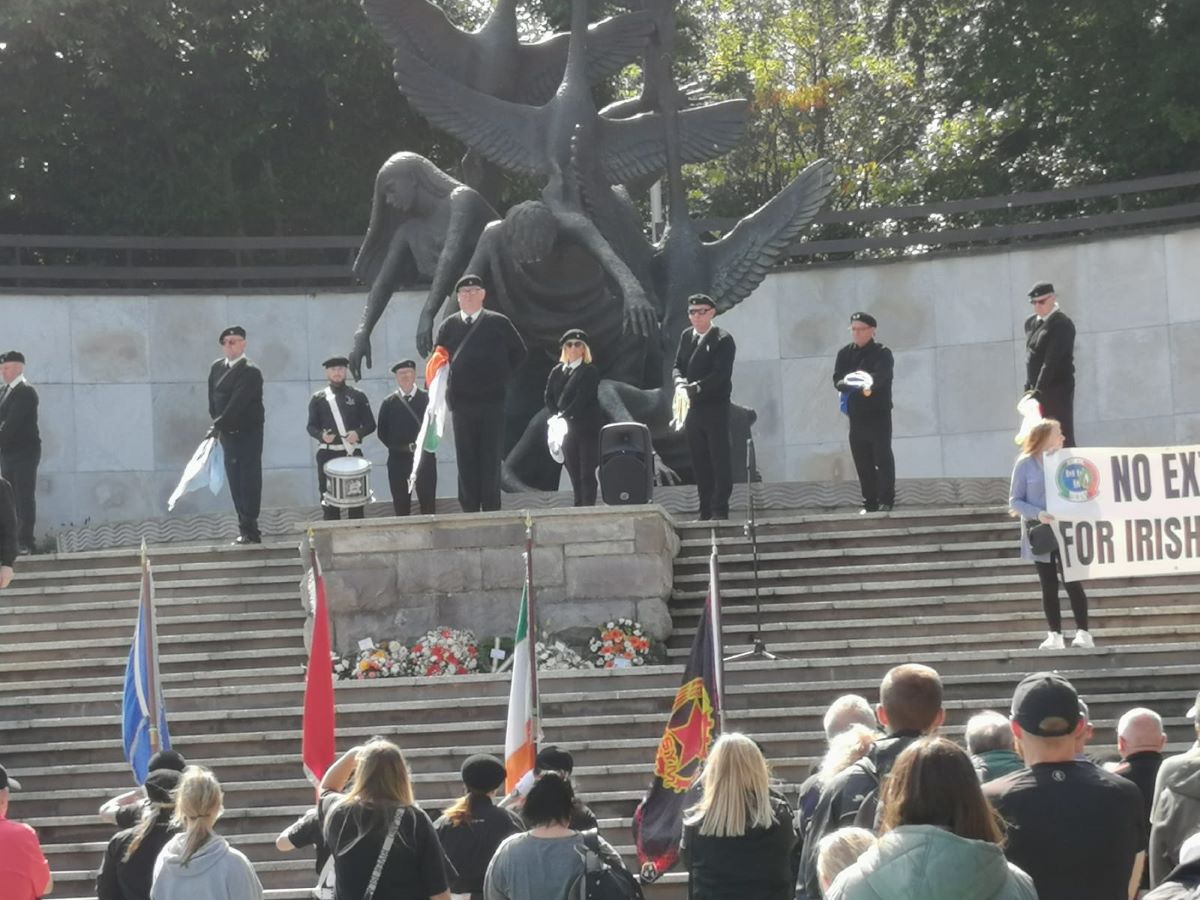
Upon returning to the Garden of Remembrance, the banners and band took up position in front of the memorial with the audience facing them, where Ado Perry as MC for the event welcomed all.

As well as recalling the struggles of Republican prisoners within the jails and deaths on hunger strike, Perry also took some time to denounce the Zionist genocide in Palestine and to express the Palestinian solidarity of Republicans (and of the majority of the Irish people).

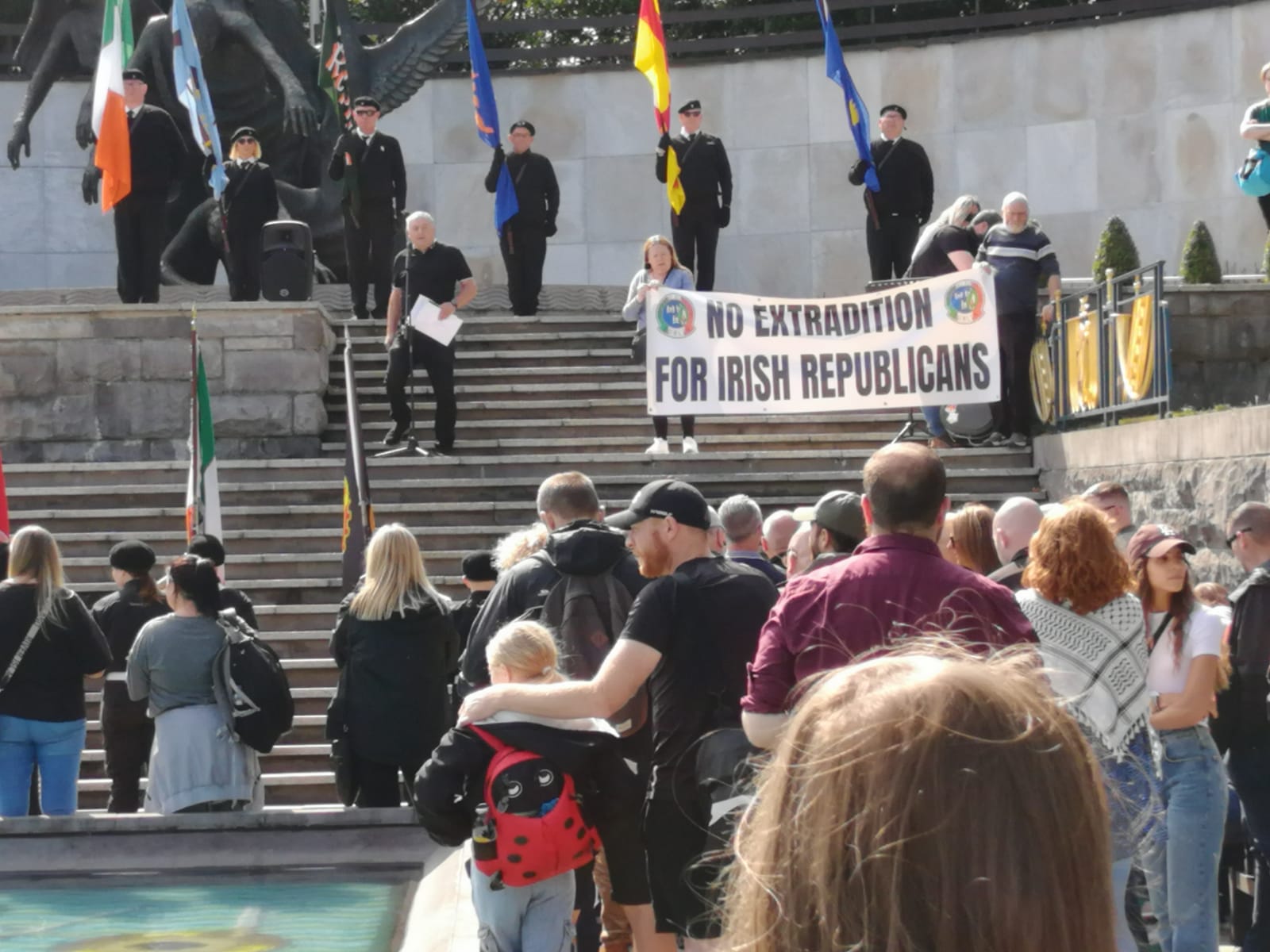
Ado Perry as MC of the rally in the Garden of Remembrance, flanked by the No Extraditions banner, the colour party behind and behind them, the Monument to those who fell in the struggle for Irish freedom. (Photo: D.Breatnach)

Perry also condemned the planned extradition of Irish Republican prisoners to British jurisdiction and called for Irish Republicans to unite in opposition, recalling the struggles against extradition over the years.

Floral tributes were laid at the Monument and Cáit Inglis read the names of the 22 who died on hunger strike, before the MC called on Cathal Graham for a song. Graham performed Wrap the Green Flag Around Me, a song that seems to have fallen somewhat in popularity in recent years.

Frankie Quinn giving his speech at the rally. (Photo: D.Breatnach)

The main speaker for the day was Frankie Quinn, a long-time Republican, community activist and ex-political prisoner who spoke first in Irish before turning to English. Quinn too condemned the genocide in Palestine and expressed solidarity with the Palestinian resistance.

In a reference to recent racist mobilisations in Ireland, Quinn made it clear that those people had nothing in common with Republicans or with the Irish national struggle for a socialist republic. (A known racist female activist had reportedly been encouraged to leave the scene a little earlier.)

The speaker was vigorously applauded and was followed by Gráinne Gibson who performed hunger strike martyr Bobby Sands’ poem The Rythm of Time.

(Photo: D.Breatnach)

Cathal Graham returned to perform The Time Has Come, a representation of hunger strike martyr Patsy O’Hara’s plea to his mother not to withdraw him from the fast when he lost consciousness, unless their demands were conceded. The colour party lowered their flags in respect to the martyrs.

Perry thanked all for their attendance in particular the marching band, colour party, performers and stewards, once again emphasising the need for united action to prevent the extradition of Irish Republicans to British jurisdiction, then called the band to perform Amhrán na bhFiann.4

The colour party leading the march out of Westmoreland to cross the river to the rally in the Garden of Remembrance. (Photo: D.Breatnach)

There was broad support for the event as shown by the participation of a number of different organisation and individual activists, which is a hopeful sign for the future. The real test however will be whether the disparate elements will act in unity as called for by Perry and Quinn.

End.

The lowering of the flags in honour of the martyrs in the struggle. (Photo: D.Breatnach)

Footnotes

1Their deaths under medically-supervised force-feeding caused the British Medical Association to oppose force-feeding of any hunger-striker in possession of normal cognition.

2The flag composition of Irish Republican colour parties varies but when flags and members are available traditionally are composed of the Irish Tricolour, the Starry Plough (blue or green version), the Sunburst and the flags of the Four Provinces. I have also seen on occasion the inclusion of a Scottish Saltere and on another, the Palestinian flag.

3More or less two columns – outside of the Six Counties marchers are unaccustomed to that formation and stewards were hard-pressed to ensure marchers kept to either one column or the other, a difficulty I remember well myself from my capacity as chief steward on a Dublin march against internment of Marion Price years ago.

4Irish language translation of The Soldiers’ Song by Peadar Kearney and Patrick Heeney, the air of the chorus which is the official National Anthem of the Irish State. At commemorations and such events it is usual for the air of both the verses and the chorus to played. In the 26 Counties it is common for people to sing along to the air played (or to a solo singer) but not in the 26 Counties. Unusually with cases of songs with versions in both langauges, it is the translated lyrics into Irish which most people know.

Useful Link

Independent Irish Republicans: https://www.facebook.com/profile.php?id=100090801607007

Wolfe Tone’s “Men of No Property”

Diarmuid Breatnach

(Reading time: 5 mins.)

Prominent among the many words quoted from Theobald Wolfe Tone, ‘the father of Irish Republicanism’, are that ‘Our Strength shall come from that great and respectable class, the men of no property’.

The interpretation of those words has led to some confusion between socialism and republicanism.

Wolfe Tone, as he is normally known historically, co-founded the Society of United Irishmen in 1791, which led a mass armed uprising in 1798 against British Rule in Ireland, as a speaker said at the Anti-Imperialist Action’s oration at their annual commemoration at Tone’s grave last month.1

Tone himself was arrested on a French ship captured by the British Navy and despite his French Army officer rank, tried on treason charges and sentenced to death upon the gallows … but died instead in prison of a wound to his throat.

Wolfe Tone Monument, Stephens Green, Dublin (Photo cred: National Built Heritage Service)

An important part of the leadership of the United Irishmen, most of the Leinster Directorate was arrested in Dublin but the Rising went ahead in other parts of Ireland, notably Antrim, Wexford and Wicklow, and another with French troop reinforcements, too few and too late, in Mayo.

The Rising was crushed, the leaders executed or exiled, along with many of their followers. A large body of Irish traditional and folk song, mostly in English and much of it composed in its centenary, commemorates the struggle and sacrifice of the United Irishmen.

The AIA speaker: “Tone’s most important belief was that we must ‘break the connection with England’ by any means necessary – one of the most important teachings for the Revolutionary Republican Movement today,” to work “for National Liberation by any means we decide necessary”.

No-one who has even the most cursory acquaintance with the historic figure of Wolfe Tone can deny that he was determined to break away from English colonial rule and, once he became convinced there was no peaceful way to do so, was determined to do it by force or arms.

Tone was also clear that the revolutionary struggle could only be successful,” continued the speaker, “if it was based on the masses of the Irish People, stating that, ‘Our Strength shall come from that great and respectable class, the men of no property’.

From that, the speaker went on to claim that “we learn from Tone that the fight for our Republic is a class struggle and that the driving force of that struggle will be the working class fighting for their own liberation.”

I do not believe that the writings or recorded words of Wolfe Tone justify that interpretation. Indeed, it would have been strange if they had; the 1798 Rising was what Marxists describe as a “bourgeois revolution”, i.e. one led by a section of the capitalist class in its own class interests.2

Such also were the Revolutions in England of 1649 and 1688, of the French in 1789 and the American in 1765-1783, the Italian of 1848, the Chinese of the early Kuo Min Tang and the Latin American revolutions against the Spanish Empire, along with the Mexican 1910-1920.

Yes, the capitalist class, which is always telling us to employ only constitutional means to get what we need or want, tries to conceal that they themselves came to power by revolution.

Colorised illustration by unknown artist of the storming of the Bastille in July 1789 (Source: Wikipedia)

The leadership of the United Irishmen was almost totally of the established Anglican church or of Protestant sects – “Protestant and Dissenter”, in Tone’s words. They were descendants of settlers from Britain and they were of bourgeois social strata.

This section of the bourgeoisie and petit-bourgeoisie were fed up with restraints imposed from England on developing the colony’s potential, on a taxation system they considered unfair, on corruption in the Irish Parliament and in management by the Monarch’s representative in Ireland.

Being only a very small minority of the Irish population3 they were aware that they needed the mass behind them in order to build an independent national economy, for which they tried to gain Catholics admission to the Irish Parliament, which at the time only admitted Anglicans as MPs.

When Henry Grattan, who had earlier led quite a rebellious Irish Parliament,4 failed in the attempt to make Parliament more representative, Tone and many others became convinced that only revolution could progress society in Ireland and from then on he strove to bring that about.

Grattan

Statue of Henry Grattan, failed reformer of the Irish Parliament, situated in Dame Street junction with Grafton Street and facing Trinity College. (Photo cred: Trip Advisor)

A revolution against England, a great European naval power, even with the help of revolutionary France, would require mass participation and support, as the AIA speaker remarked at the commemoration. So Tone aspired to the unity of “Catholic, Protestant and Dissenter.”

The section of the religions that most fell into the category of the “men of no property” were of course the Catholics, dispossessed of their lands and under Penal Laws of the Occupation. Without the support of the Catholic majority there was no chance of a successful revolution.

Tone may well have been a most democratic Republican in favour of all kinds of progressive social reform but nowhere in his writing does he advocate the overthrow of the bourgeoisie, seizure of private property and the setting up of a socialist system to be run by the working class.

united men

Reenactment of the United Irishmen in battle, depicting the “men (and women) of no property. (Photo sourced: Internet)

Theobald Wolfe Tone was a courageous democratic revolutionary, anti-colonial and a martyred patriot but was not nor could have been a socialist leader. That which he was, was the best of his time and among the best we had to offer and there is no need to try to make him something else.

The United Irishmen represented a section of the Irish bourgeoisie that was truly Republican and revolutionary. That section of society was mostly of settler descent since the mass of the native and Catholic population had been ground down and oppressed.

Thereafter most of the native Irish bourgeoisie developed as a subservient client class, “Castle Catholics” ag sodar i ndiaidh na n-uaisle,5 up to whatever “cute hoor”6 and gombeen7 tricks they could get up to but without a fraction of the spine necessary to fight for real independence.

A successful Irish national revolution does indeed need to be led by the Irish working class as demonstrated by what James Connolly – rather than Wolfe Tone – observed: “Only the Irish working class remain as the incorruptible inheritors of the fight for freedom in Ireland.”

The reason for that, as outlined by Connolly, is quite simple: the working class is the only social class of any size that has nothing to gain from compromise and betrayal of the revolution.

Some other key points laid down by Tone, continued the speaker, include that Republicanism is Anti Imperialist and it is Internationalist. Our struggle in Ireland is part of a wider international struggle of oppressed people against occupation, colonialism and imperialism.

Tone understood this when he looked to Revolutionary France to support the 1798 uprising.

This was well understood by Irish Republicans of Tone’s time who celebrated the fall of the Bastille in 1789 and the defeat of the English by the settlers in America. The United Irishmen also helped the creation of the United Englishmen and led two of the British Navy’s most serious mutinies.8

Today, continued the speaker, Republicans must fight our struggle while also supporting Liberation struggles around the world in the belief that every blow struck against imperialism brings our victory closer.

So from Palestine to the Philippines and from India to the Basque Country, and everywhere people take a stand against NATO, the Revolutionary Republican movement must raise our cries in solidarity.

End.

Footnotes

1The event was organised by Anti-Imperialist Action, a socialist republican organisation, with the oration being given on behalf of the organisation. A pilgrimage to Wolfe Tone’s grave in Bodenstown is a fixture on the calendars of most Irish Republican organisations.

2This should not be taken as a criticism since Marxists agree that many bourgeois revolutions were progressive in their time.

3Tiny, in the case of the Anglicans in particular; the Presbyterians were much more numerous.

41689-’91.

5Irish language: “Trotting after the nobles.”

6An admiring description in Ireland for one who manages to benefit by dubious means.

7Corruption of an Irish language term for the ‘carpet bagger’ types who benefited amidst the disaster of the Great Hunger in the mid 19 Century, snapping up land in particular at the lowest of prices.

8The Spithead and Nore naval mutinies, 1797.

Sources

THAT FLAG IS NOT THEIRS – BUT IT’S NOT YOURS EITHER!

Diarmuid Breatnach

(Reading time: 6 mins.)

The Irish Tricolour has been in the news recently in an unhappy circumstance. The flag was featured borne in a group of anti-immigration racists carrying a banner declaring Coolock Says No,1 next to Union Jacks2 and Loyalist flags at a Belfast riot.

This was a bizarre juxtaposition given that Loyalists are hostile to any signs of Irish Republicanism, of which the Tricolour is chief among its historical symbols. Furthermore, the Unionist state banned its public display in most situations between 1954 and 1987 leading to resistance and arrests.3

In the sectarian society created by the British in its occupied Six County colony, the Tricolour is burned annually on British Loyalist bonfires and is reviled by Unionism and its more extreme progeny, Loyalism, which in turn is associated with state-sanctioned sectarian murder gangs.4

The strange juxtaposition was remarked upon in mass media not only in Ireland (both sides of the Border) but even in Britain — and Irish State Taoiseach (prime minister) Simon Harris remarked that he found the flag in association with racism to be “repugnant”.5

But does Harris have the moral right to make that comment?

Origin and History of the Irish Tricolour

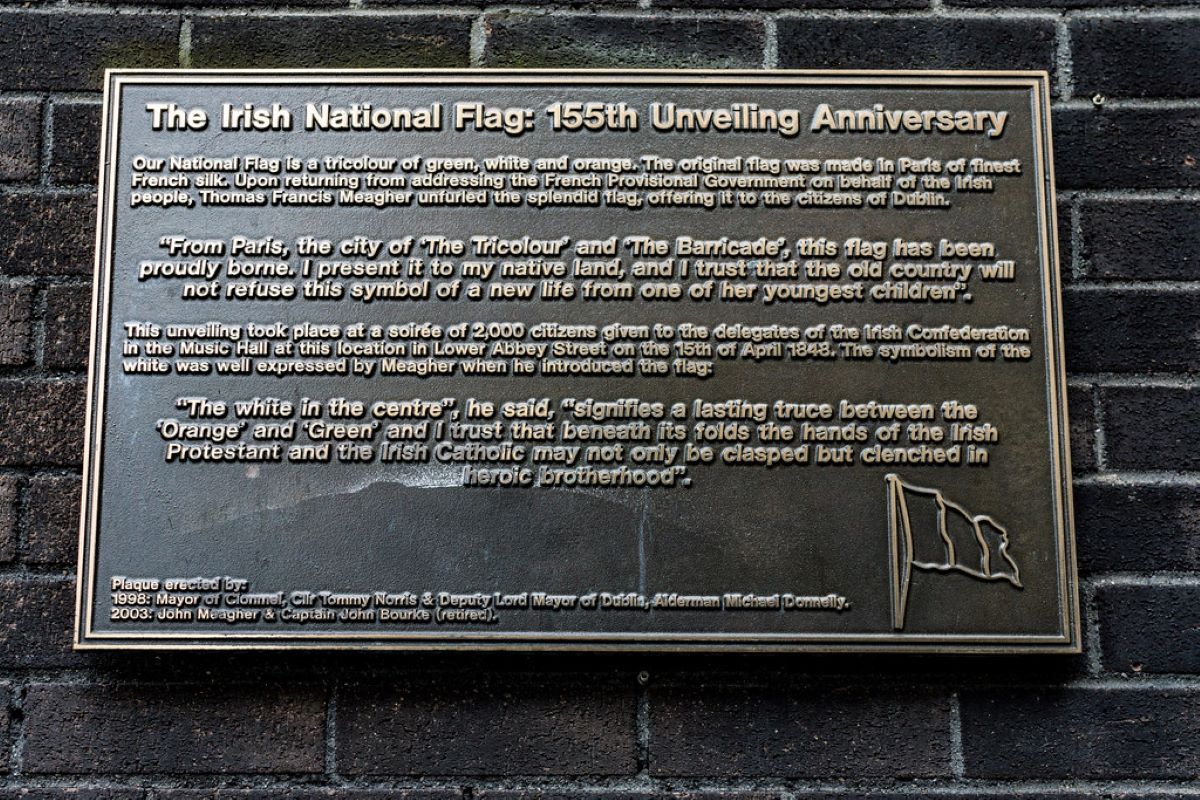
The Tricolour as we know it and its use dates from its sewing in silk by revolutionary women in Paris in 1848 and presentation to a delegation of the Young Irelanders, a revolutionary Irish Republican group of that period and its subsequent unfurling in Ireland by Thomas Meagher.

Thomas Francis Meagher as captain in the Union Army (Source: Drawing in Library of Congress, USA)

Irish revolutionary Thomas Francis Meagher was convicted by the English Occupation of sedition during trials around the planning and carrying out of the Irish Rising of 1848 and, with death sentence commuted, transported to Australia as a felon, from which he escaped to the USA in 1852.

As the American Civil War approached, Meagher, along with most of the Irish in the USA took the side of the Union, leaving only a rump following Mitchell, formerly a comrade of the Young Irelanders, to side with the slave-owning Confederacy in the conflict.

Meagher not only fought in the Union Army in the American Civil War against the slave-owning Confederacy, gaining the rank of Brigadier but he and his wife raised a regiment, the 69th New York Infantry, unofficially called The Irish Brigade or even Mrs. Meagher’s Own.

Plaque in Lower Abbey Street (opp. side of Abbey Theatre) to the first unveiling of the Irish Tricolour in Dublin, 1848. (Source: Internet)

The Young Irelanders were Republicans and the Tricolour was always seen not only as embodying the unity of all in Ireland, regardless of origin, against the British occupation but also for national liberation, against Monarchy and for complete separation of Church and State.

In addition, it had a strong internationalist element in that it was associated with revolution throughout Europe, presented to us in solidarity by French revolutionary women and flown alongside French Tricolours in Ireland at celebrations of the French revolution of 1848.

It was the principal flag of Irish anti-fascism too in the 1930s when Irish Republicans fought the fascist Blueshirts on Irish streets and a number of them went to fight in defence of the Spanish Republic against the fascist military coup of Franco and his Nazi German and Italian Fascist allies.

More recently when Irish Republicans and socialists mobilised against the attempts of the Irish ruling class to promote NATO and to ease cooperation with that alliance of Western imperialism, Harris also ranted against supporters of Anti-Imperialist Action flying of the Irish Tricolour.

The Tricolour among Loyalists was of course newsworthy and was covered by Irish mainstream media and Unionist mouthpiece The Belfast Telegraph along with photos by The Guardian on line. But all without comment on its presence in Palestine solidarity events in London.

Irish Tricolours have been flown at every current Palestine solidarity march in London (ten of them at the most recent London march) and, along with Saoirse Don Phalaistín printed on the Palastinian flag, have been seen also at university solidarity encampments and at events to free Julian Assange.

Section of Palestine solidarity protest at Barclays Bank, Tottenham Road, London on 24th April this year, showing Irish Tricolour and Saoirse Don Phalaistín flags. Zionists and British fascists are united in opposition to them across the road. (Photo cred: Northern Times)

The Tricolour Flown by Racists and Fascists?

Given its origins and history, why is the Tricolour being flown by fascists?

In recent years it seemed that whenever one saw a crowd with Tricolours among them, it was most likely a fascist or at least racist-led event. One reason for this is that the fascists historically try to portray themselves as nationalists, i.e organising ‘for the nation’.

In all cases historically, the “nation” represented by the fascists turned out to be that of the ruling class, the financial and industrial elite – never that of the working people, not even of those sections of the lower middle class that supported the rise of fascist movements.

Fascists however have also frequently colluded with the invader of their nation, for example with the Nazis in Europe, particularly in France, Greece, Yugoslavia, Ukraine.6 The fascists in Ireland today represent the neo-colonial,7 colonial and imperialist financial-industrial interests in Ireland.

Racist group from Dublin suburb finds common cause with British Loyalists in Belfast anti-immigration demonstration and riots 3 August 2024 (Photo cred: Irish News)

In that context, the unity of fascists from the Twenty-Six Counties with Loyalists from the Six Counties is not surprising, nor even with notorious English fascist Tommy Robinson. Prominent Irish fascists have had friendly interactions with Loyalist Jim Dowson and British fascist Farrage.

Portraying themselves as saviours of the nation, as moral guardians etc., just as the German Nazis did in the 1930s is hypocritical but absolutely necessary for them. If they revealed the class interests they represent and the kind of regime they really want, where would they get supporters?

The fascists are few and need those supporters, their easily-led mobs and stormtroopers. It is among sections of the down-trodden in society that they will find them, the ignorant, marginalised, abandoned by the capitalist system but all too often by the liberals and the Left also.

Substance addiction, mental illness, crime and cultural poverty is rife in these communities and it is sections of those who are presented with false enemies – migrants, LGBT people, muslims – by false saviours masquerading as patriots. Many in those communities are ripe for manipulation.

But the attempted takeover of the Tricolour and subversion has not occurred by Fascist manipulation and through historical and political ignorance alone.

When antifascists mobilise, rarely is the Tricolour seen amongst them, assisting the impression that it is the racists and fascists that are representing the nation. Understandably, Anarchists may not wish to fly the flag of a state and socialists may feel that the flag is representing a capitalist state.

Often too in the past, Republicans have been absent from antifascist mobilisations but on occasion too went to them ready for physical confrontation and therefore without flags. But what message do antifascists think is presented by Palestinian flags among them and Tricolours on the other side?8

Invited to speak at a conference on anti-fascism in Dublin some years ago, I raised the question of the appropriation of the Tricolour by fascists and how it was necessary for the antifascists to show it among themselves also but my recommendation did not win approval9.

It is depressing to see that the situation has not noticeably improved in this regard some years later.

A welcome recent exception to the rule: a number of Irish flags including the Tricolour among antifascists outnumbering fascists and racists in Dundalk, Co. Louth on 4 August 2024 (the day following the Belfast racist riots). The fascists and racists had to be escorted out of town by the Public Order Unit of the Gardaí (Source photo: Anti-Imperialist Action FB site)

The Irish state and the Tricolour

It took some time for the Tricolour to be adopted as the national flag in the Republican movement until its fluttering above the GPO at the Henry Street Corner during the 1916 Rising.10 Thereafter it represented the forces of national liberation in the War of Independence (1991-’21).

The Irish Tricolour (Photo cred.: Getty Images)

Facing treason and counter-revolution in 1922, it was the flag of the Anti-Treaty forces, the neo-colonial traitors only flying it in order to deny it to the Irish Republicans. Despite that fact it has remained the flag of Irish Republicanism, irreconcilable with neo-colonialism, racism or fascism.

Republican women activists of Cumann na mBan designed ‘Easter Lilly’ paper lapel pins to raise funds for dependants of Republicans imprisoned or killed during the Civil War and they did so in the colours of the Irish Tricolour: Green, White and Orange. The emblem is worn to this day.

The counter-revolutionary faction that spawned the fascist Blueshhirts11 did not formally adopt the Tricolour as the State flag in law, that was done by the next wave of counter-revolution, Fianna Fáil,12 while in government, situating it in the 1937 Constitution.

The Tricolour is in a sense the flag of everyone in Ireland who does not reject it or defile it but evidently too, in its origins and among those who bore it forward, it is anathema to racism.

Furthermore, it is symbolically anathema to colonialism, loyalism, neo-colonialism and monarchy. Clearly the Tricolour is not legitimately the flag of racists and fascists but neither is it of the gombeen regime that flies it; Harris and the neo-colonial State claiming it is also repugnant.

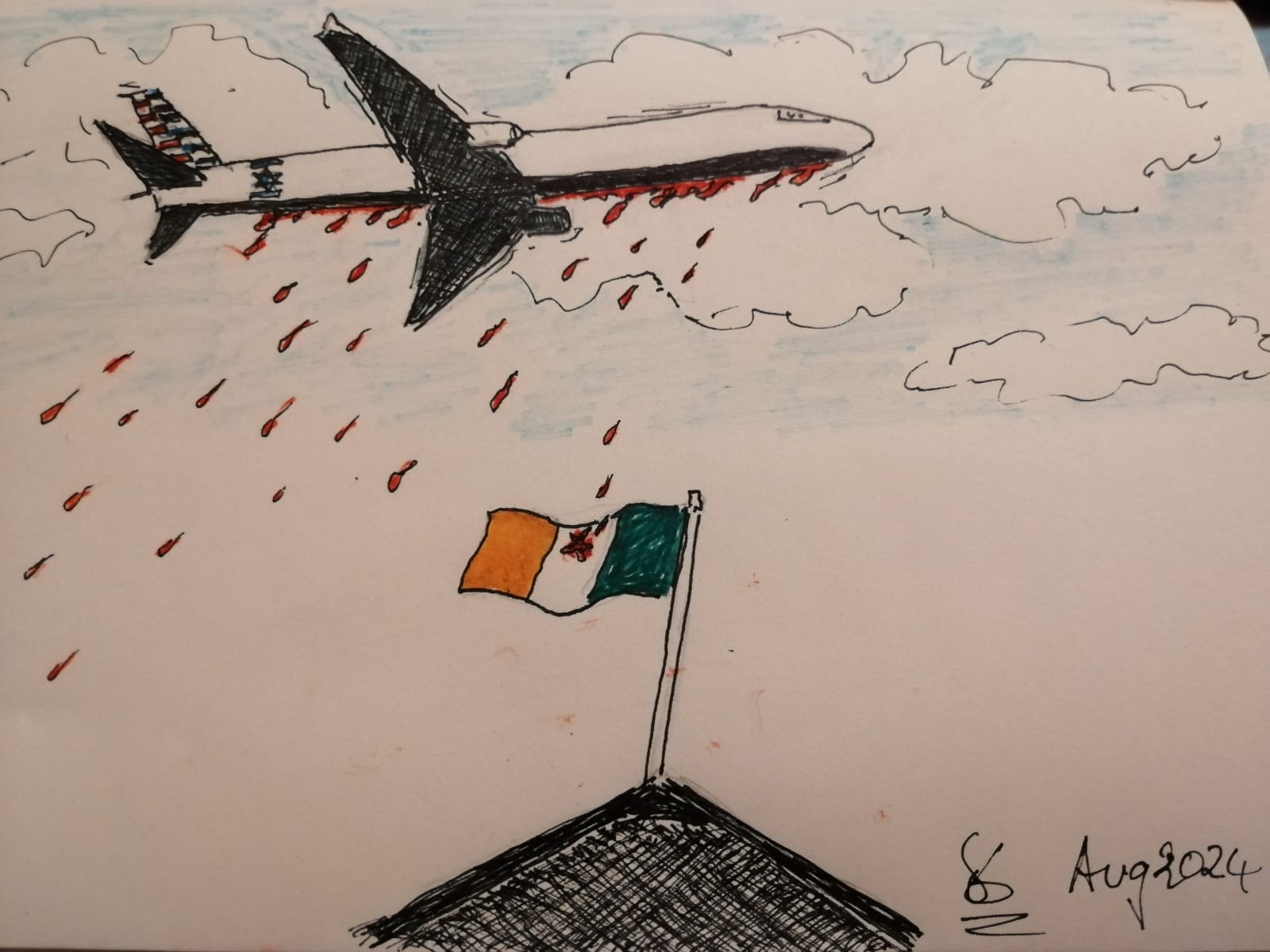
Effigy of Simon Harris showing the bloody hands of collusion in the ‘Israeli’ genocide against Palestinians at a Palestine solidarity protest last weekend (organised by Mothers Against Genocide, North Wicklow Against Genocide, Arklow Against Zionism) at the annual Bray Air Show which features UK Military fliers. (Photo cred: Aisling Hudson)

End.

FOOTNOTES

1Coolock (from the Irish place-name An Chúlóg) is a Dublin city suburban district that has seen riots and arson recently against plans to house refugees in a disused factory building there.

2Common name for the flag of the United Kingdom, more derogatorily known as ‘The Butcher’s Apron’, featuring heraldic cross and salterres of the nations of England, Scotland and Ireland (Wales had already been conquered and incorporated into the Kingdom of England).

3https://en.wikipedia.org/wiki/Flags_and_Emblems_(Display)_Act_(Northern_Ireland)_1954

4Such as the Ulster Defence Association and the Ulster Volunteer Force (see also ‘the Glennane Gang’) which targeted most of their victims on the assumption of their being of the Catholic faith but also occasionally those from the Protestant community they considered disloyal (see ‘the Shankill Butchers’) or with which they were in competition around gang crime. All operated with colonial police and British Army assistance.

5https://www.irishtimes.com/ireland/2024/08/04/cafe-and-supermarket-burnt-out-after-anti-immigration-protests-in-belfast/

6These fascist groups supplied police and auxiliary units to the Nazi occupation, collecting information on the antifascist Resistance and on fugitive Jews and Roma. In some cases, as in Ukraine, they also acted as prison and concentration camp guards (but their chief leader, Stepan Bandera, was nominated as a national hero by the current Kiyv regime).

7Sometimes called ‘comprador capitalist’ or ‘client regime’, a term describing a state that is nominally independent but is under the actual domination of an external state or states. The Irish state has been in turn dominated by Britain, the USA and the EU imperialists.

8This is an issue on Palestine solidarity marches and pickets upon which I have also commented before.

9A speaker from a very sectarian migrant group ridiculed the idea but no-one else spoke up in support.

10Incidentally, at the other corner of the GPO above Princes Street in 1916 flew the green flag with the words “Irish Republic” inscribed upon it in white and gold letters, which had been created for the occasion in the home of Constance Markievicz, socialist revolutionary of a settler landowning family and born in London. And the man who erected it was Argentinian-born-and-raised Eamon Bulfin. It is ironical in the extreme that this flag also is sometimes brandished by Irish racists opposing immigration.

11Irish fascist organisation officially called the Army Comrades Association (later The National Guard), led by former Gárda Commissioner Eoin O’ Duffy which later joined with two conservative parties to form the current Fine Gael, currently in the Coalition Government with its erstwhile opposition Fianna Fáil and the Green Party.

12A major split from Sinn Féin in the early 1930s, currently in the Coalition Government with its erstwhile opposition Fine Gael and the Green Party.

SOURCES

https://en.wikipedia.org/wiki/Flags_and_Emblems_(Display)_Act_(Northern_Ireland)_1954

https://en.wikipedia.org/wiki/Shankill_Butchers

References to the Tricolour at Belfast racist riots: https://www.irishtimes.com/ireland/2024/08/04/cafe-and-supermarket-burnt-out-after-anti-immigration-protests-in-belfast/

https://www.belfasttelegraph.co.uk/news/northern-ireland/far-right-irish-thugs-spent-night-drinking-with-uda-in-belfast-loyalist-bar/a1541636214.html

Origin & History of the Irish Tricolour: https://www.1916rising.com/cms/history/leaders-soldiers-and-poets/history-of-the-irish-flag/

Important Call for a United Resistance Front

Diarmuid Breatnach

(Reading time article: 3 mins.)

Earlier this month there was an oration delivered at the grave of Wolfe Tone1 which contained some important elements which deserve inspection and discussion.

The path to rebuild our struggle is the development of an Anti Imperialist Broad Front – said the speaker. – A United Front of Revolutionary republicans, working in cooperation to advance our common republican objectives and to achieve a common republican programme.

Looking around us at the parties and groups in the socialist and republican spectrum, the ostensibly revolutionary varieties, we see that for many of them, building up their own organisation takes precedence over anything else, including revolution – for them the revolution IS their party.

Speaker giving oration at Wolfe Tone’s grave in front of the monument, faced by colour party. (Photo: RSM)

The call given in this oration runs counter to that kind of thinking. “But we’ve heard all that about ‘unity’ before,” a reader might say. Yes we have and often “unity” meant only “unity” around that particular party or, even more often, around this or that leadership.

There is nothing of that to be found in this address “recognising and respectful of the autonomy and independence of the groups and independents involved”. “Hmmm,” the reader might say “but is it a genuine intention?” Given our experience, it’s a valid and important question.

The most dependable test is in the practice. The speaker of the oration at its annual Wolfe Town Commemoration2 was representing the Socialist Republican Movement organisation (more often manifested publicy in recent years in the form of the Anti-Imperialist Action broad group3)

As an independent revolutionary activist for many years I have often participated in AIA’s actions and at times they have supported actions of which I had been part of organising. I have found that their practice matches their words and there is no truer test.

The speaker followed with practical suggestions for the implementation of the broad front: Trust and co-operation must be developed … through activism and the development of National Republican Campaigns that can be taken up by all Republican groups and independents …

There are many campaigns that could be developed from support for POWs to opposing internment and extradition, environmental campaigns such as (overcoming) the unacceptable situation at Lough Neagh, to campaigns that oppose the British and NATO presence in Ireland.

One of the banners in the crowd at the event in Bodenstown. (Photo: RSM)

Such a Republican Broad Front would be a fitting tribute to our Patriot Dead, the speaker added, to martyrs like Cathal Brugha,4 who gave his all in fighting for the sovereign, Independent Irish Republic and gave his life on this day in 1922 as a hero in the war in defence of the Republic.

In many of the pleas for unity of the fragmented resistance in Ireland, individuals have called for a conference to form a united front, others called for a unity document of principles around which to unite while in at least one case, two distinct organisations merged.

I have for years spoken out against such endeavours and advocated as a first step unity in practice. If organisations and individuals are not capable of that step, what kind of unity can they achieve around discussion of documents? Unity in practice also helps to break down distrust.

The speaker at the Wolfe Tone commemoration takes the same line, presumably speaking for the SRM when he does so and one supposes that this will continue to be the approach of the AIA in campaigns such as against internment, in solidarity with political prisoners5 or with Palestine.6

The above piece discussed two elements of the oration given by the SRM earlier this month which I believe to be of great revolutionary importance and in need of application in Ireland, one in advocating a principle and the other in suggesting avenues for practical application.

Later I will be taking a look at some other elements in that talk (the text of which, as published by the SRM, I attach as an appendix).

Beirimís bua.

(Image sourced: Internet)

End.

FOOTNOTES

1Wolfe Tone, born into settler stock and of the Establishment Anglican congregation, was a leading figure in the formation of the revolutionary republican organisation The Society of United Irishmen, seeking “to unite Catholic, Protestant (i.e Anglican) and Dissenter” (i.e the other sects, Presbyterian, Methodist, Unitarian, Quaker etc.) to “break the connection with England. In 1798, the year of the Unitedmen uprising, the first of many Irish Republican uprisings and campaigns, Tone was captured by the British Navy on a French warship and, despite his French officer rank, tried and sentenced to death.

Tone died in jail some months before his brother Matthew was taken prisoner during the surrender at Ballinamuck (Baile na Muc) in Co. Longford of another French expedition to Ireland, late and too small, at the tail end of the Rising that year. Also ignoring his officer POW status, he was hanged in Dublin and his body reputedly thrown into the mass grave at Croppies’ Acre in Dublin city.

2Since even earlier than Thomas Davis’ (1814-1845) song In Bodenstown Churchyard, Irish Republican organisations and individuals have been making the pilgrimage to that grave in County Meath, at times with thousands in attendance.

3Also for an intense time as the Revolutionary Housing League in its attempt to spark a movement of occupation of empty properties to overcome the widely-acknowledged housing crisis in Ireland.

4Cathal Brugha (nee Burgess), son of a mixed Catholic-Protestant marriage, was a leading figure in Irish nationalist movement and in Republican rebellion in the last decades of the 19th and early decades of the 20th Centuries, learned Irish as a member of the Gaelic League, member of the Irish Republican Brotherhood (which he later left, considering it undemocratic), officer in the Irish Volunteer, 2nd in command in the South Dublin Union in 1916 served as Minister for Defence in the revolutionary government from 1919 to 1922, Ceann Comhairle of Dáil Éireann in January 1919 and its first president from January 1to April 1919, Chief of Staff of the IRAfrom 1917 to 1918. He served as a TD (electe parliamentary representative) from 1918 to 1922. He was mortally wounded by Irish Government troops in the early days of the Irish Civil War.

5Both on their own and for example in support of the Ireland Anti-Internment Campaign.

6Both on their own and for example as part of the Saoirse Don Phalaistín broad front.

APPENDIX

The following is the text of the main oration of which some sections are discussed in the preceding article and more to be discussed anon. It was delivered at the annual Wolfe Tone Commemoration at Bodenstown, organised by the Revolutionary Irish Socialist Republican Movement on Sunday July 7, 2024 and published on its Telegram page.

A Chairde is a chomrádaithe,

Táimid anseo i relig bodenstown ag uaimh ár n-athair, Wolfe Tone agus táimid ag rá go bhfuil an gluaisteacht a bhunaigh sé fós beo, agus tá sé ag fás arís.

Wolfe Tone is the father of Irish Republicanism. We come here each year not just for commemoration, but like Pearse, Connolly, Mellows and Costello before us, we come because we believe that the ideas and the vision that Tone put forward of a free independent Ireland is as relevant today as they were in the 1790s and because we believe that by remaining true to the teachings of Wolfe Tone we can build a revolutionary movement that will successfully free our country. Maybe not today, but our freedom is inevitable.

Tone’s most important belief was that we must ‘break the connection with England’ by any means necessary. It is for this reason that he established revolutionary military-political organisation the United Irishmen in 1791 and led a mass armed uprising in 1798 against British Rule in Ireland.

Tone was also clear that the revolutionary struggle could only be successful if it was based on the masses of the Irish People, stating that, ‘Our Strength shall come from that great and respectable class, the men of no property’.

And in these two simple quotes from Wolfe Tone, we have two of the most important teachings for the Revolutionary Republican Movement today. Firstly, that Republicans must work as a priority for National Liberation by any means we decide necessary.

That we must break the connection with England and defeat all forms of Imperialism in Ireland to establish a sovereign, Independent, Irish Republic.

And secondly, we learn from Tone that the fight for our Republic is a class struggle and that the driving force of that struggle will be the working class fighting for their own liberation.

These are two key teachings that when deviated from lead to compromise and the selling out of our revolution.

It is the duty of all of us here today and of all Republicans across Ireland, to ensure that the struggle for national liberation is kept at the fore of our revolutionary republican objectives and that we work tirelessly to achieve it and to ensure that our movement remains centred on and driven by the working class.

Some other key points laid down by Tone include that Republicanism is Anti Imperialist and it is Internationalist. Our struggle in Ireland is part of a wider international struggle of oppressed people against occupation, colonialism and imperialism.

Tone understood this when he looked to Revolutionary France to support the 1798 uprising. Today, Republicans must fight our struggle while also supporting Liberation struggles around the world in the belief that every blow struck against imperialism brings our victory closer.

So from Palestine to the Philippines and from India to the Basque Country, and everywhere people take a stand against NATO, the Revolutionary Republican movement must raise our cries in solidarity. The tide of revolution is rising in the world and there is much to be optimistic about.

But as revolutionaries we also have to be realistic. Since the time of Wolfe Tone the tide of revolutionary Republicanism has ebbed and flowed.

After the days of Tone and Emmet and the final defeat of the United Irishmen in 1805, Republicanism was reduced to an ember, spoken about in quiet corners until the birth of Young Ireland and the uprisings of 1848 and 1849 when revolutionaries such as Thomas Davis, Fintan Lalor, James Stephens and John O’Mahony would carry forward the vision of Tone, take up the hard work of rebuilding the Republican Movement and become the spark that would renew the Revolutionary fire, giving birth to Fenianism and the struggle that has carried us until today.

And today, we are 26 years on from the surrender of 1998, a surrender that had a devastating effect on the movement. Later this month it will be 19 years since the Provisionals ended their armed campaign.

These two great betrayals have led to the situation where the movement is fractured and split.

The revolutionary forces, though active, are scattered and there is mistrust between Republicans, whether in different groups or independents across Ireland, and this mistrust and division is exploited by our enemies.

It is a situation that all Republicans want to reverse and one of the revolutionary priorities in this phase of our struggle to overcome.

Comrades, like the revolutionary republicans after the defeat of the United Irishmen and Young Ireland, we find ourselves with the hard and gruelling task of rebuilding and reasserting the revolutionary republican struggle.

And the path to rebuild our struggle is the development of an Anti Imperialist Broad Front. A United Front of Revolutionary republicans, recognising and respectful of the autonomy and independence of the groups and independents involved, working in cooperation to advance our common republican objectives and to achieve a common republican programme. This is what our enemies most fear.

But again, this will not just happen overnight.

Trust and co-operation must be developed and we assert that this will be best achieved through activism and the development of National Republican Campaigns that can be taken up by all Republican groups and independents in a unity of purpose, that shows the real and forgotten strength of the Republican Movement.

There are many campaigns that could be developed from support for POWs to opposing internment and extradition, environmental campaigns such as the unacceptable situation at Lough Neagh, to campaigns that oppose the British and NATO presence in Ireland.

Such a Republican Broad Front would be a fitting tribute to our Patriot Dead, to martyrs like Cathal Brugha, who gave his all in fighting for the sovereign, Independent Irish Republic and gave his life on this day in 1922 as a hero in the war in defence of the Republic.

Over the last seven years we have put down a solid foundation as a movement. We have reasserted Irish Socialist Republicanism as the driving force of Revolution in Ireland.

We have recruited a new generation of republicans not damaged by the 1998 surrender who are now working with more experienced republicans to drive the struggle on.

While we can be happy with these achievements, the Republic needs more from each and every one of us and we all need to ask what we as individuals can do to carry the struggle forward.

Now is the time to move to the next phase of development in our revolutionary struggle, unsurprisingly by taking it back to Tone. Now is the time to strengthen and embed ourselves in the people of no property and to engage in systematic Republican Community work across the country.

In doing so, we would do well to return to Seamus Costello and the oration that he delivered from this spot in 1966, signalling the rise of Socialist Republicanism within the Movement. Costello outlined how it was the duty of all republicans to be active in our community.

How we should be involved in community groups, trade unions, tenants and residents associations, sporting, cultural and educational organisations and how we must take and assert our revolutionary republican position within them.

This is a task for all revolutionary republicans. Look at the groups in your area and see which ones your involvement in would advance the strengthening of Socialist Republicanism in your community.

Where no such groups exist, establish them. Where help is needed reach out to us as we have experienced comrades who excel in this area that would be happy to help in this work.

To conclude the comrades, this is a brief outline of our tasks in the time ahead.

While these plans will be deepened with discussion and debate within the movement, no one should leave this graveyard thinking there is no work for them to do, and the responsibility is on you to come forward and volunteer instead of waiting for others to come and ask you.

Our work is to free Ireland and our people by any means necessary to establish the 32 county All Ireland Socialist Republic, sovereign, independent, Gaelic and free, and we will not be stopped.

Redouble your efforts comrades, onwards to the Republic of 1916.

Beir Bua,

Tiocfaidh Ár Lá

BOBBY SANDS – FREEDOM FIGHTER AND BEACON FOR THE DIASPORA

Diarmuid Breatnach

(Reading time: 6 mins.)

The anniversary on Sunday of the death on hunger strike of IRA Volunteer Bobby Sands was marked with a number of posts on social media. I would like to add an Irish migrant’s1 perspective and some analysis of his legacy.

The Irish diaspora was a powerful sector in solidarity for the Irish struggle not only because of their cultural background but also because of their numbers. Some British cities had an estimated diaspora population of 10% (Irish-born and 1st and 2nd generations).

Furthermore, the higher proportion of those in turn was of the working class, a section of society which, although they in no way had their hands on the standard levers of power, certainly had a strong potential of the kind the British ruling class had learned to fear.

Irish Republicans of course formed part of that sector and organised within it but on the other hand the IRA’s bombing campaign in Britain was of no help at all. The popular fear of being caught in an explosion greatly enabled the Government to tighten the screws under the guise of “security”.

Karl Marx, a strong supporter of Irish freedom had commented after the Clerkenwell prison bombing of 18672 that “One cannot expect the London proletarians to allow themselves to be blown up in honour of the Fenian emissaries” (i.e who they were trying to free from the jail).

In 1974 the Labour Government had repressive legislation ready and on 29 November, using hysteria arising from the Birmingham and Guildford pub-bombings they rushed through the Prevention of Terrorism Act (1974) which permitted the holding of suspects for two days without charge.

An underground cell in London’s Paddington Green police station – this is where Irish detainees under the Prevention of Terrorism Act might be kept and interrogated for seven days without visitors or access to solicitor. “The old cells were 12-foot square, contained no windows and were reportedly too hot in the summer and too cold in winter(Wikipedia).(Photo: Posted in 2020 on Internet by Green Anti-Capitalist Front who occupied the empty building intending to turn it into community centre.)

That could be extended for another five days – and often enough was — by application to the Home Secretary. Access to solicitor was usually denied and though not lawful, the fact of the detention itself was often denied to concerned people making enquiries of the police station.

The prospect of disappearing for seven days into police custody somewhere was naturally terrifying and a ‘suspect’ could also be deported without trial to Ireland – even to the British colony of the Six Counties, which amounted according to their law to “internal exile”.

Snapshot of London police harassment and intimidation of Irish solidarity activists in 1981. (Photo sourced: Internet)

The framing of a score of innocent Irish people3 in five different trials4 with very heavy sentences added to the intended terrorising of the Irish community in Britain, the “suspect community”5, many of whom believed the victims to be not only innocent but most not even politically active.6

Irish solidarity activity in Britain diminished greatly after 1974 as state repression impacted across the Irish community. But the hunger strikes and concerns to save the lives of the strikers in 1981 broke the hold of state terror as people took to the streets in their thousands once again.

They were unsuccessful but never returned to that state of immobilising fear that had settled over the community.

The Irish in Britain Representation Group got its initial start in 1981 which happened as follows: the bourgeois Federation of Irish Societies had its AGM in May 1981 and one of the members proposed that a motion of sympathy to the Sands family be recorded when he died.

IBRG and Irish Republican POW Support Committee banners on march Birmingham 1984 (Source: Mullarkey Archive)

The meeting’s Chairperson ruled the proposal out of order and ‘the Fed’ continued with their ordinary business. The then Editor of the Irish Post7, writing in his “Dolan” column, found this disturbing and suggested there might be a need for a new type of Irish community association.

A number of individuals wrote in and the ball got rolling, though it took until 1983 to set up the branch-based organisation with a constitution and democratic safeguards in operational rules. The IBRG soon had a number of branches in London and others in the North and Midlands.

For the next two decades the organisation campaigned for the release of the framed prisoners, against the Prevention of Terrorism Act, strip-searching, all racism but in particular the anti-Irish and anti-Traveller varieties, for Irish representation in education, services, Census category, etc.

Lewisham Irish Centre Management Committee and Staff, possibly 1994. The Centre was campaigned for and won by the Lewisham Branch of the IRBG in conjunction with the Lewisham Irish Pensioners’ Association (which the IBRG had also founded).

The IBRG also called for British departure from Ireland and collaborated with other organisations in marches, demonstration, pickets, conferences, producing also a number of important report documents. The organisation’s officers were drawn from migrant Irish and those born in Britain.

THE LARK8 – a poem

Last night, from afar, I watched the Lark die

and inside me, began to cry,

and outside, a little too.

There’s nothing more that can now be done,

to save the life of this toilers’ son;

another martyr – Bobby, adieu.

Imperialism takes once more its toll,

another name joins the martyrs’ roll

and a knife of sadness runs us through.

But sorrow we must watch,

for it can still,

yes, it can kill

the song that Bobby listened to.

And if his death be not in vain,

let’s fuel our anger with the pain

and raise the fallen sword anew;

and this sword to us bequeathed:

let its blade be never sheathed

’till all our foes be ground to dust

and their machines naught but rust ….

Then will the servant be the master

and our widening horizons ever-vaster

and our debt

to Bobby

paid

as due.

(D.Breatnach, May 1981, London)

Bobby Sands Mural on gable end of a house in Belfast (Photo cred: Brooklyn Street Art)

REPRESENTATION OF BOBBY SANDS

Bobby Sands was a man of great courage whose leadership qualities were recognised by his fellow political prisoners when they elected him as their Officer Commanding in the H-Blocks. He was also an accomplished writer and poet.

When the British reneged on the agreement that ended the 1980 hunger strike and a new one was planned, Sands insisted on being first on the list, which also meant that in the event of resulting deaths, his would be the earliest.

Bobby Sands (front left, colour party), Andersonstown Road,1976. (Photo: Gérard Harlay Archive)

Most people will agree easily with all the above evaluation of the man but from that point onwards, his representation is manipulated to suit different agendas, in particular those of pacifists, social democrats, liberals and a variety of opportunists.

Some of them love above all his quotation that “Our revenge shall be the laughter of our children”. They forget many other things he wrote and seek to turn him into an angel or saint of pacifism.

Since they embraced the pacification process, Sinn Féin try to represent Sands as an advocate for and proof of the effectiveness of participating in the parliamentary electoral system, based on his success in a 1981 Westminster by-election with 30,492 votes, 51.2% of the total of valid votes.

What both these groups fail to recognise is that Sands was an IRA volunteer and was sentenced for possession of handguns in 1972 and again in 1976. If he was an angel, it was of the Archangel type, fighting against what he considered evil.

He was proposed in the Fermanagh-South Tyrone by-election mainly in order to support the campaign of the prisoners against criminalisation and for the political status recognition that they had previously. Saving the lives of the hunger strikers was of course part of the plan too.

Nine protesting Republican prisoners contested the general election in the Irish State in June. Kieran Doherty and Paddy Agnew (who was not on hunger strike) were elected in Cavan-Monaghan and Louth respectively, and Joe McDonnell narrowly missed election in Sligo-Leitrim.

But that is a long way from proving that the electoral process is a viable way of dislodging the ruling class and their system and, in fact, history has proven the opposite.

Nobody knows what position Sands and the other nine would have taken on the electoral process had they lived. Possibly some would have gone along with the SF leadership on that and some others would now be reviled as “dissidents” (as are indeed some H-Block survivors).

All we can say for certain is that they were men of courage in that all of them had joined the armed struggle for Irish national liberation. They had even higher courage of a level hard to imagine, to risk and then experience slow physical disintegration and death by the day and by the hour.

Long after their erstwhile prominent enemies are forgotten, their names will shine in our history and Bobby Sands’s, the brightest of them all.

End.

FOOTNOTES

1At the time I was living and working in England.

2A bomb was planted against the prison wall to free a member of their group who was being held on remand awaiting trial at Clerkenwell Prison, London. The explosion damaged nearby houses, killed 12 civilians and wounded 120; no prisoners escaped and the attack was a failure. Michael Barrett was found guilty of the bombing despite his claim supported by witness testimony of having been in Glasgow during the bombing and was hanged on Tuesday 26 May 1868 outside Newgate Prison, the last man to be publicly hanged in England (the practice was ended from 29 May 1868 by the Capital Punishment Amendment Act 1868). https://en.wikipedia.org/wiki/Clerkenwell_explosion.

3Carole Richardson of the Guildford Four was not Irish but she was the girlfriend of one of three Irishmen.

4Birmingham Six, Guidford Four, Giuseppe Conlon, Maguire Seven and Judith Ward. They were not acquitted and released until decades later, by which time Giuseppe Conlon had died in jail.

5Suspect Community by Paddy Hillyard, Pluto Press (1993)

6Believing them innocent and not active worked even better to terrorise because if the likes of those could be framed and jailed, no-one was safe. But perhaps safest was to do absolutely nothing to draw the attention of the State.

7Brendán Mac Lua, co-founder of the Irish community newspaper in 1970 which is now a very different periodical.

8The lark is associated with Sands because he wrote a story about a man who had captured a skylark, a bird that unusually sings in flight. In the cage the bird would not sing so the man draped the cage with cloth and still the bird would not sing, nor would it do so when he refused it food and water until eventually, it died in the dark, silent to the last.

REFERENCES

Powers under the Prevention of Terrorism Act: https://cain.ulster.ac.uk/hmso/pta1974.htm

REPUBLIC DAY MARKED IN SEPARATE DUBLIN LOCATIONS

Clive Sulish

(Reading time: mins.)

Although the 1916 Rising had been planned to take place on Easter Sunday, April 23rd, it was publicly cancelled by the titular head of the Irish Volunteers, Eoin Mac Néill and it went ahead instead on the 24th, the following day.

The 1916 Rising was unsuccessful but is considered the birth event of the Irish Republic and for some therefore Republic Day is on April 24th, the first day of that Rising and when Patrick Pearse, with James Connolly by his side, read out that remarkable Proclamation of Independence.

Banner of the Republic Day event organisers in Arbour Hill (Photo: R.Breeze)

Tom Stokes, an independent Irish Republican campaigned for some years for April 24th to be recognised as Ireland’s national day, replacing St. Patrick’s Day which is religious festival and now an excuse for excessive drinking and pseudo-Irishness.

Replacing too Easter Sunday and Monday, these being religious dates that move around on the calendar, never being on the same dates in any consecutive year.

Tom Stokes died in December 2018 and a small group of disparate independent Republicans have striven to keep his campaign going.

Stokes always held his Republic Day event at noon on the 24th in front of the GPO, the location of the first public reading of the Proclamation (as did also the Save Moore Street From Demolition one year) but this group carrying on his campaign have been holding their event in Arbour Hill.

This is the location of an old British prison containing the location of a mass grave into which had been put the bodies of 14 of those executed by British firing squads after the surrender of the leadership and majority of the fighters, their bodies covered in quicklime and earth.

The mass grave of 14 of the sixteen executed in 1916, with their names in Irish one side and in English on the other. (Photo: R.Breeze)

CEREMONY IN ‘ARBOUR HILL’

The name Arbour Hill is a corruption of the original Irish name for the location which meant something distinct from “arbour”: Cnoc (hill) an (of the) Arbhair (cereal crop). Today it is a quiet spot tastefully laid out, the names of the dead etched around the mass grave-site in both languages.

A little distance away is a tall flagpole bearing the Irish Tricolour in front of a high wall on which are chiselled the words of the Proclamation in their original English and also in Irish translation.

Dramatist Frank Allen welcomed those present, in particular members of Limerick Men’s Shed who had travelled a distance to be present at the event. He also referred to descendants who were present of martyrs of the struggle Cathal Brugha, Thomas McDonagh and Harry Boland.

Frank Allen as MC for the event (Photo: R.Breeze)

Allen also reviewed the history of Tom Stokes’ campaign for the marking of the date as Republic Day and a national holiday, outlining also the man’s background and his family connections to the struggle for Irish independence, along with his support for Palestine..

First to be called to perform was Pat Waters, professional musician and a regular contributor to the 1916 Performing Arts Club who accompanied himself singing his own composition Where Is Our Republic Day? composed at request from Tom Stokes.

Pat Waters performing his composition Where Is Our Republic? (Photo: R.Breeze)

Allen called on Glen Gannon also of the 1916 PAC to read the Proclamation and then on Shane Stokes to read one of his father’s articles which clearly outlined the man’s socialist Republican principles and their distance from the reality of the current national society and polity.

In succession Fergus Russell of the Goleen Singers organising committee was called to sing The Foggy Dew, a song about the 1916 Rising which he performs every year and Shannon Pritzel to read Patrick Pearse’s famous oration on the grave of Ó Donnabháin Rosa.

Aidan recited the eulogy poem to the 1916 fighters composed by an ex-British Army officer living in Ireland. Anne Waters of the 1916 PAC was asked to present red roses to a number of those present to lay on the named dead on the stonework surrounding the mass gravesite.

Larry Yorell (best known as a long-time activist of the National Graves Association)1, made an appeal for support for an initiative to build a monument to Patrick Pearse.

Aidan reciting a eulogy poem for the 1916 Rising fighters (Photo: R.Breeze)

Frank Allen declared total opposition to a trend seeking to eliminate Amhrán na bhFiann as the “National Anthem” for being thought too war-like.

He called Diarmuid Breatnach (also a regular at the 1916 PAC) to conclude the event with the singing of the song https://rebelbreeze.com/2024/04/26/a-new-wave-of-censorship-and-repression/by Peadar Kearney, composed first in English2 and sung during the 1916 Rising, including in the GPO.

PICKET AT THE GPO

The Anti-Imperialist Action group called a picket against imperialism to take place in the evening of the 24th outside the General Post Office, which had been the HQ of the Rising forces in 1916.

(Photo: R.Breeze)

While a number distributed leaflets, others lined out carrying a number of national flags of Palestine and one of the PFLP, in addition to a large Irish Tricolour, smaller Starry Plough and flags of the New Philippines Army.

Along with some of the standard Palestine solidarity slogans heard everywhere in Ireland on demonstrations, they called out “From Ireland to Palestine – Occupation is a crime!”; “There is only one solution – Intifada revolution!” and “Saoirse – don Phalaistín!

Flag of the New People’s Army of the Phillippines displayed alongside other flags of anti-imperialist struggle. (Photo: R.Breeze)

A number of passers-by congratulated the picketers while some stopped to discuss. A representative of the organisers gave a short address regarding the background to Republic Day and the current situation in Ireland, commenting also on the zionist genocide in Palestine.

The event concluded with a youth reading the 1916 Proclamation out loud, followed by an acapella singer performing The Larkin Ballad which relates a compressed history of the 1913 Dublin Lockout but concludes with verses about the 1916 Rising.

A youth reads the text of the Proclamation of Independence near where Patrick Pearse read it out on 24th April 1916 (Photo: R.Breeze)

End.

Southward view of part of the group marking Republic Day with a statement against imperialism today. (Photo: R.Breeze)

FOOTNOTES

1The main organisation throughout Ireland maintaining and renovating and erecting monuments, graves, plaques in memory of Irish patriot men and women and battle sites; the NGA remains independent of political parties and declines to be in receipt of funding from government or political party.

2Kearney wrote the lyrics in 1907 in cooperation with musical composer Patrick Heeney. The music for the chorus was adopted by the Irish Free State as its national anthem. The lyrics were translated into Irish in the 1930s and unusually it is the Irish version that one most often hears, first verse and chorus. The opening sentence of the chorus “Sinne fianna fáil” (‘we are soldiers of destiny’) have been changed by some to “Sinne laochra fáil” (‘warriors of destiny) in order to avoid reference to a specific political party that called itself Fianna Fáil.

LINKS FOR INFORMATION/ FURTHER READING

https://theirishrepublic.wordpress.com

https://www.facebook.com/1916artsclub

https://anti-imperialist-action-ireland.com

Anti Imperialist Action Ireland (@AIAIreland) · X