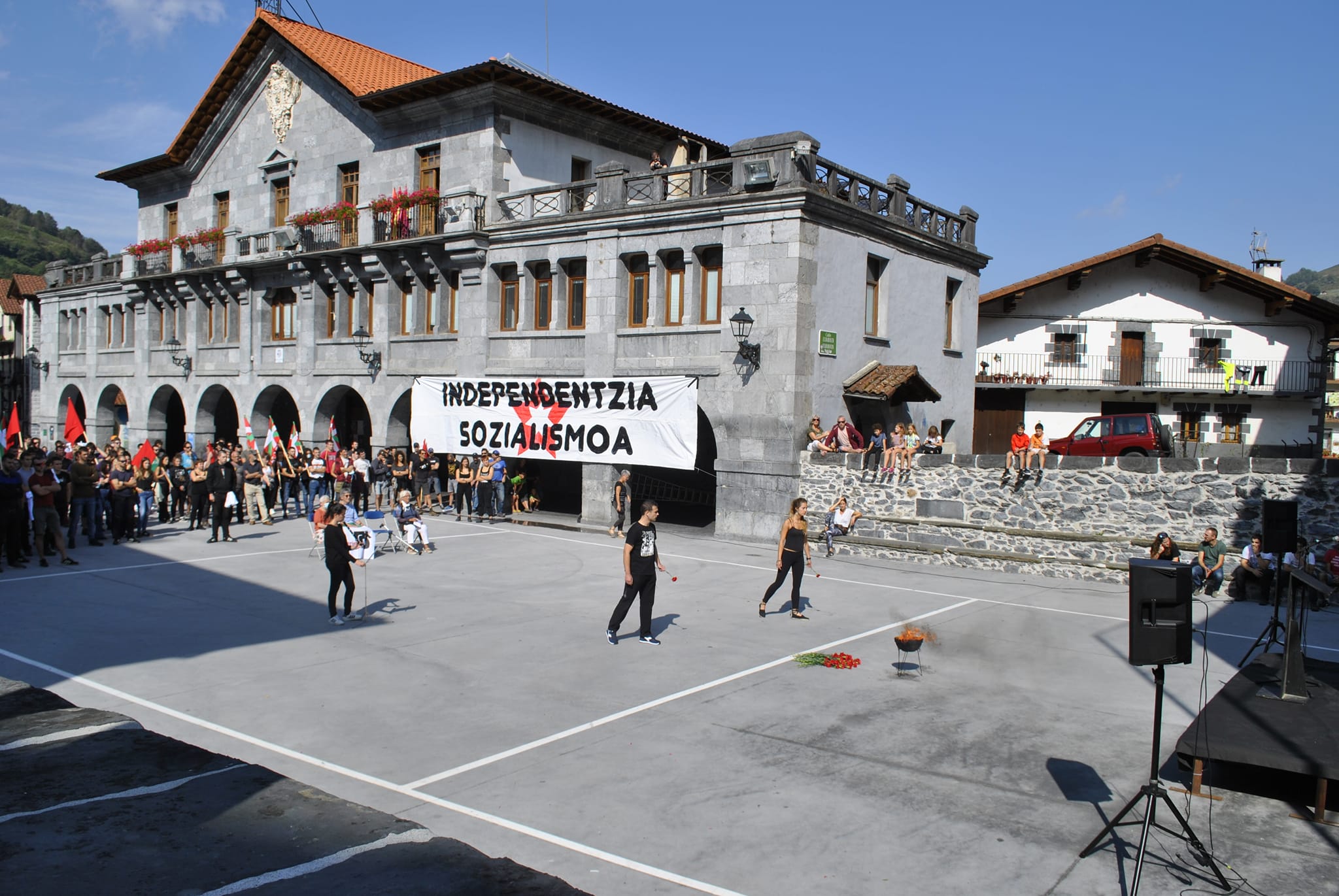
DAY OF THE PATRIOT SOLDIER

Diarmuid Breatnach

(Reading time: 4 mins.)

In the Basque Country the Day of the Patriot Soldier is commemorated on two different dates: by the Basque Nationalist Party on October 28th and by the Patriotic Left on September 27th. Each date marks different events but each is anti-fascist in character.

On October 28th one of the many atrocities of the Spanish Civil War/ Anti-Fascist War was enacted by the Spanish fascist military when they executed 42 captured Basque soldiers of the Eusko Gudarastea, a Basque antifascist militia opposing the military-fascist coup of Franco and another three generals.

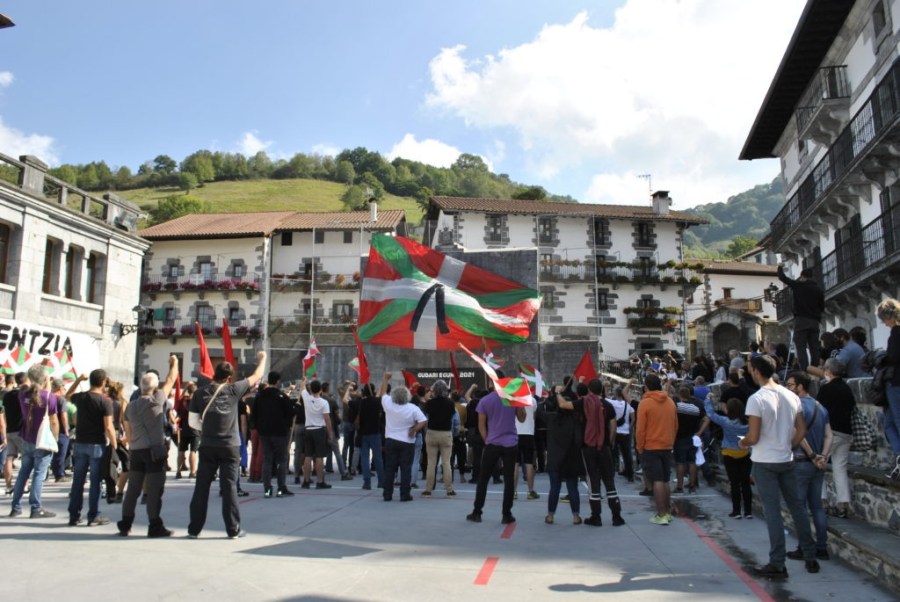
Section of the crowd at the Gudari Eguna commemoration in Arrigorriaga, Bizkaia province, southern Basque Country. (Photo: D.Breatnach)

This atrocity occurred in 1937, when that war had another two years to run. The Basque Nationalist Party (PNV) was then the main political party in that part of the Basque Country1 and many of its politicians and administrative officials were executed by the Franco regime too.

Commemoration of the PNV´s Day of the Patriotic Soldier (Gudari Eguna) was carried out clandestinely during the four decades of the fascist Franco regime but was permitted in the post-Franco arrangement in the Spanish State, when the PNV were legalised.

The PNV became the dominant force politically in the two provinces that had declared for the Spanish Republic, which was the largest part of the Basque Autonomous Region. Nafarroa however was given a separate autonomous government which split the nation administratively in at least four.2

A DIFFERENT DATE TO COMMEMORATE

However in the 1960s a large part of the PNV´s youth wing had become disenchanted with the party and, entering into alliance with a Basque socialist movement, formed ETA, a mainly political organisation but, existing under a fascist-military regime, inclined also towards armed resistance.
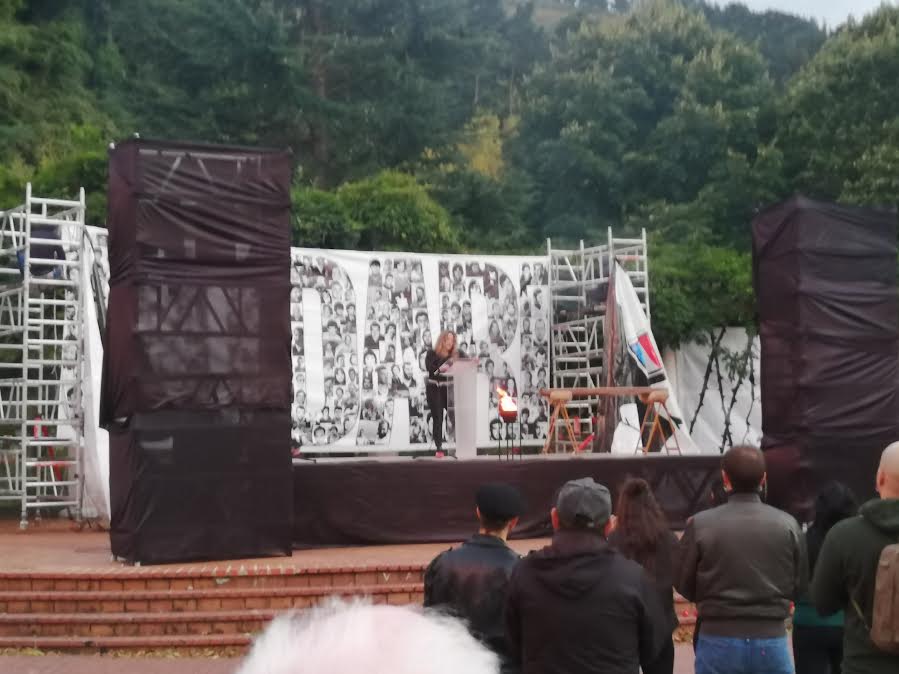
The platform at the Gudari Eguna commemoration organised by Jarki with the event’s speaker/ chairperson addressing the participants. (Photo: D.Breatnach)

ETA grew in support and in actions, military but not only, the Left Patriotic movement (Izquierda Abertzale) widening to fight on a number of fronts, linguistic, social, trade unionist and political with the armed section carrying out many actions.

The last political executions of the Franco regime were in 1975 of two members of ETA and three of FRAP3; the two Basques were Juan “Txiki” Paredes4 and Angel Otaegui. All five, despite huge international solidarity mobilisations and appeals for clemency, were shot by firing squads.

Today, the Patriotic Left´s Gudari Eguna is commemorated by different groups and not all together. As has occurred in Ireland, the accommodation of the leadership of the Basque Patriotic Left to the Spanish electoral system and abandonment of armed struggle has resulted in fragmentation.

A protest in Arrigorriaga I passed by on my way to the Gudari Eguna commemoration. I did not stop to enquire as to the purpose; I had made an error on the journey, was late and in a hurry. From the arrows design I understand these to be the Sare group doing their last Friday of the month picket in solidarity with the prisoners. ‘Giltzak’ means ‘keys’ as the graphic banner design shows and so the aim is probably to have them all leave jail. That is also the aim of the ‘dissident’ group Amnestia but they seek complete amnesty for the political prisoners whereas Etxerat, Sare and EH Bildu normally refrain from even calling them ‘political prisoners’ since, according to the Spanish State, that amounts to ‘supporting terrorism.’ (Photo: D.Breatnach)

The political party EH Bildu commemorated the executions but so did the dissenting Jarki and Tinko/Amnistia and the historical memory organisation, Ahaztuak. They did not do so together nor, naturally with the PNV on the different date.

In Arrigorriaga Jarki organised their event in the birthplace and home of Argala, nom-de-guerre of José Miguel Beñaran Ordeñana, a theoretician and activist of great importance in the development of ETA and assassinated by the state-sponsored GAL terrorists.

The attendance at the event listened to the event’s MC addressing them, after which a group of youth carrying flaming torches came on stage. The MC ended her talk with calls for a free and socialist Basque Country, after each which the audience chanted “Gora!” (‘Up!’).

She then led them in singing the Eusko Gudariak with clenched fist in the air, followed by introducing the Internationale in Basque, the revolutionary socialist song that emerged from the Paris Commune of 1871, the audience joining in (though not everyone as well-versed as with the previous song).

I sang the chorus in French, the only language other than English in which I know the chorus, sadly.

HISTORICAL MEMORY & THE MARTYRS

The martyrs of the people´s struggles around the world are remembered organically and kept close to their hearts by the people from which they came, at least for a few generations. Initiatives of conserving and transmitting historical memory keep those commemorations going further.

Section of the crowd at the commemoration of Gudari Eguna, organised by the Jarki organisation. (Photo: D.Breatnach)

In Ireland we know that commemorating the risings of the United Irishmen (1798 and 1803) fed into the struggles of the Young Irelanders a half-century later, their memory in turn contributing to the Fenians which again became part of the history of future generations and of several armed struggles.

Counter-movements, recognising the potency of historical memory, try to appropriate it and adapt it to their political program or to diminish its importance and even deny it. Both those counter-currents can be seen in many parts of the world, including in Ireland and in the Basque Country

However, the ongoing revolutionary streams and their commemorations will always be closest to the real meaning of those events in the historical memory of the people, in the real social and political meaning of martyrdom.

Patrick Pearse remarked on this process in his famous oration over the grave of O´Donovan Rosa: Life springs from death and from the graves of patriot men and women spring living nations.

Footnotes:

1The Basque Country is composed of seven provinces, four on the Spanish state´s side of its northern border and three on the French state´s side. The Anti-Fascist War split the southern Basque Country with principally two provinces, Gipuzkoa and Bizkaia, taking the side of the Spanish Republic, which at the last minute granted them national autonomy. Nafarroa (Navarre) mostly took the fascist-military side and murdered around 3,000 antifascists and Alava province took that side too.

2Two separate autonomous regions in the Spanish state and the provinces on the French side in different French regional administrative areas.

3Frente Revolucionario Antifascista y Patriota (Revolutionary Anti-Fascist & Patriotic Front); the three were: José Luis Sánchez-Bravo Sollas, José Humberto Baena Alonso and Ramón García Sanz. 

4According to his brother who, despite being misdirected arrived as Paredes was being shot by the Guardia Civil, who were shooting at different parts of his body, Txiki Paredes continued to sing Eusko Gudariak (‘Soldiers of the Basque Country’) until he finally died.

Sources:
https://es.wikipedia.org/wiki/Gudari_Eguna

FALLEN BASQUE FIGHTERS COMMEMORATED AMIDST ATMOSPHERE OF REPRESSION

(Reading time: main text 1 min, overall 2 mins)

(Report by Jardun Koordinadora translated by Dublin Basque Solidarity Committee)

The atmosphere was tense on September 25, 2021 in Leitza due to the presence from the early hours of the morning of the Civil Guard and the secret police. To this must be added the checkpoint and identification by the GAR (Guardia Civil “anti-terrorist” Rapid Response Organisation – Translator) of many of those attending the political event organized by the revolutionary organization JARKI. In the same way, the Civil Guard had no problem in stopping and subjecting to identification those who traveled by bus organized from Bilbao and Gernika. This was not the only episode of police repression since several JARDUN activists from Leitza complain of having been followed by the secret police over recent days.

One of the posters for the event (Photo source: Jardun Koordinadora)

The event organized by the revolutionary organization JARKI gathered hundreds of people in Leitza square. Once the flame was lit, to the sound of the adarras and the txalapartaris (traditional ox horns blown and wooden percussion instrument played – Trans.), the act began, under a gigantic ikurriña (flag of the Basque Country – Trans.). Next, the dantzaris exhibited the “agintariena” (see Notes) while a gust of wind snapped the rope securing the ikurriña and two young people had to climb the pediment to hold it for the rest of the act. Later, two bertsolaris took the stage asserting with their verses independence, socialism and amnesty, as the legitimacy of the fight of the gudaris (volunteer liberation fighters).

Dancing the Aurresku, the honour dance and presenting red flowers to the memory of the martyrs of the Basque struggle for independence and socialism. (Photo source: Jardun Koordinadora)

To conclude the ceremony, a member of JARKI read a statement in reference to the commemoration of Gudari Eguna. The statement among many other things vindicated the struggle for memory of Euskal Herria, and of those who have given all in for it, thus legitimizing their struggle and the celebration of this day. He also mentioned the presence of ‘dogs’ in different uniforms that act with total impunity, making it clear that there is no type of coexistence between the oppressed and the oppressors. To the revolutionary organization JARKI this underlines a clear principle: confronting who is oppressing you and who is keeping you under their control is not an option, but a necessity.

End of the event, singing the Internationale and the Eusko Gudariak (Photo source: Jardun Koordinadora)

The act ended with the singing of the Internationale and the Eusko Gudariak.

End.

SOURCES:

https://eh.lahaine.org/jarki-k-antolatutako-2021eko-gudari

https://www.facebook.com/Jardun_koordinadora-100598125431163

DIBSC explanatory NOTES:

  1. The Gudari Eguna (Day of the Soldier) originally celebrated the Basques who fell fighting the fascist-military coup in the ‘Spanish’ Anti-Fascist War or who were executed when captured or died as a result of their prison conditions. The martyrs in the struggle against the Franco dictatorship and after required that they also be included in the Gudari Eguna celebrated in October but since the Basque Nationalist Party dominates that commemoration and excludes the later martyrs, the patriotic left movement has changed the date to the last weekend in September and celebrates all the Basque martyrs. The last weekend in September was chosen because of the Franco regime’s execution of two ETA and three FRAP volunteers on 27th September 1975.
  2. Jarki is a revolutionary socialist organisation for Basque independence. Statement on who Jardun are: “It is an image that includes a group of organizations fighting for the achievement of the Basque socialist state, operating under common agreed ideological bases and minimums. JARDUN is a meeting place for different organizational frameworks, a movement that promotes their collaboration. To this end, it provides a common framework for the adoption, coordination and decision-making of the various organizations that make it up. Therefore, at different levels, it is a tool for solidarity between militancy, organizations and groups within it. Using these coordination frameworks, the ACTION will be made up of sectoral organizations with specific functions and well-defined roles to carry out in a sector-specific way. The aim of this sectoral framework is to promote the efficiency of the organizations, which, in turn, incorporate the Basque Country Workers’ Alternative in the field in which they work. In this way, all the organizations that make up JARDUN work within the framework of the same objective and strategic line, each of which deals autonomously with its own line of work.As long as we understand that the workers are the subject of the struggle for an independent, socialist and united Basque state. So, when we talk about the Basque Country Workers’ Alternative, we are talking about a comprehensive political alternative that meets the needs of the Basque Country Workers. Its aim is to reach all areas of Basque society as a tool for activating and organizing the critical pro-independence and socialist masses in the Basque Country. In other words, the Basque Workers’ Alternative must be a tool for confrontation that will lead us to a break with the states. Ultimately, JARDUN must be the organizational framework for the Basque Revolutionary Workers. In order to achieve the strategic goals of the Basque Revolutionary Workers, which must carry out the Basque socialist revolution, it must be a comprehensive alternative that must provide the means to carry out the necessary struggles.”
  3. Leitza is a town in northern Nafarroa (Navarra), one of four provinces of the Basque nation within the Spanish state.
  4. The Guardia Civil are a Spanish state-wide gendarmerie or militarised police force, armed and living in barracks. They were the physical backbone of Franco’s dictatorship and continued in a repressive political role following the “Transition to democracy”.
  5. The Agintariena is a ‘dance’ which resembles a short military parade with ‘arms’ to music; two lines of dancers march while a flag-bearer proceeds between them. At a particular point the dancers all go down on one knee with heads bent while the flag-bearer waves the flag over them all, seemingly in blessing over the fallen in battle. A mass example in a festival can be seen in the video clip https://www.youtube.com/watch?v=kfoTmQZC_gs with the irrintzi (traditional ullulating call) thrown in for good measure.
  6. Bertxolaris are performers of a traditional format of expression in song and rhyme on any theme. Competitions among these are held in the Basque Country in which the performers must extemporise rhyming verses on a given theme; these receive great public interest.
  7. “dogs in uniform” — “txakkurak” (dogs), a pejorative slang name given for generations to the police in the Basque Country.
  8. The Internationale is a song of revolutionary socialist struggle with lyrics written by an Anarchist activist in the Paris Commune of 1871 and put to music later by Marxist; it has been translated into a great many languages with examples in every populated continent. Eusko Gudariak (Basque Soldiers) is a Basque national anthem (in theme somewhat like the Irish national anthem “The Soldiers’ Song”). It was reputedly sung by ETA martyr Juan Paredes Manot (Txiki) while being executed by Guardia Civil firing squad in 1975, even continuing while mortally wounded by the first volley.