In the last days of the 1916 Easter Rising, with the GPO in flames, the garrison had to evacuate and did so through Henry Place. When they came to Moore Street, it was being raked by machine-gun fire from a British Army barricade at the junction with Parnell Street. Consequently, the garrison entered the first house in the terrace to the their right, No.10 and tunneled from house to house until they reached the end of the terrace, No.25.
A struggle is taking place currently to have the whole terrace saved and declared a national monument, a battlefield site in the context of the Historic Quarter. In 2007, the State made only four houses a national monument, No.s 14 to 17 and at the very end of 2015, bought the four run-down houses from their speculator owner at a million Euro each. The Government plans to make them into a commemorative centre, in the course of which they wish to demolish buildings 13, 18 and 19. Speculators have planning permission for a giant shopping mall from O’Connell Street to Moore Street and from Parnell Street to Henry street, which envisages the demolition of the entire terrace except for No.s 14-17.
In reply to campaigners, Minister for Arts, Heritage & Gaeltacht, Heather Humphreys, has stated that some of the buildings are of post-1916 construction and therefore are of no historic value. In opinion pieces in the Irish Times, one week after the other, Frank McDonald and Diarmaid Ferriter wrote articles supporting the Government.
JUST FOUR HOUSES — a sketch for three actors
AT HENRY LANE/ MOORE STREET INTERSECTION
(Sounds of shells crashing, flames roaring, combustibles exploding, rifle fire, the chatter of machine-guns)
Irish Volunteer A: “Bloody hell, it was hot in the GPO!”
Irish Citizen Army Volunteer: “Hot as Hell. We were lucky to get out alive, with ammunition about to blow.”
Volunteer A: “We can’t stay here in this laneway in the open, though.”
ICA Volunteer: “No, let’s get under cover quick! Into that terrace there … Moore Street this is, right? Sixteen houses ….
Volunteer B: “No, we have to occupy just four houses in this street.”
Vol. A: “Only four? But there’s nearly 300 of us here!”
Vol. B: “I know. But orders …”
Vol. A: “Damnation! OK, best bash that door down, No. 10.”
Vol. B: “No, not that one.”
Vol. A: “Why not?”
Vol. B: “Only Numbers 14 to 17.”
ICA Vol: “But they’re in the middle of the terrace. We’d get shot to pieces by the British machine gun up at Parnell Street – and we have to carry Connolly’s stretcher so he’d get shot too!”
Vol. B: “Yeah, they’ve already shot up The O’Rahilly’s lads.”
Vol A: “Whose orders are these? Who says we should all pile in just four houses in the middle of the terrace?”
Vol. B: “Somebody called Humphreys …. and a Mac Donald …. and a man called Ferriter. Something about only those four houses being of historic significance.”
ICA man: “What? Bloody rubbish – look, go and ask Connolly what he thinks. He’s the Commandant of this garrison, not that lot, whoever they are.”
(A few minutes later)
Irish Volunteer B: “Well, what did Connolly say?”
Vol A: “His exact words? ‘Don’t be stupid lad – break down the door of No. 10 there and tunnel along the terrace, from house to house, aye, all the way to the end – No. 25, isn’t it?’ ”
ICA man: “That’s more like it – I knew we’d get some sense out of Jim – I mean, the Commandant.”
Vol A: “Thanks be to Jayzus for someone with sense in charge. Who the hell are that other lot and where did they come from, that Humphreys, MacDonald and Ferriter?”
Vol B: “I dunno. Give’s a hand with this door before we get shot out here, gabbing …”
(Looking into the future, a couple of generations on)
Diarmuid Breatnach
THE GPO EVACUATION AND MOORE STREET LAST STAND
Our tour group gathered in the GPO for the Evacuation & Last Stand part of the tour; one can take this tour on its own or as part of longer tours. We said goodbye to Rónán, who handed us over to our Evacuation Guide, Pela.
Aerial view of Moore Street in the days when the speculators and supermarkets had only just begun to reduce it (Photo from Internet)
Our tickets were checked and we were handed audio earphones, receivers and issued with our instructions – stay with the group, obey the instructions of the guide, etc.
Our group had about thirty people in it and ours had the only young children, although there were a few in their late teens. About half or more looked like tourists and some asked for the foreign-language options of receivers. There was one man in a wheelchair.
As instructed by the guide in a number of languages, we tested our receivers to find the volume settings appropriate for each individual. This took a bit longer for our two younger girls. Then our guide motioned for us to listen to our earphones … and the narration began. Gradually, we were pulled back across the decades until we were in that amazing Rising, taking place in what had once been considered the second city of the British Empire, rising up against that very same Empire, one of the largest the World had ever seen.
It was the fourth day of the Rising and many of the buildings in the city centre were ablaze. Through our earphones, against a backdrop of booming cannon and crashing shell, chattering machine guns, rifles’ crack and whining ricochet, we could hear the crackle of flames. Irish Volunteers’ voices reported that the glass in Clery’s building opposite had melted and was running across the street like water. The ledgers the Volunteers had placed in the GPO windows to protect against bullets were smouldering. Other voices added that despite fire-fighting efforts the roof was on fire and the roof lead melting. We could almost smell the smoke. Then finally, the order to evacuate given in an Edinburgh accent – James Connolly, the socialist commandant of the HQ of the Rising, the General Post Office.
In the hubbub of people getting ready to evacuate some voices stood out: Elizabeth O’Farrell, giving instructions about the moving of the injured James Connolly; calls to evacuate by the side door and caution about crossing Henry Street, with machine-gun sniper fire coming all the way down Talbot Street from the tower of the train station at Amiens Street.
A man’s voice in our earphones says “It’s lucky we have oul’ Nelson there to shield us some of the way!” and we hear a few people laugh.
Then, The O’Rahilly’s voice, calling for volunteers to charge the barricade at the top of Moore Street and a chorus of voices answering, clamouring to be chosen.
Now we are out in a group and crossing Henry Street. The man in the wheelchair, having politely declined offers to push his chair, is propelling his wheels strongly along with his leather-covered hands. It is weird to see the pedestrian shoppers and sightseers of the Twenty-First Century as half our minds are back in the second decade of the Twentieth. Across this short stretch to Henry Place we went, the crack of rifles and chatter of machine guns louder now in our earphones. And explosions of shells and of combustibles. The garrison scurried across this gap carrying the wounded Connolly on a bed frame and Winifred Carney, carrying her typewriter and Webley pistol, interposed her body between Connolly and a possible bullet from the train station tower.
With the rest of our tour group, Sadhbh and I cross into into Henry Place, holding the kids’ hands, following the route of the evacuation. Immediately we stepped on the restored cobbles of the lane-way, the sounds of battle receded somewhat.
“No bullets can reach us here!” shouts a voice in our earphones.
“No, but bejaysus them artillery shells can!” replies another.
Other shouts a little ahead warn us that gunfire is being directed down what is now Moore Lane from a British barricade on the junction with Parnell Street.
The bullet-pocked “white house” in Henry Place, facing up Moore Lane (Photo North Inner City Folklore Project)
A sudden shouted warning about a building ahead of us, to our left, facing Moore Lane.
“See the white house? The bastards are in there too,” shouts a strong Cork-accented voice, almost certainly the young Michael Collins. “Let’s root them out. Who’s with me?”
Another chorus of voices, a flurry of Mauser and Parabellum fire, then only the steady chatter of the machine gun up at the British barricade and the sound of bullets striking walls.
The Cork sing-song voice again. “I can’t believe it — The place was empty, like!”.
“Aye, it was so many bullet’s hoppin’ off the walls made us think the firing was coming from inside,” a voice says, in the accents of Ulster.
Then an unmistakably Dublin working class accent: “Would yez ever give us a hand with this!” followed by the creak and rattle of wheels on the cobblestones as the cart is dragged across the intersection. Now we can hear the machine gun bullets thudding into the cart.
“Quick now, cross the gap!” comes the order and the dash across the gap begins. Nearly 300 men and women? Someone is bound to get hit and yes, they do and we hear that one of them died here.
British barricade on Bachelors Walk Easter week, 1916 and widely thought (including by me until shown otherwise by another history enthusiast) to have been at junction of Parnell Street and Moore Street (photo from Internet). There were similar barricades at the junction with of Parnell Street with Moore Street and with what is now Moore Lane, fire from each from machine gun and rifles.
Across the gap, nowadays mercifully free of enemy fire but still feeling vulnerable, we follow Pela, our guide, to the corner with Moore Street. In character, she peers carefully around as we hear machine-gun and rifle here too, but Mausers and Parabellum as well as Lee-Enfields.
“Gor blimey!” exclaims a London accent, reminding us that some of the Volunteers had been brought up in England. “O’Rahilly’s lads are getting a pastin’. None of ’em made it as far as the barricade!”
An Irish voice: “Into these houses then – no other way! We have to get into cover to plan our next move.” This is followed by the sound of a door being hit and then splintering as they break into No.10, the first house on the famous 1916 Terrace.
“Careful now,” Elizabeth Farrell’s voice, followed by a groan of pain as Connolly is manoeuvred through the doorway.
Pela sends the man in the wheelchair up in the lift and leads us up the stairs. When the lift and the last of our group arrive we proceed across the restored upper floors from house to house, passing through holes in the walls, as the GPO Garrison did in 1916 – except that they had to break through the walls themselves, working in shifts. Through a few unshuttered windows, we can see the busy street market below us going about its business, apparently oblivious of our passage above them. But then, thousands of tour groups have gone through here over the decades. Through the double glazing one can just barely hear the street traders calling out their wares and prices.
We pass through those hallowed rooms, listening to ghosts. Here and there a hologram appears and speaks, echoes of the past. Dummies dressed in the uniforms of the Irish Citizen Army, the Irish Volunteers, Cumann na mBan, Na Fianna and Hibernian Rifles are on display here and there. Imitation Mausers and Parabellums and Martinis, each one carefully made and to the same weight as the original, are there. They are security-chained but we know people are free to pick them up and feel the weight, as Rory does, to imagine carrying and firing one. But not to be flash-photographed, which is not permitted here. Replica Cumann na mBan medical kits are on display, open so one could inspect the replica contents. The houses also have period furniture, fireplaces, beds …. chamber pots …. kitchens with utensils … bedrooms ….. There are dummies dressed too in civilian clothes of the time typical of that area — women, men, children (even the dog that the last Volunteer to leave Moore St. fed).
We see magnified historical newspaper headlines, photos, badges and medals. A map of Dublin with fighting locations flashing on them, some of them going out as they fall, the dates appearing above them to show when that happened.
Snatches of poetry, of song come to us as we cross from room to room, from house to house. And for our eyes, the holograms of the Proclamation, the portraits of the executed 16 and many others who fought and died or who survived, flags, the Tricolour, the Irish Republic, the green-and-gold Starry Plough, waving in the wind above Clery’s ….
Half-way along the terrace we come to the discussion between the leaders, creatively reconstructed on the basis of some witness statements. Pearse wishing to surrender to avoid further loss of civilian life, Clarke arguing, a sob in his voice, Connolly saying maybe they should wait for Sean McLoughlin to get back (he is out reconnoitering a breakthrough route) …. Then the arguments with some of the other Volunteers, Mac Diarmada having to use all his powers of persuasion. Oh, such emotion in such short discussions! Then the decision, and Elizabeth O’Farrell volunteering to go with the white flag to open negotiations with the enemy …. even though a couple and their child have already died beneath a white flag in that street.
Shortly afterwards, the faces of the sixteen executed come into view, suspended in the air in front and a little above us. We stand there while passages are read out from their trials, letters from their condemned cells, words to relatives …. Then the dates appear above them and we hear the fusillades as by one their faces blink out, until finally only Casement remains, the image of the gallows and then he too is gone. All is dark for a moment, then all sixteen faces appear again, over a background of the three flags of the Rising, to a swelling chorus of The Soldiers’ Song, in English and in Irish.
At the end of the Terrace, we descend again and here view the O’Rahilly monument plaque and in our earphones hear the words of his final letter to his wife read out – he wrote it as he lay dying from a number of bullet wounds. I found my eyes moistening again as they had several times during the tour and some of the others were visibly crying – including foreign tourists.
The O’Rahilly Plaque in O’Rahilly Parade, at the north end of the Moore Street 1916 Terrace. It bears the words and script of his dying letter to his wife. (Photo D.Breatnach)
The end of our tour lay ahead, through the underground tunnel under Parnell Street to the Rotunda. Here the Volunteers had been publicly launched and recruited in 1913 and here, in 1916, the GPO/ Moore Street garrison had been kept prisoners without food and water for two days, while G-Men of the DMP came down to identify whomsoever they could from among the prisoners.
Now the recordings in our earphones ask us to listen to the guide for a moment as she collects our earphones and receivers. Having gathered the sets and put them away in her bag, Pela asks us all to give a moment’s thoughts to the men and women and children of the centenary year of the Rising, 2016, who had fought to preserve this monument for future generations. Pela tells us that her own grandmother had been one of the activists.
Incredible though it may now seem, the whole terrace except for four houses had been about to be demolished to make way for a shopping centre, which would also have swallowed up the street market. It had taken a determined campaign and occupations of buildings with people prepared to face imprisonment to protect it for our generation and others to come. The State of those years had little interest in history and much in facilitating speculators. She invited us to applaud the campaigners, which we did, enthusiastically. She then asked us to turn around and view the building we had left. There was a plaque on the wall there “Dedicated to the memory of the men, women, girls and boys of 2016 ……” In bronze bas-relief, it depicts the 16 houses with activists on the scaffolding erected by those who intended demolition, with a chain of people of all ages holding hands around the site and in one corner, a campaign table surrounded by people apparently signing a petition.
Once through the underpass and inside the Rotunda, the tour officially over, we thanked our guide and made for the Republican Café. Sadhb and I found we couldn’t say much, as our minds were half back in 1916. Rory was quiet too but Eva and ‘Brigie’ seemed unaffected, brightly debating what to choose from the menu in the Rotunda café, or what souvenir they fancied from those on display.
The Rotunda in the past, before it became incorporated into the Moore St. Historical Quarter and the Parnell Square Cultural Quarter. (Photo D.Breatnach)
There’s a Moore Street and Dublin Street Traders’ Museum and there are films one can see all day in the Rotunda, often too lectures, reenactments, plays …. We’d had enough for one day, however – we were full. It was truly an unforgettable experience and I knew that for Sadhbh too and probably for Rory, it was something that would remain forever alive in our memories. The girls? Years from now, who knows ….. but they had certainly not been bored, anyway.
The terrace of houses in Moore Street, No.s 10–25, in the Irish capital of Dublin, much in the news of late, is of great importance to the world and should be recognised as such by Irish people and internationally. The terrace is of great importance in terms of being
an urban WWI battlefield
of opposition to imperialist war
of the struggle of the working class
of women’s struggle for equality
of the struggle of the world’s people against colonialism and
a surviving centuries-old European street market.
In this article I intend to develop this argument and these points.
In the closing days of Easter Week, in the cancelled and hurriedly rescheduled Easter Rising in Dublin, after five days of fighting, siege and a number of days of artillery bombardment, the garrison of the General Post Office, the Headquarters of the Rising, evacuated their burning building and occupied a terrace of sixteen houses in Moore Street. They broke into No.10 and tunneled from house to house up to No.25, until the whole of the terrace and back yards had been occupied.
Meanwhile, a charge of a dozen Volunteers on the British Army barricade at the northern end of that street, at the junction with Parnell Street, had failed to reach its objective; machine-gun fire had injured some and killed others. The leader of that charge, mortally wounded in a side-street, wrote a note to his wife as he lay dying there (the words are reproduced on a plaque in the laneway named after him: O’Rahilly Parade).
That history, and of it as a market in childhood memory, is what engages many people — perhaps most – of those campaigning for the preservation of that terrace of houses and of the thousands who support their efforts. But there are aspects of international importance to that 1916 Rising not usually alluded to and which deserve to be noted, celebrated and commemorated.
A RISING AGAINST WORLD WAR
James Connolly, the revolutionary socialist or communist and trade union leader, had been calling for an uprising for years and his public exhortations intensified with the onset of WWI. A section of the Irish Republican Brotherhood was also anxious to engineer an uprising during that War — “England’s difficulty is Ireland’s opportunity” was a well-known saying among Irish nationalists. But for Connolly, the issue was much more than that – the dispute between some capitalists about which of them would control the Earth’s resources and markets was sending millions to die, workers fighting workers in battlefields in which the instigators of the slaughter would never set foot. While millions died, those big capitalists would continue to make great profits, supplying armies with weapons, transport and equipment, fuel, clothing, food …..
A declaration of war against war — banner on the old Liberty Hall, HQ of the Irish Transport & General Workers’ Union. A parade of a section of the Irish Citizen Army is drawn up in front of it. (Photo from Internet)
A few years earlier, an international socialist conference had threatened revolution on their capitalist masters should they dare to start a world war. Indeed, some revolutionary socialists saw war as anopportunity to instigate socialist revolution. Unfortunately they were outnumbered by social democrats who, despite their earlier militant words, when it came to the crunch, lined up the workers of each country behind their capitalist masters against their own class brothers in other countries.
There were few socialist parties and prominent socialists that took the opposite stand but one of those who did was James Connolly. Among the other things that characterised the 1916 Rising was that it was the first significant uprising of the 20th Century against World War. The next uprisings of that kind would be the 1917 Revolutions of February and October in Russia, with another in Germany in 1918.
“IRISHWOMEN”
The Proclamation of the insurgents in 1916 addressed itself to “Irishmen and Irishwomen”. Although not one of the seven signatories was a woman, there were a number of them prominent in the command structures of the Rising and in the preparations also. And also of course in the lower ranks during the Rising itself.
Constance Markievicz (nee Gore-Booth) of the ICA was, despite her planter family and quasi-aristocratic background, third-in-command of the Stephens Green/ College of Surgeons area. Kathleen Lynne, also of the ICA was Chief Medical Officer for the Dublin insurrectionary forces and third in command in the Dublin Castle/City Hall garrison. It was at the premises of Cumann na mBan founder member Jenny Wyse-Power, No.21 Henry Street, that the 1916 Proclamation was signed in secret a week before the Rising.
Constance Markievicz, Irish Citizen Army, second-in-command of the Stephen’s Green/ College of Surgeons garrison
Kathleen Clarke was de facto a member of the IRB, work and powers delegated to her on the eve of the Rising by her husband, Tom Clarke, one of the architects of the Rising and first of the seven signatories. Elizabeth O’Farrell was one of the Cumann na mBan nurses accompanying the men in the GPO and one of three to proceed to occupy Moore Street; she carried the short truce communications to the British and back to the leaders on the Rising surrender day, accompanied Pearse to the surrender point in Parnell Street and then carried Pearse’s and Connolly’s surrender instructions to a number of garrisons in Dublin. And Winifred Carney, James Connolly’s secretary, was in the GPO and later Moore Street with her typewriter and a Webley revolver.
Winifred Carney was the first woman into the GPO, accompanying Connolly and carrying a typewriter and a Webley revolver
It is difficult for us today perhaps to realise how progressive it was for any general public document 16 years into the 20th Century to address itself specifically to “Irishwomen”. No country in the whole world had given all its women the right to vote by 1916 although the suffragette movement was in full flow throughout most of Europe and in the European colonies. While it is true that New Zealand gave European women the right to vote as far back as 1893, it was for European settlers only and also linked to a reform movement against the sale and consumption of alcohol. Elsewhere in the world outside the colonial Antipodes and the Scandinavian democracies, the extension of the franchise to women did not seem close in 1916. Nevertheless, in Canada, women got the vote in 1917 – but again, women of European descent only. In Britain, women did not receive full rights to vote until 1928. Yet in a large part of the United Kingdom, a cross-section of people making a bid for independent nationhood, were ostensibly recognising women as citizens with equal voting rights as early as 1916.
Given the preponderance of males in all organisations of all shades of Republican and Nationalist outlook, the inclusion of women in the address had to have been agreed by the men in the top leadership. No doubt women, through their agitation for full franchise as well as by their active participation in so many facets of the movement, helped to convince the men. Connolly is often credited with responsibility for this inclusion but there is no reason to believe others among the signatories would not have taken that position themselves (although Kathleen Clarke did allege that one of those would not). Patrick Pearse had previously supported the vote for women and a number of men in the leadership had female partners who were active on that issue, as for example was Grace Gifford, Joseph Plunkett’s fiancee. The 1916 Proclamation was the first insurrectionary proclamation of the 20th Century (and almost first ever) to specifically include women in its address on a basis of gender equality.
The participation of women in the Rising however had a much sharper illustration than their inclusion in the Proclamation – they were present in most of the fighting posts throughout the Rising, whether as members of Cumann na mBan or of the Irish Citizen Army – several were killed or injured, many were arrested and one was sentenced to death (though sentence was commuted later).
The participation of Cumann na mBan made the 1916 Rising the first uprising of the 20th Century (and probably prior to that) in which women participated in their own organisation, in their own uniform.
The participation of women in the Irish Citizen Army, where they shared equal status with men, made the 1916 Rising the first uprising of the 20th Century (and almost first ever) in which women participated in an armed and uniformed organisation, and in equal status with their male comrades.
HOPE AND ENCOURAGEMENT TO THE PEOPLE OF THE COLONIES
The British Empire in 1916 was huge – around 13 million square miles of territory in 1916, nearly a quarter of the world’s area. It was said that the “sun never set” upon the Empire because at any moment during 24 hours, some part of the Empire would be receiving light from the sun. Around 450 million people were under the Empire’s dominion.
Map of the British Empire in 1914 (of course the British ruling class had dominant influence over many other areas, for example over much of Latin America). (Image sourced from Internet)
And of course, there had been resistance. Even after resistance had been beaten, there had been further uprisings – in fact, some areas such as that of the present-day Afghanistan were in almost constant rebellion. But rebellions were mostly localised and even when they took on a more sweeping character, such as the Mahdist War of 1881-’89 in the Sudan or the Boxer Uprising in northern China in 1900, they had been crushed by British military might.
The news of the Easter Rebellion in Dublin ran around all parts of the British colonial world, from the nearer to the most remote. And some of the news was carried by the Irish in the British armed forces. Tom Barry, later to be undefeated guerrilla leader in the War of Independence in West Cork, read about the Rising while serving in the British Army in Mesopotamia (now Iraq). The Connaught Rangers, hundreds of which were to mutiny in India in 1920, were also in Mesopotamia in 1916. These Irish units of the British Army and Irish men in British units serving outside the United Kingdom, served not just next to English, Welsh and Scottish soldiers but also next to soldiers drawn from colonial peoples; they were often serviced too by colonial people in auxiliary roles and mixed to a degree with the colonial populations among which they were stationed, in markets, eating houses, bars and sex-houses. Just four years later, during the mutiny of the Connaught Rangers, it is recorded that Irish rebels in British Army uniforms had communicated their mutiny and their reasons to the Indian traders.
The 1916 Rising took place in what had been considered, the previous century, the second city of the British Empire. Now past those ‘glory days’, Dublin was still a city of the Empire’s “home base”, the United Kingdom. And the Empire’s Army had been obliged to shell one of the UK’s own cities in order to suppress that Rising! To many a colonial subject contemplating resistance or even outright revolt, it must have seemed like a signaling bonfire, one that proclaimed that the end of the Empire was nigh and called the peoples under subjugation to revolt, to finish it off. And, indeed during the War of Independence, the Nehru and Ghandi families were to make contact with Irish Republicans and Ho Chi Minh is reported to have been inspired by the Irish struggle.
Nor was it only those colonial people in the British Empire who were inspired but those in the French, Dutch, Belgian, Portuguese and Spanish colonies too. Ho Chi Minh, as a Vietnamese, was under the French empire and led his people in armed resistance to the Japanese and French occupation in 1941. Over the three decades following the Easter Rising, anti-colonial struggles around the world intensified and pushed the former colonial powers into “de-colonisation” — i.e. imperialism and neo-colonialism.
WORKERS OF THE WORLD
The Irish Citizen Army had been founded in 1913 as a workers’ armed organisation to defend against the attacks of the Dublin Metropolitan Police. The DMP carried no firearms then, though they were well able to kill and maim with their truncheons, a fact they demonstrated during the 1913 Lockout. But it was clear that Connolly at least knew that at some point the workers would come up against the full force of the State which, at that time, meant the British empire and the Colonial regime in Ireland. He called publicly for the ICA to train in and to carry firearms. The Royal Irish Constabulary, policing the rest of the colony outside Dublin, was indeed armed. And British Army units were stationed across the country, many of the garrisons in Dublin alone.
The ICA fell into a kind of disrepair after the workers’ defeat in the Lockout but was soon enough dusted off and reorganised. WWI began the same year the last striking workers of the Lockout, the Jacobs girls and women, marched back to work. It was certain that Connolly would try to stage a rising during the war and suspected that the Republicans, or “advanced nationalists” as they were called then, would do so too. As the war dragged on and the bodies heaped higher, Connolly grew increasingly impatient, contemptuous and even desperate, berating the “nationalists” for not rising and threatened to bring out the couple of hundred ICA on their own.
Irish Citizen Army on the roof of Liberty Hall during a flag-raising activity (Photo sourced from Internet)
But the Irish Republican Brotherhood had been planning to rise and in late January 1916, alarmed by Connolly’s threats, brought him into secret negotiations. When he emerged a few days later after what many thought had been his kidnapping, he had been sworn into the IRB and was part of the Military Council, planning the Rising for the Easter weekend. And that would mean that the ICA would also commit to the Rising.
On Easter Monday morning, around 220 men and women of the Irish Citizen Army marched out of Liberty Hall or mobilised elsewhere in Dublin. Two of the important fighting areas in Dublin were given over to their command, Dublin Castle and Stephens Green. ICA members fought elsewhere too, including the GPO. One account has them as the first to occupy the top of the GPO’s roof and another as hoisting the “Starry Plough” on top of William Martin Murphy’s Imperial Hotel in Clery’s building (the last flag of the Rising to remain flying). At least one was killed in the fighting evacuation of the GPO and a number took part in the occupation of the 1916 Terrace in Moore Street. The 1916 Rising was the first occasion of the 20th Century when a workers’ unit rose in their own units, in their own uniforms and under their own commanders.
SURVIVING STREET OF A CENTURIES-OLD MARKET QUARTER
Authorisation was granted for the development of a market in the Moore Street area by the Dublin and General Markets Act of 1831. But the Act mentioned the location as being around “Coles Lane market”, which means there was already a street market in the area. It is probable that street trading had been going on in that area for centuries before that. Moore Street was something of a modern street of its time in the area, laid down around 1763 (and, it is worth noting, before the Great Hunger and earlier than the city’s main street, O’Connell Street), mainly as a residential street with some businesses. In following decades Moore Street would become the main street of a whole market area which included the aforementioned Coles Lane along with many other streets, laneways, cul-de-sacs (“turnings”) and mews.
The streets and lanes of the old street market quarter now buried under the ILAC (Image cropped by Save Moor Street From Demolition from J Roques Map 1754, sourced on Internet). In 1754 the street across the top was called “Great Britain Street” but by 1916 it had been renamed “Parnell Street”.
All of that was demolished and buried by the 1970s ILAC “development” of Irish Life ltd.(later joined by Chartered Land, which dispossessed the households, shops, stalls and workers for a paltry compensation, to the benefit not only of the ILAC partners but also of Dunne’s Stores and Debenhams. All that remains of that street market quarter is Moore Street, with street traders struggling in difficult circumstances to make a living, harassed by Dublin City Council officials, along with small shops, granted short leases or expensive longer ones by Chartered Land or the ILAC – and under constant threat of demolition or of ILAC expansion.
CONCLUSION
Since the 1916 Rising has all those aspects of international importance listed above, clearly the Moore Street terrace also embodies them all, being the last fighting place of the Rising’s HQ garrison and containing around 300 men of the Irish Citizen Army, the Irish Volunteers and three members of Cumann na mBan.
On the basis of those points alone, the site should be a recognised world heritage site. That the terrace and surrounding streets are, according to the National Museum of Ireland ‘the most important historic site in modern Irish history’and ‘a surviving urban WWI battleground … beyond price’ (as stated by the Imperial War Museum) and they include the last street of a centuries-old European street market adds icing to the cake – a cake that should be made available for the world to share.
End.
Documents consulted include
various accounts of the 1916 Rising,
including biographies and Witness Statements of participants (latter now available on line),
along with Moore Street – the story of Dublin’s market district (2012) by Barry Kennerc and
I write to express my admiration for your work and my sympathies with regard to the criticisms with which you are currently being bombarded. I hope you will forgive my ignorance of much of the work you have been doing in the area of Heritage, which is not really where my strengths lie. But I love the way you talk, the way you shoot down those critics, especially those TDs who ask those nasty questions. And I’m sure you had something to do with removing Westport House from the NAMA sell-off, even if it is in Enda’s constituency. Such a fine example of our colonial architectural heritage!
Heather Humhpreys, Minister for Arts, Heritage and the Gaeltacht
But as we know, Minister, that wouldn’t be the kind of thing that would be appreciated by your critics. They’d rather you devoted your talents to a shabby row of Dublin houses of dubious architectural importance in a grubby street market. A street which they say is “pre-Famine” — as if that were something to boast about! Laid down earlier than Sackville Street (now O’Connell Street) they say …. Sure why would we want to keep a street that old …. or remember that embarrassing episode in our history either, when we lost a third of our population to over-reliance on one crop! We learned from that, though, didn’t we? Sure we grow hardly any crops at all now and get them all in from abroad. And we live in cities now — who wants to be getting up at 6 a.m. in all kinds of weather and plodding through muck? If people like growing things that much, get a house with a garden, I say. And a gardener to do the donkey work.
Supporters at the symbolic Arms Around Moore Street event organised by the Save Moore Street From Demolition campaign in June this year. This is the corner of Moore Lane and Henry Place, across which Volunteers had to run under machine-gun and rifle fire from Parnell Street (at the end of Moore Lane, to the right of the photo) and at least one Volunteer died here.
But I’m digressing, Minister, my apologies. Apparently the reason they want to save that shabby terrace, that “pre-Famine street” — and the backyards and surrounding lane-ways, if you please! — is for HISTORICAL reasons. Historical! Sure have we not had enough of history – Brehon Laws, Golden Age, Clontarf, Normans, 800 years of British occupation, blah, blah, blah! Weren’t we sick of it at school?
I’ve never liked Labour too much (somehow even the word sounds sweaty) but I have to admire their Education Ministry’s efforts to remove history as a subject from the compulsory school curriculum. I’m sure they’re doing it for their own reasons – after all, wasn’t their party founded by that communist James Connolly? Sorry, revealing my own knowledge of history there, ha, ha! But whatever their reasons, they are on the right track. Who wants to know where we are coming from? It’s where we ARE and where we are GOING TO, that matters!
But some people just can’t let it go, can they? They trail history around like something unpleasant stuck to a shoe. So what if 300 of the GPO garrison occupied that terrace in 1916? The Rising, if you ask me, was a big mistake and I know plenty of people agree with me, even if most don’t have the courage to say so. Wouldn’t we be much better off if we’d stayed in the UK? And kept the Sterling currency? And as for the War of Independence …. don’t get me started!
Aerial view Moore Street, looking northwards, 1960s, before the building of the ILAC and the running down of the street market.
And then there’s all that communist-sounding stuff about treating “all the children of the nation equally” — what kind of rubbish is that? Some are born to big houses with swimming pools and some are born to flats, or even rooms. That’s just the way of life. And some will claw their way up to get to own big houses and if they are a bit uncouth, well that can’t be helped, they still deserve where they get to. And their children at least will be taught how to fit into their new station. That’s democracy! But everyone equal? Please!
Sorry, back to the Moore Street controversy. OK, after the mob pressured the Government, four houses in the street were made a national monument. But was that enough for the mob? Oh, no, not at all — eight years later the State had to buy the four houses to satisfy them. Thankfully the specul ….. sorry, the developer, got back a good return on his investment – four million, wasn’t it? That’s the kind of thing that makes one proud to be Irish – buying run-down buildings and letting them run down more, then selling them for a million each. That’s your entrepreneur! If only we had more like that, to lift this country up!
I must say I really liked that developer’s plan to build a big shopping centre from O’Connell Street into the ILAC, knocking those old houses in Moore Street down (although I know he had to leave those “national monument” four houses still standing in the plans). I do hope whoever has bought the debt off NAMA and now owns those houses will carry on with that plan. Actually, I’d like the whole of O’Connell Street under glass if it were possible. Wouldn’t it be great to do your shopping from the north end of the street to the south and from left to right, without ever having to come out into the weather? Of course, not much shopping there now, with Clery’s closed …. still ….
And then they’re going on about the market ….. traditional street market …. blah, blah. What’s wrong with getting your veg and fruit from the supermarket? Or getting them to deliver it your house, come to that? “Traditional street market” my ar….. excuse me, I got carried away there. Those street markets are all very well for your Continentals, your Africans, Asians, Latin Americans and so on. Or for us to go wandering around in when we’re abroad on holiday, maybe. But back home? It’s the nice clean supermarkets for me any day.
Well now, if the mob insists on saving the street market, here’s an idea: why not provide a showcase stall or barrow, stacked with clean vegetables and polished fruit, right in the middle of the new shopping centre. After all, that’s heritage, isn’t it? And aren’t yourself the Minister for Heritage?
On a very stormy Wednesday night (17 Nov. 2015) in Dublin around 150 people attended the launch of the video “Laneways of History” at Wynne’s Hotel, Lwr. Abbey Street.
The video maker is Marcus Howard who has videoed a number of interviews with relatives of 1916 heroes as part of a campaign to preserve the historic Moore Street 1916 Terrace and the laneways surrounding it. Marcus also videoed the second Arms Around Moore Street event, which was organised by the Save Moore Street Demolition campaign.
The video itself uses footage shot in a Dublin of today, tracing the footsteps in Easter Week 1916 of James Connolly from Williams Lane to the GPO, then of the garrison’s retreat from the burning building to Moore Street. It also stops at 21 Henry St. where the 1916 Proclamation was signed and follows the ill-fated heroic charge led by The O’Rahilly up Moore Street against the British barricade at the end, on Parnell Street.
The narrative is provided by Jim Connolly Heron (great grandson of James Connolly) and Proinsias O Rathaille, grandson of The O’Rahilly, and also by excerpts from witness statements of participants read by Marcus Howardand a woman whose name I did not catch (but will record when I find out).
Sound effects on images of the past are firing from artillery, rifles and machine guns and clips from the Cabra Historical Society are used to good effect. The video also includes recent footage from the campaign, including Taoiseach (Prime Minister) Enda Kenny being shown around the Moore Street Battlefield and the 2nd Arms Around Moore Street event, which was organised by the Save Moore Street from Demolition campaign.
Around the function room there were men and women in Ctiizen Army and Volunteer uniforms and typical IRA War of Independence dress to protect us from a raid by the British Army, Dublin Metropolitan Police or the Auxillaries (or perhaps to keep an eye out for unruly elements).
Music and some songs were provided before the speakers by two members of the Dublin band The Invincibles, one of which Paul Stone, sang Where Is Our James Connolly to a hushed room.
The main speakers were James Connolly Heron, Críona Ní Dhálaigh (SF Mayor of Dublin), Proinsias O Rathaille and Marcus Howard. Also called up to speak a few words were long-time supporters of the campaign TD Maureen O’Sullivan and Frank Allen.
Frank Allen speaking from the podium
Frank unveilled the 1916 Commemoration Bond and invited everyone to buy one at €100 each. Frank announced that the aim is to make sufficient on sales at home and abroad, to buy the threatened 1916 Terrace.
Presentations of the first three bonds were made to long-time supporters of the campaign Brendan O Neill, Colette Palsgraaf and Pat Waters (who had written the song for the “16 Signatories” production).
Crowding outside the bar
Frank also thanked Diarmuid and Mel (also thanked by Marcus Howard) for their long presence in Moore Street (the Save Moore Street from Demolition Campaign, which also includes Bróna Uí Loing).
Pat Waters in conversation in the bar
There were some questions and interventions from the floor before people repaired to buy a DVD and/or a bond and thence to the bar, to chat and no doubt plot further steps in the campaign. Among the contributors from the floor were TV presenter Duncan Stewart, Donna Cooney (PRO 1916 Relatives’ Committee and grand-niece of Elizabeth O’Farrell), Manus O’Riordan (includ. Friends of the International Brigades in Ireland), Diarmuid Breatnach (includ. Save Moore Street from Demolition campaign), Bernie Hughes (Finglas community campaigner against the Water Charge). A Dutch woman living here 15 years made the point that migrants should be included in the vision — a point echoed by at least another two from the floor, one of whom drew attention to the fact that James Connolly had been a migrant.
Some more from inside the bar (an ID parade?)
Indeed, this was so, both to the USA and to Ireland, as was the case with Jim Larkin too; Tom Clarke had been born in England also and a number of those who fought for the Republic in the Rising (especially the Kimmage group) had been born and brought up in British cities and a few had no Irish connections at all.
Two women drew attention to the exclusion of the Irish language from the video and presentation. This last was a particularly relevant point, given that one of the seven signatories of the Proclamation was a writer in Irish and in English, as well as an educator and that five of them had been members of the Gaelic League (as were others of the executed or who died in the fight). One asked what the strategic purpose of the bonds was and how this fit into the campaign.
Overall, any criticisms or doubts aside, everyone who spoke was positive about the video and wholeheartedly in favour of the retention of the historic buildings and laneways. It was notable that no-one, from panel, podium or the floor, expressed faith in the Government or in most politicians — quite the contrary.
Among the historians present were Lorcán Ó Coilleáin and Mícheál Ó Doibhlín. Also seen were Aengus Ó Snodaigh TD, Robert Ballagh (Reclaim the Spirit of 1916) and Barry Lyons (Save 16 Moore Street).
(Photos, mostly long-range dodgy mobile ones: D.Breatnach)
The 28th of June was not a normal Sunday in Moore Street. On a normal Sunday, Moore Street is not a busy street, although it is not quiet either. The stallholders are on a day off to come back on Monday but a number of small shops are open as are the supermarkets and the ILAC shopping centre, one of which doors opens up on to Moore Street. But on this Sunday, crowds packed a part of the street for the event organised by the Save Moore Street from Demolition group.
Part of the crowd lining up around the 1916 Terrace in Moore StreetPaul O’Toole, who played a number of sets, including singing some songs of his own composition
As a crowd had gathered already by 1.30pm, a half an hour early, singer-musician Paul O’Toole responded to his performing instincts and started playing a set of compositions of his own and of others. A song against the Water Charges opened his set, to be followed by another of his own, We Shall Not Lie Down.
Meanwhile the Save Moore Street from Demolition (non-political party) group, had set up their stall as they had done the previous day there and on another 41 Saturday afternoons in Moore Street. The folding table, covered in a Cumann na mBan flag donated by a diaspora supporter, was staffed by Bróna Uí Loing, a relation of 1916 veterans and of Fenians involved in the famous Manchester prison van escape, and Vivienne Lee, another early activist in the campaign. On the table was a petition to save the street and leaflets were being handed out by helpers. Nearby, some Irish tricolours, the Starry Plough and the Irish Republic flag fluttered and a number of placards indicated the concerns of the campaign: “NÍL SAOIRSE GAN STAIR (“There is no freedom without history”) stated one, while another said “NO TO SPECULATORS”.
MOORE STREET IN HISTORY
Moore Street is the sole remaining street of a market quarter going back hundreds of years comprising three parallel streets with many lane-ways in between, all the rest of which are now buried underneath the ILAC shopping centre and a Dunne’s Stores; people lived in those streets and laneways and clothes and shoes, meat and fish, fruit and vegetables and furniture were sold there.
But in 1916, Moore Street, its back yards and its surrounding streets were host to history of a different kind: in the last days of the 1916 Rising, the GPO roof burning and the ceiling unsafe, around 300 Irish Citizen Army and Irish Volunteers evacuated the building and made their way through a side door, across a Henry Street made hazardous by flying bullets, and into Henry Place. It was probably here that the English revolutionary socialist, Weekes (also variously Weeks, Wicks) who had joined the Rising, fell dead.
The insurgents’ evacuation group included three women: Elizabeth O’Farrell, her life-long friend Julia Grennan and Winifred Carney, James Connolly’s secretary who, on leaving Liberty Hall on Easter Monday, had packed a Webley pistol along with her typewriter. All three had refused to leave as the other Cumann na mBan women made their own earlier hazardous way helping the wounded fighters to Jervis Street hospital.
As the evacuees made their way hurriedly through the Henry Place laneway, they encountered a storm of machine-gun and rifle fire at the intersection of the lane and another, now named Moore Lane. The fire was coming from a British Army barricade at the top, in what is now Parnell Street. Here Michael Mulvihill fell, mortally wounded; he was also fresh over from England but originally from Kerry. Volunteers broke into a yard and dragged a car out, placing it across the gap and taking a breath, they ran across, mostly one by one. Connolly was being carried on a makeshift stretcher, his ankle shattered earlier by a ricocheting bullet in Williams Lane, ironically just next to Independent House, owned by leader of Dublin “nationalist” capitalists, William Martin Murphy and also ironically, across the road from the former office of the Irish Socialist Republican Party, founded by Connolly in 1896, sixteen years earlier.
Shortly before the evacuating group were making their way across that murderous gap, Michael The O’Rahilly had led a dozen fighters who had volunteered for the task in a charge at another British barricade and machine-gun a the top of Moore Street, also in what is now Parnell Street. Since the GPO was being evacuated, there was no covering fire from the top of that building and the fire coming down the street must have been terrific. None made it as far as the barricade. The O’Rahilly was apparently unharmed and got quite close; he sheltered in a doorway on the west side of the street and then ran across to a lane on the other side. A burst of machine-gun fire caught him and in the laneway, now named O’Rahilly Parade, he died, after having penned a note to his wife. The note is reproduced now on a bronze plaque in that street.
The other group, having made it through Henry Lane and prevented from further progress by the firing of that same machine-gun, broke into the first house of a Moore St. Terrace on the north side of the terrace and began to tunnel northwards from house to house, occupying in time the whole terrace by the time their leaders gave up their plan of breakout and, in an attempt to save further loss of civilian life, surrendered themselves and all the garrisons of the Rising on both sides of the Liffey on Saturday of Easter Week.
The surrender party of Pearse and O’Flaherty met General Lowe in what is now Parnell Street (exactly where is disputed but from the photo of the event it would appear to be outside of where In Cahoots café is now). The GPO/ Moore Street garrison marched up O’Connell Street and surrendered their arms outside the Gresham Hotel and were kept prisoner in the garden of the Rotunda, the building where the first public meeting to found the Irish Volunteers had been held in 1913. A British soldier posed later for a photo with the Irish Republic flag held upside down in front of the Parnell Monument and at some point a whole group of British officers posed for another photo, also holding the flag upside-down to signify the defeat of the rebels.
From that tunneled-through terrace in Moore Street, six were among the 14 shot by firing squad, including five of the signatories of the Proclamation: Tom Clarke (whose tobacconist shop was where the Centra shop is now, across from the Parnell Monument), Patrick Pearse, James Connolly, Seán Mac Diarmada and Joseph Plunkett. Another, William Pearse, was also executed.
MOORE STREET ON THE 28th JUNE 2015
Jumping forward to June 28th 2015, while Paul O’Toole was playing and singing to keep the audience interested, shouted slogans from the Henry Street end of Moore Street announced the arrival of the Dublin Says No weekly march, come to support the campaign.
Paul O’Toole’s place was taken later by Kev and Dwayne, who played and sang a set of Dublin and 1916 ballads, to be followed by a performance of two of his pieces by John Cummins, Poetician, champion of the Slam Poetry competition. His piece on Moore Street was particularly well received.
John Cummins, poetician, performing his Moore Street pieceKev and Dwaine, who also provided entertainment with a set of Dublin and 1916 songs
Diarmuid Breatnach of the Save Moore Street from Demolition group, who had been MCing the entertainment part of the event, then called on the crowd to line up on the street and stretch arms in a symbolic act of: “Love for Moore Street and our heritage and resistance to the plans of property speculators to destroy it”. Paul O’Toole came back on and played as the crowd eventually stretched around all four sides of the “1916 terrace”, areas where in 1916 bullets flew and people died as a relatively small group of women and men took on the British Empire. Cries could be heard of “Save Moore Street, save it all, Save the Terrace and the stalls!”
When the ‘Arms Around’ exercise had been completed, photographed and filmed, Breatnach called the participants to gather back around to the Moor Street terrace and introduced Mel Mac Giobúin, to speak on behalf of the SMSFD group and to MC the final part of the event.
Mel thanked the crowd for encircling the 1916 terrace in defence of “ ‘me jewel and darlin’ Dublin’ as Éamon Mac Thomáis would say”. Mel explained that the small group of which he was part had run an information and petition stall “every Saturday for over 40 weeks in Moore Street, in rain, cold and now sunshine” and paid tribute to all those who had campaigned over the years. He spoke of the support of ordinary people who shop in the street, who come up to the stall not only to sign the petition but to tell us their memories of shopping or working in Moore Street, of relatives who were involved in the 1916 Rising and/ or in the War of Independence.
The line stretching around from Moore St, to the corner of Moore Lane with Henry Place, then (out of frame) up Moore Lane to O’Rahilly Parade and back into Moore St.Mel Mac Giobúin, speaking on behalf of the Save Moore Street from Demolition group
Enumerating some of the advances that had been made over the years, Mel denounced the Chartered Land giant “shopping mall” proposal and the NAMA process through which property speculator Joe O’Reilly was now going and Moore Street along with him. (Joe O’Reilly was, at €12.8 billion, top of the list of NAMA debtors not long ago but is now at No.6 of the Top Ten. He is still in business and being paid €120,000 annually by the State to manage his debts; also was recently involved in bidding for another big property site — DB). Dublin City Council had received a large number of submissions, Mel said, and was now beginning to think that another shopping mall might not be the best idea for Moore Street.
Bróna Uí Loing and Vivienne Lee, members of the campaigning group with the campaign table displaying petition and leaflets
“We should continue to recognise the important significance of the 1916 Rising and the long tradition of the street market” Mel said and, in concluding, he thanked the crowd but asked them to be ready to be called out again in defence of the Moore Street historic quarter.
Next to speak was Donna Cooney, representing the 1916 Relatives Association, who spoke of the Cumann na mBan women in Moore Street in 1916, one of them being her great grand-aunt, Elizabeth O’Farrell. Donna recounted how O’Farrell had tripped in Moore Lane during the evacuation but had been caught and saved by Sean McGarry. On entering No.10, the first thing O’Farrell remembered seeing was Connolly on a stretcher and went to tend to him (she was a nurse by profession).
Donna spoke of the perilous journey O’Farrell had to take twice in the negotiations with General Lowe and then later, more danger in the unhappy task of taking the surrender instructions from Pearse and Connolly to insurgent strongholds in various parts of Dublin. “The Government needs to do much more”, said Donna, referring to Government plans to commemorate the centenary of the Rising in 2016 and was warmly applauded by the crowd.
Donna Cooney, great-grandniece of Elizabeth O’Farrell, speaking on behalf of the 1916 Relatives’ Assocation
Proinnsias Ó Rathaille, called up next by Mel, is also a 1916 hero’s relative – his grandfather was The O’Rahilly, who died in the lane that now bears his name. Proinnsias spoke briefly of the international importance of the 1916 Rising, which had given such inspiration and encouragement for their own revolutions to nations around the world, particularly those under the British Empire. Turning to the importance of the Irish diaspora to the struggles, Proinnsias singled out Maeve O’Leary who continues to promote the cause from Australia where her home is now and who had recently returned to her native Dublin for a short while (and worked with the Save Moore Street from Demolition group — DB).
Proinnsias concluded by reading the moving poem written by Yeats to the memory of The O’Rahilly to great applause.
Proinnsias Ó Raithille, grandson of The O’Rahilly and a campaigner for Moore Street
The final speaker introduced by Mel was Jim Connolly Heron, great-grandson of James Connolly, a long-time campaigner for the appropriate preservation of Moore Street. Jim spoke about how the Chartered Land plan to destroy Moore Street had been agreed by a Minister in the current government and how a land-swap deal, which would have facilitated the destruction of much of the 1916 terrace, had been voted down by elected councillors of a number of political parties and independents.
Jim Connolly Heron, great grandson of James Connolly and a long-time campaigner about Moore St.
Jim went on to speak of the NAMA sell-off of assets due for the following day, when among other properties, Chartered Land’s stake in the ILAC and Moore Street was to be sold off to the highest bidder. “Moore Street is not for sale”, he said, to cheers. Jim went on to speak of “the golden generation” who had risen in 1916 and the need to honour their memory and to commemorate the event properly and how conserving the historic Moore Street quarter, the only surviving 1916 battle-site, is very important part of that. Jim concluded to loud cheering and applause by saying that “Moore Street will not be sold on our watch!”
Paul O’Toole then played and sang again his “We Will Not Lie Down”, with the crowd joining in on the chorus, after which he accompanied Diarmuid Breatnach singing “Amhrán na bhFiann”, the first verse solo and everyone joining in on the chorus.
And so the third Arms Around Moore Street event in six years (along with other types of campaign events) came to a close. Next Saturday, the Save Moore Street from Demolition information and petition table will be there again, for people to sign, to read, to share their memories, their anger, their hope that the market, the terrace, the quarter are saved. In the meantime, people will sign the petition on line and post supportive comments on the SMSFD Facebook pages and others. It is not just their past – it is their future too.
End
Section of the crowd of supporters in Moore Street
(Primero publicado (y editado por el editor, gracias) en el blog nortedeirlanda.blogspot.ie el martes, 20 de enero de 2015).
Diarmuid Breatnach
El callejero mercado de Moore Street en mejores anos, mirando des de la calle Henry Street hacia el norte y la calle Parnell. El hilero ocupado en 1916 comienza justo después del primer callejón a la derecha.
Actualmente se está haciendo una fuerte campaňa para defender Moore Street (Sráid an Mhúraigh), el mercado callejero bien conocido de Dublín. No es solamente que esa calle es la única que sobrevive de un casco de mercado callejero con existencia desde el Siglo XVI y que hasta la mitad del siglo pasado consistía de tres calles paralelas conectadas por callejuelas. Es más que eso, pues una hilera de casas fue ocupada por entre 200 y 300 insurrectos durante el Alzamiento de Pascua en 1916 y fue desde ahí que se hizo la rendición. La hilera y el mercado callejero están amenazados por un plan del especulador Joe O’Reilly de construir otro centro comercial desde la Calle O’Connell a Moore Street.
Breve resumen de la historia de Dublín
Los vikingos construyeron la ciudad de Dublín alrededor del 841 en el lugar Dubh Linn (el Pozo Negro), al lado sur del río, antes ocupado por una colonia cristiana y ahí construyeron su puerto fortificado, sobre todo como base para su comercio de esclavos. El lugar del Pozo Negro se cree que estaba en una parte del Castillo de Dublin, pero con el río que lo alimentaba ahora bajo la tierra. Los indígenas tenían un pueblo ya cerca donde las grandes vías al oeste y al sureste cruzaban el rio por un vado, su nombre era Baile Átha Cliath.
En el 1014, en una gran batalla por las orillas del rio Tulcha, al norte de la ciudad de entonces y ahora dentro de ella, el rey indígena Brian Boróimhe (Brian Boru en inglés) venció a una fuerza militar mixta de Vikingos de Dublín, de la Isla Man, de las Islas Orca y del rey indígena de Laighean (“Leinster” en el inglés). Dublín permanecería después bajo mando vikingo pero el peligro de la dominación vikinga de Irlanda no surgió nunca mas.
Los Normandos, que ya habían vencido a los Vikingos y a los Sajones en 1066 en los reinos donde actualmente está Inglaterra, invadieron Irlanda en 1169, vencieron la resistencia indígena y se apropiaron de mucha parte del país. Estos vencieron a los vikingos de Dublín en 1170 y les expulsaron a las afueras, a un lugar que hoy en día es un distrito en el norte de la ciudad. En el mismo lugar del Pozo Negro, los Normandos construyeron su fortaleza, rodeada de su terreno con muro y empalizada y desde entonces hasta la creación del Estado Irlandés en 1922, el castillo en ese sitio ha sido el cuartel general de la ocupación británica en Irlanda. El este y sur de Bretaňa, bajo dominación Normanda pero mas tarde con alianzas con jefes sajones, se convirtió en el poder inglés que unos siglos después se puede conocer como el de Gran Bretaña y por eso se cuenta la ocupación británica de Irlanda desde el aňo 1169.
El Alzamiento de Pascua de 1916 y Moore Street
Un mapa del centro de Dublín entre el GPO y el Rotunda, con edificios ocupados por los insurrectos (y otros relevantes edificios) en el 1916 marcados en rojo.
Pues aunque la ciudad de Dublín era una creación extraňa y permanecía bajo mando ocupante, y pese a que a veces se les prohibió entrada a indígenas bajo pena de muerte, y pese también a que en el siglo XIX se pensaba en la ciudad como la segunda del Imperio, a través de los aňos la resistencia a la ocupación contaba con apoyo en muchas partes de Dublín. Y en 1916, durante la Primera Guerra Mundial, 1,200 hombres y mujeres salieron a la calle en alzamiento contra el poder imperialista y colonial mas grande del mundo, con “un imperio donde el sol nunca se pone”.
La mayor parte de la insurrección fue llevada por la organización republicana y nacionalista The Irish Volunteers (Voluntarios de Irlanda), además de su grupo auxiliar femenino Cumann na mBan y el grupo juvenil Na Fianna Éireann. La fuerza era la tercera parte de lo que habían contado los líderes del alzamiento, por razón del sabotaje por una parte del liderazgo de los Voluntarios.
Una parte de la fuerza militar insurrecta con orígenes diferentes era el Irish Citizen Army (el Ejercito Ciudadano), milicia sindical formada para defender a los sindicalistas contra ataques policiales durante el Cierre Patronal de 1913.
Por razón del sabotaje, la insurrección no comenzó el Domingo Santo, pues el jefe de los Voluntarios lo había cancelado, pero comenzó el día siguiente, el Lunes. Duró seis días y fue derrotada a través del bombardeo de la artillería británica que destruyó la mayor parte del centro de Dublín.
Destrucción por bombardeo británico en el 1916 a la calle Henry y la esquina del Moore Street. La columna es la de Nelson (ahora reemplazado por el “Spire”) en la calle O’Connell. La ruina del GPO está a la derecha, cerca a la columna.
Los insurrectos construyeron barricadas en calles y trincheras en Stephens Green pero los mayores lugares de resistencia fueron varios edificios ocupados y fortificados a los dos lados del rio Life (Liffey) y el cuartel general de la insurrección estaba localizado en el GPO (Sala Principal de Correos) en O’Connell Street (la calle principal de la ciudad).
Por razón del bombardeo y quizás del saqueo, ya el jueves, edificios en O’Connell Street estaban en llamas y por viernes el techo del GPO estaba en peligro de caer y con el plomo derritiendose. Los ocupantes lo evacuaron, llevando al herido James Connolly en camilla, con Elizabeth O’Farrell interponiendo su cuerpo entre él y la dirección de las balas que silbaban por la calle.
Los insurrectos en Moore Street
Cruzando Henry Street, entraron en el callejón Henry Lane y entraron en la primera casa de una hilera en Moore Street. De ahí hicieron un túnel de casa a casa, hasta ocupar la hilera entera. Lo hicieron así porque del extremo norte de Moore Street, conjunto con la calle Parnell, ya tenían los británicos una barricada con ametralladoras y habían ya rechazado un asalto irlandés, matando a media docena.
El líder de ese asalto era Michael O’Rahilly. O’Rahilly era uno de los que cancelaron el Alzamiento para el domingo pero sin embargo al ver que procedió, se presentó para luchar. Fue gravemente herido por un balazo y cayó en el callejón que actualmente lleva su nombre, O’Rahilly Parade, y ahí escribió una nota a su mujer: “Escribo después de que me dispararon. Querida Nancy, recibí un disparo mientras encabezaba una carga en Moore Street y tomé refugió en un portal. Mientras estuve allí, oí los hombres señalando dónde estaba e hice un perno para la calleja donde ahora estoy. He recibido más que una bala, pienso. Toneladas y toneladas de amor querida, para ti, los chicos y Nell y Anna. Fue una buena lucha de todos modos”.
“Por favor entregar esto a Nancy O ‘ Rahilly , 40 Herbert Park, Dublín.
“Adiós querida.”
Ese viernes, en la hilera en Moore Street, con una fuerza británica a un extremo de la calle y con otras apretando cada hora mas a la linea insurrecta, y con algunos de sus edificios ya aislados, el liderazgo de la guarnición del GPO, que incluía al comandante general Patrick Pearse, debatieron que pasos futuros tomar. Los proyectiles de artillería seguían cayendo y las explosiones de materiales quemandose en tiendas y en fabricas se oían en una sinfonía con disparos de ametralladoras (los insurrectos no tenían ni una), y fusiles. De vez en cuando parte de un edificio colapsaba. Aún los insurrectos en la hilera en Moore Street habían preparado una diversión con posterior asalto (suicida, casi seguro) a la barricada al extremo de la calle, con la mayor parte escapando por el callejón de Sampson Lane (ahora bloqueada, no lo estaba entonces).
Otra foto de la destrucción del centro de Dublín por el bombardeo británico en 1916.
Por fin, se dice que debido a la enorme cantidad de víctimas civiles, Patrick Pearse decidió no seguir con ese plan y en vez de ello, procedió a rendirse. Llevando bandera blanca, la enfermera y miembro de Cumann na mBan, Elizabeth O’Farrell, salió a negociar con el comandante de los británicos, lo cual era acto de gran coraje, pues los británicos ya habían matado cerca a una pareja civil con su niňo, pese a estar bajo bandera blanca. El General Lowe se negó a llevar a cabo negociaciones y demandó un rendimiento total, dandoles solamente una hora para decidir. Una hora después de volver con su ultimatum, Elizabeth O’Farrell salió por segunda vez bajo bandera blanca, acompañando esta vez a Patrick Pearse.
En la calle Parnell, cerca de Moore Street, Pearse rindió formalmente sus fuerzas insurrectas y firmó las órdenes para los Voluntarios en otros edificios para rendirse también. James Connolly firmó ordenes iguales al Ejercito Ciudadano. La desafortunada Elizabeth O’Farrell tuvo el amargo y peligroso deber de entregar esas ordenes a los varios edificios todavía ocupados por los insurrectos en una ciudad todavía en guerra.
Elizabeth O’Farrell, republicana irlandesa, fue una de los ocupantes de la hilera de Moore Street en los últimos días del Alzamiento y salió bajo bandera blanca dos veces para negociar con los militares británicos.
Los ocupantes revolucionarios de la hilera en Moore Street cumplieron parte de sus instrucciones de rendimiento pero no con otras. En vez de dejar sus armas en las casas, salieron con ellas al hombro, en marcha militar, en conjunto con Henry Street y ahí dieron vuelta a la izquierda hasta llegar a O’Connell Street. Ignoraron los gritos de los oficiales británicos y la furia del General Lowe. De ahí, a la izquierda otra vez, se fueron en marcha por O’Connell Street hasta llegar a la columna de Parnell, unos cien metros de distancia del extremo norte de Moore Street, y ahí depositaron sus armas.
Al otro lado de la misma columna existe un lugar que lleva el nombre en inglés “The Rotunda”. Por ironía, fue ahí donde se fundaron los Voluntarios originalmente en 1913, como respuesta a los “Voluntarios de Ulster”, lealistas Británicos que se movilizaban contra autonomía para Irlanda dentro del Imperio. En el jardín del Rotunda les mantuvieron bajo guardia a la mayoría de la guarnición del GPO/ Moore Street, menos los heridos que fueron llevaron al hospital, así estuvieron el resto del sábado y la mayor parte del domingo sin comida ni agua. A las mujeres que trataron de llevarles agua las arrestaron.
En los juicios militares siguientes, se condenó a pena de muerte a un centenar de hombres (Constance Markievicz, al enterarse de que ella no había recibido pena de muerte, supuestamente por ser mujer, demandó que la tratasen igualmente que a los hombres). Mas tarde, las sentencias de todos fueron conmutadas menos a trece a los cuales les fusilaron y a uno mas al cual le condenaron mas tarde en juicio en Londres a muerte por la horca. A los firmantes de la Proclamación de la Independencia (imprimido en la sala del sindicato ITGWU, “La Sala de la Libertad”, pero firmado en una tienda y café alternativo en Henry Street) les fusilaron. De los siete firmantes, cinco habían sido ocupantes de la hilera en Moore Street – Thomas Clarke, Patrick Pearse, Joseph Plunkett, Seán Mac Diarmada, y James Connolly. El hermano de Patrick, Willie Pearse, estuvo en Moore Street y a el le fusilaron también.
El patio de la Cárcel de Kilmainham (ahora un museo) donde fusilaron a los siete firmantes de la Proclamación de la Independencia y además a otros siete.
Diferente a los otros, James Connolly era socialista revolucionario, organizador del sindicato ITGWU, comandante del Ejercito Ciudadano y de la guarnición del GPO. Además era teórico, periodista, historiador, escritor de libros, artículos y de canciones. Igual que Thomas Clarke y Éamonn De Valera, Connolly no había nacido en Irlanda, y pese a pertenecer a la diáspora irlandesa en Edimburgo, de hecho su primera visita a Irlanda ocurrió cuando estaba en las filas del Ejercito Británico. Pronto salió del Ejercito y se casó con una irlandesa. Llevaron a Connolly del hospital a la Cárcel de Kilmainham y ahí, el 12 de Mayo, el último de los 12 ejecutados en 1916, fue atado a una silla por no poder ponerse de pie por razón de la gangrena en su tobillo, y le fusilaron.
La memoria histórica y la campaňa para conservar Moore Street
Muchos irlandeses y muchos turistas de otros países opinan que en cualquier otro país en Europa se hubiera hecho un monumento de la hilera y hasta distrito histórico de los alrededores. Sin embargo la mayoría de la población ni sabían hasta hace pocos años que la guarnición del GPO terminó la resistencia en Moore Street (y en la película Michael Collins, se le ve rindiendo desde el GPO, contrario a la historia de la guarnición y de Michael Collins mismo). En 2002 la National Graves Association (Asociación para las Tumbas Nacionales), una organización voluntaria e independiente de partido, empezó a hacer campaňa para guardar parte de la calle y en 2007 se hizo monumento nacional de las casas 14-17 Moore Street.
Poco después, familiares de los que lucharon en el Alzamiento y, especialmente, de los ejecutados empezaron a hacer campaňa para guardar la hilera entera. Mientras tanto en una historia complicada y sucia, el especulador Joe O’Reilly con su empresa CChartered Land, había comprado la mayor parte de las casas en Moore Street. Además, el centro comercial ILAC se había construido para 1981 encima del resto del casco del mercado callejero y perteneciente a Chartered Land y a Irish Life (compañía de seguros). Las cuatro casas del “monumento nacional” también le pertenecían a Chartered Land y por reglas del estado la compañía tenía obligación y responsabilidad de mantener los edificios en buen estado.
El número 16 Moore Street, uno de las solamente cuatro casas de la hilera hecho monumento nacional por el Estado.La placa en número 16, lo único que indica la historia de la hilera en Moore Street
A los que entienden las costumbres y trucos de los especuladores no les sorprenderá nada que Chartered Land no mantuviera en buen estado los cuatro edificios ni nada parecido y como evidencia existen fotos que demuestran agujeros en el techo, pinturas en las paredes, etc. Hace unos años, Chartered Land propuso un plan de construcción de un centro comercial enorme, con entrada en O’Connell Street y pasando por Moore Street. El plan preveía un Parking subterráneo, y un jardín en el techo. Por no poder demoler las cuatro casas del “monumento”, se proponía incorporarlas dentro del centro comercial, poniendo café, servicios y un pequeño museo.
El plan del Parking atraería más trafico a la ciudad y no se aceptó pero mucho de lo otro si lo aceptó el Estado, pero bajo cierta condiciones. Aunque el especulador ya le debía €2.8 billones al Estado, le prometieron un subvención de €5 millones para renovar las cuatro casas. Pero aparte de dinero, otro problema al que se enfrentaba a Chartered Land era que no todas las casas en la hilera le pertenecían a él. Dos a la esquina con O’Rahilly Parade le pertenecen al municipio de Dublín.
Aunque el especulador dice que los puestos de mercado no van a estar afectados, y llevó a varios comerciantes de los puestos a los EEUU para enseñarles un centro comercial ahí, poca gente le cree. Los comerciantes no están seguros — la caída del mercado debido a la incertidumbre que pesa sobre la calle les hace parecer a algunos que mejor que se construya el centro. Sin embargo, varios también han firmado la petición (abajo).
En el otoño de 2014, el Chartered Land les ofreció al Municipio tres casas en el sur de Moore Street a cambio de sus dos casas en la hilera. Esa oferta fue recomendada por el Director del Municipio y, sorprendiendo a muchos, por el director de la comisión consultiva sobre Moore Street, el concejal Niall Ring.
Concentración en el octubre 2014 presionando al Ayuntamiento de Dublín no acordar con el plan del especulador. Estrechan los participantes paginas de la petición para guardar la memoria histórica del Moore Street.
La campaňa para guardar Moore Street lo resistió y surgió una nueva iniciativa, Save Moore Street from Demolition (Guardar la Calle Moore de la Demolición), pasando unas horas cada sábado con mesa de información en la calle, pidiendo firmas con petición a los concejales del Municipio y distribuyendo panfletos. La mesa rápidamente ganó mucho interés y apoyo con gente haciendo compras en la calle y con algunos turistas que pasaban por ahí. Actualmente, después de 15 sábados, tienen 3,500 firmas en papel. Es indudable que la campaňa cuenta con muchísimo mas apoyo de que lo tiene el plan de Chartered Land.
El voto fue reprogramado y Chartered Land entonces ofrecía cuatro casas a cambio frente a las dos pero por fin hicieron el voto y el intercambio fue derrotado. Al mismo tiempo se empezó una campaňa de “urgencia”, diciendo que “es muy importante tener esto arreglado para el centenario del Alzamiento”. También hicieron unas concentraciones frente a la sala del municipio. Cuando ya no se podía retrasarlo, se votó. Los concejales del Fianna Fáil votaron en contra, igual que los del Sinn Féin y algunos del Partido Laborista, además de muchos independientes socialistas y republicanos. Los concejales a favor fueron los del partido conservador de derechas Fine Gael (ahora en el gobierno en coalición con el Partido Laborista), algunos del Laborista y algunos independientes – pero estaban en minoría.
Aunque era una victoria temporal para la campaňa, fue muy importante. Si lo hubiera ganado Chartered Land, hubiera inmediatamente demolido las dos casas y la destrucción de la hilera hubiera comenzado. Además del resto de su historia, la última de esas casas, número 18, había tenido la primera clínica de la piel del Reino Unido (en el cual estaba Irlanda en ese aňo).
Gente firmando la petición presentado cada sábado por el grupo Save Moore Street from Demolition
Street cartooning, hoarding Moore Street, Dublin inner-city historic and market quarter under threat from property speculator/ developer Chartered Land. 1st March 2014.
Street cartooning Moore Street hoarding, Dublin inner-city historic and street market area under threat from property speculator/ developer Chartered Land. 1st March 2014


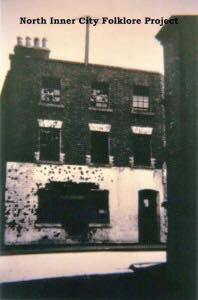
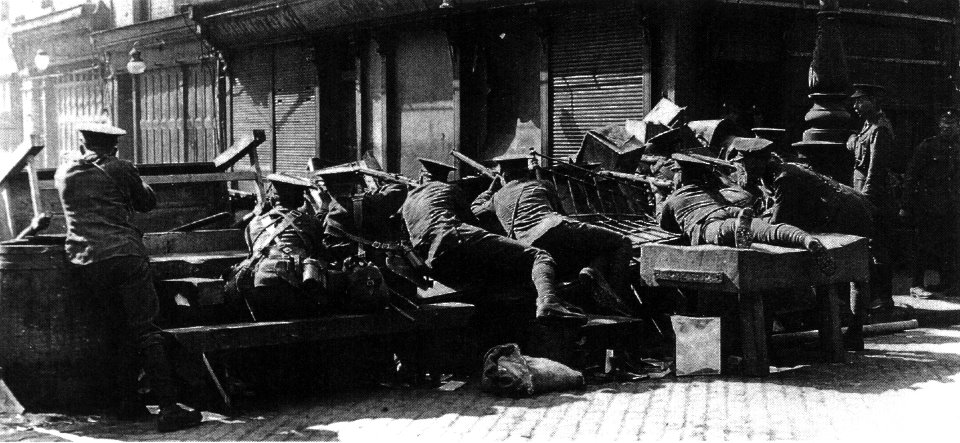

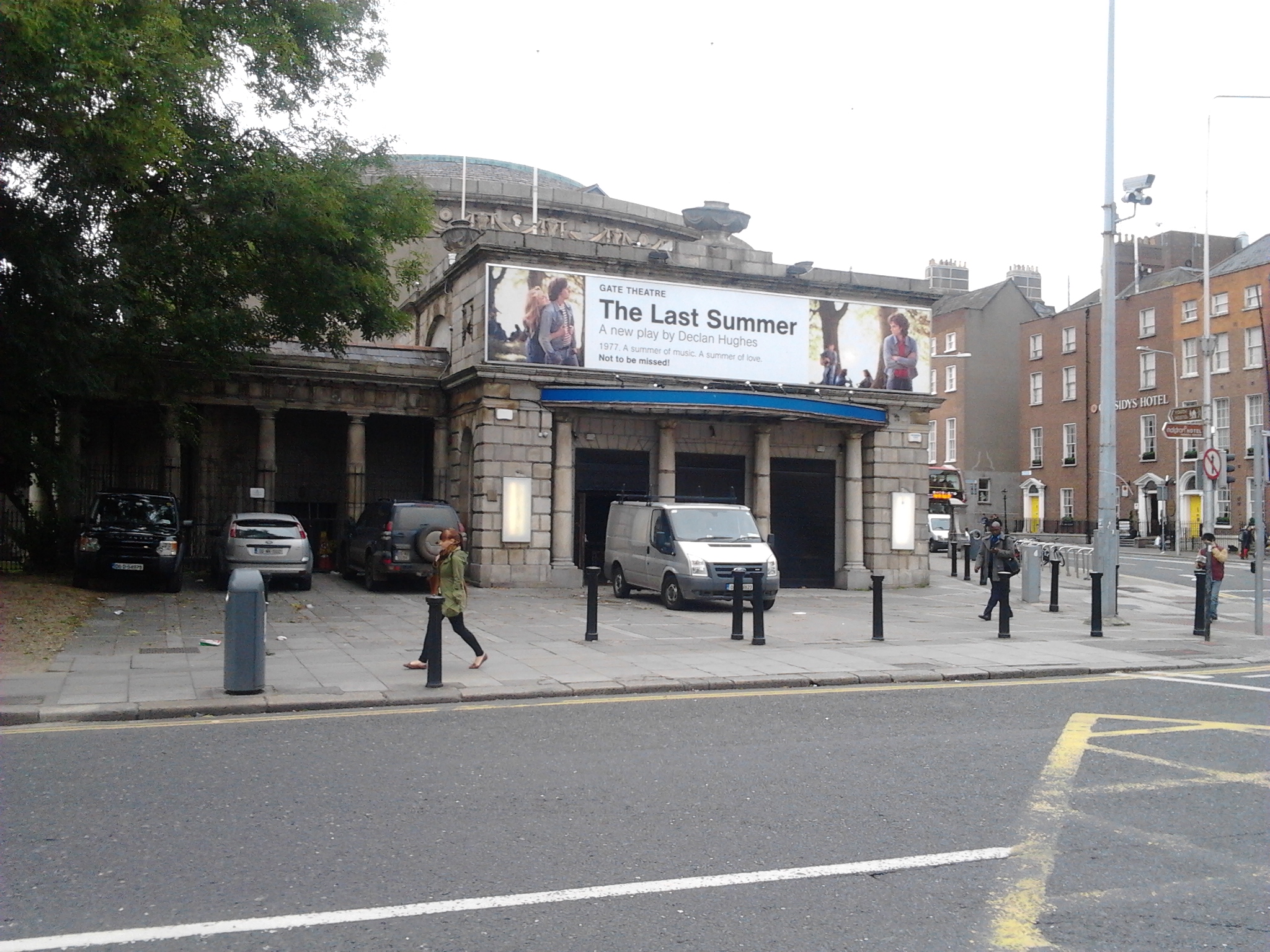
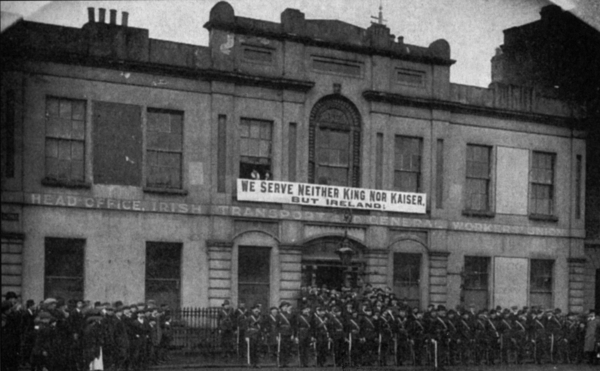

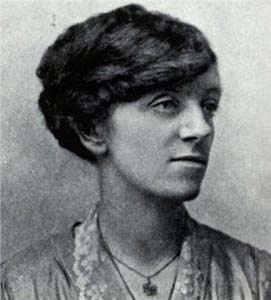
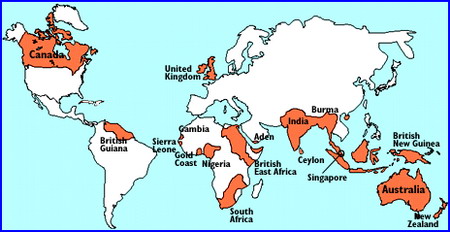

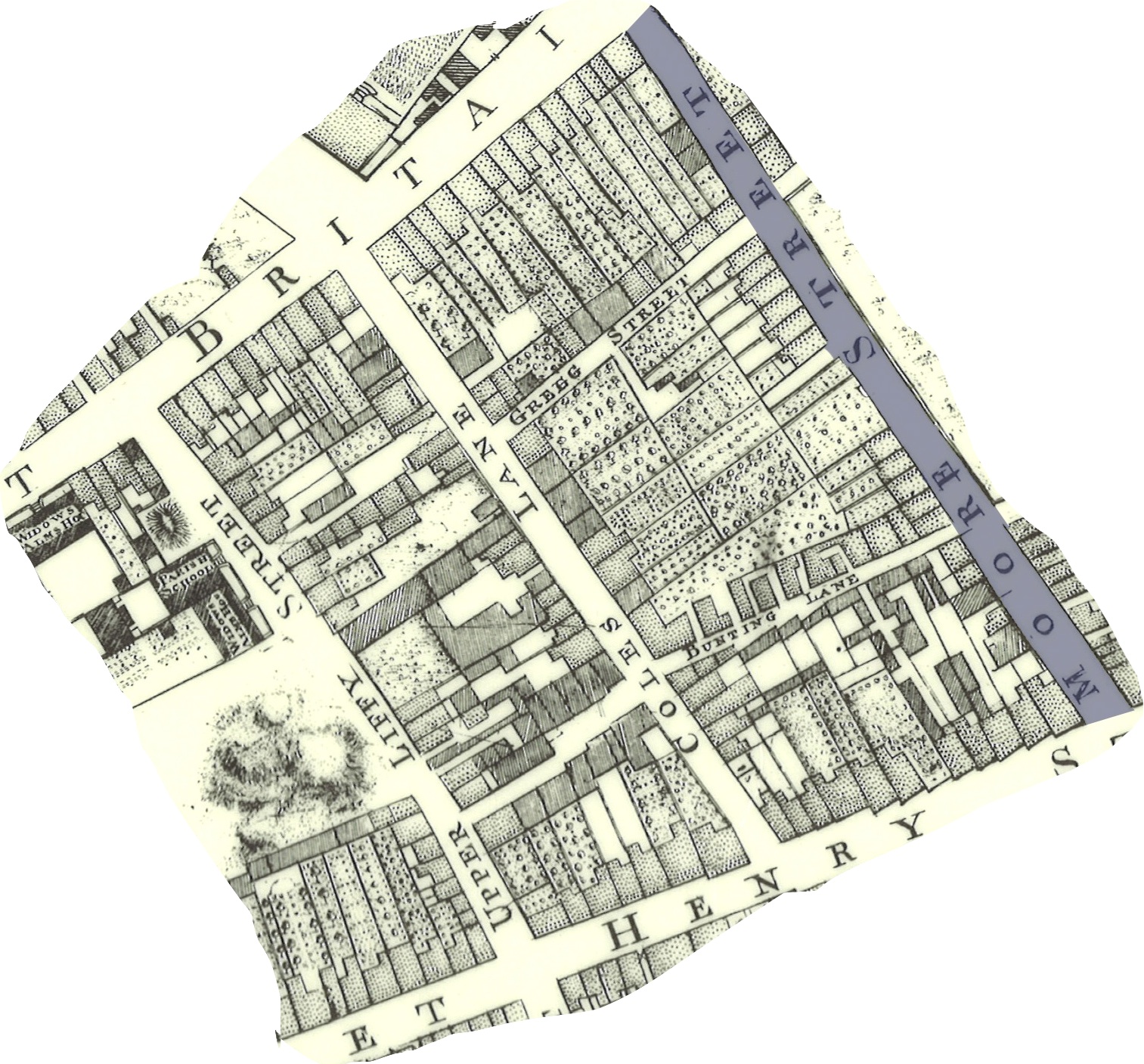

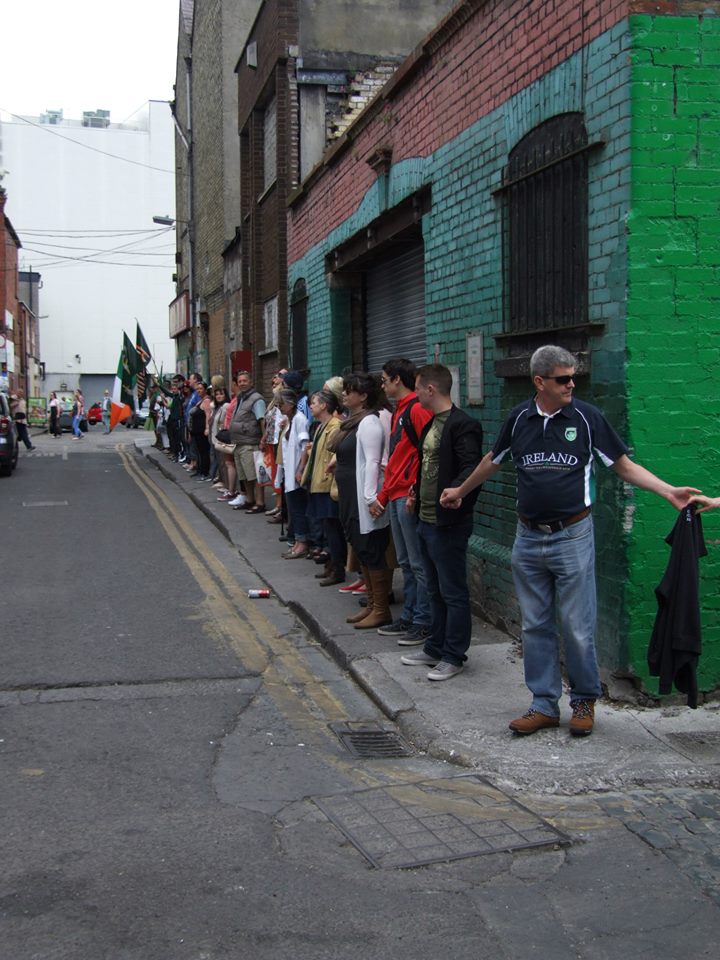
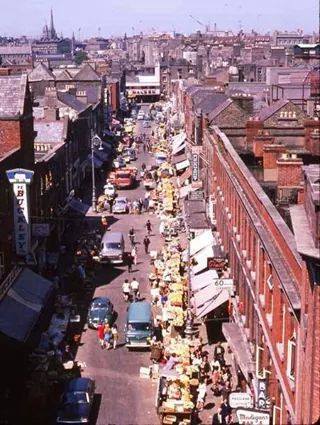


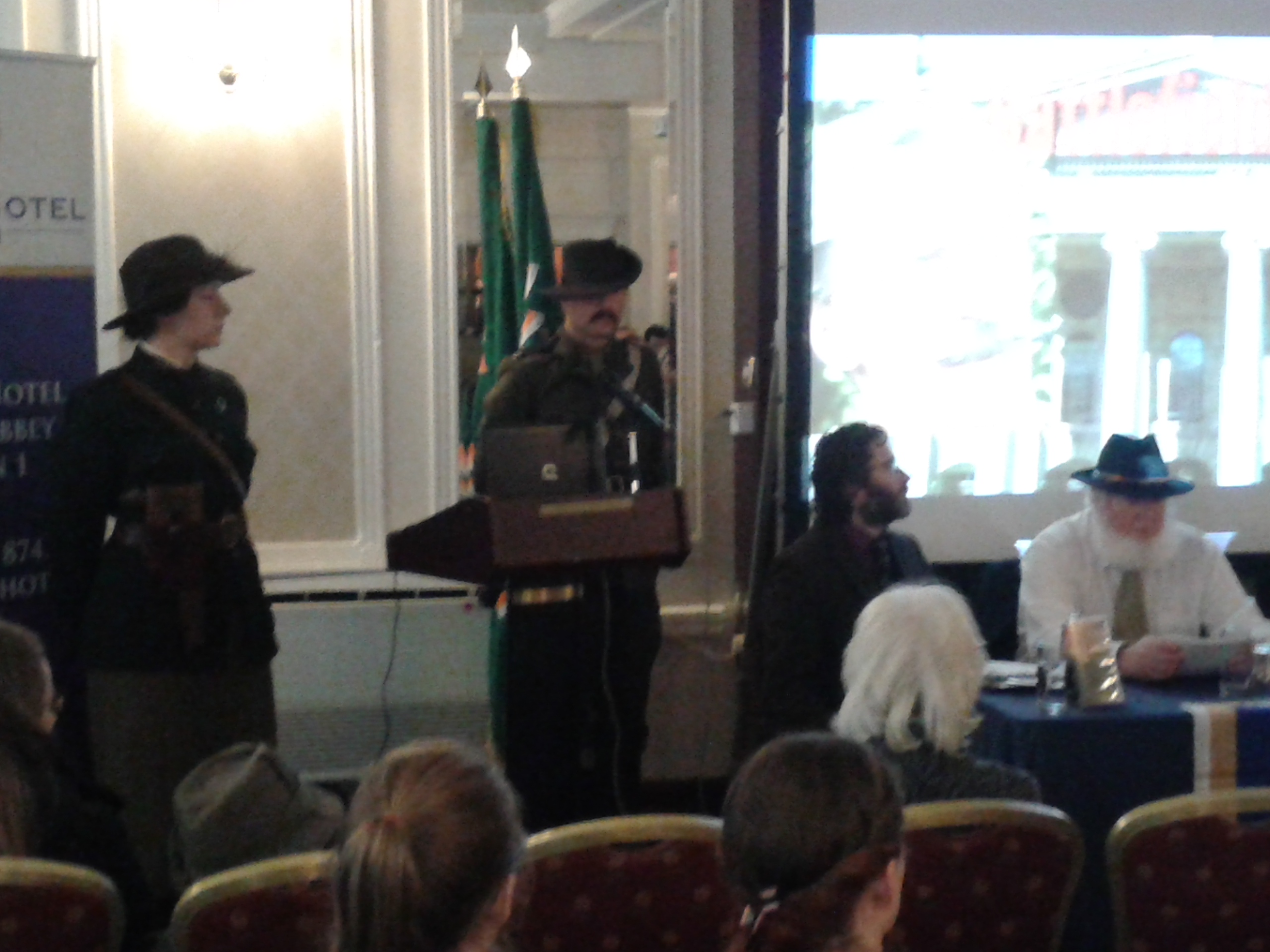


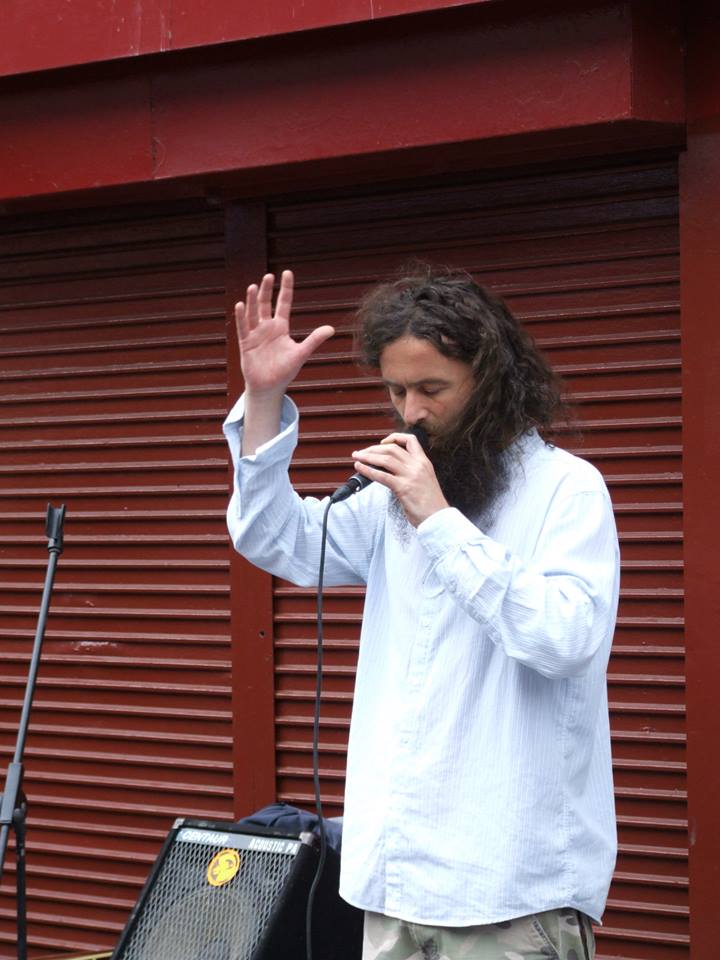


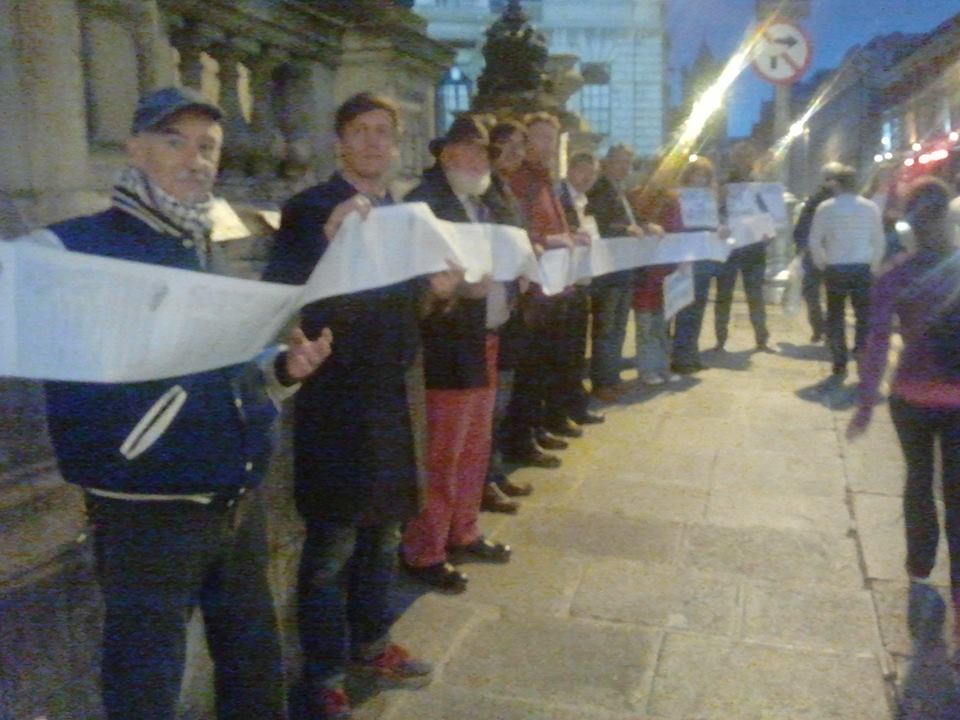


 rebelbreeze