The Save Moore Street from Demolition campaign group gratefully accepted an invitation to participate in the Comrade Corner on Sunday 3rd January in order to spread the word about the campaign and to make further contacts.
The Comrade Corner is part of the Libertine Market Crawl that takes place on the first Sunday of each month 12-5pm and is spread through a number of pubs, mostly in the Liberties area of north Dublin city: The 4th Corner, Dudley’s, Lucky’s, Molly’s Barand Peadar Brown’s.
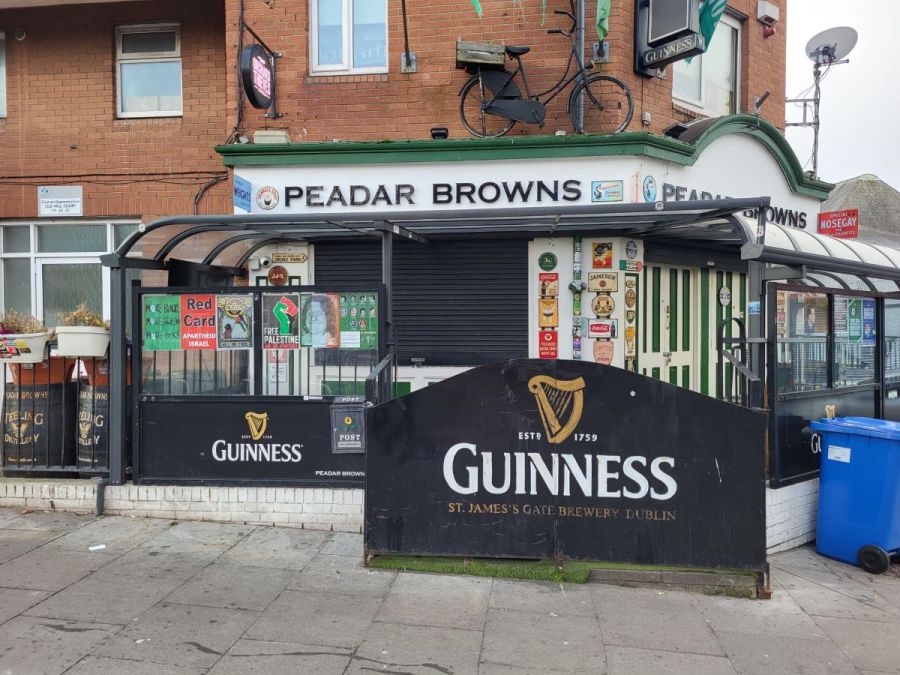
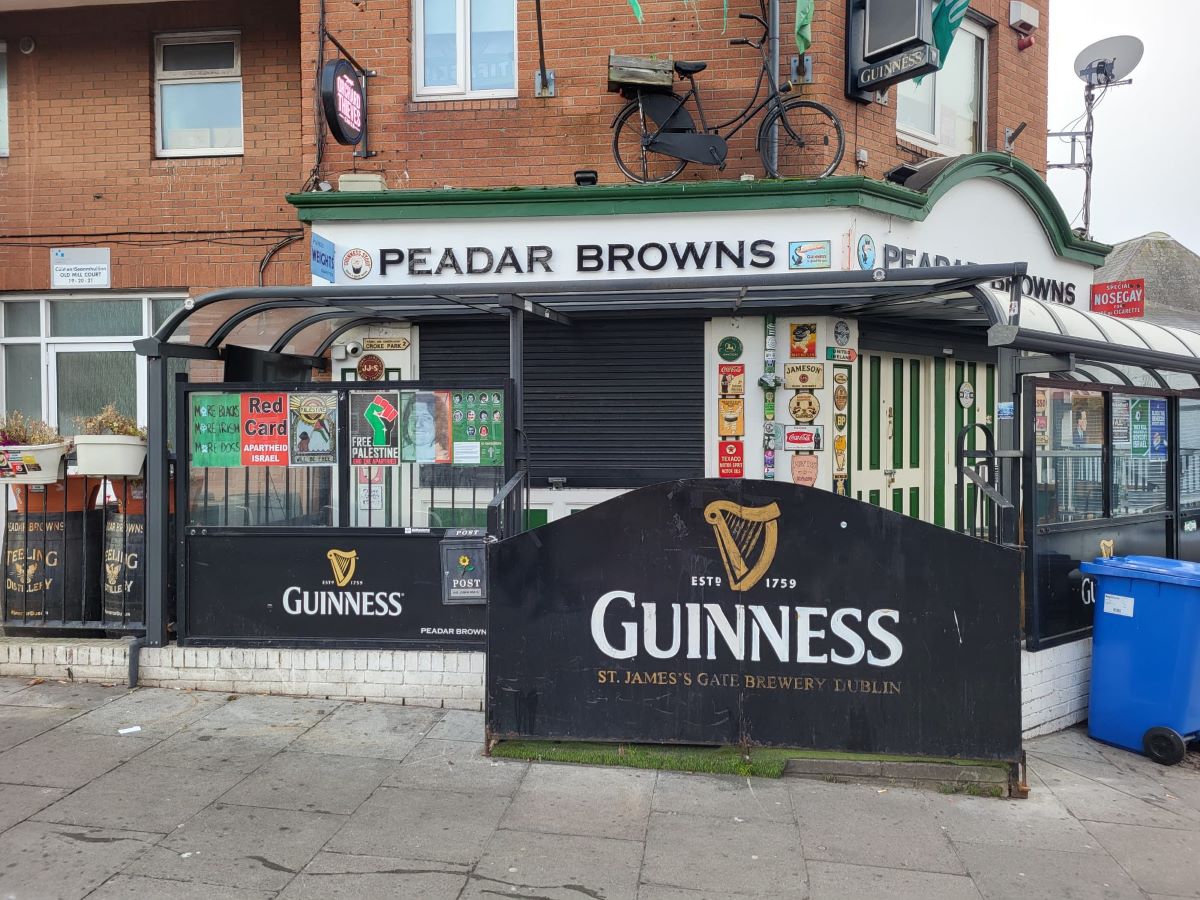
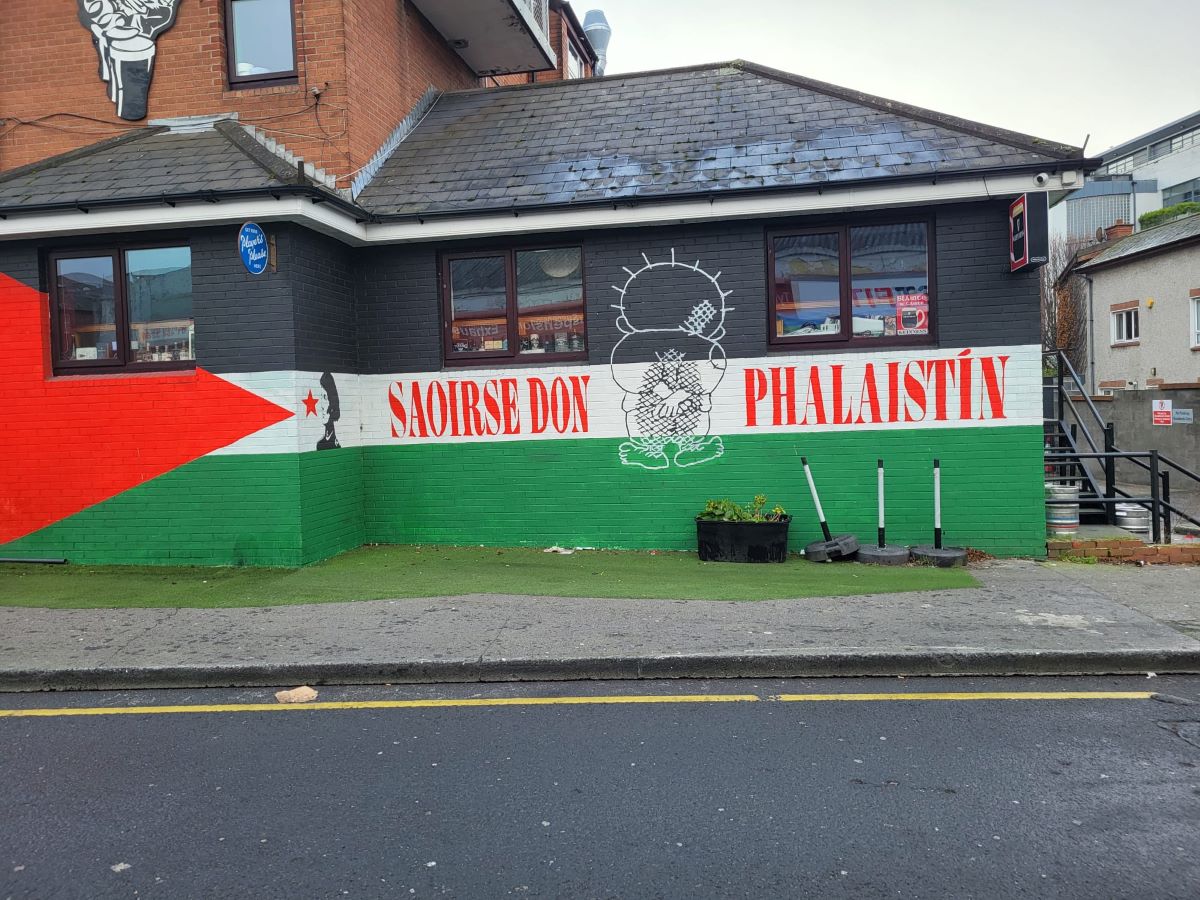
Front of the Peadar Brown’s pub building, Clanbrassil Street. (Photo: R. Breeze)
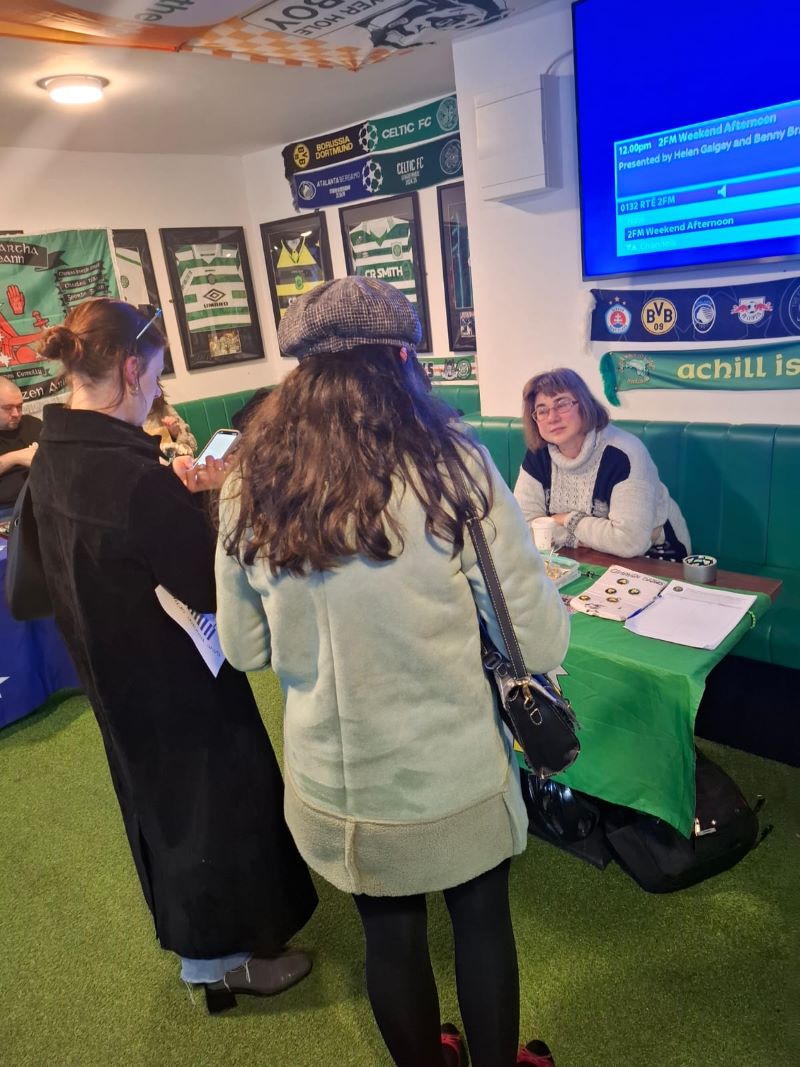
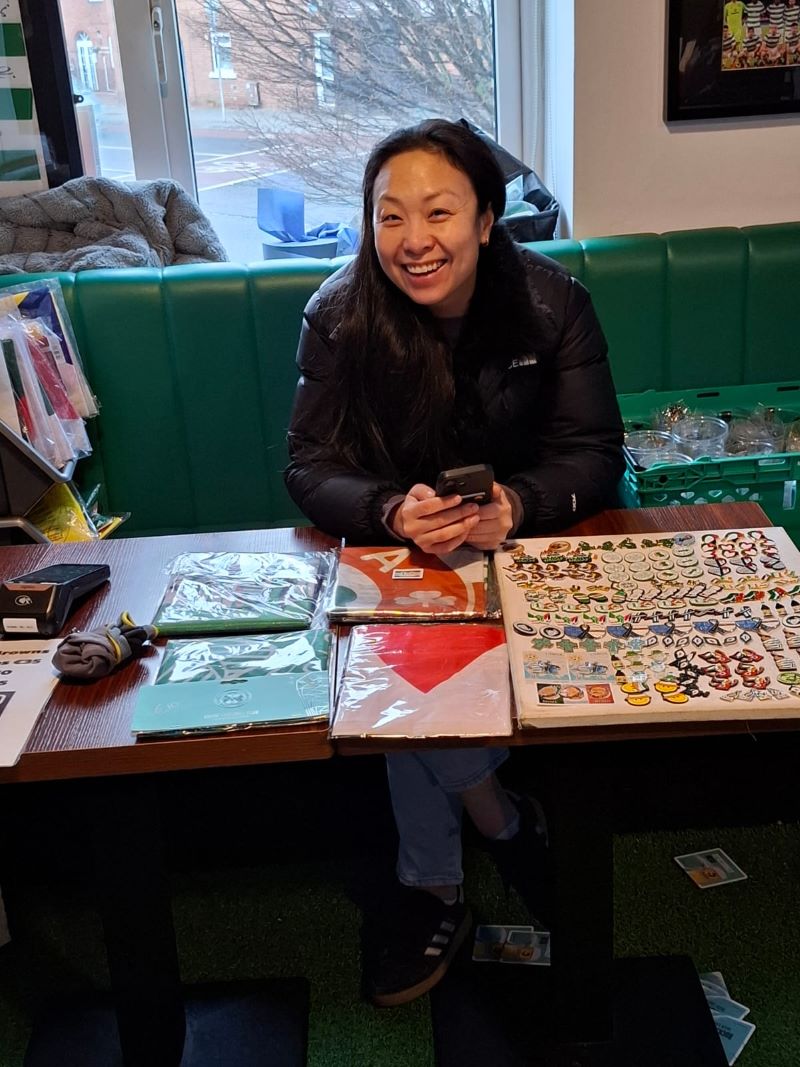
The Comrade Corner’s section of the monthly market take place upstairs in the Peadar Brown’s pub, open to campaigning and community groups to book a table to promote their campaign or group on which they had campaign leaflets, a QR to sign on line and campaign badges.
The latter represented a grotesque on the roof of No.55 Moore Street, missing wingtips shot off by a British bullet during the battle there in 1916.
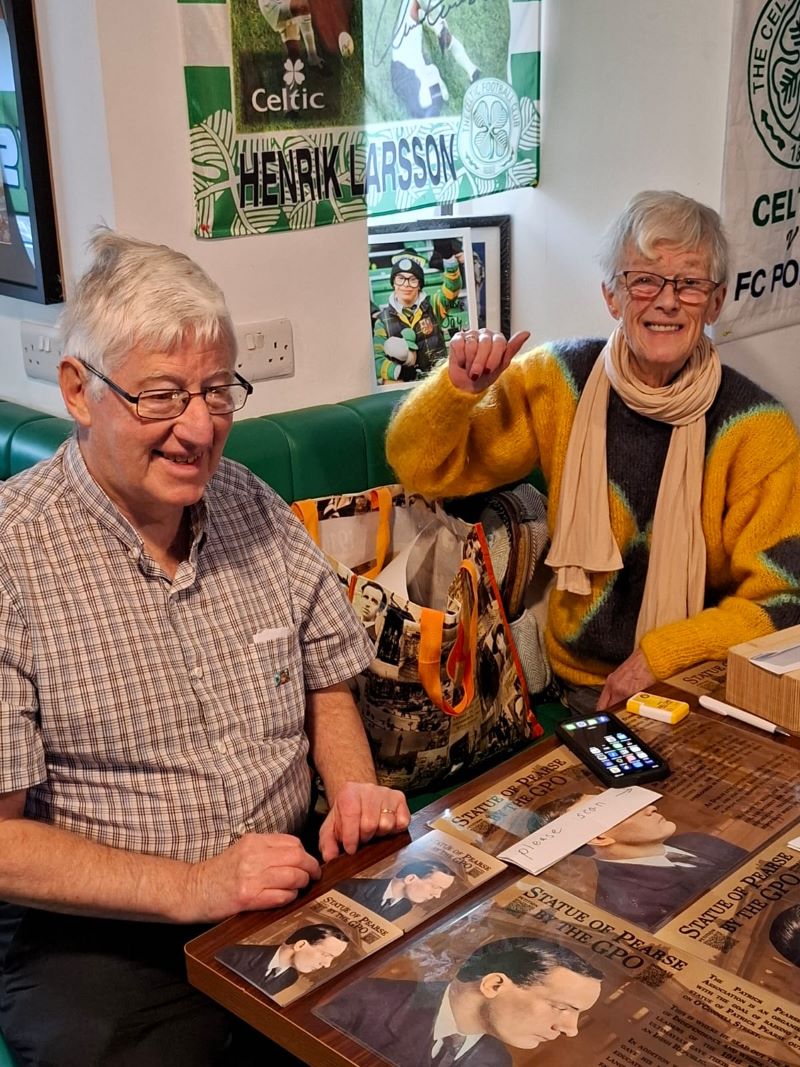
Two of a number of visitors tothe Comrade Corner engaging with the Save Moore Street From Demolition campaign stall at which campaign activist Orla Dunne is seated. (Photo: R. Breeze)
“Over the 12 years of our group’s existence campaigning on the street we have engaged in outreach work often enough,” said one of the two staffing their table in Peadar Brown’s, “including taking our banner to protest marches, giving talks, interviews and conducting history tours.”
The group has been campaigning with a weekly Saturday table for conservation and against demolition in Moore Street since September 2014. “We want to see a busy street market with small independent shops, not chain stores,” said Orla Dunne, also staffing their table in Peadar Brown’s.”
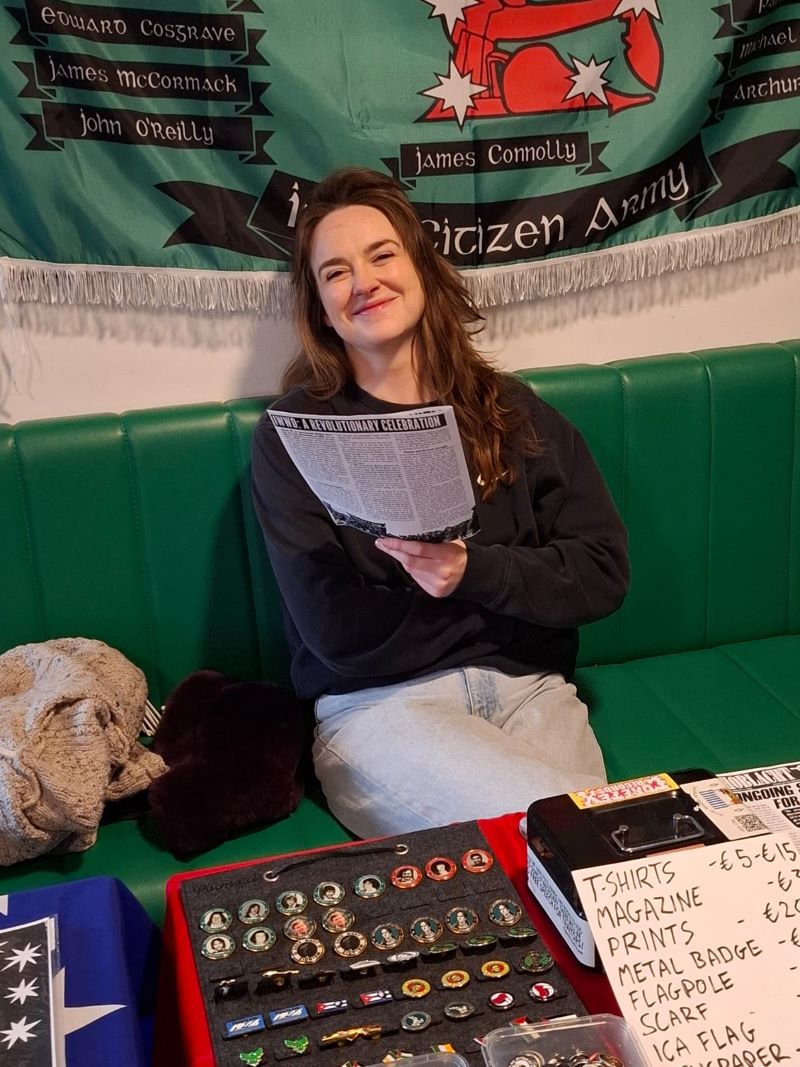
One of the team staffing the Darragh Ó Faoláin stall in Comrade Corner. (Photo: R. Breeze)
“And the history of the 1916 Battleground properly commemorated,” she went on to say, alluding to the fact that of the Seven Signatories of the Proclamation, no less than five spent their last hours of freedom in the Moore Street houses before taking the painful decision to surrender.
Those were Patrick Pearse, James Connolly, Tom Clarke, Seán Mac Diarmada and Joseph Plunkett, all shot by firing squad, along with Willie Pearse, also late of Moore Street as were another ten prominent figures, including Roger Casement, though hanged in Pentonville Jail somewhat later.
The team staffing the Statue of Pearse by the GPO campaign stall in Comrade Corner. (Photo: R. Breeze)
The GPO Garrison had left the burning building on the Friday of Easter Week and, heading to relocate at the Williams and Woods factory, got only as far as Moore Street before they came under intense machine-gun and rifle fire from the encircling British forces in Parnell Street.
Pausing to take a breath and plan their next moves, around 300 men and women occupied the whole central terrace (Nos.12-25), tunnelling through the walls, along with some other buildings. The leader of a failed charge on the British barricade died in a lane now named O’Rahilly Parade.
As he lay dying he wrote a farewell letter to his wife and children, the magnified script reproduced on an impressive monument in the lane-way.
The current Hammerson plan includes at least seven years of construction on the site (with no food stalls possible meanwhile), a new street cut through the 1916 Terrace to O’Connell Street, a hotel in Moore Lane and a Metro entrance in O’Rahilly Parade additional to the O’Connell Street one.
INSIDE PEADAR BROWN’S
The Peadar Brown’s stall in Comrade Corner. (Photo: R. Breeze)
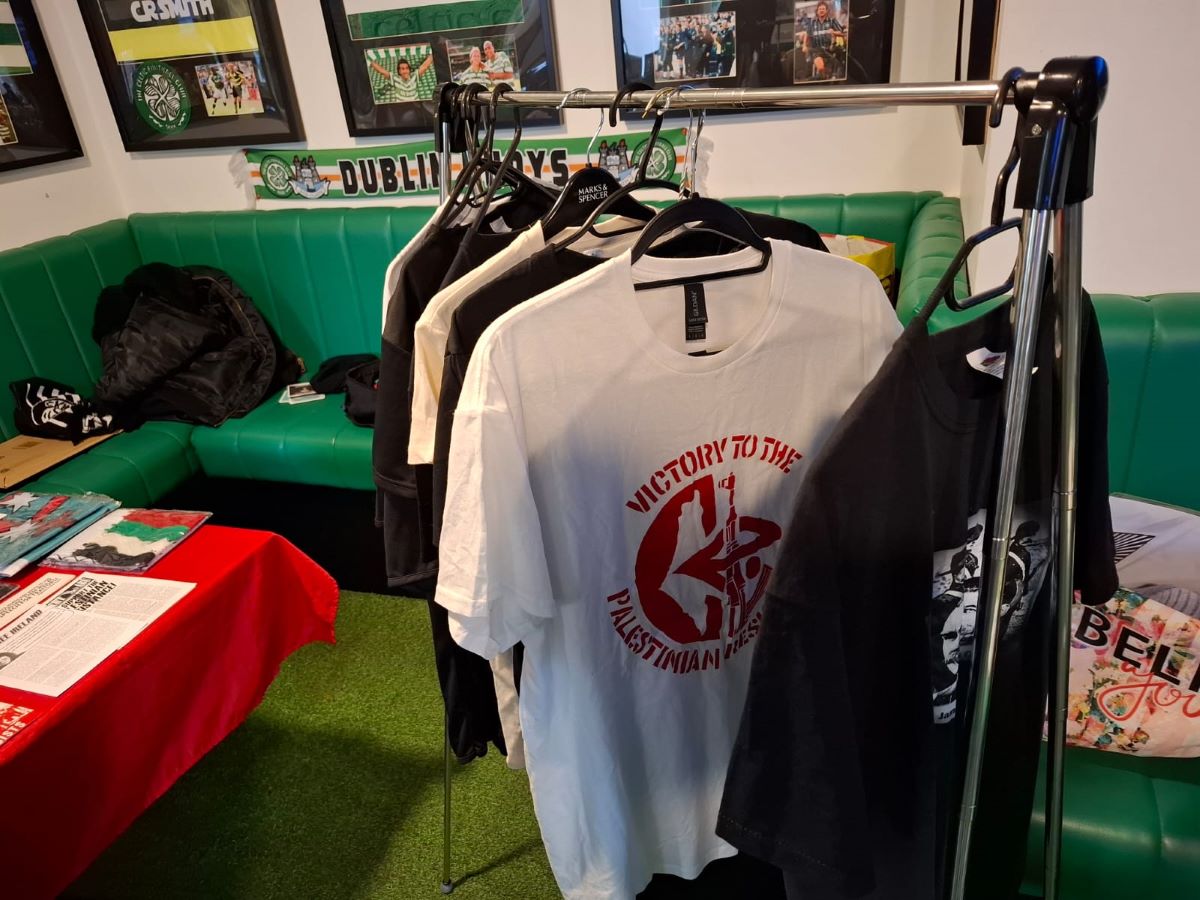
People drifted into the upstairs room in twos and threes, stopping at some or all of the stalls to examine the literature or merchandise on display and to chat to some of the groups. In addition to SMSFD’s, Peadar Brown’s had their own merchandise of badges and T-shirts.
Also selling merchandise within that range was a revolutionary anti-fascist stall, while another table was held by a group campaigning for the erection of a monument to Patrick Pearse in O’Connell Street, near to the GPO where he was located in 1916 before evacuation to Moore Street.
T-shirts merchandise near the Darragh Ó Faoláin Stall in Comrade Corner. (Photo: R. Breeze)
It was notable that the latter group also directed people to the SMSFD group’s table. Many of the visitors had origins outside Ireland, a sector for which perhaps this kind of event would be more usual. How did the SMSFD team feel their table had done for their hours there?
“We did alright,” said Dunne, “though it wasn’t very busy today.” “If we had boosted our online petition signatures alone, which we did, it would have been worth it,” said Breatnach. “Besides, I always wanted to see the famous Pub,” added Dunne, smiling.
Mural on the side of the Peadar Brown’s building. (Photo: R. Breeze)
Much artwork of an Irish Republican nature decorates the inside of the pub downstairs, including a mural along the wall behind the small stage area. The Irish Tricolour, Starry Plough and ‘Irish Republic’ flags hang from the exterior along with anti-racist posters in the outside drinking area.
Last year officials in Dublin City Council sought unsuccessfully to have Peadar Dunne’s remove the large Palestine flag painted on the side of their building. It has a reputation not only as an Irish Republican pub but also of decidedly internationalist solidarity and antifascist character.
Also last year, some fascist and far-Right elements threatened the pub with a demonstration which failed to materialise, to counter which antifascists had packed the pub to overflowing. The far-Right’s anger was aroused by the banning of a musician for allegedly uttering racist comments.
The Peadar Brown’s T-Shirt rack by their stall in Comrade Corner. (Photo: R. Breeze)
End.
Note: If you found this article of interest, why not register with Rebel Breeze for free, so that you will be notified by email of subsequent articles. You can de-register any time you wish.
A campaign for conservation of the ancient Moore Street Dublin inner-city street market area and 1916 Battleground, in its 11th year of Saturdays on the actual street is seeking to reach 2000 on-line signatures for the group’s petition this year.
The site was formerly under threat of construction of a giant ‘shopping mall’ from the ILAC to O’Connell Street. However ‘shopping malls’ are not making so much money nowadays so the new plan is largely a ‘shopping area’ with an hotel and a new road from the ILAC to O’Connell Street.
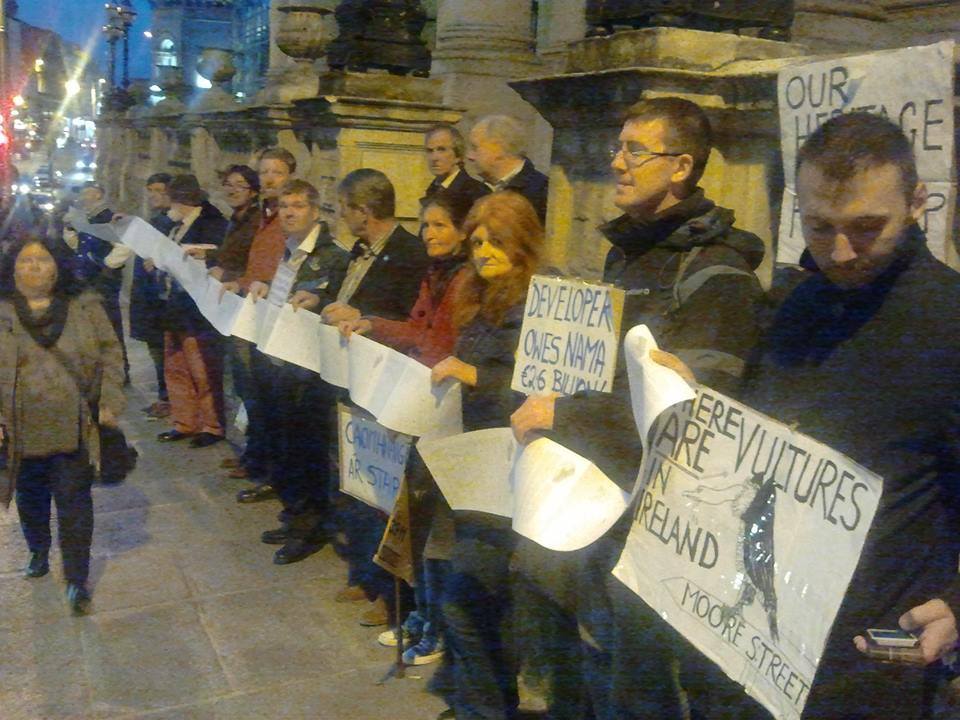
Picket/ lobby of Dublin City Council in 2014, petition stretch and posters organised by the Save Moore Street From Demolition Group, founded a couple of months earlier to prevent Dublin City Council City Manager giving property speculator Joe O’Reilly Nos. 24-25 in exchange for Nos.14-17, which would have allowed him to demolish from No.25-No.18. The campaign was successful in preventing that as councillors voted against the swap. (Photo: SMSFD archives)
Moore Street is of course already ‘a shopping area’ but what that means to property speculators is a street of chain stores, something like the Grafton and Henry Streets. Such streets are busy during shopping hours but largely deserted at night and anathema to the living social city centre.
Independent small shops and street stalls characterise a street market, typically with some cafes, a bakery and restaurant. But the agent of Hammerson, the speculator company, has closed down a bakery and a number of successful restaurants and cafés on the street.
On the Friday of Easter Week, 300 or so of the GPO garrison evacuated the burning building and occupied the central terrace in Moore Street to gain a respite, setting up their new HQ there and a field hospital caring for their wounded and for a wounded soldier of the British Army.
The new intended street would cut right through the historic 1916 terrace, the footprint and path traversed by much of the 300 or so GPO Garrison in 1916 as they evacuated their burning former HQ and prepared to relocate to William & Woods site in nearby King’s Inn Street.
Moore Street, according to campaigners, is of great Irish cultural and historical importance but is also of international historical stature: surrender site of the first anti-colonial uprising of the 20th Century and of the first rising against World War and last location in freedom of five of its leaders.
Those five, Connolly, Pearse, Clarke, Mac Diarmada and Plunkett, were also five of the Seven Signatories of the 1916 Proclamation, a document of huge symbolic significance in history and still often referenced in contemporary discourse.
Campaigners point to the presence in the street of the Irish Citizen Army, which they claim as “the first workers’ army” and of its leader, Connolly along with three of the first women’s republican military organisation, Cumann na mBan: Elizabeth O’Farrell, Julia Grenan and Winifred Carney.
The Irish Citizen Army recruited women too, including appointing some of them as officers in command of male Volunteers, another first in world history.
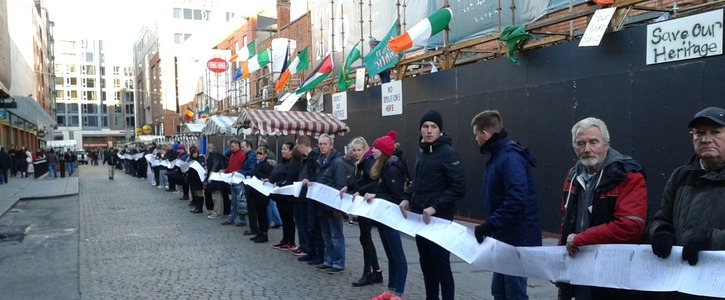
Signed petition sheets sellotaped edge to edge in January 2016, stretched along Moore Street as the 6-day occupation of the endangered buildings came to an end and shortly before the 6-week blockade began. (Photo: SMSFD archive)
SUCCESSES AND DEFEATS
The campaign has had some previous successes, including four buildings being declared a historical monument in 2007, refusal of land-swap in 2014 (see photo), a six-week blockade of the site and a High Court declaration in 2016 of the whole area being a national historical monument.
However, the campaign insists the historical monument is all 16 buildings in the terrace, not just four. And the High Court decision was successfully appealed in February 2017 by the Minister of Heritage on the grounds that a Judge did not have the power to declare a national monument.
The campaigners, now in their 11th year of Saturdays on the street, say that they stopped counting hard copy petition signatures once they passed 380,000. But last year they started an electronic petition in which they aimed for 1,000 by year’s end — and exceeded their target.
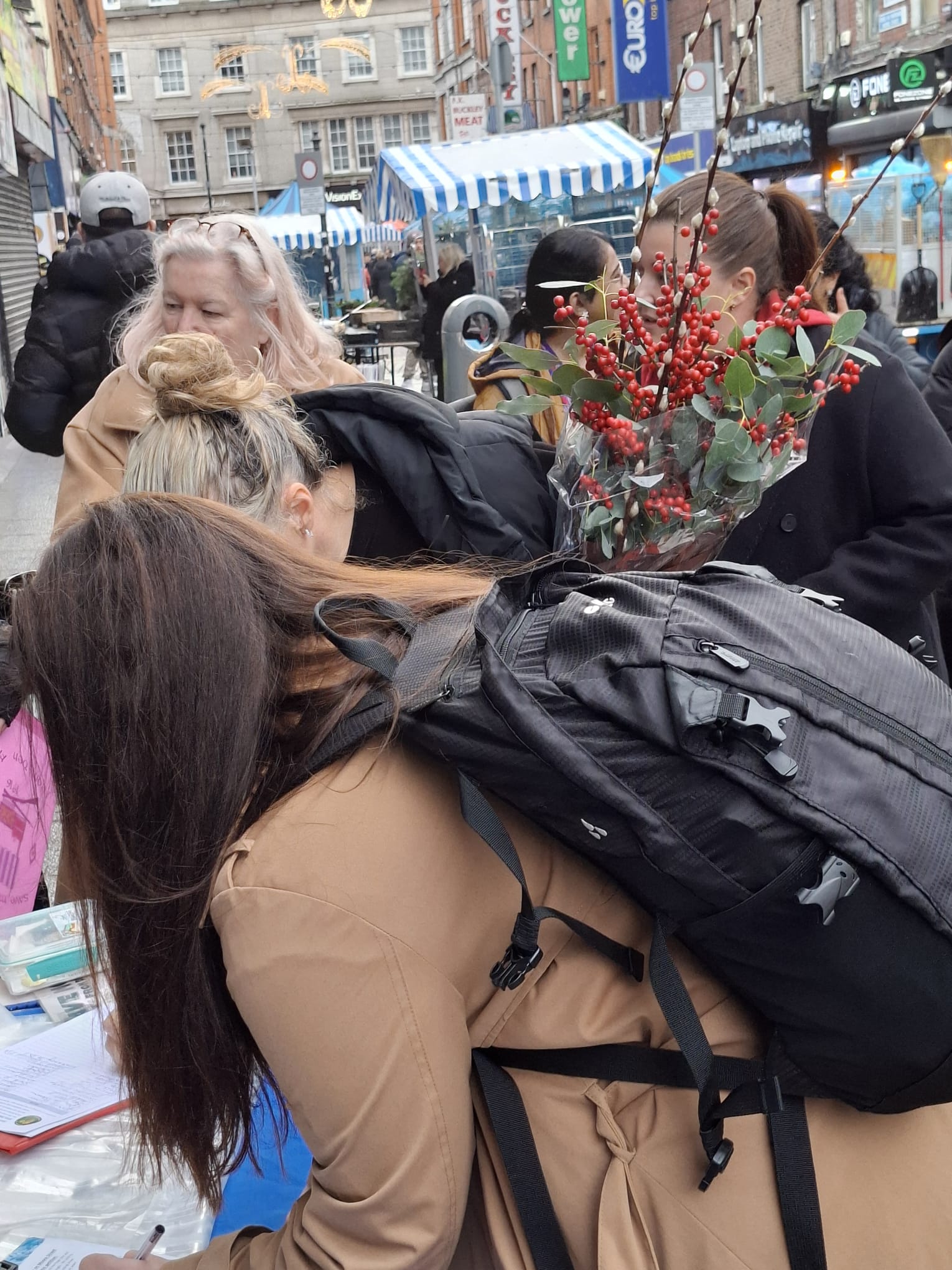
Women Christmas shopping crowding around the petition table to sign hard copy and on-line petition last Saturday. (Photo from weekly SMSFDalbum 20 December 2025.)
This year they’ve aimed to reach 2,000 but, with nearly another 300 needed with a week to go before the end of 2025, reaching their target seems very unlikely.
The campaign group supporters say that they have held the line so long because of the support of hundreds of thousands, not only of indigenous Irish but also of settled migrants (the latter being the mainstay of the traditional fresh fruit and vegetable stalls) and want the signatures to reflect all that.
“At this stage, the strongest help we can get from ordinary people is to sign the on-line petition and to get their contacts to do so too,” said one of the campaigners on the street recently. “On-line signatures are identifiable to one person, verifiable and the total can be checked on line.”
“The authorities will remember that people took direct action in the past to halt demolition, as in the occupation and blockade of 2016 but thousands of online petition signatures are an indication that the activists represent much more than themselves alone”.
The Save Moore Street From Demolition campaigners are on the street every Saturday from 11.30am-1.30pm and their online petition is on https://my.uplift.ie/petitions/save-moore-street The group has Instagram and Facebook pages also.
end.
Note: If you found this article of interest, why not register with Rebel Breeze for free, so that you will be notified by email of subsequent articles. You can de-register any time you wish.
Save Moore Street From Demolition (Reading time:2 mins.)
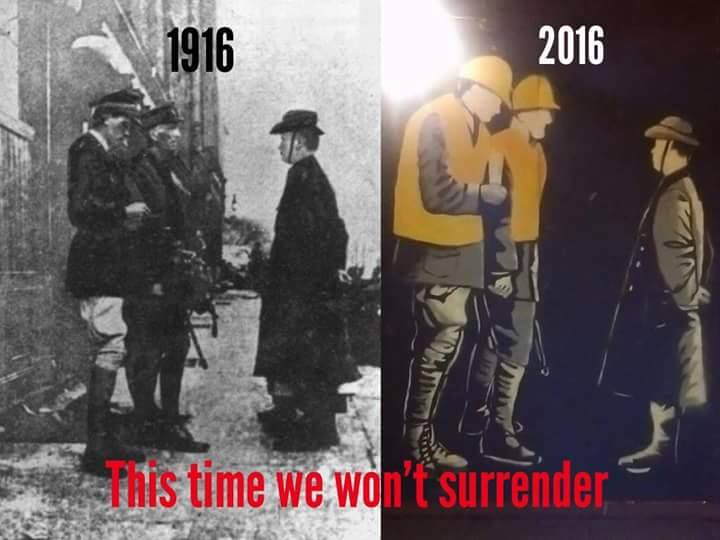
“This time we won’t surrender” were the words that appeared in January 2016 on a meme featuring Banksy-style graffiti artwork painted on hoardings in Moore Street, surrounding the planned demolition site of at least two buildings.
In the first weeks of January 2016 the Save Moore Street From Demolition team on their weekly Saturday stall had noted the erection of hoardings around a number of buildings and, learning of the planned demolition of Nos.13 and 18, called emergency demonstrations on to the street.
The first of these resulted in a number of people occupying the buildings to prevent demolition and the occupation grew until by majority decision they were evacuated after a High Court injunction had been issued against any damage by contractors pending a Court decision on the buildings.
On the last day of the occupation, signed SMSFD petition sheets were taped end to end and a chain organised stretching them from one end of Moore Street to the other. The Save Moore Street 2016 group was founded to unite the various street-active components of the conservation campaign.
One day in January, the Banksy-style graffiti appeared on part of the hoarding in the street. Part of the artwork reproduces the scene of the 1916 Rising surrender of the forces in Moore Street and of the entire Rising, captured by a photographer in Parnell Street on April 30th.
That staged photograph shows General Lowe and his son John, also a British officer, taking the surrender from Commander-in-Chief Patrick Pearse with Vol. Elizabeth O’Farrell by his side but out of view (by her choice, she later related) though her feet may be seen beside Pearse’s.
The artist transposed the scene to the present, with the two figures of the British Army now wearing construction safety helmets, representing those who planned to demolish the historic buildings in the 1916 Terrace that had been occupied by up to 300 men and women fighters in 1916.
The artwork was one feature of the many aspects of the resistance in 2016 which helped to ensure a High Court decision that the whole area is a “1916 History Monument” but the Minister of Heritage appealed on the basis that a High Court Judge could not make that decision.
Other aspects included a 6.30am-4pm blockade of the site Mon-Fri for six weeks, pickets of Heritage Dept. Offices, including re-enactments and mock history funerals, protesting the Heritage Minister’s 1916 event in Moore Street and weekly collection of petition signatures on the street.
In February 2017 the Minister’s appeal succeeded and the earlier Planning Permission was once again in force. However, no buildings in the terrace had been demolished nor have been since, with many twists and turns in the struggle yet – and still – to come.
If you support the struggle, spread the word and please sign our on-line petition and ask your contacts to do likewise. Ní neart go cur le chéile.https://my.uplift.ie/petitions/save-moore-street
Large numbers attending a rally Sunday afternoon were addressed by a number of speakers from a platform in the centre of the 1916 Terrace organised by the Moore Street Preservation Trust on part of the very site they wished to preserve.
Fintan Warfield, a Sinn Féin Senator (and cousin of Derek and Brian Warfield of the Wolfe Tones) came on stage to perform Come Out Yez Black ‘n Tans followed by Grace, about Grace Gifford’s wedding to Vol. Joseph Plunkett hours before his execution by British firing squad.
Fintan Warfield performing at the event, behind him the portraits of two of the Moore Street Garrison in 1916 may be seen. (Photo: R. Breeze)
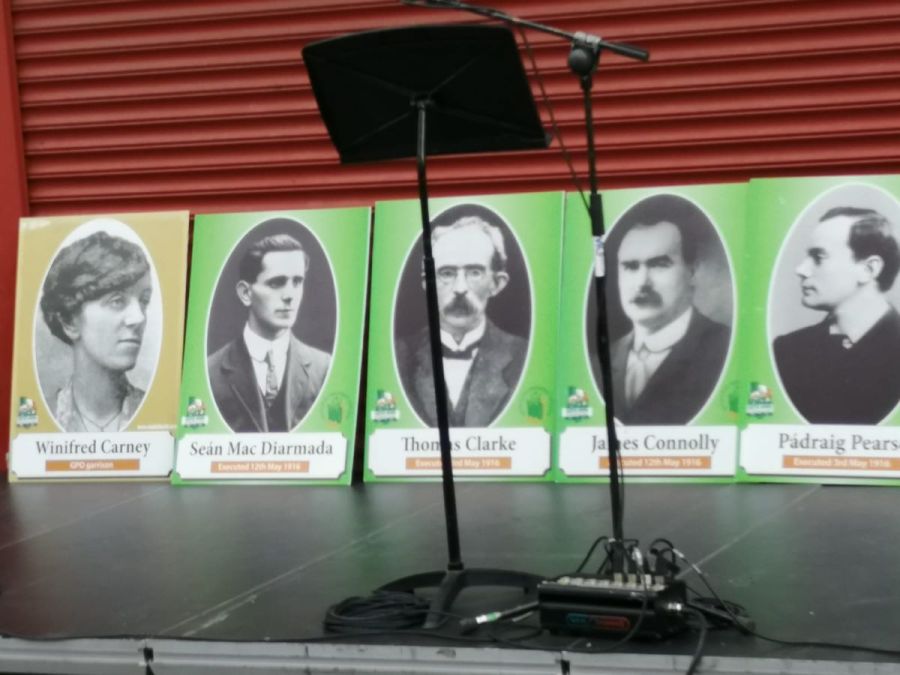
Warfield performed in front of a number of large board posters bearing the images of a number of leaders of the 1916 Rising who had occupied Moore Street in 1916 and Vols. Elizabeth O’Farrell and Winifred Carney, two of the three women Volunteers who had been part of the garrison.
The start of the rally however was delayed, apparently awaiting the arrival of Mary Lou Mac Donald, billed as the principal speaker on the Moore Street Preservation Trust’s pre-rally publicity.
Eventually Mícheál Mac Donncha, Secretary of the Trust and a Sinn Féin Dublin City councillor came on the stage to promote some MSPT merchandise (some of it for free) and to introduce the MC for the event, Christina McLoughlin, a relative of Comdt. Seán McLoughlin.
Christina McLoughline, MC of the event. (Photo: R. Breeze)
Vol. Seán McLoughlin had been appointed Dublin Commandant General by James Connolly during the GPO evacuation and was about to lead a charge on the British Army barricade in Parnell Street when the decision was taken to cancel after which he organised the surrender.
He later became a communist and was never acknowledged at Commandant level by the War Pensions Dept. of the State under De Valera, despite his rank in Moore Street and later also in the Civil War in Cork.
Sean’s relative Christina McLoughlin welcomed Mary Lou Mac Donald on to the stage.
Mac Donald’s appearance on the stage received strong applause. In fairness, many present, if not most, were of the party faithful. Despite the presence of some younger people, the general age profile was decidedly from the 40s upwards, indeed many being clearly in the later third.
Mary Lou Mac Donald, President of the Sinn Fein party, speaking at the event. (Photo: R. Breeze)
Mac Donald, who is not an Irish speaker, read the beginning of the address well in Irish before going on to talk in English about the importance of Moore Street site in the history of the 1916 Rising and in Irish history generally and how her party in government would save it.
After the applause for Mac Donald, the MC called Proinnsias Ó Rathaille, a relative of Vol. Michael The O’Rahilly, who was mortally wounded leading a charge up Moore Street against a British Army barricade in Parnell Street and who died in the nearby lane that now bears his name.
Ó Rathaille’s address was heavy in the promotion of the Sinn Féin party and, in truth rather wandering so that he had to return to the microphone after he’d concluded, to announce Evelyn Campell to perform a song she had composed: The O’Rahilly Parade (the lane where he died).
Evelyn Campbell performing her composition O’Rahilly’s Parade at the event. (Photo: R. Breeze)
Campell is a singer-songwriter and has performed in Moore Street on previous occasions, the first being at the invitation of the Save Moore Street From Demolition group who were the only group to campaign to have the O’Rahilly monument finally signposted by Dublin City Council.
McLoughlin announced Deputy Mayor Donna Cooney to speak, a relative of Vol. Elizabeth O’Farrell, one of the three women who were part of the insurrectionary forces occupying Moore Street. Cooney is a Green Party Councillor and a long-standing campaigner for the conservation of Moore Street.
Deputy Dublin Lord Mayor and Green Party councillor Donna Cooney speaking at the event. (Photo: R. Breeze)
While speaking about the importance of Moore Street conservation for its history and street market, Cooney also alluded to its deserving UNESCO World Heritage status, adding that the approval of the Hammerson plan for the street was in violation of actual planning regulations.
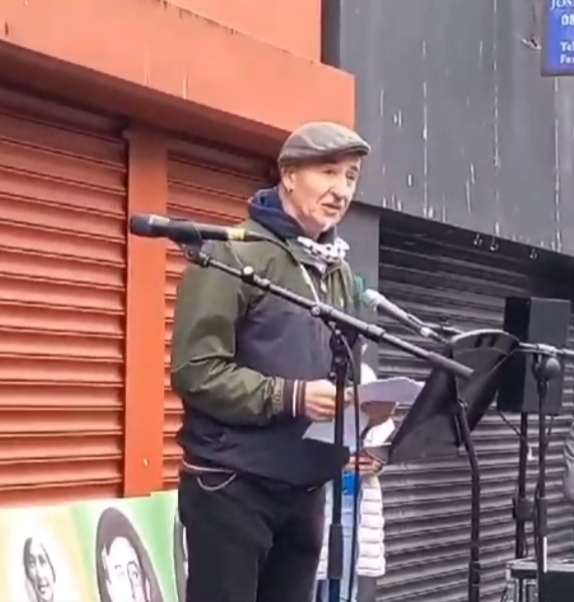
Next to speak was Diarmuid Breatnach, also a long-time campaigner, representing the Save Moore Street From Demolition campaign group which, as he pointed out has been on the street every Saturday for over a ten years and is independent of any political party or organisation.
Diarmuid Breatnach speaking at event on behalf of the independent Save Moore Street From Demolition campaign group. (Photo: R. Breeze)
Breatnach also raised the UNESCO world heritage importance, as the SMSFD group were first to point out and have been doing for some years, based on a number of historical “firsts” in world history, including the 1916 Rising having been the first anti-colonial uprising of that century.
The Rising was also the first ever against world war, Breatnach said. He told his audience that the Irish State has applied for UNESCO heritage status for Dublin City, but only because of its Victorian architecture and that it had once been considered “the second city of the British Empire”.
Stephen Troy, a traditional family butcher on the street, was next to speak. He described the no-notice-for-termination arrangements which many phone shops in the street had from their landlord and how Dublin City Planning Department had ignored the many sub-divisions of those shops.
Stephen Troy, owner of family butcher shop on the street and campaigner, speaking at the rally. (Photo: R. Breeze)
Troy’s speech was probably the longest of all as he covered official attempts to bribe the street traders to vote in favour of the Hammerson plan and what he alleged was the subversion of the Moore Street Advisory Group which had been set up by the Minister for Heritage.
It began to rain as Troy was drawing to a close but fortunately did not last long.
Jim Connolly Heron, a descendant of James Connolly and also a long-time campaigner for Moore Street preservation was then called. Speaking on behalf of the Trust, Connolly began by reading out a list of people who had supported the conservation but had died along the way.
Connolly Heron went on to promote the Trust’s Plan for the street which had been promoted by a number of speakers and to announce the intention of the Trust to take a case to the High Court for a review of the process of An Bord Pleanála’s rejection of appeals against planning permission.
Jim Connolly Heron, great-grandson of James Connolly and prominent member of the Moore Street Preservation Trust, speaking at the event. (Photo: R. Breeze)
The MC acknowledged the presence in the crowd of SF Councillor Janice Boylan, with relatives among the street traders and standing for election as TD and Clare Daly, also standing for election but as an Independent TD in the Dublin Central electoral area.
MOORE STREET, PAST AND PRESENT
Moore Street is older than O’Connell Street and the market is the oldest open-air street market in Ireland (perhaps in Europe). It became a battleground in 1916 as the GPO Garrison occupied a 16-house terrace in the street after evacuating the burning General Post Office.
At one time there were around 70 street stalls in the Moore Street area selling fresh fruit, vegetables and fish and there were always butchers’ shops there too. But clothes, shoes, furniture, crockery and vinyl discs were sold there too, among pubs, bakeries and cafés.
Dublin City Planning Department permitted the development of the ILAC shopping centre on the western side of the street centre and the Lidl supermarket at the north-east end of the street, along with a Dealz as the ILAC extended to take over the space on its eastern side.
While many Irish families turned to supermarkets, people with backgrounds in other countries kept the remaining street traders in business; but the property speculators ran down the street in terms of closing down restaurants and neglecting the upkeep of buildings.
The authorities seem to have colluded in this as antisocial behaviour that would not be tolerated for a minute in nearby Henry Street is frequently seen in Moore Street.
The new craft and hot food stalls Monday-Saturday run counter to this but are managed by the private Temple Bar company which can pull out in a minute. On Sunday, the street is empty of stalls and hot food or drinks are only available in places that are part of the ILAC shopping centre.
The O’Reilly plan was for a giant ‘shopping mall’ extending to O’Connell Street and was paralysed by an objectors’ occupation of a week followed by a six-week blockade of the site, after which a High Court judgment in 2016 declared the whole area to be a National Historical Monument.
A judge’s power to make such a determination was successfully challenged by then-Minister of Heritage Heather Humphries in February of 2017. NAMA permitted O’Reilly to transfer his assets to Hammerson who abandoned the ‘shopping mall’ plan as not profitable enough.
The Hammerson plan, approved by DCC and by ABP is for a shopping district no doubt of chain stores like Henry Street or Grafton Street, also an hotel and a number of new streets, including one cutting through the 1916 central terrace out to O’Connell Street from the ILAC.
In the past dramatist Frank Allen organised human chains in at least three ‘Arms Around Moore Street’ events and the Save Moore Street 2016 coalition organised demonstrations, re-enactments, pickets and mock funerals of Irish history (i.e under Minister Humphries).
The preservation campaigning bodies still remaining in the field are the SF-backed Moore St. Preservation Trust and the independent Save Moore St. From Demolition group. The former is only a couple of years in existence and the latter longer than ten years.
However, both groups contain individuals who have been campaigning for years before that. The MSPT tends to hold large events sporadically; the SMSFD group has a campaign stall on the street every Saturday from 11.30am-1.30pm. Both have social media pages.
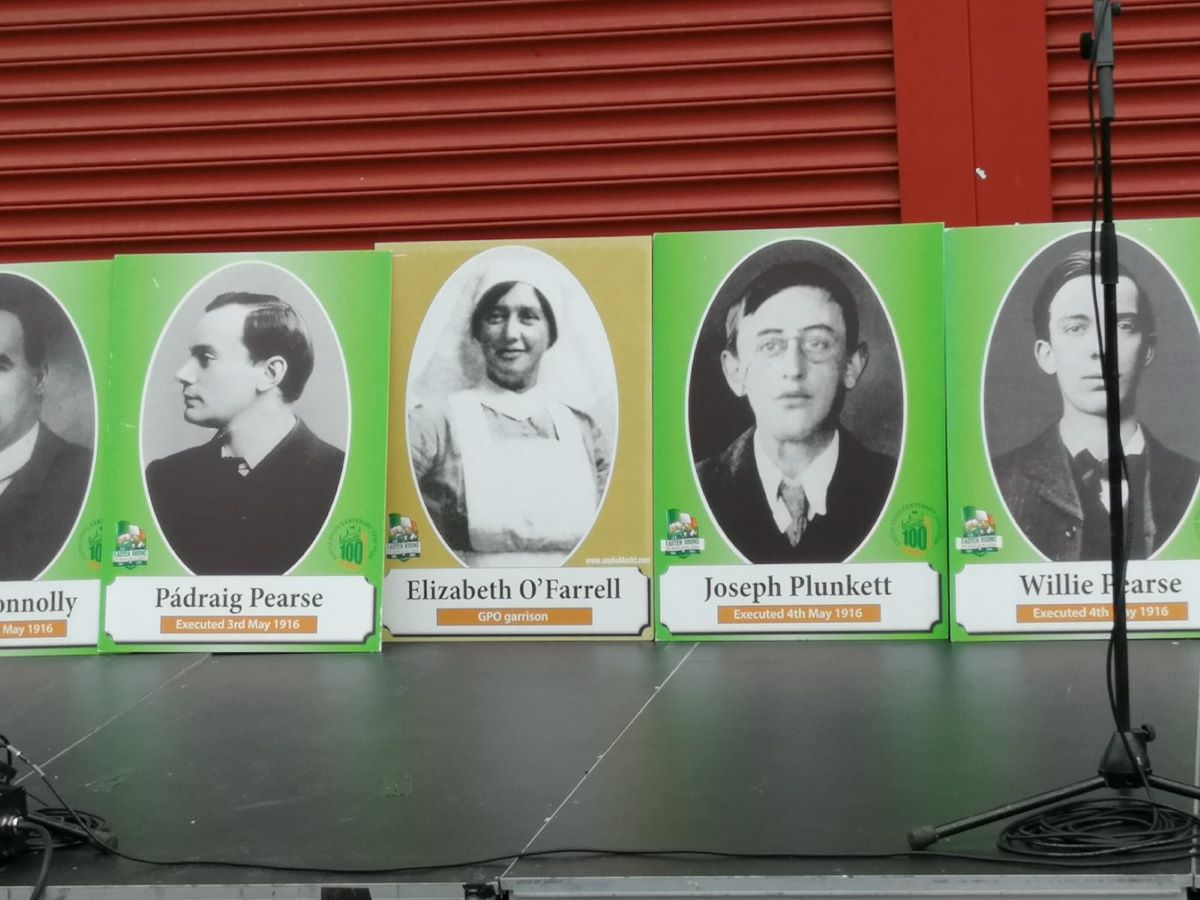
Fully in view, four prominent members of the Moore Street Garrison (L-R): Patrick Pearse, Commander-in-Chief; Vol. Elizabth O’Farrell, of Cumann na mBan; Vol. Joseph Plunkett, one of the planners of the insurrection; Vol. Willie Pearse, Adjutant to his brother Patrick. All but O’Farrell were tried by British court martial, sentenced to death and shot by British firing squad in Kilmainham Jail. (Photo: R. Breeze)
LEGISLATION & COURT CASES
2007 Nos. 14-17 Moore Street declared a National Historical Monument (but still owned by property developer Joe O’Reilly of Chartered Land)
2015 Darragh O’Brian TD (FF) – Bill Moore Street Area Development and Renewal Bill – Passed First Reading but failed Second in Seanad on 10th June 2015 by 22 votes against 16.
2015 – Colm Moore application — 18th March 2016: High Court judgement that the whole of the Moore Street area is a national historical monument.
2017 – February – Minister of Heritage application to Court of Appeal – judgement that High Court Judge cannot decide what is a national monument.
2021 — Aengus Ó Snodaigh TD (SF) – 1916 Cultural Quarter Bill – reached 3rd Stage of process; Government did not timetable its progress to Committee Stage and therefore no progress.
2024 – Property Developer Hammerson application to High Court Vs. Dublin City Council in objection to decision of elected Councillors that five buildings in the Moore Street area should receive Protected Structure status as of National Historical Heritage. Hammerson states that the decision is interfering with their Planning Permission. Case awaits hearing.
Five prominent members of the Moore Street Garrison (L-R): Vol. Winifred Carney of Irish Citizen Army and Cumann na mBan; Vol. Sean Mac Diarmada, one of the planners of the insurrection; Vol. Tom Clarke, one of the insurrection’s planners; revolutionary socialist James Connolly, Irish Citzen Army and Commandant General of the Rising (especially of Dublin); Patrick Pearse, Commander-in-Chie. All but Carney were tried by British court martial, sentenced to death and shot by British firing squad in Kilmainham Jail. (Photo: R. Breeze)
POSTSCRIPT
Someone commented later that in general the rally, from the content of most of the speeches, had been at least as much (if not more) of a Sinn Féin election rally as one for the conservation of Moore Street.
That should have been no surprise to anyone who knows that any position taken by Sinn Féin activists tends to be for the party first, second and third. And with the Irish general elections only weeks away, well …
And while Mac Donald spoke in Dublin of the importance of Ireland’s insurrectionary history and the need to conserve such sites, her second-in-command Michelle O’Neil was laying a wreath in Belfast in commemoration of the British who were killed in the First imperialist World War.
Eamon McGrath (31 October 1955 – 11 January 1923) singer and song lyrics-writer, activist in areas of housing, water and national sovereignty, historical memory and anti-fascism.
He was getting buried on Saturday and I wasn’t able to be at the service nor at the celebration of his life with comrades afterwards.
I hope this eulogy, if that’s the right word for this, will make up for my absence to his family, comrades and friends and, of course, to me.
Eamon came into my life through the Moore Street occupation in January of 2016. The property speculator Joe O’Reilly (Chartered Land) and the State were about to collude in the demolition of three buildings in the 1916 Terrace.
The State had declared only four buildings in the 16-building terrace, after a long struggle, to be a historical monument and even later, purchased – but around 300 men and women hadn’t occupied just four buildings in 1916.
The Save Moore Street From Demolition campaign group had called emergency demonstrations on to the street following which the buildings had been occupied by protesting conservationists.
The weather was bitterly cold but the occupiers held firm for a week until a stay of demolition had been imposed by the High Court. Despite his health status and challenged mobility, Eamon was there throughout, with humour and song.
Eamon McGrath to far right of photo while Dave Swift (centre) in Irish Volunteer uniform reads a historical document April 2017 in Moore Street, during historical commemoration event (the hoarding behind is covering the extension of the ILAC further into Moore Street, killing the market appearance for that side of the street for the block).
Subsequently, to prevent internal damage by contractors, a six-weeks’ blockade was imposed on the building by conservationists from 6.30am to 4.30pm each weekday. Eamon was very much a part of that too, driving himself and his close comrade Sean Doyle up from Wicklow every day.
Eamon was intensely loyal to close friends and comrades. On occasion I found him prickly or grumpy (especially at 6.30 am) but throughout any disagreements he never lost sight of who were his comrades and other people he respected.
Though a proud man, when he recognised himself in error, he didn’t hesitate to apologise.
A new broader group came out of the occupation and blockade, called Save Moore Street 2016 and Eamon attended and contributed to internal organising meetings and events we called on to the street – re-enactments, fake funerals of history, pickets, demonstrations and rallies.
As others drifted or were called away from the group by other commitments, Eamon remained with the active core.
(L-R) Paddy Reilly and Eamon McGrath in period costumes having a conversation during a history education event and anniversary commemoration of the founding of the Save Moore Street From Demolition campaign group. (Photo from Save Moore Street From Demolition FB page)
Of course, Eamon had been active before 2016: certainly very much so in the general awareness-raising and mass campaign against planned privatisation of our water and the installation of water meters.
He was to continue that activism, which resulted in assaults by a water contractor on him and Seán Doyle, court appearances for both and in May 2016 both of them went to jail for a period but remained unbowed.
Eamon was one of the original occupiers of Apollo House in December 2016 in protest against homelessness and as a co-founder of the Anti Eviction Flying Column, Eamon was to the fore in resisting evictions across the country and also a co-founder of the Bring It to Their Doors campaign.
The State authorities were making things awkward for Eamon by then, both in terms of working as a taxi driver and claiming benefit when he was not. His ability to reach events in Dublin declined but he still got there often enough on public transport, while remaining active nearer to home.
As his physical mobility declined further, comrades in Carlow started an on-line collection to buy him an electric wheelchair. Even as I made enquiries to contribute, the fund had already reached its target, so quickly did people support it.
Later still, his family installed a new chairlift for his home so he could access the room where he recorded his songs with lyrics commenting on the ongoing political struggles, adapted to popular airs.
Though our voices didn’t go well together, we sang together a couple of times – outside the GPO and outside Dublin City Hall.
Eamon McGrath, centre right after April 2016 event in Moore Street after which we brought it to in front of the General Post Office in Moore Street for awhile. Myself near centre, Glenda further to the left of photo, Sean Doyle nearly out of shot.
He remained active on social media but in particular in keeping an eye on the activities of right-wing people, covid-deniers, racists, fascists …. Eamon was a handy source for a quick update on the status of many of them.
Eamon arranged an interview for us both with the Dublin Near FM radio station, the interviewer being then a former drug addict who sadly returned later to his addiction and died on the street. It was on the way back from the interview that Eamon told me a little about his earlier years.
He had a difficult time in his childhood, including institutional confinement and his formal education suffered as a result. However, he educated himself about many things by reading, listening, discussing and viewing on line.
I think the last time I saw Eamon was at a commemoration at the Peter Daly monument in Wexford inSeptember 2022, in his electric wheelchair and attached oxygen cylinder for his lung condition and all in good cheer, asking me for Moore Street campaign updates in detail.
Eamon McGrath, centre in wheelchair, at Peter Daly commemoration in Wexford, September 2022 (Photo from Peter Daly FB page)
His comrades in Anti-Imperialist Action Ireland, which he had joined at its foundation in 2017 correctly called him “one ot the most dedicated political activists of the last decade” and no-one who knew him could argue with that.
I knew little of Eamon’s family life but he often emphasised how important family was, not just to him but in general. Though I do not know them tá mé i gcomhbhrón leo, offering them my condolences along with the many they have received and are no doubt still arriving.
A partner, father, grandfather, great-grandfather, extended family member and friend to many.
Eamon McGrath of Kenmare Heights, Greystones & formerly Wolfe Tone Square, Bray, Co. Wicklow, was buried in Radford Cemetery, Greystones Saturday after a service in the Holy Rosary Church, Bray, attended by family, comrades and friends.







 rebelbreeze