Introduction with some very little additional text by Diarmuid Breatnach
Main text from East Wall History Group
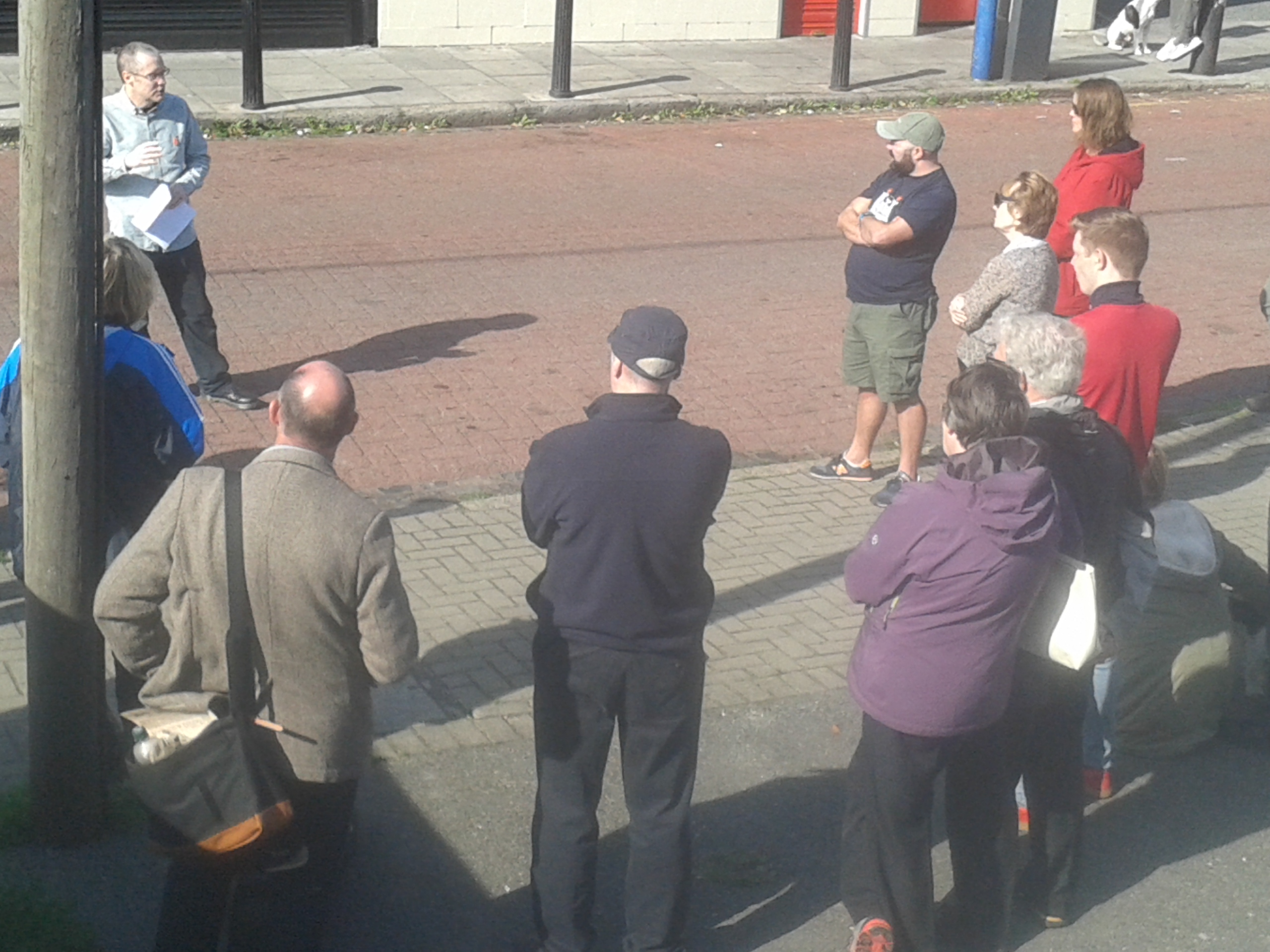
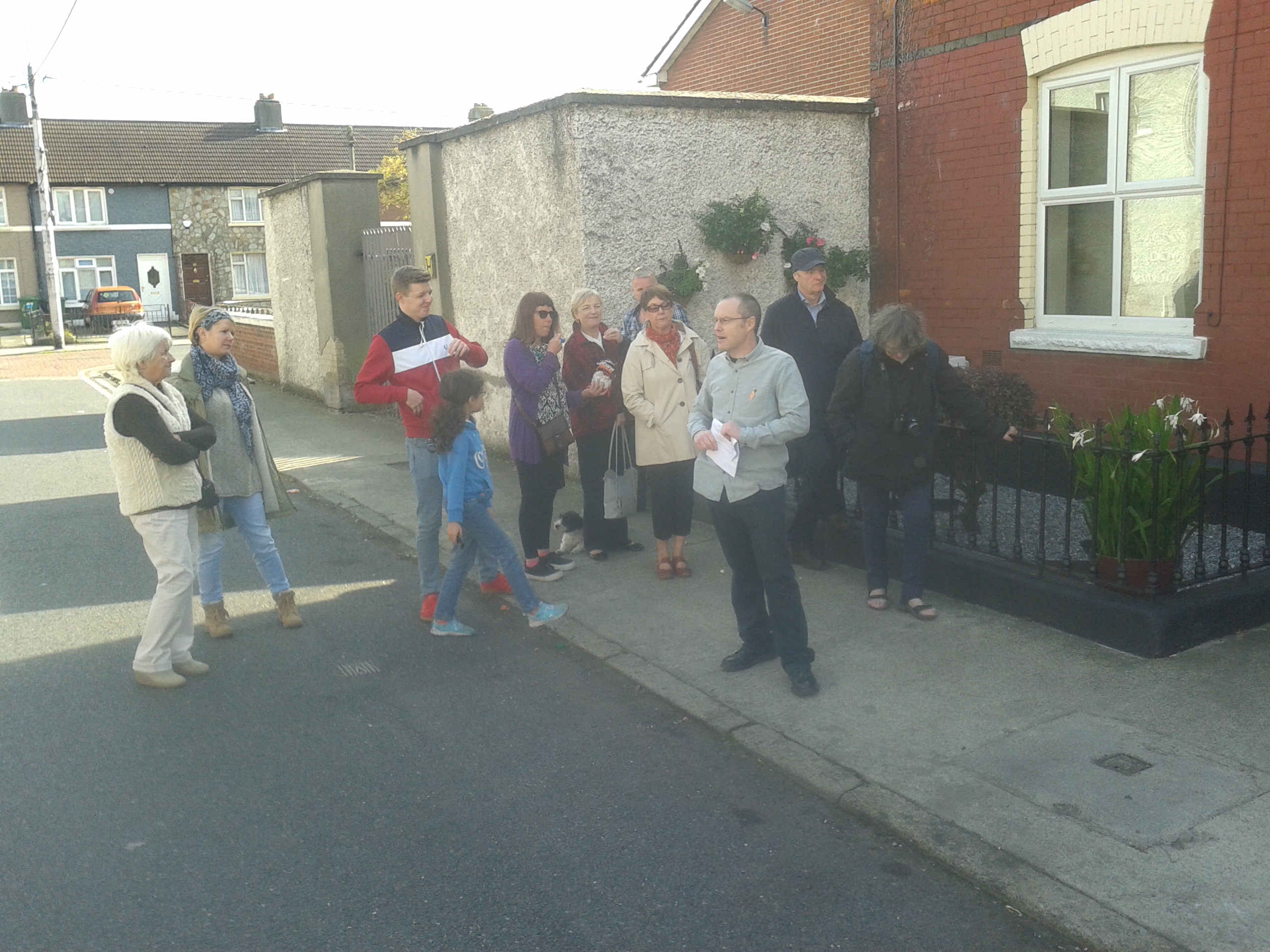
Among the many events packed into History Week by the East Wall History Group was a walking history tour of the area on Sunday 27th September. Over a score of people took part in “East Wall and the Irish Revolution” to hear Joe Mooney, a long-time community activist, outline the relevant events of history at various points along the way, covering
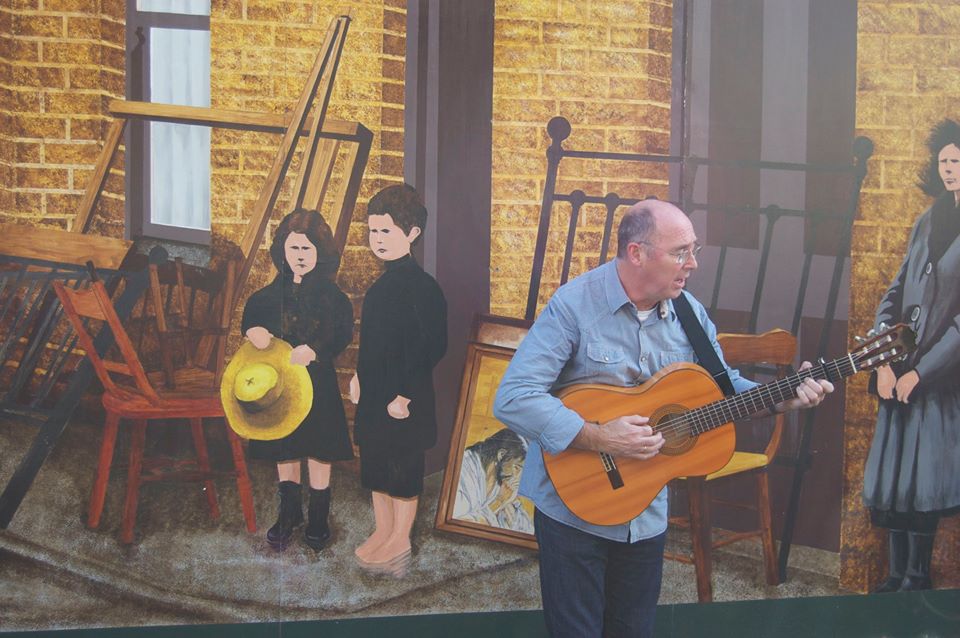
Paul O’Brien performing his 1913 Lockout song in front of mural marking the eviction of 62 families from Merchant’s Road in December 1913 by the Merchant’s Company. (Photo: EWHG)
local connections with the Fenians, docks and migrants, the Lockout, 1916 Rising and the Spanish Civil War. Appropriate songs and music accompanied the tour, Paul O’Brien performing compositions of his own at some of those points and Diarmuid Breatnach singing verses from Viva La Quinze Brigada at another.
“We set out from St Joseph’s School, originally opened in 1895. The first Principal of the Boys’ school was J.F. Homan, who served as a St. John’s Ambulance Brigade volunteer during the Rising and also during the Civil war. A number of former pupils from the school were involved in the revolutionary events of the time (the following decades) and of course in 1911 a schoolboys’ union was declared and a short strike ensued (complete with pickets!). Their demands included a shorter day and free school-books.
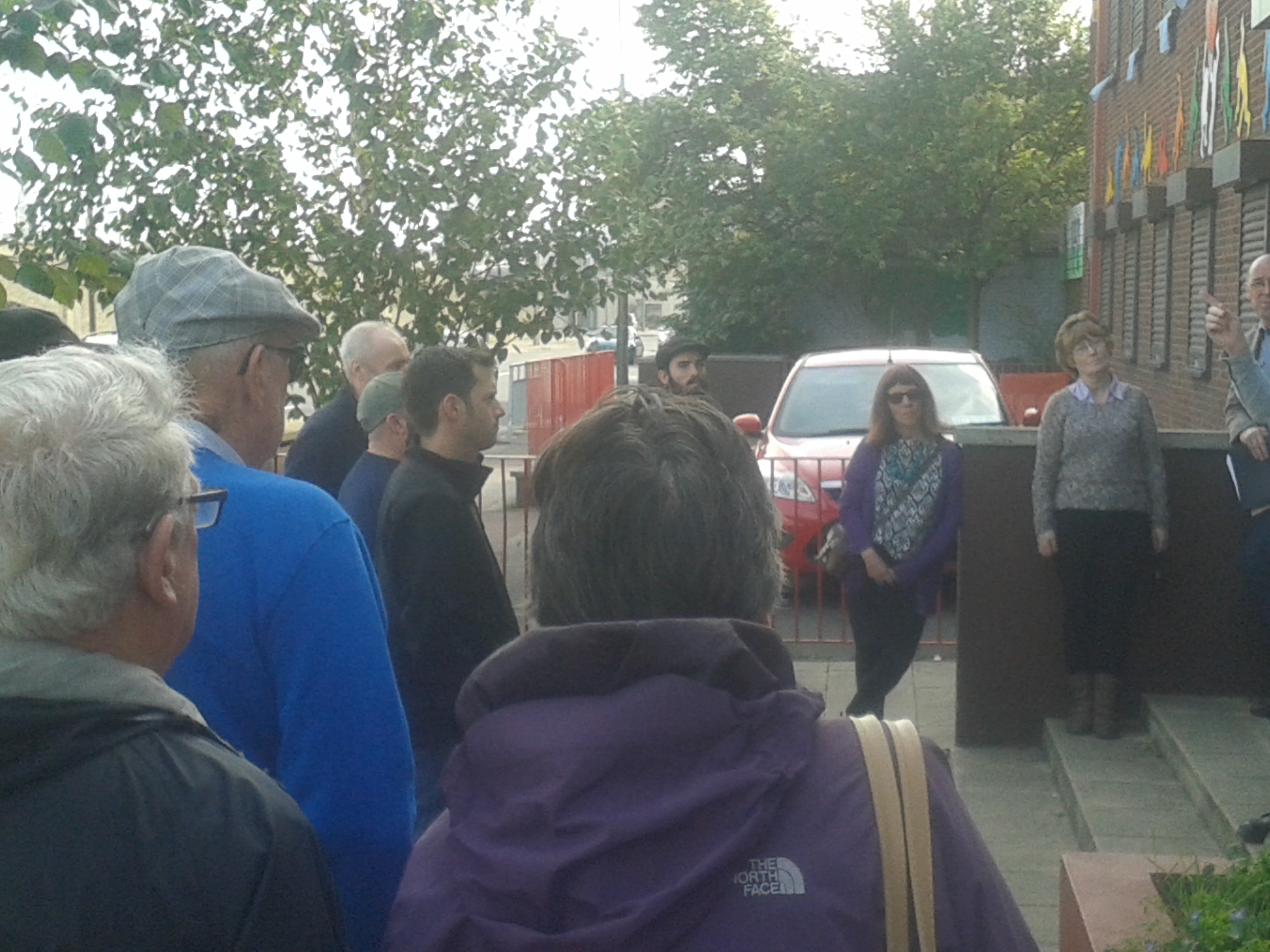
Part of crowd at the starting point. (Photo: DB)
“Our first stop was Merchant‘s Road, where during the 1913 Lockout 62 families (almost the entire population of the street) were evicted by their employer the Merchants Warehousing Company (their yard was Merchant’s Yard on East Wall Road, just before the T-junction by the Port Authority. At the fantastic mural (erected by the community) Paul paid tribute to the families and the workers‘ struggle with his song “Lockout 1913“. Amongst the evicted families were the Courtneys from number 1 – their son Bernard was a ‘Wharf’ school pupil and fought with the Jacob‘s garrison in 1916, before succumbing to TB in 1917.
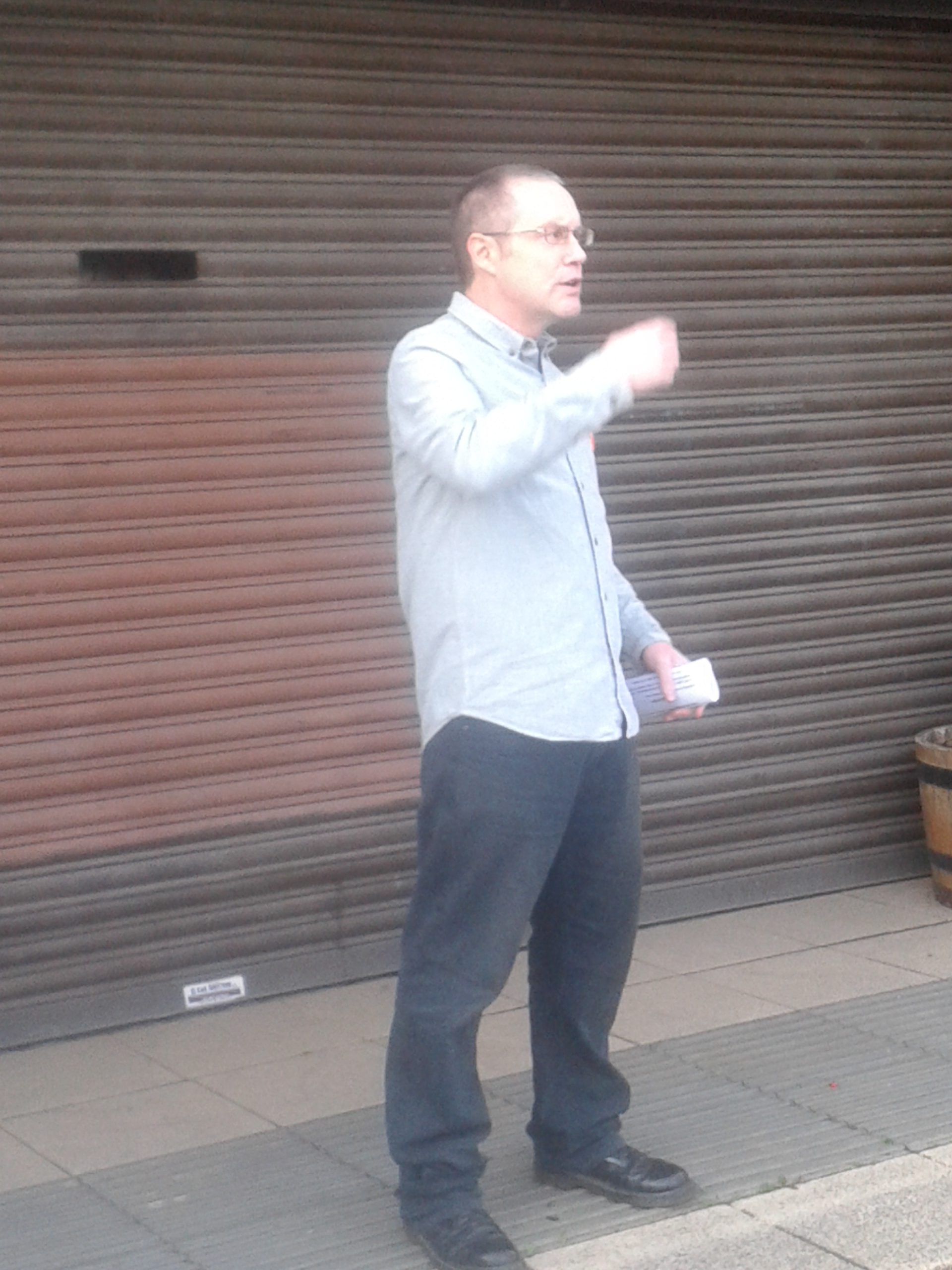
Joe Mooney pointing out Jack Nalty’s house.Jack Nalty’s house.(Photo: DB)
“Next we visited the East Road, where Diarmuid set the tone with a stirring rendition of the Christy Moore song “Viva la Quinze Brigada” (explaining that Christy incorrectly called it “Quinta” but had since corrected it – as the lyrics in English make clear, it was the FIFTEENTH Brigade). Gathered opposite the family home of Jack Nalty, we heard the story of another former ‘Wharf ‘ school-boy who became an active Republican and Socialist, eventually losing his life fighting Fascism in Spain in 1938. Jack (who was also a champion runner) was amongst the last of the International volunteers to die, while his friend and comrade Dinny Coady was amongst the first. Many of Dinny Coady‘s relatives still live locally, and we plan to commemorate them properly in the future.
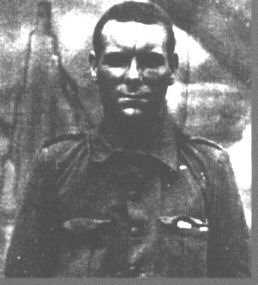
Jack Nalty in uniform of the 15th International Brigade. (Photo: Internet)
“Next was a quick stop at the junction of Bargy and Forth Roads, which along with Shelmalier, Killane and Boolavogue were the names given to streets of Corporation houses erected here in the 1930’s and ’40s. They are of course synonymous with places in Wexford in the 1798 Rebellion.
“At the rear of the former Cahill printers‘ premises we learned how an innovative glass–making factory (Fort Crystal Works) once stood there, perhaps the first industry in the area, but by the early 1800’s lay in ruins. As reported in newspapers as far away as New York, in 1848 a hundred men gathered here and spent an entire day in musketry practice, even setting up a dummy of the Lord Lieutenant of Ireland (the Queen’s representative) to practice on. These were members of the Young Ireland movement, preparing for rebellion.
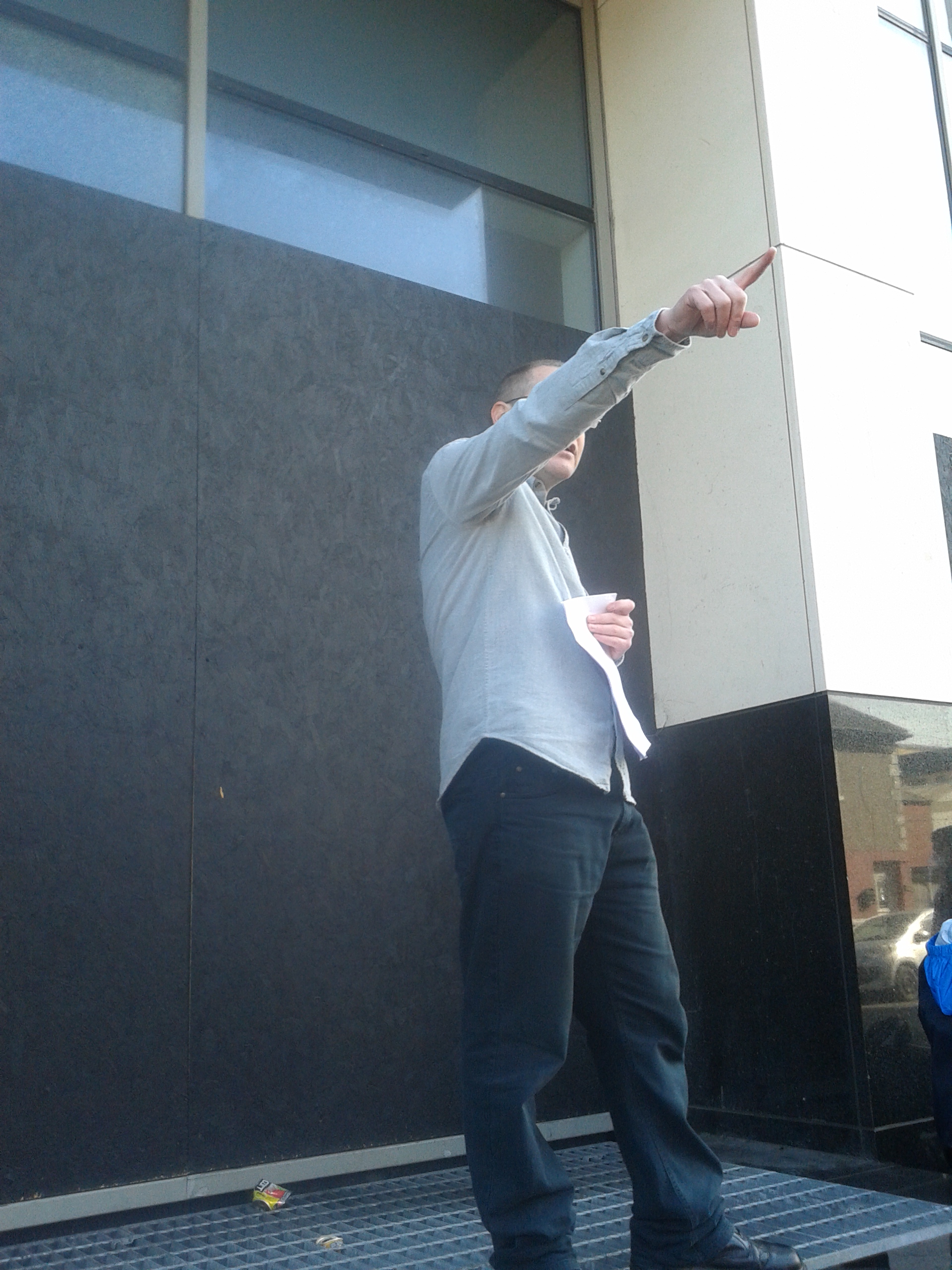
Joe speaking at the ‘Scotch Block’ — some of the crowd are out of shot, as is Paul O’Brien, who is just getting ready to play. (Photo: DB)
“On Church Road we remembered former resident Edward Dorin, a Sergeant in the IRA who was part of the operation to burn the Custom House during the War of Independence. Another former ‘Wharf’ school pupil (he started there the same year as Jack Nalty), he was shot dead alongside a young volunteer from Ballybough when they engaged a lorry–load of Auxillaries at Beresford place (just by Liberty Hall). (They were covering the attacking party). There had been a suggestion in the 1950’s to rename Custom House Quay as Dorin‘s Quay .
“A short stop at the “Scotch Block”, Fairfield Avenue, where Paul played two songs recalling Glasgow immigrants to the area and also Edinburgh–born James Connolly. An incident in 1918 when Union Jack–waving residents from these buildings attempted to disrupt a Sinn Féin election rally also got a mention.
Diarmuid Breatnach singing “Viva La Quinze Brigada” opposite Jack Nalty’s house. (Photo: EWHG)
“As we passed Hawthorn Terrace its most famous resident Sean O’Casey was briefly discussed, as was his former neighbour Willy Halpin, the diminutive Citizen Army man most famous for almost escaping capture at City Hall by climbing up a chimney.
“As we passed Russell Avenue a dishonorable mention was given to those who attempted to raise a 5,000 strong Fascist militia from an address here in the late 1950’s. Thankfully they failed miserably, as did the Italian fascist sympathiser resident of Caladon road who was banned from the U.S.A. during World War Two and eventually arrested by the Irish state and handed over to British authorities via the Six Counties.
“At Malachi Place the action–packed tale of Fenian leader John Flood was recounted. He lived here in the 1860’s as he worked on plans to stage a rebellion against British Rule. After an audacious attempt to seize weapons from Chester Castle was betrayed, he was eventually arrested following a boat chase on the Liffey and deported to Australia on the last convict ship to sail there. A memorial stands above his grave, unveiled there in 1911, two years after his death. This story could be a movie script!
“We finished off the day at the base of Johnny Cullen‘s Hill at the block of houses formerly named Irvine Crescent (now incorporated into Church Road). It was here the Scott family lived and in 1916 their 8–year–old son was shot from the gun boat Helga. He lingered on for months after his wounding before finally dying, making him the last of the child casualties of 1916. The same year his father died in an accident in the Port, leaving his mother to raise five children on her own while coping with this double tragedy.
“Their next–door neighbours were the Lennon family. On Bloody Sunday 1913 Patrick Lennon was one of those injured in the baton charge on O’Connell Street. Bloodied but unbowed, he worked alongside Sean O’Casey to raise funds for the relief of strikers‘ families, a project which eventually led to the establishment of the famous soup kitchen at Liberty Hall.
“And finally on to Bloody Sunday 1920. Everybody knows the story of how the Squad under Michael Collins (and the Dublin Brigade of the IRA) targeted British Intelligence agents in the City but not many know of the East Wall operation. A house on Church Road was targeted but the agent had left the evening before and was in Cork when the IRA group arrived. The exact location is unknown but we suspect it was within this block here as many of the houses were sub-divided at that time.”
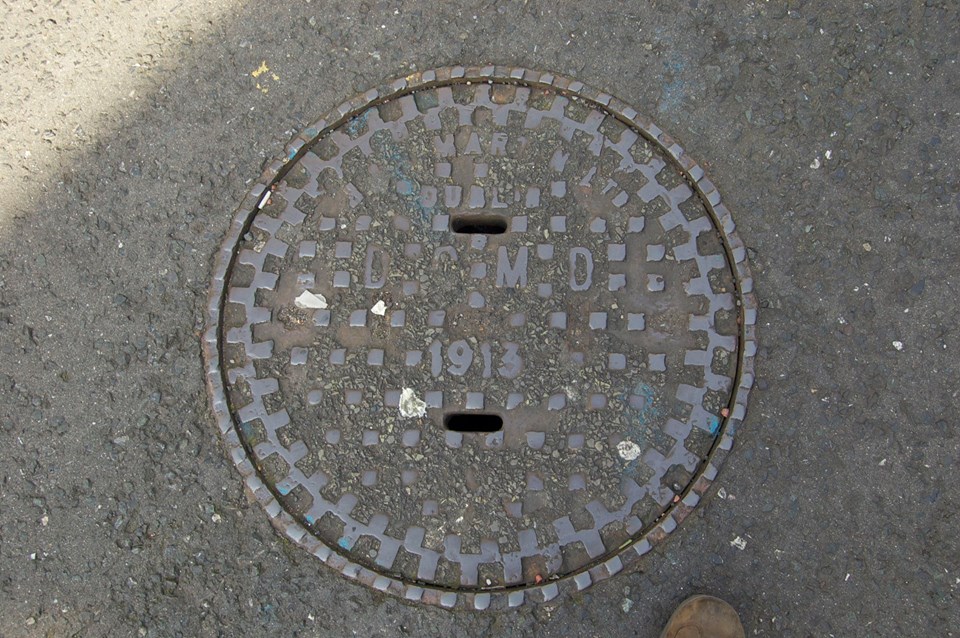
A coincidence in Merchant’s Road, opposite the mural (note the date). (Photo: EWHG)
Even if they didn’t get to tell half the stories of East Wall and the Irish Revolution, it was an enjoyable and informative walking tour … and the weather was beautiful – and there’s always next year!
Politics is about the present and the future, obviously … but it is also about the past.
Different political interests interpret and/or represent the past in different ways, emphasising or understating different events or aspects or even ignoring or suppressing them entirely. There is choice exercised in whom (and even what particular pronouncement) to quote and upon what other material to rely. And by “political interests” I mean not only groups, formal (such as political parties) or informal, but also individuals. Each individual is political in some way, having opinions about some aspects of questions that are political or at least partly-political. For example, one often hears individuals say today that they have no interest in politics, yet express strong opinions of one kind or another about the right to gay and lesbian marriage, the influence of the Catholic Church, and how the country is being run by Governments.
So when an individual writes a history book, there are going to be political interpretations, although not all writers admit to their political position, their prejudices or leanings, in advance or even in the course of their writing. One historian who does so is Padraig Yeates, author of a number of historical books: Lockout –Dublin 1913 (a work unlikely to be ever equalled on the subject of the title), A City In Wartime — 1914-1919, A City in Turmoil – 1919-1921and his latest, A City in Civil War – Dublin 1921-’24. The latter was launched on Tuesday of this week, 12th May and therefore much too early for people for who did not receive an earlier copy to review it. So it is not on the book that I am commenting here but rather on the speeches during the launch, which were laden with overtly political references to the past and to the present. If a review is what you wanted, this would be an appropriate moment to stop reading and exit – and no hard feelings.
The launch had originally been intended to take place at the new address at 17 D’Olier Street, D2, of Books Upstairs. However the interest indicated in attending was so great that Padraig Yeates, realising that the venue was going to be too small, went searching for a larger one. Having regard to how short a time he then had to find one and with his SIPTU connections, Liberty Hall would have been an obvious choice. Whether he had earlier been asked to speak at the launch I do not know but, having approached Jack O’Connor personally to obtain the use of Liberty Hall, in the latter’s role of President of SIPTU, the owners of that much-underused theatre building, it was inevitable too that O’Connor would be asked to speak and act as the MC for the event.
O’Connor’s introduction was perhaps of medium length as these things go. He talked about the author’s work in trade unions, as a journalist and as an author of books about history. O’Connor’s speech however contained much political comment. Speaking of the period of the Civil War (1919-1923), he said it had “formed what we have become as a people”. That is a statement which is of dubious accuracy or, at very least, is open to a number of conflicting interpretations. The Civil War, in which the colonialism-compromising Irish capitalist class defeated the anti-colonial elements of the nationalist or republican movement, formed what the State has become – not the people. The distinction between State and People is an essential one in our history and no less so in Ireland today.
Talking about the State that had been created in 1921 (and not mentioning once the creation of the other statelet, the Six Counties) and referring to the fact that alone among European nations, our population had not risen during most of the 20th Century and remained lower than it had been up to nearly the mid-Nineteenth, a state of affairs due to constant emigration, O’Connor laid the blame on the 26-County State and in passing, on the capitalist class which it served. He was undoubtedly correct in blaming the State for its failure to create an economic and social environment which would stop or slow down the rate of emigration – but he did not explain why it was in the interests of the capitalists ruling the state to do so. Nor did he refer to the cause of the original drastic reduction in Ireland’s population and the start of a tradition of emigration – the Great Hunger 1845-’49.
The Great Hunger memorial on Dublin’s Custom House Quay. The Great Hunger and its immediate aftermath initiated mass Irish emigration.
Even allowing for the fact that O’Connor wished to focus on the responsibility of the 26-County State, the Great Hunger was surely worthy of some mention in the context of Irish population decline. Just a little eastward along the docks from Liberty Hall is the memorial to that start of mass Irish emigration. It was the colonial oppression of the Irish people which had created the conditions in which the organism Phytophthora infestans could create such devastation, such that in much less than a decade, Ireland lost between 20% and 25% of its population, due to death by starvation and attendant disease and due also to emigration (not forgetting that many people emigrating died prematurely too, on the journey, upon reaching their destination and subsequently). Phytophthora devastated potato crops in the USA in 1843 and spread throughout Europe thereafter, without however causing such a human disaster as it did in Ireland. In Mitchell’s famous words: “The Almighty, indeed, sent the potato blight, but the English created the famine.” And that is what makes that period of population decline uncomfortable for some historical commentators.
Indeed, O’Connor did not mention British colonialism once, nor Partition, nor imperialism. And nor did either of the other two speakers, nor the author. I remarked on this to an Irish Republican present, to which he responded with a rhetorical question: “Did you expect them to?” Well, yes, perhaps naively, I did. While not expecting an Irish Republican analysis from Padraig Yeates and perhaps not either from anyone he would consider appropriate to speak at the launch of one of his books, dammit, we are talking about history. The presence of Norman/English/British Colonialism for 800 years prior to the creation of the Irish Free State, and its influence on that state’s creation and on subsequent events in Ireland, is worthy of at least a mention in launching a book about the Civil War. Not to mention its continuing occupation of one-fifth of the nation’s territory.
Colonialism and Imperialism and, in particular, the Irish experience of the British variant, were not so much ‘the elephant in the room‘ at the launch as a veritable herd of pachyderms. They overshadowed us at the launch and crowded around us, we could hear them breathing and smell their urine and excreta – but no-one mentioned them. The date of the launch was the anniversary of the execution of James Connolly 99 years ago, a man whom the Labour Party claims as its founder (correctly historically, if not politically), a former General Secretary of the ITGWU, forerunner of SIPTU and the HQ building of which, Liberty Hall, was a forerunner too of the very building in which the launch was taking place. His name and the anniversary was referred to once, though not by O’Connor, without a mention of Sean Mac Diarmada, executed in the same place on the same day. And most significantly of all, no mention of who had Connolly shot and under which authority.
That circumspection, that avoidance, meant that a leader of Dublin capitalists, William Martin Murphy, could not be mentioned with regard to Connolly’s death either — i.e. his post-Rising editorial in the Irish Independent calling for the execution of the insurgents’ leaders. But of course he did get a mention, or at least the class alliance he led in 1913 did, in a bid to smash the ITGWU, then under the leadership of Larkin and Connolly. This struggle, according to O’Connor and, it must be said also to Padraig Yeates, was the real defining struggle of the early years of the 20th Century, not the 1916 Rising, the War of Independence nor yet the Irish Civil War. It was in 1913 that “the wrong side won”.
One-eyed as that historical vision must be, we have to question whether it is even partially correct. The Lockout was a great defeat for the ITGWU and for the leading elements in the Irish workers’ movement. But the Lockout did not break the trade union and, in fact, it later began to grow in membership and in branches. Other trade unions also survived and some expanded. So in what manner was 1913 decisive in ensuring that “the wrong side won” in later years? The Irish trade union movement was still able to organise a general strike against conscription in April 1918 and the class to organise a wave of occupations of workplaces in April 1919.
True, the Irish working class had lost one of its foremost theoreticians and propagandists by then, in the person of James Connolly. And who was it who had him shot? Not Murphy (though he’d have had no hesitation in doing so) nor the rest of the Irish capitalist class. In fact, worried about the longer-term outcome, the political representatives of the Irish ‘nationalist‘ capitalist class for so long, the Irish Parliamentary Party, right at the outset and throughout, desperately called for the executions to halt. General Maxwell, with the support of British Prime Minister Asquith, ordered and confirmed the executions of Connolly and Mallin of the Irish Citizen Army and British Army personnel pulled the triggers; in essence it was British colonialism that executed them, along with the other fourteen.
For the leaders of the Labour Party and of some of the trade unions, and for some authors, Padraig Yeates among them, the participation of Connolly and the Irish Citizen Army in the Rising was an aberration. For these social democrats, the struggle should have been against the Irish capitalist class only (and preferably by an unarmed working class). It is an inconvenient fact that Ireland was under colonial occupation of a state that had strangled much of the nation’s economic potential (and therefore of the growth of the working class) in support of the interests of the British capitalist class. It is an inconvenient fact that the Irish capitalist class had been divided into Unionist and Nationalist sections, the former being descendants of planter landowners and entrepreneurs whose interests were completely bound up in Union with Britain. It is an inconvenient fact that the British and the Unionists had suppressed the last truly independent expression of the Irish bourgeoisie, the United Irishmen and, in order to do so effectively, had created and enhanced sectarian divisions among the urban and rural working and middle classes. It is also an inconvenient fact that the British cultivated a client “nationalist” capitalist class in Ireland and that the police and military forces used to back up Murphy’s coalition in 1913 were under British colonial control.
To my mind, a good comprehensive analysis of the decline inprominence of the Irish working class on the political stage from its high point in early 1913 and even in 1916, has yet to be written. One can see a number of factors that must have played a part and the killing of Connolly was one. But something else happened between 1913 and 1916 which had a negative impact on the working class, not just in Ireland but throughout the World. In July 1914, WW1 started and in rising against British colonialism in Ireland, Connolly also intended to strike a blow against this slaughter. As the Lockout struggle drew to its close at the end of 1913 and early 1914, many union members had been replaced in their jobs and many would find it hard to regain employment, due to their support for the workers and their resistance to the campaign to break the ITGWU. It is hard to avoid the conclusion that many joined the British Army or went to work in war industries in Britain. Although the Irish capitalist class supported the British in that War (up to most of 1917 at any rate) it was imperialism which had begun the war and British Imperialism which recruited Irish workers into its armed forces and industries.
Reaching back in history but to different parts of Europe, Padraig Yeates, in his short and often amusing launch speech, cracked that “for years many people thought Karl Kautsky’s first name was ‘Renegade’ ” — a reference to the title of one of Lenin’s pamphlets: The Proletarian Revolution and the Renegade Kautsky. Yeates apparently admires Kautsky and quoted him on Ireland. But Kautsky advocated no uprisings against imperialism or colonialism in the belief that “super-imperialism” (also called “Hyper Imperialism”) would regulate itself peacefully, letting socialists get on with the task of evolving socialism. Two World Wars since then and current developments have negated Kautsky’s theory but more to the point, to advocate his theory as a guiding principle at the time he did was a major ideological threat to proletarian revolution and to the evolving anti-colonial struggles of the world and therefore he was a renegade to any variant of genuine socialism and socialist struggle.
This is relevant in analysing the position of the trade union leaders and the Irish Labour Party today. They are social democrats and their central thesis is that it is possible to reform capitalism, by pressure on and by involvement in the State. They deny what Lenin and others across the revolutionary socialist spectrum declare, that the state serves the ruling class and cannot be coopted or taken over but for socialism to succeed, must be overthrown.
It is the social-democratic analysis that underpinned decades of the trade union leaders’ social partnership with the employers and the State, decades that left them totally unprepared, even if they had been willing, to declare even one day’s general strike against the successive attacks on their members, the rest of the Irish working class and indeed the lower middle class too since 2011. Indeed Padraig Yeates, speaking at a discussion on trade unions at the Anarchist Bookfair a year or two ago, conceded that social partnership had “gone too far”. Can Jack or any other collaborationist trade union leader blame that on the transitory defeat of the 1913 Lockout? They may try to but it is clear to most people that the blame does not lie there.
Two other speakers addressed the audience at the launch, Katherine O’Donnell and Caitriona Crowe. Catriona Crowe is Head of Special Projects at the National Archives of Ireland and, among other responsibilities, is Manager of the Irish Census Online Project, an Editor of Documents on Irish Foreign Policy, Vice-President of the Irish Labour History Society. She is also Chairperson of the SAOL Project, a rehabilitation initiative for women with addiction problems, based in the North Inner City. It was her, I think, who made the only mention of “Blueshirts” and her also that mentioned the anniversary of James Connolly. Although her speech was overlong in my opinion for a book launch in which she had already been preceded by two longish speeches, strangely I can remember very little of what she had to say.
Katherine O’Donnell’s contribution however made a considerable impression upon me. She declared herself early in the speech to be lesbian and a campaigner for gay and lesbian rights and is Director of the Women’s Studies Centre at the School of Social Justice at UCD. O’Donnell began by praising Padraig Yeates’ work, of which she declared herself “a fan”. In a speech which at times had me (and sometimes others too) laughing out loud, she discussed the contrast in the fields of historical representation between some historians and those who construct historical stories through the use of imagination as well as data; she denounced the social conservatism of the state, including the parameters of the upcoming referendum on same-sex marriage, the legal status of marriage in general and the climate of fear of prosecution engendered by the shameful capitulation of RTE to the Iona Institute on the accusation of “homophobia” (she did not mention them specifically but everyone knew to what she was referring).
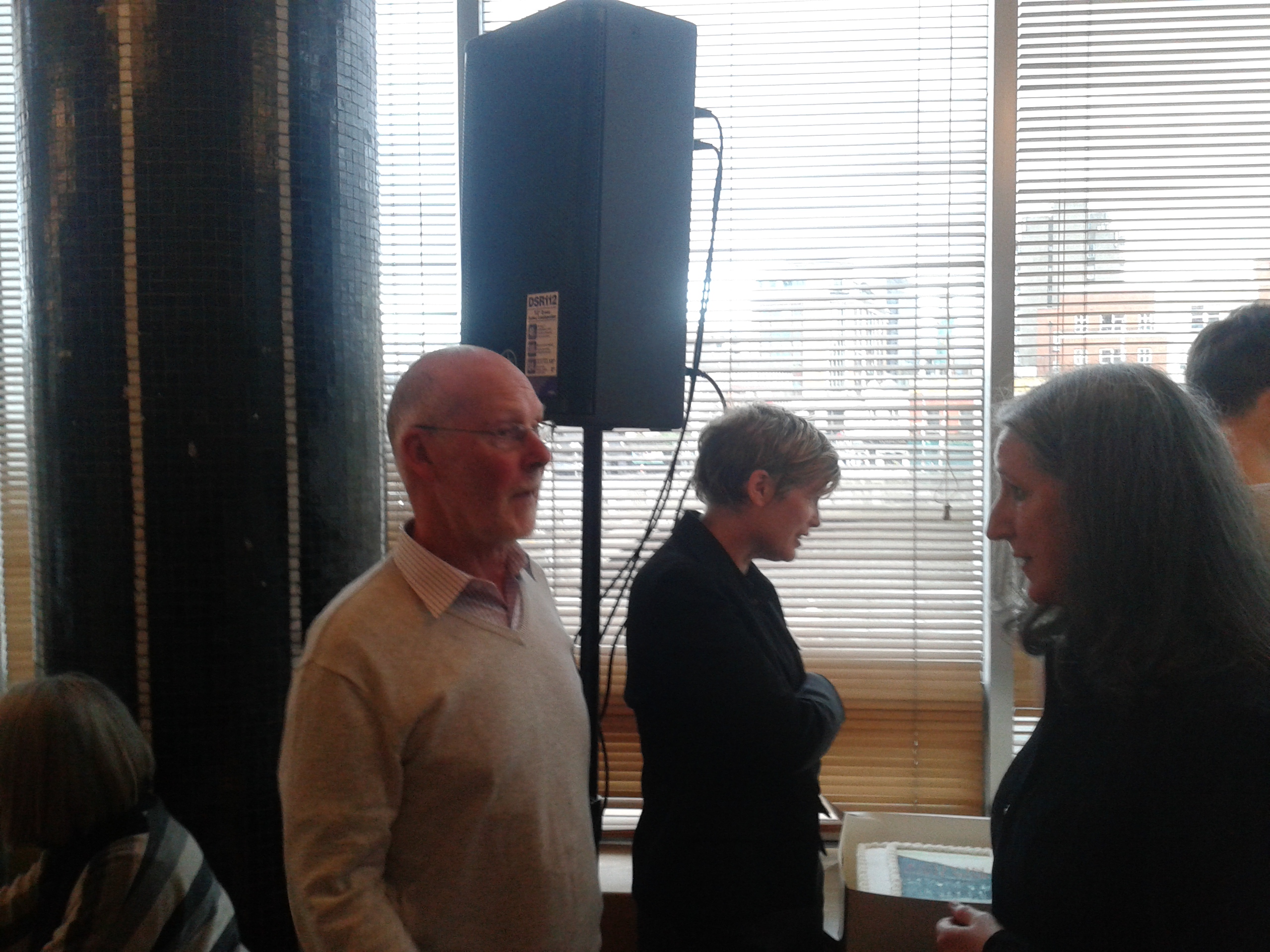
After the launch speeches — (L-R) Padraig Yeates, Katherine O’Donnell, Caitriona Crowe.
Jack O’Connor, between speeches, made a reference to a giant banner hanging off Liberty Hall which had the word “NO” displayed prominently, saying that they had received congratulatory calls from people who thought it was against same-sex marriage. The banner was however against privatisation of bus services. The current banner on Liberty Hall says “YES” to the proposal in the forthcoming referendum and he said that now busmen were calling them up complaining …. to laughter, O’Connor commented that “it’s hard to the right thing, sometimes”. Presumablywhat he meant was that it is hard to know what the right thing to do is, or perhaps to please everybody.
It is indeed hard to please everybody but I’d have to say that it is not hard to know that the purpose of and‘the right thing to do’ for a trade union, is to fight effectively and with commitment for its members and for the working class in general. And that is precisely the responsibility which has been abrogated by Jack
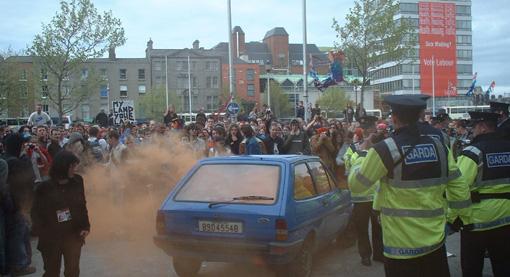
In the background to this photograph of a Reclaim the Streets demonstration in 2002 is Liberty Hall, draped in a hug “Vote Labour” banner. SIPTU has maintained that position through a number of coalition governments in which Labour has participated and that have attacked the living standards and rights of workers.
O’Connor personally, along with other leaders of most of the trade unions, including the biggest ones for many years, SIPTU and IMPACT. And also by the Irish Congress of Trade Unions. That is why Jack O’Connor gets booed now if he ever dares stand on a public platform related to trade union struggle, a treatment received also by David Beggs before he retired from the Presidency of ICTU.
Back in 2011, another giant banner hung from Liberty Hall – that time it urged us to VOTE LABOUR, as did leaders of other trade unions. Stretching magnanimity, we might give the trade union leaders the benefit of the doubt and say they had forgotten that the Labour Party had only ever been in Government in coalition, most often with the right-wing Blueshirt Fine Gael party and that its most recent spell sharing power had given us one of the most repressive governments in the history of the State. Let us imagine for a moment that these social-democratic union leaders had forgotten all that. But, after February 2011, as Labour and Fine Gael went into coalition and both reneged on their election promises, as the Coalition government began to attack the working class and the lower middle class, what is their excuse then? When did they denounce the Labour Party to their members, publicly disaffiliating from the party? No, never, and the fact that those disgusting connections continue was underlined by the presence at the book launch of a Labour Party junior Government Minister and the late arrival of noneother than Joan Burton, Minister for Social Constriction …. er, sorry, Protection.
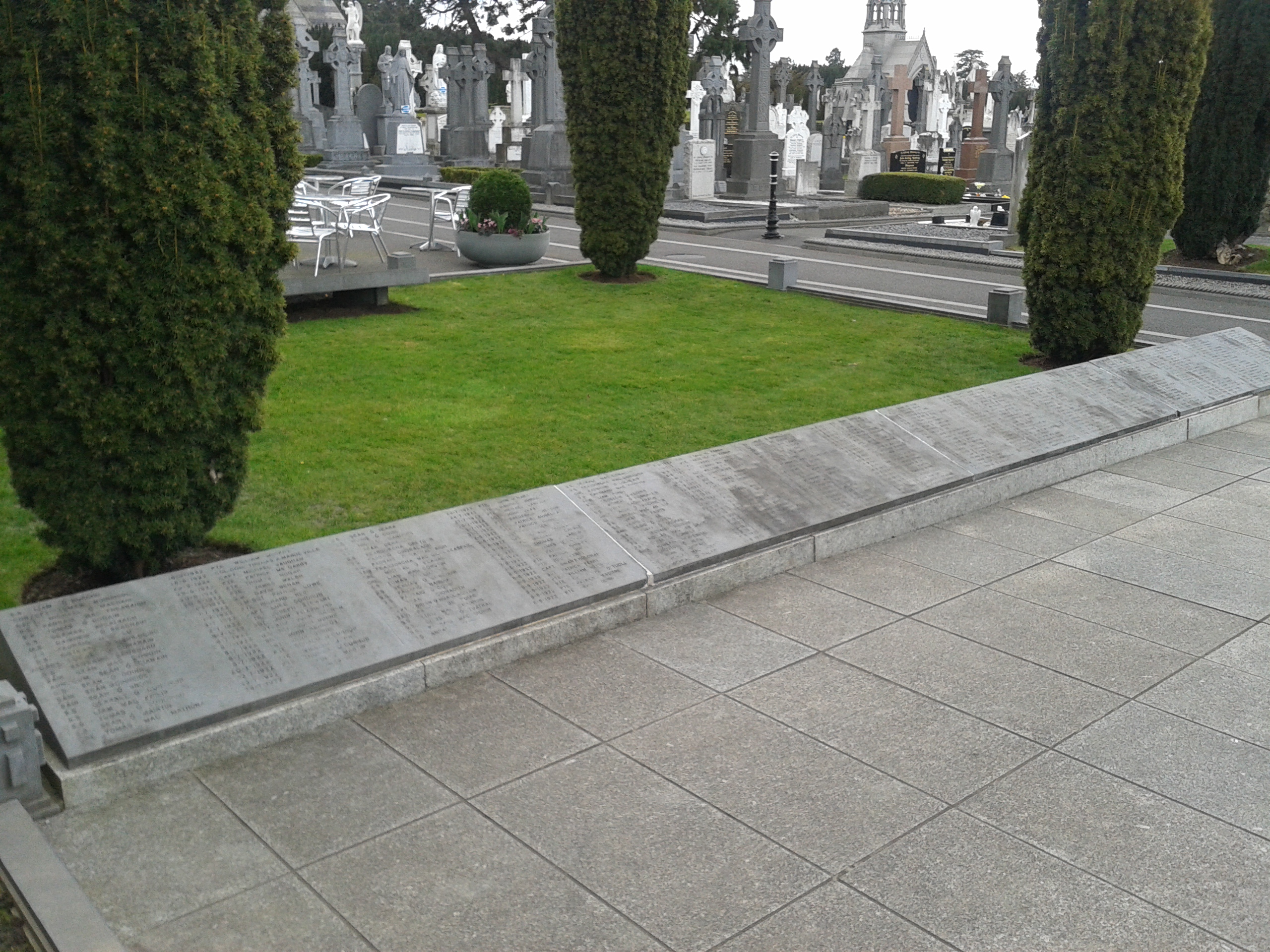
Plaques in Glasnevin’s Republican Plot recording the names of 77 of the 81 Irish Volunteers officially executed by the Free State between November 1922 and May 1923. Their police and military killed about another 150 without judicial procedure.
Considering that the book being launched was about the Civil War, it is really extraordinary that no speaker mentioned the repression by the Free State during and after that war. I am certain that Padraig Yeates has not glossed over that, he is much too honest and too good a historian to do so. But that only one speaker at the launch (Catriona Crowe) should mention the sinister Oriel House and none the at least 25 murders its occupants organised, nor the 125 other murders by Irish Free State soldiers and police, nor the 81 state executions between November 1922 and January 1923, sets one wondering at just how much self-hypnosis sections of our political and academic classes are capable.
I attended a meeting last night discussing the state of trade unions in Ireland and I found the meeting depressing. Not the state of the unions, which could be grounds enough for depression it’s true, but the state of the Left that sits down to discuss these questions. Because where else can the remedy come from except from the activists on the Left and if they don’t have a solution ….!
Practically all the 40 or so in the room were activists in trade union, community and political struggles, many with decades of experience. Many have suffered in the struggle, made financial and other sacrifices, some have suffered unemployment as a result of their commitment and some have even seen the inside of a prison. As the result of that combination of experience, one would think that they would come up with a good way – or number of ways – forward, out of the dire situation in which the trade union movement finds itself at the moment. One would think …. but alas!
The title of the meeting was TRADE UNIONS — RADICAL OR REDUNDANT? It was held on the second day of the week-long program of political discussion and cultural events of the James Connolly Festival, organised by the Communist Party of Ireland. Billed as a “debate & discussion on the future for trade unions”, the panel was chaired by Garret Gareth Murphy of Trade Union Left Forum and consisted (in speaking order and in personal capacity) of Louise O’Reilly (SIPTU), Dave Gibney (Mandate), Ann Farrelly (Swords Says No but also a member of a teacher’s trade union), Laura Duggan of Work Must Pay, Bernie Hughes (unemployed member of SIPTU but also a community activist and recently jailed for allegedly breaking an injunction sought by Sierra/ Irish Water).
Having attended a public commemoration of the death of Bobby Sands and nine other hunger-strikers which was also to start at 6pm, I arrived late for the meeting and so missed one panel speaker’s contribution and much of what another said. But that still left the rest of what the second one had to say and the other three.
At 7.15pm, the panel speakers finished and the meeting was opened to comment from the floor. Around an hour of speakers and less than an hour allocated for contributions from the audience, a discussion which then had to be cut to allow the panel to respond. This unfortunately is standard for Irish Left meetings, right across the political spectrum. Of course the intention expressed was to keep the contributions to five minutes from each and of course too some of them went way over. In this case, with five panel speakers, I had in fact predicted what would happen on the FB page of the event, though of course I would have been glad to have been proven wrong.
It is understandable, in a way. Left-wing speakers tend to be communicators and have a lot to say. They are also often kept out of many arenas where they could express their ideas. But arrogance has to be a factor too, when one knows that a meeting is scheduled to last about two hours and there are five speakers and a chair – and one still takes over 20 minutes to speak. Where does one think that extra 15 minutes (or much more) is going to come from? It is going to be deducted from other speakers probably and certainly from the audience. Or if the meeting goes on longer to make up the deficit, the risk is of wearing out the audience. The solution is crystal clear but probably won’t be applied – book less speakers and chair the meeting rigorously.
So why are so many speakers invited? Sometimes it’s because a broad representation of opinion is sought and at other times it might be that a number of organisations are expecting to be given a speaker. Then each speaker might attract a different audience or members of a different organisation. I have taken part in organising rallies and public meetings too and I know that these issues present difficulties but I also know that they have to be addressed. If we want participation and are democratically minded, we should not continue to organise debates/ discussions in this way.
All the speakers I heard expressed the opinion that there was something seriously wrong with the trade union movement. That was hardly revelatory – it is the opinion of the overwhelming majority of people on the street and in the workplace, if they have an opinion about the trade unions at all. And quite a few have hardly any opinion about trade unions – they don’t enter their view of the world to any degree whatsoever. Laura Duggan related that many young workers, finding themselves in difficulties with Job Bridge or otherwise at work, when looking for help, go first to Citizens’ Advice or to her organisation’s Facebook page – the last place many of them go to is a trade union.
Since that dismal view of the trade unions’ performance is so widespread and was shared by the panel speakers, I would have thought a few sentences could have been devoted to it and the rest of the speakers’ contributions could have been dedicated to prescribing or at least exploring solutions. Exactly the reverse is what happened – most of the contributions I heard were about ways in which the trade unions have failed, including much about personal experiences, but very little about what the solutions might be. Well, maybe the title of the meeting could be partly to blame but as activists, are we not mostly about solutions? Did Marx’s dictum on philosophy totally pass us by, that “heretofore philosophers have only interpreted the world, in various ways; the point, however, is to change it”?
So what were the solutions presented by the speakers? I recall “that the unions should recruit more young workers”, “respond more to young workers’ issues”, “there should be one big union”, “there should be education about political economy and history”, the unions should “continue participating in the struggles against the Water Tax”, “fight more strikes, especially when the membership have called for it” …..
Sure, OK, fine, brothers and sisters – but what if they don’t? What if the leadership, because that is what we are talking about in the failure of the trade unions, what if they don’t do what you think needs doing — what then? What are you going to do? What should we do?
The contributions from the floor followed much of the same pattern with however a greater amount pointed towards solutions. But again, it was mostly what was wanted from the leadership rather than what we could do to achieve the desired ends, especially in the face of the leadership’s intransigence. The need for young people to join the movement was expressed from the floor with on two occasions fulsome praise accompanied by applause for the one young person on the panel – well-intentioned no doubt but to me an embarrassing expression of the activists’ desperation.
Emigration, the 1990s Industrial Relations Act, leadership out of touch, the media … were all variously listed as being the reasons for the lack of resistance by the Irish trade union movement as well, of course, as the social partnership of decades between the unions and the employers and state.
One interesting contribution from the floor referred to an alleged ballot-rigging of which SIPTU had been found guilty in court years ago but which they appealed to the High Court. The brother relating this alleged that the Fianna Fáil Government of the day had the High Court clear SIPTU in exchange for the compliance of the trade union thereafter. Another brother a little later however denied there had been ballot-rigging (he actually said that “it was worse than that”!) and an argument broke out until the Chair quickly brought the meeting to order.
One brother in the audience stated that the problem was not at bottom whether the unions were fighting for better wages or not but about the politics of the union – if the politics were about social-democracy then of course the union would not act in the way we wanted. No-one responded to that contribution, presumably because either they agreed with it but couldn’t see how to progress from a union that isn’t even defending its membership to one with a revolutionary socialist ideology, or because they are basically in favour of social democracy, so long as it’s of a leftier kind.
I made one contribution to the discussion, in which I stated that although I have been a trade union member of different unions for most of my working life, and although I believe we should join a trade union, of course the trade unions are redundant. That is the opinion of most people at work and in the street and is the reality. But that doesn’t mean that trade unionism is redundant.
People will join a trade union if they see it fighting for its members. The workers who left the NUDL to join Larkin’s breakaway IT&GWU did so because they felt the NUDL had sold them out but they knew that Larkin wouldn’t do that and that his union would fight the employers. That was the same reason other workers joined the union too. If workers don’t see the union fighting, why should they join it?
I referred to all the bad history and difficult conditions for the operation of trade unions listed by contributors to the discussion. I pointed out that much worse conditions had been encountered and overcome by trade union organisers in the past – they had been deported in chains to Australia and in the United States many had been shot dead.
The Left in Ireland traditionally tries to deal with collaborationist trade union leadership by mobilising votes to replace the current leadership with Left candidates; I said that this process is too long if at all practicable and that our agreed Left candidates, if successful, are often corrupted by the trade union regime so that we have to start again. I proposed the same solution that I had done some years ago and on a number of occasions since, that trade union activists should form an organisation or network across the unions, in order to attend pickets when strikes break out, as people did with the Greyhound strike, to support the workers in struggle, to talk to them and also try to recruit them so as to have them go with us to the next strike and support the workers there.
I related some years ago being elected to the steering group of an organisation that was allegedly going to fulfill some of those expectations, the Trade Union Activists’ Network. I attended nearly every internal meeting for a year and was constantly trying to push it into action but it became clear to me, over time, that most of those present on the Steering Group had no real interest in the work and may have even been there for no other reason than to prevent activists from occupying their positions. Nevertheless, a grassroots network across the unions is still the only solution, I concluded; if we don’t build that we will continue to attend meetings like this in years to come, bemoaning the lack of success of our trade unions.
Some people – perhaps even most — may think they know better and after all, why should my ideas be any more likely to work than theirs? Well, perhaps for no reason; but their approaches have been tried without success for years – so why not try the one I advocate?
A somewhat separate issue which I did not address in my contribution was the much-promoted alleged support of trade unions for the Right to Water campaign. It is a fact that not one of those trade unions has advocated non-registration and non-payment. No trade union has advocated resistance to the Water Tax or its implementation by its members and, as one speaker from the floor pointed out, a number of local authority workers had been transferred to a private company installing water meters, without any resistance from the local authority trade unions.
Near the end of the meeting, speakers from the floor began to coincide in saying that we should continue to encourage trade union membership through recruitment, wearing our union badge, education, etc, etc. One went so far as to state that saying that trade unions are redundant is something some right-wing people and employers would love to hear, at which point I interjected that he was implying that “the critics are the problem”, something he hotly denied. But the fact is that the opinion of people about the trade unions is a result of the actions and inactions of those unions, rather than anything said in a meeting of around 40 people (or even a thousand).
I began this report by saying that I found the meeting depressing but that was not, it seems, what most others who attended felt. I found it depressing because despite all the lessons the Left is being taught, it seems unable to learn from them. But when the panel speakers came back to respond to the discussion, for me there were a couple of gleams of gold or at least something shiny in the bottom of the pan: Dave Gibney said that young workers will join a union when they see it fighting and spoke of the young workers in Dunne’s Stores who were enthused and politicised by their recent experience of being on a picket line; Louise O’Reilly said it was a waste of time expecting more sympathetic treatment from the media and that what we need is our own, left-wing newspaper.
End.
Credentials:
Diarmuid has been employed in many capacities, including as a factory labourer, construction labourer, kitchen porter, cleaner, laboratory assistant, foundry furnace operative, machine moulder, fitter-welder, youth worker, community worker, adult education tutor, hostel worker, hostel and addiction services team manager.
In the course of those, he has been a member in Britain at different times of the following trade unions:
Amalgamated Engineering Union
Construction Engineering Union
AEU (Foundry Workers)
Community & Youthworkers’ Union
NALGO (ILEA: Youthworkers; Adult Education Tutors)
NALGO (Local Authority, Education)
Unison
……. and in Ireland of:
SIPTU (Marine and Port)
SIPTU (Health workers)
Diarmuid has made serious attempts to found union branches in a number of manual workplaces with some successes and some failures, including being sacked from two workplaces for trade union or solidarity activity. He has also founded a union branch (managerial section) in his more recent work managing teams working with the homeless and people with substance misuse issues, along with facilitating union branch founding for other grades of workers in workplaces he managed. During his employment by NGOs, Diarmuid has faced disciplinary proceedings three times and beaten them twice, once at the initial stage and at the appeal stage in the second; he took the third to Labour Court and was awarded compensation.
Elected Shop Steward and/or Health & Safety Staff Representative in NALGO and in Unison, Diarmuid has campaigned for health & safety improvements (including organising comprehensive risk assessments by the team) as well as representing workers at disciplinary hearings (with mixed results). Elected unpaid Assistant Branch Secretary, he has been active in organising a strike, speaking at shop meetings and organising and participating in pickets. For a year, he edited a trade union branch newsletter and contributed articles to it.
As a trade union, community and political activist, among the pickets he has supported have been at car manufacturers (Fords), building sites, newspaper (Wapping), refuse workers (Greyhound), catering workers (Subway, Mac Donald’s), against cuts and closures of services, also collecting money for miners’, fire fighters’ and health workers’ strikes.
The month of January is the start of the year, according to the calendar most of us use but, for the Celts and some other peoples, it was the last month of winter, which had begun in November, after the feast of Samhain.
I am notified of many birthdays in January from among my Facebook friends. That would seem to indicate a higher rate of conception at the end of March/ early April and onwards but a quick search on the internet did not supply me comparative figures. However, in our climate, new food begins to be available inland in January as salmon arrive to spawn and with sheep lactating from February. Onwards from there, plants begin to grow again and birds lay eggs, animals give birth and so on. The pregnant mother needs a ready supply of food to sustain a viable pregnancy.
Though January may be a month of births, from what I see of history it is also a month of deaths … early, unnatural deaths …. of executions, in fact. These particular executions to which I refer took place in Ireland and in the United States of America and they were carried out by the respective states of those countries.
Executions by the Irish Free State
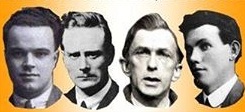
This week saw the anniversary of five such executions, on the 15th January 1923 — executions by the Free State of IRA Volunteers. Four of these were in Roscrea and the fifth was in Carlow:Vol.F. Burke; Vol.Patrick Russell; Vol.Martin Shea; Vol.Patrick MacNamara; Vol.James Lillis.
They were not the first executions by the Free State: eight had been executed the previous November and thirteen in December. The killing for the new year of 1923 had begun with five in Dublin on the 8th January and another three in Dundalk.
The Mountjoy Four reprisal executions by the Irish Free State on 8th December 1922 of one IRA Volunteer from each province.
Nor were those executed on the 15th January to be the last for that month: on the 20th another eleven stood against a wall to be shot by soldiers of the Irish state; on the 22nd, another three; on the 25th, two more; and another four on the 26th before the month’s toll of 34 had been reached. As we progress through the year, each month will contain the anniversary of an executed volunteer and in all but one, multiple executions.
Apart from those who died while fighting, seventy-seven Volunteers and two other supporters of the struggle were officially executed by the Irish Free State between November 1922 and 29th December 1923. In addition there were many (106-155) murdered without being acknowledged by Free State forces — shot (sometimes after torture) and their bodies dumped in streets, on mountains, in quarries .…1
Soiidarity demonstration outside Mountjoy Jail, probably organized by Cumann na mBan, perhaps in protest at Mountjoy executions December 1922
These deeds and others led to the composition of a number of songs, among the best of which are in my opinionMartyrs of ’22 (sung to the air of The Foggy Dew) and Take It Down from the Mast. The latter was written in 1923 by James Ryan, containing two verses about the Six Counties which one doesn’t normally hear sung. Dominic Behan in the 1950s added a verse of his own about the four executions by the State in reprisal for the assassination of TD Sean Hales, when the State deliberately shot one Volunteer from each province, each of whom had been in custody when the assassination took place: Rory O’Connor, Liam Mellows, Richard Barrett, Joseph McKelvey, Dominic Behan recorded the latter in the 1950s: https://www.youtube.com/watch?v=-b2EL8Jytao
This was the bloody baptism of the new state, a neo-colony state of twenty-six counties on a partitioned island, with six counties remaining a British colony.
MARTYRS OF ’22
1
When they heard the call of a cause laid low, They sprang to their guns again; And the pride of all was the first to fall — The glory of our fighting men. In the days to come when with pipe and drum, You’ll follow in the ways they knew, When their praise you’ll sing, let the echoes ring To the memory of Cathal Brugha.
2
Brave Liam Lynch on the mountainside Felll a victim to the foe And Danny Lacey for Ireland died in the Glen of Aherlow Neil Boyle and Quinn from the North came down To stand with the faithful and true And we’ll sing their praise in the freedom days ‘Mong the heroes of ’22.
3
Some fell in the proud red rush of war And some by the treacherous blow, Like the martyrs four in Dublin Town, And their comrades at Dromboe: And a hundred more in barrack squares and by lonely roadsides too: Without fear they died and we speak with pride of the martyrs of ’22.
Executions of “Molly Maguires”
Wednesday, 14th January, was the anniversary of the executions of James McDonnell and Charles Sharp at Mauch Chunk jail, Pennsylvania. Both had been accused of being “Molly Maguires”, a resistance group of workers, mostly miners, in the Pennsylvania region. Today, the 16th, is the anniversary of the execution of another “Molly”, Martin Bergin; 20 were executed over two years. And many more had been murdered in their homes or ambushed — many others had been beaten; these activities were carried out by “vigilantes” hired by the coal-mine owners and by Iron & Coal Guards, also employed by them.
The exact origin of the name Molly Maguires is uncertain but they were among a number of agrarian resistance organizations of previous years in Ireland; according to accounts, they gathered at night wearing women’s smocks over their clothes to attack landlords and their agents. Since these smocks tended to be white in colour, Whiteboys or Buachaillí Bána was another name for them.
Molly Maguires tribute statue by Zenos Frudrakis in Molly Maguires Memorial Park, Mahanoy City, Pennsylvania, USA
Somewhat Ironically, the state of Pennsylvania was itself named after a man with connections to Ireland: William Penn’s father, the original William, had commanded a ship in the Royal Navy during the suppression of the Irish uprising in 1641, for which he had been given estates in Ireland by Cromwell.
His son, William went to live on the Irish estates for a while and was suppressing Irish resistance there in 1666. Not lot long afterwards he became a Quaker in Cork.
In 1681 the younger Penn’s efforts to combine a number of Quaker settlements in what is now the eastern United States were successful when he was granted a charter by King Charles II to develop the colony. The governance principles he outlined there are credited with influencing the later Constitution of the United States. Charles II added the name “Penn” to William’s chosen name of “Sylvania” for the colony, in honour of the senior Penn’s naval service (he had by then become an Admiral).
Less than two hundred years later, Pennsylvania was one of the United States of America and the anthracite coal discovered there was being mined by US capitalists. The mine owners squeezed their workers as hard as they could and regularly replaced them with workers who were emigrating in mass to the United States in the mid-19th Century.
According to James D. Horan and Howard Swiggett, who wrote The Pinkerton Story sympathetically about the detective agency, about 22,000 coal miners worked in Schuylkill County, Pennsylvania, at this time and 5,500 of these (a quarter) were children between the ages of seven and sixteen years. According to Richard M. Boyer and Herbert M. Morais in Labor’s Untold Story, the children earned between one and three dollars a week separating slate from the coal. Miners who were to injured or too old to work at the coal face were put to picking out slate at the “breakers”, crushing machines for breaking the coal into manageable sizes. In that way, many of the elderly miners finished their mining days as they had begun in their youth. The life of the miners was a “bitter, terrible struggle” (Horan and Swiggett).
Workers who were illiterate and immigrants without English were unable to read safety notices, such as they were. In addition immigrants faced discrimination and Irish Catholics, who began to arrive in large numbers in the United States after the Great Hunger of 1845-1849 faced particular discrimination although (or because) most spoke English (as a second language to Irish, in many cases). The mine-owners often employed Englishmen and Welsh as supervisors and police which also led to divisions along ethnic lines.
As well as wages being low and working conditions terrible, with deaths and serious injuries at work in their hundreds every year, the mine-owners cut corners by failing to ensure good pit props and refused to install safety features such as ventilating or pumping systems or emergency exits. Boyer and Morais quote statistics of 566 miners killed and 1,655 seriously injured over a seven-year period (Labor, the Untold Story).
In 1869 a fire at the Avondale Mine in Luzerne County, Pennsylvania, cost the lives of 110 miners. There had been no emergency exit for the men’s escape. It is a measure of the influence of the mine and iron capitalists that the jury at the inquest into the deaths did not apportion blame to the mine-owner, although it did add a rider recommending the instalation of emergency exits in all mines.
Earlier at the scene, as the bodies were being recovered from the mine, a man had mounted a wagon to address the thousands of miners who had arrived from surrounding communities: “Men, if you must die with your boots on, die for your families, your homes, your country, but do not longer consent to die, like rats in a trap, for those who have no more interest in you than in the pick you dig with.”
The speaker was John Siney, a leader of the Workingmen’s Benevolent Association, a trade union that had been organizing among the miners for some time; his words were a call to unionize and thousands did so there and then and over the following days.
Trade union organisers in the USA throughout the 19th Century (and later) were routinely subject to harassment, threats and often much worse and the workers at times responded in kind. Shooting and stabbing incidents were far from unknown, with fifty unexplained murders in Schuykill County between 1863 and 1867. The mine-owners had the Coal and Iron Police force and were known to hire additional “vigilantes” to intimidate and punish trade union organisers. They also hired the Pinkerton Detective Agency to gather intelligence on union organisers and on the Molly Maguires.
The employers watched concerned as the WBA trade union grew to 30,000 strong with around 85% membership among the coal miners of the area, including nearly all the Irish. The “Great Panic” of 1873 changed the situation. A stock crash due to over-expansion was followed by a decrease in the money supply and staggering levels of unemployment followed. As is often the case, the capitalists maintained their life-styles while claiming inability to pay living wages to their workers. As is often the case too, they used the opportunity of high unemployment to force worse wages and conditions upon the workers.
One of those capitalists owned two-thirds of the mines in the southeastern Pennsylvania area; he was Franklin B. Gowen, owner of the Reading & Philadelphia Railroad and of the Reading & Philadelphia Coal & Iron Company. Gowen was determined to break the WBA and formed his own union of employers, the Anthracite Board of Trade; in December 1874 they announced a 20% cut in wages for their workers. On 1st January 1875 the WBA brought their members out on strike.
The history of the coal mines of Pennsylvania and their terrible conditions and mortality in the 19th Century, the extreme exploitation of the mine-owners’ systems and their use of prejudiced and corrupt courts, media and vigilantes to have their way, is a long one. The history of the workers’ resistance is also a long one and the “Molly Maguires” were a part of it. Their own history is also dogged by controversy, with some even doubting the existence of the Mollies, claiming that the secret society was an invention of the employers to create panic and to associate the unionized workers with violence in the minds of the public. The brief notes following are part of a narrative accepted by some historians but not by others.
In order to defend themselves, the miners developed two types of organisation which, in many areas where the workers were Irish, existed side by side. One was the Workingmen’s Benevolent Association, a trade union the methods of which were those of industrial action, demonstrations and attempts to use the legal system in order to improve working conditions and gain better remuneration for the workers.The leaders of the WBA condemned violence used by workers as well, of course, as denouncing the employers’ violence.
The other was the Molly Maguires, a secret oath-bound society which organized under the cover of the Ancient Order of Hibernians. The AOH in turn was a self-help or fraternal organization for Catholics of Irish origin, mostly in the Irish diaspora, particularly in the USA, where early Catholic Irish migrants had encountered much hostility and discrimination from the WASP establishment and from “nativist” groups. In keeping with the history of their namesakes, the Molly Maguires of the USA were prepared to use violence in response to the violence of their employers.
In March1875, Edward Coyle, a leading member of the union and of the Ancient Order of Hibernians, was murdered, as was another member of the AOH; a miners’ meeting was attacked and a mine-owner fired into a group of miners (Boyer and Morais).
Reprisals by the Mollies followed as attacks on their members and the miners in general escalated. These attacks were carried out by State police, the Coal and Iron Police of the mine-owners and in particular by the “Vigilantes”, also hired by the mine-owners.
The information supplied by the Pinkerton Agents in their daily reports, although often only initial speculations from surveillance, were used to target individuals who were then often murdered2. One of the Pinkerton agents, James McParlan3from Co. Armagh, who hadpenetrated the Mollies under cover of the alias “James McKenna”, was reportedly furious that his reports were being used to target people for the “Vigilantes”, including people he considered innocent. His job as he saw it was to gather information which would stand up in court to convict the leading Mollies, sentence them to death and break the organisation. Although his employer tried to pacify him in fact Alan Pinkerton himself had urged the mine-owners to employ “vigilantes”.
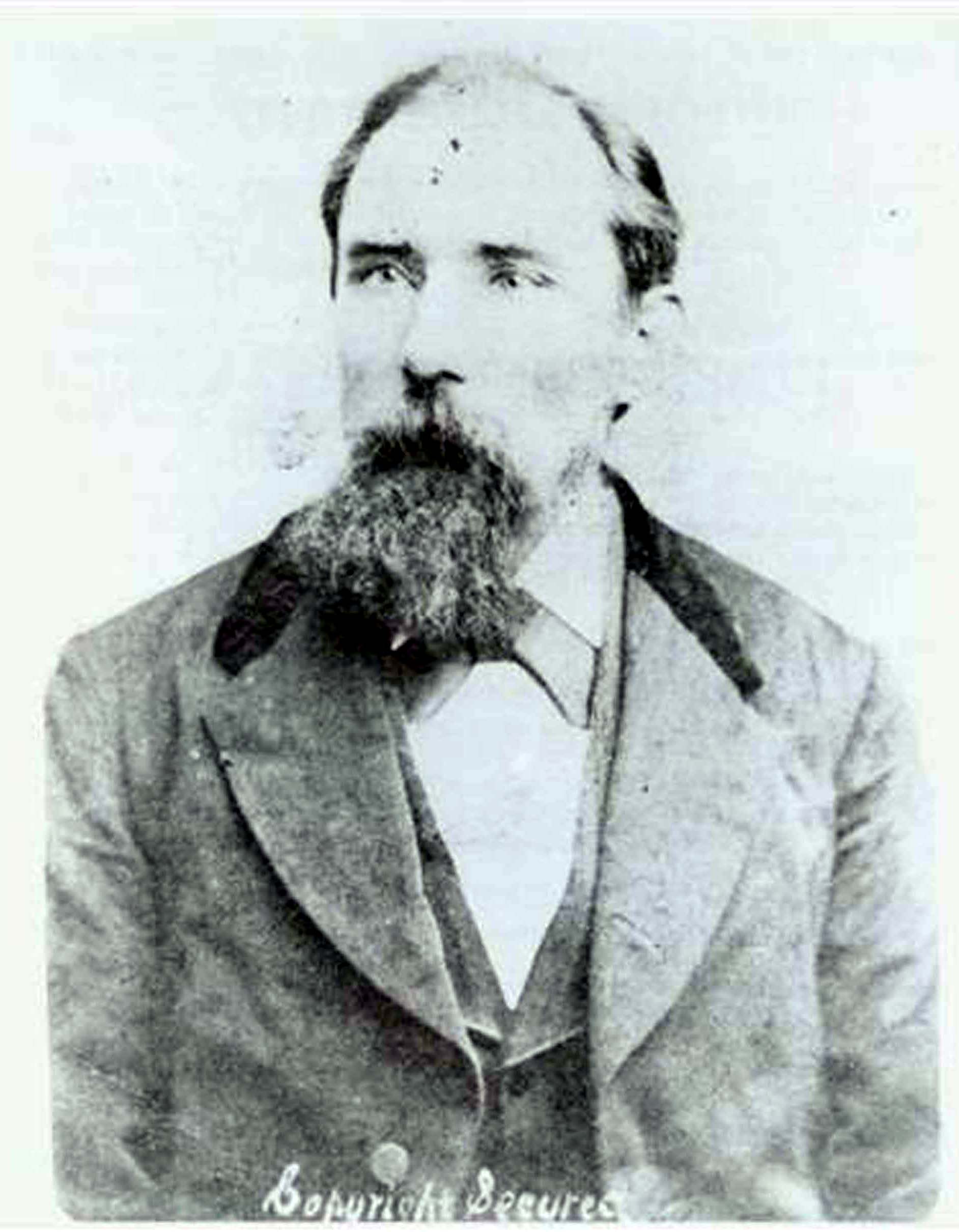
John “Black Jack” Kehoe, allegedly one of the leaders of the Molly Maguires
The mine-owners pursued a dual strategy of violence against Mollies and other leaders and members of the WBA, while also preparing legal charges against trade union officials and collecting evidence to have the Mollies tried for murder. The courts collaborated, as did the mass media. Much of the clergy were not found wanting either and denounced the union leaders to their congregations.
The state militia and the Coal and Iron Police patrolled the district, maintaining an intimidatory presence during the strike. On May 12th John Siney, a leader of the WBA was arrested at a demonstration against the importation of strike-breakers. Siney had opposed the strike and advocated seeking arbitration. Another 27 union officials were arrested on conspiracy charges. Judge Owes’ words while sentencing two of them are indicative of the side on which the legal system was, at least in Pennsylvania in 1875:
“I find you, Joyce, to be President of the Union and you, Maloney, to be Secretary and therefore I sentence you to one year’s imprisonment.”
Stories appeared in the media of strikes as far away as Jersey City in Illinois and in the Ohio mine-fields, all allegedly inspired by the Mollies. Much of the anti-union propaganda in the media was directly provided by Gowen who planted stories therein of murder and arson by the secret society.
With the workers starving and deaths among children and the infirm, surrounded by armed representatives of the employers and the state militia (also friendly to the employers), their leaders arrested, the union nearly collapsed and the strike was broken, miners going back to work on a 20% cut in their wages. The strike had lasted six months but the Mollies fought on and McPartland noted increased support for them, including among union members who had earlier declined to support their methods.
When the Mollies were brought to trial in a number of different court cases of irregular conduct, Gowen had himself appointed as Chief Prosecutor by the State. One of the accused, Kerrigan, turned state’s evidence and his and McPartland’s evidence helped send 10 Molly Maguires to their deaths:Michael Doyle, Edward Kelly, Alex Campbell, McGeehan, Carroll, Duffy, James Boyle, James Roarity, Tom Munley, McAllister.
Execution of Molly Maguire 1877 (French soure: I have been unable to find the name of the victim or the exact date of his execution)
In that area and in many other major industrial areas across the United States throughout the rest of that century and well into the next, employers continued to use spies and “vigilantes”, company police, local law enforcement agencies, state militia, labour-hostile press, fixed juries and biased judges to break workers’ defence organisations, often martyring their leaders and supporters.
A number of books have been published about the Molly Maguires and their story of has been dramatised in the film of the name (1970), starring Sean Connery as Jack Kehoe and Richard Harris as McPartland. The Mollies have also been celebrated in a number of songs, among which the lyrics of the Dubliner’s version is probably the worst and those of The Sons of Molly Maguire are the best I have heard (see Youtube recording link below end of article).
Molly Maguire tribute banner ITGWU (Cork branch)
In June 2013 the East Wall History Group organized a talk on the Mollies by US Irish author John Kearns at the Sean O’Casey Centre in Dublin’s North Wall area (video of the talk and audio of a radio interview with the author are accessible from this link:http://eastwallforall.ie/?p=1505).
In 1979, on a petition by one of John “Black Jack” Kehoe’s descendants and after an official investigation, Governor of Pennsylvania Milton Shapp posthumously pardoned Kehoe, who had proclaimed his innocence until his death (as had Alex Campbell). Shapp praised Kehoe and the others executed as “martyrs to labor” and heroes in a struggle for fair treatment for workers and the building of their trade union.
End
The Sons of Molly Maguire:
Footnotes:
1 I gratefully acknowledge the listing of that wonderful voluntary and non-party organisation, the Irish National Graves Association, which has done such important work to document and honour those who have fallen in the struggle for freedom of the people of our land http://www.nga.ie/Civil%20War-77_Executions.php
2 In what one may see as a strange coincidence, among the Mollie victims of Vigilante violence were cousins of Pat O’Donnell, with whom he had stayed for some time. Pat O’Donnell shot dead Carey in 1883 because he had turned state evidence against the Invincibles (see https://rebelbreeze.wordpress.com/2014/12/17/pat-odonnell-patriot-or-murderer/).
3 Also sometimes referred to as “McParlan”. In addition some researchers have expressed the opinion that there in fact two McParlands, brothers, working for Pinkerton against the Molly Maguires.







 rebelbreeze