AFTER A 12-DAY WAR – HOW DOES THE BALANCE LOOK?

Diarmuid Breatnach

(Reading time: 5 mins)

Both the USA and its proxy Israel carried out an unprovoked attack on Iran, both attacking nuclear facilities and Israel, as per their playbook, bombing civilians and their public facilities.

Iran targeted every category in Israel (generally not civilians) matching those the IOF bombed in Iran, assassinations excepted. And replied to the USA’s attack by hitting their most forward base in a Middle Eastern state, Al-Udeid in Qatar.1

The objectives of the US and of Israel were ostensibly to wreck Iran’s nuclear program. But more than that, to achieve a change of regime to one amenable to the western powers, such as is the case with most of the Middle Eastern regimes.

The regime change was to take place internally by subversion, terrorism and uprisings as it was fighting bombing by Israel.

Neither the US nor Israel achieved those listed objectives.

Iran’s objectives were to maintain its sovereignty and independence in general and, because of the US and Israeli public focus, defend its sovereignty with regard to uranium enrichment to improve its nuclear energy and by-products.

Iran achieved those objectives,2 at least for the time being and it will probably now leave the IAEA with justification3 so western powers will know very little of what is going one with Iran’s nuclear program, which is to Iran’s benefit.

Iran however also wanted the lifting of sanctions and it has not achieved that.

Once the Israeli attack started, Iran’s objectives were a) to recover from the initial external and internal assaults and assassinations; b) defend the state from internal subversion and terrorism and from Israeli bombing; b) strike back at Israel and punish it so thoroughly as to prevent repetition.

Iran successfully and quickly recovered from internal assaults and assassinations; b) put up a strong defence but was unable to down enemy planes other than drones, which was not a success;4 c) punished Israel very severely, to an extent that will become clearer as time goes on.

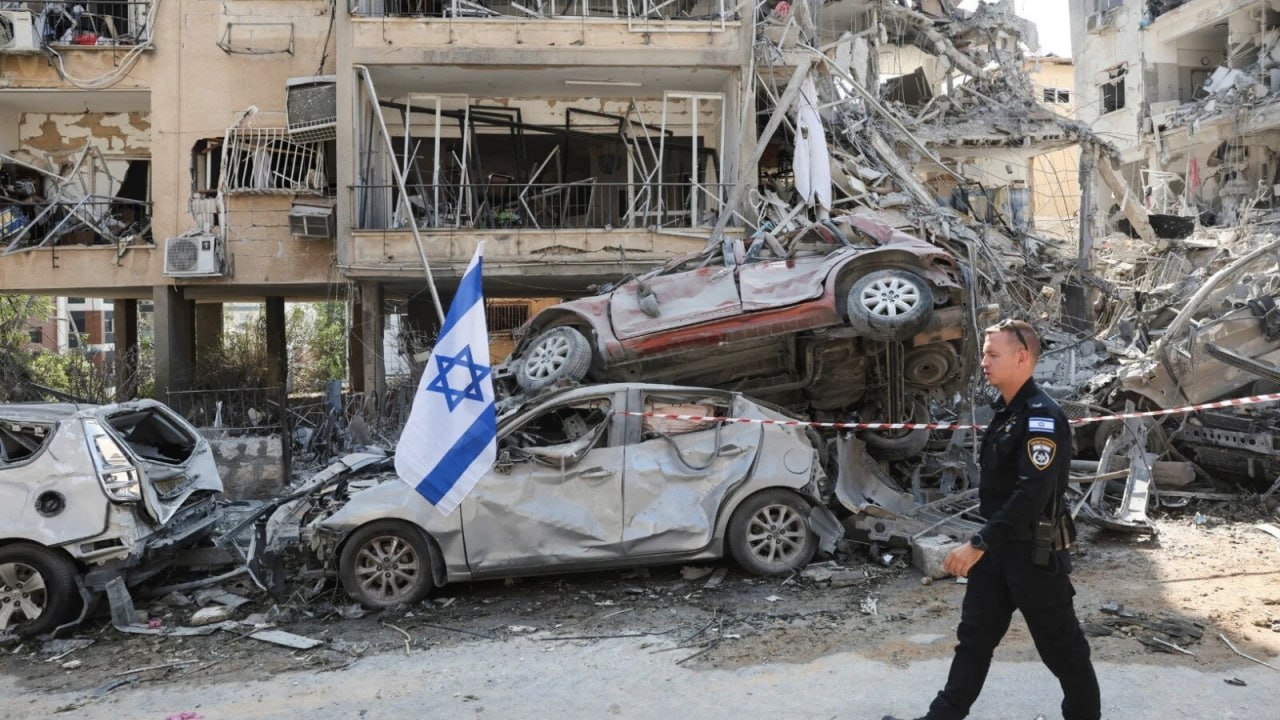
Scene of Iranian missile damage in ‘Israel’, June 2025 (Photo sourced: Telegram)

But the level of Iran’s attack was not enough to ensure Israel will never attack it again and the Zionist entity’s political and military leadership is probably even now concentrating on how to rebuild itself to strike again.

Once the USA attacked, Iran had to show that it was capable of eliminating US bases across the region and would do so if attacked again. The strike on its evacuated Al-Udeid base in Qatar was largely symbolic but in fact proved Iran’s point and willingness to go that far if necessary.

In that, Iran was resoundingly successful. No other state has attacked a Middle Eastern US base, albeit warned and evacuated at the time, without serious repercussion.

This conflict ended overall as a draw but with the preponderance of success on Iran’s side.

It is more difficult to assess the political wins and losses but in so far as there is any change in the overall political situation one would have to say it has shifted in Iran’s favour.

One process of assessment is to investigate what the antagonists think:

  • Iran is celebrating nationally before turning to the funerals of their martyrs, in particular state funerals of victims of assassinations;
  • Israel is full of recriminations against its leadership but also against the US5 for not going further and imposing a ceasefire;
  • The USA leadership seems divided but opinion is increasingly mounting that Trump is mistaken in his assessment of ‘obliteration’ of Iran’s enriched uranium production sites.

Another measure is the relative financial expenditure and loss.

  • Although this picture is far from clear from either side we know of over 39,000 insurance claims in Israel so far6and the state spent $5 Billion in the first week of the war.7

They lost a prominent military science development site and lost or sustained damage to military and military intelligence sites too but it will be some time before the true level or even approximation will escape Israeli military censorship.

Israel also lost presumably a great deal of its Mossad-run sabotage and terrorist network in Iran which exposed itself as part of Israel’s attack, much of which is now under interrogation, on trial or already executed.

  • U.S. spending on aid for Israeli military operations in Gaza and elsewhere in the region between Oct. 7, 2023 – Oct. 7, 2024 was calculated at over $17.9 billion; spending on related U.S. operations in the region at over $4.86 billion.8
  • Iran produces missiles much more cheaply than Israeli munitions and has greater productive capacity; its greatest loss was the human cost (the disparity in civilian deaths shows who was really targeting civilians) and it lost a lot of scientists through Israeli assassinations.

On the political-psychological level, an extremely important one:

  • Iran emerged as a strong state with popular support in defence of sovereignty that cannot easily be defeated. Internally this has led to greater unity, at least for the moment.

Externally, Russia and China will see it not only worthwhile but important to support Iran and possibly even to part-arm them (which Pakistan too may do).

Iran’s western-friendly neighbours will be wondering whether US airbases brings them greater security or the opposite and also whether any alliance with Israel is a good idea, even though pushed by the USA and other Western powers.

Israel has seen its image of military superiority and even invincibility destroyed, internally by its war in Gaza and externally by its recent war with Iran and this process will increase as those from other areas view the damage in ‘Tel Aviv’ for example.

For a decade the state has been seeing a steady exodus of dual-nationality Israelis, particularly among its technocrat population and during this war mass evacuations by boat and land after the Israeli State closed its airports.10

The degradation of the IOF through mental fatigue, injuries and deaths (totalling more than 10,000 since their Gaza offensive), along with damaged armour, will continue in a deeply divided body politic.11

  • The USA’s population will continue to see protests not only against the wars in the Middle East and genocide in Palestine but also against the increasing decrees and police repressing free speech and the right to organise and participate in protests.
  • Western capitalist companies will continue to reduce or even end their investment in – or relationships with – the Israeli state,12 pushed in part by targeted protests and probably more largely by doubts about how financially safe Israel really is, even in the mid-term.

IN CONCLUSION

Iran is the overall winner, Israel definitely the big loser and the USA somewhat also (not forgetting that any Israeli loss is ultimately one for the US also). But the Zionazis will rearm and increase spying, sabotage and probably covert assassination operations in Iran.

Iran will rearm also, possibly even in nuclear terms and will intensify its intelligence war against subversion and spying and always viewing future attacks on it as inevitable.

The US will continue to view Iran as its primary adversary in the Middle East, in terms of its sovereignty and military capabilities.

Also viewing Iran as a necessary obstacle to remove before its future full confrontation with China, a state financially and economically already ahead of the US and a strong proponent of a multi-polar world against the existing unipolar version with the US as its head.

The world geopolitically-militarily will not be a better place as the result of the outcome of this 12-day war and may even be worse for it – after all, Israel and the US were permitted by the rest of the western alliance to bomb nuclear installations while continuing to support genocide in Gaza.

But with the weakening of US Imperialism and Israeli Zionism, it will offer opportunities for reversing damaged sovereignty, for anti-imperialist revolutions and for social progress.

End.

FOOTNOTES & SOURCES

1https://www.bbc.com/news/articles/cdjxdgjpd48o

2https://thecradle.co/articles/european-intel-says-irans-enriched-uranium-survived-us-attacks

3https://www.theguardian.com/world/2025/jun/25/irans-parliament-approves-bill-to-suspend-cooperation-with-iaea

4Sharmine Narwani on the Cradle podcast https://www.youtube.com/watch?v=PK8tYo3jdIk pointed out that none of the many Israeli photos taken from the air over central Iran could be ascertained as typically originating from IOF planes and were instead likely taken from drones. This raised the possibility that all the air-launched missiles of the IOF were all from airspace outside Iran (and we know that the Iraqi Government complained about the US violation of its airspace by opening it to the IOF). This also seems to answer a question that was bothering me: What happened in this war to the sophisticated radar that allegedly caused enemy planes to veer away from Iranian airspace in the attack last year, with some leaks alleged from pilots claiming that the Iranians were able to ‘see’ and target the latest stealth fighter planes. However ‘seeing’ fighters is not the same as ‘targeting’ them and may not even be possible at all with US B2 bombers – see interesting short presentation from this hostile source: https://www.youtube.com/watch?v=Fz6cd9tHiyM No doubt scientists are working on the problem and technology will develop further so that stealth bombers may be detected and fighters and bombers targeted, with US technology developing technology to confuse the targeting and so on … and on.

5Including reported tweets and comments calling for Israel to bomb the US!

6https://www.aa.com.tr/en/middle-east/israel-receives-nearly-39-000-compensation-claims-for-damages-caused-by-iranian-missiles/3611868 and https://www.middleeasteye.net/news/israel-multi-billion-shekel-price-tag-iran-war

7“The David’s Sling system, used to intercept short- and long-range threats, costs around $700,000 per activation when firing its minimum of two interceptors.” https://timesofindia.indiatimes.com/world/middle-east/12billion-a-month-the-cost-of-israels-daily-strikes-and-defence-against-iran-war-at-a-premium/articleshow/121979978.cms

8Costs of War

9https://www.nytimes.com/2025/06/25/world/middleeast/gulf-states-iran-attack-us-qatar-base.html

10Even before the retaliation by Iran https://www.trtworld.com/middle-east/over-550000-israelis-flee-country-amid-gaza-war-data-shows-18176225 and during the war reported leaving by sea and land, after Israel closed airports https://www.newarab.com/news/israelis-quietly-flee-europe-yacht-escape-iran-missiles

11https://www.aa.com.tr/en/middle-east/over-10-000-israeli-soldiers-killed-or-wounded-in-gaza-war-says-military-officer/3587606

12The largest European consumers’ cooperative with 2,700,000 members (Wikipedia) joins boycott of Israeli products European retailers drop Israeli goods in solidarity with Gaza – TRT Global

The feminist call to war

Gearóid Ó Loingsigh 24 June

Reprinted in full from G.Ó.L’s substack and formatted for the Rebel Breeze blog.

Feminism used to be associated with pacifist anti-militarist movements, but times have changed and now there are feminists who call for war, whilst they still continue to blame all wars on men. It is an enormous contradiction.

For the last two years Gaza has lived under a siege and a genocide, supported by some sectors of feminism and in the midst of the conflict with Iran, once again feminist voices come out with a clamour for war. The reason is their supposed rush to free the women of Iran.

Four female political prisoners in Evin prison in Tehran (before it was bombed by Israel), conscious of the cynicism of some feminist groups in the West issued a communiqué denouncing the war and those who support it.

They stated that Israel wanted a submissive and weak Middle East and they opted to continue their own struggle against the government in Tehran without allying themselves with Yankee imperialism.

Our liberation…from the dictatorship ruling the country is possible through the struggle of the masses and by resorting to social forces – not by clinging to foreign powers or placing hopes in them.

The powers that have always brought destruction to the countries of the region through exploitation and colonisation, by inciting wars and killing in pursuit of greater benefits, will have no way out for us except for new destruction and exploitation.[1]

The four women are pro-Kurdish and also women detained in the protests following the death of Masha Amini at the hands of the Morality Police in 2022. One of them fought against ISIS in Syria. They are not coffee house feminists.

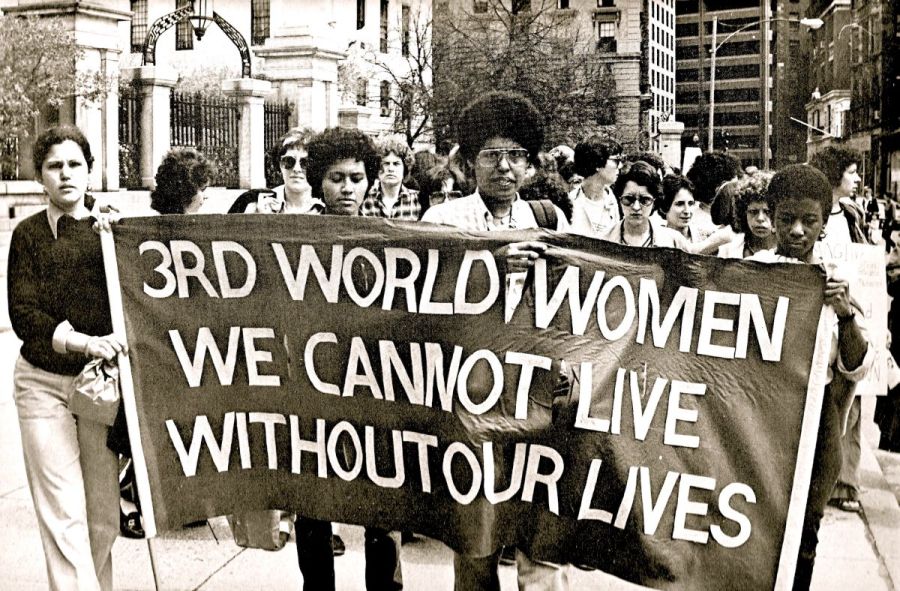
Women ‘of colour’ probably of the Combahee Collective with banner in what seems to be a general women’s liberation demonstration in the early 1970s. (Photo sourced: Internet)

They branded as traitors those Iranian who have called for war, amongst them the son of the despotic Mohammad Reza Pahlavi, the Shah imposed by the USA in 1953 following the CIA coup.

He ruled with an iron hand murdering and torturing the opposition, both the Left and Right, men and women. His son wants to go back to robbing the country’s coffers.

Traitors to Iran and traitors to the peoples of the Middle East and traitors to the people’s years of freedom-seeking struggles against oppression will know that their betrayal and disdain will be recorded in the memory of the Iranian people and in history.

Future generations will remember with shame those who stand on the corpses of defenceless people and trample them.[2]

Whilst these women who did actually rise up against the regime are opposed to the war, in the West there are those bourgeois feminists who in between their macchiatos ask for more attacks on Iran, in order to “free” the women.

They only think of Iran when a US president or the Nazis in Tel Aviv want to attack the country. They believe that the sexual predator who acts as US president is going to fight for the women. Maybe the way he did in Syria by installing ISIS.

One of the first to invoke the repression of women was none other than Netanyahu,[3] a man who has bombed maternity hospitals in Gaza killing women and children all around.

The US said something similar about Afghanistan and various bourgeois feminists came out to justify the war, deliberately ignoring that without US support the Taliban would never have existed.

It was Jimmy Carter and then Reagan who started to finance the troglodytes of the Mujahadeen and later the Taliban i.e. the bourgeois feminists too.

I should clarify that many of those feminists are not bourgeois in the sense of their social class, they have no capital, they are not rich, though there is no lack of those who are.

They are bourgeois in an ideological sense, although they use terms such as liberal, radical, separatist etc., but what unites them is their defence of capitalism and the bourgeoisie.

You could say right wing feminists but many of them like to present themselves as progressive when they are bourgeois, or in the case of the less wealthy ones, acolytes of the bourgeoisie.

Hillary Clinton, a bourgeois feminist (both in the ideological sense and also in terms of her bank balance) who has her hands stained with the blood of women in Libya and other parts is one of the spokeswomen for bourgeois feminism.

Much though they may shout, down with patriarchy! Their favourite slogan is Long Live Capitalism and Imperialism! This includes feminist intellectuals like Julie Bindel.

They kept silent about the genocide in Gaza and now believe that whoever criticises the war against Iran supports the regime. I suppose this includes the political prisoners who don’t sip macchiatos in their cells.

Bindel writing in The Sun said that those who criticise the war support Iran and the oppression of women. She repeated the usual lies about October 7th, mixed with some truths about Iran with the aim of supporting the war.[4] Bindel has kept silent about the massacres of women in Gaza.

She doesn’t support the women of Iran, but rather the West. It is worth pointing out that the owner of the paper, where she writes, has supported reactionary governments around the world, including in Great Britain where Bindel lives.

It is a misogynist, homophobic paper that frequently runs campaigns against the poor and migrants. Bindel is not alone, Kelly Jay Keen shares videos of the son of the Shah, perhaps to indicate that she supports the monarchy.[5]

The bourgeois feminists, like all of the bourgeoise in practice see other cultures as inferior ones. They use the same imperialist language to justify wars as did Rudyard Kipling, the author of the infamous poem The White Man’s Burden. They boast about the White Woman’s Burden.

It should be remembered that Kipling wrote that poem to seek and to justify the US invasion of the Philippines.

Take up the White Man’s burden
The savage wars of peace
Fill full the mouth of Famine
And bid the sickness cease;
And when your goal is nearest
The end for others sought,
Watch Sloth and heathen Folly
Bring all your hopes to nought.

Then they say that men are to blame for wars and not their dear capitalist system. Over and again the bourgeois feminists call for war.

But if they want wars and invasions, well why not ask for the US to be invaded, where women are pursued fleeing from one state to another to obtain an abortion, or where access to sex education is restricted and deficient as is access to contraceptives,[6] where women earn less than men and are under-represented in a wide range of fields.

Afghanistan is a country where women are more repressed than in any other part of the world. Throughout the conflict the US financed the Mujahadeen and later the Taliban.

They had the option of supporting organisations such as the Revolutionary Association of the Women of Afghanistan, a women’s organisation that opposed the Islamists and also the Russians and later the US invasion.[7] 

No, between one macchiato and another our dear bourgeois feminists let the men in the Carter, Reagan, Bush and Clinton support the Taliban troglodytes.

They said the same in Iraq. I am sure more than one reader is asking themselves what Iraq has to do with it all. It was a secular country, that promoted women’s education and participation.

However, one of the reasons bandied about by Bush was that he was rescuing and defending women and he compared their situation to that of Afghanistan, despite Saddam promoting women’s education.[8] 

In fact, under Saddam, 30% of faculty staff were women, trained in Europe and the USA with full funding from the government. It is no longer like that, in fact there is no intellectual world in Iraq, the bombs the bourgeois feminists asked for, put paid to that.[9] 

In the US the bourgeois feminists paid to go to universities, but Iraq promoted women as a state policy, something the Yanks have never done. In Britain, just 31% of the lecturers were women.

Iraq almost beat them, but in-between macchiatos the bourgeois feminists called for a war to improve the situation of women in Iraq and of course their investment portfolios.

Now the drums of war are beating again and the bourgeois feminists once more give themselves over to the war, despite believing that wars are a male product rather than a capitalist one.

They are not going to analyse their own participation, whilst a refugee from one of their wars prepares another macchiato for them.

As the female political prisoners in Evin said, it will be the Iranian people and the Iranian women who will free Iran and the Iranian women and not the bourgeois with the macchiatos, wine and caviar.

They are just as much the enemy of the women of Iran as the male bourgeois and are as deserving of our contempt.

There is no lack of Iranian voices asking for war and not just the son of the despot Pahlevi. Masih Alinejad is an exiled journalist. She took part in the movement against the obligatory use of head coverings in Iran and other things.

So far so good, unlike others she has fought against the oppression of women in the country.

But in exile, she turned out to be a Zionist and in the first Trump government met with the hawk Mike Pompeo and also worked at the official US propaganda radio station, Voice of America, transmitting programmes in Farsi.

Masih Alinejad & Jake Sullivan, Intelligence Adviser to US President Biden 2021 2025. (Source: Wikipedia)

Now she criticises Netanyahu, but not for bombing Iran and killing civilians but because of his bad timing. She believes he should have waited for protests against the government and attacked at that time. Of course the bombs were not going to fall on her, safe in New York.

Those feminists who keep silent about the genocide in Gaza do not seek the liberation of women in Iran, but rather a geopolitical reorganisation of the region and the victory of Zionism.

But that slogan doesn’t sound too good and you can easier convince the dozy in the world by talking about the rights of women in Iran. Meanwhile they have little to say about why their governments installed and recognised the Islamists from ISIS in Syria.

It is an exercise in public relations rather than real concern for the future of women in Iran. At the end of the day bourgeois feminists defend the bourgeoisie more than they defend women.

End.

NOTES

[1] Middle East Eye (19/06/2025) Iran: Jailed women activists issue letter condemning Israeli attacks. https://www.middleeasteye.net/news/jailed-female-activists-iran-issue-letter-condemning-israeli-attacks

[2] Ibíd.,

[3] See https://link.sbstck.com/redirect/ab68f07d-68ef-4e79-9561-0c8062663882?j=eyJ1IjoiMzBqYW1wIn0.0Y_uIvVCiPFxQqpA0lVO04u7LmUWrBGajjuhH6mjvNk

[4] The Sun (23/06/2025) Stupid ignorant lefties who support Iran when it stones women for adultery are mad and immoral. https://www.thesun.co.uk/news/35536772/support-iran-death-cult-opinion-julie-bindel/

[5] See https://x.com/Mylovanov/status/1937201198370549828

[6] The Guardian (23/01/2025) As Trump returns, state lawmakers pursue bills that would treat abortion as homicide. Carter Sherman. https://www.theguardian.com/world/2025/jan/23/abortion-homicide-bills

[7] See http://www.rawa.org/index.php

[8] The New Arab (22/10/2021) Colonial feminism and the un-liberation of women in Iraq. Jyhene Kebsi. https://www.newarab.com/opinion/colonial-feminism-and-un-liberation-women-iraq

[9] Al Jazeera (01/10/2013) The Destruction of Iraq’s Intellectuals. Matthew Schweitzer. https://www.aljazeera.com/news/2013/10/1/the-destruction-of-iraqs-intellectuals

The Palestine Struggle in Cartoons – April/ May

Diarmuid Breatnach

Like many others through much of the genocidal attack on Gaza since October last 2022, I’ve been attending pickets, demonstrations and vigils organised by others. I’ve also written some reports on those events and analyses of the solidarity movement.

But in addition, I’ve been drawing cartoon comments in a sketch book, most unpublished and I thought I would publish a selection here.


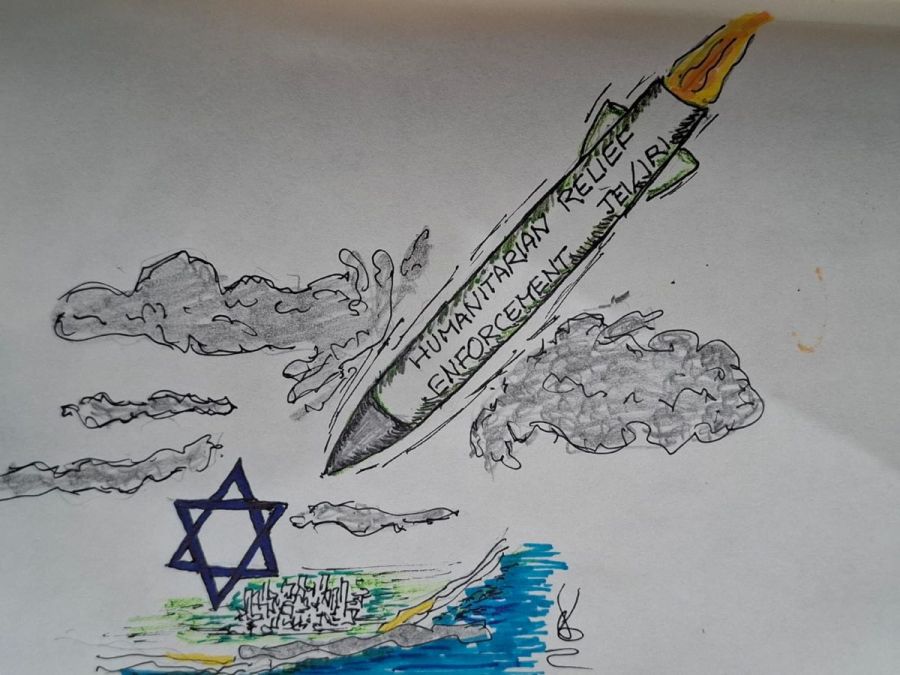
One of the poorest states in the world, Ansarallah is the only one to uphold its duty to prevent genocide, which it does by putting heavy pressure on the Zionist state’s economy through maritime blockade. For this, the UK and USA rain missiles and bombs down upon it. But it does not yield.
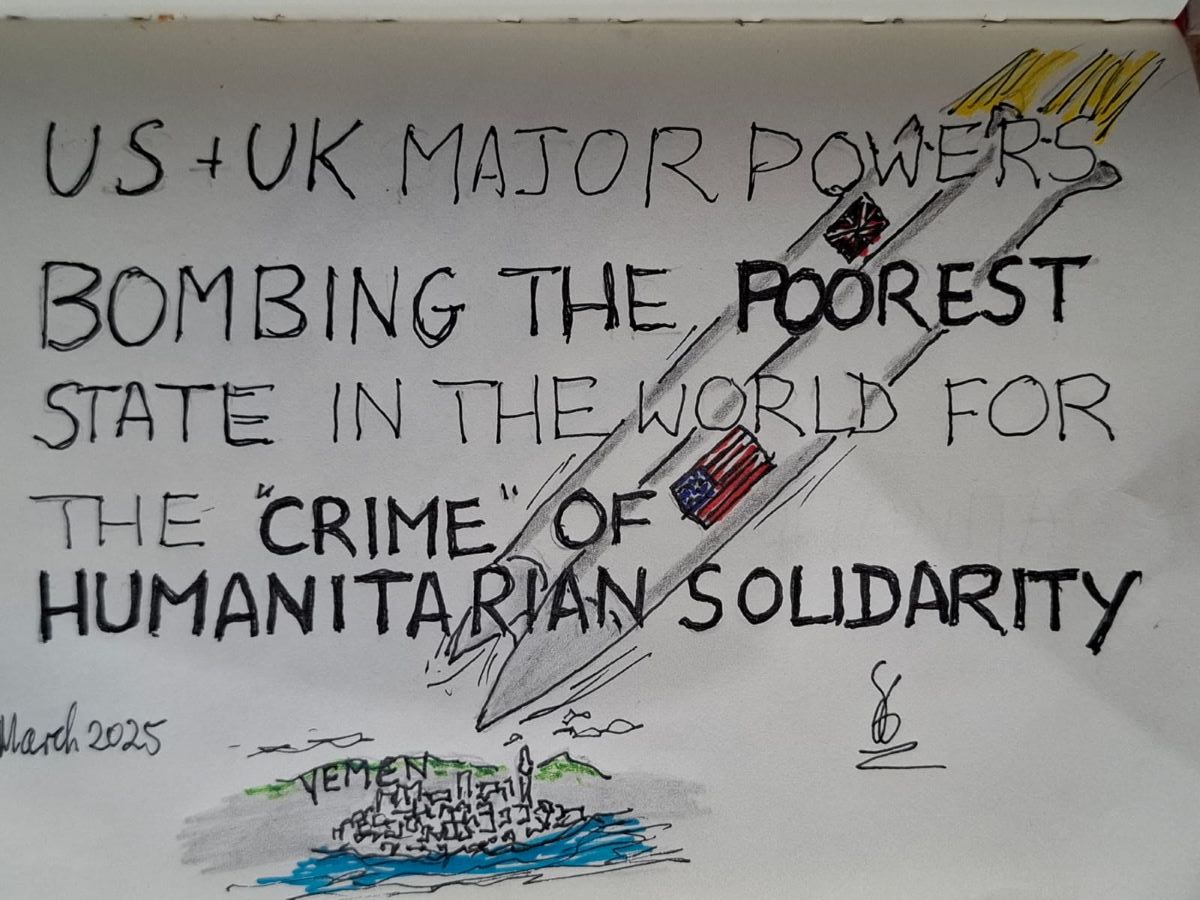
This one is at least as much placard as it is cartoon but I never got around to making the placard.
Ansarallah escalates to attack the ‘Israeli’ state directly, then again in response to Zionist airforce bombing of Yemen.
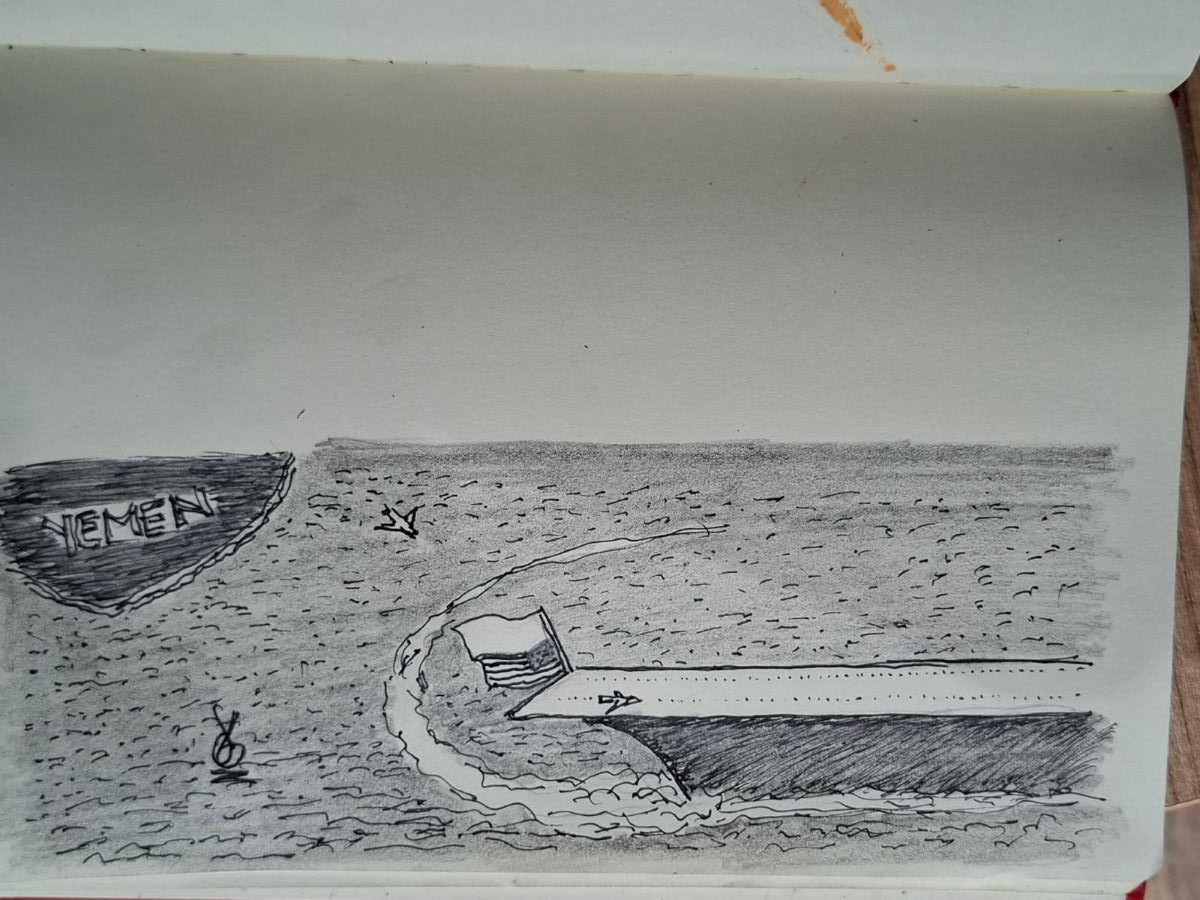
The USA Navy sends two aircraft carriers to assist the genocidal state by attacking Yemen. Ansarallah attacks the US Navy, forcing the retreat first of one aircraft carrier followed by capitulation of the US which offers Ansarallah to end attacks on Yemen if they end attacks on US Navy. The deal makes no provision for defence of the Zionist state and is accepted by Ansarallah.
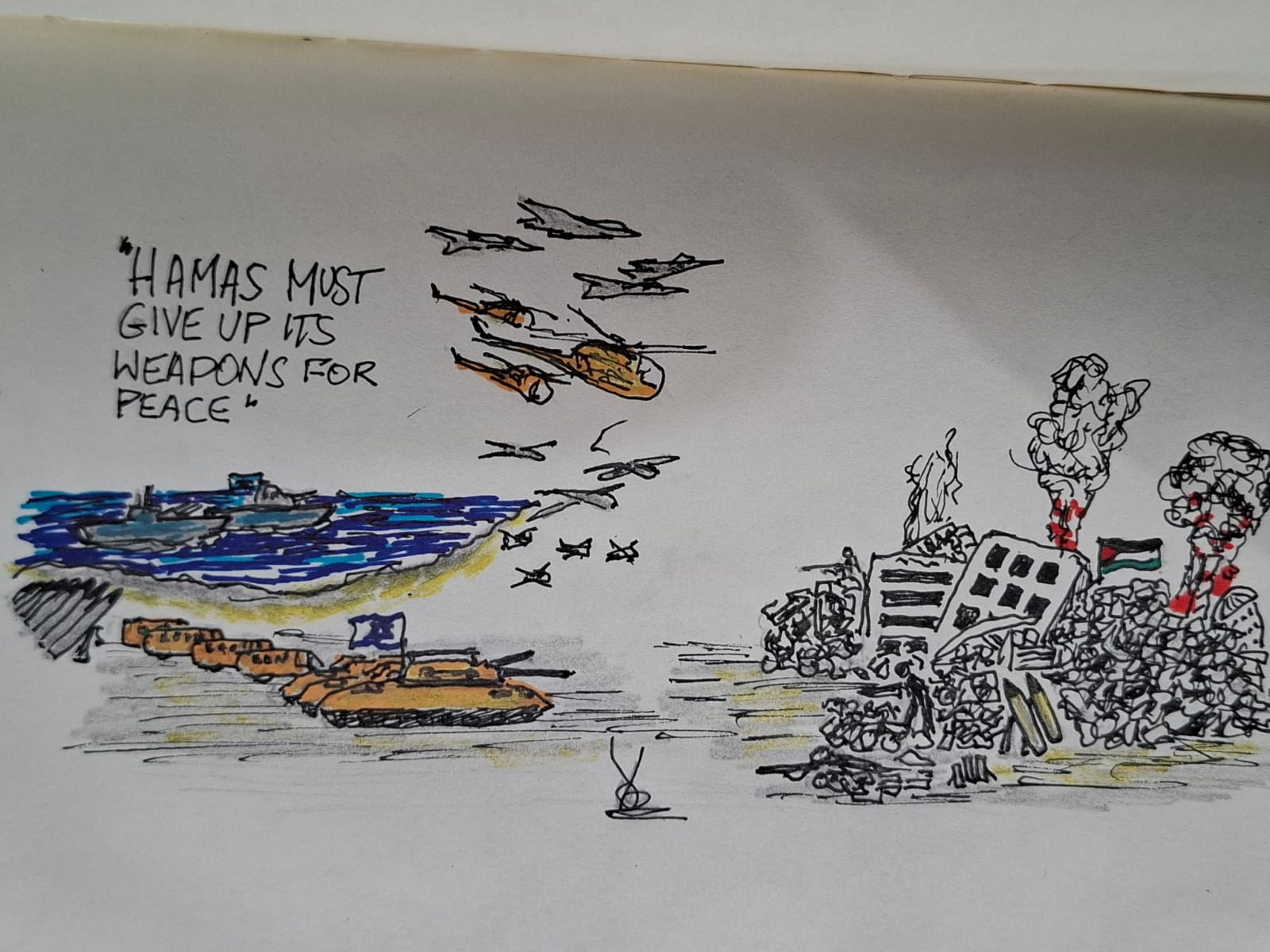
Facing some of the most heavily armed forces in the world but somehow, it’s always the national liberation forces that must disarm. For the sake of peace, of course.
The physical war against the Palestinians by the Zionist State was armed by a number of western imperialist states but also ideologically by the whole western media. In the face of real and ongoing genocide the WMM reported propaganda, repeated lies and framed its reports in the Zionists’ terms of reference – while courageous journalists reporting from the actual killing grounds were picked off by the IOF.
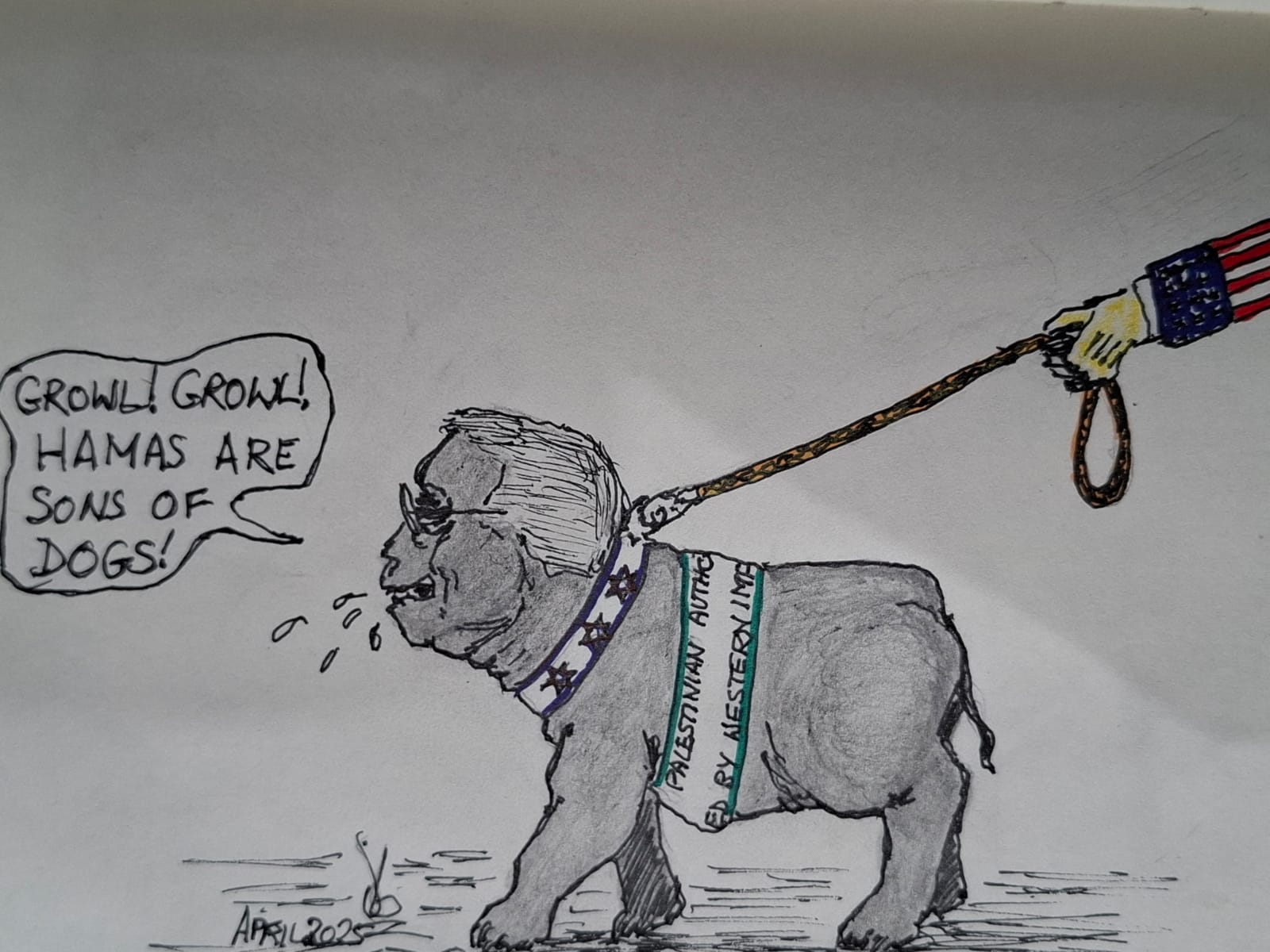
The western imperialists promote the two-states solution (sic) and a Palestine colony of Israel as a ‘Palestinian State’. This would be run by Zionist proxies such as the Palestinian Authority with its Fatah boss, Mahmoud Abbas, who recently publicly insulted the national resistance fighters of Hamas, calling them ‘sons of dogs’.

Covert Crusade: Washington’s $600m digital war on Iran

For over a decade, the US State Department’s NERD fund has covertly funnelled hundreds of millions into regime-change efforts in Iran, disguising digital warfare and opposition funding as ‘democracy promotion’ – but a sudden funding freeze has thrown these operations into chaos.

Kit Klarenberg FEB 21, 2025
(Reprinted with kind permission of author from https://thecradle.co/articles/covert-crusade-washingtons-600m-digital-war-on-iran)

(Reading time: 6 mins.)

Earlier this month, The Cradle exposed how in 2023, the US State Department’s shadowy Near East Regional Democracy (NERD) fund earmarked $55 million to stoke unrest in Iran during the following year’s elections. 

This was part of a wider US campaign of interference designed to disrupt and destabilize the Islamic Republic.

As that investigation noted, details on where this money goes – and who benefits – are strictly confidential as a matter of policy. Still, there are clues in the public domain pointing to at least some recipients.

(Image credit: The Cradle)

Regime change by another name 

As a US Congressional Research Service report records, due to hostile US–Iran relations, and Tehran’s well-founded view of NERD “as a means of financing regime change,” its programs rely on “third-country training” as well as “online training and media content.” 

The report further confirms that despite NERD being Washington’s primary “foreign assistance channel” for projects targeting Iran, “activities, grantees, [and] beneficiaries” are not advertised “due to the security risks posed by the Iranian government.”

It continues: 

“NERD was created in 2009 as a ‘line item for Iran democracy’ but was not (and is still not) technically Iran-specific … For 2024, the Biden Administration requested $65 million for NERD … to ‘foster a vibrant civil society, increase the free flow of information, and promote the exercise of human rights,’ including at least $16.75 million for internet freedom.”

What was unstated in the report is that NERD represents a simple rebranding of the Iran Democracy Fund, created by former president George W. Bush in 2006 with the explicit goal of toppling the Islamic Republic. 

The initiative was ostensibly shut down under Barack Obama three years later, eliciting bitter condemnation from much of the western media, neoconservative pundits, and lawmakers.

However, as the BBC acknowledged at the time, the move was in fact “welcomed by Iranian human rights and pro-democracy activists”:

“These US funds are going to people who have very little to do with the real struggle for democracy in Iran and our civil society activists never received such funds,” a Tehran-based human rights lawyer told the British state broadcaster.

“The end to this program will have no impact on our activities whatsoever.”

Internet interference 

In reality, the program never ended – it was merely repackaged. White House officials maintained the fiction that NERD was focused on democratization rather than regime change, a claim undermined by a June 2011 New York Times exposé. 

That investigation revealed the Obama administration’s so-called “Internet Freedom” initiative aimed to “deploy ‘shadow’ internet and mobile phone systems dissidents can use to communicate outside the reach of governments in countries like Iran, Syria, and Libya.”

In other words, Washington sought to build a covert legion of regime change operatives in Tehran, and provide them with the technology to coordinate in secret. It is clear from the Congressional report’s marked reference to “internet freedom” that these machinations continue today. 

Moreover, as a 2020 report by the DC-based Project on Middle East Democracy noted, organizations genuinely committed to advancing Iranian rights still steer well clear of NERD. An anonymous NGO worker described its “style” as “aggressive.”

Another implied NERD is engaged in deeply dirty work:

“We choose not to apply for NERD grants because we do not want to get pulled into [anything] crazy.” 

Non-Iranian’

The same year, the Financial Times (FT) reported how NERD efforts had become turbocharged under US President Donald Trump’s administration, explicitly to facilitate and encourage “anti-Tehran protests.”

This included “providing apps, servers, and other technology to help people communicate, visit banned websites, install anti-tracking software,” and more in the Islamic Republic, in order to offer “Iranians more options on how they communicate with each other and the outside world.” 

Curiously, while portraying Iran as a digital prison, the FT admitted that major western social networks remain accessible in the country, and Iranians can easily view western media.

As usual, recipients of NERD funds remained unnamed – except for Psiphon, a VPN provider long-associated with discredited exiled Iranian opposition figures and, by then, controlled by the Open Technology Fund (OTF).

The FT estimated that just three million Iranians used Psiphon, less than four percent of the population.

OTF was an “Internet Freedom” product – one of its board members has openly admitted the Fund’s agenda is “regime change.” 

Fast forward to September 2024; as former US president Joe Biden’s administration was seeking increased funds for NERD – mere months after the $55 million invested the previous year failed to produce desired mass unrest and upheaval around that year’s elections in Iran – a White House meeting was convened with major tech giants, encouraging them to offer more “digital bandwidth” for OTF-bankrolled apps and tools.

As fund chief Laura Cunningham explained, a “sizeable chunk” of OTF’s budget was taken up by the cost of hosting all the network traffic generated by its vast array of digital destabilization apps, which included Signal and Tor

While OTF sought to support “additional users” of these products, it lacked resources to keep up with “surging demand.” What came of this meeting, which was attended by representatives of Amazon, Cloudflare, Google, and Microsoft, is not clear.

Yet, if further “digital bandwidth” was granted to OTF, it is clear the Trump administration’s “pause” in overseas aid funding has thrown all NERD’s meddling efforts in Iran into total – and potentially permanent – disarray. 

A 27 January report in the Saudi-funded, anti-Islamic Republic Iran International quoted numerous anonymous beneficiaries of US financing bemoaning how grantees, including foreign-run Persian-language media outlets and organizations documenting purported “abuses” to keep the Islamic Republic “accountable,” had been abruptly shuttered.

An anonymous “human rights activist” told the outlet Washington’s freeze on aid spending “(will) impose restrictions on projects that address human rights violations or investigate governmental and military corruption which have impacted Iran’s economy and social conditions in favor of foreign terrorist activities and money laundering.” 

They said “several non-Iranian American institutions [emphasis added] have been using these funds to investigate corruption and money laundering.” Now though, “these organizations will be forced to halt their activities.”

Severe implications’

US-supplied Virtual Private Network (VPN) services also loomed large among the malign resources impacted by the aid “pause.” A nameless “activist” told Iran International that 20 million Iranians used such tools “to bypass Tehran’s internet curbs.” 

The outlet further quoted an article published by Human Rights Activists in Iran, a US-funded NGO not based in the Islamic Republic, but Virginia, near the CIA’s Langley headquarters: “In today’s Iran, the internet has no meaning without VPNs.”

Such dire warnings were echoed by Ahmad Ahmadian, head of California-based tech firm Holistic Resilience, which “aims to advance internet freedom and privacy by developing and researching censorship circumvention.” 

An Iranian expat and alumni of Tehran University, Ahmadian warned major US tech firms “may not be willing or able to continue their support for providing anti-censorship tools” without government support.

Such remarks highlight how these supposedly popular resources lack grassroots backing or financing, being wholly dependent on Washington’s sponsorship to operate:

“The leadership of the US government has been crucial in urging big tech companies to provide public services. Without the encouragement of the US government, these companies wouldn’t take the initiative on their own.”

Other unnamed activists further warned Iran International, “the consequences of Trump’s executive order will not remain limited to internet censorship circumvention tools.”

They believe that if NERD’s activities “do not receive an exemption within the next month” – by the end of February – “they will either collapse entirely or be deeply curtailed.” 

One declared, “the impact of this freeze might not be immediately noticeable, but its severe implications will become evident over time.”

Meanwhile, “internet experts” cautioned that “even if US aid starts again” after the 90-day pause, “the damage is irreversible since many people … might never fully return to using US-backed secure services.” 

As The Cradle noted on 11 February, Washington’s forced withdrawal from meddling in Iran could create fresh opportunities for genuine diplomatic engagement between the two long-time adversaries.

But another possibility looms: after spending $600 million over a decade with little success, the US may simply be preparing to test out new, potentially more malign regime-change strategies.

End.

USAID, Friend or Foe?

Gearóid Ó Loingsigh Feb 7 (Reading time: 7 mins.)

NB: Edited by RB from original article for formatting purposes

Trump’s decision to suspend funding of USAID (United States Agency for International Development) provoked the ire of many liberals.

Trump took the decision for all the wrong reasons; he is not very intelligent nor is he analytical and is incapable of understanding the big picture — and the liberals who were horrified and criticised his actions also did so for all the wrong reasons.

They came out in defence of the agency stating that all the dictators in the world will be happy,[1] ignoring that USAID has throughout its history financed projects for dictatorial or authoritarian regimes.

They even went as far as the stupidity of saying that Elon Musk wanted this as vengeance against USAID for its role in defeating Apartheid.[2] Nothing could be further from the truth.

What little role it played in the country was to ensure that capitalism would be safe, but it did not bring an end to Apartheid.

The US government and all its agencies supported the racist regime, just like they supported the new “black” capitalism as an integral part of the usual “white” capitalism, as capitalism really doesn’t have a colour.

So, what is the agency? And what role does it play in the world? These are questions that have prefabricated answers from those who have remained silent in the face of many of the US’ barbarities. There are exceptions of course.

Mehdi Hasan is a journalist who is now famous worldwide for his positions on the genocide in Gaza, but in general, all those who answer those two questions positively, answer questions on the role of the US positively, even in the case of Palestine.

Firstly, we should be clear about how the agency defines itself and how it has been seen by successive US governments. In 2002, George Bush described foreign aid as the third pillar of US national security, along with defence and diplomacy.[3] 

The same document Foreign Aid in the National Interest explains various lines of work of the agency such as financing the “development” of agriculture etc. They demand changes and reforms in the countries they “help”, just as does the World Bank.

When they clash with governments that are not given to implement the reforms they seek, they bluntly state that they will give funds to functionaries, ministers and others in the country to promote their agenda for change.

That is even if at that precise moment the beneficiaries of the programmes have no political power to implement such changes.[4] They play the long game. They openly state that they have to finance NGOs that promote “democracy”.[5] 

This is what is nowadays called Colour Revolutions i.e. where through an NGO a situation of instability is generated in a country against a government or regime, whether it be democratic or authoritarian.

What is important is whether its economic and foreign policy coincide with Washington’s interests or not.

Colombia, for example, has always been a recipient of USAID’s programmes despite the murders of journalists, social leaders, opposition politicians, such as the Patriotic Union, trade unionists etc.

Not in the worst years of the bloodbath was it proposed to limit the aid or even pressure the government to introduce democratic reforms. Colombia has always served US interests.

In the case of Colombia, the negative impacts of the supposed North American aid can be clearly seen. In 1961, Kennedy announced a new programme for Latin America, the Alliance for Progress and he also set up USAID.

As part of that programme wheat was donated to certain countries, amongst them Colombia, but it was no favour. In 1961 there were 160,000 hectares of wheat in the country with a crop of 142,100 tonnes.

The following year the area sown fell to 150,000 hectares and so it went every year until in 2023 there were barely 3,000 hectares of wheat with a crop of 9,354 tonnes. They collapsed the production of a basic crop in the Colombian diet.

In reality, USAID is prohibited by law from financing crops and other economic activities that compete with US companies. They were always going to collapse wheat production.

They did similar things in other parts of the world, collapsing local markets, though they always say that it is not their intention.

Biden and Harris announced a new USAID pilot programme to supply emergency food and it consisted of sending one billion in food to 18 countries, all of them in Africa with the exceptions of Haiti, Yemen and Bangladesh.

Amongst the products to be exported were “wheat, rice, sorghum, lentils, chickpeas, dry peas, vegetable oil, cornmeal, navy beans, pinto beans and kidney beans – commodities that align with traditional USAID international food assistance programming.” [6] 

It is nothing more than a subsidy to the cereal sector in the US dominated by just four large companies (Cargill, Cenex Harvest States, Archer Daniels Midland ([ADM] and General Mills), who get rid of their surpluses this way.

Looking at the list one sees that it includes countries with high levels of food insecurity, but they are not the worst in the world. Five of them are amongst the top ten countries with people suffering food insecurity in terms of absolute numbers of people suffering food insecurity.

In terms of percentages, just three of them are in the top ten countries with a percentage in excess of 30%. Afghanistan was not selected by the USA as they are no longer interested in the country, despite 46% of the population suffering from food insecurity, i.e. 19.9 million people.

Neither did they select Syria with 55% where they were only interested in replacing the Ba’athist regime with ISIS, which they achieved this year.

The causes of this insecurity are varied. In twelve countries it was due to weather extremes, affecting 56.8 million people and in another 27 countries economic shocks affecting 83.9 million people. And lastly 117.1 million people affected by conflicts in 19 countries.

It is worth pointing out that two of those countries were Syria and Ukraine, both of them conflicts in which the USA and Europe play a deciding role, not just in the start of the conflict but also in its course and duration.[7] 

In the case of Ukraine the war had a dramatic effect on the price and supply of cereals in many parts.

USAID’s initial work consisted of economic aid programmes that included promoting US companies and so-called free enterprise. Later in the 2000s it allied itself more closely with US companies, giving them contracts to benefit themselves and not the countries.

Dupont, one of the companies that most pollutes water in the US, won a contract to supply drinking water to Ethiopia! The jokes write themselves.

An opportunity is never lost for multinational capital. Before the war with Iraq had even begun, USAID was signing contracts for the reconstruction of the country once the war was over.

One of the beneficiaries was Bechtel, a company that drummed up public support for the war and obtained one billion in contracts after the war.[8] USAID is an arm of the US government and its policies and contacts always favour their interests and never anyone else’s.

As for the threat that this represents to freedom of the press and expression etc. the mainstream press has raised an outcry.

It is true that for the moment the USA will have to look to another agency to help foment discontent and carry out the so-called Colour Revolutions and other coups d’etat. The CIA will have to finance those organisations directly and not through USAID as they have done up till now.

It has to be said that many of the regimes overthrown were not a bit progressive but neither were those who replaced them. The US supported them because they were useful to their interests, and nothing more.

Assad in Syria was replaced by Jolani from ISIS and in the ex-soviet republics, all of those governments have dubious human rights records. USAID never financed opposition groups, nor alternative press in Colombia despite its human rights record.

It never financed those that sought to overthrow the dictator Pinochet in Chile, nor in Bolsonaro’s Brazil, nor currently in Milei’s Argentina.

Now, various NGOs around the world, including Colombia, weep. They are organisations that are only interested in their own slice of the cake. We lose nothing with them. The sooner they go bankrupt the better.

They will say that there are good projects that USAID finances and they are right. Of course there are.

The soft power of a country cannot be 100% Machiavellian, not everything is absolute greed and power. In order for the US soft power to work there must be modicum of projects that are good in and of themselves or at least not as evidently open to criticism. That is what it is about.

These projects serve to generate an atmosphere conducive to US activities and give it the right to opine on internal policies and present itself as a friend of the government — or the people when it wants to carry out a coup d’etat.

Neither Trump nor Musk understand this. They are not intelligent people; their abilities have always been to take advantage of what others build.

Thus, they have no ability to think about what soft power means as a tool of real domination in other countries, nor as a means to justify the hard power of a coup or colour revolution. The closure of USAID is an own goal of imperialism.

Elon Musk stated in Twitter that the agency was a nest of anti-American Marxist vipers. The Indian Marxist Vijay Prashad replied that Marxists such as him detested USAID as it was a nest of liberal imperialists. Prashad is right, so the answer to the headline question of this article is clear.

USAID is the foe, and no one on the left should mourn its passing. Good riddance. And those who mourn it, run to get your thirty pieces of silver whilst they are still signing cheques.

End.

NB: For more articles by Gearóid see https://gearoidloingsigh.substack.com

NOTES

[1] The Guardian (06/02/2025) Authoritarian regimes around the world cheer dismantling of USAid. Joseph Gedeon. https://www.theguardian.com/us-news/2025/feb/06/authoritarian-usaid-elon-musk
[2] The Ink (03/02/2025) USAID fought Apartheid. Musk is killing it.
The.Ink
USAID fought apartheid. Musk is killing it
As we speak, an unelected billionaire, born in South Africa, is staging an unconstitutional coup in the United States, shutting down an agency that happened to fight the apartheid regime he and his family thrived under as rich whites…
Read more
14 days ago · 222 likes · 29 comments · The Ink

[3] USAID (2002) Foreign Aid in the National Interest. USAID. Washington D.C. pIV https://www.govinfo.gov/content/pkg/GOVPUB-S18-PURL-LPS46120/pdf/GOVPUB-S18-PURL-LPS46120.pdf
[4] Ibíd., P.51
[5] Ibíd., P.44
[6] USDA (18/04/2024) USDA, USAID Deploy $1 Billion for Emergency Food Assistance. https://www.usda.gov/about-usda/news/press-releases/2024/04/18/usda-usaid-deploy-1-billion-emergency-food-assistance
[7] Statistics taken from Global Report on Food Crises 2023, https://www.fsinplatform.org/report/global-report-food-crises-2023/
[8] Current Affairs (10/03/2021) Aid for Profit: The Dark History of USAID. Saheli Khastagir. https://www.currentaffairs.org/news/2021/03/aid-for-profit-the-dark-history-of-usaid

Manufacturing Rebels: How the US and UK empowered HTS

by Kit Klarenberg (republished and somewhat reformatted with kind permission from his article in The Cradle) https://thecradle.co/articles/manufacturing-rebels-how-the-uk-and-us-empowered-hts
(Reading time: 7 mins.)

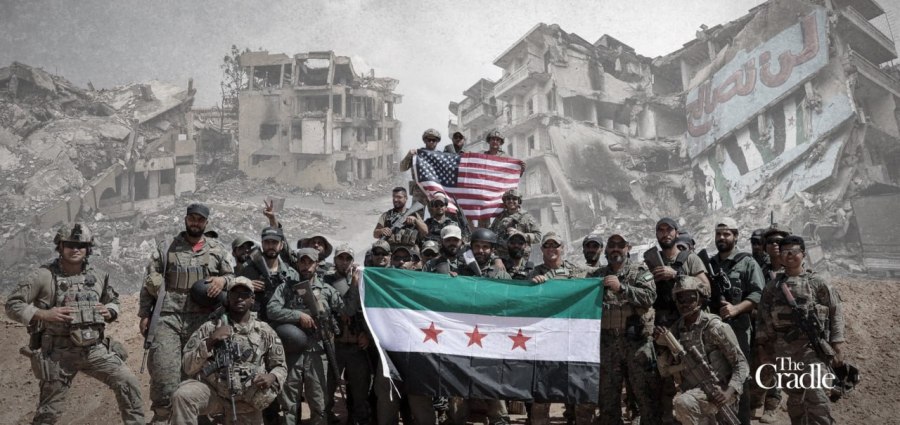
On 18 December, The Telegraph published an extraordinary investigation into how the UK and US trained and “prepared” fighters in the Revolutionary Commando Army (RCA).

This was a “rebel” force that collaborated with Hayat Tahrir al-Sham (HTS) in the mass offensive toppling of Syrian president Bashar al-Assad weeks earlier. 

In an unprecedented disclosure, the outlet revealed that Washington not only “knew about the offensive” well in advance, but also had “precise intelligence about its scale.”

Washington’s now-confirmed “effective alliance” with HTS was described as “one of many ironies” emerging from the decade-and-a-half-long proxy war.

The Telegraph suggested this collaboration was inadvertent – simply a symptom of how Syria’s grinding, protracted civil war gave birth to “a bewildering array of militias and alliances, most of them backed by foreign powers.” 

US support of HTS: A ‘necessary’ alliance 

Alliances were fluid, with groups often splintering, merging, and shifting allegiances. Fighters frequently found themselves switching sides, blurring lines between factions.

Yet, ample evidence indicates the UK and the US maintained deliberate, long-standing ties with the dominant rebels of HTS.

(Photo cred: The Cradle)

For instance, in March 2021, President-elect Donald Trump’s former lead Syria envoy, James Jeffrey, gave a revealing interview to PBS, during which he disclosed that Washington secured a specific “waiver” from then-secretary of state Mike Pompeo to assist HTS. 

While this did not permit direct funding or arming of the UN/US-designated terrorist organization, the waiver ensured that if US-supplied resources “somehow” ended up with HTS, western actors “[could not] be blamed.” 

The fungibility of weapons on the Syrian battlefield was something Washington counted on heavily.

In a 2015 interview, CENTCOM spokesman Lieutenant Commander Kyle Raines was quizzed about why Pentagon-vetted fighters’ weapons were showing up in the hands of the Nusra Front (precursor to HTS).

Raines responded: “We don’t ‘command and control’ these forces – we only ‘train and enable’ them. Who they say they’re allying with, that’s their business.”

This legal loophole enabled Washington to “indirectly” support HTS, ensuring the group did not collapse while maintaining its designation as a terrorist organization.

This status was complete with a now-rescinded $10 million bounty on leader Abu Mohammad al-Julani, who now goes by his real name Ahmad al-Sharaa. 

Jeffrey rationalized this strategy, calling HTS “the least bad option” for preserving “a US-managed security system in the region,” and thus worth “[leaving] alone.” HTS’s dominance, in turn, gave Turkiye a platform to operate in Idlib.

Meanwhile, HTS sent unmistakable messages to their US patrons, pleading:

We want to be your friend. We’re not terrorists. We’re just fighting Assad.”

Safe haven’

Since Assad’s fall, officials in London have markedly taken the lead in legitimizing the HTS-led interim administration as Syria’s new government.

The group was added to the UK’s list of proscribed terrorist organizations in 2017, its entry stating HTS should be considered among “alternative names” for the long-banned Al-Qaeda.

While UK Prime Minister Keir Starmer declared it “too early” to rescind the group’s designation, British officials met HTS representatives on 16 December – despite the illegality of such meetings.

This likely signals an impending, highly politicized western rehabilitation of HTS. Throughout Syria’s dirty war, UK intelligence waged extensive psychological operations to promote “moderate rebels,” crafting atrocity propaganda and human-interest stories. 

These efforts were ostensibly aimed at undermining groups like HTS, ISIS, and Al-Qaeda. Yet leaked documents from UK intelligence reveal how HTS remained intertwined with Al-Qaeda post-2016, directly contradicting media narratives.

In other words, throughout the decade-and-a-half-long crisis, HTS was officially considered on par with the most fundamentalist, genocidal elements in the country. 

British documents also make a total mockery of the common refrain that HTS severed all ties with Al-Qaeda in 2016. A 2020 file described how Al-Qaeda “co-exists” with HTS in occupied Syrian territory, using it as a launchpad for transnational attacks. 

The document warned that HTS’s domination created a “safe haven” for Al-Qaeda to train and expand, fueled by instability. British psyops against HTS spanned years but ultimately failed.

Instead, leaked files lament HTS’s growing influence, territorial gains, and re-branding as an alternative government.

[Al-Qaeda] remains an explicitly Salafi-Jihadist transnational group with objectives and targets which extend outside Syria’s borders. [Al-Qaeda’s] priority is to maintain an instability fuelled safe haven in Syria, from which they are able to train and prepare for future expansion. HTS domination of north west Syria provides space for [Al-Qaeda] aligned groups and individuals to exist.”

British-backed propaganda benefiting HTS

British intelligence psyops attempting to hinder HTS were in operation from the group’s founding until recently.

Yet, they appear to have achieved nothing. Numerous leaked files reviewed by The Cradle bemoan how HTS’s “influence and territorial control” had “dramatically grown” over the years. 

Its successes allowed the extremist group “to consolidate its position, neutralize opponents, and position itself as a key actor in northern Syria.” But HTS’s “domination” was secured in part by the group re-branding itself as an alternative government.

HTS-occupied territory was home to a variety of parallel service providers and institutions, including hospitals, law enforcement, schools, and courts.

The group’s domestic and international propaganda specifically promoted these resources as a demonstration of an “alternative” Syria awaiting roll-out across the entire country.

Ironically, many of these structures and organizations – such as the infamous White Helmets, who also operated in ISIS-run territories – were direct products of British intelligence, created for regime change propaganda purposes.

Moreover, they were aggressively promoted by London at enormous expense.

Repeated references are made in leaked UK intelligence documents to the importance of “[raising] awareness of moderate opposition service provision,” and providing domestic and international audiences with “compelling narratives and demonstrations of a credible alternative to the [Assad] regime.”

There is no consideration evident in the files that these efforts might be assisting HTS greatly in its own efforts to present itself as a “credible alternative” to Assad.

Nonetheless, it is acknowledged that Syrians in occupied territory would accommodate HTS “particularly if [they are] receiving services from it.”

Even more eerily, the documents note, “HTS and other extremist armed groups are significantly less likely to attack opposition entities that are receiving support” from the UK government’s Conflict, Stability, and Security Fund (CSSF). 

This was the mechanism through which Britain’s Syrian propaganda war and organizations like the White Helmets and extremist-linked Free Syrian Police were financed.

These UK-run governance structures and opposition elements, which were allegedly intended to “undermine” HTS, operated in areas controlled by the group safe from violent reprisals for their foreign-funded work, as they “demonstrably provide key services” to residents of occupied territory.

There is also the darker prospect that HTS was well aware these “opposition entities” were bankrolled by British intelligence, and they were unmolested on that very basis.

Coordinated offensive

As The Telegraph‘s report explains, “the first indication that Washington had prior knowledge” of HTS’s offensive was when its RCA proxies were given a rousing pep talk by their US handlers three weeks prior. 

At a secret meeting at the US-controlled Al-Tanf air base close to the borders of Jordan and Iraq, the militants were told to scale up their forces and “be ready” for an attack that “could lead to the end” of Assad. A quoted RCA captain told the outlet:

They did not tell us how it would happen. We were just told: ‘Everything is about to change. This is your moment. Either Assad will fall, or you will fall.’ But they did not say when or where, they just told us to be ready.”

This followed US officers at the base, swelling the RCA’s ranks by unifying the group with other UK/US-trained, funded, and directed Sunni desert units and rebel units operating out of Al-Tanf under joint command. 

According to The Telegraph, “RCA and the fighters of HTS … were cooperating, and communication between the two forces was being coordinated by the Americans.”

This collaboration proved to be of devastating effect in the “lightning offensive,” with RCA rapidly seizing key territory across the country upon explicit US orders.

RCA even joined forces with another rebel faction in the southern city of Deraa, which reached Damascus before HTS. RCA now occupies roughly one-fifth of the country, pockets of territory in Damascus, and the ancient city of Palmyra. 

Hitherto “heavily defended” by Russia and Hezbollah, Moscow’s local base has now been taken over by RCA. “All members of the force continued to be armed by the US,” receiving salaries of $400 monthly, nearly 12 times what Syrian Arab Army (SAA) soldiers were paid.

It is uncertain whether this direct financing of the RCA and other extremist militias that toppled the Assad government continues today. What is clear, though, is that the UK and US supported HTS from the group’s inception, even if “indirectly.”

In turn, this covert backing played a pivotal role in positioning HTS financially, geopolitically, materially, and militarily for its “lightning” swoop on Damascus and assumption of government today.

Reinforcing the interpretation that this was the objective of London and Washington all along, following Assad’s ouster, Starmer promptly declared that the UK would “play a more present and consistent role” in West Asia as a result. 

While western and certain regional capitals may celebrate the apparent success of their lavishly funded, blood-soaked campaign to dismantle decades of Baathism, British intelligence had long cautioned that the outcome would grant Al-Qaeda an even larger “instability-fueled safe haven” for “future expansion.”

THE MYSTERY OF THE NORD STREAM 2 EXPLOSION SOLVED?

Clive Sulish

(Reading time: 6 mins.)

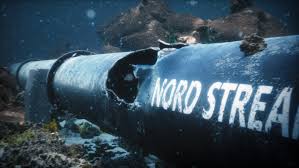
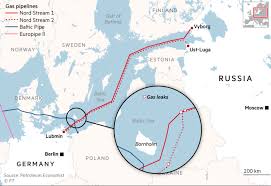
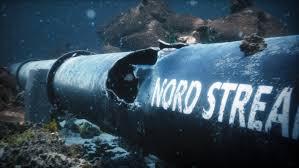
On 26 September 2022, an explosion blew a section of the Nord Stream 2 gas supply pipeline from Russia to Germany, incidentally causing an environmental disaster for sea-life in the area. Investigations confirmed that it was an act of sabotage.1

Amidst accusations and theories,2 no perpetrator was conclusively identified.

But two years later, in September 2024, an important item of previously-suppressed information came to light in a Danish newspaper. It was not however picked up by the mainstream western media, despite its potentially crucial contribution to solving the mystery.

Alternative sources however alighted on it and it is now coming into the public light.

In any investigation of culpability for a human action, one of the first established principles to investigate is – and targets of investigation should be — cui bono? (in Latin, who benefits?). Next, Qui habet potestatem?Who has the means? Finally, Who had the opportunity?

Map of route of the Nord Stream pipelines showing neighbouring state. (Source image: Financial Times)

Potentially, any in the anti-Russian coalition around NATO stood to benefit by harming not only a Russian installation but also a major source of financial benefit to Russia, i.e of sales of gas to Germany. Many eyes turned towards Russia’s opponent in the Ukraine, the Zelensky regime.

However, neither Russia nor any other serious commentators ever considered that NATO proxy to be the culprit. Russia and others stated that the operation required a major state, both in the depths concerned, in surface support needed and in the explosive type and detonation system.

A number of commentators pointed the finger at the USA, which denied any involvement. Well, the USA is a major state and certainly had the motive, as Russia was and remains its major target in the Ukraine war and it also had the potential technical and personnel means.

It would also of course, as an enemy of Russia, benefit from harm to its opponent. It would benefit the USA financially too, though that was yet to become clear.

From whom would Germany buy its power to warm its population and production through the winter as an alternative to Russian gas? That new source would turn out to be – yes, the USA.

OK, so suspicion should fall heavily on the USA, leader of NATO and chief among the enemies of Russia. But did it have the opportunity?

Since there was no record of a US naval presence in the area at the time of the explosion (even though they had been there previously in one of those major joint exercises they like to carry out to bring their allies closer and intimidate their opponents), the media investigation floundered.

Russia asked at the UN Security Council for an investigation, which was rejected. No decision of the Council can be made against a veto of even one of the five Permanent Members, of which three are part of the NATO coalition (USA, UK and France).

A number of alternative theories began to be put around, including mention of large yacht in the area and a Ukrainian oligarch financier. Official investigations were launched by two states in whose economic zone the operation must have taken place: Denmark and Sweden.3

Both regimes are part of the US/NATO/EU coalition and there may have been suspicions that their investigations might not be sufficiently thorough. In any case, in February this year both states closed their investigations without having identified the perpetrator.

Germany’s investigation is ongoing and it issued an arrest warrant for a Ukrainian oligarch who fled to NATO proxy Ukraine with assistance of NATO member Poland. However Russia and serious commentators have always said that a major state, something Ukraine is not, was culpable.

On 17 July 2024, the German government refused to publish the preliminary results of the investigation after the Alternative für Deutschland (AFD) party asked for it, or to comment about the possible involvement of American intelligence services or Ukraine in the pipeline attack.4

In October 2024, the Swiss newspaper Die Weltwoche wrote an article based on an interview given to Danish Politiken by John Anker Nielsen, the harbourmaster of Christianso in Denmark on the day of the two-year-anniversary of the Nord Stream pipelines sabotage.

Back in September 2023, the Christianso harbourmaster detected the presence of ships in the area with their transponders, equipment identifying the ship and its course, silent. Assuming some kind of accident, Nielsen sailed out to investigate, finding US Navy there.

With no evidence of disaster and a request that he leave, Nielsen turned for home. (Suppose that information had been included in the Danish investigation, would the fingers pointing at the USA not have multiplied?)

Nielsen says he was told to keep quiet about what he knew but decided to end his silence in September and his story was published in a local newspaper. Later alternative commentators such as Glen Greenwald and others on X picked up on it and now it’s finding its way into wider media.

The Swiss newspaper article went on to note that the USS Keararge three months earlier had participated in the BALTOPS 2022 exercise that included unmanned underwater vehicles suitable for demining and other underwater operations.5

Such vessels as those could transport explosive charges suitable for blowing the Nord Stream pipelines. The Swiss newspaper claimed this new information calls into question the assumption that a Ukrainian group was responsible for the sabotage and that investigations are continuing.6

OUTCOMES

The outcomes to date are that Russia has received heavy financial damage, both in the cost of the pipe and any repair costs but also through loss of a customer who might well have resumed its purchase of gas from Russia in preference to dearer fuel from elsewhere.

Carlos Latuff cartoon outlining the major suspicions at the time.

The USA has benefited financially because it is also an energy exporter, including to Germany, where Russia was its main competitor.

In 2022, Germany imported 44.65 million tonnes of hard coal. Its leading coal suppliers were Russia (29.2%), the United States (20.8%) and Colombia (16.3%).7 So in the event of any embargo on Russian hard coal, the US stands to benefit enormously.

But what about natural gas, formerly supplying 55% of Germany’s power supply, no longer possible from Russia through the Nord Stream 2 pipeline? About 45% …. comes from Norway through pipelines, 4% from the Netherlands, 5% domestic production … the rest from western neighbours.8

Norway and the United States were the top suppliers of gas to the EU in 2023. Norway provided almost 30% of all gas imports. But the actual origin of those supplies is not so easy to identify and reports even estimate that a small percentage of the EU’s supply is actually Russian.

Although additional suppliers include North African countries, the UK and Qatar, in 2023, the United States was the largest LNG supplier to the EU, representing almost 50% of total LNG imports. In 2023, comparing to 2021, imports from the US almost tripled.9

It seemed likely that some at least – and perhaps a lot – of Germany’s current LNG supply, though perhaps through another country, would actually be of US origin. And it turns out that the US has been the dominant LNG supplier to Germany since 2022 at 82% of total imports.10

IN CONCLUSION

While the USA has benefited significantly financially from the pipeline explosion and strategically through damaging an opponent, Germany has at the same time suffered a loss in having to buy more expensive fuel (from the USA).11 But Germany is an ally of the USA and a prominent one in NATO.

This episode demonstrates that 1) the USA, in advancing its own interests, is prepared to break the law and to see an ally suffer but also that 2) a major European capitalist power has surrendered a substantial portion of its own interests for the benefit of the USA, as a price of membership of the NATO club.

Germany, though an enthusiastic supporter of NATO, due to its dependence on natural Russian gas, had been reluctant to engage fully in the economic sanctions against Russia proposed by NATO. The blowing up of the Nord Stream 2 pipeline removed that dependence, transferring it to the USA.

The USA benefited, both politically/ militarily in hurting its opponent and in increasing the dependence of an ally. It also benefited subsequently financially, in gaining a major customer market share. The USA had more than enough Motive to carry out the sabotage.

It also had the Means (the capability) and now, as we know, the Opportunity also! Circumstantial? Sure but a mountain of evidence nevertheless.

End.

FOOTNOTES

MAIN SOURCES (see also Footnotes)

Unlikelihood of Ukraine culpability: https://ukraineworld.org/en/articles/analysis/wrong-allegations-against-ukraine

1https://en.wikipedia.org/wiki/Nord_Stream_pipelines_sabotage

2Including an unbelievable one that Russia had done it themselves in order to blame the USA.

3https://en.wikipedia.org/wiki/Nord_Stream_pipelines_sabotage

4Receiving the answer: “after careful consideration, the Federal Government has come to the conclusion that the question cannot be answered for reasons of public interest”.

5https://en.wikipedia.org/wiki/Nord_Stream_pipelines_sabotage

6Ibid.

7https://www.cleanenergywire.org/factsheets/germanys-dependence-imported-fossil-fuels

8https://www.cleanenergywire.org/news/germany-have-two-more-floating-lng-import-terminals-operation-winter-operator

9https://www.consilium.europa.eu/en/infographics/eu-gas-supply

10https://www.spglobal.com/commodityinsights/en/market-insights/latest-news/natural-gas/013024-german-gas-industry-group-slams-us-pause-on-new-lng-export-permits

11https://www.reuters.com/world/europe/nord-stream-insurers-say-policies-did-not-cover-war-risks-kommersant-reports-2024-04-18/

Solving the drugs issue in Colombia

Gearóid Ó Loingsigh (with kind donation of photos)

(Reading time: 7 mins.)

08 March 2023

 
Photo Coca Plants Northern Colombia: G.O.L.

The drugs issue in Colombia supposedly occupies the time of and is a concern to the government. 

It has been an important issue for all the governments and as was to be expected it is one that has come up again in the dialogues with the ELN, despite this organisation denying any links to the drugs trade.

The author (left) and Pablo Beltran, the ELN negotiator (centre) and representative of social movement in Ecuador (right) in 2017 conference in University of Simon Bolivar, Quito, Ecuador. (Photo: GOL)

In the peace process with the FARC, agreement was reached on the issue.  What was agreed to in Point 4 of the Havana Accord was abysmal and showed that the FARC did not understand the problem nor the possible solutions.

Of course, there could be a difference between what the FARC understood and what it agreed to, as at the end of the day the state won the war and imposed the greater part of what the FARC signed up to. 

Following the agreement in the declarations of the main FARC commanders there is nothing to be seen that indicates that they really understood the problem.  Will it be any different with the ELN?

One of the main concerns of the ELN has been to put a distance between themselves and the drugs trade. 

Whilst it is true that the ELN is not the FARC, it is also true that in their areas of influence or those contiguous there are coca and poppy crops and the USA is not going to believe them that they have nothing to with it, whether they like it or not.  The ELN accepts that it places taxes on economic activities and for the USA that is drug trafficking.

So, some time ago, the ELN issued a statement where they restated that they have nothing to do with drugs and invited an international commission to visit the country to see the reality for itself.(1)  They ask that a UN delegate take part in the delegation.  They also make a series of proposals in relation to the issue as such.

On the first point, the ELN feels sure of itself regarding its ability to show in practice that they are not drug traffickers.  The ELN correctly states that:

When the Colombian government and the USA accuse the ELN of having an active role in the trade, they are lying, but above all they are covering up for those really responsible and the deep-seated problems, which indicate their unwillingness to take real and effective measures.(2)

ELN guerrilla camp, Colombia (Photo: GOL)

But for the USA, it is not about whether they are guilty or not, it is a political tool and weapon and to give them a voice and vote in the affair is extremely dangerous.  When the USA accuses the ELN of being drug traffickers, it is not making a mistake. 

A mistake on their part would be to say something they believe and be wrong about it, but they accuse the ELN for political reasons on the basis of their strategic needs and the legal basis to their accusations is the least of it: it is just propaganda.  By inviting them into the country, the ELN falls into their trap.

The UN participated in the commissions of investigation for supposed weapons of mass destruction in Iraq.  The lack of evidence of such weapons wasn’t of much use. 

The USA played around with supposed or real non-compliance by Saddam and did what they always wanted to do: invade Iraq.  In this they counted on the explicit support of Great Britain and the tacit support of others.

There is a myth in Colombia that the only baddies are the USA and that other imperialist powers such as Canada (a country that is not seen as imperialist by many sections of the “Colombian left”), and other countries of the European Union are good, or at least not really that bad to the point they are friends of the Colombian people. 

In the case of Colombia, the EU competes with the US in almost everything.  The EU is Colombia’s second commercial partner and its companies are dominant in sectors such as mining, health and oil, amongst others.

The ELN also asks for the legalization of drugs.  The demand is justified and quite opportune, but their counterparts i.e. the Colombian state is not sovereign in the matter and furthermore there is a need to clarify what is understood by legalization.

If by legalization they mean legalizing production for medical purposes, the bad news is that medical production is already legal.  The thing is, that it is controlled.  In fact, in many jurisdictions they don’t talk of illegal drugs but rather controlled substances. 

Cocaine is a controlled substance.  Its production for medical reasons is authorized by the International Narcotics Control Board (INCB) and production is almost exclusively carried out in Peru.  And the market is quite small, not even reaching 400 kilos per year as I pointed out in an earlier article.(3)  It solves nothing in relation to Colombia.

If on the other hand, they are talking about legalizing recreational use, something which could positively impact the Colombian countryside, then it is a matter of international jurisdiction.  Colombia cannot legalise it on its own. 

Colombia is a signatory to the Single Convention of 1961 that holds sway in the matter and in addition there are power relationships at play. 

It doesn’t matter whether it legalises production for recreational use, it will never be able to legally export it, not only without the consent of the other country, but also the whole setup of the UN and its bodies such as the INCB i.e. at the end of the day, the USA.

Even if it is legalized for internal consumption, there are other problems that have already arisen in countries such as Uruguay which legalised recreational use of marijuana or some of the states in the USA. 

The banking system dare not receive funds from those legalised markets and the producers resort to old methods more akin to money laundering to deposit legal funds in legal accounts in a legal banking system.

Even in the hypothetical case of the USA and the EU agreeing, the legalisation of cocaine would go far beyond Colombian cocaine and would include other drugs such as opium and its derivatives such as heroin.  It is worth looking at the drugs market and its production.

According to the UN, cocaine is produced directly or indirectly in eight Latin American countries (Colombia, Peru and Bolivia account for almost all of it), whilst 57 countries produce opium, the Asian countries being the largest producers (Afghanistan, Myanmar and Mexico dominate the market). 

A bucket of opium poppy seed (Photo: GOL)

Cannabis, which is the most widely consumed drug in the world is produced in 154 countries. 

For 2020, the UN calculated that there were 246,800 hectares of opium and 234,000 of coca.(4)  They also calculate a production of 7,930 tonnes in 2021(5) and 1,982 tonnes of cocaine in 2020.(6)  We are not talking about small quantities of production or land.  Almost half a million hectares between these two drugs and 64 countries. 

Any proposal of legalisation has to include these countries and their peasantry.

The number of drug users is also large.  The UN calculates that in 2020 there were 209 million cannabis consumers, 61 million people who had consumed opiates, 24 million amphetamine users, 21 million cocaine consumers and 20 million users of ecstasy.(7) 

They say that in 2020, they had calculated that 284 million people between the ages of 15-64 years used drugs, i.e. one in every 18 people in this cohort.(8)

There are consequences to this, in economic but also cultural terms regarding the use and abuse of substances.  But there also consequences in terms of health.  Some 600,000 people received some treatment for drug problems.(9) 

So when the ELN says that “Drug addicts are ill and should be cared for by the states and not pursued as delinquents”(10) their idea is correct, however, the size of the problem is greater than the real capacity of the health systems in the countries that have large numbers of users.

 
Photo Opium Poppy Nariño Colombia: G.O.L.

The total number of people injecting drugs is 5,190,000 in Asia, 2,600,000 in Europe and 2,350,000 in the Americas (almost 75% of which is in north America).(11) 

Of those who inject, 5.5 million have Hepatitis C, 1.4 million are HIV positive and 1.2 million are HIV positive and also have Hepatitis C.(12)  These are not minor problems and are high-cost illnesses.

Of course, these figures do not include the unlawful abuse of legal pharmaceuticals.  In the USA almost 80% of the overdoses are from the consumption of legal opiates such as fentanyl, which caused 78,238 deaths in 2021 in that country.

But the issue does require legalisation and not other means that the FARC aimed for.  The peasants of Colombia did not make a mistake in choice of crop when they planted coca.  Coca was and continues to be a very profitable crop, despite all the difficulties that it generates. 

There is no need to substitute it with another crop such as cocoa or African palm etc.  It is not about the crop but rather the production model and the political and economic context.

The increase in coca production in Colombia, is not due to subjective factors such as the decisions of peasants, not even of the drug barons and less still of the insurgencies but rather objective economic factors.

This is a key point.  It was the decisions of northern countries that impacted the countryside and pushed thousands of peasants around the world to grow opium poppy and coca.  The neoliberal cutback policies in the north also contributed to the dramatic rise in problem drug use due to the increase in misery in those countries. 

Bedding, equipment and reading material in an ELN guerrilla camp, Colombia (Photo: GOL)

In any discussion we should distance ourselves from the idea that the drugs problem can be solved in a negotiation with the ELN, although they could negotiate some points that would contribute positively to a solution. 

But the problem is political and the free trade agreements and other measures that had a negative impact on the countryside have to be looked at again. 

Also, they have to reach an agreement with the Colombian government, not for some perks for peasants nor corrupt projects and budgets such as those the FARC agreed to, but rather a political agreement where the government argues and campaigns for the derogation of the Single Convention of 1961.

Notes

(1)  ELN (2022) Propuesta para una política antidrogas https://eln-voces.net/propuestas-para-una-politica-antidrogas/

(2)  Ibíd.,

(3)  https://socialistdemocracy.org/RecentArticles/RecentColombiaDrugsAndNationalSovereignty.html

(4)  UNODC (2022) World Drug Report Booklet 2. https://www.unodc.org/res/wdr2022/MS/WDR22_Booklet_2.pdfp.53

(5)  Ibíd.,

(6)  Ibíd., p.54

(7)  Ibíd., p. 13

(8)  Ibíd., p.15

(9)  Ibíd., p.46

(10)  ELN Op. Cit.

(11)  UNODC (2022) Op. Cit., p.35

(12)  Ibíd., p. 32

(13) See https://www.cdc.gov/nchs/pressroom/nchs_press_releases/2022/202205.htm

Irish painter of Native Americans

Few people know the pain of being dispossessed of their land better than the Irish, but tragically in the 1870s, thousands of impoverished Irish immigrants ended up enlisting in American armies that were fighting to push Native Americans off their land.

Irishmen fought and died in the most iconic conflict between Native Americans and the United States Army at the Battle of the Little Bighorn in Montana. The defeat of the General Custer’s 7th Cavalry by Native Americans on June 25, 1876 has become legendary. Many people know the story of Custer’s defeat, but few are aware of the role the Irish played in fighting the battle, and in creating the most famous painting of it.

One hundred and three Irish soldiers perished on that fateful day, and yet another Irishman, John Mulvany, realizing the popularity a canvas of the battle would create, painted his iconic “Custer’s Last Rally,” which remains today one of the most celebrated paintings of the American West.

Custer’s Last Rally, painted by John Mulvaney (Photo sourced: Internet)

In the 1870s, the hard and dangerous life of an American cavalry trooper was still the best option for many poor, newly arrived Irish immigrants. In 1875, Custer’s 7th Cavalry was full of Irish-born recruits when gold was discovered in the Black Hills of South Dakota, the sacred ground to the Lakota. These soldiers must have known the danger they faced when the United States claimed the land and invaded it, despite treaties the American government had signed with the Lakota, guaranteeing them its ownership. The military’s armed incursion into the area led many Sioux and Cheyenne tribesmen to leave their reservations, joining the rebel leaders, Sitting Bull and Crazy Horse, in Montana. By the spring of 1876, more than 10,000 Native Americans were camped along the Little Bighorn River – defying a War Department order to return to their reservations and setting the stage for the famous battle.

The charismatic General George Armstrong Custer and almost 600 troops of the 7th Cavalry rode into the Little Bighorn Valley, determined to attack the native encampments. Riding with Custer were over 100 Irishmen, ranging in rank from newly recruited troopers, many of whom could barely control their mounts, to Captain Myles Keogh, a heroic veteran of the Civil War from County Carlow. There were 15 Irish sergeants and three Irish corporals in Custer’s command, the backbone of his noncommissioned officers.

Today, we imagine Custer wearing his trademark buckskin jacket – it was sewn by an Irishman, Sergeant Jeremiah Finley from Tipperary, the regiment’s tailor. The song of the 7th Cavalry was another Irish influence. Just prior to Custer’s arrival in Fort Riley, Kansas, where he took command of the 7th Cavalry, Custer ran into an Irish trooper who, “under the influence of spirits,” was singing “Garryowen,” an Irish song. Custer loved the melody and began to hum the catchy tune to himself. Custer made it the official song of the 7th Cavalry and it was the last song played before Custer and his men separated from General Terry’s column at the Powder River and rode off into history.

Centre section of The Battle of Aughrim, by John Mulvany. (Photo sourced: internet

John Mulvany, who is known for his paintings of the American West and in particular “Custer’s Last Rally,” also painted “The Battle of Aughrim,” in 1885, which was exhibited in Dublin in 2010.
The battle, fought between the Jacobite and the Williamites forces in Aughrim, County Galway on July 12, 1699, it was one of the bloodiest battles in Ireland’s history, over 7,000 killed. 
The battle marked the end of Jacobitism in Ireland, a movement that aimed to restore the Roman Catholic Stuart King James II of England and Ireland (as James VII in Scotland) to the throne

Before the battle, the legendary Lakota chief Sitting Bull had a vision in which he saw many soldiers, “as thick as grasshoppers,” falling upside down into the Lakota camp, which his people saw as a foreshadowing of a major victory in which a large number of soldiers would be killed. Custer, however, blinded by ego and visions of glory, made a reckless decision to attack the huge gathering of Native Americans head on, saying, ironically, “Boys, hold your horses, there are plenty down there for us all.”

Foolishly splitting his command into three units, Custer tried in vain to attack and envelop the largest concentration of Native American fighters ever to face the American Army. The first assault against the Native American encampment was launched shortly after noon by three companies – 140 officers and men – led by Major Marcus Reno, whose men attacked along the valley floor towards the far end of the camp. Thrown back with many casualties, the survivors scrambled meekly for their lives to the top of a hill. Custer, with five companies totaling more than 200 men, advanced along the ridgeline, commanding the river valley on its eastern side. He further divided this force into two groups, one of them led by Captain Keogh.

There is debate about what occurred when Custer engaged the Native American forces just after 3 p.m. because the General and all his men were killed, so no one from Custer’s command could tell their tragic tale. Archaeological evidence suggests that Keogh and his men fought bravely, being killed while trying to reach Custer’s final position after the right wing collapsed.

On June 27, 1876, members of Gen. Terry’s column reached the Little Bighorn battlefield and began identifying bodies. Keogh was found with a small group of his men and his was one of the few bodies that had not been mutilated, apparently owing to a papal or religious medal that he wore about his neck (Keogh had once served in the in the Battalion of St. Patrick, Papal Army). Although Captain Keogh did not survive the battle, his horse, Comanche, did. The horse, spared by the Native American fighters for its heroism, recovered from its serious wounds and was falsely honored as the lone survivor of the battle (many other U.S. Army horses also survived). Comanche was retired with honors by the United States Army and lived on another 15 years. When Comanche died he was stuffed, and to this day remains in a glass case at the University of Kansas.

Comanche, Keogh’s horse, which survived his master who died at the battle. (Sourced: Internet)

White Americans, shocked and angered by the defeat of Custer and his men, demanded retaliation. And they got it. Soon after, over 1,000 U.S. troops under the leadership of General Ranald Mackenzie opened fire on a sleeping village of Cheyenne, killing many in the first few minutes. They burned all the Cheyenne’s winter food and slit the throats of their horses. The survivors, half naked, faced an 11-day walk north to Crazy Horse’s camp of Oglalas.

The victory at Little Big Horn marked the beginning of the end of the Native Americans’ ability to resist the U.S. government, but 37-year-old John Mulvany from County Meath saw opportunity in the tragedy.

John Mulvaney, photo by Anne Webber (Sourced: Internet)

12 YEARS OLD IN THE USA

Mulvany arrived in America as a 12-year-old. He went to art school in New York City and became an assistant of famed Civil War photographer Mathew Brady. He later covered the Civil War as a sketch artist for a Chicago newspaper, developing an amazing ability to capture battlefields on canvas.

Mulvany knew that a painting of the fight would be a sensation. He visited the battlefield twice and also found Sitting Bull in Canada so that his painting could capture even minute details of the battle and its combatants. Mulvany finished the epic 11 ft. x 20 ft. canvas in 1881, which was hailed as a masterpiece, and began a 17-year tour of the United States. The canvas made Mulvany the toast of Chicago, but his good fortune would not last.

Sitting Bull of the Lakota, photo by William Notman. John Mulvany sought him out to consult him about the Battle of the Little Big Horn. (Image sourced: Internet)

Mulvany eventually sold his painting and ended up destitute in Brooklyn, where he drowned in the East River in 1909 in what many labeled a suicide. Mulvany quickly became forgotten, but not the fame of his great canvas, which recently sold for $25 million. Mulvany painted many great works, but they are lost and there is a concerted effort to find these missing canvases. Perhaps we will soon find more works of this great, tragic Irish painter.

end.