On a sunny but somewhat cool day on the 30th April, despite being on the cusp of the first day of Summer, a plaque was unveiled in North King Street. It was at last a memorial, a kind of formal recognition of a series of murders that took place in the locality 100 years ago. So many murders, in fact, that they have collectively become known as the “North King Street Massacre.”
‘In the closing days of the 1916 Rising the British army exacted brutal revenge on the civilian population of North King Street. Between 28th and 29th April sixteen civilian men and boys were brutally murdered by members of the South Staffordshire regiment of the British army.
‘The bodies of many of the victims were secretly buried in yards and cellars and personal items of the victims were stolen. Not one British soldier or officer was ever held to account for this atrocity.‘
The revenge on the civilian population of that small area of Dublin was for the spirited and well-planned defence of the area by Volunteers under Commandant Edward Daly, whose district HQ was the Four Courts. 60 Volunteers fought off repeated attacks by a force overall in their area of over 800 British soldiers — outnumbered 40 to 3 and, furthermore, without a single machine gun, of which the British had several (and better, faster firing rifles). A video on the battle by Marcus Howard can be found here, with interviews with Darren Kelly and Derek Molyneux, authors of When the Clock Struck in 1916https://www.youtube.com/watch?v=Kuy5u6BnjQo
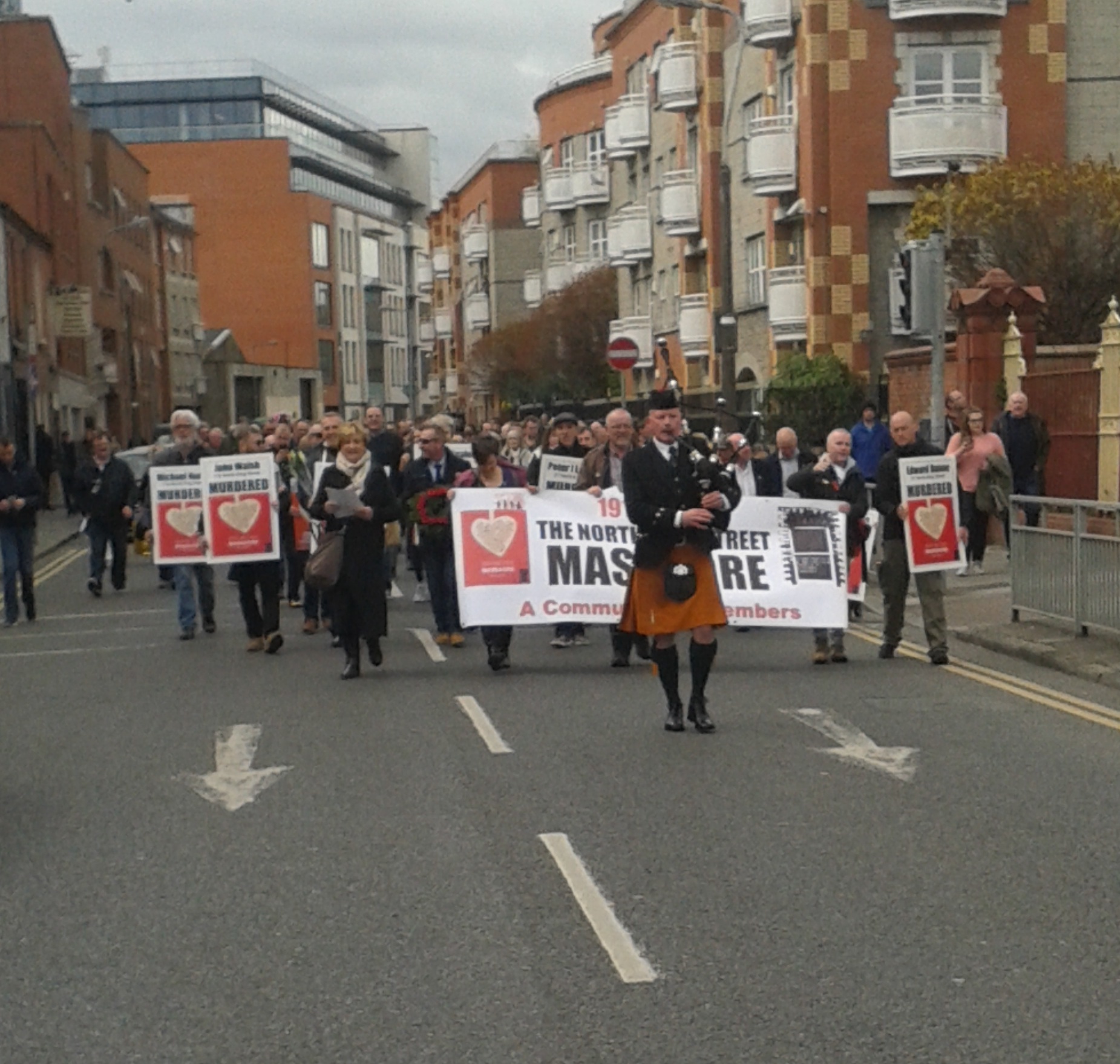
Lone piper leading march from Stoneybatter along North Brunswick Street
‘These 15 unoffending citizens were murdered by the military under circumstances which mark the crime as a cold-blooded and calculated atrocity hardly equalled in the blackest annals of warfare. None of the victims had any connection whatever with the insurrection, and indeed some of them may have been entirely opposed to it. One of the- murdered men, immediately before being shot, pointed to a pictorial representation of the Royal Standard which hung over his bed as a proof of non-complicity with the Insurgents, but no mercy was shown him.
‘The doomed men were torn from the bosom of their family, and despite all exposulation and explanation regarding their views, or identity, and despite the tears and entreaties of their terror-stricken relatives and women-folk, were led away to be slaughtered. In some instances requests were made that the military should at least make enquiries at the neighbouring police stations or obtain information from some of the prominent citizens to whom they were known. But all appeals were fruitless, they all shared a common fate at the hands of their cruel captors.
‘The young son of poor Hickey — a lad of scarcely 15 years — was at the last moment heard pleading pathetically for his father’s life. Both father and son were butchered together.
‘The wife of one of the murdered men carried a baby a few weeks old in her arms; the wife of another gave birth to a child but a few weeks after her husband’s murder. Both saw their husbands led away to death without even a moment’s respite to snatch a last farewell to those they loved. The houses in which they were taken were never at any time occupied by the Volunteers and no traces of arms or ammunition were found on the premises.
‘None of the murders was done during a sudden attack of assault, or in the heat of passion. In some cases several hours elapsed, allowing ample time for consultation with the officers in command before the doomed men were slaughtered. The officers seem in all cases to have overseen or directed the “ military operations.’ It would be difficult to find a parallel to these atrocious crimes.
‘At the inquest on Patrick Bealan and James Healy, Lieut.-Col. Taylor did not appear but sent a statement to’ the Coroner in the course of which he said :
“ No persons were attacked by the troops other than those who were assisting the rebels, and found with arms in their possession.”
General Maxwell afterwards made the sufficiently candid and luminous statement in the “ Daily Mail ” respecting the conduct of the troops under his command:
“. . . . Possibly some unfortunate incidents, which we should regret now, mav have occurred . . . . it is even possible that under the horrors of this attack some of them ‘ saw red ’, that is the inevitable consequences of a rebellion of this kind. It was allowed to come into being among these people and could not be suppressed by velvet glove methods, where troops were so desperately opposed and attacked. Some, at any rate, of the allegations are certainly false, and are probably made in order to establish a claim for compensation from the Government.”
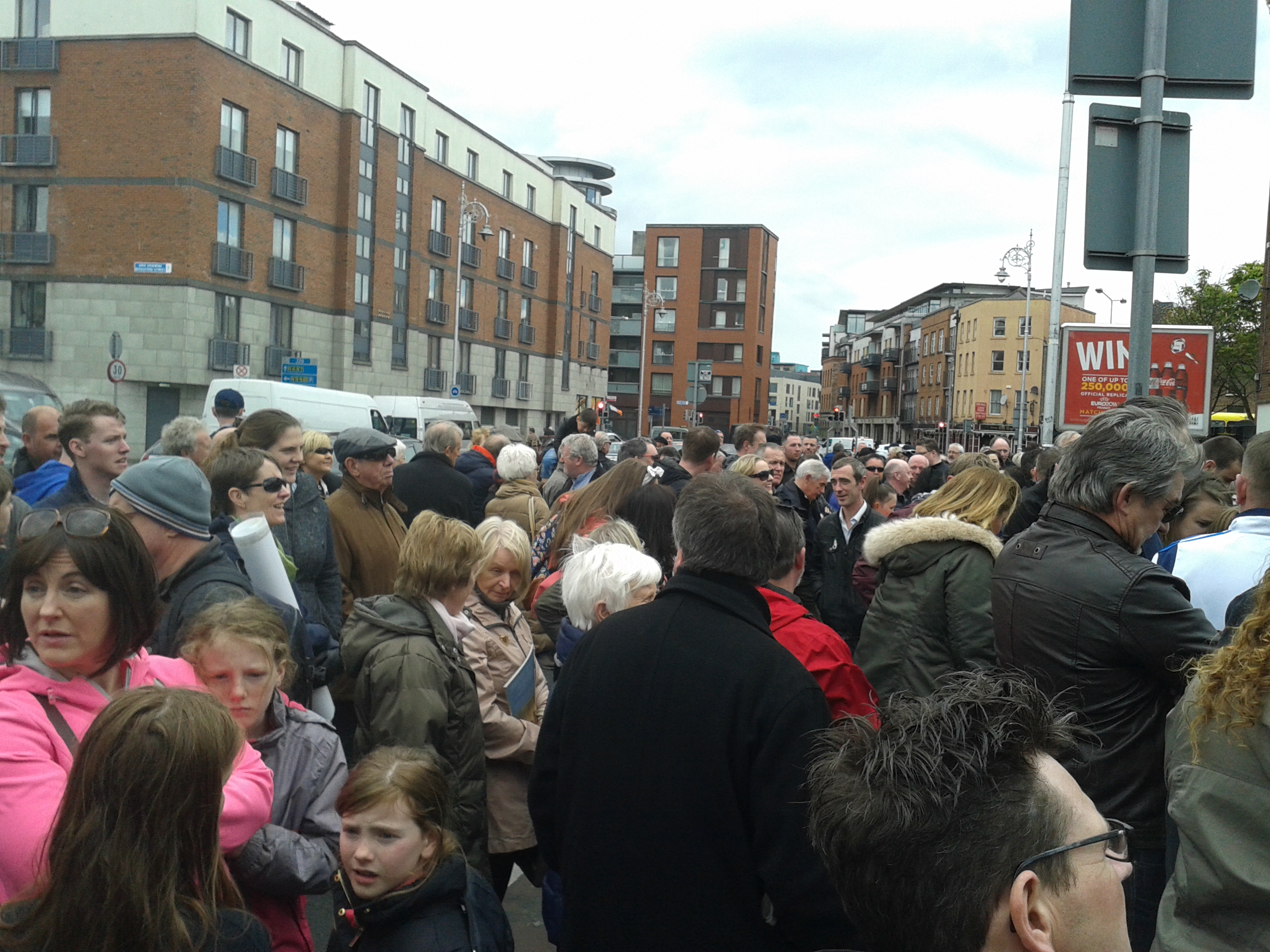
Past and FutureSection of crowd at North King Street at unveiling of plaque event
‘Repeated attempts were made to have a public enquiry into the facts of these military murders, but were opposed by the British Government.’
Sixteen civilians had been murdered in cold blood in one of the principal cities of the British Empire by soldiers of that very Empire. No official investigation ever took place, no soldier or officer was ever charged.
NO MEMORIAL FOR NINETY-NINE YEARS
It is perhaps understandable that no memorial was put up to mark the massacre while the British remained in occupation of the city – it would have been taken down by the authorities. But after the 26-County State was set up in 1921, it is less easy to understand. These victims were innocent civilians and not partisan to either side during the Civil War or the years of anti-Republican repression that followed. Not even the allegedly ‘Republican’ governments of Fianna Fáil provided a permanent marker to commemorate the massacre.
But for some years, Terry Crosbie, a local history enthusiast, has been campaigning to get a memorial erected to remember the massacre and its victims. Slowly, over the years, his campaign attracted support and finally came to fruition this year, the 100th anniversary of the Easter Rising and of the massacre too. Terry had in mind a boulder with a plaque on it but found that difficult to advance and, faced with a plaque being at last permitted and the wish to see the massacre being marked in its centenary, was pleased to see the erection of the plaque 100 years after those hours of terror for the area.
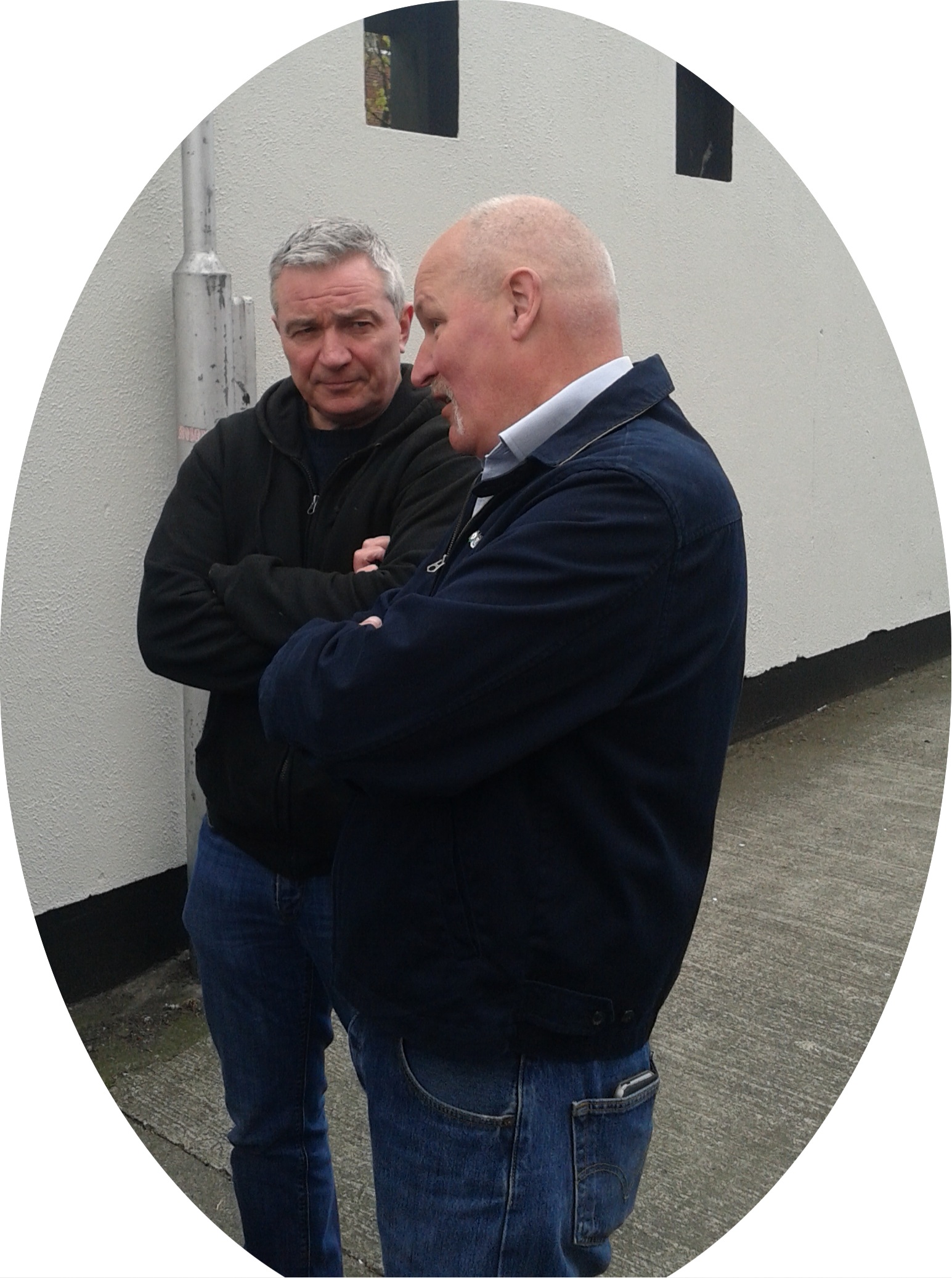
Historians and Reenactors by the plaqueTerry Lyons (foreground), moving spirit behind the commemoration, in private conversation after the event
A PLAQUE AT LAST
The parade for the march to the site assembled at 2.00pm outside Kavanagh’s Pub on Aughrim Street in Stoneybatter and not long afterwards departed in a short parade, led by a piper, to North King Street where the plaque was unveiled.
Dr. Mary Muldowneyof the Smithfield and Stoneybatter People’s History Project presided at the short ceremony. However, the amplification seemed poor and most people failed to hear what was being said. A number of “We can’t hear!” calls resulted in slightly better volume but still not enough for most to hear. A song that had been specifically written about the massacre was played but the same difficulty prevailed.
The plaque was unveiled to loud applause and wreaths and single lillies were placed before it by people related to the massacre victims.
The attendance was a healthy one in numbers as may be seen from the photos but also attracted a great cross-section of the political spectrum: older Stickies and Provos, some Left Labour, independent socialists and Republicans, housing activists, Save Moore Street activists, anti-Water Tax campaigners mixed with historians and local people who had no political organisational or campaign affiliation to speak of.
It was good to see a permanent memorial at last to the murder in cold blood of 16 civilians by an Army that has been responsible for countless atrocities around the world, including a number during the 30 Years War in the Six Counties; at least one of their units is accused in bronze here for what they did over a period of less than 24 hours one hundred years ago.
The struggle for the preservation of Moore Street that is currently in the news (but has been going on for fifteen years) is one not only for nationalists and Republicans, but for socialists too. And for socialists of revolutionary ideology as well as for radical social democrats. But currently these sectors, apart from individuals independent of political party (and one or two belonging to parties), are keeping away from the issue. In this they are seriously mistaken and are doing the working class in Ireland and indeed internationally a disservice.
Aerial view of Moore Street in the days when the speculators and supermarkets had only just begun to reduce it (Photo from Internet)
BACKGROUND TO MOORE STREET STRUGGLE
For those who may not be aware of the historical background, roughly 300 men and women of the GPO garrison in 1916, having to evacuate the burning building, made their way to Moore Street and occupied the terrace from the junction with Henry Place to what is now O’Rahilly Parade, entering at No.10 and tunneling through up to No.25 at the end of the terrace. On the following day, the decision was taken to surrender. Despite its historical status, nothing was done by the State to protect the ‘1916 Terrace’ for decades, although a small commemorative plaque was put on No.16 in 1966, when a number of such plaques were erected at sites throughout the city.
Fifteen years ago a campaign was started, by the National Graves Association and mostly by descendants of people who participated in the 1916 Rising, to have an appropriate historical monument on the site. In 2007 the State named buildings No.14-17 as a ‘National Monument’ but would take no steps regarding the other twelve buildings in the Terrace. By that time the four buildings belonged to a property speculator who allowed them to deteriorate but compliance with maintenance and upkeep obligations to a national monument were not enforced by the State. Also, shortly afterwards, the speculator put in a planning application for a huge shopping centre entailing the demolition of 12 houses of the Terrace and the State approved it.
Paul O’Toole, who played a number of sets at an “Arms Around Moore Street event in June 2015, including singing some songs of his own composition. The event was organised by Save Moore Street From Demolition group.
Other threats emerged later, such as planning applications to extend the ILAC centre further into Moore Street and to build a tall budget hotel at the Moore Lane/ O’Rahilly Parade intersection; these were approved by Dublin City Council’s Planning Department although the majority of the Councillors have voted to preserve the 1916 Terrace and indeed the Historical Quarter.
Donna Cooney, great grandniece of Elizabeth O’Farrell, speaking on behalf of the 1916 Relatives’ Association, at an “Arms Around Moore Street, event in June 2015. To her left is Mel Mac Giobúin, one of the principal organisers of the SMSFD group.
At the end of 2015 the State bought the four houses of the ‘national monument’ from the speculator, paying him €1 million each for them and proposed to knock down houses either side of it. As soon as the intention to proceed with imminent demolitions became clear, emergency demonstrations were called in the street by a newer group, Save Moore Street From Demolition (founded in September 2014). A five-day occupation of the buildings ensued, ending only on foot of an order of the Court that no demolition take place while a High Court challenge to the Dept. of Heritage was awaited.
Section of the January march to save Moore Street, organised by the Save Moore Street 2016 umbrella group. In photo foreground, two of the principal organisers of the SMSFD group, (L-R) Mel Mac Giobúin and Diarmuid Breatnach. (Also in shot, Dave Swift, supporter of the campaign, in Irish Citizen Army uniform). (Photo source: Donal Higgins)
A number of protest actions have taken place since then including a street concert and a march from Liberty Hall to Moore Street ending in a rally at the GPO. The struggle continues at the time of writing with further events planned and the SMSFD group have joined with others, including people who occupied the buildings, to form the ‘Save Moore Street 2016’ group. It is a broad group containing activists from a number of Republican organisations and independents of community action, socialist and Republican background.
In a separate development, a High Court challenge against the process undertaken by the State to buy the properties and demolish others on either side opened on February 9th and has been adjourned a number of times since, apparently due to the State not having got its papers together.
NATIONAL HISTORY
Socialists may argue that the cause lying behind the struggle is one of preservation of Republican or even nationalist history. I would argue that is only partly true – but what if it were so? Who actually makes history? It is the masses of people that make history, even if individuals among all classes at certain times are thrust – or throw themselves – upon the stage. In that sense, ALL history of progressive social history belongs to the working class.
Furthermore, the underlying historical reason for which many are seeking to preserve the 1916 Terrace and, indeed, the Moore Street historical quarter, is because it related to a struggle against colonialism, against an immense colonial empire. Are socialists to say that they take no interest in anti-colonial struggles and their history? Or is it that they do, so long as they be in some other part of the world? And if the latter be their position, what possible political justification could they offer for it?
STREET MARKET – SOCIAL HISTORY
In the development of this city, Dublin, street traders have played a part – as indeed they have in the development of probably every city in the world. Working people and small-time entrepreneurs, working hard from dawn to dusk in all weathers to feed themselves and their families, a link between town and country or between coast and inner city. They brought fresh food to the city dwellers of all classes and brought colour to what was often a drab environment, colour to the eye and to the ear also.
Moore Street is the last remaining street of a traditional street market centuries old, the rest of which now lies buried under the ILAC centre and which even now threatens to extend further into Moore Street, squeezing the market street still further. This street market and its history as well as being physically threatened by the proposed extension of the ILAC, squeezed commercially by Dunne’s and Lidl, is threatened also by a planned budget hotel building of many floors and of course the giant shopping centre plan of Chartered Land/ Hammerson. Have the socialist groups nothing to say about this or, if they are against this monopoly capitalist assault, why do they distain to take their place in the ranks of the resistance?
AGAINST WORLD WAR
Some of the Volunteers undoubtedly planned the Rising to take place during the first imperialist World War purely on the basis of the maxim that ‘England’s difficulty is Ireland’s opportunity’. But others, including the revolutionary socialist leader James Connolly, also clearly wanted a rising against the slaughter of workers in a war between imperialists. Connolly wrote a number of articles denouncing this slaughter which socialists of his time had pledged themselves to fight but which few had actually done, when it came to the crunch. However, that position remains the correct one for the working class: in a situation where your masters wish to send you out to fight your class brothers abroad, turn your guns on your masters instead. The 1916 Rising stands as an example of this, the first of the 20th Century and world history would have to wait until the following year for another example in Europe.
WORKERS’ HISTORY
All the Irish socialist groups, as far as I’m aware, right across the spectrum from Anarchist to Communist, hold the memory of James Connolly and of the Irish Citizen Army in high esteem. And so do the radical social democrats.
James Connolly led the Irish Citizen Army into alliance with the Irish Volunteers, Cumann na mBan and na Fianna. The ICA, a trade union-based militia, had been formed to defend demonstrating and picketing workers against the attacks of the Dublin Metropolitan Police in 1913. When the ICA went out in the 1916 Rising, Ireland was the first country in the world that century for a workers’ armed unit to fight in its own uniforms and under its own leaders.
Irish Citizen Army on parade at the Irish Transport & General Workers’ Union building and grounds in Fairview, Dublin. (Photo source: Internet)
The ICA were allocated the Stephens Green and Dublin Castle areas but also had members in the GPO garrison. So when the GPO garrison retreated from the burning building, ICA members were part of that retreat. At least one died on that journey, struck down in Henry Place by British Army bullets at the intersection with what is now Moore Lane.
When the GPO garrison took possession of the 16 houses of the Terrace in Moore Street, tunneling from house to house, the ICA were part of that. And when the decision to surrender was taken, the ICA laid down their arms with the rest.
The 1916 Rising and the occupation of the Moore Street terrace and backyards is part of the ICA’s history and is therefore part of the history of the Irish working class and, indeed, of the international working class. If the socialist groups don’t wish to celebrate that episode in the history of the class, why? If, on the other hand, they do celebrate it, why then do they not join the struggle to have the place of their last stand preserved from demolition and to have the ICA’s place in history marked by a fitting monument?
The lack of engagement of most of the revolutionary and radical left with the Moore Street struggle has also meant no noticeable pressure within the trade unions, where the left have some influence, to even declare verbally for the preservation of the 1916 Terrace. To date, only one section of one trade union, the Construction Section of SIPTU, has declared in favour of saving the Terrace.
WOMEN
The struggle for gender equality is an important part of the struggle for the emancipation of the working class, i.e. for socialism: women represent slightly over one-half of the human race and this is true also for the working class. In addition, the oppression of one part of the class serves as a wedge into the solidarity of the class as a whole.
In 1916 women served as auxiliaries in Cumann na mBan and as equals in the Irish Citizen Army. That year was the first in the World in which women participated in an insurrection in a unit of their own, wearing a uniform of their own and under their own female officers, as was the case with Cumann na mBan. It was also the first time in the 20th Century in which women had formal equality with men in an armed workers’ organisation, as they did in the Irish Citizen Army.
Constance Markievicz, ICA officer, fighting in the Stephen’s Green area. She poses here with a gun prior to the Rising to underline her position that women can and should take part in armed revolutionary struggle, on a par with the men. (Photo source: Internet)
The Proclamation was the first insurrectionary call to arms to address itself specifically to women alongside men (“Irish men and Irish women …”, it begins) and had been signed in secret a little earlier by the seven male signatories (or by most of them) in the alternative cafe and agricultural product cooperative run by Jenny Wyse Power at No.21 Henry Street.
Women of Cumann na mBan and ICA who participated in the 1916 Rising in a group photo a year later (photo sourced Internet)
CAPITALISM & THE STATE
The campaign for the saving and appropriate renovation of the 1916 Terrace first of all confronted the capitalist property speculator Joe Reilly and his Chartered Land company, while it lobbied the State to take over the Terrace.
When in 2007 the State declared four houses in the Terrace to be a ‘national monument’, the campaign continued confronting the speculator but now calling, without success, on the State to oblige Mr. O’Reilly to comply with his maintenance obligations to a national monument. When the State granted, with some changes, planning permission for the speculator’s giant shopping centre, the campaign moved into confrontation with the State, a confrontation which intensified after the State purchased the four buildings and prepared to demolish the buildings on either side.
The whole saga was an object demonstration of the function of the State in facilitating capitalist property speculation and furthermore, of the neo-colonial nature of a capitalist class unable to consider saving such a national historical treasure even with the support of the vast majority of the population.
In such a struggle, with people with democratic objectives on one side and, on the other, rapacious property speculators and a capitalist State facilitating those speculators, where does the duty of socialists lie? It is clear on which side they should stand if they should stand on the issue at all. And they should take a stand on it – how can the development of that struggle do anything but strengthen the democratic movement in general, including the movement for socialism, and harm its opponents, the State and capitalism in Ireland? And surely in the course of that struggle, with socialists side by side with Republicans, alliances would be formed which could be built upon for more ambitious projects later?
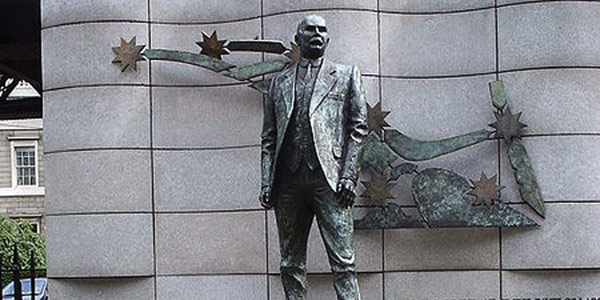
Monument in Dublin to James Connolly, revolutionary sociailist writer, historian, theorist, union organiser, publisher — his last location of freedom was the Moore Street 1916 Terrace, before he was shot by British firing squad (Photo source: Internet)
IN CONCLUSION:
For all the reasons given above, its social history, its anti-colonial history, the history of the common people as well as that of intellectuals, the history of the working class to assert its independence and dominance of the movement for liberation, the history of women’s struggles, and the current struggle of people against property speculator capital and State, the place of socialists, revolutionary and radical, is right there with the Moore Street 1916 Terrace campaigners. But where are they?
With the exception of a few honourable exceptions, they are notable by their absence. Yet, they will wonder at times why the mass of people do not follow them; why, for the most part, they regard them and their organisations as an irrelevance.
In the last days of the 1916 Easter Rising, with the GPO in flames, the garrison had to evacuate and did so through Henry Place. When they came to Moore Street, it was being raked by machine-gun fire from a British Army barricade at the junction with Parnell Street. Consequently, the garrison entered the first house in the terrace to the their right, No.10 and tunneled from house to house until they reached the end of the terrace, No.25.
A struggle is taking place currently to have the whole terrace saved and declared a national monument, a battlefield site in the context of the Historic Quarter. In 2007, the State made only four houses a national monument, No.s 14 to 17 and at the very end of 2015, bought the four run-down houses from their speculator owner at a million Euro each. The Government plans to make them into a commemorative centre, in the course of which they wish to demolish buildings 13, 18 and 19. Speculators have planning permission for a giant shopping mall from O’Connell Street to Moore Street and from Parnell Street to Henry street, which envisages the demolition of the entire terrace except for No.s 14-17.
In reply to campaigners, Minister for Arts, Heritage & Gaeltacht, Heather Humphreys, has stated that some of the buildings are of post-1916 construction and therefore are of no historic value. In opinion pieces in the Irish Times, one week after the other, Frank McDonald and Diarmaid Ferriter wrote articles supporting the Government.
JUST FOUR HOUSES — a sketch for three actors
AT HENRY LANE/ MOORE STREET INTERSECTION
(Sounds of shells crashing, flames roaring, combustibles exploding, rifle fire, the chatter of machine-guns)
Irish Volunteer A: “Bloody hell, it was hot in the GPO!”
Irish Citizen Army Volunteer: “Hot as Hell. We were lucky to get out alive, with ammunition about to blow.”
Volunteer A: “We can’t stay here in this laneway in the open, though.”
ICA Volunteer: “No, let’s get under cover quick! Into that terrace there … Moore Street this is, right? Sixteen houses ….
Volunteer B: “No, we have to occupy just four houses in this street.”
Vol. A: “Only four? But there’s nearly 300 of us here!”
Vol. B: “I know. But orders …”
Vol. A: “Damnation! OK, best bash that door down, No. 10.”
Vol. B: “No, not that one.”
Vol. A: “Why not?”
Vol. B: “Only Numbers 14 to 17.”
ICA Vol: “But they’re in the middle of the terrace. We’d get shot to pieces by the British machine gun up at Parnell Street – and we have to carry Connolly’s stretcher so he’d get shot too!”
Vol. B: “Yeah, they’ve already shot up The O’Rahilly’s lads.”
Vol A: “Whose orders are these? Who says we should all pile in just four houses in the middle of the terrace?”
Vol. B: “Somebody called Humphreys …. and a Mac Donald …. and a man called Ferriter. Something about only those four houses being of historic significance.”
ICA man: “What? Bloody rubbish – look, go and ask Connolly what he thinks. He’s the Commandant of this garrison, not that lot, whoever they are.”
(A few minutes later)
Irish Volunteer B: “Well, what did Connolly say?”
Vol A: “His exact words? ‘Don’t be stupid lad – break down the door of No. 10 there and tunnel along the terrace, from house to house, aye, all the way to the end – No. 25, isn’t it?’ ”
ICA man: “That’s more like it – I knew we’d get some sense out of Jim – I mean, the Commandant.”
Vol A: “Thanks be to Jayzus for someone with sense in charge. Who the hell are that other lot and where did they come from, that Humphreys, MacDonald and Ferriter?”
Vol B: “I dunno. Give’s a hand with this door before we get shot out here, gabbing …”
The terrace of houses in Moore Street, No.s 10–25, in the Irish capital of Dublin, much in the news of late, is of great importance to the world and should be recognised as such by Irish people and internationally. The terrace is of great importance in terms of being
an urban WWI battlefield
of opposition to imperialist war
of the struggle of the working class
of women’s struggle for equality
of the struggle of the world’s people against colonialism and
a surviving centuries-old European street market.
In this article I intend to develop this argument and these points.
In the closing days of Easter Week, in the cancelled and hurriedly rescheduled Easter Rising in Dublin, after five days of fighting, siege and a number of days of artillery bombardment, the garrison of the General Post Office, the Headquarters of the Rising, evacuated their burning building and occupied a terrace of sixteen houses in Moore Street. They broke into No.10 and tunneled from house to house up to No.25, until the whole of the terrace and back yards had been occupied.
Meanwhile, a charge of a dozen Volunteers on the British Army barricade at the northern end of that street, at the junction with Parnell Street, had failed to reach its objective; machine-gun fire had injured some and killed others. The leader of that charge, mortally wounded in a side-street, wrote a note to his wife as he lay dying there (the words are reproduced on a plaque in the laneway named after him: O’Rahilly Parade).
That history, and of it as a market in childhood memory, is what engages many people — perhaps most – of those campaigning for the preservation of that terrace of houses and of the thousands who support their efforts. But there are aspects of international importance to that 1916 Rising not usually alluded to and which deserve to be noted, celebrated and commemorated.
A RISING AGAINST WORLD WAR
James Connolly, the revolutionary socialist or communist and trade union leader, had been calling for an uprising for years and his public exhortations intensified with the onset of WWI. A section of the Irish Republican Brotherhood was also anxious to engineer an uprising during that War — “England’s difficulty is Ireland’s opportunity” was a well-known saying among Irish nationalists. But for Connolly, the issue was much more than that – the dispute between some capitalists about which of them would control the Earth’s resources and markets was sending millions to die, workers fighting workers in battlefields in which the instigators of the slaughter would never set foot. While millions died, those big capitalists would continue to make great profits, supplying armies with weapons, transport and equipment, fuel, clothing, food …..
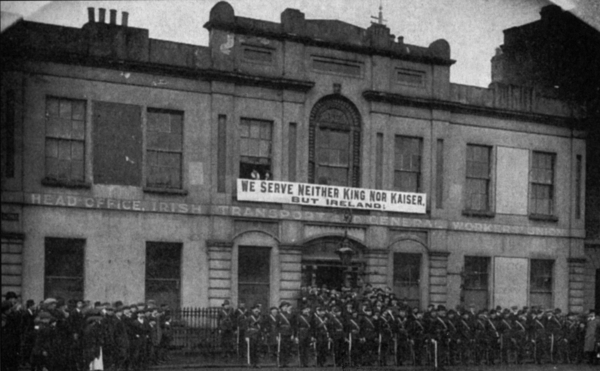
A declaration of war against war — banner on the old Liberty Hall, HQ of the Irish Transport & General Workers’ Union. A parade of a section of the Irish Citizen Army is drawn up in front of it. (Photo from Internet)
A few years earlier, an international socialist conference had threatened revolution on their capitalist masters should they dare to start a world war. Indeed, some revolutionary socialists saw war as anopportunity to instigate socialist revolution. Unfortunately they were outnumbered by social democrats who, despite their earlier militant words, when it came to the crunch, lined up the workers of each country behind their capitalist masters against their own class brothers in other countries.
There were few socialist parties and prominent socialists that took the opposite stand but one of those who did was James Connolly. Among the other things that characterised the 1916 Rising was that it was the first significant uprising of the 20th Century against World War. The next uprisings of that kind would be the 1917 Revolutions of February and October in Russia, with another in Germany in 1918.
“IRISHWOMEN”
The Proclamation of the insurgents in 1916 addressed itself to “Irishmen and Irishwomen”. Although not one of the seven signatories was a woman, there were a number of them prominent in the command structures of the Rising and in the preparations also. And also of course in the lower ranks during the Rising itself.
Constance Markievicz (nee Gore-Booth) of the ICA was, despite her planter family and quasi-aristocratic background, third-in-command of the Stephens Green/ College of Surgeons area. Kathleen Lynne, also of the ICA was Chief Medical Officer for the Dublin insurrectionary forces and third in command in the Dublin Castle/City Hall garrison. It was at the premises of Cumann na mBan founder member Jenny Wyse-Power, No.21 Henry Street, that the 1916 Proclamation was signed in secret a week before the Rising.
Constance Markievicz, Irish Citizen Army, second-in-command of the Stephen’s Green/ College of Surgeons garrison
Kathleen Clarke was de facto a member of the IRB, work and powers delegated to her on the eve of the Rising by her husband, Tom Clarke, one of the architects of the Rising and first of the seven signatories. Elizabeth O’Farrell was one of the Cumann na mBan nurses accompanying the men in the GPO and one of three to proceed to occupy Moore Street; she carried the short truce communications to the British and back to the leaders on the Rising surrender day, accompanied Pearse to the surrender point in Parnell Street and then carried Pearse’s and Connolly’s surrender instructions to a number of garrisons in Dublin. And Winifred Carney, James Connolly’s secretary, was in the GPO and later Moore Street with her typewriter and a Webley revolver.
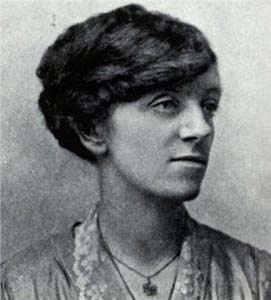
Winifred Carney was the first woman into the GPO, accompanying Connolly and carrying a typewriter and a Webley revolver
It is difficult for us today perhaps to realise how progressive it was for any general public document 16 years into the 20th Century to address itself specifically to “Irishwomen”. No country in the whole world had given all its women the right to vote by 1916 although the suffragette movement was in full flow throughout most of Europe and in the European colonies. While it is true that New Zealand gave European women the right to vote as far back as 1893, it was for European settlers only and also linked to a reform movement against the sale and consumption of alcohol. Elsewhere in the world outside the colonial Antipodes and the Scandinavian democracies, the extension of the franchise to women did not seem close in 1916. Nevertheless, in Canada, women got the vote in 1917 – but again, women of European descent only. In Britain, women did not receive full rights to vote until 1928. Yet in a large part of the United Kingdom, a cross-section of people making a bid for independent nationhood, were ostensibly recognising women as citizens with equal voting rights as early as 1916.
Given the preponderance of males in all organisations of all shades of Republican and Nationalist outlook, the inclusion of women in the address had to have been agreed by the men in the top leadership. No doubt women, through their agitation for full franchise as well as by their active participation in so many facets of the movement, helped to convince the men. Connolly is often credited with responsibility for this inclusion but there is no reason to believe others among the signatories would not have taken that position themselves (although Kathleen Clarke did allege that one of those would not). Patrick Pearse had previously supported the vote for women and a number of men in the leadership had female partners who were active on that issue, as for example was Grace Gifford, Joseph Plunkett’s fiancee. The 1916 Proclamation was the first insurrectionary proclamation of the 20th Century (and almost first ever) to specifically include women in its address on a basis of gender equality.
The participation of women in the Rising however had a much sharper illustration than their inclusion in the Proclamation – they were present in most of the fighting posts throughout the Rising, whether as members of Cumann na mBan or of the Irish Citizen Army – several were killed or injured, many were arrested and one was sentenced to death (though sentence was commuted later).
The participation of Cumann na mBan made the 1916 Rising the first uprising of the 20th Century (and probably prior to that) in which women participated in their own organisation, in their own uniform.
The participation of women in the Irish Citizen Army, where they shared equal status with men, made the 1916 Rising the first uprising of the 20th Century (and almost first ever) in which women participated in an armed and uniformed organisation, and in equal status with their male comrades.
HOPE AND ENCOURAGEMENT TO THE PEOPLE OF THE COLONIES
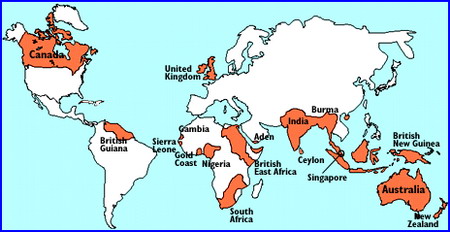
The British Empire in 1916 was huge – around 13 million square miles of territory in 1916, nearly a quarter of the world’s area. It was said that the “sun never set” upon the Empire because at any moment during 24 hours, some part of the Empire would be receiving light from the sun. Around 450 million people were under the Empire’s dominion.
Map of the British Empire in 1914 (of course the British ruling class had dominant influence over many other areas, for example over much of Latin America). (Image sourced from Internet)
And of course, there had been resistance. Even after resistance had been beaten, there had been further uprisings – in fact, some areas such as that of the present-day Afghanistan were in almost constant rebellion. But rebellions were mostly localised and even when they took on a more sweeping character, such as the Mahdist War of 1881-’89 in the Sudan or the Boxer Uprising in northern China in 1900, they had been crushed by British military might.
The news of the Easter Rebellion in Dublin ran around all parts of the British colonial world, from the nearer to the most remote. And some of the news was carried by the Irish in the British armed forces. Tom Barry, later to be undefeated guerrilla leader in the War of Independence in West Cork, read about the Rising while serving in the British Army in Mesopotamia (now Iraq). The Connaught Rangers, hundreds of which were to mutiny in India in 1920, were also in Mesopotamia in 1916. These Irish units of the British Army and Irish men in British units serving outside the United Kingdom, served not just next to English, Welsh and Scottish soldiers but also next to soldiers drawn from colonial peoples; they were often serviced too by colonial people in auxiliary roles and mixed to a degree with the colonial populations among which they were stationed, in markets, eating houses, bars and sex-houses. Just four years later, during the mutiny of the Connaught Rangers, it is recorded that Irish rebels in British Army uniforms had communicated their mutiny and their reasons to the Indian traders.
The 1916 Rising took place in what had been considered, the previous century, the second city of the British Empire. Now past those ‘glory days’, Dublin was still a city of the Empire’s “home base”, the United Kingdom. And the Empire’s Army had been obliged to shell one of the UK’s own cities in order to suppress that Rising! To many a colonial subject contemplating resistance or even outright revolt, it must have seemed like a signaling bonfire, one that proclaimed that the end of the Empire was nigh and called the peoples under subjugation to revolt, to finish it off. And, indeed during the War of Independence, the Nehru and Ghandi families were to make contact with Irish Republicans and Ho Chi Minh is reported to have been inspired by the Irish struggle.
Nor was it only those colonial people in the British Empire who were inspired but those in the French, Dutch, Belgian, Portuguese and Spanish colonies too. Ho Chi Minh, as a Vietnamese, was under the French empire and led his people in armed resistance to the Japanese and French occupation in 1941. Over the three decades following the Easter Rising, anti-colonial struggles around the world intensified and pushed the former colonial powers into “de-colonisation” — i.e. imperialism and neo-colonialism.
WORKERS OF THE WORLD
The Irish Citizen Army had been founded in 1913 as a workers’ armed organisation to defend against the attacks of the Dublin Metropolitan Police. The DMP carried no firearms then, though they were well able to kill and maim with their truncheons, a fact they demonstrated during the 1913 Lockout. But it was clear that Connolly at least knew that at some point the workers would come up against the full force of the State which, at that time, meant the British empire and the Colonial regime in Ireland. He called publicly for the ICA to train in and to carry firearms. The Royal Irish Constabulary, policing the rest of the colony outside Dublin, was indeed armed. And British Army units were stationed across the country, many of the garrisons in Dublin alone.
The ICA fell into a kind of disrepair after the workers’ defeat in the Lockout but was soon enough dusted off and reorganised. WWI began the same year the last striking workers of the Lockout, the Jacobs girls and women, marched back to work. It was certain that Connolly would try to stage a rising during the war and suspected that the Republicans, or “advanced nationalists” as they were called then, would do so too. As the war dragged on and the bodies heaped higher, Connolly grew increasingly impatient, contemptuous and even desperate, berating the “nationalists” for not rising and threatened to bring out the couple of hundred ICA on their own.
Irish Citizen Army on the roof of Liberty Hall during a flag-raising activity (Photo sourced from Internet)
But the Irish Republican Brotherhood had been planning to rise and in late January 1916, alarmed by Connolly’s threats, brought him into secret negotiations. When he emerged a few days later after what many thought had been his kidnapping, he had been sworn into the IRB and was part of the Military Council, planning the Rising for the Easter weekend. And that would mean that the ICA would also commit to the Rising.
On Easter Monday morning, around 220 men and women of the Irish Citizen Army marched out of Liberty Hall or mobilised elsewhere in Dublin. Two of the important fighting areas in Dublin were given over to their command, Dublin Castle and Stephens Green. ICA members fought elsewhere too, including the GPO. One account has them as the first to occupy the top of the GPO’s roof and another as hoisting the “Starry Plough” on top of William Martin Murphy’s Imperial Hotel in Clery’s building (the last flag of the Rising to remain flying). At least one was killed in the fighting evacuation of the GPO and a number took part in the occupation of the 1916 Terrace in Moore Street. The 1916 Rising was the first occasion of the 20th Century when a workers’ unit rose in their own units, in their own uniforms and under their own commanders.
SURVIVING STREET OF A CENTURIES-OLD MARKET QUARTER
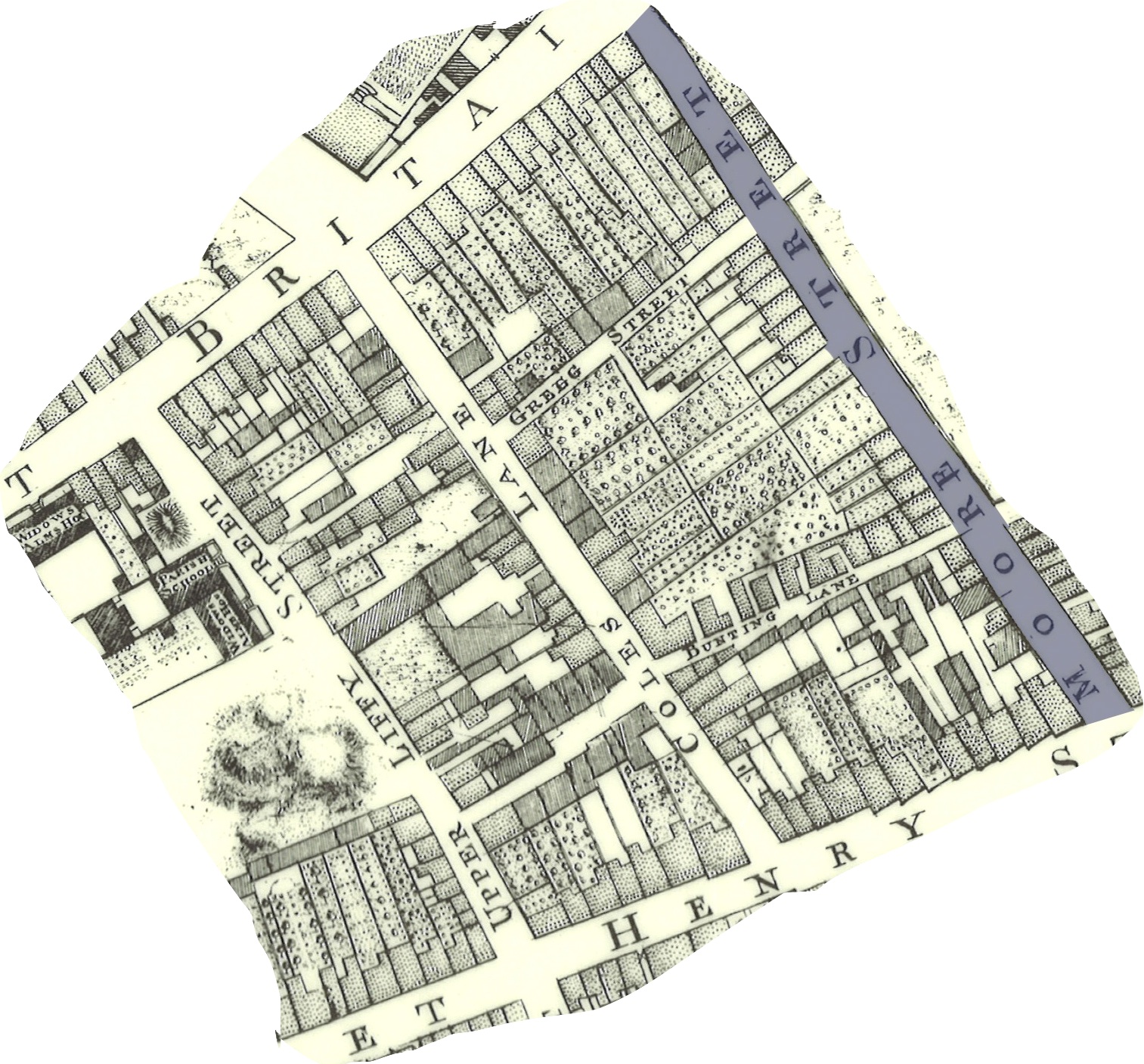
Authorisation was granted for the development of a market in the Moore Street area by the Dublin and General Markets Act of 1831. But the Act mentioned the location as being around “Coles Lane market”, which means there was already a street market in the area. It is probable that street trading had been going on in that area for centuries before that. Moore Street was something of a modern street of its time in the area, laid down around 1763 (and, it is worth noting, before the Great Hunger and earlier than the city’s main street, O’Connell Street), mainly as a residential street with some businesses. In following decades Moore Street would become the main street of a whole market area which included the aforementioned Coles Lane along with many other streets, laneways, cul-de-sacs (“turnings”) and mews.
The streets and lanes of the old street market quarter now buried under the ILAC (Image cropped by Save Moor Street From Demolition from J Roques Map 1754, sourced on Internet). In 1754 the street across the top was called “Great Britain Street” but by 1916 it had been renamed “Parnell Street”.
All of that was demolished and buried by the 1970s ILAC “development” of Irish Life ltd.(later joined by Chartered Land, which dispossessed the households, shops, stalls and workers for a paltry compensation, to the benefit not only of the ILAC partners but also of Dunne’s Stores and Debenhams. All that remains of that street market quarter is Moore Street, with street traders struggling in difficult circumstances to make a living, harassed by Dublin City Council officials, along with small shops, granted short leases or expensive longer ones by Chartered Land or the ILAC – and under constant threat of demolition or of ILAC expansion.
CONCLUSION
Since the 1916 Rising has all those aspects of international importance listed above, clearly the Moore Street terrace also embodies them all, being the last fighting place of the Rising’s HQ garrison and containing around 300 men of the Irish Citizen Army, the Irish Volunteers and three members of Cumann na mBan.
On the basis of those points alone, the site should be a recognised world heritage site. That the terrace and surrounding streets are, according to the National Museum of Ireland ‘the most important historic site in modern Irish history’and ‘a surviving urban WWI battleground … beyond price’ (as stated by the Imperial War Museum) and they include the last street of a centuries-old European street market adds icing to the cake – a cake that should be made available for the world to share.
End.
Documents consulted include
various accounts of the 1916 Rising,
including biographies and Witness Statements of participants (latter now available on line),
along with Moore Street – the story of Dublin’s market district (2012) by Barry Kennerc and
There are occasions in life when time that can never be retrieved is expended on something that is worthless. So far, three valuable hours of my life has been wasted on what RTE describes as a ‘commemorative drama’ to herald the beginning of the Centenary year of the 1916 revolution. Wasted, other than in terms of understanding the propaganda value to the political class even of badly constructed ‘historical’ costume drama – although describing ‘Rebellion’ as coherent drama is stretching it.
I quibbled after the first episode about the use of the term ‘Rebellion’ instead of the more accurate term ‘Revolution’, but it finally dawned on me with Episode 3 that what the writer, director and producers really mean is that this is about rebelliousness within the featured families, to which the 1916 Revolution is just a backdrop.
It would be a useful exercise after the series comes to an end to put a stopwatch to good use to work out the proportion of the five hours of screen-time that is devoted to an exceedingly poor and skewed telling of the story of the 1916 Revolution, and what proportion was used to tell the confusing, intertwined, and fairly inconsequential stories of domestic disagreement. There is of course a market for the latter, and for its setting in a sort of ‘upstairs-downstairs’ genre, but this series, more soap than serious drama, should not be its vehicle.
The 1916 Revolution – what was it really about, who made up the rank-and-file – essential to the creation of a revolution, what scale of operation was in play, what impediments to success existed? Nobody can be any the wiser by relying on this series.
The leaders – who were they, what were they like, what did they believe in, was there a plan, had they some endgame, some vision? Nobody can be any the wiser by relying on this series.
Where is Tom Clarke, or Seán MacDiarmada, or Joe Plunkett, three iconic signatories of the Proclamation, all present in the GPO – but not so far in this sorry series? No clue as to their characters, and precious little of James Connolly’s – relegated to a bit part, or of Patrick Pearse’s – other than his addiction to prayer, his deference to the clergy, his obsession with blood sacrifice, and a capacity for rhetorical exaggeration – as RTE would have us believe.
Where is the evidence of strong public support particularly in the impoverished inner city tenements, without which the revolution could not have lasted almost a week? We know it was there, we who have bothered to acquaint ourselves with the true narrative. Instead, that hoary old myth of widespread public disaffection with the revolution is hammered home at every opportunity.
Episode 3 begins with some bearded chap being put up against a wall and shot by firing squad. Who was he? We are none the wiser by the end of Episode 3. Why might it be important to know that he was Francis Sheehy-Skeffington, a journalist, an advanced-feminist, a pacifist who had played no part in the revolution itself? Because, perhaps, that it is true, and that he was murdered on the command of a crazed, out-of-control British army officer – an essential detail of the 1916 narrative – but not as the masses are supposed to know it since it would upset the entirely revisionist slant of this television disaster, a revisionism that is deliberately applied. And so it goes on.
Against fleeting scenes of chaos, created as we are led to believe by violent anti-democratic nutcases hell-bent on creating a Catholic state, we are encouraged to note the stabilising influence and the manners and the etiquette of both the Irish ‘Castle Catholics’ and their British masters in Dublin Castle. Fast-forward by 100 years and we see the same spurious choice being presented to the people by the political class – ‘stability’ or ‘chaos’, white or black, good or bad. No need to tease out what each side really stood for back then, or what each side stands for now.
There are those who ask ‘what matter – it is only TV drama?’. Propaganda is at its most effective when it is inserted subtly into the thought-processes of its target audience, and repeated through various forms from news and current affairs, commentary, and yes, entertainment. That works, as Joseph Goebbels knew all too well.
RTE claims an audience of 600,000 for its first episode of ‘Rebellion’. A large proportion of these will vote in the upcoming general election in which the main choice will be between, the political class tells us, stability or chaos. And that audience is also entering into the centenary year of the 1916 revolution with its competing interpretations, one of which champions the Redmondite parliamentarian Home Rule option over the other – the right of a people to self-determination and self-government, to be established through revolution where no other viable option was available. Presenting a partisan and therefore skewed version of the 1916 revolution primes at least a part of that audience to adopt a negative view of the legitimacy of that revolution and of its leaders, and that represents a highly political intervention in the popular history of 1916 on the part of the State broadcaster, RTE. It is not, presented in that way, just TV drama.
‘Rebellion’ looks like a cheap production, but cost as much as Ken Loach spent making The Wind That Shakes The Barley – an excellent production for the big screen, which grossed three times its production costs at the international box-office. Why wasn’t Loach asked to make this series? It is not as if he lacks experience. But then, he could be relied on to create a credible narrative around the main story of revolution and to consign the less consequential sub-plots to their rightful places. That would not suit the political class, including its RTE functionaries.
The 1916 revolution is an intriguing, exciting and rich human story, as rich in dramatic potential – characters, incidents and plot-lines – as was the highly successful and accurate 1913 Lockout TV drama ‘Strumpet City’, produced by RTE in 1980. ‘Rebellion’ on the other hand is dross. Some people, their names figuring prominently on the credits of each episode, opted for dross, and each received a considerable reward tor taking that option.
The foundational narrative of modern Ireland – in which the 1916 Revolution is the inciting incident – deserves to be treated with a modicum of respect. That is entirely absent in this spurious version.
There are times when we remark that ‘you couldn’t make it up’. The series writer did, with input from others.
And there are times when we remark that ‘it couldn’t get any worse’. Oh yes it can, and it will.
This is a timely and interesting article by Liam Ó Ruairc about the significance of the Easter Rising beyond our little parish.
Apart from that, it would seem to suffer a little from a terminology problem with regard to “imperialism”. In the world today this is not an insignificant issue. At the time of the 1916 Rising it was common for commentators to conflate the words “colonialism” and “imperialism” — and why not, since we had the British Empire, the French Empire etc. However, that same year, VI Lenin completed his work “Imperialism — the final stage of capitalism” which he published the following year but exchanging, for the censor, the word “highest” for “final”. Lenin described imperialism as the merging of finance with industrial capital and its export to the underdeveloped world and also explained how its colonialism was undermining British industrial capacity and competitiveness by starving it of capital which was instead being invested in the colonies for quick return of superprofits.
He showed that imperialism could be practiced where the developed state did NOT have colonies but instead had influence.
Decolonisation was indeed one of the big processes of the early to mid-21st Century, as quoted in the article, but it was accompanied by an increase in imperialist expansion, with the USA becoming the world leader and displacing the former colonial powers of Britain and France. By and large this was achieved without occupying countries and setting up colonies of UStaters within them.
Lenin also showed that imperialism leads to war; colonialism did too but not on the scale that imperialism has. Colonial wars were largely limited by the amount of people available to occupy colonies whereas imperialism fights most of its wars through proxies (with some notable exceptions such as Vietnam, Ireland, Iraq and Afghanistan, involving large committal of its troops but even there, proxies have been/are also used).
Those regimes that imperialism cultivates were later classified by national liberationists as “comprador (buyer) capitalists” or “neo-colonials”. Such an analysis of Ireland today would have to conclude that the Six Counties are a remaining British colony and the Twenty-Six a neo-colony.
In the “comment” section of the article there is a reference to another article on the same theme of international importance which is also of interest.
In less than six months, the one hundredth anniversary of the 24-29 April 1916 Easter Rising will be commemorated throughout Ireland. What is striking about the so-called ‘Decade of Commemorations’ is how insular its outlook is: the 1912 Ulster Covenant, the 1916 Rising or the setting up of Northern Ireland are seen as a purely Irish phenomenon, divorced from global trends. As Edward W. Said once noted, while the Irish struggle was a ‘model of twentieth-century wars of liberation’, “it is an amazing thing that the problem of Irish liberation not only has continued longer than other comparable struggles, but is so often not regarded as being an imperial or nationalist issue; instead it is comprehended as aberration within the British dominions. Yet the facts conclusively reveal otherwise.”[1] This article will argue that the significance of the 1916 Easter Rising lies less in its
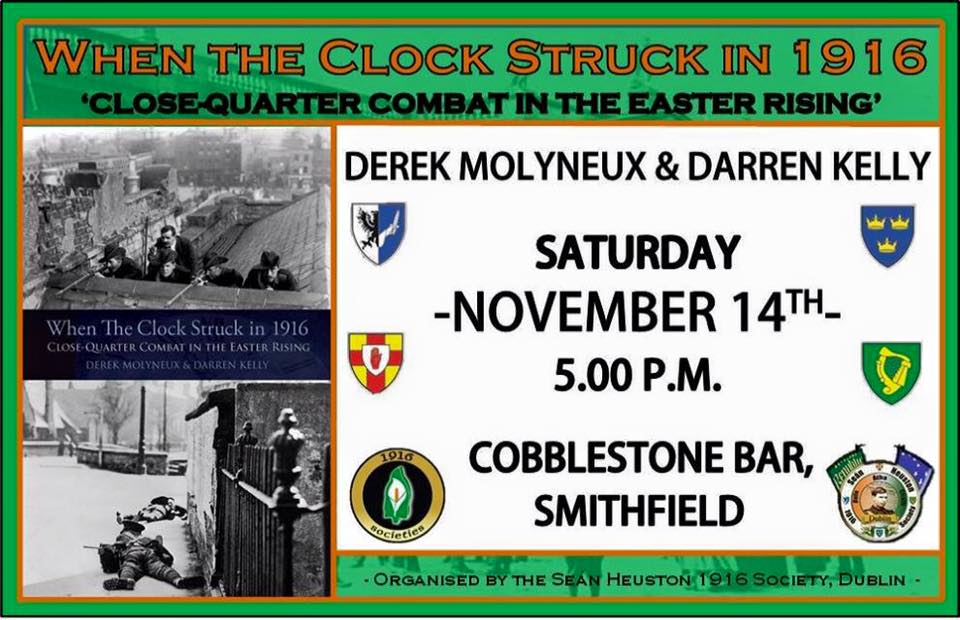
Derek Molyneux and Darren Kelly are a great 1916 Rising history double act. Taking turns at the narrative, bouncing one off the other at times, sometimes one correcting the other, interrupting one another and on occasion comically resenting the
Darren Kelly and Derek Molyneux presenting their talk at the Cobblestone
interruption. They are great entertainment. But they are also very knowledgeable on the history of the 1916 Rising and on comparative military history, as well as being passionate about the subject.
They are joint authors of “When the Clock Struck in 1916” by Collins Press (2015) and were the guest speakers presenting a talk on “Close Quarter Combat in the Easter Rising” in the back room of the Cobblestone on Saturday (07/11/2015). The talk was one of a series organised by the Sean Heuston 1916 Society.
Poster for the event
Their lively and engaging narrative focused more on the insurgent participants and their feelings and on some of the main locations of the fighting than on the leaders. They also speculated on some of the thoughts of the British soldiers engaged in the fighting and quoted from a few of their officers. Contrary to some historical narratives, the duo emphasised the good military sense of the planning and the locations chosen for fortification, as well as the effective fields of fire created. Criticisms of some failures, for example to occupy Trinity College, they ascribed to the confusion occasioned by Mac Neill’s countermanding order canceling “parades, marches or other movements” scheduled for Sunday, which resulted in a serious depletion of numbers turning out to challenge the Empire on Easter Monday.
Front cover of their book launched earlier this year
Their points were well made and although in my opinion did not completely refute some of the criticisms, in terms of fields of fire as illustrated their points were interesting and convincing.
The talk was a little overlong in my opinion and the subsequent discussion in question-and-answer time cut short accordingly, as the room had to be cleared for a music group event. However, some of the audience and the speakers carried on an interesting discussion in the bar, a discussion that broke up into smaller groups and ranged far and wide for hours afterwards.
An interesting and enjoyable talk I would recommend highly – even without the bar follow-up.
An interesting look at the Mac Neill cancellation and on Mac Neill in general as well as, in passing, the politics of the reorganised Sinn Féin party in 1919. The comment about Irish Murdoch’s novel is also interesting.
The common view has it that Eoin MacNeill, the head of the Irish Volunteers at the time of the Easter Rising, was not let in on the plans for a rebellion. He only found out on its eve and put an advertisement in the Irish Independent on Easter Sunday, cancelling the manoeuvres under which rubric the rebel leaders had planned to launch the rebellion. As the Irish Times website section on the Rising puts it, “The militants had to deceive their own official leader, Eoin MacNeill. MacNeill’s position was that the Volunteers should resist, by force if necessary, any attempt to disarm them, but that aggressive action could not be contemplated unless it had a real chance of success.”
For historians, political figures and commentators opposed to republicans, this all shows the lack of morality of the rebel leaders and becomes part of the indictment of the Rising and its…
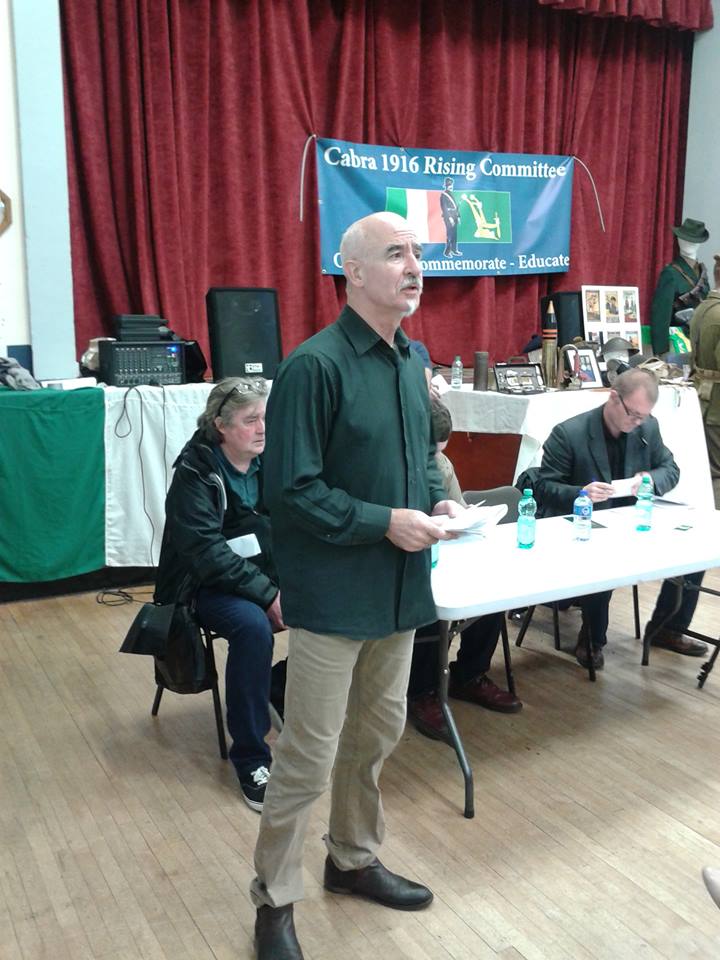
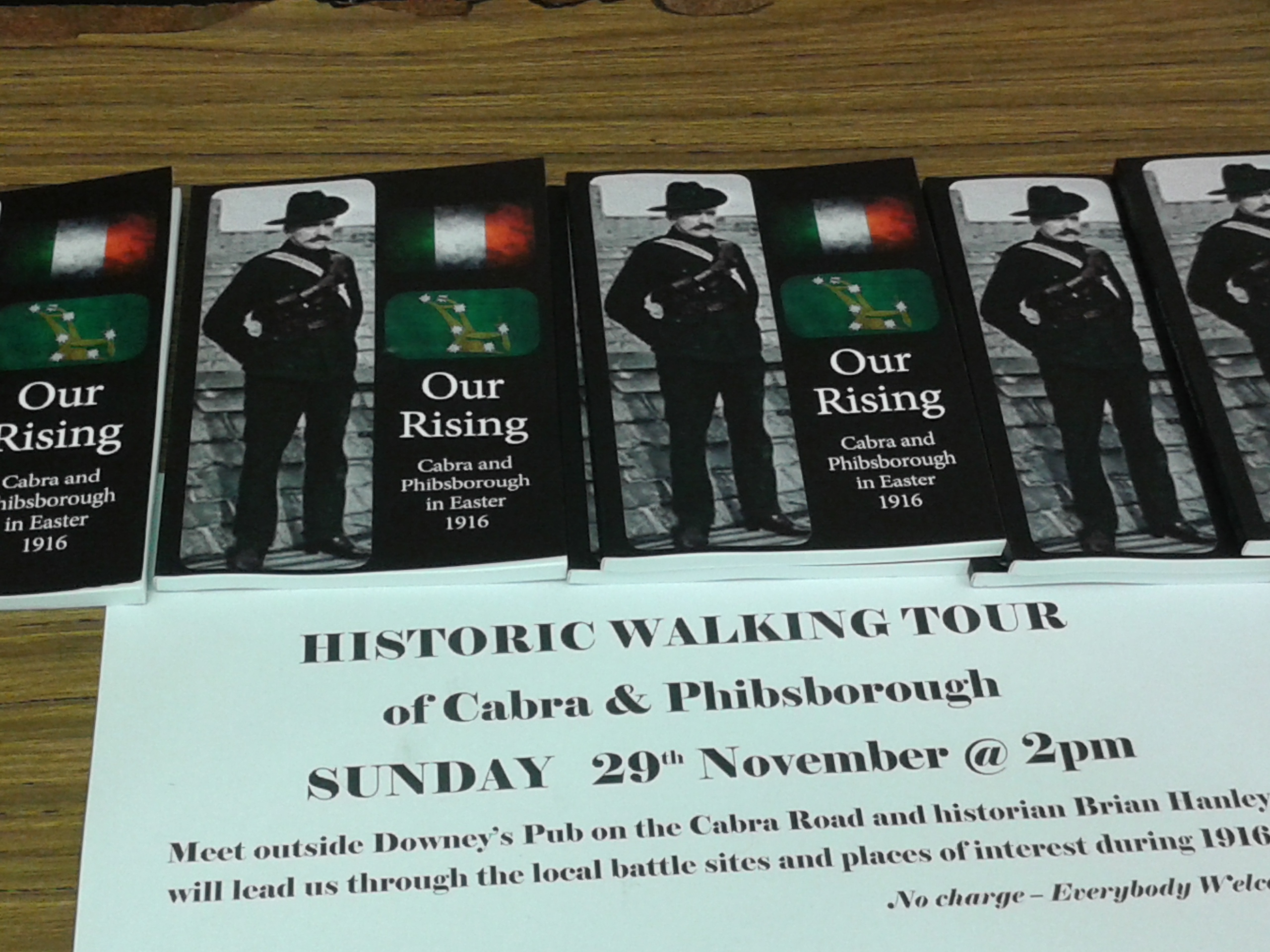
Around a hundred people attended the Cabra 1916 Rising Committee’s exhibition and launch on Saturday (7/11/2015) of their publication Our Rising – Cabra and Phibsborough in Easter 1916.
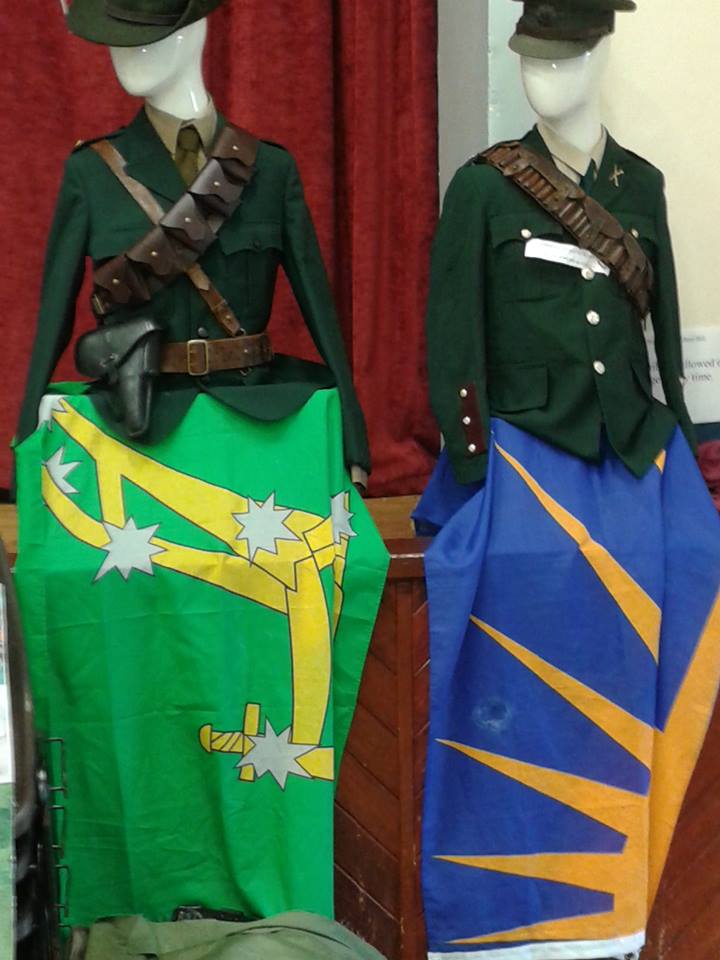
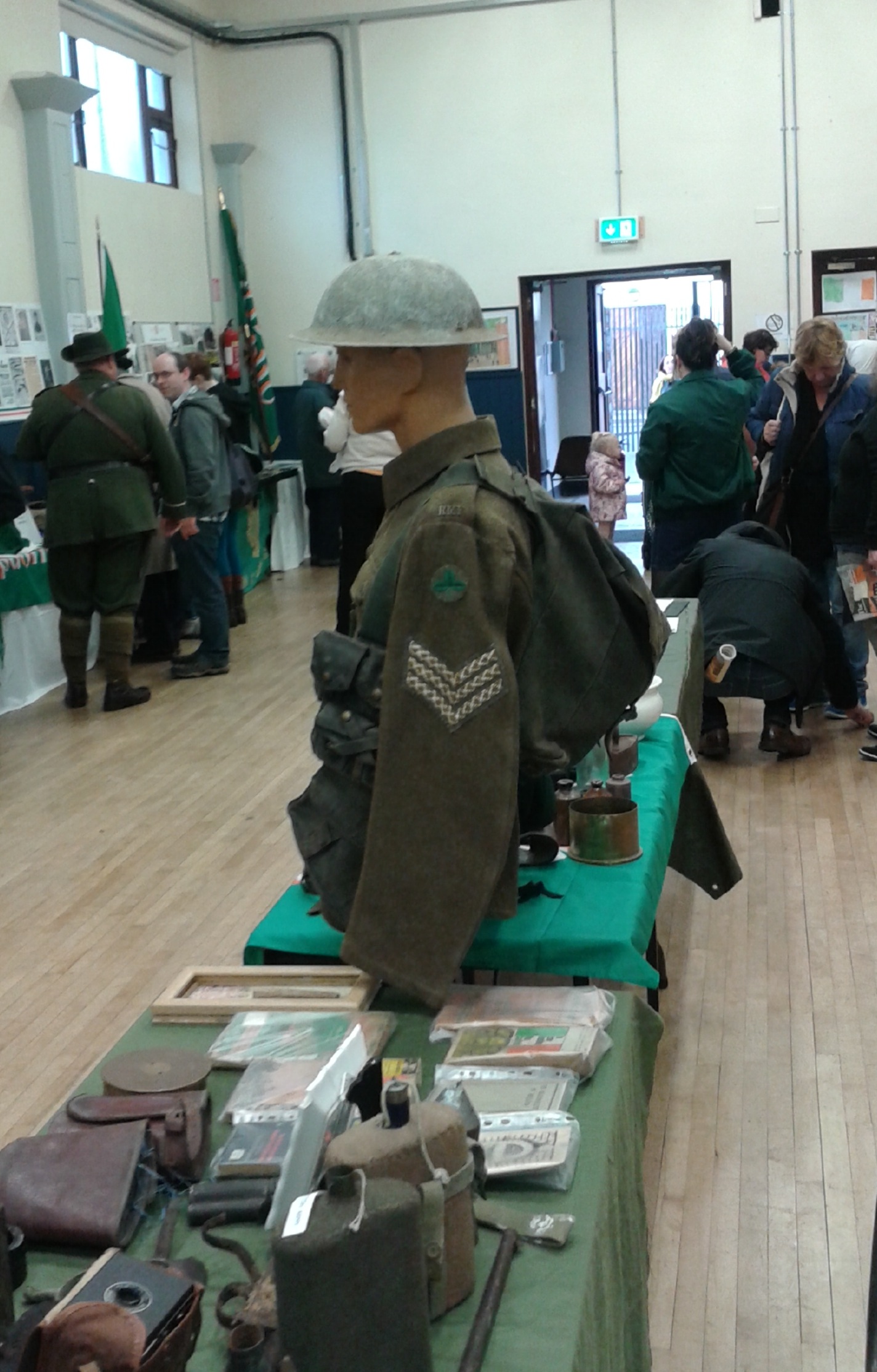
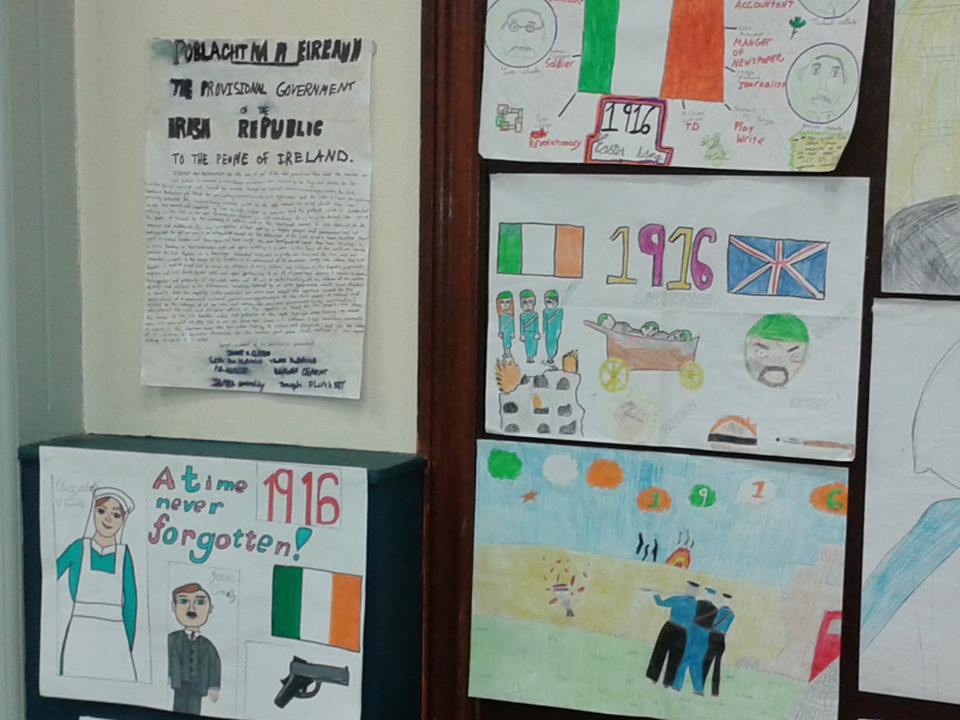
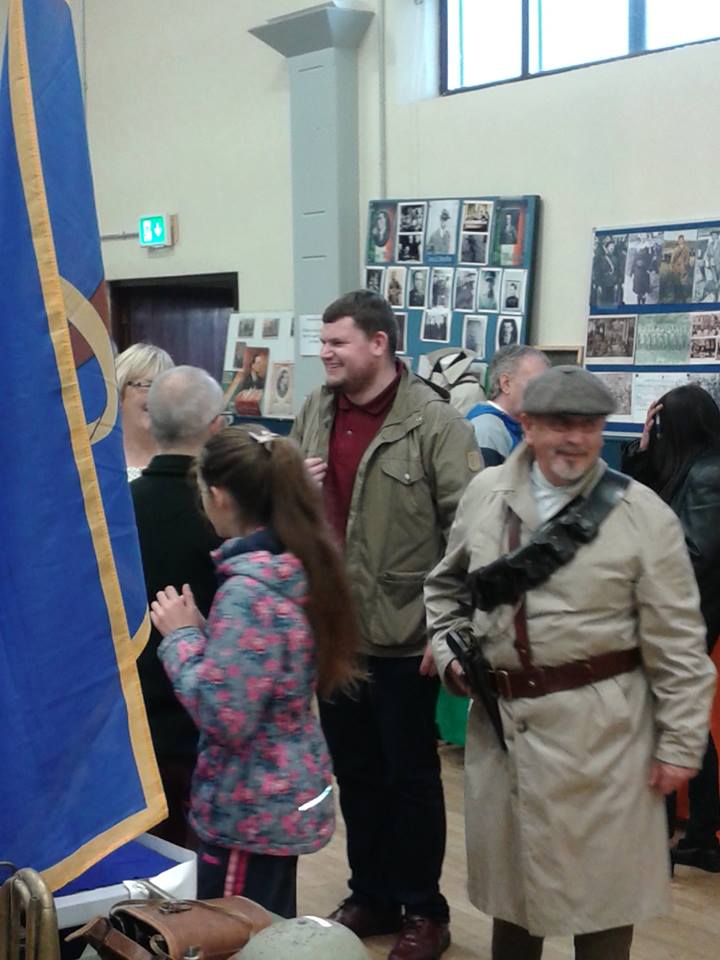
The event took place in the Cabra area itself, in the parish hall of Christ the King church. To accompany the launch, the Irish Volunteers group put on a very interesting display of artifacts from the period, including uniforms and weapons, and provided some personnel also dressed in Irish Volunteer uniforms and IRA typical clothing of the War of Independence period. Along the walls there were many period photos and a wonderful display of schoolchildren’s art on the subject of the 1916 Rising.
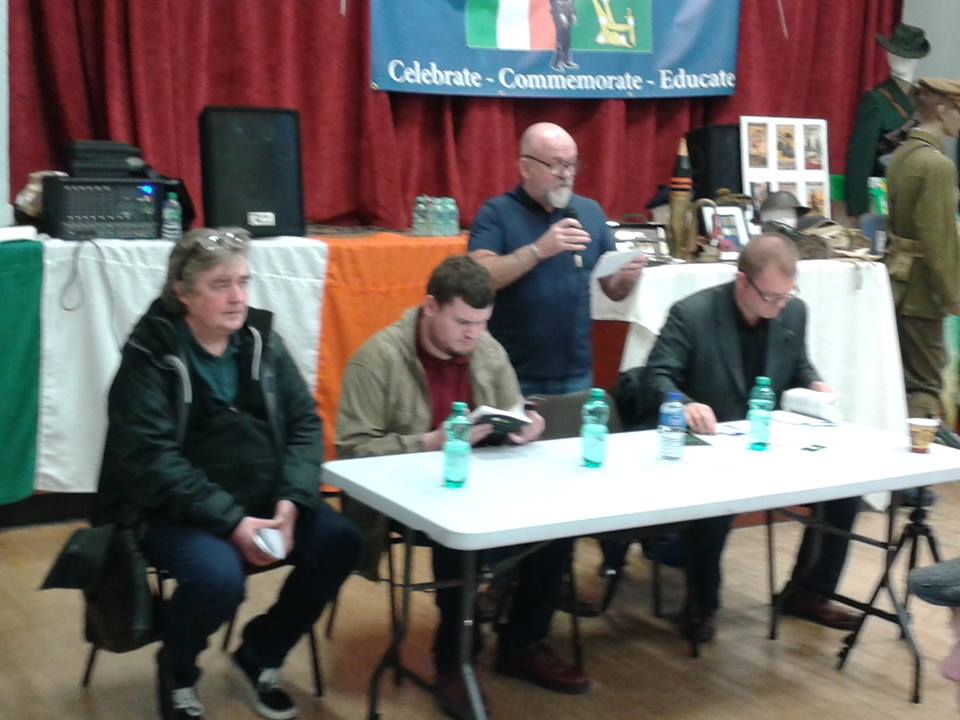
A shot of the attendance at the start of the formal part of the launch (Photo D.Breatnach)Diarmuid Breatnach introducing songs about to sing: “Sergeant William Bailey” by Peadar Kearney (with two additional verses by Breatnach) and “Where Is Our James Connolly?” by Patrick Galvin. (Photo A.Perry)
After some time allowed for people to gather, the MC Éamonn O’Hara called people to order and after they had sat down, gave a brief background to the work of the Cabra 1916 Rising Committee, then outlined the formal part of the book launch to follow. First he introduced singer Diarmuid Breatnach.
Breatnach took the floor and explained that the songs he was going to sing were from or related to the period. “During these years of commemorations,” he said, “we are told that we should remember the First World War. Some people disagree with that but I think it is right; we should remember the War but — not in the way most of those people mean. We should instead remember that hundreds of thousands were sent to murder their class brothers in other lands, sent to their deaths and millions more to injury and tragedy, for the profits of a few.”
Some of the uniforms and flags displayed by Irish Volunteers.org. (Photo D. Breatnach)
“Also, when we are told that we should commemorate the First World War, they don’t mean that we should remember those brave few who dared speak out publicly against the war, who held anti-recruitment rallies or who picketed army recruitment meetings and shouted slogans there. And who paid the price of imprisonment and sometimes even death for doing so.” And yet, Breatnach went on to elaborate, those things too are part of the history of war and to his mind the most important part, since among all the wars of the past and the present, it is that trend that holds out a hope for the future.
Breatnach related that Peadar Kearney was born not far from Phibsborough – in Dorset Street, around the corner from Inisfallen Parade, where Sean O’Casey was reared. When Kearney taught night classes in Irish, O’Casey was one of his pupils.
Among the songs that Kearney wrote was a three-verse song mocking a British Army recruiting sergeant, who apparently had a pitch at Dunphy’s Corner. According to a local historian, that was outside what is now Doyle’s pub, at the Phibsboro crossroads. Breatnach said that he had added two verses of his own composition to that song.
“Of course, the 1916 Rising is a part of the history of the First World War too,” Breatnach continued, “and not only because it took place during that War. For the IRB, undoubtedly, it was a case of ‘England’s difficulty is Ireland’s opportunity’. But for some others, including Connolly, as he made clear a number of times in writing, the Rising was necessary to interrupt the War, to stop the bloodshed of class brother killing class brother across Europe.”
Some of the wonderful children’s artistic impressions of the Rising on display at the launch. (Photo D. Breatnach)
Breatnach pointed out that the Rising in Ireland was one of the most significant internationally against that imperialist war and that it was not until February the following year in Russia that there would be another of such historical importance, to be followed later by the October socialist revolution.
Of the two better-knowns songs about James Connolly, Breatnach said one makes no mention of socialism, the Citizen Army or trade unions and that in his opinion “Where Is Our James Connolly?” is truer to Connolly’s ideology. It was written by Patrick Galvin who was, among other things a writer, playwright, screen writer and singer. Galvin died only four years ago.
Breatnach then went on to perform “Sergeant William Bailey”, followed by “Where Is Our James Connolly?” to audience applause.
The panel of historians at the launch (seated L-R): Hugo McGuinness, Donal Fallon, Brian Hanley. Eamonn O’Hara (standing) was MC. (Photo D. Breatnach)
O’Hara then introduced one of the authors of “Our Rising”, historian Brian Hanley. “Phibsborough was an area with strong revolutionary connections,” pointed out Hanley and went on to list some of the many participants and even leaders of the 1916 Rising and later who lived in the area, including Michael O’Hanrahan, who was one of the executed sixteen.
Hanley said that although it was right of course that those who were executed for their part in the Rising should have a special place in our memories and be written about by historians, it was unfortunate that many other important participants were neglected. Nearly 100 were sentenced to death but most had their sentences commuted. Had they been executed instead, Hanley pointed out, we would have had many biographies of them, their upbringing and domestic arrangements examined, their words pored over ….. instead, we know next to nothing about them except that they participated and what their role was.
Memorabilia of the British Army were there too — and a reminder that initially It was mostly Irish units fighting to suppress the Rising. (Photo D. Breatnach)
The British Army unit responsible for the suppression of insurgent activities and securing of the area was the Royal Dublin Fusiliers; this was in line with the reality of the British Army, Hanley went on to say, an organisation the main purpose of which was to suppress resistance to the British Empire in places like India, Afghanistan and Ireland. The Fusiliers killed three people in the Phibsborough area, two civilians and a Fianna scout.
Pointing out that most of those men and women who went out to fight in 1916 were not poets or dreamers, Hanley refuted the myth of blood sacrifice. Most of those people were ordinary enough, with all the hopes, excitement and fears of ordinary people, Hanley opined: “They went out with high hopes that they were going to win.”
Thanking various bodies that had supported the project, Hanley went on to point out that the book should not be considered all that had to be said on the subject and, while thanking those local people who had contributed stories and information, encouraged any others who had further information or stories, including corrections of what they had written, to get in touch with the society.
Some more of the wonderful children’s artistic impressions of the Rising on display at the launch. (Photo D. Breatnach)
Hanley’s presentation was followed by that of another historian, Dónal Fallon, co-author of Our Rising. “The commemoration of the 1916 Rising is much too important to leave to the Irish Government”, said Fallon, who admitted to being a newcomer to the area, in the community of which he was glad to live. Local history and community groups had a vital part to play in commemorating the important events of this centenary decade, he said, pointing out that we had already had the centenary of the Lockout, next year would be the centenary of the Rising, to be followed by centenaries of the War of Independence and the Civil War, which might be uncomfortable for some people but should not be shirked for all that. Last of the panel to speak was historian Hugo McGuinness who said he was delighted to have contributed the Cathleen Seery-Redmond piece to the book. He laid stress on the importance of local history and people’s stories as the human element of history. McGuinness recalled that when Connolly and some others were planning a commemorative event, a female member of the committee proposed that it would be wonderful to see Connolly in uniform; Hugo commented that he found little stories like that added human charm to the big narrative of historic events. McGuinness strongly recommended people buy a copy.
“Uniform” more typical of IRA man in the War of Independence 1919-1921 or Civil War. But even in 1916, some Volunteers could not afford a uniform. Co-author Donal Fallon centre background. (Photo D. Breatnach)
All the speakers were accorded warm applause. O’Hara thanked the speakers and asked whether there were any questions or comments. There were a few only and, announcing a historical walk to take place on the 29th, for which flyers had been placed on seats, the MC thanked the Irish Volunteers.org group for their display, thanked the audience for their attendance and concluded the formal part of the event. People remained to buy copies of the book and have them signed by the authors, or conversed or wandered among the exhibition for about an hour afterwards.
I WAS INVITED TO SING A COUPLE OF SONGS AT THE LAUNCH OF “OUR RISING – CABRA AND PHIBSBOROUGH IN 1916″. Of course I was honoured to accept; the songs I chose to sing were “Sergeant William Bailey” and “Where Is Our James Connolly?” I chose them as important to the events around the Irish Volunteers and hoped they would be considered appropriate to the book launch event also.
These years are the centenaries of many things in our history and it is right that we should remember them. Among those things we are told that we should remember the First World War. I think the people who say that are right – we should, but not in the way most of those people mean. We should remember that in a dispute about what markets of the world should be dominated by which World powers and which resources they should have a monopoly on stealing, they sent millions to their deaths and millions more to injury and tragedy. And of course, the capitalists, the class that controlled those Powers were not among those dead and injured millions.
When those people tell us that we should commemorate the First World War and collect songs and memorabilia they don’t mean that we should sing songs against the War, collect anti-War leaflets and honour those brave few who dared speak out publicly against the war stampede of their countries. And who paid the price for doing so. And yet those things too are the history of the War and to my mind the parts of that history that, among all the wars of the past and the present, hold out a hope for the future.
Peadar Kearney, author of “The Soldiers’ Song”, “Sgt. William Bailey” and many other songs
Peadar Kearney was an Irish Republican of a Dublin skilled working class background born not far from Phibsborough – in Dorset Street, around the corner from Inisfallen Parade, where Sean O’Casey was reared. When Kearney taught night classes in Irish, O’Casey would be one of his pupils.
Kearney wrote many songs that are still sung today, the most famous of which is the Soldiers’ Song, on which he cooperated with Patrick Heeney, from Railway Street, off Gardiner Street. When the Irish Volunteers was formed in 1913, Kearney was a co-founder and his song was one of a number sung by other Volunteers during the 1916 Rising, in which Kearney also fought.
Peadar Kearney also wrote a three-verse song mocking a recruiting sergeant for the British Army, who apparently had a pitch at Dunphy’s Corner. According to a local historian, that was outside what is now Doyle’s pub, at the Phibsboro crossroads. I added two verses to that song, in order to give Sergeant William Bailey a bit of a background story.
Of course, the 1916 Rising is a part of the history of the First World War too – and not only because it took place during that War. For some, undoubtedly, it was a case of “England’s difficulty is Ireland’s opportunity”. But for some others, including Connolly, as he made clear a number of times in writing, the Rising was necessary to interrupt the War, to stop the bloodshed of class brother killing class brother across Europe.
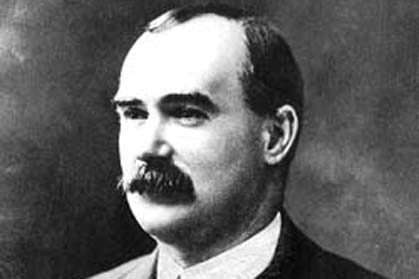
James Connolly, a revolutionary socialist, wanted revolution against world war
Connolly was a revolutionary socialist. At the end of the 19th and very early 20th Centuries, the standard position of the international socialist movement had been against imperialist or colonialist war. In 1912, on November 24–25, the congress of world socialist parties at Basel in Switzerland, including revolutionaries and reformists, had come out clearly against imperialist war. Their manifesto was unanimously adopted at the congress. In the context of the situation created by the war in the Balkans that had begun in October 1912 and the increasing threat of world war, the Basel Manifesto called called for an unrelenting struggle against war and those responsible for it, the ruling classes of the capitalist countries. It stated that that war, if it began, “would create an economic and political crisis,” which should be utilized to “hasten the downfall of the rule of capital.”
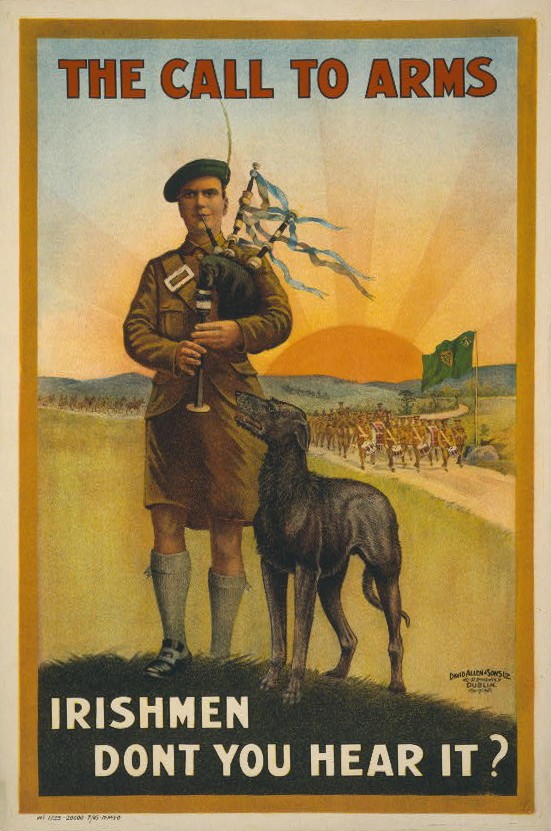
British Army recruitment poster aimed at Irish men
As we know, the leadership of those parties that we now call the social democrats abandoned this position completely and championed their own ruling classes two years later as WWI broke out, cheering the workers of their countries on into uniform, to kill and be killed. There were some uprisings against the capitalists and against war but the first of any significance — and indeed of great significance — was the 1916 Rising in Ireland. The next revolutionary blow to war would not be until be a year later, with revolution in the Russian Empire.
Of the two better-knowns songs about James Connolly, the song “Where Is Our James Connolly?” is I think the best and truer to Connolly’s ideology. It was written by Patrick Galvin who was, among other things a writer, playwright, screen writer and singer. Galvin died only four years ago. Christy Moore remembers learning the song around 1970 which is probably not long after it was written – or at least published.
Patrick Galvin, author of “Where Is Our James Connolly?”














 rebelbreeze