
Diarmuid Breatnach
(Reading time: 9 mins.)
The 1916 Rising is usually seen as a nationalist Rising of Irish Republicans with perhaps some socialist involvement. Even Connolly is often portrayed as a patriot only (see the song James Connolly the Irish Rebel) with socialist views.
Of the six organisations that participated actively in the 1916 Rising1 only one of them was specifically of the Irish working class. Perhaps that’s why the great influence of the working class on the Rising tends to be generally overlooked.
As is well-known, James Connolly is one of the Seven Signatories2 of that wonderful and progressive document, the 1916 Proclamation of Independence. However, Connolly only became part of the planning committee for the Rising a very short time before the scheduled date.3
That is true but we should ask ourselves why they included him at all. The Irish Volunteers had a nationwide organisation with the also nationwide Cumann na mBan as auxiliaries, whereas Connolly could perhaps mobilise a couple of hundred fighters.

It is said he was brought on board because the IRB believed that his constant demand for a Rising during WWI and the military exercises of the Irish Citizen Army indicated that Connolly was likely to lead the ICA to rise on their own and would spoil their schedule.
How likely was he to do that? It’s true that as a socialist Connolly was horrified by the slaughter of war, where workers of one state are sent to kill and be killed by workers4 of another and perusal of his writings do show that he thought an uprising to sabotage war was desperately needed.
Would he have gone ahead alone with the roughly 250 men and women of the Irish Citizen Army, hoping perhaps to inspire a popular upsurge and to encourage the Irish Volunteers to join it, in spite of even their leaders?5 It’s hard to believe so but of course it’s possible.
However, from the moment the Republican planners of the Rising took Connolly on board, we can see a significant organisational shift towards the working class in Dublin and nowhere more so than around Liberty Hall, where the first flag for an uprising was hoisted and the Proclamation printed.
Liberty Hall was of course the headquarters of the Irish Transport & General Workers’ union,of which James Connolly was the leader at that time and also editor of its newspaper,The Irish Worker.
And for a person brought in to the planning so recently, how extraordinary that Connolly was given the rank of Commandant General! A responsibility he took seriously, sending couriers around the country and attempting to direct defence preparations around the various Dublin garrisons.
The first battle flag of the Rising
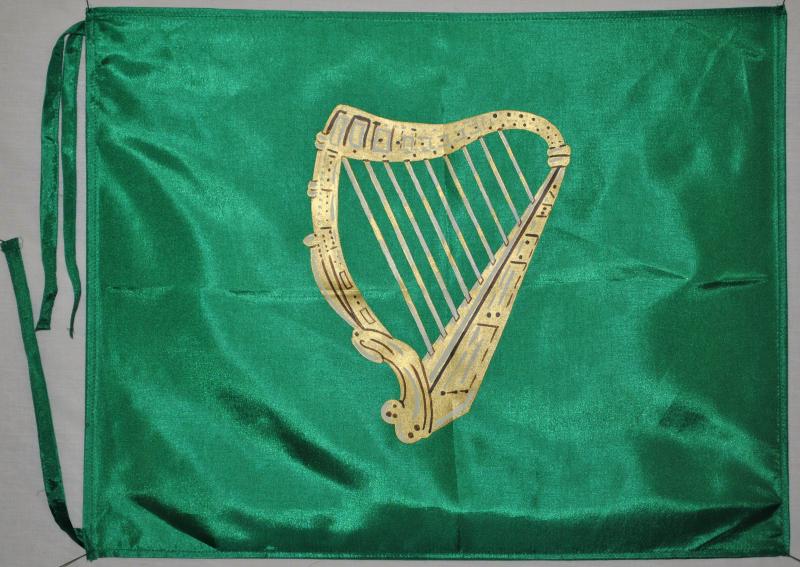
A week before the Rising Connolly and the Irish Citizen Army had an Irish Republican flag raised above Liberty Hall as a flag of war and the one chosen to do the raising was a girl of 16 years, Molly O’Reilly.6
The associated circumstances are worth retelling, if only to illustrate the difference between the Liberty Hall of then and today. Adults took classes in Irish language and cultural activities there while their children and those of union activists waited for their parents, took dancing classes or played.
In playing, Molly O’Reilly accidentally broke a window and in terror and shame, ran home.
When Connolly sent a message to her home that he wanted to see her, she went to Liberty Hall expecting a severe telling off. Instead he told her not to worry and what he was asking of her. She was proud to do it but so small she had to stand on a chair to pull the cord raising the flag.


Of course we know that flag was not of the revolutionary workers but instead the harp on green which was that of the early Fenians and was very similar to that of the United Irishmen, the first revolutionary Irish Republican organisation.7
Those early Fenians were mostly composed of working class members and their 1867 proclamation to the world was largely proletarian in outlook. In Britain, the Fenians formed part of the First International Workingmen’s Association which was led by Marx and Engels.
Their flag was flown over at least one of the 1916 Rising garrisons, I believe at theJameson Distillery in Marrowbone Lane.
The other flags of the Rising included the Tricolour, presented to the Irish Republicans of the ‘Young Irelanders’ by women in revolutionary Paris in 1848, which was one of two flown on the roof of the GPO, the headquarters of the Rising.
Sharing the GPO roof with the Tricolour was the flag made only days before from domestic material and painted with the words “Irish Republic” in the house of Constance Markievicz, an officer in the Irish Citizen Army, shortly before the Rising.
The Irish Citizen Army’s own flag, the Starry Plough, flew over the Clery’s building facing the GPO. Sadly today most Irish people do not know that flag, though awareness of it and its background is growing among the indigenous Irish and the migrant community.

The first workers’ army in the world8
The Irish Citizen Army was formed as a workers’ militia during the great Lockout and strike of 1913-1914, to defend against the attacks of the police, the physical repressive front line of the capitalist class; the ICA’s flag was placed above Murphy’s Imperial Hotel in Clery’s.9

Though its constitution was more nationalist than socialist, the ICA was in its membership and purpose the first workers’ army in the world and when reorganised a few years later, represented also working class feminism, recruiting women, some of whom were officers commanding men.
Once the preparations for the Rising were in tatters with MacNeil’s countermanding order, where did organisers gather to discuss what to do? In Liberty Hall, the building of the Irish Transport and General Workers Union and it was there that the decision to rise on Monday instead was taken.
It is hard to overstate the importance of the fact that the decision to go ahead with insurrection was taken in the building which had become de facto the HQ of the revolutionary working class in Dublin, with an illegal flag of rebellion flying and where the Proclamation was to be printed.
The writing and text of the Proclamation
The wording of the Proclamation is thought largely composed by Pearse but influenced by Connolly, including its address to “Irish men and Irish women” and perhaps “We declare the right of the people of Ireland to the ownership of Ireland, and to the unfettered control of Irish destinies”.
Another section which could bear Connolly’s fingerprint reads: The Republic guarantees religious and civil liberty, equal rights and equal opportunities to all its citizens, and declares its resolve to pursue the happiness and prosperity of the whole nation and of all its parts, cherishing all the children of the nation equally.
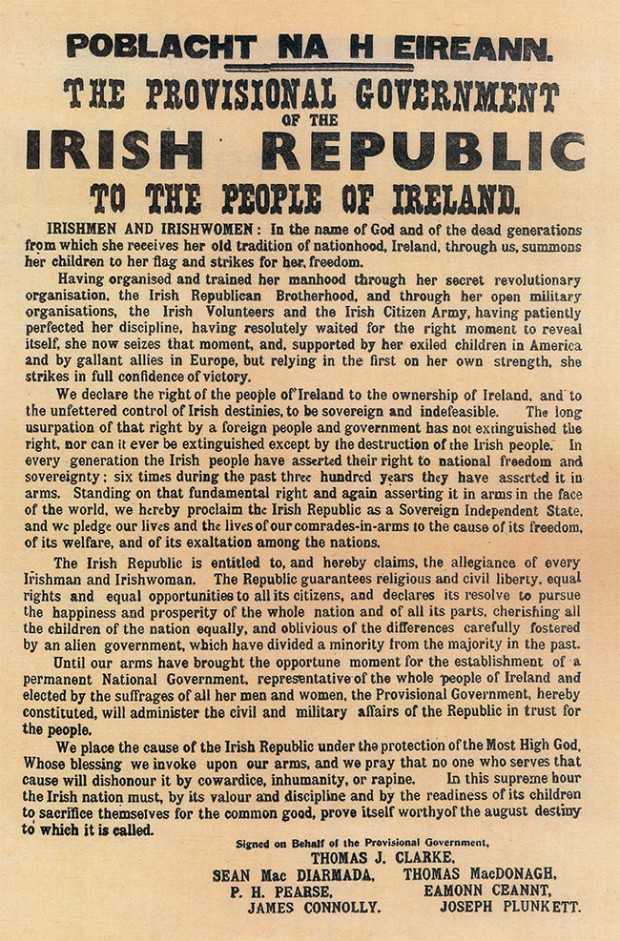
But, whoever composed or influenced the Proclamation text, it was printed in Liberty Hall. An Irish Citizen Army member went to Stafford Street (Wolfe Tone St. today) to borrow the print type from a printer there to bring back to Liberty Hall, which was under daily 24-hour armed guard.
Having printed the Proclamation in Liberty Hall under armed guard and having decided there to rise on Easter Monday, where did the assault groups for Stephens Green, Castle and the GPO, including the Headquarters Battalion, meet on the morning of the Rising? …. Again, at Liberty Hall.
An early non-combatant casualty of the Rising was Ernest Kavanagh,10 who drew cartoons for the newspaper of the ITGWU, The Irish Worker. For some reason he went to Liberty Hall on Tuesday and was shot dead on the steps of the union building, presumably by a British Army sniper.
The working class in armed resistance
Once the Rising was in motion, the Irish Citizen Army had primary responsibility for two areas, the Stephens Green/ College of Surgeons garrison and the Dublin Castle/ City Hall garrison but also fought in other areas, for example on Annesley Bridge and in the GPO/ Moore Street area.
All who fought alongside them commented on their courage and discipline. After the surrender, many, along with Irish Volunteers were sentenced to death, most being commuted to life imprisonment. But two leaders of the Irish Citizen Army were shot by firing squad.
One of the areas from which the British forces were sniped at for days after the Rising was the docks area, then predominantly surrounded by working class residential areas.
A question we should ask ourselves is why the forces coming from Britain to suppress the Rising landed at Dún Laoghaire, from where they had to march nearly 12 km (approaching eight miles) to Dublin city centre, instead of at the excellent Dublin docks on the Liffey.
Hugo McGuinness, who specialises in history of the North Wall area, believes that the British expected Dublin to be in the hands of the working class resistance and that it was simply too dangerous to land British troops there, though gunboats could fire from the Liffey.
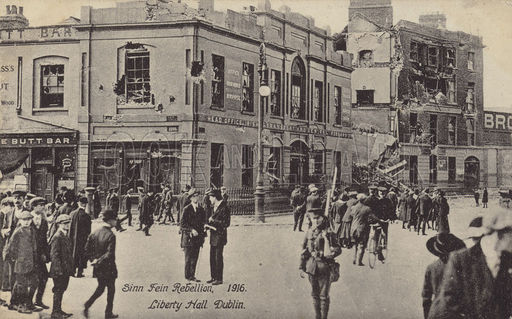
Certainly, the British believed Liberty Hall and buildings along Eden Quay were occupied as fighting posts by the Irish Citizen Army and they fired artillery at the union building from Tara Street, as photos of shell holes in that building and right through to the next testify.

Much is made in some historical accounts of the opposition to the Rising from sections of the Dublin population, during and immediately after the Rising. The city was the capital of a British colony, only just over a century earlier spoken of as “the second city of the British Empire”.
A substantial proportion of the wealthy and middle classes were Loyalist, including some Catholics; even ‘nationalist’ sections were committed to supporting the UK in WWI and John Redmond, leader of the ‘nationalist’ political party had openly recruited for the British Army.
Also, among the working class and the lumpen elements, many were depending on “Separation Allowances” with regard to males serving in the British Army. It is true that the insurgents in some places had to threaten, club or even shoot some civilians who tried to obstruct the Rising.11
These incidents during the Rising were not many but afterwards there were insults and other things thrown at prisoners being marched to imprisonment (or firing squad). The city was under martial law but even so a Canadian journalist reported the insurgents being cheered in working class areas.
There were also other individual witness accounts, such as a man on a tram saluting prisoners in Parnell Street until threatened by soldier escorts and a firefighter in the GPO doing likewise. A year later most of even the earlier hostility had changed to admiration and pride in the fighters.
Leadership of the working class
James Connolly wrote and said many things of importance but surely, with regard to the struggle for Irish national independence, the greatest of these was: “Only the Irish working class remains as the incorruptible inheritors of the fight for freedom in Ireland.”
By that he meant — and I agree — that all other social classes can gain something from selling out the interests and resources of Irish nationhood but that the working class can gain nothing from that.
The Irish working class staked their claim on the struggle for Irish independence in 1916 but have not succeeded in leading it and because of that, that struggle remains to be won.
Today and in other days, remembering that long struggle and the class whose leadership revolutionary socialists seek to represent and to uphold, we declare the need for that leadership over a broad front of all others who wish to struggle to advance.
In doing so, we declare that far from the working class having to wait for socialism, in the course of national struggle it must also shape its own demands around the economy, natural resources, infrastructure, social services, social questions, culture and, above all, to the fruits of its labour.
End.
FOOTNOTES
1Irish Republican Brotherhood, Irish Volunteers, Irish Citizen Army, Cumann na mBan, Na Fianna Éireann, Hibernian Rifles.
2All of which were executed by British firing squad, along with another seven in Dublin and yet another in Cork. The 16th execution was by hanging in London.
3(See Sources: Cooption of James Connolly etc) Connolly was a lifelong socialist and a revolutionary throughout his adult life, author, historian, journalist, song-writer, trade union organiser; active politically in Scotland, Ireland, New York and back in Ireland.
4The international socialist movement viewed the imperialists’ movement towards war with horror and in international conferences vowed to oppose it with all their might, including turning war resistance into revolution (“War against war”). However, once imperialist war was declared that resolve collapsed in most states, Russia, Germany and Ireland being notable exceptions and each saw a rising against war, in Ireland’s being the first.
5Joseph E.A. O’Connell (Jnr.) suggests a possible intention of goading of the State into attacking him and the ICA which might spark the general rising.
6(See Sources)
7The harp on the United Men’s flag was more ornate and was inscribed with the words “It is newly-strung and shall be heard”.
8https://www.connollybooks.org/product/irishcitizenarmy
9It was a good central location but more than that – the Hotel was one of the businesses of William Martin Murphy, chief organiser of the employers’ bloc to break the Irish Transport & General Workers’ Union.
10Kavanagh was a supporter of the workers, of votes for women and against participation in the imperialist war, contributing cartoons also to the Irish Citizen, Fianna and Irish Freedom publications, also to accompany poems of his sister, Maeve Cavanagh McDowell.
11I do not include in this the three members of the Dublin Metropolitan Police who were a force for the British occupation and also for the Dublin capitalists. The Irish Citizen Army in particular had good reason to settle accounts with them for attacks on them including inflicting mortal baton injuries on two workers during a charge on a union meeting on 30th September 1913 on Eden Quay and beating people and smashing up furniture in Corporation Street a little later.
SOURCES
Co-option of James Connolly to the Military Council planning the Rising: https://www.historyireland.com/connollys-kidnapping/
Raising the flag on Liberty Hall: https://microsites.museum.ie/1916objectstories/ObjectDetail/remains-of-irish-flag
Molly O’Reilly breaking a window incident: https://www.independent.ie/irish-news/ladies-day-for-1916-heroines/26528456.html
Printing of the Proclamation of Independence: https://libguides.ucc.ie/1916Proclamation
https://www.dublincity.ie/library/blog/printing-1916-proclamation-transcript
Decision taken to go ahead with the Rising on Easter Monday: https://www.irishtimes.com/culture/heritage/easter-rising-uneasy-calm-before-the-storm-1.2575638
https://www.nli.ie/1916/exhibition/en/content/risingsites/libertyhall/
“Only the Irish working class remains the incorruptible heirs …” (end second sentence from last): https://www.marxists.org/archive/connolly/1910/lih/foreword.htm
 rebelbreeze