Revolutionary socialist & anti-imperialist; Rebel Breeze publishes material within this spectrum and may or may not agree with all or part of any particular contribution. Writing English, Irish and Spanish, about politics, culture, nature.
The returning officer, Ríona Ní Fhlanghaile, has declared that the 26-County state has voted in the Referedum IN FAVOUR OF INSERTING A CLAUSE IN THE CONSTITUTION THAT PERMITS COUPLES OF EITHER GENDER TO MARRY by 1,201,607 votes to 734,300. That’s 62.1% yes to 37.9% no. The total turnout was 60.5% which is higher than in some other Irish referenda. The “Yes” vote exceeded the “No” in every county in the state except in Roscommon, where the vote was close. The “Yes” vote was significantly higher in all other counties and generally across rural and urban areas too.
The vote in favour is not surprising given that all the main political parties, as well as Sinn Fein and Left parties were all advocating a “Yes” vote. However, on its own that does not explain the wide gap between the two positions and the high turnout, especially in the face of the Irish Catholic Church hierarchy’s position against legalisation of same-sex marriage. It is hard not to see this as to some extent a conscious decision to oppose or ignore the Church’s position and to take a stand in favour of equality and civil rights.
When the votes are counted after today, we will either have a new clause inserted into our Bunreacht (Constitution) or we will not. If we do not, many of the “Vote Yes” campaign and opinion will be despondent. The revolutionaries among them should not be so but should instead reflect on their weakness as a force and on how to make that force stronger.
Should the vote result in a change in the Constitution, it will be probably the biggest blow so far to the power of the Catholic Church in lay society, a power it has enjoyed and abused even before 1921 but certainly since. Some, on both sides of the question, will see it as a blow against the Catholic religion itself but that is not necessarily so. Christianity and its Catholic variant survived and even thrived without State support in the past – indeed when its followers were discriminated against in every conceivable way by State power, a situation its faithful endured for centuries in Ireland as a whole and continue to do today, to a lesser extent, in the Six Counties.
What is the issue upon which we were being called to vote today? Although the NO campaign has tried to make us think it is, it is clearly not about whether two-gender households are better for raising children, whether surrogate birthing is right or wrong. It is not about whether we approve or homosexuality or not – although I suspect that is the real issue at base with many of the NO campaigners. In fact, it seems to me that it would be quite possible to disapprove of homosexuality and still to vote “Tá”, a question I will return to later. This might seem illogical, until we examine the actual issue upon which we are voting: do we agree with inserting a clause into the Bunreacht (Constitution) which states that a couple has a right to marryregardless of gender.
Presented with this question, which is a legal and Constitutional one, a number of issues arise, I think.
What does the Bunreacht say at the moment about this question?
What right has the State to define anything about sexual relationships?
Are we in favour of equal civil rights for people?
1. It may come as a surprise to people that our Bunreacht, our Constitution, currently says nothing about the gender issue in marriage. There is nothing actually in our Bunreacht to prevent same-sex marriage. But the prohibition does exist in law. In other words, legislators at some point decided to propose and pass a law which confined the right (and rite) of marriage to heterosexual couples alone. Why did they do so if it was not an issue at that time? It seems to me that they were aware that same sex relationships did exist and strove to exclude those people from the rights enjoyed by others. This was the point of a number of other pieces of legislation against homosexuality which were not finally overturned until 1993 in this State (1982 in the Six Counties, 1980 in Scotland, 1967 in England and Wales) – five years after the European Court of Human Rights ruled that this state’s laws against male homosexual acts violated human rights.
According to the Catholic Church (and most other churches), despite the current legal situation with regard to homosexuality at the moment, it is still wrong. Well, the Catholic Church – and before them the established Anglican Church of Ireland – can have their views but they are not entitled, nor is any other church, to impose those on lay society, neither by legislation nor by other means. They are, of course, entitled to express their opinion – just like any other organisation.
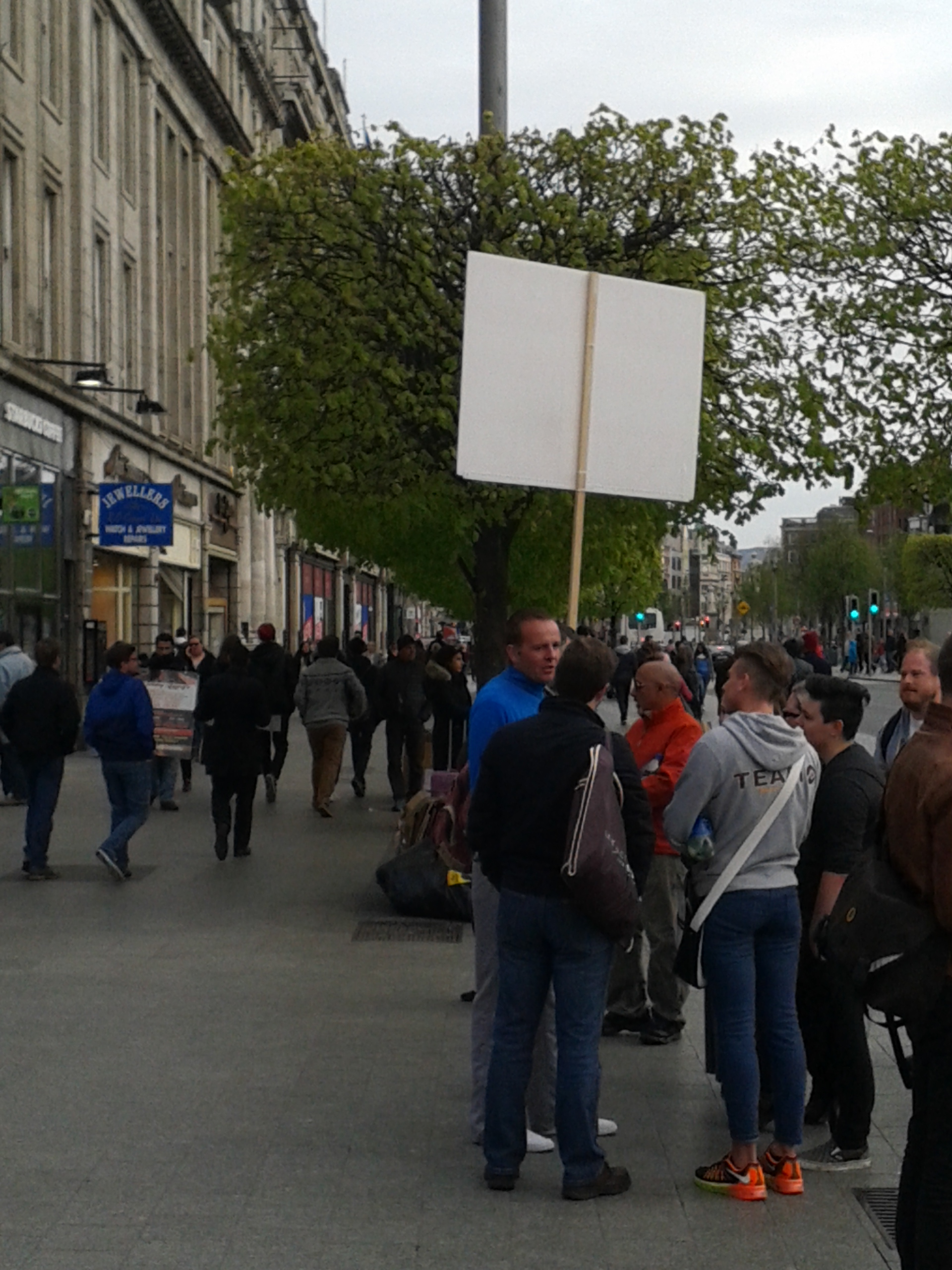
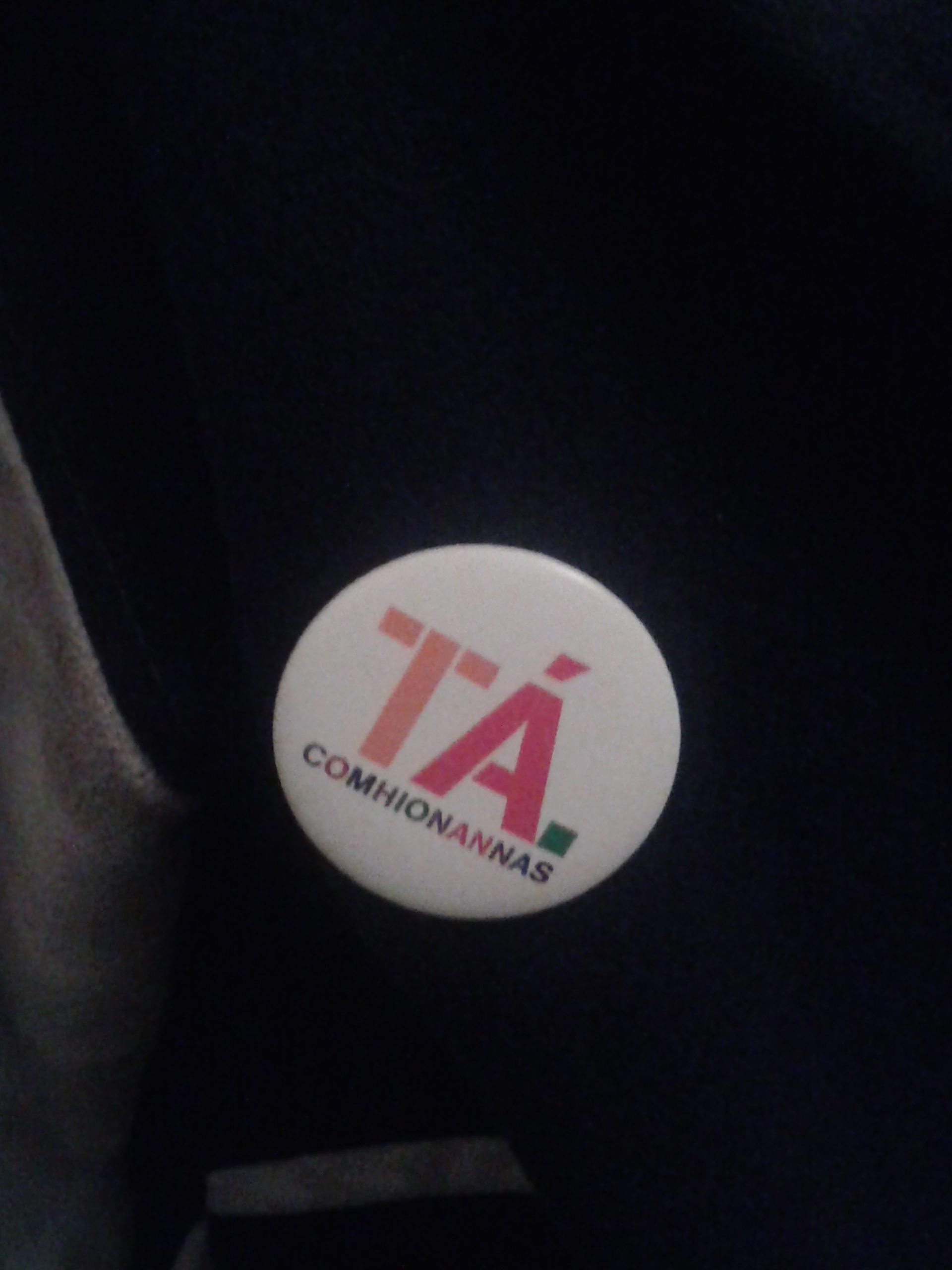
“God and Nature say NO” was the caption on this placard paraded in O’Connell St. near the Spire, some weeks prior to the Referendum. Some young people are arguing with the placard-holder.One of the many badges worn in support of a vote to insert the clause into the Irish Constitution. There was also an English-language one and each were to be seen nearly everywhere in public in the weeks prior to the Referendum.
So, going back to the beginning of the legal status of heterosexual marriage within our current legal system, it was introduced as an excluding measure, at a time when male homosexuality was illegal and subject to heavy punishment and when lesbianism was frowned upon (though not actually illegal for complicated reasons). In other words, a law excluding a group of people was passed at a time when any man who declared himself to be one of those people was subject to prison sentence and any woman who did so was subject to extreme opprobrium in society. What chance was there for their point of view to be represented? In the absence of such representation and informed opinion-making, how can any democrat defend the laws passed at that time?
2. Turning now to the question of what right the State has to make a ruling of any kind upon a sexual relationship between any two people, of either gender, it must be difficult indeed for anyone to justify that without recourse to church canon or prejudice. Those who do so tend to bring up questions of childcare, inheritance and taxation – in fact just about the same questions that were brought up in the Irish referendum on divorce in 1995. But childcare, or at least the financial aspect of it, can be regulated by the State without any interference whatsoever in the sexual relationship between the parents. Whether it does so fairly at the moment is another question which has no bearing on the concept. And inheritance – ignoring for a moment whether we agree with a political economy where land and other wealth may be appropriated by individuals or families and then legally handed on through their following generations — can also be managed without recourse to State regulation of marriage. Taxation, similarly. Were we to have a socialist society, one based on other principles than that which we now have, even those current excuses for state interference should no longer be even a consideration. In fact, it is difficult to see any reason why even now the State continues to have a role in the formalisation of a sexual contract between two individuals or, indeed, in its dissolution, except perhaps in ensuring fair divisions of belongings.
3. Those opposed to insertion of the new clause into the Bunreacht have done so from a number of perspectives of opposition: to lesbianism and homosexuality on religious or other grounds; to formalising same sex relationships; to the alleged undermining of the “sanctity of marriage” or of “romance”; in opposition to surrogate child-bearing and raising of children by gay and lesbian parents ….
Those supporting the new clause have defended the naturally-occurring continuum of sexual preference; maintained that the “sanctity of marriage” will be the same between same-sex couples, as will “romance”; denied that it opens the way to or encourages surrogate child-bearing and raising of children within a gay or lesbian household ….
Who is right and who is wrong? There is no doubt that as long as cultural beliefs and practices have been recorded, homosexuality and lesbianism have existed within societies — sometimes tolerated, often repressed, on rare occasions celebrated. We see homosexuality occurring too among animals. If there is such a thing as “sanctity of marriage” and “romance”, why should same-sex couples have any less of it than heterosexuals? Surrogate child-bearing is already possible and the hugely unequal distribution of wealth in our society – and between even our society and many others – ensures it can and will continue while the rewards are financial. Raising of children within a same-sex household is already happening, even without surrogacy. It is more difficult for gay men at present, but in the case of a gay man having custody of his children through widowhood (yes, some gay men do marry women), or the mother deserting the children or being deemed unfit by a court to have custody, a gay man may bring up his children within a homosexual parent household.
But will this change in the Constitution (and therefore also in the law) make surrogacy and child-rearing by gay couples more likely to happen? Will it increase the frequency of its occurrence? I think the answer to that, logically, must be yes – despite all the denials of the “Vote Yes” camp. And I think some of them must know that. Slowly perhaps and who knows by how much – but logically it must tend to increase the chances. But is that so awful? I find the idea of surrogacy in general distasteful but isn’t that just a prejudiced reaction? Probably. Will children reared by same-sex parents experience uncertainty about their own sexuality? Some will probably and some won’t. And if they do, why should they not be able to resolve that in time – as children reared in heterosexual relationships also find themselves having to do? Is uncertainty about sexuality such a terrible thing? In a judgmental, prohibitive and penalising society, it can be – so let’s create a society that is the opposite.
However, I have to say that I think all those questions and considerations are beside the point. If marriage is to be a legal status, then it is a civil right for everyone who is at the age of consent (and of sufficient mental ability to know to what they are consenting — in so much as any one of us was or does!). The right to same-sex marriage, as a civil right, should be supported even by people who do not approve of homosexuality, or marriage, or surrogacy, of child-rearing in a homosexual household. As for myself, someone who seeks revolutionary social, economic and political change, who wishes to see the overthrow of this State, a revolutionary as opposed to a reformist, I must nevertheless support reforms that extend civil rights, even when not led from below …. and so I voted “TÁ”.
Politics is about the present and the future, obviously … but it is also about the past.
Different political interests interpret and/or represent the past in different ways, emphasising or understating different events or aspects or even ignoring or suppressing them entirely. There is choice exercised in whom (and even what particular pronouncement) to quote and upon what other material to rely. And by “political interests” I mean not only groups, formal (such as political parties) or informal, but also individuals. Each individual is political in some way, having opinions about some aspects of questions that are political or at least partly-political. For example, one often hears individuals say today that they have no interest in politics, yet express strong opinions of one kind or another about the right to gay and lesbian marriage, the influence of the Catholic Church, and how the country is being run by Governments.
So when an individual writes a history book, there are going to be political interpretations, although not all writers admit to their political position, their prejudices or leanings, in advance or even in the course of their writing. One historian who does so is Padraig Yeates, author of a number of historical books: Lockout –Dublin 1913 (a work unlikely to be ever equalled on the subject of the title), A City In Wartime — 1914-1919, A City in Turmoil – 1919-1921and his latest, A City in Civil War – Dublin 1921-’24. The latter was launched on Tuesday of this week, 12th May and therefore much too early for people for who did not receive an earlier copy to review it. So it is not on the book that I am commenting here but rather on the speeches during the launch, which were laden with overtly political references to the past and to the present. If a review is what you wanted, this would be an appropriate moment to stop reading and exit – and no hard feelings.
The launch had originally been intended to take place at the new address at 17 D’Olier Street, D2, of Books Upstairs. However the interest indicated in attending was so great that Padraig Yeates, realising that the venue was going to be too small, went searching for a larger one. Having regard to how short a time he then had to find one and with his SIPTU connections, Liberty Hall would have been an obvious choice. Whether he had earlier been asked to speak at the launch I do not know but, having approached Jack O’Connor personally to obtain the use of Liberty Hall, in the latter’s role of President of SIPTU, the owners of that much-underused theatre building, it was inevitable too that O’Connor would be asked to speak and act as the MC for the event.
O’Connor’s introduction was perhaps of medium length as these things go. He talked about the author’s work in trade unions, as a journalist and as an author of books about history. O’Connor’s speech however contained much political comment. Speaking of the period of the Civil War (1919-1923), he said it had “formed what we have become as a people”. That is a statement which is of dubious accuracy or, at very least, is open to a number of conflicting interpretations. The Civil War, in which the colonialism-compromising Irish capitalist class defeated the anti-colonial elements of the nationalist or republican movement, formed what the State has become – not the people. The distinction between State and People is an essential one in our history and no less so in Ireland today.
Talking about the State that had been created in 1921 (and not mentioning once the creation of the other statelet, the Six Counties) and referring to the fact that alone among European nations, our population had not risen during most of the 20th Century and remained lower than it had been up to nearly the mid-Nineteenth, a state of affairs due to constant emigration, O’Connor laid the blame on the 26-County State and in passing, on the capitalist class which it served. He was undoubtedly correct in blaming the State for its failure to create an economic and social environment which would stop or slow down the rate of emigration – but he did not explain why it was in the interests of the capitalists ruling the state to do so. Nor did he refer to the cause of the original drastic reduction in Ireland’s population and the start of a tradition of emigration – the Great Hunger 1845-’49.
The Great Hunger memorial on Dublin’s Custom House Quay. The Great Hunger and its immediate aftermath initiated mass Irish emigration.
Even allowing for the fact that O’Connor wished to focus on the responsibility of the 26-County State, the Great Hunger was surely worthy of some mention in the context of Irish population decline. Just a little eastward along the docks from Liberty Hall is the memorial to that start of mass Irish emigration. It was the colonial oppression of the Irish people which had created the conditions in which the organism Phytophthora infestans could create such devastation, such that in much less than a decade, Ireland lost between 20% and 25% of its population, due to death by starvation and attendant disease and due also to emigration (not forgetting that many people emigrating died prematurely too, on the journey, upon reaching their destination and subsequently). Phytophthora devastated potato crops in the USA in 1843 and spread throughout Europe thereafter, without however causing such a human disaster as it did in Ireland. In Mitchell’s famous words: “The Almighty, indeed, sent the potato blight, but the English created the famine.” And that is what makes that period of population decline uncomfortable for some historical commentators.
Indeed, O’Connor did not mention British colonialism once, nor Partition, nor imperialism. And nor did either of the other two speakers, nor the author. I remarked on this to an Irish Republican present, to which he responded with a rhetorical question: “Did you expect them to?” Well, yes, perhaps naively, I did. While not expecting an Irish Republican analysis from Padraig Yeates and perhaps not either from anyone he would consider appropriate to speak at the launch of one of his books, dammit, we are talking about history. The presence of Norman/English/British Colonialism for 800 years prior to the creation of the Irish Free State, and its influence on that state’s creation and on subsequent events in Ireland, is worthy of at least a mention in launching a book about the Civil War. Not to mention its continuing occupation of one-fifth of the nation’s territory.
Colonialism and Imperialism and, in particular, the Irish experience of the British variant, were not so much ‘the elephant in the room‘ at the launch as a veritable herd of pachyderms. They overshadowed us at the launch and crowded around us, we could hear them breathing and smell their urine and excreta – but no-one mentioned them. The date of the launch was the anniversary of the execution of James Connolly 99 years ago, a man whom the Labour Party claims as its founder (correctly historically, if not politically), a former General Secretary of the ITGWU, forerunner of SIPTU and the HQ building of which, Liberty Hall, was a forerunner too of the very building in which the launch was taking place. His name and the anniversary was referred to once, though not by O’Connor, without a mention of Sean Mac Diarmada, executed in the same place on the same day. And most significantly of all, no mention of who had Connolly shot and under which authority.
That circumspection, that avoidance, meant that a leader of Dublin capitalists, William Martin Murphy, could not be mentioned with regard to Connolly’s death either — i.e. his post-Rising editorial in the Irish Independent calling for the execution of the insurgents’ leaders. But of course he did get a mention, or at least the class alliance he led in 1913 did, in a bid to smash the ITGWU, then under the leadership of Larkin and Connolly. This struggle, according to O’Connor and, it must be said also to Padraig Yeates, was the real defining struggle of the early years of the 20th Century, not the 1916 Rising, the War of Independence nor yet the Irish Civil War. It was in 1913 that “the wrong side won”.
One-eyed as that historical vision must be, we have to question whether it is even partially correct. The Lockout was a great defeat for the ITGWU and for the leading elements in the Irish workers’ movement. But the Lockout did not break the trade union and, in fact, it later began to grow in membership and in branches. Other trade unions also survived and some expanded. So in what manner was 1913 decisive in ensuring that “the wrong side won” in later years? The Irish trade union movement was still able to organise a general strike against conscription in April 1918 and the class to organise a wave of occupations of workplaces in April 1919.
True, the Irish working class had lost one of its foremost theoreticians and propagandists by then, in the person of James Connolly. And who was it who had him shot? Not Murphy (though he’d have had no hesitation in doing so) nor the rest of the Irish capitalist class. In fact, worried about the longer-term outcome, the political representatives of the Irish ‘nationalist‘ capitalist class for so long, the Irish Parliamentary Party, right at the outset and throughout, desperately called for the executions to halt. General Maxwell, with the support of British Prime Minister Asquith, ordered and confirmed the executions of Connolly and Mallin of the Irish Citizen Army and British Army personnel pulled the triggers; in essence it was British colonialism that executed them, along with the other fourteen.
For the leaders of the Labour Party and of some of the trade unions, and for some authors, Padraig Yeates among them, the participation of Connolly and the Irish Citizen Army in the Rising was an aberration. For these social democrats, the struggle should have been against the Irish capitalist class only (and preferably by an unarmed working class). It is an inconvenient fact that Ireland was under colonial occupation of a state that had strangled much of the nation’s economic potential (and therefore of the growth of the working class) in support of the interests of the British capitalist class. It is an inconvenient fact that the Irish capitalist class had been divided into Unionist and Nationalist sections, the former being descendants of planter landowners and entrepreneurs whose interests were completely bound up in Union with Britain. It is an inconvenient fact that the British and the Unionists had suppressed the last truly independent expression of the Irish bourgeoisie, the United Irishmen and, in order to do so effectively, had created and enhanced sectarian divisions among the urban and rural working and middle classes. It is also an inconvenient fact that the British cultivated a client “nationalist” capitalist class in Ireland and that the police and military forces used to back up Murphy’s coalition in 1913 were under British colonial control.
To my mind, a good comprehensive analysis of the decline inprominence of the Irish working class on the political stage from its high point in early 1913 and even in 1916, has yet to be written. One can see a number of factors that must have played a part and the killing of Connolly was one. But something else happened between 1913 and 1916 which had a negative impact on the working class, not just in Ireland but throughout the World. In July 1914, WW1 started and in rising against British colonialism in Ireland, Connolly also intended to strike a blow against this slaughter. As the Lockout struggle drew to its close at the end of 1913 and early 1914, many union members had been replaced in their jobs and many would find it hard to regain employment, due to their support for the workers and their resistance to the campaign to break the ITGWU. It is hard to avoid the conclusion that many joined the British Army or went to work in war industries in Britain. Although the Irish capitalist class supported the British in that War (up to most of 1917 at any rate) it was imperialism which had begun the war and British Imperialism which recruited Irish workers into its armed forces and industries.
Reaching back in history but to different parts of Europe, Padraig Yeates, in his short and often amusing launch speech, cracked that “for years many people thought Karl Kautsky’s first name was ‘Renegade’ ” — a reference to the title of one of Lenin’s pamphlets: The Proletarian Revolution and the Renegade Kautsky. Yeates apparently admires Kautsky and quoted him on Ireland. But Kautsky advocated no uprisings against imperialism or colonialism in the belief that “super-imperialism” (also called “Hyper Imperialism”) would regulate itself peacefully, letting socialists get on with the task of evolving socialism. Two World Wars since then and current developments have negated Kautsky’s theory but more to the point, to advocate his theory as a guiding principle at the time he did was a major ideological threat to proletarian revolution and to the evolving anti-colonial struggles of the world and therefore he was a renegade to any variant of genuine socialism and socialist struggle.
This is relevant in analysing the position of the trade union leaders and the Irish Labour Party today. They are social democrats and their central thesis is that it is possible to reform capitalism, by pressure on and by involvement in the State. They deny what Lenin and others across the revolutionary socialist spectrum declare, that the state serves the ruling class and cannot be coopted or taken over but for socialism to succeed, must be overthrown.
It is the social-democratic analysis that underpinned decades of the trade union leaders’ social partnership with the employers and the State, decades that left them totally unprepared, even if they had been willing, to declare even one day’s general strike against the successive attacks on their members, the rest of the Irish working class and indeed the lower middle class too since 2011. Indeed Padraig Yeates, speaking at a discussion on trade unions at the Anarchist Bookfair a year or two ago, conceded that social partnership had “gone too far”. Can Jack or any other collaborationist trade union leader blame that on the transitory defeat of the 1913 Lockout? They may try to but it is clear to most people that the blame does not lie there.
Two other speakers addressed the audience at the launch, Katherine O’Donnell and Caitriona Crowe. Catriona Crowe is Head of Special Projects at the National Archives of Ireland and, among other responsibilities, is Manager of the Irish Census Online Project, an Editor of Documents on Irish Foreign Policy, Vice-President of the Irish Labour History Society. She is also Chairperson of the SAOL Project, a rehabilitation initiative for women with addiction problems, based in the North Inner City. It was her, I think, who made the only mention of “Blueshirts” and her also that mentioned the anniversary of James Connolly. Although her speech was overlong in my opinion for a book launch in which she had already been preceded by two longish speeches, strangely I can remember very little of what she had to say.
Katherine O’Donnell’s contribution however made a considerable impression upon me. She declared herself early in the speech to be lesbian and a campaigner for gay and lesbian rights and is Director of the Women’s Studies Centre at the School of Social Justice at UCD. O’Donnell began by praising Padraig Yeates’ work, of which she declared herself “a fan”. In a speech which at times had me (and sometimes others too) laughing out loud, she discussed the contrast in the fields of historical representation between some historians and those who construct historical stories through the use of imagination as well as data; she denounced the social conservatism of the state, including the parameters of the upcoming referendum on same-sex marriage, the legal status of marriage in general and the climate of fear of prosecution engendered by the shameful capitulation of RTE to the Iona Institute on the accusation of “homophobia” (she did not mention them specifically but everyone knew to what she was referring).
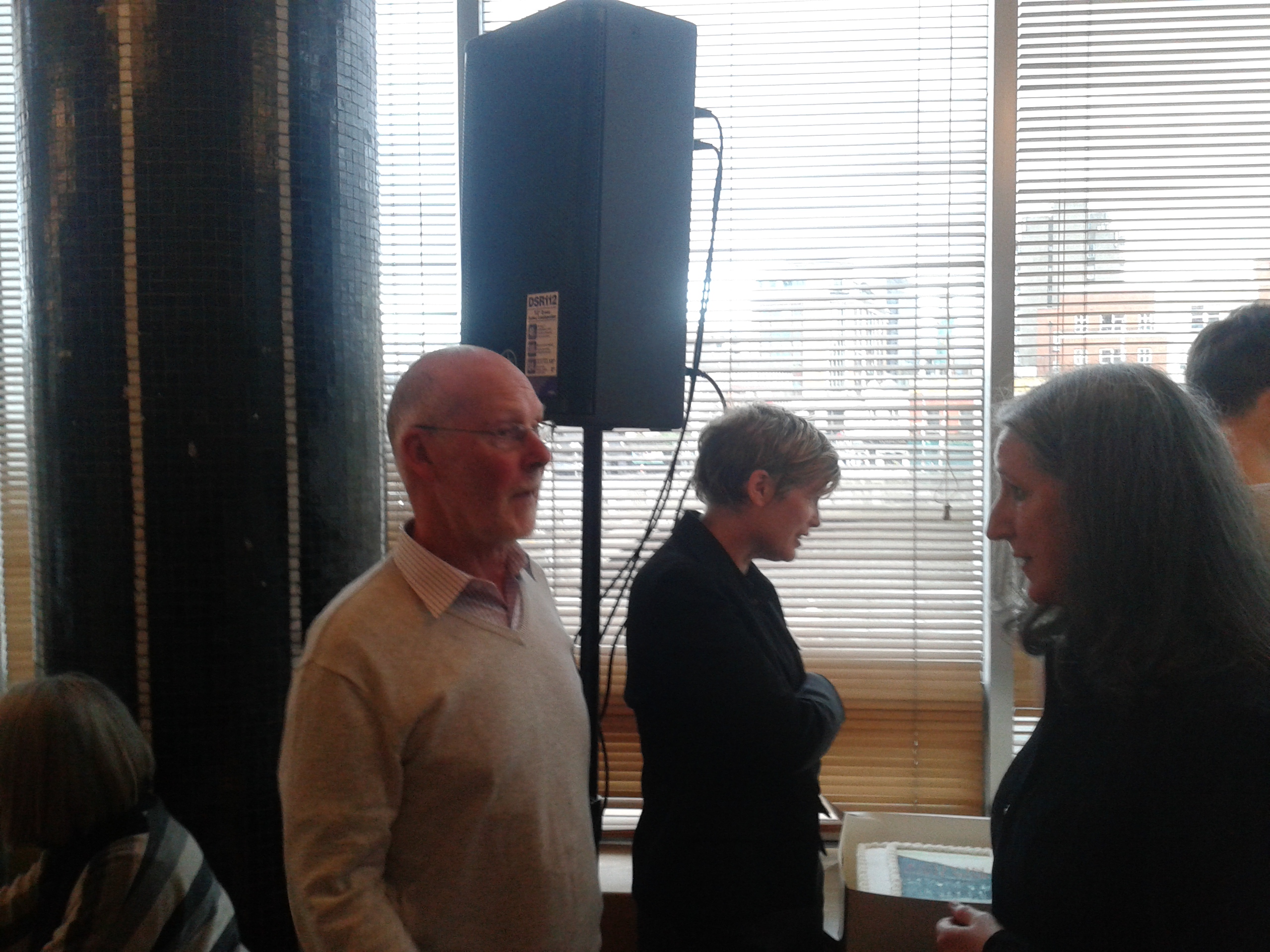
After the launch speeches — (L-R) Padraig Yeates, Katherine O’Donnell, Caitriona Crowe.
Jack O’Connor, between speeches, made a reference to a giant banner hanging off Liberty Hall which had the word “NO” displayed prominently, saying that they had received congratulatory calls from people who thought it was against same-sex marriage. The banner was however against privatisation of bus services. The current banner on Liberty Hall says “YES” to the proposal in the forthcoming referendum and he said that now busmen were calling them up complaining …. to laughter, O’Connor commented that “it’s hard to the right thing, sometimes”. Presumablywhat he meant was that it is hard to know what the right thing to do is, or perhaps to please everybody.
It is indeed hard to please everybody but I’d have to say that it is not hard to know that the purpose of and‘the right thing to do’ for a trade union, is to fight effectively and with commitment for its members and for the working class in general. And that is precisely the responsibility which has been abrogated by Jack
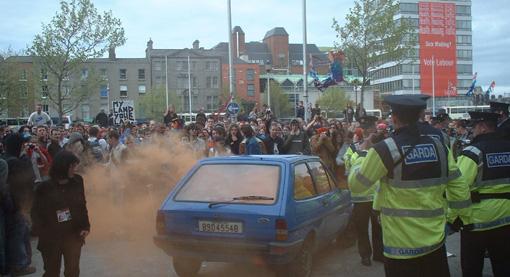
In the background to this photograph of a Reclaim the Streets demonstration in 2002 is Liberty Hall, draped in a hug “Vote Labour” banner. SIPTU has maintained that position through a number of coalition governments in which Labour has participated and that have attacked the living standards and rights of workers.
O’Connor personally, along with other leaders of most of the trade unions, including the biggest ones for many years, SIPTU and IMPACT. And also by the Irish Congress of Trade Unions. That is why Jack O’Connor gets booed now if he ever dares stand on a public platform related to trade union struggle, a treatment received also by David Beggs before he retired from the Presidency of ICTU.
Back in 2011, another giant banner hung from Liberty Hall – that time it urged us to VOTE LABOUR, as did leaders of other trade unions. Stretching magnanimity, we might give the trade union leaders the benefit of the doubt and say they had forgotten that the Labour Party had only ever been in Government in coalition, most often with the right-wing Blueshirt Fine Gael party and that its most recent spell sharing power had given us one of the most repressive governments in the history of the State. Let us imagine for a moment that these social-democratic union leaders had forgotten all that. But, after February 2011, as Labour and Fine Gael went into coalition and both reneged on their election promises, as the Coalition government began to attack the working class and the lower middle class, what is their excuse then? When did they denounce the Labour Party to their members, publicly disaffiliating from the party? No, never, and the fact that those disgusting connections continue was underlined by the presence at the book launch of a Labour Party junior Government Minister and the late arrival of noneother than Joan Burton, Minister for Social Constriction …. er, sorry, Protection.
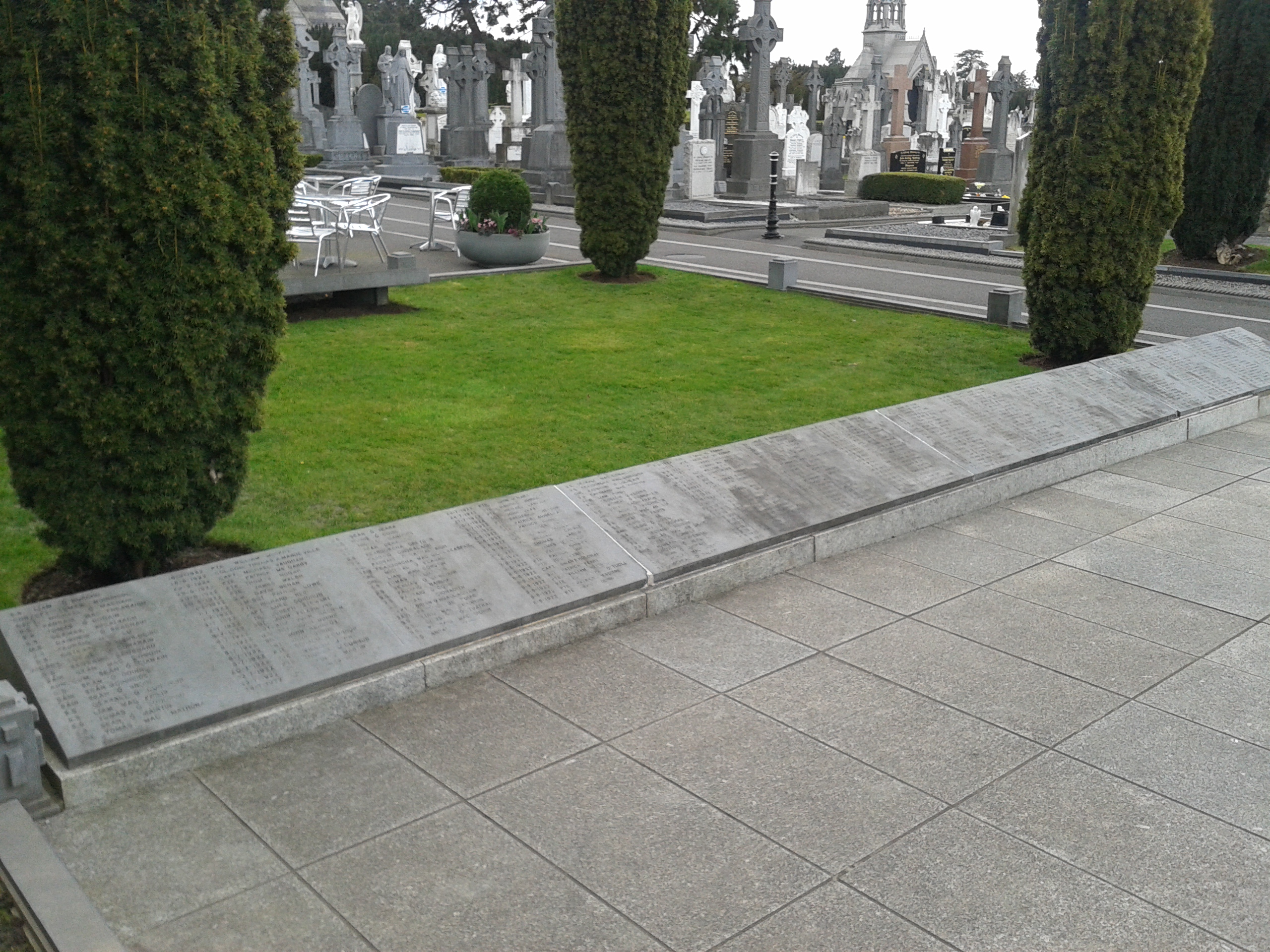
Plaques in Glasnevin’s Republican Plot recording the names of 77 of the 81 Irish Volunteers officially executed by the Free State between November 1922 and May 1923. Their police and military killed about another 150 without judicial procedure.
Considering that the book being launched was about the Civil War, it is really extraordinary that no speaker mentioned the repression by the Free State during and after that war. I am certain that Padraig Yeates has not glossed over that, he is much too honest and too good a historian to do so. But that only one speaker at the launch (Catriona Crowe) should mention the sinister Oriel House and none the at least 25 murders its occupants organised, nor the 125 other murders by Irish Free State soldiers and police, nor the 81 state executions between November 1922 and January 1923, sets one wondering at just how much self-hypnosis sections of our political and academic classes are capable.
I attended a meeting last night discussing the state of trade unions in Ireland and I found the meeting depressing. Not the state of the unions, which could be grounds enough for depression it’s true, but the state of the Left that sits down to discuss these questions. Because where else can the remedy come from except from the activists on the Left and if they don’t have a solution ….!
Practically all the 40 or so in the room were activists in trade union, community and political struggles, many with decades of experience. Many have suffered in the struggle, made financial and other sacrifices, some have suffered unemployment as a result of their commitment and some have even seen the inside of a prison. As the result of that combination of experience, one would think that they would come up with a good way – or number of ways – forward, out of the dire situation in which the trade union movement finds itself at the moment. One would think …. but alas!
The title of the meeting was TRADE UNIONS — RADICAL OR REDUNDANT? It was held on the second day of the week-long program of political discussion and cultural events of the James Connolly Festival, organised by the Communist Party of Ireland. Billed as a “debate & discussion on the future for trade unions”, the panel was chaired by Garret Gareth Murphy of Trade Union Left Forum and consisted (in speaking order and in personal capacity) of Louise O’Reilly (SIPTU), Dave Gibney (Mandate), Ann Farrelly (Swords Says No but also a member of a teacher’s trade union), Laura Duggan of Work Must Pay, Bernie Hughes (unemployed member of SIPTU but also a community activist and recently jailed for allegedly breaking an injunction sought by Sierra/ Irish Water).
Having attended a public commemoration of the death of Bobby Sands and nine other hunger-strikers which was also to start at 6pm, I arrived late for the meeting and so missed one panel speaker’s contribution and much of what another said. But that still left the rest of what the second one had to say and the other three.
At 7.15pm, the panel speakers finished and the meeting was opened to comment from the floor. Around an hour of speakers and less than an hour allocated for contributions from the audience, a discussion which then had to be cut to allow the panel to respond. This unfortunately is standard for Irish Left meetings, right across the political spectrum. Of course the intention expressed was to keep the contributions to five minutes from each and of course too some of them went way over. In this case, with five panel speakers, I had in fact predicted what would happen on the FB page of the event, though of course I would have been glad to have been proven wrong.
It is understandable, in a way. Left-wing speakers tend to be communicators and have a lot to say. They are also often kept out of many arenas where they could express their ideas. But arrogance has to be a factor too, when one knows that a meeting is scheduled to last about two hours and there are five speakers and a chair – and one still takes over 20 minutes to speak. Where does one think that extra 15 minutes (or much more) is going to come from? It is going to be deducted from other speakers probably and certainly from the audience. Or if the meeting goes on longer to make up the deficit, the risk is of wearing out the audience. The solution is crystal clear but probably won’t be applied – book less speakers and chair the meeting rigorously.
So why are so many speakers invited? Sometimes it’s because a broad representation of opinion is sought and at other times it might be that a number of organisations are expecting to be given a speaker. Then each speaker might attract a different audience or members of a different organisation. I have taken part in organising rallies and public meetings too and I know that these issues present difficulties but I also know that they have to be addressed. If we want participation and are democratically minded, we should not continue to organise debates/ discussions in this way.
All the speakers I heard expressed the opinion that there was something seriously wrong with the trade union movement. That was hardly revelatory – it is the opinion of the overwhelming majority of people on the street and in the workplace, if they have an opinion about the trade unions at all. And quite a few have hardly any opinion about trade unions – they don’t enter their view of the world to any degree whatsoever. Laura Duggan related that many young workers, finding themselves in difficulties with Job Bridge or otherwise at work, when looking for help, go first to Citizens’ Advice or to her organisation’s Facebook page – the last place many of them go to is a trade union.
Since that dismal view of the trade unions’ performance is so widespread and was shared by the panel speakers, I would have thought a few sentences could have been devoted to it and the rest of the speakers’ contributions could have been dedicated to prescribing or at least exploring solutions. Exactly the reverse is what happened – most of the contributions I heard were about ways in which the trade unions have failed, including much about personal experiences, but very little about what the solutions might be. Well, maybe the title of the meeting could be partly to blame but as activists, are we not mostly about solutions? Did Marx’s dictum on philosophy totally pass us by, that “heretofore philosophers have only interpreted the world, in various ways; the point, however, is to change it”?
So what were the solutions presented by the speakers? I recall “that the unions should recruit more young workers”, “respond more to young workers’ issues”, “there should be one big union”, “there should be education about political economy and history”, the unions should “continue participating in the struggles against the Water Tax”, “fight more strikes, especially when the membership have called for it” …..
Sure, OK, fine, brothers and sisters – but what if they don’t? What if the leadership, because that is what we are talking about in the failure of the trade unions, what if they don’t do what you think needs doing — what then? What are you going to do? What should we do?
The contributions from the floor followed much of the same pattern with however a greater amount pointed towards solutions. But again, it was mostly what was wanted from the leadership rather than what we could do to achieve the desired ends, especially in the face of the leadership’s intransigence. The need for young people to join the movement was expressed from the floor with on two occasions fulsome praise accompanied by applause for the one young person on the panel – well-intentioned no doubt but to me an embarrassing expression of the activists’ desperation.
Emigration, the 1990s Industrial Relations Act, leadership out of touch, the media … were all variously listed as being the reasons for the lack of resistance by the Irish trade union movement as well, of course, as the social partnership of decades between the unions and the employers and state.
One interesting contribution from the floor referred to an alleged ballot-rigging of which SIPTU had been found guilty in court years ago but which they appealed to the High Court. The brother relating this alleged that the Fianna Fáil Government of the day had the High Court clear SIPTU in exchange for the compliance of the trade union thereafter. Another brother a little later however denied there had been ballot-rigging (he actually said that “it was worse than that”!) and an argument broke out until the Chair quickly brought the meeting to order.
One brother in the audience stated that the problem was not at bottom whether the unions were fighting for better wages or not but about the politics of the union – if the politics were about social-democracy then of course the union would not act in the way we wanted. No-one responded to that contribution, presumably because either they agreed with it but couldn’t see how to progress from a union that isn’t even defending its membership to one with a revolutionary socialist ideology, or because they are basically in favour of social democracy, so long as it’s of a leftier kind.
I made one contribution to the discussion, in which I stated that although I have been a trade union member of different unions for most of my working life, and although I believe we should join a trade union, of course the trade unions are redundant. That is the opinion of most people at work and in the street and is the reality. But that doesn’t mean that trade unionism is redundant.
People will join a trade union if they see it fighting for its members. The workers who left the NUDL to join Larkin’s breakaway IT&GWU did so because they felt the NUDL had sold them out but they knew that Larkin wouldn’t do that and that his union would fight the employers. That was the same reason other workers joined the union too. If workers don’t see the union fighting, why should they join it?
I referred to all the bad history and difficult conditions for the operation of trade unions listed by contributors to the discussion. I pointed out that much worse conditions had been encountered and overcome by trade union organisers in the past – they had been deported in chains to Australia and in the United States many had been shot dead.
The Left in Ireland traditionally tries to deal with collaborationist trade union leadership by mobilising votes to replace the current leadership with Left candidates; I said that this process is too long if at all practicable and that our agreed Left candidates, if successful, are often corrupted by the trade union regime so that we have to start again. I proposed the same solution that I had done some years ago and on a number of occasions since, that trade union activists should form an organisation or network across the unions, in order to attend pickets when strikes break out, as people did with the Greyhound strike, to support the workers in struggle, to talk to them and also try to recruit them so as to have them go with us to the next strike and support the workers there.
I related some years ago being elected to the steering group of an organisation that was allegedly going to fulfill some of those expectations, the Trade Union Activists’ Network. I attended nearly every internal meeting for a year and was constantly trying to push it into action but it became clear to me, over time, that most of those present on the Steering Group had no real interest in the work and may have even been there for no other reason than to prevent activists from occupying their positions. Nevertheless, a grassroots network across the unions is still the only solution, I concluded; if we don’t build that we will continue to attend meetings like this in years to come, bemoaning the lack of success of our trade unions.
Some people – perhaps even most — may think they know better and after all, why should my ideas be any more likely to work than theirs? Well, perhaps for no reason; but their approaches have been tried without success for years – so why not try the one I advocate?
A somewhat separate issue which I did not address in my contribution was the much-promoted alleged support of trade unions for the Right to Water campaign. It is a fact that not one of those trade unions has advocated non-registration and non-payment. No trade union has advocated resistance to the Water Tax or its implementation by its members and, as one speaker from the floor pointed out, a number of local authority workers had been transferred to a private company installing water meters, without any resistance from the local authority trade unions.
Near the end of the meeting, speakers from the floor began to coincide in saying that we should continue to encourage trade union membership through recruitment, wearing our union badge, education, etc, etc. One went so far as to state that saying that trade unions are redundant is something some right-wing people and employers would love to hear, at which point I interjected that he was implying that “the critics are the problem”, something he hotly denied. But the fact is that the opinion of people about the trade unions is a result of the actions and inactions of those unions, rather than anything said in a meeting of around 40 people (or even a thousand).
I began this report by saying that I found the meeting depressing but that was not, it seems, what most others who attended felt. I found it depressing because despite all the lessons the Left is being taught, it seems unable to learn from them. But when the panel speakers came back to respond to the discussion, for me there were a couple of gleams of gold or at least something shiny in the bottom of the pan: Dave Gibney said that young workers will join a union when they see it fighting and spoke of the young workers in Dunne’s Stores who were enthused and politicised by their recent experience of being on a picket line; Louise O’Reilly said it was a waste of time expecting more sympathetic treatment from the media and that what we need is our own, left-wing newspaper.
End.
Credentials:
Diarmuid has been employed in many capacities, including as a factory labourer, construction labourer, kitchen porter, cleaner, laboratory assistant, foundry furnace operative, machine moulder, fitter-welder, youth worker, community worker, adult education tutor, hostel worker, hostel and addiction services team manager.
In the course of those, he has been a member in Britain at different times of the following trade unions:
Amalgamated Engineering Union
Construction Engineering Union
AEU (Foundry Workers)
Community & Youthworkers’ Union
NALGO (ILEA: Youthworkers; Adult Education Tutors)
NALGO (Local Authority, Education)
Unison
……. and in Ireland of:
SIPTU (Marine and Port)
SIPTU (Health workers)
Diarmuid has made serious attempts to found union branches in a number of manual workplaces with some successes and some failures, including being sacked from two workplaces for trade union or solidarity activity. He has also founded a union branch (managerial section) in his more recent work managing teams working with the homeless and people with substance misuse issues, along with facilitating union branch founding for other grades of workers in workplaces he managed. During his employment by NGOs, Diarmuid has faced disciplinary proceedings three times and beaten them twice, once at the initial stage and at the appeal stage in the second; he took the third to Labour Court and was awarded compensation.
Elected Shop Steward and/or Health & Safety Staff Representative in NALGO and in Unison, Diarmuid has campaigned for health & safety improvements (including organising comprehensive risk assessments by the team) as well as representing workers at disciplinary hearings (with mixed results). Elected unpaid Assistant Branch Secretary, he has been active in organising a strike, speaking at shop meetings and organising and participating in pickets. For a year, he edited a trade union branch newsletter and contributed articles to it.
As a trade union, community and political activist, among the pickets he has supported have been at car manufacturers (Fords), building sites, newspaper (Wapping), refuse workers (Greyhound), catering workers (Subway, Mac Donald’s), against cuts and closures of services, also collecting money for miners’, fire fighters’ and health workers’ strikes.
99 YEARS AGO ON 26th APRIL, THE BLOODIEST BATTLE OF THE EASTER RISING WAS FOUGHT IN A DUBLIN SUBURB
At a little past 6amon 26th April 1916, the SS Tynwald and SS Patriotic, two British troop-ships, had berthed in Dun Laoghaire harbour. The harbour and town had been renamed Kingstown by Unionist elements when King George IV came to visit the new port under construction in 1821. Although the town returned to its former name in 1920, it was known as “Kingstown” by most people in 1916, whatever their allegiance.
The troopships had been requested by General Maxwell, who had been given the responsibility for suppression of the Easter Rising, which was now in its third day. Several British thousand troops from the 59th Midland division began to disembark on a bright sunny morning. Hundreds of civilians went down to see them despite the early hour. Many in that town, especially around the seafront and some of the big houses, would have been sympathetic to the British – but by no means all and no doubt some eyes were noting the arrivals in order to report to the insurgents.
Around 9am, disembarkation completed, the soldiers were formed up and inspected, equipment checked and the Sherwood Foresters set off marching towards Dublin city centre, seven miles away, to be followed by Nottingham and Derby regiments around 10.30hrs. Their forces appear to have split up, with two Battalions marching to the city along the coast road and another two heading inland.
To reach the city centre from Dun Laoghaire, the most direct route is to proceed northward along the coast to Mount Merrion. Once there, the coast road goes through the railway level crossing to the right and continues along the seafront, into Ringsend and then along what is now Pearse Street to Trinity College. The British officers did not lead their men in that direction, perhaps because they had received intelligence of the Boland’s Mill strongpoint along their route. There would be no going past that without first taking it, which might prove a lengthy and difficult battle.
But one could avoid that by not turning right at Mount Merrion and instead continuing on what has become the main road, through Ballsbridge and Northumberland Road, across the Grand Union Canal at Mount Street Bridge, past the fashionable Merrion Square and into Nasseau Street and the city centre. That seemed the obvious choice, not just because of the Jacob’s garrison but also because at Mount Street Bridge was located Beggars’ Bush Barracks, one of the many such of the British Army in Dublin city.
Northumberland Road looking southwards. The Irish insurgents first saw the British troops coming up this road. The Parochial Hall and Schoolhouse are to the left but out of the photo. The canal is behind the photographer. (Photo D.Breatnach)
Before the British troops arrived in the area, a female courier, probably Cumann na mBan, had brought news of the troops landed in Dún Laoghaire and that they were heading towards them to the insurgents waiting in the Mount Street Bridge area.
At around noon a burst of fire hit the forward sections of the British troops marching in from Dun Laoghaire. When fired upon, in order to find effective cover, it is important to know from where the firing is coming but the soldiers were unsure. No. 25 Northumberland Road, a house at the junction with Haddington Road, seemed to some to be the source of the firing but by how many was unknown.
Screams from wounded men filled the air in the quiet suburban upper-middle class and largely Loyalist residential street.
Soldiers began to maneouver to outflank No.25 Northumberland Road and a detachment reached Baggot Street Bridge, further west, which was apparently undefended. From there it is a straight road into Stephens Green and the southside city centre. The rest of the soldiers were not led by their officers in that direction, a decision which was to cost them dearly. Instead, shortly after being fired upon, at least two British platoonsattacked 25 Northumberland Road but were driven back in disarray by fire from the building’s upper floors; yet as they turned they were also shot down in droves.
Perhaps under cover of that assault, at around 1pm some of the 2/7th Battalion Sherwood Foresters got past the corner house and made their way on to Percy Place, which runs along the south side of the canal between Mount Street and Baggot Street bridges. Now they came under fire from in front and from their left. They huddled for cover along the Canal.
The fire from the left of the British at this point was coming at long distance from the towers of Jacob’s Factory in Bishop Street, one of the insurgent strongpoints. A defensive line with insufficient mobilised insurgent numbers to hold it for very long stretched from Jacob’s down to the railway connecting Dublin and Dun Laoghaire and to Boland’s Mill beside it, overlooking the south bank of the Liffey. Roughly in the middle of this chain or defensive line were the Irish Volunteers in the Mount Street Bridge area, an outpost of the Boland’s Mill garrison. The total strength of the insurgent force defending that area had been 17 Volunteers but two had been sent home, being thought too young.
New Clanwilliam House, Mount Street, north side of the Royal Canal, looking eastward. The Bridge and Canal are to the right but out of shot. (Photo D.Breatnach)The Schoolhouse, Northumberland Road, today (a snack-cafe nowadays). The Bridge is to the right; the British troops were advancing along the road from the right.
Incredible as it seemed to the British when they learned of it later, there were only two Volunteers in No.25 Northumberland Road: 27 year-old Volunteer Lieutenant Michael Malone, a carpenter by trade,and Section Commander James Grace. In the Schoolhouse on the right-hand side just before the Bridge, there were two Volunteers. Next to that building was the Parochial Hall,held by four men: P.J. Doyle in command, Joe Clarke, William Christian and J. McGrath.Clanwilliam House, across the canal on the right-hand corner with the junction with Mount Street Lower, was occupied by seven Volunteers; the frontal fire hitting the British wascoming from there.
The British were scattered around gardens and behind the granite steps leading up the to front doors of the elegant houses in the street. Their officers called them out and they launched an attack on the Schoolhouse in Northumberland Road. As they charged up the road they came under fire from across the Canal from Clanwilliam House; about a dozen reached the Schoolhouse but they left many bodies behind. And they were still coming under fire from across the Canal too.
The officers now attempted to outflank Mount Street Bridge and Northumberland Road by advancing along Shelbourne Road to the east but were stopped as they came under fire from Volunteers along the railway line and from positions in and around Horan’s Shop nearby.
The column advancing from Dun Laoghaire had set up a temporary HQ in Ballsbridge Town Hall. Incredibly, the officers there, receiving regular dispatches reporting their troops being slaughtered around Mount Street Bridge and, presumably, knowing that other troops had found Baggot Street Bridge undefended, continued to press for an advance across the killing field.
But at least the officers on the battlefield for the time being seem to have had enough of death-or-glory charges, which were bringing plenty of death and no glory. The soldiers are now crawling along the road but whenever any are visible, which is often, they are being fired at. Clanwilliam House is wreathed in smoke.
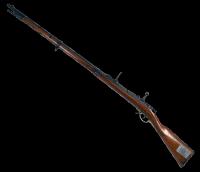
The Mauser Mark 71
The weapon the Volunteers were using was almost certainly the Mauser Model 71, the weapon of most Volunteers and Irish Citizen Army during the Rising; 1,500 had been been delivered in two landings in July 1914, first at Howth, north Dublin and then at Kilcoole, Wicklow. It had been the first cartridge rifle adopted by the Prussian Army in 1872 which by 1914had gone on to another more advanced model, presumably the reason that the rifle was being sold cheaply. The Model 71 fired a larger bullet than the British Army standard-issue Lee Enfield .303 but did not have a magazine, each cartridge having to be ejected and anew one inserted before firing again; its rate of fire was only four or five rounds a minute. The Lee Enfield took a ten-bullet magazine and the British Army were trained to fire fifteen rounds a minute. Despite this, the occupants in Clanwillian House and in No.25 in particular were able to lay down a tremendous rate of fire. Their guns grew so hot they burned to the touch and they had to cool them with wet rags. Down below, British officers blew their whistles and soldiers carried out more charges, only to be cut down by the Volunteers’ rifle fire.
During the late afternoon, a nurse ran on to the road and began treating the wounded British soldiers. The Volunteers agreed to a ceasefire as doctors and nurses from Sir Patrick Dunne’s hospital nearby went into Northumberland Road. But after a while the British attempted to use the ceasefire to advance their positions and the Volunteers ended it. Those wounded still to be tended lay where they were. This had been very different situation to what was to be seen in other areas of Dublin during the Rising, when British troops refused to allow wounded to be taken out unless the insurgents surrendered and when they accused Nurse Elizabeth Farrell of being a spy and tore her Red Cross bib–front off her.
The British got a machine gun up to the bell-tower of the church on Haddington Road so that they could fire over the roofs of the houses at Clanwilliam House, the bullets knocking chips off the outer walls and zipping through windows. They were also being backed by rifle snipers.
British soldiers recommenced attacking No.25, now with hand grenades as well as rifle fire. Finally they got close enough to blow the door in with explosives but incredibly were fired upon from inside as they tried to gain entry, injuring a number of them. Theyhurled grenades in and after they exploded, dashed in again. Coming down the stairs to meet them was Volunteer Lieutenant Michael Malone, his pipe in his mouth and was shot dead.
Section Commander James Grace had been downstairsusing a cooker as cover from bullets and shrapnel and such was the bomb damage to the room that the British assumed anyone in there had to be dead. There was still plenty of fighting to do – they had not even crossed the Canal yet.
If they believed that two men alone had held out against repeated assaults for four hours and had inflicted such damage upon them, they must have been very fearful leaving No.25. But perhaps they thought there had been others who must have escaped in the last minutes. James Grace did escape to get out of the area after lying low for some hours; however he was arrested some days later.
With No.25 taken, the Sherwood Foresters are soon able to take the Parochial Hall but they find it empty.The garrison of four Volunteers had run out of rifle ammunition and evacuated into Percy Place, where British troops, who were now all around the area, captured them.
An officer takes Volunteer Joe Clarke‘s loaded pistol off him, puts him with his back to a door and fires at him. Missing Joe, the bullet goes through the door to where a doctor is attending to injured British soldiers. He storms out in rage, berating the officer and Joe Clarke’s life is saved (he continued active in the IRA and in Republican politics nearly until his death in 1976 at the age of 94).
British soldiers are occupying nearby houses for cover and for firing positions and they are also crouched behind the low wall along Percy Place. They are still being hit. Now, they attack the Schoolhouse from its front, running across enfilading fire from Clanwilliam House to their left as they attack and from other positions to their front. When they enter, they find the Schoolhouse unoccupied by any Volunteer, alive or dead. However, their storm of bullets during the attack has riddled the bodies of its caretaker and his wife.
The cost to the British has been enormous but they have at last taken the southern side of the Canal around Mount Street Bridge. Across it, waiting for them, is Clanwilliam House. And to the east, their right-hand side, snipers at Boland’s Mill and nearby positions are also firing at them.
Now the officers order forward their reserves who had been sheltering in St Mary’s Road. The soldiers charge for the Bridge, answering to their discipline and their officers as they and many like them will do across the WWI battlefields of Europe, Greece, Turkey and Russia for another three years. It is partly against this slaughter that James Connolly led the men and women of the Irish Citizen Army out this week. One of the ICA’s detachments is not far away, under the command of Michael Malin and Constance Markievicz, in the College of Surgeons on the side of Stephens Green and they have already taken casualties.
Despite the covering fire from the Vickers Machine Gun firing incendiary bullets from St Mary’s Church, this charge too is driven back, their casualties adding to the pile of khaki-clad bodies and wounded on Northumberland Road, the Canal banks and the Bridge.
Around 8pm,the British are finally across Mount Street Bridge. An officer was in the charge, one of their few unwounded, and is at Clanwilliam House’s outer walls. Firing continues from the windows of this last insurgent bastion and from the east, a hail of Mauser death is still hitting the Bridge and the northern side of the Canal.
The British are now close enough to throwgrenades but one, thrown by a British NCO, bounced back from a second floor window and exploded next to his head, killing him. The British begin to make their way into the now-burning Clanwilliam House but are forced to retreat by the flames, leaving the fire to consume the bodies of the presumed dead Volunteers inside. They will not know now how many there were. In fact,there were only seven Volunteers, three are dead and the remaining four have escaped out the back.
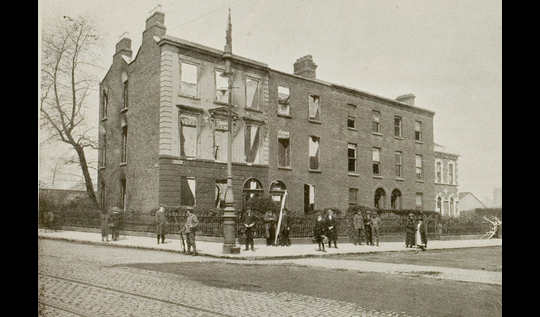
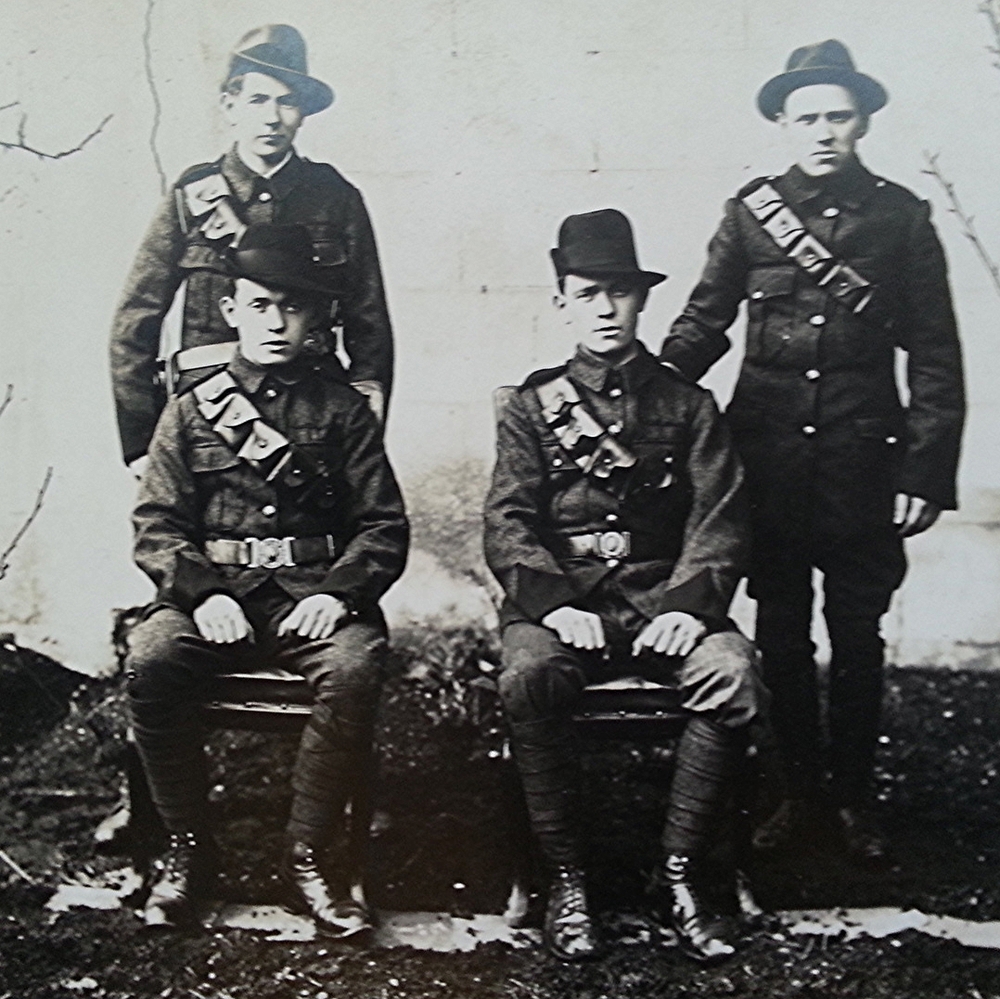
Clanwilliam House after the RisingThe four survivors of the Clanwilliam House garrison.
Ninety-nine years ago in the Battle of Mount Street Bridge, despite having only single-shot rifles and some pistols, the Volunteers held off two British Battalions, numbering approximately1,600 between them, for five hours. Approximately 234 men (including 18 officers)of the British Army had become casualties at the hands of fifteen insurgents.
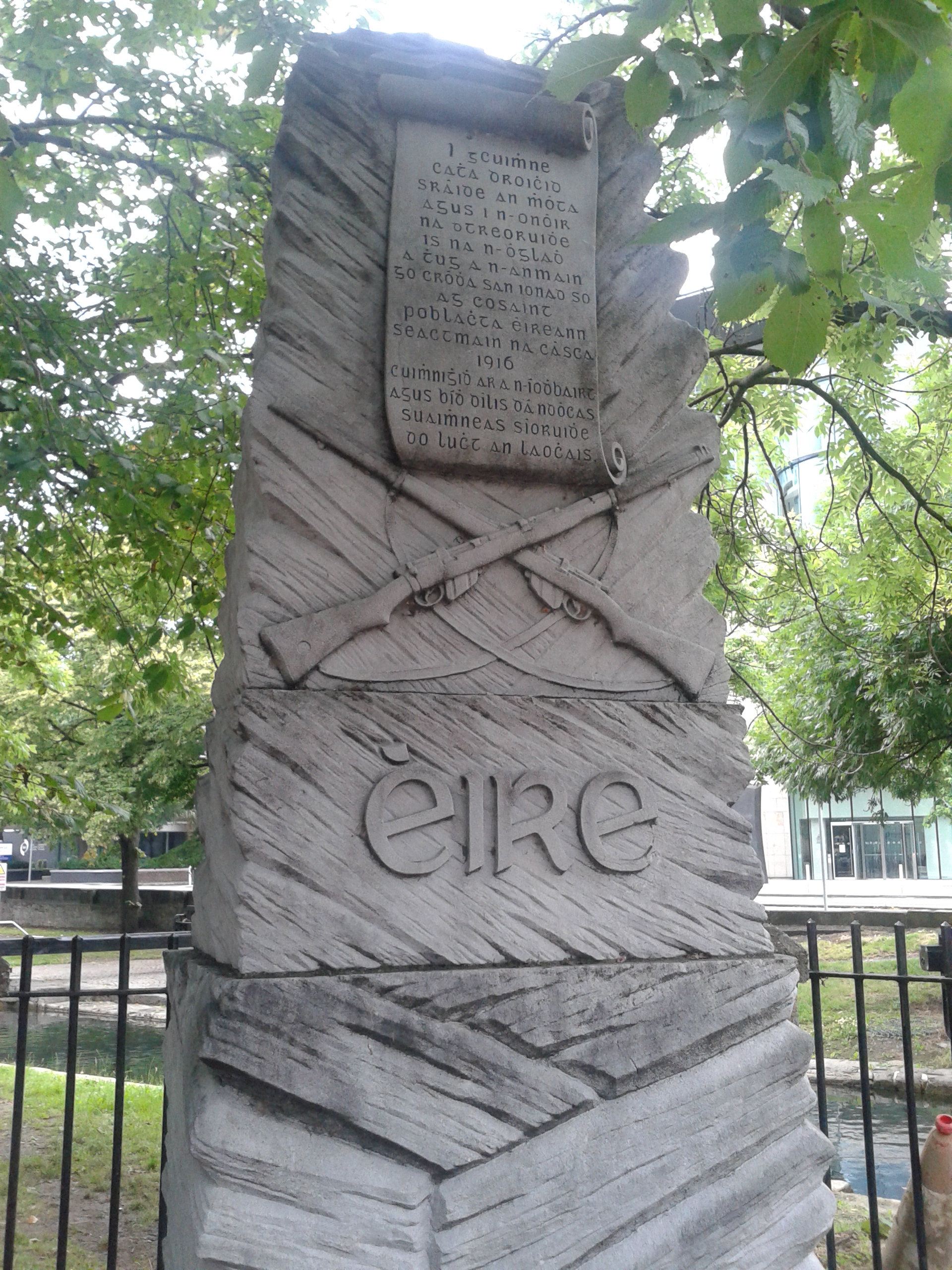
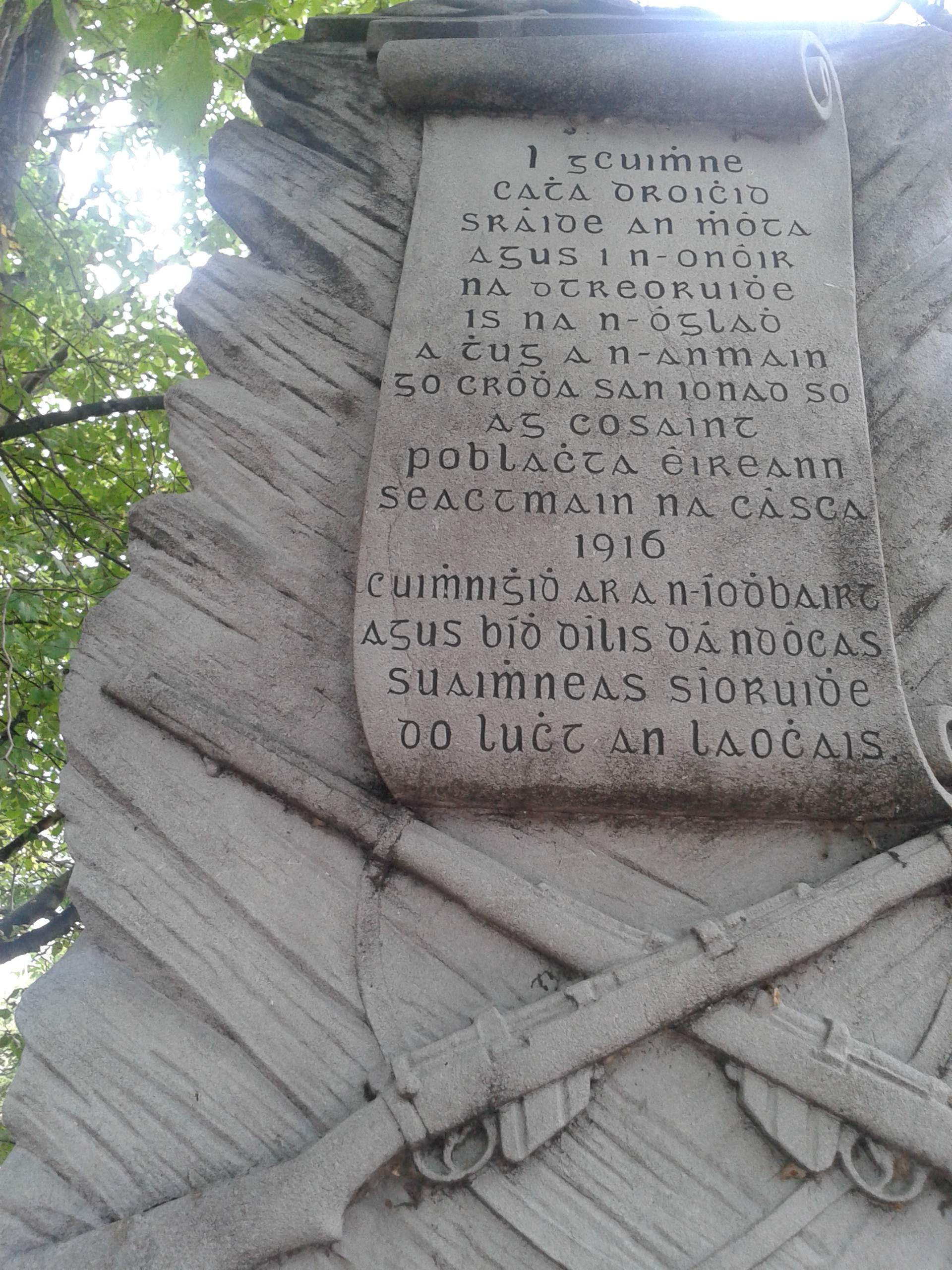
Mount Street Battle Monument on the BridgePart of the memorial on the south side of the canal. (Photo D.Breatnach)
From time to time people are asked to join a political bloc of some type. Should one join or not?
A political bloc is an arrangement of temporary unity, of as little as some hours of duration, for example on a demonstration, or of weeks, perhaps in a campaign to get an agreed list (i.e. “a slate”) of candidates elected or to vote a particular amendment to a resolution being proposed.
Blocs may be of longer duration, as for example with the Bolshevik bloc in the lead-up to the Russian socialist revolution. This last example is illustrative of the nature of blocs, which are generally not only for something but also against, or at least different to something else. There was a whole mass of political factions against Kerensky’s government in 1917 but the Bolshevik leadership sought to create a bloc not only against Kerensky and his followers’ maneuverings but also different to that of the Mensheviks and the Socialist Revolutionaries. What the Bolsheviks were for, apart from the slogan “All power to the Soviets” (the workers’, soldiers’ and sailors’ councils and assemblies), was a revolution as soon as possible, the overthrow of the capitalist-monarchist State and the creation of a socialist one (as well as pulling the Russian Army out of World War One).
Although the facts of the successful overthrow of the state and withdrawal from the War are not usually questioned by historians or political theorists, the fate of that state is. And the bloc itself had a very mixed history after the Revolution.
But what essentially is the purpose of blocs? Are they composed of like-minded people who don’t want to belong to a political party-type organisation, or perhaps of people of a variety of party political allegiances, but who want to join for the moment to promote a general idea? Or are they attempts by one group to create hegemony, to bring people of different perceptions together in temporary action, with the intention of building a more permanent organisation? Or perhaps crudely an attempt by one (or two) organisations to recruit members to their own organisations? I have over the years participated in blocs and it seems to me that different blocs have at different times been each one of those things. So I ask myself, is that ok? As political activists, should we consider blocs a legitimate type of temporary political organisation? Is each of those purposes outlined above of equal value?
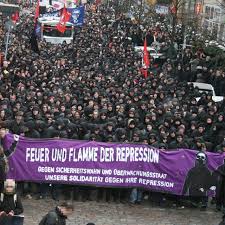
A Black Bloc against repression in Germany — location and year uncertain
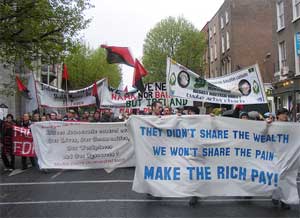
Around this time of year in 2010, early on in the protests against austerity, although then called “Right to Work”, back in the last year of the Fianna Fáil/ Green Party coalition government, there was a bloc formed for participating in demonstrations against the bank bailouts and consequent cuts in social spending and wages being imposed or proposed by that Coalition Government. Called the “Anti-Capitalist Bloc”, it seemed composed in the main of the anarchist WSM and what would often be described as “dissident Republicans”, chief among which at the time was the Éirigí organisation. There was a fair sprinkling of non-aligned activists (i.e. not belonging to any party or particular organisation) whose politics could be described variously as socialist republican, anarchist or communist.
Anti-Capitalist Bloc in Dawson Street, Dublin, marching to join anti-austerity demonstration at Dáíl in 2010
This bloc gathered at a different rallying point to the rest of the Right to Work march but marched to meet it at the Dáil. In that role, it survived I think three demonstrations. The first one was attacked by police after the demonstrators refused to be prevented from marching to join the other demonstration.
What was the purpose of this bloc, at least in the eyes of its organisers? I have no documentation to hand but as I recall, it was to say something like: “the problem is not this or that economic measure or this or that party or government; the problem is capitalism itself.” It seemed to be implying that therefore we needed a revolution. I would and did agree with such a statement and with its implication. Not only did I agree with it
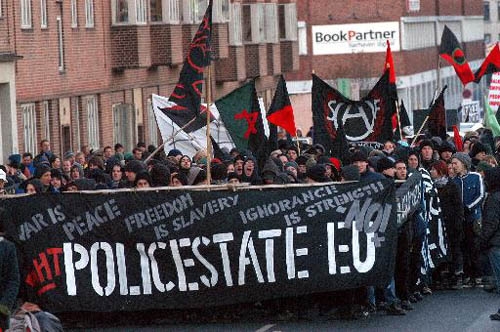
Black Bloc against the EU, possibly a section of the “March for an Alternative” in London in March 2011.
but it seems to me a crucial point to make, if we are to end our vulnerability to the vagaries of the capitalist system’s fortunes and to its particular rapacity at various times.
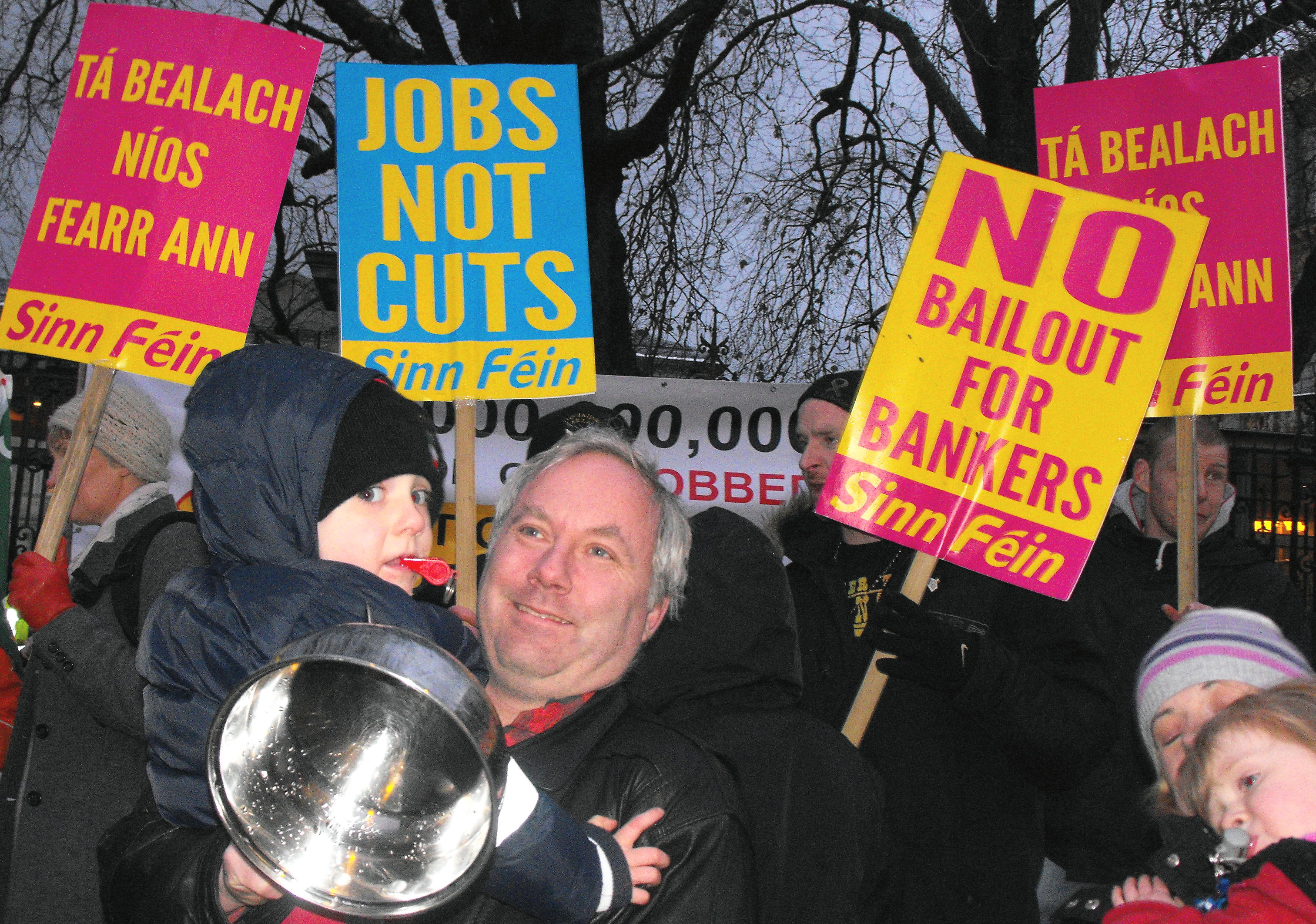
This was a message clearly different from that of some sections of opposition to the Government: SIPTU and the ICTU were saying that there was a fairer way of sharing the burden, which was about what Sinn Féin was saying with “Tá bealach níos fearr/There is a better way”.
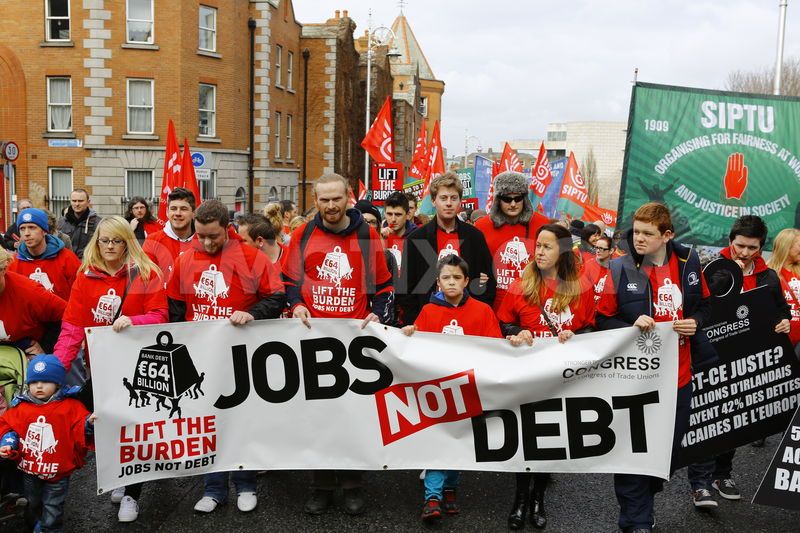
Reformist trade union slogan on anti-austerity march in 2010
But could those participants in the bloc not have presented that point of view while still joining the other demonstration at its rallying point and marching with it? Perhaps – by each person being given specific placards, for example, agreeing a joint leaflet or by having speakers to represent their point of view. But all of those present difficulties – the production of an agreed placard slogan to say nothing of the difficulties of agreeing a leaflet. And a speaker might not be permitted by the organisers of the rest of the demonstration or their message would get lost among the others being put forward, even if the speech itself could be agreed by the bloc in advance. All the bloc participants could dress in a similar colour (like the “Black Bloc” on some demonstrations overseas in the past). But a separate bloc, marching behind a banner with a slogan with which each bloc participant could agree, was surely the least complicated way to deliver that message – and very visible. The police who attacked it certainly must have thought so.
Sinn Féin demonstration at the Dail in 2010 — all totally reformist slogans apart from possibly the “Don’t Pay the Bankers” slogan
There is another factor in such a way of organising a bloc – it permits a visible assessment of its size, of the identities of its participants (unless they go masked, as many of the Black Blocs abroad did). Of course this has a down side also in that the state’s political police can take notes on the participants for the purpose of their files. But it has a positive effect too in terms of future progressive and revolutionary action. A mailing list can be compiled for calling to future events, individuals can be introduced to other like-minded individuals, organisations can get to cooperate – all factors militating against the fragmentation of the radical and revolutionary sector.
Some people on the other part of the march accused the Anti-Capitalist Bloc of being politically sectarian. Perhaps some even thought them elitist. These are of course dangers. But was it or was it not an important statement to make, that the problem was not the governing party but the system, and that a revolution was necessary? And if it was an important point to make, was such an eye-catching way of making it not justified?
Let’s consider what happened in the months and years afterwards and where we are now. In the face of a wide-scale howl of protest at the bank deals of the Government, their economic measures, and recent individual politician scandals, Fianna Fáil were deserted by their Green Party coalition partners. FF dumped their leader and elected a new one for their party and for the Government. It was all too little, too late and they were obliged to agree to a general election, the result of which was that FF’s number of TDs (elected representatives) was cut by nearly 80%, the greatest electoral defeat suffered by either of the main political parties in the history of the state. And the Green Party was wiped out as an electoral force, almost disappearing entirely off the political map.
The electoral verdict otherwise was mixed. The main rival of FF, Fine Gael, got the most votes with the social democratic Labour getting the next largest amount. Sinn Féin jumped from four to fourteen, a Trotskyist party and a different Trotskyist led-alliance got four between them for the first time, twenty Independents were elected, most of them left-wing. But whether socialist, republican, conservative or social-democratic, all candidates had been elected on platforms of opposition to the deals the previous government had made with the banks and with the EEC’s banking regulators.
Despite that, Fine Gael and Labour formed a coalition government and proceeded — in fact — to endorse what their predecessors had done and furthermore, to intensify a regime of austerity on working people, introducing three new taxes and supporting legislation to squeeze the people still further. The message of the Anti-Capitalist Bloc was vindicated.
Would the whole demonstration marching under a banner of “Overthrow Capitalism” have significantly changed that electoral result? Extremely unlikely. But it would have posed the question to the participants and to observers. It would have effected subsequent campaigns of resistance to austerity measures and additional taxes. And it would have built a much wider consensus eight or nine years later that the overthrow of capitalism was the only solution with perhaps a growing consensus that such an outcome was possible.
Because here we are now nine years after those three appearances of the Anti-Capitalist Bloc and once again it seems a general election is looming. Once again, we see other political parties pushing forward to be elected on programs without any perspective of overthrowing capitalism. Political alliances based on continuing the system are being mooted. On social media one sees calls for for kicking out Fine Gael or Labour or both, rather than capitalism. On demonstrations against the Water Tax we hear slogans against Enda Kenny, leader of Fine Gael, or against the Labour Party – but few against the capitalist system. Sinn Fein seek to cut down Labour as they court the social democratic vote which, in the past, they have largely ignored (for example, they have little history in the trade union movement). The Trotskyist groups will also attack Labour, also going for the social-democratic vote as they have traditionally done.
Most people feel that the Government will fall soon but when they pose alternatives they are doing so within the framework of capitalism. That means that same class that commanded the deal with the banks and with the EU will remain in power. Their representatives in government will change but the class will remain. And if they remain, their exploitation remains. Not only that but in the present economic climate, their austerity program will remain too – perhaps with some tweaks here and there but austerity still.
A determined campaign of political leadership over the past nine years giving a clear direction of the need to overthrow capitalism could have us in a very different political position now.
So, the next time we get a call to join a bloc for a demonstration, should we rush to it? Well, not necessarily. Let us question what the bloc is for and what it aims to do. Is the bloc in question a tactic, for example like the Black Bloc, where we identify a revolutionary opposition by colour and also, by masking, make it harder for the State to identify us? There may well be a time and place for such. Or is it to declare a revolutionary principle such as “capitalism is the problem; revolution is necessary’? Or “Non-Payment of the Water Charge is what is required”? Then it seems to me that the answer is that yes, we should.
But if it is to draw some particular lines of political affiliation, for example to say that although the participants may belong to separate organisations or none, “we are all communists” or “we are all republicans” or “we are all anarchists”, then I fail to see how that helps the popular resistance movement proceed forward at all, to say nothing of revolution. If that is the purpose of a bloc, it is fine for the followers of that particular ideology but they would be best fulfilling it by holding public meetings and conferences.
On the street, we need to be motivating observers for participation in resistance, and motivating participants for unity in effective actions, for revolution. Motivation has an emotional component but also an ideological one and in that regard the message has to be to overthrow capitalism. At the moment it is that idea that needs to gain hegemony rather than any particular political party or organisation.
INIGO CABACAS KILLED BY RUBBER BULLET FIRED BY BASQUE POLICE IN 2012 — STILL NO JUSTICE FOR FAMILY OR FRIENDS
Diarmuid Breatnach
Most Basques and especially supporters of their most popular football team, Athletic Bilbao1, were very happy in the early evening of 5th April 2012 .
Inigo Cabacas, photographed with the Basque hermitage Gaztalugatxe, on the Biscay coast, in the background.
Their team had beaten a football giant in the UEFA cup twice and another premier European team once. The fans were expecting Athletic to win or at least draw again that evening, in which case Athletic Bilbao were through to the second leg of the quarter-finals. They had no idea that the evening would end with a police riot squad firing rubber bullets into a festive crowd, causing the death of a young fan.
The high expectations of that evening in Bilbao were the result of a run of wins for the Athletic team. On March 8th 2012, Athletic Bilbao beat Manchester United 3-2 on their own ground, at Old Trafford.
One needs to know a few population statistics to understand what an achievement that was. Manchester United is a football team on the world stage, based in a city with a population of 2.55 million – that is not far from the population figure for the entire Basque Country. In addition, Manchester United’s players are drawn from around the world; Athletic recruits only Basque players from a total population of the Basque Country of less than 3 million.
A week after their win in the northern England city, on March 13th, Athletic faced Manchester United again, this time on the Basque team’s home ground, San Mames, in Bilbao. Manchester Utd. were beaten 2-1 and it seemed that the Basque lions2 were unstoppable.
These wins created a huge interest in the next game, which was with FC Schalke 04 on March 29th at the German team’s home ground. Schalke plays in the top tier of the German football league and have won many championships including one UEFA League. With around 130,000 members, Schalke 04 is the third-largest sports club in the world in terms of membership, behind their compatriot rival FC Bayern Munich and Portuguese club SL Benfica.
Athletic Bilbao is not a sports conglomerate – it is a football club which is owned by its 40,000 members (remember, this is a small country – that’s nearly 1.5% of the whole population! It’s also around 11% of the population of their home base, Bilbao). The management board is elected by the membership.
At Schalke 04’s home ground on March 29th, the Bilbaino team beat them 2-4. The interest was therefore at fever-pitch for Athletic’s return match with the German team at Athletic’s home ground, San Mames on 5th April. The result was a 2-2 draw but Athletic were ahead 6-4 on aggregate and the fans were delighted. Bilbao was, as they say, buzzing.
After matches, young fans especially go to different pubs around town. Inigo Cabacas and many others went to an Herriko Taberna (a “Peoples’ Tavern”, i.e. one managed by the Abertzale [Basque pro-Independence] Left) which is located in an small “square” with planters, connected by alley with Licenciado Poza street. This small “square” is off the María Díaz de Haro street near the stadium; it runs parallell with the San Mames street itself, an area of bars well-known as a destination for fans after a game at the stadium.
The Herriko is too small to accommodate all those who gathered there but that was no problem for the area outside took the overspill. Early in the evening a few people were seen scuffling there and the rest of the crowd around them told them to knock it off, this was a time for celebration, etc. The scuffle ended and the festivities continued.
Some time later, a van load of police arrived. These were the Ertzaintza, a Basque Police force of 7,500 created in 1982 which has had numerous clashes with Basque strike pickets and with the Abertzale (pro-Independence) Left. Supporters of the Abertzale Left and many others refer to the Ertzaintza as “zipayos” (i.e. “sepoys”, local soldiers recruited by colonial occupiers). The Ertzaintza are responsible to the Basque Autonomous Region Government (CAV), a semi-autonomous entity covering three of the four southern Basque provinces.
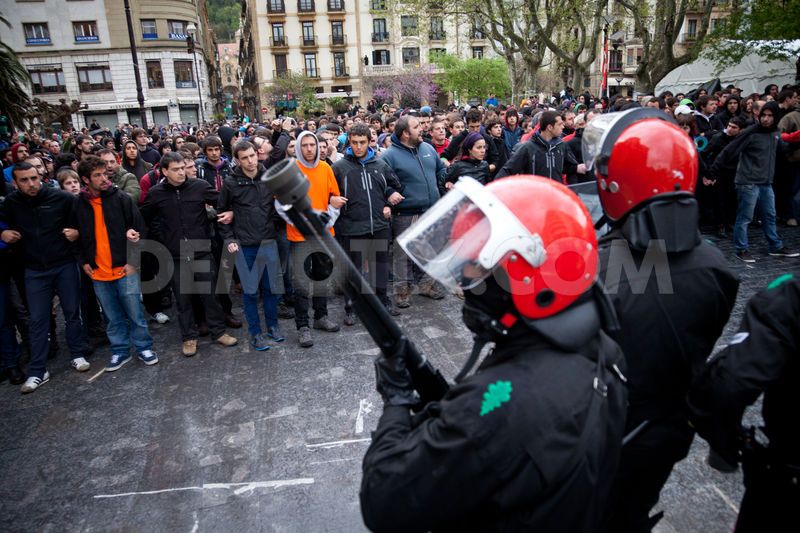
Basque Police, the Ertzaintza, face a youth Solidarity Wall built to defend Basque comrades the police have come to arrest in Donosti/San Sebastian some years ago.
Some of the youth perceive the arrival of the masked and helmeted police as a provocation and begin to throw bottles at the van.
The police officer in charge of those in the van asks for reinforcements and these are sent. The police emerge from their vans and begin to fire rubber bullets3 at the crowd at quite close range (the “square” is less than 45 metres at its furthest from the street) and everyone scatters except for a small group who are throwing bottles at the police but even they eventually dive for cover. People are sheltering in doorways, huddled up against the walls on each side of the “square”. Some are inside the pub wondering what is going on. A local shop-manager has raised the shutter over his doorway and people crowd in there. Some people are sheltering behind the wooden planters that are in a line down the centre of the narrow square.
After some time three young men walk towards the police with their hands in the air, asking them to stop firing rubber bullets; the police strike them with batons. Meanwhile it comes to the attention of some in the crowd nearby that a person is lying on the ground, apparently unconscious with blood coming from his ear and the rear of his head. People go to his aid and one of his friends recognises Inigo Cabacas. He gets his mobile phone and rushes towards the police telling them that someone has been seriously injured and to call an ambulance. A police officer tells him to drop the mobile. Inigo’s friend repeats his urgent request and the police officer tells him again to drop the mobile and hits him with a truncheon. The man drops his mobile and retreats from the police.
The police advance into the area and reach the injured man who has some people around him; a women is rendering first aid. A policeman tells her to move away. She tells him the man needs and ambulance and that she is applying pressure to stop the bleeding. He says he wants to see for himself and pulls at her arm but after awhile desists and goes away.
Eventually an ambulance arrives and takes Inigo Cabacas, still unconscious, to hospital, where he lies in a coma.
(video of the scene of the incident and interviews with friends and witnesses with English subtitles)
The news runs through a city, a shock in the midst of its celebrations and soon afterwards throughout the Basque Country. The first official reaction is given by the Interior Minister of the Basque Autonomous Regional Government, who declares to the press that the Ertzaintza acted properly and in line with their procedures, although he regrets the unfortunate death of they young man. He also repeats the first line of defence given by the Ertzaintza, that they were called to help someone injured in a fight and that the crowd was preventing the ambulance in attendance from rendering assistance to the injured.
When eye-witnesses give their version and the reporters of some newpapers begin to gather information, it becomes clear that the Minister could not possibly have investigated the incident in the time available. Furthermore, it emerges that no ambulance attended until after the incident with the police and that it appears that no call for one had been made earlier. Furthermore, according to the woman who attended to Inigo at the scene, the ambulance paramedic told her, when she complained at their delay in arriving, that the police had delayed their entrance. Under a storm of criticism from civil society and from the Abertzale Left party, EH Bildu, the Minister promises a full investigation.
Inigo Cabacas dies after three days without having recovered consciousness.
Some time later, a recording of the police communications on the night is made available by GARA, a pro-Independence Basque daily newspaper. The following becomes clear from the recording:
The Controller at Ertzaintza HQ calls a police van leader and directs him to attend the Herriko, saying that a fight has occurred there and that someone is injured.
The van leader reports that they have arrived and that some are throwing bottles at them, that they require reinforcements. No mention of ambulance.
The Controller confirms reinforcements are being sent.
Reinforcements arrive. One of the van leaders now reports that nothing is happening, everything is ok.
The Controller replies that he wants the police to go in and take possession of the area and make any arrests necessary. He emphasises that he wants to be understood clearly, that they are to “go into the Herriko with everything we have”, to take control of the area “and then everything will be ok.”
The van leader replies that the order is understood and soon shots are heard (the firing of rubber bullets).
The family employs a solicitor. A judge is appointed to carry out the investigation but is required to do so along with her other duties. Immediately, the police investigation ceases (according to the family’s lawyer, ithe file contains just three pages), using the excuse of the judicial investigation.
A number of legal applications are made, e.g. for all the police at the incident to be obliged to make a statement, for all police who fired a rubber bullet gun to be identified, for the Controller to be obliged to make a statement, but all are refused by a judge, giving a number of reasons4. Little is established over the following three years, except that threepolice voluntarily admit to having fired rubber bullets and the identity of the Controller on the evening becomes widely known. There is widespread outrage when the senior officer on duty the day of Inigo’s death is appointed Chief of the Ertzaintza.At a recent press conference, the Cabacas family’s lawyer, Jone Goirizelaia, announced that they had possibly identified the officer who had fired the fatal shot.
It emerged during the campaign by supporters of the Cabacas family that no recognised procedure was followed by the police with regard to the incident: debriefing statements were not taken from each of the police participants, guns were not examined to identify which had been fired, no inventory was taken of the number of rubber bullets fired. No attempt was made to contact witnesses after the event to gain a picture of what had occurred. Indeed, some witnesses who approached the police station to give statements were told to go away (see video link posted earlier in this article). It further appears that the Ertzaintza have been issued with no specific operational instructions with regard to the firing of rubber bullets.
According to some sources, the rubber bullets should only be fired at knee-height and at no less than 50 metres from the target. The “square” is, according to locals, less than 45 metres at its furthest from the street and therefore the police from the moment they began firing, were in serious breach of the minimum distance requirements. In addition, the Ertzaintza have frequently been seen aiming their rubber bullet guns at protesters’ faces from as little as a metre or two and also firing from the shoulder with the muzzle parallel to the ground, i.e. directed at head or chest-height of the target. Also, the rubber-coated steel balls bounce uncontrollably.
Rubber bullets against Palestinians
Rubber bullets are regularly fired by the Israeli army at Palestinians. A Palestinian source reports: “Israeli professor Michael Krausz and colleagues at the Rambam Medical Centre in Haifa analysed the medical records of 595 casualties admitted to hospital during the October 2000 protests by Palestinians living inside Israel (typically described as “Israeli Arabs” by the media). Of those, 152 were found to have been injured by rubber-coated metal bullets. Injuries were distributed randomly across their bodies but were most common on the patients’ arms and legs, and on their head, neck and face.
“The doctors said their findings dismissed the theory that “rubber bullets” were safe. Rubber-coated metal bullets with some of their rubber coating removed, revealing their hard steel core. Fired at speeds of what must be several hundred feet a second, these are munitions that cause enough damage that their manufacturers feel compelled to describe them as only ‘less lethal’.
“Writing in the Lancet, they said firing the bullets at civilians made it ‘impossible to avoid severe injuries to vulnerable body regions such as the head, neck and upper torso, leading to substantial mortality, morbidity and disability.’ They added: ‘We reported a substantial number of severe injuries and fatalities inflicted by use of rubber bullets ….. This type of ammunition should therefore not be considered a safe method of crowd control. “The study, ‘Blunt and penetrating injuries caused by rubber bullets during the Israeli-Arab conflict in October, 2000: a retrospective study’ (The Lancet, Volume 359, Issue 9320, Page 1795), also highlighted previous research which suggested that even plastic bullets may not be safe and may cause more severe head injuries.” (Sourced at http://electronicintifada.net/content/misleading-terminology-rubber-bullets/4000)
Rubber bullets against the Irish
Seventeen people were killed in the Six Counties (“Northern Ireland”) by rubber and plastic bullets fired by British soldiers (11) and colonial police (6) during the 30 Years War. A number of people were also blinded. http://cain.ulst.ac.uk/issues/violence/rubberplasticbullet.htm
It emerged in 2013 during a compensation case taken by a Derry man blinded in 1972 that the authorities knew that the missiles were potentially lethal even before they issued them. (http://www.theguardian.com/uk/2013/jun/11/mod-rubber-bullets-lethal-records) It is clear also from a wealth of evidence that the missiles were regularly fired by soldiers and police not only at close range but also aimed at chest or head. In addition, a deadly ‘game’ was played by some British soldiers. Knowing that rubber and plastic bullets were collected by children as mementoes and objects to sell to tourists, soldiers would fire some into an open area and wait for children to run forward to collect them, then see if they could hit the children with subsequent rounds.
Rubber bullets in the Spanish state
The Spanish state continues to allow its police forces to carry and to fire rubber-coated metal bullets, in particular at protesting Basques and Catalans (see video link at bottom below article). Recently, the EU expressed concern at Spanish police firing at migrants attempting to swim into the Spanish state from Morocco, an occasion when 11 of the migrants drowned. But no international protest criticises them for firing potentially lethal missiles at their own citizens. Police in the Spanish state enjoy impunity and none more so than in the Basque and Catalan countries as well as with regard to African migrants.This week, a motion was put to the Basque Parliament to ban the use of rubber bullets in the area under its control (CAV). Instead a proposal was accepted to “restrict” the use of the missiles to “situations of grave danger” to the police, and to “definitely seek a replacement” for them. The Spanish right-wing PP, the liberal Spanish unionist UPyD, along with the PNV (Basque Nationalists), currently in power, voted for it, along with the Basque version of the Spanish social-democrats, the PSE. The only party to vote against the amendment was EH Bildu, party of the Abertzale (pro-Independence) Left; they had proposed the original motion, seeking a total ban and the removal of the missiles.
Parent and friends of Inigo Cabacas confront spokesperson of the Basque Nationalist Party after attempt to ban rubber bullets fails
Among those in the public gallery at the discussion were the parents of Inigo Cabacas. Afterwards, in the corridor outside, they confronted the spokesperson of the PNV, Joseba Egibar. During the exchange, another PNV parliamentarian, Luke Uribe-Etxebarria, tried to prevent its filming by the Basque TV station ETB. That attempt will be the subject of a complaint to the President of the Parliament by EH Bildu; they view it as particularly serious since Uribe-Etxebarria is also on the management board of the TV station and the filming was taking place in areas open to the public.
“I’m never coming to this Parliament again …. I feel cheated,” said Manuel Cabacas, father of the deceased, speaking about the majority decision. “My son is dead …. I only wanted to ensure that it would never happen to anyone else ….”
On the third anniversary of the killing of Inigo “Pitu” Cabacas, among many commemorative vents in the Basque Country, 10 minutes’ silence was observed in the San Mames stadium. Alongside Inigo Cabacas; many are also remembering Aitor Zabaleta, fan of the Real Sociedad team, murdered in Madrid in 1998 by fascist ultras of Club Atletico Madrid. Many Basques around the world will be conscious of the three years that have passed since Inigo’s killing without anyone being even charged in connection with his death or any noticeable change, whether in Basque police behaviour, procedure or their use of rubber-coated steel projectiles. A change of political control of the Basque Regional Government from the social-democratice party of Patxi Lopez to the Basque Nationalist Party .(PNV) of Urkullu has had no effect.
It is true that for ordinary people, in capitalist society, the wheels of justice move very slowly; in this case it is hard to see that they are moving at all.
End.
NB:DUBLIN: A group of Basques plan to hold a commemorative event on Tuesday 28th April, on the day of a Basque derby, Bilbao Athletic v. Real Sociedad. They plan to hold a protest picket at the O’Connell Monument in Dublin’s O’Connell Street at 7pm for a short while and afterwards to go to watch the Basque derby (kick-off at 9pm) at the Living Room bar, Cathal Brugha St. Some Dublin-based Irish people have undertaken to support the Basques by participation in both events. Poster for event: https://www.facebook.com/photo.php?fbid=10153291310864390&set=gm.1624681737767253&type=1&theater
Short but shocking Guardian video of Catalan police using rubber bullets and the testimonies of victims who have lost an eye to the missiles:
1 Based in Bilbao, it is the most popular and most successful (two things that often go together) but not the only football team; there are also Real Sociedad, based in Donosti/San Sebastian and Osasuna, based in Iruña/ Pamplona.
2 A roaring lion is the emblem of the team, arising from the legend of St. Mames, to whom the local church is dedicated and which gives its name to the area, street and stadium. English-language football commentators persisted in calling the team “the Spanish lions” or “the Spanish cavaliers” (??!), in total ignorance, one hopes, of quite how insulting that would be perceived by the players and their fans. The Basque Country is not even politico-geographically Spain, it is divided between the Spanish and French states. And Bilbao Athletic is most certainly not, nor has it ever been, a Spanish team. When the Spanish King attends finals or semi-finals between Barcelona and Athletic in, yes, a Spanish football league, and the Spanish national anthem is played, the stadium fills with howls of derision, hoots and whistles from the supporters of both teams.
3 These are about the size of a tennis ball, perhaps a little smaller, of steel and coated in rubber.
4 E.g., the Controller could not be held responsible for the shooting by the police; individual police would have to be accused of firing the fatal shot if they were to be obliged to make a statement …
Viyan Peyman, famous fighter-singer of the YPJ, fell in battle against Islamic State in Serekaniye (Yazira canton) on Monday 6th April 2015, according to news agency Hawar News.
Viyan Peyman, famosa luchadora y cantante del YPJ cayó én lucha contra el Estado Islamico el lunes 6 de Abril 2015, según la agencia de noticias Hawar News (miren enlace al fondo de este corto trozo para las noticias en castellano).
When Eagles Sing
(I ndil chuimhne Viyan Peyman/Gulistan Tali Cingalo)
A bird fell from the sky —
the birdsong now has died.
A songbird but also a fighter —
When eagles sing
our struggle is made lighter.
She flies now in different skies,
skies of our memory,
of our heart, spirt and mind
where her song cannot be silenced
for Kurds or for humankind.
Diarmuid Breatnach April 2013
Viyan’s real name was Gulistan Tali Cingalo (Gulistan means “garden”) and she was from Mako city in the part of Kurdistan located within the Iranian state’s territory.
The song she sings in the video was composed by her; the lyrics say:
“Oh, mother, woe to me!
My heart cries today — what disaster has fallen upon us!
I will sing today of the resistance of Kobane,
that it may be a poem recited for the world and humanity, oh mother!
Today again our Kurdish boys and girls have made their chests into shields
against the tanks and bombs … Oh, mother, woe to me!
Today I imagine the mothers of Kobane crying in the streets;
I imagine the boys, the girls, the elderly screaming in pain and rage.
I see the tears of the children of Kobane as if they were the Euphrates river,
According to Sean O’Casey, generations of boys after 1690 were named “Patrick” or “Pádraig” in memory not of the Christian saint, patron saint of Ireland (whose position was often less than St. Bridget’s) but instead in memory of Patrick Sarsfield, First Earl of Lucan.
Portrait of Patrick Sarsfield
Sarsfield, as a younger son of an aristocratic Anglo-Irish (“Old English”) family became a soldier. He fought in the English Royalist Army in England and took part in the suppression of the Monmouth Rebellion. During the Civil War he fought again briefly for the Royalist cause and went to France after the victory of Parliament. He had come into his inheritance by then due to the death of his older brother. Sarsfield came to Ireland from France with James II to raise an Irish army to support James against the British Parliament and their Dutch King William of Orange.
“Sarsfield’s the word and Sarsfield’s the man!” Depiction of the raid led by Sarsfield on William’s waggon train of equipment and supplies for the First Siege of Limerick. Ironically, the English password that evening for the sentries was “Sarsfield”.
Up to this point he had an unremarkable military career (though an eventful personal one). The raid he led on William’s siege train at Ballyneety led to the defeat of the first Siege of Limerick. The password of the sentries of William’s siege train was “Sarsfield” which, as well as being a great irony, also indicates that his name was of some import in the ranks of the enemy. He was also mentioned in enemy accounts of the Battle of the Boyne where they praised his management of a fighting retreat after that great disaster for the Irish cause.
THE TREATY OF LIMERICK
Sarsfield negotiated the very generous surrender terms at Limerick which ended the Second Siege and the war — terms which however were broken by the English side “‘ere the ink …. was dry”. The Irish soldiers went off the France to serve in the French royal army and from there also to other armies on the Continent. The ships that were supposed to bring the women after them were never supplied, giving us Irish Jacobite songs of great romantic loss.
Statue of Sarsfield, Limerick City
AFTER LIMERICK
The Penal Laws followed, institutionalising religious discrimination against Catholics but also all non-Anglican sections of the Protestant faith which, a century later, led to the forming of the United Irishmen and the uprisings of 1798 and 1803. And so on … and on.
Fighting in the French royal army in the Nine Years’ War, Patrick Sarsfield was wounded at the Battle of Landen 1693, fighting once again against the armies of William (and of his allies). His rank was Lieutenant-General at the time. Sarsfield died days later at Huy, Belgium, where he is buried in St. Martin’s Church grounds; he was around 33 years of age.
There are a number of songs remembering Patrick Sarsfield and one of the finest, in my opinion, is “The Jackets Green” by Michael Scanlan. I don’t sing it to the air as recorded by the Wolfe Tones but instead to the air of Seosamh Ó hÉanaigh’s way of singing McAlpine’s Fusiliers (which is also much nicer than the usual McAlpine’s Fusiliers, in my opinion).
THE JACKETS GREEN
Michael Scanlan
When I was a maiden fair and young,
On the pleasant banks of Lee,
No bird that in the greenwood sung,
Was half so blithe and free.
My heart ne’er beat with flying feet,
No love sang me his queen,
Till down the glen rode Sarsfield’s men,
And they wore the jackets green.
Young Dónal sat on his gallant grey
Like a king on a royal seat,
And my heart leaped out on his regal way
To worship at his feet.
O Love, had you come in those colours dressed,
And wooed with a soldier’s mein,
I’d have laid my head on your throbbing breast
For the sake of your jacket green.
No hoarded wealth did my love own,
Save the good sword that he bore;
But I loved him for himself alone
And the colour bright he wore.
For had he come in England’s red
To make me England’s Queen,
I’d have roved the high green hills instead
For the sake of the Irish green.
When William stormed with shot and shell
At the walls of Garryowen,
In the breach of death my Dónal fell,
And he sleeps near the Treaty Stone.
That breach the foeman never crossed
While he swung his broadsword keen;
But I do not weep my darling lost,
For he fell in his jacket green.
When Sarsfield sailed away I wept
As I heard the wild ochone.
I felt then dead as the men who slept
‘Neath the fields of Garryowen.
While Ireland held my Dónal blessed,
No wild sea rolled between,
Till I would fold him to my breast
All robed in his Irish green.
My soul has sobbed like waves of woe,
That sad o’er tombstones break,
For I buried my heart in his grave below,
For his and for Ireland’s sake.
And I cry. “Make way for the soldier’s bride
In your halls of death, sad queen
For I long to rest by my true love’s side
And wrapped in the folds of green.”
I saw the Shannon’s purple tide
Roll by the Irish town,
As I stood in the breach by Dónal’s side
When England’s flag went down.
And now it lowers when I seek the skies,
Like a blood red curse between.
I weep, but ’tis not women’s sighs
Will raise our Irish green.
Oh, Ireland, said is thy lonely soul,
And loud beats the winter sea,
But sadder and higher the wild waves roll
O’er the hearts that break for thee.
Yet grief shall come to our heartless foes,
And their thrones in the dust be seen,
So, Irish Maids, love none but those
Who wear the jackets green.
We celebrate International Women’s Day on March 8th but are we aware that on that day in 1917, women started the Russian revolution? It was one of the many contributions of women the world over to the struggles of humanity.
BACKGROUND
There were many causes of discontent with the ruling regime in Russia in 1917: it was monarchic, autocratic, repressive, incompetent. It had put the country into a war with Germany and Austria, which was in its third year. People were very hungry with food shortages for a number of reasons including the trains being used to transport war materials and soldiers rather than to bring food into the city. Nationalities within Russia and Greater Russia were denied self-determination.
Peasants were serfs to the aristocracy, who could beat, imprison and even hang them. Officers, always from the aristocracy or — to a lesser degree — from the professional classes regularly struck ordinary soldiers or had them whipped. The officers were also for the most part grossly incompetent.
The Christian Church (Russian Orthodox) was allied to the regime and corrupt. Free speech was suppressed and the secret police could be anywhere; the regular police were brutal and could not be challenged by ordinary people. Wages were often barely enough to live on.
START OF THE REVOLUTION
Petrograd was the Imperial capital city of Russia (the name had been changed in 1914 from St. Petersburg, which sounded too German) and in February and March 1917 a number of factories there were on strike for better wages. In particular, on March 7th (February 22 according to the calendar in use in Russia then), workers in the large Putilov works went on strike. The factory owners sacked the workers but not had not yet replaced them; there were some clashes with police.
The following day, March 8th (by our calendar), International Women’s Day, women in Petrograd organised a number of meetings and rallies. Led by no political party but in an atmosphere of deep discontent throughout the city, the women’s activities became increasingly energetic and militant. Demonstrations began to march, demanding bread and the women went to factories not yet on strike, calling on the workers to down tools and join the demonstrations. As as many as 50,000 did.
Two days later, a general strike had seized Petrograd’s manufacturing industries, much of the city’s services and even some commercial business, bringing clerks, teachers and students to swell the numbers in protests. Everywhere there were street meetings, marches; red flags and banners began to appear among the crowds. Slogans hardly considered before were shouted and became current, including calling for the monarch, the Tsar, to abdicate or to be deposed.
Demonstration during the “February Revolution” 1917
The Petrograd police were powerless to control the demonstrators who would have turned on them had they intervened. On the 11th, three days after the women’s mobilisation, the Tsar called on the Russian Army to intervene and to shoot demonstrators.
Russia had the largest single army in the world and despite the war, thousands were still in Petrograd. They had been used in the past against the workers and in 1905 had massacred people on a demonstration to petition the Tsar. But now, after three years of war and shortages, they were not keen to do so and particularly reluctant to open fire on women. Soldiers began to mutiny and, when threatened by officers, often shot them instead.
On that day, the Chairman of the Duma, the parliament which the Tsar Nicholas had kept powerless, sent an emergency telegram to the Tsar, who was at the Headquarters of the Russian Army, asking him for urgent action. The Tsar’s reply was dismissive – his wife, the Empress Consort Alexandra, had written to him that the problems in Petrograd were being exaggerated.
A Russian Army barricade during the “February Revolution” — the soldiers refused the orders of their officers to shoot demonstrators.
But the garrison of Petrograd, including elite units, had mutinied by the 12th, four days after the women’s marches and demonstrations. In addition the Cossack troops, usually reliable in shooting and sabring demonstrators and rioters, were disobeying the orders of their officers to attack the people (although they had not joined the mutiny). Officers began to go into hiding as more of them were being shot by soldiers from their own units. Symbols of Tsarist rule were being torn down in public places.
Two days later, on the 14th, the socialist parties and organisations established the Petrograd Soviet, last seen there twelve years previously, in 1905, before it was crushed by the Russian army. The Petrograd bourgeoisie were frightened but were unused to ruling except as permitted to by the Tsar, who himself now seemed unable to control events. Their powerless Duma (parliament), although ordered closed down by the Tsar that morning, set up a temporary committee to restore law and order and later, their Military Commission as part of the Provisional Government they created.
Thus began a period of dual authority in the city – the revolutionary workers, soldiers (and later, sailors) through the Soviet on the one hand and the bourgeoisie through their Military Committee on the other.
The Petrograd Soviet set the tone for what was to come by approving a number of points in Order No.1, effectively the first law drawn up by the Soviet, point 4 of which stated:
“The orders of the Military Commission of the State Duma shall be executed only in such cases as do not conflict with the orders and resolution of the Soviet of Workers’ and Soldiers’ Deputies.”
The Soviet was making sure it could not be overruled by the new unelected body which the bourgeoisie had set up, the Provisional Government, or by its Military Commission.
Senior Army and political appointees advised the Tsar to do what just over a week previously would have been unthinkable – to abdicate. On the 15th, the Tsar abdicated on his own behalf and of his son, nominating instead his brother, the Grand Duke Alexandrovich, to be Tsar. But he in turn knew he had no support as things stood and refused the “crown”.
Demonstrating workers shot down by Army units in the Russian “July Days”, 1917
The Russian monarchy of centuries had been overthrown — only seven days after the women’s mobilisation in Petrograd.
Maneouvers by the different sides continued during May and June, including an attempted military coup by senior officers commanding army units away from Petrograd. The fortunes of the revolution swayed back and forth across the country until demonstrations in July supported by the Anarchists and the Bolsheviks were suppressed by army units loyal to the Mensheviks and Socialist Revolutionaries political parties in power.
Workers were being disarmed, soldiers re-submitted to the old discipline and revolutionary leaders were being hunted; the War was also ongoing.
In October, the Bolsheviks seized power, ended Russia’s involvement in the War and began to construct a socialist state.
Two years later the people had to fight to defend it against a right-wing military uprising supported by eight states, including the Allies but were successful in the end.
But it was the women who had started the ball rolling seven months earlier on March 8th, with their rallies and demonstrations and calling the workers out from the factories. Henceforth too, they played their part in government, in building the country and in the armed forces, particularly during the war against fascism and in defence of the USSR from June 1941 to the fall of Berlin and Nazi Germany in 1945.
Nearly 200,000 women were decorated and 89 eventually received the Soviet Union’s highest award, the Hero of the Soviet Union. Some served as pilots,snipers (some of the ace snipers at the famous battle (or siege) of Stalingrad were women), machine gunners, tank crew members and partisans, as well as in auxiliary roles of nursing, construction, administration, factory work and of course food production.
end.
Soviet female combat pilots in WW2. The USSR was the only belligerent state to have female combat pilots during WW2.