FASCIST ATTACK ON REPUBLICAN FROM “PEACEFUL” RIGHT-WING RALLY

Diarmuid Breatnach

(Reading time: mins)

After repeated claims from from a woman speaking through a loudhailer that their right-wing rally at the GPO was “peaceful” and would “not respond to your violence” (this addressed to their peaceful opponents on the other side of the road!), right-wingers crossed the road a number of times to insult and threaten their opponents, eventually assaulting one well-known Republican who defended himself vigorously. Gardaí separated assailant and victim but declined to take any action against the fascist.

BACKGROUND, BUILD-UP AND ATTACK

          The above took place on Saturday 4th July. Earlier, at 1pm, the Ireland Palestine Solidarity Campaign had hosted at the Spire a very well-attended rally in solidarity with Palestine and against the recently-announced plans of Israel to annex the Palestinian West Bank.

Section of Palestine solidarity rally (Photo: D.Breatnach)
View of crowd supporting Palestine southward (Photo: D.Breatnach)
View of the Palestine supporters northwards towards the Spire (Photo: D.Breatnach)

Many of the Palestine supporters were still on the pedestrian reservation when the far-Rightists arrived to set up their weekly protest against social distancing, with claims that Covid19 is not real (or, a variation, that it is exaggerated) and that the restrictions are being used to bring in a “New World Order”.

As the Far-Right were setting up, two members of the Special Detective Unit (in the past called the “Special Branch” as they remain known by many, along with less kind names) were seen chatting to them. These political Gardaí in plainclothes were easily identified since some who had attended the earlier demonstration at the Lithuanian Embassy against the threatened extradition of Liam Campbell (see separate report by Clive Sulish on Rebel Breeze) had seen them there, standing near the uniformed Gardaí, watching the protesters. The nature of the conversation of these undercover political police with the Far-Rightists is not known but appeared cordial and certainly they were not asking them for their names and addresses as they had done recently to people protesting in solidarity with political prisoners.

Soon jeers and cat-calls were crossing the street in each direction. The Right-wingers had a loudspeaker advantage for awhile but then one appeared among their opponents too. Even before that, the speaker for the Far-Rightists was accusing their opponents, not one of whom had crossed the road towards them, of being “violent” and claiming that the Rightists were peaceful and were “not going to respond to the violence” of the other side.

It was not long however before some of the Far-Right militants were crossing the road to throw insults and threats at their opponents at closer quarters who of course responded verbally. Gardaí then arrived and gently asked the Far-Rightists to return to the GPO side and one of the Rightists, pointing at the their opponents, who were still on the pedestrian reservation, actually demanded of the cops “Why don’t youse tell them to go back?”

GPO distance: Early arrivals of the Far-Right group portraying themselves as “patriots” (Photo: D.Breatnach)

This went on a number of times with the Gardaí intervening less and less. At one point I had one unmasked ginger-haired thug a few inches from my face photographing me, repeatedly calling me a “scumbag” and a “terrorist” (interesting) but when he told me I was destroying his country (!) I couldn’t resist asking “How am I destroying the country?” He declined to reply to my repeated question, moving on to express his aggression to someone else.

At this point I had become distracted by one of their supporters who was trying to have a conversation with me. I obliged and it was quite revealing on the disparate nature of many of the elements in these right-wing rallies. She told me that she was not racist and was bisexual and not right-wing and her friend (also present) was half-German, so why were we calling them racists and fascists? I was engaging her on some of the things that have been said by some of the group she was with and pointing out some individuals I had seen in support of Gemma Doherty, explaining to her that if she attends rallies of those people, she is going to be subjected to calls against fascists and racists.

Shortly I became aware of a disturbance behind me which, on turning I could see was a fight that was moving towards the east side of O’Connell St. (southbound traffic) where both ended up fighting fiercely on the ground. Before I could see who they were, five or six Gardaí then intervened and separated them, at which point I could identify both combatants: one was a Republican whom I had seen a little earlier sitting on the base of the flagpole in the middle of the pedestrian reservation (apparently where he was when attacked) and his assailant was the very one who had earlier been venting aggression at me and trying to provoke me into physical retaliation.

Once they had separated them the Gardaí were treating this matter as one of equal blame on both sides and saying things like “Don’t be silly now” whereas it was clearly the case that a fascist had crossed the road with aggressive intent and had then taken that further into physical aggression.

Later, when I remonstrated with some of the Gardaí that if we had crossed the road and behaved in that way, they would have at least pulled us out, “Go over there if you want,” said one of them, “I can’t stop you.” I pointed out to him that an antifascist who had approached Gemma Doherty supporters at the Dept. of Justice some months earlier had been threatened by a Garda Sergeant with arrest under the Public Order Act. (On that occasion too, the Gardaí had allowed the Far-Rightists to walk among the counter-protesters).

It seems from recent cases that the line the Gardaí are following is that if it looks like being a serious all-out fight they will police it hard and keep the two sides apart but, if smaller scattered fights break out they will break them up without arrests, especially if Republicans are being attacked and possibly, in future, use these occasions to arrest antifascists who defend themselves or respond to provocation.

It is historically true that police forces in capitalist states favour fascist movements, a fact seen throughout Europe.  In London, in the Battle of Cable Street in 1936, fought to prevent a march of the fascist “Blackshirts” through a largely Jewish East End, the main confrontation was between the antifascists on the barricades and the escort for the 2,000-3,000 fascists: 7,000 Metropolitan Police, along with the whole of the London mounted police force.

“WE ARE NOT RACISTS AND WE ARE FOR THE PALESTINIANS”

          The above was one of the claims of the speaker of the Far-Rightists, made repeatedly. This is a new development in their rhetoric and they claimed to have some Polish and also a Palestinian among their number. This last at least appeared to be true and a big man of Middle-Eastern appearance was among them and was seen later chatting to some Gardaí. A man I know informed me that this man is a Palestinian but a member of the Muslim Brotherhood (right-wing Islamic fundamentalist group).

Gemma Doherty has posted much racist material (and outright lies), as has Justin Barrett of the National Party, both of them objecting to the election of Councillor Hazel Chu as Lord Mayor, Barrett going so far as to say that he would remove Ms.Chu’s nationality if he were in power, even though she was born in the Mater  Hospital and raised and educated in Dublin.

The Far-Right, which is a mixed bag in any case, were happy to use O’Doherty’s notoriety to push their movement further but perhaps they are finding her a bit of a liability now and are remodeling themselves as some kind of inclusive alternative movement for civil freedoms etc. They are still promoting their opposition to the idea of legislation against “hate speech” discussed by the previous Government and demanding their right to “free speech”. This actually does hearken back to O’Doherty’s campaign against Google, who closed down her Youtube channels because of alleged racist abuse.

If they are going to drop the racist rhetoric and claim multi-culturalism, presumably they will have to abandon the “Replacement” conspiracy theory, whereby the EU allegedly has a plan to replace all the Irish with migrants!  However the challenge with which their militants first approached their opponents on Sunday of “Are you Irish?”, just as they did at the O’Doherty rallies, hardly exudes multi-culturalism.

The other elements of Far-Right rhetoric and propaganda remain, however: that they are “Patriots” (sic – hence the strutting around with the Tricolour and “Irish Republic” flags); they are Christians (“walking in the steps of God” according to their speaker that day); that their opponents are all in an organisation called “Antifa” and funded by the millionaire Soros (also according to their speaker); and that governments are assisting in a coming to power of a “New World Order”.

CANNOT BE TOLERATED

          It is not acceptable that Republicans or any kind of antifascist can be attacked on our streets and it must not be tolerated. Apart from anything else fascists will use incidents like that to promote themselves as some kind of “warriors” to build up their fascist thug forces while at the same time part of their movement will be playing the victim and proclaiming their “peacefulness”, as was amply demonstrated today. This is exactly the dual road of the advance of fascism historically.

The drop-down poster displays their paranoid vista. The woman to the right was their speaker, proclaiming their “peaceful demonstration” a little before participants in their rally crossed the road to insult, provoke, threaten and ultimately assault a Republican. (Photo: D.Breatnach)

There is something wrong with our organisation in the broad sense too, it seems to me, if our opponents, at least some of whom wish us harm, can walk among our ranks with impunity. In some places today they were blocked and one youth was even pursued until he returned to his group but in many places they just walked in and it was one of those who assaulted the Republican today.

On another issue, as I have pointed out in the past, these confrontations may tend to have the Far-Right appear as patriotic to onlookers, since it is they who are waving the Tricolour and “Irish Republic” flags and some wearing green tops too. For the sake of educating the public, the antifascists need to fly their flags too, whether these be tricolours as well and/or Starry Ploughs, Red, Red-and-Black or Black flags, including those with the Antifascist symbol, or that of the LGBT movement or indeed others. Placards countering the fascist and racist propaganda and exposing fake patriotism should also be visible.

The most crucial thing is that the Far-Right movement with its fascist core be not permitted to appear a viable option for the Irish ruling class to choose. We have had some successes, for example in preventing Pegida launching in Dublin in 2016 and some confrontations with the Far-Right – but it is clear that there remains a deal of work to be done.

End.

RACIST CAMPAIGN AGAINST NEW MAYOR OF DUBLIN

Diarmuid Breatnach

(Reading time: 5 mins.)

Dublin has a Lord Mayor of Chinese descent. According to some, this is some kind of disaster. Apparently to them, she is a migrant (though born, bred and educated in Ireland) and even an advance scout for a takeover by Chinese Communists (because, of course, all Chinese are communists, even those from Hong Kong – but wait, didn’t Gemma O’Doherty also tweet approvingly that some Chinese Hong Kong businessman wants to have the Communist Party of China declared a terrorist organisation?).

Hazel Chu. wearing chain of mayoral office, poses for photo with her daughter and husband.
(Photo source: Internet)

          Speaking after her election (on 43 votes against the nine for the other candidate, according to RTÉ), Ms Chu said she wanted the Dublin Agreement parties who had backed her election) to tackle the housing and homeless crisis which has seemed like “filling a hole in a sinking ship”.

Her other priorities are making Dublin a liveable city, fighting discrimination and protecting the vulnerable. In her speech, she said she wondered if her mother – who had worked washing dishes in a restaurant off O’Connell Street – dreamed that her daughter would one day become Lord Mayor.

Since being elected a public representative on to Dublin City Council in 2019, on the highest first-preference count of any Irish local authority councillor (perhaps Pembroke constituency is a Chinese Communist base?), also receiving the highest percentage vote of any first-time candidate, Hazel Chu has reportedly been subject to racist harassment, vilification and even threats, both on social media and by telephone calls to her home. Not because of her views or her political party – purely because her parents are Chinese who met and settled in Dublin in the 1970s.

When Hazel Chu was nominated for the position and before her election, racist and right-wing conspiracy theorist Gemma O’Doherty recorded herself on video attacking her and claiming that Chu is a supporter of pedophilia (because she allegedly supported the closure by Google of O’Doherty’s Youtube channels) and in Gemma-World apparently a Chairperson of the Green Party can also be “a hard-core Communist”.

After Chu’s election, O’Doherty tweeted, above a highly dubious “news” item claiming that a property developer plans to build a new city in Ireland for Hong Kong refugees (!): It’s fitting Dublin now has a Chinese Mayor when millions more are to be planted in our home in the coming years. You wanted Communism. You’ve got it. Don’t say we didn’t warn you! But the Reds know it will only make the patriot movement grow and grow.

O’Doherty has become notorious not only for her anti-immigrant rhetoric but also for claiming that the the whole Covid19 pandemic was fake and part of a plan to put in place a New World Order (apparently the existing Order is not bad enough) and that the EU has a plan to replace Irish people with migrants. One of her heroes is Donald Trump and her opponents she claims are all “Reds” who are “funded by Soros”, as is the Black Lives Matter movement, “Antifa” etc. Along with the Right in the USA she defends the statues of racists and conquistadors (even though the latter were armed immigrants and definitely dangerous to the locals!).

Hazel Chu studied and qualified as a barrister in Ireland.
(Photo source: Internet)

Justin Barrett, founder of the National Party (sic) and former member of far-Right organisation Youth Defence has said that if he were to get into power he would strip Hazel Chu of her citizenship. It is hardly surprising to see a proposal straight out of Nazi Germany coming from this former campaigner against divorce and abortion and for a “Catholic Ireland” that would ban muslims from entering the country because apparently muslims are a serious threat to our lives and Irish liberty (Henry VIII, Elizabeth I, Oliver Cromwell, William of Orange, Lord Castlereagh, King George III and Lloyd George must’ve all been muslims!). Barrett is on record as being an admirer of the anti-semitic Fr. Denis Fahey and writer Hilaire Beloc (a French immigrant to Britain!).

Dublin City Hall, seen looking eastward.
(Photo source: Wikipedia)

BEYOND THE CRAZY PARANOIA – FASCISM

          Beyond the craziness, the paranoia and ludicrous theories of conspiracy (as distinct from the real conspiracies in the world), what we have here is virulent racism and lurking in among those sad and mad people and raving racists …. are the handful of organised fascists. Those who dare not at the moment come out and declare their wish to have a corporate state in Ireland, one to outlaw oppositional organisations and demonstrations and suppress the resistance of the working class. A REAL conspiracy. A kind of State that becomes increasingly attractive to the capitalist ruling class as it finds itself in difficulty to keep up its profit levels and feels it needs to squeeze the working people harder. A REAL possibility.

Which is why we need to take these matters seriously. Such organisations as Anti-Corruption Ireland (sic), Yellow Vests Ireland and the National Party are the means by which the fascists mobilise a stream in which they can swim – and collect others to swim with them.

They must not be given an inch.

That the ruling Gombeen class would turn to them if they looked like a viable option is entirely possible if viewed historically. The State was set up by that ruling class in a vicious Civil War in which it not only repressed its opposition and the population but executed 80 Republicans with barely a court martial, shot prisoners and exploded them on landmines, kidnapped and murdered activists.

A large part of the opposition to that State at the time became coopted by the ruling class and that process has come into full development with the current Fianna Fáil/ Fine Gael coalition Government. And we can already see the straws in the wind in the behavior of the Gardaí, who appear in and out of uniform to harass peaceful Republican pickets and Debenham’s worker picketers while on the other hand, weekly demonstrations of the far-Right, violating in every way pandemic precautions, remain untouched by those same Gardaí.

The far-Right in Ireland have been trying for some time to present themselves as “patriots”, flying the Irish Tricolour, playing the Soldiers’ Song, etc. They do not have a history of promoting the Irish language or fighting for the rights of Irish speakers, nor of campaigning against English colonialism in the Six Counties, nor for Reunification of the country. Nor have they a track record of even defending areas of historical importance from rapacious Gombeen and foreign property speculators. They were not active in the struggle against British Petroleum in the Erris area nor in preventing the selloff of Irish forestry. So what actually is this “patriotism” of theirs? Nothing. Nothing but racism.

It is not even enough apparently for these racists that a person be born in Ireland – they have to be “ethnically Irish”. Would that be like the Pearse brothers, shot by British firing squads, whose father was English? Like Constance Markievicz, founder of the Na Fianna and officer in the 1916 Rising, one of the Gore-Booth planter family? Like Thomas Davis, Young Irelander author of A Nation Once Again and other songs, whose father was Welsh? Like Theobald Wolfe Tone, founder of the United Irishmen, a descendant of planters? Like Erskine Childers, fourth President of Ireland and son of an Englishman who died for Ireland, executed by this very State?

And while we are about discussing things “ethnically Irish”, should these “patriots” not return that flag they keep waving, the Tricolour, to the descendants of the Parisian revolutionary women who first presented it to Thomas Meagher in 1848?

end.

Coat of Arms of Lord Mayorality of Dublin.
(Photo source: Internet)

SOURCES

https://en.wikipedia.org/wiki/Hazel_Chu

Gemma-world tweet: https://twitter.com/gemmaod1/status/1277900127362060288

Gemma-world video: https://mail.google.com/mail/u/0?ui=2&ik=8302533bd1&attid=0.1&permmsgid=msg-f:1670942037845421793&th=173060ee2e0b2ee1&view=att&disp=safe&realattid=173060c781cbf5abe9d1

RTÉ: https://www.rte.ie/news/2020/0629/1150402-chu-dublin-lord-mayor/

Indo: https://www.independent.ie/irish-news/whether-im-irish-or-not-has-nothing-to-do-with-them-councillor-hazel-chu-hits-back-at-online-trolls-after-threatening-messages-38391990.html

COLONISERS AND INNOVATORS PART II

Diarmuid Breatnach

(Reading time: 5 mins)

In Part I, we remarked that “Plants are pioneers, colonisers, innovators and builders at least comparable to the animal kingdom, to which they are related and …. with a superior record.” We followed their emergence from the waters and their colonising of land, along with various strategies they developed for their new environment. Now we watch them constructing their very own environments and adapting to some of the most challenging climes of the earth.

ENVIRONMENT-BUILDERS

          Most plants have leaves, which is where the photosynthesis takes place; they are in fact sunlight collectors and the plants deploy them to best effect to catch the available sun. Quite a late development, they were flanges on the stems first before becoming appendages further out of the plant’s main body. Most leaves are intricately veined and contain many different layers and parts and although it is within them that photosynthesis takes place, strangely they are mostly short-lived and in cold seasons, even in perennial plants, all but the conifers let them fall.

The greater the volume of material created by plants, the more there was to decompose with their deaths or seasonal decline. Bacteria, already long existent on the planet, evolved to feed on this detritus and break it down into soil, which the same plants or others could turn to their advantage as a medium in which to anchor but also from which to draw nutrients. Other organisms evolved to live on and break down cellulose too, the main building material of plants: fungi, gastropods like snails and slugs, woodlice, termites …..

The plants, with the help of bacteria and other organisms, were creating the environment below them!

But they were and are doing more than that: they are also creating an environment immediately around them. The most concentrated examples are perhaps rain forests, tropical, temperate or cold-climate, retaining a surrounding moisture-laden air, in which not only the local tree species thrive but also providing ideal environments for ferns, algae, orchids and epiphytes and, of course, mosses.

Inside a tropical rainforest.
(Photo source: Internet)
Temperate Rainforest — parts of the Wicklow hills and valleys would almost qualify.
(Photo source: Wikipeda)

Away from forests, sphagnum moss creates a mini-atmosphere around itself and as generations die, their bodies create a spongy moisture-laden medium. This bog is quite capable of existing on an incline, with much of the water being retained by the vegetation and ‘soil’, as may be seen in a number of examples in Ireland, such as parts of the Dublin and Wicklow Mountains.

Close-up of sphagnum moss, creator of its own environment and changer of landscape.
(Photo source: Internet)


Plants, especially trees, discharge oxygen into the air and consume carbon dioxide during the daytime, for which reason they are sometimes called “the lungs of the world”. They have not only created an environment for themselves, below, around and above but also for so many other life-forms – including ourselves.

LEARNING TO LIVE IN DIFFERENT CLIMES

          Creating one’s climate isn’t always possible and, when it’s not, adaptation is the other option. Plants that adapted to grow in arid areas developed fleshy ‘leaves’ and often stalks, in which to store water and also sometimes long tap roots to find that water. But extensive shallow root networks are good too, to collect the occasional rain water that is quickly absorbed into the soil or otherwise evaporates. The “pores” on leaves through which plants absorb carbon dioxide and allow the gas-exchange necessary for photosynthesis (stomates) also permit evaporation of water, hence many dry-condition plants have fewer of them. Some only open to collect carbon dioxide in the cool of the night and store it for use on the following day. Plants grow trichomes, tiny bristles, underneath their leaves but some arid-dwellers grow them also on top of their leaves; these ‘trap’ a layer of air that prevents or slows evaporation.

Arid-adapted plants, SW USA (Photo source: Internet)

In very wet areas, plants learned to remain active by a number of strategies. Of course they originally came from aquatic environments but for some of them, returning there again after adapting to dry land, produced challenges (think of the changes necessary for land mammals to evolve into seals, otters, dolphins and whales). Nevertheless we have lillies growing in shallow water with wide floating leaves, reeds with upright blade-like leaves growing inside the water margins, thin spears of rushes in damp and water-logged land. That too is the preferred environment of some other plants and grasses, including the rice plant. And of the willows, alders and hazels growing on the banks and stabilising them. In the tropics and semi-tropics, mangroves do a similar job to willows but on a much grander scale – and they tolerate seawater too.

Reeds and two different species of willow on the Royal Canal, Dublin. (Photo source: D.Breatnach)

The alder, a tree with a high toleration of water around its roots, is thought to have been the major post-glacial coloniser of Ireland, following the retreating ice across the land. It is the only native tree which though not an evergreen produces cones, an indication of its early adaptation to cold climate. Cones, when closed, protect the seeds inside against continual freezing and thawing and, when the cones begin to dry and automatically open in spring and summer, allow the seeds inside to drop out to the ground, to be carried by river or on the wind. A closed cone collected and brought home will open as it dries; shake it then and the seeds will fall out. Alder timber, incidentally, remains waterproof for centuries, witness the wooden piles in Venice.

Close view of alder cones and leaves from tree on the Royal Canal, Dublin north city centre. (Photo source: D.Breatnach)

Adapting to cold seasons required protective materials, structures and timing. The deciduous trees (and it is worth noting that many trees have both a deciduous and an evergreen version for different climes) shed their leaves and close down for the winter, the sap retreating down to the roots. Were the sap to remain in the exposed branches it would freeze, expand and destroy them. The leaves drop because they no longer receive anything from the tree; it is going into a kind of hibernation, in preparation for the coming winter.

Many of the conifers have downward-sloping branches, to allow most of the snow to slide off, rather than break the branches with its weight. People who live in areas with heavy snowfall also tend to live under sharply sloping roofs. The “leaves” of the conifers are small, narrow and hard so that most snow falls through them and are also covered in a waxy polymer to withstand freezing. The plant cells can be emptied of water to prevent freezing but a dense waxy residue keeps them open for refilling. So, of course, they have to be tolerant of dehydration. Concentration of sugars also lowers the freezing point and small flexible conduits for water resist the formation of large ice bubbles that can burst those “pipes”.

The “needles” on pine twigs. (Photo sourced: Internet)
The downward direction of the branches of many conifers ensures slide off by snow when it reaches a certain weight — but long before the branch might break. (Photo source: Internet)
Red and white spruce in snow. Though the branches incline slightly upward, they are very flexible and will bend and dislodge the snow overlaying them long before the branch is in danger of snapping.
(Photo source: Internet)

THE YOUNG TAKE TO THE WATER AND THE AIR

Diarmuid Breatnach

(Reading time: 3 minutes)

Some young take to the water, others to the air …..

          The last weeks of May and first half of June saw the young of many species take to air or water. On my walks in the Drumcondra area of Dublin where I live, although Glasnevin Cemetery and the Botanic Gardens were unreasonably closed (the Botanic is now open but on restricted hours, again unreasonably), the banks of the Tolka river in Griffith Park and the banks of the Royal Canal were open to the public.

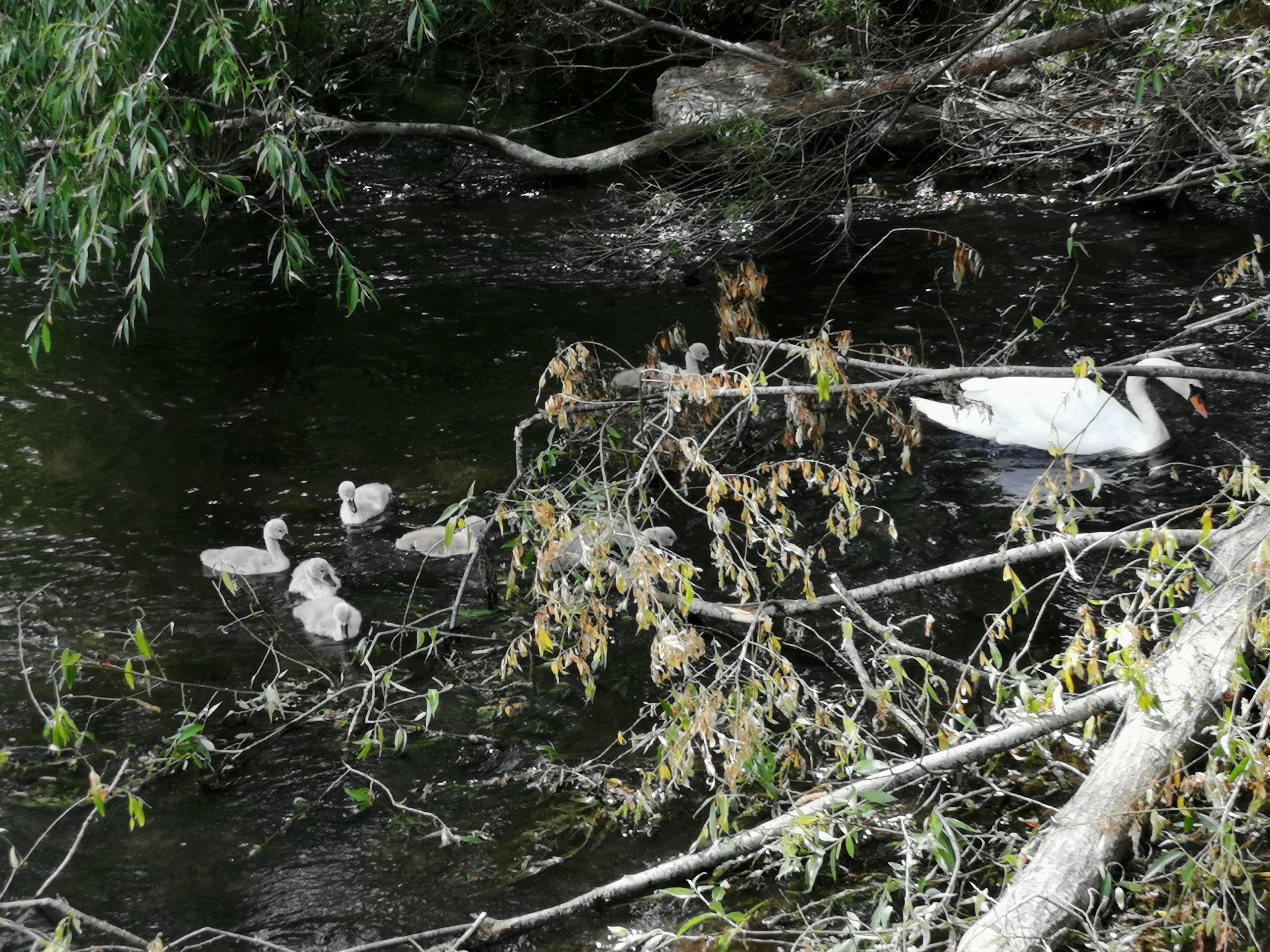
A pair of mute swans (ealaí) nested on the stretch of Royal Canal east of Cross Guns Bridge but quite near to it. Well, the female, the pen, at least did, while the cob (male) was usually swimming nearby. So how did the pen feed during the long hatching period? Unlike some bird species, this male does not feed the broody female. Well, the male may take a turn, spelling her to go off and feed herself and difficult to know when that happens, as both genders look so much alike. Fumbling with my phone once I failed to catch a photo of the large grey eggs beneath the shifting body of the sitting bird – three, an East Asian woman told me, using her fingers. Later, I saw both parents with just one cygnet – whether some of the eggs were infertile or two of its siblings died I don’t know.

Mute Swan cygnet in ‘duvet’ on land
(Photo: D.Breatnach)
Mute Swan parents and lone cygnet, Royal Canal, Glasnevin.
(Photo: D.Breatnach)

Predators can take cygnets but the parents are very good at protecting them and eggs in the nest will not be left untended until the cygnets are hatched – and then it’s straight into the water. When not swimming itself, the cygnet climbs on to a swimming parent’s back and sits there surrounded by a natural feather duvet. From then on, the nest is not needed except perhaps in stormy weather.

A few days later I was fortunate to see another pair of mute swans on the Tolka in Griffith Park, these with no less than seven cygnets! Their parents took them upstream, the cygnets swimming easily, even under the branches of a fallen tree-trunk. Until they came to a mini-weir which the parents simply walked over but their offspring were too small to do that. However, they maintained position for quite a while swimming against the mini-waterfall, their parents seemingly unable to understand why their young could not follow them and, eventually, having to turn back to them. Many mammals, confronted with a similar problem, would simply pick its young in its mouth and carry them over the obstacle and then go back for the rest. A small crowd of Homo Sapiens mammals gathered to watch the proceedings with interest and delight.

Some of the mute swan brood following their parent upriver on the Tolka.
(Photo: D.Breatnach)
Can we go under this obstacle?
(Photo: D.Breatnach
Yes, we CAN go under that obstacle!
(Photo: D.Breatnach)
Why aren’t you coming?
(Photo: D.Breatnach)

Also out with their young were mallards (Lachain), the ducks and drakes (bardaill). Some had hatched their young as far back as April but most seemed to be doing so at this time period and then it’s straight into the water. I remember witnessing the unpleasant scene of a duck with a clutch of tiny ducklings on the Tolka being harassed by a couple of drakes, one in particular trying to mate with her, she quacking that she wanted no part of it. Contrary to comment by some writers, rape is not unknown in the animal world and though in most species it is rare, mallard drakes are known for it.

Delightful it was however on another day to see a newly-hatched clutch of ducklings zooming around on the water, in their fluffy chocolate brown-and-yellow down looking like aquatic bumblebees, both parents close by.

Duck and very young ducklings, Tolka, Griffith Park.
(Photo: D.Breatnach)

Walking past the high waterside vegetation of the canal one day I heard a kind of cheeping which I guessed to be the chicks of a moorhen (Cearc Uisce). These waterfowl are very shy and careful too not to reveal their nest locations which are constructed in waterside vegetation only inches above the water level and sometimes actually afloat on a kind of raft. Though egg-laying is in March-April and they will not fledge until about 50 days later, we should be seeing the chicks with their parents already. So where are they?

Moorhen, Royal Canal, Phibsboro, not hanging around to be photographed.
(Photo: D.Breatnach)

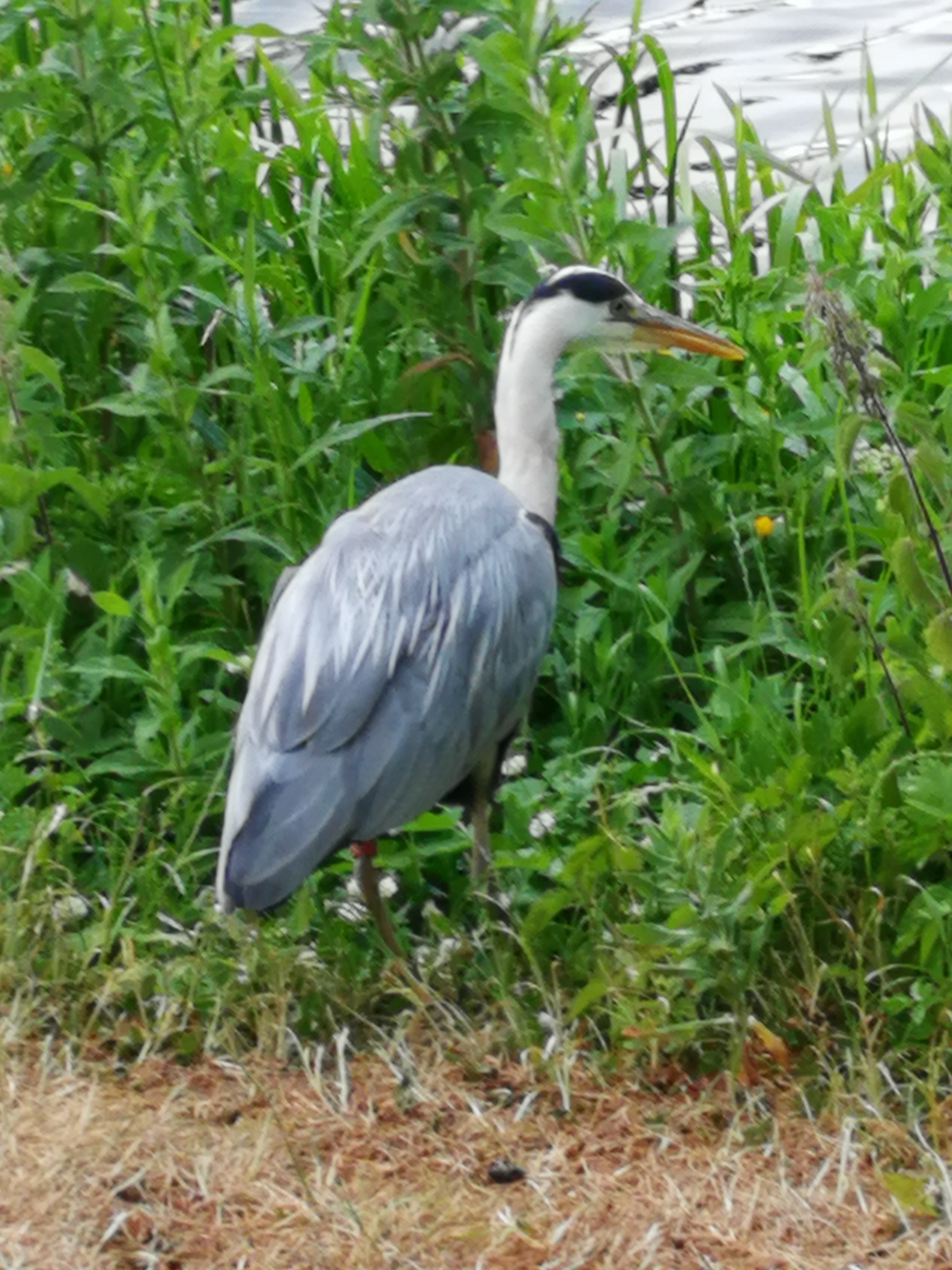
Grey herons (Corr Ghlas) fish the Tolka and the Royal but their nests are nowhere there. They prefer to nest in trees, somewhat incongrously for birds with such long legs. I have never seen their nests in Ireland myself, though I read that a colony is to be found in St. Anne’s Park, in County Dublin. Grey herons take turns on the nest and also in feeding their young – which require a lot of fish and frogs. They would take a duckling or cygnet too, given the chance …. Which is why herons often get mobbed by other birds. In Drumcondra I watched one on house rooftop being dived at by seagulls, no angels themselves but they have nests of their own in higher rooftops nearby.

Grey Heron, Royal Canal, Glasnevin.
(Photo: D.Breatnach)

And one day, a Little Egret (Éigrit Beag) spent a little while looking for fish in the Tolka before departing. It’s a relatively new settler in Ireland but no longer rare along the east coast.

Not so much “taking to the water” as already in it are the tiny young of the three-spined stickleback (Garmachán), hatched out in underwater nests cared for only by the male. I have seen shoals of the fry of larger fish in the Tolka too, once heading downriver through the Botanic Gardens; what species they were I don’t know but a large stock of brown trout (Breac Donn/ Rua) lives in the river. Many sprats are at this moment concentrated in different parts of the Tolka.

However, on a number of occasions large numbers of fish have been killed by pollutants in the water. A few years ago it was reported that salmon (Bradán) had been seen making their way upriver and this year I saw some myself in the Tolka. These spawn in freshwater and after a few years their young make their way to the sea, the survivors returning years later to spawn in the river again. If the young are killed before making it into the sea obviously they won’t coming back to spawn in a few years’ time so a fishkill incident in one week can wipe out a species in the river for a number of years. I photographed the sprats of some species of fish a few weeks ago in the Tolka and again this week while walking through Griffith Park (I, not the fish).

Sprats, young of some fish species, Tolka, Griffith Park, 25 June 2020. Difficult to photograph with mobile phone even through not much more than a foot of water. (Photo: D.Breatnach)

Among the young taking to the air now are those of the magpie (Snag Breac) and the distinctive and irritating high-pitched calls of the juveniles can be heard just about everywhere, usually from above in the trees. The call is “feed me” and is designed to be difficult to ignore. However, they need to learn not only to fly but to find their own food, so the parents will feed them only on occasion. This corvid is apparently an invader recorded arriving in Wexford in 1676, over two decades after that other invader, Oliver Cromwell. It has settled in well but is recognised as a predator by songbirds and sometimes attacked by them; on the other hand the magpies themselves will gang up on seagulls, hooded crows and cats, when they will give a frequent rattling kind of call.

The juveniles who are calling to be fed were in the egg for 20 days and fledging for nearly a month, which means the eggs were laid in April. The nests are large, a mass of twigs and can be seen in trees all over Dublin.

Some of the cottonwood seed-carrying medium on the banks of the Tolka, Griffith Park, end of May.
(Photo: D.Breatnach)
Bullrushes, Royal Canal, Drumcondra, shedding some cotton but not where the main cotton fall is coming from.
(Photo: D.Breatnach)
Bedstraw, perhaps, flowers mostly gone to seed.
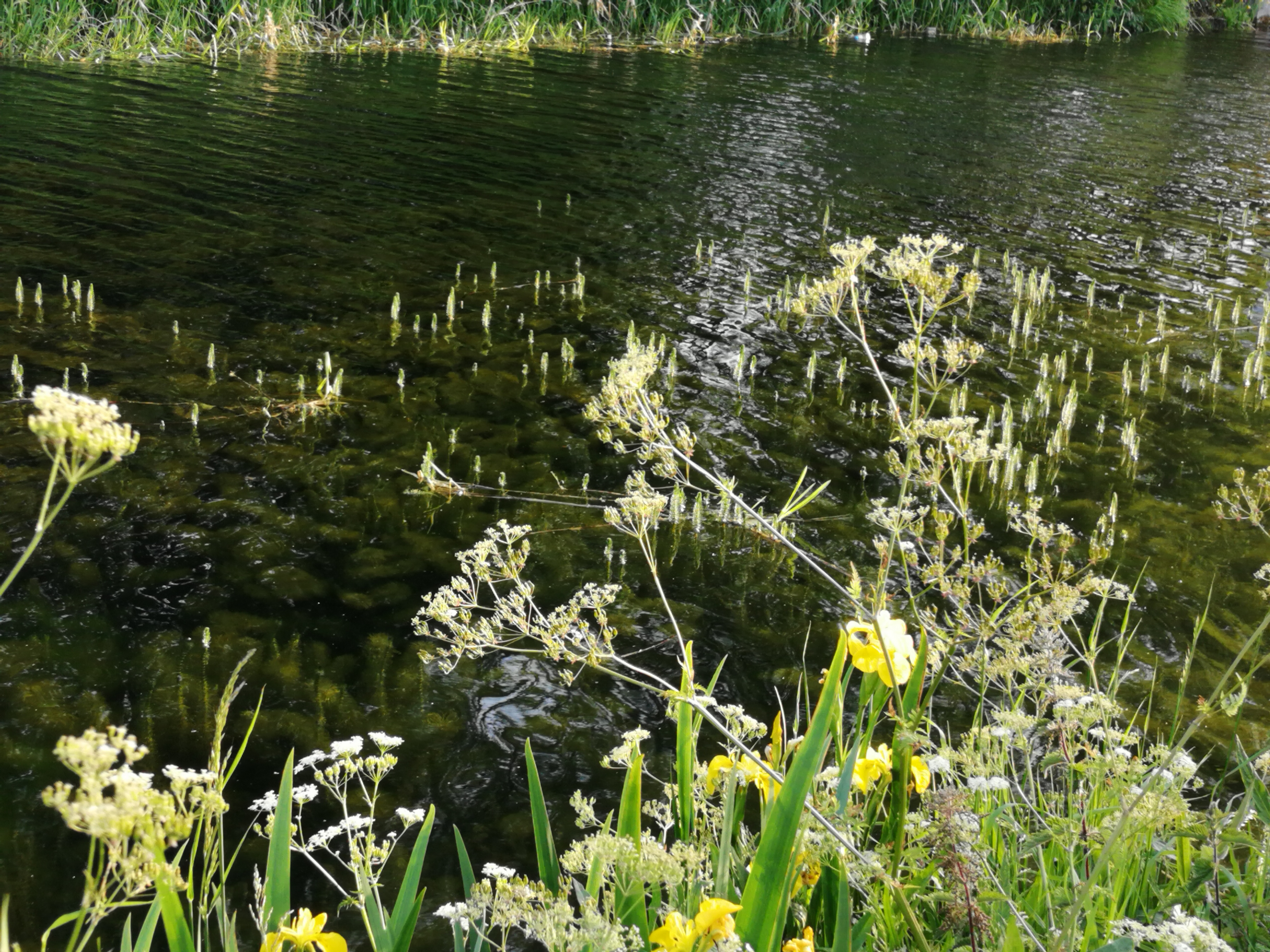
Royal Canal, Drumcondra; Yellow Flag Iris nearby.
(Photo: D.Breatnach)

The young of plants have taken to air too and along the banks of both the Royal Canal and the Tolka the flowers have died and are turning to see-capsules or to pods, while other species are bursting into flower.

Some days the ground was covered in drifts of a kind of cotton and I assumed this was seed-carrying material. But from what? Along the Royal I might suspect the bullrush or reed-mace, with tattered tufts of cotton around the mace “head” …. or perhaps the pussy willow … but surely not in these quantities? However, in Griffith Park clumps of it were drifting across my path and I remembered reading about “cottonwood trees” in stories set in the “Wild West”. Yes, three species of cottonwood are part of the larger poplar family and have been around for 55 million years in North America, Eurasia and Asia and although not native they do grow in Ireland. And poplar-type trees have been planted along stretches of the Royal but in particular in Griffith Park, recognisable by their somewhat rounded leaves and the compact upright growth of their branches, so perhaps they are the source of the cotton? Their name in Irish is Poibleog Mheiriceá Thuaidh, translating as “North American Poplar”; that’s a bit of a long one and if they become more popular (forgive the pun) we might have to start calling them ‘Crann Chadáis’ (Cotton Tree).

But it wasn’t them either.  The culprit was, after all, the willow (Sail) tree; but not the pussy or weeping willow, but the giant willows.

End (A Chríoch)

Covid-19 Has Killed More British People Than The Blitz In World War II — AN SIONNACH FIONN

Between the United Kingdom’s declaration of war on the German Reich in September 1939 and the latter’s capitulation in May 1945 some 61,000 civilians were killed in the UK by enemy action, principally in the so-called “Blitz” or aerial bombardments of June 1940 to May 1941. Despite the ludicrously low official figures published in recent […]

via Covid-19 Has Killed More British People Than The Blitz In World War II — AN SIONNACH FIONN

ANARCHIST, SUFFRAGETTE, IRISH PATRIOT, DOCTOR AND STRIKE ORGANISER: GERTRUDE KELLY

Geoffrey Cobb

(Reading time: 15 mins.)

(Article originally published 2017 in New York Irish History, journal of the New York Irish History Roundtable, abbreviated slightly and reprinted here with kind permission of the author)

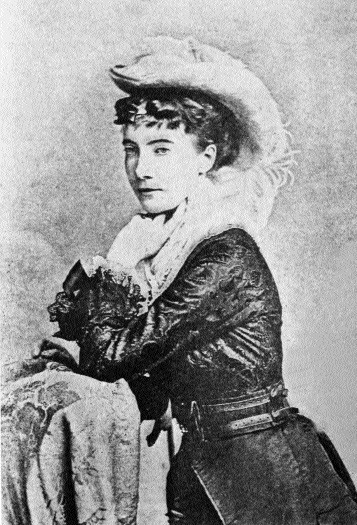
In her article, “Dr. Gertrude B. Kelly: A Forgotten Feminist,” Wendy McElroy summarizes the paradoxes in Dr. Kelly’s worldview that make her a complex, seemingly contradictory figure: A labor radical who was deeply skeptical of unions, a medical doctor who opposed state licensing of medicine, a staunch anti-statist who broke with the most prominent individualist anarchists of her day, an ardent feminist who denied that there were “women’s rights” as distinct from “human rights.” (McElroy, “Gertrude B. Kelly”)

Gertrude Kelly (photo sourced: Wikipedia)

          Kelly’s seemingly paradoxical and contradictory juxtapositions come into focus, though, in the light of her Irish birth and anarchist beliefs. Individual anarchists, like Kelly, were a group of anti-authoritarian radicals who regarded total individual autonomy and free labor as the answer to the social and economic problems of the day. Kelly believed that overthrowing power structures and maximizing individual autonomy and responsibility would create a truly free society, which would evolve organically once society had liquidated the oppressive state. Because individualist anarchists regarded labor as the source of value and exchanges of unequal values to be exploitative, they may be regarded as a part of the broader socialist movement. Kelly’s views not only were highly uncommon and radical, but they also placed her in direct conflict with the establishment: the church, the state, and the capitalist order.

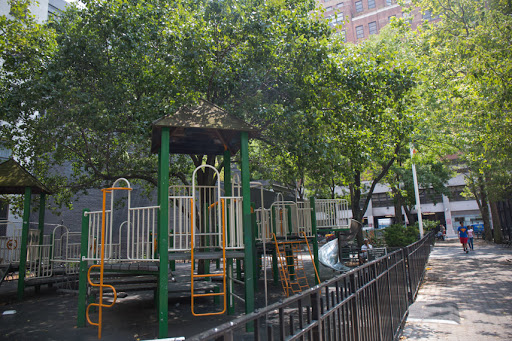
Nameplate of the New York, Chelsea area playground named in Gertrude Kelly’s honour.
(Photo sourced: Internet)

Shaping Kelly’s perspectives was that in her eyes, Ireland was victim of both capitalism and the British state.

Although she left Ireland at age eleven, the experiences and opinions of her parents profoundly shaped Kelly’s perspectives. She was born into a family of Irish nationalist educators in 1862 in Carrick-on-Suir, Co. Tipperary (Co. Waterford identifies Kelly as being born in the same year but in Ballyneale, across the border from Tipperary). Her father was a schoolmaster apparently forced out of his job for his Fenian sympathies. He left Ireland in 1868, five years before Gertrude would join him in New Jersey in 1873. He would become a high school principal, but he and the whole family remained passionately devoted to Irish affairs. Her older brother, John, played a huge role in shaping her anarchist worldview.

Kelly was one of twelve children, but little is known about any of her other siblings except for John who had a profound influence on her attitudes towards Ireland and anarchism. John graduated from Stevens Institute of Technology in Hoboken and went on to earn a Ph.D at age twenty-two in electrical engineering. An assistant for a time to Thomas Edison, Kelly became one of the world’s foremost experts in using dynamos to transmit telephone signals. During Kelly’s lifetime he held over seventy electrical related patents and pioneered high voltage electricity generating and transmission systems.

However, he was not just a man of science; he was also devoted to Ireland and used his considerable wealth generously to advance the cause of Irish freedom. In the 1880s, he wrote articles for individualist anarchist publications including Liberty, Alarm, and Lucifer, which must have greatly influenced his sister. John Kelly spent the last years of his life supporting Irish causes, working closely with his sister. From 1916–18, he served as the president of the Massachusetts State Council for Friends of Irish Freedom. From 1920–21, he wrote a third of the Irish World’s anonymous political commentaries, and in 1921, from July to December, he and his young sister agitated for a nationwide boycott of British goods.

Despite being in America, Kelly still remained keenly interested in events within Ireland. Although she was busy with her medical studies she followed Ireland from articles in the Irish World, published in New York, and the Boston Pilot. Both newspapers featured several stories on the failure of the Irish Land Act of 1870 to improve the lot of tenant farmers, the formation of the Irish Land League in 1879, the subsequent Land Wars, the No-Rent movement, and the indiscriminate evictions of Irish tenant farmers from their land by agents of absentee English landlords. These stories cemented Kelly’s rejection of British imperialism and private ownership of land.

In 1879, John Devoy of Clan na Gael in the United States forged a broad-based coalition called the “New Departure,” with Michael Davitt of the Irish Republican Brotherhood and Charles Stewart Parnell of the Home Rule League to create a joint front that united believers in physical force, agrarian agitation, and constitutional nationalism to aid the suffering Irish tenant farmer and demand Irish Home Rule from England. Parnell and Davitt were also members of the Irish National Land League. In support of that initiative Fanny and Anna Parnell founded the Ladies Land League in America in 1880 with branches in Hoboken, Jersey City, Newark, and Patterson.

Building on Parnell St. junction with O’Connell St Dublin which was the HQ of the Ladies Land League in ireland. They ran the whole campaign while the male leaders were locked up in Kilmainham.
(Photo: D. Breatnach)
Fanny Parnell who with her sister Anna formed the Ladies Land League. Fanny died of an illness very young.
(Photo sourced: Internet)

Young Gertrude Kelly became an active member of the League and a vocal supporter of a No-Rent Manifesto published by the National Land League in 1881. Kelly’s understanding of individualistic anarchist philosophy was strengthened by the columns of “Honorius” in the Irish World, an organ of the Irish No-Rent movement. Honorius was, in fact, a pseudonym for the American natural rights advocate Henry Appleton, who contributed frequently to the early issues of Liberty, both under his own name and under the pen name of “X.”(McElroy, “Gertude B. Kelly”)

PROLIFIC WRITER AND FEMINIST

          Anger at how British imperialist government had subverted its proper role in Ireland shaped Kelly’s anti-authoritarian worldview. Kelly was not only a dedicated Irish-Nationalist, but she was also a prolific writer and insightful social and political commentator. In articles published in the individualist periodical Liberty and the Irish World she expressed her indignation and abhorrence at the lack of fairness empathy or sense of humanity inherent in the attitude of the ruling elite towards the poor of Ireland. She contributed a number of other well-received articles for Liberty whose founder and editor, Benjamin Tucker, said of her “Gertrude B. Kelly…by her articles in Liberty, has placed herself at a single bound among the finest writers of this or any other country.” (McElroy, “Gertrude B. Kelly”).

(Photo sourced: Internet)

Kelly, however, would later break with Tucker and cease writing for Liberty, a sign of her fiery independence. Kelly was more than a mere analyst of Irish anti-imperialism. She was also an avant garde feminist who understood the struggles that women faced, especially poor women, with whom the doctor had a lifelong affinity and her articles for Liberty reflect a keen understanding of the special problems females faced. In one of her articles for Liberty she developed a highly controversial argument about prostitution. Instead of seeing prostitutes as “fallen women,” Kelly saw them as economic victims. Her first article in Liberty, “The Root of Prostitution,” claimed that women’s inability to earn enough money through respectable forms of labor was the root cause of sex work. She wrote: “We find all sorts of schemes for making men moral and women religious, but no scheme which proposes to give woman the fruits of her labor. In her writing, she railed against men forcing women to conform to paternalistic codes of behavior. Men…have always denied to women the opportunity to think; and, if some women have had courage enough to dare public opinion, and insist upon thinking for themselves, they have been so beaten by that most powerful weapon in society’s arsenal, ridicule, that it has effectively prevented the great majority from making any attempt to come out of slavery.” (McElroy,“Gertrude B. Kelly”)

Despite Kelly’s sincere feminism, she could make the following statement that must have alienated her from many of the leading feminists of her day: “There is, properly speaking, no woman question, as apart from the question of human right and human liberty.” She added: “The woman’s cause is man’s— they rise or sink/Together—dwarfed or godlike-bond or free.” She saw women’s struggles in the wider context of humanity’s struggle against all forms of coercion. Women would gain their deserved social status only when all of society had also liberated itself. Kelly also became a militant suffragette, believing that women with the power to vote could solve many of the issues they faced. (McElroy, “Gertrude B. Kelly”).

In Kelly’s eyes both women and men were in fact the victims of a coercive capitalist society. Radical individualists of nineteenth-century America, like Kelly, saw capitalism as the root cause of poverty and social injustice. Kelly subscribed to the labor theory of value espoused by the anarchist individualist theoretician Josiah Warren who posited that capitalists stole the fruits of labor by underpaying the worker for his or her efforts. She also accepted the popular radical belief that capitalism was an alliance between business and government, in which the state guaranteed the rich their privileged position. Kelly considered all forms of capitalism to be what individualist anarchists called “state capitalism.”

In Irish-America, where so many fellow immigrants had climbed the ladder by joining the civil service, her anti-government stance was especially incendiary.

KELLY’S WORK AS A DOCTOR

          Kelly’s becoming a physician is an extraordinary story in itself. She became one of the very few women to study medicine and become a doctor thanks to two English sisters, Elizabeth and Emily Blackwell who set up the first school to grant women licenses to practice medicine, the Women’s Medical College of New York. Kelly graduated from Blackwell’s school in 1884 with an M.D. degree and became an accomplished surgeon.

If Kelly is recalled today in New York City, it is not for her important role in agitating for Ireland, but in helping the city’s poor through her work as a doctor. Although she campaigned for many deserving causes during her lifetime, her primary focus was on treating the downtrodden and poor working women and their families in the clinics she worked in. She set up such a clinic in Manhattan’s Chelsea neighborhood where she became legendary for surreptitiously leaving cash under her dinner plate when she made house calls at the homes of impoverished patients. Kelly was also a renowned surgeon who, in addition to her work at the clinic, was a member of the surgical staff at the New York Infirmary for Women and Children, the institution where she had received training. During her medical career she authored and co-authored papers on abdominal surgical procedures and other medical and health care-related issues.

Dr. Gertrude Kelly practiced at the New York Infirmary for Women and Children, founded by the Blackwell sisters and Marie Zackrewska, now known as the New York Presbyterian – Lower Manhattan Hospital.
(Photo sourced: Internet)

KELLY AND THE RISING

          Kelly would play an oversized role in the events before and after the 1916 Easter Rising. In 1901, John Redmond, who assumed leadership of the reunited Irish Parliamentary Party (IPP), established the United Irish League of America to raise funds for the IPP and promote its Home Rule agenda in the United States. Dr. Kelly supported the United Irish League, even though its acceptance of continued British sovereignty over Ireland disturbed her. In accepting home rule, she reasoned that it could serve as an intermediary step before launching a nonviolent, anti-British, grassroots campaign that would lead to an independent Irish Republic.

In October of 1914, Kelly issued a call to “women of Irish blood” to join the first chapter of Cumann na mBan formed in the United States. Hundreds of women met at the Hotel McAlpin, where Kelly, Mary Colum, and Sidney Gifford, a recently arrived émigré from Dublin outlined the aims of the organization. Their chapter would follow the lead of Cumann na mBan in Ireland by raising funds and garnering support for the Irish Volunteers formed in 1913 in response to the formation of the anti-independence Ulster Volunteer Force the previous year. The declared aim of the Irish Volunteers was “to secure and maintain the rights and liberties common to the whole people of Ireland.” (“Dr. Gertrude B. Kelly” in Feniangraves.net). Chosen as president of the organization, Kelly helped set-up other branches and arranged for speakers from Ireland to address its members, conduct lecture tours and help in fundraising efforts.

When Redmond in a speech called on young Irishmen to enlist and fight in the British Army, it was too much for the anti-imperialist Kelly, who issued the following statement: “May I, as a woman, an Irishwoman and physician, spokeswoman of hundred, thousands of my sisters at home and abroad ask our leaders what it is they propose to Ireland to do—commit suicide? Admitting for the moment that this is “a most righteous war” not—”a war of iron and coal”—a war between titans for commercial supremacy— why should little Ireland have to do what the United States, Switzerland, etc., do not. Is Home Rule to be secured for the cattle and sheep when the young men of Ireland are slaughtered, the old men and old women left sonless, the young women obliged to emigrate to bring up sons for men of other climes.” (“Dr. Gertrude B. Kelly” in Feniangraves.net)

After the Easter Rising, Cumann na mBan’s fundraising efforts were redirected to the support of the thousands of families of imprisoned Volunteers. Kelly and other Irish women activists including Margaret Moore, a Land League veteran and labor leader Lenora O’Reilly led the highly successful fundraising campaign.

In 1917, America entered World War I on the side of the British. President Wilson threatened members of any organizations that protested against the British Empire with jail sentences. Nevertheless, in the same year Dr. Kelly was part of a group that formed the Irish Progressive Party, whose aim was to lobby the government in Washington to protest British imperialism and recognize the Irish Republic.

In 1920, Dr. Kelly would perform her greatest services to Irish freedom. She understood that women could take bold actions, such as in public protests, that would capture popular attention and focus the American public on the continued presence of Britain in Ireland, which violated one of the Fourteen Points identified by Wilson in 1918 as necessary for world peace—self-determination for small nations. The first official meeting of the activist group, American Women Pickets for the Enforcement of America’s War Aims, was held in New York on April 20, 1920, organized by Gertrude Kelly.

Women supporters of the Irish struggle and others in the USA tearing a Union Jack flag. Date uncertain but after WW1. (Photo sourced: Internet)

With Irish men in America mired in fighting one another, this women’s movement grabbed headlines through a succession of highly effective public acts, some of which created chain reactions across the eastern seaboard of the United States. In September, 1920, Kelly was one of the organizers of a female blockade of the British Embassy in Washington as response to their actions in Ireland. Kelly was arrested for her part in the agitation.

One of the Women Picketers in 1920, Mae Manning, being issued a ticket by a policeman outside the White House. (Photo sourced: Internet)

In December, 1920, the women pickets and the Irish Progressive League organized a strike at a Chelsea pier in Manhattan to protest the arrests of Irish-born Australian Archbishop Daniel Mannix, an outspoken foe of British rule in Ireland, and Terence MacSwiney, the Lord Mayor of Cork, who was on hunger strike and near death. Kelly, Leonora O’Reilly, Hannah SheehySkeffington, and Eileen Curran of the Celtic Players assembled a group of women who dressed in white with green capes and carried signs that read: “There Can Be No Peace While British Militarism Rules the World.”(“Dr. Gertrude B. Kelly” in Feniangraves.net)

The strike which, lasted three and a half weeks, was directed at British ships docked in New York. Striking workers included not only Irish longshoremen but also, Italian coal passers, AfricanAmerican longshoremen, and workers on a docked British passenger liner. According to a New York Sun report it was “…the first purely political strike of workingmen in the history of the United States. The strike became famous and spread to Brooklyn, New Jersey, and Boston. When reporters asked who exactly was behind these protests, Dr. Kelly responded “American women.” (“Gertrude B. Kelly” in Irish Echo).

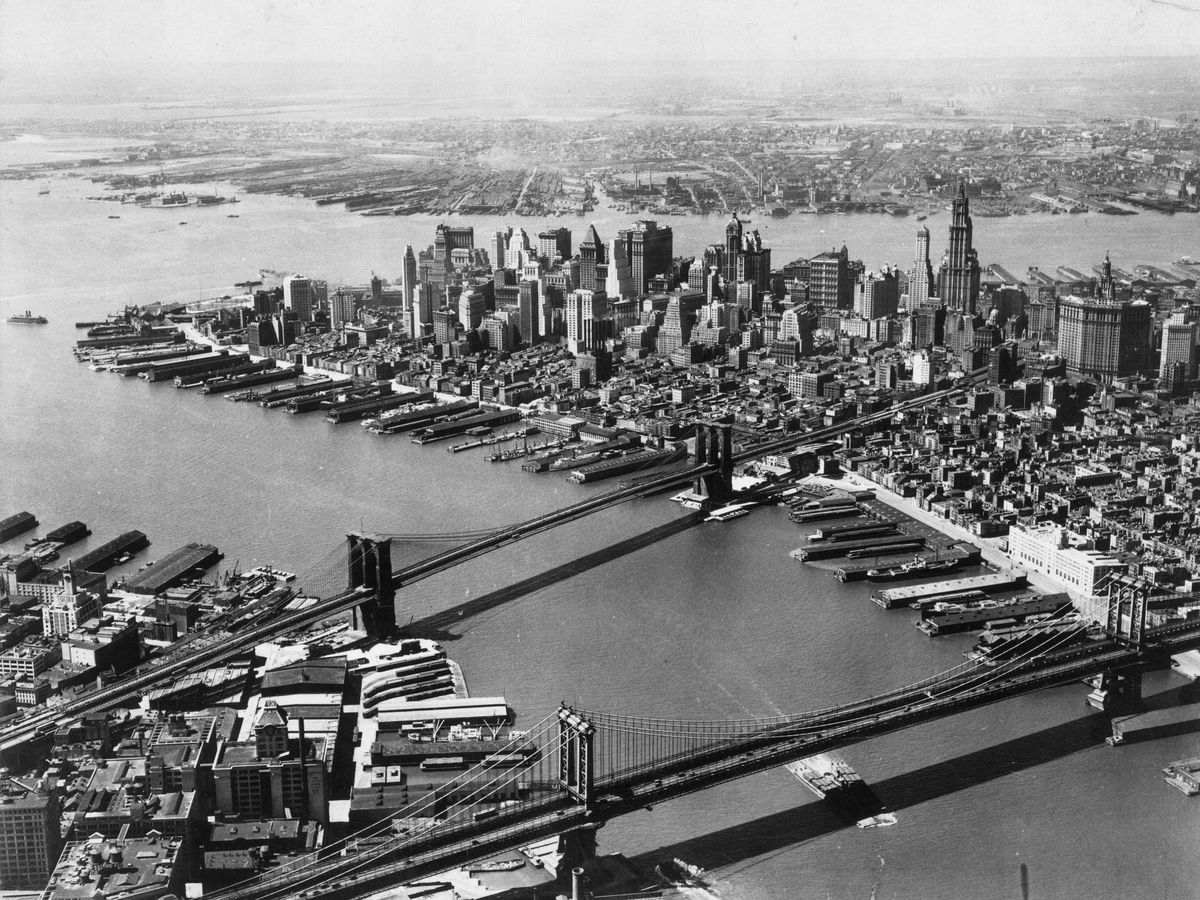
Aerial view of New York Harbour, 1920s, showing many of the multiple wharves and docks both sides of the river. (Photo sourced: Internet)

By the end of 1920, many thought the only prospect for an independent Ireland was an acceptance of partition. Dr. Kelly was a fiery opponent of division and expressed her views on Ireland being divided: “The thing itself is absolutely unthinkable. We have always been slaves, but unwilling slaves. Now we are subscribing to our slavery. I cannot believe that the Irish people will do this. The whole thing is a fake from start to finish. Summed up I would say that after 750 years we have given England moral standing in the world when she has none: it’s a tremendous defeat.” (“Gertrude B. Kelly” in Feniangraves.net)

Women protesting in the USA in solidarity with the Irish struggle in 1922.
(Photo sourced: Internet)

Nevertheless, partition did take place, much to Kelly’s dismay. Bitterly disappointed, she continued her work treating the poor of the city. In the first quarter of the twentieth century she was on the “must meet” list of every Irish political and literary figure who came to the United States.

Kelly passed away on February 16, 1934. The poor of Chelsea mourned her and remembered her acts of kindness. In 1936, Mayor Fiorello H. LaGuardia named the Dr. Gertrude B. Kelly Playground located in Chelsea west of Ninth Avenue between Sixteenth and Seventeeth Streets in her honor. It was one of five model playgrounds developed in New York City during the mid-1930s. (“Gertrude B. Kelly Playground” in NYCgovparks.org)

The playground is perhaps the only public tribute to a woman who made an outsized contribution to Irish independence and to the City of New York. Perhaps in the future Dr. Kelly will garner more.

End.

The original article in full may be found here, including also a list of sources: nyih32.CobbG_pdf2%20(3)%20(1).pdf

An internal view of the New York, Chelsea area playground named after Gertrude Kelly.
(Photo sourced: Internet)

IRISH REPUBLICANS AND ANTIFASCISTS GATHER IN DUBLIN TO HONOUR SEÁN RUSSELL

Clive Sulish

(Reading time: 10 mins)

A few hundred Irish Republicans and other Anti-Fascists gathered today in the Ballybock area north of Dublin city centre to commemorate IRA leader of the 1940s Seán Russell. The event was organised a few weeks after the incumbent Irish Prime Minister, Leo Varadkar, had made a public statement suggesting that Russell was a fascist sympathiser and that his monument and some others in Ireland should be removed. In attendance yesterday (Sunday 21st June) was a cross-section of the Irish Republican movement in addition to independent Irish socialists and anti-fascists.

Note: Photos of the event are from individuals D. Breatnach and C. Perry and organisations Saoradh and Anti-Imperialist Action.

The statue representing Seán Russell on the monument plinth.
The theme banner crossing Annesley Bridge on the way to Fairview Park.

NAZI COLLABORATOR” SLUR

          Leo Varadkar’s comment that Sean Russell had been “a Nazi collaborator” was made in the course of a TV discussion on racism, arising out of the killing of George Floyd by a police officer in the USA, an event which sparked off huge protests not only in the USA but, because it had been so clearly documented and shared on social and news media, around much of the world. Among the angry retorts in reply had been an Open Letter by Matt Doyle, of the National Graves Association, pointing out that Russell was an Irish Republican with no elements of fascism in his history or ideology and that in fact Varadkar’s party, Fine Gael, was the one built on fascism, i.e the Blue Shirts movement of the 1930s, which Republicans had fought and defeated.

Seán Russell had gone to Nazi Germany in 1940 to seek assistance from them in ridding Ireland of British colonialism but on his way back to Ireland in a German submarine, accompanied by Frank Ryan, Russell had become seriously ill, died and was buried at sea, 20 miles from Galway. Frank Ryan was also an Irish Republican but had been wounded fighting fascists in the Spanish Civil War; after his capture the Nazi German allies of the Spanish fascists had expressed interest in Ryan for the purposes of assisting Irish Republican action against the English occupation of the occupied Six Counties.

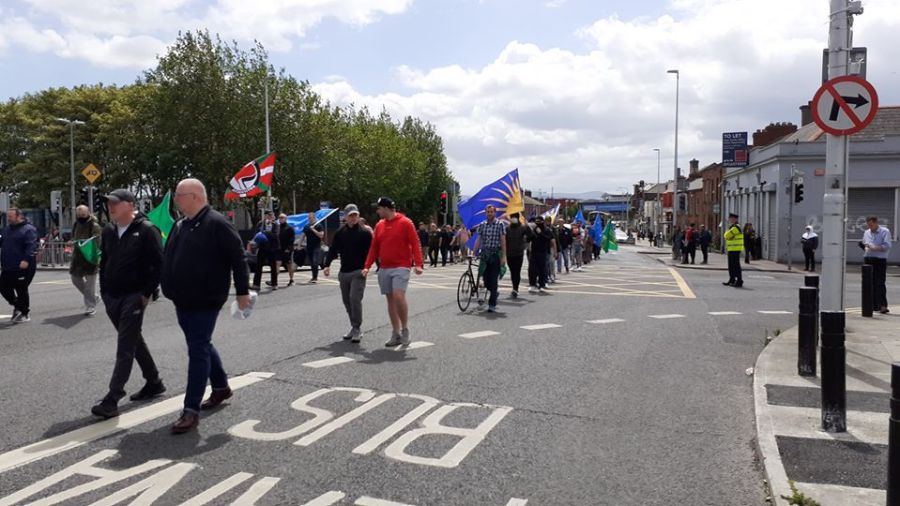
View of section of the parade crossing Annesley Bridge on the way to the monument in Fairview Park.

A BROAD REPUBLICAN PARTICIPATION IN PROCESSION AND RALLY

          The attendance had representation from across the Irish Republican spectrum from “Stickles” to “Provies” to “Dissidents”1, mixed with some independent socialists and antifascists but notably absent was a representation from the Irish socialist and communist parties in any numbers, nor were their flags to be seen. No anarchist flags were in evidence either and only one Antifa flag was, that one from the Basque Country. The event was organised by “Independent Republicans”, a headline permitting a wide attendance free from sectional hostilities or the more fundamental division of for or against the Good Friday Agreement. The flags most in evidence among the attendance were the orange rising sun on a blue field of Na Fianna and both versions of the “Starry Plough”, the one in gold on a green field and the one with white stars on a blue field.

Section of the crowd at the event in Fairview Park with Annesley Bridge Road in the background.

The Starry Plough was the flag of the Irish Citizen Army, founded by James Connolly and Jim Larkin and described as “the first workers’ army in the world”; formed in 1913 to defend the Dublin strikers and locked-out workers from the attacks of the Dublin Metropolitan Police, its ethos was socialist and for Irish independence. The ICA recruited men and women and a number of the latter were officers during the 1916 Rising, including third-in-command in two insurgent garrisons. That version was gold-on-green field version but the Republican Congress of the 1930s had the white-stars-on-blue-field version. The Republican Congress was a short-lived attempt to unite communists, socialists and the Irish Republican movement in one front.

Na Fianna Éireann was an Irish Republican youth organisation founded by Bulmer Hobson of the IRB and Constance Markievicz in 1909 and therefore predated the ICA (and the Irish Volunteers). Members of na Fianna were highly motivated and disciplined and played a prominent part in the collection of Mauser rifles smuggled into Howth in 1914, in the 1916 Rising, the War of Independence and in the Irish Civil War.

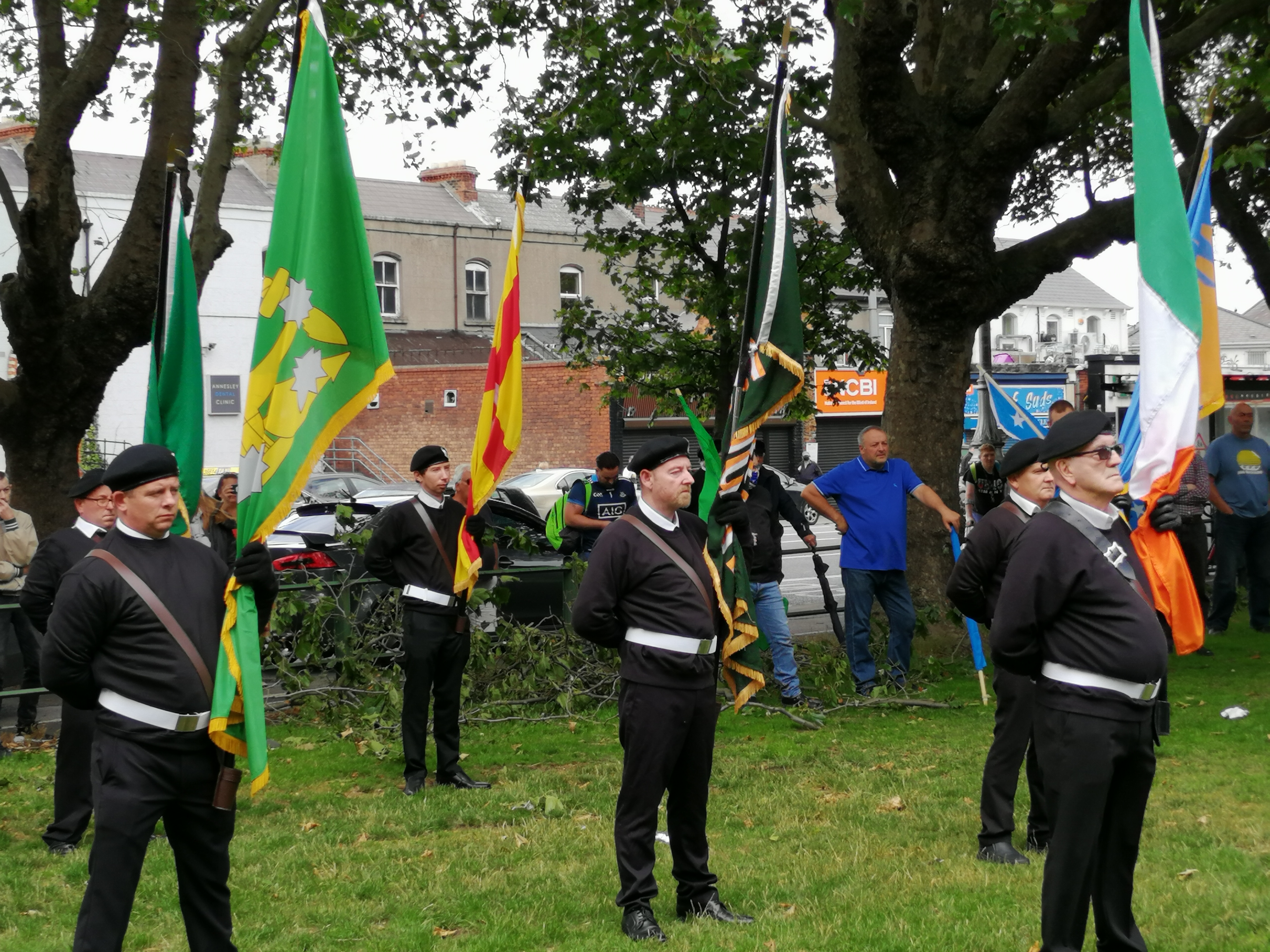
The colour party at the event.  The flags displayed traditionally include the Tricolour, those of the four provinces and that of Na Fianna, along with the Starry Plough (either version but that shown here is the original ICA design).

Led by a traditional Irish Republican colour party and a lone piper, the parade on Sunday set off from under the railway bridge crossing the North Strand road and marched north in the traditional formation of two lines, their flags fluttering in the strong breeze. The procession crossed the Tolka river at Annesley Bridge, scene of a battle in 1916. In fact, the whole area had also been the scene of running battles in 1014 as the defeated Viking mercenaries from Orkneys and Manx ran for their ships, pursued by some of Brian Boróimhe’s (“Boru”) forces, for prior to the draining and reclaiming of the marsh, dunes and mudflats of the “sloblands” to permit laying out of Fairview Park and parts of the East Wall area, the seashore had been there.

Once over the bridge, the procession turned into Fairview Park and marched a short distance under trees until arriving at the Seán Russel monument and its surrounding low iron fence, where a number of people had already gathered. The monument had been erected in 1951 by the National Graves Association, a totally independent NGO and had been attacked twice, once having an arm removed and on the other occasion, its head. The first attack has been attributed to right-wing elements and the second, to antifascists.

The lone piper plays by the monument.

WREATH, SPEECHES AND SONG

          Patrick “Parko” Burke as MC for the event welcomed those in attendance and called for the placing of a floral wreath at the monument on behalf of Dublin Republicans. The piper played a short piece while the flags of the colour party were lowered and a moment’s silence was observed, then as the flags were raised again a short piece was played again.

The wreath to be laid on behalf of Dublin Republicans at the monument.
Laying the wreath at the foot of the monument.

The MC then introduced Gerry Mac Namara, who is a member of the extended Russell family.

Speaking briefly first in Irish and going on to address the gathering in English, the speaker recounted that Russell’s antecedents had been Fenians and that Seán himself was an Irish Republican who fought in the 1916 Rising and War of Independence and continued in the IRA after De Valera led a split to form Fianna Fáil. Mac Namara denounced Varadkar for his comments and commented that if the Prime Minister was in the mood to remove monuments there are a number of memorials of the British occupation and to English landlords in Ireland with which he might make a good beginning. Mac Namara made some comments in a similar vein in reference to Cnclr. Ray McAdam, “the publicity-seeking Fine Gael Councillor” who had recently sought to desecrate the 1798 mass grave monument at Croppies Acre.  “Sean Russell has no grave”, commented Mac Namara, “because he was buried at sea.  This monument is the closest thing to a gravestone he has.”

Gerry Mac Namara, a member of the extended Russell family, speaking at the event.

If Varadkar wanted to talk about racism in Irish history, he would do well to refer to Oliver J. Flanagan, a prominent member of the Fine Gael party and Minister in Fine Gael government, who had in the Dáil in 1943 called called on the Irish Government to do as the Nazis had done and to “rout the Jews out of this country …. where the bees are, there is honey and where the Jews are, there is money.”

Liam Manners, a young man came forward then to read a statement from the Irish Republican prisoners in Maghaberry, Mountjoy and Portlaoise jails. The first of those prisons is of the Six Counties colonial administration while the other two are of the Irish State.

Pat Savage at the event performing an Irish ‘rebel’ ballad. The MC, Patrick “Parko” Burke is holding the microphone for him.
Liam Manners at the event reading statement on behalf of Irish Republican Prisoners.

Pat Savage was called forward and performed the Republican ballad “White, Orange and Green”, about an anonymous teenage Republican girl who refuses to surrender the Irish Tricolour to an English soldier during the War of Independence.

A REPUBLICAN LIKE TONE AND PEARSE”

          Mallachy Steenson came to stand in front of the monument and gave a resumé of Seán Russel’s service to the Republican movement. In seeking help to rid Ireland of British occupation Russell had been not only to Nazi Germany but to imperialist USA and Soviet Russia, however he had not been accused by Varadkar of being a Soviet or a US imperialism collaborator. Russell was ready to receive help from Nazi Germany to get rid of the British occupation, as he said himself but nothing more.

Steenson stated that Russell had been an Irish Republican in the same mold as Patrick Pearse and Theobald Wolfe Tone: Tone had sought help from France and Pearse from Imperial Germany, yet Tone was not a “French collaborator” nor was Pearse a collaborator with German imperialism or monarchy. Steenson commented that “the enemy of my enemy is my friend” has been a well-known tactical slogan on many occasions.

Briefly touching on John Mitchell, whose statue in Newry some had suggested had suggested should be got rid of, Steenson pointed out that Mitchell had opposed English rule in Ireland for which he had been deported to Australia as a convict. From there he had escaped to the USA. While it was unfortunate that he had taken the side there of the slave states of the Confederacy, were it nor for the English he would have been in neither Australia nor America.

Mallachy Steenson, delivering the main speech at the event.

The Sean Russell monument is not only to commemorate Russell, Steenson pointed out and there are names on the pediment of many other Republicans, including those executed by the De Valera government because they had continued the fight which Fianna Fáil had abandoned. The Irish Republicans of the 1940s, of which group Sean Russell was an important member, passed through a particularly difficult period.

Talking about monuments which he said should be removed, Steenson referrred to the wall of names in Glasnvevin Cemetery, which he said should be called “the Wall of Shame” and went on to refer to the attempt to interfere with the Croppies’ Acre memorial2. Steenson said that there was a concerted effort to remove or rewrite Irish history. There had not been too much controversy during the early part of the “Decade of Commemorations” but coming up soon would be the Civil War. How would Varadkar and Fine Gael justify the Free State’s execution of 77 Republicans after a summary court martial, he wondered. Or the Free State army tying of captured Republicans to a land mine and blowing them up? Or the removal from their cells in Mountjoy Jail of four Republican leaders, one from each province before shooting them dead the next day3?

The MC made a mention of the National Graves Association and announcing that the organisation had a big event planned for later in the summer, then called for another song which Pat Savage performed: “Off to Dublin in the Green”, a Republican ballad about the 1916 Rising.

Patrick Burke acknowledged the presence of Dublin City Councillors Cieran Perry and Christy Burke and invited the latter to say a few words.

Like Steenson, Cnclr. Burk referred to the “wall” in Glasnevin but also reminded listeners that in January of this year the Minister for Justice Charlie Flanagan had proposed to commemorate the Black ‘n Tans4 but his plans had been defeated by the public reaction of outrage. Burke referred also to the plan to build a playground on the United Irishmen mass grave at Croppies’ Acre and that a motion by Councillors such as Cieran Perry against any such desecration had won 50% of the vote and since he had been Chair, he had given the additional casting vote in favour of the protective motion. Cnlr. Burke said that he along with Cnclrs. Mannix, Perry and others were preparing a motion to prevent any Republican monument being removed in Dublin.

The formal part of the event concluded with the playing of the chorus of Amhrán na bhFiann, the Irish National Anthem while some remained in the area to take photographs, have theirs taken in front of the monument or catch up with friends or acquaintances whom they had not seen for some time.

INCIDENTS

          There were three minor incidents during the event:

1) Two cyclists had strung a line of bunting in LBTG colours between their bicycles and were at first some distance behind the monument but later moved to the street in front. It is not known whether they were supporting the event or commenting on it in some way.

2) While one of the speakers was addressing the crowd, one of a small group of secret police approached one of the supporters of the event who had become momentarily separated from the general attendance and tried to detain him there for questioning. However, the man shouted to the crowd that he was being “harassed by the Special Branch” and with a snarl the secret policeman stepped out of the man’s way. After all, there were several hundred supporters of the event present but only a handful of secret police!

3) During the proceedings, a middle-aged woman came from behind the monument and stood to one side of it in the space left open, looked at the statue, then at the attendance with an insolent attitude, then stalked away without saying anything.

CONCLUSION

          The event was marked by the absence of any obvious representation of the fascists and racists of the far-Right in Ireland who have been for some time now attempting to represent themselves as “Irish patriots” and who, it was rumoured had been warned not to attend.

The mood at the event was defiant and the speeches militant in form, seeming to reflect a determination to defend Irish Republican history and monuments to the anti-colonial resistance of the Irish people from forces in or outside Government who might wish to destroy or misrepresent them.

The calumny that Sean Russell was in any way a supporter of fascism has been staunchly refuted. However the correctness or otherwise of the general thesis that “the enemy of my enemy is my friend” and its specific application to Nazi Germany or other cases remains a subject of some debate even in Irish Republican circles.

End.

FOOTNOTES

1Popular words used to describe the Official Sinn Féin and IRA and its split, Provisional Sinn Féin and IRA and those Republicans of various groups and none, of armed group or none, that rejected the Good Friday Agreement.

2The “wall” referred to is an installation put up in 2016 by the Glasnevin Cemetery Trust commemorating fatalities during the 1916 Rising but which includes the names of soldiers of the British Army alongside those of freedom fighters of the insurgency. Many in Ireland have objected strenuously to this juxtaposition and the installation has been continually guarded by Gardaí, the police force of the Irish State which has failed to prevent at least two attacks on the “Wall” and there are plans to include Black and Tans and Auxilliaries on it in future.

3Actually more than 77 executions of Republicans, since the number does not include a few executed for armed robberies to raise funds for the struggle. The first of the land mine atrocities was the Ballyseedy Massacre in Kerry, on 7th March 1923, followed by others within 24 hours: five at Countess Bridge near Killarney and four in Cahirsiveen. There were many unofficial executions by the Free State during the Civil War, varying from kidnapping and murders to shooting prisoners of war: of the 32 Republican fighters killed in Kerry in March 1923, only five were killed in combat.

4In January Charlie Flanagan, Minister of Justice of the Fine Gael minority Government, had declared his plan to commemorate the colonial police force of the British occupation of Ireland, the Royal Irish Constabulary. In 1920 these had also included two auxiliary special police forces, the “Black and Tans” and the “Auxiliaries”, whose role was to terrorise the Irish population and who committed torture, murder, arson and theft until they were disbanded in 1921 after the signing of the “Anglo-Irish Treaty”.  A wave of public repugnance had caused the Government to “postpone the event”.

EXPLORERS, COLONISTS AND INNOVATORS Part 1

Part I: Expedition to the Unknown

Diarmuid Breatnach

(Reading time: 5 mins)

When plants first “crept” out of the sea and freshwater on to land, it was a perilous undertaking. The shore and in particular the sea shore is a very hostile environment, subject to battering and scouring action of wave, wind and wind-driven sand, alternating between inundation and desiccation and even both in the same day. Those early plants were not just explorers but colonisers and innovators; many died but those that survived changed the world, its very earth and atmosphere.

          There are about 320,000 known species of plants, a total that does not include most hybrids, sub-species or selectively-bred varieties. Botanists exclude from the term “plants” some of the green and all of the brown sea algae as well as the fungi and bacteria. The vast majority of plants are coloured some variety of green because of the action of photosynthesis inside them, which attracts the blue and red ends of the light spectrum but does not absorb green, which is why we see them in that colour. Some 260,000 to 290,000 species produce seeds but algae does not. Mosses and ferns, which are plants, produce spores instead, in common with fungi (which however are not plants).

We study life to place it in an order, to simplify understanding but life diversifies into a huge array.

Plants are pioneers, colonisers, innovators and builders at least comparable to the animal kingdom, to which they are related and, I would argue, with a superior record.

LAND HO!  

          Plants first “crept” out of the sea and freshwater during the Ordovician period, around 470 million years ago; they were probably non-vascular (without “veins”) and without roots, like mosses and liverworts. It was a perilous undertaking. The shore and in particular the sea shore is a very hostile environment, subject to battering and scouring action of wave, wind and wind-driven sand, alternating between inundation and desiccation and even both in the same day. Plants on land carry the genes of the early explorers, pioneers, survivors – high in endurance, adaptability and innovation.

Rootless and low-growing, Irish liverworts and moss.
(Photo: irishwildflowers.ie)

But why abandon the seas, lakes and rivers in the first place? Presumably there is always a pressure in nature to explore niches and new territory, thereby escaping pressures of population, predation, competition and consumption of available nutrition … And while some life-forms specialise in particular environments and nature also pressures in that direction, ultimately that is a highly dangerous strategy, general adaptability to food sources and environments being the best bets for long-term survival and multiplying – as shown by homo sapiens, for example.

First ashore, establishing a literal (and littoral :-)) beachhead, might have been a kind of algal slime. Perhaps it survived only while wet, died, was replaced by other migrants …. but probably at some point some carried survival pockets within them, able to regenerate when moistened anew. Or it might have been some moss or liverwort, later a branched and trailing plant but dealing with the same problems and developing a similar strategy for survival.

We can imagine a conversation, in which one plant organism on the shore questions another:

It gets so dry here I feel I am going to wither and blow away.”

Just hang on there. We’ll get rain soon. And there’s always dew at night.”

I can hardly wait. Remind me why we didn’t stay where were were, with all that lovely moisture.”

Getting eaten by other life-forms. Competition for light.”

Oh, yeah. Sometimes I forget.”

Established seashore plants and lichen on the Saltee Islands, Co. Wexford.
(Photo: outsider.ie)

REACHING DOWN, STANDING UP

          In lakes, plants could simply float upright in the water reaching towards the light (and avoiding being covered in sand or silt) as many water plants do today, or on the surface, as algal mats and bloom do, or for example the various types of “duckweed” that not only float but multiply to cover the whole pond surface. In the sea and in fast-flowing rivers however, fixed plants needed to grasp surfaces and developed means of doing so; but these were not roots as such – more like anchors. Later, as they colonised the land, most plants did indeed develop roots not only to anchor themselves in the ground or to cling to difficult surfaces but also to bring up water, the tap roots for this purpose often going quite deep. Roots also brought up nutrients.

The roots also made it possible to cling to inhospitable surfaces, including even the perpendicular or overhanging and also to exploit cracks and fissures by tunneling into them. In the course of this activity, plants changed their immediate physical environment, by helping to break down stone and also by trapping material blowing in the wind.

But why set up home clinging to a cliff or today, a wall or a chimney stack? Well, plenty of sunshine, for one thing, no competition for another! Of course, not much soil there or even none at all for nutrition – but still, most things in life are a trade-off, right?

How did the seeds get up there in the first place? Wind … or birdshit.

Buddlieia bush clinging to a wall in Dublin (Photo source: D.Breatnach)

Of course, some of the colonisers developed other ways to cling to surfaces, as was the case with the mosses, lichens and liverworts. And they also trapped material and contributed their own to it as they died, regenerated, died …. But without roots that only works when you keep low and hug the ground. If you want to grow tall to reach for sunlight and if you want to exploit soil, you need roots.

Plants at first fed almost exclusively on sunlight it seems, broken down into sugars by chlorophyll in photosynthesis. But those that developed roots also, probably as anchors to prevent themselves being blown or washed away, or to help them grow tall and compete with other plants to catch the sun, learned to draw up water and to feed on nutrients in the soil – phosphates, nitrogen, potassium etc. Some, like the legumes, beans, peas and gorse for example, even learned to extract one of the gases that make up air, nitrogen and, with the help of a bacteria, to fix and store nodes of it around their roots.

Once you have roots, why not grow stems, branches, trunks, whereby you can reach higher and higher, for more unimpeded sunlight and outpacing the competition perhaps. Your building material will need to be tougher, especially for trees, bushes and shrubs, to bear the weight, withstand the winds …. but flexible enough to stretch as you grow and also bow to high wind. Having the ideal material already in cellulose, all that is necessary is some kind of hardening process. A plant might explain to puzzled humans: “Think of keratin and how the same basic substance has been used to make stuff as varied as feathers, fur, human hair and beetle carapaces.”

If you were a plant that had learned to spread fast over distances to catch the sun, covering ground and clambering over obstacles, you might find one day that there is another way to reach towards the sun – climb up the plants that are already up there! Don’t invest in slow build-up and hardening of cellulose – go for fast growth and gripping or winding ability instead, or turn some of your leaves into grasping tendrils. Some climbers such as lianas in the tropics and ivy and honeysuckle in Ireland, are perpetual climbers, remaining in position throughout the year (although the honeysuckle will lose most of its leaves in the Autumn) and extending during the growing seasons. Others climb only in the Spring and Summer and die afterwards, for example bindweed and runner-beans.

Cultivated climbing plants, runner beans, winding around canes in a “teepee” frame.
(Photo source: Internet)

end.

Ivy making its way up a tree trunk.
(Photo source: Internet)

THE LONG ROAD

Diarmuid Breatnach

(Reading time: 8 mins)

Looking back along the road we’ve travelled, I can see we have come a long way to get where we are today. I’ve traveled a long way. I was very young then, when I started. We all were. In particular, I remember, Carl and Eva and I, we were in secondary school, fifteen years of age.

          We discussed the situation often and pretty quickly became revolutionaries. We knew people in the Party – well, we called it the Old Party after awhile, you’ll see why soon. Yes and they wanted to recruit us. If enough of us joined them, voted for them, they would be able to change things, they told us. And they had some credibility because some of them had fought in the old days, when things were even worse. Some had  lost relatives killed and some had gone to jail.

But we were not taken in, we weren’t fooled. It wasn’t just that theirs looked a really slow way to change things; we didn’t believe it would ever succeed. And we thought they knew that, deep inside and were just prepared to settle for things much as they were. Make the best of it (which for some of them meant shady deals and lining their pockets).

And we were never going to do that.

We weren’t in the armed group, the three of us but we supported them. The armed group were our heroes, the sharp end of our resistance. Over time they would weaken our oppressors and in the end we’d get the freedom we wanted. And these young men and women, they really fought. They paid for their resistance too; plenty of them were killed and if caught, they were tortured and sent to jail for really long sentences.

We delighted in their successes, marched in their funerals, supported them in their struggles in the jails and, later, honoured them when eventually they were released. We did the best we could ourselves against the oppression and general injustice but without actually taking up the gun: put up posters, painted graffiti slogans on wall, held protest marches and pickets, gave out leaflets, held public meetings. Of course, the oppressors went after us and we were out there, in plain sight, more or less.

Our oppressors had made some laws under which they could declare just about anything we did illegal. Unless we sat at home and did nothing. Or joined the Old Party. They called that group of laws the Anti-Terrorist Legislation.

ARREST AND TORTURE

          One night while were out postering in memory of a couple of our martyrs, on the anniversary of their being killed by the police, we got caught. They gave us a bit of a beating and took us to the police station, telling us on the way what they were going to do to us.

Under the ATL they could keep us in a police station for five days without access to any of our friends and relatives or even a lawyer. I’m sorry to say they broke me in the first 24 hours. You might think that was a pretty short period – it didn’t seem like it at the time. Being held in a dark windowless cell, hooded, being threatened with all kinds of horrible things you know they can do, listening to the screams of other people having some of those things done to them, having a plastic bag put over your head until you can’t breathe anymore and you feel sure you’re going to die, your lungs straining ….. It’s amazing how long 24 hours can seem. And even if you lasted that 24 hours, you knew there were another 96 hours to go after that.

Yes, I signed a “confession”, what they told me to say. According to the confession, we were honouring the martyrs because they wanted to overthrow the State, which is why we were putting up posters about them. We wanted more people to join the fighters to help recruitment. Not really about honouring their memory at all. “Glorifying and Supporting Terrorism” was what I was going to be charged with which, if convicted, would get me three years in jail. And the others: my “confession” was not only about me but about Eva and Carl too.

After I signed the “confession” they left me more or less alone but somewhere I could hear shouting and screaming. I thought it might be Eva and Carl, hoped it wasn’t. And I still had to wear a hood whenever any of the guards came in the cell or their doctor examined me. Well, they told me he was a doctor. I told him I felt ok – I knew the guards were listening and I’d get repeat treatment if I said anything against them. And it wouldn’t do any good anyway.

By the third day, or what I thought might the third day, I didn’t hear what sounded like a female screaming any more but could still hear shouting. And sometimes someone crying.

I know it was the fifth day when they brought us to court, put us all in the same cell, waiting for our trial to start. Eva and Carl looked pretty rough and I suppose I did a bit too. Eva burst into tears and told us she had signed a confession against us after the second day. We put our arms around her and held her while she cried. I admitted I had signed too, assuming we all had. I didn’t say I had only held out for about 24 hours, though.

Well, women detainees, they get it especially hard. As well as the rest of it, they are kept naked or semi-naked and, if on their monthly periods, refused tampons or cloths. They are fondled in their private parts, threatened with rape, humiliated and sometimes have something pushed inside them ….. The police don’t do things like that to male detainees ….. well, occasionally, if they know one is gay ….

A frequent method of combining asphyxiation torture with humiliation for female political prisoners in number of jurisdictions.
(Photo source: Basque Country social media)

The shock was that Carl had not signed a confession – he hadn’t broken. So how come they had brought him to trial early on the fifth day with the rest of us? Well, they must have decided he wasn’t going to break; apparently most people break by the fourth day, which is why the limit is set at five. And anyway they had our statements implicating him.

We swore we would retract our statements during the trial, declare they had been obtained under torture. That would invalidate the statements, surely?

We were tried together in a special Anti-Terrorist Legislation court. One judge, no jury. No public. We had lawyers our family and friends had got for us but they were only given five minutes with us before the trial. The Prosecutor produced the statements against us all, those of the police who arrested us and my “confession” and Eva’s. Lied through their teeth that we had made them voluntarily. They produced a statement too for Carl but his lawyer objected it didn’t have his signature, so the police couldn’t show that they hadn’t made it all up.

When we gave our evidence, Carl denied he had made any statement whatsoever and we retracted ours, talked about the torture we had suffered. Eva was magnificent, denouncing them through her tears and shaking. The Prosecutor brought the police back to testify who of course denied not only the torture but any kind of coercion. Some of them even appeared shocked at the allegations. And the doctor – his voice sounded familiar so he probably had been the man who had “examined” me — said I had made no complaint (true) and had seemed calm and rested (not possible).

Image source: Internet

The courtroom is a funny place. Things the whole world knows are not true appear reasonable while the preposterous can seem logical. Not only had they not tortured us, the police witnesses said, but they had never heard of it being done. So why had we made such detailed statements and then retracted them, accusing them of torture. Well, they were mystified about that. Except …. some had heard that this was a propaganda tactic popular among our group, to smear the police. But why then had we given them a statement at all …. well, at least two of us? Skilled interviewing, was the reply. Trained interrogators, going over the suspect’s stories again and again, exposing every contradiction.

The only thing skilled about them was in making sure they stopped short of killing us and generally left no bruises, especially on our faces. Oh yeah, and the acting in court – that was very skilled.

The case against us, with our repudiation of the statements, should have got us at most a few months or maybe even a fine for postering agitational material on public property. Eva and I got three years each, while Carl got nearly four. I suppose the fact they hadn’t broken him pissed them off and they made out he was our leader so the judge gave him extra.

PRISON

          Prison was bad but it was a relief after the police station. They moved us around jails a few times over the years, we didn’t often see one another and our families and friends had to travel long distances to visit us. When they were permitted to or we hadn’t been moved the day before the visit. We learned later, though no-one told us at the time, that Carl’s aunt had a serious accident on the motorway. Long distances, tiring, unaccustomed to motorway driving, bad luck …. With a couple of operations and time, she was able to walk again but the family had to invent excuses why she couldn’t visit him, especially because they had always been close.

Most of the prison warders were hostile but some were sadists, constantly trying to provoke me, finding ways to frustrate whatever little pleasure or diversion I was permitted. Sometimes it was “too wet” to go in the exercise yard for my permitted two hours daily. Sometimes the library was “closed for stocktaking” or “due to staff shortages.” All prisoner mail is opened before being given to or sent by the prisoner but sometimes I got a letter that looked like it had been spat on. Or it smelled bad. Often, it would be two weeks later than the date stamp. Some letters were returned to the sender, I learned later, marked “UNSUITABLE”. I had one returned to me, although I was always careful what I wrote, this one marked “BREACHING PRISON SECURITY” — I had made some remarks about the prison food.

Image source: Internet

Some of the social prisoners were ok whenever I was in contact with them, some were hostile, seemed fascist. Sometimes a warder would make comments about me in the hearing of those kinds of prisoners. Anytime out of my cell I felt I had to be alert, with 180 degrees vision.

I did physical exercises in my cell to keep my body healthy and studied for the sake of my mind. Law was the subject I studied most, so I could represent activists in court and file motions and so on but I also studied politics and economics.

When I got out, I enrolled in a law studies course. I wrote to Carl – I hadn’t been allowed to previously. From his letters, he seemed ok but you never know for sure, do you? Not when you know the letters have to pass the prison censor and the prisoner has to keep up a strong front also. I met Eva too, she was released same time as I but a long distance away; she was subdued, a kind of frightened look in her eyes. Not surprising but she still kept in the movement, though we each took a step back from the more illegal street work, where we could be isolated – like postering. I qualified to practice law at a basic level.

THE POLITICAL PARTY

          We began to discuss founding a political party and standing in elections. The armed struggle would go on, we thought, but over time we could push the Old Party back, take a lot of their votes. After all, what were they doing (except some of their leaders and contacts lining their pockets)? We could really expose them with our policies.

So we formed a political party, a New Party, for which we had to agree to respect the Constitution. We were doing well but, just before the elections, our party was disqualified by the State. “Connections with terrorism” was the reason given. We were furious and so were our supporters. And we formed another party. The State disqualified that one and, for good measure, banned it. Now one could go to jail for being a member.

This kind of thing went on over years, different versions of the New Party and more people going to jail and we rarely got a chance to stand in elections, much less to build up momentum.

We tried forming a coalition with some more moderate elements, even some we had called “collaborationist” in the old days but the State said we would have to denounce the armed struggle to be a legal constitutional party. We couldn’t do that because we’d be turning our back on not only our martyrs but on hundreds of activists in jail. And our own people wouldn’t stand for it. By this time I had risen to General Secretary of our underground Party.

After long discussions with the leaders of the armed wing, eventually we all agreed to announce an end to the armed struggle and to hope for the legalisation of our Party and early release of prisoners. It was a hard decision but not as hard as one might think because we were all pretty worn down and our military wing hadn’t been doing all that well for some time. The State had penetrated both sides of our movement with agents and people turned informer — hundreds were in jail or awaiting trial.

What was harder was getting our supporters to agree but by managing a few meetings, ensuring we had people with a militant reputation to speak in favour of the plan, ensuring people for the idea got more time to talk than those who didn’t and a few other things, we got it through. Besides, a lot of them believed us when we whispered that it was all a game to fool our oppressors.

Eventually, after we declared our total opposition to any armed struggle and total commitment to the electoral process, we got legalised and now we are chipping away at the Old Party, though it looks like it may take a long time to supplant them.

But some of the young people, and some older ones like Carl, are saying we have compromised too much, that the road we’ve chosen is too long and anyway is never going to get us justice. These people do things we’d rather they didn’t, that we’ve dropped, like illegal postering and spraying slogans, holding illegal commemorations for martyrs, protest marches, getting into trouble with the police ….. Making us look bad.

And what’s more, unbelievable as it might seem, they’re calling us “The Old Party”!!!

end.

Image source: Internet

The Hidden Hand: Official Sinn Féin – The Workers Party And Irish Journalism — AN SIONNACH FIONN

Village Magazine, which has gained a reputation over the last few years for shining a light on some of the darker corners of Ireland’s recent history, particularly the military and political consequences of the 1966-2005 Troubles, has taken another look at the now well-documented – if rarely discussed – relationship between the Official Republican movement […]

via The Hidden Hand: Official Sinn Féin – The Workers Party And Irish Journalism — AN SIONNACH FIONN